EP3252010A1 - Carbonate de calcium precipites (pcc) ayant une grosseur de grain et repartition de grosseur de grain definies et son procede de fabrication - Google Patents
Carbonate de calcium precipites (pcc) ayant une grosseur de grain et repartition de grosseur de grain definies et son procede de fabrication Download PDFInfo
- Publication number
- EP3252010A1 EP3252010A1 EP16172229.3A EP16172229A EP3252010A1 EP 3252010 A1 EP3252010 A1 EP 3252010A1 EP 16172229 A EP16172229 A EP 16172229A EP 3252010 A1 EP3252010 A1 EP 3252010A1
- Authority
- EP
- European Patent Office
- Prior art keywords
- pcc
- reaction
- calcium carbonate
- particle size
- precipitated calcium
- Prior art date
- Legal status (The legal status is an assumption and is not a legal conclusion. Google has not performed a legal analysis and makes no representation as to the accuracy of the status listed.)
- Withdrawn
Links
Images


Classifications
-
- D—TEXTILES; PAPER
- D21—PAPER-MAKING; PRODUCTION OF CELLULOSE
- D21H—PULP COMPOSITIONS; PREPARATION THEREOF NOT COVERED BY SUBCLASSES D21C OR D21D; IMPREGNATING OR COATING OF PAPER; TREATMENT OF FINISHED PAPER NOT COVERED BY CLASS B31 OR SUBCLASS D21G; PAPER NOT OTHERWISE PROVIDED FOR
- D21H17/00—Non-fibrous material added to the pulp, characterised by its constitution; Paper-impregnating material characterised by its constitution
- D21H17/63—Inorganic compounds
- D21H17/67—Water-insoluble compounds, e.g. fillers, pigments
- D21H17/675—Oxides, hydroxides or carbonates
-
- C—CHEMISTRY; METALLURGY
- C01—INORGANIC CHEMISTRY
- C01F—COMPOUNDS OF THE METALS BERYLLIUM, MAGNESIUM, ALUMINIUM, CALCIUM, STRONTIUM, BARIUM, RADIUM, THORIUM, OR OF THE RARE-EARTH METALS
- C01F11/00—Compounds of calcium, strontium, or barium
- C01F11/18—Carbonates
- C01F11/181—Preparation of calcium carbonate by carbonation of aqueous solutions and characterised by control of the carbonation conditions
-
- D—TEXTILES; PAPER
- D21—PAPER-MAKING; PRODUCTION OF CELLULOSE
- D21H—PULP COMPOSITIONS; PREPARATION THEREOF NOT COVERED BY SUBCLASSES D21C OR D21D; IMPREGNATING OR COATING OF PAPER; TREATMENT OF FINISHED PAPER NOT COVERED BY CLASS B31 OR SUBCLASS D21G; PAPER NOT OTHERWISE PROVIDED FOR
- D21H17/00—Non-fibrous material added to the pulp, characterised by its constitution; Paper-impregnating material characterised by its constitution
- D21H17/63—Inorganic compounds
- D21H17/70—Inorganic compounds forming new compounds in situ, e.g. within the pulp or paper, by chemical reaction with other substances added separately
-
- D—TEXTILES; PAPER
- D21—PAPER-MAKING; PRODUCTION OF CELLULOSE
- D21H—PULP COMPOSITIONS; PREPARATION THEREOF NOT COVERED BY SUBCLASSES D21C OR D21D; IMPREGNATING OR COATING OF PAPER; TREATMENT OF FINISHED PAPER NOT COVERED BY CLASS B31 OR SUBCLASS D21G; PAPER NOT OTHERWISE PROVIDED FOR
- D21H19/00—Coated paper; Coating material
- D21H19/36—Coatings with pigments
- D21H19/38—Coatings with pigments characterised by the pigments
- D21H19/385—Oxides, hydroxides or carbonates
-
- D—TEXTILES; PAPER
- D21—PAPER-MAKING; PRODUCTION OF CELLULOSE
- D21H—PULP COMPOSITIONS; PREPARATION THEREOF NOT COVERED BY SUBCLASSES D21C OR D21D; IMPREGNATING OR COATING OF PAPER; TREATMENT OF FINISHED PAPER NOT COVERED BY CLASS B31 OR SUBCLASS D21G; PAPER NOT OTHERWISE PROVIDED FOR
- D21H21/00—Non-fibrous material added to the pulp, characterised by its function, form or properties; Paper-impregnating or coating material, characterised by its function, form or properties
- D21H21/50—Non-fibrous material added to the pulp, characterised by its function, form or properties; Paper-impregnating or coating material, characterised by its function, form or properties characterised by form
- D21H21/52—Additives of definite length or shape
-
- C—CHEMISTRY; METALLURGY
- C01—INORGANIC CHEMISTRY
- C01P—INDEXING SCHEME RELATING TO STRUCTURAL AND PHYSICAL ASPECTS OF SOLID INORGANIC COMPOUNDS
- C01P2004/00—Particle morphology
- C01P2004/51—Particles with a specific particle size distribution
-
- C—CHEMISTRY; METALLURGY
- C01—INORGANIC CHEMISTRY
- C01P—INDEXING SCHEME RELATING TO STRUCTURAL AND PHYSICAL ASPECTS OF SOLID INORGANIC COMPOUNDS
- C01P2004/00—Particle morphology
- C01P2004/60—Particles characterised by their size
- C01P2004/61—Micrometer sized, i.e. from 1-100 micrometer
Definitions
- the invention relates to a process for the production of precipitated calcium carbonate (PCC) having a defined particle size and a defined particle size distribution. Furthermore, the invention relates to PCC, which can be produced by the process and has a defined grain size and a defined particle size distribution.
- PCC precipitated calcium carbonate
- the prior art discloses a large number of processes in which the PCC is formed in aqueous suspension of Ca (OH) 2 (the so-called lime milk) with introduction of CO 2 .
- the CO 2 can then be added in liquid form or via a suitable ventilation system as a gas into the milk of lime.
- a suitable ventilation system as a gas into the milk of lime.
- Modifications of the PCC are well described in the literature.
- the term "modification” is understood herein to mean the family of industrially produced crystals of defined morphology, of which particularly important are aragonites and calcites, and much less importantly, vaterites and ikaites.
- transition forms such as basic calcium carbonates or amorphous carbonates, which are also isolable.
- Basic controlling parameters such as the starting temperature at the beginning of a typical batch cycle, in conjunction with the concentration of the milk of lime submitted and the CO 2 concentration, are set in advance. Influences from the raw material are eliminated in long series of tests and possibly made controllable by additives of various kinds. It is also possible to adjust the degree of agglomeration of the PCC crystals by influencing the reaction conditions.
- an average particle size D4.3 of approximately 2.1 to 2.2 ⁇ m is achieved.
- an s-PCC with average particle size D4.3 of 1.3 to 1.5 microns would be advantageous.
- An unsuitable mean grain size D4,3 can cause adverse consequences in the formulation used to make the thermal papers, such as thread breakage, altered viscosity behavior and incomplete sizing.
- s-PCC is used for the production of copy paper.
- an s-PCC with an average particle size D4.3 of 2.8 to 3 microns would be advantageous, because then the degree of filling in the paper can be raised. In this way, the proportion of much more expensive pulp could be reduced.
- D4.3 value increases, so does the width of the particle size distribution, which adversely affects some paper properties, such as tear resistance.
- Rhombohedral precipitated calcium carbonate is used as a filler for highly opaque thin-film papers.
- a mean particle size D4.3 of 1.4 to 1.7 microns would be desirable. Differing particle sizes lead to a deterioration in the opacity.
- US 6,251,356 B1 proposes to influence the average grain size in a pressure reactor over the height of the established working pressure.
- the particle size ratio should be narrower compared to conventional process control.
- the process itself is technically very complicated.
- EP 1 222 146 B1 relates to a two-stage continuous process.
- a certain concentration of germs is generated.
- the volume flow rate of the lime milk is changed at a constant gas throughput.
- influence on the desired grain size is assumed by the presentation of a fine milk of lime whose reactivity is increased.
- the concentration of milk of lime is another parameter that influences the average particle size ( Kralj et Brecivic from Croatica Chimica Acta, 80 (3-4) 467-484 (2007 ) "On Calcium Carbonates from fundamental research to application”). Higher solids contents in the milk of lime usually lead to coarser particles, lower solids content should lead to finer particles.
- Pust (from the dissertation "The production of precipitated calcium carbonate - PCC” RWTH Aachen, 1992) describes the influence of the quenching parameters in the production of quicklime on the size of the crystals later formed during the carboxylation.
- EP 1 712 597 A1 describes the influence of the addition of various additives, such as Zn salts, Mg salts, and cationic and anionic dispersants on the particle size distribution.
- the characterization is carried out by means of the frequently used ratio in the range of particle goods, such as PCC D 4 . 3 D 90 , D90 means that 90% of the volume-weighted particles are smaller than the assigned value.
- the average particle size D4.3 is the arithmetic mean of a distribution over all particles. A very narrow particle size distribution is given, for example, when the D4.3 at 3.1 and the corresponding D90 at 5.0 microns. For the D 4 . 3 D 90 times 100 - married a ⁇ ltnis then results in the numerical value 62. The information applies to the formation of the so-called primary particles of the PCC process. Agglomerations at a later date are not taken into account.
- the sizing can be done with a laser diffraction particle size meter. All values refer to a dispersed product in order to exclude agglomeration as far as possible. In the present case, all measurements were either with a Particle size analyzer Malvern (device name Malvern 3000) or the company Quantachrome (device name Cilas 1064 L) carried out. Both measuring instruments are very common in the paper industry and always delivered very similar values.
- the invention is based inter alia on the finding that the specific molar energy input is the decisive controlling parameter for the grain size.
- This value describes the sum of the specific energy input of the entire system, which is required to enter one mole of CO 2 in the relevant part of the reaction from about zero to 90% of the batchwise carboxylation reaction.
- the energy input is independent of the source from which it originates.
- step a) of the method therefore, the individual influencing variables of a PCC system are recorded which provide a significant contribution to the specific molar energy input. It has been shown that the cumulative contribution of all these factors to the specific molar energy input is directly related to the particle size to be achieved.
- step b) this relationship is determined for the PCC plant in question. Basically, it was found that the grain size decreases with increasing specific molar energy input.
- step b) a linear relationship between the mean grain size D4.3 and the specific molar energy input of the overall system is determined.
- a number of test settings are run with a given specific molar energy input and then the particle sizes are determined. Both values are plotted against each other and a corresponding linear function is determined by a graphical evaluation method. For a desired particle size, the necessary energy input can now be determined with the help of the function. Subsequently, the influencing variables are adjusted accordingly in order to represent this energy input.
- the relationship D 4 . 3 D 90 times 100 is conventionally produced particle sizes in the range of about 2.8 microns and larger than 55 and is usually much smaller in the rule. This is due to spinodal demixing processes during carboxylation, which result in constantly smaller zones with higher or lower supersaturation than average. As a result, on the one hand, new smaller germs form, on the other hand, already existing crystals grow on to larger crystals.
- 2 concentration 0.5 to 0.8-fold, in particular 0.6 to 0.7-fold of the concentration of CO 2 corresponds to step c) at the beginning of the reaction, the CO to the end of the reaction and the CO 2 concentration is increased continuously or stepwise.
- a fixed value for the CO 2 concentration of the source is known (eg at power plants between 10 to 11%, at kilns for the production of quicklime about 22 to 26%, at biogas plants between about 35 and 55%, or about 98% in the case of synthetic gases)
- the starting concentration is reduced to a value which is smaller by 20 to 50%, in particular 30 to 40%, than the CO 2 concentration of the source and continuously or stepwise until End of the reaction to the maximum possible Concentration raised. This can be done in the simplest way by dilution with air. It was surprisingly found that this measure the value for D 4 . 3 D 90 times 100 increased, in particular to 59 or more.
- a temperature is predetermined at the beginning of the reaction in which the PCC is obtained in the particular desired morphology, and this temperature is kept constant over the reaction or until the end of the reaction continuously or stepwise up to 15 ° C, in particular by up to 10 ° C is lowered.
- the starting temperature is the temperature at which the desired morphology can be decisively determined.
- the starting temperature is in the range of 25 to 45 ° C, in the case of r-PCC in the range of 8 to 25 ° C, in the case of a-PCC in the range between 45 and 75 ° C.
- a level of the lime milk is 50% to 80% of the working volume of the reactor and after a nucleation phase continuously or stepwise lime milk is supplied until the end of the reaction.
- the reactor is therefore filled at the beginning of the reaction only to 50% to 80% of its working volume with lime of the required strength.
- nucleation phase At the earliest after expiry of the so-called nucleation phase, this is the case after about 20 minutes in practical operation for all morphologies, lime milk is added in stages or continuously and distributed as evenly as possible over the entire T90 running time until the reactor has reached its nominal working volume. After the T90 time, ie the relevant reaction time, in which 90% of the total sales are completed, is no longer refilled. It was surprisingly found that this measure the value for D 4 . 3 D 90 times 100 increased, in particular to 59 or more.
- step c) at the beginning of the reaction the speed of the gassing stirrer corresponds to 0.5 to 0.9 times, in particular 0.8 to 0.9 times the speed at the end of the reaction and the speed continuously or stepwise to the Final value is increased when more than 90% conversion of the reaction is achieved.
- the reactor is thus started with the predicted speed, which was chosen so that even an increase potential of about 10 to 50% is possible.
- the speed of the gassing stirrer is continuously or incrementally increased by the missing 10 to 50% until the end of the reaction. It was surprisingly found that this measure the value for D 4 . 3 D 90 times 100 increased, in particular to 59 or more.
- a further aspect of the invention relates to precipitated calcium carbonate (PCC) which can be prepared or prepared by the process described above.
- PCC precipitated calcium carbonate
- the obtainable by the process PCC has a special combination of particle size D4,3 and the ratio D 4 . 3 D 90 on.
- the properties can not be achieved with previously known PCC methods.
- Another aspect of the invention is the use of the PCC according to the invention as a filler in paper or plastic.
- FIG. 1 illustrates - very schematically - the basic structure of a PCC system 10, which can be used to carry out the method according to the invention.
- the PCC plant 10 comprises a batch reactor 20 in which an aqueous suspension of Ca (OH) 2 (so-called lime milk) is initially introduced and in which PCC is subsequently formed with introduction of CO 2 .
- the milk of lime is supplied via a template 30.
- the CO 2 is entered here by a suitable ventilation system 40, which in this example comprises a gassing stirrer 42 as a gas into the milk of lime.
- Another agitator 50 may be provided.
- the reactor 20 is tempered.
- the PCC system 10 includes here not shown sensory means for monitoring the level of the reactor 20 and detecting the temperature of the milk of lime. Furthermore, sensory means may be provided with which a CO 2 concentration in the milk of lime can be directly or indirectly inferred.
- the invention is based inter alia on the finding that the specific molar energy input is the decisive controlling parameter for the grain size. Accordingly, all the parameters of the PCC system 10, the same in operation one contribute to the specific molar energy input.
- the specific molar energy input corresponds to the energy input of the total system, which is required to enter one mole of CO 2 from the beginning of the reaction to a degree of conversion of 90% of the batchwise carboxylation reaction.
- the formation of calcium carbonate from calcium hydroxide and CO 2 is approximately linear in the major part of the reaction. From a value of about 90 to 95% of the total reaction, the pH value and the conductivity value drop sharply and the CO 2 yield also decreases sharply.
- the decisive reaction time is therefore the average value of the CO 2 yield in the first 90% of the total reaction time.
- vvm value means the following: Volume unit of gas per unit volume of reactor contents per unit time.
- gassing rates of about 0.25 vvm to 5 vm are common, which means that the reactor with possible gassing rates of 150 Nm 3 per h up to about 3000 Nm 3 per h is fumigated. Smaller values are considered uneconomical, larger values are technically not possible because of the increasing risk of the gas in the reactor being blown through. Breakthrough means that the gas bubbles coalesce abruptly when the permissible gassing rate is exceeded and thus no significant mass transfer is possible.
- PCC systems have complex arrangements for the gassing of the reactor, which allow the most uniform possible CO 2 input over the height and the cross section of the reactor with the lowest possible energy consumption. From the sum of the energy consumption of the reactor located in the reactor, operated by means of motor power stirrers or gassing turbines and possibly supplying the form pressure blower station essentially balances the hourly energy consumption of the entire system.
- Typical are energy consumption figures based on the mass of PCC produced in the range of about 60 kWh to 250 kWh per ton of PCC produced, depending on the characteristics of the gassing device and the given CO 2 concentration. The plant operator generally knows this energy consumption very precisely. For simplification, it can be assumed that the total energy consumed is proportional to the actual energy input.
- the reactor is filled with 10 m 3 of this milk of lime.
- the constant aeration rate is 2,000 Nm 3 / h, which corresponds to a value of 3.33.
- the CO 2 concentration is 26%.
- the average degree of utilization of CO 2 is 90%.
- the significant 90% time of carboxylation (T90 time) is 46 min.
- the measured power requirement of a turbine is 130 kW.
- the power consumption of an upstream blower contributes 40 kW.
- the gas inlet temperature is adjusted by cooling to 40 ° C.
- the starting temperature in the reactor (lime milk) is 38 ° C. After 90% of the carboxylation, the temperature in the reactor is 72 ° C.
- the total energy consumption for the T90 time is 117 kWh.
- the influence of the individual quantities on the specific molar energy input is basically known or can be determined in a simple manner by the person skilled in the art on a given PCC system.
- the level of the reactor against the total power input (sum of fan, Gassing unit, stirrer, etc.) are applied.
- the dependence of the gas utilization on the applied CO 2 concentration, the speed of the gassing stirrer, the relative gas input, etc. can be recorded and evaluated.
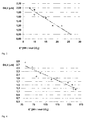
- FIGS. 2 to 5 show the results of test series, which were carried out with a pilot reactor or technical reactor.
- the characteristic mean particle size D4.3 against the specific energy input per mole of CO 2 introduced in the relevant part of the batch reaction is 0 to 90%.
- the characteristic particle size D4.3 was determined in each case with a Laser Diffraction Particle Sizer Mastersizer from Malvern.
- rhombohedral crystals with a grain size D4.3 in the range from approx. 0.8 ⁇ m to 2.0 ⁇ m in the pilot reactor ( FIG. 2 ) and technical reactor ( FIG. 3 ) produced.
- scalenohedral crystals with a particle size D4.3 in the range from about 1.1 ⁇ m to 3.0 ⁇ m in the pilot reactor ( FIG. 4 ) and technical reactor ( FIG. 5 ) produced.
- the CO 2 concentration, the fill level, the gas quantity as well as the rotational speed and the admission pressure of the gassing turbine were varied individually or in combination in the individual tests.
Landscapes
- Chemical & Material Sciences (AREA)
- Inorganic Chemistry (AREA)
- Organic Chemistry (AREA)
- Chemical Kinetics & Catalysis (AREA)
- General Chemical & Material Sciences (AREA)
- Life Sciences & Earth Sciences (AREA)
- Geology (AREA)
- Compounds Of Alkaline-Earth Elements, Aluminum Or Rare-Earth Metals (AREA)
- Paper (AREA)
Priority Applications (9)
| Application Number | Priority Date | Filing Date | Title |
|---|---|---|---|
| EP16172229.3A EP3252010A1 (fr) | 2016-05-31 | 2016-05-31 | Carbonate de calcium precipites (pcc) ayant une grosseur de grain et repartition de grosseur de grain definies et son procede de fabrication |
| PT177263266T PT3464182T (pt) | 2016-05-31 | 2017-05-31 | Carbonato de cálcio precipitado (pcc) com tamanho de grão e distribuição de tamanho de grão definidos |
| FIEP17726326.6T FI3464182T3 (fi) | 2016-05-31 | 2017-05-31 | Saostettu kalsiumkarbonaatti (pcc), jolla on määrätty raekoko ja raekokojakauma |
| PL17726326.6T PL3464182T3 (pl) | 2016-05-31 | 2017-05-31 | Strącany węglan wapnia (PCC) o określonej wielkości ziaren i określonym rozkładzie wielkości ziaren |
| EP22202092.7A EP4190751A1 (fr) | 2016-05-31 | 2017-05-31 | Carbonate de calcium précipité (pcc) ayant une granulométrie et une distribution granulométrique définies et son procédé de production |
| EP17726326.6A EP3464182B1 (fr) | 2016-05-31 | 2017-05-31 | Carbonate de calcium precipites (pcc) ayant une grosseur de grain et repartition de grosseur de grain definies |
| PCT/EP2017/063176 WO2017207642A1 (fr) | 2016-05-31 | 2017-05-31 | Carbonate de calcium précipité (ccp) présentant une taille de grains et une distribution granulométrique définies et son procédé de préparation |
| DE202017007732.9U DE202017007732U1 (de) | 2016-05-31 | 2017-05-31 | Präzipitiertes Calciumcarbonat (PCC) mit definierter Korngröße und Korngrößenverteilung |
| ES17726326T ES2936073T3 (es) | 2016-05-31 | 2017-05-31 | Carbonato de calcio precipitado (PCC) con tamaño de grano y distribución de tamaño de grano definidos |
Applications Claiming Priority (1)
| Application Number | Priority Date | Filing Date | Title |
|---|---|---|---|
| EP16172229.3A EP3252010A1 (fr) | 2016-05-31 | 2016-05-31 | Carbonate de calcium precipites (pcc) ayant une grosseur de grain et repartition de grosseur de grain definies et son procede de fabrication |
Publications (1)
| Publication Number | Publication Date |
|---|---|
| EP3252010A1 true EP3252010A1 (fr) | 2017-12-06 |
Family
ID=56108524
Family Applications (3)
| Application Number | Title | Priority Date | Filing Date |
|---|---|---|---|
| EP16172229.3A Withdrawn EP3252010A1 (fr) | 2016-05-31 | 2016-05-31 | Carbonate de calcium precipites (pcc) ayant une grosseur de grain et repartition de grosseur de grain definies et son procede de fabrication |
| EP17726326.6A Active EP3464182B1 (fr) | 2016-05-31 | 2017-05-31 | Carbonate de calcium precipites (pcc) ayant une grosseur de grain et repartition de grosseur de grain definies |
| EP22202092.7A Pending EP4190751A1 (fr) | 2016-05-31 | 2017-05-31 | Carbonate de calcium précipité (pcc) ayant une granulométrie et une distribution granulométrique définies et son procédé de production |
Family Applications After (2)
| Application Number | Title | Priority Date | Filing Date |
|---|---|---|---|
| EP17726326.6A Active EP3464182B1 (fr) | 2016-05-31 | 2017-05-31 | Carbonate de calcium precipites (pcc) ayant une grosseur de grain et repartition de grosseur de grain definies |
| EP22202092.7A Pending EP4190751A1 (fr) | 2016-05-31 | 2017-05-31 | Carbonate de calcium précipité (pcc) ayant une granulométrie et une distribution granulométrique définies et son procédé de production |
Country Status (7)
| Country | Link |
|---|---|
| EP (3) | EP3252010A1 (fr) |
| DE (1) | DE202017007732U1 (fr) |
| ES (1) | ES2936073T3 (fr) |
| FI (1) | FI3464182T3 (fr) |
| PL (1) | PL3464182T3 (fr) |
| PT (1) | PT3464182T (fr) |
| WO (1) | WO2017207642A1 (fr) |
Families Citing this family (1)
| Publication number | Priority date | Publication date | Assignee | Title |
|---|---|---|---|---|
| EP3252010A1 (fr) | 2016-05-31 | 2017-12-06 | HF Biotec Berlin GmbH | Carbonate de calcium precipites (pcc) ayant une grosseur de grain et repartition de grosseur de grain definies et son procede de fabrication |
Citations (4)
| Publication number | Priority date | Publication date | Assignee | Title |
|---|---|---|---|---|
| US6251356B1 (en) | 1999-07-21 | 2001-06-26 | G. R. International, Inc. | High speed manufacturing process for precipitated calcium carbonate employing sequential perssure carbonation |
| EP1222146B1 (fr) | 1999-09-09 | 2004-08-18 | Solvay Soda Deutschland GmbH | Procede de production en continu de carbonate de calcium precipite |
| EP1712597A1 (fr) | 2005-04-11 | 2006-10-18 | Omya Development AG | Procédé de préparation de carbonate de calcium précipité pour le revêtement de papier pour imprimante à jet d'encre et le carbonate de calcium précipité |
| EP2599750A1 (fr) * | 2011-11-29 | 2013-06-05 | HF Biotec Berlin GmbH | Procédé et installation de fabrication semi-continue de carbonate de calcium cristallin |
Family Cites Families (9)
| Publication number | Priority date | Publication date | Assignee | Title |
|---|---|---|---|---|
| US5364610A (en) | 1993-06-15 | 1994-11-15 | P. H. Glatfelter Company | Process for preparation of high opacity precipitated calcium carbonate by reacting sodium carbonate with calcium hydroxide |
| US6402824B1 (en) | 2000-05-26 | 2002-06-11 | J. M. Huber Corporation | Processes for preparing precipitated calcium carbonate compositions and the products thereof |
| PT2144851T (pt) | 2007-04-20 | 2016-07-14 | Omya Int Ag | Processo para produção de pcc |
| WO2009009553A1 (fr) | 2007-07-12 | 2009-01-15 | Imerys Pigments, Inc. | Aragonite fine et à forte inclinaison de la distribution de taille de particule pour revêtement |
| GB0917248D0 (en) | 2009-10-02 | 2009-11-18 | Calcitech Synthetic Minerals Ltd | Production of calcium carbonate |
| JP2012224535A (ja) | 2011-04-08 | 2012-11-15 | Oji Holdings Corp | 塗工用軽質炭酸カルシウム含有スラリー及びそれを用いた塗被紙 |
| EP2786967A1 (fr) | 2013-04-03 | 2014-10-08 | HF Biotec Berlin GmbH | Procédé et installation de fabrication de carbonate de calcium cristallin en utilisant deux gaz combinés ayant une teneur en CO2 différente |
| EP3252010A1 (fr) | 2016-05-31 | 2017-12-06 | HF Biotec Berlin GmbH | Carbonate de calcium precipites (pcc) ayant une grosseur de grain et repartition de grosseur de grain definies et son procede de fabrication |
| SI3252229T1 (sl) | 2016-05-31 | 2019-11-29 | Koehler Se August Papierfabrik | Papir, ki vsebuje skalenoedrijsko oborjeni kalcijev karbonat (S-PCC) |
-
2016
- 2016-05-31 EP EP16172229.3A patent/EP3252010A1/fr not_active Withdrawn
-
2017
- 2017-05-31 WO PCT/EP2017/063176 patent/WO2017207642A1/fr not_active Ceased
- 2017-05-31 DE DE202017007732.9U patent/DE202017007732U1/de active Active
- 2017-05-31 FI FIEP17726326.6T patent/FI3464182T3/fi active
- 2017-05-31 EP EP17726326.6A patent/EP3464182B1/fr active Active
- 2017-05-31 ES ES17726326T patent/ES2936073T3/es active Active
- 2017-05-31 PT PT177263266T patent/PT3464182T/pt unknown
- 2017-05-31 PL PL17726326.6T patent/PL3464182T3/pl unknown
- 2017-05-31 EP EP22202092.7A patent/EP4190751A1/fr active Pending
Patent Citations (4)
| Publication number | Priority date | Publication date | Assignee | Title |
|---|---|---|---|---|
| US6251356B1 (en) | 1999-07-21 | 2001-06-26 | G. R. International, Inc. | High speed manufacturing process for precipitated calcium carbonate employing sequential perssure carbonation |
| EP1222146B1 (fr) | 1999-09-09 | 2004-08-18 | Solvay Soda Deutschland GmbH | Procede de production en continu de carbonate de calcium precipite |
| EP1712597A1 (fr) | 2005-04-11 | 2006-10-18 | Omya Development AG | Procédé de préparation de carbonate de calcium précipité pour le revêtement de papier pour imprimante à jet d'encre et le carbonate de calcium précipité |
| EP2599750A1 (fr) * | 2011-11-29 | 2013-06-05 | HF Biotec Berlin GmbH | Procédé et installation de fabrication semi-continue de carbonate de calcium cristallin |
Non-Patent Citations (5)
| Title |
|---|
| BO FENG ET AL.: "Effect of various factors on the particle size of calcium carbonate formed in a precipitation process", MATERIALS SCIENCE AND ENGINEERING A, 2007, pages 170 - 179, XP005821990, DOI: doi:10.1016/j.msea.2006.09.010 |
| DISSERTATION: "Die Herstellung von gefälltem Calciumcarbonat - PCC", 1992, RWTH AACHEN |
| FENG ET AL: "Effect of various factors on the particle size of calcium carbonate formed in a precipitation process", MATERIALS SCIENCE AND ENGINEERING A: STRUCTURAL MATERIALS: PROPERTIES, MICROSTRUCTURES AND PROCESSING, ELSEVIER BV, NL, vol. 445-446, 18 January 2007 (2007-01-18), pages 170 - 179, XP005821990, ISSN: 0921-5093, DOI: 10.1016/J.MSEA.2006.09.010 * |
| KRALJ, BRECIVIC AUS CROATICA CHIMICA ACTA, vol. 80, no. 3-4, 2007, pages 467 - 484 |
| LAUT GERNOT KRAMMER ET AL., PART. PART. SYST. CHARACT, vol. 19, 2002, pages 348 - 353 |
Also Published As
| Publication number | Publication date |
|---|---|
| WO2017207642A1 (fr) | 2017-12-07 |
| PT3464182T (pt) | 2023-01-23 |
| EP3464182B1 (fr) | 2022-10-19 |
| EP3464182A1 (fr) | 2019-04-10 |
| ES2936073T3 (es) | 2023-03-14 |
| FI3464182T3 (fi) | 2023-01-31 |
| EP4190751A1 (fr) | 2023-06-07 |
| DE202017007732U1 (de) | 2025-07-10 |
| PL3464182T3 (pl) | 2023-03-20 |
Similar Documents
| Publication | Publication Date | Title |
|---|---|---|
| DE60224835T2 (de) | Vorrichtung und methode zur gezielten einstellung vor alkalinität und ph bei einem technischen verfahren | |
| DE69722054T2 (de) | Verfahren zum Aufbringen von Füllstoffen in eine Zellstofffaserpulpe | |
| DE69514600T2 (de) | Verfahren zur Herstellung von Persalzteilchen | |
| DE69011770T2 (de) | Verfahren und Vorrichtung zum Speisen einer Kegelstoffmühle. | |
| EP1828478A1 (fr) | Procede et dispositif de chargement de fibres ou de cellulose contenues dans une suspension au moyen d'une charge | |
| DE69105183T2 (de) | Niedergeschlagenes Calciumcarbonat. | |
| EP1222146B1 (fr) | Procede de production en continu de carbonate de calcium precipite | |
| EP3464182B1 (fr) | Carbonate de calcium precipites (pcc) ayant une grosseur de grain et repartition de grosseur de grain definies | |
| DE112016005020B4 (de) | Verfahren zum Herstellen eines Einkristall-Siliziums und Einkristall-Silizium | |
| DE102018116196A1 (de) | Verfahren und Anordnung zur Fest-Flüssig-Trennung von Suspensionen, insbesondere von Klärschlamm unter Zugabe von Flockungsmitteln | |
| DE1467418B2 (de) | Verfahren zur herstellung von russaufschlaemmungen zum einarbeiten in kautschuklatex | |
| DE69202612T2 (de) | Verfahren und Vorrichtung zum Feinmahlen von Material zur Verwendung als Füllstoff. | |
| EP2970082A1 (fr) | Procedes de production de cristaux d'acide dicarboxylique coulants | |
| EP3252229B1 (fr) | Papier contenant du carbonate de calcium (s-pcc) precipite a non-echelle | |
| AT521179B1 (de) | Verfahren zur Isolierung von Lignin aus einem alkalischen Prozessstrom | |
| DE69505313T2 (de) | Verfahren zur Herstellung eines radialen Füllstoffes, insbesondere zur Verwendung in der Papierindustrie, Füllstoff hergestellt aus Anhydrit II und Halbhydrat und eine für die Herstellung dieses Füllstoffs verwendbare Zusammensetzung | |
| DE102023123081A1 (de) | Vorrichtung zum Bestimmen einer rheologischen Eigenschaft einer Suspension aus Fasern umfassendem Material zum Herstellen von Behältern | |
| EP3325679A1 (fr) | Procédé de réduction de fer trivalent dans la production de dioxyde de titane dans le procédé au sulfate | |
| EP1678373B1 (fr) | Procede de regulation du blanc pour l'elimination des couleurs d'impression dans des installations de desencrage, et installation de desencrage comportant une cellule de flottation pour l'elimination des couleurs d'impression | |
| DE2246818A1 (de) | Kontinuierliches verfahren zur herstellung von kristallinem bariumsulfat grosser teilchengroesse | |
| DE10106312A1 (de) | Regelungsverfahren | |
| EP2764923A1 (fr) | Procédé de commande et/ou de réglage d'une installation de broyage ainsi que l'installation de broyage | |
| EP4023662A1 (fr) | Procédé de génération de la méthionyl-méthionine particulaire | |
| DE102004005080A1 (de) | Kontinuierliche gesteuerte Streichfarbenaufbereitung | |
| DE2406672A1 (de) | Verfahren zur herstellung von siliciumdioxyd |
Legal Events
| Date | Code | Title | Description |
|---|---|---|---|
| PUAI | Public reference made under article 153(3) epc to a published international application that has entered the european phase |
Free format text: ORIGINAL CODE: 0009012 |
|
| STAA | Information on the status of an ep patent application or granted ep patent |
Free format text: STATUS: THE APPLICATION HAS BEEN PUBLISHED |
|
| AK | Designated contracting states |
Kind code of ref document: A1 Designated state(s): AL AT BE BG CH CY CZ DE DK EE ES FI FR GB GR HR HU IE IS IT LI LT LU LV MC MK MT NL NO PL PT RO RS SE SI SK SM TR |
|
| AX | Request for extension of the european patent |
Extension state: BA ME |
|
| STAA | Information on the status of an ep patent application or granted ep patent |
Free format text: STATUS: REQUEST FOR EXAMINATION WAS MADE |
|
| STAA | Information on the status of an ep patent application or granted ep patent |
Free format text: STATUS: EXAMINATION IS IN PROGRESS |
|
| 17P | Request for examination filed |
Effective date: 20180606 |
|
| RBV | Designated contracting states (corrected) |
Designated state(s): AL AT BE BG CH CY CZ DE DK EE ES FI FR GB GR HR HU IE IS IT LI LT LU LV MC MK MT NL NO PL PT RO RS SE SI SK SM TR |
|
| 17Q | First examination report despatched |
Effective date: 20180713 |
|
| STAA | Information on the status of an ep patent application or granted ep patent |
Free format text: STATUS: THE APPLICATION HAS BEEN WITHDRAWN |
|
| 18W | Application withdrawn |
Effective date: 20181023 |