EP3255093B1 - Composition de caoutchouc, procédé de production associé et procédé d'évaluation de la résistance à l'usure d'une composition de caoutchouc - Google Patents
Composition de caoutchouc, procédé de production associé et procédé d'évaluation de la résistance à l'usure d'une composition de caoutchouc Download PDFInfo
- Publication number
- EP3255093B1 EP3255093B1 EP17168551.4A EP17168551A EP3255093B1 EP 3255093 B1 EP3255093 B1 EP 3255093B1 EP 17168551 A EP17168551 A EP 17168551A EP 3255093 B1 EP3255093 B1 EP 3255093B1
- Authority
- EP
- European Patent Office
- Prior art keywords
- rubber composition
- sulfur
- kneading
- rubber component
- correlation length
- Prior art date
- Legal status (The legal status is an assumption and is not a legal conclusion. Google has not performed a legal analysis and makes no representation as to the accuracy of the status listed.)
- Active
Links
Images

Classifications
-
- C—CHEMISTRY; METALLURGY
- C08—ORGANIC MACROMOLECULAR COMPOUNDS; THEIR PREPARATION OR CHEMICAL WORKING-UP; COMPOSITIONS BASED THEREON
- C08L—COMPOSITIONS OF MACROMOLECULAR COMPOUNDS
- C08L21/00—Compositions of unspecified rubbers
-
- C—CHEMISTRY; METALLURGY
- C08—ORGANIC MACROMOLECULAR COMPOUNDS; THEIR PREPARATION OR CHEMICAL WORKING-UP; COMPOSITIONS BASED THEREON
- C08C—TREATMENT OR CHEMICAL MODIFICATION OF RUBBERS
- C08C19/00—Chemical modification of rubber
- C08C19/25—Incorporating silicon atoms into the molecule
-
- C—CHEMISTRY; METALLURGY
- C08—ORGANIC MACROMOLECULAR COMPOUNDS; THEIR PREPARATION OR CHEMICAL WORKING-UP; COMPOSITIONS BASED THEREON
- C08L—COMPOSITIONS OF MACROMOLECULAR COMPOUNDS
- C08L9/00—Compositions of homopolymers or copolymers of conjugated diene hydrocarbons
- C08L9/06—Copolymers with styrene
-
- G—PHYSICS
- G01—MEASURING; TESTING
- G01N—INVESTIGATING OR ANALYSING MATERIALS BY DETERMINING THEIR CHEMICAL OR PHYSICAL PROPERTIES
- G01N33/00—Investigating or analysing materials by specific methods not covered by groups G01N1/00 - G01N31/00
- G01N33/44—Resins; Plastics; Rubber; Leather
- G01N33/445—Rubber
Definitions
- the present invention relates to a rubber composition and a production method therefor.
- a rubber composition used for a tire tread portion generally tends to have better wear resistance as the glass transition temperature (Tg) of a rubber component used therein decreases (see, for example, Japanese Laid-Open Patent Publication No. 2013-7025 ).
- Tg glass transition temperature
- One factor of this is thought to be that as the Tg decreases, the elastic modulus of the rubber composition decreases in the frequency range of stimulation received from unevenness of a road surface, so that the rubber composition easily follows the unevenness of the road surface.
- the wear resistance does not necessarily improve when the Tg decreases, and there are some exceptions. Hitherto, the wear phenomenon of rubber has been observed by various methods in order to unravel the mechanism for creation of such exceptions, but the mechanism has not fully been unraveled.
- EP 2 735 861 A1 A method for evaluating energy loss in a polymeric material based on X-ray or neutron scattering measurements is described in EP 2 735 861 A1 .
- EP 2 749 874 A1 discloses a method for evaluating rebound resilience of a polymer material based on X-ray or neutron scattering measurements.
- EP 2 803 982 A1 describes a method of evaluating a neutron scattering length density of scatterers in a material using a scattering intensity curve obtained by an X-ray scattering measurement.
- a method of producing a conjugated diene polymer and a rubber composition comprising a rubber component which contains the conjugated diene polymer is described in EP 1 958 971 A1 .
- EP 2 098 554 A1 A method for producing a modified conjugated diene polymer and a rubber composition comprising the modified conjugated diene polymer as a rubber component is known from EP 2 098 554 A1 .
- EP 2 557 410 A2 describes a method for estimating wear resistance of a tread portion of a tire.
- a process of producing a rubber composition containing a rubber component containing emulsion-polymerized styrene-butadiene copolymer rubber is disclosed in EP 2 799 482 A1 .
- the present invention has been made in order to solve the above problem, and an object of the present invention is to provide a rubber composition having excellent wear resistance and a production method therefor.
- a standard deviation ( ⁇ c of a maximum value ⁇ c of a correlation length ⁇ 1 of 10 nm to 100 ⁇ m obtained by performing curve-fitting with specific expressions on a scattering intensity curve obtained by performing X-ray scattering measurement or neutron scattering measurement in a specific region exhibits a high correlation with the wear resistance of a rubber composition, and the wear resistance tends to become more favorable as the standard deviation ⁇ c decreases.
- the present inventors have found that particularly favorable wear resistance is achieved with a rubber composition which contains a rubber component having a glass transition temperature of not higher than -20°C and in which a maximum value ⁇ c and a standard deviation ⁇ c satisfy a relationship of ⁇ c ⁇ ⁇ c /2, and have arrived at the present invention.
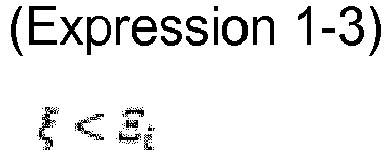
- the present invention is directed to a rubber composition in which a relationship between: a maximum value ⁇ c of a correlation length ⁇ i of 10 nm to 100 ⁇ m obtained by performing curve-fitting with the following (Expression 1-2) to (Expression 1-7) on a scattering intensity curve I(q) obtained by performing X-ray scattering measurement or neutron scattering measurement in a region of q represented by the following (Expression 1); and a standard deviation ⁇ c of the maximum value ⁇ c is ⁇ c ⁇ ⁇ c /2, the rubber composition containing a rubber component having a glass transition temperature of not higher than -20°C. [Math.
- the rubber component is preferably a polymer of one or more conjugated diene compounds.
- the rubber composition is preferably used for a tire member.
- the X-ray scattering measurement is small-angle X-ray scattering measurement
- the neutron scattering measurement is small-angle neutron scattering measurement
- the X-ray scattering measurement or the neutron scattering measurement is preferably performed in a region of q that is not greater than 10 nm -1 .
- the present invention is also directed to a production method for the rubber composition according to any one of claims 1 to 5, the production method comprising the step of kneading the rubber component, a sulfur donor, and a sulfur atom-containing vulcanization accelerator before the rubber component and a filler are kneaded, then adding the filler to an obtained kneaded product, and performing kneading at a kneading temperature of not lower than 120°C.
- the rubber composition in which the relationship between: the maximum value ⁇ c of the correlation length ⁇ i of 10 nm to 100 ⁇ m obtained by performing curve-fitting with the above (Expression 1-2) to (Expression 1-7) on the scattering intensity curve I(q) obtained by performing X-ray scattering measurement or neutron scattering measurement in a region of q represented by the above (Expression 1); and the standard deviation ⁇ c of the maximum value ⁇ c is ⁇ c ⁇ ⁇ c /2, the rubber composition containing a rubber component having a glass transition temperature of not higher than -20°C.
- FIG. 1 shows an example of a scattering intensity curve obtained by SANS measurement.
- the present invention is a rubber composition in which a relationship between: a maximum value ⁇ c of a correlation length ⁇ i of 10 nm to 100 ⁇ m obtained by performing curve-fitting with the above (Expression 1-2) to (Expression 1-7) on a scattering intensity curve I(q) obtained by performing X-ray scattering measurement or neutron scattering measurement in a region of q represented by the above (Expression 1); and a standard deviation ⁇ c of the maximum value ⁇ c is ⁇ c ⁇ ⁇ c /2, the rubber composition containing a rubber component having a glass transition temperature of not higher than -20°C.
- small-angle X-ray scattering SAXS (scattering angle: normally 10 degrees or less) measurement in which a rubber composition is irradiated with X-rays and a scattering intensity is measured.
- SAXS scattering angle: normally 10 degrees or less
- the X-rays having a small scattering angle are measured, whereby structure information of the substance is obtained, so that an ordered structure such as the microphase-separated structure of a polymeric material can be analyzed at a level of several nanometers.
- X-rays emitted from a synchrotron preferably have a brightness of not less than at least 10 10 (photons/s/mrad 2 /mm 2 /0.1% bw).
- the "bw" represents the band width of the X-rays emitted from the synchrotron.
- Examples of such a synchrotron include the beamlines BL03XU and BL20XU at the large-scale synchrotron radiation facility SPring-8 of the Japan Synchrotron Radiation Research Institute, which is an incorporated foundation.
- the brightness (photons/s/mrad 2 /mm 2 /0.1% bw) of the X-rays is preferably not less than 10 10 and more preferably not less than 10 12 .
- the upper limit thereof is not particularly limited, but the intensity of the X-rays is preferably not greater than the intensity that does not cause radiation damage.
- the number of photons (photons/s) in the X-rays is preferably not less than 10 7 and more preferably not less than 10 9 .
- the upper limit thereof is not particularly limited, but the intensity of the X-rays is preferably not greater than the intensity that does not cause radiation damage.
- small-angle neutron scattering SANS (scattering angle: normally 10 degrees or less)
- SANS scattering angle: normally 10 degrees or less
- structure information of the substance is obtained, so that an ordered structure such as the microphase-separated structure of a polymeric material can be analyzed at a level of several nanometers.
- a deuteration technique for example, a polymeric material is swollen in a deuterated solvent, and the polymeric material in equilibrium in the deuterated solvent is then irradiated with neutron rays to measure the scattering intensity.
- the neutron rays used for neutron scattering measurement such as SANS may be obtained by using, for example, the beamline SANS-J at JRR-3 of the Japan Atomic Energy Agency, which is an independent administrative agency, etc.
- the neutron flux intensity of the neutron rays is preferably not less than 10 3 and more preferably not less than 10 4 .
- the upper limit thereof is not particularly limited, but the neutron flux intensity is preferably not greater than the neutron flux intensity that does not cause radiation damage.
- the scattered X-rays in the SAXS measurement are detected by an X-ray detector, and an image is then generated by an image processor or the like using X-ray detection data from the X-ray detector.
- a two-dimensional detectors e.g., an X-ray film, a nuclear emulsion plate, an X-ray image pickup tube, an X-ray fluorescent amplifier tube, an X-ray image intensifier, an X-ray imaging plate, a CCD for X-rays, an amorphous body for X-rays, etc.
- a one-dimensional detector a line sensor
- the X-ray detector may be appropriately selected according to the type and the state of a polymeric material to be analyzed, and the like.
- Any ordinary image processor that can generate an X-ray scattering image on the basis of X-ray detection data from the X-ray detector can be appropriately used.
- the SANS measurement can also be performed on the basis of the same principle as in the SAXS measurement.
- the scattered neutron rays are detected by a neutron ray detector, and an image is then generated by an image processor or the like using neutron ray detection data from the neutron ray detector.
- an image processor or the like using neutron ray detection data from the neutron ray detector.
- any known two-dimensional detector or one-dimensional detector can be used as the neutron ray detector
- any known image processor that can generate a neutron ray scattering image can be used as the image processor. These devices may be appropriately selected.
- a correlation length ⁇ i of 10 nm to 100 ⁇ m, a maximum value ⁇ c thereof, and a standard deviation ⁇ c of the maximum value ⁇ c can be calculated by performing measurement such as the SAXS measurement or the SANS measurement and analyzing the obtained scattering intensity curve by the following method.
- the correlation length ⁇ is presumed to correspond to the distance between crosslinking points in the polymer
- the correlation length ⁇ i is presumed to correspond to the size of an ununiform network structure in the polymer.
- the standard deviation ⁇ c of the maximum value ⁇ c of the correlation length ⁇ i has a high correlation with wear resistance, and the wear resistance becomes more favorable as ⁇ c decreases.
- the Gaussian function is used on the assumption that ⁇ i has a normal distribution.
- a gamma function, a Weibull function, or the like may be used as another distribution function.
- a rubber composition having excellent wear resistance is obtained by performing adjustment so as to satisfy a relationship of ⁇ c ⁇ ⁇ c /2.
- ⁇ c and ⁇ c preferably satisfy a relationship of ⁇ c ⁇ ⁇ c /3 and more preferably satisfy a relationship of ⁇ c ⁇ ⁇ c /4.
- ⁇ c and ⁇ c only need to satisfy the above relationship, but for the reason that more favorable wear resistance is achieved, ⁇ c is preferably 500 to 1800 nm and more preferably 600 to 1500 nm, and ⁇ c is preferably 50 to 500 nm and more preferably 100 to 300 nm.
- ⁇ i , ⁇ c , and ⁇ c can be adjusted on the basis of the types and the blending amounts of chemicals such as the rubber component, a filler, and the like to be blended in the rubber composition.
- ⁇ i , ⁇ c , and ⁇ c can also be adjusted on the basis of a kneading method.
- a rubber composition that satisfies the relationship of ⁇ c ⁇ ⁇ c /2 can easily be prepared by a production method including a step of kneading the rubber component, a sulfur donor, and a sulfur atom-containing vulcanization accelerator before the rubber component and a filler are kneaded, then adding the filler to the obtained kneaded product, and performing kneading at a kneading temperature of not lower than 120°C.
- the active sulfur, the sulfur atom-containing vulcanization accelerator, and the rubber component react with each other to obtain a state where the entirety or a part (hereinafter, "vulcanization accelerator residue") of the sulfur atom-containing vulcanization accelerator is bonded to the rubber component, that is, a state where a pendant type structure is formed in which "-S- vulcanization accelerator residue" is bonded to the rubber component.
- the mechanism of this reaction is inferred to be that the released active sulfur reacts with the sulfur atoms of the sulfur atom-containing vulcanization accelerator to form a structure in which two or more sulfur atoms are bonded, and the structure portion and the double-bond portion of the rubber component react with each other.
- the kneading temperature is the actual measured temperature of the kneaded product in a kneading machine and can be measured by a noncontact type temperature sensor or the like.
- the production method is characterized in that: kneading of the rubber component, the sulfur donor, and the sulfur atom-containing vulcanization accelerator is started before the filler is kneaded; and kneading is performed at a kneading temperature of not lower than 120°C after the filler is added, as described above. As long as the above requirements are met, any of the materials may be added in any step.
- the kneading step includes two steps composed of a step X and a step F
- kneading of the rubber component, the sulfur donor, and the sulfur atom-containing vulcanization accelerator may be started at the initial stage of the step X
- the filler may be added and kneading may be performed at a kneading temperature of not lower than 120°C in the middle of the step X, and then the step F may be performed.
- the kneading step includes three steps composed of a step X, a step Y, and a step F
- kneading of the rubber component, the sulfur donor, and the sulfur atom-containing vulcanization accelerator may be started in the step X
- the filler may be added and kneading may be performed at a kneading temperature of not lower than 120°C in the subsequent step Y, and then step F may be performed.
- kneading of the rubber component, the sulfur donor, and the sulfur atom-containing vulcanization accelerator may be started at the initial stage of the step X, the filler may be added and kneading may be performed at a kneading temperature of not lower than 120°C in the middle of the step X, and then step Y and the step F may be performed; or kneading of the rubber component, the sulfur donor, and the sulfur atom-containing vulcanization accelerator may be started at the initial stage of the step X, the filler may be added in the middle of the step X, the filler may be further added and kneading may be performed at a kneading temperature of not lower than 120°C in the subsequent step Y, and then the step F may be performed. Re-milling may be performed between the respective steps.
- the kneading temperature at which the rubber component, the sulfur donor, and the sulfur atom-containing vulcanization accelerator are kneaded is not particularly limited. However, from the standpoint of inhibiting progress of a crosslinking reaction caused by the sulfur donor and the sulfur atom-containing vulcanization accelerator, the kneading temperature is preferably less than 160°C and more preferably not higher than 150°C. The lower limit thereof is not particularly limited, but the kneading temperature is preferably not lower than 60°C.
- the kneading time for which the rubber component, the sulfur donor, and the sulfur atom-containing vulcanization accelerator are kneaded before the filler is added to the rubber component is not particularly limited.
- the kneading time is, for example, not shorter than 10 seconds.
- the upper limit thereof is not particularly limited, but the kneading time is preferably not longer than 8 minutes.
- the kneading temperature after the filler is added only needs to be not lower than 120°C. However, from the standpoint of inhibiting excessive progress of a crosslinking reaction, the kneading temperature is preferably not lower than 170°C.
- the kneading time after the filler is added to the rubber component and the kneading temperature reaches 120°C is not particularly limited.
- the kneading time is preferably not shorter than 2 minutes.
- the upper limit thereof is not particularly limited, but the kneading time is preferably not longer than 10 minutes.
- This kneading time is the time from the time point at which the filler is added to the rubber component and the kneading temperature reaches 120°C to the time point at which all the steps of the kneading step end.
- this kneading time is the time from this time point to the time point at which the step F (final kneading step) ends.
- a rubber component having a glass transition temperature (Tg) of not higher than -20°C is used. Accordingly, the rubber composition easily follows unevenness of a road surface, and favorable wear resistance is achieved.
- the glass transition temperature is preferably not higher than -22°C and more preferably not higher than -24°C.
- the lower limit thereof is not particularly limited, but the glass transition temperature is preferably not lower than -35°C.
- the Tg is a value obtained by measuring the entire rubber component blended in the rubber composition by a method in Examples.
- the glass transition temperature (Tg) is a value obtained by measuring a mixture of the plurality of types.
- the rubber component is not particularly limited as long as the Tg satisfies the above temperature range.
- a polymer in which one or more conjugated diene compounds such as isoprene and butadiene are used can be used. More specifically, as the rubber component, natural rubber (NR), isoprene rubber (IR), butadiene rubber (BR), styrene butadiene rubber (SBR), acrylonitrile butadiene rubber (NBR), chloroprene rubber (CR), isobutylene-isoprene-rubber (IIR), halogenated isobutylene-isoprene-rubber (X-IIR), styrene-isoprene-butadiene rubber (SIBR), or the like can be used. One of them may be used singly, or two or more of them may be used in combination. Among them, the SBR and the BR are preferable.
- the SBR is preferably modified SBR in which the main chain thereof is modified by a nitrogen-containing compound, and at least one terminal thereof is modified by a terminal modifier.
- the nitrogen-containing compound include 3- or 4-(2-azetidinoethyl)styrene, 3- or 4-(2-pyrrolidinoethyl)styrene, 3- or 4-(2-piperidinoethyl)styrene, and 3- or 4-(2-hexamethyleneiminoethyl)styrene.
- 3- or 4-(2-pyrrolidinoethyl)styrene is preferable.
- the terminal modifier is preferably a silicon-containing compound, and examples thereof include 3-(N,N-dimethylaminopropyl)trimethoxysilane, 3-(N,N-diethylaminopropyl)trimethoxysilane, 3-(N,N-dimethylaminopropyl)triethoxysilane, 3-(N,N-diethylaminopropyl)triethoxysilane, 3-glycidoxypropyltrimethoxysilane, 2-(4-pyridylethyl)triethoxysilane, N-(3-triethoxysilylpropyl)-4,5-dihydroimidazole, and silicon tetrachloride. Among them, 3-(N,N-dimethylaminopropyl)trimethoxysilane is preferable.
- the amount of the SBR in 100% by mass of the rubber component is preferably not less than 30% by mass and more preferably not less than 50% by mass, and is preferably not greater than 85% by mass and more preferably not greater than 75% by mass.
- the amount of the BR in 100% by mass of the rubber component is preferably not less than 15% by mass and more preferably not less than 25% by mass, and is preferably not greater than 70% by mass and more preferably not greater than 50% by mass.
- a reinforcing filler such as silica and carbon black which are generally used in the tire field can be used.
- the amount of silica with respect to 100 parts by mass of the rubber component is preferably not less than 30 parts by mass and more preferably not less than 60 parts by mass, and is preferably not greater than 120 parts by mass and more preferably not greater than 90 parts by mass.
- the amount of carbon black with respect to 100 parts by mass of the rubber component is preferably not less than 1 part by mass and more preferably not less than 3 parts by mass, and is preferably not greater than 20 parts by mass and more preferably not greater than 10 parts by mass.
- the sulfur donor is elemental sulfur or a sulfur compound that releases active sulfur under a vulcanization condition (e.g., 150°C, 1.5 MPa) or at a temperature lower than 150°C and under a pressure lower than 1.5 MPa.
- the sulfur donor is a compound that generally functions as a vulcanizing agent under a vulcanization condition (e.g., 150°C, 1.5 MPa) or at a temperature lower than 150°C and under a pressure lower than 1.5 MPa.
- the released active sulfur forms a part of the above-described pendant type structure.
- elemental sulfur and/or the above-described sulfur compound that releases active sulfur can be used.
- the elemental sulfur include powdery sulfur, precipitated sulfur, colloidal sulfur, surface-treated sulfur, and insoluble sulfur.
- the amount of the elemental sulfur to be added before the rubber component and the filler are kneaded is preferably not greater than 0.1 parts by mass with respect to 100 parts by mass of the rubber component (the total amount of the rubber component to be used in all the steps). In addition, the amount is preferably not less than 0.05 parts by mass from the standpoint of breaking strength.
- Examples of the sulfur compound that serves as the sulfur donor include a polymeric polysulfide represented by -(-M-S-C-) n -, and a compound that has a structure -S n - (n ⁇ 2) in which two or more sulfur atoms are each bonded by single bond and that releases active sulfur.
- Examples of the compound include alkylphenol disulfide, morpholine disulfide, thiuram-based vulcanization accelerators having -S n - (n ⁇ 2) (tetramethylthiuram disulfide (TMTD), tetraethylthiuram disulfide (TETD), tetrabutylthiuram disulfide (TBTD), dipentamethylenethiuram tetrasulfide (DPTT), etc.), 2-(4'-morpholinodithio)benzothiazole (MDB), and polysulfide type silane coupling agents (e.g., Si69 manufactured by Evonik Industries Ag (bis(3-triethoxysilylpropyl)tetrasulfide)).
- TMTD tetramethylthiuram disulfide
- TETD tetraethylthiuram disulfide
- TBTD tetrabutylthiuram disulfide
- thiuram-based vulcanization accelerators having -S n - (n ⁇ 2) are preferable, and dipentamethylenethiuram tetrasulfide (DPTT) is more preferable.
- the amount of the sulfur compound to be added before the rubber component and the filler are kneaded is preferably not less than 0.1 parts by mass and more preferably not less than 0.2 parts by mass, with respect to 100 parts by mass of the rubber component (the total amount of the rubber component to be used in all the steps), for the reason of accelerating formation of the pendant type structure.
- the amount is preferably not greater than 5 parts by mass, more preferably not greater than 3 parts by mass, and further preferably not greater than 2 parts by mass.
- the sulfur atom-containing vulcanization accelerator refers to a vulcanization accelerator containing a sulfur atom that is bonded to another molecule by single bond.
- the sulfur atom-containing vulcanization accelerator include a sulfur atom-containing vulcanization accelerator that releases active sulfur, and a sulfur atom-containing vulcanization accelerator that does not release active sulfur. From the standpoint of inhibiting progress of a crosslinking reaction during kneading, a sulfur atom-containing vulcanization accelerator that does not release active sulfur (a sulfur non-releasing type sulfur atom-containing vulcanization accelerator) is preferable.
- the sulfur atom-containing vulcanization accelerators there are vulcanization accelerators that serve as a sulfur donor (e.g., a vulcanization accelerator containing a sulfur atom that is bonded to another molecule by single bond). Therefore, it is possible to form the pendant type structure also by blending one of the sulfur atom-containing vulcanization accelerators that serve as a sulfur donor, in a large amount, or by using two or more of the sulfur atom-containing vulcanization accelerators, in combination.
- the sulfur atom-containing vulcanization accelerator that serves as a sulfur donor is blended in a large amount, a crosslinking reaction during kneading may excessively progress.
- the sulfur donor and the sulfur atom-containing vulcanization accelerator that are kneaded before the filler is added is preferably a combination of a sulfur donor (the sulfur atom-containing vulcanization accelerator that serves as a sulfur donor and/or a sulfur donor other than the sulfur atom-containing vulcanization accelerator) and the sulfur non-releasing type sulfur atom-containing vulcanization accelerator (a sulfur atom-containing vulcanization accelerator that does not serve as a sulfur donor).
- the sulfur non-releasing type sulfur atom-containing vulcanization accelerator refers to, for example, a sulfur atom-containing vulcanization accelerator that does not release active sulfur under a vulcanization condition (e.g., 150°C, 1.5 MPa) or at a temperature lower than 150°C and under a pressure lower than 1.5 MPa.
- a sulfur atom-containing vulcanization accelerator that does not release active sulfur under a vulcanization condition (e.g., 150°C, 1.5 MPa) or at a temperature lower than 150°C and under a pressure lower than 1.5 MPa.
- the sulfur non-releasing type sulfur atom-containing vulcanization accelerator is a sulfur atom-containing vulcanization accelerator that does not function as a vulcanizing agent under a vulcanization condition (e.g., 150°C, 1.5 MPa) or at a temperature lower than 150°C and under a pressure lower than 1.5 MPa.
- sulfur non-releasing type sulfur atom-containing vulcanization accelerator examples include thiazole-based vulcanization accelerators not having -S n - (n ⁇ 2) (2-mercaptobenzothiazole (MBT), the zinc salt of 2-mercaptobenzothiazole (ZnMBT), the cyclohexylamine salt of 2-mercaptobenzothiazole (CMBT), etc.), sulfenamide-based vulcanization accelerators not having -S n - (n ⁇ 2) (N-cyclohexyl-2-benzothiazolylsulfenamide (CBS), N-(tert-butyl)-2-benzothiazolesulfenamide (TBBS), N,N-dicyclohexyl-2-benzothiazolylsulfenamide, etc.), tetramethylthiuram monosulfide (TMTM), and dithiocarbamate-based vulcanization accelerators not having -S n - (n
- sulfenamide-based vulcanization accelerators not having -S n - (n ⁇ 2) are preferable, and N-(tert-butyl)-2-benzothiazolesulfenamide (TBBS) is more preferable.
- Di-2-benzothiazolyldisulfide which is a thiazole-based vulcanization accelerator, is a vulcanization accelerator that has -S n - (n ⁇ 2) and releases sulfur, but can be used as an equivalent to the sulfur non-releasing type sulfur atom-containing vulcanization accelerator, since di-2-benzothiazolyldisulfide (MBTS) does not function as a vulcanizing agent with respect to natural rubber or butadiene rubber when being blended in an ordinary amount.
- MBTS di-2-benzothiazolyldisulfide
- the amount of the sulfur atom-containing vulcanization accelerator to be added before the rubber component and the filler are kneaded is preferably not less than 1.0 part by mass and more preferably not less than 1.5 parts by mass, with respect to 100 parts by mass of the rubber component (the total amount of the rubber component to be used in all the steps), for the reason that a vulcanization reaction in a vulcanization step efficiently progresses.
- the amount is preferably not greater than 5 parts by mass and more preferably not greater than 3 parts by mass.
- an additional sulfur donor may further be kneaded in a step other than the step before the rubber component and the filler are kneaded.
- the additional sulfur donor is added, for example, at the latter stage of the step X or in the step Y in which the filler is added to the rubber component and kneading is performed at a kneading temperature of not lower than 120°C, or in the step F after the filler is added to the rubber component and kneading is performed at a kneading temperature of not lower than 120°C.
- the additional sulfur donor may be the same type as or different from the sulfur donor kneaded before the filler is added to the rubber component, and examples of the additional sulfur donor include powdery sulfur, precipitated sulfur, colloidal sulfur, surface-treated sulfur, and insoluble sulfur.
- the amount of the additional sulfur donor is not particularly limited. However, for the reason that a vulcanization reaction efficiently progresses in the vulcanization step, the amount of the additional sulfur donor with respect to 100 parts by mass of the rubber component (the total amount of the rubber component to be used in all the steps) is preferably not less than 0.5 parts by mass and more preferably not less than 0.8 parts by mass. For the reason that the wear resistance is excellent, the amount of the additional sulfur donor is preferably not greater than 3.0 parts by mass and more preferably not greater than 2.5 parts by mass.
- an additional vulcanization accelerator may be added.
- the additional vulcanization accelerator include: thiuram-based disulfides, polysulfides, and the like, which are sulfur atom-containing vulcanization accelerators; and guanidine-based, aldehyde-amine-based, aldehyde-ammonia-based, imidazoline-based vulcanization accelerators, which are vulcanization accelerators not having any sulfur atom.
- the amount of the additional vulcanization accelerator is not particularly limited.
- the amount of the additional vulcanization accelerator with respect to 100 parts by mass of the rubber component is preferably not less than 0.1 parts by mass and more preferably not less than 1 part by mass.
- the amount is preferably not greater than 5 parts by mass and more preferably not greater than 3 parts by mass.
- the rubber composition (vulcanized rubber composition) of the present invention is obtained by vulcanizing an unvulcanized rubber composition obtained through the step F, by an ordinary method.
- the rubber composition of the present invention can suitably be used for a tire member such as a tread, since the rubber composition has excellent wear resistance.
- the rubber composition of the present invention may be extruded in an unvulcanized state into the shape of a tread or the like, shaped on a tire forming machine by an ordinary method, and attached together with other tire members to form an unvulcanized tire (green tire), and then the unvulcanized tire may be heated and pressurized in a vulcanizer.
- Example and Comparative Examples Various chemicals used in Example and Comparative Examples are listed below.
- Step X various chemicals shown in Step X were kneaded in a 1.7-L Banbury mixer at a discharge temperature of 100°C for 5 minutes (step X).
- step Y the kneaded product in the step X and various chemicals shown in Step Y were kneaded in the 1.7-L Banbury mixer at a temperature of not lower than 140°C for 30 seconds, and were further kneaded at a discharge temperature of 150°C for 3 minutes (step Y).
- step F open roll
- the obtained unvulcanized rubber composition was extruded into the shape of a tread by using an extruder having a die with a predetermined shape, and attached together with other tire members to form an unvulcanized tire, and press vulcanization was performed under a condition of 170°C for 12 minutes, to produce a test tire (tire size: 195/65R15).
- the obtained test tire was evaluated as described below. The results are shown in Table 1.
- a plate-like sample (molded product) having a thickness of about 1 mm was swollen to equilibrium in deuterated toluene, and mounted to a sample holder. The sample was then irradiated with neutron rays at room temperature. Absolute scattering intensity curves obtained by measuring the sample at distances of 2.5 m and 10 m from the sample to a detector and by measuring the sample with a focusing lens were combined by the least squares method. These three curves were combined by fixing the scattering intensity curve obtained by measuring the sample at a distance of 2.5 m from the sample to the detector, and shifting the scattering intensity curves obtained by measuring the sample at a distance 10 m from the sample to the detector and by measuring the sample with the focusing lens.
- Curve-fitting was performed on the obtained scattering intensity curve I(q) by using (Expression 1-2) to (Expression 1-7), a fitting parameter ⁇ i (a correlation length of 10 nm to 100 ⁇ m (the size of the ununiform network structure of the polymer)) was obtained by a least-squares method, and a maximum value ⁇ c of the correlation length ⁇ i and a standard deviation ⁇ c thereof were calculated.
- ⁇ i a correlation length of 10 nm to 100 ⁇ m (the size of the ununiform network structure of the polymer)
- Two-dimensional detector 3 He two-dimensional detector and two-dimensional photomultiplier + ZnS/ 6 LiF detector
- the glass transition temperature of a mixture of the rubber components used in each example was measured under a condition of a temperature rising rate of 10°C/min according to JIS-K7121 by using a differential scanning calorimeter (Q200) manufactured by TA Instruments Japan Inc.
- the above test tire was mounted to a front wheel drive vehicle produced in Japan.
- the groove depth of the tire tread portion was measured after running for 8000 km, and a running distance when the tire groove depth was reduced by 1 mm was calculated, and indexed by the following expression. The higher the index is, the more favorable the wear resistance is.
- Running distance when tire groove of each composition was reduced by 1 mm / Running distance when tire groove of Comparative Example 1 was reduced by 1 mm ⁇ 100
Landscapes
- Chemical & Material Sciences (AREA)
- Health & Medical Sciences (AREA)
- Chemical Kinetics & Catalysis (AREA)
- Medicinal Chemistry (AREA)
- Polymers & Plastics (AREA)
- Organic Chemistry (AREA)
- General Chemical & Material Sciences (AREA)
- Compositions Of Macromolecular Compounds (AREA)
- Tires In General (AREA)
- Processes Of Treating Macromolecular Substances (AREA)
Claims (6)
- Composition de caoutchouc dans laquelle une relation entre : une valeur maximale Ξc d'une longueur de corrélation Ξi de 10 nm à 100 µm obtenue en effectuant une adaptation de courbe avec de (l'expression 1-2) à (l'expression 1-7) suivantes sur une courbe d'intensité de la diffusion I(q) obtenue en effectuant une mesure de la diffusion des rayons X ou une mesure de la diffusion des neutrons dans une plage de q représentée par (l'expression 1) suivante ; et un écart type σc de la valeur maximale Ξc est σc ≤ Ξc / 2, la composition de caoutchouc contenant un composant de caoutchouc ayant une température de transition vitreuse ne dépassant pas - 20° C,
[Formule mathématique 1]
[Formule mathématique 2]


 (A, Bi, ξ, Ξi: paramètres d'adaptation)(n : un nombre entier)(q : identique à celui de (l'Expression 1))(Na : le nombre de diffuseurs ayant une longueur de corrélation ξ par unité de volume (nombre / cm3))(Ni : le nombre de diffuseurs ayant la longueur de corrélation Ξi par unité de volume (nombre / cm3))(ρ : une différence de densité de la longueur de diffusion (cm-2) ou une différence de densité d'électrons (électron cm-3) entre les diffuseurs et un solvant deutéré ou l'air alentour)(ga(r) : une fonction de densité de probabilité ayant une longueur moyenne de corrélation ξ et un écart type σa quand une longueur de corrélation est supposée être présente dans une distribution de Gauss)(gbi(r) : une fonction de densité de probabilité ayant une longueur moyenne de corrélation Ξi et un écart type σi quand une longueur de corrélation est supposée être présente dans une distribution de Gauss).
 - Composition de caoutchouc selon la revendication 1, dans laquelle le composant de caoutchouc est un polymère à base d'un seul ou de plusieurs composés diéniques conjugués.
- Composition de caoutchouc selon la revendication 1 ou la revendication 2, dans laquelle la composition de caoutchouc est utilisée pour un élément de pneumatique.
- Composition de caoutchouc selon l'une quelconque des revendications 1 à 3, dans laquelle la mesure de la diffusion des rayons X est une mesure de la diffusion des rayons X aux petits angles, et la mesure de la diffusion des neutrons est une mesure de la diffusion des neutrons aux petits angles.
- Composition de caoutchouc selon l'une quelconque des revendications 1 à 4, dans laquelle la mesure de la diffusion des rayons X ou la mesure de la diffusion des neutrons est réalisée dans une plage de q qui n'est pas supérieure à 10 nm-1.
- Procédé de fabrication pour la composition de caoutchouc selon l'une quelconque des revendications 1 à 5, le procédé de fabrication comprenant l'étape de malaxage du composant de caoutchouc, d'un donneur de soufre, et d'un accélérateur de vulcanisation contenant des atomes de soufre avant que le composant de caoutchouc et une charge ne soient malaxés, puis l'ajout de la charge à un produit malaxé obtenu, et la réalisation du malaxage à une température de malaxage qui n'est pas inférieure à 120° C.
Applications Claiming Priority (1)
| Application Number | Priority Date | Filing Date | Title |
|---|---|---|---|
| JP2016115440A JP6838294B2 (ja) | 2016-06-09 | 2016-06-09 | ゴム組成物及びその製造方法 |
Publications (2)
| Publication Number | Publication Date |
|---|---|
| EP3255093A1 EP3255093A1 (fr) | 2017-12-13 |
| EP3255093B1 true EP3255093B1 (fr) | 2019-07-24 |
Family
ID=58644926
Family Applications (1)
| Application Number | Title | Priority Date | Filing Date |
|---|---|---|---|
| EP17168551.4A Active EP3255093B1 (fr) | 2016-06-09 | 2017-04-27 | Composition de caoutchouc, procédé de production associé et procédé d'évaluation de la résistance à l'usure d'une composition de caoutchouc |
Country Status (2)
| Country | Link |
|---|---|
| EP (1) | EP3255093B1 (fr) |
| JP (1) | JP6838294B2 (fr) |
Families Citing this family (4)
| Publication number | Priority date | Publication date | Assignee | Title |
|---|---|---|---|---|
| JP6996074B2 (ja) * | 2016-06-28 | 2022-01-17 | 住友ゴム工業株式会社 | ゴム組成物およびタイヤ |
| JP6915242B2 (ja) * | 2016-08-17 | 2021-08-04 | 住友ゴム工業株式会社 | ゴム組成物及びその製造方法 |
| JP7450323B2 (ja) * | 2017-08-30 | 2024-03-15 | 住友ゴム工業株式会社 | ゴム組成物及びその製造方法 |
| EP4502598A3 (fr) * | 2023-08-02 | 2025-04-02 | Sumitomo Rubber Industries, Ltd. | Procédé d'évaluation de la résistance à l'abrasion d'une composition de caoutchouc et composition de caoutchouc |
Family Cites Families (12)
| Publication number | Priority date | Publication date | Assignee | Title |
|---|---|---|---|---|
| JP2003147124A (ja) * | 2001-11-16 | 2003-05-21 | Sumitomo Rubber Ind Ltd | タイヤ用ゴム組成物、当該ゴム組成物の製造方法および当該ゴム組成物を用いたタイヤ |
| KR101411176B1 (ko) * | 2005-12-05 | 2014-06-23 | 제이에스알 가부시끼가이샤 | 공액 디엔계 중합체의 제조 방법, 공액 디엔계 중합체, 및고무 조성물 |
| ZA200904420B (en) * | 2006-12-27 | 2010-08-25 | Jsr Corp | Method for producing modified conjugated diene polymer, modified conjugated diene polymer, and rubber composition |
| EP3029099B1 (fr) * | 2011-02-23 | 2018-04-04 | Bridgestone Corporation | Composition de caoutchouc et pneu produit à l'aide de celle-ci et procédé de production d'une composition de caoutchouc |
| JP5691682B2 (ja) * | 2011-03-11 | 2015-04-01 | 横浜ゴム株式会社 | タイヤトレッド用ゴム組成物 |
| JP5097862B1 (ja) | 2011-05-25 | 2012-12-12 | 住友ゴム工業株式会社 | タイヤ用ゴム組成物及び空気入りタイヤ |
| JP5542104B2 (ja) * | 2011-08-09 | 2014-07-09 | 住友ゴム工業株式会社 | タイヤの耐摩耗性能を評価する方法 |
| CN105699407B (zh) * | 2011-11-01 | 2018-07-13 | 住友橡胶工业株式会社 | 评价高分子材料的硬度以及能量损失的方法 |
| JP5658219B2 (ja) * | 2012-11-21 | 2015-01-21 | 住友ゴム工業株式会社 | 高分子材料のエネルギーロス、耐チッピング性能及び耐摩耗性能を評価する方法 |
| JP6030501B2 (ja) * | 2013-05-17 | 2016-11-24 | 住友ゴム工業株式会社 | 中性子散乱長密度の評価方法 |
| JP6228157B2 (ja) * | 2014-05-15 | 2017-11-08 | 住友ゴム工業株式会社 | ゴム組成物及び空気入りタイヤ |
| JP6408906B2 (ja) * | 2014-12-26 | 2018-10-17 | 住友ゴム工業株式会社 | 高分子材料のエネルギーロス及び耐摩耗性能を評価する方法 |
-
2016
- 2016-06-09 JP JP2016115440A patent/JP6838294B2/ja active Active
-
2017
- 2017-04-27 EP EP17168551.4A patent/EP3255093B1/fr active Active
Non-Patent Citations (1)
| Title |
|---|
| None * |
Also Published As
| Publication number | Publication date |
|---|---|
| EP3255093A1 (fr) | 2017-12-13 |
| JP6838294B2 (ja) | 2021-03-03 |
| JP2017218537A (ja) | 2017-12-14 |
Similar Documents
| Publication | Publication Date | Title |
|---|---|---|
| EP3255092B1 (fr) | Composition de caoutchouc, procédé de production associé et procédé d'évaluation de la résistance à l'usure d'une composition de caoutchouc | |
| EP3255091B1 (fr) | Composition de caoutchouc, procédé de production associé et procédé d'évaluation de la résistance à l'usure d'une composition de caoutchouc | |
| JP5658219B2 (ja) | 高分子材料のエネルギーロス、耐チッピング性能及び耐摩耗性能を評価する方法 | |
| EP3255093A1 (fr) | Composition de caoutchouc, procédé de production associé et procédé d'évaluation de la résistance à l'usure d'une composition de caoutchouc | |
| EP3284774B1 (fr) | Composition de caoutchouc | |
| CN108349313B (zh) | 充气轮胎和交联橡胶组合物 | |
| CN108136846B (zh) | 充气轮胎和交联橡胶组合物 | |
| CN108349311B (zh) | 充气轮胎和交联橡胶组合物 | |
| EP3450493B1 (fr) | Composition de caoutchouc, procédé de production associé et procédé d'évaluation de la résistance à l'usure d'une composition de caoutchouc | |
| CN108136847A (zh) | 充气轮胎和交联橡胶组合物 | |
| JP6329607B2 (ja) | 空気入りタイヤおよび架橋ゴム組成物 | |
| JP6329608B2 (ja) | 空気入りタイヤおよび架橋ゴム組成物 | |
| JP6329610B2 (ja) | 空気入りタイヤおよび架橋ゴム組成物 | |
| JP6460730B2 (ja) | タイヤ用加硫ゴム組成物及び空気入りタイヤ | |
| CN108349312A (zh) | 充气轮胎和交联橡胶组合物 | |
| JP6329612B2 (ja) | 空気入りタイヤおよび架橋ゴム組成物 | |
| JP6329611B2 (ja) | 空気入りタイヤおよび架橋ゴム組成物 | |
| JP6329609B2 (ja) | 空気入りタイヤおよび架橋ゴム組成物 |
Legal Events
| Date | Code | Title | Description |
|---|---|---|---|
| PUAI | Public reference made under article 153(3) epc to a published international application that has entered the european phase |
Free format text: ORIGINAL CODE: 0009012 |
|
| STAA | Information on the status of an ep patent application or granted ep patent |
Free format text: STATUS: THE APPLICATION HAS BEEN PUBLISHED |
|
| AK | Designated contracting states |
Kind code of ref document: A1 Designated state(s): AL AT BE BG CH CY CZ DE DK EE ES FI FR GB GR HR HU IE IS IT LI LT LU LV MC MK MT NL NO PL PT RO RS SE SI SK SM TR |
|
| AX | Request for extension of the european patent |
Extension state: BA ME |
|
| STAA | Information on the status of an ep patent application or granted ep patent |
Free format text: STATUS: REQUEST FOR EXAMINATION WAS MADE |
|
| 17P | Request for examination filed |
Effective date: 20180507 |
|
| RBV | Designated contracting states (corrected) |
Designated state(s): AL AT BE BG CH CY CZ DE DK EE ES FI FR GB GR HR HU IE IS IT LI LT LU LV MC MK MT NL NO PL PT RO RS SE SI SK SM TR |
|
| STAA | Information on the status of an ep patent application or granted ep patent |
Free format text: STATUS: EXAMINATION IS IN PROGRESS |
|
| 17Q | First examination report despatched |
Effective date: 20181217 |
|
| GRAP | Despatch of communication of intention to grant a patent |
Free format text: ORIGINAL CODE: EPIDOSNIGR1 |
|
| STAA | Information on the status of an ep patent application or granted ep patent |
Free format text: STATUS: GRANT OF PATENT IS INTENDED |
|
| RIC1 | Information provided on ipc code assigned before grant |
Ipc: C08L 21/00 20060101AFI20190318BHEP Ipc: C08L 9/06 20060101ALI20190318BHEP Ipc: C08C 19/25 20060101ALI20190318BHEP Ipc: G01N 23/201 20180101ALI20190318BHEP Ipc: G01N 33/44 20060101ALI20190318BHEP Ipc: G01N 23/202 20060101ALI20190318BHEP |
|
| INTG | Intention to grant announced |
Effective date: 20190410 |
|
| GRAS | Grant fee paid |
Free format text: ORIGINAL CODE: EPIDOSNIGR3 |
|
| GRAA | (expected) grant |
Free format text: ORIGINAL CODE: 0009210 |
|
| STAA | Information on the status of an ep patent application or granted ep patent |
Free format text: STATUS: THE PATENT HAS BEEN GRANTED |
|
| AK | Designated contracting states |
Kind code of ref document: B1 Designated state(s): AL AT BE BG CH CY CZ DE DK EE ES FI FR GB GR HR HU IE IS IT LI LT LU LV MC MK MT NL NO PL PT RO RS SE SI SK SM TR |
|
| REG | Reference to a national code |
Ref country code: GB Ref legal event code: FG4D |
|
| REG | Reference to a national code |
Ref country code: CH Ref legal event code: EP |
|
| REG | Reference to a national code |
Ref country code: DE Ref legal event code: R096 Ref document number: 602017005428 Country of ref document: DE |
|
| REG | Reference to a national code |
Ref country code: AT Ref legal event code: REF Ref document number: 1158109 Country of ref document: AT Kind code of ref document: T Effective date: 20190815 |
|
| REG | Reference to a national code |
Ref country code: IE Ref legal event code: FG4D |
|
| REG | Reference to a national code |
Ref country code: NL Ref legal event code: MP Effective date: 20190724 |
|
| REG | Reference to a national code |
Ref country code: LT Ref legal event code: MG4D |
|
| REG | Reference to a national code |
Ref country code: AT Ref legal event code: MK05 Ref document number: 1158109 Country of ref document: AT Kind code of ref document: T Effective date: 20190724 |
|
| PG25 | Lapsed in a contracting state [announced via postgrant information from national office to epo] |
Ref country code: FI Free format text: LAPSE BECAUSE OF FAILURE TO SUBMIT A TRANSLATION OF THE DESCRIPTION OR TO PAY THE FEE WITHIN THE PRESCRIBED TIME-LIMIT Effective date: 20190724 Ref country code: NO Free format text: LAPSE BECAUSE OF FAILURE TO SUBMIT A TRANSLATION OF THE DESCRIPTION OR TO PAY THE FEE WITHIN THE PRESCRIBED TIME-LIMIT Effective date: 20191024 Ref country code: NL Free format text: LAPSE BECAUSE OF FAILURE TO SUBMIT A TRANSLATION OF THE DESCRIPTION OR TO PAY THE FEE WITHIN THE PRESCRIBED TIME-LIMIT Effective date: 20190724 Ref country code: AT Free format text: LAPSE BECAUSE OF FAILURE TO SUBMIT A TRANSLATION OF THE DESCRIPTION OR TO PAY THE FEE WITHIN THE PRESCRIBED TIME-LIMIT Effective date: 20190724 Ref country code: SE Free format text: LAPSE BECAUSE OF FAILURE TO SUBMIT A TRANSLATION OF THE DESCRIPTION OR TO PAY THE FEE WITHIN THE PRESCRIBED TIME-LIMIT Effective date: 20190724 Ref country code: LT Free format text: LAPSE BECAUSE OF FAILURE TO SUBMIT A TRANSLATION OF THE DESCRIPTION OR TO PAY THE FEE WITHIN THE PRESCRIBED TIME-LIMIT Effective date: 20190724 Ref country code: BG Free format text: LAPSE BECAUSE OF FAILURE TO SUBMIT A TRANSLATION OF THE DESCRIPTION OR TO PAY THE FEE WITHIN THE PRESCRIBED TIME-LIMIT Effective date: 20191024 Ref country code: PT Free format text: LAPSE BECAUSE OF FAILURE TO SUBMIT A TRANSLATION OF THE DESCRIPTION OR TO PAY THE FEE WITHIN THE PRESCRIBED TIME-LIMIT Effective date: 20191125 Ref country code: HR Free format text: LAPSE BECAUSE OF FAILURE TO SUBMIT A TRANSLATION OF THE DESCRIPTION OR TO PAY THE FEE WITHIN THE PRESCRIBED TIME-LIMIT Effective date: 20190724 |
|
| PG25 | Lapsed in a contracting state [announced via postgrant information from national office to epo] |
Ref country code: AL Free format text: LAPSE BECAUSE OF FAILURE TO SUBMIT A TRANSLATION OF THE DESCRIPTION OR TO PAY THE FEE WITHIN THE PRESCRIBED TIME-LIMIT Effective date: 20190724 Ref country code: RS Free format text: LAPSE BECAUSE OF FAILURE TO SUBMIT A TRANSLATION OF THE DESCRIPTION OR TO PAY THE FEE WITHIN THE PRESCRIBED TIME-LIMIT Effective date: 20190724 Ref country code: GR Free format text: LAPSE BECAUSE OF FAILURE TO SUBMIT A TRANSLATION OF THE DESCRIPTION OR TO PAY THE FEE WITHIN THE PRESCRIBED TIME-LIMIT Effective date: 20191025 Ref country code: LV Free format text: LAPSE BECAUSE OF FAILURE TO SUBMIT A TRANSLATION OF THE DESCRIPTION OR TO PAY THE FEE WITHIN THE PRESCRIBED TIME-LIMIT Effective date: 20190724 Ref country code: IS Free format text: LAPSE BECAUSE OF FAILURE TO SUBMIT A TRANSLATION OF THE DESCRIPTION OR TO PAY THE FEE WITHIN THE PRESCRIBED TIME-LIMIT Effective date: 20191124 Ref country code: ES Free format text: LAPSE BECAUSE OF FAILURE TO SUBMIT A TRANSLATION OF THE DESCRIPTION OR TO PAY THE FEE WITHIN THE PRESCRIBED TIME-LIMIT Effective date: 20190724 |
|
| PG25 | Lapsed in a contracting state [announced via postgrant information from national office to epo] |
Ref country code: TR Free format text: LAPSE BECAUSE OF FAILURE TO SUBMIT A TRANSLATION OF THE DESCRIPTION OR TO PAY THE FEE WITHIN THE PRESCRIBED TIME-LIMIT Effective date: 20190724 |
|
| PG25 | Lapsed in a contracting state [announced via postgrant information from national office to epo] |
Ref country code: IT Free format text: LAPSE BECAUSE OF FAILURE TO SUBMIT A TRANSLATION OF THE DESCRIPTION OR TO PAY THE FEE WITHIN THE PRESCRIBED TIME-LIMIT Effective date: 20190724 Ref country code: PL Free format text: LAPSE BECAUSE OF FAILURE TO SUBMIT A TRANSLATION OF THE DESCRIPTION OR TO PAY THE FEE WITHIN THE PRESCRIBED TIME-LIMIT Effective date: 20190724 Ref country code: DK Free format text: LAPSE BECAUSE OF FAILURE TO SUBMIT A TRANSLATION OF THE DESCRIPTION OR TO PAY THE FEE WITHIN THE PRESCRIBED TIME-LIMIT Effective date: 20190724 Ref country code: EE Free format text: LAPSE BECAUSE OF FAILURE TO SUBMIT A TRANSLATION OF THE DESCRIPTION OR TO PAY THE FEE WITHIN THE PRESCRIBED TIME-LIMIT Effective date: 20190724 Ref country code: RO Free format text: LAPSE BECAUSE OF FAILURE TO SUBMIT A TRANSLATION OF THE DESCRIPTION OR TO PAY THE FEE WITHIN THE PRESCRIBED TIME-LIMIT Effective date: 20190724 |
|
| PG25 | Lapsed in a contracting state [announced via postgrant information from national office to epo] |
Ref country code: CZ Free format text: LAPSE BECAUSE OF FAILURE TO SUBMIT A TRANSLATION OF THE DESCRIPTION OR TO PAY THE FEE WITHIN THE PRESCRIBED TIME-LIMIT Effective date: 20190724 Ref country code: SK Free format text: LAPSE BECAUSE OF FAILURE TO SUBMIT A TRANSLATION OF THE DESCRIPTION OR TO PAY THE FEE WITHIN THE PRESCRIBED TIME-LIMIT Effective date: 20190724 Ref country code: SM Free format text: LAPSE BECAUSE OF FAILURE TO SUBMIT A TRANSLATION OF THE DESCRIPTION OR TO PAY THE FEE WITHIN THE PRESCRIBED TIME-LIMIT Effective date: 20190724 Ref country code: IS Free format text: LAPSE BECAUSE OF FAILURE TO SUBMIT A TRANSLATION OF THE DESCRIPTION OR TO PAY THE FEE WITHIN THE PRESCRIBED TIME-LIMIT Effective date: 20200224 |
|
| REG | Reference to a national code |
Ref country code: DE Ref legal event code: R097 Ref document number: 602017005428 Country of ref document: DE |
|
| PLBE | No opposition filed within time limit |
Free format text: ORIGINAL CODE: 0009261 |
|
| STAA | Information on the status of an ep patent application or granted ep patent |
Free format text: STATUS: NO OPPOSITION FILED WITHIN TIME LIMIT |
|
| PG2D | Information on lapse in contracting state deleted |
Ref country code: IS |
|
| 26N | No opposition filed |
Effective date: 20200603 |
|
| PG25 | Lapsed in a contracting state [announced via postgrant information from national office to epo] |
Ref country code: SI Free format text: LAPSE BECAUSE OF FAILURE TO SUBMIT A TRANSLATION OF THE DESCRIPTION OR TO PAY THE FEE WITHIN THE PRESCRIBED TIME-LIMIT Effective date: 20190724 |
|
| PG25 | Lapsed in a contracting state [announced via postgrant information from national office to epo] |
Ref country code: MC Free format text: LAPSE BECAUSE OF FAILURE TO SUBMIT A TRANSLATION OF THE DESCRIPTION OR TO PAY THE FEE WITHIN THE PRESCRIBED TIME-LIMIT Effective date: 20190724 |
|
| REG | Reference to a national code |
Ref country code: CH Ref legal event code: PL |
|
| PG25 | Lapsed in a contracting state [announced via postgrant information from national office to epo] |
Ref country code: CH Free format text: LAPSE BECAUSE OF NON-PAYMENT OF DUE FEES Effective date: 20200430 Ref country code: LU Free format text: LAPSE BECAUSE OF NON-PAYMENT OF DUE FEES Effective date: 20200427 Ref country code: LI Free format text: LAPSE BECAUSE OF NON-PAYMENT OF DUE FEES Effective date: 20200430 |
|
| REG | Reference to a national code |
Ref country code: BE Ref legal event code: MM Effective date: 20200430 |
|
| PG25 | Lapsed in a contracting state [announced via postgrant information from national office to epo] |
Ref country code: BE Free format text: LAPSE BECAUSE OF NON-PAYMENT OF DUE FEES Effective date: 20200430 |
|
| PG25 | Lapsed in a contracting state [announced via postgrant information from national office to epo] |
Ref country code: IE Free format text: LAPSE BECAUSE OF NON-PAYMENT OF DUE FEES Effective date: 20200427 |
|
| GBPC | Gb: european patent ceased through non-payment of renewal fee |
Effective date: 20210427 |
|
| PG25 | Lapsed in a contracting state [announced via postgrant information from national office to epo] |
Ref country code: GB Free format text: LAPSE BECAUSE OF NON-PAYMENT OF DUE FEES Effective date: 20210427 |
|
| PG25 | Lapsed in a contracting state [announced via postgrant information from national office to epo] |
Ref country code: MT Free format text: LAPSE BECAUSE OF FAILURE TO SUBMIT A TRANSLATION OF THE DESCRIPTION OR TO PAY THE FEE WITHIN THE PRESCRIBED TIME-LIMIT Effective date: 20190724 Ref country code: CY Free format text: LAPSE BECAUSE OF FAILURE TO SUBMIT A TRANSLATION OF THE DESCRIPTION OR TO PAY THE FEE WITHIN THE PRESCRIBED TIME-LIMIT Effective date: 20190724 |
|
| PG25 | Lapsed in a contracting state [announced via postgrant information from national office to epo] |
Ref country code: MK Free format text: LAPSE BECAUSE OF FAILURE TO SUBMIT A TRANSLATION OF THE DESCRIPTION OR TO PAY THE FEE WITHIN THE PRESCRIBED TIME-LIMIT Effective date: 20190724 |
|
| P01 | Opt-out of the competence of the unified patent court (upc) registered |
Free format text: CASE NUMBER: UPC_APP_110590/2023 Effective date: 20230510 |
|
| PGFP | Annual fee paid to national office [announced via postgrant information from national office to epo] |
Ref country code: DE Payment date: 20250305 Year of fee payment: 9 |
|
| PGFP | Annual fee paid to national office [announced via postgrant information from national office to epo] |
Ref country code: FR Payment date: 20260309 Year of fee payment: 10 |