EP3255128A1 - Komplexester und ihre verwendung - Google Patents
Komplexester und ihre verwendung Download PDFInfo
- Publication number
- EP3255128A1 EP3255128A1 EP17175075.5A EP17175075A EP3255128A1 EP 3255128 A1 EP3255128 A1 EP 3255128A1 EP 17175075 A EP17175075 A EP 17175075A EP 3255128 A1 EP3255128 A1 EP 3255128A1
- Authority
- EP
- European Patent Office
- Prior art keywords
- additin
- fatty acids
- acid
- complex
- group
- Prior art date
- Legal status (The legal status is an assumption and is not a legal conclusion. Google has not performed a legal analysis and makes no representation as to the accuracy of the status listed.)
- Granted
Links
Classifications
-
- C—CHEMISTRY; METALLURGY
- C10—PETROLEUM, GAS OR COKE INDUSTRIES; TECHNICAL GASES CONTAINING CARBON MONOXIDE; FUELS; LUBRICANTS; PEAT
- C10M—LUBRICATING COMPOSITIONS; USE OF CHEMICAL SUBSTANCES EITHER ALONE OR AS LUBRICATING INGREDIENTS IN A LUBRICATING COMPOSITION
- C10M105/00—Lubricating compositions characterised by the base-material being a non-macromolecular organic compound
- C10M105/08—Lubricating compositions characterised by the base-material being a non-macromolecular organic compound containing oxygen
- C10M105/32—Esters
- C10M105/42—Complex esters, i.e. compounds containing at least three esterified carboxyl groups and derived from the combination of at least three different types of the following five types of compound: monohydroxy compounds, polyhydroxy compounds, monocarboxylic acids, polycarboxylic acids and hydroxy carboxylic acids
-
- C—CHEMISTRY; METALLURGY
- C07—ORGANIC CHEMISTRY
- C07C—ACYCLIC OR CARBOCYCLIC COMPOUNDS
- C07C69/00—Esters of carboxylic acids; Esters of carbonic or haloformic acids
- C07C69/34—Esters of acyclic saturated polycarboxylic acids having an esterified carboxyl group bound to an acyclic carbon atom
- C07C69/50—Sebacic acid esters
-
- C—CHEMISTRY; METALLURGY
- C10—PETROLEUM, GAS OR COKE INDUSTRIES; TECHNICAL GASES CONTAINING CARBON MONOXIDE; FUELS; LUBRICANTS; PEAT
- C10M—LUBRICATING COMPOSITIONS; USE OF CHEMICAL SUBSTANCES EITHER ALONE OR AS LUBRICATING INGREDIENTS IN A LUBRICATING COMPOSITION
- C10M105/00—Lubricating compositions characterised by the base-material being a non-macromolecular organic compound
- C10M105/08—Lubricating compositions characterised by the base-material being a non-macromolecular organic compound containing oxygen
- C10M105/32—Esters
- C10M105/42—Complex esters, i.e. compounds containing at least three esterified carboxyl groups and derived from the combination of at least three different types of the following five types of compound: monohydroxy compounds, polyhydroxy compounds, monocarboxylic acids, polycarboxylic acids and hydroxy carboxylic acids
- C10M105/44—Complex esters, i.e. compounds containing at least three esterified carboxyl groups and derived from the combination of at least three different types of the following five types of compound: monohydroxy compounds, polyhydroxy compounds, monocarboxylic acids, polycarboxylic acids and hydroxy carboxylic acids derived from the combination of monocarboxylic acids, dicarboxylic acids and dihydroxy compounds only and having no free hydroxy or carboxyl groups
-
- C—CHEMISTRY; METALLURGY
- C10—PETROLEUM, GAS OR COKE INDUSTRIES; TECHNICAL GASES CONTAINING CARBON MONOXIDE; FUELS; LUBRICANTS; PEAT
- C10M—LUBRICATING COMPOSITIONS; USE OF CHEMICAL SUBSTANCES EITHER ALONE OR AS LUBRICATING INGREDIENTS IN A LUBRICATING COMPOSITION
- C10M2207/00—Organic non-macromolecular hydrocarbon compounds containing hydrogen, carbon and oxygen as ingredients in lubricant compositions
- C10M2207/02—Hydroxy compounds
- C10M2207/023—Hydroxy compounds having hydroxy groups bound to carbon atoms of six-membered aromatic rings
- C10M2207/026—Hydroxy compounds having hydroxy groups bound to carbon atoms of six-membered aromatic rings with tertiary alkyl groups
-
- C—CHEMISTRY; METALLURGY
- C10—PETROLEUM, GAS OR COKE INDUSTRIES; TECHNICAL GASES CONTAINING CARBON MONOXIDE; FUELS; LUBRICANTS; PEAT
- C10M—LUBRICATING COMPOSITIONS; USE OF CHEMICAL SUBSTANCES EITHER ALONE OR AS LUBRICATING INGREDIENTS IN A LUBRICATING COMPOSITION
- C10M2207/00—Organic non-macromolecular hydrocarbon compounds containing hydrogen, carbon and oxygen as ingredients in lubricant compositions
- C10M2207/28—Esters
- C10M2207/30—Complex esters, i.e. compounds containing at leasst three esterified carboxyl groups and derived from the combination of at least three different types of the following five types of compounds: monohydroxyl compounds, polyhydroxy xompounds, monocarboxylic acids, polycarboxylic acids or hydroxy carboxylic acids
- C10M2207/301—Complex esters, i.e. compounds containing at leasst three esterified carboxyl groups and derived from the combination of at least three different types of the following five types of compounds: monohydroxyl compounds, polyhydroxy xompounds, monocarboxylic acids, polycarboxylic acids or hydroxy carboxylic acids used as base material
-
- C—CHEMISTRY; METALLURGY
- C10—PETROLEUM, GAS OR COKE INDUSTRIES; TECHNICAL GASES CONTAINING CARBON MONOXIDE; FUELS; LUBRICANTS; PEAT
- C10M—LUBRICATING COMPOSITIONS; USE OF CHEMICAL SUBSTANCES EITHER ALONE OR AS LUBRICATING INGREDIENTS IN A LUBRICATING COMPOSITION
- C10M2207/00—Organic non-macromolecular hydrocarbon compounds containing hydrogen, carbon and oxygen as ingredients in lubricant compositions
- C10M2207/28—Esters
- C10M2207/30—Complex esters, i.e. compounds containing at leasst three esterified carboxyl groups and derived from the combination of at least three different types of the following five types of compounds: monohydroxyl compounds, polyhydroxy xompounds, monocarboxylic acids, polycarboxylic acids or hydroxy carboxylic acids
- C10M2207/302—Complex esters, i.e. compounds containing at leasst three esterified carboxyl groups and derived from the combination of at least three different types of the following five types of compounds: monohydroxyl compounds, polyhydroxy xompounds, monocarboxylic acids, polycarboxylic acids or hydroxy carboxylic acids derived from the combination of monocarboxylic acids, dicarboxylic acids and dihydroxy compounds only and having no free hydroxy or carboxyl groups
- C10M2207/3025—Complex esters, i.e. compounds containing at leasst three esterified carboxyl groups and derived from the combination of at least three different types of the following five types of compounds: monohydroxyl compounds, polyhydroxy xompounds, monocarboxylic acids, polycarboxylic acids or hydroxy carboxylic acids derived from the combination of monocarboxylic acids, dicarboxylic acids and dihydroxy compounds only and having no free hydroxy or carboxyl groups used as base material
-
- C—CHEMISTRY; METALLURGY
- C10—PETROLEUM, GAS OR COKE INDUSTRIES; TECHNICAL GASES CONTAINING CARBON MONOXIDE; FUELS; LUBRICANTS; PEAT
- C10M—LUBRICATING COMPOSITIONS; USE OF CHEMICAL SUBSTANCES EITHER ALONE OR AS LUBRICATING INGREDIENTS IN A LUBRICATING COMPOSITION
- C10M2209/00—Organic macromolecular compounds containing oxygen as ingredients in lubricant compositions
- C10M2209/02—Macromolecular compounds obtained by reactions only involving carbon-to-carbon unsaturated bonds
- C10M2209/08—Macromolecular compounds obtained by reactions only involving carbon-to-carbon unsaturated bonds containing monomers having an unsaturated radical bound to a carboxyl radical, e.g. acrylate type
- C10M2209/084—Acrylate; Methacrylate
-
- C—CHEMISTRY; METALLURGY
- C10—PETROLEUM, GAS OR COKE INDUSTRIES; TECHNICAL GASES CONTAINING CARBON MONOXIDE; FUELS; LUBRICANTS; PEAT
- C10M—LUBRICATING COMPOSITIONS; USE OF CHEMICAL SUBSTANCES EITHER ALONE OR AS LUBRICATING INGREDIENTS IN A LUBRICATING COMPOSITION
- C10M2215/00—Organic non-macromolecular compounds containing nitrogen as ingredients in lubricant Compositions
- C10M2215/02—Amines, e.g. polyalkylene polyamines; Quaternary amines
- C10M2215/06—Amines, e.g. polyalkylene polyamines; Quaternary amines having amino groups bound to carbon atoms of six-membered aromatic rings
- C10M2215/064—Di- and triaryl amines
-
- C—CHEMISTRY; METALLURGY
- C10—PETROLEUM, GAS OR COKE INDUSTRIES; TECHNICAL GASES CONTAINING CARBON MONOXIDE; FUELS; LUBRICANTS; PEAT
- C10M—LUBRICATING COMPOSITIONS; USE OF CHEMICAL SUBSTANCES EITHER ALONE OR AS LUBRICATING INGREDIENTS IN A LUBRICATING COMPOSITION
- C10M2215/00—Organic non-macromolecular compounds containing nitrogen as ingredients in lubricant Compositions
- C10M2215/22—Heterocyclic nitrogen compounds
-
- C—CHEMISTRY; METALLURGY
- C10—PETROLEUM, GAS OR COKE INDUSTRIES; TECHNICAL GASES CONTAINING CARBON MONOXIDE; FUELS; LUBRICANTS; PEAT
- C10M—LUBRICATING COMPOSITIONS; USE OF CHEMICAL SUBSTANCES EITHER ALONE OR AS LUBRICATING INGREDIENTS IN A LUBRICATING COMPOSITION
- C10M2219/00—Organic non-macromolecular compounds containing sulfur, selenium or tellurium as ingredients in lubricant compositions
- C10M2219/06—Thio-acids; Thiocyanates; Derivatives thereof
- C10M2219/062—Thio-acids; Thiocyanates; Derivatives thereof having carbon-to-sulfur double bonds
- C10M2219/066—Thiocarbamic type compounds
-
- C—CHEMISTRY; METALLURGY
- C10—PETROLEUM, GAS OR COKE INDUSTRIES; TECHNICAL GASES CONTAINING CARBON MONOXIDE; FUELS; LUBRICANTS; PEAT
- C10M—LUBRICATING COMPOSITIONS; USE OF CHEMICAL SUBSTANCES EITHER ALONE OR AS LUBRICATING INGREDIENTS IN A LUBRICATING COMPOSITION
- C10M2219/00—Organic non-macromolecular compounds containing sulfur, selenium or tellurium as ingredients in lubricant compositions
- C10M2219/10—Heterocyclic compounds containing sulfur, selenium or tellurium compounds in the ring
- C10M2219/104—Heterocyclic compounds containing sulfur, selenium or tellurium compounds in the ring containing sulfur and carbon with nitrogen or oxygen in the ring
- C10M2219/106—Thiadiazoles
-
- C—CHEMISTRY; METALLURGY
- C10—PETROLEUM, GAS OR COKE INDUSTRIES; TECHNICAL GASES CONTAINING CARBON MONOXIDE; FUELS; LUBRICANTS; PEAT
- C10M—LUBRICATING COMPOSITIONS; USE OF CHEMICAL SUBSTANCES EITHER ALONE OR AS LUBRICATING INGREDIENTS IN A LUBRICATING COMPOSITION
- C10M2223/00—Organic non-macromolecular compounds containing phosphorus as ingredients in lubricant compositions
- C10M2223/02—Organic non-macromolecular compounds containing phosphorus as ingredients in lubricant compositions having no phosphorus-to-carbon bonds
- C10M2223/04—Phosphate esters
-
- C—CHEMISTRY; METALLURGY
- C10—PETROLEUM, GAS OR COKE INDUSTRIES; TECHNICAL GASES CONTAINING CARBON MONOXIDE; FUELS; LUBRICANTS; PEAT
- C10M—LUBRICATING COMPOSITIONS; USE OF CHEMICAL SUBSTANCES EITHER ALONE OR AS LUBRICATING INGREDIENTS IN A LUBRICATING COMPOSITION
- C10M2223/00—Organic non-macromolecular compounds containing phosphorus as ingredients in lubricant compositions
- C10M2223/02—Organic non-macromolecular compounds containing phosphorus as ingredients in lubricant compositions having no phosphorus-to-carbon bonds
- C10M2223/04—Phosphate esters
- C10M2223/045—Metal containing thio derivatives
-
- C—CHEMISTRY; METALLURGY
- C10—PETROLEUM, GAS OR COKE INDUSTRIES; TECHNICAL GASES CONTAINING CARBON MONOXIDE; FUELS; LUBRICANTS; PEAT
- C10M—LUBRICATING COMPOSITIONS; USE OF CHEMICAL SUBSTANCES EITHER ALONE OR AS LUBRICATING INGREDIENTS IN A LUBRICATING COMPOSITION
- C10M2223/00—Organic non-macromolecular compounds containing phosphorus as ingredients in lubricant compositions
- C10M2223/02—Organic non-macromolecular compounds containing phosphorus as ingredients in lubricant compositions having no phosphorus-to-carbon bonds
- C10M2223/04—Phosphate esters
- C10M2223/047—Thioderivatives not containing metallic elements
-
- C—CHEMISTRY; METALLURGY
- C10—PETROLEUM, GAS OR COKE INDUSTRIES; TECHNICAL GASES CONTAINING CARBON MONOXIDE; FUELS; LUBRICANTS; PEAT
- C10M—LUBRICATING COMPOSITIONS; USE OF CHEMICAL SUBSTANCES EITHER ALONE OR AS LUBRICATING INGREDIENTS IN A LUBRICATING COMPOSITION
- C10M2223/00—Organic non-macromolecular compounds containing phosphorus as ingredients in lubricant compositions
- C10M2223/02—Organic non-macromolecular compounds containing phosphorus as ingredients in lubricant compositions having no phosphorus-to-carbon bonds
- C10M2223/049—Phosphite
-
- C—CHEMISTRY; METALLURGY
- C10—PETROLEUM, GAS OR COKE INDUSTRIES; TECHNICAL GASES CONTAINING CARBON MONOXIDE; FUELS; LUBRICANTS; PEAT
- C10M—LUBRICATING COMPOSITIONS; USE OF CHEMICAL SUBSTANCES EITHER ALONE OR AS LUBRICATING INGREDIENTS IN A LUBRICATING COMPOSITION
- C10M2223/00—Organic non-macromolecular compounds containing phosphorus as ingredients in lubricant compositions
- C10M2223/06—Organic non-macromolecular compounds containing phosphorus as ingredients in lubricant compositions having phosphorus-to-carbon bonds
-
- C—CHEMISTRY; METALLURGY
- C10—PETROLEUM, GAS OR COKE INDUSTRIES; TECHNICAL GASES CONTAINING CARBON MONOXIDE; FUELS; LUBRICANTS; PEAT
- C10M—LUBRICATING COMPOSITIONS; USE OF CHEMICAL SUBSTANCES EITHER ALONE OR AS LUBRICATING INGREDIENTS IN A LUBRICATING COMPOSITION
- C10M2229/00—Organic macromolecular compounds containing atoms of elements not provided for in groups C10M2205/00, C10M2209/00, C10M2213/00, C10M2217/00, C10M2221/00 or C10M2225/00 as ingredients in lubricant compositions
- C10M2229/02—Unspecified siloxanes; Silicones
-
- C—CHEMISTRY; METALLURGY
- C10—PETROLEUM, GAS OR COKE INDUSTRIES; TECHNICAL GASES CONTAINING CARBON MONOXIDE; FUELS; LUBRICANTS; PEAT
- C10N—INDEXING SCHEME ASSOCIATED WITH SUBCLASS C10M RELATING TO LUBRICATING COMPOSITIONS
- C10N2020/00—Specified physical or chemical properties or characteristics, i.e. function, of component of lubricating compositions
- C10N2020/01—Physico-chemical properties
- C10N2020/02—Viscosity; Viscosity index
-
- C—CHEMISTRY; METALLURGY
- C10—PETROLEUM, GAS OR COKE INDUSTRIES; TECHNICAL GASES CONTAINING CARBON MONOXIDE; FUELS; LUBRICANTS; PEAT
- C10N—INDEXING SCHEME ASSOCIATED WITH SUBCLASS C10M RELATING TO LUBRICATING COMPOSITIONS
- C10N2030/00—Specified physical or chemical properties which is improved by the additive characterising the lubricating composition, e.g. multifunctional additives
- C10N2030/02—Pour-point; Viscosity index
Definitions
- the present invention relates to complex esters, their preparation and use as base oils for lubricants and these lubricants.
- a lubricant is to reduce friction between surfaces in contact so that ultimately the heat generated as the surfaces move is reduced. Further pursued goals may be power transmission, particle transport or heating or cooling of surfaces.
- the main component of a lubricant is the base oil.
- Additives are often added to the base oil in order to be able to precisely adjust desired properties.
- Such additives are, for example, antioxidants, detergents, extreme pressure (EP) additives, defoamers, etc.
- synthetic base oils can basically be divided into four classes: monocarboxylic esters, dicarboxylic esters, polyol esters and Komplexester.
- Monocarboxylic acid esters are generally poor lubricants because of their low viscosity and low vapor pressure.
- Polyol esters, because they do not have ⁇ -H atoms, are distinguished from dicarboxylic acid esters by increased chemical stability.
- Complex esters generally have promising properties, but their preparation is complex on an industrial scale, especially when using fatty acids and alcohols as starting materials.
- the object of the present invention is to provide an alternative lubricant which preferably has improved properties compared with the prior art.
- the complex ester according to the invention with the general formula I. obtainable by esterification of sebacic acid with two partial esters R 1 OH and R 2 OH, each comprising at least one ester bond with fatty acids.
- the partial esters R 1 OH and R 2 OH are identical.
- This complex ester is a diester of the dicarboxylic acid sebacic acid (decanedioic acid, 1,8-octanedicarboxylic acid, HO 2 C (CH 2 ) 8 CO 2 H) with two alcohols R 1 OH and R 2 OH.
- the complex esters according to the invention are distinguished by relatively short-chain fatty acids in the complex ester, although the dicarboxylic acid used is longer than the typically used adipic acid (but significantly shorter than dimer fatty acids). Surprisingly, this will improve some properties.
- an acid or an alcohol may also denote the acid portion or the alcohol portion of an ester, ie, for example, a portion of an ester may also be referred to as acid portion or component, although no free carboxy group (-CO 2 H) or carboxylate group ( -CO 2 - ) is present, but these have become part of an ester bond as a functional group.
- a complex ester is a compound comprising an at least dibasic carboxylic acid (dicarboxylic acid, tricarboxylic acid, etc.) wherein the carboxylic acid is esterified with at least two at least dihydric alcohols, the alcohols having further ester linkages with fatty acids.
- each carboxy group of the carboxylic acid is esterified with at least dihydric alcohols.
- a partial ester comprises an alcohol which is at least dihydric, from the esterification of which with a divalent carboxylic acid a complex ester is obtainable, wherein the at least dihydric alcohol is esterified with at least one fatty acid which is encompassed by the partial ester.
- the at least dihydric alcohol is exemplarily a trimethylolpropane (TMP) molecule in II , but in principle any at least dihydric alcohol is suitable.
- TMP trimethylolpropane
- n> 1 it is also possible for different, at least dihydric alcohols to be present in one molecule.
- fatty acids are monocarboxylic or polycarboxylic acids having at least six C atoms, ie compounds which have at least one carboxyl group and branched or unbranched carbon chains.
- a fatty acid in the sense of the invention may additionally have double bonds, hydroxyl or epoxy groups.
- unsaturated fatty acids can the fatty acids have between 6 and 28 or 8 to 28, preferably 8 and 18, carbon atoms. As far as saturated fatty acids are concerned, they have at most a length of 10 C atoms.
- saturated fatty acids are used. These are preferably used as a mixture. These fatty acids have at least 6 and a maximum of 10 C atoms. Suitable mixtures are, for example, fatty acid mixtures containing saturated C6, C8, C10 fatty acids or mixtures containing C8, C9, C10 fatty acids. As far as unsaturated fatty acids fatty acids are used, they can have more carbon atoms.
- the melting point of the fatty acids used is below 35 ° C.
- the molar ratio of fatty acids to sebacic acid is less than 10: 1, preferably 4: 1. When all the fatty acids are saturated, it is the preferred molar ratio of fatty acids to sebacic acid is less than 3: 1. The molar ratio is preferably at least 1: 1 or greater.
- At least one of the ester bonds of the partial esters R 1 OH and R 2 OH has no ⁇ -H atom in relation to the alcohol function.
- all partial esters have no ⁇ -H atom in relation to the alcohol function.
- the partial esters R 1 OH and R 2 OH each comprise two ester bonds with fatty acids.
- the fatty acids of the partial esters R 1 OH and R 2 OH are independently selected from the group consisting of saturated, unsaturated, unbranched and branched fatty acids and mixtures thereof.
- the fatty acids are selected from the group consisting of fatty acids, obtainable from animal or vegetable starting materials, such as rapeseed oil, soybean oil, castor oil, olive oil, coconut oil, palm oil, pine oil or tallow, preferably fatty acids with 8, 10 or 18 C. And also mixtures thereof, more preferably octanoic acid (caprylic acid), decanoic acid (capric acid) and oleic acid and mixtures thereof.
- the partial esters R 1 OH and R 2 OH are independently obtainable by esterification of polyols selected from the group consisting of trimethylolpropane (TMP), di-trimethylolpropane, neopentyl glycol (NPG), pentaerythritol, dipentaerythritol, glycerol, or mixtures thereof.
- TMP trimethylolpropane
- NPG neopentyl glycol
- pentaerythritol dipentaerythritol
- glycerol glycerol
- the molar ratio of polyol to sebacic acid is preferably less than 4: 1, preferably less than 3: 1 or, in particular if only saturated fatty acids are used, less than 2: 1.
- the molar ratio is preferably at least 1: 1 or greater.
- the viscosity of the complex ester is at most 2000 mm 2 / s, measured at 40 ° C.
- the sebacic acid used is derived from renewable resources.
- the partial esters are first prepared in order subsequently to esterify the resulting partial esters with sebacic acid, while in the prior art complex esters have sometimes been attempted to obtain these by simultaneous esterification of the corresponding starting materials.
- Another object of the invention is the use of a complex ester having the general formula I , obtainable by esterification of sebacic acid with two partial esters R 1 OH and R 2 OH, each comprising at least one ester bond with fatty acids, as a base oil for lubricants.
- a lubricant of the invention comprising a complex ester of the general formula I , obtainable by esterification of sebacic acid with two partial esters R 1 OH and R 2 OH, each comprising at least one ester bond with fatty acids, and at least one additive selected from the group consisting of antioxidants, defoamers, Extreme Pressure (EP) additives, antiwear additives, pour point depressants and blends thereof.
- a complex ester of the general formula I obtainable by esterification of sebacic acid with two partial esters R 1 OH and R 2 OH, each comprising at least one ester bond with fatty acids, and at least one additive selected from the group consisting of antioxidants, defoamers, Extreme Pressure (EP) additives, antiwear additives, pour point depressants and blends thereof.
- EP Extreme Pressure
- the antioxidants are selected from the group consisting of phenolic antioxidants, in particular Additin® RC 7110, Additin® RC 7115, Additin® RC 7120; amine antioxidants, in particular Additin® RC 7001, Additin® RC 7010, Additin® RC 7130, Additin® RC 7135 LD, IRGANOX® L 06, IRGANOX® L 57; Phosphonates, especially IRGAFOSS® 168; and mixtures thereof, and / or are the defoamers selected from the group consisting of polyacrylates, in particular FOAM BAN® 3633E; Silicone compounds, in particular FOAM BAN® 149; Siloxanes, in particular FOAM BAN® 169; surfactant defoamers, in particular ILCO-LUBE AF 2; Wax dispersions, in particular TEGO® Antifoam 2205, TEGO® Antifoam MR 2124; and / or are
- oils based on vegetable raw materials are increasingly being used today, such as rapeseed oil, soybean oil, castor oil, olive oil, coconut oil, palm oil or pine oil. Further advantages are their high user-friendliness or low toxicity, biodegradability and the avoidance of accumulation in the food chain.
- negative properties with respect to use in lubricants include low thermal stability and high susceptibility to oxidation, often due to unsaturated fatty acids, for such oils. and undesirable characteristics at low temperatures, which in turn result from the saturated fatty acid fraction.
- the complex esters according to the invention are based on the preferred use of educts from renewable raw material sources and thus have an increased sustainability compared to conventional constituents of lubricants.
- dimer fatty acids which has on average 36 C atoms, including two carboxyl groups, that is a covalent bond of two C18 carboxylic acids.
- the link between the C 18 carboxylic acids may be a single covalent bond between each C atom of the two chains, or aliphatic, aromatic or mixed aliphatic-aromatic cycles involving more than 1 C each of the two Chains are involved.
- dimer fatty acids contain impurities, e.g. Trimer.
- shorter chain acids is adipic acid (HO 2 C (CH 2 ) 4 CO 2 H).
- complex esters based on R-acid are complex esters whose polycarboxylic acid is R-acid, where "R-" is any name, e.g. "Dimer fat”, “Adipin”, “Sebacin” etc.
- the pour point is the temperature at which the sample is no longer flowable after cooling + 3C °.
- a low pour point allows application at low temperatures.
- viscosity index information is viscosity indices calculated according to ISO 2909: 2002 from kinematic viscosities determined at 40 ° C and 100 ° C.
- the viscosity index is therefore given as dimensionless size. High values of the viscosity index show that small viscosity fluctuations are observed at different temperatures.
- the described advantages of the lowered pour point, determined according to ISO 3016: 1994, and the increased viscosity index, determined according to ISO 2909: 2002, are independent of the viscosity class, determined according to DIN ISO 3448: 2010-02.
- the specified value for the viscosity class eg ISO-VG 320, indicates the viscosity measured at 40 ° C, ie 320 mm 2 / s for ISO-VG 320.
- the preparation of complex esters of different viscosity classes from identical starting materials is based, as is known to the skilled person, on Use of different ratios of central carboxylic acid and partial esters or of polyol and fatty acids of the partial esters.
- Molar ratio of alcohol: sebacic acid: fatty acid is 3.67: 1: 8.86.
- Alcohol molar ratio: sebacic acid: fatty acid is 1.56: 1: 2.50.
- Alcohol molar ratio: sebacic acid: fatty acid is 1.50: 1: 2.52.
- Molar ratio of alcohol: sebacic acid: fatty acid is 1.66: 1: 2.67.
- Alcohol molar ratio: sebacic acid: fatty acid is 1.59: 1: 2.98.
- the viscosity index of various complex esters was calculated according to ISO 2909: 2002, after the kinematic viscosity according to DIN 51562-1: 1999-01 had been measured with the Ubbelohde viscometer.
- the pour point of various complex esters was determined according to ISO 3016: 1994. Complex esters of sebacic acid and those of adipic and dimer fatty acid according to the invention were compared.
- the fatty acids used irrespective of the central, at least divalent carboxylic acid used, in the case of the saturated complex esters, are mixtures of caprylic acid and capric acid, in the case of the unsaturated complex esters, oleic acid.
Landscapes
- Chemical & Material Sciences (AREA)
- Organic Chemistry (AREA)
- Health & Medical Sciences (AREA)
- Emergency Medicine (AREA)
- Chemical Kinetics & Catalysis (AREA)
- General Chemical & Material Sciences (AREA)
- Oil, Petroleum & Natural Gas (AREA)
- Lubricants (AREA)
Abstract
Description
- Die vorliegende Erfindung betrifft Komplexester, ihre Herstellung und Verwendung als Basisöle für Schmierstoffe sowie diese Schmierstoffe.
- Natürliche Fette und Öle werden bereits seit Jahrtausenden als Schmierstoffe verwendet. Spätestens mit dem Beginn der Industrialisierung und daraufhin beständig komplexer werdender Technologien haben sich die Anwendungen von Schmierstoffen und die damit einhergehenden Anforderungen an diese erheblich erweitert. Immer spezifischer werdende Probleme haben so nach immer spezifischeren Lösungen verlangt.
- Generell besteht der Zweck eines Schmierstoffs darin, Reibung zwischen in Kontakt stehenden Oberflächen zu reduzieren, so dass letztendlich die bei Bewegung der Oberflächen erzeugte Wärme reduziert wird. Weiterhin verfolgte Ziele können Kraftübertragung, Transport von Partikeln oder Erwärmen oder Abkühlen von Oberflächen sein.
- Um den gewünschten Zweck zu erfüllen, weisen Schmierstoffe in der Regel die folgenden Eigenschaften auf:
- Hohe Siedetemperatur und niedrige Gefriertemperaturen, d.h. breite Temperaturbereiche, in denen der Schmierstoff flüssig ist
- Hoher Viskositätsindex, d.h. eine geringe Änderung der Viskosität in Abhängigkeit von der Temperatur
- Thermische und hydraulische Stabilität
- Hohes Demulgiervermögen
- Korrosionsschutz
- Geringe Oxidationsanfälligkeit.
- Hauptkomponente eines Schmierstoffs ist das Basisöl. Zu dem Basisöl werden oftmals Additive gegeben, um gewünschte Eigenschaften exakt einstellen zu können. Bei solchen Additiven handelt es sich etwa um Antioxiantien, Detergenzien, Extreme Pressure (EP)-Additive, Entschäumer etc.
- Synthetische Basisöle können strukturell grundsätzlich in vier Klassen eingeteilt werden: Monocarbonsäureester, Dicarbonsäureester, Polyolester und Komplexester. Monocarbonsäureester sind auf Grund von niedriger Viskosität und niedrigem Dampfdruck generell eher schlechte Schmierstoffe. Polyolester zeichnen sich, da sie nicht über β-H-Atome verfügen, gegenüber Dicarbonsäureestern durch eine erhöhte chemische Stabilität aus. Komplexester verfügen generell über vielversprechende Eigenschaften, ihre Herstellung ist allerdings im Industriemaßstab aufwendig, insbesondere bei Verwendung von Fettsäuren und Alkoholen als Edukten.
- Obwohl bereits eine Vielzahl von synthetischen Basisölen bekannt ist, besteht dennoch weiterhin Bedarf an alternativen Zusammensetzungen, die bevorzugt jedenfalls einen der genannten Nachteile überwinden.
-
DE-OS 16 44 859 -
DE 42 22 341 A1 beschreibt Grundöle mit hohem Viskositätsindex. - Aufgabe der vorliegenden Erfindung ist es, einen alternativen Schmierstoff bereitzustellen, der bevorzugt gegenüber dem Stand der Technik verbesserte Eigenschaften aufweist.
- Gelöst wird diese Aufgabe durch Bereitstellung des erfindungsgemäßen Komplexesters mit der allgemeinen Formel I

- Bereitgestellt wird also ein Komplexester. Dieser Komplexester ist ein Diester der Dicarbonsäure Sebacinsäure (Decandisäure, 1,8-Octandicarbonsäure, HO2C(CH2)8CO2H) mit zwei Alkoholen R1OH und R2OH. Die beiden Alkohole R1OH und R2OH, sogenannte Partialester, umfassen wiederum jeweils mindestens eine Esterbindung mit Fettsäuren.
- In einer Ausführungsform zeichnen sich die erfindungsgemäßen Komplexester durch relativ kurzkettige Fettsäuren im Komplexester aus, wobei allerdings die verwendete Dicarbonsäure länger ist als die typischerweise verwendetete Adipinsäure (aber deutlich kürzer als Dimerfettsäuren). Überraschenderweise werden hierdurch einige Eigenschaften verbessert.
- Im Sinne dieser Anmeldung kann eine Säure oder ein Alkohol auch den Säureteil oder den Alkoholteil eines Esters bezeichnen, d.h. es kann beispielsweise auch ein Teil eines Esters als Säureteil oder -komponente bezeichnet werden, obwohl keine freie Carboxygruppe (-CO2H) oder Carboxylatgruppe (-CO2 -) vorhanden ist, sondern diese als funktionelle Gruppe Teil einer Esterbindung geworden sind. Dies gilt analog für Alkohole und freie Hydroxygruppen (-OH).
- Ein Komplexester ist eine Verbindung, die eine mindestens zweiwertige Carbonsäure (Dicarbonsäure, Tricarbonsäure, etc.) umfasst, wobei die Carbonsäure mit mindestens zwei mindestens zweiwertigen Alkoholen verestert ist, wobei die Alkohole weitere Esterbindungen mit Fettsäuren aufweisen. Insbesondere ist jede Carboxygruppe der Carbonsäure mit mindestens zweiwertigen Alkoholen verestert.
- Ein Partialester im Sinne dieser Anmeldung umfasst einen mindestens zweiwertigen Alkohol, aus dessen Veresterung mit einer mindestens zweiwertigen Carbonsäure ein Komplexester erhältlich ist, wobei der mindestens zweiwertige Alkohol mit mindestens einer Fettsäure, die von dem Partialester umfasst wird, verestert ist.
- In einer weiteren Ausführungsform sind zwei oder mehr mindestens zweiwertige Carbonsäuren (Dicarbonsäure, Tricarbonsäure etc.) durch mindestens zweiwertige Alkohole verbrückt sind. Das heißt, die zwei oder mehr mindestens zweiwertigen Carbonsäuren sind kovalent durch verbrückende mindestens zweiwertige Alkohole verbunden, wie exemplarisch durch die Formel II dargestellt, wobei n > 0 ist, bevorzugt 0 < n < 10, mehr bevorzugt 0 < n < 5, noch mehr bevorzugt 0 < n < 3, am meisten bevorzugt n = 1 oder n = 2.

- Bei II handelt es sich um Sebacinsäure. Der mindestens zweiwertige Alkohol ist bei II exemplarisch ein Trimethylolpropan (TMP)-Molekül, es ist aber prinzipiell jeder mindestens zweiwertige Alkohol geeignet. Es können im Fall n > 1 auch unterschiedliche, mindestens zweiwertige Alkohole in einem Molekül vorliegen.
- Fettsäuren im Sinne dieser Anmeldung sind Mono- oder Polycarbonsäuren mit mindestens sechs C-Atomen, also Verbindungen, die mindestens eine Carboxylgruppe und verzweigte oder unverzweigte Kohlenstoffketten aufweisen. Eine Fettsäure im erfindungsgemäßen Sinne kann darüber hinaus noch Doppelbindungen, Hydroxy- oder Epoxygruppen aufweisen. Nur im Falle der ungesättigten Fettsäuren können die Fettsäuren zwischen 6 und 28 oder 8 bis 28, bevorzugt 8 und 18 C-Atome aufweisen. Soweit es sich um gesättigte Fettsäuren handelt, weisen diese höchstens eine Länge von 10 C-Atomen auf.
- In einer Ausführungsform der Erfindung werden gesättigte Fettsäuren eingesetzt. Bevorzugt werden diese als Mischung eingesetzt. Diese Fettsäuren haben mindestens 6 und maximal 10 C-Atome. Geeignete Mischungen sind beispielsweise Fettsäuregemische enthaltend gesättigte C6, C8, C10 Fettsäuren oder Gemische enthaltend C8, C9, C10 Fettsäuren. Soweit ungesättigte Fettsäuren Fettsäuren eingesetzt werden, können diese mehr C-Atome aufweisen.
- Bevorzugt liegt der Schmelzpunkt der eingesetzten Fettsäuren unterhalb von 35 °C
- Bevorzugt ist das molare Verhältnis von Fettsäuren zu Sebacinsäure kleiner 10:1, bevorzugt als 4:1 ist. Wenn alle eigesetzten Fettsäuren gesättigt sind, ist das bevorzugte molare Verhältnis von Fettsäuren zu Sebacinsäure kleiner 3:1. Das Molverhältnis ist bevorzugt mindestens 1:1 oder größer.
- In einer weiteren bevorzugten Ausführungsform weist jeweils mindestens eine der Esterbindungen der Partialester R1OH und R2OH in Bezug zur Alkoholfunktion kein β-H-Atom auf. In bevorzugten Ausführungsformen weisen alle Partialester in Bezug zur Alkoholfunktion kein β-H-Atom auf.
- In einer weiteren bevorzugten Ausführungsform umfassen die Partialester R1OH und R2OH jeweils zwei Esterbindungen mit Fettsäuren.
- In einer besonders bevorzugten Ausführungsform sind die Fettsäuren der Partialester R1OH und R2OH unabhängig voneinander ausgewählt aus der Gruppe bestehend aus gesättigten, ungesättigten, unverzweigten und verzweigten Fettsäuren und Mischungen daraus.
- In einer weiteren besonders bevorzugten Ausführungsform sind die Fettsäuren ausgewählt aus der Gruppe bestehend aus Fettsäuren, erhältlich aus tierischen oder pflanzlichen Ausgangsstoffen, etwa Rapsöl, Sojaöl, Rizinusöl, Olivenöl, Kokosnussöl, Palmöl, Kiefernöl oder Talg, bevorzugt Fettsäuren mit 8, 10 oder 18 C-Atomen sowie Mischungen daraus, mehr bevorzugt Octansäure (Caprylsäure), Decansäure (Caprinsäure) und Oleinsäure sowie Mischungen daraus.
- In einer mehr bevorzugten Ausführungsform sind die Partialester R1OH und R2OH unabhängig voneinander durch Veresterung von Polyolen ausgewählt aus der Gruppe bestehend aus Trimethylolpropan (TMP), Di-Trimethylolpropan, Neopentylglycol (NPG) Pentaeryhthrol, Dipentaerythritol, Glycerin oder Mischungen hiervon erhältlich. Die Verwendung von TMP ist besonders bevorzugt.
- Bevorzugt ist das molare Verhältnis von Polyol zu Sebacinsäure kleiner als 4:1 ist, bevorzugt kleiner als 3:1 oder - insbesondere wenn nur gesättigte Fettsäuren verwendet werden kleiner als 2:1. Das Molverhältnis ist bevorzugt mindestens 1:1 oder größer.
- In einer Ausführungsform beträgt die Viskosität des Komplexesters höchstens 2000 mm2/s, gemessen bei 40 °C.
- Bei allen Angaben zur Viskosität handelt es sich, wenn nicht explizit anders angegeben, um nach DIN 51562-1:1999-01 mit dem Ubbelohde-Viskosimeter gemessene kinematische Viskositäten. Diese wird üblicherweise in der Einheit [mm2/s] angegeben.
- In einer Ausführungsform stammt die verwendete Sebacinsäure aus nachwachsenden Rohstoffquellen.
- Ein weiterer Gegenstand der Erfindung ist ein Verfahren zur Herstellung von Komplexestern mit der allgemeinen Formel I, erhältlich durch Veresterung von Sebacinsäure mit zwei Partialestern R1OH und R2OH, die jeweils mindestens eine Esterbindung mit Fettsäuren umfassen, umfassend die Schritte
- a. Bereitstellen von zwei Partialestern R1OH und R2OH, die jeweils mindestens eine Esterbindung mit Fettsäuren umfassen.
- b. Veresterung von Sebacinsäure mit den Partialestern.
- Erfindungsgemäß werden also zunächst die Partialester hergestellt, um anschließend die erhaltenen Partialester mit Sebacinsäure zu verestern, während im Stand der Technik Komplexester teilweise versucht wurde, diese durch gleichzeitige Veresterung der entsprechenden Edukte zu erhalten.
- Ein weiterer Gegenstand der Erfindung ist die Verwendung eines Komplexesters mit der allgemeinen Formel I, erhältlich durch Veresterung von Sebacinsäure mit zwei Partialestern R1OH und R2OH, die jeweils mindestens eine Esterbindung mit Fettsäuren umfassen, als Basisöl für Schmierstoffe.
- Weiterhin ist ein Schmierstoff Gegenstand der Erfindung, enthaltend einen Komplexester mit der allgemeinen Formel I, erhältlich durch Veresterung von Sebacinsäure mit zwei Partialestern R1OH und R2OH, die jeweils mindestens eine Esterbindung mit Fettsäuren umfassen, und mindestens einen Zusatzstoff ausgewählt aus der Gruppe bestehend aus Antioxidantien, Entschäumern, Extreme Pressure (EP)-Additiven, Verschleißhemmern (antiwear additive), Pour Point-Erniedrigern und Mischungen daraus.
- In einer bevorzugten Ausführungsform sind die Antioxidantien ausgewählt aus der Gruppe bestehend aus phenolischen Antioxidantien, insbesondere Additin® RC 7110, Additin® RC 7115, Additin® RC 7120; aminischen Antioxidantien, insbesondere Additin® RC 7001, Additin® RC 7010, Additin® RC 7130, Additin® RC 7135 LD, IRGANOX® L 06, IRGANOX® L 57; Phosphonaten, insbesondere IRGAFOSS® 168; und Mischungen daraus, und/oder sind die Entschäumer ausgewählt aus der Gruppe bestehend aus Polyacrylaten, insbesondere FOAM BAN® 3633E; Silikonverbindungen, insbesondere FOAM BAN® 149; Siloxanen, insbesondere FOAM BAN® 169; tensidischen Entschäumern, insbesondere ILCO-LUBE AF 2; Wachsdispersionen, insbesondere TEGO® Antifoam 2205, TEGO® Antifoam MR 2124; und/oder sind die Extreme Pressure (EP)-Additive ausgewählt aus der Gruppe bestehend aus Phosphorothioaten, insbesondere IRGALUBE® 232; N-heterozyklischen Verbindungen, insbesondere Additin® RC 8210, Additin® RC 8213, Additin® RC 8220; und Mischungen daraus; und/oder sind die Verschleißhemmer (antiwear additive) ausgewählt aus der Gruppe bestehend aus Carbamaten, insbesondere Additin® RC 6340; Dialkyldithiophosphaten, insbesondere Additin® RC 3038, Additin® RC 3045, Additin® RC 3080 und Additin® RC 3580; Phosphorsäurederivaten, insbesondere Additin® RC 3680 und Additin® RC 3760; und Mischungen daraus; und/oder sind die Pour Point-Erniedriger ausgewählt aus der Gruppe bestehend aus IRGAFLO® 610 P, IRGAFLO® 649 P und Mischungen daraus.
- Mit Blick auf Nachhaltigkeit und Verwendung nachwachsender Rohstoffe werden heutzutage vermehrt Öle auf Basis von pflanzlichen Ausgangsstoffen verwendet, etwa Rapsöl, Sojaöl, Rizinusöl, Olivenöl, Kokosnussöl, Palmöl oder Kiefernöl. Weitere Vorteile liegen in ihrer hohen Anwenderfreundlichkeit bzw. niedrigen Giftigkeit, biologischer Abbaubarkeit und der Vermeidung von Akkumulation in der Nahrungskette. Negative Eigenschaften im Hinblick auf die Verwendung in Schmierstoffen umfassen für solche Öle jedoch die geringe thermische Stabilität und hohe Oxidationsanfälligkeit, häufig auf Grund von ungesättigten Fettsäuren, sowie unerwünschte Charakteristika bei niedrigen Temperaturen, die wiederum aus der Fraktion gesättigter Fettsäuren resultieren.
- Die erfindungsgemäßen Komplexester basieren auf der bevorzugten Verwendung von Edukten aus nachwachsenden Rohstoffquellen und weisen somit eine erhöhte Nachhaltigkeit gegenüber konventionellen Bestandteilen von Schmierstoffen auf.
- Überraschenderweise können durch die erfindungsgemäßen Komplexester jedoch einige der oben genannten Nachteile überwunden werden.
- Üblicherweise wurden bisher, im Gegensatz zur Sebacinsäure, Dicarbonsäuren mit längeren Kohlenwasserstoffketten, d.h. größerer Anzahl an C-Atomen, oder solche mit kürzeren Kohlenwasserstoffketten, d.h. geringerer Anzahl an C-Atomen verwendet. Ein Beispiel für längerkettige Säuren ist die Dimerfettsäure, die im Mittel 36 C-Atome, darunter zwei Carboxylgruppen, aufweist, also eine kovalente Verbindung von zwei C18-Carbonsäuren ist. Bei dem Bindeglied zwischen den C18-Carbonsäuren kann es sich um eine einfache kovalente Bindung zwischen jeweils einem C-Atom der beiden Ketten handeln, oder um aliphatische, aromatische oder gemischt aliphatisch-aromatische Zyklen, an denen mehr als jeweils 1 C-Atom der beiden Ketten beteiligt sind. In der Regel enthalten Dimerfettsäuren Verunreinigungen, z.B. Trimerfettsäure.
- Ein Beispiel für kürzerkettige Säuren ist die Adipinsäure (HO2C(CH2)4CO2H).
- "Komplexester auf Basis von R-säure" bezeichnen im Sinne dieser Anmeldung Komplexester, deren Polycarbonsäure R-säure ist, wobei "R-" für eine beliebige Benennung steht, z.B. "Dimerfett", "Adipin", "Sebacin" etc.
- Überraschenderweise wurde gefunden, dass Komplexester der Sebacinsäure hervorragende Werte im Hinblick auf den Pourpoint und den Viskositätsindex aufweisen. Dies gilt insbesondere gegenüber Komplexestern der Adipinsäure und der Dimerfettsäure. Dieser Befund ist überraschend, da die Kettenlänge der Sebacinsäure (zehn C-Atome) zwischen der der Adipinsäure (sechs C-Atome) und der der Dimerfettsäure (18 C-Atome) liegt.
- Für alle untersuchten und in der zu den Beispielen 2 und 3 korrespondierenden Tabelle aufgeführten Komplexester wurde gefunden, dass mindestens einer der Parameter einen signifikant verbesserten Wert aufwies.
- So wurde im Vergleich zu den korrespondierenden Komplexestern der Adipinsäure und der Dimerfettsäure ein erniedrigter Pourpoint für die Komplexester der Sebacinsäure gemessen. Vereinfacht ist der Pourpoint die Temperatur, bei der die Probe nach Abkühlung nicht mehr fließfähig ist + 3C°. Ein niedriger Pourpoint erlaubt eine Anwendung bei tiefen Temperaturen. Es wurde also für die erfindungsgemäßen Komplexester ein breiterer Temperaturbereich, in dem der Komplexester in flüssiger Form, das heißt flüssiger Phase, vorliegt, gemessen, so dass ein breiterer Anwendungsbereich zugänglich ist.
- Weiterhin wurde im Vergleich zu den korrespondierenden Komplexestern der Adipinsäure und der Dimerfettsäure ein erhöhter Viskositätsindex für die Komplexester der Sebacinsäure gemessen. Es wurde also für die erfindungsgemäßen Komplexester eine geringere Änderung der Viskosität mit der Temperatur gemessen, so dass Anwendern mit geringer Toleranz für Viskositätsänderungen geeignete Schmierstoffe zur Verfügung gestellt werden.
- Bei allen Angaben zum Viskositätsindex handelt es sich, wenn nicht explizit anders angegeben, um nach ISO 2909:2002 aus den bei 40 °C und 100 °C bestimmten kinematischen Viskositäten berechnete Viskositätsindizes. Der Viskositätsindex wird demnach als dimensionslose Größe angegeben. Hohe Werte des Viskositätsindex zeigen, dass geringe Viskositätsschwankungen bei unterschiedlichen Temperaturen beobachtet werden.
- Die beschriebenen Vorteile des gesenkten Pourpoints, bestimmt nach ISO 3016:1994, und des erhöhten Viskositätsindex , bestimmt nach ISO 2909:2002, sind dabei unabhängig von der Viskositätsklasse, bestimmt nach DIN ISO 3448:2010-02. Der angegebene Wert für die Viskositätsklasse, z.B. ISO-VG 320, benennt hierbei die bei 40 °C gemessene Viskosität, bei ISO-VG 320 also 320 mm2/s. Die Herstellung von Komplexestern unterschiedlicher Viskositätsklassen aus identischen Edukten beruht, wie dem Fachmann bekannt ist, auf der Verwendung unterschiedlicher Mengenverhältnisse von zentraler Carbonsäure und Partialestern bzw. von Polyol und Fettsäuren der Partialester.
- Die Erfindung wird durch die nachstehenden Beispiele näher erläutert.
- 73,4 g eines C8/C10 Fettsäuregemischs (58:42 Gew.-%) und 26,15 g Trimethylolpropan werden in einem Dreihalskolben mit einem Intensivkühler und Thermometer vorgelegt und bei 130 - 200 °C und 100 - 250 mbar verestert, bis die Säurezahl des Reaktionsgemisches <1 mg KOH/g beträgt. Das Gemisch wird abgekühlt und 10,75 g Sebacinsäure und 0,1 g SnO als Katalysator zudosiert. Anschließend wird das Produkt bei 140 - 220 °C und 100 - 250 mbar solange verestert, bis die Säurezahl <1 mg KOH/g beträgt. Nach Entfernen des Katalysators erhält man 100 g Ester mit einer Viskosität von 46,7 mm2/s.
- Molverhältnis Alkohol:Sebacinsäre:Fettsäure ist 3,67:1:8,86.
- 67,67 g Oleinsäure und 20,25 g Trimethylolpropan werden in einem Dreihalskolben mit einem Intensivkühler und Thermometer vorgelegt und bei 130 - 200 °C und 100 - 250 mbar verestert, bis die Säurezahl des Reaktionsgemisches <1 mg KOH/g beträgt. Das Gemisch wird abgekühlt und 19,55 g Sebacinsäure und 0,1 g SnO als Katalysator zudosiert. Anschließend wird das Produkt bei 140 - 210 °C und 100 - 200 mbar solange verestert, bis die Säurezahl <1 mg KOH/g beträgt. Nach Entfernen des Katalysators erhält man 100 g Ester mit einer Viskosität von 334 mm2/s.
- Molverhältnis Alkohol:Sebacinsäre:Fettsäure ist 1,56:1:2,50.
- 54,88 g eines C8/C10 Fettsäuregemischs (58:42 Gew.-%) und 29,44 g Trimethylolpropan werden in einem Dreihalskolben mit einem Intensivkühler und Thermometer vorgelegt und bei 130 - 200 °C und 100 - 250 mbar verestert, bis die Säurezahl des Reaktionsgemisches <1 mg KOH/g beträgt. Das Gemisch wird abgekühlt und 26,69 g Sebacinsäure und 0,1 g SnO als Katalysator zudosiert. Anschließend wird das Produkt bei 140 - 220 °C und 100 - 200 mbar solange verestert, bis die Säurezahl <1 mg KOH/g beträgt. Nach Entfernen des Katalysators erhält man 100 g Ester mit einer Viskosität von 322 mm2/s. Molverhältnis Alkohol:Sebacinsäre:Fettsäure ist 1,66:1:2,67.
- 68,54 g Oleinsäure und 19,61 g Trimethylolpropan werden in einem Dreihalskolben mit einem Intensivkühler und Thermometer vorgelegt und bei 130 - 200 °C und 100 - 250 mbar verestert, bis die Säurezahl des Reaktionsgemisches <1 mg KOH/g beträgt. Das Gemisch wird abgekühlt und 19,66 g Sebacinsäure und 0,1 g SnO als Katalysator zudosiert. Anschließend wird das Produkt bei 140 - 210 °C und 100 - 200 mbar solange verestert, bis die Säurezahl <1 mg KOH/g beträgt. Nach Entfernen des Katalysators erhält man 100 g Ester mit einer Viskosität von 220 mm2/s.
- Molverhältnis Alkohol:Sebacinsäre:Fettsäure ist 1,50:1:2,52.
- 26,85 g C8-C10, 27,44 g C9 und 29,44 g Trimethylolpropan werden in einem Dreihalskolben mit einem Intensivkühler und Thermometer vorgelegt und bei 130 - 200 °C und 100 - 250 mbar verestert, bis die Säurezahl des Reaktionsgemisches <1 mg KOH/g beträgt. Das Gemisch wird abgekühlt und 26,69 g Sebacinsäure und 0,1 g SnO als Katalysator zudosiert. Anschließend wird das Produkt bei 140 - 210 °C und 100 - 200 mbar solange verestert, bis die Säurezahl <1 mg KOH/g beträgt. Nach Entfernen des Katalysators erhält man 100 g Ester mit einer Viskosität von 322 mm2/s.
- Molverhältnis Alkohol:Sebacinsäre:Fettsäure ist 1,66:1:2,67.
- 30,58 g C8-C10, 31,24 g C9 und 28,06 g Trimethylolpropan werden in einem Dreihalskolben mit einem Intensivkühler und Thermometer vorgelegt und bei 130 - 200 °C und 100 - 250 mbar verestert, bis die Säurezahl des Reaktionsgemisches <1 mg KOH/g beträgt. Das Gemisch wird abgekühlt und 26,68 g Sebacinsäure und 0,1 g SnO als Katalysator zudosiert. Anschließend wird das Produkt bei 140 - 210 °C und 100 - 200 mbar solange verestert, bis die Säurezahl <1 mg KOH/g beträgt. Nach Entfernen des Katalysators erhält man 100 g Ester mit einer Viskosität von 209 mm2/s.
- Molverhältnis Alkohol:Sebacinsäre:Fettsäure ist 1,59:1:2,98.
- Für die Beipiele 1 a)-d) wurden entsprechende Komplexester mit entweder Adipinsäure und Dimerfettsäuren (erhältlich durch Oligomerisierung von mehrfach ungesättigten Fettsäuren) anstelle von Sebacinsäure hergestellt, wobei die in den Beispielen beschriebenen Verfahrensbedingungen wurden und gleich Molverhältnisse gewählt wurden.
- Der Viskositätsindex verschiedener Komplexester wurde gemäß ISO 2909:2002 berechnet, nachdem die kinematische Viskosität nach DIN 51562-1:1999-01 mit dem Ubbelohde-Viskosimeter gemessen worden war.
- Verglichen wurden erfindungsgemäße Komplexester der Sebacinsäure und solche der Adipin- und Dimerfettsäure. Bei den verwendeten Fettsäuren handelte es sich, unabhängig von der verwendeten mindestens zweiwertigen Carbonsäure, im Fall der gesättigten Komplexester um Gemische von Caprylsäure und Caprinsäure, im Fall der ungesättigten Komplexester um Oleinsäure.
- Es wurden die in Tabelle 1 aufgeführten Werte erhalten.
- Der Pourpoint verschiedener Komplexester wurde gemäß der ISO 3016:1994 bestimmt. Verglichen wurden erfindungsgemäße Komplexester der Sebacinsäure und solche der Adipin- und Dimerfettsäure. Bei den verwendeten Fettsäuren handelte es sich, unabhängig von der verwendeten zentralen, mindestens zweiwertigen Carbonsäure, im Fall der gesättigten Komplexester um Gemische von Caprylsäure und Caprinsäure, im Fall der ungesättigten Komplexester um Oleinsäure.
- Es wurden die in Tabelle 1 aufgeführten Werte erhalten.
Tabelle 1 Viskositätsklasse [ISO-VG] Carbonsäure Fettsäuren Viskositätsindex Pourpoint [°C] 320 (Beispiel 1 b)) Sebacinsäure ungesättigt 189 -39 320 (Vergleichsbeispiel) Adipinsäure ungesättigt 184 -39 320 (Vergleichsbeispiel) Dimerfettsäure ungesättigt 184 -33 320 (Beispiel 1 c)) Sebacinsäure gesättigt 173 -39 320 (Vergleichsbeispiel) Adipinsäure gesättigt 162 -33 320 (Vergleichsbeispiel) Dimerfettsäure gesättigt [158/164] [-33/-36] 220 (Beispiel 1 d)) Sebacinsäure ungesättigt 186 -39 220 (Vergleichsbeispiel) Adipinsäure ungesättigt 182 -33 220 (Vergleichsbeispiel) Dimerfettsäure ungesättigt 152 -36 46 (Beispiel 1 a)) Sebacinsäure gesättigt 184 -54 46 (Vergleichsbeispiel) Adipinsäure gesättigt 153 -51
Claims (15)
- Komplexester mit der allgemeinen Formel

wobei die Fettsäuren, soweit sie gesättigt sind, höchstens 10 C-Atome aufweisen
wobei das molare Verhältnis von Fettsäuren zu Sebacinsäure kleiner als 10:1 ist. - Komplexester nach Anspruch 1 mit der allgemeinen Formel
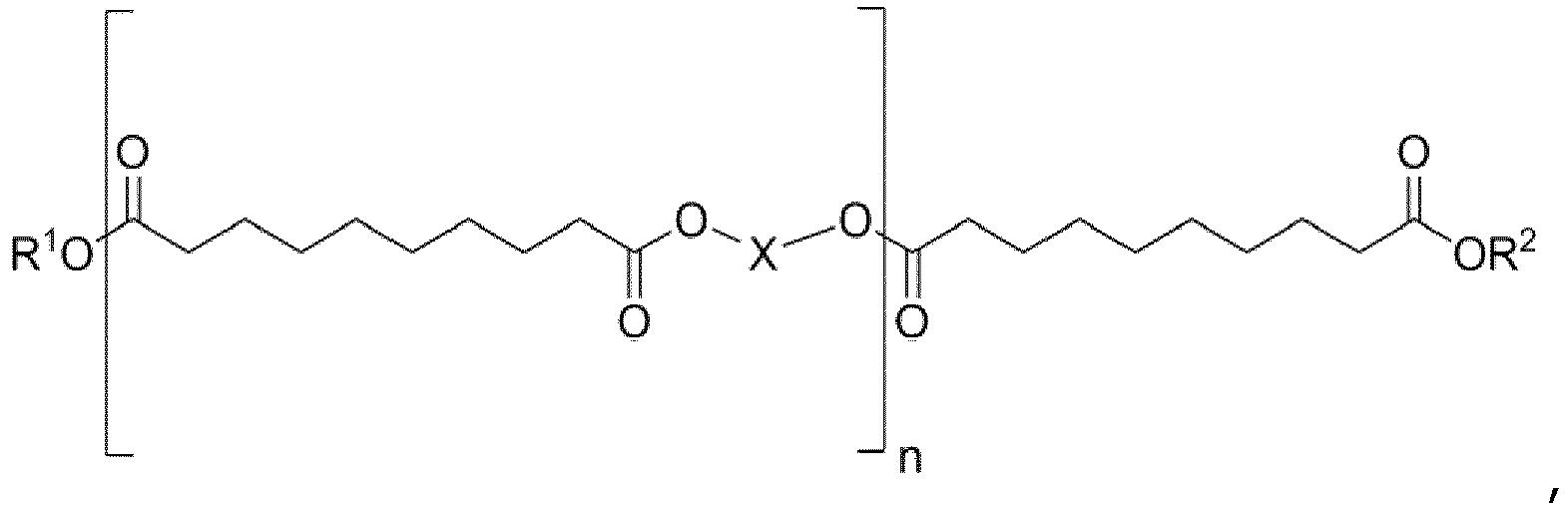
- Komplexester nach Anspruch 2, wobei n 2 bis 9 beträgt.
- Komplexester nach einem der Ansprüche 1 bis 3, wobei jeweils mindestens eine der Esterbindungen der Partialester R1OH und R2OH in Bezug zur Alkoholfunktion kein ß-H-Atom aufweist.
- Komplexester nach einem der Ansprüche 2 bis 4, wobei O-X-O gleich O-CH2-C(C2H5)(CH2-OR)-CH2-O ist.
- Komplexester nach einem der Ansprüche 1 bis 5, wobei die Fettsäuren der Partialester R1OH und R2OH unabhängig voneinander ausgewählt sind aus der Gruppe bestehend aus gesättigten, ungesättigten, unverzweigten und verzweigten Fettsäuren und Mischungen daraus.
- Komplexester nach einem der Ansprüche 1 bis 6, wobei die Fettsäuren ausgewählt sind aus der Gruppe bestehend aus Fettsäuren, erhältlich aus tierischen oder pflanzlichen Ausgangsstoffen, etwa Rapsöl, Sojaöl, Rizinusöl, Olivenöl, Kokosnussöl, Palmöl, Kiefernöl oder Talg, bevorzugt Fettsäuren mit 8, 10 oder 18 C-Atomen sowie Mischungen daraus, mehr bevorzugt Octansäure, Decansäure und Oleinsäure sowie Mischungen daraus.
- Komplexester nach einem der Ansprüche 1 bis 7, wobei die Partialester R1OH und R2OH unabhängig voneinander durch Veresterung von Polyolen ausgewählt aus der Gruppe bestehend aus Trimethylolpropan (TMP), Di-Trimethylolpropan, Neopentylglycol (NPG), Pentaerythritol, Dipentaerytrithol, Glycerin oder Mischungen hiervon erhältlich sind.
- Komplexester Anspruch 8, wobei das molare Verhältnis von Polyol zu Sebacinsäure kleiner als 4:1 ist.
- Komplexester nach einem der Ansprüche 1 bis 9, wobei das molare Verhältnis von Fettsäuren zu Sebacinsäure kleiner als 4:1 ist und die Fettsäuren gesättigt sind.
- Verfahren zur Herstellung von Komplexestern nach einem der Ansprüche 1 bis 10, umfassend die Schrittea. Bereitstellen von zwei Partialestern R1OH und R2OH, die jeweils mindestens eine Esterbindung mit Fettsäuren umfassen.b. Veresterung von Sebacinsäure mit den Partialestern.
- Verwendung eines Komplexesters nach einem der Ansprüche 1 bis 10 als Basisöl für Schmierstoffe.
- Schmierstoff, enthaltend einen Komplexester nach einem der Ansprüche 1 bis 10.
- Schmierstoff nach Anspruch 13, weiterhin enthaltend mindestens einen Zusatzstoff ausgewählt aus der Gruppe bestehend aus Antioxidantien, Entschäumern, Extreme Pressure (EP)-Additiven, Verschleißhemmern (antiwear additive) und Pour Point-Erniedrigern.
- Schmierstoff nach Anspruch 14,
wobei die Antioxidantien ausgewählt sind aus der Gruppe bestehend aus phenolischen Antioxidantien, insbesondere Additin® RC 7110, Additin® RC 7115, Additin® RC 7120; aminischen Antioxidantien, insbesondere Additin® RC 7001, Additin® RC 7010, Additin® RC 7130, Additin® RC 7135 LD, IRGANOX® L 06, IRGANOX® L 57; Phosphonaten, insbesondere IRGAFOSS® 168; und Mischungen daraus; und/oder
wobei die Entschäumer ausgewählt sind aus der Gruppe bestehend aus Polyacrylaten, insbesondere FOAM BAN® 3633E; Silikonverbindungen, insbesondere FOAM BAN® 149; Siloxanen, insbesondere FOAM BAN® 169; tensidischen Entschäumern, insbesondere ILCO-LUBE AF 2; Wachsdispersionen, insbesondere TEGO® Antifoam 2205, TEGO® Antifoam MR 2124, und/oder
wobei die Extreme Pressure (EP)-Additive ausgewählt sind aus der Gruppe bestehend aus Phosphorothioaten, insbesondere IRGALUBE® 232; N-heterozyklischen Verbindungen, insbesondere Additin® RC 8210, Additin® RC 8213, Additin® RC 8220; und Mischungen daraus; und/oder wobei die Verschleißhemmer (antiwear additive) ausgewählt sind aus der Gruppe bestehend aus Carbamaten, insbesondere Additin® RC 6340; Dialkyldithiophosphaten, insbesondere Additin® RC 3038, Additin® RC 3045, Additin® RC 3080 und Additin® RC 3580; Phosphorsäurederivaten, insbesondere Additin® RC 3680 und Additin® RC 3760; und Mischungen daraus; und /oder
wobei die Pour Point-Erniedriger ausgewählt sind aus der Gruppe bestehend aus IRGAFLO® 610 P, IRGAFLO® 649 P und Mischungen daraus.
Applications Claiming Priority (1)
| Application Number | Priority Date | Filing Date | Title |
|---|---|---|---|
| EP16173537 | 2016-06-08 |
Publications (2)
| Publication Number | Publication Date |
|---|---|
| EP3255128A1 true EP3255128A1 (de) | 2017-12-13 |
| EP3255128B1 EP3255128B1 (de) | 2021-12-01 |
Family
ID=56263502
Family Applications (1)
| Application Number | Title | Priority Date | Filing Date |
|---|---|---|---|
| EP17175075.5A Active EP3255128B1 (de) | 2016-06-08 | 2017-06-08 | Komplexester und ihre verwendung |
Country Status (1)
| Country | Link |
|---|---|
| EP (1) | EP3255128B1 (de) |
Cited By (1)
| Publication number | Priority date | Publication date | Assignee | Title |
|---|---|---|---|---|
| CN113088363A (zh) * | 2021-04-14 | 2021-07-09 | 海南热带海洋学院 | 一种椰子油脂肪酸复合酯的制备方法 |
Citations (6)
| Publication number | Priority date | Publication date | Assignee | Title |
|---|---|---|---|---|
| GB659103A (en) * | 1948-11-30 | 1951-10-17 | Standard Oil Dev Co | Complex esters |
| GB1083215A (en) * | 1964-07-10 | 1967-09-13 | British Petroleum Co | Synthetic lubricants |
| DE1264659B (de) * | 1959-11-11 | 1968-03-28 | Hale Barns | Schmiermittel fuer Flugzeug-Gasturbinen |
| DE1644859A1 (de) | 1966-07-21 | 1970-07-30 | British Petroleum Co | Synthetische Schmiermittel |
| DE2705089A1 (de) * | 1976-02-10 | 1977-08-11 | Henkel & Cie Gmbh | Gleitmittel fuer die formgebende verarbeitung thermoplastischer massen |
| DE4222341A1 (de) | 1992-07-08 | 1994-01-13 | Henkel Kgaa | Grundöle mit hohem Viskositätsindex und verbessertem Kälteverhalten |
-
2017
- 2017-06-08 EP EP17175075.5A patent/EP3255128B1/de active Active
Patent Citations (6)
| Publication number | Priority date | Publication date | Assignee | Title |
|---|---|---|---|---|
| GB659103A (en) * | 1948-11-30 | 1951-10-17 | Standard Oil Dev Co | Complex esters |
| DE1264659B (de) * | 1959-11-11 | 1968-03-28 | Hale Barns | Schmiermittel fuer Flugzeug-Gasturbinen |
| GB1083215A (en) * | 1964-07-10 | 1967-09-13 | British Petroleum Co | Synthetic lubricants |
| DE1644859A1 (de) | 1966-07-21 | 1970-07-30 | British Petroleum Co | Synthetische Schmiermittel |
| DE2705089A1 (de) * | 1976-02-10 | 1977-08-11 | Henkel & Cie Gmbh | Gleitmittel fuer die formgebende verarbeitung thermoplastischer massen |
| DE4222341A1 (de) | 1992-07-08 | 1994-01-13 | Henkel Kgaa | Grundöle mit hohem Viskositätsindex und verbessertem Kälteverhalten |
Cited By (2)
| Publication number | Priority date | Publication date | Assignee | Title |
|---|---|---|---|---|
| CN113088363A (zh) * | 2021-04-14 | 2021-07-09 | 海南热带海洋学院 | 一种椰子油脂肪酸复合酯的制备方法 |
| CN113088363B (zh) * | 2021-04-14 | 2022-10-21 | 海南热带海洋学院 | 一种椰子油脂肪酸复合酯的制备方法 |
Also Published As
| Publication number | Publication date |
|---|---|
| EP3255128B1 (de) | 2021-12-01 |
Similar Documents
| Publication | Publication Date | Title |
|---|---|---|
| DE69516154T2 (de) | Verfahren zur herstellung eines synthetischen esters aus pflanzlichem öl | |
| EP0486575B1 (de) | Grundöl für die formulierung von hydraulikölen | |
| DE69524686T2 (de) | Technische Pentaerythritolester als synthetische Grundschmieröle | |
| EP0797563A1 (de) | Synthetische ester aus alkoholen und fettsäuregemischen aus ölsäurereichen, stearinsäurearmen pflanzenölen | |
| EP1973999A1 (de) | Verwendung von estern mit verzweigten alkylgruppen als schmiermittel | |
| DE2034383A1 (de) | Gemische synthetischer Ester und ihre Verwendung | |
| EP0009746A1 (de) | Lactonmodifizierte Esteröle und diese enthaltende Schmiermittel-Zusammensetzung | |
| EP0708811A1 (de) | Grundöl auf triglyceridbasis für hydrauliköle | |
| DE1281422B (de) | Verfahren zur Herstellung von als Hochleistungsschmiermittel dienenden Veresterungsprodukten des Pentaerythrits mit Gemischen gesaettigter Fettsaeuren | |
| DE3401149C2 (de) | ||
| EP2703476A1 (de) | Verwendung von blockcopolymeren Polyalkylenoxiden als Reibminderer in synthetischen Schmierstoffen | |
| DE2159511A1 (de) | Neue Schmiermittel-Kompositionen | |
| DE3882130T2 (de) | Mittel zur Verbesserung der Viskositätszahl auf Basis von Polyestern. | |
| DE1594439C3 (de) | Schmiermittel auf Esterbasis | |
| DE69701800T3 (de) | Hydraulik-flüssigkeiten | |
| EP3556829B1 (de) | Schmierstoffgrundöl und schmierstoffzusammensetzung mit dem schmierstoffgrundöl | |
| EP3255128B1 (de) | Komplexester und ihre verwendung | |
| EP0009701B1 (de) | Schwefelhaltige Umsetzungsprodukte, Verfahren zu ihrer Herstellung und Verwendung als Zusatz zu Schmiermitteln | |
| EP2796447B1 (de) | Neue schwefelbrückenhaltige Verbindungen, Verfahren zu deren Herstellung und deren Verwendung | |
| EP2228425A1 (de) | Schmiermittel | |
| EP2444473B1 (de) | Mehrdimensionaler Polyester, seine Herstellung und seine Verwendung als Basisöl für Schmierstoffe | |
| DE112011102541T5 (de) | Anwendungsspezifische fertige schmiermittelzusammensetzungen, umfassend einen biologisch gewonnenen esterbestandteil, und verfahren zum herstellen derselben | |
| DE2214406A1 (de) | Antioxydantienmischung | |
| DE1644959B2 (de) | Schmiermittel | |
| DE102018133586B4 (de) | Mineralölfreies Schmierfett und Verfahren zur Herstellung eines mineralölfreien Schmierfetts |
Legal Events
| Date | Code | Title | Description |
|---|---|---|---|
| PUAI | Public reference made under article 153(3) epc to a published international application that has entered the european phase |
Free format text: ORIGINAL CODE: 0009012 |
|
| STAA | Information on the status of an ep patent application or granted ep patent |
Free format text: STATUS: THE APPLICATION HAS BEEN PUBLISHED |
|
| AK | Designated contracting states |
Kind code of ref document: A1 Designated state(s): AL AT BE BG CH CY CZ DE DK EE ES FI FR GB GR HR HU IE IS IT LI LT LU LV MC MK MT NL NO PL PT RO RS SE SI SK SM TR |
|
| AX | Request for extension of the european patent |
Extension state: BA ME |
|
| STAA | Information on the status of an ep patent application or granted ep patent |
Free format text: STATUS: REQUEST FOR EXAMINATION WAS MADE |
|
| 17P | Request for examination filed |
Effective date: 20180613 |
|
| RBV | Designated contracting states (corrected) |
Designated state(s): AL AT BE BG CH CY CZ DE DK EE ES FI FR GB GR HR HU IE IS IT LI LT LU LV MC MK MT NL NO PL PT RO RS SE SI SK SM TR |
|
| STAA | Information on the status of an ep patent application or granted ep patent |
Free format text: STATUS: EXAMINATION IS IN PROGRESS |
|
| 17Q | First examination report despatched |
Effective date: 20200331 |
|
| GRAP | Despatch of communication of intention to grant a patent |
Free format text: ORIGINAL CODE: EPIDOSNIGR1 |
|
| STAA | Information on the status of an ep patent application or granted ep patent |
Free format text: STATUS: GRANT OF PATENT IS INTENDED |
|
| RIC1 | Information provided on ipc code assigned before grant |
Ipc: C10M 105/42 20060101AFI20210520BHEP Ipc: C10M 105/44 20060101ALI20210520BHEP Ipc: C10N 20/02 20060101ALN20210520BHEP Ipc: C10N 30/02 20060101ALN20210520BHEP |
|
| INTG | Intention to grant announced |
Effective date: 20210617 |
|
| GRAS | Grant fee paid |
Free format text: ORIGINAL CODE: EPIDOSNIGR3 |
|
| GRAA | (expected) grant |
Free format text: ORIGINAL CODE: 0009210 |
|
| STAA | Information on the status of an ep patent application or granted ep patent |
Free format text: STATUS: THE PATENT HAS BEEN GRANTED |
|
| AK | Designated contracting states |
Kind code of ref document: B1 Designated state(s): AL AT BE BG CH CY CZ DE DK EE ES FI FR GB GR HR HU IE IS IT LI LT LU LV MC MK MT NL NO PL PT RO RS SE SI SK SM TR |
|
| REG | Reference to a national code |
Ref country code: GB Ref legal event code: FG4D Free format text: NOT ENGLISH |
|
| REG | Reference to a national code |
Ref country code: AT Ref legal event code: REF Ref document number: 1451770 Country of ref document: AT Kind code of ref document: T Effective date: 20211215 Ref country code: CH Ref legal event code: EP |
|
| REG | Reference to a national code |
Ref country code: IE Ref legal event code: FG4D Free format text: LANGUAGE OF EP DOCUMENT: GERMAN |
|
| REG | Reference to a national code |
Ref country code: DE Ref legal event code: R096 Ref document number: 502017012123 Country of ref document: DE |
|
| REG | Reference to a national code |
Ref country code: LT Ref legal event code: MG9D |
|
| REG | Reference to a national code |
Ref country code: NL Ref legal event code: MP Effective date: 20211201 |
|
| PG25 | Lapsed in a contracting state [announced via postgrant information from national office to epo] |
Ref country code: RS Free format text: LAPSE BECAUSE OF FAILURE TO SUBMIT A TRANSLATION OF THE DESCRIPTION OR TO PAY THE FEE WITHIN THE PRESCRIBED TIME-LIMIT Effective date: 20211201 Ref country code: LT Free format text: LAPSE BECAUSE OF FAILURE TO SUBMIT A TRANSLATION OF THE DESCRIPTION OR TO PAY THE FEE WITHIN THE PRESCRIBED TIME-LIMIT Effective date: 20211201 Ref country code: FI Free format text: LAPSE BECAUSE OF FAILURE TO SUBMIT A TRANSLATION OF THE DESCRIPTION OR TO PAY THE FEE WITHIN THE PRESCRIBED TIME-LIMIT Effective date: 20211201 Ref country code: BG Free format text: LAPSE BECAUSE OF FAILURE TO SUBMIT A TRANSLATION OF THE DESCRIPTION OR TO PAY THE FEE WITHIN THE PRESCRIBED TIME-LIMIT Effective date: 20220301 |
|
| PG25 | Lapsed in a contracting state [announced via postgrant information from national office to epo] |
Ref country code: SE Free format text: LAPSE BECAUSE OF FAILURE TO SUBMIT A TRANSLATION OF THE DESCRIPTION OR TO PAY THE FEE WITHIN THE PRESCRIBED TIME-LIMIT Effective date: 20211201 Ref country code: PL Free format text: LAPSE BECAUSE OF FAILURE TO SUBMIT A TRANSLATION OF THE DESCRIPTION OR TO PAY THE FEE WITHIN THE PRESCRIBED TIME-LIMIT Effective date: 20211201 Ref country code: NO Free format text: LAPSE BECAUSE OF FAILURE TO SUBMIT A TRANSLATION OF THE DESCRIPTION OR TO PAY THE FEE WITHIN THE PRESCRIBED TIME-LIMIT Effective date: 20220301 Ref country code: LV Free format text: LAPSE BECAUSE OF FAILURE TO SUBMIT A TRANSLATION OF THE DESCRIPTION OR TO PAY THE FEE WITHIN THE PRESCRIBED TIME-LIMIT Effective date: 20211201 Ref country code: HR Free format text: LAPSE BECAUSE OF FAILURE TO SUBMIT A TRANSLATION OF THE DESCRIPTION OR TO PAY THE FEE WITHIN THE PRESCRIBED TIME-LIMIT Effective date: 20211201 Ref country code: GR Free format text: LAPSE BECAUSE OF FAILURE TO SUBMIT A TRANSLATION OF THE DESCRIPTION OR TO PAY THE FEE WITHIN THE PRESCRIBED TIME-LIMIT Effective date: 20220302 Ref country code: ES Free format text: LAPSE BECAUSE OF FAILURE TO SUBMIT A TRANSLATION OF THE DESCRIPTION OR TO PAY THE FEE WITHIN THE PRESCRIBED TIME-LIMIT Effective date: 20211201 |
|
| PG25 | Lapsed in a contracting state [announced via postgrant information from national office to epo] |
Ref country code: NL Free format text: LAPSE BECAUSE OF FAILURE TO SUBMIT A TRANSLATION OF THE DESCRIPTION OR TO PAY THE FEE WITHIN THE PRESCRIBED TIME-LIMIT Effective date: 20211201 |
|
| PG25 | Lapsed in a contracting state [announced via postgrant information from national office to epo] |
Ref country code: SM Free format text: LAPSE BECAUSE OF FAILURE TO SUBMIT A TRANSLATION OF THE DESCRIPTION OR TO PAY THE FEE WITHIN THE PRESCRIBED TIME-LIMIT Effective date: 20211201 Ref country code: SK Free format text: LAPSE BECAUSE OF FAILURE TO SUBMIT A TRANSLATION OF THE DESCRIPTION OR TO PAY THE FEE WITHIN THE PRESCRIBED TIME-LIMIT Effective date: 20211201 Ref country code: RO Free format text: LAPSE BECAUSE OF FAILURE TO SUBMIT A TRANSLATION OF THE DESCRIPTION OR TO PAY THE FEE WITHIN THE PRESCRIBED TIME-LIMIT Effective date: 20211201 Ref country code: PT Free format text: LAPSE BECAUSE OF FAILURE TO SUBMIT A TRANSLATION OF THE DESCRIPTION OR TO PAY THE FEE WITHIN THE PRESCRIBED TIME-LIMIT Effective date: 20220401 Ref country code: EE Free format text: LAPSE BECAUSE OF FAILURE TO SUBMIT A TRANSLATION OF THE DESCRIPTION OR TO PAY THE FEE WITHIN THE PRESCRIBED TIME-LIMIT Effective date: 20211201 Ref country code: CZ Free format text: LAPSE BECAUSE OF FAILURE TO SUBMIT A TRANSLATION OF THE DESCRIPTION OR TO PAY THE FEE WITHIN THE PRESCRIBED TIME-LIMIT Effective date: 20211201 |
|
| REG | Reference to a national code |
Ref country code: DE Ref legal event code: R097 Ref document number: 502017012123 Country of ref document: DE |
|
| PG25 | Lapsed in a contracting state [announced via postgrant information from national office to epo] |
Ref country code: IS Free format text: LAPSE BECAUSE OF FAILURE TO SUBMIT A TRANSLATION OF THE DESCRIPTION OR TO PAY THE FEE WITHIN THE PRESCRIBED TIME-LIMIT Effective date: 20220401 |
|
| PLBE | No opposition filed within time limit |
Free format text: ORIGINAL CODE: 0009261 |
|
| STAA | Information on the status of an ep patent application or granted ep patent |
Free format text: STATUS: NO OPPOSITION FILED WITHIN TIME LIMIT |
|
| PG25 | Lapsed in a contracting state [announced via postgrant information from national office to epo] |
Ref country code: DK Free format text: LAPSE BECAUSE OF FAILURE TO SUBMIT A TRANSLATION OF THE DESCRIPTION OR TO PAY THE FEE WITHIN THE PRESCRIBED TIME-LIMIT Effective date: 20211201 Ref country code: AL Free format text: LAPSE BECAUSE OF FAILURE TO SUBMIT A TRANSLATION OF THE DESCRIPTION OR TO PAY THE FEE WITHIN THE PRESCRIBED TIME-LIMIT Effective date: 20211201 |
|
| 26N | No opposition filed |
Effective date: 20220902 |
|
| PG25 | Lapsed in a contracting state [announced via postgrant information from national office to epo] |
Ref country code: SI Free format text: LAPSE BECAUSE OF FAILURE TO SUBMIT A TRANSLATION OF THE DESCRIPTION OR TO PAY THE FEE WITHIN THE PRESCRIBED TIME-LIMIT Effective date: 20211201 |
|
| PG25 | Lapsed in a contracting state [announced via postgrant information from national office to epo] |
Ref country code: MC Free format text: LAPSE BECAUSE OF FAILURE TO SUBMIT A TRANSLATION OF THE DESCRIPTION OR TO PAY THE FEE WITHIN THE PRESCRIBED TIME-LIMIT Effective date: 20211201 |
|
| PG25 | Lapsed in a contracting state [announced via postgrant information from national office to epo] |
Ref country code: LU Free format text: LAPSE BECAUSE OF NON-PAYMENT OF DUE FEES Effective date: 20220608 |
|
| PG25 | Lapsed in a contracting state [announced via postgrant information from national office to epo] |
Ref country code: IT Free format text: LAPSE BECAUSE OF FAILURE TO SUBMIT A TRANSLATION OF THE DESCRIPTION OR TO PAY THE FEE WITHIN THE PRESCRIBED TIME-LIMIT Effective date: 20211201 |
|
| P01 | Opt-out of the competence of the unified patent court (upc) registered |
Effective date: 20230420 |
|
| PG25 | Lapsed in a contracting state [announced via postgrant information from national office to epo] |
Ref country code: HU Free format text: LAPSE BECAUSE OF FAILURE TO SUBMIT A TRANSLATION OF THE DESCRIPTION OR TO PAY THE FEE WITHIN THE PRESCRIBED TIME-LIMIT; INVALID AB INITIO Effective date: 20170608 |
|
| PG25 | Lapsed in a contracting state [announced via postgrant information from national office to epo] |
Ref country code: MK Free format text: LAPSE BECAUSE OF FAILURE TO SUBMIT A TRANSLATION OF THE DESCRIPTION OR TO PAY THE FEE WITHIN THE PRESCRIBED TIME-LIMIT Effective date: 20211201 Ref country code: CY Free format text: LAPSE BECAUSE OF FAILURE TO SUBMIT A TRANSLATION OF THE DESCRIPTION OR TO PAY THE FEE WITHIN THE PRESCRIBED TIME-LIMIT Effective date: 20211201 |
|
| PG25 | Lapsed in a contracting state [announced via postgrant information from national office to epo] |
Ref country code: TR Free format text: LAPSE BECAUSE OF FAILURE TO SUBMIT A TRANSLATION OF THE DESCRIPTION OR TO PAY THE FEE WITHIN THE PRESCRIBED TIME-LIMIT Effective date: 20211201 |
|
| PG25 | Lapsed in a contracting state [announced via postgrant information from national office to epo] |
Ref country code: MT Free format text: LAPSE BECAUSE OF FAILURE TO SUBMIT A TRANSLATION OF THE DESCRIPTION OR TO PAY THE FEE WITHIN THE PRESCRIBED TIME-LIMIT Effective date: 20211201 |
|
| PGFP | Annual fee paid to national office [announced via postgrant information from national office to epo] |
Ref country code: DE Payment date: 20250515 Year of fee payment: 9 |
|
| PGFP | Annual fee paid to national office [announced via postgrant information from national office to epo] |
Ref country code: GB Payment date: 20250620 Year of fee payment: 9 |
|
| PGFP | Annual fee paid to national office [announced via postgrant information from national office to epo] |
Ref country code: BE Payment date: 20250617 Year of fee payment: 9 |
|
| PGFP | Annual fee paid to national office [announced via postgrant information from national office to epo] |
Ref country code: FR Payment date: 20250627 Year of fee payment: 9 |
|
| PGFP | Annual fee paid to national office [announced via postgrant information from national office to epo] |
Ref country code: AT Payment date: 20250616 Year of fee payment: 9 |
|
| PGFP | Annual fee paid to national office [announced via postgrant information from national office to epo] |
Ref country code: IE Payment date: 20250618 Year of fee payment: 9 |
|
| PGFP | Annual fee paid to national office [announced via postgrant information from national office to epo] |
Ref country code: CH Payment date: 20250701 Year of fee payment: 9 |