EP3255645A1 - Procédé de recyclage d'au moins un aimant d'une machine électrique - Google Patents
Procédé de recyclage d'au moins un aimant d'une machine électrique Download PDFInfo
- Publication number
- EP3255645A1 EP3255645A1 EP17171680.6A EP17171680A EP3255645A1 EP 3255645 A1 EP3255645 A1 EP 3255645A1 EP 17171680 A EP17171680 A EP 17171680A EP 3255645 A1 EP3255645 A1 EP 3255645A1
- Authority
- EP
- European Patent Office
- Prior art keywords
- magnet
- thermal treatment
- temperature
- assembly
- oxygen
- Prior art date
- Legal status (The legal status is an assumption and is not a legal conclusion. Google has not performed a legal analysis and makes no representation as to the accuracy of the status listed.)
- Withdrawn
Links
Images
Classifications
-
- H—ELECTRICITY
- H01—ELECTRIC ELEMENTS
- H01F—MAGNETS; INDUCTANCES; TRANSFORMERS; SELECTION OF MATERIALS FOR THEIR MAGNETIC PROPERTIES
- H01F7/00—Magnets
- H01F7/02—Permanent magnets [PM]
- H01F7/0205—Magnetic circuits with PM in general
- H01F7/021—Construction of PM
-
- H—ELECTRICITY
- H01—ELECTRIC ELEMENTS
- H01F—MAGNETS; INDUCTANCES; TRANSFORMERS; SELECTION OF MATERIALS FOR THEIR MAGNETIC PROPERTIES
- H01F41/00—Apparatus or processes specially adapted for manufacturing or assembling magnets, inductances or transformers; Apparatus or processes specially adapted for manufacturing materials characterised by their magnetic properties
- H01F41/02—Apparatus or processes specially adapted for manufacturing or assembling magnets, inductances or transformers; Apparatus or processes specially adapted for manufacturing materials characterised by their magnetic properties for manufacturing cores, coils, or magnets
- H01F41/0253—Apparatus or processes specially adapted for manufacturing or assembling magnets, inductances or transformers; Apparatus or processes specially adapted for manufacturing materials characterised by their magnetic properties for manufacturing cores, coils, or magnets for manufacturing permanent magnets
-
- B—PERFORMING OPERATIONS; TRANSPORTING
- B32—LAYERED PRODUCTS
- B32B—LAYERED PRODUCTS, i.e. PRODUCTS BUILT-UP OF STRATA OF FLAT OR NON-FLAT, e.g. CELLULAR OR HONEYCOMB, FORM
- B32B43/00—Operations specially adapted for layered products and not otherwise provided for, e.g. repairing; Apparatus therefor
- B32B43/006—Delaminating
-
- C—CHEMISTRY; METALLURGY
- C22—METALLURGY; FERROUS OR NON-FERROUS ALLOYS; TREATMENT OF ALLOYS OR NON-FERROUS METALS
- C22B—PRODUCTION AND REFINING OF METALS; PRETREATMENT OF RAW MATERIALS
- C22B59/00—Obtaining rare earth metals
-
- H—ELECTRICITY
- H01—ELECTRIC ELEMENTS
- H01F—MAGNETS; INDUCTANCES; TRANSFORMERS; SELECTION OF MATERIALS FOR THEIR MAGNETIC PROPERTIES
- H01F1/00—Magnets or magnetic bodies characterised by the magnetic materials therefor; Selection of materials for their magnetic properties
- H01F1/01—Magnets or magnetic bodies characterised by the magnetic materials therefor; Selection of materials for their magnetic properties of inorganic materials
- H01F1/03—Magnets or magnetic bodies characterised by the magnetic materials therefor; Selection of materials for their magnetic properties of inorganic materials characterised by their coercivity
- H01F1/032—Magnets or magnetic bodies characterised by the magnetic materials therefor; Selection of materials for their magnetic properties of inorganic materials characterised by their coercivity of hard-magnetic materials
- H01F1/04—Magnets or magnetic bodies characterised by the magnetic materials therefor; Selection of materials for their magnetic properties of inorganic materials characterised by their coercivity of hard-magnetic materials metals or alloys
- H01F1/047—Alloys characterised by their composition
- H01F1/053—Alloys characterised by their composition containing rare earth metals
- H01F1/055—Alloys characterised by their composition containing rare earth metals and magnetic transition metals, e.g. SmCo5
- H01F1/057—Alloys characterised by their composition containing rare earth metals and magnetic transition metals, e.g. SmCo5 and IIIa elements, e.g. Nd2Fe14B
-
- H—ELECTRICITY
- H02—GENERATION; CONVERSION OR DISTRIBUTION OF ELECTRIC POWER
- H02K—DYNAMO-ELECTRIC MACHINES
- H02K1/00—Details of the magnetic circuit
- H02K1/06—Details of the magnetic circuit characterised by the shape, form or construction
- H02K1/22—Rotating parts of the magnetic circuit
- H02K1/27—Rotor cores with permanent magnets
- H02K1/2706—Inner rotors
- H02K1/272—Inner rotors the magnetisation axis of the magnets being perpendicular to the rotor axis
- H02K1/274—Inner rotors the magnetisation axis of the magnets being perpendicular to the rotor axis the rotor consisting of two or more circumferentially positioned magnets
- H02K1/2753—Inner rotors the magnetisation axis of the magnets being perpendicular to the rotor axis the rotor consisting of two or more circumferentially positioned magnets the rotor consisting of magnets or groups of magnets arranged with alternating polarity
- H02K1/276—Magnets embedded in the magnetic core, e.g. interior permanent magnets [IPM]
- H02K1/2766—Magnets embedded in the magnetic core, e.g. interior permanent magnets [IPM] having a flux concentration effect
- H02K1/2773—Magnets embedded in the magnetic core, e.g. interior permanent magnets [IPM] having a flux concentration effect consisting of tangentially magnetized radial magnets
-
- H—ELECTRICITY
- H02—GENERATION; CONVERSION OR DISTRIBUTION OF ELECTRIC POWER
- H02K—DYNAMO-ELECTRIC MACHINES
- H02K15/00—Processes or apparatus specially adapted for manufacturing, assembling, maintaining or repairing of dynamo-electric machines
- H02K15/50—Disassembling, repairing or modifying dynamo-electric machines
Definitions
- the invention relates to a method for recycling at least one magnet of an electrical machine, wherein an assembly comprising the magnet is removed from the electrical machine.
- the magnet forms part of the electrical machine, which is assigned for example to a motor vehicle.
- the electric machine is a traction engine of the motor vehicle.
- the magnet is in the form of a permanent magnet or has such at least.
- the permanent magnet consists of a magnetic material, in particular of a hard magnetic material. Such materials are an essential component of electrical machines. Their magnetic properties significantly defined their performance.
- the permanent magnet is for example in the form of a sintered neodymium-iron-boron magnet. These have a very high energy product compared to other magnets. Therefore, in applications with a high power density requirement, for example if the electric machine is a traction machine, such permanent magnets are increasingly used.
- the ternary compound (Nd 2 Fe 14 B) may be added with addition of heavy rare earths, for example dysprosium or terbium, and / or further chemical elements, for example aluminum, cobalt, Copper or the like, and be upgraded further material technology measures.
- the object of the invention is to propose a method for recycling at least one magnet of an electrical machine, which has advantages over known methods, in particular the production of high-quality magnetic material and / or the provision of a recycled magnet with very good magnetic properties, the method preferably can also be used for a slanted rotor of the electric machine.
- the electric machine has the magnet, wherein the magnet may be part of the assembly of the electrical machine.
- this assembly is removed from the electric machine and subsequently fed to the first thermal treatment.
- the assembly is brought to a first temperature, for example to a temperature of 330 ° C to 430 ° C, from 340 ° C to 420 ° C, from 360 ° C to 400 ° C, from 370 ° C to 390 ° C or about 380 ° C, especially exactly 380 ° C.
- the first thermal treatment serves, in particular, for demagnetization of the magnet and / or partial decomposition of a magnetic adhesive serving to secure the magnet and / or separation of segmented individual magnets of the magnet and / or detachment of a laminated composite of the magnet.
- the magnet is fixed, for example, in a sheet metal part or a laminated core of the assembly.
- the individual magnets can also be fastened together by means of a magnetic adhesive.
- the same magnetic adhesive can be used as for fixing the magnet in or on the sheet metal part or laminated core.
- the first thermal treatment serves to decompose, in particular completely decompose, the magnetic adhesive serving to attach the magnet to the sheet metal part.
- the magnetic adhesive, which connects the individual magnets with each other, during the first thermal treatment is only partially or not at all decomposed.
- the assembly is in the form of a rotor part of a rotor of the electric machine.
- the rotor has the rotor part containing the magnet, which is arranged non-rotatably, for example, on a shaft of the electric machine.
- the rotor part is pressed onto the shaft.
- the shaft can be squeezed out and removed from the rotor part.
- the module exists insofar For example, at least one sheet metal part, in particular a laminated core, and the magnet, wherein the magnet is fixed by means of the magnetic adhesive to the sheet metal part or the laminated core.
- the magnet is mechanically removed from the assembly. This can be done for example by means of a mechanical separation process, for example by shaking or vibration. After separation, the magnet is located separately from the assembly.
- the magnet in particular the magnet alone, that is to say without further elements of the assembly, is supplied to the second thermal treatment.
- the second thermal treatment is at a second temperature which is higher than the first temperature.
- the second temperature is at least 10%, at least 15%, at least 20%, at least 25%, at least 30%, at least 35%, at least 40%, at least 45%, or at least 50% greater than the first temperature.
- the second temperature is 450 ° C to 550 ° C, 460 ° C to 540 ° C, 470 ° C to 530 ° C, 480 ° C to 520 ° C, 490 ° C to 510 ° C or approximately or exactly 500 ° C.
- the second thermal treatment serves to debinder and / or clean the magnet.
- the method has the advantage that it also allows the recycling of the magnet in a slanted rotor of the electric machine readily.
- a slanted rotor successive magnets are arranged in the circumferential direction offset from each other in the direction of the longitudinal center axis of the rotor.
- a further embodiment of the invention provides that the first temperature and / or a first period of time over which the first thermal treatment is carried out are selected such that during the first thermal treatment, a magnetic adhesive present on the magnet at least partially, in particular only partially decomposed.
- the purpose of the first thermal treatment has already been discussed above, as well as the first temperature to which the assembly is heated during the first thermal treatment.
- the first time span is the time span over which the assembly is kept at the first temperature.
- the first time period has a duration of at least 30 minutes, at least 35 minutes, at least 40 minutes, at least 45 minutes, at least 50 minutes, at least 55 minutes, or at least 60 minutes.
- the first temperature and / or the first time period are selected such that the magnetic adhesive present on the magnet is partially or completely decomposed. Particularly preferably, only partial decomposition is provided so that at least part of the magnetic adhesive is present in chemically unchanged form after the first thermal treatment.
- a preferred further embodiment of the invention provides that by means of the separation carried out after the first thermal treatment, a sheet metal part is mechanically separated from the magnet, in particular by shaking. This has already been pointed out above.
- the separation takes place after the first thermal treatment, in particular immediately after the first thermal treatment. It can be provided that the magnet is first cooled before separation, namely to a temperature which is less than the first temperature. However, it can also be provided, the separation while the magnet is at the first temperature.
- the separation By separating out the sheet metal part is separated out of the assembly, so separated from the magnet. The separation is particularly possible because the magnetic adhesive, by means of which the magnet is attached to the sheet metal part, is already at least partially decomposed.
- the magnet is cooled after the first thermal treatment and before the second thermal treatment to a temperature which is lower than the first temperature.
- the cooling can be done, for example, before the separation of the magnet from the assembly.
- the cooling after separation is provided.
- the magnet before the second thermal treatment, the magnet is at a temperature which is lower than the first temperature.
- the separation of the magnet from the assembly takes place at a temperature which is greater than the second temperature, for example, between the first temperature and the second temperature, or the second temperature corresponds.
- the separation is made while the assembly is cooling in the direction of the second temperature, but has not yet reached.
- the assembly is kept at the first temperature during the separation.
- a further preferred embodiment of the invention provides that the second temperature and / or a second time span, over which the second thermal treatment is carried out, be selected such that during the second thermal treatment, the magnetic adhesive present on the magnet is completely decomposed , If the magnetic adhesive was only partially decomposed during the first thermal treatment, complete decomposition takes place during the first thermal treatment second thermal treatment.
- the second temperature and / or the second time period are selected accordingly.
- the magnetic adhesive is decomposed, in particular completely decomposed, which connects or fixes the individual magnets of the magnet together.
- the second temperature is, for example, in the range of 450 ° C to 550 ° C, from 460 ° C to 540 ° C, from 470 ° C to 530 ° C, from 480 ° C to 520 ° C, from 490 ° C to 510 ° C or approximately or exactly 500 ° C.
- the second time period has a duration that is greater than the duration of the first time period.
- the second time span is therefore longer than the first period, in particular by a factor of at least 1.5, at least 1.75, at least 2, at least 2.25 or at least 2.5.
- the duration of the second period is about two hours.
- the first temperature and / or the first time span is / are selected such that a corrosion coating of the magnet is completely retained, and / or that the second temperature and / or the second time span are selected will / will that the corrosion coating of the magnet is completely decomposed.
- the corrosion coating can be basically arbitrary; For example, it is present as an organic or inorganic corrosion coating.
- the corrosion coating is particularly preferably a purely organic corrosion coating, ie it has exclusively organic constituents.
- the corrosion coating should, especially if partially or completely organic, be completely decomposed, at least during the second thermal treatment.
- the second temperature and / or the second time period are selected accordingly.
- a inorganic corrosion coating can be retained - even completely.
- the first thermal treatment it may be provided that the, in particular organic, corrosion coating is completely retained.
- the corrosion coating is already completely decomposed during the first thermal treatment, in particular if it is organic.
- the first temperature and / or the first time period are to be selected accordingly.
- a further development of the invention provides that the first thermal treatment takes place under the influence of oxygen or exclusion of oxygen and / or the second thermal treatment under exclusion of oxygen or under a lower oxygen influence than during the first thermal treatment.
- Performing the thermal treatment under the influence of oxygen essentially means that the assembly or the magnet is exposed during the corresponding thermal treatment oxygen, which is present in particular as part of ambient air. During the thermal treatment, the magnet or the assembly can therefore be exposed to ambient air.
- the thermal treatment can be carried out under exclusion of oxygen. This can be realized, for example, by reducing the oxygen partial pressure in comparison to the ambient air. Particularly preferably, the oxygen partial pressure is equal to zero or at least almost equal to zero, so that the magnet or the assembly is not exposed to oxygen during the thermal treatment.
- the thermal treatment, which is carried out under exclusion of oxygen may be carried out in a partial vacuum or a vacuum.
- the first thermal treatment can be carried out either under the influence of oxygen or with the exclusion of oxygen, the former being preferred.
- the second thermal treatment should be carried out under exclusion of oxygen, or at least under the influence of less oxygen than during the first thermal treatment. This preferably means that the oxygen partial pressure in a medium enveloping the magnet or the assembly is lower during the second thermal treatment than during the first thermal treatment. This is expedient because the second thermal treatment is carried out at a higher temperature than the first thermal treatment, so that it could lead to oxidation of the magnet or of the magnet-forming magnetic material in case of excessive oxygen influence. This is reliably avoided by the lower oxygen influence or the implementation of the second thermal treatment with exclusion of oxygen.
- the magnet is treated material removal after the second thermal treatment.
- impurities are to be removed on a surface of the magnet.
- the treatment may serve to remove the corrosion coating.
- the material-removing treatment is carried out, for example, by sandblasting, grinding or similar methods.
- a development of the invention provides that the magnet is decomposed into a magnetic material, in particular chemically and / or mechanically.
- the decomposition of the magnet into the magnetic material is preferably after the second thermal treatment or after provided material removal treatment.
- the decomposition can basically be done arbitrarily.
- the chemical decomposition takes place for example by hydrogen embrittlement, which is preferably carried out under exclusion of oxygen or in a protective gas atmosphere.
- the mechanical decomposition takes place, for example, by grinding. It is also possible first to perform a chemical decomposition, in particular by hydrogen embrittlement, and then to finally mechanically decompose the magnet, in particular by grinding.
- the magnetic material results from the decomposition.
- the magnetic material is processed with the addition of one of the following substances to a recycling magnet: fresh material and / or binder.
- the magnetic material obtained from the magnet is to be recycled for recycling to the recycling magnet.
- it may be provided to initially add the fresh material and / or the binder to the magnetic material.
- the fresh material is understood to mean non-recycled magnetic material, ie magnetic material obtained from raw materials.
- the fresh material may alternatively or additionally also be in the form of one or more individual constituents of the magnetic material or compounds of these or have these.
- constituents or compounds mention may be made of neodymium, neodymium hydroxide, FeNd and DyF 3 .
- the processing of the magnetic material to the recycling magnet can basically be done in any way, for example by sintering.
- the magnetic material which may be added to at least one of the substances mentioned, first pressed and then sintered. Subsequently, a secondary heat treatment may be provided.
- the oxygen content of the atmosphere associated with the magnet and / or the magnetic material is adjusted to a certain value. For example, this is done such that during the entire process, consisting of the steps mentioned, an oxygen input into the magnet and / or the magnetic material of at most 1 wt .-%, at most 0.9 wt .-%, at most 0.8 wt. %, not more than 0.7% by weight, not more than 0.6% by weight or not more than 0.5% by weight.
- an excellent temperature stability of the magnetic properties of the recycling magnet is realized.
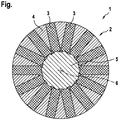
- the figure shows a part of an electric machine 1 in cross section, namely an assembly 2 of the electric machine 1.
- the assembly 2 has at least one magnet 3, in the embodiment shown here, a plurality of magnets 3 on.
- the magnet 3 is in the form of a permanent magnet, for example.
- the magnet 3 is arranged in a sheet metal part 4 of the assembly 2 or is held by this.
- About the sheet metal part 4 of the magnet 3 is rotatably connected to a shaft 5.
- the shaft 5 serves for a rotatable mounting of the assembly 2 order an axis of rotation 6 in the electric machine 1 or in a machine housing of the electric machine 1.
- the attachment of the magnet 3 to the sheet metal part 4 can be realized by means of magnetic adhesive.
- the assembly 2 is now first removed from the electric machine 1, in particular together with the shaft 5. Subsequently, it can be provided to release the shaft 5 mechanically from the assembly 2, for example by pressing the shaft 5 in axial Direction with respect to the axis of rotation. 6
- the assembly 2 is subjected to a first thermal treatment at a first temperature and over a first period of time.
- the first thermal treatment serves to partially decompose the magnetic adhesive present on the magnet 3.
- the magnet 3 is mechanically separated from the assembly 2. This means that the sheet metal part 4 is separated from the magnet 3. This can be done for example by shaking. However, other separation methods can also be provided.
- the magnet 3 is subjected to a second thermal treatment at a second temperature and over a second period of time.
- the second temperature is higher than the first temperature. Additionally or alternatively, the second time period is longer than the first time period.
- the second thermal treatment serves to completely decompose the magnetic adhesive.
- the magnet 3 is treated to remove material, for example by grinding and / or sandblasting. Subsequently, the magnet 3 is decomposed into a magnetic material, which preferably takes place chemically and / or mechanically. For example, the magnet 3 is first chemically split and then mechanically comminuted. The former is done in particular by means of hydrogen embrittlement, the latter by grinding. From the magnetic material obtained in this way, a recycling magnet can be manufactured. For this purpose, at least one additive can be added to the magnetic material, with fresh material and / or a binder being particularly preferably used as additive.
- At least one of the thermal treatments is preferably carried out with exclusion of oxygen. It can also be provided that the oxygen influence during the first thermal treatment is greater than during the second thermal treatment. For this purpose, for example, the oxygen partial pressure is lowered during the second thermal treatment compared to the first thermal treatment.
- a recycling magnet can be produced which has almost the same magnetic properties as the magnet 3. This is achieved in particular by the two successive thermal treatments with the subsequent decomposition of the magnet 3 into the magnetic material.
Landscapes
- Engineering & Computer Science (AREA)
- Power Engineering (AREA)
- Manufacturing & Machinery (AREA)
- Chemical & Material Sciences (AREA)
- Electromagnetism (AREA)
- Physics & Mathematics (AREA)
- General Life Sciences & Earth Sciences (AREA)
- Environmental & Geological Engineering (AREA)
- Life Sciences & Earth Sciences (AREA)
- Geology (AREA)
- Materials Engineering (AREA)
- Mechanical Engineering (AREA)
- Metallurgy (AREA)
- Organic Chemistry (AREA)
- Inorganic Chemistry (AREA)
- Crystallography & Structural Chemistry (AREA)
- Processing Of Solid Wastes (AREA)
- Hard Magnetic Materials (AREA)
- Manufacture And Refinement Of Metals (AREA)
Applications Claiming Priority (1)
| Application Number | Priority Date | Filing Date | Title |
|---|---|---|---|
| DE102016007038.2A DE102016007038A1 (de) | 2016-06-08 | 2016-06-08 | Verfahren zum Wiederverwerten wenigstens eines Magnets einer elektrischen Maschine |
Publications (1)
| Publication Number | Publication Date |
|---|---|
| EP3255645A1 true EP3255645A1 (fr) | 2017-12-13 |
Family
ID=58873610
Family Applications (1)
| Application Number | Title | Priority Date | Filing Date |
|---|---|---|---|
| EP17171680.6A Withdrawn EP3255645A1 (fr) | 2016-06-08 | 2017-05-18 | Procédé de recyclage d'au moins un aimant d'une machine électrique |
Country Status (4)
| Country | Link |
|---|---|
| US (1) | US20170355183A1 (fr) |
| EP (1) | EP3255645A1 (fr) |
| CN (1) | CN107481850A (fr) |
| DE (1) | DE102016007038A1 (fr) |
Cited By (1)
| Publication number | Priority date | Publication date | Assignee | Title |
|---|---|---|---|---|
| LU507675B1 (en) * | 2024-07-05 | 2026-01-05 | N9Ve Nature Ocean And Value Lda | Industrial process for recycling permanent magnets |
Families Citing this family (2)
| Publication number | Priority date | Publication date | Assignee | Title |
|---|---|---|---|---|
| EP4447076A1 (fr) * | 2023-04-11 | 2024-10-16 | Siemens Gamesa Renewable Energy A/S | Système et procédé de démagnétisation pour éléments magnétiques d'un composant de générateur d'éolienne |
| EP4542835A1 (fr) * | 2023-10-17 | 2025-04-23 | Inserma Anoia S.L | Procédé et dispositif de démontage d'un ensemble rotor |
Citations (4)
| Publication number | Priority date | Publication date | Assignee | Title |
|---|---|---|---|---|
| EP1069575A1 (fr) * | 1999-07-15 | 2001-01-17 | Sumitomo Special Metals Company Limited | Procédé de démontage pour générateur de champ magnétique et son procédé de recyclage |
| DE102012015152A1 (de) * | 2012-07-31 | 2013-01-24 | Daimler Ag | Verfahren und Vorrichtung zur Demontage eines Permanentmagneten eines Rotorelements für eine elektrische Maschine |
| JP2014150185A (ja) * | 2013-02-01 | 2014-08-21 | Mitsubishi Electric Corp | 磁石の回収方法 |
| US20140366687A1 (en) * | 2013-06-17 | 2014-12-18 | Miha Zakotnik | Magnet Recycling to Create Nd-Fe-B Magnets with Improved or Restored Magnetic Performance |
Family Cites Families (2)
| Publication number | Priority date | Publication date | Assignee | Title |
|---|---|---|---|---|
| US9663843B2 (en) * | 2010-12-02 | 2017-05-30 | The University Of Birmingham | Magnet recycling |
| GB201101201D0 (en) * | 2011-01-24 | 2011-03-09 | Univ Birmingham | Magnet recovery method |
-
2016
- 2016-06-08 DE DE102016007038.2A patent/DE102016007038A1/de not_active Withdrawn
-
2017
- 2017-05-18 EP EP17171680.6A patent/EP3255645A1/fr not_active Withdrawn
- 2017-06-07 US US15/616,321 patent/US20170355183A1/en not_active Abandoned
- 2017-06-07 CN CN201710421937.XA patent/CN107481850A/zh active Pending
Patent Citations (4)
| Publication number | Priority date | Publication date | Assignee | Title |
|---|---|---|---|---|
| EP1069575A1 (fr) * | 1999-07-15 | 2001-01-17 | Sumitomo Special Metals Company Limited | Procédé de démontage pour générateur de champ magnétique et son procédé de recyclage |
| DE102012015152A1 (de) * | 2012-07-31 | 2013-01-24 | Daimler Ag | Verfahren und Vorrichtung zur Demontage eines Permanentmagneten eines Rotorelements für eine elektrische Maschine |
| JP2014150185A (ja) * | 2013-02-01 | 2014-08-21 | Mitsubishi Electric Corp | 磁石の回収方法 |
| US20140366687A1 (en) * | 2013-06-17 | 2014-12-18 | Miha Zakotnik | Magnet Recycling to Create Nd-Fe-B Magnets with Improved or Restored Magnetic Performance |
Non-Patent Citations (1)
| Title |
|---|
| U. BAST ET AL: "Abschlussbericht zum Verbundvorhaben Recycling von Komponenten und strategischen Metallen aus elektrischen Fahrantrieben Kennwort: MORE (Motor Recycling) Die Verantwortung für den Inhalt dieser Veröffentlichung liegt bei den Autoren", 1 January 2014 (2014-01-01), XP055416214, Retrieved from the Internet <URL:https://www.ifa.tu-clausthal.de/fileadmin/Aufbereitung/Dokumente_News_ETC/MORE_Abschlussbericht.pdf> [retrieved on 20171017] * |
Cited By (2)
| Publication number | Priority date | Publication date | Assignee | Title |
|---|---|---|---|---|
| LU507675B1 (en) * | 2024-07-05 | 2026-01-05 | N9Ve Nature Ocean And Value Lda | Industrial process for recycling permanent magnets |
| WO2026008844A1 (fr) | 2024-07-05 | 2026-01-08 | N9Ve, Nature, Ocean And Value, Lda | Procédé industriel de recyclage d'aimants permanents |
Also Published As
| Publication number | Publication date |
|---|---|
| CN107481850A (zh) | 2017-12-15 |
| DE102016007038A1 (de) | 2017-12-14 |
| US20170355183A1 (en) | 2017-12-14 |
Similar Documents
| Publication | Publication Date | Title |
|---|---|---|
| DE102015220415A1 (de) | Seltenerd-Dauermagnet und Verfahren zur Herstellung desselben | |
| DE112009000399T5 (de) | Verfahren zur Wiederverwertung von Schrottmagneten | |
| DE112014003674T5 (de) | R-T-B basierter gesinterter Magnet und Motor | |
| DE102019132700B4 (de) | R-t-b-permanentmagnet | |
| EP3255645A1 (fr) | Procédé de recyclage d'au moins un aimant d'une machine électrique | |
| DE102011089787A1 (de) | System und Verfahren zur Herstellung von Verbundmagneten mittels mit seltenen Erden Pulver | |
| DE69200698T2 (de) | Verfahren zur Herstellung eines dispergierten Hartstoffpartikeln enthaltenden Legierungspulvers. | |
| DE102022119376A1 (de) | Elektroblech für eine elektrische Maschine sowie Verfahren zur Herstellung eines Elektroblechs | |
| DE102020130988A1 (de) | Verfahren zur Herstellung einer Schichtanordnung aus Elektroblech, danach hergestellte Schichtanordnung, Rotor oder Stator sowie Elektromotor | |
| DE102006032517A1 (de) | Verfahren zur Herstellung von Pulververbundkernen und Pulververbundkern | |
| WO2014009057A1 (fr) | Matériau magnétique, son utilisation et son procédé de fabrication | |
| EP4292108B1 (fr) | Procédé de production d'aimant brut | |
| EP3105764B1 (fr) | Matériau magnétique | |
| DE102016104384A1 (de) | Gesinterter Magnet auf R-T-B-Seltenerdbasis und Legierung für einen gesinterten Magneten auf R-T-B-Seltenerdbasis | |
| WO2017055170A1 (fr) | Procédé de fabrication d'un aimant permanent | |
| EP0255816A2 (fr) | Procédé de préparation de poudre magnétiquement dure, résistant à la corrosion, pour la fabrication d'aimants; aimants fabriqués à partir de poudre magnétiquement dure et leur procédé de fabrication | |
| EP4612716A1 (fr) | Procédé de production d'aimant brut | |
| DE102017116272A1 (de) | Verfahren und anlage zur herstellung eines ausgangsmaterials für die herstellung von seltenerdmagneten | |
| WO2022101447A1 (fr) | Procédé de fabrication d'un aimant permanent à partir d'un matériau de départ magnétique | |
| EP4218034A1 (fr) | Procédé de fabrication d'un aimant permanent à partir d'un matériau de départ magnétique | |
| WO2024056294A1 (fr) | Machine dynamoélectrique à excitation permanente, procédé de simulation, système informatique et produit programme d'ordinateur | |
| EP3572170B1 (fr) | Procédé de fabrication d'un matériau de départ pour la fabrication d'aimants en terres rares | |
| DE102016216355A1 (de) | Verfahren zum Recycling von Permanentmagneten durch Schmelzen und Rascherstarren | |
| DE102006019614B4 (de) | Alterungsbeständiger Dauermagnet aus einem Legierungspulver und Verfahren zu seiner Herstellung | |
| DE102023121470A1 (de) | Verfahren zur Herstellung eines Rohmagneten |
Legal Events
| Date | Code | Title | Description |
|---|---|---|---|
| PUAI | Public reference made under article 153(3) epc to a published international application that has entered the european phase |
Free format text: ORIGINAL CODE: 0009012 |
|
| AK | Designated contracting states |
Kind code of ref document: A1 Designated state(s): AL AT BE BG CH CY CZ DE DK EE ES FI FR GB GR HR HU IE IS IT LI LT LU LV MC MK MT NL NO PL PT RO RS SE SI SK SM TR |
|
| AX | Request for extension of the european patent |
Extension state: BA ME |
|
| 17P | Request for examination filed |
Effective date: 20180613 |
|
| RBV | Designated contracting states (corrected) |
Designated state(s): AL AT BE BG CH CY CZ DE DK EE ES FI FR GB GR HR HU IE IS IT LI LT LU LV MC MK MT NL NO PL PT RO RS SE SI SK SM TR |
|
| STAA | Information on the status of an ep patent application or granted ep patent |
Free format text: STATUS: THE APPLICATION IS DEEMED TO BE WITHDRAWN |
|
| 18D | Application deemed to be withdrawn |
Effective date: 20180614 |