EP3257376B1 - Régulation et répulsion de punaises de lit - Google Patents
Régulation et répulsion de punaises de lit Download PDFInfo
- Publication number
- EP3257376B1 EP3257376B1 EP17180969.2A EP17180969A EP3257376B1 EP 3257376 B1 EP3257376 B1 EP 3257376B1 EP 17180969 A EP17180969 A EP 17180969A EP 3257376 B1 EP3257376 B1 EP 3257376B1
- Authority
- EP
- European Patent Office
- Prior art keywords
- molecular weight
- chemical formula
- methyl
- cyclohexen
- carbon atoms
- Prior art date
- Legal status (The legal status is an assumption and is not a legal conclusion. Google has not performed a legal analysis and makes no representation as to the accuracy of the status listed.)
- Active
Links
Classifications
-
- C—CHEMISTRY; METALLURGY
- C07—ORGANIC CHEMISTRY
- C07C—ACYCLIC OR CARBOCYCLIC COMPOUNDS
- C07C69/00—Esters of carboxylic acids; Esters of carbonic or haloformic acids
- C07C69/66—Esters of carboxylic acids having esterified carboxylic groups bound to acyclic carbon atoms and having any of the groups OH, O—metal, —CHO, keto, ether, acyloxy, groups, groups, or in the acid moiety
- C07C69/67—Esters of carboxylic acids having esterified carboxylic groups bound to acyclic carbon atoms and having any of the groups OH, O—metal, —CHO, keto, ether, acyloxy, groups, groups, or in the acid moiety of saturated acids
- C07C69/675—Esters of carboxylic acids having esterified carboxylic groups bound to acyclic carbon atoms and having any of the groups OH, O—metal, —CHO, keto, ether, acyloxy, groups, groups, or in the acid moiety of saturated acids of saturated hydroxy-carboxylic acids
-
- A—HUMAN NECESSITIES
- A01—AGRICULTURE; FORESTRY; ANIMAL HUSBANDRY; HUNTING; TRAPPING; FISHING
- A01N—PRESERVATION OF BODIES OF HUMANS OR ANIMALS OR PLANTS OR PARTS THEREOF; BIOCIDES, e.g. AS DISINFECTANTS, AS PESTICIDES OR AS HERBICIDES; PEST REPELLANTS OR ATTRACTANTS; PLANT GROWTH REGULATORS
- A01N31/00—Biocides, pest repellants or attractants, or plant growth regulators containing organic oxygen or sulfur compounds
- A01N31/06—Oxygen or sulfur directly attached to a cycloaliphatic ring system
-
- A—HUMAN NECESSITIES
- A01—AGRICULTURE; FORESTRY; ANIMAL HUSBANDRY; HUNTING; TRAPPING; FISHING
- A01N—PRESERVATION OF BODIES OF HUMANS OR ANIMALS OR PLANTS OR PARTS THEREOF; BIOCIDES, e.g. AS DISINFECTANTS, AS PESTICIDES OR AS HERBICIDES; PEST REPELLANTS OR ATTRACTANTS; PLANT GROWTH REGULATORS
- A01N35/00—Biocides, pest repellants or attractants, or plant growth regulators containing organic compounds containing a carbon atom having two bonds to hetero atoms with at the most one bond to halogen, e.g. aldehyde radical
- A01N35/06—Biocides, pest repellants or attractants, or plant growth regulators containing organic compounds containing a carbon atom having two bonds to hetero atoms with at the most one bond to halogen, e.g. aldehyde radical containing keto or thioketo groups as part of a ring, e.g. cyclohexanone, quinone; Derivatives thereof, e.g. ketals
-
- A—HUMAN NECESSITIES
- A01—AGRICULTURE; FORESTRY; ANIMAL HUSBANDRY; HUNTING; TRAPPING; FISHING
- A01N—PRESERVATION OF BODIES OF HUMANS OR ANIMALS OR PLANTS OR PARTS THEREOF; BIOCIDES, e.g. AS DISINFECTANTS, AS PESTICIDES OR AS HERBICIDES; PEST REPELLANTS OR ATTRACTANTS; PLANT GROWTH REGULATORS
- A01N37/00—Biocides, pest repellants or attractants, or plant growth regulators containing organic compounds containing a carbon atom having three bonds to hetero atoms with at the most two bonds to halogen, e.g. carboxylic acids
- A01N37/02—Saturated carboxylic acids or thio analogues thereof; Derivatives thereof
-
- A—HUMAN NECESSITIES
- A01—AGRICULTURE; FORESTRY; ANIMAL HUSBANDRY; HUNTING; TRAPPING; FISHING
- A01N—PRESERVATION OF BODIES OF HUMANS OR ANIMALS OR PLANTS OR PARTS THEREOF; BIOCIDES, e.g. AS DISINFECTANTS, AS PESTICIDES OR AS HERBICIDES; PEST REPELLANTS OR ATTRACTANTS; PLANT GROWTH REGULATORS
- A01N37/00—Biocides, pest repellants or attractants, or plant growth regulators containing organic compounds containing a carbon atom having three bonds to hetero atoms with at the most two bonds to halogen, e.g. carboxylic acids
- A01N37/18—Biocides, pest repellants or attractants, or plant growth regulators containing organic compounds containing a carbon atom having three bonds to hetero atoms with at the most two bonds to halogen, e.g. carboxylic acids containing the group —CO—N<, e.g. carboxylic acid amides or imides; Thio analogues thereof
-
- A—HUMAN NECESSITIES
- A01—AGRICULTURE; FORESTRY; ANIMAL HUSBANDRY; HUNTING; TRAPPING; FISHING
- A01N—PRESERVATION OF BODIES OF HUMANS OR ANIMALS OR PLANTS OR PARTS THEREOF; BIOCIDES, e.g. AS DISINFECTANTS, AS PESTICIDES OR AS HERBICIDES; PEST REPELLANTS OR ATTRACTANTS; PLANT GROWTH REGULATORS
- A01N37/00—Biocides, pest repellants or attractants, or plant growth regulators containing organic compounds containing a carbon atom having three bonds to hetero atoms with at the most two bonds to halogen, e.g. carboxylic acids
- A01N37/18—Biocides, pest repellants or attractants, or plant growth regulators containing organic compounds containing a carbon atom having three bonds to hetero atoms with at the most two bonds to halogen, e.g. carboxylic acids containing the group —CO—N<, e.g. carboxylic acid amides or imides; Thio analogues thereof
- A01N37/22—Biocides, pest repellants or attractants, or plant growth regulators containing organic compounds containing a carbon atom having three bonds to hetero atoms with at the most two bonds to halogen, e.g. carboxylic acids containing the group —CO—N<, e.g. carboxylic acid amides or imides; Thio analogues thereof the nitrogen atom being directly attached to an aromatic ring system, e.g. anilides
-
- A—HUMAN NECESSITIES
- A01—AGRICULTURE; FORESTRY; ANIMAL HUSBANDRY; HUNTING; TRAPPING; FISHING
- A01N—PRESERVATION OF BODIES OF HUMANS OR ANIMALS OR PLANTS OR PARTS THEREOF; BIOCIDES, e.g. AS DISINFECTANTS, AS PESTICIDES OR AS HERBICIDES; PEST REPELLANTS OR ATTRACTANTS; PLANT GROWTH REGULATORS
- A01N37/00—Biocides, pest repellants or attractants, or plant growth regulators containing organic compounds containing a carbon atom having three bonds to hetero atoms with at the most two bonds to halogen, e.g. carboxylic acids
- A01N37/36—Biocides, pest repellants or attractants, or plant growth regulators containing organic compounds containing a carbon atom having three bonds to hetero atoms with at the most two bonds to halogen, e.g. carboxylic acids containing at least one carboxylic group or a thio analogue, or a derivative thereof, and a singly bound oxygen or sulfur atom attached to the same carbon skeleton, this oxygen or sulfur atom not being a member of a carboxylic group or of a thio analogue, or of a derivative thereof, e.g. hydroxy-carboxylic acids
-
- A—HUMAN NECESSITIES
- A01—AGRICULTURE; FORESTRY; ANIMAL HUSBANDRY; HUNTING; TRAPPING; FISHING
- A01N—PRESERVATION OF BODIES OF HUMANS OR ANIMALS OR PLANTS OR PARTS THEREOF; BIOCIDES, e.g. AS DISINFECTANTS, AS PESTICIDES OR AS HERBICIDES; PEST REPELLANTS OR ATTRACTANTS; PLANT GROWTH REGULATORS
- A01N37/00—Biocides, pest repellants or attractants, or plant growth regulators containing organic compounds containing a carbon atom having three bonds to hetero atoms with at the most two bonds to halogen, e.g. carboxylic acids
- A01N37/42—Biocides, pest repellants or attractants, or plant growth regulators containing organic compounds containing a carbon atom having three bonds to hetero atoms with at the most two bonds to halogen, e.g. carboxylic acids containing within the same carbon skeleton a carboxylic group or a thio analogue, or a derivative thereof, and a carbon atom having only two bonds to hetero atoms with at the most one bond to halogen, e.g. keto-carboxylic acids
-
- A—HUMAN NECESSITIES
- A01—AGRICULTURE; FORESTRY; ANIMAL HUSBANDRY; HUNTING; TRAPPING; FISHING
- A01N—PRESERVATION OF BODIES OF HUMANS OR ANIMALS OR PLANTS OR PARTS THEREOF; BIOCIDES, e.g. AS DISINFECTANTS, AS PESTICIDES OR AS HERBICIDES; PEST REPELLANTS OR ATTRACTANTS; PLANT GROWTH REGULATORS
- A01N43/00—Biocides, pest repellants or attractants, or plant growth regulators containing heterocyclic compounds
- A01N43/02—Biocides, pest repellants or attractants, or plant growth regulators containing heterocyclic compounds having rings with one or more oxygen or sulfur atoms as the only ring hetero atoms
- A01N43/04—Biocides, pest repellants or attractants, or plant growth regulators containing heterocyclic compounds having rings with one or more oxygen or sulfur atoms as the only ring hetero atoms with one hetero atom
- A01N43/06—Biocides, pest repellants or attractants, or plant growth regulators containing heterocyclic compounds having rings with one or more oxygen or sulfur atoms as the only ring hetero atoms with one hetero atom five-membered rings
- A01N43/08—Biocides, pest repellants or attractants, or plant growth regulators containing heterocyclic compounds having rings with one or more oxygen or sulfur atoms as the only ring hetero atoms with one hetero atom five-membered rings with oxygen as the ring hetero atom
-
- A—HUMAN NECESSITIES
- A01—AGRICULTURE; FORESTRY; ANIMAL HUSBANDRY; HUNTING; TRAPPING; FISHING
- A01N—PRESERVATION OF BODIES OF HUMANS OR ANIMALS OR PLANTS OR PARTS THEREOF; BIOCIDES, e.g. AS DISINFECTANTS, AS PESTICIDES OR AS HERBICIDES; PEST REPELLANTS OR ATTRACTANTS; PLANT GROWTH REGULATORS
- A01N43/00—Biocides, pest repellants or attractants, or plant growth regulators containing heterocyclic compounds
- A01N43/02—Biocides, pest repellants or attractants, or plant growth regulators containing heterocyclic compounds having rings with one or more oxygen or sulfur atoms as the only ring hetero atoms
- A01N43/04—Biocides, pest repellants or attractants, or plant growth regulators containing heterocyclic compounds having rings with one or more oxygen or sulfur atoms as the only ring hetero atoms with one hetero atom
- A01N43/14—Biocides, pest repellants or attractants, or plant growth regulators containing heterocyclic compounds having rings with one or more oxygen or sulfur atoms as the only ring hetero atoms with one hetero atom six-membered rings
- A01N43/16—Biocides, pest repellants or attractants, or plant growth regulators containing heterocyclic compounds having rings with one or more oxygen or sulfur atoms as the only ring hetero atoms with one hetero atom six-membered rings with oxygen as the ring hetero atom
-
- A—HUMAN NECESSITIES
- A01—AGRICULTURE; FORESTRY; ANIMAL HUSBANDRY; HUNTING; TRAPPING; FISHING
- A01N—PRESERVATION OF BODIES OF HUMANS OR ANIMALS OR PLANTS OR PARTS THEREOF; BIOCIDES, e.g. AS DISINFECTANTS, AS PESTICIDES OR AS HERBICIDES; PEST REPELLANTS OR ATTRACTANTS; PLANT GROWTH REGULATORS
- A01N49/00—Biocides, pest repellants or attractants, or plant growth regulators, containing compounds containing the group, wherein m+n>=1, both X together may also mean —Y— or a direct carbon-to-carbon bond, and the carbon atoms marked with an asterisk are not part of any ring system other than that which may be formed by the atoms X, the carbon atoms in square brackets being part of any acyclic or cyclic structure, or the group, wherein A means a carbon atom or Y, n>=0, and not more than one of these carbon atoms being a member of the same ring system, e.g. juvenile insect hormones or mimics thereof
-
- C—CHEMISTRY; METALLURGY
- C07—ORGANIC CHEMISTRY
- C07C—ACYCLIC OR CARBOCYCLIC COMPOUNDS
- C07C235/00—Carboxylic acid amides, the carbon skeleton of the acid part being further substituted by oxygen atoms
- C07C235/70—Carboxylic acid amides, the carbon skeleton of the acid part being further substituted by oxygen atoms having carbon atoms of carboxamide groups and doubly-bound oxygen atoms bound to the same carbon skeleton
- C07C235/72—Carboxylic acid amides, the carbon skeleton of the acid part being further substituted by oxygen atoms having carbon atoms of carboxamide groups and doubly-bound oxygen atoms bound to the same carbon skeleton with the carbon atoms of the carboxamide groups bound to acyclic carbon atoms
- C07C235/74—Carboxylic acid amides, the carbon skeleton of the acid part being further substituted by oxygen atoms having carbon atoms of carboxamide groups and doubly-bound oxygen atoms bound to the same carbon skeleton with the carbon atoms of the carboxamide groups bound to acyclic carbon atoms of a saturated carbon skeleton
-
- C—CHEMISTRY; METALLURGY
- C07—ORGANIC CHEMISTRY
- C07C—ACYCLIC OR CARBOCYCLIC COMPOUNDS
- C07C35/00—Compounds having at least one hydroxy or O-metal group bound to a carbon atom of a ring other than a six-membered aromatic ring
- C07C35/02—Compounds having at least one hydroxy or O-metal group bound to a carbon atom of a ring other than a six-membered aromatic ring monocyclic
- C07C35/06—Compounds having at least one hydroxy or O-metal group bound to a carbon atom of a ring other than a six-membered aromatic ring monocyclic containing a five-membered rings
-
- C—CHEMISTRY; METALLURGY
- C07—ORGANIC CHEMISTRY
- C07C—ACYCLIC OR CARBOCYCLIC COMPOUNDS
- C07C35/00—Compounds having at least one hydroxy or O-metal group bound to a carbon atom of a ring other than a six-membered aromatic ring
- C07C35/02—Compounds having at least one hydroxy or O-metal group bound to a carbon atom of a ring other than a six-membered aromatic ring monocyclic
- C07C35/08—Compounds having at least one hydroxy or O-metal group bound to a carbon atom of a ring other than a six-membered aromatic ring monocyclic containing a six-membered rings
- C07C35/18—Compounds having at least one hydroxy or O-metal group bound to a carbon atom of a ring other than a six-membered aromatic ring monocyclic containing a six-membered rings with unsaturation at least in the ring
-
- C—CHEMISTRY; METALLURGY
- C07—ORGANIC CHEMISTRY
- C07C—ACYCLIC OR CARBOCYCLIC COMPOUNDS
- C07C59/00—Compounds having carboxyl groups bound to acyclic carbon atoms and containing any of the groups OH, O—metal, —CHO, keto, ether, groups, groups, or groups
- C07C59/185—Saturated compounds having only one carboxyl group and containing keto groups
- C07C59/205—Saturated compounds having only one carboxyl group and containing keto groups containing rings
-
- C—CHEMISTRY; METALLURGY
- C07—ORGANIC CHEMISTRY
- C07C—ACYCLIC OR CARBOCYCLIC COMPOUNDS
- C07C69/00—Esters of carboxylic acids; Esters of carbonic or haloformic acids
- C07C69/66—Esters of carboxylic acids having esterified carboxylic groups bound to acyclic carbon atoms and having any of the groups OH, O—metal, —CHO, keto, ether, acyloxy, groups, groups, or in the acid moiety
- C07C69/67—Esters of carboxylic acids having esterified carboxylic groups bound to acyclic carbon atoms and having any of the groups OH, O—metal, —CHO, keto, ether, acyloxy, groups, groups, or in the acid moiety of saturated acids
- C07C69/708—Ethers
-
- C—CHEMISTRY; METALLURGY
- C07—ORGANIC CHEMISTRY
- C07D—HETEROCYCLIC COMPOUNDS
- C07D307/00—Heterocyclic compounds containing five-membered rings having one oxygen atom as the only ring hetero atom
- C07D307/02—Heterocyclic compounds containing five-membered rings having one oxygen atom as the only ring hetero atom not condensed with other rings
- C07D307/26—Heterocyclic compounds containing five-membered rings having one oxygen atom as the only ring hetero atom not condensed with other rings having one double bond between ring members or between a ring member and a non-ring member
- C07D307/30—Heterocyclic compounds containing five-membered rings having one oxygen atom as the only ring hetero atom not condensed with other rings having one double bond between ring members or between a ring member and a non-ring member with hetero atoms or with carbon atoms having three bonds to hetero atoms with at the most one bond to halogen, e.g. ester or nitrile radicals, directly attached to ring carbon atoms
- C07D307/32—Oxygen atoms
- C07D307/33—Oxygen atoms in position 2, the oxygen atom being in its keto or unsubstituted enol form
-
- C—CHEMISTRY; METALLURGY
- C07—ORGANIC CHEMISTRY
- C07D—HETEROCYCLIC COMPOUNDS
- C07D309/00—Heterocyclic compounds containing six-membered rings having one oxygen atom as the only ring hetero atom, not condensed with other rings
- C07D309/16—Heterocyclic compounds containing six-membered rings having one oxygen atom as the only ring hetero atom, not condensed with other rings having one double bond between ring members or between a ring member and a non-ring member
- C07D309/28—Heterocyclic compounds containing six-membered rings having one oxygen atom as the only ring hetero atom, not condensed with other rings having one double bond between ring members or between a ring member and a non-ring member with hetero atoms or with carbon atoms having three bonds to hetero atoms with at the most one bond to halogen, e.g. ester or nitrile radicals, directly attached to ring carbon atoms
- C07D309/30—Oxygen atoms, e.g. delta-lactones
-
- C—CHEMISTRY; METALLURGY
- C07—ORGANIC CHEMISTRY
- C07C—ACYCLIC OR CARBOCYCLIC COMPOUNDS
- C07C2601/00—Systems containing only non-condensed rings
- C07C2601/06—Systems containing only non-condensed rings with a five-membered ring
- C07C2601/08—Systems containing only non-condensed rings with a five-membered ring the ring being saturated
-
- C—CHEMISTRY; METALLURGY
- C07—ORGANIC CHEMISTRY
- C07C—ACYCLIC OR CARBOCYCLIC COMPOUNDS
- C07C2601/00—Systems containing only non-condensed rings
- C07C2601/12—Systems containing only non-condensed rings with a six-membered ring
- C07C2601/16—Systems containing only non-condensed rings with a six-membered ring the ring being unsaturated
-
- Y—GENERAL TAGGING OF NEW TECHNOLOGICAL DEVELOPMENTS; GENERAL TAGGING OF CROSS-SECTIONAL TECHNOLOGIES SPANNING OVER SEVERAL SECTIONS OF THE IPC; TECHNICAL SUBJECTS COVERED BY FORMER USPC CROSS-REFERENCE ART COLLECTIONS [XRACs] AND DIGESTS
- Y02—TECHNOLOGIES OR APPLICATIONS FOR MITIGATION OR ADAPTATION AGAINST CLIMATE CHANGE
- Y02A—TECHNOLOGIES FOR ADAPTATION TO CLIMATE CHANGE
- Y02A50/00—TECHNOLOGIES FOR ADAPTATION TO CLIMATE CHANGE in human health protection, e.g. against extreme weather
- Y02A50/30—Against vector-borne diseases, e.g. mosquito-borne, fly-borne, tick-borne or waterborne diseases whose impact is exacerbated by climate change
Definitions
- This invention relates to compounds used as agents to control and repel bed bugs.
- bed bugs infestations Cimex species of human domiciles are on the rise. At least 92 species of bed bugs have been identified globally, of which at least 16 species are in the North American continent. Generally, bed bugs are parasitic pests with its hosts including humans and various domesticated animals. It is believed that bed bug infestations are becoming more problematic now at least in part because long acting, residual insecticides are no longer being used to keep bed bug populations in check. In addition, increased international travel and insecticide resistance have made bed bug infestations spread and made control with insecticides very difficult. In terms of scale, such infestations are of particular concern for hoteliers, cruise ships, trains, daycare facilities, and the like because of the business reputation risk posed by bad press or bad reviews. Other problematic areas tend to include nursing homes, barracks, dorms, hospitals, and various other forms of high density housing. Nonetheless, single family homes can likewise be impacted adversely.
- bed bugs are not merely unsightly, they leave ugly skin markings.
- With respect to such commercial bedrooms there is more opportunity for external infection sources to bring bed bugs to the site, and should there be an unknown infestation which causes biting of customers before it is dealt with, there is a severe risk of customer dissatisfaction and adverse publicity, likely leading to a long term significant reputation loss.
- compositions including a pesticidal natural oil and a polar aromatic solvent for controlling pests are disclosed.
- US 2012/0046359 A1 discloses bed bug control formulations and a method for achieving control or repellency of bed bugs.
- US 2012/0030882 A1 discloses a composition and method for treating a textile.
- WO 2011/040252 A1 a long-lasting pest repellant that has excellent resistance to heat and solvents is disclosed.
- US 2012/0213836 A1 discloses a pest repellent with excellent heat and solvent resistance that can be kneaded into a resin molded article or synthetic fiber and that has excellent durability and persistence.
- control and repellency of bed bugs is obtained by contact of the bed bugs with an inhibitory effective amount of at least one of the compounds of the structure (I) wherein
- Safe and effective control or repellency of bed bugs can be accomplished with the use of formulations containing at least one compound selected from Structure I as described above.
- the compounds may be present in any of their isomeric or enantiomeric forms or as mixtures of their isomers or enantiomers. Additionally, they may be used in conjunction with established pesticides, including but not limited to N,N -Diethyl- m -toluamide (DEET ® ) and para-methane-3,8-diol (PMD).
- Further aspects of this invention relate to various non-therapeutic methods for the control or repellency of bed bugs.
- the invention relates to a compound for use in a method for the control or repellency of bed bugs comprising topical application of the formulation intended for use with humans or animals., such as in the form of, including but not limited to, a lotion, wipes, powder, spray or shampoo.
- Control and repellency of bed bugs is obtained by contact of the bed bugs with an inhibitory effective amount of at least one of the compounds of the structure (I) wherein
- a preferred group of control and repellency compounds are those compounds of Structure (I) wherein R is selected from -OH, X is CH 2 , y is 1 or 2, each Z is selected from (CH) and (CH 2 ), the bond between positions 2 and 3 in the ring is a single bond, one of R 1 and R 2 is H or -CH 3 and the other of R 1 and R 2 is a branched or unbranched, saturated or unsaturated hydrocarbyl group containing group containing from 9 to 15 carbon atoms and 0 to 3 double bonds, and R 3 is H.
- control and repellency compounds are those compounds of structure (I) wherein R is selected from -OH, X is CH 2 , y is 1 or 2, more preferably 1, each Z is selected from (CH) and (CH 2 ), the bond between positions 2 and 3 in the ring is a single or double bond, more preferably a single bond, one of R 1 and R 2 is H and the other of R 1 and R 2 is a branched or unbranched, saturated or unsaturated hydrocarbyl group containing from 9 to 15 carbon atoms and 0 to 3 double bonds, and R 3 is -CH 2 C(O)R 8 where R 8 is a branched or unbranched, saturated or unsaturated hydrocarbyl group containing from 1 to 6 carbon atoms, and more preferably 3 to 5 carbon atoms and still more preferably are -CH 3 .
- Representative examples of compounds of structure (I) include, but are not limited to, methyl 2-(3-hydroxy-2-pentylcyclopentyl)acetate ethyl 2-(3-hydroxy-2-pentylcyclopentyl)acetate Chemical Formula: C 13 H 24 O 3 Chemical Formula: C 14 H 26 O 3 Molecular Weight: 228.33 Molecular Weight: 242.35 Methyl Dihydro Jasmolate Ethyl Dihydro Jasmolate propyl 2-(3-hydroxy-2-pentylcyclopentyl)acetate 3-methylbut-2-enyl 2-(3-hydroxy-2-pentylcyclopentyl)acetate Chemical Formula: C 15 H 28 O 3 Chemical Formula: C 17 H 30 O 3 Molecular Weight: 256.38 Molecular Weight: 282.42 Propyl Dihydro Jasmolate Prenyl Dihydro Jasmolate 3-(2-hydroxyethyl)-2-pentylcyclopentanol methyl 2-(3,3-dimethoxy-2-
- Disclosed compounds include
- Representative examples of compounds of structure (I) include, but are not limited to, ( E )-2-(3,7-dimethylocta-2,6-dienyl)cyclopentanol 2-((2 E ,6 E )-3,7-dimethylnona-2,6-dienyl)cyclopentanol Chemical Formula: C 15 H 26 O Chemical Formula: C 16 H 28 O Molecular Weight: 222.37 Molecular Weight: 236.39 Apritol Methyl Apritol 2-(3,7-dimethylnonyl)cyclopentanol 2-((2 E ,6 E )-3,7,11-trimethyldodeca-2,6,10-trienyl)cyclopentanol Chemical Formula: C 16 H 32 O Chemical Formula: C 20 H 34 O Molecular Weight: 240.42 Molecular Weight: 290.48 Tetrahydromethyl Apritol Farnesylcyclopentanol
- disclosed compounds include 5-octyldihydrofuran-2(3 H )-one Chemical Formula: C 12 H 22 O 2 Molecular Weight: 198.30 gamma-dodecalactone (not according to the invention) 5-nonyldihydrofuran-2(3 H )-one Chemical Formula: C 13 H 24 O 2 Molecular Weight: 212.33 Gamma-Tridecalactone (not according to the invention) 5-decyldihydrofuran-2(3H)-one Chemical Formula: C 14 H 26 O 2 Molecular Weight: 226.36 Gamma-Tetradecalactone (not according to the invention) 6-nonyltetrahydro-2 H -pyran-2-one Chemical Formula: C 14 H 26 O 2 Molecular Weight: 226.36 Delta-Tetradecalactone (not according to the invention) Gamma Methyl Dodecalactone 2(3H)-Furanone, 5-octyldihydro-5-methyl-(not according to
- Representative examples of compounds of structure (I) include, but are not limited to, 3-methyl-5-isobutyl-2-cyclohexen-1-ol 3-methyl-5-pentyl-2-cyclohexen-1-ol 3-methyl-5-heptyl-2-cyclohexen-1-ol Chemical Formula: C12H22O Chemical Formula: C14H26O Molecular Weight: 182.30 Molecular Weight: 210.36 5-Butyl-3-methyl-2-cyclohexen-1-ol 5-Butyl-3-methyl-2-cyclohexen-1-yl Acetate Chemical Formula: C 11 H 20 O Chemical Formula: C 13 H 22 O 2 Molecular Weight: 168.28 Molecular Weight: 210.31
- a group of especially preferred compounds of structure (I) is methyl apritol, methyl dihydrojasmolate and methyl dihydrojasmolate dimethyl acetal.
- Gamma-dodecalactone (not according to the invention), gamma-tridecalactone (not according to the invention), gamma-pentadecalactone (not according to the invention) and 3-methyl-5-pentyl-2-cyclohexenone (not according to the invention) are part of the disclosure.
- the inhibitory effective amount of the compounds of structure (I) to control or repel the bed bugs will be dependent upon the compound employed and the manner in which it is employed and will be readily determined by the user.
- the inhibitory effective amount is in an amount of from about 0.1% to about 10% by weight, more preferably from about 0.1% to about 5% by weight, and more preferably from about 0.1% to about 2% by weight, in a carrier.
- the invention is illustrated by, but not limited to, the following examples.
- Control arenas were set up in a similar fashion with two untreated discs of paper.
- Five replicates of 10 bed bugs were released into the centers of the lids and were thus presented with a choice of treated vs. untreated substrate (or untreated vs. untreated in the control arenas). The distribution of the bed bugs was recorded at 2 hours post-treatment.
Landscapes
- Life Sciences & Earth Sciences (AREA)
- Organic Chemistry (AREA)
- Chemical & Material Sciences (AREA)
- Health & Medical Sciences (AREA)
- Environmental Sciences (AREA)
- Engineering & Computer Science (AREA)
- Dentistry (AREA)
- General Health & Medical Sciences (AREA)
- Wood Science & Technology (AREA)
- Zoology (AREA)
- Plant Pathology (AREA)
- Agronomy & Crop Science (AREA)
- Pest Control & Pesticides (AREA)
- Insects & Arthropods (AREA)
- Agricultural Chemicals And Associated Chemicals (AREA)
- Organic Low-Molecular-Weight Compounds And Preparation Thereof (AREA)
- Treatments For Attaching Organic Compounds To Fibrous Goods (AREA)
Claims (15)
- Procédé non thérapeutique de lutte contre les punaises de lit ou de répulsion des punaises de lit, le procédé comprenant la mise en contact les punaises de lit avec une quantité efficace inhibitrice d'au moins un des composés de la structure (1)
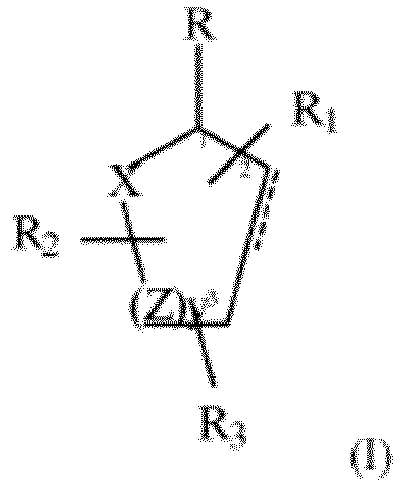 R est choisi dans le groupe constitué par -OH, -OC(O)R4, -OR6 et -(OR6)2, où chaque R6 est indépendamment choisi parmi un groupe alkyle contenant de 1 à 4 atomes de carbone et R4 est un groupe hydrocarbyle à chaîne ramifiée ou linéaire, saturé ou insaturé, comportant de zéro à deux liaisons doubles et de 1 à 15 atomes de carbone ;X représente un groupe CH2 ;chaque Z est choisi indépendamment dans le groupe constitué d'un groupe (CH) et (CH2) ;y est un nombre choisi parmi 1 et 2 ;R1 est choisi dans le groupe constitué d'un atome H et d'un groupe hydrocarbyle à chaîne ramifiée ou linéaire, saturé ou insaturé, comportant de zéro à deux liaisons doubles et de 1 à 15 atomes de carbone ;R2 est choisi dans le groupe constitué d'un atome H et d'un groupe hydrocarbyle à chaîne ramifiée ou linéaire, saturé ou insaturé, comportant de zéro à trois liaisons doubles et de 1 à 15 atomes de carbone ;R3 est choisi parmi un atome H, un groupe hydrocarbyle à chaîne ramifiée ou linéaire, saturé ou insaturé, comportant de zéro à trois liaisons doubles et de 1 à 15 atomes de carbone, un groupe -(CH2)nOH, -CH2C(O)OR7, -CH2C(O)R8 ou -CH2C(O)NR11R12, où chacun de R7, R8, R11 et R12 est choisi indépendamment dans le groupe constitué d'un atome H et d'un groupe hydrocarbyle à chaîne ramifiée ou linéaire, saturé ou insaturé, comportant de zéro à trois liaisons doubles et de 1 à 15 atomes de carbone, et n est un nombre entier de 1 à 12 ; etla liaison entre les positions 2 et 3 de la structure cyclique peut être une liaison simple ou double ;dans laquelle les composés de la structure (I) contiennent de 11 à 20 atomes de carbone au total, dans laquelle la quantité efficace inhibitrice varie de 0,1 à 10 % en poids dans un excipient.
 - Procédé non thérapeutique selon la revendication 1, dans lequel les composés de la structure (I) ont de 12 à 16 atomes de carbone dans le composé.
- Procédé non thérapeutique selon la revendication 1, dans lequel le au moins un composé de la structure (I) est un composé dans lequel
R est un groupe -OH, X est un groupe CH2, y est 1 ou 2, chaque Z est choisi dans le groupe constitué de (CH) et de (CH2), la liaison entre les positions 2 et 3 dans le cycle est une liaison simple, un parmi R1 et R2 est un atome H ou un groupe -CH3 et l'autre de R1 et de R2 est un groupe hydrocarbyle à chaîne ramifiée ou linéaire, saturé ou insaturé, comportant de 9 à 15 atomes de carbone et de 0 à 3 liaisons doubles, et R3 est un atome H. - Procédé non thérapeutique selon la revendication 1, dans lequel le au moins un composé de la structure (I) est un composé dans lequel
R est un groupe -OH, X est un groupe CH2, y est 1 ou 2, chaque Z est choisi parmi (CH) et (CH2), la liaison entre les positions 2 et 3 dans le cycle est une liaison simple ou double, un parmi R1 et R2 est un atome H et l'autre de R1 et de R2 est un groupe hydrocarbyle à chaîne ramifiée ou linéaire, saturé ou insaturé, comportant de 9 à 15 atomes de carbone et de 0 à 3 liaisons doubles, et R3 est un groupe -CH2C(O)8 où R8 est groupe hydrocarbyle à chaîne ramifiée ou linéaire, saturé ou insaturé contenant de 1 à 6 atomes de carbone. - Procédé non thérapeutique selon la revendication 4, dans lequel(i) la liaison entre les positions 2 et 3 des cycles est une liaison simple et R8 est un groupe hydrocarbyle contenant de 3 à 5 atomes de carbone,(ii) dans lequel R8 est un groupe -CH3.
ou(iii) dans laquelle R1 est un groupe alkyle avec de 5 à 10 atomes de carbone de sorte que le composé de la structure (I) contient de 10 à 14 atomes de carbone au total. - Procédé non thérapeutique selon la revendication 1, dans lequel le au moins un composé de la structure (I) est choisi dans le groupe constitué de :


2-(3-hydroxy-2-pentylcyclopentyl)acétate de méthyle 2-(3-hydroxy-2-pentylcyclopentyl)acétate d'éthyle Formule chimique : C13H24O3 Formule chimique : C14H26O3 Masse moléculaire : 228,33 Masse moléculaire : 242,35 Dihydrojasmolate de méthyle Dihydrojasmolate d'éthyle 

acétate de propyl-2-(3-hydroxy-2-pentylcyclopentyl) acétate 3-méthylbut-2-ényl-2-(3-hydroxy-2-pentylcyclopentyl) Formule chimique : C15H28O3 Formule chimique : C17H30O3 Masse moléculaire : 256,38 Masse moléculaire : 282,42 Dihydrojasmolate de propyle Dihydrojasmolate de prényle 

3-(2-hydroxyéthyl)-2-pentylcyclopentanol acétate de méthyl-2-(3,3-diméthoxy-2-pentylcyclopentyl) Formule chimique : C12H24O2 Formule chimique : C15H28O4 Masse moléculaire : 200,32 Masse moléculaire : 272,38 Dihydrojasmodiol de méthyle Dihydrojasmonate de méthyle - cétal de diméthyle 
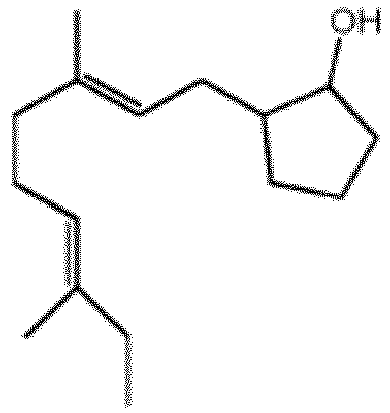
(E)-2-(3,7-diméthylocta-2,6-diényl)cyclopentanol 2-((2E,6E)-3,7-diméthylnona-2,6-diényl)cyclopentanol Formule chimique : C15H26O Formule chimique : C16H28O Masse moléculaire : 222,37 Masse moléculaire : 236,39 Apritol Méthyl Apritol 
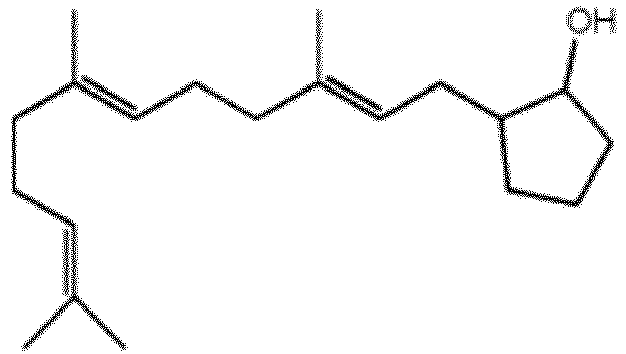
2-(3,7-diméthylnonyl)cyclopentanol 2-((2E,6E)-3,7,11-triméthyldodéca-2,6,10-triényl)cyclopentanol Formule chimique : C16H32O Formule chimique : C20H34O Masse moléculaire : 240,42 Masse moléculaire : 290,48 Tétrahydrométhyl Apritol Famésylcyclopentanol 

Formule chimique : C11H20O 3-méthyl-5-pentyl-2-cyclohexén-1-ol Masse moléculaire : 168,28 Formule chimique : C12H22O 3-méthyl-5-isobutyl-2-cyclohexén-1-ol Masse moléculaire : 182,30 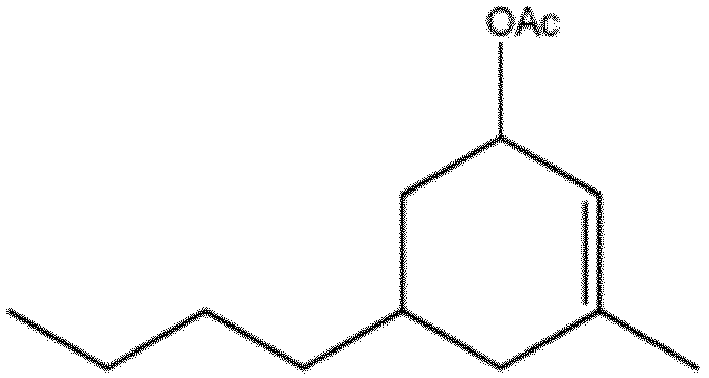

3-méthyl-5-heptyl-2-cyclohexén-1-ol Acétate de 5-butyl-3-méthyl-2-cyclohexén-1-yle Formule chimique : C14H26O Formule chimique : C13H22O2 Masse moléculaire : 210,36 Masse moléculaire : 210,31 
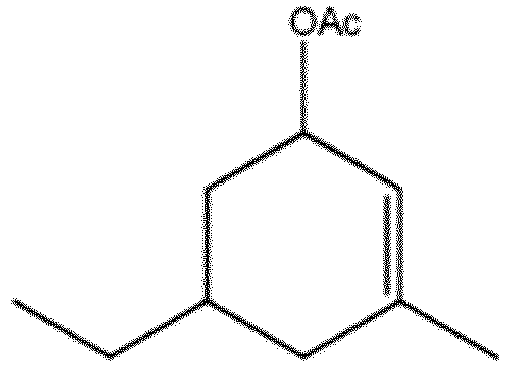
5-Butyl-3-méthyl-2-cyclohexén-1-ol Acétate de 5-éthyl-3-méthyl-2-cyclohexén-1-yle Formule chimique : C11H20O Formule chimique : C11H18O2 Masse moléculaire : 168,28 Masse moléculaire : 182,26 - Procédé non thérapeutique selon la revendication 1, dans lequel le au moins un composé de la structure (I) est choisi parmi le groupe constitué de :


(E)-2-(3,7-diméthylocta-2,6-diényl)cyclopentanol 2-((2E,6E)-3,7-diméthylnona-2,6-diényl)cyclopentanol Formule chimique : C15H26O Formule chimique : C16H28O Masse moléculaire : 222,37 Masse moléculaire : 236,39 Apritol Méthyl Apritol 
- Procédé non thérapeutique selon la revendication 1, dans lequel le au moins un composé de la structure (I) est choisi parmi le groupe constitué de :


Formule chimique : C11H20O 3-méthyl-5-pentyl-2-cyclohexén-1-ol Masse moléculaire : 168,28 Formule chimique : C12H22O 3-méthyl-5-isobutyl-2-cyclohexén-1-ol Masse moléculaire : 182,30 
3-méthyl-5-heptyl-2-cyclohexén-1-ol Formule chimique : C14H26O Masse moléculaire : 210,36 

Acétate de 5-éthyl-3-méthyl-2-cyclohexén-1-yle Acétate de 5-butyl-3-méthyl-2-cyclohexén-1-yle Formule chimique : C11H18O2 Formule chimique : C13H22O2 Masse moléculaire : 182,26 Masse moléculaire : 210,31 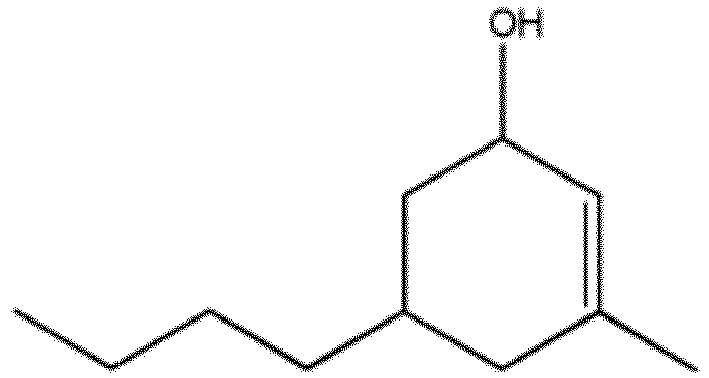
- Procédé non thérapeutique selon la revendication 1, dans lequel les punaises de lit sont mises en contact avec au moins un composé de la structure (I) en association avec des pesticides établis, dont le N,N-diéthyl-m-toluamide (DEET®).
- Procédé non thérapeutique selon la revendication 1, dans lequel les punaises de lit sont mises en contact avec au moins un composé de la structure (I) en association avec le paramenthane-3,8-diol (PMD).
- Procédé non thérapeutique selon la revendication 1, dans lequel les punaises de lit sont mises en contact avec au moins un composé de la structure (I) en association avec tout autre composé de la structure (I).
- Procédé non thérapeutique selon la revendication 1, dans lequel le au moins un composé de la structure (I) est appliqué à la surface d'un vêtement ou d'un tissu, ou imprégné dans un vêtement ou un tissu,
ou
dans lequel le au moins un composé de la structure (I) est appliqué sur des détergents, à des assouplisseurs de tissus ou à des feuilles de séchage. - Procédé non thérapeutique selon la revendication 1, dans lequel le au moins un composé de la structure (I) est choisi parmi le méthyl apritol, le dihydrojasmolate de méthyle, le dihydrojasmolate de méthyle-acétal de diméthyle, et le 3-méthyl-5-pentyl-2-cyclohexén-1-ol.
- Composé de la structure (I),
 R est choisi dans le groupe constitué par -OH, -OC(O)R4, -OR6 et -(OR6)2, où chaque R6 est indépendamment choisi parmi un groupe alkyle contenant de 1 à 4 atomes de carbone et R4 est un groupe hydrocarbyle à chaîne ramifiée ou linéaire, saturé ou insaturé, comportant de zéro à deux liaisons doubles et de 1 à 15 atomes de carbone ;X représente un groupe CH2 ;chaque Z est choisi indépendamment dans le groupe constitué d'un groupe (CH) et (CH2) ; y est un nombre choisi parmi 1 et 2 ;R1 est choisi dans le groupe constitué d'un atome H et d'un groupe hydrocarbyle à chaîne ramifiée ou linéaire, saturé ou insaturé, comportant de zéro à deux liaisons doubles et de 1 à 15 atomes de carbone ;R2 est choisi dans le groupe constitué d'un atome H et d'un groupe hydrocarbyle à chaîne ramifiée ou linéaire, saturé ou insaturé, comportant de zéro à trois liaisons doubles et de 1 à 15 atomes de carbone ;R3 est choisi parmi un atome H, un groupe hydrocarbyle à chaîne ramifiée ou linéaire, saturé ou insaturé, comportant de zéro à trois liaisons doubles et de 1 à 15 atomes de carbone, un groupe -(CH2)nOH, -CH2C(O)OR7, -CH2C(O)R8 ou -CH2C(O)NR11R12, où chacun de R7, R8, R11 et R12 est choisi indépendamment dans le groupe constitué d'un atome H et d'un groupe hydrocarbyle à chaîne ramifiée ou linéaire, saturé ou insaturé, comportant de zéro à trois liaisons doubles et de 1 à 15 atomes de carbone, et n est un nombre entier de 1 à 12 ; etla liaison entre les positions 2 et 3 de la structure cyclique peut être une liaison simple ou double ;dans laquelle les composés de la structure (I) contiennent de 11 à 20 atomes de carbone, au totaldans laquelle la quantité efficace inhibitrice varie de 0,1 à 10 % en poids d'un excipient.destiné à être utilisé dans un procédé de lutte contre les punaises de lit ou de répulsion des punaises de lit, le procédé comprenant la mise en contact les punaises de lit avec une quantité efficace inhibitrice du composé, dans laquelle le composé est appliqué de manière topique sur des humains ou de manière topique sur des humains ou des animaux, de préférence comme un répulsif topique dans une lotion, des lingettes, de la poudre, un aérosol ou du shampooing.
 - Composé destiné à être utilisé selon la revendication 14, dans lequel le composé de la structure (I) est choisi à partir du groupe constitué de :


2-(3-hydroxy-2-pentylcyclopentyl)acétate de méthyle 2-(3-hydroxy-2-pentylcyclopentyl)acétate d'éthyle Formule chimique : C13H24O3 Formule chimique : C14H26O3 Masse moléculaire : 228,33 Masse moléculaire : 242,35 Dihydrojasmolate de méthyle Dihydrojasmolate d'éthyle 

acétate de propyl-2-(3-hydroxy-2-pentylcyclopentyl) acétate 3-méthylbut-2-ényl-2-(3-hydroxy-2-pentylcyclopentyl) Formule chimique : C15H28O3 Formule chimique : C17H30O3 Masse moléculaire : 256,38 Masse moléculaire : 282,42 Dihydrojasmolate de propyle Dihydrojasmolate de prényle 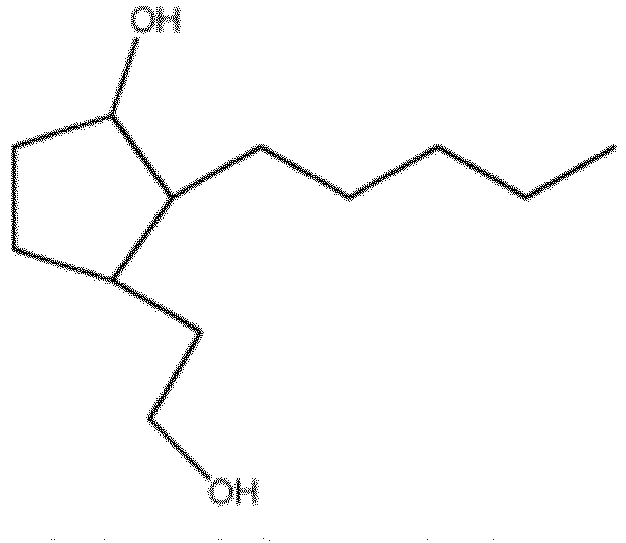

3-(2-hydroxyéthyl)-2-pentylcyclopentanol acétate de méthyl-2-(3,3-diméthoxy-2-pentylcyclopentyl) Formule chimique : C12H24O2 Formule chimique : C15H28O4 Masse moléculaire : 200,32 Masse moléculaire : 272,38 Dihydrojasmodiol de méthyle Dihydrojasmonate de méthyle - cétal de diméthyle 
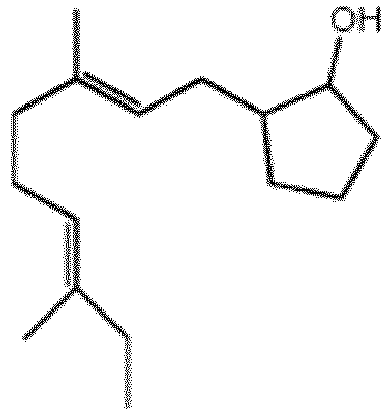
(E)-2-(3,7-diméthylocta-2,6-diényl)cyclopentanol 2-((2E, 6E)-3,7-diméthylnona-2,6-diényl)cyclopentanol Formule chimique : C15H26O Formule chimique : C16H280 Masse moléculaire : 222,37 Masse moléculaire : 236,39 Apritol Méthyl Apritol 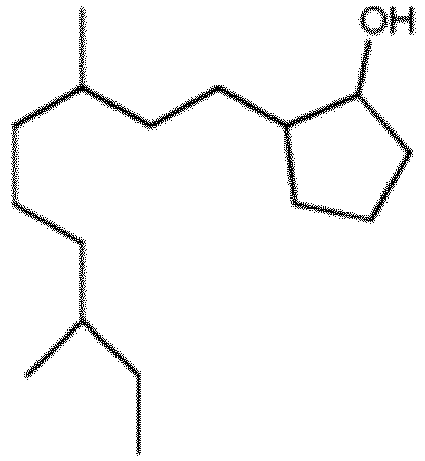
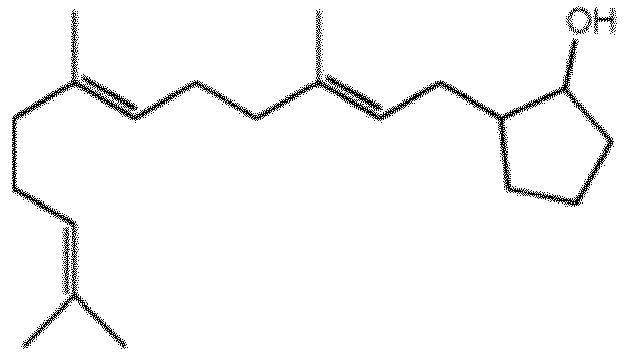
2-(3,7-diméthylnonyl)cyclopentanol 2-((2E,6E)-3,7,11-triméthyldodéca-2,6,10-triényl)cyclopentanol Formule chimique : C16H32O Formule chimique : C20H34O Masse moléculaire : 240,42 Masse moléculaire : 290,48 Tétrahydrométhyl Apritol Famésylcyclopentanol 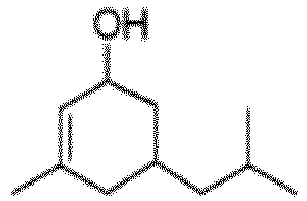

Formule chimique : C11H20O 3-méthyl-5-pentyl-2-cyclohexén-1-ol Masse moléculaire : 168,28 Formule chimique : C12H22O 3-méthyl-5-isobutyl-2-cyclohexén-1-ol Masse moléculaire : 182,30 

3-méthyl-5-heptyl-2-cyclohexén-1-ol Acétate de 5-butyl-3-méthyl-2-cyclohexén-1-yle Formule chimique : C14H26O Formule chimique : C13H22O2 Masse moléculaire : 210,36 Masse moléculaire : 210,31 

5-Butyl-3-méthyl-2-cyclohexén-1-ol Acétate de 5-éthyl-3-méthyl-2-cyclohexén-1-yle Formule chimique : C11H20O Formule chimique : C11H18O2 Masse moléculaire : 168,28 Masse moléculaire : 182,26 

(E)-2-(3,7-diméthylocta-2,6-diényl)cyclopentanol 2-((2E, 6E)-3,7-diméthylnona-2,6-diényl)cyclopentanol Formule chimique : C15H26O Formule chimique : C16H28O Masse moléculaire : 222,37 Masse moléculaires : 236,39 Apritol Méthyl Apritol 
2-(3,7-diméthylnonyl)cyclopentanol Formule chimique : C16H32O Masse moléculaire : 240,42 Tétrahydrométhyl Apritol 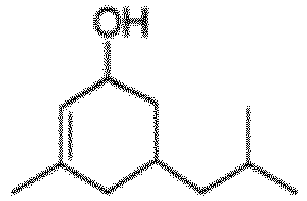
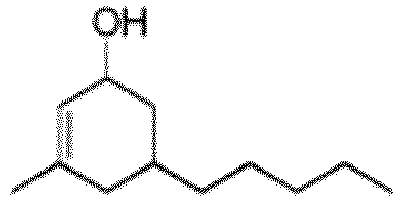
Formule chimique : C11H20O 3-méthyl-5-pentyl-2-cyclohexén-1-ol Masse moléculaire : 168,28 Formule chimique : C12H22O 3-méthyl-5-isobutyl-2-cyclohexén-1-ol Masse moléculaire : 182,30 
3-méthyl-5-heptyl-2-cyclohexén-1-ol Formule chimique : C14H26O Masse moléculaire : 210,36 
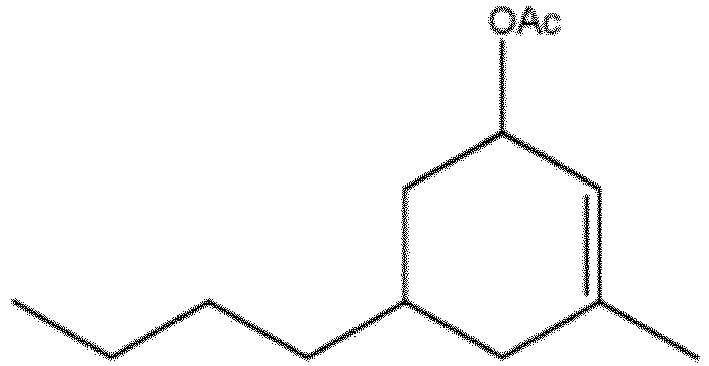
Acétate de 5-éthyl-3-méthyl-2-cyclohexén-1-yle Acétate de 5-butyl-3-méthyl-2-cyclohexén-1-yle Formule chimique : C11H18O2 Formule chimique : C13H22O2 Masse moléculaire : 182,26 Masse moléculaire : 210,31 
Applications Claiming Priority (3)
| Application Number | Priority Date | Filing Date | Title |
|---|---|---|---|
| US201261687918P | 2012-05-02 | 2012-05-02 | |
| EP13784107.8A EP2846635B1 (fr) | 2012-05-02 | 2013-04-30 | Lutte contre les punaises des lits et répulsion des punaises des lits |
| PCT/US2013/000122 WO2013165478A1 (fr) | 2012-05-02 | 2013-04-30 | Lutte contre les punaises des lits et répulsion des punaises des lits |
Related Parent Applications (2)
| Application Number | Title | Priority Date | Filing Date |
|---|---|---|---|
| EP13784107.8A Division EP2846635B1 (fr) | 2012-05-02 | 2013-04-30 | Lutte contre les punaises des lits et répulsion des punaises des lits |
| EP13784107.8A Division-Into EP2846635B1 (fr) | 2012-05-02 | 2013-04-30 | Lutte contre les punaises des lits et répulsion des punaises des lits |
Publications (3)
| Publication Number | Publication Date |
|---|---|
| EP3257376A1 EP3257376A1 (fr) | 2017-12-20 |
| EP3257376C0 EP3257376C0 (fr) | 2024-10-16 |
| EP3257376B1 true EP3257376B1 (fr) | 2024-10-16 |
Family
ID=49514701
Family Applications (2)
| Application Number | Title | Priority Date | Filing Date |
|---|---|---|---|
| EP13784107.8A Active EP2846635B1 (fr) | 2012-05-02 | 2013-04-30 | Lutte contre les punaises des lits et répulsion des punaises des lits |
| EP17180969.2A Active EP3257376B1 (fr) | 2012-05-02 | 2013-04-30 | Régulation et répulsion de punaises de lit |
Family Applications Before (1)
| Application Number | Title | Priority Date | Filing Date |
|---|---|---|---|
| EP13784107.8A Active EP2846635B1 (fr) | 2012-05-02 | 2013-04-30 | Lutte contre les punaises des lits et répulsion des punaises des lits |
Country Status (6)
| Country | Link |
|---|---|
| US (2) | US10703705B2 (fr) |
| EP (2) | EP2846635B1 (fr) |
| JP (1) | JP6063559B2 (fr) |
| CN (1) | CN104378984B (fr) |
| ES (1) | ES2964593T3 (fr) |
| WO (1) | WO2013165478A1 (fr) |
Families Citing this family (11)
| Publication number | Priority date | Publication date | Assignee | Title |
|---|---|---|---|---|
| US9924718B2 (en) | 2013-04-30 | 2018-03-27 | Bedoukian Research, Inc. | Control and repellency of biting flies, house flies, ticks, ants, fleas, biting midges, cockroaches, spiders and stink bugs |
| EP2846636B1 (fr) * | 2012-05-02 | 2022-10-26 | Bedoukian Research, Inc. | Élimination et répulsion des mouches piqueuses, des mouches domestiques, des tiques, des fourmis, des puces, des moucherons piqueurs, des blattes, des araignées et des punaises des bois |
| ES2964593T3 (es) | 2012-05-02 | 2024-04-08 | Bedoukian Res Inc | Control y repelencia de chinches de cama |
| EP2844066A4 (fr) * | 2012-05-02 | 2015-11-25 | Bedoukian Res Inc | Élimination des punaises des lits |
| US11849727B2 (en) | 2013-11-13 | 2023-12-26 | Bedoukian Research, Inc. | Synergistic formulations for control and repellency of biting arthropods |
| MX394353B (es) * | 2013-11-13 | 2025-03-11 | Bedoukian Res Inc | Formulaciones sinérgicas para control y de repelencia artrópodos picadores. |
| FR3033559B1 (fr) | 2015-03-13 | 2020-11-20 | Oreal | Procede de synthese de nouveaux composes derives d'acide 3-hydroxy-cyclopentyl acetique |
| EP3573462A1 (fr) * | 2017-01-27 | 2019-12-04 | Bedoukian Research, Inc. | Formulations permettant de lutter contre et de repousser les arthropodes piqueurs |
| CA3046552C (fr) | 2017-01-27 | 2022-05-31 | Bedoukian Research, Inc. | Formulations permettant de lutter contre et de repousser les arthropodes piqueurs |
| US20190075795A1 (en) * | 2017-09-12 | 2019-03-14 | Bedoukian Research, Inc. | Formulations for killing biting arthropods |
| US10595533B1 (en) * | 2018-11-07 | 2020-03-24 | Thomas Smith | Bed bug treatment mixture |
Family Cites Families (28)
| Publication number | Priority date | Publication date | Assignee | Title |
|---|---|---|---|---|
| US3700694A (en) * | 1971-06-14 | 1972-10-24 | Zoecon Corp | Insect control |
| EP0367140B1 (fr) * | 1988-10-31 | 1995-01-18 | Takiron Co. Ltd. | Agent repoussant les insectes à libération contrôlée |
| ZM3391A1 (en) * | 1990-08-06 | 1992-04-30 | R & C Products Pty Ltd | Insect repellent |
| DE60016907T2 (de) * | 1999-04-20 | 2005-12-22 | The Procter & Gamble Company, Cincinnati | Riechstoffvorstufen |
| JP2003040821A (ja) * | 2001-07-30 | 2003-02-13 | Nippon Zeon Co Ltd | 2,5−ジ置換シクロペンタノン系化合物および香料組成物 |
| US8603502B2 (en) | 2002-02-04 | 2013-12-10 | L'oreal S.A. | Compositions comprising jasmonic acid derivatives and use of these derivatives |
| WO2005025313A1 (fr) | 2003-09-05 | 2005-03-24 | Poseidon Ocean Sciences | Propyleneglycol-carbonate menthole et ses analogues en tant qu'insectifuges |
| US20080020087A1 (en) * | 2006-07-24 | 2008-01-24 | Landers Phillip G | Method of treating and preserving wood |
| US7892528B2 (en) * | 2007-01-12 | 2011-02-22 | Siljander Eric D | Controlling bedbugs with synthetic pheromones and/or infrared radiation |
| WO2008134744A2 (fr) * | 2007-04-30 | 2008-11-06 | Ecosmart Technologies, Inc. | Compositions de pesticides |
| WO2008152602A1 (fr) | 2007-06-15 | 2008-12-18 | Ecolab Inc. | Composition liquide de conditionnement de tissus et son utilisation |
| US7579016B2 (en) | 2007-07-13 | 2009-08-25 | The United States Of America As Represented By The Secretary Of Agriculture | Methods for repelling arthropods using isolongifolenone analogs |
| US8404260B2 (en) * | 2008-04-02 | 2013-03-26 | Bayer Cropscience Lp | Synergistic pesticide compositions |
| US20110213038A1 (en) * | 2008-10-30 | 2011-09-01 | Bedoukian Robert H | Control of bed bugs |
| WO2010061354A2 (fr) * | 2008-11-27 | 2010-06-03 | S.S. Arbel Holdings (1992) Ltd | Préparations insectifuges |
| WO2010088645A2 (fr) * | 2009-02-02 | 2010-08-05 | Ecoblend, Llc | Compositions pesticides et procédés d'utilisation associés |
| US8551510B2 (en) | 2009-04-28 | 2013-10-08 | Bedoukian Research, Inc. | Bed bug control and repellency |
| EP2424355B1 (fr) * | 2009-04-28 | 2015-03-18 | Bedoukian Research, Inc. | Produit éradiquant et repoussant les punaises de lit |
| KR20120091129A (ko) * | 2009-09-30 | 2012-08-17 | 도아고세이가부시키가이샤 | 내구성 해충 기피제 및 해충 기피성 수지 조성물 |
| US20120171313A1 (en) | 2010-12-30 | 2012-07-05 | Boon Technologies, Llc. | Compositions and Methods for Applying and Manufacturing Biopesticides |
| EP2704569A4 (fr) * | 2011-04-26 | 2015-03-25 | Semiosbio Technologies Inc | Composés contenant un carbonyle pour maîtriser et repousser des populations de cimicidae |
| CA2849270C (fr) * | 2011-10-04 | 2021-11-23 | 0903608 B.C. Ltd. | Formulations de lutte contre les nuisibles et leurs procedes de fabrication et d'utilisation |
| US20130122120A1 (en) * | 2011-11-14 | 2013-05-16 | Emira Angjeli | Insecticidal compositions and methods |
| ES2964593T3 (es) | 2012-05-02 | 2024-04-08 | Bedoukian Res Inc | Control y repelencia de chinches de cama |
| EP2844066A4 (fr) | 2012-05-02 | 2015-11-25 | Bedoukian Res Inc | Élimination des punaises des lits |
| KR20150056537A (ko) | 2012-08-17 | 2015-05-26 | 올팩터 래버러토리스, 인코포레이티드 | 곤충의 유인 및 기피를 위한 조성물 및 방법 |
| US20150250166A1 (en) | 2012-08-23 | 2015-09-10 | Allylix, Inc. | Nootkatone as an insecticide and insect repellent |
| WO2014099821A2 (fr) * | 2012-12-18 | 2014-06-26 | Allylix, Inc. | Solavétivone et 5-épi-bêta-vétivone en tant qu'agents répulsifs de nuisibles et pesticides |
-
2013
- 2013-04-30 ES ES13784107T patent/ES2964593T3/es active Active
- 2013-04-30 CN CN201380022819.1A patent/CN104378984B/zh active Active
- 2013-04-30 WO PCT/US2013/000122 patent/WO2013165478A1/fr not_active Ceased
- 2013-04-30 US US14/390,081 patent/US10703705B2/en active Active
- 2013-04-30 EP EP13784107.8A patent/EP2846635B1/fr active Active
- 2013-04-30 JP JP2015510250A patent/JP6063559B2/ja active Active
- 2013-04-30 EP EP17180969.2A patent/EP3257376B1/fr active Active
-
2019
- 2019-09-04 US US16/559,752 patent/US11098003B2/en active Active
Also Published As
| Publication number | Publication date |
|---|---|
| EP3257376C0 (fr) | 2024-10-16 |
| US10703705B2 (en) | 2020-07-07 |
| US20190389793A1 (en) | 2019-12-26 |
| JP2015515979A (ja) | 2015-06-04 |
| WO2013165478A1 (fr) | 2013-11-07 |
| EP2846635B1 (fr) | 2023-08-30 |
| ES2964593T3 (es) | 2024-04-08 |
| US20150152038A1 (en) | 2015-06-04 |
| EP2846635A1 (fr) | 2015-03-18 |
| JP6063559B2 (ja) | 2017-01-18 |
| US11098003B2 (en) | 2021-08-24 |
| CN104378984A (zh) | 2015-02-25 |
| EP2846635C0 (fr) | 2023-08-30 |
| CN104378984B (zh) | 2018-01-12 |
| EP3257376A1 (fr) | 2017-12-20 |
| EP2846635A4 (fr) | 2016-01-20 |
Similar Documents
| Publication | Publication Date | Title |
|---|---|---|
| EP3257376B1 (fr) | Régulation et répulsion de punaises de lit | |
| US4933371A (en) | Controlling ticks and fleas with linalool | |
| US8551510B2 (en) | Bed bug control and repellency | |
| CN102413686B (zh) | 臭虫的控制和驱除 | |
| JP2015515979A6 (ja) | トコジラミの防除及び忌避 | |
| CN113873884B (zh) | 节肢动物防治组合物 | |
| JP2017019875A (ja) | トコジラミ科集団を抑制及び忌避するためのカルボニル含有化合物 | |
| JP2025535405A (ja) | 節足動物防除組成物 | |
| US9512059B2 (en) | Killing of bed bugs | |
| GB2163651A (en) | Linalool pesticide | |
| JP2015521171A6 (ja) | トコジラミの死滅 | |
| SG194630A1 (en) | Carbonyl containing compounds for controlling and repelling cimicidae populations | |
| JP2025504457A (ja) | 節足動物防除組成物 | |
| JP2025504445A (ja) | 節足動物防除組成物 | |
| WO2001001977A1 (fr) | Procedes d'elimination de pathogenes fongiques |
Legal Events
| Date | Code | Title | Description |
|---|---|---|---|
| PUAI | Public reference made under article 153(3) epc to a published international application that has entered the european phase |
Free format text: ORIGINAL CODE: 0009012 |
|
| STAA | Information on the status of an ep patent application or granted ep patent |
Free format text: STATUS: THE APPLICATION HAS BEEN PUBLISHED |
|
| AC | Divisional application: reference to earlier application |
Ref document number: 2846635 Country of ref document: EP Kind code of ref document: P |
|
| AK | Designated contracting states |
Kind code of ref document: A1 Designated state(s): AL AT BE BG CH CY CZ DE DK EE ES FI FR GB GR HR HU IE IS IT LI LT LU LV MC MK MT NL NO PL PT RO RS SE SI SK SM TR |
|
| STAA | Information on the status of an ep patent application or granted ep patent |
Free format text: STATUS: REQUEST FOR EXAMINATION WAS MADE |
|
| 17P | Request for examination filed |
Effective date: 20180620 |
|
| RBV | Designated contracting states (corrected) |
Designated state(s): AL AT BE BG CH CY CZ DE DK EE ES FI FR GB GR HR HU IE IS IT LI LT LU LV MC MK MT NL NO PL PT RO RS SE SI SK SM TR |
|
| STAA | Information on the status of an ep patent application or granted ep patent |
Free format text: STATUS: EXAMINATION IS IN PROGRESS |
|
| 17Q | First examination report despatched |
Effective date: 20180802 |
|
| REG | Reference to a national code |
Ref country code: DE Ref legal event code: R079 Ref document number: 602013086203 Country of ref document: DE Free format text: PREVIOUS MAIN CLASS: A01N0035060000 Ipc: A01N0031060000 Ref country code: DE Ref legal event code: R079 Free format text: PREVIOUS MAIN CLASS: A01N0035060000 Ipc: A01N0031060000 |
|
| GRAP | Despatch of communication of intention to grant a patent |
Free format text: ORIGINAL CODE: EPIDOSNIGR1 |
|
| STAA | Information on the status of an ep patent application or granted ep patent |
Free format text: STATUS: GRANT OF PATENT IS INTENDED |
|
| RIC1 | Information provided on ipc code assigned before grant |
Ipc: A01P 17/00 20060101ALI20240515BHEP Ipc: A01P 7/04 20060101ALI20240515BHEP Ipc: A01N 31/06 20060101AFI20240515BHEP |
|
| INTG | Intention to grant announced |
Effective date: 20240606 |
|
| GRAS | Grant fee paid |
Free format text: ORIGINAL CODE: EPIDOSNIGR3 |
|
| GRAA | (expected) grant |
Free format text: ORIGINAL CODE: 0009210 |
|
| STAA | Information on the status of an ep patent application or granted ep patent |
Free format text: STATUS: THE PATENT HAS BEEN GRANTED |
|
| AC | Divisional application: reference to earlier application |
Ref document number: 2846635 Country of ref document: EP Kind code of ref document: P |
|
| AK | Designated contracting states |
Kind code of ref document: B1 Designated state(s): AL AT BE BG CH CY CZ DE DK EE ES FI FR GB GR HR HU IE IS IT LI LT LU LV MC MK MT NL NO PL PT RO RS SE SI SK SM TR |
|
| REG | Reference to a national code |
Ref country code: GB Ref legal event code: FG4D |
|
| REG | Reference to a national code |
Ref country code: DE Ref legal event code: R096 Ref document number: 602013086203 Country of ref document: DE Ref country code: CH Ref legal event code: EP |
|
| REG | Reference to a national code |
Ref country code: IE Ref legal event code: FG4D |
|
| U01 | Request for unitary effect filed |
Effective date: 20241115 |
|
| U07 | Unitary effect registered |
Designated state(s): AT BE BG DE DK EE FI FR IT LT LU LV MT NL PT RO SE SI Effective date: 20241125 |
|
| PG25 | Lapsed in a contracting state [announced via postgrant information from national office to epo] |
Ref country code: IS Free format text: LAPSE BECAUSE OF FAILURE TO SUBMIT A TRANSLATION OF THE DESCRIPTION OR TO PAY THE FEE WITHIN THE PRESCRIBED TIME-LIMIT Effective date: 20250216 Ref country code: HR Free format text: LAPSE BECAUSE OF FAILURE TO SUBMIT A TRANSLATION OF THE DESCRIPTION OR TO PAY THE FEE WITHIN THE PRESCRIBED TIME-LIMIT Effective date: 20241016 |
|
| PG25 | Lapsed in a contracting state [announced via postgrant information from national office to epo] |
Ref country code: ES Free format text: LAPSE BECAUSE OF FAILURE TO SUBMIT A TRANSLATION OF THE DESCRIPTION OR TO PAY THE FEE WITHIN THE PRESCRIBED TIME-LIMIT Effective date: 20241016 |
|
| PG25 | Lapsed in a contracting state [announced via postgrant information from national office to epo] |
Ref country code: NO Free format text: LAPSE BECAUSE OF FAILURE TO SUBMIT A TRANSLATION OF THE DESCRIPTION OR TO PAY THE FEE WITHIN THE PRESCRIBED TIME-LIMIT Effective date: 20250116 |
|
| PG25 | Lapsed in a contracting state [announced via postgrant information from national office to epo] |
Ref country code: GR Free format text: LAPSE BECAUSE OF FAILURE TO SUBMIT A TRANSLATION OF THE DESCRIPTION OR TO PAY THE FEE WITHIN THE PRESCRIBED TIME-LIMIT Effective date: 20250117 |
|
| PG25 | Lapsed in a contracting state [announced via postgrant information from national office to epo] |
Ref country code: PL Free format text: LAPSE BECAUSE OF FAILURE TO SUBMIT A TRANSLATION OF THE DESCRIPTION OR TO PAY THE FEE WITHIN THE PRESCRIBED TIME-LIMIT Effective date: 20241016 |
|
| PG25 | Lapsed in a contracting state [announced via postgrant information from national office to epo] |
Ref country code: RS Free format text: LAPSE BECAUSE OF FAILURE TO SUBMIT A TRANSLATION OF THE DESCRIPTION OR TO PAY THE FEE WITHIN THE PRESCRIBED TIME-LIMIT Effective date: 20250116 |
|
| PG25 | Lapsed in a contracting state [announced via postgrant information from national office to epo] |
Ref country code: SM Free format text: LAPSE BECAUSE OF FAILURE TO SUBMIT A TRANSLATION OF THE DESCRIPTION OR TO PAY THE FEE WITHIN THE PRESCRIBED TIME-LIMIT Effective date: 20241016 |
|
| PGFP | Annual fee paid to national office [announced via postgrant information from national office to epo] |
Ref country code: GB Payment date: 20250428 Year of fee payment: 13 |
|
| PGFP | Annual fee paid to national office [announced via postgrant information from national office to epo] |
Ref country code: CH Payment date: 20250501 Year of fee payment: 13 |
|
| PG25 | Lapsed in a contracting state [announced via postgrant information from national office to epo] |
Ref country code: SK Free format text: LAPSE BECAUSE OF FAILURE TO SUBMIT A TRANSLATION OF THE DESCRIPTION OR TO PAY THE FEE WITHIN THE PRESCRIBED TIME-LIMIT Effective date: 20241016 |
|
| PG25 | Lapsed in a contracting state [announced via postgrant information from national office to epo] |
Ref country code: CZ Free format text: LAPSE BECAUSE OF FAILURE TO SUBMIT A TRANSLATION OF THE DESCRIPTION OR TO PAY THE FEE WITHIN THE PRESCRIBED TIME-LIMIT Effective date: 20241016 |
|
| U21 | Renewal fee for the european patent with unitary effect paid with additional fee |
Year of fee payment: 13 Effective date: 20250628 |
|
| PLBE | No opposition filed within time limit |
Free format text: ORIGINAL CODE: 0009261 |
|
| STAA | Information on the status of an ep patent application or granted ep patent |
Free format text: STATUS: NO OPPOSITION FILED WITHIN TIME LIMIT |
|
| 26N | No opposition filed |
Effective date: 20250717 |
|
| PG25 | Lapsed in a contracting state [announced via postgrant information from national office to epo] |
Ref country code: MC Free format text: LAPSE BECAUSE OF FAILURE TO SUBMIT A TRANSLATION OF THE DESCRIPTION OR TO PAY THE FEE WITHIN THE PRESCRIBED TIME-LIMIT Effective date: 20241016 |
|
| PG25 | Lapsed in a contracting state [announced via postgrant information from national office to epo] |
Ref country code: IE Free format text: LAPSE BECAUSE OF NON-PAYMENT OF DUE FEES Effective date: 20250430 |