EP3258694A1 - Procédé de codec intra-trame, codeur et décodeur - Google Patents
Procédé de codec intra-trame, codeur et décodeur Download PDFInfo
- Publication number
- EP3258694A1 EP3258694A1 EP15883829.2A EP15883829A EP3258694A1 EP 3258694 A1 EP3258694 A1 EP 3258694A1 EP 15883829 A EP15883829 A EP 15883829A EP 3258694 A1 EP3258694 A1 EP 3258694A1
- Authority
- EP
- European Patent Office
- Prior art keywords
- type pixel
- pixel
- type
- transform coefficients
- residual values
- Prior art date
- Legal status (The legal status is an assumption and is not a legal conclusion. Google has not performed a legal analysis and makes no representation as to the accuracy of the status listed.)
- Ceased
Links
Images

Classifications
-
- H—ELECTRICITY
- H04—ELECTRIC COMMUNICATION TECHNIQUE
- H04N—PICTORIAL COMMUNICATION, e.g. TELEVISION
- H04N19/00—Methods or arrangements for coding, decoding, compressing or decompressing digital video signals
- H04N19/10—Methods or arrangements for coding, decoding, compressing or decompressing digital video signals using adaptive coding
- H04N19/134—Methods or arrangements for coding, decoding, compressing or decompressing digital video signals using adaptive coding characterised by the element, parameter or criterion affecting or controlling the adaptive coding
- H04N19/157—Assigned coding mode, i.e. the coding mode being predefined or preselected to be further used for selection of another element or parameter
- H04N19/159—Prediction type, e.g. intra-frame, inter-frame or bidirectional frame prediction
-
- H—ELECTRICITY
- H04—ELECTRIC COMMUNICATION TECHNIQUE
- H04N—PICTORIAL COMMUNICATION, e.g. TELEVISION
- H04N19/00—Methods or arrangements for coding, decoding, compressing or decompressing digital video signals
- H04N19/10—Methods or arrangements for coding, decoding, compressing or decompressing digital video signals using adaptive coding
- H04N19/102—Methods or arrangements for coding, decoding, compressing or decompressing digital video signals using adaptive coding characterised by the element, parameter or selection affected or controlled by the adaptive coding
- H04N19/103—Selection of coding mode or of prediction mode
- H04N19/105—Selection of the reference unit for prediction within a chosen coding or prediction mode, e.g. adaptive choice of position and number of pixels used for prediction
-
- H—ELECTRICITY
- H04—ELECTRIC COMMUNICATION TECHNIQUE
- H04N—PICTORIAL COMMUNICATION, e.g. TELEVISION
- H04N19/00—Methods or arrangements for coding, decoding, compressing or decompressing digital video signals
- H04N19/10—Methods or arrangements for coding, decoding, compressing or decompressing digital video signals using adaptive coding
- H04N19/102—Methods or arrangements for coding, decoding, compressing or decompressing digital video signals using adaptive coding characterised by the element, parameter or selection affected or controlled by the adaptive coding
- H04N19/12—Selection from among a plurality of transforms or standards, e.g. selection between discrete cosine transform [DCT] and sub-band transform or selection between H.263 and H.264
- H04N19/122—Selection of transform size, e.g. 8x8 or 2x4x8 DCT; Selection of sub-band transforms of varying structure or type
-
- H—ELECTRICITY
- H04—ELECTRIC COMMUNICATION TECHNIQUE
- H04N—PICTORIAL COMMUNICATION, e.g. TELEVISION
- H04N19/00—Methods or arrangements for coding, decoding, compressing or decompressing digital video signals
- H04N19/10—Methods or arrangements for coding, decoding, compressing or decompressing digital video signals using adaptive coding
- H04N19/102—Methods or arrangements for coding, decoding, compressing or decompressing digital video signals using adaptive coding characterised by the element, parameter or selection affected or controlled by the adaptive coding
- H04N19/124—Quantisation
-
- H—ELECTRICITY
- H04—ELECTRIC COMMUNICATION TECHNIQUE
- H04N—PICTORIAL COMMUNICATION, e.g. TELEVISION
- H04N19/00—Methods or arrangements for coding, decoding, compressing or decompressing digital video signals
- H04N19/10—Methods or arrangements for coding, decoding, compressing or decompressing digital video signals using adaptive coding
- H04N19/102—Methods or arrangements for coding, decoding, compressing or decompressing digital video signals using adaptive coding characterised by the element, parameter or selection affected or controlled by the adaptive coding
- H04N19/13—Adaptive entropy coding, e.g. adaptive variable length coding [AVLC] or context adaptive binary arithmetic coding [CABAC]
-
- H—ELECTRICITY
- H04—ELECTRIC COMMUNICATION TECHNIQUE
- H04N—PICTORIAL COMMUNICATION, e.g. TELEVISION
- H04N19/00—Methods or arrangements for coding, decoding, compressing or decompressing digital video signals
- H04N19/10—Methods or arrangements for coding, decoding, compressing or decompressing digital video signals using adaptive coding
- H04N19/102—Methods or arrangements for coding, decoding, compressing or decompressing digital video signals using adaptive coding characterised by the element, parameter or selection affected or controlled by the adaptive coding
- H04N19/132—Sampling, masking or truncation of coding units, e.g. adaptive resampling, frame skipping, frame interpolation or high-frequency transform coefficient masking
-
- H—ELECTRICITY
- H04—ELECTRIC COMMUNICATION TECHNIQUE
- H04N—PICTORIAL COMMUNICATION, e.g. TELEVISION
- H04N19/00—Methods or arrangements for coding, decoding, compressing or decompressing digital video signals
- H04N19/10—Methods or arrangements for coding, decoding, compressing or decompressing digital video signals using adaptive coding
- H04N19/134—Methods or arrangements for coding, decoding, compressing or decompressing digital video signals using adaptive coding characterised by the element, parameter or criterion affecting or controlling the adaptive coding
- H04N19/136—Incoming video signal characteristics or properties
-
- H—ELECTRICITY
- H04—ELECTRIC COMMUNICATION TECHNIQUE
- H04N—PICTORIAL COMMUNICATION, e.g. TELEVISION
- H04N19/00—Methods or arrangements for coding, decoding, compressing or decompressing digital video signals
- H04N19/10—Methods or arrangements for coding, decoding, compressing or decompressing digital video signals using adaptive coding
- H04N19/169—Methods or arrangements for coding, decoding, compressing or decompressing digital video signals using adaptive coding characterised by the coding unit, i.e. the structural portion or semantic portion of the video signal being the object or the subject of the adaptive coding
- H04N19/17—Methods or arrangements for coding, decoding, compressing or decompressing digital video signals using adaptive coding characterised by the coding unit, i.e. the structural portion or semantic portion of the video signal being the object or the subject of the adaptive coding the unit being an image region, e.g. an object
- H04N19/176—Methods or arrangements for coding, decoding, compressing or decompressing digital video signals using adaptive coding characterised by the coding unit, i.e. the structural portion or semantic portion of the video signal being the object or the subject of the adaptive coding the unit being an image region, e.g. an object the region being a block, e.g. a macroblock
-
- H—ELECTRICITY
- H04—ELECTRIC COMMUNICATION TECHNIQUE
- H04N—PICTORIAL COMMUNICATION, e.g. TELEVISION
- H04N19/00—Methods or arrangements for coding, decoding, compressing or decompressing digital video signals
- H04N19/10—Methods or arrangements for coding, decoding, compressing or decompressing digital video signals using adaptive coding
- H04N19/169—Methods or arrangements for coding, decoding, compressing or decompressing digital video signals using adaptive coding characterised by the coding unit, i.e. the structural portion or semantic portion of the video signal being the object or the subject of the adaptive coding
- H04N19/18—Methods or arrangements for coding, decoding, compressing or decompressing digital video signals using adaptive coding characterised by the coding unit, i.e. the structural portion or semantic portion of the video signal being the object or the subject of the adaptive coding the unit being a set of transform coefficients
-
- H—ELECTRICITY
- H04—ELECTRIC COMMUNICATION TECHNIQUE
- H04N—PICTORIAL COMMUNICATION, e.g. TELEVISION
- H04N19/00—Methods or arrangements for coding, decoding, compressing or decompressing digital video signals
- H04N19/10—Methods or arrangements for coding, decoding, compressing or decompressing digital video signals using adaptive coding
- H04N19/169—Methods or arrangements for coding, decoding, compressing or decompressing digital video signals using adaptive coding characterised by the coding unit, i.e. the structural portion or semantic portion of the video signal being the object or the subject of the adaptive coding
- H04N19/182—Methods or arrangements for coding, decoding, compressing or decompressing digital video signals using adaptive coding characterised by the coding unit, i.e. the structural portion or semantic portion of the video signal being the object or the subject of the adaptive coding the unit being a pixel
-
- H—ELECTRICITY
- H04—ELECTRIC COMMUNICATION TECHNIQUE
- H04N—PICTORIAL COMMUNICATION, e.g. TELEVISION
- H04N19/00—Methods or arrangements for coding, decoding, compressing or decompressing digital video signals
- H04N19/50—Methods or arrangements for coding, decoding, compressing or decompressing digital video signals using predictive coding
- H04N19/59—Methods or arrangements for coding, decoding, compressing or decompressing digital video signals using predictive coding involving spatial sub-sampling or interpolation, e.g. alteration of picture size or resolution
-
- H—ELECTRICITY
- H04—ELECTRIC COMMUNICATION TECHNIQUE
- H04N—PICTORIAL COMMUNICATION, e.g. TELEVISION
- H04N19/00—Methods or arrangements for coding, decoding, compressing or decompressing digital video signals
- H04N19/50—Methods or arrangements for coding, decoding, compressing or decompressing digital video signals using predictive coding
- H04N19/593—Methods or arrangements for coding, decoding, compressing or decompressing digital video signals using predictive coding involving spatial prediction techniques
-
- H—ELECTRICITY
- H04—ELECTRIC COMMUNICATION TECHNIQUE
- H04N—PICTORIAL COMMUNICATION, e.g. TELEVISION
- H04N19/00—Methods or arrangements for coding, decoding, compressing or decompressing digital video signals
- H04N19/60—Methods or arrangements for coding, decoding, compressing or decompressing digital video signals using transform coding
- H04N19/61—Methods or arrangements for coding, decoding, compressing or decompressing digital video signals using transform coding in combination with predictive coding
-
- H—ELECTRICITY
- H04—ELECTRIC COMMUNICATION TECHNIQUE
- H04N—PICTORIAL COMMUNICATION, e.g. TELEVISION
- H04N19/00—Methods or arrangements for coding, decoding, compressing or decompressing digital video signals
- H04N19/80—Details of filtering operations specially adapted for video compression, e.g. for pixel interpolation
- H04N19/82—Details of filtering operations specially adapted for video compression, e.g. for pixel interpolation involving filtering within a prediction loop
Definitions
- the present invention relates to the video encoding and decoding field, and in particular, to an intra-frame encoding method, an intra-frame decoding method, an encoder, and a decoder.
- Video signals have a very large amount of information, and therefore have a high requirement on transmission network bandwidth or media storage space. Therefore, before a video signal is transmitted, the video signal needs to be compressed, so as to save transmission network bandwidth or media storage space.
- a main purpose of video compression is to minimize picture distortion (distortion) after compression and reconstruction in a specific bitrate (rate/bitrate).
- intra-frame encoding usually includes many phases such as prediction (prediction), transform (transform), quantization (quantization), and entropy encoding (entropy coding). Specifically, first, intra-frame prediction (Intra prediction) is performed on a picture block according to reconstructed reference pixels surrounding the picture block.
- An intra-frame prediction manner includes 33 types of directional prediction, direct current (Direct Current, DC) prediction, or planar (Planar) prediction in a video compression standard (High Efficiency Video Coding, HEVC); prediction that is based on template matching (template matching); or the like.
- video decoding is a process of converting a bit-stream into a video picture.
- Conventional intra-frame decoding includes main phases such as entropy decoding (entropy decoding), prediction, dequantization (dequantization), and inverse transform (inverse transform).
- entropy decoding entropy decoding
- prediction prediction
- dequantization dequantization
- inverse transform inverse transform
- the bit-stream is parsed by means of entropy decoding processing to obtain encoding mode information and a quantized transform coefficient.
- predicted pixels are obtained by using intra-frame prediction mode information and decoded reconstructed pixels; on the other hand, the quantized transform coefficient is dequantized to obtain a reconstructed transform coefficient, and the reconstructed transform coefficient is reversely transformed to obtain information about a reconstructed residual value.
- the information about the reconstructed residual value and the predicted pixels are added to obtain reconstructed pixels, so as to restore the video picture.
- an existing encoding method is not flexible enough, and is low in encoding efficiency.
- Embodiments of the present invention provide an intra-frame encoding method, an intra-frame decoding method, an encoder, and a decoder. According to the intra-frame encoding method, flexible encoding can be implemented, and encoding efficiency can be improved.
- an intra-frame encoding method including: obtaining reference pixel values of a current picture block; obtaining a predicted value of a first-type pixel in the current picture block according to the reference pixel values of the current picture block by using an intra-frame prediction algorithm, where the current picture block includes the first-type pixel and a second-type pixel, and the second-type pixel is a pixel in the current picture block except the first-type pixel; determining residual values of the first-type pixel according to the predicted value of the first-type pixel and an original pixel value of the first-type pixel; obtaining transform coefficients according to the residual values of the first-type pixel; quantizing the transform coefficients to obtain quantized transform coefficients; reconstructing the first-type pixel according to the quantized transform coefficients and the predicted value of the first-type pixel, to obtain a reconstructed value of the first-type pixel; and obtaining a reconstructed value of the second-type pixel according to the reconstructed value
- the method before the obtaining a reconstructed value of the second-type pixel according to the reconstructed value of the first-type pixel by using an interpolation method, the method further includes: determining the interpolation method according to the intra-frame prediction algorithm, where an interpolation manner in the interpolation method is the same as an interpolation manner included in the intra-frame prediction algorithm.
- the obtaining transform coefficients according to the residual values of the first-type pixel includes: obtaining residual values of B pixels in the second-type pixel according to the residual values of the first-type pixel, where B is a positive integer that is not less than 1; and transforming the residual values of the first-type pixel and the residual values of the B pixels to obtain the transform coefficients, where a quantity of fixed 0 coefficients in the transform coefficients is equal to B.
- a quantity of the residual values of the first-type pixel is A
- the B pixels in the second-type pixel are corresponding to the B residual values
- the A residual values are in a one-to-one correspondence with the pixels in the first-type pixel
- the B residual values are in a one-to-one correspondence with the B pixels
- the obtaining residual values of B pixels in the second-type pixel according to the residual values of the first-type pixel includes: determining a B ⁇ A matrix corresponding to the quantity A of the residual values of the first-type pixel and a quantity B of the residual values of the B pixels in the second-type pixel; multiplying the B ⁇ A matrix by a column vector that includes the A residual values of the first-type pixel, to obtain a column vector that includes the residual values of the B pixels in the second-type pixel; and obtaining the residual values of the B pixels in the second-type pixel according to the column vector that includes the residual values of the B pixels in the second--
- the obtaining transform coefficients according to the residual values of the first-type pixel includes: subtracting a predicted value of each pixel from an original value of each of at least one pixel in the second-type pixel, to obtain a residual value of each pixel, where the predicted value of each pixel is obtained by using the intra-frame prediction algorithm; and transforming the residual values of the first-type pixel and a residual value of the at least one pixel in the second-type pixel to obtain the transform coefficients.
- the quantizing the transform coefficients to obtain quantized transform coefficients includes: quantizing the transform coefficients in a transform coefficient scanning order to obtain the quantized transform coefficients.
- the obtaining residual values of the first-type pixel according to the predicted value of the first-type pixel and an original pixel value of the first-type pixel includes: subtracting the predicted value of the first-type pixel from the original value of the first-type pixel, to obtain the residual values of the first-type pixel.
- the method further includes: generating a bit-stream according to the quantized transform coefficients, so that a decoding device reconstructs the current picture block according to the bit-stream.
- the generating a bit-stream according to the quantized transform coefficients includes: encoding the quantized transform coefficients and information about the intra-frame prediction algorithm by using an entropy encoding method, to obtain the bit-stream.
- the generating a bit-stream according to the quantized transform coefficients includes: encoding information about the intra-frame prediction algorithm, the quantized transform coefficients, and information about the interpolation method by using an entropy encoding method, to obtain the bit-stream.
- an intra-frame decoding method including: obtaining reference pixel values of a current picture block; obtaining a predicted value of a first-type pixel in the current picture block according to the reference pixel values of the current picture block by using an intra-frame prediction algorithm, where the current picture block includes the first-type pixel and a second-type pixel, and the second-type pixel is a pixel in the current picture block except the first-type pixel; dequantizing quantized transform coefficients of the current picture block to obtain transform coefficients; inversely transforming the transform coefficients to obtain reconstructed residual values of the first-type pixel; adding the reconstructed residual values of the first-type pixel and the predicted value of the first-type pixel to obtain a reconstructed value of the first-type pixel; and obtaining a reconstructed value of the second-type pixel according to the reconstructed value of the first-type pixel by using an interpolation method.
- the method before the inversely transforming the transform coefficients, the method further includes: placing the transform coefficients at first-type preset locations in a transform coefficient matrix in a transform coefficient scanning order, where transform coefficients at second-type preset locations in the transform coefficient matrix are set to preset values, and a sum of a quantity of the second-type preset locations and a quantity of the first-type preset locations is equal to a total quantity of transform coefficients in the transform coefficient matrix.
- the method before the obtaining a reconstructed value of the second-type pixel according to the reconstructed value of the first-type pixel by using an interpolation method, the method further includes: determining the interpolation method according to the intra-frame prediction algorithm, where an interpolation manner in the interpolation method is the same as an interpolation manner included in the intra-frame prediction algorithm.
- the method before the obtaining a reconstructed value of the second-type pixel according to the reconstructed value of the first-type pixel by using an interpolation method, the method further includes: determining the interpolation method according to a bit-stream of the picture block.
- an encoder including: a first obtaining unit, configured to obtain reference pixel values of a current picture block; a second obtaining unit, configured to obtain a predicted value of a first-type pixel in the current picture block according to the reference pixel values of the current picture block by using an intra-frame prediction algorithm, where the current picture block includes the first-type pixel and a second-type pixel, and the second-type pixel is a pixel in the current picture block except the first-type pixel; a first determining unit, configured to obtain residual values of the first-type pixel according to the predicted value of the first-type pixel and an original pixel value of the first-type pixel; a transform unit, configured to obtain transform coefficients according to the residual values of the first-type pixel; a quantization unit, configured to quantize the transform coefficients to obtain quantized transform coefficients; a first reconstruction unit, configured to reconstruct the first-type pixel according to the quantized transform coefficients and the predicted value of the first-type pixel
- the encoder further includes: a second determining unit, configured to determine the interpolation method according to the intra-frame prediction algorithm, where an interpolation manner in the interpolation method is the same as an interpolation manner included in the intra-frame prediction algorithm.
- the transform unit is specifically configured to: obtain residual values of B pixels in the second-type pixel according to the residual values of the first-type pixel, where B is a positive integer that is not less than 1; and transform the residual values of the first-type pixel and the residual values of the B pixels to obtain the transform coefficients, where a quantity of fixed 0 coefficients in the transform coefficients is equal to B.
- a quantity of the residual values of the first-type pixel is A
- the B pixels in the second-type pixel are corresponding to the B residual values
- the A residual values are in a one-to-one correspondence with the pixels in the first-type pixel
- the B residual values are in a one-to-one correspondence with the B pixels
- the third obtaining unit is specifically configured to: determine a B ⁇ A matrix corresponding to the quantity A of the residual values of the first-type pixel and a quantity B of the residual values of the B pixels in the second-type pixel; multiply the B ⁇ A matrix by a column vector that includes the A residual values of the first-type pixel, to obtain a column vector that includes the residual values of the B pixels in the second-type pixel; and obtain the residual values of the B pixels in the second-type pixel according to the column vector that includes the residual values of the B pixels in the second-type pixel.
- the transform unit is specifically configured to: subtract a predicted value of each pixel from an original value of each of at least one pixel in the second-type pixel, to obtain a residual value of each pixel, where the predicted value of each pixel is obtained by using the intra-frame prediction algorithm; and transform the residual values of the first-type pixel and a residual value of the at least one pixel in the second-type pixel to obtain the transform coefficients.
- the quantization unit is specifically configured to quantize the transform coefficients in a transform coefficient scanning order to obtain the quantized transform coefficients.
- the first determining unit is specifically configured to perform subtraction between the original value of the first-type pixel and the predicted value of the first-type pixel, to obtain the residual values of the first-type pixel.
- the encoder further includes: a generation unit, configured to generate a bit-stream according to the quantized transform coefficients, so that a decoding device reconstructs the current picture block according to the bit-stream.
- the generation unit is specifically configured to encode the quantized transform coefficients and information about the intra-frame prediction algorithm by using an entropy encoding method, to obtain the bit-stream.
- the generation unit is specifically configured to encode information about the intra-frame prediction algorithm, the quantized transform coefficients, and information about the interpolation method by using an entropy encoding method, to obtain the bit-stream.
- a decoder including: a first obtaining unit, configured to obtain reference pixel values of a current picture block; a second obtaining unit, configured to obtain a predicted value of a first-type pixel in the current picture block according to the reference pixel values of the current picture block by using an intra-frame prediction algorithm, where the current picture block includes the first-type pixel and a second-type pixel, and the second-type pixel is a pixel in the current picture block except the first-type pixel; a dequantization unit, configured to dequantize quantized transform coefficients of the current picture block to obtain transform coefficients; an inverse transform unit, configured to inversely transform the transform coefficients to obtain reconstructed residual values of the first-type pixel; a first reconstruction unit, configured to add the reconstructed residual values of the first-type pixel and the predicted value of the first-type pixel to obtain a reconstructed value of the first-type pixel; and a second reconstruction unit, configured to obtain a reconstructed
- the decoder further includes: a placement unit, configured to place the transform coefficients at first-type preset locations in a transform coefficient matrix in a transform coefficient scanning order, where transform coefficients at second-type preset locations in the transform coefficient matrix are set to preset values, and a sum of a quantity of the second-type preset locations and a quantity of the first-type preset locations is equal to a total quantity of transform coefficients in the transform coefficient matrix.
- a placement unit configured to place the transform coefficients at first-type preset locations in a transform coefficient matrix in a transform coefficient scanning order, where transform coefficients at second-type preset locations in the transform coefficient matrix are set to preset values, and a sum of a quantity of the second-type preset locations and a quantity of the first-type preset locations is equal to a total quantity of transform coefficients in the transform coefficient matrix.
- the decoder further includes: a first determining unit, configured to determine the interpolation method according to the intra-frame prediction algorithm, where an interpolation manner in the interpolation method is the same as an interpolation manner included in the intra-frame prediction algorithm.
- the decoder further includes: a second determining unit, configured to determine the interpolation method according to a bit-stream of the picture block.
- transform and quantization processing is performed only on residual values of a first-type pixel to obtain a bit-stream. Residual values of an entire picture block do not need to be all encoded. Therefore, flexible encoding can be implemented, and encoding efficiency can be improved.
- a pixel value in the present invention may be a pixel luminance component value, or may be a pixel chrominance component value (for example, either a Cb component or a Cr component), or may be one of an R component value, a G component value, or a B component value.
- a pixel when a pixel is represented by using other color space such as Lab (a color model) and HSV (hue, saturation, and value), the pixel may be one of the color components (color component).
- a transform coefficient and a residual value are corresponding to the color component.
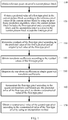
- FIG. 1 is a schematic flowchart of an intra-frame encoding method according to an embodiment of the present invention.
- the method shown in FIG. 1 may be performed by an encoder. Specifically, the method shown in FIG. 1 includes the following steps:
- transform and quantization processing is performed only on residual values of a first-type pixel to obtain a bit-stream. Residual values of an entire picture block do not need to be all encoded. Therefore, flexible encoding can be implemented, and encoding efficiency can be improved.
- the first-type pixel is reconstructed according to quantized transform coefficients and a predicted value of the first-type pixel (one part of pixels), to obtain a reconstructed value of the first-type pixel.
- a second-type pixel (the other part of pixels) is directly reconstructed by using an interpolation method that is based on the reconstructed part of pixels.
- the current picture block may be any one or one type of picture block in a current frame.
- the picture block in this embodiment of the present invention may be in multiple sizes, for example, may be in a size of 3 ⁇ 3, 4 ⁇ 4, 8 ⁇ 8, 16 ⁇ 16, 32 ⁇ 32, 64 ⁇ 64, 8 ⁇ 4, 4 ⁇ 8, 16 ⁇ 12, or 9 ⁇ 9. This embodiment of the present invention is not limited thereto.
- pixels in the current picture block include two types of pixels: the first-type pixel and the second-type pixel.
- a first-type pixel may be a pixel at any location in the current picture block.
- the first-type pixel may be at a location such as a right boundary, a lower boundary, a center, a lower left diagonal, a lower right diagonal, or the like in the current picture block.
- a quantity of first-type pixels is greater than 0 and is less than a quantity of pixels in the entire current picture block.
- the quantity of first-type pixels is 1/2, 7/16, 15/32, 3/4, 1/4, or the like of the quantity of pixels in the entire current picture block.
- the second-type pixel is a pixel in the picture block except the first-type pixel.
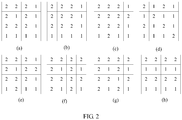
- FIG. 2 is a classification example of first-type pixels and second-type pixels in a 4 ⁇ 4 picture block according to an embodiment of the present invention. Eight examples in FIG. 2(a) to FIG. 2(h) are given in FIG. 2 . A classification case of first-type pixels and second-type pixels in FIG. 2(a) may be used.
- classification of a first-type pixel and a second-type pixel in a larger picture block may be considered as a combination of multiple small picture blocks.
- pixel classification of an 8 ⁇ 8 picture block or a larger picture block may be a combination of pixel classification of four or more picture blocks each with a size that is smaller than a size of the picture block.
- pixel classification of an 8 ⁇ 8 block in an example in FIG. 3(a) is obtained by repeatedly using the pixel classification of the 4 ⁇ 4 block in an example in FIG. 2(a) , that is, pixel classification of each of four 4 ⁇ 4 blocks in the 8 ⁇ 8 block is performed by using the pixel classification method of the 4 ⁇ 4 block in the example in FIG. 2(a) .
- pixel classification of an 8 ⁇ 8 block or a larger block may be performed in another manner, for example, in a pixel classification manner in FIG. 2b, FIG. 2c, or FIG. 2d .
- Same pixel classification may be used for all intra-frame prediction modes, or different pixel classification may be used for each intra-frame prediction mode, or same pixel classification may be used for several intra-frame prediction modes.
- an example of using the pixel classification method in FIG. 2(a) for a 4 ⁇ 4 picture block is mainly used in the following embodiment to describe a specific processing method.
- the intra-frame prediction algorithm may include directional prediction, DC prediction, or planar prediction in H.265/HEVC or H.264/AVC (Advanced Video Coding, Advanced Video Coding); or may be intra-frame prediction that is based on template matching, or the like. This is not limited in this embodiment of the present invention.
- a predicted value of the second-type pixel may be further generated.
- a decoder and an encoder may be a same device, or a decoder and an encoder may be different devices. This is not limited in this embodiment of the present invention.
- the predicted value of the first-type pixel may be subtracted from the original value of the first-type pixel, to obtain the residual values of the first-type pixel, or the original value of the first-type pixel may be subtracted from the predicted value of the first-type pixel, to obtain the residual values of the first-type pixel.
- the residual values that are of the first-type pixel and that are obtained in the first manner and the residual values that are of the first-type pixel and that are obtained in the second manner are opposite numbers.
- the residual values of the first-type pixel may be obtained in the first manner.
- a first residual value in the residual values of the first-type pixel is a difference between an original value and a predicted value of a first pixel.
- each of the residual values of the first-type pixel is a difference between an original value and a predicted value of a same first-type pixel.
- subtraction may be performed between an original value of the second-type pixel and the predicted value of the second-type pixel to obtain residual values of the second-type pixel.
- the residual values of the first-type pixel may be transformed in multiple forms.
- one-dimensional transform may be performed, or two-dimensional transform may be performed.
- the two-dimensional transform may be two-dimensional discrete cosine transform (DCT), two-dimensional discrete sine transform (DST), or the like. This embodiment of the present invention is not limited thereto.
- C is a transform coefficient matrix that includes multiple transform coefficients
- E is a residual value matrix
- the residual value matrix includes at least the residual values of all the first-type pixels, and may further include a residual value of at least one second-type pixel
- H is a transform matrix
- H T is a transposed matrix of the transform matrix H.
- H 29 55 74 84 74 74 0 ⁇ 74 84 ⁇ 29 ⁇ 74 55 55 ⁇ 84 74 ⁇ 29 / 128.
- H is an 8 ⁇ 8 DCT matrix
- a DCT matrix specified in the HEVC standard may be used.
- a quantity of non-0 transform coefficients in the transform coefficients is less than or equal to the quantity of first-type pixels.
- the transform coefficients may be quantized in multiple manners.
- the transform coefficient may be divided by a quantization step (quantization step), and rounding (rounding) is performed on a value obtained after the division. This is referred to as common quantization processing.
- quantization may be performed by using a rate-distortion optimized quantization (Rate-distortion optimized quantization, RDOQ) method. This embodiment of the present invention is not limited thereto.
- step 160 the quantized transform coefficients are dequantized to obtain reconstructed transform coefficients, the reconstructed transform coefficients are inversely transformed to obtain reconstructed residual values of the first-type pixel, and the reconstructed residual values of the first-type pixel and the predicted value of the first-type pixel are added to obtain the reconstructed value of the first-type pixel.
- dequantization processing may be multiplying the quantized transform coefficients by the quantization step to obtain the reconstructed transform coefficients.
- the operation of multiplying the quantized transform coefficients by the quantization step may be usually completed by means of integer multiplication and shift.
- sign ⁇ X ⁇ means obtaining a sign of X
- Q ( i ) is an i th quantized transform coefficient
- R ( i ) is a reconstructed transform coefficient
- bdshift is a shift parameter
- Qs' ( i ) is an integer
- Qs' ( i )/2 bashift is approximately the quantization step.
- Qs '( i ) depends on both a level scale (levelScale) and a scaling factor (scaling factor).
- the transform coefficients are obtained after the dequantization.
- the transform coefficients may be placed at first-type preset locations in a transform coefficient matrix in a scanning order.
- Transform coefficients at second-type preset locations in the transform coefficient matrix are set to preset values.
- a quantity of the second-type preset locations is greater than or equal to 0 and is less than a total quantity of transform coefficients in the transform coefficient matrix.
- the preset value may be 0.
- the transform coefficient matrix is divided into the two parts: the first-type preset locations and the second-type preset locations.
- the scanning order may include vertical scanning, horizontal scanning, or diagonal scanning.
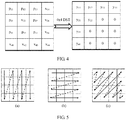
- three scanning orders shown in FIG. 5 are respectively the vertical scanning in FIG. 5(a) , the horizontal scanning in FIG. 5(b) , or the diagonal scanning in FIG. 5(c) .
- C is a transform coefficient matrix that is reconstructed after dequantization and includes multiple reconstructed transform coefficients
- E is a reconstructed residual value matrix that includes multiple reconstructed residual values
- H is a transform matrix (transform matrix)
- H T is a transposed matrix of the transform matrix H.
- Residual values obtained after inverse transform include at least the residual values of all the first-type pixels, and may further include a residual value of at least one second-type pixel.
- An inverse transform size may be the same as a size of a picture block. In this case, a quantity of residual values generated by using inverse transform is equal to a quantity of pixels in the picture block.
- the two-dimensional separable transform such as the two-dimensional DST and the two-dimensional DCT meets that a size of a transform matrix is equal to a size of a picture block.
- an inverse transform size may be smaller than a size of a picture block.
- a 3 ⁇ 3 block in the lower right corner of a 4 ⁇ 4 block in an example in FIG. 2(f) includes all the first-type pixels.
- reconstructed transform coefficients are inversely transformed by using 3 ⁇ 3 inverse transform, to obtain residual values of the 3 ⁇ 3 block.
- 4 ⁇ 4 inverse transform may be separately used for the four 4 ⁇ 4 blocks in the 8 ⁇ 8 block in the example in FIG. 3(a) , to obtain residual values of the four 4 ⁇ 4 blocks.
- Both residual values of a first-type pixel in a picture block and residual values of a second-type pixel in the picture block may be generated by using inverse transform. To reduce calculation, only the residual values of the first-type pixel may be generated while the residual values of the second-type pixel are not generated.
- a reconstructed value obtained by adding a residual value and a predicted value may exceed a dynamic range of a pixel.
- a dynamic range of an 8-bit pixel is 0 to 255. Therefore, in this embodiment of the present invention, when a predicted value obtained by adding a residual value and a predicted value exceeds an upper limit or a lower limit of a dynamic range of a pixel, the predicted value is set to a maximum value or a minimum value of the dynamic range, for example, set to 255 or 0.
- a process of reconstructing the first-type pixel may be the same as the process of reconstructing the first-type pixel in the decoding method shown in FIG. 6 .
- a specific process of reconstructing the first-type pixel in this embodiment of the present invention refer to the process of reconstructing the first-type pixel in the decoding method shown in FIG. 6 . To avoid repetition, details are not described herein.
- the method in this embodiment of the present invention further includes: determining the interpolation method according to the intra-frame prediction algorithm, where an interpolation manner in the interpolation method is the same as an interpolation manner included in the intra-frame prediction algorithm.
- the interpolation method may be determined by using the intra-frame prediction algorithm in step 120.
- the reconstructed value of the second-type pixel may be further obtained according to reference pixels of the picture block and/or the reconstructed value of the first-type pixel by using the interpolation method.
- Method 1 is an interpolation method that is based on an average of surrounding pixels. Surrounding reference pixels of the second-type pixel and/or the reconstructed first-type pixel are obtained. Weighted averaging is performed on the pixels to obtain the reconstructed value of the second-type pixel by means of interpolation. For example, a pixel P 1,1 in FIG. 7 that belongs to the second-type pixel may be obtained by performing weighted averaging on reference pixels R 0,0 , R 0,1 , R 0,2 , R 1,0 , and R 2,0 surrounding P 1,1 and a reconstructed first-type pixel R 2,2 .
- a rounding operation may further need to be performed on a weighted average value.
- Method 2 is a direction-based interpolation method. According to a predetermined interpolation direction, reference pixels of the second-type pixel in this direction and/or the reconstructed first-type pixel are obtained, and the reconstructed value of the second-type pixel are obtained by using an interpolation filter. For example, when the interpolation direction is a vertical (vertical downward) direction, a pixel P 1,2 in FIG.
- Method 3 is a hybrid interpolation method.
- Reference pixels surrounding second pixels at a predetermined location and/or the reconstructed first-type pixel is obtained.
- a reconstructed value of the second-type pixel is obtained by means of linear interpolation.
- reference pixels of the second-type pixel in the direction and/or the reconstructed first-type pixel, and the reconstructed second-type pixel are obtained.
- a reconstructed value of the second-type pixel is obtained by using an interpolation filter.
- Method 4 is a transform-based interpolation method.
- a locations of the second-type pixel is padded with a preset value, such as 0 or 128.
- a pixel block that includes reference pixels, the reconstructed first-type pixel, and a padded second-type pixel is transformed.
- Inverse transform is performed after transform coefficients at preset locations in the transform coefficients are removed, to obtain the reconstructed value of the second-type pixel.
- an intra-frame prediction mode in HEVC is used as the interpolation method for the second-type pixel.
- an intra-frame prediction mode for the first-type pixel may be the same as or may be different from the intra-frame prediction mode for the second-type pixel.
- the second pixels may be reconstructed by using one of the foregoing methods, or the second pixels may be reconstructed by using a combination of several foregoing methods. This is not limited in this embodiment of the present invention.
- step 140 residual values of B pixels in the second-type pixel are obtained according to the residual values of the first-type pixel, where B is a positive integer that is not less than 1.
- the residual values of the first-type pixel and the residual values of the B pixels are transformed to obtain the transform coefficients.
- a quantity of fixed 0 coefficients in the transform coefficients is equal to B.
- a transform size may be the same as a size of the picture block, that is, a quantity of residual values for transforming is equal to a quantity of pixels in the picture block; or a transform size may be smaller than a size of the picture block.
- the two-dimensional separable transform such as the two-dimensional DST and the two-dimensional DCT
- the picture block is a square
- a size of a transform matrix is equal to a size of the picture block
- the residual values of all the first-type pixels and the residual values of all the second-type pixels are included in a transform unit.
- the residual values of all the first-type pixels and residual values of some second-type pixels are included in a transform unit.
- the 3 ⁇ 3 block in the lower right corner of the 4 ⁇ 4 block in the example in FIG. 2(f) includes all the first-type pixels. In this case, only the residual values of the 3 ⁇ 3 block may be transformed.
- 4 ⁇ 4 transform may be separately used for the four 4 ⁇ 4 blocks in the 8 ⁇ 8 block in the example in FIG. 3(a) .
- a quantity of the residual values of the first-type pixel is A.
- the B pixels in the second-type pixel are corresponding to the B residual values.
- the A residual values are in a one-to-one correspondence with the pixels in the first-type pixel, and the B residual values are in a one-to-one correspondence with the B pixels.
- Obtaining the residual values of the B pixels in the second-type pixel according to the residual values of the first-type pixel includes: determining a B ⁇ A matrix corresponding to the quantity A of the residual values of the first-type pixel and a quantity B of the residual values of the B pixels in the second-type pixel; multiplying the B ⁇ A matrix by a column vector that includes the A residual values of the first-type pixel, to obtain a column vector that includes the residual values of the B pixels in the second-type pixel; and obtaining the residual values of the B pixels in the second-type pixel according to the column vector that includes the residual values of the B pixels in the second-type pixel.
- a smart padding (smart padding) method is elaborated in the document "A new padding technique for coding of arbitrarily-shaped image/video segments" (ICIP 1999). That is, according to a vector (column vector) that includes A known pixel values (residual values of a first-type pixel), a derived B ⁇ A matrix is multiplied by the vector (column vector) to obtain a column vector that includes other B pixel values (residual values of a second-type pixel) and then obtain the B pixel values. Coefficients at B fixed locations in transform coefficients obtained after DCT transform is performed on the A+B pixel values are always 0 (or are approximately 0 because of inadequate operation precision). The B coefficients are briefly referred to as fixed 0 coefficients. By means of the method, some of transform coefficients of residual values of a picture block may be fixed 0 coefficients, so as to reduce a quantity of non-0 coefficients that need to be encoded.
- a weighted average of the residual values of the first-type pixel is used as a residual value of at least one second-type pixel, so that transform coefficients obtained after generated residual values are transformed may have multiple fixed 0 coefficients.
- a quantity of fixed 0 coefficients is equal to or greater than the quantity B of second-type pixels for which the residual values are generated, so as to reduce non-0 coefficients that need to be encoded.
- the fixed 0 coefficient may be set at any location in the transform coefficient matrix. This is not limited in this embodiment of the present invention. In an example of this embodiment, the fixed 0 coefficient may be set at a high-frequency coefficient location in the transform coefficient matrix, such as a coefficient location in the lower right corner, or may be set at a rearward coefficient location in a coefficient scanning sequence.
- residual values (such as p 11 , p 12 ,..., p 33 in FIG. 4 ) of all eight second-type pixels are obtained by using residual values (such as x 14 , x 22 ,..., x 44 in FIG. 4 ) of eight first-type pixels.
- residual values such as x 14 , x 22 ,..., x 44 in FIG. 4
- a vector that includes the residual values of the first-type pixels is multiplied by an 8 ⁇ 8 matrix on the left to obtain the residual values of the second-type pixels.
- a corresponding 4 ⁇ 4 transform coefficient matrix may have eight fixed 0 coefficients (such as eight coefficients in FIG. 4 except y 14 , y 12 ,..., y 41 ).
- a calculation manner of an 8 ⁇ 8 matrix can be obtained by using the smart padding method.
- the 3 ⁇ 3 block at the lower right of the 4 ⁇ 4 block in the example in FIG. 2(f) includes all the first-type pixels. In this case, only the residual values of the second-type pixels in the 3 ⁇ 3 block may be obtained by using the smart padding method. It should be noted that in subsequent processing, the residual values of the lower-right 3 ⁇ 3 block may be transformed and quantized by using 3 ⁇ 3 transform.
- step 140 a predicted value of each pixel is subtracted from an original value of each of at least one pixel in the second-type pixel, to obtain a residual value of each pixel.
- the predicted value of each pixel is obtained by using the intra-frame prediction algorithm.
- the residual values of the first-type pixel and a residual value of the at least one pixel in the second-type pixel are transformed to obtain the transform coefficients.
- each residual value of the at least one pixel in the second-type pixel is a difference between an original value and a predicted value of a same second-type pixel.
- the transform coefficients are quantized in a transform coefficient scanning order to obtain the quantized transform coefficients.
- the transform coefficients are quantized to obtain the quantized transform coefficients (quantized transform coefficient).
- a quantization method is usually scalar quantization, or may be vector quantization or another manner.
- a smart quantization method elaborated in the document " Constrained Quantization in the Transform Domain with Applications in Arbitrarily-Shaped Object Coding" (IEEE TCSVT, vol. 20, no. 11, 2010 ) may be used.
- Quantized transform coefficients are sequentially determined from back to front in a transform coefficient scanning order, so as to minimize distortion of a reconstructed residual value of a target pixel point in a code block.
- the quantized transform coefficients are sequentially determined from back to front in the transform coefficient scanning order, so as to minimize distortion of the reconstructed residual values of the first-type pixel.
- the transform coefficient scanning order includes vertical scanning, horizontal scanning, or diagonal scanning.
- a transform coefficient matrix in FIG. 4 that is obtained after the residual values generated by using the smart padding method are transformed is scanned in three scanning orders in FIG. 5 : the vertical scanning in FIG. 5(a) , the horizontal scanning in FIG. 5(b) , and the diagonal scanning in FIG. 5(c) .
- a coefficient C 1,3 in the first row and the third column is the ninth coefficient in the vertical scanning order.
- C 3,2 and C 3,3 are fixed 0 coefficients, an actual sequence number of C 1,3 is 7, that is, C 1,3 is C 7 .
- C 1,4 is C 8 .
- the two methods for obtaining the residual values and the three methods for obtaining the quantized transform coefficients may be used in a combination of two methods.
- residual value processing that is based on the smart padding method and a quantization technology that is based on the smart quantization method are jointly used, relatively high encoding efficiency is achieved.
- transform coefficients may have fixed 0 coefficients, and the fixed 0 coefficients each may be located between two non-0 coefficients in a scanning sequence. When the transform coefficients are encoded, scanning of non-0 coefficients at fixed locations may be skipped.
- the method in this embodiment of the present invention further includes: generating a bit-stream according to the quantized transform coefficients, so that a decoding device reconstructs the current picture block according to the bit-stream.
- the generating a bit-stream according to the quantized transform coefficients includes: encoding the quantized transform coefficients and information about the intra-frame prediction algorithm by using an entropy encoding method, to obtain the bit-stream.
- the information about the intra-frame prediction algorithm may be intra-frame prediction mode information or the like.
- the generating a bit-stream according to the quantized transform coefficients encoding information about the intra-frame prediction algorithm, the quantized transform coefficients, and information about the interpolation method by using an entropy encoding method, to obtain the bit-stream.
- the information about the interpolation method may be explicitly transmitted in the bit-stream.
- a preset interpolation manner for the second-type pixel may be implicitly mapped according to the intra-frame prediction mode for the first-type pixel.
- the information about the interpolation method does not need to be transmitted in the bit-stream.
- the intra-frame prediction mode for the first-type pixel is the DC mode
- the interpolation manner for the second-type pixel is the method that is based on an average of surrounding pixels.
- the intra-frame prediction mode for the first-type pixel is the directional prediction
- the interpolation manner for the second-type pixel is the directional interpolation that is based on a same direction.
- a corresponding preset interpolation manners for the second-type pixel may be used by default for several intra-frame prediction modes for the first-type pixel, and for the remaining intra-frame prediction modes for the first-type pixel, the information about the interpolation method for the second-type pixel is transmitted in the bit-stream.
- the intra-frame encoding method in the present invention may be used as a supplement to a conventional intra-frame encoding method.
- the intra-frame encoding method in the present invention is added in addition to 35 intra-frame prediction encoding modes in HEVC.
- the intra-frame encoding method in the present invention may be used to replace a conventional intra-frame encoding method.
- a DC prediction mode in HEVC is replaced by the intra-frame encoding method in the present invention, and the DC prediction mode or a planar prediction mode is used as an intra-frame prediction mode for the first-type pixel.
- An actual intra-frame encoding mode for a picture block may be obtained by means of common rate-distortion optimization.
- the picture block is pre-encoded by using multiple candidate intra-frame encoding modes, rate-distortion costs of each mode are determined, and a mode with minimum rate-distortion costs is used as the actual encoding mode for the picture block.
- FIG. 1 to FIG. 5 are merely intended to help a person skilled in the art understand the embodiments of the present invention instead of limiting the embodiments of the present invention to a specific value or a specific scenario shown in the examples.
- a person skilled in the art certainly can make various equivalent modifications or changes according to the examples provided in FIG. 1 to FIG. 5 , and such modifications or changes also fall within the scope of the embodiments of the present invention.
- sequence numbers of the foregoing processes do not mean execution orders. Execution orders of the processes should be determined according to functions and internal logic of the processes, and shall not set any limitation on an implementation process of the embodiments of the present invention.
- the encoding method in the embodiments of the present invention is described in detail above with reference to FIG. 1 to FIG. 5 .
- a decoding method in the embodiments of the present invention is described in detail below with reference to FIG. 6 to FIG. 9 .
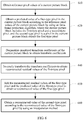
- FIG. 6 is a schematic flowchart of an intra-frame decoding method according to an embodiment of the present invention.
- the method shown in FIG. 6 may be performed by a decoder.
- the intra-frame decoding method shown in FIG. 6 is corresponding to the intra-frame encoding method shown in FIG. 1 .
- the method shown in FIG. 6 may be an inverse process of the method shown in FIG. 1 .
- the method shown in FIG. 6 includes the following steps:
- a first-type pixel is reconstructed according to quantized transform coefficients and a predicted value of the first-type pixel (one part of pixels), to obtain a reconstructed value of the first-type pixel.
- second pixels are directly reconstructed by using an interpolation method that is based on reference pixels and/or the reconstructed part of pixels. Therefore, a bitrate is reduced.
- the picture block in this embodiment of the present invention may be in multiple sizes, for example, may be in a size of 3 ⁇ 3, 4 ⁇ 4, 8 ⁇ 8, 16 ⁇ 16, 32 ⁇ 32, 64 ⁇ 64, 8 ⁇ 4, 4 ⁇ 8, 16 ⁇ 12, or 9 ⁇ 9.
- This embodiment of the present invention is not limited thereto.
- a first-type pixel may be a pixel at any location in the current picture block.
- the first-type pixel may be at a location such as a right boundary, a lower boundary, a center, a lower left diagonal, a lower right diagonal, or the like in the current picture block.
- a quantity of first-type pixels is greater than 0 and is less than a quantity of pixels in the entire current picture block.
- the quantity of first-type pixels is 1/2, 7/16, 15/32, 3/4, 1/4, or the like of the quantity of pixels in the entire current picture block.
- the second-type pixel is a pixel in the current picture block except the first-type pixel.
- FIG. 2 is a classification example of first-type pixels and second-type pixels in a 4 ⁇ 4 picture block according to an embodiment of the present invention. Eight examples in FIG. 2(a) to FIG. 2(h) are given in FIG. 2 . In an example of this embodiment, a classification case of first-type pixels and second-type pixels in FIG. 2(a) may be used.
- classification of first-type pixels and second-type pixels in a larger picture block may be considered as a combination of multiple small picture blocks.
- pixel classification of an 8 ⁇ 8 picture block or a larger picture block may be a combination of pixel classification of four or more picture blocks each with a size that is smaller than a size of the picture block.
- pixel classification of an 8 ⁇ 8 block in an example in FIG. 3(a) is obtained by repeatedly using the pixel classification of the 4 ⁇ 4 block in an example in FIG. 2(a) , that is, pixel classification of each of four 4 ⁇ 4 blocks in the 8 ⁇ 8 block is performed by using the pixel classification method of the 4 ⁇ 4 block in the example in FIG. 2(a) .
- pixel classification of an 8 ⁇ 8 block or a larger block may be performed in another manner, for example, in a pixel classification manner in FIG. 2b, FIG. 2c, or FIG. 2d .
- Same pixel classification may be used for all intra-frame prediction modes, or different pixel classification may be used for each intra-frame prediction mode, or same pixel classification may be used for several intra-frame prediction modes.
- an example of using the pixel classification method in FIG. 2(a) for a 4 ⁇ 4 picture block is mainly used in the following embodiment to describe a specific processing method.
- step 620 information about the intra-frame prediction algorithm may be obtained by parsing a bit-stream.
- the intra-frame prediction algorithm may include directional prediction, DC prediction, or planar prediction in H.265/HEVC or H.264/AVC; or may be intra-frame prediction that is based on template matching, or the like. This is not limited in this embodiment of the present invention.
- the method in this embodiment of the present invention further includes: placing the transform coefficients at first-type preset locations in a transform coefficient matrix in a transform coefficient scanning order, where transform coefficients at second-type preset locations in the transform coefficient matrix are set to preset values, and a sum of a quantity of the second-type preset locations and a quantity of the first-type preset locations is equal to a total quantity of transform coefficients in the transform coefficient matrix.
- the quantized transform coefficients may be obtained by parsing the bit-stream.
- dequantization processing may be multiplying the quantized transform coefficients by a quantization step to obtain reconstructed transform coefficients.
- the operation of multiplying the quantized transform coefficients by the quantization step may be usually completed by means of integer multiplication and shift.
- sign ⁇ X ⁇ means obtaining a sign of X
- Q ( i ) is an i th quantized transform coefficient
- R ( i ) is a reconstructed transform coefficient
- bdshift is a shift parameter
- Qs' ( i ) is an integer
- Qs' ( i )/ 2 bdshift is approximately the quantization step.
- Qs '( i ) depends on both a level scale (levelScale) and a scaling factor (scaling factor).
- the transform coefficients are obtained after the dequantization.
- the transform coefficients may be placed at the first-type preset locations in the transform coefficient matrix in the transform coefficient scanning order.
- the transform coefficients at the second-type preset locations in the transform coefficient matrix are set to the preset values.
- the quantity of the second-type preset locations is less than the total quantity of transform coefficients in the transform coefficient matrix.
- the preset value may be 0.
- the scanning order includes vertical scanning, horizontal scanning, or diagonal scanning.
- the scanning order may depend on an intra-frame prediction mode for the first-type pixel, or may be transmitted in the bit-stream.
- three scanning orders shown in FIG. 5 are respectively the vertical scanning in FIG. 5(a) , the horizontal scanning in FIG. 5(b) , or the diagonal scanning in FIG. 5(c) .
- step 630 there are multiple inverse transform forms. For example,
- Two-dimensional separable transform such as inverse DCT transform or inverse DST transform may be used.
- C is a transform coefficient matrix that is reconstructed after dequantization and includes multiple reconstructed transform coefficients
- E is a reconstructed residual value matrix that includes multiple reconstructed residual values
- H is a transform matrix (transform matrix).
- Residual values obtained after inverse transform include at least residual values of all the first-type pixels, and may further include a residual value of at least one second-type pixel.
- An inverse transform size may be the same as a size of a picture block. In this case, a quantity of residual values generated by using inverse transform is equal to a quantity of pixels in the picture block.
- the two-dimensional separable transform such as the two-dimensional DST and the two-dimensional DCT meets that a size of a transform matrix is equal to a size of a picture block.
- an inverse transform size may be smaller than a size of a picture block.
- a 3 ⁇ 3 block in the lower right corner of a 4 ⁇ 4 block in an example in FIG. 2(f) includes all the first-type pixels.
- reconstructed transform coefficients are inversely transformed by using 3 ⁇ 3 inverse transform, to obtain residual values of the 3 ⁇ 3 block.
- 4 ⁇ 4 inverse transform may be separately used for the four 4 ⁇ 4 blocks in the 8 ⁇ 8 block in the example in FIG. 3(a) , to obtain residual values of the four 4 ⁇ 4 blocks.
- Both residual values of a first-type pixel in a picture block and residual values of a second-type pixel in the picture block may be generated by using inverse transform. To reduce calculation, only the residual values of the first-type pixel may be generated while the residual values of the second-type pixel are not generated.
- a reconstructed value obtained by adding a residual value and a predicted value may exceed a dynamic range of a pixel.
- a dynamic range of an 8-bit pixel is 0 to 255. Therefore, in this embodiment of the present invention, when a predicted value obtained by adding a residual value and a predicted value exceeds an upper limit or a lower limit of a dynamic range of a pixel, the predicted value is set to a maximum value or a minimum value of the dynamic range, for example, set to 255 or 0.
- the method in this embodiment of the present invention further includes: determining the interpolation method according to the intra-frame prediction algorithm, where an interpolation manner in the interpolation method is the same as an interpolation manner included in the intra-frame prediction algorithm.
- the method in this embodiment of the present invention further includes: determining the interpolation method according to a bit-stream of the picture block.
- the interpolation method may be determined by using the intra-frame prediction algorithm in step 620.
- the reconstructed value of the second-type pixel may be further determined according to the reconstructed value of the first-type pixel by using the interpolation method.
- Method 1 is an interpolation method that is based on an average of surrounding pixels. Surrounding reference pixels of the second-type pixel and/or the reconstructed first-type pixel is obtained. Weighted averaging is performed on the pixels to obtain the reconstructed value of the second-type pixel by means of interpolation.
- Method 2 is a direction-based interpolation method. According to a predetermined interpolation direction, reference pixels of the second-type pixel in this direction and/or the reconstructed first-type pixel is obtained, and the reconstructed value of the second-type pixel is obtained by using an interpolation filter.
- Method 3 is a hybrid interpolation method.
- Reference pixels surrounding second pixels at a predetermined location and/or the reconstructed first-type pixel is obtained.
- a reconstructed value of the second-type pixel is obtained by means of linear interpolation.
- reference pixels of the second-type pixel in the direction and/or the reconstructed first-type pixel, and the reconstructed second-type pixel is obtained.
- a reconstructed value of the second-type pixel is obtained by means of linear interpolation.
- Method 4 is a transform-based interpolation method.
- a location of the second-type pixel is padded with a preset value, such as 0 or 128.
- a pixel block that includes reference pixels, the reconstructed first-type pixel, and a padded second-type pixel is transformed.
- Inverse transform is performed after transform coefficients at preset locations are removed, to obtain the reconstructed value of the second-type pixel.
- an intra-frame prediction mode in HEVC is used as the interpolation method for the second-type pixel.
- an intra-frame prediction mode for the first-type pixel may be the same as or may be different from the intra-frame prediction mode used for interpolation of the second-type pixel.
- the second pixels may be reconstructed by using one of the foregoing methods, or the second pixels may be reconstructed by using a combination of several foregoing methods. This is not limited in this embodiment of the present invention.
- Information about the interpolation method for the second-type pixel may be obtained by parsing the bit-stream, or may be obtained by means of mapping according to the intra-frame prediction mode for the first-type pixel.
- the intra-frame prediction mode for the first-type pixel is the directional prediction mode (for example, at least one of No. 2 to No. 34 prediction modes specified in HEVC)
- the directional interpolation method that is based on a same direction is used for the second-type pixel.
- corresponding preset interpolation methods for the second-type pixel may be used for several intra-frame prediction modes for the first-type pixel, and for the remaining intra-frame prediction modes for the first-type pixel, the interpolation method for the second-type pixel is obtained by parsing the bit-stream.
- different intra-prediction modes for the first-type pixel may have same or different pixel classification of the first-type pixel and the second-type pixel.
- a same pixel classification manner is used in several intra-frame prediction modes for the first-type pixel; or different pixel classification manners are used in intra-frame prediction modes for the first-type pixel.
- a 4 ⁇ 4 block is used as an example.
- the intra-frame prediction mode for the first-type pixel is the DC mode
- a pixel classification manner in FIG. 2(a) is used.
- the intra-frame prediction mode for the first-type pixel is a vertical mode
- a pixel classification manner in FIG. 2(d) is used.
- a part of processing in the decoding method should be the same as or should match processing in the encoding method.
- an encoded reconstructed picture can be the same as a decoded reconstructed picture.
- the pixel classification, the intra-frame prediction method for the first-type pixel, the coefficient scanning method, and the interpolation method for the second-type pixel in the decoding method should be the same as the corresponding methods on an encoding side.
- the processing such as the inverse transform and the entropy decoding in the decoding method should match the transform and the entropy encoding in the encoding method. That is, the processing is inverse processing of the corresponding methods in the encoding method.
- encoding also includes pixel reconstruction processing.
- the reconstruction processing also should be the same as the reconstruction processing in decoding.
- dequantization and inverse transform for the quantized transform coefficients in encoding should be the same as the dequantization and inverse transform for the quantized transform coefficients in decoding.
- the intra-frame decoding method in FIG. 6 is corresponding to the intra-frame encoding method in FIG. 1 to FIG. 5
- the decoder that performs FIG. 6 can implement inverse processes of the processes in the method embodiment in FIG. 1 to FIG. 5
- the intra-frame decoding method in FIG. 6 can be obtained according to an inverse process corresponding to the intra-frame encoding method in FIG. 1 to FIG. 5 . To avoid repetition, details are not described herein again.
- the intra-frame encoding method and the intra-frame decoding method in the embodiments of the present invention are described in detail above with reference to FIG. 1 to FIG. 6 .
- An encoder and a decoder in the embodiments of the present invention are described below with reference to FIG. 7 and FIG. 10 .
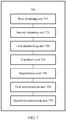
- FIG. 7 is a schematic block diagram of an encoder according to an embodiment of the present invention.
- a device 700 shown in FIG. 7 includes a first obtaining unit 710, a second obtaining unit 720, a first determining unit 730, a transform unit 740, a quantization unit 750, a first reconstruction unit 760, and a second reconstruction unit 770.
- the first obtaining unit 710 is configured to obtain reference pixel values of a current picture block.
- the first obtaining unit 720 is configured to obtain a predicted value of a first-type pixel in the current picture block according to the reference pixel values of the current picture block by using an intra-frame prediction algorithm, where the current picture block includes the first-type pixel and a second-type pixel, and the second-type pixel is a pixel in the current picture block except the first-type pixel.
- the first determining unit 730 is configured to obtain residual values of the first-type pixel according to the predicted value of the first-type pixel and an original pixel value of the first-type pixel.
- the transform unit 740 is configured to obtain transform coefficients according to the residual values of the first-type pixel.
- the quantization unit 750 is configured to quantize the transform coefficients to obtain quantized transform coefficients.
- the first reconstruction unit 760 is configured to reconstruct the first-type pixel according to the quantized transform coefficients and the predicted value of the first-type pixel, to obtain a reconstructed value of the first-type pixel.
- the second reconstruction unit 770 is configured to obtain a reconstructed value of the second-type pixel according to reference pixels of the picture block and/or the reconstructed value of the first-type pixel by using an interpolation method.
- transform and quantization processing is performed only on residual values of a first-type pixel to obtain a bit-stream. Residual values of an entire picture block do not need to be all encoded. Therefore, flexible encoding can be implemented, and encoding efficiency can be improved.
- the first-type pixel is reconstructed according to quantized transform coefficients and a predicted value of the first-type pixel (one part of pixels), to obtain a reconstructed value of the first-type pixel.
- a second-type pixel (the other part of pixels) is directly reconstructed by using an interpolation method that is based on reference pixels and/or the reconstructed part of pixels.
- the current picture block may be any one or one type of picture block in a current frame.
- the picture block in this embodiment of the present invention may be in multiple sizes, for example, may be in a size of 3 ⁇ 3, 4 ⁇ 4, 8 ⁇ 8, 16 ⁇ 16, 32 ⁇ 32, 64 ⁇ 64, 8 ⁇ 4, 4 ⁇ 8, 16 ⁇ 12, or 9 ⁇ 9. This embodiment of the present invention is not limited thereto.
- a first-type pixel may be a pixel at any location in the current picture block.
- the first-type pixel may be at a location such as a right boundary, a lower boundary, a center, a lower left diagonal, a lower right diagonal, or the like in the current picture block.
- a quantity of first-type pixels is greater than 0 and is less than a quantity of pixels in the entire current picture block.
- the quantity of first-type pixels is 1/2, 7/16, 15/32, 3/4, 1/4, or the like of the quantity of pixels in the entire current picture block.
- the second-type pixel is a pixel in the picture block except the first-type pixel.
- FIG. 2 is a classification example of first-type pixels and second-type pixels in a 4 ⁇ 4 picture block according to an embodiment of the present invention. Eight examples in FIG. 2(a) to FIG. 2(h) are given in FIG. 2 . In an example of this embodiment, a classification case of first-type pixels and second-type pixels in FIG. 2(a) may be used.
- classification of first-type pixels and second-type pixels in a larger picture block may be considered as a combination of multiple small picture blocks.
- pixel classification of an 8 ⁇ 8 picture block or a larger picture block may be a combination of pixel classification of four or more picture blocks each with a size that is smaller than a size of the picture block.
- pixel classification of an 8 ⁇ 8 block in an example in FIG. 3(a) is obtained by repeatedly using the pixel classification of the 4 ⁇ 4 block in an example in FIG. 2(a) , that is, pixel classification of each of four 4 ⁇ 4 blocks in the 8 ⁇ 8 block is performed by using the pixel classification method of the 4 ⁇ 4 block in the example in FIG. 2(a) .
- pixel classification of an 8 ⁇ 8 block or a larger block may be performed in another manner, for example, in a pixel classification manner in FIG. 2b, FIG. 2c, or FIG. 2d .
- Same pixel classification may be used for all intra-frame prediction modes, or different pixel classification may be used for each intra-frame prediction mode, or same pixel classification may be used for several intra-frame prediction modes.
- an example of using the pixel classification method in FIG. 2(a) for a 4 ⁇ 4 picture block is mainly used in the following embodiment to describe a specific processing method.
- the intra-frame prediction algorithm may include directional prediction, DC prediction, or planar prediction in H.265/HEVC or H.264/AVC (Advanced Video Coding, Advanced Video Coding); or may be intra-frame prediction that is based on template matching, or the like. This is not limited in this embodiment of the present invention.
- a predicted value of the second-type pixel may be further generated.
- a decoding device and an encoding device may be a same device, or a decoding device and an encoding device may be different devices. This is not limited in this embodiment of the present invention.
- the encoder 700 further includes a second determining unit.
- the second determining unit is configured to determine the interpolation method according to the intra-frame prediction algorithm, where an interpolation manner in the interpolation method is the same as an interpolation manner included in the intra-frame prediction algorithm.
- the first determining unit 730 is specifically configured to perform subtraction between the original value of the first-type pixel and the predicted value of the first-type pixel to obtain the residual values of the first-type pixel.
- the transform unit 740 is specifically configured to: obtain residual values of B pixels in the second-type pixel according to the residual values of the first-type pixel, where B is a positive integer that is not less than 1; and transform the residual values of the first-type pixel and the residual values of the B pixels to obtain the transform coefficients, where a quantity of fixed 0 coefficients in the transform coefficients is equal to B.
- a quantity of the residual values of the first-type pixel is A.
- the B pixels in the second-type pixel are corresponding to the B residual values.
- the A residual values are in a one-to-one correspondence with the pixels in the first-type pixel, and the B residual values are in a one-to-one correspondence with the B pixels.
- the third obtaining unit is specifically configured to: determine a B ⁇ A matrix corresponding to the quantity A of the residual values of the first-type pixel and a quantity B of the residual values of the B pixels in the second-type pixel; multiply the B ⁇ A matrix by a column vector that includes the A residual values of the first-type pixel, to obtain a column vector that includes the residual values of the B pixels in the second-type pixel; and obtain the residual values of the B pixels in the second-type pixel according to the column vector that includes the residual values of the B pixels in the second-type pixel.
- the transform unit 740 is specifically configured to: subtract a predicted value of each pixel from an original value of each of at least one pixel in the second-type pixel, to obtain a residual value of each pixel, where the predicted value of each pixel is obtained by using the intra-frame prediction algorithm; and transform the residual values of the first-type pixel and a residual value of the at least one pixel in the second-type pixel to obtain the transform coefficients.
- the quantization unit 750 is specifically configured to quantize the transform coefficients in a transform coefficient scanning order to obtain the quantized transform coefficients.
- the second reconstruction unit 770 dequantizes the quantized transform coefficients to obtain reconstructed transform coefficients, inversely transforms the reconstructed transform coefficients to obtain reconstructed residual values of the first-type pixel, and adds the reconstructed residual values of the first-type pixel and the predicted value of the first-type pixel to obtain the reconstructed value of the first-type pixel.
- the encoder 700 further includes a generation unit.
- the generation unit is configured to generate a bit-stream according to the quantized transform coefficients, so that a decoding device reconstructs the current picture block according to the bit-stream.
- the generation unit is specifically configured to encode the quantized transform coefficients and information about the intra-frame prediction algorithm by using an entropy encoding method, to obtain the bit-stream.
- the generation unit is specifically configured to encode information about the intra-frame prediction algorithm, the quantized transform coefficients, and information about the interpolation method by using an entropy encoding method, to obtain the bit-stream.
- the encoder 700 shown in FIG. 7 can implement the processes completed by the encoder in the method embodiment in FIG. 1 to FIG. 5 .
- For other functions and operations of the encoder 700 refer to the processes of the encoder in the method embodiment in FIG. 1 to FIG. 5 . To avoid repetition, details are not described herein again.
- FIG. 8 is a schematic block diagram of a decoder according to an embodiment of the present invention.
- a device 800 shown in FIG. 8 includes a first obtaining unit 810, a second obtaining unit 820, a dequantization unit 830, an inverse transform unit 840, a first reconstruction unit 850, and a second reconstruction unit 860.
- the first obtaining unit 810 is configured to obtain reference pixel values of a current picture block.
- the second obtaining unit 820 is configured to obtain a predicted value of a first-type pixel in the current picture block according to the reference pixel values of the current picture block by using an intra-frame prediction algorithm, where the current picture block includes the first-type pixel and second-type pixel, and the second-type pixel is a pixel in the current picture block except the first-type pixel.
- the dequantization unit 830 is configured to dequantize quantized transform coefficients of the current picture block to obtain transform coefficients.
- the inverse transform unit 840 is configured to inversely transform the transform coefficients to obtain reconstructed residual values of the first-type pixel.
- the first reconstruction unit 850 is configured to add the reconstructed residual values of the first-type pixel and the predicted value of the first-type pixel to obtain a reconstructed value of the first-type pixel.
- the second reconstruction unit 860 is configured to obtain a reconstructed value of the second-type pixel according to reference pixels of the picture block and/or the reconstructed value of the first-type pixel by using an interpolation method.
- a first-type pixel is reconstructed according to quantized transform coefficients and a predicted value of the first-type pixel (one part of pixels), to obtain a reconstructed value of the first-type pixel.
- second pixels are directly reconstructed by using an interpolation method that is based on reference pixels and/or the reconstructed part of pixels. Therefore, a bitrate is reduced.
- the current picture block may be any one or one type of picture block in a current frame.
- the picture block in this embodiment of the present invention may be in multiple sizes, for example, may be in a size of 3 ⁇ 3, 4 ⁇ 4, 8 ⁇ 8, 16 ⁇ 16, 32 ⁇ 32, 64 ⁇ 64, 8 ⁇ 4, 4 ⁇ 8, 16 ⁇ 12, or 9 ⁇ 9. This embodiment of the present invention is not limited thereto.
- a first-type pixel may be a pixel at any location in the current picture block.
- the first-type pixel may be at a location such as a right boundary, a lower boundary, a center, a lower left diagonal, a lower right diagonal, or the like in the current picture block.
- a quantity of first-type pixels is greater than 0 and is less than a quantity of pixels in the entire current picture block.
- the quantity of first-type pixels is 1/2, 7/16, 15/32, 3/4, 1/4, or the like of the quantity of pixels in the entire current picture block.
- the second-type pixel is a pixel in the picture block except the first-type pixel.
- FIG. 2 is a classification example of first-type pixels and second-type pixels in a 4 ⁇ 4 picture block according to an embodiment of the present invention. Eight examples in FIG. 2(a) to FIG. 2(h) are given in FIG. 2 . In an example of this embodiment, a classification case of first-type pixels and second-type pixels in FIG. 2(a) may be used.
- classification of first-type pixels and second-type pixels in a larger picture block may be considered as a combination of multiple small picture blocks.
- pixel classification of an 8 ⁇ 8 picture block or a larger picture block may be a combination of pixel classification of four or more picture blocks each with a size that is smaller than a size of the picture block.
- pixel classification of an 8 ⁇ 8 block in an example in FIG. 3(a) is obtained by repeatedly using the pixel classification of the 4 ⁇ 4 block in an example in FIG. 2(a) , that is, pixel classification of each of four 4 ⁇ 4 blocks in the 8 ⁇ 8 block is performed by using the pixel classification method of the 4 ⁇ 4 block in the example in FIG. 2(a) .
- pixel classification of an 8 ⁇ 8 block or a larger block may be performed in another manner, for example, in a pixel classification manner in FIG. 2b, FIG. 2c, or FIG. 2d .
- Same pixel classification may be used for all intra-frame prediction modes, or different pixel classification may be used for each intra-frame prediction mode, or same pixel classification may be used for several intra-frame prediction modes.
- an example of using the pixel classification method in FIG. 2(a) for a 4 ⁇ 4 picture block is mainly used in the following embodiment to describe a specific processing method.
- the intra-frame prediction algorithm may include directional prediction, DC prediction, or planar prediction in H.265/HEVC or H.264/AVC (Advanced Video Coding, Advanced Video Coding); or may be intra-frame prediction that is based on template matching, or the like. This is not limited in this embodiment of the present invention.
- a predicted value of the second-type pixel may be further generated.
- a decoding device and an encoding device may be a same device, or a decoding device and an encoding device may be different devices. This is not limited in this embodiment of the present invention.
- the decoder 800 further includes a placement unit.
- the placement unit is configured to place the transform coefficients at first-type preset locations in a transform coefficient matrix in a transform coefficient scanning order, where transform coefficients at second-type preset locations in the transform coefficient matrix are set to preset values, and a sum of a quantity of the second-type preset locations and a quantity of the first-type preset locations is equal to a total quantity of transform coefficients in the transform coefficient matrix.
- the decoder 800 further includes a first determining unit.
- the first determining unit is configured to determine the interpolation method according to the intra-frame prediction algorithm, where an interpolation manner in the interpolation method is the same as an interpolation manner included in the intra-frame prediction algorithm.
- the decoder 800 further includes a second determining unit.
- the second determining unit is configured to determine the interpolation method according to a bit-stream of the picture block.
- the decoder 800 shown in FIG. 8 can implement the processes completed by the decoder in the method embodiment in FIG. 6 .
- the decoder 800 refers to the processes of the decoder in the method embodiment in FIG. 6 . To avoid repetition, details are not described herein again.
- FIG. 9 is a schematic block diagram of an encoder according to another embodiment of the present invention.
- An encoder 900 shown in FIG. 9 includes a processor 910, a memory 920, and a bus system 930.
- the processor 910 invokes, by using the bus system 930, code stored in the memory 920 to obtain reference pixel values of a current picture block; obtain a predicted value of a first-type pixel in the current picture block according to the reference pixel values of the current picture block by using an intra-frame prediction algorithm, where the current picture block includes the first-type pixel and second-type pixel, and the second-type pixel is a pixel in the current picture block except the first-type pixel; obtain residual values of the first-type pixel according to the predicted value of the first-type pixel and an original pixel value of the first-type pixel; obtain transform coefficients according to the residual values of the first-type pixel; quantize the transform coefficients to obtain quantized transform coefficients; reconstruct the first-type pixel according to the quantized transform coefficients and the predicted value of the first-type pixel, to obtain a reconstructed value of the first-type pixel; and obtain a reconstructed value of the second-type pixel according to the reconstructed value of the a
- transform and quantization processing is performed only on residual values of a first-type pixel to obtain a bit-stream. Residual values of an entire picture block do not need to be all encoded. Therefore, flexible encoding can be implemented, and encoding efficiency can be improved.
- the first-type pixel is reconstructed according to quantized transform coefficients and a predicted value of the first-type pixel (one part of pixels), to obtain a reconstructed value of the first-type pixel.
- a second-type pixel (the other part of pixels) is directly reconstructed by using an interpolation method that is based on reference pixels and/or the reconstructed part of pixels.
- the method disclosed in the foregoing embodiment of the present invention may be applied to the processor 910, or may be implemented by the processor 910.
- the processor 910 may be an integrated circuit chip, and has a signal processing capability. In an implementation process, the steps in the foregoing method may be completed by means of an integrated logic circuit of hardware in the processor 910 or an instruction in a form of software.
- the processor 910 may be a general purpose processor, a digital signal processor (English: Digital Signal Processor, DSP for short), an application-specific integrated circuit (English: Application Specific Integrated Circuit, ASIC for short), a field programmable gate array (English: Field Programmable Gate Array, FPGA for short) or another programmable logic device, a discrete gate or a transistor logic device, or a discrete hardware assembly.
- the processor 910 may implement or perform the methods, the steps, and the logical block diagrams disclosed in the embodiments of the present invention.
- the general purpose processor may be a microprocessor, or the processor may be any conventional processor, or the like.
- the steps of the method disclosed with reference to the embodiments of the present invention may be directly performed and completed by a hardware decoding processor, or may be performed and completed by a combination of a hardware module and a software module in a decoding processor.
- the software module may be located in a mature storage medium in the art, such as a random access memory (English: Random Access Memory, RAM for short), a flash memory, a read-only memory (English: Read-Only Memory, ROM for short), a programmable read-only memory or an electrically erasable programmable memory, or a register.
- the storage medium is located in the memory 920.
- the processor 910 reads information from the memory 920, and completes the steps of the foregoing method in combination with hardware of the processor 910.
- the bus system 930 may further include a power bus, a control bus, a status signal bus, and the like. However, for clear description, various types of buses in the figure are marked as the bus system 930.
- the current picture block may be any one or one type of picture block in a current frame.
- the picture block in this embodiment of the present invention may be in multiple sizes, for example, may be in a size of 3 ⁇ 3, 4 ⁇ 4, 8 ⁇ 8, 16 ⁇ 16, 32 ⁇ 32, 64 ⁇ 64, 8 ⁇ 4, 4 ⁇ 8, 16 ⁇ 12, or 9 ⁇ 9. This embodiment of the present invention is not limited thereto.
- a first-type pixel may be a pixel at any location in the current picture block.
- the first-type pixel may be at a location such as a right boundary, a lower boundary, a center, a lower left diagonal, a lower right diagonal, or the like in the current picture block.
- a quantity of first-type pixels is greater than 0 and is less than a quantity of pixels in the entire current picture block.
- the quantity of first-type pixels is 1/2, 7/16, 15/32, 3/4, 1/4, or the like of the quantity of pixels in the entire current picture block.
- the second-type pixel is a pixel in the picture block except the first-type pixel.
- FIG. 2 is a classification example of first-type pixels and second-type pixels in a 4 ⁇ 4 picture block according to an embodiment of the present invention. Eight examples in FIG. 2(a) to FIG. 2(h) are given in FIG. 2 . In an example of this embodiment, a classification case of first-type pixels and second-type pixels in FIG. 2(a) may be used.
- classification of first-type pixels and second-type pixels in a larger picture block may be considered as a combination of multiple small picture blocks.
- pixel classification of an 8 ⁇ 8 picture block or a larger picture block may be a combination of pixel classification of four or more picture blocks each with a size that is smaller than a size of the picture block.
- pixel classification of an 8 ⁇ 8 block in an example in FIG. 3(a) is obtained by repeatedly using the pixel classification of the 4 ⁇ 4 block in an example in FIG. 2(a) , that is, pixel classification of each of four 4 ⁇ 4 blocks in the 8 ⁇ 8 block is performed by using the pixel classification method of the 4 ⁇ 4 block in the example in FIG. 2(a) .
- pixel classification of an 8 ⁇ 8 block or a larger block may be performed in another manner, for example, in a pixel classification manner in FIG. 2b, FIG. 2c, or FIG. 2d .
- Same pixel classification may be used for all intra-frame prediction modes, or different pixel classification may be used for each intra-frame prediction mode, or same pixel classification may be used for several intra-frame prediction modes.
- an example of using the pixel classification method in FIG. 2(a) for a 4 ⁇ 4 picture block is mainly used in the following embodiment to describe a specific processing method.
- the intra-frame prediction algorithm may include directional prediction, DC prediction, or planar prediction in H.265/HEVC or H.264/AVC (Advanced Video Coding, Advanced Video Coding); or may be intra-frame prediction that is based on template matching, or the like. This is not limited in this embodiment of the present invention.
- a predicted value of the second-type pixel may be further generated.
- a decoding device and an encoding device may be a same device, or a decoding device and an encoding device may be different devices. This is not limited in this embodiment of the present invention.
- the processor 910 is further configured to determine the interpolation method according to the intra-frame prediction algorithm, where an interpolation manner in the interpolation method is the same as an interpolation manner included in the intra-frame prediction algorithm.
- the processor 910 is specifically configured to perform subtraction between the original value of the first-type pixel and the predicted value of the first-type pixel to obtain the residual values of the first-type pixel.
- the processor 910 is specifically configured to: obtain residual values of B pixels in the second-type pixel according to the residual values of the first-type pixel, where B is a positive integer that is not less than 1; and transform the residual values of the first-type pixel and the residual values of the B pixels to obtain the transform coefficients, where a quantity of fixed 0 coefficients in the transform coefficients is equal to B.
- a quantity of the residual values of the first-type pixel is A.
- the B pixels in the second-type pixel are corresponding to the B residual values.
- the A residual values are in a one-to-one correspondence with the pixels in the first-type pixel, and the B residual values are in a one-to-one correspondence with the B pixels.
- the processor 910 is specifically configured to: determine a B ⁇ A matrix corresponding to the quantity A of the residual values of the first-type pixel and a quantity B of the residual values of the B pixels in the second-type pixel; multiply the B ⁇ A matrix by a column vector that includes the A residual values of the first-type pixel, to obtain a column vector that includes the residual values of the B pixels in the second-type pixel; and obtain the residual values of the B pixels in the second-type pixel according to the column vector that includes the residual values of the B pixels in the second-type pixel.
- the processor 910 is specifically configured to: subtract a predicted value of each pixel from an original value of each of at least one pixel in the second-type pixel, to obtain a residual value of each pixel, where the predicted value of each pixel is obtained by using the intra-frame prediction algorithm; and transform the residual values of the first-type pixel and a residual value of the at least one pixel in the second-type pixel to obtain the transform coefficients.
- the processor 910 is specifically configured to quantize the transform coefficients in a transform coefficient scanning order to obtain the quantized transform coefficients.
- the processor 910 is specifically configured to: dequantize the quantized transform coefficients to obtain reconstructed transform coefficients; inversely transform the reconstructed transform coefficients to obtain reconstructed residual values of the first-type pixel; and add the reconstructed residual values of the first-type pixel and the predicted value of the first-type pixel to obtain the reconstructed value of the first-type pixel.
- the processor 910 is further configured to generate a bit-stream according to the quantized transform coefficients, so that a decoding device reconstructs the current picture block according to the bit-stream.
- the processor 910 is specifically configured to encode the quantized transform coefficients and information about the intra-frame prediction algorithm by using an entropy encoding method, to obtain the bit-stream.
- the processor 910 is specifically configured to encode information about the intra-frame prediction algorithm, the quantized transform coefficients, and information about the interpolation method by using an entropy encoding method, to obtain the bit-stream.
- the encoder 900 shown in FIG. 9 is corresponding to the encoder 700 shown in FIG. 7 , and can implement the processes completed by the encoder in the method embodiment in FIG. 1 to FIG. 5 .
- For other functions and operations of the encoder 900 refer to the processes of the encoder in the method embodiment in FIG. 1 to FIG. 5 . To avoid repetition, details are not described herein again.
- FIG. 10 is a schematic block diagram of a decoder according to an embodiment of the present invention.
- a decoder 1000 shown in FIG. 10 includes a processor 1010, a memory 1020, and a bus system 1030.
- the processor 1010 invokes, by using the bus system 1030, code stored in the memory 1020 to obtain reference pixel values of a current picture block; obtain a predicted value of a first-type pixel in the current picture block according to the reference pixel values of the current picture block by using an intra-frame prediction algorithm, where the current picture block includes the first-type pixel and a second-type pixel, and the second-type pixel is a pixel in the current picture block except the first-type pixel; dequantize quantized transform coefficients of the current picture block to obtain transform coefficients; inversely transform the transform coefficients to obtain reconstructed residual values of the first-type pixel; add the reconstructed residual values of the first-type pixel and the predicted value of the first-type pixel to obtain a reconstructed value of the first-type pixel; and obtain a reconstructed value of the second-type pixel according to the reconstructed value of the first-type pixel by using an interpolation method.
- a first-type pixel is reconstructed according to quantized transform coefficients and a predicted value of the first-type pixel (one part of pixels), to obtain a reconstructed value of the first-type pixel.
- second pixels are directly reconstructed by using an interpolation method that is based on reference pixels and/or the reconstructed part of pixels. Therefore, a bitrate is reduced.
- the method disclosed in the foregoing embodiment of the present invention may be applied to the processor 1010, or may be implemented by the processor 1010.
- the processor 1010 may be an integrated circuit chip, and has a signal processing capability. In an implementation process, the steps in the foregoing method may be completed by means of an integrated logic circuit of hardware in the processor 1010 or an instruction in a form of software.
- the processor 1010 may be a general purpose processor, a digital signal processor (English: Digital Signal Processor, DSP for short), an application-specific integrated circuit (English: Application Specific Integrated Circuit, ASIC for short), a field programmable gate array (English: Field Programmable Gate Array, FPGA for short) or another programmable logic device, a discrete gate or a transistor logic device, or a discrete hardware assembly.
- the processor 1010 may implement or perform the methods, the steps, and the logical block diagrams disclosed in the embodiments of the present invention.
- the general purpose processor may be a microprocessor, or the processor may be any conventional processor, or the like.
- the steps of the method disclosed with reference to the embodiments of the present invention may be directly performed and completed by a hardware decoding processor, or may be performed and completed by a combination of a hardware module and a software module in a decoding processor.
- the software module may be located in a mature storage medium in the art, such as a random access memory (English: Random Access Memory, RAM for short), a flash memory, a read-only memory (English: Read-Only Memory, ROM for short), a programmable read-only memory or an electrically erasable programmable memory, or a register.
- the storage medium is located in the memory 1020.
- the processor 1010 reads information from the memory 1020, and completes the steps of the foregoing method in combination with hardware of the processor 1010.
- the bus system 1030 may further include a power bus, a control bus, a status signal bus, and the like. However, for clear description, various types of buses in the figure are marked as the bus system 1030.
- the current picture block may be any one or one type of picture block in a current frame.
- the picture block in this embodiment of the present invention may be in multiple sizes, for example, may be in a size of 3 ⁇ 3, 4 ⁇ 4, 8 ⁇ 8, 16 ⁇ 16, 32 ⁇ 32, 64 ⁇ 64, 8 ⁇ 4, 4 ⁇ 8, 16 ⁇ 12, or 9 ⁇ 9. This embodiment of the present invention is not limited thereto.
- a first-type pixel may be a pixel at any location in the current picture block.
- the first-type pixel may be at a location such as a right boundary, a lower boundary, a center, a lower left diagonal, a lower right diagonal, or the like in the current picture block.
- a quantity of first-type pixels is greater than 0 and is less than a quantity of pixels in the entire current picture block.
- the quantity of first-type pixels is 1/2, 7/16, 15/32, 3/4, 1/4, or the like of the quantity of pixels in the entire current picture block.
- the second-type pixel is a pixel in the picture block except the first-type pixel.
- FIG. 2 is a classification example of first-type pixels and second-type pixels in a 4 ⁇ 4 picture block according to an embodiment of the present invention. Eight examples in FIG. 2(a) to FIG. 2(h) are given in FIG. 2 . In an example of this embodiment, a classification case of first-type pixels and second-type pixels in FIG. 2(a) may be used.
- classification of first-type pixels and second-type pixels in a larger picture block may be considered as a combination of multiple small picture blocks.
- pixel classification of an 8 ⁇ 8 picture block or a larger picture block may be a combination of pixel classification of four or more picture blocks each with a size that is smaller than a size of the picture block.
- pixel classification of an 8 ⁇ 8 block in an example in FIG. 3(a) is obtained by repeatedly using the pixel classification of the 4 ⁇ 4 block in an example in FIG. 2(a) , that is, pixel classification of each of four 4 ⁇ 4 blocks in the 8 ⁇ 8 block is performed by using the pixel classification method of the 4 ⁇ 4 block in the example in FIG. 2(a) .
- pixel classification of an 8 ⁇ 8 block or a larger block may be performed in another manner, for example, in a pixel classification manner in FIG. 2b, FIG. 2c, or FIG. 2d .
- Same pixel classification may be used for all intra-frame prediction modes, or different pixel classification may be used for each intra-frame prediction mode, or same pixel classification may be used for several intra-frame prediction modes.
- an example of using the pixel classification method in FIG. 2(a) for a 4 ⁇ 4 picture block is mainly used in the following embodiment to describe a specific processing method.
- the intra-frame prediction algorithm may include directional prediction, DC prediction, or planar prediction in H.265/HEVC or H.264/AVC (Advanced Video Coding, Advanced Video Coding); or may be intra-frame prediction that is based on template matching, or the like. This is not limited in this embodiment of the present invention.
- a predicted value of the second-type pixel may be further generated.
- a decoding device and an encoding device may be a same device, or a decoding device and an encoding device may be different devices. This is not limited in this embodiment of the present invention.
- the processor 1010 is further configured to place the transform coefficients at first-type preset locations in a transform coefficient matrix in a transform coefficient scanning order, where transform coefficients at second-type preset locations in the transform coefficient matrix are set to preset values, and a sum of a quantity of the second-type preset locations and a quantity of the first-type preset locations is equal to a total quantity of transform coefficients in the transform coefficient matrix.
- the processor 1010 is further configured to determine the interpolation method according to the intra-frame prediction algorithm, where an interpolation manner in the interpolation method is the same as an interpolation manner included in the intra-frame prediction algorithm.
- the processor 1010 is further configured to determine the interpolation method according to a bit-stream of the picture block.
- the decoder 1000 shown in FIG. 10 is corresponding to the decoder 800 shown in FIG. 8 , and can implement the processes completed by the decoder in the method embodiment in FIG. 6 .
- the decoder 1000 refer to the processes of the decoder in the method embodiment in FIG. 6 . To avoid repetition, details are not described herein again.
- system and “network” in this specification may be used interchangeably in this specification.
- network in this specification describes only an association relationship for describing associated objects and represents that three relationships may exist.
- a and/or B may represent the following three cases: Only A exists, both A and B exist, and only B exists.
- character "/" in this specification generally indicates an "or" relationship between the associated objects.
- B corresponding to A indicates that B is associated with A, and B may be determined according to A.
- determining B according to A does not mean that B is determined according only to A; that is, B may alternatively be determined according to A and/or other information.
- the disclosed system, apparatus, and method may be implemented in other manners.
- the described apparatus embodiments are merely examples.
- the unit division is merely logical function division and may be other division in actual implementation.
- a plurality of units or components may be combined or integrated into another system, or some features may be ignored or not performed.
- the displayed or discussed mutual couplings or direct couplings or communication connections may be implemented through some interfaces, indirect couplings or communication connections between the apparatuses or units, or electrical connections, mechanical connections, or connections in other forms.
- the units described as separate parts may or may not be physically separate, and parts displayed as units may or may not be physical units, that is, may be located in one position, or may be distributed on a plurality of network units. Apart or all of the units may be selected according to actual needs to achieve the objectives of the solutions of the embodiments of the present invention.
- function units in the embodiments of the present invention may be integrated into one processing unit, or each of the units may exist alone physically, or two or more units are integrated into one unit.
- the integrated unit may be implemented in a form of hardware, or may be implemented in a form of a software function unit.
- the present invention may be implemented by hardware, firmware, or a combination thereof.
- the foregoing functions may be stored in a computer-readable medium or transmitted as one or more instructions or code in the computer-readable medium.
- the computer-readable medium includes a computer storage medium and a communications medium.
- the communications medium includes any medium that enables a computer program to be transmitted from one place to another.
- the storage medium may be any available medium accessible to a computer.
- the computer-readable medium may include a RAM, a ROM, an EEPROM, a CD-ROM, another optical disc storage or disk storage medium, another magnetic storage device, or any other medium that can carry or store expected program code in a form of an instruction or a data structure and can be accessed by a computer.
- any connection may be appropriately defined as a computer-readable medium.
- a disk (Disk) and disc (disc) used in the present invention includes a compact disc (CD), a laser disc, an optical disc, a digital versatile disc (DVD), a floppy disk, and a Blu-ray disc.
- the disk generally copies data by a magnetic means, and the disc copies data optically by a laser means.
Landscapes
- Engineering & Computer Science (AREA)
- Multimedia (AREA)
- Signal Processing (AREA)
- Physics & Mathematics (AREA)
- Discrete Mathematics (AREA)
- General Physics & Mathematics (AREA)
- Compression Or Coding Systems Of Tv Signals (AREA)
Applications Claiming Priority (2)
| Application Number | Priority Date | Filing Date | Title |
|---|---|---|---|
| CN201510094314.7A CN104702962B (zh) | 2015-03-03 | 2015-03-03 | 帧内编解码方法、编码器和解码器 |
| PCT/CN2015/096021 WO2016138779A1 (fr) | 2015-03-03 | 2015-11-30 | Procédé de codec intra-trame, codeur et décodeur |
Publications (2)
| Publication Number | Publication Date |
|---|---|
| EP3258694A1 true EP3258694A1 (fr) | 2017-12-20 |
| EP3258694A4 EP3258694A4 (fr) | 2018-02-21 |
Family
ID=53349673
Family Applications (1)
| Application Number | Title | Priority Date | Filing Date |
|---|---|---|---|
| EP15883829.2A Ceased EP3258694A4 (fr) | 2015-03-03 | 2015-11-30 | Procédé de codec intra-trame, codeur et décodeur |
Country Status (6)
| Country | Link |
|---|---|
| US (1) | US10412393B2 (fr) |
| EP (1) | EP3258694A4 (fr) |
| JP (1) | JP2018511227A (fr) |
| KR (1) | KR20170122796A (fr) |
| CN (1) | CN104702962B (fr) |
| WO (1) | WO2016138779A1 (fr) |
Families Citing this family (29)
| Publication number | Priority date | Publication date | Assignee | Title |
|---|---|---|---|---|
| CN104702962B (zh) | 2015-03-03 | 2019-04-16 | 华为技术有限公司 | 帧内编解码方法、编码器和解码器 |
| US11463689B2 (en) | 2015-06-18 | 2022-10-04 | Qualcomm Incorporated | Intra prediction and intra mode coding |
| US20160373770A1 (en) * | 2015-06-18 | 2016-12-22 | Qualcomm Incorporated | Intra prediction and intra mode coding |
| US10841593B2 (en) | 2015-06-18 | 2020-11-17 | Qualcomm Incorporated | Intra prediction and intra mode coding |
| BR112018007925A2 (pt) * | 2015-11-06 | 2018-10-30 | Huawei Technologies Co., Ltd. | método e aparelho de dequantização de coeficiente de transformada, e dispositivo de decodificação |
| KR102856248B1 (ko) * | 2016-02-16 | 2025-09-04 | 삼성전자주식회사 | 비디오 부호화 방법 및 장치, 그 복호화 방법 및 장치 |
| WO2018119609A1 (fr) * | 2016-12-26 | 2018-07-05 | 华为技术有限公司 | Procédé et dispositif de codage et de décodage basés sur une correspondance de modèles |
| CN106713816A (zh) * | 2017-01-09 | 2017-05-24 | 宇龙计算机通信科技(深圳)有限公司 | 图像传输的方法及装置 |
| CN110268714B (zh) * | 2017-02-02 | 2021-12-21 | 华为技术有限公司 | 图像处理装置、视频编解码装置及相关方法和存储介质 |
| US10241481B2 (en) * | 2017-03-17 | 2019-03-26 | Fisher Controls International Llc | Methods and apparatus for controlling multiple valves as a single valve based on a coordinated control signal |
| CN107181963B (zh) * | 2017-03-31 | 2019-10-22 | 武汉斗鱼网络科技有限公司 | 一种视频压缩方法及装置 |
| CN109922340B (zh) * | 2017-12-13 | 2021-10-15 | 华为技术有限公司 | 图像编解码方法、装置、系统及存储介质 |
| CN110337811A (zh) * | 2018-02-14 | 2019-10-15 | 北京大学 | 运动补偿的方法、装置和计算机系统 |
| CN108600750A (zh) * | 2018-04-10 | 2018-09-28 | 山东师范大学 | 基于ksvd的多描述编码、解码方法及系统 |
| CN111937401B (zh) | 2018-04-13 | 2022-08-16 | 皇家Kpn公司 | 基于块级超分辨率的视频编码的方法和装置 |
| CN108737836A (zh) * | 2018-06-13 | 2018-11-02 | 北京奇艺世纪科技有限公司 | 一种帧间预测编码方法、装置及电子设备 |
| US11277644B2 (en) | 2018-07-02 | 2022-03-15 | Qualcomm Incorporated | Combining mode dependent intra smoothing (MDIS) with intra interpolation filter switching |
| CN111050176B (zh) * | 2018-10-15 | 2021-10-15 | 腾讯科技(深圳)有限公司 | 视频编码、视频解码方法、装置、计算机设备和存储介质 |
| US11303885B2 (en) | 2018-10-25 | 2022-04-12 | Qualcomm Incorporated | Wide-angle intra prediction smoothing and interpolation |
| CN109495745B (zh) * | 2018-11-20 | 2021-03-30 | 北京工业大学 | 一种基于逆量化/逆变换的无损压缩解码方法 |
| CN113170197B (zh) * | 2018-12-06 | 2023-07-18 | Lg电子株式会社 | 基于二次变换的图像编码方法及其装置 |
| JP7456441B2 (ja) * | 2019-06-11 | 2024-03-27 | ソニーグループ株式会社 | 画像処理装置及び画像処理方法 |
| CN110446050B (zh) * | 2019-07-31 | 2025-09-16 | 北京百度网讯科技有限公司 | 帧内预测方法、装置、设备及计算机可读存储介质 |
| WO2021056212A1 (fr) * | 2019-09-24 | 2021-04-01 | 深圳市大疆创新科技有限公司 | Procédé et appareil de codage et de décodage vidéo |
| WO2021056216A1 (fr) | 2019-09-24 | 2021-04-01 | Oppo广东移动通信有限公司 | Procédé de détermination de valeur prédite, codeur, décodeur et support de stockage informatique |
| WO2021056433A1 (fr) | 2019-09-27 | 2021-04-01 | Oppo广东移动通信有限公司 | Procédé de détermination de valeur de prédiction, décodeur et support de stockage informatique |
| CN111050183B (zh) * | 2019-12-13 | 2022-04-19 | 浙江大华技术股份有限公司 | 一种帧内预测方法、编码器及存储介质 |
| WO2025065572A1 (fr) * | 2023-09-28 | 2025-04-03 | 深圳传音控股股份有限公司 | Procédé de traitement d'image, terminal intelligent, et support de stockage |
| CN117689556B (zh) * | 2024-02-02 | 2024-05-07 | 深圳市欧冶半导体有限公司 | 直方图编码方法、直方图解码方法、装置、设备和介质 |
Family Cites Families (13)
| Publication number | Priority date | Publication date | Assignee | Title |
|---|---|---|---|---|
| KR100750128B1 (ko) * | 2005-09-06 | 2007-08-21 | 삼성전자주식회사 | 영상의 인트라 예측 부호화, 복호화 방법 및 장치 |
| KR101246294B1 (ko) | 2006-03-03 | 2013-03-21 | 삼성전자주식회사 | 영상의 인트라 예측 부호화, 복호화 방법 및 장치 |
| US8630346B2 (en) * | 2007-02-20 | 2014-01-14 | Samsung Electronics Co., Ltd | System and method for introducing virtual zero motion vector candidates in areas of a video sequence involving overlays |
| KR101302660B1 (ko) * | 2009-09-14 | 2013-09-03 | 에스케이텔레콤 주식회사 | 고해상도 동영상의 부호화/복호화 방법 및 장치 |
| CN101783957B (zh) * | 2010-03-12 | 2012-04-18 | 清华大学 | 一种视频预测编码方法和装置 |
| US8588303B2 (en) * | 2010-03-31 | 2013-11-19 | Futurewei Technologies, Inc. | Multiple predictor sets for intra-frame coding |
| MX2012013263A (es) * | 2010-05-14 | 2013-01-24 | Thomson Licensing | Metodos y aparatos para intracodificar un bloque que tiene pixeles asignados a grupos. |
| US9497472B2 (en) * | 2010-11-16 | 2016-11-15 | Qualcomm Incorporated | Parallel context calculation in video coding |
| US9106913B2 (en) * | 2011-03-08 | 2015-08-11 | Qualcomm Incorporated | Coding of transform coefficients for video coding |
| US20120294365A1 (en) * | 2011-05-17 | 2012-11-22 | Dong Zheng | Image and video encoding and decoding |
| US9699452B2 (en) * | 2011-09-15 | 2017-07-04 | Vid Scale, Inc | Systems and methods for spatial prediction |
| CN102917226B (zh) * | 2012-10-29 | 2015-07-15 | 电子科技大学 | 一种基于自适应下采样与插值的帧内帧视频编码方法 |
| CN104702962B (zh) * | 2015-03-03 | 2019-04-16 | 华为技术有限公司 | 帧内编解码方法、编码器和解码器 |
-
2015
- 2015-03-03 CN CN201510094314.7A patent/CN104702962B/zh active Active
- 2015-11-30 EP EP15883829.2A patent/EP3258694A4/fr not_active Ceased
- 2015-11-30 WO PCT/CN2015/096021 patent/WO2016138779A1/fr not_active Ceased
- 2015-11-30 KR KR1020177027290A patent/KR20170122796A/ko not_active Ceased
- 2015-11-30 JP JP2017546177A patent/JP2018511227A/ja active Pending
-
2017
- 2017-09-01 US US15/694,440 patent/US10412393B2/en active Active
Also Published As
| Publication number | Publication date |
|---|---|
| US10412393B2 (en) | 2019-09-10 |
| CN104702962A (zh) | 2015-06-10 |
| JP2018511227A (ja) | 2018-04-19 |
| KR20170122796A (ko) | 2017-11-06 |
| US20180007367A1 (en) | 2018-01-04 |
| CN104702962B (zh) | 2019-04-16 |
| WO2016138779A1 (fr) | 2016-09-09 |
| EP3258694A4 (fr) | 2018-02-21 |
Similar Documents
| Publication | Publication Date | Title |
|---|---|---|
| US10412393B2 (en) | Intra-frame encoding method, intra-frame decoding method, encoder, and decoder | |
| CN113841401B (zh) | 用于视频处理的二次变换矩阵的选择 | |
| CN104255033B (zh) | 用于lm模式计算的简化查找表 | |
| JP5797774B2 (ja) | メディアデータコーディングのための32点変換 | |
| US11228787B2 (en) | Signaling multiple transmission selection | |
| US11683500B2 (en) | Precision transform coefficient scaling and quantization for image and video coding | |
| WO2008004769A1 (fr) | Procédé et appareil de codage/décodage d'image | |
| WO2021047540A1 (fr) | Mise à l'échelle de coefficients pour un codage d'image et de vidéo de haute précision | |
| WO2021134635A1 (fr) | Procédé de transformation, codeur, décodeur et support de stockage | |
| CN114731436A (zh) | 基于变换的图像编码方法及其设备 | |
| KR101912769B1 (ko) | 그래프 템플릿으로부터 유도된 변환을 이용하여 비디오 신호를 디코딩/인코딩하는 방법 및 장치 | |
| US11368691B2 (en) | Method and device for designing low-complexity calculation DST7 | |
| WO2020103800A1 (fr) | Procédé de décodage vidéo et décodeur vidéo | |
| EP3180910B1 (fr) | Procédé de sous-échantillonnage de chrominance optimisé, dispositif de sous-échantillonnage de chrominance optimisé et dispositif de stockage | |
| CN114667735A (zh) | 基于变换的图像编译方法及其设备 | |
| US20210021871A1 (en) | Method and apparatus for performing low-complexity operation of transform kernel for video compression | |
| US20240064302A1 (en) | Feature Based Transform Selection | |
| WO2021134637A1 (fr) | Procédé de transformée, encodeur, décodeur, et support de stockage | |
| CN118947119A (zh) | 视频编解码方法、装置、设备、系统及存储介质 | |
| US11290748B2 (en) | Method and device for designing low complexity DST7 |
Legal Events
| Date | Code | Title | Description |
|---|---|---|---|
| STAA | Information on the status of an ep patent application or granted ep patent |
Free format text: STATUS: THE INTERNATIONAL PUBLICATION HAS BEEN MADE |
|
| PUAI | Public reference made under article 153(3) epc to a published international application that has entered the european phase |
Free format text: ORIGINAL CODE: 0009012 |
|
| STAA | Information on the status of an ep patent application or granted ep patent |
Free format text: STATUS: REQUEST FOR EXAMINATION WAS MADE |
|
| 17P | Request for examination filed |
Effective date: 20170908 |
|
| AK | Designated contracting states |
Kind code of ref document: A1 Designated state(s): AL AT BE BG CH CY CZ DE DK EE ES FI FR GB GR HR HU IE IS IT LI LT LU LV MC MK MT NL NO PL PT RO RS SE SI SK SM TR |
|
| AX | Request for extension of the european patent |
Extension state: BA ME |
|
| A4 | Supplementary search report drawn up and despatched |
Effective date: 20180118 |
|
| RIC1 | Information provided on ipc code assigned before grant |
Ipc: H04N 19/136 20140101ALI20180112BHEP Ipc: H04N 19/82 20140101ALI20180112BHEP Ipc: H04N 19/176 20140101ALI20180112BHEP Ipc: H04N 19/18 20140101ALI20180112BHEP Ipc: H04N 19/122 20140101ALI20180112BHEP Ipc: H04N 19/124 20140101ALI20180112BHEP Ipc: H04N 19/105 20140101ALI20180112BHEP Ipc: H04N 19/132 20140101ALI20180112BHEP Ipc: H04N 19/182 20140101ALI20180112BHEP Ipc: H04N 19/59 20140101ALI20180112BHEP Ipc: H04N 19/61 20140101AFI20180112BHEP Ipc: H04N 19/593 20140101ALI20180112BHEP |
|
| DAV | Request for validation of the european patent (deleted) | ||
| DAX | Request for extension of the european patent (deleted) | ||
| STAA | Information on the status of an ep patent application or granted ep patent |
Free format text: STATUS: EXAMINATION IS IN PROGRESS |
|
| 17Q | First examination report despatched |
Effective date: 20200327 |
|
| REG | Reference to a national code |
Ref country code: DE Ref legal event code: R003 |
|
| STAA | Information on the status of an ep patent application or granted ep patent |
Free format text: STATUS: THE APPLICATION HAS BEEN REFUSED |
|
| 18R | Application refused |
Effective date: 20220407 |