EP3259302B1 - Synthèse de poly(acide amique) et conversion en polyimide de poids moléculaire élevé - Google Patents
Synthèse de poly(acide amique) et conversion en polyimide de poids moléculaire élevé Download PDFInfo
- Publication number
- EP3259302B1 EP3259302B1 EP16708854.1A EP16708854A EP3259302B1 EP 3259302 B1 EP3259302 B1 EP 3259302B1 EP 16708854 A EP16708854 A EP 16708854A EP 3259302 B1 EP3259302 B1 EP 3259302B1
- Authority
- EP
- European Patent Office
- Prior art keywords
- dianhydride
- diamine
- poly
- amic acid
- polyimide
- Prior art date
- Legal status (The legal status is an assumption and is not a legal conclusion. Google has not performed a legal analysis and makes no representation as to the accuracy of the status listed.)
- Active
Links
Classifications
-
- C—CHEMISTRY; METALLURGY
- C08—ORGANIC MACROMOLECULAR COMPOUNDS; THEIR PREPARATION OR CHEMICAL WORKING-UP; COMPOSITIONS BASED THEREON
- C08G—MACROMOLECULAR COMPOUNDS OBTAINED OTHERWISE THAN BY REACTIONS ONLY INVOLVING UNSATURATED CARBON-TO-CARBON BONDS
- C08G73/00—Macromolecular compounds obtained by reactions forming a linkage containing nitrogen with or without oxygen or carbon in the main chain of the macromolecule, not provided for in groups C08G12/00 - C08G71/00
- C08G73/06—Polycondensates having nitrogen-containing heterocyclic rings in the main chain of the macromolecule
- C08G73/10—Polyimides; Polyester-imides; Polyamide-imides; Polyamide acids or similar polyimide precursors
- C08G73/1003—Preparatory processes
- C08G73/1007—Preparatory processes from tetracarboxylic acids or derivatives and diamines
- C08G73/101—Preparatory processes from tetracarboxylic acids or derivatives and diamines containing chain terminating or branching agents
- C08G73/1017—Preparatory processes from tetracarboxylic acids or derivatives and diamines containing chain terminating or branching agents in the form of (mono)amine
-
- C—CHEMISTRY; METALLURGY
- C08—ORGANIC MACROMOLECULAR COMPOUNDS; THEIR PREPARATION OR CHEMICAL WORKING-UP; COMPOSITIONS BASED THEREON
- C08G—MACROMOLECULAR COMPOUNDS OBTAINED OTHERWISE THAN BY REACTIONS ONLY INVOLVING UNSATURATED CARBON-TO-CARBON BONDS
- C08G73/00—Macromolecular compounds obtained by reactions forming a linkage containing nitrogen with or without oxygen or carbon in the main chain of the macromolecule, not provided for in groups C08G12/00 - C08G71/00
- C08G73/06—Polycondensates having nitrogen-containing heterocyclic rings in the main chain of the macromolecule
- C08G73/10—Polyimides; Polyester-imides; Polyamide-imides; Polyamide acids or similar polyimide precursors
- C08G73/1003—Preparatory processes
- C08G73/1007—Preparatory processes from tetracarboxylic acids or derivatives and diamines
- C08G73/1028—Preparatory processes from tetracarboxylic acids or derivatives and diamines characterised by the process itself, e.g. steps, continuous
- C08G73/1032—Preparatory processes from tetracarboxylic acids or derivatives and diamines characterised by the process itself, e.g. steps, continuous characterised by the solvent(s) used
-
- C—CHEMISTRY; METALLURGY
- C09—DYES; PAINTS; POLISHES; NATURAL RESINS; ADHESIVES; COMPOSITIONS NOT OTHERWISE PROVIDED FOR; APPLICATIONS OF MATERIALS NOT OTHERWISE PROVIDED FOR
- C09D—COATING COMPOSITIONS, e.g. PAINTS, VARNISHES OR LACQUERS; FILLING PASTES; CHEMICAL PAINT OR INK REMOVERS; INKS; CORRECTING FLUIDS; WOODSTAINS; PASTES OR SOLIDS FOR COLOURING OR PRINTING; USE OF MATERIALS THEREFOR
- C09D179/00—Coating compositions based on macromolecular compounds obtained by reactions forming in the main chain of the macromolecule a linkage containing nitrogen, with or without oxygen, or carbon only, not provided for in groups C09D161/00 - C09D177/00
- C09D179/04—Polycondensates having nitrogen-containing heterocyclic rings in the main chain; Polyhydrazides; Polyamide acids or similar polyimide precursors
- C09D179/08—Polyimides; Polyester-imides; Polyamide-imides; Polyamide acids or similar polyimide precursors
-
- D—TEXTILES; PAPER
- D06—TREATMENT OF TEXTILES OR THE LIKE; LAUNDERING; FLEXIBLE MATERIALS NOT OTHERWISE PROVIDED FOR
- D06M—TREATMENT, NOT PROVIDED FOR ELSEWHERE IN CLASS D06, OF FIBRES, THREADS, YARNS, FABRICS, FEATHERS OR FIBROUS GOODS MADE FROM SUCH MATERIALS
- D06M15/00—Treating fibres, threads, yarns, fabrics, or fibrous goods made from such materials, with macromolecular compounds; Such treatment combined with mechanical treatment
- D06M15/19—Treating fibres, threads, yarns, fabrics, or fibrous goods made from such materials, with macromolecular compounds; Such treatment combined with mechanical treatment with synthetic macromolecular compounds
- D06M15/37—Macromolecular compounds obtained otherwise than by reactions only involving carbon-to-carbon unsaturated bonds
- D06M15/59—Polyamides; Polyimides
Definitions
- Synthesis of polyimide generally proceeds by first producing a poly(amic acid) in an organic solvent.
- the poly(amic acid) is then converted to the polyimide by cyclization, eliminating water.
- organic solvent residue is not desired for some applications. There accordingly remains a need for polyimides having a low organic solvent content, and processes for the manufacture of such polyimides.
- WO 2013/105619 A1 discloses a polyimide-precursor alcohol solution composition resulting from a polyamic acid obtained by reacting a tetracarboxylic acid component and a diamine component being dissolved along with a nitrogen-containing organic compound in an alcohol solvent having a theoretical hydroxyl value of at least 700 mgKOH/g.
- the present invention discloses a process for synthesis of a poly(amic acid), the process comprising reacting a dianhydride and a diamine in the presence of a higher monoamine in a reaction medium comprising at least 95 volume percent water, at a temperature of 60°C to 180°C, or 60°C to 100°C, or 100°C to 180°C, under an inert atmosphere, with agitation, to produce an aqueous poly(amic acid), wherein the higher monoamine is triethylamine, triethanolamine, tributylamine, dimethyldodecylamine, ammonium hydroxide, triallylamine, tetramethylammonium hydroxide, tetraethylammonium hydroxide, tetrapropylammonium hydroxide, tetrabutylammonium hydroxide, dibutylamine, dimethylethanolamine, or a combination comprising at least one of the foregoing amines wherein the dianhydride and
- the present invention further discloses a process for producing a polyimide according to claim 11.
- the present invention further discloses a process for producing a polyimide coating according to claim 12.
- composition comprising a water-soluble polyimide precursor
- a water-soluble polyimide precursor comprising the reaction product of a tetracarboxylic acid dianhydride component, an aromatic or aliphatic diamine component, and at least 0.65 moles of higher monoamine component per 1 mole of tetracarboxylic acid dianhydride component formed by the process provided above, wherein the water-soluble polyimide precursor has a solids content of 50 to 80% by weight.
- the precursor is provided in the form of a homogenous solution.
- manufacture of a poly(amic) acid in water with a minor amount of a higher monoamine as described herein can produce an aqueous solution of the poly(amic) acid.
- the poly(amic) acid can then be converted to polyimide by thermal or chemical processes.
- the method is efficient and provides a poly(amic) acid and a polyimide that contains no organic solvent or organic solvent residue.
- the aqueous solution of the poly(amic) acid can be homogenous.
- the aqueous solution of the poly(amic) acid can applied to a substrate, and then cyclized to provide the polyimide directly on the substrate.
- the process for synthesis of a poly(amic acid) comprises reacting a dianhydride and a diamine, in the presence of a higher monoamine, in water, at a temperature of 60°C to 180°C, under an inert atmosphere with agitation, to produce the aqueous poly(amic acid), wherein the higher monoamine is triethylamine, triethanolamine, tributylamine, dimethyldodecylamine, ammonium hydroxide, triallylamine, tetramethylammonium hydroxide, tetraethylammonium hydroxide, tetrapropylammonium hydroxide, tetrabutylammonium hydroxide, dibutylamine, dimethylethanolamine, or a combination comprising at least one of the foregoing amines;
- the dianhydride can be of formula (1) wherein V is a substituted or unsubstituted tetravalent C 4-40 hydrocarbon group, for example a substituted or unsubstituted C 6-20 aromatic hydrocarbon group, a substituted or unsubstituted, straight or branched chain, saturated or unsaturated C 2-20 aliphatic group, or a substituted or unsubstituted C 4-8 cycloalkylene group or a halogenated derivative thereof.
- V is a substituted or unsubstituted tetravalent C 4-40 hydrocarbon group, for example a substituted or unsubstituted C 6-20 aromatic hydrocarbon group, a substituted or unsubstituted, straight or branched chain, saturated or unsaturated C 2-20 aliphatic group, or a substituted or unsubstituted C 4-8 cycloalkylene group or a halogenated derivative thereof.
- the dianhydride is an aromatic dianhydride, in particular a substituted or unsubstituted C 6-20 aromatic hydrocarbon group, such as any of those of the formulas: wherein W is -O-, -S-, -C(O)-, -SO 2 -, -SO-, -C y H 2y - wherein y is an integer from 1 to 5 or a halogenated derivative thereof (which includes perfluoroalkylene groups), or a group of the formula T as described in formula (2) below.
- W is -O-, -S-, -C(O)-, -SO 2 -, -SO-, -C y H 2y -
- y is an integer from 1 to 5 or a halogenated derivative thereof (which includes perfluoroalkylene groups), or a group of the formula T as described in formula (2) below.
- a specific aromatic dianhydride is an aromatic bis(ether anhydride) of formula (2) wherein T is -O- or a group of the formula -O-Z-O- wherein the divalent bonds of the -O- or the -O-Z-O- group are in the 3,3', 3,4', 4,3', or the 4,4' positions.
- the group Z in -O-Z-O- of formula (1) is also a substituted or unsubstituted divalent organic group, and can be an aromatic C 6-24 monocyclic or polycyclic moiety optionally substituted with 1 to 6 C 1-8 alkyl groups, 1 to 8 halogen atoms, or a combination thereof, provided that the valence of Z is not exceeded.
- Exemplary groups Z include groups derived from a dihydroxy compound of formula (3) wherein R a and R b can be the same or different and are a halogen atom or a monovalent C 1-6 alkyl group, for example; p and q are each independently integers of 0 to 4; c is 0 to 4; and X a is a bridging group connecting the hydroxy-substituted aromatic groups, where the bridging group and the hydroxy substituent of each C 6 arylene group are disposed ortho, meta, or para (specifically para) to each other on the C 6 arylene group.
- the bridging group X a can be a single bond, -O-, -S-, -S(O)-, -SO 2 -, -C(O)-, or a C 1-18 organic bridging group.
- the C 1-18 organic bridging group can be cyclic or acyclic, aromatic or non-aromatic, and can further comprise heteroatoms such as halogens, oxygen, nitrogen, sulfur, silicon, or phosphorous.
- the C 1-18 organic group can be disposed such that the C 6 arylene groups connected thereto are each connected to a common alkylidene carbon or to different carbons of the C 1-18 organic bridging group.
- a specific example of a group Z is a divalent group of formula (3a) wherein Q is -O-, -S-, -C(O)-, -SO 2 -, -SO-, or -C y H 2y - wherein y is an integer from 1 to 5 or a halogenated derivative thereof (including a perfluoroalkylene group).
- Z is derived from bisphenol A, such that Q in formula (3a) is 2,2-isopropylidene.
- dianhydrides include 3,3-bis[4-(3,4-dicarboxyphenoxy)phenyl]propane bisanhydride; 4,4'-bis(3,4-dicarboxyphenoxy)diphenyl ether bisanhydride; 4,4'-bis(3,4-dicarboxyphenoxy)diphenyl sulfide bisanhydride; 4,4'-bis(3,4-dicarboxyphenoxy)benzophenone bisanhydride; 4,4'-bis(3,4-dicarboxyphenoxy)diphenyl sulfone bisanhydride; 2,2-bis[4-(2,3-dicarboxyphenoxy)phenyl]propane bisanhydride (bisphenol A dianhydride, or BPA-DA); 4,4'-bis(2,3-dicarboxyphenoxy)diphenyl ether bisanhydride; 4,4'-bis(2,3-dicarboxyphenoxy)diphenyl sulfide bisanhydride; 4,4
- the dianhydride is bisphenol A dianhydride, pyromellitic dianhydride, 3,3',4,4'-biphenyl dianhydride, 3,3',4,4'-benzophenone dianhydride, 3,3',4,4'-oxydiphthalic dianhydride, 1,4-bis(3,4 dicarboxyl phenoxy)benzene dianhydride, 1,3-bis(2,3-dicarboxyl phenoxy)benzene dianhydride, and 1,2,3,4-cyclobutanetetracarboxylic dianhydride.
- the dianhydride is bisphenol A dianhydride.
- a tetracarboxylic acid is used rather than the corresponding dianhydride form.
- Any organic diamine suitable for the production of the desired polyimide can be used in particular an organic diamine of formula (4) H 2 N-R-NH 2 (4) wherein R is a substituted or unsubstituted divalent C 1-20 hydrocarbon group, such as a substituted or unsubstituted C 6-20 aromatic hydrocarbon group, a substituted or unsubstituted, straight or branched chain, saturated or unsaturated C 2-20 alkylene group, or a substituted or unsubstituted C 3-8 cycloalkylene group, for example or halogenated derivative of any of the foregoing.
- R is a substituted or unsubstituted divalent C 1-20 hydrocarbon group, such as a substituted or unsubstituted C 6-20 aromatic hydrocarbon group, a substituted or unsubstituted, straight or branched chain, saturated or unsaturated C 2-20 alkylene group, or a substituted or unsubstituted C 3-8 cycloalkylene group, for
- the organic diamine is an aromatic diamine, in particular a diamine wherein R divalent group of formula (5) wherein Q 1 is -O-, -S-, -C(O)-, -SO 2 -, -SO-, -C y H 2y - wherein y is an integer from 1 to 5 or a halogenated derivative thereof (which includes perfluoroalkylene groups), or -(C 6 H 10 ) z - wherein z is an integer from 1 to 4.
- suitable diamines are substituted or unsubstituted C 6-20 aromatic diamines and substituted or unsubstituted C 3-20 aliphatic diamines, including 1,4-butane diamine, 1,5-pentanediamine, 1,6-hexanediamine, 1,7-heptanediamine, 1,8-octanediamine, 1,9-nonanediamine, 1,10-decanediamine, 1,12-dodecanediamine, 1,18-octadecanediamine, 3-methylheptamethylenediamine, 4,4-dimethylheptamethylenediamine, 4-methylnonamethylenediamine, 5-methylnonamethylenediamine, 2,5-dimethylhexamethylenediamine, 2,5-dimethylheptamethylenediamine, 2, 2-dimethylpropylenediamine, N-methyl-bis (3-aminopropyl) amine, 3-methoxyhexamethylenediamine, 1,2-bis(3-aminopropoxy) amine
- any regioisomer of the foregoing compounds can be used.
- C 1-4 alkylated or poly(C 1-4 )alkylated derivatives of any of the foregoing can be used, for example a polymethylated 1,6-hexanediamine. Combinations of these compounds can also be used.
- the organic diamine is m-phenylenediamine, p-phenylenediamine, 4,4'-diaminodiphenyl sulfone, 3,4'-diaminodiphenyl sulfone, 3,3'-diaminodiphenyl sulfone, or a combination comprising at least one of the foregoing.
- the organic diamine can include a polysiloxane diamine of formula (6) wherein each R' is independently a C 1-13 monovalent hydrocarbyl group.
- each R' can independently be a C 1-13 alkyl group, C 1-13 alkoxy group, C 2-13 alkenyl group, C 2-13 alkenyloxy group, C 3-6 cycloalkyl group, C 3-6 cycloalkoxy group, C 6-14 aryl group, C 6-10 aryloxy group, C 7-13 arylalkyl group, C 7-13 arylalkoxy group, C 7-13 alkylaryl group, or C 7-13 alkylaryloxy group.
- the foregoing groups can be fully or partially halogenated with fluorine, chlorine, bromine, or iodine, or a combination comprising at least one of the foregoing. In an embodiment no halogens are present.
- Combinations of the foregoing R' groups can be used in the same copolymer.
- the polysiloxane diamine comprises R' groups that have minimal hydrocarbon content, e.g., a methyl group.
- E in formula (6) has an average value of 5 to 100, and each R 4 is independently a C 2 -C 20 hydrocarbon, in particular a C 2 -C 20 arylene, alkylene, or arylenealkylene group.
- R 4 is a C 2 -C 20 alkyl group, specifically a C 2 -C 20 alkyl group such as propylene, and E has an average value of 5 to 100, 5 to 75, 5 to 60, 5 to 15, or 15 to 40.
- Procedures for making the polysiloxane diamines of formula (7) are well known in the art.
- the diamine component can contain 10 to 90 mole percent (mol%), or 20 to 50 mol%, or 25 to 40 mol% of polysiloxane diamine (6) and 10 to 90 mol%, or 50 to 80 mol%, or 60 to 75 mol% of diamine (4).
- the diamine is an aromatic diamine such as meta-phenylene diamine, para-phenylene diamine, diamino diphenyl ether, oxydianiline, 4,4'-diamino-3,3'-dimethyl diphenyl methane, 1,4-bis(4-amino phenoxy)benzene, 2,2'-bis(4-(4-aminophenoxy)phenyl)propane, diaminobenzoic acid, 3,3'-, 3,4', or 4,4'-diaminodiphenyl sulfone, or diaminobenzophenone.
- aromatic diamine such as meta-phenylene diamine, para-phenylene diamine, diamino diphenyl ether, oxydianiline, 4,4'-diamino-3,3'-dimethyl diphenyl methane, 1,4-bis(4-amino phenoxy)benzene, 2,2'-bis(4-(4-a
- the diamine is meta-phenylene diamine, para-phenylene diamine, 3,3'-, 3,4', or 4,4'-diaminodiphenylsulfone, or a combination comprising at least one of the foregoing.
- the mole ratio of the dianhydride to the diamine can be 0.9:1.1 to 1.1:0.9, and is preferably equimolar.
- Polymerization of the dianhydride is conducted in an aqueous solution comprising triethylamine, triethanolamine, tributylamine, dimethyldodecylamine, ammonium hydroxide, triallylamine, tetramethylammonium hydroxide, tetraethylammonium hydroxide, tetrapropylammonium hydroxide, tetrabutylammonium hydroxide, dibutylamine, dimethylethanolamine, or a combination comprising at least one of the foregoing amines. For convenience, these will be referred to herein collectively as "higher monoamines.”
- the higher monoamine is triethylamine, triethanolamine, tributylamine, dimethyldodecylamine, ammonium hydroxide, triallylamine, tetramethylammonium hydroxide, tetraethylammonium hydroxide, tetrapropylammonium hydroxide, tetrabutylammonium hydroxide, dibutylamine, dimethylethanolamine, or a combination comprising at least one of the foregoing.
- the higher monoamine is a secondary or tertiary amine, or the corresponding ammonium hydroxide.
- the tertiary amine is triethylamine and secondary amine is dibutylamine.
- the amount of the higher monoamine is selected to provide one or more of the desired reactivity between the dianhydride and the diamine and the desired solubility of the poly(amic) acid product in the aqueous solvent, and will accordingly depend on the specific compounds selected and the higher monoamine used.
- the amount of the higher monoamine is greater than 0.65 moles of higher monoamine component per mole of dianhydride.
- the amount of the higher monoamine can be 0.2 moles to 2.0 moles, or 0.6 moles to 1.5 moles, per 1 mole of diamine. In some embodiments, about 0.66 moles of triethylamine per 1 mole of bisphenol A dianhydride is used.
- the amount of the higher monoamine can be greater than 0.643 moles of monoamine per mole of dianhydride, for example up to 1.5, or up to 1.0 mole of higher monoamine per mole of dianhydride.
- the amount of the higher monoamine content can be greater than 0.3215 mole equivalent of monoamine per mole equivalent of dianhydride.
- reaction (polymerization) of the dianhydride and the diamine in the presence of the higher monoamine occurs in water as a reaction medium.
- substantially no other solvent is present in the reaction medium, to minimize or eliminate any residual organic solvent in the product.
- Use of water as a reaction medium is further less costly, and requires no special environmental considerations.
- the reaction medium and the poly(amic acid) composition contain substantially no halogenated solvent such as chloroform, dichloromethane, dichlorobenzene, or chlorobenzene, which makes the product suitable for applications where environmental concerns make organic solvents unsuitable.
- the reaction medium contains substantially no high boiling solvents (>105°C boiling point) such as N-methyl pyrrolidone, dimethylacetamide, dimethylformamide, or cyclohexanone, which can be difficult to remove from product.
- the reaction medium comprises at least 95 volume percent (vol.%) water, can comprise more preferably at least 98 vol.% water, and even more preferably at least 99 vol.% water.
- no reaction medium other than water is present, for example no halogenated or high boiling point solvent is present.
- the dianhydride and diamine components are present in the reaction medium in an amount effective to provide the desired solids content of the product poly(amic acid).
- solids content refers to the amount of product poly(amic acid) versus the total weight of the product and the reaction medium on a weight basis.
- the dianhydride and diamine components are present in the reaction medium in an amount effective to provide a solids content of the poly(amic acid) of be 50% to 80% by weight.
- the dianhydride and diamine components can be present in the reaction medium in an amount effective to provide a solids content of the poly(amic acid) of 50% to 60%, by weight.
- the order of addition of the various polymerization components can vary.
- the higher monoamine is added to the reaction medium first, followed by sequential or simultaneous addition of the dianhydride and the diamine.
- the dianhydride is added to the aqueous reaction medium in the presence of the higher monoamine, and then the diamine is added to the combination.
- the diamine is added to with the aqueous composition in the presence of the higher monoamine, and then the dianhydride is added to the combination.
- the higher monoamine is combined with the reaction medium, and then both the dianhydride and diamine are added to the combination.
- the polymerization is conducted at a temperature of 60°C to 180°C. In some embodiments, the polymerization is conducted at 60°C to 100°C, or at 70°C to 90°C, or at 60°C to 80°C. In another embodiment, the polymerization is conducted at 100°C to 180°C, or at 110°C to 160°C, or at 120°C to 140°C. It is also possible to use a ramped temperature profile during the polymerization.
- the polymerization is further conducted under an inert atmosphere with agitation.
- the inert atmosphere can be provided by a blanket of nitrogen, argon. Agitation can be via shaking, stirring, bubbling an inert gas, or other method known in the art.
- the pressure during polymerization can vary.
- an end-capping agent is present during the reaction to control the molecular weight of the poly(amic) acids and thus the polyimides formed from the poly(amic) acids.
- the end-capping agent is a monofunctional anhydride or monofunctional primary amine such as phthalic anhydride, aniline, maleic anhydride, nadic anhydride, or a combination comprising at least one of the foregoing. It is to be understood that the monofunctional amines used as end-capping agents, such as aniline, are distinguishable from the above-described monoamines because the end-capping agents are primary amines, not a quaternary, tertiary, or secondary amine. The amount of endcapping agent is adjusted to provide the desired molecular weight.
- the poly(amic acid) as produced in the reaction medium can be isolated and recovered according to known techniques.
- the reaction medium containing the poly(amic acid) product is acidified, for example an organic or inorganic acid is added in an amount effective to neutralize the higher monoamine and precipitate the polymer.
- the as-produced aqueous poly(amic acid) can be spray-dried in the presence of inert hot gas to isolate a poly(amic acid) powder.
- the poly(amic acid) powder can then be used as is known in the art, for example to produce a polyimide.
- the aqueous poly(amic acid) can be stored, treated (for example extracted), or used directly.
- the aqueous poly(amic acid) can be used for a variety of purposes, for example as an additive to other compositions, or as an intermediate in the production of a polyimide.
- the aqueous poly(amic acid) is directly cyclized to form a polyimide.
- a process for producing a polyimide comprising heating and devolatilizing the aqueous poly(amic acid). Devolatilizing can be take place in a single or double screw extruder, wiped film evaporator, thin film evaporator, or other apparatus as is known in the art.
- the chemical cyclization agent may be a conventional agent which has been used for converting polyamic acid to polyimide.
- Examples of the chemical cyclization agents include pyridine, acetic acid anhydride, trimethylamine, and benzoic acid.
- the composition comprising a water-soluble polyimide precursor comprising the reaction product of a tetracarboxylic acid dianhydride component, an aromatic or aliphatic diamine component, and at least 0.65 moles of higher monoamine component per 1 mole of tetracarboxylic acid dianhydride component is provided.
- the aqueous poly(amic acid) can be used as a coating for a substrate, for example a fiber sizing, protective coating, or film-forming formulation. Because the aqueous poly(amic acid) can be produced as a homogeneous solution in the reaction medium, the coatings can be readily and evenly applied in the desired amount.
- the coated poly(amic acid) can subsequently cyclized to a polyimide to form a conformal polyimide coating.
- the coating can be thin, for example 1 micrometers to 1 millimeter, or 10 micrometers to 1 millimeter, or 100 micrometers to 1 millimeter. Cyclization can be by known methods, for example, heating or reaction with a chemical cyclization agent.
- the polyimide produced by the above method can have a weight average molecular weight of greater than 10,000 Daltons, or greater than 50,000 Daltons, and a polydispersity index of less than 4.0 and more preferably less than 3.0.
- the polyimide formed from the poly(amic acid) comprise more than 1, for example 5 to 1000, or 5 to 500, or 10 to 100 structural units of formula (8) wherein each V is the same or different, and is as defined in formula (1), and each R is the same or different, and is defined as in formula (4).
- the polyetherimides comprise more than 1, 5 to 1000, or 5 to 500, or 10 to 100 structural units of formula (9) wherein each T is the same or different, and is as described in formula (2), and each R is the same or different, and is as described in formula (4), preferably m-phenylene or p-phenylene.
- the polyetherimides can optionally further comprises up to 10 mole%, up to 5 mole%, or up to 2 mole% of units of formula (8) wherein V is a linker of the formula In some embodiments no units are present wherein V is of these formulas.
- R is m-phenylene or p-phenylene and T is -O-Z-O- wherein Z is a divalent group of formula (3a).
- R is m-phenylene or p-phenylene and T is -O-Z-O wherein Z is a divalent group of formula (3a) and Q is 2,2-isopropylidene.
- the polyetherimide can be a polyetherimide sulfone.
- the polyetherimide can comprise the etherimide units wherein at least 10 mole percent, for example 10 to 90 mole percent, 10 to 80 mole percent, 20 to 70 mole percent, or 20 to 60 mole percent of the R groups comprise a sulfone group.
- R can be 4,4'-diphenylene sulfone
- Z can be 4,4'-diphenylene isopropylidene, providing units of the following formula
- the polyetherimide can be a polyetherimide-siloxane block or graft copolymer.
- Block polyimide-siloxane copolymers comprise imide units and siloxane blocks in the polymer backbone.
- Block polyetherimide-siloxane copolymers comprise etherimide units and siloxane blocks in the polymer backbone.
- the imide or etherimide units and the siloxane blocks can be present in random order, as blocks (i.e., AABB), alternating (i.e., ABAB), or a combination thereof.
- Graft copolymers are non-linear copolymers comprising the siloxane blocks connected to linear or branched polymer backbone comprising imide or etherimide blocks.
- a polyetherimide-siloxane has units of the formula wherein R' and E of the siloxane are as in formula (6), the R and Z of the imide are as in formula (1), R 4 is the same as R 4 as in formula (7), and n is an integer from 5 to 100.
- the R of the etherimide is a phenylene
- Z is a residue of bisphenol A
- R 4 is n-propylene
- E is 2 to 50, 5, to 30, or 10 to 40
- n is 5 to 100
- each R' of the siloxane is methyl.
- the polyetherimide-siloxane comprises 10 to 50 weight %, 10 to 40 weight %, or 20 to 35 weight % polysiloxane units, based on the total weight of the polyetherimide-siloxane.
- a sample of poly(amic acid) was heated in an oven or in a glass tube to 380°C in the presence of nitrogen to remove the water and amine. This heating process also converts the poly(amic acid) to corresponding polyimide polymer.
- the polyimide was dissolved in methylene chloride or 50:50 (wt/wt) hexafluoroisopropyl alcohol: methylene chloride mixture and the molecular weight of the polyimide was analyzed by gel permeation chromatography using polystyrene standards as a reference.
- the Tg of the dried polymer was analyzed by a differential scanning calorimeter (DSC). DSC was conducted under nitrogen from 40°C to 350°C with 20°C/minute ramp rate. Polymerization process above 100°C.
- Dianhydride (BPA-DA) and end-capping agent were taken in a glass pressure tube reactor rated to withstand 100 PSI (689 kPa) (along with necessary amounts of deionized water (DI water) and higher monoamine.
- the slurry was agitated using a magnetic stir bar.
- the glass tube was pressurized using nitrogen gas (10 PSI (68.9 kPa) to 50 PSI (345 kPa)) and heated above 100°C using an oil bath. Once the contents were completely dissolved, the pressure was relieved and an equimolar amount of diamine (MPD, PPD, or DDS) was added to the reactor.
- the reactor was pressurized with nitrogen gas to 50 PSI (345 kPa) and heated in an oil bath above 100°C to form the poly(amic acid).
- the triethylamine residue in the polyimide was measured by thermal desorption gas chromatography-mass spectroscopy (GC-MS).
- Mz refers to a Z-average molecular weight, a qualitative measure of branching/cross linking of polymers, and described, for example, in US7514516 .
- Higher Mz/Mw means more branching/cross-linking.
- An Mz/Mw of less than 2.0 indicates very low levels of branching or cross-linking.
- Examples 1, 2, 6 to 9, 17, 18 and 23 are comparative examples.
- Table 1 shows the results of polymerization of BPA-DA with diamines in the presence of DI water and the higher monoamine (TEA) at 100°C.
- BPA-DA and endcapping agent phthalic anhydride ("PA")
- PA phthalic anhydride
- Polymerization time was measured after diamine was added to the reaction mixture.
- the resulting poly(amic acid) solution was homogeneous.
- the molecular weight data is based on the polyimide obtained by ring closing the poly(amic acid) solution at 380°C for 15 min. Table 1.
- BPA-DA (g) Diamine (g) PA (g) DI H 2 O (g) TEA (g) Polymerization Temp./time (°C) /(min) Mw Mn PDI Mz/Mw Solids (%) 1a 80 MPD 16.66 0.5 80 20 100 60 40802 17558 2.32 1.73 49 1b 80 MPD 16.66 0.5 80 20 100 120 42140 18724 2.26 1.67 1c 80 MPD 16.66 0.5 80 20 100 180 49627 20536 2.42 1.79 1d 80 MPD 16.66 0.5 80 20 100 240 49831 19567 2.55 1.86 2a 80 PPD 16.66 0.5 80 20 100 60 63335 27675 2.29 1.63 49 2b 80 PPD 16.66 0.5 80 20 100 180 62865 27678 2.27 1.66 2c 80 PPD 16.66 0.5 80 20 100 240 68062 30257 2.25 1.62
- Table 2 shows molecular weight control by phthalic anhydride end-capping agent, polymerization of BPA-DA with diamines in presence of DI water and monoamine at 140°C and 50 PSI (345 KPa) pressure.
- BPA-DA and end-capping agent was dissolved in DI water in the presence of the higher monoamine (TEA)
- TAA monoamine
- Polymerization time was measured after diamine was added to the reaction mixture.
- the resulting poly(amic acid) solution was homogeneous.
- the molecular weight data is based on the polyimide obtained by ring closing the poly(amic acid) solution at 380°C for 15 min. Table 2.
- BPA-DA (g) Diamine (g) PA (g) DI H 2 O (g) TEA (g) Polymerization Temp./time (° C) /(min Mw Mn PDI Mz/Mw Tg (°C) 3 8 MPD 1.66 0.05 8 2 140 15 53649 22509 2.38 1.66 220.1 4 8 PPD 1.66 0.05 8 2 140 20 57463 26279 2.19 1.63 230.4 5 8 DDS 3.82 0.05 4 2 140 15 60532 30330 2 1.45 249.4
- Table 3 shows molecular weight control by phthalic anhydride end-capping agent, polymerization of BPA-DA with diamines in the presence of DI water and monoamine at 140°C and 50 PSI (345 KPa) pressure.
- BPA-DA and end-capping agent was dissolved in DI water in the presence of the higher monoamine (TEA)
- TAA monoamine
- Polymerization time was measured after diamine was added to the reaction mixture.
- the resulting poly(amic acid) solution was homogeneous.
- the molecular weight data is based on the polyimide obtained by ring closing the poly(amic acid) solution at 380°C for 15 min. Table 3.
- BPA-DA (g) Diamine (g) PA (g) DI H 2 O (g) TEA (g) Polymerization Temp./time (°C) /(min) Mw Mn PDI Mz/Mw solids 6 8 MPD 1.66 0 8 2 140 15 106743 35505 3 2.04 49% 7 8 MPD 1.66 0.025 8 2 140 15 61617 24796 2.48 1.79 49% 8 8 MPD 1.66 0.05 8 2 140 15 53649 22509 2.38 1.66 49% 9 8 MPD 1.66 0.075 8 2 140 15 42428 19855 2.13 1.58 49%
- Table 4 shows molecular weight control by maleic anhydride end-capping agent, polymerization of BPA-DA with diamines in the presence of DI water and monoamine at 140°C and 50 PSI (345 kPa) pressure. After BPA-DA and end-capping agent was dissolved in DI water in the presence of the higher monoamine (TEA), the diamine was added to the reactor. Polymerization time was measured after diamine was added to the reaction mixture. The resulting poly(amic acid) solution was homogeneous. The molecular weight data is based on the polyimide obtained by ring closing the polyamic acid solution at 380°C for 15 min. Table 4. Ex.
- BPA-DA (g) Diamine (g) MA (g) DI H 2 O (g) TEA (g) Polymerization Temp./time (°C) /(min) Mw Mn PDI Mz/Mw solids 10 8 MPD 1.666 0 3 2 140 30 97828 34405 2.84 2.04 66% 11 8 MPD 1.666 0.02 3 2 140 30 73845 29117 2.54 1.84 66% 12 8 MPD 1.666 0.04 3 2 140 30 67174 26949 2.49 1.78 66% 13 8 MPD 1.666 0.048 3 2 140 30 51154 21327 2.4 1.75 66% 14 8 MPD 1.666 0.056 3 2 140 30 42904 18643 2.3 1.68 66% 15 8 MPD 1.666 0.0696 3 2 140 30 35260 35260 2.67 1.78 66%
- Table 5 shows results from the polymerization of BPA-DA with diamines in the presence of DI water and monoamine at 140°C and 50 PSI (345 kPa) pressure. The minimum level of amine needed for keeping the final polymer in solution was evaluated. After BPA-DA and the end-capping agent (PA) was dissolved in DI water in the presence of the higher monoamine (TEA), the diamine was added to the reactor. Polymerization time was measured after diamine was added to the reaction mixture. For example 16, the resulting poly(amic acid) solution was homogeneous, whereas in examples 17 and 18, the resulting poly(amic acid) precipitated out of solution.
- PA end-capping agent
- the molecular weight data is based on the polyimide obtained by ring closing the poly(amic acid) solution at 380°C for 15 min. Table 5.
- BPA -DA Diamine
- PA g
- DI H 2 O g
- TEA g
- Table 6 shows results from polymerization of BPA-DA with diamines in the presence of DI water and amine at 140°C and 50 PSI (345 kPa) pressure.
- a secondary monoamine (dibutylamine "DBA") was used for comparison.
- DBA dibutylamine
- PA end-capping agent
- BPA-DA (g) Diamine (g) PA end cap (g) DI H 2 O (g) DBA (g) Polymerization Temp./time (°C) /(min) Mw Mn PDI Mz/Mw solids 19 8 MPD 1.66 0.05 2 2.45 140 30 47539 19525 2.43 1.66 69%
- Table 7 shows results from polymerization of BPA-DA with meta-phenylene diamine in the presence of DI water and dimethylethanolamine (DMEA) at 140°C.
- BPA-DA and end-capping agent (PA) were dissolved in DI water in presence of the higher monoamine, the diamine was added to the reactor. Polymerization time was measured after diamine was added to the reaction mixture. The resulting poly(amic acid) solution was homogeneous. The molecular weight data is based on the polyimide obtained by ring closing the poly(amic acid) solution at 380°C for 15 minutes. Table 7.
- BPA-DA (g) Diamine (g) PA end cap (g) DI H 2 O (g) amine DMEA (g) Polymerization Temp./time (° C) /(min) Mw Mn PDI Mz/Mw Solids % 20 16 MPD
- Table 8 shows results from polymerization of BPA-DA with diamines in the presence of DI water and monoamine (TEA) at 140°C (closed vessel) in a Helicone vessel scale up, using PA or aniline ("AN") as an end-capping agent. All the components were taken in a Helicone mixer and heated to 130 to 140°C to effect polymerization to poly(amic acid), which produced 15 to 20 PSI (103 to 138 kPa) pressure. After 30 to 60 minutes, the pressure was relieved and the contents were taken to above 300°C for 30 to 60 minutes to effect cyclization to the polyimide while continuously removing water and amine. After most of the solvents were removed, vacuum was applied for 10 to 20 minutes to remove residual amounts of amine.
- TAA monoamine
- the invention may alternatively comprise, consist of, or consist essentially of, any appropriate components herein disclosed.
- the invention may additionally, or alternatively, be formulated so as to be devoid, or substantially free, of any components, materials, ingredients, adjuvants or species used in the prior art compositions or that are otherwise not necessary to the achievement of the function and/or objectives of the present invention.
- alkyl refers to a straight or branched chain, saturated monovalent hydrocarbon group
- alkenyl refers to a straight or branched chain monovalent hydrocarbon group having at least two carbons joined by a carbon-carbon double bond
- cycloalkyl refers to a non-aromatic monovalent monocyclic or multicylic hydrocarbon group having at least three carbon atoms
- aryl refers to an aromatic monovalent group containing only carbon in the aromatic ring or rings
- arylene refers to an aromatic divalent group containing only carbon in the aromatic ring or rings
- alkylarylene refers to an aryl group that has been substituted with an alkyl group, with 4-methylphenyl being an exemplary alkylarylene group
- arylalkylene refers to an alkyl group that has been substituted with an aryl group, with benzyl being an exemplary arylalkylene group
- acyl refers to an alkyl group
- substituted means that at least one hydrogen on the designated atom or group is replaced with another group, provided that the designated atom's normal valence is not exceeded.
- two hydrogens on the atom are replaced.
- Combinations of substituents and/or variables are permissible provided that the substitutions do not significantly adversely affect synthesis or use of the compound.
- Groups that can be present on a "substituted" position are cyano, hydroxyl, halogen, nitro, alkanoyl (such as a C 2-6 alkanoyl group such as acyl), carboxamido, C 1-8 or C 1-3 alkyl, cycloalkyl, alkenyl, and alkynyl (including groups having at least one unsaturated linkages and from 2 to 8, or 2 to 6 carbon atoms); C 1-6 or C 1-3 alkoxy, C 6-10 aryloxy such as phenoxy, C 1-6 alkylthio, C 1-6 or C 1-3 alkylsulfinyl, C 1-6 or C 1-3 alkylsulfonyl, C 6-12 aryl, C 7-19 arylalkylene having 1 to 3 separate or fused rings and from 6 to 12 ring carbon atoms; or arylalkoxy having 1 to 3 separate or fused rings and from 6 to 18 ring carbon atoms, with benz
Landscapes
- Chemical & Material Sciences (AREA)
- Chemical Kinetics & Catalysis (AREA)
- Organic Chemistry (AREA)
- Health & Medical Sciences (AREA)
- Medicinal Chemistry (AREA)
- Polymers & Plastics (AREA)
- Engineering & Computer Science (AREA)
- Life Sciences & Earth Sciences (AREA)
- Materials Engineering (AREA)
- Wood Science & Technology (AREA)
- Textile Engineering (AREA)
- Macromolecular Compounds Obtained By Forming Nitrogen-Containing Linkages In General (AREA)
Claims (13)
- Procédé de synthèse d'un poly(acide amique), le procédé comprenant :la réaction d'un dianhydride et d'une diamine en présence d'une monoamine supérieure dans un milieu réactionnel comprenant au moins 95 pour cent en volume d'eau, à une température de 60 °C à 180 °C, ou de 60 °C à 100 °C ou de 100 °C à 180 °C, sous une atmosphère inerte, avec agitation, pour produire un poly(acide)amique aqueux, dans lequel la monoamine supérieure est la triéthylamine, la triéthanolamine, la tributylamine, la diméthyldodécylamine, l'hydroxyde d'ammonium, la triallylamine, l'hydroxyde de tétraméthylammonium, l'hydroxyde de tétraéthylammonium, l'hydroxyde de tétrapropylammonium, l'hydroxyde de tétrabutylammonium, la dibutylamine, la diméthyléthanolamine ou une combinaison comprenant au moins l'une des amines précédentes ;dans lequel le dianhydride et la diamine sont présents dans le milieu réactionnel dans une quantité efficace pour fournir une teneur en solides du poly(acide amique) de 50 à 80 % en poids ; etdans lequel la monoamine supérieure est présente dans une quantité supérieure à 0,65 mole de composant de la monoamine supérieure par mole de dianhydride.
- Procédé selon la revendication 1,dans lequel le dianhydride est le dianhydride de bisphénol A, le dianhydride pyromellitique, le dianhydride de 3,3',4,4'-biphényle, le dianhydride de 3,3',4,4'-benzophénone, le dianhydride 3,3',4,4'-oxydiphtalique, le dianhydride de 1,4-bis(3,4-dicarboxylphénoxy)benzène, le dianhydride de 1,3-bis(2,3-dicarboxyphénoxy)benzène, le dianhydride 1,2,3,4-cyclobutanetétracarboxylique ou une combinaison comprenant au moins l'un des précédents ;de préférence dans lequel le dianhydride est le dianhydride de bisphénol A ; et dans lequel la diamine est la métaphénylènediamine, la paraphénylènediamine, l'éther de 4,4'-diaminodiphénylène, l'oxydianiline, le 4,4'-diamino-3,3'-diméthyldiphénylméthane, le 1,4-bis(4-aminophénoxy)benzène, le 2,2'-bis(4-(4-aminophénoxy)phényl)propane, la 3,3'-diaminodiphénylène sulfone, la 4,4'-diaminodiphénylène sulfone, la 3,4'-diaminodiphénylène sulfone ou une combinaison comprenant au moins l'un des précédents ;de préférence dans lequel la diamine est la métaphénylènediamine, la paraphénylènediamine, la 4,4'-diaminodiphénylène sulfone ou une combinaison comprenant au moins l'un des précédents.
- Procédé selon l'une quelconque ou plusieurs des revendications précédentes,
dans lequel la monoamine supérieure est la triéthylamine. - Procédé selon l'une quelconque ou plusieurs des revendications précédentes,dans lequel un agent d'endcapping est présent pendant la réaction ;de préférence dans lequel l'agent d'endcapping est l'anhydride phtalique, l'aniline, l'anhydride maléique, l'anhydride nadique ou une combinaison comprenant au moins l'un des précédents.
- Procédé selon l'une quelconque ou plusieurs des revendications précédentes, dans lequel la réaction est effectuée en l'absence d'un solvant halogéné, d'un solvant ayant un point d'ébullition supérieur à 105 °C, ou les deux, de préférence dans lequel la réaction est effectuée en l'absence d'un quelconque solvant organique.
- Procédé selon l'une quelconque ou plusieurs des revendications précédentes, comprenant la combinaison du dianhydride, de l'eau et de la monoamine supérieure ; puis l'ajout de la diamine ; ou la combinaison de la diamine, de la composition aqueuse et de la monoamine supérieure ; puis l'ajout du dianhydride ; ou la combinaison de la monoamine supérieure avec l'eau ; puis l'ajout du dianhydride ou de la diamine, ou des deux.
- Procédé selon l'une quelconque ou plusieurs des revendications précédentes, dans lequel le poly(acide amique) aqueux est une solution homogène.
- Composition comprenant un précurseur de polyimide hydrosoluble comprenant un produit réactionnel d'un composant du dianhydride d'acide tétracarboxylique, un composant de la diamine aromatique ou aliphatique et au moins 0,65 mole d'un composant de la monoamine supérieure par mole de composant du dianhydride d'acide tétracarboxylique formé par le procédé selon l'une quelconque ou plusieurs des revendications 1 à 7, dans laquelle le précurseur de polyimide hydrosoluble a une teneur en solides de 50 à 80 % en poids.
- Procédé selon l'une quelconque ou plusieurs des revendications 1 à 7, comprenant en outre la neutralisation du poly(acide amique) aqueux pour précipiter le poly(acide amique).
- Procédé selon l'une quelconque ou plusieurs des revendications 1 à 7, comprenant en outre le séchage par atomisation du poly(acide amique) aqueux pour isoler une poudre de poly(acide amique).
- Procédé de production d'un polyimide, comprenant :la réaction d'un dianhydride et d'une diamine en présence d'une monoamine supérieure dans un milieu réactionnel comprenant au moins 95 pour cent en volume d'eau, à une température de 60 °C à 180 °C, ou de 60 °C à 100 °C ou de 100 °C à 180 °C, sous une atmosphère inerte, avec agitation, pour produire un poly(acide)amique aqueux, dans lequel la monoamine supérieure est la triéthylamine, la triéthanolamine, la tributylamine, la diméthyldodécylamine, l'hydroxyde d'ammonium, la triallylamine, l'hydroxyde de tétraméthylammonium, l'hydroxyde de tétraéthylammonium, l'hydroxyde de tétrapropylammonium, l'hydroxyde de tétrabutylammonium, la dibutylamine, la diméthyléthanolamine ou une combinaison comprenant au moins l'une des amines susmentionnées ;dans lequel le dianhydride et la diamine sont présents dans le milieu réactionnel dans une quantité efficace pour fournir une teneur en solides du poly(acide amique) de 50 à 80 % en poids ; etdans lequel la monoamine supérieure est présente dans une quantité supérieure à 0,65 mole de composant de la monoamine supérieure par mole de dianhydride ; etla cyclisation du poly(acide amique) pour former le polyimide ;dans lequel le polyimide a au moins l'une d'une masse moléculaire moyenne en poids supérieure à 10 000 Daltons telle que déterminée par chromatographie sur gel à l'aide d'étalons de polystyrène, un indice de polydispersité inférieur à 3,0, ou une teneur en amine résiduelle inférieure à 10 ppm; et dans lequel le polyimide comprend plus de 1 unité structurelle de formule
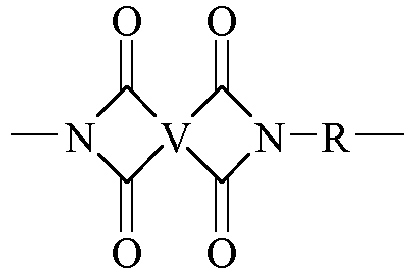 V est un groupe hydrocarboné en C4-40 tétravalent substitué ou non substitué ; etR est un groupe hydrocarboné en C1-20 divalent substitué ou non substitué.
 - Procédé de production d'un revêtement en polyimide, comprenant :la réaction d'un dianhydride et d'une diamine en présence d'une monoamine supérieure dans un milieu réactionnel comprenant au moins 95 pour cent en volume d'eau, à une température de 60 °C à 180 °C, ou de 60 °C à 100 °C ou de 100 °C à 180 °C, sous une atmosphère inerte, avec agitation, pour produire un poly(acide)amique aqueux, dans lequel la monoamine supérieure est la triéthylamine, la triéthanolamine, la tributylamine, la diméthyldodécylamine, l'hydroxyde d'ammonium, la triallylamine, l'hydroxyde de tétraméthylammonium, l'hydroxyde de tétraéthylammonium, l'hydroxyde de tétrapropylammonium, l'hydroxyde de tétrabutylammonium, la dibutylamine, la diméthyléthanolamine ou une combinaison comprenant au moins l'une des amines susmentionnées ;dans lequel le dianhydride et la diamine sont présents dans le milieu réactionnel dans une quantité efficace pour fournir une teneur en solides du poly(acide amique) de 50 à 80 % en poids ; etdans lequel la monoamine supérieure est présente dans une quantité supérieure à 0,65 mole de composant de la monoamine supérieure par mole de dianhydride ; etla mise en contact d'un substrat avec la solution de poly(acide amique) aqueux ; etla cyclisation du poly(acide amique) pour former le revêtement en polyimide ;dans lequel le polyimide comprend plus de 1 unité structurelle de formule
 V est un groupe hydrocarboné en C4-40 tétravalent substitué ou non substitué ; etR est un groupe hydrocarboné en C1-20 divalent substitué ou non substitué.
 - Procédé selon la revendication 12, dans lequel le substrat est une fibre.
Applications Claiming Priority (2)
| Application Number | Priority Date | Filing Date | Title |
|---|---|---|---|
| US201562118565P | 2015-02-20 | 2015-02-20 | |
| PCT/US2016/018435 WO2016134126A1 (fr) | 2015-02-20 | 2016-02-18 | Synthèse de poly(acide amique) et conversion en polyimide de poids moléculaire élevé |
Publications (2)
| Publication Number | Publication Date |
|---|---|
| EP3259302A1 EP3259302A1 (fr) | 2017-12-27 |
| EP3259302B1 true EP3259302B1 (fr) | 2024-07-24 |
Family
ID=55487132
Family Applications (1)
| Application Number | Title | Priority Date | Filing Date |
|---|---|---|---|
| EP16708854.1A Active EP3259302B1 (fr) | 2015-02-20 | 2016-02-18 | Synthèse de poly(acide amique) et conversion en polyimide de poids moléculaire élevé |
Country Status (5)
| Country | Link |
|---|---|
| US (1) | US10501579B2 (fr) |
| EP (1) | EP3259302B1 (fr) |
| KR (1) | KR102380686B1 (fr) |
| CN (1) | CN107250215B (fr) |
| WO (1) | WO2016134126A1 (fr) |
Families Citing this family (9)
| Publication number | Priority date | Publication date | Assignee | Title |
|---|---|---|---|---|
| CN109012528B (zh) * | 2018-08-14 | 2024-03-08 | 无锡创彩光学材料有限公司 | 一种管式反应器及用其制备单分散聚酰胺酸溶液的方法 |
| KR102347632B1 (ko) | 2019-11-13 | 2022-01-10 | 피아이첨단소재 주식회사 | 저유전 폴리이미드 필름 및 이의 제조방법 |
| KR102362385B1 (ko) * | 2019-11-13 | 2022-02-15 | 피아이첨단소재 주식회사 | 고탄성 및 고내열 폴리이미드 필름 및 그 제조방법 |
| CN111072963A (zh) * | 2019-12-27 | 2020-04-28 | 江门市优巨新材料有限公司 | 一种水相合成聚酰亚胺的方法 |
| WO2023277357A1 (fr) * | 2021-06-29 | 2023-01-05 | 한국화학연구원 | Composition de solution aqueuse d'acide polyamique |
| CN118369368A (zh) * | 2021-12-09 | 2024-07-19 | 高新特殊工程塑料全球技术有限公司 | 具有反应性支化的聚醚酰亚胺 |
| CN114920932B (zh) * | 2022-06-06 | 2023-08-22 | 黑龙江省科学院石油化学研究院 | 一种稳定性良好、耐高温热固性聚酰亚胺前驱体溶液及制备方法 |
| TWI855794B (zh) * | 2023-07-25 | 2024-09-11 | 臺灣塑膠工業股份有限公司 | 上漿料組成物、上漿料、上漿料包覆碳纖維以及複合材料 |
| CN121405941A (zh) * | 2025-12-29 | 2026-01-27 | 东华大学 | 一种水相聚合制备聚酰亚胺材料的方法 |
Citations (1)
| Publication number | Priority date | Publication date | Assignee | Title |
|---|---|---|---|---|
| EP2974801A1 (fr) * | 2013-03-13 | 2016-01-20 | UBE Industries, Ltd. | Procédé permettant de produire une couche de revêtement isolante |
Family Cites Families (24)
| Publication number | Priority date | Publication date | Assignee | Title |
|---|---|---|---|---|
| US3507765A (en) | 1966-05-05 | 1970-04-21 | Gen Electric | Method for electrocoating a polyamide acid |
| US4428977A (en) | 1969-05-08 | 1984-01-31 | General Electric Company | Ammonium salt of partially emidized polyamide acid for aqueous coating composition |
| US4480088A (en) * | 1983-10-20 | 1984-10-30 | United Technologies Corporation | Water soluble polyimide resin system |
| US5252168A (en) * | 1991-11-06 | 1993-10-12 | The United States Of America As Represented By The Administrator Of The National Aeronautics And Space Administration | Preparing polymeric matrix composites using an aqueous slurry technique |
| JPH08503031A (ja) | 1992-11-12 | 1996-04-02 | イー・アイ・デユポン・ドウ・ヌムール・アンド・カンパニー | 高温用繊維補強複合体のための水系サイズ |
| US5719253A (en) | 1994-10-07 | 1998-02-17 | Unitika Ltd. | Poly(amic acid) solution and polyimide film or polymide-coated material obtained therefrom |
| AUPO830697A0 (en) | 1997-07-30 | 1997-08-21 | Commonwealth Scientific And Industrial Research Organisation | Aqueous polyimide process |
| US6479581B1 (en) * | 1999-03-12 | 2002-11-12 | Solvay Advanced Polymers, Llc | Aqueous-based polyamide-amic acid compositions |
| US20020151234A1 (en) * | 2001-02-05 | 2002-10-17 | Ube Industries, Ltd. | Water-soluble polyimide precursor, aqueous polyimide precursor solution, polyimide, impregnated material with polyimide binder, and laminate |
| US7514516B2 (en) | 2003-05-27 | 2009-04-07 | Fina Technology, Inc. | Measurement and preparation of branched vinyl polymers |
| EP2090609A4 (fr) | 2006-11-13 | 2012-08-01 | Ube Industries | Procédé de fabrication d'une solution d'acide polyamide et solution d'acide polyamique |
| JP2008266416A (ja) * | 2007-04-18 | 2008-11-06 | Ube Ind Ltd | ポリイミドフィルムの製造方法およびポリイミドフィルム |
| US8493748B2 (en) | 2007-06-27 | 2013-07-23 | Stats Chippac Ltd. | Packaging system with hollow package and method for the same |
| KR101056967B1 (ko) | 2007-11-27 | 2011-08-17 | 주식회사 엘지화학 | 폴리아믹산 에스테르와 이의 제조방법과 상기 폴리아믹산에스테르를 포함하는 감광성 조성물 및 이에 의해 제공된폴리이미드 필름을 적용한 보호막. |
| JP2009237157A (ja) | 2008-03-26 | 2009-10-15 | Fuji Xerox Co Ltd | ポリアミック酸組成物、ポリイミド無端ベルト及びその製造方法、画像形成装置 |
| CN101412812B (zh) | 2008-10-28 | 2011-07-20 | 上海三普化工有限公司 | 一种水相合成聚酰亚胺的方法 |
| US8132677B2 (en) * | 2009-03-27 | 2012-03-13 | Uop Llc | Polymer membranes prepared from aromatic polyimide membranes by thermal treating and UV crosslinking |
| FR2959995A1 (fr) * | 2010-05-17 | 2011-11-18 | Rhodia Operations | Article polyamide composite |
| US9659322B2 (en) * | 2010-07-30 | 2017-05-23 | Xsensor Technology Corporation | Graphical display for recommending sleep comfort and support systems |
| JP5834930B2 (ja) * | 2011-09-09 | 2015-12-24 | 宇部興産株式会社 | ポリイミド前駆体水溶液組成物、及びポリイミド前駆体水溶液組成物の製造方法 |
| JP5915193B2 (ja) * | 2012-01-13 | 2016-05-11 | 宇部興産株式会社 | ポリイミド前駆体アルコール溶液組成物、及びポリイミド前駆体アルコール溶液組成物の製造方法 |
| JP5845911B2 (ja) * | 2012-01-13 | 2016-01-20 | 宇部興産株式会社 | ポリイミド前駆体水溶液組成物、及びポリイミド前駆体水溶液組成物の製造方法 |
| JP5846136B2 (ja) * | 2013-01-31 | 2016-01-20 | 富士ゼロックス株式会社 | ポリイミド前駆体組成物、及びポリイミド前駆体組成物の製造方法 |
| JP5708778B1 (ja) * | 2013-12-16 | 2015-04-30 | 富士ゼロックス株式会社 | ポリイミド前駆体組成物の製造方法 |
-
2016
- 2016-02-18 CN CN201680010667.7A patent/CN107250215B/zh active Active
- 2016-02-18 WO PCT/US2016/018435 patent/WO2016134126A1/fr not_active Ceased
- 2016-02-18 KR KR1020177024020A patent/KR102380686B1/ko active Active
- 2016-02-18 EP EP16708854.1A patent/EP3259302B1/fr active Active
- 2016-02-18 US US15/551,644 patent/US10501579B2/en active Active
Patent Citations (1)
| Publication number | Priority date | Publication date | Assignee | Title |
|---|---|---|---|---|
| EP2974801A1 (fr) * | 2013-03-13 | 2016-01-20 | UBE Industries, Ltd. | Procédé permettant de produire une couche de revêtement isolante |
Also Published As
| Publication number | Publication date |
|---|---|
| US10501579B2 (en) | 2019-12-10 |
| EP3259302A1 (fr) | 2017-12-27 |
| KR20170118763A (ko) | 2017-10-25 |
| WO2016134126A1 (fr) | 2016-08-25 |
| CN107250215B (zh) | 2020-02-28 |
| KR102380686B1 (ko) | 2022-04-01 |
| CN107250215A (zh) | 2017-10-13 |
| US20180022873A1 (en) | 2018-01-25 |
Similar Documents
| Publication | Publication Date | Title |
|---|---|---|
| US10501579B2 (en) | Poly(amic acid) synthesis and conversion to high molecular weight polyimide | |
| Yang et al. | Synthesis and properties of novel aromatic polyimides of 2, 3-bis (4-aminophenoxy) naphthalene | |
| EP1448672B1 (fr) | Poly(imide)s a poids moleculaire eleve et procede de synthese | |
| CN112955497A (zh) | 具有改善的尺寸稳定性的超薄聚酰亚胺薄膜及其制备方法 | |
| JP7375193B2 (ja) | 高弾性および高耐熱ポリイミドフィルムおよびその製造方法 | |
| US20200115502A1 (en) | Compositions and articles made from branched polyetherimides | |
| US20210070940A1 (en) | Method for the manufacture of a poly(imide) prepolymer powder and varnish, poly(imide) prepolymer powder and varnish prepared thereby, and poly(imide) prepared therefrom | |
| KR20160094551A (ko) | 폴리아믹산 조성물 및 폴리이미드 기재 | |
| TWI736867B (zh) | 聚醯亞胺清漆及其製備方法、聚醯亞胺塗層製品及其製備方法、電線以及電子裝置 | |
| EP3131950B1 (fr) | Procédés de production de bis(phthalimide)s | |
| KR20210123345A (ko) | 폴리(에테르이미드), 이의 제조 방법, 및 폴리(에테르이미드)를 포함하는 물품 | |
| US10266653B2 (en) | Polyimide-forming compositions, methods of manufacture, and articles prepared therefrom | |
| EP4444786B1 (fr) | Polyétherimide à ramification réactive | |
| JP3203750B2 (ja) | ブロック共重合体及びその製造方法 | |
| EP3684845B1 (fr) | Procede de modification d'un polyimide et polyimide obtenu | |
| CN111133031A (zh) | 聚醚酰亚胺的熔融聚合方法 | |
| EP1854829A1 (fr) | Méthode de préparation de résins à base de copolymères de polyimide | |
| TWI847885B (zh) | 黑色聚醯亞胺膜及其製造方法 | |
| EP3556794A1 (fr) | Contrôle de st chiométrie de polycondensation |
Legal Events
| Date | Code | Title | Description |
|---|---|---|---|
| STAA | Information on the status of an ep patent application or granted ep patent |
Free format text: STATUS: THE INTERNATIONAL PUBLICATION HAS BEEN MADE |
|
| PUAI | Public reference made under article 153(3) epc to a published international application that has entered the european phase |
Free format text: ORIGINAL CODE: 0009012 |
|
| STAA | Information on the status of an ep patent application or granted ep patent |
Free format text: STATUS: REQUEST FOR EXAMINATION WAS MADE |
|
| 17P | Request for examination filed |
Effective date: 20170712 |
|
| AK | Designated contracting states |
Kind code of ref document: A1 Designated state(s): AL AT BE BG CH CY CZ DE DK EE ES FI FR GB GR HR HU IE IS IT LI LT LU LV MC MK MT NL NO PL PT RO RS SE SI SK SM TR |
|
| AX | Request for extension of the european patent |
Extension state: BA ME |
|
| RAP3 | Party data changed (applicant data changed or rights of an application transferred) |
Owner name: SABIC GLOBAL TECHNOLOGIES B.V. |
|
| DAV | Request for validation of the european patent (deleted) | ||
| DAX | Request for extension of the european patent (deleted) | ||
| STAA | Information on the status of an ep patent application or granted ep patent |
Free format text: STATUS: EXAMINATION IS IN PROGRESS |
|
| 17Q | First examination report despatched |
Effective date: 20180716 |
|
| RAP1 | Party data changed (applicant data changed or rights of an application transferred) |
Owner name: SHPP GLOBAL TECHNOLOGIES B.V. |
|
| GRAP | Despatch of communication of intention to grant a patent |
Free format text: ORIGINAL CODE: EPIDOSNIGR1 |
|
| STAA | Information on the status of an ep patent application or granted ep patent |
Free format text: STATUS: GRANT OF PATENT IS INTENDED |
|
| INTG | Intention to grant announced |
Effective date: 20240301 |
|
| GRAS | Grant fee paid |
Free format text: ORIGINAL CODE: EPIDOSNIGR3 |
|
| GRAA | (expected) grant |
Free format text: ORIGINAL CODE: 0009210 |
|
| STAA | Information on the status of an ep patent application or granted ep patent |
Free format text: STATUS: THE PATENT HAS BEEN GRANTED |
|
| AK | Designated contracting states |
Kind code of ref document: B1 Designated state(s): AL AT BE BG CH CY CZ DE DK EE ES FI FR GB GR HR HU IE IS IT LI LT LU LV MC MK MT NL NO PL PT RO RS SE SI SK SM TR |
|
| REG | Reference to a national code |
Ref country code: GB Ref legal event code: FG4D |
|
| REG | Reference to a national code |
Ref country code: CH Ref legal event code: EP |
|
| REG | Reference to a national code |
Ref country code: IE Ref legal event code: FG4D Ref country code: DE Ref legal event code: R096 Ref document number: 602016088534 Country of ref document: DE |
|
| REG | Reference to a national code |
Ref country code: LT Ref legal event code: MG9D |
|
| REG | Reference to a national code |
Ref country code: NL Ref legal event code: MP Effective date: 20240724 |
|
| PG25 | Lapsed in a contracting state [announced via postgrant information from national office to epo] |
Ref country code: PT Free format text: LAPSE BECAUSE OF FAILURE TO SUBMIT A TRANSLATION OF THE DESCRIPTION OR TO PAY THE FEE WITHIN THE PRESCRIBED TIME-LIMIT Effective date: 20241125 |
|
| REG | Reference to a national code |
Ref country code: AT Ref legal event code: MK05 Ref document number: 1706282 Country of ref document: AT Kind code of ref document: T Effective date: 20240724 |
|
| PG25 | Lapsed in a contracting state [announced via postgrant information from national office to epo] |
Ref country code: NL Free format text: LAPSE BECAUSE OF FAILURE TO SUBMIT A TRANSLATION OF THE DESCRIPTION OR TO PAY THE FEE WITHIN THE PRESCRIBED TIME-LIMIT Effective date: 20240724 |
|
| PG25 | Lapsed in a contracting state [announced via postgrant information from national office to epo] |
Ref country code: PT Free format text: LAPSE BECAUSE OF FAILURE TO SUBMIT A TRANSLATION OF THE DESCRIPTION OR TO PAY THE FEE WITHIN THE PRESCRIBED TIME-LIMIT Effective date: 20241125 Ref country code: NL Free format text: LAPSE BECAUSE OF FAILURE TO SUBMIT A TRANSLATION OF THE DESCRIPTION OR TO PAY THE FEE WITHIN THE PRESCRIBED TIME-LIMIT Effective date: 20240724 |
|
| PG25 | Lapsed in a contracting state [announced via postgrant information from national office to epo] |
Ref country code: NO Free format text: LAPSE BECAUSE OF FAILURE TO SUBMIT A TRANSLATION OF THE DESCRIPTION OR TO PAY THE FEE WITHIN THE PRESCRIBED TIME-LIMIT Effective date: 20241024 |
|
| PG25 | Lapsed in a contracting state [announced via postgrant information from national office to epo] |
Ref country code: FI Free format text: LAPSE BECAUSE OF FAILURE TO SUBMIT A TRANSLATION OF THE DESCRIPTION OR TO PAY THE FEE WITHIN THE PRESCRIBED TIME-LIMIT Effective date: 20240724 Ref country code: PL Free format text: LAPSE BECAUSE OF FAILURE TO SUBMIT A TRANSLATION OF THE DESCRIPTION OR TO PAY THE FEE WITHIN THE PRESCRIBED TIME-LIMIT Effective date: 20240724 Ref country code: GR Free format text: LAPSE BECAUSE OF FAILURE TO SUBMIT A TRANSLATION OF THE DESCRIPTION OR TO PAY THE FEE WITHIN THE PRESCRIBED TIME-LIMIT Effective date: 20241025 |
|
| PG25 | Lapsed in a contracting state [announced via postgrant information from national office to epo] |
Ref country code: BG Free format text: LAPSE BECAUSE OF FAILURE TO SUBMIT A TRANSLATION OF THE DESCRIPTION OR TO PAY THE FEE WITHIN THE PRESCRIBED TIME-LIMIT Effective date: 20240724 |
|
| PG25 | Lapsed in a contracting state [announced via postgrant information from national office to epo] |
Ref country code: LV Free format text: LAPSE BECAUSE OF FAILURE TO SUBMIT A TRANSLATION OF THE DESCRIPTION OR TO PAY THE FEE WITHIN THE PRESCRIBED TIME-LIMIT Effective date: 20240724 |
|
| PG25 | Lapsed in a contracting state [announced via postgrant information from national office to epo] |
Ref country code: AT Free format text: LAPSE BECAUSE OF FAILURE TO SUBMIT A TRANSLATION OF THE DESCRIPTION OR TO PAY THE FEE WITHIN THE PRESCRIBED TIME-LIMIT Effective date: 20240724 Ref country code: IS Free format text: LAPSE BECAUSE OF FAILURE TO SUBMIT A TRANSLATION OF THE DESCRIPTION OR TO PAY THE FEE WITHIN THE PRESCRIBED TIME-LIMIT Effective date: 20241124 |
|
| PG25 | Lapsed in a contracting state [announced via postgrant information from national office to epo] |
Ref country code: HR Free format text: LAPSE BECAUSE OF FAILURE TO SUBMIT A TRANSLATION OF THE DESCRIPTION OR TO PAY THE FEE WITHIN THE PRESCRIBED TIME-LIMIT Effective date: 20240724 |
|
| PG25 | Lapsed in a contracting state [announced via postgrant information from national office to epo] |
Ref country code: RS Free format text: LAPSE BECAUSE OF FAILURE TO SUBMIT A TRANSLATION OF THE DESCRIPTION OR TO PAY THE FEE WITHIN THE PRESCRIBED TIME-LIMIT Effective date: 20241024 Ref country code: ES Free format text: LAPSE BECAUSE OF FAILURE TO SUBMIT A TRANSLATION OF THE DESCRIPTION OR TO PAY THE FEE WITHIN THE PRESCRIBED TIME-LIMIT Effective date: 20240724 |
|
| PG25 | Lapsed in a contracting state [announced via postgrant information from national office to epo] |
Ref country code: RS Free format text: LAPSE BECAUSE OF FAILURE TO SUBMIT A TRANSLATION OF THE DESCRIPTION OR TO PAY THE FEE WITHIN THE PRESCRIBED TIME-LIMIT Effective date: 20241024 Ref country code: PL Free format text: LAPSE BECAUSE OF FAILURE TO SUBMIT A TRANSLATION OF THE DESCRIPTION OR TO PAY THE FEE WITHIN THE PRESCRIBED TIME-LIMIT Effective date: 20240724 Ref country code: NO Free format text: LAPSE BECAUSE OF FAILURE TO SUBMIT A TRANSLATION OF THE DESCRIPTION OR TO PAY THE FEE WITHIN THE PRESCRIBED TIME-LIMIT Effective date: 20241024 Ref country code: LV Free format text: LAPSE BECAUSE OF FAILURE TO SUBMIT A TRANSLATION OF THE DESCRIPTION OR TO PAY THE FEE WITHIN THE PRESCRIBED TIME-LIMIT Effective date: 20240724 Ref country code: IS Free format text: LAPSE BECAUSE OF FAILURE TO SUBMIT A TRANSLATION OF THE DESCRIPTION OR TO PAY THE FEE WITHIN THE PRESCRIBED TIME-LIMIT Effective date: 20241124 Ref country code: HR Free format text: LAPSE BECAUSE OF FAILURE TO SUBMIT A TRANSLATION OF THE DESCRIPTION OR TO PAY THE FEE WITHIN THE PRESCRIBED TIME-LIMIT Effective date: 20240724 Ref country code: GR Free format text: LAPSE BECAUSE OF FAILURE TO SUBMIT A TRANSLATION OF THE DESCRIPTION OR TO PAY THE FEE WITHIN THE PRESCRIBED TIME-LIMIT Effective date: 20241025 Ref country code: FI Free format text: LAPSE BECAUSE OF FAILURE TO SUBMIT A TRANSLATION OF THE DESCRIPTION OR TO PAY THE FEE WITHIN THE PRESCRIBED TIME-LIMIT Effective date: 20240724 Ref country code: ES Free format text: LAPSE BECAUSE OF FAILURE TO SUBMIT A TRANSLATION OF THE DESCRIPTION OR TO PAY THE FEE WITHIN THE PRESCRIBED TIME-LIMIT Effective date: 20240724 Ref country code: BG Free format text: LAPSE BECAUSE OF FAILURE TO SUBMIT A TRANSLATION OF THE DESCRIPTION OR TO PAY THE FEE WITHIN THE PRESCRIBED TIME-LIMIT Effective date: 20240724 Ref country code: AT Free format text: LAPSE BECAUSE OF FAILURE TO SUBMIT A TRANSLATION OF THE DESCRIPTION OR TO PAY THE FEE WITHIN THE PRESCRIBED TIME-LIMIT Effective date: 20240724 |
|
| PG25 | Lapsed in a contracting state [announced via postgrant information from national office to epo] |
Ref country code: RO Free format text: LAPSE BECAUSE OF FAILURE TO SUBMIT A TRANSLATION OF THE DESCRIPTION OR TO PAY THE FEE WITHIN THE PRESCRIBED TIME-LIMIT Effective date: 20240724 Ref country code: SM Free format text: LAPSE BECAUSE OF FAILURE TO SUBMIT A TRANSLATION OF THE DESCRIPTION OR TO PAY THE FEE WITHIN THE PRESCRIBED TIME-LIMIT Effective date: 20240724 Ref country code: DK Free format text: LAPSE BECAUSE OF FAILURE TO SUBMIT A TRANSLATION OF THE DESCRIPTION OR TO PAY THE FEE WITHIN THE PRESCRIBED TIME-LIMIT Effective date: 20240724 |
|
| PG25 | Lapsed in a contracting state [announced via postgrant information from national office to epo] |
Ref country code: EE Free format text: LAPSE BECAUSE OF FAILURE TO SUBMIT A TRANSLATION OF THE DESCRIPTION OR TO PAY THE FEE WITHIN THE PRESCRIBED TIME-LIMIT Effective date: 20240724 |
|
| PG25 | Lapsed in a contracting state [announced via postgrant information from national office to epo] |
Ref country code: CZ Free format text: LAPSE BECAUSE OF FAILURE TO SUBMIT A TRANSLATION OF THE DESCRIPTION OR TO PAY THE FEE WITHIN THE PRESCRIBED TIME-LIMIT Effective date: 20240724 |
|
| REG | Reference to a national code |
Ref country code: DE Ref legal event code: R097 Ref document number: 602016088534 Country of ref document: DE |
|
| PG25 | Lapsed in a contracting state [announced via postgrant information from national office to epo] |
Ref country code: IT Free format text: LAPSE BECAUSE OF FAILURE TO SUBMIT A TRANSLATION OF THE DESCRIPTION OR TO PAY THE FEE WITHIN THE PRESCRIBED TIME-LIMIT Effective date: 20240724 Ref country code: SK Free format text: LAPSE BECAUSE OF FAILURE TO SUBMIT A TRANSLATION OF THE DESCRIPTION OR TO PAY THE FEE WITHIN THE PRESCRIBED TIME-LIMIT Effective date: 20240724 |
|
| PLBE | No opposition filed within time limit |
Free format text: ORIGINAL CODE: 0009261 |
|
| STAA | Information on the status of an ep patent application or granted ep patent |
Free format text: STATUS: NO OPPOSITION FILED WITHIN TIME LIMIT |
|
| 26N | No opposition filed |
Effective date: 20250425 |
|
| PG25 | Lapsed in a contracting state [announced via postgrant information from national office to epo] |
Ref country code: SE Free format text: LAPSE BECAUSE OF FAILURE TO SUBMIT A TRANSLATION OF THE DESCRIPTION OR TO PAY THE FEE WITHIN THE PRESCRIBED TIME-LIMIT Effective date: 20240724 |
|
| PG25 | Lapsed in a contracting state [announced via postgrant information from national office to epo] |
Ref country code: MC Free format text: LAPSE BECAUSE OF FAILURE TO SUBMIT A TRANSLATION OF THE DESCRIPTION OR TO PAY THE FEE WITHIN THE PRESCRIBED TIME-LIMIT Effective date: 20240724 |
|
| REG | Reference to a national code |
Ref country code: CH Ref legal event code: PL |
|
| PG25 | Lapsed in a contracting state [announced via postgrant information from national office to epo] |
Ref country code: LU Free format text: LAPSE BECAUSE OF NON-PAYMENT OF DUE FEES Effective date: 20250218 |
|
| PG25 | Lapsed in a contracting state [announced via postgrant information from national office to epo] |
Ref country code: CH Free format text: LAPSE BECAUSE OF NON-PAYMENT OF DUE FEES Effective date: 20250228 |
|
| GBPC | Gb: european patent ceased through non-payment of renewal fee |
Effective date: 20250218 |
|
| REG | Reference to a national code |
Ref country code: BE Ref legal event code: MM Effective date: 20250228 |
|
| PG25 | Lapsed in a contracting state [announced via postgrant information from national office to epo] |
Ref country code: GB Free format text: LAPSE BECAUSE OF NON-PAYMENT OF DUE FEES Effective date: 20250218 |
|
| PG25 | Lapsed in a contracting state [announced via postgrant information from national office to epo] |
Ref country code: FR Free format text: LAPSE BECAUSE OF NON-PAYMENT OF DUE FEES Effective date: 20250228 |
|
| PG25 | Lapsed in a contracting state [announced via postgrant information from national office to epo] |
Ref country code: BE Free format text: LAPSE BECAUSE OF NON-PAYMENT OF DUE FEES Effective date: 20250228 |
|
| PG25 | Lapsed in a contracting state [announced via postgrant information from national office to epo] |
Ref country code: IE Free format text: LAPSE BECAUSE OF NON-PAYMENT OF DUE FEES Effective date: 20250218 |
|
| PGFP | Annual fee paid to national office [announced via postgrant information from national office to epo] |
Ref country code: DE Payment date: 20260227 Year of fee payment: 11 |