EP3260883B1 - Appareil de détection de véhicules en excès de vitesse - Google Patents
Appareil de détection de véhicules en excès de vitesse Download PDFInfo
- Publication number
- EP3260883B1 EP3260883B1 EP17177737.8A EP17177737A EP3260883B1 EP 3260883 B1 EP3260883 B1 EP 3260883B1 EP 17177737 A EP17177737 A EP 17177737A EP 3260883 B1 EP3260883 B1 EP 3260883B1
- Authority
- EP
- European Patent Office
- Prior art keywords
- radar
- portable
- radar device
- range
- speed
- Prior art date
- Legal status (The legal status is an assumption and is not a legal conclusion. Google has not performed a legal analysis and makes no representation as to the accuracy of the status listed.)
- Active
Links
Images



Classifications
-
- G—PHYSICS
- G01—MEASURING; TESTING
- G01S—RADIO DIRECTION-FINDING; RADIO NAVIGATION; DETERMINING DISTANCE OR VELOCITY BY USE OF RADIO WAVES; LOCATING OR PRESENCE-DETECTING BY USE OF THE REFLECTION OR RERADIATION OF RADIO WAVES; ANALOGOUS ARRANGEMENTS USING OTHER WAVES
- G01S13/00—Systems using the reflection or reradiation of radio waves, e.g. radar systems; Analogous systems using reflection or reradiation of waves whose nature or wavelength is irrelevant or unspecified
- G01S13/02—Systems using reflection of radio waves, e.g. primary radar systems; Analogous systems
- G01S13/50—Systems of measurement based on relative movement of target
- G01S13/58—Velocity or trajectory determination systems; Sense-of-movement determination systems
- G01S13/583—Velocity or trajectory determination systems; Sense-of-movement determination systems using transmission of continuous unmodulated waves, amplitude-, frequency-, or phase-modulated waves and based upon the Doppler effect resulting from movement of targets
-
- G—PHYSICS
- G01—MEASURING; TESTING
- G01S—RADIO DIRECTION-FINDING; RADIO NAVIGATION; DETERMINING DISTANCE OR VELOCITY BY USE OF RADIO WAVES; LOCATING OR PRESENCE-DETECTING BY USE OF THE REFLECTION OR RERADIATION OF RADIO WAVES; ANALOGOUS ARRANGEMENTS USING OTHER WAVES
- G01S13/00—Systems using the reflection or reradiation of radio waves, e.g. radar systems; Analogous systems using reflection or reradiation of waves whose nature or wavelength is irrelevant or unspecified
- G01S13/86—Combinations of radar systems with non-radar systems, e.g. sonar, direction finder
- G01S13/867—Combination of radar systems with cameras
-
- G—PHYSICS
- G01—MEASURING; TESTING
- G01S—RADIO DIRECTION-FINDING; RADIO NAVIGATION; DETERMINING DISTANCE OR VELOCITY BY USE OF RADIO WAVES; LOCATING OR PRESENCE-DETECTING BY USE OF THE REFLECTION OR RERADIATION OF RADIO WAVES; ANALOGOUS ARRANGEMENTS USING OTHER WAVES
- G01S13/00—Systems using the reflection or reradiation of radio waves, e.g. radar systems; Analogous systems using reflection or reradiation of waves whose nature or wavelength is irrelevant or unspecified
- G01S13/88—Radar or analogous systems specially adapted for specific applications
- G01S13/91—Radar or analogous systems specially adapted for specific applications for traffic control
- G01S13/92—Radar or analogous systems specially adapted for specific applications for traffic control for velocity measurement
-
- G—PHYSICS
- G08—SIGNALLING
- G08G—TRAFFIC CONTROL SYSTEMS
- G08G1/00—Traffic control systems for road vehicles
- G08G1/01—Detecting movement of traffic to be counted or controlled
- G08G1/017—Detecting movement of traffic to be counted or controlled identifying vehicles
-
- G—PHYSICS
- G08—SIGNALLING
- G08G—TRAFFIC CONTROL SYSTEMS
- G08G1/00—Traffic control systems for road vehicles
- G08G1/01—Detecting movement of traffic to be counted or controlled
- G08G1/052—Detecting movement of traffic to be counted or controlled with provision for determining speed or overspeed
- G08G1/054—Detecting movement of traffic to be counted or controlled with provision for determining speed or overspeed photographing overspeeding vehicles
Definitions
- radar based devices to detect speeding vehicles is now well known.
- Fixed site devices either providing a measure of instantaneous speed or working with other fixed devices to provide a measure of an average speed over a set distance, may be fixed at positons by the roadside. Where more flexibility is desired it is known to provide handheld portable devices which are sometimes referred to as speed guns. These may also use radar to detect the speed of the vehicles and are primarily used by the police to enforce speed limits on the public highway.
- the radar device may apply a digital filter, such as a FIR filter, prior to the full Doppler range process to detect that a target vehicle speed is above the set threshold.
- a digital filter such as a FIR filter
- the radar device may then be configured to apply full range Doppler processing to the data to obtain range and Doppler data, i.e. range plus speed.
- the digital filter allows a 'quick process' to give speed information only using the same source data that can be used for full range plus speed processing (i.e. no time/power overhead of capturing new data if a speeding target is initially found).
- the filter design may approximate a bandpass filter which reduces the signal bandwidth and hence noise, still allowing target speed data to pass with reasonable amplitude for all ranges. This quick look method saves considerable processing overhead (power consumption) should no targets be present.
- the trigger signal may be sent at defined intervals of time for as long as a vehicle is detected, for instance every 1/10 th of a second.
- Each value sent may be indicative of the instantaneous speed of the vehicle when the vehicle is detected.
- the camera may capture an image each time a trigger signal is received.
- the trigger signal is only sent to the portable device when the speed of the vehicle exceeds a preset or user defined value. This reduces the power consumption of the device.
- the speed may be displayed on a screen of the device when it is received.
- the radar device may be arranged to receive a further control signal that encodes the speed threshold and in response to receiving this signal may set the minimum threshold speed used by the radar device.
- This control signal may be combined with the control signal that sets the range.
- the radar device may be configured to transmit to the portable device a synchronization signal indicative of the settings of the radar device, i.e. the range and speed thresholds.
- This signal may be transmitted when the radar device is first connected to the a portable device, for instance during a set up or pairing process determined by the communication protocol used to transmit signals from the radar device to the portable device.
- This synchronization signal may include, for instance, the MAC address of the portable device for connection across a Wi-Fi network, or a BD_ADDR for connection using Bluetooth.
- the radar device may include in a memory a default range of distances and optionally a default predefined minimum speed which determines when a trigger signal is to be produced. This allows the apparatus to function even when a user has not sent any control signal to the device, for instance on initial purchase.
- the portable electronic device may be configured to communicate with a database, the database including information about the portable electronic device and/or optimized camera settings.
- the portable electronic device may instead set the focal length and zoom of the camera automatically from the range information it sends to the radar device.
- the camera settings may be manually controllable by a user, the control signals provided to the radar device being at least partially derived from these camera settings.
- the portable electronic device may include location determining means for detecting the location at which the image is captured.
- the portable electronic device may be configured to time stamp each image.
- the data may be stored as image metadata.
- this data may be used to produce a composite image of the image and the data.
- the portable electronic device includes firmware that captures the images from the camera and processes the trigger signal and data transmitted from the radar device, and software in the form of an app that controls both the settings of the camera and radar device.
- the software may automatically optimize the image of a target vehicle detected by the radar device.
- the portable electronic device app may be operable in use to enable the user to setup the radar detector trigger settings such as the speed, range threshold and target direction of travel using the portable device app.
- the radar device may comprise a housing with a single power button, the housing otherwise being devoid of any user operable interface, the control and user interaction being performed using the portable electronic device. It may be a small, pocket sized housing that can fit within the hand of a user.
- the system includes a mount for physically securing the radar device to the portable electronic device.
- the FMCW radar is pulsed to reduce power.
- the radar device may in use, be configured to apply an FIR filter followed by Doppler process to detect that a target vehicle is present within the range of target speeds but not detect the range, and when a target vehicle is present in the speed range, the radar device is configured to apply full range Doppler processing to the data to obtain range and Doppler speed data.
- the device may include wireless communication means for receiving the control signal from the portable electronic device and transmitting the trigger signal to the portable device.
- the radar device may comprise a housing with a single power button, the housing otherwise being devoid of any user operable interface.
- the radar device may comprise a mount for mounting the radar device to a portable electronic device.
- the radar device may be small enough to fit in the hand, and may for instance by comparable in size to a mobile phone.
- the radar may be powered from a battery such as a single 3.6V AA battery.
- the radar and processing circuit of the radar device is configured to be powered up to take measurements for only a fraction of each frame period. For instance, the radar may be configured to be powered up for 10ms in every 100ms frame period.
- the device may include a memory which stores the minimum and maximum ranges for a trigger signal, and also stores a threshold speed below which a vehicle does not generate a trigger signal when detected.
- the control signals may be indicative of at least one of an identity of the portable electronic device or an identity of the camera for determining camera settings, or the camera settings themselves.
- the method may further comprise the step of the portable electronic device communicating with a database to obtain information about the portable electronic device and/or optimized camera settings.
- the method may further comprise the step of determining the location of the portable electronic device and storing this information with the image.
- the method may further comprise the step of automatically optimizing the image of a target vehicle.
- the method may further comprise the step of applying an FIR filter followed by Doppler process to detect that a target vehicle is present.
- the method may include the step of applying full range Doppler processing to the data to obtain range and Doppler (speed) data.
- a portable speed detection and recording system 1 for detecting speeding vehicles comprises in combination a portable electronic device 2 having a camera and a separate portable radar device 3 having a radar antenna 7.
- the two devices 2, 3 may be secured together using a clip 4 fixed to the housing of the radar device that fits around the side edges of the portable electronic device.
- the portable electronic device 2 comprises a smartphone having a screen 5 on a front face, and a camera 6 on the rear face.
- the camera 6 could be on the same face as the screen.
- the antenna 7 of the radar detector 3 when fixed should have a field of view for detecting vehicles that corresponds, or at least overlaps, with the field of view of the camera.
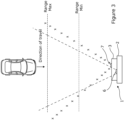
- Figure 3 shows the field of view of the camera 6, the edges of which are denoted by dashed lines and the field of view of the antenna 7, the edges of which are denoted by a line of crosses, when in a typical usage mode to observe vehicles on a highway.
- the radar device includes a radio frequency receiver/transmitter 12 for receiving control signals from the portable electronic device and for transmitting trigger signals to the portable electronic device 3.
- the control signals in this example encode a range of distances within which a vehicle is to be detected, and a minimum speed above which a vehicle must be travelling for the radar device to trigger a chain of events leading to smartphone capturing an image of a speeding vehicle.
- the control signal may also encode a direction of travel for targets that the device is to detect, allowing the device to selectively detect targets moving towards, or from, or both towards and from the device.
- the control signals may take many forms, and may include actual range values (for instance 30m or 30KPH) although the range could be encoded in numerous different ways so long as the radar device can interpret the encoding.
- Figure 3 shows exemplary upper and lower range boundaries as dotted lines, defining a zone within which a trigger may be generated and outside of which the trigger signal is not generated or is suppressed.
- the processing means of the radar device 3 in use determines the speed of a vehicle that is detected by the radar antenna 7 and that is within the range of distances, and if this is above a threshold set in the device this speed measurement is sent to the portable electronic device as a trigger signal.
- the memory 11 of the radar device stores the range information and speed threshold information.
- the device 3 may initially ship with a preset range, and can be modified on receipt of control signals from the smartphone.
- the memory 11 also includes a speed threshold, below which detected vehicles are ignored.
- the smartphone 2 also includes a receiver and transmitter, for transmitting the control signals to the radar device and receiving the trigger signal.
- the transmitted signals are generated by a computer program- a software "app" that is run on the smartphone.
- the app when running, guides the user through a process to pair the smartphone to the radar device, in this example using a Bluetooth protocol.
- An exemplary operation of the smartphone app may be as follows.
- the processing means applies a FIR filter and a Doppler process to determine the speed of the vehicle, and only if this is above a set threshold will a full Doppler process be applied to start to measure the vehicle range. If this is within the threshold set within the radar device a trigger signal will be sent to smartphone encoding the speed. When this is received the app causes the camera to capture an image of the scene. This is then saved in a memory on the smartphone together with the speed of the vehicle from the trigger signal. This speed, and other optional information such as the time of day and location may be overlaid onto the captured image when it is stored by the app. Location data may be determined if the smartphone is provided with a GPS position sensor or similar means for determining the location of the smartphone.
Landscapes
- Engineering & Computer Science (AREA)
- Radar, Positioning & Navigation (AREA)
- Remote Sensing (AREA)
- Physics & Mathematics (AREA)
- General Physics & Mathematics (AREA)
- Computer Networks & Wireless Communication (AREA)
- Electromagnetism (AREA)
- Radar Systems Or Details Thereof (AREA)
- Traffic Control Systems (AREA)
Claims (13)
- Système portable de détection et d'enregistrement de vitesse (1) destinée à détecter des véhicules en excès de vitesse, comprenant en combinaison un dispositif électronique portable (2) ayant une caméra (6) et un dispositif radar (3) portable séparé, dans lequel le dispositif radar comprend :un radar à ondes entretenues à modulation de fréquence FMCW alimenté par batterie, qui est mis sous tension et hors tension de manière répétée par une série d'impulsions, selon lequel, lorsqu'il est mis sous tension, le radar fonctionne comme un radar FMCW pour prendre des mesures, un récepteur destiné à recevoir un signal de commande à partir du dispositif électronique portable qui est indicatif d'une plage de distances à l'intérieur de laquelle le dispositif radar, en utilisation, doit délivrer en sortie un signal de déclenchement indiquant la détection d'un véhicule cible en mouvement et hors de laquelle le dispositif radar ne délivre pas en sortie de signal de déclenchement, un moyen de traitement destiné à déterminer, à partir du radar, la vitesse d'un véhicule qui est détecté par le radar uniquement lorsque ce véhicule se trouve à l'intérieur de ladite plage de distances déterminée par le radar, le radar ne déterminant pas la vitesse de cibles hors de cette plage, le dispositif radar comportant en outre un émetteur destiné à envoyer au dispositif électronique portable un signal de déclenchement qui encode au moins la vitesse du véhicule cible,et dans lequel le dispositif électronique portable est configuré pour capturer une image de la cible avec la caméra en réponse à la réception du signal de déclenchement à partir du dispositif radar et pour stocker l'image ensemble avec les données représentant la vitesse du véhicule cible, et dans lequel le signal de déclenchement est envoyé au dispositif portable uniquement lorsque la vitesse du véhicule déterminée par le radar dépasse une valeur prédéfinie ou définie par l'utilisateur.
- Système portable de détection et d'enregistrement de vitesse selon la revendication 1, dans lequel le dispositif radar comporte une mémoire dans laquelle les informations de plage sont stockées, les informations étant mises à jour lorsqu'un signal de commande est reçu qui contient des informations de plage différentes, et dans lequel le dispositif électronique portable est configuré pour communiquer avec une base de données, la base de données comportant des informations sur le dispositif électronique portable et/ou des réglages de caméra optimisés.
- Système portable de détection et d'enregistrement de vitesse selon la revendication 2, dans lequel les signaux de commande envoyés au dispositif radar afin de régler la plage configureront le dispositif radar pour envoyer le signal de déclenchement lorsque le véhicule cible se trouve dans une plage optimale pour la taille et la qualité d'image de la caméra, telles que déterminées par les réglages de caméra, ou alternativement, dans lequel le dispositif portable est configuré pour régler automatiquement la distance focale et le zoom de la caméra automatiquement à partir des informations de plage envoyées au dispositif radar dans le signal de commande.
- Système portable de détection et d'enregistrement de vitesse selon la revendication 2 à 3, dans lequel les réglages de caméra peuvent être commandés manuellement par un utilisateur, les signaux de commande étant au moins partiellement dérivés de ces réglages de caméra.
- Système portable de détection et d'enregistrement de vitesse selon l'une quelconque des revendications 2 à 4, dans lequel les réglages de caméra peuvent être commandés manuellement par l'intermédiaire d'une interface exploitable par l'utilisateur du dispositif électronique portable.
- Système portable de détection et d'enregistrement de vitesse selon l'une quelconque des revendications 2 à 5, dans lequel les réglages de caméra comportent l'un ou plusieurs parmi la distance focale, le champ de vision, le zoom, ou le numéro d'ouverture.
- Système portable de détection et d'enregistrement de vitesse selon l'une quelconque des revendications précédentes, dans lequel le dispositif électronique portable est configuré pour horodater chaque image.
- Système portable de détection et d'enregistrement de vitesse selon l'une quelconque des revendications précédentes, dans lequel les données sont utilisées pour produire une image composite de l'image et des données.
- Système portable de détection et d'enregistrement de vitesse selon l'une quelconque des revendications précédentes, dans lequel le dispositif électronique portable comporte un micrologiciel qui capture les images de la caméra et traite le signal de déclenchement et les données transmises à partir du dispositif radar, et un logiciel sous la forme d'une application qui commande à la fois les réglages de la caméra et du radar.
- Système portable de détection et d'enregistrement de vitesse selon l'une quelconque des revendications précédentes, dans lequel le dispositif radar, en utilisation, applique un filtre FIR suivi d'un traitement Doppler afin de détecter qu'un véhicule cible est présent et dans lequel, lorsqu'un véhicule cible est présent, le dispositif radar est configuré pour appliquer un traitement Doppler complet aux données afin d'obtenir des données de plage et des données Doppler.
- Système portable de détection et d'enregistrement de vitesse selon l'une quelconque des revendications précédentes, dans lequel le dispositif radar est configuré pour envoyer le signal de déclenchement uniquement lorsque le véhicule cible circule au-dessus d'une vitesse prédéterminée.
- Système portable de détection et d'enregistrement de vitesse selon l'une quelconque des revendications précédentes, dans lequel le dispositif radar communique avec le dispositif électronique portable par le biais d'un moyen de communication sans fil.
- Système portable de détection et d'enregistrement de vitesse selon l'une quelconque des revendications précédentes, dans lequel le dispositif radar comprend un boîtier avec un seul bouton d'alimentation, le boîtier étant par ailleurs dépourvu de toute interface exploitable par l'utilisateur, la commande et l'interaction avec l'utilisateur étant effectuées à l'aide du dispositif électronique portable.
Applications Claiming Priority (1)
| Application Number | Priority Date | Filing Date | Title |
|---|---|---|---|
| GBGB1611074.4A GB201611074D0 (en) | 2016-06-24 | 2016-06-24 | Apparatus for detecting speeding vehicles |
Publications (3)
| Publication Number | Publication Date |
|---|---|
| EP3260883A1 EP3260883A1 (fr) | 2017-12-27 |
| EP3260883C0 EP3260883C0 (fr) | 2025-04-16 |
| EP3260883B1 true EP3260883B1 (fr) | 2025-04-16 |
Family
ID=56891466
Family Applications (1)
| Application Number | Title | Priority Date | Filing Date |
|---|---|---|---|
| EP17177737.8A Active EP3260883B1 (fr) | 2016-06-24 | 2017-06-23 | Appareil de détection de véhicules en excès de vitesse |
Country Status (2)
| Country | Link |
|---|---|
| EP (1) | EP3260883B1 (fr) |
| GB (2) | GB201611074D0 (fr) |
Families Citing this family (1)
| Publication number | Priority date | Publication date | Assignee | Title |
|---|---|---|---|---|
| CN112837538B (zh) * | 2021-03-27 | 2023-12-22 | 深圳市迅朗科技有限公司 | 一种车牌云识别相机及补光方法 |
Family Cites Families (7)
| Publication number | Priority date | Publication date | Assignee | Title |
|---|---|---|---|---|
| GB2219881A (en) * | 1988-06-15 | 1989-12-20 | English Electric Valve Co Ltd | Vehicle monitoring system |
| US6696978B2 (en) * | 2001-06-12 | 2004-02-24 | Koninklijke Philips Electronics N.V. | Combined laser/radar-video speed violation detector for law enforcement |
| US8004454B2 (en) * | 2006-11-17 | 2011-08-23 | Sony Ericsson Mobile Communications Ab | Mobile electronic device equipped with radar |
| US8519885B2 (en) * | 2011-09-21 | 2013-08-27 | Mobile Joose, Inc. | Combination hand-held phone and radar system |
| US9618605B2 (en) * | 2011-12-30 | 2017-04-11 | Flir Systems, Inc. | Radar system providing multiple waveforms for long range and short range target detection |
| WO2015110363A1 (fr) * | 2014-01-24 | 2015-07-30 | Sony Corporation | Appareil-photo à mise au point automatique à base de radar |
| US9655390B2 (en) * | 2014-05-19 | 2017-05-23 | Donnell A. Davis | Wearable pedestrian safety radar system |
-
2016
- 2016-06-24 GB GBGB1611074.4A patent/GB201611074D0/en not_active Ceased
-
2017
- 2017-06-23 EP EP17177737.8A patent/EP3260883B1/fr active Active
- 2017-06-23 GB GB1710106.4A patent/GB2553414B/en active Active
Also Published As
| Publication number | Publication date |
|---|---|
| EP3260883A1 (fr) | 2017-12-27 |
| GB201611074D0 (en) | 2016-08-10 |
| EP3260883C0 (fr) | 2025-04-16 |
| GB2553414B (en) | 2022-07-13 |
| GB2553414A (en) | 2018-03-07 |
| GB201710106D0 (en) | 2017-08-09 |
Similar Documents
| Publication | Publication Date | Title |
|---|---|---|
| CN104537860B (zh) | 行车安全提示方法及装置 | |
| US9451062B2 (en) | Mobile device edge view display insert | |
| KR102403018B1 (ko) | 레이더와 영상분석을 이용한 교통정보 수집 장치 | |
| US9025001B2 (en) | Apparatus and method to switch a video call to an audio call | |
| WO2018021181A1 (fr) | Appareil de surveillance de navires | |
| US20150350611A1 (en) | Methods and systems for monitoring environments using smart devices | |
| WO2018205844A1 (fr) | Dispositif de vidéosurveillance, réseau de surveillance, et système | |
| CN110979318B (zh) | 车道信息获取方法、装置、自动驾驶车辆及存储介质 | |
| JP2013140142A (ja) | 空中サーモグラフィシステム及びその通信方法 | |
| CN111325701B (zh) | 图像处理方法、装置及存储介质 | |
| US10664711B2 (en) | Vehicle prompt apparatus and operating method thereof | |
| CA2914345A1 (fr) | Systeme d'application de regles de trafic avec suivi temporel et capture video integree | |
| CN109031315B (zh) | 距离测量方法、装置、设备及存储介质 | |
| EP3260883B1 (fr) | Appareil de détection de véhicules en excès de vitesse | |
| CN109788188B (zh) | 用于控制监控摄像机的方法 | |
| CN112700647B (zh) | 监测车辆行驶信息的方法及装置 | |
| US20250216949A1 (en) | Data transfer method and electronic device | |
| KR101559893B1 (ko) | 스마트폰을 이용한 차량용 블랙박스 제어 시스템 및 그 방법 | |
| CN109711477B (zh) | 一种自动驾驶模型的训练方法及装置 | |
| KR102317744B1 (ko) | 불법 촬영기기 탐지 장치 | |
| CN111277956A (zh) | 车辆盲区信息的采集方法及装置 | |
| CN106851050B (zh) | 运动检测方法和装置、移动设备 | |
| EP3749007A1 (fr) | Procédé et appareil de configuration de mesure | |
| CN111223311B (zh) | 车流控制方法、装置、系统、控制设备和存储介质 | |
| CN107479771B (zh) | 一种控制方法、终端及存储介质 |
Legal Events
| Date | Code | Title | Description |
|---|---|---|---|
| PUAI | Public reference made under article 153(3) epc to a published international application that has entered the european phase |
Free format text: ORIGINAL CODE: 0009012 |
|
| STAA | Information on the status of an ep patent application or granted ep patent |
Free format text: STATUS: THE APPLICATION HAS BEEN PUBLISHED |
|
| AK | Designated contracting states |
Kind code of ref document: A1 Designated state(s): AL AT BE BG CH CY CZ DE DK EE ES FI FR GB GR HR HU IE IS IT LI LT LU LV MC MK MT NL NO PL PT RO RS SE SI SK SM TR |
|
| AX | Request for extension of the european patent |
Extension state: BA ME |
|
| STAA | Information on the status of an ep patent application or granted ep patent |
Free format text: STATUS: REQUEST FOR EXAMINATION WAS MADE |
|
| 17P | Request for examination filed |
Effective date: 20180627 |
|
| RBV | Designated contracting states (corrected) |
Designated state(s): AL AT BE BG CH CY CZ DE DK EE ES FI FR GB GR HR HU IE IS IT LI LT LU LV MC MK MT NL NO PL PT RO RS SE SI SK SM TR |
|
| STAA | Information on the status of an ep patent application or granted ep patent |
Free format text: STATUS: EXAMINATION IS IN PROGRESS |
|
| 17Q | First examination report despatched |
Effective date: 20210318 |
|
| GRAP | Despatch of communication of intention to grant a patent |
Free format text: ORIGINAL CODE: EPIDOSNIGR1 |
|
| STAA | Information on the status of an ep patent application or granted ep patent |
Free format text: STATUS: GRANT OF PATENT IS INTENDED |
|
| INTG | Intention to grant announced |
Effective date: 20241112 |
|
| GRAS | Grant fee paid |
Free format text: ORIGINAL CODE: EPIDOSNIGR3 |
|
| GRAA | (expected) grant |
Free format text: ORIGINAL CODE: 0009210 |
|
| STAA | Information on the status of an ep patent application or granted ep patent |
Free format text: STATUS: THE PATENT HAS BEEN GRANTED |
|
| AK | Designated contracting states |
Kind code of ref document: B1 Designated state(s): AL AT BE BG CH CY CZ DE DK EE ES FI FR GB GR HR HU IE IS IT LI LT LU LV MC MK MT NL NO PL PT RO RS SE SI SK SM TR |
|
| REG | Reference to a national code |
Ref country code: GB Ref legal event code: FG4D |
|
| REG | Reference to a national code |
Ref country code: CH Ref legal event code: EP Ref country code: DE Ref legal event code: R096 Ref document number: 602017088914 Country of ref document: DE |
|
| REG | Reference to a national code |
Ref country code: IE Ref legal event code: FG4D |
|
| U01 | Request for unitary effect filed |
Effective date: 20250429 |
|
| U07 | Unitary effect registered |
Designated state(s): AT BE BG DE DK EE FI FR IT LT LU LV MT NL PT RO SE SI Effective date: 20250507 |
|
| U20 | Renewal fee for the european patent with unitary effect paid |
Year of fee payment: 9 Effective date: 20250603 |
|
| PGFP | Annual fee paid to national office [announced via postgrant information from national office to epo] |
Ref country code: GB Payment date: 20250527 Year of fee payment: 9 |
|
| PG25 | Lapsed in a contracting state [announced via postgrant information from national office to epo] |
Ref country code: ES Free format text: LAPSE BECAUSE OF FAILURE TO SUBMIT A TRANSLATION OF THE DESCRIPTION OR TO PAY THE FEE WITHIN THE PRESCRIBED TIME-LIMIT Effective date: 20250416 |
|
| PG25 | Lapsed in a contracting state [announced via postgrant information from national office to epo] |
Ref country code: GR Free format text: LAPSE BECAUSE OF FAILURE TO SUBMIT A TRANSLATION OF THE DESCRIPTION OR TO PAY THE FEE WITHIN THE PRESCRIBED TIME-LIMIT Effective date: 20250717 Ref country code: NO Free format text: LAPSE BECAUSE OF FAILURE TO SUBMIT A TRANSLATION OF THE DESCRIPTION OR TO PAY THE FEE WITHIN THE PRESCRIBED TIME-LIMIT Effective date: 20250716 |
|
| PG25 | Lapsed in a contracting state [announced via postgrant information from national office to epo] |
Ref country code: PL Free format text: LAPSE BECAUSE OF FAILURE TO SUBMIT A TRANSLATION OF THE DESCRIPTION OR TO PAY THE FEE WITHIN THE PRESCRIBED TIME-LIMIT Effective date: 20250416 |
|
| PG25 | Lapsed in a contracting state [announced via postgrant information from national office to epo] |
Ref country code: HR Free format text: LAPSE BECAUSE OF FAILURE TO SUBMIT A TRANSLATION OF THE DESCRIPTION OR TO PAY THE FEE WITHIN THE PRESCRIBED TIME-LIMIT Effective date: 20250416 |
|
| PG25 | Lapsed in a contracting state [announced via postgrant information from national office to epo] |
Ref country code: RS Free format text: LAPSE BECAUSE OF FAILURE TO SUBMIT A TRANSLATION OF THE DESCRIPTION OR TO PAY THE FEE WITHIN THE PRESCRIBED TIME-LIMIT Effective date: 20250716 |
|
| PG25 | Lapsed in a contracting state [announced via postgrant information from national office to epo] |
Ref country code: IS Free format text: LAPSE BECAUSE OF FAILURE TO SUBMIT A TRANSLATION OF THE DESCRIPTION OR TO PAY THE FEE WITHIN THE PRESCRIBED TIME-LIMIT Effective date: 20250816 |
|
| PG25 | Lapsed in a contracting state [announced via postgrant information from national office to epo] |
Ref country code: SM Free format text: LAPSE BECAUSE OF FAILURE TO SUBMIT A TRANSLATION OF THE DESCRIPTION OR TO PAY THE FEE WITHIN THE PRESCRIBED TIME-LIMIT Effective date: 20250416 |
|
| PG25 | Lapsed in a contracting state [announced via postgrant information from national office to epo] |
Ref country code: CZ Free format text: LAPSE BECAUSE OF FAILURE TO SUBMIT A TRANSLATION OF THE DESCRIPTION OR TO PAY THE FEE WITHIN THE PRESCRIBED TIME-LIMIT Effective date: 20250416 |
|
| PG25 | Lapsed in a contracting state [announced via postgrant information from national office to epo] |
Ref country code: SK Free format text: LAPSE BECAUSE OF FAILURE TO SUBMIT A TRANSLATION OF THE DESCRIPTION OR TO PAY THE FEE WITHIN THE PRESCRIBED TIME-LIMIT Effective date: 20250416 |
|
| REG | Reference to a national code |
Ref country code: CH Ref legal event code: H13 Free format text: ST27 STATUS EVENT CODE: U-0-0-H10-H13 (AS PROVIDED BY THE NATIONAL OFFICE) Effective date: 20260127 |
|
| PG25 | Lapsed in a contracting state [announced via postgrant information from national office to epo] |
Ref country code: MC Free format text: LAPSE BECAUSE OF FAILURE TO SUBMIT A TRANSLATION OF THE DESCRIPTION OR TO PAY THE FEE WITHIN THE PRESCRIBED TIME-LIMIT Effective date: 20250416 |
|
| PLBE | No opposition filed within time limit |
Free format text: ORIGINAL CODE: 0009261 |
|
| STAA | Information on the status of an ep patent application or granted ep patent |
Free format text: STATUS: NO OPPOSITION FILED WITHIN TIME LIMIT |
|
| REG | Reference to a national code |
Ref country code: CH Ref legal event code: L10 Free format text: ST27 STATUS EVENT CODE: U-0-0-L10-L00 (AS PROVIDED BY THE NATIONAL OFFICE) Effective date: 20260225 |
|
| 26N | No opposition filed |
Effective date: 20260119 |
|
| PG25 | Lapsed in a contracting state [announced via postgrant information from national office to epo] |
Ref country code: IE Free format text: LAPSE BECAUSE OF NON-PAYMENT OF DUE FEES Effective date: 20250623 |
|
| PG25 | Lapsed in a contracting state [announced via postgrant information from national office to epo] |
Ref country code: CH Free format text: LAPSE BECAUSE OF NON-PAYMENT OF DUE FEES Effective date: 20250630 |