EP3263210A1 - Procédé de perforation d'un nanomatériau de carbone et procédé de production d'un article moulé de filtre - Google Patents
Procédé de perforation d'un nanomatériau de carbone et procédé de production d'un article moulé de filtre Download PDFInfo
- Publication number
- EP3263210A1 EP3263210A1 EP17184153.9A EP17184153A EP3263210A1 EP 3263210 A1 EP3263210 A1 EP 3263210A1 EP 17184153 A EP17184153 A EP 17184153A EP 3263210 A1 EP3263210 A1 EP 3263210A1
- Authority
- EP
- European Patent Office
- Prior art keywords
- graphene
- swnh
- treated
- layer
- molded article
- Prior art date
- Legal status (The legal status is an assumption and is not a legal conclusion. Google has not performed a legal analysis and makes no representation as to the accuracy of the status listed.)
- Withdrawn
Links
Images





Classifications
-
- B—PERFORMING OPERATIONS; TRANSPORTING
- B01—PHYSICAL OR CHEMICAL PROCESSES OR APPARATUS IN GENERAL
- B01D—SEPARATION
- B01D67/00—Processes specially adapted for manufacturing semi-permeable membranes for separation processes or apparatus
- B01D67/0039—Inorganic membrane manufacture
- B01D67/0053—Inorganic membrane manufacture by inducing porosity into non porous precursor membranes
- B01D67/006—Inorganic membrane manufacture by inducing porosity into non porous precursor membranes by elimination of segments of the precursor, e.g. nucleation-track membranes, lithography or laser methods
- B01D67/0062—Inorganic membrane manufacture by inducing porosity into non porous precursor membranes by elimination of segments of the precursor, e.g. nucleation-track membranes, lithography or laser methods by micromachining techniques, e.g. using masking and etching steps, photolithography
-
- B—PERFORMING OPERATIONS; TRANSPORTING
- B01—PHYSICAL OR CHEMICAL PROCESSES OR APPARATUS IN GENERAL
- B01D—SEPARATION
- B01D67/00—Processes specially adapted for manufacturing semi-permeable membranes for separation processes or apparatus
- B01D67/0079—Manufacture of membranes comprising organic and inorganic components
- B01D67/00791—Different components in separate layers
-
- B—PERFORMING OPERATIONS; TRANSPORTING
- B01—PHYSICAL OR CHEMICAL PROCESSES OR APPARATUS IN GENERAL
- B01D—SEPARATION
- B01D69/00—Semi-permeable membranes for separation processes or apparatus characterised by their form, structure or properties; Manufacturing processes specially adapted therefor
- B01D69/10—Supported membranes; Membrane supports
- B01D69/107—Organic support material
- B01D69/1071—Woven, non-woven or net mesh
-
- B—PERFORMING OPERATIONS; TRANSPORTING
- B01—PHYSICAL OR CHEMICAL PROCESSES OR APPARATUS IN GENERAL
- B01D—SEPARATION
- B01D69/00—Semi-permeable membranes for separation processes or apparatus characterised by their form, structure or properties; Manufacturing processes specially adapted therefor
- B01D69/12—Composite membranes; Ultra-thin membranes
- B01D69/1213—Laminated layers
-
- B—PERFORMING OPERATIONS; TRANSPORTING
- B01—PHYSICAL OR CHEMICAL PROCESSES OR APPARATUS IN GENERAL
- B01D—SEPARATION
- B01D69/00—Semi-permeable membranes for separation processes or apparatus characterised by their form, structure or properties; Manufacturing processes specially adapted therefor
- B01D69/12—Composite membranes; Ultra-thin membranes
- B01D69/1216—Three or more layers
-
- B—PERFORMING OPERATIONS; TRANSPORTING
- B01—PHYSICAL OR CHEMICAL PROCESSES OR APPARATUS IN GENERAL
- B01D—SEPARATION
- B01D71/00—Semi-permeable membranes for separation processes or apparatus characterised by the material; Manufacturing processes specially adapted therefor
- B01D71/02—Inorganic material
- B01D71/021—Carbon
- B01D71/0211—Graphene or derivates thereof
-
- C—CHEMISTRY; METALLURGY
- C01—INORGANIC CHEMISTRY
- C01B—NON-METALLIC ELEMENTS; COMPOUNDS THEREOF; METALLOIDS OR COMPOUNDS THEREOF NOT COVERED BY SUBCLASS C01C
- C01B32/00—Carbon; Compounds thereof
- C01B32/05—Preparation or purification of carbon not covered by groups C01B32/15, C01B32/20, C01B32/25, C01B32/30
-
- C—CHEMISTRY; METALLURGY
- C01—INORGANIC CHEMISTRY
- C01B—NON-METALLIC ELEMENTS; COMPOUNDS THEREOF; METALLOIDS OR COMPOUNDS THEREOF NOT COVERED BY SUBCLASS C01C
- C01B32/00—Carbon; Compounds thereof
- C01B32/15—Nano-sized carbon materials
- C01B32/182—Graphene
- C01B32/194—After-treatment
-
- G—PHYSICS
- G03—PHOTOGRAPHY; CINEMATOGRAPHY; ANALOGOUS TECHNIQUES USING WAVES OTHER THAN OPTICAL WAVES; ELECTROGRAPHY; HOLOGRAPHY
- G03F—PHOTOMECHANICAL PRODUCTION OF TEXTURED OR PATTERNED SURFACES, e.g. FOR PRINTING, FOR PROCESSING OF SEMICONDUCTOR DEVICES; MATERIALS THEREFOR; ORIGINALS THEREFOR; APPARATUS SPECIALLY ADAPTED THEREFOR
- G03F7/00—Photomechanical, e.g. photolithographic, production of textured or patterned surfaces, e.g. printing surfaces; Materials therefor, e.g. comprising photoresists; Apparatus specially adapted therefor
- G03F7/004—Photosensitive materials
- G03F7/038—Macromolecular compounds which are rendered insoluble or differentially wettable
-
- G—PHYSICS
- G03—PHOTOGRAPHY; CINEMATOGRAPHY; ANALOGOUS TECHNIQUES USING WAVES OTHER THAN OPTICAL WAVES; ELECTROGRAPHY; HOLOGRAPHY
- G03F—PHOTOMECHANICAL PRODUCTION OF TEXTURED OR PATTERNED SURFACES, e.g. FOR PRINTING, FOR PROCESSING OF SEMICONDUCTOR DEVICES; MATERIALS THEREFOR; ORIGINALS THEREFOR; APPARATUS SPECIALLY ADAPTED THEREFOR
- G03F7/00—Photomechanical, e.g. photolithographic, production of textured or patterned surfaces, e.g. printing surfaces; Materials therefor, e.g. comprising photoresists; Apparatus specially adapted therefor
- G03F7/004—Photosensitive materials
- G03F7/09—Photosensitive materials characterised by structural details, e.g. supports, auxiliary layers
- G03F7/11—Photosensitive materials characterised by structural details, e.g. supports, auxiliary layers having cover layers or intermediate layers, e.g. subbing layers
-
- G—PHYSICS
- G03—PHOTOGRAPHY; CINEMATOGRAPHY; ANALOGOUS TECHNIQUES USING WAVES OTHER THAN OPTICAL WAVES; ELECTROGRAPHY; HOLOGRAPHY
- G03F—PHOTOMECHANICAL PRODUCTION OF TEXTURED OR PATTERNED SURFACES, e.g. FOR PRINTING, FOR PROCESSING OF SEMICONDUCTOR DEVICES; MATERIALS THEREFOR; ORIGINALS THEREFOR; APPARATUS SPECIALLY ADAPTED THEREFOR
- G03F7/00—Photomechanical, e.g. photolithographic, production of textured or patterned surfaces, e.g. printing surfaces; Materials therefor, e.g. comprising photoresists; Apparatus specially adapted therefor
- G03F7/20—Exposure; Apparatus therefor
- G03F7/2002—Exposure; Apparatus therefor with visible light or UV light, through an original having an opaque pattern on a transparent support, e.g. film printing, projection printing; by reflection of visible or UV light from an original such as a printed image
-
- B—PERFORMING OPERATIONS; TRANSPORTING
- B01—PHYSICAL OR CHEMICAL PROCESSES OR APPARATUS IN GENERAL
- B01D—SEPARATION
- B01D2323/00—Details relating to membrane preparation
- B01D2323/08—Specific temperatures applied
- B01D2323/081—Heating
-
- B—PERFORMING OPERATIONS; TRANSPORTING
- B01—PHYSICAL OR CHEMICAL PROCESSES OR APPARATUS IN GENERAL
- B01D—SEPARATION
- B01D2323/00—Details relating to membrane preparation
- B01D2323/34—Use of radiation
-
- B—PERFORMING OPERATIONS; TRANSPORTING
- B01—PHYSICAL OR CHEMICAL PROCESSES OR APPARATUS IN GENERAL
- B01D—SEPARATION
- B01D2323/00—Details relating to membrane preparation
- B01D2323/64—Use of a temporary support
-
- B—PERFORMING OPERATIONS; TRANSPORTING
- B82—NANOTECHNOLOGY
- B82Y—SPECIFIC USES OR APPLICATIONS OF NANOSTRUCTURES; MEASUREMENT OR ANALYSIS OF NANOSTRUCTURES; MANUFACTURE OR TREATMENT OF NANOSTRUCTURES
- B82Y30/00—Nanotechnology for materials or surface science, e.g. nanocomposites
-
- B—PERFORMING OPERATIONS; TRANSPORTING
- B82—NANOTECHNOLOGY
- B82Y—SPECIFIC USES OR APPLICATIONS OF NANOSTRUCTURES; MEASUREMENT OR ANALYSIS OF NANOSTRUCTURES; MANUFACTURE OR TREATMENT OF NANOSTRUCTURES
- B82Y40/00—Manufacture or treatment of nanostructures
-
- Y—GENERAL TAGGING OF NEW TECHNOLOGICAL DEVELOPMENTS; GENERAL TAGGING OF CROSS-SECTIONAL TECHNOLOGIES SPANNING OVER SEVERAL SECTIONS OF THE IPC; TECHNICAL SUBJECTS COVERED BY FORMER USPC CROSS-REFERENCE ART COLLECTIONS [XRACs] AND DIGESTS
- Y10—TECHNICAL SUBJECTS COVERED BY FORMER USPC
- Y10S—TECHNICAL SUBJECTS COVERED BY FORMER USPC CROSS-REFERENCE ART COLLECTIONS [XRACs] AND DIGESTS
- Y10S977/00—Nanotechnology
- Y10S977/70—Nanostructure
- Y10S977/734—Fullerenes, i.e. graphene-based structures, such as nanohorns, nanococoons, nanoscrolls or fullerene-like structures, e.g. WS2 or MoS2 chalcogenide nanotubes, planar C3N4, etc.
-
- Y—GENERAL TAGGING OF NEW TECHNOLOGICAL DEVELOPMENTS; GENERAL TAGGING OF CROSS-SECTIONAL TECHNOLOGIES SPANNING OVER SEVERAL SECTIONS OF THE IPC; TECHNICAL SUBJECTS COVERED BY FORMER USPC CROSS-REFERENCE ART COLLECTIONS [XRACs] AND DIGESTS
- Y10—TECHNICAL SUBJECTS COVERED BY FORMER USPC
- Y10S—TECHNICAL SUBJECTS COVERED BY FORMER USPC CROSS-REFERENCE ART COLLECTIONS [XRACs] AND DIGESTS
- Y10S977/00—Nanotechnology
- Y10S977/84—Manufacture, treatment, or detection of nanostructure
- Y10S977/842—Manufacture, treatment, or detection of nanostructure for carbon nanotubes or fullerenes
-
- Y—GENERAL TAGGING OF NEW TECHNOLOGICAL DEVELOPMENTS; GENERAL TAGGING OF CROSS-SECTIONAL TECHNOLOGIES SPANNING OVER SEVERAL SECTIONS OF THE IPC; TECHNICAL SUBJECTS COVERED BY FORMER USPC CROSS-REFERENCE ART COLLECTIONS [XRACs] AND DIGESTS
- Y10—TECHNICAL SUBJECTS COVERED BY FORMER USPC
- Y10S—TECHNICAL SUBJECTS COVERED BY FORMER USPC CROSS-REFERENCE ART COLLECTIONS [XRACs] AND DIGESTS
- Y10S977/00—Nanotechnology
- Y10S977/902—Specified use of nanostructure
Definitions
- the present invention relates to a perforating method for forming a hole having a desired size in a carbon nanomaterial such as a film-shaped graphene, a cylindrical carbon nanotube, or a conical carbon nanohorn.
- the present invention relates to a method for producing a filter molded article, particularly to a method for producing a filter molded article having a filter using a graphene.
- Patent Literature 1 As a filter for removing a fine particle such as an ion from water, another solution, or gas, a filter molded article employing a graphene having a fine water passage hole formed has come to be used (Patent Literature 1).
- a graphene is formed on a surface of a copper foil or the like by a chemical vapor deposition (CVD) method (Patent Literature 2). Therefore, conventionally, a step of transferring the graphene to a desired support, called transfer, has been necessary when the graphene is used as a filter molded article (Patent Literature 3).
- CVD chemical vapor deposition
- an exposed surface of the graphene formed on a copper foil is spin-coated with PMMA to form and dry a thin protective film. Thereafter, the resulting product is floated in a Cu etching solution heated to 50°C with the copper foil facing downward to remove the copper foil.
- the thin film formed of PMMA and the graphene is washed with ultrapure water, and is scooped up so as to be placed on a silicon substrate having a hydrophilized surface.
- the above thin film is scooped up with a desired support formed of a resin or the like, and is dried.
- Immersion in acetone and immersion in IPA are repeated alternately several times to remove the protective film of PMMA.
- the graphene can be transferred to the support.
- the extremely thin graphene may be broken.
- the graphene has been heated in the air at a high temperature of about 300 to 500°C or in a mixed gas of oxygen and an inert gas (nitrogen, argon, helium, or the like) (Patent Literature 1).
- cinders of the support formed of a resin or the like generated during combustion may contaminate the graphene to lower performance of a filter molded article.
- Patent Literature 4 there is an ion-selective filter using a carbon nanotube (Patent Literature 4) or a carbon nanohorn (Patent Literature 5) in addition to a graphene.
- Patent Literature 6 As another method for forming a water passage hole in a carbon nanomaterial, there is a method for attaching a nitrate to a carbon nanomaterial as an oxygen supply means and heating the carbon nanomaterial in vacuum or an inert gas at 300°C to form a hole (Patent Literature 6).
- the present invention has been made in order to solve the above problems, and an object thereof is to form a hole having a desired size uniformly in a carbon nanomaterial.
- Another obj ect is to produce a filter molded article using a graphene having a water passage hole having a desired size in a simple step.
- a first invention is a method for perforating a carbon nanomaterial for forming a hole having a desired size in the carbon nanomaterial, characterized in that the carbon nanomaterial is heated and held at a low temperature in the air containing oxygen of 160 to 250°C for a predetermined time.
- a second invention is a method for producing a filter molded article having a graphene layer as a filtering material, characterized by including a step of attaching a support layer having a water passage hole perforated in advance to the graphene layer formed on an initial substrate for a graphene and a step of forming a water pas sage hole by heating and holding the graphene layer at a low temperature in the air containing oxygen of 160 to 250°C for a predetermined time.
- a third invention is characterized in that the support is a film resist and that a step of exposing the film resist to light and stabilizing the film resist is included.
- a fourth invention is characterized in that the step of forming a water passage hole by heating and holding the graphene layer at a low temperature is performed in the air containing oxygen of 200 to 250°C.
- a hole is formed by heating and holding a layer of a carbon nanomaterial such as a graphene at a low temperature in the air containing oxygen of 160 to 250°C for a predetermined time.
- a reaction is thereby mild and can be controlled easily.
- a hole having a desired size can be formed uniformly in the carbon nanomaterial.
- breakage of a support can be prevented. Therefore, contamination of the carbon nanomaterial can be also prevented.
- a filter molded article can be formed without passing through a transfer step causing breakage of a graphene.
- a portion where a water passage hole is formed in the support actually acts as a filter.
- the graphene layer is not in contact with the support in this portion, and therefore there is no risk that the graphene may be contaminated by a residue of the support.
- the support is a film resist, and a step of exposing the film resist to light and stabilizing the film resist is included. Therefore, the film resist attached in order to protect the graphene can be used as it is as the support, and a filter molded article can be formed easily.
- the step of forming a water passage hole by heating and holding the graphene layer at a low temperature is performed in the air containing oxygen of 200 to 250°C. Therefore, the water passage hole can be formed surely in the graphene in a relatively short time.
- a graphene is used as a filter.
- a graphene 1 which has been grown on a copper foil 2 as a substrate is used as the graphene.
- a monolayer graphene is preferably used as the graphene 1, but a multilayer graphene may be used.
- a Si substrate may be provided under the copper foil 2. In this case, the Si substrate can be removed with a reagent to be used.
- a graphene may be held on an initial substrate for a graphene, formed of a material other than the copper foil 2.
- the graphene 1 is desirably a monolayer graphene formed of a single crystal having a large crystal size.
- a monolayer graphene formed on a copper foil manufactured by Graphene Platform Corporation is used.
- a film resist 3 formed of a photoresist is used as a support holding the graphene 1 in the filter molded article.
- the photoresist needs to be robust enough to be used as a support, needs to be a negative photoresist to reduce solubility in a developing solution due to exposure to light, and needs to a resin having high heat resistance, such as a polyimide or an epoxy resin.
- a film resist Raytec manufactured by Hitachi Chemical Co., Ltd., used for an insulating film of a printed substrate or the like as an epoxy resin solder resist, is used.
- Raytec is a film resist having a three-layer structure of a protective layer 4, a resist layer 5, and a support layer 6.
- the resist layer 5 is a layer formed of an epoxy resin solder resist.
- the support layer 6 is formed on one surface of the resist layer 5 to protect the resist layer 5.
- the protective layer 4 is attached to the other surface of the resist layer 5 toprotect the resist layer 5 until the resist layer 5 is attached to the graphene 1.
- the protective layer 4 and the support layer 6 can be peeled off from the resist layer 5 by holding the protective layer 4 and the support layer 6 by hand.
- the thicker film resist 3 is used more easily as a filter. Therefore, it is preferable to use a film resist as thick as possible.
- a Raytec having a film thickness of 30 ⁇ m (model: FZ-2730GA) is used.
- a water passage hole for passing of water is opened in advance in the film resist 3 before the film resist 3 is attached to the graphene 1.
- a biopsy trepan is used as a perforating apparatus for opening a hole.
- a water passage hole is opened in the film resist 3 using a biopsy trepan having a diameter of 1 mm.
- the holes can have a lattice shape having an interval of 3 mm.
- This work is performed in a yellow room in order to prevent exposure of the film resist 3 to light.
- the film resist 3 is attached to the graphene 1.
- a vacuum laminator is used for attachment.
- a laminator for a semiconductor process such as MVLP-600 manufactured by Meiki Co., Ltd. is the most suitable.
- a home laminator or a simple laminator may be used.
- the protective layer 4 of the film resist 3 is peeled off by hand, the film resist 3 is placed on the graphene 1 layer formed on the copper foil 2 such that the resist layer 5 is brought into close contact with the graphene 1 layer, and the resulting product is put in a laminator film to be subjected to vacuum pressure bonding at -50 kPa for 20 seconds using a vacuum laminator.
- This step is also performed in a yellow room in order to prevent exposure of the film resist 3 to light.
- the graphene 1 and the film resist 3 are taken out of the laminator film, is heated on a hot plate heated at 80°C for 60 seconds, and is then cooled naturally to room temperature. In this step, the resist layer 5 is bonded to the graphene 1.
- the resulting product is allowed to stand at 25°C for 15 minutes.
- the film resist 3 resist layer 5
- exposure to light described below can be performed uniformly.
- the support layer of the film resist 3 is peeled off by hand to expose the resist layer 5.
- the film resist 3 is exposed to light.
- the resist layer 5 of the film resist 3 is thereby stabilized so as not to be dissolved in a solvent.
- irradiation with an i-line is performed at 180 mJ/cm 2 using a high pressure mercury lamp.
- irradiation may be performed while a mask is not set to a mask aligner or a quartz plate is set as a dummy mask.
- the film resist 3 After exposure to light, the film resist 3 is allowed to stand at 25°C for about 30 minutes.
- the copper foil 2 When the copper foil 2 is peeled off mechanically, the graphene 1 is broken. Therefore, the copper foil 2 is dissolved by etching to be removed.
- the graphene 1 and the film resist 3 are floated in a mixed aqueous solution of 0.5 mol/1 hydrochloric acid and 0.5 mol/l iron (III) chloride as a Cu etching solution at 50°C with the surface of the copper foil 2 facing downward.
- the graphene 1 and the film resist 3 are allowed to stand for one hour. It is visually confirmed whether the copper foil 2 remains. When etching is insufficient, a step of performing etching further 10 minutes and confirming the copper foil 2 visually is repeated.
- the graphene 1 and the film resist 3 are floated in ultrapure water with the surface of the graphene 1 facing downward.
- the graphene 1 and the film resist 3 are rinsed with IPA, and are heated in a clean oven which has been heated to 160°C in advance for one hour.
- the heating step causes polymerization of the resist layer 5 to proceed, and cures the film resist 3.
- a water passage hole for passing of water is formed in the graphene 1.
- This water passage hole needs to have such a size that water can pass therethrough but impurities or an ion cannot pass therethrough.
- a hole of the graphene 1 is opened after the copper foil 2 is removed because the remaining copper foil 2 acts as a catalyst to burn the graphene 1 during heating.
- a hole is opened by heating the graphene 1 in the air at 160 to 250°C for a predetermined time.
- the air is not limited to a mixed gas containing about 20% of O 2 and about 80% of N 2 . As long as the air contains 1% or more of O 2 , the other gases contained are not limited.
- a mixed gas containing an inert gas and another gas is widely allowable.
- the film resist 3 is not broken and a hole is opened gradually and slowly in the graphene 1 to be enlarged at a low temperature of 160 to 250°C. Therefore, the size of a water passage hole can be controlled by a length of heating time.
- the water passage hole is opened in the air at 200 to 250°C, cinders do not generated. Therefore, the water passage hole can be opened while a clean surface is maintained.
- the temperature for low temperature heating is particularly desirably set to 200 to 250°C.
- a filter molded article produced in this way can remove salt from seawater to change the seawater into fresh water.
- the predetermined time means time to bring about an effect for forming a hole in a graphene while an atmosphere of 160 to 250°C is maintained.
- a film resist is used as a support.
- the support only needs to be a material having no influence on a low temperature heating treatment of the graphene 1 and capable of supporting the graphene as a filter.
- a resin or another material having adhesion to the graphene 1 may be used as a support, or a resin or another support may be used together with a heat-resistant adhesive.
- the filter molded article produced in this way can be used as a filter of a water purification apparatus using a membrane filter.
- the filter molded article is cut into a circle of 1/2 inches using a craft punch (manufactured by Carl Jimuki Co., Ltd.).
- This filter molded article is disposed downstream of a membrane filter of 1/2 inches while the resist layer 5 thereof faces upstream and the graphene 1 layer faces downstream to be set in a membrane filter holder 7.
- membrane filter for example, a polycarbonate membrane filter "Isopore GTTP (pore diameter 0.2 ⁇ m)" manufactured by Merck KGaA can be used.
- membrane filter holder 7 for example, a "Swinnex” manufactured by Merck KGaA can be used.
- a solution to be filtered for example, seawater
- a solution to be filtered for example, seawater
- the syringe 8 is connected to a filter holder, the syringe 8 is pressed to filter the solution, and water from which impurities or an ion has been removed can be thereby obtained.
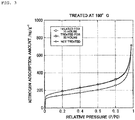
- SWNH single-walled carbon nanohorn
- the nitrogen adsorption amount at 77 K was measured using an adsorption measurement apparatus "Autosorb-iQ" manufactured by Quantachrome Instruments Japan G.K. Nitrogen gas is supplied to an outside of the SWNH, and the amount of nitrogen gas was measured after a predetermined time had passed. When a hole through which nitrogen can pass is present on a peripheral surface of the SWNH, nitrogen enters the SWNH and is adsorbed by an inner wall thereof. Therefore, a difference between the amount of nitrogen supplied and the amount of nitrogen outside the SWNH after the test indicates the nitrogen adsorption amount. The diameter of a hole and the size thereof can be determined.
- a SWNH which had not been treated, a SWNH which had been treated in the air at 250°C for 20 hours, and a SWNH which had been treated in the air at 250°C for 70 hours were prepared, and the nitrogen adsorption amount was measured for each of the SWNHs by supplying nitrogen at different relative pressures.
- the nitrogen adsorption amount was largely increased from a low pressure toward a high pressure compared with the SWNH which had not been treated. It is found that a hole through which nitrogen passes has been formed.
- the adsorption amount was increased compared with the SWNH which had been treated for 20 hours. This means that the number of the SWNH having holes opened was increased which had been treated for 70 hours. That is, the number of holes formed was increased, and consequently a ratio of the SWNH having holes opened was increased. The adsorption amount was thereby increased. Therefore, it is found that the number of holes has been increased.
- a SWNH which had not been treated a SWNH which had been treated in the air at 200°C for 20 hours, a SWNH which had been treated in the air at 200°C for 70 hours, a SWNH which had been treated in the air at 200°C for 100 hours, and a SWNH which had been treated in the air at 200°C for 150 hours were prepared, and the nitrogen adsorption amount was measured for each of the SWNHs by supplying nitrogen at different relative pressures.
- the nitrogen adsorption amount was increased as the treatment time was longer although the increase amount was not as large as the SWNH which had been treated at 250°C. That is, it is found that the number of holes has been increased as the treatment time is longer.
- a SWNH which had not been treated, a SWNH which had been treated in the air at 180°C for 50 hours, and a SWNH which had been treated in the air at 180°C for 70 hours were prepared, and the nitrogen adsorption amount was measured for each of the SWNHs by supplying nitrogen at different relative pressures.
- the nitrogen adsorption amount was increased from a low pressure toward a high pressure compared with the SWNH which had not been treated. It is found that a hole through which nitrogen passes has been formed.
- a hydrated ion radius of a cation satisfies Li + > Na + > K+ > Rb + > Cs + . Therefore, ion selectivity of a filter using a graphene was measured according to ion transmissivity of each ion.
- a SWNH which had been treated in the air at 250°C for 20 hours, a SWNH which had been treated in the air at 250°C for 70 hours, and a SWNH which had been treated in the air at 250°C for 100 hours were prepared, and each of the SWNHs was put into the mixed solution.
- a SWNH which had been treated in the air at 200°C for 20 hours, a SWNH which had been treated in the air at 200°C for 50 hours, a SWNH which had been treated in the air at 200°C for 70 hours, a SWNH which had been treated in the air at 200°C for 100 hours, and a SWNH which had been treated in the air at 200°C for 150 hours were prepared, and each of the SWNHs was put into the mixed solution.
- the SWNH which has been treated for 2 0 hours has hardly transmitted an ion having a large hydrated ion radius such as Li or Na, but has transmitted an ion having a small hydrated ion radius such as K, Rb, or Cs.
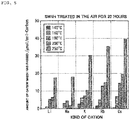
- Fig. 5 illustrates comparison of ion selectivity at each heating temperature while the treatment time is fixed to 20 hours.
- a SWNH which had been treated in the air at 140°C for 20 hours, a SWNH which had been treated in the air at 160°C for 20 hours, a SWNH which had been treated in the air at 180°C for 20 hours, a SWNH which had been treated in the air at 200°C for 20 hours, and a SWNH which had been treated in the air at 250°C for 20 hours were prepared, and each of the SWNHs was put into the mixed solution.
- SWNH which has been treated at 160°C and the SWNH which has been treated at 180°C have transmitted only a small amount of ions due to a small hole.
- the SWNH which has been treated at 160°C and the SWNH which has been treated at 180°C have small transmission amounts of K, Rb, and Cs and have no ion selectivity.
- SWNH which has been treated at 200°C has ion selectivity due to small transmission amounts of Li and Na and large transmission amounts of K, Rb, and Cs.
- Fig. 7 like in Fig. 6 , as described above, the graphene 1 was set in the membrane filter holder 7, a mixed solution of Li, Na, K, Rb, and Cs at 20 ⁇ mol/L was allowed to pass through the graphene 1 from the syringe 8, and an ion concentration of the transmission solution was measured.
- a graphene which had been treated at 160°C for 20 hours, a graphene which had been treated at 200°C for 20 hours, and a graphene which had been treated at 250°C for 20 hours were prepared.
Landscapes
- Chemical & Material Sciences (AREA)
- Chemical Kinetics & Catalysis (AREA)
- Inorganic Chemistry (AREA)
- Organic Chemistry (AREA)
- Engineering & Computer Science (AREA)
- Physics & Mathematics (AREA)
- Manufacturing & Machinery (AREA)
- General Physics & Mathematics (AREA)
- Optics & Photonics (AREA)
- Materials Engineering (AREA)
- Nanotechnology (AREA)
- Architecture (AREA)
- Structural Engineering (AREA)
- Spectroscopy & Molecular Physics (AREA)
- Carbon And Carbon Compounds (AREA)
- Separation Using Semi-Permeable Membranes (AREA)
- Filtering Materials (AREA)
Applications Claiming Priority (2)
| Application Number | Priority Date | Filing Date | Title |
|---|---|---|---|
| JP2014134449 | 2014-06-30 | ||
| EP15814634.0A EP3165277A4 (fr) | 2014-06-30 | 2015-06-17 | Procédé de perforation d'un nanomatériau de carbone, et procédé de production d'article moulé filtrant |
Related Parent Applications (2)
| Application Number | Title | Priority Date | Filing Date |
|---|---|---|---|
| EP15814634.0A Division EP3165277A4 (fr) | 2014-06-30 | 2015-06-17 | Procédé de perforation d'un nanomatériau de carbone, et procédé de production d'article moulé filtrant |
| EP15814634.0A Division-Into EP3165277A4 (fr) | 2014-06-30 | 2015-06-17 | Procédé de perforation d'un nanomatériau de carbone, et procédé de production d'article moulé filtrant |
Publications (1)
| Publication Number | Publication Date |
|---|---|
| EP3263210A1 true EP3263210A1 (fr) | 2018-01-03 |
Family
ID=55019056
Family Applications (2)
| Application Number | Title | Priority Date | Filing Date |
|---|---|---|---|
| EP17184153.9A Withdrawn EP3263210A1 (fr) | 2014-06-30 | 2015-06-17 | Procédé de perforation d'un nanomatériau de carbone et procédé de production d'un article moulé de filtre |
| EP15814634.0A Withdrawn EP3165277A4 (fr) | 2014-06-30 | 2015-06-17 | Procédé de perforation d'un nanomatériau de carbone, et procédé de production d'article moulé filtrant |
Family Applications After (1)
| Application Number | Title | Priority Date | Filing Date |
|---|---|---|---|
| EP15814634.0A Withdrawn EP3165277A4 (fr) | 2014-06-30 | 2015-06-17 | Procédé de perforation d'un nanomatériau de carbone, et procédé de production d'article moulé filtrant |
Country Status (8)
| Country | Link |
|---|---|
| US (2) | US20170128890A1 (fr) |
| EP (2) | EP3263210A1 (fr) |
| JP (1) | JP6588907B2 (fr) |
| CN (2) | CN109908768B (fr) |
| AU (2) | AU2015285551A1 (fr) |
| SA (1) | SA516380527B1 (fr) |
| TW (2) | TW201609532A (fr) |
| WO (1) | WO2016002509A1 (fr) |
Families Citing this family (4)
| Publication number | Priority date | Publication date | Assignee | Title |
|---|---|---|---|---|
| JP6545688B2 (ja) * | 2014-08-11 | 2019-07-17 | 国立大学法人信州大学 | フィルター成形体の製造方法 |
| JPWO2019013059A1 (ja) * | 2017-07-14 | 2020-05-07 | 国立大学法人信州大学 | グラフェンのナノウィンドウ構造、グラフェン膜、および高純度ガスの製造方法 |
| JP7093932B2 (ja) | 2017-10-30 | 2022-07-01 | 国立大学法人信州大学 | フィルター成形体の製造方法 |
| CN108176247A (zh) * | 2018-02-28 | 2018-06-19 | 长沙理工大学 | 用于盐水分离的纳米复合过滤膜及其制备方法和应用 |
Citations (11)
| Publication number | Priority date | Publication date | Assignee | Title |
|---|---|---|---|---|
| JP2002097008A (ja) * | 2000-09-20 | 2002-04-02 | Japan Science & Technology Corp | 単層カーボンナノチューブの開孔方法 |
| WO2003099717A1 (fr) | 2002-05-27 | 2003-12-04 | Japan Science And Technology Agency | Nanocornes de carbone haute densite et leur procede de production |
| WO2008090728A1 (fr) * | 2007-01-25 | 2008-07-31 | Nec Corporation | Composite de nanocornet de carbone de support de catalyseur et procédé permettant de le produire |
| JP2009073727A (ja) | 2007-08-29 | 2009-04-09 | Olympus Corp | カーボンナノチューブ加工方法及びそれによって加工されたカーボンナノチューブ |
| US20090291270A1 (en) * | 2008-03-24 | 2009-11-26 | The Regents Of The University Of California | Graphene-based structure, method of suspending graphene membrane, and method of depositing material onto graphene membrane |
| JP2011526834A (ja) | 2008-06-30 | 2011-10-20 | ナノエイシス テクノロジーズ,インコーポレイティド | 選択透過性のためのナノチューブが埋め込まれた膜 |
| US20120048804A1 (en) * | 2010-08-25 | 2012-03-01 | Lockheed Martin Corporation | Perforated graphene deionization or desalination |
| US20120258311A1 (en) * | 2009-10-16 | 2012-10-11 | Research & Business Foundation Sungkyunkwan University | Roll-to-roll transfer method of graphene, graphene roll produced by the method, and roll-to-roll transfer equipment for graphene |
| JP2013107789A (ja) | 2011-11-21 | 2013-06-06 | Jx Nippon Mining & Metals Corp | グラフェン製造用銅箔及びグラフェンの製造方法 |
| JP2013144621A (ja) | 2012-01-16 | 2013-07-25 | Panasonic Corp | グラフェン膜、グラフェン膜の製造方法、グラフェンデバイス、およびグラフェンデバイスの製造方法 |
| US20130192460A1 (en) * | 2012-01-26 | 2013-08-01 | Empire Technology Development, Llc | Graphene membrane with regular angstrom-scale pores |
Family Cites Families (7)
| Publication number | Priority date | Publication date | Assignee | Title |
|---|---|---|---|---|
| US20040060867A1 (en) * | 2002-09-27 | 2004-04-01 | Bmc Industries, Inc. | Membrane support devices and methods of manufacturing |
| WO2010074918A1 (fr) * | 2008-12-23 | 2010-07-01 | The Trustees Of The University Of Pennsylvania | Préparation à haut rendement de membranes d'oxyde de graphène macroscopiques |
| WO2011094204A2 (fr) * | 2010-01-26 | 2011-08-04 | Wisconsin Alumni Research Foundation | Procédés de fabrication de matériaux semi-conducteurs nanoperforés en graphène d'aire importante |
| CN102557004B (zh) * | 2011-12-23 | 2015-01-28 | 上海交通大学 | 一种通过磁场控制碳纳米材料生长形貌的方法 |
| SG11201405346RA (en) * | 2012-03-21 | 2014-10-30 | Lockheed Corp | Methods for perforating graphene using an activated gas stream and perforated graphene produced therefrom |
| US9463421B2 (en) * | 2012-03-29 | 2016-10-11 | Lockheed Martin Corporation | Planar filtration and selective isolation and recovery device |
| CN103145115B (zh) * | 2013-02-01 | 2014-11-19 | 中科院广州化学有限公司 | 表面羧基官能化的碳纳米材料及其制备方法和应用 |
-
2015
- 2015-06-17 EP EP17184153.9A patent/EP3263210A1/fr not_active Withdrawn
- 2015-06-17 CN CN201910268723.2A patent/CN109908768B/zh not_active Expired - Fee Related
- 2015-06-17 CN CN201580027835.9A patent/CN106457162A/zh active Pending
- 2015-06-17 US US15/322,682 patent/US20170128890A1/en not_active Abandoned
- 2015-06-17 EP EP15814634.0A patent/EP3165277A4/fr not_active Withdrawn
- 2015-06-17 JP JP2016531251A patent/JP6588907B2/ja active Active
- 2015-06-17 AU AU2015285551A patent/AU2015285551A1/en not_active Abandoned
- 2015-06-17 WO PCT/JP2015/067400 patent/WO2016002509A1/fr not_active Ceased
- 2015-06-30 TW TW104121074A patent/TW201609532A/zh unknown
- 2015-06-30 TW TW107131136A patent/TWI664143B/zh not_active IP Right Cessation
-
2016
- 2016-12-19 SA SA516380527A patent/SA516380527B1/ar unknown
-
2019
- 2019-07-11 AU AU2019204970A patent/AU2019204970B2/en not_active Ceased
- 2019-11-27 US US16/697,967 patent/US20200101424A1/en not_active Abandoned
Patent Citations (12)
| Publication number | Priority date | Publication date | Assignee | Title |
|---|---|---|---|---|
| JP2002097008A (ja) * | 2000-09-20 | 2002-04-02 | Japan Science & Technology Corp | 単層カーボンナノチューブの開孔方法 |
| WO2003099717A1 (fr) | 2002-05-27 | 2003-12-04 | Japan Science And Technology Agency | Nanocornes de carbone haute densite et leur procede de production |
| WO2008090728A1 (fr) * | 2007-01-25 | 2008-07-31 | Nec Corporation | Composite de nanocornet de carbone de support de catalyseur et procédé permettant de le produire |
| JP2009073727A (ja) | 2007-08-29 | 2009-04-09 | Olympus Corp | カーボンナノチューブ加工方法及びそれによって加工されたカーボンナノチューブ |
| US20090291270A1 (en) * | 2008-03-24 | 2009-11-26 | The Regents Of The University Of California | Graphene-based structure, method of suspending graphene membrane, and method of depositing material onto graphene membrane |
| JP2011526834A (ja) | 2008-06-30 | 2011-10-20 | ナノエイシス テクノロジーズ,インコーポレイティド | 選択透過性のためのナノチューブが埋め込まれた膜 |
| US20120258311A1 (en) * | 2009-10-16 | 2012-10-11 | Research & Business Foundation Sungkyunkwan University | Roll-to-roll transfer method of graphene, graphene roll produced by the method, and roll-to-roll transfer equipment for graphene |
| US20120048804A1 (en) * | 2010-08-25 | 2012-03-01 | Lockheed Martin Corporation | Perforated graphene deionization or desalination |
| JP2013536077A (ja) | 2010-08-25 | 2013-09-19 | ロッキード・マーチン・コーポレーション | 穿孔グラフェンによる脱イオンまたは脱塩 |
| JP2013107789A (ja) | 2011-11-21 | 2013-06-06 | Jx Nippon Mining & Metals Corp | グラフェン製造用銅箔及びグラフェンの製造方法 |
| JP2013144621A (ja) | 2012-01-16 | 2013-07-25 | Panasonic Corp | グラフェン膜、グラフェン膜の製造方法、グラフェンデバイス、およびグラフェンデバイスの製造方法 |
| US20130192460A1 (en) * | 2012-01-26 | 2013-08-01 | Empire Technology Development, Llc | Graphene membrane with regular angstrom-scale pores |
Non-Patent Citations (1)
| Title |
|---|
| LI LIU ET AL: "Graphene Oxidation: Thickness-Dependent Etching and Strong Chemical Doping", NANO LETTERS, vol. 8, no. 7, 1 July 2008 (2008-07-01), pages 1965 - 1970, XP055066530, ISSN: 1530-6984, DOI: 10.1021/nl0808684 * |
Also Published As
| Publication number | Publication date |
|---|---|
| TW201900555A (zh) | 2019-01-01 |
| TW201609532A (zh) | 2016-03-16 |
| CN109908768A (zh) | 2019-06-21 |
| US20170128890A1 (en) | 2017-05-11 |
| EP3165277A4 (fr) | 2018-03-14 |
| AU2019204970B2 (en) | 2020-09-10 |
| US20200101424A1 (en) | 2020-04-02 |
| WO2016002509A1 (fr) | 2016-01-07 |
| EP3165277A1 (fr) | 2017-05-10 |
| AU2015285551A1 (en) | 2017-01-12 |
| AU2019204970A1 (en) | 2019-08-01 |
| CN106457162A (zh) | 2017-02-22 |
| JPWO2016002509A1 (ja) | 2017-06-22 |
| JP6588907B2 (ja) | 2019-10-09 |
| CN109908768B (zh) | 2021-11-19 |
| TWI664143B (zh) | 2019-07-01 |
| SA516380527B1 (ar) | 2022-04-28 |
Similar Documents
| Publication | Publication Date | Title |
|---|---|---|
| US20200101424A1 (en) | Method for perforating carbon nanomaterial, and method for producing filter molded article | |
| JP6715470B2 (ja) | フィルター成形体の製造方法 | |
| EP3260191B1 (fr) | Procédé destiné à la fabrication de corps de filtre moulé | |
| EP3705174A1 (fr) | Procédé destiné à la fabrication de corps de filtre moulé |
Legal Events
| Date | Code | Title | Description |
|---|---|---|---|
| PUAI | Public reference made under article 153(3) epc to a published international application that has entered the european phase |
Free format text: ORIGINAL CODE: 0009012 |
|
| STAA | Information on the status of an ep patent application or granted ep patent |
Free format text: STATUS: THE APPLICATION HAS BEEN PUBLISHED |
|
| AC | Divisional application: reference to earlier application |
Ref document number: 3165277 Country of ref document: EP Kind code of ref document: P |
|
| AK | Designated contracting states |
Kind code of ref document: A1 Designated state(s): AL AT BE BG CH CY CZ DE DK EE ES FI FR GB GR HR HU IE IS IT LI LT LU LV MC MK MT NL NO PL PT RO RS SE SI SK SM TR |
|
| AX | Request for extension of the european patent |
Extension state: BA ME |
|
| STAA | Information on the status of an ep patent application or granted ep patent |
Free format text: STATUS: REQUEST FOR EXAMINATION WAS MADE |
|
| 17P | Request for examination filed |
Effective date: 20180702 |
|
| RBV | Designated contracting states (corrected) |
Designated state(s): AL AT BE BG CH CY CZ DE DK EE ES FI FR GB GR HR HU IE IS IT LI LT LU LV MC MK MT NL NO PL PT RO RS SE SI SK SM TR |
|
| STAA | Information on the status of an ep patent application or granted ep patent |
Free format text: STATUS: EXAMINATION IS IN PROGRESS |
|
| 17Q | First examination report despatched |
Effective date: 20200417 |
|
| STAA | Information on the status of an ep patent application or granted ep patent |
Free format text: STATUS: THE APPLICATION HAS BEEN WITHDRAWN |
|
| 18W | Application withdrawn |
Effective date: 20230125 |