EP3263271A1 - Procédé de traitement de la surface de verres précontraints - Google Patents
Procédé de traitement de la surface de verres précontraints Download PDFInfo
- Publication number
- EP3263271A1 EP3263271A1 EP16177318.9A EP16177318A EP3263271A1 EP 3263271 A1 EP3263271 A1 EP 3263271A1 EP 16177318 A EP16177318 A EP 16177318A EP 3263271 A1 EP3263271 A1 EP 3263271A1
- Authority
- EP
- European Patent Office
- Prior art keywords
- glass
- laser
- glass plate
- laser beam
- microns
- Prior art date
- Legal status (The legal status is an assumption and is not a legal conclusion. Google has not performed a legal analysis and makes no representation as to the accuracy of the status listed.)
- Withdrawn
Links
Images

Classifications
-
- C—CHEMISTRY; METALLURGY
- C03—GLASS; MINERAL OR SLAG WOOL
- C03C—CHEMICAL COMPOSITION OF GLASSES, GLAZES OR VITREOUS ENAMELS; SURFACE TREATMENT OF GLASS; SURFACE TREATMENT OF FIBRES OR FILAMENTS MADE FROM GLASS, MINERALS OR SLAGS; JOINING GLASS TO GLASS OR OTHER MATERIALS
- C03C23/00—Other surface treatment of glass not in the form of fibres or filaments
- C03C23/0005—Other surface treatment of glass not in the form of fibres or filaments by irradiation
- C03C23/0025—Other surface treatment of glass not in the form of fibres or filaments by irradiation by a laser beam
-
- B—PERFORMING OPERATIONS; TRANSPORTING
- B23—MACHINE TOOLS; METAL-WORKING NOT OTHERWISE PROVIDED FOR
- B23K—SOLDERING OR UNSOLDERING; WELDING; CLADDING OR PLATING BY SOLDERING OR WELDING; CUTTING BY APPLYING HEAT LOCALLY, e.g. FLAME CUTTING; WORKING BY LASER BEAM
- B23K26/00—Working by laser beam, e.g. welding, cutting or boring
- B23K26/352—Working by laser beam, e.g. welding, cutting or boring for surface treatment
- B23K26/355—Texturing
-
- B—PERFORMING OPERATIONS; TRANSPORTING
- B23—MACHINE TOOLS; METAL-WORKING NOT OTHERWISE PROVIDED FOR
- B23K—SOLDERING OR UNSOLDERING; WELDING; CLADDING OR PLATING BY SOLDERING OR WELDING; CUTTING BY APPLYING HEAT LOCALLY, e.g. FLAME CUTTING; WORKING BY LASER BEAM
- B23K26/00—Working by laser beam, e.g. welding, cutting or boring
- B23K26/352—Working by laser beam, e.g. welding, cutting or boring for surface treatment
- B23K26/3568—Modifying rugosity
-
- B—PERFORMING OPERATIONS; TRANSPORTING
- B41—PRINTING; LINING MACHINES; TYPEWRITERS; STAMPS
- B41M—PRINTING, DUPLICATING, MARKING, OR COPYING PROCESSES; COLOUR PRINTING
- B41M5/00—Duplicating or marking methods; Sheet materials for use therein
- B41M5/26—Thermography ; Marking by high energetic means, e.g. laser otherwise than by burning, and characterised by the material used
- B41M5/262—Thermography ; Marking by high energetic means, e.g. laser otherwise than by burning, and characterised by the material used recording or marking of inorganic surfaces or materials, e.g. glass, metal, or ceramics
-
- B—PERFORMING OPERATIONS; TRANSPORTING
- B23—MACHINE TOOLS; METAL-WORKING NOT OTHERWISE PROVIDED FOR
- B23K—SOLDERING OR UNSOLDERING; WELDING; CLADDING OR PLATING BY SOLDERING OR WELDING; CUTTING BY APPLYING HEAT LOCALLY, e.g. FLAME CUTTING; WORKING BY LASER BEAM
- B23K2103/00—Materials to be soldered, welded or cut
- B23K2103/50—Inorganic materials other than metals or composite materials
- B23K2103/54—Glass
Definitions
- the invention relates to a method for processing the surface of tempered glasses, in particular of thermally toughened glass plates or glass panes, after which a plurality of laser markings spaced apart from one another are produced with the aid of a pulsed laser beam.
- Prestressed glasses typically have zones of different voltages. Usually a distinction is made between a compressive stress zone and a tensile stress zone which are separated by a zone boundary. In prestressed glasses and in particular thermally toughened glass plates or glass panes, the respective compressive stress zone is located outside in the area of the surface and the tensile stress zone inside.
- single-pane safety glass or ESG which is constructed from a single, heat-treated glass pane or a single thermally toughened glass plate or glass pane.
- glass plate or glass does not only mean flat elements within the scope of the invention, but also includes curved or curved glass plates inwards or outwards. Likewise, several of the glass plates or glass panes in question can be combined to form a composite pane.
- the preferred tempered safety glass is heated to temperatures above its transformation temperature during processing and then abruptly cooled.
- near-surface zones of the glass cool faster than the inner core. This results in the core already mentioned tensile stress zone, while in or on the surface each pressure stress zones are observed.
- Such Single-pane safety glasses are characterized by increased impact and impact resistance compared to normal (flat) glass.
- breaking strengths according to DIN EN 12150 of typically more than 90 N / mm 2 are observed.
- the breaking strengths are regularly even higher, for example at 100 N / mm 2 in the minimum and in most cases even at 130 N / mm 2 and more.
- For toughened safety glass disintegrates at very high load into small pieces, which significantly reduces the risk of injury compared to normal flat glass.
- single-pane safety glass panes or plates are used, for example, in the automotive industry for side windows or are also used in the construction sector as structural elements.
- shower cubicles or glass doors that are produced using single-pane safety glass are known, as exemplified in the generic form DE 10 2011 000 157 A1 is described. This is about a frame-free glass element, which can be used as a glass door, balcony railing, partition and the like.
- the glass pane has at least one layer of toughened safety glass.
- an engraving is at least partially introduced into at least one surface of the glass sheet.
- the engraving is defined by means of a laser irradiation of the glass pane in the surface.
- a fire-resistant laminated glass is described in which the tempered glass is equipped with at least one local weakening.
- the local weakening is one that can be introduced by laser.
- the flat body may be a flat glass with a mechanical bias.
- the focusing of the laser beam is carried out below the surface in the portion of the flat glass, which is under compressive stress. Details of the laser used are not discussed.
- the invention is based on the technical problem of further developing such a method so that the mechanical properties of the prestressed glass processed on the surface in each case remain approximately the same as compared with the unprocessed glass. In particular, it is important to maintain the breaking strength over untreated glass for the most part.
- a generic method in the invention is characterized in that the pulsed laser beam up to the zone boundary, in particular up to half the zone boundary, in the surface of the biased glass with a pulse energy of 10 mJ to 50 mJ per single pulse penetrates.
- a controlled notch effect is observed at least in the region of the respective laser markings on the surface of the glass machined by the laser and in particular of the thermally toughened glass plate or glass pane.
- This controlled notch effect corresponds to a certain breaking strength of the glass, which is still reached and in the minimum and in the context of the invention values of at least 70 N / mm 2 and in particular of at least 90 N / mm 2 .
- breaking strengths of at least 70 N / mm 2 are observed.
- the breaking strengths are even higher, are at least 90 N / mm 2 , even typically at 100 N / mm 2 and most preferably at 130 N / mm 2 and more, each measured according to DIN EN 12150.
- the individual points or points of weakness regularly have a distance of 1 mm or even less to each other.
- the prestressed glass plate or glass pane processed in this way is equipped with defined weakening points distributed over the surface in a matrix-like manner and distributed over the surface.
- the points of weakness can also be distributed over the entire surface.
- the glass plate or glass pane processed in this way can be weakened in a targeted and controlled manner, taking these specifications into account.
- breaking strengths of at least 70 N / mm 2 are observed. In most cases, the breaking strengths are even higher, are at least 90 N / mm 2 , even more often at 100 N / mm 2 and most preferably at 130 N / mm 2 and more, each measured according to DIN EN 12150.
- the tempered glass processed in this way can be weakened in a controlled way on its surface, whereby the previously stated standard for breaking strength is still observed.
- a controlled processing during sandblasting is not possible because of air pressure fluctuations, changes in the nozzle pressure, variations in the composition of the blasting material, etc., which do not permit controlled processing.
- the invention thus first of all makes use of a pulsed laser beam whose pulse energy is in the claimed range of 10 mJ to 50 mJ per individual pulse.
- the laser beam penetrates into the surface up to a maximum of the zone boundary and in particular to a maximum of half the zone boundary, it is ensured in total and in summary that the machining of the surface of the prestressed glass and in particular of the thermally toughened glass plates or glass panes does not Tensile stress zone reached. In fact, the compressive stress zone and the tensile stress zone are separated by the zone boundary in question.
- the invention works regularly with Single-pane safety glass (ESG).
- ESG Single-pane safety glass
- laminated safety glass (LSG) can also be processed in a comparable manner. In this case, one or more of the biased glass plates or glass panes connected to one another by, for example, an interposed plastic film can be processed in a corresponding manner.
- the invention is based on the recognition that the glass plates or glass sheets in question typically have a material thickness in the range of 3 mm to 20 mm. If one then proceeds from single-pane safety glass or corresponding single-pane safety glass plates or glass panes, then the glass plates or glass panes in question are equipped with an outer compressive stress zone in the region of the surface and the inner tensile stress zone. The compressive stress zone and the tensile stress zone are separated by the zone boundary. In addition, the zones are usually so that the tensile zone occupies about 50% to 70% of the material thickness, whereas the compressive stress zone comprises about 30% to 50% of the total material thickness.
- the thickness of the respective compression stress zone near the surface of the glass plate or glass pane is in the range of 15% to 30%. calculated on the material thickness of the glass plate or glass in question. In the example, this results in a thickness of the compressive stress zone in question of at least 0.45 mm for glass plates or glass panes with the material thickness of 3 mm up to a thickness of the compressive stress zone of 3 mm at a minimum with a material thickness of 20 mm.
- the laser beam is now focused so that it penetrates maximally to the zone boundary in the surface of the glass plate or glass plate in question, that is equipped at the maximum with a penetration depth of 450 microns.
- the penetration depth of the laser beam is limited to a range of 50 ⁇ m to 300 ⁇ m and in particular 50 ⁇ m to 200 ⁇ m. This ensures at the same time that the laser beam can penetrate into the surface up to a maximum of approximately half the zone boundary, which corresponds to a penetration depth of approximately 230 ⁇ m at a material thickness of 3 mm. If the material thickness of the glass plate or glass plate is greater, the percentage penetration depth is much smaller and consequently results in a greater distance to the zone boundary.
- the laser steel with the specified pulse energy of 10 mJ to 50 mJ per single pulse taking into account the penetration depth of 50 microns to 500 microns only reaches the outer compressive stress zone of the usually used single-sheet safety glass plate or glass pane.
- a breakage of the thus processed glass plate or glass is excluded.
- a fracture strength which decreases only slightly compared to an untreated glass plate or glass pane is observed.
- the breaking strength can be adjusted in a controlled manner, namely via the controlled notch effect, because the glass plate, with the aid of the laser, experiences the described controlled weakening.
- a decrease in breaking strength of 25% is observed in the case where a surface of the glass plate or glass sheet is processed by the laser. This is usually the case.
- such tempered safety glass sheets or sheets typically have a breaking strength which is typically 120N / mm 2 and more prior to laser processing. After laser processing, values for the breaking strength of more than 90 N / mm 2 are measured, so that values for the breaking strength which are permissible within the meaning of the standard DIN EN 12150 are still achieved.
- a breaking strength typically 120N / mm 2 and more prior to laser processing.
- the laser beam has a focus diameter in the range of 100 .mu.m to 400 .mu.m, in particular in the range of 100 .mu.m to 300 .mu.m. This is typically done with a focal length of 50 mm to 150 mm, in particular a focal length in the range of about 100 mm.
- an expansion to values in the range of 8 mm to 15 mm for the expanded beam diameter has proven to be particularly favorable.
- the focus can be adjusted as desired to the particularly preferred values in the range from 100 ⁇ m to 300 ⁇ m.
- the method according to the invention operates in the so-called single-shot mode. That is, every laser mark in or on the surface of the glass plate or glass sheet to be processed is produced with only a single shot, in order to ensure in the end that only the near-surface compressive stress zone is processed.
- the measures to limit the pulse energy in the range of 10 mJ to 50 mJ per single pulse.
- the mean and previously stated pulse energy in question results, by way of example, in the case where laser pulses of a pulse duration of approximately 100 ⁇ s and a pulse duration of approximately 100 ⁇ s average power of 20 W is being worked. Assuming a pulse repetition frequency of, for example, 560 Hz, the pulse energy for the individual pulse is calculated from the product of the average power of 20 W multiplied by the period of approximately 1.8 ms, so that from this a pulse energy for the single pulse of 36 mJ in the example case results.
- suitable laser source may be a CO 2 laser used.
- CO 2 laser used.
- Nd: YAG laser or with other laser types.
- the duty cycle indicates the time relationship between pulse duration and pulse period. That is, the laser pulse has a pulse duration which is 5% to a maximum of 50% and preferably to a maximum of about 40% of the period duration.
- At least one sensor is provided for measuring the pulse energy. Consequently, the pulse energy of the individual pulse can be measured with the aid of this sensor. From the resulting sensor values can therefore be derived control or control values for the control of the laser source. Typically, a control is used here in such a way that the pulse energy per individual pulse is kept at a specific and preset value.
- a further sensor for distance measurement With the help of this sensor, the distance of the laser source or an output-side focusing lens to the surface of the processed biased glass determined. In this way, any deviations of the surface of the respective glass plate or glass from a flat profile can be considered. That is, with the help of the sensor for distance measurement, a "height profile" of the glass plate or glass pane to be processed can be detected. Common measurement methods such as laser triangulation, ultrasound or mechanical measurement with a stylus have proved to be favorable here.
- the laser source or the focusing lens can then be traced overall to ensure that the pulsed laser beam processes the surface with a consistently constant penetration depth.
- the beam guidance is changed.
- a workpiece guide can be traced.
- the work piece guide is a table for the glass plate or glass pane placed thereon.
- the relevant workpiece guide as well as the beam guidance of the laser source may be designed to be three-dimensionally movable overall.
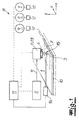
- the glass plate or glass pane 1 is, in the exemplary embodiment and not restrictive, a single-pane safety glass pane or glass plate.
- the glass plate or glass sheet 1 in question is equipped with a large surface engraving, which can fulfill decorative purposes, but also, for example, an anti-slip effect, if the glass plate or glass plate in question 1, for example, as a floor or step covering is used.
- the mentioned surface engraving is usually applied to a surface of the glass plate or glass sheet 1 in question. In principle, both surfaces of the relevant glass plate or glass pane 1 can be equipped with the surface engraving to be described below.
- the glass plate or pane of glass 1 in question is required for interior work, for example as an interior door, shower cubicle, etc.
- interior work for example as an interior door, shower cubicle, etc.
- outdoor applications as a structural element are also conceivable, for example as a facade element.
- products such as partitions, table tops, glass doors, door inserts can be realized herewith.
- a correspondingly designed glass plate or glass pane 1 for shop fitting is a correspondingly designed glass plate or glass pane 1 for shop fitting.
- the glass plate or glass pane 1 in question is processed by means of a pulsed laser beam 4, which is generated by means of a pulsed laser source 2.
- the laser source 2 may be one that uses a pulsed CO 2 laser that provides typical average output powers of about 20 W to 200 W.
- the pulse times are generally in the range of 20 ⁇ s to 500 ⁇ s, usually between 60 ⁇ s to 120 ⁇ s.
- a pulse energy of 10 mJ to 50 mJ per single pulse is observed.
- a laser beam 4 leaves the pulsed laser source 2 and is directed and deflected by a beam guide 5, 6 on the surface of the glass plate or glass sheet 1.
- the beam guidance 5, 6 is in the example after the Fig. 1 from a galvanometer mirror assembly 5 and a focusing lens 6 together.
- the individual laser markings 3 can be generated on the surface of the glass plate or glass pane 1 and define here in the Fig. 1 only indicated edit field 7.
- a workpiece guide 8 is equipped with a plurality of motors 9, which make it possible to move the glass plate or glass pane 1 in question in all three spatial directions, ie in the X, Y and Z direction.
- the beam guide 5, 6 with respect to the glass plate or glass sheet 1 also or instead of the workpiece guide 8 are moved.
- This can also be worked with a pure two-dimensional mobility.
- the beam guide 5, 6 in this context a mobility in all three spatial directions.
- Fig. 1 nor a control unit 11, to which the beam guide 5, 6 as well as the individual motors 9 of the workpiece guide 8 are connected.
- displacement sensors 12 are still provided, with the aid of which the individual travel path of the associated motor 9 of the workpiece guide 8 is determined and transmitted to the control unit 11.
- a further sensor 13 serves to measure the distance of the laser source 2 or the beam guide 5, 6 from the surface of the relevant glass plate or glass pane 1 to be processed.
- the glass plate or pane of glass 1 in question is prestressed.
- surfaces of the glass plate or glass pane 1 are provided with a compressive stress zone 1b.
- the inner tensile stress zone 1a and the compression stress zone 1b are separated from each other by a zone boundary 1c.
- the individual laser markings 3 are equipped with a penetration depth T of the laser beam 4 which does not reach the zone boundary 1c.
- the laser beam 4 penetrates maximally to the zone boundary 1c in the surface, taking into account a pulse energy of 10 mJ to 50 mJ per single pulse , In most cases, the penetration depth T is at most half the width or material thickness of the outer compressive stress zone 1 b.
- the breaking strength according to DIN EN 12150 is well above 70 N / mm 2 even after introducing the laser markings 3. This is achieved by the invention in that the penetration depth T of the laser beam 4 is set in the range of 50 ⁇ m to 500 ⁇ m.
- the material thickness S of the relevant glass pane or glass pane 1 is located and set in the embodiment in the range of about 5 mm to 10 mm.
- the laser beam 4 has a focus diameter in the range from 100 ⁇ m to 300 ⁇ m.
- each works in single shot operation. That is, each of the illustrated laser marks 3 is generated only with a single laser shot, which in turn is the previously already mentioned pulse energy in the range between 10 mJ to 50 mJ per single pulse.
- the beam guide 5, 6 is stopped or not moved in the exemplary embodiment in question in the individual shot in question. This applies in particular to the galvanometer mirror arrangement 5, which otherwise provides for the deflection of the laser beam 4 to produce the respective laser markings 3.
- a further sensor 14 is provided with the help of the indicated pulse energy can be measured and transmitted to the control unit 11.
- part of the laser beam 4 is coupled out via a beam splitter 15 into the sensor 14 in question.
- the control unit 11 ensures that the laser source 2 is tracked accordingly so that the pulse energy impinges uniformly on the surface of the glass plate or glass pane 1.
- a height profile of the relevant glass plate or glass pane 1 can be detected, as has already been described in the introduction. Taking into account the height profile can be traced in the example, the workpiece guide 8 and thus the relevant glass plate or glass 1, in such a way that the penetration depth T over the entire surface of the respective glass plate or glass 1 is set consistently.
- the invention typically works for this purpose with a control which converts the measured height profile into a corresponding movement for the workpiece guide 8.
- the laser beam 4 is moved relative to the glass plate or glass pane 1 to be processed in such a way that it is ensured that only a single laser shot produces the desired weakening point. That is, the control unit 11 logs the individual introduced points of weakness, each attenuation point belonging to a single laser pulse or single pulse with the specified pulse energy. In this case, the beam guide 5, 6 or the workpiece guide 8 is stopped during the single shot. In any case, the control unit 11 ensures that a location of the glass plate or glass pane 1 is not processed several times.
Landscapes
- Engineering & Computer Science (AREA)
- Optics & Photonics (AREA)
- Physics & Mathematics (AREA)
- Mechanical Engineering (AREA)
- Plasma & Fusion (AREA)
- Chemical & Material Sciences (AREA)
- Life Sciences & Earth Sciences (AREA)
- Chemical Kinetics & Catalysis (AREA)
- General Chemical & Material Sciences (AREA)
- Geochemistry & Mineralogy (AREA)
- Materials Engineering (AREA)
- Organic Chemistry (AREA)
- Toxicology (AREA)
- Health & Medical Sciences (AREA)
- Ceramic Engineering (AREA)
- Re-Forming, After-Treatment, Cutting And Transporting Of Glass Products (AREA)
- Laser Beam Processing (AREA)
Priority Applications (1)
| Application Number | Priority Date | Filing Date | Title |
|---|---|---|---|
| EP16177318.9A EP3263271A1 (fr) | 2016-06-30 | 2016-06-30 | Procédé de traitement de la surface de verres précontraints |
Applications Claiming Priority (1)
| Application Number | Priority Date | Filing Date | Title |
|---|---|---|---|
| EP16177318.9A EP3263271A1 (fr) | 2016-06-30 | 2016-06-30 | Procédé de traitement de la surface de verres précontraints |
Publications (1)
| Publication Number | Publication Date |
|---|---|
| EP3263271A1 true EP3263271A1 (fr) | 2018-01-03 |
Family
ID=56368839
Family Applications (1)
| Application Number | Title | Priority Date | Filing Date |
|---|---|---|---|
| EP16177318.9A Withdrawn EP3263271A1 (fr) | 2016-06-30 | 2016-06-30 | Procédé de traitement de la surface de verres précontraints |
Country Status (1)
| Country | Link |
|---|---|
| EP (1) | EP3263271A1 (fr) |
Citations (6)
| Publication number | Priority date | Publication date | Assignee | Title |
|---|---|---|---|---|
| JP2004323252A (ja) * | 2003-04-21 | 2004-11-18 | Hideaki Fujita | 強化ガラスマーキング方法及び強化ガラス |
| EP1138516B1 (fr) | 2000-03-29 | 2006-02-22 | Vitro Laser GmbH | Procédé pour former une gravure dans la masse d'un corps plat et appareil pour la réalisation dudit procédé |
| DE102008004995B3 (de) * | 2008-01-17 | 2008-12-04 | Schott Ag | Lasermarkierte Glasscheiben und deren Verwendung als Beleuchtungselemente |
| EP2269763A2 (fr) * | 2006-06-22 | 2011-01-05 | SABIC Innovative Plastics IP B.V. | Outils et systèmes de gravure et procédés pour la formation d'une pluralité de cellules sur les outils de gravure |
| DE102011000157A1 (de) | 2011-01-14 | 2012-07-19 | Erkelenz Türen GmbH | Rahmenfreies Glaselement |
| DE202011110686U1 (de) | 2010-06-29 | 2015-07-27 | Vetrotech Saint-Gobain (International) Ag | Brandschutz-Verbundglas |
-
2016
- 2016-06-30 EP EP16177318.9A patent/EP3263271A1/fr not_active Withdrawn
Patent Citations (6)
| Publication number | Priority date | Publication date | Assignee | Title |
|---|---|---|---|---|
| EP1138516B1 (fr) | 2000-03-29 | 2006-02-22 | Vitro Laser GmbH | Procédé pour former une gravure dans la masse d'un corps plat et appareil pour la réalisation dudit procédé |
| JP2004323252A (ja) * | 2003-04-21 | 2004-11-18 | Hideaki Fujita | 強化ガラスマーキング方法及び強化ガラス |
| EP2269763A2 (fr) * | 2006-06-22 | 2011-01-05 | SABIC Innovative Plastics IP B.V. | Outils et systèmes de gravure et procédés pour la formation d'une pluralité de cellules sur les outils de gravure |
| DE102008004995B3 (de) * | 2008-01-17 | 2008-12-04 | Schott Ag | Lasermarkierte Glasscheiben und deren Verwendung als Beleuchtungselemente |
| DE202011110686U1 (de) | 2010-06-29 | 2015-07-27 | Vetrotech Saint-Gobain (International) Ag | Brandschutz-Verbundglas |
| DE102011000157A1 (de) | 2011-01-14 | 2012-07-19 | Erkelenz Türen GmbH | Rahmenfreies Glaselement |
Similar Documents
| Publication | Publication Date | Title |
|---|---|---|
| WO2008068346A2 (fr) | Assemblage constitué de deux tôles d'acier | |
| EP3334697A1 (fr) | Procédé pour la coupe d'une couche de verre mince | |
| DE1244346B (de) | Verfahren zum Schneiden von Glas | |
| EP1138516B1 (fr) | Procédé pour former une gravure dans la masse d'un corps plat et appareil pour la réalisation dudit procédé | |
| WO1996036469A1 (fr) | Revetement de sol antiderapant et son procede de production | |
| EP1516068A1 (fr) | Procede pour lisser et polir des surfaces par traitement avec un rayonnement energetique | |
| EP2155917A1 (fr) | Procédé de production d'un composant profilé durci localement, composant profilé durci localement, et utilisation d'un composant profilé durci localement | |
| DE102011106097B4 (de) | Verfahren und Vorrichtung zum Bearbeiten eines Werkstückes | |
| DE10204428A1 (de) | Verfahren zum Abtragen von Vertiefungen durch einen Laser sowie Wabenstrukturformwerkzeug und Verfahren zum Herstellen dieses Werkzeugs | |
| DE69513476T2 (de) | Verfahren und Vorrichtung zum Formen von Details durch superplastische Verformung | |
| DE10237478B4 (de) | Verfahren zum Schneiden eines fortlaufenden Glasbandes bei der Herstellung von Flachglas | |
| EP3854515A1 (fr) | Procédé de traitement de matériaux dures et cassants | |
| EP1974880B1 (fr) | Dispositif de coupe de pièces usinées | |
| DE10309456A1 (de) | Vorrichtung und Verfahren zur Oberflächenbearbeitung eines Werkstückes | |
| DE102016125510B3 (de) | Warmgeformtes metallisches Blechbauteil sowie Verfahren zur Herstellung einer Öffnung in einem solchen Blechbauteil | |
| EP3263271A1 (fr) | Procédé de traitement de la surface de verres précontraints | |
| DE60305444T2 (de) | Verfahren zur bestimmung einer wärmebehandlung und so behandeltes glied | |
| DE10059802B4 (de) | Verfahren zur Oberflächenvergütung | |
| CH414891A (de) | Verfahren zum Schneiden von Werkstücken mittels eines Ladungsträgerstrahls | |
| DE102010028183B4 (de) | Umformwerkzeug und Verfahren zur Bearbeitung der Oberfläche eines Umformwerkzeugs | |
| EP3872041B1 (fr) | Procédé de séparation d'un élément en verre et élément partiel en verre | |
| DE602005003794T2 (de) | Hybridpresse zum formen von grossen werkstücken | |
| EP0919315A1 (fr) | Procédé pour casser des bielles | |
| DE2145552B1 (de) | Verfahren und vorrichtung zum ausschneiden von spiegeln | |
| DE102017129237A1 (de) | Verfahren und Vorrichtung zum Schneiden eines Werkstücks |
Legal Events
| Date | Code | Title | Description |
|---|---|---|---|
| PUAI | Public reference made under article 153(3) epc to a published international application that has entered the european phase |
Free format text: ORIGINAL CODE: 0009012 |
|
| AK | Designated contracting states |
Kind code of ref document: A1 Designated state(s): AL AT BE BG CH CY CZ DE DK EE ES FI FR GB GR HR HU IE IS IT LI LT LU LV MC MK MT NL NO PL PT RO RS SE SI SK SM TR |
|
| AX | Request for extension of the european patent |
Extension state: BA ME |
|
| STAA | Information on the status of an ep patent application or granted ep patent |
Free format text: STATUS: THE APPLICATION IS DEEMED TO BE WITHDRAWN |
|
| 18D | Application deemed to be withdrawn |
Effective date: 20180704 |