EP3264358B1 - Bestimmung der bildforensik unter verwendung einer geschätzten kamerareaktionsfunktion - Google Patents
Bestimmung der bildforensik unter verwendung einer geschätzten kamerareaktionsfunktion Download PDFInfo
- Publication number
- EP3264358B1 EP3264358B1 EP17177486.2A EP17177486A EP3264358B1 EP 3264358 B1 EP3264358 B1 EP 3264358B1 EP 17177486 A EP17177486 A EP 17177486A EP 3264358 B1 EP3264358 B1 EP 3264358B1
- Authority
- EP
- European Patent Office
- Prior art keywords
- crf
- image
- sensing device
- estimated
- model
- Prior art date
- Legal status (The legal status is an assumption and is not a legal conclusion. Google has not performed a legal analysis and makes no representation as to the accuracy of the status listed.)
- Active
Links
Images


Classifications
-
- G—PHYSICS
- G06—COMPUTING OR CALCULATING; COUNTING
- G06T—IMAGE DATA PROCESSING OR GENERATION, IN GENERAL
- G06T1/00—General purpose image data processing
- G06T1/0021—Image watermarking
- G06T1/0028—Adaptive watermarking, e.g. Human Visual System [HVS]-based watermarking
-
- G—PHYSICS
- G06—COMPUTING OR CALCULATING; COUNTING
- G06F—ELECTRIC DIGITAL DATA PROCESSING
- G06F18/00—Pattern recognition
- G06F18/20—Analysing
- G06F18/25—Fusion techniques
- G06F18/251—Fusion techniques of input or preprocessed data
-
- G—PHYSICS
- G06—COMPUTING OR CALCULATING; COUNTING
- G06F—ELECTRIC DIGITAL DATA PROCESSING
- G06F18/00—Pattern recognition
- G06F18/20—Analysing
- G06F18/25—Fusion techniques
- G06F18/253—Fusion techniques of extracted features
-
- G—PHYSICS
- G06—COMPUTING OR CALCULATING; COUNTING
- G06F—ELECTRIC DIGITAL DATA PROCESSING
- G06F21/00—Security arrangements for protecting computers, components thereof, programs or data against unauthorised activity
- G06F21/10—Protecting distributed programs or content, e.g. vending or licensing of copyrighted material ; Digital rights management [DRM]
- G06F21/16—Program or content traceability, e.g. by watermarking
-
- G—PHYSICS
- G06—COMPUTING OR CALCULATING; COUNTING
- G06V—IMAGE OR VIDEO RECOGNITION OR UNDERSTANDING
- G06V20/00—Scenes; Scene-specific elements
- G06V20/80—Recognising image objects characterised by unique random patterns
-
- H—ELECTRICITY
- H04—ELECTRIC COMMUNICATION TECHNIQUE
- H04N—PICTORIAL COMMUNICATION, e.g. TELEVISION
- H04N1/00—Scanning, transmission or reproduction of documents or the like, e.g. facsimile transmission; Details thereof
- H04N1/32—Circuits or arrangements for control or supervision between transmitter and receiver or between image input and image output device, e.g. between a still-image camera and its memory or between a still-image camera and a printer device
- H04N1/32101—Display, printing, storage or transmission of additional information, e.g. ID code, date and time or title
- H04N1/32128—Display, printing, storage or transmission of additional information, e.g. ID code, date and time or title attached to the image data, e.g. file header, transmitted message header, information on the same page or in the same computer file as the image
-
- G—PHYSICS
- G06—COMPUTING OR CALCULATING; COUNTING
- G06T—IMAGE DATA PROCESSING OR GENERATION, IN GENERAL
- G06T2201/00—General purpose image data processing
- G06T2201/005—Image watermarking
- G06T2201/0201—Image watermarking whereby only tamper or origin are detected and no embedding takes place
-
- G—PHYSICS
- G06—COMPUTING OR CALCULATING; COUNTING
- G06V—IMAGE OR VIDEO RECOGNITION OR UNDERSTANDING
- G06V20/00—Scenes; Scene-specific elements
- G06V20/90—Identifying an image sensor based on its output data
-
- G—PHYSICS
- G06—COMPUTING OR CALCULATING; COUNTING
- G06V—IMAGE OR VIDEO RECOGNITION OR UNDERSTANDING
- G06V2201/00—Indexing scheme relating to image or video recognition or understanding
- G06V2201/10—Recognition assisted with metadata
-
- H—ELECTRICITY
- H04—ELECTRIC COMMUNICATION TECHNIQUE
- H04N—PICTORIAL COMMUNICATION, e.g. TELEVISION
- H04N2201/00—Indexing scheme relating to scanning, transmission or reproduction of documents or the like, and to details thereof
- H04N2201/0001—Diagnosis, testing or measuring; Detecting, analysis or monitoring not otherwise provided for
- H04N2201/0003—Method used
- H04N2201/0005—Method used using a reference pattern designed for the purpose, e.g. a test chart
-
- H—ELECTRICITY
- H04—ELECTRIC COMMUNICATION TECHNIQUE
- H04N—PICTORIAL COMMUNICATION, e.g. TELEVISION
- H04N2201/00—Indexing scheme relating to scanning, transmission or reproduction of documents or the like, and to details thereof
- H04N2201/32—Circuits or arrangements for control or supervision between transmitter and receiver or between image input and image output device, e.g. between a still-image camera and its memory or between a still-image camera and a printer device
- H04N2201/3201—Display, printing, storage or transmission of additional information, e.g. ID code, date and time or title
- H04N2201/3225—Display, printing, storage or transmission of additional information, e.g. ID code, date and time or title of data relating to an image, a page or a document
- H04N2201/3233—Display, printing, storage or transmission of additional information, e.g. ID code, date and time or title of data relating to an image, a page or a document of authentication information, e.g. digital signature, watermark
- H04N2201/3235—Checking or certification of the authentication information, e.g. by comparison with data stored independently
-
- H—ELECTRICITY
- H04—ELECTRIC COMMUNICATION TECHNIQUE
- H04N—PICTORIAL COMMUNICATION, e.g. TELEVISION
- H04N2201/00—Indexing scheme relating to scanning, transmission or reproduction of documents or the like, and to details thereof
- H04N2201/32—Circuits or arrangements for control or supervision between transmitter and receiver or between image input and image output device, e.g. between a still-image camera and its memory or between a still-image camera and a printer device
- H04N2201/3201—Display, printing, storage or transmission of additional information, e.g. ID code, date and time or title
- H04N2201/3225—Display, printing, storage or transmission of additional information, e.g. ID code, date and time or title of data relating to an image, a page or a document
- H04N2201/3252—Image capture parameters, e.g. resolution, illumination conditions, orientation of the image capture device
-
- H—ELECTRICITY
- H04—ELECTRIC COMMUNICATION TECHNIQUE
- H04N—PICTORIAL COMMUNICATION, e.g. TELEVISION
- H04N2201/00—Indexing scheme relating to scanning, transmission or reproduction of documents or the like, and to details thereof
- H04N2201/32—Circuits or arrangements for control or supervision between transmitter and receiver or between image input and image output device, e.g. between a still-image camera and its memory or between a still-image camera and a printer device
- H04N2201/3201—Display, printing, storage or transmission of additional information, e.g. ID code, date and time or title
- H04N2201/3225—Display, printing, storage or transmission of additional information, e.g. ID code, date and time or title of data relating to an image, a page or a document
- H04N2201/3256—Display, printing, storage or transmission of additional information, e.g. ID code, date and time or title of data relating to an image, a page or a document colour related metadata, e.g. colour, ICC profiles
- H04N2201/3257—Display, printing, storage or transmission of additional information, e.g. ID code, date and time or title of data relating to an image, a page or a document colour related metadata, e.g. colour, ICC profiles relating to the original, the input device or the input process, e.g. scanner profile
Definitions
- the present disclosure relates to determining image forensics using an estimated camera response function.
- Determining the integrity of digital media is of increasing importance due to the proliferation of both real and forged imagery on social media platforms. It is easier than ever to use manipulation programs (e.g., Photoshop) to alter the content of an image in order to misinform the public or to commit fraud. As such, there is a need for methods to assess the integrity of imagery in both the commercial and government sectors. These methods must work with uncontrolled source imagery and produce, with as little user input as possible, a numerical assessment of the probability that the image or video has been altered in such a way as to misinform or mislead the recipient.
- manipulation programs e.g., Photoshop
- DARPA has launched a program called MediFor (Media Forensics) to assess the integrity of visual media used by intelligence analysts for enemy force assessment, counter-intelligence, and to debunk misinformation from foreign intelligence services.
- MediFor Media Forensics
- a method of image forensics uses blur to estimate certain camera parameters, and checks those parameters for consistency, at least, with a set of rules (both manually encoded and empirically determined) which can detect manipulations without the need to access image metadata (JPEG or EXIF data, for example).
- a set of rules both manually encoded and empirically determined
- more exacting checks can be applied to detect whether the parameters are consistent with the purported make and model of the camera.
- the specific parameter estimated and checked in this method is the camera response function (CRF), also known as the tone-mapping function.
- CRF is a non-linear mapping from the photosensor's output to an intensity value (often an 8-bit value) used in the corresponding pixel of the resulting image.
- CRFs are used to improve the aesthetics of photographic imagery, since the raw photosensor response results in unpleasantly low contrast and harsh transitions at the ends of the dynamic range. Because the CRF's main goal is aesthetic, there is no objectively best value and thus each manufacturer uses its own proprietary CRF. To the extent that different camera models target different customer segments, CRFs exhibit variation even between models produced by the same manufacturer. The role of CRFs with respect to blur has only recently become well-known in the image processing and computer vision literature.
- assessing the forensic integrity of an image or video begins by estimating the CRF. This can be done in several ways. The first, which is based on prior art, is to estimate the CRF via blurred edges in the image. An alternate method is to use image statistics, e.g. by computing the magnitudes of image gradients and modeling their distribution in relation to an a priori model of natural image gradient magnitudes.
- the estimated CRF is compared to some rules from domain knowledge, e.g. that the CRF should be monotonic and that it should span the entire output range of the available bit depth.
- the CRF is compared to a database of known CRFs, and features derived from both the current and database CRFs are compared using anomaly detection methods to determine whether the estimated CRF is likely to have come from the same space.
- the estimated CRF is compared to the corresponding entry from the database to check for consistency. The outputs of these three modules are then combined via a fusion approach for an overall integrity assessment.
- a CRF database is maintained via periodic analysis of imagery uploaded to social media sites.
- Flickr has an application program interface (API) that allows this functionality of downloading a set of photos.
- API application program interface
- a set of recently uploaded images would be downloaded and the corresponding metadata would be checked to make a list of current camera makes and models.
- the system would download a second set of photos taken with that particular camera. This second set of photos would then be processed to estimate a representative CRF for the camera make and model, and it would be added to the database.
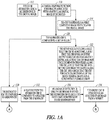
- FIGS. 1A and 1B are a block diagram illustrating features and operations of a method for determining image forensics using an estimated camera response function.
- FIGS. 1A and 1B include a number of process blocks 110 - 168. Though arranged somewhat serially in the example of FIGS. 1A and IB, other examples may reorder the blocks, omit one or more blocks, and/or execute two or more blocks in parallel using multiple processors or a single processor organized as two or more virtual machines or sub-processors. Moreover, still other examples can implement the blocks as one or more specific interconnected hardware or integrated circuit modules with related control and data signals communicated between and through the modules. Thus, any process flow is applicable to software, firmware, hardware, and hybrid implementations.
- a camera response function that is associated with a particular digital image is estimated.
- the CRF can be estimated using a blurred edge in the digital image. Specifically, the change in image intensity across a motion-blurred edge would be linear in the absence of the CRF. The observed non-linearity of the blurred edge in the digital image can thus be used with a numerical optimization method to estimate the CRF. In under-constrained situations, prior information about the blur or the CRF shape can be imposed during optimization.
- the CRF is estimated by first computing image statistics for the digital image. Pertinent image statistics can be divided into spatial and frequency domain statistics.
- Spatial domain statistics include histograms of image gradient magnitudes which, in the absence of blur and the CRF, have a known distribution; as with edge methods, numerical optimization can be used to determine the CRF which best explains the difference between the observed and expected image statistics.
- Fourier domain statistics for example, include the radial power spectrum of the image which, in the absence of blur and the CRF, have an expected falloff with the magnitude of the spatial frequency; as before, numerical optimization can estimate the CRF which best explains the difference between the observed and expected power spectra.
- the estimated CRF is compared to a set of rules.
- the set of rules can include a rule that the CRF is monotonic, a rule that the CRF spans an entire output range of an available bit depth, a rule that the CRF does not include mid-function peaks along the CRF, a rule that the CRF includes no negative slopes along the CRF, and a rule that the CRF for each color channel of the image sensing device has a substantially similar shape.
- FIG. 2 illustrates a typical CRF associated with a digital image that has not been tampered with.
- FIG. 3 illustrates a CRF in which the pixels in the image have been altered. As can be seen in FIG.
- a normal CRF comprises a relatively smooth positively increasing slope along its length.
- an altered digital image may cause the CRF to have minor peaks along the length of the CRF, and also cause the CRF to have negative slopes along the length of the CRF ( 320 ).
- the estimated CRF is compared to a known CRF.
- the known CRF is associated with a particular make and a model of a particular image sensing device.
- the estimated and known CRFs can be compared in different ways. First, they can be compared directly, for instance by measuring the difference between them at corresponding points and computing a root mean squared difference. Alternatively, CRFs can be compared via features. More specifically, as outlined at 132, a feature from the estimated CRF is compared to a feature from the known CRF. Such features for comparison can include a histogram of slope values along the CRF, a measured area under the curve, and the start- and end-points of the middle linear section. Then, at 134, an anomaly detection is used to determine whether the estimated CRF is likely to have come from the same image sensing device. As a practical matter, large sets of CRFs are used in anomaly detection so as to increase the accuracy of the detection process.
- the known CRF is updated via an analysis of an image from a website. More specifically, this updating of the known CRF includes downloading an image from a website ( 136A ), receiving metadata from a header in the downloaded image ( 136B ), determining, from the metadata from the header in the downloaded image a make and model of an image sensing device that created the downloaded image ( 136C ), and storing the metadata, make, and model of the image sensing device that created the downloaded image in the database ( 136D ). In a further embodiment, at 136E, it is determined if the make and model of the image sensing device that created the downloaded image are currently in the database.
- a second image is downloaded that was generated using the make and the model of the image sensing device that created the downloaded image. Then, at 136G, the second image is used to estimate a CRF for the make and model of the image sensing device that created the downloaded image, and at 136H, the CRF for the make and model of the image sensing device that created the downloaded image is stored in the database.
- a fusion analysis is applied to the results obtained from comparing the estimated CRF to a set of rules and from comparing the estimated CRF to the known CRF.
- a fusion analysis can involve one or more of the following methods.
- a decision-level fusion for example voting, where different cues are used to independently predict something (such as that an image has been forged), and those binary decisions are combined.
- a common option is to take a majority vote by the independent predictions.
- a score-level fusion where each of the independent features is used to predict a continuous score (conceptually, the probability that the image was forged) and those continuous scores are fused to generate a single system output, which is a binary indicator of whether the image was forged.
- a feature-level fusion where lower-level features (for example, something like the derivatives of the CRF in different places) are combined (for example, by concatenating them), and a single machine learning method is applied to the concatenated feature vector to predict whether the image was forged. Thereafter, at 150, the integrity of the image is assessed as a function of the fusion analysis.
- metadata that is stored in a header of the digital image is received into a processing unit.
- the metadata stored in the header of the digital image identifies a make and a model of an image sensing device that created the digital image.
- metadata that are stored in a database are then received into the processing unit.
- the metadata stored in the database are associated with the make and model of the image sensing device that created the digital image.
- the metadata stored in the header of the digital image is compared to the metadata stored in the database that is associated with the make and model of the image sensing device that created the digital image.
- the fusion analysis is applied to the results from comparing the metadata stored in the header of the digital image to the metadata stored in the database that are associated with the make and model of the image sensing device that created the digital image, and at 168, the integrity of the image is assessed as a function of the fusion analysis.
- FIG. 4 is a block diagram illustrating a system 400 including a digital camera 420, a computer processor 410, and a database 430.
- the system 400 can be used to execute the several functions outlined in FIGS. 1A and IB.
Landscapes
- Engineering & Computer Science (AREA)
- Theoretical Computer Science (AREA)
- Physics & Mathematics (AREA)
- General Physics & Mathematics (AREA)
- General Engineering & Computer Science (AREA)
- Multimedia (AREA)
- Data Mining & Analysis (AREA)
- Signal Processing (AREA)
- Bioinformatics & Cheminformatics (AREA)
- Artificial Intelligence (AREA)
- Life Sciences & Earth Sciences (AREA)
- Bioinformatics & Computational Biology (AREA)
- Computer Vision & Pattern Recognition (AREA)
- Evolutionary Biology (AREA)
- Evolutionary Computation (AREA)
- Software Systems (AREA)
- Technology Law (AREA)
- Computer Hardware Design (AREA)
- Computer Security & Cryptography (AREA)
- Image Analysis (AREA)
- Studio Devices (AREA)
Claims (9)
- Verfahren zum Beurteilen der Integrität eines digitalen Bildes, umfassend:Schätzen einer Kamerareaktionsfunktion (CRF, camera response function), die dem digitalen Bild (110) zugeordnet ist;Vergleichen der geschätzten CRF mit einem Regelwerk (120);gekennzeichnet durch Vergleichen der geschätzten CRF mit einer bekannten CRF, wobei die bekannte CRF einer Marke und einem Modell einer Bildaufnahmevorrichtung (130) zugeordnet ist;Anwenden einer Fusionsanalyse auf Ergebnisse, die aus dem Vergleichen der geschätzten CRF mit einem Regelwerk und aus dem Vergleichen der geschätzten CRF mit der bekannten CRF (140) erhalten wurden; undBeurteilen der Integrität des digitalen Bildes in Abhängigkeit von der Fusionsanalyse (150).
- Verfahren nach Anspruch 1, umfassend:Empfangen von in einem Header des digitalen Bildes gespeicherten Metadaten, wobei die im Header des digitalen Bildes gespeicherten Metadaten eine Marke und ein Modell einer Bildaufnahmevorrichtung kennzeichnen, die das digitale Bild (160) erzeugte;Empfangen von in einer Datenbank gespeicherten Metadaten, wobei die in der Datenbank gespeicherten Metadaten der Marke und dem Modell der Bildaufnahmevorrichtung zugeordnet sind, die das digitale Bild erzeugte;Vergleichen der im Header des digitalen Bildes gespeicherten Metadaten mit den in der Datenbank gespeicherten Metadaten, die der Marke und dem Modell der Bildaufnahmevorrichtung zugeordnet sind, die das digitale Bild (162) erzeugte;Anwenden der Fusionsanalyse auf Ergebnisse, die durch Vergleichen der im Header des digitalen Bildes gespeicherten Metadaten mit den in der Datenbank gespeicherten Metadaten erhalten wurden, die der Marke und dem Modell der Bildaufnahmevorrichtung zugeordnet sind, die das digitale Bild (166) erzeugte; undBeurteilen der Integrität des digitalen Bildes in Abhängigkeit von der Fusionsanalyse (168).
- Verfahren nach Anspruch 2, wobei die geschätzte CRF unter Verwendung einer unscharfen Kante in dem digitalen Bild (112) geschätzt wird.
- Verfahren nach Anspruch 2, umfassend Berechnen von Bildstatistiken für das digitale Bild, wobei die Bildstatistiken mit Optimierungsverfahren verwendet werden sollen, um die CRF abzuleiten; wobei die Bildstatistiken im Raumbereich berechnet werden oder wobei die Bildstatistiken in einem Fourier-Bereich (114) berechnet werden.
- Verfahren nach Anspruch 2, wobei das Regelwerk eine Regel umfasst, dass die CRF monoton ist, eine Regel, dass die CRF einen gesamten Ausgabebereich einer verfügbaren Bittiefe überspannt, dass die CRF keine Teil-Funktions-Spitzen entlang der CRF umfasst, dass die CRF keine negativen Flanken umfasst, dass die CRF keine Teil-Funktions-Nullflanken umfasst, und dass eine CRF für jeden Farbkanal der Bildaufnahmevorrichtung eine im Wesentlichen ähnliche Form (122) aufweist;
wobei das Vergleichen der geschätzten CRF mit der bekannten CRF das Vergleichen eines Merkmals aus der geschätzten CRF mit einem Merkmal aus der bekannten CRF umfasst; und Verwenden einer Anomalieerkennung, um zu bestimmen, ob die geschätzte CRF wahrscheinlich von derselben Bildaufnahmevorrichtung (132, 134) stammt; und
wobei die bekannte CRF über eine Analyse eines Bildes von einer Website (136) aktualisiert wird. - Verfahren nach Anspruch 5, wobei das Aktualisieren umfasst:Herunterladen eines Bildes von der Website (136A);Empfangen von Metadaten aus einem Header im heruntergeladenen Bild (136B);Bestimmen einer Marke und eines Modells einer Bildaufnahmevorrichtung aus den Metadaten aus dem Header im heruntergeladenen Bild, die das heruntergeladene Bild (136C) erzeugte; undSpeichern der Metadaten, Marke und des Modells der Bildaufnahmevorrichtung, die das heruntergeladene Bild erzeugte, in der Datenbank (136D).
- Verfahren nach Anspruch 6, umfassend:Bestimmen, ob sich die Marke und das Modell der Bildaufnahmevorrichtung, die das heruntergeladene Bild erzeugte, derzeit in der Datenbank (136E) befinden;wenn sich die Marke und das Modell der Bildaufnahmevorrichtung, die das heruntergeladene Bild erzeugte, derzeit nicht in der Datenbank befinden, Herunterladen eines zweiten Bildes, das unter Verwendung der Marke und des Modells der Bildaufnahmevorrichtung erzeugt wurde, die das heruntergeladene Bild (136F) erzeugte;Verwenden des zweiten Bildes zum Schätzen einer CRF für die Marke und das Modell der Bildaufnahmevorrichtung, die das heruntergeladene Bild (136G) erzeugte; undSpeichern der CRF für die Marke und das Modell der Bildaufnahmevorrichtung, die das heruntergeladene Bild erzeugte, in der Datenbank (136H).
- Verfahren nach Anspruch 2, wobei die Fusionsanalyse eines oder mehreres aus einer Fusion auf Entscheidungsebene, einer Fusion auf Punktwertebene und einer Fusion auf Merkmalsebene (142, 144, 146) umfasst.
- Bildforensiksystem, umfassend:einen oder mehrere Prozessoren (410); undein computerlesbares Medium (430), auf dem Anweisungen gespeichert sind, die bei Ausführung durch einen oder mehrere Prozessoren das System veranlassen, Vorgänge auszuführen, die umfassen:Schätzen einer Kamerareaktionsfunktion (CRF), die einem digitalen Bild (110) zugeordnet ist;Vergleichen der geschätzten CRF mit einem Regelwerk (120);gekennzeichnet durch Vergleichen der geschätzten CRF mit einer bekannten CRF, wobei die bekannte CRF einer Marke und einem Modell einer Bildaufnahmevorrichtung (130) zugeordnet ist;Anwenden einer Fusionsanalyse auf Ergebnisse, die aus dem Vergleichen der geschätzten CRF mit einem Regelwerk und aus dem Vergleichen der geschätzten CRF mit der bekannten CRF (140) erhalten wurden; undBeurteilen der Integrität des digitalen Bildes in Abhängigkeit von der Fusionsanalyse (168).
Applications Claiming Priority (1)
| Application Number | Priority Date | Filing Date | Title |
|---|---|---|---|
| US15/198,810 US9934434B2 (en) | 2016-06-30 | 2016-06-30 | Determining image forensics using an estimated camera response function |
Publications (2)
| Publication Number | Publication Date |
|---|---|
| EP3264358A1 EP3264358A1 (de) | 2018-01-03 |
| EP3264358B1 true EP3264358B1 (de) | 2020-12-02 |
Family
ID=59215570
Family Applications (1)
| Application Number | Title | Priority Date | Filing Date |
|---|---|---|---|
| EP17177486.2A Active EP3264358B1 (de) | 2016-06-30 | 2017-06-22 | Bestimmung der bildforensik unter verwendung einer geschätzten kamerareaktionsfunktion |
Country Status (2)
| Country | Link |
|---|---|
| US (2) | US9934434B2 (de) |
| EP (1) | EP3264358B1 (de) |
Families Citing this family (3)
| Publication number | Priority date | Publication date | Assignee | Title |
|---|---|---|---|---|
| US9934434B2 (en) * | 2016-06-30 | 2018-04-03 | Honeywell International Inc. | Determining image forensics using an estimated camera response function |
| US11288537B2 (en) | 2019-02-08 | 2022-03-29 | Honeywell International Inc. | Image forensics using non-standard pixels |
| EP3948597A4 (de) * | 2019-03-29 | 2022-12-14 | Drexel University | Lernendes forensisches quellensystem zur identifizierung von bildaufnahmevorrichtungsmodellen und forensischer ähnlichkeit von digitalen bildern |
Family Cites Families (11)
| Publication number | Priority date | Publication date | Assignee | Title |
|---|---|---|---|---|
| WO2002017214A2 (en) * | 2000-08-24 | 2002-02-28 | Digimarc Corporation | Watermarking recursive hashes into frequency domain regions and wavelet based feature modulation watermarks |
| US7359553B1 (en) | 2001-02-16 | 2008-04-15 | Bio-Key International, Inc. | Image identification system |
| US20100265320A1 (en) * | 2002-10-31 | 2010-10-21 | Chemimage Corporation | System and Method for Improved Forensic Analysis |
| US7505606B2 (en) * | 2005-05-19 | 2009-03-17 | Microsoft Corporation | Detecting doctored images using camera response normality and consistency |
| US20090290752A1 (en) * | 2008-05-19 | 2009-11-26 | Hari Kalva | Method for producing video signatures and identifying video clips |
| GB2467767B8 (en) * | 2009-02-13 | 2012-11-07 | Forensic Pathways Ltd | Methods for identifying image devices and classifying images acquired by unknown imaging devices |
| WO2012106261A1 (en) | 2011-01-31 | 2012-08-09 | Dolby Laboratories Licensing Corporation | Systems and methods for restoring color and non-color related integrity in an image |
| US9031329B1 (en) * | 2012-05-02 | 2015-05-12 | Fourandsix Technologies, Inc. | Photo forensics using image signatures |
| JP6163029B2 (ja) | 2013-06-25 | 2017-07-12 | キヤノン株式会社 | 画像処理装置およびその方法 |
| US9934434B2 (en) * | 2016-06-30 | 2018-04-03 | Honeywell International Inc. | Determining image forensics using an estimated camera response function |
| US10417265B2 (en) * | 2016-11-15 | 2019-09-17 | Sap Se | High performance parallel indexing for forensics and electronic discovery |
-
2016
- 2016-06-30 US US15/198,810 patent/US9934434B2/en active Active
-
2017
- 2017-06-22 EP EP17177486.2A patent/EP3264358B1/de active Active
-
2018
- 2018-03-05 US US15/912,120 patent/US10621430B2/en active Active
Non-Patent Citations (1)
| Title |
|---|
| None * |
Also Published As
| Publication number | Publication date |
|---|---|
| EP3264358A1 (de) | 2018-01-03 |
| US9934434B2 (en) | 2018-04-03 |
| US20180005032A1 (en) | 2018-01-04 |
| US10621430B2 (en) | 2020-04-14 |
| US20180197004A1 (en) | 2018-07-12 |
Similar Documents
| Publication | Publication Date | Title |
|---|---|---|
| US12327402B2 (en) | Systems and methods for detection and localization of image and document forgery | |
| US10922699B2 (en) | Method and system for determining whether a barcode is genuine using a deviation from a nominal shape | |
| Yuan | Blind forensics of median filtering in digital images | |
| US10586152B2 (en) | Determining image forensics using gradient statistics at edges | |
| Wang et al. | A survey of passive image tampering detection | |
| US8264327B2 (en) | Authentication apparatus, image sensing apparatus, authentication method and program therefor | |
| US10403076B2 (en) | Method for securing and verifying a document | |
| RU2621006C1 (ru) | Способы и система для проверки подлинности напечатанного предмета | |
| US9679354B2 (en) | Duplicate check image resolution | |
| US20150379321A1 (en) | Methods and a system for verifying the authenticity of a mark | |
| CN106920219A (zh) | 物品缺陷检测方法、图像处理系统与计算机可读记录介质 | |
| EP3742340B1 (de) | Verfahren und system zur prüfung der authentizität einer markierung | |
| CN110378254B (zh) | 车损图像修改痕迹的识别方法、系统、电子设备及存储介质 | |
| EP3264358B1 (de) | Bestimmung der bildforensik unter verwendung einer geschätzten kamerareaktionsfunktion | |
| CN117635590A (zh) | 一种笔记本电脑外壳的缺陷检测方法、缺陷检测装置和存储介质 | |
| CN112287905A (zh) | 车辆损伤识别方法、装置、设备及存储介质 | |
| CN120164087B (zh) | 图像篡改检测大模型训练方法及电子设备 | |
| CN118823457A (zh) | 一种防伪码真伪识别方法、程序产品、设备及存储介质 | |
| Henniger et al. | Utility-based performance evaluation of biometric sample quality measures | |
| Lin et al. | Image provenance inference through content-based device fingerprint analysis | |
| KR20250094811A (ko) | 영상 데이터 내 개인정보 검출용 인공지능학습모델의 정확도 측정 방법 | |
| CN121600382A (zh) | 一种基于人工智能的分布式图像质检系统 | |
| CN121747135A (zh) | 一种基于图像识别的彩票识别器自适应调整方法及系统 | |
| CN112788331A (zh) | 一种视频重压缩检测方法、终端设备及存储介质 |
Legal Events
| Date | Code | Title | Description |
|---|---|---|---|
| PUAI | Public reference made under article 153(3) epc to a published international application that has entered the european phase |
Free format text: ORIGINAL CODE: 0009012 |
|
| STAA | Information on the status of an ep patent application or granted ep patent |
Free format text: STATUS: REQUEST FOR EXAMINATION WAS MADE |
|
| 17P | Request for examination filed |
Effective date: 20170622 |
|
| AK | Designated contracting states |
Kind code of ref document: A1 Designated state(s): AL AT BE BG CH CY CZ DE DK EE ES FI FR GB GR HR HU IE IS IT LI LT LU LV MC MK MT NL NO PL PT RO RS SE SI SK SM TR |
|
| AX | Request for extension of the european patent |
Extension state: BA ME |
|
| STAA | Information on the status of an ep patent application or granted ep patent |
Free format text: STATUS: EXAMINATION IS IN PROGRESS |
|
| 17Q | First examination report despatched |
Effective date: 20190418 |
|
| GRAP | Despatch of communication of intention to grant a patent |
Free format text: ORIGINAL CODE: EPIDOSNIGR1 |
|
| STAA | Information on the status of an ep patent application or granted ep patent |
Free format text: STATUS: GRANT OF PATENT IS INTENDED |
|
| INTG | Intention to grant announced |
Effective date: 20200626 |
|
| RIN1 | Information on inventor provided before grant (corrected) |
Inventor name: MCCLOSKEY, SCOTT |
|
| GRAS | Grant fee paid |
Free format text: ORIGINAL CODE: EPIDOSNIGR3 |
|
| GRAA | (expected) grant |
Free format text: ORIGINAL CODE: 0009210 |
|
| STAA | Information on the status of an ep patent application or granted ep patent |
Free format text: STATUS: THE PATENT HAS BEEN GRANTED |
|
| AK | Designated contracting states |
Kind code of ref document: B1 Designated state(s): AL AT BE BG CH CY CZ DE DK EE ES FI FR GB GR HR HU IE IS IT LI LT LU LV MC MK MT NL NO PL PT RO RS SE SI SK SM TR |
|
| REG | Reference to a national code |
Ref country code: GB Ref legal event code: FG4D |
|
| REG | Reference to a national code |
Ref country code: AT Ref legal event code: REF Ref document number: 1341748 Country of ref document: AT Kind code of ref document: T Effective date: 20201215 Ref country code: CH Ref legal event code: EP |
|
| REG | Reference to a national code |
Ref country code: IE Ref legal event code: FG4D |
|
| REG | Reference to a national code |
Ref country code: DE Ref legal event code: R096 Ref document number: 602017028640 Country of ref document: DE |
|
| PG25 | Lapsed in a contracting state [announced via postgrant information from national office to epo] |
Ref country code: FI Free format text: LAPSE BECAUSE OF FAILURE TO SUBMIT A TRANSLATION OF THE DESCRIPTION OR TO PAY THE FEE WITHIN THE PRESCRIBED TIME-LIMIT Effective date: 20201202 Ref country code: GR Free format text: LAPSE BECAUSE OF FAILURE TO SUBMIT A TRANSLATION OF THE DESCRIPTION OR TO PAY THE FEE WITHIN THE PRESCRIBED TIME-LIMIT Effective date: 20210303 Ref country code: RS Free format text: LAPSE BECAUSE OF FAILURE TO SUBMIT A TRANSLATION OF THE DESCRIPTION OR TO PAY THE FEE WITHIN THE PRESCRIBED TIME-LIMIT Effective date: 20201202 Ref country code: NO Free format text: LAPSE BECAUSE OF FAILURE TO SUBMIT A TRANSLATION OF THE DESCRIPTION OR TO PAY THE FEE WITHIN THE PRESCRIBED TIME-LIMIT Effective date: 20210302 |
|
| REG | Reference to a national code |
Ref country code: NL Ref legal event code: MP Effective date: 20201202 |
|
| REG | Reference to a national code |
Ref country code: AT Ref legal event code: MK05 Ref document number: 1341748 Country of ref document: AT Kind code of ref document: T Effective date: 20201202 |
|
| PG25 | Lapsed in a contracting state [announced via postgrant information from national office to epo] |
Ref country code: BG Free format text: LAPSE BECAUSE OF FAILURE TO SUBMIT A TRANSLATION OF THE DESCRIPTION OR TO PAY THE FEE WITHIN THE PRESCRIBED TIME-LIMIT Effective date: 20210302 Ref country code: LV Free format text: LAPSE BECAUSE OF FAILURE TO SUBMIT A TRANSLATION OF THE DESCRIPTION OR TO PAY THE FEE WITHIN THE PRESCRIBED TIME-LIMIT Effective date: 20201202 Ref country code: PL Free format text: LAPSE BECAUSE OF FAILURE TO SUBMIT A TRANSLATION OF THE DESCRIPTION OR TO PAY THE FEE WITHIN THE PRESCRIBED TIME-LIMIT Effective date: 20201202 Ref country code: SE Free format text: LAPSE BECAUSE OF FAILURE TO SUBMIT A TRANSLATION OF THE DESCRIPTION OR TO PAY THE FEE WITHIN THE PRESCRIBED TIME-LIMIT Effective date: 20201202 |
|
| PG25 | Lapsed in a contracting state [announced via postgrant information from national office to epo] |
Ref country code: NL Free format text: LAPSE BECAUSE OF FAILURE TO SUBMIT A TRANSLATION OF THE DESCRIPTION OR TO PAY THE FEE WITHIN THE PRESCRIBED TIME-LIMIT Effective date: 20201202 Ref country code: HR Free format text: LAPSE BECAUSE OF FAILURE TO SUBMIT A TRANSLATION OF THE DESCRIPTION OR TO PAY THE FEE WITHIN THE PRESCRIBED TIME-LIMIT Effective date: 20201202 |
|
| REG | Reference to a national code |
Ref country code: LT Ref legal event code: MG9D |
|
| PG25 | Lapsed in a contracting state [announced via postgrant information from national office to epo] |
Ref country code: RO Free format text: LAPSE BECAUSE OF FAILURE TO SUBMIT A TRANSLATION OF THE DESCRIPTION OR TO PAY THE FEE WITHIN THE PRESCRIBED TIME-LIMIT Effective date: 20201202 Ref country code: SK Free format text: LAPSE BECAUSE OF FAILURE TO SUBMIT A TRANSLATION OF THE DESCRIPTION OR TO PAY THE FEE WITHIN THE PRESCRIBED TIME-LIMIT Effective date: 20201202 Ref country code: PT Free format text: LAPSE BECAUSE OF FAILURE TO SUBMIT A TRANSLATION OF THE DESCRIPTION OR TO PAY THE FEE WITHIN THE PRESCRIBED TIME-LIMIT Effective date: 20210405 Ref country code: CZ Free format text: LAPSE BECAUSE OF FAILURE TO SUBMIT A TRANSLATION OF THE DESCRIPTION OR TO PAY THE FEE WITHIN THE PRESCRIBED TIME-LIMIT Effective date: 20201202 Ref country code: EE Free format text: LAPSE BECAUSE OF FAILURE TO SUBMIT A TRANSLATION OF THE DESCRIPTION OR TO PAY THE FEE WITHIN THE PRESCRIBED TIME-LIMIT Effective date: 20201202 Ref country code: SM Free format text: LAPSE BECAUSE OF FAILURE TO SUBMIT A TRANSLATION OF THE DESCRIPTION OR TO PAY THE FEE WITHIN THE PRESCRIBED TIME-LIMIT Effective date: 20201202 Ref country code: LT Free format text: LAPSE BECAUSE OF FAILURE TO SUBMIT A TRANSLATION OF THE DESCRIPTION OR TO PAY THE FEE WITHIN THE PRESCRIBED TIME-LIMIT Effective date: 20201202 |
|
| PG25 | Lapsed in a contracting state [announced via postgrant information from national office to epo] |
Ref country code: AT Free format text: LAPSE BECAUSE OF FAILURE TO SUBMIT A TRANSLATION OF THE DESCRIPTION OR TO PAY THE FEE WITHIN THE PRESCRIBED TIME-LIMIT Effective date: 20201202 |
|
| REG | Reference to a national code |
Ref country code: DE Ref legal event code: R097 Ref document number: 602017028640 Country of ref document: DE |
|
| PG25 | Lapsed in a contracting state [announced via postgrant information from national office to epo] |
Ref country code: IS Free format text: LAPSE BECAUSE OF FAILURE TO SUBMIT A TRANSLATION OF THE DESCRIPTION OR TO PAY THE FEE WITHIN THE PRESCRIBED TIME-LIMIT Effective date: 20210402 |
|
| PLBE | No opposition filed within time limit |
Free format text: ORIGINAL CODE: 0009261 |
|
| STAA | Information on the status of an ep patent application or granted ep patent |
Free format text: STATUS: NO OPPOSITION FILED WITHIN TIME LIMIT |
|
| PG25 | Lapsed in a contracting state [announced via postgrant information from national office to epo] |
Ref country code: IT Free format text: LAPSE BECAUSE OF FAILURE TO SUBMIT A TRANSLATION OF THE DESCRIPTION OR TO PAY THE FEE WITHIN THE PRESCRIBED TIME-LIMIT Effective date: 20201202 Ref country code: AL Free format text: LAPSE BECAUSE OF FAILURE TO SUBMIT A TRANSLATION OF THE DESCRIPTION OR TO PAY THE FEE WITHIN THE PRESCRIBED TIME-LIMIT Effective date: 20201202 |
|
| 26N | No opposition filed |
Effective date: 20210903 |
|
| PG25 | Lapsed in a contracting state [announced via postgrant information from national office to epo] |
Ref country code: DK Free format text: LAPSE BECAUSE OF FAILURE TO SUBMIT A TRANSLATION OF THE DESCRIPTION OR TO PAY THE FEE WITHIN THE PRESCRIBED TIME-LIMIT Effective date: 20201202 Ref country code: SI Free format text: LAPSE BECAUSE OF FAILURE TO SUBMIT A TRANSLATION OF THE DESCRIPTION OR TO PAY THE FEE WITHIN THE PRESCRIBED TIME-LIMIT Effective date: 20201202 |
|
| REG | Reference to a national code |
Ref country code: DE Ref legal event code: R119 Ref document number: 602017028640 Country of ref document: DE |
|
| PG25 | Lapsed in a contracting state [announced via postgrant information from national office to epo] |
Ref country code: ES Free format text: LAPSE BECAUSE OF FAILURE TO SUBMIT A TRANSLATION OF THE DESCRIPTION OR TO PAY THE FEE WITHIN THE PRESCRIBED TIME-LIMIT Effective date: 20201202 Ref country code: MC Free format text: LAPSE BECAUSE OF FAILURE TO SUBMIT A TRANSLATION OF THE DESCRIPTION OR TO PAY THE FEE WITHIN THE PRESCRIBED TIME-LIMIT Effective date: 20201202 |
|
| REG | Reference to a national code |
Ref country code: CH Ref legal event code: PL |
|
| REG | Reference to a national code |
Ref country code: BE Ref legal event code: MM Effective date: 20210630 |
|
| PG25 | Lapsed in a contracting state [announced via postgrant information from national office to epo] |
Ref country code: LU Free format text: LAPSE BECAUSE OF NON-PAYMENT OF DUE FEES Effective date: 20210622 |
|
| PG25 | Lapsed in a contracting state [announced via postgrant information from national office to epo] |
Ref country code: LI Free format text: LAPSE BECAUSE OF NON-PAYMENT OF DUE FEES Effective date: 20210630 Ref country code: IE Free format text: LAPSE BECAUSE OF NON-PAYMENT OF DUE FEES Effective date: 20210622 Ref country code: DE Free format text: LAPSE BECAUSE OF NON-PAYMENT OF DUE FEES Effective date: 20220101 Ref country code: CH Free format text: LAPSE BECAUSE OF NON-PAYMENT OF DUE FEES Effective date: 20210630 |
|
| PG25 | Lapsed in a contracting state [announced via postgrant information from national office to epo] |
Ref country code: IS Free format text: LAPSE BECAUSE OF FAILURE TO SUBMIT A TRANSLATION OF THE DESCRIPTION OR TO PAY THE FEE WITHIN THE PRESCRIBED TIME-LIMIT Effective date: 20210402 Ref country code: FR Free format text: LAPSE BECAUSE OF NON-PAYMENT OF DUE FEES Effective date: 20210630 |
|
| PG25 | Lapsed in a contracting state [announced via postgrant information from national office to epo] |
Ref country code: BE Free format text: LAPSE BECAUSE OF NON-PAYMENT OF DUE FEES Effective date: 20210630 |
|
| PG25 | Lapsed in a contracting state [announced via postgrant information from national office to epo] |
Ref country code: HU Free format text: LAPSE BECAUSE OF FAILURE TO SUBMIT A TRANSLATION OF THE DESCRIPTION OR TO PAY THE FEE WITHIN THE PRESCRIBED TIME-LIMIT; INVALID AB INITIO Effective date: 20170622 |
|
| PG25 | Lapsed in a contracting state [announced via postgrant information from national office to epo] |
Ref country code: CY Free format text: LAPSE BECAUSE OF FAILURE TO SUBMIT A TRANSLATION OF THE DESCRIPTION OR TO PAY THE FEE WITHIN THE PRESCRIBED TIME-LIMIT Effective date: 20201202 |
|
| PG25 | Lapsed in a contracting state [announced via postgrant information from national office to epo] |
Ref country code: MK Free format text: LAPSE BECAUSE OF FAILURE TO SUBMIT A TRANSLATION OF THE DESCRIPTION OR TO PAY THE FEE WITHIN THE PRESCRIBED TIME-LIMIT Effective date: 20201202 |
|
| PG25 | Lapsed in a contracting state [announced via postgrant information from national office to epo] |
Ref country code: TR Free format text: LAPSE BECAUSE OF FAILURE TO SUBMIT A TRANSLATION OF THE DESCRIPTION OR TO PAY THE FEE WITHIN THE PRESCRIBED TIME-LIMIT Effective date: 20201202 |
|
| PG25 | Lapsed in a contracting state [announced via postgrant information from national office to epo] |
Ref country code: MT Free format text: LAPSE BECAUSE OF FAILURE TO SUBMIT A TRANSLATION OF THE DESCRIPTION OR TO PAY THE FEE WITHIN THE PRESCRIBED TIME-LIMIT Effective date: 20201202 |
|
| PGFP | Annual fee paid to national office [announced via postgrant information from national office to epo] |
Ref country code: GB Payment date: 20250617 Year of fee payment: 9 |