EP3264709B1 - Verfahren zur berechnung, bei einem client zum empfang von multimediainhalt von einem server mittels adaptivem streaming, der wahrgenommenen qualität einer vollständigen mediensitzung sowie client - Google Patents
Verfahren zur berechnung, bei einem client zum empfang von multimediainhalt von einem server mittels adaptivem streaming, der wahrgenommenen qualität einer vollständigen mediensitzung sowie client Download PDFInfo
- Publication number
- EP3264709B1 EP3264709B1 EP16177141.5A EP16177141A EP3264709B1 EP 3264709 B1 EP3264709 B1 EP 3264709B1 EP 16177141 A EP16177141 A EP 16177141A EP 3264709 B1 EP3264709 B1 EP 3264709B1
- Authority
- EP
- European Patent Office
- Prior art keywords
- quality
- scores
- module
- score
- degradation
- Prior art date
- Legal status (The legal status is an assumption and is not a legal conclusion. Google has not performed a legal analysis and makes no representation as to the accuracy of the status listed.)
- Active
Links
Images



Classifications
-
- H—ELECTRICITY
- H04—ELECTRIC COMMUNICATION TECHNIQUE
- H04L—TRANSMISSION OF DIGITAL INFORMATION, e.g. TELEGRAPHIC COMMUNICATION
- H04L65/00—Network arrangements, protocols or services for supporting real-time applications in data packet communication
- H04L65/10—Architectures or entities
- H04L65/1059—End-user terminal functionalities specially adapted for real-time communication
-
- H—ELECTRICITY
- H04—ELECTRIC COMMUNICATION TECHNIQUE
- H04L—TRANSMISSION OF DIGITAL INFORMATION, e.g. TELEGRAPHIC COMMUNICATION
- H04L65/00—Network arrangements, protocols or services for supporting real-time applications in data packet communication
- H04L65/60—Network streaming of media packets
- H04L65/61—Network streaming of media packets for supporting one-way streaming services, e.g. Internet radio
- H04L65/612—Network streaming of media packets for supporting one-way streaming services, e.g. Internet radio for unicast
-
- H—ELECTRICITY
- H04—ELECTRIC COMMUNICATION TECHNIQUE
- H04L—TRANSMISSION OF DIGITAL INFORMATION, e.g. TELEGRAPHIC COMMUNICATION
- H04L65/00—Network arrangements, protocols or services for supporting real-time applications in data packet communication
- H04L65/80—Responding to QoS
Definitions
- the present invention relates to multimedia streaming over the internet, and in particular to determining a measure for the quality of perception of audiovisual content transmitted using adaptive streaming.
- RTP Real Time Protocol
- NAT Network Address Translation
- HAS HTTP adaptive streaming
- the client may begin the playback of the media before the whole media is downloaded. However, if the available throughput is lower than the bitrate of the media, the player will stall until enough data have been downloaded. This is perceived by the end users as freezing without skipping, which is typically called rebuffering or stalling. After enough data have been loaded, the playback will resume at the position of stopping.
- HAS methods adapt to the available network conditions. HAS is applied in many proprietary solutions, such as Adobe Dynamic Streaming, Apple HTTP Live Streaming (HLS), or Microsoft Smooth Streaming.
- Dynamic Adaptive Streaming over HTTP has been standardized in MPEG [1].
- the media is segmented into short intervals, typically between 2 and 10 seconds long, and each media segment (i.e., consecutive non-overlapping intervals of media) is encoded in multiple quality versions, called "representations".
- Representations may differ in terms of encoding quantization settings, spatial resolution, temporal resolution (video frame rate), and audio bitrate.
- the adaptive streaming client e.g., a web browser or a standalone application
- the client may switch between different representations at each request depending (mainly) on the available network bandwidth.
- the aim is to provide the best Quality of Experience (QoE) for the user by avoiding rebuffering events.
- QoE Quality of Experience
- the perceived artefact in this case is the fluctuating quality of the media sequence.
- Quality models, which aim at predicting the experience of a user watching the media sequence, should consider the impact of temporal quality adaptation on the overall user experience.
- Quality variation and stalling can be avoided, to some extent, by employing larger client buffers. However, this results in long initial startup delays of the video, which may be unacceptable in case of live streaming and frequent switches between TV channels.
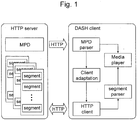
- Fig. 1 depicts the architecture of a typical HTTP adaptive streaming system using MPEG-DASH.
- a media presentation description (MPD) metadata file provides information about the structure and the different versions (representations) that are available. These representations may be encoded with different bitrates, frame rates, resolutions, codec types, etc.).
- the format of the segments may also be specified by the protocol; typical protocols that are used in existing systems include the MPEG-2 Transport Stream format (in HLS and MPEG-DASH) and MPEG-4 format (in MPEG-DASH, Microsoft Smooth Streaming, and HLS).
- the MPD metadata information is parsed and used to determine the optimal representation to request, based on the client playback capabilities and the observed network conditions.
- the client adaptation strategy is non-normative, i.e. not specified by the protocol, and the client has the ability to apply any adaptation technique or algorithm for the request of the available data at the server-side.
- the client adaptation may be determined based on the network conditions, the user preferences, or the device capabilities (e.g. CPU, display resolution, memory usage) in order to optimize the QoE of the viewer.
- Objective video quality models have been developed and used for some time in the academic world, but it is just in recent years that standards for quality models have emerged (see ITU-T G.1011 for an overview of standardized video, audio, speech, and audiovisual quality models). These standards are mainly perceptual full-reference models and target video-only or audio-only quality, e.g. ITU-T recommendations J.144, J.247 and J.341. Perceptual models have the advantage that they can utilize information at a signal level of the processed (decoded) video or audio.
- a big disadvantage of perceptual models is that they are computationally demanding and therefore not very suitable for deployment on a large scale for network monitoring purposes.
- the reference signal is compared against the processed video, in order to estimate the amount of degradation caused by coding and transmission.
- the reference signal is not available, and the full-reference models are therefore not applicable.
- a more light-weight and no-reference approach has been standardized in ITU-T SG12 as Recommendation ITU-T P.1201 [10].
- This model does not require the reference signal and works on encrypted bitstreams. It takes network layer protocol headers as input to estimate the quality of the transmitted audio and video. This makes the model very efficient to implement and use, but the estimation of the quality of the transmitted audiovisual signal may be less accurate in some cases.
- the main novelty in media transmission for the case of HAS is the introduction of (deliberate) changes in quality over time.
- Most of the existing quality assessment algorithms assume constant coding quality over the whole sequence, and have been designed for short media durations - typically between 10 and 20 seconds.
- HAS services the base quality is varying over time, and the period over which the quality varies typically lasts more than 20 seconds.
- these services facilitate the switching between devices and video resolutions (TV screens, Tablet PCs, Smartphone) during playback.
- Quality models therefore have to be adapted to estimate quality for sequences of longer duration (from a few seconds to several minutes), for fluctuating quality within the sequence, and even for switching between devices.
- Quality models are preferably developed based on the results of subjective tests. In such tests a panel of naive viewers is asked to rate media quality. These ratings are used as the ground truth for developing, training and validating objective models. Since traditional subjective test methodologies focus on short sequence durations and a limited selection of terminal devices (TV screens), the increased use of HAS services implies a revision of the existing standardized subjective test methods (ITU-R Rec. BT.500, ITU-T Rec. P.910 and P.911). In this context, ITU-T Rec. P.913 was released in 2014. It aims at giving researchers more freedom in the conduction of subjective tests.
- the gist of the invention to compute the perceived quality of a complete media session Q AVBuff of longer duration (e.g., in the range of around 1-5 min) based on a list of estimates of quality for short-duration periods (e.g., in the range of around 1-15 seconds) S and a list of rebuffering events B, including the position and duration of each rebuffering event. It considers the location effects of quality changes in the (audio)visual scores and rebuffering events and their impact on human perception.
- the short-duration quality estimates may, for example, have been obtained by an objective quality model. They may correspond to the audiovisual quality or video quality only.
- the rebuffering events may have been obtained from network or client logs or algorithms that estimate the rebuffering events (so-called "buffer models").
- the invention provides a method for computing, at a client for receiving multimedia content from a server using adaptive streaming, the perceived quality of a complete media session, Q AVBuff , based on a list of estimates of quality for short-duration periods, S, and a list of rebuffering events, B , including the position and duration of each rebuffering event, the method comprising:
- the method may further comprise receiving, at the preparation module, the interval, n , between each quality score in S.
- the parameter extraction module may perform a padding of the scores, S', at the beginning and at the end with the first and last score in S' to create padded scores, S padded .
- the estimation of the quality direction change, QC is preferably performed by comparing each score, indexed by p, with the next one, indexed by q, in a certain step size s qc and checking whether the difference exceeds or falls within a threshold t qc .
- the extracted parameter set, P may comprise at least one of the number, N, of scores in S', a value, tendency, describing the shape of the quality scores over time, the total number of quality direction changes in the scores, QDirChangesTot, and the duration in seconds of the longest period without positive and negative quality change, QDirChangesLongest.
- the quality oscillation compensation is preferably only applied if the following condition is true, that is, when the longest period without quality change is smaller than a part of the session p osc , and the longest oscillation is not longer than a given absolute duration threshold t osc :
- Q D i r C h a n g e s L o n g e s t N ⁇ p o s c ⁇ Q D i r C h a n g e s L o n g s t ⁇ t s c p o s c x ⁇ R
- 0 ⁇ x ⁇ 1 t s c x
- the encoding quality integration module may perform a recency effect compensation based on the supplied output scores, S ', and the parameter set, P.
- the length of the recency period L r may depend on at least one of sequence duration N, the value of the parameter tendency, and the average quality Q r in the recency period L r .
- the recency effect is may not be applied depending on the value of the parameter tendency, or if the average quality during the recency period is above a given threshold.
- the invention further provides a client for receiving multimedia content from a server using adaptive streaming, the client being for computing the perceived quality of a complete media session, Q AVBuff , based on a list of estimates of quality for short-duration periods, S, and a list of rebuffering events, B , including the position and duration of each rebuffering event.
- the client comprises a preparation module adapted to receive a list of estimates of quality for short-duration periods, S , and to scale the values of the short-duration period quality scores, S, from full range of their original input range to a target output range, and to transform the scaled scores into output scores, S' , that correspond to 1-second pieces of media, the preparation module (100) further being adapted to receive the list of rebuffering events, B.
- the client further comprises a parameter extraction module adapted to analyze the per-second scores, S ', to calculate a parameter set, P, that identifies characteristics of the media session.
- the parameter extraction module is further adapted to perform a moving average calculation based on the supplied output scores, S', to obtain a moving average score, S MA , and to perform a quality direction change estimation, QC, based on the moving average score, S MA .
- the calculated parameter set, P comprises a parameter tendency, wherein the parameter tendency is a value describing the shape of the quality scores, S, over the entire session.
- the client comprises an encoding quality integration module adapted to, using the computed parameter set, P, temporally pool the per-second scores, S' , received from the preparation module (100), yielding an integrated audiovisual quality score, Q AV , and to perform a quality oscillation compensation by applying a degradation factor to the media session quality, Q AV .
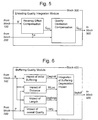
- the client also comprises a buffering quality module adapted to receive the list of rebuffering events, B , from the preparation module, and a list of parameters P from the parameter extraction module, and is further adapted to calculate the degradation, DegBuff, due to rebuffering events, wherein the buffering quality module performs different degradation calculations depending on the length of the rebuffering event, and uses the weights WLoc and WQ as weighing factors, where WLoc is a weight depending on location, and WQ is a weight depending on tendency.
- the client comprises a degradation integration module adapted to obtain the final quality score, Q AVBuff , from the degradation, DegBuff, due to rebuffering events and the integrated audiovisual quality score, Q AV .
- the preparation module may be further being adapted to receive the interval, n , between each quality score in S.
- the parameter extraction module is preferably adapted to perform a padding of the scores, S ', at the beginning and at the end with the first and last score in S' to create padded scores, S padded .
- the estimation of the quality direction change, QC is preferably performed by comparing each score, indexed by p, with the next one, indexed by q, in a certain step size s qc and checking whether the difference exceeds or falls within a threshold t qc .
- the extracted parameter set, P comprises at least one of the number, N, of scores in S', a value, tendency, describing the shape of the quality scores over time, the total number of quality direction changes in the scores, QDirChangesTot, and the duration in seconds of the longest period without positive and negative quality change, QDirChangesLongest.
- the encoding quality integration module is preferably adapted to perform a recency effect compensation based on the supplied output scores, S ', and the parameter set, P.
- the quality oscillation compensation is only applied if the following condition is true, that is, when the longest period without quality change is smaller than a part of the session p osc , and the longest oscillation is not longer than a given absolute duration threshold t osc :
- Q D i r C h a n g e s L o n g e s t N ⁇ p o s c ⁇ Q D i r C h a n g e s L o n g e t ⁇ t s c p o s c x ⁇ R
- 0 ⁇ x ⁇ 1 t s c x
- the method length of the recency period L r preferably depends on at least one of sequence duration N, the value of the parameter tendency, and the average quality Q r in the recency period L r .
- the recency effect is preferably not applied depending on the value of the parameter tendency, or if the average quality during the recency period is above a given threshold.
- the gist of the invention computes the perceived quality of a complete media session Q AVBuff of longer duration (e.g., in the range of around 1-5 min) based on a list of estimates of quality for short-duration periods (e.g., in the range of around 1-15 seconds) S and a list of rebuffering events B, including the position and duration of each rebuffering event. It considers the location effects of quality changes in the (audio)visual scores and rebuffering events and their impact on human perception.
- the short-duration quality estimates may, for example, have been obtained by an objective quality model. They may correspond to the audiovisual quality or video quality only.
- the rebuffering events may have been obtained from network or client logs or algorithms that estimate the rebuffering events (so-called "buffer models").
- the invention performs the following steps or computations:
- the input to the preparation module 100 consists of three elements:
- the quality scores in S may originate from a quality model that outputs scores in the range [1,10], where 10 corresponds to the worst possible rating rather than the best. This has to be considered later.
- the input scores S will be scaled to a target output range and temporally transformed into a list of per-second-scores S '.
- the preparation module forwards the information B as-is.
- the input S is scaled from its original input range to the target output range, resulting in a list of scaled scores S scaled .
- the module calculates a corresponding scaled score S i s c a l e d in S scaled :
- S i s c a l e d S i ⁇ I m i n I m a x ⁇ I m i n ⁇ O m a x ⁇ O m i n + O m i n
- the interval of S is n seconds. For every score S i in S , there will be n scores in S ' which all have the same value as S i .
- N the total number of scores in S '.
- a set of parameters P will be defined, based on the characteristics of the scores in S '.
- Each parameter has a name and a numerical or categorical value.
- a moving average of the scores in S ' is calculated and an estimation of quality direction changes is performed.
- a moving average of the quality scores is calculated to smooth out small variations in quality.
- the below algorithm is applied on S MA , to result in a list QC. It compares each score (indexed by p ) with the next one (indexed by q ) in a certain step size s qc and checks whether the difference exceeds or falls within a threshold t qc .
- the step size s qc determines the step when searching for quality direction changes. It is a positive integer number ⁇ 1 and depends on the order of the moving average filter k.
- the detection threshold t qc is a positive rational number in the range [0, O max - O min ].
- Q C i ⁇ 1, S q M A ⁇ S p M A > t q c 0, ⁇ t q c ⁇ S q M A ⁇ S p M A ⁇ t q c ⁇ 1, otherwise
- N is added to the parameters, as defined before (equal to the length of the score vector S ').
- a categorical value describing the shape of the quality scores over time, in the entire media session. The value is obtained as follows. First, a smoothing period of s seconds is defined. This smoothing period may depend on the overall length of the sequence N : s f s N
- 1 ⁇ i ⁇ ⁇ N 3 ⁇ + s S m i d ' S i '
- ⁇ N 3 ⁇ ⁇ s ⁇ i ⁇ 2 ⁇ ⁇ N 3 ⁇ + s S e n d ' S i '
- a modified average score of each of these ( Avg beg , Avg mid and Avg end ) is calculated as follows, rounding the score to the nearest s round , where s round is a positive rational number between 0 and 1, and:
- t e n d e n c y ⁇ c o n t R a m p , A v g b e g ⁇ A v g m i d ⁇ A v g e n d c o n t D r o p , A v g b e g > A v g m i d > A v g e n p e a k , A v g b e g ⁇ A v g m i d > A v g e n d r o p , A v g b e g > A v g m i d ⁇ A v g e n d r o p , A v g b e g > A v g m i d ⁇ A v g e n
- the duration in seconds of the longest period without positive or negative quality change is calculated.
- qc_len becomes [[1, 0], [3, 1], [8, -1], [11, 1], [12, 0]] and the list of distances is [2, 5, 3, 1].
- the value of QDirChangesLongest is equal to the maximum in the list of distances multiplied by the step size s qc , or - in case no quality changes have been observed - simply N.
- the input scores S ' are temporally pooled to arrive at an audiovisual quality estimation for the session, referred to as session score. At this stage, buffering events are ignored.
- Recency effect compensation will not be applied if tendency in P is flatlow or earlyDrop (see above).
- N ⁇ L r ⁇ i ⁇ N Q r ⁇ S r S r ⁇
- Q AV is equal to the mean of the quality scores for the entire session and the next step will be performed according to the quality oscillation compensation described below:
- Q A V ⁇ S ' S ' ⁇
- f r be a monotonically increasing function that determines the impact of the recency effect towards the end of the media session: f r : R ⁇ R f r b ⁇ f r a ⁇ b > a
- a degradation factor is applied to the media session quality Q AV , based on the number of detected quality direction changes.
- the compensation is only applied if the following condition is true, that is, when the longest period without quality change is smaller than a part of the session p osc , that is, when the quality oscillates during a large portion of the session, and the longest oscillation is not longer than a given absolute duration threshold t osc :
- Q D i r C h a n g e s L o n g e s t N ⁇ p o s c ⁇ Q D i r C h a n g e s L o n g e s t ⁇ o s c p o s c x ⁇ R
- 0 ⁇ x ⁇ 1 t s c x
- the Buffering Quality Module (Block 400 in Fig. 2 , detailed in Fig. 6 ), the following procedure is applied to estimate the degradation due to buffering events, DegBuff, using B as input. In this procedure, the degradation due to rebuffering will be added up from every rebuffering event occurring in the media session.
- B D i s t j N ⁇ B l o c j
- f dist log. f dist may be replaced with any other function.
- the overall degradation DegBuff will be calculated by summing up the degradation due to initial buffering DegInit with the individual degradations in DegSingle, the latter multiplied by the weights determined before as WLoc and WQ:
- the outputs Q AV and DegBuff are combined into the final quality score Q AVBuff
- Q A V B u f f min O m a x , max O m i n , Q A V ⁇ D e g B u f f
- the value is clipped to the output range.
Landscapes
- Engineering & Computer Science (AREA)
- Multimedia (AREA)
- Computer Networks & Wireless Communication (AREA)
- Signal Processing (AREA)
- Data Exchanges In Wide-Area Networks (AREA)
- Two-Way Televisions, Distribution Of Moving Picture Or The Like (AREA)
Claims (15)
- Verfahren zum Berechnen bei einem Client zum Empfangen von Multimediainhalt von einem Server mittels adaptivem Streaming der wahrgenommenen Qualität einer vollständigen Mediensitzung, QAVBuff, beruhend auf einer Liste von Qualitätsschätzungen für kurzzeitige Perioden, S, und einer Liste von Ereignissen, B, des erneuten Pufferns von Daten, die die Position und Dauer jedes Ereignisses des erneuten Pufferns von Daten enthält, wobei das Verfahren aufweist:Empfangen an einem Vorbereitungsmodul (100) der Liste von Qualitätsschätzungen für kurzzeitige Perioden, S, und Skalieren der Werte der Qualitätsbewertungen für kurzzeitige Perioden, S, vom vollen Bereich ihres ursprünglichen Eingangsbereichs auf einen Zielausgangsbereich und Transformieren der skalierten Bewertungen in Ausgabebewertungen, S', die 1-Sekunden-Medienstücken entsprechen, und Empfangen am Vorbereitungsmodul (100) der Liste von Ereignissen, B, des erneuten Pufferns von Daten;Liefern der Ausgabebewertungen, S', an ein Parameterextraktionsmodul (200) und ein Codierungsqualitätsintegrationsmodul (300), und Liefern der Liste von Ereignissen, B, des erneuten Pufferns von Daten an ein Pufferqualitätsmodul (400);Analysieren am Parameterextraktionsmodul (200), der Bewertungen pro Sekunde, S', um einen Parametersatz, P, zu berechnen, der die Eigenschaften der Mediensitzung kennzeichnet, wobei das Parameterextraktionsmodul (200) eine gleitende Durchschnittsberechnung beruhend auf den gelieferten Ausgabebewertungen, S', ausführt, um eine gleitende Durchschnittsbewertung, SMA, zu erhalten, und eine Schätzung der Qualitätsrichtungsänderung, QC, beruhend auf der gleitenden Durchschnittsbewertung, SMA, ausführt und wobei der berechnete Parametersatz, P, einen Parameter tendency aufweist, wobei der Parameter tendency ein Wert ist, der die Form der Qualitätsbewertungen, S, über eine gesamte Sitzung beschreibt;Liefern des Parametersatzes, P, an das Codierungsqualitätsintegrationsmodul (300) und an das Pufferqualitätsmodul (400);zeitliches Zusammenfassen am Codierungsqualitätsintegrationsmodul (300) und unter Verwendung des berechneten Parametersatzes, P, der vom Vorbereitungsmodul (100) empfangenen Bewertungen pro Sekunde, S', wobei sich eine integrierte audiovisuelle Qualitätsbewertung, QAV , ergibt, und Liefern der audiovisuellen Qualitätsbewertung, QAV , an ein Verschlechterungsintegrationsmodul (500), wobei das Codierungsqualitätsintegrationsmodul (300) eine Qualitätsschwankungskompensation durch Anwenden eines Verschlechterungsfaktors auf die Mediensitzungsqualität, QAV ausführt,Berechnen am Pufferqualitätsmodul (400) der Verschlechterung, DegBuff, infolge der Ereignisse des erneuten Pufferns von Daten beruhend auf der empfangenen Liste von Ereignissen des erneuten Pufferns von Daten, B, und der empfangenen Parameter, P, und Liefern des Verschlechterungswerts, DegBuff, an das Verschlechterungsintegrationsmodul (500), wobei das Pufferqualitätsmodul (400) unterschiedliche Verschlechterungsberechnungen abhängig von der Länge des Ereignisses des erneuten Pufferns von Daten ausführt, und die Gewichte WLoc und WQ als Gewichtungsfaktoren verwendet, wobei WLoc ein Gewicht ist, das vom Ort abhängt, und WQ ein Gewicht ist, das von der Tendenz abhängt; undErhalten am Verschlechterungsintegrationsmodul (500) der endgültigen Qualitätsbewertung, QAVBuff aus der Verschlechterung, DegBuff, infolge der Ereignisse des erneuten Pufferns von Daten und der integrierten audiovisuellen Qualitätsbewertung, QAV.
- Verfahren nach Anspruch 1, das ferner das Empfangen am Vorbereitungsmodul (100) des Intervalls, n, zwischen jeder Qualitätsbewertung in S aufweist.
- Verfahren nach Anspruch 1 oder 2, wobei beim Berechnen der gleitenden Durchschnittsbewertung das Parameterextraktionsmodul (200) ein Auffüllen der Bewertungen, S', am Anfang und am Ende mit der ersten und der letzten Bewertung in S' ausführt um aufgefüllte Bewertungen, Spadded, zu erzeugen.
- Verfahren nach Anspruch 1, 2, oder 3, wobei die Schätzung der Qualitätsrichtungsänderung, QC, durch Vergleichen jeder mit p indizierten mit der mit q indizierten nächsten Bewertung in einer bestimmten Schrittweite sqc und durch Prüfen durchgeführt wird, ob die Differenz eine Schwelle tqc überschreitet oder innerhalb von ihr liegt.
- Verfahren nach einem der vorhergehenden Ansprüche, wobei der extrahierte Parametersatz, P, zumindest die Anzahl, N, der Bewertungen in S', und/oder einen Wert tendency, der die Form der Qualitätsbewertungen mit der Zeit beschreibt, und/oder die Gesamtzahl der Qualitätsrichtungsänderungen der Bewertungen, QDirChangesTot, und/oder die Dauer in Sekunden der längsten Periode ohne positive und negative Qualitätsänderung, QDirChangesLongest aufweist.
- Verfahren nach Anspruch 1, wobei die Qualitätsschwankungskompensation nur angewendet wird, wenn die folgende Bedingung zutrifft, das heißt, wenn die längste Periode ohne Qualitätsänderung kleiner als ein Teil der Sitzung posc ist, und die längste Schwankung nicht länger als eine gegebene absolute Schwelle der Dauer tosc ist:



- Verfahren nach einem der vorhergehenden Ansprüche, wobei das Codierungsqualitätsintegrationsmodul (300) eine Rezenzeffektkompensation beruhend auf den gelieferten Ausgabebewertungen, S', und dem Parametersatz, P, ausführt.
- Verfahren nach Anspruch 7, wobei die Länge der Rezenzperiode Lr zumindest von der Sequenzdauer N, und/oder dem Wert des Parameters tendency und/oder der durchschnittlichen Qualität Qr in der Rezenzperiode Lr abhängt.
- Verfahren nach Anspruch 6 oder 7, wobei der Rezenzeffekt abhängig vom Wert des Parameters tendency, oder wenn die durchschnittliche Qualität während der Rezenzperiode über einer gegebenen Schwelle liegt, nicht angewendet wird.
- Client zum Empfangen von Multimediainhalten von einem Server mittels adaptivem Streaming, wobei der Client zum Berechnen der wahrgenommenen Qualität einer vollständigen Mediensitzung, QAVBuff, beruhend auf einer Liste von Qualitätsschätzungen für kurzzeitige Perioden, S, und einer Liste von Ereignissen des erneuten Pufferns von Daten, B, dient, die die Position und Dauer jedes Ereignisses des erneuten Pufferns von Daten enthält, wobei der Client aufweist:ein Vorbereitungsmodul (100), das eingerichtet ist, eine Liste von Qualitätsschätzungen für kurzzeitige Perioden, S, zu empfangen und die Werte der Qualitätsbewertungen für kurzzeitige Perioden, S, vom vollen Bereich ihres ursprünglichen Eingangsbereichs auf einen Zielausgangsbereich zu skalieren, und die skalierten Bewertungen in Ausgabebewertungen, S', zu transformieren, die 1-Sekunden-Medienstücken entsprechen, wobei das Vorbereitungsmodul (100) ferner eingerichtet ist, die Liste von Ereignissen des erneuten Pufferns von Daten, B zu empfangen;ein Parameterextraktionsmodul (200), das eingerichtet ist, die Bewertungen pro Sekunde, S', zu analysieren, um einen Parametersatz, P, zu berechnen, der die Eigenschaften der Mediensitzung kennzeichnet, wobei das Parameterextraktionsmodul (200) ferner eingerichtet ist, eine gleitende Durchschnittsberechnung beruhend auf den gelieferten Ausgabebewertungen, S', durchzuführen, um eine gleitende Durchschnittsbewertung, SMA , zu erhalten, und eine Schätzung der Qualitätsrichtungsänderung, QC, beruhend auf der gleitenden Durchschnittsbewertung, SMA durchzuführen, und wobei der berechnete Parametersatz, P, einen Parameter tendency aufweist, wobei der Parameter tendency ein Wert ist, der die Form der Qualitätsbewertungen, S, über eine gesamte Sitzung beschreibt;ein Codierungsqualitätsintegrationsmodul (300), das eingerichtet ist, unter Verwendung des berechneten Parametersatzes, P, die vom Vorbereitungsmodul (100) empfangenen Bewertungen pro Sekunde, S', zeitlich zusammenzufassen, wobei sich eine integrierte audiovisuelle Qualitätsbewertung, QAV , ergibt, und eine Qualitätsschwankungskompensation durch Anwenden eines Verschlechterungsfaktors auf die Mediensitzungsqualität, QAV , durchzuführen;ein Pufferqualitätsmodul (400), das eingerichtet ist, die Liste von Ereignissen des erneuten Pufferns von Daten, B, vom Vorbereitungsmodul (100) und eine Liste von Parametern P vom Parameterextraktionsmodul (200) zu empfangen, und das ferner eingerichtet ist, die Verschlechterung, DegBuff, infolge der Ereignisse des erneuten Pufferns von Daten zu berechnen, wobei das Pufferqualitätsmodul (400) unterschiedliche Verschlechterungsberechnungen abhängig von der Länge des Ereignisses des erneuten Pufferns von Daten ausführt, und die Gewichte WLoc und WQ als Gewichtungsfaktoren verwendet, wobei WLoc ein Gewicht ist, das vom Ort abhängt, und WQ ein Gewicht ist, das von der Tendenz abhängt; undein Verschlechterungsintegrationsmodul (500), das eingerichtet ist, die endgültige Qualitätsbewertung, QAVBuff , aus der Verschlechterung, DegBuff, infolge der Ereignisse des erneuten Pufferns von Daten und der integrierten audiovisuelle Qualitätsbewertung, QAV zu erhalten.
- Client nach Anspruch 10, wobei der Vorbereitungsmodul (100) ferner eingerichtet ist, das Intervall, n, zwischen jeder Qualitätsbewertung in S zu empfangen.
- Client nach Anspruch 10, oder 11, wobei beim Berechnen der gleitenden Durchschnittsbewertung das Parameterextraktionsmodul (200) eingerichtet ist, ein Auffüllen der Bewertungen, S', am Anfang und am Ende mit der ersten und der letzten Bewertung in S' durchzuführen, um aufgefüllte Bewertungen, Spadded, zu erzeugen.
- Client nach Anspruch 10, 11 oder 12, wobei die Schätzung der Qualitätsrichtungsänderung, QC, durch Vergleichen jeder mit p indizierten mit der mit q indizierten nächsten Bewertung in einer bestimmten Schrittweite sqc und Prüfen durchgeführt wird, ob die Differenz eine Schwelle tqc überschreitet oder innerhalb von ihr liegt.
- Client nach einem der Ansprüche 10 bis 13, wobei der extrahierte Parametersatz, P, zumindest die Anzahl, N, der Bewertungen in S', und/oder einen Wert tendency, der die Form der Qualitätsbewertungen mit der Zeit beschreibt, und/oder die Gesamtzahl der Qualitätsrichtungsänderungen der Bewertungen, QDirChangesTot, und/oder die Dauer in Sekunden der längsten Periode ohne positive und negative Qualitätsänderung, QDirChangesLongest aufweist.
- Client nach einem der Ansprüche 10 bis 14, wobei das Codierungsqualitätsintegrationsmodul (300) eingerichtet ist, eine Rezenzeffektkompensation beruhend auf den gelieferten Ausgabebewertungen, S', und dem Parametersatz, P, durchzuführen.
Priority Applications (1)
| Application Number | Priority Date | Filing Date | Title |
|---|---|---|---|
| EP16177141.5A EP3264709B1 (de) | 2016-06-30 | 2016-06-30 | Verfahren zur berechnung, bei einem client zum empfang von multimediainhalt von einem server mittels adaptivem streaming, der wahrgenommenen qualität einer vollständigen mediensitzung sowie client |
Applications Claiming Priority (1)
| Application Number | Priority Date | Filing Date | Title |
|---|---|---|---|
| EP16177141.5A EP3264709B1 (de) | 2016-06-30 | 2016-06-30 | Verfahren zur berechnung, bei einem client zum empfang von multimediainhalt von einem server mittels adaptivem streaming, der wahrgenommenen qualität einer vollständigen mediensitzung sowie client |
Publications (2)
| Publication Number | Publication Date |
|---|---|
| EP3264709A1 EP3264709A1 (de) | 2018-01-03 |
| EP3264709B1 true EP3264709B1 (de) | 2018-08-29 |
Family
ID=56551133
Family Applications (1)
| Application Number | Title | Priority Date | Filing Date |
|---|---|---|---|
| EP16177141.5A Active EP3264709B1 (de) | 2016-06-30 | 2016-06-30 | Verfahren zur berechnung, bei einem client zum empfang von multimediainhalt von einem server mittels adaptivem streaming, der wahrgenommenen qualität einer vollständigen mediensitzung sowie client |
Country Status (1)
| Country | Link |
|---|---|
| EP (1) | EP3264709B1 (de) |
Cited By (1)
| Publication number | Priority date | Publication date | Assignee | Title |
|---|---|---|---|---|
| US11570228B2 (en) | 2020-10-15 | 2023-01-31 | Sandvine Corporation | System and method for managing video streaming quality of experience |
Families Citing this family (3)
| Publication number | Priority date | Publication date | Assignee | Title |
|---|---|---|---|---|
| EP3806418A1 (de) * | 2016-02-25 | 2021-04-14 | Telefonaktiebolaget LM Ericsson (publ) | Vorhersage von multimediasitzungs-mos |
| CN108551436A (zh) * | 2018-03-12 | 2018-09-18 | 联想(北京)有限公司 | 数据传输方法和装置 |
| CN116311748B (zh) * | 2022-12-27 | 2026-04-17 | 合肥科大立安安全技术有限责任公司 | 用于家庭厨房火灾的复合探测系统 |
Family Cites Families (2)
| Publication number | Priority date | Publication date | Assignee | Title |
|---|---|---|---|---|
| JP4965659B2 (ja) * | 2006-10-19 | 2012-07-04 | テレフオンアクチーボラゲット エル エム エリクソン(パブル) | ビデオ画質の決定方法 |
| US9191284B2 (en) * | 2010-10-28 | 2015-11-17 | Avvasi Inc. | Methods and apparatus for providing a media stream quality signal |
-
2016
- 2016-06-30 EP EP16177141.5A patent/EP3264709B1/de active Active
Cited By (1)
| Publication number | Priority date | Publication date | Assignee | Title |
|---|---|---|---|---|
| US11570228B2 (en) | 2020-10-15 | 2023-01-31 | Sandvine Corporation | System and method for managing video streaming quality of experience |
Also Published As
| Publication number | Publication date |
|---|---|
| EP3264709A1 (de) | 2018-01-03 |
Similar Documents
| Publication | Publication Date | Title |
|---|---|---|
| US11824912B2 (en) | Systems and methods for frame duplication and frame extension in live video encoding and streaming | |
| Barman et al. | QoE modeling for HTTP adaptive video streaming–a survey and open challenges | |
| Bampis et al. | Towards perceptually optimized end-to-end adaptive video streaming | |
| JP6190525B2 (ja) | 品質対ビットレートが変動するメディアデータストリームの品質を決定するための概念 | |
| US7873727B2 (en) | System and method for evaluating streaming multimedia quality | |
| US9510028B2 (en) | Adaptive video transcoding based on parallel chunked log analysis | |
| US8631143B2 (en) | Apparatus and method for providing multimedia content | |
| KR102059222B1 (ko) | 비디오 스트리밍 서비스를 위한 컨텐트-의존 비디오 품질 모델 | |
| US11539985B2 (en) | No reference realtime video quality assessment | |
| WO2013059301A1 (en) | Distributed real-time video processing | |
| US12615343B2 (en) | Dynamic resolution switching in live streams based on video quality assessment | |
| US11477461B2 (en) | Optimized multipass encoding | |
| EP3264709A1 (de) | Verfahren zur berechnung, bei einem client zum empfang von multimediainhalt von einem server mittels adaptivem streaming, der wahrgenommenen qualität einer vollständigen mediensitzung sowie client | |
| Nguyen et al. | A client-based adaptation framework for 360-degree video streaming | |
| Tashtarian et al. | Lalisa: Adaptive bitrate ladder optimization in http-based adaptive live streaming | |
| Hegde et al. | QoE aware video adaptation for video streaming in 5G networks | |
| Thang et al. | Video streaming over HTTP with dynamic resource prediction | |
| Vlaović et al. | Influence of segmentation parameters on video quality in dynamic adaptive streaming | |
| Zhang et al. | QoE models for online video streaming | |
| Klink et al. | Video quality assessment in the DASH technique | |
| Arsenović et al. | Quality of Experience Assessment for HTTP Based Adaptive Video Streaming. | |
| Su et al. | Packet-layer quality assessment for networked video | |
| HK40026867A (en) | Systems and methods for frame duplication and frame extension in live video encoding and streaming | |
| Rodrıguez et al. | A Business Model for Video Transmission Services using Dynamic Adaptation Streaming over HTTP | |
| Lai et al. | A Self-Adaptive QoE Streaming Service Integrated on Cloud Mobile Network |
Legal Events
| Date | Code | Title | Description |
|---|---|---|---|
| PUAI | Public reference made under article 153(3) epc to a published international application that has entered the european phase |
Free format text: ORIGINAL CODE: 0009012 |
|
| STAA | Information on the status of an ep patent application or granted ep patent |
Free format text: STATUS: REQUEST FOR EXAMINATION WAS MADE |
|
| 17P | Request for examination filed |
Effective date: 20170214 |
|
| AK | Designated contracting states |
Kind code of ref document: A1 Designated state(s): AL AT BE BG CH CY CZ DE DK EE ES FI FR GB GR HR HU IE IS IT LI LT LU LV MC MK MT NL NO PL PT RO RS SE SI SK SM TR |
|
| AX | Request for extension of the european patent |
Extension state: BA ME |
|
| GRAP | Despatch of communication of intention to grant a patent |
Free format text: ORIGINAL CODE: EPIDOSNIGR1 |
|
| STAA | Information on the status of an ep patent application or granted ep patent |
Free format text: STATUS: GRANT OF PATENT IS INTENDED |
|
| RIC1 | Information provided on ipc code assigned before grant |
Ipc: H04L 29/06 20060101AFI20180220BHEP |
|
| INTG | Intention to grant announced |
Effective date: 20180307 |
|
| RIN1 | Information on inventor provided before grant (corrected) |
Inventor name: GARCIA, MARIE-NEIGE Inventor name: FEITEN, BERNHARD Inventor name: ROBITZA, WERNER Inventor name: LIST, PETER Inventor name: WUESTENHAGEN, ULF Inventor name: RAAKE, ALEXANDER |
|
| GRAS | Grant fee paid |
Free format text: ORIGINAL CODE: EPIDOSNIGR3 |
|
| RAP1 | Party data changed (applicant data changed or rights of an application transferred) |
Owner name: DEUTSCHE TELEKOM AG |
|
| GRAA | (expected) grant |
Free format text: ORIGINAL CODE: 0009210 |
|
| STAA | Information on the status of an ep patent application or granted ep patent |
Free format text: STATUS: THE PATENT HAS BEEN GRANTED |
|
| AK | Designated contracting states |
Kind code of ref document: B1 Designated state(s): AL AT BE BG CH CY CZ DE DK EE ES FI FR GB GR HR HU IE IS IT LI LT LU LV MC MK MT NL NO PL PT RO RS SE SI SK SM TR |
|
| REG | Reference to a national code |
Ref country code: GB Ref legal event code: FG4D |
|
| REG | Reference to a national code |
Ref country code: CH Ref legal event code: EP |
|
| REG | Reference to a national code |
Ref country code: AT Ref legal event code: REF Ref document number: 1036520 Country of ref document: AT Kind code of ref document: T Effective date: 20180915 |
|
| REG | Reference to a national code |
Ref country code: IE Ref legal event code: FG4D |
|
| REG | Reference to a national code |
Ref country code: DE Ref legal event code: R096 Ref document number: 602016005105 Country of ref document: DE |
|
| REG | Reference to a national code |
Ref country code: NL Ref legal event code: MP Effective date: 20180829 |
|
| REG | Reference to a national code |
Ref country code: LT Ref legal event code: MG4D |
|
| PG25 | Lapsed in a contracting state [announced via postgrant information from national office to epo] |
Ref country code: IS Free format text: LAPSE BECAUSE OF FAILURE TO SUBMIT A TRANSLATION OF THE DESCRIPTION OR TO PAY THE FEE WITHIN THE PRESCRIBED TIME-LIMIT Effective date: 20181229 Ref country code: RS Free format text: LAPSE BECAUSE OF FAILURE TO SUBMIT A TRANSLATION OF THE DESCRIPTION OR TO PAY THE FEE WITHIN THE PRESCRIBED TIME-LIMIT Effective date: 20180829 Ref country code: LT Free format text: LAPSE BECAUSE OF FAILURE TO SUBMIT A TRANSLATION OF THE DESCRIPTION OR TO PAY THE FEE WITHIN THE PRESCRIBED TIME-LIMIT Effective date: 20180829 Ref country code: BG Free format text: LAPSE BECAUSE OF FAILURE TO SUBMIT A TRANSLATION OF THE DESCRIPTION OR TO PAY THE FEE WITHIN THE PRESCRIBED TIME-LIMIT Effective date: 20181129 Ref country code: NL Free format text: LAPSE BECAUSE OF FAILURE TO SUBMIT A TRANSLATION OF THE DESCRIPTION OR TO PAY THE FEE WITHIN THE PRESCRIBED TIME-LIMIT Effective date: 20180829 Ref country code: SE Free format text: LAPSE BECAUSE OF FAILURE TO SUBMIT A TRANSLATION OF THE DESCRIPTION OR TO PAY THE FEE WITHIN THE PRESCRIBED TIME-LIMIT Effective date: 20180829 Ref country code: FI Free format text: LAPSE BECAUSE OF FAILURE TO SUBMIT A TRANSLATION OF THE DESCRIPTION OR TO PAY THE FEE WITHIN THE PRESCRIBED TIME-LIMIT Effective date: 20180829 Ref country code: NO Free format text: LAPSE BECAUSE OF FAILURE TO SUBMIT A TRANSLATION OF THE DESCRIPTION OR TO PAY THE FEE WITHIN THE PRESCRIBED TIME-LIMIT Effective date: 20181129 Ref country code: GR Free format text: LAPSE BECAUSE OF FAILURE TO SUBMIT A TRANSLATION OF THE DESCRIPTION OR TO PAY THE FEE WITHIN THE PRESCRIBED TIME-LIMIT Effective date: 20181130 |
|
| REG | Reference to a national code |
Ref country code: AT Ref legal event code: MK05 Ref document number: 1036520 Country of ref document: AT Kind code of ref document: T Effective date: 20180829 |
|
| PG25 | Lapsed in a contracting state [announced via postgrant information from national office to epo] |
Ref country code: HR Free format text: LAPSE BECAUSE OF FAILURE TO SUBMIT A TRANSLATION OF THE DESCRIPTION OR TO PAY THE FEE WITHIN THE PRESCRIBED TIME-LIMIT Effective date: 20180829 Ref country code: AL Free format text: LAPSE BECAUSE OF FAILURE TO SUBMIT A TRANSLATION OF THE DESCRIPTION OR TO PAY THE FEE WITHIN THE PRESCRIBED TIME-LIMIT Effective date: 20180829 Ref country code: LV Free format text: LAPSE BECAUSE OF FAILURE TO SUBMIT A TRANSLATION OF THE DESCRIPTION OR TO PAY THE FEE WITHIN THE PRESCRIBED TIME-LIMIT Effective date: 20180829 |
|
| PG25 | Lapsed in a contracting state [announced via postgrant information from national office to epo] |
Ref country code: IT Free format text: LAPSE BECAUSE OF FAILURE TO SUBMIT A TRANSLATION OF THE DESCRIPTION OR TO PAY THE FEE WITHIN THE PRESCRIBED TIME-LIMIT Effective date: 20180829 Ref country code: RO Free format text: LAPSE BECAUSE OF FAILURE TO SUBMIT A TRANSLATION OF THE DESCRIPTION OR TO PAY THE FEE WITHIN THE PRESCRIBED TIME-LIMIT Effective date: 20180829 Ref country code: CZ Free format text: LAPSE BECAUSE OF FAILURE TO SUBMIT A TRANSLATION OF THE DESCRIPTION OR TO PAY THE FEE WITHIN THE PRESCRIBED TIME-LIMIT Effective date: 20180829 Ref country code: PL Free format text: LAPSE BECAUSE OF FAILURE TO SUBMIT A TRANSLATION OF THE DESCRIPTION OR TO PAY THE FEE WITHIN THE PRESCRIBED TIME-LIMIT Effective date: 20180829 Ref country code: ES Free format text: LAPSE BECAUSE OF FAILURE TO SUBMIT A TRANSLATION OF THE DESCRIPTION OR TO PAY THE FEE WITHIN THE PRESCRIBED TIME-LIMIT Effective date: 20180829 Ref country code: EE Free format text: LAPSE BECAUSE OF FAILURE TO SUBMIT A TRANSLATION OF THE DESCRIPTION OR TO PAY THE FEE WITHIN THE PRESCRIBED TIME-LIMIT Effective date: 20180829 Ref country code: AT Free format text: LAPSE BECAUSE OF FAILURE TO SUBMIT A TRANSLATION OF THE DESCRIPTION OR TO PAY THE FEE WITHIN THE PRESCRIBED TIME-LIMIT Effective date: 20180829 |
|
| PG25 | Lapsed in a contracting state [announced via postgrant information from national office to epo] |
Ref country code: DK Free format text: LAPSE BECAUSE OF FAILURE TO SUBMIT A TRANSLATION OF THE DESCRIPTION OR TO PAY THE FEE WITHIN THE PRESCRIBED TIME-LIMIT Effective date: 20180829 Ref country code: SM Free format text: LAPSE BECAUSE OF FAILURE TO SUBMIT A TRANSLATION OF THE DESCRIPTION OR TO PAY THE FEE WITHIN THE PRESCRIBED TIME-LIMIT Effective date: 20180829 Ref country code: SK Free format text: LAPSE BECAUSE OF FAILURE TO SUBMIT A TRANSLATION OF THE DESCRIPTION OR TO PAY THE FEE WITHIN THE PRESCRIBED TIME-LIMIT Effective date: 20180829 |
|
| REG | Reference to a national code |
Ref country code: DE Ref legal event code: R097 Ref document number: 602016005105 Country of ref document: DE |
|
| PLBE | No opposition filed within time limit |
Free format text: ORIGINAL CODE: 0009261 |
|
| STAA | Information on the status of an ep patent application or granted ep patent |
Free format text: STATUS: NO OPPOSITION FILED WITHIN TIME LIMIT |
|
| 26N | No opposition filed |
Effective date: 20190531 |
|
| PG25 | Lapsed in a contracting state [announced via postgrant information from national office to epo] |
Ref country code: SI Free format text: LAPSE BECAUSE OF FAILURE TO SUBMIT A TRANSLATION OF THE DESCRIPTION OR TO PAY THE FEE WITHIN THE PRESCRIBED TIME-LIMIT Effective date: 20180829 |
|
| PG25 | Lapsed in a contracting state [announced via postgrant information from national office to epo] |
Ref country code: MC Free format text: LAPSE BECAUSE OF FAILURE TO SUBMIT A TRANSLATION OF THE DESCRIPTION OR TO PAY THE FEE WITHIN THE PRESCRIBED TIME-LIMIT Effective date: 20180829 |
|
| REG | Reference to a national code |
Ref country code: CH Ref legal event code: PL |
|
| REG | Reference to a national code |
Ref country code: BE Ref legal event code: MM Effective date: 20190630 |
|
| PG25 | Lapsed in a contracting state [announced via postgrant information from national office to epo] |
Ref country code: TR Free format text: LAPSE BECAUSE OF FAILURE TO SUBMIT A TRANSLATION OF THE DESCRIPTION OR TO PAY THE FEE WITHIN THE PRESCRIBED TIME-LIMIT Effective date: 20180829 |
|
| PG25 | Lapsed in a contracting state [announced via postgrant information from national office to epo] |
Ref country code: IE Free format text: LAPSE BECAUSE OF NON-PAYMENT OF DUE FEES Effective date: 20190630 |
|
| PG25 | Lapsed in a contracting state [announced via postgrant information from national office to epo] |
Ref country code: LU Free format text: LAPSE BECAUSE OF NON-PAYMENT OF DUE FEES Effective date: 20190630 Ref country code: LI Free format text: LAPSE BECAUSE OF NON-PAYMENT OF DUE FEES Effective date: 20190630 Ref country code: CH Free format text: LAPSE BECAUSE OF NON-PAYMENT OF DUE FEES Effective date: 20190630 Ref country code: BE Free format text: LAPSE BECAUSE OF NON-PAYMENT OF DUE FEES Effective date: 20190630 |
|
| PG25 | Lapsed in a contracting state [announced via postgrant information from national office to epo] |
Ref country code: PT Free format text: LAPSE BECAUSE OF FAILURE TO SUBMIT A TRANSLATION OF THE DESCRIPTION OR TO PAY THE FEE WITHIN THE PRESCRIBED TIME-LIMIT Effective date: 20181229 |
|
| PG25 | Lapsed in a contracting state [announced via postgrant information from national office to epo] |
Ref country code: CY Free format text: LAPSE BECAUSE OF FAILURE TO SUBMIT A TRANSLATION OF THE DESCRIPTION OR TO PAY THE FEE WITHIN THE PRESCRIBED TIME-LIMIT Effective date: 20180829 |
|
| PG25 | Lapsed in a contracting state [announced via postgrant information from national office to epo] |
Ref country code: HU Free format text: LAPSE BECAUSE OF FAILURE TO SUBMIT A TRANSLATION OF THE DESCRIPTION OR TO PAY THE FEE WITHIN THE PRESCRIBED TIME-LIMIT; INVALID AB INITIO Effective date: 20160630 Ref country code: MT Free format text: LAPSE BECAUSE OF FAILURE TO SUBMIT A TRANSLATION OF THE DESCRIPTION OR TO PAY THE FEE WITHIN THE PRESCRIBED TIME-LIMIT Effective date: 20180829 |
|
| REG | Reference to a national code |
Ref country code: DE Ref legal event code: R079 Ref document number: 602016005105 Country of ref document: DE Free format text: PREVIOUS MAIN CLASS: H04L0029060000 Ipc: H04L0065000000 |
|
| PG25 | Lapsed in a contracting state [announced via postgrant information from national office to epo] |
Ref country code: MK Free format text: LAPSE BECAUSE OF FAILURE TO SUBMIT A TRANSLATION OF THE DESCRIPTION OR TO PAY THE FEE WITHIN THE PRESCRIBED TIME-LIMIT Effective date: 20180829 |
|
| PGFP | Annual fee paid to national office [announced via postgrant information from national office to epo] |
Ref country code: DE Payment date: 20250618 Year of fee payment: 10 |
|
| PGFP | Annual fee paid to national office [announced via postgrant information from national office to epo] |
Ref country code: GB Payment date: 20250620 Year of fee payment: 10 |
|
| PGFP | Annual fee paid to national office [announced via postgrant information from national office to epo] |
Ref country code: FR Payment date: 20250624 Year of fee payment: 10 |