EP3270376A1 - Dispositif de codage prédictif linéaire, dispositif de décodage prédictif linéaire, et procédé, programme et support d'enregistrement associés - Google Patents
Dispositif de codage prédictif linéaire, dispositif de décodage prédictif linéaire, et procédé, programme et support d'enregistrement associés Download PDFInfo
- Publication number
- EP3270376A1 EP3270376A1 EP16780006.9A EP16780006A EP3270376A1 EP 3270376 A1 EP3270376 A1 EP 3270376A1 EP 16780006 A EP16780006 A EP 16780006A EP 3270376 A1 EP3270376 A1 EP 3270376A1
- Authority
- EP
- European Patent Office
- Prior art keywords
- coefficients
- linear predictive
- linear
- transformable
- code book
- Prior art date
- Legal status (The legal status is an assumption and is not a legal conclusion. Google has not performed a legal analysis and makes no representation as to the accuracy of the status listed.)
- Granted
Links
Images










Classifications
-
- G—PHYSICS
- G10—MUSICAL INSTRUMENTS; ACOUSTICS
- G10L—SPEECH ANALYSIS TECHNIQUES OR SPEECH SYNTHESIS; SPEECH RECOGNITION; SPEECH OR VOICE PROCESSING TECHNIQUES; SPEECH OR AUDIO CODING OR DECODING
- G10L19/00—Speech or audio signals analysis-synthesis techniques for redundancy reduction, e.g. in vocoders; Coding or decoding of speech or audio signals, using source filter models or psychoacoustic analysis
- G10L19/04—Speech or audio signals analysis-synthesis techniques for redundancy reduction, e.g. in vocoders; Coding or decoding of speech or audio signals, using source filter models or psychoacoustic analysis using predictive techniques
- G10L19/08—Determination or coding of the excitation function; Determination or coding of the long-term prediction parameters
- G10L19/09—Long term prediction, i.e. removing periodical redundancies, e.g. by using adaptive codebook or pitch predictor
-
- G—PHYSICS
- G10—MUSICAL INSTRUMENTS; ACOUSTICS
- G10L—SPEECH ANALYSIS TECHNIQUES OR SPEECH SYNTHESIS; SPEECH RECOGNITION; SPEECH OR VOICE PROCESSING TECHNIQUES; SPEECH OR AUDIO CODING OR DECODING
- G10L19/00—Speech or audio signals analysis-synthesis techniques for redundancy reduction, e.g. in vocoders; Coding or decoding of speech or audio signals, using source filter models or psychoacoustic analysis
- G10L19/04—Speech or audio signals analysis-synthesis techniques for redundancy reduction, e.g. in vocoders; Coding or decoding of speech or audio signals, using source filter models or psychoacoustic analysis using predictive techniques
- G10L19/06—Determination or coding of the spectral characteristics, e.g. of the short-term prediction coefficients
-
- G—PHYSICS
- G10—MUSICAL INSTRUMENTS; ACOUSTICS
- G10L—SPEECH ANALYSIS TECHNIQUES OR SPEECH SYNTHESIS; SPEECH RECOGNITION; SPEECH OR VOICE PROCESSING TECHNIQUES; SPEECH OR AUDIO CODING OR DECODING
- G10L19/00—Speech or audio signals analysis-synthesis techniques for redundancy reduction, e.g. in vocoders; Coding or decoding of speech or audio signals, using source filter models or psychoacoustic analysis
- G10L19/04—Speech or audio signals analysis-synthesis techniques for redundancy reduction, e.g. in vocoders; Coding or decoding of speech or audio signals, using source filter models or psychoacoustic analysis using predictive techniques
- G10L19/08—Determination or coding of the excitation function; Determination or coding of the long-term prediction parameters
- G10L19/12—Determination or coding of the excitation function; Determination or coding of the long-term prediction parameters the excitation function being a code excitation, e.g. in code excited linear prediction [CELP] vocoders
- G10L19/13—Residual excited linear prediction [RELP]
-
- G—PHYSICS
- G10—MUSICAL INSTRUMENTS; ACOUSTICS
- G10L—SPEECH ANALYSIS TECHNIQUES OR SPEECH SYNTHESIS; SPEECH RECOGNITION; SPEECH OR VOICE PROCESSING TECHNIQUES; SPEECH OR AUDIO CODING OR DECODING
- G10L19/00—Speech or audio signals analysis-synthesis techniques for redundancy reduction, e.g. in vocoders; Coding or decoding of speech or audio signals, using source filter models or psychoacoustic analysis
- G10L19/04—Speech or audio signals analysis-synthesis techniques for redundancy reduction, e.g. in vocoders; Coding or decoding of speech or audio signals, using source filter models or psychoacoustic analysis using predictive techniques
- G10L19/26—Pre-filtering or post-filtering
-
- G—PHYSICS
- G10—MUSICAL INSTRUMENTS; ACOUSTICS
- G10L—SPEECH ANALYSIS TECHNIQUES OR SPEECH SYNTHESIS; SPEECH RECOGNITION; SPEECH OR VOICE PROCESSING TECHNIQUES; SPEECH OR AUDIO CODING OR DECODING
- G10L19/00—Speech or audio signals analysis-synthesis techniques for redundancy reduction, e.g. in vocoders; Coding or decoding of speech or audio signals, using source filter models or psychoacoustic analysis
- G10L19/02—Speech or audio signals analysis-synthesis techniques for redundancy reduction, e.g. in vocoders; Coding or decoding of speech or audio signals, using source filter models or psychoacoustic analysis using spectral analysis, e.g. transform vocoders or subband vocoders
- G10L19/032—Quantisation or dequantisation of spectral components
- G10L19/038—Vector quantisation, e.g. TwinVQ audio
-
- G—PHYSICS
- G10—MUSICAL INSTRUMENTS; ACOUSTICS
- G10L—SPEECH ANALYSIS TECHNIQUES OR SPEECH SYNTHESIS; SPEECH RECOGNITION; SPEECH OR VOICE PROCESSING TECHNIQUES; SPEECH OR AUDIO CODING OR DECODING
- G10L19/00—Speech or audio signals analysis-synthesis techniques for redundancy reduction, e.g. in vocoders; Coding or decoding of speech or audio signals, using source filter models or psychoacoustic analysis
- G10L19/04—Speech or audio signals analysis-synthesis techniques for redundancy reduction, e.g. in vocoders; Coding or decoding of speech or audio signals, using source filter models or psychoacoustic analysis using predictive techniques
- G10L19/06—Determination or coding of the spectral characteristics, e.g. of the short-term prediction coefficients
- G10L19/07—Line spectrum pair [LSP] vocoders
-
- G—PHYSICS
- G10—MUSICAL INSTRUMENTS; ACOUSTICS
- G10L—SPEECH ANALYSIS TECHNIQUES OR SPEECH SYNTHESIS; SPEECH RECOGNITION; SPEECH OR VOICE PROCESSING TECHNIQUES; SPEECH OR AUDIO CODING OR DECODING
- G10L19/00—Speech or audio signals analysis-synthesis techniques for redundancy reduction, e.g. in vocoders; Coding or decoding of speech or audio signals, using source filter models or psychoacoustic analysis
- G10L2019/0001—Codebooks
- G10L2019/0007—Codebook element generation
-
- G—PHYSICS
- G10—MUSICAL INSTRUMENTS; ACOUSTICS
- G10L—SPEECH ANALYSIS TECHNIQUES OR SPEECH SYNTHESIS; SPEECH RECOGNITION; SPEECH OR VOICE PROCESSING TECHNIQUES; SPEECH OR AUDIO CODING OR DECODING
- G10L19/00—Speech or audio signals analysis-synthesis techniques for redundancy reduction, e.g. in vocoders; Coding or decoding of speech or audio signals, using source filter models or psychoacoustic analysis
- G10L2019/0001—Codebooks
- G10L2019/0016—Codebook for LPC parameters
Definitions
- the present invention relates to a technique for coding or decoding coefficients transformable to linear predictive coefficients.
- This parameter ⁇ is a shape parameter that defines probability distribution to which coding targets of arithmetic coding belong, in such a coding system for performing arithmetic coding of quantized values of coefficients in a frequency domain, utilizing a linear prediction envelope as is used in the 3GPP EVS (Enhanced Voice Services) standard.
- the parameter ⁇ has relevance to distribution of the coding targets, and it is possible to perform efficient coding and decoding by appropriately setting the parameter ⁇ .
- the parameter ⁇ can be an indicator indicating characteristics of a time-series signal. Therefore, when the parameter ⁇ is appropriately used, it is possible to efficiently perform coding and decoding coefficients transformable to linear predictive coefficients such as LSP parameters.
- Non-patent literature 1 Takehiro Moriya "Essential Technology for High-Compression Voice Coding: Line Spectrum Pair (LSP)", NTT Technical Journal, September 2014, pp. 58-60
- An object of the present invention is to provide a linear predictive coding apparatus and a linear predictive decoding apparatus for coding or decoding coefficients transformable to linear predictive coefficients using the parameter ⁇ , methods, programs and a recording medium therefor.
- a parameter ⁇ is a positive number
- a parameter ⁇ corresponding to a time-series signal is a shape parameter of generalized Gaussian distribution that approximates a histogram of a whitened spectral sequence, which is a sequence obtained by dividing a frequency domain sample sequence corresponding to the time-series signal by a spectral envelope estimated by regarding the ⁇ -th power of absolute values of the frequency domain sample sequence as a power spectrum
- ⁇ 1 is a predetermined value of the parameter ⁇ and there are provided: a linear predictive analysis part performing linear predictive analysis using a pseudo correlation function signal sequence obtained by performing inverse Fourier transform regarding the ⁇ 1 -th power of the absolute values of the frequency domain sample sequence corresponding to the time-series signal as a power spectrum to obtain coefficients transformable to linear predictive coefficients; a code book storing part storing N (N is an integer equal to or larger than 1) code books corresponding to N kinds of parameters ⁇ ,
- a parameter ⁇ is a positive number
- a parameter ⁇ corresponding to a time-series signal is a shape parameter of generalized Gaussian distribution that approximates a histogram of a whitened spectral sequence, which is a sequence obtained by dividing a frequency domain sample sequence corresponding to the time-series signal by a spectral envelope estimated by regarding the ⁇ -th power of absolute values of the frequency domain sample sequence as a power spectrum
- ⁇ 1 is a predetermined value of the parameter ⁇
- a linear predictive analysis part performing linear predictive analysis using a pseudo correlation function signal sequence obtained by performing inverse Fourier transform regarding the ⁇ 1 -th power of the absolute values of the frequency domain sample sequence corresponding to the time-series signal as a power spectrum to obtain coefficients transformable to linear predictive coefficients
- an adaptation part adapting at least either of the code book stored in the code book
- a code book storing part storing a code book
- an adaptation part adapting at least either of the code book stored in the code book storing part and a candidate for coefficients transformable to linear predictive coefficients corresponding to an inputted linear predictive coefficient code among a plurality of candidates for coefficients transformable to linear predictive coefficients stored in the code book, on the basis of inputted ⁇ 1 , the ⁇ 1 being a positive number; wherein the coefficients transformable to linear predictive coefficients are used to obtain an unsmoothed spectral envelope sequence, which is a sequence obtained by raising a sequence of an amplitude spectral envelope corresponding to the coefficients transformable to linear predictive coefficients to the power of 1/ ⁇ 1 .
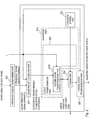
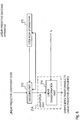
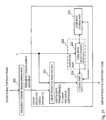
- the linear predictive coding apparatus of the first embodiment is, for example, provided with a linear predictive analysis part 221, a code book storing part 222, a coding part 224 and a linear transformation part 225 as shown in Figs. 1 , 2 and 3 .
- a frequency domain transforming part 220 is provided outside the linear predictive coding apparatus in the examples of Fig. 1 , 2 or 3 , the linear predictive coding apparatus may be further provided with the frequency domain transforming part 220.
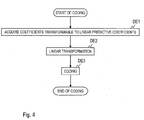
- a linear predictive coding method is realized by the parts of the linear predictive coding apparatus performing processes illustrated in Fig. 4 , respectively.
- a time domain sound signal which is a time-series signal, is inputted to the frequency domain transforming part 220.
- a frequency domain transforming part 41 transforms the inputted time domain sound signal to an MDCT coefficient sequence X(0),X(1),...,X(N-1) at N points in a frequency domain for each frame with a predetermined time length.
- N is a positive integer.
- the obtained MDCT coefficient sequence X(0),X(1),...,X(N-1) is outputted to the linear predictive analysis part 221.
- the frequency domain transforming part 220 determines a frequency domain sample sequence, which is, for example, an MDCT coefficient sequence, corresponding to the time-series signal.
- the frequency domain sample sequence which is, for example, an MDCT coefficient sequence X(0),X(1),...,X(N-1), and a parameter ⁇ 1 corresponding to the frequency domain sample sequence are inputted to the linear predictive analysis part 221.
- the parameter ⁇ 1 is a positive integer.
- the parameter ⁇ 1 is determined, for example, by a parameter determining part 27 or 27' to be described later.
- the parameter ⁇ 1 is a parameter ⁇ that defines probability distribution to which coding targets of arithmetic coding belong, in such a coding system for performing arithmetic coding of quantized values of coefficients in a frequency domain, utilizing a linear prediction envelope as is used in the 3GPP EVS (Enhanced Voice Services) standard.
- the parameter ⁇ can be an indicator indicating characteristics of a time-series signal.
- Parameters ⁇ 2 and ⁇ 3 that will appear later are also the parameters ⁇ . It can be said that ⁇ 1 , ⁇ 2 and ⁇ 3 are predetermined values of the parameter ⁇ .
- the linear predictive analysis part 221 performs linear predictive analysis using ⁇ R(0), ⁇ R(1),..., ⁇ R(N-1) that is explicitly defined by the following expression (A7) using the MDCT coefficient sequence X(0),X(1),...,X(N-1) and ⁇ 1 and generates coefficients transformable to linear predictive coefficients (step DE1).
- ⁇ 1 exp ⁇ j 2 ⁇ kn N , k 0,1, ... , N ⁇ 1
- the generated coefficients transformable to linear predictive coefficients are outputted to the coding part 224.
- the linear predictive analysis part 221 determines a pseudo correlation function signal sequence ⁇ R(0), ⁇ R(1),..., ⁇ R(N-1), which is a time domain signal sequence corresponding to the ⁇ 1 -th power of the absolute values of the MDCT coefficient sequence X(0),X(1),...,X(N-1). Then, the linear predictive analysis part 221 performs linear predictive analysis using the determined pseudo correlation function signal sequence ⁇ R(0), ⁇ R(1),..., ⁇ R(N-1) and generates coefficients transformable to linear predictive coefficients.
- the linear predictive analysis part 221 performs linear predictive analysis using a pseudo correlation function signal sequence obtained by performing inverse Fourier transform regarding the ⁇ 1 -th power of absolute values of a frequency domain sample sequence corresponding to a time-series signal as a power spectrum, the ⁇ 1 being a positive number, and obtains the coefficients transformable to linear predictive coefficients.
- the coefficients transformable to linear predictive coefficients are, for example, LSP, PARCOR coefficients, ISP and the like.
- the coefficients transformable to linear predictive coefficients may be linear predictive coefficients themselves.
- a code book in which a plurality of candidates for coefficients transformable to linear predictive coefficients corresponding to the parameter ⁇ 2 are stored is stored in the code book storing part 222.
- a pair of a candidate for coefficients transformable to linear predictive coefficients and a code corresponding to the candidate for coefficients transformable to linear predictive coefficients will be referred to as a candidate/code pair.
- a plurality of candidate/code pairs are stored in the code book. In other words, when N is assumed to be a predetermined number equal to or larger than 2, N candidate/code pairs are stored in the code book.
- a predetermined number of bits are assigned to each of codes corresponding to the candidates for coefficients transformable to linear predictive coefficients. Each code is expressed with the assigned predetermined number of bits.
- each of the candidates for coefficients transformable to linear predictive coefficients is configured with p values.
- the candidates for coefficients transformable to linear predictive coefficients corresponding to the parameter ⁇ 2 are candidates for coefficients transformable to linear predictive coefficients optimized in order to code coefficients transformable to linear predictive coefficients corresponding to a frequency domain sample sequence for which the value of the parameter ⁇ is ⁇ 2 .
- the coefficients transformable to linear predictive coefficients obtained by the linear predictive analysis part 221 and the parameter ⁇ 1 corresponding to the coefficients transformable to linear predictive coefficients are inputted to the linear transformation part 225.
- the parameter ⁇ 1 is determined, for example, by the parameter determining part 27 or 27' to be described later.
- the linear transformation part 225 is provided with at least one of a first linear transformation part 2251 and a second linear transformation part 2252.
- the first linear transformation part 2251 of the linear transformation part 225 performs first linear transformation at least according to the inputted parameter ⁇ 1 for the candidates for coefficients transformable to linear predictive coefficients stored in the code book storing part 222 (step DE2).
- the first linear transformation part 2251 transforms the candidates for coefficients transformable to linear predictive coefficients corresponding to the parameter ⁇ 2 read from the code book storing part 222 to candidates for coefficients transformable to linear predictive coefficients corresponding to the parameter ⁇ 1 .
- the candidates for coefficients transformable to linear predictive coefficients corresponding to the parameter ⁇ 1 are candidates for coefficients transformable to linear predictive coefficients optimized in order to code coefficients transformable to linear predictive coefficients corresponding to a frequency domain sample sequence for which the value of the parameter ⁇ is ⁇ 1 .
- the candidates for coefficients transformable to linear predictive coefficients after the first linear transformation are outputted to the coding part 224.
- the first linear transformation part 2251 may not perform the first linear transformation.
- the first linear transformation part 2251 of the linear transformation part 225 performs the first linear transformation for the candidates for coefficients transformable to linear predictive coefficients read from the code book storing part 222 so that, according to the inputted parameter ⁇ 1 , a sequence of an amplitude spectral envelope corresponding to the candidates for coefficients transformable to linear predictive coefficients after the first linear transformation is flatter as the inputted parameter ⁇ 1 is smaller, and outputs the candidates for coefficients transformable to linear predictive coefficients after the transformation.
- coefficients transformable to linear predictive coefficients tend to take the same value.
- the coefficients transformable to linear predictive coefficients are LSP
- the coefficients transformable to linear predictive coefficients which are LSP, tend to come closer to values obtained by equal division between 0 and ⁇ as the parameter ⁇ is smaller.
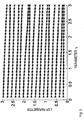
- FIG. 5 An example of values of LSP parameters when the parameter ⁇ takes each value is shown in Fig. 5 .
- the horizontal axis in Fig. 5 indicates the parameter ⁇ , and the vertical axis indicates the LSP parameters. From Fig. 5 , it is seen that the LSP parameters tend to come closer to the values obtained by equal division between 0 and ⁇ as the parameter ⁇ is smaller.
- the second linear transformation part 2252 of the linear transformation part 225 performs second linear transformation at least according to the inputted parameter ⁇ 1 for the coefficients transformable to linear predictive coefficients obtained by the linear predictive analysis part 221 (step DE2).
- the second linear transformation part 2252 performs the second linear transformation for coefficients transformable to linear predictive coefficients corresponding to the parameter ⁇ 1 obtained by the linear predictive analysis part 221 to coefficients transformable to the linear predictive coefficients corresponding to the parameter ⁇ 2 so that the coefficients transformable to linear predictive coefficients correspond to the candidates for coefficients transformable to linear predictive coefficients stored in the code book storing part 222.
- the coefficients transformable to linear predictive coefficients after the second linear transformation are outputted to the coding part 224.
- the second linear transformation part 2252 may not perform the second linear transformation.
- the second linear transformation part 2252 of the linear transformation part 225 performs the second linear transformation for inputted coefficients transformable to linear predictive coefficients so that, according to the inputted parameter ⁇ 1 , a sequence of an amplitude spectral envelope corresponding to the coefficients transformable to linear predictive coefficients after the second linear transformation is flatter as the inputted parameter ⁇ 1 is smaller, and outputs the coefficients transformable to linear predictive coefficients after the transformation.
- the first linear transformation part 2251 of the linear transformation part 225 performs first linear transformation at least according to the parameter ⁇ 3 for the candidates for coefficients transformable to linear predictive coefficients stored in the code book storing part 222.
- the parameter ⁇ 3 is a positive value, and a value different from the parameter ⁇ 2 is set for the parameter ⁇ 3 in advance or inputted from the outside of the linear predictive coding apparatus.
- the first linear transformation part 2251 transforms candidates for coefficients transformable to linear predictive coefficients corresponding to the parameter ⁇ 2 read from the code book storing part 222 to candidates for coefficients transformable to linear predictive coefficients corresponding to the parameter ⁇ 3 .
- the candidates for coefficients transformable to linear predictive coefficients corresponding to the parameter ⁇ 3 are candidates for coefficients transformable to linear predictive coefficients optimized in order to code coefficients transformable to linear predictive coefficients corresponding to a frequency domain sample sequence for which the value of the parameter ⁇ is ⁇ 3 .
- the candidates for coefficients transformable to linear predictive coefficients after the first linear transformation are outputted to the coding part 224.
- the first linear transformation part 2251 may not perform the first linear transformation.
- the first linear transformation part 2251 of the linear transformation part 225 performs the first linear transformation for the candidates for coefficients transformable to linear predictive coefficients read from the code book storing part 222 so that an amplitude spectral envelope corresponding to the candidates for coefficients transformable to linear predictive coefficients after the first linear transformation is flatter as the parameter ⁇ 3 is smaller, and outputs the candidates for coefficients transformable to linear predictive coefficients after the transformation.
- the second linear transformation part 2252 of the linear transformation part 225 performs the second linear transformation at least according to the parameter ⁇ 1 for the coefficients transformable to linear predictive coefficients obtained by the linear predictive analysis part 221.
- the second linear transformation part 2252 performs the second linear transformation for the coefficients transformable to linear predictive coefficients corresponding to the parameter ⁇ 1 obtained by the linear predictive analysis part 221 to coefficients transformable to linear predictive coefficients corresponding to the parameter ⁇ 3 .
- the candidates for coefficients transformable to linear predictive coefficients after the second linear transformation are outputted to the coding part 224.
- the second linear transformation part 2252 may not perform the second linear transformation.
- the second linear transformation part 2252 of the linear transformation part 225 performs the second linear transformation for inputted coefficients transformable to linear predictive coefficients so that, according to the inputted parameter ⁇ 1 , an amplitude spectral envelope corresponding to the coefficients transformable to linear predictive coefficients after the second linear transformation is flatter as the inputted parameter ⁇ 1 is smaller, and outputs the coefficients transformable to linear predictive coefficients after the transformation.
- the linear transformation part 225 performs at least one of the first linear transformation according to ⁇ 3 for the candidates for coefficients transformable to linear predictive coefficients stored in the code book storing part 222 and the second linear transformation according to ⁇ 3 for the coefficients transformable to linear predictive coefficients obtained by the linear predictive analysis part 221 (step DE2).
- the process of the coding part 224 differs according to the configuration of the linear transformation part 225. Therefore, the process of the coding part 224 in each of (1) the first case, (2) the second case and (3) the third case of the linear transformation part 225 will be described below.
- the coefficients transformable to linear predictive coefficients obtained by the linear predictive analysis part 221 and the candidates for coefficients transformable to linear predictive coefficients after the first linear transformation obtained by the first linear transformation part 2251 of the linear transformation part 225 are inputted to the coding part 224.
- the coding part 224 performs coding using the candidates for coefficients transformable to linear predictive coefficients after the first linear transformation to obtain a linear predictive coefficient code (step DE3).
- the coding part 224 selects a candidate that is the closest to the coefficients transformable to linear predictive coefficients, from among the plurality of candidates for coefficients transformable to linear predictive coefficients after the first linear transformation, and causes a code corresponding to the selected candidate to be a linear predictive coefficient code.
- the obtained linear predictive coefficient code is outputted to the decoding apparatus.
- the coefficients transformable to linear predictive coefficients obtained by the second linear transformation part 2252 of the linear transformation part 225 and the candidates for coefficients transformable to linear predictive coefficients stored in the code book storing part 222 are inputted to the coding part 224.
- the coding part 224 For the coefficients transformable to linear predictive coefficients after the second linear transformation, the coding part 224 performs coding using the candidates for coefficients transformable to linear predictive coefficients to obtain a linear predictive coefficient code (step DE3).
- the coding part 224 selects a candidate that is the closest to the coefficients transformable to linear predictive coefficients after the second linear transformation, from among the plurality of candidates for coefficients transformable to linear predictive coefficients, and causes a code corresponding to the selected candidate to be a linear predictive coefficient code.
- the obtained linear predictive coefficient code is outputted to the decoding apparatus.
- the coefficients transformable to linear predictive coefficients obtained by the second linear transformation part 2252 of the linear transformation part 225 and the candidates for coefficients transformable to linear predictive coefficients obtained by the first linear transformation part 2251 of the linear transformation part 225 are inputted to the coding part 224.
- the coding part 224 For the coefficients transformable to linear predictive coefficients after the second linear transformation, the coding part 224 performs coding using the candidates for coefficients transformable to linear predictive coefficients after the first linear transformation to obtain a linear predictive coefficient code (step DE3).
- the coding part 224 selects a candidate that is the closest to the coefficients transformable to linear predictive coefficients after the second linear transformation, from among the plurality of candidates for coefficients transformable to linear predictive coefficients after the first linear transformation, and causes a code corresponding to the selected candidates to be a linear predictive coefficient code.
- the obtained linear predictive coefficient code is outputted to the decoding apparatus.
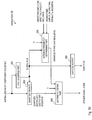
- the linear predictive decoding apparatus of the first embodiment is, for example, provided with a code book storing part 311, a decoding part 313 and a linear transformation part 314.
- a linear predictive decoding method is realized by the parts of the linear predictive decoding apparatus performing processes illustrated in Fig. 7 , respectively.
- the same code book as the code book stored in the code book storing part 222 is stored. That is, a code book in which a plurality of candidates for coefficients transformable to linear predictive coefficients corresponding to the parameter ⁇ 2 are stored is stored in the code book storing part 311.
- the linear predictive coefficient code outputted by the linear predictive coding apparatus is inputted to the decoding part 313.
- the decoding part 313 obtains a candidate for coefficients transformable to linear predictive coefficients corresponding to the inputted linear predictive coefficient code, among the plurality of candidates for coefficients transformable to linear predictive coefficients stored in the code book storing part 311, as coefficients transformable to linear predictive coefficients (step DD1).
- the obtained coefficients transformable to linear predictive coefficients are outputted to the linear transformation part 314.
- the obtained coefficients transformable to linear predictive coefficients correspond to any one of the plurality of candidates for coefficients transformable to linear predictive coefficients corresponding to the parameter ⁇ 2 stored in the code book storing part 311. Therefore, the coefficients transformable to linear predictive coefficients obtained by the decoding part 313 are coefficients transformable to linear predictive coefficients corresponding to the parameter ⁇ 2 .
- the coefficients transformable to linear predictive coefficients corresponding to the parameter ⁇ 2 obtained by the decoding part 313 and the parameter ⁇ 1 are inputted to the linear transformation part 314.
- This parameter ⁇ 1 is obtained, for example, by decoding a parameter code received from the linear predictive coding apparatus.
- the linear transformation part 314 performs the linear transformation at least according to the parameter ⁇ 1 for the coefficients transformable to linear predictive coefficients corresponding to the parameter ⁇ 2 to obtain coefficients transformable to linear predictive coefficients after the linear transformation.
- the linear transformation part 314 transforms the coefficients transformable to linear predictive coefficients corresponding to the parameter ⁇ 2 to the coefficients transformable to linear predictive coefficients corresponding to the parameter ⁇ 1 .
- the obtained coefficients transformable to linear predictive coefficients after the linear transformation are outputted as a decoding result by the linear predictive decoding apparatus or method.
- the linear transformation part 314 may not perform the linear transformation.
- the linear transformation part 314 may be configured to perform linear transformation multiple times using a parameter ⁇ 4 different from both of the parameters ⁇ 1 and ⁇ 2 at the time of performing linear transformation of the coefficients transformable to linear predictive coefficients corresponding to the parameter ⁇ 2 to obtain the coefficients transformable to linear predictive coefficients corresponding to the parameter ⁇ 1 .
- the linear transformation part 314 performs linear transformation of the coefficients transformable to linear predictive coefficients corresponding to the parameter ⁇ 2 to obtain coefficients transformable to linear predictive coefficients corresponding to the parameter ⁇ 4 . Further, the linear transformation part 314 performs linear transformation of the obtained coefficients transformable to linear predictive coefficients corresponding to the parameter ⁇ 4 to obtain coefficients transformable to linear predictive coefficients corresponding to the parameter ⁇ 1 .
- the same linear transformations as the linear transformation in the third case of the linear transformation part 225 of the linear predictive coding apparatus in which candidates for coefficients transformable to linear predictive coefficients corresponding to the parameter ⁇ 3 are obtained from among the candidates for coefficients transformable to linear predictive coefficients corresponding to the parameter ⁇ 2 and the linear transformation in the third case of the linear transformation part 225 of the linear predictive coding apparatus in which coefficients transformable to linear predictive coefficients corresponding to the parameter ⁇ 3 are obtained from the coefficients transformable to linear predictive coefficients corresponding to the parameter ⁇ 1 can be used for the two linear transformations.
- the linear transformation part 314 may obtain the coefficients transformable to linear predictive coefficients corresponding to the parameter ⁇ 1 by performing one linear transformation obtained by combining the linear transformation from the parameter ⁇ 2 to the parameter ⁇ 3 and the linear transformation from the parameter ⁇ 3 to the parameter ⁇ 1 , for the coefficients transformable to linear predictive coefficients corresponding to the parameter ⁇ 2 .
- the obtained coefficients transformable to linear predictive coefficients corresponding to the parameter ⁇ 1 are outputted as a decoding result by the linear predictive decoding apparatus or method.
- the linear transformation part 314 may perform linear transformation for the coefficients transformable to linear predictive coefficients obtained by the decoding part 313 so that an amplitude spectral envelope corresponding to the coefficients transformable to linear predictive coefficients after the linear transformation is flatter as the inputted ⁇ 1 is smaller, to obtain coefficients transformable to linear predictive coefficients after the linear transformation.
- the coefficients transformable to linear predictive coefficients after the linear transformation obtained by the linear transformation part 314 is used to obtain an unsmoothed spectral envelope sequence, which is a sequence obtained by raising a sequence of an amplitude spectral envelope corresponding to the coefficients transformable to linear predictive coefficients obtained by the linear transformation part 314 to the power of 1/ ⁇ 1.
- linear transformations such as the first linear transformation and the second linear transformation will be described below.
- the coefficients transformable to linear predictive coefficients before the linear transformation are LSP.
- the first linear transformation part 2251, the second linear transformation part 2252, an inverse linear transformation part 226 and the linear transformation part 314 perform linear transformation, for example, shown by the expression below.
- x 1 ,x 2 ,...x p , y 1 ,y 2 ,...y p-1 , z 2 ,z 3 ,...z p are predetermined non-negative numbers; at least one of y 1 ,y 2 ,...y p-1 , z 2 ,z 3 ,...z p is a predetermined positive number; and K is a matrix in which elements other than x 1 ,x 2 ,...x p , y 1 ,y 2 ,...y p -1, z 2 ,z 3 ,...z p are 0.
- x 1 ,x 2 ,...x p , y 1 ,y 2 ,...y p-1 , z 2 ,z 3 ,...z p are appropriately determined on the basis of the value of a parameter ⁇ corresponding to the coefficients transformable to linear predictive coefficients or candidates for coefficients transformable to linear predictive coefficients before the linear transformation (hereinafter referred to as a parameter before linear transformation ⁇ A ) and the value of a parameter ⁇ corresponding to the coefficients transformable to linear predictive coefficients or candidates for coefficients transformable to linear predictive coefficients after the linear transformation (hereinafter referred to as a parameter after linear transformation ⁇ B ).
- the first linear transformation part 2251, the second linear transformation part 2252, the inverse linear transformation part 226 and the linear transformation part 314 can read the specific values of x 1 ,x 2 , ...x p , y 1 ,y 2 , ...y p-1 , z 2, z 3 , ...z p corresponding to the pairs of the parameter before linear transformation ⁇ A and the parameter after linear transformation ⁇ B for the linear transformation and perform the linear transformation by the above expression using the read values.
- the first linear transformation part 2251 of the linear transformation part 225 may perform the first linear transformation so that the order of the candidates for coefficients transformable to linear predictive coefficients after the first linear transformation is lower as the parameter ⁇ 1 is smaller.
- the linear transformation part 314 may perform linear transformation so that the order of the coefficients transformable to linear predictive coefficients after linear transformation is lower as the parameter ⁇ 1 is smaller.
- linear transformation may be performed so that the order of coefficients transformable to linear predictive coefficients or candidates for coefficients transformable to linear predictive coefficients before linear transformation and the order of the coefficients transformable to linear predictive coefficients or candidates for coefficients transformable to linear predictive coefficients after the linear transformation are different from each other.
- the first linear transformation part 2251 may decrease the order of candidates for coefficients transformable to linear predictive coefficients after the linear transformation. Further, after decreasing the order of candidates for coefficients transformable to linear predictive coefficients after linear transformation, the first linear transformation part 2251 may perform linear transformation in which the order before the linear transformation is the same as the order after the linear transformation.
- the linear transformation part 314 may decrease the order of the coefficients transformable to linear predictive coefficients after the linear transformation. Further, after decreasing the order of coefficients transformable to linear predictive coefficients after linear transformation, the linear transformation part 314 may perform the linear transformation in which the order before the linear transformation is the same as the order after the linear transformation.
- the first linear transformation part 2251 may decrease the number of the plurality of candidates for coefficients transformable to linear predictive coefficients after linear transformation as the parameter ⁇ 1 is smaller by integrating a plurality of candidates for coefficients transformable to linear predictive coefficients after the linear transformation.
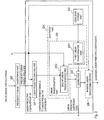
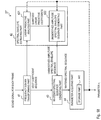
- the linear predictive coding apparatus of the second embodiment is, for example, provided with the linear predictive analysis part 221, the code book storing part 222, a code book selecting part 223 and the coding part 224.
- the frequency domain transforming part 220 is provided outside the linear predictive coding apparatus in the example of Fig. 21
- the linear predictive coding apparatus may be further provided with the frequency domain transforming part 220.
- a linear predictive coding method is realized by the parts of the linear predictive coding apparatus performing processes illustrated in Fig. 22 , respectively.
- the "parameter ⁇ 1 " is referred to as the "parameter ⁇ ”.
- a time domain sound signal which is a time-series signal, is inputted to the frequency domain transforming part 220.
- the frequency domain transforming part 41 transforms the inputted time domain sound signal to an MDCT coefficient sequence X(0),X(1),...,X(N-1) at N points in a frequency domain for each frame with a predetermined time length.
- N is a positive integer.
- the obtained MDCT coefficient sequence X(0),X(1),...,X(N-1) is outputted to the linear predictive analysis part 221.
- the frequency domain transforming part 220 determines a frequency domain sample sequence, which is, for example, an MDCT coefficient sequence, corresponding to the time-series signal.
- the frequency domain sample sequence which is, for example, an MDCT coefficient sequence X(0),X(1),...,X(N-1), and a parameter ⁇ corresponding to the frequency domain sample sequence are inputted to the linear predictive analysis part 221.
- the parameter ⁇ is a positive integer.
- the parameter ⁇ is determined, for example, by a parameter determining part 27 or 27' to be described later.
- the parameter ⁇ is a shape parameter that defines probability distribution to which coding targets of arithmetic coding belong, in such a coding system for performing arithmetic coding of quantized values of coefficients in a frequency domain, utilizing a linear prediction envelope as is used in the 3GPP EVS (Enhanced Voice Services) standard.
- the parameter ⁇ can be an indicator indicating characteristics of a time-series signal.
- the linear predictive analysis part 221 performs linear predictive analysis using ⁇ R(0), ⁇ R(1),..., ⁇ R(N-1) that is explicitly defined by the following expression (A7) using the MDCT coefficient sequence X(0),X(1),...,X(N-1) and ⁇ and generates coefficients transformable to linear predictive coefficients (step DE1).
- ⁇ exp ⁇ j 2 ⁇ kn N , k 0,1, ... , N ⁇ 1
- the generated coefficients transformable to linear predictive coefficients are outputted to the coding part 224.
- the linear predictive analysis part 22 determines a pseudo correlation function signal sequence ⁇ R(0), ⁇ R(1),..., ⁇ R(N-1), which is a time domain signal sequence corresponding to the ⁇ -th power of the absolute values of the MDCT coefficient sequence X(0),X(1),...,X(N-1). Then, the linear predictive analysis part 221 performs linear predictive analysis using the determined pseudo correlation function signal sequence ⁇ R(0), ⁇ R(1),..., ⁇ R(N-1) and generates coefficients transformable to linear predictive coefficients.
- the linear predictive analysis part 221 performs linear predictive analysis using a pseudo correlation function signal sequence obtained by performing inverse Fourier transform regarding the ⁇ -th power of absolute values of a frequency domain sample sequence corresponding to a time-series signal as a power spectrum, ⁇ being a positive number, and obtains the coefficients transformable to linear predictive coefficients.
- the coefficients transformable to linear predictive coefficients are, for example, LSP, PARCOR coefficients, ISP and the like.
- the coefficients transformable to linear predictive coefficients may be linear predictive coefficients themselves.
- a plurality of code books are stored in the code book storing part 222.
- a pair of a candidate for coefficients transformable to linear predictive coefficients and a code corresponding to the candidate for coefficients transformable to linear predictive coefficients will be referred to as a candidate/code pair.
- a plurality of candidate/code pairs are stored in each code book.
- I indicates a predetermined number equal to or larger than 2
- N i is a predetermined number equal to or larger than 2 that is determined according to i
- a predetermined number of bits are assigned to each of codes corresponding to the candidates for coefficients transformable to linear predictive coefficients.
- Each code is expressed with the assigned predetermined number of bits.
- each of the candidates for coefficients transformable to linear predictive coefficients is configured with p values.
- the plurality of code books stored in the code book storing part 222 differ depending on the code book selection method of the code book selecting part 223. Therefore, an example of the plurality of code books stored in the code book storing part 222 will be described together with an example of the code book selecting part 223 to be described later.
- a parameter ⁇ is inputted to the code book selecting part 223.
- the code book selecting part 223 selects a code book from among the plurality of code books stored in the code book storing part 222 according to the inputted ⁇ (step DE2). Information about the selected code book is outputted to the coding part 224.
- a plurality of code books that are different in the number of candidates for coefficients transformable to linear predictive coefficients are stored in the code book storing part 222. Further, the code book selecting part 223 selects a code book with a larger number of candidates for coefficients transformable to linear predictive coefficients, from among the plurality of code books stored in the code book storing part 222 as the parameter ⁇ is larger.
- the parameter ⁇ When the parameter ⁇ is large, the range that coefficients transformable to linear predictive coefficients can take tends to be wide. Therefore, the number of candidates for the coefficients transformable to linear predictive coefficients required to express the coefficients transformable to linear predictive coefficients becomes large. Therefore, when the parameter ⁇ is large, it is desirable to perform coding and decoding using a code book with a large number of candidates for coefficients transformable to linear predictive coefficients.
- the code book selecting part 223 selects a code book with a larger number of candidates for coefficients transformable to linear predictive coefficients, from among the plurality of code books stored in the code book storing part 222 as the parameter ⁇ is larger.
- a judgment about the magnitude of the parameter ⁇ in other words, a selection of an appropriate code book can be made on the basis of a threshold. For example, it is assumed that the number of candidates for coefficients transformable to linear predictive coefficients in a first code book is smaller than the number of candidates for coefficients transformable to linear predictive coefficients in a second code book.
- one threshold for the parameter ⁇ is set in advance. When an inputted parameter ⁇ is smaller than the threshold, it is judged that the parameter ⁇ is small, and the first code book is selected. When the inputted parameter ⁇ is equal to or larger than the threshold, it is judged that the parameter ⁇ is large, and the second code book is selected.
- the number of code books is equal to or larger than three, a code book can be similarly selected using the number of thresholds corresponding to a value obtained by subtracting one from the number of code books.
- pairs of a 16-dimension vector, which is a candidate for coefficients transformable to linear predictive coefficients, and a code corresponding to the candidate, the number of which is 2 5 32, are stored in the second layer.
- a candidate that is the closest to inputted coefficients transformable to linear predictive coefficients among the candidates for coefficients transformable to linear predictive coefficients and a corresponding code in the first layer are selected first.
- the value of the selected candidate for coefficients transformable to linear predictive coefficients is subtracted from the inputted coefficients transformable to linear predictive coefficients, and a candidate that is the closest to the subtraction value among the candidates for coefficients transformable to linear predictive coefficients and a corresponding code in the second layer are selected.
- the two codes selected in the first and second layers become a linear predictive coefficient code. That is, the linear predictive coefficient code is expressed with 15 bits.
- the sum of the candidates for coefficients transformable to linear predictive coefficients selected in the first and second layers becomes a result of quantization of the inputted coefficients transformable to linear predictive coefficients.
- a candidate that is the closest to the inputted coefficients transformable to linear predictive coefficients among the candidates for coefficients transformable to linear predictive coefficients and a corresponding code in the first layer are selected.
- the code selected in the first layer becomes a linear predictive coefficient code. That is, the linear predictive coefficient code is expressed with 10 bits.
- the candidate for coefficients transformable to linear predictive coefficients selected in the first layer becomes a result of quantization of the inputted coefficients transformable to linear predictive coefficients.
- this example can be also said to be an example of (1) the first method.
- the candidate/code pair search range may be narrowed more as the parameter ⁇ is smaller.
- this example can be also said to be an example of (1) the first method.
- a plurality of code books that are different in the degree of flatness of an unsmoothed spectral envelope sequence which is a sequence obtained by raising a sequence of an amplitude spectral envelope corresponding to candidates for coefficients transformable to linear predictive coefficients stored in each code book to the power of 1/ ⁇ , are stored in the code book storing part 222.
- the code book selecting part 223 selects such a code book that an unsmoothed spectral envelope sequence, which is a sequence obtained by raising a sequence of an amplitude spectral envelope corresponding to candidates for coefficients transformable to linear predictive coefficients stored in the code book to the power of 1/,n, is flatter as ⁇ is smaller.
- the unsmoothed spectral envelope sequence tends to be flatter and coefficients transformable to linear predictive coefficients take more similar values, as the parameter ⁇ is smaller.
- coefficients transformable to linear predictive coefficients are LSP
- the coefficients transformable to linear predictive coefficients which are LSP parameters, tend to come closer to values obtained by equal division between 0 and ⁇ as the parameter ⁇ is smaller.
- FIG. 5 An example of values of LSP parameters when the parameter ⁇ takes each value is shown in Fig. 5 .
- the horizontal axis in Fig. 5 indicates the parameter ⁇ , and the vertical axis indicates the LSP parameters. From Fig. 5 , it is seen that the LSP parameters tend to come closer to the values obtained by equal division between 0 and ⁇ as the parameter ⁇ is smaller.
- coefficients transformable to linear predictive coefficients are ISP parameters
- coefficients transformable to linear predictive coefficients are PARCOR coefficients
- all of the values of the coefficients transformable to linear predictive coefficients tend to be smaller as the parameter ⁇ is smaller.
- the second method is intended to cause quantization performance to be improved by performing coding and decoding using candidates for coefficients transformable to linear predictive coefficients corresponding to the case where an unsmoothed spectral envelope sequence is flatter as the parameter ⁇ is smaller, utilizing of the above tendencies.
- coefficients transformable to linear predictive coefficients are LSP or PARCOR coefficients
- coefficients transformable to linear predictive coefficients corresponding to a case where the unsmoothed spectral envelope is the flattest are expressed as ⁇ F [1], ⁇ F [2],..., ⁇ F [p].
- selection of an appropriate code book may be performed on the basis of a threshold.
- a threshold For example, it is assumed that an unsmoothed spectral envelope sequence, which is a sequence obtained by raising a sequence of an amplitude spectral envelope corresponding to candidates for coefficients transformable to linear predictive coefficients in the first code book to the power of 1/ ⁇ , is flatter than an unsmoothed spectral envelope sequence, which is a sequence obtained by raising a sequence of an amplitude spectral envelope corresponding to candidates for coefficients transformable to linear predictive coefficients in the second code book to the power of 1/ ⁇ .
- one threshold for the parameter ⁇ is set in advance.
- a plurality of code books that are different in the interval between candidates for coefficients transformable to linear predictive coefficients are stored in the code book storing part 222. Further, from among the plurality of code books stored in the code book storing part 222, the code book selecting part 223 selects a code book with a narrower interval between candidates for coefficients transformable to linear predictive coefficients as ⁇ is smaller.
- the interval between candidates for coefficients transformable to linear predictive coefficients anything is possible if it is an indicator indicating the width of the interval between candidates for coefficients transformable to linear predictive coefficients comprised in the code book.
- the interval between candidates for coefficients transformable to linear predictive coefficients may be an average value of distances between one candidate for coefficients transformable to linear predictive coefficients and another candidate for coefficients transformable to linear predictive coefficients, comprised in the code book or may be a maximum value, minimum value or median of the value.
- the third method utilizes this tendency.
- the interval between candidates for coefficients transformable to linear predictive coefficients may be an average value of distances between two adjoining candidates for coefficients transformable to linear predictive coefficients comprised in the code book.
- selection of an appropriate code book may be performed on the basis of a threshold. For example, it is assumed that the interval between candidates for coefficients transformable to linear predictive coefficients in the first code book is narrower than the interval between candidates for coefficients transformable to linear predictive coefficients in the second code book.
- one threshold for the parameter ⁇ is set in advance. When an inputted parameter ⁇ is smaller than the threshold, it is judged that the parameter ⁇ is small, and the first code book is selected. When the inputted parameter ⁇ is equal to or larger than the threshold, it is judged that the parameter ⁇ is large, and the second code book is selected.
- the number of code books is equal to or larger than three, a code book can be similarly selected using the same number of thresholds as a value obtained by subtracting one from the number of code books.
- the coefficients transformable to linear predictive coefficients and the obtained by the linear predictive analysis part 221 and information about the selected code book obtained by the code book selecting part 223 are inputted to the coding part 224.
- the coding part 224 codes the coefficients transformable to linear predictive coefficients to obtain a linear predictive coefficient code (step DE3).
- the obtained linear predictive coefficient code is outputted to the decoding apparatus.
- the linear predictive decoding apparatus of the second embodiment is, for example, provided with the code book storing part 311, a code book selecting part 312 and the decoding part 313.
- a linear predictive decoding method is realized by the parts of the linear predictive decoding apparatus performing processes illustrated in Fig. 24 , respectively.
- the "parameter ⁇ 1 " is referred to as the "parameter ⁇ ”.
- a plurality of code books are stored in the code book storing part 311.
- a pair of a candidate for coefficients transformable to linear predictive coefficients and a code corresponding to the candidate for coefficients transformable to linear predictive coefficients will be referred to as a candidate/code pair.
- a plurality of candidate/code pairs are stored in each code book.
- I indicates a predetermined number equal to or more than 2
- N i is a predetermined number equal to or larger than 2 that is determined according to i
- a predetermined number of bits are assigned to each of codes corresponding to the candidates for coefficients transformable to linear predictive coefficients.
- Each code is expressed with the assigned predetermined number of bits.
- the plurality of code books stored in the code book storing part 311 differ depending on the code book selection method of the code book selecting part 312. Therefore, an example of the plurality of code books stored in the code book storing part 311 will be described together with an example of the code book selecting part 312 to be described later.
- the same code books as the plurality of code books stored in the code book storing part 222 are stored.
- a parameter ⁇ is inputted to the code book selecting part 312.
- the parameter ⁇ is obtained by decoding a parameter code.
- the number of parameters ⁇ may be the same number set in advance in the linear predictive coding apparatus and the linear predictive decoding apparatus.
- the code book selecting part 312 selects a code book from among the plurality of code books stored in the code book storing part 311 according to the inputted ⁇ (step DD1). Information about the selected code book is outputted to the decoding part 313.
- the same code books as the plurality of code books stored in the code book storing part 222 are stored. Further, it is assumed that the same selection criterion as the criterion for selection of a code book by the code book selecting part 223 of the linear predictive coding apparatus is set for the code book selecting part 312 in advance. Thereby, a code book with the same content as the code book selected on the coding side is selected on the decoding side also.
- the linear predictive coefficient code outputted by the linear predictive coding apparatus and information about the selected code book obtained by the code book selecting part 312 are inputted to the decoding part 313. Further, the decoding part 313 reads a code book identified by the information about the selected code book from the code book storing part 311.
- the decoding part 313 decodes the linear predictive coefficient code to obtain the coefficients transformable to linear predictive coefficients (step DD2).
- the coefficients transformable to linear predictive coefficients are used to obtain an unsmoothed spectral envelope sequence, which is a sequence obtained by raising a sequence of an amplitude spectral envelope corresponding to the coefficients transformable to linear predictive coefficients to the power of 1/ ⁇ .
- an adaptation part 22A is configured with at least one of the code book selecting part 223 and the linear transformation part 225 as shown by a long dashed short dashed line in Figs. 1 to 3 , 21 and Figs. 25 to 27 , it can be said that the adaptation part 22A has adapted at least either of a code book stored in the code book storing part 222 and coefficients transformable to linear predictive coefficients generated by the linear predictive analysis part 221, on the basis of ⁇ 1 inputted.
- the adaptation part 22A adapts the values of ⁇ for a plurality of candidates for coefficients transformable to linear predictive coefficients stored in the code book stored in the code book storing part 222 and the coefficients transformable to linear predictive coefficients obtained by the linear predictive analysis part 221.
- the adaptation part 22A transforms at least one of the coefficients transformable to linear predictive coefficients such that, in comparison with "a difference between the value of a parameter ⁇ corresponding to the code book stored in the code book storing part 222, that is, the plurality of candidates for coefficients transformable to linear predictive coefficients and the value of a parameter ⁇ corresponding to the coefficients transformable to linear predictive coefficients generated by the linear predictive analysis part 221" before adaptation, a difference between the values of two parameters ⁇ after the adaptation is smaller. It can be also said that the adaptation part 22A performs adaptation so that the values of the two parameters ⁇ are almost the same value after the adaptation.
- the process of the first linear transformation part 2251 of the linear transformation part 225 described in the first embodiment and the process of the code book selecting part 223 described in the second embodiment are examples of adaptation of a code book stored in the code book storing part 222.
- the process of the second linear transformation part 2252 of the linear transformation part 225 described in the second embodiment is an example of adaptation of coefficients transformable to linear predictive coefficients generated by the linear predictive analysis part 221.
- the coding part 224 performs coding using at least one of the code books and coefficients transformable to linear predictive coefficients adapted by the adaptation part 22A.
- the coding part 224 codes the coefficients transformable to linear predictive coefficients by the linear predictive analysis part 221 or the coefficients transformable to linear predictive coefficients adapted by the adaptation part 22A, using a code book selected by the code book selecting part 223 or the code book adapted by the adaptation part 22A.
- the coding part 224 obtains a linear predictive coefficient code corresponding to coefficients transformable to linear predictive coefficients obtained by the linear predictive analysis part 221, using the plurality of candidates for coefficients transformable to linear predictive coefficients and coefficients transformable to linear predictive coefficients for which the value of ⁇ has been adapted.
- the adaptation part 22A in (1) the first case of the first embodiment is provided with the linear transformation part 225 that performs first linear transformation according to ⁇ 1 for candidates for coefficients transformable to linear predictive coefficients stored in the code book storing part 222 and obtains a plurality of candidates for coefficients transformable to linear predictive coefficients after the first linear transformation.
- the coding part 224 obtains a linear predictive coefficient code corresponding to coefficients transformable to linear predictive coefficients obtained by the linear predictive analysis part 221, using the coefficients transformable to linear predictive coefficients obtained by the linear predictive analysis part 221 and the plurality of candidates for coefficients transformable to linear predictive coefficients after the first linear transformation obtained by the adaptation part 22A.
- the adaptation part 22A in (2) the second case of the first embodiment is provided with the linear transformation part 225 that performs second linear transformation according to ⁇ 1 for coefficients transformable to linear predictive coefficients obtained by the linear predictive analysis part 221 and obtains coefficients transformable to linear predictive coefficients after the second linear transformation.
- the coding part 224 obtains a linear predictive coefficient code corresponding to the coefficients transformable to linear predictive coefficients obtained by the linear predictive analysis part 221 using the coefficients transformable to linear predictive coefficients after the second linear transformation obtained by the adaptation part 22A and the plurality of candidates for coefficients transformable to linear predictive coefficients stored in a code book.
- the adaptation part 22A of (3) the third case of the first embodiment performs first linear transformation according to ⁇ 3 for a plurality of candidates for coefficients transformable to linear predictive coefficients stored in the code book storing part 222 to obtain a plurality of candidates for coefficients transformable to linear predictive coefficients after the first linear transformation, and performs second linear transformation according to ⁇ 3 for the coefficients transformable to linear predictive coefficients obtained by the linear predictive analysis part 221 to obtain coefficients transformable to linear predictive coefficients after the second linear transformation.
- the coding part 224 obtains a linear predictive coefficient code corresponding to the coefficients transformable to linear predictive coefficients obtained by the linear predictive analysis part 221, using the coefficients transformable to linear predictive coefficients after the second linear transformation obtained by the adaptation part 22A and the plurality of candidates for coefficients transformable to linear predictive coefficients after the first linear transformation obtained by the adaptation part 22A.
- the adaptation part 22A may perform adaptation of a code book, for example, by the code book selecting part 223 and the second linear transformation part 2252 shown in Fig. 25 .
- the code book selecting part 223 selects a code book from among the plurality of code books stored in the code book storing part 222 according to the parameter ⁇ 2 .
- the second linear transformation part 2252 performs second linear transformation according to ⁇ 2 , for the coefficients transformable to linear predictive coefficients obtained by the linear predictive analysis part 221.
- the coding part 224 performs coding using the selected code book to obtain a linear predictive coefficient code.
- the adaptation part 22A may perform adaptation of a code book, for example, by the code book selecting part 223 and the first linear transformation part 2251 shown in Fig. 26 .
- the code book selecting part 223 selects a code book from among the plurality of code books stored in the code book storing part 222 according to the parameter ⁇ 2 .
- the first linear transformation part 2251 performs first linear transformation according to ⁇ 1 , for a plurality of candidates for coefficients transformable to linear predictive coefficients stored in the selected code book.
- the coding part 224 performs coding using candidates for coefficients transformable to linear predictive coefficients after the first linear transformation to obtain a linear predictive coefficient code.
- the adaptation part 22A may perform adaptation of a code book, for example, by the code book selecting part 223, the first linear transformation part 2251 and the second linear transformation part 2252 shown in Fig. 27 .
- the code book selecting part 223 selects a code book from among the plurality of code books stored in the code book storing part 222 according to the parameter ⁇ 3 .
- the first linear transformation part 2251 performs first linear transformation according to ⁇ 2 , for a plurality of candidates for coefficients transformable to linear predictive coefficients stored in the selected code book.
- the second linear transformation part 2252 performs second linear transformation according to ⁇ 2 , for the coefficients transformable to linear predictive coefficients obtained by the linear predictive analysis part 221.
- the coding part 224 codes coefficients transformable to linear predictive coefficients after the second linear transformation using the candidates for coefficients transformable to linear predictive coefficients after the first linear transformation to obtain a linear predictive coefficient code.
- an adaptation part 31A is configured with at least one of the code book selecting part 312 and the linear transformation part 314, and the decoding part 313 as shown by a long dashed short dashed line in Figs. 6 , 23 and 28 , it can be said that the adaptation part 31A adapts at least either of a code book stored in the code book storing part 311 and a candidate for coefficients transformable to linear predictive coefficients corresponding to an inputted linear predictive coefficient code among a plurality of candidates for coefficients transformable to linear predictive coefficients stored in the code book, on the basis of inputted ⁇ 1 , the ⁇ 1 being a positive number.
- the adaptation part 31A may perform the adaptation process, for example, in both of the code book selecting part 312 and the linear transformation part 314 shown in Fig. 28 .
- the code book selecting part 312 selects a code book from among a plurality of code books stored in the code book storing part 311 according to the parameter ⁇ 2 .
- the linear transformation part 314 performs linear transformation according to ⁇ 1 , which is a predetermined positive number, for the coefficients transformable to linear predictive coefficients obtained by the decoding part 313 to obtain coefficients transformable to linear predictive coefficients.
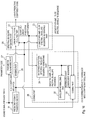
- FIG. 8 A configuration example of a coding apparatus of a first embodiment is shown in Fig. 8 .
- the coding apparatus of the first embodiment is, for example, provided with a frequency domain transforming part 21, a linear predictive analysis part 22, an unsmoothed amplitude spectral envelope sequence generating part 23, a smoothed amplitude spectral envelope sequence generating part 24, an envelope normalizing part 25, a coding part 26 and a parameter determining part 27.
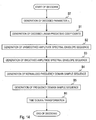
- FIG. 9 An example of each process of a coding method of the first embodiment realized by this coding apparatus is shown in Fig. 9 .
- any of a plurality of parameters ⁇ can be selected for each predetermined time interval by the parameter determining part 27.
- the plurality of parameters ⁇ are stored in the parameter determining part 27 as candidates for the parameter ⁇ .
- the parameter determining part 27 sequentially reads out one parameter ⁇ among the plurality of parameters and outputs the parameter ⁇ to the linear predictive analysis part 22, the unsmoothed amplitude spectral envelope sequence generating part 23 and the coding part 26 (step A0).
- the frequency domain transforming part 21, the linear predictive analysis part 22, the unsmoothed amplitude spectral envelope sequence generating part 23, the smoothed amplitude spectral envelope sequence generating part 24, the envelope normalizing part 25 and the coding part 26 perform, for example, processes from step A1 to step A6 described below on the basis of each of parameters ⁇ sequentially read out by the parameter determining part 27 to generate a code for a frequency domain sample sequence corresponding to a time-series signal in the same predetermined time interval.
- a predetermined parameter ⁇ is given, two or more codes are obtained for a frequency domain sample sequence corresponding to a time-series signal in the same predetermined time interval.
- a code for the frequency domain sample sequence corresponding to the time-series signal in the same predetermined time interval is an integration of the obtained two or more codes.
- the code is a combination of a linear predictive coefficient code, a gain code and an integer signal code.
- the parameter determining part 27 selects one code from among the codes obtained for the parameters ⁇ , respectively, for the frequency domain sample sequence corresponding to the time-series signal in the same predetermined time interval, and decides a parameter ⁇ corresponding to the selected code (step A7).
- the determined parameter ⁇ becomes a parameter ⁇ for the frequency domain sample sequence corresponding to the time-series signal in the same predetermined time interval.
- the parameter determining part 27 outputs the selected code and a code indicating the determined parameter ⁇ to the decoding apparatus. Details of the process of step A7 by the parameter determining part 27 will be described later.
- a sound signal which is a time domain time-series signal, is inputted to the frequency domain transforming part 21.
- An example of the sound signal is a voice digital signal or an acoustic digital signal.
- the frequency domain transforming part 21 transforms the inputted time domain sound signal to an MDCT coefficient sequence X(0),X(1),...,X(N-1) at N points in a frequency domain for each frame with a predetermined time length (step A1).
- N is a positive integer.
- the obtained MDCT coefficient sequence X(0),X(1),...,X(N-1) is outputted to the linear predictive analysis part 22 and the envelope normalizing part 25.
- the frequency domain transforming part 21 determines a frequency domain sample sequence, which is, for example, an MDCT coefficient sequence, corresponding to the sound signal.
- the MDCT coefficient sequence X(0),X(1),...,X(N-1) obtained by the frequency domain transforming part 21 is inputted to the linear predictive analysis part 22.
- the linear predictive analysis part 22 is the linear predictive coding apparatus in any of Figs. 1 to 3 and Fig. 21 described in [Linear predictive coding apparatus, linear predictive decoding apparatus and methods therefor].
- the linear predictive coding apparatus in any of Figs. 1 to 3 and Fig. 21 described in [Linear predictive coding apparatus, linear predictive decoding apparatus and methods therefor] will be referred to as "the linear predictive analysis part 22".
- the linear predictive analysis part 22 may be the linear predictive coding apparatus in any of Figs. 25 to 27 .
- the linear predictive analysis part 22 performs linear predictive analysis using a pseudo correlation function signal sequence obtained by performing inverse Fourier transform regarding the ⁇ 1 -th power of absolute values of a frequency domain sample sequence, which is, for example, an MDCT coefficient sequence, as a power spectrum, by a process similar to the process described in [Linear predictive coding apparatus, linear predictive decoding apparatus and methods therefor] to obtain coefficients transformable to linear predictive coefficients, and codes the obtained coefficients transformable to linear predictive coefficients to obtain a linear predictive coefficient code.
- a pseudo correlation function signal sequence obtained by performing inverse Fourier transform regarding the ⁇ 1 -th power of absolute values of a frequency domain sample sequence, which is, for example, an MDCT coefficient sequence, as a power spectrum
- the obtained linear predictive coefficient code is outputted to the parameter determining part 27 and the decoding apparatus.
- coefficients transformable to linear predictive coefficients corresponding to the parameter ⁇ 1 , corresponding to the linear predictive coefficient code obtained by the coding part 224 are outputted to the unsmoothed amplitude spectral envelope sequence generating part 23 and the smoothed amplitude spectral envelope sequence generating part 24 as quantized linear predictive coefficients ⁇ 1 ⁇ 2 ,..., ⁇ p .
- coefficients transformable to linear predictive coefficients corresponding to the parameter ⁇ 2 , corresponding to the linear predictive coefficient code obtained by the coding part 224 are inputted to the inverse linear transformation part 226 shown by a broken line in Fig. 2 .
- the inverse linear transformation part 226 performs linear transformation reverse to the second linear transformation performed by the second linear transformation part 2252, for the coefficients transformable to linear predictive coefficients corresponding to the parameter ⁇ 2 , corresponding to the linear predictive coefficient code to obtain coefficients transformable to linear predictive coefficients corresponding to the parameter ⁇ 1 .
- the coefficients transformable to linear predictive coefficients corresponding to the parameter ⁇ 1 are outputted to the unsmoothed amplitude spectral envelope sequence generating part 23 and the smoothed amplitude spectral envelope sequence generating part 24 as the quantized linear predictive coefficients ⁇ 1 , ⁇ 2 ,..., ⁇ p .
- the inverse linear transformation part 226 may not perform the linear transformation.
- coefficients transformable to linear predictive coefficients corresponding to the parameter ⁇ 3 , corresponding to the linear predictive coefficient code obtained by the coding part 224 are inputted to the inverse linear transformation part 226 shown by a broken line in Fig. 3 .
- the inverse linear transformation part 226 performs linear transformation reverse to second linear transformation performed by the second linear transformation part 2252, for the coefficients transformable to linear predictive coefficients corresponding to the parameter ⁇ 3 , corresponding to the linear predictive coefficient code to obtain coefficients transformable to linear predictive coefficients corresponding to the parameter ⁇ 1 .
- the coefficients transformable to linear predictive coefficients corresponding to the parameter ⁇ 1 are outputted to the unsmoothed amplitude spectral envelope sequence generating part 23 and the smoothed amplitude spectral envelope sequence generating part 24 as the quantized linear predictive coefficients ⁇ 1 , ⁇ 2 ,..., ⁇ p .
- the inverse linear transformation part 226 may not perform the linear transformation.
- predictive residual energy ⁇ 2 is calculated.
- the calculated predictive residual energy ⁇ 2 is outputted to a variance parameter determining part 268 of the coding part 26.
- the quantized linear predictive coefficients ⁇ 1 , ⁇ 2 ,..., ⁇ p generated by the linear predictive analysis part 22 are inputted to the unsmoothed amplitude spectral envelope sequence generating part 23.
- the unsmoothed amplitude spectral envelope sequence generating part 23 generates an unsmoothed amplitude spectral envelope sequence ⁇ H(0), ⁇ H(1),..., ⁇ H(N-1), which is a sequence of an amplitude spectral envelope corresponding to the quantized linear predictive coefficients ⁇ 1 , ⁇ 2 ,..., ⁇ p (step A3).
- the generated unsmoothed amplitude spectral envelope sequence ⁇ H(0), ⁇ H(1),..., ⁇ H(N-1) is outputted to the coding part 26.
- the unsmoothed amplitude spectral envelope sequence generating part 23 generates an unsmoothed amplitude spectral envelope sequence ⁇ H(0), ⁇ H(1),..., ⁇ H(N-1) explicitly defined by an expression (A2) as the unsmoothed amplitude spectral envelope sequence ⁇ H(0), ⁇ H(1),..., ⁇ H(N-1) using the quantized linear predictive coefficients ⁇ 1 , ⁇ 2 ,..., ⁇ p .
- H ⁇ k 1 2 ⁇ 1
- 1 + ⁇ n 1 p ⁇ ⁇ n exp ⁇ j 2 ⁇ kn / N
- the unsmoothed amplitude spectral envelope sequence generating part 23 performs estimation of a spectral envelope by obtaining an unsmoothed spectral envelope sequence, which is a sequence obtained by raising a sequence of an amplitude spectral envelope corresponding to the coefficients transformable to linear predictive coefficients generated by the linear predictive analysis part 22 to the power of 1/ ⁇ 1 .
- an unsmoothed spectral envelope sequence which is a sequence obtained by raising a sequence of an amplitude spectral envelope corresponding to the coefficients transformable to linear predictive coefficients generated by the linear predictive analysis part 22 to the power of 1/ ⁇ 1 .
- a sequence obtained by raising a sequence configured by a plurality of values to the power of c means a sequence configured by values obtained by raising the plurality of values to the power of c, respectively.
- a sequence obtained by raising a sequence of an amplitude spectral envelope to the power of 1/ ⁇ 1 means a sequence configured by values obtained by raising coefficients of the amplitude spect
- the process of raising to the power of 1/ ⁇ 1 by the unsmoothed amplitude spectral envelope sequence generating part 23 is due to the process performed by the linear predictive analysis part 22 in which the ⁇ 1 -th power of absolute values of a frequency domain sample sequence are regarded as a power spectrum. That is, the process of raising to the power of 1/ ⁇ 1 by the unsmoothed amplitude spectral envelope sequence generating part 23 is performed in order to return the values raised to the power of ⁇ 1 by the process performed by the linear predictive analysis part 22 in which the ⁇ 1 -th power of absolute values of a frequency domain sample sequence are regarded as a power spectrum, to the original values.
- the quantized linear predictive coefficients ⁇ 1 , ⁇ 2 ,..., ⁇ p generated by the linear predictive analysis part 22 are inputted to the smoothed amplitude spectral envelope sequence generating part 24.
- the smoothed amplitude spectral envelope sequence generating part 24 generates a smoothed amplitude spectral envelope sequence ⁇ H ⁇ (0), ⁇ H ⁇ (1),..., ⁇ H ⁇ (N-1), which is a sequence obtained by reducing amplitude unevenness of a sequence of an amplitude spectral envelope corresponding to the quantized linear predictive coefficients ⁇ 1 , ⁇ 2 ,..., ⁇ p (step A4).
- the generated smoothed amplitude spectral envelope sequence ⁇ H ⁇ (0), ⁇ H ⁇ (1),..., ⁇ H ⁇ (N-1) is outputted to the envelope normalizing part 25 and the coding part 26.
- the smoothed amplitude spectral envelope sequence generating part 24 generates a smoothed amplitude spectral envelope sequence ⁇ H ⁇ (0), ⁇ H ⁇ (1),..., ⁇ H ⁇ (N-1) explicitly defined by an expression (A3) as the smoothed amplitude spectral envelope sequence ⁇ H ⁇ (0), ⁇ H ⁇ (1),..., ⁇ H ⁇ (N-1) using the quantized linear predictive coefficients ⁇ 1 , ⁇ 2 ,..., ⁇ p and a correction coefficient ⁇ .
- H ⁇ ⁇ k 1 2 ⁇ 1
- 1 + ⁇ n 1 p ⁇ ⁇ n ⁇ n exp ⁇ j 2 ⁇ kn / N
- the correction coefficient ⁇ is a constant smaller than 1 specified in advance and is a coefficient that reduces amplitude unevenness of the unsmoothed amplitude spectral envelope sequence ⁇ H(0), ⁇ H(1),..., ⁇ H(N-1), in other words, a coefficient that smooths the unsmoothed amplitude spectral envelope sequence ⁇ H(0), ⁇ H(1),..., ⁇ H(N-1).
- the MDCT coefficient sequence X(0),X(1),...,X(N-1) obtained by the frequency domain transforming part 21 and the smoothed amplitude spectral envelope sequence ⁇ H ⁇ (0), ⁇ H ⁇ (1),..., ⁇ H ⁇ (N-1) generated by the smoothed amplitude spectral envelope generating part 24 are inputted to the envelope normalizing part 25.
- the envelope normalizing part 25 generates a normalized MDCT coefficient sequence X N (0),X N (1),...,X N (N-1) by normalizing each coefficient of the MDCT coefficient sequence X(0),X(1),...,X(N-1) by a corresponding value of the smoothed amplitude spectral envelope sequence ⁇ H ⁇ (0), ⁇ H ⁇ (1),..., ⁇ H ⁇ (N-1) (step A5).
- the generated normalized MDCT coefficient sequence is outputted to the coding part 26.
- the coding part 26 performs coding, for example, by performing processes of steps A61 to A65 shown in Fig. 12 (step A6).
- the coding part 26 determines a global gain g corresponding to the normalized MDCT coefficient sequence X N (0),X N (1),...,X N (N-1) (step A61), determines a quantized normalized coefficient sequence X Q (0),X Q (1),...,X Q (N-1), which is a sequence of integer values obtained by quantizing a result of dividing each coefficient of the normalized MDCT coefficient sequence X N (0),X N (1),...,X N (N-1) by the global gain g (step A62), determines variance parameters ⁇ (0), ⁇ (1),..., ⁇ (N-1) corresponding to coefficients of the quantized normalized coefficient sequence X Q (0),X Q (1),...,X Q (N-1), respectively, from the global gain g, the unsmoothed amplitude spectral envelope sequence ⁇ H(0), ⁇ H(1),..., ⁇ H(N-1), the smoothed amplitude spectral envelope sequence ⁇ H ⁇ (0), ⁇ H ⁇ (1),..., ⁇ H ⁇ (N-1) and the
- a normalized amplitude spectral envelope sequence ⁇ H N (0), ⁇ H N (1),..., ⁇ H N in the above expression (A1) is what is obtained by dividing each value of the unsmoothed amplitude spectral envelope sequence ⁇ H(0), ⁇ H(1),..., ⁇ H(N-1) by a corresponding value of the smoothed amplitude spectral envelope sequence ⁇ H ⁇ (0), ⁇ H ⁇ (1),..., ⁇ H ⁇ (N-1), that is, what is determined by the following expression (A8).
- the generated integer signal code and gain code are outputted to the parameter determining part 27 as codes corresponding to the normalized MDCT coefficient sequence.
- the coding part 26 realizes a function of determining such a global gain g that the number of bits of the integer signal code is equal to or smaller than the number of allocated bits B, which is the number of bits allocated in advance, and is as large as possible, and generating a gain code corresponding to the determined global gain g and an integer signal code corresponding to the determined global gain g by the above steps A61 to A65.
- step A63 that comprises a characteristic process.
- the coding process itself that is for obtaining the code corresponding to the normalized MDCT coefficient sequence by coding each of the global gain g and the quantized normalized coefficient sequence X Q (0),X Q (1),...,X Q (N-1)
- various publicly-known techniques including the technique described in Non-patent literature 1 exist. Two specific examples of the coding process performed by the coding part 26 will be described below.
- FIG. 10 A configuration example of the coding part 26 of the specific example 1 is shown in Fig. 10 .
- the coding part 26 of the specific example 1 is, for example, provided with a gain acquiring part 261, a quantization part 262, a variance parameter determining part 268, an arithmetic coding part 269 and a gain coding part 265.
- a gain acquiring part 261 As shown in Fig. 10 , the coding part 26 of the specific example 1 is, for example, provided with a gain acquiring part 261, a quantization part 262, a variance parameter determining part 268, an arithmetic coding part 269 and a gain coding part 265.
- a gain acquiring part 261 As shown in Fig. 10 , the coding part 26 of the specific example 1 is, for example, provided with a gain acquiring part 261, a quantization part 262, a variance parameter determining part 268, an arithmetic coding part 269 and a gain coding part 265.
- the normalized MDCT coefficient sequence X N (0),X N (1),...,X N (N-1) generated by the envelope normalizing part 25 is inputted to the gain acquiring part 261.
- the gain acquiring part 261 decides and outputs such a global gain g that the number of bits of an integer signal code is equal to or smaller than the number of allocated bits B, which is the number of bits allocated in advance, and is as large as possible, from the normalized MDCT coefficient sequence X N (0),X N (1),...,X N (N-1) (step S261).
- the gain acquiring part 261 acquires and outputs a value of multiplication of a square root of the total of energy of the normalized MDCT coefficient sequence X N (0),X N (1),...,X N (N-1) by a constant that is in negative correlation with the number of allocated bits B as the global gain g.
- the gain acquiring part 261 may tabulate relationships among the total of energy of the normalized MDCT coefficient sequence X N (0),X N (1),...,X N (N-1), the number of allocated bits B and the global gain g in advance, and obtain and output a global gain g by referring to the table.
- the gain acquiring part 261 obtains a gain for performing division of all samples of a normalized frequency domain sample sequence that is, for example, a normalized MDCT coefficient sequence.
- the obtained global gain g is outputted to the quantization part 262 and the variance parameter determining part 268.
- the normalized MDCT coefficient sequence X N (0),X N (1),...,X N (N-1) generated by the envelope normalizing part 25 and the global gain g obtained by the gain acquiring part 261 are inputted to the quantization part 262.
- the quantization part 262 obtains and outputs a quantized normalized coefficient sequence X Q (0),X Q (1),...,X Q (N-1), which is a sequence of an integer part of a result of dividing each coefficient of the normalized MDCT coefficient sequence X N (0),X N (1),...,X N (N-1) by the global gain g (step S262).
- the quantization part 262 determines a quantized normalized coefficient sequence by dividing each sample of a normalized frequency domain sample sequence that is, for example, a normalized MDCT coefficient sequence by a gain and quantizing the result.
- the obtained quantized normalized coefficient sequence X Q (0),X Q (1),...,X Q (N-1) is outputted to the arithmetic coding part 269.
- the variance parameter determining part 268 obtains and outputs each variance parameter of a variance parameter sequence ⁇ (0), ⁇ (1),..., ⁇ (N-1) from the global gain g, the unsmoothed amplitude spectral envelope sequence ⁇ H(0), ⁇ H(1),..., ⁇ H(N-1), the smoothed amplitude spectral envelope sequence ⁇ H ⁇ (0), ⁇ H ⁇ (1),..., ⁇ H ⁇ (N-1) and the predictive residual energy ⁇ 2 by the above expressions (A1) and (A8) (step S268).
- the obtained variance parameter sequence ⁇ (0), ⁇ (1),..., ⁇ (N-1) is outputted to the arithmetic coding part 269.
- the arithmetic coding part 269 performs arithmetic coding of the quantized normalized coefficient sequence X Q (0),X Q (1),...,X Q (N-1) using variance parameters of the variance parameter sequence ⁇ (0), ⁇ (1),..., ⁇ (N-1) as variance parameters corresponding to coefficients of the quantized normalized coefficient sequence X Q (0),X Q (1),...,X Q (N-1), respectively, to obtain and output an integer signal code (step S269).
- the arithmetic coding part 269 configures such an arithmetic code that each coefficient of the quantized normalized coefficient sequence X Q (0),X Q (1),...,X Q (N-1) becomes optimal when being in accordance with generalized Gaussian distribution f GG (X
- an expected value of bit allocation to each coefficient of the quantized normalized coefficient sequence X Q (0),X Q (1),...,X Q (N-1) is determined with the variance parameter sequence ⁇ (0), ⁇ (1),..., ⁇ (N-1).
- the obtained integer signal code are outputted to the parameter determining part 27.
- Arithmetic coding may be performed over a plurality of coefficients in the quantized normalized coefficient sequence X Q (0),X Q (1),...,X Q (N-1).
- each variance parameter of the variance parameter sequence ⁇ (0), ⁇ (1),..., ⁇ (N-1) is based on the unsmoothed amplitude spectral envelope sequence ⁇ H(0), ⁇ H(1),..., ⁇ H(N-1) as seen from the expressions (A1) and (A8), it can be said that the arithmetic coding part 269 performs such coding that bit allocation substantially changes on the basis of an estimated spectral envelope (an unsmoothed amplitude spectral envelope).
- the global gain g obtained by the gain acquiring part 261 is inputted to the gain coding part 265.
- the gain coding part 265 codes the global gain g to obtain and output a gain code (step S265).
- the generated integer signal code and gain code are outputted to the parameter determining part 27 as codes corresponding to the normalized MDCT coefficient sequence.
- Steps S261, S262, S268, S269 and S265 of the present specific example 1 correspond to the above steps A61, A62, A63, A64 and A65, respectively.
- FIG. 11 A configuration example of the coding part 26 of the specific example 2 is shown in Fig. 11 .
- the coding part 26 of the specific example 2 is, for example, provided with the gain acquiring part 261, the quantization part 262, the variance parameter determining part 268, the arithmetic coding part 269, the gain coding part 265, a judging part 266, and a gain updating part 267.
- the gain acquiring part 261 the quantization part 262
- the variance parameter determining part 268 the arithmetic coding part 269
- the gain coding part 265, a judging part 266, and a gain updating part 267 Each part in Fig. 11 will be described below.
- the normalized MDCT coefficient sequence X N (0),X N (1),...,X N (N-1) generated by the envelope normalizing part 25 is inputted to the gain acquiring part 261.
- the gain acquiring part 261 decides and outputs such a global gain g that the number of bits of an integer signal code is equal to or smaller than the number of allocated bits B, which is the number of bits allocated in advance, and is as large as possible, from the normalized MDCT coefficient sequence X N (0),X N (1),...,X N (N-1) (step S261).
- the gain acquiring part 261 acquires and outputs a value of multiplication of a square root of the total of energy of the normalized MDCT coefficient sequence X N (0),X N (1),...,X N (N-1) by a constant that is in negative correlation with the number of allocated bits B as the global gain g.
- the obtained global gain g is outputted to the quantization part 262 and the variance parameter determining part 268.
- the global gain g obtained by the gain acquiring part 261 becomes an initial value of a global gain used by the quantization part 262 and the variance parameter determining part 268.
- the normalized MDCT coefficient sequence X N (0),X N (1),...,X N (N-1) generated by the envelope normalizing part 25 and the global gain g obtained by the gain acquiring part 261 or the gain updating part 267 are inputted to the quantization part 262.
- the quantization part 262 obtains and outputs a quantized normalized coefficient sequence X Q (0),X Q (1),...,X Q (N-1), which is a sequence of an integer part of a result of dividing each coefficient of the normalized MDCT coefficient sequence X N (0),X N (1),...,X N (N-1) by the global gain g (step S262).
- a global gain g used when the quantization part 262 is executed for the first time is the global gain g obtained by the gain acquiring part 261, that is, the initial value of the global gain.
- a global gain g used when the quantization part 262 is executed at and after the second time is the global gain g obtained by the gain updating part 267, that is, an updated value of the global gain.
- the obtained quantized normalized coefficient sequence X Q (0),X Q (1),...,X Q (N-1) is outputted to the arithmetic coding part 269.
- the variance parameter determining part 268 obtains and outputs each variance parameter of a variance parameter sequence ⁇ (0), ⁇ (1),..., ⁇ (N-1) 1) from the global gain g, the unsmoothed amplitude spectral envelope sequence ⁇ H(0), ⁇ H(1),..., ⁇ H(N-1), the smoothed amplitude spectral envelope sequence ⁇ H ⁇ (0), ⁇ H ⁇ (1),..., ⁇ H ⁇ (N-1) and the predictive residual energy ⁇ 2 by the above expressions (A1) and (A8) (step S268).
- a global gain g used when the variance parameter determining part 268 is executed for the first time is the global gain g obtained by the gain acquiring part 261, that is, the initial value of the global gain.
- a global gain g used when the variance parameter determining part 268 is executed at and after the second time is the global gain g obtained by the gain updating part 267, that is, an updated value of the global gain.
- the obtained variance parameter sequence ⁇ (0), ⁇ (1),..., ⁇ (N-1) is outputted to the arithmetic coding part 269.
- the arithmetic coding part 269 performs arithmetic coding of the quantized normalized coefficient sequence X Q (0),X Q (1),...,X Q (N-1) using variance parameters of the variance parameter sequence ⁇ (0), ⁇ (1),..., ⁇ (N-1) as variance parameters corresponding to coefficients of the quantized normalized coefficient sequence X Q (0),X Q (1),...,X Q (N-1), respectively, to obtain and output an integer signal code and the number of consumed bits C, which is the number of bits of the integer signal code (step S269).
- the arithmetic coding part 269 performs such bit allocation that each coefficient of the quantized normalized coefficient sequence X Q (0),X Q (1),...,X Q (N-1) becomes optimal when being in accordance with the generalized Gaussian distribution f GG (X
- the obtained integer signal code and the number of consumed bits C are outputted to the judging part 266.
- Arithmetic coding may be performed over a plurality of coefficients in the quantized normalized coefficient sequence X Q (0),X Q (1),...,X Q (N-1).
- each variance parameter of the variance parameter sequence ⁇ (0), ⁇ (1),..., ⁇ (N-1) is based on the unsmoothed amplitude spectral envelope sequence ⁇ H(0), ⁇ H(1),..., ⁇ H(N-1) as seen from the expressions (A1) and (A8), it can be said that the arithmetic coding part 269 performs such coding that bit allocation substantially changes on the basis of an estimated spectral envelope (an unsmoothed amplitude spectral envelope).
- the integer signal code obtained by the arithmetic coding part 269 is inputted to the judging part 266.
- the judging part 266 When the number of times of updating the gain is a predetermined number of times, the judging part 266 outputs the integer signal code as well as outputting an instruction signal to code the global gain g obtained by the gain updating part 267 to the gain coding part 265. When the number of times of updating the gain is smaller than the predetermined number of times, the judging part 266 outputs the number of consumed bits C measured by the arithmetic coding part 264 to the gain updating part 267 (step S266).
- the number of consumed bits C measured by the arithmetic coding part 264 is inputted to the gain updating part 267.
- the gain updating part 267 updates the value of the global gain g to be a larger value and outputs the value.
- the gain updating part 267 updates the value of the global gain g to be a smaller value and outputs the updated value of the global gain g (step S267).
- the updated global gain g obtained by the gain updating part 267 is outputted to the quantization part 262 and the gain coding part 265.
- An output instruction from the judging part 266 and the global gain g obtained by the gain updating part 267 are inputted to the gain coding part 265.
- the gain coding part 265 codes the global gain g to obtain and output a gain code in accordance with an instruction signal (step 265).
- the integer signal code outputted by the judging part 266 and the gain code outputted by the gain coding part 265 are outputted to the parameter determining part 27 as codes corresponding to the normalized MDCT coefficient sequence.
- step S267 performed last corresponds to the above step A61
- steps S262, S263, S264 and S265 correspond to the above steps A62, A63, A64, and A65, respectively.
- the coding part 26 may perform such coding that bit allocation is changed on the basis of an estimated spectral envelope (an unsmoothed amplitude spectral envelope), for example, by performing the following process.
- an estimated spectral envelope an unsmoothed amplitude spectral envelope
- the coding part 26 determines a global gain g corresponding to the normalized MDCT coefficient sequence X N (0),X N (1),...,X N (N-1) first, and determines a quantized normalized coefficient sequence X Q (0),X Q (1),...,X Q (N-1), which is a sequence of integer values obtained by quantizing a result of dividing each coefficient of the normalized MDCT coefficient sequence X N (0),X N (1),...,X N (N-1) by the global gain g.
- the coding part 26 may decide the number of allocated bits not for allocation for each sample but for allocation for a plurality of collected samples and, as for quantization, perform not scalar quantization for each sample but quantization for each vector of a plurality of collected samples.
- X Q (k) can take 2 b(k) kinds of integers from -2 b(k)-1 to 2 b(k)-1 .
- the coding part 26 codes each sample with b(k) bits to obtain an integer signal code.
- the generated integer signal code is outputted to the decoding apparatus.
- X Q (k) exceeds the range from -2 b(k)-1 to 2 b(k)-1 described above, it is replaced with a maximum value or a minimum value.
- the coding part 26 codes the global gain g to obtain and output a gain code.
- the coding part 26 may perform coding other than arithmetic coding as done in this modification of the coding part 26.
- the code generated for each parameter ⁇ 1 , for the frequency domain sample sequence corresponding to the time-series signal in the same predetermined time interval by the processes from step A1 to step A6 (in this example, a linear predictive coefficient code, a gain code and an integer signal code) is inputted to the parameter determining part 27.
- the parameter determining part 27 selects one code from among codes obtained for the parameters ⁇ 1 , respectively, for the frequency domain sample sequence corresponding to the time-series signal in the same predetermined time interval, and decides a parameter ⁇ 1 corresponding to the selected code (step A7).
- the determined parameter ⁇ becomes a parameter ⁇ for the frequency domain sample sequence corresponding to the time-series signal in the same predetermined time interval.
- the parameter determining part 27 outputs the selected code and a parameter code indicating the determined parameter ⁇ to the decoding apparatus. Selection of a code is performed on the basis of at least one of the code amount of the code and coding distortion corresponding to the code. For example, a code with the smallest code amount or a code with the smallest coding distortion is selected.
- the coding distortion refers to an error between a frequency domain sample sequence obtained from an input signal and a frequency domain sample sequence obtained by locally decoding a generated code.
- the coding apparatus may be provided with a coding distortion calculating part for calculating the coding distortion.
- This coding distortion calculating part is provided with a decoding part that performs a similar process as a decoding apparatus to be described below, and this decoding part locally decodes the generated code.
- the coding distortion calculating part calculates an error between a frequency domain sample sequence obtained from an input signal and a frequency domain sample sequence obtained by the local decoding and causes the result to be coding distortion.
- FIG. 13 A configuration example of the decoding apparatus corresponding to the coding apparatus is shown in Fig. 13 .
- the decoding apparatus of the first embodiment is, for example, provided with a linear predictive coefficient decoding part 31, an unsmoothed amplitude spectral envelope sequence generating part 32, a smoothed amplitude spectral envelope sequence generating part 33, a decoding part 34, an envelope denormalizing part 35, a time domain transforming part 36 and a parameter decoding part 37.
- FIG. 14 An example of each process of a decoding method of the first embodiment realized by this decoding apparatus is shown in Fig. 14 .
- At least a parameter code, a code corresponding to a normalized MDCT coefficient sequence and a linear predictive coefficient code outputted by the coding apparatus are inputted to the decoding apparatus.
- the parameter code outputted by the coding apparatus is inputted to the parameter decoding part 37.
- the parameter decoding part 37 determines a decoded parameter ⁇ by decoding the parameter code.
- the determined decoded parameter ⁇ is outputted to the linear predictive coefficient decoding part 31, the unsmoothed amplitude spectral envelope sequence generating part 32, the smoothed amplitude spectral envelope sequence generating part 33 and the decoding part 34.
- a plurality of decoded parameters ⁇ are stored in the parameter decoding part 37 as candidates.
- the parameter decoding part 37 determines a candidate for a decoded parameter ⁇ corresponding to the parameter code as a decoded parameter ⁇ .
- the plurality of decoded parameters ⁇ stored in the parameter decoding part 37 are the same as the plurality of parameters ⁇ stored in the parameter determining part 27 of the coding apparatus.
- the linear predictive coefficient code outputted by the coding apparatus and the decoded parameter ⁇ obtained by the parameter decoding part 37 are inputted to the linear predictive coefficient decoding part 31.
- the linear predictive coefficient decoding part 31 is the linear predictive decoding apparatus described above using Figs. 6 and 21 described in [Linear predictive coding apparatus, linear predictive decoding apparatus and methods therefor].
- the linear predictive coding apparatus in Fig. 6 and Fig. 21 described in [Linear predictive coding apparatus, linear predictive decoding apparatus and methods therefor] will be referred to as "the linear predictive coefficient decoding part 31".
- the linear predictive coefficient decoding part 31 may be the linear predictive decoding apparatus in Fig. 28 .
- the linear predictive coefficient decoding part 31 By decoding the inputted linear predictive coefficient code by a process similar to the process described in [Linear predictive coding apparatus, linear predictive decoding apparatus and methods therefor] in which a decoded parameter ⁇ is a parameter ⁇ 1 , the linear predictive coefficient decoding part 31 obtains decoded linear predictive coefficients ⁇ 1 , ⁇ 2 ,..., ⁇ p that are decoded coefficients transformable to linear predictive coefficients (step B1).
- the obtained decoded linear predictive coefficients ⁇ 1 , ⁇ 2 ,..., ⁇ p are outputted to the unsmoothed amplitude spectral envelope sequence generating part 32 and the unsmoothed amplitude spectral envelope sequence generating part 33.
- the decoded parameter ⁇ determined by the parameter decoding part 37 and the decoded linear predictive coefficients ⁇ 1 , ⁇ 2 ,..., ⁇ p obtained by the linear predictive coefficient decoding part 31 are inputted to the unsmoothed amplitude spectral envelope sequence generating part 32.
- the unsmoothed amplitude spectral envelope sequence generating part 32 generates an unsmoothed amplitude spectral envelope sequence ⁇ H(0), ⁇ H(1),..., ⁇ H(N-1), which is a sequence of an amplitude spectral envelope corresponding to the decoded linear predictive coefficients ⁇ 1 , ⁇ 2 ,..., ⁇ p by the above expression (A2) (step B2).
- the generated unsmoothed amplitude spectral envelope sequence ⁇ H(0), ⁇ H(1),..., ⁇ H(N-1) is outputted to the decoding part 34.
- the unsmoothed amplitude spectral envelope sequence generating part 32 obtains an unsmoothed spectral envelope sequence, which is a sequence obtained by raising a sequence of an amplitude spectral envelope corresponding to coefficients transformable to the linear predictive coefficients generated by the linear predictive coefficient decoding part 31 to the power of 1/ ⁇ .
- the decoded parameter ⁇ determined by the parameter decoding part 37 and the decoded linear predictive coefficients ⁇ 1 , ⁇ 2 ,..., ⁇ p obtained by the linear predictive coefficient decoding part 31 are inputted to the smoothed amplitude spectral envelope sequence generating part 33.
- the smoothed amplitude spectral envelope sequence generating part 33 generates a smoothed amplitude spectral envelope sequence ⁇ H ⁇ (0), ⁇ H ⁇ (1),..., ⁇ H ⁇ (N-1), which is a sequence obtained by reducing amplitude unevenness of a sequence of an amplitude spectral envelope corresponding to the decoded linear predictive coefficients ⁇ 1 , ⁇ 2 ,..., ⁇ p , by the above expression A(3) (step B3).
- the generated smoothed amplitude spectral envelope sequence ⁇ H ⁇ (0), ⁇ H ⁇ (1),..., ⁇ H ⁇ (N-1) is outputted to the decoding part 34 and the envelope denormalizing part 35.
- the decoding part 34 is provided with a variance parameter determining part 342.
- the decoding part 34 performs decoding, for example, by performing processes of steps B41 to B44 shown in Fig. 15 (step B4). That is, for each frame, the decoding part 34 decodes a gain code comprised in the code corresponding to the inputted normalized MDCT coefficient sequence to obtain a global gain g (step B41).
- the variance parameter determining part 342 of the decoding part 34 determines each variance parameter of a variance parameter sequence ⁇ (0), ⁇ (1),..., ⁇ (N-1) from the global gain g, the unsmoothed amplitude spectral envelope sequence ⁇ H(0), ⁇ H(1),..., ⁇ H(N-1), the smoothed amplitude spectral envelope sequence ⁇ H ⁇ (0), ⁇ H ⁇ (1),..., ⁇ H ⁇ (N-1) and the parameter ⁇ by the above expression (A1) (step B42).
- the decoding part 34 obtains a decoded normalized coefficient sequence ⁇ X Q (0), ⁇ X Q (1),..., ⁇ X Q (N-1) by performing arithmetic decoding of an integer signal code comprised in the code corresponding to the normalized MDCT coefficient sequence in accordance with an arithmetic decoding configuration corresponding to each variance parameter of the variance parameter sequence ⁇ (0), ⁇ (1),..., ⁇ (N-1) (step B43), and generates a decoded normalized MDCT coefficient sequence ⁇ X N (0), ⁇ X N (1),..., ⁇ X N (N-1) by multiplying each coefficient of the decoded normalized coefficient sequence ⁇ X Q (0), ⁇ X Q (1),..., ⁇ X Q (N-1) by the global gain g (step B44).
- the decoding part 34 may decode an inputted integer signal code in accordance with bit allocation that substantially changes on the basis of an unsmoothed spectral envelope sequence.
- the decoding part 34 When coding is performed by the process described in [Modification of coding part 26], the decoding part 34 performs, for example, the following process. For each frame, the decoding part 34 decodes a gain code comprised in a code corresponding to an inputted normalized MDCT coefficient sequence to obtain a global gain g.
- the variance parameter determining part 342 of the decoding part 34 determines each variance parameter of a variance parameter sequence ⁇ (0), ⁇ (1),..., ⁇ (N-1) from an unsmoothed amplitude spectral envelope sequence ⁇ H(0), ⁇ H(1),..., ⁇ H(N-1) and a smoothed amplitude spectral envelope sequence ⁇ H ⁇ (0), ⁇ H ⁇ (1),..., ⁇ H ⁇ (N-1) by the above expression (A9).
- the decoding part 34 can determine b(k) by the expression (A10) on the basis of each variance parameter ⁇ (k) of the variance parameter sequence ⁇ (0), ⁇ (1),..., ⁇ (N-1).
- the decoding part 34 obtains a decoded normalized coefficient sequence ⁇ X Q (0), ⁇ X Q (1),..., ⁇ X Q (N-1) by sequentially decoding values of X Q (k) with the number of bits b(k), and generates a decoded normalized MDCT coefficient sequence ⁇ X N (0), ⁇ X N (1),..., ⁇ X N (N-1) by multiplying each coefficient of the decoded normalized coefficient sequence ⁇ X Q (0), ⁇ X Q (1),..., ⁇ X Q (N-1) by the global gain g.
- the decoding part 34 may decode an inputted integer signal code in accordance with bit allocation that changes on the basis of an unsmoothed spectral envelope sequence.
- the generated decoded normalized MDCT coefficient sequence ⁇ X N (0), ⁇ X N (1),..., ⁇ X N (N-1) is outputted to the envelope denormalizing part 35.
- the smoothed amplitude spectral envelope sequence ⁇ H ⁇ (0), ⁇ H ⁇ (1),..., ⁇ H ⁇ (N-1) generated by the smoothed amplitude spectral envelope generating part 33 and the decoded normalized MDCT coefficient sequence ⁇ X N (0), ⁇ X N (1),..., ⁇ X N (N-1) generated by the decoding part 34 are inputted to the envelope denormalizing part 35.
- the envelope denormalizing part 35 generates a decoded MDCT coefficient sequence ⁇ X(0), ⁇ X(1),..., ⁇ X(N-1) by denormalizing the decoded normalized MDCT coefficient sequence ⁇ X N (0), ⁇ X N (1),..., ⁇ X N (N-1) using the smoothed amplitude spectral envelope sequence ⁇ H ⁇ (0), ⁇ H ⁇ (1),..., ⁇ H ⁇ (N-1)
- the generated decoded MDCT coefficient sequence ⁇ X(0), ⁇ X(1),..., ⁇ X(N-1) is outputted to the time domain transforming part 36.
- the decoded MDCT coefficient sequence ⁇ X(0), ⁇ X(1),..., ⁇ X(N-1) generated by the envelope denormalizing part 35 is inputted to the time domain transforming part 36.
- the time domain transforming part 36 transforms the decoded MDCT coefficient sequence ⁇ X(0), ⁇ X(1),..., ⁇ X(N-1) obtained by the envelope denormalizing part 35 to a time domain and obtains a sound signal (a decoded sound signal) for each frame (step B6).
- the decoding apparatus obtains a time-series signal by decoding in the frequency domain.
- the coding apparatus and method of the first embodiment is such that coding is performed to generate a code for each of a plurality of parameters ⁇ , an optimum code is selected from among the codes generated for the parameters ⁇ , respectively, and the selected code and a parameter code corresponding to the selected code are outputted.
- the coding apparatus and method of the second embodiment is such that a parameter ⁇ is determined by the parameter determining part 27 first, and coding is performed on the basis of the determined parameter ⁇ to generate and output a code.
- the parameter ⁇ can be changed for each predetermined time interval by the parameter determining part 27.
- that the parameter ⁇ can be changed for each predetermined time interval means that the parameter ⁇ can also change when the predetermined time interval changes, and it is assumed that the value of the parameter ⁇ does not change in the same time interval.
- FIG. 16 A configuration example of a coding apparatus of the second embodiment is shown in Fig. 16 .
- the coding apparatus is, for example, provided with the frequency domain transforming part 21, the linear predictive analysis part 22, the unsmoothed amplitude spectral envelope sequence generating part 23, the smoothed amplitude spectral envelope sequence generating part 24, the envelope normalizing part 25, the coding part 26 and the parameter determining part 27'.
- An example of each process of a coding method realized by this coding apparatus is shown in Fig. 17 .
- a time domain sound signal which is a time-series signal, is inputted to the parameter determining part 27'.
- An example of the sound signal is a voice digital signal or an acoustic digital signal.
- the parameter determining part 27' decides a parameter ⁇ on the basis of the inputted time-series signal by a process to be described later (step A7').
- the parameter ⁇ determined by the parameter determining part 27' will be referred to as a parameter ⁇ 1 .
- ⁇ 1 determined by the parameter determining part 27' is outputted to the linear predictive analysis part 22, the unsmoothed amplitude spectral envelope sequence generating part 23, the smoothed amplitude spectral envelope sequence generating part 24 and the coding part 26.
- the parameter determining part 27' generates a parameter code by coding the determined ⁇ 1 .
- the generated parameter code is transmitted to the decoding apparatus.
- the frequency domain transforming part 21, the linear predictive analysis part 22, the unsmoothed amplitude spectral envelope sequence generating part 23, the smoothed amplitude spectral envelope sequence generating part 24, the envelope normalizing part 25 and the coding part 26 generate a code on the basis of the parameter ⁇ 1 determined by the parameter determining part 27' by a process similar to that of the first embodiment (from step A1 to step A6).
- the code is a combination of a linear predictive coefficient code, a gain code and an integer signal code.
- the generated code is transmitted to the decoding apparatus.
- the parameter determining part 27' is, for example, provided with the frequency domain transforming part 41, a spectral envelope estimating part 42, a whitened spectral sequence generating part 43 and a parameter acquiring part 44.
- the spectral envelope estimating part 42 is, for example, provided with a linear predictive analysis part 421 and an unsmoothed amplitude spectral envelope sequence generating part 422.
- Fig. 19 each process of a parameter determination method realized by this parameter determining part 27' is shown in Fig. 19 .
- a time domain sound signal which is a time-series signal, is inputted to the frequency domain transforming part 41.
- An example of the sound signal is a voice digital signal or an acoustic digital signal.
- the frequency domain transforming part 41 transforms the inputted time domain sound signal to an MDCT coefficient sequence X(0),X(1),...,X(N-1) at N points in a frequency domain for each frame with a predetermined time length.
- N is a positive integer.
- the obtained MDCT coefficient sequence X(0),X(1),...,X(N-1) is outputted to the spectral envelope estimating part 42 and the whitened spectral sequence generating part 43.
- the frequency domain transforming part 41 determines a frequency domain sample sequence, which is, for example, an MDCT coefficient sequence, corresponding to the sound signal (step C41).
- the MDCT coefficient sequence X(0),X(1),...,X(N-1) obtained by the frequency domain transforming part 21 is inputted to the spectral envelope estimating part 42.
- the spectral envelope estimating part 42 performs estimation of a spectral envelope using the ⁇ 0 -th power of absolute values of the frequency domain sample sequence corresponding to the time-series signal as a power spectrum, on the basis of a parameter ⁇ 0 specified in a predetermined method (step C42).
- the estimated spectral envelope is outputted to the whitened spectral sequence generating part 43.
- the spectral envelope estimating part 42 performs the estimation of the spectral envelope, for example, by generating an unsmoothed amplitude spectral envelope sequence by processes of the linear predictive analysis part 421 and the unsmoothed amplitude spectral envelope sequence generating part 422 described below.
- ⁇ determined for a frame before a frame for which the parameter ⁇ is to be determined currently may be used.
- the frame before the frame for which the parameter ⁇ is to be determined currently (hereinafter referred to as a current frame) is, for example, a frame before the current frame and in the vicinity of the current frame.
- the frame in the vicinity of the current frame is, for example, a frame immediately before the current frame.
- the MDCT coefficient sequence X(0),X(1),...,X(N-1) obtained by the frequency domain transforming part 41 is inputted to the linear predictive analysis part 421.
- the linear predictive analysis part 421 generates linear predictive coefficients ⁇ 1 , ⁇ 2 ,..., ⁇ p for which linear predictive analysis has been performed using ⁇ R(0), ⁇ R(1),..., ⁇ R(N-1) explicitly defined by the following expression (C1), using the MDCT coefficient sequence X(0),X(1),...,X(N-1), and codes the generated linear predictive coefficients ⁇ 1 , ⁇ 2 ,..., ⁇ p to generate a linear predictive coefficient code and quantized linear predictive coefficients ⁇ 1 , ⁇ 2 ,..., ⁇ p , which are quantized linear predictive coefficients corresponding to the linear predictive coefficient code.
- ⁇ 0 exp ⁇ j 2 ⁇ kn N , k 0,1, ... , N ⁇ 1
- the generated quantized linear predictive coefficients ⁇ 1 , ⁇ 2 ,..., ⁇ p are outputted to the unsmoothed amplitude spectral envelope sequence generating part 422.
- the linear predictive analysis part 421 determines a pseudo correlation function signal sequence ⁇ R(0), ⁇ R(1),..., ⁇ R(N-1), which is a time domain signal sequence corresponding to the ⁇ 0 -th power of the absolute values of the MDCT coefficient sequence X(0),X(1),...,X(N-1).
- the linear predictive analysis part 421 performs linear predictive analysis using the determined pseudo correlation function signal sequence ⁇ R(0), ⁇ R(1),..., ⁇ R(N-1) to generate linear predictive coefficients ⁇ 1 , ⁇ 2 ,..., ⁇ p . Then, by coding the generated linear predictive coefficients ⁇ 1 , ⁇ 2 ,..., ⁇ p , the linear predictive analysis part 421 obtains the linear predictive coefficient code and the quantized linear predictive coefficients ⁇ 1 , ⁇ 2 ,..., ⁇ p corresponding the linear predictive coefficient code.
- the linear predictive coefficients ⁇ 1 , ⁇ 2 ,..., ⁇ p are linear predictive coefficients corresponding to a time domain signal when the ⁇ 0 -th power of the absolute values of the MDCT coefficient sequence X(0),X(1),...,X(N-1) are regarded as a power spectrum.
- the conventional coding technique is, for example, a coding technique in which a code corresponding to linear predictive coefficients themselves is caused to be a linear predictive coefficient code, a coding technique in which linear predictive coefficients are transformed to LSP parameters, and a code corresponding to the LSP parameters is caused to be a linear predictive coefficient code, a coding technique in which linear predictive coefficients are transformed to PARCOR coefficients, and a code corresponding to the PARCOR coefficients is caused to be a linear predictive coefficient code, or the like.
- the linear predictive analysis part 421 performs linear predictive analysis using a pseudo correlation function signal sequence obtained by performing inverse Fourier transform regarding the ⁇ 0 -th power of absolute values of a frequency domain sample sequence, which is, for example, an MDCT coefficient sequence, as a power spectrum, and generates coefficients transformable to linear predictive coefficients (step C421).
- the linear predictive analysis part 421 may obtain a linear predictive coefficient code by the method described in the section of [Linear predictive coding apparatus, linear predictive decoding apparatus and methods therefor] and cause coefficients transformable to linear predictive coefficients corresponding to the obtained linear predictive coefficient code to be the quantized linear predictive coefficients ⁇ 1 , ⁇ 2 ,..., ⁇ p .
- the quantized linear predictive coefficients ⁇ 1 , ⁇ 2 ,..., ⁇ p generated by the linear predictive analysis part 421 are inputted to the unsmoothed amplitude spectral envelope sequence generating part 422.
- the unsmoothed amplitude spectral envelope sequence generating part 422 generates an unsmoothed amplitude spectral envelope sequence ⁇ H(0), ⁇ H(1),..., ⁇ H(N-1), which is a sequence of an amplitude spectral envelope corresponding to the quantized linear predictive coefficients ⁇ 1 , ⁇ 2 ,..., ⁇ p .
- the generated unsmoothed amplitude spectral envelope sequence ⁇ H(0), ⁇ H(1),..., ⁇ H(N-1) is outputted to the whitened spectral sequence generating part 43.
- the unsmoothed amplitude spectral envelope sequence generating part 422 generates an unsmoothed amplitude spectral envelope sequence ⁇ H(0), ⁇ H(1),..., ⁇ H(N-1) explicitly defined by the following expression (C2) as the unsmoothed amplitude spectral envelope sequence ⁇ H(0), ⁇ H(1),..., ⁇ H(N-1) using the quantized linear predictive coefficients ⁇ 1 , ⁇ 2 ,..., ⁇ p .
- H ⁇ k 1 2 ⁇ 1
- 1 + ⁇ n 1 p ⁇ ⁇ n exp ⁇ j 2 ⁇ kn / N
- the unsmoothed amplitude spectral envelope sequence generating part 422 performs estimation of a spectral envelope by obtaining an unsmoothed spectral envelope sequence, which is a sequence obtained by raising a sequence of an amplitude spectral envelope corresponding to a pseudo correlation function signal sequence to the power of 1/ ⁇ 0 , on the basis of coefficients transformable to linear predictive coefficients generated by the linear predictive analysis part 421 (step C422).
- the MDCT coefficient sequence X(0),X(1),...,X(N-1) obtained by the frequency domain transforming part 41 and the unsmoothed amplitude spectral envelope sequence ⁇ H(0), ⁇ H(1),..., ⁇ H(N-1) generated by the unsmoothed amplitude spectral envelope sequence generating part 422 are inputted to the whitened spectral sequence generating part 43.
- the whitened spectral sequence generating part 43 generates a whitened spectral sequence X W (0),X W (1),...,X W (N-1) by dividing each coefficient of the MDCT coefficient sequence X(0),X(1),...,X(N-1) by a corresponding value of the unsmoothed amplitude spectral envelope sequence ⁇ H(0), ⁇ H(1),..., ⁇ H(N-1).
- the generated whitened spectral sequence X W (0),X W (1),...,X W (N-1) is outputted to the parameter acquiring part 44.
- the whitened spectral sequence generating part 43 obtains a whitened spectral sequence that is a sequence obtained by dividing a frequency domain sample sequence that is, for example, an MDCT coefficient sequence by a spectral envelope that is, for example, an unsmoothed amplitude spectral envelope sequence (step C43).
- the whitened spectral sequence X W (0),X W (1),...,X W (N-1) generated by the whitened spectral sequence generating part 43 is inputted to the parameter acquiring part 44.
- the parameter acquiring part 44 determines such a parameter ⁇ that generalized Gaussian distribution with the parameter ⁇ as a shape parameter approximates a histogram of the whitened spectral sequence X W (0),X W (1),...,X W (N-1) (step C44). In other words, the parameter acquiring part 44 decides such a parameter ⁇ that generalized Gaussian distribution with the parameter ⁇ as a shape parameter is close to distribution of the histogram of the whitened spectral sequence X W (0),X W (1),...,X W (N-1).
- ⁇ indicates a gamma function.
- ⁇ , ⁇ A ⁇ ⁇ exp ⁇
- the generalized Gaussian distribution is capable of expressing various distributions by changing ⁇ that is a shape parameter.
- ⁇ is a predetermined number larger than 0, and ⁇ may be a predetermined number larger than 0 except 2.
- ⁇ may be a predetermined positive number smaller than 2.
- ⁇ is a parameter corresponding to variance.
- ⁇ determined by the parameter acquiring part 44 is explicitly defined, for example, by the following expression (C3).
- the parameter acquiring part 44 can determine the parameter ⁇ by calculating an output value when a value of m 1 /((m 2 ) 1/2 ) is inputted to the explicitly defined inverse function F -1 .
- the parameter acquiring part 44 may determine the parameter ⁇ , for example, by a first method or a second method described below in order to calculate a value of ⁇ explicitly defined by the expression (C3).
- the parameter acquiring part 44 calculates m 1 /((m 2 ) 1/2 ) on the basis of a whitened spectral sequence and, by referring to a plurality of different pairs of ⁇ and F( ⁇ ) corresponding to ⁇ prepared in advance, obtains ⁇ corresponding to F( ⁇ ) that is the closest to the calculated m 1 /((m 2 ) 1/2 ).
- the plurality of different pairs of ⁇ and F( ⁇ ) corresponding to ⁇ prepared in advance are stored in a storage part 441 of the parameter acquiring part 44 in advance.
- the parameter acquiring part 44 finds F( ⁇ ) that is the closest to the calculated m 1 /((m 2 ) 1/2 ) by referring to the storage part 441, and reads ⁇ corresponding to the found F( ⁇ ) from the storage part 441 and outputs it.
- F( ⁇ ) that is the closest to the calculated m 1 /((m 2 ) 1/2 ) refers to such F( ⁇ ) that an absolute value of a difference from the calculated m 1 /((m 2 ) 1/2 ) is the smallest.
- the parameter acquiring part 44 calculates m 1 /((m 2 ) 1/2 ) on the basis of a whitened spectral sequence and determines ⁇ by calculating an output value when the calculated m 1 /((m 2 ) 1/2 ) is inputted to the approximate curve function ⁇ F -1 .
- the ⁇ determined by the parameter acquiring part 44 may be explicitly defined not by the expression (C3) but by an expression obtained by generalizing the expression (C3) using positive integers q1 and q2 specified in advance (q1 ⁇ q2) like an expression (C3").
- ⁇ F ' ⁇ 1 m q 1 m q 2 q 1 / q 2
- F ' ⁇ ⁇ q 1 + 1 / ⁇ ⁇ 1 / ⁇ 1 ⁇ q 1 / q 2 ⁇ q 2 + 1 / ⁇ q 1 / q 2
- 1 N ⁇ k 0 N ⁇ 1
- ⁇ can be determined in a method similar to the method in the case where ⁇ is explicitly defined by the expression (C3). That is, after calculating a value m q1 /((m q2 ) q1/q2 ) based on m q1 that is the q1-th order moment of a whitened spectral sequence, and m q2 that is the q2-th order moment of the whitened spectral sequence on the basis of the whitened spectral sequence, the parameter acquiring part 44 can, by referring to the plurality of different pairs of ⁇ and F'( ⁇ ) corresponding to ⁇ prepared in advance, acquire ⁇ corresponding to F'( ⁇ ) that is the closest to the calculated m q1 /((m q2 ) q1/q2 ) or can determine ⁇ by calculating, on the assumption that an approximate curve function of the inverse function F' -1 is ⁇ F'
- ⁇ can be said to be a value based on two different moments m q1 and m q2 with different orders.
- ⁇ may be determined on the basis of a value of a ratio between a value of a moment with a lower order between the two different moments m q1 and m q2 with different orders or a value based on the value of the moment (hereinafter referred to as the former) and a value of a moment with a higher order or a value based on the value of the moment (hereinafter referred to as the latter), or a value based on the value of the ratio, or a value obtained by dividing the former by the latter.
- the value based on a moment refers to, for example, m Q when the moment is indicated by m, and Q is a predetermined real number. Further, ⁇ may be determined by inputting these values to the approximate curve function ⁇ F -1 .
- This approximate curve function ⁇ F' -1 is only required to be such a monotonically increasing function that an output is a positive value in a used domain similarly as described above.
- the parameter determining part 27' may determine the parameter ⁇ by a loop process. That is, the parameter determining part 27' may further perform the processes of the spectral envelope estimating part 42, the whitened spectral sequence generating part 43 and the parameter acquiring part 44 in which the parameter ⁇ determined by the parameter acquiring part 44 is a parameter ⁇ 0 specified by a predetermined method once or more times.
- the parameter ⁇ determined by the parameter acquiring part 44 is outputted to the spectral envelope estimating part 42.
- the spectral envelope estimating part 42 performs a process similar to the process described above to estimate a spectral envelope, using ⁇ determined by the parameter acquiring part 44 as the parameter ⁇ 0 .
- the whitened spectral sequence generating part 43 performs a process similar to the process described above to generate a whitened spectral sequence, on the basis of the newly estimated spectral envelope.
- the parameter acquiring part 44 performs a process similar to the process described above to determine a parameter ⁇ , on the basis of the newly generated whitened spectral sequence.
- the processes of the spectral envelope estimating part 42, the whitened spectral sequence generating part 43 and the parameter acquiring part 44 may be further performed times, which is a predetermined number of times.
- the spectral envelope estimating part 42 may repeat the processes of the spectral envelope estimating part 42, the whitened spectral sequence generating part 43 and the parameter acquiring part 44 until an absolute value of a difference between the parameter ⁇ determined this time and a parameter ⁇ determined last time becomes a predetermined threshold or below.
- this spectral envelope estimating part 2A performs estimation of a spectral envelope regarding the ⁇ 1 -th power of absolute values of a frequency domain sample sequence, which is, for example, an MDCT coefficient sequence, corresponding to a time-series signal, as a power spectrum (an unsmoothed amplitude spectral envelope sequence).
- a frequency domain sample sequence which is, for example, an MDCT coefficient sequence, corresponding to a time-series signal
- a power spectrum an unsmoothed amplitude spectral envelope sequence
- the linear predictive analysis part 22 of the spectral envelope estimating part 2A performs linear predictive analysis using a pseudo correlation function signal sequence obtained by performing inverse Fourier transform regarding the ⁇ 1 -th power of absolute values of a frequency domain sample sequence, which is, for example, an MDCT coefficient sequence, as a power spectrum, and obtains coefficients transformable to linear predictive coefficients.
- a pseudo correlation function signal sequence obtained by performing inverse Fourier transform regarding the ⁇ 1 -th power of absolute values of a frequency domain sample sequence, which is, for example, an MDCT coefficient sequence, as a power spectrum
- the unsmoothed amplitude spectral envelope sequence generating part 23 of the spectral envelope estimating part 2A performs estimation of a spectral envelope by obtaining an unsmoothed spectral envelope sequence, which is a sequence obtained by raising a sequence of an amplitude spectral envelope corresponding to coefficients transformable to linear predictive coefficients obtained by the linear predictive analysis part 22 to the power of 1/ ⁇ 1 .
- this coding part 2B performs such coding that changes bit allocation or that bit allocation substantially changes on the basis of a spectral envelope (an unsmoothed amplitude spectral envelope sequence) estimated by the spectral envelope estimating part 2A, for each coefficient of a frequency domain sample sequence, which is, for example, an MDCT coefficient sequence, corresponding to a time-series signal.
- a spectral envelope an unsmoothed amplitude spectral envelope sequence
- this decoding part 3A obtains a frequency domain sample sequence corresponding to a time-series sequence signal by performing decoding of an inputted integer signal code in accordance with such bit allocation that changes or substantially changes on the basis of an unsmoothed spectral envelope sequence.
- the coding part 2B may perform a coding process other than the arithmetic coding described above.
- the decoding part 3A performs a decoding process corresponding to the coding process performed by the coding part 2B.
- the coding part 2B may perform Golomb-Rice coding of a frequency domain sample sequence using a Rice parameter determined on the basis of a spectral envelope (an unsmoothed amplitude spectral envelope sequence).
- the decoding part 3A may perform Golomb-Rice decoding using a Rice parameter determined on the basis of a spectral envelope (an unsmoothed amplitude spectral envelope sequence).
- the coding apparatus may not perform the coding process to the end.
- the parameter determining part 27 may decide the parameter ⁇ on the basis of an estimated code amount.
- the coding part 2B obtains an estimated code amount of a code obtained by a coding process similar to the above for a frequency domain sample sequence corresponding to a time-series signal in the same predetermined time interval, using each of a plurality of parameters ⁇ .
- the parameter determining part 27 selects any one of the plurality of parameters ⁇ on the basis of the obtained estimated code amount. For example, a parameter ⁇ with the smallest estimated code amount is selected.
- the coding part 2B obtains and outputs a code by performing a coding process similar to the above, using the selected parameter ⁇ .
- each part of each apparatus or each method may be realized by a computer.
- content of the processes of each apparatus or each method is written by a program. Then, by executing this program on the computer, each part of each apparatus or each method is realized on the computer.
- the program in which the content of the processes is written can be recorded in a computer-readable recording medium.
- a computer readable recording medium any recording medium, for example, a magnetic recording device, an optical disk, a magneto-optical recording medium or a semiconductor memory is possible.
- this program is performed, for example, by sales, transfer, lending and the like of a portable recording medium such as a DVD and a CD-ROM in which the program is recorded. Furthermore, this program may be distributed by storing the program in a storage apparatus of a server computer and transferring the program from the server computer to other computers via a network.
- a computer that executes such a program stores the program recorded in the portable recording medium or transferred from the server computer into its storage part once. Then, at the time of executing a process, the computer reads the program stored in its storage part and executes the process in accordance with the read program. Further, as another embodiment of this program, the computer may read the program directly from the portable recording medium and execute the process in accordance with the program. Furthermore, it is also possible for the computer to, each time the program is transferred from the server computer to the computer, execute a process in accordance with the received program one by one.
- ASP Application Service Provider
- the processes described above are executed by a so-called ASP (Application Service Provider) type service in which transfer of the program from the server computer to the computer is not performed, and a processing function is realized only by an instruction to execute the program and acquisition of a result.
- the program comprises information that is provided for processing by an electronic calculator and is equivalent to a program (such as data that is not a direct instruction to a computer but has properties defining processing of the computer).
- each apparatus is configured by executing a predetermined program on a computer, at least a part of content of processes of the apparatus may be realized by hardware.
Landscapes
- Engineering & Computer Science (AREA)
- Physics & Mathematics (AREA)
- Computational Linguistics (AREA)
- Signal Processing (AREA)
- Health & Medical Sciences (AREA)
- Audiology, Speech & Language Pathology (AREA)
- Human Computer Interaction (AREA)
- Acoustics & Sound (AREA)
- Multimedia (AREA)
- Spectroscopy & Molecular Physics (AREA)
- Compression, Expansion, Code Conversion, And Decoders (AREA)
Applications Claiming Priority (3)
| Application Number | Priority Date | Filing Date | Title |
|---|---|---|---|
| JP2015081747 | 2015-04-13 | ||
| JP2015081746 | 2015-04-13 | ||
| PCT/JP2016/061682 WO2016167215A1 (fr) | 2015-04-13 | 2016-04-11 | Dispositif de codage prédictif linéaire, dispositif de décodage prédictif linéaire, et procédé, programme et support d'enregistrement associés |
Publications (3)
| Publication Number | Publication Date |
|---|---|
| EP3270376A1 true EP3270376A1 (fr) | 2018-01-17 |
| EP3270376A4 EP3270376A4 (fr) | 2018-08-29 |
| EP3270376B1 EP3270376B1 (fr) | 2020-03-18 |
Family
ID=57126589
Family Applications (1)
| Application Number | Title | Priority Date | Filing Date |
|---|---|---|---|
| EP16780006.9A Active EP3270376B1 (fr) | 2015-04-13 | 2016-04-11 | Codage prédictif linéaire d'un signal sonore |
Country Status (6)
| Country | Link |
|---|---|
| US (1) | US10325609B2 (fr) |
| EP (1) | EP3270376B1 (fr) |
| JP (2) | JP6517924B2 (fr) |
| KR (1) | KR102061300B1 (fr) |
| CN (1) | CN107408390B (fr) |
| WO (1) | WO2016167215A1 (fr) |
Cited By (2)
| Publication number | Priority date | Publication date | Assignee | Title |
|---|---|---|---|---|
| KR20170098278A (ko) * | 2015-01-30 | 2017-08-29 | 니폰 덴신 덴와 가부시끼가이샤 | 부호화 장치, 복호 장치, 이들의 방법, 프로그램 및 기록 매체 |
| EP3252768A4 (fr) * | 2015-01-30 | 2018-06-27 | Nippon Telegraph and Telephone Corporation | Dispositif, procédé et programme de détermination de paramètre et support d'enregistrement associé |
Families Citing this family (4)
| Publication number | Priority date | Publication date | Assignee | Title |
|---|---|---|---|---|
| CN112350760B (zh) * | 2019-08-09 | 2021-07-23 | 大唐移动通信设备有限公司 | 一种预编码码本选择的方法及装置 |
| KR20210133554A (ko) * | 2020-04-29 | 2021-11-08 | 한국전자통신연구원 | 선형 예측 코딩을 이용한 오디오 신호의 부호화 및 복호화 방법과 이를 수행하는 부호화기 및 복호화기 |
| CN111901004B (zh) * | 2020-08-04 | 2022-04-12 | 三维通信股份有限公司 | 平坦度的补偿方法和装置、存储介质和电子设备 |
| US12525248B2 (en) * | 2022-08-11 | 2026-01-13 | Electronics And Telecommunications Research Institute | Apparatus for encoding and decoding audio signal and method of operation thereof |
Family Cites Families (26)
| Publication number | Priority date | Publication date | Assignee | Title |
|---|---|---|---|---|
| JPS6253028A (ja) | 1985-09-02 | 1987-03-07 | Nec Corp | 適応形符号化復号化方式とその装置 |
| JP3186013B2 (ja) * | 1995-01-13 | 2001-07-11 | 日本電信電話株式会社 | 音響信号変換符号化方法及びその復号化方法 |
| GB2326572A (en) * | 1997-06-19 | 1998-12-23 | Softsound Limited | Low bit rate audio coder and decoder |
| US6453289B1 (en) * | 1998-07-24 | 2002-09-17 | Hughes Electronics Corporation | Method of noise reduction for speech codecs |
| CA2733453C (fr) * | 2000-11-30 | 2014-10-14 | Panasonic Corporation | Dispositif de quantification vectorielle pour des parametres lpc |
| JP4365610B2 (ja) * | 2003-03-31 | 2009-11-18 | パナソニック株式会社 | 音声復号化装置および音声復号化方法 |
| CN101556800B (zh) * | 2003-10-23 | 2012-05-23 | 松下电器产业株式会社 | 音频频谱编解码方法和装置、声音信号发送和接收装置 |
| JP4493030B2 (ja) * | 2005-10-12 | 2010-06-30 | 月島機械株式会社 | ろ過装置 |
| EP1988544B1 (fr) | 2006-03-10 | 2014-12-24 | Panasonic Intellectual Property Corporation of America | Dispositif et procede de codage |
| ATE518224T1 (de) * | 2008-01-04 | 2011-08-15 | Dolby Int Ab | Audiokodierer und -dekodierer |
| CN102449689B (zh) * | 2009-06-03 | 2014-08-06 | 日本电信电话株式会社 | 编码方法、编码装置、编码程序、以及它们的记录介质 |
| RU2510974C2 (ru) * | 2010-01-08 | 2014-04-10 | Ниппон Телеграф Энд Телефон Корпорейшн | Способ кодирования, способ декодирования, устройство кодера, устройство декодера, программа и носитель записи |
| JP5602769B2 (ja) * | 2010-01-14 | 2014-10-08 | パナソニック インテレクチュアル プロパティ コーポレーション オブ アメリカ | 符号化装置、復号装置、符号化方法及び復号方法 |
| FR2961937A1 (fr) * | 2010-06-29 | 2011-12-30 | France Telecom | Codage/decodage predictif lineaire adaptatif |
| JP2012163919A (ja) * | 2011-02-09 | 2012-08-30 | Sony Corp | 音声信号処理装置、および音声信号処理方法、並びにプログラム |
| CN103620675B (zh) * | 2011-04-21 | 2015-12-23 | 三星电子株式会社 | 对线性预测编码系数进行量化的设备、声音编码设备、对线性预测编码系数进行反量化的设备、声音解码设备及其电子装置 |
| KR101762204B1 (ko) * | 2012-05-23 | 2017-07-27 | 니폰 덴신 덴와 가부시끼가이샤 | 부호화 방법, 복호 방법, 부호화 장치, 복호 장치, 프로그램 및 기록 매체 |
| JP5958866B2 (ja) * | 2012-08-01 | 2016-08-02 | 国立研究開発法人産業技術総合研究所 | 音声分析合成のためのスペクトル包絡及び群遅延の推定システム及び音声信号の合成システム |
| PL3525208T3 (pl) * | 2012-10-01 | 2021-12-13 | Nippon Telegraph And Telephone Corporation | Sposób kodowania, koder, program i nośnik zapisu |
| FR3011408A1 (fr) * | 2013-09-30 | 2015-04-03 | Orange | Re-echantillonnage d'un signal audio pour un codage/decodage a bas retard |
| CN103824561B (zh) * | 2014-02-18 | 2015-03-11 | 北京邮电大学 | 一种语音线性预测编码模型的缺失值非线性估算方法 |
| WO2015162979A1 (fr) * | 2014-04-24 | 2015-10-29 | 日本電信電話株式会社 | Procédé de génération de séquence de paramètres dans le domaine des fréquences, procédé de codage, procédé de décodage, dispositif de génération de séquence de paramètres dans le domaine des fréquences, dispositif de codage, dispositif de décodage, programme, et support d'enregistrement |
| EP3226243B1 (fr) * | 2014-11-27 | 2022-01-05 | Nippon Telegraph and Telephone Corporation | Dispositif de codage, dispositif de décodage, et procédé et programme pour ceux-ci |
| JP6499206B2 (ja) * | 2015-01-30 | 2019-04-10 | 日本電信電話株式会社 | パラメータ決定装置、方法、プログラム及び記録媒体 |
| JP6387117B2 (ja) * | 2015-01-30 | 2018-09-05 | 日本電信電話株式会社 | 符号化装置、復号装置、これらの方法、プログラム及び記録媒体 |
| CN107851442B (zh) * | 2015-04-13 | 2021-07-20 | 日本电信电话株式会社 | 匹配装置、判定装置、它们的方法、程序及记录介质 |
-
2016
- 2016-04-11 WO PCT/JP2016/061682 patent/WO2016167215A1/fr not_active Ceased
- 2016-04-11 CN CN201680021332.5A patent/CN107408390B/zh active Active
- 2016-04-11 JP JP2017512523A patent/JP6517924B2/ja active Active
- 2016-04-11 US US15/562,689 patent/US10325609B2/en active Active
- 2016-04-11 KR KR1020177028710A patent/KR102061300B1/ko active Active
- 2016-04-11 EP EP16780006.9A patent/EP3270376B1/fr active Active
-
2019
- 2019-01-23 JP JP2019009389A patent/JP6633787B2/ja active Active
Cited By (6)
| Publication number | Priority date | Publication date | Assignee | Title |
|---|---|---|---|---|
| KR20170098278A (ko) * | 2015-01-30 | 2017-08-29 | 니폰 덴신 덴와 가부시끼가이샤 | 부호화 장치, 복호 장치, 이들의 방법, 프로그램 및 기록 매체 |
| EP3252768A4 (fr) * | 2015-01-30 | 2018-06-27 | Nippon Telegraph and Telephone Corporation | Dispositif, procédé et programme de détermination de paramètre et support d'enregistrement associé |
| EP3252758A4 (fr) * | 2015-01-30 | 2018-09-05 | Nippon Telegraph and Telephone Corporation | Dispositif de codage, dispositif de décodage, procédés associés, programme, et support d'enregistrement |
| US10224049B2 (en) | 2015-01-30 | 2019-03-05 | Nippon Telegraph And Telephone Corporation | Apparatuses and methods for encoding and decoding a time-series sound signal by obtaining a plurality of codes and encoding and decoding distortions corresponding to the codes |
| US10276186B2 (en) | 2015-01-30 | 2019-04-30 | Nippon Telegraph And Telephone Corporation | Parameter determination device, method, program and recording medium for determining a parameter indicating a characteristic of sound signal |
| EP3751565A1 (fr) * | 2015-01-30 | 2020-12-16 | Nippon Telegraph And Telephone Corporation | Dispositif de détermination de paramètres, procédé, programme et support d'enregistrement |
Also Published As
| Publication number | Publication date |
|---|---|
| JP2019079069A (ja) | 2019-05-23 |
| CN107408390B (zh) | 2021-08-06 |
| JPWO2016167215A1 (ja) | 2018-02-01 |
| KR102061300B1 (ko) | 2020-02-11 |
| US10325609B2 (en) | 2019-06-18 |
| US20180096694A1 (en) | 2018-04-05 |
| CN107408390A (zh) | 2017-11-28 |
| EP3270376A4 (fr) | 2018-08-29 |
| JP6517924B2 (ja) | 2019-05-22 |
| WO2016167215A1 (fr) | 2016-10-20 |
| KR20170127533A (ko) | 2017-11-21 |
| EP3270376B1 (fr) | 2020-03-18 |
| JP6633787B2 (ja) | 2020-01-22 |
Similar Documents
| Publication | Publication Date | Title |
|---|---|---|
| EP3270376B1 (fr) | Codage prédictif linéaire d'un signal sonore | |
| JP6422813B2 (ja) | 符号化装置、復号装置、これらの方法及びプログラム | |
| CN104321813B (zh) | 编码方法、编码装置 | |
| JP6595687B2 (ja) | 符号化方法、符号化装置、プログラム、および記録媒体 | |
| EP3226243B1 (fr) | Dispositif de codage, dispositif de décodage, et procédé et programme pour ceux-ci | |
| EP3751565B1 (fr) | Dispositif de détermination de paramètres, procédé, programme et support d'enregistrement | |
| EP3252758B1 (fr) | Dispositif de codage, dispositif de décodage, et procédés, programmes informatiques et supports d'enrégistrement pour un dispositif de codade et un dispositif de décodage | |
| JP4616891B2 (ja) | 多重ベクトル量子化方法、装置、プログラム及びその記録媒体 |
Legal Events
| Date | Code | Title | Description |
|---|---|---|---|
| STAA | Information on the status of an ep patent application or granted ep patent |
Free format text: STATUS: THE INTERNATIONAL PUBLICATION HAS BEEN MADE |
|
| PUAI | Public reference made under article 153(3) epc to a published international application that has entered the european phase |
Free format text: ORIGINAL CODE: 0009012 |
|
| STAA | Information on the status of an ep patent application or granted ep patent |
Free format text: STATUS: REQUEST FOR EXAMINATION WAS MADE |
|
| 17P | Request for examination filed |
Effective date: 20171011 |
|
| AK | Designated contracting states |
Kind code of ref document: A1 Designated state(s): AL AT BE BG CH CY CZ DE DK EE ES FI FR GB GR HR HU IE IS IT LI LT LU LV MC MK MT NL NO PL PT RO RS SE SI SK SM TR |
|
| AX | Request for extension of the european patent |
Extension state: BA ME |
|
| DAV | Request for validation of the european patent (deleted) | ||
| DAX | Request for extension of the european patent (deleted) | ||
| RIC1 | Information provided on ipc code assigned before grant |
Ipc: G10L 19/06 20130101ALI20180718BHEP Ipc: G10L 19/07 20130101AFI20180718BHEP Ipc: G10L 19/038 20130101ALN20180718BHEP Ipc: G10L 19/26 20130101ALI20180718BHEP |
|
| A4 | Supplementary search report drawn up and despatched |
Effective date: 20180726 |
|
| STAA | Information on the status of an ep patent application or granted ep patent |
Free format text: STATUS: EXAMINATION IS IN PROGRESS |
|
| 17Q | First examination report despatched |
Effective date: 20190404 |
|
| GRAP | Despatch of communication of intention to grant a patent |
Free format text: ORIGINAL CODE: EPIDOSNIGR1 |
|
| STAA | Information on the status of an ep patent application or granted ep patent |
Free format text: STATUS: GRANT OF PATENT IS INTENDED |
|
| RIC1 | Information provided on ipc code assigned before grant |
Ipc: G10L 19/038 20130101ALN20190903BHEP Ipc: G10L 19/07 20130101AFI20190903BHEP Ipc: G10L 19/06 20130101ALI20190903BHEP |
|
| INTG | Intention to grant announced |
Effective date: 20190925 |
|
| GRAS | Grant fee paid |
Free format text: ORIGINAL CODE: EPIDOSNIGR3 |
|
| GRAA | (expected) grant |
Free format text: ORIGINAL CODE: 0009210 |
|
| STAA | Information on the status of an ep patent application or granted ep patent |
Free format text: STATUS: THE PATENT HAS BEEN GRANTED |
|
| AK | Designated contracting states |
Kind code of ref document: B1 Designated state(s): AL AT BE BG CH CY CZ DE DK EE ES FI FR GB GR HR HU IE IS IT LI LT LU LV MC MK MT NL NO PL PT RO RS SE SI SK SM TR |
|
| REG | Reference to a national code |
Ref country code: GB Ref legal event code: FG4D |
|
| REG | Reference to a national code |
Ref country code: DE Ref legal event code: R096 Ref document number: 602016032131 Country of ref document: DE |
|
| REG | Reference to a national code |
Ref country code: AT Ref legal event code: REF Ref document number: 1246841 Country of ref document: AT Kind code of ref document: T Effective date: 20200415 Ref country code: IE Ref legal event code: FG4D |
|
| REG | Reference to a national code |
Ref country code: NL Ref legal event code: FP |
|
| PG25 | Lapsed in a contracting state [announced via postgrant information from national office to epo] |
Ref country code: FI Free format text: LAPSE BECAUSE OF FAILURE TO SUBMIT A TRANSLATION OF THE DESCRIPTION OR TO PAY THE FEE WITHIN THE PRESCRIBED TIME-LIMIT Effective date: 20200318 Ref country code: NO Free format text: LAPSE BECAUSE OF FAILURE TO SUBMIT A TRANSLATION OF THE DESCRIPTION OR TO PAY THE FEE WITHIN THE PRESCRIBED TIME-LIMIT Effective date: 20200618 Ref country code: RS Free format text: LAPSE BECAUSE OF FAILURE TO SUBMIT A TRANSLATION OF THE DESCRIPTION OR TO PAY THE FEE WITHIN THE PRESCRIBED TIME-LIMIT Effective date: 20200318 |
|
| PG25 | Lapsed in a contracting state [announced via postgrant information from national office to epo] |
Ref country code: GR Free format text: LAPSE BECAUSE OF FAILURE TO SUBMIT A TRANSLATION OF THE DESCRIPTION OR TO PAY THE FEE WITHIN THE PRESCRIBED TIME-LIMIT Effective date: 20200619 Ref country code: HR Free format text: LAPSE BECAUSE OF FAILURE TO SUBMIT A TRANSLATION OF THE DESCRIPTION OR TO PAY THE FEE WITHIN THE PRESCRIBED TIME-LIMIT Effective date: 20200318 Ref country code: LV Free format text: LAPSE BECAUSE OF FAILURE TO SUBMIT A TRANSLATION OF THE DESCRIPTION OR TO PAY THE FEE WITHIN THE PRESCRIBED TIME-LIMIT Effective date: 20200318 Ref country code: SE Free format text: LAPSE BECAUSE OF FAILURE TO SUBMIT A TRANSLATION OF THE DESCRIPTION OR TO PAY THE FEE WITHIN THE PRESCRIBED TIME-LIMIT Effective date: 20200318 Ref country code: BG Free format text: LAPSE BECAUSE OF FAILURE TO SUBMIT A TRANSLATION OF THE DESCRIPTION OR TO PAY THE FEE WITHIN THE PRESCRIBED TIME-LIMIT Effective date: 20200618 |
|
| REG | Reference to a national code |
Ref country code: LT Ref legal event code: MG4D |
|
| PG25 | Lapsed in a contracting state [announced via postgrant information from national office to epo] |
Ref country code: CZ Free format text: LAPSE BECAUSE OF FAILURE TO SUBMIT A TRANSLATION OF THE DESCRIPTION OR TO PAY THE FEE WITHIN THE PRESCRIBED TIME-LIMIT Effective date: 20200318 Ref country code: RO Free format text: LAPSE BECAUSE OF FAILURE TO SUBMIT A TRANSLATION OF THE DESCRIPTION OR TO PAY THE FEE WITHIN THE PRESCRIBED TIME-LIMIT Effective date: 20200318 Ref country code: EE Free format text: LAPSE BECAUSE OF FAILURE TO SUBMIT A TRANSLATION OF THE DESCRIPTION OR TO PAY THE FEE WITHIN THE PRESCRIBED TIME-LIMIT Effective date: 20200318 Ref country code: LT Free format text: LAPSE BECAUSE OF FAILURE TO SUBMIT A TRANSLATION OF THE DESCRIPTION OR TO PAY THE FEE WITHIN THE PRESCRIBED TIME-LIMIT Effective date: 20200318 Ref country code: PT Free format text: LAPSE BECAUSE OF FAILURE TO SUBMIT A TRANSLATION OF THE DESCRIPTION OR TO PAY THE FEE WITHIN THE PRESCRIBED TIME-LIMIT Effective date: 20200812 Ref country code: SM Free format text: LAPSE BECAUSE OF FAILURE TO SUBMIT A TRANSLATION OF THE DESCRIPTION OR TO PAY THE FEE WITHIN THE PRESCRIBED TIME-LIMIT Effective date: 20200318 Ref country code: SK Free format text: LAPSE BECAUSE OF FAILURE TO SUBMIT A TRANSLATION OF THE DESCRIPTION OR TO PAY THE FEE WITHIN THE PRESCRIBED TIME-LIMIT Effective date: 20200318 Ref country code: IS Free format text: LAPSE BECAUSE OF FAILURE TO SUBMIT A TRANSLATION OF THE DESCRIPTION OR TO PAY THE FEE WITHIN THE PRESCRIBED TIME-LIMIT Effective date: 20200718 |
|
| REG | Reference to a national code |
Ref country code: AT Ref legal event code: MK05 Ref document number: 1246841 Country of ref document: AT Kind code of ref document: T Effective date: 20200318 |
|
| REG | Reference to a national code |
Ref country code: CH Ref legal event code: PL |
|
| REG | Reference to a national code |
Ref country code: DE Ref legal event code: R097 Ref document number: 602016032131 Country of ref document: DE |
|
| PG25 | Lapsed in a contracting state [announced via postgrant information from national office to epo] |
Ref country code: MC Free format text: LAPSE BECAUSE OF FAILURE TO SUBMIT A TRANSLATION OF THE DESCRIPTION OR TO PAY THE FEE WITHIN THE PRESCRIBED TIME-LIMIT Effective date: 20200318 |
|
| PLBE | No opposition filed within time limit |
Free format text: ORIGINAL CODE: 0009261 |
|
| STAA | Information on the status of an ep patent application or granted ep patent |
Free format text: STATUS: NO OPPOSITION FILED WITHIN TIME LIMIT |
|
| PG25 | Lapsed in a contracting state [announced via postgrant information from national office to epo] |
Ref country code: AT Free format text: LAPSE BECAUSE OF FAILURE TO SUBMIT A TRANSLATION OF THE DESCRIPTION OR TO PAY THE FEE WITHIN THE PRESCRIBED TIME-LIMIT Effective date: 20200318 Ref country code: LI Free format text: LAPSE BECAUSE OF NON-PAYMENT OF DUE FEES Effective date: 20200430 Ref country code: ES Free format text: LAPSE BECAUSE OF FAILURE TO SUBMIT A TRANSLATION OF THE DESCRIPTION OR TO PAY THE FEE WITHIN THE PRESCRIBED TIME-LIMIT Effective date: 20200318 Ref country code: CH Free format text: LAPSE BECAUSE OF NON-PAYMENT OF DUE FEES Effective date: 20200430 Ref country code: LU Free format text: LAPSE BECAUSE OF NON-PAYMENT OF DUE FEES Effective date: 20200411 Ref country code: DK Free format text: LAPSE BECAUSE OF FAILURE TO SUBMIT A TRANSLATION OF THE DESCRIPTION OR TO PAY THE FEE WITHIN THE PRESCRIBED TIME-LIMIT Effective date: 20200318 |
|
| REG | Reference to a national code |
Ref country code: BE Ref legal event code: MM Effective date: 20200430 |
|
| 26N | No opposition filed |
Effective date: 20201221 |
|
| PG25 | Lapsed in a contracting state [announced via postgrant information from national office to epo] |
Ref country code: PL Free format text: LAPSE BECAUSE OF FAILURE TO SUBMIT A TRANSLATION OF THE DESCRIPTION OR TO PAY THE FEE WITHIN THE PRESCRIBED TIME-LIMIT Effective date: 20200318 Ref country code: BE Free format text: LAPSE BECAUSE OF NON-PAYMENT OF DUE FEES Effective date: 20200430 |
|
| PG25 | Lapsed in a contracting state [announced via postgrant information from national office to epo] |
Ref country code: IE Free format text: LAPSE BECAUSE OF NON-PAYMENT OF DUE FEES Effective date: 20200411 |
|
| PG25 | Lapsed in a contracting state [announced via postgrant information from national office to epo] |
Ref country code: SI Free format text: LAPSE BECAUSE OF FAILURE TO SUBMIT A TRANSLATION OF THE DESCRIPTION OR TO PAY THE FEE WITHIN THE PRESCRIBED TIME-LIMIT Effective date: 20200318 |
|
| PG25 | Lapsed in a contracting state [announced via postgrant information from national office to epo] |
Ref country code: TR Free format text: LAPSE BECAUSE OF FAILURE TO SUBMIT A TRANSLATION OF THE DESCRIPTION OR TO PAY THE FEE WITHIN THE PRESCRIBED TIME-LIMIT Effective date: 20200318 Ref country code: MT Free format text: LAPSE BECAUSE OF FAILURE TO SUBMIT A TRANSLATION OF THE DESCRIPTION OR TO PAY THE FEE WITHIN THE PRESCRIBED TIME-LIMIT Effective date: 20200318 Ref country code: CY Free format text: LAPSE BECAUSE OF FAILURE TO SUBMIT A TRANSLATION OF THE DESCRIPTION OR TO PAY THE FEE WITHIN THE PRESCRIBED TIME-LIMIT Effective date: 20200318 |
|
| PG25 | Lapsed in a contracting state [announced via postgrant information from national office to epo] |
Ref country code: MK Free format text: LAPSE BECAUSE OF FAILURE TO SUBMIT A TRANSLATION OF THE DESCRIPTION OR TO PAY THE FEE WITHIN THE PRESCRIBED TIME-LIMIT Effective date: 20200318 Ref country code: AL Free format text: LAPSE BECAUSE OF FAILURE TO SUBMIT A TRANSLATION OF THE DESCRIPTION OR TO PAY THE FEE WITHIN THE PRESCRIBED TIME-LIMIT Effective date: 20200318 |
|
| PGFP | Annual fee paid to national office [announced via postgrant information from national office to epo] |
Ref country code: NL Payment date: 20250418 Year of fee payment: 10 |
|
| PGFP | Annual fee paid to national office [announced via postgrant information from national office to epo] |
Ref country code: DE Payment date: 20250422 Year of fee payment: 10 |
|
| PGFP | Annual fee paid to national office [announced via postgrant information from national office to epo] |
Ref country code: GB Payment date: 20250423 Year of fee payment: 10 |
|
| PGFP | Annual fee paid to national office [announced via postgrant information from national office to epo] |
Ref country code: IT Payment date: 20250424 Year of fee payment: 10 |
|
| PGFP | Annual fee paid to national office [announced via postgrant information from national office to epo] |
Ref country code: FR Payment date: 20250425 Year of fee payment: 10 |
|
| REG | Reference to a national code |
Ref country code: NL Ref legal event code: HC Owner name: THE UNIVERSITY OF TOKYO; JP Free format text: DETAILS ASSIGNMENT: CHANGE OF OWNER(S), CHANGE OF OWNER(S) NAME; FORMER OWNER NAME: THE UNIVERSITY OF TOKYO Effective date: 20260129 |
|
| REG | Reference to a national code |
Ref country code: DE Ref legal event code: R081 Ref document number: 602016032131 Country of ref document: DE Owner name: NTT, INC., JP Free format text: FORMER OWNERS: NIPPON TELEGRAPH AND TELEPHONE CORPORATION, TOKYO, JP; THE UNIVERSITY OF TOKYO, TOKYO, JP Ref country code: DE Ref legal event code: R081 Ref document number: 602016032131 Country of ref document: DE Owner name: THE UNIVERSITY OF TOKYO, JP Free format text: FORMER OWNERS: NIPPON TELEGRAPH AND TELEPHONE CORPORATION, TOKYO, JP; THE UNIVERSITY OF TOKYO, TOKYO, JP Ref country code: DE Ref legal event code: R082 Ref document number: 602016032131 Country of ref document: DE Representative=s name: DENNEMEYER & ASSOCIATES RECHTSANWALTSGESELLSCH, DE |