EP3271060B1 - Verbesserte trocknungssysteme für polymere - Google Patents
Verbesserte trocknungssysteme für polymere Download PDFInfo
- Publication number
- EP3271060B1 EP3271060B1 EP16715393.1A EP16715393A EP3271060B1 EP 3271060 B1 EP3271060 B1 EP 3271060B1 EP 16715393 A EP16715393 A EP 16715393A EP 3271060 B1 EP3271060 B1 EP 3271060B1
- Authority
- EP
- European Patent Office
- Prior art keywords
- resin
- stage
- steam
- channels
- manifold
- Prior art date
- Legal status (The legal status is an assumption and is not a legal conclusion. Google has not performed a legal analysis and makes no representation as to the accuracy of the status listed.)
- Active
Links
Images






Classifications
-
- B—PERFORMING OPERATIONS; TRANSPORTING
- B01—PHYSICAL OR CHEMICAL PROCESSES OR APPARATUS IN GENERAL
- B01J—CHEMICAL OR PHYSICAL PROCESSES, e.g. CATALYSIS OR COLLOID CHEMISTRY; THEIR RELEVANT APPARATUS
- B01J2/00—Processes or devices for granulating materials, e.g. fertilisers in general; Rendering particulate materials free flowing in general, e.g. making them hydrophobic
- B01J2/02—Processes or devices for granulating materials, e.g. fertilisers in general; Rendering particulate materials free flowing in general, e.g. making them hydrophobic by dividing the liquid material into drops, e.g. by spraying, and solidifying the drops
- B01J2/06—Processes or devices for granulating materials, e.g. fertilisers in general; Rendering particulate materials free flowing in general, e.g. making them hydrophobic by dividing the liquid material into drops, e.g. by spraying, and solidifying the drops in a liquid medium
-
- B—PERFORMING OPERATIONS; TRANSPORTING
- B01—PHYSICAL OR CHEMICAL PROCESSES OR APPARATUS IN GENERAL
- B01J—CHEMICAL OR PHYSICAL PROCESSES, e.g. CATALYSIS OR COLLOID CHEMISTRY; THEIR RELEVANT APPARATUS
- B01J2/00—Processes or devices for granulating materials, e.g. fertilisers in general; Rendering particulate materials free flowing in general, e.g. making them hydrophobic
- B01J2/02—Processes or devices for granulating materials, e.g. fertilisers in general; Rendering particulate materials free flowing in general, e.g. making them hydrophobic by dividing the liquid material into drops, e.g. by spraying, and solidifying the drops
- B01J2/04—Processes or devices for granulating materials, e.g. fertilisers in general; Rendering particulate materials free flowing in general, e.g. making them hydrophobic by dividing the liquid material into drops, e.g. by spraying, and solidifying the drops in a gaseous medium
-
- B—PERFORMING OPERATIONS; TRANSPORTING
- B29—WORKING OF PLASTICS; WORKING OF SUBSTANCES IN A PLASTIC STATE IN GENERAL
- B29B—PREPARATION OR PRETREATMENT OF THE MATERIAL TO BE SHAPED; MAKING GRANULES OR PREFORMS; RECOVERY OF PLASTICS OR OTHER CONSTITUENTS OF WASTE MATERIAL CONTAINING PLASTICS
- B29B13/00—Conditioning or physical treatment of the material to be shaped
- B29B13/06—Conditioning or physical treatment of the material to be shaped by drying
-
- B—PERFORMING OPERATIONS; TRANSPORTING
- B29—WORKING OF PLASTICS; WORKING OF SUBSTANCES IN A PLASTIC STATE IN GENERAL
- B29B—PREPARATION OR PRETREATMENT OF THE MATERIAL TO BE SHAPED; MAKING GRANULES OR PREFORMS; RECOVERY OF PLASTICS OR OTHER CONSTITUENTS OF WASTE MATERIAL CONTAINING PLASTICS
- B29B13/00—Conditioning or physical treatment of the material to be shaped
- B29B13/06—Conditioning or physical treatment of the material to be shaped by drying
- B29B13/065—Conditioning or physical treatment of the material to be shaped by drying of powder or pellets
-
- B—PERFORMING OPERATIONS; TRANSPORTING
- B33—ADDITIVE MANUFACTURING TECHNOLOGY
- B33Y—ADDITIVE MANUFACTURING, i.e. MANUFACTURING OF THREE-DIMENSIONAL [3D] OBJECTS BY ADDITIVE DEPOSITION, ADDITIVE AGGLOMERATION OR ADDITIVE LAYERING, e.g. BY 3D PRINTING, STEREOLITHOGRAPHY OR SELECTIVE LASER SINTERING
- B33Y80/00—Products made by additive manufacturing
-
- B—PERFORMING OPERATIONS; TRANSPORTING
- B29—WORKING OF PLASTICS; WORKING OF SUBSTANCES IN A PLASTIC STATE IN GENERAL
- B29K—INDEXING SCHEME ASSOCIATED WITH SUBCLASSES B29B, B29C OR B29D, RELATING TO MOULDING MATERIALS OR TO MATERIALS FOR MOULDS, REINFORCEMENTS, FILLERS OR PREFORMED PARTS, e.g. INSERTS
- B29K2069/00—Use of PC, i.e. polycarbonates or derivatives thereof, as moulding material
-
- C—CHEMISTRY; METALLURGY
- C08—ORGANIC MACROMOLECULAR COMPOUNDS; THEIR PREPARATION OR CHEMICAL WORKING-UP; COMPOSITIONS BASED THEREON
- C08J—WORKING-UP; GENERAL PROCESSES OF COMPOUNDING; AFTER-TREATMENT NOT COVERED BY SUBCLASSES C08B, C08C, C08F, C08G or C08H
- C08J3/00—Processes of treating or compounding macromolecular substances
- C08J3/12—Powdering or granulating
Definitions
- the present disclosure relates to the field of polymer drying systems and processes.
- the present invention relates generally to steam precipitation methods for producing polycarbonate resin powder from polycarbonate solutions in nonaqueous solvent (e.g., methylene chloride). More specifically, the present invention relates to a more energy efficient method of steam precipitation which produces a powder having a relatively lower water content, thereby avoiding the need for a substantial portion of the post dryer capacity that would otherwise be required to produce an acceptably dry polycarbonate powder. Dry powder typically has less than 1% by weight volatiles.
- Polycarbonates are a widely used class of thermoplastic materials, which are prized for their superior clarity and physical toughness.
- One preferred method of producing polycarbonates comprises reacting phosgene and bisphenol-A in a two-phase system having an aqueous and a nonaqueous phase wherein the nonaqueous phase typically comprises methylene chloride as a solvent. Upon reaction, a solution of polycarbonate in methylene chloride is typically formed. Next, the aqueous phase is typically removed and the methylene chloride phase may be washed to help remove residual salts, catalysts and other impurities.
- the polycarbonate in methylene chloride solution must be converted to a dry polycarbonate powder.
- This step typically accounts for a large fraction of the total production cost because drying the powder is a very energy intensive process, which typically employs hot gas dryers. These dryers require large amounts of electricity and steam to operate and are maintenance intensive. The required electricity and steam are expensive to produce, and their production involves an environmental cost.
- the drying step is also problematic because the capacity of interfacial polycarbonate synthesis plants is often limited by their capacity to perform this final drying step.
- Steam precipitation is a commonly employed industrial method for converting polycarbonate in methylene chloride solution to wet polycarbonate powder.
- the polycarbonate solution is atomized and sprayed into a flowing steam atmosphere.
- the steam atmosphere is at a sufficient temperature and pressure to cause methylene chloride to evaporate from the small droplets of polycarbonate solution, forming granular particles, which are conventionally recovered in a downstream precipitation piping loop.
- the wet powder typically has a water content of from (or from) 25 to (or to) 60 percent by weight.
- Several downstream dryers are necessary to remove the residual water from the wet powder to produce a dry product powder having an acceptable percent water content (wt.), which is typically less than 1 percent.
- a solution of polycarbonate dissolved in methylene chloride is fed into a jet where it is introduced into a flow of high temperature steam which causes the methylene chloride to vaporize and allows the polycarbonate to solidify.
- the design of the jet influences the energy efficiency of the process, as well as the particle size of the final polymer powder. Jet designs that increase energy efficiency or improve the particle size distribution of the product make the overall manufacturing process more desirable.
- DE 10 2004 059069 is directed to providing an apparatus and a method which makes it possible to string together several dropletizing devices, thereby improving the economic efficiency and ensuring the uniformity of the product.
- a plant consisting of a) at least one reactor for polymer melt production, b) two or more drip towers, c) two or more drip nozzles, which are assigned to the respective drip towers, d) at least one Melting line, which connects the at least one reactor with the two or more drip nozzles, e) two or more delivery lines, each associated with one of the drip towers, characterized in that the two or more delivery lines are merged.
- Applicants have discovered an improved steam precipitation method for producing polycarbonate powder having a relatively lower water content than powder produced by conventional steam precipitation.
- the improved method enables the production of dry powder using less energy (i.e., steam and electricity) and potentially fewer dryers (with less maintenance).
- improve performance is that feeding the resin through multiple inlets improves atomization of the resin stream, which improves contact between the resin solution and steam flows, which in turn increases energy efficiency and particle size distribution.
- the flexibility provided by additive manufacturing also allows simplified construction of designs that would not be practical or possible with conventional machining techniques, such as elimination of dead spots in the design, smooth transitions around radius changes, and curved flow channels to better balance flow.
- a virgin polycarbonate includes mixtures of two or more virgin polycarbonates.
- a filler includes mixtures of fillers.
- Ranges can be expressed herein as from one particular value, and/or to another particular value. When such a range is expressed, another aspect includes from the one particular value and/or to the other particular value. For example, a range of "1 to 10" includes all intermediate values, e.g., 3, 5.56, and 7.3. Similarly, when values are expressed as approximations, by use of the antecedent 'about,' it will be understood that the particular value forms another aspect. It will be further understood that the endpoints of each of the ranges are significant both in relation to the other endpoint, and independently of the other endpoint. It is also understood that there are a number of values disclosed herein, and that each value is also herein disclosed as "about” that particular value in addition to the value itself. For example, if the value "10” is disclosed, then “10” is also disclosed. It is also understood that each unit between two particular units are also disclosed. For example, if 10 and 15 are disclosed, then 11, 12, 13, and 14 are also disclosed.
- the terms "about” and “at or about” mean that the amount or value in question can be the value designated some other value approximately or the same. It is generally understood, as used herein, that it is the nominal value indicated +/- 10% a variation unless otherwise indicated or inferred. For example, “10” encompasses the range from 9 to 11, including 10. The term is intended to convey that similar values promote equivalent results or effects recited in the claims. That is, it is understood that amounts, sizes, formulations, parameters, and other quantities and characteristics are not and need not be exact, but can be approximate and/or larger or smaller, as desired, reflecting tolerances, conversion factors, rounding off, measurement error and the like, and other factors known to those of skill in the art.
- an amount, size, formulation, parameter or other quantity or characteristic is “about” or “approximate” whether or not expressly stated to be such. It is understood that where "about” is used before a quantitative value, the parameter also includes the specific quantitative value itself, unless specifically stated otherwise.
- the terms “optional” or “optionally” means that the subsequently described event or circumstance can or cannot occur, and that the description includes instances where said event or circumstance occurs and instances where it does not.
- the phrase “optionally substituted alkyl” means that the alkyl group can or cannot be substituted and that the description includes both substituted and unsubstituted alkyl groups.
- an "effective amount” refers to an amount that is sufficient to achieve the desired modification of a physical property of the composition or material.
- an "effective amount" of a recycled polycarbonate blend refers to an amount that is sufficient to achieve the desired improvement in the property modulated by the formulation component, e.g. splaying, under applicable test conditions and without adversely affecting other specified properties.
- the specific level in terms of wt % in a composition required as an effective amount will depend upon a variety of factors including the amount and type of recycled polycarbonate blend, amount and type of virgin polycarbonate polymer compositions, amount and type of impact modifier compositions, including virgin and recycled impact modifiers, and end use of the article made using the composition.
- compositions of the invention Disclosed are the components useful in preparing the compositions of the invention as well as the compositions themselves to be used within the methods disclosed herein.
- these and other materials are disclosed herein, and it is understood that when combinations, subsets, interactions, groups, etc. of these materials are disclosed that while specific reference of each various individual and collective combinations and permutation of these compounds cannot be explicitly disclosed, each is specifically contemplated and described herein. For example, if a particular compound is disclosed and discussed and a number of modifications that can be made to a number of molecules including the compounds are discussed, specifically contemplated is each and every combination and permutation of the compound and the modifications that are possible unless specifically indicated to the contrary.
- X and Y are present at a weight ratio of 2:5, and are present in such ratio regardless of whether additional components are contained in the compound.
- a weight percent ("wt %") of a component is based on the total weight of the formulation or composition in which the component is included. For example if a particular element or component in a composition or article is said to have 8% by weight, it is understood that this percentage is relative to a total compositional percentage of 100% by weight.
- alkyl group as used herein is a branched or unbranched saturated hydrocarbon group of 1 to 24 carbon atoms, such as methyl, ethyl, n propyl, isopropyl, n butyl, isobutyl, t butyl, pentyl, hexyl, heptyl, octyl, decyl, tetradecyl, hexadecyl, eicosyl, tetracosyl and the like.
- a "lower alkyl” group is an alkyl group containing from one to six carbon atoms.
- aryl group as used herein is any carbon-based aromatic group including, but not limited to, benzene, naphthalene, etc.
- aromatic also includes “heteroaryl group,” which is defined as an aromatic group that has at least one heteroatom incorporated within the ring of the aromatic group. Examples of heteroatoms include, but are not limited to, nitrogen, oxygen, sulfur, and phosphorus.
- the aryl group can be substituted or unsubstituted.
- the aryl group can be substituted with one or more groups including, but not limited to, alkyl, alkynyl, alkenyl, aryl, halide, nitro, amino, ester, ketone, aldehyde, hydroxy, carboxylic acid, or alkoxy.
- aralkyl as used herein is an aryl group having an alkyl, alkynyl, or alkenyl group as defined above attached to the aromatic group.
- An example of an aralkyl group is a benzyl group.
- carbonate group as used herein is represented by the formula OC(O)OR, where R can be hydrogen, an alkyl, alkenyl, alkynyl, aryl, aralkyl, cycloalkyl, halogenated alkyl, or heterocycloalkyl group described above.
- organic residue defines a carbon containing residue, i.e., a residue comprising at least one carbon atom, and includes but is not limited to the carbon-containing groups, residues, or radicals defined hereinabove.
- Organic residues can contain various heteroatoms, or be bonded to another molecule through a heteroatom, including oxygen, nitrogen, sulfur, phosphorus, or the like. Examples of organic residues include but are not limited alkyl or substituted alkyls, alkoxy or substituted alkoxy, mono or di-substituted amino, amide groups, etc.
- Organic residues can preferably comprise 1 to 18 carbon atoms, 1 to 15, carbon atoms, 1 to 12 carbon atoms, 1 to 8 carbon atoms, 1 to 6 carbon atoms, or 1 to 4 carbon atoms.
- an organic residue can comprise 2 to 18 carbon atoms, 2 to 15, carbon atoms, 2 to 12 carbon atoms, 2 to 8 carbon atoms, 2 to 4 carbon atoms, or 2 to 4 carbon atoms.
- Polycarbonates are synthetic thermoplastic resins derived from bisphenols and phosgenes, or their derivatives. They are linear polyesters of carbonic acid and can be formed from dihydroxy compounds and carbonate diesters, or by ester interchange. Polymerization may be in aqueous, interfacial, or in nonaqueous solution. Polycarbonates are a useful class of polymers known for optical clarity and enhanced impact strength, high heat resistance, and relative ductility at room temperature or below. Polycarbonate may refer to an oligomer or polymer comprising residues of one or more dihydroxy compounds, e.g. dihydroxy aromatic compounds, joined by carbonate linkages; it also encompasses homopolycarbonates, copolycarbonates, and (co)polyester carbonates.
- the base or control case was a 'conventional one-hole' jet assembly manufactured using conventional machining techniques.
- This jet assembly contained two steam jets. Resin solution was introduced into the steam flow through a single inlet hole in each steam jet.
- the first example of a design covered under this disclosure was a jet assembly labeled '3D one-hole'.
- This jet was 3D printed using additive manufacturing techniques, but still maintains the same basic structural features as the 'conventional one-hole' jet design.
- the second example of a design covered under this disclosure was a jet assembly labeled '3D four-hole'.
- This jet was 3D printed using additive manufacturing techniques and still maintains the same basic design features, but leverages the power of additive manufacturing to deliver a higher level of performance.
- Table 1 show the benefit to introducing the resin solution into the steam jet via multiple smaller channels instead of a single larger channel. Overall resin flows and steam flows are equivalent across all three conditions.
- Table 2 show the equivalence of the 'conventional one-hole' jet assembly and the '3D one hole' jet assembly. These data shows that the improved performance above is the result of improved jet design and not simply of conventional machining vs additive manufacturing.
- S/R is the steam-to-resin ratio.
- 3D-printed techniques enable users to form geometries that are difficult - if not impossible - to obtain with traditional manufacturing techniques.
- one may form one of the disclosed systems (at least in part) with 3D printing.
- a user may form one or more components of the system and then assemble those components as desired.
- the disclosed systems include two or more jets.
- a user may employ two or more configurations (e.g., different steam jet and different resin feed arrangements) in a single system. In this way, a user may use different jets and different resin feed arrangements for different polymers or even for different grades of polymer.
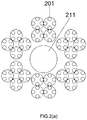
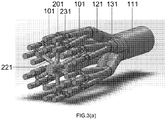
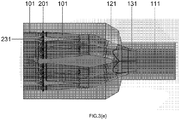
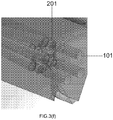
- FIG. 1 An exemplary arrangements is shown in Figures 1-3 .
- the steam channels of an exemplary device may be arranged such that there are 24 steam channels ( FIG. 1a ). It should be understood that the 24 channel design is exemplary only and is not limiting or required, as other numbers of channels may be used. These 24 steam channels converge into a single large outlet ( FIG. 1a , FIG. 1b ). The flow length of each channel is the same.
- each steam channel addresses four resin channels ( FIG. 1a , 2a , and 3 ), i.e., 96 resin channels.
- Each channel has the same length; in this way, the pressure is equalized throughout the system. Same-length channels are not, however, required, as there is no requirement that pressure be equalized within the system.
- An outlet may include some measure of choke. As the area decreases, the flow will choke and a standing shock wave will be formed in the zone. A choke, however, allows the user to reduce the amount of steam used while also maintaining good performance.
- the polymer After the dried polymer is collected, the polymer then may enter a supertube (i.e., a steam-jacketed or otherwise heated pipe), which supertube conveys the powder and steam to a cyclone for further processing.
- a supertube i.e., a steam-jacketed or otherwise heated pipe
- the steam and methylene phase may be condensed and then separated.
- the polymer particles have hardened, and phase separation allows a used to process the particles.
- the disclosed systems and methods offer a number of advantages.
- the disclosed systems and methods allow a user to use less energy to dry polymer powder - because the polymer particles that exit the steam stage of the system are comparatively dry, the user may use less energy at the downstream stages (e.g., using what may be termed a supertube) to further dry and further process the particles.
- the disclosed technology also affords a better yield of polymer particles from resin, as well as an increased control over particle size distribution.
- the preferred particle size distribution is one that is neither too coarse nor too fine.
- Coarse fractions less than 1.5 weight % are preferred (though not required); higher amounts lead to difficulties in full removal of water and other volatile species. Fine fractions can be less than 5%, with less than 4% preferred, since higher amounts can make the powder difficult to handle and can reduce the bulk density.
- the weight % of material that is greater than 20 mesh gives an idea of the average particle size in the polycarbonate.
- 50 weight % greater than 20 mesh would mean that the average particle diameter would be in the range of 0.840-1.410 mm.
- a preferred range for the wt% greater than >20 mesh is 40 to 70%.
- Less than 40% means that the powder contains a large amount of fines.
- Greater than 70% above 20 mesh means that the powder has a large fraction of large diameter particles that, in some (but not all instances) can adversely affect the removal of solvent and water from the particles.
- the disclosed technology may be configured to give rise to a product wherein from (or from) 40 to (or from) 70% of the product is greater than 20 mesh.
- the disclosed technology affords drier polymer particles, which drier particles require less energy to ship and otherwise process. Drier powder is easier to densify, which saves space - and energy - with shipping.
Landscapes
- Chemical & Material Sciences (AREA)
- Engineering & Computer Science (AREA)
- Mechanical Engineering (AREA)
- Organic Chemistry (AREA)
- Chemical Kinetics & Catalysis (AREA)
- Manufacturing & Machinery (AREA)
- Materials Engineering (AREA)
- Processes Of Treating Macromolecular Substances (AREA)
Claims (14)
- Ein Polymerausfällungssystem, umfassend:eine erste Vielzahl von Harzkanälen (201), die für Fluidverbindung mit einer Harzzufuhr konfiguriert sind;ein erster Dampfkanal (101) in Fluidverbindung mit der ersten Vielzahl von Harzkanälen unddie erste Vielzahl von Harzkanälen ist so konfiguriert, dass Harz in das Innere des ersten Dampfkanals zugeführt wird;eine zweite Vielzahl von Harzkanälen (201), die für Fluidverbindung mit der Harzzufuhr konfiguriert sind;ein zweiter Dampfkanal (101) in Fluidverbindung mit der zweiten Vielzahl von Harzkanälen, unddie zweite Vielzahl von Harzkanälen ist so konfiguriert, dass Harz in das Innere des zweiten Dampfkanals zugeführt wird; undder erste und zweite Dampfkanal laufen in einem ersten Verteiler der Stufe 1 (121) zusammen.
- Das System nach Anspruch 1, wobei der erste Verteiler der Stufe 1 eine Querschnittsfläche innerhalb von 20 % der Gesamtquerschnittsfläche der Dampfkanäle aufweist, die in Fluidverbindung mit dem ersten Verteiler der Stufe 1 stehen.
- Das System nach Anspruch 1, wobei mindestens eine der ersten und zweiten Vielzahlen von Harzkanälen 2 bis 50 Kanäle umfasst.
- Das System nach Anspruch 1, ferner umfassend einen dritten Dampfkanal und einem vierten Dampfkanal, wobei der dritte und vierte Dampfkanal in Fluidverbindung mit jeweils einer dritten und vierten Vielzahl von Harzkanälen stehen.
- Das System nach Anspruch 4, wobei der erste Verteiler der Stufe 1 so konfiguriert ist, dass er einen oder beide der dritten und vierten Dampfkanäle aufnimmt.
- Das System nach Anspruch 4, ferner umfassend einen zweiten Verteiler der Stufe 1, wobei der zweite Verteiler der Stufe 1 so konfiguriert ist, dass er einen oder beide der dritten und vierten Dampfkanäle aufnimmt.
- Das System nach Anspruch 4, ferner umfassend einen zweiten Verteiler der Stufe 1, der zweite Verteiler der Stufe 1 ist so konfiguriert, dass er einen oder beide der dritten und vierten Dampfkanäle aufnimmt, und ferner umfassend einen ersten Verteiler der Stufe 2 (131), der so konfiguriert ist, dass er einen oder beide des ersten Verteilers der Stufe 1 und des zweiten Verteilers der Stufe 1 aufnimmt.
- Das System nach Anspruch 1, das System umfassend 2 bis 30 Verteiler der Stufe 1, wobei mindestens 2 der Verteiler der Stufe 1 2 bis 50 Harzkanäle aufnehmen.
- Das System nach Anspruch 8, ferner umfassend 2 bis 30 Verteiler der Stufe 2.
- Das System nach Anspruch 7, wobei mindestens 2 Verteiler der Stufe 2 2 oder mehr Verteiler der Stufe 1 aufnehmen.
- Das System nach Anspruch 10, ferner umfassend mindestens einen Verteiler der Stufe 3, wobei der mindestens eine Verteiler der Stufe 3 mindestens einen Verteiler der Stufe 2 aufnimmt.
- Das System nach Anspruch 7, wobei die Querschnittsfläche des Verteilers der Stufe 2 kleiner ist als die Gesamtquerschnittsfläche des Verteilers der Stufe 1, der den Verteiler der Stufe 2 aufnimmt.
- Das System nach Anspruch 12, wobei die Querschnittsfläche des Verteilers der Stufe 3 kleiner ist als die Gesamtquerschnittsfläche des Verteilers der Stufe 2, der den Verteiler der Stufe 3 aufnimmt.
- Das System nach Anspruch 12, wobei mindestens zwei von (a) einem Harzkanal, (b) einem Dampfkanal und (c) einem Verteiler der Stufe 1, der Stufe 2 und der Stufe 3 in einem Werkstück ausgebildet sind.
Applications Claiming Priority (2)
| Application Number | Priority Date | Filing Date | Title |
|---|---|---|---|
| US201562135974P | 2015-03-20 | 2015-03-20 | |
| PCT/US2016/022883 WO2016153922A1 (en) | 2015-03-20 | 2016-03-17 | Improved drying systems |
Publications (2)
| Publication Number | Publication Date |
|---|---|
| EP3271060A1 EP3271060A1 (de) | 2018-01-24 |
| EP3271060B1 true EP3271060B1 (de) | 2020-08-26 |
Family
ID=55699806
Family Applications (1)
| Application Number | Title | Priority Date | Filing Date |
|---|---|---|---|
| EP16715393.1A Active EP3271060B1 (de) | 2015-03-20 | 2016-03-17 | Verbesserte trocknungssysteme für polymere |
Country Status (5)
| Country | Link |
|---|---|
| US (1) | US11040320B2 (de) |
| EP (1) | EP3271060B1 (de) |
| KR (1) | KR102101279B1 (de) |
| CN (1) | CN107405586A (de) |
| WO (1) | WO2016153922A1 (de) |
Families Citing this family (1)
| Publication number | Priority date | Publication date | Assignee | Title |
|---|---|---|---|---|
| US11701625B2 (en) * | 2021-05-05 | 2023-07-18 | Gideon Vandegrift | Multiple-Venturi nozzle, system, method of manufacture and method of use |
Family Cites Families (19)
| Publication number | Priority date | Publication date | Assignee | Title |
|---|---|---|---|---|
| US3074923A (en) | 1959-08-20 | 1963-01-22 | Allied Chem | Recovery of chlorinated polyethylene wax from solution by spray drying |
| US3508339A (en) * | 1965-11-30 | 1970-04-28 | Gen Electric | Drying apparatus and process |
| DE2635147C3 (de) * | 1976-08-05 | 1979-02-08 | Sandvik Conveyor Gmbh, 7012 Fellbach | Vorrichtung zur Herstellung von festen Teilchen |
| US4209912A (en) | 1978-01-16 | 1980-07-01 | General Electric Company | Process and apparatus for the drying of resinous materials |
| IT1094162B (it) | 1978-02-22 | 1985-07-26 | Montedison Spa | Processo in continuo per il recupero del policarbonato da sue soluzioni |
| US4568418A (en) | 1981-08-12 | 1986-02-04 | The Dow Chemical Company | Process for converting polymer solutions into granules |
| US5253991A (en) | 1989-11-20 | 1993-10-19 | Sumitomo Cement Co., Ltd. | Apparatus for producing spheroidal inorganic particulate material |
| DE4224025C2 (de) | 1992-07-21 | 1996-11-14 | Bayer Ag | Verfahren zur Isolierung von Polycarbonaten aus ihren Lösungen |
| EP0616002B1 (de) | 1992-09-18 | 1998-03-04 | Idemitsu Petrochemical Co., Ltd. | Verfahren zur herstellung eines polykarbonatpulvers |
| GB9413202D0 (en) | 1994-06-30 | 1994-08-24 | Univ Bradford | Method and apparatus for the formation of particles |
| US5615831A (en) | 1995-06-05 | 1997-04-01 | General Electric Company | Steam precipitation jet |
| EP0783011A3 (de) * | 1996-01-05 | 1998-07-08 | Bayer Ag | Verfahren zur Isolierung von teilkristallinem Polycarbonatpulver |
| DE19608521A1 (de) | 1996-03-06 | 1997-09-11 | Bayer Ag | Verfahren zur Herstellung von Polycarbonatagglomerat |
| DE10050720A1 (de) * | 2000-10-13 | 2002-04-25 | Basell Polyolefine Gmbh | Verfahren und Vorrichtung zur thermischen Behandlung pulver- oder granulatförmig vorliegenden Materials |
| US6362304B1 (en) | 2000-11-29 | 2002-03-26 | General Electric Company | Resin preheating for steam precipitation jet polycarbonate resin isolation |
| AU2003284210A1 (en) * | 2002-10-15 | 2004-05-04 | Vast Power Systems, Inc. | Method and apparatus for mixing fluids |
| DE102004059069A1 (de) * | 2004-12-07 | 2006-06-08 | Bühler AG | Vertropfungsanlage |
| CN202590663U (zh) * | 2012-02-23 | 2012-12-12 | 陆宏圻 | 组合式可调喷射器 |
| US8827684B1 (en) | 2013-12-23 | 2014-09-09 | Radiant Fabrication | 3D printer and printhead unit with multiple filaments |
-
2016
- 2016-03-17 CN CN201680015383.7A patent/CN107405586A/zh active Pending
- 2016-03-17 WO PCT/US2016/022883 patent/WO2016153922A1/en not_active Ceased
- 2016-03-17 US US15/558,658 patent/US11040320B2/en active Active
- 2016-03-17 KR KR1020177025704A patent/KR102101279B1/ko not_active Expired - Fee Related
- 2016-03-17 EP EP16715393.1A patent/EP3271060B1/de active Active
Non-Patent Citations (1)
| Title |
|---|
| None * |
Also Published As
| Publication number | Publication date |
|---|---|
| CN107405586A (zh) | 2017-11-28 |
| KR20170118790A (ko) | 2017-10-25 |
| US11040320B2 (en) | 2021-06-22 |
| US20180111104A1 (en) | 2018-04-26 |
| KR102101279B1 (ko) | 2020-04-17 |
| EP3271060A1 (de) | 2018-01-24 |
| WO2016153922A1 (en) | 2016-09-29 |
Similar Documents
| Publication | Publication Date | Title |
|---|---|---|
| EP1453890B1 (de) | Herstellen kugelförmiger partikel aus einer schmelze aus kunststoff | |
| EP1444286B1 (de) | Verfahren und vorrichtung zur herstellulng von polyestern, copolyestern and polycarbonaten | |
| EP2101972B1 (de) | Verfahren zur herstellung homogen kristallisierter polykondensatgranulate | |
| EP0017510B1 (de) | Spinnverfahren und -vorrichtung | |
| CN103304692B (zh) | 烯烃聚合装置和烯烃聚合方法 | |
| EP3271060B1 (de) | Verbesserte trocknungssysteme für polymere | |
| CN108698310A (zh) | 改进性能的单丝制造物品 | |
| KR20180095672A (ko) | 원통형 반응기 및 연속 히드로포르밀화를 위한 그의 용도 | |
| EP1129124B1 (de) | Verfahren und anlage zum herstellen von pet-granulat | |
| EP1140754B1 (de) | Verfahren und vorrichtung zur herstellung von bisphenol-a-prills und danach hergestellte bisphenol-a-prills | |
| EP3271126B1 (de) | Verbesserte trockenmethode | |
| US11860618B2 (en) | Apparatus, system and method of forming polymer microspheres for use in additive manufacturing | |
| WO2014180817A1 (de) | Verfahren zum sprühbeschichten | |
| WO2001019580A1 (de) | Verfahren zum konfektionieren von bei raumtemperatur festen polyamidharzen | |
| RU2550356C2 (ru) | Способ и устройство для получения частично кристаллизованного полимерного материала | |
| EP4556111A2 (de) | Wirbelschichtgranulation | |
| KR20140086387A (ko) | 발포시트 압출장치 | |
| CN103934941B (zh) | 一种热回流高速熔炼螺旋推押装置 |
Legal Events
| Date | Code | Title | Description |
|---|---|---|---|
| STAA | Information on the status of an ep patent application or granted ep patent |
Free format text: STATUS: THE INTERNATIONAL PUBLICATION HAS BEEN MADE |
|
| PUAI | Public reference made under article 153(3) epc to a published international application that has entered the european phase |
Free format text: ORIGINAL CODE: 0009012 |
|
| STAA | Information on the status of an ep patent application or granted ep patent |
Free format text: STATUS: REQUEST FOR EXAMINATION WAS MADE |
|
| 17P | Request for examination filed |
Effective date: 20170915 |
|
| AK | Designated contracting states |
Kind code of ref document: A1 Designated state(s): AL AT BE BG CH CY CZ DE DK EE ES FI FR GB GR HR HU IE IS IT LI LT LU LV MC MK MT NL NO PL PT RO RS SE SI SK SM TR |
|
| AX | Request for extension of the european patent |
Extension state: BA ME |
|
| RIN1 | Information on inventor provided before grant (corrected) |
Inventor name: GAUTAM, PANKAJ, SINGH Inventor name: HOCKER, THOMAS Inventor name: HOLLAR, WILLIAM, E., JR. Inventor name: MAHOOD, JAMES, ALAN Inventor name: PETERS, RICHARD |
|
| RAP3 | Party data changed (applicant data changed or rights of an application transferred) |
Owner name: SABIC GLOBAL TECHNOLOGIES B.V. |
|
| DAV | Request for validation of the european patent (deleted) | ||
| DAX | Request for extension of the european patent (deleted) | ||
| GRAP | Despatch of communication of intention to grant a patent |
Free format text: ORIGINAL CODE: EPIDOSNIGR1 |
|
| STAA | Information on the status of an ep patent application or granted ep patent |
Free format text: STATUS: GRANT OF PATENT IS INTENDED |
|
| INTG | Intention to grant announced |
Effective date: 20200422 |
|
| GRAS | Grant fee paid |
Free format text: ORIGINAL CODE: EPIDOSNIGR3 |
|
| GRAA | (expected) grant |
Free format text: ORIGINAL CODE: 0009210 |
|
| STAA | Information on the status of an ep patent application or granted ep patent |
Free format text: STATUS: THE PATENT HAS BEEN GRANTED |
|
| AK | Designated contracting states |
Kind code of ref document: B1 Designated state(s): AL AT BE BG CH CY CZ DE DK EE ES FI FR GB GR HR HU IE IS IT LI LT LU LV MC MK MT NL NO PL PT RO RS SE SI SK SM TR |
|
| REG | Reference to a national code |
Ref country code: GB Ref legal event code: FG4D |
|
| REG | Reference to a national code |
Ref country code: CH Ref legal event code: EP |
|
| REG | Reference to a national code |
Ref country code: DE Ref legal event code: R096 Ref document number: 602016042704 Country of ref document: DE |
|
| REG | Reference to a national code |
Ref country code: AT Ref legal event code: REF Ref document number: 1305828 Country of ref document: AT Kind code of ref document: T Effective date: 20200915 |
|
| REG | Reference to a national code |
Ref country code: IE Ref legal event code: FG4D |
|
| REG | Reference to a national code |
Ref country code: LT Ref legal event code: MG4D |
|
| PG25 | Lapsed in a contracting state [announced via postgrant information from national office to epo] |
Ref country code: FI Free format text: LAPSE BECAUSE OF FAILURE TO SUBMIT A TRANSLATION OF THE DESCRIPTION OR TO PAY THE FEE WITHIN THE PRESCRIBED TIME-LIMIT Effective date: 20200826 Ref country code: NO Free format text: LAPSE BECAUSE OF FAILURE TO SUBMIT A TRANSLATION OF THE DESCRIPTION OR TO PAY THE FEE WITHIN THE PRESCRIBED TIME-LIMIT Effective date: 20201126 Ref country code: GR Free format text: LAPSE BECAUSE OF FAILURE TO SUBMIT A TRANSLATION OF THE DESCRIPTION OR TO PAY THE FEE WITHIN THE PRESCRIBED TIME-LIMIT Effective date: 20201127 Ref country code: BG Free format text: LAPSE BECAUSE OF FAILURE TO SUBMIT A TRANSLATION OF THE DESCRIPTION OR TO PAY THE FEE WITHIN THE PRESCRIBED TIME-LIMIT Effective date: 20201126 Ref country code: SE Free format text: LAPSE BECAUSE OF FAILURE TO SUBMIT A TRANSLATION OF THE DESCRIPTION OR TO PAY THE FEE WITHIN THE PRESCRIBED TIME-LIMIT Effective date: 20200826 Ref country code: PT Free format text: LAPSE BECAUSE OF FAILURE TO SUBMIT A TRANSLATION OF THE DESCRIPTION OR TO PAY THE FEE WITHIN THE PRESCRIBED TIME-LIMIT Effective date: 20201228 Ref country code: LT Free format text: LAPSE BECAUSE OF FAILURE TO SUBMIT A TRANSLATION OF THE DESCRIPTION OR TO PAY THE FEE WITHIN THE PRESCRIBED TIME-LIMIT Effective date: 20200826 Ref country code: HR Free format text: LAPSE BECAUSE OF FAILURE TO SUBMIT A TRANSLATION OF THE DESCRIPTION OR TO PAY THE FEE WITHIN THE PRESCRIBED TIME-LIMIT Effective date: 20200826 |
|
| REG | Reference to a national code |
Ref country code: NL Ref legal event code: MP Effective date: 20200826 |
|
| REG | Reference to a national code |
Ref country code: AT Ref legal event code: MK05 Ref document number: 1305828 Country of ref document: AT Kind code of ref document: T Effective date: 20200826 |
|
| PG25 | Lapsed in a contracting state [announced via postgrant information from national office to epo] |
Ref country code: PL Free format text: LAPSE BECAUSE OF FAILURE TO SUBMIT A TRANSLATION OF THE DESCRIPTION OR TO PAY THE FEE WITHIN THE PRESCRIBED TIME-LIMIT Effective date: 20200826 Ref country code: LV Free format text: LAPSE BECAUSE OF FAILURE TO SUBMIT A TRANSLATION OF THE DESCRIPTION OR TO PAY THE FEE WITHIN THE PRESCRIBED TIME-LIMIT Effective date: 20200826 Ref country code: RS Free format text: LAPSE BECAUSE OF FAILURE TO SUBMIT A TRANSLATION OF THE DESCRIPTION OR TO PAY THE FEE WITHIN THE PRESCRIBED TIME-LIMIT Effective date: 20200826 Ref country code: NL Free format text: LAPSE BECAUSE OF FAILURE TO SUBMIT A TRANSLATION OF THE DESCRIPTION OR TO PAY THE FEE WITHIN THE PRESCRIBED TIME-LIMIT Effective date: 20200826 Ref country code: IS Free format text: LAPSE BECAUSE OF FAILURE TO SUBMIT A TRANSLATION OF THE DESCRIPTION OR TO PAY THE FEE WITHIN THE PRESCRIBED TIME-LIMIT Effective date: 20201226 |
|
| PG25 | Lapsed in a contracting state [announced via postgrant information from national office to epo] |
Ref country code: EE Free format text: LAPSE BECAUSE OF FAILURE TO SUBMIT A TRANSLATION OF THE DESCRIPTION OR TO PAY THE FEE WITHIN THE PRESCRIBED TIME-LIMIT Effective date: 20200826 Ref country code: RO Free format text: LAPSE BECAUSE OF FAILURE TO SUBMIT A TRANSLATION OF THE DESCRIPTION OR TO PAY THE FEE WITHIN THE PRESCRIBED TIME-LIMIT Effective date: 20200826 Ref country code: SM Free format text: LAPSE BECAUSE OF FAILURE TO SUBMIT A TRANSLATION OF THE DESCRIPTION OR TO PAY THE FEE WITHIN THE PRESCRIBED TIME-LIMIT Effective date: 20200826 Ref country code: CZ Free format text: LAPSE BECAUSE OF FAILURE TO SUBMIT A TRANSLATION OF THE DESCRIPTION OR TO PAY THE FEE WITHIN THE PRESCRIBED TIME-LIMIT Effective date: 20200826 Ref country code: DK Free format text: LAPSE BECAUSE OF FAILURE TO SUBMIT A TRANSLATION OF THE DESCRIPTION OR TO PAY THE FEE WITHIN THE PRESCRIBED TIME-LIMIT Effective date: 20200826 |
|
| REG | Reference to a national code |
Ref country code: DE Ref legal event code: R097 Ref document number: 602016042704 Country of ref document: DE |
|
| PG25 | Lapsed in a contracting state [announced via postgrant information from national office to epo] |
Ref country code: ES Free format text: LAPSE BECAUSE OF FAILURE TO SUBMIT A TRANSLATION OF THE DESCRIPTION OR TO PAY THE FEE WITHIN THE PRESCRIBED TIME-LIMIT Effective date: 20200826 Ref country code: AL Free format text: LAPSE BECAUSE OF FAILURE TO SUBMIT A TRANSLATION OF THE DESCRIPTION OR TO PAY THE FEE WITHIN THE PRESCRIBED TIME-LIMIT Effective date: 20200826 Ref country code: AT Free format text: LAPSE BECAUSE OF FAILURE TO SUBMIT A TRANSLATION OF THE DESCRIPTION OR TO PAY THE FEE WITHIN THE PRESCRIBED TIME-LIMIT Effective date: 20200826 |
|
| PG25 | Lapsed in a contracting state [announced via postgrant information from national office to epo] |
Ref country code: SK Free format text: LAPSE BECAUSE OF FAILURE TO SUBMIT A TRANSLATION OF THE DESCRIPTION OR TO PAY THE FEE WITHIN THE PRESCRIBED TIME-LIMIT Effective date: 20200826 |
|
| PLBE | No opposition filed within time limit |
Free format text: ORIGINAL CODE: 0009261 |
|
| STAA | Information on the status of an ep patent application or granted ep patent |
Free format text: STATUS: NO OPPOSITION FILED WITHIN TIME LIMIT |
|
| PG25 | Lapsed in a contracting state [announced via postgrant information from national office to epo] |
Ref country code: IT Free format text: LAPSE BECAUSE OF FAILURE TO SUBMIT A TRANSLATION OF THE DESCRIPTION OR TO PAY THE FEE WITHIN THE PRESCRIBED TIME-LIMIT Effective date: 20200826 |
|
| 26N | No opposition filed |
Effective date: 20210527 |
|
| PG25 | Lapsed in a contracting state [announced via postgrant information from national office to epo] |
Ref country code: SI Free format text: LAPSE BECAUSE OF FAILURE TO SUBMIT A TRANSLATION OF THE DESCRIPTION OR TO PAY THE FEE WITHIN THE PRESCRIBED TIME-LIMIT Effective date: 20200826 |
|
| PG25 | Lapsed in a contracting state [announced via postgrant information from national office to epo] |
Ref country code: MC Free format text: LAPSE BECAUSE OF FAILURE TO SUBMIT A TRANSLATION OF THE DESCRIPTION OR TO PAY THE FEE WITHIN THE PRESCRIBED TIME-LIMIT Effective date: 20200826 |
|
| REG | Reference to a national code |
Ref country code: CH Ref legal event code: PL |
|
| GBPC | Gb: european patent ceased through non-payment of renewal fee |
Effective date: 20210317 |
|
| REG | Reference to a national code |
Ref country code: BE Ref legal event code: MM Effective date: 20210331 |
|
| PG25 | Lapsed in a contracting state [announced via postgrant information from national office to epo] |
Ref country code: GB Free format text: LAPSE BECAUSE OF NON-PAYMENT OF DUE FEES Effective date: 20210317 Ref country code: IE Free format text: LAPSE BECAUSE OF NON-PAYMENT OF DUE FEES Effective date: 20210317 Ref country code: FR Free format text: LAPSE BECAUSE OF NON-PAYMENT OF DUE FEES Effective date: 20210331 Ref country code: CH Free format text: LAPSE BECAUSE OF NON-PAYMENT OF DUE FEES Effective date: 20210331 Ref country code: LI Free format text: LAPSE BECAUSE OF NON-PAYMENT OF DUE FEES Effective date: 20210331 Ref country code: LU Free format text: LAPSE BECAUSE OF NON-PAYMENT OF DUE FEES Effective date: 20210317 |
|
| PG25 | Lapsed in a contracting state [announced via postgrant information from national office to epo] |
Ref country code: BE Free format text: LAPSE BECAUSE OF NON-PAYMENT OF DUE FEES Effective date: 20210331 |
|
| PG25 | Lapsed in a contracting state [announced via postgrant information from national office to epo] |
Ref country code: CY Free format text: LAPSE BECAUSE OF FAILURE TO SUBMIT A TRANSLATION OF THE DESCRIPTION OR TO PAY THE FEE WITHIN THE PRESCRIBED TIME-LIMIT Effective date: 20200826 |
|
| P01 | Opt-out of the competence of the unified patent court (upc) registered |
Effective date: 20230529 |
|
| PG25 | Lapsed in a contracting state [announced via postgrant information from national office to epo] |
Ref country code: HU Free format text: LAPSE BECAUSE OF FAILURE TO SUBMIT A TRANSLATION OF THE DESCRIPTION OR TO PAY THE FEE WITHIN THE PRESCRIBED TIME-LIMIT; INVALID AB INITIO Effective date: 20160317 |
|
| PG25 | Lapsed in a contracting state [announced via postgrant information from national office to epo] |
Ref country code: MK Free format text: LAPSE BECAUSE OF FAILURE TO SUBMIT A TRANSLATION OF THE DESCRIPTION OR TO PAY THE FEE WITHIN THE PRESCRIBED TIME-LIMIT Effective date: 20200826 |
|
| PG25 | Lapsed in a contracting state [announced via postgrant information from national office to epo] |
Ref country code: TR Free format text: LAPSE BECAUSE OF FAILURE TO SUBMIT A TRANSLATION OF THE DESCRIPTION OR TO PAY THE FEE WITHIN THE PRESCRIBED TIME-LIMIT Effective date: 20200826 |
|
| PG25 | Lapsed in a contracting state [announced via postgrant information from national office to epo] |
Ref country code: MT Free format text: LAPSE BECAUSE OF FAILURE TO SUBMIT A TRANSLATION OF THE DESCRIPTION OR TO PAY THE FEE WITHIN THE PRESCRIBED TIME-LIMIT Effective date: 20200826 |
|
| PGFP | Annual fee paid to national office [announced via postgrant information from national office to epo] |
Ref country code: DE Payment date: 20260327 Year of fee payment: 11 |