EP3273604A1 - Trellisdekodierung mit verringerung der trelliszustände basierend auf a priori kenntnis über bits eines kontrollkanals - Google Patents
Trellisdekodierung mit verringerung der trelliszustände basierend auf a priori kenntnis über bits eines kontrollkanals Download PDFInfo
- Publication number
- EP3273604A1 EP3273604A1 EP16179970.5A EP16179970A EP3273604A1 EP 3273604 A1 EP3273604 A1 EP 3273604A1 EP 16179970 A EP16179970 A EP 16179970A EP 3273604 A1 EP3273604 A1 EP 3273604A1
- Authority
- EP
- European Patent Office
- Prior art keywords
- trellis
- sequence
- information
- context redundancy
- decoding
- Prior art date
- Legal status (The legal status is an assumption and is not a legal conclusion. Google has not performed a legal analysis and makes no representation as to the accuracy of the status listed.)
- Granted
Links
Images




Classifications
-
- G—PHYSICS
- G06—COMPUTING OR CALCULATING; COUNTING
- G06F—ELECTRIC DIGITAL DATA PROCESSING
- G06F11/00—Error detection; Error correction; Monitoring
- G06F11/07—Responding to the occurrence of a fault, e.g. fault tolerance
- G06F11/16—Error detection or correction of the data by redundancy in hardware
- G06F11/18—Error detection or correction of the data by redundancy in hardware using passive fault-masking of the redundant circuits
-
- G—PHYSICS
- G06—COMPUTING OR CALCULATING; COUNTING
- G06F—ELECTRIC DIGITAL DATA PROCESSING
- G06F11/00—Error detection; Error correction; Monitoring
- G06F11/07—Responding to the occurrence of a fault, e.g. fault tolerance
- G06F11/14—Error detection or correction of the data by redundancy in operations
- G06F11/1479—Generic software techniques for error detection or fault masking
-
- H—ELECTRICITY
- H03—ELECTRONIC CIRCUITRY
- H03M—CODING; DECODING; CODE CONVERSION IN GENERAL
- H03M13/00—Coding, decoding or code conversion, for error detection or error correction; Coding theory basic assumptions; Coding bounds; Error probability evaluation methods; Channel models; Simulation or testing of codes
- H03M13/25—Error detection or forward error correction by signal space coding, i.e. adding redundancy in the signal constellation, e.g. Trellis Coded Modulation [TCM]
- H03M13/256—Error detection or forward error correction by signal space coding, i.e. adding redundancy in the signal constellation, e.g. Trellis Coded Modulation [TCM] with trellis coding, e.g. with convolutional codes and TCM
-
- H—ELECTRICITY
- H03—ELECTRONIC CIRCUITRY
- H03M—CODING; DECODING; CODE CONVERSION IN GENERAL
- H03M13/00—Coding, decoding or code conversion, for error detection or error correction; Coding theory basic assumptions; Coding bounds; Error probability evaluation methods; Channel models; Simulation or testing of codes
- H03M13/37—Decoding methods or techniques, not specific to the particular type of coding provided for in groups H03M13/03 - H03M13/35
- H03M13/39—Sequence estimation, i.e. using statistical methods for the reconstruction of the original codes
- H03M13/3994—Sequence estimation, i.e. using statistical methods for the reconstruction of the original codes using state pinning or decision forcing, i.e. the decoded sequence is forced through a particular trellis state or a particular set of trellis states or a particular decoded symbol
-
- H—ELECTRICITY
- H04—ELECTRIC COMMUNICATION TECHNIQUE
- H04L—TRANSMISSION OF DIGITAL INFORMATION, e.g. TELEGRAPHIC COMMUNICATION
- H04L1/00—Arrangements for detecting or preventing errors in the information received
- H04L1/004—Arrangements for detecting or preventing errors in the information received by using forward error control
- H04L1/0045—Arrangements at the receiver end
- H04L1/0052—Realisations of complexity reduction techniques, e.g. pipelining or use of look-up tables
-
- H—ELECTRICITY
- H04—ELECTRIC COMMUNICATION TECHNIQUE
- H04L—TRANSMISSION OF DIGITAL INFORMATION, e.g. TELEGRAPHIC COMMUNICATION
- H04L1/00—Arrangements for detecting or preventing errors in the information received
- H04L1/004—Arrangements for detecting or preventing errors in the information received by using forward error control
- H04L1/0045—Arrangements at the receiver end
- H04L1/0054—Maximum-likelihood or sequential decoding, e.g. Viterbi, Fano, ZJ algorithms
-
- H—ELECTRICITY
- H04—ELECTRIC COMMUNICATION TECHNIQUE
- H04L—TRANSMISSION OF DIGITAL INFORMATION, e.g. TELEGRAPHIC COMMUNICATION
- H04L1/00—Arrangements for detecting or preventing errors in the information received
- H04L1/004—Arrangements for detecting or preventing errors in the information received by using forward error control
- H04L1/0056—Systems characterized by the type of code used
- H04L1/0059—Convolutional codes
-
- H—ELECTRICITY
- H03—ELECTRONIC CIRCUITRY
- H03M—CODING; DECODING; CODE CONVERSION IN GENERAL
- H03M13/00—Coding, decoding or code conversion, for error detection or error correction; Coding theory basic assumptions; Coding bounds; Error probability evaluation methods; Channel models; Simulation or testing of codes
- H03M13/37—Decoding methods or techniques, not specific to the particular type of coding provided for in groups H03M13/03 - H03M13/35
- H03M13/39—Sequence estimation, i.e. using statistical methods for the reconstruction of the original codes
- H03M13/41—Sequence estimation, i.e. using statistical methods for the reconstruction of the original codes using the Viterbi algorithm or Viterbi processors
Definitions
- the disclosure relates to a decoding device and a decoding method that exploit context redundancy to reduce a number of trellis states.
- the disclosure relates to techniques for increasing decoding sensitivity by exploring context redundancy in mobile communication devices, in particular devices applying LTE (Long Term Evolution) D2D (device-to-device) side link communication.
- LTE Long Term Evolution
- D2D device-to-device
- a stream of information bits 112 is transferred from one point to another through a communication channel 130 and is therefore susceptible to noise 132.
- Forward Error Correction (FEC) techniques improve the channel capacity by carefully adding redundant information to the data being transmitted 110 through the channel 130.
- the transmitted data is encoded in such a way so that the receiver 120 can correct, as well as detect, errors caused by channel noise 132.
- Convolutional encoding 111 with Viterbi decoding 121 is a FEC technique that is well suited for such communication systems.
- the convolutional encoder 111 inserts redundant information bits into the data stream 112 so that the decoder 121 can reduce and correct errors caused by the channel 130.
- today's communication networks there is a steady need for further improvement of the coding sensitivity.
- the methods and devices described herein may be based on baseband processing methods and baseband processors for use in mobile devices and radio receivers, in particular LTE radio receivers. It is understood that comments made in connection with a described method may also hold true for a corresponding device configured to perform the method and vice versa. For example, if a specific method step is described, a corresponding device may include a unit to perform the described method step, even if such a unit is not explicitly described or illustrated in the figures. Further, it is understood that the features of the various exemplary aspects described herein may be combined with each other, unless specifically noted otherwise.
- the methods and devices described herein may be implemented in wireless communication networks, in particular communication networks based on mobile communication standards such as LTE, in particular LTE-A and/or OFDM.
- the methods and devices described below may be implemented in mobile devices (or mobile stations or User Equipments (UE)), in particular in radio receivers of such mobile devices.
- the described devices may include integrated circuits and/or passives and may be manufactured according to various technologies.
- the circuits may be designed as logic integrated circuits, analog integrated circuits, mixed signal integrated circuits, optical circuits, memory circuits and/or integrated passives.
- Radio signals may be or may include radio frequency signals radiated by a radio transmitting device (or radio transmitter or sender) with a radio frequency lying in a range of about 3 Hz to 300 GHz.
- the frequency range may correspond to frequencies of alternating current electrical signals used to produce and detect radio waves.
- LTE Long Term Evolution
- LTE-A Long Term Evolution-A
- OFDM is a scheme for encoding digital data on multiple carrier frequencies.
- a large number of closely spaced orthogonal sub-carrier signals may be used to carry data. Due to the orthogonality of the sub-carriers crosstalk between sub-carriers may be suppressed.
- LTE TDD mode systems e.g. LTE mode systems having a type 2 LTE frame structure.
- the type 2 LTE frame has an overall length of 10 milliseconds.
- the 10 ms frame comprises two half frames, each 5 ms long.
- the LTE half-frames are further split into five subframes, each 1 millisecond long.
- LTE D2D communication also named as LTE side link
- LTE side link is introduced since 3GPP release 12 [3GPP TS 36.211 chapter 9].
- D2D works in in-coverage and (partial) out-coverage scenarios.
- PSBCH side link broadcast channel
- PSBCH is carrying the side link MIB (MIB-SL) information (standardized according to 3GPP TS 36.331 section 6.5.2) and is embedded within the side link synchronization sub-frame (SLSS). It is coded by conventional code and the information bits of PSBCH are the following: 1.
- System bandwidth of D2D transmitted signal (N6, N15, N25, N50, N75 and N100).
- the TDD UL/DL configuration In case of TDD mode, the TDD UL/DL configuration. (For out-coverage UEs UL/DL config cannot be received by eNodeB SIB, but only by SLSS from another D2D transmitter). 4. A Boolean flag indicating whether the UE is within or outside of eNodeB coverage. For the (partial) out-coverage scenario, a successful decoding of PSBCH is a pre-condition of setting up the communications between two devices.
- the methods and devices described herein may be applied in the field of channel coding.
- channel coding it is assumed that the information bits are uncorrelated before being encoded. Then the redundancy is only added by the coding techniques itself. In this disclosure the redundancy within the context of the information bits is further explored, which is additional redundancy on top of the channel codes. By doing this the decoding sensitivity can be further improved.
- Methods and devices according to the disclosure are designed based on the concept that certain unrealistic and/ or invalid trellis states in a Viterbi decoder can be forbidden or removed based on the self-context redundancies or cross-context redundancies embedded inside the information bits context, for example the D2D PSBCH. Removing those unrealistic states completely blocks the error propagation for the unrealistic paths, and therefore improves efficiency for valid maximum-likelihood path search in a Viterbi decoder, especially in low SINR conditions.
- SLSS sub-frame index field occupies 4 bits but the range of a sub-frame index ranges from 0 to 9. So values 10 to 15 are invalid bits and the corresponding trellis states can be forbidden in PSBCH Viterbi decoder.
- system bandwidth field of PSBCH occupies 3 bits, but there are only 6 valid system bandwidth alternatives (N6 to N100).
- SLSS sub-frame index fields and TDD UL/DL configuration field are correlated: in case of TDD, SLSS sub-frame index must be an UL sub-frame (DL sub-frames are only for eNodB reception). This restricts the possibilities of UL/DL configuration field, and vice versa.
- Such correlation is used to jointly optimize trellis structure in the Viterbi decoder (offline or during run-time) as described hereinafter.
- the motivation is to improve the decoding sensitivity of the Viterbi decoder for the D2D PSBCH, so that, by making use of the same amount of SLSS sub-frames, a UE device can successfully decode the PSBCH at a lower signal interference noise ratio (SINR) level.
- SINR signal interference noise ratio
- Fig. 2 schematically illustrates an exemplary decoding method 200 according to the disclosure.
- the decoding method 200 includes providing 201 a sequence of information bits comprising context redundancy information, wherein the sequence of information bits is encoded based on a predefined channel code.
- the decoding method 200 includes generating 202 a plurality of trellis states based on the sequence of information bits and the channel code.
- the decoding method 200 includes reducing 203 the plurality of trellis states by at least one trellis state based on the context redundancy information.
- the decoding method 200 includes decoding 204 the sequence of information bits by using a metric based on the reduced number of trellis states.
- the decoding method 200 may be used in a Viterbi decoder 121 of a receiver 120 as described above with respect to Fig. 1 , where the sequence of information bits correspond to the information bits 112 which are encoded by the convolutional encoder 111 in the transmitter 110 with a predefined channel code.
- the context redundancy information may be provided at predefined positions of the sequence of information bits, e.g. at bit3-bit5 and/or bit16-bit19 as described below with respect to Fig. 4 .
- the context redundancy information may be provided as a bit field comprising at least one invalid bit combination, e.g. as TDD-ULDL-config bit field 402 and/or SLSS bub-frame number bit field 404 as described below with respect to Fig. 4 .
- the sequence of information bits may be correlated by the context redundancy information before being encoded by the channel code.
- the decoding method 200 may further include removing trellis states which correspond to invalid bit allocations in the sequence of information bits. Invalid bit allocations may be not defined bit allocations or bit allocations that cannot occur. The decoding method 200 may further include removing trellis states which correspond to invalid field combinations in the sequence of information bits. Invalid (bit) field allocations may be not defined bit field allocations or bit field allocations that cannot occur.
- the decoding method 200 may further include removing trellis states which can only be reached by invalid paths.
- the decoding method 200 may further include providing the reduced number of trellis states during an offline processing, e.g. as described below.
- the decoding method 200 may further include providing the reduced number of trellis states during an online processing, e.g. as described below.
- the decoding method 200 may further include providing the reduced number of trellis states based on trace back for decoding the context redundancy information, e.g. as described below with respect to Fig. 3 .
- the decoding method 200 may further include using the decoded context redundancy information to restrict the plurality of trellis states, e.g. as described below with respect to Fig. 3 .
- the decoding method 200 may further include providing the reduced number of trellis states based on evaluating probabilities for different possible context redundancy information, e.g. as described below with respect to Fig. 3 .
- the decoding method 200 may further include providing the reduced number of trellis states based on evaluating hypotheses of different possible context redundancy information, e.g. as described below.
- the decoding method 200 may include evaluating the hypotheses based on a cyclic redundancy check, e.g. as described below with respect to Fig. 6 .
- the context redundancy information may include self-context redundancy information and/or cross-context redundancy information, e.g. as described below and with respect to Fig. 4 .
- the self-context redundancy information may include self-context redundancy of a bit field indicating a side link bandwidth within a side link master information block (SL-MIB) for device-to-device (D2D) communication, e.g. as described below.
- the cross-context redundancy information may include cross-context redundancy between a bit field indicating a time division duplex uplink downlink (TDD-ULDL) configuration and a bit field indicating a sub-frame number (SLSS), e.g. as described below.
- the decoding method 200 may further include decoding the sequence of information bits based on Viterbi decoding, e.g. by a Viterbi decoder 121 as described above with respect to Fig. 1 .
- method 200 may be specifically realized by the following two methods, denoted as “method 1” and “method 2” hereinafter, each one including respective modifications, denoted as “sub-method 1 of method 1", “sub-method 2 of method 1” and “modified version of method 2" hereinafter.
- method 1 and method 2 may be realized either standalone or combined.
- offline trellis reduction is done by removing the states corresponding to invalid information bit allocations or field combinations.
- the path metric of the invalid states can be forced to be a very high value, and then it behaves equivalently like being removed.
- This method can also be divided into two sub-methods: the offline trellis reduction making use of self-context redundancy (i.e. invalid bit allocations) and offline trellis reduction making use of cross-context redundancy (i.e. invalid field combinations).
- This method does not need real-time demodulated soft-input bits so it can be done offline by PC simulation, for example.
- method 2 (also denoted as the run-time method) during Viterbi decoding, early trace back is done to early decode the TDD-ULDL-config field and use this decoded TDD-ULDL-config information to further restrict certain trellis states of the SLSS sub-frame index field.
- This method needs real-time received soft-input bits so it can be done in the decoding run-time.
- a modified version of this method is provided where no early trace back is done to early detect TDD-ULDL-config but different hypothesis of different possible TDD-ULDL configurations are used. Then the SLSS sub-frame number field can be restricted based on each TDD-ULDL-config hypothesis in the same way.
- the whole decoded bit stream which passes CRC check is the final decoded information bits.
- the modified version gives even better sensitivity because the false decoding rate of early TDD-ULDL-config can be avoided. But it needs higher computation power because PSBCH decoding is performed more than once.
- Each of the above described two methods can work as standalone without the other. But also they can work in a two-step combined way as described in the following: That is to first use the offline method to reduce the trellis before decoding is started, and then use the run-time method based on the reduced trellis for run-time decoding. This will jointly improve the decoding performance.
- offline trellis reduction is done by exploring the PSBCH self-context as well as cross-context redundancy. That can be done by removing unrealistic and/or invalid trellis states by offline computation.
- the optimal trellis structure can be derived without the need of demodulated soft-input bits, so it can be done before decoding starts.
- sub-method 1 of method 1 the self-context redundancy is explored by removing the trellis states corresponding to invalid bit allocations.
- Figure 3 shows an example for forbidden stage propagation including backward propagation and forward propagation as described in the following.
- the forbidden state propagation process can be done in an iterative way until all invalid states are cleared.
- sub-method 2 of method 1 the cross-context redundancy between TDD-ULDL-config field 402 (see Fig. 4 ) and SLSS sub-frame field 404 (see Fig. 4 ) is explored by checking invalid field combinations to further reduce the trellis.
- An approach is to offline setup a table with all invalid field combinations. For example, TDD-ULDL-config two, together with SLSS sub-frame number of 3 generates an invalid field combination: in TDD-ULDL-config two, sub-frame index 3 is a DL sub-frame but D2D SLSS sub-frame in TDD mode can only be an UL sub-frame. Such example of invalid field combination is further shown in Figure 4 .
- an invalid field combination results in not only 1 path but 2 ⁇ (40-7), i.e. 2 to the power of 33 paths through the complete trellis of the PSBCH Viterbi decoder.
- the total number of invalid paths is M*2 ⁇ (40-7) where M is the total number of invalid field combinations between TDD-ULDL-config 402 and SLSS Sub-frame 404 number.
- M is the total number of invalid field combinations between TDD-ULDL-config 402 and SLSS Sub-frame 404 number.
- states which can only be reached by invalid paths are declared to be invalid states and can be removed from the trellis. This process can be performed offline by PC simulation, for example and so it does not introduce any complexity to real decoder implementation.
- the PSBCH cross-context redundancy is explored to disable invalid states in decoding run-time.
- demodulated soft-input bits may be required.
- the TDD-ULDL-config field 402 can be decoded beforehand.
- the SLSS sub-frame number fields can be better restricted and therefore more invalid states can be disabled which are corresponding to it.
- the decoding result of TDD-ULDL-config 402 is 2, then it is known that the valid values for SLSS Sub-frame number can only be 2 or 7. This further restricts the number of possible SLSS Sub-frame index from 10 down to 2.
- the procedure of method 2 is shown in Figure 5 :
- the first step 501 includes trellis path metric computation and path selection until the first bit of SLSS sub-frame number field 404.
- the second step 502 includes early trellis trace back to detect TDD-ULDL config 402.
- the third step 503 includes forbid more invalid states for invalid SLSS-sub-frame 404 numbers based on detected TDD-ULDL-config 402.
- the fourth step 504 includes continue with trellis path metric computation and path selection until the final information bit.
- the fifth step 505 includes do final trace back to decode the full stream.
- An early trace back as described herein means a trace back at an early stage in the trellis in order to early decode the context redundancy information and hence to restrict of remove unused trellis states as early as possible.
- early TDD-ULDL-Config decoding step can be replaced by a hypothesis based approach while leaving the remaining parts the same.
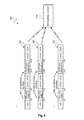
- a different hypothesis of different possible TDD-ULDL configurations can be put. For example a first hypothesis is applied to a first possible TDD-ULDL configuration 601, a second hypothesis is applied to a second possible TDD-ULDL configuration 602, a third hypothesis is applied to a third possible TDD-ULDL configuration 603, etc. Then, for each hypothesis PSBCH decoding can be done separately as shown in Fig. 6 .
- the trellis state which is violating the assumed TDD-ULDL-config 402 value can be disabled.
- the invalid trellis states can be further removed based on further conflicting SLSS sub-frame number field values.
- the way of forbidding invalid states corresponding to SLSS sub-frame fields are the same like in method 1, but just more states can be forbidden or removed compared with method 1.
- the whole decoded bit stream that passes CRC check is selected to give the best hypothesis selection 604 and thus the final decoded information bits.
- the modified version of method 2 gives even better sensitivity because the plenty of false detection rate of early TDD-ULDL-config 402 decoding can be avoided. However, it may need higher computation power because PSBCH decoding may be performed more than once.
- control channel decoder for example in the outer control channel receiver (OCRX) within LTE PHY. It provides better PSBCH decoding performance for D2D communications and therefore better link quality.
- OCRX outer control channel receiver
- Fig. 7 schematically illustrates an exemplary decoding device 700 according to the disclosure.
- the decoding device 700 may implement any one of the methods 200 or modified versions of the method 200 as described above with respect to Figures 2 to 6 .
- the decoding device 700 includes a receiver 701, a trellis generation logic 703, a trellis reduction logic 705 and a decoder 707. These units may be implemented as circuits in hardware or as blocks or modules in software.
- the receiver 701 provides a sequence of information bits 702 including context redundancy information, e.g. as described above with respect to Figures 2 to 6 , wherein the sequence of information bits 702 is encoded based on a predefined channel code, e.g. as described above with respect to Fig. 1 .
- the trellis generation logic 703 generates a plurality of trellis states 704 based on the sequence of information bits 702 and the channel code.
- the trellis reduction logic 705 reduces the plurality of trellis states by at least one trellis state based on the context redundancy information, e.g. as described above with respect to Figures 2 to 6 .
- the decoder 707 decodes the sequence of information bits 702 by using a metric based on the reduced number of trellis states 706.
- the metric may be a distance, e.g. Hamming distance or any metric that is used by a Viterbi decoder for performing the Viterbi decoding.
- the context redundancy information may be provided at predefined positions of the sequence of information bits, e.g. as described above with respect to Figures 2 to 6 .
- the context redundancy information may be provided as a bit field comprising at least one invalid bit combination, e.g. as described above with respect to Figures 2 to 6 .
- the sequence of information bits 702 may be correlated by the context redundancy information before being encoded based on the channel code.
- the trellis reduction logic 705 may be configured to remove trellis states which correspond to invalid bit allocations in the sequence of information bits, e.g. as described above with respect to Figures 2 to 6 .
- the trellis reduction logic 705 may remove trellis states which correspond to invalid field combinations in the sequence of information bits, e.g. as described above with respect to Figures 2 to 6 .
- the trellis reduction logic 705 may remove trellis states which can only be reached by invalid paths, e.g. as described above with respect to Figures 2 to 6 .
- the trellis reduction logic 705 may provide the reduced number of trellis states during an offline operation of the decoding device, e.g. as described above with respect to Figures 2 to 6 .
- the trellis reduction logic 705 may provide the reduced number of trellis states during an online operation of the decoding device.
- the trellis reduction logic 705 may provide the reduced number of trellis states based on trace back for decoding the context redundancy information, e.g. as described above with respect to Figures 2 to 6 .
- the trellis reduction logic 705 may use the decoded context redundancy information to restrict the plurality of trellis states, e.g. as described above with respect to Figures 2 to 6 .
- the trellis reduction logic 705 may provide the reduced number of trellis states based on evaluating probabilities for different possible context redundancy information.
- the trellis reduction logic 705 may provide the reduced number of trellis states 706 based on evaluating hypotheses of different possible context redundancy information, e.g. as described above with respect to Figure 6 .
- the trellis reduction logic 705 may evaluate the hypotheses based on a cyclic redundancy check, e.g. as described above with respect to Figure 6 .
- the context redundancy information may include self-context redundancy information and/or cross-context redundancy information, e.g. as described above with respect to Figures 2 to 6 .
- the self-context redundancy information may include self-context redundancy of a bit field indicating a side link bandwidth within a side link master information block (SL-MIB) for device-to-device (D2D) communication, e.g. as described above with respect to Figure 4 .
- SL-MIB side link master information block
- D2D device-to-device
- the cross-context redundancy information may include cross-context redundancy between a bit field indicating a time division duplex uplink downlink (TDD-ULDL) configuration and the bit field indicating the side link bandwidth within the side link master information block (SL-MIB) for device-to-device (D2D) communication, e.g. as described above with respect to Figure 4 .
- the decoder 707 may decode the sequence of information bits 702 based on Viterbi decoding.
- Fig. 8 is a performance diagram illustrating the decoding sensitivity in terms of successful decoding rate over SINR in dB of a decoding method according to the disclosure.
- a first graph 801 shows the performance of PSBCH decoding without using context redundancy.
- a second graph 802 shows the performance of enhanced PSBCH decoding exploring context redundancy according to method 2 alone.
- a third graph 803 shows the performance of enhanced PSBCH decoding exploring context redundancy according to a combination of method 1 and method 2.
- the disclosed concept to exploit context redundancy in the decoding improves the decoding sensitivity, in particular under low SINR conditions. Meanwhile, the offline trellis reduction also reduces the computation power and computation complexity for a Viterbi decoder. From Fig. 8 can be seen that by using method 2 only 802 already shows about 0.4dB gain improvement. It also shows that a combination 803 of method 1 and method 2 gives a further 0.25dB gain improvement.
Landscapes
- Engineering & Computer Science (AREA)
- Theoretical Computer Science (AREA)
- Physics & Mathematics (AREA)
- Probability & Statistics with Applications (AREA)
- Computer Networks & Wireless Communication (AREA)
- Signal Processing (AREA)
- Quality & Reliability (AREA)
- General Engineering & Computer Science (AREA)
- General Physics & Mathematics (AREA)
- Artificial Intelligence (AREA)
- Error Detection And Correction (AREA)
Priority Applications (3)
| Application Number | Priority Date | Filing Date | Title |
|---|---|---|---|
| EP16179970.5A EP3273604B1 (de) | 2016-07-18 | 2016-07-18 | Trellisdekodierung mit verringerung der trelliszustände basierend auf a priori kenntnis über bits eines kontrollkanals |
| US15/611,625 US10255144B2 (en) | 2016-07-18 | 2017-06-01 | Decoding device and method using context redundancy |
| CN201710440068.5A CN107634818A (zh) | 2016-07-18 | 2017-06-12 | 使用上下文冗余的解码设备和方法 |
Applications Claiming Priority (1)
| Application Number | Priority Date | Filing Date | Title |
|---|---|---|---|
| EP16179970.5A EP3273604B1 (de) | 2016-07-18 | 2016-07-18 | Trellisdekodierung mit verringerung der trelliszustände basierend auf a priori kenntnis über bits eines kontrollkanals |
Publications (2)
| Publication Number | Publication Date |
|---|---|
| EP3273604A1 true EP3273604A1 (de) | 2018-01-24 |
| EP3273604B1 EP3273604B1 (de) | 2019-10-16 |
Family
ID=56418459
Family Applications (1)
| Application Number | Title | Priority Date | Filing Date |
|---|---|---|---|
| EP16179970.5A Active EP3273604B1 (de) | 2016-07-18 | 2016-07-18 | Trellisdekodierung mit verringerung der trelliszustände basierend auf a priori kenntnis über bits eines kontrollkanals |
Country Status (3)
| Country | Link |
|---|---|
| US (1) | US10255144B2 (de) |
| EP (1) | EP3273604B1 (de) |
| CN (1) | CN107634818A (de) |
Families Citing this family (1)
| Publication number | Priority date | Publication date | Assignee | Title |
|---|---|---|---|---|
| CN110502303B (zh) * | 2019-08-20 | 2023-07-11 | 银康(中山)科技有限公司 | 评估老年人能力的方法、装置、电子设备和存储介质 |
Citations (2)
| Publication number | Priority date | Publication date | Assignee | Title |
|---|---|---|---|---|
| US20090041166A1 (en) * | 2007-08-09 | 2009-02-12 | Mbit Wireless, Inc. | Method and apparatus to improve information decoding when its characteristics are known a priori |
| US20090175388A1 (en) * | 2008-01-04 | 2009-07-09 | Qualcomm Incorporated | Decoding scheme using a-priori information about transmitted messages |
Family Cites Families (12)
| Publication number | Priority date | Publication date | Assignee | Title |
|---|---|---|---|---|
| US6081562A (en) * | 1997-10-22 | 2000-06-27 | Hitachi Ltd. | Implementing reduced-state viterbi detectors |
| JP3889516B2 (ja) * | 1998-08-27 | 2007-03-07 | 株式会社ルネサステクノロジ | トレリスデコーダ |
| US7042938B2 (en) * | 2001-08-13 | 2006-05-09 | Nokia Corporation | Soft bit computation for a reduced state equalizer |
| EP1820276A2 (de) * | 2004-12-02 | 2007-08-22 | Koninklijke Philips Electronics N.V. | Turbodecoder mit stake-weitergabe für datenblockredundante versionsdekodierung |
| US8069401B2 (en) * | 2005-12-21 | 2011-11-29 | Samsung Electronics Co., Ltd. | Equalization techniques using viterbi algorithms in software-defined radio systems |
| US7831892B2 (en) * | 2007-01-20 | 2010-11-09 | Harris Corporation | Generic, reduced state, maximum likelihood decoder |
| FI20086201A0 (fi) * | 2008-12-16 | 2008-12-16 | Nokia Corp | Epälineaarisuusmetriikan laskeminen |
| CN105337694B (zh) * | 2014-06-30 | 2018-10-30 | 上海诺基亚贝尔股份有限公司 | 无线通信网络中优化功率控制和调制编码的方法及装置 |
| SG11201708384QA (en) * | 2015-05-05 | 2017-11-29 | Agency Science Tech & Res | Joint detector/ decoder devices and joint detection/ decoding methods |
| CN105025498B (zh) * | 2015-06-08 | 2018-08-21 | 南京邮电大学 | 基于网络编码与压缩感知的传感网络分簇式空时压缩方法 |
| US9660845B2 (en) * | 2015-10-06 | 2017-05-23 | Huawei Technologies Co., Ltd. | System and method for state reduction in trellis equalizers using bounded state enumeration |
| US10075186B2 (en) * | 2015-11-18 | 2018-09-11 | Cisco Technology, Inc. | Trellis segment separation for low-complexity viterbi decoding of high-rate convolutional codes |
-
2016
- 2016-07-18 EP EP16179970.5A patent/EP3273604B1/de active Active
-
2017
- 2017-06-01 US US15/611,625 patent/US10255144B2/en not_active Expired - Fee Related
- 2017-06-12 CN CN201710440068.5A patent/CN107634818A/zh active Pending
Patent Citations (2)
| Publication number | Priority date | Publication date | Assignee | Title |
|---|---|---|---|---|
| US20090041166A1 (en) * | 2007-08-09 | 2009-02-12 | Mbit Wireless, Inc. | Method and apparatus to improve information decoding when its characteristics are known a priori |
| US20090175388A1 (en) * | 2008-01-04 | 2009-07-09 | Qualcomm Incorporated | Decoding scheme using a-priori information about transmitted messages |
Non-Patent Citations (1)
| Title |
|---|
| JONG IL PARK ET AL: "A protocol aided concatenated forward error control for wireless ATM", WIRELESS COMMUNICATIONS AND NETWORKING CONFERENCE, 2002. WCNC2002. 200 2 IEEE, PISCATAWAY, NJ, USA,IEEE, vol. 2, 17 March 2002 (2002-03-17), pages 613 - 617, XP010585665, ISBN: 978-0-7803-7376-1 * |
Also Published As
| Publication number | Publication date |
|---|---|
| US10255144B2 (en) | 2019-04-09 |
| CN107634818A (zh) | 2018-01-26 |
| EP3273604B1 (de) | 2019-10-16 |
| US20180018243A1 (en) | 2018-01-18 |
Similar Documents
| Publication | Publication Date | Title |
|---|---|---|
| CN110495113B (zh) | 将ue id嵌入到冻结位中以供dci盲检测的加扰序列设计 | |
| Fehrenbach et al. | URLLC services in 5G low latency enhancements for LTE | |
| KR101585357B1 (ko) | 간섭 셀 pdsch 송신 정보를 획득하기 위한 간섭 셀 pdcch 의 블라인드 디코딩 | |
| KR102374968B1 (ko) | 무선 통신 시스템에서 사이드 링크 전송을 위한 소스 표시 방법 및 장치 | |
| EP3472953B1 (de) | Superpositionscodierung von pdsch und pdcch | |
| US9894595B2 (en) | Method and apparatus for transmitting signal | |
| US20190393987A1 (en) | Advanced polar codes for control channel | |
| CN113261226B (zh) | 通信装置、基础设施设备及方法 | |
| KR102074441B1 (ko) | Harq 수행 방법 및 무선기기 | |
| CN108811086B (zh) | Pbch传输方法及装置 | |
| CN111699646B (zh) | 对加扰的有效载荷的决策度量进行组合 | |
| US8201031B2 (en) | System and method for removing PDCCH detection errors in a telecommunications network | |
| TWI702866B (zh) | 窄帶實體下行鏈路控制通道監測方法及使用者設備 | |
| US10686472B2 (en) | Methods and apparatus for achieving low coding rates | |
| US20180083733A1 (en) | Receiving Device and Methods Thereof | |
| CN107547177B (zh) | 一种无线通信中的方法和装置 | |
| US20240243882A1 (en) | Transmission of signalling information | |
| US10255144B2 (en) | Decoding device and method using context redundancy | |
| EP3059881B1 (de) | Verfahren zur übertragung von entdeckungssignalen für d2d-kommunikationen in einem drahtloskommunikationssystem und vorrichtung dafür | |
| CN111865495B (zh) | 译码方法、译码装置和存储介质 | |
| US20240007150A1 (en) | Telecommunication method for iterative reception and corresponding devices | |
| US20250062780A1 (en) | Resource efficient list decoding operations | |
| US20250184056A1 (en) | Method and apparatus for encoding and decoding polar codes in wireless communication system | |
| CN114762423B (zh) | 传输方法及装置 | |
| Marzo | Study of 5G New Radio and performance analysis through numerical simulation of the Physical Downlink Control Channel |
Legal Events
| Date | Code | Title | Description |
|---|---|---|---|
| PUAI | Public reference made under article 153(3) epc to a published international application that has entered the european phase |
Free format text: ORIGINAL CODE: 0009012 |
|
| STAA | Information on the status of an ep patent application or granted ep patent |
Free format text: STATUS: REQUEST FOR EXAMINATION WAS MADE |
|
| 17P | Request for examination filed |
Effective date: 20160718 |
|
| AK | Designated contracting states |
Kind code of ref document: A1 Designated state(s): AL AT BE BG CH CY CZ DE DK EE ES FI FR GB GR HR HU IE IS IT LI LT LU LV MC MK MT NL NO PL PT RO RS SE SI SK SM TR |
|
| AX | Request for extension of the european patent |
Extension state: BA ME |
|
| GRAP | Despatch of communication of intention to grant a patent |
Free format text: ORIGINAL CODE: EPIDOSNIGR1 |
|
| STAA | Information on the status of an ep patent application or granted ep patent |
Free format text: STATUS: GRANT OF PATENT IS INTENDED |
|
| RIC1 | Information provided on ipc code assigned before grant |
Ipc: G06F 11/14 20060101ALI20180905BHEP Ipc: H03M 13/39 20060101AFI20180905BHEP Ipc: H03M 13/25 20060101ALI20180905BHEP Ipc: G06F 11/18 20060101ALI20180905BHEP Ipc: H04L 1/00 20060101ALI20180905BHEP Ipc: H03M 13/41 20060101ALN20180905BHEP |
|
| RIC1 | Information provided on ipc code assigned before grant |
Ipc: H03M 13/41 20060101ALN20180917BHEP Ipc: H03M 13/39 20060101AFI20180917BHEP Ipc: G06F 11/18 20060101ALI20180917BHEP Ipc: H03M 13/25 20060101ALI20180917BHEP Ipc: H04L 1/00 20060101ALI20180917BHEP Ipc: G06F 11/14 20060101ALI20180917BHEP |
|
| INTG | Intention to grant announced |
Effective date: 20181008 |
|
| GRAJ | Information related to disapproval of communication of intention to grant by the applicant or resumption of examination proceedings by the epo deleted |
Free format text: ORIGINAL CODE: EPIDOSDIGR1 |
|
| STAA | Information on the status of an ep patent application or granted ep patent |
Free format text: STATUS: REQUEST FOR EXAMINATION WAS MADE |
|
| STAA | Information on the status of an ep patent application or granted ep patent |
Free format text: STATUS: EXAMINATION IS IN PROGRESS |
|
| INTC | Intention to grant announced (deleted) | ||
| RIC1 | Information provided on ipc code assigned before grant |
Ipc: G06F 11/18 20060101ALI20190129BHEP Ipc: H03M 13/41 20060101ALN20190129BHEP Ipc: H03M 13/39 20060101AFI20190129BHEP Ipc: H03M 13/25 20060101ALI20190129BHEP Ipc: H04L 1/00 20060101ALI20190129BHEP Ipc: G06F 11/14 20060101ALI20190129BHEP |
|
| 17Q | First examination report despatched |
Effective date: 20190212 |
|
| REG | Reference to a national code |
Ref country code: DE Ref legal event code: R079 Ref document number: 602016022460 Country of ref document: DE Free format text: PREVIOUS MAIN CLASS: H03M0013410000 Ipc: H03M0013390000 |
|
| GRAP | Despatch of communication of intention to grant a patent |
Free format text: ORIGINAL CODE: EPIDOSNIGR1 |
|
| STAA | Information on the status of an ep patent application or granted ep patent |
Free format text: STATUS: GRANT OF PATENT IS INTENDED |
|
| RIC1 | Information provided on ipc code assigned before grant |
Ipc: H04L 1/00 20060101ALI20190408BHEP Ipc: H03M 13/25 20060101ALI20190408BHEP Ipc: G06F 11/14 20060101ALI20190408BHEP Ipc: H03M 13/39 20060101AFI20190408BHEP Ipc: G06F 11/18 20060101ALI20190408BHEP Ipc: H03M 13/41 20060101ALN20190408BHEP |
|
| INTG | Intention to grant announced |
Effective date: 20190509 |
|
| RIN1 | Information on inventor provided before grant (corrected) |
Inventor name: YU, ZHIBIN Inventor name: XU, QING Inventor name: ECKARDT, FLORIAN |
|
| GRAS | Grant fee paid |
Free format text: ORIGINAL CODE: EPIDOSNIGR3 |
|
| GRAA | (expected) grant |
Free format text: ORIGINAL CODE: 0009210 |
|
| STAA | Information on the status of an ep patent application or granted ep patent |
Free format text: STATUS: THE PATENT HAS BEEN GRANTED |
|
| AK | Designated contracting states |
Kind code of ref document: B1 Designated state(s): AL AT BE BG CH CY CZ DE DK EE ES FI FR GB GR HR HU IE IS IT LI LT LU LV MC MK MT NL NO PL PT RO RS SE SI SK SM TR |
|
| REG | Reference to a national code |
Ref country code: GB Ref legal event code: FG4D |
|
| REG | Reference to a national code |
Ref country code: CH Ref legal event code: EP |
|
| REG | Reference to a national code |
Ref country code: DE Ref legal event code: R096 Ref document number: 602016022460 Country of ref document: DE |
|
| REG | Reference to a national code |
Ref country code: IE Ref legal event code: FG4D |
|
| REG | Reference to a national code |
Ref country code: AT Ref legal event code: REF Ref document number: 1192297 Country of ref document: AT Kind code of ref document: T Effective date: 20191115 |
|
| REG | Reference to a national code |
Ref country code: NL Ref legal event code: FP |
|
| REG | Reference to a national code |
Ref country code: LT Ref legal event code: MG4D |
|
| REG | Reference to a national code |
Ref country code: AT Ref legal event code: MK05 Ref document number: 1192297 Country of ref document: AT Kind code of ref document: T Effective date: 20191016 |
|
| PG25 | Lapsed in a contracting state [announced via postgrant information from national office to epo] |
Ref country code: PT Free format text: LAPSE BECAUSE OF FAILURE TO SUBMIT A TRANSLATION OF THE DESCRIPTION OR TO PAY THE FEE WITHIN THE PRESCRIBED TIME-LIMIT Effective date: 20200217 Ref country code: FI Free format text: LAPSE BECAUSE OF FAILURE TO SUBMIT A TRANSLATION OF THE DESCRIPTION OR TO PAY THE FEE WITHIN THE PRESCRIBED TIME-LIMIT Effective date: 20191016 Ref country code: GR Free format text: LAPSE BECAUSE OF FAILURE TO SUBMIT A TRANSLATION OF THE DESCRIPTION OR TO PAY THE FEE WITHIN THE PRESCRIBED TIME-LIMIT Effective date: 20200117 Ref country code: LT Free format text: LAPSE BECAUSE OF FAILURE TO SUBMIT A TRANSLATION OF THE DESCRIPTION OR TO PAY THE FEE WITHIN THE PRESCRIBED TIME-LIMIT Effective date: 20191016 Ref country code: AT Free format text: LAPSE BECAUSE OF FAILURE TO SUBMIT A TRANSLATION OF THE DESCRIPTION OR TO PAY THE FEE WITHIN THE PRESCRIBED TIME-LIMIT Effective date: 20191016 Ref country code: PL Free format text: LAPSE BECAUSE OF FAILURE TO SUBMIT A TRANSLATION OF THE DESCRIPTION OR TO PAY THE FEE WITHIN THE PRESCRIBED TIME-LIMIT Effective date: 20191016 Ref country code: NO Free format text: LAPSE BECAUSE OF FAILURE TO SUBMIT A TRANSLATION OF THE DESCRIPTION OR TO PAY THE FEE WITHIN THE PRESCRIBED TIME-LIMIT Effective date: 20200116 Ref country code: BG Free format text: LAPSE BECAUSE OF FAILURE TO SUBMIT A TRANSLATION OF THE DESCRIPTION OR TO PAY THE FEE WITHIN THE PRESCRIBED TIME-LIMIT Effective date: 20200116 Ref country code: LV Free format text: LAPSE BECAUSE OF FAILURE TO SUBMIT A TRANSLATION OF THE DESCRIPTION OR TO PAY THE FEE WITHIN THE PRESCRIBED TIME-LIMIT Effective date: 20191016 Ref country code: SE Free format text: LAPSE BECAUSE OF FAILURE TO SUBMIT A TRANSLATION OF THE DESCRIPTION OR TO PAY THE FEE WITHIN THE PRESCRIBED TIME-LIMIT Effective date: 20191016 |
|
| PG25 | Lapsed in a contracting state [announced via postgrant information from national office to epo] |
Ref country code: HR Free format text: LAPSE BECAUSE OF FAILURE TO SUBMIT A TRANSLATION OF THE DESCRIPTION OR TO PAY THE FEE WITHIN THE PRESCRIBED TIME-LIMIT Effective date: 20191016 Ref country code: RS Free format text: LAPSE BECAUSE OF FAILURE TO SUBMIT A TRANSLATION OF THE DESCRIPTION OR TO PAY THE FEE WITHIN THE PRESCRIBED TIME-LIMIT Effective date: 20191016 Ref country code: IS Free format text: LAPSE BECAUSE OF FAILURE TO SUBMIT A TRANSLATION OF THE DESCRIPTION OR TO PAY THE FEE WITHIN THE PRESCRIBED TIME-LIMIT Effective date: 20200224 |
|
| REG | Reference to a national code |
Ref country code: DE Ref legal event code: R082 Ref document number: 602016022460 Country of ref document: DE Representative=s name: BARDEHLE PAGENBERG PARTNERSCHAFT MBB PATENTANW, DE Ref country code: DE Ref legal event code: R081 Ref document number: 602016022460 Country of ref document: DE Owner name: APPLE INC., CUPERTINO, US Free format text: FORMER OWNER: INTEL IP CORPORATION, SANTA CLARA, CALIF., US Ref country code: DE Ref legal event code: R081 Ref document number: 602016022460 Country of ref document: DE Owner name: APPLE INC., CUPERTINO, US Free format text: FORMER OWNER: INTEL IP CORPORATION, SANTA CLARA, CA, US |
|
| PG25 | Lapsed in a contracting state [announced via postgrant information from national office to epo] |
Ref country code: AL Free format text: LAPSE BECAUSE OF FAILURE TO SUBMIT A TRANSLATION OF THE DESCRIPTION OR TO PAY THE FEE WITHIN THE PRESCRIBED TIME-LIMIT Effective date: 20191016 |
|
| REG | Reference to a national code |
Ref country code: DE Ref legal event code: R097 Ref document number: 602016022460 Country of ref document: DE |
|
| PG2D | Information on lapse in contracting state deleted |
Ref country code: IS |
|
| PG25 | Lapsed in a contracting state [announced via postgrant information from national office to epo] |
Ref country code: DK Free format text: LAPSE BECAUSE OF FAILURE TO SUBMIT A TRANSLATION OF THE DESCRIPTION OR TO PAY THE FEE WITHIN THE PRESCRIBED TIME-LIMIT Effective date: 20191016 Ref country code: ES Free format text: LAPSE BECAUSE OF FAILURE TO SUBMIT A TRANSLATION OF THE DESCRIPTION OR TO PAY THE FEE WITHIN THE PRESCRIBED TIME-LIMIT Effective date: 20191016 Ref country code: RO Free format text: LAPSE BECAUSE OF FAILURE TO SUBMIT A TRANSLATION OF THE DESCRIPTION OR TO PAY THE FEE WITHIN THE PRESCRIBED TIME-LIMIT Effective date: 20191016 Ref country code: CZ Free format text: LAPSE BECAUSE OF FAILURE TO SUBMIT A TRANSLATION OF THE DESCRIPTION OR TO PAY THE FEE WITHIN THE PRESCRIBED TIME-LIMIT Effective date: 20191016 Ref country code: EE Free format text: LAPSE BECAUSE OF FAILURE TO SUBMIT A TRANSLATION OF THE DESCRIPTION OR TO PAY THE FEE WITHIN THE PRESCRIBED TIME-LIMIT Effective date: 20191016 Ref country code: IS Free format text: LAPSE BECAUSE OF FAILURE TO SUBMIT A TRANSLATION OF THE DESCRIPTION OR TO PAY THE FEE WITHIN THE PRESCRIBED TIME-LIMIT Effective date: 20200216 |
|
| PGFP | Annual fee paid to national office [announced via postgrant information from national office to epo] |
Ref country code: FR Payment date: 20200612 Year of fee payment: 5 |
|
| PLBE | No opposition filed within time limit |
Free format text: ORIGINAL CODE: 0009261 |
|
| STAA | Information on the status of an ep patent application or granted ep patent |
Free format text: STATUS: NO OPPOSITION FILED WITHIN TIME LIMIT |
|
| PG25 | Lapsed in a contracting state [announced via postgrant information from national office to epo] |
Ref country code: SK Free format text: LAPSE BECAUSE OF FAILURE TO SUBMIT A TRANSLATION OF THE DESCRIPTION OR TO PAY THE FEE WITHIN THE PRESCRIBED TIME-LIMIT Effective date: 20191016 Ref country code: IT Free format text: LAPSE BECAUSE OF FAILURE TO SUBMIT A TRANSLATION OF THE DESCRIPTION OR TO PAY THE FEE WITHIN THE PRESCRIBED TIME-LIMIT Effective date: 20191016 Ref country code: SM Free format text: LAPSE BECAUSE OF FAILURE TO SUBMIT A TRANSLATION OF THE DESCRIPTION OR TO PAY THE FEE WITHIN THE PRESCRIBED TIME-LIMIT Effective date: 20191016 |
|
| 26N | No opposition filed |
Effective date: 20200717 |
|
| PGFP | Annual fee paid to national office [announced via postgrant information from national office to epo] |
Ref country code: NL Payment date: 20200715 Year of fee payment: 5 |
|
| REG | Reference to a national code |
Ref country code: NL Ref legal event code: PD Owner name: APPLE INC.; US Free format text: DETAILS ASSIGNMENT: CHANGE OF OWNER(S), ASSIGNMENT; FORMER OWNER NAME: INTEL IP CORPORATION Effective date: 20200917 |
|
| PG25 | Lapsed in a contracting state [announced via postgrant information from national office to epo] |
Ref country code: SI Free format text: LAPSE BECAUSE OF FAILURE TO SUBMIT A TRANSLATION OF THE DESCRIPTION OR TO PAY THE FEE WITHIN THE PRESCRIBED TIME-LIMIT Effective date: 20191016 |
|
| REG | Reference to a national code |
Ref country code: GB Ref legal event code: 732E Free format text: REGISTERED BETWEEN 20201105 AND 20201111 |
|
| PG25 | Lapsed in a contracting state [announced via postgrant information from national office to epo] |
Ref country code: MC Free format text: LAPSE BECAUSE OF FAILURE TO SUBMIT A TRANSLATION OF THE DESCRIPTION OR TO PAY THE FEE WITHIN THE PRESCRIBED TIME-LIMIT Effective date: 20191016 |
|
| REG | Reference to a national code |
Ref country code: CH Ref legal event code: PL |
|
| REG | Reference to a national code |
Ref country code: BE Ref legal event code: MM Effective date: 20200731 |
|
| PG25 | Lapsed in a contracting state [announced via postgrant information from national office to epo] |
Ref country code: LU Free format text: LAPSE BECAUSE OF NON-PAYMENT OF DUE FEES Effective date: 20200718 Ref country code: LI Free format text: LAPSE BECAUSE OF NON-PAYMENT OF DUE FEES Effective date: 20200731 Ref country code: CH Free format text: LAPSE BECAUSE OF NON-PAYMENT OF DUE FEES Effective date: 20200731 |
|
| PG25 | Lapsed in a contracting state [announced via postgrant information from national office to epo] |
Ref country code: BE Free format text: LAPSE BECAUSE OF NON-PAYMENT OF DUE FEES Effective date: 20200731 |
|
| PG25 | Lapsed in a contracting state [announced via postgrant information from national office to epo] |
Ref country code: IE Free format text: LAPSE BECAUSE OF NON-PAYMENT OF DUE FEES Effective date: 20200718 |
|
| REG | Reference to a national code |
Ref country code: NL Ref legal event code: MM Effective date: 20210801 |
|
| PG25 | Lapsed in a contracting state [announced via postgrant information from national office to epo] |
Ref country code: TR Free format text: LAPSE BECAUSE OF FAILURE TO SUBMIT A TRANSLATION OF THE DESCRIPTION OR TO PAY THE FEE WITHIN THE PRESCRIBED TIME-LIMIT Effective date: 20191016 Ref country code: NL Free format text: LAPSE BECAUSE OF NON-PAYMENT OF DUE FEES Effective date: 20210801 Ref country code: MT Free format text: LAPSE BECAUSE OF FAILURE TO SUBMIT A TRANSLATION OF THE DESCRIPTION OR TO PAY THE FEE WITHIN THE PRESCRIBED TIME-LIMIT Effective date: 20191016 Ref country code: FR Free format text: LAPSE BECAUSE OF NON-PAYMENT OF DUE FEES Effective date: 20210731 Ref country code: CY Free format text: LAPSE BECAUSE OF FAILURE TO SUBMIT A TRANSLATION OF THE DESCRIPTION OR TO PAY THE FEE WITHIN THE PRESCRIBED TIME-LIMIT Effective date: 20191016 |
|
| PG25 | Lapsed in a contracting state [announced via postgrant information from national office to epo] |
Ref country code: MK Free format text: LAPSE BECAUSE OF FAILURE TO SUBMIT A TRANSLATION OF THE DESCRIPTION OR TO PAY THE FEE WITHIN THE PRESCRIBED TIME-LIMIT Effective date: 20191016 |
|
| PGFP | Annual fee paid to national office [announced via postgrant information from national office to epo] |
Ref country code: GB Payment date: 20220606 Year of fee payment: 7 |
|
| PGFP | Annual fee paid to national office [announced via postgrant information from national office to epo] |
Ref country code: DE Payment date: 20220524 Year of fee payment: 7 |
|
| REG | Reference to a national code |
Ref country code: DE Ref legal event code: R119 Ref document number: 602016022460 Country of ref document: DE |
|
| GBPC | Gb: european patent ceased through non-payment of renewal fee |
Effective date: 20230718 |
|
| PG25 | Lapsed in a contracting state [announced via postgrant information from national office to epo] |
Ref country code: DE Free format text: LAPSE BECAUSE OF NON-PAYMENT OF DUE FEES Effective date: 20240201 Ref country code: GB Free format text: LAPSE BECAUSE OF NON-PAYMENT OF DUE FEES Effective date: 20230718 |