EP3273719A1 - Système de radiocommunication, dispositif de station de base et son procédé de gestion - Google Patents
Système de radiocommunication, dispositif de station de base et son procédé de gestion Download PDFInfo
- Publication number
- EP3273719A1 EP3273719A1 EP17166187.9A EP17166187A EP3273719A1 EP 3273719 A1 EP3273719 A1 EP 3273719A1 EP 17166187 A EP17166187 A EP 17166187A EP 3273719 A1 EP3273719 A1 EP 3273719A1
- Authority
- EP
- European Patent Office
- Prior art keywords
- base station
- cloud based
- based virtual
- virtual base
- resources
- Prior art date
- Legal status (The legal status is an assumption and is not a legal conclusion. Google has not performed a legal analysis and makes no representation as to the accuracy of the status listed.)
- Granted
Links
Images








Classifications
-
- H—ELECTRICITY
- H04—ELECTRIC COMMUNICATION TECHNIQUE
- H04W—WIRELESS COMMUNICATION NETWORKS
- H04W28/00—Network traffic management; Network resource management
- H04W28/16—Central resource management; Negotiation of resources or communication parameters, e.g. negotiating bandwidth or QoS [Quality of Service]
Definitions
- the present invention relates to the radio communication field, and in particular, to a system and method for managing a base station, a radio communication system, a cloud based virtual base station, and a resource scheduling method.
- a conventional radio base station system has the following features: Each base station is connected to a fixed number of sectoral antennas and covers a small area; each base station can only process received or transmitted signals of respective cells, and the base stations have strict binding relationships with the areas covered by the base stations; resources cannot be shared between base stations, and when the traffic or signaling flow of a base station keeps increasing, the base station may be faulty because of a too heavy processing load; utilization of resources of the base station system is not high, and on the network, some base stations have a too light service load, while some base stations have a too heavy service load, and resources cannot be scheduled efficiently; capabilities of the conventional base station system can be extended only in a scale-up manner, and the expansion of capabilities is limited, for example, limited by the cost, key chips, and so on; for the conventional base station, a virtual base station and a physical base station are not distinguished, and the base station service is strictly bound with the base station device.
- the main design idea for the conventional base station virtualization solution is to virtualize resources of a computing node, for example, virtualize a computing node into one or more computing resources, so that one or more virtual base stations are deployed.
- This method is mainly intended to fully use computing capabilities in a scenario where capabilities of one computing node are sufficient.
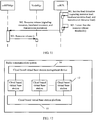
- FIG. 1 shows a current hierarchical structure of virtual base stations.
- This solution is mainly installing a layer of management programs (Hypervisor) on a computing node (for example, a multi-core processor), where the programs complete virtualization of the computing node; and installing multiple guest operating systems (Guest OS) above the layer, where base station software is installed above the Guest OS, and different base stations can share computing capabilities of the node (Node).
- Hopervisor hypervisor
- Guest OS guest operating systems
- a disadvantage of the solution lies in that: When computing capabilities of one Node are insufficient, capabilities of the system become a bottleneck; computing capabilities of the system cannot be extended flexibly, and the performance and capacity of the system are restricted by capabilities of the Node.
- BTS Base Transceiver Station
- a same cell resource of a base station device may be shared by multiple operators simultaneously, but the operators cannot independently adjust cell related parameters.
- the common feature of the two solutions lies in that more operators share an infrastructure.
- different infrastructure units for example, BTS
- BTS infrastructure units
- resources cannot be shared mutually, and when a BTS is faulty, services of multiple operators are affected; when the service load of an operator on a BTS becomes heavier, more processing resources are occupied, which may squeeze services of another operator, thus affecting quality of service of other operators.
- the conventional multi-standard base station mainly has two implementation solutions:
- this solution has a great progress, but also has a disadvantage: In a scenario where multiple standards are concurrent, when services of different standards contend for a same set of hardware resources, the service of one standard may be damaged; when hardware of the BTS is faulty, services of both standards may be damaged and cannot be recovered.
- an embodiment of the present invention provides a system for managing a base station, where the system includes:
- an embodiment of the invention provides a node management device, including:
- a cloud based virtual base station management device includes:
- an embodiment of the present invention further provides a method for managing a base station, where the method is used in the above base station system and includes:
- An embodiment of the present invention further provides a method for managing a base station, where the method is used in the above base station system and includes:
- physical resources of multiple nodes are virtualized into logical resources, and the logical resources are allocated to multiple cloud based virtual base stations for use through a resource pool, so that the base station system can implement resource capability sharing for multiple nodes; in addition, corresponding management devices are arranged in the base station system to perform resource scheduling, which improves efficiency and flexibility of resource use.
- an embodiment of the present invention provides a radio communication system, including:
- an embodiment of the present invention further provides a cloud based virtual base station, including:
- An embodiment of the present invention further provides a resource scheduling method, where the method is used in the above system and includes:
- base station physical resources are virtualized into logical resources through the cloud based virtual base station platform and are provided to multiple cloud based virtual base stations; when the base station physical resources are faulty or resource requirements of the cloud based virtual base station increase, allocation of resources can be effectively implemented through the cloud based virtual base station platform, and security and effectiveness of resource sharing can be improved.
- an embodiment of the present invention provides a radio communication system, including:
- an embodiment of the present invention further provides a cloud based virtual base station, where the cloud based virtual base station is a cloud based virtual base station having a predetermined standard and includes:
- An embodiment of the present invention further provides a resource scheduling method, including:
- base station physical resources are virtualized into logical resources through the cloud based virtual base station platform and are provided to multiple cloud based virtual base stations having different standards; when the base station physical resources are faulty or resource requirements of the cloud based virtual base station increase, allocation of resources can be effectively implemented through the cloud based virtual base station platform, and security and effectiveness of resource sharing can be improved.
- FIG. 2 is a schematic diagram of specific composition of a system for managing a base station according to an embodiment of the present invention.
- the system includes the following five parts.
- Node 20 are 5 nodes in FIG. 2 : node 0, node 1, node 2, node 3, and node 4, which are configured to provide computing resources and network resources of the base station, and virtualize the computing resources and network resources into logical resources.
- the logical resources include management control resources, signaling resources, baseband resources, and transmission resources. Therefore, the computing resources and network resources can be correspondingly virtualized into management control resources, signaling resources, baseband resources, and transmission resources.
- categories of logical resources may also be added or changed according to requirements of specific services, which is not further described herein.
- the node may be homogeneous or heterogeneous, for example, a PC may be a Node, and a base transceiver station (Base Transceiver Station, BTS) may be a Node; the Node in the embodiment of the present invention may be any device that has computing capabilities, that is, any one of the above 5 nodes is a computer, a base transceiver station, or other devices that have computing capabilities.
- BTS Base Transceiver Station
- a switch device 22 is configured to perform data exchange between the nodes.
- the switch device may be any device capable of data exchange; there may be multiple Switches in the system, and multiple Switches may be networked to form a complex topology.
- a node management device (NodeMgr) 24 is configured to obtain information of logical resources of the nodes managed by the node management device, form a resource pool according to the information of the logical resources by using the logical resources of the nodes managed by the node management device, and based on data exchange of the switch device, schedule the corresponding logical resources in the resource pool to the cloud based virtual base station for use.
- the node management device may be deployed on any one of the multiple nodes, or separately deployed on an independent server. If the node management device is deployed on a node, information exchange between the node management device and each node may be implemented through the above switch device; if the node management device is deployed on an independent server, the node management device may also be connected to the switch device, and information exchange between the node management device and each node may be implemented through the above switch device. Of course, the node management device may also be connected to a part or all of the nodes to implement direct or indirect information exchange.
- a cloud based virtual base station management device (cvBTSMgr) 26 is configured to manage and control resources of the cloud based virtual base station (Cloud based virtual BTS, cvBTS) according to the information of the resource pool provided by the node management device.
- the cloud based virtual base station management device may be deployed on any one of the multiple nodes, or deployed with the node management device together, or separately deployed on an independent server.
- the cloud based virtual base station management device may also be connected to the switch device, and information exchange between the cloud based virtual base station management device and each node may be implemented through the above switch device.
- the cloud based virtual base station management device may also be connected to a part or all of the nodes to implement direct or indirect information exchange.
- One or more cloud based virtual base stations (cvBTS) 28 are configured to obtain the logical resources according to the management of the cloud based virtual base station management device and the scheduling of the node management device, and provide base station services based on the logical resources.
- FIG. 2 shows 3 cvBTSs, which are cvBTS 0, cvBTS 1, and cvBTS 2, respectively. Resources of each cvBTS are provided by nodes in a circle that are associated with the cvBTS, for example, in this embodiment, resources of cvBTS 0 are provided by node 0 and node 1.
- the cvBTS 0 is managed by cvBTSMgr 4, and node 0 and node 1 are managed by NodeMgr 3, and other explanations are similar.
- the cloud based virtual base station may be deployed across the Nodes.
- Logical resources of one cloud based virtual base station may come from one or more Nodes; logical resources of one Node may also be allocated to one or more cloud based virtual base stations for use.
- the cloud based virtual base station is deployed on a node, and a resource management module of the cloud based virtual base station may be deployed on the node which provides management control resources, while logical resources of the cloud based virtual base station may come from each node, where the resource management module of the cloud based virtual base station is configured to manage and control the logical resources of the cloud based virtual base station.
- the cloud based virtual base station cvBTS 0 uses resources of Node 0 and Node 1
- cvBTS 1 uses resources of Node 3 and Node 4
- cvBTS 2 uses resources of Node 1, Node 2, and Node 3.
- FIG. 3 is a schematic diagram of composition of the node management device 24 according to an embodiment of the present invention, where the node management device 24 includes: a registering unit 240, configured to: after nodes managed by the node management device are started, obtain registration of the nodes, where the registration means that the nodes, after being started, virtualize their computing resources and network resources into logical resources and register information of the logical resources with the node management device; and a resource management unit 242, configured to form a resource pool according to the information of the logical resources which is obtained by the registering unit, where the resource pool records function description of the logical resources and address information providing the logical resources.
- a registering unit 240 configured to: after nodes managed by the node management device are started, obtain registration of the nodes, where the registration means that the nodes, after being started, virtualize their computing resources and network resources into logical resources and register information of the logical resources with the node management device
- a resource management unit 242 configured to form a resource pool according to the information of the
- resource management unit 242 may be configured to:
- FIG. 4a is a schematic diagram of composition of the cloud based virtual base station management device 26 according to an embodiment of the present invention, where the cloud based virtual base station management device 26 includes: a creation requesting unit 260, configured to apply for management control resources from a node management device after a request for creating a cloud based virtual base station is received, and after the application is successful, request a node where the management control resources are located to create a cloud based virtual base station, so that the node where the management control resources are located creates a cloud based virtual base station according to the request for creating a cloud based virtual base station;
- a creation requesting unit 260 configured to apply for management control resources from a node management device after a request for creating a cloud based virtual base station is received, and after the application is successful, request a node where the management control resources are located to create a cloud based virtual base station, so that the node where the management control resources are located creates a cloud based virtual base station according to the request for creating a cloud
- FIG. 5 is a schematic diagram of composition of a radio communication device according to an embodiment of the present invention, where the radio communication device includes three parts.
- a cloud based virtual base station platform 50 is configured to virtualize computing resources and network resources of multiple nodes at a physical layer into logical resources of a logical layer, and schedule, at a resource scheduling layer, the logical resources provided by the resource layer to different cloud based virtual base stations.
- the cloud based virtual base station platform may be divided into three layers: a physical layer, a resource layer, and a resource scheduling layer.
- Resources of the physical layer are computing resources and network resources of mass Nodes.
- Computing resources of each Node may include two parts: One part is general-purpose computing resources (resources which can reflect computing capabilities such as CPU processing capabilities on the Node, memory capacity, and Cache capacity); the other part is dedicated computing resources (computing resources of dedicated chips such as the DSP, FPGA, ASIC, and SOC on the Node).
- Resource layer Resources of the resource layer are resources carried on the Node for processing various specific tasks, for example, management control resources, signaling resources, transmission resources, and baseband processing resources. Resources of the resource layer are a further abstraction of resources of the physical layer, that is, services are provided to an upper layer after resources of the physical layer are virtualized into logical resources.
- Resource scheduling layer The resource scheduling layer allocates, according to a resource scheduling policy, the resources provided by the resource layer to each cvBTS. Resources used by the cvBTS may come from multiple Nodes, and herein the specific resource scheduling algorithm is not restricted.
- Functions of the resource scheduling layer of the cloud based virtual base station platform are provided by the node management device, where the node management device is deployed on any one of the multiple nodes, or the node management device is separately deployed on an independent server.
- Cloud based virtual base stations 52 (cvBTS 0, cvBTS 1, ..., cvBTS n in FIG. 5 ) provide base station services based on the logical resources scheduled by the cloud based virtual base station platform 50.
- a cloud based virtual base station management device 54 is configured to manage multiple cloud based virtual base stations 52. Likewise, the cloud based virtual base station management device is deployed on any one of the multiple nodes, or the cloud based virtual base station management device and the node management device are deployed together, or the cloud based virtual base station management device is separately deployed on an independent server.
- FIG. 5 does not illustrate the contact between the cloud based virtual base station management device 54 and the cvBTS and cloud based virtual base station platform. The specific contact may refer to the relationship between the cvBTSMgr and the cvBTS in FIG. 2 , and the relationship between the cloud based virtual base station management device 54 and the cloud based virtual base station platform 50 may refer to the relationship between the cvBTSMgr and the NodeMgr and Node in FIG. 2 .
- the main purpose of this embodiment is to describe the hierarchical structure of cloud based virtual base stations implemented in the system. From the above description, it is understandable that a cloud based virtual base station in this embodiment of the present invention has capabilities of three aspects:
- Logical resources Resources used by the cloud based virtual base station may come from any Node in the cloud, and resources used by the cloud based virtual base station may be virtualized into four categories: management control resources, signaling resources, transmission resources, and baseband processing resources. Of course, categories of logical resources may also be added or changed according to requirements of specific services, which is not further described herein.
- Resource scheduling algorithms used in the cloud based virtual base station may refer to various resource scheduling algorithms, network topology algorithms, and so on in the radio communication field, and are not further described herein.
- the essential difference between the cloud based virtual base station and the conventional virtual base station lies in that the resources used by the cloud based virtual base station may come from any Node in the cloud, and that the cloud based virtual base station may dynamically apply for and release resources according to service load conditions, thus implementing flexible expansion of resources.
- the conventional virtual base station can only use resources in one Node, which cannot implement flexible expansion of resources.
- an embodiment of the present invention further provides a method for managing a base station, used in the above base station system.
- the method includes a resource virtualization and registration process.
- two nodes are used as examples for description.
- the logical resources include management control resources, signaling resources, baseband resources, and transmission resources.
- the method in this embodiment of the present invention further includes a process of creating a cloud based virtual base station:
- the method in this embodiment of the present invention further includes a process of deleting a node.
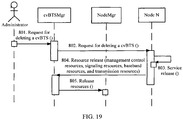
- the method in this embodiment of the present invention further includes a process of deleting a cloud based virtual base station:
- the method in this embodiment of the present invention further includes a process of applying for new resources by a cloud based virtual base station:
- the method in this embodiment of the present invention further includes a process of releasing resources by a cloud based virtual base station:
- FIG. 12 is a schematic diagram of specific composition of a radio communication system according to an embodiment of the present invention.
- the device 1 includes: a cloud based virtual base station platform 10, configured to virtualize base station physical resources of nodes at a physical layer into logical resources of a resource layer, and schedule, at a resource scheduling layer, the logical resources provided by the resource layer to a cloud based virtual base station, where the base station physical resources include node computing resources and node network resources; a cloud based virtual base station 12, configured to provide base station services to one or more operators based on the logical resources scheduled by the cloud based virtual base station platform 10; and a cloud based virtual base station management device 14, configured to manage the cloud based virtual base station.
- a cloud based virtual base station platform 10 configured to virtualize base station physical resources of nodes at a physical layer into logical resources of a resource layer, and schedule, at a resource scheduling layer, the logical resources provided by the resource layer to a cloud based virtual base station, where the base station physical resources include node computing
- the cloud based virtual base station may include an operator identifier, and the cloud based virtual base station provides base station services to an operator according to the operator identifier.
- an attribute is added to the cloud based virtual base station: an operator identifier of the cloud based virtual base station: OperatorId.
- a schematic typical operation of adding a cloud based virtual base station is as follows: ADD cvBTS: cvBTSId, RatType, OperatorId.
- the operation is an example, and there may be other forms, which are not described herein.
- one cloud based virtual base station may provide base station services to only one operator.
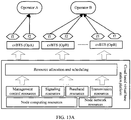
- operators are operator A (OpA) and operator B (OpB), and each cloud based virtual base station (both cells f1 and f2 in the cvBTS are provided to the same operator).
- OpA operator A
- OpB operator B
- each cloud based virtual base station both cells f1 and f2 in the cvBTS are provided to the same operator.
- FIG. 13a does not illustrate the cvBTSMgr.
- the cloud based virtual base station platform is divided into three layers according to functions.
- the physical layer includes node (Node) computing resources and Node network resources;
- the resource layer includes management control resources, signaling resources, baseband resources, and transmission resources;
- the resource scheduling layer allocates and schedules the resources at the resource layer.
- the Node computing resources may include general-purpose computing resources and dedicated computing resources, and in this case, the resource layer abstracts resources of the physical layer.
- the resource layer abstracts resources of the physical layer.
- dedicated resources need to be considered, for example, some dedicated computing resources are only used to process the baseband algorithm of a universal mobile telecommunications system (Universal Mobile Telecommunications System, UMTS), and other dedicated computing resources are used to process the baseband algorithm of long term evolution (Long Term Evolution, LTE) system.
- UMTS Universal Mobile Telecommunications System
- LTE Long Term Evolution
- the logical resources include management control resources, signaling resources, baseband resources, and transmission resources.
- general-purpose computing resources are abstracted into management control resources and signaling resources, and network resources are abstracted into transmission resources; finally the resource layer abstracts a series of resource capabilities: UMTS management control resource capabilities, UMTS signaling resource capabilities, UMTS baseband resource capabilities, LTE management control resource capabilities, LTE signaling resource capabilities, LTE baseband resource capabilities, time division synchronous (Time Division Synchronous, TDS) CDMA management control resource capabilities, TDSCDM signaling resource capabilities, TDSCDM baseband resource capabilities, and transmission resource capabilities.
- TDS Time Division Synchronous
- functions of the physical layer and resource layer of the cloud based virtual base station platform are provided by the nodes in the system, where the nodes are computers, base transceiver stations, or other devices that have computing capabilities; functions of the resource scheduling layer of the cloud based virtual base station platform are provided by the node management device, where the node management device is deployed on the nodes or deployed on an independent server.
- the cloud based virtual base station may request corresponding resources from the resource scheduling layer of the cloud based virtual base station platform according to service requirements of the operator; the cloud based virtual base station platform schedules, according to the request of the cloud based virtual base station through scheduling of the resource scheduling layer, the logical resources provided by the resource layer to the cloud based virtual base station for use. Because the logical resources are actually abstracted from baseband physical resources of the nodes, the baseband physical resources provided by the nodes in the system may be finally scheduled by the above scheduling to the cloud based virtual base station for use.
- the cloud based virtual base station platform may allocate, at the resource scheduling layer according to a resource scheduling algorithm, logical resources of other nodes provided by the resource layer, to the cloud based virtual base station.
- a cloud based virtual base station may be controlled to provide services to only one operator at the same time, so that the cloud based virtual base stations providing services to different operators are different, which can reduce coupling between operators; in another aspect, even though a cloud based virtual base station provides services to multiple operators simultaneously, resource scheduling can be performed for the cloud based virtual base station through the cloud based virtual base station platform, which can also reduce the impact due to service change between operators which use the services provided by the same cloud based virtual base station.
- the cloud based virtual base station may request the cloud based virtual base station platform to allocate new resources, which increases service processing capabilities of the cloud based virtual base station and improves sharing efficiency of the base station resources.
- FIG. 13b shows another specific embodiment of the present invention.
- multiple cloud based virtual base stations provide base station services to multiple operators, and one cloud based virtual base station provides base station services to multiple operators.
- Each cloud based virtual base station may not belong to any specific operator, for example, may belong to a third-party cloud based virtual base station provider.
- Cells of each cloud based virtual base station may be shared by multiple operators, and each cloud based virtual base station may use resources of any node in the system.
- only two operators are used as examples, and of course, there may be more operators, which are not further described herein.
- the cloud based virtual base station platform is divided into three layers according to functions.
- the physical layer includes Node computing resources and Node network resources; the resource layer includes management control resources, signaling resources, baseband resources, and transmission resources; the resource scheduling layer allocates and schedules the resources in the resource layer.
- the Node computing resources may include general-purpose computing resources and dedicated computing resources, and in this case, the resource layer abstracts resources of the physical layer. During abstraction of resources, dedicated resources need to be considered, for example, some dedicated computing resources are used to process only the baseband algorithm of a UMTS, and other dedicated computing resources are used to process the baseband algorithm of LTE.
- general-purpose computing resources are abstracted into management control resources and signaling resources, and network resources are abstracted into transmission resources; finally the resource layer abstracts a series of resource capabilities. Details are consistent with the example in FIG. 13 and are not repeated herein.
- the cloud based virtual base station may apply for more resources from the cloud based virtual base station platform according to service load conditions.
- Services of another operator are squeezed because services of an operator keep increasing (relatively, in the conventional solution, when multiple operators share resources of a base station, because resources of a base station are relatively limited, operators may mutually squeeze services). Coupling of base station resources between operators is also reduced to some degree.
- FIG. 14a is a schematic diagram of composition of a cloud based virtual base station according to an embodiment of the present invention.
- the cloud based virtual base station 12 includes: a resource obtaining unit 120, configured to request corresponding logical resources from a resource scheduling layer of a cloud based virtual base station platform according to service requirements, so that the cloud based virtual base station platform schedules the logical resources to the cloud based virtual base station for use according to the request of the cloud based virtual base station through scheduling of the resource scheduling layer, where the logical resources are logical resources of a resource layer scheduled at the resource scheduling layer into which the cloud based virtual base station platform virtualizes base station physical resources of nodes at a physical layer; and a service providing unit 122, configured to provide base station services to one or more operators based on the logical resources scheduled by the cloud based virtual base station platform.
- the service providing unit 122 may provide base station services to only one operator or provide base station services to multiple operators based on the logical resources scheduled by the cloud based virtual base station platform. Reference may be made to examples in FIG. 13a and FIG. 13b .
- the resource obtaining unit 120 may further request the cloud based virtual base station platform to perform resource scheduling according to the change.
- the resource scheduling method and method for managing a base station may be made to the description in the subsequent resource scheduling method and method for managing a base station.
- FIG. 14b is a schematic diagram of a network topology of a virtual base station system according to an embodiment of the present invention.
- the system includes the following five parts.
- Node 20 are 5 nodes in FIG. 14b : node 0, node 1, node 2, node 3, and node 4, which are configured to provide computing resources and network resources of the base station, and virtualize the computing resources and network resources into logical resources.
- the logical resources include management control resources, signaling resources, baseband resources, and transmission resources. Therefore, the computing resources and network resources can be correspondingly virtualized into management control resources, signaling resources, baseband resources, and transmission resources.
- categories of logical resources may also be added or changed according to requirements of specific services, which is not further described herein.
- the Node may be homogeneous or heterogeneous, for example, a PC may be a Node, and a base transceiver station (Base Transceiver Station, BTS) may be a Node; the Node in the embodiment of the present invention may be any device that has computing capabilities, that is, any one of the above 5 nodes is a computer, a base transceiver station, or other devices that have computing capabilities.
- BTS Base Transceiver Station
- a switch device 22 is configured to perform data exchange between the nodes.
- the switch device may be any device capable of data exchange; there may be multiple Switches in the system, and multiple Switches may be networked to form a complex topology.
- a node management device (NodeMgr) 24 is configured to obtain capabilities of logical resources of the nodes managed by the node management device, form a resource pool according to the capabilities of the logical resources by using the logical resources of the nodes managed by the node management device, and based on data exchange of the switch device, schedule the corresponding logical resources in the resource pool to the cloud based virtual base station for use.
- the node management device may be deployed on any one of the multiple nodes, or separately deployed on an independent server. If the node management device is deployed on a node, information exchange between the node management device and each node may be implemented through the above switch device; if the node management device is deployed on an independent server, the node management device may also be connected to the switch device, and information exchange between the node management device and each node may be implemented through the above switch device. Of course, the node management device may also be connected to a part or all of the nodes to implement direct or indirect information exchange.
- a cloud based virtual base station management device (cvBTSMgr) 26 is configured to manage and control resources of the cloud based virtual base station (Cloud based virtual BTS, cvBTS) according to the information of the resource pool provided by the node management device.
- the cloud based virtual base station management device may be deployed on any one of the multiple nodes, or deployed with the node management device together, or separately deployed on an independent server.
- the cloud based virtual base station management device may also be connected to the switch device, and information exchange between the cloud based virtual base station management device and each node may be implemented through the above switch device.
- the cloud based virtual base station management device may also be connected to a part or all of the nodes to implement direct or indirect information exchange.
- One or more cloud based virtual base stations (cvBTS) 28 are configured to obtain the logical resources according to the management of the cloud based virtual base station management device and the scheduling of the node management device, and provide base station services based on the logical resources.
- FIG. 3b shows 3 cvBTSs, which are respectively cvBTS 0, cvBTS 1, and cvBTS 2. Resources of each cvBTS are provided by nodes in a circle associated with the cvBTS, for example, in this embodiment, resources of cvBTS 0 are provided by node 0 and node 1.
- cvBTS 0 is managed by cvBTSMgr 4
- node 0 and node 1 are managed by NodeMgr 3, and other explanations are similar.
- the cloud based virtual base station may be deployed across the Nodes.
- Logical resources of one cloud based virtual base station may come from one or more Nodes; logical resources of one Node may also be allocated to one or more cloud based virtual base stations for use.
- the cloud based virtual base station is deployed on a node, and a resource management module of the cloud based virtual base station may be deployed on the node which provides management control resources, while logical resources of the cloud based virtual base station may come from each node, where the resource management module of the cloud based virtual base station is configured to manage and control the logical resources of the cloud based virtual base station.
- the cloud based virtual base station cvBTS 0 uses resources of Node 0 and Node 1
- cvBTS 1 uses resources of Node 3 and Node 4
- cvBTS 2 uses resources of Node 1, Node 2, and Node 3.
- an embodiment of the present invention further provides a resource scheduling method, used in the above system. As shown in FIG. 15 , the method includes the following:
- the base station physical resources are provided by the nodes in the system.
- the method may further include: when the node providing resources to the cloud based virtual base station is faulty, virtualizing, by the cloud based virtual base station platform, at the resource scheduling layer according to a resource scheduling algorithm, base station physical resources provided by other nodes in the system into logical resources, and allocating the logical resources to the cloud based virtual base station.
- the cloud based virtual base station platform is further configured to allocate, at the resource scheduling layer according to a resource scheduling algorithm, logical resources of other nodes provided by the resource layer, to the cloud based virtual base station.
- FIG. 16-FIG. 21 describe various cases in the method for managing a base station in the embodiments of the present invention.
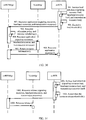
- FIG. 16 shows a resource abstraction and registration process in a method for managing a base station according to an embodiment of the present invention.
- two nodes are used as examples for description.
- FIG. 17 shows a process of creating a cloud based virtual base station in a method for managing a base station according to an embodiment of the present invention.
- FIG. 18 shows a process of deleting a node in a method for managing a base station according to an embodiment of the present invention.
- FIG. 19 shows a process of deleting a cloud based virtual base station in a method for managing a base station according to an embodiment of the present invention.
- FIG. 20 shows a process of applying for new resources by a cloud based virtual base station in a method for managing a base station according to an embodiment of the present invention. 901.
- a cloud based virtual base station detects a service is overloaded, for example, it detects that a service exceeds a load threshold.
- FIG. 21 shows a process of releasing resources by a cloud based virtual base station in a method for managing a base station according to an embodiment of the present invention.
- multiple operators can share computing capabilities between mass base station physical resources provided by multiple nodes. Therefore, the overall computing capabilities of the system can be dynamically and flexibly extended according to traffic, which can well adapt to the scenario of a temporary heavy traffic impact, and service decoupling between operators can be implemented better.
- the overall computing capabilities of the system can be dynamically and flexibly extended according to traffic, which can well adapt to the scenario of a temporary heavy traffic impact.
- multiple operators can also share computing capabilities between mass base station physical resources (such as nodes).
- the overall computing capabilities of the system can be dynamically and flexibly extended according to traffic of each cloud based virtual base station, which can well adapt to the scenario of a temporary heavy traffic impact.
- the embodiments provided in the previous aspect may also completely or partially implement functions of the embodiments provided in this aspect, namely, the multi-standard base station implementation solution based on a cloud based virtual base station platform and a cloud based virtual base station (Cloud based virtual BTS, cvBTS), so that the multi-standard base station can share computing capabilities between mass base station physical resources (such as Nodes). Therefore, the overall computing capabilities of the system can be dynamically and flexibly extended according to traffic, which can well adapt to the scenario of a temporary heavy traffic impact.
- FIG. 22a shows a schematic diagram of specific composition of a radio communication system according to an embodiment of the present invention.
- the system 1 includes: a cloud based virtual base station platform 10, configured to virtualize base station physical resources of nodes at a physical layer into logical resources of a resource layer, and schedule, at a resource scheduling layer, the logical resources provided by the resource layer to a cloud based virtual base station, where the base station physical resources include node computing resources and node network resources, and the cloud based virtual base station is a cloud based virtual base station having different standards, and the logical resources include management control resources, signaling resources, baseband resources, and transmission resources; a cloud based virtual base station 12, configured to provide base station services of predetermined standards based on the logical resources scheduled by the cloud based virtual base station platform 10; and a cloud based virtual base station management device 14, configured to manage the cloud based virtual base station.
- a cloud based virtual base station platform 10 configured to virtualize base station physical resources of nodes at a physical layer into logical resources of
- connections between devices are only examples, and that devices in the system may have more contacts when needed, for example, the cloud based virtual base station management device and the cloud based virtual base station platform may also have a direct contact.
- the number of cloud based virtual base stations in a system may be determined according to service requirements and resource restrictions, and multiple cloud based virtual base stations may exist in a same standard.
- the cloud based virtual base station may include a cloud based virtual base station identifier attribute and a cloud based virtual base station standard identifier attribute, where the cloud based virtual base station identifier attribute is used to identify different cloud based virtual base stations, and the cloud based virtual base station standard identifier attribute is used to identify the standard of the cloud based virtual base station; thereby, other devices in the system and network can distinguish different cloud based virtual base stations and standards thereof.
- the cloud based virtual base station may include: attribute 1: cloud based virtual base station instance identifier: cvBTSId; and attribute 2: cloud based virtual base station standard identifier: RatType.
- a schematic typical operation of adding a cloud based virtual base station is as follows: ADD cvBTS: cvBTSId, RatType. Of course, the operation is an example, and there may be other forms, which are not described herein.
- the cloud based virtual base station having different standards includes one or more of the following: a UMTS-standard cloud based virtual base station, an LTE-standard cloud based virtual base station, and a time division synchronous (Time Division Synchronous, TDS) CDMA-standard cloud based virtual base station.
- a UMTS-standard cloud based virtual base station an LTE-standard cloud based virtual base station
- a time division synchronous (Time Division Synchronous, TDS) CDMA-standard cloud based virtual base station includes one or more of the following: a UMTS-standard cloud based virtual base station, an LTE-standard cloud based virtual base station, and a time division synchronous (Time Division Synchronous, TDS) CDMA-standard cloud based virtual base station.
- TDS Time Division Synchronous
- the cloud based virtual base station platform is divided into three layers according to functions.
- the physical layer includes Node computing resources and Node network resources;
- the resource layer includes management control resources, signaling resources, baseband resources, and transmission resources;
- the resource scheduling layer allocates and schedules the resources in the resource layer.
- the Node computing resources may include general-purpose computing resources and dedicated computing resources, and in this case, the resource layer virtualizes resources of the physical layer into logical resources.
- dedicated resources need to be considered, for example, some dedicated computing resources are only used to process the baseband algorithm of a UMTS, and other dedicated computing resources are used to process the baseband algorithm of LTE.
- the computing resources and network resources are virtualized into logical resources.
- the resource layer abstracts a series of resource capabilities: UMTS management control resource capabilities, UMTS signaling resource capabilities, UMTS baseband resource capabilities, LTE management control resource capabilities, LTE signaling resource capabilities, LTE baseband resource capabilities, TDS management control resource capabilities, TDS signaling resource capabilities, TDS baseband resource capabilities, and transmission resource capabilities.
- base station physical resources are provided by the nodes in the system.
- the cloud based virtual base station may request corresponding resources from the resource scheduling layer of the cloud based virtual base station platform according to service requirements of the cloud based virtual base station; the cloud based virtual base station platform schedules, according to the request of the cloud based virtual base station through scheduling of the resource scheduling layer, the logical resources provided by the resource layer to the cloud based virtual base station for use.
- the cloud based virtual base station platform is further configured to virtualize, at the resource scheduling layer according to a resource scheduling algorithm, base station physical resources provided by other nodes in the system into logical resources, and allocate the logical resources to the cloud based virtual base station.
- base station physical resources are integrated through the cloud based virtual base station platform and are provided to a cloud based virtual base station having different standards; when the base station physical resources are faulty or resource requirements of the cloud based virtual base station increase, allocation of resources can be effectively implemented through the cloud based virtual base station platform, and security and effectiveness of resource sharing can be improved.
- the cloud based virtual base station may request the cloud based virtual base station platform to allocate new resources, which increases service processing capabilities of the cloud based virtual base station and improves sharing efficiency of the base station resources.
- FIG. 23 shows a schematic diagram of composition of a cloud based virtual base station according to an embodiment of the present invention.
- the cloud based virtual base station in this embodiment is a cloud based virtual base station having a predetermined standard.
- the cloud based virtual base station includes: a resource obtaining unit 120, configured to request corresponding logical resources from a resource scheduling layer of a cloud based virtual base station platform according to service requirements, so that the cloud based virtual base station platform schedules the logical resources to the cloud based virtual base station for use according to the request of the cloud based virtual base station through scheduling of the resource scheduling layer, where the logical resources are logical resources of a resource layer scheduled at the resource scheduling layer into which the cloud based virtual base station platform virtualizes base station physical resources of nodes at a physical layer; and a service providing unit 122, configured to provide base station services of the predetermined standard based on the logical resources scheduled by the cloud based virtual base station platform.
- FIG. 24 is a schematic diagram of a network topology of a virtual base station system according to an embodiment of the present invention.
- the system includes the following five parts.
- Node 20 are 5 nodes in FIG. 3 : node 0, node 1, node 3, node 3, and node 4, which are configured to provide computing resources and network resources of the base station, and virtualize the computing resources and network resources into logical resources.
- the logical resources include management control resources, signaling resources, baseband resources, and transmission resources. Therefore, the computing resources and network resources can be correspondingly virtualized into management control resources, signaling resources, baseband resources, and transmission resources. Of course, categories of logical resources may also be added or changed according to requirements of specific services, which is not further described herein.
- the Node may be homogeneous or heterogeneous, for example, a PC may be a Node, and a base transceiver station (Base Transceiver Station, BTS) may be a Node; the Node in the embodiment of the present invention may be any device that has computing capabilities, that is, any one of the above 5 nodes is a computer, a base transceiver station, or other devices that have computing capabilities.
- a switch device 22 is configured to perform data exchange between the nodes.
- the switch device may be any device capable of data exchange; there may be multiple Switches in the system, and multiple Switches may be networked to form a complex topology.
- a node management device (NodeMgr) 24 is configured to obtain capabilities of logical resources of the nodes managed by the node management device, form a resource pool according to the capabilities of the logical resources by using the logical resources of the nodes managed by the node management device, and based on data exchange of the switch device, schedule the corresponding logical resources in the resource pool to the cloud based virtual base station for use.
- the node management device may be deployed on any one of the multiple nodes, or separately deployed on an independent server. If the node management device is deployed on a node, information exchange between the node management device and each node may be implemented through the above switch device; if the node management device is deployed on an independent server, the node management device may also be connected to the switch device, and information exchange between the node management device and each node may be implemented through the above switch device. Of course, the node management device may also be connected to a part or all of the nodes to implement direct or indirect information exchange.
- a cloud based virtual base station management device (cvBTSMgr) 26 is configured to manage and control resources of the cloud based virtual base station (Cloud based virtual BTS, cvBTS) according to the information of the resource pool provided by the node management device.
- the cloud based virtual base station management device may be deployed on any one of the multiple nodes, or deployed with the node management device together, or separately deployed on an independent server.
- the cloud based virtual base station management device may also be connected to the switch device, and information exchange between the cloud based virtual base station management device and each node may be implemented through the above switch device.
- the cloud based virtual base station management device may also be connected to a part or all of the nodes to implement direct or indirect information exchange.
- One or more cloud based virtual base stations (cvBTS) 28 are configured to obtain the logical resources according to the management of the cloud based virtual base station management device and the scheduling of the node management device, and provide base station services based on the logical resources.
- FIG. 3 shows 3 cvBTSs, which are respectively cvBTS 0, cvBTS 1, and cvBTS 2. Resources of each cvBTS are provided by nodes in a circle associated with the cvBTS, for example, in this embodiment, resources of cvBTS 0 are provided by node 0 and node 1.
- cvBTS 0 is managed by cvBTSMgr 4
- node 0 and node 1 are managed by NodeMgr 3, and other explanations are similar.
- the cloud based virtual base station may be deployed across the Nodes.
- Logical resources of one cloud based virtual base station may come from one or more Nodes; logical resources of one Node may also be allocated to one or more cloud based virtual base stations for use.
- the cloud based virtual base station is deployed on a node, and a resource management module of the cloud based virtual base station may be deployed on the node which provides management control resources, while logical resources of the cloud based virtual base station may come from each node, where the resource management module of the cloud based virtual base station is configured to manage and control the logical resources of the cloud based virtual base station.
- the cloud based virtual base station cvBTS 0 uses resources of Node 0 and Node 1
- cvBTS 1 uses resources of Node 3 and Node 4
- cvBTS 2 uses resources of Node 1, Node 2, and Node 3.
- an embodiment of the present invention further provides a resource scheduling method, used in the above system. As shown in FIG. 25 , the method includes the following:
- the base station physical resources are provided by the nodes in the system.
- the method further includes: when the node providing resources to the cloud based virtual base station is faulty, virtualizing, by the cloud based virtual base station platform, at the resource scheduling layer according to a resource scheduling algorithm, base station physical resources provided by other nodes in the system into logical resources, and allocating the logical resources to the cloud based virtual base station.
- FIG. 26-FIG. 31 describe various cases in the method for managing a base station in the embodiments of the present invention.
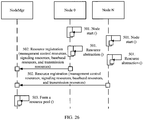
- FIG. 26 shows a resource abstraction and registration process in a method for managing a base station according to an embodiment of the present invention.
- two nodes are used as examples for description.
- FIG. 27 shows a process of creating a cloud based virtual base station in a method for managing a base station according to an embodiment of the present invention.
- FIG. 28 shows a process of deleting a node in a method for managing a base station according to an embodiment of the present invention.
- FIG. 29 shows a process of deleting a cloud based virtual base station in a method for managing a base station according to an embodiment of the present invention.
- FIG. 30 shows a process of applying for new resources by a cloud based virtual base station in a method for managing a base station according to an embodiment of the present invention. 901.
- a cloud based virtual base station detects a service is overloaded, for example, it detects that a service exceeds a load threshold.
- FIG. 31 shows a process of releasing resources by a cloud based virtual base station in a method for managing a base station according to an embodiment of the present invention.
- base stations having different standards can share computing capabilities between mass base station physical resources (such as Nodes). Therefore, the overall computing capabilities of the system can be dynamically and flexibly extended according to traffic, which can well adapt to the scenario of a temporary heavy traffic impact.
- the embodiments provided in the three aspects of the present invention not only can independently implement specific functions and solve specific problems, but also can: for a total idea, for example, virtualize multiple node physical resources into logical resources, and allocate the logical resources to multiple cloud based virtual base stations for use through the resource pool, so that the idea that the base station system can share resource capabilities of multiple nodes can be implemented.
- the embodiments in each aspect of the present invention can implement the idea at different layers.
- the program may be stored in a computer readable storage medium. When the program is run, the processes of the methods in the embodiments are performed.
- the storage medium may be a magnetic disk, an optical disk, a Read-Only Memory (Read-Only Memory, ROM), or a Random Access Memory (Read-Only Memory, RAM).
Landscapes
- Engineering & Computer Science (AREA)
- Quality & Reliability (AREA)
- Computer Networks & Wireless Communication (AREA)
- Signal Processing (AREA)
- Mobile Radio Communication Systems (AREA)
Applications Claiming Priority (5)
| Application Number | Priority Date | Filing Date | Title |
|---|---|---|---|
| CN201110369138.5A CN103124219B (zh) | 2011-11-18 | 2011-11-18 | 一种无线通讯系统、云虚拟基站和资源调度方法 |
| CN201110369126.2A CN103124409B (zh) | 2011-11-18 | 2011-11-18 | 一种用于基站管理的系统和基站管理方法 |
| CN201110369130.9A CN103124436B (zh) | 2011-11-18 | 2011-11-18 | 一种无线通讯系统、云虚拟基站和资源调度方法 |
| PCT/CN2012/084844 WO2013071896A1 (fr) | 2011-11-18 | 2012-11-19 | Système de communication sans fil, dispositif de station de base et procédé de gestion associé |
| EP12850389.3A EP2773145B1 (fr) | 2011-11-18 | 2012-11-19 | Système de communication sans fil |
Related Parent Applications (2)
| Application Number | Title | Priority Date | Filing Date |
|---|---|---|---|
| EP12850389.3A Division EP2773145B1 (fr) | 2011-11-18 | 2012-11-19 | Système de communication sans fil |
| EP12850389.3A Division-Into EP2773145B1 (fr) | 2011-11-18 | 2012-11-19 | Système de communication sans fil |
Publications (2)
| Publication Number | Publication Date |
|---|---|
| EP3273719A1 true EP3273719A1 (fr) | 2018-01-24 |
| EP3273719B1 EP3273719B1 (fr) | 2020-09-23 |
Family
ID=48428992
Family Applications (2)
| Application Number | Title | Priority Date | Filing Date |
|---|---|---|---|
| EP17166187.9A Active EP3273719B1 (fr) | 2011-11-18 | 2012-11-19 | Système de radiocommunication et son procédé de gestion |
| EP12850389.3A Active EP2773145B1 (fr) | 2011-11-18 | 2012-11-19 | Système de communication sans fil |
Family Applications After (1)
| Application Number | Title | Priority Date | Filing Date |
|---|---|---|---|
| EP12850389.3A Active EP2773145B1 (fr) | 2011-11-18 | 2012-11-19 | Système de communication sans fil |
Country Status (4)
| Country | Link |
|---|---|
| US (1) | US10616804B2 (fr) |
| EP (2) | EP3273719B1 (fr) |
| JP (1) | JP5842281B2 (fr) |
| WO (1) | WO2013071896A1 (fr) |
Families Citing this family (17)
| Publication number | Priority date | Publication date | Assignee | Title |
|---|---|---|---|---|
| WO2014190510A1 (fr) * | 2013-05-29 | 2014-12-04 | 华为技术有限公司 | Procédé et plateforme pour exécuter un service dans un système cloud d'une station de base |
| US9426663B2 (en) * | 2013-06-26 | 2016-08-23 | Cable Television Laboratories, Inc. | Capacity sharing between wireless systems |
| CN104348764B (zh) * | 2013-07-31 | 2017-09-19 | 国际商业机器公司 | 在数据接收链路中分配计算单元的方法和装置 |
| KR102012259B1 (ko) * | 2013-08-21 | 2019-08-21 | 한국전자통신연구원 | 클라우드 가상 기지국의 자원을 제어하는 방법 및 장치 |
| JP6273773B2 (ja) * | 2013-10-30 | 2018-02-07 | 富士ゼロックス株式会社 | 情報処理装置、情報処理システムおよびプログラム |
| KR20160138503A (ko) * | 2014-04-14 | 2016-12-05 | 닛본 덴끼 가부시끼가이샤 | 통신 장치, 통신 방법, 및 기억 매체 |
| US20160094387A1 (en) * | 2014-09-30 | 2016-03-31 | Ruckus Wireless, Inc. | Discovery of cloud-based access-point controllers |
| US20180109959A1 (en) * | 2015-03-30 | 2018-04-19 | Telefonaktiebolaget Lm Ericsson (Publ) | Technique for extending capacities of a radio access network |
| US9680958B2 (en) | 2015-08-27 | 2017-06-13 | Netsia, Inc. | System and method for programmable radio access networks |
| US9674859B2 (en) | 2015-09-07 | 2017-06-06 | Netsia | Method and apparatus for virtual channel station information based wireless radio access network virtualization |
| CN106330577A (zh) * | 2016-11-11 | 2017-01-11 | 郑州云海信息技术有限公司 | 一种虚拟化管理平台中管理节点切换方法及系统 |
| CN109673027B (zh) * | 2017-10-16 | 2023-01-10 | 中兴通讯股份有限公司 | 多集中单元cu融合方法、相应设备及系统 |
| CN108684075B (zh) * | 2018-04-27 | 2020-12-29 | 中国科学院计算技术研究所 | 集中式基站架构下的处理资源分配方法 |
| CN114175707B (zh) * | 2019-07-22 | 2025-12-12 | 约翰·梅扎林瓜联合有限公司 | 在单一虚拟基站环境中的共享频谱接入系统中用于安全地承载多个网络运营商的系统及方法 |
| CN113075707B (zh) * | 2021-04-02 | 2022-12-27 | 广州极飞科技股份有限公司 | 全球导航定位系统信息处理方法、装置、中心站及系统 |
| CN113747477B (zh) * | 2021-10-19 | 2024-03-15 | 上海创远仪器技术股份有限公司 | 实现针对共建5g网络基站进行核查处理的方法 |
| US20230388180A1 (en) * | 2022-05-31 | 2023-11-30 | Microsoft Technology Licensing, Llc | Techniques for provisioning workspaces in cloud-based computing platforms |
Citations (3)
| Publication number | Priority date | Publication date | Assignee | Title |
|---|---|---|---|---|
| US20090170472A1 (en) * | 2007-12-28 | 2009-07-02 | Chapin John M | Shared network infrastructure |
| CN101969391A (zh) * | 2010-10-27 | 2011-02-09 | 北京邮电大学 | 一种支持融合网络业务的云平台及其工作方法 |
| WO2011109968A1 (fr) * | 2010-03-10 | 2011-09-15 | 中兴通讯股份有限公司 | Gestionnaire de ressources radio et procédé d'attribution de ressources radio de canal de contrôle de liaison montante physique |
Family Cites Families (16)
| Publication number | Priority date | Publication date | Assignee | Title |
|---|---|---|---|---|
| CA2326750C (fr) * | 1998-04-03 | 2010-03-16 | Telefonaktiebolaget Lm Ericsson | Acces et allocation de ressources radio flexibles dans un systeme universel de telecommunications mobiles (sutm) |
| KR20040010507A (ko) | 2003-12-31 | 2004-01-31 | 주식회사 넥스다임 | 가상 기지국을 이용한 통신방법 |
| JP4901231B2 (ja) * | 2006-02-09 | 2012-03-21 | 日本電信電話株式会社 | リソース管理装置 |
| WO2007134483A1 (fr) | 2006-05-18 | 2007-11-29 | Utstarcom (China) Co. Ltd. | Station de base bimode phs/wimax |
| WO2008011149A2 (fr) * | 2006-07-20 | 2008-01-24 | Bandspeed, Inc. | Gestion de stations de base sans fil à l'aide d'un administrateur de stations de base virtuel réparti |
| EP2223556B1 (fr) * | 2007-12-05 | 2016-04-27 | Telefonaktiebolaget LM Ericsson (publ) | Attribution de ressources à des opérateurs à spectre partagé |
| CN101459597A (zh) * | 2007-12-14 | 2009-06-17 | 华为技术有限公司 | 一种使用逻辑资源的方法和系统 |
| US8010676B1 (en) | 2008-01-03 | 2011-08-30 | Desktonc, Inc. | Virtual computing services deployment network |
| US8849971B2 (en) * | 2008-05-28 | 2014-09-30 | Red Hat, Inc. | Load balancing in cloud-based networks |
| CN101478768A (zh) | 2009-01-24 | 2009-07-08 | 中兴通讯股份有限公司 | 网管系统及基于非标准接口的网络设备管理方法 |
| US9009294B2 (en) * | 2009-12-11 | 2015-04-14 | International Business Machines Corporation | Dynamic provisioning of resources within a cloud computing environment |
| CN102012891B (zh) * | 2010-11-18 | 2012-10-31 | 浪潮(北京)电子信息产业有限公司 | 计算机集群管理方法、装置和系统 |
| CN102186181A (zh) | 2011-04-14 | 2011-09-14 | 北京邮电大学 | 一种基于g-ran的新型无线接入网络方法及系统 |
| CN102164184A (zh) * | 2011-04-22 | 2011-08-24 | 广州杰赛科技股份有限公司 | 云计算网络中计算机实体的接入和管理方法及云计算网络 |
| US9515952B2 (en) * | 2011-07-01 | 2016-12-06 | Hewlett Packard Enterprise Development Lp | Method of and system for managing computing resources |
| EP2759181A1 (fr) * | 2011-09-20 | 2014-07-30 | Nokia Solutions and Networks Oy | Multiplexage de c urs de réseau en partage ran |
-
2012
- 2012-11-19 EP EP17166187.9A patent/EP3273719B1/fr active Active
- 2012-11-19 JP JP2014541526A patent/JP5842281B2/ja active Active
- 2012-11-19 EP EP12850389.3A patent/EP2773145B1/fr active Active
- 2012-11-19 WO PCT/CN2012/084844 patent/WO2013071896A1/fr not_active Ceased
-
2014
- 2014-05-16 US US14/279,978 patent/US10616804B2/en active Active
Patent Citations (4)
| Publication number | Priority date | Publication date | Assignee | Title |
|---|---|---|---|---|
| US20090170472A1 (en) * | 2007-12-28 | 2009-07-02 | Chapin John M | Shared network infrastructure |
| WO2011109968A1 (fr) * | 2010-03-10 | 2011-09-15 | 中兴通讯股份有限公司 | Gestionnaire de ressources radio et procédé d'attribution de ressources radio de canal de contrôle de liaison montante physique |
| EP2395782A1 (fr) * | 2010-03-10 | 2011-12-14 | ZTE Corporation | Gestionnaire de ressources radio et procédé d'attribution de ressources radio de canal de contrôle de liaison montante physique |
| CN101969391A (zh) * | 2010-10-27 | 2011-02-09 | 北京邮电大学 | 一种支持融合网络业务的云平台及其工作方法 |
Non-Patent Citations (2)
| Title |
|---|
| CHINA MOBILE RESEARCH INSTITUTE: "C-RAN, The Road Towards Green RAN", INTERNET CITATION, October 2011 (2011-10-01), pages 1 - 48, XP002700746, Retrieved from the Internet <URL:http://labs.chinamobile.com/cran/wp-content/uploads/CRAN_white_paper_v2_5_EN(1).pdf> [retrieved on 20130710] * |
| ZHENBO ZHU ET AL: "Virtual base station pool: towards a wireless network cloud for radio access networks", COMPUTING FRONTIERS, ACM, 2 PENN PLAZA, SUITE 701 NEW YORK NY 10121-0701 USA, 3 May 2011 (2011-05-03), pages 1 - 10, XP058006421, ISBN: 978-1-4503-0698-0, DOI: 10.1145/2016604.2016646 * |
Also Published As
| Publication number | Publication date |
|---|---|
| JP2014533906A (ja) | 2014-12-15 |
| EP2773145A4 (fr) | 2015-01-07 |
| EP3273719B1 (fr) | 2020-09-23 |
| WO2013071896A1 (fr) | 2013-05-23 |
| US10616804B2 (en) | 2020-04-07 |
| JP5842281B2 (ja) | 2016-01-13 |
| EP2773145A1 (fr) | 2014-09-03 |
| US20140247792A1 (en) | 2014-09-04 |
| EP2773145B1 (fr) | 2017-05-17 |
Similar Documents
| Publication | Publication Date | Title |
|---|---|---|
| US10616804B2 (en) | Radio communication system, base station device and management method thereof | |
| CN103124409B (zh) | 一种用于基站管理的系统和基站管理方法 | |
| US10942786B2 (en) | Network management | |
| CN107924383B (zh) | 用于网络功能虚拟化资源管理的系统和方法 | |
| EP3468151B1 (fr) | Procédé et appareil de traitement de ressources d'accélération | |
| EP3295698B1 (fr) | Système et procédé de fourniture et de distribution de ressources de spectre | |
| US12250549B2 (en) | High availability access to shared spectrum using geo-redundant spectrum access systems | |
| EP4024767B1 (fr) | Procédé d'instanciation de vnf, nfvo, vim, vnfm et système | |
| US12143861B2 (en) | Efficiency of routing traffic to an edge compute server at the far edge of a cellular network | |
| EP3611968B1 (fr) | Station de base et procédé | |
| CN108132827B (zh) | 一种网络切片资源映射方法、相关设备及系统 | |
| CN103124219B (zh) | 一种无线通讯系统、云虚拟基站和资源调度方法 | |
| EP3549326A1 (fr) | Contrôle de la configuration d'un réseau | |
| CN103124436B (zh) | 一种无线通讯系统、云虚拟基站和资源调度方法 | |
| Salman et al. | Cloud RAN: Basics, advances and challenges | |
| EP3048822B1 (fr) | Procédé, dispositif et système de gestion de la mobilité, et support de stockage informatique associé | |
| CN104699521B (zh) | 一种虚拟机在线迁移的方法、系统及装置 | |
| CN113098705B (zh) | 网络业务的生命周期管理的授权方法及装置 | |
| US12470989B2 (en) | Method, apparatus, and computer-readable storage medium for optimizing configuration of inter-frequency layer measurements for lower layer mobility | |
| Choudhury et al. | Intelligent agent support for achieving low latency in cloud-native NextG mobile core networks | |
| CN121603375A (zh) | 一种切换资源的方法、装置及系统 | |
| CN120295789A (zh) | Dpu集中式服务网格的cpu资源分配方法 | |
| CN119440795A (zh) | 基于云计算技术的跨运行时实例的混合部署方法以及装置 | |
| CN117294600A (zh) | 网络资源管理方法、装置及系统 | |
| WO2022141293A1 (fr) | Procédé et appareil de mise à l'échelle souple |
Legal Events
| Date | Code | Title | Description |
|---|---|---|---|
| PUAI | Public reference made under article 153(3) epc to a published international application that has entered the european phase |
Free format text: ORIGINAL CODE: 0009012 |
|
| STAA | Information on the status of an ep patent application or granted ep patent |
Free format text: STATUS: REQUEST FOR EXAMINATION WAS MADE |
|
| 17P | Request for examination filed |
Effective date: 20170412 |
|
| AC | Divisional application: reference to earlier application |
Ref document number: 2773145 Country of ref document: EP Kind code of ref document: P |
|
| AK | Designated contracting states |
Kind code of ref document: A1 Designated state(s): AL AT BE BG CH CY CZ DE DK EE ES FI FR GB GR HR HU IE IS IT LI LT LU LV MC MK MT NL NO PL PT RO RS SE SI SK SM TR |
|
| STAA | Information on the status of an ep patent application or granted ep patent |
Free format text: STATUS: EXAMINATION IS IN PROGRESS |
|
| 17Q | First examination report despatched |
Effective date: 20190515 |
|
| GRAP | Despatch of communication of intention to grant a patent |
Free format text: ORIGINAL CODE: EPIDOSNIGR1 |
|
| STAA | Information on the status of an ep patent application or granted ep patent |
Free format text: STATUS: GRANT OF PATENT IS INTENDED |
|
| INTG | Intention to grant announced |
Effective date: 20200407 |
|
| GRAS | Grant fee paid |
Free format text: ORIGINAL CODE: EPIDOSNIGR3 |
|
| GRAA | (expected) grant |
Free format text: ORIGINAL CODE: 0009210 |
|
| STAA | Information on the status of an ep patent application or granted ep patent |
Free format text: STATUS: THE PATENT HAS BEEN GRANTED |
|
| AC | Divisional application: reference to earlier application |
Ref document number: 2773145 Country of ref document: EP Kind code of ref document: P |
|
| AK | Designated contracting states |
Kind code of ref document: B1 Designated state(s): AL AT BE BG CH CY CZ DE DK EE ES FI FR GB GR HR HU IE IS IT LI LT LU LV MC MK MT NL NO PL PT RO RS SE SI SK SM TR |
|
| REG | Reference to a national code |
Ref country code: GB Ref legal event code: FG4D |
|
| REG | Reference to a national code |
Ref country code: CH Ref legal event code: EP |
|
| REG | Reference to a national code |
Ref country code: DE Ref legal event code: R096 Ref document number: 602012072520 Country of ref document: DE |
|
| REG | Reference to a national code |
Ref country code: IE Ref legal event code: FG4D |
|
| REG | Reference to a national code |
Ref country code: AT Ref legal event code: REF Ref document number: 1317686 Country of ref document: AT Kind code of ref document: T Effective date: 20201015 |
|
| PG25 | Lapsed in a contracting state [announced via postgrant information from national office to epo] |
Ref country code: FI Free format text: LAPSE BECAUSE OF FAILURE TO SUBMIT A TRANSLATION OF THE DESCRIPTION OR TO PAY THE FEE WITHIN THE PRESCRIBED TIME-LIMIT Effective date: 20200923 Ref country code: HR Free format text: LAPSE BECAUSE OF FAILURE TO SUBMIT A TRANSLATION OF THE DESCRIPTION OR TO PAY THE FEE WITHIN THE PRESCRIBED TIME-LIMIT Effective date: 20200923 Ref country code: BG Free format text: LAPSE BECAUSE OF FAILURE TO SUBMIT A TRANSLATION OF THE DESCRIPTION OR TO PAY THE FEE WITHIN THE PRESCRIBED TIME-LIMIT Effective date: 20201223 Ref country code: GR Free format text: LAPSE BECAUSE OF FAILURE TO SUBMIT A TRANSLATION OF THE DESCRIPTION OR TO PAY THE FEE WITHIN THE PRESCRIBED TIME-LIMIT Effective date: 20201224 Ref country code: NO Free format text: LAPSE BECAUSE OF FAILURE TO SUBMIT A TRANSLATION OF THE DESCRIPTION OR TO PAY THE FEE WITHIN THE PRESCRIBED TIME-LIMIT Effective date: 20201223 Ref country code: SE Free format text: LAPSE BECAUSE OF FAILURE TO SUBMIT A TRANSLATION OF THE DESCRIPTION OR TO PAY THE FEE WITHIN THE PRESCRIBED TIME-LIMIT Effective date: 20200923 |
|
| REG | Reference to a national code |
Ref country code: AT Ref legal event code: MK05 Ref document number: 1317686 Country of ref document: AT Kind code of ref document: T Effective date: 20200923 |
|
| PG25 | Lapsed in a contracting state [announced via postgrant information from national office to epo] |
Ref country code: LV Free format text: LAPSE BECAUSE OF FAILURE TO SUBMIT A TRANSLATION OF THE DESCRIPTION OR TO PAY THE FEE WITHIN THE PRESCRIBED TIME-LIMIT Effective date: 20200923 Ref country code: RS Free format text: LAPSE BECAUSE OF FAILURE TO SUBMIT A TRANSLATION OF THE DESCRIPTION OR TO PAY THE FEE WITHIN THE PRESCRIBED TIME-LIMIT Effective date: 20200923 |
|
| REG | Reference to a national code |
Ref country code: NL Ref legal event code: MP Effective date: 20200923 |
|
| REG | Reference to a national code |
Ref country code: LT Ref legal event code: MG4D |
|
| PG25 | Lapsed in a contracting state [announced via postgrant information from national office to epo] |
Ref country code: EE Free format text: LAPSE BECAUSE OF FAILURE TO SUBMIT A TRANSLATION OF THE DESCRIPTION OR TO PAY THE FEE WITHIN THE PRESCRIBED TIME-LIMIT Effective date: 20200923 Ref country code: SM Free format text: LAPSE BECAUSE OF FAILURE TO SUBMIT A TRANSLATION OF THE DESCRIPTION OR TO PAY THE FEE WITHIN THE PRESCRIBED TIME-LIMIT Effective date: 20200923 Ref country code: LT Free format text: LAPSE BECAUSE OF FAILURE TO SUBMIT A TRANSLATION OF THE DESCRIPTION OR TO PAY THE FEE WITHIN THE PRESCRIBED TIME-LIMIT Effective date: 20200923 Ref country code: PT Free format text: LAPSE BECAUSE OF FAILURE TO SUBMIT A TRANSLATION OF THE DESCRIPTION OR TO PAY THE FEE WITHIN THE PRESCRIBED TIME-LIMIT Effective date: 20210125 Ref country code: RO Free format text: LAPSE BECAUSE OF FAILURE TO SUBMIT A TRANSLATION OF THE DESCRIPTION OR TO PAY THE FEE WITHIN THE PRESCRIBED TIME-LIMIT Effective date: 20200923 Ref country code: CZ Free format text: LAPSE BECAUSE OF FAILURE TO SUBMIT A TRANSLATION OF THE DESCRIPTION OR TO PAY THE FEE WITHIN THE PRESCRIBED TIME-LIMIT Effective date: 20200923 |
|
| PG25 | Lapsed in a contracting state [announced via postgrant information from national office to epo] |
Ref country code: ES Free format text: LAPSE BECAUSE OF FAILURE TO SUBMIT A TRANSLATION OF THE DESCRIPTION OR TO PAY THE FEE WITHIN THE PRESCRIBED TIME-LIMIT Effective date: 20200923 Ref country code: AT Free format text: LAPSE BECAUSE OF FAILURE TO SUBMIT A TRANSLATION OF THE DESCRIPTION OR TO PAY THE FEE WITHIN THE PRESCRIBED TIME-LIMIT Effective date: 20200923 Ref country code: AL Free format text: LAPSE BECAUSE OF FAILURE TO SUBMIT A TRANSLATION OF THE DESCRIPTION OR TO PAY THE FEE WITHIN THE PRESCRIBED TIME-LIMIT Effective date: 20200923 Ref country code: PL Free format text: LAPSE BECAUSE OF FAILURE TO SUBMIT A TRANSLATION OF THE DESCRIPTION OR TO PAY THE FEE WITHIN THE PRESCRIBED TIME-LIMIT Effective date: 20200923 Ref country code: IS Free format text: LAPSE BECAUSE OF FAILURE TO SUBMIT A TRANSLATION OF THE DESCRIPTION OR TO PAY THE FEE WITHIN THE PRESCRIBED TIME-LIMIT Effective date: 20210123 |
|
| REG | Reference to a national code |
Ref country code: DE Ref legal event code: R119 Ref document number: 602012072520 Country of ref document: DE |
|
| PG25 | Lapsed in a contracting state [announced via postgrant information from national office to epo] |
Ref country code: SK Free format text: LAPSE BECAUSE OF FAILURE TO SUBMIT A TRANSLATION OF THE DESCRIPTION OR TO PAY THE FEE WITHIN THE PRESCRIBED TIME-LIMIT Effective date: 20200923 Ref country code: MC Free format text: LAPSE BECAUSE OF FAILURE TO SUBMIT A TRANSLATION OF THE DESCRIPTION OR TO PAY THE FEE WITHIN THE PRESCRIBED TIME-LIMIT Effective date: 20200923 |
|
| REG | Reference to a national code |
Ref country code: CH Ref legal event code: PL |
|
| PG25 | Lapsed in a contracting state [announced via postgrant information from national office to epo] |
Ref country code: LU Free format text: LAPSE BECAUSE OF NON-PAYMENT OF DUE FEES Effective date: 20201119 |
|
| PLBE | No opposition filed within time limit |
Free format text: ORIGINAL CODE: 0009261 |
|
| STAA | Information on the status of an ep patent application or granted ep patent |
Free format text: STATUS: NO OPPOSITION FILED WITHIN TIME LIMIT |
|
| REG | Reference to a national code |
Ref country code: BE Ref legal event code: MM Effective date: 20201130 |
|
| PG25 | Lapsed in a contracting state [announced via postgrant information from national office to epo] |
Ref country code: LI Free format text: LAPSE BECAUSE OF NON-PAYMENT OF DUE FEES Effective date: 20201130 Ref country code: DK Free format text: LAPSE BECAUSE OF FAILURE TO SUBMIT A TRANSLATION OF THE DESCRIPTION OR TO PAY THE FEE WITHIN THE PRESCRIBED TIME-LIMIT Effective date: 20200923 Ref country code: SI Free format text: LAPSE BECAUSE OF FAILURE TO SUBMIT A TRANSLATION OF THE DESCRIPTION OR TO PAY THE FEE WITHIN THE PRESCRIBED TIME-LIMIT Effective date: 20200923 Ref country code: CH Free format text: LAPSE BECAUSE OF NON-PAYMENT OF DUE FEES Effective date: 20201130 |
|
| 26N | No opposition filed |
Effective date: 20210624 |
|
| PG25 | Lapsed in a contracting state [announced via postgrant information from national office to epo] |
Ref country code: IE Free format text: LAPSE BECAUSE OF NON-PAYMENT OF DUE FEES Effective date: 20201119 Ref country code: IT Free format text: LAPSE BECAUSE OF FAILURE TO SUBMIT A TRANSLATION OF THE DESCRIPTION OR TO PAY THE FEE WITHIN THE PRESCRIBED TIME-LIMIT Effective date: 20200923 |
|
| PG25 | Lapsed in a contracting state [announced via postgrant information from national office to epo] |
Ref country code: DE Free format text: LAPSE BECAUSE OF NON-PAYMENT OF DUE FEES Effective date: 20210601 |
|
| PG25 | Lapsed in a contracting state [announced via postgrant information from national office to epo] |
Ref country code: IS Free format text: LAPSE BECAUSE OF FAILURE TO SUBMIT A TRANSLATION OF THE DESCRIPTION OR TO PAY THE FEE WITHIN THE PRESCRIBED TIME-LIMIT Effective date: 20210123 Ref country code: TR Free format text: LAPSE BECAUSE OF FAILURE TO SUBMIT A TRANSLATION OF THE DESCRIPTION OR TO PAY THE FEE WITHIN THE PRESCRIBED TIME-LIMIT Effective date: 20200923 Ref country code: MT Free format text: LAPSE BECAUSE OF FAILURE TO SUBMIT A TRANSLATION OF THE DESCRIPTION OR TO PAY THE FEE WITHIN THE PRESCRIBED TIME-LIMIT Effective date: 20200923 Ref country code: CY Free format text: LAPSE BECAUSE OF FAILURE TO SUBMIT A TRANSLATION OF THE DESCRIPTION OR TO PAY THE FEE WITHIN THE PRESCRIBED TIME-LIMIT Effective date: 20200923 |
|
| PG25 | Lapsed in a contracting state [announced via postgrant information from national office to epo] |
Ref country code: MK Free format text: LAPSE BECAUSE OF FAILURE TO SUBMIT A TRANSLATION OF THE DESCRIPTION OR TO PAY THE FEE WITHIN THE PRESCRIBED TIME-LIMIT Effective date: 20200923 |
|
| PG25 | Lapsed in a contracting state [announced via postgrant information from national office to epo] |
Ref country code: BE Free format text: LAPSE BECAUSE OF NON-PAYMENT OF DUE FEES Effective date: 20201130 |
|
| PG25 | Lapsed in a contracting state [announced via postgrant information from national office to epo] |
Ref country code: NL Free format text: LAPSE BECAUSE OF NON-PAYMENT OF DUE FEES Effective date: 20200923 |
|
| PGFP | Annual fee paid to national office [announced via postgrant information from national office to epo] |
Ref country code: GB Payment date: 20250930 Year of fee payment: 14 |
|
| PGFP | Annual fee paid to national office [announced via postgrant information from national office to epo] |
Ref country code: FR Payment date: 20250930 Year of fee payment: 14 |