EP3274004B1 - Matrixbarrierestruktur mit kontrollierter freisetzung für subkutane medizinische vorrichtungen - Google Patents
Matrixbarrierestruktur mit kontrollierter freisetzung für subkutane medizinische vorrichtungen Download PDFInfo
- Publication number
- EP3274004B1 EP3274004B1 EP16714714.9A EP16714714A EP3274004B1 EP 3274004 B1 EP3274004 B1 EP 3274004B1 EP 16714714 A EP16714714 A EP 16714714A EP 3274004 B1 EP3274004 B1 EP 3274004B1
- Authority
- EP
- European Patent Office
- Prior art keywords
- controlled release
- release matrix
- barrier structure
- matrix barrier
- poly
- Prior art date
- Legal status (The legal status is an assumption and is not a legal conclusion. Google has not performed a legal analysis and makes no representation as to the accuracy of the status listed.)
- Active
Links
Images

Classifications
-
- A—HUMAN NECESSITIES
- A61—MEDICAL OR VETERINARY SCIENCE; HYGIENE
- A61L—METHODS OR APPARATUS FOR STERILISING MATERIALS OR OBJECTS IN GENERAL; DISINFECTION, STERILISATION OR DEODORISATION OF AIR; CHEMICAL ASPECTS OF BANDAGES, DRESSINGS, ABSORBENT PADS OR SURGICAL ARTICLES; MATERIALS FOR BANDAGES, DRESSINGS, ABSORBENT PADS OR SURGICAL ARTICLES
- A61L31/00—Materials for other surgical articles, e.g. stents, stent-grafts, shunts, surgical drapes, guide wires, materials for adhesion prevention, occluding devices, surgical gloves, tissue fixation devices
- A61L31/08—Materials for coatings
- A61L31/10—Macromolecular materials
-
- A—HUMAN NECESSITIES
- A61—MEDICAL OR VETERINARY SCIENCE; HYGIENE
- A61L—METHODS OR APPARATUS FOR STERILISING MATERIALS OR OBJECTS IN GENERAL; DISINFECTION, STERILISATION OR DEODORISATION OF AIR; CHEMICAL ASPECTS OF BANDAGES, DRESSINGS, ABSORBENT PADS OR SURGICAL ARTICLES; MATERIALS FOR BANDAGES, DRESSINGS, ABSORBENT PADS OR SURGICAL ARTICLES
- A61L27/00—Materials for grafts or prostheses or for coating grafts or prostheses
- A61L27/14—Macromolecular materials
- A61L27/18—Macromolecular materials obtained otherwise than by reactions only involving carbon-to-carbon unsaturated bonds
-
- A—HUMAN NECESSITIES
- A61—MEDICAL OR VETERINARY SCIENCE; HYGIENE
- A61L—METHODS OR APPARATUS FOR STERILISING MATERIALS OR OBJECTS IN GENERAL; DISINFECTION, STERILISATION OR DEODORISATION OF AIR; CHEMICAL ASPECTS OF BANDAGES, DRESSINGS, ABSORBENT PADS OR SURGICAL ARTICLES; MATERIALS FOR BANDAGES, DRESSINGS, ABSORBENT PADS OR SURGICAL ARTICLES
- A61L27/00—Materials for grafts or prostheses or for coating grafts or prostheses
- A61L27/50—Materials characterised by their function or physical properties, e.g. injectable or lubricating compositions, shape-memory materials, surface modified materials
- A61L27/54—Biologically active materials, e.g. therapeutic substances
-
- A—HUMAN NECESSITIES
- A61—MEDICAL OR VETERINARY SCIENCE; HYGIENE
- A61L—METHODS OR APPARATUS FOR STERILISING MATERIALS OR OBJECTS IN GENERAL; DISINFECTION, STERILISATION OR DEODORISATION OF AIR; CHEMICAL ASPECTS OF BANDAGES, DRESSINGS, ABSORBENT PADS OR SURGICAL ARTICLES; MATERIALS FOR BANDAGES, DRESSINGS, ABSORBENT PADS OR SURGICAL ARTICLES
- A61L29/00—Materials for catheters, medical tubing, cannulae, or endoscopes or for coating catheters
- A61L29/04—Macromolecular materials
- A61L29/06—Macromolecular materials obtained otherwise than by reactions only involving carbon-to-carbon unsaturated bonds
-
- A—HUMAN NECESSITIES
- A61—MEDICAL OR VETERINARY SCIENCE; HYGIENE
- A61L—METHODS OR APPARATUS FOR STERILISING MATERIALS OR OBJECTS IN GENERAL; DISINFECTION, STERILISATION OR DEODORISATION OF AIR; CHEMICAL ASPECTS OF BANDAGES, DRESSINGS, ABSORBENT PADS OR SURGICAL ARTICLES; MATERIALS FOR BANDAGES, DRESSINGS, ABSORBENT PADS OR SURGICAL ARTICLES
- A61L29/00—Materials for catheters, medical tubing, cannulae, or endoscopes or for coating catheters
- A61L29/14—Materials characterised by their function or physical properties, e.g. lubricating compositions
- A61L29/16—Biologically active materials, e.g. therapeutic substances
-
- A—HUMAN NECESSITIES
- A61—MEDICAL OR VETERINARY SCIENCE; HYGIENE
- A61L—METHODS OR APPARATUS FOR STERILISING MATERIALS OR OBJECTS IN GENERAL; DISINFECTION, STERILISATION OR DEODORISATION OF AIR; CHEMICAL ASPECTS OF BANDAGES, DRESSINGS, ABSORBENT PADS OR SURGICAL ARTICLES; MATERIALS FOR BANDAGES, DRESSINGS, ABSORBENT PADS OR SURGICAL ARTICLES
- A61L31/00—Materials for other surgical articles, e.g. stents, stent-grafts, shunts, surgical drapes, guide wires, materials for adhesion prevention, occluding devices, surgical gloves, tissue fixation devices
- A61L31/14—Materials characterised by their function or physical properties, e.g. injectable or lubricating compositions, shape-memory materials, surface modified materials
-
- A—HUMAN NECESSITIES
- A61—MEDICAL OR VETERINARY SCIENCE; HYGIENE
- A61L—METHODS OR APPARATUS FOR STERILISING MATERIALS OR OBJECTS IN GENERAL; DISINFECTION, STERILISATION OR DEODORISATION OF AIR; CHEMICAL ASPECTS OF BANDAGES, DRESSINGS, ABSORBENT PADS OR SURGICAL ARTICLES; MATERIALS FOR BANDAGES, DRESSINGS, ABSORBENT PADS OR SURGICAL ARTICLES
- A61L31/00—Materials for other surgical articles, e.g. stents, stent-grafts, shunts, surgical drapes, guide wires, materials for adhesion prevention, occluding devices, surgical gloves, tissue fixation devices
- A61L31/14—Materials characterised by their function or physical properties, e.g. injectable or lubricating compositions, shape-memory materials, surface modified materials
- A61L31/16—Biologically active materials, e.g. therapeutic substances
-
- A—HUMAN NECESSITIES
- A61—MEDICAL OR VETERINARY SCIENCE; HYGIENE
- A61L—METHODS OR APPARATUS FOR STERILISING MATERIALS OR OBJECTS IN GENERAL; DISINFECTION, STERILISATION OR DEODORISATION OF AIR; CHEMICAL ASPECTS OF BANDAGES, DRESSINGS, ABSORBENT PADS OR SURGICAL ARTICLES; MATERIALS FOR BANDAGES, DRESSINGS, ABSORBENT PADS OR SURGICAL ARTICLES
- A61L2300/00—Biologically active materials used in bandages, wound dressings, absorbent pads or medical devices
- A61L2300/60—Biologically active materials used in bandages, wound dressings, absorbent pads or medical devices characterised by a special physical form
- A61L2300/602—Type of release, e.g. controlled, sustained, slow
Definitions
- US2011159072 A1 discloses a biocompatible polymeric controlled release matrix for delivery of one or more bioactive agents from an implantable medical device.
- US2010158970 A1 discloses implantable composites.
- US2012077028 A1 discloses blends prepared from polyester terpolymers that function as pressure-sensitive adhesives.
- US 5700286 discloses a polymer film for wrapping a stent structure.
- the polymeric controlled release matrix barrier structure comprises a compliant film comprising one or more compliant biocompatible polymers and one or more bioactive agents.
- the biocompatible polymeric controlled release matrix barrier structure comprises an elastomeric collar comprising one or more elastomeric biocompatible polymers and one or more bioactive agents.
- the elastomeric collar comprises at least one elastomeric co-polymer comprising elastomeric and non-elastomeric subunits.
- the elastomeric collar comprises a blend of at least one elastomeric polymer and at least one non-elastomeric polymer.
- the biocompatible polymer is biostable. In another embodiment, the biocompatible polymer is biodegradable.
- the controlled release matrix barrier structure comprises a polymer selected from the group consisting of: polycaprolactone (PCL), poly(lactic acid), poly(lactic-co-glycolic acid), and poly(ethylene-co-vinyl acetate).
- PCL polycaprolactone
- one or more polymers are cross-linked. In another embodiment, the polymers are not cross-linked.
- the bioactive agent can be selected from the group consisting of: antibiotics, antiseptics, antiviral agents, enzyme inhibitors, anti-pyretics, immunomodulators, analgesics, local anesthetics, and cell response modifiers.
- a method for applying a controlled release matrix barrier structure to a surface of an implantable medical device comprises applying a compliant biocompatible polymeric controlled release matrix barrier structure to the implantable medical device under tension, wherein the controlled release matrix barrier structure comprises a compliant film that is capable of conforming to the surface of the implantable medical device and one or more bioactive agents.
- the compliant film conforms to and adheres to the surface of the implantable medical device without an adhesive.
- an adhesive is applied to the implantable medical device or the polymeric film to increase adhesion of the compliant film to the device.
- the film has a length and the length of film applied to the implantable medical device can be altered to modify a dosage of bioactive agent.
- the film has a width between about 5 mm and about 10 mm; and a thickness between about 50 ⁇ m and about 250 ⁇ m.
- a method for applying a controlled release matrix barrier structure to a surface of an implantable medical device wherein the controlled release matrix barrier structure comprises an elastomeric biocompatible polymeric controlled release matrix barrier structure comprising an elastomeric collar and one or more bioactive agents.
- the step of applying the controlled release matrix barrier structure comprises elastic deformation of the collar by application of a stress on the collar; placement of the collar around the implantable medical device; and release of the stress on the collar, wherein the collar substantially returns to its initial shape upon release of the stress.
- tunneled catheters are passed under the skin from an insertion site to a separate exit site, where the catheter and its attachments emerge from underneath the skin. Tunneled catheters, such as those used for chronic hemodialysis access, as well as other catheters with subcutaneous elements, are prone to infection that can develop into a systemic infection known as catheter-related blood stream infection (CRBSI).
- CBSI catheter-related blood stream infection
- One of the primary routes to infection is contamination from the catheter entry site. Bacteria from the external environment or patient's skin can migrate down the catheter until they reach the blood contacting the distal portion of the catheter.
- the invention described herein provides a novel controlled release matrix barrier structure for use with implantable medical devices having subcutaneous elements. These barrier structures can prevent infections that would otherwise start from contamination at the site where the physical barrier provided by the skin is compromised, such as where a catheter pass through the skin.
- subcutaneous specifically includes transdermal and transcutaneous applications, unless the context dictates otherwise.
- embodiments herein specifically include those where the skin barrier is physically compromised by having a physical element pass through the skin barrier.
- the controlled release matrix barrier structure is a biocompatible film that can be used for the delivery of one or more bioactive agents from an implantable medical device.
- the term “film” is used here to refer to a flexible material that is conformable to the surface of an implantable medical device.
- conformable means that the material is malleable and can deform to follow the contours of the surface of the underlying medical device.
- the flexible film is able to adhere to the surface of an implantable medical device without the use of an adhesive.
- the conformable film readily adheres to itself, particularly when applied under tension.
- the term “film” can be used interchangeably with the words “wrap” and "tape.”
- the controlled release matrix barrier structure is configured as an elastomeric "collar” or “sheath” that can be applied to the surface of an implantable medical device.
- the term “collar” or “sheath” refers to a controlled release matrix barrier structure that can be deformed when a stress is applied to fit over the surface of an implantable medical device, wherein upon release of the stress, the collar relaxes substantially to back to its original configuration.
- substantially means that the collar returns to its original configuration to a great extent or degree, although, in some instance, the collar may not relax completely back to its original configuration (for example, where the underlying medical device imparts a stress on the collar that prevents it from returning to its original configuration, or where the force applied to the collar exceeds the elastic limit of the device).
- the collar can be attached to the underlying medical device by being clipped or snapped around the device (elastic deformation), rather than being applied under tension such that it stretches and conforms (plastic deformation) to the surface of the underlying device.
- One unique feature of the controlled release matrix described herein is that it can be applied to an implantable medical device by a physician or other medical practitioner after manufacturing of the underlying medical device is complete, for example, while in the operating room.
- This enables the implantable medical device to be manufactured separately from the controlled release matrix barrier structure, thus alleviating concerns with the presence of bioactive agent in the manufacturing facility.
- bioactive agent when a medical device is manufactured with a bioactive agent, the bioactive agent must be segregated to prevent contamination of other products.
- engineering controls must be in place to protect workers from the bioactive agent and an analytical chemistry laboratory is needed to test the product and to test the cleanliness of services.
- the controlled release matrix barrier structure configuration described herein allows the implantable medical device and the controlled release matrix barrier structure to be packaged separately.
- the controlled release matrix barrier structure can be stored in a suitable environment (e.g., under refrigeration, for example at a temperature between about 4 °C and about 8 °C), and the implantable medical device can be stored at room temperature.
- a suitable environment e.g., under refrigeration, for example at a temperature between about 4 °C and about 8 °C
- the implantable medical device can be stored at room temperature.
- valuable refrigerator space is not consumed unnecessarily storing the medical device.
- the post-manufacturing application of the controlled release matrix barrier structure provides the medical practitioner with increased flexibility in the selection of bioactive agent.
- the controlled release matrix barrier structure can be manufactured using a variety of different bioactive agents, such that the medical practitioner can select the matrix with the desired bioactive agent for a given patient or therapy.
- the controlled release matrix barrier structure can be packaged within a sterile single use packaging, including, but not limited to sealed foil, or TYVEK TM pouches.
- the single use package can be provided in different size (in the case of the collar configuration) or lengths (in the case of the film configuration), for example, single use packages of the conformable film can be provided in lengths of at least about 5 mm and up to about 100 mm.
- the dosage of bioactive agent can be increased by increasing the amount of the controlled release matrix that is applied to the device.
- the dosage and/or concentration of bioactive agent within the controlled release matrix can vary, for example, depending upon the particular bioactive agent in use, it is envisioned that the controlled release matrix would include a concentration of bioactive agent of at least about 2 % by weight, and up to about 50% by weight, or a dosage between about 20 micrograms to about 500 micrograms per mm 3 , or a dosage between about 21 micrograms and about 525 micrograms per millimeter of length (assuming a film about 5 mm to about 10 mm wide and about 100 microns to about 200 microns thick, or about 7 millimeters wide and about 150 microns thick).
- biocompatible refers to a substance that has substantially no known toxic or adverse effects on a biological system.
- the controlled release matrix is biodegradable.
- biodegradable refers to a substance that can be partially or fully chemically degraded, for example, via hydrolysis, or decomposed by biological processes, for example, by enzymatic activity, such that the polymer chains are converted into biologically acceptable, and progressively smaller, compounds.
- the biodegradable substance includes one or more hydrolytically, chemically, biochemically, and/or proteolytically labile groups, including, but not limited to an ester moiety, amide moiety, anhydride moiety, specific peptide sequences, and generic peptide sequences.
- hydrolytically, chemically, biochemically, and/or proteolytically labile groups including, but not limited to an ester moiety, amide moiety, anhydride moiety, specific peptide sequences, and generic peptide sequences.
- the controlled release matrix is biostable (i.e., nondegradable within the body).
- the controlled release matrix is configured to be removable by the medical practitioner, after the bioactive agent is deemed to be no longer necessary. For example, it may be desirable to remove the controlled release matrix barrier structure and/or underlying medical device in situations where the implantable device is used to stabilize a bone or joint during healing, such as orthopedic hardware used to repair fractured bones, or a temporarily placed catheter or for hardware, such as external fixation pins that span the patient's skin.
- the controlled release matrix barrier structure described herein can be applied to a medical device by a medical practitioner in the operating room, after manufacture of the implantable medical device is complete.
- the controlled release matrix barrier structure is applied as a conformable film.
- the controlled release matrix barrier structure is applied as an elastomeric collar or sheath.
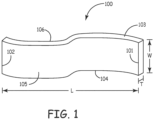
- the controlled release matrix barrier structure is a flexible polymeric film 100, as shown in Figure 1 that has a length "L” that extends between a first 101 and a second 102 end; a width "W” that extends between a first 103 and a second 104 edge; and a thickness "T” that extends between a first 105 and a second 106 side.
- film can be used interchangeably with the words “wrap” and "tape.”
- the term “film” is used here to refer to a flexible material that is conformable to an underlying surface. In various embodiments, the film is able to conform to the surface of a medical device to which it is applied.
- the term "conform” refers to the plastic deformation of the film that results when the film is applied to the surface of the medical device under tension, such that the film is slightly taut or stretched as it is being wound around the device. Applying the film under tension will not only increase the conformance of the film to the surface of the medical device, but it will increase the tenacity by which the flexible film adheres to itself.
- the amount of tension can vary, but, in general the force required to generate the tension is well within the physical abilities of a medical practitioner.
- the film is applied under a tension of at least about 50 grams and up to about 500 grams.
- the controlled release matrix barrier structure comprises a compliant polymeric material.
- compliant refers to a polymeric material or polymer that can stretch when subjected to force, conform to the surface geometry of the underlying substrate over which it is stretched, and not break, crack, or fissure as a result of the stretching and conforming actions.
- the compliant material may undergo plastic deformation in order to conform to the underlying surface geometry.
- plastic deformation refers to an irreversible change in the internal molecular structure (or microstructure) of the controlled release matrix barrier structure due to the applied force.
- the stress does not cause a permanent change, for example if the applied stress is less than the internal forces of the material, such that the internal forces are able to oppose the applied force, allowing the object to assume a new equilibrium state and return to its original shape when the force is removed (elastic deformation).
- a compliant material suitable for use herein should elongate and permanently deform but not break when it stretched/wrapped around the implantable medical device.
- the mechanical properties that can be used to define a compliant material include tensile strength, % elongation to break, yield stress and Young's Modulus, for example.
- the term "tensile strength” refers to the stress required to break a sample and is expressed in Pascals (Pa).
- a suitable compliant material has a tensile strength of at least about 1 MPa, or between about 1 MPa and about 100 MPa.
- the phrase "% elongation to break” refers to the elongation of a sample when it breaks. It is usually expressed as a percent.
- compliant materials have an elongation-to-break, of at least about 100%, or at least about 200%.
- Yield stress refers to the work (per unit volume) required to produce yield (deformation) in the polymer (units are in J/cm 3 ) and is determined by the maximum point in the stress/strain curve for a material that is followed by a yielding deformation. It is noted that yield can depend upon the rate at which the load is applied to the polymer. Young's Modulus is the ratio of stress to strain. It is also called the modulus of elasticity or the tensile modulus.. Young's Modulus for a given fiber or material can change with the amount of strain. Whereas rigid materials tend to have a high Young's modulus, compliant materials have lower values.
- one or more loops 150 of film 100 are wrapped around a surface 501 of an underlying medical device 500 to form essentially a single layer.
- the term “single layer” is meant to allow for overlap 151 between the loops 150 of film 100. Additionally, as shown more specifically in Figure 4 , the term “single layer” can also include overlap 152 between the first 101 and second 102 ends of the film 150.
- the film 100 can be wrapped around the underlying medical device 500 more than once, to form multiple layers of film 100.
- the dosage of bioactive agent released can be modified by altering the length L or amount of film 100 applied to the medical device 500.
- the width W and thickness T of controlled release matrix barrier structure can vary. In particular, a particular width W and/or thickness T may be better suited for one type of implantable medical device whereas a different width W and/or thickness T may be better suited for another type of implantable medical device.
- the controlled release matrix barrier structure has a width of at least about 1 mm and up to about 25 mm, or between about 5 mm and about 10 mm.
- the thickness of the controlled release matrix barrier structure is generally at least about 25 ⁇ m and up to about 500 ⁇ m, or between about 50 ⁇ m and 250 ⁇ m thick.
- the length L of controlled release matrix barrier structure applied to a device can be selected by the medical practitioner.
- the length L is selected to be sufficient to wrap around a medical device at least once. In an alternate embodiment, the length L is selected to wrap around a medical device multiple times. In various embodiments, the multiple loops 150 of the controlled release matrix barrier structure 100 overlap along the length of the device 500 (as shown in Figure 2 ). In another embodiment, the multiple loops 150 of the controlled release matrix barrier structure 100 form multiple layers on the surface of the device 500 (shown in Figure 3 )
- a biocompatible adhesive is applied to increase the bond between the film and the surface of the underlying medical device.
- the biocompatible adhesive includes a terpolymer or blend of terpolymers having adhesive properties. Such terpolymer adhesives are described in greater detail below.
- the controlled release matrix barrier structure is configured as a collar 100' (or sheath) that is placed on or around the implantable medical device 500 by a medical practitioner.
- a collar is manufactured using an elastomeric material that has a pre-existing shape or configuration that is substantially corresponds to the surface or a portion of the surface of the underlying medical device.
- the collar is deformed (elastic deformation) by the application of a stress or force on the collar and positioned around at least a portion of the implantable medical device.
- stress or “force” can refer to one or more of the following forces: tensile (pulling) force, compressive (pushing) force, shear, bending, or torsion (twisting) force. It is noted that, as deformation occurs, the internal forces of the collar material oppose the applied force. If the applied stress is not too large these opposing forces may completely resist the applied force, allowing the object to assume a new equilibrium state and to return to its original shape when the force is removed. This is what is known as elastic deformation (or elasticity).
- Elastic deformation can be described by Hooke's Law for restoring forces, where the stress is linearly proportional to the strain. It is likewise noted that forces in excess of the elastic limit of a material may cause a permanent (irreversible) deformation of the object. This is what is known as plastic deformation or plasticity. It is also noted that the surface of the implantable medical device may apply a force to the collar when the collar is in position, such that, once applied to the implantable medical device, the collar is not able to fully return to its original configuration.
- the mechanical properties that can be used to define a compliant material include tensile strength, % elongation to break, yield stress and Young's Modulus.
- the term "elastomer” or “elastomeric” refers to a polymer or material that can be stretched easily to high extensions (e.g., 3 to 10 times the original dimension) and which rapidly recovers to its original dimension.
- elastomers are materials having a tensile strength of at least about 10 MPa, or between about 20 MPa and about 200 MPa and a high elongation-to-break, generally at least about 300% and up to about 1000%.
- Methods for determining mechanical properties of a polymer include, for example, ASTM D882 - 09 Standard Test Method for Tensile Properties of Thin Plastic Sheeting and ASTM D1790-99 Standard Tst Method for Brittleness Temperature of Plastic Sheeting by Impact.
- the "collar" configuration of the controlled release matrix barrier structure is applied as a single layer without any overlap (See, Figure 5 ), although in other embodiments, it may be desirable for the collar to overlap.
- the thickness of the "collar” can vary, such that a collar having a particular thickness can be selected by the medical practitioner to provide a desired dosage. The precise configuration of the collar would depend upon the medical device to which it would be applied. In general, the collar is configured to encircle and/or follow the contours of the underlying medical device. In an alternate embodiment, the collar includes one or more fastening mechanisms 200 that are configured to mate with one or more receptacles 520 on the underlying medical device 500 to secure the collar thereto.
- controlled release matrix refers to a polymeric matrix that is capable of delivering a bioactive agent at a controlled rate for a period of time.
- controlled release matrix barrier structures herein include a controlled release matrix. Although there may be an initial burst phase, the overall release kinetics of the bioactive agent from the matrix are generally linear, such that a relatively constant supply of bioactive agent is released over the desired time period. The time period may vary from several hours to several months, depending upon the bioactive agent and its intended use.
- the percentage of bioactive agent released from the controlled matrix over the treatment period be relatively high (e.g., at least about 50%, at least about 75%, at least about 90%, or at least about 95%) to avoid waste of unreleased bioactive agent.
- a bioactive agent can be released from a controlled release matrix.
- Two mechanisms include diffusion and/or degradation. Diffusion occurs when the bioactive agent is released either through pores in the polymer matrix or by passing between polymer chains of the matrix.
- the bioactive agent can be dispersed throughout the matrix, or localized within a reservoir adjacent to or within the matrix.
- a reservoir of bioactive agent for example, solid drug, dilute solution, or highly concentrated drug solution within a polymer matrix is surrounded by a controlled release material through which the bioactive agent is able to diffuse.
- the bioactive agent is released as the matrix is degraded in vivo. Bioactive agent can also be released by a combination of the two mechanisms.
- the release of the bioactive agent is driven by a combination of both diffusion and degradation.
- the release rate can be controlled by varying the drug to polymer ratio (e.g., a higher drug concentration tends to result in a faster rate of release), by varying the chemistry of polymeric matrix (e.g., inclusion of polymers having a Tg of less than about 40°C or less than about 0°C would tend to result in a faster elution rate than polymers with Tgs greater than 40 °C, polymers that absorb water tend to elute drug more quickly than more hydrophobic polymers that do not absorb water. These variables can be controlled by the selection of materials used in the manufacturing process.
- the controlled release matrix barrier structure is configured to release at least about 40% and up to about 60%, or at least 50% of the bioactive agent within 7 days of implantation. In another embodiment, the controlled release matrix barrier structure is configured to release at least about 80% or up to about 100%, or at least 90% of the bioactive agent within 21 days after implantation.
- the controlled release matrix is biodegradable.
- the controlled release matrix includes a biodegradable polyester.
- biodegradable polyesters include, but are not limited to: polycaprolactone (PCL), polylactic acid (PLA), polyglycolide (PGA), and copolymers thereof, such as poly(lactic-co-glycolic acid) polymers (PLGA) and poly(glycolide-co-carolactone) (PGC).
- PCL polycaprolactone
- PCL refers to a biodegradable polyester prepared by ring opening polymerization of ⁇ -caprolactone using a catalyst such as stannous octanoate.
- Polycaprolactone has a melting point of about 60 °C and is degraded by hydrolysis of its ester linkages under physiological conditions.
- Polylactic acid is a biodegradable, thermoplastic polyester that can be produced by bacterial fermentation of renewable resources such as corn, starch or sugarcane and has a melting temperature between about 173 °C and about 178 °C.
- Polyglycolide is a biodegradable, thermoplastic polyester prepared from glycolic acid by polycondensation or ring-opening polymerization. It has a melting point of between about 225 °C to about 230 °C.
- Poly(lactic-co-glycolic acid) polymers refers to a biodegradable copolymer of lactic and glycolic acid formed by random ring-opening co-polymerization of monomers of glycolic acid and lactic acid. During polymerization, the monomeric units are linked together by ester linkages, thus yielding an aliphatic polyester.
- PLGAs are amorphous and have a glass transition temperature between about 40 °C and 60 °C. In general, the PLGA copolymer has a weight average molecular weight between about 1000 Da to about 50,000 Da, or between about 5000 Da and 25,000 Da. The ratio of lactic acid to glycolic acid can vary.
- the ratio of lactic acid to glycolic acid is between about 100:0 to about 25:75, or between about 60:40 and 40:60, or about 50:50.
- the matrix comprises blends of terpolymers having adhesive properties.
- the matrix includes a blend of (a) a first poly(D,L-lactide-co-glycol lactide-co- ⁇ -caprolactone) having a molecular weight (M w ) of from 75,000 to 250,000 Daltons and a polydispersity index (PDI) of less than 2.0, and (b) a second poly(D,L-lactide-co-glycolide-co- ⁇ -caprolactone) having a molecular weight (M w ) of 130,000 Daltons or less and a polydispersity index (PDI) of less than 2.0; the second poly(D,L-lactide-co-glycolide-co- ⁇ -caprolactone) having a molecular weight (M w ) that is less than the first poly(D,L-lactide-co-glycolide-co- ⁇ -caprolactone); and wherein the weight ratio of the first poly(D,L
- the matrix can include a blend of (a) a poly(D,L-lactide-co-glycolide-co- ⁇ -caprolactone) having a molecular weight of from 75,000 to 250,000 Daltons and a polydispersity index (PDI) of less than 2.0, and (b) a poly(D,L-lactide-co-glycolide-co-mPEG) having a molecular weight (M w ) of less than 25,000 Daltons and a polydispersity index (PDI) of less than 2.0; the poly(D,L-lactide-co-glycolide-co-mPEG) having a molecular weight (M w ) that is less than the poly(D,L-lactide-co-glycolide-co- ⁇ -caprolactone); and wherein the weight ratio of the poly(D,L-lactide-co-glycolide-co- ⁇ -caprolactone) to the poly(D,L-lactide-co-
- the controlled release matrix includes an elastomeric polymeric material that includes a copolymer with an elastomeric (or "soft") component and a non-elastomeric (or "hard”) component.
- the elastomeric polymeric material includes a polymeric blend having an elastomeric component and a non-elastomeric component.
- the compliant polymer or polymeric material is thermoplastic.
- thermoplastic refers to a polymer or polymeric material that can be softened by heat, hardened by cooling and then softened by heat over and over again. In general, thermoplastic materials are not cross-linked. However, in another embodiment, the compliant polymer or polymeric material may be cross-linked.
- the bioactive agent can be incorporated into the controlled release matrix any of various techniques known to the skilled artisan.
- the bioactive agent is dispersed throughout the controlled release matrix.
- Techniques for preparing the controlled release matrix include, but are not limited to, melt extrusion processes, injection molding, or spray casting.
- a mixture that includes the polymeric material and bioactive agent is combined in an extruder, heated to a temperature at which the polymeric material melts and then discharged through an orifice of the desired cross-sectional shape.
- the extruded material is collected under controlled conditions (e.g., speed, temperature and humidity) to obtain a product with the desired dimensions.
- the mass flow rate of the extrudate and the collection speed of the final extruded form can be controlled to achieve the desired physical dimensions. For example, if the final extruded form is a film, then the collection speed of the film can be increased relative to the mass flow rate of the extrudate to decrease the film thickness, and conversely to increase the film thickness.
- the extrudate is discharged through an orifice in the molten state, allowing elongation of the extrudate to its final dimension.
- the extrudate is subsequently cooled by exposure to ambient conditions, a chilled liquid or gas bath, or exposure to a temperature controlled surface such as a cooled roller in order to solidify the exturdate.
- the melt extrusion process is used to form a film.
- the melt extrusion process is used to form pellets or beads that can be subsequently molded into the desired film or collar configuration.
- the processing temperature is at least about 80°C, or about 100°C and less than about 180 °C, less than 160 °C, or between about 110 °C and about 150 °C, although the specific temperature is dependent on the melting and degradation temperatures of the polymeric materials and bioactive agent.
- melt-processing provides the ability for continuous operation, the ability to control operating parameters, and the ability to scale up manufacturing.
- an injection molding process is used.
- a mixture that includes the polymeric material and bioactive agent is fed into a vessel where it heated to a temperature sufficient to melt the polymeric material and then forced into a mold cavity where it cools and hardens to the configuration of the mold cavity.
- the conditions e.g., temperature and pressure
- the injection molding process is used to form a film or a collar.
- a solvent casting technique can be used.
- the polymeric material and bioactive agent are combined with a suitable solvent to form a polymeric solution which is then cast on a substrate.
- the solvent is then removed to form a film, for example, by evaporation.
- the solvent is removed under a vacuum (e.g., between about 15 inHg and about 28 inHg, depending upon the volatility of the solvent).
- the solvent is removed at an elevated temperature (e.g., between about 30°C and about 80°C).
- the polymeric solution is applied to the substrate by a spray coating process.
- the polymeric solution is fed to the spray nozzle, for example and ultrasonic spray nozzle, at a controlled rate by a positive displacement pump.
- the spray nozzle and substrate are moved in relative motion to each other at controlled speed to achieve the desired coating thickness.
- the spray nozzle is mounted on a three-axis motion control system (x-y-z) which is capable of controlling the speed and position of the spray head relative to the substrate.
- x-y-z three-axis motion control system
- the coating width is controlled by moving the spray nozzle in a specified path across the width of the substrate.
- the height (z) of the spray nozzle above the substrate can be increased to achieve a wider coating width.
- the solvent may be one in which one or more components of the polymeric material form a true solution.
- the bioactive agent may either be soluble in the solvent or form a dispersion throughout the solvent.
- Suitable solvents include, but are not limited to, alcohols (e.g., methanol, butanol, propanol and isopropanol), alkanes (e.g., halogenated or unhalogenated alkanes such as hexane, cyclohexane, methylene chloride and chloroform), amides (e.g., dimethylformamide), ethers (e.g., tetrahydrofuran (THF), dioxolane, and dioxane), ketones (e.g., methyl ethyl ketone, acetone), aromatic compounds (e.g., toluene and xylene), nitriles (e.g., acetonitrile) and esters (e.g
- the polymeric matrix includes one or more plasticizers, tackifiers, or other excipients, for example, to introduce an adhesive to one side of the film, or to increase the overall release rate of active ingredients from the film (e.g., by decreasing the glass transition of the polymer).
- the controlled release matrix barrier structure described herein can be provided as individually packaged and pre-sterilized units in a kit such that a medical practitioner is able to apply the controlled release matrix barrier structure to an implantable medical device, for example, while in the operating room.
- the entire surface of the medical device is covered with the controlled release matrix barrier structure.
- the surface of the medical device is only partially covered with the controlled release matrix barrier structure. For example, a single strip or narrow collar of the controlled release matrix barrier structure can be applied to a portion of the medical device, wherein a majority of the surface of the medical device remains uncovered.
- a majority of the surface of the medical device can be covered with the controlled release matrix barrier structure, but select areas can be left unwrapped, for example, for fixation hardware attachment.
- the dosage of bioactive agent can be modified by altering the amount of controlled release matrix barrier structure that is applied to the medical device, for example, a higher dosage of bioactive agent can be achieved by increasing the amount (or length) of controlled release matrix that is applied to the medical device. Similarly, a lower dosage of bioactive agent can be achieved by decreasing the amount (or length) of controlled release matrix that is applied to the medical device.
- the packaging material for the controlled release matrix barrier structure provides an indication of the amount of drug per unit length.
- the concentration of bioactive agent in the controlled release matrix can vary, but is generally between about 2 % by weight and about 50 % by weight of the controlled release matrix.
- the dosage per unit length can vary, but is generally between 21 micrograms per millimeter and 525 micrograms per millimeter for a 7 mm wide and 150 micron thick film.
- the controlled release matrix provides a means to deliver bioactive agents from a variety of biomaterial surfaces.
- Suitable biomaterials include those formed of synthetic polymers, including oligomers, homopolymers, and copolymers resulting from either addition or condensation polymerizations.
- suitable addition polymers include, but are not limited to, acrylics such as those polymerized from methyl acrylate, methyl methacrylate, hydroxyethyl methacrylate, hydroxyethyl acrylate, acrylic acid, methacrylic acid, glyceryl acrylate, glyceryl methacrylate, methacrylamide, and acrylamide; vinyls, such as those polymerized from ethylene, propylene, styrene, vinyl chloride, vinyl acetate, vinyl pyrrolidone, and vinylidene difluoride.
- condensation polymers include, but are not limited to, nylons such as polycaprolactam, poly(lauryl lactam), poly(hexamethylene adipamide), and poly(hexamethylene dodecanediamide), and also polyurethanes, polycarbonates, polyamides, polysulfones, poly(ethylene terephthalate), poly(lactic acid), poly(glycolic acid), poly(lactic acid-co-glycolic acid), polydimethylsiloxanes, polyetheretherketone, poly(butylene terephthalate), poly(butylene terephthalate-co-polyethylene glycol terephthalate), esters with phosphorus containing linkages, non-peptide polyamino acid polymers, polyiminocarbonates, amino acid-derived polycarbonates and polyarylates, and copolymers of polyethylene oxides with amino acids or peptide sequences.
- nylons such as polycaprolactam, poly(lauryl lactam), poly(hexamethylene
- biomaterials including human tissue such as bone, cartilage, skin and teeth; and other organic materials such as wood, cellulose, compressed carbon, and rubber.
- suitable biomaterials include metals and ceramics.
- the metals include, but are not limited to, titanium, stainless steel, and cobalt chromium.
- a second class of metals include the noble metals such as gold, silver, copper, and platinum. Alloys of metals, such as nitinol (e.g. MP35), may be suitable for biomaterials as well.
- the ceramics include, but are not limited to, silicon nitride, silicon carbide, zirconia, and alumina, as well as glass, silica, and sapphire.
- Yet other suitable biomaterials include combinations of ceramics and metals, as well as biomaterials that are fibrous or porous in nature.
- the biomaterial substrate is a resorbable material (i.e., a material that can be degraded or broken down in vivo and assimilated into the body of the patient).
- the controlled release matrix barrier structure described herein is suitable for use in connection with a variety of implantable medical devices.
- suitable medical devices include, but are not limited to, spinal fixation devices such as those used to achieve vertebral fixation, including rods, plates, screws, and combinations thereof.
- Other medical devices include, but are not limited to, surgical devices (e.g., staples, bone pins, suture anchors, clamps, screws, plates, clips, etc.); cardiovascular devices (e.g., pacemakers and defibrillation systems, including, but not limited to, electro-stimulation leads for cardiac rhythm management such as pacer or defibrillator leads; and structural cardiac applications, including, but not limited to tissue and mechanical valves, and patent foramen ovale closure systems), biosensors; orthopedic devices (e.g., joint implants, fracture repairs); and dental implants.
- surgical devices e.g., staples, bone pins, suture anchors, clamps, screws, plates, clips, etc.
- cardiovascular devices e.g., pacemakers and defibrillation systems, including, but not limited to, electro-stimulation leads for cardiac rhythm management such as pacer or defibrillator leads
- structural cardiac applications including, but not limited to tissue and mechanical valves, and patent foramen ovale closure systems
- controlled release matrix barrier structures herein are used in conjunction with medical devices having one or more subcutaneous elements.
- Subcutaneous elements are those that when placed for use pass through the skin. In some cases, such subcutaneous elements are placed for a duration longer than merely transitorily.
- Medical devices with subcutaneous elements can include, but are not limited to, ventricular assist devices (VADs), central venous catheters, implanted drug delivery ports (such as chemotherapy ports), implantable monitors, neuromodulation devices with wired external controllers or monitors.
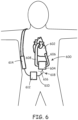
- the medical device 600 in this example, is a ventricular assist device (VAD) operatively connected to the heart 602 of a patient. Aspects of VADs are described in U.S. Pat. Nos. 4,995,857 and 7,993,260 , the content of which is herein incorporated by reference.
- the medical device 600 includes blood flow conduits (606, 608) a pump 604, power and/or data transmission cable 610 (or "driveline" that crosses the skin 618 and therefore can be regarded as a subcutaneous element) a control unit 612, and a power unit 614.
- a controlled release matrix barrier structure 616 is operatively connected to the power and/or data transmission cable 610.
- the controlled release matrix barrier structure 616 can be in full circumferential contact with the subcutaneous element such that there are no places where microorganisms can pass in gaps between the inner diameter of the controlled release matrix barrier structure 616 and the outer diameter of the subcutaneous element. While not intending to be bound by theory, embodiments wherein the controlled release matrix barrier structure is compliant can facilitate full circumferential contact and the formation of an effective barrier.
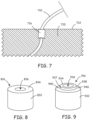
- a schematic illustration of a controlled release matrix barrier structure 716 applied to a subcutaneous element 710 of a medical device is shown in accordance with various embodiments herein.
- the controlled release matrix barrier structure 716 is positioned underneath the skin 722 and within the tissue 720 of the patient.
- the controlled release matrix barrier structure 716 can be only partially within the tissue 720 of the patient.
- the controlled release matrix barrier structure 716 can be completely outside of the tissue 720 of the patient.
- FIG 8 is a schematic illustration of a controlled release matrix barrier structure 816 configured for use with a medical device with a subcutaneous element in accordance with various embodiments herein.
- the controlled release matrix barrier structure 816 includes a body structure 832 and an outer surface 834.
- the outer surface 834 is positioned beneath the skin of the patient. In other embodiments, the outer surface 834, or a portion thereof is positioned outside the skin of the patient.
- the body structure 832 defines a central channel 836 (or aperture or lumen), through which the subcutaneous element of the medical device can pass.
- the barrier structure includes an inner surface adjacent the central channel and a terpolymer exhibiting adhesive properties, disposed on the inner surface.
- the controlled release matrix barrier structure 816 can be pre-formed as a tube (or as a collar or sheath) and the subcutaneous element can be threaded there through. The tube is circumferentially continuous.
- the controlled release matrix barrier structure includes a flange, around the top portion adjacent the outer surface.
- a schematic illustration of a controlled release matrix barrier structure 916 configured for use with a medical device with a subcutaneous element in accordance with various embodiments herein is shown.
- the controlled release matrix barrier structure 916 can include a body structure 932 defining a central channel 936 (or aperture or lumen), through which the subcutaneous element of the medical device can pass.
- the controlled release matrix barrier structure 916 can also include suture loops 940 to aid in using sutures to secure the controlled release matrix barrier structure 916 to the skin.
- the controlled release matrix barrier structure 916 includes a flange 938 and a central projection 937 upon which the outer surface 934 is disposed.
- the skin of the patient can fit against the flange and the central projection can pass through the skin to the outside.
- bioactive agent refers to a wide range of biologically active materials that causes a biological effect when administered in vivo to an animal.
- bioactive agent includes hydrophobic and hydrophilic molecules, including, but not limited to, macromolecules (i.e., molecules with a molecular weight of at least about 1000 Da) such as peptides, proteins, carbohydrates, nucleic acids, lipids, polysaccharides or combinations thereof; or synthetic or natural organic or inorganic molecules.
- animal includes, but is not limited to, birds and mammals, including humans. A comprehensive listing of bioactive agents can be found in The Merck Index, Thirteenth Edition, Merck & Co. (2001 ).
- the concentration of bioactive agent within the controlled release matrix can vary depending upon a variety of factors, including the agent and its intended use, i.e. short or long duration.
- the bioactive agent concentration in the controlled release matrix is between about 2% to about 50% by weight, or about 10% to about 40% by weight, or about 15% to about 30% by weight.
- the bioactive agent is hydrophobic.
- hydrophobic refers to a bioactive agent that has a solubility in water of no more than 200 micrograms per milliliter.
- the bioactive agent is hydrophilic.
- hydrophilic refers to a bioactive agent that has a solubility in water of more than 200 micrograms per milliliter.
- Classes of bioactive agents that can be incorporated into the controlled release matrix include, but are not limited to, antibiotics, antiseptics, antiviral agents, enzyme inhibitors, anti-pyretics, including anti-inflammatory agents, immunomodulators, including immunosuppressants and corticosteroids, analgesics, local anesthetics, and cell response modifiers.
- antibiotics antibiotics
- antiseptics antiviral agents
- anti-pyretics including anti-inflammatory agents
- immunomodulators including immunosuppressants and corticosteroids
- analgesics local anesthetics
- cell response modifiers cell response modifiers.
- Antibiotics are recognized as substances which inhibit the growth of or kill microorganisms. Antibiotics can be produced synthetically or by microorganisms. Examples of antibiotics include penicillin, tetracycline, chloramphenicol, minocycline, doxycycline, vancomycin, bacitracin, kanamycin, neomycin, gentamycin, erythromycin, geldanamycin, geldanamycin analogues and cephalosporins.
- cephalosporins examples include cephalothin, cephapirin, cefazolin, cephalexin, cephradine, cefadroxil, cefamandole, cefoxitin, cefaclor, cefuroxime, cefonicid, ceforanide, cefotaxime, moxalactam, ceflizoxime, ceftriaxone, and cefoperazone.
- Antiseptics are recognized as substances that prevent or arrest the growth or action of microorganisms, generally in a nonspecific fashion, e.g., either by inhibiting their activity or destroying them.
- antiseptics include silver sulfadiazine, chlorhexidine, glutaraldehyde, peracetic acid, sodium hypochlorite, phenols, phenolic compounds, iodophor compounds, quaternary ammonium compounds, and chlorine compounds.
- the bioactive agent is selected from antibiotics and antiseptics.
- Anti-viral agents are substances capable of destroying or suppressing the replication of viruses.
- examples of anti-viral agents include methyl-P-adamantane methylamine, hydroxy-ethoxymethylguanine, adamantanamine, 5-iodo-2'-deoxyuridine, trifluorothymidine, interferon, and adenine arabinoside.
- Enzyme inhibitors are substances which inhibit an enzymatic reaction.
- enzyme inhibitors include edrophonium chloride, N-methylphysostigmine, neostigmine bromide, physostigmine sulfate, tacrine HCl, tacrine, 1-hydroxymaleate, iodotubercidin, p-bromotetramisole, 10-(.alpha.-diethylaminopropionyl)-phenothiazine hydrochloride, calmidazolium chloride, hemicholinium-3,3,5-dinitrocatechol, diacylglycerol kinase inhibitor I, diacylglycerol kinase inhibitor II, 3-phenylpropargylamine, N-monomethyl-L-arginine acetate, carbidopa, 3-hydroxybenzylhydrazine HCl, hydralazine HCl, clorgyline HCl, deprenyl
- Anti-pyretics are substances capable of relieving or reducing fever.
- Anti-inflammatory agents are substances capable of counteracting or suppressing inflammation. Examples of such agents include aspirin (acetylsalicylic acid), indomethacin, sodium indomethacin trihydrate, salicylamide, naproxen, colchicine, fenoprofen, sulindac, diflunisal, diclofenac, indoprofen and sodium salicylamide.
- Local anesthetics are substances which inhibit pain signals in a localized region.
- anesthetics include procaine, lidocaine, tetracaine and dibucaine.
- Imaging agents are agents capable of imaging a desired site, e.g., tumor, in vivo.
- imaging agents include substances having a label which is detectable in vivo, e.g., antibodies attached to fluorescent labels.
- the term antibody includes whole antibodies or fragments thereof.
- Cell response modifiers are chemotactic factors such as platelet-derived growth factor (pDGF).
- Other chemotactic factors include neutrophil-activating protein, monocyte chemoattractant protein, macrophage-inflammatory protein, SIS (small inducible secreted), platelet factor, platelet basic protein, melanoma growth stimulating activity, epidermal growth factor, transforming growth factor (alpha), fibroblast growth factor, platelet-derived endothelial cell growth factor, estradiols, insulin-like growth factor, nerve growth factor, bone growth/cartilage-inducing factor (alpha and beta), and matrix metallo proteinase inhibitors.
- pDGF platelet-derived growth factor
- Other chemotactic factors include neutrophil-activating protein, monocyte chemoattractant protein, macrophage-inflammatory protein, SIS (small inducible secreted), platelet factor, platelet basic protein, melanoma growth stimulating activity, epidermal growth factor, transforming growth factor (alpha
- cell response modifiers are the interleukins, interleukin inhibitors or interleukin receptors, including interleukin 1 through interleukin 10; interferons, including alpha, beta and gamma; hematopoietic factors, including erythropoietin, granulocyte colony stimulating factor, macrophage colony stimulating factor and granulocyte-macrophage colony stimulating factor; tumor necrosis factors, including alpha and beta; transforming growth factors (beta), including beta-1, beta-2, beta-3, inhibin, activin.
- VEGF Vascular endothelial growth factor
- VEGF is a chemical signal produced by cells that stimulates the growth of new blood vessels.
- VEGF inhibitors can be used to treat diseases such as cancers, which require an adequate blood supply to grow and metastasize.
- DNA that encodes for the production of any of these proteins, antisense molecules, androgenic receptor blockers and statin agents can also be a bioactive agent.
- a controlled release matrix containing a bioactive agent can be prepared as follows. A mixture of 15 % bioactive agent (such as dexamethasone acetate) is combined with a polymeric matrix such as poly(lactic-co-glycolic acid) polymer (PLGA) and melt extruded using a twin screw extruder (available from American LEISTRITZ Extruder Corp. USA, Somerville, NJ 08876). The bioactive agent is fed in a continuous manner to the twin screw extruder from a loss-in-weight feeder (available from K-Tron International, Inc., Pitman, NJ 08071). The polymeric matrix is fed in a similar manner.
- bioactive agent such as dexamethasone acetate
- PLGA poly(lactic-co-glycolic acid) polymer
- PLGA poly(lactic-co-glycolic acid) polymer
- the bioactive agent is fed in a continuous manner to the twin screw extruder from a loss-in-weight feeder (available from K-Tr
- the ratio of the bioactive agent to the polymeric matrix is controlled by the relative mass flow rate of bioactive agent from the first feeder to that of the polymeric matrix from the second feeder.
- the feeders and extruder are purged with dry air or nitrogen gas to maintain low humidity.
- the polymeric matrix is melted within the extruder operating at a temperature of 120°C.
- the bioactive agent is not melted but is mixed within the molten and flowing polymeric matrix.
- the extruder forces or pumps the mixed bioactive agent and polymeric matrix through a rectangular shaped orifice or die to shape the material into an extrudate with width of between about 5 mm and about 10 mm and a thickness between about 50 ⁇ m and about 250 ⁇ m.
- the extrudate is cut into strips with a desired length and packaged.
- the individual strips are placed and sealed inside of a sterilization pouch such as foil-foil pouch (available from 445 Sixth Street, NW, Grand Rapids, MI 49504 USA).
- the term “about” refers to variation in the numerical quantity that can occur, for example, through typical measuring and handling procedures used for making compounds, compositions, concentrates or use formulations; through inadvertent error in these procedures; through differences in the manufacture, source, or purity of starting materials or ingredients used to carry out the methods, and like proximate considerations.
- the term “about” also encompasses amounts that differ due to aging of a formulation with a particular initial concentration or mixture, and amounts that differ due to mixing or processing a formulation with a particular initial concentration or mixture. Where modified by the term “about” the claims appended hereto include equivalents to these quantities.
- the phrase “configured” describes a system, apparatus, or other structure that is constructed or configured to perform a particular task or adopt a particular configuration.
- the phrase “configured” can be used interchangeably with other similar phrases such as “arranged”, “arranged and configured”, “constructed and arranged”, “constructed”, “manufactured and arranged”, and the like.
Landscapes
- Health & Medical Sciences (AREA)
- Life Sciences & Earth Sciences (AREA)
- Chemical & Material Sciences (AREA)
- Epidemiology (AREA)
- Animal Behavior & Ethology (AREA)
- General Health & Medical Sciences (AREA)
- Public Health (AREA)
- Veterinary Medicine (AREA)
- Medicinal Chemistry (AREA)
- Engineering & Computer Science (AREA)
- Surgery (AREA)
- Heart & Thoracic Surgery (AREA)
- Vascular Medicine (AREA)
- Molecular Biology (AREA)
- Biomedical Technology (AREA)
- Chemical Kinetics & Catalysis (AREA)
- Transplantation (AREA)
- Oral & Maxillofacial Surgery (AREA)
- Dermatology (AREA)
- Materials For Medical Uses (AREA)
- Medicinal Preparation (AREA)
- External Artificial Organs (AREA)
Claims (10)
- Biokompatible polymere Matrix-Barrierestruktur (916) mit kontrollierter Freisetzung, umfassend:eine Körperstruktur (932), die aus einem nachgiebigen Material gebildet ist, das ein oder mehrere nachgiebige biokompatible Polymere und ein oder mehrere bioaktive Mittel umfasst, wobei die Körperstruktur eine vorgeformte Rohrstruktur umfasst; undwobei die Körperstruktur (932) eine zentrale Öffnung (936) definiert, durch die ein subkutanes Element einer implantierbaren medizinischen Vorrichtung verläuft;wobei die Körperstruktur (932) ferner eine Mischung aus einem ersten Poly(D,L-Lactid-co-glycolid-co-ε-caprolacton)-Terpolymer mit einem Molekulargewicht (Mw) von 75.000 bis 250.000 Dalton und einem Polydispersitätsindex (PDI) von weniger als 2,0 und ein zweites Poly(D,L-lactid-co-glycolid-co-ε-caprolacton)-Terpolymer mit einem Molekulargewicht (Mw) von 130.000 Dalton oder weniger und einem Polydispersitätsindex (PDI) von weniger als 2,0, wobei das zweite Poly(D,L-lactid-co-glycolid-co-ε-caprolacton) ein Molekulargewicht (Mw) hat, das geringer ist als das erste Poly(D,L-lactid-co-glycolid-co-ε-caprolacton);wobei die Matrix-Barrierestruktur (916) mit kontrollierter Freisetzung ferner einen zentralen Vorsprung (937), der um die zentrale Öffnung (936) an einem oberen Abschnitt der Körperstruktur (932) angeordnet ist, und einen Flansch (938) umfasst, der um den zentralen Vorsprung (972) herum angeordnet ist, wobei der Flansch (938) eine Außenfläche (934) mit einer oder mehreren darauf angeordneten Nahtschlaufen (940) aufweist;wobei das Gewichtsverhältnis des ersten Poly(D,L-lactid-co-glycolid-co-ε-caprolactons) zu dem zweiten Poly(D,L-lactid-co-glycolid-co-ε-caprolacton) von etwa 90:10 bis etwa 60:40 beträgt; undwobei der zentrale Vorsprung so konfiguriert ist, dass er durch die Haut eines Patienten nach außen führt, so dass die Haut des Patienten an dem Flansch anliegen kann.
- Biokompatible polymere Matrix-Barrierestruktur mit kontrollierter Freisetzung nach Anspruch 1, wobei der elastomere Kragen mindestens ein elastomeres Copolymer umfasst, das elastomere und nicht-elastomere Untereinheiten enthält.
- Biokompatible polymere Matrix-Barrierestruktur mit kontrollierter Freisetzung nach Anspruch 1 oder 2, wobei der elastomere Kragen eine Mischung aus mindestens einem elastomeren Polymer und mindestens einem nichtelastomeren Polymer umfasst.
- Die biokompatible polymere Matrix-Barrierestruktur mit kontrollierter Freisetzung nach einem der vorhergehenden Ansprüche, wobei das biokompatible Polymer biostabil oder biologisch abbaubar ist.
- Biokompatible polymere Matrix-Barrierestruktur mit kontrollierter Freisetzung nach einem der vorhergehenden Ansprüche, wobei die Matrix-Barrierestruktur mit kontrollierter Freisetzung ferner ein Polymer umfasst, das aus der Gruppe ausgewählt ist, die aus Folgendem besteht: Polycaprolacton (PCL), Poly(milchsäure), Poly(milch-co-glykolsäure) und Poly(ethylen-co-vinylacetat).
- Die biokompatible polymere Matrix-Barrierestruktur mit kontrollierter Freisetzung nach einem der vorhergehenden Ansprüche, wobei ein oder mehrere Polymere vernetzt sind.
- Biokompatible polymere Matrix-Barrierestruktur mit kontrollierter Freisetzung nach einem der Ansprüche 1 bis 6, wobei die Polymere nicht vernetzt sind.
- Biokompatible polymere Matrix-Barrierestruktur mit kontrollierter Freisetzung nach einem der vorhergehenden Ansprüche, wobei der bioaktive Wirkstoff aus der Gruppe bestehend aus Antibiotika und Antiseptika ausgewählt ist.
- Implantierbare medizinische Vorrichtung, umfassendein subkutanes Element;eine biokompatible polymere Matrix-Barrierestruktur mit kontrollierter Freisetzung gemäß Anspruch 1, die um das subkutane Element herum angeordnet ist, wobei das subkutane Element durch die zentrale Öffnung hindurchgeht.
- Implantierbare medizinische Vorrichtung nach Anspruch 9, wobei die Vorrichtung ein Katheter oder ein ventrikuläres helfen Vorrichtung.
Applications Claiming Priority (2)
| Application Number | Priority Date | Filing Date | Title |
|---|---|---|---|
| US14/669,571 US9993441B2 (en) | 2009-12-30 | 2015-03-26 | Controlled release matrix barrier structure for subcutaneous medical devices |
| PCT/US2016/024228 WO2016154541A1 (en) | 2015-03-26 | 2016-03-25 | Controlled release matrix barrier structure for subcutaneous medical devices |
Publications (3)
| Publication Number | Publication Date |
|---|---|
| EP3274004A1 EP3274004A1 (de) | 2018-01-31 |
| EP3274004B1 true EP3274004B1 (de) | 2023-12-06 |
| EP3274004C0 EP3274004C0 (de) | 2023-12-06 |
Family
ID=55661644
Family Applications (1)
| Application Number | Title | Priority Date | Filing Date |
|---|---|---|---|
| EP16714714.9A Active EP3274004B1 (de) | 2015-03-26 | 2016-03-25 | Matrixbarrierestruktur mit kontrollierter freisetzung für subkutane medizinische vorrichtungen |
Country Status (5)
| Country | Link |
|---|---|
| EP (1) | EP3274004B1 (de) |
| JP (1) | JP6777724B2 (de) |
| CA (1) | CA2980916C (de) |
| MX (1) | MX386215B (de) |
| WO (1) | WO2016154541A1 (de) |
Families Citing this family (1)
| Publication number | Priority date | Publication date | Assignee | Title |
|---|---|---|---|---|
| US9993441B2 (en) | 2009-12-30 | 2018-06-12 | Surmodics, Inc. | Controlled release matrix barrier structure for subcutaneous medical devices |
Family Cites Families (10)
| Publication number | Priority date | Publication date | Assignee | Title |
|---|---|---|---|---|
| US4995857A (en) | 1989-04-07 | 1991-02-26 | Arnold John R | Left ventricular assist device and method for temporary and permanent procedures |
| JPH0323868A (ja) * | 1989-06-20 | 1991-01-31 | Olympus Optical Co Ltd | 経皮端子 |
| US5637113A (en) * | 1994-12-13 | 1997-06-10 | Advanced Cardiovascular Systems, Inc. | Polymer film for wrapping a stent structure |
| US6889082B2 (en) | 1997-10-09 | 2005-05-03 | Orqis Medical Corporation | Implantable heart assist system and method of applying same |
| JP4686743B2 (ja) * | 2004-05-07 | 2011-05-25 | 独立行政法人科学技術振興機構 | 経皮端子および医療用チューブ |
| EP2395982B1 (de) * | 2008-12-23 | 2014-10-22 | Surmodics Pharmaceuticals, Inc. | Implantierbares kompositmaterial enthaltend einen klebrigen biokompatiblen polymerfilm und ein freisetzbares biologisch wirksames mittel |
| US9480643B2 (en) * | 2008-12-23 | 2016-11-01 | Surmodics Pharmaceuticals, Inc. | Implantable composites and implants comprising same |
| JP2011115273A (ja) * | 2009-12-01 | 2011-06-16 | National Cerebral & Cardiovascular Center | カフ部材及びカフ部材付きカテーテル |
| US20110159072A1 (en) * | 2009-12-30 | 2011-06-30 | Surmodics, Inc. | Controlled release matrix |
| CA2809825A1 (en) * | 2010-08-30 | 2012-03-08 | Surmodics Pharmaceuticals, Inc. | Biodegradable terpolymers and terpolymer blends as pressure-sensitive adhesives |
-
2016
- 2016-03-25 EP EP16714714.9A patent/EP3274004B1/de active Active
- 2016-03-25 JP JP2018502045A patent/JP6777724B2/ja active Active
- 2016-03-25 MX MX2017012329A patent/MX386215B/es unknown
- 2016-03-25 WO PCT/US2016/024228 patent/WO2016154541A1/en not_active Ceased
- 2016-03-25 CA CA2980916A patent/CA2980916C/en active Active
Also Published As
| Publication number | Publication date |
|---|---|
| MX2017012329A (es) | 2017-12-20 |
| EP3274004C0 (de) | 2023-12-06 |
| WO2016154541A1 (en) | 2016-09-29 |
| MX386215B (es) | 2025-03-18 |
| EP3274004A1 (de) | 2018-01-31 |
| JP2018510748A (ja) | 2018-04-19 |
| JP6777724B2 (ja) | 2020-10-28 |
| CA2980916C (en) | 2023-08-08 |
| CA2980916A1 (en) | 2016-09-29 |
Similar Documents
| Publication | Publication Date | Title |
|---|---|---|
| US20110159072A1 (en) | Controlled release matrix | |
| US6387391B1 (en) | Bioresorbable polymeric clayey and sticky substance | |
| JP6368737B2 (ja) | 放出可能な生物活性薬剤を含む移植用複合材および組成物 | |
| US7544673B2 (en) | Coating compositions for bioactive agents | |
| US9598532B2 (en) | Terpolymers as pressure-sensitive adhesives | |
| US20080081064A1 (en) | Implantable Medical Device with Apertures for Delivery of Bioactive Agents | |
| US9480643B2 (en) | Implantable composites and implants comprising same | |
| US8974808B2 (en) | Elastic implantable composites and implants comprising same | |
| US9415197B2 (en) | Implantable suction cup composites and implants comprising same | |
| US20100168807A1 (en) | Bioactive terpolymer compositions and methods of making and using same | |
| US9993441B2 (en) | Controlled release matrix barrier structure for subcutaneous medical devices | |
| CA2980916C (en) | Controlled release matrix barrier structure for subcutaneous medical devices | |
| AU2011280054B2 (en) | Core-sheath implant device having an inner core lobe | |
| AU782328B2 (en) | Bioresorbable polymeric clayey and sticky substance |
Legal Events
| Date | Code | Title | Description |
|---|---|---|---|
| STAA | Information on the status of an ep patent application or granted ep patent |
Free format text: STATUS: THE INTERNATIONAL PUBLICATION HAS BEEN MADE |
|
| PUAI | Public reference made under article 153(3) epc to a published international application that has entered the european phase |
Free format text: ORIGINAL CODE: 0009012 |
|
| STAA | Information on the status of an ep patent application or granted ep patent |
Free format text: STATUS: REQUEST FOR EXAMINATION WAS MADE |
|
| 17P | Request for examination filed |
Effective date: 20171005 |
|
| AK | Designated contracting states |
Kind code of ref document: A1 Designated state(s): AL AT BE BG CH CY CZ DE DK EE ES FI FR GB GR HR HU IE IS IT LI LT LU LV MC MK MT NL NO PL PT RO RS SE SI SK SM TR |
|
| AX | Request for extension of the european patent |
Extension state: BA ME |
|
| DAV | Request for validation of the european patent (deleted) | ||
| DAX | Request for extension of the european patent (deleted) | ||
| STAA | Information on the status of an ep patent application or granted ep patent |
Free format text: STATUS: EXAMINATION IS IN PROGRESS |
|
| 17Q | First examination report despatched |
Effective date: 20190624 |
|
| GRAP | Despatch of communication of intention to grant a patent |
Free format text: ORIGINAL CODE: EPIDOSNIGR1 |
|
| STAA | Information on the status of an ep patent application or granted ep patent |
Free format text: STATUS: GRANT OF PATENT IS INTENDED |
|
| INTG | Intention to grant announced |
Effective date: 20230221 |
|
| GRAJ | Information related to disapproval of communication of intention to grant by the applicant or resumption of examination proceedings by the epo deleted |
Free format text: ORIGINAL CODE: EPIDOSDIGR1 |
|
| STAA | Information on the status of an ep patent application or granted ep patent |
Free format text: STATUS: EXAMINATION IS IN PROGRESS |
|
| GRAP | Despatch of communication of intention to grant a patent |
Free format text: ORIGINAL CODE: EPIDOSNIGR1 |
|
| STAA | Information on the status of an ep patent application or granted ep patent |
Free format text: STATUS: GRANT OF PATENT IS INTENDED |
|
| INTC | Intention to grant announced (deleted) | ||
| INTG | Intention to grant announced |
Effective date: 20230703 |
|
| GRAS | Grant fee paid |
Free format text: ORIGINAL CODE: EPIDOSNIGR3 |
|
| GRAA | (expected) grant |
Free format text: ORIGINAL CODE: 0009210 |
|
| STAA | Information on the status of an ep patent application or granted ep patent |
Free format text: STATUS: THE PATENT HAS BEEN GRANTED |
|
| AK | Designated contracting states |
Kind code of ref document: B1 Designated state(s): AL AT BE BG CH CY CZ DE DK EE ES FI FR GB GR HR HU IE IS IT LI LT LU LV MC MK MT NL NO PL PT RO RS SE SI SK SM TR |
|
| REG | Reference to a national code |
Ref country code: GB Ref legal event code: FG4D |
|
| REG | Reference to a national code |
Ref country code: DE Ref legal event code: R096 Ref document number: 602016084541 Country of ref document: DE |
|
| REG | Reference to a national code |
Ref country code: CH Ref legal event code: EP |
|
| REG | Reference to a national code |
Ref country code: IE Ref legal event code: FG4D |
|
| U01 | Request for unitary effect filed |
Effective date: 20231219 |
|
| U07 | Unitary effect registered |
Designated state(s): AT BE BG DE DK EE FI FR IT LT LU LV MT NL PT SE SI Effective date: 20240102 |
|
| U20 | Renewal fee for the european patent with unitary effect paid |
Year of fee payment: 9 Effective date: 20240207 |
|
| PG25 | Lapsed in a contracting state [announced via postgrant information from national office to epo] |
Ref country code: GR Free format text: LAPSE BECAUSE OF FAILURE TO SUBMIT A TRANSLATION OF THE DESCRIPTION OR TO PAY THE FEE WITHIN THE PRESCRIBED TIME-LIMIT Effective date: 20240307 |
|
| PG25 | Lapsed in a contracting state [announced via postgrant information from national office to epo] |
Ref country code: ES Free format text: LAPSE BECAUSE OF FAILURE TO SUBMIT A TRANSLATION OF THE DESCRIPTION OR TO PAY THE FEE WITHIN THE PRESCRIBED TIME-LIMIT Effective date: 20231206 |
|
| PG25 | Lapsed in a contracting state [announced via postgrant information from national office to epo] |
Ref country code: GR Free format text: LAPSE BECAUSE OF FAILURE TO SUBMIT A TRANSLATION OF THE DESCRIPTION OR TO PAY THE FEE WITHIN THE PRESCRIBED TIME-LIMIT Effective date: 20240307 Ref country code: ES Free format text: LAPSE BECAUSE OF FAILURE TO SUBMIT A TRANSLATION OF THE DESCRIPTION OR TO PAY THE FEE WITHIN THE PRESCRIBED TIME-LIMIT Effective date: 20231206 |
|
| PG25 | Lapsed in a contracting state [announced via postgrant information from national office to epo] |
Ref country code: RS Free format text: LAPSE BECAUSE OF FAILURE TO SUBMIT A TRANSLATION OF THE DESCRIPTION OR TO PAY THE FEE WITHIN THE PRESCRIBED TIME-LIMIT Effective date: 20231206 Ref country code: NO Free format text: LAPSE BECAUSE OF FAILURE TO SUBMIT A TRANSLATION OF THE DESCRIPTION OR TO PAY THE FEE WITHIN THE PRESCRIBED TIME-LIMIT Effective date: 20240306 Ref country code: HR Free format text: LAPSE BECAUSE OF FAILURE TO SUBMIT A TRANSLATION OF THE DESCRIPTION OR TO PAY THE FEE WITHIN THE PRESCRIBED TIME-LIMIT Effective date: 20231206 |
|
| PG25 | Lapsed in a contracting state [announced via postgrant information from national office to epo] |
Ref country code: IS Free format text: LAPSE BECAUSE OF FAILURE TO SUBMIT A TRANSLATION OF THE DESCRIPTION OR TO PAY THE FEE WITHIN THE PRESCRIBED TIME-LIMIT Effective date: 20240406 |
|
| PG25 | Lapsed in a contracting state [announced via postgrant information from national office to epo] |
Ref country code: CZ Free format text: LAPSE BECAUSE OF FAILURE TO SUBMIT A TRANSLATION OF THE DESCRIPTION OR TO PAY THE FEE WITHIN THE PRESCRIBED TIME-LIMIT Effective date: 20231206 |
|
| PG25 | Lapsed in a contracting state [announced via postgrant information from national office to epo] |
Ref country code: SK Free format text: LAPSE BECAUSE OF FAILURE TO SUBMIT A TRANSLATION OF THE DESCRIPTION OR TO PAY THE FEE WITHIN THE PRESCRIBED TIME-LIMIT Effective date: 20231206 |
|
| PG25 | Lapsed in a contracting state [announced via postgrant information from national office to epo] |
Ref country code: SM Free format text: LAPSE BECAUSE OF FAILURE TO SUBMIT A TRANSLATION OF THE DESCRIPTION OR TO PAY THE FEE WITHIN THE PRESCRIBED TIME-LIMIT Effective date: 20231206 Ref country code: SK Free format text: LAPSE BECAUSE OF FAILURE TO SUBMIT A TRANSLATION OF THE DESCRIPTION OR TO PAY THE FEE WITHIN THE PRESCRIBED TIME-LIMIT Effective date: 20231206 Ref country code: RO Free format text: LAPSE BECAUSE OF FAILURE TO SUBMIT A TRANSLATION OF THE DESCRIPTION OR TO PAY THE FEE WITHIN THE PRESCRIBED TIME-LIMIT Effective date: 20231206 Ref country code: IS Free format text: LAPSE BECAUSE OF FAILURE TO SUBMIT A TRANSLATION OF THE DESCRIPTION OR TO PAY THE FEE WITHIN THE PRESCRIBED TIME-LIMIT Effective date: 20240406 Ref country code: CZ Free format text: LAPSE BECAUSE OF FAILURE TO SUBMIT A TRANSLATION OF THE DESCRIPTION OR TO PAY THE FEE WITHIN THE PRESCRIBED TIME-LIMIT Effective date: 20231206 |
|
| PG25 | Lapsed in a contracting state [announced via postgrant information from national office to epo] |
Ref country code: PL Free format text: LAPSE BECAUSE OF FAILURE TO SUBMIT A TRANSLATION OF THE DESCRIPTION OR TO PAY THE FEE WITHIN THE PRESCRIBED TIME-LIMIT Effective date: 20231206 |
|
| PG25 | Lapsed in a contracting state [announced via postgrant information from national office to epo] |
Ref country code: PL Free format text: LAPSE BECAUSE OF FAILURE TO SUBMIT A TRANSLATION OF THE DESCRIPTION OR TO PAY THE FEE WITHIN THE PRESCRIBED TIME-LIMIT Effective date: 20231206 |
|
| REG | Reference to a national code |
Ref country code: DE Ref legal event code: R097 Ref document number: 602016084541 Country of ref document: DE |
|
| PLBE | No opposition filed within time limit |
Free format text: ORIGINAL CODE: 0009261 |
|
| STAA | Information on the status of an ep patent application or granted ep patent |
Free format text: STATUS: NO OPPOSITION FILED WITHIN TIME LIMIT |
|
| REG | Reference to a national code |
Ref country code: CH Ref legal event code: PL |
|
| 26N | No opposition filed |
Effective date: 20240909 |
|
| PG25 | Lapsed in a contracting state [announced via postgrant information from national office to epo] |
Ref country code: MC Free format text: LAPSE BECAUSE OF FAILURE TO SUBMIT A TRANSLATION OF THE DESCRIPTION OR TO PAY THE FEE WITHIN THE PRESCRIBED TIME-LIMIT Effective date: 20231206 |
|
| PG25 | Lapsed in a contracting state [announced via postgrant information from national office to epo] |
Ref country code: MC Free format text: LAPSE BECAUSE OF FAILURE TO SUBMIT A TRANSLATION OF THE DESCRIPTION OR TO PAY THE FEE WITHIN THE PRESCRIBED TIME-LIMIT Effective date: 20231206 |
|
| PG25 | Lapsed in a contracting state [announced via postgrant information from national office to epo] |
Ref country code: IE Free format text: LAPSE BECAUSE OF NON-PAYMENT OF DUE FEES Effective date: 20240325 |
|
| PG25 | Lapsed in a contracting state [announced via postgrant information from national office to epo] |
Ref country code: IE Free format text: LAPSE BECAUSE OF NON-PAYMENT OF DUE FEES Effective date: 20240325 Ref country code: CH Free format text: LAPSE BECAUSE OF NON-PAYMENT OF DUE FEES Effective date: 20240331 |
|
| U20 | Renewal fee for the european patent with unitary effect paid |
Year of fee payment: 10 Effective date: 20250205 |
|
| PG25 | Lapsed in a contracting state [announced via postgrant information from national office to epo] |
Ref country code: CY Free format text: LAPSE BECAUSE OF FAILURE TO SUBMIT A TRANSLATION OF THE DESCRIPTION OR TO PAY THE FEE WITHIN THE PRESCRIBED TIME-LIMIT; INVALID AB INITIO Effective date: 20160325 |
|
| PG25 | Lapsed in a contracting state [announced via postgrant information from national office to epo] |
Ref country code: HU Free format text: LAPSE BECAUSE OF FAILURE TO SUBMIT A TRANSLATION OF THE DESCRIPTION OR TO PAY THE FEE WITHIN THE PRESCRIBED TIME-LIMIT; INVALID AB INITIO Effective date: 20160325 |
|
| PG25 | Lapsed in a contracting state [announced via postgrant information from national office to epo] |
Ref country code: TR Free format text: LAPSE BECAUSE OF FAILURE TO SUBMIT A TRANSLATION OF THE DESCRIPTION OR TO PAY THE FEE WITHIN THE PRESCRIBED TIME-LIMIT Effective date: 20231206 |
|
| U20 | Renewal fee for the european patent with unitary effect paid |
Year of fee payment: 11 Effective date: 20260209 |
|
| PGFP | Annual fee paid to national office [announced via postgrant information from national office to epo] |
Ref country code: GB Payment date: 20260202 Year of fee payment: 11 |