EP3274473B1 - Verfahren und zusammensetzungen zum laden einer einzelmolekülzusammensetzung - Google Patents
Verfahren und zusammensetzungen zum laden einer einzelmolekülzusammensetzung Download PDFInfo
- Publication number
- EP3274473B1 EP3274473B1 EP16769633.5A EP16769633A EP3274473B1 EP 3274473 B1 EP3274473 B1 EP 3274473B1 EP 16769633 A EP16769633 A EP 16769633A EP 3274473 B1 EP3274473 B1 EP 3274473B1
- Authority
- EP
- European Patent Office
- Prior art keywords
- polymerase
- dna
- scaffold
- nucleic acid
- reaction
- Prior art date
- Legal status (The legal status is an assumption and is not a legal conclusion. Google has not performed a legal analysis and makes no representation as to the accuracy of the status listed.)
- Active
Links
Images









Classifications
-
- B—PERFORMING OPERATIONS; TRANSPORTING
- B01—PHYSICAL OR CHEMICAL PROCESSES OR APPARATUS IN GENERAL
- B01J—CHEMICAL OR PHYSICAL PROCESSES, e.g. CATALYSIS OR COLLOID CHEMISTRY; THEIR RELEVANT APPARATUS
- B01J19/00—Chemical, physical or physico-chemical processes in general; Their relevant apparatus
- B01J19/0046—Sequential or parallel reactions, e.g. for the synthesis of polypeptides or polynucleotides; Apparatus and devices for combinatorial chemistry or for making molecular arrays
-
- C—CHEMISTRY; METALLURGY
- C12—BIOCHEMISTRY; BEER; SPIRITS; WINE; VINEGAR; MICROBIOLOGY; ENZYMOLOGY; MUTATION OR GENETIC ENGINEERING
- C12Q—MEASURING OR TESTING PROCESSES INVOLVING ENZYMES, NUCLEIC ACIDS OR MICROORGANISMS; COMPOSITIONS OR TEST PAPERS THEREFOR; PROCESSES OF PREPARING SUCH COMPOSITIONS; CONDITION-RESPONSIVE CONTROL IN MICROBIOLOGICAL OR ENZYMOLOGICAL PROCESSES
- C12Q1/00—Measuring or testing processes involving enzymes, nucleic acids or microorganisms; Compositions therefor; Processes of preparing such compositions
- C12Q1/68—Measuring or testing processes involving enzymes, nucleic acids or microorganisms; Compositions therefor; Processes of preparing such compositions involving nucleic acids
- C12Q1/6804—Nucleic acid analysis using immunogens
-
- C—CHEMISTRY; METALLURGY
- C12—BIOCHEMISTRY; BEER; SPIRITS; WINE; VINEGAR; MICROBIOLOGY; ENZYMOLOGY; MUTATION OR GENETIC ENGINEERING
- C12Q—MEASURING OR TESTING PROCESSES INVOLVING ENZYMES, NUCLEIC ACIDS OR MICROORGANISMS; COMPOSITIONS OR TEST PAPERS THEREFOR; PROCESSES OF PREPARING SUCH COMPOSITIONS; CONDITION-RESPONSIVE CONTROL IN MICROBIOLOGICAL OR ENZYMOLOGICAL PROCESSES
- C12Q1/00—Measuring or testing processes involving enzymes, nucleic acids or microorganisms; Compositions therefor; Processes of preparing such compositions
- C12Q1/68—Measuring or testing processes involving enzymes, nucleic acids or microorganisms; Compositions therefor; Processes of preparing such compositions involving nucleic acids
- C12Q1/6806—Preparing nucleic acids for analysis, e.g. for polymerase chain reaction [PCR] assay
-
- C—CHEMISTRY; METALLURGY
- C12—BIOCHEMISTRY; BEER; SPIRITS; WINE; VINEGAR; MICROBIOLOGY; ENZYMOLOGY; MUTATION OR GENETIC ENGINEERING
- C12Q—MEASURING OR TESTING PROCESSES INVOLVING ENZYMES, NUCLEIC ACIDS OR MICROORGANISMS; COMPOSITIONS OR TEST PAPERS THEREFOR; PROCESSES OF PREPARING SUCH COMPOSITIONS; CONDITION-RESPONSIVE CONTROL IN MICROBIOLOGICAL OR ENZYMOLOGICAL PROCESSES
- C12Q1/00—Measuring or testing processes involving enzymes, nucleic acids or microorganisms; Compositions therefor; Processes of preparing such compositions
- C12Q1/68—Measuring or testing processes involving enzymes, nucleic acids or microorganisms; Compositions therefor; Processes of preparing such compositions involving nucleic acids
- C12Q1/6813—Hybridisation assays
- C12Q1/6834—Enzymatic or biochemical coupling of nucleic acids to a solid phase
-
- C—CHEMISTRY; METALLURGY
- C12—BIOCHEMISTRY; BEER; SPIRITS; WINE; VINEGAR; MICROBIOLOGY; ENZYMOLOGY; MUTATION OR GENETIC ENGINEERING
- C12Q—MEASURING OR TESTING PROCESSES INVOLVING ENZYMES, NUCLEIC ACIDS OR MICROORGANISMS; COMPOSITIONS OR TEST PAPERS THEREFOR; PROCESSES OF PREPARING SUCH COMPOSITIONS; CONDITION-RESPONSIVE CONTROL IN MICROBIOLOGICAL OR ENZYMOLOGICAL PROCESSES
- C12Q1/00—Measuring or testing processes involving enzymes, nucleic acids or microorganisms; Compositions therefor; Processes of preparing such compositions
- C12Q1/68—Measuring or testing processes involving enzymes, nucleic acids or microorganisms; Compositions therefor; Processes of preparing such compositions involving nucleic acids
- C12Q1/6869—Methods for sequencing
- C12Q1/6874—Methods for sequencing involving nucleic acid arrays, e.g. sequencing by hybridisation
-
- B—PERFORMING OPERATIONS; TRANSPORTING
- B01—PHYSICAL OR CHEMICAL PROCESSES OR APPARATUS IN GENERAL
- B01J—CHEMICAL OR PHYSICAL PROCESSES, e.g. CATALYSIS OR COLLOID CHEMISTRY; THEIR RELEVANT APPARATUS
- B01J2219/00—Chemical, physical or physico-chemical processes in general; Their relevant apparatus
- B01J2219/00274—Sequential or parallel reactions; Apparatus and devices for combinatorial chemistry or for making arrays; Chemical library technology
- B01J2219/00583—Features relative to the processes being carried out
- B01J2219/00596—Solid-phase processes
-
- B—PERFORMING OPERATIONS; TRANSPORTING
- B01—PHYSICAL OR CHEMICAL PROCESSES OR APPARATUS IN GENERAL
- B01J—CHEMICAL OR PHYSICAL PROCESSES, e.g. CATALYSIS OR COLLOID CHEMISTRY; THEIR RELEVANT APPARATUS
- B01J2219/00—Chemical, physical or physico-chemical processes in general; Their relevant apparatus
- B01J2219/00274—Sequential or parallel reactions; Apparatus and devices for combinatorial chemistry or for making arrays; Chemical library technology
- B01J2219/00583—Features relative to the processes being carried out
- B01J2219/00603—Making arrays on substantially continuous surfaces
- B01J2219/00605—Making arrays on substantially continuous surfaces the compounds being directly bound or immobilised to solid supports
- B01J2219/0061—The surface being organic
-
- B—PERFORMING OPERATIONS; TRANSPORTING
- B01—PHYSICAL OR CHEMICAL PROCESSES OR APPARATUS IN GENERAL
- B01J—CHEMICAL OR PHYSICAL PROCESSES, e.g. CATALYSIS OR COLLOID CHEMISTRY; THEIR RELEVANT APPARATUS
- B01J2219/00—Chemical, physical or physico-chemical processes in general; Their relevant apparatus
- B01J2219/00274—Sequential or parallel reactions; Apparatus and devices for combinatorial chemistry or for making arrays; Chemical library technology
- B01J2219/00583—Features relative to the processes being carried out
- B01J2219/00603—Making arrays on substantially continuous surfaces
- B01J2219/00605—Making arrays on substantially continuous surfaces the compounds being directly bound or immobilised to solid supports
- B01J2219/00614—Delimitation of the attachment areas
- B01J2219/00617—Delimitation of the attachment areas by chemical means
- B01J2219/00619—Delimitation of the attachment areas by chemical means using hydrophilic or hydrophobic regions
-
- B—PERFORMING OPERATIONS; TRANSPORTING
- B01—PHYSICAL OR CHEMICAL PROCESSES OR APPARATUS IN GENERAL
- B01J—CHEMICAL OR PHYSICAL PROCESSES, e.g. CATALYSIS OR COLLOID CHEMISTRY; THEIR RELEVANT APPARATUS
- B01J2219/00—Chemical, physical or physico-chemical processes in general; Their relevant apparatus
- B01J2219/00274—Sequential or parallel reactions; Apparatus and devices for combinatorial chemistry or for making arrays; Chemical library technology
- B01J2219/00583—Features relative to the processes being carried out
- B01J2219/00603—Making arrays on substantially continuous surfaces
- B01J2219/00605—Making arrays on substantially continuous surfaces the compounds being directly bound or immobilised to solid supports
- B01J2219/00623—Immobilisation or binding
- B01J2219/00626—Covalent
-
- B—PERFORMING OPERATIONS; TRANSPORTING
- B01—PHYSICAL OR CHEMICAL PROCESSES OR APPARATUS IN GENERAL
- B01J—CHEMICAL OR PHYSICAL PROCESSES, e.g. CATALYSIS OR COLLOID CHEMISTRY; THEIR RELEVANT APPARATUS
- B01J2219/00—Chemical, physical or physico-chemical processes in general; Their relevant apparatus
- B01J2219/00274—Sequential or parallel reactions; Apparatus and devices for combinatorial chemistry or for making arrays; Chemical library technology
- B01J2219/00583—Features relative to the processes being carried out
- B01J2219/00603—Making arrays on substantially continuous surfaces
- B01J2219/00646—Making arrays on substantially continuous surfaces the compounds being bound to beads immobilised on the solid supports
- B01J2219/00648—Making arrays on substantially continuous surfaces the compounds being bound to beads immobilised on the solid supports by the use of solid beads
-
- B—PERFORMING OPERATIONS; TRANSPORTING
- B01—PHYSICAL OR CHEMICAL PROCESSES OR APPARATUS IN GENERAL
- B01J—CHEMICAL OR PHYSICAL PROCESSES, e.g. CATALYSIS OR COLLOID CHEMISTRY; THEIR RELEVANT APPARATUS
- B01J2219/00—Chemical, physical or physico-chemical processes in general; Their relevant apparatus
- B01J2219/00274—Sequential or parallel reactions; Apparatus and devices for combinatorial chemistry or for making arrays; Chemical library technology
- B01J2219/00718—Type of compounds synthesised
- B01J2219/0072—Organic compounds
- B01J2219/00722—Nucleotides
-
- B—PERFORMING OPERATIONS; TRANSPORTING
- B01—PHYSICAL OR CHEMICAL PROCESSES OR APPARATUS IN GENERAL
- B01J—CHEMICAL OR PHYSICAL PROCESSES, e.g. CATALYSIS OR COLLOID CHEMISTRY; THEIR RELEVANT APPARATUS
- B01J2219/00—Chemical, physical or physico-chemical processes in general; Their relevant apparatus
- B01J2219/00274—Sequential or parallel reactions; Apparatus and devices for combinatorial chemistry or for making arrays; Chemical library technology
- B01J2219/00718—Type of compounds synthesised
- B01J2219/0072—Organic compounds
- B01J2219/0074—Biological products
Definitions
- single molecule DNA sequencing is useful for the analysis of large sets of related DNAs, such as those that occur in a genome.
- a polymerase reaction is isolated within an array of extremely small (typically optically confined) observation volumes that permit observation of the enzymatic action of individual polymerases in each reaction/observation volume of the array, while the polymerase copies a template nucleic acid. Nucleotide incorporation events are individually detected, ultimately providing the sequence of the template molecule.
- This approach dramatically increases throughput of sequencing systems while also dramatically reducing reagent consumption costs, making where personalized genomics increasingly feasible.
- the small observation volumes often used for single molecule nucleic acid sequencing and other analysis methods are typically provided by immobilizing or otherwise localizing the polymerase (or other) enzyme within an optical confinement reaction/observation region, such as an array of extremely smalls wells as in an array of Zero Mode Waveguides (ZMWs), and delivering a template, primers, etc., to the reaction region.
- ZMWs Zero Mode Waveguides
- One difficulty in performing single molecule analyses occurs in loading the reaction/observation region of single molecule analysis devices with the molecules of interest (e.g., template or other analyte and/or enzyme). Loading two or more molecules of interest into a reaction region tends to complicate any analysis of signals observed from double (or more than double)-loaded region.
- the present invention provides methods for distributing single polymerase molecules into array regions.
- the methods of the present invention result in a distribution of single polymerase molecules into array regions at a percentage that is larger than the percentage occupied under a Poisson distribution.
- the present invention provides a method of distributing single polymerase molecules into a plurality of array regions, the method comprising;
- the single nucleic acid template used in methods of the invention comprises: (i) a double stranded nucleic acid segment having a first and second end; (ii) a first hairpin oligonucleotide connecting each strand of the single template nucleic acid at the first end; (iii) a second hairpin oligonucleotide connecting each strand of the single template nucleic acid at the second end.
- the polymerase enzyme compositions are about 100 to about 200 nm in diameter at the widest point.
- the scaffold is at least 150 nm in length at its widest point.
- the scaffold is large enough to cover at least 90% of the array region.
- the core of the scaffold is not a dendrimer.
- the multiple arms of the scaffold each comprise around 20-30 functional moieties.
- the scaffold comprises about 3-5 arms. In still further embodiments, the scaffold comprises about 2, 3, 4, 5, 6, 7, 8, 9 or 10 arms.
- the practice of the present invention may employ, unless otherwise indicated, conventional techniques and descriptions of organic chemistry, polymer technology, molecular biology (including recombinant techniques), cell biology, biochemistry, and immunology, which are within the skill of the art.
- Such conventional techniques include polymer array synthesis, hybridization, ligation, phage display, and detection of hybridization using a label.
- Specific illustrations of suitable techniques can be had by reference to the example herein below. However, other equivalent conventional procedures can, of course, also be used.
- Such conventional techniques and descriptions can be found in standard laboratory manuals such as Genome Analysis: A Laboratory Manual Series (Vols.
- compositions and methods include the recited elements, but not excluding others.
- Consisting essentially of when used to define compositions and methods, shall mean excluding other elements of any essential significance to the composition or method.
- Consisting of shall mean excluding more than trace elements of other ingredients for claimed compositions and substantial method steps. Embodiments defined by each of these transition terms are within the scope of this invention. Accordingly, it is intended that the methods and compositions can include additional steps and components (comprising) or alternatively including steps and compositions of no significance (consisting essentially of) or alternatively, intending only the stated method steps or compositions (consisting of).
- nucleic acid or "oligonucleotide” or grammatical equivalents herein means at least two nucleotides covalently linked together.
- a nucleic acid of the present invention will generally contain phosphodiester bonds, although in some cases, nucleic acid analogs are included that may have alternate backbones, comprising, for example, phosphoramide, phosphorothioate, phosphorodithioate, and peptide nucleic acid backbones and linkages.
- Other analog nucleic acids include those with positive backbones; non-ionic backbones, and non-ribose backbones, including those described in U.S. Pat. Nos. 5,235,033 and 5,034,506 .
- the template nucleic acid may also have other modifications, such as the inclusion of heteroatoms, the attachment of labels, such as dyes, or substitution with functional groups which will still allow for base pairing and for recognition by the enzyme.
- a "substantially identical" nucleic acid is one that has at least 80%, 85%, 90%, 95%, 96%, 97%, 98% or 99% sequence identity to a reference nucleic acid sequence.
- the length of comparison is preferably the full length of the nucleic acid, but is generally at least 20 nucleotides, 30 nucleotides, 40 nucleotides, 50 nucleotides, 75 nucleotides, 100 nucleotides, 125 nucleotides, or more.
- the present invention is directed to methods, for distributing single enzyme molecules into a plurality of array regions.
- the methods, of the present invention result in a distribution of enzyme molecules into array regions such that the number of array regions containing only a single enzyme is greater than the number that would be expected from the Poisson distribution resulting from simple application of a dilute solution of enzyme molecules (also referred to herein as "super-Poisson loading").
- the majority of the discussion herein is in terms of polymerase enzymes, it will be appreciated that any other enzyme can be used in the methods of the invention.
- the scaffolds described herein can be used in compositions that further include without limitation a polymerase, a helicase, and an exonuclease.
- the present invention includes the use of compositions containing polymerase enzymes attached to a scaffold.
- the scaffold in such examples includes one or more functional elements, and the array regions contain one or more binding elements.
- the functional elements on the scaffold react with one or more binding elements within the array regions.
- the functional elements on the scaffold react with enough of the binding elements within the array regions to thereby prevent other polymerase enzymes attached to scaffolds from occupying the same reaction region. In this way, the plurality of array regions is loaded with single polymerase molecules, generally to a larger percentage than would be expected from a simple Poisson distribution of a dilute solution of polymerase molecules disposed on the surface.
- the present invention includes the use of compositions in accordance with any of the above, in which the scaffold is a star-shaped scaffold.
- the core of the scaffold is an organic molecule, although any other type of molecule or composition capable of attachment to multiple functional moieties may be used as the core.
- the core of the scaffold is a multi-arm polyethylene glycol molecule.
- the core of the scaffold is attached to multiple arms containing biotin moieties attached to DNA molecules.
- reaction regions on a surface contain binding elements comprising avidin moieties that are able to react with the biotin moieties on the scaffold attached to the polymerase enzymes to load the polymerase molecules into the reaction regions.
- the multiple arms contain avidin moieties attached to DNA molecules, and the binding elements on the surface then contain biotin moieties that are able to react with the avidin moieties on the scaffold to load the attached polymerase molecules into the reaction regions.
- the scaffolds of the present invention comprise linear DNA molecules.
- the linear DNA molecules contain multiple functional moieties that are incorporated into the linear DNA molecule through attachment to a nucleobase or through attachment to a flexible linker.
- the scaffolds of the present invention may comprise any other materials or shapes in accordance with the present invention.
- the scaffolds comprise DNA origami structures, star-shaped structures comprising nucleic acids and/or organic molecules, linear structures, including linear polymeric and/or nucleotide structures, branched structures, and any combination thereof.
- compositions include polymerase molecules attached to a scaffold, and these polymerase molecules are also complexed to a single template nucleic acid molecule.
- the polymerase molecule is generally also complexed to the single template nucleic acid molecule.
- the single template nucleic acid molecule can comprise DNA, RNA, non-natural nucleotides, or a combination thereof.
- the template nucleic acid may be single stranded or double stranded. In some examples, the template nucleic acid is double stranded with a first end and a second end.
- a first hairpin oligonucleotide connects each strand of the template nucleic acid at the first end, and a second hairpin oligonucleotide connects each strand of the template nucleic acid at the second end.
- the first and second hairpin oligonucleotides are identical (also described herein as symmetrical templates), and in other examples the first and second hairpin oligonucleotides are not the same (also described herein as asymmetrical templates).
- the methods, disclosed herein result in a distribution of polymerase molecules into array regions such that the number of array regions containing only a single polymerase is greater than the number that would be expected from the Poisson distribution resulting from simple application of a dilute solution of polymerase molecules.
- about 40-90%, 45-80%, 50-75% or 55-70% of the array regions are occupied by only a single polymerase molecule.
- more than 37%, 40%, 45%, 50%, 55%, 60%, 65%, 70%, 75%, 80%, 85%, 90%, 91%, 92%, 93%, 94%, 95%, 96%, 97%, 98%, or 99% of the array regions are occupied by only a single polymerase molecule.
- FIG. 1 An exemplary non-limiting embodiment of the present invention is schematically depicted in Figure 1 .
- a template nucleic acid 101 is attached to a polymerase 102 which is in turn attached to a scaffold molecule 103.
- the scaffold molecule comprises functional elements 104, which, as is described in further detail herein, may comprise moieties such as biotin or avidin moieties.
- the total complex 105 is distributed to a surface comprising array regions - array region 106 is pictured in Figure 1 , but as will be appreciated, a surface may contain several hundreds to thousands of such array regions.
- the functional elements 104 react with the binding elements 107 within array region 106.
- the scaffold 103 contains enough functional elements 104 to occupy multiple binding elements within the array region, thus preventing other complexes from entering the same array region.
- the functional elements and binding elements may comprise any moieties capable of reacting with each other, including biotin-avidin and antibody-antigen pairs.
- methods of super-Poisson loading in accordance with the present invention are particle-based methods utilizing a particle that has two regions: a more hydrophobic region and a less hydrophobic region. These regions are oriented such that when the particle comes into contact with a reaction region, the mutual attraction between the hydrophobic region of the particle and a hydrophobic region in the reaction region minimizes the free energy rotation of the particle, thus maximizing the overlap of contact between the particle and the reaction region.
- Figure 19 provides a schematic illustration of an exemplary embodiment of this aspect of the invention.
- reaction regions which can include without limitation an array of ZMWs
- the number of reaction regions containing a single polymerase molecule is higher than would be expected from a Poisson distribution of a dilute composition.
- compositions comprising polymerase molecules are attached to scaffolds containing reaction moieties.
- “attached to” as referred to herein means covalent attachment, electrostatic interaction, attachment through a linker or some other intervening molecule, or any other method by which the polymerase molecule is connected to the scaffold such that disposing the scaffold in a reaction region also results in depositing the polymerase molecule in that same region.
- the reaction moieties on the attached scaffolds react with binding sites within the reaction regions.
- the reaction moieties react with enough of the binding sites within the reaction regions to prevent other polymerase molecules from occupying that same reaction region, resulting in single polymerase loading of that reaction region. In other words, the reaction moieties "deplete" the number of available binding sites within a particular reaction region, such that additional scaffolds (and their attached polymerases) are unable to bind in the same reaction region.
- compositions may include a scaffold molecule attached to multiple enzymes attached to a single nucleic acid template.
- the scaffold will still prevent other scaffolds from entering the same reaction region by depleting the available binding sites within that region, but the reaction region will contain multiple polymerase molecules attached to the same nucleic acid template.
- scaffolds of the invention may further be attached to nucleic acid templates that comprise single stranded nucleic acid molecules hybridized to one or more primers.
- compositions comprising scaffolds attached to the polymerase molecules in accordance with the invention may further include other molecules, including template nucleic acid molecules and/or primers.
- the compositions of the invention comprise polymerase molecules attached to scaffolds and further complexed to a single template nucleic acid molecule, generally through attachment to an oligonucleotide (such as a primer oligonucleotide) hybridized to the template nucleic acid molecule.
- scaffolds of the invention are of sufficient size to fit within a reaction region and occupy at least a portion of the binding sites within a particular reaction region.
- the scaffolds can thus be designed for the types of reaction regions being used.
- the scaffolds are generally of sufficient width to cover at least 90% of the area of the reaction region.
- the scaffolds are of sufficient width to cover 50-99%, 55-95%, 60-90%, 65-85%, or 70-80% of the reaction region.
- the scaffolds are about 50-200, 75-180, 100-170, 125-160 nm across their widest point - for example, for star shaped scaffolds containing multiple arms described in further detail herein, the widest point will generally be from the end of one arm to the end of another arm located across the core from the first arm.
- the scaffolds are generally at least 25, 30, 35, 40, 45, 50, 55, 60, 65, 70, 75, 80, 85, 90, 95, 100, 105, 110, 115, 120, 125, 130, 135, 140, 145, 150, 155, 160, 165, 170, 175, 180, 185, 190, 200, 210, 220, 230, 240, 250, 260, 270, 280, 290, or 300 nm across at their widest point.
- any coupling chemistry can be used to assemble compositions in accordance with the descriptions herein. Exemplary methods of producing such compositions, particularly the scaffold components of those compositions, are provided in the Examples herein. Other coupling chemistries may also prove suitable in the compounds of the instant invention, and the element structures should not, therefore, be limited to those illustrated in the exemplified compounds. Accordingly, reactions other than those exemplified in the synthetic schemes described herein, may be suitable for generating the protected reagent compounds of the instant invention. For example, alkylations, e.g., through the reaction of alkyl halides, acylations, and other suitable reactions may be utilized in synthesizing the instant compounds.
- compounds of the invention are assembled using biotin tags.
- Strategies for assembling multiple components of a complex composition that are of use for the scaffolds described herein are described for example in: U.S. Patent No: 9,957,291 (Application 14/452,497 filed August 5, 2014 ) and U.S. Patent No: 9,678,080 (Application 14/303,296 filed June 12, 2014 ).
- a bis-biotinylated reactant that is a non-reactive component can serve to block two of the sites on a tetrameric complex. This results in a tetrameric complex having only two binding sites available for further binding as illustrated in Figure 3 .
- the tetrameric complex bound to the bis-biotinylated reactant can be subsequently used as a divalent binding partner to link together two mono-biotinylated reactants in a 1:1 stoichiometry, which can be the same reactant to produce a homodimer, or different reactants to produce a heterodimer.
- Figure 3 illustrates a branched, bis-biotin moiety linked to a non-reactive component, which is exposed to a tetrameric avidin to produce a complex having only two open biotin-binding sites.
- Two mono-biotinylated reactants (Reactant 1 and Reactant 2) are introduced, either simultaneously or serially, and each binds to one of the open biotin-binding sites.
- Reactant 1 and 2 can be different reactants, or can be identical reactants, as noted above.
- This method is especially beneficial when it is desirable to colocalize Reactant 1 and Reactant 2, e.g., to increase the kinetics of a reaction between them.
- colocalization of two components of a biochemical reaction will promote the reaction by increasing the likelihood the two components will interact with one another, e.g., an enzyme is likely to react more quickly with a colocalized enzyme substrate that an enzyme substrate free in solution.
- colocalizing them will facilitate the linkage by increasing their local concentration with respect to each other.
- colocalizing reactants that act in concert e.g., in a metabolic pathway or as a cofactor/enzyme pair, is beneficial since the colocalization increases the efficiency of their cooperative functions.
- scaffolds of the invention utilize avidin proteins as functional moieties on the arms of the scaffolds or as binding moieties in the reaction regions.
- These avidin proteins can comprise any avidin proteins known in the art, including without limitation: avidin, streptavidin, tamavidin, traptavidin, xenavidin, bradavidin, AVR2, AVR4, and homologs thereof.
- the monomeric, dimeric, or tetrameric forms can be used.
- the tetrameric form of the avidin protein in combination with bis-biotin linked components are useful in scaffolds of the present invention.
- glycosylation variants of the avidin proteins are used.
- strategies provided herein use multiple biotin tags for linking a single reactant to a single avidin protein (also referred to herein as "avidin molecule").
- Streptavidin is an exemplary avidin protein that has been cloned and studied extensively. See, for example, Argara ⁇ a, et al. (1986) Nucleic Acids Res. 14(4): 1871-1882 ; Asian, et al. (2007) Journal of Biotechnology 128:213-225 ; Asian, et al. (2005) J. Proc. Natl. Acad. Sci. USA 102(24):8507-8512 ; Baugh, et al. (2010) Biochemistry 49:4568-4570 ; Gitlin, et al.
- compositions, methods, examples, and applications described herein comprise the use or inclusion of streptavidin, e.g., for binding to biotinylated reactants
- streptavidin e.g., for binding to biotinylated reactants
- other avidin proteins e.g., nucleic acids or other molecules or molecular complexes
- avidin e.g., nucleic acids or other molecules or molecular complexes
- NeutrAvidin deglycoslylated avidin
- traptavidin e.g., a modified version of streptavidin, streptactin.
- streptactin can be substituted for streptavidin in applications where bis-biotin moieties can be bound to streptactin instead of single biotin moieties; alternatively, one or more strep-tag peptides can be linked to a reactant which is subsequently bound to streptactin, or to streptavidin where binding is strong enough.
- Linking of strep-tags to reactants can be accomplished using conventional molecular biology techniques, cloning, chemical synthesis, and the like.
- peptide and nucleic acid aptamers having an affinity for streptavidin have also been developed and described in the art, e.g., in Tahiri-Alaoui, et al. (2002) Nuc. Ac. Res. 30(10):e45 ; and Wilson, et al. (2001) Proc. Natl. Acad. Sci. USA 98:3750-3755 .
- streptavidin-binding aptamers can be linked to reactants to facilitate binding to streptavidin in a manner similar to the biotin tags described herein.
- two linked aptamers on a single reactant can operate in a manner similar to a bis-biotin tag and provide a means of linking the reactant to two binding sites on a streptavidin molecule.
- streptavidin and biotin in various embodiments herein is merely exemplary and in no way excludes the use of other avidin proteins, either instead of or in combination with streptavidin and/or biotin, in the various aspects of the invention described herein, e.g., methods, compositions, and kits.
- embodiments are contemplated that comprise different combinations of binding partners in the same complex, e.g., a reactant having a single biotin tag and a single streptavidin-binding aptamer, where the reactant binds to a streptavidin tetramer, with the aptamer bound to one binding site in one dimer of the tetramer, and the biotin bound to the other binding site in the same dimer.
- a reactant having a single biotin tag and a single streptavidin-binding aptamer, where the reactant binds to a streptavidin tetramer, with the aptamer bound to one binding site in one dimer of the tetramer, and the biotin bound to the other binding site in the same dimer.
- scaffolds discussed herein are attached to polymerase enzymes.
- the scaffolds are attached to polymerase enzyme complexes that further include a template nucleic acid molecule.
- the scaffold can be attached to a polymerase enzyme through any type of linkage capable of linking two molecules or complexes together.
- the attachment between the scaffold and the polymerase enzyme/polymerase enzyme complex is through a bis-biotin linkage.
- the linkage is a cleavable linkage between the polymerase and the scaffold such that following the sequencing reaction, the polymerase complex can be removed while retaining the scaffold at the bottom of the ZMW.
- a second polymerase complex lacking the scaffold could then be introduced and would only have the one binding site in the reaction region (e.g., the location where the first polymerase was before the polymerase complex was removed).
- cleavable linkages are known in the art and can include photocleavable linkers, such as 2-nitrobenzyl linkers (See, e.g., Rodebaugh, R.; Fraser-Reid, B.; Geysen, H. M. Tetrahedron Lett. 1997, 38, 7653-7656 ), as well as a number of other known photocleavable linker types, see e.g., Org. Lett., 2 (15), 2315-2317, 2000 .
- Such linker chemistries are also described for example in US Patent Pub. Nos. 20070238679 and 20140038178 , and in particular for all teachings related to cleavable linkers.
- compositions of the present invention comprise polymerase molecules attached to a scaffold, where the scaffold comprises a core and multiple arms - the core and the arms together form a "star-shaped" scaffold.
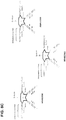
- star-shaped scaffolds of the present invention comprise a core (203) and multiple arms (202).
- the multiple arms contain functional moieties (201) that can react with binding moieties (also referred to herein as capture moieties) in a reaction region.
- the functional moieties may be attached at various points along the arms, as illustrated in Figure 2A , or in other embodiments, the functional moieties may be located at the ends of the arms.
- the functional moieties may be attached to the arms through any method known in the art, including without limitation through the use of a linker, through NHS ester chemistry, maleimide chemistry, or click chemistry.
- the functional moieties are themselves part of an oligonucleotide and the arms comprise DNA, and attachment of the functional moieties to the arms is through hybridization between the oligonucleotide and the DNA of the arms.
- the reaction between the functional moieties on any of the scaffolds described herein, including star-shaped scaffolds, and binding moieties on the reaction region help to load single scaffolds into the reaction region (and anything attached to those scaffolds) and prevent other scaffolds from loading into the same reaction region.
- the functional moieties may comprise biotin moieties and the binding moieties may comprise avidin, or vice versa.
- the core of the scaffold is any molecule or composition capable of supporting multiple arms.
- the core of the scaffold is an organic molecule or a protein.
- the core comprises a member selected from the group consisting of: an organic molecule, a multi-binding site protein, a branched peptide, a branched carbohydrate (such as cyclodextrin) and a branched oligonucleotide.
- the core of the scaffold is a multi-arm polyethylene glycol molecule.
- the core contains adaptors that can then be attached to arms.
- the arms of the PEG further comprise adapters that can be used to attach the PEG molecule to other molecules, which, as is described below, form the "multiple arms" of the scaffold.
- PEG polyethylene glycol
- the multiple arms of star-shaped scaffolds of the invention comprise linkers attaching the functional moieties to the core.
- linkers may comprise any type of molecule capable of joining the functional moieties to the core, including without limitation organic linkers such as alkane or alkene linkers of from about C2 to about C20, or longer, polyethyleneglycol (PEG) linkers, aryl, heterocyclic, saturated or unsaturated aliphatic structures comprised of single or connected rings, amino acid linkers, peptide linkers, nucleic acid linkers, PNA, LNAs, or the like or phosphate or phosphonate group containing linkers.
- organic linkers such as alkane or alkene linkers of from about C2 to about C20, or longer, polyethyleneglycol (PEG) linkers, aryl, heterocyclic, saturated or unsaturated aliphatic structures comprised of single or connected rings, amino acid linkers, peptide linkers, nucleic acid linkers, PNA, LNAs, or the
- alkyl e.g., alkane, alkene, alkyne alkoxy or alkenyl, or ethylene glycol linkers are used.
- the arms of the star-shaped scaffold comprise a DNA molecule (for example an oligonucleotide) containing one or more functional moieties, and those DNA molecule arms may further be attached directly to the core or through an intermediate adapter.
- the star-shaped scaffolds can contain any number of arms that is of use in the methods described herein.
- the star-shaped scaffolds of the invention comprise at least 2, 3, 4, 5, 6, 7, 8, 9, or 10 arms.
- the star-shaped scaffolds comprise about 2-6, 3-10, 5-30, 7-25, 9-20, or 11-15 arms.
- the arms generally comprise functional moieties capable of reacting with binding moieties in reaction regions.
- the arms comprise biotin or avidin moieties.
- each of the multiple arms of the star-shaped scaffolds comprise around 5-40 functional moieties.
- the arms individually comprise about 5-50, 10-45, 15-40, 20-35, or 25-30 functional moieties.
- the star-shaped scaffolds of the invention comprise at least 10, 15, 20, 25, 30, 35, 40, 45, 50, 55, or 60 functional moieties on each of the multiple arms.
- the star-shaped scaffolds can be of any size, depending on the design of the core and the multiple arms. In certain exemplary embodiments and as is discussed above, star-shaped scaffolds are generally of sufficient width to cover at least 90% of the area of the reaction region. In further embodiments in which the reaction regions include arrays of ZMWs, the scaffolds are about 50-200, 75-180, 100-170, 125-160 nm across their widest point - for star shaped scaffolds, the widest point will generally be from the end of one arm to the end of another arm located across the core from the first arm.
- the scaffolds are generally at least 25, 30, 35, 40, 45, 50, 55, 60, 65, 70, 75, 80, 85, 90, 95, 100, 105, 110, 115, 120, 125, 130, 135, 140, 145, 150, 155, 160, 165, 170, 175, 180, 185, 190, 200, 210, 220, 230, 240, 250, 260, 270, 280, 290, or 300 nm across at their widest point.
- the arms comprise oligonucleotides, and these oligonucleotides can be of any length to provide the desired final width for the scaffold.
- each arm is about 500 - 2000 basepairs in length.
- each arm is about 200 - 2500, 300 - 2400, 400 - 2300, 500 - 2200, 600 - 2100, 700 - 2000, 800 - 1900, 900 - 1800, 1000 - 1700, 1100 - 1600, 1200 - 1500, 1300 - 1400 basepairs in length.
- each arm is at least 450, 550, 650, 750, 850, 950, 1050, 1150, 1250, 1350, 1450, 1550, 1650, 1750, 1850, 1950, 2050 basepairs in length.
- the star-shaped scaffolds of the invention are attached to polymerase enzymes.
- the scaffolds are attached to polymerase enzyme complexes that further include a template nucleic acid molecule.
- the star-shaped scaffold is attached to a polymerase enzyme through a bis-biotin linkage between the core of the scaffold and the polymerase enzyme - an illustration of such an embodiment is provided in Figure 2B .
- the polymerase enzyme is further complexed to a template nucleic acid molecule (also referred to herein as a "template sequence").
- the template sequence may be a linear single or double stranded nucleic acid sequence.
- the template may be provided as a circular or functionally circular construct that allows redundant processing of the same nucleic acid sequence by the synthesis complex.
- Use of such circular constructs has been described in, e.g., U.S. Patent No. 7,315,019 and U.S. Patent No: 7,901,889 (Application No. 12/220674, filed July 25th, 2008 ) alternate functional circular constructs are also described in US Pat. App. Pub. No. 20090298075 and in particular for all teachings related to template nucleic acid constructs.
- the core of the scaffold is attached to multiple arms containing biotin moieties attached to DNA molecules, and in such examples the reaction regions on the surface contain binding elements comprising avidin moieties that are able to react with the biotin moieties on the scaffold attached to the polymerase enzymes to load the polymerase molecules into the reaction regions.
- the multiple arms contain avidin moieties attached to DNA molecules, and the binding elements on the surface then contain biotin moieties that are able to react with the avidin moieties on the scaffold to load the attached polymerase molecules into the reaction regions.
- star-shaped scaffolds of the invention are not dendrimers - in other words, the star-shaped scaffolds of the invention are not repetitively branched tree-like structures, but are instead discrete molecules that include a core and a set of multiple arms, where the core is comprised of a material that is different from that of the multiple arms.
- one advantage of the star-shaped scaffolds of the present invention is that the functional moieties are separated by a distance that makes depletion of the binding moieties within the reaction region more efficient than is the case if the functional moieties are located more closely to each other. This may be particularly possible in the case of the star-shaped scaffolds, because the functional moieties are generally located on flexible arms, allowing for increased mobility and rotational freedom to efficiently occupy and deplete binding moieties within the reaction region, thus preventing multiple scaffolds from occupying the same reaction region. Furthermore, the star-shaped scaffold enables coverage of a large reaction region with relatively short arm length. This speeds up binding kinetics and places the enzyme in closer proximity to the surface of the substrate, providing increased control over and intensity of signal strength for detection.
- star-shaped scaffolds of the present invention Another unexpected advantage of the star-shaped scaffolds of the present invention is that even the scaffolds comprising multiple proteinaceous functional moieties nevertheless do not show significant amounts of aggregation of the scaffolds in solution. This provides the advantage of efficient loading of single scaffolds into the reaction regions with minimal loss of reactants to aggregation.
- the scaffolds are linear DNA molecules containing one or more functional moieties that are incorporated into the linear DNA molecule through attachment to a nucleobase or through attachment to a flexible linker. These one or more functional moieties and their attached linkers are also referred to herein as "branches" of the linear DNA molecule.
- the functional moieties are biotin or avidin moieties.
- the linkers comprise polymeric structures, including without limitation polyethylene glycol, a peptide, an oligonucleotide, and an aliphatic carbon chain.
- these linkers may be attached to the linear DNA structure through a modified base
- modified bases can include without limitation aminoallyl-dT, aminopropargyl-dT, thiol-phosphate, thiol-modified base, azide modified base, and an alkyl-modified base.
- the linkers are increased in size and/or number to produce a highly "branched" linear DNA structure.
- These branched linear scaffolds are designed to enhance the flexibility of the scaffold and improve coverage of the reaction regions.
- DNA backbones are known to be rigid, with a persistence length of about 30-50 nm. By maintaining a distance between the functional moieties and the DNA backbone with a flexible linker (branch), the functional moieties are thereby more accessible to the binding sites on surface.
- linkers can include without limitation polymers, amino acids, and alkyl chains.
- such linkers include polyethylene glycol, peptides, oligonucleotides, and aliphatic carbon chains.
- the linkers are in certain embodiments attached to the DNA via a modified base such as aminoallyl-dT, aminopropargyl-dT, thiol-phosphate, thiol-modified base, azide modified base, or alkyl-modified base.
- a modified base such as aminoallyl-dT, aminopropargyl-dT, thiol-phosphate, thiol-modified base, azide modified base, or alkyl-modified base.
- the linear DNA scaffold is a DNA molecule with biotin or avidin moieties attached to the DNA chain.
- Such scaffolds can be produced using methods known in the art for attaching moieties to DNA molecules.
- biotin-or avidin-dUTP can be spiked into a PCR reaction with different percentages, and polymerase would incorporate the biotins to the DNA chain.
- amine-labeled base or thiol-labeled bases can be incorporated, and avidin or biotin can be attached though amine-NHS ester chemistry or thiol-maleimde reaction.
- the DNA backbone length can be modified by primer design, and the number of functional moieties can be controlled by the ratio of UTP's bound to functional moieties relative to native TTPs that are included in the synthesis reaction.
- the sequence of template one can also manipulate the density of functional moieties along the DNA chain. For example, one could make DNA with higher biotin density in the center region versus the ends of the DNA backbone, and vice versa.
- the branches of the linear DNA scaffolds are from about 0.2 - 5 nm in length.
- the branches are about 0.2 - 4.5, 0.4 - 4, 0.5 - 3, 0.6 - 3.5, 0.8 - 3.0, 1.0 - 2.5, or 1.2 - 2 nm in length.
- the branches are less than 1 nm in length.
- the branches are at least 2 nm in length.
- scaffolds of the invention comprise a DNA origami structure.
- functional moieties including without limitation avidin and biotin moieties, are introduced as tags on an oligonucleotide, either at the end of an oligonucleotide or inserted through a modified base.
- structures are produced by hybridizing short DNA segments to form a predetermined structure.
- the size of the origami structure can be designed to fit a reaction region (including without limitation a ZMW) so that additional DNA origami scaffolds (and their attached polymerase complexes) cannot occupy a reaction region both through occupation of the binding moieties in the reaction region by the functional moieties of the scaffold as well as by steric hindrance.
- DNA origami structures known in the art are of use in the present invention, including triangle-shaped DNA origami structures as well as those for example described in Rothemund, Nature 440: 297-302 (2006 ), Douglas et al., Nature 459:414-418 (2009 ); Dietz, Science 325: 725-730 (2009 ), and US Patent No. 8,877,438 , and in particular for all description, figures, and figure legends related to DNA structures, particularly those structures referred to as DNA origami. As is known in the art, if the proper nucleic acid components are mixed together, they self-assemble into structures (commonly referred to as "DNA origami") with a selected size and geometry.
- This "cup and coaster” DNA origami can be designed to be approximately the same size as a ZMW or other array region of interest.
- Such structures can also be designed to have a binding site for a polymerase or other analyte, leading to delivery of a single analyte to an array site of interest (e.g., to a ZMW).
- Additional DNA structures can also be adapted to the present invention for delivery of a single polymerase molecule to an array site of interest.
- self-assembling DNA structures include, e.g., DNA grids ( Park et al. (2006) “Finite-Size, Fully Addressable DNA Tile Lattices Formed by Hierarchical Assembly Procedures” Angew. Chem. Int. Ed. 45:735-739 ), DNA Dodecahedrons ( Zhang et al. (2008) "Conformational flexibility facilitates self-assembly of complex DNA nanostructures PNAS 105(31):10665-10669 ; Zimmermann et al.
- template nucleic acid molecules also referred to herein as "template sequences”
- the template nucleic acid is the molecule for which the complimentary sequence is synthesized in the polymerase reaction.
- the template nucleic acid is linear; in some cases, the template nucleic acid is circular.
- the template nucleic acid can be DNA, RNA, or can be a non-natural RNA analog or DNA analog. Any template nucleic acid that is suitable for replication by a polymerase enzyme can be used herein.
- the template nucleic acids used in methods and compositions of the present invention comprise nucleic acids obtained from a sample.
- the sample may comprise any number of things, including, but not limited to, bodily fluids (including, but not limited to, blood, urine, serum, lymph, saliva, anal and vaginal secretions, perspiration and semen) and cells of virtually any organism, with mammalian samples being preferred and human samples being particularly preferred; environmental samples (including, but not limited to, air, agricultural, water and soil samples); biological warfare agent samples; research samples (i.e.
- the sample may be the products of an amplification reaction, including both target and signal amplification, such as PCR amplification reactions; purified samples, such as purified genomic DNA, RNA preparations, raw samples (bacteria, virus, genomic DNA, etc.); as will be appreciated by those in the art, virtually any experimental manipulation may have been done on the samples.
- an amplification reaction including both target and signal amplification, such as PCR amplification reactions; purified samples, such as purified genomic DNA, RNA preparations, raw samples (bacteria, virus, genomic DNA, etc.); as will be appreciated by those in the art, virtually any experimental manipulation may have been done on the samples.
- nucleic acid molecules are obtained from a sample and fragmented for use in methods of the invention as template nucleic acids.
- the fragments may be single or double stranded and may further be modified in accordance with any methods known in the art and described herein.
- Template nucleic acids may be generated by fragmenting source nucleic acids, such as genomic DNA, using any method known in the art. In one embodiment, shear forces during lysis and extraction of genomic DNA generate fragments in a desired range. Also encompassed by the invention are methods of fragmentation utilizing restriction endonucleases.
- the template nucleic acids may be generated from a source nucleic acid, such as genomic DNA, by fragmentation to produce fragments of a specific size.
- the target nucleic acids can be, for example, from about 10 to about 50,000 nucleotides in length, or from about 10 to about 20,000 nucleotides in length.
- the fragments are 50 to 600 nucleotides in length. In another embodiment, the fragments are 300 to 600 or 200 to 2000 nucleotides in length.
- the fragments are 10-100, 50-100, 50-300, 100-200, 200-300, 50-400, 100-400, 200-400, 400-500, 400-600, 500-600, 50-1000, 100-1000, 200-1000, 300-1000, 400-1000, 500-1000, 600-1000, 700-1000, 700-900, 700-800, 800-1000, 900-1000, 1500-2000, 1750-2000, and 50-2000 nucleotides in length.
- nucleic acids used in the compositions and methods of the present invention comprise nucleoside polyphosphates (also referred to herein as "nucleotides” “nucleotide analogs” or “nucleoside polyphosphate analogs”) that have a three or more phosphate groups.
- nucleotide analogs of use in methods of the invention have at least 4, 5, 6, 7, 8, 9, 10, 11, 12, 13, 14, 15, 16, 17, 18, 19, 20, 21, 22, 23, 24, 25, 26, 27, 28, 29, 30 phosphate groups.
- nucleotide analogs of use in methods of the invention have about 4, 5, 6, 7, 8, 9, 10, 11, 12, 13, 14, 15, 16, 17, 18, 19, 20, 21, 22, 23, 24, 25, 26, 27, 28, 29, 30 phosphate groups.
- nucleotide analogs of the invention have from about 4-60, 5-55, 6-50, 7-45, 8-40, 9-35, 10-30, 11-25, 12-20, 13-15, 4-20, 4-12, 5-19, 6-18, 7-17, 8-16, 9-15, 10-14, 11-13 phosphate groups.
- the template sequence may be a linear single or double stranded nucleic acid sequence.
- the template may be provided as a circular or functionally circular construct that allows redundant processing of the same nucleic acid sequence by the synthesis complex.
- Use of such circular constructs has been described in, e.g., U.S. Patent No. 7,315,019 and U.S. Patent Application No. 12/220674, filed July 25th, 2008 , alternate functional circular constructs are also described in US Pat. App. Pub. No. 20090298075 and in particular for all teachings related to template nucleic acid constructs.
- such alternate constructs include template sequences that possess a central double stranded portion that is linked at each end by an appropriate linking oligonucleotide, such as a hairpin loop segment.
- an appropriate linking oligonucleotide such as a hairpin loop segment.
- the template nucleic acid used in the compositions of the present invention includes: a double stranded nucleic acid segment having a first and second end; a first hairpin oligonucleotide connecting each strand of the single template nucleic acid at the first end; a second hairpin oligonucleotide connecting each strand of the single template nucleic acid at the second end.
- the first hairpin and second hairpin oligonucleotide are identical.
- the first hairpin and second hairpin oligonucleotides are not identical - in other words, the template nucleic acid, despite being an alternate circular construct, is nevertheless asymmetrical.
- the first hairpin oligonucleotide includes a primer binding site whereas the second hairpin oligonucleotide includes a capture adapter (or vice versa).
- the capture adapter is generally of a sequence that can be used to enrich a population for the hairpins of choice - for example, in some embodiments, the capture adapter comprises a polyA sequence, thereby allowing capture using beads or column chromatography utilizing polyT sequences. In other embodiments, the capture adapter comprises at least one methoxy residue.
- the capture adapter is complementary to an oligonucleotide attached to a bead, which can in further embodiments be a magnetic bead that can be used to enrich a population for template nucleic acids containing the capture adapter.
- the first or second hairpin comprises a self-primed adapter sequence in which the primer is part of the adapter.
- an additional oligonucleotide primer is not needed to allow a polymerase molecule to begin replicating the template.
- the nucleotide analogs of use in the present invention include 4 or more phosphate groups as discussed above and in addition include a terminal protecting group (also referred to herein as a "terminal blocking group") to protect the nucleotide analog from degradation until the nucleotide analog is incorporated and the polyphosphate chain is released, for example in one or more of the template-directed polymerization reactions in the stepwise and single molecule sequencing reactions discussed herein.
- the protecting group will in general be on the terminal phosphate of the polyphosphate chain of the nucleotide analog and can be any type of protecting group that prevent a hydrolysis reaction, such as a reaction by a phosphatase.
- the nucleoside polyphosphate is protected by another nucleoside of the same base (e.g., a symmetric dinucleoside polyphosphate).
- the protecting group includes any group that takes the place of one or more of the oxygen atoms of the terminal phosphate group to prevent degradation.
- the protecting group comprises a linker, an alkyl group (including without limitation a methyl, ethyl, propyl or butyl group), a dye, any other adduct (including without limitation a fluorophore, a carbohydrate, and an aromatic group) that is attached either to the P or an O in the terminal phosphate.
- the linker can be any molecular structure, including without limitation organic linkers such as alkane or alkene linkers of from about C2 to about C20, or longer, polyethyleneglycol (PEG) linkers, aryl, heterocyclic, saturated or unsaturated aliphatic structures comprised of single or connected rings, amino acid linkers, peptide linkers, nucleic acid linkers, PNA, LNAs, or the like or phosphate or phosphonate group containing linkers.
- organic linkers such as alkane or alkene linkers of from about C2 to about C20, or longer, polyethyleneglycol (PEG) linkers, aryl, heterocyclic, saturated or unsaturated aliphatic structures comprised of single or connected rings, amino acid linkers, peptide linkers, nucleic acid linkers, PNA, LNAs, or the like or phosphate or phosphonate group containing linkers.
- alkyl e.g., alkane, alkene, alkyn
- linkers are described in Published U.S. Patent Application No. 2004/0241716 , and in particular for all teachings related to linkers.
- the protecting groups may in further embodiments be alkyl, aryl, or ester linkers.
- the protecting groups may also be amino-alkyl linkers, e.g., amino-hexyl linkers.
- the linkers can be rigid linkers such as disclosed in U.S. Patent Application No. 12/403,090 and in particular for all teachings related to linkers.
- nucleic acid components of the compounds of the invention optionally include modified bases. These components can also include modified sugars.
- the nucleotide analogs of the present invention may further include labels, such as fluorescent labeling groups. These labeling groups may also be such that the different types of nucleotide analogs may be distinguished from one another.
- each of the different types of nucleotide analogs will be labeled with a detectably different fluorescent labeling group, e.g., that possesses a detectably distinct fluorescent emission and/or excitation spectrum, such that it may be identified and distinguished from different nucleotides upon incorporation.
- a detectably different fluorescent labeling group e.g., that possesses a detectably distinct fluorescent emission and/or excitation spectrum, such that it may be identified and distinguished from different nucleotides upon incorporation.
- each of the different types of nucleotides e.g., A, T, G and C, will be labeled with a fluorophore having a different emission spectrum.
- the nucleotide may include a fluorescent labeling group coupled to a portion of the nucleotide that is incorporated into the nascent nucleic acid strand being produced during synthesis, e.g., the nucleobase or sugar moiety.
- Nucleotide compositions having fluorophores coupled to these portions have been previously described (See, e.g., U.S. Patent No. 5,476,928 and 4,711,955 to Ward et al. ).
- the label group being coupled to the base or sugar portion of the nucleotide, upon incorporation, the nascent strand will include the labeling group.
- This labeling group may then remain or be removed, e.g., through the use of cleavable linkages joining the label to the nucleotide (See, e.g., U.S. Patent No. 7,057,026 ).
- cleavable linkages joining the label to the nucleotide See, e.g., U.S. Patent No. 7,057,026 .
- fluorophore types including both organic and inorganic fluorescent materials, have been described for biological applications and are likewise applicable in the instant invention.
- nucleotide analogs of the present invention may include nucleoside polyphosphates having the structure: B-S-P-G, wherein B is a natural or non-natural nucleobase, S is selected from a sugar moiety, an acyclic moiety or a carbocyclic moiety, P is a modified or unmodified polyphosphate, and G is a protecting group.
- the base moiety, B, incorporated into the nucleotide analogs of the invention is generally selected from any of the natural or non-natural nucleobases or nucleobase analogs, including, e.g., purine or pyrimidine bases that are routinely found in nucleic acids and nucleic acid analogs, including adenine, thymine, guanine, cytidine, uracil, and in some cases, inosine.
- nucleotides and nucleotide analogs are generally referred to based upon their relative analogy to naturally occurring nucleotides.
- an analog that operates, functionally, like adenosine triphosphate may be generally referred to herein by the shorthand letter A.
- the standard abbreviations of T, G, C, U and I may be used in referring to analogs of naturally occurring nucleosides and nucleotides typically abbreviated in the same fashion.
- a base may function in a more universal fashion, e.g., functioning like any of the purine bases in being able to hybridize with any pyrimidine base, or vice versa.
- the base moieties used in the present invention may include the conventional bases described herein or they may include such bases substituted at one or more side groups, or other fluorescent bases or base analogs, such as 1,N6 ethenoadenosine or pyrrolo C, in which an additional ring structure renders the B group neither a purine nor a pyrimidine.
- labeled nucleobases and processes for labeling such groups are described in, e.g., U.S. Pat. Nos. 5,328,824 and 5,476,928 , and in particular for all teachings related to nucleobases and labeling nucleobases.
- the S group is generally a sugar moiety that provides a suitable backbone for a synthesizing nucleic acid strand.
- the sugar moiety is selected from a D-ribosyl, 2' or 3' D-deoxyribosyl, 2',3'-D-dideoxyribosyl, 2',3'-D-didehydrodideoxyribosyl, 2' or 3' alkoxyribosyl, 2' or 3' aminoribosyl, 2' or 3' mercaptoribosyl, 2' or 3' alkothioribosyl, acyclic, carbocyclic or other modified sugar moieties.
- carbocyclic or acyclic moieties may be incorporated as the "S" group in place of a sugar moiety, including, e.g., those described in published U.S. Patent Application No. 2003/0124576 , and in particular for all teachings related to sugar moieties of nucleotides and nucleotide analogs.
- the P groups in the nucleotides of the invention are modified or unmodified polyphosphate groups.
- the number of phosphates in the polyphosphate can have 4, 5, 6, 7, 8, 9, 10, 11, 12, 13, 14, 15, 16, 17, 18, 19, 20, 21, 22, 23, 24, 25, 26, 27, 28, 29, 30 phosphate groups or more modified or unmodified phosphates.
- the unmodified phosphates have linearly linked -O-P(O) 2 - units, for example a tetraphosphate, pentaphosphate, hexaphosphate, heptaphosphate, or octaphosphate.
- the P groups also include modified polyphosphates, for example by virtue of the inclusion of one or more phosphonate groups, effectively substituting a non-ester linkage in the phosphorous containing chain of the analog, with a more stable linkage.
- preferred linkages include, e.g., CH 2 , methylene derivatives (e.g., substituted independently at one or more hydrogens with F, Cl, OH, NH 2 , alkyl, alkenyl, alkynyl, etc.), CCl 2 , CF 2 , NH, S, CH 2 CH 2 , C(OH)(CH 3 ), C(NH 2 )[(CH 2 ) 6 CH 3 ], CH(NHR) (R is H or alkyl, alkenyl, alkynyl, aryl, C(OH)[(CH 2 ) n NH 2 ] (n is 2 or 3), and CNH 2 .
- methylene, amide or their derivatives are used as the linkages
- P groups of the invention have phosphate or modified phosphates in which one or more non-bridging oxygen is substituted, for example with S, or BH 3 .
- one or more, two or more, three or more, or four or more non-bridging oxygen atoms in the P group has an S substituted for an O.
- the substitution of, sulfur atoms for oxygen can change the polymerase reaction kinetics such that a system having two slow steps can be selected. While not being bound by theory, it is believed that the properties of the nucleotide, such as the metal chelation properties, electronegativity, or steric properties are the nucleotide can be altered by the substitution of non-bridging oxygen for sulfur in P.
- substitution of two or more non-bridging oxygen atoms with sulfur can affect the metal chelation properties so as to lead to a change in the kinetics of incorporation, which can be used to modulate the signals generated from the incorporation events discussed herein.
- Suitable nucleotide analogs include analogs in which sulfur is substituted for one of the non-bridging oxygens. In some embodiments, the single sulfur substitution is made such that substantially only one stereoisomer is present.
- the nucleotide can have multiple phosphates in which one or more of the phosphates has a non-bridging sulfur in place of oxygen.
- the substituted phosphate in the nucleotide can be the R or the S stereoisomer.
- G generally refers to a protecting group that is coupled to the terminal phosphorus atom via the R 4 (or R 10 or R 12 ) group.
- the protecting groups employed in the analogs of the invention may comprise any of a variety of molecules, including a linker, an alkyl group (including without limitation a methyl, ethyl, propyl or butyl group), any other adduct (including without limitation a fluorophore, a carbohydrate, and an aromatic group) or a label e.g., optical labels, e.g., labels that impart a detectable optical property to the analog, electrochemical labels, e.g., labels that impart a detectable electrical or electrochemical property to the analog, physical labels, e.g., labels that impart a different physical or spatial property to the analog, e.g., a mass tag or molecular volume tag.
- individual labels or combinations may be used that impart more than one of the aforementioned properties to the nucleotide analogs of the invention
- the protecting group may be directly coupled to the terminal phosphorus atom of the analog structure, in alternative aspects, it may additionally include a linker molecule to provide the coupling through, e.g., an alkylphosphonate linkage.
- linkers and linker chemistries are known in the art of synthetic chemistry may be employed in coupling the labeling group to the analogs of the invention.
- linkers may include organic linkers such as alkane or alkene linkers of from about C2 to about C20, or longer, polyethyleneglycol (PEG) linkers, aryl, heterocyclic, saturated or unsaturated aliphatic structures comprised of single or connected rings, amino acid linkers, peptide linkers, nucleic acid linkers, PNA, LNAs, or the like or phosphate or phosphonate group containing linkers.
- alkyl e.g., alkane, alkene, alkyne alkoxy or alkenyl, or ethylene glycol linkers are used.
- linkers may be selectively cleavable linkers, e.g., photo- or chemically cleavable linkers or the like.
- the linkers can be alkyl, aryl, or ester linkers.
- the linkers can be, amino-alkyl linkers, e.g., amino-hexyl linkers.
- the linkers can be rigid linkers such as disclosed in U.S. Patent No: 7,968,702 (Application No. 12/403,090 ).
- the B, S, P, and G groups can be connected directly, or can be connected using an linking unit such as an -O-, -S-, -NH-, or -CH 2 - unit.
- polymerase enzymes also referred to herein as "polymerases”
- polymerase enzymes are often part of or complexed with the scaffolds of the invention.
- Any suitable polymerase enzyme can be used in the systems and methods disclosed herein.
- Suitable polymerases include DNA dependent DNA polymerases, DNA dependent RNA polymerases, RNA dependent DNA polymerases (reverse transcriptases), and RNA dependent RNA polymerases.
- the polymerases used in the methods and compositions of the present invention are strand-displacing polymerases.
- DNA polymerases are sometimes classified into six main groups based upon various phylogenetic relationships, e.g., with E . coli Pol I (class A), E. coli Pol II (class B), E. coli Pol III (class C), Euryarchaeotic Pol II (class D), human Pol beta (class X), and E . coli UmuC/DinB and eukaryotic RAD30/xeroderma pigmentosum variant (class Y).
- E . coli UmuC/DinB and eukaryotic RAD30/xeroderma pigmentosum variant class Y.
- chimeric polymerases made from a mosaic of different sources can be used.
- ⁇ 29 polymerases made by taking sequences from more than one parental polymerase into account can be used as a starting point for mutation to produce the polymerases of the invention.
- Chimeras can be produced, e.g., using consideration of similarity regions between the polymerases to define consensus sequences that are used in the chimera, or using gene shuffling technologies in which multiple ⁇ 29-related polymerases are randomly or semi-randomly shuffled via available gene shuffling techniques (e.g., via "family gene shuffling"; see Crameri et al.
- the recombination points can be predetermined such that the gene fragments assemble in the correct order.
- the combinations e.g., chimeras
- the combinations can be formed at random.
- five gene chimeras e.g., comprising segments of a Phi29 polymerase, a PZA polymerase, an M2 polymerase, a B103 polymerase, and a GA-1 polymerase, can be generated.
- Appropriate mutations to improve branching fraction, increase closed complex stability, or alter reaction rate constants can be introduced into the chimeras.
- Available DNA polymerase enzymes have also been modified in any of a variety of ways, e.g., to reduce or eliminate exonuclease activities (many native DNA polymerases have a proof-reading exonuclease function that interferes with, e.g., sequencing applications), to simplify production by making protease digested enzyme fragments such as the Klenow fragment recombinant, etc.
- polymerases have also been modified to confer improvements in specificity, processivity, and improved retention time of labeled nucleotides in polymerase-DNA-nucleotide complexes (e.g., WO 2007/076057 POLYMERASES FOR NUCLEOTIDE ANALOGUE INCORPORATION by Hanzel et al.
- any of these available polymerases can be modified in accordance with the methods known in the art to decrease branching fraction formation, improve stability of the closed polymerase-DNA complex, and/or alter reaction rate constants.
- the polymerase is modified in order to more effectively incorporate the nucleotide analogs of the invention, e.g. analogs having four or more phosphates in their polyphosphate chain, and /or nucleotide analogs having terminal groups to prevent phosphate cleavage by phosphatase enzymes.
- Enzymes mutated to more readily accept nucleotide analogs having such properties are described, for example in the applications described above and in US 20120034602 - Recombinant Polymerases for Improved Single Molecule Sequencing; US 20100093555 - Enzymes Resistant to Photodamage; US 20110189659 - Generation of Modified Polymerases for Improved Accuracy in Single Molecule Sequencing; US 20100112645 - Generation of Modified Polymerases for Improved Accuracy in Single Molecule Sequencing; US 2008/0108082 - Polymerase enzymes and reagents for enhanced nucleic acid sequencing; and US 20110059505 - Polymerases for Nucleotide Analogue Incorporation .
- DNA Polymerase Beta is available from R&D systems.
- DNA polymerase I is available from Epicenter, GE Health Care, Invitrogen, New England Biolabs, Promega, Roche Applied Science, Sigma Aldrich and many others.
- the Klenow fragment of DNA Polymerase I is available in both recombinant and protease digested versions, from, e.g., Ambion, Chimerx, eEnzyme LLC, GE Health Care, Invitrogen, New England Biolabs, Promega, Roche Applied Science, Sigma Aldrich and many others.
- ⁇ 29 DNA polymerase is available from e.g., Epicentre. Poly A polymerase, reverse transcriptase, Sequenase, SP6 DNA polymerase, T4 DNA polymerase, T7 DNA polymerase, and a variety of thermostable DNA polymerases (Taq, hot start, titanium Taq, etc.) are available from a variety of these and other sources.
- Recent commercial DNA polymerases include PhusionTM High-Fidelity DNA Polymerase, available from New England Biolabs; GoTaq® Flexi DNA Polymerase, available from Promega; RepliPHITM ⁇ 29 DNA Polymerase, available from Epicentre Biotechnologies; PfuUltraTM Hotstart DNA Polymerase, available from Stratagene; KOD HiFi DNA Polymerase, available from Novagen; and many others. Biocompare(dot)com provides comparisons of many different commercially available polymerases.
- DNA polymerases that are preferred substrates for mutation to decrease branching fraction, increase closed complex stability, or alter reaction rate constants include Taq polymerases, exonuclease deficient Taq polymerases, E. coli DNA Polymerase 1, Klenow fragment, reverse transcriptases, ⁇ 29-related polymerases including wild type ⁇ 29 polymerase and derivatives of such polymerases such as exonuclease deficient forms, T7 DNA polymerase, T5 DNA polymerase, an RB69 polymerase, etc.
- the polymerase of use in the methods and compositions described herein is a modified ⁇ 29-type DNA polymerase.
- the modified recombinant DNA polymerase can be homologous to a wild-type or exonuclease deficient ⁇ 29 DNA polymerase, e.g., as described in U.S. Patent Nos. 5,001,050 , 5,198,543 , or 5,576,204 .
- the modified recombinant DNA polymerase can be homologous to other ⁇ 29-type DNA polymerases, such as B103, GA-1, PZA, ⁇ 15, BS32, M2Y, Nf, G1, Cp-1, PRD1, PZE, SF5, Cp-5, Cp-7, PR4, PR5, PR722, L17, ⁇ 21, or the like.
- ⁇ 29-type DNA polymerases such as B103, GA-1, PZA, ⁇ 15, BS32, M2Y, Nf, G1, Cp-1, PRD1, PZE, SF5, Cp-5, Cp-7, PR4, PR5, PR722, L17, ⁇ 21, or the like.
- Suitable polymerases are described, for example, in U.S. Patent No: 8,420,366 and 8,257,954 (Applications 12/924701, filed September 30, 2010 ; and 12/384112, filed March 30, 2009 .)
- the polymerase enzyme used in the methods of the invention includes RNA dependent DNA polymerases or reverse transcriptases.
- Suitable reverse transcriptase enzymes include HIV-1, M-MLV, AMV, and Telomere Reverse Transcriptase.
- Reverse transcriptases also allow for the direct sequencing of RNA substrates such as messenger RNA, transfer RNA, non-coding RNA, ribosomal RNA, micro RNA or catalytic RNA.
- the polymerase enzymes of use in the present invention generally require a primer, which is usually a short oligonucleotide that is complementary to a portion of the template nucleic acid.
- the primers can comprise naturally occurring RNA or DNA oligonucleotides.
- the primers may also be synthetic analogs.
- the primers may have alternative backbones as described above for the nucleic acids of the invention.
- the primer may also have other modifications, such as the inclusion of heteroatoms, the attachment of labels, such as dyes, or substitution with functional groups which will still allow for base pairing and for recognition by the enzyme.
- Primers can select tighter binding primer sequences, e.g., GC rich sequences, as well as employ primers that include within their structure non-natural nucleotides or nucleotide analogs, e.g., peptide nucleic acids (PNAs) or locked nucleic acids (LNAs), that can demonstrate higher affinity pairing with the template.
- the primer can also be selected to influence the kinetics of the polymerase reaction.
- compositions described herein are used in methods of loading polymerase molecules into reaction regions (also referred to herein as "array regions").
- these methods result in a plurality of the reaction regions containing only a single polymerase molecule.
- the percentage of reaction regions containing only a single polymerase molecule as a result of methods of the invention is higher than what would be expected from a Poisson distribution when simply relying on a passive diffusion-based mechanism.
- Passive diffusion-based mechanisms of loading have a theoretical limit of 37% of the array regions being loaded with a single polymerase molecule under the Poisson distribution.
- the methods and compositions described herein allow for an increased percentage of single-loaded reaction regions over the theoretical limit governed by the Poisson distribution.
- reaction regions can comprise any space delimited region on the surface of a substrate into which the compositions described herein can be distributed.
- the reaction regions are wells on a planar surface.
- the reaction regions comprise an array of ZMWs.
- methods of loading compositions in accordance with the present invention result in about 40-90%, 45-80%, 50-75% or 55-70% of the reaction regions occupied by only a single polymerase molecule.
- more than 37%, 40%, 45%, 50%, 55%, 60%, 65%, 70%, 75%, 80%, 85%, 90%, or 95% of the array regions are occupied by only a single polymerase molecule.
- the single polymerase molecule is generally attached to a scaffold of the invention, and that scaffold aids in the distribution of the single polymerase molecules of the invention into reaction regions by depleting binding moieties within the reaction regions, thereby preventing additional molecules from occupying the same reaction region.
- compositions comprising a polymerase molecule complexed with and/or attached to a scaffold that includes functional moieties.
- These functional moieties are generally capable of reacting to binding moieties in the array regions, and by occupying enough of those binding moieties, the compositions are able to effectively block other polymerase molecules and their scaffolds from loading into the same array region.
- these scaffolds can comprise any shape or size, and in some non-limiting examples are star-shaped structures, linear DNA structures, and DNA origami structures.
- the functional moieties on the scaffold comprise biotin moieties and the binding moieties in the array regions comprise avidin.
- the functional moieties on the scaffold comprise avidin moieties and the binding moieties in the array regions comprise biotin.
- the functional moieties and binding moieties comprise any pair that can react with each other, including without limitation antigen-antibody binding pairs, receptor-ligand binding pairs, aptamer-epitope binding pairs, GST/glutathione pairs, nucleic acid hybridization pairs, and the like.
- the compositions are applied in a solution to a surface comprising array regions and the array regions are loaded with single compositions through simple diffusion.
- the array regions are loaded with single compositions with the use of beads.
- beads may be attached to or complexed with any part of the compositions described herein, including the polymerase, the scaffold, or the template nucleic acid. Depositing with beads can lead to a more even distribution of deposited compositions by size than can be the case when relying on diffusion of the compositions alone, allowing for a more comprehensive representation of the larger size fragments in the data in any subsequent single molecule analyses.
- the beads aid in the distribution of single compositions into the array regions by improving the kinetics of moving the compositions from solution to the surface of the substrate at which point gravity and diffusion further aid in the disposition of the compositions into the array regions themselves. Additional compositions are generally prevented from entering the same array regions because the functional moieties on the scaffold deplete the available binding moieties in the array regions, leaving no further binding moieties for occupation by a second scaffold.
- the scaffolds and their attached polymerase-nucleic acid complexes are attached to a magnetic bead, and that magnetic bead is used to aid in loading of the scaffolds into the reaction regions through application of a magnetic field.
- the magnetic bead is attached via hybridization between an oligonucleotide attached to the magnetic bead and a sequence on the template nucleic acid.
- the magnetic bead is attached to a hook oligonucleotide comprising a retrieval sequence that is complimentary to an oligonucleotide attached to the magnetic bead and a capture sequence that is complementary to the template nucleic acid.
- the oligonucleotide attached to the magnetic bead comprises a poly(dA), poly(A), poly(dT) or poly(T) sequence.
- the invention provides methods for depositing molecules of interest onto a substrate, where those methods include the steps of: providing a solution of beads wherein each bead is linked to a polymerase composition comprising a scaffold attached to a complex containing a polymerase enzyme and a template nucleic acid; exposing the solution of beads to a substrate, the surface of the substrate comprising binding moieties for binding the functional moieties on the scaffold; using a contacting force to bring the beads into proximity or into physical contact with the substrate and optionally using a distributing force to move the beads across the surface of the substrate; and removing the beads from the substrate, thereby producing a substrate having the polymerase compositions bound to its surface through the binding molecules.
- the functional moieties are biotin moieties and the binding moieties are avidin moieties; in other embodiments, the functional moieties are avidin moieties and the binding moieties are biotin moieties.
- the contacting force used to bring the beads to the substrate is a magnetic force.
- the functional moieties on the scaffold deplete at least some of the binding moieties on the substrate, thereby preventing additional scaffolds (and their attached complexes) from entering the same substrate region.
- the substrate comprises an array of ZMWs.
- distribution of the polymerase compositions of the invention is aided through design of the solution used during the loading step.
- a density gradient is used during loading in which a high density solution is added to the buffer in which the polymerase compositions are held. This high density solution assists in the movement of the polymerase compositions to the surface of the substrate, and then diffusion and/or use of a distributing force (such as the magnetic beads plus magnetic field described above) further distributes the compositions into the array regions.
- distribution of the polymerase compositions is conducted in the presence of a divalent cation to improve loading of the polymerase enzyme compositions into the array regions as compared to loading in the absence of the divalent cation.
- the divalent cation is a member selected from the group consisting of Ca 2+ , Sr 2+ , and Ba 2+ .
- the divalent cation is present in a concentration of about 0.2 - about 5 mM.
- the divalent cation is present in a concentration of about 0.1 - 10, 0.3 - 9.5, 0.4 - 9.0, 0.5 - 8.5, 0.6 - 8.0, 0.7 - 7.5, 0.8 - 7.0, 0.9 - 6.5, 1.0 - 6.5, 1.1 - 6.0, 1.2 - 5.5, 1.3 - 5.0, 1.4 - 4.5, 1.5 - 4.0, 1.6 - 3.5, 1.7 - 3.0, and 1.8 - 2.5 mM.
- the methods may include a "clean up" step to boost a higher productive fraction of loaded reaction regions.
- Such clean up steps generally involve removing components of the compositions that are not bound together in a complex, thus ensuring that the compositions loaded into the reaction regions are active and contain all elements needed for subsequent reactions, such as sequencing reactions (e.g., the reaction regions are loaded with compositions comprising an enzyme attached to a scaffold and further attached to a nucleic acid template and in some embodiments a primer sequence attached to the template).
- sequencing reactions e.g., the reaction regions are loaded with compositions comprising an enzyme attached to a scaffold and further attached to a nucleic acid template and in some embodiments a primer sequence attached to the template.
- enzymes that are not attached to scaffolds are removed from the population generally using beads comprising a random sequence.
- Further clean-up steps may include removal of excess scaffolds and/or scaffold arms that are not attached to or complexed with an enzyme.
- methods known in the art are used to ensure that a large fraction of the polymerase molecule complexes loaded into the reaction regions are active. Such methods are described, for example, in US Patent No. 8,715,930 , and in particular for all written description, figures and figure legends related to loading molecules of interest onto a substrate.
- the methods of the present invention are used to distribute single polymerase compositions into a plurality of ZMWs.
- ZMW arrays and their application to single molecule analyses, and particularly to nucleic acid sequencing see, e.g., " Selective aluminum passivation for targeted immobilization of single DNA polymerase molecules in zero-mode waveguide nanostructures” (2008) Korlach et al. Proceedings of the National Academy of Sciences U.S.A. 105(4): 1176-1181 ; " Improved fabrication of zero-mode waveguides for single-molecule detection” (2008) Foquet et al.
- methods of distributing single polymerase compositions into a plurality of array regions include the steps of: (a) providing a surface comprising a plurality of array regions, wherein each array region comprises several binding elements; (b) exposing the surface to a solution comprising polymerase enzyme compositions, wherein each polymerase enzyme composition comprises a polymerase bound to a scaffold - in general, the scaffold includes a core comprising conjugation adaptors, and multiple arms comprising functional moieties attached to DNA molecules.
- the exposing is generally conducted under conditions such that the functional moieties of the DNA scaffold react with the binding elements of the array regions - in other words, the functional moieties deplete some to all of the binding elements in the array regions.
- the functional moieties react with available binding sites in a given array region and thus prevents other polymerase enzyme compositions from loading in that given array region, thereby distributing single polymerase molecules into a plurality of array regions.
- the polymerase enzyme compositions are about 100 to about 200 nm in diameter at the widest point.
- the scaffold is at least 150 nm in length at its widest point.
- the scaffold is large enough to cover at least 90% of the array region.
- the functional moieties comprise biotin moieties and the binding elements comprise avidin moieties.
- the functional moieties comprise avidin moieties and the binding elements comprise biotin moieties.
- the scaffold is a star-shaped scaffold. In further embodiments, the scaffold is not a dendrimer.
- the multiple arms of the scaffold each comprise around 20-30 functional moieties. In further embodiments, the multiple arms of the scaffold comprise about 10-100, 20-90, 30-80, 40-70, 50-60 functional moieties. In further embodiments, each scaffold comprises about 3-5, 5-20, 7-18, 9-16, 11-14 arms. In yet further embodiments, the scaffold comprises a member selected from about 2, 3, 4, 5, 6, 7, 8, 9 and 10 arms.
- the surface prior to the step of exposing the surface to a solution containing the polymerase enzyme compositions, the surface may in some embodiments be treated to add or modify the surface.
- the polymerase enzyme composition comprises a scaffold comprising biotin moieties as the functional moieties
- the surface may be treated to add avidin moieties to the reaction regions as binding moieties.
- the surface is first modified to add the appropriate binding moieties capable of reacting with the functional moieties on the scaffold of the polymerase enzyme composition.
- methods of the invention include methods of distributing single polymerase molecules into a plurality of array regions, where the single polymerase molecules are attached to both a template nucleic acid and a scaffold comprising multiple functional moieties.
- such methods include a step of forming a plurality of complexes comprising a template nucleic acid molecule, a single polymerase molecule, and a scaffold comprising multiple functional moieties.
- the template nucleic acid may comprise a double stranded nucleic acid segment having a first and second end; a first hairpin oligonucleotide connecting each strand of the single template nucleic acid at the first end, wherein the first hairpin oligonucleotide comprises a primer binding site; and a second hairpin oligonucleotide connecting each strand of the single template nucleic acid at the second end, wherein the second hairpin oligonucleotide comprises a capture adapter.
- capture adapter as used herein is meant a nucleotide sequence that is complementary to a capture sequence.
- Such a capture sequence can be used to enrich a population of these template nucleic acid sequences during synthesis to isolate those containing the capture adapter and/or prior to or subsequent to forming of the complexes to enrich the population for complexes containing the proper template nucleic acid sequences.
- the above distribution method may in further embodiments include the step of disposing the plurality of complexes to a surface of array regions comprising binding elements, where the disposing is conducted under conditions such that the functional moieties of the scaffold react with the binding elements of the array regions.
- This disposing results in at least some of the array regions having the multiple functional moieties react with available binding sites and thus preventing other complexes from loading into that given array region, thereby distributing single polymerase molecules into those array regions.
- the plurality of complexes prior to disposing the complexes to the surface, is first enriched for complexes containing active polymerases.
- the complexes further comprise magnetic beads, and the disposing step further comprises applying a magnetic field to direct the complexes to the array regions.
- methods of super-Poisson loading in accordance with the present invention are particle-based methods utilizing a particle that has two regions: a more hydrophobic region and a less hydrophobic region. These regions are oriented such that when the particle comes into contact with a reaction region, the mutual attraction between the hydrophobic region of the particle and a hydrophobic region in the reaction region minimizes the free energy rotation of the particle, thus maximizing the overlap of contact between the particle and the reaction region.
- Figure 19 provides a schematic illustration of an exemplary embodiment of this aspect of the invention.
- the particles do not need to be spherical - they can be cylindrical or an approximation of any rotatable shape that allows the polymer coating to establish hydrophobic interactions.
- these particle-based methods include the steps of: (a) providing a surface comprising a plurality of array regions, each array region comprising a hydrophobic area; (b) exposing the surface to a composition comprising polymerase enzyme complexes such that a portion of the plurality of array regions are occupied by a single polymerase enzyme complex, wherein each polymerase enzyme complex comprises: (i) a particle comprising a first region and a second region, wherein the second region is relatively more hydrophobic than the first region, and (ii) a polymerase enzyme attached to the second region of the particle, and wherein the polymerase enzyme complexes occupy the array regions such that the second region of the particle preferentially associates with the hydrophobic area of the array region.
- the particle is oriented to maximize the overlap of contact between the second region of the particle and the hydrophobic area of the array region.
- the particle is spherical or cylindrical.
- the second region of the particle has a pattern that produces a global energy minimum when associated with the hydrophobic area of the array region.
- methods of distributing enzyme compositions into reaction regions at super-Poisson levels involve the use of beads. Such methods can be used with or without the scaffolds described in further detail herein.
- small beads of a size that only one bead can fit in a reaction region are used - this "tethered loading" approach involves attaching an enzyme (including without limitation a polymerase, helicase or exonuclease) and a template nucleic acid to a single bead.
- the bead/complex is loaded onto a surface comprising array regions. Due to the ballast of the bead, only one bead/complex can be loaded into the reaction region.
- the reaction regions are of a nanometer scale of around 50-200, 60-190, 70-180, 80-170, 90-160, 100-150, 110-140 nm. In further embodiments, the reaction regions are of about 100, 110, 120, 130, 140, 150, 160, 170, 180, 190, 200 nm in diameter. In still further embodiments, the reaction regions are ZMWs of about 150 nm in diameter. In yet further embodiments, the beads have a diameter of at least about 50%, 55%, 60%, 65%, 70%, 75%, 80%, 85%, 90%, 95% of the diameter of the reaction regions into which they are being distributed.
- the beads have a diameter of about 50-190, 60-180, 70-170, 80-160, 90-150, 80-140, 90-130, 100-120 nm. In still further embodiments, the bead is about 55, 65, 75, 85, 95, 105, 115, 125, 135, 145, 155 nm in diameter.
- the beads can be attached to the complex in any method known in the art, including without limitation through complementary oligonucleotides or though nickel-NTA functionalized beads binding to a his-tag on the complex.
- the bead/complexes may be directly loaded into the reaction regions.
- the bead/complexes may in turn be tethered to larger beads - these larger beads are then loaded into the reaction regions.
- these larger beads may contain a single smaller bead/enzyme complex or may be attached to multiple bead/complexes.
- the beads (either the single small beads or the larger beads attached to one or more small bead/enzyme complexes) may fit wholly within a reaction region or plug the opening of a reaction region, thus preventing other bead/complexes from loading into the same reaction region.
- the beads may be magnetic or non-magnetic.
- Magnetic beads tethered to the complex can be loaded into the reaction regions with the aid of a magnet.
- Non-magnetic beads can be loaded through gravity and diffusion or magnetically if tethered to a second (generally larger) magnetic bead.
- the beads after loading of the bead/complexes into the reaction regions, the beads can be removed from the complexes.
- the beads can be removed through the aid of a magnetic.
- exposing the complexes to histadine would release the beads.
- connection between the bead and the complex is through hybridization of complementary oligonucleotide segments
- methods for "unzipping" the strands including the use of denaturing agents and/or temperature, will also serve to release the beads, which can then be washed out of the system, leaving behind super-Poisson loaded reaction regions each containing a single enzyme complex.
- the distributing of the single polymerase molecules results in more than 37%, 45%, 50%, 55%, 60%, 65%, 70%, 75%, 80%, 85%, 90%, 91%, 92%, 93%, 94%, 95%, 96%, 97%, 98%, 99% of the array regions containing a single polymerase molecule.
- the distributing of the single polymerase molecules results in about 40-70%, 50-60%, 20-95%, 30-90%, 40-85%, 50-80%, 60-75% of the array regions containing a single polymerase molecule.
- the methods of the invention are particularly useful for single molecule sequencing methods, and specifically single molecule sequencing by incorporation in real time, because the present invention provides a way to establish a high density array of reaction regions occupied by a single polymerase composition.
- the high density single molecule loading achieved by methods and compositions of the present invention is larger than what would be expected by a Poisson distribution based on a simple disposition of a dilute solution of polymerase compositions.
- sequencing methods relying on single molecule analysis can be conducted more efficiently and with greater speed, because there will be fewer "unusable" regions on a substrate surface for the sequencing reaction (i.e., regions that have no or multiple polymerase compositions loaded, which provide either no information (for the empty regions) or sequencing information that must be deconvoluted to account for the multiply loaded molecules).
- the sequence analysis employs template dependent synthesis in identifying the nucleotide sequence of the template nucleic acid.
- Nucleic acid sequence analysis that employs template dependent synthesis identifies individual bases, or groups of bases, as they are added during a template mediated synthesis reaction, such as a primer extension reaction, where the identity of the base is required to be complementary to the template sequence to which the primer sequence is hybridized during synthesis.
- Other such processes include ligation driven processes, where oligo- or polynucleotides are complexed with an underlying template sequence, in order to identify the sequence of nucleotides in that sequence.
- nucleic acid polymerases such as DNA polymerases, RNA polymerases, reverse transcriptases, and the like, or other enzymes such as in the case of ligation driven processes, e.g., ligases.
- Sequence analysis using template dependent synthesis can include a number of different processes. For example, in embodiments utilizing sequence by synthesis processes, individual nucleotides or nucleotide analogs are identified iteratively as they are added to the growing primer extension product.
- the progress of the reaction through these steps can of significant importance.
- the detectability of the incorporation event is improved based upon the amount of time the nucleotide is incorporated into and retained within the synthesis complex during its ultimate incorporation into a primer extension product.
- the presence of the nucleotide in the synthesis complex is detected either by virtue of a focused observation of the synthesis complex, or through the use of interactive labeling techniques that produce characteristic signals when the nucleotide is within the synthesis complex. See, e.g., Levene, et al., Science 299:682-686, January 2003 , and Eid, J. et al., Science, 323(5910), 133-138 (2009 ).
- the methods of the present invention include steps from any single molecule sequencing methods known in the art. See, e.g., Rigler, et al., DNA-Sequencing at the Single Molecule Level, Journal of Biotechnology, 86(3): 161 (2001 ); Goodwin, P. M., et al., Application of Single Molecule Detection to DNA Sequencing.
- Methods of single molecule sequencing known in the art include detecting individual nucleotides as they are incorporated into a primed template, i.e., sequencing by synthesis. Such methods often utilize exonucleases to sequentially release individual fluorescently labeled bases as a second step after DNA polymerase has formed a complete complementary strand. See Goodwin et al., "Application of Single Molecule Detection to DNA Sequencing," Nucleos. Nucleot. 16: 543-550 (1997 ).
- individual polymerase compositions are provided within separate discrete regions of a support.
- individual complexes may be provided within individual confinement structures, including nanoscale structures.
- zero-mode waveguide cores or any of the reaction chambers discussed above in the stepwise sequencing section serve as the reaction regions for sequencing methods utilizing compositions of the present invention. Examples of waveguides and processes for immobilizing individual complexes therein are described in, e.g., Published International Patent Application No. WO 2007/123763 , and in particular for all teachings related to providing individual complexes into individual confinement structures.
- the sequencing processes are generally exploited in the context of a fluorescence microscope system that is capable of illuminating the various complexes on the substrate, and obtaining detecting and separately recording fluorescent signals from these complexes.
- a fluorescence microscope system that is capable of illuminating the various complexes on the substrate, and obtaining detecting and separately recording fluorescent signals from these complexes.
- Such systems typically employ one or more illumination sources that provide excitation light of appropriate wavelength(s) for the labels being used.
- An optical train directs the excitation light at the reaction region(s) and collects emitted fluorescent signals and directs them to an appropriate detector or detectors. Additional components of the optical train can provide for separation of spectrally different signals, e.g., from different fluorescent labels, and direction of these separated signals to different portions of a single detector or to different detectors.
- Other components may provide for spatial filtering of optical signals, focusing and direction of the excitation and or emission light to and from the substrate.
- An exemplary system is also described in Lundquist et al., Published U.S. Patent Application No. 2007-0036511 , Optics Letters, Vol. 33, Issue 9, pp. 1026-1028 .
- Fluorescence reflective optical trains can be used in the applications of the systems of the invention.
- U.S. Patent Nos: 7,995,202 , 7,692,783 and 7,715,001 Application Nos. 11/704,689, filed February 9, 2007 , 11/483,413, filed July 7, 2006 , and 11/704,733, filed February 9, 2007 ).
- each base incorporation event results in a prolonged illumination (or localization) of one of four differentially labeled nucleotides being incorporated, so as to yield a recognizable pulse that carries a distinguishable spectral profile or color.
- compositions of the present invention are utilized in sequencing methods utilizing nanopores.
- enzymes are attached to the scaffold and then loaded into a nanopore - the nanopore comprises binding moieties complementary to reaction moieties on the scaffold. In this way, a single enzyme is loaded into each nanopore.
- the scaffolds and their attached enzymes are attached proximal to the nanopore.
- helicases and exonucleases as well as polymerases can be used in nanopore sequencing. Methods of nanopore sequencing are known in the art and disclosed for example in US Published App. Nos. 2013/0327644 and 2014/0051068 , and in particular for all teachings, written description, figures and figure legends related to nanopore sequencing.
- the present invention can further include computer implemented processes, and/or software incorporated onto a computer readable medium instructing such processes, as set forth in greater detail below.
- signal data generated by the reactions and optical systems described above is input or otherwise received into a computer or other data processor, and subjected to one or more of the various process steps or components set forth below.
- the resulting output of the computer implemented processes may be produced in a tangible or observable format, e.g., printed in a user readable report, displayed upon a computer display, or it may be stored in one or more databases for later evaluation, processing, reporting or the like, or it may be retained by the computer or transmitted to a different computer for use in configuring subsequent reactions or data processes.
- Computers for use in carrying out the processes of the invention can range from personal computers such as PC or MacIntosh® type computers running Intel Pentium or DuoCore processors, to workstations, laboratory equipment, or high speed servers, running UNIX, LINUX, Windows®, or other systems.
- Logic processing of the invention may be performed entirely by general purposes logic processors (such as CPU's) executing software and/or firmware logic instructions; or entirely by special purposes logic processing circuits (such as ASICs) incorporated into laboratory or diagnostic systems or camera systems which may also include software or firmware elements; or by a combination of general purpose and special purpose logic circuits.
- Data formats for the signal data may comprise any convenient format, including digital image based data formats, such as JPEG, GIF, BMP, TIFF, or other convenient formats, while video based formats, such as avi, mpeg, mov, rmv, or other video formats may be employed.
- the software processes of the invention may generally be programmed in a variety of programming languages including, e.g., Matlab, C, C++, C#, NET, Visual Basic, Python, JAVA, CGI, and the like.
- compositions, methods, and systems of the invention can be used as part of an integrated sequencing system, for example, as described in US 20120014837 - Illumination of Integrated Analytical Systems, US 20120021525 - Optics Collection and Detection System and Method, US 20120019828 - Integrated Analytical System and Method, US Patent No: 9,372,308 ( US 61/660776 filed 06/12/2012) - Arrays of Integrated Analytical Devices and Methods for Production, and US 20120085894 - Substrates and Optical Systems and Methods of Use Thereof.
- kits will typically comprise one or more components of the reaction complex, such as the polymerase enzyme and primer sequences.
- Such kits will also typically include buffers and reagents that provide the catalytic and non-catalytic metal co-factors employed in the processes described herein.
- the kits will also optionally include other components for carrying out sequencing applications in accordance with those methods described herein.
- such kits may include ZMW array substrates for use in observing individual reaction complexes as described herein.
- kits will typically include instructions for combining the various components in the amounts and/or ratios set forth herein, to carry out the desired processes, as also described or herein, e.g., for performing sequence by incorporation reactions.
- the present invention provides methods and for sequencing in which the sequence of a plurality of template nucleic acids is identified.
- Primary nucleic acids refer to nucleic acids that are in a condition to be replicated and/or extended in a template-directed manner, including without limitation nucleic acids hybridized to a primer that can be extended through the action of a polymerase as well as double stranded nucleic acids comprising a gap or a nick from which sequence-dependent replication can occur.
- nucleotide analogs of use in the present invention may in some embodiments each have a different number of phosphate groups in the polyphosphate chain, such that each type may be identified from each other type upon incorporation.
- the different types of nucleotide analogs may each correspond to a nucleobase independently selected from A, G, C, or T (or to one or more modified nucleobases), and each type may be distinguished from the other types based on characteristics such as the signal generated when the nucleotide analog is incorporated during a polymerase reaction.
- each type of nucleotide analog can in some embodiments have a different number of phosphate groups in the polyphosphate chain, such that, upon incorporation of a particular nucleotide analog type during a polymerization reaction, the signal associated with the resultant cleavage of the phosphate bonds of the polyphosphate chain will identify the incorporated nucleotide analog as having a nucleobase A, C, G, or T.
- sequencing reactions discussed herein may utilize 1, 2, 3, 4, 5, 6, 7, 8, 9, 10, 11, 12 or more different types of nucleotide analogs, and in further exemplary embodiments each of the different types of nucleotide analogs has a different number of phosphate groups in their polyphosphate chains.
- each of the different types nucleotide analogs of use in the sequencing methods discussed herein have a number of phosphate groups independently selected from 3, 4, 5, 6, 7, 8, 9, 10, 11, 12, 13, 14, 15, 16, 17, 18, 19, 20, 21, 22, 23, 24, 25, 26, 27, 28, 29, or 30 phosphate groups.
- the exposing and detecting steps are repeated with a second, third and fourth type of nucleoside polyphosphates enough times to identify the sequence of the plurality of template nucleic acids
- methods of sequencing of the invention utilize substrates that include reaction regions comprising one or more reaction chambers arranged in the form of an array on an inert substrate material, also referred to herein as a "solid support", that allows for combination of the reactants in a sequencing reaction in a defined space and for detection of the sequencing reaction event.
- a reaction chamber can be a localized area on the substrate material that facilitates interaction of reactants, e.g., in a nucleic acid sequencing reaction - such an area is also referred to herein as an "array region".
- the sequencing reactions contemplated by the invention can in some embodiments occur on numerous individual nucleic acid samples in tandem, in particular simultaneously sequencing numerous nucleic acid samples derived from genomic and chromosomal DNA.
- the apparatus of the invention can therefore include an array having a sufficient number of array regions/reaction chambers to carry out such numerous individual sequencing reactions.
- the array comprises at least 1,000 reaction chambers.
- the array comprises greater than 400,000 reaction chambers, preferably between 400,000 and 20,000,000 reaction chambers.
- the array comprises between 1,000,000 and 16,000,000 reaction chambers.
- the reaction chambers on the array may take the form of a cavity or well in the substrate material, having a width and depth, into which reactants can be deposited.
- One or more of the reactants typically are bound to the substrate material in the reaction chamber and the remainder of the reactants are in a medium which facilitates the reaction and which flows through the reaction chamber.
- the chambers are preferably of sufficient dimension and order to allow for (i) the introduction of the necessary reactants into the chambers, (ii) reactions to take place within the chamber and (iii) inhibition of mixing of reactants between chambers.
- the shape of the well or cavity is preferably circular or cylindrical, but can be multisided so as to approximate a circular or cylindrical shape. In another embodiment, the shape of the well or cavity is substantially hexagonal.
- the cavity can have a smooth wall surface. In an additional embodiment, the cavity can have at least one irregular wall surface.
- the cavities can have a planar bottom or a concave bottom.
- the reaction chambers can be spaced between 5 ⁇ m and 200 ⁇ m apart. Spacing is determined by measuring the center-to-center distance between two adjacent reaction chambers. Typically, the reaction chambers can be spaced between 10 ⁇ m and 150 ⁇ m apart, preferably between 50 ⁇ m and 100 ⁇ m apart. In one embodiment, the reaction chambers have a width in one dimension of between 0.3 ⁇ m and 100 ⁇ m.
- the reaction chambers can have a width in one dimension of between 0.3 ⁇ m and 20 ⁇ m, preferably between 0.3 ⁇ m and 10 ⁇ m, and most preferably about 6 ⁇ m. In another embodiment, the reaction chambers have a width of between 20 ⁇ m and 70 ⁇ m. Ultimately the width of the chamber may be dependent on whether the nucleic acid samples require amplification. If no amplification is necessary, then smaller, e.g., 0.3 ⁇ m is preferred. If amplification is necessary, then larger, e.g., 6 ⁇ m is preferred.
- the depth of the reaction chambers are preferably between 10 ⁇ m and 100 ⁇ m. Alternatively, the reaction chambers may have a depth that is between 0.25 and 5 times the width in one dimension of the reaction chamber or, in another embodiment, between 0.3 and 1 times the width in one dimension of the reaction chamber.
- the solid support material can be planar or can be cavitated, e.g., in a cavitated terminus of a fiber optic or in a microwell etched, molded, or otherwise micromachined into the planar surface, e.g. using techniques commonly used in the construction of microelectromechanical systems.
- the solid support is optically transparent, e.g., glass.
- reaction chambers such as ZMWs
- the process can involve first producing a structure having a lower transparent layer and an upper a cladding layer with holes or apertures extending through the cladding to the transparent layer; and subsequently depositing a layer of non-reflective material onto the walls.
- the deposition of the non-reflective material can be carried out specifically, such that deposition only occurs on the cladding layer and not on the transparent substrate.
- a conformal coating can be applied to the whole surface non-selectively.
- the non-selectively coated substrate can have the portions of the non-reflective material over the transparent substrate selectively removed.
- the transparent substrate can be substantially free of non-reflective material, which can allow, for example, for the selective reaction of a functionalizing agent or coupling agent to the surface of the transparent substrate.
- a selectively functionalized transparent substrate can be used to selectively bind a molecule of interest, such as a polymerase enzyme selectively to the base of the reaction chamber structure.
- a molecule of interest such as a polymerase enzyme selectively to the base of the reaction chamber structure.
- forming the non-reflective layer comprises forming an oxide layer by controlled oxidation of material that constitutes the cladding layer.
- the oxide layer can be formed, for example by thermal oxidation of the cladding layer in the presence of oxygen and heat, or by electrochemical oxidation whereby the cladding layer comprises an electrode.
- the cladding layer comprises aluminum
- a layer of alumina can be formed on the surface of the aluminum by subjecting it to oxidizing conditions, either thermally or electrochemistry.
- an oxygen plasma is used to produce the oxide layer.
- Figure 22 shows cross-sections of some specific embodiments of ZMW structures having non-reflective layers on their walls.
- the ZMW shown in Figure 22(A) has a layer of non-reflective material on the walls of the ZMW aperture and also on the top of the cladding layer.
- the cross sections represent an aperture with a circular profile.
- the cross-sections can also represent profiles with other shapes including a slit, ellipse, rectangle, star, or any other suitable shape.
- This type of structure can result, for example, where the non-reflective layer comprises an oxide that is specifically grown onto a metal cladding layer, e.g. by thermal or electrochemical oxidation.
- the structure can also be produced by selective deposition onto the cladding layer or by first conformally coating the non-reflective material and second, removing the portion of the non-reflective material on the transparent substrate.
- the non-reflective layer covers the walls of the ZMW, the top of the cladding, and the top of the transparent substrate within the ZMW.
- This type of structure can be created, for example, by conformally coating a ZMW structure with a non-reflective material.
- the ZMW aperture will extend into the transparent substrate, and the non-reflective layer will be specifically on the opaque cladding layer, in some cases extending over the a portion of the aperture that extends into the transparent substrate.
- Figure 22(D) shows a ZMW in which the non-reflective layer is only on the inside walls of the ZMW, and not on the top of the surface of the cladding.
- Figure 22(E) the portion of the aperture that can hold the solution extends into the transparent substrate and the non-reflective layer does not extend over the portion that extends into the transparent substrate.
- Figure 22(F) shows a ZMW in which the ZMW aperture extends into the transparent substrate and the non-reflective layer extends into the portion of the aperture that extends into the transparent substrate.
- the ZMW aperture has straight side walls (which for a ZMW with a spherical cross section would constitute a cylinder), and the non-reflective layer is applied so as to have angled side-walls (which, for a solution volume with a spherical cross section would constitute a conical structure).
- Figure 22(H) is similar to Figure 22(G) , but in which the solution containing portion extends into the transparent layer.
- the ZMW aperture extends into the transparent substrate, and the non-reflective layer coats the inside walls of the ZMW, the base of the ZMW, and the top surface of the cladding layer.
- the ZMW has angled sidewalls (which for a ZMW with a cylindrical cross section would constitute a conical structure), and the non-reflective layer also has angled sidewalls.
- Figure 22(K) shows a ZMW similar to that in Figure 22(J) , but with the solution containing portion extending into the transparent layer.
- the ZMW of Figure 22(L) is similar to that of Figure 22(D) , but having a non-reflective layer which is thicker.
- Figure 22(L) illustrates that the methods of the invention can be used to lower the solution volume significantly and also to position a luminescent species at or near the center of the ZMW. It will be appreciated by those skilled in the art that the ZMW of the invention can be comprise a combination of two or more of the structures shown in Figure 22 .
- the thickness of the non-reflective layer will generally be greater than about 5 nm. It is known, for example, that the native oxide layer on the surface of an aluminum metal can have a thickness of between about 3 to 4 microns. The thickness of the non-reflective layer will generally be greater than the thickness of this native oxide coating. It will be understood that the best thickness can depend on the diameter of the ZMW that is used and the use to which the ZMW is put. In some cases, for example, while a greater thickness of the non-reflective layer may be useful for improved optical properties, the greater thickness may result in a solution volume which is too small to accommodate the species to be analyzed, for example, the enzyme and/or its substrate.
- the structures and methods of the invention allow for adjusting the thickness of the non-reflective layer and the dimensions of the ZMW in order to improve the overall performance of the system which incorporates the ZMW, for example the analysis of biomolecules and nucleic acid sequencing.
- the non-reflective coating has a thickness of between about 5 nm and about 50 nm, between about 8 nm and 40 nm, and between about 10 nm and about 30 nm.
- a ZMW having a cross-sectional dimension of about 50 nm to about 105 nm has a non-reflective coating of about 10 nm to about 30 nm of thickness. The thickness of the non-reflective layer is generally maintained such that a solution volume is maintained inside of the ZMW.
- the non-reflective layer will generally result in a cross-sectional dimension within the non-reflective layer being less than the corresponding cross-sectional dimension of the ZMW.
- the solution volume within the non-reflective area of the ZMW will have a cross-sectional dimension that is about 10% to about 95%, from about 20% to about 80%, or between about 25% to about 50% of the corresponding cross-sectional dimension of the ZMW.
- the cross-sectional dimension would be the diameter of the circular cross-section.
- the cross-sectional dimensions will vary with height, in which case the average or median cross-sectional dimension can be used. In other cases, the cross-sectional dimension at a given height, such as at the base of the ZMW can be used.
- the non-reflective coating will take up a portion of the cross-sectional area which would be available to a solution if the non-reflective layer was not present, thus lowering the solution volume within the ZMW.
- the ZMW of the invention will have a cross-sectional area inside the non-reflective layer (the solution volume) that comprises from about 10% to about 90%, from about 30% to about 80%, or between about 30% to about 50% of the corresponding cross-sectional area of the ZMW.
- the cross-sectional area of a ZMW may vary with height. In some cases, the average or median cross sectional area of the ZMW is used to determine the relative amount of the non-reflective layer. In some cases, the relative cross sectional areas at a given height, such as at the base of the ZMW can be used.
- the cladding is typically made of materials that prevent any significant penetration of the electric and the magnetic fields of an electromagnetic radiation that is opaque and/or reflective materials. Suitable materials for fabricating the cladding include but are not limited to metals, metal oxides, alloys, conducting materials and semiconducting materials, and any combination thereof.
- the cladding layer can comprise a metal such as aluminum, copper, gold, silver, chromium, titanium or mixtures thereof.
- the transparent substrate can comprise inorganic materials, organic materials, or composite materials with both organic and inorganic materials.
- the transparent material is typically a rigid material which can keep the reactive regions in fixed positions during observation. Silica based materials, such fused silica are preferred materials, for example, where semiconductor or MEMS processing methods are used to produce the micromirror arrays.
- the transparent substrate may also comprise inorganic oxide materials and glasses.
- the transparent substrate material may be a heterogeneous material, such as a material having multiple layers. In some cases, for example, the transparent substrate may comprise a dielectric stack. Transparent polymeric materials can also be used. It is typically desired that the transparent material exhibit low levels of autofluorecence.
- Suitable transparent polymers comprise, for example, methacrylate polymers such as PMMA, polycarbonates, cyclic olefin polymers, sytrenic polymers, fluorine-containing polymers, polyesters, polyetherketones, polyethersulfones, polyimides or mixtures thereof.
- the non-reflective layer on the walls of the ZMW is generally transparent to the light at the wavelength at which the ZMWs are used, so can also be referred to as non-opaque materials. While generally transparent, the non-reflective layers need not be completely transparent, and could be, for instance translucent.
- the non-reflective layer can be made of any suitable material that is generally transparent to the light used with the ZMW.
- the non-reflective layer material can be inorganic or organic. In some cases, the non-reflective layer comprises an oxide or a nitride. Suitable oxides include oxides of aluminum, titanium, zinc, chromium, nickel, molybdenum, silver, magnesium, cesium, hafnium, zirconium, and silicon.
- oxides of aluminum are used.
- the non-reflective layer comprises an oxide of a metal which comprises the opaque cladding layer.
- Sol-gel materials can be used to form the non-reflective layer, often composed largely of silicon oxides with smaller amounts of other oxides.
- Polymeric materials can comprise the non-reflective layer. Such polymers can be either largely carbon based or silicon based.
- Suitable polymers include acrylates, methacrylates, polyimides, polyamides, polyketones, polysulfones, polyesters, cellulose based polymers, polycarbonates, cyclic olefin polymers, sytrenic polymers, fluorine-containing polymers, polyetherketones, polyethersulfones, polydimethylsiloxane (PDMS), poly(methyl methacrylate) (PMMA), and the like. Mixtures and copolymers of the above polymers can also be used.
- Figure 23 illustrates an exemplary process for producing non-reflective layers on the ZMW walls where the ZMW aperture extends through the cladding layer and into the transparent substrate.
- the structure in Figure 23(A) has a transparent substrate 2310 upon which a cladding layer 2320 is disposed.
- the cladding layer 2320 has apertures 2330 extending through the cladding layer and extending into the transparent substrate.
- the structure of Figure 23(A) is coated with the non-reflective layer material in a conformal manner such that the ZMW walls, the bases of the ZMWs, and the top surface of the cladding layer is coated relatively uniformly. Since the aperture extends into the transparent substrate, the coating on the top of the transparent substrate does not necessarily raise the base up into the ZMW.
- the portion of the non-reflective layer over the transparent substrate at the ZMW base can be selectively removed, or etched back, exposing the transparent substrate at the ZMW base 2350, and allowing specific functionalization of the surface, for example, using silanes.
- the etch-back step can be performed, for example, by using photolithography to define the region for etch-back.
- the region inside the ZMW (the solution volume) will generally become smaller.
- the solution volumes range from 1 X 10 -21 liters to 1 X 10 -16 liters, 1 X 10 -19 liters to 1 X 10 -17 liters, or 1 X 10 -18 liters to 1 X 10 -17 liters.
- the diameter of the ZMWs range from about 10 - 250, 20 - 240, 30 - 230, 40 - 220, 50 - 210, 60 - 200, 70 - 190, 80 - 180, 90 - 170, 100 - 160, 110 - 150, 120 -140 nm.
- the diameter of the ZMW is about 10, 50, 100, 110, 120, 130, 140, 150, 160, 170, 180, 190, 200, 210, 220, 230, 240, 250, 260, 270, 280, 290, 300 nm.
- the height of the ZMW ranges from about 10 - 500, 50 - 475, 100 - 450, 150 - 425, 200 - 400, 250 - 375, 300 - 350 nm.
- One way to compute loading distribution is through a 2-color Loading Assay.
- scaffolds were attached to polymerase-template complexes, which were pre-labeled with 1:1 mixture of green fluorescence dye or a red fluorescence dye.
- the label can be attached to either the primer, the DNA template, or the enzyme for these purposes.
- the complexes were loaded to Pacific Biosciences SmrtCell and the loading distribution was measured by counting the number of ZMWs with no fluorescence signal, green fluorescence signal, red fluorescence signal, and both colors.
- ZMW loading results were classified as empty, red color only, green color only, and 2-color, and the results were compared with Poisson statistics. The factions of each loading class was treated as approximation of probability, as determined by Poisson distribution.
- Figure 6 shows the %SP number from linear and branched DNA scaffold measured by the two color (2C) loading assay.
- 0 represents control loading without any scaffold
- 250, 500, 1k, and 2k represents linear DNA scaffold length
- 2 branched DNA scaffolds are 1k_10kbranch and 2k_10k branch.
- control data follows Poisson loading closely (%SP close to 0); short (250 AND 500) linear DNA scaffold gave small deviation from Poisson; while average %SP increase to 10% for 1k scaffold and then over 20% for 2k_10k branch scaffold.
- the scaffold is of a size large enough to cover multiple to all the biotins in the ZMW well to show effective loading.
- scaffolds with branches were more effective in biotin depletion.
- One non-limiting mechanism to explain the effect of the branched scaffolds is that the biotins are more accessible on such molecules.
- FIG 7 show the %SP data from star-shaped scaffolds - as above, the measurements are by the 2C loading assay.
- 0 represents control loading without any scaffold
- PEG250, PEG500, Aball330, Aball360, and Aball550 represent different star-shaped scaffolds with different arm lengths.
- PEG has a 4-arm PEG molecule as the core
- Aball have 4-arm or 6-arm Aball.
- both 360-mer DNA arm and 550-mer DNA arm yielded super-Poisson loading results. Structures of these star-shaped scaffolds are shown in Figure 8A-C . Note that although the structures shown in Figure 8C show T1 as the core, it will be appreciated that any of the T1, T2 and T3 cores pictured in Figure 8B can be used in the structures in Figure 8C .
- super-Poisson loading effect can be measured from sequencing data directly.
- the number of singly-loaded ZMWs was determined by counting the number of sequencing traces with one active polymerase. Such traces can be distinguished by pulse rate (close to the incorporation rate of one polymerase) and alignment accuracy.
- the multiple-loaded ZMWs on the other hand, produce sequencing traces with many extra pulses and poor reference alignment; the empty ZMWs produce only few non-specific pulses.
- Chart VI plots the super-Poisson effect measured with sequencing experiment, in which the "+" marked data points are theoretical Poisson prediction of %single - % Loading numbers, "x" are control data without the use of scaffold, and the other data points are from the 3 types of DNA scaffolds.
- the "Star-Aball" scaffolds gave the highest % single loading. ( Figure 9 )
- Figure 10 shows loading distribution data from avidin scaffold measured though sequencing. % single loading number from avidin scaffold surpassed control data when loading is above 70%. The stronger super-Poisson loading effect here seems to be, without being limited to any particular mechanism, the result of better depletion power, as each avidin scaffold can theoretically bind the 4 biotins on the surface.
- Example 2 Use of divalent cations to improve loading of DNA complex
- the loading kinetics can be slow due to the slow diffusion of the large complex.
- divalent cations are applied at concentration above 0.1 mM to facilitate DNA folding, which reduces the radius of gyration of the complex and increases its diffusion rate (Scheme VI).
- the cations used can be Ca 2+ , Sr 2+ , Ba 2+ , Co 3+ , etc for this purpose.
- compositions of the present invention include star-shaped scaffolds comprising a core and multiple arms, where the multiple arms comprise biotin moieties.
- Biotin-DNA arm was prepared via PCR as illustrated in Scheme I:
- a PCR primer with a spacer was applied to produce a PCR amplicon with a ssDNA overhang, and biotin-labeled dUTP was introduced at 10-80% of standard dTTP concentration to incorporate biotin functional group to the resultant PCR product.
- the product was characterized by gel electrophoresis as well as DNAase digestion to ensure the biotin incorporation.
- Figure 12 shows gel electrophoresis data for biotin arms made with 0, 40%, and 60% biotin-UTP. Gel-shifts due to biotin incorporation are evident in this figure.
- amino, thiol, azide, or alkyne functional groups can be introduced to DNA by a similar method as described above, and biotin moieties can then be added via NHS ester chemistry, maleimide chemistry, or click chemistry.
- Star-shaped scaffolds comprising a core and multiple arms may also have arms comprising avidin moieties.
- a DNA arm was first prepared via PCR using a method similar to the biotin-DNA method described above.
- a PCR primer with a spacer was applied to produce the PCR amplicon with a ssDNA overhang, and azide-labeled dUTP was introduced at 10-40% of standard dTTP concentration to incorporate azide functional group to the resulted PCR product, as pictured in Scheme II:
- PCR conditions for making the azide-DNA with ssDNA overhang were as follows: PCR conditions: Step 1: 94°C for 2 minutes Step2: Start of cycle 94°C for 30 seconds Annealing temperature 55°C for 30 seconds 72°C for 1 minute 35 Cycles total Step 3: 72°C for 5 minutes Step 4: 4°C
- An alternative version of the avidin arm prepared was an arm modified with Dibenzocyclooctyl (DBCO).
- DBCO Dibenzocyclooctyl
- the beginning molecule for this modified avidin scaffold was made in accordance with Scheme IV in which a biotin conjugate with DBCO was synthesized first, and then was reacted with excess avidin to form a mixture of single DBCO-SA adduct and 2:1, 3:1, 4:1 adducts. Both Biotin-X-OSb2(SG1)2-X-DBCO and (Biotin-X)2-T2-OSb2(SG1)2-X-DBCO can be applied for this reaction. The mixture was then purified with ion exchange chromatography, and the single DBCO-SA conjugate isolated.
- Linear DNA scaffolds according to the present invention comprise DNA chains attached to the DNA chain at one or more points through a linker.
- aminopropargyl-dT was incorporated through PCR with aminopropargyl-dUTP at 40% of other dNTP concentration.
- the 1 kbp PCR product was purified and analyzed by gel electrophoresis. Then the PCR product was reacted with biotin-PEG2000-NHS ester. This conjugation product was characterized by nuclease digesting assay and gel electrophoresis. Final product was a 1 kbp DNA chain with 2000-MW PEG-biotin braches. (Scheme illustrated in Figure 14 ).
- scaffolds of the invention include a polymeric scaffold with a hydrophilic main chain and biotin-linker side chain.
- An example is biotin-PEG acrylamide is shown in Figure 15 .
- Biotin-PEG Acrylamide To produce Biotin-PEG Acrylamide: To a solution of biotin-PEG (2kD)-amine (100 mg, 0.064 mmol) and triethyl amine (26.7 uL) in DMF (3 mL) was added a solution of acrylic chloride (17.3 uL, 0.192 mmol) at room temperature under nitrogen atmosphere. The reaction solution was stirred for 2 h and then subjected to reverse-phase column chromatography purification (gradient 0.1 M TEAB/acetonitrile). The product fractions were combined and concentrated to dryness. Further drying under high vacuum drying gave 82.6 mg (80% yield) of a white solid product.
- Biotin-PEG (480) Acrylamide To produce Biotin-PEG (480) Acrylamide: To a solution of biotin-PEG (480)-amine (100 mg, 0.146 mmol) and triethyl amine (26.7 uL) in DMF (3 mL) was added a solution of acrylic chloride (39.6 uL, 0.439 mmol) at room temperature under nitrogen atmosphere. The reaction solution was stirred for 2 h and then subjected to reverse-phase column chromatography purification (gradient 0.1 M TEAB/acetonitrile). The product fractions were combined and concentrated to dryness. Further drying under high vacuum drying gave 80 mg (74% yield) of a white solid product.
- Figure 16A shows an exemplary embodiment of an Aball Core star-shaped scaffold.
- An exemplary preparation scheme of such a scaffold is shown in Figure 16B .
- Figure 17A shows an example of another Aball core star shaped scaffold.
- An exemplary preparation method is shown in Figure 17B .
- Figure 18A shows another exemplary embodiment of Aball core star shaped scaffolds, exemplary preparation methods for which are shown in Figure 18 .
- the resultant solid was dissolved in DMF (1 mL) and repeated the precipitation step with ethyl ether one more time.
- the resultant solid was dried under high vacuum for 4 h, dissolved in DMF (1 mL) to give a stock solution of 20 mM.
- the product was again subjected to ion exchange column chromatography purification (0.05 M TEAB/20% ACN, 1.5 M TEAB/20% ACN).
- the product was quantified using the oligonucleotide's extinction coefficient to give 8.48 ⁇ M x 95 ⁇ L of the stock product solution.
Landscapes
- Chemical & Material Sciences (AREA)
- Organic Chemistry (AREA)
- Life Sciences & Earth Sciences (AREA)
- Proteomics, Peptides & Aminoacids (AREA)
- Health & Medical Sciences (AREA)
- Engineering & Computer Science (AREA)
- Zoology (AREA)
- Wood Science & Technology (AREA)
- Analytical Chemistry (AREA)
- Immunology (AREA)
- Molecular Biology (AREA)
- Bioinformatics & Cheminformatics (AREA)
- General Engineering & Computer Science (AREA)
- Microbiology (AREA)
- Biochemistry (AREA)
- Biotechnology (AREA)
- General Health & Medical Sciences (AREA)
- Genetics & Genomics (AREA)
- Physics & Mathematics (AREA)
- Biophysics (AREA)
- Chemical Kinetics & Catalysis (AREA)
- Pathology (AREA)
- Measuring Or Testing Involving Enzymes Or Micro-Organisms (AREA)
- Algebra (AREA)
- Bioinformatics & Computational Biology (AREA)
- General Physics & Mathematics (AREA)
- Mathematical Analysis (AREA)
- Mathematical Optimization (AREA)
- Mathematical Physics (AREA)
- Pure & Applied Mathematics (AREA)
Claims (14)
- Verfahren zur Verteilung einzelner Polymerase-Moleküle in einer Vielzahl von Array-Regionen, wobei das Verfahren Folgendes umfasst:(a) das Bereitstellen einer Oberfläche, die eine Vielzahl von Array-Regionen umfasst, wobei jede Array-Region mehrere Bindungselemente umfasst;(b) das Aussetzen der Oberfläche gegenüber einer Lösung, die Polymerase-Enzym-Zusammensetzungen umfasst, wobei jede Polymerase-Enzym-Zusammensetzung eine Polymerase umfasst, die an ein Gerüst gebunden ist, wobei das Gerüst Folgendes umfasst:(i) einen Kern und(ii) mehrere Arme, die an DNA-Moleküle gebundene Biotin-Gruppierungen umfassen, wobei jeder Arm mehrere Biotin-Gruppierungen umfasst, wobei das Aussetzen unter derartigen Bedingungen durchgeführt wird, dass die Biotin-Gruppierungen des DNA-Gerüsts mit den Bindungselementen der Array-Regionen reagieren,wobei in zumindest manchen der Array-Regionen die mehreren Biotin-Gruppierungen mit verfügbaren Bindungsstellen in einer gegebenen Array-Region reagieren, um dadurch zu verhindern, dass andere Polymerase-Enzym-Zusammensetzungen in diese gegebene Array-Region geladen werden,
wobei der Kern aus einem anderen Material besteht als die Arme, wodurch die einzelnen Polymerase-Moleküle in eine Vielzahl von Array-Regionen verteilt werden. - Verfahren nach Anspruch 1, wobei der Kern ein Element umfasst, das aus der aus folgenden bestehenden Gruppe ausgewählt ist: einem organischen Molekül, einem Protein mit mehreren Bindungsstellen, einem verzweigten Peptid und einem verzweigten Kohlenhydrat.
- Verfahren nach Anspruch 1 oder 2, wobei der Kern ein Polyethylenglykol-Molekül mit mehreren Armen oder ein Avidin-Molekül umfasst.
- Verfahren nach einem der vorangegangenen Ansprüche, wobei:(a) die Biotin-Gruppierungen Teil eines Oligonucleotids sind und wobei die Biotin-Gruppierungen mittels Hybridisierung zwischen dem Oligonucleotid und dem DNA-Molekül an die DNA-Moleküle gebunden werden; oder(b) die Biotin-Gruppierungen durch ein Verfahren, das aus der aus folgenden bestehenden Gruppe ausgewählt ist: Hybridisierung, NHS-Esterchemie, Maleinimidchemie und Click-Chemie, an die DNA-Moleküle gebunden werden.
- Verfahren nach einem der vorangegangenen Ansprüche, wobei der Schritt (b) des Aussetzens in Gegenwart eines zweiwertigen Kations durchgeführt wird, um das Laden der Polymerase-Enzym-Zusammensetzungen in die Array-Regionen im Vergleich zur Beladung in Abwesenheit des zweiwertigen Kations zu verbessern, wobei das zweiwertige Kation gegebenenfalls ein Element ist, das aus der aus Ca2+, Sr2+ und Ba2+ bestehenden Gruppe ausgewählt ist, und/oder wobei das zweiwertige Kation in einer Konzentration von etwa 0,2 bis etwa 5 mM vorliegt.
- Verfahren nach einem der vorangegangenen Ansprüche, wobei die Verteilung der einzelnen Polymerase-Moleküle in einer höheren Anzahl an Array-Regionen, die ein einzelnes Polymerase-Molekül enthalten, als einer Anzahl gemäß der Poisson-Verteilung resultiert.
- Verfahren nach einem der vorangegangenen Ansprüche, wobei die Verteilung der einzelnen Polymerase-Moleküle darin resultiert, dass etwa 40 bis 70 % der Array-Regionen ein einzelnes Polymerase-Molekül enthalten.
- Verfahren nach einem der vorangegangenen Ansprüche, wobei:(a) vor dem Schritt (b) des Aussetzens die Oberfläche mit Avidin-Gruppierungen funktionalisiert wird; und/oder(b) die Oberfläche Biotin-Gruppierungen umfasst, über die eine Avidin-Beschichtung gelegt ist.
- Verfahren nach einem der vorangegangenen Ansprüche, wobei die Array-Regionen Nullmodenwellenleiter (ZMW) umfassen.
- Verfahren nach einem der vorangegangenen Ansprüche, wobei das Gerüstmolekül zumindest 3 oder 4 Arme umfasst.
- Verfahren nach einem der vorangegangenen Ansprüche, wobei das Polymerase-Enzym ferner an eine einzelne Nucleinsäurematrize gebunden ist.
- Verfahren nach Anspruch 11, wobei die einzelne Nucleinsäurematrize Folgendes umfasst:(i) ein doppelsträngiges Nucleinsäuresegment mit einem ersten und einem zweiten Ende;(ii) ein erstes Haarnadel-Oligonucleotid, das die Stränge der einzelnen Matrizennucleinsäure am ersten Ende verbindet; und(iii) ein zweites Haarnadel-Oligonucleotid, das die Stränge der einzelnen Matrizennucleinsäure am zweiten Ende verbindet.
- Verfahren nach Anspruch 12, wobei:(a) das erste Haarnadel-Oligonucleotid eine in Bezug auf das zweite Haarnadel-Oligonucleotid idente Sequenz aufweist; oder(b) das erste Haarnadel-Oligonucleotid eine Primer-Bindungsstelle umfasst und das zweite Haarnadel-Oligonucleotid einen Fangadapter umfasst.
- Verfahren nach Anspruch 11, wobei die einzelne Nucleinsäurematrize ein einzelsträngiges Nucleinsäuremolekül umfasst, das an einen Primer hybridisiert ist.
Applications Claiming Priority (2)
| Application Number | Priority Date | Filing Date | Title |
|---|---|---|---|
| US201562137689P | 2015-03-24 | 2015-03-24 | |
| PCT/US2016/023824 WO2016154345A1 (en) | 2015-03-24 | 2016-03-23 | Methods and compositions for single molecule composition loading |
Publications (3)
| Publication Number | Publication Date |
|---|---|
| EP3274473A1 EP3274473A1 (de) | 2018-01-31 |
| EP3274473A4 EP3274473A4 (de) | 2018-10-31 |
| EP3274473B1 true EP3274473B1 (de) | 2020-10-28 |
Family
ID=56978670
Family Applications (1)
| Application Number | Title | Priority Date | Filing Date |
|---|---|---|---|
| EP16769633.5A Active EP3274473B1 (de) | 2015-03-24 | 2016-03-23 | Verfahren und zusammensetzungen zum laden einer einzelmolekülzusammensetzung |
Country Status (3)
| Country | Link |
|---|---|
| US (3) | US10300452B2 (de) |
| EP (1) | EP3274473B1 (de) |
| WO (1) | WO2016154345A1 (de) |
Cited By (1)
| Publication number | Priority date | Publication date | Assignee | Title |
|---|---|---|---|---|
| WO2026019720A1 (en) * | 2024-07-15 | 2026-01-22 | Pacific Biosciences Of California, Inc. | Improved loading of molecules and complexes to reaction sites |
Families Citing this family (37)
| Publication number | Priority date | Publication date | Assignee | Title |
|---|---|---|---|---|
| US10544449B2 (en) | 2013-06-14 | 2020-01-28 | Pacific Biosciences Of California, Inc. | Bis-biotinylation tags |
| CN108350491A (zh) | 2015-11-18 | 2018-07-31 | 加利福尼亚太平洋生物科学股份有限公司 | 将核酸加载到基材上 |
| CN108603180A (zh) | 2015-11-25 | 2018-09-28 | 豪夫迈·罗氏有限公司 | 聚合酶复合体的纯化 |
| US10711300B2 (en) | 2016-07-22 | 2020-07-14 | Pacific Biosciences Of California, Inc. | Methods and compositions for delivery of molecules and complexes to reaction sites |
| WO2018048829A1 (en) * | 2016-09-07 | 2018-03-15 | California Institute Of Technology | Dna-functionalized scaffolds for drug capture applications |
| ES2824553T3 (es) | 2016-09-21 | 2021-05-12 | Carrier Corp | Conjunto de refrigeración para generar un área refrigerada |
| DK3548652T3 (da) | 2016-12-01 | 2024-07-08 | Nautilus Subsidiary Inc | Fremgangsmåder til proteinanalyse |
| DE102017118574A1 (de) | 2017-08-15 | 2019-02-21 | Valeo Schalter Und Sensoren Gmbh | Verfahren zum Betreiben einer Sensoranordnung in einem Kraftfahrzeug auf Basis eines DSI-Protokolls |
| WO2019036055A2 (en) | 2017-08-18 | 2019-02-21 | Ignite Biosciences, Inc. | METHODS OF SELECTING BINDING REAGENTS |
| CN107760759A (zh) * | 2017-11-07 | 2018-03-06 | 上海纳米技术及应用国家工程研究中心有限公司 | 检测前列腺癌靶标肌氨酸的方法 |
| IL326759A (en) | 2017-12-29 | 2026-04-01 | Nautilus Subsidiary Inc | Decoding approaches for protein identification |
| WO2019150154A1 (en) | 2018-02-02 | 2019-08-08 | Carrier Corporation | Air cooling unit |
| WO2019150148A1 (en) | 2018-02-02 | 2019-08-08 | Carrier Corporation | Air cooling unit |
| US12111074B2 (en) | 2018-02-02 | 2024-10-08 | Carrier Corporation | Air cooling unit |
| ES2946010T3 (es) | 2018-02-02 | 2023-07-11 | Carrier Corp | Sistema de refrigeración |
| WO2019150156A1 (en) | 2018-02-02 | 2019-08-08 | Carrier Corporation | Cooling unit for generating cooled area |
| CN112236528A (zh) | 2018-04-04 | 2021-01-15 | 诺迪勒思生物科技公司 | 产生纳米阵列和微阵列的方法 |
| WO2020006421A1 (en) | 2018-06-29 | 2020-01-02 | Pacific Biosciences Of California, Inc. | Methods and compositions for delivery of molecules and complexes to reaction sites |
| US10704094B1 (en) | 2018-11-14 | 2020-07-07 | Element Biosciences, Inc. | Multipart reagents having increased avidity for polymerase binding |
| US10768173B1 (en) | 2019-09-06 | 2020-09-08 | Element Biosciences, Inc. | Multivalent binding composition for nucleic acid analysis |
| US11993865B2 (en) | 2018-11-20 | 2024-05-28 | Nautilus Subsidiary, Inc. | Selection of affinity reagents |
| US11249941B2 (en) * | 2018-12-21 | 2022-02-15 | Palo Alto Research Center Incorporated | Exabyte-scale data storage using sequence-controlled polymers |
| EP3963091A4 (de) | 2019-04-29 | 2023-07-19 | Nautilus Biotechnology, Inc. | Verfahren und systeme zur integrierten on-chip-einzelmoleküldetektion |
| US12313627B2 (en) | 2019-05-01 | 2025-05-27 | Element Biosciences, Inc. | Multivalent binding composition for nucleic acid analysis |
| US11287422B2 (en) | 2019-09-23 | 2022-03-29 | Element Biosciences, Inc. | Multivalent binding composition for nucleic acid analysis |
| CN110714044B (zh) * | 2019-10-29 | 2021-09-28 | 江苏理工学院 | 一种基于聚合酶反应的磁性纳米粒子自组装方法 |
| CA3144528A1 (en) * | 2019-12-23 | 2021-07-01 | Illumina, Inc. | Nanoparticle with single site for template polynucleotide attachment |
| GB2629259B (en) | 2021-07-21 | 2025-05-28 | Element Biosciences Inc | Optical systems for nucleic acid sequencing and methods thereof |
| US12612656B2 (en) | 2021-11-30 | 2026-04-28 | Nautilus Subsidiary, Inc. | Particle-based isolation of proteins and other analytes |
| AU2023325064A1 (en) | 2022-08-15 | 2025-03-06 | Element Biosciences, Inc. | Spatially resolved surface capture of nucleic acids |
| WO2024044663A2 (en) * | 2022-08-25 | 2024-02-29 | Ohio State Innovation Foundation | Peptide and nucleic acid methods to modulate delivery of nucleic acid structures, polypeptides, and their cargoes |
| EP4403643A1 (de) * | 2023-01-19 | 2024-07-24 | Gnothis Holding AG | Mehrere molekulare bindungsstellen |
| EP4623095A1 (de) * | 2022-11-21 | 2025-10-01 | Gnothis Holding AG | Mehrere molekulare bindungsstellen |
| KR20250130601A (ko) | 2022-11-29 | 2025-09-02 | 엘리먼트 바이오사이언스, 인크. | 핵산 시퀀싱을 위한 플로우 셀 디바이스 및 광학 시스템 |
| WO2025010160A1 (en) | 2023-07-06 | 2025-01-09 | Pacific Biosciences Of California, Inc. | Methods and compositions for stabilizing concatemers |
| WO2025034461A1 (en) | 2023-08-04 | 2025-02-13 | Pacific Biosciences Of California, Inc. | Detection of 5-methylcytosine |
| WO2025244989A1 (en) | 2024-05-21 | 2025-11-27 | Pacific Biosciences Of California, Inc. | Selectively functionalized nanoscale wells |
Family Cites Families (41)
| Publication number | Priority date | Publication date | Assignee | Title |
|---|---|---|---|---|
| US4711955A (en) | 1981-04-17 | 1987-12-08 | Yale University | Modified nucleotides and methods of preparing and using same |
| US5235033A (en) | 1985-03-15 | 1993-08-10 | Anti-Gene Development Group | Alpha-morpholino ribonucleoside derivatives and polymers thereof |
| US5034506A (en) | 1985-03-15 | 1991-07-23 | Anti-Gene Development Group | Uncharged morpholino-based polymers having achiral intersubunit linkages |
| US5198543A (en) | 1989-03-24 | 1993-03-30 | Consejo Superior Investigaciones Cientificas | PHI29 DNA polymerase |
| US5001050A (en) | 1989-03-24 | 1991-03-19 | Consejo Superior Investigaciones Cientificas | PHφ29 DNA polymerase |
| US7056661B2 (en) | 1999-05-19 | 2006-06-06 | Cornell Research Foundation, Inc. | Method for sequencing nucleic acid molecules |
| US6917726B2 (en) | 2001-09-27 | 2005-07-12 | Cornell Research Foundation, Inc. | Zero-mode clad waveguides for performing spectroscopy with confined effective observation volumes |
| DE10113776B4 (de) | 2001-03-21 | 2012-08-09 | "Iba Gmbh" | Isoliertes streptavidinbindendes, kompetitiv eluierbares Peptid, dieses umfassendes Fusionspeptid, dafür codierende Nukleinsäure, Expressionsvektor, Verfahren zur Herstellung eines rekombinanten Fusionsproteins und Verfahren zum Nachweis und/oder zur Gewinnung des Fusionsproteins |
| US7057026B2 (en) | 2001-12-04 | 2006-06-06 | Solexa Limited | Labelled nucleotides |
| JP4896708B2 (ja) | 2003-02-05 | 2012-03-14 | ジーイー・ヘルスケア・バイオサイエンス・コーポレイション | 新規リンカー類を有する末端リン酸標識ヌクレオチド類 |
| US20060062531A1 (en) | 2004-09-17 | 2006-03-23 | Stephen Turner | Fabrication of optical confinements |
| US7805081B2 (en) | 2005-08-11 | 2010-09-28 | Pacific Biosciences Of California, Inc. | Methods and systems for monitoring multiple optical signals from a single source |
| CA2633524A1 (en) | 2005-12-22 | 2007-07-05 | Pacific Biosciences Of California, Inc. | Polymerases for nucleotide analogue incorporation |
| EP1963530B1 (de) | 2005-12-22 | 2011-07-27 | Pacific Biosciences of California, Inc. | Aktive oberflächengekoppelte polymerasen |
| US7715001B2 (en) | 2006-02-13 | 2010-05-11 | Pacific Biosciences Of California, Inc. | Methods and systems for simultaneous real-time monitoring of optical signals from multiple sources |
| US7995202B2 (en) | 2006-02-13 | 2011-08-09 | Pacific Biosciences Of California, Inc. | Methods and systems for simultaneous real-time monitoring of optical signals from multiple sources |
| US7692783B2 (en) | 2006-02-13 | 2010-04-06 | Pacific Biosciences Of California | Methods and systems for simultaneous real-time monitoring of optical signals from multiple sources |
| US8975216B2 (en) | 2006-03-30 | 2015-03-10 | Pacific Biosciences Of California | Articles having localized molecules disposed thereon and methods of producing same |
| US8343746B2 (en) | 2006-10-23 | 2013-01-01 | Pacific Biosciences Of California, Inc. | Polymerase enzymes and reagents for enhanced nucleic acid sequencing |
| JP2010534474A (ja) | 2007-07-26 | 2010-11-11 | パシフィック バイオサイエンシーズ オブ カリフォルニア, インコーポレイテッド | 分子冗長配列決定 |
| AU2009212165A1 (en) | 2008-02-07 | 2009-08-13 | Pacific Biosciences Of California, Inc. | CIS reactive oxygen quenchers integrated into linkers |
| WO2009114182A1 (en) | 2008-03-13 | 2009-09-17 | Pacific Biosciences Of California, Inc. | Labeled reactants and their uses |
| EP3269824A1 (de) | 2008-03-28 | 2018-01-17 | Pacific Biosciences Of California, Inc. | Zusammensetzungen und verfahren zur nukleinsäuresequenzierung |
| US9127259B2 (en) | 2008-03-31 | 2015-09-08 | Pacific Biosciences Of California, Inc. | Enzymes resistant to photodamage |
| US8257954B2 (en) | 2008-03-31 | 2012-09-04 | Pacific Biosciences Of California, Inc. | Generation of modified polymerases for improved accuracy in single molecule sequencing |
| US8420366B2 (en) | 2008-03-31 | 2013-04-16 | Pacific Biosciences Of California, Inc. | Generation of modified polymerases for improved accuracy in single molecule sequencing |
| US8999676B2 (en) | 2008-03-31 | 2015-04-07 | Pacific Biosciences Of California, Inc. | Recombinant polymerases for improved single molecule sequencing |
| US8906831B2 (en) * | 2008-03-31 | 2014-12-09 | Pacific Biosciences Of California, Inc. | Single molecule loading methods and compositions |
| DK3629011T3 (da) | 2008-09-16 | 2024-01-29 | Pacific Biosciences California Inc | Integreret optisk indretning |
| WO2010091328A1 (en) | 2009-02-09 | 2010-08-12 | The United States Of America, As Represented By The Secretary, Department Of Health And Human Services | Diagnostic and therapeutic uses of gnptab, gnptg, and nagpa in stuttering |
| US8367159B2 (en) * | 2009-09-11 | 2013-02-05 | Pacific Biosciences Of California, Inc. | Methods for producing ZMWs with islands of functionality |
| EP3460458B1 (de) | 2010-02-19 | 2021-08-11 | Pacific Biosciences of California, Inc. | Verfahren zur nukleinsäuresequenzierung |
| US8877438B2 (en) | 2010-07-20 | 2014-11-04 | California Institute Of Technology | Self-assembled polynucleotide structure |
| US8889886B2 (en) * | 2010-08-25 | 2014-11-18 | Pacific Biosciences, Inc. | Cyanine dyes |
| US20140051068A1 (en) | 2010-09-07 | 2014-02-20 | The Regents Of The University Of California | Control of dna movement in a nanopore at one nucleotide precision by a processive enzyme |
| US8936911B2 (en) * | 2010-09-22 | 2015-01-20 | Pacific Biosciences Of California, Inc. | Purified extended polymerase/template complex for sequencing |
| CA3003082C (en) | 2011-10-28 | 2020-12-15 | Illumina, Inc. | Microarray fabrication system and method |
| US9116118B2 (en) | 2012-06-08 | 2015-08-25 | Pacific Biosciences Of California, Inc. | Modified base detection with nanopore sequencing |
| WO2013192106A1 (en) | 2012-06-17 | 2013-12-27 | Pacific Biosciences Of California, Inc. | Filter architecture for analytical devices |
| US9678080B2 (en) | 2013-06-14 | 2017-06-13 | Pacific Biosciences Of California, Inc. | Bis-biotinylation tags |
| US9957291B2 (en) | 2013-08-05 | 2018-05-01 | Pacific Biosciences Of California, Inc. | Protected fluorescent reagent compounds |
-
2016
- 2016-03-23 EP EP16769633.5A patent/EP3274473B1/de active Active
- 2016-03-23 US US15/078,915 patent/US10300452B2/en active Active
- 2016-03-23 WO PCT/US2016/023824 patent/WO2016154345A1/en not_active Ceased
-
2019
- 2019-04-03 US US16/374,254 patent/US10525438B2/en active Active
- 2019-11-21 US US16/690,456 patent/US10888832B2/en active Active
Non-Patent Citations (1)
| Title |
|---|
| None * |
Cited By (1)
| Publication number | Priority date | Publication date | Assignee | Title |
|---|---|---|---|---|
| WO2026019720A1 (en) * | 2024-07-15 | 2026-01-22 | Pacific Biosciences Of California, Inc. | Improved loading of molecules and complexes to reaction sites |
Also Published As
| Publication number | Publication date |
|---|---|
| US20200164335A1 (en) | 2020-05-28 |
| EP3274473A4 (de) | 2018-10-31 |
| US10525438B2 (en) | 2020-01-07 |
| US10300452B2 (en) | 2019-05-28 |
| US10888832B2 (en) | 2021-01-12 |
| US20190299187A1 (en) | 2019-10-03 |
| WO2016154345A1 (en) | 2016-09-29 |
| US20160310926A1 (en) | 2016-10-27 |
| EP3274473A1 (de) | 2018-01-31 |
Similar Documents
| Publication | Publication Date | Title |
|---|---|---|
| US10888832B2 (en) | Methods and compositions for single molecule composition loading | |
| US12233391B2 (en) | Loading nucleic acids onto substrates | |
| US20230416817A1 (en) | Methods and compositions for loading of polymerase complexes | |
| EP2952587B1 (de) | Nukleinsäuresequenzierung mit hohem durchsatz durch expansion | |
| EP2391726B1 (de) | Hochdurchsatz-nukleinsäuresequenzierung mittels expansion und zugehörige verfahren | |
| US20090163366A1 (en) | Two-primer sequencing for high-throughput expression analysis | |
| CN101910410A (zh) | 通过间隔进行高通量核酸测序 | |
| TW202130817A (zh) | 用於偵測複數個分析物之系統及方法 | |
| WO2012016357A1 (en) | Microarray-based assay integrated with particles for analyzing molecular interactions | |
| CN112567048A (zh) | 三元复合物种类的连续形成 | |
| CN107771223A (zh) | 核苷酸的正交去封闭 | |
| US11530445B2 (en) | Methods and compositions for delivery of molecule and complexes to reaction sites | |
| WO2014150392A1 (en) | Methods and compositions for nucleic acid sequencing using electronic sensing elements | |
| US20260015601A1 (en) | Improved loading of molecules and complexes to reaction sites | |
| US10544457B2 (en) | Methods and compositions for enriching compositions for polymerase enzyme complexes | |
| HK1143188B (en) | High throughput nucleic acid sequencing by expansion |
Legal Events
| Date | Code | Title | Description |
|---|---|---|---|
| STAA | Information on the status of an ep patent application or granted ep patent |
Free format text: STATUS: THE INTERNATIONAL PUBLICATION HAS BEEN MADE |
|
| PUAI | Public reference made under article 153(3) epc to a published international application that has entered the european phase |
Free format text: ORIGINAL CODE: 0009012 |
|
| STAA | Information on the status of an ep patent application or granted ep patent |
Free format text: STATUS: REQUEST FOR EXAMINATION WAS MADE |
|
| 17P | Request for examination filed |
Effective date: 20171010 |
|
| AK | Designated contracting states |
Kind code of ref document: A1 Designated state(s): AL AT BE BG CH CY CZ DE DK EE ES FI FR GB GR HR HU IE IS IT LI LT LU LV MC MK MT NL NO PL PT RO RS SE SI SK SM TR |
|
| AX | Request for extension of the european patent |
Extension state: BA ME |
|
| DAV | Request for validation of the european patent (deleted) | ||
| DAX | Request for extension of the european patent (deleted) | ||
| A4 | Supplementary search report drawn up and despatched |
Effective date: 20181002 |
|
| RIC1 | Information provided on ipc code assigned before grant |
Ipc: C12Q 1/68 20180101AFI20180926BHEP |
|
| GRAP | Despatch of communication of intention to grant a patent |
Free format text: ORIGINAL CODE: EPIDOSNIGR1 |
|
| STAA | Information on the status of an ep patent application or granted ep patent |
Free format text: STATUS: GRANT OF PATENT IS INTENDED |
|
| INTG | Intention to grant announced |
Effective date: 20200515 |
|
| GRAS | Grant fee paid |
Free format text: ORIGINAL CODE: EPIDOSNIGR3 |
|
| GRAA | (expected) grant |
Free format text: ORIGINAL CODE: 0009210 |
|
| STAA | Information on the status of an ep patent application or granted ep patent |
Free format text: STATUS: THE PATENT HAS BEEN GRANTED |
|
| AK | Designated contracting states |
Kind code of ref document: B1 Designated state(s): AL AT BE BG CH CY CZ DE DK EE ES FI FR GB GR HR HU IE IS IT LI LT LU LV MC MK MT NL NO PL PT RO RS SE SI SK SM TR |
|
| REG | Reference to a national code |
Ref country code: GB Ref legal event code: FG4D |
|
| REG | Reference to a national code |
Ref country code: CH Ref legal event code: EP |
|
| REG | Reference to a national code |
Ref country code: AT Ref legal event code: REF Ref document number: 1328274 Country of ref document: AT Kind code of ref document: T Effective date: 20201115 |
|
| REG | Reference to a national code |
Ref country code: DE Ref legal event code: R096 Ref document number: 602016046749 Country of ref document: DE |
|
| REG | Reference to a national code |
Ref country code: IE Ref legal event code: FG4D |
|
| REG | Reference to a national code |
Ref country code: CH Ref legal event code: NV Representative=s name: VENI GMBH, CH |
|
| REG | Reference to a national code |
Ref country code: AT Ref legal event code: MK05 Ref document number: 1328274 Country of ref document: AT Kind code of ref document: T Effective date: 20201028 |
|
| REG | Reference to a national code |
Ref country code: NL Ref legal event code: MP Effective date: 20201028 |
|
| PG25 | Lapsed in a contracting state [announced via postgrant information from national office to epo] |
Ref country code: FI Free format text: LAPSE BECAUSE OF FAILURE TO SUBMIT A TRANSLATION OF THE DESCRIPTION OR TO PAY THE FEE WITHIN THE PRESCRIBED TIME-LIMIT Effective date: 20201028 Ref country code: GR Free format text: LAPSE BECAUSE OF FAILURE TO SUBMIT A TRANSLATION OF THE DESCRIPTION OR TO PAY THE FEE WITHIN THE PRESCRIBED TIME-LIMIT Effective date: 20210129 Ref country code: NL Free format text: LAPSE BECAUSE OF FAILURE TO SUBMIT A TRANSLATION OF THE DESCRIPTION OR TO PAY THE FEE WITHIN THE PRESCRIBED TIME-LIMIT Effective date: 20201028 Ref country code: NO Free format text: LAPSE BECAUSE OF FAILURE TO SUBMIT A TRANSLATION OF THE DESCRIPTION OR TO PAY THE FEE WITHIN THE PRESCRIBED TIME-LIMIT Effective date: 20210128 Ref country code: RS Free format text: LAPSE BECAUSE OF FAILURE TO SUBMIT A TRANSLATION OF THE DESCRIPTION OR TO PAY THE FEE WITHIN THE PRESCRIBED TIME-LIMIT Effective date: 20201028 Ref country code: PT Free format text: LAPSE BECAUSE OF FAILURE TO SUBMIT A TRANSLATION OF THE DESCRIPTION OR TO PAY THE FEE WITHIN THE PRESCRIBED TIME-LIMIT Effective date: 20210301 |
|
| REG | Reference to a national code |
Ref country code: LT Ref legal event code: MG4D |
|
| PG25 | Lapsed in a contracting state [announced via postgrant information from national office to epo] |
Ref country code: PL Free format text: LAPSE BECAUSE OF FAILURE TO SUBMIT A TRANSLATION OF THE DESCRIPTION OR TO PAY THE FEE WITHIN THE PRESCRIBED TIME-LIMIT Effective date: 20201028 Ref country code: IS Free format text: LAPSE BECAUSE OF FAILURE TO SUBMIT A TRANSLATION OF THE DESCRIPTION OR TO PAY THE FEE WITHIN THE PRESCRIBED TIME-LIMIT Effective date: 20210228 Ref country code: LV Free format text: LAPSE BECAUSE OF FAILURE TO SUBMIT A TRANSLATION OF THE DESCRIPTION OR TO PAY THE FEE WITHIN THE PRESCRIBED TIME-LIMIT Effective date: 20201028 Ref country code: BG Free format text: LAPSE BECAUSE OF FAILURE TO SUBMIT A TRANSLATION OF THE DESCRIPTION OR TO PAY THE FEE WITHIN THE PRESCRIBED TIME-LIMIT Effective date: 20210128 Ref country code: AT Free format text: LAPSE BECAUSE OF FAILURE TO SUBMIT A TRANSLATION OF THE DESCRIPTION OR TO PAY THE FEE WITHIN THE PRESCRIBED TIME-LIMIT Effective date: 20201028 Ref country code: ES Free format text: LAPSE BECAUSE OF FAILURE TO SUBMIT A TRANSLATION OF THE DESCRIPTION OR TO PAY THE FEE WITHIN THE PRESCRIBED TIME-LIMIT Effective date: 20201028 Ref country code: SE Free format text: LAPSE BECAUSE OF FAILURE TO SUBMIT A TRANSLATION OF THE DESCRIPTION OR TO PAY THE FEE WITHIN THE PRESCRIBED TIME-LIMIT Effective date: 20201028 |
|
| PG25 | Lapsed in a contracting state [announced via postgrant information from national office to epo] |
Ref country code: HR Free format text: LAPSE BECAUSE OF FAILURE TO SUBMIT A TRANSLATION OF THE DESCRIPTION OR TO PAY THE FEE WITHIN THE PRESCRIBED TIME-LIMIT Effective date: 20201028 |
|
| REG | Reference to a national code |
Ref country code: DE Ref legal event code: R097 Ref document number: 602016046749 Country of ref document: DE |
|
| PG25 | Lapsed in a contracting state [announced via postgrant information from national office to epo] |
Ref country code: LT Free format text: LAPSE BECAUSE OF FAILURE TO SUBMIT A TRANSLATION OF THE DESCRIPTION OR TO PAY THE FEE WITHIN THE PRESCRIBED TIME-LIMIT Effective date: 20201028 Ref country code: SM Free format text: LAPSE BECAUSE OF FAILURE TO SUBMIT A TRANSLATION OF THE DESCRIPTION OR TO PAY THE FEE WITHIN THE PRESCRIBED TIME-LIMIT Effective date: 20201028 Ref country code: EE Free format text: LAPSE BECAUSE OF FAILURE TO SUBMIT A TRANSLATION OF THE DESCRIPTION OR TO PAY THE FEE WITHIN THE PRESCRIBED TIME-LIMIT Effective date: 20201028 Ref country code: CZ Free format text: LAPSE BECAUSE OF FAILURE TO SUBMIT A TRANSLATION OF THE DESCRIPTION OR TO PAY THE FEE WITHIN THE PRESCRIBED TIME-LIMIT Effective date: 20201028 Ref country code: RO Free format text: LAPSE BECAUSE OF FAILURE TO SUBMIT A TRANSLATION OF THE DESCRIPTION OR TO PAY THE FEE WITHIN THE PRESCRIBED TIME-LIMIT Effective date: 20201028 Ref country code: SK Free format text: LAPSE BECAUSE OF FAILURE TO SUBMIT A TRANSLATION OF THE DESCRIPTION OR TO PAY THE FEE WITHIN THE PRESCRIBED TIME-LIMIT Effective date: 20201028 |
|
| PG25 | Lapsed in a contracting state [announced via postgrant information from national office to epo] |
Ref country code: DK Free format text: LAPSE BECAUSE OF FAILURE TO SUBMIT A TRANSLATION OF THE DESCRIPTION OR TO PAY THE FEE WITHIN THE PRESCRIBED TIME-LIMIT Effective date: 20201028 |
|
| PLBE | No opposition filed within time limit |
Free format text: ORIGINAL CODE: 0009261 |
|
| STAA | Information on the status of an ep patent application or granted ep patent |
Free format text: STATUS: NO OPPOSITION FILED WITHIN TIME LIMIT |
|
| 26N | No opposition filed |
Effective date: 20210729 |
|
| PG25 | Lapsed in a contracting state [announced via postgrant information from national office to epo] |
Ref country code: MC Free format text: LAPSE BECAUSE OF FAILURE TO SUBMIT A TRANSLATION OF THE DESCRIPTION OR TO PAY THE FEE WITHIN THE PRESCRIBED TIME-LIMIT Effective date: 20201028 Ref country code: IT Free format text: LAPSE BECAUSE OF FAILURE TO SUBMIT A TRANSLATION OF THE DESCRIPTION OR TO PAY THE FEE WITHIN THE PRESCRIBED TIME-LIMIT Effective date: 20201028 Ref country code: AL Free format text: LAPSE BECAUSE OF FAILURE TO SUBMIT A TRANSLATION OF THE DESCRIPTION OR TO PAY THE FEE WITHIN THE PRESCRIBED TIME-LIMIT Effective date: 20201028 |
|
| PG25 | Lapsed in a contracting state [announced via postgrant information from national office to epo] |
Ref country code: SI Free format text: LAPSE BECAUSE OF FAILURE TO SUBMIT A TRANSLATION OF THE DESCRIPTION OR TO PAY THE FEE WITHIN THE PRESCRIBED TIME-LIMIT Effective date: 20201028 |
|
| REG | Reference to a national code |
Ref country code: BE Ref legal event code: MM Effective date: 20210331 |
|
| PG25 | Lapsed in a contracting state [announced via postgrant information from national office to epo] |
Ref country code: LU Free format text: LAPSE BECAUSE OF NON-PAYMENT OF DUE FEES Effective date: 20210323 Ref country code: FR Free format text: LAPSE BECAUSE OF NON-PAYMENT OF DUE FEES Effective date: 20210331 Ref country code: IE Free format text: LAPSE BECAUSE OF NON-PAYMENT OF DUE FEES Effective date: 20210323 |
|
| PG25 | Lapsed in a contracting state [announced via postgrant information from national office to epo] |
Ref country code: IS Free format text: LAPSE BECAUSE OF FAILURE TO SUBMIT A TRANSLATION OF THE DESCRIPTION OR TO PAY THE FEE WITHIN THE PRESCRIBED TIME-LIMIT Effective date: 20210228 |
|
| PG25 | Lapsed in a contracting state [announced via postgrant information from national office to epo] |
Ref country code: BE Free format text: LAPSE BECAUSE OF NON-PAYMENT OF DUE FEES Effective date: 20210331 |
|
| P01 | Opt-out of the competence of the unified patent court (upc) registered |
Effective date: 20230425 |
|
| PG25 | Lapsed in a contracting state [announced via postgrant information from national office to epo] |
Ref country code: CY Free format text: LAPSE BECAUSE OF FAILURE TO SUBMIT A TRANSLATION OF THE DESCRIPTION OR TO PAY THE FEE WITHIN THE PRESCRIBED TIME-LIMIT Effective date: 20201028 |
|
| PG25 | Lapsed in a contracting state [announced via postgrant information from national office to epo] |
Ref country code: HU Free format text: LAPSE BECAUSE OF FAILURE TO SUBMIT A TRANSLATION OF THE DESCRIPTION OR TO PAY THE FEE WITHIN THE PRESCRIBED TIME-LIMIT; INVALID AB INITIO Effective date: 20160323 |
|
| PG25 | Lapsed in a contracting state [announced via postgrant information from national office to epo] |
Ref country code: MK Free format text: LAPSE BECAUSE OF FAILURE TO SUBMIT A TRANSLATION OF THE DESCRIPTION OR TO PAY THE FEE WITHIN THE PRESCRIBED TIME-LIMIT Effective date: 20201028 |
|
| PGFP | Annual fee paid to national office [announced via postgrant information from national office to epo] |
Ref country code: DE Payment date: 20240327 Year of fee payment: 9 Ref country code: GB Payment date: 20240327 Year of fee payment: 9 |
|
| PG25 | Lapsed in a contracting state [announced via postgrant information from national office to epo] |
Ref country code: TR Free format text: LAPSE BECAUSE OF FAILURE TO SUBMIT A TRANSLATION OF THE DESCRIPTION OR TO PAY THE FEE WITHIN THE PRESCRIBED TIME-LIMIT Effective date: 20201028 |
|
| PGFP | Annual fee paid to national office [announced via postgrant information from national office to epo] |
Ref country code: CH Payment date: 20240402 Year of fee payment: 9 |
|
| PG25 | Lapsed in a contracting state [announced via postgrant information from national office to epo] |
Ref country code: MT Free format text: LAPSE BECAUSE OF FAILURE TO SUBMIT A TRANSLATION OF THE DESCRIPTION OR TO PAY THE FEE WITHIN THE PRESCRIBED TIME-LIMIT Effective date: 20201028 |
|
| REG | Reference to a national code |
Ref country code: DE Ref legal event code: R119 Ref document number: 602016046749 Country of ref document: DE |
|
| REG | Reference to a national code |
Ref country code: CH Ref legal event code: H13 Free format text: ST27 STATUS EVENT CODE: U-0-0-H10-H13 (AS PROVIDED BY THE NATIONAL OFFICE) Effective date: 20251023 |
|
| GBPC | Gb: european patent ceased through non-payment of renewal fee |
Effective date: 20250323 |
|
| PG25 | Lapsed in a contracting state [announced via postgrant information from national office to epo] |
Ref country code: DE Free format text: LAPSE BECAUSE OF NON-PAYMENT OF DUE FEES Effective date: 20251001 |
|
| PG25 | Lapsed in a contracting state [announced via postgrant information from national office to epo] |
Ref country code: GB Free format text: LAPSE BECAUSE OF NON-PAYMENT OF DUE FEES Effective date: 20250323 |
|
| PG25 | Lapsed in a contracting state [announced via postgrant information from national office to epo] |
Ref country code: CH Free format text: LAPSE BECAUSE OF NON-PAYMENT OF DUE FEES Effective date: 20250331 |