EP3275351B1 - Plat allant au four - Google Patents
Plat allant au four Download PDFInfo
- Publication number
- EP3275351B1 EP3275351B1 EP16768951.2A EP16768951A EP3275351B1 EP 3275351 B1 EP3275351 B1 EP 3275351B1 EP 16768951 A EP16768951 A EP 16768951A EP 3275351 B1 EP3275351 B1 EP 3275351B1
- Authority
- EP
- European Patent Office
- Prior art keywords
- group
- repeating unit
- ovenware
- mol
- liquid crystal
- Prior art date
- Legal status (The legal status is an assumption and is not a legal conclusion. Google has not performed a legal analysis and makes no representation as to the accuracy of the status listed.)
- Active
Links
Images

Classifications
-
- A—HUMAN NECESSITIES
- A47—FURNITURE; DOMESTIC ARTICLES OR APPLIANCES; COFFEE MILLS; SPICE MILLS; SUCTION CLEANERS IN GENERAL
- A47J—KITCHEN EQUIPMENT; COFFEE MILLS; SPICE MILLS; APPARATUS FOR MAKING BEVERAGES
- A47J36/00—Parts, details or accessories of cooking-vessels
- A47J36/02—Selection of specific materials, e.g. heavy bottoms with copper inlay or with insulating inlay
- A47J36/04—Selection of specific materials, e.g. heavy bottoms with copper inlay or with insulating inlay the materials being non-metallic
-
- C—CHEMISTRY; METALLURGY
- C08—ORGANIC MACROMOLECULAR COMPOUNDS; THEIR PREPARATION OR CHEMICAL WORKING-UP; COMPOSITIONS BASED THEREON
- C08K—Use of inorganic or non-macromolecular organic substances as compounding ingredients
- C08K3/00—Use of inorganic substances as compounding ingredients
- C08K3/18—Oxygen-containing compounds, e.g. metal carbonyls
- C08K3/20—Oxides; Hydroxides
- C08K3/22—Oxides; Hydroxides of metals
-
- B—PERFORMING OPERATIONS; TRANSPORTING
- B65—CONVEYING; PACKING; STORING; HANDLING THIN OR FILAMENTARY MATERIAL
- B65D—CONTAINERS FOR STORAGE OR TRANSPORT OF ARTICLES OR MATERIALS, e.g. BAGS, BARRELS, BOTTLES, BOXES, CANS, CARTONS, CRATES, DRUMS, JARS, TANKS, HOPPERS, FORWARDING CONTAINERS; ACCESSORIES, CLOSURES, OR FITTINGS THEREFOR; PACKAGING ELEMENTS; PACKAGES
- B65D1/00—Rigid or semi-rigid containers having bodies formed in one piece, e.g. by casting metallic material, by moulding plastics, by blowing vitreous material, by throwing ceramic material, by moulding pulped fibrous material or by deep-drawing operations performed on sheet material
-
- C—CHEMISTRY; METALLURGY
- C08—ORGANIC MACROMOLECULAR COMPOUNDS; THEIR PREPARATION OR CHEMICAL WORKING-UP; COMPOSITIONS BASED THEREON
- C08K—Use of inorganic or non-macromolecular organic substances as compounding ingredients
- C08K3/00—Use of inorganic substances as compounding ingredients
- C08K3/34—Silicon-containing compounds
-
- C—CHEMISTRY; METALLURGY
- C08—ORGANIC MACROMOLECULAR COMPOUNDS; THEIR PREPARATION OR CHEMICAL WORKING-UP; COMPOSITIONS BASED THEREON
- C08K—Use of inorganic or non-macromolecular organic substances as compounding ingredients
- C08K3/00—Use of inorganic substances as compounding ingredients
- C08K3/34—Silicon-containing compounds
- C08K3/346—Clay
-
- C—CHEMISTRY; METALLURGY
- C08—ORGANIC MACROMOLECULAR COMPOUNDS; THEIR PREPARATION OR CHEMICAL WORKING-UP; COMPOSITIONS BASED THEREON
- C08L—COMPOSITIONS OF MACROMOLECULAR COMPOUNDS
- C08L67/00—Compositions of polyesters obtained by reactions forming a carboxylic ester link in the main chain; Compositions of derivatives of such polymers
- C08L67/02—Polyesters derived from dicarboxylic acids and dihydroxy compounds
- C08L67/03—Polyesters derived from dicarboxylic acids and dihydroxy compounds the dicarboxylic acids and dihydroxy compounds having the carboxyl- and the hydroxy groups directly linked to aromatic rings
-
- C—CHEMISTRY; METALLURGY
- C08—ORGANIC MACROMOLECULAR COMPOUNDS; THEIR PREPARATION OR CHEMICAL WORKING-UP; COMPOSITIONS BASED THEREON
- C08L—COMPOSITIONS OF MACROMOLECULAR COMPOUNDS
- C08L67/00—Compositions of polyesters obtained by reactions forming a carboxylic ester link in the main chain; Compositions of derivatives of such polymers
- C08L67/04—Polyesters derived from hydroxycarboxylic acids, e.g. lactones
-
- C—CHEMISTRY; METALLURGY
- C08—ORGANIC MACROMOLECULAR COMPOUNDS; THEIR PREPARATION OR CHEMICAL WORKING-UP; COMPOSITIONS BASED THEREON
- C08K—Use of inorganic or non-macromolecular organic substances as compounding ingredients
- C08K3/00—Use of inorganic substances as compounding ingredients
- C08K3/18—Oxygen-containing compounds, e.g. metal carbonyls
- C08K3/20—Oxides; Hydroxides
- C08K3/22—Oxides; Hydroxides of metals
- C08K2003/2237—Oxides; Hydroxides of metals of titanium
- C08K2003/2241—Titanium dioxide
Definitions
- the present invention relates to ovenware .
- Ovenware which describes heating containers for cooking in oven ranges that employ oven heating methods, requires a variety of characteristics, including excellent heat resistance and mechanical strength, and favorable external appearance.
- Examples of materials having excellent heat resistance include polyester resins.
- fully aromatic polyester resins hereinafter sometimes referred to as “liquid crystal polyesters” or “liquid crystal polyester resins”
- liquid crystal polyesters have a variety of excellent properties based on the resin structure, and are particularly superior in terms of heat resistance.
- Patent Documents 1 and 2 disclose ovenware that uses fully aromatic polyester resins.
- Patent Document 3 relates to a liquid-crystal polyester resin composition which comprises: a) 35-85 wt. % of a wholly aromatic polyester which is melt processable and which displays anisotropy in the molten state; and b) 15-65 wt. % of a platelet-shaped filler having a mean particle size of less than 5 microns.
- Patent Document 4 concerns a polymer composition comprising a liquid crystalline polymer and metal particles having a particle size, wherein the particle size of at least 90 weight % of the metal particles is greater than about 200 um.
- Patent Document 5 relates to compositions comprising 30-80 wt% fully aromatic polyesters having repeating units of a specific formula, 5- 60 wt% talc, and 5-60 wt% TiO 2 .
- Patent Document 6 concerns a liquid crystal polyester resin composition having an apparent melt viscosity of 10 to 100 Pa ⁇ sec at a shearing rate of 1000 sec -1 and a flow temperature of +40°C, obtained by compounding 10 to 100 parts by weight of an inorganic filler in the form of fiber and 10 to 100 parts by weight of an inorganic filler in the form of plate based on 100 parts by weight of a liquid crystal polyester resin, wherein the liquid crystal polyester resin has a flow temperature of 270°C to 400°C, the inorganic filler in the form of fiber has an average fiber diameter of 0.1 to 10 ⁇ m and a number-average fiber length of 1 to 100 ⁇ m, the inorganic filler in the form of plate has an average particle size of 5 to 20 ⁇ m, and the ratio (F/P) of the compounding amount (F) of the inorganic filler in the form of fiber to the compounding amount (P) of the inorganic filler in the form of plate satisfies a certain equation.
- Patent Document 7 is directed to a particular composition which is produced by compounding (A) 100 parts by weight of a specific copolymerized polyester with (B) 5-200 parts by weight of talc having an average particle diameter of 2.5-3.5 ⁇ m and containing less than 1 wt.% of Fe 2 O 3 and Al 2 O 3 in total.
- Patent Document 8 relates to a specific liquid crystal polyester composition made by blending a platy filler having a volume-average particle size of 14 ⁇ m or more and a fibrous filler with a liquid crystal polyester.
- Patent Document 9 discloses a particular liquid crystal polyester composition which contains relative to 100 parts by mass of a liquid crystal polyester: 0.01-5 parts by mass of titanium oxide and/or a composite metal oxide containing titanium oxide as a principal component, and including one or more metal elements selected from among antimony, nickel, chromium, iron, zinc, molybdenum and tungsten; and 0.01-3 parts by mass of ultramarine blue.
- Patent Document 10 relates to a liquid crystalline polymer molded article comprising an opening portion obtained by subjecting a liquid crystalline polymer composition containing a spherical filler to injection molding, wherein the liquid crystalline polymer molded article includes a weld portion, formed by injection molding, which extends toward the outside from the opening portion, and the weld portion has a thickness in the opening portion of 2.5 mm or less, and also has a length, along a surface of the molding, of at least two times the thickness.
- Patent Document 11 concerns a particular method for producing a liquid crystal polymer molding comprising a weld portion by injection-molding a liquid crystal polymer composition containing a spherical filler, wherein the spherical filler has a center particle diameter of 60 ⁇ m or less.
- Patent Document 12 is directed to a liquid crystal polyester composition
- a liquid crystal polyester composition comprising: a liquid crystal polyester in an amount of 100 parts by mass as well as a fibrous filler and a plate-like filler in an amount of not less than 65 parts by mass and not more than 100 parts by mass in total, wherein the fibrous filler has a number average fiber diameter of not less than 5 ⁇ m and not more than 15 ⁇ m, and a number average fiber length of more than 200 ⁇ m and less than 400 ⁇ m, the mass ratio of the fibrous filler to the plate-like filler is not less than 3 and not more than 15, and the flow starting temperature is not lower than 250°C and lower than 314°C.
- Patent Document 13 relates to copolyesters consisting essentially of specific units (I), (II), (III) and (IV), and blends of these polymers and articles made from both, wherein units (I), (II), (III), and (IV) are present in particular proportions.
- ovenware In the production of ovenware, injection molding is sometimes used for reasons including the simplicity of the molding process, the fact that complex shapes can be formed, and an improvement in the selection of design aesthetics. On the other hand, recently there exists a growing need for larger ovenware.
- the present invention has been developed in light of the above circumstances, and has objects of providing large ovenware with excellent external appearance.
- the ovenware of the present invention is molded from a resin composition comprising a liquid crystal polyester resin and a talc filler, as specified in claim 1
- the ovenware of the present invention is large ovenware that can be used for cooking food for multiple people.
- the ovenware of the present invention has a capacity of at least 500 mL but not more than 6 L.
- the "ovenware capacity” means the maximum volume of water that can be placed in the ovenware at an air temperature of 25°C.
- the capacity of the ovenware is preferably at least 1 L but not more than 6 L, and more preferably at least 2 L but not more than 6 L.
- the ovenware is a heating container for cooking for use in an oven range, and all manner of variations in the size and shape are possible depending on the cooking application.
- the upper limit for the size of the ovenware of the present invention is 6 L, and this is the maximum size that can be used in a typical household oven.
- the ovenware of the present invention is large, because the ovenware is molded from a prescribed resin composition, flow marks do not occur, meaning the external appearance is favorable, and satisfactory strength can also be achieved.
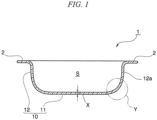
- FIG. 1 A cross-sectional view of the ovenware according to one embodiment of the present invention is illustrated in FIG. 1 .
- the ovenware of the present invention has a handle portion 2 and a container portion 10.
- the ovenware of the present invention may also have a removable lid portion 20.
- the container portion 10 has a space S for holding the food or the like that represents the item to be cooked when the ovenware is used.
- the container portion 10 has a bottom portion 11 and a side wall 12 that is provided around the periphery of the bottom portion 11 and has a closed circular shape when viewed in plan view.
- the space S is a space surrounded by the bottom portion 11 and the side wall 12.
- the container portion 10 is preferably a wide-mouth container in which the entire area vertically above the horizontal surface of the bottom portion 11 is open.
- the "horizontal surface of the bottom portion” means the portion of the inner surface of the bottom portion (namely, the interface with the space S) that is substantially horizontal when the ovenware of the present invention composed of the container portion and the handle portion is placed on a horizontal surface.
- substantially horizontal means having a gradient within a range from -5% to +5% relative to the horizontal plane.
- the "capacity” means the maximum volume of water that can be placed in the space S at an air temperature of 25°C.
- the handle portion 2 may be provided as a portion of the container portion 10, or may be provided on the periphery of the container portion 10.
- the handle portion 2 is mainly a structure for grasping when the user carries the ovenware 1.
- the handle portion 2 is provided on the outer wall 12a at the upper portion (namely, opposite the bottom portion 11) of the side wall 12, so as to protrude from the outer wall 12a in the opposite direction from the space S when viewed in plan view.
- the height of the ovenware composed of the container portion and the handle portion is preferably at least 1 cm but not more than 30 cm, and more preferably at least 3 cm but not more than 20 cm.
- the width of the ovenware composed of the container portion and the handle portion is preferably at least 5 cm but not more than 50 cm, and more preferably at least 10 cm but not more than 40 cm.
- the depth of the ovenware composed of the container portion and the handle portion is preferably at least 5 cm but not more than 50 cm, and more preferably at least 10 cm but not more than 40 cm.
- the height, width and depth when the lid portion 20 is placed on top of the container portion 10 preferably satisfy the above ranges.
- the "height of the ovenware composed of the container portion and the handle portion” means the shortest distance, when the ovenware of the present invention composed of the container portion and the handle portion is placed on a horizontal surface, from the upper surface of the horizontal surface to the uppermost portion of the ovenware composed of the container portion and the handle portion.
- the "width of the ovenware composed of the container portion and the handle portion” means the maximum length of the ovenware in the horizontal direction when the ovenware of the present invention composed of the container portion and the handle portion is placed on a horizontal surface.
- the "depth of the ovenware composed of the container portion and the handle portion” means the maximum length of the ovenware in a horizontal direction orthogonal to the direction of the aforementioned width, when the ovenware of the present invention composed of the container portion and the handle portion is placed on a horizontal surface.
- the wall thickness of the container portion of the ovenware is at least 0.3 mm but not more than 5 mm, and is preferably at least 1 mm but not more than 4 mm.
- the "wall thickness of the container portion of the ovenware" means the thickness indicated by X in FIG. 1 , and means the thinnest thickness at the measurement location.
- the "wall thickness of the container portion of the ovenware” means the shortest distance, at an arbitrary location of the container portion of the ovenware, between the surface that contacts the space that holds the food or the like (namely, the inner wall of the ovenware), and the surface on the opposite side to the surface that contacts the space (namely, the outer wall of the ovenware).
- the wall thickness of the container portion of the ovenware can be measured, for example, using calipers.
- any shape may be selected as appropriate, including a rectangular prism, a cube, an oval shape, or a shape in which the boundary between the bottom portion and the side wall is curved, as illustrated by Y in FIG. 1 .
- an oval shape, or a shape in which the boundary between the bottom portion and the side wall is curved in the manner illustrated by Y in FIG. 1 is preferable, because the inner walls of the ovenware are easier to clean, and the ovenware has more favorable strength due to the lack of corners on the outer wall.
- the thickness of the handle portion 2 of the ovenware may be made thicker than the thickness of the container portion 10.
- the thickness of the handle portion of the ovenware can be measured, for example, using calipers.
- the ovenware of the present invention has the lid portion 20
- the ovenware of the present invention is molded from a resin composition comprising a liquid crystal polyester resin and a talc filler.
- the ovenware of the present invention is a molded body of a resin composition comprising a liquid crystal polyester resin and a talc filler, wherein an average particle size of the talc filler is at least 10 um but more than 25 ⁇ m.
- the liquid crystal polyester resin of the ovenware of the present invention (hereinafter sometimes referred to as “the liquid crystal polyester”) is a resin having a repeating unit derived from a hydroxycarboxylic acid as a mesogenic group.
- derived means a change in the chemical structure due to polymerization.
- the liquid crystal polyester is a liquid crystal polyester that exhibits liquid crystallinity in a melted state, and preferably melts at a temperature of at least 250°C but not more than 450°C.
- the liquid crystal polyester is preferably a fully aromatic liquid crystal polyester formed using only aromatic compounds as raw material monomers.
- liquid crystal polyesters obtained by polymerizing (namely, polycondensing) an aromatic hydroxycarboxylic acid, an aromatic dicarboxylic acid, and at least one compound selected from the group consisting of aromatic diols, aromatic hydroxylamines and aromatic diamines, liquid crystal polyesters obtained by polymerizing a plurality of aromatic hydroxycarboxylic acids, and liquid crystal polyesters obtained by polymerizing a polyester such as polyethylene terephthalate and an aromatic hydroxycarboxylic acid.
- each of the aromatic hydroxycarboxylic acid, the aromatic dicarboxylic acid, the aromatic diol, the aromatic hydroxylamine and the aromatic diamine may, independently, be partially or totally replaced with a polymerizable derivative thereof.
- polymerizable derivatives of compounds having a carboxyl group such as the aromatic hydroxycarboxylic acid and the aromatic dicarboxylic acid
- examples of polymerizable derivatives of compounds having a carboxyl group include derivatives (also known as esters) in which the carboxyl group is substituted with an alkoxycarbonyl group or an aryloxycarbonyl group, derivatives (also known as acid halides) in which the carboxyl group is substituted with a haloformyl group, and derivatives (also known as acid anhydrides) in which the carboxyl groups are substituted with an acyloxycarbonyl group.
- polymerizable derivatives of compounds having a hydroxyl group such as the aromatic hydroxycarboxylic acid, the aromatic diol and the aromatic hydroxylamine
- examples of polymerizable derivatives of compounds having a hydroxyl group include derivatives (also known as acylated compounds) in which the hydroxyl group is acylated and substituted with an acyloxyl group.
- polymerizable derivatives of compounds having an amino group such as the aromatic hydroxylamine and the aromatic diamine
- examples of polymerizable derivatives of compounds having an amino group include derivatives (also known as acylated compounds) in which the amino group is acylated and substituted with an acylamino group.
- the liquid crystal polyester preferably has at least one repeating unit represented by general formula (1) shown below (hereinafter sometimes referred to as "the repeating unit (1)").
- the repeating unit (1) corresponds with the aforementioned mesogenic group.
- (1) -O-Ar 1 -CO- (ln the formula, Ar 1 represents a phenylene group, naphthylene group or biphenylylene group, and at least one hydrogen atom in the group represented by Ar 1 may, independently, be substituted with a halogen atom, an alkyl group or an aryl group.)
- the alkyl group that may substitute at least one hydrogen atom in the group represented by Ar 1 is preferably an alkyl group having a carbon number of 1 to 10, and examples include a methyl group, ethyl group, n-propyl group, isopropyl group, n-butyl group, isobutyl group, sec-butyl group, tert-butyl group, n-hexyl group, n-heptyl group, 2-ethylhexyl group, n-octyl group, n-nonyl group and n-decyl group.
- the aryl group that may substitute at least one hydrogen atom in the group represented by Ar 1 is preferably an aryl group having a carbon number of 6 to 20, and examples include monocyclic aromatic groups such as a phenyl group, o-tolyl group, m-tolyl group and p-tolyl group, and condensed ring aromatic groups such as a 1-naphthyl group and 2-naphthyl group.
- the number of substitutions is preferably one or two, and is more preferably one.
- the repeating unit (1) is a repeating unit derived from an aromatic hydroxycarboxylic acid.
- the repeating unit (1) is preferably a repeating unit in which Ar 1 is a 1,4-phenylene group (for example, a repeating unit derived from 4-hydroxybenzoic acid) or a repeating unit in which Ar 1 is a 2,6-naphthylene group (for example, a repeating unit derived from 6-hydroxy-2-naphthoic acid).
- Ar 1 is a 1,4-phenylene group (for example, a repeating unit derived from 4-hydroxybenzoic acid) or a repeating unit in which Ar 1 is a 2,6-naphthylene group (for example, a repeating unit derived from 6-hydroxy-2-naphthoic acid).
- the liquid crystal polyester described above is preferably a liquid crystal polyester having at least one repeating unit among a repeating unit derived from 4-hydroxybenzoic acid (also known as para-hydroxybenzoic acid) and a repeating unit derived from 6-hydroxy-2-naphthoic acid, and is more preferably a liquid crystal polyester having a repeating unit derived from 4-hydroxybenzoic acid.
- the liquid crystal polyester is preferably a liquid crystal polyester having at least one repeating unit represented by general formula (2) shown below (hereinafter sometimes referred to as “the repeating unit (2)”), and at least one repeating unit represented by general formula (3) shown below (hereinafter sometimes referred to as “the repeating unit (3)”), and is more preferably a liquid crystal polyester having the repeating unit (1), the repeating unit (2) and the repeating unit (3).
- the repeating unit (2) and the repeating unit (3) may each include a plurality of different repeating units.
- the repeating unit (1) preferably has at least one of a repeating unit in which Ar 1 is a 1,4-phenylene group and a repeating unit in which Ar 1 is a 2,6-naphthylene group.
- Examples of the halogen atom, alkyl group and aryl group that may substitute at least one hydrogen atom in the group represented by Ar 2 or Ar 3 include the same atoms and groups as those described above for the halogen atom, alkyl group and aryl group that may substitute at least one hydrogen atom in the group represented by Ar 1 .
- the number of substitutions for each group represented by Ar 2 or Ar 3 is, independently, preferably one or two, and is more preferably one.
- the alkylidene group represented by Z is preferably an alkylidene group having a carbon number of 1 to 10, and examples include a methylene group, ethylidene group, isopropylidene group, n-butylidene group and 2-ethylhexylidene group.
- the repeating unit (2) is a repeating unit derived from an aromatic dicarboxylic acid.
- the repeating unit (2) include repeating units in which Ar 2 is a 1,4-phenylene group (for example, a repeating unit derived from terephthalic acid), repeating units in which Ar 2 is a 1,3-phenylene group (for example, a repeating unit derived from isophthalic acid), repeating units in which Ar 2 is a 2,6-naphthylene group (for example, a repeating unit derived from 2,6-naphthalenedicarboxylic acid), repeating units in which Ar 2 is a 4,4'-biphenylylene group (for example, a repeating unit derived from 4,4'-dicarboxybiphenyl), and repeating units in which Ar 2 is a diphenyl ether-4,4'-diyl group (for example, a repeating unit derived from 4,4'-dicarboxydiphenyl ether).
- Examples of preferred repeating units (2) include repeating units in which Ar 2 is a 1,4-phenylene group, 1,3-phenylene group, 2,6-naphthylene group or 4,4'-biphenylylene group.
- the liquid crystal polyester may include at least one of the above repeating units as the repeating unit (2).
- the liquid crystal polyester preferably has, as the repeating unit (2), at least one repeating unit among a repeating unit in which Ar 2 is a 1,4-phenylene group and a repeating unit in which Ar 2 is a 1,3-phenylene group, and more preferably has a repeating unit in which Ar 2 is a 1,4-phenylene group.
- the repeating unit (3) is a repeating unit derived from at least one compound selected from the group consisting of aromatic diols, aromatic hydroxylamines and aromatic diamines.
- repeating unit (3) examples include repeating units in which Ar 3 is a 1,4-phenylene group (for example, a repeating unit derived from hydroquinone, a repeating unit derived from a p-aminophenol such as 4-acetoxyaminophenol, or a repeating unit derived from p-phenylenediamine), repeating units in which Ar 3 is a 1,3-phenylene group (for example, a repeating unit derived from 1,3-benzenediol, a repeating unit derived from m-aminophenol, or a repeating unit derived from m-phenylenediamine), repeating units in which Ar 3 is a 2,6-naphthylene group (for example, a repeating unit derived from 2,6-dihydroxynaphthalene, a repeating unit derived from 2-hydroxy-6-aminonaphthalene, or a repeating unit derived from 2,6-diaminonaphthalene), repeating units in which Ar 3
- Examples of preferred repeating units (3) include repeating units in which Ar 3 is a 1,4-phenylene group, 1,3-phenylene group, 2,6-naphthylene group or 4,4'-biphenylylene group.
- the liquid crystal polyester may include at least one of the above repeating units as the repeating unit (3).
- the liquid crystal polyester is preferably a liquid crystal polyester having, as the repeating unit (3), at least one repeating unit among a repeating unit in which Ar 3 is a 1,4-phenylene group and a repeating unit in which Ar 3 is a 4,4'-biphenylylene group, and is more preferably a liquid crystal polyester having a repeating unit in which Ar 3 is a 4,4'-biphenylylene group.
- the liquid crystal polyester preferably has, as the repeating unit (3), a repeating unit in which X and Y are both oxygen atoms, namely a repeating unit derived from a prescribed aromatic diol, and more preferably has only repeating units in which X and Y are both oxygen atoms as the repeating unit (3).
- one aspect of the above liquid crystal polyester is preferably a liquid crystal polyester having a repeating unit represented by general formula (21) shown below (hereinafter sometimes referred to as “the repeating unit (21)”) and a repeating unit represented by general formula (31) shown below (hereinafter sometimes referred to as “the repeating unit (31)”), and a liquid crystal polyester having the repeating unit (1), the repeating unit (21) and the repeating unit (31) is even more desirable.
- the repeating unit (1) is preferably at least one repeating unit among a repeating unit in which Ar 1 is a 1,4-phenylene group and a repeating unit in which Ar 1 is a 2,6-naphthylene group.
- each of Ar 21 and Ar 31 independently represents a 1,4-phenylene group, 1,3-phenylene group, 2,6-naphthylene group or 4,4'-biphenylylene group, and at least one hydrogen atom in the group represented by Ar 21 or Ar 31 may, independently, be substituted with a halogen atom, an alkyl group or an aryl group.
- the amount of the repeating unit (1) is preferably at least 30 mol%, more preferably at least 40 mol% but not more than 80 mol%, even more preferably at least 50 mol% but not more than 70 mol%, and most preferably at least 55 mol% but not more than 70 mol%. In those cases where the repeating unit (1) is derived from two or more compounds, the amount of all of the repeating units (1) satisfies the above range.
- the amount of the repeating unit (1) is preferably at least 30 mol%, more preferably at least 40 mol% but not more than 80 mol%, even more preferably at least 50 mol% but not more than 70 mol%, and most preferably at least 55 mol% but not more than 70 mol%.
- the repeating unit (1) preferably has at least a repeating unit derived from para-hydroxybenzoic acid.
- the repeating unit (1) may be a repeating unit derived from para-hydroxybenzoic acid, or one of a plurality of repeating units (1) may be a repeating unit derived from para-hydroxybenzoic acid.
- the amount of the repeating unit derived from para-hydroxybenzoic acid, relative to the total amount of all the repeating units that constitute the liquid crystal polyester used in the present invention is preferably at least 40 mol%, more preferably at least 45 mol% but not more than 80 mol%, even more preferably at least 50 mol% but not more than 70 mol%, and most preferably at least 55 mol% but not more than 65 mol%.
- the amount of the repeating unit derived from para-hydroxybenzoic acid is preferably at least 40 mol%, more preferably at least 45 mol% but not more than 80 mol%, even more preferably at least 50 mol% but not more than 70 mol%, and most preferably at least 55 mol% but not more than 70 mol%.
- the amount of the repeating unit (1) exceeds 80 mol%, then the processing temperature becomes too high, which can cause external appearance defects, and therefore the amount is preferably not more than 80 mol%.
- the amount of the repeating unit (2), relative to the total amount of all the repeating units that constitute the liquid crystal polyester used in the present invention, is preferably not more than 35 mol%, more preferably at least 10 mol% but not more than 35 mol%, even more preferably at least 15 mol% but not more than 30 mol%, and most preferably at least 17.5 mol% but not more than 27.5 mol%. In those cases where the repeating unit (2) is derived from two or more compounds, the amount of all of the repeating units (2) satisfies the above range.
- the amount of the repeating unit (2) in the liquid crystal polyester is preferably not more than 35 mol%, more preferably at least 10 mol% but not more than 35 mol%, even more preferably at least 15 mol% but not more than 30 mol%, and most preferably at least 17.5 mol% but not more than 27.5 mol%.
- the repeating unit (2) preferably has at least a repeating unit derived from terephthalic acid.
- the repeating unit (2) may be a repeating unit derived from terephthalic acid, or one of a plurality of repeating units (2) may be a repeating unit derived from terephthalic acid.
- the amount of the repeating unit derived from terephthalic acid, relative to the total amount of all the repeating units that constitute the liquid crystal polyester used in the present invention is preferably not more than 35 mol%, more preferably at least 10 mol% but not more than 35 mol%, even more preferably at least 10 mol% but not more than 20 mol%, and most preferably at least 11 mol% but not more than 18 mol%.
- the amount of the repeating unit derived from terephthalic acid is preferably not more than 35 mol%, more preferably at least 10 mol% but not more than 35 mol%, even more preferably at least 10 mol% but not more than 20 mol%, and most preferably at least 11 mol% but not more than 18 mol%.
- the amount of the repeating unit (2) is at least 10 mol%, satisfactory heat resistance can be imparted to the molded ovenware, and the strength during use in an oven can be enhanced.
- the amount of the repeating unit (3), relative to the total amount of all the repeating units that constitute the liquid crystal polyester used in the present invention, is preferably not more than 35 mol%, more preferably at least 10 mol% but not more than 35 mol%, even more preferably at least 15 mol% but not more than 30 mol%, and most preferably at least 17.5 mol% but not more than 27.5 mol%. In those cases where the repeating unit (3) is derived from two or more compounds, the amount of all of the repeating units (3) satisfies the above range.
- the amount of the repeating unit (3) in the liquid crystal polyester is preferably not more than 35 mol%, more preferably at least 10 mol% but not more than 35 mol%, even more preferably at least 15 mol% but not more than 30 mol%, even more preferably at least 17 mol% but not more than 30 mol%, and most preferably at least 17.5 mol% but not more than 27.5 mol%.
- the repeating unit (3) preferably has at least a repeating unit derived from 4,4'-dihydroxybiphenyl.
- the repeating unit (3) may be a repeating unit derived from 4,4'-dihydroxybiphenyl, or one of a plurality of repeating units (3) may be a repeating unit derived from 4,4'-dihydroxybiphenyl.
- the amount of the repeating unit derived from 4,4'-dihydroxybiphenyl, relative to the total amount of all the repeating units that constitute the liquid crystal polyester used in the present invention is preferably not more than 35 mol%, more preferably at least 10 mol% but not more than 35 mol%, even more preferably at least 11 mol% but not more than 30 mol%, even more preferably at least 11.5 mol% but not more than 25 mol%, and most preferably at least 12 mol% but not more than 21 mol%.
- the amount of the repeating unit derived from 4,4'-dihydroxybiphenyl is preferably not more than 35 mol%, more preferably at least 10 mol% but not more than 35 mol%, even more preferably at least 11 mol% but not more than 30 mol%, even more preferably at least 11.5 mol% but not more than 25 mol%, and most preferably at least 12 mol% but not more than 21 mol%.
- each of the repeating units (1) to (3) may, independently, include at least two types of repeating units. Further, the liquid crystal polyester may also include a repeating unit other than the repeating units (1) to (3), and the amount of the other repeating unit, relative to the total amount of all the repeating units, is preferably at least 0 mol% but not more than 10 mol%, and more preferably at least 0 mol% but not more than 5 mol%.
- the liquid crystal polyester is preferably produced by subjecting the raw material monomers corresponding with the repeating units that constitute the liquid crystal polyester to melt polymerization, and then subjecting the obtained product (prepolymer) to solid phase polymerization.
- This method enables a high-molecular weight liquid crystal polyester having superior heat resistance, strength and rigidity to be produced with good operability.
- the melt polymerization may be performed in the presence of a catalyst.
- the catalyst include metal compounds such as magnesium acetate, stannous acetate, tetrabutyl titanate, lead acetate, sodium acetate, potassium acetate and antimony trioxide, and nitrogen-containing heterocyclic compounds such as N,N-dimethylaminopyridine and N-methylimidazole.
- the flow beginning temperature of the liquid crystal polyester is preferably at least 270°C, more preferably at least 270°C but not more than 400°C, and even more preferably at least 280°C but not more than 380°C.
- the higher the flow beginning temperature of the liquid crystal polyester the more easily the heat resistance and the strength and rigidity can be improved, but if the flow beginning temperature is too high (namely, higher than the above upper limit), then a very high temperature is required to melt the polyester, thermal degradation during molding becomes more likely, and the viscosity upon melting tends to increase, causing a deterioration in fluidity.
- the heat resistance and the strength and rigidity can be improved easily, but a very high temperature is not required to melt the polyester, meaning thermal degradation during molding is unlikely, and the viscosity is not overly high upon melting, meaning the fluidity is less likely to deteriorate.
- the "flow beginning temperature” is also called the flow temperature or the fluidization temperature, and is the temperature that yields a viscosity of 4,800 Pa s (48,000 poise) when the liquid crystalline polyester is melted by heating at a rate of temperature increase of 4°C/minute under a load of 9.8 MPa (100 kg/cm 2 ) using a capillary rheometer, and extruded from a nozzle having an inner diameter of 1 mm and a length of 10 mm, and is a temperature that acts as a measure of the molecular weight of the liquid crystal polyester (see Naoyuki Koide (ed.), "Liquid Crystal Polymers - Synthesis, Molding, Applications -", CMC Publishing Co., Ltd., June 5, 1987, p. 95 ).
- the amount of the liquid crystal polyester, relative to the total mass of the resin composition is preferably from 40 to 70% by mass.
- the amount of the liquid crystal polyester, relative to the total mass of the resin composition is more preferably at least 43% by mass, even more preferably 45% by mass, and most preferably at least 50% by mass.
- the amount of the liquid crystal polyester, relative to the total mass of the resin composition is preferably not more than 65% by mass, and more preferably 63% by mass.
- the talc filler of the ovenware of the present invention is preferably a material obtained by crushing hydrated magnesium silicate.
- the crystal structure of hydrated magnesium silicate is a pyrophyllite-type three-layer structure, and the talc filler is a substance in which this structure stacked in layers.
- the talc is preferably a flat talc prepared by finely crushing the molecular crystals of hydrated magnesium silicate down to substantially the unit layer level.
- the average particle size of the talc filler is at least 10 ⁇ m but not more than 25 ⁇ m. Provided the average particle size is at least as large as the above lower limit, flow marks are unlikely to occur in the ovenware, and a favorable external appearance can be achieved. Provided the average particle size is not more than the above upper limit, particles of the talc filler are less likely to be visible at the surface of the ovenware, enabling a favorable external appearance to be obtained. If the average particle size of the talc filler is too small, then the external appearance tends to deteriorate due to foaming and the like at the surface of the molded body, and the heat resistance of the molded body may sometimes deteriorate.
- the average particle size of the talc filler is larger than 30 ⁇ m, then the talc appears as white spots on the surface of the molded body and the external appearance tends to deteriorate, and therefore the average particle size is preferably not more than 30 ⁇ m. Furthermore, in the present application, the average particle size of the talc filler is at least 10 ⁇ m but not more than 25 ⁇ m.
- the "average particle size of the talc filler" can be obtained using the following measurement method.
- talc filler powder 0.1 g is placed in 50 ml of a 0.2% by mass aqueous solution of sodium hexametaphosphate, and a dispersion containing the dispersed powder is obtained.
- the particle size distribution of the obtained dispersion is measured using a Mastersizer 2000 manufactured by Malvern Instruments Ltd. (a laser diffraction and scattering particle size distribution analyzer), and a volume-based cumulative particle size distribution curve is obtained.
- the value for the particle size at the 50% cumulative point from the small particle side of the distribution is deemed the 50% cumulative volume particle size D50, and this value is used as the average particle size of the talc filler.
- the talc filler may be used in an untreated state, or the surface of the talc may be treated with any of various known surfactants to improve the interface adhesiveness with the liquid crystal polyester and the dispersibility within the liquid crystal polyester.
- the surfactant include silane coupling agents, titanium coupling agents, higher fatty acids, higher fatty acid esters, higher fatty acid amides, and higher fatty acid salts and the like.
- the amount of the talc filler, per 100 parts by mass of the liquid crystal polyester resin is preferably at least 55 parts by mass but not more than 100 parts by mass, more preferably at least 60 parts by mass but not more than 90 parts by mass, and even more preferably at least 60 parts by mass but not more than 80 parts by mass. If the amount of the talc filler exceeds 100 parts by mass, then the specific gravity of the resin composition increases, and the strength of the obtained ovenware tends to deteriorate.
- the resin composition preferably also comprises a titanium oxide filler.
- the titanium oxide filler may be any material containing titanium oxide as the main component, any may also contain unavoidable impurities. Materials available commercially as titanium oxide fillers for resin filling can be used without modification as the titanium oxide filler used in the present invention.
- the term "main component" means the material contains at least 90% of that component.
- the crystal form of the titanium oxide filler there are no particular limitations on the crystal form of the titanium oxide filler, and the rutile form, the anatase form, or a mixture of the two may be used.
- the use of a rutile titanium oxide filler, which has a larger refractive index than an anatase titanium oxide filler, is preferable.
- the titanium oxide filler may be subjected to a surface treatment.
- the dispersibility can be improved.
- aluminum oxide namely, alumina
- the use of a titanium oxide that has not undergone a surface treatment is preferable in terms of the heat resistance and strength.
- the average particle size of the titanium oxide filler which may be selected as appropriate.
- the average particle size of the titanium oxide filler is preferably from 0.10 to 1 ⁇ m, and more preferably from 0.15 to 0.25 ⁇ m.
- the "average particle size of the titanium oxide filler" means the maximum dimension of a particle of the titanium oxide.
- the external appearance is first photographed using a scanning electron microscope (SEM).
- SEM scanning electron microscope
- An image analyzer for example, Luzex IIU manufactured by Nireco Corporation
- the proportion of particles (%) having a primary particle size in each of a series of particle size intervals thus obtaining a distribution curve.
- the volume average particle size (average particle size of the titanium oxide filler) can be obtained.
- laser diffraction or the like can be used to determine the average particle size of the titanium oxide filler.
- the amount of the titanium oxide filler, per 100 parts by mass of the liquid crystal polyester resin is preferably at least 1 part by mass but not more than 20 parts by mass, more preferably at least 1 part by mass but not more than 15 parts by mass, and even more preferably at least 2 parts by mass but not more than 13 parts by mass.
- the total amount of the mixture preferably satisfies the above range.
- the external appearance of the surface of the ovenware is favorable.
- the resin composition according to the ovenware of the present invention preferably comprises a pigment.
- the pigment included in the resin composition may be selected as appropriate in accordance with the design aesthetics of the ovenware, and examples of the pigment include inorganic fillers such as alumina, iron oxide, cobalt oxide, chromium oxide, manganese oxide, ultramarine, composite oxides (for example, Pigment Yellow 53, Pigment Red 233, Pigment Blue 35, Pigment Green 50 and Pigment Brown 31) and carbon black.
- the present invention preferably comprises an inorganic filler as the pigment, and more preferably comprises a carbon black.
- the titanium oxide filler and talc filler described above are deemed to be not included in the pigment of the present invention.
- a single pigment may be used alone, or two or more pigments may be used simultaneously.
- the blend amount of the pigment, per 100 parts by mass of the liquid crystal polyester resin is preferably at least 1 part by mass but not more than 10 parts by mass, more preferably at least 1 part by mass but not more than 5 parts by mass, and even more preferably at least 2 parts by mass but not more than 3 parts by mass. In those cases where two or more pigments are used simultaneously, the total amount of all the pigments preferably satisfies the above range.
- the blend amount of the carbon black, per 100 parts by mass of the liquid crystal polyester resin is preferably at least 1 part by mass but not more than 10 parts by mass, more preferably at least 1 part by mass but not more than 5 parts by mass, and even more preferably at least 2 parts by mass but not more than 3 parts by mass.
- the use of a carbon black that conforms to 21 CFR 178.3297 of the U.S.A. FDA is preferable.
- Examples of carbon blacks that conform to 21 CFR 178.3297 of the U.S.A. FDA include BLACK PEARLS 4350 and BLACK PEARLS 4750 manufactured by Cabot Corporation, and PRINTEX F80 and PRINTEX F85 manufactured by Orion Engineered Carbons S.A.
- typical fillers such as release agents (for example, montanoic acid and salts, esters and half-esters thereof, stearyl alcohol, stearamide, and polyethylene wax and the like), antioxidants and heat stabilizers (for example, hindered phenols, hydroquinone, phosphites, and derivatives of these compounds), ultraviolet stabilizers (for example, resorcinol, salicylates, benzotriazole, and benzophenone and the like), plasticizers, flame retardants, flame retardant assistants, antistatic agents and surfactants, and other thermoplastic resins (such as fluororesins) may also be added to the liquid crystal resin composition to impart the composition with specific properties.
- release agents for example, montanoic acid and salts, esters and half-esters thereof, stearyl alcohol, stearamide, and polyethylene wax and the like
- antioxidants and heat stabilizers for example, hindered phenols, hydroquinone, phosphites, and derivatives of these compounds
- a higher fatty acid metal salt means a fatty acid having a carbon number of 12 or greater, and preferably a fatty acid having a carbon number of 12 to 22, and specific examples include lauric acid, myristic acid, palmitic acid, stearic acid, oleic acid, and behenic acid.
- a salt having a melting point of 1 50°C or higher is preferable in terms of the moldability of the obtained liquid crystal resin composition, and a salt having a melting point of200°C or higher is more preferable.
- the higher fatty acid metal salt include calcium stearate, calcium laurate, calcium behenate, barium stearate, barium laurate, barium behenate, aluminum stearate, lithium stearate, lithium behenate, potassium stearate and sodium stearate, preferred examples include barium stearate, barium laurate, barium behenate, lithium stearate, lithium behenate, potassium stearate and sodium stearate, and particularly preferred examples include potassium stearate and calcium behenate.
- the melting point of the higher fatty acid can be measured by differential scanning calorimetry, by determining the endothermic peak temperature observed when measurement is conducted by raising the temperature from room temperature at a rate of 20°C/minute.
- the amount of the higher fatty acid metal salt, when the total amount of the liquid crystal polyester and the fillers is deemed to be 100 parts by mass, is typically not more than 1.0 parts by mass, more preferably not more than 0.5 parts by mass, and even more preferably 0.1 parts by mass or less.
- the amount of the additive in the resin composition when the total amount of the liquid crystal polyester and the fillers is deemed to be 100 parts by mass, is preferably greater than 0 parts by mass but not more than 5 parts by mass.
- the ovenware of the present invention is injection molded ovenware.
- the ovenware of the present invention can be used favorably even at high temperatures of 200°C or higher.
- the ovenware of the present invention is preferably ovenware molded from a resin composition having a deflection temperature under load of at least 250°C but less than 270°C.
- the ovenware of the present invention is preferably a molded body of a resin composition having a deflection temperature under load of at least 250°C but less than 270°C.
- the deflection temperature under load can be measured using the method disclosed in the examples described below.
- the ovenware of the present invention is able to exhibit superior strength even in the case of large ovenware with a capacity of at least 500 mL but not more than 6 L.
- the ovenware can be molded from a resin composition for molding ovenware.
- the description relating to the resin composition for molding ovenware is the same as that for the resin composition described above as the resin composition used in molding the ovenware of the present invention.
- a method for producing the resin composition for molding ovenware includes blending and kneading the resin composition used for molding the ovenware of the present invention, the talc filler, the titanium oxide, and an optional pigment, in a prescribed blending ratio.
- ovenware of the present invention is ovenware having a container portion and a handle portion, wherein the ovenware is a molded body of a resin composition comprising a liquid crystal polyester resin and a talc filler, the amount of the talc filler is at least 55 parts by mass but not more than 100 parts by mass per 100 parts by mass of the liquid crystal polyester resin, the capacity of the ovenware is at least 500 mL but not more than 6 L, and the wall thickness of the container portion is at least 0.3 mm but not more than 5 mm.
- the average particle size of the talc filler is at least 10 ⁇ m but not more than 25 ⁇ m.
- the amount of the talc filler is preferably at least 60 parts by mass but not more than 90 parts by mass, and more preferably at least 60 parts by mass but not more than 80 parts by mass, per 100 parts by mass of the liquid crystal polyester resin.
- the liquid crystal polyester resin preferably has at least the repeating un described above, the repeating unit (2) described above, and the repeating unit (3) described above. Moreover, when the total amount of the repeating unit (1), the repeating unit (2) and the repeating unit (3) is deemed to be 100 mol%, the amount of the repeating unit (1) is preferably at least 30 mol%, more preferably at least 40 mol% but not more than 80 mol%, even more preferably at least 50 mol% but not more than 70 mol%, and most preferably at least 55 mol% but not more than 70 mol%, the amount of the repeating unit (2) is preferably not more than 35 mol%, more preferably at least 10 mol% but not more than 35 mol%, even more preferably at least 15 mol% but not more than 30 mol%, and most preferably at least 17.5 mol% but not more than 27.5 mol%, and the amount of the repeating unit (3) is preferably not more than 35 mol%, more preferably at least 10 mol% but not more than 35
- the repeating unit (1) is preferably at least one repeating unit selected from the group consisting of a repeating unit derived from para-hydroxybenzoic acid and a repeating unit derived from 6-hydroxy-2-naphthoic acid.
- the repeating unit (2) is preferably at least one repeating unit selected from the group consisting of a repeating unit derived from terephthalic acid and a repeating unit derived from isophthalic acid, and including both of these repeating units is more preferable.
- the repeating unit (3) is preferably at least one repeating unit selected from the group consisting of a repeating unit derived from 4,4'-dihydroxybiphenyl and a repeating unit derived from 4-acetoxyaminophenol, and including only one of these repeating units is more preferable, but both repeating units may be included.
- the liquid crystal polyester resin is preferably a liquid crystal polyester resin in which the repeating unit (1) is a repeating unit derived from para-hydroxybenzoic acid and a repeating unit derived from 6-hydroxy-2-naphthoic acid, the repeating unit (2) is a repeating unit derived from terephthalic acid and a repeating unit derived from isophthalic acid, and the repeating unit (3) is a repeating unit derived from 4,4'-dihydroxybiphenyl, or a liquid crystal polyester resin in which the repeating unit (1) is a repeating unit derived from para-hydroxybenzoic acid, the repeating unit (2) is a repeating unit derived from terephthalic acid and a repeating unit derived from isophthalic acid, and the repeating unit (3) is a repeating unit derived from 4,4'-dihydroxybiphenyl and a repeating unit derived from 4-acetoxyaminophenol, or the like.
- the ovenware described above is preferably molded from a resin composition having a deflection temperature under load of at least 250°C but less than 270°C.
- the ovenware described above is preferably a molded body of a resin composition having a deflection temperature under load of at least 250°C but less than 270°C.
- Another aspect of the ovenware of the present invention is a molded body of a resin composition which, in addition to the liquid crystal polyester resin and the talc filler, comprises at least one material selected from the group consisting of a titanium oxide filler and a pigment.
- the pigment examples include inorganic fillers such as alumina, iron oxide, cobalt oxide, chromium oxide, manganese oxide, ultramarine, composite oxides and carbon blacks, and an inorganic material is preferable, and a carbon black is more preferable.
- inorganic fillers such as alumina, iron oxide, cobalt oxide, chromium oxide, manganese oxide, ultramarine, composite oxides and carbon blacks, and an inorganic material is preferable, and a carbon black is more preferable.
- the amount of the titanium oxide filler, per 100 parts by mass of the liquid crystal polyester resin is preferably at least 1 part by mass but not more than 20 parts by mass, more preferably at least 1 part by mass but not more than 15 parts by mass, and even more preferably at least 2 parts by mass but not more than 13 parts by mass.
- the blend amount of the pigment, per 100 parts by mass of the liquid crystal polyester resin is preferably at least 1 part by mass but not more than 10 parts by mass, more preferably at least 1 part by mass but not more than 5 parts by mass, and even more preferably at least 2 parts by mass but not more than 3 parts by mass.
- the total amount of all the blended pigments preferably satisfies this range.
- the ovenware described above is preferably molded from a resin composition having a deflection temperature under load of at least 250°C but less than 270°C.
- the ovenware described above is preferably a molded body of a resin composition having a deflection temperature under load of at least 250°C but less than 270°C.
- a resin composition comprising a liquid crystal polyester resin, a talc filler and a titanium oxide filler for molding ovenware.
- a reactor fitted with a stirring device, a torque meter, a nitrogen gas introduction tube, a thermometer and a reflux condenser was charged with 994.5 g (7.2 mol) of para-hydroxybenzoic acid, 446.9 g (2.4 mol) of 4,4'-dihydroxybiphenyl, 299.0 g (1.8 mol) of terephthalic acid, 99.7 g (0.6 mol) of isophthalic acid and 1,347.6 (13.2 mol) of acetic anhydride, 0.2 g of 1-methylimidazole was added, and the inside of the reactor was flushed thoroughly with nitrogen gas.
- the temperature was raised, under a stream of nitrogen gas, from room temperature to 150°C over a period of 30 minutes, and the reaction mixture was refluxed for one hour at the same temperature.
- the obtained prepolymer was cooled to room temperature, and then crushed using a coarse crusher.
- the thus obtained prepolymer powder was heated, under an atmosphere of nitrogen, from room temperature to 250°C over a period of one hour, and then from 250°C to 285°C over a period of 5 hours, and was then held at 285°C for 3 hours to effect a solid phase polymerization.
- the flow beginning temperature of the obtained liquid crystal polyester 1 was 327°C.
- a reactor fitted with a stirring device, a torque meter, a nitrogen gas introduction tube, a thermometer and a reflux condenser was charged with 994.5 g (7.2 mol) of para-hydroxybenzoic acid, 446.9 g (2.4 mol) of 4,4'-dihydroxybiphenyl, 239.2 g (1.4 mol) of terephthalic acid, 159.5 g (1.0 mol) of isophthalic acid and 1,347.6 (13.2 mol) of acetic anhydride, 0.2 g of 1-methylimidazole was added, and the inside of the reactor was flushed thoroughly with nitrogen gas.
- the temperature was raised, under a stream of nitrogen gas, from room temperature to 150°C over a period of 30 minutes, and the reaction mixture was refluxed for one hour at the same temperature.
- the obtained prepolymer was cooled to room temperature, and then crushed using a coarse crusher.
- the thus obtained prepolymer powder was heated, under an atmosphere of nitrogen, from room temperature to 190°C over a period of one hour, and then from 190°C to 240°C over a period of 5 hours, and was then held at 240°C for 8 hours to effect a solid phase polymerization.
- the flow beginning temperature of the obtained liquid crystal polyester 2 was 290°C.
- a reactor fitted with a stirring device, a torque meter, a nitrogen gas introduction tube, a thermometer and a reflux condenser was charged with 1,130.4 g (8.2 mol) of para-hydroxybenzoic acid, 128.4 g (0.7 mol) of 6-hydroxy-2-naphthoic acid, 52.2 g (1.7 mol) of 4,4'-dihydroxybiphenyl, 400.8 g (2.4 mol) of terephthalic acid, 103.2 g (0.7 mol) of 4-acetoxyaminophenol and 1,357.6 (13.3 mol) of acetic anhydride, 0.2 g of 1-methylimidazole was added, and the inside of the reactor was flushed thoroughly with nitrogen gas.
- the temperature was raised, under a stream of nitrogen gas, from room temperature to 150°C over a period of 30 minutes, and the reaction mixture was refluxed for one hour at the same temperature.
- a reactor fitted with a stirring device, a torque meter, a nitrogen gas introduction tube, a thermometer and a reflux condenser was charged with 1,130.4 g (8.2 mol) of para-hydroxybenzoic acid, 128.4 g (0.7 mol) of 6-hydroxy-2-naphthoic acid, 52.2 g (1.7 mol) of 4,4'-dihydroxybiphenyl, 400.8 g (2.4 mol) of terephthalic acid, 103.2 g (0.7 mol) of 4-acetoxyaminophenol and 1,357.6 (13.3 mol) of acetic anhydride, 0.2 g of 1-methylimidazole was added, and the inside of the reactor was flushed thoroughly with nitrogen gas.
- the temperature was raised, under a stream of nitrogen gas, from room temperature to 150°C over a period of 30 minutes, and the reaction mixture was refluxed for one hour at the same temperature.
- the deflection temperature under load was evaluated for each of the obtained liquid crystal polyester resin compositions. Further, the obtained ovenware was also evaluated for external appearance 1 and external appearance 2.
- the deflection temperature under load (DTUL, units °C) was measured in accordance with ASTM D648. The result is shown in Table 2 as "DTUL (°C)".
- the external appearance of the molded ovenware was inspected visually and evaluated. The evaluation was performed by having 10 people inspect the external appearance of the ovenware, and asking them whether or not they felt there was any problem with the external appearance of the ovenware. The number of people who concluded that there was a problem with the external appearance is recorded in Table 2. Items that were not evaluated are indicated by "-" in Table 2.
- Reference Example 1 is an example in which the same resin composition as Example 12 was used to produce small ovenware with a capacity of 200 mL. Based on the results for Reference Example 1 and Example 12, it is evident that when injection molding smaller ovenware, external appearance defects are less likely to occur, or are less noticeable, than when injection molding large ovenware.
- the Reference Example 2 is an example in which the same resin composition as Example 6 was used to produce small ovenware with a capacity of 200 mL. Based on the results for Reference Example 2 and Example 6, it is evident that when injection molding smaller ovenware, external appearance defects are less likely to occur, or are less noticeable, than when injection molding large ovenware.
- the present invention can provide large ovenware having excellent external appearance, and the invention is therefore extremely useful industrially.
Landscapes
- Chemical & Material Sciences (AREA)
- Health & Medical Sciences (AREA)
- Chemical Kinetics & Catalysis (AREA)
- Medicinal Chemistry (AREA)
- Polymers & Plastics (AREA)
- Organic Chemistry (AREA)
- Engineering & Computer Science (AREA)
- Food Science & Technology (AREA)
- Ceramic Engineering (AREA)
- Mechanical Engineering (AREA)
- Dispersion Chemistry (AREA)
- Compositions Of Macromolecular Compounds (AREA)
- Polyesters Or Polycarbonates (AREA)
- Cookers (AREA)
Claims (11)
- Plat allant au four présentant une partie récipient et une partie poignée, dans lequelle plat allant au four est moulé à partir d'une composition de résine comprenant une résine polyester à cristaux liquides et une matière de remplissage en talc,dans lequel une taille de particule moyenne de la matière de remplissage en talc est d'au moins 10 µm mais pas de plus de 25 µm,une quantité de la matière de remplissage en talc est d'au moins 55 parties en masse mais pas de plus de 100 parties en masse pour 100 parties en masse de la résine polyester à cristaux liquides,une capacité du plat de four est d'au moins 500 ml mais pas de plus de 6 1, etune épaisseur de paroi de la partie récipient est d'au moins 0,3 mm mais pas de plus de 5 mm.
- Plat allant au four selon la revendication 1, dans lequel la résine polyester à cristaux liquides présente au moins une unité de répétition représentée par la formule générale (1) montrée ci-dessous :
(1) -O-Ar1-CO-
dans laquelle Ar1 représente un groupe phénylène, un groupe naphtylène ou un groupe biphénylylène, et au moins un atome d'hydrogène dans un groupe représenté par Ar1 peut, indépendamment, être substitué par un atome d'halogène, un groupe alkyle ou un groupe aryle. - Plat allant au four selon la revendication 2, dans lequel l'unité de répétition représentée par la formule générale (1) est une unité de répétition dérivée de l'acide para-hydroxybenzoïque, et une quantité de cette unité de répétition, par rapport à une quantité totale de toutes les unités de répétition qui constituent le polyester à cristaux liquides, est d'au moins 50 % en moles mais pas de plus de 70 % en moles.
- Plat allant au four selon l'une quelconque des revendications 1 à 3, dans lequel la résine polyester à cristaux liquides présente au moins une unité de répétition représentée par la formule générale (2) montrée ci-dessous :
(2) -CO-Ar2-CO-
dans laquelle Ar2 représente un groupe phénylène, un groupe naphtylène, un groupe biphénylylène ou un groupe représenté par la formule générale (4) montrée ci-dessous, et au moins un atome d'hydrogène dans un groupe représenté par Ar2 peut, indépendamment, être substitué par un atome d'halogène, un groupe alkyle ou un groupe aryle,
(4) -Ar4-Z-Ar5-
dans laquelle chacun parmi Ar4 et Ar5 représente indépendamment un groupe phénylène ou un groupe naphtylène, et Z représente un atome d'oxygène, un atome de soufre, un groupe carbonyle, un groupe sulfonyle ou un groupe alkylidène. - Plat allant au four selon la revendication 4, dans lequel l'unité de répétition représentée par la formule générale (2) est une unité de répétition dérivée de l'acide téréphtalique, et une quantité de cette unité de répétition, par rapport à une quantité totale de toutes les unités de répétition qui constituent le polyester à cristaux liquides, est d'au moins 10 % en moles mais pas de plus de 20 % en moles.
- Plat allant au four selon l'une quelconque des revendications 1 à 5, dans lequel la résine polyester à cristaux liquides présente au moins une unité de répétition représentée par la formule générale (3) montrée ci-dessous :
(3) -X-Ar3-Y-
dans laquelle Ar3 représente un groupe phénylène, un groupe naphtylène, un groupe biphénylylène ou un groupe représenté par la formule générale (4) montrée ci-dessous, chacun parmi X et Y représente indépendamment un atome d'oxygène ou un groupe imino (-NH-), et au moins un atome d'hydrogène dans un groupe représenté par Ar3 peut, indépendamment, être substitué par un atome d'halogène, un groupe alkyle ou un groupe aryle,
(4) -Ar4-Z-Ar5-
dans laquelle chacun parmi Ar4 et Ar5 représente indépendamment un groupe phénylène ou un groupe naphtylène, et Z représente un atome d'oxygène, un atome de soufre, un groupe carbonyle, un groupe sulfonyle ou un groupe alkylidène. - Plat allant au four selon la revendication 6, dans lequel une quantité de l'unité de répétition représentée par la formule générale (3), par rapport à une quantité totale de toutes les unités de répétition qui constituent le polyester à cristaux liquides, n'est pas de plus 35 % en moles.
- Plat allant au four selon l'une quelconque des revendications 1 à 7, dans lequel la composition de résine comprend également une matière de remplissage en oxyde de titane.
- Plat allant au four selon l'une quelconque des revendications 1 à 8, dans lequel une quantité de remplissage de la matière de remplissage en oxyde de titane est d'au moins 1 partie en masse mais pas de plus de 15 parties en masse pour 100 parties en masse de la résine polyester à cristaux liquides.
- Plat allant au four selon l'une quelconque des revendications 1 à 9, dans lequel la composition de résine comprend également un pigment.
- Plat allant au four selon l'une quelconque des revendications 1 à 10, dans lequel une température de fléchissement sous charge pour la composition de résine est d'au moins 250 °C mais de moins de 270 °C.
Applications Claiming Priority (2)
| Application Number | Priority Date | Filing Date | Title |
|---|---|---|---|
| JP2015064234 | 2015-03-26 | ||
| PCT/JP2016/059682 WO2016153048A1 (fr) | 2015-03-26 | 2016-03-25 | Plat pour four, et composition de résine pour moulage de plat pour four |
Publications (3)
| Publication Number | Publication Date |
|---|---|
| EP3275351A1 EP3275351A1 (fr) | 2018-01-31 |
| EP3275351A4 EP3275351A4 (fr) | 2018-12-05 |
| EP3275351B1 true EP3275351B1 (fr) | 2024-03-06 |
Family
ID=56977503
Family Applications (1)
| Application Number | Title | Priority Date | Filing Date |
|---|---|---|---|
| EP16768951.2A Active EP3275351B1 (fr) | 2015-03-26 | 2016-03-25 | Plat allant au four |
Country Status (6)
| Country | Link |
|---|---|
| US (1) | US20180084942A1 (fr) |
| EP (1) | EP3275351B1 (fr) |
| JP (1) | JPWO2016153048A1 (fr) |
| CN (1) | CN107427155A (fr) |
| TW (1) | TWI765850B (fr) |
| WO (1) | WO2016153048A1 (fr) |
Families Citing this family (6)
| Publication number | Priority date | Publication date | Assignee | Title |
|---|---|---|---|---|
| JP2018020502A (ja) * | 2016-08-04 | 2018-02-08 | 住友化学株式会社 | オーブンウェア、オーブンウェアの製造方法及びオーブンウェア成形用樹脂組成物 |
| JP6843545B2 (ja) * | 2016-08-04 | 2021-03-17 | 住友化学株式会社 | オーブンウェア及びオーブンウェア形成用液晶ポリエステル樹脂組成物 |
| JP6231243B1 (ja) * | 2016-09-14 | 2017-11-15 | 住友化学株式会社 | 液晶性樹脂組成物 |
| JP2020109135A (ja) * | 2017-04-27 | 2020-07-16 | ポリプラスチックス株式会社 | ポリアリーレンサルファイド系樹脂組成物及びインサート成形品 |
| JP7309529B2 (ja) * | 2019-09-04 | 2023-07-18 | 住友化学株式会社 | 液晶ポリエステル樹脂組成物及び成形体 |
| WO2021044991A1 (fr) * | 2019-09-04 | 2021-03-11 | 住友化学株式会社 | Composition de polyester à cristaux liquides et corps moulé |
Family Cites Families (18)
| Publication number | Priority date | Publication date | Assignee | Title |
|---|---|---|---|---|
| JPS60124649A (ja) * | 1983-12-09 | 1985-07-03 | Sumitomo Chem Co Ltd | 全芳香族ポリエステル樹脂組成物 |
| EP0427795B1 (fr) * | 1988-10-11 | 1997-08-13 | Amoco Corporation | MELANGES DE POLYMERES DE GRANDE RESISTANCE POLY(ISO-TEREPHTHALATES) D'HYDROQUINONES CONTENANT DES RESIDUS D'ACIDE p-HYDROXYBENZOIQUE |
| JP3111472B2 (ja) * | 1990-11-30 | 2000-11-20 | 東レ株式会社 | 耐熱性樹脂組成物およびそれを成形してなるオーブン用樹脂耐熱食器 |
| US6093765A (en) * | 1998-11-03 | 2000-07-25 | E. I. Du Pont De Nemours And Company | Compositions containing liquid crystalline polymers |
| JP2002294038A (ja) * | 2001-03-28 | 2002-10-09 | Sumitomo Chem Co Ltd | 液晶ポリエステル樹脂組成物 |
| US20060237451A1 (en) * | 2002-07-26 | 2006-10-26 | Sameuls Michael R | Ovenware for microwave oven |
| US20050261455A1 (en) * | 2002-08-09 | 2005-11-24 | Kaneka Corporation | Formable styrenic resin particle, and pre-formed particle and foamed molding using the same |
| AU2003263007A1 (en) * | 2002-09-03 | 2004-03-29 | Solvay Advanced Polymers, Llc | Thermally conductive liquid crystalline polymer compositions and articles formed therefrom |
| KR101591541B1 (ko) * | 2008-03-28 | 2016-02-03 | 제이엑스 닛코닛세키에너지주식회사 | 카메라 모듈용 액정 폴리에스테르 수지 조성물 |
| WO2011007687A1 (fr) * | 2009-07-17 | 2011-01-20 | 東レ株式会社 | Composition de résine thermoplastique retardatrice de flamme et article moulé à base de cette composition |
| JP5487010B2 (ja) * | 2010-05-27 | 2014-05-07 | 日本発條株式会社 | 回路基板用積層板及び金属ベース回路基板 |
| JP5935288B2 (ja) * | 2010-10-29 | 2016-06-15 | 住友化学株式会社 | 液晶ポリエステル組成物 |
| FR2970028B1 (fr) * | 2010-12-29 | 2012-12-28 | Vallourec Mannesmann Oil & Gas | Procede de revetement d'un composant tubulaire filete, composant filete et joint resultant |
| JP5741915B2 (ja) * | 2011-03-30 | 2015-07-01 | 住友化学株式会社 | 液晶高分子成形体及びその製造方法 |
| JP5741914B2 (ja) * | 2011-03-30 | 2015-07-01 | 住友化学株式会社 | 液晶高分子成形体 |
| KR101963458B1 (ko) * | 2011-07-29 | 2019-03-28 | 스미또모 가가꾸 가부시끼가이샤 | 액정 폴리에스테르의 제조 방법 및 액정 폴리에스테르 |
| JP5914935B2 (ja) * | 2012-03-21 | 2016-05-11 | 住友化学株式会社 | 液晶ポリエステル組成物、液晶ポリエステル組成物の製造方法及び成形体 |
| JP5924527B2 (ja) * | 2012-03-29 | 2016-05-25 | 住友化学株式会社 | 液晶ポリエステル組成物、液晶ポリエステル成形体及び液晶ポリエステル組成物を用いたコネクター |
-
2016
- 2016-03-25 EP EP16768951.2A patent/EP3275351B1/fr active Active
- 2016-03-25 CN CN201680017147.9A patent/CN107427155A/zh active Pending
- 2016-03-25 TW TW105109535A patent/TWI765850B/zh not_active IP Right Cessation
- 2016-03-25 US US15/559,277 patent/US20180084942A1/en not_active Abandoned
- 2016-03-25 WO PCT/JP2016/059682 patent/WO2016153048A1/fr not_active Ceased
- 2016-03-25 JP JP2017508471A patent/JPWO2016153048A1/ja active Pending
Also Published As
| Publication number | Publication date |
|---|---|
| TW201703703A (zh) | 2017-02-01 |
| WO2016153048A1 (fr) | 2016-09-29 |
| US20180084942A1 (en) | 2018-03-29 |
| EP3275351A4 (fr) | 2018-12-05 |
| EP3275351A1 (fr) | 2018-01-31 |
| JPWO2016153048A1 (ja) | 2018-01-18 |
| CN107427155A (zh) | 2017-12-01 |
| TWI765850B (zh) | 2022-06-01 |
Similar Documents
| Publication | Publication Date | Title |
|---|---|---|
| EP3275351B1 (fr) | Plat allant au four | |
| JP5924527B2 (ja) | 液晶ポリエステル組成物、液晶ポリエステル成形体及び液晶ポリエステル組成物を用いたコネクター | |
| US20130082206A1 (en) | Liquid crystal polyester composition | |
| TW200944559A (en) | Liquid-crystal polyester resin composition for camera modules | |
| EP3494846B1 (fr) | Ustensile de cuisson au four et utilisation d'une composition de résine de polyester cristalline liquide pour le moulage d'ustensile de cuisson au four | |
| WO2011033892A1 (fr) | Procédé de moulage de composition de résine de polyester à cristaux liquides et corps moulé de composition de résine de polyester à cristaux liquides | |
| EP3369774B1 (fr) | Composition de résine de polyester cristalline liquide pour l'utilisation d'un module de caméra et produit moulé pour l'utilisation d'un module de caméra formé à partir de cette dernière | |
| JP2013203993A (ja) | 液晶ポリエステル樹脂組成物及び成形体 | |
| KR101996091B1 (ko) | 액정 폴리에스테르 조성물 | |
| WO2021044969A1 (fr) | Composition de résine de polyester à cristaux liquides, et corps moule | |
| US11753540B2 (en) | Resin composition | |
| KR102331275B1 (ko) | 오븐웨어, 오븐웨어의 제조 방법 및 오븐웨어 성형용 수지 조성물 | |
| JP5924525B2 (ja) | 液晶ポリエステル樹脂組成物及び成形体 | |
| JP2013177491A (ja) | 液晶ポリエステル組成物及び成形体 | |
| EP4026868B1 (fr) | Procédé de production d'une composition de résine de polyester à cristaux liquides, et composition de résine de polyester à cristaux liquides | |
| KR20240045324A (ko) | 액정 폴리에스테르 펠릿 조성물 및 사출 성형품 |
Legal Events
| Date | Code | Title | Description |
|---|---|---|---|
| STAA | Information on the status of an ep patent application or granted ep patent |
Free format text: STATUS: THE INTERNATIONAL PUBLICATION HAS BEEN MADE |
|
| PUAI | Public reference made under article 153(3) epc to a published international application that has entered the european phase |
Free format text: ORIGINAL CODE: 0009012 |
|
| STAA | Information on the status of an ep patent application or granted ep patent |
Free format text: STATUS: REQUEST FOR EXAMINATION WAS MADE |
|
| 17P | Request for examination filed |
Effective date: 20171019 |
|
| AK | Designated contracting states |
Kind code of ref document: A1 Designated state(s): AL AT BE BG CH CY CZ DE DK EE ES FI FR GB GR HR HU IE IS IT LI LT LU LV MC MK MT NL NO PL PT RO RS SE SI SK SM TR |
|
| AX | Request for extension of the european patent |
Extension state: BA ME |
|
| DAV | Request for validation of the european patent (deleted) | ||
| DAX | Request for extension of the european patent (deleted) | ||
| A4 | Supplementary search report drawn up and despatched |
Effective date: 20181107 |
|
| RIC1 | Information provided on ipc code assigned before grant |
Ipc: B65D 1/00 20060101ALI20181031BHEP Ipc: C08L 67/04 20060101ALI20181031BHEP Ipc: C08K 3/22 20060101ALI20181031BHEP Ipc: A47J 36/04 20060101AFI20181031BHEP Ipc: C08K 3/34 20060101ALI20181031BHEP |
|
| STAA | Information on the status of an ep patent application or granted ep patent |
Free format text: STATUS: EXAMINATION IS IN PROGRESS |
|
| 17Q | First examination report despatched |
Effective date: 20210701 |
|
| RIC1 | Information provided on ipc code assigned before grant |
Ipc: A47J 36/04 20060101ALI20220513BHEP Ipc: B65D 1/00 20060101ALI20220513BHEP Ipc: C08K 3/22 20060101ALI20220513BHEP Ipc: C08L 67/03 20060101ALI20220513BHEP Ipc: C08K 3/34 20060101AFI20220513BHEP |
|
| REG | Reference to a national code |
Ref country code: DE Ref legal event code: R079 Free format text: PREVIOUS MAIN CLASS: A47J0036040000 Ipc: C08L0067040000 Ref country code: DE Ref legal event code: R079 Ref document number: 602016086160 Country of ref document: DE Free format text: PREVIOUS MAIN CLASS: A47J0036040000 Ipc: C08L0067040000 |
|
| GRAP | Despatch of communication of intention to grant a patent |
Free format text: ORIGINAL CODE: EPIDOSNIGR1 |
|
| STAA | Information on the status of an ep patent application or granted ep patent |
Free format text: STATUS: GRANT OF PATENT IS INTENDED |
|
| RIC1 | Information provided on ipc code assigned before grant |
Ipc: A47J 36/04 20060101ALI20230912BHEP Ipc: B65D 1/00 20060101ALI20230912BHEP Ipc: C08K 3/22 20060101ALI20230912BHEP Ipc: C08K 3/34 20060101ALI20230912BHEP Ipc: C08L 67/03 20060101ALI20230912BHEP Ipc: C08L 67/04 20060101AFI20230912BHEP |
|
| INTG | Intention to grant announced |
Effective date: 20230926 |
|
| P01 | Opt-out of the competence of the unified patent court (upc) registered |
Effective date: 20231211 |
|
| GRAS | Grant fee paid |
Free format text: ORIGINAL CODE: EPIDOSNIGR3 |
|
| GRAA | (expected) grant |
Free format text: ORIGINAL CODE: 0009210 |
|
| STAA | Information on the status of an ep patent application or granted ep patent |
Free format text: STATUS: THE PATENT HAS BEEN GRANTED |
|
| RAP3 | Party data changed (applicant data changed or rights of an application transferred) |
Owner name: SUMITOMO CHEMICAL COMPANY, LIMITED |
|
| RIN1 | Information on inventor provided before grant (corrected) |
Inventor name: MIZUMOTO, KOICHI Inventor name: SAITO, SHINTARO |
|
| AK | Designated contracting states |
Kind code of ref document: B1 Designated state(s): AL AT BE BG CH CY CZ DE DK EE ES FI FR GB GR HR HU IE IS IT LI LT LU LV MC MK MT NL NO PL PT RO RS SE SI SK SM TR |
|
| REG | Reference to a national code |
Ref country code: GB Ref legal event code: FG4D |
|
| REG | Reference to a national code |
Ref country code: CH Ref legal event code: EP |
|
| REG | Reference to a national code |
Ref country code: DE Ref legal event code: R096 Ref document number: 602016086160 Country of ref document: DE |
|
| REG | Reference to a national code |
Ref country code: IE Ref legal event code: FG4D |
|
| REG | Reference to a national code |
Ref country code: LT Ref legal event code: MG9D |
|
| PG25 | Lapsed in a contracting state [announced via postgrant information from national office to epo] |
Ref country code: LT Free format text: LAPSE BECAUSE OF FAILURE TO SUBMIT A TRANSLATION OF THE DESCRIPTION OR TO PAY THE FEE WITHIN THE PRESCRIBED TIME-LIMIT Effective date: 20240306 |
|
| REG | Reference to a national code |
Ref country code: NL Ref legal event code: MP Effective date: 20240306 |
|
| PG25 | Lapsed in a contracting state [announced via postgrant information from national office to epo] |
Ref country code: GR Free format text: LAPSE BECAUSE OF FAILURE TO SUBMIT A TRANSLATION OF THE DESCRIPTION OR TO PAY THE FEE WITHIN THE PRESCRIBED TIME-LIMIT Effective date: 20240607 |
|
| PG25 | Lapsed in a contracting state [announced via postgrant information from national office to epo] |
Ref country code: RS Free format text: LAPSE BECAUSE OF FAILURE TO SUBMIT A TRANSLATION OF THE DESCRIPTION OR TO PAY THE FEE WITHIN THE PRESCRIBED TIME-LIMIT Effective date: 20240606 Ref country code: HR Free format text: LAPSE BECAUSE OF FAILURE TO SUBMIT A TRANSLATION OF THE DESCRIPTION OR TO PAY THE FEE WITHIN THE PRESCRIBED TIME-LIMIT Effective date: 20240306 |
|
| PG25 | Lapsed in a contracting state [announced via postgrant information from national office to epo] |
Ref country code: ES Free format text: LAPSE BECAUSE OF FAILURE TO SUBMIT A TRANSLATION OF THE DESCRIPTION OR TO PAY THE FEE WITHIN THE PRESCRIBED TIME-LIMIT Effective date: 20240306 |
|
| PG25 | Lapsed in a contracting state [announced via postgrant information from national office to epo] |
Ref country code: RS Free format text: LAPSE BECAUSE OF FAILURE TO SUBMIT A TRANSLATION OF THE DESCRIPTION OR TO PAY THE FEE WITHIN THE PRESCRIBED TIME-LIMIT Effective date: 20240606 Ref country code: NO Free format text: LAPSE BECAUSE OF FAILURE TO SUBMIT A TRANSLATION OF THE DESCRIPTION OR TO PAY THE FEE WITHIN THE PRESCRIBED TIME-LIMIT Effective date: 20240606 Ref country code: LT Free format text: LAPSE BECAUSE OF FAILURE TO SUBMIT A TRANSLATION OF THE DESCRIPTION OR TO PAY THE FEE WITHIN THE PRESCRIBED TIME-LIMIT Effective date: 20240306 Ref country code: HR Free format text: LAPSE BECAUSE OF FAILURE TO SUBMIT A TRANSLATION OF THE DESCRIPTION OR TO PAY THE FEE WITHIN THE PRESCRIBED TIME-LIMIT Effective date: 20240306 Ref country code: GR Free format text: LAPSE BECAUSE OF FAILURE TO SUBMIT A TRANSLATION OF THE DESCRIPTION OR TO PAY THE FEE WITHIN THE PRESCRIBED TIME-LIMIT Effective date: 20240607 Ref country code: FI Free format text: LAPSE BECAUSE OF FAILURE TO SUBMIT A TRANSLATION OF THE DESCRIPTION OR TO PAY THE FEE WITHIN THE PRESCRIBED TIME-LIMIT Effective date: 20240306 Ref country code: ES Free format text: LAPSE BECAUSE OF FAILURE TO SUBMIT A TRANSLATION OF THE DESCRIPTION OR TO PAY THE FEE WITHIN THE PRESCRIBED TIME-LIMIT Effective date: 20240306 Ref country code: BG Free format text: LAPSE BECAUSE OF FAILURE TO SUBMIT A TRANSLATION OF THE DESCRIPTION OR TO PAY THE FEE WITHIN THE PRESCRIBED TIME-LIMIT Effective date: 20240306 |
|
| REG | Reference to a national code |
Ref country code: AT Ref legal event code: MK05 Ref document number: 1663482 Country of ref document: AT Kind code of ref document: T Effective date: 20240306 |
|
| PG25 | Lapsed in a contracting state [announced via postgrant information from national office to epo] |
Ref country code: SE Free format text: LAPSE BECAUSE OF FAILURE TO SUBMIT A TRANSLATION OF THE DESCRIPTION OR TO PAY THE FEE WITHIN THE PRESCRIBED TIME-LIMIT Effective date: 20240306 Ref country code: LV Free format text: LAPSE BECAUSE OF FAILURE TO SUBMIT A TRANSLATION OF THE DESCRIPTION OR TO PAY THE FEE WITHIN THE PRESCRIBED TIME-LIMIT Effective date: 20240306 |
|
| PG25 | Lapsed in a contracting state [announced via postgrant information from national office to epo] |
Ref country code: NL Free format text: LAPSE BECAUSE OF FAILURE TO SUBMIT A TRANSLATION OF THE DESCRIPTION OR TO PAY THE FEE WITHIN THE PRESCRIBED TIME-LIMIT Effective date: 20240306 |
|
| PG25 | Lapsed in a contracting state [announced via postgrant information from national office to epo] |
Ref country code: NL Free format text: LAPSE BECAUSE OF FAILURE TO SUBMIT A TRANSLATION OF THE DESCRIPTION OR TO PAY THE FEE WITHIN THE PRESCRIBED TIME-LIMIT Effective date: 20240306 |
|
| REG | Reference to a national code |
Ref country code: DE Ref legal event code: R119 Ref document number: 602016086160 Country of ref document: DE |
|
| PG25 | Lapsed in a contracting state [announced via postgrant information from national office to epo] |
Ref country code: IS Free format text: LAPSE BECAUSE OF FAILURE TO SUBMIT A TRANSLATION OF THE DESCRIPTION OR TO PAY THE FEE WITHIN THE PRESCRIBED TIME-LIMIT Effective date: 20240706 |
|
| PG25 | Lapsed in a contracting state [announced via postgrant information from national office to epo] |
Ref country code: SM Free format text: LAPSE BECAUSE OF FAILURE TO SUBMIT A TRANSLATION OF THE DESCRIPTION OR TO PAY THE FEE WITHIN THE PRESCRIBED TIME-LIMIT Effective date: 20240306 Ref country code: PT Free format text: LAPSE BECAUSE OF FAILURE TO SUBMIT A TRANSLATION OF THE DESCRIPTION OR TO PAY THE FEE WITHIN THE PRESCRIBED TIME-LIMIT Effective date: 20240708 |
|
| PG25 | Lapsed in a contracting state [announced via postgrant information from national office to epo] |
Ref country code: EE Free format text: LAPSE BECAUSE OF FAILURE TO SUBMIT A TRANSLATION OF THE DESCRIPTION OR TO PAY THE FEE WITHIN THE PRESCRIBED TIME-LIMIT Effective date: 20240306 Ref country code: CZ Free format text: LAPSE BECAUSE OF FAILURE TO SUBMIT A TRANSLATION OF THE DESCRIPTION OR TO PAY THE FEE WITHIN THE PRESCRIBED TIME-LIMIT Effective date: 20240306 |
|
| PG25 | Lapsed in a contracting state [announced via postgrant information from national office to epo] |
Ref country code: AT Free format text: LAPSE BECAUSE OF FAILURE TO SUBMIT A TRANSLATION OF THE DESCRIPTION OR TO PAY THE FEE WITHIN THE PRESCRIBED TIME-LIMIT Effective date: 20240306 |
|
| PG25 | Lapsed in a contracting state [announced via postgrant information from national office to epo] |
Ref country code: PL Free format text: LAPSE BECAUSE OF FAILURE TO SUBMIT A TRANSLATION OF THE DESCRIPTION OR TO PAY THE FEE WITHIN THE PRESCRIBED TIME-LIMIT Effective date: 20240306 |
|
| PG25 | Lapsed in a contracting state [announced via postgrant information from national office to epo] |
Ref country code: SK Free format text: LAPSE BECAUSE OF FAILURE TO SUBMIT A TRANSLATION OF THE DESCRIPTION OR TO PAY THE FEE WITHIN THE PRESCRIBED TIME-LIMIT Effective date: 20240306 |
|
| PG25 | Lapsed in a contracting state [announced via postgrant information from national office to epo] |
Ref country code: SM Free format text: LAPSE BECAUSE OF FAILURE TO SUBMIT A TRANSLATION OF THE DESCRIPTION OR TO PAY THE FEE WITHIN THE PRESCRIBED TIME-LIMIT Effective date: 20240306 Ref country code: SK Free format text: LAPSE BECAUSE OF FAILURE TO SUBMIT A TRANSLATION OF THE DESCRIPTION OR TO PAY THE FEE WITHIN THE PRESCRIBED TIME-LIMIT Effective date: 20240306 Ref country code: RO Free format text: LAPSE BECAUSE OF FAILURE TO SUBMIT A TRANSLATION OF THE DESCRIPTION OR TO PAY THE FEE WITHIN THE PRESCRIBED TIME-LIMIT Effective date: 20240306 Ref country code: PT Free format text: LAPSE BECAUSE OF FAILURE TO SUBMIT A TRANSLATION OF THE DESCRIPTION OR TO PAY THE FEE WITHIN THE PRESCRIBED TIME-LIMIT Effective date: 20240708 Ref country code: PL Free format text: LAPSE BECAUSE OF FAILURE TO SUBMIT A TRANSLATION OF THE DESCRIPTION OR TO PAY THE FEE WITHIN THE PRESCRIBED TIME-LIMIT Effective date: 20240306 Ref country code: IS Free format text: LAPSE BECAUSE OF FAILURE TO SUBMIT A TRANSLATION OF THE DESCRIPTION OR TO PAY THE FEE WITHIN THE PRESCRIBED TIME-LIMIT Effective date: 20240706 Ref country code: EE Free format text: LAPSE BECAUSE OF FAILURE TO SUBMIT A TRANSLATION OF THE DESCRIPTION OR TO PAY THE FEE WITHIN THE PRESCRIBED TIME-LIMIT Effective date: 20240306 Ref country code: CZ Free format text: LAPSE BECAUSE OF FAILURE TO SUBMIT A TRANSLATION OF THE DESCRIPTION OR TO PAY THE FEE WITHIN THE PRESCRIBED TIME-LIMIT Effective date: 20240306 Ref country code: AT Free format text: LAPSE BECAUSE OF FAILURE TO SUBMIT A TRANSLATION OF THE DESCRIPTION OR TO PAY THE FEE WITHIN THE PRESCRIBED TIME-LIMIT Effective date: 20240306 |
|
| REG | Reference to a national code |
Ref country code: CH Ref legal event code: PL |
|
| PG25 | Lapsed in a contracting state [announced via postgrant information from national office to epo] |
Ref country code: LU Free format text: LAPSE BECAUSE OF NON-PAYMENT OF DUE FEES Effective date: 20240325 |
|
| PG25 | Lapsed in a contracting state [announced via postgrant information from national office to epo] |
Ref country code: LU Free format text: LAPSE BECAUSE OF NON-PAYMENT OF DUE FEES Effective date: 20240325 |
|
| PG25 | Lapsed in a contracting state [announced via postgrant information from national office to epo] |
Ref country code: IT Free format text: LAPSE BECAUSE OF FAILURE TO SUBMIT A TRANSLATION OF THE DESCRIPTION OR TO PAY THE FEE WITHIN THE PRESCRIBED TIME-LIMIT Effective date: 20240306 |
|
| PG25 | Lapsed in a contracting state [announced via postgrant information from national office to epo] |
Ref country code: IT Free format text: LAPSE BECAUSE OF FAILURE TO SUBMIT A TRANSLATION OF THE DESCRIPTION OR TO PAY THE FEE WITHIN THE PRESCRIBED TIME-LIMIT Effective date: 20240306 |
|
| PG25 | Lapsed in a contracting state [announced via postgrant information from national office to epo] |
Ref country code: MC Free format text: LAPSE BECAUSE OF FAILURE TO SUBMIT A TRANSLATION OF THE DESCRIPTION OR TO PAY THE FEE WITHIN THE PRESCRIBED TIME-LIMIT Effective date: 20240306 |
|
| PG25 | Lapsed in a contracting state [announced via postgrant information from national office to epo] |
Ref country code: DE Free format text: LAPSE BECAUSE OF NON-PAYMENT OF DUE FEES Effective date: 20241001 |
|
| PLBE | No opposition filed within time limit |
Free format text: ORIGINAL CODE: 0009261 |
|
| STAA | Information on the status of an ep patent application or granted ep patent |
Free format text: STATUS: NO OPPOSITION FILED WITHIN TIME LIMIT |
|
| PG25 | Lapsed in a contracting state [announced via postgrant information from national office to epo] |
Ref country code: DK Free format text: LAPSE BECAUSE OF FAILURE TO SUBMIT A TRANSLATION OF THE DESCRIPTION OR TO PAY THE FEE WITHIN THE PRESCRIBED TIME-LIMIT Effective date: 20240306 |
|
| PG25 | Lapsed in a contracting state [announced via postgrant information from national office to epo] |
Ref country code: IE Free format text: LAPSE BECAUSE OF NON-PAYMENT OF DUE FEES Effective date: 20240325 |
|
| PG25 | Lapsed in a contracting state [announced via postgrant information from national office to epo] |
Ref country code: MC Free format text: LAPSE BECAUSE OF FAILURE TO SUBMIT A TRANSLATION OF THE DESCRIPTION OR TO PAY THE FEE WITHIN THE PRESCRIBED TIME-LIMIT Effective date: 20240306 Ref country code: IE Free format text: LAPSE BECAUSE OF NON-PAYMENT OF DUE FEES Effective date: 20240325 Ref country code: DK Free format text: LAPSE BECAUSE OF FAILURE TO SUBMIT A TRANSLATION OF THE DESCRIPTION OR TO PAY THE FEE WITHIN THE PRESCRIBED TIME-LIMIT Effective date: 20240306 Ref country code: DE Free format text: LAPSE BECAUSE OF NON-PAYMENT OF DUE FEES Effective date: 20241001 Ref country code: CH Free format text: LAPSE BECAUSE OF NON-PAYMENT OF DUE FEES Effective date: 20240331 |
|
| 26N | No opposition filed |
Effective date: 20241209 |
|
| GBPC | Gb: european patent ceased through non-payment of renewal fee |
Effective date: 20240606 |
|
| PG25 | Lapsed in a contracting state [announced via postgrant information from national office to epo] |
Ref country code: SI Free format text: LAPSE BECAUSE OF FAILURE TO SUBMIT A TRANSLATION OF THE DESCRIPTION OR TO PAY THE FEE WITHIN THE PRESCRIBED TIME-LIMIT Effective date: 20240306 |
|
| PG25 | Lapsed in a contracting state [announced via postgrant information from national office to epo] |
Ref country code: FR Free format text: LAPSE BECAUSE OF NON-PAYMENT OF DUE FEES Effective date: 20240506 |
|
| PG25 | Lapsed in a contracting state [announced via postgrant information from national office to epo] |
Ref country code: GB Free format text: LAPSE BECAUSE OF NON-PAYMENT OF DUE FEES Effective date: 20240606 |
|
| PG25 | Lapsed in a contracting state [announced via postgrant information from national office to epo] |
Ref country code: CY Free format text: LAPSE BECAUSE OF FAILURE TO SUBMIT A TRANSLATION OF THE DESCRIPTION OR TO PAY THE FEE WITHIN THE PRESCRIBED TIME-LIMIT; INVALID AB INITIO Effective date: 20160325 |
|
| PG25 | Lapsed in a contracting state [announced via postgrant information from national office to epo] |
Ref country code: HU Free format text: LAPSE BECAUSE OF FAILURE TO SUBMIT A TRANSLATION OF THE DESCRIPTION OR TO PAY THE FEE WITHIN THE PRESCRIBED TIME-LIMIT; INVALID AB INITIO Effective date: 20160325 |
|
| PG25 | Lapsed in a contracting state [announced via postgrant information from national office to epo] |
Ref country code: TR Free format text: LAPSE BECAUSE OF FAILURE TO SUBMIT A TRANSLATION OF THE DESCRIPTION OR TO PAY THE FEE WITHIN THE PRESCRIBED TIME-LIMIT Effective date: 20240306 |
|
| PGFP | Annual fee paid to national office [announced via postgrant information from national office to epo] |
Ref country code: BE Payment date: 20260219 Year of fee payment: 11 |