EP3275992A1 - Adapter für zellkulturgefäss - Google Patents
Adapter für zellkulturgefäss Download PDFInfo
- Publication number
- EP3275992A1 EP3275992A1 EP16181914.9A EP16181914A EP3275992A1 EP 3275992 A1 EP3275992 A1 EP 3275992A1 EP 16181914 A EP16181914 A EP 16181914A EP 3275992 A1 EP3275992 A1 EP 3275992A1
- Authority
- EP
- European Patent Office
- Prior art keywords
- cell culture
- cell
- adapter
- culture vessel
- sterilizable
- Prior art date
- Legal status (The legal status is an assumption and is not a legal conclusion. Google has not performed a legal analysis and makes no representation as to the accuracy of the status listed.)
- Withdrawn
Links
- 238000004113 cell culture Methods 0.000 title claims abstract description 166
- 230000014759 maintenance of location Effects 0.000 claims abstract description 65
- 238000000926 separation method Methods 0.000 claims abstract description 20
- 238000000034 method Methods 0.000 claims abstract description 18
- 238000009423 ventilation Methods 0.000 claims abstract description 16
- 230000010412 perfusion Effects 0.000 claims description 36
- 210000004027 cell Anatomy 0.000 description 132
- 239000006143 cell culture medium Substances 0.000 description 29
- 239000007788 liquid Substances 0.000 description 24
- 239000000126 substance Substances 0.000 description 13
- CURLTUGMZLYLDI-UHFFFAOYSA-N Carbon dioxide Chemical compound O=C=O CURLTUGMZLYLDI-UHFFFAOYSA-N 0.000 description 12
- QVGXLLKOCUKJST-UHFFFAOYSA-N atomic oxygen Chemical compound [O] QVGXLLKOCUKJST-UHFFFAOYSA-N 0.000 description 11
- 229910052760 oxygen Inorganic materials 0.000 description 11
- 239000001301 oxygen Substances 0.000 description 11
- 239000000463 material Substances 0.000 description 9
- 238000003306 harvesting Methods 0.000 description 8
- 239000012528 membrane Substances 0.000 description 8
- 239000000243 solution Substances 0.000 description 8
- 229910002092 carbon dioxide Inorganic materials 0.000 description 7
- 239000001569 carbon dioxide Substances 0.000 description 7
- 238000001914 filtration Methods 0.000 description 7
- 239000001963 growth medium Substances 0.000 description 7
- 238000012544 monitoring process Methods 0.000 description 7
- 229910001220 stainless steel Inorganic materials 0.000 description 7
- 239000010935 stainless steel Substances 0.000 description 7
- 210000004748 cultured cell Anatomy 0.000 description 6
- 238000002474 experimental method Methods 0.000 description 6
- 239000002609 medium Substances 0.000 description 6
- 239000002184 metal Substances 0.000 description 6
- 235000015097 nutrients Nutrition 0.000 description 6
- 241000196324 Embryophyta Species 0.000 description 5
- 239000007789 gas Substances 0.000 description 5
- 238000004519 manufacturing process Methods 0.000 description 5
- 229920001296 polysiloxane Polymers 0.000 description 5
- 239000000523 sample Substances 0.000 description 5
- 238000005070 sampling Methods 0.000 description 5
- 239000004696 Poly ether ether ketone Substances 0.000 description 4
- 238000011138 biotechnological process Methods 0.000 description 4
- 239000003795 chemical substances by application Substances 0.000 description 4
- 210000004962 mammalian cell Anatomy 0.000 description 4
- 244000005700 microbiome Species 0.000 description 4
- 229920002530 polyetherether ketone Polymers 0.000 description 4
- 238000011165 process development Methods 0.000 description 4
- 241000238631 Hexapoda Species 0.000 description 3
- 238000011026 diafiltration Methods 0.000 description 3
- 238000005457 optimization Methods 0.000 description 3
- 240000004808 Saccharomyces cerevisiae Species 0.000 description 2
- 239000004035 construction material Substances 0.000 description 2
- 238000001514 detection method Methods 0.000 description 2
- 238000011161 development Methods 0.000 description 2
- 238000000855 fermentation Methods 0.000 description 2
- 230000004151 fermentation Effects 0.000 description 2
- 230000005484 gravity Effects 0.000 description 2
- 238000012423 maintenance Methods 0.000 description 2
- 238000005259 measurement Methods 0.000 description 2
- 230000000813 microbial effect Effects 0.000 description 2
- 230000003287 optical effect Effects 0.000 description 2
- 239000004033 plastic Substances 0.000 description 2
- 229920001343 polytetrafluoroethylene Polymers 0.000 description 2
- 238000004886 process control Methods 0.000 description 2
- 230000000717 retained effect Effects 0.000 description 2
- 238000013341 scale-up Methods 0.000 description 2
- 238000012807 shake-flask culturing Methods 0.000 description 2
- 229920002379 silicone rubber Polymers 0.000 description 2
- 230000006641 stabilisation Effects 0.000 description 2
- 238000011105 stabilization Methods 0.000 description 2
- 230000001954 sterilising effect Effects 0.000 description 2
- 238000004659 sterilization and disinfection Methods 0.000 description 2
- 210000005253 yeast cell Anatomy 0.000 description 2
- BQCIDUSAKPWEOX-UHFFFAOYSA-N 1,1-Difluoroethene Chemical compound FC(F)=C BQCIDUSAKPWEOX-UHFFFAOYSA-N 0.000 description 1
- 241000894006 Bacteria Species 0.000 description 1
- 241000699800 Cricetinae Species 0.000 description 1
- 102000001690 Factor VIII Human genes 0.000 description 1
- 108010054218 Factor VIII Proteins 0.000 description 1
- WQZGKKKJIJFFOK-GASJEMHNSA-N Glucose Natural products OC[C@H]1OC(O)[C@H](O)[C@@H](O)[C@@H]1O WQZGKKKJIJFFOK-GASJEMHNSA-N 0.000 description 1
- 241001465754 Metazoa Species 0.000 description 1
- 239000004695 Polyether sulfone Substances 0.000 description 1
- 239000004743 Polypropylene Substances 0.000 description 1
- 239000002253 acid Substances 0.000 description 1
- 238000013019 agitation Methods 0.000 description 1
- 238000004458 analytical method Methods 0.000 description 1
- 210000004102 animal cell Anatomy 0.000 description 1
- 239000002518 antifoaming agent Substances 0.000 description 1
- 238000012365 batch cultivation Methods 0.000 description 1
- 238000010364 biochemical engineering Methods 0.000 description 1
- 230000015572 biosynthetic process Effects 0.000 description 1
- 230000000903 blocking effect Effects 0.000 description 1
- 239000003114 blood coagulation factor Substances 0.000 description 1
- 230000005779 cell damage Effects 0.000 description 1
- 208000037887 cell injury Diseases 0.000 description 1
- 239000006285 cell suspension Substances 0.000 description 1
- HGAZMNJKRQFZKS-UHFFFAOYSA-N chloroethene;ethenyl acetate Chemical compound ClC=C.CC(=O)OC=C HGAZMNJKRQFZKS-UHFFFAOYSA-N 0.000 description 1
- 238000010276 construction Methods 0.000 description 1
- 238000012258 culturing Methods 0.000 description 1
- 230000002708 enhancing effect Effects 0.000 description 1
- 230000007613 environmental effect Effects 0.000 description 1
- 229960000301 factor viii Drugs 0.000 description 1
- 239000012527 feed solution Substances 0.000 description 1
- 238000007667 floating Methods 0.000 description 1
- 239000007792 gaseous phase Substances 0.000 description 1
- 239000008103 glucose Substances 0.000 description 1
- 238000000265 homogenisation Methods 0.000 description 1
- 210000005260 human cell Anatomy 0.000 description 1
- 230000002706 hydrostatic effect Effects 0.000 description 1
- 238000007654 immersion Methods 0.000 description 1
- 230000002779 inactivation Effects 0.000 description 1
- 238000003780 insertion Methods 0.000 description 1
- 230000037431 insertion Effects 0.000 description 1
- 210000003734 kidney Anatomy 0.000 description 1
- 230000004066 metabolic change Effects 0.000 description 1
- 239000002207 metabolite Substances 0.000 description 1
- 238000009629 microbiological culture Methods 0.000 description 1
- 229920006393 polyether sulfone Polymers 0.000 description 1
- -1 polypropylene Polymers 0.000 description 1
- 229920001155 polypropylene Polymers 0.000 description 1
- 229920000131 polyvinylidene Polymers 0.000 description 1
- 239000011148 porous material Substances 0.000 description 1
- 238000011045 prefiltration Methods 0.000 description 1
- 238000010926 purge Methods 0.000 description 1
- 239000004945 silicone rubber Substances 0.000 description 1
- 239000007787 solid Substances 0.000 description 1
- 229920002994 synthetic fiber Polymers 0.000 description 1
- 229920001169 thermoplastic Polymers 0.000 description 1
- 239000004416 thermosoftening plastic Substances 0.000 description 1
- 238000012546 transfer Methods 0.000 description 1
- 230000000007 visual effect Effects 0.000 description 1
Images


Classifications
-
- C—CHEMISTRY; METALLURGY
- C12—BIOCHEMISTRY; BEER; SPIRITS; WINE; VINEGAR; MICROBIOLOGY; ENZYMOLOGY; MUTATION OR GENETIC ENGINEERING
- C12M—APPARATUS FOR ENZYMOLOGY OR MICROBIOLOGY; APPARATUS FOR CULTURING MICROORGANISMS FOR PRODUCING BIOMASS, FOR GROWING CELLS OR FOR OBTAINING FERMENTATION OR METABOLIC PRODUCTS, i.e. BIOREACTORS OR FERMENTERS
- C12M23/00—Constructional details, e.g. recesses, hinges
- C12M23/02—Form or structure of the vessel
- C12M23/08—Flask, bottle or test tube
-
- C—CHEMISTRY; METALLURGY
- C12—BIOCHEMISTRY; BEER; SPIRITS; WINE; VINEGAR; MICROBIOLOGY; ENZYMOLOGY; MUTATION OR GENETIC ENGINEERING
- C12M—APPARATUS FOR ENZYMOLOGY OR MICROBIOLOGY; APPARATUS FOR CULTURING MICROORGANISMS FOR PRODUCING BIOMASS, FOR GROWING CELLS OR FOR OBTAINING FERMENTATION OR METABOLIC PRODUCTS, i.e. BIOREACTORS OR FERMENTERS
- C12M23/00—Constructional details, e.g. recesses, hinges
- C12M23/38—Caps; Covers; Plugs; Pouring means
Definitions
- the invention relates to a sterilizable adapter for a cell culture vessel comprising at least one port acting as inlet and/or as outlet of preferably liquid or gaseous substances allowing for cultivation of microorganisms and cell cultures in a cell culture vessel under controlled culture conditions using batch, fed-batch, repeated fed-batch and/or continuous cultivation conditions e.g. perfusion culture conditions.
- bioreactors In the cultivation of microorganisms and cell cultures, in particular of animal, plant and human cells, various types of bioreactors are used.
- cell cultivation is typically performed in large, fully equipped bioreactors under controlled conditions in terms of pH, dissolved oxygen concentration, liquid level, temperature and offgas analysis.
- Fully equipped bioreactors offer ports for feeding of nutrient solutions, addition of acid and base for pH control or antifoam agents as well as ports for sampling or continuous removal of cell suspension or fermentation broth.
- Controlled conditions in terms of pH, temperature and oxygen supply ensure comparability between different cell culture runs as well as reproducibility, which is important for a consistent and reliable product quality.
- batch, fed-batch, repeated fed-batch, perfusion and/or continuous cultivation conditions e.g. perfusion culture conditions are required.
- a sterilizable adapter for a cell culture vessel comprising a body, an upper connection and/or a lid, at least one port, a ventilation passage, a lower internal connection suitable for connection to a cell culture vessel and a cell retention device and/or a cell separation device.
- a device comprising a sterilizable adapter as described above, a cell culture vessel and a lid.
- a cell cultivation method is provided herein using a sterilizable adapter as described above and/or a device as described above.
- a sterilizable adapter for a cell culture vessel comprising a body, an upper connection and/or a lid, at least one port, a ventilation passage, a lower internal connection suitable for connection to a cell culture vessel and a cell retention device and/or a cell separation device.
- this sterilizable adapter in combination with a standard cell culture flask allows for cell cultivation under continuous culture conditions e.g. perfusion culture conditions.
- continuous culture conditions e.g. perfusion culture conditions.
- repeated fed-batch and batch culture can be performed using the sterilizable adapter.
- the sterilizable adapter via employing the sterilizable adapter it is possible to perform cell culture under reproducible and comparable conditions using standard cell culture vessels, which are more readily available, easier to handle and more cost-effective than fully equipped bioreactors.
- the sterilizable adapter differs from devices known in the art inter alia , since the cell retention device and/or the cell separation device render the sterilizable adapter described herein suitable for small scale cell culture. Due to the cell retention device that retains the cells to be cultured within the cell culture vessel, continuous perfusion cell culture is feasible even on a small scale. The same argument applies, if a cell separation device optimized for small culture volumes is used. Thus, via employing the sterilizable adapter described herein, it is possible to perform cell culture under reproducible and comparable conditions allowing a faster, more efficient and cost reduced process-development possibly with the functionality of a fully equipped bioreactor in terms of process control, feeding, sampling and monitoring.
- batch refers to a culture condition, in which no cell culture medium is added to the cell culture and no continuous removal of cell-culture medium takes place during cultivation.
- cell culture medium can be removed at different time points during cultivation e.g. during sampling.
- fed-batch refers to a culture condition, in which cell culture medium is added to the cell culture during cultivation but no continuous removal of cell-culture medium takes place during cultivation.
- fed-batch refers to a fed-batch culture condition, in which the cell culture medium is periodically removed in part and nutrient solution is subsequently added.
- the nutrient solution can be glucose containing solution and said nutrient solution is added until the original level of cell culture medium is reached again.
- the cell retention device and/or the cell separation device of the sterilizable adapter is not needed during cell culture under batch, fed-batch or repeated fed-batch conditions, it might - depending in the type of sterilizable adapter employed - simply be closed off or be removed from the sterilizable adapter.
- continuous refers to a culture condition, in which solution such as cell culture medium is added to the cell culture and aspirated from the cell culture continuously during cultivation.
- perfusion refers to a type of continuous cell culture, in which cell culture medium is added to the cell culture and removed from the cell culture continuously during cultivation.
- cell culture medium is added to the cell culture and removed from the cell culture continuously during cultivation.
- at least part of the cultured cells need to be retained in the cell culture vessel or separated from the removed medium under perfusion cell culture conditions.
- the cells will be returned to the cell culture vessel once they have been separated from the aspirated solution.
- a part of the cultured cells is typically discarded, i.e. not retained in the culture vessel or returned to it, in order to maintain a given target cell density and remove non-viable cells("purge").
- the term "sterilizable” refers to the fact that the material in question can be made abacterial by a known method, such as autoclaving, gamma irradiation or chemical inactivation.
- the body of the sterilizable adapter comprises least one material selected from the group consisting of stainless steel, synthetic and/or semi-synthetic materials such as polyether ether ketone (PEEK), poly tetra fluor ethylene (PTFE), poly vinylidene di fluoride (PVDF) or silicone elastomers.
- PEEK polyether ether ketone
- PTFE poly tetra fluor ethylene
- PVDF poly vinylidene di fluoride
- silicone elastomers silicone elastomers
- the body of the sterilizable adapter is made of polyether ether ketone (PEEK).
- upper connection refers to the part of the device suited to be attached to a lid, e.g. to the original lid of the chosen cell culture vessel.
- lower internal connection suitable for connection to a cell culture vessel refers to the part of the device suited to be attached to the cell culture vessel.
- This attachment could be for example via insertion, bonding or screwing.
- ventilation passage refers to a component allowing for the gas exchange between the gaseous phase inside the cell culture vessel and the upper connection or the lid of the sterilizable adapter and ultimately the surrounding atmosphere, e.g. an incubator or a temperature controlled culture room.
- port refers to an opening through which substances can be added to or removed from the inside of the cell culture vessel.
- the ports serve as inlets and/or outlets.
- cell separation device refers to a component, which separates the cells from the medium outside of the cell culture vessel. Thus, when using a cell separation device at least a part of the cells are usually returned to the cell culture vessel after separation in order to maintain cell density levels.
- cell retention device refers to a component, which holds back the cells while allowing other substances such as cell culture medium to be removed from the cell culture vessel.
- the cell retention device either retains the cells in the culture medium present in the culture vessel or retains the cells after they have been aspirated together with the culture medium.
- the cells do not leave the culture vessel. Instead cell retention i.e. cell removal from the medium is carried out within the culture vessel.
- the use of a cell retention device can be combined with the use of a cell separation device.
- Examples for a cell retention device are a piece of tubing made from e.g. synthetic, elastomeric or metal construction materials.
- Examples for a cell retention device in form of a piece of tubing made from synthetic construction material are a piece of plastic tubing or silicone rubber tubing.
- An example for a cell retention device in form of a membrane for cell retention is a membrane for cell retention made of e.g. hydrophilic polyethersulfone or polypropylene with a pore size between 0.1 ⁇ m and 10 ⁇ m or a pulsed diafiltration membrane.
- the cell retention device in form of a metal piece of tubing is made of stainless steel.
- the use of one kind of cell retention device can be combined with the use of one or more other cell retention devices of the same kind or of a different kind.
- the cell retention device retains more than 80%, even more preferably more than 90% and most preferably 100% of the cells that come into contact with the cell retention device.
- the cell retention rate is calculated via determining the perfusion rate.
- the perfusion rate describes the amount of culture broth harvested compared to the total volume of culture in the fermenter.
- the units of perfusion rate are volumes/day.
- the harvest flow rate is in ml/min and the volume is in L. (1,44 converts ml/min to L/day)
- the viable cell concentration in the harvest stream and in the bioreactor is specified with n H and n F , respectively.
- K wash,total describes the percentage of total cells lost in the harvest.
- the total cell concentration in the harvest stream and in the bioreactor is specified with n h,total and n F,total , respectively.
- n h,total and n F,total are specified with n h,total and n F,total , respectively.
- the cells can be counted with a commercially available cell counter such as the "Cedex HiRes Analyzer", Roche Innovatis, Germany.
- the geometry of the cell retention device can vary for example the cell retention device can be round or rectangular.
- the inner diameter, the length, the form and the shape of the cell retention device may vary.
- Exemplary forms of cell retention devices - especially the forms of elastomeric, plastic or metal pieces of tubing acting as cell retention devices - are straight and/or bent and/or straight and inclined with an angle between 10° and 90°, more preferably with an angle between 60° and 80° and most preferably with an angle of 70° with respect to a horizontal line.
- the piece of tubing acting as cell retention device is straight and inclined with an inclination between 40° and 80°.
- a cell retention device especially a piece of tubing employed as cell retention device, can have a conical or cylindrical shape.
- a cell retention device especially a piece of tubing employed as cell retention device, can have an inner diameter between 2 mm and 20 mm, more preferably between 2 mm and 12 mm, most preferably between 3 mm and 10 mm.
- a cell retention device especially a piece of tubing employed as cell retention device, can have an a length between 2 cm and 100 cm, more preferably between 10 cm and 40 cm and most preferably between 12 and 30 cm.
- piece of tubing used as cell retention device has an inner diameter between 2 mm and 20 mm and a length of 30 cm.
- Such a cell retention device is preferred, as it ensures a constant cell retention rate, it minimizes cell damage, it can be used over the whole cell culture period and it ensures that the retention time is adequate.
- the cell retention device made from elastomeric tubing is a piece of straight silicone tubing with a diameter of 4,8 mm and a length of 163 mm.
- Typical cell culture periods are 4 to 8 weeks. Thus, it is important that the cell retention device does not need to be replaced during this time.
- Reasons for replacing a cell retention device are, inter alia, blocking or leakage.
- cell residence time i.e. the time spend by the cells within the cell retention device, has to be adequate for a given cell type otherwise the cells might be damaged e.g. by being depleted of oxygen and/or nutrients or via aggregate formation.
- the cell separation device holds back more than 80%, even more preferably more than 90% and most preferably 100% of the cells that come into contact with the cell separation device.
- cell separation devices examples include inclined-channel gravity settlers, filtration devices or centrifuges.
- Inclined-channel gravity settlers are referred to as "settlers" within this text.
- the cell separation device is a settler.
- the settler is a pre-sterilized single-use settler made from thermoplastic and elastomeric materials of construction as described in WO2013124326 A1 and WO2013124329 A1 .
- This embodiment allows the separation of cells in small volumes outside of the cell culture vessel.
- the culture vessel is a shaker vessel also termed shake flask, i.e. a vessel suitable for culturing microorganisms, yeast, plant and animal cells while shaking.
- the sterilizable adapter described herein overcomes the need to interrupt the shaking process for sampling, adding media or other components.
- the sterilizable adapter enables controlled and monitored cell culture conditions in shake flasks without interruption and hence ensures consistent culture conditions. These consistent culture conditions are a prerequisite for comparing different cell culture runs with each other and hence adjustment of individual parameters in order to optimize cell culture conditions.
- Preferred shake flasks are Erlenmeyer flasks.
- the shake flask is preferably shaken with 40 to 1000 rpm, more preferably with 100 to 500 rpm, most preferably with 120 rpm.
- a shaking radius between 1 mm and 50 mm, more preferably between 15 mm and 35 mm most preferably with 25 mm is used.
- a shake flask with a total volume between 50 ml and 5000 ml, more preferably between 100 and 1000 ml, most preferably with 500 ml is employed.
- the relative filling volume of a shake flask lies between 5 % and 50 % of the total volume of that shake flask more preferably between 10% and 30 %, most preferably it is 20%.
- the sterilizable adapter for a cell culture vessel described herein is a sterilizable adapter for a small-scale cell culture.
- small scale cell culture refers to cell cultures with a cultivation volume of 1 ml to 500 ml.
- the small scale cell culture has a cultivation volume of 90 to 170 ml.
- the cell culture vessel on which the sterilizable adapter is mounted will be cultured in an incubator, i.e. a device used to grow and maintain microbiological cultures or cell cultures, which maintains optimal temperature, humidity and other conditions such as the carbon dioxide (CO2) and oxygen content of the atmosphere inside.
- an incubator i.e. a device used to grow and maintain microbiological cultures or cell cultures, which maintains optimal temperature, humidity and other conditions such as the carbon dioxide (CO2) and oxygen content of the atmosphere inside.
- CO2 carbon dioxide
- other systems such as a controlled cultivation room, which maintains optimal temperature, humidity and other conditions such as the carbon dioxide (CO2) and oxygen content of the atmosphere inside can also be used.
- the shaker could be located in such a room.
- the sterilizable adapter described herein is especially suited for mounting on a standard culture vessel such as a shake flask.
- This combination is suited for systems hosting several shake flask cultures, in which homogenization of the cells is ensured in parallel, which are well known in the art.
- culture conditions such as temperature, carbon dioxide content, shaking frequency and shaking diameter only requires one central drive for agitation, one central temperature control, one ventilation control etc..
- such an arrangement is typically more cost-effective and time-saving compared to stirred bioreactors that require a separate stirrer drive, a temperature control, a gas supply, e.g. a sparger etc. for each bioreactor.
- the sterilizable adapter culture conditions e.g. in shake flasks become reproducible and comparable for cell culture condition such as batch, fed-batch, repeated fed-batch and/or continuous cultivation conditions e.g. perfusion culture conditions. This is even the case for cell culture on a small scale.
- the sterilizable adapter ensures a more efficient process in determining parameters for scale-up while reducing the costs.
- the sterilizable adapter described herein further comprises at least one level sensor.
- level sensor refers to a measuring transducer that converts the level measurements of liquids into mechanical, electrical, or pneumatic signals that can then be conveniently transmitted, processed, and recorded.
- the level sensor ensures that the level of liquid in the cell culture vessel, e.g. nutrient solution or cell culture medium, is constant within a range tolerated by the cultured cells under given culture conditions.
- level sensor facilitates small scale cell culture under continuous culture conditions e.g. perfusion culture conditions. This is the case, since small culture volumes always carry the risk that the culture vessel is depleted of or overfilled with liquid. This risk is minimized via monitoring the liquid level.
- the volumetric flow rate can be adjusted accordingly.
- the measurement of the liquid level in the cell culture vessel and if necessary the adjustment of the volumetric flow rate in the case of a perfusion culture is performed once a day.
- a different way of determining the liquid level is to monitor exactly the substances, which are added and removed from the culture vessel including the liquid samples that are taken during the cultivation. This method can be used in addition or as alternative.
- level sensors In the case of small-scale culture volumes also a combination of determining the liquid level of the cell culture via monitoring of added and removed substances, employing a level sensor can be employed in order to tightly control liquid levels especially in cases of perfusion culture conditions.
- level sensors are floating, hydrostatic, electric, thermal and optical sensors. These are known in the art.
- the sterilizable adapter described herein it comprises at least one electrode and/or at least one conductive probe as level sensor.
- level sensors are capacity and conductivity level sensors.
- the working principle of a capacity level sensor lies in the fact that an increase in liquid level causes deeper immersion of the measuring electrode and thereby increases its capacity signal. This measured capacity for example sets the output of the level meter.
- a conductivity level sensor evaluates the change in electrical resistance of the measured medium. This could for instance be carried out via evaluating the change of electrical resistance between two conductivity probes or the change of electrical resistance is evaluated between the conductivity probe and another metal object, e.g. the vessel wall or the cell retention device.
- the level sensor monitors the liquid level during cultivation and ensures that the liquid level is constant within a range of ⁇ 50% of the desired volume, more preferably within a range of ⁇ 10 % of the desired volume and most preferably within a range of ⁇ 5% of the desired volume.
- the conditions are adjusted, e.g. via adding more liquid or removing less liquid.
- a preferred conductivity level sensor is the "DASGIP® Levelsensor” from Eppendorf AG, Hamburg, Germany.
- cell culture refers to the cultivation of microbial cells, mammalian cells, insect cells, yeast cells or plant cells.
- the cultivated cells are mammalian cells.
- the sterilizable adapter can not only be used for any type of cell culture but also for any cell culture purpose.
- a particularly preferred purpose - as mentioned above - is the optimization of cell culture conditions in order to optimize biotechnological processes for example in terms of product yield, product quality or in order to reduce culture costs.
- biotechnological refers to the use of microorganisms or cells such as bacteria, yeasts, insect, plant or mammalian cells to perform specific industrial or manufacturing processes.
- a preferred example of an upper connection is an upper external screw thread,since the screw thread facilitates a quick and reliable connection of the sterilizable adapter with a suitable lid for example the lid of a suitable cell culture vessel the adapter is attached to.
- the sterilizable adapter can also comprise a lid instead of, or in addition to, the upper connection.
- said lid comprises a membrane allowing gas exchange between the interior of the cell culture vessel and the environment e.g. of a cell incubator.
- the diameter of the upper connection and/or a lid can vary.
- the lower internal connection suitable for connection to a cell culture vessel is a screw thread suitable for screwing in a screw thread, as the screw thread facilitates a quick and reliable connection of the sterilizable adapter with a suitable cell culture vessel, which has a corresponding screw thread.
- the diameter of the lower internal connection suitable for connection to a cell culture vessel can vary.
- the diameter and size of the sterilizable adapter can vary in order for the sterilizable adapter to fit to the cell culture vessel and to be suited for the original lid of that given cell culture vessel.
- the sterilizable adapter has a height of 88 mm, a diameter at the top of 42 mm, an outer diameter of 50 mm and an inner diameter of 40 mm at the bottom, 4 ports, each with a length of 46 mm, and an inner diameter of 2 mm as well as a ventilation passage with an inner diameter of 10 mm.
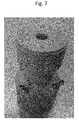
- This specific embodiment of the sterilizable adapter described herein is depicted in FIG. 7 .
- the sterilizable adapter can be disposable, i.e. for one time use or can be re-usable.
- the cell culture condition is altered, e.g. the cells are at first cultured under fed-batch conditions followed by cultivation under perfusion conditions.
- the employed substances that are added and/or removed via the sterilizable adapter can be in solid, liquid or gaseous state.
- the added or removed substances are liquids or gases.
- cell culture medium can be added via a specific port and also cells to be cultured can be added via this port.
- One way of achieving this is through using a sterilized Y-tube connected to the port, in which one arm of the "Y" is used for adding cell culture medium and one arm for adding cells to be cultured.
- the sterilizable adapter has 2 to 20 ports, more preferably, 2 to 10, even more preferably 4 to 8 ports.
- the ports are straight.
- the ports are bent, e.g. "L" shaped.
- the ports are positioned vertically or at an incline within the body of the adapter.
- the incline is at an angle of 45°.
- the ports of the adapter are straight.
- the straight ports can for instance be positioned vertically or at an angle of 45°.
- the outer diameter of the sterilizable adapter can be smaller at the locations where the ports exit the body of the sterilizable adapter as shown in FIG. 4 .
- the ports can be arranged at equal distances from each other and/or at the same position relative to the total height of the sterilizable adapter.
- the cell retention device is connected to the at least one port or the cell retention device is positioned in the ventilation passage of the adapter.
- the cell retention device is positioned in the ventilation passage of the adapter.
- the cell retention device is preferably mounted into the lid, which is to be used with the sterilizable adapter, prior to sterilization e.g. autoclaving.
- the sterilizable adapter further comprises at least one component selected from the group consisting of a tube, a filter, a hose nozzle, a screw connector, a luer lock connector and an external cell separation.
- the hose nozzle is a metal hose nozzle with a length of approx. 5 cm.
- the present invention provides a device comprising a sterilizable adapter as described above and a cell culture vessel. Moreover, if the adapter does not already comprise a lid, the device preferably comprises a lid.
- FIG 1 An example of such a device is depicted in FIG 1 .
- the device is suited for a culture volume of 1ml to 170 ml.
- the device as a whole or in parts is sterilizable.
- the lid is the lid originally belonging to the cell culture vessel of the device.
- the device further comprises a component selected from the group consisting of: at least one pH sensor spot, a conventional pH electrode, a sensor for optical density, a sensor for dissolved oxygen, a conductivity sensor and/or a capacity sensor.
- a component selected from the group consisting of: at least one pH sensor spot, a conventional pH electrode, a sensor for optical density, a sensor for dissolved oxygen, a conductivity sensor and/or a capacity sensor.
- the invention relates to the use of sterilizable adapter and/or the device as described above for cultivation of cells under batch, fed-batch, repeated fed-batch and/or continuous such as perfusion culture conditions, wherein in the case of perfusion culture conditions the adapter comprises at least 2 ports.
- one out of the at least two ports could for example be used to add pH set-up agents and cell culture medium ("feed") and the other one of the at least two ports could be employed to remove cell culture medium (“harvest”) and samples could be taken from the harvest stream.
- the sterilizable adapter comprises at least four ports, since it readily allows culture under perfusion culture conditions.
- the invention relates to a method for cultivation of cells under batch, fed-batch, repeated fed-batch and/or continuous such as perfusion culture conditions.
- the method further comprises detection of the liquid level.
- the liquid level can for example be detected via using a capacity sensor or via monitoring the weight balance of the substances that are added to and removed from the cell culture vessel.
- Detection of the liquid level facilitates small scale cell culture under continuous culture conditions e.g. perfusion culture conditions. This is the case, since small culture volumes always have the risk that the culture is depleted of or overfilled with cell culture medium. This risk is minimized via monitoring the cell culture medium level.
- ensuring a constant liquid level also facilitates controlling other culture parameters such as the dissolved oxygen concentration.
- the sterilizable adapter comprises at least two ports and the cell cultivation method is a perfusion cell culture.
- FIG 1 shows a schematic overview of a sterilizable adapter and a device comprising such a sterilizable adapter, i.e. a cell culture vessel and a lid as described herein.
- a sterilizable adapter (1) for a cell culture vessel (8) is depicted.
- the sterilizable adapter in this example comprises a body (14), an upper external screw thread (4) four ports (2a-d), a ventilation passage (3), an internal screw thread suitable for screwing in a screw thread (6) and a cell retention device (5).
- the sterilizable adapter (1) is positioned on a cell culture vessel (8) and it is closed with the original lid (7) of said cell culture vessel.
- the cell culture vessel contains cell culture medium (9) comprising the cells to be cultured (11).
- the cell culture vessel comprises a pH sensor spot and a dissolved oxygen sensor spot (10) indicating a change in pH value and dissolved oxygen tension.
- This sterilizable adapter can be used as follows:
- the lid (7) Prior to setting up the cell culture the lid (7) is removed from the shaker flask under sterile conditions. Then, the sterilizable adapter (1) is screwed onto the cell culture vessel via the internal screw thread suitable for screwing in a screw thread (6) and the lid (7) is screwed onto the sterilizable adapter (1). Afterwards the whole device is transferred to the cell cultivation chamber, here an incubator, in which the cells are cultured under suitable conditions in perfusion culture mode.
- perfusion cell culture is started, in which culture medium is continuously added via port (2b) and aspirated via port (2c), while the cell retention device retains the cells to be cultured in the medium.
- the level of the cell culture medium is detected via monitoring the weight balance of the substances that are added to and removed from the cell culture vessel,
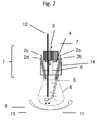
- FIG. 2 shows a schematic overview of a sterilizable adapter and a device comprising such a sterilizable adapter, i.e. a cell culture vessel and a lid as described herein.
- a sterilizable adapter (1) for a cell culture vessel (8) is depicted.
- the sterilizable adapter in this example comprises a body, an upper external screw thread (4) four ports (2a-d), a ventilation passage (3) (gas exchange is indicated by the dashed arrows), an internal screw thread suitable for screwing in a screw thread (6), a cell retention device (5), a level sensor (12) - in this case a conductivity electrode - and a lid (7).
- the sterilizable adapter (1) is positioned on a cell culture vessel (8).
- the cell culture vessel contains cell culture medium (9) comprising the cells to be cultured (11).
- the cell culture vessel comprises pH sensor spots (10) indicating a change in pH value.
- the lid (7) with the level sensor 12 Prior to setting up the cell culture the lid (7) with the level sensor 12 is removed from the shake flask under sterile conditions. Then, the sterilizable adapter (1) is screwed onto the cell culture vessel via the internal screw thread suitable for screwing in a screw thread (6) and the lid (7) is screwed onto the sterilizable adapter (1). Afterwards the whole device is transferred to the cell cultivation chamber, here an incubator, in which the cells are cultured under suitable conditions in perfusion culture mode.
- the perfusion cell culture is started, in which culture medium is continuously added via port (2b) and aspirated via port (2c), while the cell retention device retains the cells to be cultured in the medium.
- the cell culture vessel (8) is a shake flask and the cells are cultured at 120 rpm (indicated by the semi-circle arrow).
- the level of the cell culture medium is monitored via the level sensor (12) and if necessary the conditions are adjusted, e.g. via adding more culture medium or removing less culture medium ensuring that the level of the cell culture medium is constant within a narrow range.
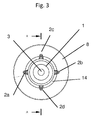
- Fig. 3 shows an exemplary device comprising a sterilizable adapter and a cell culture vessel from above.
- a sterilizable adapter (1) for a cell culture vessel (8) is depicted. Moreover, also the four ports (2a-d), the ventilation passage (3) and the body of the adapter (14) are shown. In addition, in this example of a sterilizable adapter, the four ports are arranged at equal distances from each other.
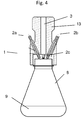
- Fig. 4 shows a side-view of an exemplary device comprising a sterilizable adapter and a cell culture vessel.
- a sterilizable adapter (1) for a cell culture vessel (8) is depicted.
- the three ports 2a-c are shown, as the fourth ports located on the visual axis, since in this example of a sterilizable adapter, the four ports are arranged at equal distances from each other.
- the four ports are also arranged at the same position relative to the total height of the sterilizable adapter.
- the ports end at the top of the cell culture vessel (8) and do not extend into the cell culture vessel (8) as is the case in the exemplary device depicted in FIG 2 .
- the ventilation passage (3), the body (13) and the cell culture medium (9) comprising the cells to be cultured are depicted.
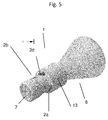
- FIG. 5 shows another view of an exemplary device comprising a sterilizable adapter and a cell culture vessel.
- a sterilizable adapter (1) for a cell culture vessel (8) comprising a body (13) and a lid (7) for the sterilizable adapter, which in the example is the original lid of the cell culture vessel.
- the three ports ports 2a, 2b and 2d are depicted.
- Fig. 6 shows a picture of an exemplary cell retention device, i.e. a filtration body. It consists of two parts between which the filtration material was placed. For stabilization of the filtration material a stabilization disk was also placed into the filtration body.
- the employed filtration material was a 20 ⁇ m prefilter and a 10 ⁇ m-filter material, i.e. a super micron filter.
- Fig. 7 shows a picture of an exemplary sterilizable adapter comprising as an upper connection a screw thread and four ports of which two can be seen.
- the device of FIG. 4 comprising the sterilizable adapter was tested under perfusion culture conditions.
- the employed sterilizable adapter had as upper connection, an upper external screw thread to which the original lid of the cell culture vessel was screwed onto and as lower internal connection a screw thread via which the adapter was screwed onto the cell culture vessel.
- the sterilizable adapter had 4 straight, vertically positioned ports, a ventilation passage, a level sensor and a cell retention device, in this case a piece of elastomeric tubing.
- the cell retention device was connected to one of the ports.
- the ports were fitted with components such as tubes, filters, hose nozzles, screw connector and luer lock connectors as appropriate.
- the sterilizable adapter Prior to use the sterilizable adapter was sterilized via steam sterilization. Afterwards the cell retention device was screwed onto the cell cultivation device and the other components were assembled under a sterile workbench (cleanbench).
- cleanbench sterile workbench
- the culture was performed in an incubator comprising a shaking platform for cell culture vessels using a DASGIP ® -fermenter control including a DASGIP ® -control-software (DASGIP ® , Eppendorf AG, Hamburg, Germany).
- a DASGIP ® -fermenter control including a DASGIP ® -control-software (DASGIP ® , Eppendorf AG, Hamburg, Germany).
- Table 1 Material Length Form 1 Silicone, inner diameter 4.8 mm 163 mm Straight, vertical 2 Silicone, inner diameter 4.8 mm 125 mm Straight, vertical 3 Silicone, inner diameter 4.8 mm 200 mm Straight, vertical 4 Silicone, inner diameter 4.8 mm 200 mm Bent 5 Tygon® inner diameter 4.8 mm 163 mm Straight 6 Stainless steel, inner diameter 3 mm 300 mm Straight, 70° inclined* 7 Stainless steel, inner diameter 4 mm 300 mm Straight, 70° inclined* 8 Stainless steel, inner diameter 6 mm 300 mm Straight, 70° inclined* 9 Stainless steel, inner diameter 10 mm 300 mm Straight, 70° inclined* * 70° inclined with respect to a horizontal line
- rFVIII expressing BHK cells were cultured for several days.
- Cell culture was performed in 500 ml shake flasks with a working volume of 150 ml.
- the culture conditions were set to an incubator temperature of 36.5°C and a shaking frequency of the incubator of 80 to 100 rounds per minute (rpm).
- the CO 2 -level of the incubator was set at 4.5% and the humidity level of the incubator was set at 80%.
- the pH set point was 6.8 and the dissolved oxygen concentration was ⁇ 10%.
Landscapes
- Health & Medical Sciences (AREA)
- Organic Chemistry (AREA)
- Life Sciences & Earth Sciences (AREA)
- Engineering & Computer Science (AREA)
- Bioinformatics & Cheminformatics (AREA)
- Chemical & Material Sciences (AREA)
- Zoology (AREA)
- Wood Science & Technology (AREA)
- Sustainable Development (AREA)
- Microbiology (AREA)
- Biotechnology (AREA)
- Biomedical Technology (AREA)
- Biochemistry (AREA)
- General Engineering & Computer Science (AREA)
- General Health & Medical Sciences (AREA)
- Genetics & Genomics (AREA)
- Clinical Laboratory Science (AREA)
- Apparatus Associated With Microorganisms And Enzymes (AREA)
Priority Applications (8)
| Application Number | Priority Date | Filing Date | Title |
|---|---|---|---|
| EP16181914.9A EP3275992A1 (de) | 2016-07-29 | 2016-07-29 | Adapter für zellkulturgefäss |
| ES17737852T ES2937713T3 (es) | 2016-07-29 | 2017-07-19 | Adaptador para recipiente de cultivo celular |
| PCT/EP2017/068214 WO2018019675A1 (en) | 2016-07-29 | 2017-07-19 | Adapter for cell-culture vessel |
| US16/318,109 US11597901B2 (en) | 2016-07-29 | 2017-07-19 | Adapter for cell-culture vessel |
| CN201780047212.7A CN109563461A (zh) | 2016-07-29 | 2017-07-19 | 用于细胞培养容器的适配器 |
| EP17737852.8A EP3491115B1 (de) | 2016-07-29 | 2017-07-19 | Adapter für zellkulturgefäss |
| TW106125207A TWI770040B (zh) | 2016-07-29 | 2017-07-27 | 細胞培養容器的可消毒接合器、可消毒裝置的用途以及用於在搖動條件下細胞培養的方法 |
| ARP170102140A AR110164A1 (es) | 2016-07-29 | 2017-07-28 | Adaptador para recipiente de cultivo celular |
Applications Claiming Priority (1)
| Application Number | Priority Date | Filing Date | Title |
|---|---|---|---|
| EP16181914.9A EP3275992A1 (de) | 2016-07-29 | 2016-07-29 | Adapter für zellkulturgefäss |
Publications (1)
| Publication Number | Publication Date |
|---|---|
| EP3275992A1 true EP3275992A1 (de) | 2018-01-31 |
Family
ID=56555317
Family Applications (2)
| Application Number | Title | Priority Date | Filing Date |
|---|---|---|---|
| EP16181914.9A Withdrawn EP3275992A1 (de) | 2016-07-29 | 2016-07-29 | Adapter für zellkulturgefäss |
| EP17737852.8A Active EP3491115B1 (de) | 2016-07-29 | 2017-07-19 | Adapter für zellkulturgefäss |
Family Applications After (1)
| Application Number | Title | Priority Date | Filing Date |
|---|---|---|---|
| EP17737852.8A Active EP3491115B1 (de) | 2016-07-29 | 2017-07-19 | Adapter für zellkulturgefäss |
Country Status (7)
| Country | Link |
|---|---|
| US (1) | US11597901B2 (de) |
| EP (2) | EP3275992A1 (de) |
| CN (1) | CN109563461A (de) |
| AR (1) | AR110164A1 (de) |
| ES (1) | ES2937713T3 (de) |
| TW (1) | TWI770040B (de) |
| WO (1) | WO2018019675A1 (de) |
Families Citing this family (3)
| Publication number | Priority date | Publication date | Assignee | Title |
|---|---|---|---|---|
| CN111433344B (zh) | 2017-11-30 | 2024-04-26 | 康宁股份有限公司 | 无菌干燥转移的方法和装置 |
| DE102017128614A1 (de) * | 2017-12-01 | 2019-06-06 | Bbg Gmbh & Co. Kg | Formwerkzeug zum Umschäumen einer Scheibe und wenigstens eines Blecheinlegeteils |
| JP7279703B2 (ja) * | 2018-03-23 | 2023-05-23 | 住友ベークライト株式会社 | 培養容器 |
Citations (5)
| Publication number | Priority date | Publication date | Assignee | Title |
|---|---|---|---|---|
| US20050130291A1 (en) * | 2001-07-31 | 2005-06-16 | Sartorius Ag | Bioreactor provided with equipment with flexible walls |
| EP1591517A1 (de) * | 2004-04-30 | 2005-11-02 | Ismatec SA, Laboratoriumstechnik | Deckel für Bioreaktorflaschen und/oder Zentrifugenröhrchen |
| WO2012076442A1 (en) * | 2010-12-07 | 2012-06-14 | F. Hoffmann-La Roche Ag | Adapter for the non-invasive cultivation of cells and uses thereof |
| WO2013124326A1 (de) | 2012-02-20 | 2013-08-29 | Bayer Technology Services Gmbh | Einweg abscheider zur rückhaltung und rückführung von zellen |
| US20150218501A1 (en) * | 2012-09-18 | 2015-08-06 | Bayer Technology Services Gmbh | Disposable bottle reactor tank |
Family Cites Families (12)
| Publication number | Priority date | Publication date | Assignee | Title |
|---|---|---|---|---|
| US4184916A (en) * | 1977-11-14 | 1980-01-22 | Monsanto Company | Continuous cell culture system |
| US4166768A (en) * | 1977-11-14 | 1979-09-04 | Monsanto Company | Continuous cell culture system |
| GB9309429D0 (en) * | 1993-05-07 | 1993-06-23 | Bioscot Ltd | Fermenter accessory |
| DE60224951T2 (de) * | 2002-12-24 | 2009-01-29 | Humanitas Mirasole S.P.A. | Analysevorrichtung für zellkulturen |
| CN101372661B (zh) * | 2008-03-18 | 2011-09-07 | 北京航空航天大学 | 一种具有培养腔旋转的可调控灌注式血管组织工程反应器 |
| JP2010011747A (ja) * | 2008-07-01 | 2010-01-21 | Canon Inc | 細胞培養容器および細胞培養方法 |
| US9180107B2 (en) * | 2009-03-31 | 2015-11-10 | Nanopharmaceuticals Llc | Combination treatment of cancer with cetuximab and tetrac |
| CN102071137B (zh) * | 2009-11-19 | 2014-10-22 | 上海坤巨科技发展有限公司 | 连续灌注生物反应器/罐袋系统制备干细胞装置和方法 |
| TW201211533A (en) * | 2010-06-17 | 2012-03-16 | Geneasys Pty Ltd | Microfluidic device for simultaneous detection of multiple conditions in a patient |
| US9228166B2 (en) * | 2011-12-20 | 2016-01-05 | Pall Corporation | Rockable biocontainer |
| US9944894B2 (en) * | 2015-01-16 | 2018-04-17 | General Electric Company | Pluripotent stem cell expansion and passage using a rocking platform bioreactor |
| CN204779581U (zh) * | 2015-06-01 | 2015-11-18 | 沈阳澔源生物科技有限公司 | 一种细胞培养无菌检测适配器 |
-
2016
- 2016-07-29 EP EP16181914.9A patent/EP3275992A1/de not_active Withdrawn
-
2017
- 2017-07-19 ES ES17737852T patent/ES2937713T3/es active Active
- 2017-07-19 EP EP17737852.8A patent/EP3491115B1/de active Active
- 2017-07-19 CN CN201780047212.7A patent/CN109563461A/zh active Pending
- 2017-07-19 US US16/318,109 patent/US11597901B2/en active Active
- 2017-07-19 WO PCT/EP2017/068214 patent/WO2018019675A1/en not_active Ceased
- 2017-07-27 TW TW106125207A patent/TWI770040B/zh not_active IP Right Cessation
- 2017-07-28 AR ARP170102140A patent/AR110164A1/es not_active Application Discontinuation
Patent Citations (6)
| Publication number | Priority date | Publication date | Assignee | Title |
|---|---|---|---|---|
| US20050130291A1 (en) * | 2001-07-31 | 2005-06-16 | Sartorius Ag | Bioreactor provided with equipment with flexible walls |
| EP1591517A1 (de) * | 2004-04-30 | 2005-11-02 | Ismatec SA, Laboratoriumstechnik | Deckel für Bioreaktorflaschen und/oder Zentrifugenröhrchen |
| WO2012076442A1 (en) * | 2010-12-07 | 2012-06-14 | F. Hoffmann-La Roche Ag | Adapter for the non-invasive cultivation of cells and uses thereof |
| WO2013124326A1 (de) | 2012-02-20 | 2013-08-29 | Bayer Technology Services Gmbh | Einweg abscheider zur rückhaltung und rückführung von zellen |
| WO2013124329A1 (de) | 2012-02-20 | 2013-08-29 | Bayer Technology Services Gmbh | Einweg abscheider zur rückhaltung und rückführung von zellen |
| US20150218501A1 (en) * | 2012-09-18 | 2015-08-06 | Bayer Technology Services Gmbh | Disposable bottle reactor tank |
Non-Patent Citations (1)
| Title |
|---|
| MEIER ET AL.: "Quasi-continuous fermentation in a reverse-flow diafiltration bioreactor", BIOCHEMICAL ENGINEERING JOURNAL, vol. 91, 15 October 2014 (2014-10-15), pages 265 - 275, XP029049952, DOI: doi:10.1016/j.bej.2014.08.021 |
Also Published As
| Publication number | Publication date |
|---|---|
| TWI770040B (zh) | 2022-07-11 |
| US20210277346A1 (en) | 2021-09-09 |
| WO2018019675A1 (en) | 2018-02-01 |
| ES2937713T3 (es) | 2023-03-30 |
| EP3491115A1 (de) | 2019-06-05 |
| AR110164A1 (es) | 2019-03-06 |
| TW201817868A (zh) | 2018-05-16 |
| CN109563461A (zh) | 2019-04-02 |
| EP3491115B1 (de) | 2022-11-23 |
| US11597901B2 (en) | 2023-03-07 |
Similar Documents
| Publication | Publication Date | Title |
|---|---|---|
| KR102641877B1 (ko) | 생물 반응기 시스템 및 그 방법 | |
| KR102621101B1 (ko) | 생물학적 활동을 지원하는 일회용 생물 공정 시스템 | |
| US20160319234A1 (en) | Continuously controlled hollow fiber bioreactor | |
| US20110201100A1 (en) | Single use cell culture bioreactor manifold system | |
| EP2321403B1 (de) | Mittel zur vorhersage des erntezeitpunkts für in einem bioreaktor kultivierte zellen | |
| US20040259240A1 (en) | Method and apparatus for filtration of bioreactor recombinant proteins | |
| EP1884562A1 (de) | Bioreaktor und Verfahren dafür | |
| US20090148941A1 (en) | Disposable mini-bioreactor device and method | |
| KR20150056548A (ko) | 1회용 병 반응기 탱크 | |
| EP2151491B1 (de) | Mehrkammer-Bioreaktor mit bidirektionaler Infusion, integriert in einem Kultursystem, zum Einsatz bei Strategien der Gewebetechnik | |
| Ozturk | Equipment for large-scale mammalian cell culture | |
| EP3491115B1 (de) | Adapter für zellkulturgefäss | |
| CN108866013B (zh) | 一种大规模生产慢病毒的方法 | |
| US4683207A (en) | Culture monitoring system | |
| KR20220079643A (ko) | 산업적 규모로 현탁액 중의 세포 또는 미생물을 배양하기 위한 생물 반응기 또는 발효기 | |
| CN114901794B (zh) | 用于生产接种物的过程和系统 | |
| Allman | Bioreactors: design, operation, and applications | |
| RU2797021C1 (ru) | Система асимметричного конического биореактора и способ ее использования | |
| RU2841776C1 (ru) | Биореактор для культивации клеток и получения вирусной суспензии и способ его работы | |
| AU2016242996B2 (en) | Materials and methods for extended continuous flow fermentation of reduced genome bacteria | |
| CN223033383U (zh) | 一种生物代谢过程控制系统 | |
| Allman | Operation and Applications | |
| WO2025141179A1 (en) | Gas exchange device for cell culture bioreactor | |
| WO2025141180A1 (en) | Nutrient distribution unit for bioreactor | |
| CN210237641U (zh) | 一种篮式生物反应器 |
Legal Events
| Date | Code | Title | Description |
|---|---|---|---|
| PUAI | Public reference made under article 153(3) epc to a published international application that has entered the european phase |
Free format text: ORIGINAL CODE: 0009012 |
|
| STAA | Information on the status of an ep patent application or granted ep patent |
Free format text: STATUS: THE APPLICATION HAS BEEN PUBLISHED |
|
| AK | Designated contracting states |
Kind code of ref document: A1 Designated state(s): AL AT BE BG CH CY CZ DE DK EE ES FI FR GB GR HR HU IE IS IT LI LT LU LV MC MK MT NL NO PL PT RO RS SE SI SK SM TR |
|
| AX | Request for extension of the european patent |
Extension state: BA ME |
|
| STAA | Information on the status of an ep patent application or granted ep patent |
Free format text: STATUS: THE APPLICATION IS DEEMED TO BE WITHDRAWN |
|
| 18D | Application deemed to be withdrawn |
Effective date: 20180801 |