EP3276064A1 - Noyau sandwich comprenant un matériau à base de fibres et procédé de fabrication ainsi que panneau sandwich - Google Patents
Noyau sandwich comprenant un matériau à base de fibres et procédé de fabrication ainsi que panneau sandwich Download PDFInfo
- Publication number
- EP3276064A1 EP3276064A1 EP17183433.6A EP17183433A EP3276064A1 EP 3276064 A1 EP3276064 A1 EP 3276064A1 EP 17183433 A EP17183433 A EP 17183433A EP 3276064 A1 EP3276064 A1 EP 3276064A1
- Authority
- EP
- European Patent Office
- Prior art keywords
- core
- plate
- plane
- sandwich
- fibers
- Prior art date
- Legal status (The legal status is an assumption and is not a legal conclusion. Google has not performed a legal analysis and makes no representation as to the accuracy of the status listed.)
- Granted
Links
Images


Classifications
-
- D—TEXTILES; PAPER
- D04—BRAIDING; LACE-MAKING; KNITTING; TRIMMINGS; NON-WOVEN FABRICS
- D04H—MAKING TEXTILE FABRICS, e.g. FROM FIBRES OR FILAMENTARY MATERIAL; FABRICS MADE BY SUCH PROCESSES OR APPARATUS, e.g. FELTS, NON-WOVEN FABRICS; COTTON-WOOL; WADDING ; NON-WOVEN FABRICS FROM STAPLE FIBRES, FILAMENTS OR YARNS, BONDED WITH AT LEAST ONE WEB-LIKE MATERIAL DURING THEIR CONSOLIDATION
- D04H1/00—Non-woven fabrics formed wholly or mainly of staple fibres or like relatively short fibres
- D04H1/40—Non-woven fabrics formed wholly or mainly of staple fibres or like relatively short fibres from fleeces or layers composed of fibres without existing or potential cohesive properties
- D04H1/42—Non-woven fabrics formed wholly or mainly of staple fibres or like relatively short fibres from fleeces or layers composed of fibres without existing or potential cohesive properties characterised by the use of certain kinds of fibres insofar as this use has no preponderant influence on the consolidation of the fleece
- D04H1/4266—Natural fibres not provided for in group D04H1/425
-
- B—PERFORMING OPERATIONS; TRANSPORTING
- B32—LAYERED PRODUCTS
- B32B—LAYERED PRODUCTS, i.e. PRODUCTS BUILT-UP OF STRATA OF FLAT OR NON-FLAT, e.g. CELLULAR OR HONEYCOMB, FORM
- B32B7/00—Layered products characterised by the relation between layers; Layered products characterised by the relative orientation of features between layers, or by the relative values of a measurable parameter between layers, i.e. products comprising layers having different physical, chemical or physicochemical properties; Layered products characterised by the interconnection of layers
- B32B7/03—Layered products characterised by the relation between layers; Layered products characterised by the relative orientation of features between layers, or by the relative values of a measurable parameter between layers, i.e. products comprising layers having different physical, chemical or physicochemical properties; Layered products characterised by the interconnection of layers with respect to the orientation of features
-
- B—PERFORMING OPERATIONS; TRANSPORTING
- B27—WORKING OR PRESERVING WOOD OR SIMILAR MATERIAL; NAILING OR STAPLING MACHINES IN GENERAL
- B27N—MANUFACTURE BY DRY PROCESSES OF ARTICLES, WITH OR WITHOUT ORGANIC BINDING AGENTS, MADE FROM PARTICLES OR FIBRES CONSISTING OF WOOD OR OTHER LIGNOCELLULOSIC OR LIKE ORGANIC MATERIAL
- B27N3/00—Manufacture of substantially flat articles, e.g. boards, from particles or fibres
- B27N3/08—Moulding or pressing
- B27N3/10—Moulding of mats
- B27N3/14—Distributing or orienting the particles or fibres
- B27N3/143—Orienting the particles or fibres
-
- B—PERFORMING OPERATIONS; TRANSPORTING
- B27—WORKING OR PRESERVING WOOD OR SIMILAR MATERIAL; NAILING OR STAPLING MACHINES IN GENERAL
- B27N—MANUFACTURE BY DRY PROCESSES OF ARTICLES, WITH OR WITHOUT ORGANIC BINDING AGENTS, MADE FROM PARTICLES OR FIBRES CONSISTING OF WOOD OR OTHER LIGNOCELLULOSIC OR LIKE ORGANIC MATERIAL
- B27N7/00—After-treatment, e.g. reducing swelling or shrinkage, surfacing; Protecting the edges of boards against access of humidity
- B27N7/005—Coating boards, e.g. with a finishing or decorating layer
-
- B—PERFORMING OPERATIONS; TRANSPORTING
- B32—LAYERED PRODUCTS
- B32B—LAYERED PRODUCTS, i.e. PRODUCTS BUILT-UP OF STRATA OF FLAT OR NON-FLAT, e.g. CELLULAR OR HONEYCOMB, FORM
- B32B21/00—Layered products comprising a layer of wood, e.g. wood board, veneer, wood particle board
- B32B21/02—Layered products comprising a layer of wood, e.g. wood board, veneer, wood particle board the layer being formed of fibres, chips, or particles, e.g. MDF, HDF, OSB, chipboard, particle board, hardboard
-
- B—PERFORMING OPERATIONS; TRANSPORTING
- B32—LAYERED PRODUCTS
- B32B—LAYERED PRODUCTS, i.e. PRODUCTS BUILT-UP OF STRATA OF FLAT OR NON-FLAT, e.g. CELLULAR OR HONEYCOMB, FORM
- B32B5/00—Layered products characterised by the non- homogeneity or physical structure, i.e. comprising a fibrous, filamentary, particulate or foam layer; Layered products characterised by having a layer differing constitutionally or physically in different parts
- B32B5/02—Layered products characterised by the non- homogeneity or physical structure, i.e. comprising a fibrous, filamentary, particulate or foam layer; Layered products characterised by having a layer differing constitutionally or physically in different parts characterised by structural features of a fibrous or filamentary layer
- B32B5/022—Non-woven fabric
-
- B—PERFORMING OPERATIONS; TRANSPORTING
- B32—LAYERED PRODUCTS
- B32B—LAYERED PRODUCTS, i.e. PRODUCTS BUILT-UP OF STRATA OF FLAT OR NON-FLAT, e.g. CELLULAR OR HONEYCOMB, FORM
- B32B5/00—Layered products characterised by the non- homogeneity or physical structure, i.e. comprising a fibrous, filamentary, particulate or foam layer; Layered products characterised by having a layer differing constitutionally or physically in different parts
- B32B5/22—Layered products characterised by the non- homogeneity or physical structure, i.e. comprising a fibrous, filamentary, particulate or foam layer; Layered products characterised by having a layer differing constitutionally or physically in different parts characterised by the presence of two or more layers which are next to each other and are fibrous, filamentary, formed of particles or foamed
- B32B5/24—Layered products characterised by the non- homogeneity or physical structure, i.e. comprising a fibrous, filamentary, particulate or foam layer; Layered products characterised by having a layer differing constitutionally or physically in different parts characterised by the presence of two or more layers which are next to each other and are fibrous, filamentary, formed of particles or foamed one layer being a fibrous or filamentary layer
- B32B5/26—Layered products characterised by the non- homogeneity or physical structure, i.e. comprising a fibrous, filamentary, particulate or foam layer; Layered products characterised by having a layer differing constitutionally or physically in different parts characterised by the presence of two or more layers which are next to each other and are fibrous, filamentary, formed of particles or foamed one layer being a fibrous or filamentary layer another layer next to it also being fibrous or filamentary
-
- B—PERFORMING OPERATIONS; TRANSPORTING
- B32—LAYERED PRODUCTS
- B32B—LAYERED PRODUCTS, i.e. PRODUCTS BUILT-UP OF STRATA OF FLAT OR NON-FLAT, e.g. CELLULAR OR HONEYCOMB, FORM
- B32B7/00—Layered products characterised by the relation between layers; Layered products characterised by the relative orientation of features between layers, or by the relative values of a measurable parameter between layers, i.e. products comprising layers having different physical, chemical or physicochemical properties; Layered products characterised by the interconnection of layers
- B32B7/04—Interconnection of layers
- B32B7/12—Interconnection of layers using interposed adhesives or interposed materials with bonding properties
-
- D—TEXTILES; PAPER
- D04—BRAIDING; LACE-MAKING; KNITTING; TRIMMINGS; NON-WOVEN FABRICS
- D04H—MAKING TEXTILE FABRICS, e.g. FROM FIBRES OR FILAMENTARY MATERIAL; FABRICS MADE BY SUCH PROCESSES OR APPARATUS, e.g. FELTS, NON-WOVEN FABRICS; COTTON-WOOL; WADDING ; NON-WOVEN FABRICS FROM STAPLE FIBRES, FILAMENTS OR YARNS, BONDED WITH AT LEAST ONE WEB-LIKE MATERIAL DURING THEIR CONSOLIDATION
- D04H1/00—Non-woven fabrics formed wholly or mainly of staple fibres or like relatively short fibres
- D04H1/70—Non-woven fabrics formed wholly or mainly of staple fibres or like relatively short fibres characterised by the method of forming fleeces or layers, e.g. reorientation of fibres
- D04H1/74—Non-woven fabrics formed wholly or mainly of staple fibres or like relatively short fibres characterised by the method of forming fleeces or layers, e.g. reorientation of fibres the fibres being orientated, e.g. in parallel (anisotropic fleeces)
-
- E—FIXED CONSTRUCTIONS
- E04—BUILDING
- E04C—STRUCTURAL ELEMENTS; BUILDING MATERIALS
- E04C2/00—Building elements of relatively thin form for the construction of parts of buildings, e.g. sheet materials, slabs, or panels
- E04C2/02—Building elements of relatively thin form for the construction of parts of buildings, e.g. sheet materials, slabs, or panels characterised by specified materials
- E04C2/10—Building elements of relatively thin form for the construction of parts of buildings, e.g. sheet materials, slabs, or panels characterised by specified materials of wood, fibres, chips, vegetable stems, or the like; of plastics; of foamed products
- E04C2/16—Building elements of relatively thin form for the construction of parts of buildings, e.g. sheet materials, slabs, or panels characterised by specified materials of wood, fibres, chips, vegetable stems, or the like; of plastics; of foamed products of fibres, chips, vegetable stems, or the like
-
- E—FIXED CONSTRUCTIONS
- E04—BUILDING
- E04C—STRUCTURAL ELEMENTS; BUILDING MATERIALS
- E04C2/00—Building elements of relatively thin form for the construction of parts of buildings, e.g. sheet materials, slabs, or panels
- E04C2/02—Building elements of relatively thin form for the construction of parts of buildings, e.g. sheet materials, slabs, or panels characterised by specified materials
- E04C2/10—Building elements of relatively thin form for the construction of parts of buildings, e.g. sheet materials, slabs, or panels characterised by specified materials of wood, fibres, chips, vegetable stems, or the like; of plastics; of foamed products
- E04C2/24—Building elements of relatively thin form for the construction of parts of buildings, e.g. sheet materials, slabs, or panels characterised by specified materials of wood, fibres, chips, vegetable stems, or the like; of plastics; of foamed products laminated and composed of materials covered by two or more of groups E04C2/12, E04C2/16, E04C2/20
-
- B—PERFORMING OPERATIONS; TRANSPORTING
- B27—WORKING OR PRESERVING WOOD OR SIMILAR MATERIAL; NAILING OR STAPLING MACHINES IN GENERAL
- B27N—MANUFACTURE BY DRY PROCESSES OF ARTICLES, WITH OR WITHOUT ORGANIC BINDING AGENTS, MADE FROM PARTICLES OR FIBRES CONSISTING OF WOOD OR OTHER LIGNOCELLULOSIC OR LIKE ORGANIC MATERIAL
- B27N3/00—Manufacture of substantially flat articles, e.g. boards, from particles or fibres
- B27N3/04—Manufacture of substantially flat articles, e.g. boards, from particles or fibres from fibres
-
- B—PERFORMING OPERATIONS; TRANSPORTING
- B32—LAYERED PRODUCTS
- B32B—LAYERED PRODUCTS, i.e. PRODUCTS BUILT-UP OF STRATA OF FLAT OR NON-FLAT, e.g. CELLULAR OR HONEYCOMB, FORM
- B32B2250/00—Layers arrangement
- B32B2250/40—Symmetrical or sandwich layers, e.g. ABA, ABCBA, ABCCBA
-
- B—PERFORMING OPERATIONS; TRANSPORTING
- B32—LAYERED PRODUCTS
- B32B—LAYERED PRODUCTS, i.e. PRODUCTS BUILT-UP OF STRATA OF FLAT OR NON-FLAT, e.g. CELLULAR OR HONEYCOMB, FORM
- B32B2260/00—Layered product comprising an impregnated, embedded, or bonded layer wherein the layer comprises an impregnation, embedding, or binder material
- B32B2260/02—Composition of the impregnated, bonded or embedded layer
- B32B2260/021—Fibrous or filamentary layer
-
- B—PERFORMING OPERATIONS; TRANSPORTING
- B32—LAYERED PRODUCTS
- B32B—LAYERED PRODUCTS, i.e. PRODUCTS BUILT-UP OF STRATA OF FLAT OR NON-FLAT, e.g. CELLULAR OR HONEYCOMB, FORM
- B32B2262/00—Composition or structural features of fibres which form a fibrous or filamentary layer or are present as additives
- B32B2262/06—Vegetal fibres
- B32B2262/062—Cellulose fibres, e.g. cotton
- B32B2262/065—Lignocellulosic fibres, e.g. jute, sisal, hemp, flax, bamboo
-
- B—PERFORMING OPERATIONS; TRANSPORTING
- B32—LAYERED PRODUCTS
- B32B—LAYERED PRODUCTS, i.e. PRODUCTS BUILT-UP OF STRATA OF FLAT OR NON-FLAT, e.g. CELLULAR OR HONEYCOMB, FORM
- B32B2262/00—Composition or structural features of fibres which form a fibrous or filamentary layer or are present as additives
- B32B2262/06—Vegetal fibres
- B32B2262/062—Cellulose fibres, e.g. cotton
- B32B2262/067—Wood fibres
-
- B—PERFORMING OPERATIONS; TRANSPORTING
- B32—LAYERED PRODUCTS
- B32B—LAYERED PRODUCTS, i.e. PRODUCTS BUILT-UP OF STRATA OF FLAT OR NON-FLAT, e.g. CELLULAR OR HONEYCOMB, FORM
- B32B2262/00—Composition or structural features of fibres which form a fibrous or filamentary layer or are present as additives
- B32B2262/10—Inorganic fibres
- B32B2262/101—Glass fibres
-
- B—PERFORMING OPERATIONS; TRANSPORTING
- B32—LAYERED PRODUCTS
- B32B—LAYERED PRODUCTS, i.e. PRODUCTS BUILT-UP OF STRATA OF FLAT OR NON-FLAT, e.g. CELLULAR OR HONEYCOMB, FORM
- B32B2262/00—Composition or structural features of fibres which form a fibrous or filamentary layer or are present as additives
- B32B2262/10—Inorganic fibres
- B32B2262/106—Carbon fibres, e.g. graphite fibres
-
- B—PERFORMING OPERATIONS; TRANSPORTING
- B32—LAYERED PRODUCTS
- B32B—LAYERED PRODUCTS, i.e. PRODUCTS BUILT-UP OF STRATA OF FLAT OR NON-FLAT, e.g. CELLULAR OR HONEYCOMB, FORM
- B32B2307/00—Properties of the layers or laminate
- B32B2307/50—Properties of the layers or laminate having particular mechanical properties
- B32B2307/54—Yield strength; Tensile strength
-
- B—PERFORMING OPERATIONS; TRANSPORTING
- B32—LAYERED PRODUCTS
- B32B—LAYERED PRODUCTS, i.e. PRODUCTS BUILT-UP OF STRATA OF FLAT OR NON-FLAT, e.g. CELLULAR OR HONEYCOMB, FORM
- B32B2307/00—Properties of the layers or laminate
- B32B2307/50—Properties of the layers or laminate having particular mechanical properties
- B32B2307/542—Shear strength
-
- B—PERFORMING OPERATIONS; TRANSPORTING
- B32—LAYERED PRODUCTS
- B32B—LAYERED PRODUCTS, i.e. PRODUCTS BUILT-UP OF STRATA OF FLAT OR NON-FLAT, e.g. CELLULAR OR HONEYCOMB, FORM
- B32B2605/00—Vehicles
- B32B2605/08—Cars
-
- B—PERFORMING OPERATIONS; TRANSPORTING
- B32—LAYERED PRODUCTS
- B32B—LAYERED PRODUCTS, i.e. PRODUCTS BUILT-UP OF STRATA OF FLAT OR NON-FLAT, e.g. CELLULAR OR HONEYCOMB, FORM
- B32B2605/00—Vehicles
- B32B2605/10—Trains
-
- B—PERFORMING OPERATIONS; TRANSPORTING
- B32—LAYERED PRODUCTS
- B32B—LAYERED PRODUCTS, i.e. PRODUCTS BUILT-UP OF STRATA OF FLAT OR NON-FLAT, e.g. CELLULAR OR HONEYCOMB, FORM
- B32B2605/00—Vehicles
- B32B2605/18—Aircraft
Definitions
- the invention relates to a sandwich core, comprising a fiber material as the core material, which withstands a higher load input in a main load direction than in another load direction, wherein the main load direction of the sandwich core perpendicular to a plate plane, spanned by the edges with the greatest length extension.
- the invention further relates to a method for producing the sandwich core and a sandwich panel comprising the sandwich core.
- the sandwich core preferably has a particularly low density.
- the lightweight construction in sandwich construction in which a lighter core of lower strength is combined with outer layers of higher tensile strength to form a very rigid, flat component, is an indispensable part of many fields of application.
- core materials are used in the areas of marine, regenerative energy, in particular in wind power, in rail vehicles, in transport (trucks, caravans), in construction, in aviation, in interior design and in trade fair construction.
- the core materials are combined by means of binders with the outer layers.
- binders As natural fiber-based cover layer materials, thin hardboard or other materials with high tensile strength in board level are suitable for furniture and interior design.
- waterproof cover layer materials eg. B. on glass or carbon fiber conceivable.
- the disadvantages are that no homogeneous fiber distribution and / or density distribution due to the tree ring structure is possible. Large particles in the material, in particular chips, contribute to inhomogeneity in the material.
- Another group of materials has homogeneous core structures with directed structural elements parallel to the plate plane. This is the case, for example, with mineral fiber insulation boards. These have a lying fiber, resulting in a low bending strength results. Disadvantages are a lack of directed stiffness and strength property, moreover, the material is not bio-based.
- the publication DE 23 07 873 B2 describes a method for producing a dimensionally stable composite panel comprising a finned layer of loose mineral wool provided with a layer of clothing on one or both surfaces.
- Several webs of mineral wool whose fibers are substantially parallel to the web surfaces are piled into a lamination.
- One of the surface clothing layers is glued to the front transverse surface of the layering running transversely to the mineral wool lamination, and then cut with a distance from the end face corresponding to the thickness of the lamellar layer Layering performed. After that, if necessary, the other surface covering layer is applied to the cut surface.
- the coalescing of the mineral wool webs and the further processing of the stratification in a coherent manner guarantee virtually pressure-free and upright.
- rigid plates are used as surface clothing layers.
- Fiberglass plates are provided as the core, in which the fibers are substantially perpendicular to the cover layer or constitute a substantially vertical connection between two cover layers.
- the fiber fins are cut from prefabricated panels.
- the binder is foamed between the fiber layer and cover layer to compensate for thickness tolerances of the fiber fins.
- the prior art plates are more or less clamped to guide the cutting device through the material. But this always means a compression of the fiberboard, since these plates are made of a very soft material. After cutting, the plates expand to their original dimensions, which can also cause some changes in length in the transverse direction.
- the publication DE 27 42 186 A1 is concerned with a method and apparatus for producing mineral fiber webs having fibers approximately perpendicular to the large surfaces.
- several conventionally produced fiber webs and plates are stacked with running parallel to the main surfaces fibers, cut together in strips and folded so that the cut surfaces to the surface of the new web.
- the strips are taken after the cut of a suction device, moved away from the respective fiberboard and brought together in approximately horizontal direction and transported on.
- Another solution describes the document DE 198 30 066 B4 with an insulating element of mineral wool with a vertical and horizontally covering fiber profile, consisting of bonded via adhesive seams mineral wool strips.
- the mineral wool strips are cut from a plate with a, with respect to their major axes, predominantly vertical fiber flow and, after a 90 ° rotation about its longitudinal center axis, joined together.
- the insulating element thus obtained has a compressive strength of 300 kN / m 2 to 500 kN / m 2 and a tear strength of 200 kN / m 2 to 450 kN / m 2 .
- the high compressive strength and tear resistance make the insulation element suitable for final layers.
- the publication DE 691 04 730 T2 is concerned with the manufacture of interconnected panel elements composed of interconnected rod-shaped mineral fiber elements (lamellae).
- the preparation comprises converting a melt of a mineral fiber-forming raw material into fibers, supplying a binder to the fibers, collecting the fibers on a conveyor belt to form a primary fiber mat.
- the rod-shaped fiber elements are cut to the desired lengths before they are turned by 90 ° and assembled into slat panels.
- Such turning may, for example, be effected in connection with the transfer of the cut slats from a conveyor belt on which they are carried in the longitudinal direction of the slats to another conveyor belt which moves perpendicular to the first belt and on which the slats are perpendicular in one direction be transported to their longitudinal direction.
- the turning of the fins may be effected during cutting of the mat into fins.
- the suitably oriented lamellae, which are to form a lamella panel, can be joined together, preferably by means of a binder.
- Another group of materials has inhomogeneous core structures with directed structural elements perpendicular to the plate plane, as in honeycomb cores, for.
- honeycomb cores for.
- aramid fiber paper, or a support fabric z. Eg Paraglass.
- the disadvantages of these materials lie in the lack of homogeneous supporting effect of the (thin) cover layer, because the structures have cavities that lead to local failure modes.
- sandwich components with such core structures have a low resistance to intermittent stress.
- Another group of materials is characterized by inhomogeneous core structures without directed structural elements.
- An example of this are foam cores in wooden casing.
- materials based on wood fibers are known, but which have no fiber orientation or fiber orientation, preferably in the plane of the plate.
- a sandwich core comprising a fiber material as a core material, which withstands a higher load input in a main load direction than in another load direction.
- the main load direction of the sandwich core is perpendicular to a plate plane, spanned by the edges with the greatest length extension, ie perpendicular to the flat sides.
- the core material comprises lignocellulosic fibers in homogeneous structure which make up the largest part of the material which deviates by at least 60% from the perpendicular to the plane of the plate by an angle of less than 25%.
- the remaining fibers which deviate farther from the vertical, serve for transverse stiffening of the fiber material which forms the core material according to the invention, and thus increase its shear strength.
- the sandwich core according to the invention also achieves the generally known advantages of using renewable raw materials, in particular with regard to conserving resources and relieving the environment.
- the fibers are aligned perpendicular to the plane of the plate in the manufacturing process of the layer with appropriate technology or technology.
- various systems are conceivable: directional scattering, alignment of the fibers by mechanical manipulation or by means of static charging or the like.
- the alignment process of the fibers takes place in the plane of the plate, with either an orientation in the direction of production or transverse thereto is. Again, this is done by the method directed scattering or alignment of the fibers by mechanical manipulation, such. Combing, brushing, carding or killing, which are to be applied to the fibers.
- the fiber orientation is cut into the plates, rotated 90 °, and added to the plate such that the core strips have fiber orientation perpendicular to the plane of the plate for subsequent gluing.
- An advantageous development of the sandwich core according to the invention has a proportion of fibers which deviates at least 80% by an angle of less than 10% from the perpendicular to the plane of the plate.
- a different ratio of compressive strength to cross-stabilizing crosslinking of the fibers is achieved, which promises advantages for certain applications, especially under high pressure loads, but also under tensile load (eg when used as facade insulation board, which also serves as a plaster base).
- Another advantage of the sandwich core according to the invention consists in its low density between 50 and 300 kg / m 3 .
- a particularly preferred density range is between 90 and 200 kg / m 3 .
- the low density achieves good insulation properties, saves material and facilitates processing as well as the transport of the plates produced using the sandwich core according to the invention.
- a further aspect of the present invention relates to a method for producing a sandwich core in which the orientation of the individual lignocellulosic fibers takes place directly in the perpendicular to the plane of the plate, without requiring a production of a core plate with horizontally oriented fibers as an intermediate step. Thereafter, the fibers are densified along the plane of the plate and a core plate is made by introducing or activating a binder. Separation into core strips and turning is not required, so simplifying the process.
- the preferred embodiment of the method variant with direct orientation of the individual fibers uses the electrostatic charge of the fibers in order to align them.
- An electric field is formed perpendicular to the plane of the plate between a first and a second field plate, also referred to as electrodes, by applying an electrical voltage to two poles connected to the field plates.
- the orientation of the individual lignocellulosic fibers to form a nonwoven fabric takes place.
- the orientation of the fibers is in the plate plane and in the feed direction or the orientation is provided in the plate plane and transverse to the feed direction.
- the arrangement of the fibers for producing the nonwoven fabric is effected for example by a mechanical method, for. B. by means of needle or comb rollers, or with the support of an air flow.
- a core plate is produced by introducing or activating a binder according to a preferred embodiment of the method.
- the core plate is separated into core strips of equal width, the width of which corresponds to the height of the sandwich core to be produced.
- the core strips are then rotated by 90 °, so that the orientation of the fibers and thus also the main load direction perpendicular to the plane of the plate form. It follows a reassembly of the core strips in their rotated position on the contacting surfaces to the sandwich core.
- a separation of the core plate which has the orientation of the individual fibers in the feed direction, takes place in core strips transversely to the feed direction.
- the turning of each core strip about an axis transverse to the feed direction is provided below.
- the initially formed, flexible fiber fleece with aligned fibers is folded in the plate plane and in the feed direction in changing directions in such a way that there is a continuous zigzag folding by 180 ° with folding edges transverse to the feed direction.
- the folded edges then form the boundary planes of the folded nonwoven fabric in plate plane.
- the folded nonwoven fabric is then stabilized stabilizing, for example, contrary to the feed direction.
- the solidification can be done mechanically, z. B. by needles.
- Another aspect of the invention relates to a method for producing a sandwich panel.
- a sandwich core obtainable by a process as described above is supplied and provided with at least one cover layer.
- the invention further relates to a device for producing a sandwich core by one of the methods described above, wherein a device for forming a nonwoven fabric including a device for fiber alignment, a device for introducing a binder and / or a device for activating the binder with the object of training a core plate are provided.
- the device for fiber alignment also comprises a device for forming an electric field between a first and a second field plate, also referred to as an electrode according to a preferred embodiment.
- the field plates are arranged parallel to each other and in plate plane.
- a device for separating the formed core plate into core strips, means for rotating the core strips and means for joining the twisted core strips to the sandwich core to be produced are provided according to an advantageous embodiment of the device.
- Means for mutual folding of the nonwoven fabric and for solidification of the folded nonwoven fabric are covered by a further embodiment of the device.
- the fiber orientation can be generated during the formation of the core layer or subsequently by manipulation of a flat plate material.
- the main advantage lies in the fiber orientation of the natural fibers and possibly in the manipulation of the intermediates to the production of a core material with fiber orientation perpendicular to the plate plane.
- natural fibers are put together in a technical process to a very light core material having a fiber orientation well over 50%, in a favorable case to 80%, more preferably 95% substantially perpendicular to the plane and thus highest compressive strengths at preferred densities between 50 and 300 kg / m 3 , particularly preferably between 90 and 200 kg / m 3 .
- Another significant advantage of the invention lies in the use of PMDI as a binder for low-density fiberboard (prior art at densities of 90 ... 400 kg / m 3 ). Compared to other previously known wood-based materials for furniture and interior design this dispenses with the use of formaldehyde as a solvent. Formaldehyde is suspected of producing cancer, which is why it has been working for years to reduce its use in manufacturing processes.
- the core layer according to the invention with fiber orientation perpendicular to the plane of the plate constitutes a "technical end grain core layer", while at the same time embodying advantages that extend beyond the advantages of a natural end grain core layer, especially with regard to homogeneity.
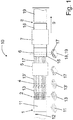
- Fig. 1 schematically shows in top view a first embodiment of the manufacturing method according to the invention with a process flow 10, wherein under each process step, the result in the form of a single symbolized plate is shown in perspective.
- the process direction 9 is indicated by an arrow.
- the preparation of a non-woven fabric, which is provided or provided with binders and is pressed to a core plate 11 by a known method takes place as a preparatory process steps.
- the sandwich panel of the invention stands out, for example, from end grain, which has a greater natural density distribution.
- the method variant according to Fig. 5 instead of the core plate, a core fleece is supplied, a flexible fiber fleece 51 which has not yet been pressed to form a stiff core plate.
- the quasi-endless core plate 11 (alternatively individual plates) is fed to the process.
- Their fiber orientation ie the predominant position of the fibers 12, is horizontal, ie horizontal and parallel to the base or the plane of the plate, which is spanned by the two longest edges.
- a fiber orientation is transverse to the process direction 9.
- the core plate 11 is guided by a separating device, in this case a multi-blade saw 2, which separates the core plate 11 into individual core strips 13 with still horizontal fiber alignment.
- a separating device in this case a multi-blade saw 2, which separates the core plate 11 into individual core strips 13 with still horizontal fiber alignment.
- the separation can also be done in other ways, such as by band saws, water jet cutting or the like.
- the core strips 13 are rotated in a strip turning station 4 by 90 ° about an axis which extends longitudinally to the process direction 9 and along the longitudinal extent of the core strips 13.
- the core strip 13 with lying fiber core strip 13 'with standing fiber 12 without in the interest of a continuous process, the core strips 13, 13' from a quasi-endless core plate 11 must be separated from each other.
- the core strips 13, 13 ' have a finite length corresponding to the plate dimensions.
- the core strips 13 ' are glued in a gluing device 5, so that glued core strips 17 form a sandwich core 15 and reach the covering layer application device 6.
- the connection between sandwich core 15 and cover layer 16 takes place in a press 7, from which a sandwich plate 18 is removed, which has standing fibers 12.
- a separation of individual sandwich panels 19 takes place in a separating device 8.
- gluing in a gluing device 5 it is also possible to use a two-stage gluing agent and for topcoat application or for lateral bonding the core strip 13 'are used.
- the adhesive was activated in a first stage, for example, for the thermoplastic connection of the fibers 12, in the core plate 11, for connecting the sandwich plate 18 with the cover layers 16 or also for the lateral connection of the core strips 13 'with each other, a second adhesive layer of the adhesive activated.
- This is a conventional adhesive used here by way of example to the thermoset adhesive.
- FIGS. 2a and 2b Individual core plates 21 are fed to the process and after separation into core strips 23 they are rotated to core strips 23 'in the strip turning station, not shown here, to to reach a standing fiber 12.
- the necessary space between the core strip 23 is first created, which is necessary especially for larger thicknesses of the core plate 21. This can be done by spreading the individual core strips 23 in the width.
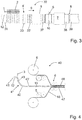
- Fig. 3 schematically shows a top view of a third embodiment of the manufacturing method according to the invention, which follows a process flow 30.
- a core plate 31 is provided as the starting material, which also lying Has fibers 12, which, however, arranged longitudinally to the process direction 9.
- the multi-blade saw 2 therefore cuts transversely to the process direction 9, so that the resulting core strips 33 are transverse to the process direction 9. This in turn simplifies the singulation of the core strips 33 for rotation in the strip turning station 4 'in which the separated core strips 33 are manipulated.
- the separation also takes place in a separating device 8, so that individual sandwich panels 39 are formed.
- Fig. 4 schematically shows a side view of a fourth embodiment of the manufacturing method according to the invention, the process flow 40.
- a knife separator 3 is generated by a knife separator 3 from a core plate 41.
- dispenses with a cutting separation process so that a corresponding savings in material can be achieved and the development of dust and waste is reduced.
- the rotation of the resulting core strip 43 is completely different, as described in the previous variants.
- the strip turning station 4 "comprises a channel 42 which describes a 90 ° curve In this channel 42, the core strips 43 are inserted after the separation and slide through the channel 42. The core strips 43 are forcibly rotated by 90 ° until core strips 43 They are present with standing fiber 12 and form the sandwich core 15. These are fed to the gluing device 5 and the cover layer applicator 6, which adds the cover layer 16. The result is an endless plate 48 with standing fiber, the remaining process steps used to produce a ready-made Lead plate, not shown here.
- Fig. 5 schematically shows in side view a process flow 50 of a further embodiment of the manufacturing method according to the invention.
- the process deviates greatly according to the process document of the formation of the nonwoven fabric from that of the previously described figures.
- the process flow 50 is determined by the Feeding device 1 as a starting material a nonwoven fabric 51 fed with horizontally oriented in the plane of the plate fibers 12.
- This fiber fleece 51 is folded in a folding device 52 mutually by 180 °, so that a significantly stronger folding web 53 is formed.
- Its outer surface is formed by adjacent, perpendicular to the feed direction and parallel to the plate plane aligned folding edges 55.
- subsequent solidification 54 takes place. This can preferably be done by needling, but also by fluid blasting.
- the folded web 53 now has vertically oriented fibers 12 and thereby obtains properties which correspond to those of the sandwich cores described above, above all they have an increased compressive strength.
- a continuous application of load from the cover layers over the sheets of the folded web 53 (similar to a gate or bridge arch), which form an edge region of the folded web 53 on both sides, is made possible up to the vertically oriented fibers 12.
- edge regions of the folded web 53 can also be processed, for. B. pressed and / or ground to remove the arches and to achieve a uniform, large-scale support for the then applied cover layer.
- a folding channel 56 is provided which facilitates a uniform formation of the folded web 53.
- Fig. 6 schematically shows in side view a method for aligning the fibers 12 with subsequent formation of a core plate by horizontal pressing.
- the fibers 12 are first supplied as a heap 12 'and get into an electric field. This is formed between the field plates 61 connected to the poles 64a and 64b. At the poles 64a and 64b, there is an electric voltage of sufficient magnitude to form an electric field between the field plates 61. As soon as the fibers 12 reach the effective area of the electric field, they align themselves along the field lines which run perpendicular to them between the field plates 61 (apart from edge regions).
- the now vertically oriented to the plate plane fibers 12 are compacted, to which a pressing plate 67 is provided, which is acted upon by a pressing force 66. there a previously introduced or already adhering to the fibers 12 binder is activated or allowed to cure.
- Fig. 7 schematically shows an embodiment of a sandwich plate according to the invention, the plate 19, 29, 39, 49 with a core of standing fibers 12 and cover layers 16, wherein the core of one of the core plates 11, 21, 31, 41 is formed.
- the juxtaposed, rotated core strips 15, 25, 35, 45 show a position of the fibers 12 perpendicular to the plane of the plate 19, 29, 39, 49, so that the advantages of the invention are realized.
Landscapes
- Engineering & Computer Science (AREA)
- Life Sciences & Earth Sciences (AREA)
- Wood Science & Technology (AREA)
- Architecture (AREA)
- Textile Engineering (AREA)
- Civil Engineering (AREA)
- Structural Engineering (AREA)
- Manufacturing & Machinery (AREA)
- Forests & Forestry (AREA)
- Laminated Bodies (AREA)
Priority Applications (1)
| Application Number | Priority Date | Filing Date | Title |
|---|---|---|---|
| PL17183433T PL3276064T3 (pl) | 2016-07-27 | 2017-07-27 | Rdzeń warstwowy zawierający materiał włóknisty i sposób jego wytwarzania oraz płyta warstwowa |
Applications Claiming Priority (1)
| Application Number | Priority Date | Filing Date | Title |
|---|---|---|---|
| DE102016113892 | 2016-07-27 |
Publications (2)
| Publication Number | Publication Date |
|---|---|
| EP3276064A1 true EP3276064A1 (fr) | 2018-01-31 |
| EP3276064B1 EP3276064B1 (fr) | 2020-09-02 |
Family
ID=59569121
Family Applications (1)
| Application Number | Title | Priority Date | Filing Date |
|---|---|---|---|
| EP17183433.6A Active EP3276064B1 (fr) | 2016-07-27 | 2017-07-27 | Noyau sandwich comprenant un matériau à base de fibres et procédé de fabrication ainsi que panneau sandwich |
Country Status (2)
| Country | Link |
|---|---|
| EP (1) | EP3276064B1 (fr) |
| PL (1) | PL3276064T3 (fr) |
Cited By (1)
| Publication number | Priority date | Publication date | Assignee | Title |
|---|---|---|---|---|
| DE102020105958B3 (de) * | 2020-03-05 | 2021-05-20 | Linzmeier Bauelemente Gmbh | Schallabsorbierende Paneel-Vorrichtung |
Citations (8)
| Publication number | Priority date | Publication date | Assignee | Title |
|---|---|---|---|---|
| DE2503123A1 (de) | 1975-01-25 | 1976-07-29 | Elastogran Gmbh | Verfahren zum herstellen von verbundplatten sowie derartige verbundplatten |
| DE2307873B2 (de) | 1972-02-17 | 1976-08-26 | Rockwool AB, Skövde (Schweden) | Verfahren zum herstellen einer formbestaendigen verbundplatte und vorrichtung zur durchfuehrung des verfahrens |
| DE2742186A1 (de) | 1977-07-09 | 1979-01-18 | Gruenzweig Hartmann Glasfaser | Verfahren und vorrichtung zum herstellen von mineralfaserbahnen mit etwa senkrecht zu den grossen oberflaechen verlaufenden fasern |
| DE69104730T2 (de) | 1990-12-07 | 1995-05-04 | Rockwool International A/S, Hedehusene | Verfahren zur herstellung von isolierenden, aus untereinander verbundenen stabförmigen mineralfaserelementen bestehenden platten. |
| DE20108858U1 (de) * | 2001-05-25 | 2001-08-23 | Voß GmbH, 48488 Emsbüren | Möbelbauplatte |
| GB2418643A (en) * | 2003-10-22 | 2006-04-05 | Auto Insulations Ltd | Composite sheet insulation |
| DE19830066B4 (de) | 1998-06-30 | 2010-01-14 | Gessner, Dieter | Dämmelement |
| EP2305869A1 (fr) * | 2009-10-02 | 2011-04-06 | Robert Bürkle GmbH | Dispositif et procédé de fabrication de pièces de formage à partir de matériaux en fibres |
-
2017
- 2017-07-27 EP EP17183433.6A patent/EP3276064B1/fr active Active
- 2017-07-27 PL PL17183433T patent/PL3276064T3/pl unknown
Patent Citations (8)
| Publication number | Priority date | Publication date | Assignee | Title |
|---|---|---|---|---|
| DE2307873B2 (de) | 1972-02-17 | 1976-08-26 | Rockwool AB, Skövde (Schweden) | Verfahren zum herstellen einer formbestaendigen verbundplatte und vorrichtung zur durchfuehrung des verfahrens |
| DE2503123A1 (de) | 1975-01-25 | 1976-07-29 | Elastogran Gmbh | Verfahren zum herstellen von verbundplatten sowie derartige verbundplatten |
| DE2742186A1 (de) | 1977-07-09 | 1979-01-18 | Gruenzweig Hartmann Glasfaser | Verfahren und vorrichtung zum herstellen von mineralfaserbahnen mit etwa senkrecht zu den grossen oberflaechen verlaufenden fasern |
| DE69104730T2 (de) | 1990-12-07 | 1995-05-04 | Rockwool International A/S, Hedehusene | Verfahren zur herstellung von isolierenden, aus untereinander verbundenen stabförmigen mineralfaserelementen bestehenden platten. |
| DE19830066B4 (de) | 1998-06-30 | 2010-01-14 | Gessner, Dieter | Dämmelement |
| DE20108858U1 (de) * | 2001-05-25 | 2001-08-23 | Voß GmbH, 48488 Emsbüren | Möbelbauplatte |
| GB2418643A (en) * | 2003-10-22 | 2006-04-05 | Auto Insulations Ltd | Composite sheet insulation |
| EP2305869A1 (fr) * | 2009-10-02 | 2011-04-06 | Robert Bürkle GmbH | Dispositif et procédé de fabrication de pièces de formage à partir de matériaux en fibres |
Cited By (1)
| Publication number | Priority date | Publication date | Assignee | Title |
|---|---|---|---|---|
| DE102020105958B3 (de) * | 2020-03-05 | 2021-05-20 | Linzmeier Bauelemente Gmbh | Schallabsorbierende Paneel-Vorrichtung |
Also Published As
| Publication number | Publication date |
|---|---|
| EP3276064B1 (fr) | 2020-09-02 |
| PL3276064T3 (pl) | 2021-03-08 |
Similar Documents
| Publication | Publication Date | Title |
|---|---|---|
| EP0277500B1 (fr) | Procédé pour la fabrication en continu d'une feuille de matériau fibreux isolant, et appareil pour exécuter ce procédé | |
| EP2660408B1 (fr) | Noyau présentant des éléments de bois en zigzag et composite multicouche doté de ce noyau | |
| EP3363960B1 (fr) | Éléments en bois dotés d'une structure ondulée et leur procédé de fabrication | |
| DE69708613T2 (de) | Verfahren und vorrichtung zur herstellung von einer mineralfaserplatte | |
| DE68921218T2 (de) | Bauplatte und verfahren zur herstellung. | |
| EP3275611B1 (fr) | Procédé de fabrication d'un panneau de fibres | |
| DE102014015976A1 (de) | Verbundkonstruktion für eine erhöhte Lebensdauer | |
| DE69423612T2 (de) | Verfahren zur herstellung einer mineralfaserbahn, und eine anlage zur herstellung einer mineralfaserbahn | |
| DE19939227A1 (de) | Verbundwerkstoff | |
| DE4133416C2 (de) | Verfahren zum Herstellen von Formkörpern, insbesondere von Dämmplatten | |
| EP0573039B1 (fr) | Nattes en fibres cellulosiques et ligno-cellulosiques contenant un agent liant | |
| DE69421267T2 (de) | Verfahren zum herstellen eines mineralfaserisolationsgewebes und anlage zum herstellen eines mineralfasergewebes | |
| EP3276064B1 (fr) | Noyau sandwich comprenant un matériau à base de fibres et procédé de fabrication ainsi que panneau sandwich | |
| EP2112293A1 (fr) | Panneau isolant en fibres de bois | |
| EP2621694B1 (fr) | Dispositif pour produire des macro-fibres à partir de grumes et procédé de production d'un matériau composite en bois renforcé à l'aide d'un tel dispositif | |
| EP3452670B1 (fr) | Composite multicouche comprenant des elements en bois ondules | |
| DE69520784T2 (de) | Isoliermatte mit einer lage mineralfasern | |
| DE4223614A1 (de) | Dämmstoff sowie Verfahren zu seiner Herstellung | |
| EP3504046B1 (fr) | Mousse renforcee par des fibres | |
| WO2009033559A1 (fr) | Procédé de production d'élément composite renforcé par fibres | |
| EP1106743B1 (fr) | Procédé et dispositif de fabrication d'une bande d'isolation fibreuse | |
| EP3587801A1 (fr) | Pale de rotor pourvue d'élément de liaison de construction en sandwich nid d'abeilles | |
| DE3522237A1 (de) | Verfahren und vorrichtung zum verformen eines mineralwollevlieses | |
| DE10055481A1 (de) | Selbsttragende Platte und Wandelement aus nachwachsenden Rohstoffen | |
| EP1095197A1 (fr) | Panneau de montage rapide et de decoffrage et procede permettant de le dresser et procede et dispositif permettant de le produire |
Legal Events
| Date | Code | Title | Description |
|---|---|---|---|
| PUAI | Public reference made under article 153(3) epc to a published international application that has entered the european phase |
Free format text: ORIGINAL CODE: 0009012 |
|
| STAA | Information on the status of an ep patent application or granted ep patent |
Free format text: STATUS: THE APPLICATION HAS BEEN PUBLISHED |
|
| AK | Designated contracting states |
Kind code of ref document: A1 Designated state(s): AL AT BE BG CH CY CZ DE DK EE ES FI FR GB GR HR HU IE IS IT LI LT LU LV MC MK MT NL NO PL PT RO RS SE SI SK SM TR |
|
| AX | Request for extension of the european patent |
Extension state: BA ME |
|
| STAA | Information on the status of an ep patent application or granted ep patent |
Free format text: STATUS: REQUEST FOR EXAMINATION WAS MADE |
|
| 17P | Request for examination filed |
Effective date: 20180713 |
|
| RBV | Designated contracting states (corrected) |
Designated state(s): AL AT BE BG CH CY CZ DE DK EE ES FI FR GB GR HR HU IE IS IT LI LT LU LV MC MK MT NL NO PL PT RO RS SE SI SK SM TR |
|
| STAA | Information on the status of an ep patent application or granted ep patent |
Free format text: STATUS: EXAMINATION IS IN PROGRESS |
|
| 17Q | First examination report despatched |
Effective date: 20190322 |
|
| GRAP | Despatch of communication of intention to grant a patent |
Free format text: ORIGINAL CODE: EPIDOSNIGR1 |
|
| STAA | Information on the status of an ep patent application or granted ep patent |
Free format text: STATUS: GRANT OF PATENT IS INTENDED |
|
| INTG | Intention to grant announced |
Effective date: 20200331 |
|
| GRAS | Grant fee paid |
Free format text: ORIGINAL CODE: EPIDOSNIGR3 |
|
| RIN1 | Information on inventor provided before grant (corrected) |
Inventor name: HEROLD, JAN-HENDRIK Inventor name: TECH, SOEREN Inventor name: WAGENFUEHR, ANDRE |
|
| RIN1 | Information on inventor provided before grant (corrected) |
Inventor name: HEROLD, JAN-HENDRIK Inventor name: WAGENFUEHR, ANDRE Inventor name: TECH, SOEREN |
|
| RIN1 | Information on inventor provided before grant (corrected) |
Inventor name: HEROLD, JAN-HENDRIK Inventor name: TECH, SOEREN Inventor name: WAGENFUEHR, ANDRE |
|
| GRAA | (expected) grant |
Free format text: ORIGINAL CODE: 0009210 |
|
| STAA | Information on the status of an ep patent application or granted ep patent |
Free format text: STATUS: THE PATENT HAS BEEN GRANTED |
|
| AK | Designated contracting states |
Kind code of ref document: B1 Designated state(s): AL AT BE BG CH CY CZ DE DK EE ES FI FR GB GR HR HU IE IS IT LI LT LU LV MC MK MT NL NO PL PT RO RS SE SI SK SM TR |
|
| REG | Reference to a national code |
Ref country code: GB Ref legal event code: FG4D Free format text: NOT ENGLISH |
|
| REG | Reference to a national code |
Ref country code: AT Ref legal event code: REF Ref document number: 1308910 Country of ref document: AT Kind code of ref document: T Effective date: 20200915 Ref country code: CH Ref legal event code: EP |
|
| REG | Reference to a national code |
Ref country code: DE Ref legal event code: R096 Ref document number: 502017007013 Country of ref document: DE |
|
| REG | Reference to a national code |
Ref country code: IE Ref legal event code: FG4D Free format text: LANGUAGE OF EP DOCUMENT: GERMAN |
|
| REG | Reference to a national code |
Ref country code: LT Ref legal event code: MG4D |
|
| PG25 | Lapsed in a contracting state [announced via postgrant information from national office to epo] |
Ref country code: GR Free format text: LAPSE BECAUSE OF FAILURE TO SUBMIT A TRANSLATION OF THE DESCRIPTION OR TO PAY THE FEE WITHIN THE PRESCRIBED TIME-LIMIT Effective date: 20201203 Ref country code: SE Free format text: LAPSE BECAUSE OF FAILURE TO SUBMIT A TRANSLATION OF THE DESCRIPTION OR TO PAY THE FEE WITHIN THE PRESCRIBED TIME-LIMIT Effective date: 20200902 Ref country code: BG Free format text: LAPSE BECAUSE OF FAILURE TO SUBMIT A TRANSLATION OF THE DESCRIPTION OR TO PAY THE FEE WITHIN THE PRESCRIBED TIME-LIMIT Effective date: 20201202 Ref country code: NO Free format text: LAPSE BECAUSE OF FAILURE TO SUBMIT A TRANSLATION OF THE DESCRIPTION OR TO PAY THE FEE WITHIN THE PRESCRIBED TIME-LIMIT Effective date: 20201202 Ref country code: FI Free format text: LAPSE BECAUSE OF FAILURE TO SUBMIT A TRANSLATION OF THE DESCRIPTION OR TO PAY THE FEE WITHIN THE PRESCRIBED TIME-LIMIT Effective date: 20200902 Ref country code: HR Free format text: LAPSE BECAUSE OF FAILURE TO SUBMIT A TRANSLATION OF THE DESCRIPTION OR TO PAY THE FEE WITHIN THE PRESCRIBED TIME-LIMIT Effective date: 20200902 Ref country code: LT Free format text: LAPSE BECAUSE OF FAILURE TO SUBMIT A TRANSLATION OF THE DESCRIPTION OR TO PAY THE FEE WITHIN THE PRESCRIBED TIME-LIMIT Effective date: 20200902 |
|
| REG | Reference to a national code |
Ref country code: NL Ref legal event code: MP Effective date: 20200902 |
|
| PG25 | Lapsed in a contracting state [announced via postgrant information from national office to epo] |
Ref country code: LV Free format text: LAPSE BECAUSE OF FAILURE TO SUBMIT A TRANSLATION OF THE DESCRIPTION OR TO PAY THE FEE WITHIN THE PRESCRIBED TIME-LIMIT Effective date: 20200902 Ref country code: RS Free format text: LAPSE BECAUSE OF FAILURE TO SUBMIT A TRANSLATION OF THE DESCRIPTION OR TO PAY THE FEE WITHIN THE PRESCRIBED TIME-LIMIT Effective date: 20200902 |
|
| PG25 | Lapsed in a contracting state [announced via postgrant information from national office to epo] |
Ref country code: CZ Free format text: LAPSE BECAUSE OF FAILURE TO SUBMIT A TRANSLATION OF THE DESCRIPTION OR TO PAY THE FEE WITHIN THE PRESCRIBED TIME-LIMIT Effective date: 20200902 Ref country code: RO Free format text: LAPSE BECAUSE OF FAILURE TO SUBMIT A TRANSLATION OF THE DESCRIPTION OR TO PAY THE FEE WITHIN THE PRESCRIBED TIME-LIMIT Effective date: 20200902 Ref country code: PT Free format text: LAPSE BECAUSE OF FAILURE TO SUBMIT A TRANSLATION OF THE DESCRIPTION OR TO PAY THE FEE WITHIN THE PRESCRIBED TIME-LIMIT Effective date: 20210104 Ref country code: EE Free format text: LAPSE BECAUSE OF FAILURE TO SUBMIT A TRANSLATION OF THE DESCRIPTION OR TO PAY THE FEE WITHIN THE PRESCRIBED TIME-LIMIT Effective date: 20200902 Ref country code: SM Free format text: LAPSE BECAUSE OF FAILURE TO SUBMIT A TRANSLATION OF THE DESCRIPTION OR TO PAY THE FEE WITHIN THE PRESCRIBED TIME-LIMIT Effective date: 20200902 |
|
| PG25 | Lapsed in a contracting state [announced via postgrant information from national office to epo] |
Ref country code: IS Free format text: LAPSE BECAUSE OF FAILURE TO SUBMIT A TRANSLATION OF THE DESCRIPTION OR TO PAY THE FEE WITHIN THE PRESCRIBED TIME-LIMIT Effective date: 20210102 Ref country code: ES Free format text: LAPSE BECAUSE OF FAILURE TO SUBMIT A TRANSLATION OF THE DESCRIPTION OR TO PAY THE FEE WITHIN THE PRESCRIBED TIME-LIMIT Effective date: 20200902 Ref country code: AL Free format text: LAPSE BECAUSE OF FAILURE TO SUBMIT A TRANSLATION OF THE DESCRIPTION OR TO PAY THE FEE WITHIN THE PRESCRIBED TIME-LIMIT Effective date: 20200902 |
|
| REG | Reference to a national code |
Ref country code: DE Ref legal event code: R097 Ref document number: 502017007013 Country of ref document: DE |
|
| PG25 | Lapsed in a contracting state [announced via postgrant information from national office to epo] |
Ref country code: SK Free format text: LAPSE BECAUSE OF FAILURE TO SUBMIT A TRANSLATION OF THE DESCRIPTION OR TO PAY THE FEE WITHIN THE PRESCRIBED TIME-LIMIT Effective date: 20200902 |
|
| PLBE | No opposition filed within time limit |
Free format text: ORIGINAL CODE: 0009261 |
|
| STAA | Information on the status of an ep patent application or granted ep patent |
Free format text: STATUS: NO OPPOSITION FILED WITHIN TIME LIMIT |
|
| 26N | No opposition filed |
Effective date: 20210603 |
|
| PG25 | Lapsed in a contracting state [announced via postgrant information from national office to epo] |
Ref country code: SI Free format text: LAPSE BECAUSE OF FAILURE TO SUBMIT A TRANSLATION OF THE DESCRIPTION OR TO PAY THE FEE WITHIN THE PRESCRIBED TIME-LIMIT Effective date: 20200902 Ref country code: DK Free format text: LAPSE BECAUSE OF FAILURE TO SUBMIT A TRANSLATION OF THE DESCRIPTION OR TO PAY THE FEE WITHIN THE PRESCRIBED TIME-LIMIT Effective date: 20200902 |
|
| PG25 | Lapsed in a contracting state [announced via postgrant information from national office to epo] |
Ref country code: MC Free format text: LAPSE BECAUSE OF FAILURE TO SUBMIT A TRANSLATION OF THE DESCRIPTION OR TO PAY THE FEE WITHIN THE PRESCRIBED TIME-LIMIT Effective date: 20200902 |
|
| REG | Reference to a national code |
Ref country code: BE Ref legal event code: MM Effective date: 20210731 |
|
| PG25 | Lapsed in a contracting state [announced via postgrant information from national office to epo] |
Ref country code: LU Free format text: LAPSE BECAUSE OF NON-PAYMENT OF DUE FEES Effective date: 20210727 |
|
| PG25 | Lapsed in a contracting state [announced via postgrant information from national office to epo] |
Ref country code: IE Free format text: LAPSE BECAUSE OF NON-PAYMENT OF DUE FEES Effective date: 20210727 Ref country code: BE Free format text: LAPSE BECAUSE OF NON-PAYMENT OF DUE FEES Effective date: 20210731 |
|
| PG25 | Lapsed in a contracting state [announced via postgrant information from national office to epo] |
Ref country code: HU Free format text: LAPSE BECAUSE OF FAILURE TO SUBMIT A TRANSLATION OF THE DESCRIPTION OR TO PAY THE FEE WITHIN THE PRESCRIBED TIME-LIMIT; INVALID AB INITIO Effective date: 20170727 |
|
| P01 | Opt-out of the competence of the unified patent court (upc) registered |
Effective date: 20230524 |
|
| PG25 | Lapsed in a contracting state [announced via postgrant information from national office to epo] |
Ref country code: NL Free format text: LAPSE BECAUSE OF NON-PAYMENT OF DUE FEES Effective date: 20200923 Ref country code: CY Free format text: LAPSE BECAUSE OF FAILURE TO SUBMIT A TRANSLATION OF THE DESCRIPTION OR TO PAY THE FEE WITHIN THE PRESCRIBED TIME-LIMIT Effective date: 20200902 |
|
| PGFP | Annual fee paid to national office [announced via postgrant information from national office to epo] |
Ref country code: IT Payment date: 20230731 Year of fee payment: 7 |
|
| PG25 | Lapsed in a contracting state [announced via postgrant information from national office to epo] |
Ref country code: MK Free format text: LAPSE BECAUSE OF FAILURE TO SUBMIT A TRANSLATION OF THE DESCRIPTION OR TO PAY THE FEE WITHIN THE PRESCRIBED TIME-LIMIT Effective date: 20200902 |
|
| PG25 | Lapsed in a contracting state [announced via postgrant information from national office to epo] |
Ref country code: TR Free format text: LAPSE BECAUSE OF FAILURE TO SUBMIT A TRANSLATION OF THE DESCRIPTION OR TO PAY THE FEE WITHIN THE PRESCRIBED TIME-LIMIT Effective date: 20200902 |
|
| PG25 | Lapsed in a contracting state [announced via postgrant information from national office to epo] |
Ref country code: MT Free format text: LAPSE BECAUSE OF FAILURE TO SUBMIT A TRANSLATION OF THE DESCRIPTION OR TO PAY THE FEE WITHIN THE PRESCRIBED TIME-LIMIT Effective date: 20200902 |
|
| PG25 | Lapsed in a contracting state [announced via postgrant information from national office to epo] |
Ref country code: IT Free format text: LAPSE BECAUSE OF NON-PAYMENT OF DUE FEES Effective date: 20240727 |
|
| PGFP | Annual fee paid to national office [announced via postgrant information from national office to epo] |
Ref country code: DE Payment date: 20250722 Year of fee payment: 9 |
|
| PGFP | Annual fee paid to national office [announced via postgrant information from national office to epo] |
Ref country code: PL Payment date: 20250714 Year of fee payment: 9 |
|
| PGFP | Annual fee paid to national office [announced via postgrant information from national office to epo] |
Ref country code: GB Payment date: 20250724 Year of fee payment: 9 |
|
| PGFP | Annual fee paid to national office [announced via postgrant information from national office to epo] |
Ref country code: FR Payment date: 20250723 Year of fee payment: 9 Ref country code: AT Payment date: 20250721 Year of fee payment: 9 |
|
| PGFP | Annual fee paid to national office [announced via postgrant information from national office to epo] |
Ref country code: CH Payment date: 20250801 Year of fee payment: 9 |