EP3276602A1 - Verfahren und system zur kalibrierung eines anzeigebildschirms - Google Patents
Verfahren und system zur kalibrierung eines anzeigebildschirms Download PDFInfo
- Publication number
- EP3276602A1 EP3276602A1 EP16181445.4A EP16181445A EP3276602A1 EP 3276602 A1 EP3276602 A1 EP 3276602A1 EP 16181445 A EP16181445 A EP 16181445A EP 3276602 A1 EP3276602 A1 EP 3276602A1
- Authority
- EP
- European Patent Office
- Prior art keywords
- image
- display screen
- display
- screen
- calibration data
- Prior art date
- Legal status (The legal status is an assumption and is not a legal conclusion. Google has not performed a legal analysis and makes no representation as to the accuracy of the status listed.)
- Withdrawn
Links
Images







Classifications
-
- G—PHYSICS
- G09—EDUCATION; CRYPTOGRAPHY; DISPLAY; ADVERTISING; SEALS
- G09G—ARRANGEMENTS OR CIRCUITS FOR CONTROL OF INDICATING DEVICES USING STATIC MEANS TO PRESENT VARIABLE INFORMATION
- G09G3/00—Control arrangements or circuits, of interest only in connection with visual indicators other than cathode-ray tubes
- G09G3/006—Electronic inspection or testing of displays and display drivers, e.g. of LED or LCD displays
-
- G—PHYSICS
- G09—EDUCATION; CRYPTOGRAPHY; DISPLAY; ADVERTISING; SEALS
- G09G—ARRANGEMENTS OR CIRCUITS FOR CONTROL OF INDICATING DEVICES USING STATIC MEANS TO PRESENT VARIABLE INFORMATION
- G09G3/00—Control arrangements or circuits, of interest only in connection with visual indicators other than cathode-ray tubes
- G09G3/20—Control arrangements or circuits, of interest only in connection with visual indicators other than cathode-ray tubes for presentation of an assembly of a number of characters, e.g. a page, by composing the assembly by combination of individual elements arranged in a matrix no fixed position being assigned to or needed to be assigned to the individual characters or partial characters
- G09G3/2003—Display of colours
-
- G—PHYSICS
- G06—COMPUTING OR CALCULATING; COUNTING
- G06T—IMAGE DATA PROCESSING OR GENERATION, IN GENERAL
- G06T7/00—Image analysis
- G06T7/90—Determination of colour characteristics
-
- G—PHYSICS
- G09—EDUCATION; CRYPTOGRAPHY; DISPLAY; ADVERTISING; SEALS
- G09G—ARRANGEMENTS OR CIRCUITS FOR CONTROL OF INDICATING DEVICES USING STATIC MEANS TO PRESENT VARIABLE INFORMATION
- G09G3/00—Control arrangements or circuits, of interest only in connection with visual indicators other than cathode-ray tubes
- G09G3/20—Control arrangements or circuits, of interest only in connection with visual indicators other than cathode-ray tubes for presentation of an assembly of a number of characters, e.g. a page, by composing the assembly by combination of individual elements arranged in a matrix no fixed position being assigned to or needed to be assigned to the individual characters or partial characters
- G09G3/22—Control arrangements or circuits, of interest only in connection with visual indicators other than cathode-ray tubes for presentation of an assembly of a number of characters, e.g. a page, by composing the assembly by combination of individual elements arranged in a matrix no fixed position being assigned to or needed to be assigned to the individual characters or partial characters using controlled light sources
- G09G3/30—Control arrangements or circuits, of interest only in connection with visual indicators other than cathode-ray tubes for presentation of an assembly of a number of characters, e.g. a page, by composing the assembly by combination of individual elements arranged in a matrix no fixed position being assigned to or needed to be assigned to the individual characters or partial characters using controlled light sources using electroluminescent panels
- G09G3/32—Control arrangements or circuits, of interest only in connection with visual indicators other than cathode-ray tubes for presentation of an assembly of a number of characters, e.g. a page, by composing the assembly by combination of individual elements arranged in a matrix no fixed position being assigned to or needed to be assigned to the individual characters or partial characters using controlled light sources using electroluminescent panels semiconductive, e.g. using light-emitting diodes [LED]
- G09G3/3208—Control arrangements or circuits, of interest only in connection with visual indicators other than cathode-ray tubes for presentation of an assembly of a number of characters, e.g. a page, by composing the assembly by combination of individual elements arranged in a matrix no fixed position being assigned to or needed to be assigned to the individual characters or partial characters using controlled light sources using electroluminescent panels semiconductive, e.g. using light-emitting diodes [LED] organic, e.g. using organic light-emitting diodes [OLED]
-
- H—ELECTRICITY
- H04—ELECTRIC COMMUNICATION TECHNIQUE
- H04N—PICTORIAL COMMUNICATION, e.g. TELEVISION
- H04N17/00—Diagnosis, testing or measuring for television systems or their details
- H04N17/02—Diagnosis, testing or measuring for television systems or their details for colour television signals
-
- H—ELECTRICITY
- H04—ELECTRIC COMMUNICATION TECHNIQUE
- H04N—PICTORIAL COMMUNICATION, e.g. TELEVISION
- H04N9/00—Details of colour television systems
- H04N9/64—Circuits for processing colour signals
- H04N9/646—Circuits for processing colour signals for image enhancement, e.g. vertical detail restoration, cross-colour elimination, contour correction, chrominance trapping filters
-
- G—PHYSICS
- G06—COMPUTING OR CALCULATING; COUNTING
- G06T—IMAGE DATA PROCESSING OR GENERATION, IN GENERAL
- G06T2207/00—Indexing scheme for image analysis or image enhancement
- G06T2207/10—Image acquisition modality
- G06T2207/10024—Color image
-
- G—PHYSICS
- G06—COMPUTING OR CALCULATING; COUNTING
- G06T—IMAGE DATA PROCESSING OR GENERATION, IN GENERAL
- G06T2207/00—Indexing scheme for image analysis or image enhancement
- G06T2207/20—Special algorithmic details
- G06T2207/20072—Graph-based image processing
-
- G—PHYSICS
- G06—COMPUTING OR CALCULATING; COUNTING
- G06T—IMAGE DATA PROCESSING OR GENERATION, IN GENERAL
- G06T2207/00—Indexing scheme for image analysis or image enhancement
- G06T2207/30—Subject of image; Context of image processing
- G06T2207/30168—Image quality inspection
-
- G—PHYSICS
- G09—EDUCATION; CRYPTOGRAPHY; DISPLAY; ADVERTISING; SEALS
- G09G—ARRANGEMENTS OR CIRCUITS FOR CONTROL OF INDICATING DEVICES USING STATIC MEANS TO PRESENT VARIABLE INFORMATION
- G09G2320/00—Control of display operating conditions
- G09G2320/02—Improving the quality of display appearance
- G09G2320/0242—Compensation of deficiencies in the appearance of colours
-
- G—PHYSICS
- G09—EDUCATION; CRYPTOGRAPHY; DISPLAY; ADVERTISING; SEALS
- G09G—ARRANGEMENTS OR CIRCUITS FOR CONTROL OF INDICATING DEVICES USING STATIC MEANS TO PRESENT VARIABLE INFORMATION
- G09G2320/00—Control of display operating conditions
- G09G2320/04—Maintaining the quality of display appearance
- G09G2320/043—Preventing or counteracting the effects of ageing
-
- G—PHYSICS
- G09—EDUCATION; CRYPTOGRAPHY; DISPLAY; ADVERTISING; SEALS
- G09G—ARRANGEMENTS OR CIRCUITS FOR CONTROL OF INDICATING DEVICES USING STATIC MEANS TO PRESENT VARIABLE INFORMATION
- G09G2320/00—Control of display operating conditions
- G09G2320/06—Adjustment of display parameters
- G09G2320/0693—Calibration of display systems
-
- G—PHYSICS
- G09—EDUCATION; CRYPTOGRAPHY; DISPLAY; ADVERTISING; SEALS
- G09G—ARRANGEMENTS OR CIRCUITS FOR CONTROL OF INDICATING DEVICES USING STATIC MEANS TO PRESENT VARIABLE INFORMATION
- G09G2360/00—Aspects of the architecture of display systems
- G09G2360/14—Detecting light within display terminals, e.g. using a single or a plurality of photosensors
- G09G2360/145—Detecting light within display terminals, e.g. using a single or a plurality of photosensors the light originating from the display screen
Definitions
- the present disclosure relates to calibrating display screens, in particular flat panel OLED displays, in order to provide uniform color distribution over the surface of the display.
- OLED Organic Light Emitting Diode
- LCD Liquid Crystal Display
- OLED displays have also some disadvantages. One of them is a poor color stability that manifests as areas that have slightly different color than other areas. These differences can change in time. They are not a major problem when watching movies or photos, but become more visible when the OLED panel is used as a computer or a tablet screen where synthetic pictures are displayed. Differences in color over a plain surface can be easily visible.
- Calibration is a known technique of adjusting the operation of a device to meet predetermined criteria. So far, calibration of brightness of display screens has been performed globally for the whole screen.
- a US patent application US20030053044A1 discloses a system and method for measuring the average light levels from a flat panel display for use in a brightness compensating system.
- One or more photodiodes are disposed outside of the display area of a flat panel display so as to measure the average light levels directly or via total internal reflection through the transparent substrate of the display.
- the measured light levels are then used to provide a baseline for calibrating the color balance and brightness of the display using the brightness compensating system.
- Such system requires a dedicated hardware setup and therefore increases the cost of the display device, is not universal and not applicable for existing devices without the system embedded therein.
- a method for calibrating a display screen comprising: displaying an image pattern of a uniform color on the display screen; capturing an image of the display screen with the image pattern displayed thereon by an image capturing device; analyzing the captured image to determine a plurality of image areas of a color diverging from the image pattern; calculating calibration data for each of the plurality of areas of the display screen to compensate the color distortions introduced to the image pattern by the display screen within that area; providing the calibration data to control the display screen.
- the method can be iterated for a plurality of image patterns.
- the method may comprise analyzing the captured image by analyzing image histograms to determine areas of dominant color.
- the image areas can be macro-blocks of pixels.
- the image areas can be individual pixels.
- a system for calibrating a display screen comprising the following modules: a source of an image pattern configured to provide an image pattern for display on the display screen; an image capturing device configured to capture an image of the display screen; an image data analysis module configured to provide calibration data to control the display screen; wherein the system modules are configured to perform the steps of the method as described above.
- the image data analysis module can be separate from the image capturing device.
- the image data analysis module can be accessible as a cloud service via the Internet.
- the image data analysis module can be embedded in the image capturing device.
- the image data analysis module can be a software application operated by a mobile image capturing device.
- the display screen may comprise an embedded controller for receiving the calibration data and calibrating the display screen accordingly.
- the system may comprise comprising a screen controller external to the display screen for receiving the calibration data and applying the calibration data to adjust the signal transmitted to the display screen.
- these quantities take the form of electrical or magnetic signals capable of being stored, transferred, combined, compared, and otherwise manipulated in a computer system.
- these signals are referred to as bits, packets, messages, values, elements, symbols, characters, terms, numbers, or the like.
- a computer-readable (storage) medium typically may be non-transitory and/or comprise a non-transitory device.
- a non-transitory storage medium may include a device that may be tangible, meaning that the device has a concrete physical form, although the device may change its physical state.
- non-transitory refers to a device remaining tangible despite a change in state.
- video content is to be understood more broadly as multimedia content comprising video data and associated audio data and associated additional data (such as content description, etc.).
- video content is used to distinguish the content from other content types, such as still images or raw data (e.g. files).
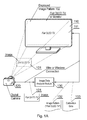
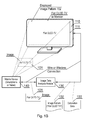
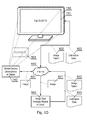
- Figs. 1A-1 F show embodiments of the system for calibrating OLED displays.
- a flat OLED display 110 i.e. a TV screen or a computer monitor, is configured to display on its screen 111 an image pattern 102.
- a digital camera 120 is used to capture an image 101 of the screen 111.
- the image can be captured by the user of the system upon receiving instructions, e.g. on how to setup the lighting (e.g. to capture the image in a daylight or in a dark), what shall be the distance from the display, which area of the display shall be captured by the camera etc.
- the instructions can be displayed or played (as a video) by the display 110 prior to displaying the image pattern 102.
- the captured image 101 is transmitted (by wire or wirelessly) from the camera 120 to an image data analysis module 130.
- the image data analysis module 130 knows the image pattern 102 that has been displayed on the screen 111 while the image 101 was captured.
- the image data analysis module 130 may generate the image pattern 102 and send it to the OLED display 110 for presentation on the screen 111.
- the image data analysis module 130 is configured to compare the captured image 101 with the image pattern 102, determine areas of the screen 111 that need to be calibrated and generate calibration data 103 that are sent (by wire or wirelessly) to the display 110 to calibrate it.
- Fig. 1 B shows an embodiment similar to the one of Fig. 1A , wherein instead of a digital camera 120 device, a mobile device 140 is used, such as a tablet or a smartphone, with an embedded camera.
- a mobile device 140 such as a tablet or a smartphone, with an embedded camera.
- Fig. 1C shows an embodiment similar to the one of Fig. 1A , wherein the image data analysis module 160 is a module operating in a cloud. It can operate according to the SaaS (software as a service) model.
- the image data analysis module 160 is operated by an external server accessible via the Internet 150.
- Fig. 1 D shows an embodiment similar to the one of Fig. 1C , wherein instead of a digital camera 120 device, a mobile device 140 is used, such as a tablet or a smartphone, with an embedded camera.
- a mobile device 140 such as a tablet or a smartphone, with an embedded camera.
- Fig. 1E shows an embodiment similar to the one of Fig. 1D , wherein the mobile device 140 is configured to communicate with the display 110 that is calibrated.
- the mobile device 140 receives the image pattern 102 from the image data analysis module 160, sends it to the display 110 to be calibrated, captures the image 101 of the screen 111, sends it to the image data analysis module 160, receives calibration data 103 generated by the image data analysis module 160 and sends the calibration data 103 to the display 110.
- Fig. 1 F shows an embodiment, wherein the mobile device 140 is configured to communicate with the display 110 that is calibrated and to perform the image analysis, i.e. the image data analysis module is embedded in the mobile device.
- the mobile device 140 sends the image pattern 102 to the display 110 to be calibrated, captures the image 101 of the screen 111, analyzes the captured image 101 to generate calibration data 103 and sends the calibration data 103 to the display 110.
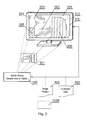
- Fig. 2 shows an example of a system such as shown in Fig. 1 F (which is applicable to other embodiments as well), during use, wherein an image pattern 102A, preferably of a uniform color plane, is displayed on an uncalibrated screen 111. If the screen is discalibrated, areas 202, 203, 205, 206 of shades that diverge from the image pattern 102A may appear on screen (along with areas 201, 204 which display the correct color).
- the captured image 101 contains information about the areas 201-206 and can be used to calibrate the device by generating calibration data 203 that identifies the areas 202, 203, 205, 206 for which color has to be corrected so that, after calibration, the image displayed on screen 111 is closer to the image pattern 102A.
- Fig. 3 shows an example of another system in use, wherein the OLED display 110 is driven by a screen controller 301 with calibration data storage.
- the screen controller 301 may be a dedicated device or may form part of a device that provides a signal to the OLED display, such as a personal computer, a video disc player, a game console, a television set-top box, a video interface etc.
- the image pattern 102A and the calibration data 103 are sent to the screen controller 301.
- the screen controller 301 is responsible for applying the calibration to the signal transmitted to the display 110 such as to compensate the color distortions introduced by the display.
- Fig. 4 shows an example of a structure of the image data analysis module 130, 160.
- the module comprises wired interfaces 402, such as USB, Ethernet, serial port (such as RS-232) and/or wireless interfaces 442, such as Wi-Fi or Bluetooth.
- the interfaces 402, 442 are used to communicate with external devices, such as the camera 120, the mobile device 140, the OLED display 110, the screen controller 301, directly or via a network such as the Internet 150.
- the module operates utilizing memory blocks 430, including RAM 431 and Flash 432 memory blocks.
- Data can be processed using a controller 410 or a digital signal processor 420.
- a clock 450 is used to synchronize the timing of generating the image pattern and capturing of the image of screen, if such timing synchronization is necessary.
- the module is controlled by a controller 410 comprising a plurality of units configured to provide the functionality of the method as described below.
- An image processing manager 411 is configured to manage image processing operations.
- An image decomposition unit is configured to decompose the image, as in steps 604, 705, 807 of the methods presented below.
- a histogram analysis unit is configured to analyze histograms of the captured image, as in steps 605, 706, 808.
- a calibration unit is configured to generate calibration data 103, as in steps 606, 713, 809.
- An image pattern generator is configured to generate image patterns 102, as in steps 601, 702, 803.
- Fig. 5 shows an example of a structure of the mobile device 140 for capturing the screen image.
- the mobile device may comprise data transmitting/receiving blocks 541 and external interfaces 542 for communicating with other devices, such as the image data analysis module 130, 160, the display 110, the screen controller 301, directly or via a network such as the Internet 150.
- the module operates utilizing memory blocks 530, including RAM 531 and Flash 532 memory blocks.
- a clock 550 is used to generate a time stamp for the captured image, if necessary.
- a camera 560 is used to capture the image of the screen.
- a media player 580 can be used to display the captured image on the display 570.
- Data can be processed using a controller 510 or an image signal processor 520.
- the module is controlled by a controller 510 comprising a plurality of units configured to provide the functionality of the method as described below.
- Units 511-515 correspond to the units 411-415.
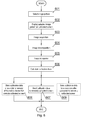
- Fig. 6 shows in general a method for calibrating the OLED display.
- an image pattern is selected.
- the image pattern is preferably a uniform color plane, such as white, red, green, blue or yellow plane.
- the selected image pattern is displayed on screen 602.
- Image is captured in step 603 using a camera (stand-alone or embedded in a mobile device).
- the captured image is processed in step 604 to identify the areas of shades that differ from the image pattern and decompose the captured image into these areas.
- the image is then interpreted in step 605 to determine the amount of correction that need to be applied to the areas 202, 203, 205, 206 diverging from the image pattern such as to improve the correspondence of the area with the image pattern.
- the calibration data is calculated in step 606 based on the determined amount of correction.
- the calibration data is applied to calibrate the display.
- the calibration data is sent in step 607 directly to the remotely calibrated display 110.
- the calibration data can be stored in step 608 in the non volatile memory of the mobile device that controls the calibrated display 110.
- the calibration data can be sent in step 609 to the screen controlled 301 connected to the calibrated display.
- Figs. 7A-7B show details of one embodiment of the calibration procedure.
- the parameters of the image pattern are determined, for example the brightness.
- the image pattern 102 is generated and displayed on the remote calibrated display screen in step 703.
- the image 101 is captured by the camera in step 704.
- the image is then divided into macro-blocks and/or pixels, according to the resolution of the calibrated screen and the camera 705.
- This step may include cropping the captured image such as to disregard the areas that are outside the screen 111 (if a user has captured an image larger than the screen which contains the surrounding of the screen as well) and/or to rotate the image (if the axes of the image do not correspond to the axes of the screen).
- regions of dominant color are determined, based on image histograms in step 706.
- the regions are then analyzed consecutively.
- a first region of a dominant color is selected in step 707 and information about color disturbances for each macro-block and/or pixel of that region is obtained in step 709. That information is recorded in the temporary memory in step 709.
- the procedure then proceeds to other regions in steps 710, 711, until all regions are analyzed.
- step 712 the obtained information about color disturbances for all macro-blocks and/or pixels is read from the temporary memory and calibration data is determined in step 713 for these macro-blocks and/or pixels.
- static white balance i.e. balance for low intensities
- dynamic white balance i.e. balance for high intensities
- step 715 the calibration data is recorded in the non volatile memory of the calibrated display screen 110 or screen controller 301.
- the procedure may then proceed to generating a next image pattern in step 716, which can be the same as the previous pattern (to check whether the calibration was successful for that image pattern and the image quality is improved) or another pattern (to calibrate the display for other conditions).
- the following patterns may be consecutively applied:
- a camera having a higher resolution than the resolution of the display screen is to be used, such that a plurality of pixels of the image captured by the camera are approximated to a single pixel of the display screen.
- the calibrated display is a flat display panel.
- the method and system can be configured to calibrate curved display panels as well, for example by processing the captured image such as to take into account the differences in distance from the camera eye to the region of the display.
- a plurality of images of the display with the image pattern may be captured, for example an image of the left portion of the display taken from the right, an image of the central portion of the display taken in front of the display and an image of the right portion of the display taken from the left.
- a panoramic image can be captured by moving the camera window across the length of the display, from one side to the other.
- Fig. 8 shows details of another embodiment of the calibration procedure.
- the calibration process is invoked in step 801 (e.g. by the user launching a calibration application, or automatically by the system in a periodic manner for example once a month or once a quarter)
- the number of calibration steps are specified in step 802 (for example, by the user selecting a desired level of calibration, such as rough calibration (e.g. 1 step) or detailed calibration (e.g. 6 steps)).
- step 803 a test image pattern 102 is sent to the calibrated display screen. For example, if a plurality of calibration steps are to be performed, and the system is setup to generate image patterns of a white screen only, the consecutive image patterns may differ by the level of brightness.
- an application run at the mobile device may analyze whether the image of the display 110 that is seen by the camera of that device corresponds with predetermined requirements (e.g. such that the display 110 occupies 90% of the field of view of the camera and the edges of the display are substantially parallel to the camera axes) - if not, the user is ordered to redirect the camera in step 812.
- the picture of the screen is captured in step 805.
- the captured image 101 is sent to the image data analysis module in step 806, wherein it is segmented into a number of blocks depending on the resolution of the calibrated screen and the camera in step 807.
- a color histogram is calculated for each block in step 808.
- the calibration data values are next determined based on the histograms in step 809. The calibration is repeated for the required number of iterations in step 810.
- the calculated calibration data is sent to the remote calibrated display screen or to the screen controller in step 811.
- the step of image acquisition 603, 704, 805 may include image correction to compensate for image distortions introduced by the lens of the camera, which is particularly useful for mobile devices with lower-quality camera lens.
- the image correction may be particularly aimed to compensate for distortions of brightness levels, such as vignetting.
- the aforementioned method for calibration of a display screen may be performed and/or controlled by one or more computer programs.
- Such computer programs are typically executed by utilizing the computing resources in a computing device.
- Applications are stored on a non-transitory medium.
- An example of a non-transitory medium is a non-volatile memory, for example a flash memory while an example of a volatile memory is RAM.
- the computer instructions are executed by a processor.
- These memories are exemplary recording media for storing computer programs comprising computer-executable instructions performing all the steps of the computer-implemented method according the technical concept presented herein.
Landscapes
- Engineering & Computer Science (AREA)
- Physics & Mathematics (AREA)
- General Physics & Mathematics (AREA)
- Theoretical Computer Science (AREA)
- Computer Hardware Design (AREA)
- Signal Processing (AREA)
- Multimedia (AREA)
- Biomedical Technology (AREA)
- General Health & Medical Sciences (AREA)
- Health & Medical Sciences (AREA)
- Computer Vision & Pattern Recognition (AREA)
- Electroluminescent Light Sources (AREA)
- Control Of Indicators Other Than Cathode Ray Tubes (AREA)
- Controls And Circuits For Display Device (AREA)
Priority Applications (2)
| Application Number | Priority Date | Filing Date | Title |
|---|---|---|---|
| EP16181445.4A EP3276602A1 (de) | 2016-07-27 | 2016-07-27 | Verfahren und system zur kalibrierung eines anzeigebildschirms |
| US15/660,974 US20180033361A1 (en) | 2016-07-27 | 2017-07-27 | Method and system for calibrating a display screen |
Applications Claiming Priority (1)
| Application Number | Priority Date | Filing Date | Title |
|---|---|---|---|
| EP16181445.4A EP3276602A1 (de) | 2016-07-27 | 2016-07-27 | Verfahren und system zur kalibrierung eines anzeigebildschirms |
Publications (1)
| Publication Number | Publication Date |
|---|---|
| EP3276602A1 true EP3276602A1 (de) | 2018-01-31 |
Family
ID=56683723
Family Applications (1)
| Application Number | Title | Priority Date | Filing Date |
|---|---|---|---|
| EP16181445.4A Withdrawn EP3276602A1 (de) | 2016-07-27 | 2016-07-27 | Verfahren und system zur kalibrierung eines anzeigebildschirms |
Country Status (2)
| Country | Link |
|---|---|
| US (1) | US20180033361A1 (de) |
| EP (1) | EP3276602A1 (de) |
Families Citing this family (8)
| Publication number | Priority date | Publication date | Assignee | Title |
|---|---|---|---|---|
| US10803988B2 (en) * | 2017-03-20 | 2020-10-13 | SK Commercial Construction, Inc. | Color analysis and control using a transparent display screen on a mobile device with non-transparent, bendable display screen or multiple display screen with 3D sensor for telemedicine diagnosis and treatment |
| US10290120B2 (en) * | 2017-03-20 | 2019-05-14 | SK Commercial Construction, Inc. | Color analysis and control using an electronic mobile device transparent display screen |
| US10390009B1 (en) * | 2018-04-25 | 2019-08-20 | Avago Technologies International Sales Pte. Limited | System, method, and computer-readable medium for adaptive display calibration and profiling |
| KR102549537B1 (ko) * | 2018-06-05 | 2023-06-29 | 삼성전자주식회사 | 디스플레이의 화질을 조정하는 사용자 단말기 및 그 동작 방법 |
| WO2022044478A1 (ja) * | 2020-08-25 | 2022-03-03 | 株式会社Jvcケンウッド | 評価システム、評価管理方法、端末装置及び評価方法 |
| CN113176742A (zh) * | 2021-03-24 | 2021-07-27 | 广东芬尼克兹节能设备有限公司 | 多设备间的集控控制方法及装置 |
| CN115278190A (zh) * | 2021-04-30 | 2022-11-01 | 卡莱特云科技股份有限公司 | 一种视频数据显示色彩的校准方法、校准设备及校准系统 |
| CN116546176B (zh) * | 2022-09-28 | 2025-11-14 | 腾讯科技(深圳)有限公司 | 一种色彩校正的方法、相关装置、设备以及存储介质 |
Citations (5)
| Publication number | Priority date | Publication date | Assignee | Title |
|---|---|---|---|---|
| US20030053044A1 (en) | 2001-09-18 | 2003-03-20 | Xerox Corporation | Color balance control in organic light emitting diode displays |
| US20060262147A1 (en) * | 2005-05-17 | 2006-11-23 | Tom Kimpe | Methods, apparatus, and devices for noise reduction |
| US20120299973A1 (en) * | 2011-05-26 | 2012-11-29 | Ignis Innovation Inc. | Adaptive Feedback System For Compensating For Aging Pixel Areas With Enhanced Estimation Speed |
| US20130194199A1 (en) * | 2012-02-01 | 2013-08-01 | Apple Inc. | Organic light emitting diode display having photodiodes |
| US20150145841A1 (en) * | 2013-11-28 | 2015-05-28 | Samsung Electronics Co., Ltd. | Apparatus and method for generating correction data, and image quality correction system thereof |
-
2016
- 2016-07-27 EP EP16181445.4A patent/EP3276602A1/de not_active Withdrawn
-
2017
- 2017-07-27 US US15/660,974 patent/US20180033361A1/en not_active Abandoned
Patent Citations (5)
| Publication number | Priority date | Publication date | Assignee | Title |
|---|---|---|---|---|
| US20030053044A1 (en) | 2001-09-18 | 2003-03-20 | Xerox Corporation | Color balance control in organic light emitting diode displays |
| US20060262147A1 (en) * | 2005-05-17 | 2006-11-23 | Tom Kimpe | Methods, apparatus, and devices for noise reduction |
| US20120299973A1 (en) * | 2011-05-26 | 2012-11-29 | Ignis Innovation Inc. | Adaptive Feedback System For Compensating For Aging Pixel Areas With Enhanced Estimation Speed |
| US20130194199A1 (en) * | 2012-02-01 | 2013-08-01 | Apple Inc. | Organic light emitting diode display having photodiodes |
| US20150145841A1 (en) * | 2013-11-28 | 2015-05-28 | Samsung Electronics Co., Ltd. | Apparatus and method for generating correction data, and image quality correction system thereof |
Also Published As
| Publication number | Publication date |
|---|---|
| US20180033361A1 (en) | 2018-02-01 |
Similar Documents
| Publication | Publication Date | Title |
|---|---|---|
| US20180033361A1 (en) | Method and system for calibrating a display screen | |
| KR102468270B1 (ko) | 전자 장치, 그의 디스플레이 패널 장치 보정 방법 및 보정 시스템 | |
| KR102545813B1 (ko) | 디스플레이 장치 및 디스플레이 방법 | |
| CN106373523B (zh) | 拼接亮暗线补偿方法 | |
| US10121418B2 (en) | Apparatus and method for controlling video wall | |
| US9236027B2 (en) | Display system and computer-readable medium | |
| CN103067743B (zh) | 液晶电视的快速调整系统及方法 | |
| CN104240674B (zh) | 一种调节显示单元的方法及一种电子设备 | |
| EP3514785A1 (de) | Bildschirmkalibrierungsverfahren und bildschirmkalibrierungssystem mit fähigkeit zur automatischen korrektur von vollrasterfarbtönen | |
| US8174626B2 (en) | Apparatus and method for correcting images displayed by a plurality of image apparatus | |
| US20170208309A1 (en) | Image projection system, projector, and method for controlling image projection system | |
| US8454171B2 (en) | Method for determining a video capture interval for a calibration process in a multi-projector display system | |
| US8717389B2 (en) | Projector array for multiple images | |
| KR102425404B1 (ko) | 표시 장치 및 이의 휘도 보정방법 | |
| CN112367557B (zh) | Led电视墙的显示方法、电视和计算机可读存储介质 | |
| US20140035893A1 (en) | Color adjustment based on object positioned near display surface | |
| KR20170042717A (ko) | 주변 광-기반 이미지 조정 | |
| CN105389809B (zh) | 显示性能测试方法、系统和装置 | |
| US20160321976A1 (en) | Optical compensation system and optical compensation method thereof | |
| US20140160101A1 (en) | Display wall adjusting apparatus and method for adjusting display parameters of display screens of display wall | |
| KR20170042846A (ko) | 전자 장치, 그의 디스플레이 장치 보정 방법 및 보정 시스템 | |
| KR102746914B1 (ko) | 전자 장치, 디스플레이 장치 및 그 제어 방법 | |
| US10937354B2 (en) | Electronic device and control method thereof | |
| US9280936B2 (en) | Image display unit, mobile phone and method with image adjustment according to detected ambient light | |
| US10205940B1 (en) | Determining calibration settings for displaying content on a monitor |
Legal Events
| Date | Code | Title | Description |
|---|---|---|---|
| PUAI | Public reference made under article 153(3) epc to a published international application that has entered the european phase |
Free format text: ORIGINAL CODE: 0009012 |
|
| STAA | Information on the status of an ep patent application or granted ep patent |
Free format text: STATUS: THE APPLICATION HAS BEEN PUBLISHED |
|
| AK | Designated contracting states |
Kind code of ref document: A1 Designated state(s): AL AT BE BG CH CY CZ DE DK EE ES FI FR GB GR HR HU IE IS IT LI LT LU LV MC MK MT NL NO PL PT RO RS SE SI SK SM TR |
|
| AX | Request for extension of the european patent |
Extension state: BA ME |
|
| STAA | Information on the status of an ep patent application or granted ep patent |
Free format text: STATUS: THE APPLICATION IS DEEMED TO BE WITHDRAWN |
|
| 18D | Application deemed to be withdrawn |
Effective date: 20180801 |