EP3276904B1 - Verfahren und system für mtd - Google Patents
Verfahren und system für mtd Download PDFInfo
- Publication number
- EP3276904B1 EP3276904B1 EP16020289.1A EP16020289A EP3276904B1 EP 3276904 B1 EP3276904 B1 EP 3276904B1 EP 16020289 A EP16020289 A EP 16020289A EP 3276904 B1 EP3276904 B1 EP 3276904B1
- Authority
- EP
- European Patent Office
- Prior art keywords
- server
- address
- client
- shared
- socket
- Prior art date
- Legal status (The legal status is an assumption and is not a legal conclusion. Google has not performed a legal analysis and makes no representation as to the accuracy of the status listed.)
- Active
Links
Images




Classifications
-
- H—ELECTRICITY
- H04—ELECTRIC COMMUNICATION TECHNIQUE
- H04L—TRANSMISSION OF DIGITAL INFORMATION, e.g. TELEGRAPHIC COMMUNICATION
- H04L63/00—Network architectures or network communication protocols for network security
- H04L63/14—Network architectures or network communication protocols for network security for detecting or protecting against malicious traffic
- H04L63/1441—Countermeasures against malicious traffic
- H04L63/1458—Denial of Service
-
- H—ELECTRICITY
- H04—ELECTRIC COMMUNICATION TECHNIQUE
- H04L—TRANSMISSION OF DIGITAL INFORMATION, e.g. TELEGRAPHIC COMMUNICATION
- H04L63/00—Network architectures or network communication protocols for network security
- H04L63/16—Implementing security features at a particular protocol layer
- H04L63/164—Implementing security features at a particular protocol layer at the network layer
Definitions
- the present invention refers to a method and a system for enabling at least one node of a communication network including a plurality of nodes to maintain or initiate communication with a process of another node although a present socket address of the process is changing.
- IP Internet Protocol
- Known communication protocols assign globally a unique address to a node of a communication network, respectively, to identify and facilitate communication between nodes in a communication network.
- IP Internet Protocol
- a combination of the IP address of a node and a port number is called a socket address.
- the port number in the socket address can be designated to a process which runs on the respective node.
- a data packet sent from a first node acting as a source node to a second node acting as a destination node includes a destination socket address (and may also include a socket address of the source node).
- the destination IP address included in the data packet plays a significant role in guiding network elements to route the data packet to the destination node through the network.
- the port number included in the data packet identifies a specific process of the destination node. During transit from the source node to destination node, a data packet can be examined to reveal the destination socket address.
- a process on a node can be available for communication and can be viewed as a service offered by a node to other nodes in the network.
- the server is a node which offers at least one service to a set of clients. It might happen that the service offered from the server is not accessible or denied to the clients requiring the service. This situation in literature is generally called Denial of Service (DoS). DoS inflicted upon clients could be deliberate or non-deliberate on part of the server. In some cases of deliberate DoS to clients, the server may discretely deny the service to a specific set of clients.
- DoS Denial of Service
- the server is ready to deliver a service
- the clients are denied of service which clearly is a non-deliberate DoS from the server.
- DoS attacks on a server induce non-deliberate DoS to the clients, where the server is unable to respond to service requests from the clients or there could be a degradation in service offered to the clients.
- DoS attacks aim to overwhelm and exhaust resources on the server such that the server becomes unresponsive to the clients.
- DoS attacks mentioned further in the document refer to network based DoS attacks. Typical examples of DoS attacks include Ping of Death, TCP SYN attack etc.
- Preventing DoS attacks are of high importance for a service oriented business, where an adversary could inflict loss and embarrassment to the business.
- DDoS attack a DoS attack originating from a plurality of sources is called Distributed DoS (DDoS) attack.
- a DDoS attack has the ability to magnify the DoS attack on a service.
- DDoS attacks are coordinated among several sources to exceed the finite resources of a server and are of concern for businesses. It can be difficult for a victim to expect and prepare for such an attack. Numerous examples of such attacks are available in literature. It is therefore necessary for a respective defender to develop strategies which could help mitigate effects or prevent DoS attacks.
- MTD Malignant Target Defense
- Moving Target IPv6 Defense from Dunlop et al. ( M. Dunlop, S. Groat, W. Urbanski, R. Marchany and J. Tront, "MT6D: A Moving Target IPv6 Defense," 2011 - MILCOM2011 Military Communications Conference, Baltimore, MD, 2011, pp. 1321-1326 ) use vast address space of IPv6 to periodically rotate the IP address of a host.
- the method described by Dunlop et al. requires that each host maintain records of one-one mapping of other MT6D hosts.
- Jafarian et al. Jafar Haadi Jafarian, Ehab Al-Shaer, and Qi Duan. 2012. Openflow random host mutation: transparent moving target defense using software defined networking.
- MT6D maintains a one-one record on each host about the communicating hosts. This might hamper the efficiency of performing hosts because in a client-server infrastructure, as a number of clients increases the load on the server increases. It is to be observed that while hopping IP addresses of the server is the norm, the addresses that can be used need to be verified to be free and unused. This is of specific concern in IPv4.
- OF-RHM uses the infrastructure of SDN and needs flow rules defined and updated for the hopping virtual IP addresses. This affects scalability of the OF-RHM method. It is of concern for scalability in SDN shuffle considering that the server needs to maintain translation rules for each client in communication.
- IP address hopping approaches have also been suggested in some patent documents.
- Wright Sr David D. U.S. Patent 9,203,798 describes a method wherein an end node hops its IP address in pseudo random order picked from a sequential set of IP addresses typically available in a network suffix. Further the source node communicating with the end node is able to follow the hopped IP address of the end node. Previously used IP addresses may not be used in future hops.
- Macdaniel US Patent 7,114,005 describes a method in a packet switched network where a translation module at the source node side translates the source and destination addresses in a data packet and at the destination side when the data packet is received at another translation module the translated addresses are resolved into original addresses before the data packet reaches to the intended destination node. Hopping of IP address is possible in translated addresses.
- Shawcross, US Patent 6,889,090 describes a method where the server uses the multicast address, such that the clients connecting to the server should already be registered with the server thus avoiding potential attacks from unregistered clients.
- US2004059944 discloses DDoS protection.
- the service is provided in successive time intervals at different active network addresses. Only authorized service users know the address at the specified time.
- a common secret "seed" is used to initialize a pseudo-random number generator and further a table is used which contains an association between time intervals and active network addresses in an address pool.
- Patent documents described so far might not scale well for a scenario like client-server paradigm where a plurality of clients is served by a single server.
- An attacker can launch an address based DOS attack on the server and further clients may not be able to access the server.
- the hopping of IP addresses is not contained to a specific set of IP addresses. Containment of hoppable set of IP addresses is of particular importance when taking lease of IP addresses for a server. It is also possible that available free addresses may not be available in a sequential order but rather randomly distributed. It is now of practical importance to hop in the available set of IP addresses and further efficiently mitigate DOS attack efforts from adversaries.
- IP addresses in IPv4 are of high value in the current industry. MTD techniques need to treat IP addresses as a valuable resource and facilitate their reuse.
- the present invention provides a method according to the independent claim 1.
- a communication network includes a plurality of nodes.
- a process on a first node in the following called “server” can be accessed by at least one second node, in the following called “client”, using a first socket address comprising IP address of the server and a port number of the process running on the server.
- the first socket address changes to a second socket address and the at least one second node, i.e. the client in communication with the first process is able to track a change in socket address of the process of the first node.
- the method and the system according to the present invention enable at least one node to maintain or initiate communication with the process of the first node although the socket address of the process is changing (hopping).
- the server can provide one or more services to one or more clients. In the following all explanations dealing with "a client” and "the client”, are also valid for a plurality of clients.
- socket addresses are used since an adversary can learn about all the IP addresses and launch attack on all the observed hoppable IP addresses simultaneously. For example, an adversary targeting a known service like Hypertext Transfer Protocol (HTTP) can attack designated port 80 on all the observerd hopping IP addresses. Therefore, socket addresses can be interchanged with IP addresses in cases where there are sufficiently many available IP addresses to hop.
- HTTP Hypertext Transfer Protocol
- a hopping only in the IP address space is also accompanied by a respective change of the socket address of the service running on the server whose IP address is changed.
- step (d) further comprises the step of generating a random number, the generated random number being used to select the new socket address from the address bank.
- generating the random number is based on the at least one shared event and the at least one shared secret.
- This step can be realised by an algorithm running as random number generator (RNG) on server side and on client side, respectively, and which takes the shared event and the shared secret as input to give a random number.
- RNG random number generator
- This random number can be pseudo or truly random in nature.
- the RNGs and their inputs on both sides, i.e. on server side and on client side, must be identical. Further, the generation of the random number on server side must be synchronized with the generation of the random number on client side.
- a frequency of the generation of a random number is decided by the time intervals of the occurence of the at least one shared event.
- the at least one shared event can be configured to alter time intervals for longer or shorter durations.
- step (b) further comprises the step of arranging the address bank in an array spanning a 2D-address space, wherein a first dimension represents an available number m of IP addresses and a second dimension represents an available number n of port numbers on the server, wherein m, n are integers, thus forming an address space of m x n socket addresses.
- the available number m of IP addresses is composed of IPv4 and/or IPv6 addresses.
- the IP addresses which are used may be a partial set of the available IP addresses. Those selected IP addresses are combined with a respective set of port numbers in a unpredictable manner.
- a possible mechanism for a non sequential ordering of addresses could be shuffling the address space as, for example, by applying the Fisher-Yates algorithm.
- the at least one shared event in step (a) is chosen as a time interval signaled by synchronized clocks between the client and the server or as an instruction from the server to the client.
- an event i.e. the at least one shared event
- the at least one shared event can also be a combination of different types of events.
- step (a) is performed at an initialization phase of a moving target defense (MTD) procedure extending at least to the server and the client or by an authentication procedure performed between the server and the client.
- MTD moving target defense
- the method further comprises the step of establishing of trust between the client and the server by an authentication mechanism, including sharing the address bank, the at least one shared event and the at least one shared secret.
- an authentication algorithm (mechanism) is running on both, on server and on client side.
- the authentication algorithm provides means to establish trust between the client and the server. It may include exchange of confidential information through out of band communication or through secure communication in band.
- band communication refers to a communication which happens in a communication link which hosts use in the communication network and may be visible to at least another host.
- Out of band communication refers to a communication which takes place in a link different from the link used by hosts in the communication network. It could be, for example, that hosts exchange message through an encrypted channel or a separate secured channel. Or in some cases users exchange information and feed it to their hosts, where users become the out of band channel.
- the authentication algorithm running at the client may enable generation of a client secret exchanged with authentication algorithm running at the server, on the basis of which the authentication algorithm running at the server may add the corresponding client to the records.
- the claimed method can further comprise the step of (e) on occurence of the shared event, converting the socket address of a data packet at the client having before occurence of the shared event the present socket address as destination address, into the new socket address as destination address.
- step (a) comprises the step of generating a plurality of shared events according to predefined strategies, thus defining whether a time interval between two successive events, respectively, is regular or irregular or a combination of regular and irregular.
- the present invention also refers to a system for enabling at least one node of a communication network including a plurality of nodes, the at least one node acting as a client, to maintain communication with a process of another node acting as server, although a present socket address of the process is changing.
- the claimed system comprises components according to the independent claim 10.
- At least one of the components A, B, C, and D comprises two subcomponents, a respective client component and a respective server component, which are configured to fulfill in cooperation the respective function of the respective at least one component A, B, C, or D.
- system further comprises a proxy server which is configured to employ instances of at least some of the system components A, B, C, and D or some of the respective subcomponents.
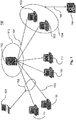
- Figure 1 shows a diagram representing a client-server paradigm which contains a server 112 and clients 111.
- the server 112 is responsible in delivering a service 113 to at least one client 111.
- a data packet flow between client 111 and server 112 can be explored by an adversary 101 on performing reconnaissance efforts 102 to reveal key information about a topology of a network including the client 111 and server 112 socket addresses.
- the adversary after performing reconnaissance 102 may be able to fix on the target socket address of the server offering the service 113.
- the adversary intending a malicious intention to compromise service 113 now has enough information to launch a DoS attack 107.
- a DoS attack on the service 113 can cause significant service degradation if not service denial to the clients 111 shown in the Figure 1 .
- a network of attacking nodes 103 may be configured by the adversary using a controller 106 and link 105. It can be seen that an adversary broadly employs the following steps to launch DDoS or DoS attacks:
- MTD Moving Target Defense
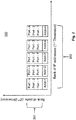
- FIG. 2 is a block diagram representing an address space used by MTD for selection of addresses.
- the socket address space 200 is composed of 2-dimensions.
- the first dimension represented on the horizontal axis is available IP number m of addresses 202 which may be composed of IPv4 or IPv6 addresses.
- the second dimension represented on the vertical axis is the available number n of port numbers 201 on the server 112.
- Availability of IP addresses 202 and port numbers 201 are explained below: Availability of IP addresses 202 concerns with not duplicating or interruption of resources in a network. Particularly IP addresses are unique in a given network. Therefore, no two nodes in the network can be assigned the same IP address. IP addresses are generally assigned by an authority responsible in distribution.
- Availability of port numbers 201 A process running on a node, i.e. on the server can open for communication on the network via one of 65536 ports on the node. Certain port numbers are reserved by Internet Assigned Numbers Authority (IANA). Therefore, a subset of 65536 may be available for a process on the server to operate on a port not overlapping with the reserved ports. Further, the availability of port numbers is limited by those port numbers which are currently in use and which are, therefore, no longer available.
- IANA Internet Assigned Numbers Authority
- the address space can now be formed of m x n socket addresses 200.
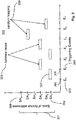
- FIG. 3 shows a block diagram which represents a selection scheme 300 showing the key features of the MTD mechanism.
- the horizontal axis represents a temporal occurrence of a shared event.
- An occurrence of event E1 303 is shown by point in time 305.
- the vertical axis represents the socket address space 200 arranged in some known order called the bank of socket addresses 301. It could be that socket address space 200 is arranged sequentially or non-sequentially.
- An event 303 is a coordinated activity between the server 112 and its clients 111 on the occurrence of which the client 111 and the server 112 select and hop to a new socket address different from the present socket address. Hopping to a new socket address shows that from the duration of event E1 303, i.e.
- socket address SA1 302 is used, collectively represented by socket address duration 307.
- the client 111 communicates with service 113 of server 112 using the socket address SA1 302.
- This method can be extended for future shared events.
- Socket address SA2 is in use from the duration of occurrence of event E6 to E7.
- the events represented on the horizontal axis can belong to a set of events comprising various activities that can act as triggers.
- the events, i.e. the shared events may be time intervals signaled by synchronized clocks between clients 111 and server 112.
- the events can overlap for a suitable time to facilitate practical implementations.
- An event can also be an instruction from the server 112 to clients 111.
- Strictly an event can be anything that signals a hop of socket address at server 112 and clients 111.
- the events represented on the horizontal axis can belong to a single type of event or a combination of type of events.
- Address reuse 308 It shows that a socket address in the socket address bank can be reused in future hops. It is this feature which promotes efficient and economical use of IP addresses. Especially in limited address space of IPv4, reuse of IP address shows the relevance in IPv4 dominated networks and is extendable to IPv6.
- Random hopping 309 It shows that on the occurrence of an event, i.e. a shared event, the socket address used on the next hop is truly random or pseudo random compared to the present socket address used before the occurrence of the event. With this feature it is difficult to predict the next socket address that will be used.
- time intervals between hopping are defined by the temporal occurrence of the events, it can be observed that time intervals can be regular or irregular or a combination of regular and irregular as agreed between the clients 111 and server 112.
- Figure 4a is more specific; Figure 4b is more open giving opportunity for variations.
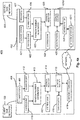
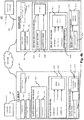
- FIG. 4a shows a block diagram of an embodiment of the claimed system.
- An example network includes a client 401 similar to client 111 and a server 402 similar to server 112.
- client side network 403 connected to client 401 in the case of which client 401 acts as a border device for client side network 403.
- server side network 404 connected to a server 402, in the case of which server acts as a border device for the server side network 404.
- the operations and nature of components of server 402 and client 401 can be understood as follows:
- AUTHENTICATION 421 shares ADDRESS BANK 424 with the AUTHENTICATION 411 to create a copy of ADDRESS BANK 424 as ADDRESS BANK 417. Additionally AUTHENTICATION 421 may also share SHARED SECRET 428, SHARED EVENT 422 and RNG 423 as SHARED EVENT 416, SHARED SECRET 412 and RNG 413, respectively. The sharing of information may occur more than once in the lifetime of MTD.
- ADDRESS SELECTOR 429 and 414 This pair represents rules and policies to select a socket address from the corresponding ADDRESS BANK using the random number generated by the corresponding RNG.
- the ADDRESS BANK 417 may be arranged in an array and random number generated by RNG 413 may be transformed to point to an index of the array.
- socket addresses are generated both at client 401 and server 402 if the respective pairs of SHARED EVENT, SHARED SECRET and ADDRESS BANK are identical.
- ADDRESS MODIFIER 4210 and 415 This pair provides means to modify a header of data packets 418.
- ADDRESS MODIFIER 415 is responsible in using the selected new socket address from ADDRESS SELECTOR 414, to modify the destination address of the DATA PACKETS 418 destinated to server 402.
- ADDRESS MODIFIER 4210 is responsible in configuring the selected new socket address from ADDRESS SELECTOR 429 such that data packets modified by PACKET MODIFIER 415 reach the server 402. It may include configuring switch rules in the network or the network interface 4211 such that data packets originating from client 401 intended to be received by server 402 are routed and received by server 402. Further ADDRESS FILTER 426 may provide means to filter the data packets arriving at server 402. Data packets containing obsolete socket addresses can be filtered before reaching the server 402.
- Client 401 could access or communicate with a service running on server 402 when using the selected new socket address. A mutual communication between client 401 and server 402 using the new socket address is possible.
- DATA PACKETS 425 may also include data traffic from internal network if client 401 or server 402 or both, client 401 and server 402 are acting as edge devices.
- ADDRESS MODIFIER 4210 may include flow rules for mapping data packets to the correct node using translation rules in the corresponding internal device known to anybody skilled in the art.
- a server 402 which implements the explained modules of MTD is said to be defended from DOS attacks.
- FIG. 4b shows a block diagram of an embodiment of the claimed system 400.
- An example network includes a client 401 similar to client 111 and a server 402 similar to server 112.
- client side network 403 connected to client 401 in the case of which case client 401 acts as a border device for client side network 403.
- server side network 404 connected to a server 402, in the case of which the server acts as a border device for the server side network 404.
- the operations and nature of components of the server 402 and client 401 can be understood as follows:
- SNM 4241 can share SHARED EVENT 4220 and SHARED SECRET 4280 with CNM 4171 as SHARED EVENT 4160 and SHARED SECRET 4120, respectively. Additionally SNM 4241 includes RECORDS 4243 which contain the information of all trusted clients 401 established during CLIENT SECRET 4172 transactions and records of clients 401 are expected to communicate in the future. In a typical case, CNM 4171 communicates with SNM 4241 as a result of which a copy of CLIENT SECRET 4172 exists as CLIENT SECRET 4242 at the server 402.
- CNM 4171 and SNM 4241 may act in accordance during the lifetime of MTD to negotiate and apply changes SHARED EVENT 4160 and 4220, SHARED SECRET 4120 and 4280 and ADDRESS BANK 4170 and 4240 between the client 401 and server 402.
- Such application of changes during the lifetime of MTD enhances the flexibility of operation towards mitigating DoS attacks by adapting to the environment.
- SELECTION MEANS 4140 and 4270 include methods to select a new socket address from the ADDRESS BANK.
- the SELECTION MEANS 4140 and 4270 are identical.
- ADDRESS SELECT 4141 and 4271 responsible in selecting the new socket address takes SHARED EVENT, SHARED SECRET and ADDRESS BANK as inputs.
- the new socket address is selected from the ADDRESS BANK.
- Such selected new socket address agrees with the features shown in the address hopping scheme shown in Figure 3 .
- ADDRESS SELECT 4141 and ADDRESS SELECT 4271 are the same, then identical socket addresses are selected. Occurrence of an event, i.e. a shared event, signals SELECTION MEANS to select a new socket address.
- ADDRESS SELECT defines strategies and methods involved in hopping. Such methods could be changed during the lifetime of MTD by CNM 4171 and SNM 4241 and adapted to the preferred level of defense.
- the selected new socket address is saved as SELECTED ADDRESS 4142 and 4242 at client 401 and server 402, respectively.
- EVENT GENERATOR 4230 is responsible in signaling events at server 402. In cases of synchronous event generation between client 401 and server 402, SELECTION MEANS 4270 can share the EVENT GENERATOR 4230 with SELECTION MEANS 4140. In other cases, server 402 can instruct generation of event to SELECTION MEANS 4140 when MTD is active. EVENT GENERATOR 4230 decides whether the time interval between events is regular or irregular or a combination of regular and irregular. EVENT GENERATOR 4230 may change strategies on generating events midway of operation while MTD is being used.
- COMMUNICATION MEANS 4150 and 4232 include methods to enable communication between client 401 and server 402 on the communication network. The operation can be understood as follows:
- COMMUNICATION MEANS are able to cater to needs of the internal network by using translation rules in case of which client 401 and server 402 act as edge devices for their internal networks.
- translation rules can be understood by ones skilled in the art.
- Data packets may be authenticated and check for authentication at client 401 and server 402. Such authentication may be in the form of encrypting/decryption of data packets.
- AUTHENTICATION 4111 may encrypt the data packet out-bound to server 402 using the CLIENT SECRET 4172 and such in-bound packets can be decrypted by AUTHENTICATION 4233 using the CLIENT SECRET 4242 stored in RECORDS 4243.
- the present socket address used in previous to occurrence of the latest shared event is to be closed completely and no communication is entertained in that socket address. This includes closing the ports and IP address except the selected new socket address.
- a temporal overlap of the usage of "old" and new socket address is desireable to facilitate practical applications and to run other MTD applications by the server.
- a server 402 employing MTD mechanisms thus discusses is said be defended from DoS attacks.
- SELECTION MEANS can also negotiate a new ADDRESS BANK.
- SELECTION MEANS 4270 may obtain a new sample from a super set of ADDRESS BANK 4240 available at server. Such samples can be refreshed during the lifetime of MTD and negotiated with client 401 using NEGOTIATION MEANS.
- the source of super set of ADDRESS BANK can be obtained by an IP address distribution authority.
- entities such as IANA can offer a set of available public IP addresses to the server.
- Internet Service Providers can offer IP addresses to their client servers.
- RECORDS at server 402 contain information of legitimate clients participating or may participate with MTD operation of server. RECORDS may be used to segregate clients into different classes. Such division of classes can be used to offer varied levels of defense for the server.
- MTD enabled server MS
- MTD enabled clients MC
- FIG. 5 shows a further embodiment of a claimed system.
- the infrastructure shown here introduces an additional entity called proxy server.
- the proxy server apart from performing the activities known to one skilled in the art also employs instances of MS and MC.
- Such proxy server are called MTD enabled Proxy Server (MPS).
- MPS MTD enabled Proxy Server
- MPS can develop abstractions for hierarchical implementations of the MTD infrastructure.
- a set of MC 531, 532, 533 and 534 intend to communicate with MS 501 to access a service.
- MPS 511 includes MC 512 and MS 513.
- MS 513 is involved in communication via link 514 with MC 531 and MC 532.
- MPS 521 includes MC 522 and MS 523.
- MS 523 is involved in communication via link 524 with MC 533 and 534.
- Data packets from MS 523 can be communicated to the MC 522 of the MPS 521.
- MC 512 and MC 522 are in communication with MS 501.
- Figure 6 provides block diagrams of possible MTD abstractions using the elements MS, MC and MPS introduced in Figure 5 .
- Figure 6a shows a block diagram representing communication between three clients C 1 , C 2 and C 3 611 similar to clients 111 intending to communicate with a server S 614 similar to server 112.
- Clients 611 represent the client side network 403 and server 614 represents the server side network 404 connected to MC 612 and MS 613, respectively.
- MS 613 and MC 612 acting as edge devices connected via MTD enabled link 615.
- server 614 benefits from the defense against DoS attacks.
- Figure 6b shows a block diagram in case where MS 625 defending server S 626 communicates with MC 1 621 and MC 2 622.
- MS 625 needs to include MS 1 623 and MS 2 624 communicating with MC 1 621 and MC 2 622, respectively.
- This abstraction enables MS 625 to communicate with MCs belonging to different networks or clients belonging to different classes who may reside in the same network.
- This abstraction illustrates a possible use case for class of service provided in accordance with RECORDS mentioned in Figure 4a and Figure 4b .
- the ADDRESS BANK of MS 1 623 and MS 2 624 are composed of different subsets of superset of ADDRESS BANK of MS 625.
- MC 1 621 and MC 2 622 may belong to different class of service at the MS 625. This may enable differential defense offered to MS 1 623 compared to MS 2 624. For example a higher defense on MS 1 623 guarantees a higher availability of service to MC 1 621 compared to MC 2 622 in terms of penetration of DoS attacks aimed at MS 1 623 and MS 2 624. Further, this enables the possibility of isolation of delivery of service between clients MC 1 621 and MC 2 622 both associated with MS 624.
- Figure 6c shows a block diagram in case where MC 635 providing communication for client C 636 communicates with MS 1 631 and MS 2 632.
- MC 635 needs to include MC 1 633 and MC 2 634 communicating with MS 1 631 and MS 2 632, respectively. This abstraction enables MC 635 to communicate with MSs belonging to different networks. In this case MS 1 and MS 2 are defended against DoS attacks.
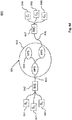
- FIG. 6d introduces an MTD network (MN) 645 which includes a network of MPS 644 similar to MPS 511 or MPS 521.
- Communication is intended between set of servers S1, S2, S3 641 similar to server 112 and set of clients C1, C2, C3 648 similar to client 111.
- the servers 641 can join the MN 645 using an edge device in the form of MS 642 via link 643 and clients can connect to MN 645 using the MC 647 via link 646.
- service requests from clients 648 can reach MC 647 to be routed via MN 645 to reach MS 642 and finally reach servers 641.
- Internal routing in the MN 645 can be determined by known methods of routing.
- the set of servers 641 are defended from DoS attacks. For an adversary performing reconnaissance, it becomes increasingly challenging to determine the topology of the network.
- FIG. 6e shows a block diagram illustrating an example MN 645. Further this abstraction of MN 645 can be extended for higher and more complex MN 645.
- the MN includes MPS-x 651, 652 and 653 similar to MPS 511 or MPS 521.
- the MPS-x of an MN 645 includes N-1 number of MC and a single MS where N is the total number of intended MPS that need to be connected with each other.
- MPS-x 651, 652 and 653 are interconnected and intending to communicate. As an example operation consider the following: MPS-1 651 uses MS-1 6511 to communicate with MPS-2 652 and MPS-3 653 using MC-1 6522 and 6532, respectively.
- MPS-1 651 This establishes a defense mechanism for MPS-1 651 against DoS attacks.
- Outbound traffic from either clients MC-1 6522 or 6532 use the address of the MS-1 6511.
- MPS-1 651 can use MC-2 6512 to send packets addressed to MS-2 6521.
- MPS-2 652 is defended against DoS attacks.
- This combination of communication can be extended to other possibilities in the MN 645 (see Figure 6d ).
- the MPS-x in the MN 645 can share the ADDRESS BANK only to be taken care that there is not collision of IP addresses used. Such coordinated use of ADDRESS BANK between a plurality of MPS can be visualized by one skilled in art.
- the communication operations employed by MPS-x can be exploited to server as Virtual Private Networks (VPN).
- VPN Virtual Private Networks
- a given MPS acting as a VPN server can open clients at its internal network for VPN with other clients connected to the internal network of another MPS serving as another VPN server.
- MS-MC pair shown in Figure 5 and in entirety of Figure 6 may be possible to share the same ADDRESS BANK with other MS-MC pairs, the SELECTION MEANS operation in each MS-MC pair is responsible to ensure that a hopped socket address contains a unique IP address visible in the scope of the network.
- ADDRESS BANK Such co-ordinated use of ADDRESS BANK further exemplies the claims of the method intending the economic use of address space.
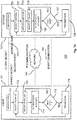
- Figure 7 shows a schematic diagram 700 of a flow of operations performed by client 701 and server 702. The flow can be analyzed as described below.
Landscapes
- Engineering & Computer Science (AREA)
- Computer Security & Cryptography (AREA)
- Computer Hardware Design (AREA)
- Computing Systems (AREA)
- General Engineering & Computer Science (AREA)
- Computer Networks & Wireless Communication (AREA)
- Signal Processing (AREA)
- Data Exchanges In Wide-Area Networks (AREA)
- Computer And Data Communications (AREA)
Claims (12)
- Verfahren für das Befähigen mindestens eines Knotens eines Kommunikationsnetzwerts, das eine Mehrzahl von Knoten einschließt, wobei der mindestens eine Knoten als Client fungiert, eine Kommunikation mit einem Prozess eines anderen Knotens, der als Server fungiert, aufrechtzuerhalten oder einzuleiten, obgleich sich eine gegenwärtige Socket-Adresse des Prozesses ändert, wobei das Verfahren mindestens die folgenden Schritte umfasst:a) Definieren mindestens eines gemeinsamen Ereignisses als koordinierte Aktivität zwischen dem Client und dem Server, bei dessen Eintreten der Client und der Server eine neue Socket-Adresse, die sich von der gegenwärtigen Socket-Adresse unterscheidet, auswählen und auf diese wechseln,b) Bereitstellen einer Adressenbank verfügbarer Socket-Adressen für sowohl den Server als auch den Client und Anordnen der Adressenbank in einem Array, das einen 2D-Adressraum umfasst, wobei eine erste Dimension eine verfügbare Anzahl m von IP-Adressen darstellt und eine zweite Dimension eine verfügbare Anzahl n von Portnummern auf dem Server darstellt,
wobei m, n Ganzzahlen sind und daher einen Adressraum von m x n Socket-Adressen bilden,c) Definieren von Informationen, die zwischen dem Client und dem Server geteilt werden, als mindestens ein gemeinsames Geheimnis,d) bei Eintreten des mindestens einen gemeinsamen Ereignisses Auswählen einer neuen Socket-Adresse aus der Adressenbank basierend auf dem gemeinsamen Geheimnis,
wobei das mindestens eine gemeinsame Ereignis, das mindestens eine gemeinsame Geheimnis und die Adressenbank einzeln oder gemeinsam von dem Server geändert werden, wenn eine derartige Änderung von einem Netzwerkelement in dem Kommunikationsnetzwerk, das vor einem möglichen Angriff warnt, ausgelöst wird. - Verfahren nach Anspruch 1, wobei Schritt d) weiterhin den Schritt des Erzeugens einer Zufallszahl umfasst, wobei die erzeugte Zufallszahl verwendet wird, um die neue Socket-Adresse aus der Adressenbank auszuwählen.
- Verfahren nach Anspruch 2, wobei das Erzeugen der Zufallszahl auf dem mindestens einen gemeinsamen Ereignis und dem mindestens einen gemeinsamen Geheimnis basiert.
- Verfahren nach einem der vorangehenden Ansprüche, wobei sich die verfügbare Anzahl m von IP-Adressen aus IPv4- und/oder IPv6-Adressen zusammensetzt.
- Verfahren nach einem der vorangehenden Ansprüche, wobei das mindestens eine Ereignis in Schritt a) als ein Zeitabschnitt, der von synchronisierten Uhren zwischen dem Client und dem Server signalisiert wird, oder als eine Anweisung vom Server an den Client gewählt wird.
- Verfahren nach einem der vorangehenden Ansprüche, wobei Schritt a) in einer Initialisierungsphase einer Moving Target Defense (MTD)-Prozedur, die sich mindestens auf den Server und den Client erstreckt, oder durch eine zwischen dem Server und dem Client ausgeführte Authentifizierungsprozedur oder durch eine Resynchronisierungsprozedur durchgeführt wird.
- Verfahren nach einem der vorangehenden Ansprüche, welches weiterhin den Schritt des Vertrauensaufbaus zwischen dem Client und dem Server über einen Authentifizierungsmechanismus umfasst, welcher das Teilen der Adressenbank, des mindestens einen gemeinsamen Ereignisses und des mindestens einen gemeinsamen Geheimnisses einschließt.
- Verfahren nach einem der vorangehenden Ansprüche, welches weiterhin den Schritt e) umfasst, wobei bei Eintreten des gemeinsamen Ereignisses die Socket-Adresse des Prozesses, welcher vor Eintreten des gemeinsamen Ereignisses die gegenwärtige Socket-Adresse hatte, in die neue Socket-Adresse umgewandelt wird, sodass der Client unter Verwendung der neuen Socket-Adresse den Prozess adressiert und/oder auf ihn zugreift.
- Verfahren nach einem der vorangehenden Ansprüche, wobei Schritt a) den Schritt des Erzeugens einer Mehrzahl von gemeinsamen Ereignissen entsprechend vordefinierter Strategien umfasst und so definiert, ob ein Zeitabschnitt zwischen zwei aufeinanderfolgenden Ereignissen jeweils regelmäßig oder unregelmäßig oder eine Kombination aus regelmäßig und unregelmäßig ist.
- System für das Befähigen mindestens eines Knotens eines Kommunikationsnetzwerts, das eine Mehrzahl von Knoten einschließt, wobei der mindestens eine Knoten als Client (401) fungiert, um eine Kommunikation mit einem Prozess eines anderen Knotens, der als Server (402) fungiert, aufrechtzuerhalten oder einzuleiten, obgleich sich eine gegenwärtige Socket-Adresse des Prozesses ändert, wobei das System mindestens die folgenden Komponenten umfasst:A) Hilfsmittel für gemeinsame Ereignisse, die konfiguriert sind, mindestens ein gemeinsames Ereignis (416, 422, 4160, 4220) als eine koordinierte Aktivität zwischen dem Client (401) und dem Server (402) zu definieren, bei dessen Eintreten der Client (401) und der Server (402) eine neue Socket-Adresse, die sich von der gegenwärtigen Socket-Adresse unterscheidet, auswählen und auf diese wechseln,B) Adressenbank-Hilfsmittel, welche konfiguriert sind, für sowohl den Server (402) als auch den Client (401) eine Adressenbank (417, 424, 4170, 4240) verfügbarer Socket-Adressen bereitzustellen und die Adressenbank in einem Array anzuordnen, das einen 2D-Adressraum umfasst, wobei eine erste Dimension eine verfügbare Anzahl m von IP-Adressen darstellt und eine zweite Dimension eine verfügbare Anzahl n von Portnummern auf dem Server darstellt, wobei m, n Ganzzahlen sind und daher einen Adressraum von m x n Socket-Adressen bilden,C) Hilfsmittel für gemeinsame Geheimnisse, welche konfiguriert sind, zwischen dem Client (401) und dem Server (402) geteilte Informationen als mindestens ein gemeinsames Geheimnis (412, 428, 4120, 4280) zu definieren,D) Auswahl-Hilfsmittel, welche konfiguriert sind, bei Eintreten des mindestens einen gemeinsamen Ereignisses (416, 422, 4160, 4220) und basierend auf dem gemeinsamen Geheimnis (412, 428, 4120, 4280) eine neue Socket-Adresse aus der Adressenbank (417, 424, 4170, 4240) auszuwählen,wobei der Server konfiguriert ist, das mindestens eine gemeinsame Ereignis, das mindestens eine gemeinsame Geheimnis und die Adressenbank einzeln oder gemeinsam zu ändern, falls eine derartige Änderung von einem Netzwerkelement in dem Kommunikationsnetzwerk, das vor einem möglichen Angriff warnt, ausgelöst wird.
- System nach Anspruch 10, wobei mindestens eine der Komponenten A, B, C und D zwei Unterkomponenten umfasst, eine jeweilige Client-Komponente und eine jeweilige Server-Komponente, die konfiguriert sind, um in Zusammenarbeit die jeweilige Funktion der jeweiligen mindestens einen Komponente A, B, C oder D zu erfüllen.
- System nach Anspruch 10 oder 11, welches weiterhin einen Proxy-Server umfasst, welcher konfiguriert ist, um Instanzen mindestens einiger der Systemkomponenten A, B, C und D oder einiger der jeweiligen Unterkomponenten einzusetzen.
Priority Applications (1)
| Application Number | Priority Date | Filing Date | Title |
|---|---|---|---|
| EP16020289.1A EP3276904B1 (de) | 2016-07-29 | 2016-07-29 | Verfahren und system für mtd |
Applications Claiming Priority (1)
| Application Number | Priority Date | Filing Date | Title |
|---|---|---|---|
| EP16020289.1A EP3276904B1 (de) | 2016-07-29 | 2016-07-29 | Verfahren und system für mtd |
Publications (2)
| Publication Number | Publication Date |
|---|---|
| EP3276904A1 EP3276904A1 (de) | 2018-01-31 |
| EP3276904B1 true EP3276904B1 (de) | 2020-09-30 |
Family
ID=56615808
Family Applications (1)
| Application Number | Title | Priority Date | Filing Date |
|---|---|---|---|
| EP16020289.1A Active EP3276904B1 (de) | 2016-07-29 | 2016-07-29 | Verfahren und system für mtd |
Country Status (1)
| Country | Link |
|---|---|
| EP (1) | EP3276904B1 (de) |
Families Citing this family (6)
| Publication number | Priority date | Publication date | Assignee | Title |
|---|---|---|---|---|
| US11005886B2 (en) * | 2018-09-28 | 2021-05-11 | EMC IP Holding Company LLC | Moving target defense with network level changes providing substantially continuous access to applications |
| CN111355690A (zh) * | 2018-12-24 | 2020-06-30 | 国网信息通信产业集团有限公司 | 一种内网通信智能动态防御的方法 |
| CN111224775A (zh) * | 2019-05-20 | 2020-06-02 | 武汉量子风暴信息科技有限公司 | 一种安全通信方法、一种安全通信系统及通信终端地址跳变图案生成方法 |
| CN110113365A (zh) * | 2019-06-05 | 2019-08-09 | 中国石油大学(华东) | 一种用于Web服务的移动目标防御系统协同控制方法 |
| CN115996210B (zh) * | 2023-03-23 | 2023-06-27 | 湖南盾神科技有限公司 | 一种源变模式的地址端口跳变方法 |
| CN117375961B (zh) * | 2023-10-27 | 2026-04-17 | 南京南自数安技术有限公司 | 一种基于移动攻击面的网络入侵主动防御方法及系统 |
Family Cites Families (9)
| Publication number | Priority date | Publication date | Assignee | Title |
|---|---|---|---|---|
| US7043633B1 (en) | 2000-08-28 | 2006-05-09 | Verizon Corporation Services Group Inc. | Method and apparatus for providing adaptive self-synchronized dynamic address translation |
| US6889090B2 (en) | 2001-11-20 | 2005-05-03 | Syneron Medical Ltd. | System and method for skin treatment using electrical current |
| US7114005B2 (en) | 2002-02-05 | 2006-09-26 | Cisco Technology, Inc. | Address hopping of packet-based communications |
| US20040059944A1 (en) * | 2002-09-25 | 2004-03-25 | Rainer Stademann | System and method for repelling attack data streams on network nodes in a communications network |
| US7216359B2 (en) | 2002-12-19 | 2007-05-08 | International Business Machines Corporation | Secure communication overlay using IP address hopping |
| US20050220017A1 (en) * | 2004-03-31 | 2005-10-06 | Brand Thomas E | Denial of service protection through port hopping |
| US20080281966A1 (en) * | 2007-05-07 | 2008-11-13 | International Business Machines Corporation | Method and system of network communication privacy between network devices |
| US9203798B2 (en) | 2013-07-18 | 2015-12-01 | Empire Technology Development Llc | Time based IP address hopping |
| US20150236752A1 (en) * | 2014-02-20 | 2015-08-20 | Raytheon Bbn Technologies Corp. | Method for selection of unique next-time-interval internet protocol address and port |
-
2016
- 2016-07-29 EP EP16020289.1A patent/EP3276904B1/de active Active
Non-Patent Citations (1)
| Title |
|---|
| None * |
Also Published As
| Publication number | Publication date |
|---|---|
| EP3276904A1 (de) | 2018-01-31 |
Similar Documents
| Publication | Publication Date | Title |
|---|---|---|
| US7774837B2 (en) | Securing network traffic by distributing policies in a hierarchy over secure tunnels | |
| Sharma et al. | FRVM: Flexible random virtual IP multiplexing in software-defined networks | |
| Houmansadr et al. | Cirripede: Circumvention infrastructure using router redirection with plausible deniability | |
| US7280540B2 (en) | Processing of data packets within a network element cluster | |
| US8984618B2 (en) | System for managing virtual private network and method thereof | |
| Al-Shaer | Toward network configuration randomization for moving target defense | |
| EP3276904A1 (de) | Verfahren und system für mtd | |
| US7043633B1 (en) | Method and apparatus for providing adaptive self-synchronized dynamic address translation | |
| US10334037B2 (en) | Peer-to-peer rendezvous system for minimizing third party visibility and method thereof | |
| US20070271453A1 (en) | Identity based flow control of IP traffic | |
| WO2008147302A1 (en) | Method and apparatus for protecting the routing of data packets | |
| Nowaczewski et al. | Securing Future Internet and 5G using Customer Edge Switching using DNSCrypt and DNSSEC. | |
| Lincoln et al. | Bootstrapping Communications into an Anti-Censorship System. | |
| Sharma et al. | Random host and service multiplexing for moving target defense in software-defined networks | |
| Cai et al. | An introduction to network address shuffling | |
| Meier et al. | itap: In-network traffic analysis prevention using software-defined networks | |
| Rossberg et al. | Distributed automatic configuration of complex ipsec-infrastructures | |
| Al-Ani et al. | Proposed DAD-match mechanism for securing duplicate address detection process in IPv6 link-local network based on symmetric-key algorithm | |
| Lindqvist et al. | Privacy management for secure mobility | |
| EP1189410A2 (de) | Der Verarbeitung von Datenpaketen in einer netzwerkgruppe | |
| Chang et al. | Using resource public key infrastructure for secure border gateway protocol | |
| Liu et al. | Beyond the VPN: practical client identity in an internet with widespread IP address sharing | |
| Marković et al. | Analysis of packet switching in VoIP telephony at the command post of tactical level units | |
| US12549360B2 (en) | Extensions to wireguard for address assignment and route announcement | |
| US12627500B2 (en) | Providing remote access to an internet-connected device |
Legal Events
| Date | Code | Title | Description |
|---|---|---|---|
| PUAI | Public reference made under article 153(3) epc to a published international application that has entered the european phase |
Free format text: ORIGINAL CODE: 0009012 |
|
| STAA | Information on the status of an ep patent application or granted ep patent |
Free format text: STATUS: THE APPLICATION HAS BEEN PUBLISHED |
|
| AK | Designated contracting states |
Kind code of ref document: A1 Designated state(s): AL AT BE BG CH CY CZ DE DK EE ES FI FR GB GR HR HU IE IS IT LI LT LU LV MC MK MT NL NO PL PT RO RS SE SI SK SM TR |
|
| AX | Request for extension of the european patent |
Extension state: BA ME |
|
| STAA | Information on the status of an ep patent application or granted ep patent |
Free format text: STATUS: REQUEST FOR EXAMINATION WAS MADE |
|
| 17P | Request for examination filed |
Effective date: 20180731 |
|
| RBV | Designated contracting states (corrected) |
Designated state(s): AL AT BE BG CH CY CZ DE DK EE ES FI FR GB GR HR HU IE IS IT LI LT LU LV MC MK MT NL NO PL PT RO RS SE SI SK SM TR |
|
| GRAP | Despatch of communication of intention to grant a patent |
Free format text: ORIGINAL CODE: EPIDOSNIGR1 |
|
| STAA | Information on the status of an ep patent application or granted ep patent |
Free format text: STATUS: GRANT OF PATENT IS INTENDED |
|
| INTG | Intention to grant announced |
Effective date: 20200403 |
|
| GRAS | Grant fee paid |
Free format text: ORIGINAL CODE: EPIDOSNIGR3 |
|
| GRAA | (expected) grant |
Free format text: ORIGINAL CODE: 0009210 |
|
| STAA | Information on the status of an ep patent application or granted ep patent |
Free format text: STATUS: THE PATENT HAS BEEN GRANTED |
|
| RAP1 | Party data changed (applicant data changed or rights of an application transferred) |
Owner name: DEUTSCHE TELEKOM AG |
|
| AK | Designated contracting states |
Kind code of ref document: B1 Designated state(s): AL AT BE BG CH CY CZ DE DK EE ES FI FR GB GR HR HU IE IS IT LI LT LU LV MC MK MT NL NO PL PT RO RS SE SI SK SM TR |
|
| REG | Reference to a national code |
Ref country code: CH Ref legal event code: EP Ref country code: GB Ref legal event code: FG4D |
|
| REG | Reference to a national code |
Ref country code: DE Ref legal event code: R096 Ref document number: 602016044807 Country of ref document: DE Ref country code: AT Ref legal event code: REF Ref document number: 1319971 Country of ref document: AT Kind code of ref document: T Effective date: 20201015 |
|
| REG | Reference to a national code |
Ref country code: IE Ref legal event code: FG4D |
|
| PG25 | Lapsed in a contracting state [announced via postgrant information from national office to epo] |
Ref country code: FI Free format text: LAPSE BECAUSE OF FAILURE TO SUBMIT A TRANSLATION OF THE DESCRIPTION OR TO PAY THE FEE WITHIN THE PRESCRIBED TIME-LIMIT Effective date: 20200930 Ref country code: SE Free format text: LAPSE BECAUSE OF FAILURE TO SUBMIT A TRANSLATION OF THE DESCRIPTION OR TO PAY THE FEE WITHIN THE PRESCRIBED TIME-LIMIT Effective date: 20200930 Ref country code: HR Free format text: LAPSE BECAUSE OF FAILURE TO SUBMIT A TRANSLATION OF THE DESCRIPTION OR TO PAY THE FEE WITHIN THE PRESCRIBED TIME-LIMIT Effective date: 20200930 Ref country code: GR Free format text: LAPSE BECAUSE OF FAILURE TO SUBMIT A TRANSLATION OF THE DESCRIPTION OR TO PAY THE FEE WITHIN THE PRESCRIBED TIME-LIMIT Effective date: 20201231 Ref country code: NO Free format text: LAPSE BECAUSE OF FAILURE TO SUBMIT A TRANSLATION OF THE DESCRIPTION OR TO PAY THE FEE WITHIN THE PRESCRIBED TIME-LIMIT Effective date: 20201230 Ref country code: BG Free format text: LAPSE BECAUSE OF FAILURE TO SUBMIT A TRANSLATION OF THE DESCRIPTION OR TO PAY THE FEE WITHIN THE PRESCRIBED TIME-LIMIT Effective date: 20201230 |
|
| REG | Reference to a national code |
Ref country code: AT Ref legal event code: MK05 Ref document number: 1319971 Country of ref document: AT Kind code of ref document: T Effective date: 20200930 |
|
| PG25 | Lapsed in a contracting state [announced via postgrant information from national office to epo] |
Ref country code: LV Free format text: LAPSE BECAUSE OF FAILURE TO SUBMIT A TRANSLATION OF THE DESCRIPTION OR TO PAY THE FEE WITHIN THE PRESCRIBED TIME-LIMIT Effective date: 20200930 Ref country code: RS Free format text: LAPSE BECAUSE OF FAILURE TO SUBMIT A TRANSLATION OF THE DESCRIPTION OR TO PAY THE FEE WITHIN THE PRESCRIBED TIME-LIMIT Effective date: 20200930 |
|
| REG | Reference to a national code |
Ref country code: NL Ref legal event code: MP Effective date: 20200930 |
|
| REG | Reference to a national code |
Ref country code: LT Ref legal event code: MG4D |
|
| PG25 | Lapsed in a contracting state [announced via postgrant information from national office to epo] |
Ref country code: NL Free format text: LAPSE BECAUSE OF FAILURE TO SUBMIT A TRANSLATION OF THE DESCRIPTION OR TO PAY THE FEE WITHIN THE PRESCRIBED TIME-LIMIT Effective date: 20200930 Ref country code: LT Free format text: LAPSE BECAUSE OF FAILURE TO SUBMIT A TRANSLATION OF THE DESCRIPTION OR TO PAY THE FEE WITHIN THE PRESCRIBED TIME-LIMIT Effective date: 20200930 Ref country code: EE Free format text: LAPSE BECAUSE OF FAILURE TO SUBMIT A TRANSLATION OF THE DESCRIPTION OR TO PAY THE FEE WITHIN THE PRESCRIBED TIME-LIMIT Effective date: 20200930 Ref country code: PT Free format text: LAPSE BECAUSE OF FAILURE TO SUBMIT A TRANSLATION OF THE DESCRIPTION OR TO PAY THE FEE WITHIN THE PRESCRIBED TIME-LIMIT Effective date: 20210201 Ref country code: SM Free format text: LAPSE BECAUSE OF FAILURE TO SUBMIT A TRANSLATION OF THE DESCRIPTION OR TO PAY THE FEE WITHIN THE PRESCRIBED TIME-LIMIT Effective date: 20200930 Ref country code: RO Free format text: LAPSE BECAUSE OF FAILURE TO SUBMIT A TRANSLATION OF THE DESCRIPTION OR TO PAY THE FEE WITHIN THE PRESCRIBED TIME-LIMIT Effective date: 20200930 Ref country code: CZ Free format text: LAPSE BECAUSE OF FAILURE TO SUBMIT A TRANSLATION OF THE DESCRIPTION OR TO PAY THE FEE WITHIN THE PRESCRIBED TIME-LIMIT Effective date: 20200930 |
|
| PG25 | Lapsed in a contracting state [announced via postgrant information from national office to epo] |
Ref country code: PL Free format text: LAPSE BECAUSE OF FAILURE TO SUBMIT A TRANSLATION OF THE DESCRIPTION OR TO PAY THE FEE WITHIN THE PRESCRIBED TIME-LIMIT Effective date: 20200930 Ref country code: IS Free format text: LAPSE BECAUSE OF FAILURE TO SUBMIT A TRANSLATION OF THE DESCRIPTION OR TO PAY THE FEE WITHIN THE PRESCRIBED TIME-LIMIT Effective date: 20210130 Ref country code: AL Free format text: LAPSE BECAUSE OF FAILURE TO SUBMIT A TRANSLATION OF THE DESCRIPTION OR TO PAY THE FEE WITHIN THE PRESCRIBED TIME-LIMIT Effective date: 20200930 Ref country code: AT Free format text: LAPSE BECAUSE OF FAILURE TO SUBMIT A TRANSLATION OF THE DESCRIPTION OR TO PAY THE FEE WITHIN THE PRESCRIBED TIME-LIMIT Effective date: 20200930 Ref country code: ES Free format text: LAPSE BECAUSE OF FAILURE TO SUBMIT A TRANSLATION OF THE DESCRIPTION OR TO PAY THE FEE WITHIN THE PRESCRIBED TIME-LIMIT Effective date: 20200930 |
|
| PG25 | Lapsed in a contracting state [announced via postgrant information from national office to epo] |
Ref country code: SK Free format text: LAPSE BECAUSE OF FAILURE TO SUBMIT A TRANSLATION OF THE DESCRIPTION OR TO PAY THE FEE WITHIN THE PRESCRIBED TIME-LIMIT Effective date: 20200930 |
|
| REG | Reference to a national code |
Ref country code: DE Ref legal event code: R097 Ref document number: 602016044807 Country of ref document: DE |
|
| PLBE | No opposition filed within time limit |
Free format text: ORIGINAL CODE: 0009261 |
|
| STAA | Information on the status of an ep patent application or granted ep patent |
Free format text: STATUS: NO OPPOSITION FILED WITHIN TIME LIMIT |
|
| PG25 | Lapsed in a contracting state [announced via postgrant information from national office to epo] |
Ref country code: DK Free format text: LAPSE BECAUSE OF FAILURE TO SUBMIT A TRANSLATION OF THE DESCRIPTION OR TO PAY THE FEE WITHIN THE PRESCRIBED TIME-LIMIT Effective date: 20200930 |
|
| 26N | No opposition filed |
Effective date: 20210701 |
|
| PG25 | Lapsed in a contracting state [announced via postgrant information from national office to epo] |
Ref country code: IT Free format text: LAPSE BECAUSE OF FAILURE TO SUBMIT A TRANSLATION OF THE DESCRIPTION OR TO PAY THE FEE WITHIN THE PRESCRIBED TIME-LIMIT Effective date: 20200930 |
|
| REG | Reference to a national code |
Ref country code: DE Ref legal event code: R079 Ref document number: 602016044807 Country of ref document: DE Free format text: PREVIOUS MAIN CLASS: H04L0029060000 Ipc: H04L0065000000 |
|
| PG25 | Lapsed in a contracting state [announced via postgrant information from national office to epo] |
Ref country code: SI Free format text: LAPSE BECAUSE OF FAILURE TO SUBMIT A TRANSLATION OF THE DESCRIPTION OR TO PAY THE FEE WITHIN THE PRESCRIBED TIME-LIMIT Effective date: 20200930 |
|
| REG | Reference to a national code |
Ref country code: CH Ref legal event code: PL |
|
| PG25 | Lapsed in a contracting state [announced via postgrant information from national office to epo] |
Ref country code: MC Free format text: LAPSE BECAUSE OF FAILURE TO SUBMIT A TRANSLATION OF THE DESCRIPTION OR TO PAY THE FEE WITHIN THE PRESCRIBED TIME-LIMIT Effective date: 20200930 |
|
| REG | Reference to a national code |
Ref country code: BE Ref legal event code: MM Effective date: 20210731 |
|
| PG25 | Lapsed in a contracting state [announced via postgrant information from national office to epo] |
Ref country code: LI Free format text: LAPSE BECAUSE OF NON-PAYMENT OF DUE FEES Effective date: 20210731 Ref country code: CH Free format text: LAPSE BECAUSE OF NON-PAYMENT OF DUE FEES Effective date: 20210731 |
|
| PG25 | Lapsed in a contracting state [announced via postgrant information from national office to epo] |
Ref country code: IS Free format text: LAPSE BECAUSE OF FAILURE TO SUBMIT A TRANSLATION OF THE DESCRIPTION OR TO PAY THE FEE WITHIN THE PRESCRIBED TIME-LIMIT Effective date: 20210130 Ref country code: LU Free format text: LAPSE BECAUSE OF NON-PAYMENT OF DUE FEES Effective date: 20210729 |
|
| PG25 | Lapsed in a contracting state [announced via postgrant information from national office to epo] |
Ref country code: IE Free format text: LAPSE BECAUSE OF NON-PAYMENT OF DUE FEES Effective date: 20210729 Ref country code: BE Free format text: LAPSE BECAUSE OF NON-PAYMENT OF DUE FEES Effective date: 20210731 |
|
| PG25 | Lapsed in a contracting state [announced via postgrant information from national office to epo] |
Ref country code: HU Free format text: LAPSE BECAUSE OF FAILURE TO SUBMIT A TRANSLATION OF THE DESCRIPTION OR TO PAY THE FEE WITHIN THE PRESCRIBED TIME-LIMIT; INVALID AB INITIO Effective date: 20160729 |
|
| PG25 | Lapsed in a contracting state [announced via postgrant information from national office to epo] |
Ref country code: CY Free format text: LAPSE BECAUSE OF FAILURE TO SUBMIT A TRANSLATION OF THE DESCRIPTION OR TO PAY THE FEE WITHIN THE PRESCRIBED TIME-LIMIT Effective date: 20200930 |
|
| PG25 | Lapsed in a contracting state [announced via postgrant information from national office to epo] |
Ref country code: MK Free format text: LAPSE BECAUSE OF FAILURE TO SUBMIT A TRANSLATION OF THE DESCRIPTION OR TO PAY THE FEE WITHIN THE PRESCRIBED TIME-LIMIT Effective date: 20200930 |
|
| PG25 | Lapsed in a contracting state [announced via postgrant information from national office to epo] |
Ref country code: TR Free format text: LAPSE BECAUSE OF FAILURE TO SUBMIT A TRANSLATION OF THE DESCRIPTION OR TO PAY THE FEE WITHIN THE PRESCRIBED TIME-LIMIT Effective date: 20200930 |
|
| PG25 | Lapsed in a contracting state [announced via postgrant information from national office to epo] |
Ref country code: MT Free format text: LAPSE BECAUSE OF FAILURE TO SUBMIT A TRANSLATION OF THE DESCRIPTION OR TO PAY THE FEE WITHIN THE PRESCRIBED TIME-LIMIT Effective date: 20200930 |
|
| PGFP | Annual fee paid to national office [announced via postgrant information from national office to epo] |
Ref country code: DE Payment date: 20250722 Year of fee payment: 10 |
|
| PGFP | Annual fee paid to national office [announced via postgrant information from national office to epo] |
Ref country code: GB Payment date: 20250724 Year of fee payment: 10 |
|
| PGFP | Annual fee paid to national office [announced via postgrant information from national office to epo] |
Ref country code: FR Payment date: 20250723 Year of fee payment: 10 |