EP3276963B1 - Procédé pour le décodage d'image de chrominance - Google Patents
Procédé pour le décodage d'image de chrominance Download PDFInfo
- Publication number
- EP3276963B1 EP3276963B1 EP17191728.9A EP17191728A EP3276963B1 EP 3276963 B1 EP3276963 B1 EP 3276963B1 EP 17191728 A EP17191728 A EP 17191728A EP 3276963 B1 EP3276963 B1 EP 3276963B1
- Authority
- EP
- European Patent Office
- Prior art keywords
- quantization parameter
- luma
- chroma
- unit
- block
- Prior art date
- Legal status (The legal status is an assumption and is not a legal conclusion. Google has not performed a legal analysis and makes no representation as to the accuracy of the status listed.)
- Active
Links
Images


Classifications
-
- H—ELECTRICITY
- H04—ELECTRIC COMMUNICATION TECHNIQUE
- H04N—PICTORIAL COMMUNICATION, e.g. TELEVISION
- H04N19/00—Methods or arrangements for coding, decoding, compressing or decompressing digital video signals
- H04N19/10—Methods or arrangements for coding, decoding, compressing or decompressing digital video signals using adaptive coding
- H04N19/102—Methods or arrangements for coding, decoding, compressing or decompressing digital video signals using adaptive coding characterised by the element, parameter or selection affected or controlled by the adaptive coding
- H04N19/103—Selection of coding mode or of prediction mode
- H04N19/105—Selection of the reference unit for prediction within a chosen coding or prediction mode, e.g. adaptive choice of position and number of pixels used for prediction
-
- H—ELECTRICITY
- H04—ELECTRIC COMMUNICATION TECHNIQUE
- H04N—PICTORIAL COMMUNICATION, e.g. TELEVISION
- H04N19/00—Methods or arrangements for coding, decoding, compressing or decompressing digital video signals
- H04N19/10—Methods or arrangements for coding, decoding, compressing or decompressing digital video signals using adaptive coding
- H04N19/102—Methods or arrangements for coding, decoding, compressing or decompressing digital video signals using adaptive coding characterised by the element, parameter or selection affected or controlled by the adaptive coding
- H04N19/103—Selection of coding mode or of prediction mode
- H04N19/11—Selection of coding mode or of prediction mode among a plurality of spatial predictive coding modes
-
- H—ELECTRICITY
- H04—ELECTRIC COMMUNICATION TECHNIQUE
- H04N—PICTORIAL COMMUNICATION, e.g. TELEVISION
- H04N19/00—Methods or arrangements for coding, decoding, compressing or decompressing digital video signals
- H04N19/10—Methods or arrangements for coding, decoding, compressing or decompressing digital video signals using adaptive coding
- H04N19/169—Methods or arrangements for coding, decoding, compressing or decompressing digital video signals using adaptive coding characterised by the coding unit, i.e. the structural portion or semantic portion of the video signal being the object or the subject of the adaptive coding
- H04N19/186—Methods or arrangements for coding, decoding, compressing or decompressing digital video signals using adaptive coding characterised by the coding unit, i.e. the structural portion or semantic portion of the video signal being the object or the subject of the adaptive coding the unit being a colour or a chrominance component
-
- H—ELECTRICITY
- H04—ELECTRIC COMMUNICATION TECHNIQUE
- H04N—PICTORIAL COMMUNICATION, e.g. TELEVISION
- H04N19/00—Methods or arrangements for coding, decoding, compressing or decompressing digital video signals
- H04N19/10—Methods or arrangements for coding, decoding, compressing or decompressing digital video signals using adaptive coding
- H04N19/102—Methods or arrangements for coding, decoding, compressing or decompressing digital video signals using adaptive coding characterised by the element, parameter or selection affected or controlled by the adaptive coding
- H04N19/124—Quantisation
-
- H—ELECTRICITY
- H04—ELECTRIC COMMUNICATION TECHNIQUE
- H04N—PICTORIAL COMMUNICATION, e.g. TELEVISION
- H04N19/00—Methods or arrangements for coding, decoding, compressing or decompressing digital video signals
- H04N19/10—Methods or arrangements for coding, decoding, compressing or decompressing digital video signals using adaptive coding
- H04N19/102—Methods or arrangements for coding, decoding, compressing or decompressing digital video signals using adaptive coding characterised by the element, parameter or selection affected or controlled by the adaptive coding
- H04N19/13—Adaptive entropy coding, e.g. adaptive variable length coding [AVLC] or context adaptive binary arithmetic coding [CABAC]
-
- H—ELECTRICITY
- H04—ELECTRIC COMMUNICATION TECHNIQUE
- H04N—PICTORIAL COMMUNICATION, e.g. TELEVISION
- H04N19/00—Methods or arrangements for coding, decoding, compressing or decompressing digital video signals
- H04N19/10—Methods or arrangements for coding, decoding, compressing or decompressing digital video signals using adaptive coding
- H04N19/134—Methods or arrangements for coding, decoding, compressing or decompressing digital video signals using adaptive coding characterised by the element, parameter or criterion affecting or controlling the adaptive coding
- H04N19/136—Incoming video signal characteristics or properties
- H04N19/137—Motion inside a coding unit, e.g. average field, frame or block difference
- H04N19/139—Analysis of motion vectors, e.g. their magnitude, direction, variance or reliability
-
- H—ELECTRICITY
- H04—ELECTRIC COMMUNICATION TECHNIQUE
- H04N—PICTORIAL COMMUNICATION, e.g. TELEVISION
- H04N19/00—Methods or arrangements for coding, decoding, compressing or decompressing digital video signals
- H04N19/10—Methods or arrangements for coding, decoding, compressing or decompressing digital video signals using adaptive coding
- H04N19/134—Methods or arrangements for coding, decoding, compressing or decompressing digital video signals using adaptive coding characterised by the element, parameter or criterion affecting or controlling the adaptive coding
- H04N19/157—Assigned coding mode, i.e. the coding mode being predefined or preselected to be further used for selection of another element or parameter
- H04N19/159—Prediction type, e.g. intra-frame, inter-frame or bidirectional frame prediction
-
- H—ELECTRICITY
- H04—ELECTRIC COMMUNICATION TECHNIQUE
- H04N—PICTORIAL COMMUNICATION, e.g. TELEVISION
- H04N19/00—Methods or arrangements for coding, decoding, compressing or decompressing digital video signals
- H04N19/10—Methods or arrangements for coding, decoding, compressing or decompressing digital video signals using adaptive coding
- H04N19/169—Methods or arrangements for coding, decoding, compressing or decompressing digital video signals using adaptive coding characterised by the coding unit, i.e. the structural portion or semantic portion of the video signal being the object or the subject of the adaptive coding
- H04N19/17—Methods or arrangements for coding, decoding, compressing or decompressing digital video signals using adaptive coding characterised by the coding unit, i.e. the structural portion or semantic portion of the video signal being the object or the subject of the adaptive coding the unit being an image region, e.g. an object
- H04N19/172—Methods or arrangements for coding, decoding, compressing or decompressing digital video signals using adaptive coding characterised by the coding unit, i.e. the structural portion or semantic portion of the video signal being the object or the subject of the adaptive coding the unit being an image region, e.g. an object the region being a picture, frame or field
-
- H—ELECTRICITY
- H04—ELECTRIC COMMUNICATION TECHNIQUE
- H04N—PICTORIAL COMMUNICATION, e.g. TELEVISION
- H04N19/00—Methods or arrangements for coding, decoding, compressing or decompressing digital video signals
- H04N19/10—Methods or arrangements for coding, decoding, compressing or decompressing digital video signals using adaptive coding
- H04N19/169—Methods or arrangements for coding, decoding, compressing or decompressing digital video signals using adaptive coding characterised by the coding unit, i.e. the structural portion or semantic portion of the video signal being the object or the subject of the adaptive coding
- H04N19/17—Methods or arrangements for coding, decoding, compressing or decompressing digital video signals using adaptive coding characterised by the coding unit, i.e. the structural portion or semantic portion of the video signal being the object or the subject of the adaptive coding the unit being an image region, e.g. an object
- H04N19/176—Methods or arrangements for coding, decoding, compressing or decompressing digital video signals using adaptive coding characterised by the coding unit, i.e. the structural portion or semantic portion of the video signal being the object or the subject of the adaptive coding the unit being an image region, e.g. an object the region being a block, e.g. a macroblock
-
- H—ELECTRICITY
- H04—ELECTRIC COMMUNICATION TECHNIQUE
- H04N—PICTORIAL COMMUNICATION, e.g. TELEVISION
- H04N19/00—Methods or arrangements for coding, decoding, compressing or decompressing digital video signals
- H04N19/10—Methods or arrangements for coding, decoding, compressing or decompressing digital video signals using adaptive coding
- H04N19/169—Methods or arrangements for coding, decoding, compressing or decompressing digital video signals using adaptive coding characterised by the coding unit, i.e. the structural portion or semantic portion of the video signal being the object or the subject of the adaptive coding
- H04N19/182—Methods or arrangements for coding, decoding, compressing or decompressing digital video signals using adaptive coding characterised by the coding unit, i.e. the structural portion or semantic portion of the video signal being the object or the subject of the adaptive coding the unit being a pixel
-
- H—ELECTRICITY
- H04—ELECTRIC COMMUNICATION TECHNIQUE
- H04N—PICTORIAL COMMUNICATION, e.g. TELEVISION
- H04N19/00—Methods or arrangements for coding, decoding, compressing or decompressing digital video signals
- H04N19/10—Methods or arrangements for coding, decoding, compressing or decompressing digital video signals using adaptive coding
- H04N19/189—Methods or arrangements for coding, decoding, compressing or decompressing digital video signals using adaptive coding characterised by the adaptation method, adaptation tool or adaptation type used for the adaptive coding
- H04N19/196—Methods or arrangements for coding, decoding, compressing or decompressing digital video signals using adaptive coding characterised by the adaptation method, adaptation tool or adaptation type used for the adaptive coding being specially adapted for the computation of encoding parameters, e.g. by averaging previously computed encoding parameters
-
- H—ELECTRICITY
- H04—ELECTRIC COMMUNICATION TECHNIQUE
- H04N—PICTORIAL COMMUNICATION, e.g. TELEVISION
- H04N19/00—Methods or arrangements for coding, decoding, compressing or decompressing digital video signals
- H04N19/50—Methods or arrangements for coding, decoding, compressing or decompressing digital video signals using predictive coding
-
- H—ELECTRICITY
- H04—ELECTRIC COMMUNICATION TECHNIQUE
- H04N—PICTORIAL COMMUNICATION, e.g. TELEVISION
- H04N19/00—Methods or arrangements for coding, decoding, compressing or decompressing digital video signals
- H04N19/50—Methods or arrangements for coding, decoding, compressing or decompressing digital video signals using predictive coding
- H04N19/593—Methods or arrangements for coding, decoding, compressing or decompressing digital video signals using predictive coding involving spatial prediction techniques
-
- H—ELECTRICITY
- H04—ELECTRIC COMMUNICATION TECHNIQUE
- H04N—PICTORIAL COMMUNICATION, e.g. TELEVISION
- H04N19/00—Methods or arrangements for coding, decoding, compressing or decompressing digital video signals
- H04N19/60—Methods or arrangements for coding, decoding, compressing or decompressing digital video signals using transform coding
- H04N19/61—Methods or arrangements for coding, decoding, compressing or decompressing digital video signals using transform coding in combination with predictive coding
-
- H—ELECTRICITY
- H04—ELECTRIC COMMUNICATION TECHNIQUE
- H04N—PICTORIAL COMMUNICATION, e.g. TELEVISION
- H04N19/00—Methods or arrangements for coding, decoding, compressing or decompressing digital video signals
- H04N19/70—Methods or arrangements for coding, decoding, compressing or decompressing digital video signals characterised by syntax aspects related to video coding, e.g. related to compression standards
Definitions
- the present invention relates to a method for decoding chroma image, and more particularly, to a method of generating a chroma prediction block and a chroma residual block according to a chroma intra prediction mode and a size of a transform unit.
- one picture is divided into macroblocks to encode an image, the respective macroblocks are encoded by generating a prediction block using inter prediction or intra prediction.
- the difference between an original block and the prediction block is transformed to generate a transformed block, and the transformed block is quantized using a quantization parameter and one of a plurality of predetermined quantization matrices.
- the quantized coefficient of the quantized block are scanned by a predetermined scan type and then entropy-coded.
- the quantization parameter is adjusted per macroblock and encoded using a previous quantization parameter.
- HEVC High Efficiency Video Coding
- various sizes of coding unit are introduced to obtain two times of compression efficiency.
- the coding unit has a role similar to the macroblock of H.264.
- the number of quantization parameters to be encoded increases as the size of the coding unit is smaller. Therefore, adjusting luma and chroma quantization parameter per coding unit results in greater quantity of coding bits required to encode the quantization parameter, which degrades the coding efficiency. Also, because using various sizes of coding unit makes the correlation between the quantization parameter and the previous quantization parameter weaker than that of H.264, a new method of encoding and decoding the quantization parameter is required for various sizes of the coding unit. Accordingly, more effective method is required to encode and decode the image for luma and chroma component.
- the present invention is directed to a method for generating a chroma prediction block and a chroma residual block to generate a chroma reconstructed block.
- One aspect provides a method for decoding chroma image, comprising: deriving a chroma intra prediction mode of a prediction unit; determining a size of a current chroma block using luma transform size information; generating a chroma prediction block of the current chroma block using the chroma intra prediction mode; generating a chroma residual block of the current chroma block using the chroma intra prediction mode and a chroma quantization parameter; and generating a chroma reconstructed block adding the chroma prediction block and the chroma residual block.
- a method derives a chroma intra prediction mode of a prediction unit, determines a size of a current chroma block using luma transform size information, generates a chroma prediction block of the current chroma block using the chroma intra prediction mode, generates a chroma residual block of the current chroma block using the chroma intra prediction mode and a chroma quantization parameter, generates a chroma reconstructed block adding the chroma prediction block and the chroma residual block, and the chroma quantization parameter is generated using a luma quantization parameter and information indicating the relationship between the luma quantization parameter and the chroma quantization parameter.
- the coding efficiency is improved by adjusting the chroma quantization parameter per picture. Also, the amount of bits for transmitting the luma and chroma quantization parameters is reduced by encoding the luma quantization parameter using neighboring luma quantization parameters.
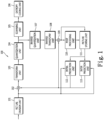
- FIG. 1 is a block diagram of an image coding apparatus 100.
- the image coding apparatus 100 includes a picture division unit 110, an intra prediction unit 120, an inter prediction unit 130, a transform unit 140, a quantization unit 150, a scanning unit 160, an entropy coding unit 170, an inverse quantization unit 155, an inverse transform unit 145, a post-processing unit 180, a picture storing unit 190, a subtracter 192 and an adder 194.
- the picture division unit 110 divides a picture into slices, divides a slice into largest coding units (LCUs), and divides each LCU into one or more coding units.
- the picture division unit 110 determines prediction mode of each coding unit and a size of prediction unit.
- the picture, slice and coding unit are comprised of luminance sample array (luma array) and two chrominance sample arrays (chromaarrays).
- Achroma block has half the height and half the width of aluma block.
- the block may be a LCU, coding unit or a prediction unit.
- a luma coding unit, a luma prediction unit and a luma transform unit is referred to as a coding unit, a prediction unit and a transform unit respectively.
- An LCU includes one or more coding units.
- the LCU has a recursive quad tree structure to specify a division structure of coding units. Parameters for specifying the maximum size and the minimum size of the coding unit are included in a sequence parameter set.
- the division structure is specified by one or more split coding unit flags (split_cu_flags).
- split_cu_flags The size of acoding unit is 2Nx2N.
- a coding unit includes one or more prediction units.
- the size of the prediction unit is 2Nx2N or NxN.
- the size of the prediction unit is 2Nx2N, 2NxN, Nx2N or NxN.
- a coding unit includes one or more transform units.
- the transform unit has a recursive quad tree structure to specify a division structure.
- the division structure is specified by one or more split transform unit flags (split_tu_flags).
- split_tu_flags Parameter for specifying the maximum size and the minimum size of the lumatransform unit is included in a sequence parameter set.
- the chroma transform unit has half the height and half the width of the transform unit if the transform unit is not 4x4.
- the minimum size of the chroma transform unit is 4x4.
- the intra prediction unit 120 determines an intra prediction mode of a current prediction unit and generates a prediction block using the intra prediction mode.
- a size of the prediction block is equal to a size of the transform unit.
- the inter prediction unit 130 determines motion information of the current prediction unit using one or more reference pictures stored in the picture storing unit 190, and generates a prediction block of the prediction unit.
- the motion information includes one or more reference picture indexes and one or more motion vectors.
- the transform unit 140 transforms residual signals generated using an original block and a prediction block to generate a transformed block.
- the residual signals are transformed by the transform unit.
- a transform type is determined by the prediction mode and the size of the transform unit.
- the transform type is a DCT-based integer transform or a DST-based integer transform. Inter prediction, DCT-based integer transforms are used. In intra prediction mode, if the size of the transform unit is smaller than a predetermined size, the DST-based integer transforms are used, otherwise the DCT-based integer transforms are used.
- the predetermined size is 8x8.
- the transform type for the chroma transform unit is the DCT-based integer transform.
- the quantization unit 150 determines a quantization parameter for quantizing the transformed block.
- the quantization parameter is a quantization step size.
- the quantization parameter is the luma quantization parameter.
- the quantization parameter is determined per quantization unit.
- the size of the quantization unit is one of allowable sizes of coding unit. If a size of the coding unit is equal to or larger than the size of aminimum quantization unit, the coding unit becomes the quantization unit.
- a plurality of coding units may be included in the minimum quantization unit.
- the size of the minimum quantization unit is determined per picture and a parameter for specifying the size of the minimum quantization unit is included in a picture parameter set.
- a chroma quantization parameter for each chroma component is determined by the quantization parameter.
- the relationship between the quantization parameter and the chroma quantization parameter may be determined by the picture.
- a parameter (chroma_qp_index_offset) for indicating the relationship is transmitted in a picture parameter set (PPS).
- PPS picture parameter set
- the relationship may be changed by the slice.
- Another parameter for changing the relationship may be transmitted in a slice header.
- the quantization unit 150 generates a quantization parameter predictor and generates a differential quantization parameter by subtracting the quantization parameter predictor from the quantization parameter.
- the differential quantization parameter is entropy-coded.
- the quantization parameter predictor is generated by using quantization parameters of neighboring coding units and quantization parameter of previous coding unit as follows.
- a left quantization parameter, an above quantization parameter and a previous quantization parameter are sequentially retrieved in this order.
- An average of the first two available quantization parameters retrieved in that order is set as the quantization parameter predictor when two or more quantization parameters are available, and when only one quantization parameter is available, the available quantization parameter is set as the quantization parameter predictor. That is, if the left and above quantization parameter are available, the average of the left and above quantization parameter is set as the quantization parameter predictor. If only one of the left and above quantization parameter is available, the average of the available quantization parameter and the previous quantization parameter is set as the quantization parameter predictor. If both of the left and above quantization parameter are unavailable, the previous quantization parameter is set as the quantization parameter predictor. The average is rounded off.
- the quantization unit 150 quantizes the transformed block using a quantization matrix and the quantization parameter to generate a quantized block.
- the quantized block is provided to the inverse quantization unit 155 and the scanning unit 160.
- the scanning unit 160 determines a scan pattern and applies the scan pattern to the quantized block.
- the scan pattern is determined as follows.
- the scan pattern is determined by the intra prediction mode and the size of the transform unit.
- the size of the transform unit, the size of transformed block and the size of the quantized block are same.
- the scan pattern is selected among a diagonal scan, vertical scan and horizontal scan.
- the quantized transform coefficients of the quantized block are split into significant flags, coefficient signs and coefficient levels.
- the scan pattern is applied to the significant flags, coefficient signs and coefficient levels respectively.
- the significant flag indicates whether the corresponding quantized transform coefficient is zero or not.
- the coefficient sign indicates a sign of non-zero quantized transform coefficient, and the coefficients level indicates an absolute value of non-zero quantized transform coefficient.
- the horizontal scan is selected for the vertical mode and a predetermined number of neighboring intra prediction modesof the vertical mode in directionality
- the vertical scan is selected for the horizontal mode and the predetermined number of neighboring intra prediction modes of the horizontal mode in directionality
- the diagonal scan is selected for the other intra prediction modes.
- the first size is 8x8.
- a predetermined scan pattern is used regardless of the size of the transform unit.
- the predetermined scan pattern is the diagonal scan when the CABAC is used for entropy coding.
- the scan pattern of a chroma transform unit is equal to the scan pattern of a corresponding luma transform unit.
- the minimum size of the chroma transform unit is 4x4.
- the quantized block is divided into a main subset and a plurality of remaining subsets and the determined scan pattern is applied to each subset. Significant flags, coefficient signs and coefficients levels of each subset are scanned respectively according to the determined scan pattern.
- the main subset includes DC coefficient and the remaining subsets covers the region other than the region covered by the main subset.
- the second size is 4x4.
- the subset is a 4x4 block containing 16 transform coefficients.
- the subset for chroma is also a 4x4 block containing 16 transform coefficients.
- the scan pattern for scanning the subsets is the same as the scan pattern for scanning quantized transform coefficients of each subset.
- the quantized transform coefficients of each subset are scanned in the reverse direction.
- the subsets are also scanned in the reverse direction.
- Last non-zero coefficient position is encoded and transmitted to the decoder.
- the last non-zero coefficient position specifies a position of last non-zero quantized transform coefficient within the transform unit.
- the last non-zero coefficient position is used to determine the number of subsets to be signaled in the decoder.
- Non-zero subset flag is set for the subsets other than the main subset and the last subset. The last subset covers the last non-zero coefficient.
- the non-zero subset flag indicates whether the subset contains non-zero coefficients or not.
- the inverse quantization unit 155 inversely quantizes the quantized transform coefficients of the quantized block.
- the inverse transform unit 145 inversely transforms the inverse quantized block to generate residual signals of the spatial domain.
- the adder 194 generates a reconstructed block by adding the residual block and the prediction block.
- the post-processing unit 180 performs a deblocking filtering process for removing blocking artifact generated in a reconstructed picture.
- the picture storing unit 190 receives post-processed image from the post-processing unit 180, and stores the image in picture units.
- a picture may be a frame or a field.
- the entropy coding unit 170 entropy-codes the one-dimensional coefficient information received from the scanning unit 160, intra prediction information received from the intra prediction unit 120, motion information received from the inter prediction unit 130, and so on.
- FIG. 2 is a block diagram of an image decoding apparatus 200.
- the image decoding apparatus 200 includes an entropy decoding unit 210, an inverse scanning unit 220, an inverse quantization unit 230, an inverse transform unit 240, an intra prediction unit 250, an inter prediction unit 260, a post-processing unit 270, a picture storing unit 280, an adder 290 and a switch 295.
- the entropy decoding unit 210 extracts the intra prediction information, the inter prediction information and the one-dimensional coefficient information from a received bit stream.
- the entropy decoding unit 210 transmits the inter prediction information to the inter prediction unit 260, the intra prediction information to the intra prediction unit 250 and the coefficient information to the inverse scanning unit 220.
- the inverse scanning unit 220 uses an inverse scan pattern to generate quantized block.
- the scan pattern is determined as follows.
- the inverse scan pattern is determined by the intra prediction mode and the size of the transform unit.
- the inverse scan pattern is selected among a diagonal scan, vertical scan and horizontal scan.
- the selected inverse scan pattern is applied to significant flags, coefficient signs and coefficients levels respectively to generate the quantized block.
- the inverse scan pattern of the chroma transform unit is equal to the scan pattern of a corresponding luma transform unit.
- the minimum size of the chroma transform unit is 4x4.
- the horizontal scan is selected for the vertical mode and a predetermined number of neighboring intra prediction modes of the vertical mode
- the vertical scan is selected for the horizontal mode and the predetermined number of neighboring intra prediction modes of the horizontal mode
- the diagonal scan is selected for the other intra prediction modes.
- the size of the transform unit is larger than the first size
- the diagonal scan is used.
- the size of the transform unit is larger than the first size
- the diagonal scan is selected for all intra prediction modes.
- the first size is 8x8.
- the significant flags, the coefficient signs and the coefficients levels are inversely scanned in the unit of subset using the determined inverse scan pattern to generate subsets, and the subsets are inversely scanned to generate the quantized block.
- the second size is equal to the size of the subset.
- the subset is a 4x4 block including 16 transform coefficients.
- the subset for chroma is also a 4x4 block. Therefore, when the size of the chroma transform unit is larger than the second size, the subsets are generated first and the subsets are inversely scanned.
- the inverse scan pattern used for generating each subset is the same as the inverse scan pattern used for generating the quantized block.
- the significant flags, the coefficient signs and the coefficient levels are inversely scanned in the reverse direction.
- the subsets are also inversely scanned in the reverse direction.
- the last non-zero coefficient position and the non-zero subset flags are received from the encoder.
- the number of encoded subsets is determined according to the last non-zero coefficient position and the inverse scan pattern.
- the non-zero subset flags are used to select subsets to be generated.
- the main subset and the last subset are generated using the inverse scan pattern.
- the inverse quantization unit 230 receives the differential quantization parameter from the entropy decoding unit 210 and generates the quantization parameter predictor to generate the quantization parameter of the coding unit.
- the operation of generating the quantization parameter is the same as the operation of the quantization unit 150 of FIG. 1 .
- the quantization parameter of the current coding unit is generated by adding the differential quantization parameter and the quantization parameter predictor. If the differential quantization parameter for the current coding unit is not received from the encoder, the differential quantization parameter is set to 0.
- a parameter for indicating the relationship between the quantization parameter and the chroma quantization parameter is included in the PPS.
- Another parameter is included in the slice header if it is allowed to change the relationship by the slice. Therefore, the chroma quantization parameter is generated using the quantization parameter and the parameter included in the PPS or using the quantization parameter and the two parameters.
- the inverse quantization unit 230 inversely quantizes the quantized block.
- the inverse transform unit 240 inversely transforms the inverse-quantized block to restore a residual block.
- the inverse transform type is adaptively determined according to the prediction mode and the size of the transform unit.
- the inverse transform type is the DCT-based integer transform or the DST-based integer transform. For example, in inter prediction, DCT-based integer transforms are used. In intra prediction mode, if the size of the transform unit is smaller than a predetermined size, the DST-based integer transforms are used, otherwise the DCT-based integer transforms are used.
- the inverse transform type for the chroma transform unit is the DCT-based integer transform.
- the intra prediction unit 250 restores the intra prediction mode of the current prediction unit using the received intra prediction information, and generates a prediction block according to the restored intra prediction mode.
- the inter prediction unit 260 restores the motion information of the current prediction unit using the received inter prediction information, and generates a prediction block using the motion information.
- the post-processing unit 270 operates the same as the post-processing unit 180 of FIG. 1 .
- the picture storing unit 280 receives post-processed image from the post-processing unit 270, and stores the image in picture units.
- a picture may be a frame or a field.
- the adder 290 adds the restored residual block and a prediction block to generate a reconstructed block.
- FIG. 3 is a flow chart illustrating a procedure of generating a chroma prediction block in intra prediction mode.
- a chroma intra prediction mode of a chroma prediction unit is derived using an intra prediction index (S110).
- the chroma intra prediction mode group includes a DC mode, a planar mode, a vertical mode, a horizontal mode, a LM mode and a DM mode.
- the DM mode is set to a luma intra prediction mode of corresponding luma prediction unit. If the luma intra prediction mode is one of the DC mode, the planar mode, the vertical mode, the horizontal mode and the LM mode, the mode is replaced with a vertical right mode.
- the chroma prediction unit has half the width and half the height of the luma prediction unit.
- a size of a current chroma block is determined to generated a chroma prediction block based on the transform size information specifying the size of the luma transform unit (S120).
- the transform size information may be one or more split_tu_flags. Therefore, the current chroma block has the same size of the chroma transform unit.
- the minimum size of the chroma prediction block is 4x4.
- the chroma transform unit has half the width and height of the corresponding luma transform unit.
- the prediction unit is set as the current block.
- the prediction unit is comprised of multiple sub-blocks of the prediction unit having the same size of the transform unit. Each sub-block is set as the current chroma block.
- the steps S130 and S140 are performed for the first sub-block of the prediction unit.
- the steps S130 and S140 are repeatedly performed for the remaining sub-blocks of the chroma prediction unit in decoding order. Same chroma intra prediction mode is used for all the sub-block within the chroma prediction unit.
- Reference pixels are generated if one or more reference pixels of the current chroma block are unavailable (S130).
- N is the width of the current chroma block and M is the height of the current chroma block.
- the current chroma block may be the prediction unit or the sub-block of the prediction.
- the value of 2 L-1 is substituted for the values of all the reference pixels.
- the value of L is the number of bits used to represent luminance pixel value.
- the value of the reference pixel nearest to the unavailable pixel is substituted for the unavailable reference pixel.
- the average value of the reference pixels nearest to the unavailable pixel in each side or the value of the reference pixel nearest to the unavailable pixel in a predetermined direction is substituted for each unavailable reference pixel.
- the reference pixels of the current chroma block are not filtered regardless of the chroma intra prediction mode and the size of the chroma transform unit.
- a prediction block of the current chroma block is generated (S140).
- the prediction block is generated using the chroma intra prediction mode.
- the prediction block is generated through the same operation of generating luma prediction block for DC mode, planar mode, vertical mode and horizontal mode.
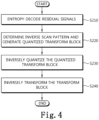
- FIG. 4 is a flow chart illustrating a procedure of generating a chroma residual block.
- the encoded residual signals are entropy-decoded to generate quantized coefficient information (S210).
- the coefficients information includes significant flags, coefficient signs and coefficient levels.
- the significant flag indicates whether the corresponding quantized transform coefficient is zero or not.
- the coefficient sign indicates a sign of non-zero quantized transform coefficient, and the coefficients level indicates an absolute value of non-zero quantized transform coefficient.
- An inverse scan pattern is determined and a quantized block is generated according the inverse scan pattern (S220).
- the inverse scan pattern is determined by the chroma intra prediction mode and the size of the chroma transform unit.
- the inverse scan pattern is selected among a diagonal scan, vertical scan and horizontal scan.
- the selected inverse scan pattern is applied to significant flags, coefficient signs and coefficients levels respectively to generate the quantized block.
- the inverse scan pattern of the chroma transform unit is equal to the scan pattern of a corresponding luma transform unit.
- the minimum size of the chroma transform unit is 4x4.
- the horizontal scan is selected for the vertical mode and a predetermined number of neighboring intra prediction modes of the vertical mode
- the vertical scan is selected for the horizontal mode and the predetermined number of neighboring intra prediction modes of the horizontal mode
- the diagonal scan is selected for the other intra prediction modes.
- the size of the transform unit is larger than 4x4, the diagonal scan is used.
- the significant flags, the coefficient signs and the coefficients levels are inversely scanned in the unit of subset using the determined inverse scan pattern to generate subsets, and the subsets are inversely scanned to generate the quantized block.
- the second size is equal to the size of the subset.
- the subset is a 4x4 block including 16 transform coefficients.
- the inverse scan pattern used for generating each subset is the same as the inverse scan pattern used for generating the quantized block.
- the significant flags, the coefficient signs and the coefficient levels are inversely scanned in the reverse direction.
- the subsets are also inversely scanned in the reverse direction.
- the last non-zero coefficient position and the non-zero subset flags are received from the encoder.
- the number of encoded subsets is determined according to the last non-zero coefficient position and the inverse scan pattern.
- the non-zero subset flags are used to select subsets to be generated.
- the main subset and the last subset are generated using the inverse scan pattern.
- the quantized block is inversely quantized using a chroma quantization parameter (S230).
- the chroma quantization parameter for each chroma component is derived from luma quantization parameter.
- the parameter (chroma_qp_index_offset) for indicating the relationship between the luma quantization parameter and the chroma quantization parameter is extracted from the PPS.
- Another parameter is also extracted from the slice header if the relationship is changed per slice. Therefore, the luma quantization parameter is generated and the parameter for indicating the relationship is extracted from the received bit stream. Then, the chroma quantization parameter is generated using the luma quantization parameter and the parameters.
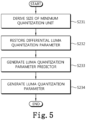
- FIG. 5 is a flow chart illustrating a procedure of deriving luma quantization parameter according to the present invention.
- a minimum size of a quantization unit is derived (S231).
- the minimum size of the quantization unit is equal to a size of LCU or a size of sub-block of LCU.
- the minimum size of the quantization unit is determined per picture.
- a parameter (cu_qp_delta_enabled_info) specifying the depth of the minimum size of the quantization unit is extracted from PPS.
- the MinQUSize is the minimum size of the quantization unit.
- the MaxCUSize is the size of LCU. Only one parameter is used for deriving the minimum size of the quantization unit.
- a differential luma quantization parameter (dQP) of the current coding unit is restored (S232).
- the dQP is restored per quantization unit. For example, if the size of the current coding unit is equal to or larger than the minimum size of the quantization unit, the dQP is restored for the current coding unit. If the current coding unit does not contain an encoded dQP, the dQP is set to zero. If the quantization unit includes plural coding units, a first coding unit containing the dQP and the following coding unit within the quantization unit have same dQP.
- the encoded dQP is arithmetically decoded to generate a bin string, and the bin string is converted into the dQP.
- the bin string comprises a bin for indicating the dQP is zero or not. When the dQP is not zero, the bin string further comprises a bin for sign of the dQP, and a bin string for indicating absolute value of the dQP.
- a luma quantization parameter predictor of the current coding unit is generated (S233).
- the luma quantization parameter predictor is generated by using luma quantization parameters of neighboring coding units and a luma quantization parameter of previous coding unit as follows.
- a left luma quantization parameter, an above luma quantization parameter and a previous luma quantization parameter are sequentially retrieved in this order.
- An average of the first two available luma quantization parameters retrieved in that order is set as the luma quantization parameter predictor when two or more luma quantization parameters are available, and when only one luma quantization parameter is available, the available luma quantization parameter is set as the luma quantization parameter predictor. That is, if the left and above luma quantization parameter are available, the average of the left and above luma quantization parameter is set as the luma quantization parameter predictor.
- the average of the available luma quantization parameter and the previous lumaquantization parameter is set as the luma quantization parameter predictor. If both of the left and above luma quantization parameter are unavailable, the previous luma quantization parameter is set as the luma quantization parameter predictor. The average is rounded off.
- the quantization unit includes plural coding units, the luma quantization parameter predictor of the first coding unit in the decoding order is generated, and the generated luma quantization parameter predictor is used for all the coding units within the quantization unit.
- the luma quantization parameter is generated using the dQP and the luma quantization parameter predictor (S234).
- the user-defined quantization matrices are also restored.
- a set of the user-defined quantization matrices is received from the encoding apparatus through the SPS or the PPS.
- the user-defined quantization matrix is restored using inverse DPCM.
- the diagonal scan is used for the DPCM.
- the user-defined quantization matrix is restored by up-sampling the coefficients of the received 8x8 quantization matrix.
- the DC coefficient of the user-defined quantization matrix is extracted from the SPS or the PPS. For example, if the size of the user-defined quantization matrix is 16x16, coefficients of the received 8x8 quantization matrix are up-sampled using 1:4 up-sampling.
- a residual block is generated by inversely transforming the inverse-quantized block (S1440).
- An inverse transform type may be fixed.
- the DCT-based integer transform is used for a horizontal transform and a vertical transform.
- a reconstructed chroma block is generated by adding the chroma prediction block and the chroma residual block.
Landscapes
- Engineering & Computer Science (AREA)
- Multimedia (AREA)
- Signal Processing (AREA)
- Computing Systems (AREA)
- Theoretical Computer Science (AREA)
- Compression Or Coding Systems Of Tv Signals (AREA)
- Color Television Systems (AREA)
- Color Image Communication Systems (AREA)
Claims (3)
- Procédé de décodage d'images de chrominance codées avec un codage vidéo à haute efficacité, HEVC, le procédé comprenant :la dérivation d'un mode de prédiction intra de chrominance d'une unité de prédiction ;la détermination de la taille d'un bloc de chrominance actuel en utilisant de l'information de taille de transformée en luminance ;la génération d'un bloc de prédiction de chrominance du bloc de chrominance actuel en utilisant le mode de prédiction intra de chrominance ;la génération d'un bloc résiduel de chrominance du bloc de chrominance actuel en utilisant le mode de prédiction intra de chrominance et un paramètre de quantification de chrominance ; etla génération d'un bloc reconstruit en chrominance en sommant le bloc de prédiction de chrominance et le bloc résiduel de chrominance ;dans lequel le paramètre de quantification de chrominance est généré en utilisant un paramètre de quantification de luminance déterminé par unité de quantification, et de l'information indiquant la relation entre le paramètre de quantification de luminance et le paramètre de quantification de chrominance ;dans lequel la taille de l'unité de quantification est l'une des tailles admissibles d'une unité de codage ;dans lequel une taille minimale de l'unité de quantification est déterminée par image, et un paramètre permettant de spécifier la taille minimale de l'unité de quantification est inclus dans l'ensemble de paramètres d'image ;dans lequel, si la taille de l'unité de codage est supérieure ou égale à la taille minimale de l'unité de quantification, l'unité de codage devient l'unité de quantification ;dans lequel l'information indiquant la relation entre le paramètre de quantification de luminance et le paramètre de quantification de chrominance est signalée dans l'ensemble de paramètres d'image ou dans un en-tête de tranche ;dans lequel le paramètre de quantification de luminance est généré en utilisant un prédicteur de paramètre de quantification de luminance et un paramètre de quantification de luminance différentielle, dans lequel le paramètre de quantification de luminance différentielle est restauré par décodage arithmétique d'un paramètre de quantification de luminance différentielle codé pour générer une chaîne de segments et par application d'une binarisation inverse à la chaîne de segments, et la chaîne de segments comprend une chaîne de segments indiquant une valeur absolue du paramètre de quantification de luminance différentielle et un segment indiquant un signe du paramètre de quantification de luminance différentielle ;dans lequel le prédicteur de paramètre de quantification de luminance est généré en utilisant deux paramètres de quantification si au moins deux paramètres parmi un paramètre de quantification de luminance gauche, un paramètre de quantification de luminance supérieure et un paramètre de quantification de luminance antérieure sont disponibles ;dans lequel les deux paramètres de quantification utilisés pour générer le prédicteur de paramètre de quantification de luminance sont déterminés dans l'ordre paramètre de quantification de luminance gauche, paramètre de quantification de luminance supérieure et paramètre de quantification de luminance antérieure ;dans lequel, si le paramètre de quantification de luminance gauche et le paramètre de quantification de luminance supérieure sont tous deux disponibles, une moyenne du paramètre de quantification de luminance gauche et du paramètre de quantification de luminance supérieure est définie comme étant le prédicteur de paramètre de quantification de luminance ;dans lequel, si un seul paramètre parmi le paramètre de quantification de luminance gauche et le paramètre de quantification de luminance supérieure est disponible, une moyenne du paramètre de quantification de luminance disponible et du paramètre de quantification de luminance antérieure est définie comme étant le prédicteur de paramètre de quantification de luminance ;dans lequel, si le paramètre de quantification de luminance gauche et le paramètre de quantification de luminance supérieure ne sont disponibles ni l'un ni l'autre, le paramètre de quantification de luminance antérieure est défini comme étant le prédicteur de paramètre de quantification de luminance ; etdans lequel un bloc de prédiction de luminance d'un bloc de luminance actuel est généré en utilisant un mode de prédiction intra de luminance et des pixels de référence de luminance, et le bloc de prédiction de chrominance est généré en utilisant le mode de prédiction intra de chrominance et des pixels de référence de chrominance, et dans lequel les pixels de référence ne sont pas filtrés pour le bloc de chrominance actuel qui présente la moitié de la hauteur et la moitié de la largeur du bloc de luminance actuel.
- Procédé selon la revendication 1, dans lequel la taille minimale de l'unité de quantification est ajustée par image.
- Procédé selon la revendication 2, dans lequel la taille minimale de l'unité de quantification est dérivée en utilisant un paramètre qui spécifie la profondeur de la taille minimale de l'unité de quantification et la taille de l'unité de codage la plus grande.
Priority Applications (3)
| Application Number | Priority Date | Filing Date | Title |
|---|---|---|---|
| EP24158367.3A EP4346206A3 (fr) | 2011-11-25 | 2012-11-09 | Procédé de décodage d'image de chrominance |
| EP24158374.9A EP4346208A3 (fr) | 2011-11-25 | 2012-11-09 | Procédé de décodage d'image de chrominance |
| EP24158368.1A EP4346207A3 (fr) | 2011-11-25 | 2012-11-09 | Procédé de décodage d'image de chrominance |
Applications Claiming Priority (3)
| Application Number | Priority Date | Filing Date | Title |
|---|---|---|---|
| KR20110124580A KR20130058524A (ko) | 2011-11-25 | 2011-11-25 | 색차 인트라 예측 블록 생성 방법 |
| EP12851659.8A EP2786577B1 (fr) | 2011-11-25 | 2012-11-09 | Procédé pour le décodage d'image de chrominance |
| PCT/CN2012/084374 WO2013075589A1 (fr) | 2011-11-25 | 2012-11-09 | Procédé pour le décodage d'image de chrominance |
Related Parent Applications (2)
| Application Number | Title | Priority Date | Filing Date |
|---|---|---|---|
| EP12851659.8A Division EP2786577B1 (fr) | 2011-11-25 | 2012-11-09 | Procédé pour le décodage d'image de chrominance |
| EP12851659.8A Division-Into EP2786577B1 (fr) | 2011-11-25 | 2012-11-09 | Procédé pour le décodage d'image de chrominance |
Related Child Applications (6)
| Application Number | Title | Priority Date | Filing Date |
|---|---|---|---|
| EP24158374.9A Division EP4346208A3 (fr) | 2011-11-25 | 2012-11-09 | Procédé de décodage d'image de chrominance |
| EP24158374.9A Division-Into EP4346208A3 (fr) | 2011-11-25 | 2012-11-09 | Procédé de décodage d'image de chrominance |
| EP24158367.3A Division EP4346206A3 (fr) | 2011-11-25 | 2012-11-09 | Procédé de décodage d'image de chrominance |
| EP24158367.3A Division-Into EP4346206A3 (fr) | 2011-11-25 | 2012-11-09 | Procédé de décodage d'image de chrominance |
| EP24158368.1A Division EP4346207A3 (fr) | 2011-11-25 | 2012-11-09 | Procédé de décodage d'image de chrominance |
| EP24158368.1A Division-Into EP4346207A3 (fr) | 2011-11-25 | 2012-11-09 | Procédé de décodage d'image de chrominance |
Publications (2)
| Publication Number | Publication Date |
|---|---|
| EP3276963A1 EP3276963A1 (fr) | 2018-01-31 |
| EP3276963B1 true EP3276963B1 (fr) | 2024-04-10 |
Family
ID=48469103
Family Applications (5)
| Application Number | Title | Priority Date | Filing Date |
|---|---|---|---|
| EP24158374.9A Pending EP4346208A3 (fr) | 2011-11-25 | 2012-11-09 | Procédé de décodage d'image de chrominance |
| EP12851659.8A Active EP2786577B1 (fr) | 2011-11-25 | 2012-11-09 | Procédé pour le décodage d'image de chrominance |
| EP17191728.9A Active EP3276963B1 (fr) | 2011-11-25 | 2012-11-09 | Procédé pour le décodage d'image de chrominance |
| EP24158368.1A Pending EP4346207A3 (fr) | 2011-11-25 | 2012-11-09 | Procédé de décodage d'image de chrominance |
| EP24158367.3A Pending EP4346206A3 (fr) | 2011-11-25 | 2012-11-09 | Procédé de décodage d'image de chrominance |
Family Applications Before (2)
| Application Number | Title | Priority Date | Filing Date |
|---|---|---|---|
| EP24158374.9A Pending EP4346208A3 (fr) | 2011-11-25 | 2012-11-09 | Procédé de décodage d'image de chrominance |
| EP12851659.8A Active EP2786577B1 (fr) | 2011-11-25 | 2012-11-09 | Procédé pour le décodage d'image de chrominance |
Family Applications After (2)
| Application Number | Title | Priority Date | Filing Date |
|---|---|---|---|
| EP24158368.1A Pending EP4346207A3 (fr) | 2011-11-25 | 2012-11-09 | Procédé de décodage d'image de chrominance |
| EP24158367.3A Pending EP4346206A3 (fr) | 2011-11-25 | 2012-11-09 | Procédé de décodage d'image de chrominance |
Country Status (19)
| Country | Link |
|---|---|
| US (8) | US8942284B2 (fr) |
| EP (5) | EP4346208A3 (fr) |
| JP (5) | JP5714781B2 (fr) |
| KR (4) | KR20130058524A (fr) |
| CN (7) | CN107277504B (fr) |
| CY (1) | CY1119935T1 (fr) |
| DK (2) | DK2786577T3 (fr) |
| ES (2) | ES2657908T3 (fr) |
| HR (1) | HRP20180179T1 (fr) |
| HU (2) | HUE067195T2 (fr) |
| LT (1) | LT2786577T (fr) |
| NO (1) | NO2786577T3 (fr) |
| PL (2) | PL3276963T3 (fr) |
| PT (2) | PT3276963T (fr) |
| RS (1) | RS56762B1 (fr) |
| SI (1) | SI2786577T1 (fr) |
| TR (1) | TR201802460T4 (fr) |
| TW (5) | TWI544784B (fr) |
| WO (1) | WO2013075589A1 (fr) |
Families Citing this family (89)
| Publication number | Priority date | Publication date | Assignee | Title |
|---|---|---|---|---|
| WO2007104266A1 (fr) * | 2006-03-16 | 2007-09-20 | Huawei Technologies Co., Ltd. | Procédé et appareil de quantification adaptative dans une procédure de codage |
| KR20130049523A (ko) * | 2011-11-04 | 2013-05-14 | 오수미 | 인트라 예측 블록 생성 장치 |
| KR20130049526A (ko) * | 2011-11-04 | 2013-05-14 | 오수미 | 복원 블록 생성 방법 |
| KR20130049524A (ko) * | 2011-11-04 | 2013-05-14 | 오수미 | 인트라 예측 블록 생성 방법 |
| KR20130058524A (ko) * | 2011-11-25 | 2013-06-04 | 오수미 | 색차 인트라 예측 블록 생성 방법 |
| JP5900307B2 (ja) * | 2011-12-13 | 2016-04-06 | 株式会社Jvcケンウッド | 動画像符号化装置、動画像符号化方法及び動画像符号化プログラム、並びに送信装置、送信方法及び送信プログラム |
| US9420302B2 (en) * | 2012-01-24 | 2016-08-16 | Dolby Laboratories Licensing Corporation | Weighted multi-band cross color channel predictor |
| MX340434B (es) | 2012-09-10 | 2016-07-08 | Panasonic Ip Corp America | Metodo de codificacion de imagenes, metodo de decodificacion de imagenes, aparato de codificacion de imagenes, aparato de decodificacion de imagenes y aparato de codificacion y decodificacion de imagenes. |
| US10440365B2 (en) | 2013-06-28 | 2019-10-08 | Velos Media, Llc | Methods and devices for emulating low-fidelity coding in a high-fidelity coder |
| US20150016516A1 (en) * | 2013-07-15 | 2015-01-15 | Samsung Electronics Co., Ltd. | Method for intra prediction improvements for oblique modes in video coding |
| US9294766B2 (en) | 2013-09-09 | 2016-03-22 | Apple Inc. | Chroma quantization in video coding |
| WO2015100522A1 (fr) | 2013-12-30 | 2015-07-09 | Mediatek Singapore Pte. Ltd. | Procédés de prédiction inter-composant par les résidus |
| CA2939434C (fr) | 2014-03-04 | 2021-02-16 | Microsoft Techology Licensing, Llc | Commutation adaptative d'espaces de couleur, taux d'echantillonnage de couleur et/ou profondeurs de bit |
| US10182241B2 (en) | 2014-03-04 | 2019-01-15 | Microsoft Technology Licensing, Llc | Encoding strategies for adaptive switching of color spaces, color sampling rates and/or bit depths |
| JP6367359B2 (ja) * | 2014-03-27 | 2018-08-01 | マイクロソフト テクノロジー ライセンシング,エルエルシー | 色空間を切り替えるときの量子化/スケーリング及び逆量子化/スケーリングの調整 |
| WO2016054765A1 (fr) | 2014-10-08 | 2016-04-14 | Microsoft Technology Licensing, Llc | Ajustements apportés au codage et au décodage lors de la commutation entre espaces colorimétriques |
| WO2016199409A1 (fr) * | 2015-06-07 | 2016-12-15 | Sharp Kabushiki Kaisha | Systèmes et procédés d'optimisation de codage vidéo basés sur une fonction de transfert de luminance ou des valeurs de composantes de couleur vidéo |
| KR20180008797A (ko) * | 2015-06-15 | 2018-01-24 | 엘지전자 주식회사 | 인트라 예측 모드 기반 영상 처리 방법 및 이를 위한 장치 |
| KR102605285B1 (ko) * | 2015-08-19 | 2023-11-24 | 엘지전자 주식회사 | 다중 그래프 기반 모델에 따라 최적화된 변환을 이용하여 비디오 신호를 인코딩/디코딩하는 방법 및 장치 |
| KR102714094B1 (ko) | 2016-02-11 | 2024-10-08 | 삼성전자주식회사 | 비디오 부호화 방법 및 장치, 비디오 복호화 방법 및 장치 |
| CN116708776A (zh) * | 2016-07-18 | 2023-09-05 | 韩国电子通信研究院 | 图像编码/解码方法和装置以及存储比特流的记录介质 |
| US20200036985A1 (en) * | 2016-09-30 | 2020-01-30 | Lg Electronics Inc. | Method and apparatus for block partitioning and intra prediction in image coding system |
| WO2018066986A1 (fr) * | 2016-10-06 | 2018-04-12 | 김기백 | Procédé et appareil de codage et de décodage de données d'images |
| US10880546B2 (en) | 2016-10-11 | 2020-12-29 | Lg Electronics Inc. | Method and apparatus for deriving intra prediction mode for chroma component |
| CN116647680A (zh) | 2016-10-28 | 2023-08-25 | 韩国电子通信研究院 | 视频编码/解码方法和设备以及存储比特流的记录介质 |
| WO2018124686A1 (fr) * | 2016-12-26 | 2018-07-05 | 에스케이텔레콤 주식회사 | Codage et décodage d'image à l'aide d'une prédiction intra |
| WO2018199001A1 (fr) | 2017-04-28 | 2018-11-01 | シャープ株式会社 | Dispositif de décodage d'image et dispositif de codage d'image |
| CN115174911B (zh) * | 2017-07-24 | 2025-06-20 | 艾锐势有限责任公司 | 帧内模式jvet编译方法 |
| EP3718304A1 (fr) | 2017-12-01 | 2020-10-07 | InterDigital VC Holdings, Inc. | Traitement d'une image |
| EP3941052B1 (fr) * | 2018-04-01 | 2023-09-13 | LG Electronics Inc. | Appareil de codage d'image et son procédé basé sur la dérivation de paramètres de quantification |
| US10609402B2 (en) * | 2018-05-02 | 2020-03-31 | Tencent America LLC | Method and apparatus for prediction and transform for small blocks |
| KR20200047723A (ko) | 2018-05-03 | 2020-05-07 | 엘지전자 주식회사 | 영상 코딩 시스템에서 블록 사이즈에 따른 변환을 사용하는 영상 디코딩 방법 및 그 장치 |
| US10645396B2 (en) * | 2018-06-04 | 2020-05-05 | Tencent America LLC | Method and apparatus for implicit transform splitting |
| WO2019234598A1 (fr) | 2018-06-05 | 2019-12-12 | Beijing Bytedance Network Technology Co., Ltd. | Interaction entre ibc et stmvp |
| KR101997681B1 (ko) | 2018-06-11 | 2019-07-08 | 광운대학교 산학협력단 | 양자화 파라미터 기반의 잔차 블록 부호화/복호화 방법 및 장치 |
| KR101956756B1 (ko) * | 2018-06-12 | 2019-03-11 | 광운대학교 산학협력단 | 성분 간 참조 기반의 비디오 신호 처리 방법 및 장치 |
| EP3788782A1 (fr) * | 2018-06-21 | 2021-03-10 | Beijing Bytedance Network Technology Co. Ltd. | Héritage mv de sous-blocs entre des composants de couleur |
| CN110636298B (zh) | 2018-06-21 | 2022-09-13 | 北京字节跳动网络技术有限公司 | 对于Merge仿射模式和非Merge仿射模式的统一约束 |
| CN116708833A (zh) * | 2018-07-02 | 2023-09-05 | Lg电子株式会社 | 编解码和发送方法及存储介质 |
| US11438590B2 (en) | 2018-08-16 | 2022-09-06 | Hfi Innovation Inc. | Methods and apparatuses of chroma quantization parameter derivation in video processing system |
| CN110858903B (zh) * | 2018-08-22 | 2022-07-12 | 华为技术有限公司 | 色度块预测方法及装置 |
| KR102366262B1 (ko) | 2018-08-24 | 2022-02-23 | 삼성전자주식회사 | 영상 부호화 방법 및 장치, 영상 복호화 방법 및 장치 |
| CN112840649A (zh) * | 2018-09-21 | 2021-05-25 | Lg电子株式会社 | 图像编码系统中通过使用块分割对图像解码的方法及其装置 |
| WO2020065517A1 (fr) | 2018-09-24 | 2020-04-02 | Beijing Bytedance Network Technology Co., Ltd. | Prédiction de vecteurs de mouvement basée sur l'historique simplifié |
| CN112889291A (zh) | 2018-10-08 | 2021-06-01 | 北京达佳互联信息技术有限公司 | 对跨分量线性模型的简化 |
| US10893286B2 (en) * | 2018-10-09 | 2021-01-12 | Tencent America LLC | Methods and apparatus for low-complexity MTS |
| CN112997495B (zh) | 2018-11-10 | 2024-02-20 | 北京字节跳动网络技术有限公司 | 当前图片参考中的取整 |
| WO2020103901A1 (fr) * | 2018-11-21 | 2020-05-28 | Huawei Technologies Co., Ltd. | Procédé et dispositif d'intra-prédiction |
| WO2020111981A1 (fr) * | 2018-11-26 | 2020-06-04 | Huawei Technologies Co., Ltd. | Appareil et procédé de dérivation de paramètre de quantification de chrominance |
| KR102859877B1 (ko) * | 2019-01-16 | 2025-09-16 | 샤프 가부시키가이샤 | 비디오 코딩에서 비디오 블록들에 대한 양자화 파라미터들을 도출하기 위한 시스템들 및 방법들 |
| WO2020182093A1 (fr) | 2019-03-08 | 2020-09-17 | Beijing Bytedance Network Technology Co., Ltd. | Signalisation d'informations de remodelage en traitement vidéo |
| WO2020185039A1 (fr) * | 2019-03-14 | 2020-09-17 | 엘지전자 주식회사 | Procédé de codage résiduel et dispositif |
| PH12021552544A1 (en) | 2019-04-18 | 2022-07-04 | Beijing Bytedance Network Tech Co Ltd | Restriction on applicability of cross component mode |
| BR112021019675A2 (pt) | 2019-04-23 | 2021-12-07 | Beijing Bytedance Network Tech Co Ltd | Método para processamento de mídia visual, aparelho codificador de vídeo, aparelho decodificador de vídeo, e, mídia legível por computador |
| CN113785566B (zh) * | 2019-04-27 | 2024-09-20 | 数码士有限公司 | 基于帧内预测处理视频信号的方法和设备 |
| WO2020224629A1 (fr) * | 2019-05-08 | 2020-11-12 | Beijing Bytedance Network Technology Co., Ltd. | Conditions d'applicabilité d'un codage à composants croisés |
| WO2020228670A1 (fr) | 2019-05-10 | 2020-11-19 | Beijing Bytedance Network Technology Co., Ltd. | Sélection de matrice de transformée secondaire basée sur la luminance pour traitement vidéo |
| CN113906758B (zh) | 2019-05-31 | 2025-06-20 | 字节跳动有限公司 | 调色板模式与帧内块复制预测 |
| CN117354521A (zh) | 2019-06-07 | 2024-01-05 | 北京字节跳动网络技术有限公司 | 视频比特流中的简化二次变换的有条件信令 |
| CN114208169B (zh) * | 2019-06-11 | 2024-10-18 | Lg电子株式会社 | 用于色度分量的图像解码方法及其装置 |
| WO2020251278A1 (fr) * | 2019-06-11 | 2020-12-17 | 엘지전자 주식회사 | Procédé de décodage d'image basé sur des données de paramètre de quantification de chrominance, et appareil associé |
| CN113382256B (zh) * | 2019-06-21 | 2022-05-20 | 杭州海康威视数字技术股份有限公司 | 一种编解码方法、装置、设备及存储介质 |
| TWI862567B (zh) * | 2019-06-21 | 2024-11-21 | 法商內數位Ce專利控股公司 | 用於視訊編碼及解碼的單一索引量化矩陣設計 |
| EP3973707A4 (fr) | 2019-06-22 | 2022-08-31 | Beijing Bytedance Network Technology Co., Ltd. | Élément de syntaxe pour mise à l'échelle résiduelle de chrominance |
| JP7328373B2 (ja) | 2019-06-28 | 2023-08-16 | バイトダンス インコーポレイテッド | スクリーンコンテンツ符号化におけるクロマイントラモードの導出 |
| US12015792B2 (en) | 2019-06-28 | 2024-06-18 | Lg Electronics Inc. | Image decoding method for chroma quantization parameter data and apparatus therefor |
| WO2020262909A1 (fr) * | 2019-06-28 | 2020-12-30 | 엘지전자 주식회사 | Procédé de décodage d'image utilisant une table de paramètres de quantification de chrominance, et dispositif exécutant le procédé |
| US11418787B2 (en) | 2019-06-28 | 2022-08-16 | Qualcomm Incorporated | Chroma delta QP in video coding |
| KR102612765B1 (ko) | 2019-06-28 | 2023-12-13 | 바이트댄스 아이엔씨 | 변환 스킵 모드에서 양자화 파라미터를 수정하는 기술 |
| CN120201192A (zh) * | 2019-07-05 | 2025-06-24 | Lg 电子株式会社 | 用于色度分量的图像解码方法及其装置 |
| CN119011836A (zh) * | 2019-07-05 | 2024-11-22 | Lg 电子株式会社 | 编译色度量化参数数据的图像解码方法及其设备 |
| US11381819B2 (en) | 2019-07-05 | 2022-07-05 | Qualcomm Incorporated | Chroma delta quantization parameter (QP) in video coding |
| CN114128280B (zh) | 2019-07-07 | 2023-11-14 | 北京字节跳动网络技术有限公司 | 色度残差缩放的信令通知 |
| CN114128275A (zh) * | 2019-07-12 | 2022-03-01 | 交互数字Vc控股法国有限公司 | 亮度到色度量化参数表信令 |
| CN114208183B (zh) | 2019-08-03 | 2025-01-10 | 北京字节跳动网络技术有限公司 | 视频的缩减二次变换中基于位置的模式导出 |
| CN114586344B (zh) | 2019-08-14 | 2022-12-09 | Lg电子株式会社 | 参考亮度样本位置确定色度块的预测模式的图像编码/解码方法和设备及发送比特流的方法 |
| WO2021032045A1 (fr) | 2019-08-17 | 2021-02-25 | Beijing Bytedance Network Technology Co., Ltd. | Modélisation de contexte d'informations annexes pour transformées secondaires réduites en vidéo |
| CN118764623A (zh) * | 2019-08-27 | 2024-10-11 | 现代自动车株式会社 | 利用差分编码的视频编码和解码 |
| KR20220062085A (ko) | 2019-09-20 | 2022-05-13 | 알리바바 그룹 홀딩 리미티드 | 비디오 처리에서 양자화 파라미터 시그널링 |
| CN114731405A (zh) * | 2019-09-23 | 2022-07-08 | Lg电子株式会社 | 使用量化矩阵的图像编码/解码方法和设备以及发送比特流的方法 |
| JP7001668B2 (ja) * | 2019-12-26 | 2022-01-19 | Kddi株式会社 | 画像復号装置、画像復号方法及びプログラム |
| WO2021134072A1 (fr) * | 2019-12-27 | 2021-07-01 | Beijing Dajia Internet Information Technology Co., Ltd. | Procédés et appareil de codage vidéo dans un format de chrominance 4:4:4 |
| WO2022114768A1 (fr) * | 2020-11-24 | 2022-06-02 | 현대자동차주식회사 | Procédé et dispositif pour générer des signaux résiduels à l'aide de références inter-composants |
| US11394987B2 (en) * | 2020-12-11 | 2022-07-19 | Qualcomm Incorporated | Chroma samples from luma samples prediction for video coding |
| US12413734B2 (en) * | 2022-01-13 | 2025-09-09 | Tencent America LLC | Cross-channel prediction based on multiple prediction modes |
| US20250159207A1 (en) * | 2023-11-09 | 2025-05-15 | Tencent America Llc. | Systems and methods for improved recursive intra region partitioning |
| US12556732B2 (en) | 2023-11-27 | 2026-02-17 | Tencent America LLC | Systems and methods for transform partitioning in a recursive intra region |
| US12610041B2 (en) | 2023-11-29 | 2026-04-21 | Tencent America LLC | Systems and methods for chroma mode coding in recursive intra/inter region |
| US12445630B2 (en) | 2023-11-29 | 2025-10-14 | Tencent America LLC | Systems and methods for implicit derivation in a recursive intra region |
Family Cites Families (39)
| Publication number | Priority date | Publication date | Assignee | Title |
|---|---|---|---|---|
| US7099387B2 (en) * | 2002-03-22 | 2006-08-29 | Realnetorks, Inc. | Context-adaptive VLC video transform coefficients encoding/decoding methods and apparatuses |
| KR100585710B1 (ko) * | 2002-08-24 | 2006-06-02 | 엘지전자 주식회사 | 가변길이 동영상 부호화 방법 |
| US7649539B2 (en) * | 2004-03-10 | 2010-01-19 | Microsoft Corporation | Image formats for video capture, processing and display |
| CN1777283A (zh) * | 2004-12-31 | 2006-05-24 | 上海广电(集团)有限公司 | 一种基于微块的视频信号编/解码方法 |
| US7751478B2 (en) * | 2005-01-21 | 2010-07-06 | Seiko Epson Corporation | Prediction intra-mode selection in an encoder |
| US7495679B2 (en) * | 2005-08-02 | 2009-02-24 | Kolorific, Inc. | Method and system for automatically calibrating a color display |
| US7773816B2 (en) * | 2006-04-17 | 2010-08-10 | Mediatek Inc. | Systems and methods for decoding large images |
| US9001899B2 (en) * | 2006-09-15 | 2015-04-07 | Freescale Semiconductor, Inc. | Video information processing system with selective chroma deblock filtering |
| CN100586184C (zh) * | 2008-01-24 | 2010-01-27 | 北京工业大学 | 帧内预测方法 |
| KR101291196B1 (ko) * | 2008-01-25 | 2013-07-31 | 삼성전자주식회사 | 영상의 부호화, 복호화 방법 및 장치 |
| CN101222646B (zh) * | 2008-01-30 | 2010-06-02 | 上海广电(集团)有限公司中央研究院 | 一种适用于avs编码的帧内预测装置及预测方法 |
| US8542730B2 (en) * | 2008-02-22 | 2013-09-24 | Qualcomm, Incorporated | Fast macroblock delta QP decision |
| CN101247525B (zh) * | 2008-03-24 | 2010-06-02 | 北京邮电大学 | 一种提高图像帧内编码速率的方法 |
| US8199823B2 (en) * | 2008-04-15 | 2012-06-12 | Sony Corporation | Estimation of B frame average rate quantization parameter (QP) in a group of pictures (GOP) |
| US8897359B2 (en) * | 2008-06-03 | 2014-11-25 | Microsoft Corporation | Adaptive quantization for enhancement layer video coding |
| BRPI0915061A2 (pt) * | 2008-06-12 | 2015-10-27 | Thomson Licensing | métodos e aparelho para codificação e decodificação de vídeo com modo de atualização de profundidade de bit reduzido e modo de atualização de amostragem de croma reduzido |
| US8279924B2 (en) * | 2008-10-03 | 2012-10-02 | Qualcomm Incorporated | Quantization parameter selections for encoding of chroma and luma video blocks |
| CN101742330B (zh) | 2008-11-24 | 2013-03-27 | 北京中星微电子有限公司 | 一种图像编码方法及装置 |
| CN101742301B (zh) * | 2008-11-24 | 2017-04-19 | 北京中星微电子有限公司 | 一种块模式编码方法及装置 |
| KR101527085B1 (ko) * | 2009-06-30 | 2015-06-10 | 한국전자통신연구원 | 인트라 부호화/복호화 방법 및 장치 |
| US8588297B2 (en) * | 2009-12-23 | 2013-11-19 | Oracle America, Inc. | Quantization parameter prediction |
| CN102223525B (zh) * | 2010-04-13 | 2014-02-19 | 富士通株式会社 | 视频解码方法和系统 |
| JP5488168B2 (ja) * | 2010-04-27 | 2014-05-14 | パナソニック株式会社 | 画像符号化装置 |
| BR112012030158B1 (pt) * | 2010-06-04 | 2021-10-05 | Sony Corporation | Aparelho e método de processamento de imagem |
| JP2012054818A (ja) * | 2010-09-02 | 2012-03-15 | Sony Corp | 画像処理装置と画像処理方法 |
| CN102065298B (zh) * | 2011-01-05 | 2012-10-24 | 西安电子科技大学 | 高性能宏块编码实现方法 |
| US9667987B2 (en) | 2011-03-10 | 2017-05-30 | Futurewei Technologies, Inc. | Using multiple prediction sets to encode extended unified directional intra mode numbers for robustness |
| US9654785B2 (en) | 2011-06-09 | 2017-05-16 | Qualcomm Incorporated | Enhanced intra-prediction mode signaling for video coding using neighboring mode |
| CN103688533B (zh) * | 2011-06-20 | 2015-12-23 | 联发科技(新加坡)私人有限公司 | 可减少行存储器的色度帧内预测方法及装置 |
| US9693070B2 (en) * | 2011-06-24 | 2017-06-27 | Texas Instruments Incorporated | Luma-based chroma intra-prediction for video coding |
| MX2013010892A (es) * | 2011-06-29 | 2013-12-06 | Panasonic Corp | Metodo de decodificacion de imagenes, metodo de codificacion de imagenes, aparato de decodificacion de imagenes, aparato de codificacion de imagenes y aparato de codificacion y decodificacion de imagenes. |
| GB2494468B (en) | 2011-09-12 | 2014-01-15 | Canon Kk | Method and device for encoding or decoding information representing prediction modes |
| EP3139596B1 (fr) | 2011-09-13 | 2019-09-25 | HFI Innovation Inc. | Procédé et appareil pour codage vidéo hevc en mode interne |
| US20130083845A1 (en) * | 2011-09-30 | 2013-04-04 | Research In Motion Limited | Methods and devices for data compression using a non-uniform reconstruction space |
| KR101575777B1 (ko) | 2011-10-07 | 2015-12-14 | 주식회사 팬택자산관리 | 복수개의 후보 화면 내 예측 모드를 이용한 화면 내 예측 모드의 부호화/복호화 방법 및 이러한 방법을 사용하는 장치 |
| KR20130049523A (ko) * | 2011-11-04 | 2013-05-14 | 오수미 | 인트라 예측 블록 생성 장치 |
| KR20130049526A (ko) * | 2011-11-04 | 2013-05-14 | 오수미 | 복원 블록 생성 방법 |
| KR20130058524A (ko) * | 2011-11-25 | 2013-06-04 | 오수미 | 색차 인트라 예측 블록 생성 방법 |
| JP6064580B2 (ja) | 2011-12-21 | 2017-01-25 | 株式会社Jvcケンウッド | 動画像符号化装置、動画像符号化方法及び動画像符号化プログラム、並びに送信装置、送信方法及び送信プログラム |
-
2011
- 2011-11-25 KR KR20110124580A patent/KR20130058524A/ko not_active Withdrawn
-
2012
- 2012-11-09 EP EP24158374.9A patent/EP4346208A3/fr active Pending
- 2012-11-09 RS RS20180062A patent/RS56762B1/sr unknown
- 2012-11-09 JP JP2014542692A patent/JP5714781B2/ja active Active
- 2012-11-09 ES ES12851659.8T patent/ES2657908T3/es active Active
- 2012-11-09 EP EP12851659.8A patent/EP2786577B1/fr active Active
- 2012-11-09 DK DK12851659.8T patent/DK2786577T3/en active
- 2012-11-09 KR KR1020147010160A patent/KR20140088099A/ko not_active Ceased
- 2012-11-09 PT PT171917289T patent/PT3276963T/pt unknown
- 2012-11-09 SI SI201231238T patent/SI2786577T1/en unknown
- 2012-11-09 DK DK17191728.9T patent/DK3276963T3/da active
- 2012-11-09 WO PCT/CN2012/084374 patent/WO2013075589A1/fr not_active Ceased
- 2012-11-09 HU HUE17191728A patent/HUE067195T2/hu unknown
- 2012-11-09 PL PL17191728.9T patent/PL3276963T3/pl unknown
- 2012-11-09 EP EP17191728.9A patent/EP3276963B1/fr active Active
- 2012-11-09 KR KR1020147010148A patent/KR20140088098A/ko not_active Ceased
- 2012-11-09 TR TR2018/02460T patent/TR201802460T4/tr unknown
- 2012-11-09 PT PT128516598T patent/PT2786577T/pt unknown
- 2012-11-09 EP EP24158368.1A patent/EP4346207A3/fr active Pending
- 2012-11-09 KR KR1020147010161A patent/KR20140088100A/ko not_active Ceased
- 2012-11-09 EP EP24158367.3A patent/EP4346206A3/fr active Pending
- 2012-11-09 NO NO12851659A patent/NO2786577T3/no unknown
- 2012-11-09 PL PL12851659T patent/PL2786577T3/pl unknown
- 2012-11-09 HR HRP20180179TT patent/HRP20180179T1/hr unknown
- 2012-11-09 LT LTEP12851659.8T patent/LT2786577T/lt unknown
- 2012-11-09 HU HUE12851659A patent/HUE037151T2/hu unknown
- 2012-11-09 US US14/354,518 patent/US8942284B2/en active Active
- 2012-11-09 ES ES17191728T patent/ES2985067T3/es active Active
- 2012-11-23 TW TW101144066A patent/TWI544784B/zh active
- 2012-11-23 TW TW105143015A patent/TWI611685B/zh active
- 2012-11-23 TW TW106141061A patent/TWI650993B/zh active
- 2012-11-23 TW TW105119180A patent/TWI572190B/zh active
- 2012-11-23 TW TW107147691A patent/TWI694710B/zh active
- 2012-11-26 CN CN201710570446.1A patent/CN107277504B/zh active Active
- 2012-11-26 CN CN201710570447.6A patent/CN107302699B/zh active Active
- 2012-11-26 CN CN201210488604.6A patent/CN103139565B/zh active Active
- 2012-11-26 CN CN201710570096.9A patent/CN107172422B/zh active Active
- 2012-11-26 CN CN201710570967.7A patent/CN107426568B/zh active Active
- 2012-11-26 CN CN201710570979.XA patent/CN107197249B/zh active Active
- 2012-11-26 CN CN201710570401.4A patent/CN107197248B/zh active Active
-
2014
- 2014-11-13 US US14/540,649 patent/US9402078B2/en active Active
- 2014-12-15 US US14/570,328 patent/US9392287B2/en active Active
- 2014-12-15 US US14/570,200 patent/US9445100B2/en active Active
- 2014-12-15 US US14/570,252 patent/US9325995B2/en active Active
-
2015
- 2015-03-11 JP JP2015047989A patent/JP5990299B2/ja active Active
- 2015-03-11 JP JP2015047990A patent/JP5990300B2/ja active Active
-
2016
- 2016-08-08 US US15/231,274 patent/US9918097B2/en active Active - Reinstated
- 2016-08-12 JP JP2016158614A patent/JP6335984B2/ja active Active
-
2018
- 2018-01-30 US US15/884,062 patent/US10334257B2/en active Active
- 2018-02-21 CY CY20181100207T patent/CY1119935T1/el unknown
- 2018-05-01 JP JP2018088215A patent/JP6553769B2/ja active Active
-
2019
- 2019-06-20 US US16/447,293 patent/US10880559B2/en active Active
Also Published As
Similar Documents
| Publication | Publication Date | Title |
|---|---|---|
| EP3276963B1 (fr) | Procédé pour le décodage d'image de chrominance | |
| US10404983B2 (en) | Apparatus of decoding video data | |
| CA3251599A1 (fr) | Appareil pour décoder des données vidéo | |
| AU2017254968B2 (en) | Apparatus of decoding video data |
Legal Events
| Date | Code | Title | Description |
|---|---|---|---|
| PUAI | Public reference made under article 153(3) epc to a published international application that has entered the european phase |
Free format text: ORIGINAL CODE: 0009012 |
|
| STAA | Information on the status of an ep patent application or granted ep patent |
Free format text: STATUS: THE APPLICATION HAS BEEN PUBLISHED |
|
| AC | Divisional application: reference to earlier application |
Ref document number: 2786577 Country of ref document: EP Kind code of ref document: P |
|
| AK | Designated contracting states |
Kind code of ref document: A1 Designated state(s): AL AT BE BG CH CY CZ DE DK EE ES FI FR GB GR HR HU IE IS IT LI LT LU LV MC MK MT NL NO PL PT RO RS SE SI SK SM TR |
|
| STAA | Information on the status of an ep patent application or granted ep patent |
Free format text: STATUS: REQUEST FOR EXAMINATION WAS MADE |
|
| 17P | Request for examination filed |
Effective date: 20180727 |
|
| RBV | Designated contracting states (corrected) |
Designated state(s): AL AT BE BG CH CY CZ DE DK EE ES FI FR GB GR HR HU IE IS IT LI LT LU LV MC MK MT NL NO PL PT RO RS SE SI SK SM TR |
|
| RAP1 | Party data changed (applicant data changed or rights of an application transferred) |
Owner name: INNOTIVE LTD |
|
| STAA | Information on the status of an ep patent application or granted ep patent |
Free format text: STATUS: EXAMINATION IS IN PROGRESS |
|
| 17Q | First examination report despatched |
Effective date: 20220705 |
|
| RAP1 | Party data changed (applicant data changed or rights of an application transferred) |
Owner name: GENSQUARE LLC |
|
| GRAP | Despatch of communication of intention to grant a patent |
Free format text: ORIGINAL CODE: EPIDOSNIGR1 |
|
| STAA | Information on the status of an ep patent application or granted ep patent |
Free format text: STATUS: GRANT OF PATENT IS INTENDED |
|
| INTG | Intention to grant announced |
Effective date: 20231115 |
|
| P01 | Opt-out of the competence of the unified patent court (upc) registered |
Effective date: 20240123 |
|
| GRAS | Grant fee paid |
Free format text: ORIGINAL CODE: EPIDOSNIGR3 |
|
| GRAA | (expected) grant |
Free format text: ORIGINAL CODE: 0009210 |
|
| STAA | Information on the status of an ep patent application or granted ep patent |
Free format text: STATUS: THE PATENT HAS BEEN GRANTED |
|
| AC | Divisional application: reference to earlier application |
Ref document number: 2786577 Country of ref document: EP Kind code of ref document: P |
|
| AK | Designated contracting states |
Kind code of ref document: B1 Designated state(s): AL AT BE BG CH CY CZ DE DK EE ES FI FR GB GR HR HU IE IS IT LI LT LU LV MC MK MT NL NO PL PT RO RS SE SI SK SM TR |
|
| REG | Reference to a national code |
Ref country code: GB Ref legal event code: FG4D |
|
| REG | Reference to a national code |
Ref country code: CH Ref legal event code: EP |
|
| REG | Reference to a national code |
Ref country code: DK Ref legal event code: T3 Effective date: 20240423 |
|
| REG | Reference to a national code |
Ref country code: DE Ref legal event code: R096 Ref document number: 602012080691 Country of ref document: DE |
|
| REG | Reference to a national code |
Ref country code: PT Ref legal event code: SC4A Ref document number: 3276963 Country of ref document: PT Date of ref document: 20240503 Kind code of ref document: T Free format text: AVAILABILITY OF NATIONAL TRANSLATION Effective date: 20240426 |
|
| REG | Reference to a national code |
Ref country code: SE Ref legal event code: TRGR |
|
| REG | Reference to a national code |
Ref country code: IE Ref legal event code: FG4D |
|
| REG | Reference to a national code |
Ref country code: SK Ref legal event code: T3 Ref document number: E 43906 Country of ref document: SK |
|
| REG | Reference to a national code |
Ref country code: NL Ref legal event code: FP |
|
| REG | Reference to a national code |
Ref country code: LT Ref legal event code: MG9D |
|
| REG | Reference to a national code |
Ref country code: EE Ref legal event code: FG4A Ref document number: E024329 Country of ref document: EE Effective date: 20240603 |
|
| REG | Reference to a national code |
Ref country code: GR Ref legal event code: EP Ref document number: 20240401492 Country of ref document: GR Effective date: 20240819 |
|
| REG | Reference to a national code |
Ref country code: AT Ref legal event code: UEP Ref document number: 1676099 Country of ref document: AT Kind code of ref document: T Effective date: 20240410 |
|
| PG25 | Lapsed in a contracting state [announced via postgrant information from national office to epo] |
Ref country code: IS Free format text: LAPSE BECAUSE OF FAILURE TO SUBMIT A TRANSLATION OF THE DESCRIPTION OR TO PAY THE FEE WITHIN THE PRESCRIBED TIME-LIMIT Effective date: 20240810 |
|
| PG25 | Lapsed in a contracting state [announced via postgrant information from national office to epo] |
Ref country code: FI Free format text: LAPSE BECAUSE OF FAILURE TO SUBMIT A TRANSLATION OF THE DESCRIPTION OR TO PAY THE FEE WITHIN THE PRESCRIBED TIME-LIMIT Effective date: 20240410 Ref country code: HR Free format text: LAPSE BECAUSE OF FAILURE TO SUBMIT A TRANSLATION OF THE DESCRIPTION OR TO PAY THE FEE WITHIN THE PRESCRIBED TIME-LIMIT Effective date: 20240410 |
|
| REG | Reference to a national code |
Ref country code: HU Ref legal event code: AG4A Ref document number: E067195 Country of ref document: HU |
|
| PG25 | Lapsed in a contracting state [announced via postgrant information from national office to epo] |
Ref country code: LV Free format text: LAPSE BECAUSE OF FAILURE TO SUBMIT A TRANSLATION OF THE DESCRIPTION OR TO PAY THE FEE WITHIN THE PRESCRIBED TIME-LIMIT Effective date: 20240410 |
|
| PG25 | Lapsed in a contracting state [announced via postgrant information from national office to epo] |
Ref country code: LV Free format text: LAPSE BECAUSE OF FAILURE TO SUBMIT A TRANSLATION OF THE DESCRIPTION OR TO PAY THE FEE WITHIN THE PRESCRIBED TIME-LIMIT Effective date: 20240410 Ref country code: IS Free format text: LAPSE BECAUSE OF FAILURE TO SUBMIT A TRANSLATION OF THE DESCRIPTION OR TO PAY THE FEE WITHIN THE PRESCRIBED TIME-LIMIT Effective date: 20240810 Ref country code: HR Free format text: LAPSE BECAUSE OF FAILURE TO SUBMIT A TRANSLATION OF THE DESCRIPTION OR TO PAY THE FEE WITHIN THE PRESCRIBED TIME-LIMIT Effective date: 20240410 Ref country code: FI Free format text: LAPSE BECAUSE OF FAILURE TO SUBMIT A TRANSLATION OF THE DESCRIPTION OR TO PAY THE FEE WITHIN THE PRESCRIBED TIME-LIMIT Effective date: 20240410 Ref country code: RS Free format text: LAPSE BECAUSE OF FAILURE TO SUBMIT A TRANSLATION OF THE DESCRIPTION OR TO PAY THE FEE WITHIN THE PRESCRIBED TIME-LIMIT Effective date: 20240710 |
|
| REG | Reference to a national code |
Ref country code: ES Ref legal event code: FG2A Ref document number: 2985067 Country of ref document: ES Kind code of ref document: T3 Effective date: 20241104 |
|
| PGFP | Annual fee paid to national office [announced via postgrant information from national office to epo] |
Ref country code: LU Payment date: 20241121 Year of fee payment: 13 |
|
| REG | Reference to a national code |
Ref country code: DE Ref legal event code: R097 Ref document number: 602012080691 Country of ref document: DE |
|
| PGFP | Annual fee paid to national office [announced via postgrant information from national office to epo] |
Ref country code: BG Payment date: 20241127 Year of fee payment: 13 |
|
| PGFP | Annual fee paid to national office [announced via postgrant information from national office to epo] |
Ref country code: AT Payment date: 20241126 Year of fee payment: 13 |
|
| PG25 | Lapsed in a contracting state [announced via postgrant information from national office to epo] |
Ref country code: SM Free format text: LAPSE BECAUSE OF FAILURE TO SUBMIT A TRANSLATION OF THE DESCRIPTION OR TO PAY THE FEE WITHIN THE PRESCRIBED TIME-LIMIT Effective date: 20240410 |
|
| PG25 | Lapsed in a contracting state [announced via postgrant information from national office to epo] |
Ref country code: SM Free format text: LAPSE BECAUSE OF FAILURE TO SUBMIT A TRANSLATION OF THE DESCRIPTION OR TO PAY THE FEE WITHIN THE PRESCRIBED TIME-LIMIT Effective date: 20240410 |
|
| PLBE | No opposition filed within time limit |
Free format text: ORIGINAL CODE: 0009261 |
|
| STAA | Information on the status of an ep patent application or granted ep patent |
Free format text: STATUS: NO OPPOSITION FILED WITHIN TIME LIMIT |
|
| 26N | No opposition filed |
Effective date: 20250113 |
|
| PG25 | Lapsed in a contracting state [announced via postgrant information from national office to epo] |
Ref country code: SI Free format text: LAPSE BECAUSE OF FAILURE TO SUBMIT A TRANSLATION OF THE DESCRIPTION OR TO PAY THE FEE WITHIN THE PRESCRIBED TIME-LIMIT Effective date: 20240410 |
|
| PG25 | Lapsed in a contracting state [announced via postgrant information from national office to epo] |
Ref country code: MC Free format text: LAPSE BECAUSE OF FAILURE TO SUBMIT A TRANSLATION OF THE DESCRIPTION OR TO PAY THE FEE WITHIN THE PRESCRIBED TIME-LIMIT Effective date: 20240410 |
|
| PG25 | Lapsed in a contracting state [announced via postgrant information from national office to epo] |
Ref country code: IE Free format text: LAPSE BECAUSE OF NON-PAYMENT OF DUE FEES Effective date: 20241109 |
|
| REG | Reference to a national code |
Ref country code: CH Ref legal event code: U11 Free format text: ST27 STATUS EVENT CODE: U-0-0-U10-U11 (AS PROVIDED BY THE NATIONAL OFFICE) Effective date: 20251201 |
|
| PGFP | Annual fee paid to national office [announced via postgrant information from national office to epo] |
Ref country code: PT Payment date: 20251031 Year of fee payment: 14 |
|
| PGFP | Annual fee paid to national office [announced via postgrant information from national office to epo] |
Ref country code: HU Payment date: 20251107 Year of fee payment: 14 |
|
| PGFP | Annual fee paid to national office [announced via postgrant information from national office to epo] |
Ref country code: NL Payment date: 20251127 Year of fee payment: 14 |
|
| PGFP | Annual fee paid to national office [announced via postgrant information from national office to epo] |
Ref country code: DE Payment date: 20251128 Year of fee payment: 14 |
|
| PGFP | Annual fee paid to national office [announced via postgrant information from national office to epo] |
Ref country code: GB Payment date: 20251125 Year of fee payment: 14 |
|
| PGFP | Annual fee paid to national office [announced via postgrant information from national office to epo] |
Ref country code: NO Payment date: 20251127 Year of fee payment: 14 |
|
| PGFP | Annual fee paid to national office [announced via postgrant information from national office to epo] |
Ref country code: IT Payment date: 20251127 Year of fee payment: 14 Ref country code: DK Payment date: 20251126 Year of fee payment: 14 |
|
| PGFP | Annual fee paid to national office [announced via postgrant information from national office to epo] |
Ref country code: FR Payment date: 20251128 Year of fee payment: 14 |
|
| PGFP | Annual fee paid to national office [announced via postgrant information from national office to epo] |
Ref country code: TR Payment date: 20251103 Year of fee payment: 14 Ref country code: GR Payment date: 20251125 Year of fee payment: 14 Ref country code: BE Payment date: 20251125 Year of fee payment: 14 |
|
| PGFP | Annual fee paid to national office [announced via postgrant information from national office to epo] |
Ref country code: CH Payment date: 20251201 Year of fee payment: 14 Ref country code: SE Payment date: 20251127 Year of fee payment: 14 |
|
| PGFP | Annual fee paid to national office [announced via postgrant information from national office to epo] |
Ref country code: CZ Payment date: 20251031 Year of fee payment: 14 |
|
| PGFP | Annual fee paid to national office [announced via postgrant information from national office to epo] |
Ref country code: PL Payment date: 20251103 Year of fee payment: 14 |
|
| PGFP | Annual fee paid to national office [announced via postgrant information from national office to epo] |
Ref country code: EE Payment date: 20251126 Year of fee payment: 14 |
|
| PGFP | Annual fee paid to national office [announced via postgrant information from national office to epo] |
Ref country code: RO Payment date: 20251103 Year of fee payment: 14 Ref country code: SK Payment date: 20251103 Year of fee payment: 14 |
|
| PGFP | Annual fee paid to national office [announced via postgrant information from national office to epo] |
Ref country code: ES Payment date: 20251201 Year of fee payment: 14 |
|
| PG25 | Lapsed in a contracting state [announced via postgrant information from national office to epo] |
Ref country code: CY Free format text: LAPSE BECAUSE OF FAILURE TO SUBMIT A TRANSLATION OF THE DESCRIPTION OR TO PAY THE FEE WITHIN THE PRESCRIBED TIME-LIMIT; INVALID AB INITIO Effective date: 20121109 |