EP3277649B1 - Transalkylierte cyclohexylbenzyl- und biphenylverbindungen - Google Patents
Transalkylierte cyclohexylbenzyl- und biphenylverbindungen Download PDFInfo
- Publication number
- EP3277649B1 EP3277649B1 EP15820417.2A EP15820417A EP3277649B1 EP 3277649 B1 EP3277649 B1 EP 3277649B1 EP 15820417 A EP15820417 A EP 15820417A EP 3277649 B1 EP3277649 B1 EP 3277649B1
- Authority
- EP
- European Patent Office
- Prior art keywords
- compound
- cyclohexylbenzyl
- transalkylation
- catalyst
- ring
- Prior art date
- Legal status (The legal status is an assumption and is not a legal conclusion. Google has not performed a legal analysis and makes no representation as to the accuracy of the status listed.)
- Not-in-force
Links
- -1 cyclohexylbenzyl Chemical group 0.000 title claims description 155
- ZUOUZKKEUPVFJK-UHFFFAOYSA-N diphenyl Chemical class C1=CC=CC=C1C1=CC=CC=C1 ZUOUZKKEUPVFJK-UHFFFAOYSA-N 0.000 title claims description 100
- UHOVQNZJYSORNB-UHFFFAOYSA-N monobenzene Natural products C1=CC=CC=C1 UHOVQNZJYSORNB-UHFFFAOYSA-N 0.000 claims description 157
- YXFVVABEGXRONW-UHFFFAOYSA-N Toluene Chemical compound CC1=CC=CC=C1 YXFVVABEGXRONW-UHFFFAOYSA-N 0.000 claims description 144
- 238000010555 transalkylation reaction Methods 0.000 claims description 119
- 239000003054 catalyst Substances 0.000 claims description 115
- 238000005984 hydrogenation reaction Methods 0.000 claims description 76
- 238000000034 method Methods 0.000 claims description 73
- 230000008569 process Effects 0.000 claims description 72
- 235000010290 biphenyl Nutrition 0.000 claims description 64
- 239000004305 biphenyl Substances 0.000 claims description 64
- 125000001997 phenyl group Chemical group [H]C1=C([H])C([H])=C(*)C([H])=C1[H] 0.000 claims description 58
- HHNHBFLGXIUXCM-GFCCVEGCSA-N cyclohexylbenzene Chemical compound [CH]1CCCC[C@@H]1C1=CC=CC=C1 HHNHBFLGXIUXCM-GFCCVEGCSA-N 0.000 claims description 44
- 238000006243 chemical reaction Methods 0.000 claims description 40
- RZTDESRVPFKCBH-UHFFFAOYSA-N 1-methyl-4-(4-methylphenyl)benzene Chemical group C1=CC(C)=CC=C1C1=CC=C(C)C=C1 RZTDESRVPFKCBH-UHFFFAOYSA-N 0.000 claims description 36
- 239000002808 molecular sieve Substances 0.000 claims description 33
- URGAHOPLAPQHLN-UHFFFAOYSA-N sodium aluminosilicate Chemical compound [Na+].[Al+3].[O-][Si]([O-])=O.[O-][Si]([O-])=O URGAHOPLAPQHLN-UHFFFAOYSA-N 0.000 claims description 33
- 150000001555 benzenes Chemical class 0.000 claims description 32
- 150000001875 compounds Chemical class 0.000 claims description 29
- 125000002496 methyl group Chemical group [H]C([H])([H])* 0.000 claims description 24
- 239000000203 mixture Substances 0.000 claims description 24
- 229910052739 hydrogen Inorganic materials 0.000 claims description 23
- 238000005804 alkylation reaction Methods 0.000 claims description 22
- 125000000113 cyclohexyl group Chemical group [H]C1([H])C([H])([H])C([H])([H])C([H])(*)C([H])([H])C1([H])[H] 0.000 claims description 22
- 238000010544 hydroalkylation process reaction Methods 0.000 claims description 22
- 230000029936 alkylation Effects 0.000 claims description 21
- 230000001588 bifunctional effect Effects 0.000 claims description 20
- 239000001257 hydrogen Substances 0.000 claims description 18
- YNQLUTRBYVCPMQ-UHFFFAOYSA-N Ethylbenzene Chemical compound CCC1=CC=CC=C1 YNQLUTRBYVCPMQ-UHFFFAOYSA-N 0.000 claims description 16
- 229910052751 metal Inorganic materials 0.000 claims description 16
- 239000002184 metal Substances 0.000 claims description 16
- 239000008096 xylene Substances 0.000 claims description 16
- UFHFLCQGNIYNRP-UHFFFAOYSA-N Hydrogen Chemical compound [H][H] UFHFLCQGNIYNRP-UHFFFAOYSA-N 0.000 claims description 13
- CTQNGGLPUBDAKN-UHFFFAOYSA-N O-Xylene Chemical compound CC1=CC=CC=C1C CTQNGGLPUBDAKN-UHFFFAOYSA-N 0.000 claims description 13
- HNPSIPDUKPIQMN-UHFFFAOYSA-N dioxosilane;oxo(oxoalumanyloxy)alumane Chemical compound O=[Si]=O.O=[Al]O[Al]=O HNPSIPDUKPIQMN-UHFFFAOYSA-N 0.000 claims description 12
- 239000010457 zeolite Substances 0.000 claims description 12
- QPFDYHDUFKORSP-UHFFFAOYSA-N (1-methylcyclohexyl)methylbenzene Chemical compound C=1C=CC=CC=1CC1(C)CCCCC1 QPFDYHDUFKORSP-UHFFFAOYSA-N 0.000 claims description 11
- 125000000008 (C1-C10) alkyl group Chemical group 0.000 claims description 11
- 229910021536 Zeolite Inorganic materials 0.000 claims description 11
- PNEYBMLMFCGWSK-UHFFFAOYSA-N aluminium oxide Inorganic materials [O-2].[O-2].[O-2].[Al+3].[Al+3] PNEYBMLMFCGWSK-UHFFFAOYSA-N 0.000 claims description 11
- AHHIZGRCBJEBIX-UHFFFAOYSA-N cyclohexylmethylbenzene Chemical compound C=1C=CC=CC=1CC1CCCCC1 AHHIZGRCBJEBIX-UHFFFAOYSA-N 0.000 claims description 10
- PCMIWASLPQNSCD-UHFFFAOYSA-N 1-cyclohexyl-2-methylbenzene Chemical class CC1=CC=CC=C1C1CCCCC1 PCMIWASLPQNSCD-UHFFFAOYSA-N 0.000 claims description 9
- 239000002243 precursor Substances 0.000 claims description 9
- 229910052763 palladium Inorganic materials 0.000 claims description 7
- 229910052593 corundum Inorganic materials 0.000 claims description 6
- 229910001845 yogo sapphire Inorganic materials 0.000 claims description 6
- 150000002431 hydrogen Chemical class 0.000 claims description 5
- 230000000737 periodic effect Effects 0.000 claims description 5
- 239000011973 solid acid Substances 0.000 claims description 5
- 229910052759 nickel Inorganic materials 0.000 claims description 4
- KQBAQFISKZGHIK-UHFFFAOYSA-N 1-cyclohexyl-2,3-dimethylbenzene Chemical class CC1=CC=CC(C2CCCCC2)=C1C KQBAQFISKZGHIK-UHFFFAOYSA-N 0.000 claims description 3
- 229910052802 copper Inorganic materials 0.000 claims description 3
- 125000006527 (C1-C5) alkyl group Chemical group 0.000 claims 1
- HYYFAYFMSHAWFA-UHFFFAOYSA-N 2-cyclohexylethylbenzene Chemical class C1CCCCC1CCC1=CC=CC=C1 HYYFAYFMSHAWFA-UHFFFAOYSA-N 0.000 claims 1
- SNFUNPLZJDPAMA-UHFFFAOYSA-N CC1(CCC(CC1)C1=C(C(=CC=C1)C)C)C Chemical group CC1(CCC(CC1)C1=C(C(=CC=C1)C)C)C SNFUNPLZJDPAMA-UHFFFAOYSA-N 0.000 claims 1
- 229910052697 platinum Inorganic materials 0.000 claims 1
- 238000006467 substitution reaction Methods 0.000 description 50
- 239000000047 product Substances 0.000 description 38
- 150000002430 hydrocarbons Chemical class 0.000 description 23
- 238000006356 dehydrogenation reaction Methods 0.000 description 21
- 239000004215 Carbon black (E152) Substances 0.000 description 20
- 229930195733 hydrocarbon Natural products 0.000 description 20
- 125000000217 alkyl group Chemical group 0.000 description 18
- 150000004996 alkyl benzenes Chemical class 0.000 description 15
- VYPSYNLAJGMNEJ-UHFFFAOYSA-N Silicium dioxide Chemical compound O=[Si]=O VYPSYNLAJGMNEJ-UHFFFAOYSA-N 0.000 description 14
- KDLHZDBZIXYQEI-UHFFFAOYSA-N Palladium Chemical compound [Pd] KDLHZDBZIXYQEI-UHFFFAOYSA-N 0.000 description 11
- 239000007788 liquid Substances 0.000 description 10
- 238000000926 separation method Methods 0.000 description 10
- 230000015572 biosynthetic process Effects 0.000 description 9
- PXHVJJICTQNCMI-UHFFFAOYSA-N nickel Substances [Ni] PXHVJJICTQNCMI-UHFFFAOYSA-N 0.000 description 9
- ALLIZEAXNXSFGD-UHFFFAOYSA-N 1-methyl-2-phenylbenzene Chemical class CC1=CC=CC=C1C1=CC=CC=C1 ALLIZEAXNXSFGD-UHFFFAOYSA-N 0.000 description 8
- 125000004432 carbon atom Chemical group C* 0.000 description 8
- 239000011230 binding agent Substances 0.000 description 7
- 239000006227 byproduct Substances 0.000 description 6
- 239000007795 chemical reaction product Substances 0.000 description 6
- 239000000543 intermediate Substances 0.000 description 6
- RATMDIXKNCIQOD-UHFFFAOYSA-N (1-methylcyclohexyl)benzene Chemical compound C=1C=CC=CC=1C1(C)CCCCC1 RATMDIXKNCIQOD-UHFFFAOYSA-N 0.000 description 5
- 0 CC(C(*)C(C)C1*)C(*)C1c1c(C)c(*)c(*)c(*)c1* Chemical compound CC(C(*)C(C)C1*)C(*)C1c1c(C)c(*)c(*)c(*)c1* 0.000 description 5
- OKTJSMMVPCPJKN-UHFFFAOYSA-N Carbon Chemical group [C] OKTJSMMVPCPJKN-UHFFFAOYSA-N 0.000 description 5
- 125000001931 aliphatic group Chemical group 0.000 description 5
- WVIIMZNLDWSIRH-UHFFFAOYSA-N cyclohexylcyclohexane Chemical group C1CCCCC1C1CCCCC1 WVIIMZNLDWSIRH-UHFFFAOYSA-N 0.000 description 5
- 239000004014 plasticizer Substances 0.000 description 5
- 239000000377 silicon dioxide Substances 0.000 description 5
- 238000012360 testing method Methods 0.000 description 5
- 150000003738 xylenes Chemical class 0.000 description 5
- XDTMQSROBMDMFD-UHFFFAOYSA-N Cyclohexane Chemical group C1CCCCC1 XDTMQSROBMDMFD-UHFFFAOYSA-N 0.000 description 4
- 229910052799 carbon Inorganic materials 0.000 description 4
- 238000006555 catalytic reaction Methods 0.000 description 4
- RWGFKTVRMDUZSP-UHFFFAOYSA-N cumene Chemical compound CC(C)C1=CC=CC=C1 RWGFKTVRMDUZSP-UHFFFAOYSA-N 0.000 description 4
- NIHNNTQXNPWCJQ-UHFFFAOYSA-N fluorene Chemical compound C1=CC=C2CC3=CC=CC=C3C2=C1 NIHNNTQXNPWCJQ-UHFFFAOYSA-N 0.000 description 4
- 238000004519 manufacturing process Methods 0.000 description 4
- 239000010453 quartz Substances 0.000 description 4
- PSHNPTLDAYUIBE-UHFFFAOYSA-N 2-cyclohexyl-1,3-dimethylbenzene Chemical compound CC1=CC=CC(C)=C1C1CCCCC1 PSHNPTLDAYUIBE-UHFFFAOYSA-N 0.000 description 3
- OKKJLVBELUTLKV-UHFFFAOYSA-N Methanol Chemical compound OC OKKJLVBELUTLKV-UHFFFAOYSA-N 0.000 description 3
- 125000003118 aryl group Chemical group 0.000 description 3
- 230000000694 effects Effects 0.000 description 3
- 238000005194 fractionation Methods 0.000 description 3
- 238000011068 loading method Methods 0.000 description 3
- 238000004949 mass spectrometry Methods 0.000 description 3
- RZTQGLJYMDOELQ-UHFFFAOYSA-N 1,2,3-trimethyl-4-phenylbenzene Chemical class CC1=C(C)C(C)=CC=C1C1=CC=CC=C1 RZTQGLJYMDOELQ-UHFFFAOYSA-N 0.000 description 2
- RYGMFSIKBFXOCR-UHFFFAOYSA-N Copper Chemical compound [Cu] RYGMFSIKBFXOCR-UHFFFAOYSA-N 0.000 description 2
- URLKBWYHVLBVBO-UHFFFAOYSA-N Para-Xylene Chemical group CC1=CC=C(C)C=C1 URLKBWYHVLBVBO-UHFFFAOYSA-N 0.000 description 2
- 238000002441 X-ray diffraction Methods 0.000 description 2
- 125000003342 alkenyl group Chemical group 0.000 description 2
- 238000004458 analytical method Methods 0.000 description 2
- 239000010949 copper Substances 0.000 description 2
- JHIVVAPYMSGYDF-UHFFFAOYSA-N cyclohexanone Chemical compound O=C1CCCCC1 JHIVVAPYMSGYDF-UHFFFAOYSA-N 0.000 description 2
- 238000013461 design Methods 0.000 description 2
- 238000004821 distillation Methods 0.000 description 2
- JBKVHLHDHHXQEQ-UHFFFAOYSA-N epsilon-caprolactam Chemical compound O=C1CCCCCN1 JBKVHLHDHHXQEQ-UHFFFAOYSA-N 0.000 description 2
- 150000002148 esters Chemical class 0.000 description 2
- 125000001495 ethyl group Chemical group [H]C([H])([H])C([H])([H])* 0.000 description 2
- 238000002474 experimental method Methods 0.000 description 2
- 125000000524 functional group Chemical group 0.000 description 2
- 125000004051 hexyl group Chemical group [H]C([H])([H])C([H])([H])C([H])([H])C([H])([H])C([H])([H])C([H])([H])* 0.000 description 2
- 238000002347 injection Methods 0.000 description 2
- 239000007924 injection Substances 0.000 description 2
- 238000006317 isomerization reaction Methods 0.000 description 2
- IVSZLXZYQVIEFR-UHFFFAOYSA-N m-xylene Chemical group CC1=CC=CC(C)=C1 IVSZLXZYQVIEFR-UHFFFAOYSA-N 0.000 description 2
- 239000000463 material Substances 0.000 description 2
- 230000003647 oxidation Effects 0.000 description 2
- 238000007254 oxidation reaction Methods 0.000 description 2
- 239000002245 particle Substances 0.000 description 2
- 239000011148 porous material Substances 0.000 description 2
- 229920006395 saturated elastomer Polymers 0.000 description 2
- 150000003613 toluenes Chemical class 0.000 description 2
- HBANEAUWVOSOON-UHFFFAOYSA-N (4,4-dimethylcyclohexyl)benzene Chemical class C1CC(C)(C)CCC1C1=CC=CC=C1 HBANEAUWVOSOON-UHFFFAOYSA-N 0.000 description 1
- WBODDOZXDKQEFS-UHFFFAOYSA-N 1,2,3,4-tetramethyl-5-phenylbenzene Chemical class CC1=C(C)C(C)=CC(C=2C=CC=CC=2)=C1C WBODDOZXDKQEFS-UHFFFAOYSA-N 0.000 description 1
- HCAHMRPMYBVHGU-UHFFFAOYSA-N 1,2-dimethyl-3-phenylbenzene Chemical group CC1=CC=CC(C=2C=CC=CC=2)=C1C HCAHMRPMYBVHGU-UHFFFAOYSA-N 0.000 description 1
- CKENDVLIAVMNDW-UHFFFAOYSA-N 1,2-dimethyl-4-phenylbenzene Chemical group C1=C(C)C(C)=CC=C1C1=CC=CC=C1 CKENDVLIAVMNDW-UHFFFAOYSA-N 0.000 description 1
- GKEUODMJRFDLJY-UHFFFAOYSA-N 1-Methylfluorene Chemical compound C12=CC=CC=C2CC2=C1C=CC=C2C GKEUODMJRFDLJY-UHFFFAOYSA-N 0.000 description 1
- USXOOJQTTSPFTK-UHFFFAOYSA-N 1-cyclohexylpropylbenzene Chemical compound C=1C=CC=CC=1C(CC)C1CCCCC1 USXOOJQTTSPFTK-UHFFFAOYSA-N 0.000 description 1
- FNPGJPKNKADBGK-UHFFFAOYSA-N 2,4-dimethyl-1-phenylbenzene Chemical group CC1=CC(C)=CC=C1C1=CC=CC=C1 FNPGJPKNKADBGK-UHFFFAOYSA-N 0.000 description 1
- PPTIPYCFMYFAOO-UHFFFAOYSA-N 2-(1-methylcyclohexyl)ethylbenzene Chemical compound C=1C=CC=CC=1CCC1(C)CCCCC1 PPTIPYCFMYFAOO-UHFFFAOYSA-N 0.000 description 1
- LFQSCWFLJHTTHZ-UHFFFAOYSA-N Ethanol Chemical compound CCO LFQSCWFLJHTTHZ-UHFFFAOYSA-N 0.000 description 1
- OFOBLEOULBTSOW-UHFFFAOYSA-N Malonic acid Chemical compound OC(=O)CC(O)=O OFOBLEOULBTSOW-UHFFFAOYSA-N 0.000 description 1
- 239000004677 Nylon Substances 0.000 description 1
- ISWSIDIOOBJBQZ-UHFFFAOYSA-N Phenol Chemical compound OC1=CC=CC=C1 ISWSIDIOOBJBQZ-UHFFFAOYSA-N 0.000 description 1
- 239000012494 Quartz wool Substances 0.000 description 1
- 239000007868 Raney catalyst Substances 0.000 description 1
- 229910000564 Raney nickel Inorganic materials 0.000 description 1
- KJTLSVCANCCWHF-UHFFFAOYSA-N Ruthenium Chemical compound [Ru] KJTLSVCANCCWHF-UHFFFAOYSA-N 0.000 description 1
- ATJFFYVFTNAWJD-UHFFFAOYSA-N Tin Chemical compound [Sn] ATJFFYVFTNAWJD-UHFFFAOYSA-N 0.000 description 1
- HCHKCACWOHOZIP-UHFFFAOYSA-N Zinc Chemical compound [Zn] HCHKCACWOHOZIP-UHFFFAOYSA-N 0.000 description 1
- KETWBQOXTBGBBN-RMKNXTFCSA-N [(e)-hex-1-enyl]benzene Chemical compound CCCC\C=C\C1=CC=CC=C1 KETWBQOXTBGBBN-RMKNXTFCSA-N 0.000 description 1
- 238000010521 absorption reaction Methods 0.000 description 1
- 230000004913 activation Effects 0.000 description 1
- 125000000304 alkynyl group Chemical group 0.000 description 1
- 230000004075 alteration Effects 0.000 description 1
- 229910021417 amorphous silicon Inorganic materials 0.000 description 1
- 230000008901 benefit Effects 0.000 description 1
- 238000009835 boiling Methods 0.000 description 1
- 230000003197 catalytic effect Effects 0.000 description 1
- 239000004927 clay Substances 0.000 description 1
- 229910017052 cobalt Inorganic materials 0.000 description 1
- 239000010941 cobalt Substances 0.000 description 1
- GUTLYIVDDKVIGB-UHFFFAOYSA-N cobalt atom Chemical compound [Co] GUTLYIVDDKVIGB-UHFFFAOYSA-N 0.000 description 1
- 229910052681 coesite Inorganic materials 0.000 description 1
- 229910052906 cristobalite Inorganic materials 0.000 description 1
- 238000002425 crystallisation Methods 0.000 description 1
- 230000008025 crystallization Effects 0.000 description 1
- 125000000392 cycloalkenyl group Chemical group 0.000 description 1
- IGARGHRYKHJQSM-UHFFFAOYSA-N cyclohexylbenzene Chemical class C1CCCCC1C1=CC=CC=C1 IGARGHRYKHJQSM-UHFFFAOYSA-N 0.000 description 1
- 229930007927 cymene Natural products 0.000 description 1
- 230000003247 decreasing effect Effects 0.000 description 1
- 238000010586 diagram Methods 0.000 description 1
- 238000010790 dilution Methods 0.000 description 1
- 239000012895 dilution Substances 0.000 description 1
- 238000009826 distribution Methods 0.000 description 1
- 230000009977 dual effect Effects 0.000 description 1
- 230000032050 esterification Effects 0.000 description 1
- 238000005886 esterification reaction Methods 0.000 description 1
- 239000012467 final product Substances 0.000 description 1
- 239000007789 gas Substances 0.000 description 1
- 230000008570 general process Effects 0.000 description 1
- 238000010438 heat treatment Methods 0.000 description 1
- KETWBQOXTBGBBN-UHFFFAOYSA-N hex-1-enylbenzene Chemical compound CCCCC=CC1=CC=CC=C1 KETWBQOXTBGBBN-UHFFFAOYSA-N 0.000 description 1
- 238000011065 in-situ storage Methods 0.000 description 1
- 238000000622 liquid--liquid extraction Methods 0.000 description 1
- 230000007246 mechanism Effects 0.000 description 1
- 229910044991 metal oxide Inorganic materials 0.000 description 1
- 150000004706 metal oxides Chemical class 0.000 description 1
- 150000002739 metals Chemical class 0.000 description 1
- 238000002156 mixing Methods 0.000 description 1
- 238000012544 monitoring process Methods 0.000 description 1
- 150000002762 monocarboxylic acid derivatives Chemical class 0.000 description 1
- 229910052680 mordenite Inorganic materials 0.000 description 1
- SYSQUGFVNFXIIT-UHFFFAOYSA-N n-[4-(1,3-benzoxazol-2-yl)phenyl]-4-nitrobenzenesulfonamide Chemical class C1=CC([N+](=O)[O-])=CC=C1S(=O)(=O)NC1=CC=C(C=2OC3=CC=CC=C3N=2)C=C1 SYSQUGFVNFXIIT-UHFFFAOYSA-N 0.000 description 1
- 229920001778 nylon Polymers 0.000 description 1
- 229940078552 o-xylene Drugs 0.000 description 1
- 238000005457 optimization Methods 0.000 description 1
- HFPZCAJZSCWRBC-UHFFFAOYSA-N p-cymene Chemical compound CC(C)C1=CC=C(C)C=C1 HFPZCAJZSCWRBC-UHFFFAOYSA-N 0.000 description 1
- 230000037361 pathway Effects 0.000 description 1
- 238000011056 performance test Methods 0.000 description 1
- 239000003208 petroleum Substances 0.000 description 1
- 229920000728 polyester Polymers 0.000 description 1
- 229920000642 polymer Polymers 0.000 description 1
- 238000002360 preparation method Methods 0.000 description 1
- 238000012545 processing Methods 0.000 description 1
- 230000005855 radiation Effects 0.000 description 1
- 230000009467 reduction Effects 0.000 description 1
- 229910052707 ruthenium Inorganic materials 0.000 description 1
- HBMJWWWQQXIZIP-UHFFFAOYSA-N silicon carbide Chemical compound [Si+]#[C-] HBMJWWWQQXIZIP-UHFFFAOYSA-N 0.000 description 1
- 238000000638 solvent extraction Methods 0.000 description 1
- 238000001179 sorption measurement Methods 0.000 description 1
- 238000010561 standard procedure Methods 0.000 description 1
- 239000007858 starting material Substances 0.000 description 1
- 230000003068 static effect Effects 0.000 description 1
- 229910052682 stishovite Inorganic materials 0.000 description 1
- 239000000126 substance Substances 0.000 description 1
- 238000003786 synthesis reaction Methods 0.000 description 1
- 229910052905 tridymite Inorganic materials 0.000 description 1
- 238000011144 upstream manufacturing Methods 0.000 description 1
- 239000006200 vaporizer Substances 0.000 description 1
- 210000003462 vein Anatomy 0.000 description 1
- 230000035899 viability Effects 0.000 description 1
- 229910052725 zinc Inorganic materials 0.000 description 1
- 239000011701 zinc Substances 0.000 description 1
Images

Classifications
-
- C—CHEMISTRY; METALLURGY
- C07—ORGANIC CHEMISTRY
- C07C—ACYCLIC OR CARBOCYCLIC COMPOUNDS
- C07C13/00—Cyclic hydrocarbons containing rings other than, or in addition to, six-membered aromatic rings
- C07C13/28—Polycyclic hydrocarbons or acyclic hydrocarbon derivatives thereof
-
- C—CHEMISTRY; METALLURGY
- C07—ORGANIC CHEMISTRY
- C07C—ACYCLIC OR CARBOCYCLIC COMPOUNDS
- C07C15/00—Cyclic hydrocarbons containing only six-membered aromatic rings as cyclic parts
- C07C15/12—Polycyclic non-condensed hydrocarbons
- C07C15/14—Polycyclic non-condensed hydrocarbons all phenyl groups being directly linked
-
- C—CHEMISTRY; METALLURGY
- C07—ORGANIC CHEMISTRY
- C07C—ACYCLIC OR CARBOCYCLIC COMPOUNDS
- C07C2/00—Preparation of hydrocarbons from hydrocarbons containing a smaller number of carbon atoms
- C07C2/74—Preparation of hydrocarbons from hydrocarbons containing a smaller number of carbon atoms by addition with simultaneous hydrogenation
-
- C—CHEMISTRY; METALLURGY
- C07—ORGANIC CHEMISTRY
- C07C—ACYCLIC OR CARBOCYCLIC COMPOUNDS
- C07C5/00—Preparation of hydrocarbons from hydrocarbons containing the same number of carbon atoms
- C07C5/02—Preparation of hydrocarbons from hydrocarbons containing the same number of carbon atoms by hydrogenation
- C07C5/10—Preparation of hydrocarbons from hydrocarbons containing the same number of carbon atoms by hydrogenation of aromatic six-membered rings
- C07C5/11—Partial hydrogenation
-
- C—CHEMISTRY; METALLURGY
- C07—ORGANIC CHEMISTRY
- C07C—ACYCLIC OR CARBOCYCLIC COMPOUNDS
- C07C5/00—Preparation of hydrocarbons from hydrocarbons containing the same number of carbon atoms
- C07C5/32—Preparation of hydrocarbons from hydrocarbons containing the same number of carbon atoms by dehydrogenation with formation of free hydrogen
- C07C5/367—Formation of an aromatic six-membered ring from an existing six-membered ring, e.g. dehydrogenation of ethylcyclohexane to ethylbenzene
-
- C—CHEMISTRY; METALLURGY
- C07—ORGANIC CHEMISTRY
- C07C—ACYCLIC OR CARBOCYCLIC COMPOUNDS
- C07C6/00—Preparation of hydrocarbons from hydrocarbons containing a different number of carbon atoms by redistribution reactions
- C07C6/08—Preparation of hydrocarbons from hydrocarbons containing a different number of carbon atoms by redistribution reactions by conversion at a saturated carbon-to-carbon bond
- C07C6/12—Preparation of hydrocarbons from hydrocarbons containing a different number of carbon atoms by redistribution reactions by conversion at a saturated carbon-to-carbon bond of exclusively hydrocarbons containing a six-membered aromatic ring
- C07C6/126—Preparation of hydrocarbons from hydrocarbons containing a different number of carbon atoms by redistribution reactions by conversion at a saturated carbon-to-carbon bond of exclusively hydrocarbons containing a six-membered aromatic ring of more than one hydrocarbon
-
- C—CHEMISTRY; METALLURGY
- C07—ORGANIC CHEMISTRY
- C07C—ACYCLIC OR CARBOCYCLIC COMPOUNDS
- C07C2521/00—Catalysts comprising the elements, oxides or hydroxides of magnesium, boron, aluminium, carbon, silicon, titanium, zirconium or hafnium
- C07C2521/02—Boron or aluminium; Oxides or hydroxides thereof
- C07C2521/04—Alumina
-
- C—CHEMISTRY; METALLURGY
- C07—ORGANIC CHEMISTRY
- C07C—ACYCLIC OR CARBOCYCLIC COMPOUNDS
- C07C2529/00—Catalysts comprising molecular sieves
- C07C2529/04—Catalysts comprising molecular sieves having base-exchange properties, e.g. crystalline zeolites, pillared clays
- C07C2529/06—Crystalline aluminosilicate zeolites; Isomorphous compounds thereof
- C07C2529/08—Crystalline aluminosilicate zeolites; Isomorphous compounds thereof of the faujasite type, e.g. type X or Y
-
- C—CHEMISTRY; METALLURGY
- C07—ORGANIC CHEMISTRY
- C07C—ACYCLIC OR CARBOCYCLIC COMPOUNDS
- C07C2529/00—Catalysts comprising molecular sieves
- C07C2529/04—Catalysts comprising molecular sieves having base-exchange properties, e.g. crystalline zeolites, pillared clays
- C07C2529/06—Crystalline aluminosilicate zeolites; Isomorphous compounds thereof
- C07C2529/08—Crystalline aluminosilicate zeolites; Isomorphous compounds thereof of the faujasite type, e.g. type X or Y
- C07C2529/10—Crystalline aluminosilicate zeolites; Isomorphous compounds thereof of the faujasite type, e.g. type X or Y containing iron group metals, noble metals or copper
- C07C2529/12—Noble metals
-
- C—CHEMISTRY; METALLURGY
- C07—ORGANIC CHEMISTRY
- C07C—ACYCLIC OR CARBOCYCLIC COMPOUNDS
- C07C2529/00—Catalysts comprising molecular sieves
- C07C2529/04—Catalysts comprising molecular sieves having base-exchange properties, e.g. crystalline zeolites, pillared clays
- C07C2529/06—Crystalline aluminosilicate zeolites; Isomorphous compounds thereof
- C07C2529/70—Crystalline aluminosilicate zeolites; Isomorphous compounds thereof of types characterised by their specific structure not provided for in groups C07C2529/08 - C07C2529/65
-
- C—CHEMISTRY; METALLURGY
- C07—ORGANIC CHEMISTRY
- C07C—ACYCLIC OR CARBOCYCLIC COMPOUNDS
- C07C2529/00—Catalysts comprising molecular sieves
- C07C2529/04—Catalysts comprising molecular sieves having base-exchange properties, e.g. crystalline zeolites, pillared clays
- C07C2529/06—Crystalline aluminosilicate zeolites; Isomorphous compounds thereof
- C07C2529/70—Crystalline aluminosilicate zeolites; Isomorphous compounds thereof of types characterised by their specific structure not provided for in groups C07C2529/08 - C07C2529/65
- C07C2529/72—Crystalline aluminosilicate zeolites; Isomorphous compounds thereof of types characterised by their specific structure not provided for in groups C07C2529/08 - C07C2529/65 containing iron group metals, noble metals or copper
- C07C2529/74—Noble metals
-
- C—CHEMISTRY; METALLURGY
- C07—ORGANIC CHEMISTRY
- C07C—ACYCLIC OR CARBOCYCLIC COMPOUNDS
- C07C2601/00—Systems containing only non-condensed rings
- C07C2601/12—Systems containing only non-condensed rings with a six-membered ring
- C07C2601/14—The ring being saturated
Definitions
- This disclosure relates to a process for the preparation of cyclohexylbenzyl compounds and/or biphenyl compounds alkylated at targeted positions on said compounds.
- Cyclohexylbenzyl compounds such as cyclohexylbenzene are useful intermediates in the production of a variety of other commercially valuable intermediates and precursors, such as biphenyl compounds (which, themselves, are useful intermediates in production of polyesters, plasticizers, and other polymer compositions, among other things) and phenol and/or cyclohexanone (which itself is a useful intermediate in, e.g., caprolactam for nylon production).
- cyclohexylbenzyls such as cyclohexylbenzene
- hydroalkylation catalyst such as described in United States Patent No. 6,037,513 .
- Substituted cyclohexylbenzyl compounds such as alkyl-substituted cyclohexylbenzyl compounds, may be formed by utilizing toluene, xylene, or another alkylbenzene in place of benzene in the hydroalkylation process.
- hydroalkylation offers little in the way of control of alkylation position.
- the reaction product will contain alkyl substitutions on both the cyclohexyl and the phenyl rings of the compound.
- MCHT can be dehydrogenated to provide dimethylbiphenyl (DMBP).
- DMBP can readily be converted to an ester plasticizer by a process comprising oxidation of the DMBP to produce the corresponding mono- or dicarboxylic acid followed by esterification with a long chain alcohol.
- DMBP dimethylbiphenyl
- ester plasticizer by a process comprising oxidation of the DMBP to produce the corresponding mono- or dicarboxylic acid followed by esterification with a long chain alcohol.
- 2,X' DMBP (where X' is 2', 3', or 4') isomers are not preferred in a final product since, for example, diphenate esters having substitution on the 2-carbons tend to be too volatile for use as plasticizers.
- the process tends to yield a mixture of all six DMBP positional isomers (2,2', 2,3', 2,4', 3,3', 3,4', and 4,4' DMBP), including up to about 20% by weight or more of the undesired 2,X' DMBP isomers, which cannot easily be separated from unreacted MCHT by distillation due to an overlap in their vapor-liquid equilibrium properties.
- Additional references of interest may include US Patent Nos. 6,730,625 ; U.S. Patent Publication nos. 2014/0275605 , 2014/0275606 , 2014/0275607 , 2014/0275609 , 2014/0323782 ; and WIPO Publication No. WO 2010138248 A2 .
- the present invention provides for selectively alkylated cyclohexylbenzyl and/or biphenyl compounds, and methods to obtain them.
- processes according to the present invention employ transalkylation of a cyclohexylbenzyl compound, in some embodiments in combination with other processing steps such as dehydrogenation and/or hydrogenation, to obtain cyclohexylbenzyl compounds and/or biphenyl compounds with alkyl substitutions at controlled locations on those compounds.
- Processes according to the invention therefore include transalkylating a substituted or unsubstituted cyclohexylbenzyl compound with a substituted or unsubstituted benzene in the presence of a transalkylation catalyst, thereby obtaining a substituted or unsubstituted cyclohexylbenzene transalkylation product.
- cyclohexylbenzene may be transalkylated with an alkylbenzene (e.g., toluene, ethylbenzene, etc.) according to the following reaction, wherein R represents a C 1 - C 10 alkyl group:
- the transalkylation reaction effectively provides for targeted addition of alkyl groups on only the phenyl ring of a cyclohexylbenzyl compound.
- the reaction in some embodiments may be carried out with a cyclohexylbenzyl group having any of 1, 2, 3, 4, and 5 substitutions (preferably C 1 - C 10 alkyl substitutions) on either or both of the cyclohexyl ring or the phenyl ring of such compound, as illustrated by formula (I) of the reaction shown below, wherein each R 1 - R 10 is independently H or C 1 - C 10 alkyl.
- the alkylbenzene with which the cyclohexylbenzyl compound is transalkylated may in general be a substituted or unsubstituted benzene according to Formula (II), wherein R 6* - R 10* are each independently H or C 1 - C 10 alkyl.
- the reaction forms a transalkylated cyclohexylbenzyl compound according to the formula (III) (and/or positional isomers thereof), where each R n and R n* is as previously defined.
- the cyclohexylbenzyl compound may be obtained by partially hydrogenating a biphenyl compound of formula (IV), shown below (where each R 1 - R 10 is as previously defined for formula (I)).
- the transalkylated cyclohexylbenzyl compound of formula (III) may, in some embodiments, be dehydrogenated to give a corresponding ring-replaced biphenyl compound of formula (V), also shown below (where each R n and R n* is as previously defined for formula (III)):
- the overall process of some embodiments may, therefore, include (i) partially hydrogenating a precursor biphenyl compound to a corresponding cyclohexylbenzyl compound; (ii) transalkylating the cyclohexylbenzyl compound with an alkylbenzene so as to obtain a transalkylated cyclohexylbenzyl compound; and (iii) dehydrogenating the transalkylated cyclohexylbenzyl compound to obtain a ring-replaced biphenyl compound, wherein one phenyl ring of the ring-replaced biphenyl compound comprises different substitutions than the corresponding ring of the precursor biphenyl compound.
- the end result according to such embodiments in other words, is a targeted alkylation of only one ring of a biphenyl compound.
- This allows for advantageously targeted molecular design of biphenyl compounds (e.g., production of alkylbiphenyl compounds with alkyl substitution(s) on only one ring of the biphenyl compound), and/or could find application in isomerization reactions (e.g., replacing undesirable substitutions on one ring of a biphenyl compound with desirable substitutions, and/or removing undesirable substitutions entirely by transalkylating with unsubstituted benzene).
- the process may be repeated using the second biphenyl compound as a starting point, so as to selectively alkylate the other ring of the biphenyl compound (e.g., the ring that did not undergo transalkylation in the prior reaction steps).
- Processes according to such embodiments therefore further include (iv) partially hydrogenating the ring-replaced biphenyl compound so as to obtain a semi-substituted cyclo-hexylbenzyl compound (e.g., partially hydrogenating the alkylated ring of the alkylbiphenyl); (v) transalkylating the ring-replaced cyclohexylbenzyl compound with a second alkylbenzene (which may be the same as or different from the first alkylbenzene of step (ii)) to as to obtain a further transalkylated cyclohexylbenzyl compound; which is then (vi) dehydrogenated to obtain the corresponding double ring-replaced biphenyl compound, wherein both rings of the double ring-replaced biphenyl compound have different substitutions than the rings of the first biphenyl compound.
- a semi-substituted cyclo-hexylbenzyl compound e
- an unsubstituted benzene may be used, which would result in effectively removing any unwanted substitutions from the phenyl ring of the cyclohexylbenzyl compound being transalkylated with the benzene. Combined with the surrounding partial hydrogenation and dehydrogenation steps, in this way, unwanted substitutions on either or both rings of a biphenyl compound could be removed.
- Yet further embodiments may include a combination hydroalkylation and transalkylation reaction, utilizing either a bifunctional catalyst (which catalyzes hydroalkylation and transalkylation reactions) or multiple catalysts (each catalyst performing a separate function), such as a hydrogenation catalyst and an alkylation catalyst.
- the feed to such a combined reaction may comprise hydrogen, a substituted or unsubstituted benzene, and either or both of a cyclohexylbenzyl compound and a biphenyl compound.
- a combination of hydrogenation, hydroalkylation, and transalkylation may take place in the presence of the bifunctional catalyst (or multiple catalysts), so as to co-produce both a transalkylation product and a hydroalkylation product.
- a bifunctional catalyst comprises a hydrogenation component and a molecular sieve.
- multiple catalysts include a hydrogenation catalyst (e.g., a hydrogenation component) and an alkylation catalyst (e.g., a molecular sieve).
- a hydrogenation catalyst e.g., a hydrogenation component
- an alkylation catalyst e.g., a molecular sieve.
- Utilizing molecular sieves of different silica and alumina compositions may, in some embodiments, increase selectivity to the transalkylation products at the expense of hydroalkylation products, and vice-versa. Performing such combined reactions, in many cases, will lead to a reduction in net process costs by eliminating the need for additional reactor vessels.
- the increase in higher molecular-weight liquid feed (e.g., either or both of the cyclohexylbenzyl and biphenyl compounds) to the reactor can act as sensible heat to reduce the severity of the exotherm associated with hydroalkylation.
- Figure 1 is a simplified process flow diagram illustrating a transalkylation and hydroalkylation process in accordance with some embodiments of the invention.
- Processes for the advantageous targeted alkylation of cyclohexylbenzyl and/or biphenyl compounds are provided herein.
- the processes each take advantage of the ability to selectively transalkylate a cyclohexylbenzyl compound so as to replace the phenyl ring of said cyclohexylbenzyl compound with another phenyl ring having desired substitutions (or, if preferred, a phenyl ring having no substitutions).
- This transalkylation may be utilized in combination with various surrounding reactions, such as dehydrogenation and partial hydrogenation, to provide for targeted alkylation of, and/or replacement of substitutions on, a single ring of a two-ring compound such as a cyclohexylbenzyl compound and/or a biphenyl compound.
- a "substituted" hydrocarbon is one in which at least one H on the hydrocarbon has been replaced with another moiety, such as an alkyl, alkenyl, alkynyl, aryl, or other functional group.
- a “substitution” is the moiety that has replaced an H on the hydrocarbon.
- a "substituted” benzene is one in which at least one H has been replaced by another moiety, and that other moiety is the "substitution" on that benzene.
- an alkyl-substituted benzene is a benzene in which at least one H has been replaced by an alkyl group (e.g., toluene, wherein a methyl group is the substitution).
- an "unsubstituted" hydrocarbon is one in which none of the Hs have been substituted with another moiety.
- an unsubstituted benzene is a benzene molecule with no pendant moieties.
- an unsubstituted cyclohexylbenzene is a cyclohexylbenzene with no additional moieties.
- a "cyclohexylbenzyl” or a “cyclohexylaromatic” compound, as used herein, is a benzene molecule substituted at one position with a cyclohexane moiety, which moiety itself may or may not be further alkyl substituted. Further, the benzene of the cyclohexylbenzyl compound may or may not have additional substitutions.
- examples of cyclohexylbenzyl compounds include cyclohexylbenzene (wherein neither the cyclohexane moiety nor the benzene moiety contain further substitutions); methylcyclohexylbenzene (wherein the cylcohexane moiety contains a methyl substitution); methylcyclohexyltoluene (wherein each of the cylcohexane and the benzene moieties additionally contains a methyl substitution); ethylcyclohexyltoluene (wherein the cyclohexane moiety contains an ethyl substitution and the benzene moiety contains a methyl substitution); and so on.
- a “ring-replaced” compound is a shorthand term that refers to a cyclohexylbenzyl or biphenyl compound in which one of the two hydrocarbon rings (in the case of cyclohexylbenzyl, the hexyl or phenyl ring; in the case of biphenyl, one of the two phenyl rings) has been replaced by another ring having different substitutions, via a process including a transalkylation reaction.
- a “double ring-replaced” compound similarly, refers to a cyclohexylbenzyl or biphenyl compound in which both hydrocarbon rings have been so replaced.
- a "transalkylated cyclohexylbenzyl compound” refers to a cyclohexylbenzyl compound that has had its phenyl ring replaced via a transalkylation reaction
- a "further transalkylated cyclohexylbenzyl compound” refers to a cyclohexylbenzyl compound that has undergone a further transalkylation, wherein the cyclohexylbenzyl compound prior to the further alkylation underwent a first transalkylation followed by dehydrogenation, and partial rehydrogenation such that the replaced ring from the first transalkylation is the saturated (hexyl) moiety.
- a "(alkylcyclohexyl)benzene” compound or an "(alkylcyclohexyl)aromatic” compound is a cyclohexylbenzyl compound wherein the cyclohexane moiety is further substituted by one or more C 1 - C 10 aliphatic alkyl groups.
- the cyclohexylbenzyl compound may more specifically be referred to as a "cyclohexyl(alkylbenzene)" or a "cyclohexyl(alkylaromatic)" compound.
- an "(alkylcyclohexyl)alkylbenzene” is a cyclohexylbenzyl compound having one or more substitutions (which may be the same or different) on each of its cylcohexyl and phenyl rings.
- Such a cyclohexylbenzyl compound may also be referred to as a "polyalkylated” cyclohexylbenzene (e.g., a cyclohexylbenzyl compound having more than one alkyl substitution).
- alkylbiphenyl is a biphenyl with at least one C 1 - C 10 aliphatic alkyl substitution.
- a "polyalkylbiphenyl” compound has more than one such substitutions.
- a C 6 hydrocarbon is a hydrocarbon having 6 carbon atoms.
- a "C x - C y hydrocarbon” is a hydrocarbon having from x to y carbon atoms (e.g., a C 6 - C 10 hydrocarbon is a hydrocarbon having 6, 7, 8, 9, or 10 carbon atoms); a "C x or greater” hydrocarbon is a hydrocarbon having x or more carbon atoms; and a "greater than C x hydrocarbon” is a hydrocarbon having more than x carbon atoms.
- a "C x or less” hydrocarbon is one having x or fewer carbon atoms, and "a less than C x " hydrocarbon is one having fewer than x carbon atoms.
- a “positional isomer” or “regioisomer,” as used herein, refers to a compound in which a functional group or other moiety changes position on a parent structure. Such terms are used herein in conjunction with depictions of structural formulas. Thus, in other words, a “positional isomer” or “regioisomer” of a compound having one or more R-groups is defined as a compound having the same parent structure depicted in the structural formula, but with the R-group(s) in a different position. For instance, a compound having multiple R-groups may have a regioisomer in which two or more of the R-groups have switched place with one another. Examples of Regioisomers may be seen in the following formulas (I) and (I-i), with (I-i) being a positional isomer, or regioisomer, of (I):
- the transalkylation reaction of embodiments of the present invention is represented by the reaction shown below, which depicts transalkylation of a cyclohexylbenzyl compound of formula (I) with a substituted or unsubstituted benzene of formula (II).
- the reaction is carried out in the presence of a transalkylation catalyst and under transalkylation conditions suitable to produce a transalkylation reaction product comprising a cyclohexylbenzyl compound of formula (III) (and positional isomers thereof).
- each of R 1 , R 2 , R 3 , R 4 , R 5 , R 6 , R 7 , R 8 , R 9 , and R 10 is independently selected from the group consisting of H and C 1 - C 10 alkyl groups, preferably non-aliphatic alkyl groups.
- each of R 6* , R 7* , R 8* , R 9* , and R 10* is likewise independently selected from the group consisting of H and C 1 - C 10 alkyl groups, preferably non-aliphatic alkyl groups, provided that one or more of the following is true: R 6* is different from R 6 , R 7* is different from R 7 , R 8* is different from R 8 , R 9* is different from R 9 , and R 10* is different from R 10 .
- one or two of R 6* - R 10* is methyl (C 1 alkyl), and the rest of R 6* - R 10* are each H.
- the substituted or unsubstituted benzene of formula (II) is toluene and/or xylene.
- one of R 6* - R 10* is ethyl, and the rest of R 6* - R 10* are each H (i.e., the substituted or unsubstituted benzene of formula (II) is ethylbenzene).
- each of R 6* , R 7* , R 8* , R 9* , and R 10* is H (i.e., the compound according to formula (II) is benzene).
- R 1 - R 5 are each methyl or H, and in such embodiments, preferably only two or less (i.e., 0, 1, or 2) of R 1 - R 5 are methyl.
- the reaction essentially involves the targeted replacement of (a) the benzene moiety of the cyclohexylbenzyl compound of formula (I) with (b) the substituted or unsubstituted benzene of formula (II).
- a cyclohexylbenzene having one or more alkyl substitutions specifically located on the phenyl ring of the cyclohexylbenzene by selecting a substituted benzene with desired pendant R-groups (R 6* - R 10* ).
- a cyclohexylbenzene could be transalkylated to a (cylcohexyl)toluene with reliable location of the methyl group on the phenyl ring, according to the following reaction (where R is methyl):
- a (methylcyclohexyl)ethylbenzene could be transalkylated to a (methylcyclohexyl)toluene, or to a (methylcyclohexyl)benzene.
- cyclohexylbenzene could be transalkylated with xylene to give cyclohexylxylene (which could, in turn, be dehydrogenated as discussed in more detail below, thereby giving a dimethylbiphenyl compound in which both methyl groups are on a single phenyl ring).
- Yet further examples include isomerization reactions, such as transalkylation of (methylcyclohexyl)toluenes having the methylcyclohexyl substitution at the 2-position on the toluene (e.g., 2,x-(methylcyclohexyl)toluene, where x may be 3, or 4).
- isomerization reactions such as transalkylation of (methylcyclohexyl)toluenes having the methylcyclohexyl substitution at the 2-position on the toluene (e.g., 2,x-(methylcyclohexyl)toluene, where x may be 3, or 4).
- (methylcyclohexyl)toluenes having a methyl group in the 2 position on either the cyclohexyl or phenyl ring are precursors for the formation of fluorene and methylfluorene in a synthesis process for producing biphenyl plasticizers from toluene hydroalkylation (in which methylcyclohexyltoluene is an intermediate).
- Fluorene is difficult to separate from the dimethylbiphenyl product of such processes, and may further cause problems in later steps (e.g., oxidation) of those processes.
- transalkylation of the (methylcyclohexyl)toluenes having methyl groups in the 2-position on the phenyl ring e.g., with additional toluene
- transalkylation of the (methylcyclohexyl)toluenes having methyl groups in the 2-position on the phenyl ring e.g., with additional toluene
- any reaction product using the undesired isomer as feed will have a mixture of desired and undesired isomers.
- transalkylation reaction with further toluene will favor (methylcyclohexyl)toluene isomers that do not have methyl groups in the 2-position on the phenyl ring.
- processes according to various embodiments may also help reduce the presence of isomers having methyl groups in the 2 position on the cyclohexyl ring, when transalkylation is combined with dehydrogenation and partial hydrogenation, as described in more detail below.
- transalkylation as described herein can be used to increase the carbon efficiency of the process by converting undesired isomers to desired isomers.
- the transalkylation reaction can be conducted over a wide range of conditions but in most embodiments is effected at a temperature from about 75°C to about 250°C, such as from about 100°C to about 200°C, for example about 125°C to about 160°C; and a pressure from about 100 to about 3550 kPa-absolute, such as from about 1000 to about 1500 kPa-absolute.
- the transalkylation catalyst may be a solid acid catalyst, such as a molecular sieve and in particular a molecular sieve having a large pore molecular sieve having a Constraint Index (as defined in US 4,016,218 ) less than 2.
- Suitable large pore molecular sieves include zeolite beta, zeolite Y, Ultrastable Y (USY), Dealuminated Y (Deal Y), mordenite, ZSM-3, ZSM-4, ZSM-18, ZSM-20, and mixtures thereof, with zeolite beta and zeolite Y being preferred in some embodiments.
- molecular sieves include molecular sieves of the MCM-22 family, including MCM-22 (described in US 4,954,325 ), PSH-3 (described in US 4,439,409 ), SSZ-25 (described in US 4,954,325 ), PSH-3 (described in US 4,439,409 ), SSZ-25 (described in US 4,826,667 ), ERB-1 (described in EP 0 293 032 ), ITQ-1 (described in US 6,077,498 ), ITQ-2 (described in WO 97/17290 ), MCM-36 (described in US 5,250,277 ), MCM-49 (described in US 5,236,575 ), MCM-56 (described in US 5,362,697 ), and mixtures thereof.
- one phenyl ring of a biphenyl compound is selectively alkylated and/or dealkylated.
- desired substitutions can be added to just one phenyl ring of a biphenyl compound, and undesired substitutions on one phenyl ring of a biphenyl can be removed and/or replaced, according to various embodiments.
- processes according to such embodiments include partially hydrogenating a biphenyl compound according to formula (IV) (shown below) so as to obtain a partial hydrogenation reaction effluent comprising a cyclohexylbenzyl compound according to formula (I) above (and, optionally, positional isomers thereof), as shown in the partial hydrogenation reaction depicted below.
- the cyclohexylbenzyl compound according to formula (I) can, as already described, then be subjected to a targeted transalkylation reaction.
- each R 1 - R 10 is defined in the same manner as the R 1 - R 10 of formula (I), already defined previously.
- the target product of the partial hydrogenation of a biphenyl compound according to formula (IV) is the cyclohexylbenzyl compound of formula (I) and positional isomers thereof in which R 6 - R 10 are located on the phenyl ring of formula (I).
- the partial hydrogenation reaction preferably should result in hydrogenation of only one of the two phenyl rings is hydrogenated.
- the target product of the partial hydrogenation is the cyclohexylbenzyl compound in which R 6 - R 10 are located on the phenyl ring of the cyclohexylbenzyl compound.
- the selectivity of hydrogenation toward the partially saturated product can be increased through limiting the overall conversion, optimization of operating conditions, or design and use of effective catalysts. For instance, by choosing a particular hydrogenation component (e.g., palladium, or in some cases, a S-Ni (skeletal Ni) catalyst), concentration of the hydrogenation component, zeolite function, and zeolite concentration (vs. metal concentration and binder concentration), selectivity to the partially hydrogenated product may be tuned. Other options include lowering hydrogen partial pressure, or modifying reaction conditions to similar effect.
- a particular hydrogenation component e.g., palladium, or in some cases, a S-Ni (skeletal Ni) catalyst
- concentration of the hydrogenation component e.g., zeolite function
- zeolite concentration vs. metal concentration and binder concentration
- any hydrogenation reaction of a biphenyl compound should yield at least some partially hydrogenated species, which may be separated out from other products; increasing selectivity to such species of course increases efficiency, but any hydrogenation may be used in combination with separation to obtain the partially hydrogenated product.
- the target cyclohexylbenzyl partial hydrogenation product may be co-produced with bicyclohexyl compounds (e.g., as a result of complete hydrogenation), and/or with cyclohexylbenzyl compounds in which the cyclohexyl ring, not the phenyl ring, contains the undesired substitutions (continuing the example of desired partial hydrogenation from above, such cyclohexylbenzyl compounds represent the case where one or more of the R 6 - R 10 is an undesired substitution, but the R 6 - R 10 are located on the cyclohexyl ring, while the R 1 - R 10 are located on the phenyl ring).
- obtaining the partial hydrogenation product may further comprise separating the target partial hydrogenation product (e.g., the cyclohexylbenzyl positional isomers according to formula (I) wherein R 6 - R 10 are located on the phenyl ring) from other cyclohexylbenzyl compounds (e.g., other positional isomers) and/or bicyclohexyl compounds in the hydrogenation reaction effluent.
- Such separation can conveniently be carried out by, e.g., fractionation, distillation, and the like, where the target positional isomers have different boiling points from the byproduct positional isomers.
- separations such as crystallization, adsorption, absorption, and/or liquid-liquid extraction may be used to obtain the target cyclohexylbenzyl partial hydrogenation product.
- any undesired species may, after separation (either immediately after, or further downstream in an integrated process), be recycled to the partial hydrogenation reaction in order to increase system efficiency.
- the partial hydrogenation reaction can take place in the presence of a hydrogenation catalyst, under conditions suitable to provide the target partial hydrogenation product.
- Suitable hydrogenation catalysts include a hydrogenation metal.
- Any known hydrogenation metal or compound thereof can be employed, although suitable metals in particular include those selected from group 10 of the Periodic Table of the Elements (in particular palladium and nickel, such as skeletal nickel and/or raney nickel), and/or copper, ruthenium, nickel, zinc, and cobalt.
- the hydrogenation catalyst is preferably a supported hydrogenation metal catalyst, with the support having a small (narrow) particle size distribution.
- Example supports include SiO 2 , Al 2 O 3 , carbon, and any combination thereof.
- cyclohexylbenzyl compounds obtained by the transalkylation reaction described above may in turn be dehydrogenated to provide a corresponding biphenyl compound.
- Processes of some embodiments therefore further include dehydrogenating a transalkylated cyclohexylbenzyl compound (e.g., according to formula (III)) to a corresponding biphenyl compound (e.g., according to formula
- each R 1 , R 2 , R 3 , R 4 , and R 5 is defined as it was previously defined with respect to formula (I); and each R 6* , R 7* , R 8* , R 9* , and R 10* likewise is defined as it was previously defined with respect to formula (II).
- the dehydrogenation is conveniently conducted at a temperature from about 200°C to about 600°C and a pressure from about 100 kPa to about 3550 kPa (atmospheric to about 500 psig) in the presence of a dehydrogenation catalyst.
- a suitable dehydrogenation catalyst comprises one or more elements or compounds thereof selected from group 10 of the Periodic Table of the Elements, for example Pt, on a support, such as silica, alumina, or carbon.
- the group 10 element is present in amounts from about 0.1 to about 5 wt% of the catalyst.
- Suitable dehydrogenation catalysts of some embodiments may further include tin (e.g., in amounts from about 0.01 to about 2 wt% of the catalyst, if present).
- biphenyl compounds with selective substitution(s) on only one ring (or having all substitutions removed from only one ring).
- biphenyl compounds may be produced with unequal saturations (e.g., unequal number of substitutions) between the two phenyl rings of the biphenyl compounds.
- both rings of a cyclohexylbenzyl and/or biphenyl compound may be selectively alkylated in succession by using a combination of the above-described processes of transalkylation, dehydrogenation, and partial hydrogenation.
- Processes according to such embodiments may start with either of a cyclohexylbenzyl or a biphenyl compound (or a mixture thereof).
- processes according to some embodiments may include the following reactions (with each referenced formula as previously defined, unless noted otherwise):
- processes according to such embodiments include:
- R 1* , R 2* , R 3* , R 4* , and R 5* are each independently selected from the group consisting of H and C 1 - C 10 alkyl, preferably aliphatic alkyl, provided that at least one of the following is true: R 1* is not the same as R 1 , R 2* is not the same as R 2 , R 3* is not the same as R 3 , and R 4* is not the same as R 4 . Any one or more of R 1* - R 5* may in some embodiments be the same or different from any one or more of R 6* - R 10* .
- both transalkylation steps (i) and (iv) according to processes of the above embodiments may take place over the same catalyst composition (e.g., using a recycle loop to provide the ring-replaced cyclohexylbenzyl compound of formula (VI) to the same reaction zone in which the first transalkylation (i) takes place).
- each transalkylation may take place over different catalyst compositions (which may be, but need not be, identical to each other), e.g., in two different reaction zones.
- Processes according to certain embodiments may optionally further include dehydrogenating the double ring-replaced cyclohexylbenzyl compound of structural formula (VIII) so as to obtain a double ring-replaced biphenyl compound according to formula (IX) below, where each R 1* - R 10* is as defined previously with respect to formulas (II) and (VII).
- such processes optionally begin with a precursor biphenyl compound which is dehydrogenated to give the cyclohexylbenzyl compound of formula (I).
- One specific example of processes of targeted alkylation of both rings of cyclohexylbenzyl and/or biphenyl compounds is the formation of dimethylbiphenyl by successive steps of transalkylation-dehydrogenation-partial hydrogenation-transalkylation-dehydrogenation according to the following process, which starts with a step of hydroalkylation to obtain the cyclohexylbenzyl starting compound:
- the transalkylation (v) above may take place in the same reaction zone (e.g., over the same transalkylation catalyst) as the transalkylation (ii). That is, at least a portion of the (methylcyclohexyl)benzene formed via the dehydrogenation (iv) may be recycled back to the same reaction zone in which the transalkylation (ii) takes place. Likewise, both dehydrogenation steps (iv) and (vi) may take place in the same dehydrogenation reaction zone.
- a process according to some such embodiments may be carried out in a system as illustrated in Figure 1 , where benzene is fed to a hydroalkylation reaction zone 100, forming a hydroalkylation effluent comprising CHB, which is taken via line 105 to a transalkylation reaction zone 110.
- Toluene is delivered to the transalkylation reaction zone 110 either directly or, as shown in Figure 1 , by combination with the CHB in feed line 105, prior to transalkylation.
- a recycle stream comprising methylcyclohexylbenzene is delivered to the transalkylation reaction zone 110 via second recycle line 135, such that the transalkylation feed includes (i) CHB; (ii) toluene; and (iii) recycled methylcyclohexylbenzene.
- the transalkylation reaction effluent carried out in line 115 therefore comprises cyclohexyltoluene, methylcyclohexyltoluene, and benzene (removed from CHB and methylcyclohexylbenzene upon transalkylation to form cyclohexyltoluene and MCHT, respectively).
- the benzene may readily be separated via a separation system 150 (which may be, e.g., one or more fractionation columns or other suitable separation device(s)) and recycled to the hydroalkylation reaction zone 100 as additional hydroalkylation feed, as shown in line 155.
- the MCHT and cyclohexyltoluene of the transalkylation reaction effluent are delivered via line 156 to a dehydrogenation reaction zone 120, whereupon each is dehydrogenated to DMBP and methylbiphenyl, respectively, which are carried away along with hydrogen via line 125.
- a second separation system 160 (again, comprising one or more fractionation columns or other suitable separation device(s)) divides the effluent into: (i) a hydrogen-containing stream for recycle via line 165 to the hydroalkylation reaction zone 100; (ii) a product line 166 rich in the desired end-product DMBP; and (iii) a first recycle line 167 carrying a stream rich in methylbiphenyl.
- the first recycle line 167 brings the methylbiphenyl-rich stream to a hydrogenation reaction zone 130, whereupon the methylbiphenyl is partially hydrogenated to methylcyclohexylbenzene, which, as discussed above, is delivered via second recycle line 135 to the transalkylation reaction zone 110.
- Additional hydrogen for the hydrogenation reaction may be delivered directly to the hydrogenation zone 130 or, as shown in Figure 1 , mixed with the methylbiphenyl feed in line 167.
- at least a portion of the hydrogen leaving the second separation system 160 e.g., via line 165 may be routed to the hydrogenation reaction zone 130 (not shown in Figure 1 ).
- overall benzene consumption in such processes may be nearly zero, as it is expected that: (1) any benzene byproduct produced during transalkylation may be recycled as additional hydroalkylation feed; (2) any byproduct cyclohexylbenzenes that consume byproduct benzene during the transalkylation steps may similarly be recycled as additional feed to the first transalkylation (ii); and finally, (3) any cyclohexane byproduct of the hydroalkylation reaction (e.g., resulting from complete hydrogenation of benzene during that reaction) may be dehydrogenated to benzene to provide further hydroalkylation feed, for instance as described in US 8,247,627 , column 7, line 35 through column 9, line 30.
- xylene could be used for either or both transalkylation steps instead of or in addition to toluene. That is, some embodiments include transalkylation with an alkylbenzene selected from the group consisting of toluene, xylene, and mixtures thereof.
- the transalkylation reaction effluent in (ii) will comprise one or more positional isomers of (cyclohexyl)alkylbenzenes selected from the group consisting of (cyclohexyl)toluene, (cyclohexyl)xylene, and mixtures thereof (provided that the positional isomers are such that the methyl group is on the phenyl ring of each of the (cyclohexyl)alkylbenzenes); and the dehydrogenation (iii) will result in one or more positional isomers of alkyl-biphenyl compounds selected from the group consisting of: (1) one or more positional isomers of methylbiphenyl; (2) 2,3-dimethylbiphenyl; (3) 2,4-dimethylbiphenyl; (4) 3,4-dimethylbiphenyl; and mixtures of any two or more of the foregoing.
- alkyl-biphenyl compounds are positional isomers of DMBP in which both methyl groups are on the same phenyl ring (e.g., compounds 2, 3, and 4).
- DMBP methyl groups are on the same phenyl ring
- the alkyl-biphenyl compounds can be partially hydrogenated to provide an (alkylcyclohexyl)benzene selected from the group consisting of one or more positional isomers of (methylcyclohexyl)benzene; one or more positional isomers of (dimethylcyclohexyl)benzene; and mixtures thereof; the (alkylcyclohexyl)benzene may then be transalkylated with an additional alkylbenzene selected from the group consisting of toluene, xylene, and mixtures thereof, so as to obtain an (alkylcyclohexyl)alkylbenzene, which is then dehydrogenated to obtain a polyalkylbiphenyl compound selected from the group consisting of: one or more position
- cyclohexylbenzyl compounds such as cyclohexylbenzene and (methylcyclohexyl)toluene (MCHT) are conveniently formed by hydroalkylation.
- the processes described herein may form at least a portion of the treatment of a hydroalkylation reaction effluent to obtain desired selective alkylations (and/or to selectively remove undesired substitutions).
- the transalkylation process may be combined with the hydroalkylation process, by utilization of a bifunctional catalyst (e.g., a catalyst capable of catalyzing both hydroalkylation and transalkylation), or of a multi-catalyst reactor zone.
- a bifunctional catalyst e.g., a catalyst capable of catalyzing both hydroalkylation and transalkylation
- a multi-catalyst reactor zone e.g., a catalyst capable of catalyzing both hydroalkylation and transalkylation
- Suitable bifunctional catalysts include a hydrogenation component (e.g., any hydrogenation metal discussed previously herein) and a solid acid alkylation component, typically a molecular sieve.
- Suitable bifunctional catalysts for use in such hydroalkylation/transalkylation reactions comprise a hydrogenation component (e.g., a hydrogenation metal selected from group 10 of the Periodic Table of the Elements, with palladium being particularly advantageous) and a solid acid alkylation component, typically a molecular sieve.
- the catalyst may also include a binder such as clay, silica and/or metal oxides.
- suitable bifunctional catalysts include the hydroalkylation catalysts described in Paragraphs [0025] - [0029] of WIPO Publication No. 2014/159104 (published 2 October 2014 , with International Filing Date of 7 March 2014).
- One example bifunctional catalyst as described in WIPO Publication No. 2014/159104 , comprises a molecular sieve of the MCM-22 family.
- Molecular sieves of MCM-22 family generally have an X-ray diffraction pattern including d-spacing maxima at 12.4 ⁇ 0.25, 6.9 ⁇ 0.15, 3.57 ⁇ 0.07 and 3.42 ⁇ 0.07 Angstrom.
- the X-ray diffraction data used to characterize the material are obtained by standard techniques using the K-alpha doublet of copper as the incident radiation and a diffractometer equipped with a scintillation counter and associated computer as the collection system.
- MCM-22 (described in US 4,954,325 ), PSH-3 (described in US 4,439,409 ), SSZ-25 (described in US 4,826,667 ), ERB-1 (described in EP 0 293 032 ), ITQ-1 (described in US 6,077,498 ), ITQ-2 (described in WO 97/17290 ), MCM-36 (described in US 5,250,277 ), MCM-49 (described in US 5,236,575 ), MCM-56 (described in US 5,362,697 ) and mixtures thereof.
- a preferred bifunctional catalyst according to yet further embodiments is a Pd / USY catalyst (i.e., where the hydrogenation component is Pd at about 0.1 to about 2 % Pd (such as about 0.3% Pd) by weight of the catalyst, and the molecular sieve is USY).
- the USY in some embodiments is bound with an Al 2 O 3 binder material in a combined composition, such that the bound molecular sieve comprises 80 wt% USY and 20 wt% Al 2 O 3 .
- the bound molecular sieve comprises from about 60 wt% to about 90 wt% USY, and from about 10 to about 40 wt% Al 2 O 3 , based on the weight of the bound molecular sieve.
- adjusting the ratio of silica to alumina (sometimes shorthanded herein to "Si/Al 2 ") in the molecular sieve of the catalyst results in adjusting the selectivity of the catalyst to transalkylation vs. hydroalkylation reaction products.
- a higher Si/Al 2 ratio leads to a greater selectivity to transalkylation products, while a lower Si/Al 2 ratio leads to a greater selectivity to hydroalkylation products.
- bifunctional catalysts can be tailored and/or adjusted to obtain a desired balance between hydroalkylation and transalkylation in a combined reaction.
- hydrogenation metal concentration, acidity (e.g., metal concentration vs. Si/Al 2 ratio), zeolite:binder ratio, and binder type may also be adjusted in order to modify the balance between hydroalkylation and transalkylation products.
- hydroalkylation of aromatics to form cycloalkylaromatics involves a feed including hydrogen and substituted or unsubstituted benzene (such as benzene, toluene, xylene, and mixtures thereof).
- substituted or unsubstituted benzene such as benzene, toluene, xylene, and mixtures thereof.
- substituted or unsubstituted benzene is partially hydrogenated to the corresponding cycloalkenyl, which in turn undergoes an alkylation reaction with additional benzene (and/or toluene and/or xylene).
- Processes of combined hydroalkylation and transalkylation involve the addition of a cyclohexylbenzyl compound and/or a biphenyl compound to the typical hydroalkylation feed.
- the substituted or unsubstituted benzene in the feed will either undergo hydroalkylation (as summarized above), or will undergo transalkylation with a cyclohexylbenzyl compound in the feed (thereby replacing the phenyl ring of such compound, as described previously herein), catalyzed in a manner similar to the alkylation portion of the hydroalkylation reaction.
- the cyclohexylbenzyl compound in the feed is either added directly (as just noted), and/or results from partial hydrogenation of a biphenyl compound in the feed (catalyzed by the hydrogenation component of the bifunctional catalyst).
- processes of combined hydroalkylation and transalkylation may, in some embodiments, include providing a hydroalkylation feed comprising, as shown in the structural formulas below, a substituted or unsubstituted benzene according to formula (II) (with each R group defined as set forth previously), hydrogen, and one or both of a cyclohexylbenzyl compound according to formula (I) (also with R groups as previously defined) and a biphenyl compound according to formula (IV) (also with R groups as previously defined), which may be labeled a "precursor biphenyl.”
- a hydroalkylation feed comprising, as shown in the structural formulas below, a substituted or unsubstituted benzene according to formula (II) (with each R group defined as set forth previously), hydrogen, and one or both of a cyclohexylbenzyl compound according to formula (I) (also with R groups as previously defined) and a biphenyl compound according to formula (IV) (also with
- the feed is contacted with a bifunctional catalyst comprising a hydrogenation component and a solid acid alkylation component such as a molecular sieve, leading to formation of a reaction effluent comprising a hydroalkylation product and a transalkylation product.
- a bifunctional catalyst comprising a hydrogenation component and a solid acid alkylation component such as a molecular sieve
- the hydroalkylation product has the formula (X) (and positional isomers thereof), where each of R 6* , R 7* , R 8* , R 9* , and R 10* is as defined for the substituted or unsubstituted benzene of formula (II) (i.e., each R 6* - R 10* is independently selected from the group consisting of H and C 1 - C 10 alkyl groups, preferably non-aliphatic alkyl groups, provided that one or more of the following is true, with respect to the R 6 - R 10 of formula (I): R 6* is different from R 6 , R 7* is different from R 7 , R 8* is different from R 8 , R 9* is different from R 9 , and R 10* is different from R 10 ).
- the transalkylation product if according to the formula (III) and positional isomers thereof, according to transalkylation embodiments previously discussed (and with R groups as previously defined).
- the combined hydroalkylation and transalkylation process may be part of an integrated process to form an alkylbiphenyl, such as DMBP, which may in turn be used for, e.g., the formation of plasticizers.
- an alkylbiphenyl such as DMBP
- plasticizers e.g., the formation of plasticizers.
- a process as shown in Figure 1 and previously discussed could combine the hydroalkylation reaction zone 100 and transalkylation reaction zone 110 into a single combined hydroalkylation and transalkylation reaction zone, and otherwise maintain the same process streams shown in Figure 1 .
- the transalkylation reaction can advantageously provide a means to eliminate or at least reduce the number of undesirable positional isomers of (methylcyclohexyl)toluene (MCHT) and/or DMBP in a process for the formation of DMBP via hydroalkylation.
- MCHT methylcyclohexyl
- DMBP dehydrogenation of the MCHT to DMBP
- the unwanted positional isomers may be separated from the MCHT and/or DMBP and recycled back to the hydroalkylation reaction.
- the undesired isomers will advantageously undergo transalkylation reactions with toluene in the feed, thereby at least reducing the amount of the undesired isomers.
- processes according to some embodiments may include contacting a bifunctional catalyst comprising a hydrogenation component and a molecular sieve with a hydroalkylation feed.
- the hydroalkylation feed comprises toluene, hydrogen, and one or both of MCHT and DMBP, wherein n wt% of the MCHT and/or DMBP (based on the combined weight of MCHT and DMBP in the feed) comprises 2,X' positional isomers of MCHT and/or DMBP (i.e., positional isomers in which at least one methyl group is in the 2-position on either ring of said MCHT and/or DMBP).
- the contacting results in a reaction effluent comprising a hydroalkylation product and a transalkylation product.
- the hydroalkylation product comprises one or more positional isomers of MCHT.
- the transalkylation product also comprises one or more positional isomers of MCHT.
- the transalkylation product comprises only m wt% of 2,X' positional isomers of MCHT, where m is less than n.
- a multiple catalyst reactor zone may be employed, such that in any of the aforementioned combined processes, two or more catalysts serving different functions are used instead of, or in addition to, a bifunctional catalyst.
- a reactor zone for combined hydroalkylation and transalkylation may comprise a hydrogenation catalyst and an alkylation catalyst (which may serve both alkylation and transalkylation functions).
- Suitable hydrogenation catalysts may include any hydrogenation metal (e.g., a metal selected from group 10 of the Periodic Table of the Elements).
- One example of a hydrogenation catalyst according to some embodiments includes S-Ni, a selective hydrogenation catalyst to turn biphenyl to CHB, although any other hydrogenation catalyst may be utilized.
- Suitable alkylation catalysts may comprise a molecular sieve, such as any of the molecular sieves discussed previously with respect to bifunctional catalysts.
- the multiple catalysts may comprise a hydroalkylation catalyst (e.g., a catalyst comprising a hydrogenation component and an MCM-22 molecular sieve) and a transalkylation catalyst (e.g., comprising a zeolite Y and/or zeolite beta molecular sieve).
- the multiple catalysts may be disposed in the reaction zone as a mixed bed, stacked bed, or the like.
- Some embodiments include a mixed bed comprising two or more catalysts, and having a concentration gradient of at least one of the catalysts. That is, the catalyst composition can be tailored as a function of position in the reactor.
- the mixed catalyst bed of some embodiments may include a hydrogenation (and/or hydroalkylation) catalyst such that the concentration of hydrogenation (hydroalkylation) catalyst in the mixed bed becomes more dilute as a function of bed length (with dilution of the hydrogenation and/or hydroalkylation catalyst increasing in the downstream direction along the length of the mixed bed).
- a similar concept can further be applied to a catalyst bed comprising bifunctional catalyst, wherein the hydrogenation metal loading on the bifunctional catalyst is configured to follow a similar concentration gradient, with increased metal loading in the upstream portion of the bed, and progressively lower metal loading in the downstream direction of the bed.
- room or ambient temperature is about 23°C.
- Example 1 utilized a reactor unit with 8 parallel reactors heated by furnace. For different tests, anywhere from 1-8 reactors were utilized.
- the reactors consisted of quartz tubes of 9mm inner diameter. Annular N 2 flow on the outside of the quartz reactor allowed for pressure equilibrium between the inside and outside of each reactor channel.
- Catalyst extrudates consisting of USY zeolite on alumina binder
- a quartz wool plug was used at the top and bottom of the catalyst bed to keep catalyst in place.
- Two sets of 4 parallel reactors were placed in heated furnaces to control isothermal reaction temperature. Each reactor contained an internal thermocouple in the catalyst bed in a 1/16" thermowell. The reactors were topped off with the same quartz chips.
- the catalysts in all reactors were pre-conditions in situ as described in subsequent examples.
- An ISCO syringe pump was used to introduce feed to the reactor system.
- the feed was pumped through a vaporizer before being mixed inline with N 2 at a molar ratio of about 0.7 (gas to hydrocarbon liquid).
- Samples were analyzed on an Agilent 7890 GC equipped with a 5975C MSD detector and FID and an automatic liquid sampler (ALS). Typical injection size for analysis was about 0.5 ⁇ l.
- Example 2 The transalkylation test of Example 2 was carried out in a fixed bed down-flow reactor.
- the reactor was 1 ⁇ 2 inch (1.27 cm) inner diameter.
- the catalyst used in the study was a commercial catalyst consisting of USY zeolite on alumina binder.
- the catalyst charge was 1.65 g, and the catalyst was activated by heating up the catalyst bed to 260°C, and then holding at that temperature for 8 hours.
- Hydrogen flow rate was 50 cc/minute.
- Reactor pressure was maintained constant, at 50 psig (344.7 kPag) throughout catalyst activation.
- the feed used in the transalkylation test was prepared by physically blending anhydrous toluene purchased from Sigma Aldrich and cyclohexylbenzene purchased from Alfa Aesar in the ratio of 83:17 by weight.
- the transalkylation test was carried out at 180°C. Reactor pressure, WHSV, and hydrogen/hydrocarbon molar ratio were kept constant at 200 psig (1379.0 kPag), 2.5 hr -1 , and 0.7, respectively.
- Samples were analyzed on an Agilent 7890 GC equipped with a 5975 mass spectrometer detector and Flame ionization detector. Dual injection of a 0.5 ⁇ l sample size was utilized for two independent identical columns, one for FID and the other for MS (mass spec) detector. The carbon number of components greater than or equal to C 12 was inferred from molecular weights obtained from the MS result.
- the feed contained 83.33 wt% toluene and 16.67 wt% cyclohexylbenzene.
- the reaction produced (cyclohexyl)toluene and other byproducts.
- the effluent contained: 3.6 wt% benzene; 80.6 wt% toluene; 7.3 wt% cyclohexylbenzene; 7.0 wt% cyclohexyl(toluene), and 1.5 wt% heavies (C 12 or greater).
- Example 3 Combined hydrogenation, hydroalkylation, and transalkylation
- Biphenyl spiked experiments e.g., feed comprising hydrogen, toluene, and biphenyl
- feed comprising hydrogen, toluene, and biphenyl
- Catalytic performance tests described in this example were carried out in a 7mm diameter x 150 mm isothermal reactor, equipped with a 1.6 mm internal thermowell for temperature monitoring.
- Two different catalysts both having 0.30 wt% Pd on a bound molecular sieve support comprising 80 wt% USY and 20 wt% Al 2 O 3 , were used: (1) catalysts with Si/Al 2 ratio in the bound molecular sieve of 7, and (2) those with Si/Al 2 ratio in the molecular sieve of 30.
- the H 2 and toluene/biphenyl feed were mixed using a high efficiency static mixer and the H 2 : toluene molar ratio was maintained at 2.
- the feed consisted of either pure toluene or 89.6 wt% toluene and 10.4 wt% biphenyl, as indicated in Table 3 below (where "Biphenyl Added” value of "Y" indicates additional of biphenyl, so as to make the feed 89.6 wt% toluene and 10.4 wt% biphenyl).
- Liquid samples were collected from the reactor effluent at process pressure. Analysis of the liquid samples was performed on an Agilent 7890 GC equipped with an autosampler and 150 vial sample tray.
- the expected reactions included hydrogenation of the biphenyl in the feed to cyclohexylbenzene, and transalkylation of the cyclohexylbenzene with toluene in the feed to form (cyclohexyl)toluene and benzene.
- Benzene can react further to form cyclohexane (via hydrogenation), cyclohexylbenzene (via hydroalkylation with hydrogen and additional benzene), and additional (cyclohexyl)toluene (via hydroalkylation with hydrogen and toluene).
- one mole of biphenyl can potentially yield two moles of (cyclohexyl)toluene in this process.
- the expected reactions also included hydroalkylation of two toluenes to the C 14 species (methylcyclohexyl)toluene (MCHT).
- the majority of the formed C 13 and C 14 species was the C 14 hydroalkylation product (MCHT). This suggests that selectivity between hydroalkylation and transalkylation in a combined reaction may be controlled in part by the Si/Al 2 ratio of the molecular sieve.
Landscapes
- Chemical & Material Sciences (AREA)
- Organic Chemistry (AREA)
- Chemical Kinetics & Catalysis (AREA)
- Organic Low-Molecular-Weight Compounds And Preparation Thereof (AREA)
- Low-Molecular Organic Synthesis Reactions Using Catalysts (AREA)
Claims (14)
- Verfahren zur Bildung von Cyclohexylbenzyl- und/oder Biphenylverbindungen, bei dem(a) eine erste Cyclohexylbenzylverbindung in Gegenwart eines Transalkylierungskatalysators mit einem substituierten oder unsubstituierten Benzol in Kontakt gebracht wird, wodurch eine transalkylierte Cyclohexylbenzylverbindung erhalten wird,
wobei der Transalkylierungskatalysator einen festen Säurekatalysator umfasst;
wobei die erste Cyclohexylbenzylverbindung die Strukturformel (I) aufweist:
wobei das substituierte oder unsubstituierte Benzol die Strukturformel (II) aufweist:
wobei die transalkylierte Cyclohexylbenzylverbindung die Strukturformel (III):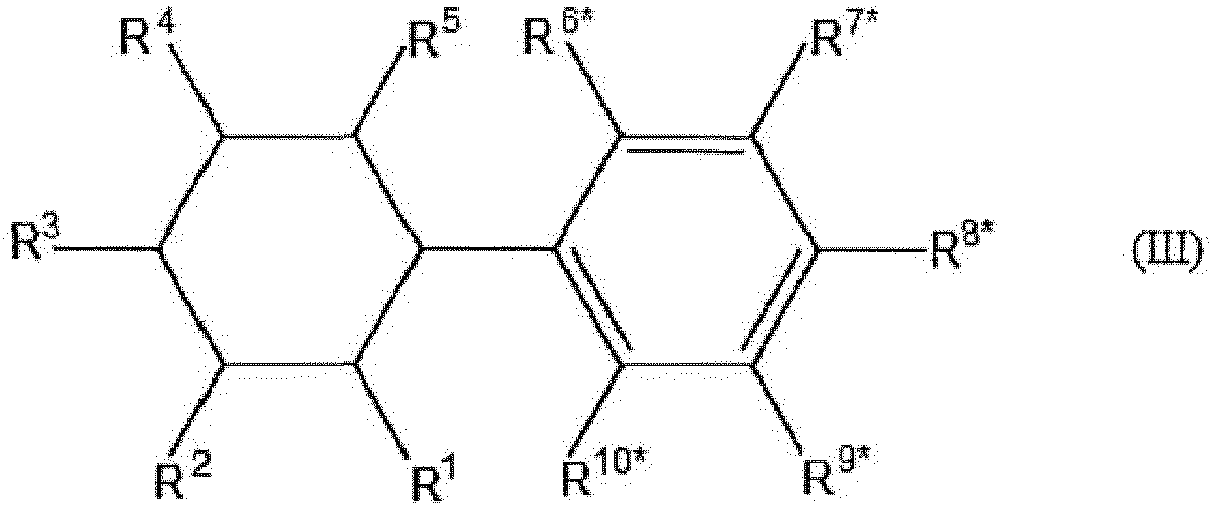
- Verfahren nach Anspruch 1, bei dem ferner eine Vorläuferbiphenylverbindung mit der Strukturformel (IV) partiell hydriert wird,
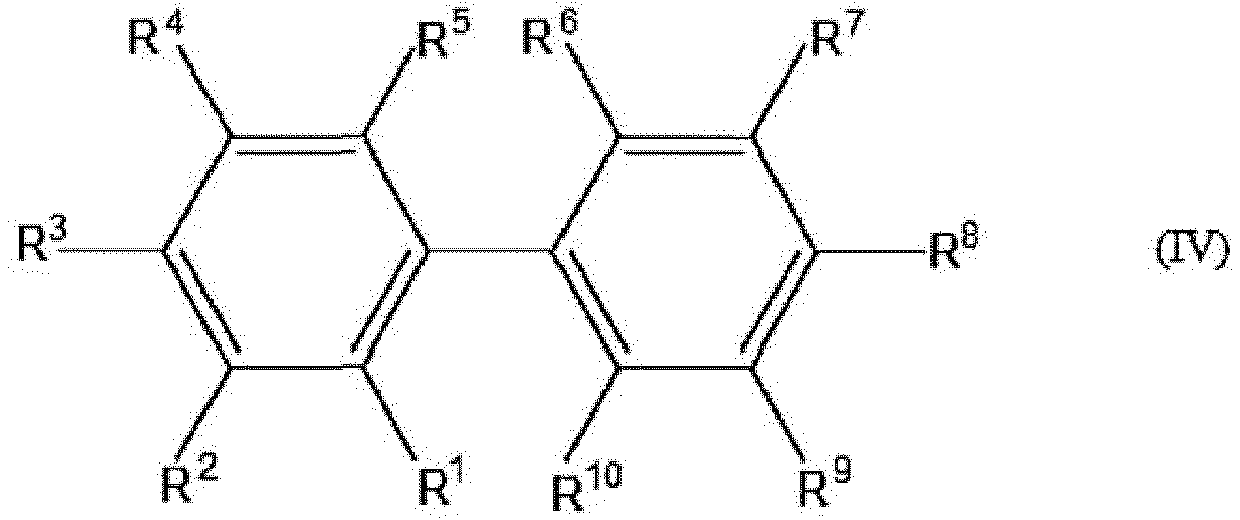
- Verfahren nach Anspruch 2, bei dem ferner(b)die transalkylierte Cyclohexylbenzylverbindung dehydriert wird, um eine ringersetzte Biphenylverbindung mit der Strukturformel (V)
 (c)die ringersetzte Biphenylverbindung in Gegenwart eines Hydrierkatalysators partiell hydriert wird, um eine ringersetzte Cyclohexylbenzylverbindung mit der Strukturformel (VI)
 (d)und die ringersetzte Cyclohexylbenzylverbindung mit einem zusätzlichen substituierten oder unsubstituierten Benzol in Gegenwart eines zweiten Transalkylierungskatalysators in Kontakt gebracht wird, wodurch eine weitere transalkylierte Cyclohexylbenzylverbindung erhalten wird, wobei das zusätzliche substituierte oder unsubstituierte Benzol die Strukturformel (VII)
wobei die weitere transalkylierte Cyclohexylbenzylverbindung die Strukturformel (VIII)
- Verfahren nach Anspruch 3, bei dem ferner die weiter transalkylierte Cyclohexylbenzylverbindung dehydriert wird, um eine doppelt ringersetzte Biphenylverbindung mit der Strukturformel (IX)

- Verfahren nach einem der Ansprüche 1 bis 4, bei dem R1 bis R5 jeweils H sind.
- Verfahren nach Anspruch 5, bei dem R6 bis R10 jeweils H sind.
- Verfahren nach einem der Ansprüche 1 bis 4, bei dem einer von R1 bis R5 eine C1- bis C5-Alkylgruppe ist und der Rest von R1 bis R5 jeweils H ist; und wobei ferner R6 bis R10 jeweils H sind.
- Verfahren nach einem der Ansprüche 1 bis 7, bei dem das substituierte oder unsubstituierte Benzol und das zusätzliche substituierte oder unsubstituierte Benzol jeweils unabhängig ausgewählt sind aus der Gruppe bestehend aus Toluol, Xylol und Ethylbenzol.
- Verfahren nach einem der vorhergehenden Ansprüche 3 bis 8, bei dem eine einzelne Katalysatorzusammensetzung sowohl der Transalkylierungskatalysator als auch der zweite Transalkylierungskatalysator ist.
- Verfahren nach einem der vorhergehenden Ansprüche, bei dem die Cyclohexylbenzylverbindung Cyclohexylbenzol (CHB) ist; das substituierte oder unsubstituierte Benzol ein substituiertes Benzol ausgewählt aus der Gruppe bestehend aus Toluol, Xylol, Ethylbenzol und Mischungen davon ist; und die transalkylierte Cyclohexylbenzylverbindung ein oder mehrere Isomere von Cyclohexyltoluol, Cyclohexylxylol beziehungsweise Cyclohexylethylbenzol oder Mischungen davon umfasst.
- Verfahren zur Bildung von Cyclohexylbenzyl- und/oder Biphenylverbindungen, bei dem(a) einer kombinierten Hydroalkylierungs- und Transalkylierungsreaktionszone ein Hydroalkylierungseinsatzmaterial bereitgestellt wird, das (i) Wasserstoff, (ii) ein substituiertes oder unsubstituiertes Benzol und (iii) ein oder beide von Cyclohexylbenzylverbindung und Vorläuferbiphenylverbindung umfasst;
wobei die kombinierte Hydroalkylierungs- und Transalkylierungsreaktionszone (A) einen Hydrierkatalysator und einen Alkylierungskatalysator oder (B) einen bifunktionalen Katalysator umfasst, der (i) ein Hydriermetall ausgewählt aus Gruppe 10 des Periodensystems der Elemente und (ii) ein Molekularsieb umfasst; wobei das substituierte oder unsubstituierte Benzol des Weiteren die Strukturformel (II) aufweist:
wobei die Cyclohexylbenzylverbindung des Weiteren die Strukturformel (I) aufweist:
wobei die Vorläuferbiphenylverbindung des Weiteren die Strukturformel (IV) aufweist: (b) ein Reaktionsausfluss gebildet wird, der Hydroalkylierungsprodukt und Transalkylierungsprodukt umfasst, wobei das Hydroalkylierungsprodukt die Formel (X)

- Verfahren nach Anspruch 11, bei dem das substituierte oder unsubstituierte Benzol ausgewählt ist aus der Gruppe bestehend aus Toluol, Xylol und Ethylbenzol; und wobei des Weiteren die Cyclohexylbenzylverbindung ausgewählt ist aus der Gruppe bestehend aus Cyclohexylbenzol, (Methylcyclohexyl)toluol, (Dimethylcyclohexyl)xylol, (Cyclohexyl)toluol und Mischungen davon.
- Verfahren nach Anspruch 11 oder 12, bei dem
das Hydroalkylierungseinsatzmaterial Wasserstoff, Toluol und eines oder beide von Methylcylohexyltoluol (MCHT) und Dimethylbiphenyl (DMBP) umfasst, so dass n % des kombinierten Gewichts von dem MCHT und DMBP in dem Einsatzmaterial aus Positionsisomeren zusammengesetzt ist, bei denen eine der beiden Methylgruppen des Phenylrings des MCHT oder DMBP in der 2-Position ist; und
wobei das Transalkylierungsprodukt in dem Reaktionsausfluss ferner MCHT umfasst, so dass m % des Gewichts von dem MCHT in dem Reaktionsausfluss aus Positionsisomeren zusammengesetzt ist, bei denen eine der beiden Methylgruppen des Phenylrings des MCHT in der 2-Position ist, wobei m kleiner als n ist. - Verfahren nach einem der Ansprüche 11 bis 13, bei dem der Hydrierkatalysator ein Metall ausgewählt aus der Gruppe bestehend aus Pd, Pt, Ni, Cu und jeglicher Kombination davon umfasst, und wobei ferner der Alkylierungskatalysator ausgewählt ist aus der Gruppe bestehend aus (i) gebundenen Molekularsieben, die USY-Zeolith und Al2O3 umfassen, (ii) Molekularsieben der Familie MCM-22, und (iii) jeglicher Kombination davon.
Applications Claiming Priority (3)
| Application Number | Priority Date | Filing Date | Title |
|---|---|---|---|
| US201562140723P | 2015-03-31 | 2015-03-31 | |
| EP15173771 | 2015-06-25 | ||
| PCT/US2015/066109 WO2016160084A1 (en) | 2015-03-31 | 2015-12-16 | Transalkylated cyclohexylbenzyl and biphenyl compounds |
Publications (2)
| Publication Number | Publication Date |
|---|---|
| EP3277649A1 EP3277649A1 (de) | 2018-02-07 |
| EP3277649B1 true EP3277649B1 (de) | 2019-08-21 |
Family
ID=53502462
Family Applications (1)
| Application Number | Title | Priority Date | Filing Date |
|---|---|---|---|
| EP15820417.2A Not-in-force EP3277649B1 (de) | 2015-03-31 | 2015-12-16 | Transalkylierte cyclohexylbenzyl- und biphenylverbindungen |
Country Status (6)
| Country | Link |
|---|---|
| US (1) | US10017433B2 (de) |
| EP (1) | EP3277649B1 (de) |
| JP (1) | JP6441501B2 (de) |
| KR (1) | KR20180004108A (de) |
| CN (1) | CN107438590A (de) |
| WO (1) | WO2016160084A1 (de) |
Families Citing this family (2)
| Publication number | Priority date | Publication date | Assignee | Title |
|---|---|---|---|---|
| US10294338B2 (en) | 2015-04-02 | 2019-05-21 | Exxonmobil Chemical Patents Inc. | Method of making thermoplastic vulcanizates and thermoplastic vulcanizates made therefrom |
| CN109456736A (zh) * | 2018-10-19 | 2019-03-12 | 江苏中能化学科技股份有限公司 | 一种高温合成型导热油 |
Family Cites Families (28)
| Publication number | Priority date | Publication date | Assignee | Title |
|---|---|---|---|---|
| US4016218A (en) | 1975-05-29 | 1977-04-05 | Mobil Oil Corporation | Alkylation in presence of thermally modified crystalline aluminosilicate catalyst |
| DE3117135A1 (de) | 1981-04-30 | 1982-11-18 | Bayer Ag, 5090 Leverkusen | Kristallines alumosilicat, verfahren zu dessen herstellung sowie dessen verwendung zur katalytischen umwandlung von methanol und/oder dimethylether in kohlenwasserstoffe |
| US4629817A (en) * | 1985-05-06 | 1986-12-16 | Mobil Oil Corporation | Transfer of cycloalkyl groups by transalkylation of aromatics |
| US4826667A (en) | 1986-01-29 | 1989-05-02 | Chevron Research Company | Zeolite SSZ-25 |
| US4954325A (en) | 1986-07-29 | 1990-09-04 | Mobil Oil Corp. | Composition of synthetic porous crystalline material, its synthesis and use |
| IT1205681B (it) | 1987-05-26 | 1989-03-31 | Eniricerche Spa | Materiale sintetico cristallino poroso contenente ossidi di silicio e boro |
| US5250277A (en) | 1991-01-11 | 1993-10-05 | Mobil Oil Corp. | Crystalline oxide material |
| US5236575A (en) | 1991-06-19 | 1993-08-17 | Mobil Oil Corp. | Synthetic porous crystalline mcm-49, its synthesis and use |
| US5362697A (en) | 1993-04-26 | 1994-11-08 | Mobil Oil Corp. | Synthetic layered MCM-56, its synthesis and use |
| JP3603908B2 (ja) | 1994-09-29 | 2004-12-22 | 三菱瓦斯化学株式会社 | 4−メチルビフェニルおよび4,4’−ジメチルビフェニルの製造法 |
| ES2124154B1 (es) | 1995-11-08 | 1999-12-01 | Univ Politecnica De Valencia C | Metodo de preparaciion y propiedades cataliticas de un solido microporoso con alta superficie externa. |
| ES2105982B1 (es) | 1995-11-23 | 1998-07-01 | Consejo Superior Investigacion | Zeolita itq-1 |
| US6037513A (en) | 1998-07-09 | 2000-03-14 | Mobil Oil Corporation | Hydroalkylation of aromatic hydrocarbons |
| WO2009131769A1 (en) | 2008-04-25 | 2009-10-29 | Exxonmobil Chamical Patents Inc. | Process for producing phenol and/or cyclohexanone |
| JP5486083B2 (ja) * | 2009-05-26 | 2014-05-07 | エクソンモービル ケミカル パテンツ インコーポレイテッド | ポリシクロヘキシルベンゼンのトランスアルキル化 |
| WO2012082229A1 (en) | 2010-12-17 | 2012-06-21 | Exxonmobil Chemical Patents Inc. | Composition comprising cyclohexylbenzene and 1 - phenyl - 1 -methylcyclopentane and use thereof in oxidation processes |
| SG193427A1 (en) | 2011-03-28 | 2013-10-30 | Exxonmobil Chem Patents Inc | Dehydrogenation process |
| US9663417B2 (en) * | 2013-03-14 | 2017-05-30 | Exxonmobil Chemical Patents Inc. | Methyl-substituted biphenyl compounds, their production and their use in the manufacture of plasticizers |
| US9725377B2 (en) | 2013-03-14 | 2017-08-08 | Exxonmobil Chemical Patents Inc. | Hydroalkylation catalyst and process for use thereof |
| US9328053B2 (en) | 2013-03-14 | 2016-05-03 | Exxonmobil Chemical Patents Inc. | Methyl-substituted biphenyl compounds, their production and their use in the manufacture of plasticizers |
| EP2970045A4 (de) | 2013-03-14 | 2016-03-09 | Exxonmobil Chem Patents Inc | Methylsubstituierte biphenylverbindungen, deren herstellung und deren verwendung bei der herstellung von weichmachern |
| EP2970050A4 (de) * | 2013-03-14 | 2016-04-06 | Exxonmobil Chem Patents Inc | Methylsubstituierte biphenylverbindungen, deren herstellung und deren verwendung bei der herstellung von weichmachern |
| RU2015143691A (ru) | 2013-03-14 | 2017-04-17 | Эксонмобил Кемикэл Пейтентс Инк. | Смеси изомеров (метилциклогексил)толуола, их получение и их применение для получения пластификаторов |
| US9896393B2 (en) | 2014-06-13 | 2018-02-20 | Exxonmobil Chemical Patents Inc. | Process for preparing dialkylbiphenyl isomer mixtures |
| US9758447B2 (en) | 2014-10-24 | 2017-09-12 | Exxonmobil Chemical Patents Inc. | Activation of dehydrogenation catalysts |
| US9856186B2 (en) | 2014-12-19 | 2018-01-02 | Exxonmobil Chemical Patents Inc. | Production and use of dialkylbiphenyl isomer mixtures |
| US9708230B2 (en) | 2015-03-25 | 2017-07-18 | Exxonmobil Chemical Patents Inc. | Production of biphenyl compounds |
| US10294338B2 (en) | 2015-04-02 | 2019-05-21 | Exxonmobil Chemical Patents Inc. | Method of making thermoplastic vulcanizates and thermoplastic vulcanizates made therefrom |
-
2015
- 2015-12-16 EP EP15820417.2A patent/EP3277649B1/de not_active Not-in-force
- 2015-12-16 US US15/554,211 patent/US10017433B2/en active Active
- 2015-12-16 WO PCT/US2015/066109 patent/WO2016160084A1/en not_active Ceased
- 2015-12-16 JP JP2017550573A patent/JP6441501B2/ja not_active Expired - Fee Related
- 2015-12-16 CN CN201580078406.4A patent/CN107438590A/zh active Pending
- 2015-12-16 KR KR1020177027718A patent/KR20180004108A/ko not_active Ceased
Non-Patent Citations (1)
| Title |
|---|
| None * |
Also Published As
| Publication number | Publication date |
|---|---|
| US10017433B2 (en) | 2018-07-10 |
| CN107438590A (zh) | 2017-12-05 |
| WO2016160084A1 (en) | 2016-10-06 |
| JP6441501B2 (ja) | 2018-12-19 |
| EP3277649A1 (de) | 2018-02-07 |
| JP2018509461A (ja) | 2018-04-05 |
| KR20180004108A (ko) | 2018-01-10 |
| US20180050971A1 (en) | 2018-02-22 |
Similar Documents
| Publication | Publication Date | Title |
|---|---|---|
| US7579511B1 (en) | Process for making cyclohexylbenzene | |
| US9896393B2 (en) | Process for preparing dialkylbiphenyl isomer mixtures | |
| US9663417B2 (en) | Methyl-substituted biphenyl compounds, their production and their use in the manufacture of plasticizers | |
| US9856186B2 (en) | Production and use of dialkylbiphenyl isomer mixtures | |
| TW201136888A (en) | Transalkylation of heavy aromatic hydrocarbon feedstocks | |
| KR20190040077A (ko) | 중질 방향족 탄화수소의 탈알킬화 및 알킬교환 | |
| EP3154922B1 (de) | Verfahren zur herstellung von dialkylbiphenylisomergemischen | |
| US9708230B2 (en) | Production of biphenyl compounds | |
| SG175815A1 (en) | Aromatic alkylation process with reduced byproduct formation | |
| US10017433B2 (en) | Transalkylated cyclohexylbenzyl and biphenyl compounds | |
| TWI600640B (zh) | 轉烷化之環己基苯甲基及聯苯化合物 | |
| US10787399B2 (en) | Preparation and use of phenylstyrene | |
| EP3274318B1 (de) | Herstellung von biphenylverbindungen | |
| TWI615382B (zh) | 苯基苯乙烯之製造及用途 | |
| WO2011046547A1 (en) | Process for the high yield production of monoalkylaromatics | |
| US20160176786A1 (en) | Sulfiding Process for Aromatic Transalkylations | |
| CN107001184A (zh) | 二烷基联苯异构体混合物的生产和用途 |
Legal Events
| Date | Code | Title | Description |
|---|---|---|---|
| STAA | Information on the status of an ep patent application or granted ep patent |
Free format text: STATUS: THE INTERNATIONAL PUBLICATION HAS BEEN MADE |
|
| PUAI | Public reference made under article 153(3) epc to a published international application that has entered the european phase |
Free format text: ORIGINAL CODE: 0009012 |
|
| STAA | Information on the status of an ep patent application or granted ep patent |
Free format text: STATUS: REQUEST FOR EXAMINATION WAS MADE |
|
| 17P | Request for examination filed |
Effective date: 20171025 |
|
| AK | Designated contracting states |
Kind code of ref document: A1 Designated state(s): AL AT BE BG CH CY CZ DE DK EE ES FI FR GB GR HR HU IE IS IT LI LT LU LV MC MK MT NL NO PL PT RO RS SE SI SK SM TR |
|
| AX | Request for extension of the european patent |
Extension state: BA ME |
|
| DAV | Request for validation of the european patent (deleted) | ||
| DAX | Request for extension of the european patent (deleted) | ||
| GRAP | Despatch of communication of intention to grant a patent |
Free format text: ORIGINAL CODE: EPIDOSNIGR1 |
|
| STAA | Information on the status of an ep patent application or granted ep patent |
Free format text: STATUS: GRANT OF PATENT IS INTENDED |
|
| INTG | Intention to grant announced |
Effective date: 20190408 |
|
| GRAS | Grant fee paid |
Free format text: ORIGINAL CODE: EPIDOSNIGR3 |
|
| GRAA | (expected) grant |
Free format text: ORIGINAL CODE: 0009210 |
|
| STAA | Information on the status of an ep patent application or granted ep patent |
Free format text: STATUS: THE PATENT HAS BEEN GRANTED |
|
| AK | Designated contracting states |
Kind code of ref document: B1 Designated state(s): AL AT BE BG CH CY CZ DE DK EE ES FI FR GB GR HR HU IE IS IT LI LT LU LV MC MK MT NL NO PL PT RO RS SE SI SK SM TR |
|
| REG | Reference to a national code |
Ref country code: GB Ref legal event code: FG4D |
|
| REG | Reference to a national code |
Ref country code: CH Ref legal event code: EP |
|
| REG | Reference to a national code |
Ref country code: DE Ref legal event code: R096 Ref document number: 602015036414 Country of ref document: DE |
|
| REG | Reference to a national code |
Ref country code: AT Ref legal event code: REF Ref document number: 1169584 Country of ref document: AT Kind code of ref document: T Effective date: 20190915 |
|
| REG | Reference to a national code |
Ref country code: IE Ref legal event code: FG4D |
|
| REG | Reference to a national code |
Ref country code: LT Ref legal event code: MG4D |
|
| REG | Reference to a national code |
Ref country code: NL Ref legal event code: MP Effective date: 20190821 |
|
| PG25 | Lapsed in a contracting state [announced via postgrant information from national office to epo] |
Ref country code: BG Free format text: LAPSE BECAUSE OF FAILURE TO SUBMIT A TRANSLATION OF THE DESCRIPTION OR TO PAY THE FEE WITHIN THE PRESCRIBED TIME-LIMIT Effective date: 20191121 Ref country code: NO Free format text: LAPSE BECAUSE OF FAILURE TO SUBMIT A TRANSLATION OF THE DESCRIPTION OR TO PAY THE FEE WITHIN THE PRESCRIBED TIME-LIMIT Effective date: 20191121 Ref country code: NL Free format text: LAPSE BECAUSE OF FAILURE TO SUBMIT A TRANSLATION OF THE DESCRIPTION OR TO PAY THE FEE WITHIN THE PRESCRIBED TIME-LIMIT Effective date: 20190821 Ref country code: LT Free format text: LAPSE BECAUSE OF FAILURE TO SUBMIT A TRANSLATION OF THE DESCRIPTION OR TO PAY THE FEE WITHIN THE PRESCRIBED TIME-LIMIT Effective date: 20190821 Ref country code: FI Free format text: LAPSE BECAUSE OF FAILURE TO SUBMIT A TRANSLATION OF THE DESCRIPTION OR TO PAY THE FEE WITHIN THE PRESCRIBED TIME-LIMIT Effective date: 20190821 Ref country code: HR Free format text: LAPSE BECAUSE OF FAILURE TO SUBMIT A TRANSLATION OF THE DESCRIPTION OR TO PAY THE FEE WITHIN THE PRESCRIBED TIME-LIMIT Effective date: 20190821 Ref country code: PT Free format text: LAPSE BECAUSE OF FAILURE TO SUBMIT A TRANSLATION OF THE DESCRIPTION OR TO PAY THE FEE WITHIN THE PRESCRIBED TIME-LIMIT Effective date: 20191223 Ref country code: SE Free format text: LAPSE BECAUSE OF FAILURE TO SUBMIT A TRANSLATION OF THE DESCRIPTION OR TO PAY THE FEE WITHIN THE PRESCRIBED TIME-LIMIT Effective date: 20190821 |
|
| PG25 | Lapsed in a contracting state [announced via postgrant information from national office to epo] |
Ref country code: GR Free format text: LAPSE BECAUSE OF FAILURE TO SUBMIT A TRANSLATION OF THE DESCRIPTION OR TO PAY THE FEE WITHIN THE PRESCRIBED TIME-LIMIT Effective date: 20191122 Ref country code: ES Free format text: LAPSE BECAUSE OF FAILURE TO SUBMIT A TRANSLATION OF THE DESCRIPTION OR TO PAY THE FEE WITHIN THE PRESCRIBED TIME-LIMIT Effective date: 20190821 Ref country code: AL Free format text: LAPSE BECAUSE OF FAILURE TO SUBMIT A TRANSLATION OF THE DESCRIPTION OR TO PAY THE FEE WITHIN THE PRESCRIBED TIME-LIMIT Effective date: 20190821 Ref country code: LV Free format text: LAPSE BECAUSE OF FAILURE TO SUBMIT A TRANSLATION OF THE DESCRIPTION OR TO PAY THE FEE WITHIN THE PRESCRIBED TIME-LIMIT Effective date: 20190821 Ref country code: RS Free format text: LAPSE BECAUSE OF FAILURE TO SUBMIT A TRANSLATION OF THE DESCRIPTION OR TO PAY THE FEE WITHIN THE PRESCRIBED TIME-LIMIT Effective date: 20190821 Ref country code: IS Free format text: LAPSE BECAUSE OF FAILURE TO SUBMIT A TRANSLATION OF THE DESCRIPTION OR TO PAY THE FEE WITHIN THE PRESCRIBED TIME-LIMIT Effective date: 20191221 |
|
| REG | Reference to a national code |
Ref country code: AT Ref legal event code: MK05 Ref document number: 1169584 Country of ref document: AT Kind code of ref document: T Effective date: 20190821 |
|
| PG25 | Lapsed in a contracting state [announced via postgrant information from national office to epo] |
Ref country code: TR Free format text: LAPSE BECAUSE OF FAILURE TO SUBMIT A TRANSLATION OF THE DESCRIPTION OR TO PAY THE FEE WITHIN THE PRESCRIBED TIME-LIMIT Effective date: 20190821 |
|
| PG25 | Lapsed in a contracting state [announced via postgrant information from national office to epo] |
Ref country code: DK Free format text: LAPSE BECAUSE OF FAILURE TO SUBMIT A TRANSLATION OF THE DESCRIPTION OR TO PAY THE FEE WITHIN THE PRESCRIBED TIME-LIMIT Effective date: 20190821 Ref country code: AT Free format text: LAPSE BECAUSE OF FAILURE TO SUBMIT A TRANSLATION OF THE DESCRIPTION OR TO PAY THE FEE WITHIN THE PRESCRIBED TIME-LIMIT Effective date: 20190821 Ref country code: IT Free format text: LAPSE BECAUSE OF FAILURE TO SUBMIT A TRANSLATION OF THE DESCRIPTION OR TO PAY THE FEE WITHIN THE PRESCRIBED TIME-LIMIT Effective date: 20190821 Ref country code: PL Free format text: LAPSE BECAUSE OF FAILURE TO SUBMIT A TRANSLATION OF THE DESCRIPTION OR TO PAY THE FEE WITHIN THE PRESCRIBED TIME-LIMIT Effective date: 20190821 Ref country code: EE Free format text: LAPSE BECAUSE OF FAILURE TO SUBMIT A TRANSLATION OF THE DESCRIPTION OR TO PAY THE FEE WITHIN THE PRESCRIBED TIME-LIMIT Effective date: 20190821 Ref country code: RO Free format text: LAPSE BECAUSE OF FAILURE TO SUBMIT A TRANSLATION OF THE DESCRIPTION OR TO PAY THE FEE WITHIN THE PRESCRIBED TIME-LIMIT Effective date: 20190821 |
|
| PG25 | Lapsed in a contracting state [announced via postgrant information from national office to epo] |
Ref country code: IS Free format text: LAPSE BECAUSE OF FAILURE TO SUBMIT A TRANSLATION OF THE DESCRIPTION OR TO PAY THE FEE WITHIN THE PRESCRIBED TIME-LIMIT Effective date: 20200224 Ref country code: SK Free format text: LAPSE BECAUSE OF FAILURE TO SUBMIT A TRANSLATION OF THE DESCRIPTION OR TO PAY THE FEE WITHIN THE PRESCRIBED TIME-LIMIT Effective date: 20190821 Ref country code: CZ Free format text: LAPSE BECAUSE OF FAILURE TO SUBMIT A TRANSLATION OF THE DESCRIPTION OR TO PAY THE FEE WITHIN THE PRESCRIBED TIME-LIMIT Effective date: 20190821 Ref country code: SM Free format text: LAPSE BECAUSE OF FAILURE TO SUBMIT A TRANSLATION OF THE DESCRIPTION OR TO PAY THE FEE WITHIN THE PRESCRIBED TIME-LIMIT Effective date: 20190821 |
|
| REG | Reference to a national code |
Ref country code: DE Ref legal event code: R097 Ref document number: 602015036414 Country of ref document: DE |
|
| REG | Reference to a national code |
Ref country code: DE Ref legal event code: R119 Ref document number: 602015036414 Country of ref document: DE |
|
| PLBE | No opposition filed within time limit |
Free format text: ORIGINAL CODE: 0009261 |
|
| STAA | Information on the status of an ep patent application or granted ep patent |
Free format text: STATUS: NO OPPOSITION FILED WITHIN TIME LIMIT |
|
| PG2D | Information on lapse in contracting state deleted |
Ref country code: IS |
|
| REG | Reference to a national code |
Ref country code: CH Ref legal event code: PL |
|
| 26N | No opposition filed |
Effective date: 20200603 |
|
| REG | Reference to a national code |
Ref country code: BE Ref legal event code: MM Effective date: 20191231 |
|
| PG25 | Lapsed in a contracting state [announced via postgrant information from national office to epo] |
Ref country code: SI Free format text: LAPSE BECAUSE OF FAILURE TO SUBMIT A TRANSLATION OF THE DESCRIPTION OR TO PAY THE FEE WITHIN THE PRESCRIBED TIME-LIMIT Effective date: 20190821 Ref country code: MC Free format text: LAPSE BECAUSE OF FAILURE TO SUBMIT A TRANSLATION OF THE DESCRIPTION OR TO PAY THE FEE WITHIN THE PRESCRIBED TIME-LIMIT Effective date: 20190821 |
|
| GBPC | Gb: european patent ceased through non-payment of renewal fee |
Effective date: 20191216 |
|
| PG25 | Lapsed in a contracting state [announced via postgrant information from national office to epo] |
Ref country code: FR Free format text: LAPSE BECAUSE OF NON-PAYMENT OF DUE FEES Effective date: 20191231 Ref country code: GB Free format text: LAPSE BECAUSE OF NON-PAYMENT OF DUE FEES Effective date: 20191216 Ref country code: LU Free format text: LAPSE BECAUSE OF NON-PAYMENT OF DUE FEES Effective date: 20191216 Ref country code: IE Free format text: LAPSE BECAUSE OF NON-PAYMENT OF DUE FEES Effective date: 20191216 Ref country code: DE Free format text: LAPSE BECAUSE OF NON-PAYMENT OF DUE FEES Effective date: 20200701 |
|
| PG25 | Lapsed in a contracting state [announced via postgrant information from national office to epo] |
Ref country code: BE Free format text: LAPSE BECAUSE OF NON-PAYMENT OF DUE FEES Effective date: 20191231 Ref country code: LI Free format text: LAPSE BECAUSE OF NON-PAYMENT OF DUE FEES Effective date: 20191231 Ref country code: CH Free format text: LAPSE BECAUSE OF NON-PAYMENT OF DUE FEES Effective date: 20191231 |
|
| PG25 | Lapsed in a contracting state [announced via postgrant information from national office to epo] |
Ref country code: CY Free format text: LAPSE BECAUSE OF FAILURE TO SUBMIT A TRANSLATION OF THE DESCRIPTION OR TO PAY THE FEE WITHIN THE PRESCRIBED TIME-LIMIT Effective date: 20190821 |
|
| PG25 | Lapsed in a contracting state [announced via postgrant information from national office to epo] |
Ref country code: HU Free format text: LAPSE BECAUSE OF FAILURE TO SUBMIT A TRANSLATION OF THE DESCRIPTION OR TO PAY THE FEE WITHIN THE PRESCRIBED TIME-LIMIT; INVALID AB INITIO Effective date: 20151216 Ref country code: MT Free format text: LAPSE BECAUSE OF FAILURE TO SUBMIT A TRANSLATION OF THE DESCRIPTION OR TO PAY THE FEE WITHIN THE PRESCRIBED TIME-LIMIT Effective date: 20190821 |
|
| PG25 | Lapsed in a contracting state [announced via postgrant information from national office to epo] |
Ref country code: MK Free format text: LAPSE BECAUSE OF FAILURE TO SUBMIT A TRANSLATION OF THE DESCRIPTION OR TO PAY THE FEE WITHIN THE PRESCRIBED TIME-LIMIT Effective date: 20190821 |