EP3278985B1 - Composite aérogel et son procédé de préparation - Google Patents
Composite aérogel et son procédé de préparation Download PDFInfo
- Publication number
- EP3278985B1 EP3278985B1 EP17747797.3A EP17747797A EP3278985B1 EP 3278985 B1 EP3278985 B1 EP 3278985B1 EP 17747797 A EP17747797 A EP 17747797A EP 3278985 B1 EP3278985 B1 EP 3278985B1
- Authority
- EP
- European Patent Office
- Prior art keywords
- fibers
- fibrous material
- precursor
- vessel
- gel
- Prior art date
- Legal status (The legal status is an assumption and is not a legal conclusion. Google has not performed a legal analysis and makes no representation as to the accuracy of the status listed.)
- Active
Links
Images
Classifications
-
- B—PERFORMING OPERATIONS; TRANSPORTING
- B32—LAYERED PRODUCTS
- B32B—LAYERED PRODUCTS, i.e. PRODUCTS BUILT-UP OF STRATA OF FLAT OR NON-FLAT, e.g. CELLULAR OR HONEYCOMB, FORM
- B32B5/00—Layered products characterised by the non- homogeneity or physical structure, i.e. comprising a fibrous, filamentary, particulate or foam layer; Layered products characterised by having a layer differing constitutionally or physically in different parts
- B32B5/22—Layered products characterised by the non- homogeneity or physical structure, i.e. comprising a fibrous, filamentary, particulate or foam layer; Layered products characterised by having a layer differing constitutionally or physically in different parts characterised by the presence of two or more layers which are next to each other and are fibrous, filamentary, formed of particles or foamed
- B32B5/24—Layered products characterised by the non- homogeneity or physical structure, i.e. comprising a fibrous, filamentary, particulate or foam layer; Layered products characterised by having a layer differing constitutionally or physically in different parts characterised by the presence of two or more layers which are next to each other and are fibrous, filamentary, formed of particles or foamed one layer being a fibrous or filamentary layer
- B32B5/28—Layered products characterised by the non- homogeneity or physical structure, i.e. comprising a fibrous, filamentary, particulate or foam layer; Layered products characterised by having a layer differing constitutionally or physically in different parts characterised by the presence of two or more layers which are next to each other and are fibrous, filamentary, formed of particles or foamed one layer being a fibrous or filamentary layer impregnated with or embedded in a plastic substance
-
- B—PERFORMING OPERATIONS; TRANSPORTING
- B32—LAYERED PRODUCTS
- B32B—LAYERED PRODUCTS, i.e. PRODUCTS BUILT-UP OF STRATA OF FLAT OR NON-FLAT, e.g. CELLULAR OR HONEYCOMB, FORM
- B32B38/00—Ancillary operations in connection with laminating processes
- B32B38/08—Impregnating
-
- B—PERFORMING OPERATIONS; TRANSPORTING
- B29—WORKING OF PLASTICS; WORKING OF SUBSTANCES IN A PLASTIC STATE IN GENERAL
- B29C—SHAPING OR JOINING OF PLASTICS; SHAPING OF MATERIAL IN A PLASTIC STATE, NOT OTHERWISE PROVIDED FOR; AFTER-TREATMENT OF THE SHAPED PRODUCTS, e.g. REPAIRING
- B29C70/00—Shaping composites, i.e. plastics material comprising reinforcements, fillers or preformed parts, e.g. inserts
- B29C70/04—Shaping composites, i.e. plastics material comprising reinforcements, fillers or preformed parts, e.g. inserts comprising reinforcements only, e.g. self-reinforcing plastics
- B29C70/28—Shaping operations therefor
- B29C70/30—Shaping by lay-up, i.e. applying fibres, tape or broadsheet on a mould, former or core; Shaping by spray-up, i.e. spraying of fibres on a mould, former or core
- B29C70/305—Spray-up of reinforcing fibres with or without matrix to form a non-coherent mat in or on a mould
-
- B—PERFORMING OPERATIONS; TRANSPORTING
- B32—LAYERED PRODUCTS
- B32B—LAYERED PRODUCTS, i.e. PRODUCTS BUILT-UP OF STRATA OF FLAT OR NON-FLAT, e.g. CELLULAR OR HONEYCOMB, FORM
- B32B37/00—Methods or apparatus for laminating, e.g. by curing or by ultrasonic bonding
- B32B37/02—Methods or apparatus for laminating, e.g. by curing or by ultrasonic bonding characterised by a sequence of laminating steps, e.g. by adding new layers at consecutive laminating stations
-
- B—PERFORMING OPERATIONS; TRANSPORTING
- B32—LAYERED PRODUCTS
- B32B—LAYERED PRODUCTS, i.e. PRODUCTS BUILT-UP OF STRATA OF FLAT OR NON-FLAT, e.g. CELLULAR OR HONEYCOMB, FORM
- B32B38/00—Ancillary operations in connection with laminating processes
- B32B38/10—Removing layers, or parts of layers, mechanically or chemically
-
- B—PERFORMING OPERATIONS; TRANSPORTING
- B32—LAYERED PRODUCTS
- B32B—LAYERED PRODUCTS, i.e. PRODUCTS BUILT-UP OF STRATA OF FLAT OR NON-FLAT, e.g. CELLULAR OR HONEYCOMB, FORM
- B32B38/00—Ancillary operations in connection with laminating processes
- B32B38/16—Drying; Softening; Cleaning
- B32B38/162—Cleaning
-
- B—PERFORMING OPERATIONS; TRANSPORTING
- B32—LAYERED PRODUCTS
- B32B—LAYERED PRODUCTS, i.e. PRODUCTS BUILT-UP OF STRATA OF FLAT OR NON-FLAT, e.g. CELLULAR OR HONEYCOMB, FORM
- B32B38/00—Ancillary operations in connection with laminating processes
- B32B38/16—Drying; Softening; Cleaning
- B32B38/164—Drying
-
- B—PERFORMING OPERATIONS; TRANSPORTING
- B32—LAYERED PRODUCTS
- B32B—LAYERED PRODUCTS, i.e. PRODUCTS BUILT-UP OF STRATA OF FLAT OR NON-FLAT, e.g. CELLULAR OR HONEYCOMB, FORM
- B32B43/00—Operations specially adapted for layered products and not otherwise provided for, e.g. repairing; Apparatus therefor
- B32B43/006—Delaminating
-
- B—PERFORMING OPERATIONS; TRANSPORTING
- B32—LAYERED PRODUCTS
- B32B—LAYERED PRODUCTS, i.e. PRODUCTS BUILT-UP OF STRATA OF FLAT OR NON-FLAT, e.g. CELLULAR OR HONEYCOMB, FORM
- B32B5/00—Layered products characterised by the non- homogeneity or physical structure, i.e. comprising a fibrous, filamentary, particulate or foam layer; Layered products characterised by having a layer differing constitutionally or physically in different parts
- B32B5/22—Layered products characterised by the non- homogeneity or physical structure, i.e. comprising a fibrous, filamentary, particulate or foam layer; Layered products characterised by having a layer differing constitutionally or physically in different parts characterised by the presence of two or more layers which are next to each other and are fibrous, filamentary, formed of particles or foamed
- B32B5/24—Layered products characterised by the non- homogeneity or physical structure, i.e. comprising a fibrous, filamentary, particulate or foam layer; Layered products characterised by having a layer differing constitutionally or physically in different parts characterised by the presence of two or more layers which are next to each other and are fibrous, filamentary, formed of particles or foamed one layer being a fibrous or filamentary layer
-
- C—CHEMISTRY; METALLURGY
- C01—INORGANIC CHEMISTRY
- C01B—NON-METALLIC ELEMENTS; COMPOUNDS THEREOF; METALLOIDS OR COMPOUNDS THEREOF NOT COVERED BY SUBCLASS C01C
- C01B33/00—Silicon; Compounds thereof
- C01B33/113—Silicon oxides; Hydrates thereof
- C01B33/12—Silica; Hydrates thereof, e.g. lepidoic silicic acid
- C01B33/14—Colloidal silica, e.g. dispersions, gels, sols
- C01B33/157—After-treatment of gels
-
- C—CHEMISTRY; METALLURGY
- C01—INORGANIC CHEMISTRY
- C01B—NON-METALLIC ELEMENTS; COMPOUNDS THEREOF; METALLOIDS OR COMPOUNDS THEREOF NOT COVERED BY SUBCLASS C01C
- C01B33/00—Silicon; Compounds thereof
- C01B33/113—Silicon oxides; Hydrates thereof
- C01B33/12—Silica; Hydrates thereof, e.g. lepidoic silicic acid
- C01B33/14—Colloidal silica, e.g. dispersions, gels, sols
- C01B33/157—After-treatment of gels
- C01B33/158—Purification; Drying; Dehydrating
- C01B33/1585—Dehydration into aerogels
-
- D—TEXTILES; PAPER
- D06—TREATMENT OF TEXTILES OR THE LIKE; LAUNDERING; FLEXIBLE MATERIALS NOT OTHERWISE PROVIDED FOR
- D06M—TREATMENT, NOT PROVIDED FOR ELSEWHERE IN CLASS D06, OF FIBRES, THREADS, YARNS, FABRICS, FEATHERS OR FIBROUS GOODS MADE FROM SUCH MATERIALS
- D06M11/00—Treating fibres, threads, yarns, fabrics or fibrous goods made from such materials, with inorganic substances or complexes thereof; Such treatment combined with mechanical treatment, e.g. mercerising
- D06M11/77—Treating fibres, threads, yarns, fabrics or fibrous goods made from such materials, with inorganic substances or complexes thereof; Such treatment combined with mechanical treatment, e.g. mercerising with silicon or compounds thereof
- D06M11/79—Treating fibres, threads, yarns, fabrics or fibrous goods made from such materials, with inorganic substances or complexes thereof; Such treatment combined with mechanical treatment, e.g. mercerising with silicon or compounds thereof with silicon dioxide, silicic acids or their salts
-
- B—PERFORMING OPERATIONS; TRANSPORTING
- B32—LAYERED PRODUCTS
- B32B—LAYERED PRODUCTS, i.e. PRODUCTS BUILT-UP OF STRATA OF FLAT OR NON-FLAT, e.g. CELLULAR OR HONEYCOMB, FORM
- B32B38/00—Ancillary operations in connection with laminating processes
- B32B2038/0052—Other operations not otherwise provided for
- B32B2038/0056—Moistening
-
- B—PERFORMING OPERATIONS; TRANSPORTING
- B32—LAYERED PRODUCTS
- B32B—LAYERED PRODUCTS, i.e. PRODUCTS BUILT-UP OF STRATA OF FLAT OR NON-FLAT, e.g. CELLULAR OR HONEYCOMB, FORM
- B32B2307/00—Properties of the layers or laminate
- B32B2307/30—Properties of the layers or laminate having particular thermal properties
- B32B2307/304—Insulating
Definitions
- an aerogel is the lightest solid developed by centuries and an ultra-insulating material having a porosity of greater than about 95%.
- the aerogel is a new material that has attracted attention as future insulation and soundproofing materials, and, thus, various types of research have recently been carried out to widely utilize the aerogel in various industrial fields.
- an aerogel has low density, an open cell structure, a large surface area, and a nanoscale pore size.
- the aerogel exhibits a density of up to 0.01 g/cc to 0.3 g/cc and an excellent thermal insulation property having a thermal conductivity of 10 mW/mK to 15 mW/mK at about 37°C (100°F) and atmospheric pressure.
- silica aerogel is a nanostructure material having a high specific surface area, high porosity, low density, low permittivity, and excellent thermal insulation, wherein lots of research into production and characterization of the silica aerogel has been conducted. For example, in order to improve mechanical strength and thermal insulation performance of the silica aerogel, there was an attempt to prepare an aerogel composite ( see Korean Patent Laid-open Publication No. 2011-0082379 ).
- gelation must be achieved to a certain level, i.e., the aerogel may be rolled while a reaction occurs during transport. But, that sufficient gelation time required for the formation of nanopores having high quality may not be provided.
- the precursor since the precursor is insufficient or is non-uniform even in the case that the viscosity of the precursor is reduced and the impregnation is performed, in which the precursor must be further added to an aging tank to supplement a deficient gel.
- the produced aerogel since the produced aerogel may be partially exfoliated and scattered in the form of powder, there may be a difficulty in its application and performance quality may be reduced.
- an object of the present invention is to provide an aerogel composite according to claim 17 which has improved thermal insulation performance and is easily prepared, and a method of preparing the same, i.e. according to claim 1.
- the method of preparing an aerogel composite according to the invention includes: providing a fibrous material including at least one of inorganic fibers and organic fibers; wetting the fibrous material; charging the wetted fibrous material into a vessel; impregnating the fibrous material with a precursor by injecting the precursor into the vessel after reducing a pressure in the vessel; preparing a gel-fiber composite by gelation of the precursor; substituting a solvent included in a gel of the gel-fiber composite and organically modifying an inner surface of the gel; and drying the gel-fiber composite.
- An aerogel composite obtainable by the above method includes: a fibrous material including at least one of inorganic fibers and organic fibers; and an aerogel disposed in the fibrous material, wherein, in a cut surface of the aerogel composite, the number of pores having a diameter of 10 ⁇ m to 5 mm in an area of 1,500 mm 2 is 10 or less.
- the method of preparing an aerogel composite according to the invention includes a wetting pretreatment step for suppressing the generation of the air bubbles in the fibrous material such as a mat.
- the preparation method according to the invention may provide a high quality, high insulation aerogel-impregnated composite without air bubbles.
- the precursor is injected into the vessel and the fibrous material is impregnated with the precursor under a reduced pressure.
- the preparation method according to the invention may quickly and uniformly impregnate the fibrous material with the precursor, and, thereafter, since a sufficient gelation aging process is performed.
- a high insulation aerogel composite having uniform nanopores formed therein may be provided.
- the fibrous material in the form of a mat and a separator are laminated, the laminate may then be charged into the vessel in a roll form, and, thereafter, the precursor is injected into the vessel under a reduced pressure.
- the fibrous material is impregnated with the injected precursor under a reduced pressure.
- the fibrous material may be uniformly and quickly impregnated with the precursor without air bubbles.
- an aerogel composite may be easily prepared in large quantities. Also, during a process of gelation of the precursor impregnated into the fibrous material, the separator may suppress a phenomenon that the fibrous materials stick to each other. That is, the method of preparing an aerogel composite according to an embodiment may mass-produce the aerogel composite in a roll form by using the separator.
- air bubbles in the fibrous material may be sufficiently removed by further reducing the pressure in the vessel.
- the aerogel composite according to the invention hardly has pores having a diameter of a few ⁇ m or more.
- the number of pores having a diameter of 10 ⁇ m to 5 mm in an area of 1,500 mm 2 may be 10 or less, 5 or less, 3 or less, or 2 or less.
- the aerogel composite according to the invention hardly has pores having a diameter of a few ⁇ m or more, the aerogel composite may have an improved thermal insulation performance.
- the method of preparing an aerogel composite according to the invention includes the steps of: providing a fibrous material including at least one of inorganic fibers and organic fibers; wetting the fibrous material; charging the wetted fibrous material into a vessel; impregnating the fibrous material with a precursor by injecting the precursor into the vessel after reducing a pressure in the vessel; preparing a gel-fiber composite by gelation of the precursor; substituting a solvent included in a gel of the gel-fiber composite and organically modifying an inner surface of the gel; and drying the gel-fiber composite.
- a fibrous material is provided first.
- the fibrous material may be in the form of a mat.
- the fibrous material may be a woven mat or a nonwoven mat.
- the fibrous material may include inorganic fibers or organic fibers, or may include both thereof.
- the inorganic fibers may include at least one selected from the group consisting of glass fibers, glass wool, rock wool, ceramic wool, and boron fibers; and the organic fibers may include at least one selected from the group consisting of nylon, aramid fibers, carbon fibers, polypropylene fibers, polyethylene fibers, polyester fibers, polyurethane fibers, acrylic fibers, polyvinyl chloride acetate fibers, rayon fibers, regenerated fibers, and waste fibers, but not limited thereto. Further, other special fibers or common fibers, such as cotton or linen, used in daily life may be used.
- a diameter of the inorganic fibers and the organic fibers may be in a range of about 0.01 ⁇ m to 100 ⁇ m, for example, about 0.1 ⁇ m to 10 ⁇ m.
- a length of the each of the inorganic fibers and the organic fibers may be in a range of about 1 mm to 100 mm, for example, about 0.5 mm to 50 mm.
- the wetting may be performed by using any one or more of an acid, a water-soluble solvent, and a surfactant as a wetting agent.
- the wetting may be performed by using at least one wetting agent selected from (i) at least one acid selected from the group consisting of sulfuric acid, nitric acid, hydrochloric acid, acetic acid, and hydrofluoric acid in a pH range of 1 to 5; (ii) at least one water-soluble solvent selected from the group consisting of C1-C4 alcohol, acetone, ethylene glycol, glycol ethers, dimethylformamide (DMF), and tetrahydrofuran (THF); and (iii) at least one surfactant selected from the group consisting of sodium fatty acid, sodium alkylbenzenesulfonic acid, linear alkylbenzene sulfonate (LAS), polyacrylamide, polyoxyethylene alkylamine, dialkyldimethyl ammonium salt, alkylbenzylmethyl ammonium salt, polyoxyethylene alkyl ether, fatty acid sorbitan ester, fatty acid diethanolamine, alkylmonoglyceryl
- the wetting may be performed by using an acid as a wetting agent.
- a detailed wetting method using an acid may be changed depending on types of fibers.
- a thermal insulation effect may be maximized. Also, since surfaces of the glass fibers are activated to be in a wet state, a hydrogel may be formed without air bubbles during the impregnation with the precursor.
- the acid may have a pH range of 1 to 5 or 2 to 3.
- the acid may be sulfuric acid, nitric acid, hydrochloric acid, acetic acid, or hydrofluoric acid, but not limited thereto.
- a concentration of the acid may be in a range of 0.1 wt% to 10 wt% or 0.2 wt% to 3 wt%.
- the wetting may be performed by using a water-soluble solvent as a wetting agent.
- the water-soluble solvent may include C1-C4 alcohol, acetone, ethylene glycol, glycol ethers, dimethylformamide (DMF), and tetrahydrofuran (THF), but not limited thereto.
- the water-soluble solvent is not particularly limited as long as it is a solvent having good miscibility with water.
- the wetting may be performed by using a surfactant as a wetting agent, and, accordingly, the generation of the air bubbles may be suppressed.
- the surfactant may include an anionic surfactant such as sodium fatty acid, sodium alkylbenzenesulfonic acid, linear alkylbenzene sulfonate (LAS), and polyacrylamide; a cationic surfactant such as polyoxyethylene alkylamine, dialkyldimethyl ammonium salt, and alkylbenzylmethyl ammonium salt; a nonionic surfactant such as polyoxyethylene alkyl ether, fatty acid sorbitan ester, fatty acid diethanolamine, and alkylmonoglyceryl ether; and an amphoteric surfactant such as alkyl sulfobetaine and alkyl carboxybetaine.
- anionic surfactant such as sodium fatty acid, sodium alkylbenzenesulfonic acid, linear alkylbenzene sulfonate (LAS), and polyacrylamide
- a cationic surfactant such as polyoxyethylene alkylamine, dialkyldimethyl ammonium salt, and al
- a concentration of the surfactant may be in a range of 0.1 wt% to 10 wt%, 0.1 wt% to 5 wt%, 0.2 wt% to 3 wt%, or 0.5 wt% to 2 wt%.
- the fibrous material is charged into the vessel.
- a separator may be inserted into the wetted fibrous material before the wetted fibrous material is charged into the vessel, and the separator may be removed after the gel-fiber composite is prepared.
- the fibrous material after the wetting may first be wound with the separator in a roll form or may be laminated with the separator in a planar form.
- the separator may be wound with the wetted fibrous material in a roll form.
- the separator and the wetted fibrous material may be alternately stacked.
- the separator may be formed by treating a material, which is selected from the group consisting of stainless steel, a rubber membrane, a magnesium sheet, an aluminum sheet, polyvinyl chloride (PVC), polyethylene (PE), polyester, polypropylene (PP), polystyrene (PS), nylon, and a mixture material thereof, to allow a fluid to penetrate and permeate thereinto.
- a material which is selected from the group consisting of stainless steel, a rubber membrane, a magnesium sheet, an aluminum sheet, polyvinyl chloride (PVC), polyethylene (PE), polyester, polypropylene (PP), polystyrene (PS), nylon, and a mixture material thereof, to allow a fluid to penetrate and permeate thereinto.
- the fibrous material may be prepared in the form of a roll mat, wherein the fibrous material is wrapped in several layers with the separator, or in the form of a flat mat wherein the fibrous material is stacked with the separator to have a planar form.
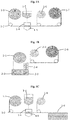
- Figs. 1A and 1B respectively, illustrate processes of preparing a roll mat through wetting by spraying and impregnation with a wetting agent
- Fig. 1C illustrates a process of preparing a flat mat through wetting by spraying a wetting agent.
- a mat 1-1 is transported by a roller 1-2, a remaining wetting agent 1-3 is contained in a storage tank 1-5 while the wetting agent 1-3 is sprayed onto the mat by a spray device 1-4, and the mat may be wound with a separator 1-6 to prepare a roll mat 1-7.
- a mat 2-1 is transported by an impregnation roller 2-2 and impregnated with a wetting agent 2-3
- the mat is compressed while a residual wetting agent is removed by a drawing roller 2-4, and the mat may be wound with a separator 2-5 to prepare a roll mat 2-6.
- a mat 1-1 is transported by a roller 1-2, a remaining wetting agent 1-3 is contained in a storage tank 1-5 while the wetting agent 1-3 is sprayed onto the mat by a spray device 1-4, and the mat may be stacked with the separator 1-6 to prepare a flat mat 1-8.
- the impregnation of a sol may be sufficiently performed and the duration for winding or laminating the fibrous material with the separator may not limited.
- the spraying of the wetting agent and the removal of the remaining wetting agent may be simultaneously and instantaneously performed and a large amount of the mat may be wetted in a short period of time.
- the wound or laminated fibrous material is charged into at least one vessel. Thereafter, a gel-fiber composite is prepared by injecting a precursor into the vessel and gelating the precursor while removing the residual air bubbles under vacuum.
- the horizontal or vertical roll mats or flat mats subjected to the wetting are charged into the vessel and impregnated with the precursor by injecting the precursor, and, are gelated.
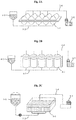
- Figs. 2A and 2B respectively, illustrate processes of impregnating the horizontal roll mat and the vertical roll mat with the precursor
- Fig. 2C illustrates a process of impregnating the flat mat with the precursor.
- the horizontal/vertical roll mats and flat mat are, respectively, charged into vessels 3-3, 4-3, and 5-3, the insides of the vessels are decompressed by exhaust lines 3-4, 4-4, and 5-4 and vacuum pumps 3-5, 4-5, and 5-5, and thereafter, precursors 3-1, 4-1, and 5-1 may be injected into the vessels through supply lines 3-2, 4-2, and 5-2.
- the precursor may be a sol of sodium silicate, potassium silicate, or lithium silicate in a pH range of 3 to 7, or may be tetraethoxysilane (TEOS) hydrolyzed by an acid catalyst.
- TEOS tetraethoxysilane
- the precursor may be sufficiently gelated and aged in a pH range of 4 to 6, and high-quality nanopores may be formed in the inside thereof.
- a low viscosity of about 5 cP to about 30 cP of the precursor is more advantageous for dense gelation without external loss or air bubbles.
- a precursor comprising water having a relatively low vapor pressure, as a solvent (dispersion medium), with the sol of sodium silicate, potassium silicate, or lithium silicate, as the above precursor, because the pressure in the vessel may be effectively reduced.
- the solvent may include water, and, in this case, the pressure in the vessel may be in a range of 0.001 Torr to 10 Torr before the fibrous material is impregnated with the precursor. Also, after the impregnation of the fibrous material with the precursor, a step of reducing the pressure in the vessel may be further included, and, in this case, the pressure in the vessel may be reduced to a range of 0.001 Torr to 10 Torr.
- the injection of the precursor and the gelation process may be performed by the following procedure.
- the pressure in the vessel is reduced, and, specifically, the pressure in the vessel may be reduced to a range of about 0.001 Torr to about 100 Torr, about 0.001 Torr to about 10 Torr, or about 0.001 Torr to about 1 Torr.
- the precursor is injected into the vessel, and, in this case, since the vessel is in a decompressed state, the precursor may be automatically injected by a pressure difference.
- the precursor may be injected from a bottom of the vessel and may be injected at an appropriate rate so that air bubbles may not be generated in the fibrous material.
- the pressure in the vessel may be continuously reduced, and, specifically, the pressure in the vessel may be reduced to a range of about 0.001 Torr to about 100 Torr, about 0.001 Torr to about 10 Torr, or about 0.001 Torr to about 1 Torr. Accordingly, the air bubbles in the fibrous material may be completely removed.
- the precursor is gelated and aged, and, the pressure in the vessel may also be maintained as described above.
- the prepared gel-fiber composite is taken out from the vessel and the separator is removed. Thereafter, the gel-fiber composite having the separator removed therefrom is solvent substituted, organically surface modified, and washed.
- a salt is removed by washing the gel-fiber composite with hot water several times, substitution by an organic solvent and organic surface modification may be performed and then the gel fiber composite is washed.
- substitution by an organic solvent and organic surface modification may be performed and then the gel fiber composite is washed.
- washing may be performed after substitution by an organic solvent and organic surface modification without the removal of the salt.
- the organic solvent substitution may be performed by using C1-C8 alcohols; ketones such as acetone; or aromatic solvents such as toluene and xylene.
- silanes such as trimethylchlorosilane (TMCS), hexamethyldisilazane (HMDS), dimethylchlorosilane (DMCS), and methyltrichlorosilane (MTCS), may be used.
- TMCS trimethylchlorosilane
- HMDS hexamethyldisilazane
- DMCS dimethylchlorosilane
- MTCS methyltrichlorosilane
- silanes are only used, since a water-repellent maintenance period is not long, these silanes may be decomposed over time to cause the reduction of water repellency, and, accordingly, moisture may penetrate to deteriorate thermal conductivity.
- the use of a mixture of silane and alkoxysilane as the treatment agent for the organic surface modification may be more advantageous in terms of the pore retention during drying and the increase in lifetime.
- the silane may be hexamethyldisilazane (HMDS) or trimethylchlorosilane (TMCS).
- HMDS hexamethyldisilazane
- TMCS trimethylchlorosilane
- the alkoxysilane may have a formula of R-Si-(OR') 3 , wherein R may be C1-C8 alkyl, phenyl, epoxy, amino, benzyl, aminochloropropyl, disulphido, isocyanate, epoxymelamine, mercapto, methacrylate, tetrasulphido, ureido, vinyl, or vinylbenzylamino, and R' may be methoxy, ethoxy, or acetoxy.
- R may be C1-C8 alkyl, phenyl, epoxy, amino, benzyl, aminochloropropyl, disulphido, isocyanate, epoxymelamine, mercapto, methacrylate, tetrasulphido, ureido, vinyl, or vinylbenzylamino
- R' may be methoxy, ethoxy, or acetoxy.
- the R group of the alkoxysilane may provide adhesion to other additive materials, and, for example, may provide adhesion to a sheet of a plastic material such as polyethylene, polyethylene terephthalate, polypropylene, polyvinyl chloride, nylon, and ethylene vinyl acetate, which may be used as a finishing material of the mat.
- a plastic material such as polyethylene, polyethylene terephthalate, polypropylene, polyvinyl chloride, nylon, and ethylene vinyl acetate, which may be used as a finishing material of the mat.
- Specific examples of the alkoxysilane may be tetramethoxysilane, tetraethoxysilane, methyltrimethoxysilane (MTMS), and ethyltrimethoxysilane (ETMS).
- a mixing ratio by weight of the silane to the alkoxysilane may be in a range of 1:0.01 to 1:0.3, and the ratio may be appropriately adjusted according to a type of an organic group of the alkoxy.
- the treatment agent for the organic surface modification may further include an opacifying agent, and, for example, may further include Al 2 O 3 , Fe 2 O 3 , TiO 2 , carbon, graphite, SiC, and a boron compound.
- the opacifying agent for example, may have a particle diameter of 0.01 ⁇ m to 100 ⁇ m, particularly, 0.1 ⁇ m to 10 ⁇ m, and may be included in an amount of 1 part by weight to 10 parts by weight, particularly, 3 parts by weight to 7 parts by weight, based on 100 parts by weight of the organic surface modification treatment agent.
- the gel-fiber composite obtained after the completion of the organic surface modification may be further subjected to a washing step.
- the washing may be performed by using alcohols such as n-butanol; or aromatic solvents such as toluene and xylene.
- the gel-fiber composite is subjected to atmospheric pressure drying or supercritical drying.
- the atmospheric pressure drying may be performed at 60°C for 1 hour or 250°C for 2 hours, and the supercritical drying is not particularly limited, but may be performed at about 100 atm.
- the method of preparing an aerogel composite according to the invention may be used in the manufacture of an aerogel mat.
- the aerogel mat may be manufactured by a method including: wetting a mat in advance and winding the mat with a separator in a multilayer roll form or laminating the mat with the separator to prepare a plurality of roll mats or flat mats; charging the plurality of roll mats or flat mats into a vessel and injecting a precursor to undergo sufficient gelation and aging period; and taking out the plurality of roll mats or flat mats from the vessel and removing the separator.
- the high-quality aerogel mat may be mass-produced.
- An aerogel composite according to the invention includes: a fibrous material including at least one of inorganic fibers and organic fibers; and an aerogel disposed in the fibrous material, wherein, in a cut surface of the aerogel composite, the number of pores having a diameter of 10 ⁇ m to 5 mm in an area of 1,500 mm 2 is 10 or less.
- the aerogel composite may be prepared by the above-described preparation method according to the invention.
- the aerogel may be formed from a sol of sodium silicate, potassium silicate, or lithium silicate.
- the sol of the sodium silicate, potassium silicate, or lithium silicate is impregnated into the fibrous material under vacuum and gelated, and the aerogel may then be prepared by solvent substitution and organic modification of an inner surface of the gel.
- the fibrous material is densely impregnated with the precursor in the preparation process, the fibrous material may be densely filled with the aerogel.
- the aerogel composite according to the invention hardly has pores having a diameter of several ⁇ m or more.
- the number of pores having a diameter of 10 ⁇ m to 5 mm in an area of 1,500 mm 2 may be 10 or less, 5 or less, 3 or less, 2 or less, or 1 or less.
- the number of pores having a diameter of 200 ⁇ m to 5 mm in an area of 1,500 mm 2 may be 5 or less, 4 or less, 3 or less, 2 or less, or 1 or less.
- the aerogel composite has relatively low thermal conductivity.
- the aerogel composite may have a thermal conductivity of 1 W/mK or less, 0.1 W/mK or less, 0.05 W/mK or less, 0.001 W/mK to 0.03 W/mK, 0.01 W/mK to 0.02 W/mK, or 0.012 W/mK to 0.015 W/mK,
- An E-glass mat was wetted with a 0.5 wt% sulfuric acid solution at 60°C as a wetting agent and then wound with a 0.5 mm thick polypropylene sheet, as a separator, to prepare a roll mat.
- the mats in the form of a round roll were charged into a plurality of vessels, and a pressure of the vessel was reduced to 0.01 Torr.
- a lower value of the vessel was closed, a vacuum was applied to remove remaining air bubbles at 0.01 Torr for 30 minutes and aging was performed, to prepare a roll mat having a cured hydrogel.
- a salt was removed by washing the roll mat several times with 60°C hot water. Thereafter, the roll mat was put in a reactor connected to a distillation column, and solvent substitution was performed by adding an organic solvent such as isopropyl alcohol, toluene, and xylene. Also, the roll mat was organically surface modified with a mixture containing trimethylchlorosilane and methyltrimethoxysilane in a weight ratio of 1:0.1, and was then washed with toluene. A final aerogel mat was obtained by drying the washed mat at 80°C for 60 minutes and then drying at 230°C for 2 hours. A thermal conductivity of the aerogel mat obtained was 0.015 W/mK.
- An aerogel mat was manufactured in the same manner as in Example 1 except that wetting was performed by using a 0.5 wt% linear alkylbenzene sulfonate (LAS) as a wetting gent.
- a thermal conductivity of the aerogel mat was 0.012 W/mK.
- wetting was performed on a ceramic wool mat by injecting ethanol while transporting the ceramic wool mat by a roller, and a residual solvent was absorbed and removed.
- the wetted mat was wound with a stainless steel sheet, as a separator, in multiple layers to prepare a roll mat.
- the wetted roll mats were charged into a plurality of injection aging vessels, and an internal pressure of each vessel was reduced to 0.01 Torr.
- a roll mat having a hydrogel was manufactured by curing the roll mat at 60°C for 4 hours. After the roll mat was taken out from the vessel and the separator was removed, a salt was removed by ultrasonically cleaning the roll mat several times with 60°C hot water. Thereafter, the roll mat was put in a reactor connected to a distillation column, and solvent substitution was performed by adding an organic solvent such as acetone, isopropyl alcohol, butanol, and xylene. Also, the roll mat was organically surface modified with a mixture containing hexamethyldisilazane and methyltrimethoxysilane in a weight ratio of 1:0.1, and was then washed with isopropyl alcohol. A final aerogel mat was obtained by drying the washed mat at 80°C and then drying at 230°C for 2 hours. A thermal conductivity of the aerogel mat obtained was 0.014 W/mK.
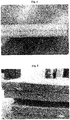
- a cross section was visually observed by cutting the aerogel composite prepared in Example 1. As a result, pores having a diameter of about 200 ⁇ m to about 5 mm were not observed in an area of 1,500 mm 2 as illustrated in Fig. 4 . Also, as a result of observing the cross section with an optical microscope, pores having a diameter of about 10 ⁇ m to about 200 ⁇ m were not observed in the area of 1,500 mm 2 .
Landscapes
- Chemical & Material Sciences (AREA)
- Dispersion Chemistry (AREA)
- Organic Chemistry (AREA)
- Engineering & Computer Science (AREA)
- Mechanical Engineering (AREA)
- Inorganic Chemistry (AREA)
- Composite Materials (AREA)
- Textile Engineering (AREA)
- Chemical Or Physical Treatment Of Fibers (AREA)
- Silicon Compounds (AREA)
- Reinforced Plastic Materials (AREA)
- Porous Artificial Stone Or Porous Ceramic Products (AREA)
- Cell Separators (AREA)
- Treatments For Attaching Organic Compounds To Fibrous Goods (AREA)
- Manufacture Of Porous Articles, And Recovery And Treatment Of Waste Products (AREA)
- Catalysts (AREA)
Claims (18)
- Procédé de préparation d'un composite d'aérogel, le procédé comprenant :la fourniture d'un matériau fibreux (1-1, 2-1) incluant au moins une des fibres anorganiques et fibres organiques ;le mouillage du matériau fibreux ;le chargement du matériau fibreux mouillé dans un récipient (3-3, 4-3, 5-3) ;l'imprégnation du matériau fibreux avec un précurseur (3-1, 4-1, 5-1) par injection du précurseur dans le récipient après réduction d'une pression dans le récipient ;la préparation d'un composite de fibre et de gel par gélation du précurseur ;la substitution d'un solvant inclus dans un gel du composite de fibre et de gel et la modification organique d'une surface intérieure du gel ; etle séchage du composite de fibre et de gel.
- Procédé selon la revendication 1, dans lequel un séparateur est inséré dans le matériau fibreux mouillé avant que le matériau fibreux mouillé ne soit chargé dans le récipient, et
le séparateur est retiré après que le composite de fibre et de gel est préparé. - Procédé selon la revendication 2, dans lequel le séparateur est formé par traitement d'un matériau qui est sélectionné à partir du groupe constitué par de l'acier inoxydable, une membrane en caoutchouc, une feuille de magnésium, une feuille d'aluminium, du chlorure de polyvinyle (PVC), du polyéthylène (PE), du polyester, du polypropylène (PP), du polystyrène (PS), du nylon, et un matériau de mélange de ceux-ci, pour permettre à un fluide de pénétrer et de s'infiltrer dedans.
- Procédé selon la revendication 2 ou la revendication 3, dans lequel (a) le séparateur est enroulé avec le matériau fibreux mouillé dans une forme de rouleau, ou (b) le séparateur et le matériau fibreux mouillé sont empilés en alternance.
- Procédé selon l'une quelconque des revendications précédentes, dans lequel les fibres anorganiques comprennent au moins un sélectionné à partir du groupe constitué par des fibres de verre, laine de verre, laine de roche, laine céramique, et fibres de bore ; et
les fibres organiques comprenant au moins un sélectionné à partir du groupe constitué de nylon, fibres d'aramide, fibres de carbone, fibres de polypropylène, fibres de polyéthylène, fibres de polyester, fibres de polyuréthane, fibres acryliques, fibres d'acétate de chlorure de polyvinyle, fibres de rayonne, fibres régénérées, et fibres à base de déchet. - Procédé selon l'une quelconque des revendications précédentes, dans lequel le mouillage est réalisé par utilisation d'au moins un agent de mouillage sélectionné dans :(i) au moins un acide sélectionné à partir du groupe constitué par l'acide sulfurique, acide nitrique, acide hydrochlorique, acide acétique, et acide hydrofluorique dans une plage de pH de 1 à 5 ;(ii) au moins un solvant soluble dans l'eau sélectionné à partir du groupe constitué par l'alcool C1-C4, acétone, éthylène glycol, éthers de glycol, diméthylformamide (DMF) et tétrahydrofurane (THF) ; et(iii) au moins un tensioactif sélectionné à partir du groupe constitué par l'acide gras de sodium, acide alkylbenzènesulfonique de sodium, sulfonate d'alkylbenzène linéaire (LAS), polyacrylamide, polyoxyéthylène alkylamine, sel d'ammonium de dialkyldiméthyle, sel d'ammonium d'alkylbenzylméthyle, éther d'alkyle de polyoxyéthylène, ester de sorbitane d'acide gras, diéthanolamine d'acide gras, éther d'alkylmonoglycéryle, sulfobétaine d'alkyle, et carboxybétaine d'alkyle.
- Procédé selon l'une quelconque des revendications précédentes, dans lequel le précurseur est un sol de silicate de sodium, silicate de potassium, ou silicate de lithium dans une plage de pH de 3 à 7, ou est du tétraéthoxysilane hydrolysé par un catalyseur d'acide.
- Procédé selon l'une quelconque des revendications précédentes, dans lequel le solvant comprend de l'eau.
- Procédé selon la revendication 8, dans lequel avant que le matériau fibreux ne soit imprégné avec le précurseur, une pression dans le récipient est réduite à une plage de 0,001 torr à 10 torrs.
- Procédé selon l'une quelconque des revendications précédentes, comprenant en outre la réduction de la pression dans le récipient après que le matériau fibreux est imprégné avec le précurseur.
- Procédé selon la revendication 10, dans lequel après que le matériau fibreux est imprégné avec le précurseur, la pression dans le récipient est réduite à une plage de 0,001 torr à 10 torrs.
- Procédé selon l'une quelconque des revendications précédentes, dans lequel la modification de surface organique est réalisée par utilisation d'un mélange de silane et alkoxysilane comme agent de traitement.
- Procédé selon l'une quelconque des revendications précédentes, dans lequel le rapport de poids du silane à l'alkoxysilane dans le mélange de ceux-ci est dans la plage de 1:0,01 à 1:0,3.
- Procédé selon la revendication 12 ou la revendication 13, dans lequel le silane est sélectionné parmi triméthylchlorosilane, hexaméthyldisilazane, diméthylchlorosilane, et méthyltrichlorosilane, de préférence dans lequel le silane est du hexaméthyldisilazane ou triméthylchlorosilane.
- Procédé selon l'une quelconque des revendications 12 à 14, dans lequel l'alkoxysilane présente la formule R-Si-(OR')3, dans lequel R peut être de l'alkyle C1-C8, phényle, époxy, amino, benzyle, aminochloropropyle, disulfure, isocyanate, epoxymélamine, mercaptide, méthacrylate, tétrasulfure, uréide, vinyle, ou vinylbenzylamino, et R' peut être du méthoxy, éthoxy, ou acétoxy.
- Procédé selon l'une quelconque des revendications précédentes, dans lequel le séchage du composite de fibre et de gel est réalisé par soumission du composite de fibre et de gel au séchage de pression atmosphérique ou séchage surcritique.
- Composite d'aérogel pouvant être obtenu par le procédé selon l'une quelconque des revendications précédentes, comprenant :un matériau fibreux incluant au moins une des fibres anorganiques et fibres organiques ; etun aérogel disposé dans le matériau fibreux,dans lequel dans une surface découpée du composite d'aérogel, le nombre de pores présentant un diamètre de 10 µm à 5 mm dans une zone de 1500 mm2 est de 10 ou moins.
- Composite d'aérogel selon la revendication 17, dans lequel le nombre de pores est de 5 ou moins, de préférence de 3 ou moins, de manière davantage préférée de 2 ou moins.
Applications Claiming Priority (2)
| Application Number | Priority Date | Filing Date | Title |
|---|---|---|---|
| KR1020160014993A KR101654795B1 (ko) | 2016-02-05 | 2016-02-05 | 고단열 에어로겔 함침 매트의 제조 방법 |
| PCT/KR2017/001215 WO2017135752A1 (fr) | 2016-02-05 | 2017-02-03 | Composite aérogel et son procédé de préparation |
Publications (3)
| Publication Number | Publication Date |
|---|---|
| EP3278985A1 EP3278985A1 (fr) | 2018-02-07 |
| EP3278985A4 EP3278985A4 (fr) | 2018-07-04 |
| EP3278985B1 true EP3278985B1 (fr) | 2020-06-24 |
Family
ID=56946291
Family Applications (1)
| Application Number | Title | Priority Date | Filing Date |
|---|---|---|---|
| EP17747797.3A Active EP3278985B1 (fr) | 2016-02-05 | 2017-02-03 | Composite aérogel et son procédé de préparation |
Country Status (8)
| Country | Link |
|---|---|
| US (1) | US10940670B2 (fr) |
| EP (1) | EP3278985B1 (fr) |
| JP (1) | JP6918705B2 (fr) |
| KR (1) | KR101654795B1 (fr) |
| CN (1) | CN107709013B (fr) |
| RU (1) | RU2729992C2 (fr) |
| TW (1) | TWI663062B (fr) |
| WO (1) | WO2017135752A1 (fr) |
Families Citing this family (44)
| Publication number | Priority date | Publication date | Assignee | Title |
|---|---|---|---|---|
| KR101654795B1 (ko) | 2016-02-05 | 2016-09-06 | 김현철 | 고단열 에어로겔 함침 매트의 제조 방법 |
| KR101928538B1 (ko) * | 2017-06-19 | 2018-12-13 | 에스케이씨 주식회사 | 에어로겔 복합체 |
| EP3677546B1 (fr) * | 2017-11-13 | 2023-05-10 | LG Chem, Ltd. | Procédé de recyclage de déchets liquides supercritiques générés pendant un processus de production d'un matelas d'aérogel de silice |
| KR102037425B1 (ko) * | 2017-12-27 | 2019-10-28 | 에스케이씨 주식회사 | 에어로겔 복합체 제조방법 및 이를 위한 제조장치 |
| KR20190081024A (ko) * | 2017-12-29 | 2019-07-09 | 에스케이씨 주식회사 | 판형 에어로겔 복합체의 제조장치 및 이를 이용한 판형 에어로겔 복합체의 제조방법 |
| CN108381949B (zh) | 2018-02-08 | 2019-06-21 | 广东埃力生高新科技有限公司 | 凝胶复合材料的制备系统及制备方法 |
| US12409639B2 (en) * | 2018-02-22 | 2025-09-09 | Graphene Composites Limited | Laminate structure and wearable article |
| KR101980486B1 (ko) * | 2018-06-12 | 2019-05-20 | 최경훈 | 열교 차단용 불연성 단열 시트 및 그 제조 방법 |
| CN109081673B (zh) * | 2018-08-14 | 2021-04-09 | 上海康达新能源材料有限公司 | 一种纤维增强氧化铝气凝胶复合材料及其制备方法 |
| CN109019611B (zh) * | 2018-08-17 | 2020-06-02 | 中南大学 | 一种块体透明二氧化硅气凝胶及其快速制备方法和应用 |
| US11866324B2 (en) | 2018-11-27 | 2024-01-09 | Lg Chem, Ltd. | Method for manufacturing aerogel blanket |
| JP7071540B2 (ja) * | 2018-11-27 | 2022-05-19 | エルジー・ケム・リミテッド | シリカエアロゲルの製造方法 |
| CN110318182B (zh) * | 2019-06-14 | 2021-11-12 | 常州玛特利尔干燥工程有限公司 | 一种一体式气凝胶保温毡制作设备 |
| CN114007999A (zh) | 2019-09-03 | 2022-02-01 | 株式会社Lg化学 | 气凝胶毡 |
| KR102581268B1 (ko) | 2019-09-03 | 2023-09-22 | 주식회사 엘지화학 | 에어로겔 블랭킷 제조방법 |
| CN113226677A (zh) * | 2019-09-03 | 2021-08-06 | 株式会社Lg化学 | 用于制备气凝胶毡的装置和方法 |
| KR102701498B1 (ko) * | 2019-09-18 | 2024-09-03 | 주식회사 엘지화학 | 에어로겔 블랑켓 및 이의 제조방법 |
| KR102681445B1 (ko) * | 2019-09-30 | 2024-07-05 | 주식회사 엘지화학 | 에어로겔 블랭킷의 제조방법 |
| CN111235790A (zh) * | 2019-12-19 | 2020-06-05 | 响水华夏特材科技发展有限公司 | 一种连续浸渍凝胶复合系统 |
| BR112022013136A2 (pt) * | 2020-01-11 | 2022-09-06 | Univ New York State Res Found | Método para formar um compósito de fibra de espuma cerâmica, e, compósito de fibra de espuma cerâmica |
| CN111535019A (zh) * | 2020-04-21 | 2020-08-14 | 浙江岩谷科技有限公司 | 一种疏水玻璃纤维毡-硅气凝胶绝热复合材料的制备方法 |
| CN112125697A (zh) * | 2020-09-11 | 2020-12-25 | 烟台正海合泰科技股份有限公司 | 一种汽车内饰材料 |
| CN112681009B (zh) * | 2020-12-25 | 2021-10-26 | 华南理工大学 | 一种纸基耐高温复合材料及其制备方法和应用 |
| CN112774585A (zh) * | 2020-12-31 | 2021-05-11 | 广东埃力生高新科技有限公司 | 纤维增强体复合气凝胶材料及其制备方法 |
| KR102737602B1 (ko) * | 2021-05-31 | 2024-12-04 | 주식회사 엘지화학 | 에어로겔 블랭킷 제조장치 및 제조 방법 |
| US12552673B2 (en) | 2021-05-31 | 2026-02-17 | Lg Chem, Ltd. | Device and method for producing aerogel blanket |
| CN113352709B (zh) * | 2021-07-06 | 2023-05-26 | 厦门点石新材料有限公司 | 一种不掉粉气凝胶毡及其生产方法 |
| CN113829545B (zh) * | 2021-09-27 | 2023-04-07 | 江西宏柏新材料股份有限公司 | 一种气凝胶复合材料卷式生产装置及方法 |
| CN113860848B (zh) * | 2021-10-08 | 2022-06-10 | 贵州省材料产业技术研究院 | 一种改性碳纤维/SiO2气凝胶复合材料的制备方法 |
| IT202200013786A1 (it) * | 2022-06-29 | 2022-09-29 | Biakko Srl In Liquidazione | PROCESSO PER LA FABBRICAZIONE DI ARTICOLI IN MATERIALE A BASE DI CELLULOSA VETRIFICATA E MATERIALE A BASE DI CELLULOSA VETRIFICATA COSì OTTENUTO |
| CN115124319B (zh) * | 2022-07-04 | 2023-03-24 | 巩义市泛锐熠辉复合材料有限公司 | 一种高压缩二氧化硅气凝胶、气凝胶毡及其制备方法 |
| WO2024019594A1 (fr) * | 2022-07-22 | 2024-01-25 | 주식회사 엘지화학 | Procédé de fabrication d'un matelas d'aérogel de silice hydrophobe, et matelas d'aérogel de silice |
| WO2024019593A1 (fr) * | 2022-07-22 | 2024-01-25 | 주식회사 엘지화학 | Procédé de fabrication d'un matelas d'aérogel de silice hydrophobe et matelas d'aérogel de silice |
| CN115501826B (zh) * | 2022-10-24 | 2024-03-08 | 江苏安珈新材料科技有限公司 | 一种制备气凝胶复合材料的一体化装置及方法 |
| CN115742357A (zh) * | 2022-11-04 | 2023-03-07 | 航天特种材料及工艺技术研究所 | 一种宽幅度无机纤维增强气凝胶卷材及其成型方法 |
| KR20260018911A (ko) * | 2023-06-05 | 2026-02-09 | 캐보트 코포레이션 | 가요성 절연 부재 |
| US12326214B2 (en) | 2023-08-30 | 2025-06-10 | Lg Chem, Ltd. | Aerogel composite |
| KR20250032471A (ko) | 2023-08-31 | 2025-03-07 | 주식회사 플러스 | 시스코어형 에어로겔 복합섬유 및 그의 제조방법 |
| US12162260B1 (en) * | 2023-10-05 | 2024-12-10 | Lg Chem, Ltd. | Aerogel composite |
| KR20250144821A (ko) | 2024-03-27 | 2025-10-13 | 주식회사 엘지화학 | 에어로겔 복합체 |
| KR20250144820A (ko) | 2024-03-27 | 2025-10-13 | 주식회사 엘지화학 | 에어로겔 복합체 |
| US12479734B2 (en) | 2024-05-02 | 2025-11-25 | Lg Chem, Ltd. | Aerogel composite |
| US12606446B2 (en) | 2024-05-16 | 2026-04-21 | Lg Chem, Ltd. | Aerogel composite |
| US12551859B1 (en) | 2025-01-13 | 2026-02-17 | Lg Chem, Ltd. | Aerogel composite |
Family Cites Families (29)
| Publication number | Priority date | Publication date | Assignee | Title |
|---|---|---|---|---|
| US5306555A (en) * | 1991-09-18 | 1994-04-26 | Battelle Memorial Institute | Aerogel matrix composites |
| US5565142A (en) * | 1992-04-01 | 1996-10-15 | Deshpande; Ravindra | Preparation of high porosity xerogels by chemical surface modification. |
| DE4430642A1 (de) * | 1994-08-29 | 1996-03-07 | Hoechst Ag | Aerogel- und Xerogelverbundstoffe, Verfahren zu ihrer Herstellung sowie ihre Verwendung |
| DE19507732A1 (de) * | 1995-03-07 | 1996-09-12 | Hoechst Ag | Transparentes Bauelement, enthaltend mindestens eine faserverstärkte Aerogelplatte und/oder -matte |
| US20020061396A1 (en) * | 1997-11-17 | 2002-05-23 | Susan M White | Aerogel loaded tile composite material |
| JP3792438B2 (ja) | 1999-06-23 | 2006-07-05 | 株式会社神戸製鋼所 | エアロゲル膜の製造方法及び製造装置 |
| BR0115523A (pt) * | 2000-12-22 | 2003-09-16 | Aspen Aerogels Inc | Compósito |
| ATE365071T1 (de) * | 2002-05-15 | 2007-07-15 | Cabot Corp | Zusammensetzung auf basis von aerogel, hohlen partikeln und binder, hergestelltes dämmmaterial und herstellungsverfahren |
| PL3120983T5 (pl) * | 2003-06-24 | 2024-04-22 | Aspen Aerogels, Inc. | Ciągły arkusz materiału żelowego oraz ciągły arkusz materiału aerożelowego |
| US7635411B2 (en) * | 2004-12-15 | 2009-12-22 | Cabot Corporation | Aerogel containing blanket |
| KR100849927B1 (ko) * | 2007-05-03 | 2008-08-04 | 연세대학교 산학협력단 | 형태에 따라 최적화된 실리카 에어로젤의 제조방법 |
| EP2429948A4 (fr) * | 2009-04-27 | 2017-09-06 | Cabot Corporation | Compositions d'aérogel et leurs procédés de fabrication et d'utilisation |
| KR101047965B1 (ko) | 2009-06-11 | 2011-07-12 | 한국에너지기술연구원 | 에어로겔 매트, 이의 제조방법 및 제조장치 |
| JP4905814B2 (ja) * | 2009-10-09 | 2012-03-28 | 国立大学法人 東京大学 | 複合多孔材料及びその製造方法 |
| JP2011136859A (ja) * | 2009-12-28 | 2011-07-14 | Asahi Fiber Glass Co Ltd | 繊維系断熱材及びその製造方法 |
| KR101193987B1 (ko) | 2010-01-11 | 2012-10-24 | 한국과학기술연구원 | 고단열 에어로젤 함침 섬유의 제조 방법 |
| KR101290046B1 (ko) * | 2010-08-31 | 2013-07-30 | 한국기계연구원 | 다공성 세라믹스 기지상과 이를 충진하는 나노 에어로겔로 이루어진 복합체 제조 방법 |
| KR101187568B1 (ko) | 2010-09-29 | 2012-10-04 | 한국에너지기술연구원 | 실리카 에어로겔 과립의 제조방법 |
| US20120231251A1 (en) * | 2011-03-09 | 2012-09-13 | Samsung Electronics Co., Ltd. | Composition for clay-aerogel composite, clay-aerogel composite, and method of making the same |
| WO2012138803A2 (fr) * | 2011-04-04 | 2012-10-11 | Carnegie Mellon University | Aérogels de nanotubes de carbone, composites les comprenant et dispositifs formés à partir de ceux-ci |
| WO2014150310A1 (fr) * | 2013-03-15 | 2014-09-25 | Cabot Corporation | Couche d'aérogel et procédé de production associé |
| KR101306632B1 (ko) * | 2013-05-23 | 2013-09-11 | 주식회사 에코인프라홀딩스 | 스프레이 방식의 불연성 단열소재 조성물과 그 제조 방법 및 코팅 방법 |
| KR101515803B1 (ko) * | 2013-12-18 | 2015-05-04 | 호서대학교 산학협력단 | 침지방식을 이용한 에어로겔이 함침된 단열원단의 제조장치 및 제조방법 |
| CN104911901A (zh) | 2014-03-12 | 2015-09-16 | 引领科技无锡有限公司 | 一种静电纺气凝胶复合纳米纤维膜及其制备方法 |
| EP3253817A4 (fr) * | 2015-02-05 | 2018-12-26 | Aerogel Technologies, LLC | Systèmes et procédés de production d'un matériau de type aérogel |
| CN104961494A (zh) * | 2015-06-05 | 2015-10-07 | 江苏丰彩新型建材有限公司 | 一种气凝胶复合粉体材料及其制备方法 |
| CN104944887A (zh) * | 2015-07-01 | 2015-09-30 | 卓达新材料科技集团有限公司 | 刚性二氧化硅气凝胶绝热板的制备方法 |
| US20190002356A1 (en) * | 2015-07-15 | 2019-01-03 | Neha Yeshwanta HEBALKAR | Improved process for producing silica aerogel thermal insulation product with increased efficiency |
| KR101654795B1 (ko) | 2016-02-05 | 2016-09-06 | 김현철 | 고단열 에어로겔 함침 매트의 제조 방법 |
-
2016
- 2016-02-05 KR KR1020160014993A patent/KR101654795B1/ko active Active
-
2017
- 2017-02-03 US US15/570,568 patent/US10940670B2/en active Active
- 2017-02-03 JP JP2017557103A patent/JP6918705B2/ja active Active
- 2017-02-03 CN CN201780001357.3A patent/CN107709013B/zh active Active
- 2017-02-03 RU RU2017141569A patent/RU2729992C2/ru active
- 2017-02-03 TW TW106103665A patent/TWI663062B/zh active
- 2017-02-03 WO PCT/KR2017/001215 patent/WO2017135752A1/fr not_active Ceased
- 2017-02-03 EP EP17747797.3A patent/EP3278985B1/fr active Active
Non-Patent Citations (1)
| Title |
|---|
| None * |
Also Published As
| Publication number | Publication date |
|---|---|
| WO2017135752A1 (fr) | 2017-08-10 |
| CN107709013A (zh) | 2018-02-16 |
| JP2019509236A (ja) | 2019-04-04 |
| US10940670B2 (en) | 2021-03-09 |
| RU2729992C2 (ru) | 2020-08-13 |
| EP3278985A1 (fr) | 2018-02-07 |
| JP6918705B2 (ja) | 2021-08-11 |
| RU2017141569A3 (fr) | 2020-03-13 |
| KR101654795B1 (ko) | 2016-09-06 |
| CN107709013B (zh) | 2021-08-13 |
| TWI663062B (zh) | 2019-06-21 |
| CA2983917A1 (fr) | 2017-08-10 |
| US20180326700A1 (en) | 2018-11-15 |
| EP3278985A4 (fr) | 2018-07-04 |
| TW201739605A (zh) | 2017-11-16 |
| RU2017141569A (ru) | 2019-05-29 |
Similar Documents
| Publication | Publication Date | Title |
|---|---|---|
| EP3278985B1 (fr) | Composite aérogel et son procédé de préparation | |
| KR101928538B1 (ko) | 에어로겔 복합체 | |
| JP7320664B2 (ja) | エアロゲルブランケットの製造方法 | |
| JP7322156B2 (ja) | シリカゾル、これを用いて製造したシリカエアロゲルブランケットおよびその製造方法 | |
| US11059262B2 (en) | Method of preparing low-dust and high-insulation aerogel blanket | |
| JP2021523869A (ja) | エアロゲルブランケットの製造方法 | |
| WO2016171558A1 (fr) | Procédé d'application d'un revêtement d'aérogel de polyméthylsilsesquioxane sur un substrat poreux | |
| CN1839024A (zh) | 凝胶片的制造方法 | |
| CN101544838A (zh) | 一种超疏水纳米SiO2/高聚物复合膜及其制备方法 | |
| JP7317120B2 (ja) | エアロゲルブランケット | |
| CN113896505A (zh) | 一种非连续生产气凝胶毡的方法 | |
| CN106747265A (zh) | 一种基于自组装遮光剂纤维的气凝胶复合材料及其制法 | |
| CN115124319A (zh) | 一种高压缩二氧化硅气凝胶、气凝胶毡及其制备方法 | |
| WO2024222843A1 (fr) | Dispositif de préparation de feutre de gel, procédé de préparation de feutre de gel et feutre d'aérogel | |
| EP4026803B1 (fr) | Couche d'aérogel | |
| CA2983917C (fr) | Composite aerogel et son procede de preparation | |
| CN109626954A (zh) | 一种耐温防潮型二氧化硅气凝胶复合材料及其制备方法和应用 | |
| CN116983914B (zh) | 疏水气凝胶材料及其制备方法和隔热材料 | |
| TWI841984B (zh) | 無塵室及電動車安全防護用氣凝膠隔熱複合材及其製備方法 | |
| JP2002283488A (ja) | 乾燥ゲル複合体およびその製造方法 |
Legal Events
| Date | Code | Title | Description |
|---|---|---|---|
| STAA | Information on the status of an ep patent application or granted ep patent |
Free format text: STATUS: THE INTERNATIONAL PUBLICATION HAS BEEN MADE |
|
| PUAI | Public reference made under article 153(3) epc to a published international application that has entered the european phase |
Free format text: ORIGINAL CODE: 0009012 |
|
| STAA | Information on the status of an ep patent application or granted ep patent |
Free format text: STATUS: REQUEST FOR EXAMINATION WAS MADE |
|
| 17P | Request for examination filed |
Effective date: 20171031 |
|
| AK | Designated contracting states |
Kind code of ref document: A1 Designated state(s): AL AT BE BG CH CY CZ DE DK EE ES FI FR GB GR HR HU IE IS IT LI LT LU LV MC MK MT NL NO PL PT RO RS SE SI SK SM TR |
|
| AX | Request for extension of the european patent |
Extension state: BA ME |
|
| A4 | Supplementary search report drawn up and despatched |
Effective date: 20180605 |
|
| RIC1 | Information provided on ipc code assigned before grant |
Ipc: B29C 70/00 20060101AFI20180529BHEP Ipc: B32B 38/08 20060101ALI20180529BHEP Ipc: B32B 38/16 20060101ALN20180529BHEP Ipc: C01B 33/14 20060101ALI20180529BHEP |
|
| DAV | Request for validation of the european patent (deleted) | ||
| DAX | Request for extension of the european patent (deleted) | ||
| GRAP | Despatch of communication of intention to grant a patent |
Free format text: ORIGINAL CODE: EPIDOSNIGR1 |
|
| STAA | Information on the status of an ep patent application or granted ep patent |
Free format text: STATUS: GRANT OF PATENT IS INTENDED |
|
| RIC1 | Information provided on ipc code assigned before grant |
Ipc: B29C 70/00 20060101ALN20190912BHEP Ipc: C01B 33/158 20060101ALI20190912BHEP Ipc: B32B 38/08 20060101AFI20190912BHEP Ipc: B32B 38/16 20060101ALN20190912BHEP |
|
| INTG | Intention to grant announced |
Effective date: 20191007 |
|
| REG | Reference to a national code |
Ref country code: DE Ref legal event code: R079 Ref document number: 602017018736 Country of ref document: DE Free format text: PREVIOUS MAIN CLASS: B32B0037020000 Ipc: B32B0038080000 |
|
| GRAJ | Information related to disapproval of communication of intention to grant by the applicant or resumption of examination proceedings by the epo deleted |
Free format text: ORIGINAL CODE: EPIDOSDIGR1 |
|
| STAA | Information on the status of an ep patent application or granted ep patent |
Free format text: STATUS: REQUEST FOR EXAMINATION WAS MADE |
|
| GRAP | Despatch of communication of intention to grant a patent |
Free format text: ORIGINAL CODE: EPIDOSNIGR1 |
|
| STAA | Information on the status of an ep patent application or granted ep patent |
Free format text: STATUS: GRANT OF PATENT IS INTENDED |
|
| INTC | Intention to grant announced (deleted) | ||
| RIC1 | Information provided on ipc code assigned before grant |
Ipc: B32B 38/08 20060101AFI20200220BHEP Ipc: B32B 38/16 20060101ALN20200220BHEP Ipc: B29C 70/00 20060101ALN20200220BHEP Ipc: C01B 33/158 20060101ALI20200220BHEP |
|
| INTG | Intention to grant announced |
Effective date: 20200303 |
|
| GRAS | Grant fee paid |
Free format text: ORIGINAL CODE: EPIDOSNIGR3 |
|
| GRAA | (expected) grant |
Free format text: ORIGINAL CODE: 0009210 |
|
| STAA | Information on the status of an ep patent application or granted ep patent |
Free format text: STATUS: THE PATENT HAS BEEN GRANTED |
|
| AK | Designated contracting states |
Kind code of ref document: B1 Designated state(s): AL AT BE BG CH CY CZ DE DK EE ES FI FR GB GR HR HU IE IS IT LI LT LU LV MC MK MT NL NO PL PT RO RS SE SI SK SM TR |
|
| REG | Reference to a national code |
Ref country code: GB Ref legal event code: FG4D |
|
| REG | Reference to a national code |
Ref country code: CH Ref legal event code: EP |
|
| REG | Reference to a national code |
Ref country code: AT Ref legal event code: REF Ref document number: 1283484 Country of ref document: AT Kind code of ref document: T Effective date: 20200715 |
|
| REG | Reference to a national code |
Ref country code: DE Ref legal event code: R096 Ref document number: 602017018736 Country of ref document: DE |
|
| REG | Reference to a national code |
Ref country code: IE Ref legal event code: FG4D |
|
| PG25 | Lapsed in a contracting state [announced via postgrant information from national office to epo] |
Ref country code: GR Free format text: LAPSE BECAUSE OF FAILURE TO SUBMIT A TRANSLATION OF THE DESCRIPTION OR TO PAY THE FEE WITHIN THE PRESCRIBED TIME-LIMIT Effective date: 20200925 Ref country code: NO Free format text: LAPSE BECAUSE OF FAILURE TO SUBMIT A TRANSLATION OF THE DESCRIPTION OR TO PAY THE FEE WITHIN THE PRESCRIBED TIME-LIMIT Effective date: 20200924 Ref country code: FI Free format text: LAPSE BECAUSE OF FAILURE TO SUBMIT A TRANSLATION OF THE DESCRIPTION OR TO PAY THE FEE WITHIN THE PRESCRIBED TIME-LIMIT Effective date: 20200624 Ref country code: SE Free format text: LAPSE BECAUSE OF FAILURE TO SUBMIT A TRANSLATION OF THE DESCRIPTION OR TO PAY THE FEE WITHIN THE PRESCRIBED TIME-LIMIT Effective date: 20200624 Ref country code: LT Free format text: LAPSE BECAUSE OF FAILURE TO SUBMIT A TRANSLATION OF THE DESCRIPTION OR TO PAY THE FEE WITHIN THE PRESCRIBED TIME-LIMIT Effective date: 20200624 |
|
| REG | Reference to a national code |
Ref country code: LT Ref legal event code: MG4D |
|
| PG25 | Lapsed in a contracting state [announced via postgrant information from national office to epo] |
Ref country code: HR Free format text: LAPSE BECAUSE OF FAILURE TO SUBMIT A TRANSLATION OF THE DESCRIPTION OR TO PAY THE FEE WITHIN THE PRESCRIBED TIME-LIMIT Effective date: 20200624 Ref country code: BG Free format text: LAPSE BECAUSE OF FAILURE TO SUBMIT A TRANSLATION OF THE DESCRIPTION OR TO PAY THE FEE WITHIN THE PRESCRIBED TIME-LIMIT Effective date: 20200924 Ref country code: RS Free format text: LAPSE BECAUSE OF FAILURE TO SUBMIT A TRANSLATION OF THE DESCRIPTION OR TO PAY THE FEE WITHIN THE PRESCRIBED TIME-LIMIT Effective date: 20200624 Ref country code: LV Free format text: LAPSE BECAUSE OF FAILURE TO SUBMIT A TRANSLATION OF THE DESCRIPTION OR TO PAY THE FEE WITHIN THE PRESCRIBED TIME-LIMIT Effective date: 20200624 |
|
| REG | Reference to a national code |
Ref country code: NL Ref legal event code: MP Effective date: 20200624 |
|
| REG | Reference to a national code |
Ref country code: AT Ref legal event code: MK05 Ref document number: 1283484 Country of ref document: AT Kind code of ref document: T Effective date: 20200624 |
|
| PG25 | Lapsed in a contracting state [announced via postgrant information from national office to epo] |
Ref country code: AL Free format text: LAPSE BECAUSE OF FAILURE TO SUBMIT A TRANSLATION OF THE DESCRIPTION OR TO PAY THE FEE WITHIN THE PRESCRIBED TIME-LIMIT Effective date: 20200624 Ref country code: NL Free format text: LAPSE BECAUSE OF FAILURE TO SUBMIT A TRANSLATION OF THE DESCRIPTION OR TO PAY THE FEE WITHIN THE PRESCRIBED TIME-LIMIT Effective date: 20200624 |
|
| PG25 | Lapsed in a contracting state [announced via postgrant information from national office to epo] |
Ref country code: ES Free format text: LAPSE BECAUSE OF FAILURE TO SUBMIT A TRANSLATION OF THE DESCRIPTION OR TO PAY THE FEE WITHIN THE PRESCRIBED TIME-LIMIT Effective date: 20200624 Ref country code: PT Free format text: LAPSE BECAUSE OF FAILURE TO SUBMIT A TRANSLATION OF THE DESCRIPTION OR TO PAY THE FEE WITHIN THE PRESCRIBED TIME-LIMIT Effective date: 20201026 Ref country code: AT Free format text: LAPSE BECAUSE OF FAILURE TO SUBMIT A TRANSLATION OF THE DESCRIPTION OR TO PAY THE FEE WITHIN THE PRESCRIBED TIME-LIMIT Effective date: 20200624 Ref country code: EE Free format text: LAPSE BECAUSE OF FAILURE TO SUBMIT A TRANSLATION OF THE DESCRIPTION OR TO PAY THE FEE WITHIN THE PRESCRIBED TIME-LIMIT Effective date: 20200624 Ref country code: SM Free format text: LAPSE BECAUSE OF FAILURE TO SUBMIT A TRANSLATION OF THE DESCRIPTION OR TO PAY THE FEE WITHIN THE PRESCRIBED TIME-LIMIT Effective date: 20200624 Ref country code: IT Free format text: LAPSE BECAUSE OF FAILURE TO SUBMIT A TRANSLATION OF THE DESCRIPTION OR TO PAY THE FEE WITHIN THE PRESCRIBED TIME-LIMIT Effective date: 20200624 Ref country code: RO Free format text: LAPSE BECAUSE OF FAILURE TO SUBMIT A TRANSLATION OF THE DESCRIPTION OR TO PAY THE FEE WITHIN THE PRESCRIBED TIME-LIMIT Effective date: 20200624 Ref country code: CZ Free format text: LAPSE BECAUSE OF FAILURE TO SUBMIT A TRANSLATION OF THE DESCRIPTION OR TO PAY THE FEE WITHIN THE PRESCRIBED TIME-LIMIT Effective date: 20200624 |
|
| PG25 | Lapsed in a contracting state [announced via postgrant information from national office to epo] |
Ref country code: IS Free format text: LAPSE BECAUSE OF FAILURE TO SUBMIT A TRANSLATION OF THE DESCRIPTION OR TO PAY THE FEE WITHIN THE PRESCRIBED TIME-LIMIT Effective date: 20201024 Ref country code: SK Free format text: LAPSE BECAUSE OF FAILURE TO SUBMIT A TRANSLATION OF THE DESCRIPTION OR TO PAY THE FEE WITHIN THE PRESCRIBED TIME-LIMIT Effective date: 20200624 Ref country code: PL Free format text: LAPSE BECAUSE OF FAILURE TO SUBMIT A TRANSLATION OF THE DESCRIPTION OR TO PAY THE FEE WITHIN THE PRESCRIBED TIME-LIMIT Effective date: 20200624 |
|
| REG | Reference to a national code |
Ref country code: DE Ref legal event code: R097 Ref document number: 602017018736 Country of ref document: DE |
|
| PG25 | Lapsed in a contracting state [announced via postgrant information from national office to epo] |
Ref country code: DK Free format text: LAPSE BECAUSE OF FAILURE TO SUBMIT A TRANSLATION OF THE DESCRIPTION OR TO PAY THE FEE WITHIN THE PRESCRIBED TIME-LIMIT Effective date: 20200624 |
|
| PLBE | No opposition filed within time limit |
Free format text: ORIGINAL CODE: 0009261 |
|
| STAA | Information on the status of an ep patent application or granted ep patent |
Free format text: STATUS: NO OPPOSITION FILED WITHIN TIME LIMIT |
|
| 26N | No opposition filed |
Effective date: 20210325 |
|
| PG25 | Lapsed in a contracting state [announced via postgrant information from national office to epo] |
Ref country code: SI Free format text: LAPSE BECAUSE OF FAILURE TO SUBMIT A TRANSLATION OF THE DESCRIPTION OR TO PAY THE FEE WITHIN THE PRESCRIBED TIME-LIMIT Effective date: 20200624 |
|
| PG25 | Lapsed in a contracting state [announced via postgrant information from national office to epo] |
Ref country code: MC Free format text: LAPSE BECAUSE OF FAILURE TO SUBMIT A TRANSLATION OF THE DESCRIPTION OR TO PAY THE FEE WITHIN THE PRESCRIBED TIME-LIMIT Effective date: 20200624 |
|
| GBPC | Gb: european patent ceased through non-payment of renewal fee |
Effective date: 20210203 |
|
| REG | Reference to a national code |
Ref country code: BE Ref legal event code: MM Effective date: 20210228 |
|
| PG25 | Lapsed in a contracting state [announced via postgrant information from national office to epo] |
Ref country code: LU Free format text: LAPSE BECAUSE OF NON-PAYMENT OF DUE FEES Effective date: 20210203 Ref country code: LI Free format text: LAPSE BECAUSE OF NON-PAYMENT OF DUE FEES Effective date: 20210228 Ref country code: CH Free format text: LAPSE BECAUSE OF NON-PAYMENT OF DUE FEES Effective date: 20210228 |
|
| PG25 | Lapsed in a contracting state [announced via postgrant information from national office to epo] |
Ref country code: GB Free format text: LAPSE BECAUSE OF NON-PAYMENT OF DUE FEES Effective date: 20210203 Ref country code: FR Free format text: LAPSE BECAUSE OF NON-PAYMENT OF DUE FEES Effective date: 20210228 Ref country code: IE Free format text: LAPSE BECAUSE OF NON-PAYMENT OF DUE FEES Effective date: 20210203 |
|
| PG25 | Lapsed in a contracting state [announced via postgrant information from national office to epo] |
Ref country code: BE Free format text: LAPSE BECAUSE OF NON-PAYMENT OF DUE FEES Effective date: 20210228 |
|
| PG25 | Lapsed in a contracting state [announced via postgrant information from national office to epo] |
Ref country code: CY Free format text: LAPSE BECAUSE OF FAILURE TO SUBMIT A TRANSLATION OF THE DESCRIPTION OR TO PAY THE FEE WITHIN THE PRESCRIBED TIME-LIMIT Effective date: 20200624 |
|
| P01 | Opt-out of the competence of the unified patent court (upc) registered |
Effective date: 20230621 |
|
| PG25 | Lapsed in a contracting state [announced via postgrant information from national office to epo] |
Ref country code: HU Free format text: LAPSE BECAUSE OF FAILURE TO SUBMIT A TRANSLATION OF THE DESCRIPTION OR TO PAY THE FEE WITHIN THE PRESCRIBED TIME-LIMIT; INVALID AB INITIO Effective date: 20170203 |
|
| PG25 | Lapsed in a contracting state [announced via postgrant information from national office to epo] |
Ref country code: MK Free format text: LAPSE BECAUSE OF FAILURE TO SUBMIT A TRANSLATION OF THE DESCRIPTION OR TO PAY THE FEE WITHIN THE PRESCRIBED TIME-LIMIT Effective date: 20200624 |
|
| PG25 | Lapsed in a contracting state [announced via postgrant information from national office to epo] |
Ref country code: MT Free format text: LAPSE BECAUSE OF FAILURE TO SUBMIT A TRANSLATION OF THE DESCRIPTION OR TO PAY THE FEE WITHIN THE PRESCRIBED TIME-LIMIT Effective date: 20200624 |
|
| PGFP | Annual fee paid to national office [announced via postgrant information from national office to epo] |
Ref country code: DE Payment date: 20241223 Year of fee payment: 9 |
|
| PG25 | Lapsed in a contracting state [announced via postgrant information from national office to epo] |
Ref country code: TR Free format text: LAPSE BECAUSE OF FAILURE TO SUBMIT A TRANSLATION OF THE DESCRIPTION OR TO PAY THE FEE WITHIN THE PRESCRIBED TIME-LIMIT Effective date: 20200624 |