EP3279977B1 - Lithiumkomplexoxid für positives aktivmaterial einer lithiumsekundärbatterie und verfahren zur herstellung davon - Google Patents
Lithiumkomplexoxid für positives aktivmaterial einer lithiumsekundärbatterie und verfahren zur herstellung davon Download PDFInfo
- Publication number
- EP3279977B1 EP3279977B1 EP17160906.8A EP17160906A EP3279977B1 EP 3279977 B1 EP3279977 B1 EP 3279977B1 EP 17160906 A EP17160906 A EP 17160906A EP 3279977 B1 EP3279977 B1 EP 3279977B1
- Authority
- EP
- European Patent Office
- Prior art keywords
- positive active
- active material
- secondary particle
- particle
- lithium
- Prior art date
- Legal status (The legal status is an assumption and is not a legal conclusion. Google has not performed a legal analysis and makes no representation as to the accuracy of the status listed.)
- Active
Links
Images













Classifications
-
- H—ELECTRICITY
- H01—ELECTRIC ELEMENTS
- H01M—PROCESSES OR MEANS, e.g. BATTERIES, FOR THE DIRECT CONVERSION OF CHEMICAL ENERGY INTO ELECTRICAL ENERGY
- H01M4/00—Electrodes
- H01M4/02—Electrodes composed of, or comprising, active material
- H01M4/36—Selection of substances as active materials, active masses, active liquids
- H01M4/48—Selection of substances as active materials, active masses, active liquids of inorganic oxides or hydroxides
- H01M4/485—Selection of substances as active materials, active masses, active liquids of inorganic oxides or hydroxides of mixed oxides or hydroxides for inserting or intercalating light metals, e.g. LiTi2O4 or LiTi2OxFy
-
- H—ELECTRICITY
- H01—ELECTRIC ELEMENTS
- H01M—PROCESSES OR MEANS, e.g. BATTERIES, FOR THE DIRECT CONVERSION OF CHEMICAL ENERGY INTO ELECTRICAL ENERGY
- H01M4/00—Electrodes
- H01M4/02—Electrodes composed of, or comprising, active material
- H01M4/36—Selection of substances as active materials, active masses, active liquids
- H01M4/48—Selection of substances as active materials, active masses, active liquids of inorganic oxides or hydroxides
- H01M4/52—Selection of substances as active materials, active masses, active liquids of inorganic oxides or hydroxides of nickel, cobalt or iron
- H01M4/525—Selection of substances as active materials, active masses, active liquids of inorganic oxides or hydroxides of nickel, cobalt or iron of mixed oxides or hydroxides containing iron, cobalt or nickel for inserting or intercalating light metals, e.g. LiNiO2, LiCoO2 or LiCoOxFy
-
- C—CHEMISTRY; METALLURGY
- C01—INORGANIC CHEMISTRY
- C01G—COMPOUNDS CONTAINING METALS NOT COVERED BY SUBCLASSES C01D OR C01F
- C01G53/00—Compounds of nickel
- C01G53/40—Complex oxides containing nickel and at least one other metal element
- C01G53/42—Complex oxides containing nickel and at least one other metal element containing alkali metals, e.g. LiNiO2
-
- H—ELECTRICITY
- H01—ELECTRIC ELEMENTS
- H01B—CABLES; CONDUCTORS; INSULATORS; SELECTION OF MATERIALS FOR THEIR CONDUCTIVE, INSULATING OR DIELECTRIC PROPERTIES
- H01B1/00—Conductors or conductive bodies characterised by the conductive materials; Selection of materials as conductors
- H01B1/06—Conductors or conductive bodies characterised by the conductive materials; Selection of materials as conductors mainly consisting of other non-metallic substances
- H01B1/08—Conductors or conductive bodies characterised by the conductive materials; Selection of materials as conductors mainly consisting of other non-metallic substances oxides
-
- H—ELECTRICITY
- H01—ELECTRIC ELEMENTS
- H01M—PROCESSES OR MEANS, e.g. BATTERIES, FOR THE DIRECT CONVERSION OF CHEMICAL ENERGY INTO ELECTRICAL ENERGY
- H01M10/00—Secondary cells; Manufacture thereof
- H01M10/05—Accumulators with non-aqueous electrolyte
- H01M10/052—Li-accumulators
- H01M10/0525—Rocking-chair batteries, i.e. batteries with lithium insertion or intercalation in both electrodes; Lithium-ion batteries
-
- H—ELECTRICITY
- H01—ELECTRIC ELEMENTS
- H01M—PROCESSES OR MEANS, e.g. BATTERIES, FOR THE DIRECT CONVERSION OF CHEMICAL ENERGY INTO ELECTRICAL ENERGY
- H01M4/00—Electrodes
- H01M4/02—Electrodes composed of, or comprising, active material
- H01M4/13—Electrodes for accumulators with non-aqueous electrolyte, e.g. for lithium-accumulators; Processes of manufacture thereof
- H01M4/131—Electrodes based on mixed oxides or hydroxides, or on mixtures of oxides or hydroxides, e.g. LiCoOx
-
- H—ELECTRICITY
- H01—ELECTRIC ELEMENTS
- H01M—PROCESSES OR MEANS, e.g. BATTERIES, FOR THE DIRECT CONVERSION OF CHEMICAL ENERGY INTO ELECTRICAL ENERGY
- H01M4/00—Electrodes
- H01M4/02—Electrodes composed of, or comprising, active material
- H01M4/36—Selection of substances as active materials, active masses, active liquids
- H01M4/362—Composites
- H01M4/364—Composites as mixtures
-
- H—ELECTRICITY
- H01—ELECTRIC ELEMENTS
- H01M—PROCESSES OR MEANS, e.g. BATTERIES, FOR THE DIRECT CONVERSION OF CHEMICAL ENERGY INTO ELECTRICAL ENERGY
- H01M4/00—Electrodes
- H01M4/02—Electrodes composed of, or comprising, active material
- H01M4/36—Selection of substances as active materials, active masses, active liquids
- H01M4/362—Composites
- H01M4/366—Composites as layered products
-
- H—ELECTRICITY
- H01—ELECTRIC ELEMENTS
- H01M—PROCESSES OR MEANS, e.g. BATTERIES, FOR THE DIRECT CONVERSION OF CHEMICAL ENERGY INTO ELECTRICAL ENERGY
- H01M4/00—Electrodes
- H01M4/02—Electrodes composed of, or comprising, active material
- H01M4/36—Selection of substances as active materials, active masses, active liquids
- H01M4/38—Selection of substances as active materials, active masses, active liquids of elements or alloys
- H01M4/381—Alkaline or alkaline earth metals elements
- H01M4/382—Lithium
-
- H—ELECTRICITY
- H01—ELECTRIC ELEMENTS
- H01M—PROCESSES OR MEANS, e.g. BATTERIES, FOR THE DIRECT CONVERSION OF CHEMICAL ENERGY INTO ELECTRICAL ENERGY
- H01M4/00—Electrodes
- H01M4/02—Electrodes composed of, or comprising, active material
- H01M4/36—Selection of substances as active materials, active masses, active liquids
- H01M4/48—Selection of substances as active materials, active masses, active liquids of inorganic oxides or hydroxides
-
- H—ELECTRICITY
- H01—ELECTRIC ELEMENTS
- H01M—PROCESSES OR MEANS, e.g. BATTERIES, FOR THE DIRECT CONVERSION OF CHEMICAL ENERGY INTO ELECTRICAL ENERGY
- H01M4/00—Electrodes
- H01M4/02—Electrodes composed of, or comprising, active material
- H01M4/36—Selection of substances as active materials, active masses, active liquids
- H01M4/48—Selection of substances as active materials, active masses, active liquids of inorganic oxides or hydroxides
- H01M4/50—Selection of substances as active materials, active masses, active liquids of inorganic oxides or hydroxides of manganese
-
- H—ELECTRICITY
- H01—ELECTRIC ELEMENTS
- H01M—PROCESSES OR MEANS, e.g. BATTERIES, FOR THE DIRECT CONVERSION OF CHEMICAL ENERGY INTO ELECTRICAL ENERGY
- H01M4/00—Electrodes
- H01M4/02—Electrodes composed of, or comprising, active material
- H01M4/36—Selection of substances as active materials, active masses, active liquids
- H01M4/48—Selection of substances as active materials, active masses, active liquids of inorganic oxides or hydroxides
- H01M4/50—Selection of substances as active materials, active masses, active liquids of inorganic oxides or hydroxides of manganese
- H01M4/505—Selection of substances as active materials, active masses, active liquids of inorganic oxides or hydroxides of manganese of mixed oxides or hydroxides containing manganese for inserting or intercalating light metals, e.g. LiMn2O4 or LiMn2OxFy
-
- C—CHEMISTRY; METALLURGY
- C01—INORGANIC CHEMISTRY
- C01P—INDEXING SCHEME RELATING TO STRUCTURAL AND PHYSICAL ASPECTS OF SOLID INORGANIC COMPOUNDS
- C01P2004/00—Particle morphology
- C01P2004/50—Agglomerated particles
-
- C—CHEMISTRY; METALLURGY
- C01—INORGANIC CHEMISTRY
- C01P—INDEXING SCHEME RELATING TO STRUCTURAL AND PHYSICAL ASPECTS OF SOLID INORGANIC COMPOUNDS
- C01P2006/00—Physical properties of inorganic compounds
- C01P2006/40—Electric properties
-
- H—ELECTRICITY
- H01—ELECTRIC ELEMENTS
- H01M—PROCESSES OR MEANS, e.g. BATTERIES, FOR THE DIRECT CONVERSION OF CHEMICAL ENERGY INTO ELECTRICAL ENERGY
- H01M4/00—Electrodes
- H01M4/02—Electrodes composed of, or comprising, active material
- H01M2004/026—Electrodes composed of, or comprising, active material characterised by the polarity
- H01M2004/028—Positive electrodes
-
- H—ELECTRICITY
- H01—ELECTRIC ELEMENTS
- H01M—PROCESSES OR MEANS, e.g. BATTERIES, FOR THE DIRECT CONVERSION OF CHEMICAL ENERGY INTO ELECTRICAL ENERGY
- H01M4/00—Electrodes
- H01M4/02—Electrodes composed of, or comprising, active material
- H01M4/13—Electrodes for accumulators with non-aqueous electrolyte, e.g. for lithium-accumulators; Processes of manufacture thereof
- H01M4/139—Processes of manufacture
- H01M4/1391—Processes of manufacture of electrodes based on mixed oxides or hydroxides, or on mixtures of oxides or hydroxides, e.g. LiCoOx
-
- Y—GENERAL TAGGING OF NEW TECHNOLOGICAL DEVELOPMENTS; GENERAL TAGGING OF CROSS-SECTIONAL TECHNOLOGIES SPANNING OVER SEVERAL SECTIONS OF THE IPC; TECHNICAL SUBJECTS COVERED BY FORMER USPC CROSS-REFERENCE ART COLLECTIONS [XRACs] AND DIGESTS
- Y02—TECHNOLOGIES OR APPLICATIONS FOR MITIGATION OR ADAPTATION AGAINST CLIMATE CHANGE
- Y02E—REDUCTION OF GREENHOUSE GAS [GHG] EMISSIONS, RELATED TO ENERGY GENERATION, TRANSMISSION OR DISTRIBUTION
- Y02E60/00—Enabling technologies; Technologies with a potential or indirect contribution to GHG emissions mitigation
- Y02E60/10—Energy storage using batteries
Definitions
- Embodiments of the inventive concept described herein relate to a lithium complex oxide for a secondary battery and a method of preparing the same, and more particularly, relate to a lithium complex oxide for a secondary battery, and a method of preparing the same, improving the characteristics of capacity, resistance, and battery lifetime with different interplanar distances of crystalline structure between a primary particle locating on the surface of a secondary particle and a primary particle locating in the secondary particle by coating different elements on the surface, in consideration of inclination to functional degradation but reduction of residual lithium after a washing for removing the residual lithium in a preparation process, for a positive active material where lithium ion pathways in a-axis and c-axis of a crystalline structure.
- lithium (Li) secondary batteries are being now commercialized and widely used on the merits of high energy density and operating potential, long cycle lifetime, and low discharge rate.
- a positive active material for a lithium secondary battery usually employs a lithium-contained cobalt oxide (LiCoO 2 ). It is also considered therefor even to use a lithium-contained manganese oxide such as layered crystalline structure of LiMnO 2 or spinel crystalline structure of LiMn 2 O 4 , or a lithium-contained nickel oxide such as LiNiO 2 .
- a lithium-contained cobalt oxide LiCoO 2
- a lithium-contained manganese oxide such as layered crystalline structure of LiMnO 2 or spinel crystalline structure of LiMn 2 O 4
- a lithium-contained nickel oxide such as LiNiO 2 .
- LiCoO 2 is most frequently used because of good characteristics of battery lifetime and charge/discharge efficiency, but there is a limit to competitiveness of cost in mass use as power sources for middle/large-scale batteries of electric vehicles because cobalt (Co) is rare and expensive as a resource, and small in capacity.
- the lithium manganese oxide such as LiMnO 2 or LiMn 2 O 4 , as the positive active material, is low in price, eco-friendly, and highly stable in heat, it is deteriorative in high temperature and cycle characteristics.
- a method of preparing a lithium complex oxide generally includes the steps of manufacturing transition metal precursors, mixing a lithium compound and the transition metal precursors, and then baking the mixture. During this, LiOH and/or Li 2 CO 3 are/is used for the lithium compound. It is generally preferred to use Li 2 CO 3 in the case that Ni content of the positive active material is equal to or lower than 65% and preferred to use LiOH in the case that Ni content of the positive active material is equal to or higher than 65%.
- the residual lithium that is, unreacted LiOH and Li 2 CO 3 generate gas and a swelling effect by reacting with an electrolyte in the battery, and then cause high temperature stability to be seriously worse.
- the unreacted LiOH also causes gelation because its viscosity is high when mixing slurry before manufacturing electrode plates.
- US 2012/009474 A1 discloses a Li-complex oxide secondary particle formed by plurality of primary particles, where "the amount of cobalt in the primary particle at the surface of the secondary particle is greater than the amount of cobalt in the primary particle around the center of the secondary particle".
- the document also discloses a method for preparing the active material, involving reacting precursors, thermal treatment; washing; coating with Co; and second heat treatment.
- EP 2 634 148 A1 discloses Li-complex oxide secondary particle formed by multiple primary particles, wherein Co concentration at the boundary of the primary particle is higher than Co concentration in the primary particle.
- Embodiments of the inventive concept provide a lithium complex oxide of a new structure improving the characteristics of capacity, resistance, and battery lifetime as well as reducing residual lithium.
- the invention provides a lithium complex oxide secondary particle formed by coagulation of a plurality of primary particles, wherein Co concentration at a boundary of the primary particle is higher than Co concentration in the primary particle, that is in the internal part of the primary particle, wherein: the Co concentration of a primary particle at a part of the primary particle which is in contact with the surface of the secondary particle is higher than at a part of the primary particle that is not in contact with the surface of the secondary particle, wherein the primary particle is located at a surface part of the secondary particle; a primary particle located at a surface of the secondary particle has a Co ion concentration gradient toward a center of the primary particle from the surface of the primary particle; a primary particle located at a surface part of the secondary particle has a Co concentration gradient that is reduced by 0.05 to 0.07 mol% per nm toward a center of the primary particle; the lithium complex oxide secondary particle comprises a hexagonal crystal structure; and the secondary particle has a bound energy (P1) of spin-orbit 2p3/2
- a primary particle located at the surface part of the secondary particle may be configured to satisfy that dc/dh is 2 to 10, where the dc is a length toward a center and the dh is a length vertical to the center. That is, primary particles forming the surface of secondary particle according to the inventive concept may be shaped in an oval or stick that has an aspect ratio of 2 to 10.
- the secondary particle may have at least one peak at positions (104), (110), (113), (101), (102), and (003) during XRD analysis.
- the peaks maybe specific peaks generated from LiCoO 2 , appearing by a coating with the different metals after a washing process.
- the secondary particle may have a ratio of peak intensity (I 531 ) around 531 eV and peak intensity (I 528 ) around 528.5 eV during an O 1s core-level spectrometry that is obtained through XPS measurement, wherein the ratio may be I531/I528 ⁇ 2.
- the secondary particle has a ratio between peak intensity (I 289 ) around 289 eV and peak intensity (I 284 ) around 284.5 eV during a C 1s core-level spectrometry that is obtained through XPS measurement, wherein the ratio is I 289 /I 284 ⁇ 0.9.
- the secondary particle may be given by the following Formula 1, [Formula 1] Li x Ni 1-(a1+b1+c1) Co a1 M1 b1 M2 c1 M3 d O y , wherein, in the Formula 1, M1 may be Mn or Al, and M2 and M3 are metals selected from a group of Al, Ba, B, Co, Ce, Cr, F, Li, Mg, Mn, Mo, P, Sr, Ti, and Zr, and wherein 0.95 ⁇ x ⁇ 1.05, 1.50 ⁇ y ⁇ 2.1, 0.02 ⁇ a1 ⁇ 0.25, 0.01 ⁇ b1 ⁇ 0.20, 0 ⁇ c1 ⁇ 0.20, and 0 ⁇ d ⁇ 0.20.
- Formula 1 Li x Ni 1-(a1+b1+c1) Co a1 M1 b1 M2 c1 M3 d O y
- M1 may be Mn or Al
- M2 and M3 are metals selected from a group of Al, Ba, B, Co, Ce, Cr, F, Li, M
- a method of preparing the lithium complex oxide secondary particle may include manufacturing precursors of lithium secondary battery positive active materials given by the following Formula 2, [Formula 2] Ni 1-(x2+y2+z2) Co x2 M1 y2 M2 z2 (OH) 2 , wherein, in Formula 2, M1 is Mn or Al, and M2 is a metal selected from a group of Al, Ba, B, Co, Ce, Cr, F, Li, Mg, Mn, Mo, P, Sr, Ti, and Zr, and wherein 0 ⁇ x2 ⁇ 0.25, 0 ⁇ y2 ⁇ 0.20, and 0 ⁇ z2 ⁇ 0.20, reacting precursors of lithium secondary battery positive active materials with a lithium compound and manufacturing a positive active material by first thermal treating the reactant, washing the positive active material with distilled water or an alkaline solution, reactively coating the washed positive active material with a solution containing M2 being Co drying particles of the positive active material, and mixing the dried positive active material with M3 that is
- the reactively coating may include reactively coating the washed positive active material with the solution containing Co ion.
- a thickness of a graded Co concentration part formed on a surface of the secondary particle may vary according to the solution containing Co.
- the solution containing Co has concentration of 1 to 10 mol%.
- a lithium secondary battery includes a lithium complex oxide secondary particle prepared according to embodiments of the inventive concept.
- the lithium secondary battery according to the inventive concept may have a residual lithium equal to or smaller than 6,000 ppm.
- LiCoO 2 positive active material which is commercially sold, was used for Comparison 1.
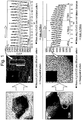
- FIG. 1 shows respective diffraction patterns and interplanar distances for a primary particle, which locates in a secondary particle, and a primary particle locating on the surface part of the secondary particle of the LiCoO 2 positive active material of Comparison 1.
- diffraction patterns of the primary particles locating in the internal part of the secondary particle of the LiCoO 2 positive active material and locating on the surface part of the secondary particle were all in hexagonal structure, and interplanar distances of the primary particles locating in the secondary particle and locating on the surface part of the secondary particle were all measured as 4.70 nm.
- NiCo(OH) 2 precursors were manufactured through a coprecipitation. Then, a lithium secondary battery positive active material was manufactured by adding Li 2 CO 3 and LiOH as lithium compounds to the manufactured precursors, adding Al and Mg as M1 thereto, and processing the mixture in first thermal treatment.
- the manufactured lithium secondary battery positive active material was washed by injecting the distilled water in uniform temperature.
- the surface of the positive active material was washed and coated with Co as M2 by agitating the positive active material while injecting a cobalt sulfate solution of 0.03 mol into the positive active material washing liquid for one hour in a specific ratio, and then dried at 120 °C under a vacuum.
- the lithium secondary battery positive active material was manufactured by adding Ti as M3 to the coated positive active material and processing the Ti-added positive active material in second thermal treatment at 450 °C.
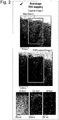
- the positive active material manufactured through Embodiment 1 of the inventive concept has Co concentration that is higher on the surface of the secondary particle and lower toward the inside from the surface of the secondary particle. Co concentration is ununiform in the secondary particle with a grade.
- FIG. 3 shows respective diffraction patterns and interplanar distances for primary particles locating in the internal part of the secondary particle manufactured through Embodiment 1 and locating on the surface part on which Co and Ti are coated.
- the thickness of a Co-coated layer is about 80 nm, and the diffraction pattern of the primary particle locating in the internal part of the secondary particle is in hexagonal structure.
- 10 adjacent interplanar distances were measured as 4.88 nm on average in a TEM photograph.
- the primary particle locating on the surface part having the Co-coated layer was measured as exhibiting a diffraction pattern of hexagonal structure with an interplanar distance of 4.73 nm.
- a positive active material of Embodiment 2 was manufactured in the same as Embodiment 1, except that concentration of a cobalt solution added to the positive active material washing liquid is 4 mol%.
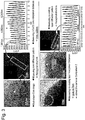
- FIG. 4 shows a result of measuring TEM and EDX photographs of the positive active material manufactures through Embodiment 2.
- the positive active material manufactured through Embodiment 2 of the inventive concept has Co concentration that is higher on the surface of the secondary particle and lower toward the inside of the secondary particle. That is, Co concentration of the positive active material is ununiform and distributed in a grade.
- FIG. 5 shows a result of measuring respective diffraction patterns and interplanar distances of primary particles locating in the internal part of the positive active material manufactured through Embodiment 1 and locating on the surface where Co and Ti are coated.
- a thickness of the Co-coated layer was about 90 nm
- a diffraction pattern of the primary particle locating in the internal part of the secondary particle was in a hexagonal structure
- an average of 10 adjacent interplanar distances of the primary particle locating in the internal part of the secondary particle was measured as 4.85 nm in a TEM photograph
- the primary particle locating on the surface part of the Co-coated layer had a diffraction pattern of hexagonal structure but an interplanar distance thereof was measured as 4.73 nm.
- a positive active material of Embodiment 3 was manufactured by executing a coating process with 5 mol% concentration of a cobalt solution added to the positive active material washing liquid.
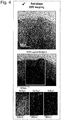
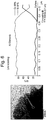
- FIG. 6 shows a result of measuring respective concentration variations of No, Co, and Al from the surface of the secondary particle of the positive active material, which is manufactured through Embodiment 3, toward the center of the particle.
- the positive active material manufactured through Embodiment 3 of the inventive concept has Co concentration that becomes higher toward the center from the surface in the Co-coated layer where Co is coated, but after the Co-coated layer, the Co concentration turns to be reduced as close as the center and a thickness of the Co-coated layer is 0.1 ⁇ m.
- FIG. 7 shows a result of measuring respective EDX photographs for Ni, Co, and Al from the surface of the secondary particle of the positive active material, which is manufactured through Embodiment 3, toward the center of the particle.
- the positive active material manufactured through Embodiment 3 of the inventive concept has Co concentration that becomes higher toward the center from the surface in the Co-coated layer where Co is coated, but after the Co-coated layer, the Co concentration turns to be reduced as close as the center and concentration of the Co-coated layer is higher along the boundaries of the primary particles.
- FIG. 8 shows a result of measuring respective diffraction patterns and interplanar distances of primary particles locating in the internal part of the positive active material manufactured through Embodiment 3 and locating on the surface on which Co and Ti are coated.
- a thickness of the Co-coated layer was about 100 nm
- a diffraction pattern of the primary particle locating in the internal part of the secondary particle was in a hexagonal structure
- an average of 10 adjacent interplanar distances of the primary particle locating in the internal part of the secondary particle was measured as 4.84 nm in a TEM photograph
- the primary particle locating on the Co-coated layer had a diffraction pattern of hexagonal structure but an interplanar distance thereof was measured as 4.67 nm.
- a positive active material of Embodiment 4 was manufactured by executing a washing and coating process with 10 mol% concentration of a cobalt solution added to the positive active material washing liquid.
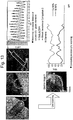
- FIG. 9 shows a result of measuring TEM and EDX photographs on the surface of the secondary particle of the positive active material manufactured through Embodiment 4.
- the positive active material manufactured through Embodiment 4 of the inventive concept has Co concentration that becomes higher on the surface of the secondary particle but turns to be lower as close as the center of the secondary particle.
- the Co concentration is ununiform in a grade.
- the EDX measurement shows a Co distribution of bar-shaped primary particle, from which it can be seen that Co concentration is measured as being higher at the periphery of the bar-shaped primary particle.
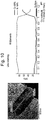
- FIG. 10 shows a result of measuring respective concentration variations of No, Co, and Al from the surface of a secondary particle of the positive active material, which is manufactured through Embodiment 4, toward the center of the particle.
- the positive active material manufactured through Embodiment 4 of the inventive concept has Co concentration that becomes higher toward the center from the surface in the Co-coated layer where Co is coated, but after the Co-coated layer, the Co concentration turns to be reduced as close as the center and a thickness of the Co-coated layer is 0.14 ⁇ m.
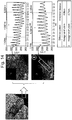
- FIG. 11 shows a result of measuring respective concentration variations of No, Co, and Al from three spots on the surface of a secondary particle of the positive active material, which is manufactured through Embodiment 4, toward the center of the secondary particle.
- FIG. 12 shows a result of measuring respective diffraction patterns and interplanar distances of primary particle locating in a secondary particle of the positive active material manufactured through Embodiment 4 and locating on the surface where Co and Ti are coated.
- a thickness of the Co-coated layer was about 140 nm
- a diffraction pattern of the primary particle locating in the internal part of the secondary particle was in a hexagonal structure
- interplanar distance of the primary particle locating in the internal part of the secondary particle was measured as 4.85 nm
- the primary particle locating on the surface, which was coated with Co and Ti had a diffraction pattern of hexagonal structure but its interplanar distance thereof was measured as 4.69 nm.
- FIG. 13 shows a result of measuring a diffraction pattern and interplanar distances from a boundary between the inside of a primary particle, which locates on the surface of a secondary particle of the positive active material manufactured through Embodiment 4, and a coated layer in the primary particle locating on the surface part of the secondary particle.
- the diffraction pattern was in a hexagonal structure and the interplanar distances were measured as 4.71 nm on average.
- FIG. 14 shows diffraction patterns and interplanar distances at boundaries of a primary particle locating on the surface of a secondary particle, which is coated with Co and Ti, of the positive active material manufactured through Embodiment 4.
- the diffraction patterns are in a hexagonal structure and the interplanar distances are measured as 4.69 nm and 4.71 nm as an intermediate value of interplanar distances between a core part and a coated layer part.
- a positive active material of Embodiment 5 was manufactured by manufacturing a lithium secondary battery positive active material, which had been processed through the first thermal treatment, in the composition of Li 1.02 Ni 0.816 Co 0.15 Al 0.034 O 2 without addition of Ti.
- a positive active material of Embodiment 6 was manufactured by manufacturing a lithium secondary battery positive active material, which had been processed through the first thermal treatment, in the composition of Li 1.02 Ni 0.903 Co 0.08 Al 0.014 Mg 0.003 O 2 .
- a positive active material of Embodiment 7 was manufactured by manufacturing a lithium secondary battery positive active material, which had been processed through the first thermal treatment, in the composition of Li 1.00 Ni 0.965 Co 0.02 Al 0.014 Mg 0.001 O 2 .
- a positive active material of Embodiment 8 was manufactured by executing a coating process with 4 mol% concentration of a cobalt solution which was added to the positive active material washing liquid.
- a positive active material of Embodiment 9 was manufactured by executing a coating process with 5 mol% concentration of a cobalt solution which was added to the positive active material washing liquid.
- a positive active material of Embodiment 10 was manufactured by manufacturing a lithium secondary battery positive active material, which had been processed through the first thermal treatment, in the composition of Li 1.00 Ni 0.985 Al 0.014 Mg 0.001 O 2 .
- a positive active material of Comparison 2 was manufactured by injecting active material particles into a 0.1 mol cobalt solution, coating the active material with cobalt while agitating the mixture, and drying the coated material.
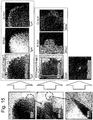
- FIG. 15 shows a result of measuring TEM and EDX photographs from the surface of a secondary particle of the positive active material manufactured through Comparison 2.
- the positive active material resulted in an uneven surface, without being doped into the inside, because there was no subsequent thermal treatment even though the Co distribution was concentrated on the surface due to the agitation with the active material particles which were injected into the cobalt solution.
- a positive active material of Comparison 4 was manufactured by adding Ti with concentration of 0.001 mol and then executing a second thermal treatment.
- a positive active material of Comparison 6 was prepared by manufacturing a lithium secondary battery positive active material, which had been processed through a first thermal treatment, in the composition of Li 1.00 Ni 0.815 Co 0.15 Al 0.014 O 2 .
- a positive active material of Comparison 7 was prepared by manufacturing a lithium secondary battery positive active material, which had been processed through a first thermal treatment, in the composition of Li 1.02 Ni 0.903 Co 0.08 Al 0.014 Mg 0.003 O 2 .
- a positive active material of Comparison 8 was prepared by manufacturing a lithium secondary battery positive active material, which had been processed through a first thermal treatment, in the composition of Li 1.00 Ni 0.965 Co 0.02 Al 0.014 Mg 0.001 O 2 .
- a positive active material of Comparison 9 was prepared by manufacturing a lithium secondary battery positive active material, which had been processed through a first thermal treatment, in the composition of Li 1.00 Ni 0.985 Al 0.014 Mg 0.001 O 2 .
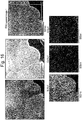
- FIG. 16 shows a result of measuring TEM and EDX photographs from the surface of a secondary particle of the positive active material manufactured through Comparison 4.
- the positive active material manufactured through Comparison 4 has Co concentration uniformly distributed in the particle, because a Co coating process is not preformed after manufacturing an active material, and a Co concentration grade toward the inside of the particle is not found on the surface.
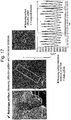
- FIG. 17 shows a result of measuring respective a diffraction pattern and interplanar distances from the surface of a secondary particle of the positive active material manufactured through Embodiment 4.
- a diffraction pattern of the surface was in a hexagonal structure and the interplanar distances were measured as 4.85 nm on average.
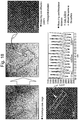
- FIG. 18 shows a result of measuring a diffraction pattern and interplanar distances of a primary particle locating in a secondary particle of the positive active material manufactured through Comparison 4.
- the primary particle locating in the secondary particle of the positive active material has a diffraction pattern of hexagonal structure and interplanar distances of 4.83 nm on average. It can be also seen that, even with a second thermal treatment in the case without a Co coating process, the interplanar distance of the primary particle locating in the secondary particle of the positive active material is almost similar to that of a primary particle locating on the surface of the secondary particle.
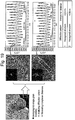
- FIG. 19 shows a result of measuring diffraction patterns and interplanar distances from a boundary of a primary particle locating on the surface of a secondary particle of the positive active material manufactured through Embodiment 4.
- the primary particle locating on the surface of the secondary particle of the positive active material was measured as having a diffraction pattern of hexagonal structure and interplanar distances of 4.81 nm on average.
- FIGS. 18 and 19 it can be seen from FIGS. 18 and 19 that, in the case without a Co coating process, diffraction patterns and interplanar distances are similar between the inside and the boundary of the primary particle.
- FIG. 20 shows a result of measuring respective concentration of Ni, Co, and Al toward the core from the surface of a secondary particle of the positive active material manufactured through Comparison 4.
- the positive active material manufactured through Comparison 4 has uniform concentration of Ni, Co, and Al in the particle.
- FIG. 21 shows a result of measuring respective concentration of Ni, Co, and Al in a direction horizontal to the surface direction of a primary particle locating on the surface of a secondary particle of the positive active material manufactured through Comparison 4.
- the positive active material manufactured through Comparison 4 has uniform concentration of Ni, Co, and Al in the particle, without a Co concentration grade due to absence of a CO coating process, and interplanar distances thereof are also similar between the surface and the inside.
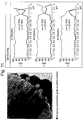
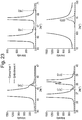
- FIG. 24 A result of measuring XRD for a positive active material of Comparison 2 is shown in FIG. 24 .
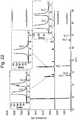
- FIG. 25 shows a result of measuring XRD for positive active materials manufactured through Comparison 4, which does not execute a Co coating process, and through Embodiment 4 executing a thermal treatment after a Co coating process.
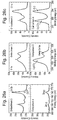
- FIG. 26 shows results of measuring XPS for positive active materials manufactured through Comparison 4, which does not execute a Co coating process, and through Embodiment 3 executing a coating process with a cobalt solution which has concentration of 5 mol%.
- Slurry was manufactured by mixing the positive active materials, which were manufactured through Embodiments 1 to 10 and Comparisons 4, and 6 to 9, super-P as a conducting agent, and polyvinylidenefluoride (PVdF) as a binding agent in weight ratio of 92:5:3. Then an anode for a lithium secondary battery was manufactured by uniformly coating the slurry on an aluminum foil which has a thickness of 15 ⁇ m, and then by drying the slurry-coated aluminum foil at 135 °C under vacuum.
- PVdF polyvinylidenefluoride
- a coin battery was manufactured by using the anode and a lithium foil as the other electrode, using a porous polyethylene film (Celgard 2300 made by Celgard LLC; thickness of 25 ⁇ m) as a separator, and using a liquid electrolyte in which LiPF6 with concentration of 1.15 M was dissolved in a solvent in which ethylene carbonate and ethylmethyl carbonate are mixed in a volume ratio of 3:7.
- a porous polyethylene film (Celgard 2300 made by Celgard LLC; thickness of 25 ⁇ m) as a separator
- LiPF6 with concentration of 1.15 M was dissolved in a solvent in which ethylene carbonate and ethylmethyl carbonate are mixed in a volume ratio of 3:7.
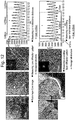
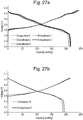
- FIG. 27A Embodiments 1 to 4, Comparison 4
- FIG. 27B Embodiment 5, Comparison 6
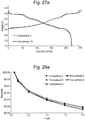
- FIG. 27C Embodiment 6, Comparison 7
- FIG. 27D Embodiments 7 to 9, Comparison 8
- FIG. 27E Embodiment 10, Comparison 9
- the coating process executed according to the embodiments of the inventive concept contributed to the characteristics of capacity and efficiency that was measured as being more improved than that of a comparison examples.
- Embodiment 1 242.2 215.9 89.1 Embodiment 2 239.9 214.4 89.4 Embodiment 3 239.0 215.0 90.0 Embodiment 4 231.7 215.2 92.9 Embodiment 5 213.9 194.1 90.8 Embodiment 6 232.5 213.7 91.9 Embodiment 7 248.9 222.3 89.3 Embodiment 8 247.2 222.5 90.0 Embodiment 9 245.1 220.9 90.1 Embodiment 10 251.8 221.6 88.0 Comparison 4 244.5 209.7 85.8 Comparison 6 217.1 190.2 87.6 Comparison 7 239.3 211.3 88.3 Comparison 8 255.1 219.0 85.9 Comparison 9 258.2 221.6 85.8
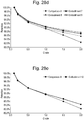
- FIG. 28A Embodiments 1 to 4, Comparison 4
- FIG. 28B Embodiment 5, Comparison 6
- FIG. 28C Embodiment 6, Comparison 7
- FIG. 28D Embodiments 7 to 9, Comparison 8
- FIG. 28E Embodiment 10, Comparison 9
- the coating process executed by the embodiments of the inventive concept contributed to making the characteristics of capacity and efficiency measured as being more improved than the comparison examples.
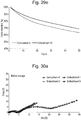
- FIG. 29A Embodiments 1 to 4, Comparison 4
- FIG. 29C Embodiment 5, Comparison 6
- FIG. 29C Embodiment 6, Comparison 7
- FIG. 29D Embodiments 7 to 9, Comparison 8
- FIG. 29E Embodiment 10, Comparison 9
- the coating process executed according to the embodiments of the inventive concept contributed to making the characteristics of lifetime measured as being more improved than the comparison examples.
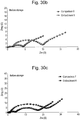
- FIG. 30A Embodiments 1 to 3, Comparison 4
- FIG. 30B Embodiment 5, Comparison 6
- FIG. 30C Embodiment 6, Comparison 7
- FIG. 30D Embodiments 7 to 9, Comparison 8
- FIG. 30E Embodiment 10, Comparison 9
- FIG. 31A Embodiments 1 to 3, Comparison 4
- FIG. 31B Embodiment 5, Comparison 6
- FIG. 31C Embodiment 6, Comparison 7
- FIG. 31D Embodiments 7 to 9, Comparison 8
- FIG. 31E Embodiment 10, Comparison 9
- the coating process executed by the embodiments of the inventive concept contributed to greatly improving the high temperature storage characteristics because impedances after high temperature storage increased less than those of the comparison examples.
- a secondary battery in the characteristics of capacity, resistance, and lifetime with different interplanar distances of crystalline structures between a primary particle locating on the surface part of a secondary particle and a primary particle locating in the internal part of the secondary particle by coating different elements and washing in the processes of forming precursors and/or an active material.
- a secondary battery in the characteristics of capacity, resistance, and lifetime with different interplanar distances of crystalline structures between a primary particle locating on the surface part of a secondary particle and a primary particle locating in the internal part of the secondary particle by coating different elements and washing in the processes of forming precursors and/or an active material.
Landscapes
- Chemical & Material Sciences (AREA)
- Chemical Kinetics & Catalysis (AREA)
- Electrochemistry (AREA)
- General Chemical & Material Sciences (AREA)
- Inorganic Chemistry (AREA)
- Engineering & Computer Science (AREA)
- Materials Engineering (AREA)
- Composite Materials (AREA)
- Organic Chemistry (AREA)
- Manufacturing & Machinery (AREA)
- Battery Electrode And Active Subsutance (AREA)
- Inorganic Compounds Of Heavy Metals (AREA)
Claims (11)
- Lithiumkomplexoxid-Sekundärteilchen, das durch Koagulation einer Vielzahl von Primärteilchen gebildet wird, wobei die Co-Konzentration an einer Grenze des Primärteilchens höher ist als die Co-Konzentration im inneren Teil des Primärteilchens,
wobei:die Co-Konzentration eines Primärteilchens an einem Teil des Primärteilchens, der mit der Oberfläche des Sekundärteilchens in Kontakt steht, höher ist als an einem Teil des Primärteilchens, der nicht mit der Oberfläche des Sekundärteilchens in Kontakt steht, wobei sich das Primärteilchen an einem Oberflächenteil des Sekundärteilchens befindet;ein Primärteilchen, das sich an einer Oberfläche des Sekundärteilchens befindet, einen Co-Ionen-Konzentrationsgradienten in Richtung eines Zentrums des Primärteilchens von der Oberfläche des Primärteilchens aus aufweist;ein Primärteilchen, das sich an einem Oberflächenteil des Sekundärteilchens befindet, einen Co-Konzentrationsgradienten aufweist, der um 0,05 bis 0,07 mol-% pro nm in Richtung eines Zentrums des Primärteilchens verringert ist;das Lithiumkomplexoxid-Sekundärteilchen eine hexagonale Kristallstruktur aufweist; unddas Sekundärteilchen eine gebundene Energie (P1) mit einem Spin-Umlaufbahn-2p3/2-Peak und eine gebundene Energie (P2) mit einem 2p1/2-Peak in einer Co-2p-Kernebenenspektrometrie, erhalten durch eine XPS-Messung, aufweist, wobei P1 und P2 jeweils in einem Bereich liegen von:
779eV ≤ P1 ≤ 780eV und 794eV ≤ P2 ≤ 795 eV. - Lithiumkomplexoxid-Sekundärteilchen nach Anspruch 1, wobei ein Primärteilchen, das sich an einem Oberflächenteil des Sekundärteilchens befindet, konfiguriert ist, um zu erfüllen, dass dc/dh 2 bis 10 beträgt, wobei dc eine Länge in Richtung eines Zentrums hin und dh eine Länge senkrecht zum Zentrum ist.
- Lithiumkomplexoxid-Sekundärteilchen nach Anspruch 1 oder 2, wobei das Sekundärteilchen mindestens einen Peak an den Positionen (104), (110), (113), (101), (102) und (003) während der XRD-Analyse aufweist.
- Lithiumkomplexoxid-Sekundärteilchen nach einem der vorstehenden Ansprüche, wobei das Sekundärteilchen ein Verhältnis der Peak-Intensität (I531) von etwa 531 eV und der Peak-Intensität (I528) von etwa 528,5 eV während einer O1s-Kernebenenspektrometrie aufweist, das durch eine XPS-Messung erhalten wird und
wobei das Verhältnis I531/I528 ≤ 2 ist. - Lithiumkomplexoxid-Sekundärteilchen nach einem der vorstehenden Ansprüche, wobei das Sekundärteilchen ein Verhältnis zwischen der Peak-Intensität (I289) von etwa 289 eV und der Peak-Intensität (I284) von etwa 284,5 eV während einer C-1s-Kernebenenspektrometrie aufweist, das durch eine XPS-Messung erhalten wird, und
wobei das Verhältnis I289/I284 ≤ 0,9 ist. - Lithiumkomplexoxid-Sekundärteilchen nach einem der vorstehenden Ansprüche, wobei das Sekundärteilchen durch die folgende Formel 1 vorgegeben wird
[Formel 1] LixNi1-(a1+b1+c1)Coa1M1b1M2c1M3dOy,
wobei in der Formel 1 M1 Mn oder A1 ist und M2 und M3 Metalle sind, die ausgewählt sind aus einer Gruppe von Al, Ba, B, Co, Ce, Cr, F, Li, Mg, Mn, Mo, P, Sr, Ti und Zr, undwobei 0,95 ≤ x ≤ 1,05, 1,50 ≤ y ≤ 2,1, 0,02 ≤ a1 ≤ 0,25, 0,01 ≤ b1 ≤ 0,20, 0 ≤ c1 ≤ 0,20 und 0 ≤ d ≤ 0,20. - Verfahren zur Herstellung eines Lithiumkomplexoxid-Sekundärteilchens nach einem der vorstehenden Ansprüche, wobei das Verfahren Folgendes umfasst:Herstellung von Vorläufern von positiven aktiven Lithium-Sekundärbatterie-Materialien, die durch die folgende Formel 2 vorgegeben werden,
[Formel 2] LixNi1-(x2+y2+z2)Cox2M1y2M2z2(OH)2,
wobei in Formel 2 M1 Mn oder A1 ist und M2 ein Metall ist, das ausgewählt ist aus einer Gruppe von Al, Ba, B, Co, Ce, Cr, F, Li, Mg, Mn, Mo, P, Sr, Ti und Zr, und wobei 0 ≤ x2 ≤ 0,25, 0 ≤ y2 ≤ 0,20 und 0 ≤ z2 ≤ 0,20;Reagieren von Vorläufern von positiven aktiven Lithium-Sekundärbatterie-Materialien mit einer Lithiumverbindung und Herstellung eines positiven aktiven Materials durch eine erste thermische Behandlung des Reaktionsmittels;Waschen des positiven aktiven Materials mit destilliertem Wasser oder einer alkalischen Lösung;reaktives Beschichten des gewaschenen positiven aktiven Materials mit einer Lösung, die M2 enthält, das Co ist;Trocknen der Teilchen des positiven aktiven Materials; undMischen des getrockneten positiven aktiven Materials mit M3, das ein Metall ist, das ausgewählt ist aus der Gruppe von Al, Ba, B, Ce, Cr, F, Li, Mg, Mn, Mo, P, Sr, Ti und Zr, und Dotieren des Metalls M3 in die Teilchen durch eine zweite thermische Behandlung des Gemisches. - Verfahren nach Anspruch 7, wobei die reaktive Beschichtung Folgendes umfasst:
reaktives Beschichten des gewaschenen positiven aktiven Materials mit der Lösung, die Co enthält. - Verfahren nach Anspruch 8, wobei bei der reaktiven Beschichtung die Lösung, die ein Co-Ion enthält, eine Konzentration von 1 bis 10 mol-% aufweist.
- Lithium-Sekundärbatterie, umfassend ein Lithiumkomplexoxid-Sekundärteilchen nach einem der Ansprüche 1 bis 6.
- Lithium-Sekundärbatterie nach Anspruch 10, wobei die Lithium-Sekundärbatterie einen Lithium-Restgehalt gleich 6.000 ppm oder weniger aufweist.
Priority Applications (1)
| Application Number | Priority Date | Filing Date | Title |
|---|---|---|---|
| PL17160906T PL3279977T3 (pl) | 2016-08-02 | 2017-03-14 | Tlenek kompleksu litu do dodatniego materiału aktywnego baterii litowych ogniw wtórnych i sposób jego przygotowania |
Applications Claiming Priority (2)
| Application Number | Priority Date | Filing Date | Title |
|---|---|---|---|
| KR20160098648 | 2016-08-02 | ||
| KR1020160130566A KR101934848B1 (ko) | 2016-08-02 | 2016-10-10 | 리튬 이차전지용 리튬복합 산화물 및 이의 제조 방법 |
Publications (2)
| Publication Number | Publication Date |
|---|---|
| EP3279977A1 EP3279977A1 (de) | 2018-02-07 |
| EP3279977B1 true EP3279977B1 (de) | 2020-03-11 |
Family
ID=58347168
Family Applications (1)
| Application Number | Title | Priority Date | Filing Date |
|---|---|---|---|
| EP17160906.8A Active EP3279977B1 (de) | 2016-08-02 | 2017-03-14 | Lithiumkomplexoxid für positives aktivmaterial einer lithiumsekundärbatterie und verfahren zur herstellung davon |
Country Status (5)
| Country | Link |
|---|---|
| US (2) | US10483540B2 (de) |
| EP (1) | EP3279977B1 (de) |
| JP (1) | JP6771419B2 (de) |
| CN (1) | CN107681152B (de) |
| PL (1) | PL3279977T3 (de) |
Families Citing this family (20)
| Publication number | Priority date | Publication date | Assignee | Title |
|---|---|---|---|---|
| US11158853B2 (en) | 2016-04-27 | 2021-10-26 | Camx Power Llc | Nanocrystals of polycrystalline layered lithium nickel metal oxides |
| PL3279978T3 (pl) | 2016-08-02 | 2021-04-19 | Ecopro Bm Co., Ltd. | Złożony tlenek litu dla dodatniego materiału aktywnego baterii akumulatorowej i sposób jego wytwarzania |
| CN110890525B (zh) | 2018-09-11 | 2023-08-11 | 艾可普罗 Bm 有限公司 | 用于锂二次电池的正极活性材料及包括其的锂二次电池 |
| US10501335B1 (en) | 2019-01-17 | 2019-12-10 | Camx Power Llc | Polycrystalline metal oxides with enriched grain boundaries |
| US10950857B2 (en) | 2019-01-17 | 2021-03-16 | Camx Power Llc | Polycrystalline metal oxides with enriched grain boundaries |
| US11424449B2 (en) | 2019-01-25 | 2022-08-23 | Camx Power Llc | Stable cathode materials |
| JP7258373B6 (ja) * | 2019-02-28 | 2024-02-13 | エスエム ラブ コーポレーション リミテッド | 正極活物質、その製造方法、及びそれを含む正極を含むリチウム二次電池 |
| CN113412548B (zh) * | 2019-02-28 | 2024-07-23 | Sm研究所股份有限公司 | 阳极活性物质、其制备方法以及包括该阳极活性物质的阳极的锂二次电池 |
| CN110247039A (zh) * | 2019-06-17 | 2019-09-17 | 启东启澳新材料科技发展有限公司 | 一种包覆钛酸锶基导电涂层的镍锰酸锂正极材料制备方法 |
| KR102213787B1 (ko) * | 2019-10-18 | 2021-02-08 | 주식회사 에코프로비엠 | 양극 활물질 및 이를 포함하는 리튬 이차전지 |
| CN115103816A (zh) * | 2020-02-27 | 2022-09-23 | 巴斯夫欧洲公司 | 制备电极活性材料的方法以及电极活性材料 |
| CN115461308A (zh) * | 2020-05-12 | 2022-12-09 | 巴斯夫欧洲公司 | 电极活性材料及其制备方法 |
| EP4176476B1 (de) * | 2020-07-06 | 2024-04-17 | Basf Se | Beschichtete teilchenförmige aktive elektrodenmaterialien |
| JP7669650B2 (ja) * | 2020-09-02 | 2025-04-30 | 株式会社プロテリアル | リチウムイオン二次電池用正極活物質の製造方法 |
| JP7473828B2 (ja) | 2021-07-26 | 2024-04-24 | 日亜化学工業株式会社 | 非水電解質二次電池用正極及びその製造方法 |
| EP4455554A1 (de) | 2021-12-22 | 2024-10-30 | Joint Stock Company "Rosenergoatom" | Vorrichtung zur verbrennung von ammoniak |
| KR102930893B1 (ko) * | 2022-06-16 | 2026-02-25 | 주식회사 에코프로비엠 | 양극 활물질 및 이를 포함하는 리튬 이차전지 |
| KR20250124004A (ko) * | 2024-02-08 | 2025-08-19 | 삼성에스디아이 주식회사 | 세정액의 회수방법, 이의 회수장치, 및 이에 의해 회수된 세정액 |
| US12278363B1 (en) | 2024-04-29 | 2025-04-15 | Camx Power, Llc | Multiple morphology composite cathode materials providing high energy and long cycle life and cells employing the same |
| CN118315582B (zh) * | 2024-04-30 | 2025-06-24 | 北京当升材料科技股份有限公司 | 正极活性材料及其制备方法、正极极片、电池和用电设备 |
Citations (6)
| Publication number | Priority date | Publication date | Assignee | Title |
|---|---|---|---|---|
| WO2002103824A2 (en) | 2001-06-15 | 2002-12-27 | Kureha Chemical Industry Company, Limited | Gradient cathode material for lithium rechargeable batteries |
| US20120009474A1 (en) * | 2010-07-08 | 2012-01-12 | Sony Corporation | Positive electrode active material, nonaqueous electrolyte battery and method for manufacturing positive electrode active material |
| WO2013025328A2 (en) | 2011-08-16 | 2013-02-21 | Tiax Llc | Polycrystalline metal oxide, methods of manufacture thereof, and articles comprising the same |
| EP2634148A1 (de) * | 2012-03-01 | 2013-09-04 | GS Yuasa International Ltd. | Aktivmaterial für eine Sekundärbatterie mit nichtwässrigem Elektrolyten, Verfahren zur Herstellung des Aktivmaterials, Elektrode für eine Sekundärbatterie mit nichtwässrigem Elektrolyten und Sekundärbatterie mit nichtwässrigem Elektrolyten |
| US20160181611A1 (en) | 2014-12-18 | 2016-06-23 | Unist Academy-Industry Research Corporation | Composite cathode active material, method of preparing the same, and cathode and lithium battery including the composite cathode active material |
| WO2017189887A1 (en) | 2016-04-27 | 2017-11-02 | Camx Power, L.L.C. | Polycrystalline layered metal oxides comprising nano-crystals |
Family Cites Families (22)
| Publication number | Priority date | Publication date | Assignee | Title |
|---|---|---|---|---|
| JP5002872B2 (ja) * | 2001-08-09 | 2012-08-15 | トヨタ自動車株式会社 | リチウム二次電池用正極活物質、リチウム二次電池用正極及びリチウム二次電池並びにリチウム二次電池用正極活物質の製造方法 |
| JP2003303592A (ja) * | 2002-04-10 | 2003-10-24 | Japan Storage Battery Co Ltd | 非水電解液二次電池 |
| KR100560540B1 (ko) * | 2003-07-18 | 2006-03-15 | 삼성에스디아이 주식회사 | 리튬 이차 전지용 양극 활물질, 그의 제조 방법 및 그를포함하는 리튬 이차 전지 |
| US7381496B2 (en) | 2004-05-21 | 2008-06-03 | Tiax Llc | Lithium metal oxide materials and methods of synthesis and use |
| WO2010090185A1 (ja) * | 2009-02-05 | 2010-08-12 | Agcセイミケミカル株式会社 | リチウムイオン二次電池用正極活物質用の表面修飾リチウム含有複合酸化物及びその製造方法 |
| JP5638232B2 (ja) * | 2009-12-02 | 2014-12-10 | 住友金属鉱山株式会社 | 非水系電解質二次電池正極活物質用ニッケルコバルトマンガン複合水酸化物粒子とその製造方法、非水系電解質二次電池用正極活物質とその製造方法、および非水系電解質二次電池 |
| WO2012171780A1 (en) * | 2011-06-17 | 2012-12-20 | Umicore | Lithium metal oxide partcles coated with a mixture of the elements of the core material and one or more metal oxides |
| JP5360159B2 (ja) * | 2011-08-09 | 2013-12-04 | トヨタ自動車株式会社 | 複合正極活物質、全固体電池、および複合正極活物質の製造方法 |
| JP5365711B2 (ja) * | 2012-02-21 | 2013-12-11 | 住友金属鉱山株式会社 | ニッケルコバルトマンガン複合水酸化物及びその製造方法 |
| KR101521178B1 (ko) * | 2012-03-31 | 2015-05-19 | 한양대학교 산학협력단 | 리튬 이차 전지용 양극활물질 전구체의 제조 방법, 이에 의하여 제조된 리튬 이차 전지용 양극활물질 전구체, 및 이를 포함하는 리튬 이차 전지용 양극활물질 |
| KR20130138073A (ko) * | 2012-06-08 | 2013-12-18 | 한양대학교 산학협력단 | 리튬 이차 전지용 양극활물질 전구체, 이를 이용하여 제조된 양극활물질 및 이를 포함하는 리튬 이차 전지 |
| KR101567039B1 (ko) * | 2012-12-13 | 2015-11-10 | 주식회사 에코프로 | 리튬 이차 전지용 양극활물질의 제조 방법 및 이에 의하여 제조된 리튬 이차 전지용 양극활물질 |
| JP5954493B2 (ja) * | 2013-04-01 | 2016-07-20 | 株式会社Ihi | 連続加熱炉 |
| KR102277906B1 (ko) * | 2013-11-28 | 2021-07-15 | 삼성전자주식회사 | 양극 활물질, 이를 포함하는 이차전지, 및 이의 제조방법 |
| KR101555594B1 (ko) * | 2014-10-02 | 2015-10-06 | 주식회사 에코프로 | 리튬 이차 전지용 양극활물질 및 이를 포함하는 리튬 이차 전지 |
| JP6287771B2 (ja) * | 2014-11-18 | 2018-03-07 | 住友金属鉱山株式会社 | 非水系電解質二次電池用正極活物質、その製造方法及びそれを用いた非水系電解質二次電池 |
| KR102361193B1 (ko) | 2015-02-10 | 2022-02-11 | 코웨이 주식회사 | 가습기 |
| KR20160130566A (ko) | 2015-05-04 | 2016-11-14 | 최윤석 | 수족관 |
| US10693136B2 (en) * | 2016-07-11 | 2020-06-23 | Ecopro Bm Co., Ltd. | Lithium complex oxide for lithium secondary battery positive active material and method of preparing the same |
| PL3279979T3 (pl) * | 2016-08-02 | 2021-12-20 | Ecopro Bm Co., Ltd. | Złożony tlenek litu dla dodatniego materiału aktywnego baterii wtórnej i sposób jego wytwarzania |
| PL3279978T3 (pl) * | 2016-08-02 | 2021-04-19 | Ecopro Bm Co., Ltd. | Złożony tlenek litu dla dodatniego materiału aktywnego baterii akumulatorowej i sposób jego wytwarzania |
| US10903490B2 (en) * | 2016-08-02 | 2021-01-26 | Ecopro Bm Co., Ltd. | Lithium complex oxide for lithium secondary battery positive active material and method of preparing the same |
-
2017
- 2017-03-14 EP EP17160906.8A patent/EP3279977B1/de active Active
- 2017-03-14 PL PL17160906T patent/PL3279977T3/pl unknown
- 2017-03-22 CN CN201710172451.7A patent/CN107681152B/zh active Active
- 2017-03-28 US US15/471,317 patent/US10483540B2/en active Active
- 2017-03-30 JP JP2017069393A patent/JP6771419B2/ja active Active
-
2019
- 2019-10-02 US US16/591,129 patent/US10700355B2/en active Active
Patent Citations (6)
| Publication number | Priority date | Publication date | Assignee | Title |
|---|---|---|---|---|
| WO2002103824A2 (en) | 2001-06-15 | 2002-12-27 | Kureha Chemical Industry Company, Limited | Gradient cathode material for lithium rechargeable batteries |
| US20120009474A1 (en) * | 2010-07-08 | 2012-01-12 | Sony Corporation | Positive electrode active material, nonaqueous electrolyte battery and method for manufacturing positive electrode active material |
| WO2013025328A2 (en) | 2011-08-16 | 2013-02-21 | Tiax Llc | Polycrystalline metal oxide, methods of manufacture thereof, and articles comprising the same |
| EP2634148A1 (de) * | 2012-03-01 | 2013-09-04 | GS Yuasa International Ltd. | Aktivmaterial für eine Sekundärbatterie mit nichtwässrigem Elektrolyten, Verfahren zur Herstellung des Aktivmaterials, Elektrode für eine Sekundärbatterie mit nichtwässrigem Elektrolyten und Sekundärbatterie mit nichtwässrigem Elektrolyten |
| US20160181611A1 (en) | 2014-12-18 | 2016-06-23 | Unist Academy-Industry Research Corporation | Composite cathode active material, method of preparing the same, and cathode and lithium battery including the composite cathode active material |
| WO2017189887A1 (en) | 2016-04-27 | 2017-11-02 | Camx Power, L.L.C. | Polycrystalline layered metal oxides comprising nano-crystals |
Non-Patent Citations (6)
| Title |
|---|
| KALYANI ET AL.: "Various aspects of LiNiO2 chemistry: A review", SCIENCE AND TECHNOLOGY OF ADVANCED MATERIALS, vol. 6, 2005, pages 689 - 703, XP027624516 |
| KALYANI, P. KALAISELVI, N.: "Various aspects of LiNiO"2 chemistry: A review", SCIENCE AND TECHNOLOGY OF ADVANCED MATERIALS, ELSEVIER SCIENCE, vol. 6, no. 6, 1 September 2005 (2005-09-01), pages 689 - 703, XP005170053, ISSN: 1468-6996, DOI: 10.1016/j.stam.2005.06.001 |
| LEE EUNG-JU ET AL: "Effect of outer layer thickness on full concentration gradient layered cathode material for lithium-ion batteries", JOURNAL OF POWER SOURCES, ELSEVIER SA, CH, vol. 273, 2 October 2014 (2014-10-02), pages 663 - 669, XP029092216, ISSN: 0378-7753, DOI: 10.1016/J.JPOWSOUR.2014.09.161 * |
| MOSES ANTHONY W ET AL: "Surface properties of LiCoO2, LiNiO2and LiNi1-xCoxO2", APPLIED SURFACE SCIENCE, ELSEVIER, AMSTERDAM, NL, vol. 253, no. 10, 29 November 2006 (2006-11-29), pages 4782 - 4791, XP029661998, ISSN: 0169-4332, DOI: 10.1016/J.APSUSC.2006.10.044 * |
| MOSES ANTHONY W.; FLORES HARRY G. GARCIA; KIM JONG-GYU; LANGELL MARJORIE A.: "Surface properties of LiCoO2, LiNiO2and LiNi1−xCoxO2", APPLIED SURFACE SCIENCE, ELSEVIER, AMSTERDAM, NL, vol. 253, no. 10, 29 November 2006 (2006-11-29), AMSTERDAM, NL, pages 4782 - 4791, XP029661998, ISSN: 0169-4332, DOI: 10.1016/j.apsusc.2006.10.044 |
| MOSES ET AL.: "Surface properties of LiCoO2, LiNiO2 and LiNi1−xCoxO2", APPLIED SURFACE SCIENCE, vol. 253, 2007, pages 4782 - 4791, XP029661998 |
Also Published As
| Publication number | Publication date |
|---|---|
| JP6771419B2 (ja) | 2020-10-21 |
| EP3279977A1 (de) | 2018-02-07 |
| PL3279977T3 (pl) | 2020-08-24 |
| US20200036006A1 (en) | 2020-01-30 |
| CN107681152A (zh) | 2018-02-09 |
| CN107681152B (zh) | 2021-03-16 |
| US20180040891A1 (en) | 2018-02-08 |
| US10700355B2 (en) | 2020-06-30 |
| US10483540B2 (en) | 2019-11-19 |
| JP2018022676A (ja) | 2018-02-08 |
Similar Documents
| Publication | Publication Date | Title |
|---|---|---|
| EP3279977B1 (de) | Lithiumkomplexoxid für positives aktivmaterial einer lithiumsekundärbatterie und verfahren zur herstellung davon | |
| EP3279978B1 (de) | Lithiumkomplexoxid für positives aktivmaterial einer sekundärbatterie und verfahren zur herstellung davon | |
| US11508964B2 (en) | Lithium complex oxide for lithium secondary battery positive active material and method of preparing the same | |
| EP3279979B1 (de) | Lithiumkomplexoxid für positives aktivmaterial einer lithiumsekundärbatterie und verfahren zur herstellung davon | |
| US10693136B2 (en) | Lithium complex oxide for lithium secondary battery positive active material and method of preparing the same | |
| EP3315638B1 (de) | Lithiumkomplexoxid für positives aktives material einer lithiumsekundärbatterie und verfahren zur herstellung davon | |
| EP3301076A1 (de) | Lithiumkomplexoxid für positivaktivmaterial einer lithiumsekundärbatterie und verfahren zur herstellung davon | |
| KR101934853B1 (ko) | 리튬 이차전지용 리튬복합 산화물 및 이의 제조 방법 | |
| EP3399579B1 (de) | Verfahren zur herstellung eines positiven elektrodenaktivmaterials | |
| KR101912202B1 (ko) | 리튬 이차전지용 리튬복합 산화물 및 이의 제조 방법 | |
| EP3486220B2 (de) | Katodenaktivmaterial für eine lithiumsekundärbatterie sowie lithiumsekundärbatterie damit | |
| KR101934848B1 (ko) | 리튬 이차전지용 리튬복합 산화물 및 이의 제조 방법 | |
| KR100804085B1 (ko) | 리튬 이차 전지용 양극 활물질 및 그 제조방법 |
Legal Events
| Date | Code | Title | Description |
|---|---|---|---|
| PUAI | Public reference made under article 153(3) epc to a published international application that has entered the european phase |
Free format text: ORIGINAL CODE: 0009012 |
|
| STAA | Information on the status of an ep patent application or granted ep patent |
Free format text: STATUS: THE APPLICATION HAS BEEN PUBLISHED |
|
| AK | Designated contracting states |
Kind code of ref document: A1 Designated state(s): AL AT BE BG CH CY CZ DE DK EE ES FI FR GB GR HR HU IE IS IT LI LT LU LV MC MK MT NL NO PL PT RO RS SE SI SK SM TR |
|
| AX | Request for extension of the european patent |
Extension state: BA ME |
|
| STAA | Information on the status of an ep patent application or granted ep patent |
Free format text: STATUS: REQUEST FOR EXAMINATION WAS MADE |
|
| 17P | Request for examination filed |
Effective date: 20180215 |
|
| RBV | Designated contracting states (corrected) |
Designated state(s): AL AT BE BG CH CY CZ DE DK EE ES FI FR GB GR HR HU IE IS IT LI LT LU LV MC MK MT NL NO PL PT RO RS SE SI SK SM TR |
|
| TPAC | Observations filed by third parties |
Free format text: ORIGINAL CODE: EPIDOSNTIPA |
|
| STAA | Information on the status of an ep patent application or granted ep patent |
Free format text: STATUS: EXAMINATION IS IN PROGRESS |
|
| 17Q | First examination report despatched |
Effective date: 20190507 |
|
| REG | Reference to a national code |
Ref country code: DE Ref legal event code: R079 Ref document number: 602017012770 Country of ref document: DE Free format text: PREVIOUS MAIN CLASS: H01M0004131000 Ipc: C01G0053000000 |
|
| GRAP | Despatch of communication of intention to grant a patent |
Free format text: ORIGINAL CODE: EPIDOSNIGR1 |
|
| STAA | Information on the status of an ep patent application or granted ep patent |
Free format text: STATUS: GRANT OF PATENT IS INTENDED |
|
| RIC1 | Information provided on ipc code assigned before grant |
Ipc: H01M 4/131 20100101ALI20191119BHEP Ipc: H01M 4/48 20100101ALI20191119BHEP Ipc: H01M 4/1391 20100101ALI20191119BHEP Ipc: H01M 4/02 20060101ALI20191119BHEP Ipc: H01M 4/505 20100101ALI20191119BHEP Ipc: H01M 4/36 20060101ALI20191119BHEP Ipc: H01M 10/0525 20100101ALI20191119BHEP Ipc: H01M 4/50 20100101ALI20191119BHEP Ipc: H01M 4/38 20060101ALI20191119BHEP Ipc: H01M 4/525 20100101ALI20191119BHEP Ipc: C01G 53/00 20060101AFI20191119BHEP |
|
| INTG | Intention to grant announced |
Effective date: 20191213 |
|
| GRAS | Grant fee paid |
Free format text: ORIGINAL CODE: EPIDOSNIGR3 |
|
| GRAA | (expected) grant |
Free format text: ORIGINAL CODE: 0009210 |
|
| STAA | Information on the status of an ep patent application or granted ep patent |
Free format text: STATUS: THE PATENT HAS BEEN GRANTED |
|
| AK | Designated contracting states |
Kind code of ref document: B1 Designated state(s): AL AT BE BG CH CY CZ DE DK EE ES FI FR GB GR HR HU IE IS IT LI LT LU LV MC MK MT NL NO PL PT RO RS SE SI SK SM TR |
|
| REG | Reference to a national code |
Ref country code: GB Ref legal event code: FG4D |
|
| REG | Reference to a national code |
Ref country code: CH Ref legal event code: EP |
|
| REG | Reference to a national code |
Ref country code: AT Ref legal event code: REF Ref document number: 1242941 Country of ref document: AT Kind code of ref document: T Effective date: 20200315 |
|
| REG | Reference to a national code |
Ref country code: DE Ref legal event code: R096 Ref document number: 602017012770 Country of ref document: DE |
|
| REG | Reference to a national code |
Ref country code: IE Ref legal event code: FG4D |
|
| REG | Reference to a national code |
Ref country code: SE Ref legal event code: TRGR |
|
| PG25 | Lapsed in a contracting state [announced via postgrant information from national office to epo] |
Ref country code: FI Free format text: LAPSE BECAUSE OF FAILURE TO SUBMIT A TRANSLATION OF THE DESCRIPTION OR TO PAY THE FEE WITHIN THE PRESCRIBED TIME-LIMIT Effective date: 20200311 Ref country code: NO Free format text: LAPSE BECAUSE OF FAILURE TO SUBMIT A TRANSLATION OF THE DESCRIPTION OR TO PAY THE FEE WITHIN THE PRESCRIBED TIME-LIMIT Effective date: 20200611 Ref country code: RS Free format text: LAPSE BECAUSE OF FAILURE TO SUBMIT A TRANSLATION OF THE DESCRIPTION OR TO PAY THE FEE WITHIN THE PRESCRIBED TIME-LIMIT Effective date: 20200311 |
|
| REG | Reference to a national code |
Ref country code: NL Ref legal event code: MP Effective date: 20200311 |
|
| PG25 | Lapsed in a contracting state [announced via postgrant information from national office to epo] |
Ref country code: BG Free format text: LAPSE BECAUSE OF FAILURE TO SUBMIT A TRANSLATION OF THE DESCRIPTION OR TO PAY THE FEE WITHIN THE PRESCRIBED TIME-LIMIT Effective date: 20200611 Ref country code: GR Free format text: LAPSE BECAUSE OF FAILURE TO SUBMIT A TRANSLATION OF THE DESCRIPTION OR TO PAY THE FEE WITHIN THE PRESCRIBED TIME-LIMIT Effective date: 20200612 Ref country code: LV Free format text: LAPSE BECAUSE OF FAILURE TO SUBMIT A TRANSLATION OF THE DESCRIPTION OR TO PAY THE FEE WITHIN THE PRESCRIBED TIME-LIMIT Effective date: 20200311 Ref country code: HR Free format text: LAPSE BECAUSE OF FAILURE TO SUBMIT A TRANSLATION OF THE DESCRIPTION OR TO PAY THE FEE WITHIN THE PRESCRIBED TIME-LIMIT Effective date: 20200311 |
|
| REG | Reference to a national code |
Ref country code: LT Ref legal event code: MG4D |
|
| PG25 | Lapsed in a contracting state [announced via postgrant information from national office to epo] |
Ref country code: NL Free format text: LAPSE BECAUSE OF FAILURE TO SUBMIT A TRANSLATION OF THE DESCRIPTION OR TO PAY THE FEE WITHIN THE PRESCRIBED TIME-LIMIT Effective date: 20200311 |
|
| PG25 | Lapsed in a contracting state [announced via postgrant information from national office to epo] |
Ref country code: LT Free format text: LAPSE BECAUSE OF FAILURE TO SUBMIT A TRANSLATION OF THE DESCRIPTION OR TO PAY THE FEE WITHIN THE PRESCRIBED TIME-LIMIT Effective date: 20200311 Ref country code: SK Free format text: LAPSE BECAUSE OF FAILURE TO SUBMIT A TRANSLATION OF THE DESCRIPTION OR TO PAY THE FEE WITHIN THE PRESCRIBED TIME-LIMIT Effective date: 20200311 Ref country code: CZ Free format text: LAPSE BECAUSE OF FAILURE TO SUBMIT A TRANSLATION OF THE DESCRIPTION OR TO PAY THE FEE WITHIN THE PRESCRIBED TIME-LIMIT Effective date: 20200311 Ref country code: IS Free format text: LAPSE BECAUSE OF FAILURE TO SUBMIT A TRANSLATION OF THE DESCRIPTION OR TO PAY THE FEE WITHIN THE PRESCRIBED TIME-LIMIT Effective date: 20200711 Ref country code: PT Free format text: LAPSE BECAUSE OF FAILURE TO SUBMIT A TRANSLATION OF THE DESCRIPTION OR TO PAY THE FEE WITHIN THE PRESCRIBED TIME-LIMIT Effective date: 20200805 Ref country code: RO Free format text: LAPSE BECAUSE OF FAILURE TO SUBMIT A TRANSLATION OF THE DESCRIPTION OR TO PAY THE FEE WITHIN THE PRESCRIBED TIME-LIMIT Effective date: 20200311 Ref country code: SM Free format text: LAPSE BECAUSE OF FAILURE TO SUBMIT A TRANSLATION OF THE DESCRIPTION OR TO PAY THE FEE WITHIN THE PRESCRIBED TIME-LIMIT Effective date: 20200311 Ref country code: EE Free format text: LAPSE BECAUSE OF FAILURE TO SUBMIT A TRANSLATION OF THE DESCRIPTION OR TO PAY THE FEE WITHIN THE PRESCRIBED TIME-LIMIT Effective date: 20200311 |
|
| REG | Reference to a national code |
Ref country code: CH Ref legal event code: PL |
|
| REG | Reference to a national code |
Ref country code: AT Ref legal event code: MK05 Ref document number: 1242941 Country of ref document: AT Kind code of ref document: T Effective date: 20200311 |
|
| REG | Reference to a national code |
Ref country code: DE Ref legal event code: R026 Ref document number: 602017012770 Country of ref document: DE |
|
| PLBI | Opposition filed |
Free format text: ORIGINAL CODE: 0009260 |
|
| PLAX | Notice of opposition and request to file observation + time limit sent |
Free format text: ORIGINAL CODE: EPIDOSNOBS2 |
|
| REG | Reference to a national code |
Ref country code: HU Ref legal event code: AG4A Ref document number: E050349 Country of ref document: HU |
|
| PG25 | Lapsed in a contracting state [announced via postgrant information from national office to epo] |
Ref country code: LU Free format text: LAPSE BECAUSE OF NON-PAYMENT OF DUE FEES Effective date: 20200314 Ref country code: MC Free format text: LAPSE BECAUSE OF FAILURE TO SUBMIT A TRANSLATION OF THE DESCRIPTION OR TO PAY THE FEE WITHIN THE PRESCRIBED TIME-LIMIT Effective date: 20200311 |
|
| 26 | Opposition filed |
Opponent name: JOHNSON MATTHEY PUBLIC LIMITED COMPANY Effective date: 20201210 |
|
| PG25 | Lapsed in a contracting state [announced via postgrant information from national office to epo] |
Ref country code: IT Free format text: LAPSE BECAUSE OF FAILURE TO SUBMIT A TRANSLATION OF THE DESCRIPTION OR TO PAY THE FEE WITHIN THE PRESCRIBED TIME-LIMIT Effective date: 20200311 Ref country code: CH Free format text: LAPSE BECAUSE OF NON-PAYMENT OF DUE FEES Effective date: 20200331 Ref country code: LI Free format text: LAPSE BECAUSE OF NON-PAYMENT OF DUE FEES Effective date: 20200331 Ref country code: IE Free format text: LAPSE BECAUSE OF NON-PAYMENT OF DUE FEES Effective date: 20200314 Ref country code: DK Free format text: LAPSE BECAUSE OF FAILURE TO SUBMIT A TRANSLATION OF THE DESCRIPTION OR TO PAY THE FEE WITHIN THE PRESCRIBED TIME-LIMIT Effective date: 20200311 Ref country code: AT Free format text: LAPSE BECAUSE OF FAILURE TO SUBMIT A TRANSLATION OF THE DESCRIPTION OR TO PAY THE FEE WITHIN THE PRESCRIBED TIME-LIMIT Effective date: 20200311 Ref country code: ES Free format text: LAPSE BECAUSE OF FAILURE TO SUBMIT A TRANSLATION OF THE DESCRIPTION OR TO PAY THE FEE WITHIN THE PRESCRIBED TIME-LIMIT Effective date: 20200311 |
|
| PG25 | Lapsed in a contracting state [announced via postgrant information from national office to epo] |
Ref country code: SI Free format text: LAPSE BECAUSE OF FAILURE TO SUBMIT A TRANSLATION OF THE DESCRIPTION OR TO PAY THE FEE WITHIN THE PRESCRIBED TIME-LIMIT Effective date: 20200311 |
|
| PLAF | Information modified related to communication of a notice of opposition and request to file observations + time limit |
Free format text: ORIGINAL CODE: EPIDOSCOBS2 |
|
| PLBB | Reply of patent proprietor to notice(s) of opposition received |
Free format text: ORIGINAL CODE: EPIDOSNOBS3 |
|
| PG25 | Lapsed in a contracting state [announced via postgrant information from national office to epo] |
Ref country code: TR Free format text: LAPSE BECAUSE OF FAILURE TO SUBMIT A TRANSLATION OF THE DESCRIPTION OR TO PAY THE FEE WITHIN THE PRESCRIBED TIME-LIMIT Effective date: 20200311 Ref country code: MT Free format text: LAPSE BECAUSE OF FAILURE TO SUBMIT A TRANSLATION OF THE DESCRIPTION OR TO PAY THE FEE WITHIN THE PRESCRIBED TIME-LIMIT Effective date: 20200311 Ref country code: CY Free format text: LAPSE BECAUSE OF FAILURE TO SUBMIT A TRANSLATION OF THE DESCRIPTION OR TO PAY THE FEE WITHIN THE PRESCRIBED TIME-LIMIT Effective date: 20200311 |
|
| PG25 | Lapsed in a contracting state [announced via postgrant information from national office to epo] |
Ref country code: MK Free format text: LAPSE BECAUSE OF FAILURE TO SUBMIT A TRANSLATION OF THE DESCRIPTION OR TO PAY THE FEE WITHIN THE PRESCRIBED TIME-LIMIT Effective date: 20200311 Ref country code: AL Free format text: LAPSE BECAUSE OF FAILURE TO SUBMIT A TRANSLATION OF THE DESCRIPTION OR TO PAY THE FEE WITHIN THE PRESCRIBED TIME-LIMIT Effective date: 20200311 |
|
| APAH | Appeal reference modified |
Free format text: ORIGINAL CODE: EPIDOSCREFNO |
|
| APAW | Appeal reference deleted |
Free format text: ORIGINAL CODE: EPIDOSDREFNO |
|
| APBM | Appeal reference recorded |
Free format text: ORIGINAL CODE: EPIDOSNREFNO |
|
| APBP | Date of receipt of notice of appeal recorded |
Free format text: ORIGINAL CODE: EPIDOSNNOA2O |
|
| PLAB | Opposition data, opponent's data or that of the opponent's representative modified |
Free format text: ORIGINAL CODE: 0009299OPPO |
|
| R26 | Opposition filed (corrected) |
Opponent name: JOHNSON MATTHEY PUBLIC LIMITED COMPANY Effective date: 20201210 |
|
| APBQ | Date of receipt of statement of grounds of appeal recorded |
Free format text: ORIGINAL CODE: EPIDOSNNOA3O |
|
| P01 | Opt-out of the competence of the unified patent court (upc) registered |
Effective date: 20230403 |
|
| APBU | Appeal procedure closed |
Free format text: ORIGINAL CODE: EPIDOSNNOA9O |
|
| PGFP | Annual fee paid to national office [announced via postgrant information from national office to epo] |
Ref country code: PL Payment date: 20250308 Year of fee payment: 9 |
|
| PLAY | Examination report in opposition despatched + time limit |
Free format text: ORIGINAL CODE: EPIDOSNORE2 |
|
| PLBC | Reply to examination report in opposition received |
Free format text: ORIGINAL CODE: EPIDOSNORE3 |
|
| PLAY | Examination report in opposition despatched + time limit |
Free format text: ORIGINAL CODE: EPIDOSNORE2 |
|
| PGFP | Annual fee paid to national office [announced via postgrant information from national office to epo] |
Ref country code: SE Payment date: 20260319 Year of fee payment: 10 |
|
| PGFP | Annual fee paid to national office [announced via postgrant information from national office to epo] |
Ref country code: GB Payment date: 20260324 Year of fee payment: 10 |
|
| PGFP | Annual fee paid to national office [announced via postgrant information from national office to epo] |
Ref country code: DE Payment date: 20260319 Year of fee payment: 10 |
|
| PGFP | Annual fee paid to national office [announced via postgrant information from national office to epo] |
Ref country code: BE Payment date: 20260319 Year of fee payment: 10 |
|
| PGFP | Annual fee paid to national office [announced via postgrant information from national office to epo] |
Ref country code: HU Payment date: 20260323 Year of fee payment: 10 |
|
| PGFP | Annual fee paid to national office [announced via postgrant information from national office to epo] |
Ref country code: FR Payment date: 20260320 Year of fee payment: 10 |