EP3280123A2 - Zustandsbasierte endpunktkonferenzinteraktion - Google Patents
Zustandsbasierte endpunktkonferenzinteraktion Download PDFInfo
- Publication number
- EP3280123A2 EP3280123A2 EP17184476.4A EP17184476A EP3280123A2 EP 3280123 A2 EP3280123 A2 EP 3280123A2 EP 17184476 A EP17184476 A EP 17184476A EP 3280123 A2 EP3280123 A2 EP 3280123A2
- Authority
- EP
- European Patent Office
- Prior art keywords
- far
- audio
- audio stream
- voice data
- nuisance
- Prior art date
- Legal status (The legal status is an assumption and is not a legal conclusion. Google has not performed a legal analysis and makes no representation as to the accuracy of the status listed.)
- Granted
Links
Images




Classifications
-
- H—ELECTRICITY
- H04—ELECTRIC COMMUNICATION TECHNIQUE
- H04M—TELEPHONIC COMMUNICATION
- H04M3/00—Automatic or semi-automatic exchanges
- H04M3/42—Systems providing special services or facilities to subscribers
- H04M3/56—Arrangements for connecting several subscribers to a common circuit, i.e. affording conference facilities
- H04M3/568—Arrangements for connecting several subscribers to a common circuit, i.e. affording conference facilities audio processing specific to telephonic conferencing, e.g. spatial distribution, mixing of participants
-
- H—ELECTRICITY
- H04—ELECTRIC COMMUNICATION TECHNIQUE
- H04M—TELEPHONIC COMMUNICATION
- H04M3/00—Automatic or semi-automatic exchanges
- H04M3/22—Arrangements for supervision, monitoring or testing
- H04M3/2236—Quality of speech transmission monitoring
-
- H—ELECTRICITY
- H04—ELECTRIC COMMUNICATION TECHNIQUE
- H04M—TELEPHONIC COMMUNICATION
- H04M9/00—Arrangements for interconnection not involving centralised switching
- H04M9/08—Two-way loud-speaking telephone systems with means for conditioning the signal, e.g. for suppressing echoes for one or both directions of traffic
- H04M9/082—Two-way loud-speaking telephone systems with means for conditioning the signal, e.g. for suppressing echoes for one or both directions of traffic using echo cancellers
-
- G—PHYSICS
- G10—MUSICAL INSTRUMENTS; ACOUSTICS
- G10L—SPEECH ANALYSIS TECHNIQUES OR SPEECH SYNTHESIS; SPEECH RECOGNITION; SPEECH OR VOICE PROCESSING TECHNIQUES; SPEECH OR AUDIO CODING OR DECODING
- G10L21/00—Speech or voice signal processing techniques to produce another audible or non-audible signal, e.g. visual or tactile, in order to modify its quality or its intelligibility
- G10L21/02—Speech enhancement, e.g. noise reduction or echo cancellation
- G10L21/0208—Noise filtering
- G10L2021/02082—Noise filtering the noise being echo, reverberation of the speech
-
- G—PHYSICS
- G10—MUSICAL INSTRUMENTS; ACOUSTICS
- G10L—SPEECH ANALYSIS TECHNIQUES OR SPEECH SYNTHESIS; SPEECH RECOGNITION; SPEECH OR VOICE PROCESSING TECHNIQUES; SPEECH OR AUDIO CODING OR DECODING
- G10L25/00—Speech or voice analysis techniques not restricted to a single one of groups G10L15/00 - G10L21/00
- G10L25/78—Detection of presence or absence of voice signals
Definitions
- Embodiments herein relate generally to audio signal processing, and more specifically to dynamic adjustment of audio playback based on a determined conference state.
- Systems and methods are described for modifying far-end signal playback on an audio device.
- the audio device may anticipate the likely intent or nature of instantaneous audio traffic.
- the device may further cull or remove unwanted or unlikely content from the device input and output. This may have a substantial advantage in allowing for full duplex operation in the case of more meaningful and continuing voice activity, particularly in the case where there are many connected endpoints.
- full duplex operation refers to both local capture and far-end audio playback of a device operating substantially at the same time.
- the audio device may receive a far-end audio stream, and split the audio stream into a plurality of frames.
- Each frame may be analyzed using a measure of voice activity to determine if there is voice activity within each frame, the analyzing producing far-end voice data associated with each frame.
- the far-end voice data may indicate whether the associated frame contains voice activity, e.g., may be an estimate of the voice activity in the frame. For example, each frame may be classified as either containing voice activity ('voice') or not containing voice activity ('not voice').
- the far-end voice data may be determined by a voice activity detector, for example.
- Frames of a local input audio stream may also be analyzed using the measure of voice activity to produce near-end voice data.
- the near-end voice data may indicate whether the associated frame contains voice activity, e.g., may be an estimate of the voice activity in the frame. For example, each frame may be classified as either containing voice activity ('voice') or not containing voice activity ('not voice').
- the near-end voice data may be determined by the voice activity detector, for example.
- a conference state may be determined. Based on the determined conference state, playback of the far-end audio stream on a speaker of the audio device or capture of local audio (e.g., on the audio device, for example by a microphone of the audio device) may be modified.
- the conference state may be indicative of a current presenter in the conference call, e.g., may be indicative of whether the near-end is presenting, the far-end is presenting, or whether the near-end and the far-end are in a two-way conversation.
- the conference state may be one of a near-end-presentation state, a far-end presentation state, and an intermediate state (e.g., conversation state) between near-end presentation and far-end presentation.
- Additional embodiments may include receiving a plurality of far-end audio streams, each stream being from a different endpoint, rather than receiving a single mixed audio signal that includes multiple endpoints.
- each of the plurality of far-end audio streams may be transmitted with an associated data stream, each associated data stream including context information for the corresponding far-end audio stream.
- analysis for voice activity may be performed on a per-stream basis.
- the conference state may be determined. Playback of one or more of the plurality of far-end audio streams or capture of local audio (e.g., on the audio device, for example by a microphone of the audio device) may be modified based on the identified conference state and the received context information.
- a nuisance state in the far-end audio stream may be determined by, for example, determining a nuisance parameter value for the audio stream that decays over time.
- the nuisance parameter may be modified based on one or more rules, the binary voice data, and the continuous voice data for the frame.
- the modified nuisance parameter value may be compared to a threshold, where a nuisance state is identified when the modified nuisance parameter value exceeds the threshold. When a nuisance state is identified, playback of the far-end audio stream on a speaker of the audio device may be modified.
- a conferencing system there may be many participants simultaneously listening to a call, and each of these over time may want to participate and speak.
- different endpoints may have a tendency to inject minor noise and nuisance from sources such as typing, headset movements, room noise, coughs and breathing and even minor verbal acknowledgements.
- nuisances When coming from many participants over multiple endpoints, such nuisances may create a substantial amount of audio.
- the amount of audio being played out in the room may directly impact the ability to capture audio in that room. This may be particularly true of a small audio conferencing device, where the speakers and microphones are in close proximity.
- a typical problem use case with conventional conferencing systems is the experience of 'suck' or brown out, where the audio from a primary speaker or room of interest is momentarily impacted due to a spurious audio burst on the wider conference which has played out the device in that room.
- room A is presenting material when user B coughs.
- the captured audio from room A is compromised because echo suppression is activated to prevent an echo return path of the cough. All participants at this point may then hear a momentary degradation of the audio from A.
- this can render the conference audio poor, requiring a listener to interrupt and resolve the issue as room A can no longer be well understood. This is a common and problematic scenario that takes time and productivity from audio teleconference meetings.
- Audio signal processing on audio devices such as speaker phones, conventionally performs functions such as suppressing noise, removing echo, and leveling the local signal.
- the choices of audio processing are generally pre-defined in the system, and potentially remain unchanged for all use of the audio device.
- the speakers of the audio device may be configured to output the audio present on the broader conference, and the microphone processing may be configured to optimize audio capture.
- the system generally operates as if at every moment there may be something of interest to capture in the room, and something important is coming in from the far end to playback.
- the near-end audio signal processing has no real sense of state and time. This is somewhat limiting and suboptimal, given that so much of a conference and human interaction is longer-term state based, and there is a natural progression of speaking cadence and interaction.
- the systems and methods described herein use the state of conference interactions to improve the audio processing of audio devices during conference calls.
- shifting set points refers to the algorithmic parameters which affect how sensitive the algorithms are to microphone sensitivity, VAD and playback level.
- VAD voice activity detection sensitivity
- the shifting set points may include one or more of changing microphone sensitivity, changing voice activity detection sensitivity, and changing loudspeaker playback level based on the conference state.
- FIG. 1 shows a flow diagram for a method 100 for modifying far-end signal playback on an audio device, in an embodiment.
- FIG. 2 shows a simplified block diagram of a system 200 for modifying far-end signal playback on an audio device, in an embodiment, which may utilize method 100.
- the exemplary system 200 for modifying far-end signal playback includes conference interaction model (CIM) 220, near-end audio processing module 210, far-end audio processing module 235, and audio playback module 250.
- Far-end audio processing module 235 may include voice activity detector (VAD) 230 and voice activity module 240.
- VAD voice activity detector
- a CIM such as CIM 220
- CIM 220 may be defined as a conference state classifier that infers the type of interaction based on the voice activity patterns of the set of P endpoints.
- the conference state could be determined using various heuristics or machine learning of the activity inputs. Once the state of a conference is known and identified, this information can be relayed to an endpoint or all the endpoints to be used to affect the processing of the signals at each endpoint.
- each endpoint may be capable of calculating the incoming voice activity, and this information can be sent to a server or another endpoint to generate the CIM 220.
- the audio device may receive a far-end audio stream 225, and split the audio stream 225 into a plurality of frames at step 110.
- the far-end audio stream 225 may be from a single endpoint, or may be a mixed stream including inputs from multiple endpoints.
- the device may be any audio device having a speaker, such as a mobile telephonic device having a speaker phone function, or a dedicated speaker phone.
- the device may include the exemplary system 200 for modifying far-end signal playback on an audio device, for example.
- Each frame may be analyzed using a measure of voice activity to determine if there is voice activity within each frame at step 120.
- the analyzing may produce voice data associated with each frame. For example, consider a conference containing P participant endpoints. Each endpoint may be physically located in a different environment, and may be in communication with the other endpoints via an audio device (e.g., a conference phone with loudspeakers).
- a near-end audio stream may be analyzed to generate near-end voice data.
- Each conference phone may include an audio processor, such as audio processing module 210, configured to remove echo, adjust levels, and/or remove noise from the near-end recorded audio stream. The processing performed by audio processing module 210 may be performed before the voice activity analysis of step 130 is performed on the near-end voice data in some embodiments.
- voice activity within the far-end audio stream VAD p [ ⁇ ] may be determined, where each frame ⁇ is classified as either 'voice' or 'not voice' (binary 1 or 0 respectively) using a Voice Activity Detector (VAD) (e.g., VAD 230 in Fig. 2 ).
- VAD Voice Activity Detector
- Each endpoint may, in an embodiment, calculate both the voice activity of the near-end audio stream (from the microphone/s 205 of the audio device), and additionally calculates the voice activity of the far-end audio stream 225 (which is being played through the speakers 255).
- voice data in the form of voice activity estimates from both the near end, VAD near [ ⁇ ] , and far end, VAD ⁇ ar [ ⁇ ] , where, in the embodiment, ⁇ denotes frames calculated every 20 ms. Any suitable frame size may be utilized; 20 ms frames are just an example.
- System 200 for modifying far-end signal playback may assume that the far end audio stream 225 is already mixed, and may have little information around who or how many participants are generating the present audio.
- the voice activity VAD ⁇ ar [ ⁇ ] in the far-end audio stream 225 can be then further temporally processed (e.g., using a heuristic) to provide an improved voice activity estimate depending on how much latency can be tolerated.
- the processing may result in filtered voice activity estimates of the near and far end on a particular device V near [ ⁇ ] and V ⁇ ar [ ⁇ ] respectively.
- embodiments may vary around the tunings of time for the burst rejection and talking hold over.
- the heuristic may reject bursts of detected sound when the sound is less than a selected value in the range of 200-2000ms, and further heuristics may add hold over times selected from the range of 500ms - 2000ms in various embodiments.
- the voice activity data V[ ⁇ ] may then fed into a Conference Interaction Model (CIM) 220, which attempts to estimate the type of interaction taking place.
- CIM Conference Interaction Model
- a conference state may be determined at step 140 by the CIM.
- the determining the conference state may include calculating a transaction parameter value based on the voice data and the near-end voice data. Based on the calculated transaction parameter value, the conference state may be assigned to the conference call.
- the transaction parameter value T may be defined as a low-pass filtered measure of the voice activity at the far end.
- ⁇ ⁇ (0,1) may be a transaction time constant governing the rate of transaction aggregation
- A[ ⁇ ] may be the voice activity of the far end.
- the transaction parameter value is dependent upon both near-end voice activity and far-end voice activity, in the exemplary embodiment.
- the transaction parameter value T for a far-end audio stream may be a measure of the transactional nature of the conference call, and may range between 0 and 1. When T is close to 1, the far-end is likely presenting, and when T is close to 0, the near end is likely presenting. In between these values exists a state of transaction around 0.5. Fixed thresholds for T can be placed to denote various states, or hysteresis thresholds, which are adjustable based on previous values of T, may be used.
- playback of the far-end audio stream on a speaker of the audio device may be modified at step 150.
- capture of the near-end audio stream may be adjusted by near-end audio processor 210 based on the determined conference state, as is shown in Fig. 2 (with respect to processed near-end audio 215).
- VAD thresholds for the near-end audio stream may be increased (less sensitive), microphone levels may be decreased (attenuated transmission), and noise suppression of the near-end audio stream may be increased by the CIM 220 (providing modified settings to audio processing module 210) to minimize disturbance of spurious noise interrupting the far-end presentation.
- the CIM 220 may also modify playback of the far-end audio stream through the speakers 255 by providing modified settings to audio playback module 250, causing the far-end audio stream to be played back slightly louder.
- VAD thresholds for the near-end audio stream can be decreased (to be more sensitive for transmission) by the near-end audio processor 210.
- the near-end audio processor 210 may also increase microphone levels (e.g., from nominal transmission levels to perhaps 3dB higher) and decrease noise suppression to maximize the capture of audio from participants at the near-end endpoint.
- the playback level of the far-end audio stream can also be reduced by CIM 220 (via audio playback module 250) to improve double talk performance and minimize other distractions.
- the conference when T ⁇ [0,4. 0.6] then the conference is likely in transactional conversation state and processing can proceed in its default mode, without any modification to playback of the far-end audio stream (or capture of the near-end audio stream).
- the threshold between the near end presentation state and the transactional conversation state would be a T value of 0.4.
- the threshold between the transactional conversation state and the far-end presentation state would be a T value of 0.6.
- the threshold values while defined as 0.4 and 0.6 in the exemplary embodiment, may be set to any desired value.
- FIGS. 1-2 pertain to an embodiment where the far end is already mixed, and the audio device has little information around whom or how many participants are generating the far-end audio stream.
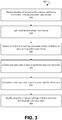
- FIG. 3 shows a flow diagram for an alternative method 300 for modifying far-end signal playback on an audio device, in an embodiment, where there is an additional data channel to send information between endpoints. Such embodiments may be used when audio devices communicate over voice over Internet protocol (VoIP) channels, for example.
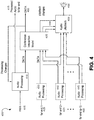
- FIG. 4 shows a simplified block diagram of a system 400 for modifying far-end signal playback on an audio device utilizing side-band communication between endpoints, in an embodiment.
- the exemplary system 400 may include CIM 420, near-end audio processing module 410, far-end audio processing modules 430, 440, and 445, and audio playback module 450.
- the audio device may receive a plurality of far-end audio streams (425, 435, etc. up to far end audio stream (P-1) 465) at step 305.
- Each far-end audio stream may be split into a plurality of frames at step 310, similarly as described above in FIG. 1 .
- Each frame of each far-end audio stream may be analyzed to determine voice activity within each frame at step 320. While the audio processing modules 430, 440, and 445 of the system 400 may be used to determine voice activity (as was done in system 200), in an alternative embodiment, the voice activity data may be received via the additional data channel. Similar to method 100, at step 325 a near-end audio stream may be analyzed to generate near-end voice data.
- the conference state for each far-end audio stream may be determined based on the voice data for each stream.
- additional data channel in which to send information
- the CIMs from each audio device can effectively compare notes and sort out differences, as a CIM would have access to audio processing information from every endpoint in the conference. With more information, the CIM can determine even more about the state of the conference.
- a presenter may be identified from a plurality of far-end audio streams and modify playback of presenter far-end audio stream in step 340 (e.g., by increasing the volume of the presenter far-end audio stream).
- similar measures of the participative nature of each endpoint can be determined by evaluating the processing undertaken. For example, if an endpoint is consistently interrupting with spurious noise incongruent with traditional conversational dynamics models, this endpoint can then be put into a 'nuisance' mode by the CIM, where VAD thresholds are increased, noise suppression is increased and other processing is set to aggressively minimize the potential for conference disturbance.
- an endpoint is setup in a configuration page to be an 'executive office', then this can potentially weight the importance of contribution to the CIM calculations.
- VAD can be set to be more sensitive, and microphone level may be increased for near-end audio capture to ensure the presenter is heard.
- the CIM is able to use additional context information, such as the relative locations of endpoints and types of rooms or attendance in each room, the nature of the meeting as scheduled and the roles such as chairperson, additional activity such as document sharing, presenting, typing and video, information around quality of network connection and the likelihood of meaningful transmission, and information around the context of a user such as their movement and location.
- FIG. 5 shows a flow diagram for a method 500 for identifying a nuisance state in a far-end audio stream, in an embodiment.
- the audio device may receive a far-end audio stream, and split the audio stream into a plurality of frames at step 510.
- each frame may be analyzed using two measures of voice activity to determine if there is voice activity within each frame.
- the analyzing may produce both binary voice data and continuous voice data for each frame.
- R_t may be defined as the binary measure of audio activity based on a speech activity classifier (such as a VAD, for example).
- V may be defined as a continuous measure of voice activity based on a higher latency (and more specific) voice classification algorithm.
- R_t may be a simple flag based on receipt of audio if the conference upstream already has sophisticated voice activity detection.
- R_t may also be a measure of incoming energy, say for example with a threshold of -40dB RMS relative to full scale which would remain inactive for the typical incoming background noise signals.
- R_t may include some trained classifiers that are targeted at having a low latency activity detection, where a low latency is deemed to be ⁇ 100ms.
- Such a system that uses two measures of voice activity, is generally able to adapt and remove sensitivity to energy from stationary or low informational sounds such as background noise, rumble, fans, motors, air conditioning, low level background mumble, car noise and other common constant noise sources.
- R may have an additional hold over of 200-500ms to avoid detection of micro-pauses in speech as the end of a frame of voice activity.
- V_t may be set as an integrated or low pass filtered version of another classifier.
- V_t may utilize a larger window of activity, of the order of 500-2000ms, for example, in order to identify communicative speech as opposed to less relevant noises such as taps, typing, breathing, russling, chair and table noises, coughs and other non-stationary noises.
- Such non-stationary noise may otherwise trigger the lower latency flag R_t, despite not being informative speech once reviewed over a longer observational window.
- V_t may be implemented as a first order smoothed signal from an instantaneous classifier updated when R_t is 1. Without loss of generality, R_t may have a value of either 0 or 1, and V_t may have a value in the range of 0 to 1 on a continuous scale.
- the nuisance parameter may be a measure of the likelihood of an immediate burst of sound being undesirable for the ongoing conference, and therefore more likely to cause a degradation of the room capture than signal a desired interjection or request for far end turn taking.
- the far-end audio stream may be modified by, for example, suppressing the output of the near-end audio device for better results in the duplex performance or local audio capture.
- the nuisance value may accordingly be connected to a volume reduction of the output.
- the nuisance parameter value N(t) may be defined at each instance in time, and may decay over time.
- the nuisance parameter N(t) may be modified based on one or more rules, the binary voice data for the frame R_t and the continuous voice data for the frame V_t.
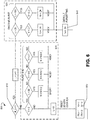
- FIG. 6 shows a flow diagram 600 of a plurality of rules for modifying a nuisance parameter value, in an embodiment.
- State machine 600 provides exemplary rules for modifying the nuisance parameter value, without loss of generality for a frame time of 20ms typical of speech processing.
- the time threshold for this action was set at 1000ms, with values in the range from 500ms to 2000ms found to meaningfully discriminate between nuisance noise and desired noise.
- a value for C_short was set at 0.2, representing 5 activity bursts to set full nuisance level, and values of 0.1 to 0.5 may be used.
- N t N t + C_noiseburst
- the first threshold for the voice ratio was set at 0.5, but values in the range of 0.2 to 0.7 may be selected.
- the increment C_noiseburst was set to 0.1 in flow 600, but values in the range of 0.1 to 0.4 may be selected to increment the nuisance parameter value.
- the second threshold of V for this was set at 0.7 (but may be selected from the range 0.6-0.8), and the time constant of 400ms was found to be useful (but any value from the range 200-1000ms may be selected). This is to restore nuisance once a concerted effort to communicate is discerned.
- N t N t + C_noisesustain While equation (7) indicates additive modification of the nuisance level, multiplicative modification of the nuisance may be used in some embodiments.
- C_noisesustain in some embodiment represents a ramp from 0 to 1 over a time of around 5000ms (e.g.1/250 th of a second increments).
- the attenuation of the far-end audio stream, in dB may be accordingly scaled linearly with N_t.
- an attenuation of 10dB is used; however, any desired attenuation from the range of 3 - 20dB may be selected.
- FIG. 5 assumes a mixed far-end signal where there are multiple far-end endpoints, as described above, it is possible to identify the source of multiple audio endpoints uniquely (e.g., using a separate data channel, as shown in FIG. 4 ). In such cases, a nuisance value could be calculated for each independently identified incoming stream. This is still possible even in the case of a system that combines both mixing and forwarding, or in systems that use peer to peer. If there is the possibility of identifying different source identities, it is useful to have multiple values of nuisance.
- the device When a device only receives audio from far-end endpoints, the device must infer the state of the conference. Where there is additional metadata between clients, however, the nuisance may be calculated locally at the point of transmission, and this could incorporate additional information from the local context. The receiving end may then have a value of nuisance for each incoming audio stream. In both cases above, multiple values of N_t are available, based on the potential end-points. This would improve device performance, as gains for each far-end stream would be received as metadata instead of being calculated as pre-processing at the device. As such, it is presented that the cumulative or present applied attenuation and associated overall N_t may be calculated by, for example, taking instantaneously the minimum nuisance of any currently active incoming audio. This may allow break through for endpoints that were not otherwise causing a nuisance.
- a further embodiment may include a smoothing filter, such as a low pass filter, with time constant of 100-300ms in order to avoid sudden jumps in the output level.
- FIG. 7 is a block diagram of an exemplary system for modifying far-end signal playback on an audio device, in various embodiments of the present invention.
- an exemplary system for implementing the subject matter disclosed herein, including the methods described above includes a hardware device 700, including a processing unit 702, memory 704, storage 706, data entry module 708, display adapter 710, communication interface 712, and a bus 714 that couples elements 704-712 to the processing unit 702.
- the bus 714 may comprise any type of bus architecture. Examples include a memory bus, a peripheral bus, a local bus, etc.
- the processing unit 702 is an instruction execution machine, apparatus, or device and may comprise a microprocessor, a digital signal processor, a graphics processing unit, an application specific integrated circuit (ASIC), a field programmable gate array (FPGA), etc.
- the processing unit 702 may be configured to execute program instructions stored in memory 704 and/or storage 706 and/or received via data entry module 708.
- the memory 704 may include read only memory (ROM) 716 and random access memory (RAM) 718.
- Memory 704 may be configured to store program instructions and data during operation of device 700.
- memory 704 may include any of a variety of memory technologies such as static random access memory (SRAM) or dynamic RAM (DRAM), including variants such as dual data rate synchronous DRAM (DDR SDRAM), error correcting code synchronous DRAM (ECC SDRAM), or RAMBUS DRAM (RDRAM), for example.
- SRAM static random access memory
- DRAM dynamic RAM
- DRAM dynamic RAM
- ECC SDRAM error correcting code synchronous DRAM
- RDRAM RAMBUS DRAM
- Memory 704 may also include nonvolatile memory technologies such as nonvolatile flash RAM (NVRAM) or ROM.
- NVRAM nonvolatile flash RAM
- ROM basic input/output system
- BIOS basic input/output system
- the storage 706 may include a flash memory data storage device for reading from and writing to flash memory, a hard disk drive for reading from and writing to a hard disk, a magnetic disk drive for reading from or writing to a removable magnetic disk, and/or an optical disk drive for reading from or writing to a removable optical disk such as a CD ROM, DVD or other optical media.
- the drives and their associated computer-readable media provide nonvolatile storage of computer readable instructions, data structures, program modules and other data for the hardware device 700.
- the methods described herein can be embodied in executable instructions stored in a non-transitory computer readable medium for use by or in connection with an instruction execution machine, apparatus, or device, such as a computer-based or processor-containing machine, apparatus, or device. It will be appreciated by those skilled in the art that for some embodiments, other types of computer readable media may be used which can store data that is accessible by a computer, such as magnetic cassettes, flash memory cards, digital video disks, Bernoulli cartridges, RAM, ROM, and the like may also be used in the exemplary operating environment.
- a "computer-readable medium” can include one or more of any suitable media for storing the executable instructions of a computer program in one or more of an electronic, magnetic, optical, and electromagnetic format, such that the instruction execution machine, system, apparatus, or device can read (or fetch) the instructions from the computer readable medium and execute the instructions for carrying out the described methods.
- a non-exhaustive list of conventional exemplary computer readable medium includes: a portable computer diskette; a RAM; a ROM; an erasable programmable read only memory (EPROM or flash memory); optical storage devices, including a portable compact disc (CD), a portable digital video disc (DVD), a high definition DVD (HD-DVDTM), a BLU-RAY disc; and the like.
- a number of program modules may be stored on the storage 706, ROM 716 or RAM 718, including an operating system 722, one or more applications programs 724, program data 726, and other program modules 728.
- a user may enter commands and information into the hardware device 700 through data entry module 708.
- Data entry module 708 may include mechanisms such as a keyboard, a touch screen, a pointing device, etc.
- Other external input devices (not shown) are connected to the hardware device 700 via external data entry interface 730.
- external input devices may include a microphone, joystick, game pad, satellite dish, scanner, or the like.
- external input devices may include video or audio input devices such as a video camera, a still camera, etc.
- Data entry module 708 may be configured to receive input from one or more users of device 700 and to deliver such input to processing unit 702 and/or memory 704 via bus 714.
- the hardware device 700 may operate in a networked environment using logical connections to one or more remote nodes (not shown) via communication interface 712.
- the remote node may be another computer, a server, a router, a peer device or other common network node, and typically includes many or all of the elements described above relative to the hardware device 700.
- the communication interface 712 may interface with a wireless network and/or a wired network. Examples of wireless networks include, for example, a BLUETOOTH network, a wireless personal area network, a wireless 802.11 local area network (LAN), and/or wireless telephony network (e.g., a cellular, PCS, or GSM network).
- wireless networks include, for example, a BLUETOOTH network, a wireless personal area network, a wireless 802.11 local area network (LAN), and/or wireless telephony network (e.g., a cellular, PCS, or GSM network).
- wired networks include, for example, a LAN, a fiber optic network, a wired personal area network, a telephony network, and/or a wide area network (WAN).
- WAN wide area network
- communication interface 712 may include logic configured to support direct memory access (DMA) transfers between memory 704 and other devices.
- DMA direct memory access
- program modules depicted relative to the hardware device 700 may be stored in a remote storage device, such as, for example, on a server. It will be appreciated that other hardware and/or software to establish a communications link between the hardware device 700 and other devices may be used.
- At least one component defined by the claims is implemented at least partially as an electronic hardware component, such as an instruction execution machine (e.g., a processor-based or processor-containing machine) and/or as specialized circuits or circuitry (e.g., discrete logic gates interconnected to perform a specialized function), such as those illustrated in FIG. 7 .
- Other components may be implemented in software, hardware, or a combination of software and hardware. Moreover, some or all of these other components may be combined, some may be omitted altogether, and additional components can be added while still achieving the functionality described herein.
- the subject matter described herein can be embodied in many different variations, and all such variations are contemplated to be within the scope of what is claimed.
- the terms “component,” “module,” and “process,” may be used interchangeably to refer to a processing unit that performs a particular function and that may be implemented through computer program code (software), digital or analog circuitry, computer firmware, or any combination thereof.
- a method for modifying one of far-end signal playback and capture of local audio on an audio device during a conference call is disclosed.
- an audio device receives a far-end audio stream.
- the received far-end audio stream is split into a plurality of frames.
- Each frame is analyzed using a measure of voice activity to determine if there is voice activity within each frame, the analyzing producing far-end voice data associated with each frame.
- the far-end voice data may indicate whether the associated frame contains voice activity, e.g., may be an estimate of the voice activity in the frame.
- each frame may be classified as either containing voice activity ('voice') or not containing voice activity ('not voice').
- the far-end voice data may be determined by a voice activity detector, for example.
- Frames of a local input audio stream are analyzed using the measure of voice activity to produce near-end voice data.
- the near-end voice data may indicate whether the associated frame contains voice activity, e.g., may be an estimate of the voice activity in the frame. For example, each frame may be classified as either containing voice activity ('voice') or not containing voice activity ('not voice').
- the far-end voice data may be determined by a voice activity detector, for example. Based upon the far-end voice data and the near-end voice data, a conference state is determined, and based upon the determined conference state, one of the playback of the far-end audio stream on a speaker of the audio device and capture of local audio (e.g., on the audio device, for example by a microphone of the audio device) are modified.
- the conference state may be indicative of a current presenter in the conference call, e.g., may be indicative of whether the near-end is presenting, the far-end is presenting, or whether the near-end and the far-end are in a two-way conversation.
- the conference state may be one of a near-end-presentation state, a far-end presentation state, and an intermediate state (e.g., conversation state) between near-end presentation and far-end presentation.
- the conference state is determined by calculating a transaction parameter value based upon the far-end voice data and the near-end voice data, and based upon the calculated transaction parameter, a conference state is assigned.
- the transaction parameter may be an estimate of whether the far end or the near end is presenting in the conference call.
- the transaction parameter may be defined as a low-pass filtered measure of voice activity at the far end, wherein the low-pass filtering is based at least in part on the voice activity at the near end.
- predetermined ranges of transaction parameter values are associated with particular conference states. The pre-determined ranges being associated with a near-end presentation state, a far-end presentation state and a conversation state.
- the playback of the far-end audio stream on the speaker of the audio device and/or the capture of local audio is modified by modifying at least one of (1) the voice-activity thresholds for the measure of voice activity, (2) a microphone level of the audio device, and (3) noise suppression of the audio device.
- the voice activity threshold for the near-end audio stream may be increased
- the microphone level of the audio device may be decreased
- noise suppression of the near-end audio stream may be increased
- a playback level e.g., speaker volume
- the voice activity threshold for the near-end audio stream may be decreased, the microphone level of the audio device may be increased, noise suppression of the near-end audio stream may be decreased, and/or a playback level (e.g., speaker volume) of the far-end audio stream may be decreased. Any, some, or all of these measures may be performed.
- the method can also include the additional step of filtering the voice data to remove short bursts, and/or applying a hold-over on the voice data that indicates presence of voice for a predetermined additional time period after the voice sound has ended in the incoming audio stream.
- a method modifies one of the far-end signal playback on an audio device and capture of local audio (e.g., on the audio device, for example by a microphone of the audio device) during a conference call.
- An audio device receives a plurality of far-end audio streams, each far-end audio stream being transmitted with an associated data stream, each associated data stream containing context information for the corresponding far-end audio stream.
- Each far-end audio stream is split into a plurality of frames.
- Each frame of each far-end audio stream is analyzed using a measure of voice activity to determine if there is voice activity within each frame. The analysis produces far-end voice data associated with each frame of the corresponding far-end audio stream.
- Frames of a local input audio stream are analyzed using the measure of voice activity to produce near-end voice data.
- a conference state is determined based on the far-end voice data for each far-end audio stream and the near-end voice data.
- One of playback of a far-end audio stream of the plurality of far-end audio streams and capture of local audio is modified based on the determined conference state and the context information for the far-end audio stream of the plurality, the playback of the far-end audio stream being performed on a speaker of the audio device.
- the method may further include the step of identifying a far-end audio stream of the plurality of audio streams that is contributing a nuisance, the identifying being based on the voice data associated with the far-end audio stream contributing the nuisance, and modifying playback of the far-end audio stream contributing the nuisance in response to the identifying the far-end audio stream contributing the nuisance.
- a method for modifying one of far-end signal playback and capture of local audio on an audio device during a conference call includes receiving, by an audio device, a far-end audio stream.
- the received far-end audio stream is split into a plurality of frames.
- Each frame is analyzed using two measures of voice activity to determine if there is voice activity within each frame, the analyzing producing both binary voice data and continuous voice data for each frame.
- a nuisance parameter value is defined for the far-end audio stream.
- the nuisance parameter may decay over time.
- the nuisance parameter value is modified based on one or more rules, the binary voice data for the frame, and the continuous voice data for the frame.
- the modified nuisance parameter value is compared to a threshold, wherein a nuisance state is identified for the far-end audio stream when the modified nuisance parameter value exceeds the threshold.
- a nuisance state is identified, one of a playback of the far-end audio stream on a speaker of the audio device and capture of local audio is modified.
- the one or more rules of the method includes a rule that the nuisance parameter value is increased when a length of an activity burst indicated by the binary voice data is less than a predetermined threshold.
- the continuous voice data has a value within a range of values corresponding to the level of detected voice activity
- the one or more rules include a rule that the nuisance parameter value is increased when the continuous voice data value falls below a first threshold value within the range of values.
- the continuous voice data has a value within a range of values corresponding to the level of detected voice activity
- the one or more rules includes a rule that the nuisance parameter value is decreased when the continuous voice data value falls above (e.g., rises above) a second threshold value within the range of values.
- the modification of the playback of the incoming audio stream applies a gain to the incoming audio stream, the gain being based on the modified nuisance parameter value.
- a plurality of incoming audio streams are received wherein each incoming audio stream is transmitted with an associated data stream that includes nuisance parameter values for the corresponding audio stream. Then, one audio stream of the plurality of incoming audio streams is selected which has the lowest nuisance parameter value. The plurality of incoming audio streams are combined into a mixed far-end audio stream; and the playback of the mixed far-end audio stream is modified based only on the lowest nuisance parameter value.
- an audio device in another embodiment, includes as its components (1) a near-end audio processor that receives audio signal data from a microphone, and analyzes frames of the audio signal data using a measure of voice activity to produce near-end voice data; (2) a far-end audio processor that receives an incoming audio stream, splits the audio stream into a plurality of frames, and analyzes each frame using the measure of voice activity to produce far-end voice data; and (3) a conference modeling circuit (as an example of an analysis circuit) coupled to the both the near-end audio processor and the far-end audio processor, the conference modeling circuit determining a conference state based on both the near-end voice data and the far-end voice data, and, based on the determined conference state, modifying one of playback of the incoming audio stream on a speaker and capture of local audio on the audio device.
- a near-end audio processor that receives audio signal data from a microphone, and analyzes frames of the audio signal data using a measure of voice activity to produce near-end voice data
- a far-end audio processor
Landscapes
- Engineering & Computer Science (AREA)
- Signal Processing (AREA)
- Multimedia (AREA)
- Health & Medical Sciences (AREA)
- Audiology, Speech & Language Pathology (AREA)
- Telephonic Communication Services (AREA)
- Two-Way Televisions, Distribution Of Moving Picture Or The Like (AREA)
Applications Claiming Priority (1)
| Application Number | Priority Date | Filing Date | Title |
|---|---|---|---|
| EP16182501 | 2016-08-03 |
Publications (3)
| Publication Number | Publication Date |
|---|---|
| EP3280123A2 true EP3280123A2 (de) | 2018-02-07 |
| EP3280123A3 EP3280123A3 (de) | 2018-05-16 |
| EP3280123B1 EP3280123B1 (de) | 2022-05-11 |
Family
ID=56618010
Family Applications (1)
| Application Number | Title | Priority Date | Filing Date |
|---|---|---|---|
| EP17184476.4A Active EP3280123B1 (de) | 2016-08-03 | 2017-08-02 | Zustandsbasierte endpunktkonferenzinteraktion |
Country Status (1)
| Country | Link |
|---|---|
| EP (1) | EP3280123B1 (de) |
Cited By (1)
| Publication number | Priority date | Publication date | Assignee | Title |
|---|---|---|---|---|
| US12003673B2 (en) | 2019-07-30 | 2024-06-04 | Dolby Laboratories Licensing Corporation | Acoustic echo cancellation control for distributed audio devices |
Family Cites Families (4)
| Publication number | Priority date | Publication date | Assignee | Title |
|---|---|---|---|---|
| US8934382B2 (en) * | 2001-05-10 | 2015-01-13 | Polycom, Inc. | Conference endpoint controlling functions of a remote device |
| US20090003586A1 (en) * | 2007-06-28 | 2009-01-01 | Fortemedia, Inc. | Signal processor and method for canceling echo in a communication device |
| US8625776B2 (en) * | 2009-09-23 | 2014-01-07 | Polycom, Inc. | Detection and suppression of returned audio at near-end |
| US8639294B2 (en) * | 2012-05-01 | 2014-01-28 | Audyssey Laboratories, Inc. | System and method for performing automatic gain control in mobile phone environments |
-
2017
- 2017-08-02 EP EP17184476.4A patent/EP3280123B1/de active Active
Non-Patent Citations (1)
| Title |
|---|
| None |
Cited By (1)
| Publication number | Priority date | Publication date | Assignee | Title |
|---|---|---|---|---|
| US12003673B2 (en) | 2019-07-30 | 2024-06-04 | Dolby Laboratories Licensing Corporation | Acoustic echo cancellation control for distributed audio devices |
Also Published As
| Publication number | Publication date |
|---|---|
| EP3280123B1 (de) | 2022-05-11 |
| EP3280123A3 (de) | 2018-05-16 |
Similar Documents
| Publication | Publication Date | Title |
|---|---|---|
| US10771631B2 (en) | State-based endpoint conference interaction | |
| US9721580B2 (en) | Situation dependent transient suppression | |
| CN113766073B (zh) | 会议系统中的啸叫检测 | |
| RU2461081C2 (ru) | Интеллектуальная градиентная система шумоподавления | |
| US10242695B1 (en) | Acoustic echo cancellation using visual cues | |
| US10237412B2 (en) | System and method for audio conferencing | |
| US9979769B2 (en) | System and method for audio conferencing | |
| CN106063238B (zh) | 电话会议中的在感知上连续的混合 | |
| US9560316B1 (en) | Indicating sound quality during a conference | |
| US11894006B2 (en) | Compressor target curve to avoid boosting noise | |
| CN105144628A (zh) | 基于有意声音相比无意声音的检测来控制电子会议 | |
| JP2024507916A (ja) | オーディオ信号の処理方法、装置、電子機器、及びコンピュータプログラム | |
| US11694706B2 (en) | Adaptive energy limiting for transient noise suppression | |
| US9014058B2 (en) | Enhancement of audio conference productivity through gain biasing | |
| EP2896126B1 (de) | Langzeit-überwachung von übertragungs- und sprachaktivitätsmustern zur verstärkungsregelung | |
| JP2008543194A (ja) | オーディオ信号ゲイン制御装置及び方法 | |
| CN107533849B (zh) | 基于麦克风音频信号来处理输入耳机音频信号的音频信号处理装置 | |
| US10192566B1 (en) | Noise reduction in an audio system | |
| EP3280123B1 (de) | Zustandsbasierte endpunktkonferenzinteraktion | |
| CN103546109A (zh) | 远程多方会议音量调整系统及方法 | |
| TW201506913A (zh) | 麥克風系統及其聲音處理方法 | |
| JP2009027239A (ja) | 通信会議装置 | |
| WO2022181013A1 (ja) | 会議システム | |
| US20080059161A1 (en) | Adaptive Comfort Noise Generation | |
| JP2023047178A (ja) | 情報処理装置及び情報処理プログラム |
Legal Events
| Date | Code | Title | Description |
|---|---|---|---|
| PUAI | Public reference made under article 153(3) epc to a published international application that has entered the european phase |
Free format text: ORIGINAL CODE: 0009012 |
|
| STAA | Information on the status of an ep patent application or granted ep patent |
Free format text: STATUS: THE APPLICATION HAS BEEN PUBLISHED |
|
| AK | Designated contracting states |
Kind code of ref document: A2 Designated state(s): AL AT BE BG CH CY CZ DE DK EE ES FI FR GB GR HR HU IE IS IT LI LT LU LV MC MK MT NL NO PL PT RO RS SE SI SK SM TR |
|
| AX | Request for extension of the european patent |
Extension state: BA ME |
|
| PUAL | Search report despatched |
Free format text: ORIGINAL CODE: 0009013 |
|
| AK | Designated contracting states |
Kind code of ref document: A3 Designated state(s): AL AT BE BG CH CY CZ DE DK EE ES FI FR GB GR HR HU IE IS IT LI LT LU LV MC MK MT NL NO PL PT RO RS SE SI SK SM TR |
|
| AX | Request for extension of the european patent |
Extension state: BA ME |
|
| RIC1 | Information provided on ipc code assigned before grant |
Ipc: H04M 3/56 20060101ALI20180411BHEP Ipc: H04M 9/08 20060101ALI20180411BHEP Ipc: H04M 3/22 20060101AFI20180411BHEP Ipc: G10L 21/0208 20130101ALN20180411BHEP |
|
| STAA | Information on the status of an ep patent application or granted ep patent |
Free format text: STATUS: REQUEST FOR EXAMINATION WAS MADE |
|
| 17P | Request for examination filed |
Effective date: 20181116 |
|
| RBV | Designated contracting states (corrected) |
Designated state(s): AL AT BE BG CH CY CZ DE DK EE ES FI FR GB GR HR HU IE IS IT LI LT LU LV MC MK MT NL NO PL PT RO RS SE SI SK SM TR |
|
| STAA | Information on the status of an ep patent application or granted ep patent |
Free format text: STATUS: EXAMINATION IS IN PROGRESS |
|
| 17Q | First examination report despatched |
Effective date: 20190410 |
|
| GRAP | Despatch of communication of intention to grant a patent |
Free format text: ORIGINAL CODE: EPIDOSNIGR1 |
|
| STAA | Information on the status of an ep patent application or granted ep patent |
Free format text: STATUS: GRANT OF PATENT IS INTENDED |
|
| RIC1 | Information provided on ipc code assigned before grant |
Ipc: G10L 21/0208 20130101ALN20211111BHEP Ipc: H04M 9/08 20060101ALI20211111BHEP Ipc: H04M 3/56 20060101ALI20211111BHEP Ipc: H04M 3/22 20060101AFI20211111BHEP |
|
| INTG | Intention to grant announced |
Effective date: 20211202 |
|
| GRAS | Grant fee paid |
Free format text: ORIGINAL CODE: EPIDOSNIGR3 |
|
| GRAA | (expected) grant |
Free format text: ORIGINAL CODE: 0009210 |
|
| STAA | Information on the status of an ep patent application or granted ep patent |
Free format text: STATUS: THE PATENT HAS BEEN GRANTED |
|
| AK | Designated contracting states |
Kind code of ref document: B1 Designated state(s): AL AT BE BG CH CY CZ DE DK EE ES FI FR GB GR HR HU IE IS IT LI LT LU LV MC MK MT NL NO PL PT RO RS SE SI SK SM TR |
|
| REG | Reference to a national code |
Ref country code: GB Ref legal event code: FG4D |
|
| REG | Reference to a national code |
Ref country code: CH Ref legal event code: EP |
|
| REG | Reference to a national code |
Ref country code: AT Ref legal event code: REF Ref document number: 1492479 Country of ref document: AT Kind code of ref document: T Effective date: 20220515 |
|
| REG | Reference to a national code |
Ref country code: DE Ref legal event code: R096 Ref document number: 602017057248 Country of ref document: DE |
|
| REG | Reference to a national code |
Ref country code: IE Ref legal event code: FG4D |
|
| REG | Reference to a national code |
Ref country code: LT Ref legal event code: MG9D |
|
| REG | Reference to a national code |
Ref country code: NL Ref legal event code: MP Effective date: 20220511 |
|
| REG | Reference to a national code |
Ref country code: AT Ref legal event code: MK05 Ref document number: 1492479 Country of ref document: AT Kind code of ref document: T Effective date: 20220511 |
|
| PG25 | Lapsed in a contracting state [announced via postgrant information from national office to epo] |
Ref country code: SE Free format text: LAPSE BECAUSE OF FAILURE TO SUBMIT A TRANSLATION OF THE DESCRIPTION OR TO PAY THE FEE WITHIN THE PRESCRIBED TIME-LIMIT Effective date: 20220511 Ref country code: PT Free format text: LAPSE BECAUSE OF FAILURE TO SUBMIT A TRANSLATION OF THE DESCRIPTION OR TO PAY THE FEE WITHIN THE PRESCRIBED TIME-LIMIT Effective date: 20220912 Ref country code: NO Free format text: LAPSE BECAUSE OF FAILURE TO SUBMIT A TRANSLATION OF THE DESCRIPTION OR TO PAY THE FEE WITHIN THE PRESCRIBED TIME-LIMIT Effective date: 20220811 Ref country code: NL Free format text: LAPSE BECAUSE OF FAILURE TO SUBMIT A TRANSLATION OF THE DESCRIPTION OR TO PAY THE FEE WITHIN THE PRESCRIBED TIME-LIMIT Effective date: 20220511 Ref country code: LT Free format text: LAPSE BECAUSE OF FAILURE TO SUBMIT A TRANSLATION OF THE DESCRIPTION OR TO PAY THE FEE WITHIN THE PRESCRIBED TIME-LIMIT Effective date: 20220511 Ref country code: HR Free format text: LAPSE BECAUSE OF FAILURE TO SUBMIT A TRANSLATION OF THE DESCRIPTION OR TO PAY THE FEE WITHIN THE PRESCRIBED TIME-LIMIT Effective date: 20220511 Ref country code: GR Free format text: LAPSE BECAUSE OF FAILURE TO SUBMIT A TRANSLATION OF THE DESCRIPTION OR TO PAY THE FEE WITHIN THE PRESCRIBED TIME-LIMIT Effective date: 20220812 Ref country code: FI Free format text: LAPSE BECAUSE OF FAILURE TO SUBMIT A TRANSLATION OF THE DESCRIPTION OR TO PAY THE FEE WITHIN THE PRESCRIBED TIME-LIMIT Effective date: 20220511 Ref country code: BG Free format text: LAPSE BECAUSE OF FAILURE TO SUBMIT A TRANSLATION OF THE DESCRIPTION OR TO PAY THE FEE WITHIN THE PRESCRIBED TIME-LIMIT Effective date: 20220811 Ref country code: AT Free format text: LAPSE BECAUSE OF FAILURE TO SUBMIT A TRANSLATION OF THE DESCRIPTION OR TO PAY THE FEE WITHIN THE PRESCRIBED TIME-LIMIT Effective date: 20220511 |
|
| PG25 | Lapsed in a contracting state [announced via postgrant information from national office to epo] |
Ref country code: RS Free format text: LAPSE BECAUSE OF FAILURE TO SUBMIT A TRANSLATION OF THE DESCRIPTION OR TO PAY THE FEE WITHIN THE PRESCRIBED TIME-LIMIT Effective date: 20220511 Ref country code: PL Free format text: LAPSE BECAUSE OF FAILURE TO SUBMIT A TRANSLATION OF THE DESCRIPTION OR TO PAY THE FEE WITHIN THE PRESCRIBED TIME-LIMIT Effective date: 20220511 Ref country code: LV Free format text: LAPSE BECAUSE OF FAILURE TO SUBMIT A TRANSLATION OF THE DESCRIPTION OR TO PAY THE FEE WITHIN THE PRESCRIBED TIME-LIMIT Effective date: 20220511 Ref country code: IS Free format text: LAPSE BECAUSE OF FAILURE TO SUBMIT A TRANSLATION OF THE DESCRIPTION OR TO PAY THE FEE WITHIN THE PRESCRIBED TIME-LIMIT Effective date: 20220911 |
|
| PG25 | Lapsed in a contracting state [announced via postgrant information from national office to epo] |
Ref country code: SM Free format text: LAPSE BECAUSE OF FAILURE TO SUBMIT A TRANSLATION OF THE DESCRIPTION OR TO PAY THE FEE WITHIN THE PRESCRIBED TIME-LIMIT Effective date: 20220511 Ref country code: SK Free format text: LAPSE BECAUSE OF FAILURE TO SUBMIT A TRANSLATION OF THE DESCRIPTION OR TO PAY THE FEE WITHIN THE PRESCRIBED TIME-LIMIT Effective date: 20220511 Ref country code: RO Free format text: LAPSE BECAUSE OF FAILURE TO SUBMIT A TRANSLATION OF THE DESCRIPTION OR TO PAY THE FEE WITHIN THE PRESCRIBED TIME-LIMIT Effective date: 20220511 Ref country code: ES Free format text: LAPSE BECAUSE OF FAILURE TO SUBMIT A TRANSLATION OF THE DESCRIPTION OR TO PAY THE FEE WITHIN THE PRESCRIBED TIME-LIMIT Effective date: 20220511 Ref country code: EE Free format text: LAPSE BECAUSE OF FAILURE TO SUBMIT A TRANSLATION OF THE DESCRIPTION OR TO PAY THE FEE WITHIN THE PRESCRIBED TIME-LIMIT Effective date: 20220511 Ref country code: DK Free format text: LAPSE BECAUSE OF FAILURE TO SUBMIT A TRANSLATION OF THE DESCRIPTION OR TO PAY THE FEE WITHIN THE PRESCRIBED TIME-LIMIT Effective date: 20220511 Ref country code: CZ Free format text: LAPSE BECAUSE OF FAILURE TO SUBMIT A TRANSLATION OF THE DESCRIPTION OR TO PAY THE FEE WITHIN THE PRESCRIBED TIME-LIMIT Effective date: 20220511 |
|
| REG | Reference to a national code |
Ref country code: DE Ref legal event code: R097 Ref document number: 602017057248 Country of ref document: DE |
|
| PLBE | No opposition filed within time limit |
Free format text: ORIGINAL CODE: 0009261 |
|
| STAA | Information on the status of an ep patent application or granted ep patent |
Free format text: STATUS: NO OPPOSITION FILED WITHIN TIME LIMIT |
|
| PG25 | Lapsed in a contracting state [announced via postgrant information from national office to epo] |
Ref country code: MC Free format text: LAPSE BECAUSE OF FAILURE TO SUBMIT A TRANSLATION OF THE DESCRIPTION OR TO PAY THE FEE WITHIN THE PRESCRIBED TIME-LIMIT Effective date: 20220511 Ref country code: AL Free format text: LAPSE BECAUSE OF FAILURE TO SUBMIT A TRANSLATION OF THE DESCRIPTION OR TO PAY THE FEE WITHIN THE PRESCRIBED TIME-LIMIT Effective date: 20220511 |
|
| REG | Reference to a national code |
Ref country code: CH Ref legal event code: PL |
|
| 26N | No opposition filed |
Effective date: 20230214 |
|
| PG25 | Lapsed in a contracting state [announced via postgrant information from national office to epo] |
Ref country code: LU Free format text: LAPSE BECAUSE OF NON-PAYMENT OF DUE FEES Effective date: 20220802 Ref country code: LI Free format text: LAPSE BECAUSE OF NON-PAYMENT OF DUE FEES Effective date: 20220831 Ref country code: CH Free format text: LAPSE BECAUSE OF NON-PAYMENT OF DUE FEES Effective date: 20220831 |
|
| REG | Reference to a national code |
Ref country code: BE Ref legal event code: MM Effective date: 20220831 |
|
| PG25 | Lapsed in a contracting state [announced via postgrant information from national office to epo] |
Ref country code: SI Free format text: LAPSE BECAUSE OF FAILURE TO SUBMIT A TRANSLATION OF THE DESCRIPTION OR TO PAY THE FEE WITHIN THE PRESCRIBED TIME-LIMIT Effective date: 20220511 |
|
| P01 | Opt-out of the competence of the unified patent court (upc) registered |
Effective date: 20230513 |
|
| PG25 | Lapsed in a contracting state [announced via postgrant information from national office to epo] |
Ref country code: IE Free format text: LAPSE BECAUSE OF NON-PAYMENT OF DUE FEES Effective date: 20220802 |
|
| PG25 | Lapsed in a contracting state [announced via postgrant information from national office to epo] |
Ref country code: BE Free format text: LAPSE BECAUSE OF NON-PAYMENT OF DUE FEES Effective date: 20220831 |
|
| PG25 | Lapsed in a contracting state [announced via postgrant information from national office to epo] |
Ref country code: IT Free format text: LAPSE BECAUSE OF FAILURE TO SUBMIT A TRANSLATION OF THE DESCRIPTION OR TO PAY THE FEE WITHIN THE PRESCRIBED TIME-LIMIT Effective date: 20220511 |
|
| PG25 | Lapsed in a contracting state [announced via postgrant information from national office to epo] |
Ref country code: HU Free format text: LAPSE BECAUSE OF FAILURE TO SUBMIT A TRANSLATION OF THE DESCRIPTION OR TO PAY THE FEE WITHIN THE PRESCRIBED TIME-LIMIT; INVALID AB INITIO Effective date: 20170802 |
|
| PG25 | Lapsed in a contracting state [announced via postgrant information from national office to epo] |
Ref country code: MK Free format text: LAPSE BECAUSE OF FAILURE TO SUBMIT A TRANSLATION OF THE DESCRIPTION OR TO PAY THE FEE WITHIN THE PRESCRIBED TIME-LIMIT Effective date: 20220511 Ref country code: CY Free format text: LAPSE BECAUSE OF FAILURE TO SUBMIT A TRANSLATION OF THE DESCRIPTION OR TO PAY THE FEE WITHIN THE PRESCRIBED TIME-LIMIT Effective date: 20220511 |
|
| PG25 | Lapsed in a contracting state [announced via postgrant information from national office to epo] |
Ref country code: TR Free format text: LAPSE BECAUSE OF FAILURE TO SUBMIT A TRANSLATION OF THE DESCRIPTION OR TO PAY THE FEE WITHIN THE PRESCRIBED TIME-LIMIT Effective date: 20220511 |
|
| PG25 | Lapsed in a contracting state [announced via postgrant information from national office to epo] |
Ref country code: MT Free format text: LAPSE BECAUSE OF FAILURE TO SUBMIT A TRANSLATION OF THE DESCRIPTION OR TO PAY THE FEE WITHIN THE PRESCRIBED TIME-LIMIT Effective date: 20220511 |
|
| PG25 | Lapsed in a contracting state [announced via postgrant information from national office to epo] |
Ref country code: BG Free format text: LAPSE BECAUSE OF FAILURE TO SUBMIT A TRANSLATION OF THE DESCRIPTION OR TO PAY THE FEE WITHIN THE PRESCRIBED TIME-LIMIT Effective date: 20220511 |
|
| PG25 | Lapsed in a contracting state [announced via postgrant information from national office to epo] |
Ref country code: BG Free format text: LAPSE BECAUSE OF FAILURE TO SUBMIT A TRANSLATION OF THE DESCRIPTION OR TO PAY THE FEE WITHIN THE PRESCRIBED TIME-LIMIT Effective date: 20220511 |
|
| PGFP | Annual fee paid to national office [announced via postgrant information from national office to epo] |
Ref country code: DE Payment date: 20250724 Year of fee payment: 9 |
|
| PGFP | Annual fee paid to national office [announced via postgrant information from national office to epo] |
Ref country code: GB Payment date: 20250724 Year of fee payment: 9 |
|
| PGFP | Annual fee paid to national office [announced via postgrant information from national office to epo] |
Ref country code: FR Payment date: 20250725 Year of fee payment: 9 |