EP3281334B1 - Verfahren und vorrichtung zur übertragung von harq-ack-rückkopplungsinformationen in einem erweiterten trägeraggregationssystem - Google Patents
Verfahren und vorrichtung zur übertragung von harq-ack-rückkopplungsinformationen in einem erweiterten trägeraggregationssystem Download PDFInfo
- Publication number
- EP3281334B1 EP3281334B1 EP16776823.3A EP16776823A EP3281334B1 EP 3281334 B1 EP3281334 B1 EP 3281334B1 EP 16776823 A EP16776823 A EP 16776823A EP 3281334 B1 EP3281334 B1 EP 3281334B1
- Authority
- EP
- European Patent Office
- Prior art keywords
- pucch
- uci
- bits
- pucch format
- transmission
- Prior art date
- Legal status (The legal status is an assumption and is not a legal conclusion. Google has not performed a legal analysis and makes no representation as to the accuracy of the status listed.)
- Active
Links
Images


Classifications
-
- H—ELECTRICITY
- H04—ELECTRIC COMMUNICATION TECHNIQUE
- H04L—TRANSMISSION OF DIGITAL INFORMATION, e.g. TELEGRAPHIC COMMUNICATION
- H04L1/00—Arrangements for detecting or preventing errors in the information received
- H04L1/12—Arrangements for detecting or preventing errors in the information received by using return channel
- H04L1/16—Arrangements for detecting or preventing errors in the information received by using return channel in which the return channel carries supervisory signals, e.g. repetition request signals
- H04L1/18—Automatic repetition systems, e.g. Van Duuren systems
- H04L1/1829—Arrangements specially adapted for the receiver end
- H04L1/1861—Physical mapping arrangements
-
- H—ELECTRICITY
- H04—ELECTRIC COMMUNICATION TECHNIQUE
- H04W—WIRELESS COMMUNICATION NETWORKS
- H04W72/00—Local resource management
- H04W72/20—Control channels or signalling for resource management
- H04W72/21—Control channels or signalling for resource management in the uplink direction of a wireless link, i.e. towards the network
-
- H—ELECTRICITY
- H04—ELECTRIC COMMUNICATION TECHNIQUE
- H04B—TRANSMISSION
- H04B7/00—Radio transmission systems, i.e. using radiation field
- H04B7/02—Diversity systems; Multi-antenna system, i.e. transmission or reception using multiple antennas
- H04B7/04—Diversity systems; Multi-antenna system, i.e. transmission or reception using multiple antennas using two or more spaced independent antennas
- H04B7/06—Diversity systems; Multi-antenna system, i.e. transmission or reception using multiple antennas using two or more spaced independent antennas at the transmitting station
- H04B7/0613—Diversity systems; Multi-antenna system, i.e. transmission or reception using multiple antennas using two or more spaced independent antennas at the transmitting station using simultaneous transmission
- H04B7/0615—Diversity systems; Multi-antenna system, i.e. transmission or reception using multiple antennas using two or more spaced independent antennas at the transmitting station using simultaneous transmission of weighted versions of same signal
- H04B7/0619—Diversity systems; Multi-antenna system, i.e. transmission or reception using multiple antennas using two or more spaced independent antennas at the transmitting station using simultaneous transmission of weighted versions of same signal using feedback from receiving side
- H04B7/0621—Feedback content
-
- H—ELECTRICITY
- H04—ELECTRIC COMMUNICATION TECHNIQUE
- H04B—TRANSMISSION
- H04B7/00—Radio transmission systems, i.e. using radiation field
- H04B7/02—Diversity systems; Multi-antenna system, i.e. transmission or reception using multiple antennas
- H04B7/04—Diversity systems; Multi-antenna system, i.e. transmission or reception using multiple antennas using two or more spaced independent antennas
- H04B7/06—Diversity systems; Multi-antenna system, i.e. transmission or reception using multiple antennas using two or more spaced independent antennas at the transmitting station
- H04B7/0613—Diversity systems; Multi-antenna system, i.e. transmission or reception using multiple antennas using two or more spaced independent antennas at the transmitting station using simultaneous transmission
- H04B7/0615—Diversity systems; Multi-antenna system, i.e. transmission or reception using multiple antennas using two or more spaced independent antennas at the transmitting station using simultaneous transmission of weighted versions of same signal
- H04B7/0619—Diversity systems; Multi-antenna system, i.e. transmission or reception using multiple antennas using two or more spaced independent antennas at the transmitting station using simultaneous transmission of weighted versions of same signal using feedback from receiving side
- H04B7/0636—Feedback format
-
- H—ELECTRICITY
- H04—ELECTRIC COMMUNICATION TECHNIQUE
- H04L—TRANSMISSION OF DIGITAL INFORMATION, e.g. TELEGRAPHIC COMMUNICATION
- H04L1/00—Arrangements for detecting or preventing errors in the information received
- H04L1/12—Arrangements for detecting or preventing errors in the information received by using return channel
- H04L1/16—Arrangements for detecting or preventing errors in the information received by using return channel in which the return channel carries supervisory signals, e.g. repetition request signals
- H04L1/1607—Details of the supervisory signal
- H04L1/1671—Details of the supervisory signal the supervisory signal being transmitted together with control information
-
- H—ELECTRICITY
- H04—ELECTRIC COMMUNICATION TECHNIQUE
- H04L—TRANSMISSION OF DIGITAL INFORMATION, e.g. TELEGRAPHIC COMMUNICATION
- H04L1/00—Arrangements for detecting or preventing errors in the information received
- H04L1/12—Arrangements for detecting or preventing errors in the information received by using return channel
- H04L1/16—Arrangements for detecting or preventing errors in the information received by using return channel in which the return channel carries supervisory signals, e.g. repetition request signals
- H04L1/18—Automatic repetition systems, e.g. Van Duuren systems
- H04L1/1812—Hybrid protocols; Hybrid automatic repeat request [HARQ]
-
- H—ELECTRICITY
- H04—ELECTRIC COMMUNICATION TECHNIQUE
- H04L—TRANSMISSION OF DIGITAL INFORMATION, e.g. TELEGRAPHIC COMMUNICATION
- H04L5/00—Arrangements affording multiple use of the transmission path
- H04L5/0001—Arrangements for dividing the transmission path
- H04L5/0003—Two-dimensional division
- H04L5/0005—Time-frequency
- H04L5/0007—Time-frequency the frequencies being orthogonal, e.g. OFDM(A) or DMT
- H04L5/001—Time-frequency the frequencies being orthogonal, e.g. OFDM(A) or DMT the frequencies being arranged in component carriers
-
- H—ELECTRICITY
- H04—ELECTRIC COMMUNICATION TECHNIQUE
- H04L—TRANSMISSION OF DIGITAL INFORMATION, e.g. TELEGRAPHIC COMMUNICATION
- H04L5/00—Arrangements affording multiple use of the transmission path
- H04L5/003—Arrangements for allocating sub-channels of the transmission path
- H04L5/0053—Allocation of signalling, i.e. of overhead other than pilot signals
- H04L5/0055—Physical resource allocation for ACK/NACK
-
- H—ELECTRICITY
- H04—ELECTRIC COMMUNICATION TECHNIQUE
- H04L—TRANSMISSION OF DIGITAL INFORMATION, e.g. TELEGRAPHIC COMMUNICATION
- H04L5/00—Arrangements affording multiple use of the transmission path
- H04L5/14—Two-way operation using the same type of signal, i.e. duplex
- H04L5/1469—Two-way operation using the same type of signal, i.e. duplex using time-sharing
-
- H—ELECTRICITY
- H04—ELECTRIC COMMUNICATION TECHNIQUE
- H04W—WIRELESS COMMUNICATION NETWORKS
- H04W72/00—Local resource management
- H04W72/04—Wireless resource allocation
- H04W72/044—Wireless resource allocation based on the type of the allocated resource
- H04W72/0446—Resources in time domain, e.g. slots or frames
-
- H—ELECTRICITY
- H04—ELECTRIC COMMUNICATION TECHNIQUE
- H04L—TRANSMISSION OF DIGITAL INFORMATION, e.g. TELEGRAPHIC COMMUNICATION
- H04L1/00—Arrangements for detecting or preventing errors in the information received
- H04L1/0001—Systems modifying transmission characteristics according to link quality, e.g. power backoff
- H04L1/0006—Systems modifying transmission characteristics according to link quality, e.g. power backoff by adapting the transmission format
- H04L1/0007—Systems modifying transmission characteristics according to link quality, e.g. power backoff by adapting the transmission format by modifying the frame length
-
- H—ELECTRICITY
- H04—ELECTRIC COMMUNICATION TECHNIQUE
- H04L—TRANSMISSION OF DIGITAL INFORMATION, e.g. TELEGRAPHIC COMMUNICATION
- H04L5/00—Arrangements affording multiple use of the transmission path
- H04L5/003—Arrangements for allocating sub-channels of the transmission path
- H04L5/0053—Allocation of signalling, i.e. of overhead other than pilot signals
Definitions
- the present disclosure relates to radio communication systems and in particular to a method and an apparatus for transmitting HARQ-ACK feedback information in an enhanced carrier aggregation system.
- a long term evolution (LTE) system supports two types of duplex: frequency division duplex (FDD) and time division duplex (TDD).
- Fig.1 is a frame structure of a TDD system. Each radio frame is 10ms long, and is equally divided into two half frames having a length of 5ms each. Each half frame includes 8 timeslots having a length of 0.5ms each and 3 special fields, i.e., a downlink pilot timeslot (DwPTS), a guard period (GP), and an uplink pilot timeslot (UpPTS). An overall length of the 3 special fields is 1ms. Each subframe consists of two consecutive timeslots, i.e., subframe k containing timeslot 2k and timeslot 2k+1.
- the TDD system supports 7 different TDD downlink and uplink configurations, as shown in table 1. In table 1, "D” represents a downlink subframe, "U” represents an uplink subframe, and "S" represents a special subframe containing the 3 special fields.
- a hybrid automatic repeat-request acknowledgement (HARQ-ACK) of a physical downlink shared channel (PDSCH) and a downlink semi-persistent scheduling (SPS) release physical downlink control channel (PDCCH)/enhanced physical downlink control channel (EPDCCH) transmitted in multiple downlink subframes is transmitted in an uplink subframe, as shown in Fig.2 .
- the number of downlink subframes whose HARQ-ACK is transmitted in an uplink subframe is referred to as a HARQ-ACK bundling window size.
- the number of downlink subframes whose HARQ-ACK is transmitted in an uplink subframe is 1, i.e., a HARQ-ACK bundling window size of the FDD system is 1.
- LTE-A LTE advanced
- CCs component carriers
- CA carrier aggregation
- a relatively large working bandwidth may be obtained by aggregating multiple component carriers (CCs), i.e., carrier aggregation (CA), to construct uplinks and downlinks in a communication system so as to support higher transmission rates.
- CCs component carriers
- CA carrier aggregation
- each CC is referred to as a cell.
- a base station may configure the UE to work in multiple CCs, and one of the multiple CCs is a primary CC (a PCC or a Pcell), and the others are secondary CCs (SCCs or Scells).
- a downlink (DL)-reference uplink/downlink (UL/DL) configuration of a serving cell is determined based on configurations of serving cells with HARQ-ACK transmission configured for UEs and a configuration of the serving cell.
- the configuration of the serving cell includes FDD and TDD uplink and downlink configurations. Then, according to the determined DL-reference UL/DL configuration, a HARQ-ACK bundling window of the serving cell and a size thereof may be determined.
- a way for a UE to transmit HARQ-ACK feedback information is physical uplink control channel (PUCCH) format 3.
- PUCCH format 3 may support at most 5 cells, and may transmit at most 22 bits of information. These 22 bits may include HARQ-ACK feedback information bits, channel state information (CSI) bits, and scheduling request (SR) bits.
- a PUCCH format 3 resource for transmission of HARQ-ACK feedback information is dynamically indicated by a HARQ-ACK resource indicator (ARI) contained in a PDCCH/EPDCCH for PDSCH scheduling among a set of PUCCH format 3 resources allocated to the UE by higher layer signaling.
- ARI HARQ-ACK resource indicator
- the ARI may be implemented by re-interpreting a transmission power control (TPC) field which may include a TPC field in a PDCCH for Scell scheduling and a TPC field in a PDCCH/EPDCCH for Pcell scheduling where a downlink downlink assignment indicator (DL DAI) is not equal to 1.
- TPC transmission power control
- DL DAI downlink downlink assignment indicator
- a UE In a traditional CA system, if a UE is configured with PUCCH format 3 to transmit HARQ-ACK feedback information, and the total number of bits of HARQ-ACK feedback information and/or CSI information and/or SR is not larger than 22 bits, then HARQ-ACK feedback information and/or CSI information and/or SR are/is transmitted using a PUCCH; in case spatial bundling is performed for HARQ-ACK feedback information, if the total number of bits of HARQ-ACK feedback information and/or CSI information and/or SR is not larger than 22 bits, then the PUCCH is still used to transmit HARQ-ACK feedback information and/or CSI and/or SR; and if the total number of bits of HARQ-ACK feedback information and/or CSI information and/or SR is still larger than 22 bits, the UE may only transmit HARQ-ACK feedback information and/or SR, but may not transmit CSI information.
- a UE may aggregate a carrier aggregation system of more than 5 CCs so as to achieve a larger working bandwidth, e.g., aggregating a carrier aggregation system of up to 32 serving cells.
- the new PUCCH format is referred to as PUCCH format X
- the PUCCH format X may bear as many as N' bits, e.g., N' being equal to 64 or 128.
- N' being equal to 64 or 128.
- PUCCH formats 2/2a/2b currently used for transmission of CSI are not enough to bear CSI bits of multiple serving cells.
- EP 2 760 171 A2 discloses a method and an apparatus for transmitting UCI, which is carried out by a terminal in a wireless communication system, including a specific process of a UCI transmission based on the use of PUCCH Format 3.
- INTERDIGITAL COMMUNICATIONS "Enabling LTE carrier aggregation of up to 32 component carriers", 3GPP DRAFT; R1-150537, 3RD GENERATION PARTNERSHIP PROJECT (3GPP), MOBILE COMPETENCE CENTRE ; 650, ROUTE DES LUCIOLES ; F-06921 SOPHIA-ANTIPOLIS CEDEX ; FRANCE, vol. RAN WG1, no. Athens, Greece; 8 February 2015 , discloses LTE carrier enhancement to enable carrier aggregation of up to 32 component carriers for the DL.
- PUCCH format Y A study has proposed a PUCCH format distinct from the PUCCH formats 2/2a/2b to bear CSI bits of multiple serving cells.
- this PUCCH format is referred to as PUCCH format Y.
- the PUCCH format Y may be same as the PUCCH format X, or may be the PUCCH format 3.
- a PUCCH format Y resource for transmission of CSI is configured to the UE by higher layer signaling. Since the new PUCCH channel formats are introduced, channel allocation and multiplexing problems need to be solved.
- the present disclosure provides a method performed by a terminal for transmitting an uplink signal in a wireless communication system according to claim 1.
- the present disclosure also provides a terminal according to claim 3.
- the present disclosure also provides a method performed by a base station for receiving an uplink signal in a wireless communication system according to claim 5.
- the present disclosure also provides a base station according to claim 7.
- UCI information may be transmitted using different formats in different PUCCH formats.
- Fig.3 is a flowchart of a method for transmitting HARQ-ACK feedback information in an enhanced carrier aggregation system provided according to embodiments of the present disclosure. The method includes the following steps.
- Step 301 a UE determines the number of HARQ-ACK feedback information bits that need to be transmitted in an uplink subframe.
- the UE may determine the number of the HARQ-ACK feedback information bits that need to be transmitted in the uplink subframe according to the number of serving cells configured for the UE, a transmission mode of each of the serving cells, and a HARQ-ACK bundling window size of each of the serving cells; or the UE may receive base station information signaling, and may obtain the number of the HARQ-ACK feedback information bits that need to be transmitted in the uplink subframe based on received base station information signaling.
- Step 302 the UE determines the number of uplink control information (UCI) bits to be transmitted in the uplink subframe according to the number of the HARQ feedback information bits, CSI information bits, and SR bits to be transmitted in the uplink subframe.
- UCI uplink control information
- HARQ-ACK feedback information bits, periodic CSI information bits, and SR information bits are called UCI bits. Since CSI is configured periodically, therefore, some uplink subframes may be configured with a periodic CSI transmission, and some may not. Different uplink subframes may transmit different numbers of periodic CSI bits too.
- the SR is also configured periodically. Some uplink subframes may be configured with a SR transmission, and some may not. When an uplink subframe is configured with a SR transmission, a SR in the uplink subframe is 1 bit.
- the uplink subframes referred to in this step and in the previous step are uplink subframes that need to transmit HARQ-ACK feedback information.
- a part of uplink subframes may not need to transmit CSI information or SR bits.
- the number of CSI bits or the number of SR bits in this part of uplink subframes may be considered as 0.
- Step 303 the UE determines a PUCCH format and a resource for transmission of PUCCH to transmit uplink control information according to the number of the UCI bits to be transmitted in the uplink subframe.
- HARQ-ACK feedback information may be jointly coded; or they may be processed using other methods, which will not be limited herein.
- the PUCCH format to be used i.e., PUCCH format 3 or newly defined PUCCH format X or PUCCH format Y, is determined according to the total number of UCI bits to be transmitted in a subframe.
- an ARI in a (an) (E)PDCCH may dynamically indicate one from multiple channels with this kind of PUCCH format semi-statically configured by higher layers, and if the PUCCH format Y is used, then it may be configured semi-statically.
- one of the PUCCH format 3 and the PUCCH format X is selected to transmit UCI based on the total number of UCI bits or the total number of HARQ-ACK/SR bits determined.
- the PUCCH format 3 is used to transmit the UCI bits, and an ARI in a (an) (e)PDCCH for PDSCH scheduling indicates a corresponding PUCCH format 3 resource from a set of PUCCH format 3 resources configured for the UE by higher layer signaling.
- the PUCCH format X is used to transmit the UCI bits, and the ARI indicator in the (e)PDCCH for PDSCH scheduling indicates a corresponding PUCCH format X resource from a set of PUCCH format X resources configured for the UE by higher layer signaling, as shown in Table 3.
- PUCCH format X resource indicator PUCCH format X resource configured by higher layer signaling '00' First PUCCH format X resource configured by higher layer signaling '01' Second PUCCH format X resource configured by higher layer signaling '10' Third PUCCH format X resource configured by higher layer signaling '11' Fourth PUCCH format X resource configured by higher layer signaling
- the UE may adopt different PUCCH formats in different uplink subframes.
- higher layer signaling configures a set of PUCCH format 3 resources and a set of PUCCH format X resources for the UE, used in different subframes.
- the UE determines the number of the HARQ-ACK feedback information bits to be transmitted in an uplink subframe according to the number of the serving cells configured for the UE, a transmission mode of each serving cell, and a HARQ-ACK bundling window size of each serving cell.
- methods for the UE to calculate the number of the UCI bits to be transmitted in an uplink subframe will be described.
- the UE determines the number of HARQ-ACK bits that need to be transmitted by each serving cell.
- bundling window size is that: according to a DL reference UL-DL configuration, the number of downlink subframes whose HARQ-ACK feedback information is fed back in a PUCCH is a bundling window size of the serving cell.
- HARQ-ACK bundling window sizes in different uplink subframes may be different.
- DL reference UL-DL configuration of which is FDD its bundling window size is 1.
- a transmission mode of the serving cell is configured to be single-input multiple-output (SIMO) where one downlink subframe corresponds to one transmission block, and HARQ-ACK feedback information transmitted is 1 bit
- HARQ-ACK feedback information of the serving cell to be transmitted by the UE is 1 bit
- MIMO multiple-input multiple-output
- DL reference UL-DL configuration of which is TDD assume that its bundling window size is N.
- N the number of HARQ-ACK bits of the serving cell to be transmitted by the UE.
- the transmission mode of the serving cell is configured to be MIMO where one downlink subframe corresponds to two transmission blocks, and HARQ-ACKs transmitted is 2 bits, the number of HARQ-ACK bits of the serving cell to be transmitted by the UE is 2 ⁇ N.
- the number of UCI bits may be calculated by combining the number of HARQ-ACK feedback information bits, the number of CSI bits, and the number of SR bits of individual serving cells.
- the total number of HARQ-ACK bits to be transmitted by the UE in an uplink subframe is equal to the total number of HARQ-ACK bits of respective cells configured for the UE to be transmitted in the uplink subframe, or is equal to the total number of HARQ-ACK bits to be transmitted in the uplink subframe calculated out by the UE according to received PDCCHs/EPDCCHs.
- the number of UCI bits is equal to a sum of the total number of HARQ-ACK bits to be transmitted in the corresponding uplink subframe, the total number of periodic CSI bits to be transmitted in the corresponding uplink subframe, and the total number of SR bits to be transmitted in the corresponding uplink subframe.
- the total number of HARQ-ACK bits to be transmitted by the UE in an uplink subframe is equal to the total number of HARQ-ACK bits of respective cells configured for the UE to be transmitted in the uplink subframe, or is equal to the total number of HARQ-ACK bits to be transmitted in the uplink subframe calculated out by the UE according to received PDCCHs/EPDCCHs.
- a sum of the total number of HARQ-ACK bits to be transmitted in the corresponding uplink subframe, the total number of periodic CSI bits to be transmitted in the corresponding uplink subframe, and the total number of SR bits to be transmitted in the corresponding uplink subframe is calculated. If the sum is smaller than or equal to a preset M' (e.g., M' is equal to 22) bits, then the number of the UCI bits is equal to the sum of the total number of the HARQ-ACK bits to be transmitted in the corresponding uplink subframe, the total number of the periodic CSI bits to be transmitted in the corresponding uplink subframe, and the total number of the SR bits to be transmitted in the corresponding uplink subframe.
- M' e.g., M' is equal to 22
- HARQ-ACK feedback information should be spatially bundled, so as to re-calculate the number of UCI bits after the spatially bundling operation is performed. That is, the number of the HARQ-ACK bits to be transmitted by the UE in an uplink subframe is equal to the number of spatially bundled HARQ-ACK bits of the respective cells configured for the UE to be transmitted in the uplink subframe.
- the number of UCI bits is equal to a sum of the total number of the spatially bundled HARQ-ACK bits to be transmitted in the corresponding uplink subframe, the total number of the periodic CSI bits to be transmitted in the corresponding uplink subframe, and the total number of the SR bits to be transmitted in the corresponding uplink subframe.
- higher layer signaling allocates a set of PUCCH format 3 resources and a set of PUCCH format X resources for a UE, and meanwhile, the UE is configured with periodic CSI feedback in some subframes to feedback CSI using PUCCH format 2/2A/2B or PUCCH format Y.
- the number of bits that can be borne by the PUCCH format Y is L.
- Higher layer signaling semi-statically configures a PUCCH format Y resource for the UE.
- a PUCCH format and a PUCCH transmission resource may be determined differently depending on whether a periodic CSI transmission and a SR transmission are configured in subframe n or not, which will be described hereinafter.
- the UE may select a PUCCH format from the PUCCH format 3/PUCCH format X and the PUCCH format Y to transmit UCI according to the methods in the present embodiment. Further, to improve resource utilization, the UE may select the PUCCH format Y and a corresponding resource to transmit UCI preferably.
- "/" represents "or”.
- the UE uses the PUCCH format Y to transmit UCI on a configured corresponding PUCCH resource.
- the UE may select a PUCCH format that can bear more bits from the PUCCH format 3/PUCCH format X for transmission of HARQ-ACK feedback information and the PUCCH format Y for transmission of periodic CSI information.
- the UE uses the selected PUCCH format and a configured resource with the PUCCH format to transmit UCI.
- the UE may drop all periodic CSI information, or the UE may drop a part of periodic CSI information until the number of remaining UCI bits is smaller than the largest number of bits that can be borne by the selected PUCCH format.
- the UE may select the PUCCH format Y for transmission of periodic CSI and a PUCCH format Y resource configured for the UE to transmit UCI.
- the UE may drop all periodic CSI information, or may drop a part of periodic CSI information, to obtain updated UCI, and the UE uses the selected PUCCH format and a transmission resource to transmit updated UCI.
- the UE is able to use a PUCCH format Y resource configured by higher layer signaling to transmit UCI in priority, so as to use the PUCCH format Y resource as much as possible. Since this PUCCH format Y resource is allocated semi-statically by higher layer signaling, while a PUCCH format X or PUCCH format 3 resource for transmission of HARQ-ACK feedback information may be dynamically indicated using an ARI, the PUCCH format X or PUCCH format 3 resource may be indicated dynamically to other UEs to use, which improves resource utilization.
- the number of UCI bits may be calculated according to the calculation methods in Embodiment 1.
- the number of bits that it can bear is limited, and to be specific, limited by the largest number of bits that each PUCCH format can bear.
- the number of UCI bits is compared with the largest numbers of bits that can be borne various PUCCH formats, and a PUCCH format is selected to transmit UCI according to a comparison result, or according to the number of PUCCHs supported by the UE,
- the UE may select PUCCH formats that are enough to bear the UCI bits from the PUCCH formats for transmission of HARQ-ACK feedback information and the PUCCH formats for transmission of CSI, and may select a PUCCH format by which the largest number of UCI bits that can be borne is the smallest among the selected PUCCH formats to transmit UCI.
- Being enough to bear the UCI bits means the largest number of bits that can be borne by a PUCCH format is larger than or equal to the number of the UCI bits.
- the UE may select a PUCCH format by which the largest number of bits that can be borne is the largest from the PUCCH formats for HARQ-ACK transmission and the PUCCH formats for transmission of CSI, drop all periodic CSI information, or drop a part of periodic CSI information until the number of remaining UCI bits is smaller than the largest number of bits that can be borne by the selected PUCCH format.
- the UE selects PUCCH formats that are enough to bear remaining UCI from the PUCCH formats for transmission of HARQ-ACK and the PUCCH formats for transmission of CSI, and selects a PUCCH format by which the largest number of bits that can be borne is the smallest to transmit remaining UCI.
- Remaining UCI is UCI with all CSI information or the part of CSI information being dropped, and being enough to bear remaining UCI means that the largest number of bits that can be borne by a PUCCH format is larger than or equal to the number of the remaining UCI bits.
- the UE may select PUCCH formats that are enough to bear the UCI bits from the PUCCH formats for transmission of HARQ-ACK feedback information and the PUCCH formats for transmission of CSI, and select a PUCCH format by which the largest number of bits that can be borne is the smallest from the selected PUCCH formats to transmit UCI.
- Being enough to bear the UCI bits means the largest number of bits that can be borne by a PUCCH format is larger than or equal to the number of the UCI bits.
- the following methods may be used.
- the UE may transmit HARQ-ACK and SR information on one of the PUCCH resources, and transmit CSI on the other PUCCH resource, as shown in Fig.4 .
- formats of the PUCCH resources may be selected using a method same as traditional ones.
- this PUCCH uses the PUCCH resources for transmission of HARQ-ACK feedback information and the PUCCH resources for transmission of periodic CSI at the same time
- the system configures (e.g., higher layer signaling configures) the UE to support a transmission of one PUCCH
- this PUCCH uses the PUCCH resources for transmission of HARQ-ACK and the PUCCH resources for transmission of periodic CSI at the same time
- the UE may transmit HARQ-ACK and periodic CSI information on this PUCCH, as shown in Fig.5 .
- the UE may select formats of the PUCCH resources using a method same as traditional ones.
- the UE may select a PUCCH format by which the largest number of bits that can be borne is the largest from the PUCCH formats for transmission
- the UE may select PUCCH formats that are enough to bear remaining UCI from the PUCCH formats for transmission of HARQ-ACK feedback information and the PUCCH formats for transmission of CSI, and select a PUCCH format by which the largest number of bits that can be borne is the smallest from the selected PUCCH formats to transmit remaining UCI.
- a method to transmit UCI when a method to transmit UCI is determined, it may be determined according to power restrictions of the UE and PUCCHs supported by the UE.
- the method in this embodiment is applicable for an enhanced carrier aggregation system, i.e., a system where the number of downlink carriers configured for a UE is larger than 5 but less than 32, or a system with more than 2 TDD UL-DL configurations 5, or is applicable for other downlink carrier combinations defined by an enhanced carrier aggregation system.
- an enhanced carrier aggregation system i.e., a system where the number of downlink carriers configured for a UE is larger than 5 but less than 32, or a system with more than 2 TDD UL-DL configurations 5, or is applicable for other downlink carrier combinations defined by an enhanced carrier aggregation system.
- a PUCCH resource used by the UE to transmit a periodic CSI is a PUCCH resource with the PUCCH format 2/2a/2b.
- the number of PUCCH resources to transmit multiple periodic CSIs may at most be two, or one. If there are two PUCCH resources to transmit multiple periodic CSIs, then formats of the two PUCCH resources may both be a new PUCCH format (here, the new PUCCH format includes two kinds of formats in which one is a new PUCCH format based on a PUSCH structure, and the other is a new PUCCH format based on the PUSCH structure and code division multiplexing.
- the new structure refers to either of these two kinds of PUCCH formats, and will not be specifically pointed out), and the number of physical resource blocks (PRBs) occupied by them may be different; or one is a PUCCH resource with the new PUCCH format, and the other is a PUCCH resource with the PUCCH format 3. If there is one PUCCH resource used to transmit the multiple periodic CSIs, the PUCCH resource may be a PUCCH resource with the new PUCCH format, or may be a PUCCH resource with the PUCCH format 3.
- PRBs physical resource blocks
- the UE When the UE is configured with the periodic CSI transmission in the subframe n, and transmits HARQ-ACK bits and/or SR bits in the subframe n at the same time, i.e., the UE transmitting periodic CSI in the subframe n and at the same time transmitting the HARQ-ACK bits and/or the SR bits, then the UE may select a PUCCH format and a PUCCH resource according to the following methods.
- the UE has only a PUCCH format 1/1a/1b resource to transmit HARQ-ACK/SR information in the subframe n, and does not have a PUCCH format 3 resource or new PUCCH format X resource indicated by an ARI.
- the UE may use a PUCCH resource for transmission of multiple periodic CSIs to transmit periodic CSI and HARQ-ACK/SR information, in which "/" represents "and/or”. If two PUCCH resources for transmission of multiple periodic CSIs are configured for the UE, then the UE may select one of the two PUCCH resources based on the total number of UCI bits consisting of the periodic CSI and HARQ-ACK/SR information.
- a principle to select the PUCCH resource is that when the largest numbers of bits that can be transmitted by the two PUCCH resources are both larger than the total number of the UCI bits, the UE selects a resource by which the largest number of bits that can be transmitted is smaller from the two PUCCH resources to transmit UCI, or otherwise, the UE selects a PUCCH resource by which the largest number of bits that can be transmitted is larger from the two PUCCH resources to transmit UCI.
- the UE may drop all periodic CSI information, or drop a part of periodic CSI information until the number of remaining UCI bits is smaller than or equal to the largest number of bits that can be borne by the selected PUCCH format, and the UE uses this PUCCH resource to transmit UCI with all or a part of CSI being dropped.
- the UE may drop all periodic CSI information, or drop a part of periodic CSI information until the number of remaining UCI bits is smaller than or equal to the largest number of bits that can be borne by the PUCCH format, and the UE uses this PUCCH resource to transmit UCI with all or the part of periodic CSI being dropped.
- the UE uses the PUCCH resource to transmit UCI.
- the UE When the UE is configured with one periodic CSI in the subframe n, and only needs to transmit HARQ-ACK feedback information of a scheduled PDSCH where a DAI is equal to 1 and/or SPS downlink transmission of a Pcell, and if the subframe n has not been configured with the SR transmission, the UE uses a PUCCH format 2a/2b resource for transmission of periodic CSI configured for the UE to transmit periodic CSI and HARQ-ACK feedback information.
- the UE When the UE is configured with one periodic CSI in the subframe n, and there is no PUCCH format 3 resource or PUCCH format X resource indicated by an ARI, if the subframe n has been configured with the SR transmission, the UE uses a PUCCH format 1/1a/1b resource to transmit HARQ-ACK/SR information, and does not transmit periodic CSI.
- the UE uses a PUCCH resource for transmission of multiple periodic CSIs configured for the UE to transmit periodic CSI and HARQ-ACK/SR information. If PUCCH resources for transmission of multiple periodic CSIs configured for the UE are two, the UE may select one PUCCH resource based on the total number of UCI bits consisting of periodic CSI and HARQ-ACK/SR information.
- a principle of selection is that when the largest numbers of bits that can be transmitted by the two PUCCH resources are both larger than the total number of UCI bits, the UE selects a PUCCH resource by which the largest number of bits that can be borne is smaller to transmit UCI, or otherwise, the UE selects a PUCCH resource by which the largest number of bits that can be borne is larger to transmit UCI; or if the largest number of bits that can be borne by the selected PUCCH resource is smaller than the number of the UCI bits to be transmitted, the UE drops all periodic CSI information, or drops a part of periodic CSI information until the number of remaining UCI bits is equal to the largest number of bits that can be borne by the selected PUCCH resource, and then the UE uses the selected PUCCH resource to transmit UCI with all or a part of periodic CSI information being dropped.
- the UE drops all periodic CSI information, or drops a part of periodic CSI information until the number of remaining UCI bits is smaller than or equal to the largest number of bits that can be borne by the PUCCH format, and use the resource to transmit UCI with all or the part of periodic CSI information being dropped.
- the PUCCH resource is used to transmit UCI.
- the UE has a PUCCH format 3 resource or new PUCCH format X resource for transmission of HARQ-ACK/SR information indicated by an ARI in the subframe n.
- the UE uses a PUCCH format 3 resource or new PUCCH format X resource for transmission of HARQ-ACK/SR information to transmit HARQ-ACK/SR and periodic CSI information.
- the UE uses the PUCCH format 3 to transmit the UCI bits, and an ARI in a (an) (e)PDCCH for PDSCH scheduling indicates a corresponding resource from a set of PUCCH format 3 resources configured for the UE by higher layer signaling.
- the UE uses the PUCCH format X to transmit the UCI bits, and an ARI in a(an) (e)PDCCH for PDSCH scheduling indicates a corresponding resource of a set of PUCCH format X resources configured for the UE by higher layer signaling.
- the UE uses the PUCCH resource to transmit UCI; or otherwise, the UE drops all periodic CSI information or a part of periodic CSI information until the number of remaining UCI bits is smaller than or equal to the largest number of bits that can be borne by PUCCH resource indicated by the ARI, and the UE uses this PUCCH resource to transmit UCI with all or the part of periodic CSI information being dropped.
- the UE may select a PUCCH resource from the PUCCH format 3/PUCCH format X resource for transmission of HARQ-ACK feedback information and one or two PUCCH resources different from the PUCCH format 2 for transmission of multiple periodic CSIs configured for the UE to transmit UCI.
- a detailed method of selection is that when the number of the UCI bits that need to be transmitted in the subframe n is smaller than or equal to the largest one of the largest numbers of bits that can be borne by the PUCCH format 3/PUCCH format X resource configured for transmission of HARQ-ACK feedback information and the one or two PUCCH resources different from the PUCCH format 2 for transmission of multiple periodic CSIs configured for the UE, the UE selects PUCCH resources with PUCCH formats which are enough to bear the UCI bits from the PUCCH format 3/PUCCH format X resource configured for transmission of HARQ-ACK feedback information and the one or two PUCCH resources different from the PUCCH format 2 for transmission of multiple periodic CSIs configured for the UE, and selects a PUCCH resource with a PUCCH format by which the largest number of bits that can be borne is the smallest from the selected PUCCH resources with the PUCCH formats to transmit UCI.
- one method is using the PUCCH resource indicated by the ARI, and the other method is using the PUCCH resource for transmission of multiple periodic CSIs.
- the UE selects a PUCCH resource with a PUCCH format by which the largest number of UCI bits that can be borne is the largest from the PUCCH format 3/PUCCH format X for transmission of HARQ-ACK feedback information and one or more PUCCH resources different from the PUCCH format 2 configured for the UE for transmission of multiple periodic CSIs.
- the UE drops all periodic CSI information, or drops a part of periodic CSI information until the number of remaining UCI bits is smaller than or equal to the largest number of bits that can be borne by the selected PUCCH format, and uses the selected PUCCH resource to transmit UCI with all periodic CSI information or the part of periodic CSI information being dropped.
- one method is to use the PUCCH resource indicated by the ARI, and another method is to use the PUCCH resource for transmission of multiple periodic CSIs.
- the UE may select a PUCCH resource from the PUCCH format 3/PUCCH format X for transmission of HARQ-ACK feedback information and one or two PUCCH resources with a format different from the PUCCH format 2 for transmission of multiple periodic CSIs configured for the UE to transmit UCI according to the total number of the UCI bits.
- a specific method of selection is that when the number of the UCI bits that need to be transmitted in the subframe n is smaller than or equal to the largest one of the largest numbers of bits that can be borne by the PUCCH format 3/PUCCH format X for transmission of HARQ-ACK feedback information and the one or two PUCCH resources with the format different from the PUCCH format 2 for transmission of multiple periodic CSIs configured for the UE, the UE may select PUCCH resources with PUCCH formats that are enough to bear the UCI bits from the PUCCH format 3/PUCCH format X for transmission of HARQ-ACK feedback information and the one or two PUCCH resources with the format different from the PUCCH format 2 configured for the UE to transmit multiple periodic CSIs, and selects a PUCCH resource with a PUCCH format by which the largest number of bits that can be borne is the smallest from the selected PUCCH resources with the PUCCH formats to transmit UCI.
- a method is to use the resource indicated by the ARI, and another method is to use the PUCCH resource for transmission of multiple periodic CSIs.
- the UE selects a PUCCH resource with a PUCCH format by which the largest number of UCI bits that can be borne is the largest from the PUCCH format 3/PUCCH format X for transmission of HARQ-ACK feedback information and the one or two PUCCH resources with the formats different from the PUCCH format 2 for transmission of multiple periodic CSIs configured for the UE.
- the UE drops all periodic CSI information or drops a part of periodic CSI information until the number of remaining UCI bits is smaller than or equal to the largest number of bits that can be borne by the selected PUCCH format, and transmits UCI with all or the part of periodic CSI information being dropped.
- PUCCH resources with PUCCH formats are selected, in which one is a PUCCH resource for transmission of multiple periodic CSIs, and the other is a PUCCH resource for transmission of HARQ-ACK/SR information indicated by the ARI, then one method is to use the PUCCH resource indicated by the ARI, and another method is to use the PUCCH resource for transmission of multiple periodic CSIs.
- the UE uses the PUCCH format 3 resource for transmission of HARQ-ACK/SR information or the new PUCCH format X resource for transmission of HARQ-ACK/SR and periodic CSI information indicated by the ARI.
- the UCI bits are transmitted using the PUCCH format 3, and the ARI in a (an) (e)PDCCH for PDSCH scheduling indicates a corresponding PUCCH resource from a set of PUCCH format 3 resources configured for the UE by the higher layer signaling.
- the UCI bits are transmitted using the PUCCH format X, and the ARI in the (an) (e)PDCCH for PDSCH scheduling indicates a PUCCH resource from a set of PUCCH format X resources configured for the UE by higher layer signaling.
- the PUCCH resource is used to transmit UCI; or otherwise, the UE drops all periodic CSI information or a part of periodic CSI information until the number of remaining UCI bits is smaller than or equal to the largest number of bits that can be borne by the selected PUCCH format, and uses the selected PUCCH resource to transmit UCI with all or the part of periodic CSI information being dropped.
- a method for determining the PUCCH format and the resource for transmission of PUCCH may be: selecting a PUCCH resource for transmission of periodic CSI according to the number of periodic CSI bits, and selecting the number of periodic CSI bits to be transmitted; using a sum of the number of periodic CSI bits and the number of HARQ-ACK/SR bits to be transmitted as the number of the UCI bits; and selecting a PUCCH resource from the PUCCH format 3 resource or the PUCCH format X resource for transmission of HARQ-ACK/SR information and PUCCH resources for transmission of periodic CSI to transmit the UCI.
- the UE selects a PUCCH resource for transmission of periodic CSI according to the number of periodic CSI bits, and selects the number of periodic CSI bits to be transmitted. If there are two PUCCH resources for transmission of multiple periodic CSIs configured for the UE, the UE selects a PUCCH resource according to the total number of periodic CSI bits.
- a principle of selection is that when the largest numbers of bits that can be transmitted by the two PUCCH resources are both larger than the total number of periodic CSI bits, a PUCCH resource by which the largest number of bits that can be borne is smaller is selected, and the number of CSI bits to be transmitted is the number of all CSI bits; or otherwise, a PUCCH resource by which the largest number of bits that can be transmitted is larger is selected.
- the UE may drop all periodic CSI information, or drop a part of periodic CSI information until the number of remaining UCI bits is smaller than or equal to the largest number of UCI bits that can be borne by the selected PUCCH resource, and the number of periodic CSI bits to be transmitted is the number of CSI bits with all or the part of periodic CSI information being dropped.
- the UE may drop all periodic CSI information, or drop a part of periodic CSI information until the number of remaining UCI bits is smaller than or equal to the largest number of bits that can be borne by the PUCCH format, and the number of periodic CSI bits to be transmitted is the number of periodic CSI bits with all or the part of CSI information being dropped.
- the PUCCH resource is used to transmit the periodic CSI, and the number of periodic CSI bits is the number of all periodic CSI bits. Then the determined number of periodic CSI bits and HARQ-ACK/SR bits to be transmitted is used as the number of UCI bits, and the number of UCI bits used hereinafter refers to this.
- a PUCCH resource is selected from the PUCCH format 3 resource or the new PUCCH format X resource for transmission of HARQ-ACK/SR information indicated by the ARI and the selected PUCCH resource for transmission of periodic CSI according to the number of the UCI bits to transmit the UCI bits.
- a specific method of selection is that when the number of UCI bits that need to be transmitted in the subframe n is smaller than or equal to the largest value of the largest numbers of bits that can be borne by the PUCCH format 3/PUCCH format X for transmission of HARQ-ACK feedback information and the selected PUCCH resource for transmission of periodic CSI, the UE selects PUCCH resources that are enough to bear the UCI bits from the PUCCH format 3/PUCCH format X for transmission of HARQ-ACK feedback information and the PUCCH resource for transmission of periodic CSI, and selects a PUCCH resource by which the largest number of bits that can be borne is the smallest from the selected PUCCH resources to transmit UCI.
- one method is to use the PUCCH resource indicated by the ARI, and the other method is to use the selected PUCCH resource for transmission of periodic CSI.
- the UE selects a PUCCH resource by which the largest number of UCI bits that can be borne is the largest from the PUCCH format 3/PUCCH format X for transmission of HARQ-ACK feedback information and the selected PUCCH resource for transmission of periodic CSI.
- the UE drops all periodic CSI information, or drops a part of periodic CSI information until the number of remaining UCI bits is smaller than or equal to the largest number of bits that can be borne by the selected PUCCH format, and uses this selected PUCCH to transmit UCI with all or the part of periodic CSI information being dropped.
- a method is to use the resource indicated by the ARI and another other method is to use the selected PUCCH resource for transmission of periodic CSI.
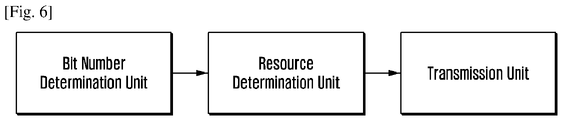
- Fig.6 is a schematic diagram of a basic structure of an apparatus for transmission of HAR-ACK according to the present disclosure. As shown in Fig.6 , the apparatus includes a bit number determination unit, a resource determination unit, and a transmission unit.
- the bit number determination unit is configured to determine the number of HARQ-ACK feedback information bits that need to be transmitted by an UE in an uplink subframe; and determine the number of UCI bits to be transmitted in the uplink subframe based on the number of the HARQ-ACK feedback information bits, the number of CSI bits, and the number of SR bits that need to be transmitted in the uplink subframe.
- the resource determination unit is configured to determine a PUCCH format and a resource for transmission of PUCCH according to the number of the UCI bits determined by the bit number determination unit.
- the transmission unit is configured to transmit UCI according to the PUCCH format and the resource for transmission of PUCCH determined by the resource determination unit.
Landscapes
- Engineering & Computer Science (AREA)
- Signal Processing (AREA)
- Computer Networks & Wireless Communication (AREA)
- Mobile Radio Communication Systems (AREA)
Claims (8)
- Verfahren, das von einem Endgerät zum Übertragen eines Uplink-Signals in einem drahtlosen Kommunikationssystem durchgeführt wird, wobei das Verfahren Folgendes umfasst:Empfangen von Downlink-Steuerinformationen von einer Basisstation, einschließlich Informationen zum Identifizieren einer PUCCH(physikalischer Uplink-Steuerkanal)-Ressource;Erzeugen von Uplink-Steuerinformationen, UCI, einschließlich HARQ-ACK(hybride automatische Wiederholungsanforderungsbestätigungs)-Informationen;Identifizieren eines Satzes von PUCCH-Ressourcen basierend auf einer Anzahl von Bits der UCI aus mindestens einem PUCCH-Ressourcensatz, der durch Signalisierung höherer Schichten konfiguriert ist;Identifizieren einer PUCCH-Ressource und eines PUCCH-Formats basierend auf den Informationen, wobei die PUCCH-Ressource aus dem Satz von PUCCH-Ressourcen identifiziert wird und das PUCCH-Format der PUCCH-Ressource entspricht; undÜbertragen der UCI auf der PUCCH-Ressource basierend auf dem PUCCH-Format an die Basisstation,wobei ein erster PUCCH-Ressourcensatz aus dem mindestens einen PUCCH-Ressourcensatz identifiziert wird, um die UCI zu übertragen, falls die Anzahl der Bits der UCI größer als ein Wert ist,wobei ein zweiter PUCCH-Ressourcensatz aus dem mindestens einen PUCCH-Ressourcensatz identifiziert wird, um die UCI zu übertragen, falls die Anzahl der Bits der UCI kleiner als oder gleich dem Wert ist, undwobei der Wert durch Signalisierung höherer Schichten konfiguriert wird.
- Verfahren nach Anspruch 1, wobei die Downlink-Steuerinformationen eine PDSCH(gemeinsam genutzter physikalischer Downlink-Kanal)-Übertragung planen, und
wobei die UCI die HARQ-ACK für die PDSCH-Übertragung und Kanalzustandsinformationen, CSI, und/oder eine Scheduling-Anfrage, SR, enthalten. - Endgerät, das angepasst ist, um ein Uplink-Signal für ein drahtloses Kommunikationssystem zu übertragen, wobei das Endgerät Folgendes umfasst:einen Transceiver, der zum Übertragen und Empfangen von Signalen konfiguriert ist; undeine Steuerung, die mit dem Transceiver gekoppelt und konfiguriert ist zum:Empfangen von Downlink-Steuerinformationen einschließlich Informationen zum Identifizieren einer PUCCH (physikalischer Uplink-Steuerkanal)-Ressource von einer Basisstation,Erzeugen von UCI, Uplink-Steuerinformationen, einschließlich HARQ-ACK (hybride automatische Wiederholungsanforderungsbestätigungs)-Informationen,Identifizieren eines Satzes von PUCCH-Ressourcen basierend auf einer Anzahl von Bits der UCI aus mindestens einem PUCCH-Ressourcensatz, der durch eine Signalisierung höherer Schichten konfiguriert ist,Identifizieren einer PUCCH-Ressource und eines PUCCH-Formats, basierend auf den Informationen, wobei die PUCCH-Ressource aus dem Satz der PUCCH-Ressourcen identifiziert wird und das PUCCH-Format der PUCCH-Ressource entspricht, undÜbertragen der UCI auf der PUCCH-Ressource basierend auf dem PUCCH-Format an die Basisstation,wobei ein erster PUCCH-Ressourcensatz aus dem mindestens einen PUCCH-Ressourcensatz identifiziert wird, um die UCI zu übertragen, falls die Anzahl der Bits der UCI größer als ein Wert ist,wobei ein zweiter PUCCH-Ressourcensatz aus dem mindestens einen PUCCH-Ressourcensatz identifiziert wird, um die UCI zu übertragen, falls die Anzahl der Bits der UCI kleiner als oder gleich dem Wert ist, undwobei der Wert durch Signalisierung höherer Schichten konfiguriert wird.
- Endgerät nach Anspruch 3, wobei die Downlink-Steuerinformationen eine Planung einer PDSCH(gemeinsam genutzter physikalischer Downlink-Kanal)-Übertragung plant, und
wobei die UCI die HARQ-ACK für die PDSCH-Übertragung und Kanalzustandsinformationen, CSI, und/oder eine Scheduling-Anfrage, SR, enthalten. - Verfahren, das von einer Basisstation zum Empfangen eines Uplink-Signals in einem drahtlosen Kommunikationssystem durchgeführt wird, wobei das Verfahren Folgendes umfasst:Übertragen von Downlink-Steuerinformationen, einschließlich Informationen zum Identifizieren einer PUCCH(physikalischer Uplink-Steuerkanal)-Ressource, an ein Endgerät; undEmpfangen von Uplink-Steuerinformationen, UCI, einschließlich HARQ-ACK(hybride automatische Wiederholungsanforderungsbestätigungs)-Informationen, von dem Endgerät,wobei ein Satz von PUCCH-Ressourcen für die UCI basierend auf einer Anzahl von Bits der UCI aus mindestens einem PUCCH-Ressourcensatz identifiziert wird, der durch eine Signalisierung höherer Schichten konfiguriert wird,wobei eine PUCCH-Ressource und ein PUCCH-Format für die UCI basierend auf den Informationen identifiziert werden, wobei die PUCCH-Ressource aus dem Satz von PUCCH-Ressourcen identifiziert wird, und das PUCCH-Format der PUCCH-Ressource entspricht, undwobei die UCI auf der PUCCH-Ressource basierend auf dem PUCCH-Format empfangen wird,wobei ein erster PUCCH-Ressourcensatz aus dem mindestens einen PUCCH-Ressourcensatz identifiziert wird, um die UCI zu empfangen, falls die Anzahl der Bits der UCI größer als ein Wert ist,wobei ein zweiter PUCCH-Ressourcensatz aus dem mindestens einen PUCCH-Ressourcensatz identifiziert wird, um die UCI zu empfangen, falls die Anzahl der Bits der UCI kleiner als oder gleich dem Wert ist, undwobei der Wert durch Signalisierung höherer Schichten konfiguriert wird.
- Verfahren nach Anspruch 5, wobei die Downlink-Steuerinformationen eine PDSCH(gemeinsam genutzter physikalischer Downlink-Kanal)-Übertragung planen, und
wobei die UCI die HARQ-ACK für die PDSCH-Übertragung und Kanalzustandsinformationen, CSI, und/oder eine Scheduling-Anfrage, SR, enthalten. - Basisstation, die angepasst ist, um ein Uplink-Signal für ein drahtloses Kommunikationssystem zu empfangen, wobei die Basisstation Folgendes umfasst:einen Transceiver, der zum Übertragen und Empfangen von Signalen konfiguriert ist; undeine Steuerung, die mit dem Transceiver gekoppelt und konfiguriert ist zum:Übertragen von Downlink-Steuerinformationen, einschließlich Informationen zum Identifizieren einer PUCCH(physikalischer Uplink-Steuerkanal)-Ressource, an ein Endgerät, undEmpfangen von Uplink-Steuerinformationen, UCI, einschließlich HARQ-ACK(hybride automatische Wiederholungsanforderungsbestätigungs)-Informationen, von dem Endgerät,wobei ein Satz von PUCCH-Ressourcen für die UCI basierend auf einer Anzahl von Bits der UCI aus mindestens einem PUCCH-Ressourcensatz identifiziert wird, der durch eine Signalisierung höherer Schichten konfiguriert wird,wobei eine PUCCH-Ressource und ein PUCCH-Format für die UCI basierend auf den Informationen identifiziert werden, wobei die PUCCH-Ressource aus dem Satz von PUCCH-Ressourcen identifiziert wird und das PUCCH-Format der PUCCH-Ressource entspricht, undwobei die UCI auf der PUCCH-Ressource basierend auf dem PUCCH-Format empfangen werden,wobei ein erster PUCCH-Ressourcensatz aus dem mindestens einen PUCCH-Ressourcensatz identifiziert wird, um die UCI zu empfangen, falls die Anzahl der Bits der UCI größer als ein Wert ist,wobei ein zweiter PUCCH-Ressourcensatz aus dem mindestens einen PUCCH-Ressourcensatz identifiziert wird, um die UCI zu empfangen, falls die Anzahl der Bits der UCI kleiner als oder gleich dem Wert ist, undwobei der Wert durch Signalisierung höherer Schichten konfiguriert wird.
- Basisstation nach Anspruch 7, wobei die Downlink-Steuerinformationen eine PDSCH(gemeinsam genutzter physikalischer Downlink-Kanal)-Übertragung planen, und
wobei die UCI die HARQ-ACK für die PDSCH-Übertragung und Kanalzustandsinformationen, CSI, und/oder eine Scheduling-Anfrage, SR, enthalten.
Applications Claiming Priority (4)
| Application Number | Priority Date | Filing Date | Title |
|---|---|---|---|
| CN201510165986 | 2015-04-09 | ||
| CN201510501677 | 2015-08-14 | ||
| CN201510752710.4A CN106060930B (zh) | 2015-04-09 | 2015-11-06 | 一种增强载波聚合系统的harq-ack传输方法和设备 |
| PCT/KR2016/003534 WO2016163720A1 (en) | 2015-04-09 | 2016-04-05 | Method and apparatus for transmitting harq-ack feedback information in an enhanced carrier aggregation system |
Publications (3)
| Publication Number | Publication Date |
|---|---|
| EP3281334A1 EP3281334A1 (de) | 2018-02-14 |
| EP3281334A4 EP3281334A4 (de) | 2018-03-14 |
| EP3281334B1 true EP3281334B1 (de) | 2022-09-07 |
Family
ID=57179423
Family Applications (1)
| Application Number | Title | Priority Date | Filing Date |
|---|---|---|---|
| EP16776823.3A Active EP3281334B1 (de) | 2015-04-09 | 2016-04-05 | Verfahren und vorrichtung zur übertragung von harq-ack-rückkopplungsinformationen in einem erweiterten trägeraggregationssystem |
Country Status (3)
| Country | Link |
|---|---|
| US (1) | US11637659B2 (de) |
| EP (1) | EP3281334B1 (de) |
| CN (2) | CN113438060A (de) |
Families Citing this family (46)
| Publication number | Priority date | Publication date | Assignee | Title |
|---|---|---|---|---|
| CN103209483B (zh) * | 2012-01-12 | 2015-09-09 | 华为技术有限公司 | 传输上行控制信息的方法、用户设备和基站 |
| CN112615707B (zh) * | 2015-06-19 | 2024-04-23 | 北京三星通信技术研究有限公司 | 一种传输上行控制信息的方法 |
| JP6081531B2 (ja) * | 2015-06-26 | 2017-02-15 | 株式会社Nttドコモ | ユーザ端末、無線基地局及び無線通信方法 |
| EP3742850B1 (de) * | 2015-08-12 | 2022-02-09 | Huawei Technologies Co., Ltd. | Uplink-steuerungsinformationssendeverfahren, uplink-steuerungsinformationsempfangsverfahren, vorrichtung und system |
| EP3355608A4 (de) * | 2015-09-24 | 2019-05-15 | Ntt Docomo, Inc. | Benutzerendgerät, drahtlose basisstation und drahtloskommunikationsverfahren |
| US10939419B2 (en) * | 2016-09-30 | 2021-03-02 | Qualcomm Incorporated | Uplink control information |
| CN109716694B (zh) * | 2016-11-04 | 2021-03-30 | 华为技术有限公司 | Harq-ack反馈信息的传输方法及相关装置 |
| CN115835395B (zh) | 2016-11-04 | 2026-04-17 | 中兴通讯股份有限公司 | 一种控制信道的发送方法和装置 |
| WO2018103659A1 (en) * | 2016-12-08 | 2018-06-14 | Mediatek Inc. | Harq feedback scheme for 5g new radio |
| EP3566371B1 (de) * | 2017-01-05 | 2021-09-22 | SHARP Kabushiki Kaisha | Design eines kurzen physical uplink control channel (pucch) für new radio (nr) der 5. generation (5g) |
| CN109150413B (zh) * | 2017-06-16 | 2021-06-15 | 华为技术有限公司 | 发送和接收反馈信息的方法和装置 |
| JP6701445B2 (ja) * | 2017-10-26 | 2020-05-27 | テレフオンアクチーボラゲット エルエム エリクソン(パブル) | 物理アップリンク制御チャネル(pucch)リソース割り当て |
| CN109802763B (zh) * | 2017-11-16 | 2020-07-07 | 展讯通信(上海)有限公司 | 一种反馈的方法以及设备 |
| JP7115843B2 (ja) * | 2017-12-13 | 2022-08-09 | シャープ株式会社 | 端末装置、基地局装置、通信方法、および、集積回路 |
| JP7027150B2 (ja) | 2017-12-13 | 2022-03-01 | シャープ株式会社 | 端末装置、基地局装置、通信方法、および、集積回路 |
| KR102067813B1 (ko) | 2018-01-12 | 2020-01-17 | 엘지전자 주식회사 | 무선 통신 시스템에서 pucch 상에서 상향링크 제어 정보를 송수신하기 위한 방법 및 이를 위한 장치 |
| CN110034850B (zh) * | 2018-01-12 | 2020-10-30 | 电信科学技术研究院有限公司 | 一种信息传输方法、终端及网络设备 |
| US11172430B2 (en) | 2018-01-12 | 2021-11-09 | Qualcomm Incorporated | Uplink control channel resource allocation |
| ES2933380T3 (es) | 2018-01-12 | 2023-02-06 | Lg Electronics Inc | Método y aparato para transmitir y recibir una señal inalámbrica en un sistema de comunicación inalámbrica |
| CN110048817B (zh) * | 2018-01-15 | 2021-08-20 | 展讯通信(上海)有限公司 | 确定harq反馈pucch资源的方法、装置及用户设备 |
| KR102427695B1 (ko) * | 2018-01-19 | 2022-07-29 | 광동 오포 모바일 텔레커뮤니케이션즈 코포레이션 리미티드 | 무선 통신 방법, 단말 기기 및 네트워크 기기 |
| KR102745002B1 (ko) * | 2018-02-11 | 2024-12-19 | 광동 오포 모바일 텔레커뮤니케이션즈 코포레이션 리미티드 | 업링크 제어 정보를 전송하는 방법 및 기기 |
| CN110166179B (zh) * | 2018-02-12 | 2022-07-29 | 华为技术有限公司 | 指示方法,网络设备及用户设备 |
| CN115802505B (zh) * | 2018-02-13 | 2025-08-19 | 华为技术有限公司 | 通信的方法和装置 |
| EP3753327A4 (de) * | 2018-02-14 | 2021-03-03 | NEC Corporation | Verfahren und vorrichtung zur übertragung von uplink-steuerinformationen |
| JP7099835B2 (ja) * | 2018-03-13 | 2022-07-12 | シャープ株式会社 | 端末装置、基地局装置、および、通信方法 |
| CN110324128B (zh) | 2018-03-30 | 2020-10-23 | 维沃移动通信有限公司 | 物理上行控制信道资源确定方法和通信设备 |
| CN110351007B (zh) | 2018-04-04 | 2021-09-07 | 华为技术有限公司 | 一种上行控制信息发送和接收方法及装置 |
| CN110380833A (zh) * | 2018-04-13 | 2019-10-25 | 维沃移动通信有限公司 | Pucch资源确定方法、终端及网络设备 |
| US11368260B2 (en) * | 2018-05-03 | 2022-06-21 | Mediatek Singapore Pte. Ltd. | Method and apparatus for reporting hybrid automatic repeat request-acknowledge information in mobile communications |
| WO2019215898A1 (ja) * | 2018-05-10 | 2019-11-14 | 株式会社Nttドコモ | ユーザ端末及び無線通信方法 |
| CN110719150B (zh) * | 2018-07-11 | 2021-08-10 | 大唐移动通信设备有限公司 | 一种信息传输方法、终端及基站 |
| EP3836443A4 (de) * | 2018-08-08 | 2021-08-18 | Beijing Xiaomi Mobile Software Co., Ltd. | Verfahren und vorrichtung für rückkopplung von hybriden automatischen wiederholungsanforderungen (harq) |
| KR102429524B1 (ko) * | 2018-08-09 | 2022-08-05 | 엘지전자 주식회사 | 비면허 대역에서 단말의 상향링크 공유 채널 전송 방법 및 상기 방법을 이용하는 장치 |
| CN110830176B (zh) * | 2018-08-10 | 2023-10-03 | 大唐移动通信设备有限公司 | 一种harq-ack发送方法、接收方法、终端及基站 |
| CN110913478A (zh) * | 2018-09-15 | 2020-03-24 | 华为技术有限公司 | 一种信息发送、接收方法及通信装置 |
| US12047168B2 (en) * | 2018-09-28 | 2024-07-23 | Lenovo (Singapore) Pte. Ltd. | Method and apparatus for generating a CSI report |
| CN111492710A (zh) * | 2018-11-27 | 2020-08-04 | 联发科技股份有限公司 | 用于上行链路控制信息(uci)报告的多个物理上行链路控制信道(pucch)资源 |
| WO2020034566A1 (en) * | 2019-01-08 | 2020-02-20 | Zte Corporation | Feedback code size determination schemes in wireless communication |
| KR20250151569A (ko) | 2019-01-09 | 2025-10-21 | 주식회사 윌러스표준기술연구소 | 무선통신 시스템에서 상향링크 제어채널의 전송 장치 및 방법 |
| CN111788786A (zh) * | 2019-01-11 | 2020-10-16 | Oppo广东移动通信有限公司 | 用于传输反馈信息的方法、终端设备和网络设备 |
| EP3965492A4 (de) * | 2019-05-03 | 2022-11-16 | Ntt Docomo, Inc. | Benutzergerät und kommunikationsverfahren |
| CN113544992B (zh) * | 2019-11-25 | 2025-11-14 | 三星电子株式会社 | 在无线通信系统中发送/接收上行链路控制信息的方法和设备 |
| US11889502B2 (en) * | 2020-02-24 | 2024-01-30 | Qualcomm Incorporated | Two-stage feedback procedures |
| CN117769873A (zh) * | 2021-08-06 | 2024-03-26 | 中兴通讯股份有限公司 | 用于无线网络中的传输控制参数更新的方法、设备及系统 |
| CN121367582A (zh) * | 2021-08-06 | 2026-01-20 | 维沃移动通信有限公司 | 上行控制信息传输方法、装置及相关设备 |
Family Cites Families (9)
| Publication number | Priority date | Publication date | Assignee | Title |
|---|---|---|---|---|
| WO2010123304A2 (en) * | 2009-04-24 | 2010-10-28 | Samsung Electronics Co., Ltd. | Multiplexing large payloads of control information from user equipments |
| US9877290B2 (en) * | 2010-04-22 | 2018-01-23 | Sharp Kabushiki Kaisha | Communication method and system for physical uplink control channel resource assignment, and base station, user equipment and integrated circuit therein |
| CN107196743B (zh) * | 2011-09-23 | 2020-11-06 | Lg电子株式会社 | 在无线通信系统中控制上行链路控制信息的方法和装置 |
| CN103580797B (zh) * | 2012-08-03 | 2017-05-03 | 电信科学技术研究院 | 上行控制信息uci的传输方法和设备 |
| WO2014148796A1 (ko) * | 2013-03-19 | 2014-09-25 | 엘지전자 주식회사 | 무선 통신 시스템에서 단말이 신호를 송수신하는 방법 및 이를 위한 장치 |
| US9949275B2 (en) * | 2013-10-01 | 2018-04-17 | Qualcomm Incorporated | Physical uplink control management in LTE/LTE-A systems with unlicensed spectrum |
| EP3264650A4 (de) * | 2015-03-20 | 2018-04-04 | Huawei Technologies Co., Ltd. | Verfahren und vorrichtung zum melden und empfangen eines csi |
| JP6526231B2 (ja) * | 2015-03-30 | 2019-06-05 | 華為技術有限公司Huawei Technologies Co.,Ltd. | 制御情報を送信するための方法、ユーザ機器、及び基地局 |
| WO2016163186A1 (ja) * | 2015-04-09 | 2016-10-13 | シャープ株式会社 | 端末装置、基地局装置、集積回路、および、通信方法 |
-
2015
- 2015-11-06 CN CN202110736821.1A patent/CN113438060A/zh active Pending
- 2015-11-06 CN CN201510752710.4A patent/CN106060930B/zh active Active
-
2016
- 2016-04-05 EP EP16776823.3A patent/EP3281334B1/de active Active
- 2016-04-05 US US15/555,880 patent/US11637659B2/en active Active
Also Published As
| Publication number | Publication date |
|---|---|
| EP3281334A1 (de) | 2018-02-14 |
| CN106060930B (zh) | 2021-07-16 |
| EP3281334A4 (de) | 2018-03-14 |
| US20180054280A1 (en) | 2018-02-22 |
| CN106060930A (zh) | 2016-10-26 |
| CN113438060A (zh) | 2021-09-24 |
| US11637659B2 (en) | 2023-04-25 |
Similar Documents
| Publication | Publication Date | Title |
|---|---|---|
| EP3281334B1 (de) | Verfahren und vorrichtung zur übertragung von harq-ack-rückkopplungsinformationen in einem erweiterten trägeraggregationssystem | |
| US11728936B2 (en) | Method and apparatus for transmitting/receiving HARQ-ACK signal in wireless communication system supporting carrier aggregation | |
| US9615267B2 (en) | Method and apparatus for transmitting HARQ-ACK feedback information by a user equipment in a wireless communication system | |
| EP2838301B1 (de) | Verfahren und vorrichtung zur übertragung von bestätigungsinformationen einer hybriden automatischen wiederholungsanfrage | |
| KR102594361B1 (ko) | 캐리어 집적을 지원하는 무선 통신 시스템에서 harq 수신 확인 응답 신호를 송수신하기 위한 방법 및 장치 | |
| KR101712895B1 (ko) | 다운링크 제어 정보 전송 방법 및 장치 | |
| EP2733883B1 (de) | Datenübertragungsverfahren und -vorrichtung in einem trägeraggregationssystem | |
| CN103384188B (zh) | 载波聚合反馈方法、装置及系统 | |
| US9515782B2 (en) | HARQ feedback implementation method and device | |
| EP3132557B1 (de) | Verfahren und vorrichtung zur flexiblen duplexverarbeitung | |
| CN109474371B (zh) | 一种harq-ack信息反馈方法和设备 | |
| EP2309787A1 (de) | Verfahren für ein downlink-empfangsstatus-feedback | |
| CN105264807B (zh) | 上行控制信息的传输方法、基站和用户设备 | |
| KR20170093107A (ko) | 상향링크 제어 정보를 전송하기 위한 방법 및 이를 위한 장치 | |
| EP2663008B1 (de) | Verfahren, benutzervorrichtung und basisstation zur informationsübertragung in einem zeitteilungs-duplexsystem | |
| KR101975851B1 (ko) | Ack/nack 정보 송신 방법 및 장치 | |
| KR20140001171A (ko) | Harq-ack 피드백 송수신 방법 및 장치 | |
| CN106160983A (zh) | 一种增强载波聚合系统的harq-ack传输方法和设备 | |
| ES2928338T3 (es) | Procedimiento y aparato para transmitir información de retroalimentación HARQ-ACK en un sistema de agregación de portadoras mejorado | |
| US20170048055A1 (en) | Method and apparatus for communicating data on physical downlink shared channel | |
| EP2728781B1 (de) | Verfahren, system und vorrichtung zum senden und empfangen von feedback-informationen | |
| EP2941073B1 (de) | Verfahren und vorrichtung zum senden und empfangen von bestätigungsfeedbackinformationen | |
| CN106160959A (zh) | 上行控制信息的传输方法及装置 |
Legal Events
| Date | Code | Title | Description |
|---|---|---|---|
| STAA | Information on the status of an ep patent application or granted ep patent |
Free format text: STATUS: THE INTERNATIONAL PUBLICATION HAS BEEN MADE |
|
| PUAI | Public reference made under article 153(3) epc to a published international application that has entered the european phase |
Free format text: ORIGINAL CODE: 0009012 |
|
| STAA | Information on the status of an ep patent application or granted ep patent |
Free format text: STATUS: REQUEST FOR EXAMINATION WAS MADE |
|
| REG | Reference to a national code |
Ref country code: DE Ref legal event code: R079 Ref document number: 602016074850 Country of ref document: DE Free format text: PREVIOUS MAIN CLASS: H04L0001180000 Ipc: H04L0005000000 |
|
| 17P | Request for examination filed |
Effective date: 20171009 |
|
| AK | Designated contracting states |
Kind code of ref document: A1 Designated state(s): AL AT BE BG CH CY CZ DE DK EE ES FI FR GB GR HR HU IE IS IT LI LT LU LV MC MK MT NL NO PL PT RO RS SE SI SK SM TR |
|
| AX | Request for extension of the european patent |
Extension state: BA ME |
|
| A4 | Supplementary search report drawn up and despatched |
Effective date: 20180214 |
|
| RIC1 | Information provided on ipc code assigned before grant |
Ipc: H04L 5/00 20060101AFI20180208BHEP Ipc: H04L 1/18 20060101ALI20180208BHEP Ipc: H04L 5/14 20060101ALI20180208BHEP |
|
| DAV | Request for validation of the european patent (deleted) | ||
| DAX | Request for extension of the european patent (deleted) | ||
| STAA | Information on the status of an ep patent application or granted ep patent |
Free format text: STATUS: EXAMINATION IS IN PROGRESS |
|
| 17Q | First examination report despatched |
Effective date: 20191118 |
|
| GRAP | Despatch of communication of intention to grant a patent |
Free format text: ORIGINAL CODE: EPIDOSNIGR1 |
|
| STAA | Information on the status of an ep patent application or granted ep patent |
Free format text: STATUS: GRANT OF PATENT IS INTENDED |
|
| INTG | Intention to grant announced |
Effective date: 20220405 |
|
| GRAS | Grant fee paid |
Free format text: ORIGINAL CODE: EPIDOSNIGR3 |
|
| GRAA | (expected) grant |
Free format text: ORIGINAL CODE: 0009210 |
|
| STAA | Information on the status of an ep patent application or granted ep patent |
Free format text: STATUS: THE PATENT HAS BEEN GRANTED |
|
| AK | Designated contracting states |
Kind code of ref document: B1 Designated state(s): AL AT BE BG CH CY CZ DE DK EE ES FI FR GB GR HR HU IE IS IT LI LT LU LV MC MK MT NL NO PL PT RO RS SE SI SK SM TR |
|
| REG | Reference to a national code |
Ref country code: GB Ref legal event code: FG4D |
|
| REG | Reference to a national code |
Ref country code: CH Ref legal event code: EP Ref country code: AT Ref legal event code: REF Ref document number: 1517934 Country of ref document: AT Kind code of ref document: T Effective date: 20220915 |
|
| REG | Reference to a national code |
Ref country code: DE Ref legal event code: R096 Ref document number: 602016074850 Country of ref document: DE |
|
| REG | Reference to a national code |
Ref country code: IE Ref legal event code: FG4D |
|
| REG | Reference to a national code |
Ref country code: NL Ref legal event code: FP |
|
| REG | Reference to a national code |
Ref country code: ES Ref legal event code: FG2A Ref document number: 2928338 Country of ref document: ES Kind code of ref document: T3 Effective date: 20221117 |
|
| REG | Reference to a national code |
Ref country code: LT Ref legal event code: MG9D |
|
| PG25 | Lapsed in a contracting state [announced via postgrant information from national office to epo] |
Ref country code: SE Free format text: LAPSE BECAUSE OF FAILURE TO SUBMIT A TRANSLATION OF THE DESCRIPTION OR TO PAY THE FEE WITHIN THE PRESCRIBED TIME-LIMIT Effective date: 20220907 Ref country code: RS Free format text: LAPSE BECAUSE OF FAILURE TO SUBMIT A TRANSLATION OF THE DESCRIPTION OR TO PAY THE FEE WITHIN THE PRESCRIBED TIME-LIMIT Effective date: 20220907 Ref country code: NO Free format text: LAPSE BECAUSE OF FAILURE TO SUBMIT A TRANSLATION OF THE DESCRIPTION OR TO PAY THE FEE WITHIN THE PRESCRIBED TIME-LIMIT Effective date: 20221207 Ref country code: LV Free format text: LAPSE BECAUSE OF FAILURE TO SUBMIT A TRANSLATION OF THE DESCRIPTION OR TO PAY THE FEE WITHIN THE PRESCRIBED TIME-LIMIT Effective date: 20220907 Ref country code: LT Free format text: LAPSE BECAUSE OF FAILURE TO SUBMIT A TRANSLATION OF THE DESCRIPTION OR TO PAY THE FEE WITHIN THE PRESCRIBED TIME-LIMIT Effective date: 20220907 Ref country code: FI Free format text: LAPSE BECAUSE OF FAILURE TO SUBMIT A TRANSLATION OF THE DESCRIPTION OR TO PAY THE FEE WITHIN THE PRESCRIBED TIME-LIMIT Effective date: 20220907 |
|
| REG | Reference to a national code |
Ref country code: AT Ref legal event code: MK05 Ref document number: 1517934 Country of ref document: AT Kind code of ref document: T Effective date: 20220907 |
|
| PG25 | Lapsed in a contracting state [announced via postgrant information from national office to epo] |
Ref country code: HR Free format text: LAPSE BECAUSE OF FAILURE TO SUBMIT A TRANSLATION OF THE DESCRIPTION OR TO PAY THE FEE WITHIN THE PRESCRIBED TIME-LIMIT Effective date: 20220907 Ref country code: GR Free format text: LAPSE BECAUSE OF FAILURE TO SUBMIT A TRANSLATION OF THE DESCRIPTION OR TO PAY THE FEE WITHIN THE PRESCRIBED TIME-LIMIT Effective date: 20221208 |
|
| PG25 | Lapsed in a contracting state [announced via postgrant information from national office to epo] |
Ref country code: SM Free format text: LAPSE BECAUSE OF FAILURE TO SUBMIT A TRANSLATION OF THE DESCRIPTION OR TO PAY THE FEE WITHIN THE PRESCRIBED TIME-LIMIT Effective date: 20220907 Ref country code: RO Free format text: LAPSE BECAUSE OF FAILURE TO SUBMIT A TRANSLATION OF THE DESCRIPTION OR TO PAY THE FEE WITHIN THE PRESCRIBED TIME-LIMIT Effective date: 20220907 Ref country code: PT Free format text: LAPSE BECAUSE OF FAILURE TO SUBMIT A TRANSLATION OF THE DESCRIPTION OR TO PAY THE FEE WITHIN THE PRESCRIBED TIME-LIMIT Effective date: 20230109 Ref country code: CZ Free format text: LAPSE BECAUSE OF FAILURE TO SUBMIT A TRANSLATION OF THE DESCRIPTION OR TO PAY THE FEE WITHIN THE PRESCRIBED TIME-LIMIT Effective date: 20220907 Ref country code: AT Free format text: LAPSE BECAUSE OF FAILURE TO SUBMIT A TRANSLATION OF THE DESCRIPTION OR TO PAY THE FEE WITHIN THE PRESCRIBED TIME-LIMIT Effective date: 20220907 |
|
| PG25 | Lapsed in a contracting state [announced via postgrant information from national office to epo] |
Ref country code: SK Free format text: LAPSE BECAUSE OF FAILURE TO SUBMIT A TRANSLATION OF THE DESCRIPTION OR TO PAY THE FEE WITHIN THE PRESCRIBED TIME-LIMIT Effective date: 20220907 Ref country code: PL Free format text: LAPSE BECAUSE OF FAILURE TO SUBMIT A TRANSLATION OF THE DESCRIPTION OR TO PAY THE FEE WITHIN THE PRESCRIBED TIME-LIMIT Effective date: 20220907 Ref country code: IS Free format text: LAPSE BECAUSE OF FAILURE TO SUBMIT A TRANSLATION OF THE DESCRIPTION OR TO PAY THE FEE WITHIN THE PRESCRIBED TIME-LIMIT Effective date: 20230107 Ref country code: EE Free format text: LAPSE BECAUSE OF FAILURE TO SUBMIT A TRANSLATION OF THE DESCRIPTION OR TO PAY THE FEE WITHIN THE PRESCRIBED TIME-LIMIT Effective date: 20220907 |
|
| REG | Reference to a national code |
Ref country code: DE Ref legal event code: R097 Ref document number: 602016074850 Country of ref document: DE |
|
| PG25 | Lapsed in a contracting state [announced via postgrant information from national office to epo] |
Ref country code: AL Free format text: LAPSE BECAUSE OF FAILURE TO SUBMIT A TRANSLATION OF THE DESCRIPTION OR TO PAY THE FEE WITHIN THE PRESCRIBED TIME-LIMIT Effective date: 20220907 |
|
| PLBE | No opposition filed within time limit |
Free format text: ORIGINAL CODE: 0009261 |
|
| STAA | Information on the status of an ep patent application or granted ep patent |
Free format text: STATUS: NO OPPOSITION FILED WITHIN TIME LIMIT |
|
| PG25 | Lapsed in a contracting state [announced via postgrant information from national office to epo] |
Ref country code: DK Free format text: LAPSE BECAUSE OF FAILURE TO SUBMIT A TRANSLATION OF THE DESCRIPTION OR TO PAY THE FEE WITHIN THE PRESCRIBED TIME-LIMIT Effective date: 20220907 |
|
| 26N | No opposition filed |
Effective date: 20230608 |
|
| PG25 | Lapsed in a contracting state [announced via postgrant information from national office to epo] |
Ref country code: SI Free format text: LAPSE BECAUSE OF FAILURE TO SUBMIT A TRANSLATION OF THE DESCRIPTION OR TO PAY THE FEE WITHIN THE PRESCRIBED TIME-LIMIT Effective date: 20220907 |
|
| REG | Reference to a national code |
Ref country code: CH Ref legal event code: PL |
|
| PG25 | Lapsed in a contracting state [announced via postgrant information from national office to epo] |
Ref country code: LU Free format text: LAPSE BECAUSE OF NON-PAYMENT OF DUE FEES Effective date: 20230405 |
|
| REG | Reference to a national code |
Ref country code: BE Ref legal event code: MM Effective date: 20230430 |
|
| PG25 | Lapsed in a contracting state [announced via postgrant information from national office to epo] |
Ref country code: MC Free format text: LAPSE BECAUSE OF FAILURE TO SUBMIT A TRANSLATION OF THE DESCRIPTION OR TO PAY THE FEE WITHIN THE PRESCRIBED TIME-LIMIT Effective date: 20220907 |
|
| PG25 | Lapsed in a contracting state [announced via postgrant information from national office to epo] |
Ref country code: MC Free format text: LAPSE BECAUSE OF FAILURE TO SUBMIT A TRANSLATION OF THE DESCRIPTION OR TO PAY THE FEE WITHIN THE PRESCRIBED TIME-LIMIT Effective date: 20220907 Ref country code: LI Free format text: LAPSE BECAUSE OF NON-PAYMENT OF DUE FEES Effective date: 20230430 Ref country code: CH Free format text: LAPSE BECAUSE OF NON-PAYMENT OF DUE FEES Effective date: 20230430 |
|
| REG | Reference to a national code |
Ref country code: IE Ref legal event code: MM4A |
|
| PG25 | Lapsed in a contracting state [announced via postgrant information from national office to epo] |
Ref country code: BE Free format text: LAPSE BECAUSE OF NON-PAYMENT OF DUE FEES Effective date: 20230430 |
|
| PG25 | Lapsed in a contracting state [announced via postgrant information from national office to epo] |
Ref country code: IE Free format text: LAPSE BECAUSE OF NON-PAYMENT OF DUE FEES Effective date: 20230405 |
|
| PG25 | Lapsed in a contracting state [announced via postgrant information from national office to epo] |
Ref country code: IE Free format text: LAPSE BECAUSE OF NON-PAYMENT OF DUE FEES Effective date: 20230405 |
|
| PG25 | Lapsed in a contracting state [announced via postgrant information from national office to epo] |
Ref country code: BG Free format text: LAPSE BECAUSE OF FAILURE TO SUBMIT A TRANSLATION OF THE DESCRIPTION OR TO PAY THE FEE WITHIN THE PRESCRIBED TIME-LIMIT Effective date: 20220907 |
|
| PG25 | Lapsed in a contracting state [announced via postgrant information from national office to epo] |
Ref country code: BG Free format text: LAPSE BECAUSE OF FAILURE TO SUBMIT A TRANSLATION OF THE DESCRIPTION OR TO PAY THE FEE WITHIN THE PRESCRIBED TIME-LIMIT Effective date: 20220907 |
|
| PGFP | Annual fee paid to national office [announced via postgrant information from national office to epo] |
Ref country code: IT Payment date: 20250321 Year of fee payment: 10 |
|
| PGFP | Annual fee paid to national office [announced via postgrant information from national office to epo] |
Ref country code: DE Payment date: 20250320 Year of fee payment: 10 |
|
| PGFP | Annual fee paid to national office [announced via postgrant information from national office to epo] |
Ref country code: ES Payment date: 20250516 Year of fee payment: 10 |
|
| PG25 | Lapsed in a contracting state [announced via postgrant information from national office to epo] |
Ref country code: CY Free format text: LAPSE BECAUSE OF FAILURE TO SUBMIT A TRANSLATION OF THE DESCRIPTION OR TO PAY THE FEE WITHIN THE PRESCRIBED TIME-LIMIT; INVALID AB INITIO Effective date: 20160405 |
|
| PG25 | Lapsed in a contracting state [announced via postgrant information from national office to epo] |
Ref country code: HU Free format text: LAPSE BECAUSE OF FAILURE TO SUBMIT A TRANSLATION OF THE DESCRIPTION OR TO PAY THE FEE WITHIN THE PRESCRIBED TIME-LIMIT; INVALID AB INITIO Effective date: 20160405 |
|
| PG25 | Lapsed in a contracting state [announced via postgrant information from national office to epo] |
Ref country code: TR Free format text: LAPSE BECAUSE OF FAILURE TO SUBMIT A TRANSLATION OF THE DESCRIPTION OR TO PAY THE FEE WITHIN THE PRESCRIBED TIME-LIMIT Effective date: 20220907 |
|
| PGFP | Annual fee paid to national office [announced via postgrant information from national office to epo] |
Ref country code: GB Payment date: 20260324 Year of fee payment: 11 |
|
| PGFP | Annual fee paid to national office [announced via postgrant information from national office to epo] |
Ref country code: NL Payment date: 20260324 Year of fee payment: 11 |
|
| PGFP | Annual fee paid to national office [announced via postgrant information from national office to epo] |
Ref country code: FR Payment date: 20260323 Year of fee payment: 11 |