EP3283661B1 - Procédé de lixiviation de sulfures métalliques au moyen de réactifs possédant des groupes fonctionnels thiocarbonyle - Google Patents
Procédé de lixiviation de sulfures métalliques au moyen de réactifs possédant des groupes fonctionnels thiocarbonyle Download PDFInfo
- Publication number
- EP3283661B1 EP3283661B1 EP16779376.9A EP16779376A EP3283661B1 EP 3283661 B1 EP3283661 B1 EP 3283661B1 EP 16779376 A EP16779376 A EP 16779376A EP 3283661 B1 EP3283661 B1 EP 3283661B1
- Authority
- EP
- European Patent Office
- Prior art keywords
- reagent
- metal
- solution
- functional group
- copper
- Prior art date
- Legal status (The legal status is an assumption and is not a legal conclusion. Google has not performed a legal analysis and makes no representation as to the accuracy of the status listed.)
- Active
Links
Images




Classifications
-
- C—CHEMISTRY; METALLURGY
- C01—INORGANIC CHEMISTRY
- C01G—COMPOUNDS CONTAINING METALS NOT COVERED BY SUBCLASSES C01D OR C01F
- C01G1/00—Methods of preparing compounds of metals not covered by subclasses C01B, C01C, C01D, or C01F, in general
-
- C—CHEMISTRY; METALLURGY
- C01—INORGANIC CHEMISTRY
- C01G—COMPOUNDS CONTAINING METALS NOT COVERED BY SUBCLASSES C01D OR C01F
- C01G11/00—Compounds of cadmium
-
- C—CHEMISTRY; METALLURGY
- C01—INORGANIC CHEMISTRY
- C01G—COMPOUNDS CONTAINING METALS NOT COVERED BY SUBCLASSES C01D OR C01F
- C01G3/00—Compounds of copper
- C01G3/10—Sulfates
-
- C—CHEMISTRY; METALLURGY
- C01—INORGANIC CHEMISTRY
- C01G—COMPOUNDS CONTAINING METALS NOT COVERED BY SUBCLASSES C01D OR C01F
- C01G49/00—Compounds of iron
- C01G49/14—Sulfates
-
- C—CHEMISTRY; METALLURGY
- C01—INORGANIC CHEMISTRY
- C01G—COMPOUNDS CONTAINING METALS NOT COVERED BY SUBCLASSES C01D OR C01F
- C01G53/00—Compounds of nickel
- C01G53/10—Sulfates
-
- C—CHEMISTRY; METALLURGY
- C22—METALLURGY; FERROUS OR NON-FERROUS ALLOYS; TREATMENT OF ALLOYS OR NON-FERROUS METALS
- C22B—PRODUCTION AND REFINING OF METALS; PRETREATMENT OF RAW MATERIALS
- C22B15/00—Obtaining copper
- C22B15/0063—Hydrometallurgy
- C22B15/0065—Leaching or slurrying
- C22B15/0067—Leaching or slurrying with acids or salts thereof
- C22B15/0071—Leaching or slurrying with acids or salts thereof containing sulfur
-
- C—CHEMISTRY; METALLURGY
- C22—METALLURGY; FERROUS OR NON-FERROUS ALLOYS; TREATMENT OF ALLOYS OR NON-FERROUS METALS
- C22B—PRODUCTION AND REFINING OF METALS; PRETREATMENT OF RAW MATERIALS
- C22B15/00—Obtaining copper
- C22B15/0063—Hydrometallurgy
- C22B15/0084—Treating solutions
- C22B15/0089—Treating solutions by chemical methods
-
- C—CHEMISTRY; METALLURGY
- C22—METALLURGY; FERROUS OR NON-FERROUS ALLOYS; TREATMENT OF ALLOYS OR NON-FERROUS METALS
- C22B—PRODUCTION AND REFINING OF METALS; PRETREATMENT OF RAW MATERIALS
- C22B17/00—Obtaining cadmium
- C22B17/04—Obtaining cadmium by wet processes
-
- C—CHEMISTRY; METALLURGY
- C22—METALLURGY; FERROUS OR NON-FERROUS ALLOYS; TREATMENT OF ALLOYS OR NON-FERROUS METALS
- C22B—PRODUCTION AND REFINING OF METALS; PRETREATMENT OF RAW MATERIALS
- C22B23/00—Obtaining nickel or cobalt
- C22B23/04—Obtaining nickel or cobalt by wet processes
- C22B23/0407—Leaching processes
- C22B23/0415—Leaching processes with acids or salt solutions except ammonium salts solutions
- C22B23/043—Sulfurated acids or salts thereof
-
- C—CHEMISTRY; METALLURGY
- C22—METALLURGY; FERROUS OR NON-FERROUS ALLOYS; TREATMENT OF ALLOYS OR NON-FERROUS METALS
- C22B—PRODUCTION AND REFINING OF METALS; PRETREATMENT OF RAW MATERIALS
- C22B23/00—Obtaining nickel or cobalt
- C22B23/04—Obtaining nickel or cobalt by wet processes
- C22B23/0453—Treatment or purification of solutions, e.g. obtained by leaching
- C22B23/0461—Treatment or purification of solutions, e.g. obtained by leaching by chemical methods
-
- C—CHEMISTRY; METALLURGY
- C22—METALLURGY; FERROUS OR NON-FERROUS ALLOYS; TREATMENT OF ALLOYS OR NON-FERROUS METALS
- C22B—PRODUCTION AND REFINING OF METALS; PRETREATMENT OF RAW MATERIALS
- C22B3/00—Extraction of metal compounds from ores or concentrates by wet processes
- C22B3/04—Extraction of metal compounds from ores or concentrates by wet processes by leaching
- C22B3/06—Extraction of metal compounds from ores or concentrates by wet processes by leaching in inorganic acid solutions, e.g. with acids generated in situ; in inorganic salt solutions other than ammonium salt solutions
- C22B3/08—Sulfuric acid, other sulfurated acids or salts thereof
-
- C—CHEMISTRY; METALLURGY
- C22—METALLURGY; FERROUS OR NON-FERROUS ALLOYS; TREATMENT OF ALLOYS OR NON-FERROUS METALS
- C22B—PRODUCTION AND REFINING OF METALS; PRETREATMENT OF RAW MATERIALS
- C22B3/00—Extraction of metal compounds from ores or concentrates by wet processes
- C22B3/04—Extraction of metal compounds from ores or concentrates by wet processes by leaching
- C22B3/16—Extraction of metal compounds from ores or concentrates by wet processes by leaching in organic solutions
- C22B3/1608—Leaching with acyclic or carbocyclic agents
- C22B3/1658—Leaching with acyclic or carbocyclic agents of different types in admixture, e.g. with organic acids added to oximes
-
- C—CHEMISTRY; METALLURGY
- C22—METALLURGY; FERROUS OR NON-FERROUS ALLOYS; TREATMENT OF ALLOYS OR NON-FERROUS METALS
- C22B—PRODUCTION AND REFINING OF METALS; PRETREATMENT OF RAW MATERIALS
- C22B3/00—Extraction of metal compounds from ores or concentrates by wet processes
- C22B3/18—Extraction of metal compounds from ores or concentrates by wet processes with the aid of microorganisms or enzymes, e.g. bacteria or algae
-
- C—CHEMISTRY; METALLURGY
- C22—METALLURGY; FERROUS OR NON-FERROUS ALLOYS; TREATMENT OF ALLOYS OR NON-FERROUS METALS
- C22B—PRODUCTION AND REFINING OF METALS; PRETREATMENT OF RAW MATERIALS
- C22B3/00—Extraction of metal compounds from ores or concentrates by wet processes
- C22B3/20—Treatment or purification of solutions, e.g. obtained by leaching
-
- C—CHEMISTRY; METALLURGY
- C22—METALLURGY; FERROUS OR NON-FERROUS ALLOYS; TREATMENT OF ALLOYS OR NON-FERROUS METALS
- C22B—PRODUCTION AND REFINING OF METALS; PRETREATMENT OF RAW MATERIALS
- C22B3/00—Extraction of metal compounds from ores or concentrates by wet processes
- C22B3/20—Treatment or purification of solutions, e.g. obtained by leaching
- C22B3/42—Treatment or purification of solutions, e.g. obtained by leaching by ion-exchange extraction
-
- C—CHEMISTRY; METALLURGY
- C25—ELECTROLYTIC OR ELECTROPHORETIC PROCESSES; APPARATUS THEREFOR
- C25C—PROCESSES FOR THE ELECTROLYTIC PRODUCTION, RECOVERY OR REFINING OF METALS; APPARATUS THEREFOR
- C25C1/00—Electrolytic production, recovery or refining of metals by electrolysis of solutions
- C25C1/12—Electrolytic production, recovery or refining of metals by electrolysis of solutions of copper
-
- C—CHEMISTRY; METALLURGY
- C25—ELECTROLYTIC OR ELECTROPHORETIC PROCESSES; APPARATUS THEREFOR
- C25C—PROCESSES FOR THE ELECTROLYTIC PRODUCTION, RECOVERY OR REFINING OF METALS; APPARATUS THEREFOR
- C25C1/00—Electrolytic production, recovery or refining of metals by electrolysis of solutions
- C25C1/06—Electrolytic production, recovery or refining of metals by electrolysis of solutions or iron group metals, refractory metals or manganese
- C25C1/08—Electrolytic production, recovery or refining of metals by electrolysis of solutions or iron group metals, refractory metals or manganese of nickel or cobalt
-
- C—CHEMISTRY; METALLURGY
- C25—ELECTROLYTIC OR ELECTROPHORETIC PROCESSES; APPARATUS THEREFOR
- C25C—PROCESSES FOR THE ELECTROLYTIC PRODUCTION, RECOVERY OR REFINING OF METALS; APPARATUS THEREFOR
- C25C1/00—Electrolytic production, recovery or refining of metals by electrolysis of solutions
- C25C1/16—Electrolytic production, recovery or refining of metals by electrolysis of solutions of zinc, cadmium or mercury
-
- Y—GENERAL TAGGING OF NEW TECHNOLOGICAL DEVELOPMENTS; GENERAL TAGGING OF CROSS-SECTIONAL TECHNOLOGIES SPANNING OVER SEVERAL SECTIONS OF THE IPC; TECHNICAL SUBJECTS COVERED BY FORMER USPC CROSS-REFERENCE ART COLLECTIONS [XRACs] AND DIGESTS
- Y02—TECHNOLOGIES OR APPLICATIONS FOR MITIGATION OR ADAPTATION AGAINST CLIMATE CHANGE
- Y02P—CLIMATE CHANGE MITIGATION TECHNOLOGIES IN THE PRODUCTION OR PROCESSING OF GOODS
- Y02P10/00—Technologies related to metal processing
- Y02P10/20—Recycling
Definitions
- This disclosure pertains to methods for leaching metals from metal sulfide-containing ores. More particularly it pertains to a hydrometallurgical process for the extraction of metals from metal sulfide-containing ores using reagents having a thiocarbonyl functional group.
- Aqueous processing of minerals presents several advantages over pyrometallurgical approaches, particularly when dealing with complex and/or low-grade ores.
- the main disadvantage of hydrometallurgical processes, when applied to several metal sulfide ores, is the low extraction rates that are observed. It is desirable to develop a process where high metal extractions can be achieved in time scales that are of industrial interest.
- Chalcopyrite for example, is a semiconductor, and therefore corrodes electrochemically in oxidizing solutions.
- ferric sulfate media the overall leaching reaction is as follows: CuFeS 2 (s) + 2 Fe 2 (SO 4 ) 3 (a) ⁇ CuSO 4 (a) + 5 FeSO 4 (a) + 2 S 0 (s)
- This reaction may be represented as a combination of anodic and cathodic half-cell reactions: Anodic half-cell reaction: CuFeS 2 ⁇ Cu 2+ + Fe 2+ + 2 S 0 + 4 e - Cathodic half-cell reaction: 4 Fe 3+ + 4 e - ⁇ 4 Fe 2+
- chalcopyrite mineral surfaces become resistant to electrochemical breakdown at solution potentials above a certain level (generally considered to be about 550 to 600 mV vs Ag/AgCI). It is widely held that this results from the formation of some sort of passivating film on the mineral surface that most likely consists of an altered, partially Fe-depleted form of chalcopyrite. It is desirable to provide leaching processes in which such passivation is reduced or avoided.
- This disclosure relates, at least in part, to the unexpected discovery that several reagents comprising a thiocarbonyl function group (e.g. thiourea) can be used to facilitate the leaching of metal from several metal sulfides (e.g. copper from chalcopyrite) with acidic sulfate leach solutions. When added in small amounts, such reagents may increase the rate of metal leaching over that observed in its absence.
- This disclosure relates to a method of recovering at least one metal from an ore containing at least one metal sulfide.
- the method involves contacting the ore with an acidic sulfate solution containing ferric ions and a reagent having a thiocarbonyl functional group to extract metal ions from the at least one metal sulfide, wherein the concentration of the reagent in the acidic sulfate solution is sufficient to increase the rate of the metal ion extraction relative to an acidic sulfate solution that does not contain the reagent, to produce a pregnant solution containing the metal ions.
- the method further involves recovering the at least one metal from the pregnant solution.
- the at least one metal includes: copper, wherein the at least one metal sulfide includes chalcopyrite, covellite, bornite, enargite, a copper sulfide of the formula Cu x S y wherein the x:y ratio is between 1 and 2, or a combination thereof; cadmium, wherein the at least one metal sulfide is greenockite; nickel, wherein the at least one metal sulfide is pentlandite, violarite, or a combination thereof; or a combination thereof.
- the concentration of the reagent is in the range of about 0.2mM to about 30 mM.
- the acidic sulfate solution contains ferric sulfate.
- the invention relates to the use of a reagent for extracting at least one metal from at least one metal sulfide in an ore as defined in claim 1.
- the invention further relates to the method of recovering at least one metal from at least one metal sulfide in an ore as defined in claim 2.
- the concentration of the reagent in the acidic sulfate solution may be in the range of about 0.2 mM to about 20 mM, about 0.2 mM to about 10 mM, about 0.2 mM to about 5 mM, about 0.2 mM to about 4 mM, about 0.2 mM to about 3 mM, about 0.2 mM to about 2 mM, about 0.2 mM to about 1.5 mM, about 0.2 mM to about 1.0 mM, or about 0.2 mM to about 0.5 mM.
- the metal is a copper sulfide of the formula CuxSy wherein the x:y ratio is between 1 and 2, the copper sulfide may includes chalcocite, djurleite, digenite, or a combination thereof.
- the reagent may be thiourea (Tu), thioacetamide (TA), sodium-dimethyldithiocarbamate (SDDC), ethylene trithiocarbonate (ETC), thiosemicarbazide (TSCA), or a combination thereof.
- This disclosure yet further relates to a method of recovering a metal from an ore containing at least one metal sulfide.
- the method involves contacting the ore with an acidic sulfate solution comprising ferric ions and formamidine disulfide (FDS) to produce a pregnant solution containing metal ions.
- FDS formamidine disulfide
- the method further involves recovering the metal from the pregnant solution.
- the at least one metal includes: copper, wherein the at least one metal sulfide includes chalcopyrite, covellite, bornite, enargite, a copper sulfide of the formula Cu x S y wherein the x:y ratio is between 1 and 2, or a combination thereof; cadmium, wherein the at least one metal sulfide is greenockite; nickel, wherein the at least one metal sulfide is pentlandite, violarite, or a combination thereof; or a combination thereof.
- the acidic sulfate solution contains ferric sulfate.
- the concentration of FDS in the acidic sulfate solution may be in the range of about 0.1 mM to about 15 mM, about 0.1 mM to about 10 mM, about 0.2 mM to about 5 mM, about 0.1 mM to about 2.5 mM, about 0.1 mM to about 2 mM, about 0.1 mM to about 1.5 mM, about 0.1 mM to about 1.0 mM, about 0.1 mM to about 0.5 mM, or about 0.1 mM to about 0.25 mM.
- the metal is a copper sulfide of the formula CuxSy wherein the x:y ratio is between 1 and 2, the copper sulfide may includes chalcocite, djurleite, digenite, or a combination thereof.
- the concentration of FDS in the acidic sulfate solution may be sufficient to provide sufficient thiourea to increase the rate of the metal ion extraction relative to an acidic sulfate solution that does not contain the reagent to produce the pregnant solution containing the metal ions.
- the ore may be provided as coarse particles, which may be agglomerated particles.
- Ferric ions are used to oxidize the metal sulfide.
- the ferric ions may be generated at least in part by bacteria.
- the methods may involve a percolation leach.
- the percolation leach may be a heap leach.
- the percolation leach may be a vat leach.
- the leach may be a tank leach.
- Recovering metal from the pregnant solution may include solvent extraction and electrowinning.
- This disclosure relates to methods of recovering metal from a metal sulfide mineral, and relates in particular to the unexpected discovery that various reagents having a thiocarbonyl functional group, e.g. thiourea (also known as thiocarbamide), can be used to facilitate the leaching of metal from a metal sulfide mineral with acidic sulfate leach solutions. Such reagents can increase the rate of metal sulfide leaching.
- thiocarbonyl functional group e.g. thiourea
- thiocarbamide also known as thiocarbamide
- Such methods may be particularly useful in the recovery of metal from low grade ores that do not contain the metal sulfide mineral in high proportions.
- the method involves contacting the copper sulfide mineral with an acidic sulfate solution containing the reagent having a thiocarbonyl functional group.
- Leaching of chalcocite in ferric solution proceeds according to the following formula: Cu 2 S + 2 Fe 3+ ⁇ Cu 2+ + 2 Fe 2+ + CuS
- Bornite is an important copper mineral that usually coexists with chalcopyrite.
- the leaching process of bornite in ferric solution is described in two stages: Cu 5 FeS 4 + 4 Fe 3+ ⁇ Cu 3 FeS 4 + 2 Cu 2+ + 4 Fe 2+ Cu 3 FeS 4 + 8 Fe 3+ ⁇ 3 Cu 2+ + 9 Fe 2+ + 4 S 0
- the copper in enargite is mainly Cu(II) instead of Cu(I).
- the difference in copper's oxidation state will also influence its leaching kinetics under catalyzed conditions.
- Previous study showed that the leaching of enargite at atmospheric pressure is extremely slow.
- the dissolution of enargite in ferric sulfate media can take various paths.
- Cadmium metal and compounds are mainly used for alloys, coatings, batteries and plastic stabilizers. There are no mines specifically for cadmium extraction. Cadmium sulfide is usually associated with zinc sulfides and is recovered as a byproduct of zinc leaching from roasted sulfide concentrates.
- Violarite is a nickel (III) sulfide mineral that is usually associated with primary pentlandite nickel sulfide ores.
- reagents having a thiocarbonyl functional group include, but are not limited to thiourea (Tu), thioacetamide (TA), sodium-dimethyldithiocarbamate (SDDC), ethylene trithiocarbonate (ETC) and thiosemicarbazide (TSCA).
- a non-exhaustive list of additional compounds having a thiocarbonyl functional group is: isothiourea; N-N' substituted thioureas; 2,5-dithiobiurea; dithiobiuret; Thiosemicarbazide purum, Thiosemicarbazide; Methyl chlorothiolformate; Dithiooxamide; Thioacetamide; 2-Methyl-3-thiosemicarbazide; 4-Methyl-3-thiosemicarbazide; Vinylene trithiocarbonate purum; Vinylene trithiocarbonate; 2-Cyanothioacetamide; Ethylene trithiocarbonate; Potassium ethyl xanthogenate; Dimethylthiocarbamoyl chloride; dimethyldithiocarbamate; S,S'-Dimethyl dithiocarbonate; Dimethyl trithiocarbonate; N,N-Dimethylthioformamide; 4,4-Di
- Each of Tu, TA, SDDC, ETC and TSCA feature a thiocarbonyl functional group having a sulfur that 1) bears a partial negative charge, 2) bears negative electrostatic potential surface, and 3) has an empty ⁇ *-antibonding orbital as its lowest unoccupied molecular orbital (LUMO). Accordingly, the skilled person may reasonably expect that other reagents, including those additional reagents listed above, that share such criteria and are sufficiently soluble in water may be useful in the performance of the methods disclosed herein (provided that they do not complex with the metal or iron oxidant to from precipitates). It will be within the purview of the skilled person to identify potentially useful reagents and test them to determine efficacy with any particular ore, if any at all.
- LUMO lowest unoccupied molecular orbital
- Tu has a thiocarbonyl functional group with the sulfur bearing a partial charge of -0.371, a negative electrostatic potential around the Sulfur, and ⁇ *-antibonding orbital as its LUMO.
- thiourea satisfies all three criteria and has demonstrated catalytic effect.
- TA has a similar structure as Tu, but with a CH 3 side chain instead of NH 2 . It has a thiocarbonyl functional group with the sulfur bearing a partial charge of -0.305, which is slightly lower than that for Tu, a negative electrostatic potential around the sulfur, and a ⁇ *-antibonding orbital as its LUMO. Accordingly, TA also satisfies all three criteria and has demonstrated catalytic effect.
- ETC differs from Tu and TA as it does not contain any thioamide group. It has a thiocarbonyl functional group with the two sulfur atoms ⁇ -bonded to carbon as the side chain. The sulfur in the thiocarbonyl group bears a partial charge of -0.122, which is much lower than Tu, a negative electrostatic potential around the Sulfur, and ⁇ *-antibonding orbital as its LUMO. Accordingly, ETC also satisfies all three criteria and has demonstrated catalytic effect.
- its LUMO does not contain ⁇ *-antibonding. Accordingly, urea is not predicted to have a catalytic effect in metal leaching, which is confirmed in respect of chalcopyrite by the results of the stirred reactor experiment shown in Fig.22 .
- Carbon disulfide (CS 2 ) contains two thiocarbonyl functional groups. Although the sulfur atoms of each functional group contain a ⁇ *-antibonding orbitals as their LUMO, they bear a partial positive charge of +0.012. Therefore, CS 2 is not predicted to have catalytic effect, which is confirmed in respect of chalcopyrite by the results of the stirred reactor experiment shown in Figure 23 .
- the reagent should also be water soluble.
- ETC for example, is only sparingly soluble in water, which may explain why it appears less effective than Tu in leaching copper from chalcopyrite.
- the reagent will not form complexes/precipitate with Fe 2+ /Fe 3+ ions.
- TSCA for example, is able to form a red-color complex with Fe 3+ in solution, which may explain why it is less effective than Tu in leaching copper from chalcopyrite.
- the reagent also should not complex/precipitate with target metal ions such as Cu + , Cu 2+ , Cd 2+ , or Ni 2+ .
- Dithiooxamide forms an insoluble complex with copper ions and therefore cannot be used for the leaching of copper sulfide minerals, whereas TA complexes with Cd 2+ ions to form an insoluble complex and therefore cannot be used for leaching cadmium sulfide minerals such as greenockite.
- FDS Formamidine Disulfide
- Formamidine disulfide is generated by oxidation of Tu.
- Tu will oxidize partially to formamidine disulfide (FDS) according to the following half-cell reaction: 2 SC(NH 2 ) 2 ⁇ [(NH 2 ) 2 CS] 2 2+ + 2 e -
- FDS contains no thiocarbonyl functional group but a sulfur-sulfur sigma bond instead.
- concentration of Tu may fluctuate over time. Accordingly, “concentration” as used herein to refer to the concentration of Tu in the leach solution relates to the amount of Tu present in the solution as if all FDS in the solution was dissociated into Tu (i.e ignoring interconversion between the two forms). Similarly, “concentration” as used herein to refer to the concentration of FDS in the leach solution relates to the amount of FDS present in the solution as if all Tu in the solution was converted into FDS (i.e ignoring interconversion between the two forms).
- Initial concentration is used herein to refer to the initial concentration of the reagent at the time the leach solution is applied to the ore sample.
- concentration of the reagent may diminish over time (e.g. through precipitation or decay) as the solution percolates through the column or the heap. Accordingly, the skilled person will appreciate that the processes disclosed herein should work to increase the rate of metal extraction from the metal sulfide provided that the concentration of the reagent is within a suitable range during some portion of the percolation through the ore.
- the anodic dissolution of a copper sulfide mineral such as chalcopyrite may proceed according to the following two reactions, with oxidation of the chalcopyrite by either FDS or ferric, respectively: CuFeS 2 (s) + 2 [(NH 2 ) 2 CS] 2 SO 4 (aq) --7 CuSO 4 (aq) + FeSO 4 (aq) + 2 S 0 (s) + 4 SC(NH 2 ) 2 (aq) CuFeS 2 (s) + 2 Fe 2 (SO 4 ) 3 (a) ⁇ CuSO 4 (a) + 5 FeSO 4 (a) + 2 S 0 (s)
- the methods disclosed herein involve two basic steps, namely, leaching and metal recovery (e.g. by SX-EW).
- the leaching process may be carried out as a percolation leach (such as a heap leach), a vat leach, or a tank leach as is known in the field.
- a "percolation leach”, as used herein, refers to the selective removal of a mineral by causing a suitable solvent to seep into and through a mass or pile of material containing the desired soluble mineral, e.g. a column leach or a heap leach.
- a "column leach”, as used herein, refers to leaching through the use of a long narrow column in which ore sample and solution are in contact for measuring the effects of typical variables encountered in actual heap leaching.
- a "heap leach”, as used herein, is a process through which metals are extracted from the ore in which they are found, i.e. without beneficiation.
- a heap leach is often chosen for its efficiency and cost-effectiveness. After being removed from the ground, ore is typically sent through a crusher to break the ore down into smaller particles (although heap ores can be "run-of-mine” in which the ore is leached in an "as-blasted” state with no further crushing). Heap ores may be the product of primary, secondary, or tertiary crushing. Traditionally, the crushed particles are then "heaped", or "stacked" into a large pile.
- a persistent cause of failure of heap leach operations is the presence of excess fines in the materials placed on the pad. Excess fines results in a low permeability material and thus the seepage rate of the lixiviant is too slow, or ore-solution contact is insufficient, for economic pad operations. Accordingly, the efficiency of a heap leach may be increased by agglomeration after crushing.
- Agglomeration refers to a technique that binds together material fines or particles to create a larger product. Agglomeration may be achieved by different methods known in the art. Typically, heap leach agglomeration is performed in a drum agglomerator with sulfuric acid and no binder, or on conveyor belts with acid sprayed onto the ore at drop points.
- the heap is irrigated with a solution that is dependent upon the type of ore being extracted.
- Acid for the leach will preferably be generated by bacteria using processes known in the art. Alternatively, additional acid could be added as necessary.
- the irrigated solution is allowed to percolate through the ore, and drain to the bottom of the heap.
- the ore pile sits over an impermeable layer, such as plastic sheet, which collects the pregnant leach solution as it drains through and directs it to a collection pond.
- an impermeable layer such as plastic sheet, which collects the pregnant leach solution as it drains through and directs it to a collection pond.
- the solution is collected, it is pumped to a recovery plant to extract the copper by solvent extraction and electrowinning (SX-EW).
- about 20 mM or less about 10 mM or less, about 5 mM or less, about 4 mM or less, about 3 mM or less, about 2 mM or less, about 1.5 mM or less, about 1 mM or less, about 0.9 mM or less, about 0.8 mM or less, about 0.7 mM or less, about 0.6 mM or less, about 0.5 mM or less, about 0.4 mM or less, 0.3 mM or less, or about 0.2 mM.
- the concentration of the reagent in the acidic sulfate solution may in the range of about 0.2 mM to about 0.3 mM, about 0.2 mM to about 0.4 mM, about 0.2 mM to about 0.5 mM, about 0.2 mM to about 0.6 mM, about 0.2 mM to about 0.7 mM, about 0.2 mM to about 0.8 mM, about 0.2 mM to about 0.9 mM, about 0.2 mM to about 1.0 mM, about 0.2 to about 1.5 mM, about 0.2 to about 2.0 mM, about 0.2 to about 2.5 mM, about 0.2 to about 3 mM, about 0.2 to about 4 mM, about 0.2 to about 5 mM, about 0.2 to about 10 mM, or about 0.2 to about 20 mM.
- the leaching process may be run at temperatures between 0°C (i.e. the freezing point of water) and 80°C. However, the process would typically be carried out at ambient temperature and atmospheric pressure.
- Reagents having a thiocarbonyl functional group in the pregnant leach solution should not present any problem in the electrowinning operation and, as a matter of fact, may even be useful as a leveling agent.
- Raffinate containing thiourea may then be recirculated to the heap for further leaching.
- the recirculated leach solution may also be supplemented with thiourea to arrive at the desired initial thiourea concentration for the leach.
- reagents having a thiocarbonyl functional group were added to acidic ferric sulfate solutions as catalysts.
- the reagents that contain thiocarbonyl functional groups have positive catalytic effect on the extraction of the minerals.
- Tu consistently provided the highest catalytic performance. Accordingly, Tu was the most heavily studied reagent of those identified.
- the results of experiments with other reagents having thiocarbonyl functional groups are provided to compare their catalytic effects.
- FDS which does not contain a thiocarbonyl functional group but has comparable catalytic effect as Tu was studied as a special case due to its equilibrium with Tu.
- Leaching reactions were carried out at atmospheric pressure on a variety of ore compositions, reagent concentrations, ferric concentrations, and under various other conditions, as described below.
- the effect of thiourea on the electrochemical behavior of a chalcopyrite electrode was studied in a conventional 3-electrode glass-jacketed cell.
- a CuFeS 2 electrode was using as working electrode, a saturated calomel electrode (SCE) was used as reference, and a graphite bar was used as counter-electrode.
- the CuFeS 2 electrode was polished using 600 and 1200 grit carbide paper. All experiments were conducted at 25°C using a controlled temperature water bath.
- the electrolyte composition was 500 mM H 2 SO 4 , 20 mM Fe 2 SO 4 and 0 - 100 mM thiourea see Fig. 1 ; 0 mM and 100 mM Tu are not part of the claimed subject matter).
- OCP Open circuit potential
- EIS electrochemical impedance spectroscopy
- Figure 1 shows the effect of thiourea on the dissolution current density and mixed potential of the CuFeS 2 electrode, and indicates that a maximum dissolution current density was achieved when thiourea concentration is 30 mM.
- Increasing thiourea concentration to 100 mM resulted in a decrease in the current density and mixed potential of the CuFeS 2 electrode.
- a copper-like film was observed on the surface of the electrode, which film could only be removed by polishing the electrode with carbide paper.
- Figure 2 is a bar graph showing the effect of initial thiourea or FDS concentration on the electrochemical dissolution of a chalcopyrite electrode in sulfuric acid solution at pH 2 and 25°C.
- a concentration of 10 mM thiourea in the leach solution resulted in a six fold increase in dissolution rate compared to no thiourea, and a concentration of 5 mM FDS resulted in a six fold increase relative to 10 mM thiourea.
- a concentration of 10 mM thiourea in leach solution also containing 40 mM Fe(III) resulted in a thirty fold increase in dissolution rate compared to 40 mM Fe(III) alone.
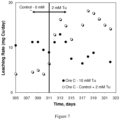
- a column leach of different acid-cured copper ores was conducted with thiourea added to the leach solution.
- a schematic description of the column setup is shown in Figure 3 .
- the column diameter was 8.84 cm
- the column height was 21.6 cm
- the column stack height was 15.9 cm.
- the irrigation rate was 0.77 mL/min or 8 L/m 2 /h.
- the pregnant leach solution emitted from these columns was sampled for copper every 2 or 3 days using Atomic Absorption Spectroscopy (AAS).
- AAS Atomic Absorption Spectroscopy
- the specific mineralogical composition of these ores are provided in Table 1.
- the Cu contents of Ore A, Ore B, and Ore C were 0.52%, 1.03%, and 1.22% w/w, respectively.
- Prior to leaching, ore was "acid cured" to neutralize the acid-consuming material present in the ore. That is, the ore was mixed with a concentrated sulfuric acid solution composed of 80% concentrated sulfuric acid and 20% de-ionized water and allowed to sit for 72 hours.
- thiourea was added to the sulfuric acid curing solutions.
- the initial composition of the leaching solutions included 2.2 g/L Fe (i.e. 40 mM, provided as ferric sulfate) and pH 2 for the control experiment, with or without 0.76 g/L thiourea (i.e. 10 mM).
- the initial load of mineral in each column was 1.6 to 1.8 kg of ore.
- the superficial velocity of solution through the ore column was 7.4 L m -2 h -1 .
- the pH was adjusted using diluted sulfuric acid.
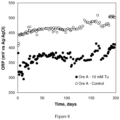
- Figure 8 shows the effect of Tu on solution potential. All potentials are reported against a Ag/AgCl (saturated) reference electrode.
- the solution potential of the leach solutions containing thiourea was generally between 75 and 100 mV lower than the solution potential of leach solution that did not include thiourea. Lower solution potentials are consistent with thiourea working to prevent the passivation of chalcopyrite.
- the ore Prior to leaching, the ore was cured using a procedure similar to what was performed on the ore used in the column leaching experiments.
- the ore was mixed with a concentrated sulfuric acid solution composed of 80% concentrated sulfuric acid and 20% de-ionized water and allowed to settle for 72 hours to neutralize the acid-consuming material present in the ore.
- a concentrated sulfuric acid solution composed of 80% concentrated sulfuric acid and 20% de-ionized water
- the bottles used for the experiments were 20 cm long and 12.5 cm in diameter. Each bottle was loaded with 180 g of cured ore and 420 g of leaching solution, filling up to around one third of the bottle's volume.
- the leaching solution from each bottle was sampled at 2, 4, 6 and 8 hours, and then every 24 hours thereafter. Samples were analyzed using atomic absorption spectroscopy (AAS) for their copper content.
- AAS atomic absorption spectroscopy
- solutions containing 100 mM thiourea did not appear to be much more effective on copper extraction than those containing no thiourea, and even worse at some time points. This is consistent with the results of Deschênes and Ghali, which reported that solutions containing ⁇ 200 mM thiourea (i.e. 15 g/L) did not improve copper extraction from chalcopyrite. Thiourea is less stable at high concentrations and decomposes. Accordingly, it is possible that, when initial thiourea concentrations are somewhat higher than 30 mM, sufficient elemental sulfur may be produced by decomposition of thiourea to form a film on the chalcopyrite mineral and thereby assist in its passivation. It is also possible that, at high Tu dosages, some copper precipitates from solution (e.g. see Figure 15 ) to account for some of the low extraction results.
- chalcopyrite 100% pure synthetic chalcopyrite was used instead of chalcopyrite concentrate which contains various impurities.
- the covellite mineral used in the experiment disclosed herein was also synthesized via a hydrothermal approach.
- CuCl and Tu were mixed with a molar ratio of 1: 1 and dissolved in 150 mL DI water.
- the solution was transferred to a Teflon-lined reaction vessel and heated up to 220°C for 24 hours.
- the synthesized CuS was acid-washed and dried in air. XRD analysis showed that it had 100% purity with no interference of other species.
- the chalcocite mineral sample used in the experiments disclosed herein was 100% pure natural mineral.
- the bornite mineral used in the experiments disclosed herein was obtained from Butte, Montana with copper content of 58.9% based on ICP-AES.
- XRD analysis showed that the mineral contains 76.8% bornite, 8.1% chalcopyrite, 6.3% pyrite, 5.8% tennatite and 3.0% enargite.
- the copper content calculated from XRD was 55.6%, which is relatively consistent with the chemical assay.
- the enargite mineral used in the experiments disclosed herein was in the form of an enargite concentrate, which contained approximately 70% enargite (34% copper) according to XRD analysis.
- the Greenockite mineral used in this experiment was synthesized via a hydrothermal approach.
- CdCl 2 and thiourea were mixed with a molar ratio of 1:1 and dissolved in 100 mL DI water.
- the solution was transferred to a Teflon-lined reaction vessel and heated up to 150°C for 24 hours.
- the synthesized CdS was acid-washed and dried in air. XRD analysis showed that it has 100% purity with no interference of other species.
- the violarite used in the experiments disclosed herein was natural violarite mineral that contains 15.8% Ni according to ICP-AES. XRD analysis showed that the mineral had approximately 42% violarite and 13.1% NiSO 4 .6H 2 O.
- the sulfur on thiocarbonyl groups contains a lone electron pair and a filled ⁇ -orbital which can be used for donor-acceptor type bonding with a transition metal, together with a ⁇ *-antibonding orbital that could potentially accept the back-donation of electrons from the filled d -orbitals on the transition metal. Accordingly, without wanting to be bound by theory, it is suspected that the interaction between the surface ion and the thiocarbonyl functional group, especially back donation from metal to ligand, is responsible for the catalytic effect. Moreover, it is suspected that the catalytic effect should be more pronounced for the transition metals with higher d-electron numbers, with the catalytic effect being most pronounced for minerals with d 10 electronic configuration
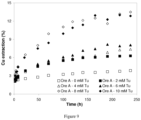
- FIG 11 shows that Tu catalyzes the leaching of common copper sulfide minerals, including chalcopyrite, covellite, chalcocite, and bornite, which all contain Cu(I).
- chalcopyrite extraction reaches 64.1% with 2 mM of Tu compared to 21.1% without Tu
- covellite extraction reaches 74.4% with 2 mM of Tu compared to 7.2% without Tu
- chalcocite extraction reaches 85.6% with 2 mM of Tu compared to 65.1% without Tu
- bornite extraction reaches 91.4% with 2 mM of Tu compared to 56.7% without Tu.
- Cd(II) also contains the d 10 electronic configuration.
- Figure 12 shows that leaching of CdS mineral is significantly enhanced with the addition of Tu. With Tu, the extraction of cadmium reaches 100% at 48 hours whereas extraction in the noncatalyzed reaction plateaued at 47% after 96 hours.
- the copper ion in the enargite mineral has fewer d-electrons than other primary and secondary sulfides, and thus it may be expected that the catalytic effect should be slower than that for Cu(I) minerals. Nevertheless, the results shown in Figure 13 clearly demonstrate that leaching with a leach solution comprising an initial concentration of 2 mM Tu increases the leach rate of copper from enargite compared to a control without Tu, which did not show any significant extraction after 96 hours of leaching.
- Optimum dosage of reagent may increase the efficiency of leaching.
- the reagent may form an insoluble complex with the metal ion of interest and precipitate.
- Tu can form an insoluble complex with Cu(I) ions at a 3:1 molar ratio.
- a precipitation test was performed to examine the concentration range at which Cu-Tu complex precipitation may occur. 20 mL of Cu solution was divided into several identical portions followed by the addition of various Tu dosage (i.e. 0 to 60 mM (examples with 0, 40, 50, and 60 mM Tu are not part of the claimed subject matter)). The solution was stirred for 24 hours, and the Cu remaining in the solution phase was analyzed by AAS. The results are shown in Figure 15 , plotted as the percentage of Cu remaining.
- heap leaching of metal sulfides is based on a bioleaching mechanism
- an excessive amount of reagent may be detrimental to bioleaching microbes.
- bacteria commonly used for bioleaching such as Acidithiobacillus ferrooxidans and Acidithiobacillus thiooxidans, have very slow growth in a solution containing 10 mM Tu, and cannot survive at 100 mM Tu (not part of the claimed subject matter).
- the initial 40 mM ferric sulfate solution can be considered as a sufficient supply of oxidant.
- extra ferric in 1:1 ratio with Tu
- 10 mM Tu an extra 10 mM of Fe 3+ was added at time zero.
- 20 mM Tu an extra 20 mM of Fe 3+ was added at 72 hours, which led to the continuation of extraction as shown in Figure 16 .
- the Tu dosage vs. Cu extraction at 172 hours is plotted in Figure 17 .
- An initial Tu dosage up to 5 mM appears to have the most pronounced effect on the dissolution of Cu.
- Figure 22 summarizes the results of further stirred reactor tests on chalcopyrite that additionally investigate urea and carbon disulfide. These results confirm that, as expected, neither urea nor carbon disulfide are effective reagents.
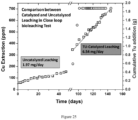
- a closed loop bioleach with Tu was conducted. 7 kg of ore contain approximately 0.25% Cu content, mainly in the form of CuFeS 2 was leached at a flow rate of 1 L / day at an aeration rate of approximately 300 mL / min.
- the ore was pre-treated with sulfuric acid to leach oxides (e.g. chalcanthite and basic copper salts) using sulfuric acid.
- oxides e.g. chalcanthite and basic copper salts
- the ferrous and nutrients solution was flushed through the column to establish a good habitat for bacterial growth. Inoculation of bacteria showed an increase in the ORP from 274 mV to 550 mV within 48 hours.
- the solution used in this step and future steps was kept circulating through the column, forming a self-sustaining closed-loop system.
- the remaining copper source is mainly CuFeS 2 .
- Tu was progressively added to the leaching solution.
- Tu is converted to FDS at a molar ratio of 2:1 in the presence of 40 mM Fe 3+ .
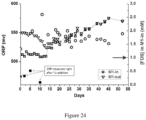
- Operating potential (ORP) was used as the indicator for bacterial activity, and HPLC was used to monitor FDS content.
- the leaching solution included 40 mM Fe 3+ with inoculated bacteria (with no Tu addition).
- a total of 1.878 g of Tu was progressively added, upon which the HPLC analysis on the effluent showed that the FDS was being maintained at approximately 1.5 mM, and no more Tu was added.
- the ORP of the effluent was always equal to or higher than the influent, indicating that bacteria were actively oxidizing Fe 2+ to Fe 3+ .
- the FDS contents were analyzed by HPLC, showing that approximately 1.5 mM of FDS (equivalent to 3 mM of Tu added) existing in the solution phase without any precipitation being observed. Therefore, it appears that 1.5 mM FDS (3 mM Tu equivalent) may be used in the solution without precipitation of ferric.
Landscapes
- Chemical & Material Sciences (AREA)
- Organic Chemistry (AREA)
- Engineering & Computer Science (AREA)
- Materials Engineering (AREA)
- Metallurgy (AREA)
- Manufacturing & Machinery (AREA)
- Mechanical Engineering (AREA)
- Inorganic Chemistry (AREA)
- Life Sciences & Earth Sciences (AREA)
- Geochemistry & Mineralogy (AREA)
- Geology (AREA)
- General Life Sciences & Earth Sciences (AREA)
- Environmental & Geological Engineering (AREA)
- Chemical Kinetics & Catalysis (AREA)
- Electrochemistry (AREA)
- General Chemical & Material Sciences (AREA)
- Microbiology (AREA)
- Biotechnology (AREA)
- Biochemistry (AREA)
- Manufacture And Refinement Of Metals (AREA)
- Inorganic Compounds Of Heavy Metals (AREA)
- Extraction Or Liquid Replacement (AREA)
- Processing Of Solid Wastes (AREA)
Claims (15)
- Utilisation d'un réactif pour extraire au moins un métal d'au moins un sulfure métallique dans un minerai dans une lixiviation au sulfate acide comprenant des ions ferriques, dans laquelle le réactif est :un réactif ayant un groupe fonctionnel thiocarbonyle à une concentration de 0,2 mM à 30 mM ; ou le disulfure de formamidine (FDS),dans laquelle l'au moins un métal comporte :du cuivre, dans laquelle l'au moins un sulfure métallique comporte de la chalcopyrite, de la covellite, de la bornite, de l'énargite, du sulfure de cuivre de formule CuxSy dans laquelle le rapport x:y est compris entre 1 et 2, ou une combinaison de ceux-ci ;du cadmium, dans laquelle l'au moins un sulfure métallique est la greenockite ;du nickel, dans laquelle l'au moins un sulfure métallique est la pentlandite, la violarite ou une combinaison de celles-ci ; ouune combinaison de ceux-ci.
- Procédé de récupération d'au moins un métal à partir d'au moins un sulfure métallique dans un minerai, le procédé comprenant :
la mise en contact du minerai avec :une solution de sulfate acide comprenant des ions ferriques et un réactif ayant un groupe fonctionnel thiocarbonyle, dans lequel la concentration initiale du réactif dans la solution de sulfate acide est comprise dans la plage de 0,2 mM à 30 mM ; ouune solution de sulfate acide comprenant des ions ferriques et du disulfure de formamidine (FDS), pour produire une solution riche contenant des ions métalliques ; etla récupération de l'au moins un métal à partir de la solution riche,dans lequel l'au moins un métal comporte :du cuivre, dans lequel l'au moins un sulfure métallique comporte de la chalcopyrite, de la covellite, de la bornite, de l'énargite, du sulfure de cuivre de formule CuxSy dans laquelle le rapport x:y est compris entre 1 et 2, ou une combinaison de ceux-ci ;du cadmium, dans lequel l'au moins un sulfure métallique est la greenockite ;du nickel, dans lequel l'au moins un sulfure métallique est la pentlandite, la violarite ou une combinaison de celles-ci ; ouune combinaison de ceux-ci. - Utilisation selon la revendication 1, ou procédé selon la revendication 2, dans laquelle/lequel le réactif est un réactif ayant un groupe fonctionnel thiocarbonyle, et la concentration initiale du réactif ayant un groupe fonctionnel thiocarbonyle dans la solution de sulfate acide est comprise dans la plage de 0,2 mM à 20 mM.
- Utilisation selon la revendication 1, ou procédé selon la revendication 2, dans laquelle/lequel le réactif est un réactif ayant un groupe fonctionnel thiocarbonyle, et la concentration initiale du réactif ayant un groupe fonctionnel thiocarbonyle dans la solution de sulfate acide est comprise dans la plage de 0,2 mM à 10 mM, de 0,2 mM à 5 mM, de 0,2 mM à 4 mM, de 0,2 mM à 3 mM, de 0,2 mM à 2 mM, de 0,2 mM à 1,5 mM, de 0,2 mM à 1,0 mM ou de 0,2 mM à 0,5 mM.
- Utilisation selon la revendication 1, ou procédé selon la revendication 2, dans laquelle/lequel le réactif est le FDS à une concentration initiale de FDS dans la solution de sulfate acide comprise dans la plage de 0,1 mM à 15 mM, de 0,1 mM à 10 mM, de 0,2 mM à 5 mM, de 0,1 mM à 2,5 mM, de 0,1 mM à 2 mM, de 0,1 mM à 1,5 mM, de 0,1 mM à 1,0 mM, de 0,1 mM à 0,5 mM ou de 0,1 mM à 0,25 mM.
- Utilisation selon l'une quelconque des revendications 1 ou 3 à 5, ou procédé selon l'une quelconque des revendications 2 à 5, dans laquelle/lequel le réactif est un réactif ayant un groupe fonctionnel thiocarbonyle, et le réactif ayant un groupe fonctionnel thiocarbonyle est la thiourée (Tu), le thioacétamide (TA), le diméthyldithiocarbamate de sodium (SDDC), le trithiocarbonate d'éthylène (ETC), le thiosemicarbazide (TSCA) ou une combinaison de ceux-ci.
- Utilisation selon l'une quelconque des revendications 1 ou 3 à 5, ou procédé selon l'une quelconque des revendications 2 à 5, dans laquelle/lequel le réactif est un réactif ayant un groupe fonctionnel thiocarbonyle, et le réactif ayant un groupe fonctionnel thiocarbonyle est la thiourée (Tu).
- Utilisation selon l'une quelconque des revendications 1 ou 3 à 5, ou procédé selon l'une quelconque des revendications 2 à 5, dans laquelle/lequel le réactif est un réactif ayant un groupe fonctionnel thiocarbonyle, et le réactif ayant un groupe fonctionnel thiocarbonyle est des thiourées N,N'-substituées ; la 2,5-dithiobiurée ; le dithiobiuret ; le thiosemicarbazide purum ; le thiosemicarbazide ; le thioacétamide ; le 2-méthyl-3-thiosemicarbazide ; le 4-méthyl-3-thiosemicarbazide ; le trithiocarbonate de vinylène purum ; le trithiocarbonate de vinylène ; le 2-cyanothioacétamide ; le trithiocarbonate d'éthylène ; l'éthylxanthogénate de potassium ; le chlorure de diméthylthiocarbamoyle ; le dithiocarbamate de diméthyle ; le trithiocarbonate de diméthyle ; le N,N-diméthylthioformamide ; le 4,4-diméthyl-3-thiosemicarbazide ; le 4-éthyl-3-thiosemicarbazide ; l'acide O-isopropylxanthique ; le thiooxamate d'éthyle ; le dithioacétate d'éthyle ; le pyrazine-2-thiocarboxamide ; le chlorure de diéthylthiocarbamoyle ; le dithiocarbamate de diéthyle ; le monosulfure de tétraméthylthiuram ; le disulfure de tétraméthylthiuram ; le chlorothionoformiate de pentafluorophényle ; le chlorothionoformiate de 4-fluorophényle ; le chlorothionoformiate d'O-phényle ; le chlorodithioformiate de phényle ; le 3,4-difluorothiobenzamide ; le 2-bromothiobenzamide ; le 3-bromothiobenzamide ; le 4-bromothiobenzamide ; le 4-chlorothiobenzamide ; le 4-fluorothiobenzamide ; l'acide thiobenzoïque ; le thiobenzamide ; le 4-phénylthiosemicarbazide ; le chlorothionoformiate d'O-(p-Tolyle) ; le 4-bromo-2-méthylthiobenzamide ; le 3-méthoxythiobenzamide ; le 4-méthoxythiobenzamide ; le 4-méthylbenzènethioamide ; le thioacétanilide ; la salicylaldéhyde-thiosemicarbazone ; l'indole-3-thiocarboxamide ; l'acide S-(thiobenzoyl)thioglycolique ; le 3-(acétoxy)thiobenzamide ; le 4-(acétoxy)thiobenzamide ; le N'-[(e)-(4-chlorophényl)méthylidène]hydrazonothiocarbamate de méthyle ; le 3-éthoxythiobenzamide ; le 4-éthylbenzène-1-thiocarboxamide ; l'acide diéthyldithiocarbamique ; l'acide 2-(phénylcarbonothioylthio)propanoïque ; la 2- hydroxybenzaldéhyde-N-éthylthiosemicarbazone ; la (1R,4R)-1,7,7-triméthylbicyclo[2.2.1]heptane-2-thione ; le disulfure de tétraéthylthiuram ; le 4'-hydroxybiphényl-4-thiocarboxamide ; le 4-biphénylthioamide ; la dithizone ; le 4'-méthylbiphényl-4-thiocarboxamide ; le disulfure de tétraisopropylthiuram ; l'anthracène-9-thiocarboxamide ; le phénanthrène-9-thiocarboxamide ; le bibenzyldithiocarbamate de sodium ; ou la 4,4'-bis(diméthylamino)thiobenzophénone.
- Utilisation selon l'une quelconque des revendications 1 ou 3 à 8, ou procédé selon l'une quelconque des revendications 2 à 8, dans laquelle/lequel l'au moins un métal comporte du cuivre, dans laquelle/lequel l'au moins un sulfure métallique comporte de la chalcopyrite, de la covellite, de la bornite, de l'énargite, du sulfure de cuivre de formule CuxSy dans laquelle le rapport x:y est compris entre 1 et 2, ou une combinaison de ceux-ci.
- Utilisation ou procédé selon la revendication 9, dans laquelle/lequel l'au moins un sulfure métallique comporte de la chalcopyrite ou de l'énargite.
- Utilisation selon l'une quelconque des revendications 1 ou 3 à 10, ou procédé selon l'une quelconque des revendications 2 à 10, dans laquelle/lequel l'au moins un métal comporte du cadmium, dans laquelle/lequel l'au moins un sulfure métallique comporte de la greenockite.
- Utilisation selon l'une quelconque des revendications 1 ou 3 à 11, ou procédé selon l'une quelconque des revendications 2 à 11, dans laquelle/lequel l'au moins un métal comporte du nickel, dans laquelle/lequel l'au moins un sulfure métallique comporte de la pentlandite, de la violarite ou une combinaison de celles-ci.
- Utilisation selon l'une quelconque des revendications 1 ou 3 à 12, ou procédé selon l'une quelconque des revendications 2 à 12, dans laquelle/lequel le procédé est une lixiviation par percolation, telle qu'une lixiviation en tas ou une lixiviation en bac, ou dans laquelle/lequel le procédé est une lixiviation en cuve.
- Utilisation selon l'une quelconque des revendications 1 ou 3 à 13, dans laquelle la lixiviation au sulfate acide comprend du sulfate ferrique.
- Procédé selon l'une quelconque des revendications 1 et 3 à 13, dans lequel la solution de sulfate acide comprend du sulfate ferrique.
Priority Applications (1)
| Application Number | Priority Date | Filing Date | Title |
|---|---|---|---|
| EP24179686.1A EP4461833A1 (fr) | 2015-04-17 | 2016-04-15 | Procédé de lixiviation de sulfures métalliques au moyen de réactifs possédant des groupes fonctionnels thiocarbonyle |
Applications Claiming Priority (2)
| Application Number | Priority Date | Filing Date | Title |
|---|---|---|---|
| US201562149015P | 2015-04-17 | 2015-04-17 | |
| PCT/CA2016/050444 WO2016165027A1 (fr) | 2015-04-17 | 2016-04-15 | Procédé de lixiviation de sulfures métalliques au moyen de réactifs possédant des groupes fonctionnels thiocarbonyle |
Related Child Applications (1)
| Application Number | Title | Priority Date | Filing Date |
|---|---|---|---|
| EP24179686.1A Division EP4461833A1 (fr) | 2015-04-17 | 2016-04-15 | Procédé de lixiviation de sulfures métalliques au moyen de réactifs possédant des groupes fonctionnels thiocarbonyle |
Publications (3)
| Publication Number | Publication Date |
|---|---|
| EP3283661A1 EP3283661A1 (fr) | 2018-02-21 |
| EP3283661A4 EP3283661A4 (fr) | 2018-10-17 |
| EP3283661B1 true EP3283661B1 (fr) | 2024-06-05 |
Family
ID=57125622
Family Applications (2)
| Application Number | Title | Priority Date | Filing Date |
|---|---|---|---|
| EP16779376.9A Active EP3283661B1 (fr) | 2015-04-17 | 2016-04-15 | Procédé de lixiviation de sulfures métalliques au moyen de réactifs possédant des groupes fonctionnels thiocarbonyle |
| EP24179686.1A Pending EP4461833A1 (fr) | 2015-04-17 | 2016-04-15 | Procédé de lixiviation de sulfures métalliques au moyen de réactifs possédant des groupes fonctionnels thiocarbonyle |
Family Applications After (1)
| Application Number | Title | Priority Date | Filing Date |
|---|---|---|---|
| EP24179686.1A Pending EP4461833A1 (fr) | 2015-04-17 | 2016-04-15 | Procédé de lixiviation de sulfures métalliques au moyen de réactifs possédant des groupes fonctionnels thiocarbonyle |
Country Status (17)
| Country | Link |
|---|---|
| US (14) | US10961604B2 (fr) |
| EP (2) | EP3283661B1 (fr) |
| JP (3) | JP6431213B2 (fr) |
| CN (2) | CN111850294A (fr) |
| AR (1) | AR104304A1 (fr) |
| AU (4) | AU2016250309B2 (fr) |
| BR (1) | BR112017022091B1 (fr) |
| CA (1) | CA2973612C (fr) |
| CL (3) | CL2017002632A1 (fr) |
| EA (1) | EA201792285A1 (fr) |
| EC (1) | ECSP17068938A (fr) |
| ES (1) | ES2986429T3 (fr) |
| MX (2) | MX373981B (fr) |
| PE (3) | PE20251305A1 (fr) |
| PH (1) | PH12017501886A1 (fr) |
| PL (1) | PL3283661T3 (fr) |
| WO (1) | WO2016165027A1 (fr) |
Families Citing this family (20)
| Publication number | Priority date | Publication date | Assignee | Title |
|---|---|---|---|---|
| WO2016165027A1 (fr) | 2015-04-17 | 2016-10-20 | University Of British Columbia | Procédé de lixiviation de sulfures métalliques au moyen de réactifs possédant des groupes fonctionnels thiocarbonyle |
| EP3529387A4 (fr) | 2016-10-19 | 2020-06-10 | The University of British Columbia | Procédé de lixiviation de sulfures métalliques au moyen de réactifs possédant des groupes fonctionnels thiocarbonyle |
| AU2018248023C1 (en) * | 2017-04-06 | 2025-04-17 | Technological Resources Pty. Limited | Leaching copper-containing ores |
| CN109929996B (zh) * | 2017-12-19 | 2020-12-08 | 有研工程技术研究院有限公司 | 高铁低品位硫化镍矿选择性生物浸出工艺 |
| KR102023344B1 (ko) * | 2018-01-25 | 2019-09-20 | 울산대학교 산학협력단 | 선택적 구리 이온의 검출 및 분리가 가능한 고분자 기반 색센서 |
| IT201800009093A1 (it) * | 2018-10-02 | 2020-04-02 | Universita' Degli Studi Di Cagliari | Metodo per il recupero di palladio |
| CA3130430C (fr) | 2020-09-18 | 2024-02-06 | The University Of British Columbia | Extraction de metaux de base au moyen d'une matiere carbonee et d'un reactif du groupe fonctionnel thiocarbonyl |
| AU2021345381A1 (en) * | 2020-09-18 | 2023-05-04 | Jetti Resources, Llc | Extracting base metals using a wetting agent and a thiocarbonyl functional group reagent |
| WO2022067448A1 (fr) * | 2020-10-02 | 2022-04-07 | Excir Works Corp. | Procédé d'extraction de métaux de monnaie |
| KR20230125253A (ko) * | 2020-12-30 | 2023-08-29 | 더 트러스티스 오브 콜롬비아 유니버시티 인 더 시티 오브 뉴욕 | 구리의 습식 제련 추출을 가능하게 하는 수성 상 환원제에의한 황동석의 환원 |
| CA3160449C (fr) * | 2021-05-17 | 2025-04-08 | Jetti Resources, Llc | Procédés de libération de métaux précieux au moyen d’un réactif comportant un groupe fonctionnel thiocarbonyle |
| CN113968806A (zh) * | 2021-10-12 | 2022-01-25 | 北京科技大学 | 一种非对称硫代酰胺类萃取剂及其合成方法 |
| CN115287453A (zh) * | 2022-06-29 | 2022-11-04 | 中南大学 | 一种浮选捕收剂强化黄铜矿生物浸出的方法 |
| WO2024137042A1 (fr) * | 2022-12-23 | 2024-06-27 | Basf Se | Compositions pour la lixiviation de matériaux contenant du sulfure métallique et leurs procédés de préparation et d'utilisation |
| CN115806296B (zh) * | 2022-12-30 | 2023-10-17 | 遂川县磊鑫矿业有限公司 | 一种普通石英砂原料连续制备高纯度石英砂的生产方法 |
| US20240254590A1 (en) * | 2023-01-24 | 2024-08-01 | Jetti Resources, Llc | Method of metal recovery with cosolvent |
| US20250034454A1 (en) * | 2023-07-27 | 2025-01-30 | Solenis Technologies, L.P. | Dispersion of metal sulfates in acidic leaching solution |
| US20250146101A1 (en) * | 2023-11-03 | 2025-05-08 | Allonnia, Llc | Selective solubilization of gangue from nickel sulfides using biosolvents |
| WO2025123053A1 (fr) * | 2023-12-09 | 2025-06-12 | Massachusetts Institute Of Technology | Systèmes et procédés d'extraction de ressources à partir de charges d'alimentation riches en fer |
| WO2025129330A1 (fr) * | 2023-12-19 | 2025-06-26 | Universite Laval | Lixiviation par complexation de cuivre et de nickel provenant de ressources de minéraux sulfureux de qualité inférieure avec minéralisation de co2 |
Family Cites Families (79)
| Publication number | Priority date | Publication date | Assignee | Title |
|---|---|---|---|---|
| US1636463A (en) * | 1922-08-08 | 1927-07-19 | Dezeng Standard Company | Otoscope |
| US2716600A (en) | 1950-08-29 | 1955-08-30 | Anaconda Copper Mining Co | Method of recovering copper from sulfidic copper ore |
| US2902345A (en) | 1954-11-22 | 1959-09-01 | Freeport Sulphur Co | Separate recovery of nickel and cobalt from mixed compounds containing the same |
| US3679397A (en) | 1969-12-29 | 1972-07-25 | Regents New Mexico Inst Of Min | Bacterial leaching process |
| US3884831A (en) | 1971-04-05 | 1975-05-20 | Stanley H Bloom | Catalyst system and method for improving the leaching of elements such as copper from their ores using the catalyst system |
| US3761566A (en) | 1971-09-13 | 1973-09-25 | American Metal Climax Inc | Leaching of nickel lateritic ores with waste iron sulfate solutions |
| DE2501184C2 (de) | 1975-06-18 | 1977-02-10 | Meixner Michael J Dr Ing | Verfahren zur gewinnung von kupfer |
| GB1565200A (en) | 1976-01-06 | 1980-04-16 | Post Office | Switching circuit |
| ZA84929B (en) | 1983-02-22 | 1984-09-26 | Sueddeutsche Kalkstickstoff | Hydrometallurgical recovery of noble metals using thiourea |
| US4556483A (en) | 1984-08-17 | 1985-12-03 | American Cyanamid Company | Neutral hydrocarboxycarbonyl thiourea sulfide collectors |
| GB2180829B (en) * | 1985-09-20 | 1989-08-16 | Aurotech N L | Precious metal extraction |
| CA1306613C (fr) * | 1987-05-15 | 1992-08-25 | Guy Deschenes | Methode de recuperation de l'or et de l'argent contenus dans des solutions aqueuses |
| US5104445A (en) | 1987-07-31 | 1992-04-14 | Chevron Research & Technology Co. | Process for recovering metals from refractory ores |
| SU1636463A1 (ru) | 1988-06-06 | 1991-03-23 | Балхашский Горно-Металлургический Комбинат | Способ обезмеживани медеэлектролитного шлама |
| CA2023119A1 (fr) | 1989-08-15 | 1991-02-16 | Richard O. Shafsky | Extraction de metaux nobles a l'aide de thio-uree |
| NZ237011A (en) * | 1990-02-23 | 1992-06-25 | Cra Services | Extraction and recovery of gold by treatment with an acidic lixiviant solution |
| JPH0913127A (ja) * | 1991-04-02 | 1997-01-14 | Manabu Kitasaka | 金含有物から金を回収する方法と装置 |
| US5332559A (en) | 1991-07-10 | 1994-07-26 | Newmont Gold Co. | Biooxidation process for recovery of metal values from sulphur-containing ore materials |
| US5207996A (en) | 1991-10-10 | 1993-05-04 | Minnesota Mining And Manufacturing Company | Acid leaching of copper ore heap with fluoroaliphatic surfactant |
| CN1035683C (zh) * | 1992-07-21 | 1997-08-20 | 西安冶金建筑学院 | 用硫脲提取金、银的方法 |
| CN1027765C (zh) | 1992-07-23 | 1995-03-01 | 北方交通大学 | 提高电刷镀构件疲劳寿命的方法 |
| WO1995015403A1 (fr) | 1993-12-03 | 1995-06-08 | Geobiotics, Inc. | Bio-oxydation de pyrites refractaires |
| US5795465A (en) | 1994-07-15 | 1998-08-18 | Coproco Development Corporation | Process for recovering copper from copper-containing material |
| JPH09131127A (ja) | 1995-11-10 | 1997-05-20 | Chichibu Onoda Cement Corp | 緑化用構築物及びその施工方法 |
| US5622615A (en) * | 1996-01-04 | 1997-04-22 | The University Of British Columbia | Process for electrowinning of copper matte |
| WO1998008585A1 (fr) * | 1996-08-26 | 1998-03-05 | Geochem Technologies, Inc. | Lixiviation de mineraux chalcogenes metalliques (de type sulfure) au moyen d'agents oxydants et chelateurs |
| WO1998014623A1 (fr) | 1996-10-02 | 1998-04-09 | International Curator Resources Limited | Extraction hydrometallurgique de cuivre, de zinc et de cobalt a partir de minerais contenant du dioxyde de manganese |
| US5989311A (en) | 1997-07-28 | 1999-11-23 | South Dakota School Of Mines And Technology | Recovery of copper from its sulfides and other sources using halogen reagents and oxidants |
| AUPP543798A0 (en) | 1998-08-24 | 1998-09-17 | Technological Resources Pty Limited | Hydrometallurgical extraction of copper and other valuable metals |
| GB2349876B (en) * | 1999-05-10 | 2003-03-05 | Rio Tinto Technology Dev Ltd | Process for the Recovery of Noble Metals |
| DE19960132A1 (de) * | 1999-12-14 | 2001-06-21 | Alexander Beckmann | Verfahren zur Gewinnung von Kupfer und anderen Metallen |
| AU2002246310A1 (en) | 2002-03-26 | 2003-10-08 | Council Of Scientific And Industrial Research | Process for the recovery of gold and silver from used refractory bricks |
| US20060193762A1 (en) * | 2002-09-27 | 2006-08-31 | Manoranjan Misra | Catalyzed dissolution of copper from sulfur-containing copper minerals |
| CA2405649C (fr) | 2002-09-27 | 2006-05-16 | E.Qu.I.P. International Inc. | Composition de fabrication de papier contenant un sequestrant a base de polymere cationique sans solvant, combine a une resine phenolique et a de l'oxyde de polyethylene |
| US7722840B2 (en) | 2002-11-15 | 2010-05-25 | Placer Dome Technical Services Limited | Method for thiosulfate leaching of precious metal-containing materials |
| US7285256B2 (en) | 2003-04-04 | 2007-10-23 | Newmont Usa Limited | Precious metal recovery using thiocyanate lixiviant |
| MXPA03006955A (es) | 2003-08-04 | 2005-02-09 | Univ Autonoma Metropolitana | Proceso de lixiviacion y recuperacion de plata y oro con soluciones de tiourea electro-oxidada. |
| DE102004036602A1 (de) | 2004-07-28 | 2006-03-23 | Degussa Ag | Hochgefüllte, wässerige Metalloxid-Dispersion |
| FI117389B (fi) | 2004-12-28 | 2006-09-29 | Outokumpu Oy | Menetelmä useampia arvometalleja sisältävän sulfidirikasteen hydrometallurgiseksi käsittelemiseksi |
| DE102005006982A1 (de) | 2005-02-15 | 2006-08-17 | Basf Ag | Verwendung nichtionischer Tenside bei der Metallgewinnung durch Elektrolyse |
| RU2342446C2 (ru) * | 2005-04-18 | 2008-12-27 | Общество с ограниченной ответственностью "Уральская гео-технологическая компания" | Способ извлечения цветных и благородных металлов, преимущественно меди и золота, из пиритных огарков |
| FI117941B (fi) * | 2005-10-13 | 2007-04-30 | Outokumpu Technology Oyj | Menetelmä metallisulfidimineraalien liuottamiseksi |
| JP5052834B2 (ja) | 2006-07-27 | 2012-10-17 | Jx日鉱日石金属株式会社 | 黄銅鉱を含有する硫化銅鉱の浸出方法 |
| WO2008059770A1 (fr) | 2006-11-15 | 2008-05-22 | Semiconductor Energy Laboratory Co., Ltd. | Procédé destiné à recueillir du métal |
| CN100460532C (zh) | 2007-04-16 | 2009-02-11 | 中南大学 | 一种原生硫化矿细菌浸出制备高纯铜的方法 |
| US8025859B2 (en) | 2007-05-18 | 2011-09-27 | Cesl Limited | Process for gold and silver recovery from a sulphide concentrate |
| US7964015B2 (en) | 2007-05-23 | 2011-06-21 | Contact Marketing Solutions, Llc | Metal extraction without cyanide |
| MX2008003249A (es) | 2008-03-07 | 2009-09-07 | Univ Autonoma Metropolitana | Mejora al proceso de lixiviacion y recuperacion de plata y oro con soluciones de tiourea electro-oxidada. |
| JP4565025B2 (ja) | 2008-07-23 | 2010-10-20 | 日鉱金属株式会社 | ヨウ素を用いた硫化銅鉱の浸出方法 |
| WO2010011552A2 (fr) | 2008-07-25 | 2010-01-28 | Cytec Technology Corp. | Réactifs de flottation, et processus de flottation utilisant ceux-ci |
| WO2010037169A1 (fr) | 2008-10-01 | 2010-04-08 | The University Of Queensland | Procédé pour l’extraction de matériau minier |
| JP2010180450A (ja) | 2009-02-05 | 2010-08-19 | Sumitomo Metal Mining Co Ltd | 硫化銅鉱物からの金の濃縮方法 |
| US8052774B2 (en) * | 2009-03-31 | 2011-11-08 | Sumitomo Metal Mining Co., Ltd. | Method for concentration of gold in copper sulfide minerals |
| JP4950257B2 (ja) | 2009-08-24 | 2012-06-13 | Jx日鉱日石金属株式会社 | 硫化銅鉱からの銅の積層体浸出方法 |
| JP2011161386A (ja) | 2010-02-10 | 2011-08-25 | Akita Univ | チオ亜ヒ酸塩の処理方法 |
| CN101818258B (zh) | 2010-05-10 | 2011-07-06 | 梁伟基 | 一种混合浸出剂快速浸出金银的方法 |
| AU2011255908B2 (en) | 2010-05-19 | 2014-06-12 | Jx Nippon Mining & Metals Corporation | Method for processing acidic solution that contains iodide ions and iron ions |
| CL2010001399A1 (es) * | 2010-12-10 | 2012-04-20 | Prokumet Spa | Procedimiento para lixiviar oxido de cobre sin usar acido sulfurico que comprende impregnar el oxido de cobre con agente lixiviante organico no contaminante de acido tricarboxilico (c6h8o7) y agua con ph 1,0 a 5,0, opcionalmente volver a lixiviar y obtener citrato de cobre concentrado. |
| MX2010013713A (es) | 2010-12-13 | 2012-06-13 | Univ Autonoma Metropolitana | Medio para la lixiviacion de cobre de minerales refractarios. |
| JP5533700B2 (ja) | 2011-01-27 | 2014-06-25 | 住友金属鉱山株式会社 | 有価金属の浸出方法及びこの浸出方法を用いた有価金属の回収方法 |
| JP5319718B2 (ja) | 2011-03-04 | 2013-10-16 | Jx日鉱日石金属株式会社 | 硫化鉱からの銅及び金の浸出方法 |
| JP5889059B2 (ja) | 2011-04-04 | 2016-03-22 | アークレイ株式会社 | 金属の回収方法 |
| CA2843791C (fr) | 2011-08-15 | 2017-03-14 | Her Majesty The Queen In Right Of Canada As Represented By The Minister Of Natural Resources Canada | Procede de lixiviation de metaux precieux |
| WO2014150710A1 (fr) | 2013-03-15 | 2014-09-25 | Freeport-Mcmoran Corporation | Système et procédé de récupération de métaux précieux à partir de matières métallifères par lixiviation |
| US10041143B2 (en) | 2013-10-23 | 2018-08-07 | Bhp Chile Inc. | Heap leaching of copper |
| CN103789546B (zh) | 2014-01-28 | 2016-01-20 | 中国有色桂林矿产地质研究院有限公司 | 一种硫脲浸金的方法 |
| CN103993171B (zh) | 2014-05-14 | 2015-11-04 | 东北大学 | 一种添加非离子表面活性剂促进黄铜矿生物浸出的方法 |
| CL2014002238A1 (es) * | 2014-08-22 | 2014-10-17 | Compañia Minera Zaldivar Limitada | Lixiviación de sulfuros de cobre en medio cloruro-ferroso con bacterias |
| CA2912940C (fr) | 2014-11-26 | 2021-09-14 | Keith Stuart Liddell | Procede de traitement destine a l'extraction de matieres precieuses, de matiere de base et d'elements de terres rares |
| EP3268501A4 (fr) | 2015-03-11 | 2018-10-17 | Curtin University | Procédé pour la récupération sélective d'éléments du groupe des chalcophiles |
| CA2981829C (fr) | 2015-04-08 | 2023-10-10 | Ecolab Usa Inc. | Aide a la lixiviation pour la recuperation de metaux |
| WO2016165027A1 (fr) | 2015-04-17 | 2016-10-20 | University Of British Columbia | Procédé de lixiviation de sulfures métalliques au moyen de réactifs possédant des groupes fonctionnels thiocarbonyle |
| AU2016369257B2 (en) | 2015-12-07 | 2022-05-26 | Basf Se | Leaching aids and methods of using leaching aids |
| CL2016001188A1 (es) | 2016-05-18 | 2017-02-24 | Antofagasta Minerales S A | Procedimiento para el mejoramiento de procesos de lixiviación de cobre utilizando cloruro de calcio |
| EP3529387A4 (fr) | 2016-10-19 | 2020-06-10 | The University of British Columbia | Procédé de lixiviation de sulfures métalliques au moyen de réactifs possédant des groupes fonctionnels thiocarbonyle |
| US10604821B2 (en) | 2017-01-05 | 2020-03-31 | Ethox Chemicals, Llc | Process for recovering precious metals from clay-containing ores |
| US20180223392A1 (en) | 2017-02-09 | 2018-08-09 | Lixivia, Inc. | Compositions and methods for recovery of alkaline metals |
| EP3862707B1 (fr) | 2018-10-02 | 2025-07-23 | LG Electronics Inc. | Réfrigérateur et son procédé de commande |
| CN110860277A (zh) | 2019-12-09 | 2020-03-06 | 天津工业大学 | 一种氨基二乙酸改性纤维提取稀土金属的方法 |
-
2016
- 2016-04-15 WO PCT/CA2016/050444 patent/WO2016165027A1/fr not_active Ceased
- 2016-04-15 EP EP16779376.9A patent/EP3283661B1/fr active Active
- 2016-04-15 PE PE2024003077A patent/PE20251305A1/es unknown
- 2016-04-15 CN CN202010406265.7A patent/CN111850294A/zh active Pending
- 2016-04-15 ES ES16779376T patent/ES2986429T3/es active Active
- 2016-04-15 EP EP24179686.1A patent/EP4461833A1/fr active Pending
- 2016-04-15 BR BR112017022091-1A patent/BR112017022091B1/pt active IP Right Grant
- 2016-04-15 PL PL16779376.9T patent/PL3283661T3/pl unknown
- 2016-04-15 MX MX2017013312A patent/MX373981B/es active IP Right Grant
- 2016-04-15 US US15/566,684 patent/US10961604B2/en active Active
- 2016-04-15 PE PE2017001988A patent/PE20180472A1/es unknown
- 2016-04-15 EA EA201792285A patent/EA201792285A1/ru unknown
- 2016-04-15 CN CN201680022436.8A patent/CN107532229B/zh active Active
- 2016-04-15 PE PE2020000627A patent/PE20200914A1/es unknown
- 2016-04-15 AU AU2016250309A patent/AU2016250309B2/en active Active
- 2016-04-15 JP JP2017555583A patent/JP6431213B2/ja active Active
- 2016-04-15 CA CA2973612A patent/CA2973612C/fr active Active
- 2016-04-18 AR ARP160101055A patent/AR104304A1/es active IP Right Grant
-
2017
- 2017-10-16 MX MX2020006857A patent/MX2020006857A/es unknown
- 2017-10-17 CL CL2017002632A patent/CL2017002632A1/es unknown
- 2017-10-17 EC ECIEPI201768938A patent/ECSP17068938A/es unknown
- 2017-10-18 PH PH12017501886A patent/PH12017501886A1/en unknown
-
2018
- 2018-10-12 AU AU2018247307A patent/AU2018247307C1/en active Active
- 2018-11-01 JP JP2018206496A patent/JP6801888B2/ja active Active
-
2019
- 2019-07-25 CL CL2019002080A patent/CL2019002080A1/es unknown
-
2020
- 2020-01-03 CL CL2020000013A patent/CL2020000013A1/es unknown
- 2020-01-15 US US16/744,041 patent/US10781502B2/en active Active
- 2020-01-15 US US16/743,982 patent/US10876186B2/en active Active
- 2020-01-15 US US16/743,635 patent/US10954583B2/en active Active
- 2020-01-15 US US16/743,675 patent/US10865460B2/en active Active
- 2020-01-15 US US16/744,012 patent/US10876187B2/en active Active
- 2020-01-15 US US16/743,949 patent/US10870903B2/en active Active
- 2020-01-16 US US16/744,831 patent/US12049680B2/en active Active
- 2020-01-21 US US16/748,557 patent/US12049681B2/en active Active
- 2020-01-21 US US16/748,553 patent/US11884993B2/en active Active
- 2020-02-07 AU AU2020200918A patent/AU2020200918B2/en active Active
- 2020-06-12 JP JP2020102585A patent/JP7044404B2/ja active Active
-
2021
- 2021-01-04 US US17/140,943 patent/US20210198767A1/en active Pending
- 2021-06-23 AU AU2021204246A patent/AU2021204246B2/en active Active
-
2023
- 2023-12-28 US US18/399,240 patent/US20240141456A1/en active Pending
-
2024
- 2024-06-14 US US18/744,443 patent/US20240336990A1/en active Pending
- 2024-06-14 US US18/744,522 patent/US20240336991A1/en active Pending
Also Published As
Similar Documents
| Publication | Publication Date | Title |
|---|---|---|
| US20240141456A1 (en) | Process for leaching metal sulfides with reagents having thiocarbonyl functional groups | |
| AU2022218577B2 (en) | Process for leaching metal sulfides with reagents having thiocarbonyl functional groups | |
| EA047833B1 (ru) | Способ выщелачивания сульфидов металлов реагентами, имеющими тиокарбонильные функциональные группы |
Legal Events
| Date | Code | Title | Description |
|---|---|---|---|
| STAA | Information on the status of an ep patent application or granted ep patent |
Free format text: STATUS: THE INTERNATIONAL PUBLICATION HAS BEEN MADE |
|
| PUAI | Public reference made under article 153(3) epc to a published international application that has entered the european phase |
Free format text: ORIGINAL CODE: 0009012 |
|
| STAA | Information on the status of an ep patent application or granted ep patent |
Free format text: STATUS: REQUEST FOR EXAMINATION WAS MADE |
|
| 17P | Request for examination filed |
Effective date: 20171117 |
|
| AK | Designated contracting states |
Kind code of ref document: A1 Designated state(s): AL AT BE BG CH CY CZ DE DK EE ES FI FR GB GR HR HU IE IS IT LI LT LU LV MC MK MT NL NO PL PT RO RS SE SI SK SM TR |
|
| AX | Request for extension of the european patent |
Extension state: BA ME |
|
| DAV | Request for validation of the european patent (deleted) | ||
| DAX | Request for extension of the european patent (deleted) | ||
| A4 | Supplementary search report drawn up and despatched |
Effective date: 20180913 |
|
| RIC1 | Information provided on ipc code assigned before grant |
Ipc: C22B 3/42 20060101ALI20180907BHEP Ipc: C01G 49/00 20060101ALI20180907BHEP Ipc: C01G 49/14 20060101ALI20180907BHEP Ipc: C22B 17/00 20060101ALI20180907BHEP Ipc: C22B 3/08 20060101ALI20180907BHEP Ipc: C22B 3/00 20060101ALI20180907BHEP Ipc: C25C 1/12 20060101ALI20180907BHEP Ipc: C01G 11/00 20060101ALI20180907BHEP Ipc: C01G 3/00 20060101ALI20180907BHEP Ipc: C22B 23/00 20060101ALI20180907BHEP Ipc: C22B 15/00 20060101ALI20180907BHEP Ipc: C01G 3/10 20060101ALI20180907BHEP Ipc: C22B 3/20 20060101AFI20180907BHEP Ipc: C01G 53/10 20060101ALI20180907BHEP Ipc: C01G 1/00 20060101ALI20180907BHEP |
|
| STAA | Information on the status of an ep patent application or granted ep patent |
Free format text: STATUS: EXAMINATION IS IN PROGRESS |
|
| 17Q | First examination report despatched |
Effective date: 20190911 |
|
| RAP1 | Party data changed (applicant data changed or rights of an application transferred) |
Owner name: JETTI RESOURCES, LLC |
|
| P01 | Opt-out of the competence of the unified patent court (upc) registered |
Effective date: 20230516 |
|
| GRAP | Despatch of communication of intention to grant a patent |
Free format text: ORIGINAL CODE: EPIDOSNIGR1 |
|
| STAA | Information on the status of an ep patent application or granted ep patent |
Free format text: STATUS: GRANT OF PATENT IS INTENDED |
|
| INTG | Intention to grant announced |
Effective date: 20231128 |
|
| GRAS | Grant fee paid |
Free format text: ORIGINAL CODE: EPIDOSNIGR3 |
|
| GRAA | (expected) grant |
Free format text: ORIGINAL CODE: 0009210 |
|
| STAA | Information on the status of an ep patent application or granted ep patent |
Free format text: STATUS: THE PATENT HAS BEEN GRANTED |
|
| AK | Designated contracting states |
Kind code of ref document: B1 Designated state(s): AL AT BE BG CH CY CZ DE DK EE ES FI FR GB GR HR HU IE IS IT LI LT LU LV MC MK MT NL NO PL PT RO RS SE SI SK SM TR |
|
| REG | Reference to a national code |
Ref country code: GB Ref legal event code: FG4D |
|
| REG | Reference to a national code |
Ref country code: CH Ref legal event code: EP |
|
| REG | Reference to a national code |
Ref country code: DE Ref legal event code: R096 Ref document number: 602016087857 Country of ref document: DE |
|
| REG | Reference to a national code |
Ref country code: IE Ref legal event code: FG4D |
|
| REG | Reference to a national code |
Ref country code: LT Ref legal event code: MG9D |
|
| REG | Reference to a national code |
Ref country code: NL Ref legal event code: MP Effective date: 20240605 |
|
| PG25 | Lapsed in a contracting state [announced via postgrant information from national office to epo] |
Ref country code: FI Free format text: LAPSE BECAUSE OF FAILURE TO SUBMIT A TRANSLATION OF THE DESCRIPTION OR TO PAY THE FEE WITHIN THE PRESCRIBED TIME-LIMIT Effective date: 20240605 Ref country code: HR Free format text: LAPSE BECAUSE OF FAILURE TO SUBMIT A TRANSLATION OF THE DESCRIPTION OR TO PAY THE FEE WITHIN THE PRESCRIBED TIME-LIMIT Effective date: 20240605 |
|
| PG25 | Lapsed in a contracting state [announced via postgrant information from national office to epo] |
Ref country code: GR Free format text: LAPSE BECAUSE OF FAILURE TO SUBMIT A TRANSLATION OF THE DESCRIPTION OR TO PAY THE FEE WITHIN THE PRESCRIBED TIME-LIMIT Effective date: 20240906 |
|
| PG25 | Lapsed in a contracting state [announced via postgrant information from national office to epo] |
Ref country code: LV Free format text: LAPSE BECAUSE OF FAILURE TO SUBMIT A TRANSLATION OF THE DESCRIPTION OR TO PAY THE FEE WITHIN THE PRESCRIBED TIME-LIMIT Effective date: 20240605 |
|
| PG25 | Lapsed in a contracting state [announced via postgrant information from national office to epo] |
Ref country code: NO Free format text: LAPSE BECAUSE OF FAILURE TO SUBMIT A TRANSLATION OF THE DESCRIPTION OR TO PAY THE FEE WITHIN THE PRESCRIBED TIME-LIMIT Effective date: 20240905 Ref country code: LV Free format text: LAPSE BECAUSE OF FAILURE TO SUBMIT A TRANSLATION OF THE DESCRIPTION OR TO PAY THE FEE WITHIN THE PRESCRIBED TIME-LIMIT Effective date: 20240605 Ref country code: HR Free format text: LAPSE BECAUSE OF FAILURE TO SUBMIT A TRANSLATION OF THE DESCRIPTION OR TO PAY THE FEE WITHIN THE PRESCRIBED TIME-LIMIT Effective date: 20240605 Ref country code: GR Free format text: LAPSE BECAUSE OF FAILURE TO SUBMIT A TRANSLATION OF THE DESCRIPTION OR TO PAY THE FEE WITHIN THE PRESCRIBED TIME-LIMIT Effective date: 20240906 Ref country code: FI Free format text: LAPSE BECAUSE OF FAILURE TO SUBMIT A TRANSLATION OF THE DESCRIPTION OR TO PAY THE FEE WITHIN THE PRESCRIBED TIME-LIMIT Effective date: 20240605 Ref country code: RS Free format text: LAPSE BECAUSE OF FAILURE TO SUBMIT A TRANSLATION OF THE DESCRIPTION OR TO PAY THE FEE WITHIN THE PRESCRIBED TIME-LIMIT Effective date: 20240905 |
|
| REG | Reference to a national code |
Ref country code: ES Ref legal event code: FG2A Ref document number: 2986429 Country of ref document: ES Kind code of ref document: T3 Effective date: 20241111 |
|
| PG25 | Lapsed in a contracting state [announced via postgrant information from national office to epo] |
Ref country code: NL Free format text: LAPSE BECAUSE OF FAILURE TO SUBMIT A TRANSLATION OF THE DESCRIPTION OR TO PAY THE FEE WITHIN THE PRESCRIBED TIME-LIMIT Effective date: 20240605 |
|
| REG | Reference to a national code |
Ref country code: AT Ref legal event code: MK05 Ref document number: 1692498 Country of ref document: AT Kind code of ref document: T Effective date: 20240605 |
|
| PG25 | Lapsed in a contracting state [announced via postgrant information from national office to epo] |
Ref country code: NL Free format text: LAPSE BECAUSE OF FAILURE TO SUBMIT A TRANSLATION OF THE DESCRIPTION OR TO PAY THE FEE WITHIN THE PRESCRIBED TIME-LIMIT Effective date: 20240605 |
|
| PG25 | Lapsed in a contracting state [announced via postgrant information from national office to epo] |
Ref country code: PT Free format text: LAPSE BECAUSE OF FAILURE TO SUBMIT A TRANSLATION OF THE DESCRIPTION OR TO PAY THE FEE WITHIN THE PRESCRIBED TIME-LIMIT Effective date: 20241007 |
|
| PG25 | Lapsed in a contracting state [announced via postgrant information from national office to epo] |
Ref country code: PT Free format text: LAPSE BECAUSE OF FAILURE TO SUBMIT A TRANSLATION OF THE DESCRIPTION OR TO PAY THE FEE WITHIN THE PRESCRIBED TIME-LIMIT Effective date: 20241007 |
|
| PG25 | Lapsed in a contracting state [announced via postgrant information from national office to epo] |
Ref country code: EE Free format text: LAPSE BECAUSE OF FAILURE TO SUBMIT A TRANSLATION OF THE DESCRIPTION OR TO PAY THE FEE WITHIN THE PRESCRIBED TIME-LIMIT Effective date: 20240605 |
|
| PG25 | Lapsed in a contracting state [announced via postgrant information from national office to epo] |
Ref country code: IS Free format text: LAPSE BECAUSE OF FAILURE TO SUBMIT A TRANSLATION OF THE DESCRIPTION OR TO PAY THE FEE WITHIN THE PRESCRIBED TIME-LIMIT Effective date: 20241005 Ref country code: AT Free format text: LAPSE BECAUSE OF FAILURE TO SUBMIT A TRANSLATION OF THE DESCRIPTION OR TO PAY THE FEE WITHIN THE PRESCRIBED TIME-LIMIT Effective date: 20240605 |
|
| PG25 | Lapsed in a contracting state [announced via postgrant information from national office to epo] |
Ref country code: CZ Free format text: LAPSE BECAUSE OF FAILURE TO SUBMIT A TRANSLATION OF THE DESCRIPTION OR TO PAY THE FEE WITHIN THE PRESCRIBED TIME-LIMIT Effective date: 20240605 |
|
| PG25 | Lapsed in a contracting state [announced via postgrant information from national office to epo] |
Ref country code: RO Free format text: LAPSE BECAUSE OF FAILURE TO SUBMIT A TRANSLATION OF THE DESCRIPTION OR TO PAY THE FEE WITHIN THE PRESCRIBED TIME-LIMIT Effective date: 20240605 Ref country code: SK Free format text: LAPSE BECAUSE OF FAILURE TO SUBMIT A TRANSLATION OF THE DESCRIPTION OR TO PAY THE FEE WITHIN THE PRESCRIBED TIME-LIMIT Effective date: 20240605 |
|
| PG25 | Lapsed in a contracting state [announced via postgrant information from national office to epo] |
Ref country code: SM Free format text: LAPSE BECAUSE OF FAILURE TO SUBMIT A TRANSLATION OF THE DESCRIPTION OR TO PAY THE FEE WITHIN THE PRESCRIBED TIME-LIMIT Effective date: 20240605 |
|
| PG25 | Lapsed in a contracting state [announced via postgrant information from national office to epo] |
Ref country code: SM Free format text: LAPSE BECAUSE OF FAILURE TO SUBMIT A TRANSLATION OF THE DESCRIPTION OR TO PAY THE FEE WITHIN THE PRESCRIBED TIME-LIMIT Effective date: 20240605 Ref country code: SK Free format text: LAPSE BECAUSE OF FAILURE TO SUBMIT A TRANSLATION OF THE DESCRIPTION OR TO PAY THE FEE WITHIN THE PRESCRIBED TIME-LIMIT Effective date: 20240605 Ref country code: RO Free format text: LAPSE BECAUSE OF FAILURE TO SUBMIT A TRANSLATION OF THE DESCRIPTION OR TO PAY THE FEE WITHIN THE PRESCRIBED TIME-LIMIT Effective date: 20240605 Ref country code: IS Free format text: LAPSE BECAUSE OF FAILURE TO SUBMIT A TRANSLATION OF THE DESCRIPTION OR TO PAY THE FEE WITHIN THE PRESCRIBED TIME-LIMIT Effective date: 20241005 Ref country code: EE Free format text: LAPSE BECAUSE OF FAILURE TO SUBMIT A TRANSLATION OF THE DESCRIPTION OR TO PAY THE FEE WITHIN THE PRESCRIBED TIME-LIMIT Effective date: 20240605 Ref country code: CZ Free format text: LAPSE BECAUSE OF FAILURE TO SUBMIT A TRANSLATION OF THE DESCRIPTION OR TO PAY THE FEE WITHIN THE PRESCRIBED TIME-LIMIT Effective date: 20240605 Ref country code: AT Free format text: LAPSE BECAUSE OF FAILURE TO SUBMIT A TRANSLATION OF THE DESCRIPTION OR TO PAY THE FEE WITHIN THE PRESCRIBED TIME-LIMIT Effective date: 20240605 |
|
| PG25 | Lapsed in a contracting state [announced via postgrant information from national office to epo] |
Ref country code: IT Free format text: LAPSE BECAUSE OF FAILURE TO SUBMIT A TRANSLATION OF THE DESCRIPTION OR TO PAY THE FEE WITHIN THE PRESCRIBED TIME-LIMIT Effective date: 20240605 |
|
| REG | Reference to a national code |
Ref country code: DE Ref legal event code: R097 Ref document number: 602016087857 Country of ref document: DE |
|
| PLBE | No opposition filed within time limit |
Free format text: ORIGINAL CODE: 0009261 |
|
| STAA | Information on the status of an ep patent application or granted ep patent |
Free format text: STATUS: NO OPPOSITION FILED WITHIN TIME LIMIT |
|
| PG25 | Lapsed in a contracting state [announced via postgrant information from national office to epo] |
Ref country code: DK Free format text: LAPSE BECAUSE OF FAILURE TO SUBMIT A TRANSLATION OF THE DESCRIPTION OR TO PAY THE FEE WITHIN THE PRESCRIBED TIME-LIMIT Effective date: 20240605 |
|
| PGFP | Annual fee paid to national office [announced via postgrant information from national office to epo] |
Ref country code: PL Payment date: 20250321 Year of fee payment: 10 |
|
| 26N | No opposition filed |
Effective date: 20250306 |
|
| PGFP | Annual fee paid to national office [announced via postgrant information from national office to epo] |
Ref country code: DE Payment date: 20250422 Year of fee payment: 10 |
|
| PGFP | Annual fee paid to national office [announced via postgrant information from national office to epo] |
Ref country code: ES Payment date: 20250530 Year of fee payment: 10 |
|
| PGFP | Annual fee paid to national office [announced via postgrant information from national office to epo] |
Ref country code: BG Payment date: 20250424 Year of fee payment: 10 |
|
| PGFP | Annual fee paid to national office [announced via postgrant information from national office to epo] |
Ref country code: TR Payment date: 20250408 Year of fee payment: 10 |
|
| PG25 | Lapsed in a contracting state [announced via postgrant information from national office to epo] |
Ref country code: SE Free format text: LAPSE BECAUSE OF FAILURE TO SUBMIT A TRANSLATION OF THE DESCRIPTION OR TO PAY THE FEE WITHIN THE PRESCRIBED TIME-LIMIT Effective date: 20240605 |
|
| REG | Reference to a national code |
Ref country code: CH Ref legal event code: H13 Free format text: ST27 STATUS EVENT CODE: U-0-0-H10-H13 (AS PROVIDED BY THE NATIONAL OFFICE) Effective date: 20251125 |
|
| PG25 | Lapsed in a contracting state [announced via postgrant information from national office to epo] |
Ref country code: LU Free format text: LAPSE BECAUSE OF NON-PAYMENT OF DUE FEES Effective date: 20250415 |
|
| PG25 | Lapsed in a contracting state [announced via postgrant information from national office to epo] |
Ref country code: MC Free format text: LAPSE BECAUSE OF FAILURE TO SUBMIT A TRANSLATION OF THE DESCRIPTION OR TO PAY THE FEE WITHIN THE PRESCRIBED TIME-LIMIT Effective date: 20240605 |
|
| GBPC | Gb: european patent ceased through non-payment of renewal fee |
Effective date: 20250415 |
|
| REG | Reference to a national code |
Ref country code: BE Ref legal event code: MM Effective date: 20250430 |
|
| PG25 | Lapsed in a contracting state [announced via postgrant information from national office to epo] |
Ref country code: GB Free format text: LAPSE BECAUSE OF NON-PAYMENT OF DUE FEES Effective date: 20250415 |
|
| PG25 | Lapsed in a contracting state [announced via postgrant information from national office to epo] |
Ref country code: FR Free format text: LAPSE BECAUSE OF NON-PAYMENT OF DUE FEES Effective date: 20250430 |
|
| PG25 | Lapsed in a contracting state [announced via postgrant information from national office to epo] |
Ref country code: BE Free format text: LAPSE BECAUSE OF NON-PAYMENT OF DUE FEES Effective date: 20250430 |
|
| PG25 | Lapsed in a contracting state [announced via postgrant information from national office to epo] |
Ref country code: CH Free format text: LAPSE BECAUSE OF NON-PAYMENT OF DUE FEES Effective date: 20250430 |
|
| PG25 | Lapsed in a contracting state [announced via postgrant information from national office to epo] |
Ref country code: IE Free format text: LAPSE BECAUSE OF NON-PAYMENT OF DUE FEES Effective date: 20250415 |