EP3284512B1 - Passage electrique comprenant une liaison electrique frittee en particulier pour implants medicaux - Google Patents
Passage electrique comprenant une liaison electrique frittee en particulier pour implants medicaux Download PDFInfo
- Publication number
- EP3284512B1 EP3284512B1 EP16184554.0A EP16184554A EP3284512B1 EP 3284512 B1 EP3284512 B1 EP 3284512B1 EP 16184554 A EP16184554 A EP 16184554A EP 3284512 B1 EP3284512 B1 EP 3284512B1
- Authority
- EP
- European Patent Office
- Prior art keywords
- frame
- preferred
- bis
- von
- component
- Prior art date
- Legal status (The legal status is an assumption and is not a legal conclusion. Google has not performed a legal analysis and makes no representation as to the accuracy of the status listed.)
- Active
Links
Images


Classifications
-
- A—HUMAN NECESSITIES
- A61—MEDICAL OR VETERINARY SCIENCE; HYGIENE
- A61N—ELECTROTHERAPY; MAGNETOTHERAPY; RADIATION THERAPY; ULTRASOUND THERAPY
- A61N1/00—Electrotherapy; Circuits therefor
- A61N1/18—Applying electric currents by contact electrodes
- A61N1/32—Applying electric currents by contact electrodes alternating or intermittent currents
- A61N1/36—Applying electric currents by contact electrodes alternating or intermittent currents for stimulation
- A61N1/372—Arrangements in connection with the implantation of stimulators
- A61N1/375—Constructional arrangements, e.g. casings
- A61N1/3752—Details of casing-lead connections
- A61N1/3754—Feedthroughs
-
- A—HUMAN NECESSITIES
- A61—MEDICAL OR VETERINARY SCIENCE; HYGIENE
- A61B—DIAGNOSIS; SURGERY; IDENTIFICATION
- A61B5/00—Measuring for diagnostic purposes; Identification of persons
- A61B5/24—Detecting, measuring or recording bioelectric or biomagnetic signals of the body or parts thereof
- A61B5/316—Modalities, i.e. specific diagnostic methods
- A61B5/318—Heart-related electrical modalities, e.g. electrocardiography [ECG]
-
- A—HUMAN NECESSITIES
- A61—MEDICAL OR VETERINARY SCIENCE; HYGIENE
- A61N—ELECTROTHERAPY; MAGNETOTHERAPY; RADIATION THERAPY; ULTRASOUND THERAPY
- A61N1/00—Electrotherapy; Circuits therefor
- A61N1/18—Applying electric currents by contact electrodes
- A61N1/32—Applying electric currents by contact electrodes alternating or intermittent currents
- A61N1/36—Applying electric currents by contact electrodes alternating or intermittent currents for stimulation
- A61N1/372—Arrangements in connection with the implantation of stimulators
- A61N1/375—Constructional arrangements, e.g. casings
- A61N1/37512—Pacemakers
-
- H—ELECTRICITY
- H02—GENERATION; CONVERSION OR DISTRIBUTION OF ELECTRIC POWER
- H02G—INSTALLATION OF ELECTRIC CABLES OR LINES, OR OF COMBINED OPTICAL AND ELECTRIC CABLES OR LINES
- H02G15/00—Cable fittings
- H02G15/013—Sealing means for cable inlets
Definitions
- the present invention relates to a device comprising a first frame, a further frame, a first component, a second component and a third component, wherein the third component establishes an electrically conductive connection between the first component and the second component and a porosity in one Range from 0.001 to 0.4; a device precursor including a first frame, another frame and a first component, wherein a contact surface of the first component is at least partially superimposed with a composition; a method including providing a via, obtaining a component precursor, and heating the component precursor; a device obtainable by the aforementioned method; an implantable electrical medical device; a method of manufacturing an implantable electrical medical device; an implantable electrical medical device obtainable by the above method; and using an assembly to electrically connect a feedthrough member and an electrical conductor.
- electrical feedthroughs are commonly used in the prior art.
- Electrical devices with a hermetically sealed housing are in particular electrical medical implantable devices. These may be active, electrical impulse giving devices such as pacemakers, defibrillators or cochlear implants; but also passive, electrical signals measuring device such as ECG devices.
- Pacemakers known in the art include, for example, bladder pacemakers, diaphragm pacemakers, intestinal pacemakers, respiratory pacemakers, brain pacemakers, and pacemakers.
- the hermetically sealed housing is typically a metal housing which, on a side facing the interior space or the exterior, has a header or header block, ie a connection body with connection sockets for connection of electrical lines.
- the connection sockets have electrical contacts, via which electrode lines in the outer space can be electrically connected to control electronics in the interior of the hermetically sealed housing.
- hermetic tightness is of paramount importance.
- every electrical implementation must be hermetically sealed.
- Such a bushing usually includes an electrical line electrically connecting the interior and the exterior space, which is formed by an electrically conductive connection pin which passes through a passage opening in an electrically insulating insulation body.
- the electrically conductive pin protrudes on both sides over the respective end face of the insulating body, so that on both sides of the insulating body and thus on both sides of the electrical feedthrough further electrical lines can be connected to the pin.
- the electrical feedthroughs of the prior art involve at least the following disadvantages. Electrical conductivity of an electrical connection soldered or welded to a terminal pin is limited, for example, by a choice of suitable solders or by a minimum thickness of the solder or weld joint. Furthermore, soldered or welded electrical connections regularly have a meniscus, which can lead to an electrical malfunction, in particular to a short circuit, the implementation. Thus, such a meniscus limits miniaturization of electrical feedthroughs. A soldered or welded electrical connection to a bushing must be cleaned after soldering or welding. This carries a risk for introducing impurities. To connect electrical leads to prior art bushings, metal alloys or metal blends must be used.
- Another object of the present invention is to at least partially overcome a disadvantage arising from the prior art.
- Another object of the invention is to provide an implantable electrical medical device having an improved electrical connection between a cermet feedthrough and an electrical lead.
- Another object of the invention is to provide a lead-through for an implantable electrical medical device having a lower electrical resistance.
- Another object of the invention is to provide an implantable electrical medical device having an electrical connection to an electrical feedthrough, wherein the electrical connection does not include a meniscus.
- Another object of the invention is to provide an implantable electrical medical device with less risk of a defect such as a short circuit.
- Another object of the invention is to provide an implantable electrical medical device having a lower pitch of a feedthrough.
- An object of the invention is to provide an implantable electrical medical device which is less expensive or less expensive, or both.
- a further object of the invention is to provide a less expensive or more favorable or both manufacturing method of an implantable electrical medical device.
- Another object of the invention is to provide an implantable electrical medical device with increased efficiency.
- Another object of the invention is to provide an implantable electrical medical device with lower power consumption.
- Another object of the invention is to provide an implantable electrical medical device having a longer battery life.
- Another object of the invention is to provide an implantable electrical medical device with increased reliability.
- Another object of the invention is to provide an implantable electrical medical device having a reduced number of junctions.
- Another object of the invention is to provide an implantable electrical medical device with increased functional life.
- Another object of the invention is to provide a less susceptible implantable electrical medical device.
- Another object of the invention is to provide a manufacturing method for one of the above advantageous implantable electrical medical devices. Another object of the invention is to provide an improved implantable electrical medical device. Another object of the invention is to provide an improved therapy of bradycardia or tachycardia or both. Another object of the invention is to provide a more cost-effective therapy of bradycardia or tachycardia or both. Another object of the invention is to provide a gentler therapy of bradycardia or tachycardia or both. Another object of the invention is to provide a therapy for bradycardia or tachycardia, or both, which involves less surgical intervention. Another object of the invention is to provide a lower risk therapy of bradycardia or tachycardia or both.
- Another object of the invention is a method for electrically connecting a leadthrough of an implantable electrical medical To provide device with an electrical line, the process has a lower risk of introducing impurities.
- Another object of the invention is to provide a method for an improved electrical connection of a cermet leadthrough of an implantable electrical medical device to an electrical lead.
- Another object of the invention is to provide a cardiac pacemaker or an implantable ECG device, or both, which has one of the advantages or a balanced combination of two or more of the advantages of the above-mentioned implantable electrical medical devices.
- An embodiment 2 of the device 1 according to the invention is designed according to the embodiment 1, wherein the first component includes a cermet, preferably consists thereof.
- An embodiment 3 of the device 1 according to the invention is designed according to the embodiment 1 or 2, wherein the further frame includes a ceramic, preferably consists thereof.
- An inventive embodiment 4 of the device 1 is configured according to one of the preceding embodiments, wherein the further frame and the first component are integrally formed.
- the further frame and the first component consist of mutually different materials, which are materially connected to each other.
- a preferred material connection does not include solder joints or welds, or both.
- the further frame and the first component were produced as one piece in a manufacturing process without assembling prefabricated parts.
- An embodiment 5 of the device 1 according to the invention is configured according to one of the preceding embodiments, wherein the second component is one selected from the group consisting of an electrical contact, a conductor, a wire, a socket, and a plug, or a combination of at least two thereof is.
- An embodiment 6 of the device 1 according to the invention is designed according to one of the preceding embodiments, the first component or the second component or both being connected to an electrotechnical filter.
- the first component or the second component or both mechanically or electrically conductive or both with the electrical engineering Filter connected.
- a preferred electro-technical filter is an MLCC filter.
- the electrotechnical filter is arranged on a side of the first frame, which faces the second component.
- An embodiment 8 of the device 1 according to the invention is configured according to one of the preceding embodiments, wherein the electrically conductive connection has an electrical resistance in a range from 0.001 to 10 m ⁇ , preferably from 0.01 to 9 m ⁇ , more preferably from 0.05 to 8 m ⁇ , preferably from 0.075 to 7.5 milliohms, more preferably from 0.1 to 6 milliohms, most preferably from 0.5 to 5 milliohms.
- the composition meets any of the above criteria.
- a preferred reduction in process step f) is expulsion.
- a preferred expulsion is debindering.
- a preferred debinding is one selected from the group consisting of thermal, catalytic, and solvent debinding, or a combination of at least two thereof.
- a preferred component precursor is a green or brown or both.
- a preferred first frame is a first frame according to the device 1 according to the invention.
- a preferred further frame is a further frame according to the device 1 according to the invention.
- a preferred first component is a first component according to the device 1 according to the invention.
- a preferred second component is a second component according to the device 1 according to the invention.
- a preferred third component is a third component according to the device 1 according to the invention.
- a preferred composition is the composition according to the device precursor 1 according to the invention.
- a device precursor 1 according to the invention is preferably obtained.
- the aforesaid maximum temperature is preferably maintained for 0.5 to 20 minutes, more preferably 0.5 to 7 minutes, most preferably 0.5 to 5 minutes.
- process step g) is preferably carried out in a sintering press.
- An embodiment 2 of the method 1 according to the invention is configured according to the embodiment 1, wherein the reduction in method step f) heating of the composition to a temperature in a range from 50 to 160 ° C, preferably from 70 to 150 ° C, more preferably from 80 to 130 ° C, most preferably from 90 to 110 ° C.
- the aforementioned temperature is preferably a maximum temperature in process step f).
- the above temperature is preferably maintained for 0.5 to 30 minutes, more preferably 1 to 25 minutes, most preferably 3 to 20 minutes.
- process step f) is the component precursor preferably in air.
- process step f) is preferably carried out in a chamber furnace or a chamber dryer or in both.
- process step g) satisfies one of the following combinations of the above criteria: a) b) c) d), and a) c) d).
- a further preferred protective gas atmosphere is characterized by a gas pressure in a range from 0.1 to 1100 mbar, preferably from 0.5 to 1000 mbar, more preferably from 1 to 900 mbar, more preferably from 10 to 800 mbar, more preferably from 50 to 700 mbar, more preferably from 100 to 600 mbar, most preferably from 200 to 500 mbar.
- the component precursor is in process step g) in air.
- An embodiment 4 of the method 1 according to the invention is configured according to one of the embodiments 1 to 3, wherein the overlaying is one selected from the group consisting of a dispensing, a dipping, a printing, a brushing, and a doctoring or a combination of at least two of them ,
- Preferred printing is stencil printing.
- stencil printing the composition is printed through at least one aperture, preferably through a plurality of apertures, in a stencil.
- An embodiment 5 of the method 1 according to the invention is designed according to one of the embodiments 1 to 4, wherein after step g) the third component is not cleaned.
- cleaning is a treatment of the third component with the aim of reducing or removing contamination on the third component, or both.
- This is preferred third component after process step g) is not contacted with a cleaning agent or a cleaning tool or both.
- a preferred cleaning agent is a solution comprising at least 40% by weight, preferably at least 50% by weight, more preferably at least 60% by weight, more preferably at least 70% by weight, more preferably at least 80% by weight. most preferably at least 90% by weight of a solvent; or a flux, or both.
- a preferred solvent is an alcohol or acetone or both.
- a preferred alcohol is isopropanol.
- a preferred cleaning tool is a glass eraser.
- the composition meets any of the above criteria.
- an embodiment 1 of a device 2 obtainable by the method 1 according to one of its embodiments 1 to 5.
- Preferred components and components of the device 2 are designed according to one of the embodiments of the device 1 according to the invention.
- an embodiment 1 of an implantable electrical medical device 1 comprising a housing and a device 1 according to one of its embodiments 1 to 8, or a device 2 according to its embodiment 1; wherein the housing includes a housing opening; wherein the housing opening includes the first frame.
- the housing is hermetically sealed.
- the device 1 or device 2 seals the housing opening hermetically sealed.
- An embodiment 1 of a method 2 for producing an implantable electrical medical device comprising a housing, including a housing opening, contributes to the fulfillment of at least one of the objects according to the invention.
- a device 1 according to one of its embodiments 1 to 8, or a device 2 according to its embodiment 1, or a device precursor 1 according to one of its embodiments 1 or 2 is introduced into the housing opening, that the housing opening includes the first frame.
- the device 1, or the device 2, or the device precursor 1 is inserted into the housing opening such that the housing opening is hermetically sealed.
- the device 1, or the device 2, or the device precursor 1 can be soldered or welded into the housing opening or both.
- the first frame preferably consists of the same material as the housing and is welded into the housing opening.
- An embodiment 1 of an implantable electrical medical device 2 obtainable by the method 2 according to its embodiment 1, contributes to the fulfillment of at least one of the tasks according to the invention.
- an embodiment 1 of a use of an assembly comprising a liquid and a multiplicity of metal particles for an electrically conductive connection of a feed-through element and an electrical conductor; wherein the use includes sintering the composition.
- a preferred composition is the composition according to the inventive device precursor 1 or the process 1 according to the invention or both.
- a preferred introduction is an implantation.
- a preferred eukaryotic organism is a human or animal or both.
- a preferred introduction is in one selected from the group consisting of a thorax, a heart, a thorax, an abdomen, an abdomen, a head, a skull, and an inner ear, or a combination of at least two of them.
- a frame is preferably a torus, torus-shaped, or prism, wherein the prism includes a first base surface and a second base surface and at least one cavity, wherein the cavity includes a partial surface of the first base surface and a partial surface of the second base surface.
- the cavity is a frame opening.
- a preferred first base surface or a preferred second base surface or both are one selected from the group consisting of a circular surface, an ellipse surface, an oval surface, a triangular surface, a quadrangular surface, a pentagon surface, a hexagon surface, a heptagon surface, an octagon surface, a polygon surface or a Combination of at least two of them.
- the partial area of the first base area or the partial area of the second base area or both, which includes the frame opening, are preferably one selected from the group consisting of a circular area, an ellipse area, an oval area, a Triangular surface, a quadrangular surface, a pentagon surface, a hexagon surface, a heptagon surface, an octagon surface, a polygon surface, or a combination of at least two thereof.
- a preferred polygon surface is an area of a regular polygon or an area of an irregular polygon.
- a most preferred frame is a hollow cylinder or a ring or both.
- a further preferred frame is a perforated plate.
- a perforated plate is a plate containing a plurality of holes connecting opposite surfaces.
- An inventively preferred first frame is a flange. Another preferred first frame is made of a metal.
- An inventively preferred further frame is a grommet. Another preferred further frame consists of a ceramic.
- An inventively preferred first component is a feedthrough element or a pin, also called terminal pin, or both.
- Another preferred first component consists of a cermet.
- a preferred metal according to the invention is preferably selected from the group consisting of platinum, iridium, niobium, palladium, iron, stainless steel, a cobalt-chromium alloy, molybdenum, tantalum, tungsten, titanium, cobalt and zirconium or a combination of at least two from that.
- a preferred combination is an alloy.
- a preferred stainless steel is a 316L stainless steel.
- a preferred metal is biocompatible.
- a preferred alloy is biocompatible.
- a preferred biocompatible material is one selected from the group consisting of biotolerant, bioinert and bioactive or a combination of at least two thereof.
- a preferred eukaryotic tissue is an animal tissue or tissue, or both.
- a composite of one or more ceramic materials in at least one metallic matrix or a composite of one or more metallic materials in at least one ceramic matrix or both is referred to as "cermet".
- a cermet for example, a mixture of at least one ceramic powder and at least one metallic powder can be used, which can be mixed, for example, with at least one binder and optionally at least one solvent.
- the ceramic powder (s) of the cermet preferably have an average particle size of less than 10 ⁇ m, preferably less than 5 ⁇ m, particularly preferably less than 3 ⁇ m.
- the metallic powder (s) of the cermet preferably had an average particle size of less than 15 ⁇ m, preferably less than 10 ⁇ m, particularly preferably less than 5 ⁇ m.
- the median value or D 50 value of the particle size distribution is considered as mean grain size.
- the D 50 value describes that value at which 50% of the grains of the ceramic powder and / or the metallic powder are finer than the D 50 value.
- a preferred cermet has a high specific conductivity which is preferably at least 1 S / m, more preferably at least 100 S / m, more preferably at least 10 3 S / m, more preferably at least 10 4 S / m, even more preferably at least 10 5 S / m, and most preferably at least 10 6 S / m.
- the at least one ceramic component of a cermet according to the invention preferably contains a ceramic according to the invention.
- the at least one metallic component of a Cermets according to the invention preferably comprises one selected from the group consisting of platinum, iridium, niobium, palladium, iron, stainless steel, a cobalt-chromium alloy, molybdenum, tantalum, tungsten, titanium, cobalt and zirconium or a combination of at least two thereof. In this case, a preferred combination is an alloy.
- a preferred stainless steel is a 316L stainless steel.
- An electrically conductive compound usually sets in the cermet when the metal content is above the so-called percolation threshold at which the metal particles in the sintered cermet are at least selectively connected to one another, so that an electrical conduction is made possible.
- the metal content should be at least 25% by volume, preferably at least 32% by volume, most preferably at least 38% by volume, based in each case on the total volume of the cermet.
- a ceramic according to the invention can be any ceramic that would be selected by a person skilled in the art for use according to the invention.
- the ceramic is preferably selected from the group consisting of an oxide ceramic, a silicate ceramic, a non-oxide ceramic or a mixture of at least two thereof.
- the oxide ceramic is preferably selected from the group consisting of a metal oxide, a semi-metal oxide or a mixture thereof.
- the metal of the metal oxide may be selected from the group consisting of aluminum, beryllium, barium, calcium, magnesium, sodium, potassium, iron, zirconium, titanium or a mixture of at least two thereof.
- the metal oxide is preferably selected from the group consisting of aluminum oxide (Al 2 O 3 ), magnesium oxide (MgO), zirconium oxide (ZrO 2 ), yttrium oxide (Y 2 O 3 ), aluminum titanate (Al 2 TiO 5 ), a piezoceramic such as lead oxide.
- the semimetal of the semimetal oxide is preferably selected from the group consisting of boron, silicon, arsenic, tellurium or a mixture of at least two thereof.
- Another preferred oxide ceramic includes one selected from the group consisting of zirconia reinforced Alumina (ZTA - Zirconia Toughened Aluminum - Al 2 O 3 / ZrO 2 ), yttria-reinforced zirconia (Y-TZP), barium (Zr, Ti) oxide, barium (Ce, Ti) oxide, or a combination of at least two thereof.
- the non-oxide ceramic may be selected from the group consisting of a carbide, a nitride or a mixture thereof.
- the carbide may be selected from the group consisting of silicon carbide (SiC), boron carbide (B 4 C), titanium carbide (TiC), tungsten carbide, cementite (Fe 3 C).
- the nitride may be selected from the group consisting of silicon nitride (Si 3 N 4 ), aluminum nitride (AlN), titanium nitride (TiN), silicon aluminum oxynitride (SIALON), or a mixture of at least two thereof.
- Another preferred nonoxide ceramic is sodium potassium niobate.
- hermetically sealed may clarify that during normal use (for example 5 to 10 years) moisture or gases or both can not or only minimally be replaced by a hermetically sealed barrier.
- a physical quantity that may describe, for example, a permeation of gases or moisture or both through the barrier is the so-called leak rate, which may be determined, for example, by leak tests.
- Corresponding leakage tests can be carried out, for example, with helium leak testers and / or mass spectrometers and are specified in the Mil-STD-883G Method 1014 standard. The maximum allowable helium leak rate is determined depending on the internal volume of the device to be tested.
- these maximum allowable helium leak rates for example, from 1 x 10 -8 atm ⁇ cm 3 / s to 1 x 10 -7 atm ⁇ cm 3 / s amount.
- the term "hermetically sealed” may in particular mean that the barrier, in this case preferably the housing, has a helium leak rate of less than 1 ⁇ 10 -7 atm ⁇ cm 3 / s.
- the helium leak rate may be less than 1 ⁇ 10 -8 atm ⁇ cm 3 / s, in particular less than 1 ⁇ 10 -9 atm ⁇ cm 3 / s.
- said helium leak rates may also be converted to the equivalent standard air leak rate.
- the equivalent standard air leak rate definition and conversion are given in the ISO 3530 standard.
- a preferred implantable electrical medical device is a therapy device.
- a preferred implantable therapy device is implantable in a thorax or head, or both.
- Another preferred therapy device is a defibrillator or a pacemaker or a combination of at least two of them.
- a preferred pacemaker is one selected from the group consisting of a pacemaker, a bladder pacemaker, a gut pacemaker, a brain pacemaker, a respiratory pacemaker and a diaphragm pacemaker, or a combination of at least two thereof.
- One Particularly preferred pacemaker is a pacemaker.
- a preferred pacemaker is a cordless pacemaker.
- Another preferred therapy device is a cochlear implant.
- a preferred implantable electrical medical device is a diagnostic device.
- a preferred diagnostic device is a biomonitor.
- a preferred biomonitor includes one selected from the group consisting of an ECG device, a Holter monitor, an event recorder, and a loop recorder, or a combination of at least two thereof.
- a preferred ECG device is a long-term ECG device, which preferably stores data that accumulates over a period of at least one hour.
- Another preferred diagnostic device includes a transmitter or a data memory or both.
- a preferred transmitting device is designed for wireless, preferably telemetric, transmission of data, preferably ECG data.
- a preferred wireless transmission of data is wave transmission.
- Preferred waves are longitudinal waves or transverse waves, or both.
- Preferred longitudinal waves are acoustic waves or sound waves or both.
- Preferred transverse waves are electromagnetic waves.
- Preferred electromagnetic waves are waves of the frequency of a mobile network or of Bluetooth or both.
- a preferred mobile network is a GSM network.
- each unit for storing data can be selected, which the skilled person considers suitable for storing medical data, preferably ECG data, in an implantable device.
- a preferred data memory is a magnetic memory or flash memory or both.
- a meniscus is a curvature of a surface of the third component, the curvature being caused by an interfacial tension of a liquid phase.
- a preferred liquid phase is a melt.
- a preferred meniscus is a convex meniscus or a concave meniscus or both.
- a preferred composition is a paste.
- a preferred paste is viscous.
- Another preferred paste has a viscosity suitable for printing, preferably stencil printing.
- a preferred liquid, included by the composition, is a vehicle.
- Preferred metal particles comprised of the composition consist of one selected from the group consisting of Ag, Au, Cu, Pd, and Pt, or a combination of at least two thereof. It is known to those skilled in the art that metal particles may have various shapes, finishes, sizes, specific surface areas, and specific surface area or surface area to volume ratios. Many different possible forms of metal particles are known to those skilled in the art. Examples include spherical, angular, rounded, elongated (rod-shaped and needle-shaped) and flat (sheet-like) forms. The metal particles may also include a mixture of particles of different shapes. Metal particles having a shape or combination of shapes that promote favorable sintering behavior, electrical contact, adhesion, and electrical conductivity are preferred.
- the metal particles have a length, a width and a thickness. If the particle size is specified, this refers to the length of the metal particles.
- the length of a particle is the length of the longest straight line, which has start and end points on the surface of the particle.
- the width of the particle is the length of the longest straight line, which has start and end points on the surface of the particle and is perpendicular to the length of the particle.
- the thickness of the particle is the length of the longest straight line which has start and end points on the surface of the particle and is perpendicular to both the length of the particle and its width, as defined above.
- uniform as possible metal particles are preferred.
- the ratios of length, width and thickness are as close as possible to one another.
- these ratios are in the range of 0.7 to 1.5, more preferably 0.8 to 1.3, most preferably 0.9 to 1.2.
- this embodiment for example spherical or cube-shaped forms of the metal particles or combinations of both preferred.
- non-uniform metal particles are preferred.
- flake-shaped, rod-shaped and needle-shaped metal particles or a combination of at least two of the aforementioned metal particles or a combination with another metal particle shape is preferred.
- Preference is also given to metal particles with surfaces which promote effective sintering and good electrical contact and high electrical conductivity.
- Preferred binders are those which contribute to obtaining a composition having suitable stability, printing ability, viscosity and sintering behavior. Binders are known to the person skilled in the art. All binders which appear to those skilled in the art as suitable for use according to the invention can be used as binders in the vehicle. Preferred binders are resins. Further preferred binders are polymeric binders, monomeric binders and binders of a combination of polymers and monomers. Polymeric binders may also be co-polymers, wherein at least two monomeric units are included in a single molecule. Preferred polymeric binders include a functional group in the backbone of the polymer, outside the backbone, or in the backbone and outside the backbone.
- Preferred binders having a functional group in the main chain are polyesters, substituted polyesters, polycarbonates, substituted polycarbonates, polymers having a cyclic group in the main chain, poly sugars, substituted poly sugars, polyurethanes, substituted polyurethanes, polyamides, substituted polyamides, phenolic resins, substituted phenolic resins, Co Polymers of the monomers of one or more of the aforementioned polymers, optionally with other Co monomers, or a combination of at least two thereof.
- Preferred polymers having a cyclic group in the main chain are polyvinyl butoxide (PVB) and its derivatives, and poly-terpineol and its derivatives, or mixtures thereof.
- Preferred poly sugars are cellulose and alkyl derivatives thereof, preferably methyl cellulose, ethyl cellulose, propyl cellulose, butyl cellulose, and derivatives thereof, and mixtures of at least two thereof.
- Preferred polymers having a functional group outside their main chain are those having an amide group, an acid group and / or an ester group (also called acrylic resins), or polymers having a combination of the aforementioned functional groups.
- Preferred polymers having an amide group outside the backbone are polyvinylpyrolidone (PVP) and its derivatives.
- Preferred polymers having an acid group and / or an ester group outside the main chain are polyacrylic acid and its derivatives, polymethacrylate (PMA) and its derivatives, and polymethylmethacrylate (PMMA) and its derivatives, or combinations of at least two thereof.
- Preferred monomeric binders are ethylene glycol based monomers, terpineol resins, and resin derivatives, or a combination of at least two thereof.
- Preferred ethylene glycol based monomeric binders have an ether group, an ester group, or both.
- Preferred ether groups are methyl, ethyl, propyl, butyl, pentyl, hexyl, and higher alkyl ether groups.
- Preferred ester groups are acetate and its alkyl derivatives, preferably ethylene glycol monobutyl ether monoacetate, or a mixture of the foregoing.
- Particularly preferred binders are alkylcellulose, preferably ethylcellulose, and their derivatives, and mixtures thereof with other binders selected from those listed above or others.
- Preferred surfactants are those which contribute to obtaining a composition having suitable stability, printing ability, viscosity and sintering behavior.
- Surfactants are known to the person skilled in the art. All surfactants which appear to one skilled in the art to be suitable for use according to the invention can be used as surfactant in the vehicle.
- Preferred surfactants are based on linear chains, branched chains, aromatic chains, fluoridated chains, siloxane chains, polyether chains, or combinations of at least two thereof.
- Preferred surfactants are single-chain, double-chain, or poly-chain.
- Preferred surfactants have nonionic, anionic, cationic or zwitterionic ends.
- Other preferred surfactants are polymeric or monomeric or a mixture of both.
- Preferred surfactants may have pigment affinity groups, preferably hydroxyfunctional carboxylic acid esters having pigment affinity groups (for example DISPERBYK®-108, made by BYK USA, Inc.), acrylate copolymers having pigment affinity groups (for example DISPERBYK®-116, made by BYK USA, Inc .), modified polyethers having pigment affinity groups (for example, TEGO® DISPERS 655, manufactured by Evonik Tego Chemie GmbH), and other surfactants having high pigment affinity groups (for example, TEGO® DISPERS 662 C, manufactured by Evonik Tego Chemie GmbH).
- pigment affinity groups preferably hydroxyfunctional carboxylic acid esters having pigment affinity groups (for example DISPERBYK®-108, made by BYK USA, Inc.), acrylate copolymers having pigment affinity groups (for example DISPERBYK®-116, made by BYK USA, Inc .), modified polyethers having pigment affinity groups (for example, TEGO® DISPERS 6
- polystyrene resin polyethylene glycol and its derivatives, and alkyl carboxylic acid and its derivatives or salts, or mixtures of at least two thereof.
- a preferred polyethylene glycol is poly (ethylene glycol) acetic acid.
- Preferred alkylcarboxylic acids are those with completely saturated or mono- or polyunsaturated alkyl chains or mixtures of at least two thereof.
- Preferred saturated alkyl chain carboxylic acids are those having alkyl chain lengths in the range of 8 to 20 carbon atoms, preferably C 9 H 19 COOH (capric acid), C 11 H 23 COOH (lauric acid), C 13 H 27 COOH (myristic acid), C 15 H 31 COOH (palmitic acid), C 17 H 35 COOH (stearic acid), or mixtures of at least two thereof.
- Preferred carboxylic acids with unsaturated alkyl chains are C 18 H 34 O 2 (oleic acid) and C 18 H 32 O 2 (linoleic acid).
- Preferred solvents are those which can be removed in process step f) or g) or in both of process 1 of the invention to a substantial extent from the composition.
- the weight fraction of the solvent in the composition is reduced by 80%, preferably by 95%, based on the weight fraction immediately before process step f).
- Preferred solvents are those which contribute to obtaining a composition having suitable stability, printing ability, viscosity and sintering behavior and which result in proper electrical conductivity and electrical contact of the third device. Solvents are known to the skilled person. All solvents which appear to one skilled in the art to be suitable for use according to the invention may be used as solvents in the vehicle.
- solvents which make it possible to give the composition the best possible suitability for printing.
- Preferred solvents are liquid at standard room temperature (298.15K, 100 kPa).
- Other preferred solvents have a boiling temperature above 90 ° C or a melting temperature above -20 ° C or both.
- Other preferred solvents are polar or non-polar, protic, aprotic, aromatic, non-aromatic, ionic, or a combination of at least two thereof.
- Preferred solvents are monoalcohols, dialcohols, polyalcohols, monoesters, diesters, Polyester, monoether, diether, polyether, solvent containing one or at least two functional groups of these categories, optionally containing functional groups of other categories, preferably cyclic groups, aromatic groups, unsaturated bonds, alcohol groups in which one or at least two oxygen atoms are replaced by heteroatoms, ether groups in which one or at least two oxygen atoms are replaced by heteroatoms, ester groups in which one or at least two oxygen atoms are replaced by heteroatoms, and mixtures of at least two thereof.
- Preferred esters are dialkyl esters of adipic acid, with preferred alkyl constituents methyl, ethyl, propyl, butyl, pentyl, hexyl and higher alkyl groups or mixtures of at least two thereof, preferably dimethyl adipin, and mixtures of two or more adipic esters.
- Preferred ethers are diethers, preferably dialkyl ethers of ethylene glycol, with preferred alkyl moieties, methyl, ethyl, propyl, butyl, pentyl, hexyl, and higher alkyl groups, or mixtures of at least two thereof, and mixtures of two diethers.
- Preferred alcohols are primary, secondary and tertiary alcohols, or a mixture of two or more alcohols.
- a preferred alcohol is terpineol and its derivatives.
- Preferred alcohols containing two or more functional groups are 2,2,4-trimethyl-1,3-pentanediol mono-iso-butyrate, also called texanol, and its derivatives, 2- (2-ethoxyethoxy) ethanol, also carbitol the alkyl derivatives thereof, preferably methyl, ethyl, propyl, butyl, pentyl, hexylcarbitol, preferably hexylcarbitol or butylcarbitol, and acetate derivatives thereof, preferably butylcarbitol acetate, or mixtures of at least two of the abovementioned.
- Preferred additives in the vehicle are distinct from the aforementioned vehicle ingredients and contribute to preferred properties of the composition, such as suitable viscosity, sintering properties, electrical conductivity of the third component made from the composition, electrical contact. Any additives which appear to one skilled in the art to be suitable for use according to the invention can be used as additives in the vehicle.
- Preferred additives according to the invention are thixotropic agents, viscosity regulators, stabilizers, inorganic additives, thickeners, emulsifiers, Dispersants, and pH regulators.
- Preferred thixotropic agents are carboxylic acid derivatives, preferably fatty acid derivatives.
- Preferred fatty acid derivatives are C 9 H 19 COOH (capric acid), C 11 H 23 COOH (lauric acid), C 13 H 27 COOH (myristic acid), C 15 H 31 COOH (palmitic acid), C 17 H 35 COOH (stearic acid), C 18 H 34 O 2 (oleic acid) and C 18 H 32 O 2 (linoleic acid), or mixtures of at least two thereof.
- a preferred mixture, including fatty acid derivatives, is castor oil.
- the composition may be superimposed, preferably applied to the contact surface, in any manner known to those skilled in the art which appears suitable for superposing a contact surface with the composition of the invention. This includes, but is not limited to, impregnation, dipping, dripping, pouring, spraying, spraying, knife coating, curtain coating, brushing, printing, or a combination of at least two of them.
- Preferred printing methods are jet printing, screen printing, pad printing, offset printing, relief printing and stencil printing or a combination of at least two of them. Particularly preferred is printing, especially stencil printing.
- a preferred therapy is neurotherapy or cardiac therapy, or both.
- Neurotherapy preferably involves electrical stimulation of a nerve.
- a preferred cardiac therapy preferably includes electrical stimulation of a heart.
- a preferred neurotherapy is one selected from the group consisting of deep brain stimulation (DBS), spinal cord stimulation, vagus nerve stimulation, sacral nerve stimulation, and gastric or intestinal nerve stimulation or a combination of at least two thereof.
- a preferred cardiac therapy is one selected from the group consisting of pacemaker therapy, ICD therapy, CRT-P therapy and CRT-D therapy, or a combination of at least two thereof.
- a preferred deep brain stimulation is a therapy of one selected from the group consisting of Alzheimer's disease, Parkinson's disease, tremor, depression, epilepsy, dystonia, obsessive-compulsive disorder, Tourette syndrome, coma and trauma, or a combination of at least two of them.
- a preferred spinal cord stimulation is a therapy of any one selected from the group consisting of chronic back pain, a post-discomfort syndrome, a complex regional pain syndrome, and a therapy-resistant pain, preferably by ischemia, or a combination of at least two thereof.
- a preferred vagus nerve stimulation is a therapy of one selected from the group consisting of epilepsy, depression and chronic heart failure (CHF), or a combination of at least two thereof.
- a preferred sacral nerve stimulation is a therapy of one selected from the group consisting of urinary incontinence, urinary retention, frequent urinary urgency, fecal incontinence, idiopathic constipation, interstitial cystitis and chronic anal fissure, or a combination of at least two thereof.
- a preferred gastric or intestinal nerve stimulation is a therapy of obesity.
- a preferred cardiac pacing therapy is a therapy of bradycardia or tachycardia or both.
- a preferred ICD therapy is a therapy of ventricular fibrillation or ventricular tachycardia or both.
- a preferred CRT-P therapy is a therapy of chronic heart failure.
- a preferred CRT-D therapy is a therapy of cardiac failure induced conduction disorder or ventricular dyssynchrony, or both.
- Biocompatibility is determined according to the standard of 10993-4: 2002.
- the roughness is determined according to the standard EN ISO 4288: 1997 as the average roughness R a described therein.
- metallographic samples were first prepared by embedding in epoxy resin, grinding with SiC paper with successively smaller grain size and polishing with a diamond paste. The outermost layer of each sample was removed by etching the sample.
- images of the thus treated sample surface were taken with a light microscope and an electron microscope.
- the highest possible contrast between the pores of the sample and the material (metal and ceramic) should be achieved.
- these grayscale images were converted into binary images using the Otsu method. That is, the image pixels were assigned to a pore or the sample material by means of a threshold value.
- the porosity was determined by the binary images as a quotient of the number of pixels representing pores and the total number of pixels per image.
- the porosity was determined as an arithmetic mean of 5 images, each taken on 5 ground samples.
- the bulk density is the actual density of the sample with pores.
- the true density is the density of the sample without pores.
- the electrical resistance is determined by a four-wire measurement.
- a known electric current flows through the resistor via two of the lines.
- the voltage dropped across the resistor is tapped at high impedance via two further lines and measured with a voltmeter.
- the resistance to be measured it is calculated according to Ohm's law as a quotient of voltage and current.
- the specimen is cut with a diamond disc equipped and cooled cut saw so that the surface to be examined is exposed.
- the cut sample is placed in a container filled with EpoFix (Struers GmbH) as an embedding material.
- EpoFix (Struers GmbH) as an embedding material.
- the embedding material was previously mixed according to the instructions for use.
- the sample can be processed further.
- the sample is ground with a Labopol-25 (Struers GmbH).
- silicon carbide paper 180-800 (Struers GmbH) is used at 250 revolutions per minute.
- the sample is polished with a Rotopol-2 equipped with Retroforce-4, MD Piano 220 and MD allegro.
- the micrograph obtained is examined with a Zeiss Ultra 55 scanning electron microscope (Carl Zeiss AG) equipped with a field emission electrode at an acceleration voltage of 20 kV and a pressure of about 3 ⁇ 10 -6 mbar. In some cases, the micrograph was used to determine the elemental composition of the sample material. For this purpose, an EDX measurement (energy dispersive X-ray spectroscopy) was performed as a line scan. For this purpose, the Zeiss Ultra 55 with IncaPentaFETx3 and the software "The Microanalysis Suite Issue 18d + SP3" (both from Oxford Instruments) and an aperture of 30 microns was used.
- the grain size is determined by a metallographic micrograph obtained by the above method according to the line-cutting method. Line patterns are used and the grain size is determined on the basis of the average cut length. The procedure is carried out in accordance with EN 623-3: 2003. Thus, the grain size used herein is equal to the average measured grain size determined from the cut-line length.
- the scanning electron microscope Zeiss Ultra 55 (Carl Zeiss AG) will continue to be used for the measurement. According to point 7.3 of the standard micro-micrographs of 3 different areas of the sample made. Furthermore, in the case of the applicability of the procedure A (criteria see standard) after the first alternative under point 8.2 of the standard is proceeded.
- the pore size is determined by a metallographic micrograph obtained by the above method according to the line-cut method. Line patterns are used and the pore size is determined based on the average cut length. The procedure is carried out analogously to the standard EN 623-3: 2003 for grain sizes. In this case, the method described under point 8.3 is used with the evaluation according to point 9.2, whereby the pores are to be used in each case.
- the mass-specific surface is determined according to DIN ISO 9277: 2003-05 by gas adsorption by the BET method.
- nitrogen is used as Adsorbtiv.
- a control period over which the pressure does not change substantially is used for 20 minutes.
- the saturation vapor pressure of the adsorbent is measured directly with a nitrogen vapor pressure thermometer.
- the gravimetric measuring method according to item 6.3.2 of the standard is used, taking into account the given target specifications.
- the evaluation is based on equation (1) under point 7.1.
- the multi-point determination according to point 7.2 is applied.
- the one-point determination according to 7.3 is not used.
- a "Gemini 2360 Surface Area Analyzer" from Micrometrics GmbH (Rutherford 108, D-52072 Aachen) is used.
- the distance between the first and further contact surfaces is measured with a micrometer.
- the particle size (D 50 ) is measured according to ISO 13317-3: 2001.
- a Sedigraph 5100 with the software Win 5100 V2.03.01 (from Micromeritics) is used for the measurement.
- the device works with X-rays and gravitational sedimentation.
- a sample of 400 to 600 mg of the metal particles to be measured is weighed in a 50 ml beaker and 40 ml Sedisperse P11 (from Micromeritics, density about 0.74 to 0.76 g / cm 3 , viscosity about 1.25 to 1.9 mPa ⁇ s) are added as suspending agent and thus obtained a suspension.
- a magnetic stir bar is added.
- the sample is homogenized with an Ultrasonic Probe Sonifer 250 (from Branson) at Power Level 2 for 8 minutes.
- the sample is stirred with the magnetic stirrer.
- the pretreated sample is added to the measuring instrument and the measurement is started.
- the temperature of the suspension is recorded, with values typically in the range of 24 to 45 ° C. For the calculation the measured viscosity of the suspension at this temperature is used.
- the density (density of 10.5 g / cm 3 of silver) and the mass of the sample are used to determine the particle size and indicate D 50 .
- the halogen content of the composition was determined according to the BS EN 14582 standard.
- a profilometer Hommel-Etamic-Tester T8000 with the software Turbo-Wave V7.53 (both Jenoptik) is used.
- the probe TKLT 300/17 is guided over the layer surface at a distance of 2.5 mm at a speed of 0.5 mm / s.
- the scan is performed perpendicular to the edge of the layer. Thirty-two such scans were performed and as a result the mean was established.
- Viscosity measurements are taken with a Thermo Fischer Scientific Corp. "Haake Rheostress 6000" with a base plate MPC60 Ti and a cone plate C 20 / 0.5 ° Ti as well as the software "Haake RheoWin Job Manager 4.00.0003" performed. After the distance zero point has been set, a sample sufficient for the measurement is placed on the base plate. The cone plate is moved to the measuring position with a distance of 0.026 mm and excess sample material is removed with a spatula. The sample is heated to 25 ° C for three minutes and the rotation measurement is started.
- the shear rate is increased from 0 to 20 s -1 in 48 s and 24 equidistant measuring points and further to 150 s -1 in 312 s and 156 equidistant measuring points.
- the shear rate is reduced from 150 s -1 to 20 s -1 in 312 s and 156 equidistant measuring points and further to 0 in 48 s and 24 equidistant measuring points.
- Micro torque correction, micro stress control and inertia control were activated.
- the measured viscosity is the value at the shear rate of 100 s -1 during the reduction of the shear rate.
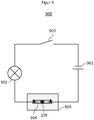
- a circuit was in each case according to FIG. 9 built up.
- the circuit contained in each case as a voltage source a 9 V 550 mAh alkaline battery manufacturer Varta, and as a consumer in the circuit an electric motor type 0816K009SR Faulhaber.
- the battery was connected to the motor by means of a battery clip and cables.
- each circuit included a switch through which the circuit could be interrupted.
- a stripped cable end was inserted into a longitudinal blind hole each hole of a copper pin and fixed by means of a transversely attacking screw.
- the two copper pins were each 10 mm long and had a diameter of 2 mm.
- the two free faces of the copper pins were electrically connected to one another by a solder connection not according to the invention or by a sintered connection according to the invention.
- the electrical connection had a diameter of 2 mm and a length of 2 mm. This was ensured by abrading in a post-processing step after establishing the connection.
- the circuit was closed with the switch, so that the electric motor was operated at idle.
- the vibrating table was activated at 3000 vibrations per minute. After a vibration period of 1 h, the vibrating table was switched off.
- the electrical connection between the two copper pins had to be checked so that the engine had stopped, this was counted as a failure. If there was no failure, the engine was operated until the power source failed. The duration of the engine run time was measured and determined the battery life.
- the porosity of the electrical connections produced was determined in each case by means of the above-mentioned measuring method after the measurement in the circuit. The table below gives the averages of the porosities over the 100 runs for each example and comparative example.
- a metal powder from US Research Nanomaterials Inc. consisting of Ag particles with a particle size of 30 to 50 nm together with 14 g of a polymer system in a kneader Speedmixer from Hauschild & Co KG were intimately mixed for 10 minutes.
- the polymer system consisted of 10% by weight of butyl diglycol, 68.77% by weight of diethyl sebacate, and 21.23% by weight of Vitel 2700B from Bostik Inc.
- the resulting paste was passed through a 3-roll mill with stainless steel rolls until a homogeneous paste was obtained.
- the homogeneous paste thus obtained was applied by stencil printing in each case on the end faces of the two copper pins. Here, a wet film thickness of 25 microns was achieved. Subsequently, the applied paste was dried at 80 ° C for 15 minutes. Next were The copper pins provided with the dried paste were installed in a uniaxial press in such a way that the copper pins could be electrically connected to one another by uniaxial pressing over the paste. The uniaxial compression was carried out at 250 ° C for a holding time of 30 minutes with a contact pressure of 20 MPa under argon blanketing gas. Subsequently, the copper pins were respectively introduced by introducing stripped cable ends in holes in the free end faces and fixing the cable ends by means of screws in the circuit.
- Example 2 the procedure was as in Example 1, wherein the paste was applied by dispensing on the faces of the copper pins. Here, a wet film thickness of 35 microns was achieved. Further, the uniaxial pressing was for a holding time of 5 minutes at 300 ° C. Further, after pressing, the electrical connection was sintered at 300 ° C for a holding time of 30 minutes under argon atmosphere. For this purpose, the heating rate was 50 K / min.
- Comparative Example 1 the electrical connection between the two copper pins was produced by soldering a silver disk having a thickness of 30 ⁇ m and a diameter of 2.0 mm. The soldering proceeds under vacuum keeping a brazing temperature of 980 ° C for 3 minutes.
- Comparative Example 2 a solder paste Indium 9.72 from Indium Corporation was applied by dispensing onto the copper pins and then soldered in accordance with the manufacturer's instructions.
- Example 1 Example 2 Comparative Example 1 Comparative Example 2 Porosity of electrical connection 0.1 0.13 0 0
- FIG. 1a 1) shows a schematic illustration of a device 100 according to the invention.
- the device 100 includes a first frame 101, a further frame 102, a first component 103, a second component 104 and a third component 105.
- the first frame 101 is a flange.
- the flange is made of titanium.
- the further frame 102 is a bushing and consists of an electrically insulating ceramic (Al 2 O 3 ).
- the bushing is soldered into the flange with a gold solder. That is, the first frame 101 frames the further frame 102.
- the first component 103, a connecting pin, is in turn soldered into the bushing with a gold solder. That is, the further frame 102 frames the first component 103.
- the feedthrough sleeve electrically isolates the pin from the flange.
- the pin is made of a platinum-iridium alloy.
- the second component 104 here an electrically conductive cable, is electrically conductively connected to the third component 105 and the connection pin. This compound was produced by a sintering process in which the third member 105 was obtained.
- the third component 105 has a porosity of 0.1.
- the third component 105 is 99 wt .-% based on the third component 105 made of platinum.
- FIG. 1b shows a schematic cross-sectional view of the inventive device 100 in FIG. 1a ).
- a layer thickness 106 of the third component 105 is shown in FIG. 1b . That is, the third component 105 forms a layer overlying the terminal pin.
- FIG. 2 shows a schematic cross-sectional view of another device 100 according to the invention.
- the device 100 includes a first frame 101, a further frame 102, a first component 103, a second component 104 and a third component 105.
- the first frame 101 is a flange.
- the flange is made of titanium.
- the further frame 102 is a ring made of a ceramic (Al 2 O 3 ).
- the further frame 102 is soldered into the flange with a gold solder.
- An annular opening of the ring is pierced by the first component 103, a connecting pin.
- the first component 103 consists of an electrically conductive cermet.
- the first component 103 and the further frame 102 have been obtained integrally in a sintering process.
- the second component 104 is a pin for electrically contacting a printed circuit board.
- the third component 105 electrically connects the pin and the terminal pin. This compound was produced by a sintering process in which the third member 105 was obtained.
- the third component 105 has a porosity of 0.1.
- the electrical connection has a resistance of 0.1 m ⁇ . Further, the third member 105 does not include a meniscus.
- the third component 105 is 99.5 wt .-% based on the third component 105 made of silver.
- FIG. 3 shows a schematic cross-sectional view of another device 100 according to the invention.
- the device 100 includes a first frame 101, a further frame 102, a first component 103, a second component 104 and a third component 105.
- the first frame 101 is a flange.
- the flange is made of titanium.
- the further frame 102 is a perforated plate made of a ceramic (Al 2 O 3 ).
- the further frame 102 is soldered into the flange with a gold solder. A hole of the perforated plate is pierced by the first member 103, a terminal pin.
- the first component 103 consists of an electrically conductive cermet.
- the first component 103 and the further frame 102 have been obtained integrally in a sintering process.
- the second component 104 is a pin for electrically contacting a printed circuit board.
- the third component 105 electrically connects the pin and the terminal pin. This compound was produced by a sintering process in which the third member 105 was obtained.
- the third component 105 has a porosity of 0.1.
- the electrical connection has a resistance of 0.1 m ⁇ . Further, the third member 105 does not include a meniscus.
- the third component 105 is 99.5 wt .-% based on the third component 105 made of silver.
- the device 100 includes a plurality of further pins, further third components 105 and further pins. Each further third component 105 electrically connects another pin to another pin.
- Each further third component has a porosity in a range of 0.05 to 0.15.
- FIG. 4 shows a schematic cross-sectional view of another device 100 according to the invention.
- This device 100 is the device in FIG. 3 wherein the pins are each connected to an MLCC filter 401.
- the MLCC filters 401 reduce transfer of electrical noise from the pins and pins to an electronic circuit connected to the pins.
- FIG. 5 shows a schematic cross-sectional view of a device precursor 500 according to the invention.
- the device precursor 500 includes a first frame 101, a further frame 102, and a first component 103.
- the first frame 101 is a flange.
- the flange is made of titanium.
- the further frame 102 is a ring made of a ceramic (Al 2 O 3 ).
- the further frame 102 is soldered into the flange with a gold solder.
- An annular opening of the ring is pierced by the first component 103, a connecting pin.
- the first component 103 consists of an electrically conductive cermet.
- the first component 103 and the further frame 102 have been obtained integrally in a sintering process.
- the terminal pin includes a first contact surface 502.
- a composition 501 is applied to this first contact surface 502.
- the composition 501 is a paste including a binder, a solvent and a plurality of metal particles.
- the metal particles are gold particles.
- the paste contains the gold particles in a proportion of 90% by weight, based on the weight of the paste.
- FIG. 6 shows a flow diagram of a method according to the invention 600.
- the method 600 includes method steps a) 601 to g) 607.
- step a) 601 a implementation is provided.
- the implementation includes a first frame 101, another Frame 102, and a first component 103.
- the first frame 101 is a flange.
- the flange is made of titanium.
- the further frame 102 is a ring made of a ceramic (Al 2 O 3 ).
- the further frame 102 is soldered into the flange with a gold solder.
- An annular opening of the ring is pierced by the first component 103, a connecting pin.
- the first component 103 consists of an electrically conductive cermet.
- the first component 103 and the further frame 102 have been obtained integrally in a sintering process.
- a second component 104 including a first contact surface is provided.
- the second component 102 is an electrical cable including another contact surface.
- the further contact surface is a front side of a cable end.
- a composition 501 is provided.
- the composition 501 is a paste including a binder and a plurality of metal particles.
- the metal particles are silver particles.
- the paste contains the silver particles in an amount of 90% by weight based on the weight of the paste.
- the paste is printed on the first contact surface 502 in a stencil printing process.
- step e) 605 the cable is contacted with the paste via its further contact surface, and thus the first contact surface 502 is connected to the further contact surface.
- step f) 606 the paste is thermally debinded.
- the paste is heated to 100 ° C for 10 minutes.
- a component precursor, a green compact is obtained.
- the green compact is sintered.
- the green body is heated for 2 minutes to a temperature of 300 ° C. In this case, a mechanical pressure of 20 MPa is exerted on the green body.
- the green compact is in air.
- FIG. 7 shows a schematic cross-sectional view of an implantable electrical medical device 700 according to the invention.
- the implantable electrical medical device 700 is a pacemaker.
- the pacemaker includes a housing 701 made of titanium, housed therein control electronics 702, as well as hermetically sealed in a housing opening the device 100 of the invention FIG. 4 , Connect here the pins, the pins and the control electronics 702 electrically to each other. To an outside of the pins, a header block 703 is connected.
- FIG. 8 12 shows a schematic cross-sectional view of a bushing 800 not in contact with the invention.
- the bushing 800 includes a flange 801, soldered therein is a feedthrough sleeve 802, soldered therein is a terminal pin 803.
- the pin 803 is soldered to a cable 804 at one end via a solder joint 805.
- Solder 805 includes a meniscus 805 which has been formed by an interfacial tension of a solder during soldering and became part of solid solder 805 upon solidification of the solder.
- FIG. 9 shows a schematic representation of a measurement setup 900 for measuring the failure rate of the electrical connections and the battery life in the examples.
- a circuit including a voltage source 901, a load 902 and a switch 903.
- the circuit 2 includes copper pins 904, each having a bore in the longitudinal direction of the copper pin 904.
- a stripped cable end of the circuit is inserted and fixed by means of screw.
- the free end surfaces of the Kuper pins 904 are connected to each other by means of the electrical connection under test.
- this is a sintered connection according to the third component 105 according to the invention.
- the two copper pins 904 and the electrical connection to a vibrating table 905 are fixed for measuring the failure rate.
Landscapes
- Health & Medical Sciences (AREA)
- Life Sciences & Earth Sciences (AREA)
- Engineering & Computer Science (AREA)
- Biomedical Technology (AREA)
- Animal Behavior & Ethology (AREA)
- General Health & Medical Sciences (AREA)
- Public Health (AREA)
- Veterinary Medicine (AREA)
- Nuclear Medicine, Radiotherapy & Molecular Imaging (AREA)
- Radiology & Medical Imaging (AREA)
- Biophysics (AREA)
- Heart & Thoracic Surgery (AREA)
- Cardiology (AREA)
- Physics & Mathematics (AREA)
- Pathology (AREA)
- Medical Informatics (AREA)
- Molecular Biology (AREA)
- Surgery (AREA)
- Powder Metallurgy (AREA)
- Prostheses (AREA)
Claims (13)
- Dispositif (100) comprenant un premier cadre (101), un autre cadre (102), un premier élément (103), un deuxième élément (104) et un troisième élément (105) ;
dans lequela) le premier cadre (101) encadre l'autre cadre (102) ;b) l'autre cadre (102)i) encadre le premier élément (103), etii) le premier élément (103) et le premier cadre (101) sont électriquement isolés l'un de l'autre ;c) le premier élément (103) est électriquement conducteur ;d) le second élément (104) est électriquement conducteur ; ete) le troisième élément (105) établit une connexion électriquement conductrice entre le premier élément (103) et le deuxième élément (104) ;caractérisé en ce que ledit troisième élément (105) a une porosité dans une plage de 0,001 à 0,4. - Dispositif (100) selon la revendication 1, dans lequel le premier élément (103) comprend un cermet.
- Dispositif (100) selon la revendication 1 ou 2, le cadre supplémentaire (102) comprenant une céramique.
- Dispositif (100) selon l'une des revendications précédentes, dans lequel le cadre supplémentaire (102) et le premier élément (103) sont formés intégralement.
- Dispositif (100) selon l'une des revendications précédentes, dans lequel le second élément (104) est un élément choisi dans le groupe constitué par un contact électrique, une piste conductrice, un fil, une douille et une fiche, ou une combinaison d'au moins deux de ceux-ci.
- Dispositif (100) selon l'une des revendications précédentes, dans lequel le premier élément (103) ou le second élément (104) ou les deux sont reliés à un filtre électrotechnique (401).
- Précurseur de dispositif (500) comprenant un premier cadre (101), un autre cadre (102) et un premier élément (103) ;
dans lequela) le premier cadre (101) encadre l'autre cadre (102) ;b) l'autre cadre (102)i) encadre le premier élément (103), etii) le premier élément (103) et le premier cadre (101) sont électriquement isolés l'un de l'autre ; etc) le premier élément (103)dans laquelle la première surface de contact (502) est au moins partiellement recouverte d'une composition (501) comprenant un liquide et une pluralité de particules métalliques.i) est électriquement conducteur, etii) comprend une première surface de contact (502) ; - Procédé (600) comprenant comme étapes de procédé (601 à 607) :a) fournir une traversée comprenant un premier cadre (101), un autre cadre (102) et un premier élément (103),
dans lequeli) le premier cadre (101) encadre l'autre cadre (102),ii) l'autre cadre (102)A. encadre le premier élément (103), etB. isole électriquement ledit premier cadre (101) et ledit premier élément (103) l'un de l'autre, etiii) le premier élément (103)A. est électriquement conducteur, etB. comprend une première surface de contact (502) ;b) Fourniture d'un deuxième élément (104) comprenant une surface de contact supplémentaire ;c) fournir une composition (501) comprenant un liquide et une pluralité de particules métalliques,
lesdites particules métalliques comprenant un métal ayant une température de fusion la plus basse ;d) superposer la première surface de contact (502) ou l'autre surface de contact ou les deux avec la composition (501) ;e) relier la première surface de contact (502) et l'autre surface de contact par l'intermédiaire de la composition (501) ;f) réduire la proportion de liquide dans la composition (501) tout en conservant un précurseur de élément ; etg) Chauffage du précurseur d'élément à une température comprise entre 10 et 90 % de la température de fusion la plus basse pour obtenir un troisième élément (105). - Procédé (600) selon la revendication 8, dans lequel la réduction dans l'étape de procédé f) comprend le chauffage de la composition (501) à une température comprise entre 50 et 160°C.
- Procédé (600) selon la revendication 8 ou 9, dans lequel l'étape (g) remplit un ou au moins deux des critères suivants :a) le précurseur de élément est soumis à une pression mécanique dans la plage de 0 à 50 MPa dans l'étape de procédé g) ;b) pendant que le troisième élément (105) est obtenu, le précurseur du élément ou le troisième élément (105) ou les deux se trouvent dans une atmosphère de gaz protecteur ;c) une distance de la première surface de contact (502) par rapport à l'autre surface de contact est réduite dans l'étape de procédé g) de 0,01 à 5 %, sur la base de la distance immédiatement avant l'étape de procédé g), à une valeur comprise entre 0,005 et 1 mm ;d) la température spécifiée à l'étape g) du procédé est maintenue dans une plage de 1 à 120 min pendant un certain temps.
- Dispositif médical électrique implantable (700) comprenant un boîtier (701) et un dispositif (100) selon l'une quelconque des revendications 1 à 6 ;
dans laquelle le boîtier (701) comprend une ouverture de boîtier ;
l'ouverture du boîtier, y compris le premier cadre (101). - Procédé de fabrication d'un dispositif médical électrique implantable comprenant un boîtier (701) comprenant une ouverture de boîtier, dans lequel, dans une étape de procédé, un dispositif (100) selon l'une des revendications 1 à 6, ou un précurseur de dispositif (500) selon la revendication 7, est inséré dans l'ouverture du boîtier de sorte que l'ouverture du boîtier comprend le premier châssis (101).
- Utilisation d'une composition (501) comprenant un liquide et une pluralité de particules métalliques pour connecter électriquement un élément traversant et un conducteur électrique ;
dans laquelle l'utilisation comprend le frittage de la composition (501).
Priority Applications (2)
| Application Number | Priority Date | Filing Date | Title |
|---|---|---|---|
| EP16184554.0A EP3284512B1 (fr) | 2016-08-17 | 2016-08-17 | Passage electrique comprenant une liaison electrique frittee en particulier pour implants medicaux |
| US15/680,124 US11110285B2 (en) | 2016-08-17 | 2017-08-17 | Electrical feedthrough with a sintered electrical connection |
Applications Claiming Priority (1)
| Application Number | Priority Date | Filing Date | Title |
|---|---|---|---|
| EP16184554.0A EP3284512B1 (fr) | 2016-08-17 | 2016-08-17 | Passage electrique comprenant une liaison electrique frittee en particulier pour implants medicaux |
Publications (2)
| Publication Number | Publication Date |
|---|---|
| EP3284512A1 EP3284512A1 (fr) | 2018-02-21 |
| EP3284512B1 true EP3284512B1 (fr) | 2019-11-13 |
Family
ID=56737990
Family Applications (1)
| Application Number | Title | Priority Date | Filing Date |
|---|---|---|---|
| EP16184554.0A Active EP3284512B1 (fr) | 2016-08-17 | 2016-08-17 | Passage electrique comprenant une liaison electrique frittee en particulier pour implants medicaux |
Country Status (2)
| Country | Link |
|---|---|
| US (1) | US11110285B2 (fr) |
| EP (1) | EP3284512B1 (fr) |
Families Citing this family (3)
| Publication number | Priority date | Publication date | Assignee | Title |
|---|---|---|---|---|
| DE102018005733B4 (de) * | 2018-07-20 | 2021-01-14 | Schott Ag | Glas-Metall-Durchführung |
| DE102020113106B4 (de) | 2020-05-14 | 2022-03-03 | Heraeus Deutschland GmbH & Co. KG | Hermetische Beschichtung von Bauteilen |
| EP4147746A1 (fr) | 2021-09-10 | 2023-03-15 | Greatbatch Ltd. | Composite métallique renforcé céramique pour corps hermétiques pour dispositifs implantables |
Family Cites Families (12)
| Publication number | Priority date | Publication date | Assignee | Title |
|---|---|---|---|---|
| US6999818B2 (en) * | 2003-05-23 | 2006-02-14 | Greatbatch-Sierra, Inc. | Inductor capacitor EMI filter for human implant applications |
| US7765005B2 (en) * | 2004-02-12 | 2010-07-27 | Greatbatch Ltd. | Apparatus and process for reducing the susceptability of active implantable medical devices to medical procedures such as magnetic resonance imaging |
| US20070083244A1 (en) * | 2005-10-06 | 2007-04-12 | Greatbatch-Sierra, Inc. | Process for tuning an emi filter to reduce the amount of heat generated in implanted lead wires during medical procedures such as magnetic resonance imaging |
| DE102006041940A1 (de) | 2006-09-07 | 2008-03-27 | Biotronik Crm Patent Ag | Elektrische Durchführung |
| JP4955831B1 (ja) * | 2010-12-24 | 2012-06-20 | 日本碍子株式会社 | 固体酸化物形燃料電池の発電部間を電気的に接続する接合体 |
| DE102011009865B4 (de) * | 2011-01-31 | 2012-09-20 | Heraeus Precious Metals Gmbh & Co. Kg | Kopfteil für eine medizinisch implantierbare Vorrichtung |
| DE102011009860B4 (de) * | 2011-01-31 | 2013-03-07 | Heraeus Precious Metals Gmbh & Co. Kg | Implantierbare Vorrichtung mit integrierter Keramikdurchführung |
| DE102011009858B8 (de) * | 2011-01-31 | 2013-11-07 | Heraeus Precious Metals Gmbh & Co. Kg | Cermethaltige Durchführung für eine medizinisch inplantierbare Vorrichtung mit Verbindungsschicht |
| EP2736109A4 (fr) * | 2011-07-21 | 2015-09-30 | Murata Manufacturing Co | Matériau de connexion électrique pour pile à combustible à oxygène solide, pile à combustible à oxyde solide, module de pile à combustible à oxyde solide et procédé de fabrication d'une pile à combustible à oxyde solide |
| WO2013054580A1 (fr) * | 2011-10-13 | 2013-04-18 | 住友電気工業株式会社 | Substrat de carbure de silicium, dispositif à semi-conducteur de carbure de silicium, procédé de fabrication de substrat de carbure de silicium et procédé de fabrication de dispositif à semi-conducteur de carbure de silicium |
| US8843215B2 (en) * | 2012-06-13 | 2014-09-23 | Biotronik Se & Co. Kg | Connecting device |
| KR102018194B1 (ko) * | 2014-08-29 | 2019-09-04 | 미쓰이금속광업주식회사 | 도전체의 접속 구조 및 그 제조 방법, 도전성 조성물 그리고 전자부품 모듈 |
-
2016
- 2016-08-17 EP EP16184554.0A patent/EP3284512B1/fr active Active
-
2017
- 2017-08-17 US US15/680,124 patent/US11110285B2/en active Active
Non-Patent Citations (1)
| Title |
|---|
| None * |
Also Published As
| Publication number | Publication date |
|---|---|
| US11110285B2 (en) | 2021-09-07 |
| EP3284512A1 (fr) | 2018-02-21 |
| US20180050211A1 (en) | 2018-02-22 |
Similar Documents
| Publication | Publication Date | Title |
|---|---|---|
| DE19819797C2 (de) | Durchführungsbaugruppe für eine implantierbare medizinische Vorrichtung | |
| DE102011119125B4 (de) | Kontaktierungsanordnung mit Durchführung und Filterstruktur | |
| EP3542855B1 (fr) | Dispositifs pourvus d'au moins une couche de précurseur céramique, en particulier précurseurs d'une traversée électrique | |
| DE102011009862B4 (de) | Cermethaltige Durchführung mit Halteelement für eine medizinisch implantierbare Vorrichtung | |
| DE102011009858B4 (de) | Cermethaltige Durchführung für eine medizinisch inplantierbare Vorrichtung mit Verbindungsschicht | |
| DE102013216963B4 (de) | Screeningverfahren für Elektrolytkondensatoren | |
| DE60311613T2 (de) | Herstellungsverfahren für ein monolithisches piezoelektrisches Bauelement | |
| EP3009211B1 (fr) | Pate metallique et son utilisation pour relier des elements de construction | |
| EP1430489B1 (fr) | Composant electroceramique comportant plusieurs surfaces de contact | |
| EP3284512B1 (fr) | Passage electrique comprenant une liaison electrique frittee en particulier pour implants medicaux | |
| EP2819126B1 (fr) | Pâte conductrice contenant du platine | |
| DE10307804B4 (de) | Leitfähige Paste und deren Verwendung zur Herstellung eines laminierten keramischen elektronischen Bauteils | |
| DE69933792T3 (de) | Niobkondensator und verfahren zu dessen herstellung | |
| EP3160580A1 (fr) | Stimulateur cardiaque sans fil comportant une électrode cermet | |
| EP3351290A1 (fr) | Traversée électrique comprenant un élément de contact et procédé de fabrication | |
| WO2008074305A1 (fr) | Composant électrique et contact extérieur d'un composant électrique | |
| EP3072553B1 (fr) | Broche de raccordement et traversée | |
| DE102005013827B4 (de) | Elektrisch leitende Paste und Verfahren zur Erzeugung eines gestapelten piezoelektrischen Elements | |
| DE10231209B4 (de) | Piezoelektrisches Bauelement | |
| EP3311883B1 (fr) | Broche de raccordement et traversée | |
| DE102020113106B4 (de) | Hermetische Beschichtung von Bauteilen | |
| DE4408579C2 (de) | Festelektrolytkondensator und Verfahren zur Herstellung dieses Kondensators | |
| DE102019220269B4 (de) | Additives Herstellverfahren für multidirektionale Elektroden | |
| DE102020123651B4 (de) | Mehrlagige Ringelektrode mit Klemme | |
| EP3461533A1 (fr) | Partie du boitier extérieur d'un appareil médical électronique implantable |
Legal Events
| Date | Code | Title | Description |
|---|---|---|---|
| PUAI | Public reference made under article 153(3) epc to a published international application that has entered the european phase |
Free format text: ORIGINAL CODE: 0009012 |
|
| STAA | Information on the status of an ep patent application or granted ep patent |
Free format text: STATUS: THE APPLICATION HAS BEEN PUBLISHED |
|
| AK | Designated contracting states |
Kind code of ref document: A1 Designated state(s): AL AT BE BG CH CY CZ DE DK EE ES FI FR GB GR HR HU IE IS IT LI LT LU LV MC MK MT NL NO PL PT RO RS SE SI SK SM TR |
|
| AX | Request for extension of the european patent |
Extension state: BA ME |
|
| STAA | Information on the status of an ep patent application or granted ep patent |
Free format text: STATUS: REQUEST FOR EXAMINATION WAS MADE |
|
| 17P | Request for examination filed |
Effective date: 20180817 |
|
| RBV | Designated contracting states (corrected) |
Designated state(s): AL AT BE BG CH CY CZ DE DK EE ES FI FR GB GR HR HU IE IS IT LI LT LU LV MC MK MT NL NO PL PT RO RS SE SI SK SM TR |
|
| GRAP | Despatch of communication of intention to grant a patent |
Free format text: ORIGINAL CODE: EPIDOSNIGR1 |
|
| STAA | Information on the status of an ep patent application or granted ep patent |
Free format text: STATUS: GRANT OF PATENT IS INTENDED |
|
| RIC1 | Information provided on ipc code assigned before grant |
Ipc: A61N 1/375 20060101AFI20190214BHEP |
|
| INTG | Intention to grant announced |
Effective date: 20190308 |
|
| GRAJ | Information related to disapproval of communication of intention to grant by the applicant or resumption of examination proceedings by the epo deleted |
Free format text: ORIGINAL CODE: EPIDOSDIGR1 |
|
| STAA | Information on the status of an ep patent application or granted ep patent |
Free format text: STATUS: REQUEST FOR EXAMINATION WAS MADE |
|
| INTC | Intention to grant announced (deleted) | ||
| GRAP | Despatch of communication of intention to grant a patent |
Free format text: ORIGINAL CODE: EPIDOSNIGR1 |
|
| STAA | Information on the status of an ep patent application or granted ep patent |
Free format text: STATUS: GRANT OF PATENT IS INTENDED |
|
| INTG | Intention to grant announced |
Effective date: 20190702 |
|
| GRAS | Grant fee paid |
Free format text: ORIGINAL CODE: EPIDOSNIGR3 |
|
| GRAA | (expected) grant |
Free format text: ORIGINAL CODE: 0009210 |
|
| STAA | Information on the status of an ep patent application or granted ep patent |
Free format text: STATUS: THE PATENT HAS BEEN GRANTED |
|
| AK | Designated contracting states |
Kind code of ref document: B1 Designated state(s): AL AT BE BG CH CY CZ DE DK EE ES FI FR GB GR HR HU IE IS IT LI LT LU LV MC MK MT NL NO PL PT RO RS SE SI SK SM TR |
|
| REG | Reference to a national code |
Ref country code: CH Ref legal event code: EP Ref country code: AT Ref legal event code: REF Ref document number: 1201044 Country of ref document: AT Kind code of ref document: T Effective date: 20191115 |
|
| REG | Reference to a national code |
Ref country code: DE Ref legal event code: R096 Ref document number: 502016007540 Country of ref document: DE |
|
| REG | Reference to a national code |
Ref country code: IE Ref legal event code: FG4D Free format text: LANGUAGE OF EP DOCUMENT: GERMAN |
|
| REG | Reference to a national code |
Ref country code: NL Ref legal event code: MP Effective date: 20191113 |
|
| REG | Reference to a national code |
Ref country code: LT Ref legal event code: MG4D |
|
| PG25 | Lapsed in a contracting state [announced via postgrant information from national office to epo] |
Ref country code: GR Free format text: LAPSE BECAUSE OF FAILURE TO SUBMIT A TRANSLATION OF THE DESCRIPTION OR TO PAY THE FEE WITHIN THE PRESCRIBED TIME-LIMIT Effective date: 20200214 Ref country code: NO Free format text: LAPSE BECAUSE OF FAILURE TO SUBMIT A TRANSLATION OF THE DESCRIPTION OR TO PAY THE FEE WITHIN THE PRESCRIBED TIME-LIMIT Effective date: 20200213 Ref country code: BG Free format text: LAPSE BECAUSE OF FAILURE TO SUBMIT A TRANSLATION OF THE DESCRIPTION OR TO PAY THE FEE WITHIN THE PRESCRIBED TIME-LIMIT Effective date: 20200213 Ref country code: LT Free format text: LAPSE BECAUSE OF FAILURE TO SUBMIT A TRANSLATION OF THE DESCRIPTION OR TO PAY THE FEE WITHIN THE PRESCRIBED TIME-LIMIT Effective date: 20191113 Ref country code: FI Free format text: LAPSE BECAUSE OF FAILURE TO SUBMIT A TRANSLATION OF THE DESCRIPTION OR TO PAY THE FEE WITHIN THE PRESCRIBED TIME-LIMIT Effective date: 20191113 Ref country code: PT Free format text: LAPSE BECAUSE OF FAILURE TO SUBMIT A TRANSLATION OF THE DESCRIPTION OR TO PAY THE FEE WITHIN THE PRESCRIBED TIME-LIMIT Effective date: 20200313 Ref country code: SE Free format text: LAPSE BECAUSE OF FAILURE TO SUBMIT A TRANSLATION OF THE DESCRIPTION OR TO PAY THE FEE WITHIN THE PRESCRIBED TIME-LIMIT Effective date: 20191113 Ref country code: LV Free format text: LAPSE BECAUSE OF FAILURE TO SUBMIT A TRANSLATION OF THE DESCRIPTION OR TO PAY THE FEE WITHIN THE PRESCRIBED TIME-LIMIT Effective date: 20191113 Ref country code: NL Free format text: LAPSE BECAUSE OF FAILURE TO SUBMIT A TRANSLATION OF THE DESCRIPTION OR TO PAY THE FEE WITHIN THE PRESCRIBED TIME-LIMIT Effective date: 20191113 Ref country code: PL Free format text: LAPSE BECAUSE OF FAILURE TO SUBMIT A TRANSLATION OF THE DESCRIPTION OR TO PAY THE FEE WITHIN THE PRESCRIBED TIME-LIMIT Effective date: 20191113 |
|
| PG25 | Lapsed in a contracting state [announced via postgrant information from national office to epo] |
Ref country code: HR Free format text: LAPSE BECAUSE OF FAILURE TO SUBMIT A TRANSLATION OF THE DESCRIPTION OR TO PAY THE FEE WITHIN THE PRESCRIBED TIME-LIMIT Effective date: 20191113 Ref country code: IS Free format text: LAPSE BECAUSE OF FAILURE TO SUBMIT A TRANSLATION OF THE DESCRIPTION OR TO PAY THE FEE WITHIN THE PRESCRIBED TIME-LIMIT Effective date: 20200313 Ref country code: RS Free format text: LAPSE BECAUSE OF FAILURE TO SUBMIT A TRANSLATION OF THE DESCRIPTION OR TO PAY THE FEE WITHIN THE PRESCRIBED TIME-LIMIT Effective date: 20191113 |
|
| PG25 | Lapsed in a contracting state [announced via postgrant information from national office to epo] |
Ref country code: AL Free format text: LAPSE BECAUSE OF FAILURE TO SUBMIT A TRANSLATION OF THE DESCRIPTION OR TO PAY THE FEE WITHIN THE PRESCRIBED TIME-LIMIT Effective date: 20191113 |
|
| PG25 | Lapsed in a contracting state [announced via postgrant information from national office to epo] |
Ref country code: CZ Free format text: LAPSE BECAUSE OF FAILURE TO SUBMIT A TRANSLATION OF THE DESCRIPTION OR TO PAY THE FEE WITHIN THE PRESCRIBED TIME-LIMIT Effective date: 20191113 Ref country code: RO Free format text: LAPSE BECAUSE OF FAILURE TO SUBMIT A TRANSLATION OF THE DESCRIPTION OR TO PAY THE FEE WITHIN THE PRESCRIBED TIME-LIMIT Effective date: 20191113 Ref country code: ES Free format text: LAPSE BECAUSE OF FAILURE TO SUBMIT A TRANSLATION OF THE DESCRIPTION OR TO PAY THE FEE WITHIN THE PRESCRIBED TIME-LIMIT Effective date: 20191113 Ref country code: EE Free format text: LAPSE BECAUSE OF FAILURE TO SUBMIT A TRANSLATION OF THE DESCRIPTION OR TO PAY THE FEE WITHIN THE PRESCRIBED TIME-LIMIT Effective date: 20191113 Ref country code: DK Free format text: LAPSE BECAUSE OF FAILURE TO SUBMIT A TRANSLATION OF THE DESCRIPTION OR TO PAY THE FEE WITHIN THE PRESCRIBED TIME-LIMIT Effective date: 20191113 |
|
| REG | Reference to a national code |
Ref country code: DE Ref legal event code: R097 Ref document number: 502016007540 Country of ref document: DE |
|
| PG25 | Lapsed in a contracting state [announced via postgrant information from national office to epo] |
Ref country code: SM Free format text: LAPSE BECAUSE OF FAILURE TO SUBMIT A TRANSLATION OF THE DESCRIPTION OR TO PAY THE FEE WITHIN THE PRESCRIBED TIME-LIMIT Effective date: 20191113 Ref country code: SK Free format text: LAPSE BECAUSE OF FAILURE TO SUBMIT A TRANSLATION OF THE DESCRIPTION OR TO PAY THE FEE WITHIN THE PRESCRIBED TIME-LIMIT Effective date: 20191113 |
|
| PLBE | No opposition filed within time limit |
Free format text: ORIGINAL CODE: 0009261 |
|
| STAA | Information on the status of an ep patent application or granted ep patent |
Free format text: STATUS: NO OPPOSITION FILED WITHIN TIME LIMIT |
|
| 26N | No opposition filed |
Effective date: 20200814 |
|
| PG25 | Lapsed in a contracting state [announced via postgrant information from national office to epo] |
Ref country code: SI Free format text: LAPSE BECAUSE OF FAILURE TO SUBMIT A TRANSLATION OF THE DESCRIPTION OR TO PAY THE FEE WITHIN THE PRESCRIBED TIME-LIMIT Effective date: 20191113 |
|
| PG25 | Lapsed in a contracting state [announced via postgrant information from national office to epo] |
Ref country code: IT Free format text: LAPSE BECAUSE OF FAILURE TO SUBMIT A TRANSLATION OF THE DESCRIPTION OR TO PAY THE FEE WITHIN THE PRESCRIBED TIME-LIMIT Effective date: 20191113 |
|
| PG25 | Lapsed in a contracting state [announced via postgrant information from national office to epo] |
Ref country code: MC Free format text: LAPSE BECAUSE OF FAILURE TO SUBMIT A TRANSLATION OF THE DESCRIPTION OR TO PAY THE FEE WITHIN THE PRESCRIBED TIME-LIMIT Effective date: 20191113 |
|
| REG | Reference to a national code |
Ref country code: CH Ref legal event code: PL |
|
| GBPC | Gb: european patent ceased through non-payment of renewal fee |
Effective date: 20200817 |
|
| PG25 | Lapsed in a contracting state [announced via postgrant information from national office to epo] |
Ref country code: LI Free format text: LAPSE BECAUSE OF NON-PAYMENT OF DUE FEES Effective date: 20200831 Ref country code: LU Free format text: LAPSE BECAUSE OF NON-PAYMENT OF DUE FEES Effective date: 20200817 Ref country code: CH Free format text: LAPSE BECAUSE OF NON-PAYMENT OF DUE FEES Effective date: 20200831 |
|
| REG | Reference to a national code |
Ref country code: BE Ref legal event code: MM Effective date: 20200831 |
|
| PG25 | Lapsed in a contracting state [announced via postgrant information from national office to epo] |
Ref country code: BE Free format text: LAPSE BECAUSE OF NON-PAYMENT OF DUE FEES Effective date: 20200831 Ref country code: GB Free format text: LAPSE BECAUSE OF NON-PAYMENT OF DUE FEES Effective date: 20200817 |
|
| PG25 | Lapsed in a contracting state [announced via postgrant information from national office to epo] |
Ref country code: TR Free format text: LAPSE BECAUSE OF FAILURE TO SUBMIT A TRANSLATION OF THE DESCRIPTION OR TO PAY THE FEE WITHIN THE PRESCRIBED TIME-LIMIT Effective date: 20191113 Ref country code: MT Free format text: LAPSE BECAUSE OF FAILURE TO SUBMIT A TRANSLATION OF THE DESCRIPTION OR TO PAY THE FEE WITHIN THE PRESCRIBED TIME-LIMIT Effective date: 20191113 Ref country code: CY Free format text: LAPSE BECAUSE OF FAILURE TO SUBMIT A TRANSLATION OF THE DESCRIPTION OR TO PAY THE FEE WITHIN THE PRESCRIBED TIME-LIMIT Effective date: 20191113 |
|
| PG25 | Lapsed in a contracting state [announced via postgrant information from national office to epo] |
Ref country code: MK Free format text: LAPSE BECAUSE OF FAILURE TO SUBMIT A TRANSLATION OF THE DESCRIPTION OR TO PAY THE FEE WITHIN THE PRESCRIBED TIME-LIMIT Effective date: 20191113 |
|
| REG | Reference to a national code |
Ref country code: AT Ref legal event code: MM01 Ref document number: 1201044 Country of ref document: AT Kind code of ref document: T Effective date: 20210817 |
|
| PG25 | Lapsed in a contracting state [announced via postgrant information from national office to epo] |
Ref country code: AT Free format text: LAPSE BECAUSE OF NON-PAYMENT OF DUE FEES Effective date: 20210817 |
|
| P01 | Opt-out of the competence of the unified patent court (upc) registered |
Effective date: 20230528 |
|
| REG | Reference to a national code |
Ref country code: DE Ref legal event code: R081 Ref document number: 502016007540 Country of ref document: DE Owner name: HERAEUS MEDEVIO GMBH & CO. KG, DE Free format text: FORMER OWNER: HERAEUS DEUTSCHLAND GMBH & CO. KG, 63450 HANAU, DE |
|
| PGFP | Annual fee paid to national office [announced via postgrant information from national office to epo] |
Ref country code: DE Payment date: 20250820 Year of fee payment: 10 |
|
| PGFP | Annual fee paid to national office [announced via postgrant information from national office to epo] |
Ref country code: FR Payment date: 20250828 Year of fee payment: 10 |
|
| PGFP | Annual fee paid to national office [announced via postgrant information from national office to epo] |
Ref country code: IE Payment date: 20250820 Year of fee payment: 10 |