EP3285206A1 - Dispositif, procédé et programme d'évaluation pour des données biométriques - Google Patents
Dispositif, procédé et programme d'évaluation pour des données biométriques Download PDFInfo
- Publication number
- EP3285206A1 EP3285206A1 EP17184017.6A EP17184017A EP3285206A1 EP 3285206 A1 EP3285206 A1 EP 3285206A1 EP 17184017 A EP17184017 A EP 17184017A EP 3285206 A1 EP3285206 A1 EP 3285206A1
- Authority
- EP
- European Patent Office
- Prior art keywords
- false acceptance
- sets
- population
- acceptance rate
- biometric data
- Prior art date
- Legal status (The legal status is an assumption and is not a legal conclusion. Google has not performed a legal analysis and makes no representation as to the accuracy of the status listed.)
- Granted
Links
Images





Classifications
-
- G—PHYSICS
- G06—COMPUTING OR CALCULATING; COUNTING
- G06F—ELECTRIC DIGITAL DATA PROCESSING
- G06F21/00—Security arrangements for protecting computers, components thereof, programs or data against unauthorised activity
- G06F21/30—Authentication, i.e. establishing the identity or authorisation of security principals
- G06F21/31—User authentication
- G06F21/32—User authentication using biometric data, e.g. fingerprints, iris scans or voiceprints
-
- G—PHYSICS
- G06—COMPUTING OR CALCULATING; COUNTING
- G06F—ELECTRIC DIGITAL DATA PROCESSING
- G06F17/00—Digital computing or data processing equipment or methods, specially adapted for specific functions
- G06F17/10—Complex mathematical operations
- G06F17/18—Complex mathematical operations for evaluating statistical data, e.g. average values, frequency distributions, probability functions, regression analysis
-
- G—PHYSICS
- G06—COMPUTING OR CALCULATING; COUNTING
- G06F—ELECTRIC DIGITAL DATA PROCESSING
- G06F18/00—Pattern recognition
- G06F18/20—Analysing
- G06F18/21—Design or setup of recognition systems or techniques; Extraction of features in feature space; Blind source separation
- G06F18/217—Validation; Performance evaluation; Active pattern learning techniques
-
- G—PHYSICS
- G06—COMPUTING OR CALCULATING; COUNTING
- G06V—IMAGE OR VIDEO RECOGNITION OR UNDERSTANDING
- G06V40/00—Recognition of biometric, human-related or animal-related patterns in image or video data
- G06V40/10—Human or animal bodies, e.g. vehicle occupants or pedestrians; Body parts, e.g. hands
-
- G—PHYSICS
- G06—COMPUTING OR CALCULATING; COUNTING
- G06V—IMAGE OR VIDEO RECOGNITION OR UNDERSTANDING
- G06V40/00—Recognition of biometric, human-related or animal-related patterns in image or video data
- G06V40/50—Maintenance of biometric data or enrolment thereof
-
- H—ELECTRICITY
- H04—ELECTRIC COMMUNICATION TECHNIQUE
- H04L—TRANSMISSION OF DIGITAL INFORMATION, e.g. TELEGRAPHIC COMMUNICATION
- H04L63/00—Network architectures or network communication protocols for network security
- H04L63/08—Network architectures or network communication protocols for network security for authentication of entities
- H04L63/0861—Network architectures or network communication protocols for network security for authentication of entities using biometrical features, e.g. fingerprint, retina-scan
Definitions
- a certain aspect of embodiments described herein relates to an evaluation device, an evaluation method and an evaluation program.
- the present invention has been made in view of those circumstances, and an object thereof is to provide an evaluation device, an evaluation method and an evaluation program that are capable of estimating an evaluation index with a low cost.
- an evaluation device including: a generator configured to generate a plurality of sets from a first population of biometric data collected from a plurality of users, a number of biometric data of the plurality of sets being smaller than that of the first population, at least a part of the plurality of sets being different from each other; a first estimator configured to estimate a probability density distribution of similarity degrees of different people's pairs of each of the plurality of sets; a calculator configured to calculate a false acceptance rate with respect to each similarity degree threshold on a basis of the probability density distribution, with respect to each of the plurality of sets; and a second estimator configured to estimate a combined false acceptance rate from a statistic amount of false acceptance rates of the plurality of sets calculated by the calculator.
- an evaluation index of a biometric authentication algorism There are FAR (False Acceptance Rate) and FRR (False Rejection Rate) as evaluation indices indicating authentication accuracy of the biometric authentication algorism.
- FAR False Acceptance Rate
- FRR False Rejection Rate
- the false acceptance rate is a probability that two different people are determined as an identical person when biometric information of the two different people is compared with each other.
- the false rejection rate is a probability that a person is erroneously determined as another person when biometric information of an identical person is compared with each other. When any of the values are smaller, the authentication accuracy becomes higher.
- an authentication simulation using a biometric data set collected from a plurality of users is performed. It is necessary to evaluate the authentication accuracy when a sensor is newly developed. Therefore, biometric data are collected with use of a new sensor. In order to satisfy a false acceptance rate (for example, 0.0001% level) needed for produced authentication technology, it is necessary to collect a few thousands or more biometric data (the number of fingers in a case of fingerprint authentication or the number of hands in case of palm authentication). Therefore, a cost increases. In terms of the cost, it is preferable that the number of biometric data to be collected is smaller. It is difficult to secure a collection period of the biometric data, an evaluation workload and so on.
- the method can determine a necessary minimum pair number of an enrolled data and a data for comparison for accurately statistically measure a false acceptance rate and a false rejection rate.
- the number of the comparison pairs and the number of the biometric data that needed for evaluating the false acceptance rate (1%) and the false rejection rate (0.001%, 0.0001%) at a reliability of 95% are shown in Table 1.
- the number of the biometric data satisfying the false acceptance rate is larger than the number of the biometric data satisfying the false rejection rate. Therefore, the number of the biometric data is often determined in accordance with the false acceptance rate.
- the technology uses a generalized Pareto distribution that is one of an extreme value distribution, for estimating a false acceptance rate.
- a bottom edge of a similarity distribution of different people's pair is fitted to the generalized Pareto distribution.
- a distribution of a region in which the false acceptance rate is low is extrapolated.
- the false acceptance rate that is originally unmeasurable is estimated.
- the extreme value distribution indicates a distribution of the number of samples equal to or more than a threshold of samples in accordance with an arbitrary distribution function. Specifically, the extreme value distribution is a distribution in which a maximum value and a minimum value are approximately followed.
- the extreme value distribution is applied to a distribution of flood of a river or a maximum wind speed.
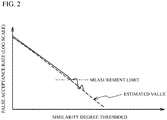
- FIG. 1 and FIG. 2 illustrate estimated results of the above-mentioned technology.
- a horizontal axis indicates a similarity degree threshold.
- a vertical axis indicates a false acceptance rate.
- FIG. 1 a measurement limit determined from the number of all biometric data is illustrated.
- the similarity degree threshold is equal to or more than the measurement limit, there is variability in the measurement accuracy of the false acceptance rate.
- FIG. 2 illustrates a false acceptance rate that is estimated with use of the generalized Pareto distribution. In FIG. 2 , the estimated false acceptance rate is illustrated with a broken line. As illustrated in FIG. 2 , when the generalized Pareto distribution is used, the variability of the measurement accuracy of the false acceptance rate is suppressed.
- a bootstrap method Sarat Dass, Yongfang Zhu, and Anil Jain, "Validating a Biometric Authentication System: Sample Size Requirements," IEEE Trans. On PAMI, 2006 .
- a bootstrap method a plurality of subsets obtained by a random sampling from the collected biometric data set are generated. Each false acceptance rate is calculated with respect to each subset. When an average value of the calculated false acceptance rates is a final value, the average value is stably obtained as a false acceptance rate.
- a reliable section is calculated from dispersions of the false acceptance rates. The number of the biometric data needed for obtaining a desirable reliable section is determined.
- FIG. 3 illustrates estimated results of the false acceptance rate with use of the bootstrap method.
- a horizontal axis indicates the similarity degree threshold.
- a vertical axis indicates the false acceptance rate.
- a thin solid line indicates the false acceptance rate measured by using the biometric data set.
- a thin dotted line indicates the false acceptance rate measured from each bootstrap set.
- a thick dotted line indicates an average of these false acceptance rates measured from each bootstrap set.
- a false acceptance rate over an accuracy limit is estimated from a small scale biometric data set. Moreover, a final false acceptance rate is estimated from the estimated false acceptance rate. Thereby, the false acceptance rate is estimated with a low cost. And, the necessary number of the biometric data is reduced.
- FIG. 4 illustrates a functional block diagram of an evaluation device 100 in accordance with a first embodiment.
- the evaluation device 100 acts as a biometric data storage 10, a bootstrap evaluator 20, an extrapolator 30, a calculator 40, a false acceptance rate estimator 50, a reliable section estimator 60, and an inspector 70.
- FIG. 5 illustrates a flowchart of an evaluation process executed by the evaluation device 100. A description will be given of an operation of the evaluation device 100, on the basis of FIG. 4 and FIG. 5 .
- the bootstrap evaluator 20 reads a biometric data set from the biometric data storage 10 (Step S1).
- the biometric data set has a data structure in which an ID of each user is related with a biometric data.
- the biometric data may be a biometric data of a specific modality of a specific instance or may be biometric data of an identical modality of a plurality of instances.
- the instance means a unit of biological body.
- the biometric data may be a biometric data in which a plurality of different modalities of an identical instance are combined or may be a biometric data in which a plurality of modalities of a plurality of different instances are combined.
- the bootstrap evaluator 20 generates a small scale set (hereinafter referred to as a bootstrap set) by randomly sampling biometric data from the biometric data set that is read in Step S1 (Step S2).
- the number of the biometric data in the bootstrap set is smaller than the number of the biometric data in the biometric data set.
- a size of the bootstrap set (the number of data) is around 50% of the biometric data set.
- the extrapolator 30 makes a similarity degree set by calculating similarity degrees of all of different people's pairs (combination of different IDs) with use of a predetermined biometric authentication algorism (Step S3), with respect to the bootstrap set generated in Step S2.
- a predetermined biometric authentication algorism Step S3
- the example of random sampling from the biometric data set is used.
- a partial set of similarity degree may be obtained by randomly sampling similarity degrees from the similarity degree set corresponding to the biometric data set.
- the extrapolator 30 estimates a probability density distribution by an arbitrary method, with respect to the obtained similarity degree set.
- the extrapolator 30 extrapolates a section of which the number of data is small around a bottom edge of the distribution or a section without data, on the basis of the estimation result (Step S4).
- the probability density distribution may be estimated with use of a parametric approximation method or a non-parametric approximation method in a region including many similarity degree data, as the estimation method of the probability density distribution.
- the bottom edge of the distribution may be estimated with high accuracy by estimating the probability density distribution of a similarity degree set, with use of a generalized Pareto distribution, as a model of the distribution bottom edge. When the bottom edge of the distribution is extended on a presumption that the probability density distribution is continuous, it is possible to extrapolate a section in which there is no similarity degree data.
- the calculator 40 calculates a false acceptance rate of each similarity degree threshold from the estimated result of the similarity degree distribution of different people's pair (Step S5).
- FIG. 7 illustrates a relationship between the probability density distribution and the false acceptance rate of the similarity degree set of different people's pairs. The probability density distribution is obtained by dividing frequency of each similarity degree of different people's pairs by all samples. When the similarity degree threshold is set, the similarity degree of different people's pairs that is equal to or more than the threshold is a false acceptance error.
- the false acceptance rate of each bootstrap (hereinafter referred to as an individual false acceptance rate) may be expressed by the following formula (1).
- the individual false acceptance rate is expressed by the following formula (2).
- Step S6 determines whether the individual false acceptance rates of all bootstraps of which the number is a predetermined value are calculated.
- Step S2 is executed again.
- the bootstrap evaluator 20 generates a bootstrap set including a different biometric data from the generated bootstrap sets.
- the false acceptance rate estimator 50 calculates a false acceptance rate of the biometric data set (hereinafter referred to as a combined false acceptance rate) by calculating statics such as an average, a median or the like on the basis of the plurality of individual false acceptance rates generated from the bootstrap sets (Step S7).
- the reliable section estimator 60 estimates statistics of variability such as a standard deviation, a dispersion, an upper limit value, a lower limit value or the like of the individual false acceptance rate of each bootstrap set, as the reliable section of the combined false acceptance rate (Step S8).
- a percentile reliable section can be used as a calculation method of the reliable section.
- each individual false acceptance rate is sorted in an ascending order.
- a both-side reliable section of reliability of 95% is obtained from an upper limit to a lower limit.
- the upper limit is a maximum value of the false acceptance rate of which an upper 2.5% is removed.
- the lower limit is a minimum value of the false acceptance rate of which a lower 2.5% is removed.
- the inspector 70 determines whether the estimated result of the combined false acceptance rate is appropriate with respect to each similarity degree threshold by comparing at least one of the combined false acceptance rate and the reliable section with a predetermined range, with respect to each similarity degree threshold. For example, the inspector 70 determines whether the combined false acceptance rate is within a predetermined range and whether the reliable section is within a predetermined range, with respect to each similarity degree threshold. The inspector 70 determines a section determined as appropriate, as an appropriate section (Step S9). It is possible to use the reliable section used for the evaluation of other biometric data set as a predetermined threshold, in the same biometric authentication algorism. Next, the inspector 70 adopts the combined false acceptance rate in the appropriate section from the combined false acceptance rate (Step S10).
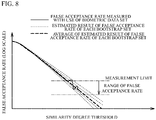
- FIG. 8 illustrates the combined false acceptance rate obtained by the above-mentioned process.
- a thick broken line indicates the combined false acceptance rate.
- a lower limit of "range of false acceptance rate" corresponds to the lower limit of the appropriate section. As illustrated in FIG. 8 , it is possible to stably obtain the false acceptance rate over a measurement limit based on the sample number of the biometric data set.
- the embodiment it is possible to calculate the individual false acceptance rate over the measurement limit of each bootstrap by estimating the probability density distribution of the similarity degree set with respect to each bootstrap set. And, it is possible to estimate the combined false acceptance rate with high accuracy because the statics of the plurality of individual false acceptance rates are used. It is therefore possible to estimate the combined false acceptance rate with high accuracy with a little number of the biometric data. That is, it is possible to reduce a cost for collecting data, a period for collecting biometric data, a workload for collecting biometric data.
- the reliable section of the combined false acceptance rate by calculating the statics of variability such as a standard deviation, a dispersion, an upper limit, a lower limit or the like of the plurality of individual false acceptance rates. And, it is possible to determine whether the estimated results of the combined false acceptance rate are appropriate with respect to each similarity degree threshold by comparing at least one of the combined false acceptance rate and the reliable section with a predetermined threshold. When the combined false acceptance rate of the section (appropriate section) determined as appropriate is adopted, the accuracy of the combined false acceptance rate is improved.
- the second embodiment is under a condition that there is a large scale biometric data set and the false acceptance rate obtained from the similarity calculated with different people's pairs is already known in the arbitrary biometric authentication algorism.
- the number of the biometric data for obtaining a desirable false acceptance rate is estimated with used of these data.
- the estimated result is used for evaluating another sensor.
- a scenario for collecting a new biometric data set is considered.
- FIG. 9 illustrates a functional block diagram of an evaluation device 100a in accordance with the second embodiment. As illustrated in FIG. 9 , the evaluation device 100a is different from the evaluation device 100 of FIG. 4 in a point that a subset generator 80 and a determiner 90 are provided.
- FIG. 10 illustrates a flowchart of an evaluation process executed by the evaluation device 100a. A description will be given of an operation of the evaluation device 100a on the basis of FIG. 9 and FIG. 10 .
- the subset generator 80 reads a biometric data set from the biometric data storage 10 (Step S11). Next, the subset generator 80 randomly samples biometric data from the biometric data set that is read in Step S11, and generates a subset (Step S12). The subset is a biometric data set of which the number of biometric data is lower than that of the biometric data set stored in the biometric data storage 10. Next, the bootstrap evaluator 20 generates a bootstrap set in which biometric data is randomly sampled from the subset generated in Step S12 (Step S13). For example, the size (the number of data) of the bootstrap set is around 50% of the subset.
- Step S14 to Step S21 are executed.
- Step S14 to Step S21 are the same as Step S3 to Step S10 of FIG. 5 .
- the combined false acceptance rate estimated in Step S18 is not a false acceptance rate of a biometric data set but a false acceptance rate of a subset.
- the determiner 90 determines whether a minimum value of the combined false acceptance rate of the subset adopted in Step S21 is equal to or less than a desirable false acceptance rate that is determined in advance (Step S22). When it is determined as "Yes" in Step S22, Step S12 is executed again.
- Step S12 the subset generator 80 generates a subset of which the number of biometric data is less than that of the subset that is previously generated.
- the determiner 90 determines the minimum size of the subsets as a necessary number of the biometric data (Step S23). That is, the number of the biometric data for obtaining a desirable false acceptance rate is estimated.
- the size of the subset is gradually reduced. It is therefore possible to estimate the number of biometric data for obtaining a desirable false acceptance rate. That is, it is possible to reduce a cost for collecting biometric data, a collection period of the biometric data, collection workload of the biometric data, and so on.
- a modality of biometric data is not limited.
- the embodiments can be applied to all modalities such as a fingerprint authentication, a vein authentication, an iris authentication, a face authentication and so on.
- FIG. 11 illustrates a hardware structure of the evaluation device 100.
- the evaluation device 100 has a CPU 101, a RAM (Random Access Memory) 102, a memory device 103, a display device 104 and so on.
- RAM Random Access Memory
- the CPU 101 is a central processing unit.
- the CPU 101 includes one or more core.
- the RAM 102 is a volatile memory temporally storing a program executed by the CPU 101, a data processed by the CPU 101, and so on.
- the memory device 103 is a nonvolatile memory device.
- the memory device 103 may be a SSD (Solid State Drive) such as a ROM (Read Only Memory) or a flash memory, or a hard disk driven by a hard disk drive.
- the memory device 103 stores an evaluation program.
- the display device 104 is such as a liquid crystal device, an electroluminescence panel or the like and shows an evaluation result.
- Each component of the evaluation device 100 is achieved by the execution of the program. However, each component of the evaluation device 100 may be a hardware such as a dedicated circuit.
- the bootstrap evaluator 20 is an example of a generator configured to generate a plurality of sets from a first population of biometric data collected from a plurality of users, a number of biometric data of the plurality of sets being smaller than that of the first population, at least a part of the plurality of sets being different from each other.
- the extrapolator 30 is an example of a first estimator configured to estimate a probability density distribution of similarity degrees of different people's pairs of each of the plurality of sets.
- the calculator 40 is an example of a calculator configured to calculate a false acceptance rate with respect to each similarity degree threshold on a basis of the probability density distribution, with respect to each of the plurality of sets.
- the false acceptance rate estimator 50 is an example of a second estimator configured to estimate a combined false acceptance rate from a statistic amount of false acceptance rates of the plurality of sets calculated by the calculator.
- the determiner 90 is an example of a determiner configured to determine whether a minimum value of a false acceptance rate estimated by the second estimator is equal to or less than a threshold.
- the subset generator 80 is an example of an updater configured to update a population as the second population when it is determined that the minimum value is equal or less than the threshold, a number of samples of the population being smaller than that of the second population.
Landscapes
- Engineering & Computer Science (AREA)
- Theoretical Computer Science (AREA)
- Physics & Mathematics (AREA)
- General Physics & Mathematics (AREA)
- Data Mining & Analysis (AREA)
- General Engineering & Computer Science (AREA)
- Computer Security & Cryptography (AREA)
- Computer Hardware Design (AREA)
- Software Systems (AREA)
- Bioinformatics & Cheminformatics (AREA)
- Evolutionary Biology (AREA)
- Life Sciences & Earth Sciences (AREA)
- Bioinformatics & Computational Biology (AREA)
- Mathematical Optimization (AREA)
- Computational Mathematics (AREA)
- Mathematical Physics (AREA)
- Pure & Applied Mathematics (AREA)
- Mathematical Analysis (AREA)
- Computing Systems (AREA)
- Signal Processing (AREA)
- General Health & Medical Sciences (AREA)
- Biomedical Technology (AREA)
- Computer Networks & Wireless Communication (AREA)
- Evolutionary Computation (AREA)
- Health & Medical Sciences (AREA)
- Multimedia (AREA)
- Human Computer Interaction (AREA)
- Artificial Intelligence (AREA)
- Computer Vision & Pattern Recognition (AREA)
- Algebra (AREA)
- Databases & Information Systems (AREA)
- Probability & Statistics with Applications (AREA)
- Operations Research (AREA)
- Collating Specific Patterns (AREA)
- Measurement Of The Respiration, Hearing Ability, Form, And Blood Characteristics Of Living Organisms (AREA)
Applications Claiming Priority (1)
| Application Number | Priority Date | Filing Date | Title |
|---|---|---|---|
| JP2016160597A JP2018028815A (ja) | 2016-08-18 | 2016-08-18 | 評価装置、評価方法および評価プログラム |
Publications (2)
| Publication Number | Publication Date |
|---|---|
| EP3285206A1 true EP3285206A1 (fr) | 2018-02-21 |
| EP3285206B1 EP3285206B1 (fr) | 2020-03-25 |
Family
ID=59569141
Family Applications (1)
| Application Number | Title | Priority Date | Filing Date |
|---|---|---|---|
| EP17184017.6A Active EP3285206B1 (fr) | 2016-08-18 | 2017-07-31 | Dispositif, procédé et programme d'évaluation pour des données biométriques |
Country Status (3)
| Country | Link |
|---|---|
| US (1) | US10515200B2 (fr) |
| EP (1) | EP3285206B1 (fr) |
| JP (1) | JP2018028815A (fr) |
Cited By (1)
| Publication number | Priority date | Publication date | Assignee | Title |
|---|---|---|---|---|
| CN108596112A (zh) * | 2018-04-27 | 2018-09-28 | 北京万里红科技股份有限公司 | 一种大规模虹膜特征识别匹配阈值的动态选取方法 |
Families Citing this family (3)
| Publication number | Priority date | Publication date | Assignee | Title |
|---|---|---|---|---|
| CN111971671B (zh) * | 2018-04-24 | 2024-07-12 | 三菱电机株式会社 | 认证装置 |
| US12437574B2 (en) | 2020-09-30 | 2025-10-07 | Nec Corporation | Threshold calculation system, threshold calculation method, and computer program |
| CN114005129B (zh) * | 2021-11-01 | 2025-08-19 | 厦门市腾云易惠科技有限公司 | 基于特征碰撞的预判方法、装置、设备及可读存储介质 |
Citations (1)
| Publication number | Priority date | Publication date | Assignee | Title |
|---|---|---|---|---|
| WO2010047685A1 (fr) * | 2008-10-20 | 2010-04-29 | Ultra-Scan Corporation | Système logique de décision de fusion multimodale destiné à déterminer s'il convient d'accepter un échantillon |
Family Cites Families (9)
| Publication number | Priority date | Publication date | Assignee | Title |
|---|---|---|---|---|
| JPH11306352A (ja) | 1998-04-20 | 1999-11-05 | Ntt Data Corp | 生体的特徴の認証精度推定方法及び装置、記録媒体 |
| DE10132013B4 (de) * | 2001-07-03 | 2004-04-08 | Siemens Ag | Multimodale Biometrie |
| US8433920B2 (en) * | 2004-12-07 | 2013-04-30 | Mitsubishi Electric Research Laboratories, Inc. | Method and system for authenticating reliable biometric data |
| US8190540B2 (en) * | 2005-01-14 | 2012-05-29 | Ultra-Scan Corporation | Multimodal fusion decision logic system for determining whether to accept a specimen |
| US20070036400A1 (en) * | 2005-03-28 | 2007-02-15 | Sanyo Electric Co., Ltd. | User authentication using biometric information |
| WO2008022157A2 (fr) * | 2006-08-15 | 2008-02-21 | Vxv Solutions, Inc. | Réglage adaptatif de moteurs biométriques |
| JP5012247B2 (ja) * | 2007-06-21 | 2012-08-29 | ソニー株式会社 | 認証装置、入場管理装置、入退場管理装置、入場管理システム、入退場管理システム、認証処理方法およびプログラム |
| JP2011044101A (ja) * | 2009-08-24 | 2011-03-03 | Sony Corp | 閾値更新装置、閾値決定装置、閾値更新方法、閾値決定方法およびプログラム |
| KR102238688B1 (ko) * | 2015-10-21 | 2021-04-09 | 삼성전자주식회사 | 생체 인증 방법 및 생체 인증 장치 |
-
2016
- 2016-08-18 JP JP2016160597A patent/JP2018028815A/ja active Pending
-
2017
- 2017-07-31 EP EP17184017.6A patent/EP3285206B1/fr active Active
- 2017-07-31 US US15/664,609 patent/US10515200B2/en not_active Expired - Fee Related
Patent Citations (1)
| Publication number | Priority date | Publication date | Assignee | Title |
|---|---|---|---|---|
| WO2010047685A1 (fr) * | 2008-10-20 | 2010-04-29 | Ultra-Scan Corporation | Système logique de décision de fusion multimodale destiné à déterminer s'il convient d'accepter un échantillon |
Non-Patent Citations (4)
| Title |
|---|
| BOLLE R M ET AL: "Error analysis of pattern recognition systems-the subsets bootstrap", COMPUTER VISION AND IMAGE UNDERSTAND, ACADEMIC PRESS, US, vol. 93, no. 1, 1 January 2004 (2004-01-01), pages 1 - 33, XP004480407, ISSN: 1077-3142, DOI: 10.1016/J.CVIU.2003.08.002 * |
| DASS S C ET AL: "Validating a Biometric Authentication System: Sample Size Requirements", IEEE TRANSACTIONS ON PATTERN ANALYSIS AND MACHINE INTELLIGENCE, IEEE COMPUTER SOCIETY, USA, vol. 28, no. 12, 1 December 2006 (2006-12-01), pages 1902 - 1913, XP001523408, ISSN: 0162-8828, DOI: 10.1109/TPAMI.2006.255 * |
| HERVE JAROSZ; JEAN-CHISTOPHE FONDEUR; XAVIER DUPRE: "Biometric Systems", 2004, SPRINGER, article "Large-Scale Identification System Design", pages: 272 - 275 |
| SARAT DASS; YONGFANG ZHU; ANIL JAIN: "Validating a Biometric Authentication System: Sample Size Requirements", IEEE TRANS. ON PAMI, 2006 |
Cited By (1)
| Publication number | Priority date | Publication date | Assignee | Title |
|---|---|---|---|---|
| CN108596112A (zh) * | 2018-04-27 | 2018-09-28 | 北京万里红科技股份有限公司 | 一种大规模虹膜特征识别匹配阈值的动态选取方法 |
Also Published As
| Publication number | Publication date |
|---|---|
| US20180052984A1 (en) | 2018-02-22 |
| EP3285206B1 (fr) | 2020-03-25 |
| US10515200B2 (en) | 2019-12-24 |
| JP2018028815A (ja) | 2018-02-22 |
Similar Documents
| Publication | Publication Date | Title |
|---|---|---|
| US10635890B2 (en) | Facial recognition method and apparatus, electronic device, and storage medium | |
| US10757125B2 (en) | Anomaly detection method and recording medium | |
| EP3285206B1 (fr) | Dispositif, procédé et programme d'évaluation pour des données biométriques | |
| EP3229171A1 (fr) | Procédé et dispositif servant à déterminer un identifiant d'identité d'un visage humain dans une image de visage humain, et terminal | |
| EP3690806A1 (fr) | Dispositif d'authentification, système d'authentification, procédé d'authentification et programme | |
| US10404524B2 (en) | Resource and metric ranking by differential analysis | |
| CN107067099B (zh) | 风电功率概率预测方法及装置 | |
| US20160027181A1 (en) | Accelerating Object Detection | |
| CN102194134B (zh) | 基于统计学习对生物特征识别系统的性能指标进行预测的方法 | |
| WO2017075913A1 (fr) | Procédé d'authentification basé sur des comportements de souris | |
| US11042880B1 (en) | Authenticating users in the presence of small transaction volumes | |
| US20190180194A1 (en) | Computer-readable recording medium, abnormality candidate extraction method, and abnormality candidate extraction apparatus | |
| WO2019095587A1 (fr) | Procédé de reconnaissance faciale, serveur d'application et support de stockage lisible par ordinateur | |
| CN118094118A (zh) | 数据集质量评估方法、系统、电子设备及存储介质 | |
| WO2023083051A1 (fr) | Procédé et appareil de reconnaissance biométrique, ainsi que dispositif et support de stockage | |
| CN115146890A (zh) | 企业运营风险告警方法、装置、计算机设备和存储介质 | |
| US20120221272A1 (en) | Quality estimation apparatus, quality estimation method and non-transitory computer-readable medium storing program | |
| US20070183625A1 (en) | Statistical Match For Facial Biometric To Reduce False Accept Rate/False Match Rate (FAR/FMR) | |
| Lanitis et al. | Quantitative evaluation of the effects of aging on biometric templates | |
| JPWO2013145249A1 (ja) | 生体認証装置、生体認証方法、および生体認証プログラム | |
| CN112363859B (zh) | 异常判定阈值的确定方法及装置 | |
| CN114002657B (zh) | 海面慢速目标检测方法及设备、存储介质和程序产品 | |
| CN116206179A (zh) | 人脸识别模型性能的评估方法及装置 | |
| RU2459252C1 (ru) | Система и способ идентификации пользователей эвм (варианты) | |
| Mau et al. | Gaussian Probabilistic Confidence Score for Biometric Applications |
Legal Events
| Date | Code | Title | Description |
|---|---|---|---|
| PUAI | Public reference made under article 153(3) epc to a published international application that has entered the european phase |
Free format text: ORIGINAL CODE: 0009012 |
|
| STAA | Information on the status of an ep patent application or granted ep patent |
Free format text: STATUS: THE APPLICATION HAS BEEN PUBLISHED |
|
| AK | Designated contracting states |
Kind code of ref document: A1 Designated state(s): AL AT BE BG CH CY CZ DE DK EE ES FI FR GB GR HR HU IE IS IT LI LT LU LV MC MK MT NL NO PL PT RO RS SE SI SK SM TR |
|
| AX | Request for extension of the european patent |
Extension state: BA ME |
|
| STAA | Information on the status of an ep patent application or granted ep patent |
Free format text: STATUS: REQUEST FOR EXAMINATION WAS MADE |
|
| 17P | Request for examination filed |
Effective date: 20180809 |
|
| RBV | Designated contracting states (corrected) |
Designated state(s): AL AT BE BG CH CY CZ DE DK EE ES FI FR GB GR HR HU IE IS IT LI LT LU LV MC MK MT NL NO PL PT RO RS SE SI SK SM TR |
|
| STAA | Information on the status of an ep patent application or granted ep patent |
Free format text: STATUS: EXAMINATION IS IN PROGRESS |
|
| 17Q | First examination report despatched |
Effective date: 20190122 |
|
| REG | Reference to a national code |
Ref country code: DE Ref legal event code: R079 Ref document number: 602017013498 Country of ref document: DE Free format text: PREVIOUS MAIN CLASS: G06K0009000000 Ipc: G06K0009620000 |
|
| RIC1 | Information provided on ipc code assigned before grant |
Ipc: G06K 9/62 20060101AFI20191028BHEP Ipc: G06F 21/32 20130101ALI20191028BHEP Ipc: H04L 29/06 20060101ALI20191028BHEP Ipc: G06K 9/00 20060101ALI20191028BHEP |
|
| GRAP | Despatch of communication of intention to grant a patent |
Free format text: ORIGINAL CODE: EPIDOSNIGR1 |
|
| STAA | Information on the status of an ep patent application or granted ep patent |
Free format text: STATUS: GRANT OF PATENT IS INTENDED |
|
| INTG | Intention to grant announced |
Effective date: 20191206 |
|
| GRAS | Grant fee paid |
Free format text: ORIGINAL CODE: EPIDOSNIGR3 |
|
| GRAA | (expected) grant |
Free format text: ORIGINAL CODE: 0009210 |
|
| STAA | Information on the status of an ep patent application or granted ep patent |
Free format text: STATUS: THE PATENT HAS BEEN GRANTED |
|
| AK | Designated contracting states |
Kind code of ref document: B1 Designated state(s): AL AT BE BG CH CY CZ DE DK EE ES FI FR GB GR HR HU IE IS IT LI LT LU LV MC MK MT NL NO PL PT RO RS SE SI SK SM TR |
|
| REG | Reference to a national code |
Ref country code: GB Ref legal event code: FG4D |
|
| REG | Reference to a national code |
Ref country code: AT Ref legal event code: REF Ref document number: 1249412 Country of ref document: AT Kind code of ref document: T Effective date: 20200415 Ref country code: IE Ref legal event code: FG4D |
|
| REG | Reference to a national code |
Ref country code: DE Ref legal event code: R096 Ref document number: 602017013498 Country of ref document: DE |
|
| PG25 | Lapsed in a contracting state [announced via postgrant information from national office to epo] |
Ref country code: FI Free format text: LAPSE BECAUSE OF FAILURE TO SUBMIT A TRANSLATION OF THE DESCRIPTION OR TO PAY THE FEE WITHIN THE PRESCRIBED TIME-LIMIT Effective date: 20200325 Ref country code: NO Free format text: LAPSE BECAUSE OF FAILURE TO SUBMIT A TRANSLATION OF THE DESCRIPTION OR TO PAY THE FEE WITHIN THE PRESCRIBED TIME-LIMIT Effective date: 20200625 Ref country code: RS Free format text: LAPSE BECAUSE OF FAILURE TO SUBMIT A TRANSLATION OF THE DESCRIPTION OR TO PAY THE FEE WITHIN THE PRESCRIBED TIME-LIMIT Effective date: 20200325 |
|
| PGFP | Annual fee paid to national office [announced via postgrant information from national office to epo] |
Ref country code: FR Payment date: 20200520 Year of fee payment: 4 |
|
| PG25 | Lapsed in a contracting state [announced via postgrant information from national office to epo] |
Ref country code: HR Free format text: LAPSE BECAUSE OF FAILURE TO SUBMIT A TRANSLATION OF THE DESCRIPTION OR TO PAY THE FEE WITHIN THE PRESCRIBED TIME-LIMIT Effective date: 20200325 Ref country code: SE Free format text: LAPSE BECAUSE OF FAILURE TO SUBMIT A TRANSLATION OF THE DESCRIPTION OR TO PAY THE FEE WITHIN THE PRESCRIBED TIME-LIMIT Effective date: 20200325 Ref country code: LV Free format text: LAPSE BECAUSE OF FAILURE TO SUBMIT A TRANSLATION OF THE DESCRIPTION OR TO PAY THE FEE WITHIN THE PRESCRIBED TIME-LIMIT Effective date: 20200325 Ref country code: GR Free format text: LAPSE BECAUSE OF FAILURE TO SUBMIT A TRANSLATION OF THE DESCRIPTION OR TO PAY THE FEE WITHIN THE PRESCRIBED TIME-LIMIT Effective date: 20200626 Ref country code: BG Free format text: LAPSE BECAUSE OF FAILURE TO SUBMIT A TRANSLATION OF THE DESCRIPTION OR TO PAY THE FEE WITHIN THE PRESCRIBED TIME-LIMIT Effective date: 20200625 |
|
| REG | Reference to a national code |
Ref country code: NL Ref legal event code: MP Effective date: 20200325 |
|
| REG | Reference to a national code |
Ref country code: LT Ref legal event code: MG4D |
|
| PG25 | Lapsed in a contracting state [announced via postgrant information from national office to epo] |
Ref country code: NL Free format text: LAPSE BECAUSE OF FAILURE TO SUBMIT A TRANSLATION OF THE DESCRIPTION OR TO PAY THE FEE WITHIN THE PRESCRIBED TIME-LIMIT Effective date: 20200325 |
|
| PG25 | Lapsed in a contracting state [announced via postgrant information from national office to epo] |
Ref country code: CZ Free format text: LAPSE BECAUSE OF FAILURE TO SUBMIT A TRANSLATION OF THE DESCRIPTION OR TO PAY THE FEE WITHIN THE PRESCRIBED TIME-LIMIT Effective date: 20200325 Ref country code: IS Free format text: LAPSE BECAUSE OF FAILURE TO SUBMIT A TRANSLATION OF THE DESCRIPTION OR TO PAY THE FEE WITHIN THE PRESCRIBED TIME-LIMIT Effective date: 20200725 Ref country code: LT Free format text: LAPSE BECAUSE OF FAILURE TO SUBMIT A TRANSLATION OF THE DESCRIPTION OR TO PAY THE FEE WITHIN THE PRESCRIBED TIME-LIMIT Effective date: 20200325 Ref country code: RO Free format text: LAPSE BECAUSE OF FAILURE TO SUBMIT A TRANSLATION OF THE DESCRIPTION OR TO PAY THE FEE WITHIN THE PRESCRIBED TIME-LIMIT Effective date: 20200325 Ref country code: PT Free format text: LAPSE BECAUSE OF FAILURE TO SUBMIT A TRANSLATION OF THE DESCRIPTION OR TO PAY THE FEE WITHIN THE PRESCRIBED TIME-LIMIT Effective date: 20200818 Ref country code: SM Free format text: LAPSE BECAUSE OF FAILURE TO SUBMIT A TRANSLATION OF THE DESCRIPTION OR TO PAY THE FEE WITHIN THE PRESCRIBED TIME-LIMIT Effective date: 20200325 Ref country code: EE Free format text: LAPSE BECAUSE OF FAILURE TO SUBMIT A TRANSLATION OF THE DESCRIPTION OR TO PAY THE FEE WITHIN THE PRESCRIBED TIME-LIMIT Effective date: 20200325 Ref country code: SK Free format text: LAPSE BECAUSE OF FAILURE TO SUBMIT A TRANSLATION OF THE DESCRIPTION OR TO PAY THE FEE WITHIN THE PRESCRIBED TIME-LIMIT Effective date: 20200325 |
|
| PGFP | Annual fee paid to national office [announced via postgrant information from national office to epo] |
Ref country code: DE Payment date: 20200421 Year of fee payment: 4 |
|
| REG | Reference to a national code |
Ref country code: AT Ref legal event code: MK05 Ref document number: 1249412 Country of ref document: AT Kind code of ref document: T Effective date: 20200325 |
|
| REG | Reference to a national code |
Ref country code: DE Ref legal event code: R097 Ref document number: 602017013498 Country of ref document: DE |
|
| PG25 | Lapsed in a contracting state [announced via postgrant information from national office to epo] |
Ref country code: DK Free format text: LAPSE BECAUSE OF FAILURE TO SUBMIT A TRANSLATION OF THE DESCRIPTION OR TO PAY THE FEE WITHIN THE PRESCRIBED TIME-LIMIT Effective date: 20200325 Ref country code: AT Free format text: LAPSE BECAUSE OF FAILURE TO SUBMIT A TRANSLATION OF THE DESCRIPTION OR TO PAY THE FEE WITHIN THE PRESCRIBED TIME-LIMIT Effective date: 20200325 Ref country code: ES Free format text: LAPSE BECAUSE OF FAILURE TO SUBMIT A TRANSLATION OF THE DESCRIPTION OR TO PAY THE FEE WITHIN THE PRESCRIBED TIME-LIMIT Effective date: 20200325 Ref country code: IT Free format text: LAPSE BECAUSE OF FAILURE TO SUBMIT A TRANSLATION OF THE DESCRIPTION OR TO PAY THE FEE WITHIN THE PRESCRIBED TIME-LIMIT Effective date: 20200325 |
|
| PLBE | No opposition filed within time limit |
Free format text: ORIGINAL CODE: 0009261 |
|
| STAA | Information on the status of an ep patent application or granted ep patent |
Free format text: STATUS: NO OPPOSITION FILED WITHIN TIME LIMIT |
|
| PG25 | Lapsed in a contracting state [announced via postgrant information from national office to epo] |
Ref country code: MC Free format text: LAPSE BECAUSE OF FAILURE TO SUBMIT A TRANSLATION OF THE DESCRIPTION OR TO PAY THE FEE WITHIN THE PRESCRIBED TIME-LIMIT Effective date: 20200325 Ref country code: PL Free format text: LAPSE BECAUSE OF FAILURE TO SUBMIT A TRANSLATION OF THE DESCRIPTION OR TO PAY THE FEE WITHIN THE PRESCRIBED TIME-LIMIT Effective date: 20200325 |
|
| REG | Reference to a national code |
Ref country code: CH Ref legal event code: PL |
|
| 26N | No opposition filed |
Effective date: 20210112 |
|
| REG | Reference to a national code |
Ref country code: BE Ref legal event code: MM Effective date: 20200731 |
|
| PG25 | Lapsed in a contracting state [announced via postgrant information from national office to epo] |
Ref country code: CH Free format text: LAPSE BECAUSE OF NON-PAYMENT OF DUE FEES Effective date: 20200731 Ref country code: LI Free format text: LAPSE BECAUSE OF NON-PAYMENT OF DUE FEES Effective date: 20200731 Ref country code: LU Free format text: LAPSE BECAUSE OF NON-PAYMENT OF DUE FEES Effective date: 20200731 |
|
| PG25 | Lapsed in a contracting state [announced via postgrant information from national office to epo] |
Ref country code: BE Free format text: LAPSE BECAUSE OF NON-PAYMENT OF DUE FEES Effective date: 20200731 Ref country code: SI Free format text: LAPSE BECAUSE OF FAILURE TO SUBMIT A TRANSLATION OF THE DESCRIPTION OR TO PAY THE FEE WITHIN THE PRESCRIBED TIME-LIMIT Effective date: 20200325 |
|
| PG25 | Lapsed in a contracting state [announced via postgrant information from national office to epo] |
Ref country code: IE Free format text: LAPSE BECAUSE OF NON-PAYMENT OF DUE FEES Effective date: 20200731 |
|
| REG | Reference to a national code |
Ref country code: DE Ref legal event code: R079 Ref document number: 602017013498 Country of ref document: DE Free format text: PREVIOUS MAIN CLASS: G06K0009620000 Ipc: G06V0030190000 |
|
| REG | Reference to a national code |
Ref country code: DE Ref legal event code: R119 Ref document number: 602017013498 Country of ref document: DE |
|
| GBPC | Gb: european patent ceased through non-payment of renewal fee |
Effective date: 20210731 |
|
| PG25 | Lapsed in a contracting state [announced via postgrant information from national office to epo] |
Ref country code: GB Free format text: LAPSE BECAUSE OF NON-PAYMENT OF DUE FEES Effective date: 20210731 Ref country code: DE Free format text: LAPSE BECAUSE OF NON-PAYMENT OF DUE FEES Effective date: 20220201 |
|
| PG25 | Lapsed in a contracting state [announced via postgrant information from national office to epo] |
Ref country code: TR Free format text: LAPSE BECAUSE OF FAILURE TO SUBMIT A TRANSLATION OF THE DESCRIPTION OR TO PAY THE FEE WITHIN THE PRESCRIBED TIME-LIMIT Effective date: 20200325 Ref country code: MT Free format text: LAPSE BECAUSE OF FAILURE TO SUBMIT A TRANSLATION OF THE DESCRIPTION OR TO PAY THE FEE WITHIN THE PRESCRIBED TIME-LIMIT Effective date: 20200325 Ref country code: FR Free format text: LAPSE BECAUSE OF NON-PAYMENT OF DUE FEES Effective date: 20210731 Ref country code: CY Free format text: LAPSE BECAUSE OF FAILURE TO SUBMIT A TRANSLATION OF THE DESCRIPTION OR TO PAY THE FEE WITHIN THE PRESCRIBED TIME-LIMIT Effective date: 20200325 |
|
| PG25 | Lapsed in a contracting state [announced via postgrant information from national office to epo] |
Ref country code: MK Free format text: LAPSE BECAUSE OF FAILURE TO SUBMIT A TRANSLATION OF THE DESCRIPTION OR TO PAY THE FEE WITHIN THE PRESCRIBED TIME-LIMIT Effective date: 20200325 Ref country code: AL Free format text: LAPSE BECAUSE OF FAILURE TO SUBMIT A TRANSLATION OF THE DESCRIPTION OR TO PAY THE FEE WITHIN THE PRESCRIBED TIME-LIMIT Effective date: 20200325 |