EP3285298A1 - Schutzstruktur gegen elektrostatische entladungen und herstellungsverfahren dafür - Google Patents
Schutzstruktur gegen elektrostatische entladungen und herstellungsverfahren dafür Download PDFInfo
- Publication number
- EP3285298A1 EP3285298A1 EP17185877.2A EP17185877A EP3285298A1 EP 3285298 A1 EP3285298 A1 EP 3285298A1 EP 17185877 A EP17185877 A EP 17185877A EP 3285298 A1 EP3285298 A1 EP 3285298A1
- Authority
- EP
- European Patent Office
- Prior art keywords
- region
- substrate
- doped layer
- fin portion
- electrostatic discharge
- Prior art date
- Legal status (The legal status is an assumption and is not a legal conclusion. Google has not performed a legal analysis and makes no representation as to the accuracy of the status listed.)
- Withdrawn
Links
Images



Classifications
-
- H—ELECTRICITY
- H10—SEMICONDUCTOR DEVICES; ELECTRIC SOLID-STATE DEVICES NOT OTHERWISE PROVIDED FOR
- H10D—INORGANIC ELECTRIC SEMICONDUCTOR DEVICES
- H10D89/00—Aspects of integrated devices not covered by groups H10D84/00 - H10D88/00
- H10D89/60—Integrated devices comprising arrangements for electrical or thermal protection, e.g. protection circuits against electrostatic discharge [ESD]
- H10D89/601—Integrated devices comprising arrangements for electrical or thermal protection, e.g. protection circuits against electrostatic discharge [ESD] for devices having insulated gate electrodes, e.g. for IGFETs or IGBTs
- H10D89/811—Integrated devices comprising arrangements for electrical or thermal protection, e.g. protection circuits against electrostatic discharge [ESD] for devices having insulated gate electrodes, e.g. for IGFETs or IGBTs using FETs as protective elements
-
- H—ELECTRICITY
- H10—SEMICONDUCTOR DEVICES; ELECTRIC SOLID-STATE DEVICES NOT OTHERWISE PROVIDED FOR
- H10D—INORGANIC ELECTRIC SEMICONDUCTOR DEVICES
- H10D62/00—Semiconductor bodies, or regions thereof, of devices having potential barriers
- H10D62/10—Shapes, relative sizes or dispositions of the regions of the semiconductor bodies; Shapes of the semiconductor bodies
- H10D62/113—Isolations within a component, i.e. internal isolations
- H10D62/115—Dielectric isolations, e.g. air gaps
-
- H—ELECTRICITY
- H10—SEMICONDUCTOR DEVICES; ELECTRIC SOLID-STATE DEVICES NOT OTHERWISE PROVIDED FOR
- H10D—INORGANIC ELECTRIC SEMICONDUCTOR DEVICES
- H10D62/00—Semiconductor bodies, or regions thereof, of devices having potential barriers
- H10D62/10—Shapes, relative sizes or dispositions of the regions of the semiconductor bodies; Shapes of the semiconductor bodies
- H10D62/13—Semiconductor regions connected to electrodes carrying current to be rectified, amplified or switched, e.g. source or drain regions
- H10D62/149—Source or drain regions of field-effect devices
- H10D62/151—Source or drain regions of field-effect devices of IGFETs
-
- H—ELECTRICITY
- H10—SEMICONDUCTOR DEVICES; ELECTRIC SOLID-STATE DEVICES NOT OTHERWISE PROVIDED FOR
- H10D—INORGANIC ELECTRIC SEMICONDUCTOR DEVICES
- H10D62/00—Semiconductor bodies, or regions thereof, of devices having potential barriers
- H10D62/10—Shapes, relative sizes or dispositions of the regions of the semiconductor bodies; Shapes of the semiconductor bodies
- H10D62/17—Semiconductor regions connected to electrodes not carrying current to be rectified, amplified or switched, e.g. channel regions
- H10D62/213—Channel regions of field-effect devices
- H10D62/221—Channel regions of field-effect devices of FETs
- H10D62/235—Channel regions of field-effect devices of FETs of IGFETs
- H10D62/292—Non-planar channels of IGFETs
-
- H—ELECTRICITY
- H10—SEMICONDUCTOR DEVICES; ELECTRIC SOLID-STATE DEVICES NOT OTHERWISE PROVIDED FOR
- H10D—INORGANIC ELECTRIC SEMICONDUCTOR DEVICES
- H10D64/00—Electrodes of devices having potential barriers
- H10D64/20—Electrodes characterised by their shapes, relative sizes or dispositions
- H10D64/27—Electrodes not carrying the current to be rectified, amplified, oscillated or switched, e.g. gates
- H10D64/311—Gate electrodes for field-effect devices
- H10D64/411—Gate electrodes for field-effect devices for FETs
- H10D64/511—Gate electrodes for field-effect devices for FETs for IGFETs
- H10D64/514—Gate electrodes for field-effect devices for FETs for IGFETs characterised by the insulating layers
- H10D64/516—Gate electrodes for field-effect devices for FETs for IGFETs characterised by the insulating layers the thicknesses being non-uniform
-
- H—ELECTRICITY
- H10—SEMICONDUCTOR DEVICES; ELECTRIC SOLID-STATE DEVICES NOT OTHERWISE PROVIDED FOR
- H10D—INORGANIC ELECTRIC SEMICONDUCTOR DEVICES
- H10D64/00—Electrodes of devices having potential barriers
- H10D64/20—Electrodes characterised by their shapes, relative sizes or dispositions
- H10D64/27—Electrodes not carrying the current to be rectified, amplified, oscillated or switched, e.g. gates
- H10D64/311—Gate electrodes for field-effect devices
- H10D64/411—Gate electrodes for field-effect devices for FETs
- H10D64/511—Gate electrodes for field-effect devices for FETs for IGFETs
- H10D64/517—Gate electrodes for field-effect devices for FETs for IGFETs characterised by the conducting layers
- H10D64/518—Gate electrodes for field-effect devices for FETs for IGFETs characterised by the conducting layers characterised by their lengths or sectional shapes
-
- H—ELECTRICITY
- H10—SEMICONDUCTOR DEVICES; ELECTRIC SOLID-STATE DEVICES NOT OTHERWISE PROVIDED FOR
- H10D—INORGANIC ELECTRIC SEMICONDUCTOR DEVICES
- H10D84/00—Integrated devices formed in or on semiconductor substrates that comprise only semiconducting layers, e.g. on Si wafers or on GaAs-on-Si wafers
- H10D84/01—Manufacture or treatment
-
- H—ELECTRICITY
- H10—SEMICONDUCTOR DEVICES; ELECTRIC SOLID-STATE DEVICES NOT OTHERWISE PROVIDED FOR
- H10D—INORGANIC ELECTRIC SEMICONDUCTOR DEVICES
- H10D84/00—Integrated devices formed in or on semiconductor substrates that comprise only semiconducting layers, e.g. on Si wafers or on GaAs-on-Si wafers
- H10D84/01—Manufacture or treatment
- H10D84/0123—Integrating together multiple components covered by H10D12/00 or H10D30/00, e.g. integrating multiple IGBTs
- H10D84/0126—Integrating together multiple components covered by H10D12/00 or H10D30/00, e.g. integrating multiple IGBTs the components including insulated gates, e.g. IGFETs
- H10D84/013—Manufacturing their source or drain regions, e.g. silicided source or drain regions
-
- H—ELECTRICITY
- H10—SEMICONDUCTOR DEVICES; ELECTRIC SOLID-STATE DEVICES NOT OTHERWISE PROVIDED FOR
- H10D—INORGANIC ELECTRIC SEMICONDUCTOR DEVICES
- H10D84/00—Integrated devices formed in or on semiconductor substrates that comprise only semiconducting layers, e.g. on Si wafers or on GaAs-on-Si wafers
- H10D84/01—Manufacture or treatment
- H10D84/0123—Integrating together multiple components covered by H10D12/00 or H10D30/00, e.g. integrating multiple IGBTs
- H10D84/0126—Integrating together multiple components covered by H10D12/00 or H10D30/00, e.g. integrating multiple IGBTs the components including insulated gates, e.g. IGFETs
- H10D84/0151—Manufacturing their isolation regions
-
- H—ELECTRICITY
- H10—SEMICONDUCTOR DEVICES; ELECTRIC SOLID-STATE DEVICES NOT OTHERWISE PROVIDED FOR
- H10D—INORGANIC ELECTRIC SEMICONDUCTOR DEVICES
- H10D84/00—Integrated devices formed in or on semiconductor substrates that comprise only semiconducting layers, e.g. on Si wafers or on GaAs-on-Si wafers
- H10D84/01—Manufacture or treatment
- H10D84/0123—Integrating together multiple components covered by H10D12/00 or H10D30/00, e.g. integrating multiple IGBTs
- H10D84/0126—Integrating together multiple components covered by H10D12/00 or H10D30/00, e.g. integrating multiple IGBTs the components including insulated gates, e.g. IGFETs
- H10D84/0158—Integrating together multiple components covered by H10D12/00 or H10D30/00, e.g. integrating multiple IGBTs the components including insulated gates, e.g. IGFETs the components including FinFETs
-
- H—ELECTRICITY
- H10—SEMICONDUCTOR DEVICES; ELECTRIC SOLID-STATE DEVICES NOT OTHERWISE PROVIDED FOR
- H10D—INORGANIC ELECTRIC SEMICONDUCTOR DEVICES
- H10D84/00—Integrated devices formed in or on semiconductor substrates that comprise only semiconducting layers, e.g. on Si wafers or on GaAs-on-Si wafers
- H10D84/01—Manufacture or treatment
- H10D84/02—Manufacture or treatment characterised by using material-based technologies
- H10D84/03—Manufacture or treatment characterised by using material-based technologies using Group IV technology, e.g. silicon technology or silicon-carbide [SiC] technology
- H10D84/038—Manufacture or treatment characterised by using material-based technologies using Group IV technology, e.g. silicon technology or silicon-carbide [SiC] technology using silicon technology, e.g. SiGe
-
- H—ELECTRICITY
- H10—SEMICONDUCTOR DEVICES; ELECTRIC SOLID-STATE DEVICES NOT OTHERWISE PROVIDED FOR
- H10D—INORGANIC ELECTRIC SEMICONDUCTOR DEVICES
- H10D84/00—Integrated devices formed in or on semiconductor substrates that comprise only semiconducting layers, e.g. on Si wafers or on GaAs-on-Si wafers
- H10D84/80—Integrated devices formed in or on semiconductor substrates that comprise only semiconducting layers, e.g. on Si wafers or on GaAs-on-Si wafers characterised by the integration of at least one component covered by groups H10D12/00 or H10D30/00, e.g. integration of IGFETs
- H10D84/82—Integrated devices formed in or on semiconductor substrates that comprise only semiconducting layers, e.g. on Si wafers or on GaAs-on-Si wafers characterised by the integration of at least one component covered by groups H10D12/00 or H10D30/00, e.g. integration of IGFETs of only field-effect components
- H10D84/83—Integrated devices formed in or on semiconductor substrates that comprise only semiconducting layers, e.g. on Si wafers or on GaAs-on-Si wafers characterised by the integration of at least one component covered by groups H10D12/00 or H10D30/00, e.g. integration of IGFETs of only field-effect components of only insulated-gate FETs [IGFET]
- H10D84/834—Integrated devices formed in or on semiconductor substrates that comprise only semiconducting layers, e.g. on Si wafers or on GaAs-on-Si wafers characterised by the integration of at least one component covered by groups H10D12/00 or H10D30/00, e.g. integration of IGFETs of only field-effect components of only insulated-gate FETs [IGFET] comprising FinFETs
-
- H—ELECTRICITY
- H10—SEMICONDUCTOR DEVICES; ELECTRIC SOLID-STATE DEVICES NOT OTHERWISE PROVIDED FOR
- H10D—INORGANIC ELECTRIC SEMICONDUCTOR DEVICES
- H10D89/00—Aspects of integrated devices not covered by groups H10D84/00 - H10D88/00
- H10D89/10—Integrated device layouts
-
- H—ELECTRICITY
- H10—SEMICONDUCTOR DEVICES; ELECTRIC SOLID-STATE DEVICES NOT OTHERWISE PROVIDED FOR
- H10P—GENERIC PROCESSES OR APPARATUS FOR THE MANUFACTURE OR TREATMENT OF DEVICES COVERED BY CLASS H10
- H10P50/00—Etching of wafers, substrates or parts of devices
- H10P50/60—Wet etching
- H10P50/64—Wet etching of semiconductor materials
- H10P50/642—Chemical etching
-
- H—ELECTRICITY
- H10—SEMICONDUCTOR DEVICES; ELECTRIC SOLID-STATE DEVICES NOT OTHERWISE PROVIDED FOR
- H10P—GENERIC PROCESSES OR APPARATUS FOR THE MANUFACTURE OR TREATMENT OF DEVICES COVERED BY CLASS H10
- H10P50/00—Etching of wafers, substrates or parts of devices
- H10P50/69—Etching of wafers, substrates or parts of devices using masks for semiconductor materials
- H10P50/691—Etching of wafers, substrates or parts of devices using masks for semiconductor materials for Group V materials or Group III-V materials
- H10P50/692—Etching of wafers, substrates or parts of devices using masks for semiconductor materials for Group V materials or Group III-V materials characterised by their composition, e.g. multilayer masks or materials
-
- H—ELECTRICITY
- H10—SEMICONDUCTOR DEVICES; ELECTRIC SOLID-STATE DEVICES NOT OTHERWISE PROVIDED FOR
- H10D—INORGANIC ELECTRIC SEMICONDUCTOR DEVICES
- H10D84/00—Integrated devices formed in or on semiconductor substrates that comprise only semiconducting layers, e.g. on Si wafers or on GaAs-on-Si wafers
- H10D84/01—Manufacture or treatment
- H10D84/0123—Integrating together multiple components covered by H10D12/00 or H10D30/00, e.g. integrating multiple IGBTs
- H10D84/0126—Integrating together multiple components covered by H10D12/00 or H10D30/00, e.g. integrating multiple IGBTs the components including insulated gates, e.g. IGFETs
- H10D84/0135—Manufacturing their gate conductors
-
- H—ELECTRICITY
- H10—SEMICONDUCTOR DEVICES; ELECTRIC SOLID-STATE DEVICES NOT OTHERWISE PROVIDED FOR
- H10P—GENERIC PROCESSES OR APPARATUS FOR THE MANUFACTURE OR TREATMENT OF DEVICES COVERED BY CLASS H10
- H10P50/00—Etching of wafers, substrates or parts of devices
- H10P50/20—Dry etching; Plasma etching; Reactive-ion etching
- H10P50/28—Dry etching; Plasma etching; Reactive-ion etching of insulating materials
- H10P50/282—Dry etching; Plasma etching; Reactive-ion etching of insulating materials of inorganic materials
- H10P50/283—Dry etching; Plasma etching; Reactive-ion etching of insulating materials of inorganic materials by chemical means
Definitions
- the present invention generally relates to the field of semiconductor fabricating technology and, more particularly, relates to an electrostatic discharge protection structure and a fabricating method thereof.
- Transistors as the most basic semiconductor devices are currently being widely used and, with the increasing of the semiconductor device component density and the integration degree, the transistor size is getting smaller and smaller.
- the channel is projected over the surface of the substrate to form a fin structure, and the gate covers the top and sidewalls of the fin structure.
- the inversion layer formed on each side of the channel can control the turning-on and turning-off of the circuit on both sides, thereby greatly improving the circuit control and reducing the leakage current.
- the 3d architecture of a fin fet can improve the integration of the fin fet.
- the width of the fin structure of a fin fet may be relatively narrow, which can make the cooling of the fin fet to be a significant challenge. Therefore, a self-heat problem of the fin fet may be caused, which can damage the fin structure of the fin fet.
- an electrostatic discharge circuit a large electrostatic current generated by external circuitry can flow into the drain of the electrostatic discharge circuit, which may easily lead to a sharp increase of the temperature of the drain, causing an instable performance of the electrostatic discharge device. Therefore, the heat dissipation performance of the electrostatic discharge circuit has a significant impact on the electrostatic discharge device.
- the existing fin field-effect transistors have the disadvantages of poor heat dissipation and instable transistor performance.
- a first aspect of present invention provides an electrostatic discharge protection structure, comprising: A base substrate including a substrate and a fin portion on the substrate, wherein the substrate includes a first region and a second region; a first doped layer on a surface of the fin portion in the first region; and a second doped layer on a surface of the fin portion in the second region and on a surface of the substrate in the second region.
- the base substrate further includes a gate region between the first region and the second region; the electrostatic discharge protection structure further comprises a gate structure on the base substrate in the gate region; and the first doped layer and the second doped layer are of a same type.
- the electrostatic discharge protection structure further comprises an isolation structure on the base substrate between the second region and the gate region.
- the first doped layer is in contact with the second doped layer.
- the first doped layer and the second doped layer are of opposite types.
- a height of the fin portion in the second region is less than a height of the fin portion in the first region.
- a height of the fin portion in the second region is in a range from 150 angstroms to 800 angstroms.
- the base substrate includes a plurality of fin portions on the substrate in the second region.
- a depth-to-width ratio of gaps between adjacent fin portions in the second region is in a range from 1 to 4.
- a thickness of the second doped layer is in a range from 50 angstroms to 500 angstroms.
- a second aspect of the present invention provides a method for fabricating an electrostatic discharge protection structure, comprising: Providing a base substrate including a first region and a second region, wherein the base substrate in the second region includes a substrate and a fin portion on the substrate; Forming a first doped layer on a surface of a fin portion in the first region; and Forming a second doped layer on a surface of the fin portion in the second region and on a surface of the substrate in the second region.
- the base substrate further includes a gate region between the first region and the second region, further comprising: Before forming the first doped layer and the second doped layer, forming a gate structure on the base substrate in the gate region; wherein the first doped layer and the second doped layer are of a same type.
- an isolation structure is formed on the base substrate between the second region and the gate region.
- forming the second doped layer includes using an epitaxial growth process.
- the method further comprises: Before forming the second doped layer, etching the fin portion in the second region to reduce a height of the fin portion in the second region.
- the height of the fin portion in the second region is in a range from 150 angstroms to 800 angstroms.
- the base substrate includes a plurality of fin portions on the substrate in the second region.
- a depth-to-width ratio of gaps between adjacent fin portions in the second region is in a range from 1 to 4.
- the substrate and the fin portion on the substrate are further located in the first region of the base substrate, further comprising: Before forming the first doped layer and the second doped layer, forming an isolation structure on the substrate in the first region and the second region, wherein the isolation structure covers a portion of sidewalls of the fin portion, a top surface of the isolation structure is lower than a top surface of the fin portion, and removing the isolation structure in the second region to expose a surface of the substrate in the second region.
- the method further comprises: After forming the isolation structure, and before removing the isolation structure in the second region, etching the fin portion in the second region.
- the method further comprises: After removing the isolation structure in the second region, etching the fin portion in the second region.
- etching the fin portion in the second region includes: Forming a first sacrificial layer in the first region, wherein the first sacrificial layer covers sidewalls and a top surface of the fin portion in the first region; forming a second sacrificial layer in the second region substrate, wherein a top surface of the second sacrificial layer is lower than a top surface of the in portion in the second region; etching the fin portion in the second region by using the first sacrificial layer and the second sacrificial layer as masks; and removing the first sacrificial layer and the second sacrificial layer.
- the method of claim 16 further comprises: During the process of removing the isolation structure on the substrate in the second region, removing the isolation structure on the substrate in the first region.
- the present invention provides an electrostatic discharge protection structure and a fabricating method thereof.
- the formed electrostatic discharge protection structure may have a poor heat dissipation performance.
- the reasons why the electrostatic discharge protection structure is difficult to dissipate heat can be analyzed in the following.
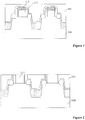
- FIG. 1 illustrates a cross-sectional view of the electrostatic discharge protection structure shown in fig. 1 along a dashed line 1-2.
- the electrostatic discharge protection structure includes a substrate 100, a fin portion 101, a first well region 121, a second well region 122, an isolation structure 102, a gate structure 110, a source region 112, and a drain region 111.
- the fin portion 101 is on the substrate 100.
- the first well region 121 is in the fin portion 101 and the substrate 100.
- the second well region 122 is in the fin portion 101 and the substrate 100, and is in contact with the first well region 121.
- the isolation structure 102 is on the substrate 100, and covers a part of sidewalls of the fin portion 101.
- the gate structure 110 spans the fin portion 101, and covers a part of the sidewalls and top surface of the fin portion 101.
- the source region 112 and the drain region 111 are in the fin portion 101, and on the two sides of the gate structure 110 respectively.
- the electrostatic discharge protection structure When the electrostatic discharge protection structure is in operation, a large amount of electrostatic current can flow into the drain region 111 to generate a large amount of heat. Since the drain region 111 is in contact with only the fin portion 101, and the contact area between the drain region 111 and the substrate is small, the heat generated by the electrostatic current is hardly released. Thus, a sharp rise of the temperature of the electrostatic discharge protection structure can be caused, which is liable to damage the fin portion 101, and thereby resulting in an unstable performance of the electrostatic discharge device.
- the present invention provides an improved method for fabricating an electrostatic discharge protection structure.
- the method can include the following steps. First, a base substrate including a first region and a second region can be provided.
- the second region of the substrate can include a substrate and a fin portion on the substrate. Further, a first doped layer can be formed on the base substrate in the first region. Then, a second doped layer can be formed on the surface of the fin portion and the surface of the based substrate in the second region.
- the second doped layer is formed not only on the surface of the fin portion in the second region, but also on the surface of the base substrate in the second region. As such, the contact area between the second doped layer and the base substrate can be enlarged, thereby increasing the current flow through the cross-sectional area of the channel. Therefore, the disclosed method can increase the heat dissipation performance of the formed electrostatic discharge protection structure, and can improve the performance of the formed electrostatic discharge protection structure.
- FIG. 11 a schematic flow diagram of an exemplary process for fabricating an electrostatic discharge protection structure is shown in accordance with some embodiments of the disclosed subject matter.
- FIGs. 3-10 illustrate schematic structural views of an exemplary electrostatic discharge protection structure at certain stages of the fabricating process shown in fig. 11.
- the drain of the electrostatic discharge structure under an effect of a large electrostatic current is easy to produce large amounts of heat. Therefore, the electrostatic discharge protection structure has a high requirement of the heat dissipation performance.
- the method for fabricating the electrostatic discharge protection structure according to the present invention is described in details by using the heat dissipation performance of the electrostatic discharge protection structure as an example.
- the method of the present invention is not limited to fabricate the electrostatic discharge protection structure, but can also be applied to the formation of other semiconductor devices such as diodes and transistors.
- a base substrate including a first region and a second region can be provided.
- the base substrate in the second region can include a substrate and multiple fin portions on the substrate
- the first region i in fig. 4 shows a cross-sectional view of the structure in fig. 3 along the dashed line 11-12
- the second region ii in fig. 4 shows a cross-sectional view of the structure in fig. 3 along the dashed line 21-22.
- a base substrate including the first region i and the second region ii can be provided.
- the second region ii of the base substrate includes a substrate 200 and multiple fin portions 201 on the substrate 200.
- the first region i can be used for forming a source region, and the second region ii can be used for forming a drain region. In some other embodiments, the first region can be used d to form a drain region, and the second region can be used to form a source region.
- the base substrate in the first region i can also include the substrate 200 and the multiple fin portions 201 on the substrate 200.
- the base substrate can include multiple fin portions 201 on the substrate 200 in the second region ii, as well as multiple fin portions 201 on the substrate 200 in the first region i.
- the base substrate can further include a gate region iii between the first region i and the second region ii.
- the gate region iii can be used for forming a gate structure.
- the base substrate can further include an isolation region iv between the gate region iii and the second region ii. In some other embodiments, the base substrate may not include the gate region and the isolation region.
- the process of forming the base substrate can include the following steps. First, an initial substrate can be provided. Furtherfurther, the initial substrate can be patterned to form the substrate 200 and initial fin portions on the substrate 200. Then, the initial fin portions on the isolation region iv can be removed to form the multiple fin portions 201.
- the substrate 200 can be a silicon substrate. In some other embodiments, the substrate 200 may also be a semiconductor substrate such as a germanium substrate, a silicon germanium substrate, or a silicon-on-insulator substrate.
- the material of the multiple fin portions 201 can be silicon. In some other embodiments, the material of the multiple fin portions 201 may also be germanium or silicon germanium.
- the initial fin portions on the isolation region iv can be removed by using a dry etching method or a wet etching method.
- the method can further include the following steps.
- a first well region (not shown in the figures) can be formed in the base substrate in the first region i and the gate region iii.
- a second well region (not shown in the figures) can be formed in the base substrate in the gate region iii, the isolation region iv and the second region ii. The second well region can be in contact with the first well region.
- the first well region has first dopant ions
- the second well region has second dopant ions.
- the type of the second dopant ions is opposite with the type of the first dopant ions.
- the type of the first dopant ions is n-type and the type of the second dopant ions is p-type.
- the type of the first dopant ions is p-type and the type of the second dopant ions is n-type.
- an isolation structure can be formed on the substrate in the first region and the second region.
- an isolation structure 202 can be formed on the substrate in the first region i and the second region ii.
- the isolation structure 202 can cover a portion of sidewalls of the multiple fin portions 201.
- a top surface of the isolation structure 202 can be lower than the top surface of the multiple fin portions 201.
- the isolation structure 202 can be used to achieve an isolation between the multiple fin portions 201 in the first region i for reducing the leakage current.
- the material of the isolation structure 202 can be silicon oxide. In some other embodiments, the material of the isolation structure 202 may also be silicon oxynitride.
- a process for forming the isolation structure 202 can include the following steps. First, an initial isolation structure can be formed to cover the sidewalls and the top surface of the multiple fin portions 201. Further, the initial isolation structure can be etched to form the isolation structure 202, such that the top surface of the isolation structure 202 is lower than the top surface of the multiple fin portions 201 top surface.
- the method of etching the initial isolation structure can include a dry etching process. In some other embodiments, the method of etching the initial isolation structure may also include a wet etching process.
- the isolation structure 202 can also cover the substrate 200 in the isolation region iv, as shown in fig. 3 .
- the isolation structure 202 on the substrate 200 in the isolation region iv can be used to increase the length of the channel that the current flows through, thereby the heat dissipation performance of the formed electrostatic discharge protection structure can be enhanced.
- the isolation structure 202 can also be located on the substrate 200 between the multiple fin portions 201 in the gate region iii.
- step 1105 the isolation structure in the second region to expose the surface of the substrate in the second region.
- the isolation structure 202 on the substrate 200 in the second region ii can be removed to expose the surface of the substrate 200 in the second region ii.
- the surface of the substrate 200 in the second region ii is exposed to enable the formation of a subsequently formed second doped layer on the surface of the substrate 200 in the second region ii.
- the contact area between the second doped layer and the base substrate can be increased, thereby increasing the cross-sectional area of the channel that the current flows through. Therefore, the heat dissipation performance of the formed electrostatic discharge protection structure can be enhanced.
- the process for removing the isolation structure 202 on the substrate 200 in the second region ii can include the following steps. First, a first photoresist film can be formed on the substrate 200 in the first region i. The first photoresist film can cover the sidewalls and top surface of the multiple fin portions 201 in the first region i. Further, the isolation structure 202 can be etched by using the first photoresist film as a mask. The isolation structure 202 on the substrate 200 in the second region ii can be removed. Finally, the first photoresist film can be removed.
- the method of removing the isolation structure 202 on the substrate 200 in the second region ii can include a wet etching process, a dry etching process, or a combination thereof.
- the isolation structure 202 on the substrate 200 in the second region ii can be removed, and the isolation structure 202 on the substrate 200 in the first region i can be retained.
- the isolation structure on the substrate in the first region may also be removed during the removal of the isolation structure on the substrate in the second region. As such, the substrate in the first region can be exposed. Therefore, in a subsequent epitaxial growth process, a first doped region can also be formed on the substrate in the first region, thereby further enhancing the heat dissipation performance of the formed electrostatic discharge protection structure.
- the substrate does not include the gate region and the isolation region, so that the fabricating method may not include the steps of forming the isolation structure and removing the isolation structure in the second region.
- the multiple fin portions in the second region can be etched to reduce a thickness of the multiple fin portions in the second region.
- the fabricating method can subsequently include etching the multiple fin portions 201 in the second region ii to reduce the thickness of the multiple fin portions 201 in the second region ii.
- a first sacrificial layer 203 can be formed in the first region i.
- the first sacrificial layer 203 can cover the sidewalls and top surface of the multiple fin portions 201 in the first region i.
- a second sacrificial layer 204 can be formed on the substrate 200 in the second region ii.
- the top surface of the second sacrificial layer 204 can be lower than the top surface of the multiple fin portions 201 in the second region ii.
- the base substrate can further include the gate region iii between the first region i and the second region ii, as shown in fig. 3 .
- the first sacrificial layer 203 can also cover the sidewalls and top surface of the multiple fin portions 201 in the gate region iii.
- the first sacrificial layer 203 and the second sacrificial layer 204 can be antireflective coatings.
- the antireflective coatings can be organic antireflective coatings, since a removal process of the organic anti-reflective coatings is relatively simple.
- the material of the first sacrificial layer and the second sacrificial layer may also be silicon oxide, silicon nitride, or silicon oxynitride.
- the process of forming the first sacrificial layer 203 and the second sacrificial layer 204 can include the following steps. Firstly, an initial sacrificial layer can be formed to cover the substrate in the first region i, the second region ii, and the gate region iii. Then, a second photoresist film can be formed on the initial sacrificial layer in the first region i and the gate region iii. Further, the initial sacrificial layer can be etched by using the second photoresist film as a mask, such that the top surface of the initial sacrificial layer in the second region ii is lower than the top surface of the multiple fin portions 201 in the second region ii. Finally, the second photoresist film can be removed.
- the method of etching the initial sacrificial layer by using the second photoresist film as a mask can include a dry etching process or a wet etching process.
- the first sacrificial layer may not cover the first region substrate, thereby exposing the multiple fin portions in the first region.
- the multiple fin portions 201 in the second region ii can be etched to reduce the height of the multiple fin portions 201 in the second region ii.
- the height of the multiple fin portions 201 in the second region ii can be reduced to decrease the aspect ratio of the gaps between adjacent fin portions 201 in the second region ii.
- the reactant can be sufficiently in contact with the substrate 200 in the second region ii to form the second doped layer on the substrate 200 in the second region ii.
- the multiple fin portions 201 in the second region ii can be etched using the first sacrificial layer 203 and the second sacrificial layer 204 as masks.
- a contact area between the subsequently formed second doped layer and the sidewalls of the multiple fin portions 201 may be too small to improve the heat dissipation performance of the formed electrostatic discharge protection structure.
- the height of the multiple fin portions 201 in the second region ii is too large, it is difficult to reduce the difficulty of contacting the reaction gas with the substrate 200 in the second region ii during the formation of the second doped layer. As such, it may not be easy to form the second doped layer on the substrate 200 in the second region ii.
- the height of the multiple fin portions 201 in the second region ii can be in a range from 150 angstroms to 800 angstroms.
- the depth-to-width ratio of the gaps between adjacent fin portions 201 in the second region ii can be in a range from 1 to 4.
- the method of etching the multiple fin portions 201 in the second region ii can include a dry etching process, a wet etching process, or a combination thereof.
- the first sacrificial layer may not cover the substrate in the first region, thereby exposing the multiple fin portions in the first region. Accordingly, during the etching process of the multiple fin portions in the second region, the multiple fin portions in the first region may also be etched to reduce the height of the multiple fin portions in the first region.
- the first sacrificial layer 203 and the second sacrificial layer 204 can be removed.
- the first sacrificial layer 203 and the second sacrificial layer 204 are organic antireflective coatings, and the first sacrificial layer 203 and the second sacrificial layer 204 can be removed by using washing water in a photolithography process.
- the first sacrificial layer and the second sacrificial layer are silicon nitride, silicon oxide, or silicon oxynitride, which may be removed by using a dry etching process, a wet etching process, or a combination thereof.
- the multiple fin portions in the second region can be etched to reduce the height of the multiple fin portions in the second region.
- a process for etching the multiple fin portions in the second region can include the following steps. Firstly, a sacrificial layer can be formed in the first region, and the sacrificial layer can cover the sidewalls and top surface of the multiple fin portions in the first region. Then, the multiple fin portions in the second region can be etched by using the sacrificial layer as a mask. Finally, the sacrificial layer can be removed.
- the sacrificial layer can be used as a mask to etch the multiple fin portions in the second region. Therefore, the process flow of the fabrication method can be simplified.
- the multiple fin portions in the second region may also be etched before forming the isolation structure.
- a first doped layer can be formed on the surface of the fin portion in the first region.
- a second doped layer can be formed on the surface of the fin portion in the second region.
- the first region i in fig. 9 shows a cross-sectional view of the structure in fig. 10 along the dashed line b-b
- the second region ii in fig. 9 shows a cross-sectional view of the structure in fig. 10 along the dashed line a-a.
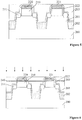
- a first doped layer 211 can be formed on the surface of the multiple fin portions 201 in the first region i
- a second doped layer 212 can be formed on the surface of the multiple fin portions 201 in the second region ii.
- the first doped layer 211 can be sued as a source region of a transistor, and the second doped layer 212 can be used as a drain region of the transistor.
- the first doped layer 211 and the second doped layer 212 can have a same type, and are both n-type semiconductors. Thus, the first doped layer 211 and the second doped layer 212 can be formed in a single process.
- the dopant ions in the first doped layer 211 and the second doped layer 212 can be the same type, and are both n-type ions.
- the specific dopant ions may be phosphorus ions or arsenic ions.
- dopant ions in the first doped layer and the second doped layer may also be different types.
- the first doped layer and the second doped layer may be both p-type semiconductors.
- the types of the first doped layer and the second doped layer may be different, and the first doped layer and the second doped layer are formed in different processes.
- the first doped layer 211 and the second doped layer 212 can be formed by using an epitaxial growth process. During the epitaxial growth process, the first doped layer 211 and the second doped layer 212 can be in-situ doped to form the dopant ions in the first and second doped layers 211 and 212 respectively. In some other embodiments, the first doped layer and the second doped layer may also be formed by an ion implantation process.
- the second doped layer 212 may also be formed on the surface of the substrate 200 in the second region ii during the epitaxial growth process. As such, the contact area between the second doped layer 212 and the base substrate can be increased, thereby increasing the area of the base substrate that receives electrostatic charge, and resulting in an enhancing of the heat dissipation performance of the formed electrostatic discharge protection structure.
- the first doped layer 211 and the second doped layer 212 can be used to form n-type semiconductors.
- the dopant ions can be phosphorus ions or arsenic ions.
- the first doped layer and the second doped layer are both p-type semiconductors, and the dopant ions can be boron ions or boron fluoride ions.
- the type of the first dopant ions in the first well region 221 is opposite to the type of the dopant ions of the first doped layer 211 and the second doped layer 212. Therefore, the first dopant ions are p-type ions, such as boron ions.
- the type of the second dopant ions in the second well region 222 is the same as the type of the dopant ions of the first doped layer 211 and the second doped layer 212. Therefore, the second dopant ions are n-type ions, such as phosphorus ions or arsenic ions.
- the material of the first doped layer 211 and the second doped layer 212 can be silicon germanium or silicon. In some other embodiments, the first doped layer and the second doped layer may also be p-type semiconductors, and the materials of the first doped layer and the second doped layer may be carbon- silicon or silicon.
- a thickness of the first doped layer 211 can be in a range from 100 angstroms to 500 angstroms, for example 400 angstroms.
- a thickness of the second doped layer 212 can be in a range from 50 angstroms to 500 angstroms, for example, 350 angstroms.
- a gate structure crossing the fin portion can be formed in a gate region.
- the fabricating method can further include forming a gate structure 210 across the multiple fin portions 201 in the gate region iii.
- the gate structure 210 can cover a portion of the sidewalls and top surface of the multiple fin portions 201 in the gate region iii.
- a channel can be formed in the first well region 221 and the second well region 222 of the multiple fin portions 201 below the gate structure 210.
- the gate structure 210 can include a gate dielectric layer and a gate electrode on the gate dielectric layer.
- the gate electrode can be a polysilicon gate electrode. In some other embodiments, the gate electrode may also be a metal gate electrode.
- the material of the gate dielectric layer can be silicon oxide. In some other embodiments, the material of the gate dielectric layer may also be a high-k dielectric material that has a dielectric constant greater than 3.9.
- the second doped layer can be formed not only on the surface of the multiple fin portions in the second region, but also on the surface of the substrate in the second region. Therefore, the contact area between the second doped layer and the base substrate can be increased, thereby increasing the cross-sectional area of the channel that the current flows through. Accordingly, the disclosed method can enhance the heat dissipation performance of the formed electrostatic discharge protection structure, and can improve the performance of the formed electrostatic discharge protection structure.
- fig. 11 can be executed or performed in any order or sequence not limited to the order and sequence shown and described in the figure. Also, some of the above steps of the flow diagram of fig. 11 can be executed or performed substantially simultaneously where appropriate or in parallel to reduce latency and processing times. Furthermore, it should be noted that fig. 11 is provided as an example only. At least some of the steps shown in the figure may be performed in a different order than represented, performed concurrently, or altogether omitted.
- the present invention also provides an electrostatic discharge protection structure.
- the electrostatic discharge protection structure can include a base substrate comprising a substrate 200 and multiple fin portions 201 on the substrate 200.
- the base substrate can include a first region i and a second region ii.
- a first doping layer 211 can be on the surface of the multiple fin portions 201 in the first region i.
- a second doping layer 212 can be on the surface of the multiple fin portions 201 and the substrate 200 in the second region ii.
- the first region i is used for forming a source region, and the second region ii is used for forming a drain region. In some other embodiments, the first region is used for forming a drain region, and the second region is used for forming a source region.
- the base substrate includes multiple fin portions 201 on the substrate 200 in the second region ii, and multiple fin portions 201 on the substrate 200 in the first region i.
- the base substrate can further include a gate region iii between the first region i and the second region ii.
- the gate region iii is used for forming a gate structure.
- the base substrate can further include an isolation region iv between the gate region iii and the second region ii. In some other embodiments, the base substrate may not include the gate region and the isolation region.
- the disclosed electrostatic discharge protection structure can further include a first well region 221 in the multiple fin portions 201 and the substrate 200, as well as a second well region 222 in the multiple fin portions 201 and the substrate 200.
- the second well region 222 can be in contact with the first well region 221.
- the first well region 221 has first dopant ions.
- the type of the first dopant ions are opposite to the type of dopant ions in the first doping layer 211.
- the second well region 212 has second dopant ions.
- the type of the second dopant ions are opposite to the type of the first dopant ions.
- the first dopant ions are p-type ions, such as boron ions.
- the second dopant ions are n-type ions, such as phosphorus ions or arsenic ions.
- the first dopant ions may be n-type ions, and the second dopant ions may be p-type ions.
- the substrate 200 can be a silicon substrate.
- the substrate may be any other suitable semiconductor substrate, such as a germanium substrate, a silicon germanium substrate, or a silicon-on-insulator substrate.
- the material of the multiple fin portions 201 is silicon. In some other embodiments, the material of the multiple fin portions may be germanium or silicon germanium.
- the electrostatic discharge protection structure can further include an isolation structure 202 between the multiple fin portions 201 in the first region i.
- the top surface of the isolation structure 202 can be lower than the top surface of the multiple fin portions 201 in the first region i.
- the isolation structure 202 can also be located on the substrate 200 in the isolation region iv.
- the isolation structure 202 on the substrate 200 in the isolation region iv can increase the length of the channel that current flows through, thereby increasing the heat dissipation performance of the formed electrostatic discharge protection structure.
- the height of the multiple fin portions 201 in the second region ii is lower than the height of the multiple fin portions 201 in the first region i.
- the height of the multiple fin portions 201 in the second region ii is lowered than the height of the multiple fin portions 201 in the gate region iii.
- the height of the multiple fin portions in the first region may be equal to the height of the multiple fin portions in the second region.
- the height of the multiple fin portions in the second region and in the first region may be lower than the height of the multiple fin portions in the gate region.
- the contact arear between the second doped layer and the sidewalls of the multiple fin portions 201 may be too small to improve the heat dissipation performance of the formed electrostatic discharge protection structure. If the height of the multiple fin portions 201 in the second region ii is too large, it is difficult to form the second doped layer on the substrate 200 in the second region ii. Specifically, the height of the multiple fin portions 201 in the second region ii can be in a range from 150 angstroms to 800 angstroms.
- the depth-to-width ratio of the gaps between adjacent fin portions 201 in the second region ii is smaller than the depth-to-width ratio of the gaps between adjacent fin portions 201 in the gate region iii. Since the depth-to-width ratio of the gaps between the multiple fin portions 201 in the second region ii is small, the second doped layer 212 can adequately cover the surface of the substrate 200 in the first region i. Specifically, the depth-to-width ratio of the gaps between the adjacent fin portions 201 in the second region ii can be in a range from 1 to 4.
- the second doped layer 212 on the substrate 200 in the second region ii can increase the contact area between the second doped layer 212 and the base substrate, thereby increasing the area of the base substrate that receives electrostatic charge, and resulting in an enhancing of the heat dissipation performance of the formed electrostatic discharge protection structure.
- the first doped layer 211 can be used as a source region of a transistor, and the second doped layer 212 can be used as a drain region of the transistor.
- the first doped layer 211 and the second doped layer 212 can have a same type and are both n-type semiconductors. In some other embodiments, the first doped layer 211 and the second doped layer 212 may be both p-type semiconductors. In addition, the types of the first doped layer 211 and second doped layer 212 may be different.
- the first doped layer 211 and the second doped layer 212 contain same type of dopant ions.
- the first doped layer 211 and the second doped layer 212 can be both n-type semiconductors.
- the dopant ions can be phosphorus ions or arsenic ions.
- both the first doped layer 211 and the second doped layer 212 are p-type semiconductors, and the dopant ions are boron ions or bf 2 ions.
- the material of the first doped layer 211 and the second doped layer 212 can be silicon germanium or silicon. In some other embodiments, the first doped layer 211 and the second doped layer 212 may be p-type semiconductors, and the material of the first doped layer 211 and second doped layer 212 may be carbon-carbon or silicon.
- the thickness of the first doped layer 211 can be in a range from 100 angstroms to 500 angstroms, for example 400 angstroms.
- a thickness of the second doped layer 212 can be in a range from 50 angstroms to 500 angstroms, for example, 350 angstroms.
- the electrostatic discharge protection structure can further include a gate structure 210 located in the gate region iii.
- the gate structure 210 can cover a portion of the sidewalls and top surface of the multiple fin portions 201 in the gate region iii.
- the gate structure 201 can include a gate dielectric layer, and a gate electrode on the gate dielectric layer.
- the gate electrode is a polysilicon gate electrode. In some other embodiments, the gate electrode may be a metal gate electrode.
- the material of the gate dielectric layer can be silicon oxide. In some other embodiments, the material of the gate dielectric layer may be a high-k dielectric material that has a dielectric constant greater than 3.9.
- the second doped layer can be formed not only on the surface of the multiple fin portions in the second region, but also on the surface of the substrate in the second region. Therefore, the contact area between the second doped layer and the base substrate can be increased, thereby increasing the cross-sectional area of the channel that the current flows through. Accordingly, the disclosed method can enhance the heat dissipation performance of the formed electrostatic discharge protection structure, and can improve the performance of the formed electrostatic discharge protection structure.
- an electrostatic discharge protection structure and a fabricating method thereof are provided.
Landscapes
- Semiconductor Integrated Circuits (AREA)
- Chemical & Material Sciences (AREA)
- Chemical Kinetics & Catalysis (AREA)
- General Chemical & Material Sciences (AREA)
- Engineering & Computer Science (AREA)
- General Engineering & Computer Science (AREA)
- Metal-Oxide And Bipolar Metal-Oxide Semiconductor Integrated Circuits (AREA)
- Insulated Gate Type Field-Effect Transistor (AREA)
Applications Claiming Priority (1)
| Application Number | Priority Date | Filing Date | Title |
|---|---|---|---|
| CN201610666917.4A CN107731808B (zh) | 2016-08-12 | 2016-08-12 | 静电放电保护结构及其形成方法 |
Publications (1)
| Publication Number | Publication Date |
|---|---|
| EP3285298A1 true EP3285298A1 (de) | 2018-02-21 |
Family
ID=59631594
Family Applications (1)
| Application Number | Title | Priority Date | Filing Date |
|---|---|---|---|
| EP17185877.2A Withdrawn EP3285298A1 (de) | 2016-08-12 | 2017-08-11 | Schutzstruktur gegen elektrostatische entladungen und herstellungsverfahren dafür |
Country Status (3)
| Country | Link |
|---|---|
| US (2) | US10354993B2 (de) |
| EP (1) | EP3285298A1 (de) |
| CN (1) | CN107731808B (de) |
Families Citing this family (4)
| Publication number | Priority date | Publication date | Assignee | Title |
|---|---|---|---|---|
| CN107731808B (zh) * | 2016-08-12 | 2020-02-07 | 中芯国际集成电路制造(上海)有限公司 | 静电放电保护结构及其形成方法 |
| CN107799421B (zh) * | 2016-09-05 | 2021-04-02 | 中芯国际集成电路制造(上海)有限公司 | 半导体器件的形成方法 |
| CN113257921B (zh) * | 2017-07-03 | 2023-06-13 | 中芯国际集成电路制造(上海)有限公司 | 半导体结构 |
| US20250157872A1 (en) * | 2023-11-10 | 2025-05-15 | Nxp B.V. | Finfet with local heatsinking and method of manufacturing the same |
Citations (5)
| Publication number | Priority date | Publication date | Assignee | Title |
|---|---|---|---|---|
| DE102013101705A1 (de) * | 2012-11-15 | 2014-05-15 | Taiwan Semiconductor Manufacturing Co., Ltd. | ESD-Vorrichtungen mit Halbleiterfinnen |
| EP2889906A1 (de) * | 2013-12-30 | 2015-07-01 | IMEC vzw | Verbesserungen an oder im Zusammenhang mit elektrostatischem Entladungsschutz |
| US20150311342A1 (en) * | 2014-04-23 | 2015-10-29 | Taiwan Semiconductor Manufacturing Company Ltd. | Finfet with esd protection |
| US20160093730A1 (en) * | 2014-09-26 | 2016-03-31 | Semiconductor Manufacturing International (Shanghai) Corporation | Finfet ldmos device and manufacturing methods |
| US20160181358A1 (en) * | 2014-12-22 | 2016-06-23 | Broadcom Corporation | Super junction ldmos finfet devices |
Family Cites Families (6)
| Publication number | Priority date | Publication date | Assignee | Title |
|---|---|---|---|---|
| US7700449B2 (en) * | 2008-06-20 | 2010-04-20 | Taiwan Semiconductor Manufacturing Company, Ltd. | Forming ESD diodes and BJTs using FinFET compatible processes |
| US8551841B2 (en) * | 2012-01-06 | 2013-10-08 | Taiwan Semiconductor Manufacturing Company, Ltd. | IO ESD device and methods for forming the same |
| US9093566B2 (en) * | 2012-12-31 | 2015-07-28 | Taiwan Semiconductor Manufacturing Company, Ltd. | High efficiency FinFET diode |
| KR102049774B1 (ko) * | 2013-01-24 | 2019-11-28 | 삼성전자 주식회사 | 반도체 장치 및 그 제조 방법 |
| US9916978B2 (en) * | 2016-06-02 | 2018-03-13 | United Microelectronics Corporation | Method for fabricating a Fin field effect transistor (FinFET) |
| CN107731808B (zh) * | 2016-08-12 | 2020-02-07 | 中芯国际集成电路制造(上海)有限公司 | 静电放电保护结构及其形成方法 |
-
2016
- 2016-08-12 CN CN201610666917.4A patent/CN107731808B/zh active Active
-
2017
- 2017-08-11 EP EP17185877.2A patent/EP3285298A1/de not_active Withdrawn
- 2017-10-05 US US15/725,854 patent/US10354993B2/en active Active
-
2019
- 2019-05-31 US US16/427,711 patent/US10714469B2/en active Active
Patent Citations (5)
| Publication number | Priority date | Publication date | Assignee | Title |
|---|---|---|---|---|
| DE102013101705A1 (de) * | 2012-11-15 | 2014-05-15 | Taiwan Semiconductor Manufacturing Co., Ltd. | ESD-Vorrichtungen mit Halbleiterfinnen |
| EP2889906A1 (de) * | 2013-12-30 | 2015-07-01 | IMEC vzw | Verbesserungen an oder im Zusammenhang mit elektrostatischem Entladungsschutz |
| US20150311342A1 (en) * | 2014-04-23 | 2015-10-29 | Taiwan Semiconductor Manufacturing Company Ltd. | Finfet with esd protection |
| US20160093730A1 (en) * | 2014-09-26 | 2016-03-31 | Semiconductor Manufacturing International (Shanghai) Corporation | Finfet ldmos device and manufacturing methods |
| US20160181358A1 (en) * | 2014-12-22 | 2016-06-23 | Broadcom Corporation | Super junction ldmos finfet devices |
Also Published As
| Publication number | Publication date |
|---|---|
| US10354993B2 (en) | 2019-07-16 |
| CN107731808B (zh) | 2020-02-07 |
| US10714469B2 (en) | 2020-07-14 |
| US20180158813A1 (en) | 2018-06-07 |
| CN107731808A (zh) | 2018-02-23 |
| US20190287958A1 (en) | 2019-09-19 |
Similar Documents
| Publication | Publication Date | Title |
|---|---|---|
| US8946829B2 (en) | Selective fin-shaping process using plasma doping and etching for 3-dimensional transistor applications | |
| US8936986B2 (en) | Methods of forming finfet devices with a shared gate structure | |
| US10714613B2 (en) | Semiconductor device | |
| US20170323888A1 (en) | Finfet and fabrication method thereof | |
| US9660054B2 (en) | Tunneling field effect transistor (TFET) with ultra shallow pockets formed by asymmetric ion implantation and method of making same | |
| CN107731918B (zh) | 半导体结构及其制造方法 | |
| US11742414B2 (en) | Semiconductor device with fins | |
| US10714469B2 (en) | Electrostatic discharge protection structure | |
| US9640660B2 (en) | Asymmetrical FinFET structure and method of manufacturing same | |
| CN105097533A (zh) | 半导体结构的形成方法 | |
| US10978349B2 (en) | Semiconductor device and fabrication method thereof | |
| CN108538724A (zh) | 半导体结构及其形成方法 | |
| US20200273980A1 (en) | Semiconductor device and fabrication method thereof | |
| US10686078B2 (en) | Semiconductor structure and fabrication method thereof | |
| US11374116B2 (en) | Semiconductor devices | |
| US11205721B2 (en) | Semiconductor device with isolation layer and fabrication method thereof | |
| KR101026479B1 (ko) | 반도체 소자 및 그의 제조 방법 | |
| US10651092B2 (en) | Semiconductor device and fabrication method thereof | |
| CN109003976B (zh) | 半导体结构及其形成方法 | |
| CN107579108B (zh) | 半导体结构的形成方法 | |
| CN111354681A (zh) | 晶体管结构及其形成方法 | |
| US10748817B2 (en) | Semiconductor device and fabrication method thereof | |
| CN113540235B (zh) | 半导体器件及其形成方法 | |
| CN119108273A (zh) | 一种半导体结构及其制造方法 | |
| CN117476463A (zh) | 半导体结构及其形成方法 |
Legal Events
| Date | Code | Title | Description |
|---|---|---|---|
| PUAI | Public reference made under article 153(3) epc to a published international application that has entered the european phase |
Free format text: ORIGINAL CODE: 0009012 |
|
| STAA | Information on the status of an ep patent application or granted ep patent |
Free format text: STATUS: THE APPLICATION HAS BEEN PUBLISHED |
|
| AK | Designated contracting states |
Kind code of ref document: A1 Designated state(s): AL AT BE BG CH CY CZ DE DK EE ES FI FR GB GR HR HU IE IS IT LI LT LU LV MC MK MT NL NO PL PT RO RS SE SI SK SM TR |
|
| AX | Request for extension of the european patent |
Extension state: BA ME |
|
| STAA | Information on the status of an ep patent application or granted ep patent |
Free format text: STATUS: REQUEST FOR EXAMINATION WAS MADE |
|
| 17P | Request for examination filed |
Effective date: 20180820 |
|
| RBV | Designated contracting states (corrected) |
Designated state(s): AL AT BE BG CH CY CZ DE DK EE ES FI FR GB GR HR HU IE IS IT LI LT LU LV MC MK MT NL NO PL PT RO RS SE SI SK SM TR |
|
| RAP1 | Party data changed (applicant data changed or rights of an application transferred) |
Owner name: SEMICONDUCTOR MANUFACTURING INTERNATIONAL (SHANGHA Owner name: SEMICONDUCTOR MANUFACTURING INTERNATIONAL (BEIJING |
|
| STAA | Information on the status of an ep patent application or granted ep patent |
Free format text: STATUS: EXAMINATION IS IN PROGRESS |
|
| 17Q | First examination report despatched |
Effective date: 20191018 |
|
| STAA | Information on the status of an ep patent application or granted ep patent |
Free format text: STATUS: THE APPLICATION IS DEEMED TO BE WITHDRAWN |
|
| 18D | Application deemed to be withdrawn |
Effective date: 20200229 |