EP3287108A1 - Couche culotte jetable pourvu de barrières d'étanchéité - Google Patents
Couche culotte jetable pourvu de barrières d'étanchéité Download PDFInfo
- Publication number
- EP3287108A1 EP3287108A1 EP17183302.3A EP17183302A EP3287108A1 EP 3287108 A1 EP3287108 A1 EP 3287108A1 EP 17183302 A EP17183302 A EP 17183302A EP 3287108 A1 EP3287108 A1 EP 3287108A1
- Authority
- EP
- European Patent Office
- Prior art keywords
- barrier
- edge
- article
- leg
- topsheet
- Prior art date
- Legal status (The legal status is an assumption and is not a legal conclusion. Google has not performed a legal analysis and makes no representation as to the accuracy of the status listed.)
- Granted
Links
Images



Classifications
-
- A—HUMAN NECESSITIES
- A61—MEDICAL OR VETERINARY SCIENCE; HYGIENE
- A61F—FILTERS IMPLANTABLE INTO BLOOD VESSELS; PROSTHESES; DEVICES PROVIDING PATENCY TO, OR PREVENTING COLLAPSING OF, TUBULAR STRUCTURES OF THE BODY, e.g. STENTS; ORTHOPAEDIC, NURSING OR CONTRACEPTIVE DEVICES; FOMENTATION; TREATMENT OR PROTECTION OF EYES OR EARS; BANDAGES, DRESSINGS OR ABSORBENT PADS; FIRST-AID KITS
- A61F13/00—Bandages or dressings; Absorbent pads
- A61F13/15—Absorbent pads, e.g. sanitary towels, swabs or tampons for external or internal application to the body; Supporting or fastening means therefor; Tampon applicators
- A61F13/45—Absorbent pads, e.g. sanitary towels, swabs or tampons for external or internal application to the body; Supporting or fastening means therefor; Tampon applicators characterised by the shape
- A61F13/49—Absorbent pads, e.g. sanitary towels, swabs or tampons for external or internal application to the body; Supporting or fastening means therefor; Tampon applicators characterised by the shape specially adapted to be worn around the waist, e.g. diapers, nappies
- A61F13/49007—Form-fitting, self-adjusting disposable diapers
- A61F13/49009—Form-fitting, self-adjusting disposable diapers with elastic means
- A61F13/49017—Form-fitting, self-adjusting disposable diapers with elastic means the elastic means being located at the crotch region
-
- A—HUMAN NECESSITIES
- A61—MEDICAL OR VETERINARY SCIENCE; HYGIENE
- A61F—FILTERS IMPLANTABLE INTO BLOOD VESSELS; PROSTHESES; DEVICES PROVIDING PATENCY TO, OR PREVENTING COLLAPSING OF, TUBULAR STRUCTURES OF THE BODY, e.g. STENTS; ORTHOPAEDIC, NURSING OR CONTRACEPTIVE DEVICES; FOMENTATION; TREATMENT OR PROTECTION OF EYES OR EARS; BANDAGES, DRESSINGS OR ABSORBENT PADS; FIRST-AID KITS
- A61F13/00—Bandages or dressings; Absorbent pads
- A61F13/15—Absorbent pads, e.g. sanitary towels, swabs or tampons for external or internal application to the body; Supporting or fastening means therefor; Tampon applicators
- A61F13/15577—Apparatus or processes for manufacturing
- A61F13/15804—Plant, e.g. involving several steps
-
- A—HUMAN NECESSITIES
- A61—MEDICAL OR VETERINARY SCIENCE; HYGIENE
- A61F—FILTERS IMPLANTABLE INTO BLOOD VESSELS; PROSTHESES; DEVICES PROVIDING PATENCY TO, OR PREVENTING COLLAPSING OF, TUBULAR STRUCTURES OF THE BODY, e.g. STENTS; ORTHOPAEDIC, NURSING OR CONTRACEPTIVE DEVICES; FOMENTATION; TREATMENT OR PROTECTION OF EYES OR EARS; BANDAGES, DRESSINGS OR ABSORBENT PADS; FIRST-AID KITS
- A61F13/00—Bandages or dressings; Absorbent pads
- A61F13/15—Absorbent pads, e.g. sanitary towels, swabs or tampons for external or internal application to the body; Supporting or fastening means therefor; Tampon applicators
- A61F13/45—Absorbent pads, e.g. sanitary towels, swabs or tampons for external or internal application to the body; Supporting or fastening means therefor; Tampon applicators characterised by the shape
- A61F13/49—Absorbent pads, e.g. sanitary towels, swabs or tampons for external or internal application to the body; Supporting or fastening means therefor; Tampon applicators characterised by the shape specially adapted to be worn around the waist, e.g. diapers, nappies
- A61F13/49058—Absorbent pads, e.g. sanitary towels, swabs or tampons for external or internal application to the body; Supporting or fastening means therefor; Tampon applicators characterised by the shape specially adapted to be worn around the waist, e.g. diapers, nappies characterised by the modular concept of constructing the diaper
-
- A—HUMAN NECESSITIES
- A61—MEDICAL OR VETERINARY SCIENCE; HYGIENE
- A61F—FILTERS IMPLANTABLE INTO BLOOD VESSELS; PROSTHESES; DEVICES PROVIDING PATENCY TO, OR PREVENTING COLLAPSING OF, TUBULAR STRUCTURES OF THE BODY, e.g. STENTS; ORTHOPAEDIC, NURSING OR CONTRACEPTIVE DEVICES; FOMENTATION; TREATMENT OR PROTECTION OF EYES OR EARS; BANDAGES, DRESSINGS OR ABSORBENT PADS; FIRST-AID KITS
- A61F13/00—Bandages or dressings; Absorbent pads
- A61F13/15—Absorbent pads, e.g. sanitary towels, swabs or tampons for external or internal application to the body; Supporting or fastening means therefor; Tampon applicators
- A61F13/45—Absorbent pads, e.g. sanitary towels, swabs or tampons for external or internal application to the body; Supporting or fastening means therefor; Tampon applicators characterised by the shape
- A61F13/49—Absorbent pads, e.g. sanitary towels, swabs or tampons for external or internal application to the body; Supporting or fastening means therefor; Tampon applicators characterised by the shape specially adapted to be worn around the waist, e.g. diapers, nappies
- A61F13/494—Absorbent pads, e.g. sanitary towels, swabs or tampons for external or internal application to the body; Supporting or fastening means therefor; Tampon applicators characterised by the shape specially adapted to be worn around the waist, e.g. diapers, nappies characterised by edge leakage prevention means
- A61F13/49406—Absorbent pads, e.g. sanitary towels, swabs or tampons for external or internal application to the body; Supporting or fastening means therefor; Tampon applicators characterised by the shape specially adapted to be worn around the waist, e.g. diapers, nappies characterised by edge leakage prevention means the edge leakage prevention means being at the crotch region
- A61F13/49413—Absorbent pads, e.g. sanitary towels, swabs or tampons for external or internal application to the body; Supporting or fastening means therefor; Tampon applicators characterised by the shape specially adapted to be worn around the waist, e.g. diapers, nappies characterised by edge leakage prevention means the edge leakage prevention means being at the crotch region the edge leakage prevention means being an upstanding barrier
-
- A—HUMAN NECESSITIES
- A61—MEDICAL OR VETERINARY SCIENCE; HYGIENE
- A61F—FILTERS IMPLANTABLE INTO BLOOD VESSELS; PROSTHESES; DEVICES PROVIDING PATENCY TO, OR PREVENTING COLLAPSING OF, TUBULAR STRUCTURES OF THE BODY, e.g. STENTS; ORTHOPAEDIC, NURSING OR CONTRACEPTIVE DEVICES; FOMENTATION; TREATMENT OR PROTECTION OF EYES OR EARS; BANDAGES, DRESSINGS OR ABSORBENT PADS; FIRST-AID KITS
- A61F13/00—Bandages or dressings; Absorbent pads
- A61F13/15—Absorbent pads, e.g. sanitary towels, swabs or tampons for external or internal application to the body; Supporting or fastening means therefor; Tampon applicators
- A61F13/45—Absorbent pads, e.g. sanitary towels, swabs or tampons for external or internal application to the body; Supporting or fastening means therefor; Tampon applicators characterised by the shape
- A61F13/49—Absorbent pads, e.g. sanitary towels, swabs or tampons for external or internal application to the body; Supporting or fastening means therefor; Tampon applicators characterised by the shape specially adapted to be worn around the waist, e.g. diapers, nappies
- A61F13/494—Absorbent pads, e.g. sanitary towels, swabs or tampons for external or internal application to the body; Supporting or fastening means therefor; Tampon applicators characterised by the shape specially adapted to be worn around the waist, e.g. diapers, nappies characterised by edge leakage prevention means
- A61F13/49406—Absorbent pads, e.g. sanitary towels, swabs or tampons for external or internal application to the body; Supporting or fastening means therefor; Tampon applicators characterised by the shape specially adapted to be worn around the waist, e.g. diapers, nappies characterised by edge leakage prevention means the edge leakage prevention means being at the crotch region
- A61F13/49413—Absorbent pads, e.g. sanitary towels, swabs or tampons for external or internal application to the body; Supporting or fastening means therefor; Tampon applicators characterised by the shape specially adapted to be worn around the waist, e.g. diapers, nappies characterised by edge leakage prevention means the edge leakage prevention means being at the crotch region the edge leakage prevention means being an upstanding barrier
- A61F13/4942—Absorbent pads, e.g. sanitary towels, swabs or tampons for external or internal application to the body; Supporting or fastening means therefor; Tampon applicators characterised by the shape specially adapted to be worn around the waist, e.g. diapers, nappies characterised by edge leakage prevention means the edge leakage prevention means being at the crotch region the edge leakage prevention means being an upstanding barrier the barrier not being integral with the top- or back-sheet
-
- A—HUMAN NECESSITIES
- A61—MEDICAL OR VETERINARY SCIENCE; HYGIENE
- A61F—FILTERS IMPLANTABLE INTO BLOOD VESSELS; PROSTHESES; DEVICES PROVIDING PATENCY TO, OR PREVENTING COLLAPSING OF, TUBULAR STRUCTURES OF THE BODY, e.g. STENTS; ORTHOPAEDIC, NURSING OR CONTRACEPTIVE DEVICES; FOMENTATION; TREATMENT OR PROTECTION OF EYES OR EARS; BANDAGES, DRESSINGS OR ABSORBENT PADS; FIRST-AID KITS
- A61F13/00—Bandages or dressings; Absorbent pads
- A61F13/15—Absorbent pads, e.g. sanitary towels, swabs or tampons for external or internal application to the body; Supporting or fastening means therefor; Tampon applicators
- A61F13/45—Absorbent pads, e.g. sanitary towels, swabs or tampons for external or internal application to the body; Supporting or fastening means therefor; Tampon applicators characterised by the shape
- A61F13/49—Absorbent pads, e.g. sanitary towels, swabs or tampons for external or internal application to the body; Supporting or fastening means therefor; Tampon applicators characterised by the shape specially adapted to be worn around the waist, e.g. diapers, nappies
- A61F13/494—Absorbent pads, e.g. sanitary towels, swabs or tampons for external or internal application to the body; Supporting or fastening means therefor; Tampon applicators characterised by the shape specially adapted to be worn around the waist, e.g. diapers, nappies characterised by edge leakage prevention means
- A61F13/49406—Absorbent pads, e.g. sanitary towels, swabs or tampons for external or internal application to the body; Supporting or fastening means therefor; Tampon applicators characterised by the shape specially adapted to be worn around the waist, e.g. diapers, nappies characterised by edge leakage prevention means the edge leakage prevention means being at the crotch region
- A61F13/49413—Absorbent pads, e.g. sanitary towels, swabs or tampons for external or internal application to the body; Supporting or fastening means therefor; Tampon applicators characterised by the shape specially adapted to be worn around the waist, e.g. diapers, nappies characterised by edge leakage prevention means the edge leakage prevention means being at the crotch region the edge leakage prevention means being an upstanding barrier
- A61F13/49426—Absorbent pads, e.g. sanitary towels, swabs or tampons for external or internal application to the body; Supporting or fastening means therefor; Tampon applicators characterised by the shape specially adapted to be worn around the waist, e.g. diapers, nappies characterised by edge leakage prevention means the edge leakage prevention means being at the crotch region the edge leakage prevention means being an upstanding barrier the barrier having an absorbent medium
-
- A—HUMAN NECESSITIES
- A61—MEDICAL OR VETERINARY SCIENCE; HYGIENE
- A61F—FILTERS IMPLANTABLE INTO BLOOD VESSELS; PROSTHESES; DEVICES PROVIDING PATENCY TO, OR PREVENTING COLLAPSING OF, TUBULAR STRUCTURES OF THE BODY, e.g. STENTS; ORTHOPAEDIC, NURSING OR CONTRACEPTIVE DEVICES; FOMENTATION; TREATMENT OR PROTECTION OF EYES OR EARS; BANDAGES, DRESSINGS OR ABSORBENT PADS; FIRST-AID KITS
- A61F13/00—Bandages or dressings; Absorbent pads
- A61F13/15—Absorbent pads, e.g. sanitary towels, swabs or tampons for external or internal application to the body; Supporting or fastening means therefor; Tampon applicators
- A61F13/45—Absorbent pads, e.g. sanitary towels, swabs or tampons for external or internal application to the body; Supporting or fastening means therefor; Tampon applicators characterised by the shape
- A61F13/49—Absorbent pads, e.g. sanitary towels, swabs or tampons for external or internal application to the body; Supporting or fastening means therefor; Tampon applicators characterised by the shape specially adapted to be worn around the waist, e.g. diapers, nappies
- A61F13/494—Absorbent pads, e.g. sanitary towels, swabs or tampons for external or internal application to the body; Supporting or fastening means therefor; Tampon applicators characterised by the shape specially adapted to be worn around the waist, e.g. diapers, nappies characterised by edge leakage prevention means
- A61F13/49466—Absorbent pads, e.g. sanitary towels, swabs or tampons for external or internal application to the body; Supporting or fastening means therefor; Tampon applicators characterised by the shape specially adapted to be worn around the waist, e.g. diapers, nappies characterised by edge leakage prevention means the edge leakage prevention means being at the waist region
-
- A—HUMAN NECESSITIES
- A61—MEDICAL OR VETERINARY SCIENCE; HYGIENE
- A61F—FILTERS IMPLANTABLE INTO BLOOD VESSELS; PROSTHESES; DEVICES PROVIDING PATENCY TO, OR PREVENTING COLLAPSING OF, TUBULAR STRUCTURES OF THE BODY, e.g. STENTS; ORTHOPAEDIC, NURSING OR CONTRACEPTIVE DEVICES; FOMENTATION; TREATMENT OR PROTECTION OF EYES OR EARS; BANDAGES, DRESSINGS OR ABSORBENT PADS; FIRST-AID KITS
- A61F13/00—Bandages or dressings; Absorbent pads
- A61F13/15—Absorbent pads, e.g. sanitary towels, swabs or tampons for external or internal application to the body; Supporting or fastening means therefor; Tampon applicators
- A61F13/45—Absorbent pads, e.g. sanitary towels, swabs or tampons for external or internal application to the body; Supporting or fastening means therefor; Tampon applicators characterised by the shape
- A61F13/49—Absorbent pads, e.g. sanitary towels, swabs or tampons for external or internal application to the body; Supporting or fastening means therefor; Tampon applicators characterised by the shape specially adapted to be worn around the waist, e.g. diapers, nappies
- A61F13/494—Absorbent pads, e.g. sanitary towels, swabs or tampons for external or internal application to the body; Supporting or fastening means therefor; Tampon applicators characterised by the shape specially adapted to be worn around the waist, e.g. diapers, nappies characterised by edge leakage prevention means
- A61F13/49473—Absorbent pads, e.g. sanitary towels, swabs or tampons for external or internal application to the body; Supporting or fastening means therefor; Tampon applicators characterised by the shape specially adapted to be worn around the waist, e.g. diapers, nappies characterised by edge leakage prevention means the edge leakage prevention means having a continuous closed form, e.g. circle, ellipse, rectangle
-
- A—HUMAN NECESSITIES
- A61—MEDICAL OR VETERINARY SCIENCE; HYGIENE
- A61F—FILTERS IMPLANTABLE INTO BLOOD VESSELS; PROSTHESES; DEVICES PROVIDING PATENCY TO, OR PREVENTING COLLAPSING OF, TUBULAR STRUCTURES OF THE BODY, e.g. STENTS; ORTHOPAEDIC, NURSING OR CONTRACEPTIVE DEVICES; FOMENTATION; TREATMENT OR PROTECTION OF EYES OR EARS; BANDAGES, DRESSINGS OR ABSORBENT PADS; FIRST-AID KITS
- A61F13/00—Bandages or dressings; Absorbent pads
- A61F13/15—Absorbent pads, e.g. sanitary towels, swabs or tampons for external or internal application to the body; Supporting or fastening means therefor; Tampon applicators
- A61F13/45—Absorbent pads, e.g. sanitary towels, swabs or tampons for external or internal application to the body; Supporting or fastening means therefor; Tampon applicators characterised by the shape
- A61F13/49—Absorbent pads, e.g. sanitary towels, swabs or tampons for external or internal application to the body; Supporting or fastening means therefor; Tampon applicators characterised by the shape specially adapted to be worn around the waist, e.g. diapers, nappies
- A61F13/495—Absorbent pads, e.g. sanitary towels, swabs or tampons for external or internal application to the body; Supporting or fastening means therefor; Tampon applicators characterised by the shape specially adapted to be worn around the waist, e.g. diapers, nappies with faecal cavity
-
- A—HUMAN NECESSITIES
- A61—MEDICAL OR VETERINARY SCIENCE; HYGIENE
- A61F—FILTERS IMPLANTABLE INTO BLOOD VESSELS; PROSTHESES; DEVICES PROVIDING PATENCY TO, OR PREVENTING COLLAPSING OF, TUBULAR STRUCTURES OF THE BODY, e.g. STENTS; ORTHOPAEDIC, NURSING OR CONTRACEPTIVE DEVICES; FOMENTATION; TREATMENT OR PROTECTION OF EYES OR EARS; BANDAGES, DRESSINGS OR ABSORBENT PADS; FIRST-AID KITS
- A61F13/00—Bandages or dressings; Absorbent pads
- A61F13/15—Absorbent pads, e.g. sanitary towels, swabs or tampons for external or internal application to the body; Supporting or fastening means therefor; Tampon applicators
- A61F13/45—Absorbent pads, e.g. sanitary towels, swabs or tampons for external or internal application to the body; Supporting or fastening means therefor; Tampon applicators characterised by the shape
- A61F13/49—Absorbent pads, e.g. sanitary towels, swabs or tampons for external or internal application to the body; Supporting or fastening means therefor; Tampon applicators characterised by the shape specially adapted to be worn around the waist, e.g. diapers, nappies
- A61F13/494—Absorbent pads, e.g. sanitary towels, swabs or tampons for external or internal application to the body; Supporting or fastening means therefor; Tampon applicators characterised by the shape specially adapted to be worn around the waist, e.g. diapers, nappies characterised by edge leakage prevention means
- A61F13/49406—Absorbent pads, e.g. sanitary towels, swabs or tampons for external or internal application to the body; Supporting or fastening means therefor; Tampon applicators characterised by the shape specially adapted to be worn around the waist, e.g. diapers, nappies characterised by edge leakage prevention means the edge leakage prevention means being at the crotch region
- A61F13/4946—Absorbent pads, e.g. sanitary towels, swabs or tampons for external or internal application to the body; Supporting or fastening means therefor; Tampon applicators characterised by the shape specially adapted to be worn around the waist, e.g. diapers, nappies characterised by edge leakage prevention means the edge leakage prevention means being at the crotch region the edge leakage prevention means being an absorbent medium
-
- A—HUMAN NECESSITIES
- A61—MEDICAL OR VETERINARY SCIENCE; HYGIENE
- A61F—FILTERS IMPLANTABLE INTO BLOOD VESSELS; PROSTHESES; DEVICES PROVIDING PATENCY TO, OR PREVENTING COLLAPSING OF, TUBULAR STRUCTURES OF THE BODY, e.g. STENTS; ORTHOPAEDIC, NURSING OR CONTRACEPTIVE DEVICES; FOMENTATION; TREATMENT OR PROTECTION OF EYES OR EARS; BANDAGES, DRESSINGS OR ABSORBENT PADS; FIRST-AID KITS
- A61F13/00—Bandages or dressings; Absorbent pads
- A61F13/15—Absorbent pads, e.g. sanitary towels, swabs or tampons for external or internal application to the body; Supporting or fastening means therefor; Tampon applicators
- A61F13/45—Absorbent pads, e.g. sanitary towels, swabs or tampons for external or internal application to the body; Supporting or fastening means therefor; Tampon applicators characterised by the shape
- A61F13/49—Absorbent pads, e.g. sanitary towels, swabs or tampons for external or internal application to the body; Supporting or fastening means therefor; Tampon applicators characterised by the shape specially adapted to be worn around the waist, e.g. diapers, nappies
- A61F2013/49088—Absorbent pads, e.g. sanitary towels, swabs or tampons for external or internal application to the body; Supporting or fastening means therefor; Tampon applicators characterised by the shape specially adapted to be worn around the waist, e.g. diapers, nappies characterized by the leg opening
- A61F2013/49092—Absorbent pads, e.g. sanitary towels, swabs or tampons for external or internal application to the body; Supporting or fastening means therefor; Tampon applicators characterised by the shape specially adapted to be worn around the waist, e.g. diapers, nappies characterized by the leg opening comprising leg cuffs
-
- A—HUMAN NECESSITIES
- A61—MEDICAL OR VETERINARY SCIENCE; HYGIENE
- A61F—FILTERS IMPLANTABLE INTO BLOOD VESSELS; PROSTHESES; DEVICES PROVIDING PATENCY TO, OR PREVENTING COLLAPSING OF, TUBULAR STRUCTURES OF THE BODY, e.g. STENTS; ORTHOPAEDIC, NURSING OR CONTRACEPTIVE DEVICES; FOMENTATION; TREATMENT OR PROTECTION OF EYES OR EARS; BANDAGES, DRESSINGS OR ABSORBENT PADS; FIRST-AID KITS
- A61F13/00—Bandages or dressings; Absorbent pads
- A61F13/15—Absorbent pads, e.g. sanitary towels, swabs or tampons for external or internal application to the body; Supporting or fastening means therefor; Tampon applicators
- A61F13/45—Absorbent pads, e.g. sanitary towels, swabs or tampons for external or internal application to the body; Supporting or fastening means therefor; Tampon applicators characterised by the shape
- A61F13/49—Absorbent pads, e.g. sanitary towels, swabs or tampons for external or internal application to the body; Supporting or fastening means therefor; Tampon applicators characterised by the shape specially adapted to be worn around the waist, e.g. diapers, nappies
- A61F13/495—Absorbent pads, e.g. sanitary towels, swabs or tampons for external or internal application to the body; Supporting or fastening means therefor; Tampon applicators characterised by the shape specially adapted to be worn around the waist, e.g. diapers, nappies with faecal cavity
- A61F2013/4951—Absorbent pads, e.g. sanitary towels, swabs or tampons for external or internal application to the body; Supporting or fastening means therefor; Tampon applicators characterised by the shape specially adapted to be worn around the waist, e.g. diapers, nappies with faecal cavity with internal barriers
-
- A—HUMAN NECESSITIES
- A61—MEDICAL OR VETERINARY SCIENCE; HYGIENE
- A61F—FILTERS IMPLANTABLE INTO BLOOD VESSELS; PROSTHESES; DEVICES PROVIDING PATENCY TO, OR PREVENTING COLLAPSING OF, TUBULAR STRUCTURES OF THE BODY, e.g. STENTS; ORTHOPAEDIC, NURSING OR CONTRACEPTIVE DEVICES; FOMENTATION; TREATMENT OR PROTECTION OF EYES OR EARS; BANDAGES, DRESSINGS OR ABSORBENT PADS; FIRST-AID KITS
- A61F13/00—Bandages or dressings; Absorbent pads
- A61F13/15—Absorbent pads, e.g. sanitary towels, swabs or tampons for external or internal application to the body; Supporting or fastening means therefor; Tampon applicators
- A61F13/45—Absorbent pads, e.g. sanitary towels, swabs or tampons for external or internal application to the body; Supporting or fastening means therefor; Tampon applicators characterised by the shape
- A61F13/49—Absorbent pads, e.g. sanitary towels, swabs or tampons for external or internal application to the body; Supporting or fastening means therefor; Tampon applicators characterised by the shape specially adapted to be worn around the waist, e.g. diapers, nappies
- A61F13/495—Absorbent pads, e.g. sanitary towels, swabs or tampons for external or internal application to the body; Supporting or fastening means therefor; Tampon applicators characterised by the shape specially adapted to be worn around the waist, e.g. diapers, nappies with faecal cavity
- A61F2013/4956—Absorbent pads, e.g. sanitary towels, swabs or tampons for external or internal application to the body; Supporting or fastening means therefor; Tampon applicators characterised by the shape specially adapted to be worn around the waist, e.g. diapers, nappies with faecal cavity with vertical spacer or separator keeping other components out of contact
Definitions
- the invention pertains to the technical field of absorbent hygiene products.
- the present invention relates to an absorbent article for absorbing body fluids and exudates, such as urine and fecal material.
- the present invention relates to absorbent garments which can be worn around the waist of a user, such as disposable diapers or diaper pants, which are configured to collect and contain fecal material and avoid leakage.
- bodily exudates are absorbed by an absorbent core positioned in a crotch region of the garment.
- the exposure of the core to exudates is unevenly distributed in time, i.e. insults of e.g. urine or faces occur within a short time interval on separate occasions.
- the absorbent core is not capable of absorbing all exudates essentially within the short time interval of the insult. Consequently, exudates can flow or distribute over the absorbent core towards edges of the garment, leading to possible leakages.
- barriers are provided on the body-facing side of the garment which attempt to contain the exudates within the boundaries of the garment.
- leg barriers which are provided around and/or near the leg holes of the garment, having as main function to keep the sides of the garment against the wearer's legs during use to contain the exudates.
- absorbent garments may comprise leg cuffs which are provided longitudinally on the body-facing side of the garment, near the transverse edges of the garment, and which are configured to be elevated over the absorbent core and/or topsheet of the garment such that a space is obtained between the wearer and the topsheet of the garment at the crotch region. This space allows temporary storage of the exudates and prevents at least partially that exudates are pushed outwards due to the pressure exerted thereon by the wearer's buttocks and the garment.
- both leg barriers and leg cuffs are provided on the absorbent garment to provide a double protection against leakages.
- European patent application EP 1 199 058 A1 discloses a disposable wearing article which includes a substantially liquid-impervious leak-barrier cuff which has a fixed end portion lying in the vicinity of a longitudinal end portion of an article, a free end portion extending from the fixed end portion toward a crotch region and fixed lateral end portions lying on transversely opposite side edge portions of the article. The free end portion is normally biased by an elastic member attached to the free end portion to rise over a topsheet and being locally bonded to the article in retaining zones.
- European patent application EP 2 410 966 A1 discloses an absorbent article which is provided with a waist-cuff to prevent body waste from leaking beyond a waist-opening.
- An elastic sheet is used for the waist-cuff to be held in contact with the wearer's skin even if the wearer moves.
- the waist-cuff and a chassis may be joined to each other so as to be separated from each other in the vicinity of an absorbent structure to assure that fitness of the waist-cuff to the wearer's skin is not significantly affected by movement of the wearer and, at the same time, to assure that leg-cuffs can rise without being collapsed by the waist-cuff.
- the ends of the leg-cuffs are interleaved between the waist-cuff and the chassis to prevent body waste from leaking through a clearance which would otherwise be defined between the leg-cuffs and the waist-cuff.
- European patent application EP 0 779 802 A2 discloses a disposable diaper having a waist pocket cuff is disclosed.
- the pocket cuff has an open edge having an apex.
- the open edge extends between ends joined to the distal edges of barrier cuffs.
- the open edge is elastically biased to form the open edge apex along the longitudinal centerline of the disposable diaper.
- a disposable absorbent hygiene article suitable to be worn around the waist of a wearer, with improved leakage barrier at the sides of the article, as well as at the waist front and/or waist back of the article.
- a disposable absorbent hygiene article suitable to be worn around the waist of a wearer, with a leakage barrier at the sides of the article, as well as at the waist front and/or waist back of the article, which can be easily constructed with less material and less production steps.
- methods for manufacturing said leakage barrier and said hygiene article aims to resolve at least some of the problems mentioned above.
- the present invention provides an absorbent hygiene product, suitable to be worn around the lower torso of a wearer, such as a disposable baby diaper, baby diaper pants, incontinence diaper, incontinence diaper pants, according to claim 1.
- the product of the present invention further overcomes the problems of prior art products, in particular with the leakage barrier, and in particular the front barrier and/or back barrier comprises, and preferably essentially consists only of, a nonwoven liquid-impermeable sheet of low weight, in particular of at most 25 gsm, preferably 18 gsm (gram per squared meter), preferably at most 17 gsm, more preferably at most 16 gsm, yet more preferably at most 15 gsm, still more preferably at most 14 gsm, even more preferably at most 13 gsm, most preferably at most 12 gsm, such as 11, 10, 9, 8, 7, 6 gsm or less.
- said basis weight is typically greater than 0, preferably from 5 gsm up to the upper limits recited above and herein.
- the applicant has noted that simply reducing the weight of the front barrier and/or back barrier to at most 18 gsm, can lead to problems of tearing and of reduced capability of the front and/or back barrier of being lifted over the topsheet.
- the applicant has found that the reduced capability of being lifted of the front/back barrier is primarily due to wrinkling of the low-weight barrier's side edges, this wrinkling also being partially responsible for the tearing of the low-weight barrier.
- the applicant has therefore found that it is necessary to ensure that front barrier and/or back barrier is not attached to the leg cuffs at the position of the leg cuff elastics, i.e. the elastic members in the leg cuffs which ensure that the leg cuff can be lifted over the top sheet.
- the leg cuff elastic members not overlapping the front barrier and/or the back barrier.
- the reduced weight of the front/back barrier nonwoven sheet allows the front/back barrier to be lifted even if it is attached to a part of the leg cuffs which does not comprise leg cuff elastics.
- the present invention provides a method for manufacturing an absorbent hygiene product as further specified in the claims, said absorbent hygiene product being a product according to claim 1.
- the present invention relates to a method for manufacturing an absorbent hygiene article according to the present invention, the method comprising the steps of:
- the leakage barrier is attached to the body-facing side of the article preform such that the pair of leg cuffs are arranged longitudinally on the body-facing side of the article preform, whereby a first leg cuff of said pair of leg cuffs is arranged such that its proximal edge is or will be attached longitudinally near a first leg hole defining edge of the hygiene article and a second leg cuff of said pair of leg cuffs is arranged such that its proximal edge is or will be attached longitudinally near a second leg hole defining edge of the hygiene article.
- each leg cuff is attached in the front region of the article preform and the back end edge of each leg cuff is attached in the back region of the article preform, while the longitudinal distal edge of each leg cuff is substantially unattached.
- a front barrier it will be attached to the front region of the article preform, whereby the front barrier waist edge will be attached to a topsheet of the article preform such that it is or will be located near a front waist edge of the hygiene article.
- the front barrier internal edge will be substantially unattached.
- a back barrier it will be attached to the back region of the article preform, whereby the back barrier waist edge will be attached to a topsheet of the article preform such that it is or will be located near a back waist edge of the hygiene article.
- the back barrier internal edge will be substantially unattached.
- the front and/or back barrier can comprise (or consist entirely or essentially of) nonwovens, for instance super absorbent-nonwovens (SA), super absorbent particle-nonwoven (SAP) or super absorbent fiber-nonwoven (SAF).
- SA super absorbent-nonwovens
- SAP super absorbent particle-nonwoven
- SAF super absorbent fiber-nonwoven
- SAF-nonwoven can be a nonwoven substantially made from super absorbent fibers, or super absorbent fibers applied like a nonwoven.
- SAF can be used in the core of the front and/or back barrier, but also in other parts of the front and/or back barrier, such as (parts of) sheets holding the absorbent core.
- the SAF can be provided in a fibrous form (laminate) on its own (possibly supplemented with other fibers), or can be integrated within a different nonwoven fabric or in a spun yarn as a mixture of several substrates.
- the front and/or back barrier can have a body-facing sheet comprising the SAF, preferably in a laminate form (or mixed form) which will contact the skin of the wear, with a non-absorbent nonwoven facing outwardly.
- the body-facing sheet can be the non-absorbent nonwoven, while the outward-facing sheet can comprise the SAF as mentioned above.
- both sides may comprise the SAF.
- the present invention further concerns the leakage barrier as disclosed here above, in the claims and further below, as well as a method and apparatus for manufacturing such a leakage barrier.
- the present invention concerns an absorbent hygiene article comprising a leakage barrier with a back barrier and/or a front barrier, a manufacturing method for such hygiene article, a leakage barrier with a back barrier and/or a front barrier, a manufacturing method for such a leakage barrier, as well as an apparatus therefor.
- a compartment refers to one or more than one compartment.
- the value to which the modifier "about” refers is itself also specifically disclosed.
- Super absorbent polymer refers to materials (or polymers) that are capable of absorbing at least 10 times their own weight in liquid.
- the high-absorbency material may comprise absorbent gelling materials.
- Superabsorbent polymers are water-swellable, water-insoluble organic or inorganic materials capable of absorbing at least about 20 times their own weight of an aqueous solution containing 0.9 weight percent of sodium chloride.
- Absorbent gelling materials can be natural, synthetic and modified natural polymers and materials.
- the absorbent gelling materials can be inorganic materials, such as silica gels, or organic compounds such as cross-linked polymers.
- cross-linked refers to any means for effectively rendering normally water-soluble materials substantially water insoluble but swellable.
- Such means can include, for example, physical entanglement, crystalline domains, covalent bonds, ionic complexes and associations, hydrophilic associations, such as hydrogen bonding, and hydrophobic associations or Van der Waals forces.
- synthetic absorbent gelling material polymers include the alkali metal and ammonium salts of poly(acrylic acid) and poly (methacrylic acid), poly(acrylamides), poly(vinyl ethers), maleic anhydride copolymers with vinyl ethers and alpha-olefins, poly(vinyl pyrrolidone), poly(vinylmorpholinone), poly(vinyl alcohol), and mixtures and copolymers thereof.
- Further polymers suitable for use in the absorbent structure include natural and modified natural polymers, such as hydrolyzed acrylonitrile-grafted starch, acrylic acid grafted starch, methyl cellulose, carboxymethyl cellulose, hydroxypropyl cellulose, and the natural gums, such as alginates, xanthan gum, locust bean gum and the like. Mixtures of natural and wholly or partially synthetic absorbent polymers can also be used.
- Synthetic absorbent gelling materials typically are xerogels which form hydrogels when wetted. The term "hydrogel", however, has commonly been used to also refer to both the wetted and unwetted forms of the material.
- the high-absorbency material may be in any of a wide variety of geometric forms.
- the high-absorbency material be in the form of discrete particles.
- the high-absorbency material may also be in the form of fibres, flakes, rods, spheres, needles, spiral or semi-spiral, cubic, rod-like, polyhedral, or the like. Conglomerates of particles of high-absorbency material may also be used.
- the high-absorbency material may be present in the absorbent core (of in the barriers) in an amount of from about 5 to about 100 weight percent and desirably from about 30 to about 100 weight percent based on the total weight of the absorbent core.
- the distribution of the high-absorbency material within the different portions of a substrate can vary depending upon the intended end use.
- the high-absorbency material may be arranged in a generally discrete layer within the matrix of hydrophilic fibres, or be constructed in the form of fibers forming a nonwoven-like structure. Alternatively, laminates of fibrous webs and high-absorbency material or other suitable means of maintaining a high-absorbency material in a localized area may be used.
- Absorbent article refers to devices that absorb and contain liquid, and more specifically, refers to devices that are placed against or in proximity to the body of the wearer to absorb and contain the various exudates discharged from the body.
- Absorbent articles include but are not limited to diapers, adult incontinence briefs, training pants, diaper holders and liners, sanitary napkins and the like, as well as surgical bandages and sponges.
- Absorbent articles preferably comprise a longitudinal axis and a transversal axis perpendicular to said longitudinal axis.
- Disposable absorbent articles can include a liquid pervious top sheet, a back sheet joined to the top sheet, and an absorbent core positioned and held between the top sheet and the back sheet.
- the top sheet is operatively permeable to the liquids that are intended to be held or stored by the absorbent article, and the back sheet may or may not be substantially impervious or otherwise operatively impermeable to the intended liquids.
- the absorbent article may also include other components, such as liquid wicking layers, liquid intake layers, liquid distribution layers, transfer layers, barrier layers, wrapping layers and the like, as well as combinations thereof. Disposable absorbent articles and the components thereof can operate to provide a body-facing surface and a garment-facing surface.
- An absorbent article such as a diaper, comprises a front waistband region, a back waistband region, an intermediate crotch region which interconnects the front and rear waistband regions.
- a front portion refers to that part of the diaper which is generally located on the front of a wearer when in use.
- Reference to the “rear” portion refers to the portion of the diaper generally located at the rear of the wearer when in use, and reference to the “crotch” portion refers to that portion which is generally located between the legs of a wearer when in use.
- the crotch region is an area where repeated fluid surge typically occurs.
- the hygiene article of the present invention comprises a liquid permeable "top sheet”, a liquid impermeable “back sheet”, and an "absorbent medium” disposed between the top sheet and the back sheet.
- the top sheet, back sheet and the absorbent medium could be made from any suitable material known to the person skilled in the art.
- the top sheet is generally located at or near the bodyside surface of the article, while the back sheet is generally located at or near the garment-side surface of the article.
- the article may comprise one or more separate layers which are in addition to the back sheet and are interposed between the back sheet and the absorbent medium. Top sheet and back sheet are connected or otherwise associated together in an operable manner.
- the "absorbent medium” or “absorbent core” or “absorbent body” is the absorbent structure disposed between the top sheet and the back sheet of the absorbent article in at least the crotch region of the absorbent article and is capable of absorbing and retaining liquid body exudates.
- the size and the absorbent capacity of the absorbent medium should be compatible with the size of the intended wearer and the liquid loading imparted by the intended use of the absorbent article. Further, the size and the absorbent capacity of the absorbent medium can be varied to accommodate wearers ranging from infants through adults. It may be manufactured in a wide variety of shapes (for example, rectangular, trapezoidal, T-shape, I-shape, hourglass shape, etc.) and from a wide variety of materials.
- absorbent materials are cellulosic fluff pulp, tissue layers, highly absorbent polymers (so called superabsorbent polymer particles (SAP)), absorbent foam materials, absorbent nonwoven materials or the like. It is common to combine cellulosic fluff pulp with superabsorbent polymers in an absorbent material.
- SAP superabsorbent polymer particles
- adhesive or "glue” as used herein is intended to refer to any suitable hot melt, water or solvent borne adhesive that can be applied to a surface of a film layer in the required pattern or network of adhesive areas to form the film-nonwoven laminate of the present invention.
- suitable adhesives include conventional hot melt adhesives, pressure-sensitive adhesives and reactive adhesives (i.e., polyurethane).
- adhesive bonding means a bonding process which forms a bond by application of an adhesive.
- adhesive may be by various processes such as slot coating, spray coating and other topical applications. Further, such adhesive may be applied within a product component and then exposed to pressure such that contact of a second product component with the adhesive containing product component forms an adhesive bond between the two components.
- back section refers to the area of the absorbent article which is contact with the back of the wearer when the absorbent article is worn.
- back sheet refers to a material forming the outer cover of the absorbent article.
- the back sheet prevents the exudates contained in the absorbent structure from wetting articles such as bedsheets and overgarments which contact the disposable absorbent article.
- the back sheet may be a unitary layer of material or may be a composite layer composed of multiple components assembled side-by-side or laminated.
- the back sheet may be the same or different in different parts of the absorbent article.
- the back sheet comprises a liquid impervious material in the form of a thin plastic film, e.g.
- a polyethylene or polypropylene film a nonwoven material coated with a liquid impervious material, a hydrophobic nonwoven material, which resists liquid penetration, or a laminate of a plastic film and a nonwoven material.
- the back sheet material may be breathable so as to allow vapour to escape from the absorbent material, while still preventing liquids from passing there through. Examples of breathable back sheet materials are porous polymeric films, nonwoven laminates of spunbond and meltblown layers and laminates of porous polymeric films and nonwoven materials.
- belt section refers to the area of the absorbent article which is in contact with the belly of the wearer when the absorbent article is worn.
- the "body-facing” or “bodyside” surface means that surface of the article or component which is intended to be disposed toward or placed adjacent to the body of the wearer during ordinary use, while the "outward”, “outward-facing”, “garment-facing” or “garment-side” surface is on the opposite side, and is intended to be disposed to face away from the wearer's body during ordinary use.
- Such outward surface may be arranged to face toward or placed adjacent to the wearer's undergarments when the absorbent article is worn.
- compositions consisting essentially of
- materials that do not significantly affect the desired characteristics of a given composition or product.
- Exemplary materials of this sort would include, without limitation, pigments, antioxidants, stabilizers, surfactants, waxes, flow promoters, solvents, particulates and materials added to enhance processability of the composition.
- the hygiene article of the present invention comprises "leg cuffs", which is used synonymously to "containment flaps" or “barrier cuffs".
- the leg cuffs are generally thought to be particularly well suited for the containment of fecal matter and to prevent the lateral flow of liquid waste until such time as the liquid waste can be absorbed by the absorbent article.
- Many constructions of leg cuffs are known.
- Such leg cuffs generally comprise a proximal edge, intended to be attached to the absorbent article, and an opposite distal edge which is generally not attached to the absorbent article along at least a portion of its length.
- An elastic member is generally located adjacent the distal edge to assist in maintaining the leg cuff in an upright condition and in maintaining a sealing relationship between the distal edge of the leg cuff and the body of a wearer during use.
- the elastic member is generally located between two layers of material so that the elastic does not come into contact with the body of a wearer.
- the leg cuffs may be manufactured from a wide variety of materials such as polypropylene, polyester, rayon, nylon, foams, plastic films, formed films, and elastic foams. A number of manufacturing techniques may be used to manufacture the leg cuffs.
- the leg cuffs may be woven, non-woven, spunbonded, carded, cast, blown or the like.
- Extension means the ratio of the extension of a material to the length of the material prior to the extension (expressed in percent), as represented by the following: “Extension” means the change in length of a material due to stretching (expressed in units of length).
- finished or “final”, when used with reference to a product, means that the product has been suitably manufactured for its intended purpose.
- the term "garment” means any type of apparel which may be worn. This includes diapers, training pants, incontinence products, surgical gowns, industrial workwear and coveralls, undergarments, pants, shirts, jackets and the like.
- the term "impermeable” generally refers to articles and/or elements that are substantially not penetrated by aqueous fluid through the entire thickness thereof under a pressure of 1.0 kPa or less.
- the impermeable article or element is not penetrated by aqueous fluid under pressures of 3.4 kPa or less. More preferably, the impermeable article or element is not penetrated by fluid under pressures of 6.8 kPa or less.
- An article or element that is not impermeable is permeable.
- Join when used in describing the relationship between two or more elements, means that the elements can be connected together in any suitable manner, such as by heat sealing, ultrasonic bonding, thermal bonding, by adhesives, stitching, or the like.
- the elements can be joined directly together, or have one or more elements interposed between them, all of which are connected together.
- said-flat state is intended to refer to the article when it is flattened into a plane or is substantially flattened into a plane and is used in contrast to when the article otherwise positioned, such as when the article is folded or shaped in or for use by a wearer.
- the crotch portion of the hygiene article according to the present invention comprises opposite longitudinal side portions which comprise a pair of elasticized, longitudinally-extending "leg cuffs".
- the leg cuffs are generally adapted to fit about the legs of a wearer when in use and serve as a mechanical barrier to the lateral flow of body exudates.
- Leg cuffs are elasticized by leg elastics.
- the hygiene article further preferably comprises a front waist elastic and/or a rear waist elastic. Materials suitable for use in forming leg elastics are known to those skilled in the art.
- Exemplary of such materials are strands or ribbons of a polymeric, elastomeric material which are adhered to the diaper at the leg cuff while in a stretched position, or which are attached to the diaper while the diaper is pleated, such that elastic constrictive forces are imparted to the leg cuff.
- suitable elastomer materials include polyether-polyamide block copolymers, polyurethanes, synthetic linear A-B-A and A-B block copolymers, chlorinated rubber/EVA (ethylene-vinyl acetate) blends, EPDM (ethylene-propylene diene monomer) rubbers, EPM (ethylene-propylene monomer) rubbers, blends of EPDM/EPM/EVA, and the like.
- top sheet refers to a liquid permeable material sheet forming the inner cover of the absorbent article and which in use is placed in direct contact with the skin of the wearer.
- the top sheet is typically employed to help isolate the wearer's skin from liquids held in the absorbent structure.
- the top sheet can comprise a nonwoven material, e.g. spunbond, meltblown, carded, hydro-entangled, wetlaid etc.
- the top sheet material may further be composed of two fibers, which may be bonded to each other in a bonding pattern. Further examples of top sheet materials are porous foams, apertured plastic films, laminates of nonwoven materials and apertured plastic films etc.
- the inner coversheet may further be different in different parts of the absorbent article.
- the top sheet fabrics may be composed of a substantially hydrophobic material, and the hydrophobic material may optionally be treated with a surfactant or otherwise processed to impart a desired level of wettability and hydrophilicity.
- the present invention provides an absorbent hygiene article, suitable to be worn around the lower torso of a wearer.
- An embodiment of such a hygiene article is shown in fig. 1 .
- the barrier constructions that will be described below comprise a super absorbent polymer, preferably super absorbent fibers (SAF), arranged to de-hydrate liquid stool and/or urine that accumulates in the proximity thereof.
- SAF super absorbent fibers
- SAF in addition to having the absorption advantages of SAP, also has the following salient features: (i) in view of its fibrous nature, may be mixed with other fibrous materials through the spun yarn, woven or nonwoven, preferably the nonwoven, process and made to meet different requirements of the product; (ii) the surface area of the absorbent fiber is approximately 8-10 times greater than ordinary powder-form SAP resin, and has a pore structure, thus the water absorption rate, that is much faster than the SAP resin; (iii) it not only has a high free swell absorbent capacity, but additionally has a better liquid holding capability and absorption capacity; and (iv) no skin irritation, nor risks of puncturing of absorbent article layers by the typically sharp edges present in SAP.
- SAF being a fibrous material, formed by the fibers entangled with each other so as to eliminate migration, ensures a more uniform absorption versus the more non-uniform absorption that typically characterizes SAP.
- suitable SAF materials are disclosed in CN101666057A and CN102337702A , in particular with Examples 1 to 10 of CN101666057A herein incorporated by reference.
- both the front and/or back barrier and the leg cuffs comprise a super absorbent polymer, and wherein the superabsorbent polymer of the front barrier and/or back barrier has a Centrifuge Retention Capacity (CRC) different from that of the superabsorbent polymer of the leg cuffs, preferably wherein the superabsorbent polymer of the front barrier and/or back barrier has a CRC of greater than 30 g/g, preferably greater than 35 g/g, more preferably greater than 40 g/g, most preferably from 45 g/g to 75 g/g.
- CRC Centrifuge Retention Capacity
- CRC tests known in the art are designed to measure the amount of saline solution retained inside a superabsorbent polymer when under a specific centrifuge force.
- CRC as referred to herein may be measured by any suitable method known in the art, for example, by following the method described hereinafter: approximately 0.200 grams of superabsorbent polymer are placed into a sealable tea bag (7.5 cm * 6.5 cm) and the tea bag sealed. The tea bag and polymer are immersed in a 0.9% saline solution for 30 minutes and then centrifuged for three minutes at 1600 rpm on a 21.6 cm diameter centrifuge.
- the weight difference before centrifuging and after is the amount of saline solution absorbed by polymer gel which is divided by original dry polymer weight and this value is the CRC of the polymer expressed in g/g.
- the CRC ratio, of the CRC of superabsorbent polymer of the front barrier and/or back barrier over the CRC of the superabsorbent polymer of the leg cuffs is greater than 1, preferably from 1.2 to 10, more preferably from 1.5 to 5.
- the super absorbent polymer is comprised in the form of super absorbent particles or in the form of super absorbent fibers forming a fibrous network.
- the super absorbent particles may be suspended within a nonwoven substrate or sandwiched between two substrates, preferably nonwoven substrates.
- the super absorbent fibers are comprised at a level of at least 30%wt, preferably at least 40%wt, more preferably at least 50%wt, most preferably from 55% to 100%, by weight of the substrate forming the cuffs, front barrier and/or back barrier.
- the front and/or back barriers further comprise a fibrous cellulosic material in the form of fluff sandwiched between two nonwoven substrates, and wherein super absorbent particles are uniformly suspended within said fibrous cellulosic material or wherein the nonwoven substrates comprise super absorbent fibers and said fluff is free of super absorbent particles, preferably wherein the weight ratio of said fluff to super absorbent polymer is from 50:50 to 5:95, preferably 40:60 to 10:90, more preferably from 30:70 to 20:80.
- An advantage is that a cost effective barrier can be generated that effectively dehydrates and thus better retains liquid stool.
- Fig. 1 shows an absorbent hygiene article (1) comprising a front region (F), a back region (B) and a crotch region (C) therebetween.
- the hygiene article comprises an absorbent core (2) indicated by the dashed lines and located mainly in the crotch region (C).
- the absorbent core (2) is located in between a topsheet at a body-facing side of the hygiene article and a backsheet at a garment-facing side of the hygiene article.
- the article further comprises a pair of leg cuffs (3a, 3b), a first leg cuff (3a) and a second leg cuff (3b).
- Each of the leg cuffs comprises a front end edge (4a, 4b), a back end edge (5a, 5b), a longitudinal proximal edge (6a, 6b) and a longitudinal distal edge (7a, 7b).
- the leg cuffs (3a, 3b) are provided with elastic members (13a, 13b) which are wrapped within a fold of the leg cuffs (3a, 3b) near the distal edges (7a, 7b).
- the article also comprises a front barrier (8) in the front region (F) and a back barrier (9) in the back region (B).
- the front barrier (8) comprises a first front barrier edge (10a) attached to the first leg cuff (3a) near the distal edge (7a) of the first leg cuff (3a) and a second front barrier edge (10b) attached to the second leg cuff (3b) near the distal edge (7b) of the second leg cuff (3b).
- the back barrier (9) comprises a first back barrier edge (11a) attached to the first leg cuff (3a) near the distal edge (7a) of the first leg cuff (3a) and a second back barrier edge (10b) attached to the second leg cuff (3b) near the distal edge (7b) of the second leg cuff (3b).
- the attachment of the front barrier (8) and the back barrier (9) to the leg cuffs (3a, 3b) is done along longitudinal attachment paths (12a, 12b), preferably by heat-sealing.
- the attachment paths (12a, 12b) hereby preferably extend along the full length of the leg cuffs (3a, 3b), hereby enclosing elastic members (13a, 13b) between a distal edge (7a, 7b) and an attachment path (12a, 12b), thereby preferably providing additional containment of the elastic members within the fold of the leg cuff.
- the leakage barrier is attached to the body-facing side of an article preform.
- each of the leg cuffs (3a, 3b) is attached longitudinally near a leg-hole defining edge (14a, 14b) of the article or article preform.
- the leakage barrier is preferably attached by gluing and/or by heat-sealing to the article preform.
- the embodiment of fig. 1 shows a preferred attachment comprising, wherein zig-zag lines refer to heat-sealing attachments and grey areas refer to gluing zones of attachment:
- the front barrier and/or the back barrier are attached in between the leg cuffs and the topsheet of the article preform for an improved containment of fluids by the front barrier and/or back barrier.
- the front barrier is glued to the topsheet over a zone which extends from the front barrier waist edge to over at least 5%, preferably at least 10%, more preferably at least 20%, such as 25%, 30%, 35%, 40%, 45% or, most preferably about 50%, or any value therebetween, of the length of the front barrier, the length being measured along the longitudinal direction.
- the back barrier is glued to the topsheet over a zone which extends from the back barrier waist edge to over at least 5%, preferably at least 10%, more preferably at least 20%, such as 25%, 30%, 35%, 40%, 45% or, most preferably about 50%, or any value therebetween, of the length of the back barrier, the length being measured along the longitudinal direction.
- the front barrier is heat-sealed to the leg cuffs over a distance which extends from the front barrier internal edge to over at least 5%, preferably at least 10%, more preferably at least 20%, such as 25%, 30%, 35%, 40%, 45% or, most preferably about 50%, or any value therebetween, of the length of the front barrier, the length being measured along the longitudinal direction.
- the back barrier is heat-sealed to the leg cuffs over a distance which extends from the back barrier internal edge to over at least 5%, preferably at least 10%, more preferably at least 20%, such as 25%, 30%, 35%, 40%, 45% or, most preferably about 50%, or any value therebetween, of the length of the back barrier, the length being measured along the longitudinal direction.
- the heat-sealing attachments of the front barrier and/or the back barrier with the leg cuffs to the topsheet of the article preform are located on top of or essentially bordering a region of attachment by gluing which attaches the front barrier waist edge and/or the back barrier waist edge to the article preform. This ensures that essentially no gap is present for fluids at the front waist edge and/or the back waist edge, and thus ensures a better containment of the pocket cuff which is created when the leakage barrier is attached to the article preform.
- front barrier and/or the back barrier are attached to the topsheet along zones of attachment, such as zones of glue near the front barrier waist edge (15) or back barrier waist edge (16) or zones of heat-sealing such as along the paths (20a, 20b, 22a, 22b), these zones of attachment preferably not overlapping the absorbent core (2) to ensure an optimal use of the absorbent core (2) and to ensure that the zones of attachment are not exposed to moisture for an extended period which could compromise the attachment of the leakage barrier.
- the attachments typically can withstand temporary exposure to moisture and fluids, but that essentially direct contact of possibly several hours with an absorbent core which has taken up fluids and could be moist may compromise the attachments.
- the front barrier (8) and/or the back barrier (9) do not overlap the absorbent core (2) when the hygiene article is in a stretched-out state.
- FIG. 2 An expanded cross-sectional view of a distal edge of a leg cuff (3) is illustrated in fig. 2 .
- the leg cuff (3) comprises a fold (24) at the distal edge, the fold enclosing an elastic member (7), in this case an elastic strand.
- the fold is closed primarily with a (longitudinally) applied (band of) glue strip (25) (which glue preferably substantially fills said fold), which can be applied to the elastic member (7) itself or to the material of the fold enclosing the elastic member (7) (or both).
- the fold is additionally closed by heat-sealing along a longitudinally applied attachment path (12), which can be the same heat-sealed attachment used for attaching the front barrier and/or the back barrier to the distal edge of the leg cuff (see e.g. (12a) and (12b) in fig. 1 ), or this can be actuated in an earlier step in the process, for instance during an elastification process in which the elastic members are wrapped within the fold and said fold is closed (at least partially).
- a longitudinally applied attachment path (12) can be the same heat-sealed attachment used for attaching the front barrier and/or the back barrier to the distal edge of the leg cuff (see e.g. (12a) and (12b) in fig. 1 ), or this can be actuated in an earlier step in the process, for instance during an elastification process in which the elastic members are wrapped within the fold and said fold is closed (at least partially).
- this attachment path (12) is thus doubly advantageous as it encloses the elastic member in the fold (doubly so if the elastic member is also attached to the fold of the leg cuff through glue or similar methods), while also attaching the leg cuff to the front and/or back barrier.
- the present invention also concerns a method for manufacturing the hygiene product as e.g. illustrated in fig. 1 .
- the method includes the steps of providing the components of the hygiene article, i.e. an article preform, two leg cuffs and a front barrier and/or a back barrier, an attaching the components to each other to obtain the hygiene article.
- one method, as further specified in the claims, is particularly preferred, as it allows easy incorporation into or adaptation of existing methods and/or apparatuses for manufacturing disposable hygiene articles suitable to be worn around the waist.
- the applicant has found that it is best to first ensure attachment between the leg cuffs and the front barrier and/or back barrier, thereby providing a leakage barrier with leg cuffs and front barrier and/or back barrier.
- the leakage barrier can be attached to an article preform, preferably by gluing and/or heat-sealing.
- Fig. 5 illustrates an embodiment of a leakage barrier (26) according to the present invention, which can be provided in the method of manufacturing a hygiene article.
- References in fig. are in correspondence with the references in fig. 1 .
- FIGS 3 and 4 show cross-sectional views of a hygiene article according to the present invention.
- a transverse cross section is shown at the location of the front barrier near the front barrier internal edge.
- a transverse cross section is shown at the location of the front barrier near the front barrier waist edge.
- the cross sectional view of figures 3 and 4 differ as they are taken at different positions along the longitudinal axis of the hygiene article. More in particular, fig.
- FIG. 3 shows the cross section at the position of the front barrier near its internal edge, which is unattached to the topsheet (30), thereby allowing the front barrier to be spaced apart from the topsheet
- fig. 4 shows the cross section at the position of the front barrier near its waist edge (15), which is attached to the topsheet (30) of the hygiene article or article preform. This difference is mainly reflected in the manner in which the leakage barrier is attached to the topsheet (30). Near the internal edge of the front barrier ( fig.
- the leakage barrier is attached by gluing the proximal edges (6a, 6b), or a zone along or near (can be at a distance of 0.1 cm, 0.2 cm, 0.3 cm, 0.4 cm, 0.5 cm, 0.6 cm, 0.7 cm, 0.8 cm, 0.9 cm, 1 cm, 1.2 cm, 1.5 cm or more) to said proximal edges, of the leg cuffs (3a, 3b) to the topsheet (30) and by an adjacent heat-sealed attachment zone (19a, 19b).
- the leakage barrier is additionally attached to the topsheet (30) by an essentially transversely applied gluing zone (31) which provides a strong attachment of the front barrier near the front waist edge, thereby blocking liquids to flow towards the front waist edge, and by a first attachment path (20a) and a second attachment path (20b) along which the front barrier and the leg cuffs are attached to the topsheet by heat-sealing.
- the first path (20a) and second path (20b) are seen to connect to or essentially adjoin the gluing zone (31) to reduce the risk of leakage.
- the same principle preferably applies to the third and fourth attachment path (22a, 22b) on the opposite end of the hygiene article as well for attaching the back barrier, and the leg cuffs, to the topsheet.
- the hygiene article of the present invention is a diaper, such as a baby diaper, a baby diaper pants, an incontinence diaper or an incontinence diaper pants.
- the diaper and/or the topsheet of the diaper comprises a width of between 15 and 55 cm, preferably between 16 and 40 cm, such as 17, 18, 19, 20, 21, 22, 23, 24, 25, 26, 27, 28, 29, 30, 31, 32, 33, 34, 35, 36, 37, 38, 39 cm or any value therebetween, the width of the diaper and/or topsheet being measured along a transverse direction perpendicular to the longitudinal direction.
- the front barrier and/or the back barrier comprises a width of between 6 and 25 cm, preferably between 6.5 and 20 cm, such as 7, 7.5, 8, 8.5, 9, 9.5, 10, 10.5, 11, 11.5, 12, 12.5, 13, 13.5, 14, 14.5, 15, 15.5, 16, 16.5, 17, 17.5, 18, 18.5, 19, 19.5 cm or any value therebetween, the width of the front and/or back barrier being measured along a transverse direction perpendicular to the longitudinal direction.
- the front barrier comprises a length of between 2 and 15 cm, preferably between 3 and 12 cm, such as 3.5, 4, 4.5, 5, 5.5, 6, 6.5, 7, 7.5, 8, 8.5, 9, 9.5, 10, 10.5, 11, 11.5 cm or any value therebetween, the length being measured along the longitudinal direction.
- the back barrier comprises a length of between 2.5 and 17.5 cm, preferably between 3.5 and 15 cm, such as 4, 4.5, 5, 5.5, 6, 6.5, 7, 7.5, 8, 8.5, 9, 9.5, 10, 10.5, 11, 11.5, 12, 12.5, 13, 13.5, 14, 14.5 cm or any value therebetween, the length being measured along the longitudinal direction.
- the back barrier is longer than the front barrier.
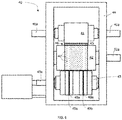
- FIG. 6 shows an embodiment of an apparatus for manufacturing a leakage barrier according to the present invention.
- the apparatus (40) comprises a cutting roller (41), an anvil roller (42) and an attachment roller (43), each rotatably mounted on a frame (44) by a cutting roller axis (41a), an anvil roller axis (42a) and an attachment roller axis (43a) respectively.
- the cutting roller and the anvil roller are configured to cut a front barrier and/or a back barrier from a sheet material by pressing a knife (45) of the cutting roller to a surface (46) of the anvil roller with the sheet material in between, the sheet material being a liquid-impermeable nonwoven sheet comprising a weight of at most 18 gsm.
- the anvil roller (42) comprises holding means for holding the front barrier and/or the back barrier to the surface (46) of the anvil roller.
- the holding means comprise a large number of orifices (47) on the surface (46) of the anvil roller (42).
- These orifices (47) are in fluid connection with suction means which create an underpressure at the position of the orifices such that the nonwoven for the front barrier and/or back barrier is sucked to the anvil's surface, and that the portions of nonwoven, which are cut by the cutting roller, also remain attached to the anvil's surface while being conveyed to the attachment roller.
- the surface of the anvil roller comprises orifices which are preferably circular.
- the anvil roller has a diameter of essentially between 20 and 500 mm, more preferably between 100 and 250 mm, yet more preferably between 130 and 200 mm, still more preferably between 150 and 170 mm, such as 151, 152, 153, 154, 155, 156, 157, 158, 159, 160, 161, 162, 163, 164, 165, 166, 167, 168, 169 mm or any value therebetween.
- the anvil roller has a circumference of essentially between 60 and 1600 mm, more preferably between 300 and 800 mm, yet more preferably between 390 and 640 mm, still more preferably between 450 and 544 mm, even more preferably between 590 and 610 mm, such as 491, 492, 493, 494, 495, 496, 497, 498, 499, 500, 501, 502, 503, 504, 505, 506, 507, 508, 509 mm or any value therebetween.
- the distance between orifices, from center to center is between 2.5 and 30 mm, more preferably between 5 and 20 mm, yet more preferably between 8 and 15 mm, such as 9, 10, 11, 12, 13, 14 mm or any value therebetween.
- the orifices comprise a diameter of between 1 and 5 mm, more preferably between 2 and 3 mm, such as 2.1, 2.2, 2.3, 2.4, 2.5, 2.6, 2.7, 2.8, 2.9 mm or any value therebetween.
- the anvil roller comprises a circumferential path along which between 20 and 100 orifices are positioned, more preferably between 30 and 80, yet more preferably between 40 and 60, such as 41, 42, 43, 44, 45, 46, 47, 48, 49, 50, 51, 52, 53, 54, 55, 56, 57, 58, 59 orifices.
- leg cuffs typically in the form of two endless strips, preferably each already provided with elastic members at a pre-determined pitch, preferably nonwovens and/or hydrophobic material, is supplied in between the anvil roller (42) and the attachment roller (43) on two leg cuff zones (48a, 48b).
- the leg cuff zones (48a, 48b) can be provided with holding means for pulling on the leg cuff strips.
- leg cuff zones (48a, 48b) are each provided with attachment means (49a, 49b), preferably heat-sealing attachment zones, which are configured to attach the leg cuffs, preferably along attachment paths (12a, 12b), to the front barrier and/or back barrier at predetermined positions, such that the front and/or back barrier do not overlap with the elastic members in the leg cuffs.
- the apparatus comprises a main encoder, preferably connected to a main shaft of the apparatus, for ensuring timely operation of the different parts of the apparatus, comprising any and any combination of the cutting roller, the anvil roller, the attachment roller, the supplying means for the nonwoven of the back barrier and/or front barrier, the supplying means for the leg cuff material, or other encoders for controlling parts of the apparatus.
- a main encoder preferably connected to a main shaft of the apparatus, for ensuring timely operation of the different parts of the apparatus, comprising any and any combination of the cutting roller, the anvil roller, the attachment roller, the supplying means for the nonwoven of the back barrier and/or front barrier, the supplying means for the leg cuff material, or other encoders for controlling parts of the apparatus.
- the cutting roller is controlled by a cutting servo motor, which preferably comprises a multiturn absolute encoder, which keeps track of its position.
- a cutting servo motor which preferably comprises a multiturn absolute encoder, which keeps track of its position.
- the multiturn absolute encoder for the cutting servo motor is controlled by the main encoder, thereby ensuring synchronous operation.
- the anvil roller is controlled by an anvil servo motor, preferably comprising a multiturn absolute encoder.
- the anvil roller and attachment roller are connected, e.g. by a system comprising one or more gears and/or a toothed belt, such that both anvil roller and attachment roller can be driven and controlled by the same servo motor.
- the anvil servo motor can be controlled by a main encoder.
- the anvil servo motor and the cutting servo motor are configured such that the knife (46) of the cutting roller cuts the nonwoven of the back barrier and/or front barrier at a position on the anvil roller's surface where no orifices are located, i.e. the nonwoven is cut in between the orifices such that the knife always has a surface to press to.
- an endless nonwoven (51) for the front and/or back barrier is supplied by supplying means (50) comprising a set of guiding bars or rollers (50a, 50b, 50c, 50d, 50e, 50f) and a pair of pulling rollers (52a, 52b) to the leakage barrier manufacturing apparatus (40).
- the set of bars or rollers preferably comprises one or more rollers, e.g. rollers (50b) and (50c), whose rotational speed can be changed, thereby altering the supply speed of the nonwoven between the supply of nonwoven (51) and the pair of pulling rollers (52a, 52b).
- the rotational speed of the rollers (50b) and (50c) is preferably controlled in correspondence with the rotational speed of the pulling rollers (52a, 52b), e.g. by a single servo motor and a system of gears and/or timing belts, the single servo motor preferably controlled by a main encoder.
- leg cuffs Two strips of leg cuffs (53) are provided separately from the barrier nonwoven (51).
- Elastic members (54), such as elastic strands are provided and attached to the leg cuff strips in a leg cuff elastification system (55).
- the elastic members are cut during the elastification process at predetermined intervals such that the elastified leg cuff strips comprise elastic strands at specific intervals.
- the elastified leg cuff strips are subsequently provided to the leakage barrier manufacturing apparatus (40).
- the apparatus (40) cuts strips from the nonwoven (51) in between the cutting roller (41) and the anvil roller (42) to create front barriers and/or back barriers.
- the cutting roller is preferably driven by a cutting servo motor, which is preferably controlled in such a manner that it cuts off a front barrier and/or a back barrier (56,57) at the moment which corresponds to the moment when said front barrier and/or back barrier needs to be attached to the leg cuff strips (53), taking into account the conveyance time by the anvil roller of the barrier, i.e. the time needed to convey the barrier from the position of cutting from the nonwoven to the position of attachment to the leg cuff strips.
- the cutting servo motor is configured to cut off a combined strip of front and back barrier, which is attached to the leg cuff strips, and which is cut in a later process in a front barrier and a back barrier of two subsequent hygiene articles, i.e. the barrier which is attached to the leg cuff strips by the attachment roller (43) overlaps the waist edges of subsequent hygiene articles and thus comprises the front barrier of a first hygiene article and the back barrier of a second hygiene article or vice versa.
- the apparatus (40) provides a leakage barrier (58) comprising a pair of leg cuffs and a front barrier and/or a back barrier, in the form of subsequent leakage barriers whose leg cuffs are still attached at longitudinal ends, e.g. a front end edge (4a, 4b) of a leg cuff (3a, 3b) of a first leakage barrier is still attached to a back end edge (5a, 5b) of a leg cuff (3a, 3b) of a second leakage barrier.
- the leakage barrier (58) is subsequently combined, e.g.
- the topsheet preferably provided in the form of an endless sheet, preferably a nonwoven and/or hydrophilic.
- the article preform (60) may consist solely of the topsheet, whereby other components of the hygiene article, e.g. back sheet or absorbent core, can be attached in a later attachment process, preferably finally leading to a continuous production of longitudinally attached hygiene articles, which can be cut into separate hygiene articles.
Landscapes
- Health & Medical Sciences (AREA)
- Life Sciences & Earth Sciences (AREA)
- Engineering & Computer Science (AREA)
- Biomedical Technology (AREA)
- Heart & Thoracic Surgery (AREA)
- Vascular Medicine (AREA)
- Epidemiology (AREA)
- Animal Behavior & Ethology (AREA)
- General Health & Medical Sciences (AREA)
- Public Health (AREA)
- Veterinary Medicine (AREA)
- Botany (AREA)
- Manufacturing & Machinery (AREA)
- Absorbent Articles And Supports Therefor (AREA)
- Orthopedics, Nursing, And Contraception (AREA)
Applications Claiming Priority (1)
| Application Number | Priority Date | Filing Date | Title |
|---|---|---|---|
| PCT/EP2016/070210 WO2018036639A1 (fr) | 2016-08-26 | 2016-08-26 | Couche avec barrières transversales. |
Publications (2)
| Publication Number | Publication Date |
|---|---|
| EP3287108A1 true EP3287108A1 (fr) | 2018-02-28 |
| EP3287108B1 EP3287108B1 (fr) | 2019-11-20 |
Family
ID=56801559
Family Applications (2)
| Application Number | Title | Priority Date | Filing Date |
|---|---|---|---|
| EP16757258.5A Active EP3451989B1 (fr) | 2016-08-26 | 2016-08-26 | Couche avec barrières transversales. |
| EP17183302.3A Active EP3287108B1 (fr) | 2016-08-26 | 2017-07-26 | Couche culotte jetable pourvu de barrières d'étanchéité |
Family Applications Before (1)
| Application Number | Title | Priority Date | Filing Date |
|---|---|---|---|
| EP16757258.5A Active EP3451989B1 (fr) | 2016-08-26 | 2016-08-26 | Couche avec barrières transversales. |
Country Status (6)
| Country | Link |
|---|---|
| US (1) | US10603227B2 (fr) |
| EP (2) | EP3451989B1 (fr) |
| AU (1) | AU2016421117B2 (fr) |
| BR (1) | BR112018076010A2 (fr) |
| MX (1) | MX379238B (fr) |
| WO (1) | WO2018036639A1 (fr) |
Cited By (7)
| Publication number | Priority date | Publication date | Assignee | Title |
|---|---|---|---|---|
| WO2020117738A1 (fr) * | 2018-12-05 | 2020-06-11 | Attends Healthcare Products, Inc. | Articles absorbants comprenant des revers absorbant |
| WO2020142009A3 (fr) * | 2018-12-31 | 2020-08-06 | Evyap Sabun Yag Gliserin Sanayi Ve Ticaret Anonim Sirketi | Système de production d'un noyau en plusieurs parties pour articles absorbants |
| CN115151227A (zh) * | 2020-02-28 | 2022-10-04 | 宝洁公司 | 裤型吸收制品 |
| US11672710B2 (en) | 2014-02-28 | 2023-06-13 | Attends Healthcare Products, Inc. | Absorbent article with multi-layer folded absorbent core |
| US11744748B2 (en) | 2018-05-28 | 2023-09-05 | Attends Healthcare Products, Inc. | Dryness layer laminate for absorbent articles |
| US12303369B2 (en) | 2016-12-14 | 2025-05-20 | Attends Healthcare Products, Inc. | Absorbent laminates, absorbent cores and disposable articles utilizing the absorbent laminates, and related methods |
| US12564522B2 (en) | 2021-04-21 | 2026-03-03 | The Procter & Gamble Company | Pant-type absorbent article with waist guard |
Families Citing this family (19)
| Publication number | Priority date | Publication date | Assignee | Title |
|---|---|---|---|---|
| BR112019002317B1 (pt) * | 2016-08-29 | 2023-01-31 | Unicharm Corporation | Artigo absorvente e método de fabricação de um artigo absorvente que pode ser vestido |
| JP6751625B2 (ja) * | 2016-08-29 | 2020-09-09 | ユニ・チャーム株式会社 | パンツ型吸収性物品 |
| DE102016125446A1 (de) | 2016-12-22 | 2018-06-28 | Repulping Technology Gmbh & Co. Kg | Verfahren zum Vereinzeln von Fasern |
| BE1025887B1 (nl) * | 2017-05-15 | 2019-08-07 | Drylock Technologies Nv | Absorberend voorwerp met vier kanalen |
| EP3842016B1 (fr) | 2019-12-25 | 2024-08-28 | Ontex BV | Article pour incontinence masculine |
| WO2021214231A1 (fr) | 2020-04-24 | 2021-10-28 | Ontex Bv | Articles absorbants et procédés de fabrication |
| WO2022094546A1 (fr) * | 2020-10-29 | 2022-05-05 | Curt G. Joa, Inc. | Article absorbant à poche de confinement de taille et son procédé de fabrication |
| JP7092954B1 (ja) | 2020-11-13 | 2022-06-28 | 株式会社瑞光 | 伸縮積層シート、使い捨て着用物品、伸縮積層シートの製造方法および製造装置 |
| US20260041591A1 (en) | 2022-08-09 | 2026-02-12 | Ontex Bv | Absorbent article with transversal barrier |
| EP4321138B1 (fr) | 2022-08-09 | 2024-08-28 | Ontex BV | Article absorbant doté d'une barrière transversale |
| US20260041589A1 (en) | 2022-08-09 | 2026-02-12 | Ontex Bv | Method and apparatus for the manufacture of absorbent article with transversal barrier |
| EP4356889A1 (fr) | 2022-10-17 | 2024-04-24 | Ontex BV | Articles absorbants comportant une poche de confinement |
| EP4431071B1 (fr) | 2023-03-13 | 2026-03-25 | Ontex BV | Procédé et appareil pour la fabrication d'un article absorbant à barrière transversale |
| EP4458337B1 (fr) | 2023-04-27 | 2025-04-09 | Ontex BV | Article absorbant à barrière transversale anti-fuite |
| EP4696291A3 (fr) | 2023-04-27 | 2026-02-25 | Ontex BV | Article absorbant à barrière transversale anti-fuite |
| DE202024106914U1 (de) | 2023-04-27 | 2024-12-06 | Ontex Bv | Absorbierender Artikel mit Auslaufschutz-Querbarriere |
| WO2025078135A1 (fr) | 2023-10-12 | 2025-04-17 | Ontex Bv | Procédé et appareil de fabrication d'un article absorbant comportant une barrière transversale |
| WO2025180754A1 (fr) | 2024-02-26 | 2025-09-04 | Ontex Bv | Articles absorbants et procédés de production |
| EP4623878A1 (fr) | 2024-03-29 | 2025-10-01 | Ontex BV | Procédé et appareil pour la fabrication d'un article absorbant à barrière transversale |
Citations (6)
| Publication number | Priority date | Publication date | Assignee | Title |
|---|---|---|---|---|
| US5366453A (en) * | 1991-09-11 | 1994-11-22 | Kimberly-Clark Corporation | Newborn's growth adjustable absorbent diaper having variable overlapping and non-overlapping ears |
| GB2297683A (en) * | 1995-02-10 | 1996-08-14 | Kimberly Clark Co | An absorbent article having leg containment gaskets |
| US5935118A (en) * | 1995-06-07 | 1999-08-10 | Kimberly-Clark Worldwide, Inc. | Absorbent article including liquid containment beams |
| EP1224922A2 (fr) * | 2001-01-23 | 2002-07-24 | Uni-Charm Corporation | Couche-culotte jetable |
| US6794557B1 (en) * | 1999-07-16 | 2004-09-21 | Associated Hygienic Products Llc | Disposable absorbent article employing an absorbent composite and method of making the same |
| US20070197987A1 (en) * | 2006-02-22 | 2007-08-23 | Patrick Tsang | Method of making an absorbent composite and absorbent articles employing the same |
Family Cites Families (19)
| Publication number | Priority date | Publication date | Assignee | Title |
|---|---|---|---|---|
| US4753646A (en) * | 1984-06-04 | 1988-06-28 | Kimberly-Clark Corporation | Diaper with waist flaps |
| US4938755A (en) * | 1986-10-10 | 1990-07-03 | The Procter & Gamble Company | Absorbent article having a containment pocket |
| US4808177A (en) * | 1987-10-02 | 1989-02-28 | The Procter & Gamble Company | Absorbent article having floating inner cuffs |
| US5540671A (en) | 1993-06-10 | 1996-07-30 | The Procter & Gamble Company | Absorbent article having a pocket cuff with an apex |
| US5827259A (en) * | 1995-10-25 | 1998-10-27 | Kimberly-Clark Worldwide, Inc. | Absorbent article with waist elastic and containment system |
| US6336922B1 (en) * | 1996-06-19 | 2002-01-08 | Kimberly-Clark Worldwide, Inc. | Absorbent article having a fit panel |
| US6132410A (en) * | 1998-05-07 | 2000-10-17 | Kimberly-Clark Worldwide, Inc. | Disposable garment having dryness barriers with expandable attachment to an absorbent |
| JP3406232B2 (ja) | 1998-11-06 | 2003-05-12 | ユニ・チャーム株式会社 | 使い捨ておむつ |
| US6217563B1 (en) * | 1999-02-12 | 2001-04-17 | Kimberly-Clark Worldwide, Inc. | Three-dimensional, inward leg gather disposable garment |
| JP3732399B2 (ja) | 2000-10-16 | 2006-01-05 | ユニ・チャーム株式会社 | 使い捨て着用物品 |
| US7785309B2 (en) * | 2005-08-31 | 2010-08-31 | Kimberly-Clark Worldwide, Inc. | Disposable garment with biaxially stretchable inner layer |
| JP5383271B2 (ja) | 2009-03-25 | 2014-01-08 | ユニ・チャーム株式会社 | 吸収性物品 |
| US8663182B2 (en) * | 2009-06-02 | 2014-03-04 | The Procter & Gamble Company | Disposable absorbent article with absorbent waistcap or waistband and method for making the same |
| US10524963B2 (en) * | 2015-03-18 | 2020-01-07 | The Procter & Gamble Company | Absorbent article with waist gasketing element and leg cuffs |
| KR101895757B1 (ko) * | 2015-06-29 | 2018-09-05 | 킴벌리-클라크 월드와이드, 인크. | 부분적으로 에워싸인 허리 샘방지 부재를 구비한 흡수 용품 및 이의 제조 방법 |
| WO2017003741A1 (fr) * | 2015-06-30 | 2017-01-05 | The Procter & Gamble Company | Article absorbant présentant une zone de la taille élastifiée |
| BR112018002363B1 (pt) * | 2015-08-31 | 2022-05-03 | Kimberly-Clark Worldwide, Inc | Compósito elástico e artigo absorvente incluindo o mesmo |
| US20170246044A1 (en) * | 2016-02-25 | 2017-08-31 | The Procter & Gamble Company | Absorbent pads |
| WO2017201401A1 (fr) * | 2016-05-20 | 2017-11-23 | The Procter & Gamble Company | Article absorbant comportant un élément anti-fuite à la taille |
-
2016
- 2016-08-26 EP EP16757258.5A patent/EP3451989B1/fr active Active
- 2016-08-26 BR BR112018076010-2A patent/BR112018076010A2/pt not_active IP Right Cessation
- 2016-08-26 US US16/313,123 patent/US10603227B2/en active Active
- 2016-08-26 AU AU2016421117A patent/AU2016421117B2/en not_active Ceased
- 2016-08-26 MX MX2018015487A patent/MX379238B/es unknown
- 2016-08-26 WO PCT/EP2016/070210 patent/WO2018036639A1/fr not_active Ceased
-
2017
- 2017-07-26 EP EP17183302.3A patent/EP3287108B1/fr active Active
Patent Citations (6)
| Publication number | Priority date | Publication date | Assignee | Title |
|---|---|---|---|---|
| US5366453A (en) * | 1991-09-11 | 1994-11-22 | Kimberly-Clark Corporation | Newborn's growth adjustable absorbent diaper having variable overlapping and non-overlapping ears |
| GB2297683A (en) * | 1995-02-10 | 1996-08-14 | Kimberly Clark Co | An absorbent article having leg containment gaskets |
| US5935118A (en) * | 1995-06-07 | 1999-08-10 | Kimberly-Clark Worldwide, Inc. | Absorbent article including liquid containment beams |
| US6794557B1 (en) * | 1999-07-16 | 2004-09-21 | Associated Hygienic Products Llc | Disposable absorbent article employing an absorbent composite and method of making the same |
| EP1224922A2 (fr) * | 2001-01-23 | 2002-07-24 | Uni-Charm Corporation | Couche-culotte jetable |
| US20070197987A1 (en) * | 2006-02-22 | 2007-08-23 | Patrick Tsang | Method of making an absorbent composite and absorbent articles employing the same |
Cited By (10)
| Publication number | Priority date | Publication date | Assignee | Title |
|---|---|---|---|---|
| US11672710B2 (en) | 2014-02-28 | 2023-06-13 | Attends Healthcare Products, Inc. | Absorbent article with multi-layer folded absorbent core |
| US12303369B2 (en) | 2016-12-14 | 2025-05-20 | Attends Healthcare Products, Inc. | Absorbent laminates, absorbent cores and disposable articles utilizing the absorbent laminates, and related methods |
| US11744748B2 (en) | 2018-05-28 | 2023-09-05 | Attends Healthcare Products, Inc. | Dryness layer laminate for absorbent articles |
| WO2020117738A1 (fr) * | 2018-12-05 | 2020-06-11 | Attends Healthcare Products, Inc. | Articles absorbants comprenant des revers absorbant |
| WO2020142009A3 (fr) * | 2018-12-31 | 2020-08-06 | Evyap Sabun Yag Gliserin Sanayi Ve Ticaret Anonim Sirketi | Système de production d'un noyau en plusieurs parties pour articles absorbants |
| CN115151227A (zh) * | 2020-02-28 | 2022-10-04 | 宝洁公司 | 裤型吸收制品 |
| CN115151227B (zh) * | 2020-02-28 | 2023-07-28 | 宝洁公司 | 裤型吸收制品 |
| US12440395B2 (en) | 2020-02-28 | 2025-10-14 | The Procter & Gamble Company | Pant-type absorbent article and manufacturing method thereof |
| US12458545B2 (en) | 2020-02-28 | 2025-11-04 | The Procter & Gamble Company | Pant-type absorbent article and manufacturing method thereof |
| US12564522B2 (en) | 2021-04-21 | 2026-03-03 | The Procter & Gamble Company | Pant-type absorbent article with waist guard |
Also Published As
| Publication number | Publication date |
|---|---|
| WO2018036639A1 (fr) | 2018-03-01 |
| AU2016421117B2 (en) | 2019-04-11 |
| BR112018076010A2 (pt) | 2019-03-26 |
| MX2018015487A (es) | 2019-05-22 |
| AU2016421117A1 (en) | 2019-01-03 |
| US20190254886A1 (en) | 2019-08-22 |
| EP3451989B1 (fr) | 2020-07-29 |
| EP3451989A1 (fr) | 2019-03-13 |
| MX379238B (es) | 2025-03-11 |
| EP3287108B1 (fr) | 2019-11-20 |
| US10603227B2 (en) | 2020-03-31 |
Similar Documents
| Publication | Publication Date | Title |
|---|---|---|
| EP3287108B1 (fr) | Couche culotte jetable pourvu de barrières d'étanchéité | |
| EP3760176B1 (fr) | Noyau absorbant, articles comprenant ledit noyau et procédés de fabrication | |
| EP3752114B1 (fr) | Noyau absorbant, articles absorbants comprenant ledit noyau | |
| EP3752116B1 (fr) | Noyau absorbant et articles absorbants comprenant ledit noyau | |
| WO2018122117A1 (fr) | Noyau absorbant, articles comprenant ledit noyau et procédés de fabrication | |
| EP3527184B1 (fr) | Noyau absorbant et articles comprenant ledit noyau | |
| EP3842016B1 (fr) | Article pour incontinence masculine | |
| JP7784000B2 (ja) | 使い捨ての吸収性衛生物品のための吸収性コアを製造する方法、吸収性コア、および吸収性物品 |
Legal Events
| Date | Code | Title | Description |
|---|---|---|---|
| PUAI | Public reference made under article 153(3) epc to a published international application that has entered the european phase |
Free format text: ORIGINAL CODE: 0009012 |
|
| STAA | Information on the status of an ep patent application or granted ep patent |
Free format text: STATUS: THE APPLICATION HAS BEEN PUBLISHED |
|
| AK | Designated contracting states |
Kind code of ref document: A1 Designated state(s): AL AT BE BG CH CY CZ DE DK EE ES FI FR GB GR HR HU IE IS IT LI LT LU LV MC MK MT NL NO PL PT RO RS SE SI SK SM TR |
|
| AX | Request for extension of the european patent |
Extension state: BA ME |
|
| STAA | Information on the status of an ep patent application or granted ep patent |
Free format text: STATUS: REQUEST FOR EXAMINATION WAS MADE |
|
| 17P | Request for examination filed |
Effective date: 20180828 |
|
| RBV | Designated contracting states (corrected) |
Designated state(s): AL AT BE BG CH CY CZ DE DK EE ES FI FR GB GR HR HU IE IS IT LI LT LU LV MC MK MT NL NO PL PT RO RS SE SI SK SM TR |
|
| STAA | Information on the status of an ep patent application or granted ep patent |
Free format text: STATUS: EXAMINATION IS IN PROGRESS |
|
| 17Q | First examination report despatched |
Effective date: 20190123 |
|
| GRAP | Despatch of communication of intention to grant a patent |
Free format text: ORIGINAL CODE: EPIDOSNIGR1 |
|
| STAA | Information on the status of an ep patent application or granted ep patent |
Free format text: STATUS: GRANT OF PATENT IS INTENDED |
|
| INTG | Intention to grant announced |
Effective date: 20190719 |
|
| GRAS | Grant fee paid |
Free format text: ORIGINAL CODE: EPIDOSNIGR3 |
|
| GRAA | (expected) grant |
Free format text: ORIGINAL CODE: 0009210 |
|
| STAA | Information on the status of an ep patent application or granted ep patent |
Free format text: STATUS: THE PATENT HAS BEEN GRANTED |
|
| AK | Designated contracting states |
Kind code of ref document: B1 Designated state(s): AL AT BE BG CH CY CZ DE DK EE ES FI FR GB GR HR HU IE IS IT LI LT LU LV MC MK MT NL NO PL PT RO RS SE SI SK SM TR |
|
| REG | Reference to a national code |
Ref country code: GB Ref legal event code: FG4D |
|
| REG | Reference to a national code |
Ref country code: CH Ref legal event code: EP |
|
| REG | Reference to a national code |
Ref country code: IE Ref legal event code: FG4D |
|
| REG | Reference to a national code |
Ref country code: DE Ref legal event code: R096 Ref document number: 602017008845 Country of ref document: DE |
|
| REG | Reference to a national code |
Ref country code: AT Ref legal event code: REF Ref document number: 1203345 Country of ref document: AT Kind code of ref document: T Effective date: 20191215 |
|
| REG | Reference to a national code |
Ref country code: NL Ref legal event code: MP Effective date: 20191120 |
|
| REG | Reference to a national code |
Ref country code: LT Ref legal event code: MG4D |
|
| PG25 | Lapsed in a contracting state [announced via postgrant information from national office to epo] |
Ref country code: LT Free format text: LAPSE BECAUSE OF FAILURE TO SUBMIT A TRANSLATION OF THE DESCRIPTION OR TO PAY THE FEE WITHIN THE PRESCRIBED TIME-LIMIT Effective date: 20191120 Ref country code: NO Free format text: LAPSE BECAUSE OF FAILURE TO SUBMIT A TRANSLATION OF THE DESCRIPTION OR TO PAY THE FEE WITHIN THE PRESCRIBED TIME-LIMIT Effective date: 20200220 Ref country code: GR Free format text: LAPSE BECAUSE OF FAILURE TO SUBMIT A TRANSLATION OF THE DESCRIPTION OR TO PAY THE FEE WITHIN THE PRESCRIBED TIME-LIMIT Effective date: 20200221 Ref country code: NL Free format text: LAPSE BECAUSE OF FAILURE TO SUBMIT A TRANSLATION OF THE DESCRIPTION OR TO PAY THE FEE WITHIN THE PRESCRIBED TIME-LIMIT Effective date: 20191120 Ref country code: FI Free format text: LAPSE BECAUSE OF FAILURE TO SUBMIT A TRANSLATION OF THE DESCRIPTION OR TO PAY THE FEE WITHIN THE PRESCRIBED TIME-LIMIT Effective date: 20191120 Ref country code: BG Free format text: LAPSE BECAUSE OF FAILURE TO SUBMIT A TRANSLATION OF THE DESCRIPTION OR TO PAY THE FEE WITHIN THE PRESCRIBED TIME-LIMIT Effective date: 20200220 Ref country code: LV Free format text: LAPSE BECAUSE OF FAILURE TO SUBMIT A TRANSLATION OF THE DESCRIPTION OR TO PAY THE FEE WITHIN THE PRESCRIBED TIME-LIMIT Effective date: 20191120 Ref country code: SE Free format text: LAPSE BECAUSE OF FAILURE TO SUBMIT A TRANSLATION OF THE DESCRIPTION OR TO PAY THE FEE WITHIN THE PRESCRIBED TIME-LIMIT Effective date: 20191120 |
|
| PG25 | Lapsed in a contracting state [announced via postgrant information from national office to epo] |
Ref country code: HR Free format text: LAPSE BECAUSE OF FAILURE TO SUBMIT A TRANSLATION OF THE DESCRIPTION OR TO PAY THE FEE WITHIN THE PRESCRIBED TIME-LIMIT Effective date: 20191120 Ref country code: IS Free format text: LAPSE BECAUSE OF FAILURE TO SUBMIT A TRANSLATION OF THE DESCRIPTION OR TO PAY THE FEE WITHIN THE PRESCRIBED TIME-LIMIT Effective date: 20200320 Ref country code: RS Free format text: LAPSE BECAUSE OF FAILURE TO SUBMIT A TRANSLATION OF THE DESCRIPTION OR TO PAY THE FEE WITHIN THE PRESCRIBED TIME-LIMIT Effective date: 20191120 |
|
| PG25 | Lapsed in a contracting state [announced via postgrant information from national office to epo] |
Ref country code: AL Free format text: LAPSE BECAUSE OF FAILURE TO SUBMIT A TRANSLATION OF THE DESCRIPTION OR TO PAY THE FEE WITHIN THE PRESCRIBED TIME-LIMIT Effective date: 20191120 |
|
| PG25 | Lapsed in a contracting state [announced via postgrant information from national office to epo] |
Ref country code: CZ Free format text: LAPSE BECAUSE OF FAILURE TO SUBMIT A TRANSLATION OF THE DESCRIPTION OR TO PAY THE FEE WITHIN THE PRESCRIBED TIME-LIMIT Effective date: 20191120 Ref country code: ES Free format text: LAPSE BECAUSE OF FAILURE TO SUBMIT A TRANSLATION OF THE DESCRIPTION OR TO PAY THE FEE WITHIN THE PRESCRIBED TIME-LIMIT Effective date: 20191120 Ref country code: EE Free format text: LAPSE BECAUSE OF FAILURE TO SUBMIT A TRANSLATION OF THE DESCRIPTION OR TO PAY THE FEE WITHIN THE PRESCRIBED TIME-LIMIT Effective date: 20191120 Ref country code: PT Free format text: LAPSE BECAUSE OF FAILURE TO SUBMIT A TRANSLATION OF THE DESCRIPTION OR TO PAY THE FEE WITHIN THE PRESCRIBED TIME-LIMIT Effective date: 20200412 Ref country code: DK Free format text: LAPSE BECAUSE OF FAILURE TO SUBMIT A TRANSLATION OF THE DESCRIPTION OR TO PAY THE FEE WITHIN THE PRESCRIBED TIME-LIMIT Effective date: 20191120 Ref country code: RO Free format text: LAPSE BECAUSE OF FAILURE TO SUBMIT A TRANSLATION OF THE DESCRIPTION OR TO PAY THE FEE WITHIN THE PRESCRIBED TIME-LIMIT Effective date: 20191120 |
|
| REG | Reference to a national code |
Ref country code: AT Ref legal event code: MK05 Ref document number: 1203345 Country of ref document: AT Kind code of ref document: T Effective date: 20191120 |
|
| REG | Reference to a national code |
Ref country code: DE Ref legal event code: R097 Ref document number: 602017008845 Country of ref document: DE |
|
| PG25 | Lapsed in a contracting state [announced via postgrant information from national office to epo] |
Ref country code: SK Free format text: LAPSE BECAUSE OF FAILURE TO SUBMIT A TRANSLATION OF THE DESCRIPTION OR TO PAY THE FEE WITHIN THE PRESCRIBED TIME-LIMIT Effective date: 20191120 Ref country code: SM Free format text: LAPSE BECAUSE OF FAILURE TO SUBMIT A TRANSLATION OF THE DESCRIPTION OR TO PAY THE FEE WITHIN THE PRESCRIBED TIME-LIMIT Effective date: 20191120 |
|
| PLBE | No opposition filed within time limit |
Free format text: ORIGINAL CODE: 0009261 |
|
| STAA | Information on the status of an ep patent application or granted ep patent |
Free format text: STATUS: NO OPPOSITION FILED WITHIN TIME LIMIT |
|
| 26N | No opposition filed |
Effective date: 20200821 |
|
| PG25 | Lapsed in a contracting state [announced via postgrant information from national office to epo] |
Ref country code: AT Free format text: LAPSE BECAUSE OF FAILURE TO SUBMIT A TRANSLATION OF THE DESCRIPTION OR TO PAY THE FEE WITHIN THE PRESCRIBED TIME-LIMIT Effective date: 20191120 Ref country code: PL Free format text: LAPSE BECAUSE OF FAILURE TO SUBMIT A TRANSLATION OF THE DESCRIPTION OR TO PAY THE FEE WITHIN THE PRESCRIBED TIME-LIMIT Effective date: 20191120 Ref country code: SI Free format text: LAPSE BECAUSE OF FAILURE TO SUBMIT A TRANSLATION OF THE DESCRIPTION OR TO PAY THE FEE WITHIN THE PRESCRIBED TIME-LIMIT Effective date: 20191120 |
|
| PG25 | Lapsed in a contracting state [announced via postgrant information from national office to epo] |
Ref country code: IT Free format text: LAPSE BECAUSE OF FAILURE TO SUBMIT A TRANSLATION OF THE DESCRIPTION OR TO PAY THE FEE WITHIN THE PRESCRIBED TIME-LIMIT Effective date: 20191120 |
|
| PG25 | Lapsed in a contracting state [announced via postgrant information from national office to epo] |
Ref country code: MC Free format text: LAPSE BECAUSE OF FAILURE TO SUBMIT A TRANSLATION OF THE DESCRIPTION OR TO PAY THE FEE WITHIN THE PRESCRIBED TIME-LIMIT Effective date: 20191120 |
|
| REG | Reference to a national code |
Ref country code: CH Ref legal event code: PL |
|
| REG | Reference to a national code |
Ref country code: BE Ref legal event code: MM Effective date: 20200731 |
|
| PG25 | Lapsed in a contracting state [announced via postgrant information from national office to epo] |
Ref country code: LI Free format text: LAPSE BECAUSE OF NON-PAYMENT OF DUE FEES Effective date: 20200731 Ref country code: LU Free format text: LAPSE BECAUSE OF NON-PAYMENT OF DUE FEES Effective date: 20200726 Ref country code: CH Free format text: LAPSE BECAUSE OF NON-PAYMENT OF DUE FEES Effective date: 20200731 |
|
| PG25 | Lapsed in a contracting state [announced via postgrant information from national office to epo] |
Ref country code: BE Free format text: LAPSE BECAUSE OF NON-PAYMENT OF DUE FEES Effective date: 20200731 |
|
| PG25 | Lapsed in a contracting state [announced via postgrant information from national office to epo] |
Ref country code: IE Free format text: LAPSE BECAUSE OF NON-PAYMENT OF DUE FEES Effective date: 20200726 |
|
| PG25 | Lapsed in a contracting state [announced via postgrant information from national office to epo] |
Ref country code: TR Free format text: LAPSE BECAUSE OF FAILURE TO SUBMIT A TRANSLATION OF THE DESCRIPTION OR TO PAY THE FEE WITHIN THE PRESCRIBED TIME-LIMIT Effective date: 20191120 Ref country code: MT Free format text: LAPSE BECAUSE OF FAILURE TO SUBMIT A TRANSLATION OF THE DESCRIPTION OR TO PAY THE FEE WITHIN THE PRESCRIBED TIME-LIMIT Effective date: 20191120 Ref country code: CY Free format text: LAPSE BECAUSE OF FAILURE TO SUBMIT A TRANSLATION OF THE DESCRIPTION OR TO PAY THE FEE WITHIN THE PRESCRIBED TIME-LIMIT Effective date: 20191120 |
|
| PG25 | Lapsed in a contracting state [announced via postgrant information from national office to epo] |
Ref country code: MK Free format text: LAPSE BECAUSE OF FAILURE TO SUBMIT A TRANSLATION OF THE DESCRIPTION OR TO PAY THE FEE WITHIN THE PRESCRIBED TIME-LIMIT Effective date: 20191120 |
|
| PGFP | Annual fee paid to national office [announced via postgrant information from national office to epo] |
Ref country code: DE Payment date: 20250722 Year of fee payment: 9 |
|
| PGFP | Annual fee paid to national office [announced via postgrant information from national office to epo] |
Ref country code: GB Payment date: 20250724 Year of fee payment: 9 |
|
| PGFP | Annual fee paid to national office [announced via postgrant information from national office to epo] |
Ref country code: FR Payment date: 20250723 Year of fee payment: 9 |