EP3287919A1 - Système de protection de données - Google Patents
Système de protection de données Download PDFInfo
- Publication number
- EP3287919A1 EP3287919A1 EP16185166.2A EP16185166A EP3287919A1 EP 3287919 A1 EP3287919 A1 EP 3287919A1 EP 16185166 A EP16185166 A EP 16185166A EP 3287919 A1 EP3287919 A1 EP 3287919A1
- Authority
- EP
- European Patent Office
- Prior art keywords
- data
- verification result
- access
- result
- current
- Prior art date
- Legal status (The legal status is an assumption and is not a legal conclusion. Google has not performed a legal analysis and makes no representation as to the accuracy of the status listed.)
- Withdrawn
Links
Images





Classifications
-
- G—PHYSICS
- G06—COMPUTING OR CALCULATING; COUNTING
- G06F—ELECTRIC DIGITAL DATA PROCESSING
- G06F21/00—Security arrangements for protecting computers, components thereof, programs or data against unauthorised activity
- G06F21/10—Protecting distributed programs or content, e.g. vending or licensing of copyrighted material ; Digital rights management [DRM]
-
- G—PHYSICS
- G06—COMPUTING OR CALCULATING; COUNTING
- G06F—ELECTRIC DIGITAL DATA PROCESSING
- G06F21/00—Security arrangements for protecting computers, components thereof, programs or data against unauthorised activity
- G06F21/60—Protecting data
- G06F21/62—Protecting access to data via a platform, e.g. using keys or access control rules
-
- H—ELECTRICITY
- H04—ELECTRIC COMMUNICATION TECHNIQUE
- H04L—TRANSMISSION OF DIGITAL INFORMATION, e.g. TELEGRAPHIC COMMUNICATION
- H04L63/00—Network architectures or network communication protocols for network security
- H04L63/04—Network architectures or network communication protocols for network security for providing a confidential data exchange among entities communicating through data packet networks
- H04L63/0428—Network architectures or network communication protocols for network security for providing a confidential data exchange among entities communicating through data packet networks wherein the data content is protected, e.g. by encrypting or encapsulating the payload
-
- H—ELECTRICITY
- H04—ELECTRIC COMMUNICATION TECHNIQUE
- H04L—TRANSMISSION OF DIGITAL INFORMATION, e.g. TELEGRAPHIC COMMUNICATION
- H04L63/00—Network architectures or network communication protocols for network security
- H04L63/10—Network architectures or network communication protocols for network security for controlling access to devices or network resources
- H04L63/105—Multiple levels of security
-
- G—PHYSICS
- G06—COMPUTING OR CALCULATING; COUNTING
- G06F—ELECTRIC DIGITAL DATA PROCESSING
- G06F2221/00—Indexing scheme relating to security arrangements for protecting computers, components thereof, programs or data against unauthorised activity
- G06F2221/21—Indexing scheme relating to G06F21/00 and subgroups addressing additional information or applications relating to security arrangements for protecting computers, components thereof, programs or data against unauthorised activity
- G06F2221/2101—Auditing as a secondary aspect
-
- H—ELECTRICITY
- H04—ELECTRIC COMMUNICATION TECHNIQUE
- H04L—TRANSMISSION OF DIGITAL INFORMATION, e.g. TELEGRAPHIC COMMUNICATION
- H04L2463/00—Additional details relating to network architectures or network communication protocols for network security covered by H04L63/00
- H04L2463/101—Additional details relating to network architectures or network communication protocols for network security covered by H04L63/00 applying security measures for digital rights management
Definitions
- the present invention relates to the field of communication systems.
- the present invention relates to systems, devices and methods for detecting unauthorized access to data in communication systems.
- IP Internet protocol
- the invention relates to a data guard system for detecting unauthorized access to a data token of a plurality of data tokens by a requesting communication entity
- the data guard system comprising: a guard interface being configured to receive from the requesting communication entity an access request requesting an access to the data token, the access request comprising first information data representing a first information content, a data guard with an access rule for ruling the access to the data token, the data guard being configured to extract an attribute relating to the information content from the information data and to apply the access rule to the extracted attribute to obtain a current verification result, and a decider being configured to determine whether the current verification result matches with a pre-stored verification result, the pre-stored verification result resulting from applying the access rule to a previously extracted attribute from a previously received access request from the requesting communication entity, the previously received access request comprising second information data representing a second information content, the decider being configured to issue a warning message indicating the unauthorized access if the current verification result does not match with the pre-stored verification
- An advantage of the invention is that storing the verification result allows the data guard system to perform authentication and matching of the requesting communication entity in one step, because, in such a way, the data guard system can save metadata of every "authentication chain” and data token with a time stamp depending on the requesting communication entity. While performing the operations allowing to obtain the current verification result, the data guard system can perform a matching with historic guard metadata ("reaction chain") concerning the requesting communication entity in order to, for example, detect potential fraud or to recommend information or data token to the requesting communication entity. While the aim of the authentication is to prevent a fraudulent behavior of the requesting communication entity, the aim of matching is to provide the requesting communication entity with suggestions of content that could match its interests.
- the guard interface is configured to receive from the requesting communication entity the previous access request requesting an access to the data token, wherein the data guard is configured to extract an attribute from the second information data to obtain the previously extracted attribute and to apply the access rule to the previously extracted attribute to obtain the previous verification result.
- the information content is represented by a data stream, and the data guard is configured to extract the respective attribute from the information content.
- the data guard is configured to identify the information content in order to extract the respective attribute.
- the data guard is configured to extract a frequency spectrum of the information content to obtain the respective attribute.
- the information content is a graphical information, in particular a picture or a video, or an audio information, in particular a sound file, or a text information.
- the decider is configured to compare or to correlate the current verification result to the previous verification result to determine whether the current verification result matches with the previous verification result.
- the decider is configured to determine that the current verification result does not match with the pre-stored verification result if the current verification result differs from the previous verification result, or to determine that the current verification result matches with the pre-stored verification result if the pre-stored verification result equals the current verification result.
- the decider is configured to compare a plurality of previous verification results with the current verification result and to determine that the current verification result does not match with the pre-stored verification result if the pre-stored verification result differs from the majority of the previous verification results, or to determine that the current verification result matches with the pre-stored verification result if the pre-stored verification result equals the majority of the previous verification results.
- the previous verification result comprises a plurality or result entries, in particular binary result entries, forming a previous result vector
- the current verification result comprises a plurality or result entries, in particular binary result entries, forming a current result vector
- the decider is configured to compare the result entries of the previous result vector with the result entries of the current result vector or to correlate the previous result vector with the current result vector or to subtract the previous result vector from the current result vector to determine whether the current verification result does not match with the pre-stored verification result.
- the data token is formed by digital data or the data token is formed by digital access data for accessing to digital data, in particular to a digital data space forming a digital group.
- the data guard system is formed by a computer executable code, the computer executable code being signed with a digital signature, in particular with a Hash value generated upon the bases of the computer executable code.
- the invention relates to a data guard method for detecting unauthorized access to a data token of a plurality of data tokens by a requesting communication entity.
- the data guard method comprises the following steps: receiving from the requesting communication entity an access request requesting an access to the data token, the access request comprising first information data representing a first information content, extracting an attribute relating to the information content from the information data, applying an access rule to the extracted attribute to obtain a current verification result, the access rule ruling the access to the data token, and determining whether the current verification result matches with a pre-stored verification result, the pre-stored verification result resulting from applying the access rule to a previously extracted attribute from a previously received access request from the requesting communication entity, the previously received access request comprising second information data representing a second information content, the decider being configured to issue a warning message indicating the unauthorized access if the current verification result does not match with the pre-stored verification result.
- the invention relates to a communication device comprising the data guard system according to the first or second aspect and any one of the implementation forms thereof and a communication interface, the communication interface being configured to receive the access request over a communication network, and to pass the received access request to the guard interface.
- the communication interface is a wireless interface, in particular a LTE interface or a UMTS interface or a WiFi interface or a NFC interface or an infrared interface.
- the data guard system is a software code which can be downloaded from a server according to rules defined by an owner of the software code.
- the software code is a Java or an objective-C code.
- the invention can be implemented in hardware and/or software.
- a disclosure in connection with a described method will generally also hold true for a corresponding device or system configured to perform the method and vice versa.
- a corresponding device may include a unit to perform the described method step, even if such unit is not explicitly described or illustrated in the figures.
- Figure 1 shows a schematic diagram illustrating a communication system 100 comprising a data guard system 102 and a requesting communication entity 104 communicating over a communication channel 110 according to an embodiment.
- the data guard system 102 can be used for detecting unauthorized access to a data token of a plurality of data tokens by the requesting communication entity 104.
- the data guard system 102 can comprise a guard interface 102a being configured to receive from the requesting communication entity 104 an access request requesting an access to the data token, the access request comprising first information data representing a first information content.
- the data guard system 102 can comprise a data guard 102b with an access rule for ruling the access to the data token, wherein the data guard 102b can be configured to extract an attribute relating to the information content from the information data and to apply the access rule to the extracted attribute to obtain a current verification result.
- the data guard system 102 can comprise a decider 102d, which can be configured to determine whether the current verification result matches with a pre-stored verification result, the pre-stored verification result resulting from applying the access rule to a previously extracted attribute from a previously received access request from the requesting communication entity 104, the previously received access request comprising second information data representing a second information content.
- the decider 102d can also be configured to issue a warning message indicating the unauthorized access if the current verification result does not match with the pre-stored verification result.
- the respective information content can be a meta content, in particular a geographical location of the requesting communication entity 104 or personal information relating to a user 104a of the requesting entity 104, and the respective data guard 102b can be configured to extract the respective meta content to obtain the respective attribute.
- the decider 102d can be configured to output an enable signal if the current verification result matches with the pre-stored verification result.
- the decider 102d can be configured to establish a communication channel between the requesting communication entity 104 and the data token if the decider 102d outputs the enable signal, or to reject the access request if the decider 102d outputs the warning signal.
- guard interface 102a can be a HTML interface or a HTTP interface or a GUI interface or a API interface.
- the communication channel 110 can be a wired or a wireless communication channel.
- Figure 2 shows a schematic diagram illustrating a communication flow between a data guard system 102 and a user 104a of a requesting communication entity 104 according to an embodiment.
- the user 104a of the requesting communication entity 104 request access to a data token (e.g., picture, text or video) I c , wherein the data token is guarded by the data guard system 102, and provides information data I u to the data guard system 102.
- the data guards e.g. 102b and 102c
- the data guards extract attributes from the provided information data I u (e.g. objects in a picture) of the requesting communication entity 104.
- the current verification result r is passed to the decider 102d. Based on the current verification result r, the decider 102d can determine whether the current verification result r matches with a pre-stored verification result. If the current verification result r matches with the pre-stored verification result, then the decider 102d grants access to the requested data token I c to the requesting communication entity 104, otherwise it denies access to the requested data token I c .
- Storing the verification result r has the advantage of allowing the data guard system 102 to perform authentication and matching of the requesting communication entity 104 in one step, because, in such a way, the data guard system 102 saves metadata of every "authentication chain" and data token with a time stamp depending on the requesting communication entity 104.
- the data guard system 102 can perform a matching with historic guard metadata ("reaction chain") concerning the requesting communication entity 104 in order to, for example, detect potential fraud or to recommend information or data token to the requesting communication entity 104.
- the aim of the authentication is to prevent a fraudulent behavior of the requesting communication entity 104
- the aim of matching is to provide the requesting communication entity 104 with suggestions of content that could match its interests.
- the data guard system 102 can save the following metadata related to the requesting communication entity 104: data token type and headline, access rule type or guard type, task and result, time stamp, amount of access rules or guards per data token, the last showing the relationship between the requesting communication entity 104 and a particular data token.
- the data guard system 102 allows to encrypt personal data related to requesting communication entity 104, while still being able to perform authentication and matching, even if the profile of the user 104a of the requesting communication entity 104 as well as the information itself (data token) can be encrypted.
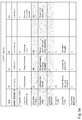
- Figure 3a and 3b show exemplary entries of a table containing information related to a data guard system 102 according to an embodiment.
- the table shows an example of a fraudulent behavior of the user 104a of the requesting communication entity 104.
- the user 104a has a "reaction chain" with 65 entries and wants to solve the access rule or guard 88 (age guard) in order to access the data token 7 (picture token).
- the data guard system 102 identifies the potential fraudulent behavior, since in the reaction chain of the user 104a there is a logical error concerning the age guard.
- the user 104a proved to be older than 18 years and this means that it cannot be under 18 years at time t65 (which is after t3) as shown in figure 3a .
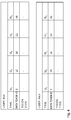
- Figure 4 shows two exemplary tables containing information related to a data guard system 102 according to an embodiment.
- a reaction chain that is of a chain of reactions of a user 104a of the requesting communication entity 104 to a particular data token is illustrated, showing what data tokens the user 104a is interested in.
- the reaction chain can be seen as a result vector which may be compared to the reaction chains of other users, wherein similar result vectors of different users will form smaller angles. The differences between the most similar or most matching result vectors can be used from the data guard system 102 to make suggestions to other users.
- the user Alice in figure 4 reacted to the data tokens 5, 15, 18, 34 and 48, while the user Bob in figure 4 reacted to data tokens 5, 16, 18, 21 and 48. Since the difference between these result vectors is small, they can be considered similar.
- Bob can receive suggestions from the data guard system 102 containing data tokens 15 and 34, while Alice can receive data tokens 16 and 31.
- FIG. 5 shows a schematic diagram of a data guard method 500 for detecting unauthorized access to a data token of a plurality of data by a requesting communication entity 104 according to an embodiment.
- the data guard method 500 comprises the steps of:
- Figure 6 shows a schematic diagram of a communication system 600 comprising a communication device 602 and a requesting communication entity 104 communicating over a communication channel 110 according to an embodiment.
- the communication device 602 can comprise the data guard system 102 and a communication interface, the communication interface being configured to receive the access request over the communication channel 110, and to pass the received access request to the guard interface 102a of the data guard system 102.
- the data guard system 102 is formed by an executable software code
- the communication device 602 comprises a processor being configured to execute the executable software code.
- the computer executable code can be signed with a digital signature. Signing the executable code with a digital signature has the advantage of allowing the processor of the communication device 602 to identify the signature and to verify that the executable code has not been modified since it was signed. In such a way, the executable code can be protected by the digital signature, because the digital signature becomes invalid if any part of the executable code is changed. Signing the executable code can also be used in combination with an identity of the data guard system 102, provisioning profile, or entitlements in order to ensure at least the following aspects:
- signing the executable code with a digital signature can also allow the entrusted entity to remove or redesign the data guard system 102.
- the communication device 602 can comprise a memory 602a for access rule storage and the data guard system 102 can be configured to read out the respective access rule from the memory 602a.
- the communication device 602 can be a smartphone or a personal computer.
- the communication device 602 can be configured to execute the data guard method 500.
Landscapes
- Engineering & Computer Science (AREA)
- Computer Security & Cryptography (AREA)
- Theoretical Computer Science (AREA)
- General Engineering & Computer Science (AREA)
- Software Systems (AREA)
- Computer Hardware Design (AREA)
- General Physics & Mathematics (AREA)
- Physics & Mathematics (AREA)
- Technology Law (AREA)
- Multimedia (AREA)
- Computing Systems (AREA)
- Computer Networks & Wireless Communication (AREA)
- Signal Processing (AREA)
- Health & Medical Sciences (AREA)
- Bioethics (AREA)
- General Health & Medical Sciences (AREA)
- Mobile Radio Communication Systems (AREA)
Priority Applications (4)
| Application Number | Priority Date | Filing Date | Title |
|---|---|---|---|
| EP16185166.2A EP3287919A1 (fr) | 2016-08-22 | 2016-08-22 | Système de protection de données |
| US16/327,529 US20190207943A1 (en) | 2016-08-22 | 2017-08-22 | Data guard system |
| CN201780065363.5A CN109863494A (zh) | 2016-08-22 | 2017-08-22 | 数据防护系统 |
| PCT/EP2017/071072 WO2018036983A1 (fr) | 2016-08-22 | 2017-08-22 | Système de protection de données |
Applications Claiming Priority (1)
| Application Number | Priority Date | Filing Date | Title |
|---|---|---|---|
| EP16185166.2A EP3287919A1 (fr) | 2016-08-22 | 2016-08-22 | Système de protection de données |
Publications (1)
| Publication Number | Publication Date |
|---|---|
| EP3287919A1 true EP3287919A1 (fr) | 2018-02-28 |
Family
ID=56787337
Family Applications (1)
| Application Number | Title | Priority Date | Filing Date |
|---|---|---|---|
| EP16185166.2A Withdrawn EP3287919A1 (fr) | 2016-08-22 | 2016-08-22 | Système de protection de données |
Country Status (1)
| Country | Link |
|---|---|
| EP (1) | EP3287919A1 (fr) |
Cited By (1)
| Publication number | Priority date | Publication date | Assignee | Title |
|---|---|---|---|---|
| CN113836436A (zh) * | 2020-06-23 | 2021-12-24 | 腾讯科技(深圳)有限公司 | 一种数据复核方法、装置、电子设备及存储介质 |
Citations (4)
| Publication number | Priority date | Publication date | Assignee | Title |
|---|---|---|---|---|
| US6345361B1 (en) * | 1998-04-06 | 2002-02-05 | Microsoft Corporation | Directional set operations for permission based security in a computer system |
| EP1653655A1 (fr) * | 2004-10-29 | 2006-05-03 | Research In Motion Limited | Système et procédé de vérification des signatures numériques des certificats |
| WO2007047846A2 (fr) * | 2005-10-18 | 2007-04-26 | Intertrust Technologies Corporation | Systemes et procedes de moteur de gestion de droits numeriques |
| US20140143890A1 (en) * | 2006-05-30 | 2014-05-22 | Dell Products L.P. | Dynamic constraints for content rights |
-
2016
- 2016-08-22 EP EP16185166.2A patent/EP3287919A1/fr not_active Withdrawn
Patent Citations (4)
| Publication number | Priority date | Publication date | Assignee | Title |
|---|---|---|---|---|
| US6345361B1 (en) * | 1998-04-06 | 2002-02-05 | Microsoft Corporation | Directional set operations for permission based security in a computer system |
| EP1653655A1 (fr) * | 2004-10-29 | 2006-05-03 | Research In Motion Limited | Système et procédé de vérification des signatures numériques des certificats |
| WO2007047846A2 (fr) * | 2005-10-18 | 2007-04-26 | Intertrust Technologies Corporation | Systemes et procedes de moteur de gestion de droits numeriques |
| US20140143890A1 (en) * | 2006-05-30 | 2014-05-22 | Dell Products L.P. | Dynamic constraints for content rights |
Cited By (1)
| Publication number | Priority date | Publication date | Assignee | Title |
|---|---|---|---|---|
| CN113836436A (zh) * | 2020-06-23 | 2021-12-24 | 腾讯科技(深圳)有限公司 | 一种数据复核方法、装置、电子设备及存储介质 |
Similar Documents
| Publication | Publication Date | Title |
|---|---|---|
| EP3905078B1 (fr) | Procédé de vérification d'identité et système à cet effet | |
| EP3100171B1 (fr) | Authentification de client à l'aide de données de relations sociales | |
| CN101251881B (zh) | 一种内容识别的方法、系统和装置 | |
| US9515832B2 (en) | Process authentication and resource permissions | |
| CN103607284B (zh) | 身份认证方法及设备、服务器 | |
| CN109327314A (zh) | 业务数据的访问方法、装置、电子设备和系统 | |
| US20160044511A1 (en) | Device identification in service authorization | |
| KR20170102877A (ko) | 사용자 신원을 식별하는 방법 및 장치 | |
| US11977620B2 (en) | Attestation of application identity for inter-app communications | |
| WO2014014793A1 (fr) | Procédé et système anti-clonage | |
| CN110611657A (zh) | 一种基于区块链的文件流处理的方法、装置及系统 | |
| CN106549919B (zh) | 一种信息注册、认证方法及装置 | |
| CN113282951A (zh) | 一种应用程序的安全校验方法、装置及设备 | |
| EP3474247B1 (fr) | Commande de confidentialité de contenu multimédia | |
| CN111431918B (zh) | 一种基于区块链确定目标用户状态标签的方法和系统 | |
| US10049222B1 (en) | Establishing application trust levels using taint propagation | |
| JP2022533874A (ja) | 電気通信ネットワーク測定におけるデータ操作の防止およびユーザのプライバシーの保護 | |
| US20190207943A1 (en) | Data guard system | |
| CN112769565B (zh) | 密码加密算法的升级方法、装置、计算设备和介质 | |
| EP3287919A1 (fr) | Système de protection de données | |
| CN110955909B (zh) | 个人数据保护方法及区块链节点 | |
| CN114595465A (zh) | 数据加密处理方法、装置及电子设备 | |
| GB2598096A (en) | Method for authenticating using distributed identities | |
| WO2024120636A1 (fr) | Gestion d'autorisations pour un partage d'objet local et une protection d'intégrité | |
| CN109347826B (zh) | 一种验证方法以及系统 |
Legal Events
| Date | Code | Title | Description |
|---|---|---|---|
| PUAI | Public reference made under article 153(3) epc to a published international application that has entered the european phase |
Free format text: ORIGINAL CODE: 0009012 |
|
| STAA | Information on the status of an ep patent application or granted ep patent |
Free format text: STATUS: THE APPLICATION HAS BEEN PUBLISHED |
|
| AK | Designated contracting states |
Kind code of ref document: A1 Designated state(s): AL AT BE BG CH CY CZ DE DK EE ES FI FR GB GR HR HU IE IS IT LI LT LU LV MC MK MT NL NO PL PT RO RS SE SI SK SM TR |
|
| AX | Request for extension of the european patent |
Extension state: BA ME |
|
| STAA | Information on the status of an ep patent application or granted ep patent |
Free format text: STATUS: REQUEST FOR EXAMINATION WAS MADE |
|
| 17P | Request for examination filed |
Effective date: 20180828 |
|
| RBV | Designated contracting states (corrected) |
Designated state(s): AL AT BE BG CH CY CZ DE DK EE ES FI FR GB GR HR HU IE IS IT LI LT LU LV MC MK MT NL NO PL PT RO RS SE SI SK SM TR |
|
| STAA | Information on the status of an ep patent application or granted ep patent |
Free format text: STATUS: EXAMINATION IS IN PROGRESS |
|
| 17Q | First examination report despatched |
Effective date: 20200218 |
|
| STAA | Information on the status of an ep patent application or granted ep patent |
Free format text: STATUS: THE APPLICATION IS DEEMED TO BE WITHDRAWN |
|
| 18D | Application deemed to be withdrawn |
Effective date: 20200630 |