EP3288285A1 - Procédé?? et appareil de suppression de ré?troaction acoustique fiable - Google Patents
Procédé?? et appareil de suppression de ré?troaction acoustique fiable Download PDFInfo
- Publication number
- EP3288285A1 EP3288285A1 EP17188032.1A EP17188032A EP3288285A1 EP 3288285 A1 EP3288285 A1 EP 3288285A1 EP 17188032 A EP17188032 A EP 17188032A EP 3288285 A1 EP3288285 A1 EP 3288285A1
- Authority
- EP
- European Patent Office
- Prior art keywords
- signal
- error signal
- feedback
- adaptive
- audio
- Prior art date
- Legal status (The legal status is an assumption and is not a legal conclusion. Google has not performed a legal analysis and makes no representation as to the accuracy of the status listed.)
- Granted
Links
Images


Classifications
-
- H—ELECTRICITY
- H04—ELECTRIC COMMUNICATION TECHNIQUE
- H04R—LOUDSPEAKERS, MICROPHONES, GRAMOPHONE PICK-UPS OR LIKE ACOUSTIC ELECTROMECHANICAL TRANSDUCERS; ELECTRIC HEARING AIDS; PUBLIC ADDRESS SYSTEMS
- H04R25/00—Electric hearing aids
- H04R25/45—Prevention of acoustic reaction, i.e. acoustic oscillatory feedback
- H04R25/453—Prevention of acoustic reaction, i.e. acoustic oscillatory feedback electronically
-
- G—PHYSICS
- G10—MUSICAL INSTRUMENTS; ACOUSTICS
- G10K—SOUND-PRODUCING DEVICES; METHODS OR DEVICES FOR PROTECTING AGAINST, OR FOR DAMPING, NOISE OR OTHER ACOUSTIC WAVES IN GENERAL; ACOUSTICS NOT OTHERWISE PROVIDED FOR
- G10K11/00—Methods or devices for transmitting, conducting or directing sound in general; Methods or devices for protecting against, or for damping, noise or other acoustic waves in general
- G10K11/16—Methods or devices for protecting against, or for damping, noise or other acoustic waves in general
- G10K11/175—Methods or devices for protecting against, or for damping, noise or other acoustic waves in general using interference effects; Masking sound
- G10K11/178—Methods or devices for protecting against, or for damping, noise or other acoustic waves in general using interference effects; Masking sound by electro-acoustically regenerating the original acoustic waves in anti-phase
-
- G—PHYSICS
- G10—MUSICAL INSTRUMENTS; ACOUSTICS
- G10K—SOUND-PRODUCING DEVICES; METHODS OR DEVICES FOR PROTECTING AGAINST, OR FOR DAMPING, NOISE OR OTHER ACOUSTIC WAVES IN GENERAL; ACOUSTICS NOT OTHERWISE PROVIDED FOR
- G10K11/00—Methods or devices for transmitting, conducting or directing sound in general; Methods or devices for protecting against, or for damping, noise or other acoustic waves in general
- G10K11/16—Methods or devices for protecting against, or for damping, noise or other acoustic waves in general
- G10K11/175—Methods or devices for protecting against, or for damping, noise or other acoustic waves in general using interference effects; Masking sound
- G10K11/178—Methods or devices for protecting against, or for damping, noise or other acoustic waves in general using interference effects; Masking sound by electro-acoustically regenerating the original acoustic waves in anti-phase
- G10K11/1785—Methods, e.g. algorithms; Devices
- G10K11/17853—Methods, e.g. algorithms; Devices of the filter
- G10K11/17854—Methods, e.g. algorithms; Devices of the filter the filter being an adaptive filter
-
- H—ELECTRICITY
- H04—ELECTRIC COMMUNICATION TECHNIQUE
- H04R—LOUDSPEAKERS, MICROPHONES, GRAMOPHONE PICK-UPS OR LIKE ACOUSTIC ELECTROMECHANICAL TRANSDUCERS; ELECTRIC HEARING AIDS; PUBLIC ADDRESS SYSTEMS
- H04R25/00—Electric hearing aids
- H04R25/43—Electronic input selection or mixing based on input signal analysis, e.g. mixing or selection between microphone and telecoil or between microphones with different directivity characteristics
-
- H—ELECTRICITY
- H04—ELECTRIC COMMUNICATION TECHNIQUE
- H04R—LOUDSPEAKERS, MICROPHONES, GRAMOPHONE PICK-UPS OR LIKE ACOUSTIC ELECTROMECHANICAL TRANSDUCERS; ELECTRIC HEARING AIDS; PUBLIC ADDRESS SYSTEMS
- H04R25/00—Electric hearing aids
- H04R25/50—Customised settings for obtaining desired overall acoustical characteristics
- H04R25/505—Customised settings for obtaining desired overall acoustical characteristics using digital signal processing
-
- H—ELECTRICITY
- H04—ELECTRIC COMMUNICATION TECHNIQUE
- H04R—LOUDSPEAKERS, MICROPHONES, GRAMOPHONE PICK-UPS OR LIKE ACOUSTIC ELECTROMECHANICAL TRANSDUCERS; ELECTRIC HEARING AIDS; PUBLIC ADDRESS SYSTEMS
- H04R3/00—Circuits for transducers
- H04R3/02—Circuits for transducers for preventing acoustic reaction, i.e. acoustic oscillatory feedback
-
- G—PHYSICS
- G10—MUSICAL INSTRUMENTS; ACOUSTICS
- G10K—SOUND-PRODUCING DEVICES; METHODS OR DEVICES FOR PROTECTING AGAINST, OR FOR DAMPING, NOISE OR OTHER ACOUSTIC WAVES IN GENERAL; ACOUSTICS NOT OTHERWISE PROVIDED FOR
- G10K2210/00—Details of active noise control [ANC] covered by G10K11/178 but not provided for in any of its subgroups
- G10K2210/10—Applications
- G10K2210/108—Communication systems, e.g. where useful sound is kept and noise is cancelled
Definitions
- This document relates generally to audio systems and more particularly to an acoustic amplification device with robust acoustic feedback cancellation.
- Hearing devices provide sound for the wearer.
- Some examples of hearing devices include headsets, hearing aids, speakers, cochlear implants, bone conduction devices, and personal listening devices.
- Hearing aids provide acoustic amplification to compensate for hearing loss by transmitting amplified sounds to the wearer's ear canals.
- a hearing aid is worn in and/or around a wearer's ear.
- the present subject matter can improve robustness of performance of acoustic feedback cancellation in the presence of strong acoustic disturbances.
- an optimization criterion determined to enhance robustness of an adaptive feedback canceller in an audio device against disturbances in an incoming audio signal can be applied such that the adaptive feedback controller remains in a converged state in response to presence of the disturbances.
- an audio device can include a microphone to receive an input sound and to produce a microphone signal representative of the received sound, an audio processing circuit configured to process the microphone sound to produce a loudspeaker signal, and a loudspeaker configured to produce an output sound using the loudspeaker signal.
- the audio processing circuit includes an adaptive feedback canceller that can be configured to cancel acoustic feedback in the microphone signal and be configured to be updated by applying an optimization criterion determined to enhance robustness against disturbances in the microphone signal, such that the adaptive feedback controller remains convergent in the presence of the disturbances.
- the audio device can be a hearing device, such as a hearing aid configured to compensate for hearing impairment.
- the audio processing circuit is configured to detect onsets of the microphone signal and to halt an adaptation process of the adaptive feedback canceller in response to each detection of the onsets.
- the present subject matter improves the overall performance of acoustic feedback cancellation that can be used in a variety of audio devices, including but not limited to headsets, speakers, personal listening devices, headphones, hearing aids and other types of hearing devices. It is understood that other hearing devices not expressly stated herein may be used in conjunction with the present subject matter.
- the present subject matter enhances the operation of the adaptive feedback canceller.
- the present subject matter improves the performance of the adaptive feedback canceller in a device by making it robust against outliers, such as incoming signal onsets and variations of the incoming signal statistics, thus maintaining the converged state of the feedback canceller in the presence of strong disturbances. This improves overall performance of the feedback canceller in terms of maintaining and achieving higher added stable gains and less audible artifacts.
- Adaptive feedback cancellation algorithms suffer in the presence of strong disturbances, such as during onsets of incoming signal (impulses, speech, music, noise, etc.).
- the incoming signal autocorrelation introduces a bias term to the feedback estimate, but a large amount of variance will still result depending on the feedback-to-incoming-signal ratio (FSR) and variations to the incoming signal statistics.
- FSR feedback-to-incoming-signal ratio
- the feedback signal is the signal of interest, whereas the incoming signal (impulses, speech, music, noise, etc.) is considered as measurement noise to the identification process. This is discussed in, for example, Rombouts et al., "Robust and Efficient Implementation of the PEM-AFROW Algorithm for Acoustic Feedback Cancellation," J. Audio Eng. Soc., 2007 , which is incorporated herein by reference in its entirety.
- the variance will be high (e.g. during signal onsets).
- the microphone signal is almost completely a disturbance to the adaptation process as it takes some time for the incoming signal to travel through the system and return to the microphone as feedback.
- the adaptive filter diverges resulting in performance degradation leading to lower added stable gains, audible artifacts, and even instabilities.
- the present subject matter enables the feedback canceller to be robust against outliers, such as incoming signal (impulses, speech, music, noise, etc.) onsets and variations to the incoming signal statistics. This is different from solving a bias problem.
- the present approach reduces the variance of the adaptive feedback canceller.
- Outliers such as strong disturbances (e.g., onsets, bursts), caused by incoming signal (impulses, speech, music, noise, etc.) onset and variation to its statistics poses a challenge to traditional adaptive feedback cancellation algorithms that are based on least-squares error (LSE) or mean-squared error (MSE). During such conditions, the adaptive filter diverges leading to lower added stable gains, audible artifacts, and potentially even instabilities.
- LSE least-squares error
- MSE mean-squared error
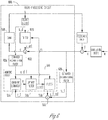
- FIG. 1 is a block diagram illustrating an embodiment of an audio device 100 with adaptive feedback cancellation in a sound system
- x(n) is the incoming signal
- y(n) is the feedback signal.
- the incoming signal x ( n ) (such as impulses, speech, music, noise, etc.) is picked up by a microphone 102 (which produces a microphone signal m(n)), modified by an audio processing circuit 106 including a forward signal processor 108, played out through a receiver (loudspeaker) 104 as u ( n ) , and then picked up again by microphone 102 as a feedback signal, via a feedback path.
- An adaptive feedback canceller (FBC) 110 produces a feedback estimate signal ⁇ (n) , which is subtracted from m(n) to produce an error signal e(n) by an adder 112 to be processed by forward signal processor 108 to produce u(n).
- FIG. 2 is a graph illustrating an example of FSR in the feedback cancellation as illustrated in FIG. 1 .
- the graph shows how the FSR varies during incoming signal (such as impulses, speech, music, noise, etc.) onsets.
- incoming signal such as impulses, speech, music, noise, etc.
- the FSR is low.
- feedback resulting from the incoming signal
- the FSR is picked up by microphone 102 and the FSR is increased.
- the incoming signal stops and, for a very short period of time, only feedback is present and the FSR peaks.
- the FBC convergence is good.
- PEM is used in feedback cancellation to address bias problem (also known as entrainment).
- Prediction error filters whiten the error signal based on a model of the signal statistics, thus reducing or removing the bias problem. If such model is incorrect, then the performance of the FBC is degraded. Thus, when there is a sudden change to the incoming signal statistics, the prediction error filter needs some time to re-converge. At such times, the prediction error filter divergence causes the FBC to further diverge as a result of the added bias.
- Various embodiments of the present subject matter have an added benefit that gives the prediction error filters enough time to adapt to the new signal statistics without causing the feedback canceler to diverge. That is, these embodiments make the FBC robust against variations to incoming signal statistics and also reduce the added bias term from a diverged prediction error filter.
- robustness to outliers can be achieved with modification to the cost function to be minimized.
- Feedback cancellation methods generally aim at minimizing the square of the error (residuals). This is analogous to regression models using a Gaussian distribution with zero mean and constant variance (note that decorrelation methods may be required for this solution to deal with the bias problem, e.g. prediction error method, phase modulation, etc.).
- decorrelation methods may be required for this solution to deal with the bias problem, e.g. prediction error method, phase modulation, etc.
- the squared error penalizes deviations quadratically, so points further from the true function have more effect on the fit than points near to the true function to be estimated.
- One way to achieve robustness is to replace the Gaussian distribution for the response variable with a distribution that has heavy tails such as the Student t-and the Laplace distributions, as discussed, for example, in Murphy and Bishop.
- Examples of such non-quadratic cost functions such as the Huber loss function, may be employed, as discussed in Gansler et al. and Buchner et al. This is applied to the acoustic echo cancellation to handle double-talk situations, as discussed, for example, in Gansler et al. and Buchner et al. This is typically applied on a real (i.e., not complex) error signal.
- the l 1 norm can be approximated by an upper bound given by the sum of the l 1 norm value of the real part and the l 1 norm value of the imaginary part.
- a more general approach involves using a variant l p norm optimization criterion, as discussed in Helwani et al., "Multichannel Adaptive Filtering with Sparseness Constraints," Int. Work. Acoust. SignaL Enhanc., no. September, pp. 4-6, 2012 , which is hereby incorporated by reference in its entirety.
- Various embodiments even minimize a piecewise function of the error signal, for instance, minimize a l 2 -norm if this function is under some threshold or an l p -norm otherwise. This should generalize the problem to include complex error/residual signals such as in the subband/weighted overlap add (WOLA) domain.
- WOLA subband/weighted overlap add
- the present subject matter changes optimization criterion in the context of acoustic feedback cancellation.
- the FBC can be made robust against onsets and strong disturbances (e.g. signal onsets and variations to its statistics).
- One embodiment uses a partitioned block frequency domain adaptive filter (PBFDAF).
- the prediction error method (PEM) is used to whiten the error signal and reference signals prior to updating the FBC, thereby removing or reducing the bias problem.
- a path change occurs half way through the simulation.
- the PBFDAF is provided in Spriet et al. (2006).
- the error (residual) signal is computed in the time domain and is real (i.e., not complex).
- the FBC update occurs in the frequency domain.
- a modified adaptive filter which minimizes the median of the error signal (instead of the mean square error), is used. This results in a l 1 norm instead of a l 2 norm minimization. Other embodiments may generalize to l p norms. This can also be thought as constraining the error signal prior to updating the adaptive filter.
- FIGS. 3 and 4 present the misalignment (normalized distance between the true and estimated feedback path - lower values better), added stable gain (ASG, amount of gain added to the system by having the FBC - higher values better), and the incoming signal (speech in FIG. 3 , or castanet instrument showing strong onsets in FIG 4 ).
- ASG added stable gain
- SSG amount of gain added to the system by having the FBC - higher values better
- the incoming signal speech in FIG. 3 , or castanet instrument showing strong onsets in FIG 4 .
- Pbfdaf_Pem_PobustStats corresponds to robust FBC update
- Pbfdaf_Pem corresponds to non-robust normalized least mean square (NLMS) update.
- an ad hoc, empirical approach compares an instantaneous level of an incoming signal to a threshold. This threshold can be computed by scaling the average of the incoming signal. If the instantaneous value of the incoming signal is greater than this threshold, then an onset is detected and the FBC adaptation halted for some time.
- incoming signal onsets are detected using the second derivative of the signal phase, such as discussed in Bello, et al., "A tutorial on onset detection in music signals," IEEE Trans. Speech Audio Process., vol. 13, no. 5, pp. 1035-1046, 2005 , which is hereby incorporated by reference in its entirety.
- Yet another embodiment for detecting incoming signal onsets and halting the FBC adaptation is provided by U.S. Patent Application Ser. No. 15/133,910, filed April 20, 2016 , which is incorporated by reference herein in its entirety.
- detection of onsets in the incoming signal is not needed.
- the FBC is also robust against outliers in general other than just signal onsets.
- the adaptation process does not need to be halted. In some embodiments and applications, halting the adaptation process may be highly undesirable.
- a modification of a non-quadratic regression approach may be employed.
- One example is the modification of the l 1 norm minimization or the Huber loss function as provided in Huber et al.
- the approach is modified for use in feedback cancellation to make it robust against disturbances, such as, incoming signal onsets and changes to its statistics.
- an extension from the l 1 and l 2 norm minimization to a more general to l p norm may be employed.
- FIG. 5 is a block diagram illustrating an embodiment of an audio processing circuit 506 with adaptive feedback cancellation in a sound system, showing an adaptive filter 510.
- Audio processing circuit 506 represents an example of audio processing 106.
- Signals labeled in FIG. 5 include:
- FIG. 6 is a block diagram illustrating an embodiment of an audio processing circuit with adaptive feedback cancellation using PEM.
- the PEM addresses the bias problem (entrainment).
- Other embodiments for addressing the bias problem include, for example, applying output phase modulation (OPM) to the loudspeaker signal output instead of using PEM.
- OPM output phase modulation
- a decorrelation method is necessary for normal operation of feedback cancellation. The decorrelation method including its various aspects is discussed, for example, in Guo et al., "On the Use of a Phase Modulation Method for Decorrelation in Acoustic Feedback Cancellation," in Eur. SignaL Process. Conf., 2012 ; Forssell et al., “Closed-loop identification revisited," Automatica, vol. 35, no. 7, pp.
- an audio processing circuit 606 represents another embodiment of audio processing circuit 106 and includes adaptive filter 510.
- signals in FIG. 6 further include:
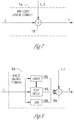
- FIGS. 7 and 8 are each a block diagram illustrating an embodiment of the gradient estimator.
- FIG. 7 illustrates a non-robust gradient estimator 714, which includes a multiplier 730 to produce the gradient estimate V by multiplying the delayed loudspeaker signal u_d by the error signal.
- the FIG. 8 illustrates a robust gradient estimator 814, which includes a multiplier 830 to produce the gradient estimate V by multiplying the delayed loudspeaker signal u_d by a processed error signal.
- the processed error signal is the error signal e processed through limiter circuitry 832 to limit the error signal e, scale factor circuity 834 to apply a scale factor to the error signal e, and sign circuitry 836 to determine a sign of the error signal (positive or negative), such that the error signal is constrained prior to being used by update filter circuitry 516 to update the coefficients of filter circuity 518.
- Gradient estimators 714 and 814 can each represent an example of gradient estimator 514.
- the gradient estimator is the key figure that differentiates the non-robust from the robust approach. In various embodiments with the robust approach, gradient estimator 814 can be used as gradient estimator 514 in audio processing circuit 606.
- the adaptive filter can be implemented according to an RLS, NLMS, Affine Projection (AP), or LMS update rules.
- the illustrated embodiment shows time domain processing that can be performed on a sample-by-same or frame-by-frame basis.
- Other embodiments can include frequency domain adaptive filters (FDAF).
- FDAF frequency domain adaptive filters
- An example of the FDAF is discussed in Shynk, "Frequency-Domain and Multirate Adaptive Filtering", IEEE SP Magazine, pp 14-37, January 1992 , which is incorporated herein by reference in its entirety.
- Another example, which uses partitioned block FDAF is discussed in Spriet et al. (2006).
- the error signal is processed in the time domain as discussed above to make the algorithm robust.
- the processing can be performed in subbands.
- the error signal is a complex number (in each subband), which can be handled as discussed above, in one embodiment.
- the same equations as presented above can be used to process the real components and the imaginary components of the complex error signal separately.
- Hearing devices typically include at least one enclosure or housing, a microphone, hearing device electronics including processing electronics, and a speaker or "receiver.”
- Hearing devices may include a power source, such as a battery.
- the battery may be rechargeable.
- multiple energy sources may be employed.
- the microphone may be optional.
- the receiver may be optional.
- Antenna configurations may vary and may be included within an enclosure for the electronics or be external to an enclosure for the electronics.
- digital hearing aids include a processor.
- audio processing circuit 106, 506, and 606, or portions thereof can each be implemented in such a processor.
- programmable gains may be employed to adjust the hearing aid output to a wearer's particular hearing impairment.
- the processor may be a digital signal processor (DSP), microprocessor, microcontroller, other digital logic, or combinations thereof.
- DSP digital signal processor
- the processing may be done by a single processor, or may be distributed over different devices.
- the processing of signals referenced in this application can be performed using the processor or over different devices. Processing may be done in the digital domain, the analog domain, or combinations thereof. Processing may be done using subband processing techniques. Processing may be done using frequency domain or time domain approaches.
- Some processing may involve both frequency and time domain aspects.
- drawings may omit certain blocks that perform frequency synthesis, frequency analysis, analog-to-digital conversion, digital-to-analog conversion, amplification, buffering, and certain types of filtering and processing.
- the processor is adapted to perform instructions stored in one or more memories, which may or may not be explicitly shown.
- Various types of memory may be used, including volatile and nonvolatile forms of memory.
- the processor or other processing devices execute instructions to perform a number of signal processing tasks.
- Such embodiments may include analog components in communication with the processor to perform signal processing tasks, such as sound reception by a microphone, or playing of sound using a receiver (i.e., in applications where such transducers are used).
- different realizations of the block diagrams, circuits, and processes set forth herein can be created by one of skill in the art without departing from the scope of the present subject matter.
- the wireless communications can include standard or nonstandard communications.
- standard wireless communications include, but not limited to, BluetoothTM, low energy Bluetooth, IEEE 802.11(wireless LANs), 802.15 (WPANs), and 802.16 (WiMAX).
- Cellular communications may include, but not limited to, CDMA, GSM, ZigBee, and ultra-wideband (UWB) technologies.
- the communications are radio frequency communications.
- the communications are optical communications, such as infrared communications.
- the communications are inductive communications.
- the communications are ultrasound communications.
- the wireless communications support a connection from other devices.
- Such connections include, but are not limited to, one or more mono or stereo connections or digital connections having link protocols including, but not limited to 802.3 (Ethernet), 802.4, 802.5, USB, ATM, Fibre-channel, Firewire or 1394, InfiniBand, or a native streaming interface.
- link protocols including, but not limited to 802.3 (Ethernet), 802.4, 802.5, USB, ATM, Fibre-channel, Firewire or 1394, InfiniBand, or a native streaming interface.
- link protocols including, but not limited to 802.3 (Ethernet), 802.4, 802.5, USB, ATM, Fibre-channel, Firewire or 1394, InfiniBand, or a native streaming interface.
- such connections include all past and present link protocols. It is also contemplated that future versions of these protocols and new protocols may be employed without departing from the scope of the present subject matter.
- the present subject matter is used in hearing devices that are configured to communicate with mobile phones.
- the hearing device may be operable to perform one or more of the following: answer incoming calls, hang up on calls, and/or provide two way telephone communications.
- the present subject matter is used in hearing devices configured to communicate with packet-based devices.
- the present subject matter includes hearing devices configured to communicate with streaming audio devices.
- the present subject matter includes hearing devices configured to communicate with Wi-Fi devices.
- the present subject matter includes hearing devices capable of being controlled by remote control devices.
- hearing devices may embody the present subject matter without departing from the scope of the present disclosure.
- the devices depicted in the figures are intended to demonstrate the subject matter, but not necessarily in a limited, exhaustive, or exclusive sense. It is also understood that the present subject matter can be used with a device designed for use in the right ear or the left ear or both ears of the wearer.
- the present subject matter may be employed in hearing devices, such as hearing aids, headsets, headphones, and similar hearing devices.
- the present subject matter may be employed in hearing devices having additional sensors.
- sensors include, but are not limited to, magnetic field sensors, telecoils, temperature sensors, accelerometers and proximity sensors.
- hearing devices including but not limited to headsets, speakers, cochlear devices, bone conduction devices, personal listening devices, headphones, and hearing aids.
- Hearing aids include, but not limited to, behind-the-ear (BTE), in-the-ear (ITE), in-the-canal (ITC), receiver-in-canal (RIC or RITE), completely-in-the-canal (CIC), or invisible-in-the-canal (IIC) type hearing aids.
- BTE behind-the-ear
- ITE in-the-ear
- ITC in-the-canal
- RIC or RITE receiver-in-canal
- CIC completely-in-the-canal
- IIC invisible-in-the-canal
- behind-the-ear type hearing aids may include devices that reside substantially behind the ear or over the ear.
- Such devices may include hearing aids with receivers associated with the electronics portion of the behind-the-ear device (BTE), or hearing aids of the type having receivers in the ear canal of the user, such as receiver-in-canal (RIC) or receiver-in-the-ear (RITE) designs.
- BTE behind-the-ear device
- hearing aids of the type having receivers in the ear canal of the user such as receiver-in-canal (RIC) or receiver-in-the-ear (RITE) designs.
- the present subject matter can also be used in hearing devices generally, such as cochlear implant type hearing devices.
- the present subject matter can also be used in deep insertion devices having a transducer, such as a receiver or microphone.
- the present subject matter can be used in devices whether such devices are standard or custom fit and whether they provide an open or an occlusive design. It is understood that other hearing devices not expressly stated herein may be used in conjunction with the present subject matter.
Landscapes
- Physics & Mathematics (AREA)
- Engineering & Computer Science (AREA)
- Acoustics & Sound (AREA)
- Health & Medical Sciences (AREA)
- General Health & Medical Sciences (AREA)
- Otolaryngology (AREA)
- Signal Processing (AREA)
- Neurosurgery (AREA)
- Multimedia (AREA)
- Soundproofing, Sound Blocking, And Sound Damping (AREA)
- Circuit For Audible Band Transducer (AREA)
Applications Claiming Priority (1)
| Application Number | Priority Date | Filing Date | Title |
|---|---|---|---|
| US201662380230P | 2016-08-26 | 2016-08-26 |
Publications (2)
| Publication Number | Publication Date |
|---|---|
| EP3288285A1 true EP3288285A1 (fr) | 2018-02-28 |
| EP3288285B1 EP3288285B1 (fr) | 2019-10-30 |
Family
ID=59702649
Family Applications (1)
| Application Number | Title | Priority Date | Filing Date |
|---|---|---|---|
| EP17188032.1A Active EP3288285B1 (fr) | 2016-08-26 | 2017-08-25 | Procédé et appareil de suppression de rétroaction acoustique robuste |
Country Status (4)
| Country | Link |
|---|---|
| US (1) | US11445306B2 (fr) |
| EP (1) | EP3288285B1 (fr) |
| CN (1) | CN107786925B (fr) |
| DK (1) | DK3288285T3 (fr) |
Cited By (3)
| Publication number | Priority date | Publication date | Assignee | Title |
|---|---|---|---|---|
| EP4047955A1 (fr) * | 2021-02-17 | 2022-08-24 | Oticon A/s | Prothèse auditive comprenant un système de commande de rétroaction |
| KR102713521B1 (ko) * | 2023-11-20 | 2024-10-07 | 주식회사 힐링사운드 | 인공 지능을 이용한 청각 보조 기기 |
| EP3794585B1 (fr) | 2018-05-18 | 2025-07-02 | Bose Corporation | Détection d'instabilités en temps réel pour régulations par antéroaction |
Families Citing this family (4)
| Publication number | Priority date | Publication date | Assignee | Title |
|---|---|---|---|---|
| US10741162B1 (en) * | 2019-07-02 | 2020-08-11 | Harman International Industries, Incorporated | Stored secondary path accuracy verification for vehicle-based active noise control systems |
| US12033649B2 (en) * | 2020-01-21 | 2024-07-09 | Dolby International Ab | Noise floor estimation and noise reduction |
| FR3115390A1 (fr) * | 2020-10-15 | 2022-04-22 | Orange | Procédé et dispositif pour une annulation d’écho à pas variable |
| US11722819B2 (en) * | 2021-09-21 | 2023-08-08 | Meta Platforms Technologies, Llc | Adaptive feedback cancelation and entrainment mitigation |
Citations (2)
| Publication number | Priority date | Publication date | Assignee | Title |
|---|---|---|---|---|
| US20040264706A1 (en) * | 2001-06-22 | 2004-12-30 | Ray Laura R | Tuned feedforward LMS filter with feedback control |
| US20110249846A1 (en) * | 2010-04-13 | 2011-10-13 | Starkey Laboratories, Inc. | Methods and apparatus for allocating feedback cancellation resources for hearing assistance devices |
Family Cites Families (31)
| Publication number | Priority date | Publication date | Assignee | Title |
|---|---|---|---|---|
| US5796849A (en) * | 1994-11-08 | 1998-08-18 | Bolt, Beranek And Newman Inc. | Active noise and vibration control system accounting for time varying plant, using residual signal to create probe signal |
| US6185300B1 (en) * | 1996-12-31 | 2001-02-06 | Ericsson Inc. | Echo canceler for use in communications system |
| KR100233463B1 (ko) * | 1997-03-07 | 1999-12-01 | 윤종용 | 반향제거장치 및 방법 |
| US6498858B2 (en) * | 1997-11-18 | 2002-12-24 | Gn Resound A/S | Feedback cancellation improvements |
| US7072465B1 (en) * | 1999-01-06 | 2006-07-04 | Agere Systems, Inc. | Adaptive filter for network echo cancellation |
| DK1119218T3 (en) * | 2000-01-21 | 2018-09-10 | Oticon As | Electromagnetic feedback reduction in a communication device |
| US7187907B2 (en) * | 2000-05-09 | 2007-03-06 | Bernard Widrow | Simultaneous two-way transmission of information signals in the same frequency band |
| US6377682B1 (en) | 2000-06-26 | 2002-04-23 | Lucent Technologies Inc. | Robust adaptive filter for use in acoustic and network echo cancellation |
| US7062040B2 (en) * | 2002-09-20 | 2006-06-13 | Agere Systems Inc. | Suppression of echo signals and the like |
| US6947549B2 (en) | 2003-02-19 | 2005-09-20 | The Hong Kong Polytechnic University | Echo canceller |
| DE602005006957D1 (de) * | 2005-01-11 | 2008-07-03 | Harman Becker Automotive Sys | Verringerung der Rückkopplung von Kommunikationssystemen |
| CA2643716C (fr) * | 2006-03-09 | 2013-09-24 | Widex A/S | Appareil auditif a suppression du retour adaptative |
| EP2002688B1 (fr) * | 2006-03-31 | 2010-02-03 | Widex A/S | Appareil auditif et procédé permettant d'estimer la limitation de gain dynamique dans un appareil auditif |
| WO2008051570A1 (fr) * | 2006-10-23 | 2008-05-02 | Starkey Laboratories, Inc. | Évitement d'entrainement a filtre auto-régressif |
| US8345860B1 (en) | 2008-05-09 | 2013-01-01 | Hellosoft India PVT. Ltd | Method and system for detection of onset of near-end signal in an echo cancellation system |
| EP2148526B1 (fr) | 2008-07-24 | 2020-08-19 | Oticon A/S | Modification de contenu spectral pour évaluation de canal de réponse robuste |
| JP4377952B1 (ja) * | 2008-11-14 | 2009-12-02 | 有限会社ケプストラム | 適応フィルタ及びこれを有するエコーキャンセラ |
| US8229147B2 (en) * | 2009-03-12 | 2012-07-24 | Strakey Laboratories, Inc. | Hearing assistance devices with echo cancellation |
| DK2237573T3 (da) | 2009-04-02 | 2021-05-03 | Oticon As | Adaptiv feedbackundertrykkelsesfremgangsmåde og anordning dertil |
| US8442251B2 (en) * | 2009-04-02 | 2013-05-14 | Oticon A/S | Adaptive feedback cancellation based on inserted and/or intrinsic characteristics and matched retrieval |
| US8625775B2 (en) * | 2009-08-06 | 2014-01-07 | Hti Ip, L.L.C. | Method and system for reducing echo and noise in a vehicle passenger compartment environment |
| US8942398B2 (en) * | 2010-04-13 | 2015-01-27 | Starkey Laboratories, Inc. | Methods and apparatus for early audio feedback cancellation for hearing assistance devices |
| EP2580923A4 (fr) * | 2010-06-08 | 2013-10-30 | Music Group Ip Ltd | Système et procédé pour augmenter une fréquence de détection de retour d'informations dans un système audio |
| EP2736271B1 (fr) * | 2012-11-27 | 2019-06-19 | Oticon A/s | Procédé de commande d'un algorithme de mise à jour d'un système d'estimation de rétroaction adaptative et unité de dé-corrélation |
| US9148735B2 (en) * | 2012-12-28 | 2015-09-29 | Gn Resound A/S | Hearing aid with improved localization |
| CN103475980B (zh) | 2013-07-19 | 2016-05-25 | 杭州联汇数字科技有限公司 | 一种自适应声反馈消除方法 |
| US20170188147A1 (en) | 2013-09-26 | 2017-06-29 | Universidade Do Porto | Acoustic feedback cancellation based on cesptral analysis |
| DK3148214T3 (da) * | 2015-09-15 | 2022-01-03 | Oticon As | Høreanordning der omfatter et forbedret feedback-annulleringssystem |
| US9704471B1 (en) * | 2016-03-30 | 2017-07-11 | Bose Corporation | Adaptive modeling of secondary path in an active noise control system |
| US10097930B2 (en) | 2016-04-20 | 2018-10-09 | Starkey Laboratories, Inc. | Tonality-driven feedback canceler adaptation |
| EP3481085B1 (fr) * | 2017-11-01 | 2020-09-09 | Oticon A/s | Détecteur de rétroaction et dispositif auditif comprenant un détecteur de rétroaction |
-
2017
- 2017-08-25 DK DK17188032T patent/DK3288285T3/da active
- 2017-08-25 EP EP17188032.1A patent/EP3288285B1/fr active Active
- 2017-08-25 US US15/687,025 patent/US11445306B2/en active Active
- 2017-08-28 CN CN201710752170.9A patent/CN107786925B/zh active Active
Patent Citations (2)
| Publication number | Priority date | Publication date | Assignee | Title |
|---|---|---|---|---|
| US20040264706A1 (en) * | 2001-06-22 | 2004-12-30 | Ray Laura R | Tuned feedforward LMS filter with feedback control |
| US20110249846A1 (en) * | 2010-04-13 | 2011-10-13 | Starkey Laboratories, Inc. | Methods and apparatus for allocating feedback cancellation resources for hearing assistance devices |
Non-Patent Citations (18)
| Title |
|---|
| BELLO ET AL.: "A tutorial on onset detection in music signals", IEEE TRANS. SPEECH AUDIO PROCESS., vol. 13, no. 5, 2005, pages 1035 - 1046, XP011137550, DOI: doi:10.1109/TSA.2005.851998 |
| BISHOP, PATTERN RECOGNITION AND MACHINE LEARNING, vol. 4, no. 4, 2006 |
| BUCHNER ET AL.: "Robust extended multidelay filter and double-talk detector for acoustic echo cancellation", IEEE TRANS. AUDIO, SPEECH LANG. PROCESS., vol. 14, no. 5, September 2006 (2006-09-01), pages 1633 - 1644, XP055044712, DOI: doi:10.1109/TSA.2005.858559 |
| FORSSELL ET AL.: "Closed-loop identification revisited", AUTOMATICA, vol. 35, no. 7, 1999, pages 1215 - 1241 |
| GANSLER ET AL.: "Double-talk robust fast converging algorithms for network echo cancellation", IEEE TRANS. SPEECH AUDIO PROCESS., vol. 8, no. 6, 2000, pages 656 - 663 |
| GUO ET AL.: "Novel Acoustic Feedback Cancellation Approaches in Hearing Aid Applications Using Probe Noise and Probe Noise Enhancement", IEEE TRANS. AUDIO. SPEECH. LANG. PROCESSING, vol. 20, no. 9, November 2012 (2012-11-01), pages 2549 - 2563, XP011458211, DOI: doi:10.1109/TASL.2012.2206025 |
| GUO ET AL.: "On the Use of a Phase Modulation Method for Decorrelation in Acoustic Feedback Cancellation", EUR. SIGNAL PROCESS. CONF., 2012 |
| HELLGREN: "Analysis of feedback cancellation in hearing aids with Filtered-x LMS and the direct method of closed loop identification", IEEE TRANS. SPEECH AUDIO PROCESS., vol. 10, no. 2, 2002, pages 119 - 131, XP011054162 |
| HELWANI ET AL.: "Multichannel Adaptive Filtering with Sparseness Constraints", INT. WORK. ACOUST. SIGNAL ENHANC., 2012, pages 4 - 6 |
| HUBER ET AL., ROBUST STATISTICS, vol. 523, no. 3, 2009 |
| MAZET V ET AL: "Background removal from spectra by designing and minimising a non-quadratic cost function", CHEMOMETRICS AND INTELLIGENT LABORATORY SYSTEMS, ELSEVIER SCIENCE PUBLISHERS B.V. AMSTERDAM, NL, vol. 76, no. 2, 28 April 2005 (2005-04-28), pages 121 - 133, XP027774984, ISSN: 0169-7439, [retrieved on 20050428] * |
| MURPHY, MACHINE LEARNING: A PROBABILISTIC PERSPECTIVE, 2012 |
| NAKAGAWA ET AL.: "Feedback Cancellation With Probe Shaping Compensation", IEEE SIGNAL PROCESS. LETT., vol. 21, no. 3, March 2014 (2014-03-01), pages 365 - 369, XP011539269, DOI: doi:10.1109/LSP.2014.2301832 |
| ROMBOUTS ET AL.: "Robust and Efficient Implementation of the PEM-AFROW Algorithm for Acoustic Feedback Cancellation", J. AUDIO ENG. SOC., 2007 |
| ROMBOUTS G ET AL: "Robust and efficient implementation of the PEM-AFROW algorithm for acoustic feedback cancellation", JOURNAL OF THE AUDIO ENGINEERING SOC, AUDIO ENGINEERING SOCIETY, NEW YORK, NY, US, vol. 55, no. 11, 1 November 2007 (2007-11-01), pages 955 - 966, XP007904474, ISSN: 0004-7554 * |
| SHYNK: "Frequency-Domain and Multirate Adaptive Filtering", IEEE SP MAGAZINE, January 1992 (1992-01-01), pages 14 - 37, XP000436314, DOI: doi:10.1109/79.109205 |
| SPRIET ET AL.: "Adaptive feedback cancellation in hearing aids with linear prediction of the desired signal", IEEE TRANS. SIGNAL PROCESS., vol. 53, no. 10, October 2005 (2005-10-01), pages 3749 - 3763, XP001238143, DOI: doi:10.1109/TSP.2005.855108 |
| SPRIET ET AL.: "Adaptive feedback cancellation in hearing aids", J. FRANKLIN INST., vol. 343, no. 6, September 2006 (2006-09-01), pages 545 - 573, XP028064330, DOI: doi:10.1016/j.jfranklin.2006.08.002 |
Cited By (4)
| Publication number | Priority date | Publication date | Assignee | Title |
|---|---|---|---|---|
| EP3794585B1 (fr) | 2018-05-18 | 2025-07-02 | Bose Corporation | Détection d'instabilités en temps réel pour régulations par antéroaction |
| EP4047955A1 (fr) * | 2021-02-17 | 2022-08-24 | Oticon A/s | Prothèse auditive comprenant un système de commande de rétroaction |
| US12096184B2 (en) | 2021-02-17 | 2024-09-17 | Oticon A/S | Hearing aid comprising a feedback control system |
| KR102713521B1 (ko) * | 2023-11-20 | 2024-10-07 | 주식회사 힐링사운드 | 인공 지능을 이용한 청각 보조 기기 |
Also Published As
| Publication number | Publication date |
|---|---|
| US11445306B2 (en) | 2022-09-13 |
| EP3288285B1 (fr) | 2019-10-30 |
| CN107786925B (zh) | 2021-06-11 |
| CN107786925A (zh) | 2018-03-09 |
| DK3288285T3 (da) | 2019-11-18 |
| US20180063651A1 (en) | 2018-03-01 |
Similar Documents
| Publication | Publication Date | Title |
|---|---|---|
| US12483844B2 (en) | Neural network-driven feedback cancellation | |
| US11445306B2 (en) | Method and apparatus for robust acoustic feedback cancellation | |
| US12149890B2 (en) | Neural network-driven frequency translation | |
| US9877115B2 (en) | Dynamic relative transfer function estimation using structured sparse Bayesian learning | |
| EP3236677B1 (fr) | Adaptation de suppresseur de rétroaction commandée par la tonalité | |
| US20230254649A1 (en) | Method of detecting a sudden change in a feedback/echo path of a hearing aid | |
| US20120243716A1 (en) | Hearing apparatus with feedback canceler and method for operating the hearing apparatus | |
| US20140321683A1 (en) | Method for controlling an adaptation increment and hearing apparatus | |
| AU2015227437B2 (en) | Method and apparatus for feedback suppression | |
| US20220148558A1 (en) | Feedback cancellation divergence prevention | |
| EP2688067B1 (fr) | Système d'apprentissage et d'amélioration de la réduction du bruit dans des dispositifs d'assistance auditive | |
| US12335688B2 (en) | Artifact detection and logging for tuning of feedback canceller | |
| EP3065422B1 (fr) | Techniques permettant d'améliorer la capacité de traitement des aides auditives | |
| US20160029130A1 (en) | Method for evaluating a useful signal and audio device | |
| US12389173B2 (en) | Predicting gain margin in a hearing device using a neural network | |
| WO2014179489A1 (fr) | Coefficients d'annulation de retour adaptative basés sur la tension |
Legal Events
| Date | Code | Title | Description |
|---|---|---|---|
| PUAI | Public reference made under article 153(3) epc to a published international application that has entered the european phase |
Free format text: ORIGINAL CODE: 0009012 |
|
| STAA | Information on the status of an ep patent application or granted ep patent |
Free format text: STATUS: THE APPLICATION HAS BEEN PUBLISHED |
|
| AK | Designated contracting states |
Kind code of ref document: A1 Designated state(s): AL AT BE BG CH CY CZ DE DK EE ES FI FR GB GR HR HU IE IS IT LI LT LU LV MC MK MT NL NO PL PT RO RS SE SI SK SM TR |
|
| AX | Request for extension of the european patent |
Extension state: BA ME |
|
| STAA | Information on the status of an ep patent application or granted ep patent |
Free format text: STATUS: REQUEST FOR EXAMINATION WAS MADE |
|
| 17P | Request for examination filed |
Effective date: 20180822 |
|
| RBV | Designated contracting states (corrected) |
Designated state(s): AL AT BE BG CH CY CZ DE DK EE ES FI FR GB GR HR HU IE IS IT LI LT LU LV MC MK MT NL NO PL PT RO RS SE SI SK SM TR |
|
| GRAP | Despatch of communication of intention to grant a patent |
Free format text: ORIGINAL CODE: EPIDOSNIGR1 |
|
| STAA | Information on the status of an ep patent application or granted ep patent |
Free format text: STATUS: GRANT OF PATENT IS INTENDED |
|
| INTG | Intention to grant announced |
Effective date: 20190108 |
|
| GRAJ | Information related to disapproval of communication of intention to grant by the applicant or resumption of examination proceedings by the epo deleted |
Free format text: ORIGINAL CODE: EPIDOSDIGR1 |
|
| STAA | Information on the status of an ep patent application or granted ep patent |
Free format text: STATUS: REQUEST FOR EXAMINATION WAS MADE |
|
| GRAP | Despatch of communication of intention to grant a patent |
Free format text: ORIGINAL CODE: EPIDOSNIGR1 |
|
| STAA | Information on the status of an ep patent application or granted ep patent |
Free format text: STATUS: GRANT OF PATENT IS INTENDED |
|
| INTC | Intention to grant announced (deleted) | ||
| INTG | Intention to grant announced |
Effective date: 20190607 |
|
| GRAS | Grant fee paid |
Free format text: ORIGINAL CODE: EPIDOSNIGR3 |
|
| GRAA | (expected) grant |
Free format text: ORIGINAL CODE: 0009210 |
|
| STAA | Information on the status of an ep patent application or granted ep patent |
Free format text: STATUS: THE PATENT HAS BEEN GRANTED |
|
| AK | Designated contracting states |
Kind code of ref document: B1 Designated state(s): AL AT BE BG CH CY CZ DE DK EE ES FI FR GB GR HR HU IE IS IT LI LT LU LV MC MK MT NL NO PL PT RO RS SE SI SK SM TR |
|
| REG | Reference to a national code |
Ref country code: GB Ref legal event code: FG4D |
|
| REG | Reference to a national code |
Ref country code: CH Ref legal event code: EP |
|
| REG | Reference to a national code |
Ref country code: DE Ref legal event code: R096 Ref document number: 602017008173 Country of ref document: DE |
|
| REG | Reference to a national code |
Ref country code: AT Ref legal event code: REF Ref document number: 1197402 Country of ref document: AT Kind code of ref document: T Effective date: 20191115 Ref country code: CH Ref legal event code: NV Representative=s name: RENTSCH PARTNER AG, CH |
|
| REG | Reference to a national code |
Ref country code: DK Ref legal event code: T3 Effective date: 20191114 |
|
| REG | Reference to a national code |
Ref country code: IE Ref legal event code: FG4D |
|
| REG | Reference to a national code |
Ref country code: NL Ref legal event code: FP |
|
| REG | Reference to a national code |
Ref country code: LT Ref legal event code: MG4D |
|
| PG25 | Lapsed in a contracting state [announced via postgrant information from national office to epo] |
Ref country code: LT Free format text: LAPSE BECAUSE OF FAILURE TO SUBMIT A TRANSLATION OF THE DESCRIPTION OR TO PAY THE FEE WITHIN THE PRESCRIBED TIME-LIMIT Effective date: 20191030 Ref country code: PT Free format text: LAPSE BECAUSE OF FAILURE TO SUBMIT A TRANSLATION OF THE DESCRIPTION OR TO PAY THE FEE WITHIN THE PRESCRIBED TIME-LIMIT Effective date: 20200302 Ref country code: BG Free format text: LAPSE BECAUSE OF FAILURE TO SUBMIT A TRANSLATION OF THE DESCRIPTION OR TO PAY THE FEE WITHIN THE PRESCRIBED TIME-LIMIT Effective date: 20200130 Ref country code: FI Free format text: LAPSE BECAUSE OF FAILURE TO SUBMIT A TRANSLATION OF THE DESCRIPTION OR TO PAY THE FEE WITHIN THE PRESCRIBED TIME-LIMIT Effective date: 20191030 Ref country code: LV Free format text: LAPSE BECAUSE OF FAILURE TO SUBMIT A TRANSLATION OF THE DESCRIPTION OR TO PAY THE FEE WITHIN THE PRESCRIBED TIME-LIMIT Effective date: 20191030 Ref country code: SE Free format text: LAPSE BECAUSE OF FAILURE TO SUBMIT A TRANSLATION OF THE DESCRIPTION OR TO PAY THE FEE WITHIN THE PRESCRIBED TIME-LIMIT Effective date: 20191030 Ref country code: GR Free format text: LAPSE BECAUSE OF FAILURE TO SUBMIT A TRANSLATION OF THE DESCRIPTION OR TO PAY THE FEE WITHIN THE PRESCRIBED TIME-LIMIT Effective date: 20200131 Ref country code: NO Free format text: LAPSE BECAUSE OF FAILURE TO SUBMIT A TRANSLATION OF THE DESCRIPTION OR TO PAY THE FEE WITHIN THE PRESCRIBED TIME-LIMIT Effective date: 20200130 Ref country code: PL Free format text: LAPSE BECAUSE OF FAILURE TO SUBMIT A TRANSLATION OF THE DESCRIPTION OR TO PAY THE FEE WITHIN THE PRESCRIBED TIME-LIMIT Effective date: 20191030 |
|
| PG25 | Lapsed in a contracting state [announced via postgrant information from national office to epo] |
Ref country code: IS Free format text: LAPSE BECAUSE OF FAILURE TO SUBMIT A TRANSLATION OF THE DESCRIPTION OR TO PAY THE FEE WITHIN THE PRESCRIBED TIME-LIMIT Effective date: 20200229 Ref country code: HR Free format text: LAPSE BECAUSE OF FAILURE TO SUBMIT A TRANSLATION OF THE DESCRIPTION OR TO PAY THE FEE WITHIN THE PRESCRIBED TIME-LIMIT Effective date: 20191030 Ref country code: RS Free format text: LAPSE BECAUSE OF FAILURE TO SUBMIT A TRANSLATION OF THE DESCRIPTION OR TO PAY THE FEE WITHIN THE PRESCRIBED TIME-LIMIT Effective date: 20191030 |
|
| PG25 | Lapsed in a contracting state [announced via postgrant information from national office to epo] |
Ref country code: AL Free format text: LAPSE BECAUSE OF FAILURE TO SUBMIT A TRANSLATION OF THE DESCRIPTION OR TO PAY THE FEE WITHIN THE PRESCRIBED TIME-LIMIT Effective date: 20191030 |
|
| PG25 | Lapsed in a contracting state [announced via postgrant information from national office to epo] |
Ref country code: ES Free format text: LAPSE BECAUSE OF FAILURE TO SUBMIT A TRANSLATION OF THE DESCRIPTION OR TO PAY THE FEE WITHIN THE PRESCRIBED TIME-LIMIT Effective date: 20191030 Ref country code: EE Free format text: LAPSE BECAUSE OF FAILURE TO SUBMIT A TRANSLATION OF THE DESCRIPTION OR TO PAY THE FEE WITHIN THE PRESCRIBED TIME-LIMIT Effective date: 20191030 Ref country code: CZ Free format text: LAPSE BECAUSE OF FAILURE TO SUBMIT A TRANSLATION OF THE DESCRIPTION OR TO PAY THE FEE WITHIN THE PRESCRIBED TIME-LIMIT Effective date: 20191030 Ref country code: RO Free format text: LAPSE BECAUSE OF FAILURE TO SUBMIT A TRANSLATION OF THE DESCRIPTION OR TO PAY THE FEE WITHIN THE PRESCRIBED TIME-LIMIT Effective date: 20191030 |
|
| REG | Reference to a national code |
Ref country code: DE Ref legal event code: R097 Ref document number: 602017008173 Country of ref document: DE |
|
| REG | Reference to a national code |
Ref country code: AT Ref legal event code: MK05 Ref document number: 1197402 Country of ref document: AT Kind code of ref document: T Effective date: 20191030 |
|
| PG25 | Lapsed in a contracting state [announced via postgrant information from national office to epo] |
Ref country code: SM Free format text: LAPSE BECAUSE OF FAILURE TO SUBMIT A TRANSLATION OF THE DESCRIPTION OR TO PAY THE FEE WITHIN THE PRESCRIBED TIME-LIMIT Effective date: 20191030 Ref country code: IT Free format text: LAPSE BECAUSE OF FAILURE TO SUBMIT A TRANSLATION OF THE DESCRIPTION OR TO PAY THE FEE WITHIN THE PRESCRIBED TIME-LIMIT Effective date: 20191030 Ref country code: SK Free format text: LAPSE BECAUSE OF FAILURE TO SUBMIT A TRANSLATION OF THE DESCRIPTION OR TO PAY THE FEE WITHIN THE PRESCRIBED TIME-LIMIT Effective date: 20191030 |
|
| PLBE | No opposition filed within time limit |
Free format text: ORIGINAL CODE: 0009261 |
|
| STAA | Information on the status of an ep patent application or granted ep patent |
Free format text: STATUS: NO OPPOSITION FILED WITHIN TIME LIMIT |
|
| 26N | No opposition filed |
Effective date: 20200731 |
|
| PG25 | Lapsed in a contracting state [announced via postgrant information from national office to epo] |
Ref country code: SI Free format text: LAPSE BECAUSE OF FAILURE TO SUBMIT A TRANSLATION OF THE DESCRIPTION OR TO PAY THE FEE WITHIN THE PRESCRIBED TIME-LIMIT Effective date: 20191030 Ref country code: AT Free format text: LAPSE BECAUSE OF FAILURE TO SUBMIT A TRANSLATION OF THE DESCRIPTION OR TO PAY THE FEE WITHIN THE PRESCRIBED TIME-LIMIT Effective date: 20191030 |
|
| PG25 | Lapsed in a contracting state [announced via postgrant information from national office to epo] |
Ref country code: MC Free format text: LAPSE BECAUSE OF FAILURE TO SUBMIT A TRANSLATION OF THE DESCRIPTION OR TO PAY THE FEE WITHIN THE PRESCRIBED TIME-LIMIT Effective date: 20191030 |
|
| PG25 | Lapsed in a contracting state [announced via postgrant information from national office to epo] |
Ref country code: LU Free format text: LAPSE BECAUSE OF NON-PAYMENT OF DUE FEES Effective date: 20200825 |
|
| REG | Reference to a national code |
Ref country code: BE Ref legal event code: MM Effective date: 20200831 |
|
| PG25 | Lapsed in a contracting state [announced via postgrant information from national office to epo] |
Ref country code: IE Free format text: LAPSE BECAUSE OF NON-PAYMENT OF DUE FEES Effective date: 20200825 Ref country code: BE Free format text: LAPSE BECAUSE OF NON-PAYMENT OF DUE FEES Effective date: 20200831 |
|
| PG25 | Lapsed in a contracting state [announced via postgrant information from national office to epo] |
Ref country code: TR Free format text: LAPSE BECAUSE OF FAILURE TO SUBMIT A TRANSLATION OF THE DESCRIPTION OR TO PAY THE FEE WITHIN THE PRESCRIBED TIME-LIMIT Effective date: 20191030 Ref country code: MT Free format text: LAPSE BECAUSE OF FAILURE TO SUBMIT A TRANSLATION OF THE DESCRIPTION OR TO PAY THE FEE WITHIN THE PRESCRIBED TIME-LIMIT Effective date: 20191030 Ref country code: CY Free format text: LAPSE BECAUSE OF FAILURE TO SUBMIT A TRANSLATION OF THE DESCRIPTION OR TO PAY THE FEE WITHIN THE PRESCRIBED TIME-LIMIT Effective date: 20191030 |
|
| PG25 | Lapsed in a contracting state [announced via postgrant information from national office to epo] |
Ref country code: MK Free format text: LAPSE BECAUSE OF FAILURE TO SUBMIT A TRANSLATION OF THE DESCRIPTION OR TO PAY THE FEE WITHIN THE PRESCRIBED TIME-LIMIT Effective date: 20191030 |
|
| PGFP | Annual fee paid to national office [announced via postgrant information from national office to epo] |
Ref country code: NL Payment date: 20220725 Year of fee payment: 6 |
|
| PGFP | Annual fee paid to national office [announced via postgrant information from national office to epo] |
Ref country code: DK Payment date: 20220711 Year of fee payment: 6 |
|
| PGFP | Annual fee paid to national office [announced via postgrant information from national office to epo] |
Ref country code: CH Payment date: 20220901 Year of fee payment: 6 |
|
| P01 | Opt-out of the competence of the unified patent court (upc) registered |
Effective date: 20230624 |
|
| PGFP | Annual fee paid to national office [announced via postgrant information from national office to epo] |
Ref country code: GB Payment date: 20230726 Year of fee payment: 7 |
|
| REG | Reference to a national code |
Ref country code: DK Ref legal event code: EBP Effective date: 20230831 |
|
| REG | Reference to a national code |
Ref country code: CH Ref legal event code: PL |
|
| REG | Reference to a national code |
Ref country code: NL Ref legal event code: MM Effective date: 20230901 |
|
| PG25 | Lapsed in a contracting state [announced via postgrant information from national office to epo] |
Ref country code: CH Free format text: LAPSE BECAUSE OF NON-PAYMENT OF DUE FEES Effective date: 20230831 |
|
| PG25 | Lapsed in a contracting state [announced via postgrant information from national office to epo] |
Ref country code: NL Free format text: LAPSE BECAUSE OF NON-PAYMENT OF DUE FEES Effective date: 20230901 |
|
| PG25 | Lapsed in a contracting state [announced via postgrant information from national office to epo] |
Ref country code: NL Free format text: LAPSE BECAUSE OF NON-PAYMENT OF DUE FEES Effective date: 20230901 |
|
| PG25 | Lapsed in a contracting state [announced via postgrant information from national office to epo] |
Ref country code: DK Free format text: LAPSE BECAUSE OF NON-PAYMENT OF DUE FEES Effective date: 20230831 |
|
| PG25 | Lapsed in a contracting state [announced via postgrant information from national office to epo] |
Ref country code: DK Free format text: LAPSE BECAUSE OF NON-PAYMENT OF DUE FEES Effective date: 20230831 |
|
| GBPC | Gb: european patent ceased through non-payment of renewal fee |
Effective date: 20240825 |
|
| PG25 | Lapsed in a contracting state [announced via postgrant information from national office to epo] |
Ref country code: GB Free format text: LAPSE BECAUSE OF NON-PAYMENT OF DUE FEES Effective date: 20240825 |
|
| PGFP | Annual fee paid to national office [announced via postgrant information from national office to epo] |
Ref country code: DE Payment date: 20250708 Year of fee payment: 9 |
|
| PGFP | Annual fee paid to national office [announced via postgrant information from national office to epo] |
Ref country code: FR Payment date: 20250707 Year of fee payment: 9 |