EP3290376A1 - Indicateur de vieillissement de moyens de traction - Google Patents
Indicateur de vieillissement de moyens de traction Download PDFInfo
- Publication number
- EP3290376A1 EP3290376A1 EP16186660.3A EP16186660A EP3290376A1 EP 3290376 A1 EP3290376 A1 EP 3290376A1 EP 16186660 A EP16186660 A EP 16186660A EP 3290376 A1 EP3290376 A1 EP 3290376A1
- Authority
- EP
- European Patent Office
- Prior art keywords
- traction means
- visual indicator
- color
- pigments
- traction
- Prior art date
- Legal status (The legal status is an assumption and is not a legal conclusion. Google has not performed a legal analysis and makes no representation as to the accuracy of the status listed.)
- Withdrawn
Links
Images

Classifications
-
- B—PERFORMING OPERATIONS; TRANSPORTING
- B66—HOISTING; LIFTING; HAULING
- B66B—ELEVATORS; ESCALATORS OR MOVING WALKWAYS
- B66B7/00—Other common features of elevators
- B66B7/12—Checking, lubricating, or cleaning means for ropes, cables or guides
- B66B7/1207—Checking means
- B66B7/1215—Checking means specially adapted for ropes or cables
- B66B7/1238—Checking means specially adapted for ropes or cables by optical techniques
-
- B—PERFORMING OPERATIONS; TRANSPORTING
- B66—HOISTING; LIFTING; HAULING
- B66B—ELEVATORS; ESCALATORS OR MOVING WALKWAYS
- B66B5/00—Applications of checking, fault-correcting, or safety devices in elevators
- B66B5/02—Applications of checking, fault-correcting, or safety devices in elevators responsive to abnormal operating conditions
-
- B—PERFORMING OPERATIONS; TRANSPORTING
- B66—HOISTING; LIFTING; HAULING
- B66B—ELEVATORS; ESCALATORS OR MOVING WALKWAYS
- B66B7/00—Other common features of elevators
- B66B7/06—Arrangements of ropes or cables
Definitions
- the present invention relates to a traction means of an elevator, the use of pigments and a method for determining the aging of a traction means.
- Traction means such as belts and cables may comprise one or more metal strands that are encased in elastomer material.
- Elastomers such as polyurethane and rubber, used in traction belts and traction cables may lose their physical properties such as elasticity and elongation on break, due to physical conditions they are exposed to. Depending on operational area and stress, the elastomers lose their properties with a different speed.
- anti-oxidants are included into the elastomers, which reduce a degrading of the elastomers.
- the anti-oxidants are not stable for a long time and lose their effect depending on the environmental conditions.
- the elastomers tend to become more brittle and to develop cracks.
- a traction means with cracks may not provide enough protection for the metal strands from corrosion.
- the reduced physical properties may influence the traction properties and the friction of the traction means.
- the overall life time of a traction means may be restricted to a specific value, such as 15 years, to cover all possible environmental exposers. This life time may start after the production of the traction means and may be provided on the traction means in the form of a code. During inspection, a service technician may interpret the code and may determine the remaining life time.
- An aspect of the invention relates to a traction means for an elevator.
- a traction means may be a traction belt or a traction cable, which may be wound around pulleys.
- An elevator may be a device adapted for transporting things and persons vertically.
- the traction means may be adapted for vertically pulling an elevator cabin or an elevator platform. Additionally, weights may be attached to the traction means.
- the traction means may be moved by a drive, such as an electrical motor.
- the traction means comprises a visual indicator provided on the traction means for indicating a wear of the traction means, wherein the visual indicator comprises pigments that are selected to change a visual appearance, such as color, due to physical conditions, the traction means is exposed to.
- a visual indicator may be an area of pigments that are visible or may become visible for a person monitoring the visual indicator.
- the visual indicator may be provided in the form of a token and/or may comprise readable symbols, such as letters, numbers, etc.
- the visual indicator may be a pigment field.
- the pigments may change color due to a chemical reaction that is effected by the physical conditions. For example, oxygen or chemical radicals in the vicinity of the traction means may react with the pigments.
- the degrading of the traction belt may be caused by the same chemical substances, and thus the color change of the visual indicator may indicate the amount of substances and/or time, the traction means was exposed to, which may be used as an indicator for the wear of the traction means.
- the visual indicator may comprise a chemical substance that is also used in the traction means and which decay or vanishing is a reason of the degrading of the traction means.
- the chemical substance may be a softening agent for plastics material.
- the visual appearance of the visual indicator may depend on the chemical substance and/or the presence of the chemical substance. Since the visual indicator is exposed to the same physical conditions as the traction means, the chemical substance in the visual indicator may decay or vanish as fast as in the traction means and the visual appearance of the visual indicator may be strongly correlated with the degrading of the traction means.
- the visual indicator may be seen as a service indicator. With the visual indicator, the wear and/or aging of a traction means may be determined more easily, in particular by unexperienced service personnel.
- the pigments change between two base colors.
- Base colors may be chosen from black, white, green, yellow, red, blue, i.e. colors that not only differ in intensity but in quality.
- One possibility is that the pigments change from black to yellow or another bright color. It also may be possible that the visual indicator behaves like a traffic light and changes from green to red.
- the pigments change a color intensity.
- the pigments may change in one base color from a low intensity to a high intensity, or vice versa.
- the change may be from dark yellow to bright yellow.
- the color intensity may be proportional to the exposer with the physical condition.
- the physical conditions are at least one of a temperature, a humidity exposer, a light exposer, a UV (ultraviolet) light exposer, a chemical radical exposer, an oxygen exposer.
- the temperature may be either an environmental temperature as well as a temperature inside the traction means that, for example, is increased due to friction of the traction means.
- the pigments are selected, such that they change to a final color after 10 years, when they are exposed to a predefined average of physical conditions during these 10 years.
- chemical substances for the pigments are chosen, such that the pigments change from an initial color to the final color during a rather long time interval, such as 10 years or 15 years.
- the traction means is exchanged after this time interval.
- the service technician may decide that the aging and/or wear of the traction means was slower as expected and therefore, the traction means need not yet be exchanged.
- the visual indicator is provided on a foil attached to the traction means. It may be possible that the visual indicator is painted or printed to a foil that may have a self-adhesive side and/or that may be attached or glued to the traction means by a service technician, when the traction means has been installed. It also may be possible that the foil is attached to the traction means during production.
- further readable information is printed to the foil.
- a code encoding the production year / time of the traction means and/or a serial number may be provided on the foil.
- the visual indicator is printed or painted on the traction means.
- the pigments may be provided directly on the traction means during production.
- also further readable codes may be printed or painted on the traction means besides the visual indicator.
- the visual indicator is protected by a protection foil that may be removed from the visual indicator to activate it.
- the protection foil may be impermeable to light, UV light, oxygen or chemical radicals. When the foil is removed, these physical conditions from the environment may start to interact with the pigments.
- the traction means is a traction belt with a profiled side and a back side.
- a traction belt has a profiled side, which touches pulleys of the elevator system and a back side that it is not in direct touch with other components of the elevator system.
- the visual indicator may be provided on the back side and/or a narrow side of the traction belt, i.e. areas of the traction belt that are not directly exposed to other components of the elevator system that may damage the visual indicator.
- the traction means comprises at least one metal strand embedded into a plastics material, wherein the visual indicator is provided on a surface of the plastics material.
- the traction means is a coated cable on which surface the visual indicator is provided.
- the traction means comprises a plurality of visual indicators that are provided along an extension direction of the traction means.
- a number of visual indicators may be attached to the traction means in specific distances during production.
- the monitoring of the traction means may be performed in different sections of the traction means. In such a way, areas with wear may be detected.
- a further aspect of the invention relates to an elevator system with a traction means according to one of the previous claims.
- an elevator system may comprise a drive, an elevator cabin in a shaft, automatic doors, etc.
- the elevator system comprises a reference visual indicator protected from the physical conditions, the traction means is exposed to, such that a visual appearance, such as color, of the visual indicator on the traction means is comparable to the reference visual indicator.
- the reference visual indicator may be provided and/or attached on a further equipment of the elevator system.
- the reference visual indicator may be identical or at least may comprise the same pigments as the visual indicator on the tractions means.
- the reference visual indicator may be provided on a foil, which may be used to attach the reference visual indicator to a further equipment of the elevator system.
- the pigments may be sensitive to temperature.
- the reference visual indicator When the reference visual indicator is provided in the shaft, it is exposed to the same environment temperature changes as the traction means. However, the visual indicator on the traction means additionally are exposed to higher temperatures that are caused by friction inside the traction means. By comparing the reference visual indicator with the visual indicator on the tractions means, it may be possible to determine the degrading of the traction means based on the internal friction of the traction means.
- the visual indicator is adapted for monitoring the temperature of the traction means, it indirectly may monitor the overall mechanical stress, such as the number of bends, of the traction means.
- a further aspect of the invention relates to a use of a visual indicator for determining an aging of a traction means of an elevator, wherein the visual indicator comprises pigments that are selected to change color due to physical conditions, the traction means is exposed to.
- the visual indicator may be provided on the traction means.
- a further aspect of the invention relates to a method of determining the aging of a traction means.
- the method may be performed by a service technician inspecting the traction means.
- the method comprises: providing a visual indicator on the traction means, wherein the visual indicator comprises pigments that are selected to change from an initial color to a final color due to physical conditions, the traction means is exposed to; comparing an actual color of the visual indicator with a reference color; and deciding that the traction means is aged, when the actual color is the reference color.
- the visual indicator may be attached to the traction means, directly after installation of its elevator system. It also may be possible that the visual indicator is activated by removing a protection foil. After that, a service technician may look at the visual indicator regularly (for example every year), whether the visual indicator has changed color or has changed color to a color indicating a specific wear. In this case, the service technician may decide that the traction means has to be replaced.
- Fig. 1 shows a traction means 10 in the form of a traction belt, which comprises a number of metal strands 12, which are embedded in a plastics material 14.
- the plastics material 14 may be a polymer, such as an elastomer or a rubber material.
- the traction means 10 in the form of a traction belt has a substantially rectangular cross-section with a profiled front side 16, a substantially flush back side 18 and two narrow sides 20. It has to be noted that here and in the following, the traction means 10 also may be a coated cable, which may have a more round or circular cross-section.
- a visual indicator 22 is provided on the traction means 10. As shown in Fig. 1 , the visual indicator 22 may be provided on the surface of the plastics material. Furthermore, in the case of a traction belt, the visual indicator 22 may be provided on the flush back side 18 and/or on a flush narrow side 20.
- the visual indicator 22 may have a simple shape, such as a circle or rectangle. However, it is also possible that it has the shape of a token or contains a code, which may be in letters and/or numbers. Furthermore, the visual indicator 22 may comprise a computer-readable code, such as a bar code.
- the visual indicator 22 comprises pigments 24, which are adapted for changing color, when they are exposed to physical conditions of the traction means 10 and/or the environment of the traction means 10.
- Such physical conditions may include a temperature, a humidity exposer, a light exposer, a UV light exposer, a chemical radical exposer, an oxygen exposer.
- the pigments 24 when exposed for a specific time to one or more physical conditions, they change between an initial color to a final color.
- the color change may be in the intensity of the original color, i.e. the final color may have the same base color as the initial color.
- the initial color may be dark red and the final color may be light red.
- the time of exposer with the physical condition may be correlated with the color change. It may be possible that the color intensity is measured with a device, which then may determine the time of exposure from the color change.
- the color change also may be monitored by a person, which looks on the visual indicator and decides, whether the color has changed to the final color. Another option is that the color change is between base colors, i.e. that the initial color is another base color as the final color.
- Base colors may be black, white, red, green, blue, yellow, etc. Base colors may be colors that a person may simply distinguish from each other.
- the color change of the pigments 24 may be based on a chemical reaction that is effected and/or accelerated by the physical condition. Furthermore, the pigments 24 may be chosen that they react with the same physical condition as substances of the plastics material 14. For example, it may be that the plastics material 14 degrades due to the exposer to UV light. When pigments 24 are chosen that also react with UV light, the color change of the pigments may be an indicator for the degrading and the aging of the traction means 10. Other physical conditions that may influence the degrading of the plastics material 14 are humidity, oxygen, and other chemical radicals.
- the visual indicator 22 is directly provided on the traction means 10.
- the pigments 24 may be directly printed or painted on the traction means 10.
- the visual indicator 22 is provided on a foil 26, which, for example, may have a self-adhesive side and/or is glued to the traction means 10.
- the visual indicator 22 may be embedded in a jacket material, e.g. in the plastics material 18.
- a code field 28 may be provided on the traction means 10.
- the code field 28 may be directly provided on the traction means 10 or may be provided on the foil 26.
- the code field 28 may contain human and/or computer-readable information.
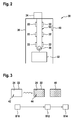
- Fig. 2 schematically shows an elevator system 30, which comprises an elevator cabin 32 which is moved by a drive 34 in an elevator shaft 36 via the traction means 10.
- the traction means 10 may be guided by pulleys 38.
- the profiled side 16 may run over the pulleys 38, while the back side 18 is not in contact with other components of the elevator system 30.
- the visual indicators 22 may be provided on the traction means, several visual indicators 22 may be provided.
- the visual indicators 22 may be provided along a longitudinal extension of the traction means, for example in regular distances to each other. With visual indicators 22 in different areas and/or sections of the traction means 10, not only the overall traction means 10 but the areas and/or sections of the traction means 10 may be monitored separately.
- a reference visual indicator 40 is provided in the elevator system 30, which is not attached to the traction means 10.
- the reference visual indicator 40 may be attached to the elevator shaft 36 or another component of the elevator system 30.
- the reference color field 40 may be exposed to physical conditions in the environment of the traction means 10 but not to physical conditions directly at the traction means 10.
- the reference visual indicator 40 and the one or more visual indicators 22, which may be based on the same pigments 24, may be sensitive to temperature. By comparing the color of the reference visual indicator 40 with the color of a visual indicator 22, an overall difference in temperature over time between the traction means 10 and the environment may be determined.
- this indicator also may be an indicator for wear and aging of the traction means 10.
- Fig. 3 shows a diagram illustrating a method for determining an aging of a traction means.
- a visual indicator 22 is provided on the traction means 10, wherein the visual indicator 22 comprises pigments 24 that are selected to change from an initial color 42 to a final color 44 due to physical conditions, the traction means 10 is exposed to.
- the visual indicator 22 is printed or painted on the traction means 10 during production. It also may be possible that the visual indicator 22 is attached to the traction means 10 directly after installation, for example in a foil 26.
- the visual indicator 22 is exposed to physical conditions and starts to change color. After a specific amount of exposer to the specific physical conditions, to which the pigments 24 are sensitive, the visual indicator 22 has changed color.
- the pigments 24 may have been selected that after an average exposer of 10 years or 15 years or more, a complete color change to the final color 44 has taken place.
- a service technician compares an actual color of the visual indicator 22 with a reference color 46.
- the reference color 46 is known to the service technician, who looks on the visual indicator 22.
- the reference color 46 may be the final color 44.
- step S 14 when the actual color of the visual indicator 22 is the reference color, the service technician decides that the traction means 10 is aged.
Landscapes
- Maintenance And Inspection Apparatuses For Elevators (AREA)
Priority Applications (1)
| Application Number | Priority Date | Filing Date | Title |
|---|---|---|---|
| EP16186660.3A EP3290376A1 (fr) | 2016-08-31 | 2016-08-31 | Indicateur de vieillissement de moyens de traction |
Applications Claiming Priority (1)
| Application Number | Priority Date | Filing Date | Title |
|---|---|---|---|
| EP16186660.3A EP3290376A1 (fr) | 2016-08-31 | 2016-08-31 | Indicateur de vieillissement de moyens de traction |
Publications (1)
| Publication Number | Publication Date |
|---|---|
| EP3290376A1 true EP3290376A1 (fr) | 2018-03-07 |
Family
ID=56920496
Family Applications (1)
| Application Number | Title | Priority Date | Filing Date |
|---|---|---|---|
| EP16186660.3A Withdrawn EP3290376A1 (fr) | 2016-08-31 | 2016-08-31 | Indicateur de vieillissement de moyens de traction |
Country Status (1)
| Country | Link |
|---|---|
| EP (1) | EP3290376A1 (fr) |
Cited By (3)
| Publication number | Priority date | Publication date | Assignee | Title |
|---|---|---|---|---|
| CN110775774A (zh) * | 2018-07-26 | 2020-02-11 | 奥的斯电梯公司 | 电梯张力部件检验 |
| CN112119028A (zh) * | 2018-05-22 | 2020-12-22 | 三菱电机株式会社 | 电梯的防偷拍装置 |
| US20260000066A1 (en) * | 2024-07-01 | 2026-01-01 | Otis Elevator Company | Elevator suspension member with rodent deterrent additive |
Citations (3)
| Publication number | Priority date | Publication date | Assignee | Title |
|---|---|---|---|---|
| EP1275608A1 (fr) * | 2001-07-12 | 2003-01-15 | Inventio Ag | Dispositif pour la détection de l'usure des câbles porteurs |
| JP2003261271A (ja) * | 2002-03-08 | 2003-09-16 | Fujitec Co Ltd | 駆動装置 |
| DE102005051888A1 (de) * | 2005-10-29 | 2007-05-03 | Phoenix Conveyor Belt Systems Gmbh | Einrichtung zur Überwachung einer Förderanlage |
-
2016
- 2016-08-31 EP EP16186660.3A patent/EP3290376A1/fr not_active Withdrawn
Patent Citations (3)
| Publication number | Priority date | Publication date | Assignee | Title |
|---|---|---|---|---|
| EP1275608A1 (fr) * | 2001-07-12 | 2003-01-15 | Inventio Ag | Dispositif pour la détection de l'usure des câbles porteurs |
| JP2003261271A (ja) * | 2002-03-08 | 2003-09-16 | Fujitec Co Ltd | 駆動装置 |
| DE102005051888A1 (de) * | 2005-10-29 | 2007-05-03 | Phoenix Conveyor Belt Systems Gmbh | Einrichtung zur Überwachung einer Förderanlage |
Cited By (6)
| Publication number | Priority date | Publication date | Assignee | Title |
|---|---|---|---|---|
| CN112119028A (zh) * | 2018-05-22 | 2020-12-22 | 三菱电机株式会社 | 电梯的防偷拍装置 |
| CN112119028B (zh) * | 2018-05-22 | 2022-03-08 | 三菱电机株式会社 | 电梯的防偷拍装置 |
| CN110775774A (zh) * | 2018-07-26 | 2020-02-11 | 奥的斯电梯公司 | 电梯张力部件检验 |
| EP3617122A1 (fr) * | 2018-07-26 | 2020-03-04 | Otis Elevator Company | Vérification d'élément de tension d'ascenseur |
| CN110775774B (zh) * | 2018-07-26 | 2021-12-14 | 奥的斯电梯公司 | 电梯张力部件检验 |
| US20260000066A1 (en) * | 2024-07-01 | 2026-01-01 | Otis Elevator Company | Elevator suspension member with rodent deterrent additive |
Similar Documents
| Publication | Publication Date | Title |
|---|---|---|
| EP3290376A1 (fr) | Indicateur de vieillissement de moyens de traction | |
| EP2611720B1 (fr) | Système et procédé de surveillance en fonction de résistance | |
| US9599582B2 (en) | Simplified resistance based belt inspection | |
| US5992574A (en) | Method and apparatus to inspect hoisting ropes | |
| CN109748171B (zh) | 电梯的绳索检查系统 | |
| US7117981B2 (en) | Load bearing member for use in an elevator system having external markings for indicating a condition of the assembly | |
| US11001474B2 (en) | Wear detection of elevator belt | |
| CA2890138C (fr) | Installation d'un appareil de levage | |
| JP4271578B2 (ja) | 荷重支持アセンブリの状態を判定する方法 | |
| CN1184132C (zh) | 电梯用合成纤维绳 | |
| JP2009012903A (ja) | エレベータ用ワイヤーロープの素線切れ検査装置及びその方法 | |
| HK1223344A1 (zh) | 用於检查电梯系统的负载承载元件的完整性的方法和设备 | |
| US10202258B2 (en) | Method for determining state of elevator system component | |
| ES3010257T3 (en) | Resistance-based inspection of elevator system support members | |
| JP2004075221A (ja) | エレベータ | |
| WO2018037013A1 (fr) | Procédé et dispositif de test pour déterminer un état d'un moyen de traction de suspension d'un système d'ascenseur | |
| WO2013062428A1 (fr) | Système pour la détection continue de défauts de brins dans des câbles d'ascenseur plats en acier recouverts de plastique | |
| US20180237262A1 (en) | Inspection of devices mounted on an elevator | |
| CN111465571B (zh) | 升降机悬吊工具及用于其检查的方法和装置 | |
| CN206985442U (zh) | 用于电梯的曳引带及包括该曳引带的电梯 | |
| CN105270980B (zh) | 自动扶梯或自动人行道的安全检测装置及方法 | |
| EP3305707A1 (fr) | Indicateur de mauvais alignement de courroie de traction | |
| JP6834035B1 (ja) | ロープ伸び位置表示システム、およびロープ伸び位置表示方法 | |
| CN108861954A (zh) | 用于电梯的曳引带及包括该曳引带的电梯 | |
| KR102499879B1 (ko) | 탄소섬유강화 복합재료로 이루어진 엘리베이터 로프의 실시간 손상감지 시스템 |
Legal Events
| Date | Code | Title | Description |
|---|---|---|---|
| PUAI | Public reference made under article 153(3) epc to a published international application that has entered the european phase |
Free format text: ORIGINAL CODE: 0009012 |
|
| AK | Designated contracting states |
Kind code of ref document: A1 Designated state(s): AL AT BE BG CH CY CZ DE DK EE ES FI FR GB GR HR HU IE IS IT LI LT LU LV MC MK MT NL NO PL PT RO RS SE SI SK SM TR |
|
| AX | Request for extension of the european patent |
Extension state: BA ME |
|
| STAA | Information on the status of an ep patent application or granted ep patent |
Free format text: STATUS: THE APPLICATION IS DEEMED TO BE WITHDRAWN |
|
| 18D | Application deemed to be withdrawn |
Effective date: 20180908 |