EP3290418B1 - Janus kinase (jak)-hemmstoffe - Google Patents
Janus kinase (jak)-hemmstoffe Download PDFInfo
- Publication number
- EP3290418B1 EP3290418B1 EP16785915.6A EP16785915A EP3290418B1 EP 3290418 B1 EP3290418 B1 EP 3290418B1 EP 16785915 A EP16785915 A EP 16785915A EP 3290418 B1 EP3290418 B1 EP 3290418B1
- Authority
- EP
- European Patent Office
- Prior art keywords
- pyrazole
- triazolo
- mmol
- reaction
- cyanomethyl
- Prior art date
- Legal status (The legal status is an assumption and is not a legal conclusion. Google has not performed a legal analysis and makes no representation as to the accuracy of the status listed.)
- Active
Links
- 0 *N(CC1)CC1=O Chemical compound *N(CC1)CC1=O 0.000 description 8
- UEXBVVYKRDRGNV-UHFFFAOYSA-N CC(C1)CC1(F)F Chemical compound CC(C1)CC1(F)F UEXBVVYKRDRGNV-UHFFFAOYSA-N 0.000 description 1
- RLZCVQXSZNTRAN-UHFFFAOYSA-N CC(CC1)CCN1C(c1cc(CN(C)C)nc(C(F)(F)F)n1)=O Chemical compound CC(CC1)CCN1C(c1cc(CN(C)C)nc(C(F)(F)F)n1)=O RLZCVQXSZNTRAN-UHFFFAOYSA-N 0.000 description 1
- RGGPJGQLSGRLMR-UHFFFAOYSA-N CCS(N(C1)CC1(CC#N)[n]1ncc(-c2cccc3nc(NC(C4CC4)=O)n[n]23)c1)(=O)=O Chemical compound CCS(N(C1)CC1(CC#N)[n]1ncc(-c2cccc3nc(NC(C4CC4)=O)n[n]23)c1)(=O)=O RGGPJGQLSGRLMR-UHFFFAOYSA-N 0.000 description 1
- LUDFAJPSAAFHAG-UHFFFAOYSA-N CCS(N(C1)CC1(CC#N)[n]1ncc(-c2ncc[n]3nc(NC(C4CC4)=O)nc23)c1)(=O)=O Chemical compound CCS(N(C1)CC1(CC#N)[n]1ncc(-c2ncc[n]3nc(NC(C4CC4)=O)nc23)c1)(=O)=O LUDFAJPSAAFHAG-UHFFFAOYSA-N 0.000 description 1
- KUXAHNPBDXEPTH-UHFFFAOYSA-N CCS(N(C1)CC1(CC#N)[n]1ncc(-c2nccc3nc(NC(C4CC4)=O)n[n]23)c1)(=O)=O Chemical compound CCS(N(C1)CC1(CC#N)[n]1ncc(-c2nccc3nc(NC(C4CC4)=O)n[n]23)c1)(=O)=O KUXAHNPBDXEPTH-UHFFFAOYSA-N 0.000 description 1
- ZJGTYRWDTOYPDY-UHFFFAOYSA-N CCS(N(C1)CC1=CC#N)(=C)=O Chemical compound CCS(N(C1)CC1=CC#N)(=C)=O ZJGTYRWDTOYPDY-UHFFFAOYSA-N 0.000 description 1
- NYWGTSOYENQHDR-UHFFFAOYSA-N CS(N(C1)CC1(CC#N)[n]1ncc(-c2c3[o]c(NC(C4CC4)=O)nc3ccc2)c1)(=O)=O Chemical compound CS(N(C1)CC1(CC#N)[n]1ncc(-c2c3[o]c(NC(C4CC4)=O)nc3ccc2)c1)(=O)=O NYWGTSOYENQHDR-UHFFFAOYSA-N 0.000 description 1
- QAZQBGAOKHWAFL-UHFFFAOYSA-N CS(N(C1)CC1(CC#N)[n]1ncc(-c2c3[s]c(NC(C4CC4)=O)nc3ccc2)c1)(=O)=O Chemical compound CS(N(C1)CC1(CC#N)[n]1ncc(-c2c3[s]c(NC(C4CC4)=O)nc3ccc2)c1)(=O)=O QAZQBGAOKHWAFL-UHFFFAOYSA-N 0.000 description 1
- YAGORJMBSVWGBZ-UHFFFAOYSA-N CS(N(C1)CC1(CC#N)[n]1ncc(-c2cccc3c2[o]c(N)n3)c1)(=O)=O Chemical compound CS(N(C1)CC1(CC#N)[n]1ncc(-c2cccc3c2[o]c(N)n3)c1)(=O)=O YAGORJMBSVWGBZ-UHFFFAOYSA-N 0.000 description 1
- RGGUZESTKSSINV-UHFFFAOYSA-N CS(N(C1)CC1(CC#N)[n]1ncc(-c2cccc3nc(N)n[n]23)c1)(=O)=O Chemical compound CS(N(C1)CC1(CC#N)[n]1ncc(-c2cccc3nc(N)n[n]23)c1)(=O)=O RGGUZESTKSSINV-UHFFFAOYSA-N 0.000 description 1
- OWMAUILZJRKPBN-UHFFFAOYSA-N N#CC=C1CNC1 Chemical compound N#CC=C1CNC1 OWMAUILZJRKPBN-UHFFFAOYSA-N 0.000 description 1
- MZMOLYFYPMADOP-UHFFFAOYSA-N N#CCC(C1)(CN1S(C(F)(F)F)(=O)=O)[n]1ncc(-c2cccc3ncn[n]23)c1 Chemical compound N#CCC(C1)(CN1S(C(F)(F)F)(=O)=O)[n]1ncc(-c2cccc3ncn[n]23)c1 MZMOLYFYPMADOP-UHFFFAOYSA-N 0.000 description 1
- APASPURLTSWCMY-UHFFFAOYSA-N N#CCC(C1)(CN1S(C(F)(F)F)(=O)=O)[n]1ncc(-c2nccc3nc(NC(C4CC4)=O)n[n]23)c1 Chemical compound N#CCC(C1)(CN1S(C(F)(F)F)(=O)=O)[n]1ncc(-c2nccc3nc(NC(C4CC4)=O)n[n]23)c1 APASPURLTSWCMY-UHFFFAOYSA-N 0.000 description 1
- IZOOJMJUQKUBJL-UHFFFAOYSA-N N#CCC(C1)(CN1S(C1CC1)(=O)=O)[n]1ncc(-c2nccc3nc(NC(C4CC4)=O)n[n]23)c1 Chemical compound N#CCC(C1)(CN1S(C1CC1)(=O)=O)[n]1ncc(-c2nccc3nc(NC(C4CC4)=O)n[n]23)c1 IZOOJMJUQKUBJL-UHFFFAOYSA-N 0.000 description 1
- WPYUYWQUYMQXHL-UHFFFAOYSA-N N#CCC1(CNC1)[n]1ncc(-c2cccc3nc(NC(C4CC4)=O)n[n]23)c1 Chemical compound N#CCC1(CNC1)[n]1ncc(-c2cccc3nc(NC(C4CC4)=O)n[n]23)c1 WPYUYWQUYMQXHL-UHFFFAOYSA-N 0.000 description 1
- BNNRUVJPMPUBGK-UHFFFAOYSA-N Nc1n[n]2c(-c3c[n](C(CC#N)(C4)CN4S(C(F)(F)F)(=O)=O)nc3)cccc2n1 Chemical compound Nc1n[n]2c(-c3c[n](C(CC#N)(C4)CN4S(C(F)(F)F)(=O)=O)nc3)cccc2n1 BNNRUVJPMPUBGK-UHFFFAOYSA-N 0.000 description 1
Classifications
-
- C—CHEMISTRY; METALLURGY
- C07—ORGANIC CHEMISTRY
- C07D—HETEROCYCLIC COMPOUNDS
- C07D487/00—Heterocyclic compounds containing nitrogen atoms as the only ring hetero atoms in the condensed system, not provided for by groups C07D451/00 - C07D477/00
- C07D487/02—Heterocyclic compounds containing nitrogen atoms as the only ring hetero atoms in the condensed system, not provided for by groups C07D451/00 - C07D477/00 in which the condensed system contains two hetero rings
- C07D487/04—Ortho-condensed systems
-
- A—HUMAN NECESSITIES
- A61—MEDICAL OR VETERINARY SCIENCE; HYGIENE
- A61K—PREPARATIONS FOR MEDICAL, DENTAL OR TOILETRY PURPOSES
- A61K31/00—Medicinal preparations containing organic active ingredients
- A61K31/33—Heterocyclic compounds
- A61K31/395—Heterocyclic compounds having nitrogen as a ring hetero atom, e.g. guanethidine or rifamycins
- A61K31/495—Heterocyclic compounds having nitrogen as a ring hetero atom, e.g. guanethidine or rifamycins having six-membered rings with two or more nitrogen atoms as the only ring heteroatoms, e.g. piperazine or tetrazines
- A61K31/505—Pyrimidines; Hydrogenated pyrimidines, e.g. trimethoprim
- A61K31/519—Pyrimidines; Hydrogenated pyrimidines, e.g. trimethoprim ortho- or peri-condensed with heterocyclic rings
-
- A—HUMAN NECESSITIES
- A61—MEDICAL OR VETERINARY SCIENCE; HYGIENE
- A61P—SPECIFIC THERAPEUTIC ACTIVITY OF CHEMICAL COMPOUNDS OR MEDICINAL PREPARATIONS
- A61P19/00—Drugs for skeletal disorders
-
- A—HUMAN NECESSITIES
- A61—MEDICAL OR VETERINARY SCIENCE; HYGIENE
- A61P—SPECIFIC THERAPEUTIC ACTIVITY OF CHEMICAL COMPOUNDS OR MEDICINAL PREPARATIONS
- A61P29/00—Non-central analgesic, antipyretic or antiinflammatory agents, e.g. antirheumatic agents; Non-steroidal antiinflammatory drugs [NSAID]
-
- A—HUMAN NECESSITIES
- A61—MEDICAL OR VETERINARY SCIENCE; HYGIENE
- A61P—SPECIFIC THERAPEUTIC ACTIVITY OF CHEMICAL COMPOUNDS OR MEDICINAL PREPARATIONS
- A61P35/00—Antineoplastic agents
-
- A—HUMAN NECESSITIES
- A61—MEDICAL OR VETERINARY SCIENCE; HYGIENE
- A61P—SPECIFIC THERAPEUTIC ACTIVITY OF CHEMICAL COMPOUNDS OR MEDICINAL PREPARATIONS
- A61P37/00—Drugs for immunological or allergic disorders
-
- A—HUMAN NECESSITIES
- A61—MEDICAL OR VETERINARY SCIENCE; HYGIENE
- A61P—SPECIFIC THERAPEUTIC ACTIVITY OF CHEMICAL COMPOUNDS OR MEDICINAL PREPARATIONS
- A61P37/00—Drugs for immunological or allergic disorders
- A61P37/02—Immunomodulators
-
- A—HUMAN NECESSITIES
- A61—MEDICAL OR VETERINARY SCIENCE; HYGIENE
- A61P—SPECIFIC THERAPEUTIC ACTIVITY OF CHEMICAL COMPOUNDS OR MEDICINAL PREPARATIONS
- A61P37/00—Drugs for immunological or allergic disorders
- A61P37/02—Immunomodulators
- A61P37/06—Immunosuppressants, e.g. drugs for graft rejection
-
- A—HUMAN NECESSITIES
- A61—MEDICAL OR VETERINARY SCIENCE; HYGIENE
- A61P—SPECIFIC THERAPEUTIC ACTIVITY OF CHEMICAL COMPOUNDS OR MEDICINAL PREPARATIONS
- A61P43/00—Drugs for specific purposes, not provided for in groups A61P1/00-A61P41/00
-
- C—CHEMISTRY; METALLURGY
- C07—ORGANIC CHEMISTRY
- C07D—HETEROCYCLIC COMPOUNDS
- C07D413/00—Heterocyclic compounds containing two or more hetero rings, at least one ring having nitrogen and oxygen atoms as the only ring hetero atoms
- C07D413/14—Heterocyclic compounds containing two or more hetero rings, at least one ring having nitrogen and oxygen atoms as the only ring hetero atoms containing three or more hetero rings
-
- C—CHEMISTRY; METALLURGY
- C07—ORGANIC CHEMISTRY
- C07D—HETEROCYCLIC COMPOUNDS
- C07D417/00—Heterocyclic compounds containing two or more hetero rings, at least one ring having nitrogen and sulfur atoms as the only ring hetero atoms, not provided for by group C07D415/00
- C07D417/14—Heterocyclic compounds containing two or more hetero rings, at least one ring having nitrogen and sulfur atoms as the only ring hetero atoms, not provided for by group C07D415/00 containing three or more hetero rings
-
- C—CHEMISTRY; METALLURGY
- C07—ORGANIC CHEMISTRY
- C07D—HETEROCYCLIC COMPOUNDS
- C07D471/00—Heterocyclic compounds containing nitrogen atoms as the only ring hetero atoms in the condensed system, at least one ring being a six-membered ring with one nitrogen atom, not provided for by groups C07D451/00 - C07D463/00
- C07D471/02—Heterocyclic compounds containing nitrogen atoms as the only ring hetero atoms in the condensed system, at least one ring being a six-membered ring with one nitrogen atom, not provided for by groups C07D451/00 - C07D463/00 in which the condensed system contains two hetero rings
- C07D471/04—Ortho-condensed systems
-
- A—HUMAN NECESSITIES
- A61—MEDICAL OR VETERINARY SCIENCE; HYGIENE
- A61K—PREPARATIONS FOR MEDICAL, DENTAL OR TOILETRY PURPOSES
- A61K31/00—Medicinal preparations containing organic active ingredients
- A61K31/33—Heterocyclic compounds
- A61K31/395—Heterocyclic compounds having nitrogen as a ring hetero atom, e.g. guanethidine or rifamycins
- A61K31/41—Heterocyclic compounds having nitrogen as a ring hetero atom, e.g. guanethidine or rifamycins having five-membered rings with two or more ring hetero atoms, at least one of which being nitrogen, e.g. tetrazole
- A61K31/42—Oxazoles
- A61K31/423—Oxazoles condensed with carbocyclic rings
-
- A—HUMAN NECESSITIES
- A61—MEDICAL OR VETERINARY SCIENCE; HYGIENE
- A61K—PREPARATIONS FOR MEDICAL, DENTAL OR TOILETRY PURPOSES
- A61K31/00—Medicinal preparations containing organic active ingredients
- A61K31/33—Heterocyclic compounds
- A61K31/395—Heterocyclic compounds having nitrogen as a ring hetero atom, e.g. guanethidine or rifamycins
- A61K31/41—Heterocyclic compounds having nitrogen as a ring hetero atom, e.g. guanethidine or rifamycins having five-membered rings with two or more ring hetero atoms, at least one of which being nitrogen, e.g. tetrazole
- A61K31/425—Thiazoles
- A61K31/428—Thiazoles condensed with carbocyclic rings
-
- A—HUMAN NECESSITIES
- A61—MEDICAL OR VETERINARY SCIENCE; HYGIENE
- A61K—PREPARATIONS FOR MEDICAL, DENTAL OR TOILETRY PURPOSES
- A61K31/00—Medicinal preparations containing organic active ingredients
- A61K31/33—Heterocyclic compounds
- A61K31/395—Heterocyclic compounds having nitrogen as a ring hetero atom, e.g. guanethidine or rifamycins
- A61K31/435—Heterocyclic compounds having nitrogen as a ring hetero atom, e.g. guanethidine or rifamycins having six-membered rings with one nitrogen as the only ring hetero atom
- A61K31/4353—Heterocyclic compounds having nitrogen as a ring hetero atom, e.g. guanethidine or rifamycins having six-membered rings with one nitrogen as the only ring hetero atom ortho- or peri-condensed with heterocyclic ring systems
- A61K31/437—Heterocyclic compounds having nitrogen as a ring hetero atom, e.g. guanethidine or rifamycins having six-membered rings with one nitrogen as the only ring hetero atom ortho- or peri-condensed with heterocyclic ring systems the heterocyclic ring system containing a five-membered ring having nitrogen as a ring hetero atom, e.g. indolizine, beta-carboline
-
- A—HUMAN NECESSITIES
- A61—MEDICAL OR VETERINARY SCIENCE; HYGIENE
- A61K—PREPARATIONS FOR MEDICAL, DENTAL OR TOILETRY PURPOSES
- A61K31/00—Medicinal preparations containing organic active ingredients
- A61K31/33—Heterocyclic compounds
- A61K31/395—Heterocyclic compounds having nitrogen as a ring hetero atom, e.g. guanethidine or rifamycins
- A61K31/495—Heterocyclic compounds having nitrogen as a ring hetero atom, e.g. guanethidine or rifamycins having six-membered rings with two or more nitrogen atoms as the only ring heteroatoms, e.g. piperazine or tetrazines
- A61K31/4985—Pyrazines or piperazines ortho- or peri-condensed with heterocyclic ring systems
-
- A—HUMAN NECESSITIES
- A61—MEDICAL OR VETERINARY SCIENCE; HYGIENE
- A61K—PREPARATIONS FOR MEDICAL, DENTAL OR TOILETRY PURPOSES
- A61K31/00—Medicinal preparations containing organic active ingredients
- A61K31/33—Heterocyclic compounds
- A61K31/395—Heterocyclic compounds having nitrogen as a ring hetero atom, e.g. guanethidine or rifamycins
- A61K31/495—Heterocyclic compounds having nitrogen as a ring hetero atom, e.g. guanethidine or rifamycins having six-membered rings with two or more nitrogen atoms as the only ring heteroatoms, e.g. piperazine or tetrazines
- A61K31/505—Pyrimidines; Hydrogenated pyrimidines, e.g. trimethoprim
- A61K31/506—Pyrimidines; Hydrogenated pyrimidines, e.g. trimethoprim not condensed and containing further heterocyclic rings
Definitions
- the present invention relates to a series of JAK inhibitors, in particular to compounds of Formula (I) or pharmaceutically acceptable salts thereof.
- JAK belongs to a family of tyrosine kinases that are involved in inflammation, autoimmune diseases, proliferative diseases, transplant rejection, diseases involving impairment of cartilage turnover, congenital cartilage malformations and/or diseases associated with hypersecretion of IL6.
- the present invention also provides methods for the production of the compounds, pharmaceutical compositions comprising the compounds, methods for the prophylaxis and/or treatment of diseases involving inflammation, autoimmune diseases, proliferative diseases, transplant rejection, diseases involving impairment of cartilage turnover, congenital cartilage malformations and/or diseases associated with hypersecretion of IL6 by administering a compound of the present invention.
- Janus kinases are cytoplasmic tyrosine kinases that transduce cytokine signaling from membrane receptors to STAT transcription factors.
- JAK family members Four JAK family members are described in the prior art: JAK1, JAK2, JAK3 and TYK2. Upon binding of the cytokine to its receptor, JAK family members auto- and/or transphosphorylate each other, followed by phosphorylation of STATs and then migrate to the nucleus to modulate transcription.
- JAK-STAT intracellular signal transduction is suitable for the interferons, most interleukins, as well as a variety of cytokines and endocrine factors such as EPO, TPO, GH, OSM, LIF, CNTF, GM-CSF and PRL (Vainchenker W. et al. (2008)).
- JAK2 gene mutation research is one of the breakthrough progress of hematological research in recent years.
- Myeloproliferative diseases are disclosed in the prior art, including polycythemia vela (PV), essential thrombocythemia (ET) and idiopathicmyelofibrosis (IMF), which are malignant diseases caused by the lesions of a group of hematopoietic stem cell lesion.
- a JAK2 point mutation (JAK2V617F) in this group of diseases was discovered by the researchers in 2005, which led to a new era in MPD diagnosis and treatment.
- JAK2V617 is a point mutation that occurs at exon v617 at exon 14, and valine (V) is substituted by phenylalanine (F).
- JH1 is the kinase domain
- Val617 is located in JH2 adjacent to JH1, which is a pseudokinase domain, binds to JH1 and inhibits its activation.
- V617F mutations cause JH2 to lose inhibitory effect on JH1 kinase activity, leading to sustained activation of JAK2, resulting in enhanced cell proliferation [ Kilpivaara 0, Levine RL. JAK2 and MPL mutations in myeloprolifer-ative neoplasms: discovery and science. Leukemia.
- JAK2V617F mutation There is a high incidence of JAK2V617F mutation in patients with polycythaemia vera, essential thrombocythaemia, and idiopathic myelofibrosis. It was determined by Allele-Specific PCR that, the incidence of JAK2V617F mutation in patients with polycythaemia vera was 90%; in patients with essential thrombocythaemia and idiopathic myelofibrosis was 50%-60% [ Baxter EJ, Scott LM, Campbell PJ, et al. Lancet. 2005; 365 (9464): 1054-61 ]. The molecular basis of these diseases without finding JAK2 mutation in patients lacking of V617F mutation is unclear.
- JAK2V617F-negative MPD patients An exon 12 mutation was found in JAK2V617F-negative MPD patients. This mutation can also cause JH2 to lose inhibitory effect on JH kinase activity, which provides molecular markers and genetic mechanisms for JAK2V617F-negative patients with myeloproliferative diseases[ Scott LM, Tong W, Levine RL, et al. JAK2 exon 12 mutations in polycythemia vera and idiopathic erythrocytosis. NEngl J Med 2007;356:459-68 ⁇ ].
- JAK2 mediates signal transduction of various cytokines, including erythropoietin (EPO), thrombopoietin (TPO), granulocyte-macrophage colony stimulating factor, interleukin-3 and growth factor, and regulates and promotes cell proliferation.
- EPO erythropoietin
- TPO thrombopoietin
- granulocyte-macrophage colony stimulating factor granulocyte-macrophage colony stimulating factor
- interleukin-3 and growth factor interleukin-3 and growth factor
- JAK-STAT can directly correlate extracellular signals with gene expression regulation, initiate transcription and expression of responsive genes, complete the signal transduction process of cytokine receptors such as erythropoietin receptor (EPOR) and thrombopoietin receptor (MPL/TPOR), resulting in cell proliferation effects.
- cytokine receptors such as erythropoietin receptor (EPOR) and thrombopoietin receptor (MPL/TPOR
- Tofacitinib is a pan jak inhibitor, a non-highly specific JAK2 inhibitor, its structural formula is as follows:
- R is independently selected from H, halogen, OH, NH 2 , CN, or is selected from C 1-3 alkyl, C 1-3 alkoxy, C 1-3 alkylamino, which can be optionally substituted with 1, 2, 3, or 4 R'.
- R is selected from H, F, Cl, Br, I, OH, CN, NH 2 , Me, Et, N(CH 3 ) 2 , NH(CH 3 ).
- Ri is selected from H, or is selected from C 1-3 alkyl, C 3-6 cycloalkyl, C 3-6 heterocycloalkyl, C 1-3 alkyl-O-C 1-3 alkyl-, C 1-3 alkyl-S-C 1-3 alkyl-, C 1-3 alkyl-NH-C 1-3 alkyl-, C 1-6 alkoxy, C 1-3 alkylamino,
- Ri is selected from H, or is selected from Me, , which is optionally substituted with 1, 2, 3, or 4 R.
- Ri is selected from H, Me,
- R 1 -L 1 - is selected from H, or is selected from which can be optionally substituted with R.
- R 1 -L 1 - is selected from H
- R 2 is selected from H, NH 2 , or is selected from C 1-3 alkyl, C 3-6 cycloalkyl, 3-6 membered heterocycloalkyl, C 1-3 alkyl-O-C 1-3 alkyl-, C 1-3 alkyl-S-C 1-3 alkyl-, C 1-3 alkyl-NH-C 1-3 alkyl-, C 1-6 alkoxy, C 1-6 alkylamino, which can b e optionally substituted with R.
- R 2 is selected from H, NH 2 , or is selected from Me, which can be optionally substituted with R.
- R 2 is selected from H, NH 2 ,
- R 2 -L 2 - is selected from H, or is selected from NH 2 , which can be optionally substituted with R'.
- R 2 -L 2 - is selected from H, NH 2 ,
- the ring A is selected from 1, 3, 4-triazolyl, imidazolyl, oxazolyl, thiazolyl.
- the ring A is selected from:
- the structural unit is selected from:
- the structural unit is selected from:
- the compound of the invention is selected from:
- C 1-6 is selected from C 1 , C 2 , C 3 , C 4 , C 5 , and C 6 ;
- C 3-7 is selected from C 3 , C 4 , C 5 , C 6 , and C 7 ;
- 3-7 membered is selected from 3-membered, 4-membered, 5-membered, 6-membered, and 7-membered.
- the term "pharmaceutically acceptable” is employed to refer to those compounds, materials, compositions and/or dosage forms which are, within the scope of reliable medical judgment, suitable for use in contact with the tissues of human beings and animals without excessive toxicity, irritation, allergic response, or other problem or complication, commensurate with a reasonable benefit/risk ratio.
- pharmaceutically acceptable salts refers to salts of the compound of the present invention, which are prepared from the compounds having particular substituent found by the present invention with relatively nontoxic acids or bases.
- base addition salts can be obtained by contacting a sufficient amount of the base with the neutral form of such compounds, either in a neat solution or in a suitable inert solvent.
- the pharmaceutically acceptable base addition salts include sodium, lithium, calcium, ammonium, organic ammonium, magnesium, and the like.
- acid addition salts can be obtained by contacting a sufficient amount of the acid with the neutral form of such compounds, either in a neat solution or in a suitable inert solvent.
- Examples of pharmaceutically acceptable acid addition salts include those derived from inorganic acids like hydrochloric, hydrobromic, nitric, carbonic, monohydrogencarbonic, phosphoric, monohydrogenphosphoric, dihydrogenphosphoric, sulfuric, monohydrogensulfuric, hydriodic, or phosphorous acids and the like, as well as the salts derived from organic acids like acetic, propionic, isobutyric, maleic, malonic, benzoic, succinic, suberic, fumaric, lactic, mandelic, phthalic, benzenesulfonic, p-toluenesulfonic, citric, tartaric, methanesulfonic, and the like.
- inorganic acids like hydrochloric, hydrobromic, nitric, carbonic, monohydrogencarbonic, phosphoric, monohydrogenphosphoric, dihydrogenphosphoric, sulfuric, monohydrogensulfuric, hydriodic, or phosphorous acids and the
- salts of amino acids such as arginate and the like, and salts of organic acids like glucuronic acids and the like (see, Berge et al., "Pharmaceutical Salts", Journal of Pharmaceutical Science 66: 1-19 (1977 )).
- Certain specific compounds of the present invention contain both basic and acidic functionalities that allow the compounds to be converted into either base or acid addition salts.
- the neutral forms of the compounds may be regenerated by contacting the salt with a base or acid and isolating the parent compound in the conventional manner.
- the parent form of the compound differs from the various salt forms in certain physical properties, such as solubility in polar solvents.
- pharmaceutically acceptable salts belongs to derivatives of the disclosed compounds wherein the parent compound is modified by converting an existing acid or base to its salt form.
- pharmaceutically acceptable salts include, but not limited to, inorganic or organic acid salts of basic residues such as amines; alkali or organic salts of acidic residues such as carboxylic acids, and the like.
- the pharmaceutically acceptable salts include the conventional non-toxic salts or the quaternary ammonium salts of the parent compounds formed, for example, from non-toxic inorganic or organic acids.
- such conventional non-toxic salts include, but not limited to, those derived from salts of inorganic or organic acids selected from 2-acetoxybenzoic, 2-hydroxyethane sulfonic, acetic, ascorbic, benzenesulfonic, benzoic, bicarbonic, carbonic, citric, edetic, ethane disulfonic, ethane sulfonic, fumaric, glucoheptonic, gluconic, glutamic, glycolic, hydrobromic, hydrochloric, hydroiodic, hydroxy, hydroxynaphthoic, isethionic, lactic, lactobionic, lauryl sulfonic, maleic, malic, mandelic, methane sulfonic, nitric, oxalic, pamoic, pantothenic, phenylacetic, phosphoric, polygalacturonic, propionic, salicylic, stearic, subacetic, succinic,
- the pharmaceutically acceptable salts of the present invention can be synthesized from the parent compound which contains an acidic or basic moiety by conventional chemical methods.
- such salts can be prepared by reacting the free acid or base forms of these compounds with a stoichiometric amount of the appropriate base or acid in water or in an organic solvent, or in a mixture of the two.
- non-aqueous media like ether, ethyl acetate, ethanol, iso-propanol, or acetonitrile are preferred.
- the compounds provided by the present invention are also in the form of prodrugs.
- the prodrugs of the compounds described herein are those compounds that readily undergo chemical changes under physiological conditions to convert to the compounds of the present invention. Additionally, prodrugs can be converted to the compounds of the present invention by chemical or biochemical methods in vivo environment.
- the compounds of the present invention can exist in unsolvated forms as well as solvated forms, which including hydrated forms.
- the solvated forms are equivalent to unsolvated forms and are intended to be encompassed within the scope of the present invention.
- Certain compounds of the present invention possess asymmetric carbon atoms (optical centers) or double bonds.
- the racemates, diastereomers, geometric isomers and individual isomers are all intended to be encompassed within the scope of the present invention.
- the compounds of the present invention may exist in particular geometric or stereoisomeric forms.
- the present invention takes into account all such compounds, including cis- and trans isomers, (-)- and (+)- pair enantiomers, R- and S- enantiomers, diastereomers, (D)-isomers, (L)-isomers, the racemic mixture thereof, such as the enriched mixture of either the enantiomers or the diastereomers, as being covered within the scope of this invention.
- Additional asymmetric carbon atoms may be present in a substituent such as an alkyl group. All such isomers, as well as mixtures thereof, are intended to be included in this invention.
- Optically-active R-and S- enantiomers, and (D)-, and (L)-isomers may be prepared by chiral synthesis, or by chiral reagents, or by any other conventional techniques. If an enantiomer of a certain compound of the present invention is desired, it may be prepared by asymmetric synthesis, or by derivation with a chiral auxiliary, where the resulting diastereomeric mixture is separated and the auxiliary group cleaved to provide the pure desired enantionmers.
- diastereomeric salts are formed with an appropriate optically-active acid or base, followed by resolution of the diastereomers thus formed by resolution means well known in the art, and subsequent recovery of the pure enantionmers.
- the separation of the enantionmers and diastereomers can be generally accomplished by using chromatography which using chiral stationary phase and optionally in combination with a chemical derivatization method (e.g. the formation of carbamates from amines).
- the compounds of the present invention may also contain unnatural proportions of atomic isotopes at one or more of the atoms that constitute such compounds.
- the compounds may be labeled by using radioactive isotopes, such as tritium ( 3 H), iodine-125 ( 125 I), or carbon-14 ( 14 C). All isotopic variations of the compounds of the present invention, whether radioactive or not, are intended to be encompassed within the scope of the present invention.
- pharmaceutically acceptable carriers refers to any formulation or carrier medium capable of delivering an effective amount of the active substance of the present invention without interfering with the biological activity of the active substance and having no toxic side effects to the host or patient.
- the representative carriers include water, oils, vegetables and minerals, cream base, lotion matrix, ointment matrix, and the like. These matrices include suspending agents, tackifiers, transdermal enhancers, and the like, the formulations of which are well known to those skilled person in the art of cosmetics or local medicines.
- matrices include suspending agents, tackifiers, transdermal enhancers, and the like, the formulations of which are well known to those skilled person in the art of cosmetics or local medicines.
- additional information about the carriers refer to the content in " Remington: The Science and Practice of Pharmacy, 21st Ed., Lippincott, Williams & Wilkins (2005 )" which are hereby incorporated by reference.
- excipient generally refers to the carrier, diluent and/or medium required by preparation of an effective pharmaceutical composition.
- the term "effective amount” or “therapeutically effective amount” refers to a nontoxic but sufficient amount of the drug or agent to provide the desired effect.
- the "effective amount” of an active substance in the composition refers to the amount required to achieve the desired effect when used in combination with another active substance in the composition.
- the effective amount will vary from subject to subject, depending on the age and general condition of the individual, depending on the particular active agent as well. Thus, it is not always possible to specify an exact "effective amount”. However, an appropriate "effective” amount in any individual case may be determined by one of ordinary skill in the art in accordance with conventional experimentation.
- active ingredient means a chemical entity which is effective in treating a target disorder, disease or condition.
- substituted means that any one or more hydrogen atoms on the designated atom is replaced with substituent, provided that the designated atom's valency is normal, and that the substitution results in a stable compound.
- two hydrogen atoms are substituted.
- Keto substituents are not present on aromatic moieties.
- optionally substituted means that it may be substituted or may not be substituted, unless specified otherwise, the type and number of substituents may be optionally on the chemically achievable basis.
- any variable e.g., R
- its definition at each occurrence is independent.
- R e.g., R
- said group may optionally be substituted with up to two R groups and R at each occurrence is selected independently from the definition of R.
- substituents and/or variables are permissible only if such combinations result in stable compounds.
- R', R", R"', R"" and R'" each preferably independently refer to hydrogen, substituted or unsubstituted heteroalkyl, substituted or unsubstituted aryl, e.g., aryl substituted with 1-3 halogens, substituted or unsubstituted alkyl, alkoxy or thioalkoxy groups, or aryalkyl groups.
- each of the R groups is independently selected as are each R', R", R"', R"" and R""' groups when more than one of these groups is present.
- R' and R" When R' and R" are attached to the same nitrogen atom, they can be combined with the nitrogen atom to form a 5-, 6-, or 7-membered ring.
- -NR'R is meant to include, but not be limited to, 1-pyrrolidinyl and 4-morpholinyl.
- alkyl is meant to include groups including carbon atoms bound to groups other than hydrogen groups, such as haloalkyl (e.g., -CF 3 and -CH 2 CF 3 ) and acyl (e.g., -C(O)CH 3 , -C(O)CF 3 , -C(O)CH 2 OCH 3 , and the like).
- haloalkyl e.g., -CF 3 and -CH 2 CF 3
- acyl e.g., -C(O)CH 3 , -C(O)CF 3 , -C(O)CH 2 OCH 3 , and the like.
- two of the aryl substituents on adjacent atoms of the aryl or heteroaryl ring may optionally be replaced with a substituent of the formula -T-C(O)-(CRR') q -U-, wherein T and U are independently selected from -NR-, -O-, CRR'- or a single bond, and q is an integer of from 0 to 3.
- two of the substituents on adjacent atoms of the aryl or heteroaryl ring may optionally be replaced with a substituent of the formula -A-(CH 2 ) r -B-, wherein A and B are independently -CRR'-, -O-, -NR-, -S-, -S(O)-, -S(O) 2 -, -S(O) 2 NR'- or a single bond, and r is an integer of from 1 to 4.
- one of the single bonds of the new ring so formed may be replaced with a double bond.
- two of the substituents on adjacent atoms of the aryl or heteroaryl ring may optionally be replaced with a substituent of the formula -(CRR') s -X-(CR"R"') d -, where s and d are independently integers of from 0 to 3, and X is -O-, NR'-, -S-, -S(O)-, -S(O) 2 -, or -S(O) 2 NR'-.
- the substituent R, R', R" and R'" are preferably independently selected from hydrogen or substituted or unsubstituted (C 1 -C 6 ) alkyl.
- halo or halogen, by themselves of as part of another substituent, mean, unless specified otherwise, a fluorine, chlorine, bromine, or iodine atom. Additionally, terms such as “haloalkyl”, are meant to include monohaloalkyl and polyhaloalkyl.
- halo(C 1 -C 4 )alkyl is mean to include, but not be limited to, trifluoromethyl, 2,2,2-trifluoroethyl, 4-chlorobutyl, 3-bromopropyl, and the like.
- haloalkyl examples include, but are not limited to, trifluoromethyl, trichloromethyl, pentafluoroethyl, and pentachloroethyl.
- Alkoxy represents an alkyl group as defined above with the indicated number of carbon atoms attached through an oxygen bridge.
- C 1-6 alkoxy includes the alkoxy of C 1 , C 2 , C 3 , C 4 , C 5 and C 6 .
- alkoxy examples include, but are not limited to, methoxy, ethoxy, n-propoxy, i-propoxy, n-butoxy, s-butoxy, t-butoxy, n-pentoxy, and s-pentoxy.
- Cycloalkyl is intended to include saturated ring groups, such as cyclopropyl, cyclobutyl, or cyclopentyl.
- C 3-7 cycloalkyl includes the cycloalkyl of C 3 , C 4 , C 5 , C 6 and C 7 .
- Alkenyl is intended to include hydrocarbon chains of either a straight or branched configuration and one or more carbon-carbon double bonds which may occur in any stable point along the chain, such as ethenyl and propenyl.
- halo or halogen as used herein refers to fluoro, chloro, bromo, and iodo.
- cyclo refers to a substituted or unsubstituted cycloalkyl, heterocycloalkyl, cycloalkenyl, heterocycloalkenyl, cycloalkynyl, heterocycloalkynyl, aryl or heteroaryl.
- the ring includes monocyclic ring, bicyclic ring, spiro ring, or bridged ring.
- the number of atoms on the ring is usually defined as the number of membered ring, for example, "5- to 7-membered ring” refers to the surrounding arrangement of 5 to 7 atoms. Unless specified otherwise, the ring optionally contains from 1 to 3 heteroatoms.
- the term “5- to 7-membered ring” includes such as phenyl, pyridyl and piperidinyl.
- the term “5- to 7-membered heterocycloalkyl ring” includes pyridyl and piperidinyl, but does not include phenyl.
- the term “cyclo” also includes cyclic system containing at least one ring, in which each "cyclo" independently meets the above definition.
- heterocycle or “heterocyclic group” is intended to mean a stable monocyclic or bicyclic or tricyclic ring, including heteroatom or heteroatom radical, which is saturated, partially unsaturated or fully unsaturated (aromatic), and which consists of carbon atoms and from 1, 2, 3 or 4 cyclic heteroatoms independently selected from the group consisting of N, O and S; and including any bicyclic group in which any of the above-defined heterocyclic rings is fused to a benzene ring.
- the nitrogen and sulfur heteroatoms may optionally be oxidized (NO, and S(O)p).
- the nitrogen atom may be substituted or unsubstituted (i.e., N or NR, wherein R is H or other substituents already defined herein).
- the heterocyclic ring may be attached to its pendant group at any heteroatom or carbon atom which results in a stable structure.
- the heterocyclic ring described herein may be substituted on carbon or on a nitrogen atom if the resulting compound is stable.
- a nitrogen in the heterocycle may optionally be quaternized. It is preferred that when the total number of S and O atoms in the heterocycle exceeds 1, then these heteroatoms are not adjacent to one another. It is preferred that the total number of S and O atoms in the heterocycle is not more than 1.
- aromatic heterocyclic system or "heteroaryl group” is intended to mean a stable 5, 6, 7-membered monocyclic or bicyclic or 10-membered bicyclic heterocyclic aromatic ring, and which consists of carbon atoms and from 1, 2, 3 or 4 cyclic heteroatoms independently selected from the group consisting of N, O and S.
- the nitrogen atom may be substituted or unsubstituted (i.e., N or NR, wherein R is H or other substituents already defined herein).
- the nitrogen and sulfur heteroatoms may optionally be oxidized (NO, and S(O)p). It is noted that the total number of S and O atoms in the aromatic heterocycle is not more than 1.
- Bridged rings are also included in the definition of heterocycle.
- a bridged ring forms when one or more atoms (i.e., C, O, N, or S) link two non-adjacent carbon or nitrogen atoms.
- Preferred bridges include, but are not limited to, one carbon atom, two carbon atoms, one nitrogen atom, two nitrogen atoms, and a carbon-nitrogen group. It is noted that a bridge always converts a monocyclic ring into a tricyclic ring. In bridged ring, the substituents recited for the ring may also be present on the bridge.
- heterocyclic compounds include, but are not limited to, acridinyl, azocinyl, benzimidazolyl, benzofuranyl, benzothiofuranyl, benzothiophenyl, benzoxazolyl, benzoxazolinyl, benzthiazolyl, benztriazolyl, benztetrazolyl, benzisoxazolyl, benzisothiazolyl, benzimidazalonyl, carbazolyl, 4a H -carbazolyl, carbolinyl, chromanyl, chromenyl, cinnolinyl, decahydroquinolinyl, 2H, 6 H -1,5,2-dithiazinyl, dihydrofuro[2,3- b ]tetrahydrofuran, furanyl, furazanyl, imidazolidinyl, imidazolinyl, imidazolyl, 1 H -indazolyl
- hydrocarbyl or the specific term thereof (such as alkyl, alkenyl, alkynyl, phenyl, and the like), by itself or as part of another substituent, means, unless specified otherwise, a straight or branched chain, or cyclic hydrocarbon radical, or combination thereof, which may be fully saturated, mono- or polyunsaturated and may be mono-, di-, or poly-substituted, and may be monovalent (such as methyl), divalent (such as methylene), or multivalent (such as methenyl), and can include di- and multivalent radicals, having the number of carbon atoms designated(i.e. C 1 -C 10 means one to ten carbons).
- Hydrocarbyl includes, but is not limited to, aliphatic and aromatic hydrocarbon.
- the aliphatic hydrocarbon includes linear and cyclic hydrocarbon, which specifically includes, but is not limited to, alkyl, alkenyl, alkynyl.
- the aromatic hydrocarbon includes, but is not limited to, 6- to 12-membered aromatic hydrocarbon, such as phenyl, naphthyl, and the like.
- hydrocarbyl means a straight or branched chain radical, or combination thereof, which may be fully saturated, mono- or polyunsaturated and can include di- and multivalent radicals.
- saturated hydrocarbon radicals include, but are not limited to, groups such as methyl, ethyl, n-propyl, isopropyl, n-butyl, t-butyl, isobutyl, sec-butyl, isobutyl, cyclohexyl, (cyclohexyl)methyl, cyclopropylmethyl, homologs and isomers of, n-pentyl, n-hexyl, n-heptyl, n-octyl, and the like.
- An unsaturated alkyl group is one having one or more double bonds or triple bonds.
- unsaturated alkyl groups include, but are not limited to, vinyl, 2-propenyl, butenyl, crotyl, 2-isopentenyl, 2-(butadienyl), 2,4-pentadienyl, 3-(1,4-pentadienyl), ethynyl, 1- and 3-propynyl, 3-butynyl, and higher homologs and isomers.
- heterohydrocarbyl or the specific term thereof (such as heteroalkyl, heteroalkenyl, heteroalkynyl, heterophenyl, and the like), by itself or in combination with another term, means, a stable straight or branched chain, or cyclic hydrocarbon radical, or combinations thereof, consisting of a number of carbon atoms and at least one heteroatom.
- heteroalkyl by itself or in combination with another term, means, a stable straight or branched chain, or cyclic hydrocarbon radical, or combinations thereof, consisting of a number of carbon atoms and at least one heteroatom.
- the heteroatom is selected from the group consisting of B, O, N, and S, and wherein the nitrogen and sulfur atoms may optionally be oxidized and the nitrogen heteroatom may optionally be quaternized.
- the heteroatom or heteroatom radical may be placed at any interior position of the heteroalkyl group (including at the position at which the hydrocarbyl group is attached to the remainder of the molecule).
- alkoxy refers to those alkyl groups attached to the remainder of the molecule via an oxygen atom, an amino group or a sulfur atom, respectively.
- cyclohydrocarbyl and heterocyclohydrocarbyl or the specific term thereof (such as aryl, heteroaryl, cycloalkyl, heterocycloalkyl, cycloalkenyl, heterocycloalkenyl, cycloalkynyl, heterocycloalkynyl, and the like), by themselves or in combination with other terms, represent, cyclic versions of "hydrocarbyl” and “heterohydrocarbyl", respectively.
- heterohydrocarbyl or heterocyclohydrocarbyl such as heteroalkyl, heterocycloalkyl
- a heteroatom can occupy the position at which the heterocycle is attached to the remainder of the molecule.
- cycloalkyl examples include, but are not limited to, cyclopentyl, cyclohexyl, 1-cyclohexenyl, 3-cyclohexenyl, cycloheptyl, and the like.
- heterocyclic radicals include 1-(1,2,5,6-tetrahydropyridyl), 1-piperidinyl, 2-piperidinyl, 3-piperidinyl, 4-morpholinyl, 3-morpholinyl, tetrahydrofuran-2-yl, tetrahydrofuran indole-3-yl, tetrahydrothien-2-yl, tetrahydrothien-3-yl, 1-piperazinyl, 2-piperazinyl, and the like.
- aryl means, unless specified otherwise, a polyunsaturated, aromatic, hydrocarbon substituent , which may be mono-, di-, or poly-substituted, and may be monovalent, divalent, or multivalent, and which can be a single ring or multiple rings (such as 1 to 3 rings; wherein at least one ring is the aromatic) which are fused together or linked covalently.
- heteroaryl refers to aryl groups (or rings) that contain from one to four heteroatoms. In one exemplary embodiment, the heteroatom is selected from B, N, O, and S, wherein the nitrogen and sulfur atoms are optionally oxidized, and the nitrogen atom(s) are optionally quaternized.
- a heteroaryl group can be attached to the remainder of the molecule through a heteroatom.
- aryl or heteroaryl groups include phenyl, 1-naphthyl, 2-naphthyl, 4-biphenyl, 1-pyrrolyl, 2-pyrrolyl, 3-pyrrolyl, 3-pyrazolyl, 2-imidazolyl, 4-imidazolyl, pyrazinyl, 2-oxazolyl, 4-oxazolyl, 2-phenyl-4-oxazolyl, 5-oxazolyl, 3-isoxazolyl, 4-isoxazolyl, 5-isoxazolyl, 2-thiazolyl, 4-thiazolyl, 5-thiazolyl, 2-furyl, 3-furyl, 2-thienyl, 3-thienyl, 2-pyridyl, 3-pyridyl, 4-pyridyl, 2-pyrimidyl, 4-pyrimidyl, 5-benzothiazolyl, purinyl,
- aryl when used in combination with other terms (e.g. aryloxy, arylthioxy, arylalkyl) includes both aryl and heteroaryl rings as defined above.
- arylalkyl is meant to include those radicals in which an aryl group is attached to an alkyl group (e.g., benzyl, phenethyl, pyridylmethyl and the like) including those alkyl groups in which a carbon atom (e.g., a methylene group) has been replaced by, for example, an oxygen atom (e.g., phenoxymethyl, 2-pyridyloxymethyl, 3-(1-naphthyloxy) propyl, and the like).
- alkyl group e.g., benzyl, phenethyl, pyridylmethyl and the like
- an oxygen atom e.g., phenoxymethyl, 2-pyridyloxymethyl, 3-(1-naphth
- leaving group means a functional group or atom which can be displaced by anther functional group or atom through a substitution reaction, such as a nucleophilic substitution reaction.
- representative leaving groups include trifluoromethanesulfonate; chloro, bromo and iodo groups; sulfonic ester groups, such as mesylate, tosylate, brosylate, p-toluenesulfonate and the like; and acyloxy groups, such as acetoxy, trifluoroacetoxy and the like.
- protecting groups include, but are not limited to "amino-protecting group", “hydroxyl-protecting group”, and “thiol-protecting group”.
- amino- protecting group means a protecting group suitable for preventing said reactions at N position of an amino group.
- Representative amino-protecting groups include, but not limited to, formyl; acyl, for example, alkane acyl, such as acetyl, trichloroacetyl or trifluoroacetyl; alkoxycarbonyl, such as tert-butoxycarbonyl (Boc); aryl methoxycarbonyl, such as benzyloxycarbonyl (Cbz), 9-fluorenylmethoxycarbonyl (Fmoc), aryl methyl, such as benzyl (Bn), trityl (Tr), 1,1-di(4'-methoxyphenyl) methyl; siliyl such as trimethylsilyl (TMS), tert-butyldimethylsilyl (TBS), and the like.
- alkoxycarbonyl such as tert-butoxycarbonyl (Boc)
- aryl methoxycarbonyl such as benzyloxycarbonyl (Cbz
- hydroxyl-protecting group means a protecting group suitable for preventing said reactions at a carboxy group.
- Representative hydroxyl-protecting groups include, but are not limited to, alkyl, such as methyl, ethyl, and tert-butyl; acyl, for example, alkane acyl, such as acetyl; aryl methyl, such as benzyl (Bn), p-methoxybenzyl (PMB), 9-fluroenylmethyl (Fm), benzhydryl (diphenyl-methyl, DPM); siliyl, such as trimethylsilyl (TMS), tert-butyldimethylsilyl (TBS), and the like.
- alkyl such as methyl, ethyl, and tert-butyl
- acyl for example, alkane acyl, such as acetyl
- aryl methyl such as benzyl (Bn), p-methoxybenz
- the compounds of the present invention can be prepared in a number of synthetic methods well known to one person skilled in the art.
- the methods includes the specific embodiments described below; the embodiments formed by the combination with the following embodiments and other chemical synthesis methods; and the substitution to the same methods well known to those skilled in the art.
- the preferred embodiments include, but are not limited to, the examples of the present invention.
- aq represents water
- HATU O-(7-azabenzotriazol-1-yl)-N,N,N',N'-tetramethyluronium hexafluoro phosphate
- EDC represents N-(3-dimethylaminopropyl)-N'-ethylcarbodiimide hydrochloride
- eq represents equivalent, equal quantity
- CDI represents carbonyl diimidazole
- DCM represents dichloromethylene
- PE represents petroleum ether
- DIAD represents diisopropyl azodicarboxylate
- DMF represents N, N-dimethylformamide
- DMSO represents dimethyl sulfoxide
- EtOAc represents ethyl acetate
- EtOH represents ethanol
- MeOH represents methanol
- CBz represents benzyloxycarbonyl and is an amine-protecting group
- BOC represents tert-butoxycarbony
- the compounds are named by handwork or ChemDraw®software, and the commercially available compounds are used with the supplier catalog name.
- the selectivity of the compounds of the present invention for JAK2 is superior to that of Tofacitinib.
- Step 1 Preparation of tert-butyl 4-(4-amidopyrimidinyl-2-yl) pyrazole-1-carboxylate (2)
- reaction mixture was stirred at 80°C in an oil bath for 2 hours under the protection of nitrogen, and the complete reaction was tracked and determined by TLC. After cooling, the mixture was filtered through diatomaceous earth and filter cake washed with ethyl acetate (100 mL) and tetrahydrofuran(100 mL). The filtrate was dried by anhydrous sodium sulfate, filtered and concentrated under reduced pressure.
- Step 2 Preparation of tert-butyl 4-(4-(3-(ethoxycarbonyl)thiourea)pyrimidin -2-yl)-1H-pyrazole-1 -carboxylate (3)
- Step 4 Preparation of tert-butyl 3-[4-(2-amino-[1,2,4]triazolo[1,5-c]pyrimidin-5-yl) pyrazole-1-yl]-3-(cyanomethyl)azetidine-1-carboxylate (Intermediate 2)
- Step 5 Preparation of 2-[3-[4-(2-amino-[1,2,4]triazolo[1,5-c]pyrimidin-5-yl) pyrazole-1-yl]cyclobutylamine-3-yl] acetonitrile (Intermediate 3)
- Step 6 Preparation of tert-butyl 3-(cyanomethyl)-3-[4-2-(cyclopropylcarbonylamino)-[1,2,4]triazolo[1,5-c]pyrimidin-5-yl]pyrazole-1-yl] azetidine-1-carboxylate(Intermediate 4)
- reaction mixture was concentrated under reduced pressure, then methylamine in ethanol solution (27% ⁇ 22%, 3 mL) was added, stirred at 26°C for 0.5 hour.
- a monosubstituted target product was formed from LC-MS display.
- Step 7 Preparation of N-[5-[1-[3-(cyanomethyl)azetidine-3-yl]pyrazole-4-yl]-[1,2,4] triazolo[1,5-c]pyrimidin-2-yl]cyclopropanecarboxamide(Intermediate 5)
- Step 1 Preparation of ethyl-N-[(6-bromo-2-pyridyl)thiocarbamoyl]carbamic acid (2)
- Step 3 Preparation of N-(5-bromo-[1,2,4]triazolo[1,5-a]pyridin-2-yl)cyclopropyl carboxamide (4)
- Step 4 Preparation of N-[5-(1H-pyrazole-4-yl)-[1,2,4]triazolo[1,5-a]pyridin-2-yl] cyclopropane carboxamide (Intermediate 6)
- Step 5 Preparation of tert-butyl 3-(cyanomethyl)-3-[4-[2-(cyclopropylcarbonylamino) -[1,2,4]triazolo[1,5-a]pyridin-5-yl]pyrazole-1-yl]azetidine-1-carboxylate (Intermediate 7)
- Step 6 Preparation of N-[5-[1-[3-(cyanomethyl)azetidine-3-yl]pyrazole-4-yl]-[1,2,4] triazolo[1,5-a]pyridin-2-yl]cyclopropane carboxamide (Intermediate 8)(WX00)
- Step 1 Preparation of tert-butyl 3-(cyanomethyl)azetine-1-carbonate(1)
- Step 3 Preparation of 2-(1-(ethylsulfonyl)azetine-3-yl)methyl cyanide(Intermediate 9)
- Step 3' Preparation of 2-(1-cyclopropylsulfonylazetidine-3-alkenyl)acetonitrile (Intermediate 10)
- Step 1 Preparation of 2-[3-[4-(2-amino-[1,2,4]triazolo[1,5-c]pyrimidin-5-yl) pyrazole-1-yl]-1-ethylsulfonylazetidine-3-yl]acetonitrile (1)
- Step 2 Preparation of N-[5-[1-[3-(cyanomethyl)-1-ethylsulfonylazetidine-3-yl] pyrazole-4-yl]-[1,2,4]triazolo[1,5-c]pyrimidin-2-yl]cyclopropanecarboxamide (WX01)
- Step 1 Preparation of N-[5-[1-[3-(cyanomethyl)-1-(trifluoromethylsulfonyl) azetidine-3-yl]pyrazole-4-yl]-[1,2,4]triazolo[1,5-c]pyrimidin-2-yl] cyclopropanecarboxamide (WX02)
- Step 1 Preparation of 2-[3-[4-(2-amino-[1,2,4]triazolo[1,5-c]pyrimidin-5-yl) pyrazole-1-yl]-1-cyclopropylsulfonyl-azetidine-3-yl]acetonitrile (2)
- Step 2 Preparation of N-[5-[1-[3-(cyanomethyl)-1-cyclopropylsulfonyl-azetidine-3-yl]pyrazole-4-yl]-[1,2,4]triazolo[1,5-c]pyrimidin-2-yl]cyclopropanecarboxamide (WX03)
- Step 1 Preparation of 2-[3-[4-(2-amino-[1,2,4]triazolo[1,5-c]pyrimidin-5-yl) pyrazole-1-yl]-1-methylsulfonyl-cyclobutylamine-3-yl]acetonitrile (WX04)
- Step 1 Preparation of 2-[3-[4-(2-amino-[1,2,4]triazolo[1,5-c]pyrimidin-5-yl) pyrazole-1-yl]-1-(trifluoromethylsulfonyl)cyclobutylamine-3-yl]acetonitrile (WX05)
- Step 2 Preparation of N-[5-[1-[3-(cyanomethyl)-1-(trifluoromethylsulfonyl) cyclobutylamine-3-yl]pyrazole-4-yl]-[1,2,4]triazolo[1,5-c]pyrimidin-2-yl] cyclobutylamine-3-formamide (WX06)
- the product was dissolved in DCM(2 mL), to which the TFA(2 mL) was added at 15°C. The resulting mixture was stirred at 15°C for 1 hour. After the reaction was completed, the mixture was concentrated and dried.
- Step 1 Preparation of tert-butyl-3-(cyanomethyl)-3-[4-[2-[(3-hydroxycyclobutane formoxyl)amino]-[1,2,4]triazolo[1,5-c]pyrimidin-5-yl]pyrazole-1-yl]cyclobutane-1-fbrmate(1)
- Step 2 Preparation of N-[5-[1-[3-(cyanomethyl)cyclobutylamine-3-yl]pyrazole-4-yl] -[1,2,4]triazolo[1,5-c]pyrimidin-2-yl]-3-hydroxy-cyclobutane formamide(2)
- tert-butyl-3-(cyanomethyl)-3-[4-[2-[(3-hydroxycyclobutaneformoxyl) amino]-[1,2,4]triazolo[1,5-c]pyrimidin-5-yl]pyrazole-1-yl]cyclobutane-1-formate(36 mg, 72.9 umol) in dichloromethane(2.00 mL) was added dropwise TFA(1 mL) at 15°C.
- Step 3 Preparation of N-[5-[1-[3-(cyanomethyl)-1-(trifluoromethylsulfonyl) cyclobutylamine-3-yl]pyrazole-4-yl]-[1,2,4]triazolo[1,5-c]pyrimidin-2-yl]-3-hydroxy-cyc lobutane formamide(WX07)
- Step 1 Preparation of N-(5-(1-(3-(Cyanomethyl)-1-(trifluoromethylsulfonyl)azetidine -3-yl)-1H-pyrazole-4-yl)-[1,2,4]triazolo[1,5-a]pyridin-2-yl)cyclopropane formamide
- WX08 N-(5-(1-(3-(cyanomethyl)-1-(cyclopropylsulfonyl)azetidine -3-yl)-1H-pyrazole-4-yl)-[1,2,4]triazolo[1,5-a]pyridin-2-yl)cyclopropane formamide (WX08) was prepared using the preparation method similar to WX09 (Step 1).
- Step 1 Preparation of N-[5-[1-[3-(cyanomethyl)-1-(2-methoxyacetyl)azetidine-3-] pyrazole-4-]-[1,2,4]triazolo[1,5-c]pyrimidin2-]cyclopropyl carboxamide
- 2-Methoxyacetlc acid 11 mg, 128.4 umol
- HOBt 35 mg, 256.9 umol
- EDCI 49 mg, 256.9 umol
- Step 1 Preparation of N-[5-[1-[3-(cyanomethyl)-1-(cyclopropylcarbonyl)azetidine-3-] pyrazole-4-]-[1,2,4]triazolo[1,5-c]pyrimidin2-]cyclopropyl carboxamide
- Step 1 Preparation of N-[5-[1-[3-(cyanomethyl)-1-methanesulfonyl-azetidine-3-] pyrazole-4-]-[1,2,4]triazolo[1,5-c]pyrimidin2-]cyclopropyl carboxamide(WX12)
- Step 1 Preparation of N-[5-[1-[3-(cyanomethyl)-1-(difluoromethylsulfonyl)-azetidine-3-]pyrazole-4-]-[1,2,4]triazolo[1,5-c]pyrimidin2-]cyclopropyl carboxamide (WX13)
- Step 1 Preparation of N-[5-[1-[3-(cyanomethyl)-1-(difluoromethylsulfonyl) azetidine-3-]pyrazole-4-]-[1,2,4]triazolo[1,5-c]pyridin-2-]cyclopropyl carboxamide (WX14)
- Step 1 Preparation of N-[5-[1-[3-(cyanomethyl)-1-methylsulfony-azetidine-3-] pyrazole-4-]-[1,2,4]triazolo[1,5-a]pyrimidin2-]cyclopropyl carboxamide
- Step 1 Preparation of N-(5-(1-(3-(cyanomethyl)-1-(ethylsulfony)azetidine-3-yl)-1H-pyrazole-4-yl]-[1,2,4]triazolo[1,5-a]pyridin-2-yl)cyclopropyl carboxamide(WX16)
- Step 1 Preparation of tert-butyl 3-[4-(2-amino-[1,2,4]triazolo[1,5-a]pyridin-1-]-3-(cyanoethyl) azetidine-1-formate
- Step 2 Preparation of tert-butyl 3-(cyanomethyl-3-[4-([1,2,4]triazolo[1,5-a]pyridin-5-) pyrazole-1-]azetidine-1-formate
- Step 3 Preparation of 2-[3-[4-([1,2,4]triazolo[1,5-a]pyridin-5-)pyrazole-1-] azetidine-3-]acetonitrile
- Step 4 Preparation of 2-[3-[4-([1,2,4]triazolo[1,5-a]pyridin-5-)pyrazole-1-] -1-(trifluoromethylsulfonyl)azetidine-3-]acetonitrile
- Step 1 Preparation of 2-(3-(4-(2-amino-[1,2,4]triazolo[1,5-a]pyridinyl)-1H-pyrazolyl)-1-(trifluoromethylsulfonyl)cyclobutane)acetonitrile (WX18) 2-(3-(4-(2-amino-[1,2,4]triazolo[1,5-a]pyridinyl)-1H-pyrazolyl)cyclobutane-3) acetonitrile (200 mg, 489.8 umol) was dissolved in DCM(10 mL), and TEA(198 mg, 2 mmol) was added.
- WX19 was prepared in the same method as the preparation of WX18 (Step 1). It was purified and freeze-dried through preparative HPLC(HCl) to give 2-(3-(4-(2-amino-[1,2,4]triazolo[1,5-a]pyridinyl)-1H-pyrazolyl)-1-(methylsulfonyl) cyclobutane)acetonitrile.
- Step 1 Preparation of N-(8-bromo-[1,2,4]triazolo[1,5-a]pyridin-2-yl) cyclopropanecarboxamide
- Step 2 Preparation of N-[8-(1H-pyrazole-4-yl)-[1,2,4]triazolo[1,5-a]pyridin-2-yl) cyclopropanecarboxamide
- Step 3 Preparation of compound of N-(8-(1-(3-(cyanomethyl)-1-(ethylsulfonyl) azetidine-3-yl)-1H-pyrazole-4-yl)-[1,2,4]triazolo[1,5-a]pyridin-2-yl) cyclopropanecarboxamide (WX20)
- WX21 was prepared in the same method as the preparation of WX20 (Step 3).
- Step 1 Preparation of N-(8-bromo-[1,2,4]triazolo[1,5-a]pyridin-2-yl)-2,2,2-trifluoroacetamide
- Step 3 Preparation of 2-[3-[4-(2-amino-[1,2,4]triazolo[1,5-a]pyridine-8-yl)pyrazole-1 -yl]-1-ethylsulfonyl-azetidine-3-yl]acetonitrile
- Step 4 Preparation of N-(8-(1-(3-(cyanomethyl)-1-(ethylsulfonyl)azetidine-3-yl)-1H-pyrazole-4-yl)-[1,2,4]triazolo[1,5-a]pyridin-2-yl)-2,2,2- trifluoroacetamide(WX22)
- Step 1 Preparation of 2-[3-[4-(2-amino-[1,2,4]triazolo[1,5-a]pyridine-8-yl)pyrazole-1 -yl]-1-cyclopropylsulfonyl-azetidine-3-yl]acetonitrile
- Step 1 Preparation of tert-butyl 3-(cyanomethyl)-3-(4-(2-(2-methoxyacetamide)-[1,2,4] triazolo[1,5-c]pyridin-5-yl]-1H-pyrazole-1-yl)azetidine-1-carboxylate (1)
- Step 2 Preparation of N-(5-(1-(3-(cyanomethyl)azetidine-3-yl)-1H-pyrazole-4-yl)-[1,2,4]triazolo[1,5-c]pyridin-2-yl)-2-methoxyacetamide (2)
- Step 3 Preparation of N-(5-(1-(3-(cyanomethyl)-1-((trifluoromethyl)sulfonyl) azetidine-3-yl)-1H-pyrazole-4-yl)-[1,2,4]triazolo[1,5-c]pyridin-2-yl)-2-methoxyacetamide (WX24)
- N-(5-(1-(3-(cyanomethyl)azetidine-3-yl)-1H-pyrazole-4-yl)-[1,2,4]triazolo[1,5-c] pyridin-2-yl)-2-methoxyacetamide(50 mg, 0.14 mmol) was dissolved in dichloromethane(5 mL), triethylamine(42 mg, 0.4 mmol) and then trifluoromethanesulfonyl chloride(47 mg, 0.28 mmol) was added. The resulting mixture was stirred at 10°C for reacting 1 hour. LC-MS showed that the reaction was completed and the solvent was concentrated to give a crude product (50 mg).
- Step 1 Preparation of tert-butyl 3-(4-(2-(2-cyanoacetamide)-[1,2,4]triazolo [1,-yl)-1H-pyrazole-1 -yl)-3-(cyanomethyl)azetidine-1 -carboxylate (1)
- Step 2 Preparation of 2-cyano-N-(5-(1-(3-(cyanomethyl)azetidine-3-yl)-1H-pyrazole-4-yl)-[1,2,4]triazolo[1,5-c]pyridin-2-yl)acetamide (2)
- Step 3 Preparation of 2-cyano-N-(5-(1-(3-(cyanomethyl)-1-(methanesulfonamide) azetidine-3-yl)-1H-pyrazole-4-yl)-[1,2,4]triazolo[1,5-c]pyridin-2-yl)acetamide (WX26)
- Step 3 Preparation of N-(7-bromobenzo[d]thiazole-2-yl)cyclopropyl carboxamide (4)
- Step 4 Preparation of N-(7-(1H-pyrazole-4-yl)benzo[d]thiazole-2-yl) cyclopropanecarboxamide (5)
- Step 6 Preparation of tert-butyl 3-(4-(2-aminobenzo[d]thiazole-7-yl)-1H-pyrazole-1-yl)-3-(cyanomethyl)azetidine-1-carbonate(7)
- Step 7 Preparation of 2-(3-(4-(2-aminobenzo[d]thiazole-7-yl)-1H-pyrazole-1-yl)-azetidine-3-yl) methyl cyanide(8)
- Step 8 Preparation of 2-(3-(4-(2-aminobenzo[d]thiazole-7-yl)-1H-pyrazole-1-yl)-(methylsulfonyl)azetidine-3-yl) methyl cyanide(WX27)
- Step 1 Preparation of tert-butyl 3-(cyanomethyl)- 3-(4-(2-(cyclopropanecarboxamido) benzo[d]thiazole-7-yl)-1H-pyrazole-1-yl)azetidin-1-carbonate
- Step 2 Preparation of N-(7-(1-(3-(cyanomethyl)azetidin-3-yl)-1H-pyrazole-4-yl) benzo[d]thiazole-2-yl) cyclopropanecarboxamide
- Step 3 Preparation of N-(7-(1-(3-(cyanomethyl)-1-(methylsulfonyl)azetidin-3-yl) -1H-pyrazole-4-yl)benzo[d]thiazole-2-yl)cyclopropanecarboxamide
- Step 3 Preparation of ter-butyl 3-(4-(2-(benzyloxy)-3-nitrophenyl)-1H-pyrazole-1-yl)-3 -(cyanomethyl) azetidin-1 -carbonate
- Step 4 Preparation of 2-(3-(4-2-(benzyloxy)-3-nitrophenyl-1H-pyrazole-1-yl) azetidin-3-yl)acetonitrile
- Step 5 Preparation of 2-(3-(4-2-(benzyloxy)-3-nitrophenyl-1H-pyrazole-1-yl) -1-(methylsulfonyl)azetidin-3-yl)acetonitrile
- Step 6 Preparation of 2-(3-(4-(3-amino-2-hydroxypheyl)-1H-pyrazole-1-yl)-1-(methylsulfonyl)azetidin-3-yl)acetonitrile
- Step 7 Preparation of 2-(3-(4-(2-aminobenzo[d]oxazole-7-yl)-1H-pyrazole-1-yl)-1-(methylsulfonyl)azetidin-3-yl)acetonitrile
- Step 8 Preparation of N-(7-(1-(3-(cyanomethyl)-1-(methylsulfonyl)azetidin-3-yl) -1H-pyrazole-4-yl)benzo[d]oxazole-2-yl)cyclopropanecarboxamide(WX30)
- Step 1 Preparation of ethyl N-[(3-chloropyrazin-2-yl)thiocarbamoyl]carbamate
- Step 2 Preparation of 8-chloro-[1,2,4]triazolo[1,5-a]pyrazine-2-amine
- Hydroxylamine hydrochloride (20.0 g, 287.7 mmol) was suspended in100 mL of mixture of ethanol and methanol (1:1), and then DIEA(22.3 g, 172.6 mmol) was added. After the resulting mixture was stirred at 27°C for reacting for 1 hour, ethyl N-[(3-chloropyrazin-2-yl)thiocarbamoyl]carbamate (15.0 g, 57.54 mmol) was added to this system and refluxed (70°C) slowly for 3 hours.
- Step 3 Preparation of N-(8-chloro-[1,2,4]triazolo[1,5-a]pyrazine-2-yl) cyclopropanecarboxamide
- Step 4 Preparation of N-[8-(1H-pyrazole-4-yl)-[1,2,4]triazolo[1,5-a]pyrazine-2-yl] cyclopropanecarboxamide
- Step 5 Preparation of N-[8-[1-[3-(cyanomethyl)-1-ethylsulfonylazetidin-3-yl] pyrazole-4-yl)-[1,2,4]triazolo[1,5-a]pyrazine-2-yl]cyclopropanecarboxamide(WX31)
- Step 1 Preparation of benzyl 3-oxocyclobutane-carboxylate
- Step 2 Preparation of benzyl 3,3-difluorocyclobutane carboxylate
- Step 5 Preparation of ter-butyl 3-(cyanomethyl)-3-[4-[2-[(3,3-difluorocyclobutane carboxylic acid)amino]-[1,2,4]triazolo[1,5-c]pyrimidin-5-ylpyrazole-1-yl]azetidin-1-carboxylic acid
- reaction mixture was poured into water(5 mL) and the water phase was extracted with dichloromethane(15 mL ⁇ 2). The combined organic phase was washed with saturated salt water(10 mL), dried with anhydrous sodium sulfate, filtered and concentrated under vacuum.
- Step 6 Preparation of N-[5-[1-[3-(cyanomethyl)azetidin-3-yl]pyrazole-4-yl]-[1,2,4]triazolo[1,5-c]pyrimidin-2-yl]-3,3-difluoro-cyclobutanecarboxamide
- Step 7 Preparation of N-[5-[1-[3-(cyanomethyl)-1-(trifluoromethylsulfonyl) azetidin-3-yl]pyrazole-4-yl]-[1,2,4]triazolo[1,5-c]pyrimidin-2-yl]-3,3-difluoro-cyclobutanecarboxamide(WX3 2)
- Step 1 Preparation of tert-butyl tert-butyl 4-[3-(cyanomethyl)-3-[4-[2-(cyclopropylcarbonyl)amino-[1,2,4]triazolo[1,5-a]pyridin-5-yl]pyridylbutane-1-yl] azetidin-1-yl]piperdine-1-carboxylate(1)
- Step 2 Preparation of N-[5-[1-[3-(cyanomethyl)-1-(4-piperdine)azetidin-3-yl] pyrazole-4-yl]-[1,2,4]triazolo[1,5-]pyridin-2-yl]cyclopropanecarboxamide(2)
- Step 3 Preparation of ethyl ethyl 6-(bromomethyl)-2-(trifluoromethyl)pyrimidin-4-carboxylate(3)
- Step 4 Preparation of ethyl ethyl 6-[(dimethylamino)methyl]-2-(trifluoromethyl) pyrimidin- 4-carboxylate(4)
- Step 5 Preparation of 6-[(dimethylamino)methyl]-2-(trifluoromethyl) pyrimidin-4-carboxylic acid(5)
- Step 6 Preparation of N-(5-(1-(3-(cyanomethyl)-1-(1-(6-((dimethylamino)methyl)-2-(trifluoromethyl)pyrimidin-4-carbonyl)piperidine-4-yl)azetidin-3 -yl)-1H-pyrazole-4-yl) -[1,2,4]triazolo[1,5-a]cyclopropanecarboxamide(WX33)
- Recombinant human protease of JAK1, JAK2 and JAK3 were purchased from Life technology.
- LANCE Ultra ULightTM-JAK-1 (Tyr1023) peptide and LANCE Eu-W1024 Anti-phosphotyrosine (PT66) were purchased from PerkinElmer. Multimode ELISA, Envison(PerkinElmer) reader was used.
- test compound was diluted according to gradient of three times concentration with a final concentration of from 10 uM to 0.17 nM at 11 concentrations totally, each concentration with two complex holes, and the content of DMSO in the detection was 1%.
- Four parameter curve fitting (Model 205 in XLFIT5, iDBS) measured IC50 data, as shown in Table 1.
Landscapes
- Chemical & Material Sciences (AREA)
- Organic Chemistry (AREA)
- Health & Medical Sciences (AREA)
- Veterinary Medicine (AREA)
- Medicinal Chemistry (AREA)
- Pharmacology & Pharmacy (AREA)
- Life Sciences & Earth Sciences (AREA)
- Animal Behavior & Ethology (AREA)
- General Health & Medical Sciences (AREA)
- Public Health (AREA)
- Nuclear Medicine, Radiotherapy & Molecular Imaging (AREA)
- General Chemical & Material Sciences (AREA)
- Chemical Kinetics & Catalysis (AREA)
- Engineering & Computer Science (AREA)
- Immunology (AREA)
- Bioinformatics & Cheminformatics (AREA)
- Epidemiology (AREA)
- Transplantation (AREA)
- Pain & Pain Management (AREA)
- Rheumatology (AREA)
- Physical Education & Sports Medicine (AREA)
- Pharmaceuticals Containing Other Organic And Inorganic Compounds (AREA)
- Nitrogen Condensed Heterocyclic Rings (AREA)
- Plural Heterocyclic Compounds (AREA)
Claims (9)
- Eine Verbindung der Formel (I) oder ein pharmazeutisch verträgliches Salz davon,
 R1 ausgewählt ist aus H, oder ausgewählt ist aus: C1-6 Alkyl, C1-6 Heteroalkyl, C3-7 Cycloalkyl, 3-bis 7-gliedrigem Heterocycloalkyl, 5- bis 6-gliedrigem Aryl, 5- bis 6- gliedrigem Heteroaryl, und
 L1, L2 unabhängig ausgewählt sind aus einer Einfachbindung, -S(=O)2, -S(=O)-, -C(=O)-, -NHC(=O)-;R2 ausgewählt ist aus: H, oder ausgewählt ist aus: NH2, C1-6 Alkyl, C1-6 Heteroalkyl, C3-7 Cycloalkyl, 3- bis 7-gliedrigem Heterocycloalkyl, 5- bis 6-gliedrigem Aryl, 5- bis 6-gliedrigem Heteroaryl, die gegebenenfalls mit 1, 2, 3 oder 4 R substituiert sind;Ring A ausgewählt ist aus 5- bis 6-gliedrigem Heteroaryl;X unabhängig ausgewählt ist aus N, C;T ausgewählt ist aus N oder C(R);R ausgewählt ist aus H, Halogen, NH2, CN, OH, oder ausgewählt ist aus: C1-3 Alkyl, C1-3 Heteroalkyl, C3-6 Cycloalkyl, 3- bis 6-gliedrigem Heterocycloalkyl, 5- bis 6-gliedrigem Aryl, 5- bis 6-gliedrigem Heteroaryl, die gegebenenfalls mit 1, 2, 3 oder 4 R' substituiert sind;R' ausgewählt ist aus Halogen, OH, CN, NH2;wobei "hetero" für Heteroatome oder Heterogruppen steht und unabhängig ausgewählt ist aus O, S, N, C(=O), S(O=) oder S(=O)2;die Anzahl der Heteroatome oder Heterogruppen unabhängig ausgewählt ist aus 0, 1, 2, 3 oder 4.
- Die Verbindung oder das pharmazeutisch verträgliche Salz davon nach Anspruch 1, wobei R unabhängig ausgewählt ist aus H, Halogen, OH, NH2, CN, oder ausgewählt ist aus C1-3 Alkyl, C1-3Alkoxy, C1-3 Alkylamino, die gegebenenfalls substituiert sind mit 1, 2, 3 oder 4 R'; insbesondere ist R ausgewählt aus H, F, Cl, Br, I, OH, CN, NH2, Me, Et, N(CH3)2, NH(CH3).
- Die Verbindung oder das pharmazeutisch verträgliche Salz davon nach Anspruch 1, wobei R1 ausgewählt ist aus H, oder ausgewählt ist aus C1-3 Alkyl, C3-6 Cycloalkyl, C3-6 Heterocycloalkyl, C1-3 Alkyl-O-C1-3 Alkyl-, C1-3 Alkyl-S-C1-3 Alkyl-, C1-3 Alkyl-NH-C1-3 Alkyl-, C1-6 Alkoxy, C1-3 Alkylamino,
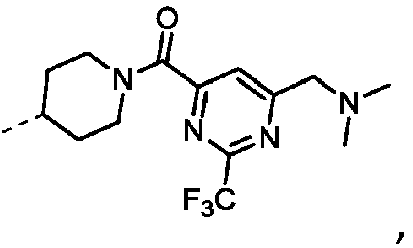


bevorzugt ist R1 ausgewählt aus H, Me,

- Die Verbindung oder das pharmazeutisch verträgliche Salz davon nach Anspruch 1, wobei R1-L1- ausgewählt ist aus H, oder ausgewählt ist aus


insbesondere ist R1-L1- ausgewählt aus H,

- Die Verbindung oder das pharmazeutisch verträgliche Salz davon nach Anspruch 1, wobei R2 ausgewählt ist aus H, NH2, oder ausgewählt ist aus C1-3 Alkyl, C3-6Cycloalkyl, 3- bis 6-gliedrigem Heterocycloalkyl, C1-3 Alkyl-O-C1-3 Alkyl-, C1-3 Alkyl-S-C1-3 Alkyl-, C1-3 Alkyl-NH-C1-3 Alkyl-, C1-6 Alkoxy, C1-6 Alkylamino, die gegebenenfalls mit R substituiert sind; insbesondere ist R2 ausgewählt aus H, NH2, oder ausgewählt aus Me,


- Die Verbindung oder das pharmazeutisch verträgliche Salz davon nach Anspruch 1, wobei R2-L2- ausgewählt ist aus H, oder ausgewählt ist aus: NH2,
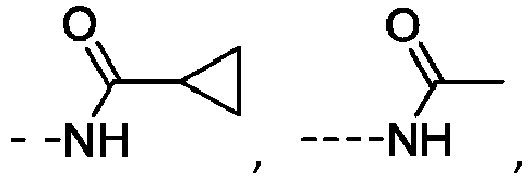

insbesondere ist R2-L2- ausgewählt aus H, NH2,

- Die Verbindung oder das pharmazeutisch verträgliche Salz davon nach Anspruch 1, wobei der Ring A ausgewählt ist aus 1, 3, 4-Triazolyl, Imidazolyl, Oxazolyl, Thiazolyl; insbesondere ist der Ring A ausgewählt aus

- Die Verbindung oder das pharmazeutisch verträgliche Salz davon nach Anspruch 1 oder 7, wobei die Struktureinheit



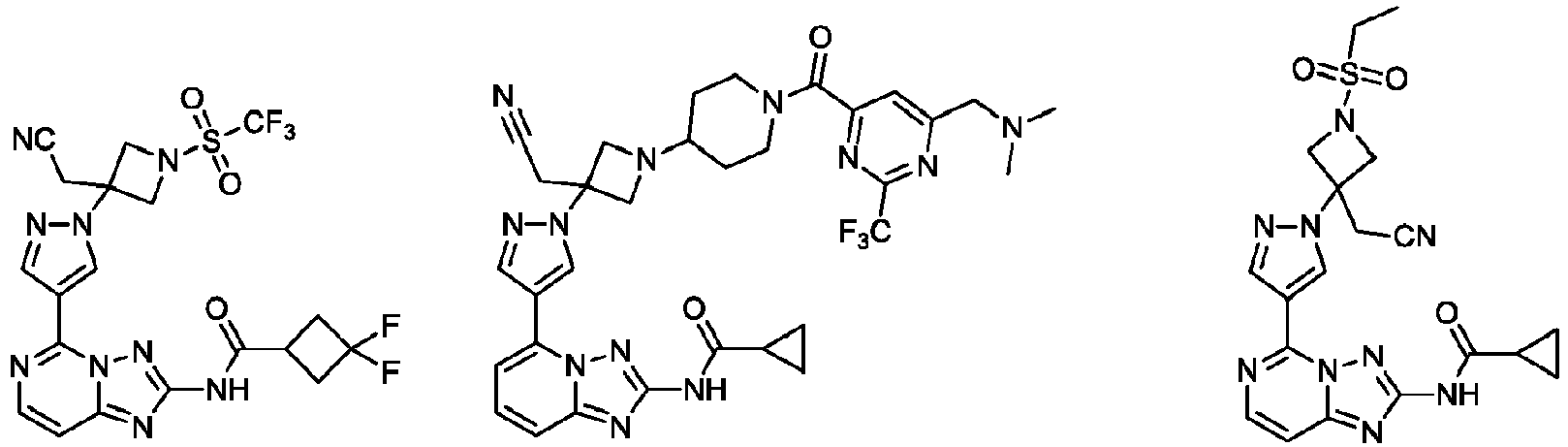
- Die Verbindung nach Anspruch 1 ausgewählt aus:



Priority Applications (1)
| Application Number | Priority Date | Filing Date | Title |
|---|---|---|---|
| PL16785915T PL3290418T3 (pl) | 2015-04-29 | 2016-04-26 | Inhibitory kinaz janusowych (jak) |
Applications Claiming Priority (2)
| Application Number | Priority Date | Filing Date | Title |
|---|---|---|---|
| CN201510213187 | 2015-04-29 | ||
| PCT/CN2016/080208 WO2016173484A1 (zh) | 2015-04-29 | 2016-04-26 | Jak抑制剂 |
Publications (3)
| Publication Number | Publication Date |
|---|---|
| EP3290418A1 EP3290418A1 (de) | 2018-03-07 |
| EP3290418A4 EP3290418A4 (de) | 2018-10-17 |
| EP3290418B1 true EP3290418B1 (de) | 2019-05-15 |
Family
ID=57198164
Family Applications (1)
| Application Number | Title | Priority Date | Filing Date |
|---|---|---|---|
| EP16785915.6A Active EP3290418B1 (de) | 2015-04-29 | 2016-04-26 | Janus kinase (jak)-hemmstoffe |
Country Status (18)
| Country | Link |
|---|---|
| US (1) | US10174036B2 (de) |
| EP (1) | EP3290418B1 (de) |
| JP (1) | JP6600365B2 (de) |
| KR (1) | KR102006684B1 (de) |
| CN (1) | CN107531695B (de) |
| AU (1) | AU2016254385B2 (de) |
| CA (1) | CA2982493C (de) |
| DK (1) | DK3290418T3 (de) |
| EA (1) | EA036058B1 (de) |
| ES (1) | ES2734048T3 (de) |
| HU (1) | HUE044240T2 (de) |
| MX (1) | MX370933B (de) |
| PL (1) | PL3290418T3 (de) |
| PT (1) | PT3290418T (de) |
| TR (1) | TR201909694T4 (de) |
| TW (1) | TWI694998B (de) |
| UA (1) | UA119701C2 (de) |
| WO (1) | WO2016173484A1 (de) |
Families Citing this family (22)
| Publication number | Priority date | Publication date | Assignee | Title |
|---|---|---|---|---|
| MX383747B (es) | 2016-02-24 | 2025-03-14 | Pfizer | Derivados de pirazolo[1,5-a]pirazin-4-ilo como inhibidores de quinasas janus (jak) |
| EP3492468B1 (de) * | 2016-07-26 | 2022-02-23 | Suzhou Longbiotech Pharmaceuticals Co., Ltd. | Heterocyclische verbindung als jak-hemmer sowie salze und therapeutische verwendung davon |
| WO2019034973A1 (en) * | 2017-08-14 | 2019-02-21 | Pfizer Inc. | PYRAZOLO [1,5-A] PYRAZIN-4-YL AND RELATED DERIVATIVES |
| KR20190043437A (ko) | 2017-10-18 | 2019-04-26 | 씨제이헬스케어 주식회사 | 단백질 키나제 억제제로서의 헤테로고리 화합물 |
| WO2019233434A1 (zh) * | 2018-06-06 | 2019-12-12 | 杭州澳津生物医药技术有限公司 | 一种吡唑嘧啶衍生物及其用途和药物组合物 |
| TW202028209A (zh) * | 2018-09-27 | 2020-08-01 | 大陸商重慶複創醫藥研究有限公司 | 作為RET激酶抑制劑的取代的咪唑[1,2-a]吡啶和[1,2,4]三唑[1,5-a]吡啶化合物 |
| KR102195348B1 (ko) | 2018-11-15 | 2020-12-24 | 에이치케이이노엔 주식회사 | 단백질 키나제 억제제로서의 신규 화합물 및 이를 포함하는 약제학적 조성물 |
| CN111320624B (zh) * | 2018-12-14 | 2023-05-12 | 中国医药研究开发中心有限公司 | 三唑并吡啶类和咪唑并吡啶类化合物及其制备方法和医药用途 |
| DK3915989T3 (da) | 2019-01-30 | 2023-09-18 | Felicamed Biotechnology Co Ltd | Jak inhibitor and preparation method therefor |
| CA3129665A1 (en) | 2019-03-21 | 2020-09-24 | Onxeo | A dbait molecule in combination with kinase inhibitor for the treatment of cancer |
| CN111892592B (zh) * | 2019-08-06 | 2023-09-19 | 江苏柯菲平医药股份有限公司 | Jak激酶抑制剂及其用途 |
| KR20220098759A (ko) | 2019-11-08 | 2022-07-12 | 인쎄름 (엥스띠뛰 나씨오날 드 라 쌍떼 에 드 라 흐쉐르슈 메디깔) | 키나제 억제제에 대해 내성을 획득한 암의 치료 방법 |
| CN111039963B (zh) * | 2019-12-31 | 2021-03-19 | 卓和药业集团有限公司 | Wxfl10203614水溶性类似物及其合成方法 |
| WO2021148581A1 (en) | 2020-01-22 | 2021-07-29 | Onxeo | Novel dbait molecule and its use |
| US12668594B2 (en) | 2020-12-23 | 2026-06-30 | Sudo Biosciences Limited | TYK2 inhibitors and uses thereof |
| KR20230159421A (ko) | 2021-02-19 | 2023-11-21 | 수도 바이오사이언시즈 리미티드 | Tyk2 억제제 및 이의 용도 |
| TW202302583A (zh) | 2021-02-19 | 2023-01-16 | 英商蘇多生物科學有限公司 | Tyk2抑制劑及其用途 |
| IL305119A (en) | 2021-02-19 | 2023-10-01 | Sudo Biosciences Ltd | Tyk2 inhibitors and uses thereof |
| AR125588A1 (es) | 2021-03-04 | 2023-08-02 | Lilly Co Eli | Compuestos inhibidores de fgfr3 |
| CN116496268A (zh) * | 2022-01-18 | 2023-07-28 | 盛世泰科生物医药技术(苏州)有限公司 | 一种含环丙酰胺化合物及其应用 |
| CN114539247B (zh) * | 2022-01-19 | 2023-03-21 | 暨南大学 | 一种[1,2,4]三唑并[1,5-a]吡啶类化合物及其制备方法和应用 |
| WO2024153147A1 (zh) * | 2023-01-18 | 2024-07-25 | 北京普祺医药科技股份有限公司 | 一种氮杂环烷烃化合物、药物组合物及其用途 |
Family Cites Families (12)
| Publication number | Priority date | Publication date | Assignee | Title |
|---|---|---|---|---|
| US7160890B2 (en) | 1999-12-02 | 2007-01-09 | Osi Pharmaceuticals, Inc. | Compounds specific to adenosine A3 receptor and uses thereof |
| BR0115847A (pt) | 2000-12-01 | 2004-02-25 | Osi Pharm Inc | Compostos especìficos para receptor para adenosina a1, a2a, e a3 e usos dos mesmos |
| US7301023B2 (en) | 2001-05-31 | 2007-11-27 | Pfizer Inc. | Chiral salt resolution |
| HUE028588T2 (hu) * | 2005-12-13 | 2016-12-28 | Incyte Holdings Corp | Heteroaril-szubsztituált pirrolo[2,3-b]piridinek és pirrolo[2,3-b]pirimidinek mint Janus-kináz inhibitorok |
| GB0719803D0 (en) | 2007-10-10 | 2007-11-21 | Cancer Rec Tech Ltd | Therapeutic compounds and their use |
| JO3041B1 (ar) * | 2008-07-25 | 2016-09-05 | Galapagos Nv | مركبات جديدة مفيدة لمعالجة الأمراض التنكسية والالتهابية |
| RS53382B (sr) | 2008-08-20 | 2014-10-31 | Zoetis Llc | Jedinjenja pirol [2,3-d]pirimidina |
| KR20130094710A (ko) | 2010-04-14 | 2013-08-26 | 어레이 바이오파마 인크. | Jak 키나아제의 억제제로서 5,7-치환된-이미다조[1,2-c]피리미딘 |
| US8691807B2 (en) * | 2011-06-20 | 2014-04-08 | Incyte Corporation | Azetidinyl phenyl, pyridyl or pyrazinyl carboxamide derivatives as JAK inhibitors |
| SG11201401342VA (en) * | 2011-10-12 | 2014-09-26 | Array Biopharma Inc | 5,7-substituted-imidazo[1,2-c]pyrimidines |
| US8551542B1 (en) | 2012-09-20 | 2013-10-08 | Basic Research L.L.C. | Methods and compositions for increasing growth hormones |
| ES2865058T3 (es) | 2013-12-09 | 2021-10-14 | Unichem Lab Ltd | Un proceso mejorado para la preparación de (3R,4R)-(1-bencil-4-metilpiperidin-3-il)-metilamina |
-
2016
- 2016-04-26 EP EP16785915.6A patent/EP3290418B1/de active Active
- 2016-04-26 CN CN201680021913.9A patent/CN107531695B/zh active Active
- 2016-04-26 AU AU2016254385A patent/AU2016254385B2/en active Active
- 2016-04-26 US US15/570,499 patent/US10174036B2/en active Active
- 2016-04-26 KR KR1020177034258A patent/KR102006684B1/ko active Active
- 2016-04-26 TR TR2019/09694T patent/TR201909694T4/tr unknown
- 2016-04-26 CA CA2982493A patent/CA2982493C/en active Active
- 2016-04-26 ES ES16785915T patent/ES2734048T3/es active Active
- 2016-04-26 DK DK16785915.6T patent/DK3290418T3/da active
- 2016-04-26 MX MX2017013798A patent/MX370933B/es active IP Right Grant
- 2016-04-26 EA EA201792021A patent/EA036058B1/ru unknown
- 2016-04-26 HU HUE16785915 patent/HUE044240T2/hu unknown
- 2016-04-26 PL PL16785915T patent/PL3290418T3/pl unknown
- 2016-04-26 UA UAA201709833A patent/UA119701C2/uk unknown
- 2016-04-26 JP JP2017556667A patent/JP6600365B2/ja active Active
- 2016-04-26 PT PT16785915T patent/PT3290418T/pt unknown
- 2016-04-26 WO PCT/CN2016/080208 patent/WO2016173484A1/zh not_active Ceased
- 2016-04-29 TW TW105113453A patent/TWI694998B/zh active
Non-Patent Citations (1)
| Title |
|---|
| None * |
Also Published As
| Publication number | Publication date |
|---|---|
| CA2982493C (en) | 2020-01-07 |
| US20180179209A1 (en) | 2018-06-28 |
| CN107531695A (zh) | 2018-01-02 |
| CA2982493A1 (en) | 2016-11-03 |
| UA119701C2 (uk) | 2019-07-25 |
| PT3290418T (pt) | 2019-07-16 |
| US10174036B2 (en) | 2019-01-08 |
| EA036058B1 (ru) | 2020-09-21 |
| AU2016254385B2 (en) | 2018-05-10 |
| AU2016254385A1 (en) | 2017-11-02 |
| KR102006684B1 (ko) | 2019-08-02 |
| MX370933B (es) | 2020-01-09 |
| TW201704231A (zh) | 2017-02-01 |
| JP6600365B2 (ja) | 2019-10-30 |
| KR20170140370A (ko) | 2017-12-20 |
| DK3290418T3 (da) | 2019-07-01 |
| WO2016173484A1 (zh) | 2016-11-03 |
| EP3290418A4 (de) | 2018-10-17 |
| JP2018514551A (ja) | 2018-06-07 |
| PL3290418T3 (pl) | 2019-11-29 |
| HUE044240T2 (hu) | 2019-10-28 |
| TWI694998B (zh) | 2020-06-01 |
| CN107531695B (zh) | 2020-03-27 |
| ES2734048T3 (es) | 2019-12-04 |
| MX2017013798A (es) | 2018-03-21 |
| EA201792021A1 (ru) | 2018-07-31 |
| EP3290418A1 (de) | 2018-03-07 |
| TR201909694T4 (tr) | 2019-07-22 |
Similar Documents
| Publication | Publication Date | Title |
|---|---|---|
| US10174036B2 (en) | Substituted pyrazoles as JAK inhibitors | |
| EP3305788B1 (de) | Janus-kinasehemmer | |
| EP3567030B1 (de) | Chinazolinverbindung zur egfr-hemmung | |
| CN105461711B (zh) | 作为PI3K抑制剂的吡啶并[1,2-a]嘧啶酮类似物 | |
| EP3159341B1 (de) | Pyridin[1,2-a]pyrimidonanalog als pi3k-hemmer | |
| CA3054324C (en) | Tri-cycle compound and applications thereof | |
| KR102412045B1 (ko) | 혈액응고인자 Xa 억제제로서의 히드라지드 화합물 | |
| EP3543227B1 (de) | Fgfr4-inhibitor sowie herstellungsverfahren und verwendung davon | |
| WO2017215588A1 (zh) | 作为Akt抑制剂的二氢吡唑氮杂卓类化合物 | |
| HK40004140A (en) | Fgfr4 inhibitor and preparation method and use thereof | |
| HK40004140B (en) | Fgfr4 inhibitor and preparation method and use thereof |
Legal Events
| Date | Code | Title | Description |
|---|---|---|---|
| STAA | Information on the status of an ep patent application or granted ep patent |
Free format text: STATUS: THE INTERNATIONAL PUBLICATION HAS BEEN MADE |
|
| PUAI | Public reference made under article 153(3) epc to a published international application that has entered the european phase |
Free format text: ORIGINAL CODE: 0009012 |
|
| STAA | Information on the status of an ep patent application or granted ep patent |
Free format text: STATUS: REQUEST FOR EXAMINATION WAS MADE |
|
| 17P | Request for examination filed |
Effective date: 20170925 |
|
| AK | Designated contracting states |
Kind code of ref document: A1 Designated state(s): AL AT BE BG CH CY CZ DE DK EE ES FI FR GB GR HR HU IE IS IT LI LT LU LV MC MK MT NL NO PL PT RO RS SE SI SK SM TR |
|
| AX | Request for extension of the european patent |
Extension state: BA ME |
|
| DAV | Request for validation of the european patent (deleted) | ||
| DAX | Request for extension of the european patent (deleted) | ||
| A4 | Supplementary search report drawn up and despatched |
Effective date: 20180914 |
|
| RIC1 | Information provided on ipc code assigned before grant |
Ipc: C07D 413/14 20060101ALI20180911BHEP Ipc: C07D 471/04 20060101AFI20180911BHEP Ipc: A61K 31/506 20060101ALI20180911BHEP Ipc: A61K 31/423 20060101ALI20180911BHEP Ipc: C07D 417/14 20060101ALI20180911BHEP Ipc: A61P 37/00 20060101ALI20180911BHEP Ipc: A61K 31/437 20060101ALI20180911BHEP Ipc: A61K 31/428 20060101ALI20180911BHEP Ipc: A61K 31/519 20060101ALI20180911BHEP Ipc: C07D 487/04 20060101ALI20180911BHEP Ipc: A61K 31/4985 20060101ALI20180911BHEP |
|
| GRAP | Despatch of communication of intention to grant a patent |
Free format text: ORIGINAL CODE: EPIDOSNIGR1 |
|
| STAA | Information on the status of an ep patent application or granted ep patent |
Free format text: STATUS: GRANT OF PATENT IS INTENDED |
|
| INTG | Intention to grant announced |
Effective date: 20190228 |
|
| GRAS | Grant fee paid |
Free format text: ORIGINAL CODE: EPIDOSNIGR3 |
|
| GRAA | (expected) grant |
Free format text: ORIGINAL CODE: 0009210 |
|
| STAA | Information on the status of an ep patent application or granted ep patent |
Free format text: STATUS: THE PATENT HAS BEEN GRANTED |
|
| RIN1 | Information on inventor provided before grant (corrected) |
Inventor name: LI, JIAN Inventor name: WANG, FEI Inventor name: CHEN, SHUHUI Inventor name: WU, HAO Inventor name: MAO, WEIWEI Inventor name: LI, PENG |
|
| AK | Designated contracting states |
Kind code of ref document: B1 Designated state(s): AL AT BE BG CH CY CZ DE DK EE ES FI FR GB GR HR HU IE IS IT LI LT LU LV MC MK MT NL NO PL PT RO RS SE SI SK SM TR |
|
| REG | Reference to a national code |
Ref country code: CH Ref legal event code: EP |
|
| REG | Reference to a national code |
Ref country code: DE Ref legal event code: R096 Ref document number: 602016014102 Country of ref document: DE |
|
| REG | Reference to a national code |
Ref country code: IE Ref legal event code: FG4D |
|
| REG | Reference to a national code |
Ref country code: DK Ref legal event code: T3 Effective date: 20190626 |
|
| REG | Reference to a national code |
Ref country code: RO Ref legal event code: EPE |
|
| REG | Reference to a national code |
Ref country code: SE Ref legal event code: TRGR |
|
| REG | Reference to a national code |
Ref country code: PT Ref legal event code: SC4A Ref document number: 3290418 Country of ref document: PT Date of ref document: 20190716 Kind code of ref document: T Free format text: AVAILABILITY OF NATIONAL TRANSLATION Effective date: 20190705 |
|
| REG | Reference to a national code |
Ref country code: NL Ref legal event code: FP |
|
| REG | Reference to a national code |
Ref country code: CH Ref legal event code: NV Representative=s name: ING. MARCO ZARDI C/O M. ZARDI AND CO. S.A., CH |
|
| REG | Reference to a national code |
Ref country code: NO Ref legal event code: T2 Effective date: 20190515 |
|
| REG | Reference to a national code |
Ref country code: LT Ref legal event code: MG4D |
|
| REG | Reference to a national code |
Ref country code: HU Ref legal event code: AG4A Ref document number: E044240 Country of ref document: HU |
|
| PG25 | Lapsed in a contracting state [announced via postgrant information from national office to epo] |
Ref country code: HR Free format text: LAPSE BECAUSE OF FAILURE TO SUBMIT A TRANSLATION OF THE DESCRIPTION OR TO PAY THE FEE WITHIN THE PRESCRIBED TIME-LIMIT Effective date: 20190515 Ref country code: LT Free format text: LAPSE BECAUSE OF FAILURE TO SUBMIT A TRANSLATION OF THE DESCRIPTION OR TO PAY THE FEE WITHIN THE PRESCRIBED TIME-LIMIT Effective date: 20190515 Ref country code: AL Free format text: LAPSE BECAUSE OF FAILURE TO SUBMIT A TRANSLATION OF THE DESCRIPTION OR TO PAY THE FEE WITHIN THE PRESCRIBED TIME-LIMIT Effective date: 20190515 |
|
| PG25 | Lapsed in a contracting state [announced via postgrant information from national office to epo] |
Ref country code: LV Free format text: LAPSE BECAUSE OF FAILURE TO SUBMIT A TRANSLATION OF THE DESCRIPTION OR TO PAY THE FEE WITHIN THE PRESCRIBED TIME-LIMIT Effective date: 20190515 Ref country code: BG Free format text: LAPSE BECAUSE OF FAILURE TO SUBMIT A TRANSLATION OF THE DESCRIPTION OR TO PAY THE FEE WITHIN THE PRESCRIBED TIME-LIMIT Effective date: 20190815 Ref country code: RS Free format text: LAPSE BECAUSE OF FAILURE TO SUBMIT A TRANSLATION OF THE DESCRIPTION OR TO PAY THE FEE WITHIN THE PRESCRIBED TIME-LIMIT Effective date: 20190515 |
|
| REG | Reference to a national code |
Ref country code: ES Ref legal event code: FG2A Ref document number: 2734048 Country of ref document: ES Kind code of ref document: T3 Effective date: 20191204 |
|
| REG | Reference to a national code |
Ref country code: GR Ref legal event code: EP Ref document number: 20190402307 Country of ref document: GR Effective date: 20191128 |
|
| PG25 | Lapsed in a contracting state [announced via postgrant information from national office to epo] |
Ref country code: EE Free format text: LAPSE BECAUSE OF FAILURE TO SUBMIT A TRANSLATION OF THE DESCRIPTION OR TO PAY THE FEE WITHIN THE PRESCRIBED TIME-LIMIT Effective date: 20190515 Ref country code: SK Free format text: LAPSE BECAUSE OF FAILURE TO SUBMIT A TRANSLATION OF THE DESCRIPTION OR TO PAY THE FEE WITHIN THE PRESCRIBED TIME-LIMIT Effective date: 20190515 |
|
| REG | Reference to a national code |
Ref country code: DE Ref legal event code: R097 Ref document number: 602016014102 Country of ref document: DE |
|
| PG25 | Lapsed in a contracting state [announced via postgrant information from national office to epo] |
Ref country code: SM Free format text: LAPSE BECAUSE OF FAILURE TO SUBMIT A TRANSLATION OF THE DESCRIPTION OR TO PAY THE FEE WITHIN THE PRESCRIBED TIME-LIMIT Effective date: 20190515 |
|
| PLBE | No opposition filed within time limit |
Free format text: ORIGINAL CODE: 0009261 |
|
| STAA | Information on the status of an ep patent application or granted ep patent |
Free format text: STATUS: NO OPPOSITION FILED WITHIN TIME LIMIT |
|
| 26N | No opposition filed |
Effective date: 20200218 |
|
| PG25 | Lapsed in a contracting state [announced via postgrant information from national office to epo] |
Ref country code: SI Free format text: LAPSE BECAUSE OF FAILURE TO SUBMIT A TRANSLATION OF THE DESCRIPTION OR TO PAY THE FEE WITHIN THE PRESCRIBED TIME-LIMIT Effective date: 20190515 |
|
| PG25 | Lapsed in a contracting state [announced via postgrant information from national office to epo] |
Ref country code: MC Free format text: LAPSE BECAUSE OF FAILURE TO SUBMIT A TRANSLATION OF THE DESCRIPTION OR TO PAY THE FEE WITHIN THE PRESCRIBED TIME-LIMIT Effective date: 20190515 |
|
| PG25 | Lapsed in a contracting state [announced via postgrant information from national office to epo] |
Ref country code: LU Free format text: LAPSE BECAUSE OF NON-PAYMENT OF DUE FEES Effective date: 20200426 |
|
| PG25 | Lapsed in a contracting state [announced via postgrant information from national office to epo] |
Ref country code: MT Free format text: LAPSE BECAUSE OF FAILURE TO SUBMIT A TRANSLATION OF THE DESCRIPTION OR TO PAY THE FEE WITHIN THE PRESCRIBED TIME-LIMIT Effective date: 20190515 Ref country code: CY Free format text: LAPSE BECAUSE OF FAILURE TO SUBMIT A TRANSLATION OF THE DESCRIPTION OR TO PAY THE FEE WITHIN THE PRESCRIBED TIME-LIMIT Effective date: 20190515 |
|
| PG25 | Lapsed in a contracting state [announced via postgrant information from national office to epo] |
Ref country code: MK Free format text: LAPSE BECAUSE OF FAILURE TO SUBMIT A TRANSLATION OF THE DESCRIPTION OR TO PAY THE FEE WITHIN THE PRESCRIBED TIME-LIMIT Effective date: 20190515 Ref country code: IS Free format text: LAPSE BECAUSE OF FAILURE TO SUBMIT A TRANSLATION OF THE DESCRIPTION OR TO PAY THE FEE WITHIN THE PRESCRIBED TIME-LIMIT Effective date: 20190915 |
|
| PGFP | Annual fee paid to national office [announced via postgrant information from national office to epo] |
Ref country code: RO Payment date: 20230323 Year of fee payment: 8 Ref country code: NO Payment date: 20230324 Year of fee payment: 8 Ref country code: IE Payment date: 20230321 Year of fee payment: 8 Ref country code: FI Payment date: 20230321 Year of fee payment: 8 Ref country code: DK Payment date: 20230327 Year of fee payment: 8 Ref country code: CZ Payment date: 20230330 Year of fee payment: 8 |
|
| REG | Reference to a national code |
Ref country code: AT Ref legal event code: UEP Ref document number: 1133288 Country of ref document: AT Kind code of ref document: T Effective date: 20190515 |
|
| PG25 | Lapsed in a contracting state [announced via postgrant information from national office to epo] |
Ref country code: IT Free format text: LAPSE BECAUSE OF NON-PAYMENT OF DUE FEES Effective date: 20220426 |
|
| PGFP | Annual fee paid to national office [announced via postgrant information from national office to epo] |
Ref country code: PT Payment date: 20230320 Year of fee payment: 8 Ref country code: PL Payment date: 20230306 Year of fee payment: 8 Ref country code: GR Payment date: 20230320 Year of fee payment: 8 |
|
| PGFP | Annual fee paid to national office [announced via postgrant information from national office to epo] |
Ref country code: ES Payment date: 20230504 Year of fee payment: 8 Ref country code: CH Payment date: 20230502 Year of fee payment: 8 |
|
| PGFP | Annual fee paid to national office [announced via postgrant information from national office to epo] |
Ref country code: TR Payment date: 20230412 Year of fee payment: 8 Ref country code: HU Payment date: 20230331 Year of fee payment: 8 Ref country code: AT Payment date: 20230321 Year of fee payment: 8 |
|
| PGFP | Annual fee paid to national office [announced via postgrant information from national office to epo] |
Ref country code: BE Payment date: 20230424 Year of fee payment: 8 |
|
| REG | Reference to a national code |
Ref country code: DK Ref legal event code: EBP Effective date: 20240430 |
|
| REG | Reference to a national code |
Ref country code: CH Ref legal event code: PL |
|
| PG25 | Lapsed in a contracting state [announced via postgrant information from national office to epo] |
Ref country code: PT Free format text: LAPSE BECAUSE OF NON-PAYMENT OF DUE FEES Effective date: 20241028 |
|
| REG | Reference to a national code |
Ref country code: AT Ref legal event code: MM01 Ref document number: 1133288 Country of ref document: AT Kind code of ref document: T Effective date: 20240426 |
|
| REG | Reference to a national code |
Ref country code: BE Ref legal event code: MM Effective date: 20240430 |
|
| PG25 | Lapsed in a contracting state [announced via postgrant information from national office to epo] |
Ref country code: PT Free format text: LAPSE BECAUSE OF NON-PAYMENT OF DUE FEES Effective date: 20241028 |
|
| PG25 | Lapsed in a contracting state [announced via postgrant information from national office to epo] |
Ref country code: HU Free format text: LAPSE BECAUSE OF NON-PAYMENT OF DUE FEES Effective date: 20240427 |
|
| PG25 | Lapsed in a contracting state [announced via postgrant information from national office to epo] |
Ref country code: NO Free format text: LAPSE BECAUSE OF NON-PAYMENT OF DUE FEES Effective date: 20240430 |
|
| PG25 | Lapsed in a contracting state [announced via postgrant information from national office to epo] |
Ref country code: BE Free format text: LAPSE BECAUSE OF NON-PAYMENT OF DUE FEES Effective date: 20240430 Ref country code: GR Free format text: LAPSE BECAUSE OF NON-PAYMENT OF DUE FEES Effective date: 20241104 Ref country code: FI Free format text: LAPSE BECAUSE OF NON-PAYMENT OF DUE FEES Effective date: 20240426 |
|
| PG25 | Lapsed in a contracting state [announced via postgrant information from national office to epo] |
Ref country code: AT Free format text: LAPSE BECAUSE OF NON-PAYMENT OF DUE FEES Effective date: 20240426 |
|
| PG25 | Lapsed in a contracting state [announced via postgrant information from national office to epo] |
Ref country code: CZ Free format text: LAPSE BECAUSE OF NON-PAYMENT OF DUE FEES Effective date: 20240426 |
|
| PG25 | Lapsed in a contracting state [announced via postgrant information from national office to epo] |
Ref country code: RO Free format text: LAPSE BECAUSE OF NON-PAYMENT OF DUE FEES Effective date: 20240426 |
|
| PG25 | Lapsed in a contracting state [announced via postgrant information from national office to epo] |
Ref country code: RO Free format text: LAPSE BECAUSE OF NON-PAYMENT OF DUE FEES Effective date: 20240426 Ref country code: NO Free format text: LAPSE BECAUSE OF NON-PAYMENT OF DUE FEES Effective date: 20240430 Ref country code: HU Free format text: LAPSE BECAUSE OF NON-PAYMENT OF DUE FEES Effective date: 20240427 Ref country code: GR Free format text: LAPSE BECAUSE OF NON-PAYMENT OF DUE FEES Effective date: 20241104 Ref country code: FI Free format text: LAPSE BECAUSE OF NON-PAYMENT OF DUE FEES Effective date: 20240426 Ref country code: CZ Free format text: LAPSE BECAUSE OF NON-PAYMENT OF DUE FEES Effective date: 20240426 Ref country code: BE Free format text: LAPSE BECAUSE OF NON-PAYMENT OF DUE FEES Effective date: 20240430 Ref country code: AT Free format text: LAPSE BECAUSE OF NON-PAYMENT OF DUE FEES Effective date: 20240426 Ref country code: CH Free format text: LAPSE BECAUSE OF NON-PAYMENT OF DUE FEES Effective date: 20240430 |
|
| PG25 | Lapsed in a contracting state [announced via postgrant information from national office to epo] |
Ref country code: DK Free format text: LAPSE BECAUSE OF NON-PAYMENT OF DUE FEES Effective date: 20240430 |
|
| PG25 | Lapsed in a contracting state [announced via postgrant information from national office to epo] |
Ref country code: IE Free format text: LAPSE BECAUSE OF NON-PAYMENT OF DUE FEES Effective date: 20240426 |
|
| REG | Reference to a national code |
Ref country code: ES Ref legal event code: FD2A Effective date: 20250603 |
|
| PG25 | Lapsed in a contracting state [announced via postgrant information from national office to epo] |
Ref country code: ES Free format text: LAPSE BECAUSE OF NON-PAYMENT OF DUE FEES Effective date: 20240427 |
|
| PG25 | Lapsed in a contracting state [announced via postgrant information from national office to epo] |
Ref country code: IT Free format text: LAPSE BECAUSE OF NON-PAYMENT OF DUE FEES Effective date: 20220426 |
|
| PGRI | Patent reinstated in contracting state [announced from national office to epo] |
Ref country code: IT Effective date: 20230710 |
|
| PGFP | Annual fee paid to national office [announced via postgrant information from national office to epo] |
Ref country code: NL Payment date: 20260326 Year of fee payment: 11 |
|
| PG25 | Lapsed in a contracting state [announced via postgrant information from national office to epo] |
Ref country code: TR Free format text: LAPSE BECAUSE OF NON-PAYMENT OF DUE FEES Effective date: 20240426 |
|
| PGFP | Annual fee paid to national office [announced via postgrant information from national office to epo] |
Ref country code: GB Payment date: 20260430 Year of fee payment: 11 |
|
| PGFP | Annual fee paid to national office [announced via postgrant information from national office to epo] |
Ref country code: IT Payment date: 20260410 Year of fee payment: 11 |
|
| PGFP | Annual fee paid to national office [announced via postgrant information from national office to epo] |
Ref country code: DE Payment date: 20260416 Year of fee payment: 11 |
|
| PGFP | Annual fee paid to national office [announced via postgrant information from national office to epo] |
Ref country code: SE Payment date: 20260429 Year of fee payment: 11 |
|
| PGFP | Annual fee paid to national office [announced via postgrant information from national office to epo] |
Ref country code: FR Payment date: 20260429 Year of fee payment: 11 |