EP3290638B1 - Composant refroidi de turbine présentant des rangées de trous de refroidissement alternativement orientés et procédé de fabrication - Google Patents
Composant refroidi de turbine présentant des rangées de trous de refroidissement alternativement orientés et procédé de fabrication Download PDFInfo
- Publication number
- EP3290638B1 EP3290638B1 EP17189120.3A EP17189120A EP3290638B1 EP 3290638 B1 EP3290638 B1 EP 3290638B1 EP 17189120 A EP17189120 A EP 17189120A EP 3290638 B1 EP3290638 B1 EP 3290638B1
- Authority
- EP
- European Patent Office
- Prior art keywords
- cooling
- radially
- airfoil
- recited
- gas turbine
- Prior art date
- Legal status (The legal status is an assumption and is not a legal conclusion. Google has not performed a legal analysis and makes no representation as to the accuracy of the status listed.)
- Active
Links
Images

Classifications
-
- F—MECHANICAL ENGINEERING; LIGHTING; HEATING; WEAPONS; BLASTING
- F01—MACHINES OR ENGINES IN GENERAL; ENGINE PLANTS IN GENERAL; STEAM ENGINES
- F01D—NON-POSITIVE DISPLACEMENT MACHINES OR ENGINES, e.g. STEAM TURBINES
- F01D5/00—Blades; Blade-carrying members; Heating, heat-insulating, cooling or antivibration means on the blades or the members
- F01D5/12—Blades
- F01D5/14—Form or construction
- F01D5/18—Hollow blades, i.e. blades with cooling or heating channels or cavities; Heating, heat-insulating or cooling means on blades
- F01D5/187—Convection cooling
-
- F—MECHANICAL ENGINEERING; LIGHTING; HEATING; WEAPONS; BLASTING
- F01—MACHINES OR ENGINES IN GENERAL; ENGINE PLANTS IN GENERAL; STEAM ENGINES
- F01D—NON-POSITIVE DISPLACEMENT MACHINES OR ENGINES, e.g. STEAM TURBINES
- F01D25/00—Component parts, details, or accessories, not provided for in, or of interest apart from, other groups
- F01D25/08—Cooling; Heating; Heat-insulation
- F01D25/12—Cooling
-
- F—MECHANICAL ENGINEERING; LIGHTING; HEATING; WEAPONS; BLASTING
- F01—MACHINES OR ENGINES IN GENERAL; ENGINE PLANTS IN GENERAL; STEAM ENGINES
- F01D—NON-POSITIVE DISPLACEMENT MACHINES OR ENGINES, e.g. STEAM TURBINES
- F01D5/00—Blades; Blade-carrying members; Heating, heat-insulating, cooling or antivibration means on the blades or the members
- F01D5/12—Blades
- F01D5/14—Form or construction
- F01D5/18—Hollow blades, i.e. blades with cooling or heating channels or cavities; Heating, heat-insulating or cooling means on blades
- F01D5/186—Film cooling
-
- F—MECHANICAL ENGINEERING; LIGHTING; HEATING; WEAPONS; BLASTING
- F05—INDEXING SCHEMES RELATING TO ENGINES OR PUMPS IN VARIOUS SUBCLASSES OF CLASSES F01-F04
- F05D—INDEXING SCHEME FOR ASPECTS RELATING TO NON-POSITIVE-DISPLACEMENT MACHINES OR ENGINES, GAS-TURBINES OR JET-PROPULSION PLANTS
- F05D2220/00—Application
- F05D2220/30—Application in turbines
- F05D2220/32—Application in turbines in gas turbines
-
- F—MECHANICAL ENGINEERING; LIGHTING; HEATING; WEAPONS; BLASTING
- F05—INDEXING SCHEMES RELATING TO ENGINES OR PUMPS IN VARIOUS SUBCLASSES OF CLASSES F01-F04
- F05D—INDEXING SCHEME FOR ASPECTS RELATING TO NON-POSITIVE-DISPLACEMENT MACHINES OR ENGINES, GAS-TURBINES OR JET-PROPULSION PLANTS
- F05D2230/00—Manufacture
- F05D2230/10—Manufacture by removing material
-
- F—MECHANICAL ENGINEERING; LIGHTING; HEATING; WEAPONS; BLASTING
- F05—INDEXING SCHEMES RELATING TO ENGINES OR PUMPS IN VARIOUS SUBCLASSES OF CLASSES F01-F04
- F05D—INDEXING SCHEME FOR ASPECTS RELATING TO NON-POSITIVE-DISPLACEMENT MACHINES OR ENGINES, GAS-TURBINES OR JET-PROPULSION PLANTS
- F05D2230/00—Manufacture
- F05D2230/20—Manufacture essentially without removing material
- F05D2230/21—Manufacture essentially without removing material by casting
-
- F—MECHANICAL ENGINEERING; LIGHTING; HEATING; WEAPONS; BLASTING
- F05—INDEXING SCHEMES RELATING TO ENGINES OR PUMPS IN VARIOUS SUBCLASSES OF CLASSES F01-F04
- F05D—INDEXING SCHEME FOR ASPECTS RELATING TO NON-POSITIVE-DISPLACEMENT MACHINES OR ENGINES, GAS-TURBINES OR JET-PROPULSION PLANTS
- F05D2260/00—Function
- F05D2260/20—Heat transfer, e.g. cooling
- F05D2260/202—Heat transfer, e.g. cooling by film cooling
-
- F—MECHANICAL ENGINEERING; LIGHTING; HEATING; WEAPONS; BLASTING
- F05—INDEXING SCHEMES RELATING TO ENGINES OR PUMPS IN VARIOUS SUBCLASSES OF CLASSES F01-F04
- F05D—INDEXING SCHEME FOR ASPECTS RELATING TO NON-POSITIVE-DISPLACEMENT MACHINES OR ENGINES, GAS-TURBINES OR JET-PROPULSION PLANTS
- F05D2260/00—Function
- F05D2260/20—Heat transfer, e.g. cooling
- F05D2260/221—Improvement of heat transfer
-
- Y—GENERAL TAGGING OF NEW TECHNOLOGICAL DEVELOPMENTS; GENERAL TAGGING OF CROSS-SECTIONAL TECHNOLOGIES SPANNING OVER SEVERAL SECTIONS OF THE IPC; TECHNICAL SUBJECTS COVERED BY FORMER USPC CROSS-REFERENCE ART COLLECTIONS [XRACs] AND DIGESTS
- Y02—TECHNOLOGIES OR APPLICATIONS FOR MITIGATION OR ADAPTATION AGAINST CLIMATE CHANGE
- Y02T—CLIMATE CHANGE MITIGATION TECHNOLOGIES RELATED TO TRANSPORTATION
- Y02T50/00—Aeronautics or air transport
- Y02T50/60—Efficient propulsion technologies, e.g. for aircraft
Definitions
- a gas turbine engine typically includes a fan section, a compressor section, a combustor section and a turbine section. Air entering the compressor section is compressed and delivered into the combustion section where it is mixed with fuel and ignited to generate a high-speed exhaust gas flow. The high-energy exhaust gas flow expands through the turbine section to drive the compressor and the fan section.
- the compressor section typically includes low and high pressure compressors, and the turbine section includes low and high pressure turbines.
- Cooling airflow is therefore provided to components such as blades and vanes. Cooling airflow is obtained from the other parts of the engine such as the compressor section and therefore impact overall engine efficiency and is therefore applied sparingly throughout the various engine components. Cooling airflow within a turbine blade or vane is provided through film cooling holes that inject air over the airfoil surface to partially insulate the blade from the extreme temperatures of the high energy exhaust gas flow. The orientation of the film cooling holes is a controlling factor in both cooling airflow management and effectiveness.
- Turbine engine manufacturers continue to seek further improvements to engine performance including improvements to thermal, transfer and propulsive efficiencies.
- EP 1126 135 A2 discloses a prior art cooled component for a gas turbine engine as set forth in the preamble of claim 1.
- the invention provides a cooled component for a gas turbine engine as recited in claim 1.
- cooling holes within each of the rows are disposed along a common centerline.
- an outboard radial bias angle from the common centerline for a radially outboard biased cooling hole is equal and opposite an inboard radial bias angle relative to the common centerline for a radially inboard biased cooling hole.
- At least two cooling holes disposed along a common centerline include a common surface angle.
- the cooled component includes an airfoil defining a surface between a leading edge and a trailing edge.
- the airfoil extends radially relative to an engine centerline and the rows extend substantially parallel to the engine centerline.
- the rows are spaced apart radially between a tip of the airfoil and a platform.
- Another embodiment of any of the above includes a diffuser extending from at least some of the plurality of cooling holes.
- the diffuser alternates between a radially outboard bias and a radially inboard bias corresponding to a bias of the corresponding one of the plurality of cooling holes.
- the diffuser includes a diverging shape extending outward from the corresponding one of the plurality of cooling holes.
- At least one of the plurality of cooling holes includes one of a round shape, an oval shape and a rectangular shape.
- cooling holes within each of the rows are disposed along a common centerline.
- an outboard radial bias angle from the common centerline for a radially outboard biased cooling hole is equal and opposite an inboard radial bias angle relative to the common centerline for a radially inboard biased cooling hole.
- the rows extend substantially parallel to the engine centerline.
- the gas turbine engine further includes a fan driven through a geared architecture by the turbine section.
- Another embodiment of any of the above includes a diffuser extending from at least some of the plurality of cooling holes.
- the diffuser extends from the corresponding cooling hole in a direction alternating between a radially outboard bias and a radially inboard bias corresponding to a bias of the corresponding one of the plurality of cooling holes.
- each of the plurality of cooling holes includes one of a round shape, an oval shape and a rectangular shape.
- An embodiment of the above includes forming openings with an outboard radial bias angle directing airflow above the common centerline adjacent to an opening with an inboard radial bias angle directing airflow below the common centerline.
- Another embodiment of any of the above includes forming a plurality of rows spaced radially apart between a platform of the airfoil and a tip of the airfoil.
- Another embodiment of any of the above includes forming at least two openings within one of the rows to include a common radial bias angle.
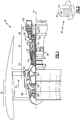
- FIG. 1 schematically illustrates an example gas turbine engine 20 that includes a fan section 22, a compressor section 24, a combustor section 26 and a turbine section 28.
- Alternative engines might include an augmenter section (not shown) among other systems or features.
- the fan section 22 drives air along a bypass flow path B while the compressor section 24 draws air in along a core flow path C where air is compressed and communicated to a combustor section 26.
- air is mixed with fuel and ignited to generate a high-energy exhaust gas stream that expands through the turbine section 28 where energy is extracted and utilized to drive the fan section 22 and the compressor section 24.
- a turbine engine including a three-spool architecture in which three spools concentrically rotate about a common axis and where a low spool enables a low pressure turbine to drive a fan via a gearbox, an intermediate spool that enables an intermediate pressure turbine to drive a first compressor of the compressor section, and a high spool that enables a high pressure turbine to drive a high pressure compressor of the compressor section.
- the example engine 20 generally includes a low speed spool 30 and a high speed spool 32 mounted for rotation about an engine central longitudinal axis A relative to an engine static structure 36 via several bearing systems 38. It should be understood that various bearing systems 38 at various locations may alternatively or additionally be provided.
- the low speed spool 30 generally includes an inner shaft 40 that connects a fan 42 and a low pressure (or first) compressor section 44 to a low pressure (or first) turbine section 46.
- the inner shaft 40 drives the fan 42 through a speed change device, such as a geared architecture 48, to drive the fan 42 at a lower speed than the low speed spool 30.
- the high-speed spool 32 includes an outer shaft 50 that interconnects a high pressure (or second) compressor section 52 and a high pressure (or second) turbine section 54.
- the inner shaft 40 and the outer shaft 50 are concentric and rotate via the bearing systems 38 about the engine central longitudinal axis A.
- a combustor 56 is arranged between the high pressure compressor 52 and the high pressure turbine 54.
- the high pressure turbine 54 includes at least two stages to provide a double stage high pressure turbine 54.
- the high pressure turbine 54 includes only a single stage.
- a "high pressure" compressor or turbine experiences a higher pressure than a corresponding "low pressure” compressor or turbine.
- the example low pressure turbine 46 has a pressure ratio that is greater than about 5.
- the pressure ratio of the example low pressure turbine 46 is measured prior to an inlet of the low pressure turbine 46 as related to the pressure measured at the outlet of the low pressure turbine 46 prior to an exhaust nozzle.
- a mid-turbine frame 58 of the engine static structure 36 is arranged generally between the high pressure turbine 54 and the low pressure turbine 46.
- the mid-turbine frame 58 further supports bearing systems 38 in the turbine section 28 as well as setting airflow entering the low pressure turbine 46.
- Airflow through the core airflow path C is compressed by the low pressure compressor 44 then by the high pressure compressor 52 mixed with fuel and ignited in the combustor 56 to produce high speed exhaust gases that are then expanded through the high pressure turbine 54 and low pressure turbine 46.
- the mid-turbine frame 58 includes vanes 60, which are in the core airflow path and function as an inlet guide vane for the low pressure turbine 46. Utilizing the vane 60 of the mid-turbine frame 58 as the inlet guide vane for low pressure turbine 46 decreases the length of the low pressure turbine 46 without increasing the axial length of the mid-turbine frame 58. Reducing or eliminating the number of vanes in the low pressure turbine 46 shortens the axial length of the turbine section 28. Thus, the compactness of the gas turbine engine 20 is increased and a higher power density may be achieved.
- the disclosed gas turbine engine 20 in one example is a high-bypass geared aircraft engine.
- the gas turbine engine 20 includes a bypass ratio greater than about six, with an example embodiment being greater than about ten.
- the example geared architecture 48 is an epicyclical gear train, such as a planetary gear system, star gear system or other known gear system, with a gear reduction ratio of greater than about 2.3.
- the gas turbine engine 20 includes a bypass ratio greater than about ten and the fan diameter is significantly larger than an outer diameter of the low pressure compressor 44. It should be understood, however, that the above parameters are only exemplary of one embodiment of a gas turbine engine including a geared architecture and that the present disclosure is applicable to other gas turbine engines.
- the fan section 22 of the engine 20 is designed for a particular flight condition -- typically cruise at about 0.8 Mach and about 35,000 feet (10,668 metres).
- the flight condition of 0.8 Mach and 35,000 ft. (10,668 m), with the engine at its best fuel consumption - also known as "bucket cruise Thrust Specific Fuel Consumption ('TSFC')" - is the industry standard parameter of pound-mass (lbm) of fuel per hour being burned divided by pound-force (lbf) of thrust the engine produces at that minimum point.
- Low fan pressure ratio is the pressure ratio across the fan blade alone, without a Fan Exit Guide Vane (“FEGV”) system.
- the low fan pressure ratio as disclosed herein according to one non-limiting embodiment is less than about 1.50. In another non-limiting embodiment the low fan pressure ratio is less than about 1.45.
- the "Low corrected fan tip speed”, as disclosed herein according to one non-limiting embodiment, is less than about 1150 ft/second (350.5 m/s).
- the example gas turbine engine includes the fan 42 that comprises in one non-limiting embodiment less than about twenty-six fan blades. In another non-limiting embodiment, the fan section 22 includes less than about twenty fan blades. Moreover, in one disclosed embodiment the low pressure turbine 46 includes no more than about six turbine rotors schematically indicated at 34. In another non-limiting example embodiment the low pressure turbine 46 includes about three turbine rotors. A ratio between the number of fan blades 42 and the number of low pressure turbine rotors is between about 3.3 and about 8.6. The example low pressure turbine 46 provides the driving power to rotate the fan section 22 and therefore the relationship between the number of turbine rotors 34 in the low pressure turbine 46 and the number of blades 42 in the fan section 22 disclose an example gas turbine engine 20 with increased power transfer efficiency.
- Gas turbine engines designs are seeking to increase overall efficiency by generating higher speeds and pressures. By achieving increased speeds and pressures, increased levels of performance and efficiency may be achieved. However, challenges are raised in that the parts and components associated with higher pressures and speeds require additional cooling air to maintain temperatures within material capabilities.
- Efficiency is a priority for gas turbine engine manufacturers and includes the desire to improve turbine efficiency.
- the turbine section receives high energy gas flow at a temperature substantially above the material capabilities of structures disposed within the turbine section. Accordingly, each of the turbine blades and turbine vanes disposed within the engine section are cooled by a cooling airflow.
- the cooling airflow is obtained from the compressor section and directed to a component within the turbine section.
- Cooling airflow schematically shown at 64 is provided over the airfoil to maintain the material of the turbine within material capabilities such that the turbine airfoils will meet the performance and life span targets.
- the amount of cooling airflow that is extracted from the compressor section and provided to the turbine section impacts overall compressor and therefore engine efficiency. Accordingly, it is desirable to minimize the amount of cooling air that is required in the turbine section while also maintaining operational efficiencies.
- Film cooling patterns are configured to efficiently utilize the cooling airflow.
- Film cooling holes may be cast into the vane or machined in a process such as laser or electron discharge machining operations.
- the disclosed example turbine blade 62 includes a plurality of cooling film holes 84 orientated in a manner to more efficiently utilize film cooling air.
- turbine blade is disclosed and described by way of example, the features disclosed herein are applicable to both rotating and fixed airfoils such as turbine blades and turbine vanes and also may be applied to other cooled components within the turbine section or other parts of the gas turbine engine that require film air cooling.
- an example turbine blade 62 includes an airfoil 66.
- the airfoil 66 includes a suction side 68, a pressure side 70, a leading edge 72 and a trailing edge 74.
- the airfoil 66 extends between the leading edge 72 and the trailing edge 74 between a tip 70 and a platform 78.
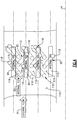
- a plurality of cooling air holes 84, 85 are arranged along the surface of the airfoil 66.
- the disclosed airfoil 66 includes an orientation and arrangement of film cooling holes 84, 85 that reduces the amount of cooling air required to maintain the turbine airfoil 66 within acceptable temperature ranges.
- the example turbine blade 62 includes an internal cavity 110 shown schematically in Figure 3 .
- the internal cavity 110 includes internal ribs 112 that define cooling air passages 114.
- the schematic view is provided to illustrate the configuration of each cooling air hole 84, 85.
- Each cooling air hole 84 includes an internal opening 116 that opens to the internal cavity 110.
- the internal opening 116 is shown schematically as a broken line in Figure 4 as it is within the cavity and not on the outer surface of the airfoil 66.
- Each cooling air hole 84, 85 further includes an external opening 118 that opens through the outer surface of the airfoil 66.
- the external opening 118 is shown in solid lines as it opens to the outer surface of the airfoil 66.
- the holes 84, 85 are indicated by dashed lines as they each extend through the wall of the airfoil to supply air cooling air along the outer surface of the airfoil.
- the internal ribs 112 extend axially substantially parallel to the engine axis A.
- the corresponding cooling air passage 114 also extend parallel to the engine axis A.
- Internal openings 116 for each of the holes 84, 85 break out into the internal cavity 110 within one of the cooling air passages 114. Accordingly, the internal openings 116 are aligned within a row corresponding with one of the cooling air passages 114.
- the holes 84, 85 alternate such that the external opening 118 of each hole 84, 85 breaks through an outer surface 120 ( Figure 6 ) of the airfoil 66 on a side of the internal passage opposite the corresponding internal rib 112. In other words, each of the holes 84, 85 at least partially crosses over one of the internal ribs 112 as is illustrated in Figure 4 .
- Each of the holes 84, 85 includes the internal opening 116 that opens on an internal side 122 of the airfoil 66 and the external opening 118 that breaks through the airfoil 66 on the outer surface 120 of the airfoil 66. Between the internal opening 116 and the external opening 118, each hole 84, 85 crosses over one of the internal ribs 112 to provide the desired direction and angle of cooling airflow along the outer surface 120 of the airfoil 66.
- the holes 84, 85 are round, but may be oval or rectangular. Similarly, the corresponding internal openings 116 and external openings 118 may be round, oval or rectangular. Moreover, other shapes for both the holes 84, 85 and the openings 116, 118 are within the contemplation of this disclosure.
- the example cooling air holes 84, 85 are arranged in rows 80 that are evenly spaced radially between the platform 78 and the tip 76.
- the internal openings 116 for each of the holes 84, 85 are arranged in rows 80.
- the corresponding external openings 118 for each of the holes 84, 85 may be angled or offset relative to an adjacent external opening 118.
- the external openings 116 may also be arranged in evenly spaced rows.
- each of the rows 80 are disposed along a corresponding common centerline 82 spaced a radial distance 100 apart.
- the example rows 80 are evenly spaced, other radial spacing is within the contemplation of this disclosure.
- the cooling air holes 84, 85 are arranged along a common centerline 82. Each of the cooling air holes 84, 85 along each row 80 are orientated in an alternating fashion to direct cooling air above and below the common centerline 82.
- a first cooling air hole 84 includes a diffuser 86 and directs airflow radially inboard relative to the common centerline 82.
- the diffuser 86 is a diverging shape that extends outward from the corresponding cooling hole.
- the diffusers 86 alternate between a radially outboard bias and a radially inboard bias corresponding to a bias of the corresponding cooling air holes 84, 85.
- An adjacent cooling air hole 85 directs cooling air above the common centerline 82.
- the subsequent cooling air hole 84 directs airflow below the common centerline 82.
- each of the rows 80 include a plurality of cooling air openings 84, 85 that alternately direct airflow above and below the common centerline 82 for each row 80.
- cooling air openings 84, 85 that alternately direct airflow above and below the common centerline 82 for each row 80.
- the first cooling holes 84 in each row indicated at 104 direct airflow downward or radially inboard.
- the second or middle row in the illustrated example shown at 102 includes an outward radial bias.
- any number of cooling holes 84, 85 could be utilized depending on the airfoil configuration and cooling air needs for a specific turbine airfoil 66.
- the radially inboard biased cooling air holes 84 include an inboard radial angle 88 that angles the hole 84 such that airflow is directed radially.
- the inboard radial angle 88 is measured between the common centerline 82 and a centerline 94 of the cooling air hole 84.
- the adjacent cooling air hole 85 that directs airflow radially outboard includes an outboard radial angle 90 that is disposed between the common centerline 82 and the hole centerline 96.
- the alternating radial bias angles for each of the cooling air openings 84 and 85 enable more efficient allocation of film cooling air along the common centerline 82 of each row 80.
- each of the cooling air holes 84 and 85 are spaced a substantially equal distance 98 apart along the entire row 80. It should be understood that the axial spacing 98 between cooling air holes 84, 85 may vary depending on application specific requirements. As appreciated, the disclosed even spacing provides a specific amount of film cooling air over an area of the airfoil. Moreover, in this example, the radial inboard angle 88 and the radial outboard angle 90 are equal although in opposite directions to sole orientate airflow emitted from the specific cooling air opening 84, 85. Each of the cooling air holes 84 and 85 direct cooling air flow downstream in a direction toward the trailing edge 74.
- each of the cooling air holes 84 and 85 includes a common surface angle 92.
- the surface angle 92 is commonly defined as that angle between the hole centerline 94, 96 and a top or bottom surface through which the hole extends. It should be appreciated that different surface angles 92 is also within the contemplation of this disclosure.
- each of the cooling air holes 84, 85 may be either cast within the airfoil or machined after formation of the airfoil.
- the cooling air holes 84, 85 are illustrated schematically in an airfoil 66, the specific air pattern could be applied to other structures that require cooling air such as static surfaces within the turbine section that utilize film cooling air holes.
- the example cooling air orientation and configuration provides improved cooling airflow coverage.
- the example film air provides cooling air holes that stagger cooling airflow bias above and below a common centerline rather than a common direction to improve airflow coverage and increase cooling efficiencies while limiting the use of cooling air.
Landscapes
- Engineering & Computer Science (AREA)
- Mechanical Engineering (AREA)
- General Engineering & Computer Science (AREA)
- Turbine Rotor Nozzle Sealing (AREA)
Claims (15)
- Composant refroidi (62) pour un moteur à turbine à gaz (20) comprenant :une pluralité de nervures internes (112) qui, en utilisation, s'étendent sensiblement parallèlement à un axe longitudinal (A) du moteur à turbine à gaz (20), les nervures internes (112) disposées à l'intérieur d'une cavité interne (110) définissant des passages d'air de refroidissement (114) à l'intérieur du composant refroidi (62) ; etune pluralité de trous de refroidissement (84, 85) agencés en rangées (80) avec des orientations axiales alternant entre de l'air de refroidissement à orientation sollicitée radialement vers l'extérieur (64, 65) radialement vers l'extérieur et de l'air de refroidissement à orientation sollicitée radialement vers l'intérieur (64, 65) radialement vers l'intérieur, dans lequel chacun des trous de refroidissement (84, 85) inclut une ouverture interne (116) en communication avec l'un des passages d'air de refroidissement (114) et une ouverture externe (118) donnant sur une surface externe (120) du composant refroidi (62), caractérisé en ce que :l'ouverture externe (118) de chacun de la pluralité de trous de refroidissement (84, 85) est disposée radialement sur un côté latéral opposé d'une nervure interne (112) par rapportà une ouverture interne correspondante (116), de sorte que chaque trou de refroidissement (84, 85) traverse au moins partiellement l'une des nervures internes (112).
- Composant refroidi (62) selon la revendication 1, dans lequel le composant refroidi (62) comprend un profil aérodynamique (66) définissant une surface (68, 70) entre un bord d'attaque (72) et un bord de fuite (74), le profil aérodynamique (66) s'étend radialement par rapport à une ligne centrale de moteur (A) et les rangées (80) s'étendent sensiblement parallèlement à la ligne central de moteur (A).
- Composant refroidi (62) selon la revendication 2, dans lequel les rangées (80) sont espacées radialement entre une pointe (70) du profil aérodynamique (66) et une plate-forme (78).
- Composant refroidi (62) selon une quelconque revendication précédente, incluant un diffuseur (86, 87) s'étendant depuis au moins certains de la pluralité de trous de refroidissement (80), le diffuseur (86, 87) alternant entre une sollicitation radialement vers l'extérieur et une sollicitation radialement vers l'intérieur correspondant à une sollicitation de l'un correspondant de la pluralité de trous de refroidissement (84, 85), dans lequel, éventuellement, le diffuseur (86, 87) comprend une forme divergente s'étendant vers l'extérieur depuis l'un correspondant de la pluralité de trous de refroidissement (84, 85).
- Composant refroidi (62) selon une quelconque revendication précédente, dans lequel au moins l'un de la pluralité de trous de refroidissement (84, 85) comprend une forme arrondie, une forme ovale ou une forme rectangulaire.
- Moteur à turbine à gaz (20) comprenant une section de turbine (28) disposée autour d'une ligne centrale de moteur (A) incluant une aube de turbine rotative (62) et une ailette de turbine fixe, dans lequel au moins l'une de l'aube de turbine (62) et de l'ailette de turbine inclut le composant refroidi (62) de la revendication 2.
- Composant refroidi (62) ou moteur à turbine à gaz (20) selon une quelconque revendication précédente, dans lequel des trous de refroidissement (84, 85) à l'intérieur de chacune des rangées (80) sont disposés le long d'une ligne centrale commune (82).
- Composant refroidi (62) ou moteur à turbine à gaz (20) selon la revendication 7, dans lequel un angle de sollicitation radiale vers l'extérieur (90) depuis la ligne centrale commune (82) pour un trou de refroidissement sollicité radialement vers l'extérieur (85) est égal et opposé à un angle de sollicitation radiale vers l'intérieur (88) par rapport à la ligne centrale commune (82) pour un trou de refroidissement sollicité radialement vers l'intérieur (84).
- Composant refroidi (62) ou moteur à turbine à gaz (20) selon la revendication 7 ou 8, dans lequel au moins deux trous de refroidissement (84, 85) disposés le long d'une ligne centrale commune (82) incluent un angle de surface commun (92), dans lequel l'angle de surface (92) est l'angle entre une ligne centrale (94, 96) du trou de refroidissement (84, 85) et la surface externe (120) à travers laquelle le trou de refroidissement (84, 85) s'étend.
- Moteur à turbine à gaz (20) selon l'une quelconque des revendications 6 à 9, dans lequel les rangées (80) s'étendent sensiblement parallèlement à la ligne centrale de moteur (A).
- Moteur à turbine à gaz (20) selon l'une quelconque des revendications 6 à 10, dans lequel le moteur à turbine à gaz (20) inclut en outre un ventilateur (42) entraîné à travers une architecture à engrenages (48) par la section de turbine (28).
- Moteur à turbine à gaz (20) selon l'une quelconque des revendications 6 à 11, incluant un diffuseur (86, 87) s'étendant depuis au moins certains de la pluralité de trous de refroidissement (84, 85), le diffuseur (86, 87) s'étendant depuis le trou de refroidissement correspondant (84, 85) dans une direction alternant entre une sollicitation radialement vers l'extérieur et une sollicitation radialement vers l'intérieur correspondant à une sollicitation de l'un correspondant de la pluralité de trous de refroidissement (84, 85) .
- Moteur à turbine à gaz (20) selon l'une quelconque des revendications 6 à 12, dans lequel chacun de la pluralité de trous de refroidissement (84, 85) comprend une forme arrondie, une forme ovale ou une forme rectangulaire.
- Procédé de fabrication d'un profil aérodynamique de turbine (66) incluant :la formation d'un profil aérodynamique (66) incluant un côté pression (70), et un côté aspiration (68) qui s'étendent entre un bord d'attaque (72) et un bord de fuite (74) ;la formation d'une cavité interne (110) pour un écoulement d'air de refroidissement (64, 65) incluant des rainures internes s'étendant axialement (112) définissant des passages d'air de refroidissement (114) ;la formation de trous (84, 85) à l'intérieur du profil aérodynamique (66) dans une rangée (80) s'étendant du bord d'attaque (72) vers le bord de fuite (74) le long d'une ligne centrale commune (82), dans lequel chacun des trous (84, 85) inclut une ouverture interne (116) en communication avec un passage d'air de refroidissement (114) et une ouverture externe (118) donnant sur une surface externe (120) du profil aérodynamique (66), et l'ouverture externe (118) est formée de sorte qu'elle soit disposée sur un côté latéral opposé d'une nervure interne (112) par rapport à l'ouverture interne (116), de sorte que chaque trou de refroidissement (84, 85) traverse au moins partiellement l'une des nervures internes (112) ; etdes ouvertures inclinées (116, 118) à l'intérieur de chaque rangée (80) pour alterner une sollicitation radiale d'un écoulement d'air de refroidissement (64, 65) au-dessus et au-dessous de la ligne centrale commune (82).
- Procédé selon la revendication 14, incluant la formation d'ouvertures (116, 118) avec un angle de sollicitation radiale vers l'extérieur (90) orientant un écoulement d'air (64, 65) au-dessus de la ligne centrale commune (82) adjacent à une ouverture (116, 118) avec un angle de sollicitation radiale vers l'intérieur (88) orientant un écoulement d'air (64, 65) au-dessous de la ligne centrale commune (82), et, incluant éventuellement :la formation d'une pluralité de rangées (80) espacées radialement entre une plate-forme (78) du profil aérodynamique (66) et une pointe (70) du profil aérodynamique (66) ; et/oula formation d'au moins deux ouvertures (116, 118) à l'intérieur de l'une des rangées (88) pour inclure un angle de sollicitation radiale commun (88 ; 90).
Applications Claiming Priority (1)
| Application Number | Priority Date | Filing Date | Title |
|---|---|---|---|
| US15/255,187 US10443401B2 (en) | 2016-09-02 | 2016-09-02 | Cooled turbine vane with alternately orientated film cooling hole rows |
Publications (2)
| Publication Number | Publication Date |
|---|---|
| EP3290638A1 EP3290638A1 (fr) | 2018-03-07 |
| EP3290638B1 true EP3290638B1 (fr) | 2020-04-29 |
Family
ID=59761874
Family Applications (1)
| Application Number | Title | Priority Date | Filing Date |
|---|---|---|---|
| EP17189120.3A Active EP3290638B1 (fr) | 2016-09-02 | 2017-09-01 | Composant refroidi de turbine présentant des rangées de trous de refroidissement alternativement orientés et procédé de fabrication |
Country Status (2)
| Country | Link |
|---|---|
| US (1) | US10443401B2 (fr) |
| EP (1) | EP3290638B1 (fr) |
Families Citing this family (3)
| Publication number | Priority date | Publication date | Assignee | Title |
|---|---|---|---|---|
| US11118462B2 (en) | 2019-01-24 | 2021-09-14 | Pratt & Whitney Canada Corp. | Blade tip pocket rib |
| US11371359B2 (en) | 2020-11-26 | 2022-06-28 | Pratt & Whitney Canada Corp. | Turbine blade for a gas turbine engine |
| CN116951466A (zh) * | 2023-08-25 | 2023-10-27 | 中国航发贵阳发动机设计研究所 | 一种高效的发散孔冷却结构 |
Family Cites Families (19)
| Publication number | Priority date | Publication date | Assignee | Title |
|---|---|---|---|---|
| GB1420625A (en) * | 1972-08-10 | 1976-01-07 | Rolls Royce | Pitch varying mechanism for a variable pitch fan or propeller |
| US5326224A (en) | 1991-03-01 | 1994-07-05 | General Electric Company | Cooling hole arrangements in jet engine components exposed to hot gas flow |
| US5419681A (en) * | 1993-01-25 | 1995-05-30 | General Electric Company | Film cooled wall |
| EP0945593B1 (fr) * | 1998-03-23 | 2003-05-07 | ALSTOM (Switzerland) Ltd | Trou de refroidissement pelliculaire |
| US6164912A (en) * | 1998-12-21 | 2000-12-26 | United Technologies Corporation | Hollow airfoil for a gas turbine engine |
| US6325593B1 (en) * | 2000-02-18 | 2001-12-04 | General Electric Company | Ceramic turbine airfoils with cooled trailing edge blocks |
| US6325596B1 (en) * | 2000-07-21 | 2001-12-04 | General Electric Company | Turbine diaphragm support system |
| JP3997986B2 (ja) * | 2003-12-19 | 2007-10-24 | 株式会社Ihi | 冷却タービン部品、及び冷却タービン翼 |
| US7328580B2 (en) | 2004-06-23 | 2008-02-12 | General Electric Company | Chevron film cooled wall |
| US7186085B2 (en) | 2004-11-18 | 2007-03-06 | General Electric Company | Multiform film cooling holes |
| JP4147239B2 (ja) | 2005-11-17 | 2008-09-10 | 川崎重工業株式会社 | ダブルジェット式フィルム冷却構造 |
| US8128366B2 (en) | 2008-06-06 | 2012-03-06 | United Technologies Corporation | Counter-vortex film cooling hole design |
| US7997868B1 (en) | 2008-11-18 | 2011-08-16 | Florida Turbine Technologies, Inc. | Film cooling hole for turbine airfoil |
| US8905713B2 (en) | 2010-05-28 | 2014-12-09 | General Electric Company | Articles which include chevron film cooling holes, and related processes |
| US9279330B2 (en) | 2012-02-15 | 2016-03-08 | United Technologies Corporation | Gas turbine engine component with converging/diverging cooling passage |
| US9322279B2 (en) | 2012-07-02 | 2016-04-26 | United Technologies Corporation | Airfoil cooling arrangement |
| EP2961964B1 (fr) | 2013-02-26 | 2020-10-21 | United Technologies Corporation | Composant de moteur à turbine à gaz et procédé associé de fabrication d'une ouverture |
| US10041356B2 (en) * | 2014-08-15 | 2018-08-07 | United Technologies Corporation | Showerhead hole scheme apparatus and system |
| US10006371B2 (en) | 2014-09-15 | 2018-06-26 | United Technologies Corporation | Film hole with in-wall accumulator |
-
2016
- 2016-09-02 US US15/255,187 patent/US10443401B2/en active Active
-
2017
- 2017-09-01 EP EP17189120.3A patent/EP3290638B1/fr active Active
Non-Patent Citations (1)
| Title |
|---|
| None * |
Also Published As
| Publication number | Publication date |
|---|---|
| US10443401B2 (en) | 2019-10-15 |
| EP3290638A1 (fr) | 2018-03-07 |
| US20180066524A1 (en) | 2018-03-08 |
Similar Documents
| Publication | Publication Date | Title |
|---|---|---|
| EP3091184B1 (fr) | Refroidissement du bord d'attaque d'une aube de turbine | |
| EP2977556B1 (fr) | Pale d'aube, agencement de moteur à turbine à gaz et procédé de refroidissement associé | |
| US10036271B2 (en) | Gas turbine engine blade outer air seal profile | |
| EP3004558B1 (fr) | Refroidissement du côté extrados de bord de fuite d'une aube de moteur à turbine à gaz | |
| EP3091186B1 (fr) | Composant de moteur à turbine comprenant un passage central de l'enveloppe aligné axialement interrompu par un socle | |
| EP3034793B1 (fr) | Composant de moteur à turbine à gaz avec capacité de refroidissement accrue | |
| US20190368359A1 (en) | Squealer shelf airfoil tip | |
| US10309253B2 (en) | Gas turbine engine blade outer air seal profile | |
| EP3078807B2 (fr) | Passages de refroidissement pour composant de moteur à turbine à gaz | |
| EP3179040B1 (fr) | Composant pour un moteur à turbine à gaz et procédé associé de fabrication d'un article refroidi par pellicule | |
| EP2867501B1 (fr) | Plateforme d'aube de turbine comprenant des trous de refroidissement de canal en u | |
| EP3290638B1 (fr) | Composant refroidi de turbine présentant des rangées de trous de refroidissement alternativement orientés et procédé de fabrication | |
| EP3351731B1 (fr) | Configuration de bord de fuite comportant des rainures de fonderie et des trous de refroidissement par film percés | |
| US10794194B2 (en) | Staggered core printout | |
| EP3099901B1 (fr) | Aube rotorique de turbine avec profil aérodynamique avec configuration de socles de refroidissement de bord de fuite | |
| EP3730742B1 (fr) | Turbine à gaz et procédé de production | |
| EP3508693B1 (fr) | Passages d'air de refroidissement séparés pour aube de turbine | |
| EP2961964B1 (fr) | Composant de moteur à turbine à gaz et procédé associé de fabrication d'une ouverture | |
| EP3450697B1 (fr) | Segment d'aubes de guidage et moteur à turbine à gaz associé | |
| US12065945B2 (en) | Internally cooled turbine blade |
Legal Events
| Date | Code | Title | Description |
|---|---|---|---|
| PUAI | Public reference made under article 153(3) epc to a published international application that has entered the european phase |
Free format text: ORIGINAL CODE: 0009012 |
|
| STAA | Information on the status of an ep patent application or granted ep patent |
Free format text: STATUS: THE APPLICATION HAS BEEN PUBLISHED |
|
| AK | Designated contracting states |
Kind code of ref document: A1 Designated state(s): AL AT BE BG CH CY CZ DE DK EE ES FI FR GB GR HR HU IE IS IT LI LT LU LV MC MK MT NL NO PL PT RO RS SE SI SK SM TR |
|
| AX | Request for extension of the european patent |
Extension state: BA ME |
|
| STAA | Information on the status of an ep patent application or granted ep patent |
Free format text: STATUS: REQUEST FOR EXAMINATION WAS MADE |
|
| 17P | Request for examination filed |
Effective date: 20180906 |
|
| RBV | Designated contracting states (corrected) |
Designated state(s): AL AT BE BG CH CY CZ DE DK EE ES FI FR GB GR HR HU IE IS IT LI LT LU LV MC MK MT NL NO PL PT RO RS SE SI SK SM TR |
|
| GRAP | Despatch of communication of intention to grant a patent |
Free format text: ORIGINAL CODE: EPIDOSNIGR1 |
|
| STAA | Information on the status of an ep patent application or granted ep patent |
Free format text: STATUS: GRANT OF PATENT IS INTENDED |
|
| INTG | Intention to grant announced |
Effective date: 20191111 |
|
| GRAS | Grant fee paid |
Free format text: ORIGINAL CODE: EPIDOSNIGR3 |
|
| GRAA | (expected) grant |
Free format text: ORIGINAL CODE: 0009210 |
|
| STAA | Information on the status of an ep patent application or granted ep patent |
Free format text: STATUS: THE PATENT HAS BEEN GRANTED |
|
| AK | Designated contracting states |
Kind code of ref document: B1 Designated state(s): AL AT BE BG CH CY CZ DE DK EE ES FI FR GB GR HR HU IE IS IT LI LT LU LV MC MK MT NL NO PL PT RO RS SE SI SK SM TR |
|
| REG | Reference to a national code |
Ref country code: GB Ref legal event code: FG4D |
|
| REG | Reference to a national code |
Ref country code: CH Ref legal event code: EP |
|
| REG | Reference to a national code |
Ref country code: DE Ref legal event code: R096 Ref document number: 602017015560 Country of ref document: DE |
|
| REG | Reference to a national code |
Ref country code: AT Ref legal event code: REF Ref document number: 1263606 Country of ref document: AT Kind code of ref document: T Effective date: 20200515 |
|
| REG | Reference to a national code |
Ref country code: IE Ref legal event code: FG4D |
|
| REG | Reference to a national code |
Ref country code: NL Ref legal event code: MP Effective date: 20200429 |
|
| REG | Reference to a national code |
Ref country code: LT Ref legal event code: MG4D |
|
| PG25 | Lapsed in a contracting state [announced via postgrant information from national office to epo] |
Ref country code: PT Free format text: LAPSE BECAUSE OF FAILURE TO SUBMIT A TRANSLATION OF THE DESCRIPTION OR TO PAY THE FEE WITHIN THE PRESCRIBED TIME-LIMIT Effective date: 20200831 Ref country code: IS Free format text: LAPSE BECAUSE OF FAILURE TO SUBMIT A TRANSLATION OF THE DESCRIPTION OR TO PAY THE FEE WITHIN THE PRESCRIBED TIME-LIMIT Effective date: 20200829 Ref country code: FI Free format text: LAPSE BECAUSE OF FAILURE TO SUBMIT A TRANSLATION OF THE DESCRIPTION OR TO PAY THE FEE WITHIN THE PRESCRIBED TIME-LIMIT Effective date: 20200429 Ref country code: GR Free format text: LAPSE BECAUSE OF FAILURE TO SUBMIT A TRANSLATION OF THE DESCRIPTION OR TO PAY THE FEE WITHIN THE PRESCRIBED TIME-LIMIT Effective date: 20200730 Ref country code: LT Free format text: LAPSE BECAUSE OF FAILURE TO SUBMIT A TRANSLATION OF THE DESCRIPTION OR TO PAY THE FEE WITHIN THE PRESCRIBED TIME-LIMIT Effective date: 20200429 Ref country code: NO Free format text: LAPSE BECAUSE OF FAILURE TO SUBMIT A TRANSLATION OF THE DESCRIPTION OR TO PAY THE FEE WITHIN THE PRESCRIBED TIME-LIMIT Effective date: 20200729 Ref country code: SE Free format text: LAPSE BECAUSE OF FAILURE TO SUBMIT A TRANSLATION OF THE DESCRIPTION OR TO PAY THE FEE WITHIN THE PRESCRIBED TIME-LIMIT Effective date: 20200429 |
|
| REG | Reference to a national code |
Ref country code: AT Ref legal event code: MK05 Ref document number: 1263606 Country of ref document: AT Kind code of ref document: T Effective date: 20200429 |
|
| PG25 | Lapsed in a contracting state [announced via postgrant information from national office to epo] |
Ref country code: BG Free format text: LAPSE BECAUSE OF FAILURE TO SUBMIT A TRANSLATION OF THE DESCRIPTION OR TO PAY THE FEE WITHIN THE PRESCRIBED TIME-LIMIT Effective date: 20200729 Ref country code: RS Free format text: LAPSE BECAUSE OF FAILURE TO SUBMIT A TRANSLATION OF THE DESCRIPTION OR TO PAY THE FEE WITHIN THE PRESCRIBED TIME-LIMIT Effective date: 20200429 Ref country code: HR Free format text: LAPSE BECAUSE OF FAILURE TO SUBMIT A TRANSLATION OF THE DESCRIPTION OR TO PAY THE FEE WITHIN THE PRESCRIBED TIME-LIMIT Effective date: 20200429 Ref country code: LV Free format text: LAPSE BECAUSE OF FAILURE TO SUBMIT A TRANSLATION OF THE DESCRIPTION OR TO PAY THE FEE WITHIN THE PRESCRIBED TIME-LIMIT Effective date: 20200429 |
|
| PG25 | Lapsed in a contracting state [announced via postgrant information from national office to epo] |
Ref country code: AL Free format text: LAPSE BECAUSE OF FAILURE TO SUBMIT A TRANSLATION OF THE DESCRIPTION OR TO PAY THE FEE WITHIN THE PRESCRIBED TIME-LIMIT Effective date: 20200429 Ref country code: NL Free format text: LAPSE BECAUSE OF FAILURE TO SUBMIT A TRANSLATION OF THE DESCRIPTION OR TO PAY THE FEE WITHIN THE PRESCRIBED TIME-LIMIT Effective date: 20200429 |
|
| PG25 | Lapsed in a contracting state [announced via postgrant information from national office to epo] |
Ref country code: DK Free format text: LAPSE BECAUSE OF FAILURE TO SUBMIT A TRANSLATION OF THE DESCRIPTION OR TO PAY THE FEE WITHIN THE PRESCRIBED TIME-LIMIT Effective date: 20200429 Ref country code: AT Free format text: LAPSE BECAUSE OF FAILURE TO SUBMIT A TRANSLATION OF THE DESCRIPTION OR TO PAY THE FEE WITHIN THE PRESCRIBED TIME-LIMIT Effective date: 20200429 Ref country code: EE Free format text: LAPSE BECAUSE OF FAILURE TO SUBMIT A TRANSLATION OF THE DESCRIPTION OR TO PAY THE FEE WITHIN THE PRESCRIBED TIME-LIMIT Effective date: 20200429 Ref country code: SM Free format text: LAPSE BECAUSE OF FAILURE TO SUBMIT A TRANSLATION OF THE DESCRIPTION OR TO PAY THE FEE WITHIN THE PRESCRIBED TIME-LIMIT Effective date: 20200429 Ref country code: IT Free format text: LAPSE BECAUSE OF FAILURE TO SUBMIT A TRANSLATION OF THE DESCRIPTION OR TO PAY THE FEE WITHIN THE PRESCRIBED TIME-LIMIT Effective date: 20200429 Ref country code: RO Free format text: LAPSE BECAUSE OF FAILURE TO SUBMIT A TRANSLATION OF THE DESCRIPTION OR TO PAY THE FEE WITHIN THE PRESCRIBED TIME-LIMIT Effective date: 20200429 Ref country code: CZ Free format text: LAPSE BECAUSE OF FAILURE TO SUBMIT A TRANSLATION OF THE DESCRIPTION OR TO PAY THE FEE WITHIN THE PRESCRIBED TIME-LIMIT Effective date: 20200429 Ref country code: ES Free format text: LAPSE BECAUSE OF FAILURE TO SUBMIT A TRANSLATION OF THE DESCRIPTION OR TO PAY THE FEE WITHIN THE PRESCRIBED TIME-LIMIT Effective date: 20200429 |
|
| REG | Reference to a national code |
Ref country code: DE Ref legal event code: R097 Ref document number: 602017015560 Country of ref document: DE |
|
| PG25 | Lapsed in a contracting state [announced via postgrant information from national office to epo] |
Ref country code: PL Free format text: LAPSE BECAUSE OF FAILURE TO SUBMIT A TRANSLATION OF THE DESCRIPTION OR TO PAY THE FEE WITHIN THE PRESCRIBED TIME-LIMIT Effective date: 20200429 Ref country code: SK Free format text: LAPSE BECAUSE OF FAILURE TO SUBMIT A TRANSLATION OF THE DESCRIPTION OR TO PAY THE FEE WITHIN THE PRESCRIBED TIME-LIMIT Effective date: 20200429 |
|
| PLBE | No opposition filed within time limit |
Free format text: ORIGINAL CODE: 0009261 |
|
| STAA | Information on the status of an ep patent application or granted ep patent |
Free format text: STATUS: NO OPPOSITION FILED WITHIN TIME LIMIT |
|
| RAP2 | Party data changed (patent owner data changed or rights of a patent transferred) |
Owner name: RAYTHEON TECHNOLOGIES CORPORATION |
|
| 26N | No opposition filed |
Effective date: 20210201 |
|
| REG | Reference to a national code |
Ref country code: CH Ref legal event code: PL |
|
| PG25 | Lapsed in a contracting state [announced via postgrant information from national office to epo] |
Ref country code: SI Free format text: LAPSE BECAUSE OF FAILURE TO SUBMIT A TRANSLATION OF THE DESCRIPTION OR TO PAY THE FEE WITHIN THE PRESCRIBED TIME-LIMIT Effective date: 20200429 |
|
| REG | Reference to a national code |
Ref country code: BE Ref legal event code: MM Effective date: 20200930 |
|
| PG25 | Lapsed in a contracting state [announced via postgrant information from national office to epo] |
Ref country code: LU Free format text: LAPSE BECAUSE OF NON-PAYMENT OF DUE FEES Effective date: 20200901 |
|
| PG25 | Lapsed in a contracting state [announced via postgrant information from national office to epo] |
Ref country code: LI Free format text: LAPSE BECAUSE OF NON-PAYMENT OF DUE FEES Effective date: 20200930 Ref country code: IE Free format text: LAPSE BECAUSE OF NON-PAYMENT OF DUE FEES Effective date: 20200901 Ref country code: BE Free format text: LAPSE BECAUSE OF NON-PAYMENT OF DUE FEES Effective date: 20200930 Ref country code: CH Free format text: LAPSE BECAUSE OF NON-PAYMENT OF DUE FEES Effective date: 20200930 |
|
| PG25 | Lapsed in a contracting state [announced via postgrant information from national office to epo] |
Ref country code: TR Free format text: LAPSE BECAUSE OF FAILURE TO SUBMIT A TRANSLATION OF THE DESCRIPTION OR TO PAY THE FEE WITHIN THE PRESCRIBED TIME-LIMIT Effective date: 20200429 Ref country code: MT Free format text: LAPSE BECAUSE OF FAILURE TO SUBMIT A TRANSLATION OF THE DESCRIPTION OR TO PAY THE FEE WITHIN THE PRESCRIBED TIME-LIMIT Effective date: 20200429 Ref country code: CY Free format text: LAPSE BECAUSE OF FAILURE TO SUBMIT A TRANSLATION OF THE DESCRIPTION OR TO PAY THE FEE WITHIN THE PRESCRIBED TIME-LIMIT Effective date: 20200429 |
|
| PG25 | Lapsed in a contracting state [announced via postgrant information from national office to epo] |
Ref country code: MK Free format text: LAPSE BECAUSE OF FAILURE TO SUBMIT A TRANSLATION OF THE DESCRIPTION OR TO PAY THE FEE WITHIN THE PRESCRIBED TIME-LIMIT Effective date: 20200429 Ref country code: MC Free format text: LAPSE BECAUSE OF FAILURE TO SUBMIT A TRANSLATION OF THE DESCRIPTION OR TO PAY THE FEE WITHIN THE PRESCRIBED TIME-LIMIT Effective date: 20200429 |
|
| REG | Reference to a national code |
Ref country code: DE Ref legal event code: R081 Ref document number: 602017015560 Country of ref document: DE Owner name: RAYTHEON TECHNOLOGIES CORPORATION (N.D.GES.D.S, US Free format text: FORMER OWNER: UNITED TECHNOLOGIES CORPORATION, FARMINGTON, CONN., US Ref country code: DE Ref legal event code: R081 Ref document number: 602017015560 Country of ref document: DE Owner name: RTX CORPORATION (N.D.GES.D. STAATES DELAWARE),, US Free format text: FORMER OWNER: UNITED TECHNOLOGIES CORPORATION, FARMINGTON, CONN., US |
|
| P01 | Opt-out of the competence of the unified patent court (upc) registered |
Effective date: 20230520 |
|
| PGFP | Annual fee paid to national office [announced via postgrant information from national office to epo] |
Ref country code: DE Payment date: 20250820 Year of fee payment: 9 |
|
| PGFP | Annual fee paid to national office [announced via postgrant information from national office to epo] |
Ref country code: GB Payment date: 20250822 Year of fee payment: 9 |
|
| PGFP | Annual fee paid to national office [announced via postgrant information from national office to epo] |
Ref country code: FR Payment date: 20250820 Year of fee payment: 9 |
|
| REG | Reference to a national code |
Ref country code: DE Ref legal event code: R081 Ref document number: 602017015560 Country of ref document: DE Owner name: RTX CORPORATION (N.D.GES.D. STAATES DELAWARE),, US Free format text: FORMER OWNER: RAYTHEON TECHNOLOGIES CORPORATION (N.D.GES.D.STAATES DELAWARE), ARLINGTON, VA, US |