EP3290961A1 - Trennung von biege- und dehn-modi in multimodalen akustischen signalen - Google Patents
Trennung von biege- und dehn-modi in multimodalen akustischen signalen Download PDFInfo
- Publication number
- EP3290961A1 EP3290961A1 EP16306114.6A EP16306114A EP3290961A1 EP 3290961 A1 EP3290961 A1 EP 3290961A1 EP 16306114 A EP16306114 A EP 16306114A EP 3290961 A1 EP3290961 A1 EP 3290961A1
- Authority
- EP
- European Patent Office
- Prior art keywords
- flexural
- extensional
- acoustic
- mode
- acoustic signals
- Prior art date
- Legal status (The legal status is an assumption and is not a legal conclusion. Google has not performed a legal analysis and makes no representation as to the accuracy of the status listed.)
- Withdrawn
Links
Images


Classifications
-
- G—PHYSICS
- G01—MEASURING; TESTING
- G01V—GEOPHYSICS; GRAVITATIONAL MEASUREMENTS; DETECTING MASSES OR OBJECTS; TAGS
- G01V1/00—Seismology; Seismic or acoustic prospecting or detecting
- G01V1/40—Seismology; Seismic or acoustic prospecting or detecting specially adapted for well-logging
- G01V1/44—Seismology; Seismic or acoustic prospecting or detecting specially adapted for well-logging using generators and receivers in the same well
- G01V1/48—Processing data
-
- G—PHYSICS
- G01—MEASURING; TESTING
- G01V—GEOPHYSICS; GRAVITATIONAL MEASUREMENTS; DETECTING MASSES OR OBJECTS; TAGS
- G01V1/00—Seismology; Seismic or acoustic prospecting or detecting
- G01V1/40—Seismology; Seismic or acoustic prospecting or detecting specially adapted for well-logging
-
- E—FIXED CONSTRUCTIONS
- E21—EARTH OR ROCK DRILLING; MINING
- E21B—EARTH OR ROCK DRILLING; OBTAINING OIL, GAS, WATER, SOLUBLE OR MELTABLE MATERIALS OR A SLURRY OF MINERALS FROM WELLS
- E21B47/00—Survey of boreholes or wells
- E21B47/005—Monitoring or checking of cementation quality or level
Definitions
- Wells are generally drilled into subsurface rocks to access fluids, such as hydrocarbons, stored in subterranean formations.
- the formations penetrated by a well can be evaluated for various purposes, including for identifying hydrocarbon reservoirs within the formations.
- one or more drilling tools in a drill string may be used to test or sample the formations.
- a wireline tool may also be run into the well to test or sample the formations.
- drilling tools and wireline tools as well as other wellbore tools conveyed on coiled tubing, slickline, drill pipe, casing or other means of conveyance, are also referred to herein as "downhole tools.”
- a downhole tool may be employed alone or in combination with other downhole tools in a downhole tool string.
- casing may be run into the well for structural support and for isolating fluids within the wellbore from certain formations (e.g., freshwater reservoirs) penetrated by the well.
- the casing can be cemented into place within the well.
- a cement job includes the design and the pumping of a cement slurry inside the well, with the objective of the right cement slurry placement.
- the cement slurry can be pumped down a casing string in a well, out the bottom of the casing string, and then up the annular space surrounding the casing string. The cement is then allowed to set in the annular space.
- a downhole tool e.g., an acoustic logging tool
- a downhole tool may be run into the cased well for evaluating the quality of the cement around the casing.
- a method includes emitting an ultrasonic pulse toward a casing within a well so as to excite a multi-modal Lamb wave within the casing, the multi-modal Lamb wave having flexural and extensional modes.
- the method also includes detecting acoustic signals generated by the multi-modal Lamb wave within the casing, and processing the detected acoustic signals to separate acoustic signals generated by the extensional mode from acoustic signals generated by the flexural mode.
- This processing includes filtering the detected acoustic signals with a first filter bank that filters the detected acoustic signals based on an estimated quality factor for the extensional mode and on dispersion characteristics of the extensional mode to produce a first set of coefficients.
- the processing also includes filtering the detected acoustic signals with a second filter bank that filters the detected acoustic signals based on an estimated quality factor for the flexural mode and on dispersion characteristics of the flexural mode to produce a second set of coefficients. Additionally, the processing includes selecting subsets of the first and second sets of coefficients and using the selected subsets of coefficients to predict an extensional mode waveform and a flexural mode waveform based on the estimated quality factors for the extensional and flexural modes.
- a method in another embodiment, includes emitting an ultrasonic pulse so as to excite a multi-modal Lamb wave having flexural and extensional modes within a pipe and receiving acoustic signals generated by the multi-modal Lamb wave.
- the method also includes calculating phase velocity and group velocity curves for each of the flexural and extensional modes, as well as calculating a group delay time for each of the flexural and extensional modes.
- the method includes defining filters based on estimated quality factors for the flexural and extensional modes, decomposing the received acoustic signals via the defined filters, and reconstructing estimates of flexural and extensional wave components of the multi-modal Lamb wave based on the decomposition of the received acoustic signals.
- an apparatus in an additional embodiment, includes a downhole tool for acquiring data within a well.
- the downhole tool includes an acoustic transmitter and an acoustic receiver, which are positioned to allow the acoustic transmitter to emit acoustic signals outwardly from the downhole tool to generate a Lamb wave having flexural and extensional modes in a casing in the well and to allow the acoustic receiver to detect the Lamb wave when the downhole tool is positioned inside the casing.
- the apparatus also includes an analysis system for receiving data from the downhole tool and separating concurrent flexural and extensional mode components of the detected Lamb wave using quality factors for the flexural and extensional modes.
- the present disclosure generally relates to acoustic tools, such as acoustic logging tools that may be used to evaluate cement about a casing in a well. More particularly, at least some embodiments relate to a technique for processing signals acquired by ultrasonic cement evaluation tools.
- the signals are ultrasonic multi-modal guided waves and the signals are separated into a sum of individual signals of zeroth-order symmetric and antisymmetric Lamb modes to improve the quantitative interpretation of measurements.
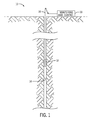
- FIG. 1 an apparatus 10 for evaluating cement quality in a well is depicted in FIG. 1 in accordance with one embodiment.
- a downhole tool 12 is suspended in a well 14 on a cable 16.
- the cable 16 may be a wireline cable with at least one conductor that enables data transmission between the downhole tool 12 and a monitoring and control system 18.
- the cable 16 may be raised and lowered within the well 14 in any suitable manner.
- the cable 16 can be reeled from a drum in a service truck, which may be a logging truck having the monitoring and control system 18.
- the downhole tool 12 is depicted in FIG. 1 as being deployed via a cable, the downhole tool 12 could be deployed within the well 14 in any other suitable manner.
- the apparatus 10 is shown in FIG. 1 at an onshore well 14, it will be appreciated that the apparatus 10 could be used with an offshore well in full accordance with the present techniques.
- the monitoring and control system 18 controls movement of the downhole tool 12 within the well 14 and receives data from the downhole tool 12.
- the monitoring and control system 18 can include one or more computer systems or devices.
- the system 18 can receive data from the downhole tool 12, and this data can be stored, communicated to an operator, or processed.
- FIG. 1 it is noted that the system 18 could be positioned elsewhere, and that the system 18 could be a distributed system with elements provided at different places near or remote from the well 14.
- a local component of the system 18 may be located at the wellsite for controlling operation of the downhole tool 12 and receiving data from the tool 12, but the received data could be processed by a different portion of the system 18 at another location.
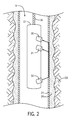
- the downhole tool 12 can take various forms, one example of which is depicted in FIG. 2 as an acoustic logging tool lowered within a casing 24 in the well 14.
- Cement 26 is provided in an annular space between the casing 24 (which may also be referred to as pipe 24) and a formation 28 penetrated by the well 14.
- the acoustic logging tool includes transducers 32, 34, and 36, which are provided in the form of ultrasonic transducers in at least some instances. In the particular arrangement depicted in FIG.
- the transducer 32 operates as an emitter (and may accordingly be referred to as an acoustic transmitter or an ultrasonic transmitter), while the transducers 34 and 36 operate as receivers (which may be referred to as acoustic or ultrasonic receivers). Based on their location relative to the transducer 32, the transducer 34 may also be referred to as the "near" receiver and the transducer 36 may be referred to as the "far" receiver.
- the transducer 32 can emit an ultrasonic pulse toward the casing 24 so as to excite a multi-modal Lamb wave within the casing 24, while transducers 34 and 36 can measure the resulting signals.
- the transducers 32, 34, and 36 may be arranged obliquely to facilitate this Lamb wave excitation and measurement.
- the transducer 32 may be angled toward the transducers 34 and 36 at an angle of incidence (with respect to the normal of the casing 24), and the transducers 34 and 36 can also be oriented toward the transducer 32 at that angle of incidence.
- the angle of incidence is selected so as to optimize the excitation and detection of a particular mode (e.g., a flexural mode) of the Lamb wave in the casing 24.
- the signals measured with the transducers 34 and 36 can be analyzed through various techniques, such as those described below, to facilitate cement evaluation by providing insight into the presence and condition of the cement 26 about the casing 24. Consequently, the acoustic logging tool of FIG. 2 may also be referred to as a cement evaluation tool.
- Data acquired with the transducers 34 and 36 can be communicated (e.g., in real time) to the monitoring and control system 18 at the surface via a wireline cable 16 in at least some embodiments. The data could also or instead be stored in a local memory device within the tool 12 for later collection.
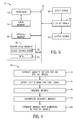
- the control and monitoring system 18 may be provided as a processor-based system, an example of which is depicted in FIG. 3 .
- the processor-based system 40 includes at least one processor 42 connected by a bus 44 to volatile memory 46 (e.g., random-access memory) and non-volatile memory 48 (e.g., flash memory).
- volatile memory 46 e.g., random-access memory
- non-volatile memory 48 e.g., flash memory
- Coded application instructions 50 and data 52 are stored in the non-volatile memory 48.
- the instructions 50 and the data 52 may also be loaded into the volatile memory 46 (or in a local memory 54 of the processor) as desired, such as to reduce latency and increase operating efficiency of the system 40.
- the coded application instructions 50 can be provided as software that may be executed by the processor 42 to enable various functionalities described herein, including analysis of signals received via the transducers 34 and 36 for casing cement evaluation.
- the system 18 may also be referred to as an analysis system.
- the application instructions 50 are encoded in a non-transitory, computer-readable storage medium, such as the volatile memory 46, the non-volatile memory 48, the local memory 54, or a portable storage device (e.g., a flash drive or a compact disc).
- An interface 56 of the system 40 enables communication between the processor 42 and various input devices 58 and output devices 60.
- the interface 56 can include any suitable device that enables such communication, such as a modem or a serial port.
- the input devices 58 include one or more sensing components of the downhole tool 12 (e.g., the transducers 34 and 36) and the output devices 60 include displays, printers, and storage devices that allow output of data received or generated by the system 40.
- the emitter i.e., transducer 32
- the emitter can send an oblique incident pulse exciting predominantly a zeroth-order anti-symmetric mode A0, also called the flexural mode, according to the way the energy propagates inside the wall of the pipe 24.
- A0 also called the flexural mode
- the acoustic wave leaks energy into both sides of the pipe wall and the amount of leakage depends on the material properties outside the pipe.
- an analysis of the recorded signals may provide valuable information to evaluate the cement quality.
- 2 t , t 0 ... T Strictly speaking, the terminology of symmetric SO and anti-symmetric AO modes refers just to attenuation-free plate waves (Lamb waves) in vacuum, but the present disclosure adopts the convention of labeling those waves whose real wavenumbers follow the corresponding classical Lamb plate waves by the same mode names (SO and AO).
- the tool 12 excites predominantly the zeroth-order symmetric mode S0, also called the extensional mode.
- This extensional mode is typically excited with a pulse center frequency lower that that used for exciting the AO mode.
- the choice of mode, AO versus S0 may be governed by considerations of spatial resolution, attenuation in the fluid, and sensitivity to the elastic properties of the cement.
- the measured signal can be represented again in the form of the weighted sum of equation (2).
- the results of dispersion relations for fluid-coupled plate waves can be used as approximations for the analysis of tube modes with a fluid- or solid-coupled external interface.
- the tool 12 emits an incident pulse from the transducer 32 toward the pipe 24 and concurrently excites both the zeroth-order anti-symmetric (flexural) mode AO and the zeroth-order symmetric (extensional) mode SO in the pipe 24.
- the emitted pulse is centered on a frequency of 20 kHz to 400 kHz (and is centered on a frequency of 250 kHz in at least one embodiment).
- the configuration of the tool 12 can be adjusted to favor one mode over the other, but in some cases the adjustment cannot completely annihilate one of the two modes because of the tool operational range.
- the signal may be processed in any suitable manner to separate these two modes.
- a quality factor Q-factor
- quality factor is estimated (block 72) for each of the AO (flexural) and SO (extensional) modes.
- quality factor is defined as the center-frequency-to-bandwidth ratio.
- the Q-factor for each mode can be computed from the dispersion characteristics of the individual modes and the ultrasonic transducer pulse spectrum.
- a filter bank is then created for each individual mode (block 74), with the design of the filter banks taking into account the quality factors and the dispersion characteristics of the individual modes.
- Signals may then be acquired (block 76), such as by either or both of transducers 34 and 36, and then decomposed (block 78) into series of coefficients using analysis filters of the filter banks.
- the separation of the signals into individual AO and SO signals (block 80) is then obtained by minimizing the error between the original signals and the sum of reconstructed individual signals, where the reconstructed individual signals can be provided as output of the synthesis filters applied to the optimized coefficients.
- the separation technique includes selecting a subset of coefficients produced by filtering via the first filter bank and a subset of coefficients produced by filtering via the second filter bank, such as by applying a threshold to discard lower-level coefficients.
- the selected subsets of coefficients can then be used to predict extensional mode and flexural mode waveforms that are based on the estimated quality factors for the individual modes. This prediction can include fitting a sum of reconstructed extensional mode and flexural mode waveforms to the acquired acoustic signal. Additional details regarding such processing are provided below.
- the frames F 1 and F 2 are respectively adapted to the Q-factor of AO and S0, as the Q-factor is a discriminant factor of zeroth-order Lamb modes signals.
- the Q-factor can be estimated by the signal bandwidth evaluated at - 6 dB below the maximum spectrum amplitude.
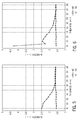
- FIGS. 5 and 6 show AO and SO mode Q-factors for the near ( FIG. 5 ) and far ( FIG. 6 ) receivers at one particular incident angle (28 degrees) in the tool configuration of FIG. 2 . While the Q-factors are given in FIGS. 5 and 6 for one particular incident angle, other incident angles may be used by the tool 12 and the Q-factors may differ in other embodiments. In general, the difference of Q-factor is more than 0.1 below 18 mm and close to 0 above 18 mm.
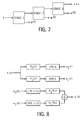
- FIG. 8 One example of a perfect reconstruction oversampled filter bank is generally represented in FIG. 8 , while iterative filtering using the filter bank is generally represented in FIG. 7 .
- the filter 8 includes an analysis filter bank (with analysis filters H 0 and H 1 ) shown in the top half of the figure and a synthesis filter bank (with synthesis filters H 0 * and H 1 *) shown in the bottom half.
- the filters H 0 and H 1 are also functions of the parameters ⁇ and ⁇ , such that ⁇ + ⁇ > 1, hence the oversampled characteristic.
- the blocks LPS and HPS are low-pass and high-pass scaling, and the subband signals v 0 and v 1 have sampling rates of ⁇ f s and ⁇ f s , respectively.
- Iterated filter bank decomposition is generally depicted in FIG. 7 , in which each stage includes the analysis filter bank depicted in FIG. 8 . It will be appreciated that iterated filter bank reconstruction may be generally represented as the reverse of the iterated decomposition.
- the first term (l 2 norm) is a fidelity term, ensuring that the decomposition has a small residual.
- the two other terms (l 1 norms) ensure that the components have a sparse representation in their respective frames.
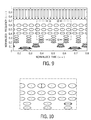
- tiling of the time-frequency plane is depicted in FIG. 9 for a Q-factor of 2.8 and an oversampling rate r of 3.1. For clarity, just some of the tiles are shown. With zero-phase filters H 0 and H 1 in FIG. 8 , the main axes of the tiles are either vertical or horizontal, as generally shown by the arrows in the detail view of FIG. 10 . This regular tiling is not well suited to decompose dispersive signals.
- l pipe is the propagation distance in the pipe (e.g., casing 24)
- ⁇ mud is the propagation time
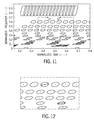
- the parameter ⁇ rotates the main axes of the tiles by a certain angle.
- the decomposition will locally match the slope of the group delay curve. Examples of theoretical group delay curves for both AO and SO modes for a particular pipe thickness of 16 mm are depicted in FIG. 13 . While both filters can be adapted to a group delay curve, in one implementation it is just the filter H 1 that is adapted to the group delay curve.
- the AO and SO signals may be separated in any suitable manner.
- Another example of a method for separating such signals is generally represented by flowchart 90 in FIG. 14 .
- the presently represented method includes various inputs, such as a waveform y of N samples (block 92), which may be detected via transducer 34 or 36 as a result of the excitation of a multi-modal Lamb wave excited in the pipe 24, as described above.
- Inputs may also include estimated quality factors Q 1 and Q 2 (block 94) for AO and SO waves, respectively; oversampling rates r 1 and r 2 (block 96) for AO and SO waves, respectively; and a desired number of iterations N it for signal decomposition (block 98).
- the method can also include computing phase and group velocity curves (via equations (9) and (10), for instance), as represented in block 106, as well as computing travel time ( ⁇ mud ) of an acoustic signal in a drilling mud or other logging fluid in the pipe 24, as represented in block 108.
- the filters may be defined based on estimated Q-factors for the AO and SO waves, as described above.
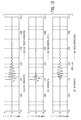
- a comparison of synthetic A0 and SO waves (i.e., simulated single-mode signals) with AO and SO waves reconstructed in accordance with the present techniques is depicted in the lower two plots of FIG. 15 , while the uppermost plot in FIG. 15 compares synthetic and reconstructed composites of the AO and SO waves.
Landscapes
- Life Sciences & Earth Sciences (AREA)
- Physics & Mathematics (AREA)
- Engineering & Computer Science (AREA)
- Geology (AREA)
- General Life Sciences & Earth Sciences (AREA)
- Environmental & Geological Engineering (AREA)
- Geophysics (AREA)
- Mining & Mineral Resources (AREA)
- Acoustics & Sound (AREA)
- Remote Sensing (AREA)
- General Physics & Mathematics (AREA)
- Fluid Mechanics (AREA)
- Quality & Reliability (AREA)
- Geochemistry & Mineralogy (AREA)
- Investigating Or Analyzing Materials By The Use Of Ultrasonic Waves (AREA)
Priority Applications (2)
| Application Number | Priority Date | Filing Date | Title |
|---|---|---|---|
| EP16306114.6A EP3290961A1 (de) | 2016-09-06 | 2016-09-06 | Trennung von biege- und dehn-modi in multimodalen akustischen signalen |
| US15/691,808 US20180067223A1 (en) | 2016-09-06 | 2017-08-31 | Separation of flexural and extensional modes in multi modal acoustic signals |
Applications Claiming Priority (1)
| Application Number | Priority Date | Filing Date | Title |
|---|---|---|---|
| EP16306114.6A EP3290961A1 (de) | 2016-09-06 | 2016-09-06 | Trennung von biege- und dehn-modi in multimodalen akustischen signalen |
Publications (1)
| Publication Number | Publication Date |
|---|---|
| EP3290961A1 true EP3290961A1 (de) | 2018-03-07 |
Family
ID=56939983
Family Applications (1)
| Application Number | Title | Priority Date | Filing Date |
|---|---|---|---|
| EP16306114.6A Withdrawn EP3290961A1 (de) | 2016-09-06 | 2016-09-06 | Trennung von biege- und dehn-modi in multimodalen akustischen signalen |
Country Status (2)
| Country | Link |
|---|---|
| US (1) | US20180067223A1 (de) |
| EP (1) | EP3290961A1 (de) |
Cited By (3)
| Publication number | Priority date | Publication date | Assignee | Title |
|---|---|---|---|---|
| CN109409194A (zh) * | 2018-08-30 | 2019-03-01 | 中国航发湖南动力机械研究所 | 多模态时域信号模态分离、阻尼参数辨识方法及存储介质 |
| EP3995865A1 (de) * | 2020-11-06 | 2022-05-11 | Services Pétroliers Schlumberger | Automatische erkennung von umgebungsparametern mit azimutal verteilten wandlern |
| CN116399960A (zh) * | 2023-04-20 | 2023-07-07 | 江苏大学 | 一种金属薄板中宽频带激光超声Lamb波衰减系数的实测方法 |
Families Citing this family (8)
| Publication number | Priority date | Publication date | Assignee | Title |
|---|---|---|---|---|
| CN108921113A (zh) * | 2018-07-10 | 2018-11-30 | 南京信息工程大学 | 基于分数阶微分的多模式兰姆波信号分离方法 |
| CN110333285B (zh) * | 2019-07-04 | 2021-07-27 | 大连海洋大学 | 基于变分模态分解的超声兰姆波缺陷信号识别方法 |
| GB2592974A (en) * | 2020-03-12 | 2021-09-15 | Equanostic As | Method for differentiating materials on a remote side of a partition based on the attenuation of the ultrasonic extensional zero mode |
| GB2609627A (en) | 2021-08-09 | 2023-02-15 | Equanostic As | Method for determining if a wellbore consists of micro annulus, free pipe or solid bonding between the wellbore and a casing |
| CN115992690B (zh) * | 2023-03-24 | 2023-06-06 | 中海油田服务股份有限公司 | 一种随钻超声兰姆波成像测井装置及测井方法 |
| US12270296B2 (en) * | 2023-08-03 | 2025-04-08 | Halliburton Energy Services, Inc. | Cement evaluation |
| US12704063B2 (en) | 2023-11-30 | 2026-08-11 | Halliburton Energy Services, Inc. | Computing A0 mode attenuation for cement evaluation in cased wells |
| US20250305406A1 (en) * | 2024-03-26 | 2025-10-02 | Halliburton Energy Services, Inc. | Cement Evaluation With Coated Pipe |
Citations (3)
| Publication number | Priority date | Publication date | Assignee | Title |
|---|---|---|---|---|
| US20090067286A1 (en) * | 2007-09-12 | 2009-03-12 | Schlumberger Technology Corporation | Dispersion extraction for acoustic data using time frequency analysis |
| US20120069705A1 (en) * | 2008-11-10 | 2012-03-22 | Baker Hughes Incorporated | EMAT Acoustic Signal Measurement Using Modulated Gaussian Wavelet and Hilbert Demodulation |
| US20160209539A1 (en) * | 2014-11-14 | 2016-07-21 | Schlumberger Technology Corporation | Method for Separating Multi-Modal Acoustic Measurements for Evaluating Multilayer Structures |
Family Cites Families (5)
| Publication number | Priority date | Publication date | Assignee | Title |
|---|---|---|---|---|
| DE60301734D1 (de) * | 2003-08-08 | 2006-02-09 | Schlumberger Technology Bv | Multimodale akustische Bilderzeugung in verrohrten Bohrlöchern |
| EP1672168B1 (de) * | 2004-12-20 | 2008-02-06 | Services Petroliers Schlumberger | Bestimmung der Impedanz eines hinter einer Futterrohrung sich befindenden Materials durch Kombination zweier Sätze von Ultraschallmessungen |
| US9115568B2 (en) * | 2009-09-29 | 2015-08-25 | Schlumberger Technology Corporation | Reduction of tool mode and drilling noise in acoustic LWD |
| US9927541B2 (en) * | 2014-04-15 | 2018-03-27 | Schlumberger Technology Corporation | Apparatus for monopole and multipole sonic logging of a downhole formation |
| US9732607B2 (en) * | 2014-08-18 | 2017-08-15 | Schlumberger Technology Corporation | Methods and apparatus for evaluating properties of cement utilizing ultrasonic signal testing |
-
2016
- 2016-09-06 EP EP16306114.6A patent/EP3290961A1/de not_active Withdrawn
-
2017
- 2017-08-31 US US15/691,808 patent/US20180067223A1/en not_active Abandoned
Patent Citations (3)
| Publication number | Priority date | Publication date | Assignee | Title |
|---|---|---|---|---|
| US20090067286A1 (en) * | 2007-09-12 | 2009-03-12 | Schlumberger Technology Corporation | Dispersion extraction for acoustic data using time frequency analysis |
| US20120069705A1 (en) * | 2008-11-10 | 2012-03-22 | Baker Hughes Incorporated | EMAT Acoustic Signal Measurement Using Modulated Gaussian Wavelet and Hilbert Demodulation |
| US20160209539A1 (en) * | 2014-11-14 | 2016-07-21 | Schlumberger Technology Corporation | Method for Separating Multi-Modal Acoustic Measurements for Evaluating Multilayer Structures |
Non-Patent Citations (2)
| Title |
|---|
| RICCARDO BERNARDINI ET AL: "Arbitrary Tilings of the Time-Frequency Plane Using Local Bases", IEEE TRANSACTIONS ON SIGNAL PROCESSING, IEEE SERVICE CENTER, NEW YORK, NY, US, vol. 47, no. 8, 1 August 1999 (1999-08-01), XP011058646, ISSN: 1053-587X * |
| ROBERT VAN KUIJK ET AL: "A Novel Ultrasonic Cased-Hole Imager for Enhanced Cement Evaluation", PROCEEDINGS OF INTERNATIONAL PETROLEUM TECHNOLOGY CONFERENCE, 1 January 2005 (2005-01-01), XP055064256, ISBN: 978-1-55-563991-4, DOI: 10.2523/10546-MS * |
Cited By (5)
| Publication number | Priority date | Publication date | Assignee | Title |
|---|---|---|---|---|
| CN109409194A (zh) * | 2018-08-30 | 2019-03-01 | 中国航发湖南动力机械研究所 | 多模态时域信号模态分离、阻尼参数辨识方法及存储介质 |
| CN109409194B (zh) * | 2018-08-30 | 2020-12-01 | 中国航发湖南动力机械研究所 | 多模态时域信号模态分离、阻尼参数辨识方法及存储介质 |
| EP3995865A1 (de) * | 2020-11-06 | 2022-05-11 | Services Pétroliers Schlumberger | Automatische erkennung von umgebungsparametern mit azimutal verteilten wandlern |
| US11947064B2 (en) | 2020-11-06 | 2024-04-02 | Schlumberger Technology Corporation | Automatic recognition of environmental parameters with azimuthally distributed transducers |
| CN116399960A (zh) * | 2023-04-20 | 2023-07-07 | 江苏大学 | 一种金属薄板中宽频带激光超声Lamb波衰减系数的实测方法 |
Also Published As
| Publication number | Publication date |
|---|---|
| US20180067223A1 (en) | 2018-03-08 |
Similar Documents
| Publication | Publication Date | Title |
|---|---|---|
| US20180067223A1 (en) | Separation of flexural and extensional modes in multi modal acoustic signals | |
| US20220351037A1 (en) | Method and system for spectroscopic prediction of subsurface properties using machine learning | |
| US20160349389A1 (en) | Method for developing a geomechanical model based on seismic data, well logs and sem analysis of horizontal and vertical drill cuttings | |
| US8243549B2 (en) | Estimating seismic anisotropy of shales | |
| GB2560228A (en) | Improved method of and apparatus for carrying out acoustic well logging | |
| US20160109603A1 (en) | Method and apparatus for characterizing elastic anisotropy for transversely isotropic unconventional shale | |
| US20170168179A1 (en) | Resonance-based inversion of acoustic impedance of annulus behind casing | |
| WO2016187240A1 (en) | Method for analyzing cement integrity in cased wells using sonic logging | |
| US8630146B2 (en) | Method and apparatus for estimating formation permeability and electroacoustic constant of an electrolyte-saturated multi-layered rock taking into account osmosis | |
| US20180031718A1 (en) | Real-time pattern recognition and automatic interpretation of acoustic reflection images | |
| CN106460507A (zh) | 导波井下流体传感器 | |
| US20190242221A1 (en) | Method to predict reservoir formation permeability using combined acoustic and multi-frequency dielectric measurements | |
| US10094945B2 (en) | Formation measurements using nonlinear guided waves | |
| US12523791B2 (en) | Randomly quantized seismic data reconstruction using LSTM network | |
| NO20260431A1 (en) | Computing a0 mode attenuation for cement evaluation in cased wells | |
| US20180045845A1 (en) | Method and system for processing sonic data acquired with a downhole tool | |
| US20250003325A1 (en) | Method and system for predicting hydrocarbon data for unconventional reservoirs using machine learning | |
| US20180031722A1 (en) | Systems and methods employing a menu-based graphical user interface (gui) to derive a shear slowness log | |
| US20240376812A1 (en) | Enhancing Borehole Resonance Signal For Through Tubing Cement Evaluation | |
| US20250305406A1 (en) | Cement Evaluation With Coated Pipe | |
| Maalouf et al. | Direct Inversion of Wellbore Acoustic Waveforms Using Convolutional Neural Networks | |
| US20260093055A1 (en) | Sequential residual symbolic regression for modeling formation evaluation and reservoir fluid parameters | |
| US20250223900A1 (en) | Borehole resonance mode for cement evaluation using machine learning | |
| US20260086258A1 (en) | Blue-Shift Of Resonance Frequency To Detect Fluid Channel Behind Cemented Casing | |
| US20250130343A1 (en) | Fast q filter estimation in acoustic waveform inversion |
Legal Events
| Date | Code | Title | Description |
|---|---|---|---|
| PUAI | Public reference made under article 153(3) epc to a published international application that has entered the european phase |
Free format text: ORIGINAL CODE: 0009012 |
|
| AK | Designated contracting states |
Kind code of ref document: A1 Designated state(s): AL AT BE BG CH CY CZ DE DK EE ES FI FR GB GR HR HU IE IS IT LI LT LU LV MC MK MT NL NO PL PT RO RS SE SI SK SM TR |
|
| AX | Request for extension of the european patent |
Extension state: BA ME |
|
| STAA | Information on the status of an ep patent application or granted ep patent |
Free format text: STATUS: THE APPLICATION IS DEEMED TO BE WITHDRAWN |
|
| 18D | Application deemed to be withdrawn |
Effective date: 20180908 |