EP3291553A1 - Verfahren und vorrichtung zur videocodierung mit probenadaptivem offset - Google Patents
Verfahren und vorrichtung zur videocodierung mit probenadaptivem offset Download PDFInfo
- Publication number
- EP3291553A1 EP3291553A1 EP16306095.7A EP16306095A EP3291553A1 EP 3291553 A1 EP3291553 A1 EP 3291553A1 EP 16306095 A EP16306095 A EP 16306095A EP 3291553 A1 EP3291553 A1 EP 3291553A1
- Authority
- EP
- European Patent Office
- Prior art keywords
- category
- samples
- sub
- categories
- values
- Prior art date
- Legal status (The legal status is an assumption and is not a legal conclusion. Google has not performed a legal analysis and makes no representation as to the accuracy of the status listed.)
- Withdrawn
Links
- 238000000034 method Methods 0.000 title claims description 88
- 230000003044 adaptive effect Effects 0.000 title abstract description 3
- 238000012545 processing Methods 0.000 claims description 8
- 230000011664 signaling Effects 0.000 claims description 8
- 230000001955 cumulated effect Effects 0.000 description 13
- OSWPMRLSEDHDFF-UHFFFAOYSA-N methyl salicylate Chemical compound COC(=O)C1=CC=CC=C1O OSWPMRLSEDHDFF-UHFFFAOYSA-N 0.000 description 13
- 230000000875 corresponding effect Effects 0.000 description 11
- 238000001914 filtration Methods 0.000 description 11
- 239000013598 vector Substances 0.000 description 11
- 241000023320 Luma <angiosperm> Species 0.000 description 10
- 238000004891 communication Methods 0.000 description 10
- 238000010586 diagram Methods 0.000 description 5
- 238000012360 testing method Methods 0.000 description 5
- 238000013139 quantization Methods 0.000 description 4
- 230000006835 compression Effects 0.000 description 2
- 238000007906 compression Methods 0.000 description 2
- 238000012937 correction Methods 0.000 description 2
- 230000006870 function Effects 0.000 description 2
- 230000003287 optical effect Effects 0.000 description 2
- 238000000638 solvent extraction Methods 0.000 description 2
- 101150114515 CTBS gene Proteins 0.000 description 1
- 230000002596 correlated effect Effects 0.000 description 1
- 230000001186 cumulative effect Effects 0.000 description 1
- 238000013500 data storage Methods 0.000 description 1
- 238000005516 engineering process Methods 0.000 description 1
- 238000002474 experimental method Methods 0.000 description 1
- 238000000265 homogenisation Methods 0.000 description 1
- 238000005457 optimization Methods 0.000 description 1
- 238000005192 partition Methods 0.000 description 1
- 229920001690 polydopamine Polymers 0.000 description 1
- 238000003672 processing method Methods 0.000 description 1
- 238000007670 refining Methods 0.000 description 1
- 239000004065 semiconductor Substances 0.000 description 1
- 238000001228 spectrum Methods 0.000 description 1
- 230000002123 temporal effect Effects 0.000 description 1
Images






Classifications
-
- H—ELECTRICITY
- H04—ELECTRIC COMMUNICATION TECHNIQUE
- H04N—PICTORIAL COMMUNICATION, e.g. TELEVISION
- H04N19/00—Methods or arrangements for coding, decoding, compressing or decompressing digital video signals
- H04N19/10—Methods or arrangements for coding, decoding, compressing or decompressing digital video signals using adaptive coding
- H04N19/102—Methods or arrangements for coding, decoding, compressing or decompressing digital video signals using adaptive coding characterised by the element, parameter or selection affected or controlled by the adaptive coding
- H04N19/132—Sampling, masking or truncation of coding units, e.g. adaptive resampling, frame skipping, frame interpolation or high-frequency transform coefficient masking
-
- H—ELECTRICITY
- H04—ELECTRIC COMMUNICATION TECHNIQUE
- H04N—PICTORIAL COMMUNICATION, e.g. TELEVISION
- H04N19/00—Methods or arrangements for coding, decoding, compressing or decompressing digital video signals
- H04N19/10—Methods or arrangements for coding, decoding, compressing or decompressing digital video signals using adaptive coding
- H04N19/102—Methods or arrangements for coding, decoding, compressing or decompressing digital video signals using adaptive coding characterised by the element, parameter or selection affected or controlled by the adaptive coding
- H04N19/117—Filters, e.g. for pre-processing or post-processing
-
- H—ELECTRICITY
- H04—ELECTRIC COMMUNICATION TECHNIQUE
- H04N—PICTORIAL COMMUNICATION, e.g. TELEVISION
- H04N19/00—Methods or arrangements for coding, decoding, compressing or decompressing digital video signals
- H04N19/10—Methods or arrangements for coding, decoding, compressing or decompressing digital video signals using adaptive coding
- H04N19/102—Methods or arrangements for coding, decoding, compressing or decompressing digital video signals using adaptive coding characterised by the element, parameter or selection affected or controlled by the adaptive coding
- H04N19/124—Quantisation
-
- H—ELECTRICITY
- H04—ELECTRIC COMMUNICATION TECHNIQUE
- H04N—PICTORIAL COMMUNICATION, e.g. TELEVISION
- H04N19/00—Methods or arrangements for coding, decoding, compressing or decompressing digital video signals
- H04N19/10—Methods or arrangements for coding, decoding, compressing or decompressing digital video signals using adaptive coding
- H04N19/134—Methods or arrangements for coding, decoding, compressing or decompressing digital video signals using adaptive coding characterised by the element, parameter or criterion affecting or controlling the adaptive coding
- H04N19/136—Incoming video signal characteristics or properties
-
- H—ELECTRICITY
- H04—ELECTRIC COMMUNICATION TECHNIQUE
- H04N—PICTORIAL COMMUNICATION, e.g. TELEVISION
- H04N19/00—Methods or arrangements for coding, decoding, compressing or decompressing digital video signals
- H04N19/10—Methods or arrangements for coding, decoding, compressing or decompressing digital video signals using adaptive coding
- H04N19/134—Methods or arrangements for coding, decoding, compressing or decompressing digital video signals using adaptive coding characterised by the element, parameter or criterion affecting or controlling the adaptive coding
- H04N19/157—Assigned coding mode, i.e. the coding mode being predefined or preselected to be further used for selection of another element or parameter
- H04N19/159—Prediction type, e.g. intra-frame, inter-frame or bidirectional frame prediction
-
- H—ELECTRICITY
- H04—ELECTRIC COMMUNICATION TECHNIQUE
- H04N—PICTORIAL COMMUNICATION, e.g. TELEVISION
- H04N19/00—Methods or arrangements for coding, decoding, compressing or decompressing digital video signals
- H04N19/10—Methods or arrangements for coding, decoding, compressing or decompressing digital video signals using adaptive coding
- H04N19/169—Methods or arrangements for coding, decoding, compressing or decompressing digital video signals using adaptive coding characterised by the coding unit, i.e. the structural portion or semantic portion of the video signal being the object or the subject of the adaptive coding
- H04N19/17—Methods or arrangements for coding, decoding, compressing or decompressing digital video signals using adaptive coding characterised by the coding unit, i.e. the structural portion or semantic portion of the video signal being the object or the subject of the adaptive coding the unit being an image region, e.g. an object
- H04N19/176—Methods or arrangements for coding, decoding, compressing or decompressing digital video signals using adaptive coding characterised by the coding unit, i.e. the structural portion or semantic portion of the video signal being the object or the subject of the adaptive coding the unit being an image region, e.g. an object the region being a block, e.g. a macroblock
-
- H—ELECTRICITY
- H04—ELECTRIC COMMUNICATION TECHNIQUE
- H04N—PICTORIAL COMMUNICATION, e.g. TELEVISION
- H04N19/00—Methods or arrangements for coding, decoding, compressing or decompressing digital video signals
- H04N19/10—Methods or arrangements for coding, decoding, compressing or decompressing digital video signals using adaptive coding
- H04N19/169—Methods or arrangements for coding, decoding, compressing or decompressing digital video signals using adaptive coding characterised by the coding unit, i.e. the structural portion or semantic portion of the video signal being the object or the subject of the adaptive coding
- H04N19/182—Methods or arrangements for coding, decoding, compressing or decompressing digital video signals using adaptive coding characterised by the coding unit, i.e. the structural portion or semantic portion of the video signal being the object or the subject of the adaptive coding the unit being a pixel
-
- H—ELECTRICITY
- H04—ELECTRIC COMMUNICATION TECHNIQUE
- H04N—PICTORIAL COMMUNICATION, e.g. TELEVISION
- H04N19/00—Methods or arrangements for coding, decoding, compressing or decompressing digital video signals
- H04N19/70—Methods or arrangements for coding, decoding, compressing or decompressing digital video signals characterised by syntax aspects related to video coding, e.g. related to compression standards
-
- H—ELECTRICITY
- H04—ELECTRIC COMMUNICATION TECHNIQUE
- H04N—PICTORIAL COMMUNICATION, e.g. TELEVISION
- H04N19/00—Methods or arrangements for coding, decoding, compressing or decompressing digital video signals
- H04N19/80—Details of filtering operations specially adapted for video compression, e.g. for pixel interpolation
- H04N19/82—Details of filtering operations specially adapted for video compression, e.g. for pixel interpolation involving filtering within a prediction loop
-
- H—ELECTRICITY
- H04—ELECTRIC COMMUNICATION TECHNIQUE
- H04N—PICTORIAL COMMUNICATION, e.g. TELEVISION
- H04N19/00—Methods or arrangements for coding, decoding, compressing or decompressing digital video signals
- H04N19/85—Methods or arrangements for coding, decoding, compressing or decompressing digital video signals using pre-processing or post-processing specially adapted for video compression
- H04N19/86—Methods or arrangements for coding, decoding, compressing or decompressing digital video signals using pre-processing or post-processing specially adapted for video compression involving reduction of coding artifacts, e.g. of blockiness
Definitions
- the present embodiments generally relate to a method and an apparatus for video encoding and decoding, and more particularly, to a method and an apparatus for video encoding and decoding with Sample Adaptive Offset (SAO).
- SAO Sample Adaptive Offset
- image and video coding schemes usually employ prediction and transform to leverage spatial and temporal redundancy in the video content.
- intra or inter prediction is used to exploit the intra or inter frame correlation, then the differences between the original image and the predicted image, often denoted as prediction errors or prediction residuals, are transformed, quantized and entropy coded.
- the compressed data is decoded by inverse processes corresponding to the prediction, transform, quantization and entropy coding.
- in-loop filtering can be applied after reconstruction of the coding blocks.
- the filtered reconstructed picture can be stored in the decoded picture buffer for output and for prediction if indicated.
- Different in-loop filters can be used. For example, in High Efficiency Video Coding (HEVC), two consecutive in-loop filters are specified. First, a deblocking filter is applied to block edges in order to reduce the amount of visible blockiness artifacts. In addition, SAO filtering is applied. SAO classifies reconstructive samples into different categories, obtains an offset for each category, and then adds the offset to each sample of the category. SAO filtering can further reduce coding artifacts.
- HEVC High Efficiency Video Coding
- a method for processing video data comprising: accessing a subset of samples in a region of a picture; dividing the subset of samples into at least a first sub-category and a second sub-category, using statistics of sample values in the subset of samples such that the number of samples in the first sub-category meets a condition; and adjusting values of samples in the first sub-category based on a first offset, and adjusting values of samples in the second sub-category based on a second offset.
- the first sub-category and the second sub-category may be divided at a first sample value that is a largest sample value among a set of sample values, each one of the set of sample values, N1, satisfying a first condition: the number of samples whose values are smaller than N1, is smaller than a first percentage of the number of samples in the subset, and wherein samples in the subset smaller than the first sample value are in the first sub-category.
- the first sub-category and the second sub-category may also divided at a second sample value that is a smallest sample value among a set of sample values, each one of the set of sample values, N2, satisfying a second condition: the number of samples whose values are smaller than N2, is larger than a second percentage of the number of samples in the subset, and wherein samples in the subset smaller than the second sample value are in the first sub-category.
- the first sub-category may have substantially the same number of samples as the second sub-category.
- a video signal is formatted to include an encoding of a subset of samples in a region of a picture, wherein the subset of samples includes at least a first sub-category and a second sub-category, and wherein the number of samples in the first sub-category meets a condition; and a second offset used to adjust values of samples in the second sub-category.
- the region of the picture may be a coding tree block, a slice, or different coding units.
- the dividing may be based on a histogram of sample values.
- the method may be used for in-loop filtering for encoding or decoding.
- the first offset and the second offset may be further encoded into a bitstream; and when used for decoding, the first offset and the second offset may be decoded from the bitstream.
- the region of the picture includes two or more categories of samples, a first category having the most number of samples among the two or more categories, and a second category having the least number of samples among the two or more categories, and wherein the first category corresponds to the subset of samples, the method further comprises adjusting values of samples in categories remaining in the two or more categories after excluding the first category.
- the remaining categories may further exclude the second category.
- the first category may be a first band of sample values and the second category may be a second band of sample values, and the first band and the second band may have a same range of sample values.
- At least one of the number of samples in the first sub-category and the number of samples in the second sub-category can be compared with the number of samples in the second category.
- the dividing may be performed, without explicit signaling. Otherwise, the dividing may be disabled without explicit signaling.
- the dividing may also be performed or be disabled based on explicit signaling.
- the first sub-category is associated with a first range of sample values
- the second sub-category is associated with a second range of sample values
- the first sub-category is associated with a first range of gradient-based values
- the second sub-category is associated with a second range of gradient-based values.
- the gradient-based values may be calculated as the average of the absolute values of the gradients, the difference of the absolute values of the gradients, the minimum of the absolute values of the gradients, or the maximum of the absolute values of the gradients.
- the first sub-category and the second sub-category of samples are adjusted by positive offsets without explicit signaling of signs. According to another embodiment, the first sub-category and the second sub-category of samples are adjusted by negative offsets without explicit signaling of signs.
- the present embodiments also provide an apparatus for processing video data according to the methods described above.
- the present embodiments also provide a computer readable storage medium having stored thereon instructions for processing video data according to the methods described above.
- the present embodiments also provide a computer readable storage medium having stored thereon a bitstream generated according to the methods described above.
- the present embodiments also provide an apparatus for transmitting the video signal generated according to the methods described above.
- FIG. 1 illustrates an exemplary HEVC encoder 100.
- a picture is partitioned into one or more slices where each slice can include one or more slice segments.
- a slice segment is organized into coding units, prediction units and transform units.
- the terms “reconstructed” and “decoded” may be used interchangeably. Usually but not necessarily the term “reconstructed” is used at the encoder side while “decoded” is used at the decoder side.
- the HEVC specification distinguishes between “blocks” and “units,” where a “block” addresses a specific area in a sample array (e.g., luma, Y), and the “unit” includes the collocated block of all encoded color components (Y, Cb, Cr, or monochrome), syntax elements and prediction data that are associated with the block (e.g., motion vectors).
- a "block” addresses a specific area in a sample array (e.g., luma, Y)
- the “unit” includes the collocated block of all encoded color components (Y, Cb, Cr, or monochrome), syntax elements and prediction data that are associated with the block (e.g., motion vectors).
- a picture is partitioned into coding tree blocks (CTB) of square shape with a configurable size, and a consecutive set of coding tree blocks is grouped into a slice.
- a Coding Tree Unit (CTU) contains the CTBs of the encoded color components.
- a CTB is the root of a quadtree partitioning into Coding Blocks (CB), and a Coding Block is partitioned into one or more Prediction Blocks (PB) and forms the root of a quadtree partitioning into Transform Blocks (TBs).
- CB Coding Tree Unit
- PB Prediction Blocks
- TBs Transform Blocks
- a Coding Unit includes the Prediction Units (PUs) and the tree-structured set of Transform Units (TUs), a PU includes the prediction information for all color components, and a TU includes residual coding syntax structure for each color component.
- the size of a CB, PB and TB of the luma component applies to the corresponding CU, PU and TU.
- the term "block” can be used to refer to any of CTU, CU, PU, TU, CB, PB and TB.
- the "block” can also be used to refer to a macroblock, a partition and a sub-block as specified in H.264/AVC or other video coding standards, and more generally to refer to an array of data of various sizes.
- a picture is encoded by the encoder elements as described below.
- the picture to be encoded is processed in units of CUs.
- Each CU is encoded using either an intra or inter mode.
- intra prediction 160
- inter mode motion estimation (175) and compensation (170) are performed.
- the encoder decides (105) which one of the intra mode or inter mode to use for encoding the CU, and indicates the intra/inter decision by a prediction mode flag. Prediction residuals are calculated by subtracting (110) the predicted block from the original image block.
- CUs in intra mode are predicted from reconstructed neighboring samples within the same slice.
- a set of 35 intra prediction modes is available in HEVC, including a DC, a planar and 33 angular prediction modes.
- the intra prediction reference is reconstructed from the row and column adjacent to the current block. The reference extends over two times the block size in horizontal and vertical direction using available samples from previously reconstructed blocks.
- reference samples can be copied along the direction indicated by the angular prediction mode.
- the applicable luma intra prediction mode for the current block can be coded using two different options. If the applicable mode is included in a constructed list of three most probable modes (MPM), the mode is signaled by an index in the MPM list. Otherwise, the mode is signaled by a fixed-length binarization of the mode index.
- the three most probable modes are derived from the intra prediction modes of the top and left neighboring blocks.
- the corresponding coding block is further partitioned into one or more prediction blocks. Inter prediction is performed on the PB level, and the corresponding PU contains the information about how inter prediction is performed.
- the motion information i.e., motion vector and reference picture index
- AMVP advanced motion vector prediction
- a video encoder or decoder In the merge mode, a video encoder or decoder assembles a candidate list based on already coded blocks, and the video encoder signals an index for one of the candidates in the candidate list.
- the motion vector (MV) and the reference picture index are reconstructed based on the signaled candidate.
- AMVP a video encoder or decoder assembles candidate lists based on motion vectors determined from already coded blocks.
- the video encoder then signals an index in the candidate list to identify a motion vector predictor (MVP) and signals a motion vector difference (MVD).
- MVP motion vector predictor
- MVD motion vector difference
- the motion vector (MV) is reconstructed as MVP+MVD.
- the precision of the motion information for motion compensation is one quarter-sample (also referred to as quarter-pel or 1/4-pel) for the luma component and one eighth-sample (also referred to as 1/8-pel) for the chroma components.
- a 7-tap or 8-tap interpolation filter is used for interpolation of fractional-sample positions, i.e., 1/4, 1/2 and 3/4 of full sample locations in both horizontal and vertical directions can be addressed for luma.
- the prediction residuals are then transformed (125) and quantized (130).
- the quantized transform coefficients, as well as motion vectors and other syntax elements, are entropy coded (145) to output a bitstream.
- the encoder may also skip the transform and apply quantization directly to the non-transformed residual signal on a 4x4 TU basis.
- the encoder may also bypass both transform and quantization, i.e., the residual is coded directly without the application of the transform or quantization process. In direct PCM coding, no prediction is applied and the coding unit samples are directly coded into the bitstream.
- the encoder decodes an encoded block to provide a reference for further predictions.
- the quantized transform coefficients are de-quantized (140) and inverse transformed (150) to decode prediction residuals.
- In-loop filters (165) are applied to the reconstructed picture, for example, to perform deblocking/SAO filtering to reduce encoding artifacts.
- the filtered image is stored at a reference picture buffer (180).
- FIG. 2 illustrates a block diagram of an exemplary HEVC video decoder 200.
- a bitstream is decoded by the decoder elements as described below.
- Video decoder 200 generally performs a decoding pass reciprocal to the encoding pass as described in FIG. 1 , which performs video decoding as part of encoding video data.
- the input of the decoder includes a video bitstream, which may be generated by video encoder 100.
- the bitstream is first entropy decoded (230) to obtain transform coefficients, motion vectors, and other coded information.
- the transform coefficients are de-quantized (240) and inverse transformed (250) to decode the prediction residuals.
- Combining (255) the decoded prediction residuals and the predicted block an image block is reconstructed.
- the predicted block may be obtained (270) from intra prediction (260) or motion-compensated prediction (i.e., inter prediction) (275).
- AMVP and merge mode techniques may be used to derive motion vectors for motion compensation, which may use interpolation filters to calculate interpolated values for sub-integer samples of a reference block.
- In-loop filters (265) are applied to the reconstructed image.
- the filtered image is stored at a reference picture buffer (280).
- SAO is a sample-based filtering operation on a CTU basis. SAO is applied right after the deblocking filter if activated. SAO can be deactivated per CTU.
- Two SAO modes are specified: edge offset (EO) and band offset (BO).
- EO edge offset
- BO band offset
- SAO the sample classification is based on local directional structures in the picture to be filtered.
- the parameters for EO or BO may be explicitly coded or derived from the neighborhood.
- SAO can be applied to the luma and chroma components, where the SAO mode is the same for Cb and Cr components.
- the SAO parameters are configured individually for each color component.
- EO uses four 1-D directional patterns: horizontal, vertical, 135° diagonal, and 45° diagonal, as shown in FIG. 3 , for sample classification, where the label "p c " represents a current sample and the labels "p 0 " and "p 1 " represent two neighboring samples.
- Four EO classes are specified based on the directions, and each EO class corresponds to one direction. The selected EO class is signaled in the bitstream as side information.
- the categorization rules for a sample are summarized in TABLE 1. As also shown in FIG. 4 , categories 1 and 4 are associated with a local valley and a local peak along the selected 1-D pattern, respectively, categories 2 and 3 are associated with concave and convex corners along the selected 1-D pattern, respectively.
- the current sample value does not belong to categories 1- 4 (i.e., the current sample value is the same as its two neighbors, or if p 0 ⁇ p c ⁇ p 1 or p 0 > p c > p 1 ), then it is in category 0 and SAO is not applied (i.e., offset is 0).
- offsets are encoded.
- a category with an offset encoded may be referred to as a "signaled category.”
- Only offsets of four consecutive bands and the starting band position are signaled to the decoder.
- the starting band position indicates the position of the first band with an encoded offset.
- One offset is coded for each of the (NC - 1) bands and the remaining bands have an offset equal to zero.
- the offset values may correspond to non-consecutive bands as depicted in an example of FIG. 5B since the bands are managed as a circular buffer.
- those four signaled bands can be considered as four categories, and the remaining bands can be considered as another category.
- band and “category” interchangeably.
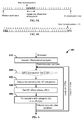
- FIG. 6 illustrates an exemplary method 600 for decoding a bitstream using SAO.
- the bitstream is decoded (610)
- the reconstructed samples are further filtered using SAO.
- the term "decoded” or "reconstructed” may mean that a bitstream is partially “decoded,” for example, the signals obtained after deblocking filtering but before SAO filtering, and the reconstructed samples may be different from the final decoded output that is used for display.
- the encoder may perform a similar process as method 600.
- step 610 is implemented to obtain the reconstructed samples, for example, the SAO filtering process uses the reconstructed samples from the deblocking filter as input.
- the offset values are encoded in the bitstream.
- the filtered reconstructed samples can be used as references for other pictures.
- FIG. 7A illustrates a portion of a picture that includes a CTB at position (rx, ry), and a neighboring left CTB at position (rx - 1, ry) and a neighboring above CTB at position (rx, ry - 1).
- the SAO parameters are either encoded explicitly in the bitstream or derived from previous encoded neighboring left or above CTUs (merge modes).
- FIG. 7B illustrates an exemplary method 700 for obtaining the SAO parameters.
- syntax element sao_merge_left_flag can be decoded (710) from the bitstream. If sao_merge_left_flag equals 1 (720), the SAO parameters of the neighboring left CTB are used for the current CTB (760), and the decoding moves on to the next CTB. If sao_merge_left_flag equals 0, syntax element sao_merge_up_flag can be decoded (730) from the bitstream. If sao_merge_up_flag equals 1 (740), the SAO parameters of the neighboring above CTB are used for the current CTB (770), and the decoding moves on to the next CTB. If neither of syntax elements sao_merge_left_flag or sao_merge_up_flag is equal to 1, the SAO parameters for the current CTB are decoded (750) from the bitstream.
- FIG. 8 illustrates an exemplary method 800 for decoding the SAO parameters for the luma component of the current CTB at position (rx, ry).
- the SAO parameters for the chroma components can be decoded similarly.
- Method 800 can be used to perform step 750 in method 700.
- saoTypeIdx[0][rx][ry] equals 1 (840)
- BO is applied, and the decoder decodes (860, 870) up to four offset signs (sao_offset_sign[0][rx]ry][i]) for non-zero offset values and the starting band position (sao_band_position[0][rx][ry]).
- saoTypeIdx[0][rx][ry] is not equal to 1 (840)
- SAO EO class sinao_eo_class_luma
- the category can be decided as shown in TABLE 1 and the sign for an offset can be inferred from the category as described before.
- the present principles are directed to SAO in video encoding and decoding.
- the SAO categories can be redefined depending on the statistics of the reconstructed samples.
- FIG. 9 illustrates a histogram for an exemplary CTB and the associated 32 SAO bands, wherein a bar in the histogram counts the number of samples in a band.
- the starting band position for signaling offsets is also indicated in FIG. 9 .
- offsets are encoded for 4 bands: c 1 , c 2 , c 3 and c 4 .
- an offset is encoded, there is an encoding cost associated with encoding the offset value.
- the sample values in the corresponding category may be corrected and thus artifacts may be reduced.
- the efficiency of SAO is a trade-off between the encoding cost of the offset value and the artifact reduction brought by correction of the sample values. When there are more samples in one category, more samples may be corrected, resulting in higher artifact reduction. Therefore, SAO may be more efficient when there are more samples in one category.
- band c 3 has a small number of samples.
- band with the largest number of samples we refer to the band with the largest number of samples as CAT-high, and refer to the band with the smallest number of samples as CAT-low.
- the efficiency of SAO may be improved by adjusting the trade-off between the encoding cost and artifact reduction. Because redefining the categories may improve the precision of the offset as applied to a band, we also refer to the method of redefining categories as a "high precision" process.
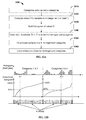
- FIG. 10A illustrates an exemplary method 1000 for adjusting the BO categories at the decoder, according to an embodiment of the present principles.
- the decoder can decode the starting band position and (NC - 1) offsets.
- the decoder decodes the sao_high_precision flag, which informs the decoder whether the proposed high precision process is applied or not (1030). If the flag is true, for these (NC - 1) bands, the decoder counts (1040) the number of samples in a band, and determines the band with the highest number of samples as CAT-high and the band with the smallest number of samples as CAT-low.
- band CAT-high The statistics of samples in band CAT-high are analyzed (1050) to divide the band into two sub-bands, CAT-high1 and CAT-high2.
- a histogram of the samples in the band CAT-high can be generated wherein a bin in the histogram corresponds to one sample value. Based on the histogram, band CAT-high can be divided into two sub-bands with substantially equal numbers of samples.
- CAT-high may be divided at a sample value whose cumulated histogram value is closest to 50%. After the division, band CAT-high becomes two sub-bands, band CAT-low is removed (i.e., offset is zero), and thus the total number of categories with non-zero offsets remains at (NC - 1).
- the sample values for the redefined categories are then adjusted by the received offsets.
- steps 1020 and 1030 may be skipped and the high precision process is always applied. In another variation, steps 1020 and 1030 are skipped, and the decoder decides whether or not to perform the high precision process based on the comparison based on CAT-low and CAT-high1 (or CAT-high2).
- n CAT-high1 , n CAT-high2 and n CAT-low are the numbers of samples in CAT-high1, CAT-high2 and CAT-low, respectively.
- the same process namely, comparing n CAT-high1 and n CAT-high2 with n CAT-low can be performed at both the encoder and decoder, and no explicit signaling is needed to indicate whether the high precision process is used or not.
- FIG. 10B illustrates an example of redefining the categories for BO, according to an embodiment of the present principles.
- c 1 is CAT-high and c 3 is CAT-low.
- CAT-high is divided into two sub-bands, c 11 and c 12 .
- the received four offsets are applied to sub-bands (c 11 and c 12 ) and bands (c 2 and c 4 ), respectively.
- the left portion of the CAT-high histogram has larger values (i.e., denser sample values at the lower range of CAT-high).
- the sub-band (c 11 ) on the left is narrower than the sub-band (c 12 ) on the right.
- the band becomes narrower.
- the cumulated histogram can be analyzed to determine the threshold where the division of CAT-high is made.
- the threshold is determined as the highest "th" value that satisfies cumul(th) ⁇ 50%, wherein cumul(x) is the cumulated histogram value at x as shown in FIG. 10C .
- cumul(x) is the cumulated histogram value at x as shown in FIG. 10C .
- 37.5% of the samples fall into CAT-high1 and 62.5% of the samples fall into CAT-high2.
- the redefining method attempts to divide the band CAT-high into two sub-bands with equal numbers of samples, the numbers of samples in the two sub-bands may not always be exactly identical, due to the discrete nature of the numbers of samples.
- the numbers of samples in two sub-bands may get closer (i.e., more equal).
- th we may choose "th" as the lowest value that satisfies cumul(th) ⁇ 50%. More generally, the choice of the division threshold can be considered as a value that meets certain conditions, for example, as the highest "th" value that satisfies cumul(th) ⁇ cum_th%, the lowest value that satisfies cumul(th) ⁇ cum_th%, wherein cumth may be equal to 50 as described above or be set as other values.
- the encoder or decoder may analyze the cumulated histogram of values C derived from the gradients, using one or more of the following:
- the histogram of category CAT-high can be based on value C, and a bin in the histogram represents the number of samples with a particular value C or a range of gradient-based values C.
- a bin in the histogram represents the number of samples with a particular value C or a range of gradient-based values C.
- steps 1020-1050 are performed in the encoder to match the decoder.
- Step 1010 is not used, rather, the starting band position and (NC - 1) offsets are encoded.
- the value of the sao_high_precision_flag can be determined based on RDO (Rate-Distortion Optimization).
- the flag may be skipped, and the encoder may always perform the high precision process or the encoder may decide whether or not to perform the high precision process based on comparison between n CAT-high1 , n CAT-high2 and n CAT-low .
- category CAT-high is divided into two sub-categories and category CAT-low is removed.
- category CAT-low may be kept. In this case, the number of categories is increased and an additional offset is to be encoded.
- JVET is the Joint Video Exploration Team on Future Video coding of ITU-T VCEG and ISO/IEC MPEG founded in October 2015.
- the reference software for the JVET group is named Joint Exploration Model (JEM).
- JEM Joint Exploration Model
- the bands may be chosen such that the number of samples are more evenly distributed in the four bands.
- the original equal-length bands (c 1 , c 2 , c 3 and c 4 ) become variable-length bands (c 1 ', c 2 ', c 3 ' and c 4 ').
- the histogram and the cumulated histogram are built using the numbers of samples in these four bands, and a bin of the histogram corresponds to one sample value.
- the sample values whose corresponding histogram values are closest to 25%, 50% and 75%, respectively, are used to divide the bands in order to homogenize the samples in these four categories.
- different techniques can be used to decide the four bands from the cumulated histogram. Also because of the discrete nature of the numbers of samples, the percentages after the homogenization may not be exactly 25%, 50% and 75%.
- FIG. 12A illustrates an exemplary method 1200 for homogenizing categories for EO, according to an embodiment of the present principles.
- the encoder or decoder categorizes the reconstructed samples into 5 categories according to TABLE 1.
- a value C can be computed (1220) as follows:
- the combined categories 1 and 2 are a "positive offset” category
- the combined categories 3 and 4 are a "negative offset” category.
- the "positive offset” category is divided, based on the gradients, into two sub-categories, which would be associated with positive offsets.
- the "negative offset” category is divided, based on the gradients, into another two sub-categories, which would be associated with negative offsets, as shown in an example in FIG. 12B . Therefore, the signs of the offsets do not need to be transmitted as for EO in HEVC.
- samples are re-allocated (1250) into these four homogenized (in term of the number of samples) categories.
- An offset is encoded/decoded (1260) for each of these (NC-1) categories, and the offset is used to adjust the sample values in the corresponding category.
- a range of categories i.e., 4 signaled bands for BO and categories 1-4 for EO
- the range can be determined or signaled as in HEVC, for example, for BO, the range can include (1 ⁇ (bitdepth - 3)) samples, and the lower limit is determined as the starting band position.
- different values known a-priori at the encoder or decoder can be used to set the range, for example, for EO, the range of the value C can be [1 - (1 ⁇ bitdepth), (1 ⁇ bitdepth) - 1].
- the EO categories may be defined differently from what is in HEVC.
- TABLE 2 shows a different categorization for EO for a given class, as also illustrated in FIG. 13 .
- a threshold "th" is introduced that allows to modify the EO categorization of TABLE 1. For example, when a difference of p 0 and p c is larger than "th" and a difference of p 1 and p c is larger than "th,” "category 1" is assigned to sample p 0 .
- th 0, the EO categorization as in TABLE 2 is the same as the one in TABLE 1.
- the samples categorized as "plain” have an offset inferred to be zero (see “no-offset” category in FIG. 13 ).
- threshold may counter the impact of random noise in the high bit-depth video, and may increase the number of samples categorized into category 2 or 3.
- the introduction of threshold "th" allows for obtaining non-zero values for C for categories 2 and 3.
- the choice of the threshold value "th” may depend on the content or known a priori to the encoder or decoder.
- the value “th” may depend on the bit depth of the video data.
- the value “th” could be an a-priori known function of the bit-depth. For example, “th” is set to 0 if the bit depth is no greater than 8, and is set to 1 ⁇ (bitdepth - 9) if the bit depth is greater than 8 to cancel out the fluctuation caused by random noise.
- ⁇ For example, setting a greater "th" for classes "EO_135" and “EO_45” than for other classes may homogenize the categories within directional classes and result in better statistics.
- the value of "th” may also be encoded in the bitstream, for example, in the PPS (Picture Parameter Set) or in the slice header.
- the modified EO categorization can be used to replace HEVC EO.
- an offset may be encoded or decoded for each modified EO category, while the sign of the offset value is inferred.
- the samples can be categorized using the modified categorization.
- the modified EO categorization can be used together with the redefining method or the homogenizing method as discussed above. For example, method 1000 or method 1200 can be adjusted to use the modified categorization for EO.
- EO categorization can be consolidated. For example, there may be a first category for "positive offset,” which includes categories 1 and 2 as shown in TABLE 2, a second category for "negative offset,” which includes categories 3 and 4 as shown in TABLE 2, and a third category for "no offset.” These categories may be used independently or in conjunction with the redefining or homogenizing methods.
- the EO categorization keeps the "classical" categories as defined in HEVC, and adds one or more extra categories. For instance, half peaks and half valleys remain unchanged with an exact equality of the neighboring samples as shown in TABLE 1, but additional classes, namely "almost half peak” and “almost half valley” can be added, depending on the threshold "th,” as shown in TABLE 3.
- the EO categorization as shown in TABLE 3 includes 7 categories, where categories 1 and 6 correspond to categories 1 and 4, respectively, as shown in TABLE 1, categories 2 and 3 in combination corresponds to category 2 as shown in TABLE 2, and categories 4 and 5 in combination corresponds to category 2 as shown in TABLE 2.
- this categorization may enable the SAO process to derive more accurate offsets for the new categories.
- the additional categories allow an encoder to find better rate-distortion compromise even with the additional syntax.
- the specific values are for exemplary purposes and the present principles are not limited to these specific values.
- the present principles can also be applied to different video formats, in other bit depths or color space, or different numbers of bands or categories.
- encoding SAO parameters is performed at a CTU level.
- the present principles can also be applied when the SAO encoding is performed at a different level, for example, but not limited to, at a slice level or at a picture level.
- various embodiments are described with respect to the HEVC standard.
- various methods to determine categories for SAO as described above can be used to modify the in-loop filtering module (165, 265) of the HEVC encoder and decoder as shown in FIG. 1 and FIG. 2 .
- the present principles are not limited to HEVC, and can be applied to other standards, recommendations, and extensions thereof.
- the SAO filtering according to the present principles can also be applied as a general image processing method, for example, in image de-noising.
- Various embodiments described above can be used individually or in combination. For example, BO may choose to use dividing a band into two sub-bands, while EO may choose to use homogenizing the categories.
- FIG. 14 illustrates a block diagram of an exemplary system in which various aspects of the exemplary embodiments of the present principles may be implemented.
- System 1400 may be embodied as a device including the various components described below and is configured to perform the processes described above. Examples of such devices, include, but are not limited to, personal computers, laptop computers, smartphones, tablet computers, digital multimedia set top boxes, digital television receivers, personal video recording systems, connected home appliances, and servers.
- System 1400 may be communicatively coupled to other similar systems, and to a display via a communication channel as shown in FIG. 14 and as known by those skilled in the art to implement the exemplary video system described above.
- the system 1400 may include at least one processor 1410 configured to execute instructions loaded therein for implementing the various processes as discussed above.
- Processor 1410 may include embedded memory, input output interface and various other circuitries as known in the art.
- the system 1400 may also include at least one memory 1420 (e.g., a volatile memory device, a non-volatile memory device).
- System 1400 may additionally include a storage device 1440, which may include non-volatile memory, including, but not limited to, EEPROM, ROM, PROM, RAM, DRAM, SRAM, flash, magnetic disk drive, and/or optical disk drive.
- the storage device 1440 may comprise an internal storage device, an attached storage device and/or a network accessible storage device, as non-limiting examples.
- System 1400 may also include an encoder/decoder module 1430 configured to process data to provide an encoded video or decoded video.
- Encoder/decoder module 1430 represents the module(s) that may be included in a device to perform the encoding and/or decoding functions. Encoder 100 and decoder 200 may be used in encoder/decoder module 1430. As is known, a device may include one or both of the encoding and decoding modules. Additionally, encoder/decoder module 1430 may be implemented as a separate element of system 1400 or may be incorporated within processors 1410 as a combination of hardware and software as known to those skilled in the art.
- processors 1410 Program code to be loaded onto processors 1410 to perform the various processes described hereinabove may be stored in storage device 1440 and subsequently loaded onto memory 1420 for execution by processors 1410.
- one or more of the processor(s) 1410, memory 1420, storage device 1440 and encoder/decoder module 1430 may store one or more of the various items during the performance of the processes discussed herein above, including, but not limited to the input video, the bitstream, equations, formula, matrices, variables, operations, and operational logic.
- the system 1400 may also include communication interface 1450 that enables communication with other devices via communication channel 1460.
- the communication interface 1450 may include, but is not limited to a transceiver configured to transmit and receive data from communication channel 1460.
- the communication interface may include, but is not limited to, a modem or network card and the communication channel may be implemented within a wired and/or wireless medium.
- the various components of system 1400 may be connected or communicatively coupled together using various suitable connections, including, but not limited to internal buses, wires, and printed circuit boards.
- the exemplary embodiments according to the present principles may be carried out by computer software implemented by the processor 1410 or by hardware, or by a combination of hardware and software.
- the exemplary embodiments according to the present principles may be implemented by one or more integrated circuits.
- the memory 1420 may be of any type appropriate to the technical environment and may be implemented using any appropriate data storage technology, such as optical memory devices, magnetic memory devices, semiconductor-based memory devices, fixed memory and removable memory, as non-limiting examples.
- the processor 1410 may be of any type appropriate to the technical environment, and may encompass one or more of microprocessors, general purpose computers, special purpose computers and processors based on a multi-core architecture, as non-limiting examples.
- each of the methods comprises one or more steps or actions for achieving the described method. Unless a specific order of steps or actions is required for proper operation of the method, the order and/or use of specific steps and/or actions may be modified or combined.
- the implementations described herein may be implemented in, for example, a method or a process, an apparatus, a software program, a data stream, or a signal. Even if only discussed in the context of a single form of implementation (for example, discussed only as a method), the implementation of features discussed may also be implemented in other forms (for example, an apparatus or program).
- An apparatus may be implemented in, for example, appropriate hardware, software, and firmware.
- the methods may be implemented in, for example, an apparatus such as, for example, a processor, which refers to processing devices in general, including, for example, a computer, a microprocessor, an integrated circuit, or a programmable logic device. Processors also include communication devices, such as, for example, computers, cell phones, portable/personal digital assistants ("PDAs”), and other devices that facilitate communication of information between end-users.
- PDAs portable/personal digital assistants
- the appearances of the phrase “in one embodiment” or “in an embodiment” or “in one implementation” or “in an implementation”, as well any other variations, appearing in various places throughout the specification are not necessarily all referring to the same embodiment.
- Determining the information may include one or more of, for example, estimating the information, calculating the information, predicting the information, or retrieving the information from memory.
- Accessing the information may include one or more of, for example, receiving the information, retrieving the information (for example, from memory), storing the information, processing the information, transmitting the information, moving the information, copying the information, erasing the information, calculating the information, determining the information, predicting the information, or estimating the information.
- Receiving is, as with “accessing”, intended to be a broad term.
- Receiving the information may include one or more of, for example, accessing the information, or retrieving the information (for example, from memory).
- “receiving” is typically involved, in one way or another, during operations such as, for example, storing the information, processing the information, transmitting the information, moving the information, copying the information, erasing the information, calculating the information, determining the information, predicting the information, or estimating the information.
- implementations may produce a variety of signals formatted to carry information that may be, for example, stored or transmitted.
- the information may include, for example, instructions for performing a method, or data produced by one of the described implementations.
- a signal may be formatted to carry the bitstream of a described embodiment.
- Such a signal may be formatted, for example, as an electromagnetic wave (for example, using a radio frequency portion of spectrum) or as a baseband signal.
- the formatting may include, for example, encoding a data stream and modulating a carrier with the encoded data stream.
- the information that the signal carries may be, for example, analog or digital information.
- the signal may be transmitted over a variety of different wired or wireless links, as is known.
- the signal may be stored on a processor-readable medium.
Landscapes
- Engineering & Computer Science (AREA)
- Multimedia (AREA)
- Signal Processing (AREA)
- Compression Or Coding Systems Of Tv Signals (AREA)
Priority Applications (7)
| Application Number | Priority Date | Filing Date | Title |
|---|---|---|---|
| EP16306095.7A EP3291553A1 (de) | 2016-08-30 | 2016-08-30 | Verfahren und vorrichtung zur videocodierung mit probenadaptivem offset |
| JP2019511632A JP2019528648A (ja) | 2016-08-30 | 2017-08-28 | サンプル適応オフセットを用いたビデオコード化のための方法及び機器 |
| EP17762077.0A EP3507983A1 (de) | 2016-08-30 | 2017-08-28 | Verfahren und vorrichtung zur videocodierung mit probenadaptivem offset |
| US16/327,255 US20190222846A1 (en) | 2016-08-30 | 2017-08-28 | Method and apparatus for video coding with sample adaptive offset |
| CN201780052059.7A CN109644274A (zh) | 2016-08-30 | 2017-08-28 | 利用样本自适应偏移的视频译码的方法和装置 |
| KR1020197005599A KR20190039538A (ko) | 2016-08-30 | 2017-08-28 | 샘플 적응형 오프셋을 갖는 비디오 코딩을 위한 방법 및 장치 |
| PCT/EP2017/071555 WO2018041782A1 (en) | 2016-08-30 | 2017-08-28 | Method and apparatus for video coding with sample adaptive offset |
Applications Claiming Priority (1)
| Application Number | Priority Date | Filing Date | Title |
|---|---|---|---|
| EP16306095.7A EP3291553A1 (de) | 2016-08-30 | 2016-08-30 | Verfahren und vorrichtung zur videocodierung mit probenadaptivem offset |
Publications (1)
| Publication Number | Publication Date |
|---|---|
| EP3291553A1 true EP3291553A1 (de) | 2018-03-07 |
Family
ID=56926139
Family Applications (2)
| Application Number | Title | Priority Date | Filing Date |
|---|---|---|---|
| EP16306095.7A Withdrawn EP3291553A1 (de) | 2016-08-30 | 2016-08-30 | Verfahren und vorrichtung zur videocodierung mit probenadaptivem offset |
| EP17762077.0A Withdrawn EP3507983A1 (de) | 2016-08-30 | 2017-08-28 | Verfahren und vorrichtung zur videocodierung mit probenadaptivem offset |
Family Applications After (1)
| Application Number | Title | Priority Date | Filing Date |
|---|---|---|---|
| EP17762077.0A Withdrawn EP3507983A1 (de) | 2016-08-30 | 2017-08-28 | Verfahren und vorrichtung zur videocodierung mit probenadaptivem offset |
Country Status (6)
| Country | Link |
|---|---|
| US (1) | US20190222846A1 (de) |
| EP (2) | EP3291553A1 (de) |
| JP (1) | JP2019528648A (de) |
| KR (1) | KR20190039538A (de) |
| CN (1) | CN109644274A (de) |
| WO (1) | WO2018041782A1 (de) |
Families Citing this family (4)
| Publication number | Priority date | Publication date | Assignee | Title |
|---|---|---|---|---|
| JP6814029B2 (ja) * | 2016-11-22 | 2021-01-13 | 日本放送協会 | ループフィルタ、符号化装置、復号装置、及びプログラム |
| CN110852376B (zh) * | 2019-11-11 | 2023-05-26 | 杭州睿琪软件有限公司 | 用于识别生物种类的方法及系统 |
| CN121312130A (zh) * | 2023-06-06 | 2026-01-09 | 交互数字Ce专利控股有限公司 | 使用基于偏移的滤波的编码和解码方法以及对应设备 |
| KR20250172382A (ko) * | 2024-05-31 | 2025-12-09 | 한국전자통신연구원 | 영상 부호화 방법 및 장치, 그리고 비트스트림을 저장한 기록 매체 |
Citations (4)
| Publication number | Priority date | Publication date | Assignee | Title |
|---|---|---|---|---|
| WO2013103893A1 (en) * | 2012-01-05 | 2013-07-11 | General Instrument Corporation | Devices and methods for multipass sample adaptive offset coding |
| US20140376619A1 (en) * | 2013-06-19 | 2014-12-25 | Apple Inc. | Sample adaptive offset control |
| US20150195534A1 (en) * | 2011-06-24 | 2015-07-09 | Lg Electronics Inc. | Image information encoding and decoding method |
| US20150215617A1 (en) * | 2014-01-30 | 2015-07-30 | Qualcomm Incorporated | Low complexity sample adaptive offset encoding |
Family Cites Families (7)
| Publication number | Priority date | Publication date | Assignee | Title |
|---|---|---|---|---|
| US10484693B2 (en) * | 2011-06-22 | 2019-11-19 | Texas Instruments Incorporated | Method and apparatus for sample adaptive offset parameter estimation for image and video coding |
| US9148663B2 (en) * | 2011-09-28 | 2015-09-29 | Electronics And Telecommunications Research Institute | Method for encoding and decoding images based on constrained offset compensation and loop filter, and apparatus therefor |
| CN104094601B (zh) * | 2011-11-08 | 2018-01-19 | 谷歌技术控股有限责任公司 | 用于采样自适应偏移编码和/或信令的装置和方法 |
| CA2950943C (en) * | 2011-12-22 | 2019-06-04 | Samsung Electronics Co., Ltd. | Video encoding method using offset adjustment according to classification of pixels by maximum encoding units and apparatus thereof, and video decoding method and apparatus thereof |
| US10708588B2 (en) * | 2013-06-19 | 2020-07-07 | Apple Inc. | Sample adaptive offset control |
| KR20150045819A (ko) * | 2013-10-21 | 2015-04-29 | 삼성전자주식회사 | 움직임 보상을 수행하는 비디오 부호화 방법 및 그 장치, 비디오 복호화 방법 및 그 장치 |
| KR20170078682A (ko) * | 2014-11-04 | 2017-07-07 | 삼성전자주식회사 | 에지 타입의 오프셋을 적용하는 비디오 부호화 방법 및 그 장치, 비디오 복호화 방법 및 그 장치 |
-
2016
- 2016-08-30 EP EP16306095.7A patent/EP3291553A1/de not_active Withdrawn
-
2017
- 2017-08-28 WO PCT/EP2017/071555 patent/WO2018041782A1/en not_active Ceased
- 2017-08-28 EP EP17762077.0A patent/EP3507983A1/de not_active Withdrawn
- 2017-08-28 JP JP2019511632A patent/JP2019528648A/ja active Pending
- 2017-08-28 US US16/327,255 patent/US20190222846A1/en not_active Abandoned
- 2017-08-28 KR KR1020197005599A patent/KR20190039538A/ko not_active Withdrawn
- 2017-08-28 CN CN201780052059.7A patent/CN109644274A/zh active Pending
Patent Citations (4)
| Publication number | Priority date | Publication date | Assignee | Title |
|---|---|---|---|---|
| US20150195534A1 (en) * | 2011-06-24 | 2015-07-09 | Lg Electronics Inc. | Image information encoding and decoding method |
| WO2013103893A1 (en) * | 2012-01-05 | 2013-07-11 | General Instrument Corporation | Devices and methods for multipass sample adaptive offset coding |
| US20140376619A1 (en) * | 2013-06-19 | 2014-12-25 | Apple Inc. | Sample adaptive offset control |
| US20150215617A1 (en) * | 2014-01-30 | 2015-07-30 | Qualcomm Incorporated | Low complexity sample adaptive offset encoding |
Non-Patent Citations (1)
| Title |
|---|
| COHEN R ET AL: "Description of screen content coding technology proposal by Mitsubishi Electric Corporation", 17. JCT-VC MEETING; 27-3-2014 - 4-4-2014; VALENCIA; (JOINT COLLABORATIVE TEAM ON VIDEO CODING OF ISO/IEC JTC1/SC29/WG11 AND ITU-T SG.16 ); URL: HTTP://WFTP3.ITU.INT/AV-ARCH/JCTVC-SITE/,, no. JCTVC-Q0036-v4, 28 March 2014 (2014-03-28), XP030115926 * |
Also Published As
| Publication number | Publication date |
|---|---|
| CN109644274A (zh) | 2019-04-16 |
| KR20190039538A (ko) | 2019-04-12 |
| WO2018041782A1 (en) | 2018-03-08 |
| US20190222846A1 (en) | 2019-07-18 |
| JP2019528648A (ja) | 2019-10-10 |
| EP3507983A1 (de) | 2019-07-10 |
Similar Documents
| Publication | Publication Date | Title |
|---|---|---|
| US20240305780A1 (en) | Systems and methods for reducing a reconstruction error in video coding based on a cross-component correlation | |
| EP3456052B1 (de) | Verfahren und vorrichtung zur videocodierung mit adaptivem schneiden | |
| US20190306502A1 (en) | System and method for improved adaptive loop filtering | |
| US20190238845A1 (en) | Adaptive loop filtering on deblocking filter results in video coding | |
| EP3100456B1 (de) | Adaptive offset-codierung einer probe mit niedriger komplexität | |
| CN107087180B (zh) | 基于分区基础的自适应环路滤波方法和装置 | |
| US20240244198A1 (en) | Decoding device of filtering reconstructed video data | |
| US10999603B2 (en) | Method and apparatus for video coding with adaptive clipping | |
| CN110999289A (zh) | 视频编码和解码中最可能模式(mpm)排序和发信号通知的方法和装置 | |
| EP3804314B1 (de) | Verfahren und vorrichtung zur videocodierung und -decodierung mit teilweise geteilten luma und chroma-codierungsbäumen | |
| WO2019002169A1 (en) | METHOD AND APPARATUS FOR SORTING AND SIGNALING A MOST PROBABLE MODE (MPM) IN VIDEO ENCODING AND DECODING PROCESSES | |
| KR20210099008A (ko) | 이미지를 디블록킹하기 위한 방법 및 장치 | |
| CA3149102A1 (en) | Secondary transform for video encoding and decoding | |
| EP4035357A1 (de) | Verfahren und vorrichtung unter verwendung einer homogenen syntax mit codierungswerkzeugen | |
| US20250203071A1 (en) | On sao and ccsao | |
| US20190222846A1 (en) | Method and apparatus for video coding with sample adaptive offset | |
| EP3244611A1 (de) | Verfahren und vorrichtung zur videokodierung mit adaptivem abschneiden von pixel werten | |
| US11102480B2 (en) | Devices and methods for image and video coding | |
| EP3280143A1 (de) | Verfahren und vorrichtung zur bildblockcodierung und -decodierung | |
| EP3291554A1 (de) | Verfahren und vorrichtung zur videocodierung mit probenadaptivem offset | |
| EP3349465A1 (de) | Verfahren und einrichtung zur bildcodierung mit multipass sao | |
| US20210243445A1 (en) | Encoding and decoding a video | |
| EP3349466A1 (de) | Verfahren und vorrichtung zur videocodierung mit probenadaptiver multipassfilterung mit offsets | |
| EP4702740A1 (de) | Adaptiver wiener-entblockierungsfilter |
Legal Events
| Date | Code | Title | Description |
|---|---|---|---|
| PUAI | Public reference made under article 153(3) epc to a published international application that has entered the european phase |
Free format text: ORIGINAL CODE: 0009012 |
|
| AK | Designated contracting states |
Kind code of ref document: A1 Designated state(s): AL AT BE BG CH CY CZ DE DK EE ES FI FR GB GR HR HU IE IS IT LI LT LU LV MC MK MT NL NO PL PT RO RS SE SI SK SM TR |
|
| AX | Request for extension of the european patent |
Extension state: BA ME |
|
| STAA | Information on the status of an ep patent application or granted ep patent |
Free format text: STATUS: THE APPLICATION IS DEEMED TO BE WITHDRAWN |
|
| 18D | Application deemed to be withdrawn |
Effective date: 20180908 |