EP3291603B1 - Vorzugs-zugang für heimbasisstationen mit hybridzugangsmodus - Google Patents
Vorzugs-zugang für heimbasisstationen mit hybridzugangsmodus Download PDFInfo
- Publication number
- EP3291603B1 EP3291603B1 EP17197794.5A EP17197794A EP3291603B1 EP 3291603 B1 EP3291603 B1 EP 3291603B1 EP 17197794 A EP17197794 A EP 17197794A EP 3291603 B1 EP3291603 B1 EP 3291603B1
- Authority
- EP
- European Patent Office
- Prior art keywords
- csg
- hnb
- cell
- mobile telephone
- access mode
- Prior art date
- Legal status (The legal status is an assumption and is not a legal conclusion. Google has not performed a legal analysis and makes no representation as to the accuracy of the status listed.)
- Active
Links
Images





Classifications
-
- H—ELECTRICITY
- H04—ELECTRIC COMMUNICATION TECHNIQUE
- H04W—WIRELESS COMMUNICATION NETWORKS
- H04W88/00—Devices specially adapted for wireless communication networks, e.g. terminals, base stations or access point devices
- H04W88/02—Terminal devices
-
- H—ELECTRICITY
- H04—ELECTRIC COMMUNICATION TECHNIQUE
- H04W—WIRELESS COMMUNICATION NETWORKS
- H04W4/00—Services specially adapted for wireless communication networks; Facilities therefor
- H04W4/06—Selective distribution of broadcast services, e.g. multimedia broadcast multicast service [MBMS]; Services to user groups; One-way selective calling services
- H04W4/08—User group management
-
- H—ELECTRICITY
- H04—ELECTRIC COMMUNICATION TECHNIQUE
- H04W—WIRELESS COMMUNICATION NETWORKS
- H04W8/00—Network data management
- H04W8/18—Processing of user or subscriber data, e.g. subscribed services, user preferences or user profiles; Transfer of user or subscriber data
- H04W8/186—Processing of subscriber group data
-
- H—ELECTRICITY
- H04—ELECTRIC COMMUNICATION TECHNIQUE
- H04W—WIRELESS COMMUNICATION NETWORKS
- H04W12/00—Security arrangements; Authentication; Protecting privacy or anonymity
- H04W12/08—Access security
-
- H—ELECTRICITY
- H04—ELECTRIC COMMUNICATION TECHNIQUE
- H04W—WIRELESS COMMUNICATION NETWORKS
- H04W24/00—Supervisory, monitoring or testing arrangements
- H04W24/08—Testing, supervising or monitoring using real traffic
-
- H—ELECTRICITY
- H04—ELECTRIC COMMUNICATION TECHNIQUE
- H04W—WIRELESS COMMUNICATION NETWORKS
- H04W36/00—Hand-off or reselection arrangements
- H04W36/0005—Control or signalling for completing the hand-off
- H04W36/0055—Transmission or use of information for re-establishing the radio link
- H04W36/0061—Transmission or use of information for re-establishing the radio link of neighbour cell information
-
- H—ELECTRICITY
- H04—ELECTRIC COMMUNICATION TECHNIQUE
- H04W—WIRELESS COMMUNICATION NETWORKS
- H04W48/00—Access restriction; Network selection; Access point selection
- H04W48/08—Access restriction or access information delivery, e.g. discovery data delivery
-
- H—ELECTRICITY
- H04—ELECTRIC COMMUNICATION TECHNIQUE
- H04W—WIRELESS COMMUNICATION NETWORKS
- H04W48/00—Access restriction; Network selection; Access point selection
- H04W48/08—Access restriction or access information delivery, e.g. discovery data delivery
- H04W48/10—Access restriction or access information delivery, e.g. discovery data delivery using broadcasted information
-
- H—ELECTRICITY
- H04—ELECTRIC COMMUNICATION TECHNIQUE
- H04W—WIRELESS COMMUNICATION NETWORKS
- H04W48/00—Access restriction; Network selection; Access point selection
- H04W48/20—Selecting an access point
-
- H—ELECTRICITY
- H04—ELECTRIC COMMUNICATION TECHNIQUE
- H04W—WIRELESS COMMUNICATION NETWORKS
- H04W76/00—Connection management
- H04W76/10—Connection setup
- H04W76/18—Management of setup rejection or failure
-
- H—ELECTRICITY
- H04—ELECTRIC COMMUNICATION TECHNIQUE
- H04W—WIRELESS COMMUNICATION NETWORKS
- H04W8/00—Network data management
- H04W8/02—Processing of mobility data, e.g. registration information at HLR [Home Location Register] or VLR [Visitor Location Register]; Transfer of mobility data, e.g. between HLR, VLR or external networks
- H04W8/08—Mobility data transfer
- H04W8/16—Mobility data transfer selectively restricting mobility data tracking
-
- H—ELECTRICITY
- H04—ELECTRIC COMMUNICATION TECHNIQUE
- H04W—WIRELESS COMMUNICATION NETWORKS
- H04W84/00—Network topologies
- H04W84/02—Hierarchically pre-organised networks, e.g. paging networks, cellular networks, WLAN [Wireless Local Area Network] or WLL [Wireless Local Loop]
- H04W84/04—Large scale networks; Deep hierarchical networks
- H04W84/042—Public Land Mobile systems, e.g. cellular systems
- H04W84/045—Public Land Mobile systems, e.g. cellular systems using private Base Stations, e.g. femto Base Stations, home Node B
Definitions
- the present invention relates to mobile telecommunication networks, particularly but not exclusively networks operating according to the (3 rd Generation Partnership Project) 3GPP standards or equivalents or derivatives thereof.
- the invention has particular although not exclusive relevance to the provision of access to home base stations and more specifically the access prioritisation for home base stations operating using a hybrid access mode.
- a NodeB (or an eNB in LTE) is the base station via which mobile devices connect to the core network.
- HNB home base stations
- the home base station is operating in accordance with the (Long Term Evolution) LTE standards, the HNB is sometimes referred to as a HeNB.
- WiMAX Worldwide Interoperability for Microwave Access
- the home base station is commonly referred to as a femto cell.
- HNB refers to any such home base station and will use the term NodeB generically to refer to other base stations (such as the base station for the macro cell in which a HNB operates).
- the HNB will provide radio coverage (for example, 3G/4G/WiMAX) within the home and will connect to the core network via a suitable public network (for example via an ADSL link to the Internet) and in the case of the 3GPP standards, via an optional HNB gateway (HNB-GW) which typically will aggregate traffic from several HNBs.
- a suitable public network for example via an ADSL link to the Internet
- HNB-GW optional HNB gateway
- the HNB may be configured to operate using one of a plurality of access modes, namely: 'closed' in which the HNB operates as a closed subscriber group (CSG) cell; 'hybrid' in which the HNB operates as a CSG cell where at the same time, non-members are allowed access; and 'open' in which the HNB operates as a normal (non-CSG) cell.
- CSG closed subscriber group
- 'open' in which the HNB operates as a normal (non-CSG) cell.
- the HNB When the HNB is in the hybrid access mode, and services cannot be provided to a CSG member due to a shortage of HNB resources, established communications of non- members via a CSG cell may be diverted to another cell. Furthermore, to minimise the impact of non-member established communication on CSG members, the network may allow the data rate of established communication of non-members to be reduced. However, the need to establish the CSG membership status of a particular mobile telephone in order to determine which established connections belong to members, and which belong to non-members has the potential to have a negative impact on already scarce resources.
- a congested HNB when a congested HNB receives new connection requests it may admit requests from non-member devices which may result in an undesirable degradation in service for member devices, or may reject requests from member devices due to a lack of available resources when the congestion is being caused by established connections with non-member devices.
- WO 2009/044318 A2 discloses that an adjacent cell is determined to be a private cell, and then a measurement report of it that includes an identifier for the private cell is sent from a UE to the UE's serving network node.
- the identifier is at least a TA ID for the private cell's CSG network, where the UE receives the TA ID over a broadcast channel/system information of the serving network node; the TA ID may be a short TA ID received over a primary broadcast channel of the serving network node; the identifier comprises the TA ID and either a LI cell ID or a CSG cell ID; and if the UE is not a member of the CSG network it the measurement report only in response to a command received from the serving network node.
- FIG. 1 schematically illustrates a mobile (cellular) telecommunication system 1 in which a user of a mobile telephone (MT) 3 can communicate with other users (not shown) via a macro cell of a 3G Radio Access Network (RAN) base station 5, a Radio Network Controller (RNC) 7 and a core telephone network 8 when the user is away from a 'home' base station (HNB) based cell 9, which he may be permitted to access.
- RAN 3G Radio Access Network
- RNC Radio Network Controller
- HNB home' base station
- the core telephone network 8 when the user is away from a 'home' base station (HNB) based cell 9
- the user may also communicate with the other users (not shown) via the cell 9 of an HNB 11, a public data network (in this case the Internet 13), a home base station gateway (HNB-GW) 15, and the core telephone network 8 when the user is within the HNB based cell 9.
- HNB-GW home base station gateway
- the HNB 11 will typically connect to the respective HNB-GW 15 via a suitable Internet connection such as an ADSL (Asymmetric Digital Subscriber Line) or cable connection 16 and is programmed with the IP address of the HNB-GW 15 so that all uplink communications are transmitted via the respective HNB-GW 15.
- a suitable Internet connection such as an ADSL (Asymmetric Digital Subscriber Line) or cable connection 16 and is programmed with the IP address of the HNB-GW 15 so that all uplink communications are transmitted via the respective HNB-GW 15.
- ADSL Asymmetric Digital Subscriber Line
- cable connection 16 is programmed with the IP address of the HNB-GW 15 so that all uplink communications are transmitted via the respective HNB-GW 15.
- the HNB 11 is configured to operate using one of a plurality of access modes, including: a 'closed' mode in which only the members of a closed subscriber group (CSG) associated with the HNB 11 are allowed access; a 'hybrid' mode in which both members and non-members of a CSG associated with the HNB 11 are allowed access; and an 'open' mode in which the HNB 11 operates as a normal (non-CSG) cell not having an associated CSG.
- CSG closed subscriber group
- each HNB 11 can communicate with a number of different mobile telephones 3. It will be further appreciated that there may be any number of HNB based cells 9 and that the same HNB-GW 15 may be shared by a plurality of HNBs 11.
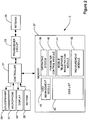
- FIG 2 schematically illustrates the main components of the mobile telephone 3 shown in Figure 1 .
- the mobile telephone 3 includes transceiver circuitry 23 which is operable to transmit signals to and to receive signals from the RAN base station 5 or the HNB 11 via one or more antennae 25.
- the mobile telephone 3 also includes a controller 27 which controls the operation of the mobile telephone 3 and which is connected to the transceiver circuit 23 and to a loudspeaker 29, a microphone 31, a display 33, and a keypad 35.
- the controller 27 operates in accordance with software instructions stored within memory 37. As shown, these software instructions include, among other things, an operating system 39, a mobile telephone registration module 41, and a CSG management module 43.
- the mobile telephone registration module 41 allows selection of the home base station 11 when the mobile telephone 3 is within range of their HNB 11; and the CSG management module 43 maintains at least one CSG list 45 containing details of the CSGs of which the mobile telephone 3 is a member (e.g. an operator controlled 'Allowed CSG list' and/or a user controlled a 'User CSG list').
- the CSG management module 43 maintains at least one CSG list 45 containing details of the CSGs of which the mobile telephone 3 is a member (e.g. an operator controlled 'Allowed CSG list' and/or a user controlled a 'User CSG list').
- the selection of the home base station 11 may be automatic or manually controlled by the user and that the CSG list 45 may be stored in the memory 37 of the mobile telephone 3 and/or in a Universal Subscriber Identity Module (USIM) (not shown).
- USIM Universal Subscriber Identity Module
- the mobile telephone registration module 41 of the mobile telephone 3 is operable to generate a connection request (e.g. an RNC Connection Request) for initiating connection to the HNB 11 which request includes information identifying whether the mobile telephone 3 is a member of the closed subscriber group to the HNB 11 in question.
- a connection request e.g. an RNC Connection Request
- FIG 3 is a block diagram illustrating the main components of the home base station (HNB) 11 shown in Figure 1 .
- the HNB 11 includes a transceiver circuit 51 which is operable to transmit signals to, and to receive signals from, the mobile telephone 3 via one or more antennae 53 and which is operable to transmit signals to and to receive signals from the HNB-GW 15 via an HNB-GW interface 55.
- the operation of the transceiver circuit 51 is controlled by a controller 57 in accordance with software stored in memory 59.
- the software includes, among other things, an operating system 61, a base station registration module 63, a mobile telephone registration module 65, a connection management module 67, a system information module 68, and a CSG management module 69.
- the base station registration module 63 is operable to register the HNB with the HNB-GW 15 and the mobile telephone registration module 65 is operable to register the mobile telephone 3 with the HNB 11 and with the HNB-GW 15.
- the connection management module 67 is operable to manage the connections of mobile telephones camped on the cell 9 of the HNB 11.
- the system information module 68 is operable to broadcast system information relating to the cell 9, to mobile telephones 3 in the vicinity.
- the CSG management module 69 is operable for configuring the HNB 11 to operate under one of the CSG access modes ('closed', 'hybrid', or 'open') and for setting up CSGs associated with the HNB 11.
- the mobile telephone registration module 65 is operable, when operating in the hybrid access mode, to manage attempted registration by mobile telephones 3, such that a mobile telephone 3 that is a member of a CSG associated with the HNB 11, is given preferential access compared to a mobile telephone 3 which is not a member (non-CSG).
- the connection management module 67 is operable to monitor and manage established connections such that preferential connection conditions may be provided for a mobile telephone 3 that is a member of a CSG associated with the HNB 11 as compared to a non-CSG mobile telephone.
- the mobile telephone 3 and the home base station 11 are described, for ease of understanding, as having a number of discrete modules (base station/mobile telephone registration modules, the parameter control module, and the connection/CSG management modules). Whilst these modules may be provided in this way for certain applications, for example where an existing system has been modified to implement the invention, in other applications, for example in systems designed with the inventive features in mind from the outset, these modules may be built into the overall operating system or code and so these modules may not be discernible as discrete entities.
- Figures 4 to 6 illustrate the operation of an exemplary implementation of the telecommunication system of Figure 1 in which the mobile telephone 3 begins in an idle state/mode and subsequently requires connection to an HNB 11.
- the CSG management module 69 of the HNB 11 is operable for configuring the HNB 11 to operate under one of the CSG access modes ('closed', 'hybrid', or 'open') and for setting up a CSG associated with the HNB 11 (if the hybrid or closed CSG access mode is configured), as shown at step 100.
- the system information module 68 is operable to broadcast system information, including information identifying the CSG access mode of the HNB 11, to mobile telephones 3 in the vicinity, at suitable times (step 102).
- the information identifying the CSG access mode typically comprises, depending on the access mode, a CSG Indicator (or CSG Indication) information element (IE) / flag for indicating whether or not the HNB 11 is operating in the closed CSG access mode and a CSG Identity information element for identifying a CSG set up for the HNB 11 as follows:
- the mobile telephone 3 is operable, in idle mode, to receive the system information broadcast by the HNB 11 of a cell 9 in which it is located and to extract (read) the information identifying the CSG access mode of the HNB 11 broadcasting it (step 200).
- the CSG management module 43 of the mobile telephone 3 is operable to determine the CSG access mode of the HNB 11 from the extracted information (step 202).
- the CSG management module 43 is further operable, in the event that the CSG access mode is determined to be a closed or hybrid access mode, to determine if the CSG is represented in the CSG list 45 (steps 204 and 206) and, accordingly, whether the mobile telephone 3 is a member of that subscriber group.
- the mobile telephone registration module 41 of the mobile telephone 3 is operable to generate a connection request (208) for transmission to the HNB 11 and the connection process proceeds in the normal manner for connecting to a normal (non-CSG) base station as a skilled person will understand.
- the mobile telephone registration module 41 is operable to generate a connection request (210) for transmission to the HNB 11, and the connection process proceeds in the normal manner for connecting to a home base station operating in a closed access mode, as a skilled person will understand.
- the mobile telephone registration module 41 is also operable, in the event that the access mode is a hybrid access mode and when connection is required, to generate a connection request (steps 212a and 212b) for transmission to the HNB 11.
- the mobile telephone registration module 41 When the mobile telephone 3 has been identified to be a member of the CSG associated with the HNB 11 the mobile telephone registration module 41 generates a request which includes a CSG membership information element to act as a flag (or in which the CSG membership flag is set to a particular value, e.g. 'TRUE') for indicating the mobile telephone's membership of the subscriber group (step 212a).
- step 212b when the mobile telephone 3 has been determined not to be a member of the CSG associated with the HNB 11 the mobile telephone registration module 41 generates a request which does not include the CSG membership flag (or in which the CSG membership flag is set to a different value, e.g. 'FALSE').
- the mobile telephone 3 is operable to send the generated request to the HNB 11 via its transceiver circuit 23 and antenna 25.
- the HNB 11 (operating in hybrid access mode) is operable to receive the connection request via its antenna 53 and transceiver circuit 51 (step 300).
- the mobile telephone registration module 65 of the HNB 11 is operable to establish whether the HNB 11 is in a congested situation (e.g. there is a shortage of HNB 11 resources) based, for example, on information received from the connection management module 67 about the nature of any existing connections and/or on information about any other mobile telephones attempting to make a connection (step 302).
- the mobile telephone registration module 65 is further operable to identify the presence or absence of the CSG membership indication flag (and/or to determine its value) and accordingly, to determine whether the mobile telephone 3 from which the connection request originated is a member of the CSG associated with the HNB 11 (step 304).
- the mobile telephone registration module 65 of the HNB 11 is operable to respond to the connection request in dependence on whether the HNB 11 is in a congested situation (step 302), and whether the mobile telephone 3 is a member of the CSG (step 304) as follows:
- connection management module 67 is operable to monitor and manage established connections. More particularly, the connection management module 67 is operable to store membership details for established connections (e.g. the CSG membership flag or other data from which the CSG membership can be derived) and to assist preferential establishment of a new connection with a member mobile telephone 3 (step 312) as follows:
- the implementation described with reference to Figures 4 to 6 provide an efficient mechanism by which an HNB 11 experiencing congestion can determine which connection request should be allowed and which should be rejected in dependence on whether the mobile telephone 3 originating the request is a member of a CSG associated with the device or not.
- the implementation also allows the HNB 11 experiencing congestion to provide preferential connection conditions to member devices by redirecting non-member devices or initiating a reduction in their data rate.
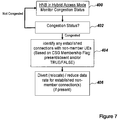
- FIG 7 illustrates the operation of an exemplary implementation of the telecommunication system 1 of Figure 1 in which the HNB 11 has a plurality of established connections.
- the connection management module 67 is operable to store membership details for established connections (e.g. the CSG membership flag or other data from which the CSG membership can be derived). As seen in Figure 7 , the connection management module 67 is further operable to monitor the level of congestion (steps 400 and 402) and, when the HNB 11 enters a congested situation from a non-congested situation, to identify non-member connections from the stored CSG membership information (step 404). Moreover, the connection management module 67 is further operable to assist provision of preferential access to member mobile telephones 3 having established connections (step 406) as follows:
- the implementation described with reference to Figure 7 provides an efficient mechanism by which an HNB 11 experiencing congestion can provide preferential connection conditions to member devices with established connections by redirecting non-member devices or initiating a reduction in their data rate.
- Figure 8 illustrates the operation of another exemplary implementation of the telecommunication system 1 of Figure 1 in which new connection requests from non member mobile telephones 3 are suppressed without the need to provide the CSG membership flag in the connection request.
- the HNB 11 is operable to monitor congestion and monitor the level of congestion (steps 500 and 502).
- the CSG management module 69 of the HNB 11 is configured to respond to a change from a non-congested state to a congested state by changing the access mode from the hybrid access mode to the closed access mode (step 504).
- the system information module 68 is operable to broadcast system information, including information identifying the new closed CSG access mode of the HNB 11 (CSG Indicator/Indication IE set to TRUE), to mobile telephones 3 in the vicinity either substantially immediately, or at the next suitable time according to its normal broadcast cycle, and at suitable intervals thereafter (step 506).
- a mobile telephone 3 (in idle mode) according to this implementation is operable to receive the newly broadcast system information and to act on it in substantially the manner described with reference to Figure 5 (for steps 200, 202 and 210).
- the mobile telephone 3 is operable, in idle mode, to receive the system information broadcast by the HNB 11 of a cell 9 in which it is located and to extract (read) the information identifying the CSG access mode of the HNB 11 broadcasting it.
- the CSG management module 43 of the mobile telephone 3 is operable to determine the CSG access mode of the HNB 11 from the extracted information. On determining that the CSG access mode is a closed access mode the CSG management module 43 is further operable to determine if the associated CSG is represented in the CSG list 45 and, accordingly, whether the mobile telephone 3 is a member of that subscriber group.
- the mobile telephone registration module 41 is operable to generate a connection request for transmission to the HNB 11, and the connection process proceeds substantially in the normal manner for connecting to a home base station operating in a closed access mode, as a skilled person will understand.
- the HNB 11 is further operable to continue monitoring congestion after a change in access mode and monitor the level of congestion (steps 507 and 508).
- the CSG management module 69 of the HNB 11 is configured to respond to a change from a congested state to a non-congested state by changing the access mode from the closed access mode to the hybrid access mode (step 510).
- the system information module 68 is operable to broadcast system information, including information identifying the return to the hybrid CSG access mode of the HNB 11 (CSG Indicator/Indication IE set to FALSE), to mobile telephones 3 in the vicinity (which may be substantially immediately or at another suitable time according to its normal broadcast cycle) (step 512).
- the mobile telephone 3 is operable, in idle mode, to receive the system information (identifying the return to the hybrid mode) broadcast by the HNB 11 and to extract (read) the information identifying the CSG access mode of the HNB 11 broadcasting it.
- the CSG management module 43 of the mobile telephone 3 is operable to determine the CSG access mode of the HNB 11 from the extracted information.
- the mobile telephone registration module 41 of the mobile telephone is operable, when a connection is required, to generate a connection request for transmission to the HNB 11 which is subsequently accepted by the HNB 11 (subject to any other connection criteria).
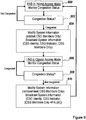
- Figure 9 illustrates the operation of another exemplary implementation of the telecommunication system 1 of Figure 1 in which new connection requests from non member mobile telephones 3 are suppressed without the need to provide the CSG membership flag in the connection request and, in this implementation, without the need to change the CSG access mode.
- the HNB 11 is operable to monitor congestion and monitor the level of congestion (steps 600 and 602).
- the CSG management module 69 of the HNB 11 is configured to respond to a change from a non-congested state to a congested state by modifying the system information associated with CSGs to include a 'CSG members only' (or 'Only CSG members allowed') flag (or set it to 'TRUE') for indicating that new connections are restricted to member mobile telephones 3 only (step 604).
- the system information module 68 is operable to broadcast system information, including the CSG members only flag and the information identifying the CSG access mode of the HNB 11, to mobile telephones 3 in the vicinity either substantially immediately, or at the next suitable time according to its normal broadcast cycle, and at suitable intervals thereafter (step 604).
- the mobile telephone 3 is operable, in idle mode, to receive the system information broadcast by the HNB 11 and to extract (read) the CSG members only flag with the information identifying the CSG access mode.
- the CSG management module 43 of the mobile telephone 3 is operable to determine whether access is restricted to members only when identifying the CSG access mode of the HNB 11 from the extracted information. On determining that the CSG access mode is a hybrid mode, and that access is restricted to members only, the CSG management module 43 is operable to determine if the associated CSG is represented in the CSG list 45 and, accordingly, whether the mobile telephone 3 is a member of that subscriber group.
- the mobile telephone registration module 41 is operable to generate a connection request for transmission to the HNB 11, and the connection process proceeds substantially in the normal manner for connecting to a home base station as a skilled person will understand.
- the HNB 11 is further operable to continue monitoring congestion for a change in the level of congestion (steps 606 and 608).
- the CSG management module 69 of the HNB 11 is configured to respond to a change from a congested state to a non-congested state by modifying the system information associated with CSGs to remove a 'CSG members only' (or 'Only CSG members allowed') flag (or reset it to 'FALSE') to indicate that new connections are no longer restricted to member mobile telephones 3 only.
- the system information module 68 is operable to broadcast system information, without the CSG members only flag (or with it reset to 'FALSE') and with the information identifying the CSG access mode of the HNB 11, to mobile telephones 3 in the vicinity either substantially immediately, or at the next suitable time according to its normal broadcast cycle, and at suitable intervals thereafter (step 610).
- the mobile telephone 3 is operable, in idle mode, to receive the system information broadcast by the HNB 11 and to extract (read) the information identifying the CSG access mode of the HNB 11 broadcasting it.
- the CSG management module 43 of the mobile telephone 3 is operable to determine the CSG access mode of the HNB 11, and to establish that new connections are not restricted to member mobile telephones 3 only, from the extracted information.
- the mobile telephone registration module 41 of the mobile telephone is operable, when a connection is required, to generate a connection request for transmission to the HNB 11 which is subsequently accepted by the HNB 11 (subject to any other connection criteria).
- the HNB 11 may obtain information on the CSG membership of a mobile telephone 3 in the vicinity from another node (for example, from a node in the Core Telephone Network 8 or from an HNB-GW 15) rather than from the mobile telephone 3.
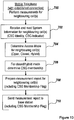
- FIG 10 illustrates the operation of another exemplary implementation of the telecommunication system 1 of Figure 1 in which a base station (HNB 11 or other base station 5) and/or associated RNC 7 (if applicable) is able to obtain information from a mobile telephone 3 with an established connection, on the telephone's membership of a CSG associated with another cell 9 (HNB 11) in the vicinity (e.g. a neighbouring cell) for the purposes of possible relocation/handover to the other cell 9.
- HNB 11 base station
- RNC 7 if applicable
- a measurement module 42 ( Figure 2 ) of the mobile telephone 3 is operable, when the mobile telephone 3 is in a connected mode/state, to perform measurements (e.g. Intra frequency, inter frequency and inter RAT mobility, Quality, UE internal, positioning measurements, or the like) in other cells 9 (e.g. neighbouring/nearby cells) in the vicinity (step 700).
- the measurements may be automatic or may be explicitly requested by or via the base station 11,5.
- the mobile telephone 3 is operable to receive system information broadcast by the HNB 11 of the nearby cell 9 (e.g. as described with reference to Figure 4 ) and to extract (read) the information identifying the CSG access mode (CSG Indicator/Indication and/or CSG Identity) of the HNB 11 broadcasting it (step 702).
- the CSG management module 43 of the mobile telephone 3 is operable to determine the CSG access mode of the nearby HNB 11 from the extracted information (step 704) and in the event that the CSG access mode is determined to be a closed or hybrid access mode, to determine if the CSG is represented in the CSG list 45 and, accordingly, whether the mobile telephone 3 is a member of the subscriber group (step 706) associated with the nearby/neighbouring cell.
- the measurement module 42 is further operable to prepare a measurement report (step 708) including details of the measurements performed in step 700. If the mobile telephone has been determined to be a member of the CSG associated with the nearby/neighbouring cell (in step 706), a CSG membership flag is included (e.g. set to 'TRUE') in the measurement report. If the mobile telephone has been determined not to be a member of the CSG associated with the nearby/neighbouring cell (in step 706), the CSG membership flag is set to a different value (e.g. 'FALSE') in the measurement report.
- a CSG membership flag is included (e.g. set to 'TRUE') in the measurement report. If the mobile telephone has been determined not to be a member of the CSG associated with the nearby/neighbouring cell (in step 706), the CSG membership flag is set to a different value (e.g. 'FALSE') in the measurement report.
- the mobile telephone 3 is operable to send the measurement report to the base station (step 710) 5, 11 to which it is connected (for possible onward transmission to the RNC 7 if applicable).
- the base station 11, 5 (or RNC 7) is operable to make handover/relocation/redirection decisions for the mobile telephone 3, taking the presence/absence of the CSG membership indication (or its 'TRUE' / 'FALSE' value) into account, as follows:
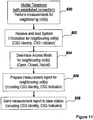
- Figures 11 and 12 illustrate the operation of implementations of the system of Figure 1 in which the source radio access network is operable to obtain information regarding the access mode (open, hybrid or closed) of the neighbouring cells (e.g. to allow the source radio access network to perform handover decisions as described above) in at least one of the following ways:
- the measurement module 42 of the mobile telephone 3 is operable, when the mobile telephone 3 is in a connected mode/state, to perform measurements (e.g. Intra frequency, inter frequency and inter RAT mobility, Quality, UE internal, positioning measurements, or the like) in other cells 9 (e.g. neighbouring/nearby cells) in the vicinity (step 800).
- the measurements may be automatic or may be explicitly requested by or via the base station 11, 5.
- the mobile telephone 3 is operable to receive system information broadcast by the HNB 11 of the nearby cell 9 (e.g. as described with reference to Figure 4 ) and to extract (read) the information identifying the CSG access mode (CSG Indicator/Indication and/or CSG Identity) of the HNB 11 broadcasting it (step 802).
- the CSG management module 43 of the mobile telephone 3 is operable to determine the CSG access mode of the nearby HNB 11 from the extracted information (step 804).
- the measurement module 42 is further operable to prepare a measurement report (step 806) including details of the measurements performed in step 800 including information identifying the access mode of the neighbouring cell 9 (e.g. The CSG Indicator/Indication and/or CSG Identity).
- a measurement report including details of the measurements performed in step 800 including information identifying the access mode of the neighbouring cell 9 (e.g. The CSG Indicator/Indication and/or CSG Identity).
- the mobile telephone 3 need not identify the access mode itself (as described) but may instead forward the appropriate information to the base station 11, 5 to which it is connected without determining the access mode.
- the mobile telephone 3 is operable to send the measurement report to the base station (step 808) 5, 11 to which it is connected (for possible onward transmission to the RNC 7 if applicable).
- the base station 11, 5 (or RNC 7) is operable to make handover/relocation/redirection decisions for the mobile telephone 3, taking the CSG mode into account as described previously (e.g. with reference to Figure 10 ).
- the nodes are operable to exchange information related to their access modes (e.g. the CSG Indicator/Indication and/or CSG Identity).
- the network node of the first cell is operable to obtain details of the access mode of candidate neighbouring cells during an initialisation procedure which is used to exchange application layer protocol data between RAN nodes (e.g. the X2 Setup procedure in LTE).
- the access mode details, once acquired are then stored for future reference (e.g. to allow decisions to be made on handover) (step 904).
- the radio access network node may be operable to receive and extract updated information on the access mode of candidate neighbouring cells (e.g. via the X2AP eNB Configuration Update procedure for LTE).
- the base station 11, 5 (or RNC 7) is operable to make handover/relocation/redirection decisions for the mobile telephone 3, taking the acquired information on the access mode of candidate neighbouring cells into account as described previously.
- a mobile telephone based telecommunications system was described.
- the signalling techniques described in the present application can be employed in other communications system.
- Other communications nodes or devices may include user devices such as, for example, personal digital assistants, laptop computers, web browsers, etc.
- the mobile telephone and the HNB each include transceiver circuitry.
- this circuitry will be formed by dedicated hardware circuits.
- part of the transceiver circuitry may be implemented as software run by the corresponding controller.
- the software modules may be provided in compiled or un-compiled form and may be supplied to the HNB or to the mobile telephone as a signal over a computer network, or on a recording medium. Further, the functionality performed by part or all of this software may be performed using one or more dedicated hardware circuits. However, the use of software modules is preferred as it facilitates the updating of the base stations, gateways, and the mobile telephones in order to update their functionalities.
- the component parts of the system may be configured such that the opposite is true (e.g. presence or absence of the CSG membership indication flag respectively representing non-membership and membership).
- the telephone registration module of the mobile telephone may be operable to generate connection requests for HNBs operating in a hybrid access mode in which the CSG membership indication flag is always present but is set to a first value (e.g. TRUE) when the mobile telephone 3 is a CSG member and to another value (e.g. FALSE) when it is not a member.
- connection requests Whilst it may not be necessary to include the CSG membership indication flag in connection requests for closed or open access mode HNBs, it will be appreciated that the connection requests in one or both cases may, nevertheless, include such a flag (if appropriate) possibly set to an appropriate value (e.g. TRUE or FALSE).
- an appropriate value e.g. TRUE or FALSE
- HNB home base stations of any type of network (e.g. LTE, WiMAX etc.) and that similar functionality may be provided by a base station (NodeB) and/or RNC.
- NodeB base station
- RNC Radio Network Controller
- a UE camping on a cell served by the Hybrid HNB can know the Access Mode of the HNB as well as whether it is a CSG member of that HNB.
- the UE can provide this information to the HNB via some CSG membership flag. If the UE is not CSG member of the Hybrid HNB, then the UE does not send this flag.
- the HNB in a congested situation can swiftly make decisions on whether to divert the RRC Connection to another cell (if the UE attempting to access the HNB is not CSG member) or not (if the UE attempting to access the HNB is CSG member).
- SRAN Indicates the Source Radio Access Network
- TRAN Indicates the Target Radio Access Network (Where the UE wants to handover)
- the SRAN can obtain this information as follows:
- the SRAN can prevent the non CSG members from accessing when the SRAN node is congested. For these possibilities it is assumed that the SRAN may get the information on the CSG membership from some other node (e.g. Core Network or HNB-GW) and not from the UE.
- some other node e.g. Core Network or HNB-GW
Landscapes
- Engineering & Computer Science (AREA)
- Computer Networks & Wireless Communication (AREA)
- Signal Processing (AREA)
- Computer Security & Cryptography (AREA)
- Databases & Information Systems (AREA)
- Multimedia (AREA)
- Mobile Radio Communication Systems (AREA)
Claims (4)
- Mobile Kommunikationsvorrichtung (3), die konfiguriert ist, um mit einer Basisstation (5) zu kommunizieren, wobei die mobile Kommunikationsvorrichtung (3) aufweist:eine Einrichtung zum Empfangen (23, 25) einer geschlossenen Teilnehmergruppen-, CSG-, Anzeige und erster Informationen, die eine CSG identifizieren, von einer Nachbarzelle, wobei, wenn die Nachbarzelle eine Hybridzelle ist, die den Zugriff sowohl für Mitglieder als Nichtmitglieder der CSG zulässt, die CSG-Anzeige auf falsch festgelegt wird; undeine Einrichtung (23, 25), um, wenn die empfangene CSG-Anzeige anzeigt, dass die Nachbarzelle eine Hybridzelle ist, einen Messbericht an die Basisstation (5) zu übertragen, der zweite Informationen aufweist, um anzuzeigen, dass die mobile Kommunikationsvorrichtung (3) kein Mitglied der CSG der Nachbarzelle ist, wenn die Nachbarzelle eine CSG-Mitgliedszelle ist, wenn die mobile Kommunikationsvorrichtung (3) kein Mitglied der CSG ist, und dass die mobile Kommunikationsvorrichtung (3) ein Mitglied der CSG der Nachbarstation ist, wenn die mobile Kommunikationsvorrichtung (3) ein Mitglied der CSG ist.
- Mobile Kommunikationsvorrichtung (3) nach Anspruch 1, wobei die mobile Kommunikationsvorrichtung (3) ferner eine Einrichtung zum Bestimmen (27, 43) aufweist, ob die Nachbarzelle eine CSG-Mitgliedszelle ist.
- Verfahren in einer mobilen Kommunikationsvorrichtung (3), die mit einer Basisstation (5) kommuniziert, wobei das Verfahren aufweist:Empfangen einer geschlossenen Teilnehmergruppen-, CSG-, Anzeige und erster Informationen, die eine CSG identifizieren, von einer Nachbarzelle, wobei, wenn die Nachbarzelle eine Hybridzelle ist, die den Zugriff sowohl für Mitglieder als Nichtmitglieder der CSG zulässt, die CSG-Anzeige auf falsch festgelegt wird; undwenn die empfangene CSG-Anzeige anzeigt, dass die Nachbarzelle eine Hybridzelle ist, Übertragen eines Messberichts an die Basisstation (5), der zweite Informationen aufweist, um anzuzeigen, dass die mobile Kommunikationsvorrichtung (3) kein Mitglied der CSG der Nachbarzelle ist, wenn die Nachbarzelle eine CSG-Mitgliedszelle ist, wenn die mobile Kommunikationsvorrichtung (3) kein Mitglied der CSG ist, und dass die mobile Kommunikationsvorrichtung (3) ein Mitglied der CSG der Nachbarstation ist, wenn die mobile Kommunikationsvorrichtung (3) ein Mitglied der CSG ist.
- Verfahren nach Anspruch 3, wobei das Verfahren ferner aufweist:
Bestimmen, ob die Nachbarzelle eine CSG-Mitgliedszelle ist.
Applications Claiming Priority (3)
| Application Number | Priority Date | Filing Date | Title |
|---|---|---|---|
| GB0907187A GB2471988A (en) | 2009-04-27 | 2009-04-27 | Communication System comprising Home Base Station and associated Closed Subscriber Group |
| PCT/JP2010/057782 WO2010126155A1 (en) | 2009-04-27 | 2010-04-26 | Preferential access for hybrid access mode home base stations |
| EP10723361.1A EP2425660B1 (de) | 2009-04-27 | 2010-04-26 | Vorzugs-zugang für heimbasisstationen mit hybridzugangsmodus |
Related Parent Applications (2)
| Application Number | Title | Priority Date | Filing Date |
|---|---|---|---|
| EP10723361.1A Division-Into EP2425660B1 (de) | 2009-04-27 | 2010-04-26 | Vorzugs-zugang für heimbasisstationen mit hybridzugangsmodus |
| EP10723361.1A Division EP2425660B1 (de) | 2009-04-27 | 2010-04-26 | Vorzugs-zugang für heimbasisstationen mit hybridzugangsmodus |
Publications (2)
| Publication Number | Publication Date |
|---|---|
| EP3291603A1 EP3291603A1 (de) | 2018-03-07 |
| EP3291603B1 true EP3291603B1 (de) | 2020-02-26 |
Family
ID=40791837
Family Applications (2)
| Application Number | Title | Priority Date | Filing Date |
|---|---|---|---|
| EP10723361.1A Active EP2425660B1 (de) | 2009-04-27 | 2010-04-26 | Vorzugs-zugang für heimbasisstationen mit hybridzugangsmodus |
| EP17197794.5A Active EP3291603B1 (de) | 2009-04-27 | 2010-04-26 | Vorzugs-zugang für heimbasisstationen mit hybridzugangsmodus |
Family Applications Before (1)
| Application Number | Title | Priority Date | Filing Date |
|---|---|---|---|
| EP10723361.1A Active EP2425660B1 (de) | 2009-04-27 | 2010-04-26 | Vorzugs-zugang für heimbasisstationen mit hybridzugangsmodus |
Country Status (8)
| Country | Link |
|---|---|
| US (3) | US8880069B2 (de) |
| EP (2) | EP2425660B1 (de) |
| JP (3) | JP5488843B2 (de) |
| KR (2) | KR101424413B1 (de) |
| CN (3) | CN105916122B (de) |
| ES (1) | ES2660599T3 (de) |
| GB (1) | GB2471988A (de) |
| WO (1) | WO2010126155A1 (de) |
Families Citing this family (30)
| Publication number | Priority date | Publication date | Assignee | Title |
|---|---|---|---|---|
| GB2370380B (en) | 2000-12-19 | 2003-12-31 | Picochip Designs Ltd | Processor architecture |
| GB2454865B (en) | 2007-11-05 | 2012-06-13 | Picochip Designs Ltd | Power control |
| KR20100070279A (ko) * | 2008-12-17 | 2010-06-25 | 이용석 | 무선통신 시스템에서 펨토셀의 운영방법 |
| GB2470037B (en) | 2009-05-07 | 2013-07-10 | Picochip Designs Ltd | Methods and devices for reducing interference in an uplink |
| GB2470771B (en) | 2009-06-05 | 2012-07-18 | Picochip Designs Ltd | A method and device in a communication network |
| GB2470891B (en) | 2009-06-05 | 2013-11-27 | Picochip Designs Ltd | A method and device in a communication network |
| GB2474071B (en) | 2009-10-05 | 2013-08-07 | Picochip Designs Ltd | Femtocell base station |
| KR101784264B1 (ko) | 2010-04-28 | 2017-10-11 | 삼성전자주식회사 | 이동 통신 시스템에서의 핸드오버 방법 및 장치 |
| US9535762B2 (en) * | 2010-05-28 | 2017-01-03 | At&T Intellectual Property I, L.P. | Methods to improve overload protection for a home subscriber server (HSS) |
| US9319433B2 (en) | 2010-06-29 | 2016-04-19 | At&T Intellectual Property I, L.P. | Prioritization of protocol messages at a server |
| GB2482869B (en) | 2010-08-16 | 2013-11-06 | Picochip Designs Ltd | Femtocell access control |
| JP5412656B2 (ja) * | 2011-03-30 | 2014-02-12 | 株式会社日立製作所 | 通信システム及び通信制御方法 |
| GB2489716B (en) | 2011-04-05 | 2015-06-24 | Intel Corp | Multimode base system |
| GB2489919B (en) | 2011-04-05 | 2018-02-14 | Intel Corp | Filter |
| JP5300912B2 (ja) * | 2011-04-26 | 2013-09-25 | 株式会社エヌ・ティ・ティ・ドコモ | 移動通信システムにおける基地局及び基地局が実行する方法 |
| US20140092895A1 (en) * | 2011-05-13 | 2014-04-03 | Telefonaktiebolaget L M Ericsson (Publ) | Time Synchronization in a Communication Network |
| GB2491098B (en) | 2011-05-16 | 2015-05-20 | Intel Corp | Accessing a base station |
| US8934913B2 (en) | 2011-09-28 | 2015-01-13 | Telefonaktiebolaget L M Ericsson (Publ) | Enhanced mobility to home base station cells |
| US20150043532A1 (en) * | 2012-03-16 | 2015-02-12 | Kyocera Corporation | Communication control method, base station, home base station, and gateway device |
| WO2014010919A1 (en) * | 2012-07-10 | 2014-01-16 | Lg Electronics Inc. | Method and apparatus for performing access class barring in wireless communication system |
| US8923868B2 (en) * | 2012-11-30 | 2014-12-30 | Sony Corporation | Hybrid access mode dynamic traffic offloading in an H(e)NB cell associated with a closed subscriber group |
| US10949080B2 (en) | 2013-03-12 | 2021-03-16 | Gerald Douglas Hosier, JR. | Online systems and methods for advancing information organization sharing and collective action |
| US9253609B2 (en) | 2013-03-12 | 2016-02-02 | Doug Hosier | Online systems and methods for advancing information organization sharing and collective action |
| US11252633B2 (en) | 2013-03-12 | 2022-02-15 | Gerald Douglas Hosier, JR. | Online systems and methods for advancing information organization sharing and collective action |
| US10635263B2 (en) | 2013-03-12 | 2020-04-28 | Gerald Douglas Hosier, JR. | Online systems and methods for advancing information organization sharing and collective action |
| KR102166623B1 (ko) * | 2013-09-10 | 2020-10-16 | 에스케이텔레콤 주식회사 | 호접속제어장치 및 호접속제어장치의 동작 방법 |
| JP6383004B2 (ja) | 2014-03-28 | 2018-08-29 | ノキア ソリューションズ アンド ネットワークス オサケユキチュア | クローズド加入者グループ情報伝送のための方法および装置 |
| JP7216553B2 (ja) | 2019-01-11 | 2023-02-01 | シャープ株式会社 | Ue、コアネットワーク装置、及び通信制御方法 |
| CN116636293A (zh) * | 2020-11-05 | 2023-08-22 | 中兴通讯股份有限公司 | 无线住宅网关及室内基站 |
| US11438834B2 (en) * | 2021-06-14 | 2022-09-06 | Ultralogic 6G, Llc | Searchable database of 5G/6G network access information |
Family Cites Families (40)
| Publication number | Priority date | Publication date | Assignee | Title |
|---|---|---|---|---|
| US5656556A (en) | 1996-07-22 | 1997-08-12 | Vanguard International Semiconductor | Method for fabricating planarized borophosphosilicate glass films having low anneal temperatures |
| JP3211872B2 (ja) | 1997-07-29 | 2001-09-25 | 日本電気株式会社 | 薬液処理方法、半導体基板の処理方法及び半導体装置の製造方法 |
| CN101443929A (zh) | 2004-11-10 | 2009-05-27 | 德斯塔尔科技公司 | 使用含碱层的过程和光电装置 |
| JP2007043311A (ja) * | 2005-08-01 | 2007-02-15 | Softbank Mobile Corp | 移動通信システムの輻輳制御方法及び輻輳制御装置 |
| JP2008092043A (ja) * | 2006-09-29 | 2008-04-17 | Nec Corp | 無線端末装置、無線通信システム、通信制御方法及び通信制御プログラム |
| US20080138966A1 (en) | 2006-11-15 | 2008-06-12 | Rogojina Elena V | Method of fabricating a densified nanoparticle thin film with a set of occluded pores |
| WO2008073763A2 (en) | 2006-12-07 | 2008-06-19 | Innovalight, Inc. | Methods for creating a densified group iv semiconductor nanoparticle thin film |
| JP2010520712A (ja) * | 2007-03-08 | 2010-06-10 | インターデイジタル テクノロジー コーポレーション | ページング負荷の均衡化およびトラッキングエリアの更新 |
| US8072953B2 (en) * | 2007-04-24 | 2011-12-06 | Interdigital Technology Corporation | Wireless communication method and apparatus for performing home Node-B identification and access restriction |
| CN101330722B (zh) * | 2007-06-18 | 2012-10-17 | 华为技术有限公司 | 一种小区接入控制方法以及用户设备 |
| JP2009005108A (ja) * | 2007-06-21 | 2009-01-08 | Nec Corp | 移動通信システム、ネットワークノード及び移動局 |
| WO2009001269A2 (en) * | 2007-06-22 | 2008-12-31 | Nokia Corporation | Apparatus, method and computer program product providing signaling between mobile terminal and network in presence of private cells/closed subscriber groups |
| US8028274B2 (en) * | 2007-06-27 | 2011-09-27 | Microsoft Corporation | Integrating loosely coupled tools using contracts and references |
| US8769268B2 (en) * | 2007-07-20 | 2014-07-01 | Check Point Software Technologies, Inc. | System and methods providing secure workspace sessions |
| US8165590B2 (en) * | 2007-08-13 | 2012-04-24 | Telefonaktiebolaget Lm Ericsson (Publ) | Neighbor cell relation list initialization |
| US8265033B2 (en) * | 2007-08-13 | 2012-09-11 | Telefonakatiebolaget Lm Ericsson (Publ) | Closed subscriber group cell handover |
| US8923212B2 (en) * | 2007-08-17 | 2014-12-30 | Qualcomm Incorporated | Method and apparatus for interference management |
| CN105472572B (zh) * | 2007-09-10 | 2020-01-07 | 蜂窝通信设备有限责任公司 | 封闭订户组的访问控制 |
| US9572089B2 (en) * | 2007-09-28 | 2017-02-14 | Interdigital Patent Holdings, Inc. | Method and apparatus for supporting home Node B services |
| US9042899B2 (en) * | 2007-10-01 | 2015-05-26 | Nokia Corporation | Closed subscriber group measurement reporting |
| WO2009044317A2 (en) * | 2007-10-01 | 2009-04-09 | Nokia Corporation | Closed subscriber group cell identification for active mode mobility |
| US9167505B2 (en) * | 2007-10-08 | 2015-10-20 | Qualcomm Incorporated | Access management for wireless communication |
| JP5321466B2 (ja) | 2007-10-09 | 2013-10-23 | 日本電気株式会社 | 無線通信システム、無線通信方法、基地局、基地局の制御方法、及び基地局の制御プログラム |
| KR101126461B1 (ko) * | 2007-11-26 | 2012-03-29 | 노키아 지멘스 네트웍스 오와이 | 위치에서의 로컬 서비스의 이용가능성을 표시하기 위한 방법들, 장치들 및 컴퓨터 매체 |
| KR20100108436A (ko) * | 2008-01-02 | 2010-10-06 | 인터디지탈 패튼 홀딩스, 인크 | 충돌하는 물리층 신호들을 갖는 셀들 중에서 홈 노드 b(폐쇄된 가입자 그룹(csg) 셀)를 선택 또는 재선택하기 위한 방법 및 장치 |
| US7704866B2 (en) | 2008-03-18 | 2010-04-27 | Innovalight, Inc. | Methods for forming composite nanoparticle-metal metallization contacts on a substrate |
| CN103546938B (zh) * | 2008-03-19 | 2018-02-09 | 夏普株式会社 | 移动台装置及其处理方法、基站装置及其处理方法 |
| US9913206B2 (en) * | 2008-03-21 | 2018-03-06 | Interdigital Patent Holdings, Inc. | Method and apparatus for searching for closed subscriber group cells |
| WO2010044903A2 (en) * | 2008-03-24 | 2010-04-22 | Interdigital Patent Holdings, Inc. | Cell selection and reselection for closed subscriber group cells |
| KR101344760B1 (ko) * | 2008-04-30 | 2013-12-24 | 삼성전자주식회사 | 광대역 무선통신 시스템에서 시스템 정보 블럭 송수신 방법및 장치 |
| US7615393B1 (en) | 2008-10-29 | 2009-11-10 | Innovalight, Inc. | Methods of forming multi-doped junctions on a substrate |
| US8467793B2 (en) * | 2008-10-31 | 2013-06-18 | Nokia Corporation | Mobility for user equipment in closed subscriber group environment |
| US9143275B2 (en) * | 2008-12-16 | 2015-09-22 | Samsung Electronics Co., Ltd. | Methods and apparatus to identify the accessibility of femto-base stations in communication systems |
| JP5484487B2 (ja) * | 2009-01-23 | 2014-05-07 | テレフオンアクチーボラゲット エル エム エリクソン(パブル) | 通信ネットワークにおける方法及び装置 |
| DE202010017878U1 (de) | 2009-03-20 | 2012-11-27 | Htc Corporation | System und Vorrichtung zur Messberichtserstattung und damit in Beziehung stehende Kommunikationsvorrichtung |
| US8903413B2 (en) * | 2009-03-20 | 2014-12-02 | Qualcomm Incorporated | Hybrid cell management in wireless networks |
| KR101619527B1 (ko) * | 2009-03-20 | 2016-05-11 | 엘지전자 주식회사 | 무선 통신 시스템에서 csg 서비스를 지원하는 방법 및 장치 |
| US20100240366A1 (en) * | 2009-03-23 | 2010-09-23 | Motorola, Inc. | Connection attempt message procedure enhancement for manual selection of a hybrid home network base station |
| EP2412190A1 (de) * | 2009-03-23 | 2012-02-01 | Nokia Corp. | Messungskonfiguration und -aufzeichnung von csg-zellen im verbindungsmodus |
| CN101867966A (zh) * | 2009-04-16 | 2010-10-20 | 中兴通讯股份有限公司 | 一种封闭用户组小区的测量报告上报方法 |
-
2009
- 2009-04-27 GB GB0907187A patent/GB2471988A/en not_active Withdrawn
-
2010
- 2010-04-26 CN CN201610237186.1A patent/CN105916122B/zh active Active
- 2010-04-26 EP EP10723361.1A patent/EP2425660B1/de active Active
- 2010-04-26 KR KR1020137019335A patent/KR101424413B1/ko active Active
- 2010-04-26 JP JP2011540245A patent/JP5488843B2/ja active Active
- 2010-04-26 CN CN201080018550.6A patent/CN102415159B/zh active Active
- 2010-04-26 WO PCT/JP2010/057782 patent/WO2010126155A1/en not_active Ceased
- 2010-04-26 EP EP17197794.5A patent/EP3291603B1/de active Active
- 2010-04-26 US US13/260,306 patent/US8880069B2/en active Active
- 2010-04-26 KR KR1020117025469A patent/KR101424323B1/ko active Active
- 2010-04-26 ES ES10723361.1T patent/ES2660599T3/es active Active
- 2010-04-26 CN CN201610237452.0A patent/CN105722035A/zh active Pending
-
2013
- 2013-12-24 JP JP2013265435A patent/JP5811371B2/ja active Active
-
2014
- 2014-10-27 US US14/524,976 patent/US10419923B2/en active Active
-
2015
- 2015-09-16 JP JP2015182511A patent/JP6146591B2/ja active Active
-
2019
- 2019-07-03 US US16/503,076 patent/US11089470B2/en active Active
Non-Patent Citations (1)
| Title |
|---|
| None * |
Also Published As
| Publication number | Publication date |
|---|---|
| JP6146591B2 (ja) | 2017-06-14 |
| US11089470B2 (en) | 2021-08-10 |
| JP2012521664A (ja) | 2012-09-13 |
| WO2010126155A1 (en) | 2010-11-04 |
| US10419923B2 (en) | 2019-09-17 |
| JP5488843B2 (ja) | 2014-05-14 |
| EP2425660B1 (de) | 2017-12-06 |
| CN102415159B (zh) | 2016-05-11 |
| KR101424413B1 (ko) | 2014-08-01 |
| GB2471988A (en) | 2011-01-26 |
| CN102415159A (zh) | 2012-04-11 |
| US8880069B2 (en) | 2014-11-04 |
| GB0907187D0 (en) | 2009-06-10 |
| CN105916122B (zh) | 2020-07-03 |
| EP2425660A1 (de) | 2012-03-07 |
| ES2660599T3 (es) | 2018-03-23 |
| US20150043343A1 (en) | 2015-02-12 |
| EP3291603A1 (de) | 2018-03-07 |
| KR101424323B1 (ko) | 2014-08-01 |
| JP2014099873A (ja) | 2014-05-29 |
| JP5811371B2 (ja) | 2015-11-11 |
| CN105916122A (zh) | 2016-08-31 |
| JP2015228705A (ja) | 2015-12-17 |
| KR20120005476A (ko) | 2012-01-16 |
| CN105722035A (zh) | 2016-06-29 |
| US20190327604A1 (en) | 2019-10-24 |
| US20120021743A1 (en) | 2012-01-26 |
| KR20130100203A (ko) | 2013-09-09 |
Similar Documents
| Publication | Publication Date | Title |
|---|---|---|
| US11089470B2 (en) | Communication system | |
| US9398497B2 (en) | Communications system including maintained cell history data | |
| CN102598799B (zh) | 用于在无线通信系统中检测csg小区的方法及其设备 | |
| US8938228B2 (en) | Method, apparatus and system for performing handover in an overlapping network environment | |
| US9807678B2 (en) | Communications system | |
| EP2465287B1 (de) | Zugangssteuerung bei der neupositionierung eines benutzergeräts zwischen heimatknoten-b-gateways | |
| CN102340844A (zh) | 切换过程中确定目标基站的方法、ue及mme | |
| US20120142346A1 (en) | Wireless communication system, base station apparatus, wireless communication terminal and wireless communication method | |
| US9642046B2 (en) | Communication system |
Legal Events
| Date | Code | Title | Description |
|---|---|---|---|
| PUAI | Public reference made under article 153(3) epc to a published international application that has entered the european phase |
Free format text: ORIGINAL CODE: 0009012 |
|
| STAA | Information on the status of an ep patent application or granted ep patent |
Free format text: STATUS: REQUEST FOR EXAMINATION WAS MADE |
|
| 17P | Request for examination filed |
Effective date: 20171023 |
|
| AC | Divisional application: reference to earlier application |
Ref document number: 2425660 Country of ref document: EP Kind code of ref document: P |
|
| AK | Designated contracting states |
Kind code of ref document: A1 Designated state(s): AT BE BG CH CY CZ DE DK EE ES FI FR GB GR HR HU IE IS IT LI LT LU LV MC MK MT NL NO PL PT RO SE SI SK SM TR |
|
| RBV | Designated contracting states (corrected) |
Designated state(s): AT BE BG CH CY CZ DE DK EE ES FI FR GB GR HR HU IE IS IT LI LT LU LV MC MK MT NL NO PL PT RO SE SI SK SM TR |
|
| STAA | Information on the status of an ep patent application or granted ep patent |
Free format text: STATUS: EXAMINATION IS IN PROGRESS |
|
| 17Q | First examination report despatched |
Effective date: 20180717 |
|
| GRAP | Despatch of communication of intention to grant a patent |
Free format text: ORIGINAL CODE: EPIDOSNIGR1 |
|
| STAA | Information on the status of an ep patent application or granted ep patent |
Free format text: STATUS: GRANT OF PATENT IS INTENDED |
|
| RIC1 | Information provided on ipc code assigned before grant |
Ipc: H04W 84/04 20090101ALN20190820BHEP Ipc: H04W 8/18 20090101ALI20190820BHEP Ipc: H04W 4/08 20090101ALI20190820BHEP Ipc: H04W 36/00 20090101AFI20190820BHEP |
|
| INTG | Intention to grant announced |
Effective date: 20190911 |
|
| GRAS | Grant fee paid |
Free format text: ORIGINAL CODE: EPIDOSNIGR3 |
|
| GRAA | (expected) grant |
Free format text: ORIGINAL CODE: 0009210 |
|
| STAA | Information on the status of an ep patent application or granted ep patent |
Free format text: STATUS: THE PATENT HAS BEEN GRANTED |
|
| AC | Divisional application: reference to earlier application |
Ref document number: 2425660 Country of ref document: EP Kind code of ref document: P |
|
| AK | Designated contracting states |
Kind code of ref document: B1 Designated state(s): AT BE BG CH CY CZ DE DK EE ES FI FR GB GR HR HU IE IS IT LI LT LU LV MC MK MT NL NO PL PT RO SE SI SK SM TR |
|
| REG | Reference to a national code |
Ref country code: GB Ref legal event code: FG4D |
|
| REG | Reference to a national code |
Ref country code: CH Ref legal event code: EP |
|
| REG | Reference to a national code |
Ref country code: AT Ref legal event code: REF Ref document number: 1239215 Country of ref document: AT Kind code of ref document: T Effective date: 20200315 |
|
| REG | Reference to a national code |
Ref country code: IE Ref legal event code: FG4D |
|
| REG | Reference to a national code |
Ref country code: DE Ref legal event code: R096 Ref document number: 602010063304 Country of ref document: DE |
|
| PGFP | Annual fee paid to national office [announced via postgrant information from national office to epo] |
Ref country code: FR Payment date: 20200326 Year of fee payment: 11 |
|
| PG25 | Lapsed in a contracting state [announced via postgrant information from national office to epo] |
Ref country code: FI Free format text: LAPSE BECAUSE OF FAILURE TO SUBMIT A TRANSLATION OF THE DESCRIPTION OR TO PAY THE FEE WITHIN THE PRESCRIBED TIME-LIMIT Effective date: 20200226 Ref country code: NO Free format text: LAPSE BECAUSE OF FAILURE TO SUBMIT A TRANSLATION OF THE DESCRIPTION OR TO PAY THE FEE WITHIN THE PRESCRIBED TIME-LIMIT Effective date: 20200526 |
|
| REG | Reference to a national code |
Ref country code: NL Ref legal event code: MP Effective date: 20200226 |
|
| REG | Reference to a national code |
Ref country code: LT Ref legal event code: MG4D |
|
| PG25 | Lapsed in a contracting state [announced via postgrant information from national office to epo] |
Ref country code: SE Free format text: LAPSE BECAUSE OF FAILURE TO SUBMIT A TRANSLATION OF THE DESCRIPTION OR TO PAY THE FEE WITHIN THE PRESCRIBED TIME-LIMIT Effective date: 20200226 Ref country code: LV Free format text: LAPSE BECAUSE OF FAILURE TO SUBMIT A TRANSLATION OF THE DESCRIPTION OR TO PAY THE FEE WITHIN THE PRESCRIBED TIME-LIMIT Effective date: 20200226 Ref country code: HR Free format text: LAPSE BECAUSE OF FAILURE TO SUBMIT A TRANSLATION OF THE DESCRIPTION OR TO PAY THE FEE WITHIN THE PRESCRIBED TIME-LIMIT Effective date: 20200226 Ref country code: GR Free format text: LAPSE BECAUSE OF FAILURE TO SUBMIT A TRANSLATION OF THE DESCRIPTION OR TO PAY THE FEE WITHIN THE PRESCRIBED TIME-LIMIT Effective date: 20200527 Ref country code: IS Free format text: LAPSE BECAUSE OF FAILURE TO SUBMIT A TRANSLATION OF THE DESCRIPTION OR TO PAY THE FEE WITHIN THE PRESCRIBED TIME-LIMIT Effective date: 20200626 Ref country code: BG Free format text: LAPSE BECAUSE OF FAILURE TO SUBMIT A TRANSLATION OF THE DESCRIPTION OR TO PAY THE FEE WITHIN THE PRESCRIBED TIME-LIMIT Effective date: 20200526 |
|
| PG25 | Lapsed in a contracting state [announced via postgrant information from national office to epo] |
Ref country code: NL Free format text: LAPSE BECAUSE OF FAILURE TO SUBMIT A TRANSLATION OF THE DESCRIPTION OR TO PAY THE FEE WITHIN THE PRESCRIBED TIME-LIMIT Effective date: 20200226 |
|
| PG25 | Lapsed in a contracting state [announced via postgrant information from national office to epo] |
Ref country code: LT Free format text: LAPSE BECAUSE OF FAILURE TO SUBMIT A TRANSLATION OF THE DESCRIPTION OR TO PAY THE FEE WITHIN THE PRESCRIBED TIME-LIMIT Effective date: 20200226 Ref country code: EE Free format text: LAPSE BECAUSE OF FAILURE TO SUBMIT A TRANSLATION OF THE DESCRIPTION OR TO PAY THE FEE WITHIN THE PRESCRIBED TIME-LIMIT Effective date: 20200226 Ref country code: SM Free format text: LAPSE BECAUSE OF FAILURE TO SUBMIT A TRANSLATION OF THE DESCRIPTION OR TO PAY THE FEE WITHIN THE PRESCRIBED TIME-LIMIT Effective date: 20200226 Ref country code: PT Free format text: LAPSE BECAUSE OF FAILURE TO SUBMIT A TRANSLATION OF THE DESCRIPTION OR TO PAY THE FEE WITHIN THE PRESCRIBED TIME-LIMIT Effective date: 20200719 Ref country code: RO Free format text: LAPSE BECAUSE OF FAILURE TO SUBMIT A TRANSLATION OF THE DESCRIPTION OR TO PAY THE FEE WITHIN THE PRESCRIBED TIME-LIMIT Effective date: 20200226 Ref country code: CZ Free format text: LAPSE BECAUSE OF FAILURE TO SUBMIT A TRANSLATION OF THE DESCRIPTION OR TO PAY THE FEE WITHIN THE PRESCRIBED TIME-LIMIT Effective date: 20200226 Ref country code: ES Free format text: LAPSE BECAUSE OF FAILURE TO SUBMIT A TRANSLATION OF THE DESCRIPTION OR TO PAY THE FEE WITHIN THE PRESCRIBED TIME-LIMIT Effective date: 20200226 Ref country code: DK Free format text: LAPSE BECAUSE OF FAILURE TO SUBMIT A TRANSLATION OF THE DESCRIPTION OR TO PAY THE FEE WITHIN THE PRESCRIBED TIME-LIMIT Effective date: 20200226 Ref country code: SK Free format text: LAPSE BECAUSE OF FAILURE TO SUBMIT A TRANSLATION OF THE DESCRIPTION OR TO PAY THE FEE WITHIN THE PRESCRIBED TIME-LIMIT Effective date: 20200226 |
|
| REG | Reference to a national code |
Ref country code: AT Ref legal event code: MK05 Ref document number: 1239215 Country of ref document: AT Kind code of ref document: T Effective date: 20200226 |
|
| REG | Reference to a national code |
Ref country code: DE Ref legal event code: R097 Ref document number: 602010063304 Country of ref document: DE |
|
| PG25 | Lapsed in a contracting state [announced via postgrant information from national office to epo] |
Ref country code: MC Free format text: LAPSE BECAUSE OF FAILURE TO SUBMIT A TRANSLATION OF THE DESCRIPTION OR TO PAY THE FEE WITHIN THE PRESCRIBED TIME-LIMIT Effective date: 20200226 |
|
| REG | Reference to a national code |
Ref country code: CH Ref legal event code: PL |
|
| PLBE | No opposition filed within time limit |
Free format text: ORIGINAL CODE: 0009261 |
|
| STAA | Information on the status of an ep patent application or granted ep patent |
Free format text: STATUS: NO OPPOSITION FILED WITHIN TIME LIMIT |
|
| PG25 | Lapsed in a contracting state [announced via postgrant information from national office to epo] |
Ref country code: LI Free format text: LAPSE BECAUSE OF NON-PAYMENT OF DUE FEES Effective date: 20200430 Ref country code: CH Free format text: LAPSE BECAUSE OF NON-PAYMENT OF DUE FEES Effective date: 20200430 Ref country code: AT Free format text: LAPSE BECAUSE OF FAILURE TO SUBMIT A TRANSLATION OF THE DESCRIPTION OR TO PAY THE FEE WITHIN THE PRESCRIBED TIME-LIMIT Effective date: 20200226 Ref country code: IT Free format text: LAPSE BECAUSE OF FAILURE TO SUBMIT A TRANSLATION OF THE DESCRIPTION OR TO PAY THE FEE WITHIN THE PRESCRIBED TIME-LIMIT Effective date: 20200226 Ref country code: LU Free format text: LAPSE BECAUSE OF NON-PAYMENT OF DUE FEES Effective date: 20200426 |
|
| 26N | No opposition filed |
Effective date: 20201127 |
|
| REG | Reference to a national code |
Ref country code: BE Ref legal event code: MM Effective date: 20200430 |
|
| PG25 | Lapsed in a contracting state [announced via postgrant information from national office to epo] |
Ref country code: SI Free format text: LAPSE BECAUSE OF FAILURE TO SUBMIT A TRANSLATION OF THE DESCRIPTION OR TO PAY THE FEE WITHIN THE PRESCRIBED TIME-LIMIT Effective date: 20200226 Ref country code: PL Free format text: LAPSE BECAUSE OF FAILURE TO SUBMIT A TRANSLATION OF THE DESCRIPTION OR TO PAY THE FEE WITHIN THE PRESCRIBED TIME-LIMIT Effective date: 20200226 Ref country code: BE Free format text: LAPSE BECAUSE OF NON-PAYMENT OF DUE FEES Effective date: 20200430 |
|
| PG25 | Lapsed in a contracting state [announced via postgrant information from national office to epo] |
Ref country code: IE Free format text: LAPSE BECAUSE OF NON-PAYMENT OF DUE FEES Effective date: 20200426 |
|
| PG25 | Lapsed in a contracting state [announced via postgrant information from national office to epo] |
Ref country code: FR Free format text: LAPSE BECAUSE OF NON-PAYMENT OF DUE FEES Effective date: 20210430 |
|
| PG25 | Lapsed in a contracting state [announced via postgrant information from national office to epo] |
Ref country code: TR Free format text: LAPSE BECAUSE OF FAILURE TO SUBMIT A TRANSLATION OF THE DESCRIPTION OR TO PAY THE FEE WITHIN THE PRESCRIBED TIME-LIMIT Effective date: 20200226 Ref country code: MT Free format text: LAPSE BECAUSE OF FAILURE TO SUBMIT A TRANSLATION OF THE DESCRIPTION OR TO PAY THE FEE WITHIN THE PRESCRIBED TIME-LIMIT Effective date: 20200226 Ref country code: CY Free format text: LAPSE BECAUSE OF FAILURE TO SUBMIT A TRANSLATION OF THE DESCRIPTION OR TO PAY THE FEE WITHIN THE PRESCRIBED TIME-LIMIT Effective date: 20200226 |
|
| PG25 | Lapsed in a contracting state [announced via postgrant information from national office to epo] |
Ref country code: MK Free format text: LAPSE BECAUSE OF FAILURE TO SUBMIT A TRANSLATION OF THE DESCRIPTION OR TO PAY THE FEE WITHIN THE PRESCRIBED TIME-LIMIT Effective date: 20200226 |
|
| PGFP | Annual fee paid to national office [announced via postgrant information from national office to epo] |
Ref country code: DE Payment date: 20250422 Year of fee payment: 16 |
|
| REG | Reference to a national code |
Ref country code: GB Ref legal event code: 732E Free format text: REGISTERED BETWEEN 20250612 AND 20250618 |
|
| PGFP | Annual fee paid to national office [announced via postgrant information from national office to epo] |
Ref country code: GB Payment date: 20250423 Year of fee payment: 16 |
|
| REG | Reference to a national code |
Ref country code: DE Ref legal event code: R081 Ref document number: 602010063304 Country of ref document: DE Owner name: VTECT IP INC., JP Free format text: FORMER OWNER: NEC CORPORATION, TOKYO, JP |