EP3291709B1 - Appareil de support de nourrisson - Google Patents
Appareil de support de nourrisson Download PDFInfo
- Publication number
- EP3291709B1 EP3291709B1 EP16721883.3A EP16721883A EP3291709B1 EP 3291709 B1 EP3291709 B1 EP 3291709B1 EP 16721883 A EP16721883 A EP 16721883A EP 3291709 B1 EP3291709 B1 EP 3291709B1
- Authority
- EP
- European Patent Office
- Prior art keywords
- infant
- support device
- region
- configuration
- headrest
- Prior art date
- Legal status (The legal status is an assumption and is not a legal conclusion. Google has not performed a legal analysis and makes no representation as to the accuracy of the status listed.)
- Active
Links
Images



Classifications
-
- A—HUMAN NECESSITIES
- A47—FURNITURE; DOMESTIC ARTICLES OR APPLIANCES; COFFEE MILLS; SPICE MILLS; SUCTION CLEANERS IN GENERAL
- A47D—FURNITURE SPECIALLY ADAPTED FOR CHILDREN
- A47D13/00—Other nursery furniture
- A47D13/08—Devices for use in guiding or supporting children, e.g. safety harness
-
- A—HUMAN NECESSITIES
- A47—FURNITURE; DOMESTIC ARTICLES OR APPLIANCES; COFFEE MILLS; SPICE MILLS; SUCTION CLEANERS IN GENERAL
- A47D—FURNITURE SPECIALLY ADAPTED FOR CHILDREN
- A47D13/00—Other nursery furniture
- A47D13/06—Children's play- pens
- A47D13/061—Children's play- pens foldable
- A47D13/063—Children's play- pens foldable with soft walls
-
- A—HUMAN NECESSITIES
- A47—FURNITURE; DOMESTIC ARTICLES OR APPLIANCES; COFFEE MILLS; SPICE MILLS; SUCTION CLEANERS IN GENERAL
- A47D—FURNITURE SPECIALLY ADAPTED FOR CHILDREN
- A47D13/00—Other nursery furniture
-
- A—HUMAN NECESSITIES
- A47—FURNITURE; DOMESTIC ARTICLES OR APPLIANCES; COFFEE MILLS; SPICE MILLS; SUCTION CLEANERS IN GENERAL
- A47D—FURNITURE SPECIALLY ADAPTED FOR CHILDREN
- A47D15/00—Accessories for children's furniture, e.g. safety belts or baby-bottle holders
- A47D15/001—Mattresses
- A47D15/003—Mattresses foldable, e.g. baby mats
-
- A—HUMAN NECESSITIES
- A47—FURNITURE; DOMESTIC ARTICLES OR APPLIANCES; COFFEE MILLS; SPICE MILLS; SUCTION CLEANERS IN GENERAL
- A47D—FURNITURE SPECIALLY ADAPTED FOR CHILDREN
- A47D15/00—Accessories for children's furniture, e.g. safety belts or baby-bottle holders
- A47D15/005—Restraining devices, e.g. safety belts, contoured cushions or side bumpers
- A47D15/008—Restraining devices, e.g. safety belts, contoured cushions or side bumpers in beds, play-pens or cradles
Definitions
- the invention relates to an infant accommodation apparatus.
- playpens comprise an enclosure wall supported on the floor within which an infant is placed.
- Another known apparatus comprises a pair of soft foam semi-circles secured together in order to define a circular area for accommodating an infant.
- GB2284546 (Gait) relates to a device for accommodating an infant which comprises an inflatable ring which can be adjusted in volume to vary the space available to the child and a cover releasably attachable to the ring.
- the device may be arranged in a fully inflated condition wherein the ring is relatively rigid.
- the device is said to be suitable for use by relatively old infants, for example aged between 1 and 4 years who may sit or crouch within a safe environment and play with various features associated with the cover.
- the ring may be inflated to about 60-70% of the maximum inflation wherein the ring is relatively flaccid.
- the device is said to be suitable for infants, between the ages of 0 and 1, who may be laid across the device in a resting position.
- this arrangement is not always satisfactory, and in some cases may be dangerous, particularly as the baby becomes more mobile, since the infant may squirm and become dislodged from its protective position. It is an object of the present invention to address this problem.
- US2010029170A1 and US5930854A disclose an infant accommodation apparatus which comprises an inflatable support and a framework which abuts and extends over the device and includes toys arranged to stimulate an infant accommodated within an accommodation region of the device.
- WO2014074916A2 discloses a collapsible seat for supporting an infant which is configured so as to obtain a relatively compact unit for convenient storage and easy transportation during periods of non-use.
- US6499165B1 discloses a safety device for use in safely restraining an infant, particularly on a flat substrate, the safety device comprising a support portion for supporting the body of the infant and a harness portion for restraining the body of the infant in the supported position in which the harness includes a number of flaps which co-operate with each other to envelop a part of the body of the infant, thereby restraining the infant.
- the device may be in the form of a U-pillow or in the form of a pillowcase for a U-pillow.
- infant accommodation apparatus as described in claim 1.
- the base preferably makes face to face contact with the support surface.
- said first side suitably faces upwardly and said second side faces downwardly.
- Said enclosure of said support device is preferably resilient and/or cushioning and/or deformable.
- Said enclosure is preferably defined by means of an inflated member which inflated member can preferably be deflated.
- Said support device preferably includes an outer surface provided in a multiplicity of colours. Tactile sense stimulation means and/or auditory sense stimulation means may be associated with said surface.
- Said support device is preferably arranged to define an endless enclosure around the region for accommodating an infant.
- Said support device is preferably arranged to be of substantially constant cross-section along its extent. It is preferably substantially circular in cross-section.
- the support device may be arranged to define a first condition. In said first condition, said support device may have a first volume. In this case, said support device is preferably relatively rigid. Preferably, also, said support device is cushioning and/or deformable when in said first condition.
- the device may be arranged to define a second condition. In said second condition, said support device may have a second volume. Said second volume is preferably less than said first volume. Said second volume suitably represents the minimum volume of said support device. Said second condition of the device suitably represents a storage condition of the device.
- the device When the device is in said first condition, it may be inflated to 80-100% of its maximum volume. When the device is in said second condition, it is preferably substantially deflated.
- Said support device preferably incorporates a cover which is preferably removable from an insert member of the device.
- Said insert member preferably provides the resilient and/or cushioning and/or deformable properties of the support device.
- Said insert member is preferably said inflated member.
- Said cover is preferably arranged to cover substantially the whole of said insert member.
- Said cover is preferably flexible.
- Said cover is preferably non-self-supporting.
- the cover is preferably made out of a fabric which is preferably washable.
- Said cover preferably has an internal region in which the insert member is accommodated.
- a cover opening is suitably provided in said cover means for allowing access to said internal region.
- Closure means for example in the form of a zip fastener, may be provided for closing said cover opening.
- an infant When in said first configuration, an infant may suitably be positioned within the infant accommodation region in a kneeling or sitting position.
- said second side of the base may be an underside of the base.
- said headrest is preferably secured to the cover. It is preferably permanently secured to the cover. For example, it may be sewn to the cover.
- Said headrest preferably includes a first part which is arranged to contact and/or seat the back of an infant's (e.g. a baby of 0 to 1 years old) head, in use.
- the first part may have a curved outer perimeter.
- the headrest preferably includes a proud region which extends around the first part and is suitably arranged to restrict side to side movement of the infant's head in use. A portion of the proud region may be provided on opposite sides of the first part. The proud region may extend around the first part. The proud region is preferably cushioned.
- the headrest is preferably arranged to restrict movement of the infant and/or support the infant's head, in use.
- Said headrest is preferably superimposed on a region of the support device which is outside an area occupied by the infant accommodation region.
- said harness is preferably secured relative to the cover. It is preferably permanently secured relative to the cover. For example, it may be sewn to the cover and/or to an infant support part which is secured to the cover.
- Said harness may include means defining two openings for receiving the legs of an infant in use.
- the harness may include a crotch part which is suitably arranged to extend between the infant's legs.
- the crotch part is preferably secured, for example substantially permanently secured, relative to a cover of the device.
- the crotch part suitably extends from its position of securement to a waist/hips-contacting part of the harness. First and second ends of the waist/hips-contacting part are suitably secured in position, for example permanently, at spaced apart positions.
- Said harness is preferably superimposed on the infant accommodation region of the support device.
- Said infant accommodation apparatus is suitably arranged to be positioned in a second configuration which is suitably inverted relative to said first configuration.
- said first side suitably faces downwardly and said second side faces upwardly.
- said headrest and said harness face upwardly.
- said headrest are associated with an uppermost surface of the support device.
- an outer face of said enclosure wall of said support device suitably abuts a support surface, for example the floor.
- said infant accommodation region When in said second configuration, said infant accommodation region may be substantially inaccessible, since a mouth (which when in said first configuration defines an opening allowing access to said region) abuts a support surface, for example the floor.
- said support device includes an infant support part which suitably defines an area for supporting an infant's body when the support device is in its second configuration.
- Said infant support device may comprise a shaped material which may be secured to the cover.
- Said infant support device is preferably cushioned and/or it may incorporate wadding.
- Said harness is preferably attached to said infant support part.
- the support device may be arranged such that, when in said second configuration with an infant contacting said infant support part, a concave region is defined (i.e. by virtue of the weight of the infant) in which an infant (e.g. aged 0 to 1) lies.
- a concave region may be defined, at least in part, by said cover and/or infant support device.
- the cover and/or infant support device may be flexible.
- the concave region is defined inwards of said enclosure.
- an infant When in said second configuration, an infant may be positioned in the device with its posterior as described, its head in contact with the headrest and secured in position by a harness (when provided as described).
- the headrest and harness are preferably diametrically spaced apart on opposite sides of the infant accommodation region.
- the support device includes an enclosure having inner and outer walls in the shape of equilateral triangles as described in the specific embodiments which follow.
- said support device includes an inwardly facing non-circular upstanding enclosure wall (hereinafter referred to as the "inner enclosure wall”) which surrounds an infant accommodation region in which an infant may be positioned in use.
- Said inner enclosure wall is preferably endless, suitably for defining an endless enclosure around the infant accommodation region.
- Said inner enclosure wall is preferably curved to define a curved infant accommodation region. That is, said inner enclosure wall suitably curves in a horizontal plane (which plane is suitably parallel to a support surface, for example a floor, on which the apparatus may be supported.
- Said inner enclosure wall preferably includes a first region which has a smaller radius of curvature than respective second and third regions of said inner enclosure wall adjacent to said first region.
- Said inner enclosure wall preferably includes a fourth region which is adjacent said second region, wherein said fourth region has a radius of curvature which is less than that of said second region.
- Said inner enclosure wall preferably includes a fifth region which is adjacent said third region, wherein said fifth region has a radius of curvature which is less than that of said third region.
- Said enclosure wall preferably has a sixth region between said fourth and fifth regions, wherein said sixth region has a radius of curvature which is greater than the radius of curvature of said fourth and fifth regions.
- the radii of curvature of said regions are preferably substantially the same.
- the lengths of said first, fourth and fifth regions are substantially the same.
- the radii of curvature of each of said first, fourth and fifth regions are preferably less than the radii of curvature of each of said second, third and sixth regions
- the radii of curvature of said regions are preferably substantially the same.
- the lengths of said second, third and sixth regions are substantially the same.
- the radii of curvature of each of said second, third and sixth regions are preferably greater than the radii of curvature of each of said first, fourth and fifth regions.
- Said inner enclosure wall is preferably substantially symmetrical about each of three vertical planes angled at 120° to each other.
- Said inner enclosure wall is preferably substantially in the shape of a modified triangle, for example a modified equilateral triangle.
- the wall suitable includes three curved apex regions (which are suitably said first, fourth and fifth regions described) separated by curved side regions (which are suitably said second, third and sixth regions described).
- the maximum diameter of the inner enclosure wall may be in the range 20 to 50cm, preferably 25 to 40cm, more preferably 30 to 40cm.
- Said support device suitably includes an outwardly facing non-circular upstanding enclosure wall (hereinafter referred to as the "outer enclosure wall").
- Said outer enclosure wall is preferably endless, suitably for defining an endless outer wall of the support device.
- Said outer enclosure wall is preferably curved to define a curved outer wall of the support device. That is, said outer enclosure wall suitably curves in a horizontal plane (which plane is suitably parallel to a support surface, for example a floor, in which the apparatus may be supported).
- Said outer enclosure wall preferably includes a first region which has a smaller radius of curvature than respective second and third regions of said outer enclosure wall adjacent to said first region.
- Said outer enclosure wall preferably includes a fourth region which is adjacent said second region, wherein said fourth region has a radius of curvature which is less than that of said second region.
- Said enclosure wall preferably includes a fifth region which is adjacent said third region, wherein said fifth region has a radius of curvature which is less than that of said third region.
- Said outer enclosure wall preferably has a sixth region between said fourth and fifth regions, wherein said sixth region has a radius of curvature which is greater than the radius of curvature of said fourth and fifth regions.
- the radii of curvature of said regions are preferably substantially the same.
- the lengths of said first, fourth and fifth regions are substantially the same.
- the radii of curvature of each of said first, fourth and fifth regions of said outer enclosure wall are preferably less than the radii of curvature of each of said second, third and sixth regions.
- the radii of curvature of said regions are preferably substantially the same.
- the lengths of said second, third and sixth regions are substantially the same.
- the radii of curvature of each of said second, third and sixth regions are preferably greater than the radii of curvature of each of said first, fourth and fifth regions.
- Said outer enclosure wall is preferably substantially symmetrical about each of three vertical planes angled at 120° to each other.
- Said outer enclosure wall is preferably substantially in the shape of a modified triangle, for example a modified equilateral triangle.
- the outer wall suitable includes three curved apex regions (which are suitably said first, fourth and fifth regions described) separated by curved side regions (which are suitably said second, third and sixth regions described).
- Said inner and outer enclosure walls preferably extend substantially parallel to one another across substantially their entire extent.
- Said support device preferably has a substantially constant cross-section (suitably the cross-section in a vertical plane) along its extent.
- Said cross-section is preferably curved; it is preferably substantially circular or oval-shaped.
- Said support device preferably has first and second maximum diameters (i.e. the two largest distances across the support device) which extend in respective first and second directions in a horizontal direction, wherein said first and second directions extend at an angle in the range 95 to 145°, preferably 110 to 130°, especially about 120°, to one another.
- Said support device preferably has a third maximum diameter (i.e. the third largest distance) which extends in a third direction, wherein said third direction extends at an angle in the range 95 to 145°, preferably 110 to 130°, especially about 120°, to each of said first and second directions.
- Said first maximum diameter may be in the range 70 to 100cm, preferably 75 to 95cm.
- Said second maximum diameter may be in the range 70 to 100cm, preferably 75 to 95cm.
- Said third maximum diameter may be in the range 70 to 100cm, preferably 75 to 95cm.
- the support device may have a maximum height in the range 10 to 35cm, preferably 15 to 30cm.
- said headrest is preferably positioned between parts of the inner and outer enclosure wall which have a greater radius of curvature than other parts of the inner and outer enclosure walls.
- said inner enclosure wall may include a first region which has a smaller radius of curvature than respective second and third regions of said inner enclosure walls adjacent to said first region; and said outer enclosure wall may include a first region which has a smaller radius of curvature than respective second and third regions; and said headrest is preferably positioned between said second region of said inner enclosure wall and a second region of said outer enclosure wall. This is illustrated in Figure 8 in a specific example.
- said harness is preferably positioned in line with parts of the inner and outer enclosure walls which have a smaller radius of curvature than other parts of the inner and outer enclosure walls.
- said inner enclosure wall may include a fifth region, adjacent the third region, which has a radius of curvature which is less than that of a third region of the inner enclosure wall; and may include an outer enclosure wall which includes a fifth region, adjacent the third region, which has a radius of curvature which is less than that of the third region of the outer enclosure wall, wherein said harness is positioned in line with the fifth regions of the inner and outer enclosure walls.
- Said infant accommodation apparatus may include a frame extending above the support device for visually stimulating an infant positioned in the device.
- Said support device preferably includes first securement means for securing said frame in position.
- Said first securement means preferably is arranged on an outwardly, preferably generally radially outwardly, facing surface of the support device.
- Said support device is preferably spaced from a base of said support means (which base is arranged to abut a support surface in use), suitably by a distance which is greater than one quarter, preferably greater than one third, of the height of the support device.
- said support means is arranged approximately halfway between the base and a top of the support device.
- Said first securement means preferably defines a female element for receiving a male portion of said frame.
- Said first securement means preferably comprises a loop. Said loop is preferably an integral part of said cover means when provided.
- Said support device preferably includes a plurality of first securement means. At least three, preferably four, first securement means may be provided. The or each first securement means is preferably provided on the periphery of the support device.
- the top of said frame may extend above the support device to a position which is spaced from said support device by a distance which is greater preferably by a factor of at least two, more preferably at least three, than the height of said support device.
- Said frame preferably includes at least two, more preferably at least three, limbs extending upwardly from said support device.
- four limbs are provided.
- Each of said limbs is preferably curved and preferably extends to an apex region of the frame which apex region is preferably positioned substantially centrally above the support device.
- the or each limb preferably abuts a region, preferably a curved region, of the support device and is suitably positioned outside the periphery of the support device.
- Said limbs of said frame preferably include plastics members.
- Said limbs are preferably resilient.
- Said limbs, for example said plastic members when provided, are preferably provided with a cover.
- Said frame preferably includes means for securing, preferably releasably securing, stimulation means, suitably in the form of toys.
- One of said stimulation means is preferably a mirror.
- Said means for securing may comprise male or female elements arrangements to cooperate with the other one of a male or female element associated with said stimulation means.
- said male or female element is associated with said cover of the frame.
- Securement means for securing the frame in position may be arranged to releasably engage the frame when the infant accommodation apparatus is in each both of said first and second configuration as described above.
- a method of assembling an infant accommodation apparatus of the first aspect comprises selecting a support device as described and positioning the support device on a support surface so that a headrest of the support device faces downwardly and/or abuts the support surface.
- a kit for assembly of an infant accommodation apparatus or for use in the method described comprises means for defining a support device and, optionally, means for defining a frame means.
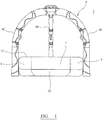
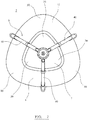
- the infant accommodation apparatus 2 comprises an inflatable support device 4 and a framework 6 which abuts and extends over the device 4 and includes toys (not shown) arranged to stimulate, for example to visually stimulate, an infant accommodated within an accommodation region 7 of the device.
- the apparatus 2 is described in greater detail below.
- the support device 4 comprises an inner inflatable plastics member 8 and an outer removable fabric cover 12 which is arranged to completely enclose the member 8.
- the support device incorporates a padded base part 14 ( Figure 5 ) upon which the infant may lie, kneel or sit within the accommodation region 7.
- the plastics member 8 includes an enclosure wall 10 which defines an opening 9 which, when member 8 is inflated, defines the infant accommodation region 7.
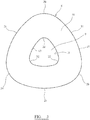
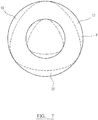
- the enclosure wall 10 has respective parallel inner and outer walls 15, 17 in the shape of modified equilateral triangles. This is illustrated in Figure 6 wherein three convex arcs 16 are shown extending between adjacent apexes 18 of an equilateral triangular in order to form the shape of the outer wall 17.
- outer wall 17 of the member 8 may be regarded as being of a modified triangular shape having three curved apex regions 20 each of which has a radius of curvature which is less than the radius of curvature of the outer wall at apex regions 21 between the apex regions 20.
- the inner wall 15 corresponds in shape to that of the outer wall 17 so the opening 9 defined by the inner wall 15 comprises three regions 22 ( Figure 7 ) having a radius of curvature which is less than the radius of curvature of regions of the opening between the apex regions.
- the plastics member 8 is preferably made from a plastics material which does not contain phthalates.
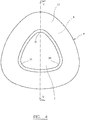
- the fabric cover 12 is shaped to snugly receive the plastics member 8 so that when the member 8 is arranged within it, the shape of the support device 4 substantially corresponds to that of the plastic member 8, as shown in figures 4 and 5 .
- the region 7 is in the shape of a modified equilateral triangle with apex regions 30 having a lower radius of curvature compared to the radius of curvature of regions between the apex regions.
- the cover 12 includes a zip 32 ( Figure 1 ) arranged to define an opening through which the plastics member 8, in a partially deflated state, may be inserted for engagement with the cover.
- the member 8 may then be inflated to define the arrangement of Figure 1 .
- the padded base 14 of Figure 5 is not secured to the underlying fabric 34 so that the plastic member 8 can pass between base 14 and fabric 34 when it is being positioned within the cover.
- the support device 4 When assembled, the support device 4 provides a safe, supportive environment for an infant who may sit or kneel within accommodation region 7. It will be appreciated that the infant is prevented from falling back by the support provided by the walls of the device.
- the infant accommodation apparatus is furthermore provided with an additional safe environment which may safely accommodate babies from age 0 who cannot support their necks.
- the additional safe environment is described below with reference to Figures 8 and 11 . Note that all of the features shown in Figures 8 to 11 are not necessarily shown in other figures, in the interests of clarity.
- the support device 4 is shown inverted compared to its configuration shown in Figures 1 , 2 and 5 to reveal a second infant accommodation region 50 of the apparatus 2.
- the second infant accommodation region 50 is arranged to provide a safe and secure position for a baby from age 0.
- Region 50 includes a padded headrest 54 and a body support region 55.
- the headrest 54 comprises a piece of material which is sewn to the fabric 34 of the cover 12. It includes a circular region 56 and, extending there around, a padded region 58 (shown hatched in Figure 8 ) which includes wadding so that region 58 extends outwardly away from circular region 56 to provide support for an infant's head which may rest upon circular region 56.
- Body support region 55 comprises a piece of material which is also sewn to the fabric 34 of the cover 12 and is padded (as shown hatched in Figure 8 ).
- a harness 60 is provided and arranged to receive a baby's legs, through leg openings 61, so that elongate portion 62 is arranged around a baby's waist and/or hips in use.
- padded base 14 may fall away slightly from fabric 34 which in the Figures 1 , 2 , and 5 arrangements directly contacts the ground on which the support device 4 rests.
- the headrest 54 is positioned radially inwards of one apex region 21 (i.e. radially inwards of a region of enclosure wall 10 which has the lowest radius of curvature). This enables the baby's shoulders to rest on the widest part of enclosure wall 10. This arrangement provides a well-supported snug position for the baby.
- the headrest 54 and body support region 35 are sufficiently compact and compressible that they can be permanent features of the apparatus, even when the apparatus is used in the Figures 1 , 2 and 5 positions.
- the headrest 54 does not need to be removable.
- harness 60 can be a permanent fixture which is suitably sufficiently soft that it doesn't interfere with the apparatus when used in the Figures 1 , 2 and 5 positions.
- a baby In use, a baby can be placed on region 55, with its head resting in region 56 of headrest 54 and safely secured in positon by engagement with harness 60.
- harness 60 there is suitably a small amount of "give" associated with region 55 and underlying fabric 54, so a slightly bowl-shaped or concave region is defined in which the baby can comfortably lie.
- the infant accommodation apparatus may be used alone or may be used with the framework 6 extending over the device.
- Various different types of frameworks may be utilized. One type may be as shown in Figures 1 and 2 .
- a preferred infant accommodation apparatus incorporating a framework is shown in Figures 12 to 14 .
- FIG. 12 to 14 four elastic loops 16 are incorporated into the fabric cover 12 and spaced at 90° intervals around the periphery of the cover at a level which is approximately midway between the upper and lower walls of the device 4.
- the loops are arranged to resiliently engage members 118 of the framework 6.
- the cover is highly decorated and provided with various means for stimulating the senses of an infant.
- the cover may be visually stimulating by incorporating representations in bright and contrasting colours; it may stimulate the tactile sense by incorporating materials of different textures; and it may stimulate the auditory sense by incorporating means for causing squeaks or crinkle sounds or electronic devices for playing melodies or making other noises.
- Framework 6 is arranged to provide a dome-shaped structure over the device 4 and comprises a cruciform connector 120 which includes outwardly facing ports 122 which are spaced at 90° to one another and are arranged to slidably receive ends 124 of arcuate tubular struts 126. Each strut 126 has two strut parts 125 connected by a female connector 127.
- the framework 6 is provided with a one piece removable fabric cover 130 which encloses each strut 126 and connector 120.
- the cover comprises a first sleeve which is arranged to cover one pair of diametrically extending struts 126 and two other sleeves extending perpendicular to the first sleeve and stitched thereto for covering the other two struts. Access to the cover is obtained via an opening facing downwardly in use in the region of the cover which accommodates the cruciform connector.
- the framework 6 is assembled by inserting each strut in position in the sleeves of the cover and then inserting connector 120 into the cover via the downwardly facing opening described and securing the struts to the connector.
- the cover 130 is brightly coloured and it includes scalloped areas 132 which incorporate buttonholes to which toys 134 can be releasably secured.
- Framework 6 with cover 130 in position can be releasably secured to the support device 4 with the support device positioned with its fabric 134 of its base on the ground by pushing the fabric covered struts 126 through loops 16 until the struts are adjacent the floor on which the apparatus is supported.
- the struts and, therefore, the framework 6, are retained in position by virtue of the friction between the fabric of the framework and loops 16 and the force exerted by the resilient loops.
- the framework may, in view of the positioning and arrangement of loops 16, also be secured in position when the support device is inverted as represented in Figures 8 to 11 .
- the apparatus may advantageously be used in a number of configurations to accommodate and/or stimulate a baby/infant from age 0 up to about 3 or 4 years, as follows:
- the apparatus described can provide a safe, stimulating environment for a baby/infant for many years.
- the apparatus described can provide a safe, stimulating environment for a baby/infant for many years.
Landscapes
- Health & Medical Sciences (AREA)
- General Health & Medical Sciences (AREA)
- Pediatric Medicine (AREA)
- Carriages For Children, Sleds, And Other Hand-Operated Vehicles (AREA)
- Seats For Vehicles (AREA)
- Toys (AREA)
Claims (12)
- Appareil de réception d'enfant en bas âge (2) comprenant un dispositif de support (4) qui comprend une base (14), ledit dispositif de support (4) comprenant un enclos (10) s'étendant dans une direction s'éloignant de ladite base (14) sur un premier côté de la base (14), ledit enclos (10) entourant une région de réception d'enfant en bas âge (7) dans laquelle un enfant en bas âge est placé lors de l'utilisation, un appuie-tête (54) étant fourni sur un second côté de la base (14) ;
ledit appareil de réception d'enfant en bas âge (2) étant conçu pour être placé dans une première configuration dans laquelle la base (14) est en contact direct avec une surface de support, par exemple un sol, et/ou est supportée par celle-ci et ledit enclos (10) s'étend dans une direction s'éloignant de ladite base (14) sur ledit premier côté de la base (14), où :(i) lorsque ledit appareil (2) est placé dans ladite première configuration, ledit appuie-tête (54) est orienté vers le bas ; et/ou(ii) dans ladite première configuration, ledit appuie-tête (54) est en contact direct avec une surface de support, par exemple un sol, sur laquelle l'appareil de réception d'enfant en bas âge (2) est disposé lors de l'utilisation ;un harnais (60) étant fourni sur ledit second côté de la base (14) pour attacher un enfant en bas âge au dispositif de support (4) ;
ledit harnais (60) étant orienté vers le bas lorsque ledit appareil (2) se trouve dans ladite première configuration dans laquelle ledit appuie-tête (54) est orienté vers le bas ; et ledit harnais (54) étant en contact direct avec une surface de support, par exemple un sol, sur laquelle l'appareil de réception d'enfant en bas âge (2) est disposé lors de l'utilisation lorsque ledit appareil (2) se trouve dans ladite première configuration. - Appareil selon la revendication 1, dans lequel ledit dispositif de support (4) est conçu pour définir un enclos continu autour de la région (7) destinée à recevoir un enfant en bas âge ; et, éventuellement, ledit dispositif de support inclut une housse (12) qui est amovible vis-à-vis d'un élément formant garniture intérieure (8) du dispositif.
- Appareil selon la revendication 1 ou la revendication 2, dans lequel ledit appuie-tête (54) comprend une première partie qui est conçue pour venir en contact avec l'arrière de la tête d'un enfant en bas âge et/ou soutenir celui-ci lors de l'utilisation ; et dans lequel ledit appuie-tête est en superposition sur une région du dispositif de support qui se situe en dehors d'une zone occupée par la région de réception d'enfant en bas âge.
- Appareil selon l'une quelconque des revendications précédentes, dans lequel ledit dispositif de support (4) comprend une housse (12) et ledit harnais (60) est attaché à la housse.
- Appareil selon l'une quelconque des revendications précédentes, dans lequel ledit harnais (60) est en superposition sur la région de réception d'enfant en bas âge (7) du dispositif de support.
- Appareil selon l'une quelconque des revendications précédentes, ledit appareil de réception d'enfant en bas âge étant conçu pour être placé dans une seconde configuration (Fig. 9) qui est inversée par rapport à ladite première configuration (Fig. 1), ledit appuie-tête (54) étant orienté vers le bas dans ladite première configuration ; et ledit premier côté étant orienté vers le bas et ledit second côté étant orienté vers le haut dans ladite seconde configuration.
- Appareil selon la revendication 6, dans lequel ledit dispositif de support comprend une partie de support d'enfant en bas âge (55) qui définit une zone destinée à supporter le corps d'un enfant en bas âge lorsque le dispositif de support se trouve dans ladite seconde configuration ; et, éventuellement, ladite partie de support d'enfant en bas âge comprend un matériau conformé attaché vis-à-vis d'une ou de ladite housse (12) de l'appareil.
- Appareil selon l'une quelconque des revendications précédentes, dans lequel ledit dispositif de support (4) est conçu de telle sorte que, lorsqu'il se trouve dans une ou ladite seconde configuration avec un enfant en bas âge en contact avec une ou ladite partie de support d'enfant en bas âge (55) de l'appareil, une région concave est définie dans laquelle est situé l'enfant en bas âge.
- Appareil selon l'une quelconque des revendications précédentes, dans lequel ledit appuie-tête (54) est positionné entre des parties de parois d'enclos intérieure (15) et extérieure (17) dudit dispositif de support qui présentent un rayon de courbure supérieur à celui d'autres parties des parois d'enclos intérieure et extérieure ; et/ou
dans lequel ladite paroi d'enclos intérieure comprend une première région qui présente un rayon de courbure inférieur à celui de deuxième et troisième régions respectives desdites parois d'enclos intérieures adjacentes à ladite première région ; et ladite paroi d'enclos extérieure comprend une première région qui présente un rayon de courbure inférieur à celui de deuxième et troisième régions respectives ; et ledit appuie-tête (54) est positionné entre ladite deuxième région de ladite paroi d'enclos intérieure et une deuxième région de ladite paroi d'enclos extérieure ; et/ou
ledit dispositif de support comprend un harnais (60) positionné dans l'alignement de parties des parois d'enclos intérieure et extérieure qui présentent un rayon de courbure inférieur à celui d'autres parties des parois d'enclos intérieure et extérieure. - Appareil selon l'une quelconque des revendications précédentes, ledit appareil de réception d'enfant en bas âge comprenant une structure (6) s'étendant au-dessus du dispositif de support (4) servant à stimuler visuellement un enfant en bas âge positionné dans le dispositif.
- Appareil selon la revendication 10, dans lequel un premier moyen d'attache (16) est conçu pour venir en prise de manière libérable avec la structure lorsque l'appareil de réception d'enfant en bas âge se trouve dans ladite première configuration et également lorsqu'il se trouve dans une seconde configuration dans laquelle ledit premier côté est orienté vers le bas et ledit second côté est orienté vers le haut.
- Procédé d'assemblage d'un appareil de réception d'enfant en bas âge (2) selon l'une quelconque des revendications précédentes, qui comprend la sélection d'un dispositif de support (4) et le positionnement du dispositif de support (4) sur une surface de support de sorte qu'un appuie-tête (54) du dispositif de support (4) soit orienté vers le haut ; et, éventuellement, le positionnement du dispositif de support (4) sur une surface de support de sorte qu'un appuie-tête (54) du dispositif de support (4) soit orienté vers le bas et/ou soit en appui sur la surface de support.
Applications Claiming Priority (2)
| Application Number | Priority Date | Filing Date | Title |
|---|---|---|---|
| GB1507749.8A GB2538086B (en) | 2015-05-06 | 2015-05-06 | Infant accommodation apparatus |
| PCT/GB2016/051268 WO2016178014A1 (fr) | 2015-05-06 | 2016-05-03 | Appareil de support de nourrisson |
Publications (2)
| Publication Number | Publication Date |
|---|---|
| EP3291709A1 EP3291709A1 (fr) | 2018-03-14 |
| EP3291709B1 true EP3291709B1 (fr) | 2021-06-16 |
Family
ID=53489202
Family Applications (1)
| Application Number | Title | Priority Date | Filing Date |
|---|---|---|---|
| EP16721883.3A Active EP3291709B1 (fr) | 2015-05-06 | 2016-05-03 | Appareil de support de nourrisson |
Country Status (8)
| Country | Link |
|---|---|
| US (1) | US10542827B2 (fr) |
| EP (1) | EP3291709B1 (fr) |
| CN (1) | CN107592795B (fr) |
| AU (1) | AU2016257494B2 (fr) |
| CA (1) | CA2982858C (fr) |
| ES (1) | ES2883955T3 (fr) |
| GB (1) | GB2538086B (fr) |
| WO (1) | WO2016178014A1 (fr) |
Family Cites Families (19)
| Publication number | Priority date | Publication date | Assignee | Title |
|---|---|---|---|---|
| US1392533A (en) * | 1921-10-04 | Necticut | ||
| US2672628A (en) * | 1947-10-30 | 1954-03-23 | Abraham N Spanel | Utility device for infants |
| US3058122A (en) * | 1960-06-16 | 1962-10-16 | Union Carbide Corp | Thermoplastic film lavatory |
| US4964183A (en) * | 1987-10-13 | 1990-10-23 | Laforce Jr James W | Tanning tub |
| AT400222B (de) * | 1993-10-27 | 1995-11-27 | Schwarz Zoehrer Sabine | Liege für ein kleinkind |
| GB2284546B (en) | 1993-12-04 | 1998-06-10 | James Galt & Company Limited | Device for accomodating an infant |
| CN2249538Y (zh) * | 1995-03-29 | 1997-03-19 | 梅尔阿派尔有限公司 | 带有可充气底的游戏围栏 |
| US5813066A (en) * | 1996-07-15 | 1998-09-29 | Gebhard; Albert W. | Baby rest |
| GB2318050B (en) * | 1996-10-10 | 2001-02-14 | James Galt & Company Ltd | Infant accommodation apparatus |
| AUPP547598A0 (en) * | 1998-08-25 | 1998-09-17 | Morgillo, Angelo | Infant safety device |
| US6354665B1 (en) * | 1999-02-08 | 2002-03-12 | Elisabeth Helen Ross | Inflatable infant sitting support |
| GB2348130A (en) * | 1999-03-26 | 2000-09-27 | James Galt & Company Limited | Baby accommodation device |
| US6553590B1 (en) * | 2002-06-11 | 2003-04-29 | Jamie S. Leach | Infant support pillow with body wrap |
| US6857150B2 (en) * | 2003-07-01 | 2005-02-22 | The Boppy Company | Support pillow for small infants |
| GB0521364D0 (en) * | 2005-10-20 | 2005-11-30 | Walsh Barltrop Sharon | Mattress cover and harness system |
| GB0619582D0 (en) * | 2006-10-04 | 2006-11-15 | James Galt & Company Ltd | Infant accommodation apparatus |
| US8024829B2 (en) * | 2008-02-05 | 2011-09-27 | Mia Carr | Weight activated restraining pillow |
| CN202959685U (zh) * | 2011-08-10 | 2013-06-05 | 儿童二代公司 | 躺椅 |
| WO2014074916A2 (fr) * | 2012-11-09 | 2014-05-15 | Wallace-Simpson Tiffany | Siège de voyage escamotable pour enfants et autres |
-
2015
- 2015-05-06 GB GB1507749.8A patent/GB2538086B/en not_active Expired - Fee Related
-
2016
- 2016-05-03 CA CA2982858A patent/CA2982858C/fr active Active
- 2016-05-03 ES ES16721883T patent/ES2883955T3/es active Active
- 2016-05-03 EP EP16721883.3A patent/EP3291709B1/fr active Active
- 2016-05-03 WO PCT/GB2016/051268 patent/WO2016178014A1/fr not_active Ceased
- 2016-05-03 CN CN201680025820.3A patent/CN107592795B/zh active Active
- 2016-05-03 US US15/571,772 patent/US10542827B2/en active Active
- 2016-05-03 AU AU2016257494A patent/AU2016257494B2/en active Active
Non-Patent Citations (1)
| Title |
|---|
| None * |
Also Published As
| Publication number | Publication date |
|---|---|
| CN107592795B (zh) | 2021-05-11 |
| WO2016178014A1 (fr) | 2016-11-10 |
| GB201507749D0 (en) | 2015-06-17 |
| AU2016257494B2 (en) | 2020-07-09 |
| US10542827B2 (en) | 2020-01-28 |
| GB2538086A (en) | 2016-11-09 |
| CA2982858C (fr) | 2024-01-16 |
| CA2982858A1 (fr) | 2016-11-10 |
| GB2538086B (en) | 2020-11-25 |
| EP3291709A1 (fr) | 2018-03-14 |
| AU2016257494A1 (en) | 2017-11-23 |
| US20180140111A1 (en) | 2018-05-24 |
| CN107592795A (zh) | 2018-01-16 |
| HK1246118A1 (zh) | 2018-09-07 |
| ES2883955T3 (es) | 2021-12-09 |
Similar Documents
| Publication | Publication Date | Title |
|---|---|---|
| EP0835622B1 (fr) | Dispositif d'accomodation d'un petit enfant | |
| EP2096963B1 (fr) | Appareil de support de bébé | |
| US7418752B2 (en) | Mattress insert | |
| US20110041244A1 (en) | Child bathing apparatus | |
| US20140189956A1 (en) | The baby wedge | |
| US8992337B1 (en) | Portable toddler swing | |
| US6000761A (en) | Infant supporting chair | |
| US6918149B2 (en) | Sitting square baby support cushion | |
| EP3291709B1 (fr) | Appareil de support de nourrisson | |
| MX2014002874A (es) | Soporte infantil. | |
| GB2471564A (en) | Infant accommodation with a toy mountable in two positions | |
| HK1246118B (en) | Infant accommodation apparatus | |
| US7146661B1 (en) | Knockdown, portable, non-intimidating, and stable pen for comfortably, conformingly, supportingly, and entertainingly accommodating an infant therein | |
| KR200318423Y1 (ko) | 유아용 의자 | |
| US20150351559A1 (en) | The Baby Sitter Infant Support Cushion | |
| GB2383749A (en) | Play area for children | |
| AU2007304039B2 (en) | Infant accommodation apparatus | |
| KR200411919Y1 (ko) | 유아 보호자용 지지의자 | |
| CN210842412U (zh) | 婴幼儿坐卧椅 | |
| KR200377460Y1 (ko) | 의자 | |
| HK1130642B (en) | Infant accommodation apparatus | |
| HK1130642A (en) | Infant accommodation apparatus |
Legal Events
| Date | Code | Title | Description |
|---|---|---|---|
| STAA | Information on the status of an ep patent application or granted ep patent |
Free format text: STATUS: THE INTERNATIONAL PUBLICATION HAS BEEN MADE |
|
| PUAI | Public reference made under article 153(3) epc to a published international application that has entered the european phase |
Free format text: ORIGINAL CODE: 0009012 |
|
| STAA | Information on the status of an ep patent application or granted ep patent |
Free format text: STATUS: REQUEST FOR EXAMINATION WAS MADE |
|
| 17P | Request for examination filed |
Effective date: 20171020 |
|
| AK | Designated contracting states |
Kind code of ref document: A1 Designated state(s): AL AT BE BG CH CY CZ DE DK EE ES FI FR GB GR HR HU IE IS IT LI LT LU LV MC MK MT NL NO PL PT RO RS SE SI SK SM TR |
|
| AX | Request for extension of the european patent |
Extension state: BA ME |
|
| DAV | Request for validation of the european patent (deleted) | ||
| DAX | Request for extension of the european patent (deleted) | ||
| REG | Reference to a national code |
Ref country code: HK Ref legal event code: DE Ref document number: 1246118 Country of ref document: HK |
|
| STAA | Information on the status of an ep patent application or granted ep patent |
Free format text: STATUS: EXAMINATION IS IN PROGRESS |
|
| 17Q | First examination report despatched |
Effective date: 20200421 |
|
| GRAP | Despatch of communication of intention to grant a patent |
Free format text: ORIGINAL CODE: EPIDOSNIGR1 |
|
| STAA | Information on the status of an ep patent application or granted ep patent |
Free format text: STATUS: GRANT OF PATENT IS INTENDED |
|
| INTG | Intention to grant announced |
Effective date: 20210407 |
|
| GRAS | Grant fee paid |
Free format text: ORIGINAL CODE: EPIDOSNIGR3 |
|
| GRAA | (expected) grant |
Free format text: ORIGINAL CODE: 0009210 |
|
| STAA | Information on the status of an ep patent application or granted ep patent |
Free format text: STATUS: THE PATENT HAS BEEN GRANTED |
|
| AK | Designated contracting states |
Kind code of ref document: B1 Designated state(s): AL AT BE BG CH CY CZ DE DK EE ES FI FR GB GR HR HU IE IS IT LI LT LU LV MC MK MT NL NO PL PT RO RS SE SI SK SM TR |
|
| REG | Reference to a national code |
Ref country code: GB Ref legal event code: FG4D |
|
| REG | Reference to a national code |
Ref country code: CH Ref legal event code: EP |
|
| REG | Reference to a national code |
Ref country code: DE Ref legal event code: R096 Ref document number: 602016059355 Country of ref document: DE |
|
| REG | Reference to a national code |
Ref country code: AT Ref legal event code: REF Ref document number: 1401596 Country of ref document: AT Kind code of ref document: T Effective date: 20210715 |
|
| REG | Reference to a national code |
Ref country code: IE Ref legal event code: FG4D |
|
| REG | Reference to a national code |
Ref country code: NL Ref legal event code: FP |
|
| REG | Reference to a national code |
Ref country code: LT Ref legal event code: MG9D |
|
| PG25 | Lapsed in a contracting state [announced via postgrant information from national office to epo] |
Ref country code: LT Free format text: LAPSE BECAUSE OF FAILURE TO SUBMIT A TRANSLATION OF THE DESCRIPTION OR TO PAY THE FEE WITHIN THE PRESCRIBED TIME-LIMIT Effective date: 20210616 Ref country code: FI Free format text: LAPSE BECAUSE OF FAILURE TO SUBMIT A TRANSLATION OF THE DESCRIPTION OR TO PAY THE FEE WITHIN THE PRESCRIBED TIME-LIMIT Effective date: 20210616 Ref country code: HR Free format text: LAPSE BECAUSE OF FAILURE TO SUBMIT A TRANSLATION OF THE DESCRIPTION OR TO PAY THE FEE WITHIN THE PRESCRIBED TIME-LIMIT Effective date: 20210616 Ref country code: BG Free format text: LAPSE BECAUSE OF FAILURE TO SUBMIT A TRANSLATION OF THE DESCRIPTION OR TO PAY THE FEE WITHIN THE PRESCRIBED TIME-LIMIT Effective date: 20210916 |
|
| REG | Reference to a national code |
Ref country code: AT Ref legal event code: MK05 Ref document number: 1401596 Country of ref document: AT Kind code of ref document: T Effective date: 20210616 |
|
| PG25 | Lapsed in a contracting state [announced via postgrant information from national office to epo] |
Ref country code: SE Free format text: LAPSE BECAUSE OF FAILURE TO SUBMIT A TRANSLATION OF THE DESCRIPTION OR TO PAY THE FEE WITHIN THE PRESCRIBED TIME-LIMIT Effective date: 20210616 Ref country code: RS Free format text: LAPSE BECAUSE OF FAILURE TO SUBMIT A TRANSLATION OF THE DESCRIPTION OR TO PAY THE FEE WITHIN THE PRESCRIBED TIME-LIMIT Effective date: 20210616 Ref country code: NO Free format text: LAPSE BECAUSE OF FAILURE TO SUBMIT A TRANSLATION OF THE DESCRIPTION OR TO PAY THE FEE WITHIN THE PRESCRIBED TIME-LIMIT Effective date: 20210916 Ref country code: GR Free format text: LAPSE BECAUSE OF FAILURE TO SUBMIT A TRANSLATION OF THE DESCRIPTION OR TO PAY THE FEE WITHIN THE PRESCRIBED TIME-LIMIT Effective date: 20210917 Ref country code: LV Free format text: LAPSE BECAUSE OF FAILURE TO SUBMIT A TRANSLATION OF THE DESCRIPTION OR TO PAY THE FEE WITHIN THE PRESCRIBED TIME-LIMIT Effective date: 20210616 |
|
| REG | Reference to a national code |
Ref country code: ES Ref legal event code: FG2A Ref document number: 2883955 Country of ref document: ES Kind code of ref document: T3 Effective date: 20211209 |
|
| PG25 | Lapsed in a contracting state [announced via postgrant information from national office to epo] |
Ref country code: RO Free format text: LAPSE BECAUSE OF FAILURE TO SUBMIT A TRANSLATION OF THE DESCRIPTION OR TO PAY THE FEE WITHIN THE PRESCRIBED TIME-LIMIT Effective date: 20210616 Ref country code: PT Free format text: LAPSE BECAUSE OF FAILURE TO SUBMIT A TRANSLATION OF THE DESCRIPTION OR TO PAY THE FEE WITHIN THE PRESCRIBED TIME-LIMIT Effective date: 20211018 Ref country code: AT Free format text: LAPSE BECAUSE OF FAILURE TO SUBMIT A TRANSLATION OF THE DESCRIPTION OR TO PAY THE FEE WITHIN THE PRESCRIBED TIME-LIMIT Effective date: 20210616 Ref country code: EE Free format text: LAPSE BECAUSE OF FAILURE TO SUBMIT A TRANSLATION OF THE DESCRIPTION OR TO PAY THE FEE WITHIN THE PRESCRIBED TIME-LIMIT Effective date: 20210616 Ref country code: CZ Free format text: LAPSE BECAUSE OF FAILURE TO SUBMIT A TRANSLATION OF THE DESCRIPTION OR TO PAY THE FEE WITHIN THE PRESCRIBED TIME-LIMIT Effective date: 20210616 Ref country code: SM Free format text: LAPSE BECAUSE OF FAILURE TO SUBMIT A TRANSLATION OF THE DESCRIPTION OR TO PAY THE FEE WITHIN THE PRESCRIBED TIME-LIMIT Effective date: 20210616 Ref country code: SK Free format text: LAPSE BECAUSE OF FAILURE TO SUBMIT A TRANSLATION OF THE DESCRIPTION OR TO PAY THE FEE WITHIN THE PRESCRIBED TIME-LIMIT Effective date: 20210616 |
|
| PG25 | Lapsed in a contracting state [announced via postgrant information from national office to epo] |
Ref country code: PL Free format text: LAPSE BECAUSE OF FAILURE TO SUBMIT A TRANSLATION OF THE DESCRIPTION OR TO PAY THE FEE WITHIN THE PRESCRIBED TIME-LIMIT Effective date: 20210616 |
|
| REG | Reference to a national code |
Ref country code: DE Ref legal event code: R097 Ref document number: 602016059355 Country of ref document: DE |
|
| PLBE | No opposition filed within time limit |
Free format text: ORIGINAL CODE: 0009261 |
|
| STAA | Information on the status of an ep patent application or granted ep patent |
Free format text: STATUS: NO OPPOSITION FILED WITHIN TIME LIMIT |
|
| PG25 | Lapsed in a contracting state [announced via postgrant information from national office to epo] |
Ref country code: DK Free format text: LAPSE BECAUSE OF FAILURE TO SUBMIT A TRANSLATION OF THE DESCRIPTION OR TO PAY THE FEE WITHIN THE PRESCRIBED TIME-LIMIT Effective date: 20210616 |
|
| 26N | No opposition filed |
Effective date: 20220317 |
|
| PG25 | Lapsed in a contracting state [announced via postgrant information from national office to epo] |
Ref country code: AL Free format text: LAPSE BECAUSE OF FAILURE TO SUBMIT A TRANSLATION OF THE DESCRIPTION OR TO PAY THE FEE WITHIN THE PRESCRIBED TIME-LIMIT Effective date: 20210616 |
|
| REG | Reference to a national code |
Ref country code: CH Ref legal event code: PL |
|
| PG25 | Lapsed in a contracting state [announced via postgrant information from national office to epo] |
Ref country code: MC Free format text: LAPSE BECAUSE OF FAILURE TO SUBMIT A TRANSLATION OF THE DESCRIPTION OR TO PAY THE FEE WITHIN THE PRESCRIBED TIME-LIMIT Effective date: 20210616 Ref country code: LI Free format text: LAPSE BECAUSE OF NON-PAYMENT OF DUE FEES Effective date: 20220531 Ref country code: CH Free format text: LAPSE BECAUSE OF NON-PAYMENT OF DUE FEES Effective date: 20220531 |
|
| PG25 | Lapsed in a contracting state [announced via postgrant information from national office to epo] |
Ref country code: IE Free format text: LAPSE BECAUSE OF NON-PAYMENT OF DUE FEES Effective date: 20220503 |
|
| P01 | Opt-out of the competence of the unified patent court (upc) registered |
Effective date: 20230523 |
|
| PG25 | Lapsed in a contracting state [announced via postgrant information from national office to epo] |
Ref country code: HU Free format text: LAPSE BECAUSE OF FAILURE TO SUBMIT A TRANSLATION OF THE DESCRIPTION OR TO PAY THE FEE WITHIN THE PRESCRIBED TIME-LIMIT; INVALID AB INITIO Effective date: 20160503 |
|
| PG25 | Lapsed in a contracting state [announced via postgrant information from national office to epo] |
Ref country code: MK Free format text: LAPSE BECAUSE OF FAILURE TO SUBMIT A TRANSLATION OF THE DESCRIPTION OR TO PAY THE FEE WITHIN THE PRESCRIBED TIME-LIMIT Effective date: 20210616 Ref country code: CY Free format text: LAPSE BECAUSE OF FAILURE TO SUBMIT A TRANSLATION OF THE DESCRIPTION OR TO PAY THE FEE WITHIN THE PRESCRIBED TIME-LIMIT Effective date: 20210616 |
|
| PGFP | Annual fee paid to national office [announced via postgrant information from national office to epo] |
Ref country code: LU Payment date: 20240522 Year of fee payment: 9 |
|
| PGFP | Annual fee paid to national office [announced via postgrant information from national office to epo] |
Ref country code: NL Payment date: 20240521 Year of fee payment: 9 |
|
| PGFP | Annual fee paid to national office [announced via postgrant information from national office to epo] |
Ref country code: DE Payment date: 20240521 Year of fee payment: 9 |
|
| PGFP | Annual fee paid to national office [announced via postgrant information from national office to epo] |
Ref country code: FR Payment date: 20240528 Year of fee payment: 9 |
|
| PGFP | Annual fee paid to national office [announced via postgrant information from national office to epo] |
Ref country code: BE Payment date: 20240521 Year of fee payment: 9 |
|
| PG25 | Lapsed in a contracting state [announced via postgrant information from national office to epo] |
Ref country code: MT Free format text: LAPSE BECAUSE OF FAILURE TO SUBMIT A TRANSLATION OF THE DESCRIPTION OR TO PAY THE FEE WITHIN THE PRESCRIBED TIME-LIMIT Effective date: 20210616 |
|
| PGFP | Annual fee paid to national office [announced via postgrant information from national office to epo] |
Ref country code: GB Payment date: 20250424 Year of fee payment: 10 Ref country code: ES Payment date: 20250627 Year of fee payment: 10 |
|
| PGFP | Annual fee paid to national office [announced via postgrant information from national office to epo] |
Ref country code: IT Payment date: 20250521 Year of fee payment: 10 |
|
| REG | Reference to a national code |
Ref country code: DE Ref legal event code: R119 Ref document number: 602016059355 Country of ref document: DE |
|
| PG25 | Lapsed in a contracting state [announced via postgrant information from national office to epo] |
Ref country code: TR Free format text: LAPSE BECAUSE OF FAILURE TO SUBMIT A TRANSLATION OF THE DESCRIPTION OR TO PAY THE FEE WITHIN THE PRESCRIBED TIME-LIMIT Effective date: 20210616 |
|
| REG | Reference to a national code |
Ref country code: NL Ref legal event code: MM Effective date: 20250601 |
|
| PG25 | Lapsed in a contracting state [announced via postgrant information from national office to epo] |
Ref country code: LU Free format text: LAPSE BECAUSE OF NON-PAYMENT OF DUE FEES Effective date: 20250503 |
|
| REG | Reference to a national code |
Ref country code: BE Ref legal event code: MM Effective date: 20250531 |
|
| PG25 | Lapsed in a contracting state [announced via postgrant information from national office to epo] |
Ref country code: NL Free format text: LAPSE BECAUSE OF NON-PAYMENT OF DUE FEES Effective date: 20250601 |
|
| PG25 | Lapsed in a contracting state [announced via postgrant information from national office to epo] |
Ref country code: DE Free format text: LAPSE BECAUSE OF NON-PAYMENT OF DUE FEES Effective date: 20251202 |
|
| PG25 | Lapsed in a contracting state [announced via postgrant information from national office to epo] |
Ref country code: BE Free format text: LAPSE BECAUSE OF NON-PAYMENT OF DUE FEES Effective date: 20250531 |
|
| PG25 | Lapsed in a contracting state [announced via postgrant information from national office to epo] |
Ref country code: FR Free format text: LAPSE BECAUSE OF NON-PAYMENT OF DUE FEES Effective date: 20250531 |