EP3292378B1 - Repères binauraux de navigation - Google Patents
Repères binauraux de navigation Download PDFInfo
- Publication number
- EP3292378B1 EP3292378B1 EP16789746.1A EP16789746A EP3292378B1 EP 3292378 B1 EP3292378 B1 EP 3292378B1 EP 16789746 A EP16789746 A EP 16789746A EP 3292378 B1 EP3292378 B1 EP 3292378B1
- Authority
- EP
- European Patent Office
- Prior art keywords
- navigational
- user
- heading
- directional
- computer
- Prior art date
- Legal status (The legal status is an assumption and is not a legal conclusion. Google has not performed a legal analysis and makes no representation as to the accuracy of the status listed.)
- Active
Links
Images




Classifications
-
- G—PHYSICS
- G01—MEASURING; TESTING
- G01C—MEASURING DISTANCES, LEVELS OR BEARINGS; SURVEYING; NAVIGATION; GYROSCOPIC INSTRUMENTS; PHOTOGRAMMETRY OR VIDEOGRAMMETRY
- G01C21/00—Navigation; Navigational instruments not provided for in groups G01C1/00 - G01C19/00
- G01C21/26—Navigation; Navigational instruments not provided for in groups G01C1/00 - G01C19/00 specially adapted for navigation in a road network
- G01C21/34—Route searching; Route guidance
- G01C21/36—Input/output arrangements for on-board computers
- G01C21/3626—Details of the output of route guidance instructions
- G01C21/3629—Guidance using speech or audio output, e.g. text-to-speech
-
- G—PHYSICS
- G01—MEASURING; TESTING
- G01C—MEASURING DISTANCES, LEVELS OR BEARINGS; SURVEYING; NAVIGATION; GYROSCOPIC INSTRUMENTS; PHOTOGRAMMETRY OR VIDEOGRAMMETRY
- G01C21/00—Navigation; Navigational instruments not provided for in groups G01C1/00 - G01C19/00
- G01C21/20—Instruments for performing navigational calculations
-
- G—PHYSICS
- G01—MEASURING; TESTING
- G01C—MEASURING DISTANCES, LEVELS OR BEARINGS; SURVEYING; NAVIGATION; GYROSCOPIC INSTRUMENTS; PHOTOGRAMMETRY OR VIDEOGRAMMETRY
- G01C21/00—Navigation; Navigational instruments not provided for in groups G01C1/00 - G01C19/00
- G01C21/26—Navigation; Navigational instruments not provided for in groups G01C1/00 - G01C19/00 specially adapted for navigation in a road network
- G01C21/34—Route searching; Route guidance
- G01C21/3407—Route searching; Route guidance specially adapted for specific applications
- G01C21/3415—Dynamic re-routing, e.g. recalculating the route when the user deviates from calculated route or after detecting real-time traffic data or accidents
-
- G—PHYSICS
- G01—MEASURING; TESTING
- G01C—MEASURING DISTANCES, LEVELS OR BEARINGS; SURVEYING; NAVIGATION; GYROSCOPIC INSTRUMENTS; PHOTOGRAMMETRY OR VIDEOGRAMMETRY
- G01C21/00—Navigation; Navigational instruments not provided for in groups G01C1/00 - G01C19/00
- G01C21/26—Navigation; Navigational instruments not provided for in groups G01C1/00 - G01C19/00 specially adapted for navigation in a road network
- G01C21/34—Route searching; Route guidance
- G01C21/36—Input/output arrangements for on-board computers
- G01C21/3626—Details of the output of route guidance instructions
- G01C21/3661—Guidance output on an external device, e.g. car radio
-
- G—PHYSICS
- G06—COMPUTING OR CALCULATING; COUNTING
- G06F—ELECTRIC DIGITAL DATA PROCESSING
- G06F3/00—Input arrangements for transferring data to be processed into a form capable of being handled by the computer; Output arrangements for transferring data from processing unit to output unit, e.g. interface arrangements
- G06F3/16—Sound input; Sound output
- G06F3/165—Management of the audio stream, e.g. setting of volume, audio stream path
-
- G—PHYSICS
- G06—COMPUTING OR CALCULATING; COUNTING
- G06F—ELECTRIC DIGITAL DATA PROCESSING
- G06F3/00—Input arrangements for transferring data to be processed into a form capable of being handled by the computer; Output arrangements for transferring data from processing unit to output unit, e.g. interface arrangements
- G06F3/16—Sound input; Sound output
- G06F3/167—Audio in a user interface, e.g. using voice commands for navigating, audio feedback
-
- H—ELECTRICITY
- H04—ELECTRIC COMMUNICATION TECHNIQUE
- H04S—STEREOPHONIC SYSTEMS
- H04S7/00—Indicating arrangements; Control arrangements, e.g. balance control
- H04S7/30—Control circuits for electronic adaptation of the sound field
- H04S7/302—Electronic adaptation of stereophonic sound system to listener position or orientation
- H04S7/303—Tracking of listener position or orientation
- H04S7/304—For headphones
-
- H—ELECTRICITY
- H04—ELECTRIC COMMUNICATION TECHNIQUE
- H04R—LOUDSPEAKERS, MICROPHONES, GRAMOPHONE PICK-UPS OR LIKE ACOUSTIC ELECTROMECHANICAL TRANSDUCERS; ELECTRIC HEARING AIDS; PUBLIC ADDRESS SYSTEMS
- H04R1/00—Details of transducers, loudspeakers or microphones
- H04R1/10—Earpieces; Attachments therefor ; Earphones; Monophonic headphones
- H04R1/1041—Mechanical or electronic switches, or control elements
-
- H—ELECTRICITY
- H04—ELECTRIC COMMUNICATION TECHNIQUE
- H04R—LOUDSPEAKERS, MICROPHONES, GRAMOPHONE PICK-UPS OR LIKE ACOUSTIC ELECTROMECHANICAL TRANSDUCERS; ELECTRIC HEARING AIDS; PUBLIC ADDRESS SYSTEMS
- H04R2420/00—Details of connection covered by H04R, not provided for in its groups
- H04R2420/07—Applications of wireless loudspeakers or wireless microphones
-
- H—ELECTRICITY
- H04—ELECTRIC COMMUNICATION TECHNIQUE
- H04R—LOUDSPEAKERS, MICROPHONES, GRAMOPHONE PICK-UPS OR LIKE ACOUSTIC ELECTROMECHANICAL TRANSDUCERS; ELECTRIC HEARING AIDS; PUBLIC ADDRESS SYSTEMS
- H04R2460/00—Details of hearing devices, i.e. of ear- or headphones covered by H04R1/10 or H04R5/033 but not provided for in any of their subgroups, or of hearing aids covered by H04R25/00 but not provided for in any of its subgroups
- H04R2460/07—Use of position data from wide-area or local-area positioning systems in hearing devices, e.g. program or information selection
-
- H—ELECTRICITY
- H04—ELECTRIC COMMUNICATION TECHNIQUE
- H04R—LOUDSPEAKERS, MICROPHONES, GRAMOPHONE PICK-UPS OR LIKE ACOUSTIC ELECTROMECHANICAL TRANSDUCERS; ELECTRIC HEARING AIDS; PUBLIC ADDRESS SYSTEMS
- H04R27/00—Public address systems
-
- H—ELECTRICITY
- H04—ELECTRIC COMMUNICATION TECHNIQUE
- H04R—LOUDSPEAKERS, MICROPHONES, GRAMOPHONE PICK-UPS OR LIKE ACOUSTIC ELECTROMECHANICAL TRANSDUCERS; ELECTRIC HEARING AIDS; PUBLIC ADDRESS SYSTEMS
- H04R5/00—Stereophonic arrangements
- H04R5/033—Headphones for stereophonic communication
-
- H—ELECTRICITY
- H04—ELECTRIC COMMUNICATION TECHNIQUE
- H04S—STEREOPHONIC SYSTEMS
- H04S2400/00—Details of stereophonic systems covered by H04S but not provided for in its groups
- H04S2400/11—Positioning of individual sound objects, e.g. moving airplane, within a sound field
-
- H—ELECTRICITY
- H04—ELECTRIC COMMUNICATION TECHNIQUE
- H04S—STEREOPHONIC SYSTEMS
- H04S2420/00—Techniques used stereophonic systems covered by H04S but not provided for in its groups
- H04S2420/01—Enhancing the perception of the sound image or of the spatial distribution using head related transfer functions [HRTF's] or equivalents thereof, e.g. interaural time difference [ITD] or interaural level difference [ILD]
-
- H—ELECTRICITY
- H04—ELECTRIC COMMUNICATION TECHNIQUE
- H04S—STEREOPHONIC SYSTEMS
- H04S2420/00—Techniques used stereophonic systems covered by H04S but not provided for in its groups
- H04S2420/11—Application of ambisonics in stereophonic audio systems
Definitions
- This specification relates to audio signal processing of navigational cues.
- Recent advances in technology enable navigational instruction describing how to get from one geographic location to another geographic location.
- navigation technology uses the global positioning system (GPS), compasses, and maps.
- mobile devices e.g., smart phones, tablets, etc.
- GPS global positioning system
- digital maps maps
- magnetometers magnetometers
- These mobile devices allow users to get navigational directions when the user is away from their home (e.g., in the car, at the grocery store, walking around a city).
- many of the mobile devices that provide navigational directions give notifications of up-coming changes in direction by way of audio cues that are superimposed over audio that is currently being provided by the system, e.g., by way of voice notification to turn in a certain direction that is superimposed over music.
- US2015/00301159A1 discloses an approach for navigation with an apparatus.
- the disclosed apparatus includes an a navigation processor configured to generate at least one navigation command; and an audio processor configured to determine at least one directional audio parameter so as to provide a direction, the at least one directional audio parameter being based on the navigation command and further configured to process at least one audio signal based on the at least one directional audio parameter such that a virtual sound image of a navigation routing is generated based on the processed at least one audio signal.
- US2014/0107916A1 discloses a navigation system.
- the disclosed navigation system includes: a hearing device configured to be worn at a head of a user and having speakers for emission of sound towards ears of the user; a GPS unit for determining a geographical position of the system; a user interface for receiving input from the user regarding at least one of available time and maximum distance; a sound generator for outputting audio signals to the speakers; and a processor configured for determining a route between selected Points-Of-Interest, which route can be covered within the at least one of available time and maximum distance, wherein the processor is also configured for controlling the sound generator to output the audio signals for processing by the speakers to guide the user along the determined route; wherein the processor is further configured for taking information on preferred directions of approach for at least one Point-Of-Interest into account when determining the route.
- US2012/069711A1 discloses a terminal device, mobile terminal, and navigation program.
- the disclosed terminal device includes an orientation calculating unit that calculates the orientation of a device with respect to the target.
- the terminal device also includes a degree of processing determining unit that determines the degree of processing related to an attribute of a sound that indicates the target in accordance with the orientation calculated by the orientation calculating unit.
- the terminal device also includes an output control unit that controls an output of a sound in accordance with the degree of processing determined by the degree-of-processing determining unit.
- This specification describes technologies relating to binaural navigation cues. According to a first aspect, there is provided a computer-implemented method as set forth in claim 1, according to a second aspect there is provided a system as set forth in claim 12. According to a third aspect, there is provided a non-transistory computer readable medium as set forth in claim 13.
- the systems and methods disclosed herein enable directions to be provided to user without interrupting playback of a media file.
- By providing binaural cues it is possible to make effective use of an audio delivery device such as headphones by using the balance between the audio signal provided to each ear to convey information, rather than relying solely on the content of audio which is delivered. This means that it is not necessary to interrupt media file playback to include a navigational cue in place of the media file.
- the avoidance of an interruption of the playback avoids the need to store a current position of the media file playback, so that playback can be resumed from the current position after delivery of a navigational cue, and in turn, this enables the playback of the media file to be more efficient, as well as more smooth.
- avoiding interruption of the playback can avoid the time delay associated with restarting the streaming connection and accessing a streaming buffer.
- the use of binaural cues improves the technical operation through which navigational information can be delivered, in the context of a media playback system where media playback resources are already in use, through modulating the playback resources in a way which does not compromise the content of the media playback. Accordingly, it is possible to increase the amount of information which can be conveyed to a user for a given amount of content of the media file.
- the systems and methods also offer an intuitive mechanism to deliver navigational instructions to a user.
- the binaural navigational cues provides cues in spatial relation to a specific destination using spatialized sound that makes the presentation of audio media to appear to be originating from a source that is in the direction that the user is to be heading. Because people naturally localize sound, the providing of spatial navigational cues to the user results in a lighter cognitive load than when the user is provided vocal or other navigational cues that are superimposed over existing audio.
- Systems and methods for delivering binaural navigational cues provide audible navigational directions for a mapped navigational route.
- audio e.g., from a media file
- the binaural navigational cues can include modifying the audio that is presented to appear to sound 3-dimensional and appear to come from the direction that a user is intended to pursue.
- the present systems and methods can change to a directional playback state that presents the audible media such that it appears to be presented (e.g., heard) from a specific direction.
- Providing binaural navigational cues can help users who are following a navigational route (e.g., in a vehicle, traveling on foot, etc.) intuitively navigate towards a desired destination.
- the presentation of the audible media does not have to be interrupted to notify a user that a change is required in a current navigational course.
- the audible media can be presented to a user in the audible media's original recorded format (e.g., unmodified from the original recording, as presented live, etc.).
- the present systems and methods modify the playback of the audible media to present the audible media as to appear as though the sound is coming from the determined navigational heading (e.g., the direction the user should alter their current course).
- the binaural navigational cues can provide intermittent or constant notifications that enable the user to consistently recognize their current position relative to a predefined position.
- the present systems and methods can facilitate providing binaural navigational cues when the user engages an interactive map. For example, a user may click on a geographic location on an interactive map and an audible cue may presented to the user in the direction of the geographic location.
- Fig.1A is an illustration of example binaural cue system 100 that provides binaural navigational cues.
- the example binaural cue system 100 includes a pair of headphones 102 and a user device 104.
- a user will be listening to audio media by use of the headphones 102 and user device 104.
- the audio media may be pre-recorded audio media (e.g., podcast, music, movie, etc.), or live broadcast audio media (e.g., radio broadcast, television broadcast, etc.).
- the headphones headphones 102 enable playback of audio media to be presented in stereophonic sound (e.g., stereo).
- stereophonic sound e.g., stereo
- Stereophonic sound enables sound reproduction that can create the appearance of sound directionality and audible perspective.
- the headphones 102 can be a smart set of headphones that include an inertial motion unit 106.
- the inertial motion unit includes an accelerometer 110, a gyroscope 108, and a compass 112.
- the smart headphones enable the example binaural cue system to determine head orientation and where the user is looking (e.g., heading and absolute heading) in real-time.
- the accelerometer 110 can measure proper acceleration.
- the gyroscope 108 can track rotation.
- the binaural navigational system 100 can determine the position of the binaural navigational system 100, as well as the ability to track the system's movement.
- the compass 112 can determine which way the binaural navigational system 100 is facing with respect to cardinal north.
- these inertial motion unit 106, gyroscope 108, accelerometer 110 and compass 112 are optional and can be omitted. However, if included, these devices can further enhance the provisioning of navigational cues using the user device 104.
- the user device 104 can be a mobile phone, a tablet, a global positioning device with audio playback capabilities, or any other suitable device that can provide a digital map and audio playback.
- the user device works together with the headphones 102 to present the audio media and binaural navigational cues.
- the user device 104 includes a global positioning system (GPS) unit 114 that gives the user device 104 the ability to use GPS to facilitate the binaural navigational system's determination of the current geographic location of the user device 104.
- GPS global positioning system
- the user device includes an audio navigation system 116 that has the ability to modify the playback of audible media from a non-directional playback state to a spatialized playback (e.g., directional playback state) of the audible media.
- the audio navigation system 116 can use a spatialization algorithm to produce a virtual sound that can make the sound appear as if it is coming from any direction within 360 degrees around the user.
- the audio navigation system 116 can use a head-related transfer function (HRTF) to modify the presentation of audio from a non-directional playback state to a directional playback state, as will be described in more detail below.
- HRTF head-related transfer function
- Fig. 1B illustrates an example navigational route.
- Fig. 1B is also described in the context of Fig. 1C , which is a flow diagram describing a process 180 for providing navigational cues when a navigational route is mapped.
- the map 150 may be, for example, a digital map used to map and give directions for a navigational route from one location to a destination. For example, a user may decide to walk from home 152 to a theater 162.
- the user can input the start point as the user's home 152 address and the destination as the theater 162 address.
- the digital map 100 will determine the best navigational route (e.g., fastest route, shortest route, etc.) to travel from the home 152 to the theater 162.
- the navigational route 153 is determined to have a change in navigational heading at four different locations (e.g., waypoints) 1, 2, 3, and 4 before ending at the theater 162.
- a non-directional playback state is a state in which the audio media is presented in an original format over two or more audio channels, and is not directionally related to the user's route.
- stereo audio may be perceived to have directional sources, such as a bass predominantly weighted on one channel, for example, the directional sources are non-directional in the sense that they are presented according to the original recording or reception, and not modified to signal a navigational cue.
- each waypoint 1, 2, 3, 4 can have a respectively associated waypoint region 154-160 that is used to determine when to begin providing a binaural navigational cue to indicate an upcoming change in navigational heading as determined by the binaural navigational cue system 100. Further details regarding different implementations of providing navigational cues upon entering a waypoint region 154-160 will be described in further detail in connection with Figs. 2A , 2B , and 2C .
- the user device can determine current geographical location 164 and current navigational heading 166. Based on the determination of the current geographical location and the current navigational heading, the binaural navigational cue system 100 can determine whether a change to the current navigational course is necessary.
- the binaural navigational cue system 100 determines that the user is to continue along the current navigational course. For example, each determination that a change is not required to the current navigational course results in continuation presentation the audio media in the non-directional playback state (182).
- the binaural navigational system indicates a determined navigational heading. For example, for each determination that a change is required to the current navigational course, the system 100 changes the non-directional playback state to a directional playback state that presents the audible media in a modified format so that playback is directional from the navigational heading (188).
- the modified format is achieved by modulating a sound level of at least one of the audio channels.
- a head-related transfer function (HRTF) is used to modify the presentation of audio from a non-directional playback state to a directional playback state.
- the audio is used to cause the audio to have a directionality from the navigational heading.
- a change in the current navigational course can include changing a current navigational heading to a determined navigational heading and proceeding forward along the determined navigational heading. For example, assume the user is walking east and reaches the way point 1. A determined navigational heading would thus be 90 degrees in the left direction from the current navigational heading (i.e., a left turn, so that the user is heading north). Thus, the user would receive a binaural navigational cue as an instruction to change headings 90 degrees in a left direction.
- the playback of the audio media file would change from the non-directional playback state to the directional playback state.
- the directional playback state may modify the playback of the audio media to only play in the left ear of the headphones 102, indicating for the user to turn left.
- route corrections may not be sensed until the user has taken several steps in the new direction. Once the user's new route is determined, the presentation of audio will resume to the non-directional state if the user is heading in the direction of the navigational route. Alternatively, if the user is not heading in the correct direction, then the audio is again adjusted to indicate the route correction. In some implementations, when a user is heading in a direction 180 degrees from a current route, the audio presentation may paused or shut off to indicate the user is required to turn around to head in the correct direction.
- navigational cue may be adjusted more quickly. For example, if a user becomes confused about the direction in which she needs to be heading, she can pause and slowly turn until she determines the correct heading from the changing navigation cues.
- the user's distance from a route may also result in a navigational cue, even if the user is heading in a correct direction.
- the user symbol 164' indicates the user has strayed from the path 153 by at least a threshold distance D.
- the system 100 causes the user device to present audio in a directional state to correct the user's course.
- the navigational cue may in the form of an absolute correction that indicates the shortest path the user must take to get back on course, as indicated by the user symbol 164".
- the system 100 may instead calculate a new route and resume navigation from the user's current location on the new route.
- the map 150 of Fig. 1B can be displayed on the user device 104 as an interactive map that can have items highlighted, marked, the map moved, etc. by the touch of a user's finger.
- the binaural navigational cue system 100 can provide binaural cues indicating the navigational heading of the location.
- the binaural navigational system can provide an audible cue that appears to come from the direction that the location is positioned.
- the system 100 can provide a navigational cue that indicates a straight line direction from a user's current location to a destination location.
- the line 155 indicates a direction to a location from the user's current position.
- the general direction can be sensed by, for example, interacting with the digital map by pressing on a destination location.
- Fig. 1D is a flow diagram 190 describing a process for providing navigational cues in response to an interaction with an interactive digital map.
- the binaural navigational system receives an indication of an interaction with a geographical location depicted on the interactive map (192).
- the user may press on the theater 162 location.
- the binaural navigational cue system determines a direct navigational heading from the current location of the geographic location (194).
- the system 100 determines the theater 162 is located in the direction of the line 155, e.g., at a heading of approximate 70 degrees from absolute North.
- the binaural navigational system 100 changes the non-directional playback state to a directional playback state that presents the audible media in a modified format that modulates a sound level of at least one of the audio channels so that playback is directional from the direct navigational heading (196). In some instances, this can help users who are walking determine where they are and which direction they are facing relative to a potential known landmark.
- navigational cues occurred when the user was near a waypoint.
- navigational cues may begin when a user enters a waypoint region that surrounds a waypoint.
- the binaural navigational cue system 100 recognizes that the user device 104 is within the waypoint region, and begins to provide binaural cues indicating a necessary change in navigational heading is approaching.
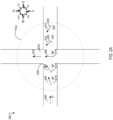
- Fig. 2A is an illustration of a waypoint region 154 around a waypoint 230 and one implementation of providing binaural navigational cues.
- the binaural navigational cue system 100 gradually modifies the audio media playback in the determined navigational heading's direction to assist the user in knowing when the change in the navigational heading is required.
- the amount of modification is dependent on the user's position within the waypoint region and relative to the waypoint.
- the radius of the waypoint region can be fixed, e.g., 10 meters, or can be set to a value specified by the user.
- the binaural navigational cue system 100 iteratively modifies the direction the audio media is perceived as the user gets closer to the waypoint, which is the center of the waypoint region 154.
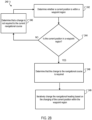
- the process illustrated in Fig. 2B of modifying the audio as a user traverses a waypoint region is a flow diagram 240 describing an iterative process for determining when to provide navigational cues, will be discussed in connection with Fig. 2A .
- a user who is presented with audio media utilizing the user device 104, is in an initial position 202, which is outside of the waypoint region 154, with an example current heading of 90 degrees.
- the binaural navigational system 100 determines whether a current position is within a waypoint region 154 (242). At the initial position 202, the current position is outside of the waypoint region 154 (244). Thus, the binaural navigational system 100 determines that a change to the current navigational course is not required (246). Audio is thus presented in a non-directional format. At the next iteration, the binaural navigational system 100 determines again whether a current position is within a waypoint region 154 (242). The process 240 continues as the user walks eastward.
- the binaural navigational cue system 100 determines whether a current position is within a waypoint region 154 (242). At the second position 202, the current position is inside of the waypoint region 154 (244) and the binaural navigational cue system 100 determines that a change to the navigational course is required (248). Accordingly, the binaural navigational cue system 100 modifies the playback state of the audio media to the directional playback state. With the current position within the waypoint region 154, the binaural navigational system 100 iteratively changes the navigational heading based on a changing of the current position in the waypoint region 154 (249).
- the determined navigational heading is approximately 30 degrees 214.
- the binaural navigational is the audio media being played in the directional playback state such that the audio media is perceived to appear as though the source of the audio file is 30 degrees north relative to the 90 degree navigational heading, e.g., 60 degrees from true north.
- the determined navigational heading continues to increase towards the determined 90 degree navigational heading 218.
- the determined navigational heading is 50 degrees 216.
- the audio file is still in the directional playback state and the source of the audio file is perceived to come from 50 degrees north relative to the 90 degree navigational heading.
- the determined navigational heading is 90 degrees 218.
- the audio media will appear to be played back from the 90 degree navigational heading 218.
- the playback may only be played in the left ear of the headphones 102.
- the playback may be louder in the left ear and seem distant in the right ear.
- the appearance of the audio media playback originating from some point in space 90 degrees counter-clockwise indicates to the user to make a left-hand turn 224 at that intersection.
- the navigational heading would modify to directions 220 and 222, respectively.
- the directional state of playback would modify the audio media to sound as if it were coming from 120 degrees or 150 degrees which would appear to be behind the head of the user. Playing the audio media to appear as if it were coming from behind the user indicates that the determined navigation heading to continue along the navigational route was passed and is now behind the current position.
- the binaural navigational cue system 100 may set an absolute direction (e.g., magnetic north) as 0 degrees and determine subsequent navigational headings from 0-360 degrees relative to 0 degrees consistently being defined by the absolute direction.
- an absolute direction e.g., magnetic north
- the binaural navigational cue may be an audible voice that dictates the intended direction to the user with the sound of the voice appearing to come from the determined navigational heading.
- the binaural navigational system 100 in response to determining the navigational heading, can provide a directional voice that describes the manner in which to alter the current navigational course in the direction of the navigational heading and that is directional from the navigational heading.
- Providing binaural navigational cues when the current position enters a waypoint region indicates to the user that a change in the navigational course is approaching. If the playback state remains in the non-directional playback state (i.e., the audio media is being presented in its original format), the user understands that the current navigational course is correct. If the user changes the navigational heading without indication from the binaural navigational cue system, the playback state can change to the directional playback state to correct the navigational course and/or navigational heading back to the proper navigational route.
- Fig. 2C is an illustration of a waypoint region 154 around a waypoint 230 and another implementation of providing binaural navigational cues. Similar to Fig. 2A , the initial position 252 is outside of the waypoint region and the current navigational heading is described as 90 degrees. Likewise, the binaural navigational system 100 is in the non-directional playback state, where the audio music is presented in its original format.
- the binaural navigational cue system 100 modifies the playback state of the audio media from the non-directional playback state to the directional playback state. Modifying the playback state presents the audio media to the user such that the audio media appears to originate from a point in space 90 degrees counter-clockwise from the initial position's navigational heading (e.g., originating from 0 degrees, or true north).
- presenting the media appearing to originate from a source that is north indicates that the user is to take the next left-hand turn 224.
- the determined navigational heading 264 and 266 remain 90 degrees counter-clockwise which continues to indicate the user of the determined change of navigational heading is approaching.
- Fig. 3 is an illustration of a map 300 and another implementation of providing binaural navigational cues.
- the binaural navigational cue system 100 presents an audible sound in addition to the presentation of the audible media, where the audible sound is directional from a cardinal direction to which the current navigational course is relative.
- the audible sound can indicate the position of a known cardinal direction (e.g., north, south, east, west, etc.) or geographic location (e.g., a known landmark, the user's home, etc.).
- a known cardinal direction e.g., north, south, east, west, etc.
- geographic location e.g., a known landmark, the user's home, etc.
- an audible sound can be presented to the user such that the sound is perceived to come from the direction of north 302.
- the audible sound can be a distinct sound that is audibly different than the audio file that is presented to the user (e.g., a low hum, a buzz, a beep, etc.).
- the audible sound is presented intermittently according to a predetermined time interval. For example, the audible sound can be presented every 30 seconds, 1 minute, 15 seconds, at the end of a song, etc. In other implementations, the audible sound can be played constantly under the playback of the audio media.
- Fig. 3 shows a user that can be in the initial position 304 and cardinal north 302. Accordingly, the user hears an audible sound that is perceived to come from the same direction 312 as cardinal north 302. As the user proceeds to the second and third position 306, 308, the audible sound is still perceived to come from the same direction 314, 316, which would be to the user's left or 90 degrees relative to the user. Upon the user changing navigational course and navigational heading, as shown at the fourth position 310, the audible sound is still coming from the same direction 318, but due to the change in navigational heading the sound appears to come from behind the user or at 180 degrees relative to the user.
- the users may be provided with an opportunity to control whether applications or features collect user information (e.g., information about a user's social network, social actions or activities, profession, a user's preferences, or a user's current location), or to control whether and/or how to receive content that may be more relevant to the user.
- user information e.g., information about a user's social network, social actions or activities, profession, a user's preferences, or a user's current location
- certain data may be treated in one or more ways before it is stored or used, so that personally identifiable information is removed.
- a user's identity may be treated so that no personally identifiable information can be determined for the user, or a user's geographic location may be generalized where location information is obtained (such as to a city, ZIP code, or state level), so that a particular location of a user cannot be determined.
- location information such as to a city, ZIP code, or state level
- the user may have control over how information is collected about the user and used by a content server.
- Embodiments of the subject matter and the operations described in this specification can be implemented in digital electronic circuitry, or in computer software, firmware, or hardware, including the structures disclosed in this specification and their structural equivalents, or in combinations of one or more of them.
- Embodiments of the subject matter described in this specification can be implemented as one or more computer programs, i.e., one or more modules of computer program instructions, encoded on computer storage medium for execution by, or to control the operation of, data processing apparatus.
- a computer storage medium can be, or be included in, a computer-readable storage device, a computer-readable storage substrate, a random or serial access memory array or device, or a combination of one or more of them.
- a computer storage medium is not a propagated signal, a computer storage medium can be a source or destination of computer program instructions encoded in an artificially-generated propagated signal.
- the computer storage medium can also be, or be included in, one or more separate physical components or media (e.g., multiple CDs, disks, or other storage devices).
- the operations described in this specification can be implemented as operations performed by a data processing apparatus on data stored on one or more computer-readable storage devices or received from other sources.
- the term "data processing apparatus” encompasses all kinds of apparatus, devices, and machines for processing data, including by way of example a programmable processor, a computer, a system on a chip, or multiple ones, or combinations, of the foregoing.
- the apparatus can include special purpose logic circuitry, e.g., an FPGA (field programmable gate array) or an ASIC (application-specific integrated circuit).
- the apparatus can also include, in addition to hardware, code that creates an execution environment for the computer program in question, e.g., code that constitutes processor firmware, a protocol stack, a database management system, an operating system, a cross-platform runtime environment, a virtual machine, or a combination of one or more of them.
- the apparatus and execution environment can realize various different computing model infrastructures, such as web services, distributed computing and grid computing infrastructures.
- a computer program (also known as a program, software, software application, script, or code) can be written in any form of programming language, including compiled or interpreted languages, declarative or procedural languages, and it can be deployed in any form, including as a stand-alone program or as a module, component, subroutine, object, or other unit suitable for use in a computing environment.
- a computer program may, but need not, correspond to a file in a file system.
- a program can be stored in a portion of a file that holds other programs or data (e.g., one or more scripts stored in a markup language document), in a single file dedicated to the program in question, or in multiple coordinated files (e.g., files that store one or more modules, sub-programs, or portions of code).
- a computer program can be deployed to be executed on one computer or on multiple computers that are located at one site or distributed across multiple sites and interconnected by a communication network.
- the processes and logic flows described in this specification can be performed by one or more programmable processors executing one or more computer programs to perform actions by operating on input data and generating output.
- the processes and logic flows can also be performed by, and apparatus can also be implemented as, special purpose logic circuitry, e.g., a FPGA (field programmable gate array) or an ASIC (application-specific integrated circuit).
- special purpose logic circuitry e.g., a FPGA (field programmable gate array) or an ASIC (application-specific integrated circuit).
- processors suitable for the execution of a computer program include, by way of example, both general and special purpose microprocessors, and any one or more processors of any kind of digital computer.
- a processor will receive instructions and data from a read-only memory or a random access memory or both.
- the essential elements of a computer are a processor for performing actions in accordance with instructions and one or more memory devices for storing instructions and data.
- a computer will also include, or be operatively coupled to receive data from or transfer data to, or both, one or more mass storage devices for storing data, e.g., magnetic, magneto-optical disks, or optical disks.
- mass storage devices for storing data, e.g., magnetic, magneto-optical disks, or optical disks.
- a computer need not have such devices.
- a computer can be embedded in another device, e.g., a mobile telephone, a personal digital assistant (PDA), a mobile audio or video player, a game console, a Global Positioning System (GPS) receiver, or a portable storage device (e.g., a universal serial bus (USB) flash drive), to name just a few.
- Devices suitable for storing computer program instructions and data include all forms of non-volatile memory, media and memory devices, including by way of example semiconductor memory devices, e.g., EPROM, EEPROM, and flash memory devices; magnetic disks, e.g., internal hard disks or removable disks; magneto-optical disks; and CD-ROM and DVD-ROM disks.
- the processor and the memory can be supplemented by, or incorporated in, special purpose logic circuitry.
- a computer having a display device, e.g., a CRT (cathode ray tube) or LCD (liquid crystal display) monitor, for displaying information to the user and a keyboard and a pointing device, e.g., a mouse or a trackball, by which the user can provide input to the computer.
- a display device e.g., a CRT (cathode ray tube) or LCD (liquid crystal display) monitor
- keyboard and a pointing device e.g., a mouse or a trackball
- Other kinds of devices can be used to provide for interaction with a user as well; for example, feedback provided to the user can be any form of sensory feedback, e.g., visual feedback, auditory feedback, or tactile feedback; and input from the user can be received in any form, including acoustic, speech, or tactile input.
- a computer can interact with a user by sending documents to and receiving documents from a device that is used by the user; for example, by sending web pages to a
- Embodiments of the subject matter described in this specification can be implemented in a computing system that includes a back-end component, e.g., as a data server, or that includes a middleware component, e.g., an application server, or that includes a front-end component, e.g., a user computer having a graphical user interface or a Web browser through which a user can interact with an implementation of the subject matter described in this specification, or any combination of one or more such back-end, middleware, or front-end components.
- the components of the system can be interconnected by any form or medium of digital data communication, e.g., a communication network.
- Examples of communication networks include a local area network (“LAN”) and a wide area network (“WAN”), an inter-network (e.g., the Internet), and peer-to-peer networks (e.g., ad hoc peer-to-peer networks).
- LAN local area network
- WAN wide area network
- inter-network e.g., the Internet
- peer-to-peer networks e.g., ad hoc peer-to-peer networks.
- the computing system can include users and servers.
- a user and server are generally remote from each other and typically interact through a communication network. The relationship of user and server arises by virtue of computer programs running on the respective computers and having a user-server relationship to each other.
- a server transmits data (e.g., an HTML page) to a user device (e.g., for purposes of displaying data to and receiving user input from a user interacting with the user device).
- Data generated at the user device e.g., a result of the user interaction
Landscapes
- Engineering & Computer Science (AREA)
- Radar, Positioning & Navigation (AREA)
- Remote Sensing (AREA)
- Physics & Mathematics (AREA)
- Automation & Control Theory (AREA)
- General Physics & Mathematics (AREA)
- Theoretical Computer Science (AREA)
- Multimedia (AREA)
- General Health & Medical Sciences (AREA)
- Audiology, Speech & Language Pathology (AREA)
- Health & Medical Sciences (AREA)
- Human Computer Interaction (AREA)
- General Engineering & Computer Science (AREA)
- Acoustics & Sound (AREA)
- Signal Processing (AREA)
- Stereophonic System (AREA)
- Navigation (AREA)
Claims (13)
- Procédé mis en œuvre par ordinateur, comprenant :la présentation (182) d'un média audio dans un état de lecture non directionnelle qui présente un média audio dans un format original sur une pluralité de canaux audio, et qui n'est pas lié directionnellement à l'itinéraire de navigation d'un utilisateur etla détermination itérative (184) d'un cap de navigation par rapport à un parcours de navigation actuel, le cap de navigation indiquant une direction à suivre pour se déplacer le long de l'itinéraire de navigation de l'utilisateur, et pour chaque itération, le fait de déterminer (186) s'il est nécessaire de changer le parcours de navigation actuel sur la base du cap de navigation ;caractérisé par :pour chaque détermination selon laquelle un changement n'est pas nécessaire pour le parcours de navigation actuel, la présentation (182) du média audio dans l'état de lecture non directionnel ; etpour chaque détermination selon laquelle un changement n'est pas nécessaire pour le parcours de navigation actuel, le changement (188) de l'état de lecture non directionnelle en un état de lecture directionnelle et la présentation du média audio dans un format modifié de sorte que la lecture est directionnelle à partir du cap de navigation afin de fournir des repères de navigation binauraux.
- Procédé mis en œuvre par ordinateur selon la revendication 1, comprenant en outre la présentation d'un son audible en plus de la présentation du média audio, où le son audible est directionnel à partir d'une direction cardinale par rapport à laquelle le parcours de navigation actuel est relatif.
- Procédé mis en œuvre par ordinateur selon la revendication 2, dans lequel le son audible est présenté par intermittence selon un intervalle de temps prédéterminé.
- Procédé mis en œuvre par ordinateur selon la revendication 1, comprenant en outre, en réponse à la détermination du cap de navigation, la fourniture d'une voix directionnelle qui décrit une manière de changer le parcours de navigation actuel dans la direction du cap de navigation et qui est directionnelle à partir du cap de navigation.
- Procédé mis en œuvre par ordinateur selon l'une quelconque des revendications précédentes, dans lequel le média audio comprend un média audio préenregistré.
- Procédé mis en œuvre par ordinateur selon l'une quelconque des revendications 1 à 4, dans lequel le média audio comprend un média audio diffusé en direct.
- Procédé mis en œuvre par ordinateur selon l'une quelconque des revendications précédentes, comprenant en outre :la réception d'une indication d'une interaction avec un emplacement géographique représenté sur une carte interactive ;la détermination d'un cap de navigation direct à partir d'un emplacement actuel vers l'emplacement géographique ; etla modification de l'état de lecture non directionnelle à un état de lecture directionnelle qui présente le média audio dans un format modifié qui module un niveau sonore d'au moins un des canaux audio de sorte que la lecture est directionnelle à partir du cap de navigation direct.
- Procédé mis en œuvre par ordinateur selon l'une quelconque des revendications précédentes, dans lequel la détermination itérative du cap de navigation par rapport au parcours de navigation actuel comprend, pour chaque itération :le fait de déterminer si une position actuelle se trouve au sein d'une région de point de cheminement ;si la position actuelle ne se trouve pas au sein de la région de point de cheminement, la détermination du fait que le changement n'est pas nécessaire pour le parcours de navigation actuel ; etsi la position actuelle se trouve au sein de la région de point de cheminement, la détermination du fait que le changement n'est pas nécessaire pour le parcours de navigation actuel.
- Procédé mis en œuvre par ordinateur selon la revendication 8, dans lequel, lorsque la position actuelle se trouve au sein de la région de point de cheminement, le changement itératif du cap de navigation est basé sur un changement de la position actuelle dans la région de point de cheminement.
- Procédé mis en œuvre par ordinateur selon l'une quelconque des revendications précédentes, dans lequel le format modifié comprend la modulation d'un niveau sonore d'au moins un des canaux audio.
- Procédé mis en œuvre par ordinateur selon l'une quelconque des revendications 1 à 9, dans lequel le format modifié comprend la modulation de l'audio par une fonction de transfert liée à la tête (HRTF).
- Système (100), comprenant :une paire d'écouteurs (102) ; etun appareil de traitement (104), l'appareil de traitement (104) étant configuré pour réaliser le procédé selon l'une quelconque des revendications 1 à 11.
- Support non transitoire lisible par ordinateur stockant des instructions exécutables par un appareil de traitement de données (104), l'appareil de traitement de données (104) étant couplé à une paire d'écouteurs (102), et qui, lors de cette exécution, amènent l'appareil de traitement de données (104) à réaliser le procédé de l'une quelconque des revendications 1 à 11.
Applications Claiming Priority (2)
| Application Number | Priority Date | Filing Date | Title |
|---|---|---|---|
| US14/705,481 US9464912B1 (en) | 2015-05-06 | 2015-05-06 | Binaural navigation cues |
| PCT/US2016/028413 WO2016178820A1 (fr) | 2015-05-06 | 2016-04-20 | Repères binauraux de navigation |
Publications (3)
| Publication Number | Publication Date |
|---|---|
| EP3292378A1 EP3292378A1 (fr) | 2018-03-14 |
| EP3292378A4 EP3292378A4 (fr) | 2019-01-09 |
| EP3292378B1 true EP3292378B1 (fr) | 2023-10-04 |
Family
ID=57046287
Family Applications (1)
| Application Number | Title | Priority Date | Filing Date |
|---|---|---|---|
| EP16789746.1A Active EP3292378B1 (fr) | 2015-05-06 | 2016-04-20 | Repères binauraux de navigation |
Country Status (4)
| Country | Link |
|---|---|
| US (2) | US9464912B1 (fr) |
| EP (1) | EP3292378B1 (fr) |
| CN (1) | CN107532908A (fr) |
| WO (1) | WO2016178820A1 (fr) |
Families Citing this family (19)
| Publication number | Priority date | Publication date | Assignee | Title |
|---|---|---|---|---|
| US9464912B1 (en) * | 2015-05-06 | 2016-10-11 | Google Inc. | Binaural navigation cues |
| US10142755B2 (en) * | 2016-02-18 | 2018-11-27 | Google Llc | Signal processing methods and systems for rendering audio on virtual loudspeaker arrays |
| US9591427B1 (en) * | 2016-02-20 | 2017-03-07 | Philip Scott Lyren | Capturing audio impulse responses of a person with a smartphone |
| DE102017207581A1 (de) * | 2017-05-05 | 2018-11-08 | Sivantos Pte. Ltd. | Hörsystem sowie Hörvorrichtung |
| EP3410747B1 (fr) * | 2017-06-02 | 2023-12-27 | Nokia Technologies Oy | Commutation de mode de rendu sur base de données d'emplacement |
| WO2019067443A1 (fr) * | 2017-09-27 | 2019-04-04 | Zermatt Technologies Llc | Navigation spatiale audio |
| US20190170533A1 (en) * | 2017-12-01 | 2019-06-06 | EmbodyVR, Inc. | Navigation by spatial placement of sound |
| WO2019138187A1 (fr) * | 2018-01-12 | 2019-07-18 | Esthesix | Procede et dispositif ameliores pour indiquer un cap c a un utilisateur |
| FR3076899B1 (fr) * | 2018-01-12 | 2020-05-22 | Esthesix | Procede et dispositif pour indiquer un cap c a un utilisateur |
| CN110139178A (zh) * | 2018-02-02 | 2019-08-16 | 中兴通讯股份有限公司 | 一种确定终端移动方向的方法、装置、设备及存储介质 |
| US10477338B1 (en) | 2018-06-11 | 2019-11-12 | Here Global B.V. | Method, apparatus and computer program product for spatial auditory cues |
| US10674306B2 (en) * | 2018-08-14 | 2020-06-02 | GM Global Technology Operations LLC | Location information through directional sound provided by mobile computing device |
| JP6559921B1 (ja) * | 2019-03-06 | 2019-08-14 | 株式会社ネイン | 音声情報提供システム、情報処理端末の制御方法、情報処理端末の制御プログラム、音声出力装置の制御方法、及び、音声出力装置の制御プログラム |
| AT522549B1 (de) | 2019-04-18 | 2022-09-15 | Dreamwaves Gmbh | Verfahren zum Leiten von Verkehrsteilnehmern |
| CN111010641A (zh) * | 2019-12-20 | 2020-04-14 | 联想(北京)有限公司 | 信息处理方法、耳机和电子设备 |
| US11211095B1 (en) * | 2020-06-19 | 2021-12-28 | Harman International Industries, Incorporated | Modifying media content playback based on user mental state |
| US11277708B1 (en) | 2020-10-26 | 2022-03-15 | Here Global B.V. | Method, apparatus and computer program product for temporally based dynamic audio shifting |
| WO2022151336A1 (fr) * | 2021-01-15 | 2022-07-21 | Harman International Industries, Incorporated | Techniques pour des transducteurs autour de l'oreille |
| US20250076067A1 (en) * | 2023-08-29 | 2025-03-06 | Honda Motor Co., Ltd. | Computer implemented method and device for assisting person to perform a task and computer program product |
Citations (1)
| Publication number | Priority date | Publication date | Assignee | Title |
|---|---|---|---|---|
| US20120069711A1 (en) * | 2010-09-22 | 2012-03-22 | Fujitsu Limited | Terminal device, mobile terminal, and navigation program |
Family Cites Families (25)
| Publication number | Priority date | Publication date | Assignee | Title |
|---|---|---|---|---|
| JP3263286B2 (ja) * | 1995-09-07 | 2002-03-04 | 松下電器産業株式会社 | 車載ナビゲーション装置 |
| US6097315A (en) | 1996-02-15 | 2000-08-01 | Minter; Jerry B. | Multi-indicator aviation pilot collision alert |
| FR2811175B1 (fr) * | 2000-06-29 | 2002-12-27 | Touchtunes Music Corp | Procede de distribution d'informations audiovisuelles et systeme de distribution d'informations audiovisuelles |
| US9101279B2 (en) * | 2006-02-15 | 2015-08-11 | Virtual Video Reality By Ritchey, Llc | Mobile user borne brain activity data and surrounding environment data correlation system |
| US7876903B2 (en) | 2006-07-07 | 2011-01-25 | Harris Corporation | Method and apparatus for creating a multi-dimensional communication space for use in a binaural audio system |
| KR101384528B1 (ko) * | 2007-03-02 | 2014-04-11 | 삼성전자주식회사 | 입체 음향을 이용한 방향 안내 처리 방법 및 그를 적용한네비게이션 시스템 |
| CN101290232A (zh) * | 2007-04-18 | 2008-10-22 | 日本先锋公司 | 数字多媒体车载导航装置及导航方法 |
| US7885819B2 (en) * | 2007-06-29 | 2011-02-08 | Microsoft Corporation | Bitstream syntax for multi-process audio decoding |
| GB0815362D0 (en) | 2008-08-22 | 2008-10-01 | Queen Mary & Westfield College | Music collection navigation |
| US9473812B2 (en) * | 2008-09-10 | 2016-10-18 | Imagine Communications Corp. | System and method for delivering content |
| US9591118B2 (en) * | 2009-01-01 | 2017-03-07 | Intel Corporation | Pose to device mapping |
| US8886455B2 (en) * | 2009-12-17 | 2014-11-11 | Tomtom International B.V. | Navigation apparatus, audible instruction generation system and method of generating audible instructions |
| US8923995B2 (en) | 2009-12-22 | 2014-12-30 | Apple Inc. | Directional audio interface for portable media device |
| US9300445B2 (en) * | 2010-05-27 | 2016-03-29 | Time Warner Cable Enterprise LLC | Digital domain content processing and distribution apparatus and methods |
| US8797386B2 (en) * | 2011-04-22 | 2014-08-05 | Microsoft Corporation | Augmented auditory perception for the visually impaired |
| WO2013055756A1 (fr) * | 2011-10-10 | 2013-04-18 | Talko Inc. | Système de communication |
| US8831255B2 (en) * | 2012-03-08 | 2014-09-09 | Disney Enterprises, Inc. | Augmented reality (AR) audio with position and action triggered virtual sound effects |
| EP2669634A1 (fr) | 2012-05-30 | 2013-12-04 | GN Store Nord A/S | Système de navigation personnel avec dispositif auditif |
| EP2720001A1 (fr) * | 2012-10-15 | 2014-04-16 | GN Store Nord A/S | Système de navigation avec dispositif auditif |
| EP2725818A1 (fr) * | 2012-10-23 | 2014-04-30 | GN Store Nord A/S | Appareil auditif pourvu d'une unité de mesure de distance |
| CN103206961A (zh) * | 2013-03-31 | 2013-07-17 | 惠州市德赛西威汽车电子有限公司 | 一种车载导航系统及其保存信息的方法 |
| US11022456B2 (en) | 2013-07-25 | 2021-06-01 | Nokia Technologies Oy | Method of audio processing and audio processing apparatus |
| EP2842529A1 (fr) * | 2013-08-30 | 2015-03-04 | GN Store Nord A/S | Système de rendu audio catégorisant des objets géolocalisables |
| US9313863B2 (en) * | 2014-06-02 | 2016-04-12 | Qualcomm Incorporated | Methods, devices, and systems for controlling smart lighting objects to establish a lighting condition |
| US9464912B1 (en) * | 2015-05-06 | 2016-10-11 | Google Inc. | Binaural navigation cues |
-
2015
- 2015-05-06 US US14/705,481 patent/US9464912B1/en active Active
-
2016
- 2016-04-20 WO PCT/US2016/028413 patent/WO2016178820A1/fr not_active Ceased
- 2016-04-20 CN CN201680019864.5A patent/CN107532908A/zh active Pending
- 2016-04-20 EP EP16789746.1A patent/EP3292378B1/fr active Active
- 2016-08-19 US US15/241,642 patent/US9746338B2/en not_active Expired - Fee Related
Patent Citations (1)
| Publication number | Priority date | Publication date | Assignee | Title |
|---|---|---|---|---|
| US20120069711A1 (en) * | 2010-09-22 | 2012-03-22 | Fujitsu Limited | Terminal device, mobile terminal, and navigation program |
Also Published As
| Publication number | Publication date |
|---|---|
| US9746338B2 (en) | 2017-08-29 |
| WO2016178820A1 (fr) | 2016-11-10 |
| CN107532908A (zh) | 2018-01-02 |
| EP3292378A4 (fr) | 2019-01-09 |
| EP3292378A1 (fr) | 2018-03-14 |
| US20160356620A1 (en) | 2016-12-08 |
| US9464912B1 (en) | 2016-10-11 |
Similar Documents
| Publication | Publication Date | Title |
|---|---|---|
| EP3292378B1 (fr) | Repères binauraux de navigation | |
| US11068227B2 (en) | Information processing device and information processing method for indicating a position outside a display region | |
| CN107111332B (zh) | 使用声音来促进用户与其环境之间的交互 | |
| US20200236490A1 (en) | Information processing apparatus, information processing method, and program | |
| US9826297B2 (en) | Accessory device that provides sensor input to a media device | |
| US20200264006A1 (en) | Spatial audio navigation | |
| US9354074B2 (en) | Controlling media output during consecutive navigation interruptions | |
| CN103036691A (zh) | 选择性的空间音频通信 | |
| US10667073B1 (en) | Audio navigation to a point of interest | |
| US20250237521A1 (en) | System and method for haptic navigation |
Legal Events
| Date | Code | Title | Description |
|---|---|---|---|
| STAA | Information on the status of an ep patent application or granted ep patent |
Free format text: STATUS: THE INTERNATIONAL PUBLICATION HAS BEEN MADE |
|
| PUAI | Public reference made under article 153(3) epc to a published international application that has entered the european phase |
Free format text: ORIGINAL CODE: 0009012 |
|
| STAA | Information on the status of an ep patent application or granted ep patent |
Free format text: STATUS: REQUEST FOR EXAMINATION WAS MADE |
|
| 17P | Request for examination filed |
Effective date: 20170918 |
|
| AK | Designated contracting states |
Kind code of ref document: A1 Designated state(s): AL AT BE BG CH CY CZ DE DK EE ES FI FR GB GR HR HU IE IS IT LI LT LU LV MC MK MT NL NO PL PT RO RS SE SI SK SM TR |
|
| AX | Request for extension of the european patent |
Extension state: BA ME |
|
| DAV | Request for validation of the european patent (deleted) | ||
| DAX | Request for extension of the european patent (deleted) | ||
| A4 | Supplementary search report drawn up and despatched |
Effective date: 20181210 |
|
| RIC1 | Information provided on ipc code assigned before grant |
Ipc: G01C 21/20 20060101ALI20181204BHEP Ipc: G01C 21/34 20060101AFI20181204BHEP Ipc: G06F 3/16 20060101ALI20181204BHEP Ipc: G01C 21/36 20060101ALI20181204BHEP |
|
| STAA | Information on the status of an ep patent application or granted ep patent |
Free format text: STATUS: EXAMINATION IS IN PROGRESS |
|
| 17Q | First examination report despatched |
Effective date: 20220301 |
|
| GRAP | Despatch of communication of intention to grant a patent |
Free format text: ORIGINAL CODE: EPIDOSNIGR1 |
|
| STAA | Information on the status of an ep patent application or granted ep patent |
Free format text: STATUS: GRANT OF PATENT IS INTENDED |
|
| INTG | Intention to grant announced |
Effective date: 20230620 |
|
| GRAS | Grant fee paid |
Free format text: ORIGINAL CODE: EPIDOSNIGR3 |
|
| GRAA | (expected) grant |
Free format text: ORIGINAL CODE: 0009210 |
|
| STAA | Information on the status of an ep patent application or granted ep patent |
Free format text: STATUS: THE PATENT HAS BEEN GRANTED |
|
| AK | Designated contracting states |
Kind code of ref document: B1 Designated state(s): AL AT BE BG CH CY CZ DE DK EE ES FI FR GB GR HR HU IE IS IT LI LT LU LV MC MK MT NL NO PL PT RO RS SE SI SK SM TR |
|
| REG | Reference to a national code |
Ref country code: GB Ref legal event code: FG4D |
|
| REG | Reference to a national code |
Ref country code: CH Ref legal event code: EP |
|
| REG | Reference to a national code |
Ref country code: IE Ref legal event code: FG4D |
|
| REG | Reference to a national code |
Ref country code: DE Ref legal event code: R096 Ref document number: 602016083211 Country of ref document: DE |
|
| P01 | Opt-out of the competence of the unified patent court (upc) registered |
Effective date: 20231003 |
|
| REG | Reference to a national code |
Ref country code: LT Ref legal event code: MG9D |
|
| REG | Reference to a national code |
Ref country code: NL Ref legal event code: MP Effective date: 20231004 |
|
| REG | Reference to a national code |
Ref country code: AT Ref legal event code: MK05 Ref document number: 1618159 Country of ref document: AT Kind code of ref document: T Effective date: 20231004 |
|
| PG25 | Lapsed in a contracting state [announced via postgrant information from national office to epo] |
Ref country code: NL Free format text: LAPSE BECAUSE OF FAILURE TO SUBMIT A TRANSLATION OF THE DESCRIPTION OR TO PAY THE FEE WITHIN THE PRESCRIBED TIME-LIMIT Effective date: 20231004 |
|
| PG25 | Lapsed in a contracting state [announced via postgrant information from national office to epo] |
Ref country code: GR Free format text: LAPSE BECAUSE OF FAILURE TO SUBMIT A TRANSLATION OF THE DESCRIPTION OR TO PAY THE FEE WITHIN THE PRESCRIBED TIME-LIMIT Effective date: 20240105 |
|
| PG25 | Lapsed in a contracting state [announced via postgrant information from national office to epo] |
Ref country code: IS Free format text: LAPSE BECAUSE OF FAILURE TO SUBMIT A TRANSLATION OF THE DESCRIPTION OR TO PAY THE FEE WITHIN THE PRESCRIBED TIME-LIMIT Effective date: 20240204 |
|
| PG25 | Lapsed in a contracting state [announced via postgrant information from national office to epo] |
Ref country code: LT Free format text: LAPSE BECAUSE OF FAILURE TO SUBMIT A TRANSLATION OF THE DESCRIPTION OR TO PAY THE FEE WITHIN THE PRESCRIBED TIME-LIMIT Effective date: 20231004 |
|
| PG25 | Lapsed in a contracting state [announced via postgrant information from national office to epo] |
Ref country code: AT Free format text: LAPSE BECAUSE OF FAILURE TO SUBMIT A TRANSLATION OF THE DESCRIPTION OR TO PAY THE FEE WITHIN THE PRESCRIBED TIME-LIMIT Effective date: 20231004 |
|
| PG25 | Lapsed in a contracting state [announced via postgrant information from national office to epo] |
Ref country code: ES Free format text: LAPSE BECAUSE OF FAILURE TO SUBMIT A TRANSLATION OF THE DESCRIPTION OR TO PAY THE FEE WITHIN THE PRESCRIBED TIME-LIMIT Effective date: 20231004 |
|
| PG25 | Lapsed in a contracting state [announced via postgrant information from national office to epo] |
Ref country code: LT Free format text: LAPSE BECAUSE OF FAILURE TO SUBMIT A TRANSLATION OF THE DESCRIPTION OR TO PAY THE FEE WITHIN THE PRESCRIBED TIME-LIMIT Effective date: 20231004 Ref country code: IS Free format text: LAPSE BECAUSE OF FAILURE TO SUBMIT A TRANSLATION OF THE DESCRIPTION OR TO PAY THE FEE WITHIN THE PRESCRIBED TIME-LIMIT Effective date: 20240204 Ref country code: GR Free format text: LAPSE BECAUSE OF FAILURE TO SUBMIT A TRANSLATION OF THE DESCRIPTION OR TO PAY THE FEE WITHIN THE PRESCRIBED TIME-LIMIT Effective date: 20240105 Ref country code: ES Free format text: LAPSE BECAUSE OF FAILURE TO SUBMIT A TRANSLATION OF THE DESCRIPTION OR TO PAY THE FEE WITHIN THE PRESCRIBED TIME-LIMIT Effective date: 20231004 Ref country code: BG Free format text: LAPSE BECAUSE OF FAILURE TO SUBMIT A TRANSLATION OF THE DESCRIPTION OR TO PAY THE FEE WITHIN THE PRESCRIBED TIME-LIMIT Effective date: 20240104 Ref country code: AT Free format text: LAPSE BECAUSE OF FAILURE TO SUBMIT A TRANSLATION OF THE DESCRIPTION OR TO PAY THE FEE WITHIN THE PRESCRIBED TIME-LIMIT Effective date: 20231004 Ref country code: PT Free format text: LAPSE BECAUSE OF FAILURE TO SUBMIT A TRANSLATION OF THE DESCRIPTION OR TO PAY THE FEE WITHIN THE PRESCRIBED TIME-LIMIT Effective date: 20240205 |
|
| PG25 | Lapsed in a contracting state [announced via postgrant information from national office to epo] |
Ref country code: SE Free format text: LAPSE BECAUSE OF FAILURE TO SUBMIT A TRANSLATION OF THE DESCRIPTION OR TO PAY THE FEE WITHIN THE PRESCRIBED TIME-LIMIT Effective date: 20231004 Ref country code: RS Free format text: LAPSE BECAUSE OF FAILURE TO SUBMIT A TRANSLATION OF THE DESCRIPTION OR TO PAY THE FEE WITHIN THE PRESCRIBED TIME-LIMIT Effective date: 20231004 Ref country code: PL Free format text: LAPSE BECAUSE OF FAILURE TO SUBMIT A TRANSLATION OF THE DESCRIPTION OR TO PAY THE FEE WITHIN THE PRESCRIBED TIME-LIMIT Effective date: 20231004 Ref country code: NO Free format text: LAPSE BECAUSE OF FAILURE TO SUBMIT A TRANSLATION OF THE DESCRIPTION OR TO PAY THE FEE WITHIN THE PRESCRIBED TIME-LIMIT Effective date: 20240104 Ref country code: LV Free format text: LAPSE BECAUSE OF FAILURE TO SUBMIT A TRANSLATION OF THE DESCRIPTION OR TO PAY THE FEE WITHIN THE PRESCRIBED TIME-LIMIT Effective date: 20231004 Ref country code: HR Free format text: LAPSE BECAUSE OF FAILURE TO SUBMIT A TRANSLATION OF THE DESCRIPTION OR TO PAY THE FEE WITHIN THE PRESCRIBED TIME-LIMIT Effective date: 20231004 |
|
| REG | Reference to a national code |
Ref country code: DE Ref legal event code: R097 Ref document number: 602016083211 Country of ref document: DE |
|
| PGFP | Annual fee paid to national office [announced via postgrant information from national office to epo] |
Ref country code: DE Payment date: 20240429 Year of fee payment: 9 |
|
| PG25 | Lapsed in a contracting state [announced via postgrant information from national office to epo] |
Ref country code: DK Free format text: LAPSE BECAUSE OF FAILURE TO SUBMIT A TRANSLATION OF THE DESCRIPTION OR TO PAY THE FEE WITHIN THE PRESCRIBED TIME-LIMIT Effective date: 20231004 |
|
| PG25 | Lapsed in a contracting state [announced via postgrant information from national office to epo] |
Ref country code: CZ Free format text: LAPSE BECAUSE OF FAILURE TO SUBMIT A TRANSLATION OF THE DESCRIPTION OR TO PAY THE FEE WITHIN THE PRESCRIBED TIME-LIMIT Effective date: 20231004 |
|
| PG25 | Lapsed in a contracting state [announced via postgrant information from national office to epo] |
Ref country code: SK Free format text: LAPSE BECAUSE OF FAILURE TO SUBMIT A TRANSLATION OF THE DESCRIPTION OR TO PAY THE FEE WITHIN THE PRESCRIBED TIME-LIMIT Effective date: 20231004 |
|
| PG25 | Lapsed in a contracting state [announced via postgrant information from national office to epo] |
Ref country code: SM Free format text: LAPSE BECAUSE OF FAILURE TO SUBMIT A TRANSLATION OF THE DESCRIPTION OR TO PAY THE FEE WITHIN THE PRESCRIBED TIME-LIMIT Effective date: 20231004 Ref country code: SK Free format text: LAPSE BECAUSE OF FAILURE TO SUBMIT A TRANSLATION OF THE DESCRIPTION OR TO PAY THE FEE WITHIN THE PRESCRIBED TIME-LIMIT Effective date: 20231004 Ref country code: RO Free format text: LAPSE BECAUSE OF FAILURE TO SUBMIT A TRANSLATION OF THE DESCRIPTION OR TO PAY THE FEE WITHIN THE PRESCRIBED TIME-LIMIT Effective date: 20231004 Ref country code: IT Free format text: LAPSE BECAUSE OF FAILURE TO SUBMIT A TRANSLATION OF THE DESCRIPTION OR TO PAY THE FEE WITHIN THE PRESCRIBED TIME-LIMIT Effective date: 20231004 Ref country code: EE Free format text: LAPSE BECAUSE OF FAILURE TO SUBMIT A TRANSLATION OF THE DESCRIPTION OR TO PAY THE FEE WITHIN THE PRESCRIBED TIME-LIMIT Effective date: 20231004 Ref country code: DK Free format text: LAPSE BECAUSE OF FAILURE TO SUBMIT A TRANSLATION OF THE DESCRIPTION OR TO PAY THE FEE WITHIN THE PRESCRIBED TIME-LIMIT Effective date: 20231004 Ref country code: CZ Free format text: LAPSE BECAUSE OF FAILURE TO SUBMIT A TRANSLATION OF THE DESCRIPTION OR TO PAY THE FEE WITHIN THE PRESCRIBED TIME-LIMIT Effective date: 20231004 |
|
| PGFP | Annual fee paid to national office [announced via postgrant information from national office to epo] |
Ref country code: FR Payment date: 20240425 Year of fee payment: 9 |
|
| PLBE | No opposition filed within time limit |
Free format text: ORIGINAL CODE: 0009261 |
|
| STAA | Information on the status of an ep patent application or granted ep patent |
Free format text: STATUS: NO OPPOSITION FILED WITHIN TIME LIMIT |
|
| 26N | No opposition filed |
Effective date: 20240705 |
|
| PG25 | Lapsed in a contracting state [announced via postgrant information from national office to epo] |
Ref country code: SI Free format text: LAPSE BECAUSE OF FAILURE TO SUBMIT A TRANSLATION OF THE DESCRIPTION OR TO PAY THE FEE WITHIN THE PRESCRIBED TIME-LIMIT Effective date: 20231004 |
|
| PG25 | Lapsed in a contracting state [announced via postgrant information from national office to epo] |
Ref country code: SI Free format text: LAPSE BECAUSE OF FAILURE TO SUBMIT A TRANSLATION OF THE DESCRIPTION OR TO PAY THE FEE WITHIN THE PRESCRIBED TIME-LIMIT Effective date: 20231004 |
|
| PG25 | Lapsed in a contracting state [announced via postgrant information from national office to epo] |
Ref country code: MC Free format text: LAPSE BECAUSE OF FAILURE TO SUBMIT A TRANSLATION OF THE DESCRIPTION OR TO PAY THE FEE WITHIN THE PRESCRIBED TIME-LIMIT Effective date: 20231004 |
|
| PG25 | Lapsed in a contracting state [announced via postgrant information from national office to epo] |
Ref country code: MC Free format text: LAPSE BECAUSE OF FAILURE TO SUBMIT A TRANSLATION OF THE DESCRIPTION OR TO PAY THE FEE WITHIN THE PRESCRIBED TIME-LIMIT Effective date: 20231004 |
|
| REG | Reference to a national code |
Ref country code: CH Ref legal event code: PL |
|
| PG25 | Lapsed in a contracting state [announced via postgrant information from national office to epo] |
Ref country code: LU Free format text: LAPSE BECAUSE OF NON-PAYMENT OF DUE FEES Effective date: 20240420 |
|
| GBPC | Gb: european patent ceased through non-payment of renewal fee |
Effective date: 20240420 |
|
| REG | Reference to a national code |
Ref country code: BE Ref legal event code: MM Effective date: 20240430 |
|
| PG25 | Lapsed in a contracting state [announced via postgrant information from national office to epo] |
Ref country code: LU Free format text: LAPSE BECAUSE OF NON-PAYMENT OF DUE FEES Effective date: 20240420 |
|
| PG25 | Lapsed in a contracting state [announced via postgrant information from national office to epo] |
Ref country code: BE Free format text: LAPSE BECAUSE OF NON-PAYMENT OF DUE FEES Effective date: 20240430 |
|
| PG25 | Lapsed in a contracting state [announced via postgrant information from national office to epo] |
Ref country code: GB Free format text: LAPSE BECAUSE OF NON-PAYMENT OF DUE FEES Effective date: 20240420 |
|
| PG25 | Lapsed in a contracting state [announced via postgrant information from national office to epo] |
Ref country code: GB Free format text: LAPSE BECAUSE OF NON-PAYMENT OF DUE FEES Effective date: 20240420 Ref country code: BE Free format text: LAPSE BECAUSE OF NON-PAYMENT OF DUE FEES Effective date: 20240430 Ref country code: CH Free format text: LAPSE BECAUSE OF NON-PAYMENT OF DUE FEES Effective date: 20240430 |
|
| PG25 | Lapsed in a contracting state [announced via postgrant information from national office to epo] |
Ref country code: IE Free format text: LAPSE BECAUSE OF NON-PAYMENT OF DUE FEES Effective date: 20240420 |
|
| PG25 | Lapsed in a contracting state [announced via postgrant information from national office to epo] |
Ref country code: CY Free format text: LAPSE BECAUSE OF FAILURE TO SUBMIT A TRANSLATION OF THE DESCRIPTION OR TO PAY THE FEE WITHIN THE PRESCRIBED TIME-LIMIT; INVALID AB INITIO Effective date: 20160420 |
|
| PG25 | Lapsed in a contracting state [announced via postgrant information from national office to epo] |
Ref country code: HU Free format text: LAPSE BECAUSE OF FAILURE TO SUBMIT A TRANSLATION OF THE DESCRIPTION OR TO PAY THE FEE WITHIN THE PRESCRIBED TIME-LIMIT; INVALID AB INITIO Effective date: 20160420 |
|
| PG25 | Lapsed in a contracting state [announced via postgrant information from national office to epo] |
Ref country code: FI Free format text: LAPSE BECAUSE OF FAILURE TO SUBMIT A TRANSLATION OF THE DESCRIPTION OR TO PAY THE FEE WITHIN THE PRESCRIBED TIME-LIMIT Effective date: 20231004 |
|
| REG | Reference to a national code |
Ref country code: DE Ref legal event code: R119 Ref document number: 602016083211 Country of ref document: DE |
|
| PG25 | Lapsed in a contracting state [announced via postgrant information from national office to epo] |
Ref country code: DE Free format text: LAPSE BECAUSE OF NON-PAYMENT OF DUE FEES Effective date: 20251104 |
|
| PG25 | Lapsed in a contracting state [announced via postgrant information from national office to epo] |
Ref country code: FR Free format text: LAPSE BECAUSE OF NON-PAYMENT OF DUE FEES Effective date: 20250430 |