EP3292957A1 - Tourne-vis ayant une mâchoire mobile - Google Patents
Tourne-vis ayant une mâchoire mobile Download PDFInfo
- Publication number
- EP3292957A1 EP3292957A1 EP17166477.4A EP17166477A EP3292957A1 EP 3292957 A1 EP3292957 A1 EP 3292957A1 EP 17166477 A EP17166477 A EP 17166477A EP 3292957 A1 EP3292957 A1 EP 3292957A1
- Authority
- EP
- European Patent Office
- Prior art keywords
- hexagonal
- contact surfaces
- mouth
- jaws
- screwing tool
- Prior art date
- Legal status (The legal status is an assumption and is not a legal conclusion. Google has not performed a legal analysis and makes no representation as to the accuracy of the status listed.)
- Withdrawn
Links
Images

Classifications
-
- B—PERFORMING OPERATIONS; TRANSPORTING
- B25—HAND TOOLS; PORTABLE POWER-DRIVEN TOOLS; MANIPULATORS
- B25B—TOOLS OR BENCH DEVICES NOT OTHERWISE PROVIDED FOR, FOR FASTENING, CONNECTING, DISENGAGING, OR HOLDING
- B25B13/00—Spanners; Wrenches
- B25B13/46—Spanners; Wrenches of the ratchet type, for providing a free return stroke of the handle
-
- B—PERFORMING OPERATIONS; TRANSPORTING
- B25—HAND TOOLS; PORTABLE POWER-DRIVEN TOOLS; MANIPULATORS
- B25B—TOOLS OR BENCH DEVICES NOT OTHERWISE PROVIDED FOR, FOR FASTENING, CONNECTING, DISENGAGING, OR HOLDING
- B25B13/00—Spanners; Wrenches
- B25B13/02—Spanners; Wrenches with rigid jaws
- B25B13/08—Spanners; Wrenches with rigid jaws of open jaw type
-
- B—PERFORMING OPERATIONS; TRANSPORTING
- B25—HAND TOOLS; PORTABLE POWER-DRIVEN TOOLS; MANIPULATORS
- B25B—TOOLS OR BENCH DEVICES NOT OTHERWISE PROVIDED FOR, FOR FASTENING, CONNECTING, DISENGAGING, OR HOLDING
- B25B13/00—Spanners; Wrenches
- B25B13/10—Spanners; Wrenches with adjustable jaws
- B25B13/12—Spanners; Wrenches with adjustable jaws the jaws being slidable
- B25B13/18—Spanners; Wrenches with adjustable jaws the jaws being slidable by cam, wedge, or lever
Definitions
- the invention relates to a screwing tool with a head and a pivotable about a pivot axis with the head so motion-coupled handle, the torque acting on the handle in a screwing a relation to a firmly connected to the head fixed jaw in a sliding direction movable jaw towards the solid Jaw subjected to force, wherein both jaws substantially transversely to the direction of extending, a mouth between the jaws limiting, extending in first reference planes, first contact surfaces, which are interrupted by a respective second and third contact surface forming corner recesses, wherein the second and third abutment surfaces in mutually angularly offset by 60 ° to each other first and second reference planes and offset by 30 ° to the first reference planes, so that on hexagonal sections of nuts or screws of different width across flats in a first torque-Einbring ein and in a second torque-insertion position offset by 30 ° in each case from at least two pressure zones formed by the contact surfaces on different polygonal surfaces of the hexagonal sections can be applied with a compress
- the DE 94 04 031.1 shows an adjustable wrench of the generic type.
- a material of the same material connected to the head fixed jaw and a relative to the fixed jaw movable jaw.
- the two jaws form mutually facing, substantially mutually parallel first contact surfaces for engagement with hexagonal surfaces of a nut, wherein the first contact surfaces run transversely to the direction of displacement.
- a corner recess interrupts the first contact surface in a mouth-side portion and a maulground stoolen portion, wherein the clear width of the mouth is defined by the distance of the mouth-opening side portions of the first contact surface.
- the maulground seasoneauen first contact surfaces have a greater distance from each other.
- the DE 200 07 561 U1 describes a similar screwing tool.
- the contact surfaces have additional profile ribs.
- the DE 931 580 describes a screwing tool with a fixed and a movable jaw, wherein the jaws from the mouth opening to the mouth base rectilinearly extending first contact surfaces.
- the DE 935 418 describes a screwing tool in which the sliding jaw is also displaced relative to the fixed jaw.
- the slidable jaw is spring biased with respect to the fixed jaw and has a tooth which engages a tooth gap of a short arm of a two-armed handle. If a torque is exerted on the handle about an axis of rotation, the displaceable jaw is subjected to a force in the direction of the fixed jaw.
- the movable jaw can move away from the fixed jaw, so that the screwing tool can be rotated by 60 ° relative to the hexagonal section resting in space, so that after the 60 ° rotation, the mutually parallel contact surfaces of the jaws on other hexagonal surfaces of the Hexagonal section abut.
- the screwing is thus usable in the manner of a gun.
- Adjustable wrenches are out of the US 1,048,298 and DE 1 931 580 previously known.
- the US 2,751,802 shows a ring spanner with a head stop that blocks a free axial displacement of the hexagonal portion relative to the contact surfaces.
- the invention has for its object to improve the mouth design of a generic screwing tools by screwing.
- the corner recess is located between two mutually aligned portions of the first contact surface.
- Each of the two jaws has a maulö réelles suren portion of the first contact surface and a maulground stoolen portion of the first contact surface, wherein the two sections are aligned with each other, that lie in a common first reference plane.
- the first reference planes can in the non-force-loaded state in the mouth opening direction small, about 2 converge to 3 degrees, so that they do not mathematically strictly parallel or mathematically strictly perpendicular to the direction of displacement.
- the deliberate deviation of the course of the first reference planes of a parallel or perpendicular direction to the displacement direction leads to a torque application and concomitant bending of the jaws to a parallel alignment of the two first reference planes, so that the reference planes at least when a screw head or a Nut with a torque parallel to each other.
- the maulground paragraphen sections and the jaw opening side portions have the same distance from each other.
- the clear width of the mouth is thus determined by the distance of the maulground remedyen sections of the first contact surfaces.
- the use of the screwing tool in the manner of a ratchet wrench is improved by this mouth design.
- the screw head or the nut can assume a radially tethered torque transmission position in the mouth, in which the corner regions of the hexagon nut or of the hexagonal screw head engage in the corner recesses.
- a non-constrained torque transmission position two mutually opposite flank sections of the hexagonal profile abut against the first contact surfaces.
- the screwing tool can be withdrawn from the screw head or from the nut in the radial direction without substantial removal of the two jaws.
- the screwing tool can be operated ratchet-like, with only a return angle of 30 ° is required to come from the radially unbelted first torque transmission position in one of these functionally adjacent radially bound second torque transmission position.
- the maul ground felte portion of the first contact surface is longer than the mouth opening side distance. Furthermore, it can be provided that the maulground discoverede section is longer than the width of the corner recess. Particularly preferably, the maulground discoverede portion of the first contact surface is at least twice as long as the width of the Corner recess. As a result of this configuration, the range of wrench sizes has been increased by nuts or hex bolts that can be screwed with the adjustable wrench.
- the maulground worne portion of the first contact surface has a length such that the flanks of the hexagonal sections with the largest spanner size, which can be screwed with the wrench can rest with its entire length to the maulground remedyen portions of the first contact surface.
- the corner recesses then take in the radially bound torque-transfer position only the corner regions of the hexagonal profiles of nuts or screw heads.
- the flanks of the corner recesses are formed by second and third abutment surfaces which are angularly offset from each other by 60 ° and by 30 ° relative to the first abutment surface.
- diametrically opposite hexagonal surface sections of the hexagonal section are located on first contact surfaces of the first reference plane running transversely to the displacement direction of the displaceable jaw.
- diametrically opposite corner regions of the hexagonal section are diametrically opposite corner regions of the hexagonal section in corner recesses of two jaws, which are each formed by contact surfaces of the second and third reference plane. These corner recesses can lie between two contact surfaces of the first reference plane. If such a design rotates a nut or a screw head in a ratchet-like manner of actuation, that is, pivots it back and forth, then the hexagonal section of the nut or of the screw head performs a radial movement within the mouth.
- the attack on the opposite first contact surfaces takes place in a position remote from the mouth opening of the hexagonal section.
- the attack on the opposite corner recesses on the hexagonal section takes place in a closer to the opening of the mouth position of the hexagonal section.
- In the ratcheting screw actuation of the hexagonal portion thus migrates in the mouth extension direction between two positions back and forth, in a first position, two opposing polygonal edges of the hexagonal portion abut first abutment surfaces and eino in a second position corner portions of the polygonal section in Eckaussparungen.
- further contact surfaces are provided.
- the contact surfaces are then arranged in such a way that when applying a torque to a bound by the jaws hexagon section with at least three adjacent to different hexagonal surfaces, each formed by a contact surface pressure zones a compressive force is applied to the hexagonal surface.
- the further contact surfaces may extend along further reference planes, which occupy a 30 ° angle to one of the first, second or third reference plane.
- the second and third abutment surfaces preferably form on the jaws associated therewith corner recesses for receiving the corner region of the hexagonal section of the nut or of the screw head.
- the Eckaussparines are preferably each between first contact surfaces. It can be provided more Eckausspar urge in which eino corner portions of the hexagonal portion in the radially unbelted torque transmission position.
- the contact surfaces form a total the sidewalls of an open mouth.
- the mouth opening detection bevels are provided, which extend V-shaped to each other.
- the finding slopes each have an angle which may be 30 ° to the respective first reference plane, which run perpendicular to the movable jaw.
- the slidable jaw can be spring-loaded by a spring element in the direction of the fixed jaw. It may be provided a second, weaker spring element which acts in the opposite direction.
- the spring element may be a helical gear compression spring, which is arranged in a spring receiving chamber which is closed by a plug.
- the spring element can be supported on the plug.
- the kinematic coupling of the pivotable jaw to the handle can be done via a tooth which engages in a tooth gap.
- the tooth may be associated with the slidable jaw and the gap between the teeth with a short arm of the two-armed handle. It is also provided a head stop, which can take an active position and a Toonoch sacred too. In the non-operating position, the hexagonal portion can move freely through the mouth between the two jaws, wherein the contact surfaces abut the hexagonal surfaces. In an active position of the head stop, an end face of the hexagonal section is supported on a stop face of the head stop, so that the hexagonal section is fixed to the head at least in an axial direction.
- the head stop can be associated with a stop slider, which is linearly displaceable or slidably mounted on the fixed jaw about an axis.
- the head stop covers only one of the Eckaussparungen in its operative position, so that the axial bondage is limited to one of the two torque transmission positions and in particular to the radially tethered torque transmission position.
- diverging determination slopes adjoin the mouth-opening-side ends of the mouth-opening-side sections of the first contact surfaces in the mouth opening direction. The detection slopes facilitate the radial attachment of the jaws to a screw head or a nut.
- the maulground skillen ends of the maulground paragraphen Connect sections of the first contact surfaces oblique contact surfaces on which flanks of the hexagonal profiles of screws or nuts can create, if they are taken in the radially unbelted torque transmission position. These contact surfaces have a 60 ° angle to the first contact surfaces.
- the screwing tools shown in the drawings are capable of turning screws with a hexagon head or hexagon nuts of different width across flats in a screwing direction. Will the screwing tool rotated against the screwing direction in a freewheeling direction, the profiled jaws 4, 5 of the mouth 10 overflow the hexagonal corners in order to be able to be attached to a different position of the hexagonal section. While in the prior art, the screwing must be turned back by at least 60 ° in the freewheeling direction, so that the jaws 4, 5 can again enter into a captivating attack on the hexagonal profile, sufficient in the screwing invention a pivoting movement in the freewheeling direction by 30 °.
- the screwing tool can engage in two mutually different torque transmission positions on the hexagonal portion of the nut or the screw head to transmit a torque, namely in a first torque transmission position, as they FIG. 8 shows and in a second torque transmission position, like the FIG. 10 shows. Both positions differ by a 30 ° twist of the hexagonal section 30 within the mouth 10 of the screwing tool.
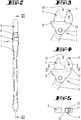
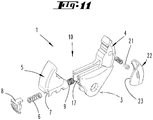
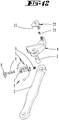
- the screwing tool consists of an elongated, made of steel handle 2, which forms a two-armed lever which is mounted about a pivot axis 3 pivotally mounted on a head 1 also made of steel.
- the long arm of the handle 2 may be encompassed by a user's hand.
- the short arm of the handle 2 has a tooth gap 16 into which a tooth 15 of a relative to the head 1 in a direction V displaceable body engages.
- This displaceable body forms a displaceable jaw 5, which can be displaced relative to a fixed jaw 4, which is connected to the head 1 in the same material, when the handle 2 is pivoted about the pivot axis 3.
- a guide portion of the jaw 5 engages positively in a guide channel of the head 1, so that the displaceable jaw 5 is assigned linearly displaceable head 1. It is provided a spring receiving chamber 7, in which a helical gear compression spring 6 rests.
- the spring receiving chamber 7 is closed by a plug 8 and extends in the direction of displacement V. At the plug 8, one end of the spring element 6 is supported. The other end acts on the movable jaw 5 in the direction of the fixed jaw 4th
- the walls of the mouth 10 consist of a plurality of contact surfaces 11, 11 ', 12, 12', 13, 13 ', 18, 19, 25, 29, 31.
- Each of the two jaws 4, 5 has a first contact surface 11, 11th '.
- the contact surface 11 as well as the contact surface 11 'of a corner recess 24, 24' interrupted in two isolated first contact surfaces 11 and 11 '.
- the first contact surfaces 11, 11 'each extend along a reference plane a, a'. This first reference plane a, a 'extends substantially, ie with a deviation of +/- 2 degrees transversely to the displacement direction V.
- the reference plane a which is associated with the movable jaw, thus extends substantially, ie with a deviation from 0 to -4 degrees parallel to the reference plane a ', which is assigned to the fixed jaw 4.
- the two reference planes a, a ' form a reference plane pair.
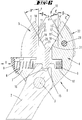
- FIG. 8 shows a hexagonal portion which is held in a non-radially bound torque transmission position of the jaws 4, 5.
- Two mutually opposite, mutually parallel hexagonal surfaces of the hexagonal section lie in surface contact with the first contact surfaces 11, 11 '.
- the hexagonal section 30 can be pulled out of the mouth 10 in the radial direction with respect to the insertion direction of a screw having the hexagonal section 30. The two hexagonal surfaces then slide along the mutually parallel first contact surfaces 11 along.
- the contact surface 18 forms, together with the contact surface 11 ', a corner recess 27.
- the contact surface 19 of the movable jaw 5 forms together with contact surface 11 a corner recess 26. Corner regions of the hexagonal section 30 lie in these two corner recesses when the jaws 4, 5 engage the hexagonal section 30 in the non-radially constrained torque transmission position. If a torque is applied to the handle 2 in a clockwise direction, the tooth engagement causes the displaceable jaw 5 to be acted upon in the direction of the fixed jaw 4.
- FIG. 9 An inclined surface adjoins the abutment surface 25, which forms a sliding surface 32, on which an edge of the hexagonal section 30 can slide along during the pivoting back of the handle.
- the sliding surface 32 can be offset by 30 degrees to the contact surface 29. It lies opposite the contact surface 31.
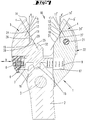
- FIG. 10 shown operating position After a pivoting of 30 ° relative to the in FIG. 8 shown position is the in FIG. 10 shown operating position, in which the jaws 4, 5 in a second torque transmission position, which is here a radially captive torque transmission position, engage the hexagonal portion 30.
- corner recesses 24, 24 'a Two diametrically opposite corner regions of the hexagonal section 30 are now each in opposite corner recesses 24, 24 'a. These are the corner recesses 24, 24 ', which interrupt the two first contact surfaces 11, 11' approximately centrally.
- the two flanks of the corner recesses 24, 24 ' are formed by second contact surfaces 12, 12' and third contact surfaces 13, 13 '.
- the third contact surfaces 13, 13 'extend along third reference planes c, c', which are also inclined by 30 ° with respect to the first reference plane a, a ' are.
- the third reference planes c, c 'and second reference planes b, b' intersect at an angle of 60 and 120 °, respectively.
- Each of the two jaws 4, 4 ' has at least one second contact surface 2, 2' and at least one third contact surface 13, 13 ', the respective reference planes c, c' and b, b 'extending parallel to one another.
- the second reference plane b ' extends over a contact surface 12' and a contact surface 31, wherein between the contact surfaces 12 'and 31 a further corner recess 27 is located, in which a multi-corner of the hexagonal portion 30 in the in FIG. 8 shown torque transmission position rests.
- the contact surfaces 13 ', 31, 25 and 13 respectively form pressure zones P to transmit torque to the hexagonal section 30. While at the in the FIG. 8 shown torque transfer position three pressure zones P act on the hexagonal portion 30, acting in the in FIG. 10 shown second torque transmission position four pressure zones P, wherein each of the two jaws 4, 5 are associated with two pressure zones.
- second torque transmission position are a total of three corner regions of the hexagonal section 30 in corner recesses 24, 28 and 24 ', wherein the corner recess 28 is formed by the contact surfaces 25 and 29, the contact surface 29 extends in the third reference plane c and the contact surface 25 in a further reference plane, which is inclined relative to the third reference plane c by 60 ° or 120 °.
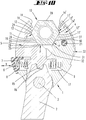
- a stopper slide 22 On the fixed jaw 4 is a stopper slide 22, the of a Tinwirk ein as the FIG. 3 shows, in an operative position, which the FIG. 4 shows, can be pushed.
- a head stop 23 projects in the operative position, a head stop 23 into the mouth 10 into which a broad side surface of the hexagonal portion 30 can be supported, so that the hexagonal portion 30 forming nut or screw is bound in the mouth 10 in the axial direction.
- the head stop 23 can engage over the corner recess 27 and / or the corner recess 24 '.
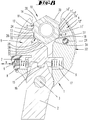
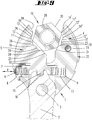
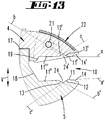
- FIG. 13 shows a further optimized embodiment in which as well as in the embodiment described above, a first contact surface of the fixed jaw 4 has a first contact surface having a mouth opening side portion 11 'and a maulground stoolen portion 11'''.
- the two sections 11 ', 11''' lie in a common reference plane a.
- the reference plane a extends substantially transversely to the direction of displacement V, that is also here with a deviation of +/- 2 degrees to the vertical of the direction of displacement V.
- the sliding jaw 5 also has a two-section first contact surface.
- a mouth-opening-side section 11 runs in alignment with a base-side-side section 11 ".
- the two sections 11, 11" extend in a reference plane a '.
- the reference plane a ' also extends substantially transversely to the displacement direction V, ie with a deviation of +/- 2 degrees to the vertical.
- the reference planes a, a ' are substantially parallel to each other, wherein they converge slightly in the unaugmented state in the mouth opening direction, wherein the convergence angle is 0 to 4 degrees.
- the length of the base-side-side sections 11 ", 11 '''measured in the direction of the mouth extension is greater than the length of the mouth-opening-side sections 11, 11' measured in the mouth extension direction.
- the length of the maulground paragraphen sections 11 ", 11 '' ' is also greater than the width measured in the mouth extension direction of the Eckaussparungen 24, 24', ie the distance between the two in a common reference plane a, a 'lying portions 11', 11 '' 'or 11, 11 ".
- detection bevels 14, 14 ' are provided, which in each case adjoin the mouth-opening-side ends of the mouth-opening-side sections 11,11' of the first contact surface.
- the finding slopes 14, 14 ' diverge from each other in the mouth opening direction and facilitate the attachment of the screwing tool on a screw or a nut.
- the screwing tool is able to attack like a wrench on a hexagonal profile, wherein the two jaws 4, 5 are pushed onto the screw head in the radial direction, ie in the mouth extension direction, on the hexagonal profile.
- the two jaws 4, 5 spaced from each other, which is a consequence of the emergence of the detection bevels 14, 14 'on the hexagonal profile.
- the screwing is pushed into a stop position on the hexagonal profile by the edges abut the contact surfaces 18,19. Further flanks running parallel to one another then abut against the base-side-side sections 11 ", 11" of the first contact surface, the length of which preferably corresponds to the flank length of the hexagonal profile with the largest flatscrew.
- the corner regions of the hexagonal profile thus find the corner recesses 24, 24 ', the hexagonal profile shifting slightly in the mouth opening direction until opposite corner regions of the hexagonal profile rest in the opposite corner recesses 24, 24'.
- the hexagonal profile can then be further screwed in this radially bound torque transmission position in a screwing direction, with a subsequent backward displacement of the screwing tool by 30 °, glide p mutually parallel flanks of the hexagonal profile again in a two-dimensional contact with the first contact surfaces 11,11 ', wherein the hexagonal profile slightly in Radialein Introduceraum relative to the pivot axis, ie toward the mouth base, relocate until the flanks of the hexagonal profile over its entire length abut the maulground stoolen sections 11 ", 11 '' 'of the first contact surface.
- a screwing tool which is characterized in that each of the two jaws 4, 5 respectively second 12, 12 ', 31 and third 13, 13', 29 contact surfaces formed, each in a second b, b 'and a third c, c 'Reference plane extending, each extending parallel to each other, wherein the second b, b' and third c, c 'reference planes with respect to the plane of rotation respectively to the first reference planes a, a' at an angle ⁇ , ⁇ of 30 ° and to each other in one Angle y + ⁇ of 60 °, so that on hexagonal portions 30 of nuts or screws of different wrench size in a first torque-Einbringhyroid and offset by 30 ° second torque-Einbring ein each of at least two pressure zones formed by the contact surfaces P at different Polygonal surfaces of the hexagonal sections 30 a compressive force can be applied.
- a screwing tool which is characterized in that the corner recesses 24, 24 'respectively between a mouth-side portion 11, 11' and an aligned maulground documenten portion 11 ", 11 '' 'of the first contact surface 11, 11', wherein the inside diameter of the mouth 10, the distance between the two maulground technologyen sections 11 ", 11 '' '.
- a screwing tool which is characterized in that the maulground solution 11 ", 11 '''are longer than the mouth opening side portions 11, 11' of the first contact surfaces 11,11 ', 11", 11''' .
- a screwing tool which is characterized in that the maulground patenten sections 11 ", 11 '''are longer than the width of the Eckaussparitch 24, 24'.
- a screwing tool which is characterized in that the maulground patenten portions 11 ", 11 '' 'at least twice as long as the width of the Eckaussparitch 24, 24'.
- a screwing tool which is characterized in that the mouth opening has finding bevels 14, 14 ', which adjoin one another divergently in the mouth opening direction, respectively, to the mouth-opening-side section 11, 11' of the first contact surfaces 11, 11 '.
- a screwing tool which is characterized in that the first, second and third and further contact surfaces 11, 11 '; 12, 12 ', 13, 13', 29; 18, 25, 31 are arranged such that when exerting a torque on the hexagonal portion 30 held by the jaws 4, 5, a pressure force is applied to the hexagonal surface on at least three pressure surfaces P acting on different hexagonal surfaces 20, each formed by a contact surface.
- a screwing tool which is characterized in that the further contact surfaces 18, 25, 29 either in one of the first, second or third reference plane a, a ', b, b', c, c 'lie or in a further reference plane, the order 30 ° inclined to a first, second or third reference plane extends.
- a screwing tool which is characterized in that between two first contact surfaces 11, 11 ', between two second contact surfaces 12, 12' and between two third contact surfaces 13,13 'each have a corner recess 24, 24', 27, 26, wherein the in the radially unbelted second torque transmission position two mutually parallel hexagonal surfaces on the first contact surfaces 11, 11 'bear and in the radially bound torque transmission position two diametrically opposite corner regions of the hexagonal section in the Eckaussparitch 24, 24' eino.
- a screwing tool which is characterized in that the contact surfaces 11, 11 ', 12, 12', 31, 13, 13 ', 29, 18, 25 form the side walls of an open mouth 10, the mouth opening of which has chamfers 14, 14', which are inclined to the first reference planes a, a '.
- a screwing tool which is characterized by a head stop 23 associated with one of the jaws 4, which moves from an out of action position in which a hexagonal section 30, which is bound by the jaws 4, 5, in an axial direction between the jaws 4, 5, into an operative position can be brought, in which the head stop 23 blocks the axial displaceability of the hexagonal portion 30 by an end face of the hexagonal portion 30 abuts the head stop 23.
- a screwing tool which is characterized by a spring element 6, with which the displaceable jaw 5 is subjected to force in the direction of the fixed jaw 4.
- a screwing tool which is characterized in that, when the handle 2 is pivoted counter to the screwing direction, the abutment surfaces 11, 11 ', 12, 12', 31, 13, 13 ', 29, 18, 25, which abut the hexagonal surfaces 20 of the hexagonal section 30 from the hexagonal surface, so that opposite corner portions of the hexagonal portion 30 slide along abutment surfaces to change the torque transmission position.
- a screwing tool which is characterized in that a tooth 15 assigned to the displaceable jaw 4 engages in a tooth gap 16 of a short arm of the two-armed handle 2.
- a screwing tool which is characterized in that between the corner recesses 24, 24 'and that of the opening of the mouth 10th pointing base of the mouth 10 measured length of the first contact surfaces 11 ', 11''' is dimensioned such that at a particular 30 degrees amount of reciprocating movement of the screwing a between the jaws 4, 5 seized hexagonal section when changing between a flank of the hexagonal section on the contact surfaces 11 ", 11 '''and an engagement of the corner regions of the hexagonal section in the Eckaussparitch in the extension direction of the mouth 10 moves back and forth.
Landscapes
- Engineering & Computer Science (AREA)
- Mechanical Engineering (AREA)
- Details Of Spanners, Wrenches, And Screw Drivers And Accessories (AREA)
Applications Claiming Priority (1)
| Application Number | Priority Date | Filing Date | Title |
|---|---|---|---|
| DE102016107025 | 2016-04-15 |
Publications (1)
| Publication Number | Publication Date |
|---|---|
| EP3292957A1 true EP3292957A1 (fr) | 2018-03-14 |
Family
ID=58547413
Family Applications (1)
| Application Number | Title | Priority Date | Filing Date |
|---|---|---|---|
| EP17166477.4A Withdrawn EP3292957A1 (fr) | 2016-04-15 | 2017-04-13 | Tourne-vis ayant une mâchoire mobile |
Country Status (2)
| Country | Link |
|---|---|
| EP (1) | EP3292957A1 (fr) |
| DE (1) | DE102017108014A1 (fr) |
Cited By (2)
| Publication number | Priority date | Publication date | Assignee | Title |
|---|---|---|---|---|
| CN112236265A (zh) * | 2018-06-06 | 2021-01-15 | 维拉工具有限责任公司 | 扳手 |
| CN116829309A (zh) * | 2021-01-25 | 2023-09-29 | 维拉工具有限责任公司 | 旋拧工具 |
Families Citing this family (2)
| Publication number | Priority date | Publication date | Assignee | Title |
|---|---|---|---|---|
| DE102018113478A1 (de) | 2018-06-06 | 2019-12-12 | Wera Werkzeuge Gmbh | Schraubwerkzeug mit zueinander beweglichen Backen |
| USD967682S1 (en) | 2020-02-27 | 2022-10-25 | Wera Werkzeuge Gmbh | Wrench |
Citations (12)
| Publication number | Priority date | Publication date | Assignee | Title |
|---|---|---|---|---|
| US1048298A (en) | 1912-03-13 | 1912-12-24 | John K Daniels | Wrench. |
| US1506362A (en) * | 1923-03-14 | 1924-08-26 | Alvin O Carman | Wrench |
| DE931580C (de) | 1952-04-27 | 1955-08-11 | Eugen Dr-Ing Mayer | Verstellbarer Schraubenschluessel |
| DE935418C (de) | 1953-03-04 | 1955-11-17 | Eugen Dr-Ing Mayer | Verstellbarer Schraubenschluessel |
| US2751802A (en) | 1953-06-30 | 1956-06-26 | Chauncey R Hatch Jr | Box wrench having a pivotally mounted workpiece abutment |
| DE1931580U (de) | 1965-11-06 | 1966-01-27 | Homa G M B H | Isolierleiste zur mechanischen halterung und fuehrung elektrischer stromschienen. |
| DE9404031U1 (de) | 1994-03-07 | 1994-05-19 | Lacrex S.A., Orselina | Universalschlüssel |
| EP0839611A1 (fr) * | 1996-10-30 | 1998-05-06 | Eduard Wille GmbH & Co. | Clé ouverte |
| DE20007561U1 (de) | 2000-04-27 | 2000-10-05 | Huang, Chia-Hao, Taichung | Rollgabelschlüssel |
| DE10204805A1 (de) * | 2002-02-06 | 2003-08-14 | Markus Feldhaus | Maulschlüssel mit freiem Rückhub |
| WO2010069783A2 (fr) * | 2008-12-19 | 2010-06-24 | Wera - Werk Hermann Werner Gmbh & Co. Kg | Clé mixte |
| DE112011104952T5 (de) | 2011-02-25 | 2013-12-12 | Jim LAI | Schraubenschlüssel |
-
2017
- 2017-04-13 DE DE102017108014.7A patent/DE102017108014A1/de active Pending
- 2017-04-13 EP EP17166477.4A patent/EP3292957A1/fr not_active Withdrawn
Patent Citations (12)
| Publication number | Priority date | Publication date | Assignee | Title |
|---|---|---|---|---|
| US1048298A (en) | 1912-03-13 | 1912-12-24 | John K Daniels | Wrench. |
| US1506362A (en) * | 1923-03-14 | 1924-08-26 | Alvin O Carman | Wrench |
| DE931580C (de) | 1952-04-27 | 1955-08-11 | Eugen Dr-Ing Mayer | Verstellbarer Schraubenschluessel |
| DE935418C (de) | 1953-03-04 | 1955-11-17 | Eugen Dr-Ing Mayer | Verstellbarer Schraubenschluessel |
| US2751802A (en) | 1953-06-30 | 1956-06-26 | Chauncey R Hatch Jr | Box wrench having a pivotally mounted workpiece abutment |
| DE1931580U (de) | 1965-11-06 | 1966-01-27 | Homa G M B H | Isolierleiste zur mechanischen halterung und fuehrung elektrischer stromschienen. |
| DE9404031U1 (de) | 1994-03-07 | 1994-05-19 | Lacrex S.A., Orselina | Universalschlüssel |
| EP0839611A1 (fr) * | 1996-10-30 | 1998-05-06 | Eduard Wille GmbH & Co. | Clé ouverte |
| DE20007561U1 (de) | 2000-04-27 | 2000-10-05 | Huang, Chia-Hao, Taichung | Rollgabelschlüssel |
| DE10204805A1 (de) * | 2002-02-06 | 2003-08-14 | Markus Feldhaus | Maulschlüssel mit freiem Rückhub |
| WO2010069783A2 (fr) * | 2008-12-19 | 2010-06-24 | Wera - Werk Hermann Werner Gmbh & Co. Kg | Clé mixte |
| DE112011104952T5 (de) | 2011-02-25 | 2013-12-12 | Jim LAI | Schraubenschlüssel |
Cited By (4)
| Publication number | Priority date | Publication date | Assignee | Title |
|---|---|---|---|---|
| CN112236265A (zh) * | 2018-06-06 | 2021-01-15 | 维拉工具有限责任公司 | 扳手 |
| CN112236265B (zh) * | 2018-06-06 | 2023-08-08 | 维拉工具有限责任公司 | 扳手 |
| TWI815901B (zh) * | 2018-06-06 | 2023-09-21 | 德商維拉維克催格有限責任公司 | 擰緊工具 |
| CN116829309A (zh) * | 2021-01-25 | 2023-09-29 | 维拉工具有限责任公司 | 旋拧工具 |
Also Published As
| Publication number | Publication date |
|---|---|
| DE102017108014A1 (de) | 2017-10-19 |
Similar Documents
| Publication | Publication Date | Title |
|---|---|---|
| EP2376259B1 (fr) | Clé mixte | |
| DE10011506A1 (de) | Werkzeug zum Übertragen eines Drehmomentes | |
| EP3894134B1 (fr) | Clé dynamométrique pouvant être utilisée comme clé à cliquet | |
| DE202019100356U1 (de) | Drehmomentschlüssel mit einem elastischen Element | |
| DE102017108014A1 (de) | Schraubwerkzeug mit beweglichen Backen | |
| WO1999021685A1 (fr) | Clef a ecrou en forme de clef a fourche | |
| WO2019219505A1 (fr) | Outil de vissage pour la transmission de deux couples réglés fixement | |
| DE10105653C1 (de) | Spannzange | |
| DE69314863T2 (de) | Schraubenschlüssel für Schnellmontage | |
| DE20108604U1 (de) | Werkzeugschlüssel mit einer Mutternhalterung | |
| DE112011104952T5 (de) | Schraubenschlüssel | |
| WO2013171246A1 (fr) | Adaptateur de vissage | |
| EP4237197A1 (fr) | Insert de tournevis | |
| DE202007008824U1 (de) | Kreuzverbinder für Profile | |
| DE60019140T2 (de) | Drehantriebswerkzeug für eine schraubelement | |
| WO2021119708A1 (fr) | Entraînement de vis | |
| DE10236586A1 (de) | Kraftschrauber | |
| DE102015205623B4 (de) | Manuelles Schraubwerkzeug | |
| EP0111627A1 (fr) | Clé ouverte à auto-serrage pour vis hexagonales de dimensions différentes | |
| DE102013101361B4 (de) | Kantenschutz - Ratschenmaulschlüssel | |
| DE102018113478A1 (de) | Schraubwerkzeug mit zueinander beweglichen Backen | |
| DE102006059807B3 (de) | Schraubzange | |
| DE3427591A1 (de) | Schraubenschluessel | |
| EP3741511A1 (fr) | Chausse-trape | |
| DE20300453U1 (de) | Mehrgrößen Zangen-Schraubenschlüssel |
Legal Events
| Date | Code | Title | Description |
|---|---|---|---|
| PUAI | Public reference made under article 153(3) epc to a published international application that has entered the european phase |
Free format text: ORIGINAL CODE: 0009012 |
|
| AK | Designated contracting states |
Kind code of ref document: A1 Designated state(s): AL AT BE BG CH CY CZ DE DK EE ES FI FR GB GR HR HU IE IS IT LI LT LU LV MC MK MT NL NO PL PT RO RS SE SI SK SM TR |
|
| AX | Request for extension of the european patent |
Extension state: BA ME |
|
| RAP1 | Party data changed (applicant data changed or rights of an application transferred) |
Owner name: WERA WERKZEUGE GMBH |
|
| STAA | Information on the status of an ep patent application or granted ep patent |
Free format text: STATUS: THE APPLICATION IS DEEMED TO BE WITHDRAWN |
|
| 18D | Application deemed to be withdrawn |
Effective date: 20180915 |