EP3293501A1 - Appareil et procédé pour détecter une vibration anormale dans un rotor - Google Patents
Appareil et procédé pour détecter une vibration anormale dans un rotor Download PDFInfo
- Publication number
- EP3293501A1 EP3293501A1 EP17190028.5A EP17190028A EP3293501A1 EP 3293501 A1 EP3293501 A1 EP 3293501A1 EP 17190028 A EP17190028 A EP 17190028A EP 3293501 A1 EP3293501 A1 EP 3293501A1
- Authority
- EP
- European Patent Office
- Prior art keywords
- rotor
- peak
- vibration
- value
- hotelling
- Prior art date
- Legal status (The legal status is an assumption and is not a legal conclusion. Google has not performed a legal analysis and makes no representation as to the accuracy of the status listed.)
- Granted
Links
Images





Classifications
-
- G—PHYSICS
- G01—MEASURING; TESTING
- G01M—TESTING STATIC OR DYNAMIC BALANCE OF MACHINES OR STRUCTURES; TESTING OF STRUCTURES OR APPARATUS, NOT OTHERWISE PROVIDED FOR
- G01M13/00—Testing of machine parts
-
- G—PHYSICS
- G01—MEASURING; TESTING
- G01H—MEASUREMENT OF MECHANICAL VIBRATIONS OR ULTRASONIC, SONIC OR INFRASONIC WAVES
- G01H1/00—Measuring characteristics of vibrations in solids by using direct conduction to the detector
- G01H1/003—Measuring characteristics of vibrations in solids by using direct conduction to the detector of rotating machines
-
- G—PHYSICS
- G01—MEASURING; TESTING
- G01M—TESTING STATIC OR DYNAMIC BALANCE OF MACHINES OR STRUCTURES; TESTING OF STRUCTURES OR APPARATUS, NOT OTHERWISE PROVIDED FOR
- G01M1/00—Testing static or dynamic balance of machines or structures
- G01M1/14—Determining imbalance
- G01M1/16—Determining imbalance by oscillating or rotating the body to be tested
- G01M1/22—Determining imbalance by oscillating or rotating the body to be tested and converting vibrations due to imbalance into electric variables
-
- G—PHYSICS
- G01—MEASURING; TESTING
- G01H—MEASUREMENT OF MECHANICAL VIBRATIONS OR ULTRASONIC, SONIC OR INFRASONIC WAVES
- G01H17/00—Measuring mechanical vibrations or ultrasonic, sonic or infrasonic waves, not provided for in the other groups of this subclass
-
- G—PHYSICS
- G01—MEASURING; TESTING
- G01M—TESTING STATIC OR DYNAMIC BALANCE OF MACHINES OR STRUCTURES; TESTING OF STRUCTURES OR APPARATUS, NOT OTHERWISE PROVIDED FOR
- G01M7/00—Vibration-testing of structures; Shock-testing of structures
- G01M7/02—Vibration-testing by means of a shake table
- G01M7/025—Measuring arrangements
-
- Y—GENERAL TAGGING OF NEW TECHNOLOGICAL DEVELOPMENTS; GENERAL TAGGING OF CROSS-SECTIONAL TECHNOLOGIES SPANNING OVER SEVERAL SECTIONS OF THE IPC; TECHNICAL SUBJECTS COVERED BY FORMER USPC CROSS-REFERENCE ART COLLECTIONS [XRACs] AND DIGESTS
- Y02—TECHNOLOGIES OR APPLICATIONS FOR MITIGATION OR ADAPTATION AGAINST CLIMATE CHANGE
- Y02E—REDUCTION OF GREENHOUSE GAS [GHG] EMISSIONS, RELATED TO ENERGY GENERATION, TRANSMISSION OR DISTRIBUTION
- Y02E10/00—Energy generation through renewable energy sources
- Y02E10/70—Wind energy
- Y02E10/72—Wind turbines with rotation axis in wind direction
Definitions
- the present disclosure relates generally to an apparatus and a method for detecting abnormal vibrations of a rotor. More particularly, the present disclosure relates to an apparatus and a method for detecting abnormal vibrations of a rotor based on four-dimensional (4D) vibration information distinguishing locations and directions of the rotor.
- 4D four-dimensional
- a high speed rotor such as a turbine of a power plant
- a vibration reference value of the high speed rotor is set in accordance with international codes and by a company that orders the fabrication of a generator.
- the high speed rotor is monitored and managed through various methods.
- An object of the present disclosure is to determine an abnormal vibration in a rotor by measuring, in various locations and directions, rotor vibrations due to the rotation of the rotor and synthesizing measured data.
- Another object of the present disclosure is to determine the abnormal vibration in the rotor through other methods of distinguishing a transient section and a regular section, the transient section indicating a section until the rotor rotates in a normal state after initially rotating, and the normal section indicating a section in which the rotor rotates in the normal state.
- Another object of the present disclosure is to determine an abnormality in a vibration change according to whether a Hotelling's T-squared value of a peak-to-peak value of a vibration of the rotor exceeds an upper control limit (UCL), when it is determined whether there is the abnormal vibration in the rotor in the regular section.
- UCL upper control limit
- Another object of the present disclosure is to accurately determine the abnormal vibration in the rotor through an exploratory analysis, a correlation analysis, and a contribution analysis of a Hotelling's T-squared value over time of a peak-to-peak value of a vibration of the rotor, and a value change over time of other operation elements of a generator.
- an apparatus for detecting abnormal vibrations of a rotor may include: a vibration information receiver receiving at least one type of information among vibration information regarding one or more dimensions by distinguishing locations and directions of the rotor and rotor rotation information including a number of rotations of the rotor; a multivariate management index calculator calculating multivariate management indexes regarding the vibration information regarding the one or more dimensions; and an operation index extractor determining an abnormality in vibration characteristics of the rotor when a Hotelling's T-squared value is greater than an upper control limit and extracting an operation index causing the abnormality in the vibration characteristics of the rotor from one or more operation indexes.
- the vibration information regarding the one or more dimensions may include: a first peak-to-peak value of a vibration at one end of the rotor with respect to an X-axis direction orthogonal to a line connecting one end and the other end of the rotor, a second peak-to-peak value of a vibration at one end of the rotor with respect to a Y-axis direction orthogonal to the line connecting one end and the other end of the rotor, a third peak-to-peak value of a vibration at the other end of the rotor with respect to the X-axis direction orthogonal to the line connecting one end and the other end of the rotor, and a fourth peak-to-peak value of a vibration at the other end of the rotor with respect to the Y-axis direction orthogonal to the line connecting one end and the other end of the rotor.
- the multivariate management index calculator may calculate the Hotelling's T-squared value using a deviation between an average value of the first to fourth peak-to-peak values in a specific section and an average value of the first to the fourth peak-to-peak values in an entire time section.
- the operation index extractor may output at least one of the Hotelling's T-squared value, the first to fourth peak-to-peak values, and an operation index value over time on a display unit.
- the one or more operation indexes may include at least one of a temperature of a thrust bearing pad metal, a temperature of a stator gas, and a voltage, a current, a power factor, an output voltage, and reactive power of a generator.
- the operation index extractor may extract the operation index causing the abnormality in the vibration characteristics by comparing correlation analysis coefficients with a reference coefficient, the correlation analysis coefficients being extracted by performing a correlation analysis on the Hotelling's T-squared value and the one or more operation indexes.
- the operation index extractor may extract the operation index causing the abnormality in the vibration characteristics from the one or more operation indexes using a residual magnitude between a Hotelling's T-squared value when there are all operation indexes among the one or more operation indexes, and a Hotelling's T-squared value when there are only the remaining operation indexes except for an operation index on which a contribution measurement is to be performed.
- the apparatus may further include a peak-to-peak value calculator calculating the first to fourth peak values according to the number of rotations of the rotor.
- An abnormal vibration determination unit may determine an abnormal vibration in the rotor, when any one of the first to fourth peak-to-peak values exceeds a threshold value.
- the operation index extractor may extract correlation analysis coefficients by performing a correlation analysis on the Hotelling's T-squared value and the one or more operation indexes.
- a method of detecting abnormal vibrations of a rotor may include: receiving at least one type of information among vibration information regarding one or more dimensions distinguishing locations and directions of the rotor and rotor rotation information including a number of rotations of the rotor; calculating multivariate management indexes regarding the vibration information regarding the one or more dimensions; and determining an abnormality in vibration characteristics of the rotor when a Hotelling's T-squared value is greater than an upper control limit and extracting an operation index causing the abnormality in the vibration characteristics of the rotor from one or more operation indexes.
- the vibration information regarding the one or more dimensions may include: a first peak-to-peak value of a vibration at one end of the rotor with respect to an X-axis direction orthogonal to a line connecting one end and the other end of the rotor, a second peak-to-peak value of a vibration at one end of the rotor with respect to a Y-axis direction orthogonal to the line connecting one end and the other end of the rotor, a third peak-to-peak value of a vibration at the other end of the rotor with respect to the X-axis direction orthogonal to the line connecting one end and the other end of the rotor, and a fourth peak-to-peak value of a vibration at the other end of the rotor with respect to the Y-axis direction orthogonal to the line connecting one end and the other end of the rotor.
- the Hotelling's T-squared value may be calculated using a deviation between an average value of the first to fourth peak-to-peak values in a specific section and an average value of the first to the fourth peak-to-peak values in an entire time section.
- At least one of the Hotelling's T-squared value, the first to fourth peak-to-peak values, and an operation index value over time may be displayed on a display unit.
- the one or more operation indexes may include at least one of a temperature of a thrust bearing pad metal, a temperature of a stator gas, and a voltage, a current, a power factor, an output voltage, and reactive power of a generator.
- the operation index causing the abnormality in the vibration characteristics may be extracted by comparing correlation analysis coefficients with a reference coefficient, the correlation analysis coefficients being extracted by performing a correlation analysis on the Hotelling's T-squared value and the one or more operation indexes.
- the operation index causing the abnormality in the vibration characteristics may be extracted from the one or more operation indexes using a residual magnitude between a Hotelling's T-squared value when there are all operation indexes among the one or more operation indexes, and a Hotelling's T-squared value when there are only the remaining operation indexes except for an operation index on which a contribution measurement is to be performed.
- the method may further include calculating the first to fourth peak-to-peak values according to the number of rotations of the rotor.
- the abnormality when at least one of the first to fourth peak-to-peak values exceeds a threshold value, it may be determined that there is an abnormal vibration in the rotor.
- correlation analysis coefficients may be extracted by performing a correlation analysis on the Hotelling's T-squared value and the one or more operation indexes.
- an abnormal vibration in a rotor can be determined by measuring, in various locations and directions, a rotor vibration due to the rotation of the rotor and synthesizing measured data.
- the abnormal vibration in the rotor can be determined through other methods of distinguishing a transient section and a regular section, the transient section indicating a section until the rotor rotates in a normal state after an initial rotation, and the normal section indicating a section in which the rotor rotates in the normal state.
- an abnormality in a vibration change can be determined according to whether a Hotelling's T-squared value of a peak-to-peak value of a vibration of the rotor exceeds an upper control limit (UCL), when it is determined whether there is the abnormal vibration in the rotor in the regular section.
- UCL upper control limit
- the abnormal vibration in the rotor can be accurately determined through an exploratory analysis, a correlation analysis, and a contribution analysis of a Hotelling's T-squared value over time of a peak-to-peak value of a vibration of the rotor, and a value change over time of other operation elements of a generator.
- a signal means an amount of electric charge, such as a voltage or a current.
- part means a “block configured to be changeable or pluggable in a hardware or software system,” i.e. a single unit or block performing a specific function in hardware or software.
- FIG. 1 is an entire configuration view illustrating an apparatus for detecting abnormal vibrations of a rotor, according to an exemplary embodiment.
- the apparatus for detecting the abnormal vibration in the rotor includes a vibration information receiver 110, a multivariate management index calculator 120, and an operation index extractor 130.
- the vibration information receiver 110 receives at least one type of information among four-dimensional (4D) vibration information distinguishing the locations and the directions of the rotor included in a generator and rotor rotation information including a number of rotations of the rotor.
- 4D four-dimensional
- the aforementioned generator is, for example, a gas turbine generator (GTG).
- GTG gas turbine generator
- the aforementioned locations of the rotor include a turbine end (TE) of the rotor and a collector end (CE) of the rotor.
- the aforementioned directions of the rotor include two axis directions, i.e. an X-axis direction and a Y-axis orthogonal to each other.
- the vibration information regarding the four dimensions include vibration information on the rotor in an X-axis direction and a Y-axis direction orthogonal to each other at the turbine end of the rotor and vibration information on the rotor in an X-axis direction and a Y-axis direction orthogonal to each other at the collector end of the rotor.
- the vibration information on the rotor indicates, for example, a peak-to-peak value of a vibration.
- a unit of the peak-to-peak value is, for example, ⁇ m.
- the number of rotations of the rotor over time is expressed in rotations per minute (RPM).
- the vibration information receiver 110 receives an RPM value of the rotor, according to the rotation of the rotor.
- the vibration information receiver 110 receives peak-to-peak values of a rotor vibration in the X-axis direction and the Y-axis direction orthogonal to each other at the turbine end of the rotor and peak-to-peak values of a rotor vibration in the X-axis direction and the Y-axis direction orthogonal to each other at the collector end of the rotor.
- the multivariate management index calculator 120 calculates multivariate management indexes including a Hotelling's T-squared value and an upper control limit (UCL) regarding vibration information regarding one or more dimensions.
- UCL upper control limit
- vibration information on the rotor may be measured with respect to four dimensions by distinguishing the locations and the directions of the rotor, and a correlation between at least two dimensions among the four dimensions may be analyzed.
- vibration characteristics with respect to a single dimension are analyzed through a multivariate analysis, an influence due to a combination of pieces of vibration information of respective dimensions may be overlooked, a correlation being present between the respective dimensions. Thus, the accurate behavior of vibration information cannot be evaluated.
- a Hotelling's T 2 is calculated by Formula 1.
- the observed value vector is a peak-to-peak value of a vibration with respect to any one axis among a plurality of axes of the rotor in a subgroup.
- An n number of yi may be present in a specific time section, i.e. a subgroup. That is, the peak-to-peak value of the vibration may be measured n times in ⁇ m.
- the Hotelling's T 2 is a Hotelling's T-squared value.
- the Hotelling's T 2 is a value for measuring a degree in which an observed value having a multivariate attribute deviates from a center of a fluctuation.
- y is a vibration data matrix of the rotor.
- the "P" may be four. That is, the "P” is a number of axes, which is a criterion for measuring a vibration of the rotor.
- y i is an average value of peak-to-peak values of a vibration in any one subgroup.
- y i is a P-dimensional matrix. That is, y i may be a four-dimensional matrix having elements such as a first peak-to-peak value, a second peak-to-peak value, a third peak-to-peak value, and a fourth peak-to-peak value, the first peak-to-peak value being a peak-to-peak value of a vibration at the turbine end of the rotor with respect to an X-axis direction orthogonal to a line connecting one end and the other end of the rotor in any one subgroup, the second peak-to-peak value being a peak-to-peak value of a vibration at the turbine end of the rotor with respect to a Y-axis direction orthogonal to the line connecting one end and the other end of the rotor in any one subgroup, the third peak-to-peak value being a peak-to-peak value of a vibration at the collector
- the aforementioned "j” is a numeral corresponding to any one subgroup, and the aforementioned "n” is a number of data included in any one subgroup.
- a subgroup is a specific time section, for example, one hour. That is, an average value of peak-to-peak values of a vibration with respect to four axes in a subgroup means an average value of peak-to-peak values of a vibration with respect to four axes in a specific time section.
- T 2 ⁇ m + 1 n ⁇ 1 p m n ⁇ 1 + 1 ⁇ p F p , m n ⁇ 1 + 1 ⁇ p
- m is the number of subgroups, and n is the number of data included in the subgroup.
- P is the number of axes, which is a criterion for measuring a peak-to-peak value.
- the "P" may be four.
- the Hotelling's T 2 is calculated using a transposed matrix of a deviation, i.e. a difference between an average value of peak-to-peak values of a vibration with respect to four axes in a subgroup and an average value of peak-to-peak values of a vibration with respect to four axes in an entire section.
- the Hotelling's T 2 is calculated using a covariance matrix of the deviation. That is, the Hotelling's T 2 is calculated by multiplying the transposed matrix of the deviation by the covariance matrix of the deviation.
- the upper control unit is determined by an F-distribution function, the number of data (i.e. the number of peak-to-peak values measured with respect to each of axes), a tolerance a, the number of axes P, and the number of subgroups K (obtained by dividing an entire section into subgroups).
- a is, for example, 0.001
- P is, for example, four.
- m is the number of subgroups
- n is the number of data included in the subgroup
- P is the number of axes.
- the multivariate management index calculator 120 calculates multivariate management indexes including a Hotelling's T 2 and an upper control limit (UCL) regarding 4D vibration information in a regular section in which a rotor speed is constant.
- the regular section in which the rotor speed is constant means a section in which the rotor is operated at a constant speed after the acceleration of the rotor is completed.
- the operation index extractor 130 determines an abnormality in vibration characteristics of the rotor when the Hotelling's T 2 is greater than the upper control limit (UCL) and extracts an operation index causing the abnormality in vibration characteristics of the rotor from one or more operation indexes.
- the operation index extractor 130 determines whether there is the abnormality in vibration characteristics of the rotor, and further extracts the operation index causing the abnormality in vibration characteristics of the rotor.
- the detailed descriptions of the operation index extractor 130 will be provided later.
- the vibration information regarding the four dimensions along the locations and the directions of the rotor include a first peak-to-peak value, a second peak-to-peak value, a third peak-to-peak value, and a fourth peak-to-peak value
- the first peak-to-peak value being a peak-to-peak value of a vibration at one end of the rotor with respect to an X-axis direction orthogonal to a line connecting one end and the other end of the rotor
- the second peak-to-peak value being a peak-to-peak value of a vibration at one end of the rotor with respect to a Y-axis direction orthogonal to the line connecting one end and the other end of the rotor
- the third peak-to-peak value being a peak-to-peak value of a vibration at the other end of the rotor with respect to the X-axis direction orthogonal to the line connecting one end and the other end of the rotor
- the fourth peak-to-peak value being a
- vibration information on the rotor may be measured with respect to four dimensions by distinguishing the locations and the directions of the rotor, and a correlation between of at least two dimensions among the four dimensions may be analyzed.
- vibration characteristics with respect to a single dimension are analyzed through a multivariate analysis, an influence due to a combination of pieces of vibration information of respective dimensions may be overlooked, a correlation being present between the respective dimensions. Thus, the accurate behavior of vibration information cannot be evaluated.
- the multivariate management index calculator 120 calculates the Hotelling's T 2 using a deviation, i.e. a difference between an average value of the first to fourth peak-to-peak values in a specific section and an average value of the first to fourth peak-to-peak values in an entire time section.
- the specific section is, for example, one hour.
- the Hotelling's T 2 is calculated using a transposed matrix of the deviation, i.e. the difference between the average value of the peak-to-peak values of the vibration with respect to the four axes in a subgroup and the average value of the peak-to-peak values of the vibration with respect to the four axes in the entire section.
- the Hotelling's T 2 is calculated using a covariance matrix of the deviation. That is, the Hotelling's T 2 is calculated by multiplying the transposed matrix of the deviation by the covariance matrix of the deviation.
- the operation index extractor 130 outputs at least one of the Hotelling's T 2 , the first to fourth peak-to-peak values, and an operation index value over time on a display unit.
- the Hotelling's T 2 and the operation index value are output as a numeral value over time.
- An operation index value at a time in which an abnormal vibration is detected may be confirmed by confirming an operation index value in a time section in which a Hotelling's T 2 exceeds an upper control limit (UCL). Therefore, it is possible to extract an operation index causing an abnormal vibration.
- UCL upper control limit
- the operation index includes at least one of a temperature of a thrust bearing pad metal, a temperature of a stator gas, and a voltage, a current, a power factor, an output voltage, and reactive power of a generator.
- Information related to the aforementioned operation index is measured in a gas turbine generator in real time and is transmitted to the apparatus for detecting the abnormal vibration.
- the operation index extractor 130 extracts an operation index causing an abnormal vibration by comparing correlation analysis coefficients with a reference coefficient, the coefficient being extracted by performing an correlation analysis on a Hotelling's T 2 and one or more operation indexes.
- the operation index extractor 130 extracts a correlation analysis coefficient by performing a correlation analysis on a Hotelling's T 2 and an operation index.
- the extracted correlation coefficient is compared with a reference coefficient.
- the reference coefficient has, for example, an absolute value of
- an absolute value of the extracted correlation analysis coefficient is more than that of the reference value, an operation index corresponding to the extracted analysis coefficient is extracted as an operation index causing an abnormality of vibration characteristics.
- a correlation analysis coefficient i.e. a Spearman's rank correlation coefficient p
- a (i) and b (i) are a rank of an i th value thereof.
- n is the number of data.
- a (i) is a Hotelling's T 2
- b (i) is any one operation index of operation indexes.
- the operation index extractor 130 performs a correlation analysis on all operation indexes among the operation indexes and the Hotelling's T 2 based on Formula 8.
- the operation index extractor 130 extracts an operation index causing an abnormality in vibration characteristics from one or more operation indexes using a residual magnitude between a Hotelling's T 2 when there are all operation indexes among the operation indexes, and a Hotelling's T 2 when there are only the remaining operation indexes except for an operation index on which a contribution measurement is to be performed.
- the operation index on which the contribution measurement is to be performed is, for example, an operation index, of which an absolute value of an extracted correlation analysis coefficient is more than that of a reference coefficient.
- the operation index on which the contribution measurement is to be performed is extracted as the operation index causing the abnormality in the vibration characteristics. That is, an operation index having high contribution is extracted as the operation index causing the abnormality in the vibration characteristics.
- x j is an average value of operation values in a j th subgroup. For example, an m number of subgroups are present in an entire section, and x j is an average value in a j th subgroup among the m number of subgroups.
- x ⁇ j ⁇ k where k-1, ..., and q, is an average value of the remaining operation indexes in the j th subgroup from which a k th operation index is removed.
- any learning model may be changed according to characteristics of data.
- the any learning model includes a multiple linear regression model, a generalized linear model, a support vector machine, a neural network, and the like.
- T ⁇ j 2 is an estimate or a predicted value of T j 2 and is calculated trough the learning model f ( x j , ⁇ ).
- SSE squared error
- T ⁇ j 2 ⁇ k is an estimate of T j 2
- e j ⁇ k is a residual
- SSE (-k) is the sum of squared error (SSE).
- f x ⁇ j full ⁇ full , T ⁇ j 2 full , e j full , and SSE are a learning model including all operation indexes, an estimate of T j 2 , a residual, and SSE, respectively.
- Contribution of each operation index, influencing vibration characteristics of the rotor, i.e. a Hotelling's T 2 , is calculated through an SSE difference between a full learning model and a reduced learning model, the full learning model using all operation indexes, and the reduced learning model using operation indexes except for one operation index among all operation indexes.
- An operation index having the highest contribution calculated through Formula 12 may be extracted as an operation index causing an abnormality in vibration characteristics.
- the apparatus for detecting the abnormal vibration in the rotor may perform a learning model and a contribution analysis in a section in which a Hotelling's T 2 is relatively abruptly changed.
- the apparatus for detecting the abnormal vibration in the rotor further includes a peak-to-peak value calculation unit 150 and an abnormal vibration determination unit 140.
- the peak-to-peak value calculation unit 150 calculates first to fourth peak-to-peak values according to the number of rotations of the rotor.
- the peak-to-peak value calculation unit 150 calculates the first to fourth peak-to-peak values according to the number of rotations of the rotor by combining first to fourth peak-to-peak values over time with the number of rotations of the rotor over time.
- the abnormal vibration determination unit 140 determines an abnormal vibration in the rotor.
- the threshold value is about 75 ⁇ m.
- the abnormal vibration determination unit 140 determines whether there is an abnormal vibration in the rotor in an acceleration section before a regular section, in which the rotor is accelerated from an initial rotation speed.
- the abnormal vibration determination unit 140 determines whether there is an abnormal vibration in the rotor in a deceleration section, in which the rotor is gradually decelerated from the regular section.
- the abnormal vibration determination unit 140 determines an abnormal vibration in the rotor.
- FIG. 2 is an entire flowchart of a method of detecting abnormal vibrations of a rotor, according to an exemplary embodiment.
- the method of detecting the abnormal vibration in the rotor includes a vibration information receiving step (S610), a multivariate management index calculating step (S620), and an operation index extracting step (S630).
- the vibration information receiving step (S610) at least one type of information among 4D vibration information and rotor rotation information on the rotor is received, the four dimensions being placed along the locations and the directions of the rotor included in a generator, and the rotor rotation information including the number of rotations of the rotor.
- the aforementioned generator is, for example, a gas turbine generator (GTG).
- GTG gas turbine generator
- the aforementioned locations of the rotor include a turbine end (TE) of the rotor and a collector end (CE) of the rotor.
- the aforementioned directions of the rotor include two axis directions, i.e. an X-axis direction and a Y-axis orthogonal to each other.
- the vibration information regarding the four dimensions includes vibration information on the rotor in the X-axis direction and the Y-axis direction orthogonal to each other at the turbine end of the rotor and vibration information on the rotor in the X-axis direction and the Y-axis direction orthogonal to each other at the collector end of the rotor.
- the vibration information on the rotor indicates, for example, a peak-to-peak value of a vibration.
- a unit of the peak-to-peak value is, for example, ⁇ m.
- the number of rotations of the rotor over time is expressed in rotations per minute (RPM).
- an RPM value of the rotor is received according to the rotation of the rotor.
- peak-to-peak values of a rotor vibration are received in the X-axis direction and the Y-axis direction orthogonal to each other at the turbine end of the rotor, and peak-to-peak values of a rotor vibration are received in the X-axis direction and the Y-axis direction orthogonal to each other at the collector end of the rotor.
- multivariate management index calculating step (S620) multivariate management indexes including a Hotelling's T 2 and an upper control limit (UCL) are calculated regarding vibration information regarding one or more dimensions.
- vibration information on the rotor may be measured with respect to four dimensions by distinguishing the locations and the directions of the rotor, and a correlation between of at least two dimensions among the four dimensions may be analyzed.
- vibration characteristics regarding a single dimension are analyzed through a multivariate analysis, an influence due to a combination of pieces of vibration information of respective dimensions may be overlooked, a correlation being present between the respective dimensions. Thus, the accurate behavior of vibration information cannot be evaluated.
- the observed value vector is a peak-to-peak value of a vibration with respect to any one axis among a plurality of axes of the rotor in a subgroup.
- An n number of yi may be present in a specific time section, i.e. a subgroup. That is, the peak-to-peak value of the vibration may be measured n times in ⁇ m.
- the Hotelling's T 2 is a Hotelling's T-squared value.
- the Hotelling's T 2 is a value for measuring a degree in which an observed value having a multivariate attribute deviates from a center of a fluctuation.
- y is a vibration data matrix of the rotor.
- the "P" may be four. That is, the "P” is a number of axes, which is a criterion for measuring a vibration of the rotor.
- y j is an average value of peak-to-peak values of a vibration in any one subgroup. As described above, is a P-dimensional matrix. That is, y j may be a four-dimensional matrix having elements such as a first peak-to-peak value, a second peak-to-peak value, a third peak-to-peak value, and a fourth peak-to-peak value, the first peak-to-peak value being a peak-to-peak value of a vibration at the turbine end of the rotor with respect to an X-axis direction orthogonal to a line connecting one end and the other end of the rotor in any one subgroup, the second peak-to-peak value being a peak-to-peak value of a vibration at the turbine end of the rotor with respect to a Y-axis direction orthogonal to the line connecting one end and the other end of the rotor in any one subgroup, the third peak-to-peak value being a peak-to-peak value of a vibration at the collector end of the
- the aforementioned "j” is a numeral corresponding to any one subgroup, and the aforementioned "n” is a number of data included in any one subgroup.
- a subgroup is a specific time section, for example, one hour. That is, an average value of peak-to-peak values of a vibration with respect to four axes in a subgroup means an average value of peak-to-peak values of a vibration with respect to four axes in a specific time section.
- T 2 statistically follows an F-distribution and thus is approximately calculated as in Formula 6; T 2 ⁇ m + 1 n ⁇ 1 p m n ⁇ 1 + 1 ⁇ p F p , m n ⁇ 1 + 1 ⁇ p
- m is the number of subgroups, and n is the number of data included in the subgroup.
- P is the number of axes, which is a criterion for measuring a peak-to-peak value.
- the "P" may be four.
- the Hotelling's T 2 is calculated using a transposed matrix of the deviation, i.e. the difference between the average value of the peak-to-peak values of the vibration with respect to the four axes in a subgroup and the average value of the peak-to-peak values of the vibration with respect to the four axes in the entire section.
- the Hotelling's T 2 is calculated using a covariance matrix of the deviation. That is, the Hotelling's T 2 is calculated by multiplying the transposed matrix of the deviation by the covariance matrix of the deviation.
- the upper control unit is determined by an F-distribution function, the number of data (i.e. the number of peak-to-peak values measured with respect to each of axes), a tolerance a, the number of axes P, and the number of subgroups K (obtained by dividing an entire section into subgroups).
- a is, for example, 0.001
- P is, for example, four.
- m is the number of subgroups
- n is the number of data included in the subgroup
- P is the number of axes.
- multivariate management index calculating step (S620) multivariate management indexes including a Hotelling's T 2 and an upper control limit (UCL) are calculated regarding 4D vibration information in a regular section in which a rotor speed is constant.
- the rotor section in which the rotor speed is constant means a section in which the rotor is operated at a constant speed after the acceleration of the rotor is completed.
- the operation index extractor 130 determines an abnormality in vibration characteristics of the rotor when the Hotelling's T 2 is greater than the upper control limit (UCL) and extracts an operation index causing the abnormality in vibration characteristics of the rotor from one or more operation indexes.
- the operation index extractor 130 determines whether there is the abnormality in vibration characteristics of the rotor, and further extracts the operation index causing the abnormality in vibration characteristics of the rotor.
- the detailed descriptions of the operation index extractor 130 will be provided later.
- the vibration information regarding the four dimensions along the locations and the directions of the rotor includes a first peak-to-peak value, a second peak-to-peak value, a third peak-to-peak value, and a fourth peak-to-peak value
- the first peak-to-peak value being a peak-to-peak value of a vibration at one end of the rotor with respect to an X-axis direction orthogonal to a line connecting one end and the other end of the rotor
- the second peak-to-peak value being a peak-to-peak value of a vibration at one end of the rotor with respect to a Y-axis direction orthogonal to the line connecting one end and the other end of the rotor
- the third peak-to-peak value being a peak-to-peak value of a vibration at the other end of the rotor with respect to the X-axis direction orthogonal to the line connecting one end and the other end of the rotor
- the fourth peak-to-peak value being a
- vibration information on the rotor may be measured with respect to four dimensions by distinguishing the locations and the directions of the rotor, and a correlation between of at least two dimensions among the four dimensions may be analyzed.
- vibration characteristics regarding a single dimension are analyzed through a multivariate analysis, an influence due to a combination of vibration information of respective dimensions may be overlooked, a correlation being present between the respective dimensions. Thus, the accurate behavior of vibration information cannot be evaluated.
- the Hotelling's T 2 is calculated using a deviation, i.e. a difference between an average value of the first to fourth peak-to-peak values in a specific section and an average value of the first to fourth peak-to-peak values in an entire time section.
- the specific section is, for example, one hour.
- the Hotelling's T 2 is calculated using a transposed matrix of the deviation, i.e. the difference between the average value of the peak-to-peak values of the vibration with respect to the four axes in a sub group and the average value of the peak-to-peak values of the vibration with respect to the four axes in the entire section.
- the Hotelling's T 2 is calculated using a covariance matrix of the deviation. That is, the Hotelling's T 2 is calculated by multiplying the transposed matrix of the deviation by the covariance matrix of the deviation.
- the operation index extracting step (S630) at least one of the Hotelling's T2, the first to fourth peak-to-peak values, and an operation index value over time is output on a display unit.
- the Hotelling's T2 and the operation index value are output as a numeral value over time.
- An operation index value at a time in which an abnormal vibration is detected may be confirmed by confirming an operation index value in a time section in which a Hotelling's T2 exceeds an upper control limit (UCL). Therefore, it is possible to extract an operation index causing an abnormal vibration.
- UCL upper control limit
- the operation index includes at least one of a temperature of a thrust bearing pad metal, a temperature of a stator gas, and a voltage, a current, a power factor, an output voltage, and reactive power of a generator.
- Information related to the aforementioned operation index is measured in a gas turbine generator in real time and is transmitted to an apparatus for detecting an abnormal vibration.
- an operation index causing an abnormal vibration is extracted by comparing correlation analysis coefficients with a reference coefficient, the coefficient being extracted by performing a correlation analysis on a Hotelling's T 2 and one or more operation indexes.
- a correlation analysis coefficient i.e. a Spearman's rank correlation coefficient p
- a (i) and b (i) are a rank of an i th value thereof.
- n is the number of data.
- a (i) is a Hotelling's T 2
- b (i) is any one operation index of operation indexes.
- S630 a correlation analysis is performed on all operation indexes among the operation indexes and the Hotelling's T 2 based on Formula 8.
- a correlation analysis coefficient is extracted by performing a correlation analysis on a Hotelling's T 2 and an operation index.
- the extracted correlation coefficient is compared with a reference coefficient.
- the reference coefficient has, for example, an absolute value of
- an operation index causing an abnormality in vibration characteristics is extracted from one or more operation indexes using a residual magnitude between a Hotelling's T 2 when there are all operation indexes among the operation indexes, and a Hotelling's T 2 when there are only the remaining operation indexes except for an operation index on which a contribution measurement is to be performed.
- the operation index on which the contribution measurement is to be performed is, for example, an operation index, of which an absolute value of an extracted correlation analysis coefficient is more than that of a reference coefficient.
- the operation index on which the contribution measurement is to be performed is extracted as the operation index causing the abnormality in the vibration characteristics. That is, an operation index having high contribution is extracted as the operation index causing the abnormality in the vibration characteristics.
- x j is an average value of operation values in a j th subgroup. For example, an m number of subgroups are present in an entire section, and x j is an average value in a j th subgroup among the m number of subgroups.
- x ⁇ j ⁇ k where k-1, ..., and q, is an average value of the remaining operation indexes in a subgroup from which a k th operation index is removed.
- f ( x j , ⁇ ) is any learning model for describing a relation between an operation index matrix X and a Hotelling's T 2 obtained using vibration data of the rotor, the operation index matrix X being obtainable using statistics, machine learning, an artificial intelligence (AI) method, and the like.
- ⁇ is a parameter vector determining characteristics and performance of a learning model and is determined based on the given data, X and the Hotelling's T 2 through model learning.
- any learning model may be changed according to characteristics of data.
- the any learning model includes a multiple linear regression model, a generalized linear model, a support vector machine, a neural network, and the like.
- T ⁇ j 2 is an estimate or a predicted value of T j 2 and is calculated trough the learning model f ( x j , ⁇ ).
- SSE squared error
- f x ⁇ j full ⁇ full , T ⁇ j 2 full , e j full , and SSE are a learning model including all operation indexes, an estimate of T j 2 , a residual, and SSE, respectively.
- An operation index having the highest contribution calculated through Formula 12 may be extracted as an operation index causing an abnormality of vibration characteristics.
- the apparatus for detecting the abnormal vibration in the rotor may perform a learning model and a contribution analysis in a section in which a Hotelling's T-squared value T 2 is relatively abruptly changed.
- the method of detecting the abnormal vibration in the rotor further includes a peak-to-peak value calculating step (S640) and an abnormal vibration determining step (S650).
- first to fourth peak-to-peak values according to the number of rotations of the rotor are calculated.
- the first to fourth peak-to-peak values according to the number of rotations of the rotor are calculated by combining first to fourth peak-to-peak values over time with the number of rotations of the rotor over time.
- the abnormal vibration determining step (S650) when at least one of the first to fourth peak-to-peak values exceeds a threshold value, it is determined that there is an abnormal vibration in the rotor.
- the threshold value is about 75 ⁇ m.
- the abnormal vibration determining step (S650) when at least one of the first to fourth peak-to-peak values according to the number of rotations of the rotor exceeds a threshold value, it is determined that there is an abnormal vibration in the rotor.
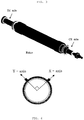
- FIG. 3 is a view illustrating a turbine according to an exemplary embodiment.
- FIG. 4 is a view illustrating an X-axis and a Y-axis orthogonal to each other at a turbine end of the rotor and the front surface of the turbine end, according to an exemplary embodiment.
- the locations of the rotor include a turbine end (TE) of the rotor and a collector end (CE) of the rotor.
- the aforementioned directions of the rotor include two axis directions, i.e. an X-axis direction and a Y-axis direction orthogonal to each other.
- the vibration information regarding the four dimensions includes vibration information on the rotor in the X-axis direction and the Y-axis direction orthogonal to each other at the turbine end of the rotor and vibration information on the rotor in the X-axis direction and the Y-axis direction orthogonal to each other at the collector end of the rotor.
- the vibration information on the rotor indicates, for example, a peak-to-peak value of a vibration.
- a unit of the peak-to-peak value is, for example, ⁇ m.
- the number of rotations of the rotor over time is expressed in rotations per minute (RPM) of the rotor.
- FIG. 5 illustrates graphs respectively showing the number of rotations of the rotor over time (RPM), a peak-to-peak value of a vibration over time, and a vibration according to RPM, according to an exemplary embodiment.
- the apparatus for detecting the abnormal vibration calculates the number of rotations of the rotor over time (RPM), a peak-to-peak value of a vibration over time, and a vibration according to RPM.
- FIG. 6 illustrates graphs respectively showing a peak-to-peak value of a vibration according to RPM in an X-axis direction of a turbine end, a peak-to-peak value of a vibration according to RPM in a Y-axis direction of the turbine end, a peak-to-peak value of a vibration according to RPM in an X-axis direction of a collector end, and a peak-to-peak value of a vibration according to RPM in a Y-axis direction of the collector end in an acceleration section of the rotor, according to an exemplary embodiment.
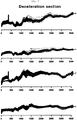
- FIG. 7 illustrates graphs respectively showing a peak to peak value of a vibration according to RPM in the X-axis direction of the turbine end, a peak to peak value of a vibration according to RPM in the Y-axis direction of the turbine end, a peak to peak value of a vibration according to RPM in the X-axis direction of the collector end, and a peak to peak value of a vibration according to RPM in the Y-axis direction of the collector end in a deceleration section of the rotor, according to an exemplary embodiment.
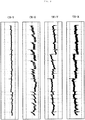
- FIG. 8 illustrates graphs respectively showing a peak to peak value of a vibration according to RPM in the X-axis direction of the turbine end, a peak to peak value of a vibration according to RPM in the Y-axis direction of the turbine end, a peak to peak value of a vibration according to RPM in the X-axis direction of the collector end, and a peak to peak value of a vibration according to RPM in the Y-axis direction of the collector end in a regular section of the rotor, according to an exemplary embodiment.
- FIG. 9 illustrates graphs respectively showing a peak to peak value of a vibration according to RPM, a 2 ⁇ confidence section, and a 4 ⁇ confidence section in the X-axis direction of the turbine end, a peak to peak value of a vibration according to RPM, a 2 ⁇ confidence section, and a 4 ⁇ confidence section in the Y-axis direction of the turbine end, a peak to peak value of a vibration according to RPM, a 2 ⁇ confidence section, and a 4 ⁇ confidence section in the X-axis direction of the collector end, and a peak to peak value of a vibration according to RPM, a 2 ⁇ confidence section, and a 4 ⁇ confidence section in the Y-axis direction of the collector end in the regular section of the rotor, according to an exemplary embodiment;
- FIG. 10 is a graph showing a management index of the rotor over time, i.e. a Hotelling's T-squared value according to an exemplary embodiment.
- the dotted line indicates an upper control limit (UCL).
- FIG. 11 is a graph showing a change amount of a vibration variable of the rotor over time according to an exemplary embodiment.
- FIG. 12 is a graph showing a change amount of an operation index of the rotor over time.
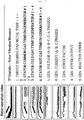
- the apparatus for detecting the abnormal vibration in the rotor may extract an operation index causing an abnormality in vibration characteristics of the rotor by extracting an operation index increasing or decreasing in a section in which a Hotelling's T-squared value is changed.
- STATOR COMMON GAS TEMP IN GENERATOR # 1-2, STATOR COLD GAS TEMP IN GENERATOR # 1-4, and STATOR HOT GAS TEMP IN GENERATOR # 1 to 4 are extracted as the operation index causing the abnormality in vibration characteristics of the rotor.
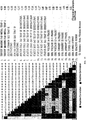
- FIG. 13 illustrates correlation analysis results according to an exemplary embodiment.
- the operation index extractor 130 extracts an operation index causing an abnormality in vibration characteristics by comparing correlation analysis coefficients with a reference coefficient, the correlation analysis coefficients being extracted by performing an correlation analysis on a Hotelling's T 2 and one or more operation indexes.
- FIG. 13 illustrates correlation analysis coefficients according to operation indexes. In comparison between an absolute value of the aforementioned correlation analysis coefficient and an absolute value of a reference coefficient, an operation index, of which an absolute of a correlation analysis coefficient is more than that of the reference coefficient, is extracted as an operation index causing an abnormality in vibration characteristics.
- the technical features disclosed herein and an implementation executing the same may be embodied as a digital electronic circuit, as a piece of computer software, firmware, or hardware including the structures described herein and structural equivalents thereof, or as a combination of one or more thereof.
- the implementation of the technical features disclosed herein may be embodied as a module regarding computer program instructions encoded on a tangible program storage medium to control a program product, i.e. the operation of a processing system, or execute the program product.
- Examples of the computer readable recording medium include a machine readable storage disk, a memory device, a composition of a material influential to machine readable carrier wave signals, or a combination of one or more thereof.
- apparatus or “system” used herein include any types of devices, apparatuses, and machines for processing data, such as a processor, a computer, and a multiprocessor.
- a processing system may include, in addition to hardware, for example, all codes for forming execution environments regarding computer programs as required, including codes for constituting processor firmware, protocol stacks, a database management system, an operating system, or a combination of one or more thereof.
- a computer program also referred to as a program, software, a software application, a script, codes, or the like, may be written in any form of program language, such as a compiled or interpreted language or a priori or procedural language.
- the computer program may be embodied in any form, including an independent program or module, a component, a subroutine, or another unit suitable to be used in a computer environment.
- the computer program does not necessarily correspond to files of a file system and may be stored in a single file provided to a request program, in interacting multi-files (e.g. files in which portions of one or more modules, subprograms, or codes are stored), or in portions of files retaining another program or data (e.g. one or more scripts stored in a markup language document).
- multi-files e.g. files in which portions of one or more modules, subprograms, or codes are stored
- portions of files retaining another program or data e.g. one or more scripts stored in a markup language document.
- the computer program may be executed by one or more computers located in a single site or a plurality of computers distributed to a plurality of sites and connected to each other via wired/wireless communications systems.
- the computer readable recording medium suitable for program instructions and data to be stored therein may include all types of non-volatile memory, media, and memory devices, including semiconductor memory devices, such as erasable read-only memory (EPROM), electrically erasable read-only memory (EEPROM), and flash memory; magnetic discs, such as an internal hard disk and an external hard disc; magneto-optical discs; compact disc read-only memory (CD-ROM); digital versatile discs (DVDs); and the like.
- the processor and memory may be supplemented by a special purpose logic circuit or integrated thereto.
- Implementations executing the technical features as described in the specification may be embodied in a backend component, such as a data server, a middleware component, such as an application server, a front end component, such as a client computer, having a web browser or a graphic user interface (GUI) allowing a user to interact with the implementations executing the technical features described in the specification, or a computing system including all combinations of one or more thereof.
- a backend component such as a data server
- middleware component such as an application server
- a front end component such as a client computer
- GUI graphic user interface
- the system components may be connected to each other via any type of digital data communications, such as a communications network, or any medium.
- the method may be used, in part or entirety, in a client device, a server related to a web-based storage system, or one or more processors included in the server, by a means for executing computer software, program codes, or instructions.
- the processor may be a part of a computing platform, such as a server, a client device, a network infrastructure, a mobile computing platform, a fixed computing platform and, more particularly, may be a type of computer or processing device able to execute program instructions, codes, and the like.
- the processor may further include memory storing a walking path guidance service method by measuring user movements, instructions, codes, and program.
- the processor may access a storage device, such as CD-ROM, a DVD, memory, a hard disc, a flash drive, random access memory (RAM), read-only memory (ROM), and a cache, in which the method, instructions, codes, and program according to the present disclosure are stored, using a separate interface.
- a storage device such as CD-ROM, a DVD, memory, a hard disc, a flash drive, random access memory (RAM), read-only memory (ROM), and a cache, in which the method, instructions, codes, and program according to the present disclosure are stored, using a separate interface.
- the system described in the specification and the walking path guidance service method based on the measurement of user movements may be used, in part or entirety, using a device executing computer software in a server, a client device, a gateway, a hub, a router, or network hardware.
- the software may be executed by a variety of types of servers, such as a file server, a print server, a domain server, an Internet server, an intranet server, a host server, a distributed server, and the like.
- These servers may respectively include memory, a processor, a computer readable recording medium, a storage medium, a communications device, a port, a client device, and an interface providing access to the other servers via wired/wireless networks.
- the method, instructions, codes, and the like according to the present disclosure may be executed by the server.
- Other devices necessary for executing the walking path guidance service method based on the measurement of user movements may be implemented as parts of a hierarchy associated with the server.
- the server may provide an interface to other devices including, without limitations, another server, a printer, a database server, a print server, a communications server, a distributed server, and the like. Connections using the interface may facilitate remote execution of programs via wired/wireless networks.
- Any one of the devices connected to the server via the interface may further include at least one storage device able to store a method, instructions, codes, and the like for issuance of a face-to-face one-time passcode (OTP) application.
- the central process of the server may provide the storage device with instructions, codes, and the like to be executed in different devices, so that the instructions, codes, and the like are stored therein.
- the method in the specification may be used, in part or entirety, using a network infrastructure.
- the network infrastructure may include devices, such as a computing device, a server, a router, a hub, a firewall, a client, a personal computer (PC), a communications device, and a routing device, as well as separate modules able to execute functions thereof.
- the network infrastructure may further include a storage medium, such as flash memory, a buffer, a stack, RAM, and ROM.
- the walking path guidance service method based on the measurement of user movements, instructions, codes, and the like may be executed and stored by any one of the device, module, and storage medium of the network infrastructure. Other devices necessary for the execution of the method may be implemented as parts of the network infrastructure.
- the system and method described in the specification may be implemented using hardware or a combination of hardware and software suitable for a specific application.
- the term "hardware” used herein includes all of general purpose computing devices, such as a PC and a mobile communications device, and specific office computing devices.
- the computing devices may be implemented as a device including any one, or a combination, of a microprocessor, a digital signal processor, an application integrated circuit (IC), a programmable gate array, a programmable array system.
- readable device may include all types of memory, such as computer components containing digital data used in computing for a predetermined period of time; semiconductor storages, such as RAN or ROM; permanent storages, such as an optical disc; mass storages, such as a hard disc, a tape, and a drum; optical storages, such as CD-ROM or a DVD; flash memory; floppy discs; magnetic tapes; paper tapes; independent RAM discs; mass storages detachable from computers; dynamic memory; static memory; variable storages; and network connected storages, such as cloud memory.
- semiconductor storages such as RAN or ROM
- permanent storages such as an optical disc
- mass storages such as a hard disc, a tape, and a drum
- optical storages such as CD-ROM or a DVD
- flash memory floppy discs
- magnetic tapes paper tapes
- independent RAM discs independent RAM discs
- mass storages detachable from computers
- dynamic memory static memory
- variable storages and network connected storages, such as cloud memory
- instructions and “codes” used herein may include all types of languages, such as data-oriented languages, such as SQL and dBase; system languages, such as C language, objective C language, C++ language, and assembly language; architecture languages, such as Java and NET; and application languages, such as PHP, Ruby, Perl, and Python.
- system languages such as C language, objective C language, C++ language, and assembly language
- architecture languages such as Java and NET
- application languages such as PHP, Ruby, Perl, and Python.
- instructions and “codes” are not limited thereto and may include any languages well-known to those skilled in the art to which the present disclosure relates.
- computer readable medium used herein may include all types of media that contribute to providing instructions to the process for the execution of a program.
- computer readable medium may include non-volatile media, such as a data storage device, an optical disk, and a magnetic disc; volatile media, such as dynamic memory; and transmission media, such as a coaxial cable transferring data, a copper wire, and an optical fiber, but is not limited thereto.
- the illustrated components and functions thereof are executed in forms of an independent software module, a monolithic software structure, codes, a service, and a combination thereof.
- the functions may be stored in a medium readable by a computer having a processor able to execute the stored program codes, instructions, and the like and may be executed by a computer.
Landscapes
- Physics & Mathematics (AREA)
- General Physics & Mathematics (AREA)
- Testing Of Devices, Machine Parts, Or Other Structures Thereof (AREA)
- Control Of Eletrric Generators (AREA)
- Motor Or Generator Frames (AREA)
- Measurement Of Mechanical Vibrations Or Ultrasonic Waves (AREA)
Applications Claiming Priority (1)
| Application Number | Priority Date | Filing Date | Title |
|---|---|---|---|
| KR1020160115332A KR101863781B1 (ko) | 2016-09-08 | 2016-09-08 | 로터 진동 이상 감지 장치 및 방법 |
Publications (2)
| Publication Number | Publication Date |
|---|---|
| EP3293501A1 true EP3293501A1 (fr) | 2018-03-14 |
| EP3293501B1 EP3293501B1 (fr) | 2023-01-11 |
Family
ID=59846413
Family Applications (1)
| Application Number | Title | Priority Date | Filing Date |
|---|---|---|---|
| EP17190028.5A Active EP3293501B1 (fr) | 2016-09-08 | 2017-09-08 | Appareil et procédé pour détecter une vibration anormale dans un rotor |
Country Status (5)
| Country | Link |
|---|---|
| US (1) | US10724918B2 (fr) |
| EP (1) | EP3293501B1 (fr) |
| JP (1) | JP6431152B2 (fr) |
| KR (1) | KR101863781B1 (fr) |
| CN (1) | CN107806985B (fr) |
Cited By (2)
| Publication number | Priority date | Publication date | Assignee | Title |
|---|---|---|---|---|
| JP2018040803A (ja) * | 2016-09-08 | 2018-03-15 | ドゥサン ヘヴィー インダストリーズ アンド コンストラクション カンパニー リミテッド | ローター振動異常検知装置及び方法 |
| RU2711647C1 (ru) * | 2019-04-08 | 2020-01-17 | ОАО "Научно-исследовательский институт технологии, контроля и диагностики железнодорожного транспорта" (ОАО "НИИТКД") | Устройство и способ оценки технического состояния асинхронных двигателей |
Families Citing this family (7)
| Publication number | Priority date | Publication date | Assignee | Title |
|---|---|---|---|---|
| CN108680244B (zh) * | 2018-04-26 | 2020-06-09 | 浙江大学 | 一种旋转机械振动无线监测装置及方法 |
| CN109163689B (zh) * | 2018-09-04 | 2020-07-24 | 国网青海省电力公司检修公司 | 一种波纹管状态评价方法及装置 |
| KR102245922B1 (ko) * | 2018-11-30 | 2021-04-30 | 두산중공업 주식회사 | CFD(Computational Fluid Dynamics) 해석 이상 징후 예측 시스템 및 방법 |
| JP2022523564A (ja) | 2019-03-04 | 2022-04-25 | アイオーカレンツ, インコーポレイテッド | 機械学習を使用するデータ圧縮および通信 |
| JP7123886B2 (ja) * | 2019-09-17 | 2022-08-23 | 株式会社東芝 | 電力制御回路、発電機、及び発電システム |
| CN112326248B (zh) * | 2020-11-10 | 2022-08-23 | 江苏大学 | 基于Hotelling’sT2控制图融合双峭度图的轴承状态监测及故障诊断的方法 |
| CN116827055B (zh) * | 2022-09-09 | 2024-01-30 | 东莞市智美生活电子科技有限公司 | 一种电机结构 |
Citations (3)
| Publication number | Priority date | Publication date | Assignee | Title |
|---|---|---|---|---|
| US20100138267A1 (en) * | 2009-08-31 | 2010-06-03 | Sameer Vittal | System and method for wind turbine health management |
| EP2988104A2 (fr) * | 2014-08-21 | 2016-02-24 | General Electric Company | Détection d'anomalies de rotor au cours de fonctionnements en régime transitoire |
| KR20160115332A (ko) | 2015-03-26 | 2016-10-06 | 주식회사 대진정공 | 산소통 보관장치 |
Family Cites Families (39)
| Publication number | Priority date | Publication date | Assignee | Title |
|---|---|---|---|---|
| US3220247A (en) * | 1962-05-14 | 1965-11-30 | Gen Electric | Vibration vector measurement and display apparatus |
| JPS6018729A (ja) * | 1983-07-11 | 1985-01-30 | Mitsubishi Electric Corp | 振動監視装置 |
| JP2850917B2 (ja) | 1990-03-28 | 1999-01-27 | 株式会社東芝 | 回転機械の異常診断方法 |
| JP3321487B2 (ja) * | 1993-10-20 | 2002-09-03 | 株式会社日立製作所 | 機器/設備診断方法およびシステム |
| JPH08334405A (ja) | 1995-06-08 | 1996-12-17 | Omron Corp | 回転機の異常診断装置 |
| JP3708041B2 (ja) * | 2001-11-16 | 2005-10-19 | 株式会社東芝 | 回転機械の振動診断方法及び装置 |
| KR200335004Y1 (ko) | 2003-08-28 | 2003-12-01 | 한국서부발전 주식회사 | 발전소용 증기터빈 운전조작 감시모듈구조 |
| US8096184B2 (en) * | 2004-06-30 | 2012-01-17 | Siemens Energy, Inc. | Turbine blade for monitoring blade vibration |
| US7567887B2 (en) * | 2004-09-10 | 2009-07-28 | Exxonmobil Research And Engineering Company | Application of abnormal event detection technology to fluidized catalytic cracking unit |
| US7424395B2 (en) * | 2004-09-10 | 2008-09-09 | Exxonmobil Research And Engineering Company | Application of abnormal event detection technology to olefins recovery trains |
| JP2009506261A (ja) * | 2005-08-31 | 2009-02-12 | シーメンス アクチエンゲゼルシヤフト | タービンの回転軸の動的挙動を監視するための方法と装置 |
| US7243048B2 (en) * | 2005-11-28 | 2007-07-10 | Honeywell International, Inc. | Fault detection system and method using multiway principal component analysis |
| US7853431B2 (en) * | 2006-09-29 | 2010-12-14 | Fisher-Rosemount Systems, Inc. | On-line monitoring and diagnostics of a process using multivariate statistical analysis |
| JP2008298527A (ja) * | 2007-05-30 | 2008-12-11 | Toshiba Corp | 回転機械の振動診断方法及びその振動診断装置 |
| JP2009070071A (ja) * | 2007-09-12 | 2009-04-02 | Toshiba Corp | 学習型プロセス異常診断装置、およびオペレータ判断推測結果収集装置 |
| US7775114B2 (en) * | 2007-09-26 | 2010-08-17 | Siemens Energy, Inc. | Method of on-line turbine blade slope and sensor position verification |
| US7756678B2 (en) * | 2008-05-29 | 2010-07-13 | General Electric Company | System and method for advanced condition monitoring of an asset system |
| US8144005B2 (en) * | 2008-05-29 | 2012-03-27 | General Electric Company | System and method for advanced condition monitoring of an asset system |
| US8352216B2 (en) * | 2008-05-29 | 2013-01-08 | General Electric Company | System and method for advanced condition monitoring of an asset system |
| WO2010010688A1 (fr) * | 2008-07-24 | 2010-01-28 | 株式会社アルバック | Système de contrôle d'actions pour dispositif de traitement |
| JP5010032B2 (ja) * | 2008-10-21 | 2012-08-29 | 富士電機株式会社 | 地熱発電設備のオンライン診断方法 |
| FR2939170B1 (fr) * | 2008-11-28 | 2010-12-31 | Snecma | Detection d'anomalie dans un moteur d'aeronef. |
| CN101899563B (zh) * | 2009-06-01 | 2013-08-28 | 上海宝钢工业检测公司 | 基于pca模型的连续退火机组炉内温度、张力监测及故障追溯方法 |
| US8297123B2 (en) * | 2009-07-30 | 2012-10-30 | General Electric Company | Detection of anomalous movement in a reciprocating device |
| JP5363927B2 (ja) * | 2009-09-07 | 2013-12-11 | 株式会社日立製作所 | 異常検知・診断方法、異常検知・診断システム、及び異常検知・診断プログラム |
| KR100954090B1 (ko) | 2009-10-27 | 2010-04-23 | 주식회사 위다스 | 풍력발전설비 상태감시시스템 |
| US8222760B2 (en) * | 2010-06-29 | 2012-07-17 | General Electric Company | Method for controlling a proximity sensor of a wind turbine |
| EP2571739A4 (fr) * | 2010-06-30 | 2015-03-04 | Services Petroliers Schlumberger | Système, procédé et appareil pour des pronostics d'équipements de champ pétrolifère et la gestion sanitaire |
| US8364424B2 (en) * | 2010-07-30 | 2013-01-29 | General Electric Company | System and method for monitoring a wind turbine gearbox |
| US8751423B2 (en) * | 2010-11-30 | 2014-06-10 | General Electric Company | Turbine performance diagnostic system and methods |
| TWI515522B (zh) * | 2010-12-28 | 2016-01-01 | 萬國商業機器公司 | 測定系統情況的方法、電腦程式及電腦 |
| CZ2011588A3 (cs) * | 2011-09-21 | 2013-06-12 | Doosan Skoda Power S.R.O. | Zpusob urcení aktuální excentricity rotujícího rotoru a diagnostika excentricity rotujícího rotoru |
| US9063030B2 (en) * | 2012-02-14 | 2015-06-23 | Computational Systems, Inc. | Apparatus and method for visualizing the position of a rotating structure with respect to a stationary structure |
| KR101449457B1 (ko) | 2013-06-26 | 2014-10-13 | 주식회사 포스코 | 발전기 제어 장치 |
| WO2015139709A1 (fr) * | 2014-03-19 | 2015-09-24 | Northern Vo Aps | Procédé et système de surveillance d'un véhicule |
| CN103824137B (zh) * | 2014-03-20 | 2016-08-17 | 北京信息科技大学 | 一种复杂机械设备多工况故障预测方法 |
| US9568301B2 (en) * | 2014-04-11 | 2017-02-14 | General Electric Company | Systems and methods for capacitive proximity sensing |
| US10677041B2 (en) * | 2014-06-16 | 2020-06-09 | Sensia Llc | Fault detection in electric submersible pumps |
| KR101863781B1 (ko) * | 2016-09-08 | 2018-06-01 | 두산중공업 주식회사 | 로터 진동 이상 감지 장치 및 방법 |
-
2016
- 2016-09-08 KR KR1020160115332A patent/KR101863781B1/ko active Active
-
2017
- 2017-09-07 CN CN201710802379.1A patent/CN107806985B/zh active Active
- 2017-09-08 US US15/699,179 patent/US10724918B2/en active Active
- 2017-09-08 JP JP2017173407A patent/JP6431152B2/ja active Active
- 2017-09-08 EP EP17190028.5A patent/EP3293501B1/fr active Active
Patent Citations (3)
| Publication number | Priority date | Publication date | Assignee | Title |
|---|---|---|---|---|
| US20100138267A1 (en) * | 2009-08-31 | 2010-06-03 | Sameer Vittal | System and method for wind turbine health management |
| EP2988104A2 (fr) * | 2014-08-21 | 2016-02-24 | General Electric Company | Détection d'anomalies de rotor au cours de fonctionnements en régime transitoire |
| KR20160115332A (ko) | 2015-03-26 | 2016-10-06 | 주식회사 대진정공 | 산소통 보관장치 |
Cited By (2)
| Publication number | Priority date | Publication date | Assignee | Title |
|---|---|---|---|---|
| JP2018040803A (ja) * | 2016-09-08 | 2018-03-15 | ドゥサン ヘヴィー インダストリーズ アンド コンストラクション カンパニー リミテッド | ローター振動異常検知装置及び方法 |
| RU2711647C1 (ru) * | 2019-04-08 | 2020-01-17 | ОАО "Научно-исследовательский институт технологии, контроля и диагностики железнодорожного транспорта" (ОАО "НИИТКД") | Устройство и способ оценки технического состояния асинхронных двигателей |
Also Published As
| Publication number | Publication date |
|---|---|
| JP2018040803A (ja) | 2018-03-15 |
| KR20180028111A (ko) | 2018-03-16 |
| US10724918B2 (en) | 2020-07-28 |
| EP3293501B1 (fr) | 2023-01-11 |
| JP6431152B2 (ja) | 2018-11-28 |
| US20180067010A1 (en) | 2018-03-08 |
| CN107806985B (zh) | 2020-01-21 |
| KR101863781B1 (ko) | 2018-06-01 |
| CN107806985A (zh) | 2018-03-16 |
Similar Documents
| Publication | Publication Date | Title |
|---|---|---|
| EP3293501B1 (fr) | Appareil et procédé pour détecter une vibration anormale dans un rotor | |
| EP3823156B1 (fr) | Procédé de détection de phase initiale et de séquence de phase de moteur et système de commande de moteur synchrone à aimant permanent | |
| EP3674822B1 (fr) | Procédé et appareil servant à générer une base d'informations de diagnostic de panne d'une machine-outil à commande numérique | |
| US20220128620A1 (en) | Managing health condition of a rotating system | |
| Rajamany et al. | Induction motor stator interturn short circuit fault detection in accordance with line current sequence components using artificial neural network | |
| US10234508B1 (en) | Dynamic parameter estimation of generators | |
| US10698031B2 (en) | Systems and methods for obtaining and validating performance data on motors | |
| Dong et al. | A fault diagnosis method for rotating machinery based on PCA and Morlet kernel SVM | |
| CN119178996A (zh) | 一种车用驱动电机旋转变压器微小故障检测方法 | |
| US20220221374A1 (en) | Hybrid vibration-sound acoustic profiling using a siamese network to detect loose parts | |
| Kawady et al. | AI driven fault diagnosis approach for stator turn to turn faults in induction motors | |
| Aswad et al. | Detection and localization of the stator winding inter-turn fault in induction motors based on parameters estimation using genetic algorithm | |
| US10845792B2 (en) | Failure diagnosis apparatus, monitoring apparatus, failure diagnosis method and recording medium | |
| Chioncel et al. | Determination of reference mechanical angular speed for wind power systems | |
| WO2020193325A1 (fr) | Appareil de surveillance d'équipement | |
| Zaman et al. | Online estimation of PID controllers and plant dynamics via multi‐recursive least squares estimation from closed‐loop I/O data | |
| El Bouharrouti et al. | Co‐simulations of induction machines coupled with a radial ball bearing for mechanical defects analysis | |
| CN118504297A (zh) | 一种电磁仿真模型校正方法、装置、存储介质及电子设备 | |
| US20150227875A1 (en) | Systems and Methods to Determine Competitiveness of a Long Term Service Agreement | |
| Daems et al. | Operational modal analysis of wind turbine drivetrain with focus on damping extraction | |
| CN117931609B (zh) | 云台的性能分析方法、装置、设备及存储介质 | |
| Wang et al. | Consideration of gyroscopic effect in fault detection and isolation for unbalance excited rotor systems | |
| Montalvo et al. | Application of the monte carlo method for capacitive pressure transmitters surveillance in nuclear power plants | |
| Knezevic et al. | A new approach for parameter estimation of induction machines based on speed-time characteristics during direct startup | |
| Dong et al. | Adaptive Remaining Useful Life Prediction Method for Devices With Random Failure Threshold |
Legal Events
| Date | Code | Title | Description |
|---|---|---|---|
| PUAI | Public reference made under article 153(3) epc to a published international application that has entered the european phase |
Free format text: ORIGINAL CODE: 0009012 |
|
| STAA | Information on the status of an ep patent application or granted ep patent |
Free format text: STATUS: REQUEST FOR EXAMINATION WAS MADE |
|
| 17P | Request for examination filed |
Effective date: 20170908 |
|
| AK | Designated contracting states |
Kind code of ref document: A1 Designated state(s): AL AT BE BG CH CY CZ DE DK EE ES FI FR GB GR HR HU IE IS IT LI LT LU LV MC MK MT NL NO PL PT RO RS SE SI SK SM TR |
|
| AX | Request for extension of the european patent |
Extension state: BA ME |
|
| RBV | Designated contracting states (corrected) |
Designated state(s): AL AT BE BG CH CY CZ DE DK EE ES FI FR GB GR HR HU IE IS IT LI LT LU LV MC MK MT NL NO PL PT RO RS SE SI SK SM TR |
|
| RAP1 | Party data changed (applicant data changed or rights of an application transferred) |
Owner name: DOOSAN HEAVY INDUSTRIES & CONSTRUCTION CO., LTD. |
|
| STAA | Information on the status of an ep patent application or granted ep patent |
Free format text: STATUS: EXAMINATION IS IN PROGRESS |
|
| 17Q | First examination report despatched |
Effective date: 20201118 |
|
| GRAP | Despatch of communication of intention to grant a patent |
Free format text: ORIGINAL CODE: EPIDOSNIGR1 |
|
| STAA | Information on the status of an ep patent application or granted ep patent |
Free format text: STATUS: GRANT OF PATENT IS INTENDED |
|
| INTG | Intention to grant announced |
Effective date: 20220826 |
|
| RAP3 | Party data changed (applicant data changed or rights of an application transferred) |
Owner name: DOOSAN ENERBILITY CO., LTD. |
|
| GRAS | Grant fee paid |
Free format text: ORIGINAL CODE: EPIDOSNIGR3 |
|
| GRAA | (expected) grant |
Free format text: ORIGINAL CODE: 0009210 |
|
| STAA | Information on the status of an ep patent application or granted ep patent |
Free format text: STATUS: THE PATENT HAS BEEN GRANTED |
|
| AK | Designated contracting states |
Kind code of ref document: B1 Designated state(s): AL AT BE BG CH CY CZ DE DK EE ES FI FR GB GR HR HU IE IS IT LI LT LU LV MC MK MT NL NO PL PT RO RS SE SI SK SM TR |
|
| REG | Reference to a national code |
Ref country code: GB Ref legal event code: FG4D |
|
| REG | Reference to a national code |
Ref country code: CH Ref legal event code: EP |
|
| REG | Reference to a national code |
Ref country code: DE Ref legal event code: R096 Ref document number: 602017065363 Country of ref document: DE |
|
| REG | Reference to a national code |
Ref country code: IE Ref legal event code: FG4D |
|
| REG | Reference to a national code |
Ref country code: AT Ref legal event code: REF Ref document number: 1543694 Country of ref document: AT Kind code of ref document: T Effective date: 20230215 |
|
| REG | Reference to a national code |
Ref country code: LT Ref legal event code: MG9D |
|
| REG | Reference to a national code |
Ref country code: NL Ref legal event code: MP Effective date: 20230111 |
|
| REG | Reference to a national code |
Ref country code: AT Ref legal event code: MK05 Ref document number: 1543694 Country of ref document: AT Kind code of ref document: T Effective date: 20230111 |
|
| PG25 | Lapsed in a contracting state [announced via postgrant information from national office to epo] |
Ref country code: NL Free format text: LAPSE BECAUSE OF FAILURE TO SUBMIT A TRANSLATION OF THE DESCRIPTION OR TO PAY THE FEE WITHIN THE PRESCRIBED TIME-LIMIT Effective date: 20230111 |
|
| PG25 | Lapsed in a contracting state [announced via postgrant information from national office to epo] |
Ref country code: RS Free format text: LAPSE BECAUSE OF FAILURE TO SUBMIT A TRANSLATION OF THE DESCRIPTION OR TO PAY THE FEE WITHIN THE PRESCRIBED TIME-LIMIT Effective date: 20230111 Ref country code: PT Free format text: LAPSE BECAUSE OF FAILURE TO SUBMIT A TRANSLATION OF THE DESCRIPTION OR TO PAY THE FEE WITHIN THE PRESCRIBED TIME-LIMIT Effective date: 20230511 Ref country code: NO Free format text: LAPSE BECAUSE OF FAILURE TO SUBMIT A TRANSLATION OF THE DESCRIPTION OR TO PAY THE FEE WITHIN THE PRESCRIBED TIME-LIMIT Effective date: 20230411 Ref country code: LV Free format text: LAPSE BECAUSE OF FAILURE TO SUBMIT A TRANSLATION OF THE DESCRIPTION OR TO PAY THE FEE WITHIN THE PRESCRIBED TIME-LIMIT Effective date: 20230111 Ref country code: LT Free format text: LAPSE BECAUSE OF FAILURE TO SUBMIT A TRANSLATION OF THE DESCRIPTION OR TO PAY THE FEE WITHIN THE PRESCRIBED TIME-LIMIT Effective date: 20230111 Ref country code: HR Free format text: LAPSE BECAUSE OF FAILURE TO SUBMIT A TRANSLATION OF THE DESCRIPTION OR TO PAY THE FEE WITHIN THE PRESCRIBED TIME-LIMIT Effective date: 20230111 Ref country code: ES Free format text: LAPSE BECAUSE OF FAILURE TO SUBMIT A TRANSLATION OF THE DESCRIPTION OR TO PAY THE FEE WITHIN THE PRESCRIBED TIME-LIMIT Effective date: 20230111 Ref country code: AT Free format text: LAPSE BECAUSE OF FAILURE TO SUBMIT A TRANSLATION OF THE DESCRIPTION OR TO PAY THE FEE WITHIN THE PRESCRIBED TIME-LIMIT Effective date: 20230111 |
|
| PG25 | Lapsed in a contracting state [announced via postgrant information from national office to epo] |
Ref country code: SE Free format text: LAPSE BECAUSE OF FAILURE TO SUBMIT A TRANSLATION OF THE DESCRIPTION OR TO PAY THE FEE WITHIN THE PRESCRIBED TIME-LIMIT Effective date: 20230111 Ref country code: PL Free format text: LAPSE BECAUSE OF FAILURE TO SUBMIT A TRANSLATION OF THE DESCRIPTION OR TO PAY THE FEE WITHIN THE PRESCRIBED TIME-LIMIT Effective date: 20230111 Ref country code: IS Free format text: LAPSE BECAUSE OF FAILURE TO SUBMIT A TRANSLATION OF THE DESCRIPTION OR TO PAY THE FEE WITHIN THE PRESCRIBED TIME-LIMIT Effective date: 20230511 Ref country code: GR Free format text: LAPSE BECAUSE OF FAILURE TO SUBMIT A TRANSLATION OF THE DESCRIPTION OR TO PAY THE FEE WITHIN THE PRESCRIBED TIME-LIMIT Effective date: 20230412 Ref country code: FI Free format text: LAPSE BECAUSE OF FAILURE TO SUBMIT A TRANSLATION OF THE DESCRIPTION OR TO PAY THE FEE WITHIN THE PRESCRIBED TIME-LIMIT Effective date: 20230111 |
|
| REG | Reference to a national code |
Ref country code: DE Ref legal event code: R097 Ref document number: 602017065363 Country of ref document: DE |
|
| PG25 | Lapsed in a contracting state [announced via postgrant information from national office to epo] |
Ref country code: SM Free format text: LAPSE BECAUSE OF FAILURE TO SUBMIT A TRANSLATION OF THE DESCRIPTION OR TO PAY THE FEE WITHIN THE PRESCRIBED TIME-LIMIT Effective date: 20230111 Ref country code: RO Free format text: LAPSE BECAUSE OF FAILURE TO SUBMIT A TRANSLATION OF THE DESCRIPTION OR TO PAY THE FEE WITHIN THE PRESCRIBED TIME-LIMIT Effective date: 20230111 Ref country code: EE Free format text: LAPSE BECAUSE OF FAILURE TO SUBMIT A TRANSLATION OF THE DESCRIPTION OR TO PAY THE FEE WITHIN THE PRESCRIBED TIME-LIMIT Effective date: 20230111 Ref country code: DK Free format text: LAPSE BECAUSE OF FAILURE TO SUBMIT A TRANSLATION OF THE DESCRIPTION OR TO PAY THE FEE WITHIN THE PRESCRIBED TIME-LIMIT Effective date: 20230111 Ref country code: CZ Free format text: LAPSE BECAUSE OF FAILURE TO SUBMIT A TRANSLATION OF THE DESCRIPTION OR TO PAY THE FEE WITHIN THE PRESCRIBED TIME-LIMIT Effective date: 20230111 |
|
| PLBE | No opposition filed within time limit |
Free format text: ORIGINAL CODE: 0009261 |
|
| STAA | Information on the status of an ep patent application or granted ep patent |
Free format text: STATUS: NO OPPOSITION FILED WITHIN TIME LIMIT |
|
| PG25 | Lapsed in a contracting state [announced via postgrant information from national office to epo] |
Ref country code: SK Free format text: LAPSE BECAUSE OF FAILURE TO SUBMIT A TRANSLATION OF THE DESCRIPTION OR TO PAY THE FEE WITHIN THE PRESCRIBED TIME-LIMIT Effective date: 20230111 |
|
| 26N | No opposition filed |
Effective date: 20231012 |
|
| PG25 | Lapsed in a contracting state [announced via postgrant information from national office to epo] |
Ref country code: SI Free format text: LAPSE BECAUSE OF FAILURE TO SUBMIT A TRANSLATION OF THE DESCRIPTION OR TO PAY THE FEE WITHIN THE PRESCRIBED TIME-LIMIT Effective date: 20230111 |
|
| REG | Reference to a national code |
Ref country code: CH Ref legal event code: PL |
|
| PG25 | Lapsed in a contracting state [announced via postgrant information from national office to epo] |
Ref country code: LU Free format text: LAPSE BECAUSE OF NON-PAYMENT OF DUE FEES Effective date: 20230908 |
|
| REG | Reference to a national code |
Ref country code: BE Ref legal event code: MM Effective date: 20230930 |
|
| GBPC | Gb: european patent ceased through non-payment of renewal fee |
Effective date: 20230908 |
|
| PG25 | Lapsed in a contracting state [announced via postgrant information from national office to epo] |
Ref country code: LU Free format text: LAPSE BECAUSE OF NON-PAYMENT OF DUE FEES Effective date: 20230908 Ref country code: IT Free format text: LAPSE BECAUSE OF FAILURE TO SUBMIT A TRANSLATION OF THE DESCRIPTION OR TO PAY THE FEE WITHIN THE PRESCRIBED TIME-LIMIT Effective date: 20230111 Ref country code: MC Free format text: LAPSE BECAUSE OF FAILURE TO SUBMIT A TRANSLATION OF THE DESCRIPTION OR TO PAY THE FEE WITHIN THE PRESCRIBED TIME-LIMIT Effective date: 20230111 |
|
| REG | Reference to a national code |
Ref country code: IE Ref legal event code: MM4A |
|
| PG25 | Lapsed in a contracting state [announced via postgrant information from national office to epo] |
Ref country code: IE Free format text: LAPSE BECAUSE OF NON-PAYMENT OF DUE FEES Effective date: 20230908 |
|
| PG25 | Lapsed in a contracting state [announced via postgrant information from national office to epo] |
Ref country code: GB Free format text: LAPSE BECAUSE OF NON-PAYMENT OF DUE FEES Effective date: 20230908 |
|
| PG25 | Lapsed in a contracting state [announced via postgrant information from national office to epo] |
Ref country code: CH Free format text: LAPSE BECAUSE OF NON-PAYMENT OF DUE FEES Effective date: 20230930 |
|
| PG25 | Lapsed in a contracting state [announced via postgrant information from national office to epo] |
Ref country code: IE Free format text: LAPSE BECAUSE OF NON-PAYMENT OF DUE FEES Effective date: 20230908 Ref country code: GB Free format text: LAPSE BECAUSE OF NON-PAYMENT OF DUE FEES Effective date: 20230908 Ref country code: CH Free format text: LAPSE BECAUSE OF NON-PAYMENT OF DUE FEES Effective date: 20230930 |
|
| PG25 | Lapsed in a contracting state [announced via postgrant information from national office to epo] |
Ref country code: BE Free format text: LAPSE BECAUSE OF NON-PAYMENT OF DUE FEES Effective date: 20230930 |
|
| PG25 | Lapsed in a contracting state [announced via postgrant information from national office to epo] |
Ref country code: BG Free format text: LAPSE BECAUSE OF FAILURE TO SUBMIT A TRANSLATION OF THE DESCRIPTION OR TO PAY THE FEE WITHIN THE PRESCRIBED TIME-LIMIT Effective date: 20230111 |
|
| PG25 | Lapsed in a contracting state [announced via postgrant information from national office to epo] |
Ref country code: BG Free format text: LAPSE BECAUSE OF FAILURE TO SUBMIT A TRANSLATION OF THE DESCRIPTION OR TO PAY THE FEE WITHIN THE PRESCRIBED TIME-LIMIT Effective date: 20230111 |
|
| PG25 | Lapsed in a contracting state [announced via postgrant information from national office to epo] |
Ref country code: CY Free format text: LAPSE BECAUSE OF FAILURE TO SUBMIT A TRANSLATION OF THE DESCRIPTION OR TO PAY THE FEE WITHIN THE PRESCRIBED TIME-LIMIT; INVALID AB INITIO Effective date: 20170908 |
|
| PG25 | Lapsed in a contracting state [announced via postgrant information from national office to epo] |
Ref country code: HU Free format text: LAPSE BECAUSE OF FAILURE TO SUBMIT A TRANSLATION OF THE DESCRIPTION OR TO PAY THE FEE WITHIN THE PRESCRIBED TIME-LIMIT; INVALID AB INITIO Effective date: 20170908 |
|
| PGFP | Annual fee paid to national office [announced via postgrant information from national office to epo] |
Ref country code: DE Payment date: 20250702 Year of fee payment: 9 |
|
| PGFP | Annual fee paid to national office [announced via postgrant information from national office to epo] |
Ref country code: FR Payment date: 20250703 Year of fee payment: 9 |
|
| PG25 | Lapsed in a contracting state [announced via postgrant information from national office to epo] |
Ref country code: TR Free format text: LAPSE BECAUSE OF FAILURE TO SUBMIT A TRANSLATION OF THE DESCRIPTION OR TO PAY THE FEE WITHIN THE PRESCRIBED TIME-LIMIT Effective date: 20230111 |