EP3293528B1 - Mesures de recommandation basées sur le type de forme d'onde détecté - Google Patents
Mesures de recommandation basées sur le type de forme d'onde détecté Download PDFInfo
- Publication number
- EP3293528B1 EP3293528B1 EP17190691.0A EP17190691A EP3293528B1 EP 3293528 B1 EP3293528 B1 EP 3293528B1 EP 17190691 A EP17190691 A EP 17190691A EP 3293528 B1 EP3293528 B1 EP 3293528B1
- Authority
- EP
- European Patent Office
- Prior art keywords
- classification
- test
- classifiers
- user
- machine learning
- Prior art date
- Legal status (The legal status is an assumption and is not a legal conclusion. Google has not performed a legal analysis and makes no representation as to the accuracy of the status listed.)
- Active
Links
Images



Classifications
-
- G—PHYSICS
- G01—MEASURING; TESTING
- G01R—MEASURING ELECTRIC VARIABLES; MEASURING MAGNETIC VARIABLES
- G01R13/00—Arrangements for displaying electric variables or waveforms
- G01R13/20—Cathode-ray oscilloscopes
- G01R13/22—Circuits therefor
-
- G—PHYSICS
- G06—COMPUTING OR CALCULATING; COUNTING
- G06F—ELECTRIC DIGITAL DATA PROCESSING
- G06F18/00—Pattern recognition
- G06F18/20—Analysing
- G06F18/21—Design or setup of recognition systems or techniques; Extraction of features in feature space; Blind source separation
- G06F18/214—Generating training patterns; Bootstrap methods, e.g. bagging or boosting
- G06F18/2148—Generating training patterns; Bootstrap methods, e.g. bagging or boosting characterised by the process organisation or structure, e.g. boosting cascade
-
- G—PHYSICS
- G01—MEASURING; TESTING
- G01R—MEASURING ELECTRIC VARIABLES; MEASURING MAGNETIC VARIABLES
- G01R13/00—Arrangements for displaying electric variables or waveforms
-
- G—PHYSICS
- G01—MEASURING; TESTING
- G01R—MEASURING ELECTRIC VARIABLES; MEASURING MAGNETIC VARIABLES
- G01R13/00—Arrangements for displaying electric variables or waveforms
- G01R13/02—Arrangements for displaying electric variables or waveforms for displaying measured electric variables in digital form
-
- G—PHYSICS
- G01—MEASURING; TESTING
- G01R—MEASURING ELECTRIC VARIABLES; MEASURING MAGNETIC VARIABLES
- G01R23/00—Arrangements for measuring frequencies; Arrangements for analysing frequency spectra
- G01R23/16—Spectrum analysis; Fourier analysis
-
- G—PHYSICS
- G06—COMPUTING OR CALCULATING; COUNTING
- G06F—ELECTRIC DIGITAL DATA PROCESSING
- G06F18/00—Pattern recognition
- G06F18/20—Analysing
- G06F18/24—Classification techniques
-
- G—PHYSICS
- G06—COMPUTING OR CALCULATING; COUNTING
- G06N—COMPUTING ARRANGEMENTS BASED ON SPECIFIC COMPUTATIONAL MODELS
- G06N20/00—Machine learning
-
- G—PHYSICS
- G06—COMPUTING OR CALCULATING; COUNTING
- G06N—COMPUTING ARRANGEMENTS BASED ON SPECIFIC COMPUTATIONAL MODELS
- G06N20/00—Machine learning
- G06N20/20—Ensemble learning
-
- G—PHYSICS
- G06—COMPUTING OR CALCULATING; COUNTING
- G06N—COMPUTING ARRANGEMENTS BASED ON SPECIFIC COMPUTATIONAL MODELS
- G06N7/00—Computing arrangements based on specific mathematical models
- G06N7/01—Probabilistic graphical models, e.g. probabilistic networks
Definitions
- This disclosure is directed to a system and methods for oscilloscope operation, and, more particularly, to a system and methods for detecting input waveform types and suggesting corresponding measurement settings for the oscilloscope.
- Test and measurement systems are designed to receive signal inputs, sample the signals, and display the result as a waveform.
- Various settings can be employed to control the manner of sampling, the nature of the samples taken, and the manner in which the waveform is displayed.
- Some advanced test and measurement systems include large numbers of potential control settings, and many such settings are only useful for specific input types. Accordingly, advanced models can inundate the user with choices, while making relevant settings exceedingly difficult to find.
- Embodiments of the invention address these and other issues.
- a test and measurement instrument is defined by claim 1
- a method for operating a test and measurement instrument is defined by claim 9. Further aspects are defined by the corresponding dependent claims.
- a computer readable medium is defined by claim 15.
- references in the specification to embodiment, aspect, example, etc. indicate that the described item may include a particular feature, structure, or characteristic. However, every disclosed aspect may or may not necessarily include that particular feature, structure, or characteristic. Moreover, such phrases are not necessarily referring to the same aspect unless specifically noted. Further, when a particular feature, structure, or characteristic is described in connection with a particular aspect, such feature, structure, or characteristic can be employed in connection with another disclosed aspect whether or not such feature is explicitly described in conjunction with such other disclosed aspect.
- the disclosed aspects may be implemented, in some cases, in hardware, firmware, software, or any combination thereof.
- the disclosed aspects may also be implemented as instructions carried by or stored on one or more transitory or non-transitory machine-readable (e.g., computer-readable) storage medium, which may be read and executed by one or more processors.
- a machine-readable storage medium may be embodied as any storage device, mechanism, or other physical structure for storing or transmitting information in a form readable by a machine (e.g., a volatile or non-volatile memory, a media disc, or other media device).
- Fig. 1 is a block diagram of an embodiment of a test system 100 including an oscilloscope 110 configured to accept one or more input signals as measurement data 125, for example to test the signals from a device under test (DUT) 121.
- DUT 121 may be any signal source configured to communicate via electrical and/or optical signals.
- DUT 121 may include any form of transmitter or a signal transmission medium coupled via one or more signal probes.
- DUT 121 may transmit a wide variety of waveforms as input signals that can be measured by the oscilloscope 110 as measurement data 125, which is discussed more fully below.
- the waveforms may be transmitted in the form of sine waves, square waves, pulse width modulation signals, rising edge signals, falling edge signals, ramp signals, direct current (DC) signals, noise signals, sin(x)/x signals where x is a variable value, Gaussian signals, Lorentz signals, exponential rise signals, exponential decay signals, Haversine signals, cardiac signals, etc.
- the DUT 121 may optionally connect to the oscilloscope 110 via a bus 123.
- a bus 123 is any communication system that transfers signals or data between two points. Many types of buses 123 employ specific communication protocols.
- bus 123 may be configured as a parallel bus, a Serial Peripheral Interface (SPI) bus, an Inter-Integrated Circuit (I2C) bus, a Universal Serial Bus (USB), a Local Interconnect Network (LIN) bus, a Controller Area Network (CAN) bus, an audio bus, an Aeronautical Radio Inc. data transfer standard 429 (ARINC429) bus, a Radio Sector standard 232 (RS232) bus, an Ethernet bus, a FlexRay bus, etc.
- the DUT 121 may be employed to train the oscilloscope 110 to classify the waveforms/buses in some aspects. In other aspects, the DUT 121 may be a device to be tested by the oscilloscope.
- the oscilloscope 110 is a test and measurement instrument configured to receive the measurement data 125, classify the measurement data 125 to determine which type of waveform is being received or which type of bus 123 is connected to the oscilloscope, suggest measurements or actions to be taken based on the classification, and ultimately display relevant data on display 111 including one or more graticules.
- the oscilloscope 110 includes ports 115 for receiving the measurement data 125 and forwarding the signals/data to local hardware for conditioning, sampling, classification, etc.
- the oscilloscope 110 also includes controls 113 for receiving user input, for example alternating current (AC) or DC coupling controls, trigger level controls, trigger-level hysteresis controls to alter trigger-level hysteresis thresholds and margins, user selections, user over-rides, etc.
- controls 113 for receiving user input, for example alternating current (AC) or DC coupling controls, trigger level controls, trigger-level hysteresis controls to alter trigger-level hysteresis thresholds and margins, user selections, user over-rides, etc.
- AC alternating current
- trigger level controls to alter trigger-level hysteresis thresholds and margins
- user selections user over-rides, etc.
- a user can train or employ the oscilloscope to classify waveforms or buses and accept or reject suggested measurements or actions presented on the display 111 as a result of such classifications.
- oscilloscope 100 is presented as an example for purposes of clarity of discussion, but should not be considered
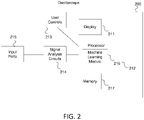
- Fig. 2 is a block diagram of an embodiment of an oscilloscope 200, which may be employed in a test system such as test system 100.
- oscilloscope 200 may be substantially similar to oscilloscope 100 and connected to a DUT or other training device in similar fashion.
- Oscilloscope 200 may be employed to implement test and measurement system 300, store and interact with machine learning objects 400, and/or implement methods 500, 600, and/or any other method disclosed herein as shown in Figs. 1-6 , respectively.
- Oscilloscope 200 includes input ports 215 which may be substantially similar to port 115 and may include any electrical and/or optical ports, receivers, etc. configured to accept an input signal including measurement or training data.
- Input ports 215 may include channel inputs, phase reference inputs, clock inputs, and/or any other signal input.
- Signal input ports 215 are coupled to signal analysis circuits 214, which may include conditioning circuits, amplifiers, samplers, analog to digital converters, phase reference circuits, clock circuits, and/or any components employable to obtain measurement or training data from the input signal received via the input ports 215.
- Signal analysis circuits 214 receive input signals from the signal input ports 215, condition the signals, perform signal sampling, and/or digitize the signals and forward the results to memory 217 or processor 212 for analysis.
- Signal analysis circuits 214 may be implemented as an application specific integrated circuit (ASIC), a digital signal processor (DSP), or other processing circuitry.
- ASIC application specific integrated circuit
- DSP digital signal processor
- Signal analysis circuits 214 are coupled to processor 212, which may be implemented as a general purpose processor.
- Processor 212 is configured to execute instructions from memory 217 and perform any methods and/or associated steps indicated by the instructions.
- Memory 217 may be implemented as processor cache, random access memory (RAM), read only memory (ROM), solid state memory, hard disk drive(s), or any other memory type.
- Memory 217 acts as a non-transitory medium for storing computer program products and other instructions, storing waveform samples, and/or storing other data objects such as classifiers and models as discussed below. Memory 217 provides such stored information to the processor 212 for computation as needed.
- Processor 212 includes a machine learning module 216.
- the machine learning module 216 is a processing circuit and/or set of executing instructions configured to operate machine learning algorithms, such as machine learning module 333.
- the processor 212 and machine learning module 216 are employed during a learning phase to train data objects such as classifiers 335 and 435, and models 336 and 436.
- Such training employs training data such as training data 331.
- the machine learning module 216 is also configured to operate machine learning algorithms and a recommender, such as recommender 338, during an evaluation and/or action phase.
- machine learning module 216 is configured to perform methods 500, 600, and/or any other methods discussed herein.
- the machine learning module 216 is implemented, in part, in the memory 217 and/or other components in oscilloscope 200.
- User controls 213 are coupled at least to the processor 212 and signal analysis circuits 214.
- User controls 213 may include strobe inputs, gain controls, triggers, display adjustments, power controls, or any other controls employable by a user to display an input signal on display 211.
- User controls 213 may also allow the user to select particular measurements or actions to be taken when analyzing a signal.
- the machine learning module 216 may suggest measurements and/or actions via the display 211, and the user controls 213 may be configured to allow the user to accept or override the suggested actions or measurements.
- the user controls 213 are integrated, in whole or in part, in the display 211.
- Display 211 may be a digital screen or a cathode ray tube based display.
- Display 211 includes a plurality of graticules for displaying corresponding input signals, for example as eye diagrams, histograms, heat maps, time domain signals, frequency domain signals, etc.
- oscilloscope 200 may be configured to employ the machine learning module 216 to train classifiers and modules to classify training data to determine classifications for incoming waveforms and/or buses as discussed below.
- the oscilloscope 200 may also be configured to employ the classifiers and modules to classify measurement data and suggest measurements and/or actions as discussed below. Further, the oscilloscope 200 may take action, as directed by the suggested measurements and/or suggested actions, without requiring direct user initiation or approval.
- Fig. 3 is a block diagram of an embodiment of a test and measurement system 300 configured to employ machine learning to classify waveforms and suggest corresponding measurements and actions.
- Test and measurement system 300 may be implemented in an oscilloscope, such as oscilloscope 100 and/or 200, configured to receive signals from a DUT, such as DUT 121 or other training hardware.
- Test and measurement system 300 includes a machine learning module 333, classifiers 335, recommender 338, and models 336, which can be implemented by a general purpose processor, application specific processor, memory, or combinations thereof (e.g. processor 212, machine learning module 216, and memory 217).
- the test and measurement system 300 accepts training data 331 and captured waveform measurements/device states 337 as inputs and generates output 339 as described below.
- Machine learning module 333 (e.g. machine learning algorithm) is a set of instructions configured to perform a task, measure the performance of the task, and alter the performance of the task based on the measurements to improve performance based on experience.
- Machine learning module 333 may be implemented according to a supervised learning algorithm including analytical learning, artificial neural network, backpropagation, boosting, Bayesian statistics, case-based reasoning, decision tree learning, inductive logic programming, Gaussian process regression, group method of data handling, kernel estimators, learning automata, minimum message length (decision trees, decision graphs, etc.), multilinear subspace learning, naive Bayes classifier, maximum entropy classifier, conditional random field, nearest neighbor algorithm, Probably Approximately Correct (PAC) learning, ripple down rules, symbolic machine learning, sub-symbolic machine learning, support vector machines, Minimum Complexity Machines (MCM), random forests, ensembles of classifiers, ordinal classification, data pre-processing, handling imbalanced datasets, statistical relational learning, and/or Proaft
- machine learning module 333 receives training data 331.
- Training data 331 is a set of waveforms and corresponding known classifications.
- Machine learning module 333 creates and trains a plurality of classifiers 335 to classify the training data 331.
- a classifier 335 is any component configured to provide a classification of incoming data based on preconfigured rules, and modify such rules through training.
- a classifier 335 may include a random decision forest with multiple decision trees.
- Each classifier 335 corresponds to a particular classification, such as sine wave, square wave, pulse width modulation, rising edge, falling edge, ramp, DC, noise, sin(x)/x, Gaussian, Lorentz, exponential rise, exponential decay, Haversine, cardiac, parallel bus, SPI bus, I2C bus, USB, LIN bus, CAN bus, audio bus, ARINC429 bus, RS232 bus, Ethernet bus, FlexRay bus, etc.
- Machine learning module 333 applies each set of waveforms in the training data 331 to each classifier 335, and each classifier 335 returns a result.
- a sine wave classifier 335 should return a match and all other classifiers should not return a match.
- the machine learning module 333 then employs the known classification to correct the rules of any classifier returning an incorrect result. For example, when a USB classifier 335 returns a match when a Gaussian waveform is applied (e.g. an incorrect match), the machine learning module 333 corrects the rules of the USB classifier 335.
- Classifiers 335 may employ various signal qualities to classify training data 331 and measurement data (e.g. captured waveform measurements/device states 337). For example, classifiers 335 may employ signal amplitude characteristics such as amplitude, maximum amplitude, minimum amplitude, peak-to-peak, positive overshoot, negative overshoot, mean amplitude, signal Root Mean Square (RMS), AC RMS, DC common mode, AC common mode (e.g. peak-to-peak), signal area, differential Crossover, signal top, signal base, bit high, bit low, bit amplitude, transmission/network transmission (T/nT) ratio, etc.
- signal amplitude characteristics such as amplitude, maximum amplitude, minimum amplitude, peak-to-peak, positive overshoot, negative overshoot, mean amplitude, signal Root Mean Square (RMS), AC RMS, DC common mode, AC common mode (e.g. peak-to-peak), signal area, differential Crossover, signal top, signal base, bit high, bit low,
- Classifiers 335 may also employ time related characteristics such as period, frequency, data rate, positive pulse width, negative pulse width, skew, rise time, fall time, delay, rising slew rate, falling slew rate, phase, positive duty cycle, negative duty cycle, burst width, setup time, hold time, time outside level, high time, low time, duration of N-periods where N is a variable number of periods, Spread Spectrum Clocking (SSC) frequency deviation, SSC modulation rate, positive edge count, negative edge count, pulse count, burst, etc.
- SSC Spread Spectrum Clocking
- Classifiers 335 may also employ jitter related characteristics such as Time Interval Error (TIE), phase noise, random jitter (RJ), RJ anti-aliasing (RJ-aa), non-periodic jitter (NPJ), total jitter at specified bit error rate (TJ@BER), deterministic jitter (DJ), DJ anti-aliasing (DJ-aa), periodic jitter (PJ), data-dependent jitter (DDJ), duty cycle distortion (DCD), interval that includes all but 10 -2 jitter distribution (J2), interval that includes all but 10 -9 jitter distribution (J9), sub-rate jitter (SRJ), frequency (F)/2, F/4, F/8, etc.
- TIE Time Interval Error
- RJ random jitter
- RJ-aa RJ anti-aliasing
- NPJ non-periodic jitter
- TJ@BER total jitter at specified bit error rate
- DJ deterministic jitter
- Classifiers 335 may also employ power related characteristics such as power quality power derivative, modulation, power harmonics, switching loss, ripple, etc. Accordingly, the classifiers 335 are configured to determine a classification for the training data and measurement data by examining signal amplitude, time characteristics, jitter, and/or power.
- the training data 331 may be delivered to the classifiers 335 in various forms, including raw point data, waveform images, vertical histograms, device settings or information (e.g. device state), a collection of multiple acquisitions combined into a heat map, waveform measurements, etc.
- classifiers 335 may employ a plurality of machine learning algorithms, with specified machine learning algorithms selected to classify particular waveform types. In other words, some machine learning algorithms may be better suited to classify a first set waveforms, which other machine learning algorithms may be better suited to classify a second set of waveforms. Thus some classifiers 335 may employ different machine learning algorithms than other classifiers 335 in the same system.
- a model 336 is built (e.g. by the machine learning module 333) during the learning phase to correspond with each classifier 335 (and hence each classification).
- Some models 336 are built to correspond with waveforms incoming over an input port (e.g. ports 115/215), while others correspond with a bus (e.g. bus 123) connected to the input port.
- a bus e.g. bus 123
- feature selection is employed by the machine learning module 333 to remove unneeded measurements from each classifier 335 and generate a corresponding model 336 with only relevant data.
- each model 336 describes the measurements the corresponding classifier 335 can accept as input.
- each model 336 can be configured to include particular measurements or actions user may want to take in the event that incoming data indicates a corresponding classification.
- the machine learning module 333 Upon completely processing the training data 331, the machine learning module 333 has created and trained the classifiers 335 and models 336.
- the state of the machine learning module 333 has created and trained the classifiers 335 and models 336 may be stored in memory for run time use by an oscilloscope.
- a master test and measurement instrument may train the machine learning module 333, classifiers 335, and models 336 and store the results in a memory readable format to be loaded on multiple oscilloscopes, when such oscilloscopes are manufactured.
- each oscilloscope can be trained during the manufacture process.
- An end user employs the test and measurement system 300 at run time as part of an evaluation phase.
- captured waveform measurements/device states 337 are received by the machine learning module 333, for example via an input port/ signal analysis circuit in the case of a waveform or via the signal analysis circuits and/or memory in the case of a device state.
- Each classifier 335 is applied to the measurements/states 337.
- the classifiers 335 each indicate a match or lack of match. In some aspects, the classifiers 335 also return a confidence value.
- the measurements/states 337 received during the evaluation phase may contain virtually any type of data, and the classifications are unknown. Accordingly, a classification is determined if only one classifier 335 returns a match.
- the system 300 is unable to classify the incoming signal.
- the classification e.g. waveform or bus type
- the recommender 339 is a component configured to recommend particular actions or measurements to a user.
- the recommender 338 receives the classification and obtains the corresponding model 336. Based on the model 336 returned, the recommender 338 can recommend particular measurements that a user may find useful for the classifications, such as useful trigger points, particular transforms, etc. that are relevant to the classified waveform or bus. Further, the recommender 338 can recommend particular actions that a user may wish to take based on the classification, such as selecting configuring a bus, changing display ranges, etc. In addition, the recommender 338 may also reorder lists of suggested actions/measurements so the most relevant actions/measurements for the particular classification are listed first.
- the recommender 338 may grey out or remove actions/measurements that are unsuited for a particular classification.
- the recommender 338 then sends such suggestions to the user via an output 339, which may include a display such as display 111/211.
- the user may the employ the controls (e.g. controls 113/213) to accept or reject the suggestions.
- the recommender 338 may also take any suggested action or initiate any suggested measurements immediately without requiring direct user initiation, approval, or interaction.
- Fig. 4 is a block diagram illustrating an embodiment of machine learning objects 400 including classifier 435 and model data 436 objects.
- Classifier 435 and model 436 are substantially similar to classifiers 335 and models 336, respectively.
- Classifier 435 is an example of a classifier 335 configured to implement a random forest machine learning algorithm.
- Classifier 435 includes a decision forest 441, which further includes a plurality of decision trees 443. Specifically, a decision forest 441 is created for each classification (e.g. as discussed with respect to classifier 335). During training, decision trees 443 are grown in the decision forest 441 based on the training data.
- Various signal qualities are employed by the decision trees 443 to classify the training data, as discussed above, and the decision trees 443 are corrected when an incorrect result is returned (e.g. improper match or improper lack of match).
- one hundred decision trees 443 are employed in a decision forest 441. Randomization is employed to reduce the occurrence of overfitting of the decision trees 443 to the training data set.
- a confidence threshold 445 may be stored to each classifier 435.
- a confidence threshold 445 indicates a minimum percentage of decision trees 443 in the decision forest 441 that should output a positive classification (e.g. return a match) to result in a positive classification for the corresponding decision forest 441 and corresponding classifier 435.
- a confidence threshold 445 of eighty percent may be used to indicate that eighty percent of the decision trees 443 should indicate a match before the system is confident that a match has actually been found.
- cross-validation may be employed to evaluate the accuracy of the decision forest 441 with respect to the training data set. The cross-validation results may be employed to further correct the output of the decision forest relative to the training data.
- measurement data is received via an input port and forwarded to the processor.
- the processor applies each of the classifiers 435 to the measurement data to determine a classification for the measurement data.
- the decision forest 443 applies each decision tree 443 and receives an output.
- the classifier 435 employs the percentage of decision tree 443 outputs that report a match as a confidence value 447.
- the confidence value 447 output by the decision forest 441 exceeds a confidence threshold 445 of the classifier 435, the decision tree 441 and hence the classifier 435 is considered to have returned a match.
- each classifier 435 corresponds with a model 436 that indicates suggested measurements 444 and suggested actions 446 associated with the classification of the classifier 435.
- the recommender selects the model 436 corresponding to the classification to obtain the corresponding suggested measurements 444 and/or suggested actions 446.
- the recommender can then configure the test and measurement instrument to employ the suggested measurements 444 and/or suggested actions 446 corresponding to the selected model 436 when capturing a waveform received over the input port.
- suggested measurements 444 and/or suggested actions 446 are set during the learning phase to suggest intuitive actions for the user.
- Suggested measurements 444 may include sorting, enabling, highlighting, and/or hiding any of the measurements listed with respect to classifier 335 on the display.
- Suggested actions 446 may include sorting, enabling, highlighting, and/or hiding any of the bus categories listed with respect to classifier 335 on the display.
- Fig. 5 is a block diagram illustrating an embodiment of a method 500 of implementing a learning phase in a test and measurement system.
- Method 500 may be employed by an oscilloscope, such as oscilloscope 100/200 operating a test and measurement system, such as system 300 with data structures such as machine learning objects 400.
- training data such as training data 331
- the training data represents waveforms and/or buses and may also include corresponding known classifications.
- a processor employs a machine learning algorithm to train the classifiers on the training data based on the known classifications. Specifically, each classifier is iteratively applied to each waveform of the training data to obtain corresponding predicted waveform classifications.
- the predicted waveform classifications are compared with the known classifications. Further, each classifier that outputs a predicted waveform classification that does not match the known classification for the corresponding waveform is corrected. By iteratively testing and correcting each classifier, the classifiers progressively become more accurate when attempting classification of new input data.
- confidence thresholds may optionally be stored for the classifiers. For example, decision forest based classifiers may employ confidence thresholds, while other learning algorithms may not employ confidence thresholds and may instead return only a match (e.g. a classification) or a lack of a match (no classification) for each classifier.
- Models such as models 436, are generated at block 507. Sets of suggested measurements and/or suggested actions are added to each model.
- the suggested measurements/actions include instructions executed by the test and measurement system upon matching measurement data with a classification of a classifier corresponding to the model. For example, suggested measurements associated with waveform classification are stored to a classifier corresponding to waveform classification, and suggested actions associated with bus classification are stored to a classifier corresponding to bus classification.
- cross validation of the training data is employed to evaluate the accuracy of and/or further correct the classifiers. Cross validation may be performed on both waveform based training data and bus based training data.
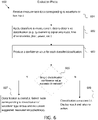
- Fig. 6 is a block diagram illustrating an embodiment of a method 600 of implementing an evaluation phase in a test and measurement system.
- Method 600 may be employed by an oscilloscope, such as oscilloscope 100/200 operating a test and measurement system, such as system 300 with data structures such as machine learning objects 400. Specifically, method 600 may be employed after the training of method 500 is completed.
- measurement data is received, for example via an input port.
- the received measurement data corresponds to a measured waveform or bus input, and is received for purposes of classification.
- each of the classifiers are applied to the measurement data to determine a classification, for example for a measured waveform or bus input.
- the classifiers each return a classification by examining signal amplitude, time characteristics, jitter, power, etc. as described above.
- a confidence value is produced for some or all of the classifiers to support determination of a classification.
- the confidence values of the classifiers are compared to their respective confidence thresholds to determine whether a single classifier produces a confidence value in excess of a corresponding stored confidence threshold. If two classifiers return a match, then classification is unclear. If no classifier returns a match, then classification is not possible. In either case, the method 600 proceed to block 609. In such a case, classification is unsuccessful. The result may be displayed on the test and measurement system display and no action is taken.
- a model corresponding to the classifier returning the determined classification is selected, for example by the recommender.
- the model corresponds to suggested measurements and/or actions for the classifier.
- the recommender implements the suggested measurements and/or actions by configuring the test and measurement instrument to employ the suggested measurements/actions corresponding to the selected model when capturing the measured waveform, for example upon approval by the user via controls.
- the recommender can either display the suggested actions/measurements to the user on the display by emphasizing or deemphasizing the suggestions, removing actions/measurements from the display that are irrelevant to the determine classification, or by preparing the test and measurement system to perform the actions upon receiving approval from the user.
- Feature selection may also be employed on each classifier's classification by reducing a corresponding set of classifier inputs in the models by removing inputs that are not useful for the corresponding classification.
- the oscilloscope 100/200 operating test and measurement system 300 with data objects 400 according to methods 500-600 improve the functionality of an oscilloscope by allowing the oscilloscope to classify inputs to the oscilloscope and alter the oscilloscope display accordingly to emphasize or de-emphasize device functions that are relevant to the user.
- the devices, systems, and methods disclosed herein allow the user to access relevant functions much more easily and clearly the other systems.
- Examples provide a test and measurement instrument comprising an input port configured to receive measurement data, and a processor coupled to the input port and configured to apply a plurality of classifiers to the measurement data to determine a classification for the measurement data, select a model corresponding to the classification, the model corresponding to one or more suggested measurements, and configure the test and measurement instrument to employ the suggested measurements corresponding to the selected model when capturing a waveform received over the input port.
- the plurality of classifiers includes at least one decision forest, and wherein the decision forest determines the classification of the measurement data when a confidence value output by the decision forest exceeds a confidence threshold of the classifier.
- the plurality of classifiers employ a plurality of machine learning algorithms with specified machine learning algorithms selected to classify particular waveform types.
- the classifiers determine a classification for the measurement data by examining signal amplitude, time characteristics, jitter, or power.
- the model corresponding to the classification indicates a type of waveform incoming over the input port.
- the model corresponding to the classification indicates a bus connected to the input port.
- Some examples further comprise a display, wherein the processor is further configured to suggest actions corresponding to the selected model by altering the display to enable or disable user selections.
- processor is further configured to initiate suggested actions without direct user interaction.
- Examples provide a method for training a test and measurement instrument to suggest measurements, the method comprising receiving training data including waveforms and corresponding known classifications via an input port, and training, via a processor, a plurality of classifiers on the training data by iteratively applying each classifier to each waveform of the training data to obtain corresponding predicted waveform classifications, comparing the predicted waveform classifications with the known classifications, and correcting each classifier that outputs a predicted waveform classification that does not match the known classification for the corresponding waveform.
- the classifiers include a decision forest, and wherein training the classifiers involves growing decision trees in the decision forest.
- Some examples further comprise storing a confidence threshold to each classifier, the confidence threshold indicating a minimum percentage of decision trees in the decision forest that output a positive classification to result in a positive classification for the corresponding classifier.
- Some examples further comprise employing cross validation of the training data of waveforms to further correct the classifiers.
- Some examples further comprise employing feature selection on each classifier to reduce a corresponding set of classifier inputs by removing inputs that are not useful for the corresponding classification.
- Some examples further comprise storing a set of one or more suggested actions to each model, the suggested actions including instructions executed by the test and measurement system upon matching measurement data with a classification of a classifier corresponding to the model.
- Some examples further comprise receiving measurement data corresponding to a measured waveform or bus input, applying each of the classifiers to the measurement data to determine a classification for the measured waveform, selecting a model corresponding to the classifier returning the determined classification, the model corresponding to one or more suggested measurements for the classifier, and configuring the test and measurement instrument to employ the suggested measurements corresponding to the selected model when capturing the measured waveform.
- determining the classification for the measured waveform includes producing a confidence value for each of the classifiers, and wherein the classification is determined when a single classifier produces a confidence value in excess of a stored confidence threshold.
- Embodiments of the invention may operate on a particularly created hardware, on firmware, digital signal processors, or on a specially programmed general purpose computer including a processor operating according to programmed instructions.
- controller or “processor” as used herein are intended to include microprocessors, microcomputers, ASICs, and dedicated hardware controllers.
- One or more aspects of the invention may be embodied in computer-usable data and computer-executable instructions, such as in one or more program modules, executed by one or more computers (including monitoring modules), or other devices.
- program modules include routines, programs, objects, components, data structures, etc. that perform particular tasks or implement particular abstract data types when executed by a processor in a computer or other device.
- the computer executable instructions may be stored on a non-transitory computer readable medium such as a hard disk, optical disk, removable storage media, solid state memory, RAM, etc.
- a non-transitory computer readable medium such as a hard disk, optical disk, removable storage media, solid state memory, RAM, etc.
- the functionality of the program modules may be combined or distributed as desired in various embodiments.
- the functionality may be embodied in whole or in part in firmware or hardware equivalents such as integrated circuits, field programmable gate arrays (FPGA), and the like.
- Particular data structures may be used to more effectively implement one or more aspects of the invention, and such data structures are contemplated within the scope of computer executable instructions and computer-usable data described herein.
Landscapes
- Engineering & Computer Science (AREA)
- Physics & Mathematics (AREA)
- Theoretical Computer Science (AREA)
- General Physics & Mathematics (AREA)
- Software Systems (AREA)
- Data Mining & Analysis (AREA)
- Evolutionary Computation (AREA)
- Artificial Intelligence (AREA)
- General Engineering & Computer Science (AREA)
- Mathematical Physics (AREA)
- Computer Vision & Pattern Recognition (AREA)
- Computing Systems (AREA)
- Medical Informatics (AREA)
- Bioinformatics & Cheminformatics (AREA)
- Life Sciences & Earth Sciences (AREA)
- Bioinformatics & Computational Biology (AREA)
- Evolutionary Biology (AREA)
- Probability & Statistics with Applications (AREA)
- Algebra (AREA)
- Computational Mathematics (AREA)
- Mathematical Analysis (AREA)
- Mathematical Optimization (AREA)
- Pure & Applied Mathematics (AREA)
- Tests Of Electronic Circuits (AREA)
- Measurement Of Mechanical Vibrations Or Ultrasonic Waves (AREA)
Claims (15)
- Instrument d'essai et de mesure (200) comprenant :un port d'entrée (215) configuré pour recevoir des données de mesure ;un processeur (212) couplé au port d'entrée et configuré pour :appliquer une pluralité de classificateurs aux données de mesure pour déterminer une classification pour les données de mesure, moyennant quoi un module d'apprentissage automatique (216, 333) est utilisé pour former la pluralité de classificateurs ;sélectionner un modèle correspondant à la classification, le modèle correspondant à une ou plusieurs actions suggérées ; etrecommander les actions suggérées à un utilisateur ; etune commande utilisateur couplée au processeur, la commande utilisateur étant configurée pour recevoir une sélection en provenance de l'utilisateur ;ledit processeur étant en outre configuré pour, en réponse à la sélection de l'utilisateur, configurer l'instrument d'essai et de mesure (200) pour employer les actions suggérées correspondant au modèle sélectionné lors de la capture d'une forme d'onde reçue sur le port d'entrée.
- Instrument d'essai et de mesure selon la revendication 1, ladite pluralité de classificateurs comprenant au moins une forêt de décisions, et ladite forêt de décisions déterminant la classification de données de mesure lorsqu'une valeur de confiance émise par la forêt de décisions dépasse un seuil de confiance du classificateur.
- Instrument d'essai et de mesure selon la revendication 1 ou 2, ladite pluralité de classificateurs employant une pluralité d'algorithmes d'apprentissage automatique avec des algorithmes d'apprentissage automatique spécifiés sélectionnés pour classer des types de formes d'onde particuliers.
- Instrument d'essai et de mesure selon une quelconque revendication précédente, lesdits classificateurs déterminant une classification pour les données de mesure en examinant une amplitude de signal, des caractéristiques temporelles, une gigue ou une puissance.
- Instrument d'essai et de mesure selon une quelconque revendication précédente, ledit modèle correspondant à la classification indiquant un type de forme d'onde entrant sur le port d'entrée.
- Instrument d'essai et de mesure selon une quelconque revendication précédente, ledit modèle correspondant à la classification indique un bus connecté au port d'entrée.
- Instrument d'essai et de mesure selon une quelconque revendication précédente, comprenant en outre un dispositif d'affichage, ledit processeur étant en outre configuré pour recommander les actions suggérées à l'utilisateur en modifiant le dispositif d'affichage pour désactiver les actions qui ne sont pas pertinentes pour le modèle sélectionné.
- Instrument d'essai et de mesure selon une quelconque revendication précédente, ledit processeur étant en outre configuré pour initier des actions suggérées sans interaction directe de l'utilisateur.
- Procédé permettant de faire fonctionner un instrument d'essai et de mesure, comprenant :la formation d'une pluralité de classificateurs durant une phase d'apprentissage ;la réception des données de mesure ;l'application de la pluralité de classificateurs aux données de mesure pour déterminer une classification pour les données de mesure ;la sélection d'un modèle correspondant à la classification, le modèle correspondant à une ou plusieurs actions suggérées ;la recommandation des actions suggérées à un utilisateur ;la réception d'une sélection en provenance de l'utilisateur ; etla configuration de l'instrument d'essai et de mesure (200) pour employer les actions suggérées correspondant au modèle sélectionné lors de la capture d'une forme d'onde reçue sur le port d'entrée.
- Procédé selon la revendication 9, ladite pluralité de classificateurs comprenant au moins une forêt de décisions, et ledit procédé comprenant en outre la forêt de décisions déterminant la classification des données de mesure lorsqu'une valeur de confiance délivrée en sortie par la forêt de décisions dépasse un seuil de confiance du classificateur.
- Procédé selon la revendication 9 ou 10, ladite pluralité de classificateurs employant une pluralité d'algorithmes d'apprentissage automatique avec des algorithmes d'apprentissage automatique spécifiés sélectionnés pour classer des types de formes d'onde particuliers.
- Procédé selon l'une quelconque des revendications 9 à 11, comprenant en outre la détermination d'une classification pour les données de mesure en examinant une amplitude de signal, des caractéristiques temporelles, une gigue ou une puissance.
- Procédé selon l'une quelconque des revendications 9 à 12, ladite sélection du modèle correspondant à la classification comprenant l'indication d'un type de forme d'onde entrant sur le port d'entrée.
- Procédé selon l'une quelconque des revendications 9 à 13, ledit modèle correspondant à la classification indiquant un bus connecté au port d'entrée.
- Support lisible par ordinateur comprenant des instructions qui, lorsqu'elles sont exécutées par un ou plusieurs processeurs d'un instrument d'essai et de mesure, amènent ledit ou lesdits processeurs à effectuer le procédé selon l'une quelconque des revendications 9 à 14.
Priority Applications (1)
| Application Number | Priority Date | Filing Date | Title |
|---|---|---|---|
| EP22190041.8A EP4109113B1 (fr) | 2016-09-12 | 2017-09-12 | Mesures de recommandation basées sur le type de forme d'onde détecté |
Applications Claiming Priority (1)
| Application Number | Priority Date | Filing Date | Title |
|---|---|---|---|
| US15/262,406 US10585121B2 (en) | 2016-09-12 | 2016-09-12 | Recommending measurements based on detected waveform type |
Related Child Applications (2)
| Application Number | Title | Priority Date | Filing Date |
|---|---|---|---|
| EP22190041.8A Division EP4109113B1 (fr) | 2016-09-12 | 2017-09-12 | Mesures de recommandation basées sur le type de forme d'onde détecté |
| EP22190041.8A Division-Into EP4109113B1 (fr) | 2016-09-12 | 2017-09-12 | Mesures de recommandation basées sur le type de forme d'onde détecté |
Publications (3)
| Publication Number | Publication Date |
|---|---|
| EP3293528A2 EP3293528A2 (fr) | 2018-03-14 |
| EP3293528A3 EP3293528A3 (fr) | 2018-07-18 |
| EP3293528B1 true EP3293528B1 (fr) | 2022-11-23 |
Family
ID=59858596
Family Applications (2)
| Application Number | Title | Priority Date | Filing Date |
|---|---|---|---|
| EP22190041.8A Active EP4109113B1 (fr) | 2016-09-12 | 2017-09-12 | Mesures de recommandation basées sur le type de forme d'onde détecté |
| EP17190691.0A Active EP3293528B1 (fr) | 2016-09-12 | 2017-09-12 | Mesures de recommandation basées sur le type de forme d'onde détecté |
Family Applications Before (1)
| Application Number | Title | Priority Date | Filing Date |
|---|---|---|---|
| EP22190041.8A Active EP4109113B1 (fr) | 2016-09-12 | 2017-09-12 | Mesures de recommandation basées sur le type de forme d'onde détecté |
Country Status (4)
| Country | Link |
|---|---|
| US (2) | US10585121B2 (fr) |
| EP (2) | EP4109113B1 (fr) |
| JP (1) | JP7096653B2 (fr) |
| CN (1) | CN107818331A (fr) |
Families Citing this family (41)
| Publication number | Priority date | Publication date | Assignee | Title |
|---|---|---|---|---|
| CA3036448A1 (fr) * | 2018-03-12 | 2019-09-12 | Royal Bank Of Canada | Systeme et methode de surveillance de modeles d'apprentissage machine |
| US20210241042A1 (en) * | 2018-08-15 | 2021-08-05 | Nippon Telegraph And Telephone Corporation | Classifier evaluation device, classifier evaluation method, and non-transitory computer readable recording medium |
| US11137323B2 (en) * | 2018-11-12 | 2021-10-05 | Kabushiki Kaisha Toshiba | Method of detecting anomalies in waveforms, and system thereof |
| US11181552B2 (en) * | 2018-11-28 | 2021-11-23 | Tektronix, Inc. | Categorization of acquired data based on explicit and implicit means |
| CN109547102B (zh) * | 2018-12-17 | 2020-05-29 | 北京邮电大学 | 一种光性能监测方法、装置、电子设备及可读存储介质 |
| US10852323B2 (en) * | 2018-12-28 | 2020-12-01 | Rohde & Schwarz Gmbh & Co. Kg | Measurement apparatus and method for analyzing a waveform of a signal |
| US11640523B2 (en) | 2019-01-02 | 2023-05-02 | Rohde & Schwarz Gmbh & Co. Kg | Method for training a neural network, method for automatically characterizing a measurement signal, measurement apparatus and method for analyzing |
| US11481667B2 (en) * | 2019-01-24 | 2022-10-25 | International Business Machines Corporation | Classifier confidence as a means for identifying data drift |
| US11580382B2 (en) | 2019-04-26 | 2023-02-14 | Rohde & Schwarz Gmbh & Co. Kg | Method and apparatus providing a trained signal classification neural network |
| US11138477B2 (en) * | 2019-08-15 | 2021-10-05 | Collibra Nv | Classification of data using aggregated information from multiple classification modules |
| US12524321B2 (en) * | 2019-10-01 | 2026-01-13 | Tektronix, Inc. | Bus autodetect |
| US10749618B1 (en) * | 2019-10-22 | 2020-08-18 | Raytheon Company | Methods of closed-loop control of a radio frequency (RF) test environment based on machine learning |
| DE112020005481T5 (de) * | 2019-11-05 | 2022-09-15 | Georgia Tech Research Corporation | Vorrichtungen, systeme und verfahren zur bearbeitung optischer komponenten |
| US11798618B2 (en) * | 2019-11-15 | 2023-10-24 | Rohde & Schwarz Gmbh & Co. Kg | Signal analyzer and method of processing data from an input signal |
| US11481584B2 (en) * | 2020-01-15 | 2022-10-25 | Vmware, Inc. | Efficient machine learning (ML) model for classification |
| JP7739341B2 (ja) * | 2020-06-11 | 2025-09-16 | テクトロニクス・インコーポレイテッド | 画像データ生成システム及び波形分類方法 |
| US11526785B2 (en) | 2020-06-22 | 2022-12-13 | Vmware, Inc. | Predictability-driven compression of training data sets |
| US20220036238A1 (en) * | 2020-07-30 | 2022-02-03 | Tektronix, Inc. | Mono channel burst classification using machine learning |
| CN114091522A (zh) * | 2020-07-30 | 2022-02-25 | 特克特朗尼克公司 | 使用机器学习的单通道突发脉冲分类 |
| US11316542B2 (en) | 2020-08-10 | 2022-04-26 | Rohde & Schwarz Gmbh & Co. Kg | Signal analysis method and signal analysis module |
| US11867725B2 (en) | 2020-11-06 | 2024-01-09 | Rohde & Schwarz Gmbh & Co. Kg | Measurement instrument |
| US12352784B2 (en) * | 2020-11-23 | 2025-07-08 | Tektronix, Inc. | System and method for high performance distribution of large waveform captures to multiple viewers |
| JP2024506293A (ja) * | 2021-02-03 | 2024-02-13 | テクトロニクス・インコーポレイテッド | 人間と機械学習のためのオーバーレイ、コンポジット、ダイナミック・アイ・トリガを備えたアイのクラス・セパレータ |
| US12442845B2 (en) * | 2021-02-08 | 2025-10-14 | Tektronix, Inc. | Method of generating metadata from acquired signals for search, filtering, and machine learning inputs |
| JP7545914B2 (ja) * | 2021-03-08 | 2024-09-05 | 株式会社豊田中央研究所 | 状態判断装置および車両 |
| US11940889B2 (en) | 2021-08-12 | 2024-03-26 | Tektronix, Inc. | Combined TDECQ measurement and transmitter tuning using machine learning |
| US11907090B2 (en) | 2021-08-12 | 2024-02-20 | Tektronix, Inc. | Machine learning for taps to accelerate TDECQ and other measurements |
| US11923895B2 (en) | 2021-03-24 | 2024-03-05 | Tektronix, Inc. | Optical transmitter tuning using machine learning and reference parameters |
| US12442852B2 (en) | 2022-03-30 | 2025-10-14 | Tektronix, Inc. | Tuning a device under test using parallel pipeline machine learning assistance |
| US11923896B2 (en) | 2021-03-24 | 2024-03-05 | Tektronix, Inc. | Optical transceiver tuning using machine learning |
| US12146914B2 (en) | 2021-05-18 | 2024-11-19 | Tektronix, Inc. | Bit error ratio estimation using machine learning |
| US12571841B2 (en) | 2021-06-04 | 2026-03-10 | Tektronix, Inc. | General digital signal processing waveform machine learning control application |
| US20230012393A1 (en) * | 2021-07-12 | 2023-01-12 | Tektronix, Inc. | Usage-aware compression for streaming data from a test and measurement instrument |
| DE112022004038T5 (de) * | 2021-08-20 | 2024-06-20 | Tektronix, Inc. | Digitaler zwilling durch wellenformerzeugung mit maschinellem lernen einschliesslich parametersteuerung für prüflingsemulation |
| US12607667B2 (en) * | 2021-09-23 | 2026-04-21 | Tektronix, Inc. | System and method for detection of anomalies in test and measurement results of a device under test (DUT) |
| US12560630B2 (en) * | 2021-12-10 | 2026-02-24 | Tektronix, Inc. | Entropy on one-dimensional and two-dimensional histograms |
| US20230222382A1 (en) * | 2022-01-07 | 2023-07-13 | Tektronix, Inc. | Systems and methods for machine learning model training and deployment |
| US12416662B2 (en) | 2022-01-14 | 2025-09-16 | Tektronix, Inc. | Machine learning model training using de-noised data and model prediction with noise correction |
| US12596145B2 (en) | 2022-03-30 | 2026-04-07 | Tektronix, Inc. | Optical tuning test system using parallel oven pipelines with parallel instrument channels and machine learning assistance |
| US12100458B2 (en) * | 2022-05-27 | 2024-09-24 | Sandisk Technologies Llc | Systems and methods of correcting errors in unmatched memory devices |
| CN120947497B (zh) * | 2025-10-17 | 2026-02-03 | 独角兽网络科技(苏州)有限公司 | 一种位移数据采集控制方法、装置、电子设备、介质及程序产品 |
Family Cites Families (17)
| Publication number | Priority date | Publication date | Assignee | Title |
|---|---|---|---|---|
| US5092343A (en) * | 1988-02-17 | 1992-03-03 | Wayne State University | Waveform analysis apparatus and method using neural network techniques |
| JPH05126859A (ja) * | 1991-11-08 | 1993-05-21 | Matsushita Electric Ind Co Ltd | オシロスコープ |
| GB9604315D0 (en) * | 1996-02-29 | 1996-05-01 | British Telecomm | Training process |
| US6571185B1 (en) * | 1999-04-20 | 2003-05-27 | Tektronix, Inc. | Continually responsive and anticipating automatic setup function for a digital oscilloscope |
| KR20010006990A (ko) | 1999-04-20 | 2001-01-26 | 윈켈만 존 디. | 디지털 오실로스코프용 연속 응답 및 예상 자동 셋업 기능 |
| JP2002162419A (ja) | 2000-10-11 | 2002-06-07 | Agilent Technol Inc | 信号測定システムで捕捉された信号の各パルス毎に、パルス特性のデータベースを生成するためのシステム及び方法 |
| US6993440B2 (en) | 2002-04-22 | 2006-01-31 | Harris Corporation | System and method for waveform classification and characterization using multidimensional higher-order statistics |
| EP1531478A1 (fr) * | 2003-11-12 | 2005-05-18 | Sony International (Europe) GmbH | Appareil et méthode pour classer un signal audio |
| US7477999B2 (en) | 2006-10-26 | 2009-01-13 | Samplify Systems, Inc. | Data compression for a waveform data analyzer |
| US8025425B2 (en) | 2007-06-06 | 2011-09-27 | Trex Enterprises Corp | Beaconless adaptive optics system |
| US8306942B2 (en) * | 2008-05-06 | 2012-11-06 | Lawrence Livermore National Security, Llc | Discriminant forest classification method and system |
| CN103518224B (zh) * | 2011-03-04 | 2017-05-17 | Lbt创新有限公司 | 用于分析微生物生长的方法 |
| WO2016007360A1 (fr) | 2014-07-11 | 2016-01-14 | BidAway, Inc. | Système et procédé pour une enchère en ligne |
| WO2016028888A1 (fr) | 2014-08-19 | 2016-02-25 | The General Hospital Corporation | Système et procédé d'annotation et d'analyse de formes d'onde d'électroencéphalogramme (eeg) |
| JP6353747B2 (ja) | 2014-08-29 | 2018-07-04 | 日置電機株式会社 | 波形記録装置 |
| US9361503B2 (en) * | 2014-10-30 | 2016-06-07 | Datalogic IP Tech Srl | Systems, methods and articles for reading highly blurred machine-readable symbols |
| EP3096152B1 (fr) * | 2015-05-18 | 2019-12-18 | Fluke Precision Measurement Limited | Procédé et appareil de classification d'une forme d'onde de signal en cours de test |
-
2016
- 2016-09-12 US US15/262,406 patent/US10585121B2/en active Active
-
2017
- 2017-09-11 JP JP2017173708A patent/JP7096653B2/ja active Active
- 2017-09-12 EP EP22190041.8A patent/EP4109113B1/fr active Active
- 2017-09-12 CN CN201710816657.9A patent/CN107818331A/zh active Pending
- 2017-09-12 EP EP17190691.0A patent/EP3293528B1/fr active Active
-
2020
- 2020-03-06 US US16/811,753 patent/US11181553B2/en active Active
Also Published As
| Publication number | Publication date |
|---|---|
| JP7096653B2 (ja) | 2022-07-06 |
| EP4109113B1 (fr) | 2024-05-01 |
| JP2018059912A (ja) | 2018-04-12 |
| US11181553B2 (en) | 2021-11-23 |
| CN107818331A (zh) | 2018-03-20 |
| EP3293528A3 (fr) | 2018-07-18 |
| US20180074096A1 (en) | 2018-03-15 |
| EP4109113A1 (fr) | 2022-12-28 |
| US10585121B2 (en) | 2020-03-10 |
| US20200209282A1 (en) | 2020-07-02 |
| EP3293528A2 (fr) | 2018-03-14 |
Similar Documents
| Publication | Publication Date | Title |
|---|---|---|
| US11181553B2 (en) | Recommending measurements based on detected waveform type | |
| US11181552B2 (en) | Categorization of acquired data based on explicit and implicit means | |
| US11923895B2 (en) | Optical transmitter tuning using machine learning and reference parameters | |
| US12571841B2 (en) | General digital signal processing waveform machine learning control application | |
| US11907090B2 (en) | Machine learning for taps to accelerate TDECQ and other measurements | |
| US11923896B2 (en) | Optical transceiver tuning using machine learning | |
| KR100816468B1 (ko) | 고속 데이터 스트림을 캡쳐하여 평가하는 방법 및 장치 | |
| US12146914B2 (en) | Bit error ratio estimation using machine learning | |
| US11940889B2 (en) | Combined TDECQ measurement and transmitter tuning using machine learning | |
| JP2022179459A (ja) | 測定方法及び試験測定システム | |
| US10782348B2 (en) | Automatic device detection and connection verification | |
| CN109729546A (zh) | 波形模型 | |
| US20230384084A1 (en) | Method and device for determining an optimized parameter set to perform a measurement | |
| US20250102573A1 (en) | System and method for decimated sweep measurements of a device under test using machine learning | |
| CN114153676B (zh) | 服务网格系统的配置优化方法和相关设备 | |
| CN107453784A (zh) | 通信接口灵敏度测试方法和系统 | |
| TW202413960A (zh) | 使用提取自波形的線性回應之用於測量的機器學習 | |
| US11698849B2 (en) | Automated application testing of mutable interfaces | |
| TW202413957A (zh) | 分離雜訊以增加測試及測量系統中的機器學習預測準確度 | |
| CN114761971A (zh) | 用于时间序列数据的评价框架 | |
| US20240369625A1 (en) | Method for separating and modeling n-ui jitter based on spectrum | |
| CN117273164A (zh) | 用于使用从波形提取的线性响应进行测量的机器学习 |
Legal Events
| Date | Code | Title | Description |
|---|---|---|---|
| PUAI | Public reference made under article 153(3) epc to a published international application that has entered the european phase |
Free format text: ORIGINAL CODE: 0009012 |
|
| STAA | Information on the status of an ep patent application or granted ep patent |
Free format text: STATUS: THE APPLICATION HAS BEEN PUBLISHED |
|
| AK | Designated contracting states |
Kind code of ref document: A2 Designated state(s): AL AT BE BG CH CY CZ DE DK EE ES FI FR GB GR HR HU IE IS IT LI LT LU LV MC MK MT NL NO PL PT RO RS SE SI SK SM TR |
|
| AX | Request for extension of the european patent |
Extension state: BA ME |
|
| PUAL | Search report despatched |
Free format text: ORIGINAL CODE: 0009013 |
|
| AK | Designated contracting states |
Kind code of ref document: A3 Designated state(s): AL AT BE BG CH CY CZ DE DK EE ES FI FR GB GR HR HU IE IS IT LI LT LU LV MC MK MT NL NO PL PT RO RS SE SI SK SM TR |
|
| AX | Request for extension of the european patent |
Extension state: BA ME |
|
| RIC1 | Information provided on ipc code assigned before grant |
Ipc: G01R 13/02 20060101AFI20180613BHEP Ipc: G01R 23/16 20060101ALI20180613BHEP Ipc: G06N 99/00 20100101ALI20180613BHEP Ipc: G01R 13/22 20060101ALI20180613BHEP Ipc: G06N 7/00 20060101ALI20180613BHEP |
|
| STAA | Information on the status of an ep patent application or granted ep patent |
Free format text: STATUS: REQUEST FOR EXAMINATION WAS MADE |
|
| 17P | Request for examination filed |
Effective date: 20190118 |
|
| RBV | Designated contracting states (corrected) |
Designated state(s): AL AT BE BG CH CY CZ DE DK EE ES FI FR GB GR HR HU IE IS IT LI LT LU LV MC MK MT NL NO PL PT RO RS SE SI SK SM TR |
|
| REG | Reference to a national code |
Ref country code: DE Ref legal event code: R079 Ref document number: 602017063883 Country of ref document: DE Free format text: PREVIOUS MAIN CLASS: G01R0013020000 Ipc: G06N0020200000 |
|
| RIC1 | Information provided on ipc code assigned before grant |
Ipc: G01R 13/02 20060101ALI20211220BHEP Ipc: G06N 20/20 20190101AFI20211220BHEP |
|
| GRAP | Despatch of communication of intention to grant a patent |
Free format text: ORIGINAL CODE: EPIDOSNIGR1 |
|
| STAA | Information on the status of an ep patent application or granted ep patent |
Free format text: STATUS: GRANT OF PATENT IS INTENDED |
|
| INTG | Intention to grant announced |
Effective date: 20220217 |
|
| RIN1 | Information on inventor provided before grant (corrected) |
Inventor name: STRONG, KRAIG M Inventor name: ABSHER, IAN R |
|
| GRAJ | Information related to disapproval of communication of intention to grant by the applicant or resumption of examination proceedings by the epo deleted |
Free format text: ORIGINAL CODE: EPIDOSDIGR1 |
|
| STAA | Information on the status of an ep patent application or granted ep patent |
Free format text: STATUS: REQUEST FOR EXAMINATION WAS MADE |
|
| GRAP | Despatch of communication of intention to grant a patent |
Free format text: ORIGINAL CODE: EPIDOSNIGR1 |
|
| INTC | Intention to grant announced (deleted) | ||
| RIN1 | Information on inventor provided before grant (corrected) |
Inventor name: STRONG, KRAIG M Inventor name: ABSHER, IAN R |
|
| STAA | Information on the status of an ep patent application or granted ep patent |
Free format text: STATUS: GRANT OF PATENT IS INTENDED |
|
| INTG | Intention to grant announced |
Effective date: 20220804 |
|
| GRAS | Grant fee paid |
Free format text: ORIGINAL CODE: EPIDOSNIGR3 |
|
| GRAA | (expected) grant |
Free format text: ORIGINAL CODE: 0009210 |
|
| STAA | Information on the status of an ep patent application or granted ep patent |
Free format text: STATUS: THE PATENT HAS BEEN GRANTED |
|
| AK | Designated contracting states |
Kind code of ref document: B1 Designated state(s): AL AT BE BG CH CY CZ DE DK EE ES FI FR GB GR HR HU IE IS IT LI LT LU LV MC MK MT NL NO PL PT RO RS SE SI SK SM TR |
|
| REG | Reference to a national code |
Ref country code: GB Ref legal event code: FG4D |
|
| REG | Reference to a national code |
Ref country code: CH Ref legal event code: EP |
|
| REG | Reference to a national code |
Ref country code: DE Ref legal event code: R096 Ref document number: 602017063883 Country of ref document: DE |
|
| REG | Reference to a national code |
Ref country code: AT Ref legal event code: REF Ref document number: 1533608 Country of ref document: AT Kind code of ref document: T Effective date: 20221215 |
|
| REG | Reference to a national code |
Ref country code: IE Ref legal event code: FG4D |
|
| REG | Reference to a national code |
Ref country code: LT Ref legal event code: MG9D |
|
| REG | Reference to a national code |
Ref country code: NL Ref legal event code: MP Effective date: 20221123 |
|
| REG | Reference to a national code |
Ref country code: AT Ref legal event code: MK05 Ref document number: 1533608 Country of ref document: AT Kind code of ref document: T Effective date: 20221123 |
|
| PG25 | Lapsed in a contracting state [announced via postgrant information from national office to epo] |
Ref country code: SE Free format text: LAPSE BECAUSE OF FAILURE TO SUBMIT A TRANSLATION OF THE DESCRIPTION OR TO PAY THE FEE WITHIN THE PRESCRIBED TIME-LIMIT Effective date: 20221123 Ref country code: PT Free format text: LAPSE BECAUSE OF FAILURE TO SUBMIT A TRANSLATION OF THE DESCRIPTION OR TO PAY THE FEE WITHIN THE PRESCRIBED TIME-LIMIT Effective date: 20230323 Ref country code: NO Free format text: LAPSE BECAUSE OF FAILURE TO SUBMIT A TRANSLATION OF THE DESCRIPTION OR TO PAY THE FEE WITHIN THE PRESCRIBED TIME-LIMIT Effective date: 20230223 Ref country code: LT Free format text: LAPSE BECAUSE OF FAILURE TO SUBMIT A TRANSLATION OF THE DESCRIPTION OR TO PAY THE FEE WITHIN THE PRESCRIBED TIME-LIMIT Effective date: 20221123 Ref country code: FI Free format text: LAPSE BECAUSE OF FAILURE TO SUBMIT A TRANSLATION OF THE DESCRIPTION OR TO PAY THE FEE WITHIN THE PRESCRIBED TIME-LIMIT Effective date: 20221123 Ref country code: ES Free format text: LAPSE BECAUSE OF FAILURE TO SUBMIT A TRANSLATION OF THE DESCRIPTION OR TO PAY THE FEE WITHIN THE PRESCRIBED TIME-LIMIT Effective date: 20221123 Ref country code: AT Free format text: LAPSE BECAUSE OF FAILURE TO SUBMIT A TRANSLATION OF THE DESCRIPTION OR TO PAY THE FEE WITHIN THE PRESCRIBED TIME-LIMIT Effective date: 20221123 |
|
| PG25 | Lapsed in a contracting state [announced via postgrant information from national office to epo] |
Ref country code: RS Free format text: LAPSE BECAUSE OF FAILURE TO SUBMIT A TRANSLATION OF THE DESCRIPTION OR TO PAY THE FEE WITHIN THE PRESCRIBED TIME-LIMIT Effective date: 20221123 Ref country code: PL Free format text: LAPSE BECAUSE OF FAILURE TO SUBMIT A TRANSLATION OF THE DESCRIPTION OR TO PAY THE FEE WITHIN THE PRESCRIBED TIME-LIMIT Effective date: 20221123 Ref country code: LV Free format text: LAPSE BECAUSE OF FAILURE TO SUBMIT A TRANSLATION OF THE DESCRIPTION OR TO PAY THE FEE WITHIN THE PRESCRIBED TIME-LIMIT Effective date: 20221123 Ref country code: IS Free format text: LAPSE BECAUSE OF FAILURE TO SUBMIT A TRANSLATION OF THE DESCRIPTION OR TO PAY THE FEE WITHIN THE PRESCRIBED TIME-LIMIT Effective date: 20230323 Ref country code: HR Free format text: LAPSE BECAUSE OF FAILURE TO SUBMIT A TRANSLATION OF THE DESCRIPTION OR TO PAY THE FEE WITHIN THE PRESCRIBED TIME-LIMIT Effective date: 20221123 Ref country code: GR Free format text: LAPSE BECAUSE OF FAILURE TO SUBMIT A TRANSLATION OF THE DESCRIPTION OR TO PAY THE FEE WITHIN THE PRESCRIBED TIME-LIMIT Effective date: 20230224 |
|
| PG25 | Lapsed in a contracting state [announced via postgrant information from national office to epo] |
Ref country code: NL Free format text: LAPSE BECAUSE OF FAILURE TO SUBMIT A TRANSLATION OF THE DESCRIPTION OR TO PAY THE FEE WITHIN THE PRESCRIBED TIME-LIMIT Effective date: 20221123 |
|
| P01 | Opt-out of the competence of the unified patent court (upc) registered |
Effective date: 20230530 |
|
| PG25 | Lapsed in a contracting state [announced via postgrant information from national office to epo] |
Ref country code: SM Free format text: LAPSE BECAUSE OF FAILURE TO SUBMIT A TRANSLATION OF THE DESCRIPTION OR TO PAY THE FEE WITHIN THE PRESCRIBED TIME-LIMIT Effective date: 20221123 Ref country code: RO Free format text: LAPSE BECAUSE OF FAILURE TO SUBMIT A TRANSLATION OF THE DESCRIPTION OR TO PAY THE FEE WITHIN THE PRESCRIBED TIME-LIMIT Effective date: 20221123 Ref country code: EE Free format text: LAPSE BECAUSE OF FAILURE TO SUBMIT A TRANSLATION OF THE DESCRIPTION OR TO PAY THE FEE WITHIN THE PRESCRIBED TIME-LIMIT Effective date: 20221123 Ref country code: DK Free format text: LAPSE BECAUSE OF FAILURE TO SUBMIT A TRANSLATION OF THE DESCRIPTION OR TO PAY THE FEE WITHIN THE PRESCRIBED TIME-LIMIT Effective date: 20221123 Ref country code: CZ Free format text: LAPSE BECAUSE OF FAILURE TO SUBMIT A TRANSLATION OF THE DESCRIPTION OR TO PAY THE FEE WITHIN THE PRESCRIBED TIME-LIMIT Effective date: 20221123 |
|
| REG | Reference to a national code |
Ref country code: DE Ref legal event code: R097 Ref document number: 602017063883 Country of ref document: DE |
|
| PG25 | Lapsed in a contracting state [announced via postgrant information from national office to epo] |
Ref country code: SK Free format text: LAPSE BECAUSE OF FAILURE TO SUBMIT A TRANSLATION OF THE DESCRIPTION OR TO PAY THE FEE WITHIN THE PRESCRIBED TIME-LIMIT Effective date: 20221123 Ref country code: AL Free format text: LAPSE BECAUSE OF FAILURE TO SUBMIT A TRANSLATION OF THE DESCRIPTION OR TO PAY THE FEE WITHIN THE PRESCRIBED TIME-LIMIT Effective date: 20221123 |
|
| PLBE | No opposition filed within time limit |
Free format text: ORIGINAL CODE: 0009261 |
|
| STAA | Information on the status of an ep patent application or granted ep patent |
Free format text: STATUS: NO OPPOSITION FILED WITHIN TIME LIMIT |
|
| 26N | No opposition filed |
Effective date: 20230824 |
|
| PG25 | Lapsed in a contracting state [announced via postgrant information from national office to epo] |
Ref country code: SI Free format text: LAPSE BECAUSE OF FAILURE TO SUBMIT A TRANSLATION OF THE DESCRIPTION OR TO PAY THE FEE WITHIN THE PRESCRIBED TIME-LIMIT Effective date: 20221123 |
|
| REG | Reference to a national code |
Ref country code: CH Ref legal event code: PL |
|
| PG25 | Lapsed in a contracting state [announced via postgrant information from national office to epo] |
Ref country code: LU Free format text: LAPSE BECAUSE OF NON-PAYMENT OF DUE FEES Effective date: 20230912 |
|
| REG | Reference to a national code |
Ref country code: BE Ref legal event code: MM Effective date: 20230930 |
|
| GBPC | Gb: european patent ceased through non-payment of renewal fee |
Effective date: 20230912 |
|
| PG25 | Lapsed in a contracting state [announced via postgrant information from national office to epo] |
Ref country code: LU Free format text: LAPSE BECAUSE OF NON-PAYMENT OF DUE FEES Effective date: 20230912 Ref country code: IT Free format text: LAPSE BECAUSE OF FAILURE TO SUBMIT A TRANSLATION OF THE DESCRIPTION OR TO PAY THE FEE WITHIN THE PRESCRIBED TIME-LIMIT Effective date: 20221123 Ref country code: MC Free format text: LAPSE BECAUSE OF FAILURE TO SUBMIT A TRANSLATION OF THE DESCRIPTION OR TO PAY THE FEE WITHIN THE PRESCRIBED TIME-LIMIT Effective date: 20221123 |
|
| REG | Reference to a national code |
Ref country code: IE Ref legal event code: MM4A |
|
| PG25 | Lapsed in a contracting state [announced via postgrant information from national office to epo] |
Ref country code: IE Free format text: LAPSE BECAUSE OF NON-PAYMENT OF DUE FEES Effective date: 20230912 |
|
| PG25 | Lapsed in a contracting state [announced via postgrant information from national office to epo] |
Ref country code: GB Free format text: LAPSE BECAUSE OF NON-PAYMENT OF DUE FEES Effective date: 20230912 |
|
| PG25 | Lapsed in a contracting state [announced via postgrant information from national office to epo] |
Ref country code: CH Free format text: LAPSE BECAUSE OF NON-PAYMENT OF DUE FEES Effective date: 20230930 |
|
| PG25 | Lapsed in a contracting state [announced via postgrant information from national office to epo] |
Ref country code: IE Free format text: LAPSE BECAUSE OF NON-PAYMENT OF DUE FEES Effective date: 20230912 Ref country code: GB Free format text: LAPSE BECAUSE OF NON-PAYMENT OF DUE FEES Effective date: 20230912 Ref country code: FR Free format text: LAPSE BECAUSE OF NON-PAYMENT OF DUE FEES Effective date: 20230930 Ref country code: CH Free format text: LAPSE BECAUSE OF NON-PAYMENT OF DUE FEES Effective date: 20230930 |
|
| PG25 | Lapsed in a contracting state [announced via postgrant information from national office to epo] |
Ref country code: BE Free format text: LAPSE BECAUSE OF NON-PAYMENT OF DUE FEES Effective date: 20230930 |
|
| PG25 | Lapsed in a contracting state [announced via postgrant information from national office to epo] |
Ref country code: BG Free format text: LAPSE BECAUSE OF FAILURE TO SUBMIT A TRANSLATION OF THE DESCRIPTION OR TO PAY THE FEE WITHIN THE PRESCRIBED TIME-LIMIT Effective date: 20221123 |
|
| PG25 | Lapsed in a contracting state [announced via postgrant information from national office to epo] |
Ref country code: BG Free format text: LAPSE BECAUSE OF FAILURE TO SUBMIT A TRANSLATION OF THE DESCRIPTION OR TO PAY THE FEE WITHIN THE PRESCRIBED TIME-LIMIT Effective date: 20221123 |
|
| PG25 | Lapsed in a contracting state [announced via postgrant information from national office to epo] |
Ref country code: CY Free format text: LAPSE BECAUSE OF FAILURE TO SUBMIT A TRANSLATION OF THE DESCRIPTION OR TO PAY THE FEE WITHIN THE PRESCRIBED TIME-LIMIT; INVALID AB INITIO Effective date: 20170912 |
|
| PG25 | Lapsed in a contracting state [announced via postgrant information from national office to epo] |
Ref country code: HU Free format text: LAPSE BECAUSE OF FAILURE TO SUBMIT A TRANSLATION OF THE DESCRIPTION OR TO PAY THE FEE WITHIN THE PRESCRIBED TIME-LIMIT; INVALID AB INITIO Effective date: 20170912 |
|
| PGFP | Annual fee paid to national office [announced via postgrant information from national office to epo] |
Ref country code: DE Payment date: 20250929 Year of fee payment: 9 |
|
| PG25 | Lapsed in a contracting state [announced via postgrant information from national office to epo] |
Ref country code: TR Free format text: LAPSE BECAUSE OF FAILURE TO SUBMIT A TRANSLATION OF THE DESCRIPTION OR TO PAY THE FEE WITHIN THE PRESCRIBED TIME-LIMIT Effective date: 20221123 |