EP3293930B1 - Procédé et dispositif de réglage appliqué à un coefficient d'égaliseur et support de stockage informatique - Google Patents
Procédé et dispositif de réglage appliqué à un coefficient d'égaliseur et support de stockage informatique Download PDFInfo
- Publication number
- EP3293930B1 EP3293930B1 EP15896952.7A EP15896952A EP3293930B1 EP 3293930 B1 EP3293930 B1 EP 3293930B1 EP 15896952 A EP15896952 A EP 15896952A EP 3293930 B1 EP3293930 B1 EP 3293930B1
- Authority
- EP
- European Patent Office
- Prior art keywords
- axis
- parameter
- coefficients
- equalizer
- col
- Prior art date
- Legal status (The legal status is an assumption and is not a legal conclusion. Google has not performed a legal analysis and makes no representation as to the accuracy of the status listed.)
- Active
Links
Images







Classifications
-
- H—ELECTRICITY
- H04—ELECTRIC COMMUNICATION TECHNIQUE
- H04L—TRANSMISSION OF DIGITAL INFORMATION, e.g. TELEGRAPHIC COMMUNICATION
- H04L25/00—Baseband systems
- H04L25/02—Details ; arrangements for supplying electrical power along data transmission lines
- H04L25/03—Shaping networks in transmitter or receiver, e.g. adaptive shaping networks
- H04L25/03006—Arrangements for removing intersymbol interference
- H04L25/03178—Arrangements involving sequence estimation techniques
- H04L25/03248—Arrangements for operating in conjunction with other apparatus
- H04L25/03254—Operation with other circuitry for removing intersymbol interference
- H04L25/03261—Operation with other circuitry for removing intersymbol interference with impulse-response shortening filters
-
- H—ELECTRICITY
- H04—ELECTRIC COMMUNICATION TECHNIQUE
- H04L—TRANSMISSION OF DIGITAL INFORMATION, e.g. TELEGRAPHIC COMMUNICATION
- H04L25/00—Baseband systems
- H04L25/02—Details ; arrangements for supplying electrical power along data transmission lines
- H04L25/03—Shaping networks in transmitter or receiver, e.g. adaptive shaping networks
- H04L25/03006—Arrangements for removing intersymbol interference
-
- H—ELECTRICITY
- H04—ELECTRIC COMMUNICATION TECHNIQUE
- H04B—TRANSMISSION
- H04B10/00—Transmission systems employing electromagnetic waves other than radio-waves, e.g. infrared, visible or ultraviolet light, or employing corpuscular radiation, e.g. quantum communication
- H04B10/60—Receivers
- H04B10/61—Coherent receivers
- H04B10/616—Details of the electronic signal processing in coherent optical receivers
- H04B10/6166—Polarisation demultiplexing, tracking or alignment of orthogonal polarisation components
-
- H—ELECTRICITY
- H04—ELECTRIC COMMUNICATION TECHNIQUE
- H04L—TRANSMISSION OF DIGITAL INFORMATION, e.g. TELEGRAPHIC COMMUNICATION
- H04L25/00—Baseband systems
- H04L25/02—Details ; arrangements for supplying electrical power along data transmission lines
- H04L25/03—Shaping networks in transmitter or receiver, e.g. adaptive shaping networks
-
- H—ELECTRICITY
- H04—ELECTRIC COMMUNICATION TECHNIQUE
- H04L—TRANSMISSION OF DIGITAL INFORMATION, e.g. TELEGRAPHIC COMMUNICATION
- H04L25/00—Baseband systems
- H04L25/02—Details ; arrangements for supplying electrical power along data transmission lines
- H04L25/03—Shaping networks in transmitter or receiver, e.g. adaptive shaping networks
- H04L25/03006—Arrangements for removing intersymbol interference
- H04L25/03012—Arrangements for removing intersymbol interference operating in the time domain
- H04L25/03019—Arrangements for removing intersymbol interference operating in the time domain adaptive, i.e. capable of adjustment during data reception
- H04L25/03038—Arrangements for removing intersymbol interference operating in the time domain adaptive, i.e. capable of adjustment during data reception with a non-recursive structure
- H04L25/03044—Arrangements for removing intersymbol interference operating in the time domain adaptive, i.e. capable of adjustment during data reception with a non-recursive structure using fractionally spaced delay lines or combinations of fractionally integrally spaced taps
-
- H—ELECTRICITY
- H04—ELECTRIC COMMUNICATION TECHNIQUE
- H04L—TRANSMISSION OF DIGITAL INFORMATION, e.g. TELEGRAPHIC COMMUNICATION
- H04L25/00—Baseband systems
- H04L25/02—Details ; arrangements for supplying electrical power along data transmission lines
- H04L25/03—Shaping networks in transmitter or receiver, e.g. adaptive shaping networks
- H04L25/03006—Arrangements for removing intersymbol interference
- H04L25/03178—Arrangements involving sequence estimation techniques
- H04L25/03248—Arrangements for operating in conjunction with other apparatus
- H04L25/0328—Arrangements for operating in conjunction with other apparatus with interference cancellation circuitry
-
- H—ELECTRICITY
- H04—ELECTRIC COMMUNICATION TECHNIQUE
- H04L—TRANSMISSION OF DIGITAL INFORMATION, e.g. TELEGRAPHIC COMMUNICATION
- H04L25/00—Baseband systems
- H04L25/02—Details ; arrangements for supplying electrical power along data transmission lines
- H04L25/03—Shaping networks in transmitter or receiver, e.g. adaptive shaping networks
- H04L25/03891—Spatial equalizers
- H04L25/03949—Spatial equalizers equalizer selection or adaptation based on feedback
-
- H—ELECTRICITY
- H04—ELECTRIC COMMUNICATION TECHNIQUE
- H04L—TRANSMISSION OF DIGITAL INFORMATION, e.g. TELEGRAPHIC COMMUNICATION
- H04L25/00—Baseband systems
- H04L25/02—Details ; arrangements for supplying electrical power along data transmission lines
- H04L25/03—Shaping networks in transmitter or receiver, e.g. adaptive shaping networks
- H04L25/03006—Arrangements for removing intersymbol interference
- H04L2025/03592—Adaptation methods
- H04L2025/03598—Algorithms
- H04L2025/03611—Iterative algorithms
- H04L2025/03617—Time recursive algorithms
- H04L2025/0363—Feature restoration, e.g. constant modulus
-
- H—ELECTRICITY
- H04—ELECTRIC COMMUNICATION TECHNIQUE
- H04L—TRANSMISSION OF DIGITAL INFORMATION, e.g. TELEGRAPHIC COMMUNICATION
- H04L25/00—Baseband systems
- H04L25/02—Details ; arrangements for supplying electrical power along data transmission lines
- H04L25/03—Shaping networks in transmitter or receiver, e.g. adaptive shaping networks
- H04L25/03006—Arrangements for removing intersymbol interference
- H04L2025/03777—Arrangements for removing intersymbol interference characterised by the signalling
- H04L2025/03802—Signalling on the reverse channel
- H04L2025/03808—Transmission of equaliser coefficients
Definitions
- the present disclosure relates to communication via optical transmission, and in particular to a method and device for adjusting a coefficient of an equalizer, and a computer-readable storage medium.
- An equalizer in a communication system is a device for correcting amplitude-frequency characteristics and phase-frequency characteristics of a transmission channel.
- a coefficient of an equalizer is a crucial factor in system stability.
- both coefficients of X-axis and Y-axis polarizations may be shifted in a same direction, such that a center of the coefficients of X-axis and Y-axis polarizations may not be adjusted to a central position of taps of coefficients, impacting system stability.
- a receiver in an optical transmission system which utilizes polarization multiplexing, includes an adaptive equalizer which is adjusted at turn-up such that two polarization modes at the equalizer output are time aligned.
- the adaptive equalizer may be reset in a directed manner in response to an indication that one polarization mode is present at both the first and second outputs. Further, the dominant filters taps of the adaptive equalizer are maintained near a middle of a tap index range.
- the receiver may also include an interpolation function upstream of the adaptive equalizer and a symbol timing error estimation function that feeds a control signal back to the interpolation function, wherein the interpolation function causes the adaptive equalizer function and symbol timing error estimation function to receive an integer number of samples per symbol.
- Embodiments herein provide a method and device for adjusting a coefficient of an equalizer, and a computer-readable storage medium.
- a jones matrix is acquired with coefficients of an equalizer; a parameter of the jones matrix is acquired using the jones matrix; when it is determined, using the parameter of the jones matrix, that the coefficients are of singularity characteristics, a coefficient of X-axis or Y-axis polarization among the coefficients is adjusted; and /or, strength corresponding to a coefficient of X axis or Y-axis polarization of an order of a filter in the equalizer is determined using two coefficients of X-axis or Y-axis polarization among coefficients of the equalizer; and when it is determined, using the strength corresponding to a coefficient of X axis or Y-axis polarization of an order of the filter, that a central position of taps of coefficients of X axis or Y-axis polarization of the equalizer has deviated, the
- a jones matrix is acquired with coefficients of an equalizer; a parameter of the jones matrix is acquired using the jones matrix; when it is determined, using the parameter of the jones matrix, that the coefficients are of singularity characteristics, a coefficient of X-axis or Y-axis polarization among the coefficients is adjusted; and /or, strength corresponding to a coefficient of X axis or Y-axis polarization of an order of a filter in the equalizer is determined using two coefficients of X-axis or Y-axis polarization among coefficients of the equalizer; and when it is determined, using the strength corresponding to a coefficient of X axis or Y-axis polarization of an order of the filter, that a central position of taps of coefficients of X axis or Y-axis polarization of the equalizer has deviated, the central position of taps of coefficients of X axis or Y-axis polarization of the
- a method for adjusting a coefficient of an equalizer includes steps as follows.
- step 101 a jones matrix is acquired with coefficients of an equalizer.
- X and Y may be two polarized signals, respectively.
- Modulation by polarization multiplexing may be used in a communication system.
- a polarized signal may deviate during transmission, causing interference to another polarized signal.
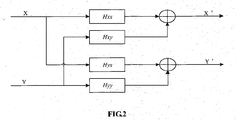
- a filter of a butterfly-shaped structure is to be used to implement polarization demultiplexing.
- the butterfly filter may be implemented by four Finite Impulse Response (FIR) filters.
- the coefficients of the equalizer may include Hxx (f), Hxy (f), Hyy (f), and Hyx (f).
- the jones matrix may be H xx f H xy f H yx f H yy f .
- step 102 a parameter of the jones matrix is acquired using the jones matrix.
- a first parameter, a second parameter, and a third parameter may be acquired by performing a mathematical operation on the jones matrix.
- the first parameter may represent strength of a signal of X-axis polarization.
- the second parameter may represent strength of a signal of Y-axis polarization.
- the third parameter may represent an angle between the signal of X-axis polarization and the signal of Y-axis polarization.
- the third parameter may be expressed by a formula as follows.
- jones _ val jones 1 , 1 * jones 2 , 2 ⁇ jones 1 , 2 * jones 2 , 1 2
- the n may represent an order of a filter in the equalizer.
- the col may take on a value of 1, 2, ..., or n.
- step 103 when it is determined, using the parameter of the jones matrix, that the coefficients are of singularity characteristics, a coefficient of X-axis or Y-axis polarization among the coefficients is adjusted.
- a signal of X-axis polarization and a signal of Y-axis polarization may converge to each other in terms of polarization.
- the third parameter is less than a first threshold.
- the third parameter is less than the first threshold, it may be determined that the coefficients are of singularity characteristics.
- the first threshold may be set using a result of simulation.
- a first value may be acquired by summing over N acquired instances of the third parameter.
- the N may be an integer greater than 1. It may be determined whether the first value is less than a second threshold. When the first value is less than the second threshold, it may be determined that the coefficients are of singularity characteristics.
- the second threshold may be set using a result of simulation.
- a coefficient of X-axis or Y-axis polarization among the coefficients may be adjusted as follows.
- singularity alteration may be performed on the coefficient of X-axis polarization.
- the coefficient of X-axis polarization having gone through the singularity alteration may be set as the coefficient of Y-axis polarization.
- singularity alteration may be performed on the coefficient of Y-axis polarization.
- the coefficient of Y-axis polarization having gone through the singularity alteration may be set as the coefficient of X-axis polarization.
- Singularity alteration may be performed on the coefficient of X-axis polarization, and the coefficient of X-axis polarization having gone through the singularity alteration may be set as the coefficient of Y-axis polarization as follows.
- Hyy 1 , col conj Hxx 1 , n + 1 ⁇ col .
- Hyx 1 , col ⁇ conj Hxy 1 , n + 1 ⁇ col .
- the conj may represent conjugation.
- the n may represent an order of a filter in the equalizer.
- the col may take on a value of 1, 2, ..., or n.
- Singularity alteration may be performed on the coefficient of Y-axis polarization, and the coefficient of Y-axis polarization having gone through the singularity alteration may be set as the coefficient of X-axis polarization as follows.
- Hxx 1 , col conj Hyy 1 , n + 1 ⁇ col .
- Hxy 1 , col ⁇ conj Hyx 1 , n + 1 ⁇ col .
- the conj may represent conjugation.
- the n may represent an order of a filter in the equalizer.
- the col may take on a value of 1, 2, ..., or n.
- a pulse signal warning a singularity may be generated.
- the method may further include steps as follows.
- Strength corresponding to a coefficient of X axis or Y-axis polarization of an order of a filter in the equalizer may be determined using two coefficients of X-axis or Y-axis polarization among the coefficients of the equalizer.
- the central position of taps of coefficients of X axis or Y-axis polarization of the equalizer may then be adjusted.
- the central position of taps of coefficients of X axis polarization of the equalizer and the central position of taps of coefficients of Y-axis polarization of the equalizer may be adjusted respectively.
- Strength corresponding to a coefficient of X axis polarization of an order of a filter in the equalizer may be determined using two coefficients of X axis polarization among the coefficients of the equalizer. It may be determined, using the strength corresponding to a coefficient of X axis polarization of an order of the filter, that a central position of taps of coefficients of the equalizer has deviated. The central position of taps of coefficients of the equalizer may then be adjusted.
- Strength corresponding to a coefficient of Y axis polarization of an order of a filter in the equalizer may be determined using two coefficients of Y axis polarization among the coefficients of the equalizer. It may be determined, using the strength corresponding to a coefficient of Y axis polarization of an order of the filter, that a central position of taps of coefficients of the equalizer has deviated. The central position of taps of coefficients of the equalizer may then be adjusted.
- a third parameter may be set as a maximal strength found by searching strength corresponding to a first coefficient of X axis or Y-axis polarization of an order of the filter.
- a fourth parameter may be set as a first position index corresponding to the third parameter.
- a fifth parameter may be set as a maximal strength found by searching strength corresponding to a second coefficient of X axis or Y-axis polarization of an order of the filter.
- a sixth parameter may be set as a second position index corresponding to the fifth parameter.
- the central position of taps of coefficients of X axis or Y-axis polarization of the equalizer may then be moved to the left or to the right by M taps.
- the M may be an integer no less than 1.
- first and second coefficients herein, it indicates but that the coefficients are different coefficients. There is no limitation to a form of a coefficient. Similarly, by first parameter, second parameter,..., it indicates but that the parameters are different parameters. There is no limitation to a form of a parameter.
- a coefficient used in adjusting the central position of taps of coefficients of X axis as well as a parameter and a set threshold thereof may or may not be identical to that used in adjusting the central position of taps of coefficients of Y axis, depending on an actual condition.
- the central position of taps of coefficients of X axis or Y-axis polarization of the equalizer may then be moved to the left or to the right by M taps, as follows.
- both the fourth and sixth parameters are no greater than a third threshold and both the third and fifth parameters are greater than a fifth threshold, the central position of taps of coefficients of X axis or Y-axis polarization of the equalizer may be moved to the right by M taps.
- the central position of taps of coefficients of X axis or Y-axis polarization of the equalizer may be moved to the left by M taps.
- the third threshold, the fourth threshold, the fifth threshold, and the sixth threshold may be set using a result of simulation.
- the central position of taps of coefficients of X axis polarization may be adjusted with formulas as follows.
- the third threshold may be denoted by A1.
- the fourth threshold may be denoted by A2.
- the fifth threshold may be denoted by G1.
- the sixth threshold may be denoted by G2. It may be determined whether the central position has deviated, and the central position may then be adjusted as follows.
- the central position may not be adjusted.
- step 101 to 103 there is no fixed order between adjusting the central position of taps of coefficients of the equalizer and the singularity alteration/adjustment on the coefficients of the equalizer (steps 101 to 103).
- Singularity adjustment may be performed on the coefficients of the equalizer, followed by the process of adjusting the central position of taps of coefficients of the equalizer.
- the flow/process of adjusting the central position of taps of coefficients of the equalizer may be executed after the flow/process of singularity adjustment has completed for some time.
- the flow/process of adjusting the central position of taps of coefficients of the equalizer may be followed by the flow/process of singularity adjustment.
- singularity adjustment may be performed after the flow/process of adjusting the central position of taps of coefficients of the equalizer has completed for some time.
- a jones matrix is acquired with coefficients of an equalizer; a parameter of the jones matrix is acquired using the jones matrix; when it is determined, using the parameter of the jones matrix, that the coefficients are of singularity characteristics, a coefficient of X-axis or Y-axis polarization among the coefficients is adjusted. Only a coefficient of X-axis or Y-axis polarization is adjusted, such that both centers of the coefficients of X-axis and Y-axis polarizations may be adjusted to a central position of taps of coefficients. Thus, the coefficients of the equalizer may be adjusted accurately, thereby improving filter performance and system stability.
- a first value may be acquired by summing over N acquired instances of the third parameter.
- the N may be an integer greater than 1. It may be determined whether the first value is less than a second threshold. When the first value is less than the second threshold, it may be determined that the coefficients are of singularity characteristics. There may be major fluctuation among individual instances of the third parameter. By summing over instances of the third parameter, it may be determined, with increased accuracy, whether the coefficients are of singularity characteristics.
- Strength corresponding to a coefficient of X axis or Y-axis polarization of an order of a filter in the equalizer may be determined using two coefficients of X-axis or Y-axis polarization among the coefficients of the equalizer. It may be determined, using the strength corresponding to a coefficient of X axis or Y-axis polarization of an order of the filter, that a central position of taps of coefficients of X axis or Y-axis polarization of the equalizer has deviated. The central position of taps of coefficients of X axis or Y-axis polarization of the equalizer may then be adjusted. Singularity adjustment and center adjustment on the coefficients of the equalizer may further improve filter performance and system stability.
- a method for adjusting a coefficient of an equalizer includes steps as follows.
- step 301 strength corresponding to a coefficient of X axis or Y-axis polarization of an order of a filter in the equalizer is determined using two coefficients of X-axis or Y-axis polarization among coefficients of the equalizer.
- step 302 when it is determined, using the strength corresponding to a coefficient of X axis or Y-axis polarization of an order of the filter, that a central position of taps of coefficients of X axis or Y-axis polarization of the equalizer has deviated, the central position of taps of coefficients of X axis or Y-axis polarization of the equalizer is adjusted.
- a third parameter may be set as a maximal strength found by searching strength corresponding to a first coefficient of X axis or Y-axis polarization of an order of the filter.
- a fourth parameter may be set as a first position index corresponding to the third parameter.
- a fifth parameter may be set as a maximal strength found by searching strength corresponding to a second coefficient of X axis or Y-axis polarization of an order of the filter.
- a sixth parameter may be set as a second position index corresponding to the fifth parameter.
- the central position of taps of coefficients of X axis or Y-axis polarization of the equalizer may then be moved to the left or to the right by M taps.
- the M may be an integer no less than 1.
- first and second coefficients herein, it indicates but that the coefficients are different coefficients. There is no limitation to a form of a coefficient. Similarly, by first parameter, second parameter,..., it indicates but that the parameters are different parameters. There is no limitation to a form of a parameter.
- a coefficient used in adjusting the central position of taps of coefficients of X axis as well as a parameter and a set threshold thereof may or may not be identical to that used in adjusting the central position of taps of coefficients of Y axis, depending on an actual condition.
- the central position of taps of coefficients of X axis or Y-axis polarization of the equalizer may then be moved to the left or to the right by M taps, as follows.
- both the fourth and sixth parameters are no greater than a third threshold and both the third and fifth parameters are greater than a fifth threshold, the central position of taps of coefficients of X axis or Y-axis polarization of the equalizer may be moved to the right by M taps.
- the central position of taps of coefficients of X axis or Y-axis polarization of the equalizer may be moved to the left by M taps.
- the third threshold, the fourth threshold, the fifth threshold, and the sixth threshold may be set using a result of simulation.
- the central position of taps of coefficients of X axis polarization of the equalizer and the central position of taps of coefficients of Y-axis polarization of the equalizer may be adjusted respectively.
- Strength corresponding to a coefficient of X axis polarization of an order of a filter in the equalizer may be determined using two coefficients of X axis polarization among the coefficients of the equalizer. It may be determined, using the strength corresponding to a coefficient of X axis polarization of an order of the filter, that a central position of taps of coefficients of the equalizer has deviated. The central position of taps of coefficients of the equalizer may then be adjusted.
- Strength corresponding to a coefficient of Y axis polarization of an order of a filter in the equalizer may be determined using two coefficients of Y axis polarization among the coefficients of the equalizer. It may be determined, using the strength corresponding to a coefficient of Y axis polarization of an order of the filter, that a central position of taps of coefficients of the equalizer has deviated. The central position of taps of coefficients of the equalizer may then be adjusted.
- the central position of taps of coefficients of X axis polarization may be adjusted with formulas as follows.
- the third threshold may be denoted by A1.
- the fourth threshold may be denoted by A2.
- the fifth threshold may be denoted by G1.
- the sixth threshold may be denoted by G2. It may be determined whether the central position has deviated, and the central position may then be adjusted as follows.
- the central position may not be adjusted.
- the flow/process of adjusting the central position of taps of coefficients of the equalizer may be performed periodically, without impacting system performance. Power consumption by equipment may be reduced as well.
- strength corresponding to a coefficient of X axis or Y-axis polarization of an order of a filter in the equalizer is determined using two coefficients of X-axis or Y-axis polarization among coefficients of the equalizer; and when it is determined, using the strength corresponding to a coefficient of X axis or Y-axis polarization of an order of the filter, that a central position of taps of coefficients of X axis or Y-axis polarization of the equalizer has deviated, the central position of taps of coefficients of X axis or Y-axis polarization of the equalizer is adjusted.
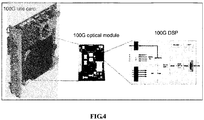
- the process of adjusting coefficients of an equalizer may be explained with a 100G DSP chip in a communication system in 100G optical transmission in a bearer network as an example.
- a DSP chip and a multiplexer (MUX) chip in a 100G optical module are key to 100G long-distance transmission. Limited by a technical threshold and a high capital input, not many manufacturers are cable of developing a DSP chip. One may have to develop a DSP chip by oneself. A competitor who has developed a DSP chip successfully may put major stress on products of a 100G system by other manufacturers in terms of cost. The solution used by the competitor to develop the DSP chip may take away a substantial market share from an independent design company. Impact on market expectation may immediately lead to increasingly cautious investment on a DSP chip project by other manufacturers.
- a 100G DSP chip may apply in a 100G optical module in a 100G line card, mainly for processing a data signal, forming a vital part of the 100G optical module.
- Adaptive equalization may include Polarization Mode Dispersion (PMD), Chromatic Dispersion (CD), polarization mode demultiplexing, etc.
- PMD Polarization Mode Dispersion
- CD Chromatic Dispersion
- Adaptive equalization may be a vital link in processing a data signal by a 100G DSP chip.
- adaptive equalization may be implemented using blind equalization by a Constant Modulus Algorithm (CMA).
- CMA Constant Modulus Algorithm
- the blind equalization by the CMA makes up for damage to a signal caused by an imperfect channel.
- Interaction between light components of different polarizations may be compensated using a filter of a butterfly-shaped structure.
- a filter of a butterfly-shaped structure may consist of four FIR filters.
- X and Y may be two polarized signals, respectively.
- Modulation by polarization multiplexing may be used in a communication system. A polarized signal may deviate during transmission, causing interference to another polarized signal.
- a filter of a butterfly-shaped structure is to be used to implement polarization demultiplexing.
- the H (n-1) may be a coefficient for a last beat.
- the X out may be output filtered data.
- the X * in may be an input vector of a filter involved in computing the X out .
- the k may depend on a hardware delay.
- the R may be a configurable CMA output power factor.
- the ⁇ may be a factor for stepwise time variation.
- Adjustment of a coefficient of an equalizer may include singularity adjustment and center adjustment.
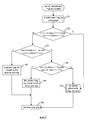
- singularity adjustment singularity in coefficients of an equalizer may be detected using a jones matrix of the coefficients of the equalizer. As shown in FIG.5 , singularity adjustment may include steps as follows.
- a jones matrix may be computed with coefficients of an equalizer.
- the jones matrix may be H xx f H xy f H yx f H yy f .
- step 502 three parameters of the jones matrix may be computed.
- jones _ x jones 1,1 2 + jones 1,2 2
- jones _ y jones 2,1 2 + jones 2,2 2
- the n may represent an order of a filter in the equalizer.
- the col may take on a value of 1, 2, ..., or n.
- the parameters of the jones matrix may be referred to as real-time parameters.
- step 503 it may be determined whether jones_val is less than a first threshold. When jones_val is less than the first threshold, step 504 may be executed. Otherwise, step 501 may be executed.
- the first threshold may be set using a result of simulation.
- jones_val When jones_val is greater than the first threshold, it means that the coefficients of the equalizer show no singularity characteristics and do not need to be adjusted. In this case, no signal warning a singularity may be generated.
- step 504 a signal warning a singularity may be generated, and then steps 505 and 506 may be executed.
- the generated signal warning a singularity may be a pulse signal.
- step 505 singularity adjustment may be performed on the coefficients of the equalizer.
- jones_x may be compared to jones_y. Singularity alteration may be performed on the coefficient of a polarization with a larger jones value. The coefficient having gone through the singularity alteration may then be set as the coefficient of a polarization with a smaller jones value. For example, when jones_x is less/smaller than jones_y, singularity alteration may have to be performed on the coefficient of X-axis polarization.
- the coefficient of Y-axis polarization having gone through the singularity alteration may have to be set as the coefficient of X-axis polarization.
- singularity alteration may have to be performed on the coefficient of Y-axis polarization. That is, the coefficient of X-axis polarization having gone through the singularity alteration may have to be set as the coefficient of Y-axis polarization.
- Singularity adjustment may be performed on the coefficient of X-axis polarization as follows.
- Hxx 1 col conj Hyy 1 , n + 1 ⁇ col .
- Hxy 1 col ⁇ conj Hyx 1 , n + 1 ⁇ col .
- Hyy 1 col conj Hxx 1 , n + 1 ⁇ col .
- Hyx 1 col ⁇ conj Hxy 1 , n + 1 ⁇ col .
- the conj may represent conjugation.
- the n may represent an order of a filter in the equalizer.
- the col may take on a value of 1, 2, ..., or n.
- step 506 a timer 2 for masking the warning may be started.
- the timer 2 for masking the warning may serve to generate a signal to mask the warning to allow periodical singularity adjustment on the coefficients of the equalizer.
- singularity adjustment may include steps as follows.
- a jones matrix may be computed with coefficients of an equalizer.
- the jones matrix may be
- step 602 three parameters of the jones matrix may be computed.
- jones _ x jones 1,1 2 + jones 1,2 2
- jones _ y jones 2,1 2 + jones 2,2 2
- jones _ val jones 1,1 ⁇ jones 2 2 ⁇ jones 1,2 ⁇ jones 2,1 2
- the n may represent an order of a filter in the equalizer.
- the col may take on a value of 1, 2, ..., or n.
- the parameters of the jones matrix may be referred to as real-time parameters.
- step 603 a sum over jones_val in time may be computed.
- the N may be 32.
- step 604 it may be determined whether a count by a timer 1 starting from 1 has reached 31. When it has, step 605 may be executed. Otherwise, step 601 may be executed.
- step 605 it may be determined whether the sum over jones_val in time is less than a second threshold. When it is, step 606 may be executed. Otherwise, step 601 may be executed.
- the second threshold may be set using a result of simulation.
- step 606 a signal warning a singularity may be generated. Then steps 607 and 608 may be executed.
- the generated signal warning a singularity may be a pulse signal.
- step 607 singularity adjustment may be performed on the coefficients of the equalizer.
- jones_x may be compared to jones_y. Singularity alteration may be performed on the coefficient of a polarization with a larger jones value. The coefficient having gone through the singularity alteration may then be set as the coefficient of a polarization with a smaller jones value. For example, when jones_x is less/smaller than jones_y, singularity alteration may have to be performed on the coefficient of X-axis polarization.
- the coefficient of Y-axis polarization having gone through the singularity alteration may have to be set as the coefficient of X-axis polarization.
- singularity alteration may have to be performed on the coefficient of Y-axis polarization. That is, the coefficient of X-axis polarization having gone through the singularity alteration may have to be set as the coefficient of Y-axis polarization.
- Singularity adjustment may be performed on the coefficient of X-axis polarization as follows.
- Hxx 1 col conj Hyy 1 , n + 1 ⁇ col .
- Hxy 1 col ⁇ conj Hyx 1 , n + 1 ⁇ col .
- Hyy 1 col conj Hxx 1 , n + 1 ⁇ col .
- Hyx 1 col ⁇ conj Hxy 1 , n + 1 ⁇ col .
- the conj may represent conjugation.
- the n may represent an order of a filter in the equalizer.
- the col may take on a value of 1, 2, ..., or n.
- step 608 a timer 2 for masking the warning may be started.
- the timer 2 for masking the warning may serve to generate a signal to mask the warning to allow periodical singularity adjustment on the coefficients of the equalizer.
- center adjustment on coefficients of an equalizer may include steps as follow.
- a third parameter, a fourth parameter, a fifth parameter, and a sixth parameter may be computed.
- the m1 may be a maximal value among h1(1, col).
- the w1 may be a position index corresponding to the maximal value among h1(1, col).
- the m2 may be a maximal value among h2(1, col).
- the w2 may be a position index corresponding to the maximal value among h2(1, col).
- steps 702 to 708 may be executed.
- step 704 the central position may be moved to the right by one tap, and then step 708 may be executed.
- step 706 the central position may be moved to the left by one tap, and then step 708 may be executed.
- step 708 may be executed, skipping adjustment to the central position.
- step 708 the flow may end.
- both singularity adjustment and center adjustment may be performed periodically. No adjustment may be performed at any other time. As change in a channel is in general slow, periodical adjustment will have no impact on system performance. Neither center adjustment nor further singularity adjustment may be conducted within a period of time after singularity adjustment has been done. In an actual application, timing and mask of singularity adjustment and center adjustment may be selected with reference to FIG.8 . By monitoring, and performing singularity adjustment and center adjustment on, coefficients of an equalizer, filter performance and system stability may be improved.
- coefficients of an equalizer may be updated adaptively with a dynamic step size.
- the coefficients of the equalizer may be monitored in real time. When singularity characteristics of the coefficients are found, singularity adjustment may be performed. When a center of the coefficients is at a boundary of taps, center adjustment may be performed.
- a central position of coefficients of an equalizer is adjustable, of good real-time performance, and converges fast. Hardware implementation thereof is simple. Thus, performance of a 100G DSP chip in terms of equalization is improved, thereby improving overall performance of a 100G DSP processing chip, reducing an overall cost.
- blind equalization by the CMA may include filter, coefficient adjustment, and center adjustment.
- Input data may be filtered using adjusted and updated coefficients.
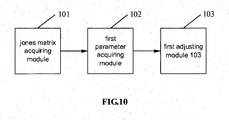
- a device for adjusting a coefficient of an equalizer includes a jones matrix acquiring module 101, a first parameter acquiring module 102, and a first adjusting module 103.
- the jones matrix acquiring module 101 is arranged for: acquiring a jones matrix with coefficients of an equalizer.
- the first parameter acquiring module 102 is arranged for: acquiring a parameter of the jones matrix.
- the first adjusting module 103 is arranged for: in response to determining, using the parameter of the jones matrix, that the coefficients are of singularity characteristics, adjusting a coefficient of X-axis or Y-axis polarization among the coefficients.
- X and Y may be two polarized signals, respectively.
- Modulation by polarization multiplexing may be used in a communication system.
- a polarized signal may deviate during transmission, causing interference to another polarized signal.
- a filter of a butterfly-shaped structure is to be used to implement polarization demultiplexing.
- the butterfly filter may be implemented by four Finite Impulse Response (FIR) filters.
- the coefficients of the equalizer may include Hxx (f), Hxy (f), Hyy (f), and Hyx (f).
- the jones matrix may be
- the first parameter acquiring module 102 may be arranged for: acquiring, by performing a mathematical operation on the jones matrix, a first parameter, a second parameter, and a third parameter.
- the first parameter may represent strength of a signal of X-axis polarization.
- the second parameter may represent strength of a signal of Y-axis polarization.
- the third parameter may represent an angle between the signal of X-axis polarization and the signal of Y-axis polarization.
- the third parameter may be expressed by a formula as follows.
- jones _ val jones 1 , 1 * jones 2 , 2 ⁇ jones 1 , 2 * jones 2 , 1 2
- the n may represent an order of a filter in the equalizer.
- the col may take on a value of 1, 2, ..., or n.
- a signal of X-axis polarization and a signal of Y-axis polarization may converge to each other in terms of polarization.
- the first adjusting module 103 may be arranged for determining whether the third parameter is less than a first threshold; in response to determining that the third parameter is less than the first threshold, determining that the coefficients are of singularity characteristics.
- the first threshold may be set using a result of simulation.
- the first adjusting module 103 may be arranged for: acquiring a first value by summing over N instances of the third parameter, the N being an integer greater than 1; determining whether the first value is less than a second threshold; in response to determining that the first value is less than the second threshold, determining that the coefficients are of singularity characteristics.
- the second threshold may be set using a result of simulation.
- the first value may be expressed by a formula as follows.
- a coefficient of X-axis or Y-axis polarization among the coefficients may be adjusted as follows.
- the first adjusting module 103 may be arranged for: in response to determining that the first parameter is greater than the second parameter, performing singularity alteration on the coefficient of X-axis polarization; setting the coefficient of X-axis polarization having gone through the singularity alteration as the coefficient of Y-axis polarization.
- the first adjusting module 103 may be arranged for: in response to determining that the first parameter is less than the second parameter, performing singularity alteration on the coefficient of Y-axis polarization; setting the coefficient of Y-axis polarization having gone through the singularity alteration as the coefficient of X-axis polarization.
- Singularity alteration may be performed on the coefficient of X-axis polarization, and the coefficient of X-axis polarization having gone through the singularity alteration may be set as the coefficient of Y-axis polarization as follows.
- Hyy 1 , col conj Hxx 1 , n + 1 ⁇ col .
- Hyx 1 , col ⁇ conj Hxy 1 , n + 1 ⁇ col .
- the conj may represent conjugation.
- the n may represent an order of a filter in the equalizer.
- the col may take on a value of 1, 2, ..., or n.
- Singularity alteration may be performed on the coefficient of Y-axis polarization, and .
- the coefficient of Y-axis polarization having gone through the singularity alteration may be set as the coefficient of X-axis polarization as follows.
- Hxx 1 , col conj Hyy 1 , n + 1 ⁇ col .
- Hxy 1 , col ⁇ conj Hyx 1 , n + 1 ⁇ col .
- the conj may represent conjugation.
- the n may represent an order of a filter in the equalizer.
- the col may take on a value of 1, 2, ..., or n.
- the device may further include a first warning module.
- the first warning module may be arranged for: in response to determining that the coefficients are of singularity characteristics, before the coefficient of X-axis or Y-axis polarization among the coefficients is adjusted, generating a warning of singularity.
- the first warning module may generate a pulse signal warning a singularity.
- the device may further include a first strength determining module and a second adjusting module.
- the first strength determining module may be arranged for: determining, using two coefficients of X-axis or Y-axis polarization among the coefficients of the equalizer, strength corresponding to a coefficient of X axis or Y-axis polarization of an order of a filter in the equalizer.
- the second adjusting module may be arranged for: in response to determining, using the strength corresponding to a coefficient of X axis or Y-axis polarization of an order of the filter, that a central position of taps of coefficients of X axis or Y-axis polarization of the equalizer has deviated, adjusting the central position of taps of coefficients of X axis or Y-axis polarization of the equalizer.
- the central position of taps of coefficients of X axis polarization of the equalizer and the central position of taps of coefficients of Y-axis polarization of the equalizer may be adjusted respectively.
- the first strength determining module may be arranged for: determining, using two coefficients of X axis polarization among the coefficients of the equalizer, strength corresponding to a coefficient of X axis polarization of an order of a filter in the equalizer.
- the second adjusting module may be arranged for: in response to determining, using the strength corresponding to a coefficient of X axis polarization of an order of the filter, that a central position of taps of coefficients of the equalizer has deviated, adjusting the central position of taps of coefficients of the equalizer.
- the first strength determining module may be arranged for: determining, using two coefficients of Y axis polarization among the coefficients of the equalizer, strength corresponding to a coefficient of Y axis polarization of an order of a filter in the equalizer.
- the second adjusting module may be arranged for: in response to determining, using the strength corresponding to a coefficient of Y axis polarization of an order of the filter, that a central position of taps of coefficients of the equalizer has deviated, adjusting the central position of taps of coefficients of the equalizer.
- the second adjusting module may be arranged for: setting a third parameter as a maximal strength found by searching strength corresponding to a first coefficient of X axis or Y-axis polarization of an order of the filter, and setting a fourth parameter as a first position index corresponding to the third parameter.
- the second adjusting module may be arranged for: setting a fifth parameter as a maximal strength found by searching strength corresponding to a second coefficient of X axis or Y-axis polarization of an order of the filter, and setting a sixth parameter as a second position index corresponding to the fifth parameter.
- the second adjusting module may be arranged for: in response to determining, using the third parameter, the fourth parameter, the fifth parameter, the sixth parameter, and a preset condition, that the central position of taps of coefficients of X axis or Y-axis polarization of the equalizer has deviated, moving the central position of taps of coefficients of X axis or Y-axis polarization of the equalizer to the left or to the right by M taps.
- the M may be an integer no less than 1.
- first and second coefficients herein, it indicates but that the coefficients are different coefficients. There is no limitation to a form of a coefficient. Similarly, by first parameter, second parameter,..., it indicates but that the parameters are different parameters. There is no limitation to a form of a parameter.
- a coefficient used in adjusting the central position of taps of coefficients of X axis as well as a parameter and a set threshold thereof may or may not be identical to that used in adjusting the central position of taps of coefficients of Y axis, depending on an actual condition.
- the central position of taps of coefficients of X axis or Y-axis polarization of the equalizer may then be moved to the left or to the right by M taps, as follows.
- the second adjusting module may be arranged for: in response to determining that both the fourth and sixth parameters are no greater than a third threshold and both the third and fifth parameters are greater than a fifth threshold, moving the central position of taps of coefficients of X axis or Y-axis polarization of the equalizer to the right by M taps.
- the second adjusting module may be arranged for: in response to determining that both the fourth and sixth parameters are no less than a fourth threshold and both the third and fifth parameters are greater than the fifth threshold, moving the central position of taps of coefficients of X axis or Y-axis polarization of the equalizer to the left by M taps.
- the third threshold, the fourth threshold, the fifth threshold, and the sixth threshold may be set using a result of simulation.
- the central position of taps of coefficients of X axis polarization may be adjusted with formulas as follows.
- the third threshold may be denoted by A1.
- the fourth threshold may be denoted by A2.
- the fifth threshold may be denoted by G1.
- the sixth threshold may be denoted by G2. It may be determined whether the central position has deviated, and the central position may then be adjusted as follows.
- the central position may not be adjusted by the second adjusting module.
- Singularity adjustment may be performed on the coefficients of the equalizer, followed by the process of adjusting the central position of taps of coefficients of the equalizer.
- the flow/process of adjusting the central position of taps of coefficients of the equalizer may be executed after the flow/process of singularity adjustment has completed for some time.
- the flow/process of adjusting the central position of taps of coefficients of the equalizer may be followed by the flow/process of singularity adjustment.
- singularity adjustment may be performed after the flow/process of adjusting the central position of taps of coefficients of the equalizer has completed for some time.
- the jones matrix acquiring module 101, the first parameter acquiring module 102, the first adjusting module 103, the first strength determining module, and the second adjusting module may be implemented by a Central Processing Unit (CPU), a Micro Control Unit (MCU), a DSP, or a Field - Programmable Gate Array (FPGA) in the device for adjusting a coefficient of an equalizer.
- the first warning module may be implemented by an alarm in the device for adjusting a coefficient of an equalizer.
- a jones matrix acquiring module 101 acquires a jones matrix with coefficients of an equalizer; a first parameter acquiring module 102 acquires a parameter of the jones matrix using the jones matrix; a first adjusting module 103 determines, using the parameter of the jones matrix, that the coefficients are of singularity characteristics, and then adjusts a coefficient of X-axis or Y-axis polarization among the coefficients. Only a coefficient of X-axis or Y-axis polarization is adjusted, such that both centers of the coefficients of X-axis and Y-axis polarizations may be adjusted to a central position of taps of coefficients. Thus, the coefficients of the equalizer may be adjusted accurately, thereby improving filter performance and system stability.
- the first adjusting module 103 may be arranged for: acquiring a first value by summing over N instances of the third parameter, the N being an integer greater than 1; determining whether the first value is less than a second threshold; in response to determining that the first value is less than the second threshold, determining that the coefficients are of singularity characteristics. There may be major fluctuation among individual instances of the third parameter. By summing over instances of the third parameter, it may be determined, with increased accuracy, whether the coefficients are of singularity characteristics.
- the first strength determining module may be arranged for: determining, using two coefficients of X-axis or Y-axis polarization among the coefficients of the equalizer, strength corresponding to a coefficient of X axis or Y-axis polarization of an order of a filter in the equalizer.
- the second adjusting module may be arranged for: in response to determining, using the strength corresponding to a coefficient of X axis or Y-axis polarization of an order of the filter, that a central position of taps of coefficients of X axis or Y-axis polarization of the equalizer has deviated, adjusting the central position of taps of coefficients of X axis or Y-axis polarization of the equalizer. Singularity adjustment and center adjustment on the coefficients of the equalizer may further improve filter performance and system stability.
- a device for adjusting a coefficient of an equalizer includes a second strength determining module 111 and a third adjusting module 112.
- the second strength determining module 111 is arranged for: determining, using two coefficients of X-axis or Y-axis polarization among coefficients of the equalizer, strength corresponding to a coefficient of X axis or Y-axis polarization of an order of a filter in the equalizer.
- the third adjusting module 112 is arranged for: in response to determining, using the strength corresponding to a coefficient of X axis or Y-axis polarization of an order of the filter, that a central position of taps of coefficients of X axis or Y-axis polarization of the equalizer has deviated, adjusting the central position of taps of coefficients of X axis or Y-axis polarization of the equalizer.
- the third adjusting module 112 may further include a second parameter acquiring module, a third parameter acquiring module, and a center adjusting module.
- the second parameter acquiring module may be arranged for: setting a third parameter as a maximal strength found by searching strength corresponding to a first coefficient of X axis or Y-axis polarization of an order of the filter, and setting a fourth parameter as a first position index corresponding to the third parameter.
- the third parameter acquiring module may be arranged for: setting a fifth parameter as a maximal strength found by searching strength corresponding to a second coefficient of X axis or Y-axis polarization of an order of the filter, and setting a sixth parameter as a second position index corresponding to the fifth parameter.
- the center adjusting module may be arranged for: in response to determining, using the third parameter, the fourth parameter, the fifth parameter, the sixth parameter, and a preset condition, that the central position of taps of coefficients of X axis or Y-axis polarization of the equalizer has deviated, moving the central position of taps of coefficients of X axis or Y-axis polarization of the equalizer to the left or to the right by M taps.
- the M may be an integer no less than 1.
- first and second coefficients herein, it indicates but that the coefficients are different coefficients. There is no limitation to a form of a coefficient. Similarly, by first parameter, second parameter,..., it indicates but that the parameters are different parameters. There is no limitation to a form of a parameter.
- a coefficient used in adjusting the central position of taps of coefficients of X axis as well as a parameter and a set threshold thereof may or may not be identical to that used in adjusting the central position of taps of coefficients of Y axis, depending on an actual condition.
- the center adjusting module may be arranged for:
- the third threshold, the fourth threshold, the fifth threshold, and the sixth threshold may be set using a result of simulation.
- the central position of taps of coefficients of X axis polarization of the equalizer and the central position of taps of coefficients of Y-axis polarization of the equalizer may be adjusted respectively.
- the second strength determining module 111 may be arranged for: determining, using two coefficients of X axis polarization among the coefficients of the equalizer, strength corresponding to a coefficient of X axis polarization of an order of a filter in the equalizer.
- the third adjusting module 112 may be arranged for: in response to determining, using the strength corresponding to a coefficient of X axis polarization of an order of the filter, that a central position of taps of coefficients of the equalizer has deviated, adjusting the central position of taps of coefficients of the equalizer.
- the second strength determining module 111 may be arranged for: determining, using two coefficients of Y axis polarization among the coefficients of the equalizer, strength corresponding to a coefficient of Y axis polarization of an order of a filter in the equalizer.
- the third adjusting module 112 may be arranged for: in response to determining, using the strength corresponding to a coefficient of Y axis polarization of an order of the filter, that a central position of taps of coefficients of the equalizer has deviated, adjusting the central position of taps of coefficients of the equalizer.
- the central position of taps of coefficients of X axis polarization may be adjusted with formulas as follows.
- the third threshold may be denoted by A1.
- the fourth threshold may be denoted by A2.
- the fifth threshold may be denoted by G1.
- the sixth threshold may be denoted by G2. It may be determined whether the central position has deviated, and the central position may then be adjusted as follows.
- the central position may not be adjusted.
- the flow/process of adjusting the central position of taps of coefficients of the equalizer may be performed periodically, without impacting system performance. Power consumption by equipment may be reduced as well.
- the second strength determining module 111, the third adjusting module 112, the second parameter acquiring module, the third parameter acquiring module, and the center adjusting module may be implemented by a CPU, an MCU, a DSP, or an FPGA in the device for adjusting a coefficient of an equalizer.
- the second warning module may be implemented by an alarm in the device for adjusting a coefficient of an equalizer.
- the second strength determining module 111 determines, using two coefficients of X-axis or Y-axis polarization among coefficients of the equalizer, strength corresponding to a coefficient of X axis or Y-axis polarization of an order of a filter in the equalizer.
- the third adjusting module 112 determines, using the strength corresponding to a coefficient of X axis or Y-axis polarization of an order of the filter, that a central position of taps of coefficients of X axis or Y-axis polarization of the equalizer has deviated, and then adjusts the central position of taps of coefficients of X axis or Y-axis polarization of the equalizer.
- the coefficients of the equalizer may be adjusted accurately, thereby improving filter performance and system stability.
- an embodiment herein may provide a method, system, or computer program product. Therefore, an embodiment herein may take on a form of hardware, software, or a combination thereof. In addition, an embodiment herein may take on a form of a computer program product implemented on one or more computer available storage media (including but not limited to, magnetic disk memory, optic memory, and the like) containing computer available program codes.
- a computer available storage media including but not limited to, magnetic disk memory, optic memory, and the like
- each flow in the flowcharts and/or each block in the block diagrams as well as combination of flows in the flowcharts and/or blocks in the block diagrams may be implemented by instructions of a computer program.
- Such instructions may be offered in a processor of a general-purpose computer, a dedicated computer, an embedded processor or other programmable data processing devices to generate a machine, such that a device with a function specified in one or more flows of the flowcharts and/or one or more blocks in the block diagrams is produced by instructions executed by a processor of a computer or other programmable data processing devices.
- These computer-program instructions may also be stored in a non-transitory computer-readable memory capable of guiding a computer or another programmable data processing device to work in a given way, such that the instructions stored in the computer-readable memory generate a manufactured good including an instruction device for implementing a function specified in one or more flows of the flowcharts and/or one or more blocks in the block diagrams.
- These computer-program instructions may also be loaded in a computer or other programmable data processing devices, which thus executes a series of operations thereon to generate computer-implemented processing, such that the instructions executed on the computer or other programmable data processing devices provide the steps for implementing the function specified in one or more flows of the flowcharts or one or more blocks in the block diagrams.
- a transitory or non-transitory computer-readable storage medium has stored therein instructions that, when executed by at least one processor, causes the at least one processor to perform the method for adjusting a coefficient of an equalizer according to embodiments herein.
Landscapes
- Engineering & Computer Science (AREA)
- Computer Networks & Wireless Communication (AREA)
- Signal Processing (AREA)
- Power Engineering (AREA)
- Physics & Mathematics (AREA)
- Electromagnetism (AREA)
- Mathematical Physics (AREA)
- Optical Communication System (AREA)
- Filters That Use Time-Delay Elements (AREA)
Claims (14)
- Procédé de réglage d'un coefficient d'égaliseur, comprenant :l'acquisition (101, 501, 601) d'une matrice de Jones
 l'acquisition d'un paramètre de la matrice de Jones par acquisition (102, 502, 602) d'un premier paramètre, d'un deuxième paramètre et d'un troisième paramètre en réalisant une opération mathématique sur la matrice de Jones ; le premier paramètre représentant la puissance d'un signal polarisé selon l'axe X, le deuxième paramètre représentant la puissance d'un signal polarisé selon l'axe Y, le troisième paramètre étant exprimé par jones_val = |jones (1, 1)* jones (2, 2) - jones (1, 2)* jones (2, 1)|2, où
 suite à la détermination, au moyen du troisième paramètre de la matrice de Jones, que les coefficients présentent des caractéristiques de singularité, le réglage (103, 505, 607) d'un coefficient de polarisation selon l'axe X ou Y parmi les coefficients, en :définissant Hyy(1,col) = conj (Hxx(1, n+1-col)) et Hyx (1, col) = - conj (Hxy (1, n+1-col)), suite à la détermination que le premier paramètre est supérieur au deuxième paramètre, et endéfinissant Hxx(1, col) = conj (Hyy(1, n+1-col)) et Hxy (1, col) = - conj (Hyx (1, n+1-col)), suite à la détermination que le premier paramètre est inférieur au deuxième paramètre,où conj représente une conjugaison, n représente l'ordre d'un filtre de l'égaliseur, et col prend une valeur de 1, 2, ..., ou n.
 - Procédé selon la revendication 1, dans lequel la détermination, au moyen du paramètre de la matrice de Jones, que les coefficients présentent des caractéristiques de singularité comprend :la détermination (503) du fait ou non que le troisième paramètre est inférieur à un premier seuil, et suite à la détermination que le troisième paramètre est inférieur au premier seuil, la détermination que les coefficients présentent des caractéristiques de singularité ;ou bien,l'acquisition (603-604) d'une première valeur par sommation sur N occurrences du troisième paramètre, N étant un entier supérieur à 1, la détermination (605) du fait ou non que la première valeur est inférieure à un deuxième seuil, et suite à la détermination que la première valeur est inférieure au deuxième seuil, la détermination que les coefficients présentent des caractéristiques de singularité.
- Procédé selon la revendication 1, comprenant en outre : suite à la détermination que les coefficients présentent des caractéristiques de singularité, avant le réglage d'un coefficient de polarisation selon l'axe X ou Y parmi les coefficients,
la production (504, 606) d'un avertissement de singularité. - Procédé selon l'une quelconque des revendications 1 à 3, comprenant en outre :la détermination (301, 701), au moyen de deux coefficients de polarisation selon l'axe X ou Y parmi les coefficients de l'égaliseur, d'une puissance correspondant à un coefficient de polarisation selon l'axe X ou Y de l'ordre du filtre de l'égaliseur, etsuite à la détermination, au moyen de la puissance correspondant au coefficient de polarisation selon l'axe X ou Y de l'ordre du filtre, qu'une position centrale de prises de coefficients de polarisation selon l'axe X ou Y de l'égaliseur a dévié, le réglage (302) de la position centrale de prises de coefficients de polarisation selon l'axe X ou Y de l'égaliseur.
- Procédé selon la revendication 4, dans lequel le réglage de la position centrale de prises de coefficients de polarisation selon l'axe X ou Y de l'égaliseur, suite à la détermination, au moyen de la puissance correspondant au coefficient de polarisation selon l'axe X ou Y de l'ordre du filtre, qu'une position centrale de prises de coefficients de polarisation selon l'axe X ou Y de l'égaliseur a dévié, comprend :la définition d'un second troisième paramètre en tant que puissance maximale trouvée en examinant une puissance correspondant à un premier coefficient de polarisation selon l'axe X ou Y d'un ordre du filtre, et la définition d'un quatrième paramètre en tant que premier indice de position correspondant au second troisième paramètre,la définition d'un cinquième paramètre en tant que puissance maximale trouvée en examinant une puissance correspondant à un deuxième coefficient de polarisation selon l'axe X ou Y d'un ordre du filtre, et la définition d'un sixième paramètre en tant que deuxième indice de position correspondant au cinquième paramètre, etsuite à la détermination, au moyen du second troisième paramètre, du quatrième paramètre, du cinquième paramètre, du sixième paramètre et d'une condition prédéfinie, que la position centrale de prises de coefficients de polarisation selon l'axe X ou Y de l'égaliseur a dévié, le déplacement de la position centrale de prises de coefficients de polarisation selon l'axe X ou Y de l'égaliseur vers la gauche ou vers la droite d'une valeur de M prises, M étant un nombre entier non inférieur à 1.
- Procédé selon la revendication 5, dans lequel le déplacement de la position centrale de prises de coefficients de polarisation selon l'axe X ou Y de l'égaliseur vers la gauche ou vers la droite d'une valeur de M prises, effectué suite à la détermination, au moyen du second troisième paramètre, du quatrième paramètre, du cinquième paramètre, du sixième paramètre et d'une condition prédéfinie, que la position centrale de prises de coefficients de polarisation selon l'axe X ou Y de l'égaliseur a dévié, comprend :suite à la détermination que le quatrième et le sixième paramètre ne sont pas supérieurs à un troisième seuil et que le second troisième et le cinquième paramètre sont supérieurs à un cinquième seuil, le déplacement de la position centrale de prises de coefficients de polarisation selon l'axe X ou Y de l'égaliseur vers la droite d'une valeur de M prises, ou bien,suite à la détermination que le quatrième et le sixième paramètre ne sont pas inférieurs à un quatrième seuil et que le second troisième et le cinquième paramètre sont supérieurs au cinquième seuil, le déplacement de la position centrale de prises de coefficients de polarisation selon l'axe X ou Y de l'égaliseur vers la gauche d'une valeur de M prises.
- Dispositif de réglage d'un coefficient d'égaliseur, comprenant un premier module d'acquisition de matrice de Jones (101), un premier module d'acquisition de paramètre (102) et un premier module de réglage (103),
ledit premier module d'acquisition de matrice de Jones (101) étant agencé pour : acquérir une matrice de Jones
ledit premier module d'acquisition de paramètre (102) étant agencé pour : acquérir un paramètre de la matrice de Jones par acquisition d'un premier paramètre, d'un deuxième paramètre et d'un troisième paramètre en réalisant une opération mathématique sur la matrice de Jones ; le premier paramètre représentant la puissance d'un signal polarisé selon l'axe X, le deuxième paramètre représentant la puissance d'un signal polarisé selon l'axe Y, le troisième paramètre étant exprimé par jones_val = |jones (1, 1)* jones (2, 2) - jones (1, 2)* jones (2, 1)|2, où définissant Hyy (1,col) = conj (Hxx(1, n+1-col)) et Hyx (1, col) = - conj (Hxy (1, n+1-col)), suite à la détermination que le premier paramètre est supérieur au deuxième paramètre, et endéfinissant Hxx (1,col) = conj (Hyy(1, n+1-col)) et Hxy (1, col) = - conj (Hyx (1, n+1-col)), suite à la détermination que le premier paramètre est inférieur au deuxième paramètre,où conj représente une conjugaison, n représente l'ordre d'un filtre de l'égaliseur, et col prend une valeur de 1, 2, ..., ou n.
 - Dispositif selon la revendication 7, dans lequel la détermination, au moyen du paramètre de la matrice de Jones, que les coefficients présentent des caractéristiques de singularité comprend :la détermination du fait ou non que le troisième paramètre est inférieur à un premier seuil, et suite à la détermination que le troisième paramètre est inférieur au premier seuil, la détermination que les coefficients présentent des caractéristiques de singularité ;ou bien,l'acquisition d'une première valeur par sommation sur N occurrences du troisième paramètre, N étant un entier supérieur à 1, la détermination du fait ou non que la première valeur est inférieure à un deuxième seuil, et suite à la détermination que la première valeur est inférieure au deuxième seuil, la détermination que les coefficients présentent des caractéristiques de singularité.
- Dispositif selon la revendication 7, comprenant en outre un premier module d'avertissement agencé pour : suite à la détermination que les coefficients présentent des caractéristiques de singularité, avant le réglage du coefficient de polarisation selon l'axe X ou Y parmi les coefficients, produire un avertissement de singularité.
- Dispositif selon l'une quelconque des revendications 7 à 9, comprenant en outre un premier module de détermination de puissance (111) et un deuxième module de réglage (112),
ledit premier module de détermination de puissance (111) étant agencé pour : déterminer, au moyen de deux coefficients de polarisation selon l'axe X ou Y parmi les coefficients de l'égaliseur, une puissance correspondant à un coefficient de polarisation selon l'axe X ou Y de l'ordre du filtre de l'égaliseur,
ledit deuxième module de réglage (112) étant agencé pour : suite à la détermination, au moyen de la puissance correspondant au coefficient de polarisation selon l'axe X ou Y de l'ordre du filtre, qu'une position centrale de prises de coefficients de polarisation selon l'axe X ou Y de l'égaliseur a dévié, régler la position centrale de prises de coefficients de polarisation selon l'axe X ou Y de l'égaliseur. - Dispositif selon la revendication 10, dans lequel le deuxième module de réglage (112) est agencé pour :définir un second troisième paramètre en tant que puissance maximale trouvée en examinant une puissance correspondant à un premier coefficient de polarisation selon l'axe X ou Y d'un ordre du filtre, et définir un quatrième paramètre en tant que premier indice de position correspondant au second troisième paramètre,définir un cinquième paramètre en tant que puissance maximale trouvée en examinant une puissance correspondant à un deuxième coefficient de polarisation selon l'axe X ou Y d'un ordre du filtre, et définir un sixième paramètre en tant que deuxième indice de position correspondant au cinquième paramètre, etsuite à la détermination, au moyen du second troisième paramètre, du quatrième paramètre, du cinquième paramètre, du sixième paramètre et d'une condition prédéfinie, que la position centrale de prises de coefficients de polarisation selon l'axe X ou Y de l'égaliseur a dévié, déplacer la position centrale de prises de coefficients de polarisation selon l'axe X ou Y de l'égaliseur vers la gauche ou vers la droite d'une valeur de M prises, M étant un entier non inférieur à 1.
- Dispositif selon la revendication 11, dans lequel le deuxième module de réglage (112) est agencé pour :suite à la détermination que le quatrième et le sixième paramètre ne sont pas supérieurs à un troisième seuil et que le second troisième et le cinquième paramètre sont supérieurs à un cinquième seuil, déplacer la position centrale de prises de coefficients de polarisation selon l'axe X ou Y de l'égaliseur vers la droite d'une valeur de M prises ; ou biensuite à la détermination que le quatrième et le sixième paramètre ne sont pas inférieurs à un quatrième seuil et que le second troisième et le cinquième paramètre sont supérieurs au cinquième seuil, déplacer la position centrale de prises de coefficients de polarisation selon l'axe X ou Y de l'égaliseur vers la gauche d'une valeur de M prises.
- Support d'enregistrement lisible par ordinateur sur lequel sont enregistrées des instructions qui, lorsqu'elles sont exécutées, amènent au moins un processeur à exécuter le procédé selon l'une quelconque des revendications 1 à 6.
- Programme informatique comprenant des instructions qui, lorsqu'elles sont exécutées, amènent au moins un processeur à exécuter le procédé selon l'une quelconque des revendications 1 à 6.
Applications Claiming Priority (2)
| Application Number | Priority Date | Filing Date | Title |
|---|---|---|---|
| CN201510371532.0A CN106330794B (zh) | 2015-06-29 | 2015-06-29 | 一种均衡器系数的调整方法及装置 |
| PCT/CN2015/091788 WO2017000422A1 (fr) | 2015-06-29 | 2015-10-12 | Procédé et dispositif de réglage appliqué à un coefficient d'égaliseur et support de stockage informatique |
Publications (3)
| Publication Number | Publication Date |
|---|---|
| EP3293930A1 EP3293930A1 (fr) | 2018-03-14 |
| EP3293930A4 EP3293930A4 (fr) | 2018-06-06 |
| EP3293930B1 true EP3293930B1 (fr) | 2019-12-04 |
Family
ID=57607606
Family Applications (1)
| Application Number | Title | Priority Date | Filing Date |
|---|---|---|---|
| EP15896952.7A Active EP3293930B1 (fr) | 2015-06-29 | 2015-10-12 | Procédé et dispositif de réglage appliqué à un coefficient d'égaliseur et support de stockage informatique |
Country Status (4)
| Country | Link |
|---|---|
| US (1) | US10461968B2 (fr) |
| EP (1) | EP3293930B1 (fr) |
| CN (1) | CN106330794B (fr) |
| WO (1) | WO2017000422A1 (fr) |
Family Cites Families (16)
| Publication number | Priority date | Publication date | Assignee | Title |
|---|---|---|---|---|
| CN1124009C (zh) | 1997-12-29 | 2003-10-08 | 株式会社建伍 | 接收机的帧同步信号捕获电路 |
| US6784745B2 (en) * | 2003-01-31 | 2004-08-31 | Lsi Logic Corporation | Adjustable current-mode equalizer |
| US7039330B2 (en) | 2003-10-10 | 2006-05-02 | Finisar Corporation | Optical signal equalizer with adjustable linear filter |
| CN101425851B (zh) | 2008-12-06 | 2011-11-30 | 华中科技大学 | 光通讯用电子色散补偿均衡器及其抽头调整方法 |
| JP5598290B2 (ja) * | 2010-11-30 | 2014-10-01 | 富士通株式会社 | 適応等化器、光受信機、及び適応等化器のタップ係数補正方法、 |
| JP5633352B2 (ja) * | 2010-12-09 | 2014-12-03 | 富士通株式会社 | デジタルコヒーレント光受信器、適応等化型イコライザ及びデジタルコヒーレント光通信方法 |
| WO2012122237A2 (fr) | 2011-03-07 | 2012-09-13 | Acacia Communications Incorporated | Fonctionnement à forte intensité et de longue durée d'un égaliseur adaptif dans le domaine de l'optique |
| JP5943001B2 (ja) * | 2011-12-07 | 2016-06-29 | 日本電気株式会社 | 等化信号処理装置、それを用いた光受信装置および等化信号処理方法 |
| US8861960B2 (en) * | 2012-08-20 | 2014-10-14 | Ciena Corporation | Systems and methods for the compensation of nonlinear cross polarization and cross phase modulation in dual polarization coherent channels |
| JP6065618B2 (ja) | 2013-01-31 | 2017-01-25 | 富士通株式会社 | 適応等化器タップ係数補正方法、及び光受信機 |
| CN103840883A (zh) * | 2013-08-16 | 2014-06-04 | 北京邮电大学 | 一种抑制光纤双向传输中受激拉曼散射散射串扰的方法 |
| CN103441972A (zh) | 2013-08-30 | 2013-12-11 | 四川大学 | 一种盲均衡方法及盲均衡系统 |
| CN103516648B (zh) | 2013-10-18 | 2016-09-28 | 南京信息工程大学 | 一种修正的模判决多模盲均衡方法 |
| CN103825851B (zh) * | 2014-01-21 | 2017-02-01 | 南京信息工程大学 | 一种多输入多输出mimo系统小波常模盲均衡方法 |
| CN104079379B (zh) * | 2014-07-01 | 2017-04-12 | 南京邮电大学 | 一种基于自适应相位旋转角量子蚁群的信号盲检测方法 |
| CN104280737B (zh) * | 2014-08-29 | 2017-01-11 | 浙江工业大学 | 加权宽带时反算子分解声成像方法 |
-
2015
- 2015-06-29 CN CN201510371532.0A patent/CN106330794B/zh active Active
- 2015-10-12 WO PCT/CN2015/091788 patent/WO2017000422A1/fr not_active Ceased
- 2015-10-12 US US15/577,263 patent/US10461968B2/en active Active
- 2015-10-12 EP EP15896952.7A patent/EP3293930B1/fr active Active
Non-Patent Citations (1)
| Title |
|---|
| None * |
Also Published As
| Publication number | Publication date |
|---|---|
| US20180152328A1 (en) | 2018-05-31 |
| EP3293930A1 (fr) | 2018-03-14 |
| CN106330794A (zh) | 2017-01-11 |
| WO2017000422A1 (fr) | 2017-01-05 |
| US10461968B2 (en) | 2019-10-29 |
| EP3293930A4 (fr) | 2018-06-06 |
| CN106330794B (zh) | 2019-10-22 |
Similar Documents
| Publication | Publication Date | Title |
|---|---|---|
| US11750298B2 (en) | Frequency deviation compensation scheme and frequency deviation compensation method | |
| US8478135B2 (en) | Method and apparatus for polarization-division-multiplexed optical receivers | |
| EP3096470B1 (fr) | Procédé et système d'atténuation d'interférence non linéaire | |
| JP5029200B2 (ja) | 光トランシーバ調整方法 | |
| US9197456B2 (en) | Blind equalization tap coefficient adaptation in optical systems | |
| EP3553973A1 (fr) | Procédé d'estimation de caractéristique d'émission optique, procédé de compensation de caractéristique d'émission optique, système d'estimation de caractéristique d'émission optique et système de compensation de caractéristique d'émission optique | |
| EP2464069A2 (fr) | Récepteur optique cohérent numérique, égaliseur adaptatif et procédé de communication optique cohérente numérique | |
| CN102511136B (zh) | 色散评估器和评估色散的方法 | |
| EP3094037A1 (fr) | Procédé, dispositif et système de récupération d'horloge et support de stockage informatique | |
| EP3358767B1 (fr) | Dispositif et procédé pour traiter un signal de lumière | |
| EP3046300A1 (fr) | Procédé et dispositif de récupération d'horloge | |
| CN107534484A (zh) | 波长色散估计电路、光接收装置及波长色散量估计方法 | |
| JP2012109711A (ja) | 光伝送システム | |
| JP6378654B2 (ja) | 空間多重光伝送システム及び空間多重光伝送方法 | |
| Hager et al. | Revisiting multi-step nonlinearity compensation with machine learning | |
| US8923460B1 (en) | Methods and apparatus for signal equalization in dual polarization multiplexed optical communication systems | |
| CN109510668A (zh) | 相干光通信中基于准前馈控制的自适应均衡器及方法 | |
| EP3496327A1 (fr) | Procédé d'acquisition de signal de discrimination de phase dans un circuit de récupération d'horloge, et discriminateur de phase | |
| US10461968B2 (en) | Adjustment method and device for equalizer coefficient, and computer storage medium | |
| EP3506577B1 (fr) | Procédé et appareil pour calculer une erreur d'égalisation aveugle et support d'informations | |
| CN1312867C (zh) | 偏振模式色散补偿器及其自适应调节方法 | |
| Glentis et al. | Electronic dispersion compensation of fiber links using sparsity induced volterra equalizers | |
| JP2010206250A (ja) | 偏波モード分散抑圧方法及び偏波モード分散抑圧装置 | |
| JP4924276B2 (ja) | 分散等化方法、分散等化装置および光トランシーバ | |
| EP3217618A1 (fr) | Procédé et dispositif de compensation de signal |
Legal Events
| Date | Code | Title | Description |
|---|---|---|---|
| STAA | Information on the status of an ep patent application or granted ep patent |
Free format text: STATUS: THE INTERNATIONAL PUBLICATION HAS BEEN MADE |
|
| PUAI | Public reference made under article 153(3) epc to a published international application that has entered the european phase |
Free format text: ORIGINAL CODE: 0009012 |
|
| STAA | Information on the status of an ep patent application or granted ep patent |
Free format text: STATUS: REQUEST FOR EXAMINATION WAS MADE |
|
| 17P | Request for examination filed |
Effective date: 20171205 |
|
| AK | Designated contracting states |
Kind code of ref document: A1 Designated state(s): AL AT BE BG CH CY CZ DE DK EE ES FI FR GB GR HR HU IE IS IT LI LT LU LV MC MK MT NL NO PL PT RO RS SE SI SK SM TR |
|
| AX | Request for extension of the european patent |
Extension state: BA ME |
|
| A4 | Supplementary search report drawn up and despatched |
Effective date: 20180509 |
|
| RIC1 | Information provided on ipc code assigned before grant |
Ipc: H04L 25/03 20060101AFI20180503BHEP Ipc: H04B 10/61 20130101ALI20180503BHEP |
|
| DAV | Request for validation of the european patent (deleted) | ||
| DAX | Request for extension of the european patent (deleted) | ||
| GRAP | Despatch of communication of intention to grant a patent |
Free format text: ORIGINAL CODE: EPIDOSNIGR1 |
|
| STAA | Information on the status of an ep patent application or granted ep patent |
Free format text: STATUS: GRANT OF PATENT IS INTENDED |
|
| INTG | Intention to grant announced |
Effective date: 20190621 |
|
| GRAS | Grant fee paid |
Free format text: ORIGINAL CODE: EPIDOSNIGR3 |
|
| GRAA | (expected) grant |
Free format text: ORIGINAL CODE: 0009210 |
|
| STAA | Information on the status of an ep patent application or granted ep patent |
Free format text: STATUS: THE PATENT HAS BEEN GRANTED |
|
| AK | Designated contracting states |
Kind code of ref document: B1 Designated state(s): AL AT BE BG CH CY CZ DE DK EE ES FI FR GB GR HR HU IE IS IT LI LT LU LV MC MK MT NL NO PL PT RO RS SE SI SK SM TR |
|
| REG | Reference to a national code |
Ref country code: GB Ref legal event code: FG4D |
|
| REG | Reference to a national code |
Ref country code: CH Ref legal event code: EP |
|
| REG | Reference to a national code |
Ref country code: AT Ref legal event code: REF Ref document number: 1210877 Country of ref document: AT Kind code of ref document: T Effective date: 20191215 |
|
| REG | Reference to a national code |
Ref country code: DE Ref legal event code: R096 Ref document number: 602015043271 Country of ref document: DE |
|
| REG | Reference to a national code |
Ref country code: IE Ref legal event code: FG4D |
|
| REG | Reference to a national code |
Ref country code: NL Ref legal event code: MP Effective date: 20191204 |
|
| REG | Reference to a national code |
Ref country code: LT Ref legal event code: MG4D |
|
| PG25 | Lapsed in a contracting state [announced via postgrant information from national office to epo] |
Ref country code: GR Free format text: LAPSE BECAUSE OF FAILURE TO SUBMIT A TRANSLATION OF THE DESCRIPTION OR TO PAY THE FEE WITHIN THE PRESCRIBED TIME-LIMIT Effective date: 20200305 Ref country code: NO Free format text: LAPSE BECAUSE OF FAILURE TO SUBMIT A TRANSLATION OF THE DESCRIPTION OR TO PAY THE FEE WITHIN THE PRESCRIBED TIME-LIMIT Effective date: 20200304 Ref country code: LT Free format text: LAPSE BECAUSE OF FAILURE TO SUBMIT A TRANSLATION OF THE DESCRIPTION OR TO PAY THE FEE WITHIN THE PRESCRIBED TIME-LIMIT Effective date: 20191204 Ref country code: SE Free format text: LAPSE BECAUSE OF FAILURE TO SUBMIT A TRANSLATION OF THE DESCRIPTION OR TO PAY THE FEE WITHIN THE PRESCRIBED TIME-LIMIT Effective date: 20191204 Ref country code: LV Free format text: LAPSE BECAUSE OF FAILURE TO SUBMIT A TRANSLATION OF THE DESCRIPTION OR TO PAY THE FEE WITHIN THE PRESCRIBED TIME-LIMIT Effective date: 20191204 Ref country code: BG Free format text: LAPSE BECAUSE OF FAILURE TO SUBMIT A TRANSLATION OF THE DESCRIPTION OR TO PAY THE FEE WITHIN THE PRESCRIBED TIME-LIMIT Effective date: 20200304 Ref country code: FI Free format text: LAPSE BECAUSE OF FAILURE TO SUBMIT A TRANSLATION OF THE DESCRIPTION OR TO PAY THE FEE WITHIN THE PRESCRIBED TIME-LIMIT Effective date: 20191204 |
|
| PG25 | Lapsed in a contracting state [announced via postgrant information from national office to epo] |
Ref country code: RS Free format text: LAPSE BECAUSE OF FAILURE TO SUBMIT A TRANSLATION OF THE DESCRIPTION OR TO PAY THE FEE WITHIN THE PRESCRIBED TIME-LIMIT Effective date: 20191204 Ref country code: HR Free format text: LAPSE BECAUSE OF FAILURE TO SUBMIT A TRANSLATION OF THE DESCRIPTION OR TO PAY THE FEE WITHIN THE PRESCRIBED TIME-LIMIT Effective date: 20191204 |
|
| PG25 | Lapsed in a contracting state [announced via postgrant information from national office to epo] |
Ref country code: AL Free format text: LAPSE BECAUSE OF FAILURE TO SUBMIT A TRANSLATION OF THE DESCRIPTION OR TO PAY THE FEE WITHIN THE PRESCRIBED TIME-LIMIT Effective date: 20191204 |
|
| PG25 | Lapsed in a contracting state [announced via postgrant information from national office to epo] |
Ref country code: EE Free format text: LAPSE BECAUSE OF FAILURE TO SUBMIT A TRANSLATION OF THE DESCRIPTION OR TO PAY THE FEE WITHIN THE PRESCRIBED TIME-LIMIT Effective date: 20191204 Ref country code: NL Free format text: LAPSE BECAUSE OF FAILURE TO SUBMIT A TRANSLATION OF THE DESCRIPTION OR TO PAY THE FEE WITHIN THE PRESCRIBED TIME-LIMIT Effective date: 20191204 Ref country code: PT Free format text: LAPSE BECAUSE OF FAILURE TO SUBMIT A TRANSLATION OF THE DESCRIPTION OR TO PAY THE FEE WITHIN THE PRESCRIBED TIME-LIMIT Effective date: 20200429 Ref country code: CZ Free format text: LAPSE BECAUSE OF FAILURE TO SUBMIT A TRANSLATION OF THE DESCRIPTION OR TO PAY THE FEE WITHIN THE PRESCRIBED TIME-LIMIT Effective date: 20191204 Ref country code: RO Free format text: LAPSE BECAUSE OF FAILURE TO SUBMIT A TRANSLATION OF THE DESCRIPTION OR TO PAY THE FEE WITHIN THE PRESCRIBED TIME-LIMIT Effective date: 20191204 Ref country code: ES Free format text: LAPSE BECAUSE OF FAILURE TO SUBMIT A TRANSLATION OF THE DESCRIPTION OR TO PAY THE FEE WITHIN THE PRESCRIBED TIME-LIMIT Effective date: 20191204 |
|
| PG25 | Lapsed in a contracting state [announced via postgrant information from national office to epo] |
Ref country code: SM Free format text: LAPSE BECAUSE OF FAILURE TO SUBMIT A TRANSLATION OF THE DESCRIPTION OR TO PAY THE FEE WITHIN THE PRESCRIBED TIME-LIMIT Effective date: 20191204 Ref country code: IS Free format text: LAPSE BECAUSE OF FAILURE TO SUBMIT A TRANSLATION OF THE DESCRIPTION OR TO PAY THE FEE WITHIN THE PRESCRIBED TIME-LIMIT Effective date: 20200404 Ref country code: SK Free format text: LAPSE BECAUSE OF FAILURE TO SUBMIT A TRANSLATION OF THE DESCRIPTION OR TO PAY THE FEE WITHIN THE PRESCRIBED TIME-LIMIT Effective date: 20191204 |
|
| REG | Reference to a national code |
Ref country code: DE Ref legal event code: R097 Ref document number: 602015043271 Country of ref document: DE |
|
| REG | Reference to a national code |
Ref country code: AT Ref legal event code: MK05 Ref document number: 1210877 Country of ref document: AT Kind code of ref document: T Effective date: 20191204 |
|
| PLBE | No opposition filed within time limit |
Free format text: ORIGINAL CODE: 0009261 |
|
| STAA | Information on the status of an ep patent application or granted ep patent |
Free format text: STATUS: NO OPPOSITION FILED WITHIN TIME LIMIT |
|
| PG25 | Lapsed in a contracting state [announced via postgrant information from national office to epo] |
Ref country code: DK Free format text: LAPSE BECAUSE OF FAILURE TO SUBMIT A TRANSLATION OF THE DESCRIPTION OR TO PAY THE FEE WITHIN THE PRESCRIBED TIME-LIMIT Effective date: 20191204 |
|
| 26N | No opposition filed |
Effective date: 20200907 |
|
| PG25 | Lapsed in a contracting state [announced via postgrant information from national office to epo] |
Ref country code: PL Free format text: LAPSE BECAUSE OF FAILURE TO SUBMIT A TRANSLATION OF THE DESCRIPTION OR TO PAY THE FEE WITHIN THE PRESCRIBED TIME-LIMIT Effective date: 20191204 Ref country code: AT Free format text: LAPSE BECAUSE OF FAILURE TO SUBMIT A TRANSLATION OF THE DESCRIPTION OR TO PAY THE FEE WITHIN THE PRESCRIBED TIME-LIMIT Effective date: 20191204 Ref country code: SI Free format text: LAPSE BECAUSE OF FAILURE TO SUBMIT A TRANSLATION OF THE DESCRIPTION OR TO PAY THE FEE WITHIN THE PRESCRIBED TIME-LIMIT Effective date: 20191204 |
|
| PG25 | Lapsed in a contracting state [announced via postgrant information from national office to epo] |
Ref country code: IT Free format text: LAPSE BECAUSE OF FAILURE TO SUBMIT A TRANSLATION OF THE DESCRIPTION OR TO PAY THE FEE WITHIN THE PRESCRIBED TIME-LIMIT Effective date: 20191204 |
|
| REG | Reference to a national code |
Ref country code: CH Ref legal event code: PL |
|
| PG25 | Lapsed in a contracting state [announced via postgrant information from national office to epo] |
Ref country code: MC Free format text: LAPSE BECAUSE OF FAILURE TO SUBMIT A TRANSLATION OF THE DESCRIPTION OR TO PAY THE FEE WITHIN THE PRESCRIBED TIME-LIMIT Effective date: 20191204 Ref country code: LU Free format text: LAPSE BECAUSE OF NON-PAYMENT OF DUE FEES Effective date: 20201012 |
|
| REG | Reference to a national code |
Ref country code: BE Ref legal event code: MM Effective date: 20201031 |
|
| PG25 | Lapsed in a contracting state [announced via postgrant information from national office to epo] |
Ref country code: LI Free format text: LAPSE BECAUSE OF NON-PAYMENT OF DUE FEES Effective date: 20201031 Ref country code: BE Free format text: LAPSE BECAUSE OF NON-PAYMENT OF DUE FEES Effective date: 20201031 Ref country code: CH Free format text: LAPSE BECAUSE OF NON-PAYMENT OF DUE FEES Effective date: 20201031 |
|
| PG25 | Lapsed in a contracting state [announced via postgrant information from national office to epo] |
Ref country code: IE Free format text: LAPSE BECAUSE OF NON-PAYMENT OF DUE FEES Effective date: 20201012 |
|
| PG25 | Lapsed in a contracting state [announced via postgrant information from national office to epo] |
Ref country code: TR Free format text: LAPSE BECAUSE OF FAILURE TO SUBMIT A TRANSLATION OF THE DESCRIPTION OR TO PAY THE FEE WITHIN THE PRESCRIBED TIME-LIMIT Effective date: 20191204 Ref country code: MT Free format text: LAPSE BECAUSE OF FAILURE TO SUBMIT A TRANSLATION OF THE DESCRIPTION OR TO PAY THE FEE WITHIN THE PRESCRIBED TIME-LIMIT Effective date: 20191204 Ref country code: CY Free format text: LAPSE BECAUSE OF FAILURE TO SUBMIT A TRANSLATION OF THE DESCRIPTION OR TO PAY THE FEE WITHIN THE PRESCRIBED TIME-LIMIT Effective date: 20191204 |
|
| PG25 | Lapsed in a contracting state [announced via postgrant information from national office to epo] |
Ref country code: MK Free format text: LAPSE BECAUSE OF FAILURE TO SUBMIT A TRANSLATION OF THE DESCRIPTION OR TO PAY THE FEE WITHIN THE PRESCRIBED TIME-LIMIT Effective date: 20191204 |
|
| PGFP | Annual fee paid to national office [announced via postgrant information from national office to epo] |
Ref country code: GB Payment date: 20250904 Year of fee payment: 11 |
|
| PGFP | Annual fee paid to national office [announced via postgrant information from national office to epo] |
Ref country code: FR Payment date: 20250908 Year of fee payment: 11 |
|
| PGFP | Annual fee paid to national office [announced via postgrant information from national office to epo] |
Ref country code: DE Payment date: 20250902 Year of fee payment: 11 |