EP3294034A1 - Traitement d'appel d'urgence - Google Patents
Traitement d'appel d'urgence Download PDFInfo
- Publication number
- EP3294034A1 EP3294034A1 EP17198069.1A EP17198069A EP3294034A1 EP 3294034 A1 EP3294034 A1 EP 3294034A1 EP 17198069 A EP17198069 A EP 17198069A EP 3294034 A1 EP3294034 A1 EP 3294034A1
- Authority
- EP
- European Patent Office
- Prior art keywords
- ecall
- msd
- command
- type
- data
- Prior art date
- Legal status (The legal status is an assumption and is not a legal conclusion. Google has not performed a legal analysis and makes no representation as to the accuracy of the status listed.)
- Withdrawn
Links
Images



Classifications
-
- H—ELECTRICITY
- H04—ELECTRIC COMMUNICATION TECHNIQUE
- H04W—WIRELESS COMMUNICATION NETWORKS
- H04W8/00—Network data management
- H04W8/02—Processing of mobility data, e.g. registration information at HLR [Home Location Register] or VLR [Visitor Location Register]; Transfer of mobility data, e.g. between HLR, VLR or external networks
- H04W8/08—Mobility data transfer
-
- H—ELECTRICITY
- H04—ELECTRIC COMMUNICATION TECHNIQUE
- H04M—TELEPHONIC COMMUNICATION
- H04M11/00—Telephonic communication systems specially adapted for combination with other electrical systems
- H04M11/04—Telephonic communication systems specially adapted for combination with other electrical systems with alarm systems, e.g. fire, police or burglar alarm systems
-
- G—PHYSICS
- G08—SIGNALLING
- G08B—SIGNALLING SYSTEMS, e.g. PERSONAL CALLING SYSTEMS; ORDER TELEGRAPHS; ALARM SYSTEMS
- G08B25/00—Alarm systems in which the location of the alarm condition is signalled to a central station, e.g. fire or police telegraphic systems
- G08B25/01—Alarm systems in which the location of the alarm condition is signalled to a central station, e.g. fire or police telegraphic systems characterised by the transmission medium
- G08B25/016—Personal emergency signalling and security systems
-
- H—ELECTRICITY
- H04—ELECTRIC COMMUNICATION TECHNIQUE
- H04B—TRANSMISSION
- H04B7/00—Radio transmission systems, i.e. using radiation field
-
- H—ELECTRICITY
- H04—ELECTRIC COMMUNICATION TECHNIQUE
- H04L—TRANSMISSION OF DIGITAL INFORMATION, e.g. TELEGRAPHIC COMMUNICATION
- H04L1/00—Arrangements for detecting or preventing errors in the information received
- H04L1/12—Arrangements for detecting or preventing errors in the information received by using return channel
- H04L1/16—Arrangements for detecting or preventing errors in the information received by using return channel in which the return channel carries supervisory signals, e.g. repetition request signals
- H04L1/1607—Details of the supervisory signal
- H04L1/1671—Details of the supervisory signal the supervisory signal being transmitted together with control information
- H04L1/1678—Details of the supervisory signal the supervisory signal being transmitted together with control information where the control information is for timing, e.g. time stamps
-
- H—ELECTRICITY
- H04—ELECTRIC COMMUNICATION TECHNIQUE
- H04L—TRANSMISSION OF DIGITAL INFORMATION, e.g. TELEGRAPHIC COMMUNICATION
- H04L47/00—Traffic control in data switching networks
- H04L47/10—Flow control; Congestion control
- H04L47/24—Traffic characterised by specific attributes, e.g. priority or QoS
- H04L47/2466—Traffic characterised by specific attributes, e.g. priority or QoS using signalling traffic
-
- H—ELECTRICITY
- H04—ELECTRIC COMMUNICATION TECHNIQUE
- H04L—TRANSMISSION OF DIGITAL INFORMATION, e.g. TELEGRAPHIC COMMUNICATION
- H04L47/00—Traffic control in data switching networks
- H04L47/10—Flow control; Congestion control
- H04L47/24—Traffic characterised by specific attributes, e.g. priority or QoS
- H04L47/2475—Traffic characterised by specific attributes, e.g. priority or QoS for supporting traffic characterised by the type of applications
-
- H—ELECTRICITY
- H04—ELECTRIC COMMUNICATION TECHNIQUE
- H04L—TRANSMISSION OF DIGITAL INFORMATION, e.g. TELEGRAPHIC COMMUNICATION
- H04L47/00—Traffic control in data switching networks
- H04L47/10—Flow control; Congestion control
- H04L47/28—Flow control; Congestion control in relation to timing considerations
-
- H—ELECTRICITY
- H04—ELECTRIC COMMUNICATION TECHNIQUE
- H04L—TRANSMISSION OF DIGITAL INFORMATION, e.g. TELEGRAPHIC COMMUNICATION
- H04L5/00—Arrangements affording multiple use of the transmission path
- H04L5/14—Two-way operation using the same type of signal, i.e. duplex
-
- H—ELECTRICITY
- H04—ELECTRIC COMMUNICATION TECHNIQUE
- H04L—TRANSMISSION OF DIGITAL INFORMATION, e.g. TELEGRAPHIC COMMUNICATION
- H04L65/00—Network arrangements, protocols or services for supporting real-time applications in data packet communication
- H04L65/10—Architectures or entities
- H04L65/1016—IP multimedia subsystem [IMS]
-
- H—ELECTRICITY
- H04—ELECTRIC COMMUNICATION TECHNIQUE
- H04L—TRANSMISSION OF DIGITAL INFORMATION, e.g. TELEGRAPHIC COMMUNICATION
- H04L65/00—Network arrangements, protocols or services for supporting real-time applications in data packet communication
- H04L65/1066—Session management
- H04L65/1069—Session establishment or de-establishment
-
- H—ELECTRICITY
- H04—ELECTRIC COMMUNICATION TECHNIQUE
- H04L—TRANSMISSION OF DIGITAL INFORMATION, e.g. TELEGRAPHIC COMMUNICATION
- H04L65/00—Network arrangements, protocols or services for supporting real-time applications in data packet communication
- H04L65/1066—Session management
- H04L65/1101—Session protocols
- H04L65/1104—Session initiation protocol [SIP]
-
- H—ELECTRICITY
- H04—ELECTRIC COMMUNICATION TECHNIQUE
- H04W—WIRELESS COMMUNICATION NETWORKS
- H04W24/00—Supervisory, monitoring or testing arrangements
- H04W24/10—Scheduling measurement reports ; Arrangements for measurement reports
-
- H—ELECTRICITY
- H04—ELECTRIC COMMUNICATION TECHNIQUE
- H04W—WIRELESS COMMUNICATION NETWORKS
- H04W28/00—Network traffic management; Network resource management
- H04W28/02—Traffic management, e.g. flow control or congestion control
- H04W28/0226—Traffic management, e.g. flow control or congestion control based on location or mobility
-
- H—ELECTRICITY
- H04—ELECTRIC COMMUNICATION TECHNIQUE
- H04W—WIRELESS COMMUNICATION NETWORKS
- H04W28/00—Network traffic management; Network resource management
- H04W28/02—Traffic management, e.g. flow control or congestion control
- H04W28/0247—Traffic management, e.g. flow control or congestion control based on conditions of the access network or the infrastructure network
-
- H—ELECTRICITY
- H04—ELECTRIC COMMUNICATION TECHNIQUE
- H04W—WIRELESS COMMUNICATION NETWORKS
- H04W28/00—Network traffic management; Network resource management
- H04W28/02—Traffic management, e.g. flow control or congestion control
- H04W28/0268—Traffic management, e.g. flow control or congestion control using specific QoS parameters for wireless networks, e.g. QoS class identifier [QCI] or guaranteed bit rate [GBR]
-
- H—ELECTRICITY
- H04—ELECTRIC COMMUNICATION TECHNIQUE
- H04W—WIRELESS COMMUNICATION NETWORKS
- H04W36/00—Hand-off or reselection arrangements
- H04W36/0005—Control or signalling for completing the hand-off
- H04W36/0055—Transmission or use of information for re-establishing the radio link
- H04W36/0061—Transmission or use of information for re-establishing the radio link of neighbour cell information
-
- H—ELECTRICITY
- H04—ELECTRIC COMMUNICATION TECHNIQUE
- H04W—WIRELESS COMMUNICATION NETWORKS
- H04W4/00—Services specially adapted for wireless communication networks; Facilities therefor
- H04W4/02—Services making use of location information
- H04W4/021—Services related to particular areas, e.g. point of interest [POI] services, venue services or geofences
- H04W4/022—Services related to particular areas, e.g. point of interest [POI] services, venue services or geofences with dynamic range variability
-
- H—ELECTRICITY
- H04—ELECTRIC COMMUNICATION TECHNIQUE
- H04W—WIRELESS COMMUNICATION NETWORKS
- H04W4/00—Services specially adapted for wireless communication networks; Facilities therefor
- H04W4/02—Services making use of location information
- H04W4/025—Services making use of location information using location based information parameters
- H04W4/027—Services making use of location information using location based information parameters using movement velocity, acceleration information
-
- H—ELECTRICITY
- H04—ELECTRIC COMMUNICATION TECHNIQUE
- H04W—WIRELESS COMMUNICATION NETWORKS
- H04W4/00—Services specially adapted for wireless communication networks; Facilities therefor
- H04W4/90—Services for handling of emergency or hazardous situations, e.g. earthquake and tsunami warning systems [ETWS]
-
- H—ELECTRICITY
- H04—ELECTRIC COMMUNICATION TECHNIQUE
- H04W—WIRELESS COMMUNICATION NETWORKS
- H04W64/00—Locating users or terminals or network equipment for network management purposes, e.g. mobility management
- H04W64/006—Locating users or terminals or network equipment for network management purposes, e.g. mobility management with additional information processing, e.g. for direction or speed determination
-
- H—ELECTRICITY
- H04—ELECTRIC COMMUNICATION TECHNIQUE
- H04W—WIRELESS COMMUNICATION NETWORKS
- H04W72/00—Local resource management
- H04W72/04—Wireless resource allocation
- H04W72/044—Wireless resource allocation based on the type of the allocated resource
- H04W72/0446—Resources in time domain, e.g. slots or frames
-
- H—ELECTRICITY
- H04—ELECTRIC COMMUNICATION TECHNIQUE
- H04W—WIRELESS COMMUNICATION NETWORKS
- H04W72/00—Local resource management
- H04W72/20—Control channels or signalling for resource management
- H04W72/21—Control channels or signalling for resource management in the uplink direction of a wireless link, i.e. towards the network
-
- H—ELECTRICITY
- H04—ELECTRIC COMMUNICATION TECHNIQUE
- H04W—WIRELESS COMMUNICATION NETWORKS
- H04W72/00—Local resource management
- H04W72/50—Allocation or scheduling criteria for wireless resources
- H04W72/54—Allocation or scheduling criteria for wireless resources based on quality criteria
- H04W72/542—Allocation or scheduling criteria for wireless resources based on quality criteria using measured or perceived quality
-
- H—ELECTRICITY
- H04—ELECTRIC COMMUNICATION TECHNIQUE
- H04W—WIRELESS COMMUNICATION NETWORKS
- H04W76/00—Connection management
-
- H—ELECTRICITY
- H04—ELECTRIC COMMUNICATION TECHNIQUE
- H04W—WIRELESS COMMUNICATION NETWORKS
- H04W76/00—Connection management
- H04W76/20—Manipulation of established connections
- H04W76/27—Transitions between radio resource control [RRC] states
-
- H—ELECTRICITY
- H04—ELECTRIC COMMUNICATION TECHNIQUE
- H04W—WIRELESS COMMUNICATION NETWORKS
- H04W76/00—Connection management
- H04W76/50—Connection management for emergency connections
-
- H—ELECTRICITY
- H04—ELECTRIC COMMUNICATION TECHNIQUE
- H04W—WIRELESS COMMUNICATION NETWORKS
- H04W88/00—Devices specially adapted for wireless communication networks, e.g. terminals, base stations or access point devices
- H04W88/02—Terminal devices
- H04W88/06—Terminal devices adapted for operation in multiple networks or having at least two operational modes, e.g. multi-mode terminals
-
- H—ELECTRICITY
- H04—ELECTRIC COMMUNICATION TECHNIQUE
- H04W—WIRELESS COMMUNICATION NETWORKS
- H04W92/00—Interfaces specially adapted for wireless communication networks
- H04W92/02—Inter-networking arrangements
-
- H—ELECTRICITY
- H04—ELECTRIC COMMUNICATION TECHNIQUE
- H04L—TRANSMISSION OF DIGITAL INFORMATION, e.g. TELEGRAPHIC COMMUNICATION
- H04L1/00—Arrangements for detecting or preventing errors in the information received
- H04L1/12—Arrangements for detecting or preventing errors in the information received by using return channel
- H04L1/16—Arrangements for detecting or preventing errors in the information received by using return channel in which the return channel carries supervisory signals, e.g. repetition request signals
- H04L1/1607—Details of the supervisory signal
-
- H—ELECTRICITY
- H04—ELECTRIC COMMUNICATION TECHNIQUE
- H04M—TELEPHONIC COMMUNICATION
- H04M2242/00—Special services or facilities
- H04M2242/04—Special services or facilities for emergency applications
-
- H—ELECTRICITY
- H04—ELECTRIC COMMUNICATION TECHNIQUE
- H04W—WIRELESS COMMUNICATION NETWORKS
- H04W36/00—Hand-off or reselection arrangements
- H04W36/0005—Control or signalling for completing the hand-off
- H04W36/0055—Transmission or use of information for re-establishing the radio link
- H04W36/0069—Transmission or use of information for re-establishing the radio link in case of dual connectivity, e.g. decoupled uplink/downlink
- H04W36/00698—Transmission or use of information for re-establishing the radio link in case of dual connectivity, e.g. decoupled uplink/downlink using different RATs
-
- H—ELECTRICITY
- H04—ELECTRIC COMMUNICATION TECHNIQUE
- H04W—WIRELESS COMMUNICATION NETWORKS
- H04W84/00—Network topologies
- H04W84/02—Hierarchically pre-organised networks, e.g. paging networks, cellular networks, WLAN [Wireless Local Area Network] or WLL [Wireless Local Loop]
- H04W84/04—Large scale networks; Deep hierarchical networks
- H04W84/042—Public Land Mobile systems, e.g. cellular systems
-
- H—ELECTRICITY
- H04—ELECTRIC COMMUNICATION TECHNIQUE
- H04W—WIRELESS COMMUNICATION NETWORKS
- H04W84/00—Network topologies
- H04W84/02—Hierarchically pre-organised networks, e.g. paging networks, cellular networks, WLAN [Wireless Local Area Network] or WLL [Wireless Local Loop]
- H04W84/10—Small scale networks; Flat hierarchical networks
- H04W84/12—WLAN [Wireless Local Area Networks]
-
- H—ELECTRICITY
- H04—ELECTRIC COMMUNICATION TECHNIQUE
- H04W—WIRELESS COMMUNICATION NETWORKS
- H04W88/00—Devices specially adapted for wireless communication networks, e.g. terminals, base stations or access point devices
- H04W88/08—Access point devices
-
- Y—GENERAL TAGGING OF NEW TECHNOLOGICAL DEVELOPMENTS; GENERAL TAGGING OF CROSS-SECTIONAL TECHNOLOGIES SPANNING OVER SEVERAL SECTIONS OF THE IPC; TECHNICAL SUBJECTS COVERED BY FORMER USPC CROSS-REFERENCE ART COLLECTIONS [XRACs] AND DIGESTS
- Y02—TECHNOLOGIES OR APPLICATIONS FOR MITIGATION OR ADAPTATION AGAINST CLIMATE CHANGE
- Y02D—CLIMATE CHANGE MITIGATION TECHNOLOGIES IN INFORMATION AND COMMUNICATION TECHNOLOGIES [ICT], I.E. INFORMATION AND COMMUNICATION TECHNOLOGIES AIMING AT THE REDUCTION OF THEIR OWN ENERGY USE
- Y02D30/00—Reducing energy consumption in communication networks
- Y02D30/70—Reducing energy consumption in communication networks in wireless communication networks
Definitions
- Emergency call services provided by network operators may allow callers to contact local emergency services for assistance.
- the caller may dial an emergency telephone number, such as 9-1-1 in the United States, in order to connect with emergency service personnel.
- the caller may dial the emergency telephone number on a cellular phone or a landline telephone.
- An emergency telephone call may be answered by a telephone operator or an emergency dispatcher at a call center, also known as a public safety answering point (PSAP).
- PSAP public safety answering point
- the emergency telephone call may be routed to the PSAP over a public switched telephone network (PSTN) when the caller dials the emergency telephone number using the landline telephone, or a cellular network when the caller dials the emergency telephone number using the cellular phone.
- PSTN public switched telephone network
- a nature of the emergency e.g., police, fire, medical
- a nature of the emergency may be determined and appropriate help may be dispatched, for example, to a current location of the caller.
- Wireless mobile communication technology uses various standards and protocols to transmit data between a node (e.g., a transmission station) and a wireless device (e.g., a mobile device).
- Some wireless devices communicate using orthogonal frequency-division multiple access (OFDMA) in a downlink (DL) transmission and single carrier frequency division multiple access (SC-FDMA) in an uplink (UL) transmission.
- OFDM orthogonal frequency-division multiplexing
- 3GPP third generation partnership project
- LTE long term evolution
- Emergency calls may be initiated by communication devices (e.g., mobile phones) by setting up an emergency voice call.
- the emergency voice call may include a special emergency call indication.
- the emergency voice call may be indicated as being related to a request for emergency services.
- the emergency voice call may be routed to a public safety answering point (PSAP) located in a network.
- PSAP public safety answering point
- the PSAP may connect the emergency voice call to relevant safety personnel (e.g., police station, fire station, hospital).
- the emergency call may be initiated automatically or manually from a vehicle, such as an automobile, motorcycle, boat, bicycle, train, bus, truck, etc.
- the eCall may provide rapid assistance to motorists involved in a vehicle collision or request emergency services for additional reasons (e.g., medical emergencies).
- a mobile terminal is an electronic communication device that may be installed in the vehicle, and when a serious road accident or emergency event occurs, the mobile terminal may automatically dial an emergency telephone number for connecting with the PSAP. In other words, the mobile device may initiate the eCall to the PSAP.
- the mobile terminal may be a standalone device carried by a user, and if an emergency event occurs, the mobile terminal may automatically or manually dial the emergency telephone number for connecting with the PSAP.
- the eCall may be supplemented with a minimum set of emergency related data (MSD).
- the MSD may be approximately 140 bytes in size.
- the MSD may include a current time and a current location of the vehicle and/or the user, such as global positioning system (GPS) coordinates for the vehicle and/or the user.
- GPS global positioning system
- the MSD may include vehicular system information, such as airbag deployment, brake information, speed information and/or impact sensor information collected at the vehicle when the accident occurs.
- MSD for the eCall may be communicated to the PSAP in-band in audio streams, i.e., via user plane communication paths.
- the 3GPP LTE standard has proposed extending the eCall to Internet Protocol Multimedia Subsystem (IMS)-based emergency calls.
- IMS Internet Protocol Multimedia Subsystem
- eCalls may be transmitted using the IMS architectural framework. Therefore, MSD for the eCall may be communicated to the PSAP using Session Initiation Protocol (SIP) invite messages, i.e., via control plane communication paths.
- SIP Session Initiation Protocol
- the SIP invite message may include a reference or pointer to information that is remotely stored at a server.
- the information may be relatively large in size (e.g., photographs of an accident scene), and rather than including the information in the SIP invite message itself, the reference or pointer to the information may be provided to the PSAP.
- the information may be accessed from the server.
- the mobile terminal (T) that is operable to initiate the emergency call may include a mobile termination (MT) and a terminal equipment (TE).
- the mobile termination may include modem hardware, such as senders and receivers for inter device communications.
- the mobile termination may be controlled by the terminal equipment, i.e., hardware that interacts with end users and includes application processors, via attention (AT) commands.
- the AT commands are further defined in 3GPP LTE Technical Specification (TS) 27.007 Release 12, as well as earlier releases of the 3GPP LTE standard. In other words, the AT commands enable communication between the terminal equipment and the mobile termination via the terminal adaptor.
- eCall data may be provided to the mobile termination of the mobile terminal via AT commands.
- the mobile termination may include the eCall data in the emergency call, for example, when connecting to the PSAP.
- the PSAP may gather information surrounding the circumstances of the emergency situation.
- the eCall data may be provided to the mobile termination via an extended version of an existing +CECALL command or a novel AT command.
- the existing +CECALL command may include an AT command that is communicated between the terminal equipment and the mobile termination via the terminal adaptor.
- the eCall data may be provided to the mobile termination through novel parameters included in the AT command.
- the MSD may be provided using a novel ⁇ msd_data> parameter, and additional data related to the emergency situation may be provided using a novel ⁇ add_data> parameter.
- the additional data may be requested to be transmitted within the eCall, or alternatively, the additional data may be requested to be transmitted through an external reference, by using a novel (add_type> parameter.
- MSD and/or additional data may be provided for an ongoing eCall by setting a ⁇ type_of_eCall> parameter to a novel value of "4," thereby indicating a current eCall.
- the eCall data may be provided during an ongoing eCall using the extended version of the existing +CECALL command. If an eCall is currently not ongoing, the eCall data may be provided in the AT command when an eCall is being initiated at the mobile termination.
- the novel AT commands described herein may provide eCall data to the mobile termination.
- the eCall data may be provided for eCalls that are ongoing, or alternatively, for eCalls that are to be initiated at the mobile termination.
- the novel AT commands described herein indicates whether the eCall data is to be transmitted via an external reference or within the eCall.
- the novel AT commands described herein may be compatible with existing AT commands described in the 3GPP LTE specification.
- the novel AT commands described herein may support an IMS-based eCall service.
- FIG. 1 illustrates a mobile terminal (T) 110 operable to initiate an emergency call (eCall) to a public safety answering point (PSAP) 160 over a communication network 150.
- the mobile terminal 110 may also be known as mobile equipment (ME).
- the mobile terminal 110 may be further described in 3GPP TS 27.007 Release 12 and earlier releases.
- the mobile terminal 110 may include terminal equipment (TE) 120, a terminal adaptor (TA) 130 and a mobile termination (MT) 140.
- the terminal equipment 120 may support users and applications 170. In other words, the terminal equipment 120 may provide application and user interface functionality.
- the mobile termination 140 may provide modem functionality. In other words, the mobile termination 140 may communicate network messages to the PSAP 160 over the communication network 150.
- the terminal equipment 120 and the mobile termination 140 may communicate with one another using attention (AT) commands via a terminal adaptor (TA) 130.
- AT attention
- the mobile terminal 110 may be an electronic communication device that is installed on a vehicle, and when a serious road accident or emergency event occurs, the mobile terminal 110 may (via the mobile termination 140) automatically initiate the eCall for communicating with the PSAP 160.
- the mobile terminal 110 may be carried by a user (e.g., the mobile terminal 110 may be inside the user's pocket), and if an emergency event occurs, the mobile terminal 110 may automatically or manually initiate the eCall for connecting with the PSAP 160.
- the user associated with the mobile terminal 110 may be involved in a vehicle accident.
- An in-vehicle system (IVS) in the vehicle may be connected to the mobile terminal 110. The IVS may automatically initiate the eCall using the mobile terminal 110.
- IVS in-vehicle system
- the IVS may determine a minimum set of eCall data (e.g., the MSD) to be communicated during the eCall.
- the eCall data may include a current time and a current location of the vehicle and/or the user. The current location of the vehicle and/or the user may be represented using global positioning system (GPS) coordinates.
- GPS global positioning system
- the eCall data may include vehicular system information, such as airbag deployment, brake information, speed information and/or impact sensor information collected at the vehicle when the accident occurs.
- the eCall data may relate to information describing or characterizing the road accident or emergency event, such as images of the scene, possible injuries suffered by users at the scene, etc.
- the IVS may trigger the mobile terminal 110 to set up the eCall with the PSAP 160.
- the IVS may trigger the mobile terminal 110 to initiate the eCall using the eCall data (e.g., the MSD) related to the vehicle accident or emergency situation.
- the terminal equipment 120 of the mobile terminal 110 may receive the external trigger from the IVS.
- the terminal equipment 120 may send AT commands to the mobile termination 140, via the terminal adapter 130, in order to request the mobile termination 140 to setup the eCall with the PSAP 160.
- the eCall data may be included in the eCall to assist the PSAP 160 in determining appropriate emergency services for the user associated with the mobile terminal 110.
- FIG. 2 is a diagram illustrating a mobile terminal (T) 210 that is operable to initiate an emergency call (eCall).
- the eCall may be initiated with a public safety answering point (PSAP).
- PSAP public safety answering point
- a terminal equipment (TE) 220 may communicate an attention (AT) command to a mobile termination (MT) 240, via a terminal adapter (TA) 230, in order to request the mobile termination 240 to setup the eCall.
- AT attention
- MT mobile termination
- TA terminal adapter
- the AT command communicated to the mobile termination 240 may be an extended +CECALL command.
- the terminal equipment 220 may communicate the +CECALL command to the mobile termination 240 via the terminal adapter 230.
- the ⁇ type_of_eCall> parameter included in the +CECALL command may indicate a type of eCall that is to be initiated at the mobile termination 240.
- the ⁇ type_of_eCall> parameter may be of an integer type. For example, the ⁇ type_of_eCall> parameter may be set to "0" to indicate that the eCall is a test call, the ⁇ type_of_eCall> parameter may be set to "1" to indicate that the eCall is a reconfiguration eCall, the ⁇ type_of_eCall> parameter may be set to "2" to indicate that the eCall is a manually initiated eCall, the ⁇ type_of_eCall> parameter may be set to "3" to indicate that the eCall is an automatically initiated eCall, or the ⁇ type_of_eCall> parameter may be set to "4" to indicate that the eCall is a current eCall.
- the ⁇ format> parameter included in the +CECALL command may indicate a format of eCall data that is to be provided during the eCall.
- the ⁇ format> parameter may be of an integer type.
- the ⁇ format> parameter may be set to "0" to indicate that the format of the eCall data is an Extensible Markup Language (XML) format, or the ⁇ format> parameter may be set to "1" to indicate that the format of the eCall data is a binary format.
- the ⁇ msd_data> parameter included in the +CECALL command may indicate a minimum set of data that is to be provided during the eCall.
- the ⁇ msd_data> parameter may be of a string type.
- the ⁇ msd_data> parameter may include a string of characters representing the current location of a user and/or a vehicle. In one configuration, the ⁇ msd_data> may be approximately 140 bytes in size.
- the ⁇ add_type> parameter included in the +CECALL command may indicate a type of transmission for the additional data.
- the ⁇ add_type> parameter may be of an integer type.
- the ⁇ add_type> parameter may be set to "0" to indicate that the additional data is to be transmitted within the eCall
- the ⁇ add_type> parameter may be set to "1" to indicate that the additional data is to be transmitted by reference (e.g., the eCall may include a pointer or reference to an external server that stores the additional data)
- the ⁇ add_type> parameter may be set to "2" to indicate that the type of transmission for the additional data is undecided.
- the ⁇ add_data> parameter included in the +CECALL command may indicate additional data that is to be included in the eCall.
- the ⁇ add_data> parameter may be of a string type.
- the ⁇ add_data> parameter may include audio, pictures, etc. related to the vehicle accident or the emergency situation.
- the ⁇ add_data> parameter may include the pointer or reference, such as a uniform resource locator (URL), to indicate a location of the additional data on a network server.
- URL uniform resource locator
- +CECALL 3,0, ⁇ msd_data>,0, ⁇ add_data>
- an ongoing eCall may be occurring at the mobile termination 240.
- the ongoing eCall may be taking place between the mobile terminal 210 and the PSAP.
- the user associated with the mobile terminal 210 may take pictures of the accident scene and, using the mobile terminal 210, request to add the pictures to the ongoing eCall. Therefore, the terminal equipment 220 may send an AT command to the mobile termination 240 in order to send the additional pictures.
- the +CECALL command may not include the third parameter of ⁇ msd_data> because there is no MSD to be sent in the ongoing eCall.
- FIG. 3 is a diagram illustrating a mobile terminal (T) 310 that is operable to initiate an emergency call (eCall).
- the eCall may be initiated with a public safety answering point (PSAP).
- PSAP public safety answering point
- a terminal equipment (TE) 320 may communicate an attention (AT) command to a mobile termination (MT) 340, via a terminal adapter (TA) 330, in order to request the mobile termination 340 to setup the eCall.
- AT attention
- MT mobile termination
- TA terminal adapter
- the AT command communicated to the mobile termination 340 may be a +CECALLDAT command.
- a novel AT command may be used to provide the eCall.
- the terminal equipment 320 may communicate the +CECALLDAT command to the mobile termination 340 via the terminal adapter 330.
- the ⁇ format> parameter included in the +CECALLDAT command may indicate a format of eCall data that is to be provided during the eCall.
- the ⁇ format> parameter may be of an integer type.
- the ⁇ format> parameter may be set to "0" to indicate that the format of the eCall data is an Extensible Markup Language (XML) format, or the ⁇ format> parameter may be set to "1" to indicate that the format of the eCall data is a binary format.
- XML Extensible Markup Language
- the ⁇ msd_data> parameter included in the +CECALLDAT command may indicate a minimum set of data that is to be provided during the eCall.
- the ⁇ msd_data> parameter may be of a string type.
- the ⁇ msd_data> parameter may include a string of characters representing the current location of a user and/or a vehicle.
- the ⁇ msd_data> may be approximately 140 bytes in size.
- the ⁇ add_type> parameter included in the +CECALLDAT command may indicate a type of transmission for the additional data.
- the ⁇ add_type> parameter may be of an integer type.
- the ⁇ add_type> parameter may be set to "0" to indicate that the additional data is to be transmitted within the eCall
- the ⁇ add_type> parameter may be set to "1" to indicate that the additional data is to be transmitted by reference (e.g., the eCall may include a pointer or reference to an external server that stores the additional data)
- the ⁇ add_type> parameter may be set to "2" to indicate that the type of transmission for the additional data is undecided.
- the pointer or reference included in the ⁇ add_type> parameter may include a uniform resource locator (URL) indicating a location of the additional data.
- URL uniform resource locator
- the ⁇ add_data> parameter included in the +CECALLDAT command may indicate additional data that is to be included in the eCall.
- the ⁇ add_data> parameter may be of a string type.
- the ⁇ add_data> parameter may include audio, pictures, etc. related to the vehicle accident or the emergency situation.
- the terminal equipment 320 may send a +CECALL command to the mobile termination 340 for initiating the eCall.
- +CECALLDAT 0, ⁇ msd_data>,0, ⁇ add_data>
- an ongoing eCall may be occurring at the mobile termination 340.
- the ongoing eCall may be taking place between the mobile terminal 310 and a PSAP.
- the user associated with the mobile terminal 310 may take pictures of the accident scene and, using the mobile terminal 310, request to add the pictures to the ongoing eCall. Therefore, the terminal equipment 320 may send an AT command to the mobile termination 340 in order to send the additional pictures.
- the +CECALLDAT command may not include the second parameter of ⁇ msd_data> because there is no MSD to be sent in the ongoing eCall.
- the mobile termination 340 may provide default eCall data when initiating the eCall.
- the mobile termination 340 may provide the default eCall data in response to determining that no data is provided for the eCall.
- default eCall data may be used when the AT command (e.g., the +CECALL command or the +CECALLDAT command) does not include ⁇ msd_data> and/or ⁇ add_data> parameters, or alternatively, when the ⁇ msd_data> and/or ⁇ add_data> parameters are empty.
- the mobile termination 340 may receive AT commands from the terminal equipment 320 and respond with an error code when the AT commands are incorrect or incomplete.
- the mobile termination 340 may receive the +CECALL command from the terminal equipment 320.
- the +CECALL command may include a ⁇ type_of_eCall> parameter set to "4" to indicate a current eCall, even though no eCall may be ongoing. Therefore, the mobile termination 340 may respond with a suitable error code to the terminal equipment 320.
- the mobile terminal 310 may support multiple simultaneous eCalls. Therefore, the eCalls may be identified using an additional ⁇ cid> parameter in the AT command.
- the ⁇ cid> parameter may be included in the +CECALL command or the +CECALLDAT command.
- the ⁇ type_of_eCall> parameter in the extended +CECALL command may be ignored, and as an example, a ⁇ type_of_eCall> value of "4" (i.e., indicating a current eCall) may be assumed if an existing ⁇ cid> parameter value is provided in the +CECALL command.
- the +CECALL command may respond a newly assigned ⁇ cid> parameter value for a newly initiated eCall.
- the +CECALL command communicated between the terminal equipment 320 and the mobile termination 340 may include a ⁇ domain> parameter.
- the ⁇ domain> parameter may indicate whether the eCall is to be setup via a circuit switched (CS) domain or an Internet Protocol Multimedia Subsystem (IMS) domain.
- the ⁇ domain> parameter may be of an integer type.
- the ⁇ domain> parameter may be set to "0" to indicate that the domain for setting up the eCall is a CS domain
- the ⁇ domain> parameter may be set to "1" to indicate that the domain for setting up the eCall is an IMS domain
- the ⁇ domain> parameter may be set to "2" to indicate that the domain for setting up the eCall is undecided.
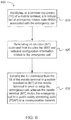
- FIG. 4 Another example provides functionality 400 of computer circuitry of a mobile terminal (T) operable to initiate an emergency call, as shown in the flow chart in FIG. 4 .
- the functionality may be implemented as a method or the functionality may be executed as instructions on a machine, where the instructions are included on at least one computer readable medium or one non-transitory machine readable storage medium.
- the circuitry can be configured to identify a minimum set of emergency related data (MSD) associated with the emergency call, as in block 410.
- the circuitry can be configured to generate an attention (AT) command that includes the MSD and selected configuration information related to the emergency call, as in block 420.
- MSD emergency related data
- AT attention
- the circuitry can be configured to send the AT command to a mobile termination (MT) of the mobile terminal in order to setup the emergency call, wherein the mobile terminal (MT) routes the emergency call to a public safety answering point (PSAP) in a communication network, as in block 430.
- MT mobile termination
- PSAP public safety answering point
- the circuitry can be further configured to generate the AT command in response to receiving a trigger from an in-vehicle system (IVS) associated with the mobile terminal.
- IVS in-vehicle system
- the circuitry can be configured to send the MSD from the mobile termination (MT) of the mobile terminal to the PSAP via a session initial protocol (SIP) invite message.
- SIP session initial protocol
- the mobile terminal is configured to initiate internet protocol multimedia subsystem (IMS) based emergency calls.
- the MSD associated with the emergency call includes a current time and a current location of the mobile terminal.
- the ⁇ type_of_eCall> indicates that the type of emergency call is at least one of: a manually initiated emergency call, an automatically initiated emergency call, or an ongoing emergency call.
- the ⁇ add_data> is a uniform resource locator (URL) to an external server that stores the additional data.
- the ⁇ add_type> indicates that the additional data is transmitted within the emergency call or via a reference to an external server that stores the additional data.
- the AT command is a +CECALLDAT command
- ID call identifier
- CS circuit switched
- IMS internet protocol multimedia subsystem
- the circuitry can be configured to receive an attention (AT) command for an emergency call from a terminal equipment (TE) of the mobile terminal, wherein the AT command includes a minimum set of emergency related data (MSD) associated with the emergency call, as in block 510.
- the circuitry can be configured to identify a public safety answering point (PSAP) based in part on the MSD included in the AT command, as in block 520.
- PSAP public safety answering point
- the circuitry can be further configured to route the emergency call to the PSAP, wherein the PSAP connects the emergency call to appropriate public safety personnel, as in block 530.
- the MSD associated with the emergency call includes a current time and a current location of the mobile terminal.
- the circuitry can be further configured to: determine that ⁇ msd_data> and ⁇ add_data> parameters are not provided in the AT command from the TE; and identify default data to be used in place of the ⁇ msd_data> and ⁇ add_data> parameters when initiating the emergency call.
- the AT command received from the TE is a +CECALL command
- the circuitry can be further configured to: determine that the +CECALL command received from the TE includes one or more parameters that are in error; and send, to the TE, an error code and a description of the error to enable the TE to resend the +CECALL command to the MT.
- the method may be executed as instructions on a machine, where the instructions are included on at least one computer readable medium or one non-transitory machine readable storage medium.
- the method can include the operation of identifying, at a terminal equipment (TE) of a mobile terminal, a minimum set of emergency related data (MSD) associated with the emergency call, as in block 610.
- the method can include the operation of generating an attention (AT) command that includes the MSD and selected configuration information related to the emergency call, as in block 620.
- TE terminal equipment
- MSD minimum set of emergency related data
- AT attention
- the method can include the operation of sending the AT command from the TE of the mobile terminal to a mobile termination (MT) of the mobile terminal in order to setup the emergency call, wherein the mobile terminal (MT) routes the emergency call to a public safety answering point (PSAP) in a communication network, as in block 630.
- MT mobile termination
- PSAP public safety answering point
- the method can further include the operation of generating the AT command in response to receiving a trigger from an in-vehicle system (IVS) associated with the mobile terminal.
- the method can further include the operation of sending the MSD associated with the emergency call from the mobile terminal to the PSAP using a session initial protocol (SIP) invite message.
- SIP session initial protocol
- FIG. 7 provides an example illustration of the wireless device, such as an user equipment (UE), a mobile station (MS), a mobile wireless device, a mobile communication device, a tablet, a handset, or other type of wireless device.
- the wireless device can include one or more antennas configured to communicate with a node, macro node, low power node (LPN), or, transmission station, such as a base station (BS), an evolved Node B (eNB), a baseband unit (BBU), a remote radio head (RRH), a remote radio equipment (RRE), a relay station (RS), a radio equipment (RE), or other type of wireless wide area network (WWAN) access point.
- BS base station
- eNB evolved Node B
- BBU baseband unit
- RRH remote radio head
- RRE remote radio equipment
- RS relay station
- RE radio equipment
- the wireless device can be configured to communicate using at least one wireless communication standard including 3GPP LTE, WiMAX, High Speed Packet Access (HSPA), Bluetooth, and WiFi.
- the wireless device can communicate using separate antennas for each wireless communication standard or shared antennas for multiple wireless communication standards.
- the wireless device can communicate in a wireless local area network (WLAN), a wireless personal area network (WPAN), and/or a WWAN.
- FIG. 7 also provides an illustration of a microphone and one or more speakers that can be used for audio input and output from the wireless device.
- the display screen may be a liquid crystal display (LCD) screen, or other type of display screen such as an organic light emitting diode (OLED) display.
- the display screen can be configured as a touch screen.
- the touch screen may use capacitive, resistive, or another type of touch screen technology.
- An application processor and a graphics processor can be coupled to internal memory to provide processing and display capabilities.
- a non-volatile memory port can also be used to provide data input/output options to a user.
- the non-volatile memory port may also be used to expand the memory capabilities of the wireless device.
- a keyboard may be integrated with the wireless device or wirelessly connected to the wireless device to provide additional user input.
- a virtual keyboard may also be provided using the touch screen.
- Various techniques, or certain aspects or portions thereof, may take the form of program code (i.e., instructions) embodied in tangible media, such as floppy diskettes, CD-ROMs, hard drives, non-transitory computer readable storage medium, or any other machine-readable storage medium wherein, when the program code is loaded into and executed by a machine, such as a computer, the machine becomes an apparatus for practicing the various techniques.
- Circuitry can include hardware, firmware, program code, executable code, computer instructions, and/or software.
- a non-transitory computer readable storage medium can be a computer readable storage medium that does not include signal.
- the computing device may include a processor, a storage medium readable by the processor (including volatile and non-volatile memory and/or storage elements), at least one input device, and at least one output device.
- the volatile and non-volatile memory and/or storage elements may be a RAM, EPROM, flash drive, optical drive, magnetic hard drive, solid state drive, or other medium for storing electronic data.
- the node and wireless device may also include a transceiver module, a counter module, a processing module, and/or a clock module or timer module.
- One or more programs that may implement or utilize the various techniques described herein may use an application programming interface (API), reusable controls, and the like.
- API application programming interface
- Such programs may be implemented in a high level procedural or object oriented programming language to communicate with a computer system.
- the program(s) may be implemented in assembly or machine language, if desired.
- the language may be a compiled or interpreted language, and combined with hardware implementations.
- modules may be implemented as a hardware circuit comprising custom VLSI circuits or gate arrays, off-the-shelf semiconductors such as logic chips, transistors, or other discrete components.
- a module may also be implemented in programmable hardware devices such as field programmable gate arrays, programmable array logic, programmable logic devices or the like.
- Modules may also be implemented in software for execution by various types of processors.
- An identified module of executable code may, for instance, comprise one or more physical or logical blocks of computer instructions, which may, for instance, be organized as an object, procedure, or function. Nevertheless, the executables of an identified module need not be physically located together, but may comprise disparate instructions stored in different locations which, when joined logically together, comprise the module and achieve the stated purpose for the module.
- a module of executable code may be a single instruction, or many instructions, and may even be distributed over several different code segments, among different programs, and across several memory devices.
- operational data may be identified and illustrated herein within modules, and may be embodied in any suitable form and organized within any suitable type of data structure. The operational data may be collected as a single data set, or may be distributed over different locations including over different storage devices, and may exist, at least partially, merely as electronic signals on a system or network.
- the modules may be passive or active, including agents operable to perform desired functions.
- the invention may be related to one or more of the following examples:
Landscapes
- Engineering & Computer Science (AREA)
- Signal Processing (AREA)
- Computer Networks & Wireless Communication (AREA)
- Multimedia (AREA)
- Business, Economics & Management (AREA)
- General Business, Economics & Management (AREA)
- Emergency Management (AREA)
- Databases & Information Systems (AREA)
- Public Health (AREA)
- Health & Medical Sciences (AREA)
- Environmental & Geological Engineering (AREA)
- Quality & Reliability (AREA)
- Computer Security & Cryptography (AREA)
- Physics & Mathematics (AREA)
- General Physics & Mathematics (AREA)
- Mobile Radio Communication Systems (AREA)
- Telephonic Communication Services (AREA)
- Telephone Function (AREA)
Applications Claiming Priority (3)
| Application Number | Priority Date | Filing Date | Title |
|---|---|---|---|
| US201361893792P | 2013-10-21 | 2013-10-21 | |
| US14/495,469 US9615234B2 (en) | 2013-10-21 | 2014-09-24 | Emergency call handling |
| EP14855363.9A EP3061275A4 (fr) | 2013-10-21 | 2014-09-25 | Traitement d'appel d'urgence |
Related Parent Applications (1)
| Application Number | Title | Priority Date | Filing Date |
|---|---|---|---|
| EP14855363.9A Division EP3061275A4 (fr) | 2013-10-21 | 2014-09-25 | Traitement d'appel d'urgence |
Publications (1)
| Publication Number | Publication Date |
|---|---|
| EP3294034A1 true EP3294034A1 (fr) | 2018-03-14 |
Family
ID=52826088
Family Applications (7)
| Application Number | Title | Priority Date | Filing Date |
|---|---|---|---|
| EP14856440.4A Active EP3061199B1 (fr) | 2013-10-21 | 2014-09-17 | Amélioration de couverture et support de planification semi-persistante dans des systèmes lte-tdd |
| EP14855350.6A Active EP3061286B1 (fr) | 2013-10-21 | 2014-09-17 | Métriques pour orientation de trafic dans un réseau sans fil |
| EP14856386.9A Active EP3061315B1 (fr) | 2013-10-21 | 2014-09-23 | Appareil, système et procédé d'interfaçage entre un gestionnaire cellulaire et un dispositif d'accès à un réseau local sans fil (wlan) |
| EP14855652.5A Active EP3061312B8 (fr) | 2013-10-21 | 2014-09-24 | Équipement utilisateur (ue) prenant en charge des appels d'urgence à commutation de paquets sur le sous-système multimédia ip (ims) |
| EP17198069.1A Withdrawn EP3294034A1 (fr) | 2013-10-21 | 2014-09-25 | Traitement d'appel d'urgence |
| EP14855229.2A Withdrawn EP3061277A4 (fr) | 2013-10-21 | 2014-09-25 | Rapport d'informations de mobilité |
| EP14855363.9A Withdrawn EP3061275A4 (fr) | 2013-10-21 | 2014-09-25 | Traitement d'appel d'urgence |
Family Applications Before (4)
| Application Number | Title | Priority Date | Filing Date |
|---|---|---|---|
| EP14856440.4A Active EP3061199B1 (fr) | 2013-10-21 | 2014-09-17 | Amélioration de couverture et support de planification semi-persistante dans des systèmes lte-tdd |
| EP14855350.6A Active EP3061286B1 (fr) | 2013-10-21 | 2014-09-17 | Métriques pour orientation de trafic dans un réseau sans fil |
| EP14856386.9A Active EP3061315B1 (fr) | 2013-10-21 | 2014-09-23 | Appareil, système et procédé d'interfaçage entre un gestionnaire cellulaire et un dispositif d'accès à un réseau local sans fil (wlan) |
| EP14855652.5A Active EP3061312B8 (fr) | 2013-10-21 | 2014-09-24 | Équipement utilisateur (ue) prenant en charge des appels d'urgence à commutation de paquets sur le sous-système multimédia ip (ims) |
Family Applications After (2)
| Application Number | Title | Priority Date | Filing Date |
|---|---|---|---|
| EP14855229.2A Withdrawn EP3061277A4 (fr) | 2013-10-21 | 2014-09-25 | Rapport d'informations de mobilité |
| EP14855363.9A Withdrawn EP3061275A4 (fr) | 2013-10-21 | 2014-09-25 | Traitement d'appel d'urgence |
Country Status (7)
| Country | Link |
|---|---|
| US (8) | US20150109997A1 (fr) |
| EP (7) | EP3061199B1 (fr) |
| JP (1) | JP2016534682A (fr) |
| KR (2) | KR20170127058A (fr) |
| CN (8) | CN105580287A (fr) |
| HK (6) | HK1224441A1 (fr) |
| WO (6) | WO2015060958A1 (fr) |
Families Citing this family (108)
| Publication number | Priority date | Publication date | Assignee | Title |
|---|---|---|---|---|
| KR101737239B1 (ko) * | 2012-08-06 | 2017-05-17 | 엘지전자 주식회사 | 무선 통신 시스템에서 이동성 정보 보고 방법 및 이를 지원하는 장치 |
| ES2703336T3 (es) * | 2012-08-06 | 2019-03-08 | Alcatel Lucent | Proporcionar información de célula para las últimas N células visitadas desde un equipo de usuario a un nodo de control de red |
| US9647818B2 (en) | 2013-01-03 | 2017-05-09 | Intel IP Corporation | Apparatus and method for single-tone device discovery in wireless communication networks |
| CN105103634B (zh) | 2013-03-29 | 2019-03-22 | 英特尔Ip公司 | 无线通信网络中的扩展型呼叫非连续接收(drx)周期 |
| US9191178B2 (en) | 2013-04-04 | 2015-11-17 | Intel IP Corporation | Enhanced node B and method for RRC connection establishment for small data transfers |
| US9160515B2 (en) | 2013-04-04 | 2015-10-13 | Intel IP Corporation | User equipment and methods for handover enhancement using scaled time-to-trigger and time-of-stay |
| US9445338B2 (en) | 2013-04-04 | 2016-09-13 | Intel IP Corporation | Reconfiguration control channel resource mapping collision avoidance |
| US10305626B2 (en) | 2013-04-05 | 2019-05-28 | Qualcomm Incorporated | Enhanced transmission time interval bundling design for machine type communications |
| US20150109997A1 (en) * | 2013-10-21 | 2015-04-23 | Alexander Sirotkin | Apparatus, system and method of interfacing between a cellular manager and a wlan access device |
| JP6110565B2 (ja) * | 2013-11-01 | 2017-04-05 | エルジー エレクトロニクス インコーポレイティド | セル訪問履歴伝送方法及びその無線装備 |
| EP2878968A1 (fr) * | 2013-11-27 | 2015-06-03 | Telefonica Digital España, S.L.U. | Procédé d'estimation de la vitesse de dispositifs d'utilisateur dans des réseaux de communication sans fil |
| WO2015096916A1 (fr) * | 2013-12-23 | 2015-07-02 | Sony Corporation | Système de communications, équipement d'infrastructure, terminal et procédé de communications |
| US9661546B2 (en) * | 2014-01-29 | 2017-05-23 | Mediatek Inc. | Dynamic offload selection in mobile communication systems |
| US9986556B1 (en) * | 2014-04-29 | 2018-05-29 | Sprint Spectrum L.P. | Enhanced TTI bundling in TDD mode |
| US10701729B2 (en) * | 2014-06-03 | 2020-06-30 | Qualcomm Incorporated | Protected CET transmission and reception |
| GB2539363A (en) | 2014-06-12 | 2016-12-21 | Nec Corp | Communication system |
| WO2015198106A1 (fr) | 2014-06-25 | 2015-12-30 | Telefonaktiebolaget L M Ericsson (Publ) | Systèmes et procédés pour permettant la coexistence de services mbms et voip |
| JP6630719B2 (ja) * | 2014-07-23 | 2020-01-15 | クアルコム,インコーポレイテッド | 車両開始型緊急呼 |
| US9521612B2 (en) * | 2014-07-23 | 2016-12-13 | Qualcomm Incorporated | Notifying availability of internet protocol multimedia subsystem services |
| US9596687B1 (en) * | 2014-07-24 | 2017-03-14 | Sprint Communications Company L.P. | Aperiodic antenna calibration triggering method |
| US9420450B2 (en) * | 2014-08-27 | 2016-08-16 | Motorola Solutions, Inc. | Methods and systems for talkgroup-state-dependent routing of group data |
| US10440765B2 (en) | 2014-09-24 | 2019-10-08 | Apple Inc. | Multi-RAT radio resource aggregation with split bearer support |
| US10104705B2 (en) | 2014-11-05 | 2018-10-16 | Intel IP Corporation | Apparatus, system and method of communicating between a cellular manager and a user equipment (UE) via a WLAN access device |
| EP3223546B1 (fr) * | 2014-11-21 | 2020-02-12 | Huawei Technologies Co., Ltd. | Procédé et dispositif pour l'exécution d'un appel d'urgence |
| JP2016146542A (ja) * | 2015-02-06 | 2016-08-12 | 株式会社Kddi研究所 | 制御装置、通信装置、制御方法及びプログラム |
| EP3268943B1 (fr) | 2015-03-12 | 2021-06-02 | Alarm.com Incorporated | Fourniture d'un accès à internet par l'intermédiaire d'un système de surveillance de propriété |
| US10075970B2 (en) | 2015-03-15 | 2018-09-11 | Qualcomm Incorporated | Mission critical data support in self-contained time division duplex (TDD) subframe structure |
| US10342012B2 (en) | 2015-03-15 | 2019-07-02 | Qualcomm Incorporated | Self-contained time division duplex (TDD) subframe structure |
| US9936519B2 (en) | 2015-03-15 | 2018-04-03 | Qualcomm Incorporated | Self-contained time division duplex (TDD) subframe structure for wireless communications |
| US10326615B2 (en) * | 2015-04-10 | 2019-06-18 | Avago Technologies International Sales Pte. Limited | Cellular-wireless local area network (WLAN) interworking |
| US10462834B2 (en) * | 2015-05-15 | 2019-10-29 | Qualcomm Incorporated | Offloading through simplified multiflow |
| US9814058B2 (en) | 2015-05-15 | 2017-11-07 | Qualcomm Incorporated | Scaled symbols for a self-contained time division duplex (TDD) subframe structure |
| US9584976B2 (en) * | 2015-06-24 | 2017-02-28 | The Florida International University Board Of Trustees | Specific velocity estimation of wireless network devices |
| US9992790B2 (en) | 2015-07-20 | 2018-06-05 | Qualcomm Incorporated | Time division duplex (TDD) subframe structure supporting single and multiple interlace modes |
| EP3326408B1 (fr) * | 2015-07-22 | 2020-04-01 | Intel IP Corporation | Couche de convergence pour systèmes de communication 5g |
| US9999039B2 (en) * | 2015-07-23 | 2018-06-12 | Qualcomm Incorporated | Semi-persistent scheduling for enhanced machine type communications |
| US10244024B2 (en) * | 2015-07-29 | 2019-03-26 | General Motors Llc | Direct air interface control of telematics unit network access device by operations control center |
| EP3329720B1 (fr) * | 2015-07-30 | 2020-07-15 | Sony Corporation | Hotspot mobile |
| DE102015215294A1 (de) | 2015-08-11 | 2017-02-16 | Bayerische Motoren Werke Aktiengesellschaft | Bereitstellen von Hilfsmitteln nach einem Fahrzeugunfall |
| CN105188078A (zh) * | 2015-08-13 | 2015-12-23 | 深圳市广和通无线股份有限公司 | Ecall测试方法和系统 |
| WO2017028818A1 (fr) * | 2015-08-19 | 2017-02-23 | 华为技术有限公司 | Procédé, dispositif, et système de transmission de données |
| JP6844855B2 (ja) * | 2015-09-02 | 2021-03-17 | 株式会社Nttドコモ | 端末、無線通信方法及び基地局 |
| CN107113813A (zh) * | 2015-10-29 | 2017-08-29 | 华为技术有限公司 | 调度方法、装置及系统 |
| US10547730B2 (en) * | 2015-11-11 | 2020-01-28 | Ford Global Technologies, Llc | Method and apparatus for vehicular emergency call |
| US10499229B2 (en) * | 2016-01-24 | 2019-12-03 | Qualcomm Incorporated | Enhanced fallback to in-band mode for emergency calling |
| US10212571B2 (en) * | 2016-02-25 | 2019-02-19 | Electronics And Telecommunications Research Institute | Vehicle emergency notification apparatus and method using external terminal |
| KR102126239B1 (ko) * | 2016-02-25 | 2020-06-25 | 한국전자통신연구원 | 외장 단말을 이용하여 자동차의 긴급 상황을 통보하는 장치 및 방법 |
| US10778569B2 (en) * | 2016-03-03 | 2020-09-15 | Comcast Cable Communications, Llc | Methods and systems for providing alternate content |
| US9998970B2 (en) * | 2016-04-28 | 2018-06-12 | Samsung Electronics Co., Ltd. | Fast VoWiFi handoff using IKE v2 optimization |
| WO2017196400A1 (fr) * | 2016-05-12 | 2017-11-16 | Intel IP Corporation | Systèmes, procédés et dispositifs de retransmission non adaptative utilisant des ressources de programmation semi-persistantes |
| EP3459199B1 (fr) * | 2016-05-20 | 2021-06-30 | Nokia Technologies Oy | Gestion de cryptage dans l'agrégation de porteuses |
| US10517021B2 (en) | 2016-06-30 | 2019-12-24 | Evolve Cellular Inc. | Long term evolution-primary WiFi (LTE-PW) |
| CN109565794B (zh) * | 2016-07-06 | 2023-08-04 | 瑞典爱立信有限公司 | 用于调度多个tti束传送的方法和网络节点 |
| US10819475B2 (en) * | 2016-08-12 | 2020-10-27 | Qualcomm Incorporated | Uplink semi-persistent scheduling for low latency communications |
| US10306449B2 (en) | 2016-08-26 | 2019-05-28 | Intrinsic Value, Llc | Systems, devices, and methods for emergency responses and safety |
| US10506413B2 (en) | 2017-08-28 | 2019-12-10 | Intrinsic Value, Llc | Systems, devices, and methods for emergency responses and safety |
| US11259165B2 (en) | 2016-08-26 | 2022-02-22 | Intrinsic Value, Llc | Systems, devices, and methods for emergency responses and safety |
| US11368851B2 (en) | 2016-08-29 | 2022-06-21 | Arris Enterprises Llc | Transmitting traffic in a shared frequency bandwidth |
| CN107872858A (zh) * | 2016-09-27 | 2018-04-03 | 中兴通讯股份有限公司 | 一种网络切换方法和装置 |
| US11071127B2 (en) * | 2016-11-04 | 2021-07-20 | Telefonaktiebolaget Lm Ericsson (Publ) | Semi-persistent transmission scheduling |
| US10484144B2 (en) * | 2016-11-11 | 2019-11-19 | Qualcomm Incorporated | Hybrid automatic repeat request management for low latency communications |
| CN108243469B (zh) * | 2016-12-23 | 2021-07-16 | 夏普株式会社 | 用户移动性方法和设备 |
| US10152875B2 (en) * | 2017-01-10 | 2018-12-11 | GM Global Technology Operations LLC | Systems and methods to detect unexpected electric bicycle events |
| CN108684216A (zh) * | 2017-03-03 | 2018-10-19 | 华为技术有限公司 | 一种车载紧急呼叫的方法及设备 |
| US10257839B2 (en) * | 2017-03-20 | 2019-04-09 | At&T Intellectual Property I, L.P. | Facilitating communication of radio resource quality to a mobile application |
| RS59582B1 (sr) * | 2017-03-22 | 2019-12-31 | Deutsche Telekom Ag | Postupak za unapređeno rukovanje hitnim pozivom sa komutacijom paketa unutar telekomunikacione mreže i/ili za poboljšano rukovanje informacijama o lokalnoj službi za hitne slučajeve pomoću korisničke opreme, sistema, korisničke opreme i programa |
| CN108811114B (zh) * | 2017-05-05 | 2020-12-01 | 中兴通讯股份有限公司 | 一种半持续调度的混合自动重传请求的传输方法及装置 |
| US10492206B2 (en) * | 2017-06-02 | 2019-11-26 | Apple Inc. | Coexistence of collocated radios |
| US11166216B2 (en) * | 2017-07-21 | 2021-11-02 | Cisco Technology, Inc. | Traffic steering in a heterogeneous network |
| US10595238B2 (en) * | 2017-07-25 | 2020-03-17 | Qualcomm Incorporated | Systems and methods to improve mobility for a mobile device in ecall-only mode |
| US10813143B2 (en) | 2017-11-09 | 2020-10-20 | Ford Global Technologies, Inc. | Multiple event-based vehicle communications |
| US10708835B2 (en) | 2017-12-26 | 2020-07-07 | At&T Intellecutual Property I, L.P. | Control of wireless fidelity access for 5G or other next generation network |
| DE102019101853B4 (de) * | 2018-01-31 | 2026-03-26 | Nvidia Corporation | Dynamische Partitionierung von Ausführungsressourcen |
| JP6908551B2 (ja) * | 2018-03-29 | 2021-07-28 | Kddi株式会社 | 移動通信ネットワークの制御装置、基地局装置、およびユーザ装置 |
| DE102019107023A1 (de) * | 2018-04-10 | 2019-10-10 | Reliance Jio Infocomm Limited | System und verfahren zu m kategorisieren und routen von mit benutzereinrichtungen assoziiertem netzverkehr |
| CN110418294A (zh) * | 2018-04-27 | 2019-11-05 | 国基电子(上海)有限公司 | 通信方法、车载装置及计算机可读存储介质 |
| WO2019222901A1 (fr) * | 2018-05-22 | 2019-11-28 | Nokia Shanghai Bell Co., Ltd. | Procédé, appareil et supports lisibles par ordinateur permettant d'appliquer une règle relative au routage de trafic |
| WO2019232746A1 (fr) * | 2018-06-07 | 2019-12-12 | Huawei Technologies Co., Ltd. | Procédé de mobilité basé sur une prédiction et une pré-préparation |
| CN110689641A (zh) * | 2018-07-06 | 2020-01-14 | 上海博泰悦臻网络技术服务有限公司 | 事故后续服务触发方法、系统、可读存储介质及车载终端 |
| WO2020046383A1 (fr) * | 2018-08-31 | 2020-03-05 | Cisco Technology, Inc. | Gestion de mobilité et d'itinérance sans ancrage et multi-rat |
| US10588089B1 (en) * | 2018-09-21 | 2020-03-10 | Qualcomm Incorporated | Mitigation of calibration errors |
| US10673708B2 (en) * | 2018-10-12 | 2020-06-02 | International Business Machines Corporation | Auto tuner for cloud micro services embeddings |
| KR102722912B1 (ko) * | 2018-10-18 | 2024-10-29 | 삼성전자주식회사 | 통신 상태에 기반한 상향링크 선택 장치 및 방법 |
| CN110099409B (zh) * | 2019-04-18 | 2020-12-08 | 烽火通信科技股份有限公司 | 一种Mesh组网AP控制客户端接入的方法及系统 |
| US11405127B2 (en) * | 2019-04-25 | 2022-08-02 | Microchip Technology Incorporated | Changing a master node in a wired local area network and related systems, methods, and devices |
| CN110262894B (zh) * | 2019-05-17 | 2023-09-01 | 平安科技(深圳)有限公司 | 负载均衡应用管理方法、装置、计算机设备及存储介质 |
| US10834731B1 (en) * | 2019-07-11 | 2020-11-10 | The Boeing Company | Crowd sourced resource management system |
| JP7427769B2 (ja) * | 2019-08-15 | 2024-02-05 | クゥアルコム・インコーポレイテッド | ユーザ機器(ue)モビリティ履歴情報管理 |
| US11095488B2 (en) * | 2019-08-19 | 2021-08-17 | Cisco Technology, Inc. | Optimized performance with mixed media access protocols |
| US12389277B2 (en) * | 2020-01-17 | 2025-08-12 | Esw Technologies Fz-Llc | Offloading a user device into a wireless network using an ANDSF application |
| US11743710B2 (en) * | 2020-03-26 | 2023-08-29 | Qualcomm Incorporated | Mobility history reporting in new radio |
| CN113541881B (zh) * | 2020-04-20 | 2022-05-24 | 大唐移动通信设备有限公司 | 混合自动重传应答消息传输资源的确定方法、装置及设备 |
| US11259190B2 (en) | 2020-05-12 | 2022-02-22 | T-Mobile Usa, Inc. | Direct communication channel bandwidth reliability in a V2X communication |
| US11223959B2 (en) | 2020-05-12 | 2022-01-11 | T-Mobile Usa, Inc. | Unlicensed assisted access aggregated band for improving direct communication channel bandwidth reliability in a V2X communication |
| US11228883B2 (en) * | 2020-06-02 | 2022-01-18 | T-Mobile Usa, Inc. | Vehicle-to-everything (V2X) communication assisted medical devices |
| EP4195726A4 (fr) * | 2020-08-04 | 2024-04-17 | Beijing Xiaomi Mobile Software Co., Ltd. | Procédé et appareil de transmission d'informations, dispositif de communication et support d'enregistrement |
| CN112055350B (zh) * | 2020-08-11 | 2022-06-03 | 博泰车联网科技(上海)股份有限公司 | 一种紧急求援方法及装置 |
| CN114554456B (zh) * | 2020-11-26 | 2025-03-07 | 华为技术有限公司 | 一种数据传输方法及装置 |
| CN114980059B (zh) * | 2021-02-26 | 2026-04-03 | 深圳引望智能技术有限公司 | 多设备联合呼叫方法和装置 |
| CN113141674A (zh) * | 2021-04-08 | 2021-07-20 | 成都极米科技股份有限公司 | 多链路系统中链路配置方法、设备、系统及存储介质 |
| US11509408B1 (en) * | 2021-07-30 | 2022-11-22 | Inntot Technologies Private Limited | System and method for large data transmission in digital radio broadcasting |
| EP4344482A4 (fr) * | 2021-08-05 | 2024-07-17 | ZTE Corporation | Procédés et système pour une session d'unité de données de protocole d'accès multiples |
| CN113747413B (zh) * | 2021-11-04 | 2022-02-22 | 北京百瑞互联技术有限公司 | 多网络多模车载紧急呼叫方法、系统及介质 |
| US11937165B1 (en) | 2022-09-27 | 2024-03-19 | Stackshare Technologies LLC | Systems and methods of selectively routing a packet flow |
| US12408082B2 (en) | 2022-09-30 | 2025-09-02 | T-Mobile Usa, Inc. | Reducing network traffic associated with a throughput intensive communication over a wireless telecommunication network |
| JP2024157381A (ja) * | 2023-04-25 | 2024-11-07 | ソニーグループ株式会社 | 端末装置、基地局、及び通信方法 |
| US20250227568A1 (en) * | 2024-01-09 | 2025-07-10 | Qualcomm Incorporated | Virtual user equipment radio resource management |
| WO2025154282A1 (fr) * | 2024-01-19 | 2025-07-24 | 株式会社Nttドコモ | Station de base |
Citations (1)
| Publication number | Priority date | Publication date | Assignee | Title |
|---|---|---|---|---|
| US20120108198A1 (en) * | 2008-04-02 | 2012-05-03 | Qualcomm Incorporated | Method and Apparatus for Supporting Emergency Calls (eCalls) |
Family Cites Families (91)
| Publication number | Priority date | Publication date | Assignee | Title |
|---|---|---|---|---|
| US4914650A (en) * | 1988-12-06 | 1990-04-03 | American Telephone And Telegraph Company | Bandwidth allocation and congestion control scheme for an integrated voice and data network |
| US20020064164A1 (en) * | 2000-10-06 | 2002-05-30 | Barany Peter A. | Protocol header construction and/or removal for messages in wireless communications |
| US20030139180A1 (en) * | 2002-01-24 | 2003-07-24 | Mcintosh Chris P. | Private cellular network with a public network interface and a wireless local area network extension |
| WO2003105007A1 (fr) * | 2002-06-06 | 2003-12-18 | Thomson Licensing S.A. | Fonction d'interfonctionnement (iwf), en tant que dispositif de commande de reseau radio logique (rnc) pour un couplage hybride dans un interfonctionnement entre un reseau local sans fil (wlan) et un reseau de communication mobile |
| US7260392B2 (en) * | 2002-09-25 | 2007-08-21 | Intel Corporation | Seamless teardown of direct link communication in a wireless LAN |
| US20040196868A1 (en) * | 2003-04-04 | 2004-10-07 | King Neal J. | Method and system for prioritizing a telephone call |
| US8265587B2 (en) * | 2004-06-17 | 2012-09-11 | West Corporation | System and method for amending instructions for emergency auxiliary services following an emergency services request |
| US7580706B2 (en) * | 2004-09-02 | 2009-08-25 | Motorola, Inc. | Methods for enhanced communication between a plurality of communication systems |
| EP1694088A1 (fr) * | 2005-02-22 | 2006-08-23 | Alcatel | Procédé pour la gestion d'admission pour réseaux mobiles, contrôleur d'admission et système de communication comprenant celui-ci |
| US20060209882A1 (en) * | 2005-02-28 | 2006-09-21 | Seung-Jae Han | Method for vertical handoff in a hierarchical network |
| FR2896940B1 (fr) * | 2006-02-02 | 2008-04-04 | Alcatel Sa | Dispositif de radiocommunication a moyens d'acces conformes aux technologies gan et 3spp-wlan interworking, et controleur de reseau d'acces correspondant |
| US9100802B2 (en) * | 2006-03-17 | 2015-08-04 | Blackberry Limited | Method and apparatus to concurrently notify emergency contacts during an emergency voice call based on network capability |
| IL176288A0 (en) | 2006-06-13 | 2007-07-04 | Imagine Comm Ltd | Synchronous transmission over packet based network |
| US20080004024A1 (en) * | 2006-06-28 | 2008-01-03 | Beceem Communications, Inc. | Managing subscriber connections between at least two types of wireless networks |
| US8095175B2 (en) * | 2006-10-26 | 2012-01-10 | Mcmaster University | WLAN-to-WWAN handover methods and apparatus using a WLAN support node having a WWAN interface |
| CN101312550B (zh) * | 2007-05-22 | 2016-05-25 | 株式会社Ntt都科摩 | 在混合网络中实现载荷均衡的方法和装置 |
| US8130742B2 (en) * | 2007-06-15 | 2012-03-06 | Microsoft Corporation | Communication protocol for a wireless device and a game console |
| CN101365230B (zh) * | 2007-08-07 | 2010-08-11 | 华为技术有限公司 | 异构网络切换/改变时的用户分离方法、系统及装置 |
| US8711767B2 (en) * | 2007-10-09 | 2014-04-29 | Qualcomm Incorporated | Distributed mobile access point acquisition |
| EP2248377A1 (fr) * | 2008-01-28 | 2010-11-10 | Telefonaktiebolaget LM Ericsson (publ) | Procédé et appareil à utiliser dans un réseau de communications |
| US8351973B2 (en) * | 2008-06-13 | 2013-01-08 | Telefonaktiebolaget L M Ericsson (Publ) | Short message service (SMS) over service access point identifier 0 (SAPI-0) |
| US20100029275A1 (en) * | 2008-07-31 | 2010-02-04 | Peter Bosch | Migration of TCP connections with layer 2 support in wireless environments |
| CN101656941B (zh) * | 2008-08-20 | 2012-11-07 | 华为技术有限公司 | 更新邻区信息的方法、装置以及基站 |
| CN101677282A (zh) * | 2008-09-18 | 2010-03-24 | 中兴通讯股份有限公司 | 无线资源调度的配置方法以及基站 |
| CN101677467A (zh) * | 2008-09-19 | 2010-03-24 | 诺基亚公司 | 用于具有tti绑定的半静态调度的多周期模式 |
| US8271025B2 (en) | 2008-10-20 | 2012-09-18 | At&T Mobility Ii Llc | Device network technology selection and display in multi-technology wireless environments |
| US20100105394A1 (en) * | 2008-10-29 | 2010-04-29 | Qualcomm Incorporated | Methods and systems for selective data communications for multi-mode devices |
| US8787331B2 (en) * | 2008-11-21 | 2014-07-22 | At&T Intellectual Property I, L.P. | Femtocell local breakout mechanisms |
| CN101754268B (zh) * | 2008-12-04 | 2012-08-15 | 中国移动通信集团公司 | 用户上行数据调度方法及用户设备 |
| ES2969950T3 (es) * | 2008-12-15 | 2024-05-23 | Malikie Innovations Ltd | Programación semipersistente y alineación de recepción discontinua |
| US9107133B2 (en) * | 2009-01-06 | 2015-08-11 | Qualcomm Incorporated | Adaptation of handover parameters |
| US9204349B2 (en) * | 2009-02-10 | 2015-12-01 | Qualcomm Incorporated | Method and apparatus for facilitating a hand-in of user equipment to femto cells |
| US8265022B2 (en) * | 2009-02-10 | 2012-09-11 | Apple Inc. | Apparatus and methods for transmission of emergency call data over wireless networks |
| CN101854639A (zh) * | 2009-03-31 | 2010-10-06 | 中兴通讯股份有限公司 | 资源调度方法及用户设备 |
| US8867486B2 (en) * | 2009-04-17 | 2014-10-21 | Qualcomm Incorporated | Wireless data communications employing IP flow mobility |
| EP2425551B1 (fr) * | 2009-04-28 | 2019-08-14 | Samsung Electronics Co., Ltd. | Procédé et appareil de gestion d'informations d'historique d'équipement d'utilisateur dans un réseau de communication sans fil |
| US8594723B2 (en) * | 2009-05-26 | 2013-11-26 | Intel Corporation | Techniques for interworking between heterogeneous radios |
| GB2472791A (en) * | 2009-08-17 | 2011-02-23 | Nec Corp | A base station operable to maintain cell history data for a mobile communications device |
| WO2011047708A1 (fr) * | 2009-10-19 | 2011-04-28 | Nokia Siemens Networks Oy | Production et transmission d'un message d'urgence |
| CN102083151A (zh) * | 2009-11-27 | 2011-06-01 | 华为终端有限公司 | 重定向的处理方法、装置和通信系统 |
| CN101730279B (zh) * | 2009-12-18 | 2012-06-06 | 哈尔滨工业大学 | 基于ap转发机制的无线局域网与3g蜂窝网络协同工作方法 |
| US8780826B2 (en) * | 2010-01-12 | 2014-07-15 | Qualcomm Incorporated | Continuous CDM/FDM structure for LTE uplink data |
| US20110188416A1 (en) * | 2010-02-02 | 2011-08-04 | Stefano Faccin | System and method for packetized emergency messages |
| US8996649B2 (en) * | 2010-02-05 | 2015-03-31 | Qualcomm Incorporated | Utilizing policies for offload and flow mobility in wireless communications |
| US20110222523A1 (en) * | 2010-03-12 | 2011-09-15 | Mediatek Inc | Method of multi-radio interworking in heterogeneous wireless communication networks |
| US9131495B2 (en) * | 2010-03-30 | 2015-09-08 | Nokia Solutions And Networks Oy | Enhanced admission control in relay-enhanced access networks |
| US8417212B2 (en) * | 2010-05-18 | 2013-04-09 | General Motors Llc | Methods for providing emergency services to a mobile vehicle |
| WO2012059954A1 (fr) * | 2010-11-02 | 2012-05-10 | 富士通株式会社 | Procédé de spécification de cellule, station de base et station mobile |
| CN103370970B (zh) * | 2010-11-03 | 2016-11-09 | 三星电子株式会社 | 具有载波聚合的下行链路的tdd系统中的harq-ack信息生成及harq-ack信号功率控制 |
| CN102055576A (zh) * | 2010-12-29 | 2011-05-11 | 大唐移动通信设备有限公司 | 一种确定harq模式的方法及装置 |
| BR112013022758A2 (pt) * | 2011-03-07 | 2016-12-06 | Intel Corp | método implementado por computador, dispositivo de máquina para máquina, sistema de computador e sistema de máquina para máquina |
| KR102032846B1 (ko) * | 2011-03-24 | 2019-10-16 | 엘지전자 주식회사 | 신호 송수신 방법 및 이를 위한 장치 |
| US8705363B2 (en) * | 2011-04-05 | 2014-04-22 | Telefonaktiebolaget L M Ericsson (Publ) | Packet scheduling method and apparatus |
| US8849237B2 (en) * | 2011-05-11 | 2014-09-30 | Qualcomm Incorporated | Priority registration for in-vehicle emergency call service |
| EP2709299B1 (fr) * | 2011-05-12 | 2016-04-13 | LG Electronics Inc. | Procédé et dispositif pour la transmission de données de contrôle |
| WO2012155236A1 (fr) * | 2011-05-16 | 2012-11-22 | Research In Motion Limited | Canal de données à accès direct de liaison montante utilisant la technique harq |
| JP5574046B2 (ja) * | 2011-05-30 | 2014-08-20 | 富士通株式会社 | 無線通信システム、基地局、ゲートウェイ、及び無線通信方法 |
| US20120311173A1 (en) * | 2011-05-31 | 2012-12-06 | Broadcom Corporation | Dynamic Wireless Channel Selection And Protocol Control For Streaming Media |
| US9749932B2 (en) | 2011-07-07 | 2017-08-29 | Google Technology Holdings LLC | Wireless communication device, wireless communication system, and related methods |
| KR20130012479A (ko) * | 2011-07-25 | 2013-02-04 | 삼성전자주식회사 | 셀룰러 통신 시스템에서의 부하 분산 방법 및 그 장치 |
| US8923816B2 (en) * | 2011-07-28 | 2014-12-30 | Samsung Electronics Co., Ltd. | Apparatus and method for providing seamless service between a cellular network and wireless local area network for a mobile user |
| US8509780B2 (en) * | 2011-08-15 | 2013-08-13 | Alcatel Lucent | Method and apparatus for determining handover parameters in wireless overlay networks |
| US8553580B2 (en) | 2011-09-30 | 2013-10-08 | Intel Corporation | Multi-radio medium-agnostic access architecture |
| JP5944004B2 (ja) | 2011-10-03 | 2016-07-05 | インテル・コーポレーション | デバイスツーデバイス通信(d2d通信)メカニズム |
| WO2013052805A1 (fr) * | 2011-10-07 | 2013-04-11 | Interdigital Patent Holdings Inc. | Procédé et appareil d'intégration de différentes technologies d'accès radio utilisant une agrégation de porteuses |
| WO2013085310A1 (fr) | 2011-12-06 | 2013-06-13 | Samsung Electronics Co., Ltd. | Appareil et procédé de distribution efficace de service de message court dans système de communication sans fil |
| US9559866B2 (en) * | 2011-12-21 | 2017-01-31 | Cisco Technology, Inc. | Systems and methods for load balancing in cellular networks and wireless local area networks |
| WO2013091228A1 (fr) * | 2011-12-23 | 2013-06-27 | 华为技术有限公司 | Procédé, dispositif et système de transmission d'ensemble minimal de données dans une situation d'appel d'urgence |
| TWI466581B (zh) * | 2012-01-05 | 2014-12-21 | Ind Tech Res Inst | 處理通訊裝置及傳輸點間之時間偏移量的方法及其通訊裝置 |
| WO2013110351A1 (fr) * | 2012-01-26 | 2013-08-01 | Telefonaktiebolaget L M Ericsson (Publ) | Fonctionnement d'un nœud de desserte dans un réseau |
| US20140376515A1 (en) * | 2012-02-17 | 2014-12-25 | Nokia Corporation | Methods, apparatuses and computer program products for wlan discovery and handover in coexisted lte and wlan networks |
| US20130229931A1 (en) * | 2012-03-02 | 2013-09-05 | Electronics And Telecommunications Research Institute | Methods of managing terminal performed in base station and terminal |
| TWI620431B (zh) * | 2012-03-16 | 2018-04-01 | 內數位專利控股公司 | 以fdd模式操作的網路中支援hd-fdd操作的方法及裝置 |
| US9706423B2 (en) * | 2012-03-16 | 2017-07-11 | Qualcomm Incorporated | System and method of offloading traffic to a wireless local area network |
| US9295056B2 (en) * | 2012-03-23 | 2016-03-22 | Qualcomm Incorporated | Systems and methods for signaling and determining transmission time interval bundling parameters |
| US20140003354A1 (en) * | 2012-06-29 | 2014-01-02 | Ozgur Ekici | Providing a system information message having retry parameter values |
| US9197376B2 (en) * | 2012-08-03 | 2015-11-24 | Broadcom Corporation | Transmission time interval (TTI) bundling operation within communication systems |
| KR101737239B1 (ko) * | 2012-08-06 | 2017-05-17 | 엘지전자 주식회사 | 무선 통신 시스템에서 이동성 정보 보고 방법 및 이를 지원하는 장치 |
| US20140098782A1 (en) * | 2012-10-05 | 2014-04-10 | Sierra Wireless. Inc. | Enhancement for lte communication systems |
| US9900832B2 (en) * | 2012-11-07 | 2018-02-20 | Lg Electronics Inc. | Method and an apparatus for access network selection in a wireless communication system |
| CN104885518B (zh) * | 2012-12-24 | 2019-03-12 | 诺基亚技术有限公司 | 在无线电局域网中用于区分安全配置的方法和装置 |
| US9313697B2 (en) * | 2013-01-18 | 2016-04-12 | Futurewei Technologies, Inc. | Optimized offloading to WLAN in 3GPP-RAT mobility |
| US20140233384A1 (en) * | 2013-02-15 | 2014-08-21 | General Dynamics Broadband Inc. | Method and Apparatus for Receiving Information From a Communications Network |
| US9973980B2 (en) * | 2013-03-06 | 2018-05-15 | Qualcomm Incorporated | Communications methods and apparatus that facilitate handover decisions and related measurements |
| US9374770B2 (en) * | 2013-03-14 | 2016-06-21 | Qualcomm Incorporated | Communications methods and apparatus that facilitate discovery of small coverage area base stations |
| US10560887B2 (en) * | 2013-05-06 | 2020-02-11 | Qualcomm Incorporated | Routing modification based on handover detection |
| US9622134B2 (en) * | 2013-05-06 | 2017-04-11 | Qualcomm Incorporated | Coordinating handover events across RATs |
| WO2014209194A1 (fr) * | 2013-06-28 | 2014-12-31 | Telefonaktiebolaget L M Ericsson (Publ) | Procédés et nœuds de réseau pour mobilité améliorée entre réseaux mobiles de communication |
| WO2015042893A1 (fr) * | 2013-09-27 | 2015-04-02 | 华为技术有限公司 | Procédé, équipement utilisateur et station de base permettant de transmettre des données de liaison montante |
| US20150109997A1 (en) | 2013-10-21 | 2015-04-23 | Alexander Sirotkin | Apparatus, system and method of interfacing between a cellular manager and a wlan access device |
| US20150264548A1 (en) * | 2014-03-11 | 2015-09-17 | Via Telecom, Inc. | Ecall system and method |
-
2014
- 2014-06-26 US US14/315,551 patent/US20150109997A1/en not_active Abandoned
- 2014-07-24 US US14/339,710 patent/US9479915B2/en active Active
- 2014-07-25 US US14/340,936 patent/US9635530B2/en active Active
- 2014-07-25 US US14/340,639 patent/US20150109972A1/en not_active Abandoned
- 2014-09-17 EP EP14856440.4A patent/EP3061199B1/fr active Active
- 2014-09-17 WO PCT/US2014/056113 patent/WO2015060958A1/fr not_active Ceased
- 2014-09-17 CN CN201480050648.8A patent/CN105580287A/zh active Pending
- 2014-09-17 HK HK16112387.8A patent/HK1224441A1/zh unknown
- 2014-09-17 WO PCT/US2014/056115 patent/WO2015060959A1/fr not_active Ceased
- 2014-09-17 EP EP14855350.6A patent/EP3061286B1/fr active Active
- 2014-09-17 CN CN201480051864.4A patent/CN105557015B/zh active Active
- 2014-09-17 HK HK16111506.6A patent/HK1223479A1/zh unknown
- 2014-09-23 CN CN201910788545.6A patent/CN110460539A/zh active Pending
- 2014-09-23 US US14/494,161 patent/US20150111581A1/en not_active Abandoned
- 2014-09-23 WO PCT/US2014/056894 patent/WO2015060971A1/fr not_active Ceased
- 2014-09-23 EP EP14856386.9A patent/EP3061315B1/fr active Active
- 2014-09-23 HK HK16111507.5A patent/HK1223480A1/zh unknown
- 2014-09-23 CN CN201480051861.0A patent/CN105557064A/zh active Pending
- 2014-09-24 WO PCT/US2014/057212 patent/WO2015060977A1/fr not_active Ceased
- 2014-09-24 US US14/495,469 patent/US9615234B2/en active Active
- 2014-09-24 EP EP14855652.5A patent/EP3061312B8/fr active Active
- 2014-09-24 HK HK16112599.2A patent/HK1224489A1/zh unknown
- 2014-09-24 CN CN201480051882.2A patent/CN105637972A/zh active Pending
- 2014-09-25 EP EP17198069.1A patent/EP3294034A1/fr not_active Withdrawn
- 2014-09-25 EP EP14855229.2A patent/EP3061277A4/fr not_active Withdrawn
- 2014-09-25 KR KR1020177032441A patent/KR20170127058A/ko not_active Abandoned
- 2014-09-25 WO PCT/US2014/057486 patent/WO2015060987A1/fr not_active Ceased
- 2014-09-25 JP JP2016544361A patent/JP2016534682A/ja active Pending
- 2014-09-25 EP EP14855363.9A patent/EP3061275A4/fr not_active Withdrawn
- 2014-09-25 CN CN201480050610.0A patent/CN105532025B/zh not_active Expired - Fee Related
- 2014-09-25 CN CN201711376902.5A patent/CN108462937B/zh not_active Expired - Fee Related
- 2014-09-25 CN CN201480051684.6A patent/CN105580403B/zh active Active
- 2014-09-25 WO PCT/US2014/057448 patent/WO2015060986A1/fr not_active Ceased
- 2014-09-25 HK HK16111233.6A patent/HK1223221A1/zh unknown
- 2014-09-25 KR KR1020167007342A patent/KR101802680B1/ko active Active
-
2016
- 2016-09-21 US US15/272,383 patent/US10104239B2/en active Active
-
2017
- 2017-04-03 US US15/477,725 patent/US10178236B2/en active Active
-
2019
- 2019-01-15 HK HK19100644.9A patent/HK1258280A1/zh unknown
Patent Citations (1)
| Publication number | Priority date | Publication date | Assignee | Title |
|---|---|---|---|---|
| US20120108198A1 (en) * | 2008-04-02 | 2012-05-03 | Qualcomm Incorporated | Method and Apparatus for Supporting Emergency Calls (eCalls) |
Non-Patent Citations (3)
| Title |
|---|
| "3rd Generation Partnership Project; Technical Specification Group Services and System Aspects; Service aspects; Service principles (Release 10)", 3GPP STANDARD; 3GPP TS 22.101, 3RD GENERATION PARTNERSHIP PROJECT (3GPP), MOBILE COMPETENCE CENTRE ; 650, ROUTE DES LUCIOLES ; F-06921 SOPHIA-ANTIPOLIS CEDEX ; FRANCE, no. V10.5.0, 23 December 2010 (2010-12-23), pages 1 - 60, XP050462372 * |
| "Human Factors (HF); AT Commands for Assistive Mobile Device Interfaces;Draft ETSI TS 102 511", ETSI DRAFT; DRAFT ETSI TS 102 511, EUROPEAN TELECOMMUNICATIONS STANDARDS INSTITUTE (ETSI), 650, ROUTE DES LUCIOLES ; F-06921 SOPHIA-ANTIPOLIS ; FRANCE, vol. HF, no. V0.0.2, 15 March 2007 (2007-03-15), pages 1 - 24, XP014188306 * |
| GSM_ECALL_APPLICATION_NOTE_V1 QUECTELL: "GSM Quectel Cellular Engine GSM eCall Application Note 1.1", 1 January 2012 (2012-01-01), XP055334266, Retrieved from the Internet <URL:http://www.quectel.com/UploadImage/Downlad/GSM_eCall_Application_Note_V1.1.pdf> [retrieved on 20170111] * |
Also Published As
Similar Documents
| Publication | Publication Date | Title |
|---|---|---|
| US10178236B2 (en) | Emergency call handling | |
| US11064562B2 (en) | Emergency notification SMS messaging during E911 call | |
| US10708412B1 (en) | Transferring computer aided dispatch incident data between public safety answering point stations | |
| EP2301268B1 (fr) | Service de message court (sms) sur identificateur de point d'accès au service 0 (sapi-0) | |
| EP3349526B1 (fr) | Procédés et dispositifs pour renvoyer un message | |
| US8913979B2 (en) | Methods, devices and computer programs for supporting emergency communications | |
| WO2012166663A4 (fr) | Localisateur activable à distance avec canal de retour | |
| US10154371B1 (en) | Response at network terminal to initialization failure | |
| CN110583079B (zh) | 信息发送方法及装置、连接建立方法及装置和基站 | |
| US20110059721A1 (en) | Method of handling emergency-purposed short message service in a wireless communication system and related apparatus | |
| WO2020191230A1 (fr) | Systèmes et procédés d'amélioration de l'acheminement des communications aux services d'urgence | |
| EP4451659A1 (fr) | Procédé et appareil d'appel vocal, support de stockage lisible par ordinateur, et système de puce | |
| WO2024138415A1 (fr) | Procédé et appareil de positionnement, et dispositif de communication et support de stockage | |
| US12439477B2 (en) | System and method for communicating emergency information in an emergency call | |
| CN106304405A (zh) | 语音通话的拨号方法和装置 | |
| US9860722B1 (en) | Converting location information into public safety answering point (PSAP) signaling | |
| JP2013239849A (ja) | 移動局 | |
| EP4525487A1 (fr) | Procédé et appareil de transmission de capacité de mesure d'équipement utilisateur, et support de stockage lisible | |
| US20240334409A1 (en) | Bwp indication method and apparatus, communication device, and storage medium | |
| EP4694563A1 (fr) | Procédé de transmission d'informations, appareil et support de stockage | |
| JP2026506052A (ja) | mTRP伝送のスケジューリング方法、装置、通信デバイス及び記憶媒体 | |
| JP2025537186A (ja) | 通信方法、装置、電子デバイス及び媒体 | |
| CN118715797A (zh) | 操作执行、指示方法和装置、通信装置及存储介质 | |
| WO2020019210A1 (fr) | Procédé et dispositif de transmission de canal physique pour système de mtc, et support de stockage |
Legal Events
| Date | Code | Title | Description |
|---|---|---|---|
| PUAI | Public reference made under article 153(3) epc to a published international application that has entered the european phase |
Free format text: ORIGINAL CODE: 0009012 |
|
| STAA | Information on the status of an ep patent application or granted ep patent |
Free format text: STATUS: THE APPLICATION HAS BEEN PUBLISHED |
|
| AC | Divisional application: reference to earlier application |
Ref document number: 3061275 Country of ref document: EP Kind code of ref document: P |
|
| AK | Designated contracting states |
Kind code of ref document: A1 Designated state(s): AL AT BE BG CH CY CZ DE DK EE ES FI FR GB GR HR HU IE IS IT LI LT LU LV MC MK MT NL NO PL PT RO RS SE SI SK SM TR |
|
| STAA | Information on the status of an ep patent application or granted ep patent |
Free format text: STATUS: REQUEST FOR EXAMINATION WAS MADE |
|
| 17P | Request for examination filed |
Effective date: 20180914 |
|
| RBV | Designated contracting states (corrected) |
Designated state(s): AL AT BE BG CH CY CZ DE DK EE ES FI FR GB GR HR HU IE IS IT LI LT LU LV MC MK MT NL NO PL PT RO RS SE SI SK SM TR |
|
| STAA | Information on the status of an ep patent application or granted ep patent |
Free format text: STATUS: EXAMINATION IS IN PROGRESS |
|
| 17Q | First examination report despatched |
Effective date: 20190812 |
|
| RAP1 | Party data changed (applicant data changed or rights of an application transferred) |
Owner name: APPLE INC. |
|
| RIC1 | Information provided on ipc code assigned before grant |
Ipc: H04W 4/02 20180101ALI20210218BHEP Ipc: H04W 28/08 20090101ALI20210218BHEP Ipc: H04L 29/06 20060101ALI20210218BHEP Ipc: H04W 76/50 20180101ALI20210218BHEP Ipc: H04W 4/90 20180101ALI20210218BHEP Ipc: H04W 4/021 20180101ALI20210218BHEP Ipc: H04L 12/859 20130101ALI20210218BHEP Ipc: H04L 12/855 20130101AFI20210218BHEP Ipc: H04L 12/841 20130101ALI20210218BHEP Ipc: H04W 28/02 20090101ALI20210218BHEP Ipc: H04L 1/16 20060101ALN20210218BHEP |
|
| GRAP | Despatch of communication of intention to grant a patent |
Free format text: ORIGINAL CODE: EPIDOSNIGR1 |
|
| STAA | Information on the status of an ep patent application or granted ep patent |
Free format text: STATUS: GRANT OF PATENT IS INTENDED |
|
| INTG | Intention to grant announced |
Effective date: 20210331 |
|
| STAA | Information on the status of an ep patent application or granted ep patent |
Free format text: STATUS: THE APPLICATION IS DEEMED TO BE WITHDRAWN |
|
| 18D | Application deemed to be withdrawn |
Effective date: 20210811 |