EP3294232B1 - Radialverdichtungsvorrichtung mit begrenzter matrize - Google Patents
Radialverdichtungsvorrichtung mit begrenzter matrize Download PDFInfo
- Publication number
- EP3294232B1 EP3294232B1 EP16852567.3A EP16852567A EP3294232B1 EP 3294232 B1 EP3294232 B1 EP 3294232B1 EP 16852567 A EP16852567 A EP 16852567A EP 3294232 B1 EP3294232 B1 EP 3294232B1
- Authority
- EP
- European Patent Office
- Prior art keywords
- die
- radial compression
- cut
- compression mechanism
- bearing
- Prior art date
- Legal status (The legal status is an assumption and is not a legal conclusion. Google has not performed a legal analysis and makes no representation as to the accuracy of the status listed.)
- Active
Links
Images





Classifications
-
- B—PERFORMING OPERATIONS; TRANSPORTING
- B21—MECHANICAL METAL-WORKING WITHOUT ESSENTIALLY REMOVING MATERIAL; PUNCHING METAL
- B21D—WORKING OR PROCESSING OF SHEET METAL OR METAL TUBES, RODS OR PROFILES WITHOUT ESSENTIALLY REMOVING MATERIAL; PUNCHING METAL
- B21D41/00—Application of procedures in order to alter the diameter of tube ends
- B21D41/04—Reducing; Closing
-
- A—HUMAN NECESSITIES
- A61—MEDICAL OR VETERINARY SCIENCE; HYGIENE
- A61F—FILTERS IMPLANTABLE INTO BLOOD VESSELS; PROSTHESES; DEVICES PROVIDING PATENCY TO, OR PREVENTING COLLAPSING OF, TUBULAR STRUCTURES OF THE BODY, e.g. STENTS; ORTHOPAEDIC, NURSING OR CONTRACEPTIVE DEVICES; FOMENTATION; TREATMENT OR PROTECTION OF EYES OR EARS; BANDAGES, DRESSINGS OR ABSORBENT PADS; FIRST-AID KITS
- A61F2/00—Filters implantable into blood vessels; Prostheses, i.e. artificial substitutes or replacements for parts of the body; Appliances for connecting them with the body; Devices providing patency to, or preventing collapsing of, tubular structures of the body, e.g. stents
- A61F2/95—Instruments specially adapted for placement or removal of stents or stent-grafts
- A61F2/9522—Means for mounting a stent or stent-graft onto or into a placement instrument
- A61F2/9524—Iris-type crimpers
-
- A—HUMAN NECESSITIES
- A61—MEDICAL OR VETERINARY SCIENCE; HYGIENE
- A61F—FILTERS IMPLANTABLE INTO BLOOD VESSELS; PROSTHESES; DEVICES PROVIDING PATENCY TO, OR PREVENTING COLLAPSING OF, TUBULAR STRUCTURES OF THE BODY, e.g. STENTS; ORTHOPAEDIC, NURSING OR CONTRACEPTIVE DEVICES; FOMENTATION; TREATMENT OR PROTECTION OF EYES OR EARS; BANDAGES, DRESSINGS OR ABSORBENT PADS; FIRST-AID KITS
- A61F2/00—Filters implantable into blood vessels; Prostheses, i.e. artificial substitutes or replacements for parts of the body; Appliances for connecting them with the body; Devices providing patency to, or preventing collapsing of, tubular structures of the body, e.g. stents
- A61F2/95—Instruments specially adapted for placement or removal of stents or stent-grafts
-
- A—HUMAN NECESSITIES
- A61—MEDICAL OR VETERINARY SCIENCE; HYGIENE
- A61F—FILTERS IMPLANTABLE INTO BLOOD VESSELS; PROSTHESES; DEVICES PROVIDING PATENCY TO, OR PREVENTING COLLAPSING OF, TUBULAR STRUCTURES OF THE BODY, e.g. STENTS; ORTHOPAEDIC, NURSING OR CONTRACEPTIVE DEVICES; FOMENTATION; TREATMENT OR PROTECTION OF EYES OR EARS; BANDAGES, DRESSINGS OR ABSORBENT PADS; FIRST-AID KITS
- A61F2/00—Filters implantable into blood vessels; Prostheses, i.e. artificial substitutes or replacements for parts of the body; Appliances for connecting them with the body; Devices providing patency to, or preventing collapsing of, tubular structures of the body, e.g. stents
- A61F2/95—Instruments specially adapted for placement or removal of stents or stent-grafts
- A61F2/9522—Means for mounting a stent or stent-graft onto or into a placement instrument
-
- B—PERFORMING OPERATIONS; TRANSPORTING
- B21—MECHANICAL METAL-WORKING WITHOUT ESSENTIALLY REMOVING MATERIAL; PUNCHING METAL
- B21J—FORGING; HAMMERING; PRESSING METAL; RIVETING; FORGE FURNACES
- B21J7/00—Hammers; Forging machines with hammers or die jaws acting by impact
- B21J7/02—Special design or construction
- B21J7/14—Forging machines working with several hammers
- B21J7/16—Forging machines working with several hammers in rotary arrangements
-
- B—PERFORMING OPERATIONS; TRANSPORTING
- B25—HAND TOOLS; PORTABLE POWER-DRIVEN TOOLS; MANIPULATORS
- B25B—TOOLS OR BENCH DEVICES NOT OTHERWISE PROVIDED FOR, FOR FASTENING, CONNECTING, DISENGAGING, OR HOLDING
- B25B27/00—Hand tools, specially adapted for fitting together or separating parts or objects whether or not involving some deformation, not otherwise provided for
- B25B27/02—Hand tools, specially adapted for fitting together or separating parts or objects whether or not involving some deformation, not otherwise provided for for connecting objects by press fit or detaching same
- B25B27/10—Hand tools, specially adapted for fitting together or separating parts or objects whether or not involving some deformation, not otherwise provided for for connecting objects by press fit or detaching same inserting fittings into hoses
-
- B—PERFORMING OPERATIONS; TRANSPORTING
- B30—PRESSES
- B30B—PRESSES IN GENERAL
- B30B7/00—Presses characterised by a particular arrangement of the pressing members
-
- B—PERFORMING OPERATIONS; TRANSPORTING
- B30—PRESSES
- B30B—PRESSES IN GENERAL
- B30B7/00—Presses characterised by a particular arrangement of the pressing members
- B30B7/04—Presses characterised by a particular arrangement of the pressing members wherein pressing is effected in different directions simultaneously or in turn
Definitions
- This invention generally relates to radial compression mechanisms and more specifically to mechanisms for compressing devices such as stents, catheters, balloons, and the like.
- stents In the manufacture and testing of medical devices, mechanisms are used to radially compress cylindrical devices such as stents, balloons, and catheters.
- installation of a stent onto a catheter balloon is typically accomplished by compressing the stent radially inward onto the balloon with enough pressure to permanently deform the stent to a smaller diameter and to slightly embed the metal stent into the plastic balloon.
- a polymer catheter balloon is compressed radially after pleating to wrap it tightly around the catheter shaft.
- a self-expanding stent is radially compressed to insert it into a sheath or delivery system.
- a stent is radially compressed while the required force is measured, in order to measure the stent's functional relationship between diameter and radial force.
- a first type of prior art device includes a radial compression mechanism wherein several similar wedge-shaped die with planar surfaces are arranged to form an approximately cylindrical central cavity, the wedges being hinged and driven in unison to change the diameter of the cavity.
- this mechanism are the Crimpfox tool sold by Phoenix Contact GmbH 7 Co. KG (CRIMPFOX UD 6-6, Part Number 1206366), and the "segmental compression mechanism" marketed by Machine Solutions Incorporated, and described in U. S. Patent 6,968,607 .
- the working surfaces of the die have a wedge shape with two planar surfaces meeting at the tip.
- a shortcoming of this type of mechanism is that there exists a gap between adjacent wedges, the size of which varies with the diameter of the cavity in an undesirable way.
- the mechanism is specifically designed to provide a desired range of cavity diameters. At the lowest and highest diameters, the die are tightly wedged against each other (zero gap). As the diameter is increased from the lowest, the gap increases until it reaches a maximum, then decreases until it becomes zero again at the highest diameter.
- the diameter range and gap (as a function of diameter) depend on the specific design of the mechanism, particularly the location of the hinge point of the die and the diameter of the circle formed by all of the die hinge points in the mechanism. A larger diameter of the hinge point circle results in a smaller maximum gap for a given diameter range.
- a second type of prior art device includes a radial compression mechanism wherein several similar wedge-shaped die with planar surfaces are arranged to form an approximately cylindrical central cavity, the wedges being attached to linear guides that constrain each die individually to move linearly relative to a stationary part, the die being driven in unison to change the diameter of the central cavity.
- Each die's motion path is constrained when assembled to the stationary part, even when the other die are not present.
- the die are guided only by the linear guides, and not by neighboring die. Examples of this mechanism include the mechanism taught by Kokish in U. S. Patent 6,651,478 , or the mechanism marketed by Interface Catheter Solutions as part of the model DFW-1000 balloon fluter-wrapper machine.
- the working surfaces of the die have a wedge shape with two planar surfaces meeting at the tip.
- the linear motion of the wedges in this mechanism provides a wedge-to-wedge gap that is constant, independent of the cavity diameter, and may be designed to be any desired size.
- a shortcoming of this mechanism is that it typically does not provide a sufficiently accurate positional relationship of the wedge-shaped working ends of the die. Accurate positional relationship of the die is important so that the central cavity remains approximately round and provides even compression around the circumference of the compressed device, and so that the largest die-to-die gaps aren't much larger than the average.
- Each die is carried on its own linear guide, all of the guides are attached to a plate or base, and another rotating part such as a cam must be used to impose motion in unison. Therefore, many parts and attachments may influence the accuracy (roundness) of the central cavity. Medical device manufacturing and testing often require an accurately round cavity at diameters as small as 0.3 mm, which this type of mechanism is typically unable to achieve because of dimensional variability of the many parts.
- a third type of prior art device is a radial compression mechanism wherein several arcuate-shaped die have an outer end pivotally attached to a hinge plate and approximately wedge-shaped inner working tips that form an approximately cylindrical-shaped central cavity. The die are driven in unison to form and change the diameter of the central cavity.
- a mechanism of this type is described in U.S. Pat. No. 7,963,142 B2 , and is marketed by Blockwise Engineering LLC as the "J-Crimp" mechanism.
- This type of mechanism has an important advantage over the first type of prior art: constant die-to-die gaps that do not vary with opening diameter. It also has an important advantage over the second type of prior art: it can be manufactured with die-to-die gaps smaller and more precise.
- the die-to-die gaps of this third type of mechanism can be made not to vary as function of the opening diameter, and are generally smaller than those of the other prior art, the tolerance of the die-to-die gaps remains significant because there are several parts contributing to manufacturing dimensional variability, including the die themselves, which are rather long and thin. Further improvement of the smallness and precision of the die-to-die gaps would be advantageous in some applications, such as stent crimping of very small stents or balloon wrapping of very small balloons, where the compressed product benefits from being very small, uniform, and accurately round.
- Another object of the invention is to provide a new and improved radial compression mechanism for compressing devices such as stents, catheters, balloons, and the like in the medical industry.
- WO 2013/101704 A1 discloses a crimper system having a slide frame with a base and a movable head slidably mounted on the slide frame, with a crimp zone opening defined between the base and head including a dual compound leverage mechanism having two tension arms with lower ends pivotably attached to the base; two compression arms with lower ends pivotably attached to the movable head; and the upper end of each tension arm pivotably attached to the upper end of a corresponding one of the compression arms forming two elbow joints.
- US 2011/0094285 A1 discloses a crimping tool having crimping indenters, wherein the crimping indenters are arranged in a star shape directed at a crimping region and are subjected to rotational action radially outwards for the crimping movement by means of an actuating part.
- a radial compression mechanism comprising:
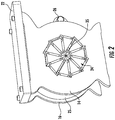
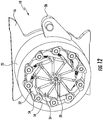
- FIGS. 1 , 2 and 6 illustrate a radial compression device 10 in accordance with the present invention.
- Device 10 includes a constraining structure 12, which in this preferred embodiment includes a pair of spaced apart stationary plates 14 and 16.
- Each plate 14 and 16 includes a generally centrally located cut-out 18 and 19, respectively, formed therethrough and defined by a plurality of bearing surfaces 20.
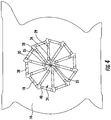
- Each cut-out 18 and 19, defined by bearing surfaces 20, is a general polygonal shape, with each bearing surface 20 forming a side of the polygonal shape. Cut-outs 18 and 19 are parallel and aligned, with matching bearing surfaces 20.
- Plates 14 and 16 are mounted to a base 22 to prevent relative movement and provide a secure device. While two plates 14 and 16 are described, it will be understood that one or more plates can be employed in constraining structure 12, as long a cut-out defined by bearing surfaces is present.
- Device 10 further includes a plurality of die 24 carried within cut-outs 18 and 19.
- Each die 24 extends between stationary plates 14 and 16, from cut-out 18 of plate 14 to cut-out 19 of plate 16.
- Plurality of die 24 are arranged in a generally circular pattern about a central axis, constrained by constraining structure 12 and movable between an open position and a closed position.
- a driving mechanism is coupled to at least one of the plurality of die 24 to drive all of the die in unison between the open position and the closed position.
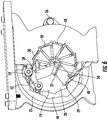
- the driving mechanism includes a rotating cam element 25 reciprocally rotatably carried between stationary plates 14 and 16 and actuated by an arm 26 driven by an actuating force.
- the actuating force can be provided by substantially any means, including electric motor, mechanical, manual and the like.
- Die 24 are moved within cut-outs 18 and 19 by cam element 25 between the open position ( FIG. 1 ) and the closed position ( FIG. 2 ) which can have an accurately round cavity at diameters as small as 0.3 mm.
- each die 24 is an isosceles-triangle or wedge shape, with a vertex 27 defined by converging sides 28 and 29 ( FIG. 8 ). Vertex 27 preferably has an angle of approximately 36 degrees in the preferred embodiment.
- Each die 24 also includes a base side 30 opposite vertex 27.
- the number of bearing surfaces 20 of cut-outs 18 and 19 is dependent upon the number of die 24 used.
- the polygonal shape of cut-outs 18 and 19 is a decagon carrying ten die 24. It will be understood that more or less die 24 can be used, with the polygonal shape corresponding to the number selected.
- the number of die may be varied over the practical range of 3 to 15 depending on the requirements and desires of the manufacturer. It should also be noted that the decagon described here would, in the general case, be a regular polygon with a number of sides equal to the die count, and that the vertex angle of the isosceles-triangular-shaped die would in general be equal to 360 degrees divided by the number of die.
- Plurality of die 24 are arranged in a generally circular pattern about a central axis with sides 28 of die 24 in parallel juxtaposition with sides 29 of adjacent die 24.
- This arrangement of die 24 is constrained within cut-outs 18 and 19, such that base side 30 of each die of the plurality of die 24 is positioned adjacent one of the bearing surfaces 20 forming the sides of the polygonal cut-outs 18 and 19.
- the dimensions of cut-outs 18 and 19, and the dimensions of die 24, are chosen so that there is just enough space to pack die 24 within cut-outs 18 and 19 of stationary plates 14 and 16 and engaging bearing surfaces 20. With the proper dimensions, bases 30 of die 24 bear on and are guided by bearing surfaces 20 and sides 28 of die 24 bear on and are guided by sides 29 of adjacent die 24.
- One portion of side 29 of each die 24, near vertex 27, forms a working surface 34 that contacts a product, and cooperates with the other die' working surface 34 to define a central cylindrically-shaped product-receiving cavity 35 generally at the central axis of the circular pattern of arranged die 24.
- each die 24 is free to move only in linear motion relative to the stationary plates, and only along a direction parallel to bearing surfaces 20 as indicated by arrowed line A, and only in unison with each other. Furthermore, this arrangement constrains each die 24 to move only in linear motion with respect to each of the two adjacent die 24, namely a sliding motion between sides 28 and sides 29 of adjacent die. Further still, this constrained and coordinated die motion results in a changing diameter of the central cylindrically-shaped product-receiving cavity 35 between the open position and the closed position. The motion is so completely constrained that, if bearing surfaces 20 were free of friction, a force applied to any one of die 24 would cause the whole group of die to move in unison to open or close central cavity 35.
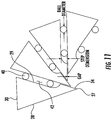
- the above-described arrangement of die 24 also results in a constant die-to-die gap that does not vary depending on the diameter of central cavity 35, as illustrated in FIGS. 9 and 10 .
- the dimension of the die-to-die gap may be designed to be any size, depending on the requirements of the application, but for many applications it should be as small as possible while preventing direct rubbing contact of working tips 34, in accordance with the achievable manufacturing tolerances of the parts. In some applications, direct rubbing contact of the adjacent working tips 34 may be allowable or desirable.
- Contact between die 24 can be made by direct sliding contact of planar surfaces, with or without lubricating grease or oil or can be made to slide easier on one another and bearing surfaces 20 by application of low friction materials, or by use of bearing elements such as rolling cylinders (also known commonly as “needle rollers") or by the use of balls 40 as in the preferred embodiment illustrated.
- Bearing balls 40 are used for die-to-die bearing and guidance. Balls 40 are positioned between adjacent sides 28 and 29 of adjacent die 24 as well as between base 30 and bearing surfaces 20. Die 24 and rolling bearing balls 40 are preferably made from hard material such as hardened tool steel or hardened martensitic stainless steel or ceramic. Bearing balls 40 provide low friction, long service life with low wear, low maintenance, and very good guiding precision. In this embodiment, the precision of the die-to-die gaps is influenced only by a small number of parts comprising die 24 themselves and rolling bearing balls 40.
- die 24 can be modified to further reduce the gap created between die 24 by forming an inset step 42 along side 29 of each die 24.
- Bearing balls 40 are carried between die 24 within inset steps 42, each of which act as a ball race. In this manner, friction between die 24 is reduced by bearing balls 40 while a very slight, if any, gap is created at working tips 34.
- the dimension of inset step 42 between working tip surface 34 and the ball-race surface a feature that can easily be made to very high precision. For example, readily available metal cutting methods such as surface grinding or wire-cut EDM can make such cuts with accuracy plus or minus 0.0002 inches.
- bearing and guidance that occurs between die 24 and stationary plates 14 and 16, and also between the sides of adjacent die 24, may practically be achieved with a wide range of design elements, such as 1) direct sliding surface contact of the parts with or without lubricating grease or oil, or 2) by coating, laminating, or attaching various commonly-used friction-reducing or wear-enhancing materials, or 3) rolling cylinders (also known commonly as “needle rollers", or 4) cam-follower type ball bearing or plain bearings rolling on planer surfaces, or 5) rolling balls placed between the adjacent parts, as is shown in the embodiment in FIGS. 1-4 and 6 .
- design elements such as 1) direct sliding surface contact of the parts with or without lubricating grease or oil, or 2) by coating, laminating, or attaching various commonly-used friction-reducing or wear-enhancing materials, or 3) rolling cylinders (also known commonly as “needle rollers", or 4) cam-follower type ball bearing or plain bearings rolling on planer surfaces, or 5) rolling balls placed between the adjacent parts, as is shown in the embodiment
- the shape of the die although shown to be isosceles triangular in this easy-to-illustrate embodiment, could in general take a wide variety of shapes, provided that the directions of linear motion allowed by the three bearing and guiding mechanisms engaging each die form an isosceles triangle.
- central cavity 35 of device 10 can be opened or closed by a wide variety of actuating methods that apply a force to one or more die 24, one preferred embodiment uses rotating cam element 25 to simultaneously actuate all die 24. Simultaneous actuation of all die 24 imposes lower forces on the bearing and guiding apparatus compared to actuation of just one or a few of die 24, though this is possible.
- a rotating cam element 25 is rotatably coupled to and between stationary plates 14 and 16.
- Rotating cam 25 includes a cam surface 50 for each die 24.
- each die includes a pair of arms 52 terminating in rollers 54 also referred to as cam follower bearings.
- Arms 52 extend perpendicularly from base 30 and are intermediate stationary plates 14 and 16 when die 24 is mounted in housing 12.
- Cam surfaces 50 engage rollers or cam-follower bearings 54 of each die 24.
- Cam element 25 can be rotated to move die 24 between the open and the closed positions and continuously increase or decrease the diameter of central cavity 35.
- an actuating arm 26 is attached to rotating cam element 25 such that a downward force on arm 26 from an actuator such as an air cylinder, handle, or electric motor closes central cavity 35.
- Arm 26 can be operated continuously to increase or decrease the diameter of the central cavity.
- any device to be radially compressed such as a stent, balloon, catheter, etc, is inserted into central cavity 35. Arm 26 is then operated to continuously reduce the diameter of central cavity 35 until the product is suitably compressed.
- die 24 are moved to a closed position by cam element 25, against a bias generated by return springs 60 carried between adjacent arms 52. Upon release of roller 54 from cam surfaces 50, springs 60 bias die 24 to the open position.
- the new and novel radial compression mechanism is constructed to operate with a constant gap between adjacent die and to move the die in unison between a maximum diameter central cavity and a minimum diameter central cavity with a continuous radial movement, and to be manufacturable with very small and precise gaps between adjacent die. Therefore, the large and variable gaps of some prior art devices, and the relatively imprecise gaps of other prior art devices have been overcome.
Landscapes
- Health & Medical Sciences (AREA)
- Engineering & Computer Science (AREA)
- Biomedical Technology (AREA)
- Mechanical Engineering (AREA)
- Life Sciences & Earth Sciences (AREA)
- Public Health (AREA)
- Heart & Thoracic Surgery (AREA)
- Vascular Medicine (AREA)
- Oral & Maxillofacial Surgery (AREA)
- Animal Behavior & Ethology (AREA)
- General Health & Medical Sciences (AREA)
- Transplantation (AREA)
- Veterinary Medicine (AREA)
- Cardiology (AREA)
- Moulds For Moulding Plastics Or The Like (AREA)
- Media Introduction/Drainage Providing Device (AREA)
- Perforating, Stamping-Out Or Severing By Means Other Than Cutting (AREA)
- Mounting, Exchange, And Manufacturing Of Dies (AREA)
- Prostheses (AREA)
Claims (9)
- Radialer Kompressionsmechanismus (10), der Folgendes umfasst:eine einschränkende Struktur (12), die einen dahindurch ausgebildeten Ausschnitt beinhaltet, wobei der Ausschnitt (18, 19) durch mehrere Lageroberflächen (20) definiert ist;mehrere Gesenke (24), die von der einschränkenden Struktur getragen und in einem kreisförmigen Muster um eine Mittelachse angeordnet sind;wobei jedes Gesenk der mehreren Gesenke eine Arbeitsoberfläche (34) aufweist, wobei die Arbeitsoberflächen der mehreren Gesenke zusammenwirken, um einen mittleren produktaufnehmenden zylindrisch gestalteten Hohlraum (35) auszubilden, der zwischen einer offenen Position und einer geschlossenen Position beweglich ist, während sich die mehreren Gesenke gemeinsam bewegen; undeinen Antriebsmechanismus, der mit wenigstens einem der mehreren Gesenke gekoppelt ist, um alle Gesenke gemeinsam zwischen der offenen Position und der geschlossenen Position anzutreiben, dadurch gekennzeichnet, dass:die einschränkende Struktur stationär ist; undjedes Gesenk der mehreren Gesenke eine Keilform mit einer Basisseite (30) aufweist, die in paralleler Nebeneinanderstellung zu einer entsprechenden Lageroberfläche der mehreren Lageroberflächen positioniert ist, wobei jedes Gesenk eingeschränkt ist, um sich wechselseitig und linear entlang der entsprechenden Lageroberfläche zu bewegen.
- Radialer Kompressionsmechanismus (10) nach Anspruch 1, wobei jedes der mehreren Gesenke (24) eine Gleitoberfläche (28) gegenüber der Arbeitsoberfläche (34) aufweist, wobei die Gleitoberfläche jedes Gesenks der mehreren Gesenke in einer im Wesentlichen parallelen Nebeneinanderstellung zu der Arbeitsoberfläche eines angrenzenden Gesenks positioniert ist, wobei ein Spalt mit konstanter Breite zwischen der Gleitoberfläche jedes Gesenks der mehreren Gesenke und der Arbeitsoberfläche jedes angrenzenden Gesenks der mehreren Gesenke definiert ist.
- Radialer Kompressionsmechanismus (10) nach Anspruch 1, wobei der Antriebsmechanismus ein Nockenelement (25) beinhaltet, das relativ zu der einschränkenden Struktur (12) beweglich ist, wobei das Nockenelement wenigstens eine Nockenoberfläche (50) aufweist, die wenigstens eines der mehreren Gesenke (24) in Eingriff nimmt, wobei eine Bewegung des Nockenelements gleichzeitig alle Gesenke gemeinsam zwischen der offenen Position und der geschlossenen Position antreibt.
- Radialer Kompressionsmechanismus (10) nach Anspruch 1, wobei der Antriebsmechanismus ein Nockenelement (25) beinhaltet, das relativ zu der einschränkenden Struktur beweglich ist, wobei das Nockenelement mehrere Nockenoberflächen (50) beinhaltet, wobei jede Nockenoberfläche einem der Gesenke der mehreren Gesenke (24) entspricht und dieses in Eingriff nimmt, wobei die Bewegung des Nockenelements gleichzeitig alle Gesenke gemeinsam zwischen der offenen Position und der geschlossenen Position antreibt.
- Radialer Kompressionsmechanismus (10) nach Anspruch 1, wobei der Eingriff zwischen angrenzenden Gesenken der mehreren Gesenke (24) und zwischen jedem Gesenk und der entsprechenden Lageroberfläche (20) ein direkter Gleitoberflächenkontakt dazwischen ist, der verschiedene reibungsmindernde oder verschleißbeständige Materialien dazwischen beschichtet, laminiert oder anbringt und Lagerelemente dazwischen positioniert.
- Radialer Kompressionsmechanismus (10) nach Anspruch 1, wobei der Ausschnitt (18, 19) eine polygonale Form aufweist und wobei jede Lageroberfläche (20) eine Seite der polygonalen Form ausbildet.
- Radialer Kompressionsmechanismus (10) nach Anspruch 1, wobei die mehreren Gesenke (24) zwischen 3 und 15 Gesenke (24) beinhalten.
- Radialer Kompressionsmechanismus (10) nach Anspruch 1, wobei der mittlere produktaufnehmende zylindrisch gestaltete Hohlraum (35) in der geschlossenen Position so klein wie 0,3 mm ist.
- Radialer Kompressionsmechanismus (10) nach Anspruch 1, wobei die einschränkende Struktur Folgendes umfasst:eine erste stationäre Platte (14), die einen dahindurch ausgebildeten ersten Ausschnitt (18) beinhaltet, wobei der erste Ausschnitt durch mehrere Lageroberflächen (20) definiert ist; undeine zweite stationäre Platte (16), die einen dahindurch ausgebildeten zweiten Ausschnitt (19) beinhaltet, wobei der zweite Ausschnitt durch mehrere Lageroberflächen (20) definiert ist.
Applications Claiming Priority (3)
| Application Number | Priority Date | Filing Date | Title |
|---|---|---|---|
| US201562235075P | 2015-09-30 | 2015-09-30 | |
| US15/276,539 US9821363B2 (en) | 2015-09-30 | 2016-09-26 | Radial compression device with constrained dies |
| PCT/US2016/054360 WO2017059024A1 (en) | 2015-09-30 | 2016-09-29 | Radial compression device with constrained die |
Publications (3)
| Publication Number | Publication Date |
|---|---|
| EP3294232A1 EP3294232A1 (de) | 2018-03-21 |
| EP3294232A4 EP3294232A4 (de) | 2019-03-06 |
| EP3294232B1 true EP3294232B1 (de) | 2020-10-21 |
Family
ID=58406162
Family Applications (1)
| Application Number | Title | Priority Date | Filing Date |
|---|---|---|---|
| EP16852567.3A Active EP3294232B1 (de) | 2015-09-30 | 2016-09-29 | Radialverdichtungsvorrichtung mit begrenzter matrize |
Country Status (5)
| Country | Link |
|---|---|
| US (1) | US9821363B2 (de) |
| EP (1) | EP3294232B1 (de) |
| JP (1) | JP6703552B2 (de) |
| CN (1) | CN107949350B (de) |
| WO (1) | WO2017059024A1 (de) |
Families Citing this family (15)
| Publication number | Priority date | Publication date | Assignee | Title |
|---|---|---|---|---|
| US10709591B2 (en) * | 2017-06-06 | 2020-07-14 | Twelve, Inc. | Crimping device and method for loading stents and prosthetic heart valves |
| US11677203B2 (en) | 2018-04-09 | 2023-06-13 | Hubbell Incorporated | Decagon compression die |
| JP7326451B2 (ja) * | 2019-01-24 | 2023-08-15 | ブロックワイズ エンジニアリング エルエルシー | 半径方向圧縮機械 |
| US11229941B1 (en) * | 2019-04-22 | 2022-01-25 | Blockwise Engineering Llc | Radial compression mechanism |
| CN111468547B (zh) * | 2020-05-30 | 2021-08-06 | 东台磊达钢帘线有限公司 | 一种拉丝模具 |
| DE102020121142B4 (de) * | 2020-08-11 | 2022-03-10 | Uniflex - Hydraulik GmbH | Radialpresse |
| US20240001630A1 (en) * | 2020-11-30 | 2024-01-04 | Arctic Biomaterials Oy | Method for manufacturing fiber reinforced article and apparatus |
| JP7485303B2 (ja) * | 2021-03-31 | 2024-05-16 | テルモ株式会社 | 形状付け装置および形状付け方法 |
| JP2022155878A (ja) * | 2021-03-31 | 2022-10-14 | テルモ株式会社 | 形状付け装置 |
| CN113334268B (zh) * | 2021-05-10 | 2023-03-31 | 哈尔滨玻璃钢研究院有限公司 | 一种铰链软配合定位工装及其使用方法 |
| US20220401242A1 (en) * | 2021-06-16 | 2022-12-22 | Boston Scientific Scimed, Inc. | Medical device loading tool |
| WO2023064263A1 (en) * | 2021-10-12 | 2023-04-20 | Boston Scientific Scimed, Inc. | Device and method for compressing and loading a stent |
| CN117440790A (zh) * | 2021-11-12 | 2024-01-23 | 美利奴生命科学有限公司 | 径向收缩医疗器械的装置和方法 |
| CN115414165A (zh) * | 2022-09-19 | 2022-12-02 | 苏州美创医疗科技有限公司 | 手持tips支架压缩装置及方法 |
| US12544823B2 (en) * | 2022-12-20 | 2026-02-10 | Stolle Machinery Company, Llc | Ram support assembly for a can bodymaker and can bodymaker including same |
Family Cites Families (16)
| Publication number | Priority date | Publication date | Assignee | Title |
|---|---|---|---|---|
| US1480077A (en) * | 1920-02-13 | 1924-01-08 | Edward E Johnson | Die-forging machine |
| US4041766A (en) * | 1976-06-03 | 1977-08-16 | Gte Sylvania Incorporated | Swaging device for use within a die apparatus |
| US4454657A (en) * | 1980-07-25 | 1984-06-19 | Japan Aviation Electronics Industry Limited | Aperture setting device |
| US4454857A (en) * | 1982-09-28 | 1984-06-19 | Miller Allen W | Peep sight for a bow |
| US5715723A (en) * | 1996-08-14 | 1998-02-10 | Owens; Carl H. | Hose crimping apparatus |
| WO2004019768A2 (en) * | 2002-08-31 | 2004-03-11 | Machine Solutions, Inc. | Hand held stent crimping apparatus and method |
| EP1768630B1 (de) * | 2004-06-16 | 2015-01-07 | Machine Solutions, Inc. | Stent-Komprimiervorrichtung |
| WO2007010339A2 (en) * | 2005-07-19 | 2007-01-25 | Pi.Effe.Ci. S.R.L. | Tool for the connection of tubes by means of connection sleeves |
| US7530253B2 (en) * | 2005-09-09 | 2009-05-12 | Edwards Lifesciences Corporation | Prosthetic valve crimping device |
| US7963142B2 (en) * | 2006-08-22 | 2011-06-21 | Ed Goff | Radial compression mechanism with optimum die-to-die gap |
| US7886661B1 (en) * | 2007-02-07 | 2011-02-15 | Ed Goff | Radial compression mechanism |
| US8245559B1 (en) * | 2007-04-11 | 2012-08-21 | Warriner Jeremiah J | Radial compression mechanism with optimum die-to-die gap |
| US8220307B2 (en) * | 2007-08-21 | 2012-07-17 | Ed Goff | Radial compression mechanism with optimum die-to-die gap |
| TW201008714A (en) * | 2008-07-02 | 2010-03-01 | Rennsteig Werkzeuge Gmbh | Crimping tool |
| EP2720651A4 (de) * | 2011-06-20 | 2014-12-31 | Mach Solutions Inc | Vorrichtung und verfahren zum laden von stents in abgaberöhren |
| WO2013101704A1 (en) * | 2011-12-31 | 2013-07-04 | The Gates Corporation | Crimper system |
-
2016
- 2016-09-26 US US15/276,539 patent/US9821363B2/en active Active
- 2016-09-29 EP EP16852567.3A patent/EP3294232B1/de active Active
- 2016-09-29 WO PCT/US2016/054360 patent/WO2017059024A1/en not_active Ceased
- 2016-09-29 JP JP2017560323A patent/JP6703552B2/ja active Active
- 2016-09-29 CN CN201680031081.9A patent/CN107949350B/zh active Active
Non-Patent Citations (1)
| Title |
|---|
| None * |
Also Published As
| Publication number | Publication date |
|---|---|
| CN107949350A (zh) | 2018-04-20 |
| EP3294232A1 (de) | 2018-03-21 |
| CN107949350B (zh) | 2020-09-15 |
| WO2017059024A8 (en) | 2018-09-20 |
| EP3294232A4 (de) | 2019-03-06 |
| WO2017059024A1 (en) | 2017-04-06 |
| US9821363B2 (en) | 2017-11-21 |
| US20170087620A1 (en) | 2017-03-30 |
| JP2018531629A (ja) | 2018-11-01 |
| JP6703552B2 (ja) | 2020-06-03 |
Similar Documents
| Publication | Publication Date | Title |
|---|---|---|
| EP3294232B1 (de) | Radialverdichtungsvorrichtung mit begrenzter matrize | |
| US7886661B1 (en) | Radial compression mechanism | |
| US7963142B2 (en) | Radial compression mechanism with optimum die-to-die gap | |
| US8245559B1 (en) | Radial compression mechanism with optimum die-to-die gap | |
| US8220307B2 (en) | Radial compression mechanism with optimum die-to-die gap | |
| EP3914199B1 (de) | Radialkompressionsmaschine | |
| US9285021B2 (en) | Linear module with a support device | |
| US10137927B2 (en) | Rack guide for rack and pinion steering device, rack and pinion steering device and manufacturing method of rack guide for rack and pinion steering device | |
| US8702414B1 (en) | Lip adjustment push system | |
| JP6331835B2 (ja) | トグル用の軸受ブッシュ | |
| KR101918194B1 (ko) | 축체 삽입물의 배치 장치 | |
| TWI790298B (zh) | 輪胎建造裝置和用於連接或切割輪胎構件的方法 | |
| KR20130026147A (ko) | 피스톤링용 지그 및 이를 이용한 레이저 표면 텍스처링 방법 | |
| US11229941B1 (en) | Radial compression mechanism | |
| JP2010012559A (ja) | スナップリング収縮装置 | |
| JP6790391B2 (ja) | 転がり軸受の楕円測定装置、楕円測定方法、及び転がり軸受の製造方法 | |
| JP2017166888A5 (ja) | 転がり軸受の楕円測定装置、楕円測定方法、及び転がり軸受の製造方法 | |
| CN209102528U (zh) | 一种钢筋弯曲试验机 | |
| US9132467B2 (en) | Method and tool for the cylindrical deformation of an Al sleeve to the core dimension of the internal plastic closure, as preparation for a diffusion-proof press connection within the two components | |
| US4230009A (en) | Rotary tool positioner | |
| JP6342365B2 (ja) | ロール成形装置 | |
| JP7285137B2 (ja) | 可動子およびローラガイド装置 | |
| CN217738626U (zh) | 一种疲劳试验用往复运动装置 | |
| JP6618791B2 (ja) | ベルトラッパー | |
| US9249664B2 (en) | Bent axis type axial piston motor |
Legal Events
| Date | Code | Title | Description |
|---|---|---|---|
| STAA | Information on the status of an ep patent application or granted ep patent |
Free format text: STATUS: THE INTERNATIONAL PUBLICATION HAS BEEN MADE |
|
| PUAI | Public reference made under article 153(3) epc to a published international application that has entered the european phase |
Free format text: ORIGINAL CODE: 0009012 |
|
| STAA | Information on the status of an ep patent application or granted ep patent |
Free format text: STATUS: REQUEST FOR EXAMINATION WAS MADE |
|
| 17P | Request for examination filed |
Effective date: 20171214 |
|
| AK | Designated contracting states |
Kind code of ref document: A1 Designated state(s): AL AT BE BG CH CY CZ DE DK EE ES FI FR GB GR HR HU IE IS IT LI LT LU LV MC MK MT NL NO PL PT RO RS SE SI SK SM TR |
|
| AX | Request for extension of the european patent |
Extension state: BA ME |
|
| RIN1 | Information on inventor provided before grant (corrected) |
Inventor name: WARRINER, JEREMIAH, J. Inventor name: GOFF, ED |
|
| RIN1 | Information on inventor provided before grant (corrected) |
Inventor name: WARRINER, JEREMIAH J. Inventor name: GOFF, ED |
|
| DAV | Request for validation of the european patent (deleted) | ||
| DAX | Request for extension of the european patent (deleted) | ||
| A4 | Supplementary search report drawn up and despatched |
Effective date: 20190131 |
|
| RIC1 | Information provided on ipc code assigned before grant |
Ipc: A61F 2/82 20130101ALI20190125BHEP Ipc: B21J 7/16 20060101ALI20190125BHEP Ipc: A61F 2/844 20130101AFI20190125BHEP Ipc: B25B 27/10 20060101ALI20190125BHEP Ipc: A61F 2/06 20130101ALI20190125BHEP Ipc: B21C 3/06 20060101ALI20190125BHEP Ipc: A61F 2/95 20130101ALI20190125BHEP Ipc: B30B 7/04 20060101ALI20190125BHEP Ipc: A61F 2/07 20130101ALI20190125BHEP Ipc: B21D 41/04 20060101ALI20190125BHEP |
|
| GRAP | Despatch of communication of intention to grant a patent |
Free format text: ORIGINAL CODE: EPIDOSNIGR1 |
|
| STAA | Information on the status of an ep patent application or granted ep patent |
Free format text: STATUS: GRANT OF PATENT IS INTENDED |
|
| INTG | Intention to grant announced |
Effective date: 20200430 |
|
| GRAS | Grant fee paid |
Free format text: ORIGINAL CODE: EPIDOSNIGR3 |
|
| GRAA | (expected) grant |
Free format text: ORIGINAL CODE: 0009210 |
|
| STAA | Information on the status of an ep patent application or granted ep patent |
Free format text: STATUS: THE PATENT HAS BEEN GRANTED |
|
| AK | Designated contracting states |
Kind code of ref document: B1 Designated state(s): AL AT BE BG CH CY CZ DE DK EE ES FI FR GB GR HR HU IE IS IT LI LT LU LV MC MK MT NL NO PL PT RO RS SE SI SK SM TR |
|
| REG | Reference to a national code |
Ref country code: GB Ref legal event code: FG4D |
|
| REG | Reference to a national code |
Ref country code: CH Ref legal event code: NV Representative=s name: ISLER AND PEDRAZZINI AG, CH Ref country code: CH Ref legal event code: EP |
|
| REG | Reference to a national code |
Ref country code: IE Ref legal event code: FG4D |
|
| REG | Reference to a national code |
Ref country code: DE Ref legal event code: R096 Ref document number: 602016046453 Country of ref document: DE |
|
| REG | Reference to a national code |
Ref country code: AT Ref legal event code: REF Ref document number: 1325066 Country of ref document: AT Kind code of ref document: T Effective date: 20201115 |
|
| REG | Reference to a national code |
Ref country code: NL Ref legal event code: FP |
|
| REG | Reference to a national code |
Ref country code: AT Ref legal event code: MK05 Ref document number: 1325066 Country of ref document: AT Kind code of ref document: T Effective date: 20201021 |
|
| PG25 | Lapsed in a contracting state [announced via postgrant information from national office to epo] |
Ref country code: FI Free format text: LAPSE BECAUSE OF FAILURE TO SUBMIT A TRANSLATION OF THE DESCRIPTION OR TO PAY THE FEE WITHIN THE PRESCRIBED TIME-LIMIT Effective date: 20201021 Ref country code: GR Free format text: LAPSE BECAUSE OF FAILURE TO SUBMIT A TRANSLATION OF THE DESCRIPTION OR TO PAY THE FEE WITHIN THE PRESCRIBED TIME-LIMIT Effective date: 20210122 Ref country code: NO Free format text: LAPSE BECAUSE OF FAILURE TO SUBMIT A TRANSLATION OF THE DESCRIPTION OR TO PAY THE FEE WITHIN THE PRESCRIBED TIME-LIMIT Effective date: 20210121 Ref country code: PT Free format text: LAPSE BECAUSE OF FAILURE TO SUBMIT A TRANSLATION OF THE DESCRIPTION OR TO PAY THE FEE WITHIN THE PRESCRIBED TIME-LIMIT Effective date: 20210222 Ref country code: RS Free format text: LAPSE BECAUSE OF FAILURE TO SUBMIT A TRANSLATION OF THE DESCRIPTION OR TO PAY THE FEE WITHIN THE PRESCRIBED TIME-LIMIT Effective date: 20201021 |
|
| REG | Reference to a national code |
Ref country code: LT Ref legal event code: MG4D |
|
| PG25 | Lapsed in a contracting state [announced via postgrant information from national office to epo] |
Ref country code: SE Free format text: LAPSE BECAUSE OF FAILURE TO SUBMIT A TRANSLATION OF THE DESCRIPTION OR TO PAY THE FEE WITHIN THE PRESCRIBED TIME-LIMIT Effective date: 20201021 Ref country code: IS Free format text: LAPSE BECAUSE OF FAILURE TO SUBMIT A TRANSLATION OF THE DESCRIPTION OR TO PAY THE FEE WITHIN THE PRESCRIBED TIME-LIMIT Effective date: 20210221 Ref country code: LV Free format text: LAPSE BECAUSE OF FAILURE TO SUBMIT A TRANSLATION OF THE DESCRIPTION OR TO PAY THE FEE WITHIN THE PRESCRIBED TIME-LIMIT Effective date: 20201021 Ref country code: PL Free format text: LAPSE BECAUSE OF FAILURE TO SUBMIT A TRANSLATION OF THE DESCRIPTION OR TO PAY THE FEE WITHIN THE PRESCRIBED TIME-LIMIT Effective date: 20201021 Ref country code: BG Free format text: LAPSE BECAUSE OF FAILURE TO SUBMIT A TRANSLATION OF THE DESCRIPTION OR TO PAY THE FEE WITHIN THE PRESCRIBED TIME-LIMIT Effective date: 20210121 Ref country code: AT Free format text: LAPSE BECAUSE OF FAILURE TO SUBMIT A TRANSLATION OF THE DESCRIPTION OR TO PAY THE FEE WITHIN THE PRESCRIBED TIME-LIMIT Effective date: 20201021 Ref country code: ES Free format text: LAPSE BECAUSE OF FAILURE TO SUBMIT A TRANSLATION OF THE DESCRIPTION OR TO PAY THE FEE WITHIN THE PRESCRIBED TIME-LIMIT Effective date: 20201021 |
|
| PG25 | Lapsed in a contracting state [announced via postgrant information from national office to epo] |
Ref country code: HR Free format text: LAPSE BECAUSE OF FAILURE TO SUBMIT A TRANSLATION OF THE DESCRIPTION OR TO PAY THE FEE WITHIN THE PRESCRIBED TIME-LIMIT Effective date: 20201021 |
|
| REG | Reference to a national code |
Ref country code: DE Ref legal event code: R097 Ref document number: 602016046453 Country of ref document: DE |
|
| PG25 | Lapsed in a contracting state [announced via postgrant information from national office to epo] |
Ref country code: SM Free format text: LAPSE BECAUSE OF FAILURE TO SUBMIT A TRANSLATION OF THE DESCRIPTION OR TO PAY THE FEE WITHIN THE PRESCRIBED TIME-LIMIT Effective date: 20201021 Ref country code: LT Free format text: LAPSE BECAUSE OF FAILURE TO SUBMIT A TRANSLATION OF THE DESCRIPTION OR TO PAY THE FEE WITHIN THE PRESCRIBED TIME-LIMIT Effective date: 20201021 Ref country code: CZ Free format text: LAPSE BECAUSE OF FAILURE TO SUBMIT A TRANSLATION OF THE DESCRIPTION OR TO PAY THE FEE WITHIN THE PRESCRIBED TIME-LIMIT Effective date: 20201021 Ref country code: EE Free format text: LAPSE BECAUSE OF FAILURE TO SUBMIT A TRANSLATION OF THE DESCRIPTION OR TO PAY THE FEE WITHIN THE PRESCRIBED TIME-LIMIT Effective date: 20201021 Ref country code: SK Free format text: LAPSE BECAUSE OF FAILURE TO SUBMIT A TRANSLATION OF THE DESCRIPTION OR TO PAY THE FEE WITHIN THE PRESCRIBED TIME-LIMIT Effective date: 20201021 Ref country code: RO Free format text: LAPSE BECAUSE OF FAILURE TO SUBMIT A TRANSLATION OF THE DESCRIPTION OR TO PAY THE FEE WITHIN THE PRESCRIBED TIME-LIMIT Effective date: 20201021 |
|
| PLBE | No opposition filed within time limit |
Free format text: ORIGINAL CODE: 0009261 |
|
| STAA | Information on the status of an ep patent application or granted ep patent |
Free format text: STATUS: NO OPPOSITION FILED WITHIN TIME LIMIT |
|
| PG25 | Lapsed in a contracting state [announced via postgrant information from national office to epo] |
Ref country code: DK Free format text: LAPSE BECAUSE OF FAILURE TO SUBMIT A TRANSLATION OF THE DESCRIPTION OR TO PAY THE FEE WITHIN THE PRESCRIBED TIME-LIMIT Effective date: 20201021 |
|
| 26N | No opposition filed |
Effective date: 20210722 |
|
| PG25 | Lapsed in a contracting state [announced via postgrant information from national office to epo] |
Ref country code: AL Free format text: LAPSE BECAUSE OF FAILURE TO SUBMIT A TRANSLATION OF THE DESCRIPTION OR TO PAY THE FEE WITHIN THE PRESCRIBED TIME-LIMIT Effective date: 20201021 Ref country code: IT Free format text: LAPSE BECAUSE OF FAILURE TO SUBMIT A TRANSLATION OF THE DESCRIPTION OR TO PAY THE FEE WITHIN THE PRESCRIBED TIME-LIMIT Effective date: 20201021 |
|
| PG25 | Lapsed in a contracting state [announced via postgrant information from national office to epo] |
Ref country code: SI Free format text: LAPSE BECAUSE OF FAILURE TO SUBMIT A TRANSLATION OF THE DESCRIPTION OR TO PAY THE FEE WITHIN THE PRESCRIBED TIME-LIMIT Effective date: 20201021 |
|
| REG | Reference to a national code |
Ref country code: BE Ref legal event code: MM Effective date: 20210930 |
|
| PG25 | Lapsed in a contracting state [announced via postgrant information from national office to epo] |
Ref country code: IS Free format text: LAPSE BECAUSE OF FAILURE TO SUBMIT A TRANSLATION OF THE DESCRIPTION OR TO PAY THE FEE WITHIN THE PRESCRIBED TIME-LIMIT Effective date: 20210221 Ref country code: MC Free format text: LAPSE BECAUSE OF FAILURE TO SUBMIT A TRANSLATION OF THE DESCRIPTION OR TO PAY THE FEE WITHIN THE PRESCRIBED TIME-LIMIT Effective date: 20201021 |
|
| PG25 | Lapsed in a contracting state [announced via postgrant information from national office to epo] |
Ref country code: LU Free format text: LAPSE BECAUSE OF NON-PAYMENT OF DUE FEES Effective date: 20210929 Ref country code: BE Free format text: LAPSE BECAUSE OF NON-PAYMENT OF DUE FEES Effective date: 20210930 |
|
| PG25 | Lapsed in a contracting state [announced via postgrant information from national office to epo] |
Ref country code: HU Free format text: LAPSE BECAUSE OF FAILURE TO SUBMIT A TRANSLATION OF THE DESCRIPTION OR TO PAY THE FEE WITHIN THE PRESCRIBED TIME-LIMIT; INVALID AB INITIO Effective date: 20160929 |
|
| PG25 | Lapsed in a contracting state [announced via postgrant information from national office to epo] |
Ref country code: CY Free format text: LAPSE BECAUSE OF FAILURE TO SUBMIT A TRANSLATION OF THE DESCRIPTION OR TO PAY THE FEE WITHIN THE PRESCRIBED TIME-LIMIT Effective date: 20201021 |
|
| PG25 | Lapsed in a contracting state [announced via postgrant information from national office to epo] |
Ref country code: MK Free format text: LAPSE BECAUSE OF FAILURE TO SUBMIT A TRANSLATION OF THE DESCRIPTION OR TO PAY THE FEE WITHIN THE PRESCRIBED TIME-LIMIT Effective date: 20201021 |
|
| PGFP | Annual fee paid to national office [announced via postgrant information from national office to epo] |
Ref country code: NL Payment date: 20240816 Year of fee payment: 9 |
|
| PG25 | Lapsed in a contracting state [announced via postgrant information from national office to epo] |
Ref country code: MT Free format text: LAPSE BECAUSE OF FAILURE TO SUBMIT A TRANSLATION OF THE DESCRIPTION OR TO PAY THE FEE WITHIN THE PRESCRIBED TIME-LIMIT Effective date: 20201021 |
|
| PGFP | Annual fee paid to national office [announced via postgrant information from national office to epo] |
Ref country code: GB Payment date: 20240808 Year of fee payment: 9 |
|
| PGFP | Annual fee paid to national office [announced via postgrant information from national office to epo] |
Ref country code: FR Payment date: 20240808 Year of fee payment: 9 |
|
| REG | Reference to a national code |
Ref country code: CH Ref legal event code: U11 Free format text: ST27 STATUS EVENT CODE: U-0-0-U10-U11 (AS PROVIDED BY THE NATIONAL OFFICE) Effective date: 20251001 |
|
| PGFP | Annual fee paid to national office [announced via postgrant information from national office to epo] |
Ref country code: DE Payment date: 20250805 Year of fee payment: 10 |
|
| PGFP | Annual fee paid to national office [announced via postgrant information from national office to epo] |
Ref country code: IE Payment date: 20250812 Year of fee payment: 10 |
|
| PG25 | Lapsed in a contracting state [announced via postgrant information from national office to epo] |
Ref country code: TR Free format text: LAPSE BECAUSE OF FAILURE TO SUBMIT A TRANSLATION OF THE DESCRIPTION OR TO PAY THE FEE WITHIN THE PRESCRIBED TIME-LIMIT Effective date: 20201021 |
|
| PGFP | Annual fee paid to national office [announced via postgrant information from national office to epo] |
Ref country code: CH Payment date: 20251001 Year of fee payment: 10 |